Manchester Art Gallery. Part 1. The Females.

Manchester Art Gallery

If you happen to visit Manchester, England, you will find two main art galleries, the Manchester Art Gallery and the Whitworth Gallery.  Last weekend I was in the city for a weekend break and decided to revisit the main Manchester Art Gallery.

The main part of the collection is derived from the Royal Manchester Institution which demonstrated a partiality for purchasing contemporary art and that predilection continued when it eventually became the City Art Gallery in 1883.  The retired Bradford-based textile businessman and philanthropist with a passionate love of art, Charles Rutherston, although not an artist himself, was both an art collector and a generous friend and patron to artists.  He had amassed a large collection of paintings which he bequeathed to the Gallery in 1925.  Between the two World Wars, the Gallery accumulated a large number of contemporary artworks.  Today the Manchester Art Gallery has an extensive collection of work by nineteenth-century British artists, particularly the Pre-Raphaelites.  In 1979, the European Old Masters collection was transformed by the Assheton Bennett bequest of almost a hundred paintings, mainly by seventeenth-century Dutch and Flemish artists. Today the collection includes over 2,000 oil paintings, plus related studies and archival material, and there is a renewed focus on collecting contemporary art.  In the next three blogs I will be looking at some of  my favourites which were on view.

Study of Jane Morris

Chalk drawing of Jane Morris by Rossetti (1875)

In the Gallery, there are a number of paintings by the Pre-Raphaelite artists but the one I find the most haunting is Rossetti’s late work entitled Astarte Syriaca.  The story behind this work started back in 1875 with a chalk drawing Rossetti had made of Jane Morris, his lover.  Rossetti’s friend, Theodore Watts–Dunton, told Rossetti that the drawing could form the basis of a full-length Venus portrait.  After one of Rossetti’s patrons, Clarence Fry saw some of the preliminary sketches in August 1875, he commissioned Rossetti to complete the Venus painting.

Rossetti started working on the painting, Astarte Syriaca, sometimes known as Venus Astarte, in the Autumn of 1875 but abandoned it, unfinished in March 1876, saying that he was dissatisfied with it and he began work on the “second” Astarte.  Finally it was completed in December 1876 and framed at the end of January 1877 ready for his patron.  Jane Morris was the model for Venus (and May Morris, her sister, the attendant figure on the left)

Astarte Syriaca Dante Gabriel Rossetti

Astarte Syriacs by Dante Rossetti (1876)

The depiction is a full-length figure of a woman dressed in sea-green robes, gazing towards us, the viewer. Astarte Syriaca has long, thick. and wavy flowing hair that flows on her back.  She is pictured holding an ornate floral metal strap with her left hand under her chest. Her left hand seems to be holding a similar strap that rests around the hips area.  This is known as a traditional pudica pose.

Both her hands, the limbs, and her breast are large, and her lips seem to be full and pink. Astarte Syriaca portrait is one of Gabriel Rossetti’s iconic paintings that romantically evokes the marvellous power of women in the context of the European Symbolist Movement, the nascent pan. In the same breath, it signifies as a covert admonition of the patriarchal Victorian Christianity. It can as well be interpreted in various other ways.   The woman has one of her legs placed forward to look as if she is striding towards us.  Also in the painting we see two male figures placed symmetrically in the background.  Rossetti wrote a sonnet which was first published in 1877 and which accompanied the painting.

ASTARTE SYRIACA

Mystery: lo! betwixt the sun and moon

Astarte of the Syrians: Venus Queen

⁠Ere Aphrodite was. In silver sheen

Her twofold girdle clasps the infinite boon

Of bliss whereof the heaven and earth commune:

⁠And from her neck’s inclining flower-stem lean

Love-freighted lips and absolute eyes that wean

The pulse of hearts to the spheres’ dominant tune.

Torch-bearing, her sweet ministers compel

⁠All thrones of light beyond the sky and sea

⁠The witnesses of Beauty’s face to be:

That face, of Love’s all-penetrative spell

Amulet, talisman, and oracle,—

⁠Betwixt the sun and moon a mystery.

Cinderella by Valentine Prinsep (1899)

The next painting featuring a female is simply entitled Cinderella.  The artist is Valentine Cameron Prinsep who was born in India on St Valentine’s Day 1838.  His father was a civil servant based in the country but who would return to England with his family when Valentine was five years old.  Valentine’s mother was a great art lover and would often hold parties at their Kensington home with artists and writers, including poets Alfred Lord Tennyson and Robert Browning and artists John Everett Millais, Dante Gabriel Rossetti and Edward Burne-Jones. Although his parents assumed their son would follow his father into the Indian Civil Service but having been stirred by the artistic company he kept, Valentine decided his future life should be as an artist too.  Prinsep never reached the status of a great artist although he had his successes.  He was influenced by Rossetti, Millais and Burne-Jones, and he painted initially in the Pre-Raphaelite style. He exhibited at the Royal Academy of Arts for the first time in 1862, after travelling with Burne-Jones in Italy.

The painting, Cinderella, was completed in 1899 and is a work of great sentimentality.  The young girl rests against the stone wall of the kitchen.  It is a depiction of poverty.  The girl is barefooted and is wearing a dress which is ragged at the hem.  She raises the hem of the skirt to allow the warmth from the fire to caress her body.  Look at her posture and facial expression.  Is it a happy looking expression awaiting for the arrival of somebody she looks forward to seeing or is it one of trepidation at the thought of the impending arrival?  We all know the story of Cinderella so probably we also know the answer to the question.
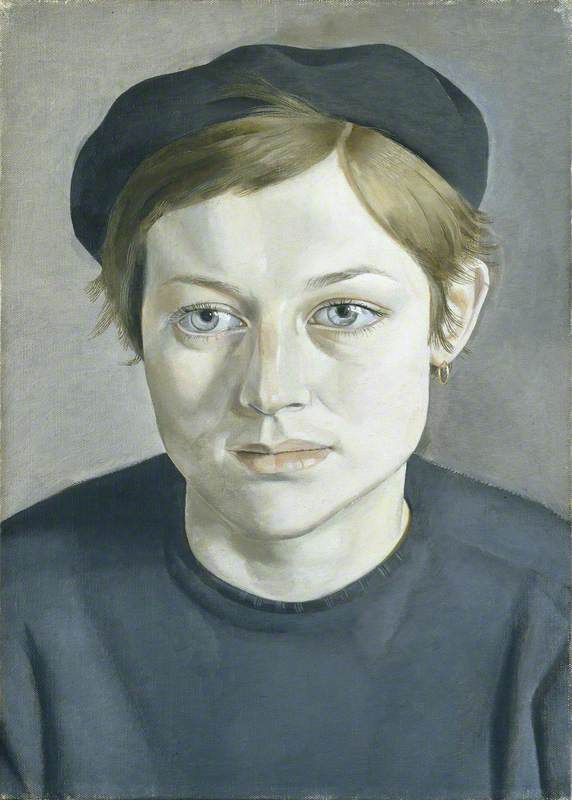
Girl with Beret
Girl with a Beret by Lucian Freud (1951)

Girl with a Beret, the 1959 painting by Lucian Freud is a beautifully painted, close-up head and shoulders portrait of a young woman wearing a plain blue-grey jumper and beret. The girl has pale skin and shiny blue eyes, which stare off to the left in a self-absorbed manner. Her hair is parted to one side and she wears a small gold hoop earring in her left ear. The background colour is muted.  Freud liked his portraits to be of people he knew well and as such were people Lucien had a close personal relationship with and because of this, these portraits could be looked upon as being pictorial autobiographies.  The sitter for this portrait is the Irish actress, Helena Hughes who was twenty-three at the time.  Helena had been introduced to Freud by his lover Anne Dunn during one of his frequent visits to Dublin in the 1950s. In 1950, Helena Hughes had invited Freud to Paris where she was working on a stage production with Orson Welles. The portrait took more than one hundred and fifty sittings to complete and for this protracted length of time artist and model were together which led to an intensity of their relationship and in a way, this could be detected within the painting.
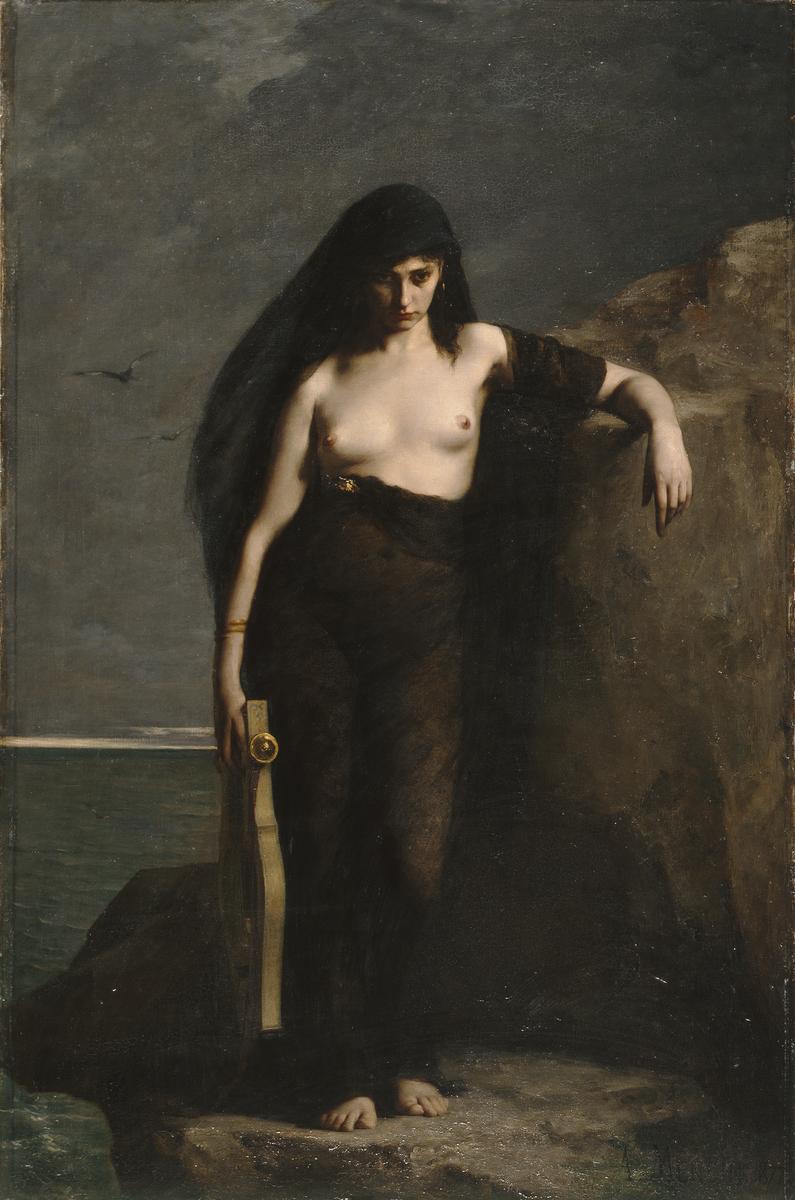
Sapho by Charles-August Mengin (1877)

The painting entitled Sapho was completed in 1877 by Charles-August Mengin, a French Academic painter and sculptor.  He was a pupil of Alexandre Cabanel and exhibited regularly at the Salon from 1876 to 1927.  Sappho was a Greek lyric poet born around 600 BC. Her poems considered love, desire and contemplation.  Many of her works were devoted to her female pupils who studied with her on the island of Lesbos. Legend had it that she threw herself into the sea from the cliff of Leucadia because Phaon, a young man from Mitylene, did not return her love.  In the painting we see Sapho depicted standing on the cliff edge in dark, in translucent robes, with her breasts exposed. Her left arm rests lightly at shoulder height, on a huge rock whilst her right hand holds her lyre down by her right side. Her face is partly put in the shade by her dark wavy hair, gauzy veil. Her dark eyes, which have shadows beneath them, stare down into the middle distance.  Her feet are bare. She wears gold hoop earrings, a gold bangle, and there is a gold tie or belt around her waist. The dark sky in the background, which is only broken by a sliver of light on the horizon adds to the feeling of impending doom.  Two grey birds fly in the sky behind.

And now for something different.  Gone is the exotic beauty of Sapho and Artiste Syriaca.  Gone is the everyday prettiness of the girl wearing her Beret.  It is now about the reality of mortality.
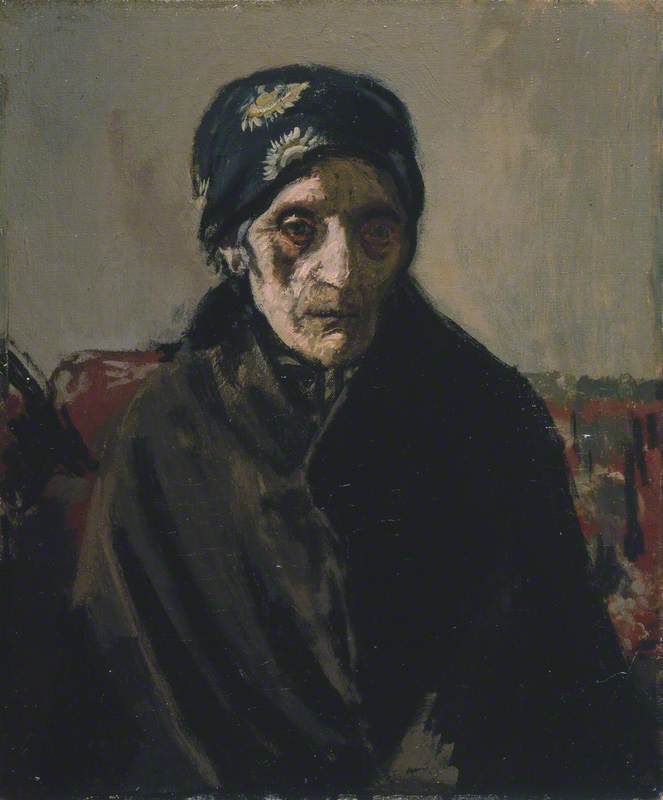
Mamma Mia Poveretta
Mama Mia Poveretta by Walter Sickert (c.1904)

Walter Sickert, a German-born English painter, made a series of visits to Venice, initially focusing on the city’s topography but it was during his last painting trip from the autumn of 1903 to the summer of 1904 that, due to inclement weather, he was forced indoors to his small studio at 940 Calle dei Frati, close to the Rialto, to paint and it was during that time he developed a distinctive approach to portraiture.  The models for many of the Venetian paintings are believed to have been prostitutes, whom Sickert might have known through being a client.  One of his models which he nicknamed La Giuseppina was his favourite and one day she arrived at the studio with her mother, the old lady who became known as mamma mia poveretta (my poor mother)

La Giuseppina
La Giuseppina by Walter Sickert (1904). Yale Center for British Art, Paul Mellon Fund

In the first decade of the twentieth century in Britain which was also the end of the reign of Queen Victoria, artists and designers began to try new things.  Artists were starting to create a new art for a modern era. Traditional ways of completing portraits, landscapes and interiors would be undertaken in new ways.  Gone was the romantic view of life and an acceptance that urban life was often a matter of hectic rushing around and there was definitely an air of brutality to it.  Life was becoming a challenge.  Walter Sickert’s 1904 painting entitled Mama Mia Poveretta is realist depiction of life.  It is a half-length frontal portrait of this gaunt, almost emaciated elderly Venetian woman who is nearing the end of a hard life.  She is wrapped in a dark shawl and wears a headscarf. She has turned her head slightly to the right, and her face is illuminated from the left and highlights the darkness around her eyes.

In my next blog I will look at work by some of the Pre-Raphaeliete artists which are on display at the Manchester Art Gallery.

………………………………..to be continued
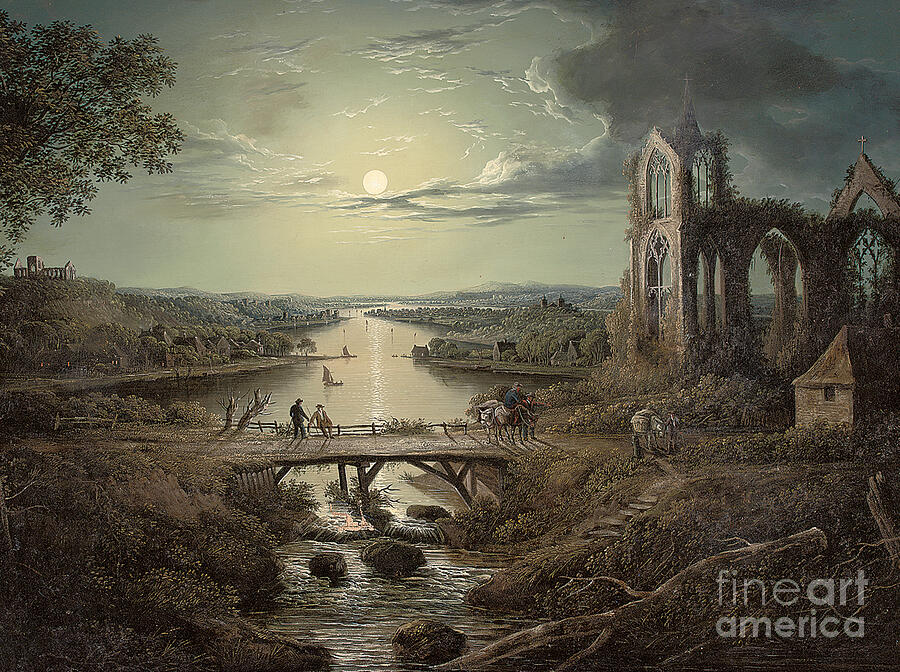
The Moonlight Pethers

Today I am looking at a family of artists who specialised in painting moonlight scenes, so much so they were known as the Moonlight Pethers.  This is a story about Abraham Pether and his two sons Henry and Sebastian who lived and worked in Southampton, England in the late 18th and early 19th Centuries.

Abraham Pether, the patriarch, was a landscape painter who was born at Chichester in 1756. He was the cousin of the notable engraver, William Pether. He could have been a professional musician as at the tender age of nine, he showed a great talent for music, and played the organ in one of the Chichester churches. However, his main love became art and he received artistic training from George Smith, an English landscape painter and poet.  Within a short period of time the talent of the pupil matched that of his master.

See the source image

A moonlit view of the River Tweed with Melrose Abbey in the foreground and figures on a bridge by Abraham Pether

Abraham painted river and mountain scenery, incorporating classical buildings, in an attractive though artificial style.  Some compared his work with the great Welsh landscape painter Richard Wilson.  However, Abraham Pether will be remembered for his moonlight subjects which warranted him the moniker, ‘Moonlight’ Pether.

media

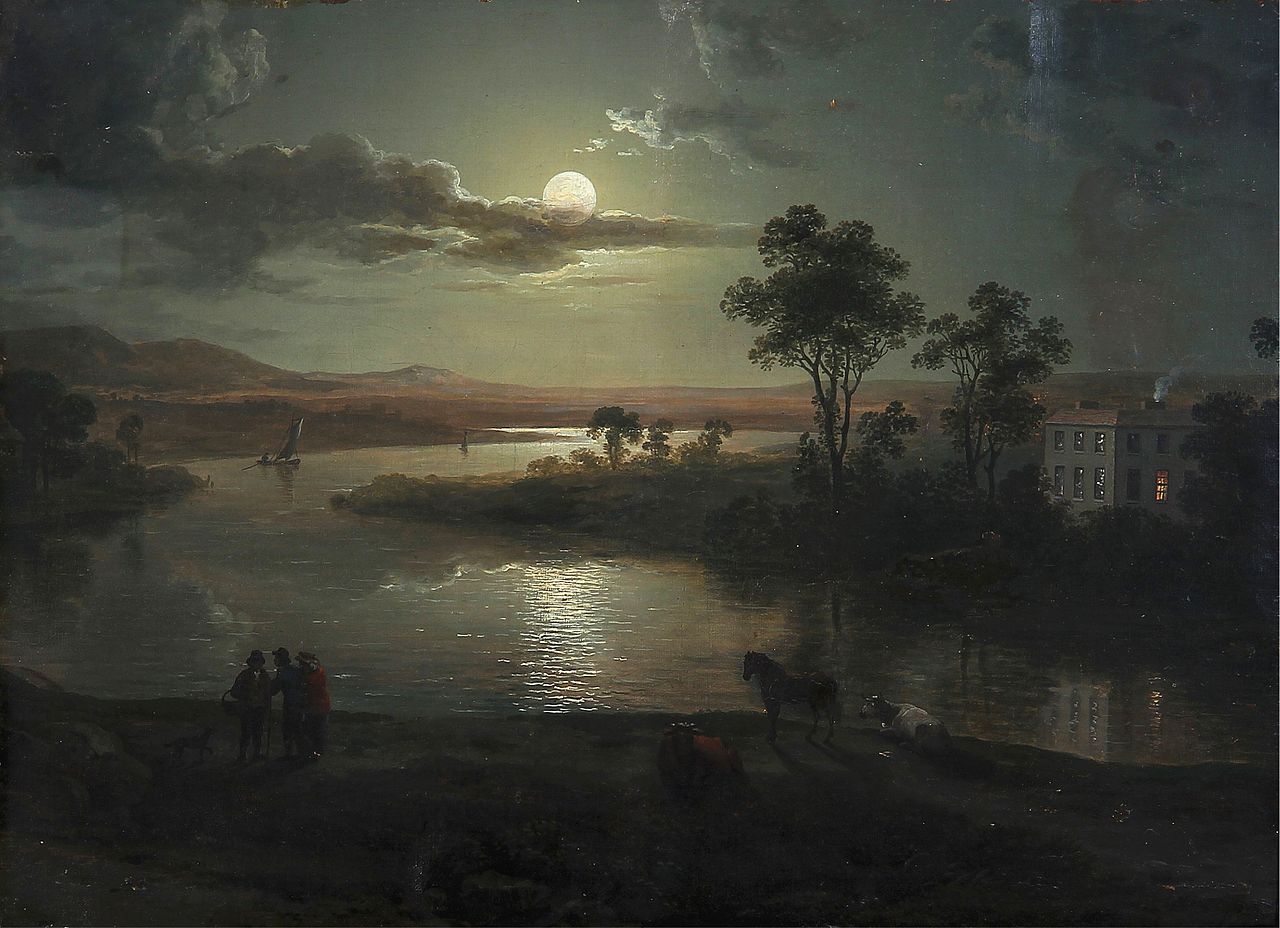
Moonlight Scene by Abraham Pether (c.1790)

His moonlight pieces are notable for their astronomical accuracy. He exhibited at the Royal Academy in 1784, his subject being “Moonlight.”

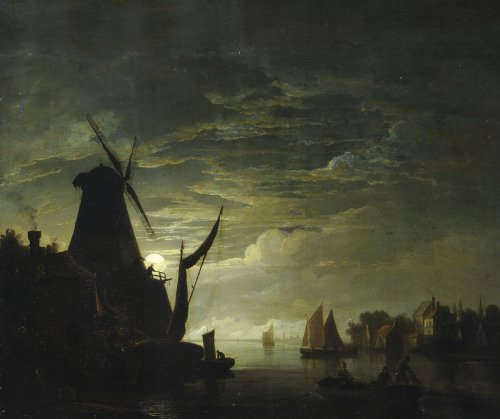
Moonlight Scene with Windmill by Abraham Pether (c.1780)

Moonlight Scene with Windmill by Abraham Pether (c.1780)

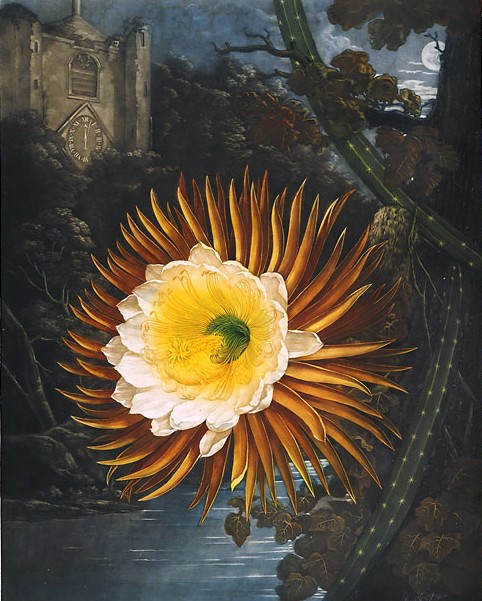
The Night Blowing Cereus (flower painted by Philip Reinagle, (moonlit background by Abraham Pether)

Abraham also collaborated with other painters who needed a moonlight background to their painting.  One example of this is his collaboration with Philip Reinagle RA, an English painter of animals, landscapes, and botanical scenes. Reinagle’s painting was entitled The Night Blowing Cereus and Abraham’s moonlight background added authenticity to the work.

God’s House Tower by Moonlight by Abraham Pether

Close to Abraham’s birthplace, Chichester, is the city of Southampton.  One of Abraham Pether’s paintings featured a night scene featuring the 13th century God’s House Tower, a gatehouse, which leads into the old town.  It stands at the south-east corner of the town walls and permitted access to the town from the Platform and Town Quay. It is now an arts and heritage venue.  In its former days it had served as the town gaol and housed the Museum of Archaeology. The building is Grade I listed and a scheduled ancient monument.  The buildings which form modern-day God’s House Tower are some of the earliest in Southampton. The name God’s House comes from the nearby hospice and it was built around 1189 as a resting place for travellers and pilgrims en-route to Canterbury.  The original gate was built around 1280, to give access to the Platform Quay as well as to the walls on the east at a high level, useful for any patrols or at times of attack. Running along the eastern walls was a double ditched moat, up to 40 feet wide, which was fed by sea water operated by a sluice at the Platform Quay. The ditches were important not only for defence but also because they also provided water-power for one of the town’s main mills which was built adjacent to God’s House Tower.

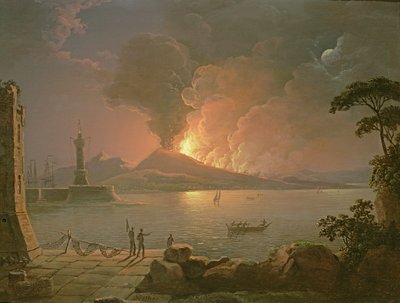
A View of Mount Vesuvius Erupting  by Abraham Pether

A View of Mount Vesuvius Erupting by Abraham Pether (c.1810)

 Abraham Pether also liked to paint depictions in which not only moonlight but fire lighted up the sky as can be seen in his painting entitled A View of Mount Vesuvius Erupting.

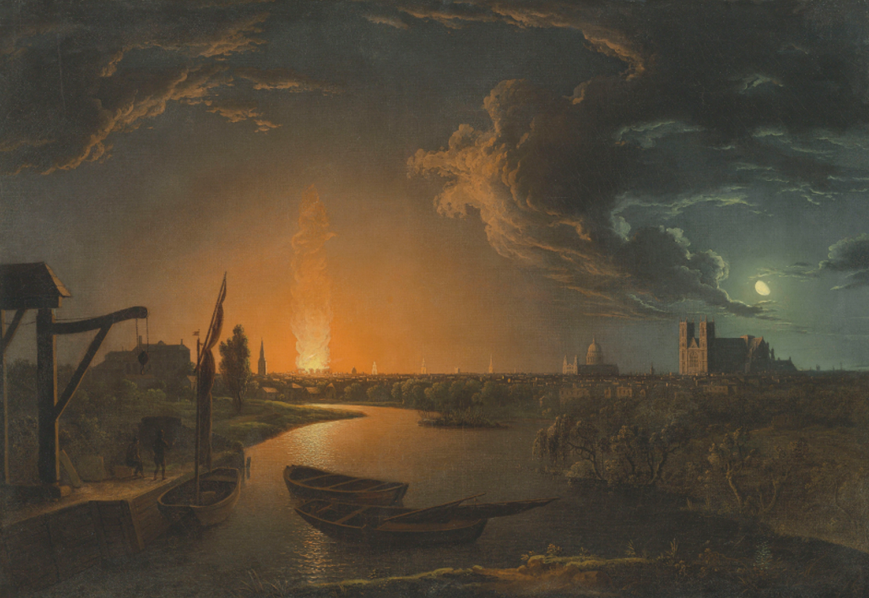
The fire at the Old Drury Lane Theatre, seen from Pimlico by Abraham Pether (1809)

It was not just fire lighting up the sky by natural phenomena, that Abraham captured in some of his works of art but also devastating events of buildings burning such as his painting entitled The Fire at the Old Drury Lane Theatre seen from Pimlico. In this 1809 painting we witness the destruction of Richard Brinsley Sheridan’s Drury Lane Theatre in 1809, which Sheridan had completely rebuilt in 1794 with the architect Henry Holland.  It is said that when Sheridan, who was in the Houses of Parliament at the time when the fire broke out, heard the news, he hurried to his theatre. Upon realising that there was little he could do to help, he sat down in the coffeehouse opposite and ordered a bottle of port, remarking rather dryly ‘a man may surely be allowed to take a glass of wine by his own fireside’.   It is a work of Romanticism which was popular around the beginning of the nineteenth century.  Abraham has cleverly balanced the light sources emanating from the moon and the fire, which adds a sense of excitement to the depiction.  Another interesting fact about this depiction is that it actually shows a lost view of London as the river seen is not the Thames, but part of the River Tyburn, which now flows beneath the city, coming out into the Thames at Whitehall Stairs, near Downing Street.

This image has an empty alt attribute; its file name is 1280px-Abraham_Pether_-_Evening_scene_with_full_moon_and_persons_%281801%29.jpg
Evening Scene With Full Moon and Persons by Abraham Pether (1801)

Abraham Pether not only distinguished himself as painter and musician but also by his philosophical and mathematical research which were of great value. He also showed skill as a mechanic, and constructed various optical instruments, such as telescopes, microscopes, air-pumps, and electric instruments. Abraham Pether died in Southampton on April 13th, 1812.

Abraham had two artistically talented sons Sebastian Pether who was born in 1790 and Henry Pether who was born on March 5th, 1800, both of whom became landscape artists who, like their father, became known for their moonlit scenes.

This image has an empty alt attribute; its file name is img_0959.jpg
Houses of Parliament from the Thames by Moonlight by Henry Pether (c.1864)

In Henry Pether‘s painting, Houses of Parliament from the Thames by Moonlight we see Westminster Bridge straddling the River Thames with the Houses of Parliament on the right bank. By the mid-19th century Westminster Bridge was subsiding badly and expensive to maintain and so was replaced by the current bridge, which was designed by Thomas Page and opened on 24 May 1862.  As Henry Pether died in 1865, we know the painting had to be completed sometime between those three years.  It is a fascinating depiction of the endless work on the river even during the night with barges and rowing boats plying their trade.  Note the gaslights illuminating the bridge.  During these years air pollution was very bad, day and night, and this is depicted by the smoky and murky appearance.

View of Windsor Castle looking at the Lowe Ward by Moonlight by Henry Pether

Henry Pether’s work, View of Windsor Castle looking at the Lowe Ward by Moonlight, demonstrates how Henry Pether’s portrayal of the romantic quality of light makes his depiction so striking. Henry preferred actual scenes, often on the Thames or in Venice, and this painting communicates the poetry and realism of his best work. As ever, Henry’s palette was more sensitive and truthful to nature than that used by his father and brother, as this very fine example demonstrates.

Henry Pether, ‘Greenwich Reach, Moonlight’ exhibited 1854
Greenwich Reach, Moonlight by Henry Pether (c.1854)

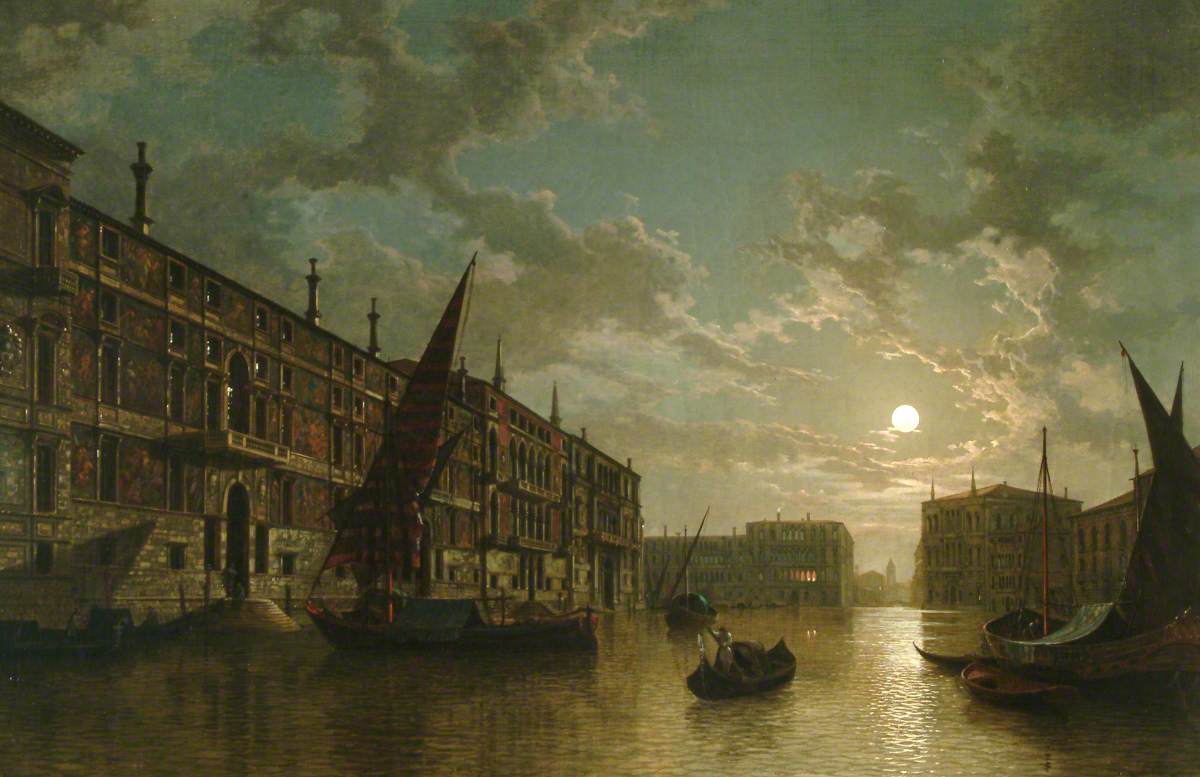
Henry Pether’s works were not all about England as he completed and excellent depiction of the canals of Venice.

Venice by Moonlight
Venice by Moonlight by Henry Pether

Sebastian Pether, born in 1790, was the eldest son of Abraham Pether, was also a landscape painter. He exhibited at the Royal Academy from 1812 to 1826 and at the Royal Society of British Artists at Suffolk Street, London.  He had learnt his artistic ability as a pupil of his father, and, like him, primarily painted moonlight views as well as depictions of fires as seen at night.  His paintings were praised for their accuracy and congruency of colour.   He could have made a fortune from the sales of his work but being desperate for money to feed his family he was having to accept paltry sums from art dealers who knew of his desperate financial circumstances and wanted his work so as they may be copied and sold on. 

Fishing by Moonlight by Sebastian Pether

One of Sebastian’s beautiful painting is his Fishing by Moonlight.  The work is painted on panel, which is a medium best suited to the fine brushwork quality, which he found necessary for this intricate work. In this painting, he has cleverly used the strong use of chiaroscuro effects of light and shade in his painting. The eye, of course, is drawn towards the full moon, which illuminates the sky and caresses the clouds.  Look how the artist has created the mysterious atmosphere of the moonlit evening. He has depicted the moonlight glistening on the river below and has painstakingly depicted the buildings in meticulous detail.  On the bank in the foreground we see the two night fishermen silhouetted against the calm waters.

Artwork by Sebastian Pether, Anglers along a moonlit river, Made of oil on canvas laid down on panel
An extensive river landscape with a fisherman by the shore, before a tower by Sebastian Pether

Sebastian married very young. In the July 1884 edition of the Gentleman’s Magazine there was an obituary notice regarding the death of Sebastian Pether. It said that “he married too young and too poor“. To exacerbate matters his wife had nine children in a short period and Sebastian struggled to earn enough money from his art to feed his family. The art dealers who bought his paintings were aware of his dire financial situation and the obituary notice was very cutting about their role in Sebastian’s life:

“…As a matter of course he soon fell into the hands of those harpies – the dealers. When once they had obtained power over him they took care to retain it; he was their victim all through life…”

See the source image
The Night Fishermen by Sebastian Pether (1920)

Sebastian Pether’s paintings always sold well but because of the low prices offered to him by dealers the money from the sale of his work was never enough to satisfy the wants of his large family.  Sebastian became ill in March 1844.  The illness was brief but severe and he died on March 14th 1844, aged 54.  His life at the end was an unhappy one and this was set out in the Gentleman’s Magazine obituary:

…During the three last years of his life he lost three of his grown-up children by consumption; and since the demise of the father another son died at Westminster Hospital of lockjaw occasioned by an accident to the hand……………………..A subscription has been opened to help his surviving family out of their terrible state of distress…”

A truly sad ending to a great painter.

Dorothea Tanning, her early life and her love of Surrealism. Part 3

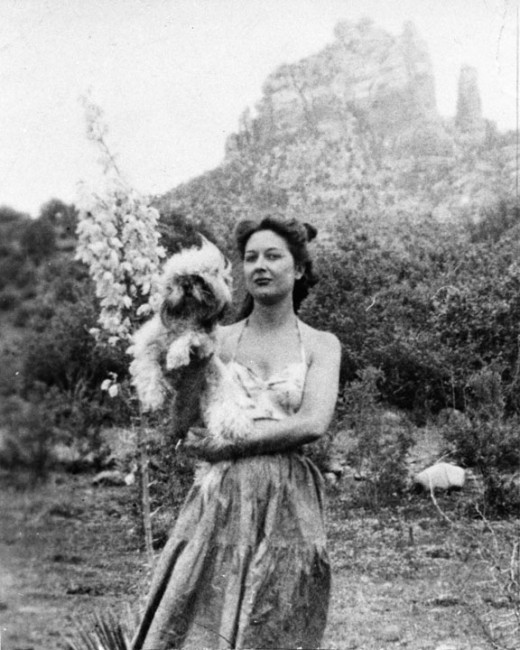
Dorothea Tanning, Sedona, Arizona
Dorothea Tanning in Sedona (1943)

Dorothea and Max Ernst divided their time between their Arizona home in Sedona and their apartment in New York.  Often Tanning would return to New York to show her work at the Julien Levy Gallery in Midtown Manhattan.  In April 1944, the Julien Levy Gallery held Dorothea’s first one-person exhibition.

See the source image
Fête Champêtre by Dorothea Tanning (1944)

That same year, 1944, Dorothea completed her painting entitled Fête Champêtre depicting a popular form of entertainment in Baroque France during the 18th century, taking the form of a garden party.  In Tanning’s work an unusual desert landscape provides the setting and she has added a marble mantelpiece and an ornate rococo clock.  She has also populated the depiction with a number of unidentifiable figures, some of which are human others are anthropomorphic, adding human characteristics to nonhuman things.  However, we can clearly see a bearded man and a girl who sits beside him, both staring out at something invisible to us.  The whole depiction remains a mystery as to what it is all about.

The Temptation of St Anthony by Dorothea Tanning (1945)

Whilst in New York,in 1945, Dorothea Tanning, completed a work which focused on a biblical scene that has been depicted by many famous artists, such as Dali and Hieronymus Bosch.  The painting is entitled The Temptation of St Anthony, which is now the property of Philadelphia’s La Salle University Art Museum. The painting portrays the supernatural temptation reportedly faced by Saint Anthony the Great during his stay in the Egyptian desert.  Saint Anthony, then aged 35, decided to spend the night alone in an abandoned tomb. A great multitude of demons came and started beating him, wounding him all over. He lay on the ground as if dead and the claws of the demons prevented him from getting up. According to the hermit the suffering caused by this demonic torture was comparable to no other.  Terrified and brought to his knees in fear, the habit that he is wearing wafts upwards as if caught in a gale-force updraft.  The blue, green and pink folds of the habit expose images of feminine shapes that seem to be the cause of his anguish. 

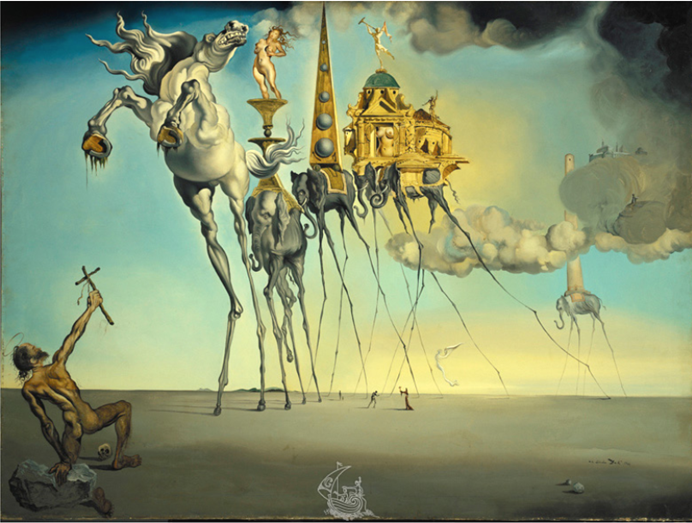
The Temptation of St Anthony by Salvador Dali. His entry to the Bel Ami competition

Dorothea created the work for the Bel Ami International Art Competition, where twelve surrealist and magic realist painters were asked to submit a painting to be used in Albert Lewin’s film The Private Affairs of Bel Ami, based on Guy de Maupassant’s novel Bel Ami. The rules of the competition for a cash prize were that the painting should be 36 × 48 inches and on the subject of the temptation of Saint Anthony. It would be shown as the only colour segment in the otherwise black and white film in which paintings of The Temptation of St. Anthony. Both American and European artists participated, including Ivan Albright, Eugene Berman, Leonora Carrington, Salvador Dalí, Paul Delvaux, Max Ernst, O. Louis Gugliemi, Abraham Rattner, Horace Pippin, Sydney Spencer, Leonor Fini and Dorothea Tanning.  All artists who submitted a painting received $500, while the winner received a prize of $3000. Max Ernst won the competition and his painting was shown in the film. Dali’s entry also became famous in its own right.

The Temptation of Saint Anthony (Ernst painting).png
The Temptation of Saint Anthony. The winning entry by Max Ernst

The competition was judged by Marcel Duchamp, Alfred H. Barr, Jr., and Sidney Janis. Max Ernst wining submission was not loved by all as the film critic Bosley Crowther of The New York Times called Ernst’s painting “downright nauseous” and wrote that it “looks like a bad boiled lobster.

Of her work and the meaning behind the depiction Dorothea Tanning wrote:

“…It seems to me that a man like our St. Anthony, with his self-inflicted mortification of the flesh, would be most crushingly tempted by sexual desires and, more particularly, the vision of woman in all her voluptuous aspects.  It is this phase which I have tried to depict in my painting. St. Anthony, alone in the desert, struggles against his visions; half-formed, moving in indolent suggestion, colored with the beautiful colors of sex, his desires take shape even in the folds of his own wind-tossed robes…”

Dorothea Tanning painting the Temptation of St Anthony (1945)

A photographer took a picture of Dorothea whilst she was working on the St Anthony portrait as a promotional photograph for the Bel Ami competition.  It was at a time when she had been ill and had contracted encephalitis and the photographer had to prop her up for the shot as she was so unwell.  She has her back to us but we see her long flowing locks of hair and on the wall is her famous Birthday self-portrait.  In her autobiography, Between Lives, she tells of how the illness caused her and her soon-to-be husband Max to return to the peace of Sedona in 1946 and sub-let their New York apartment to their friend, Marcel Duchamp.  Dorothea and Max married in October 1946.  Although they had regular guests come to their Sedona home, Dorothea always maintained that the period in Sedona, when it was just her and her husband, were the happiest days of her life.

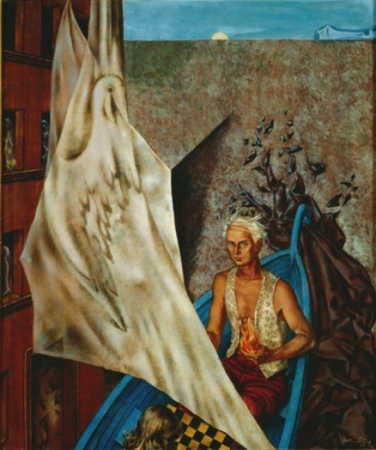
The newlywed couple would separately paint all day and then come together in the evenings to listen to music, read and often play chess which was one of their favourite pastimes.

Max in a Blue Boat, 1947 - Dorothea Tanning
Max in a Blue Boat by Dorothea Tanning (1947)

Their love of chess is depicted in Dorothea’s 1947 work entitled Max in a Blue Boat.  It depicts the couple in the boat in the midst of a desert landscape and they seem to move effortlessly despite the lack of water.

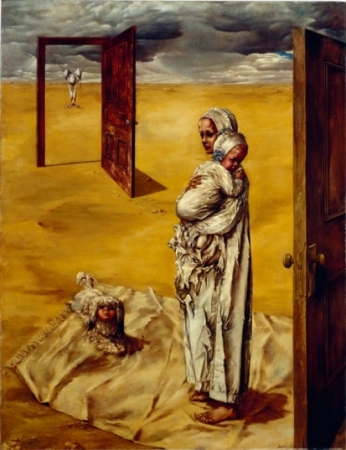
Maternity, 1946 - 1947 - Dorothea Tanning
Maternity by Dorothea Tanning (1947)

In 1947 Dorothea completed the work entitled Maternity, which focused on motherhood and the psychological and physical problems associated with bearing and raising a child.  In the setting of a sand-strewn desert we see a young woman holding a young child in a shielding encirclement.  At the feet of the woman, on the rug, lies her dog which has a child’s solemn face staring out at us.  The features of the dog resembled her own Lhasa Apso dog, named Katchina.  Mother, child and dog make for a strong family unit set against a hostile setting.

The dog was depicted in one of her favourite works entitled Tableau Vivant.  It was then purchased by the National Galleries of Scotland. The painting was the first by Dorothea Tanning that they had acquired and joined up with major artworks by Surrealists Leonora Carrington, Salvador Dalí and René Magritte held at the Scottish National Gallery of Modern Art (SNGMA).  The work was first shown at Tanning’s first exhibition in France in May 1954 at the Galerie Furstenberg, Dorothea Tanning: Peintures 1949-1954.   She had inscribed the title L’Etreinte on the verso, which can be translated as The Embrace.   A few months later the inscription was crossed out and substituted with Tableau Vivant and it was under its new title, Tableau Vivant that it was included in the artist’s first exhibition in Britain, at the Arthur Jeffress Gallery, London in 1955.

Tableau Vivant by Dorothea Tanning (1954)

It was not uncommon for Surrealist artists to include animals in their paintings.  Numerous Surrealist artists took animal embodiments which played the role of their alter-ego in their work: Max Ernst used a bird, Leonora Carrington favoured a horse; and Tanning took Katchina. Whreas other Surrealist depicted various types of the animal, Tanning’s choice was more specific.  It was her own pet, Katchina, whose insertion into Tanning’s work was not of necessity a personification of the artist; sometimes it acted as a witness, other times as a protagonist, the Katchina affected different roles in different works. These works started a change of Tanning’s painting style.  She moved away from the meticulous, controlled, illustrative technique which was the hallmark of her Surrealist work. In its place she began to decide on much looser, softer, more painterly brushwork and her colour switched from bright, intense primaries to ashes and ochres.  It was a move towards her Abstract period.

The painting is a depiction of many feelings.   Power, love, the erotic, the humorous, the dream and the nightmare, Tableau Vivant brings together many key moments in the artist’s life and career. Tanning loved the painting and it was included in almost every major exhibition of her work, notably her solo shows in Brussels in 1967, Paris in 1974, and the Malmö Konsthall and Camden Art Centre in 1993. The work of art remained with her for the remainder of her life until 2012, when she died at the age of 101, almost sixty years after painting it. Towards the end of her life, she specified it as one of a small number of works reserved only for sale to a museum.  Simon Groom, Director of Modern and Contemporary Art at the National Galleries of Scotland said of the painting:

“…We’ve been looking for a major painting by Dorothea Tanning for many years. This was one of her favourite works: she kept it for more than sixty years, hanging it above her desk in her apartment in New York. It’s a stunning addition to the Galleries’ world-famous collection of Surrealist art…”

Sarah Philp, Director of Programme and Policy at Art Fund, which helped the National Galleries of Scotland financially with the purchase of the work which cost £205K  said:

“…Tableau Vivant is an astonishing work with a fascinating biography and we are proud to help National Galleries of Scotland purchase this painting for their outstanding Surrealist art collection…”

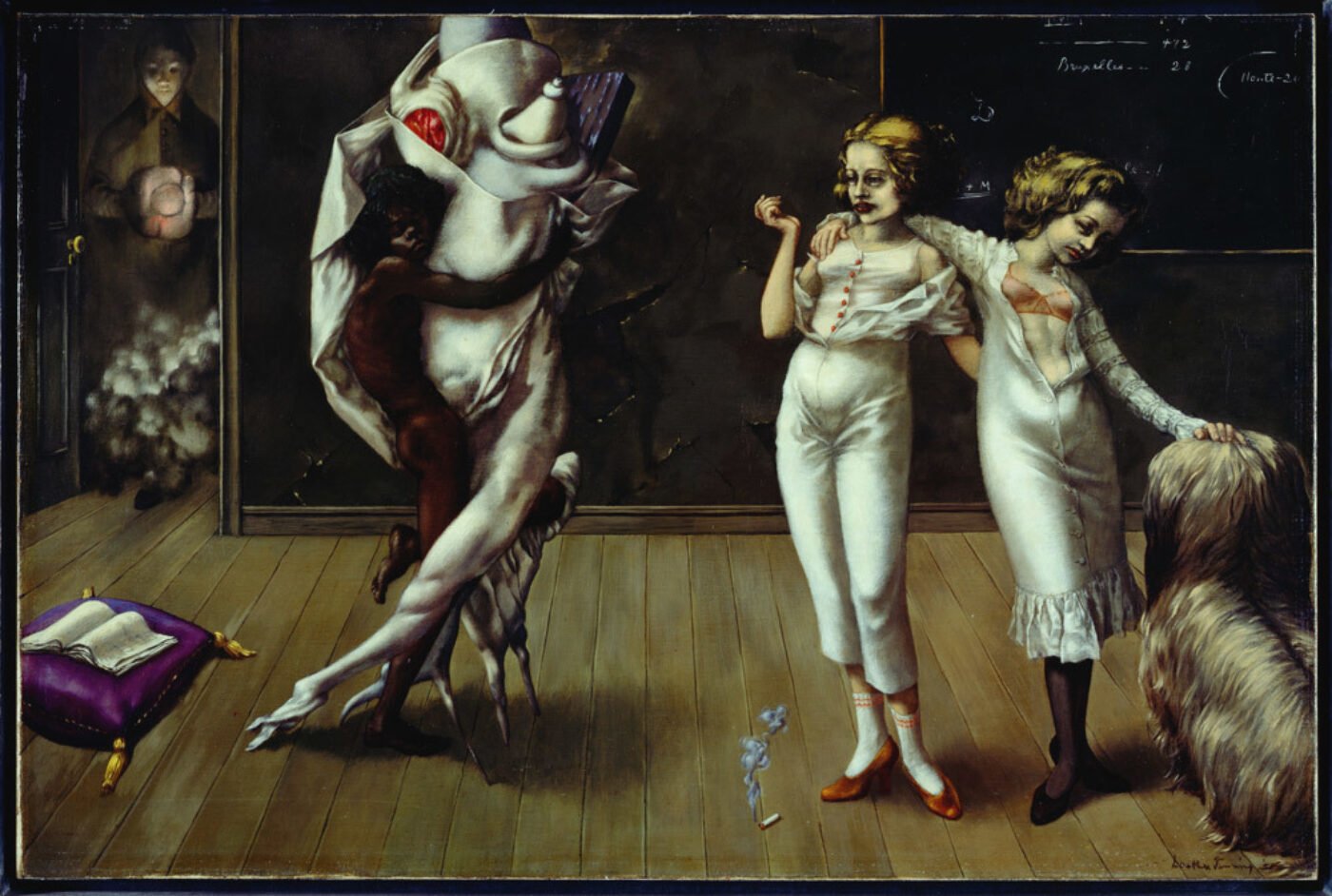
Interior with Sudden Joy by Dorothea Tanning (1951)

The Tableau Vivant dog appeared in a number of her paintings after 1946, including Interior with Sudden Joy.

Interior with Sudden Joy is a strange painting.  In the depiction we see two girls standing to the right. They strike a provocative pose.  They are both dressed in white garments which harmonise with their pale skin, the buttons are unfastened and expose a camisole top and red bra, which reminds one of the bared chest in Tanning’s self-portrait Birthday. The girls pose with their arms wrapped around each other and both exude an air of nonchalance. They are young women and are only too aware of their sexuality.  The girl furthest to the right pats the head of a large shaggy dog.  The dog, which faces away from us, takes little notice of the two girls and instead stares at the blackboard on the back wall like a pupil ready to learn. On the blackboard there is chalked writing. In her memoir, Tanning says she took writings written in poet Arthur Rimbaud’s ‘secret notebooks’ and put them on the blackboard in this painting.  Rimbaud was admired by the surrealists because of his belief that poetry passed through the body in the manner of a musical instrument, which reaffirmed the surrealist idea of automatism as a creative outlet using the body as a vehicle.

The Boy

On the floor, close to the feet of one of the girls, lies a burning cigarette.  The girl’s hand is held up as though the cigarette had once been held between her fingers. To the left of them is a naked boy embracing a strange amorphous mass which imitates a human figure and wraps itself around him. The whiteness of its fabric-like flesh contrasts with the boy’s dark skin, and abundance of dark curls which form a halo around the boy’s head. The boy looks completely at peace. If the painting’s title Sudden Joy derives from any part of the depiction it is from him. In her memoir, Tanning described the girls as being like Sodom and Gomorrah.  On the floor in the left-hand corner of Tanning’s painting is an open book atop an ornate purple cushion. Its pages are blank, perhaps waiting to be written in. It is an eerie depiction.  We see a figure standing in the doorway in the left-hand top corner of the painting, and the black door stands ajar waiting for someone or something to enter the room.

 Dorothea Tanning died on January 31st 2012, at her Manhattan home at age 101. Her husband Max Ernst had died thirty-six years earlier.

Most of the information in my blogs about Dorothea Tanning come from the excellent 2020 biography of the artist, entitled Dorothea Tanning: Transformations by Victoria Carruthers.

Dorothea Tanning, her early life and her love of Surrealism. Part 1.

Dorothea Tanning
Dorothea Tanning aged 18. (1928)

What does one mean when one says they like art.  What is art?  By definition, art is a diverse range of human activities involving creative imagination to express technical proficiency, beauty, emotional power, or conceptual ideas and it encompasses the three classical branches of visual art are painting, sculpture, and architecture, but the term “art” also embraces theatre, dance, and other performing arts, as well as literature, music, film and other media such as interactive media. So, I need to narrow down what I mean when I say I love art.  I should maybe say I love visual art and yet I am not a fan of conceptual or performance art.   I love the paintings created by numerous artists.  However, that is not quite true as I do not love all painting genres.  I neither find pleasure in looking at works of abstract art such as those by Kurt Schwitters nor the black lines and blocks of colour by Mondrian nor the works of abstract expressionist painters such as those by Robert Delaunay, Jackson Pollock, Mark Rothko and Willem de Kooning nor the disturbing imagery of Francis Bacon. Having told you what I do not like I suppose I should tell you what I do like but if you have been following my blogs over the years, you will probably already know.

I love the paintings of the Dutch and Flemish Masters.  I like many of the painters of the Victorian era.  I like “busy” multi-figure paintings and love to delve into the depiction to see what is happening in narrative paintings.  I like narrative paintings which have a tale to tell or a moral to enforce.  Surprisingly, having said all that I also have a reluctant love of Surrealism and enjoy trying to figure out what the depiction is all about and what was in the painter’s mind when he or she put brush to canvas.

Dorothea Tanning with her mother, Amanda Tanning
Dorothea Tanning with her mother, Amanda Tanning, 1911

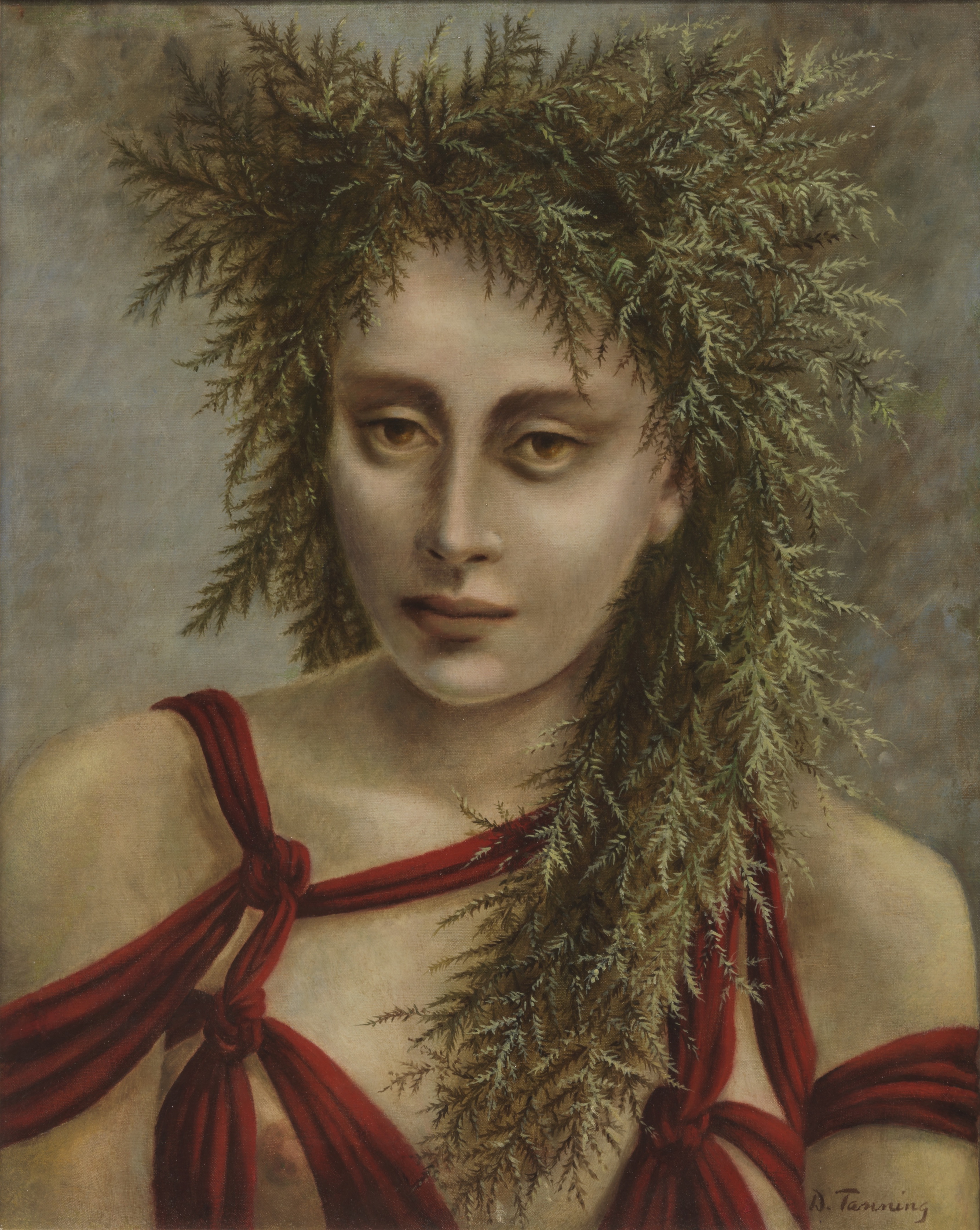
This was a somewhat long-winded introduction to today’s artist, the American Surrealist painter, printmaker, sculptor, writer, and poet, Dorothea Margaret Tanning.  Tanning was born on August 25th 1910.  She was the middle child of Andrew Tanning and Amanda Marie Tanning (née Hansen), who were of Swedish descent.  She had an elder sister Maurine and a younger sister Mary Louise.  Andrew Tanning, born Andreas Peter Georg Thaning, came alone from Skåne in the southernmost county of Sweden and settled in the conservative Midwestern town of Galesburg, Illinois.  In her memoirs Dorothea Tanning recounted that both her parents were very loving, indulgent and imaginative, the latter trait which she believed led to her creativity.  In her 2001 autobiography, Between Lives, Tanning wrote lovingly of her mother:

“…How could a tiny artist grow into a big one without the quilt of maternal love with its pattern of solace for hurts, its curving comfort, cloud-soft, its consolation for having to exist, its sweet smell?  The mother-goddess (the term would have embarrassed her), doctor and protector hovered over us in the full conviction that we were worth the trouble…”

Dorothea Tanning
Dorothea Tanning, aged 5. (1915)

By her own admission Dorothea was a small and delicate child prone to bouts of illness which often confined her to bed.  Like similar stories of young children who became well-known artists, it was this time during bed rest that she developed artistic skills and immersed herself into reading picture books.  Her favourites were the fairy tales of the Brothers Grimm, and the stories and colourfully mesmerising characters from Greek mythology and the Bible.  It was from the likes of these that Dorothea gained an insight of the outside world, a world free from a cosseting mother.  She would also amuse herself by the simple game of staring at patterns on the wallpaper or furnishings and allow her imagination to form images which were not real.  In a way she was slipping from the real world into an imagined parallel existence.  Maybe it was this which would eventually lead her into the world of Surrealism.

Dorothea Tanning, Galesburg High School Yearbook, Senior Year
Dorothea Tanning, Galesburg High School Yearbook, Senior Year, 1926

In 1926, aged sixteen, Dorothea Tanning graduated from Galesburg Public High School.  The following year she managed to get a part-time job at Galesburg Public Library which gave her access to a world of literature.  She termed it the House of Joy.  One of her earlier jobs was cataloguing the books with a senior assistant who decided on whether the contents were deigned immoral and unfit for minors and were marked with a red cross in the catalogue.  Dorothea said that it was then much easier to find the “best” books.  In her biography she wrote about the time at the library and how it made her consider her future:

“…Over the years, the library became my haven, its treasures slyly challenging the voice of “art” in the tug-of-war for my ambitions, its sirens singing and crying by turns, its weight crushing my famous certitudes forever…”

Some Roses and Their Phantoms, 1952 - Dorothea Tanning
Some Roses and Their Phantoms by Dorothea Tanning (1952) represents a domestic world transformed by mysterious eruptions and inhabited by unnamed creatures. The table top setting, with its crisp white tablecloth and marks of ironed folds, suggests a safe world of bourgeois ritual. A recurrent motif, the white table cloth can also be found in other works of the same period. 

In 1928 she enrolled at Knox College in Galesburg and remained there for two years.  In 1930 she quit the college in order to pursue an artistic career and set off for Chicago under the guise of meeting up with a friend.  She had surreptitiously packed a trunk with her belongings which she left in her bedroom and later, once in Chicago, asked her parents to forward it to her !

Chicago at the time of Dorothea’s arrival, was a city in the grip of Prohibition, jazz-filled nightclubs and violent gang wars.  She lodged with an ex-library colleague.  She revelled in the nightlife of the Windy City and began a relationship with the writer, Homer Shannon.  To earn a living, she took on a number of jobs including waitressing at the Colonial Room.  She operated marionettes in the 1933 Chicago World Fair.  She must have accumulated some money as she loved to travel going to New Orleans in 1934 where she exhibited some of her watercolours. 

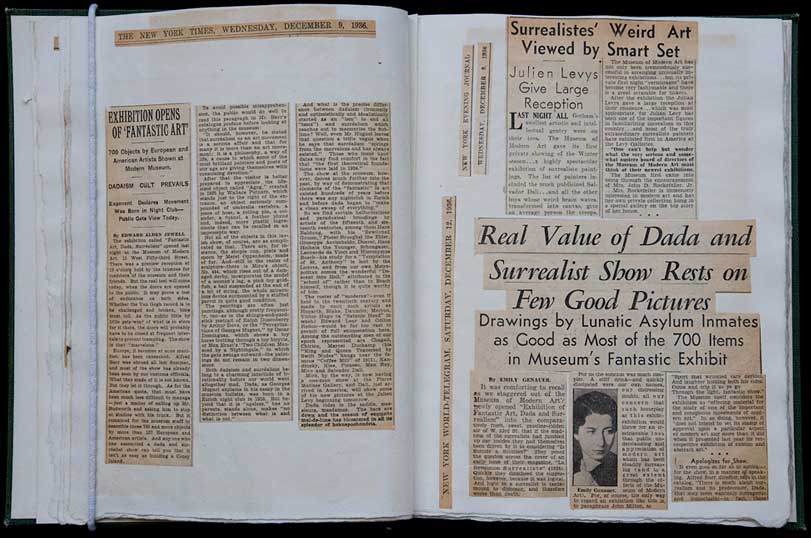
December 1936 newspaper cuttings about the Fantastic Art, Dada and Surrealism exhibition. 

She also made a number of trips to New York searching for work as a commercial artist and during one visit in 1936 visited the Museum of Modern Art to see the Fantastic Art, Dada and Surrealism exhibition.  The exhibition was rife with controversy and provoked fierce reactions from battling factions among the Dadaists and the Surrealists.  The press release by MOMA identified Surrealism and Dadaism as such:

“…”Surrealism, which developed in Paris around 1924, was the direct descendent of the Dadaist interest in the bizarre, the spontaneous, and the anti-rational. But while the Surrealist program carried on the iconoclasm of Dada it added serious research into subconscious images, dreams, visions, automatic and psychoanalytic drawings. Surrealism, so far as its serious adherents are concerned, is more than a literary or an art movement: it is a philosophy, a way of life, a cause which has involved some of the most brilliant painters and poets of our age…”

In a later interview Dorothea said of the exhibition:

“…For me it was the revelation, and I wasn’t the only one.  I would even say that most American artists – as well as poets – were deeply affected by that explosive event.  So, I became more impatient than ever – I just had to live in Paris…”

Once again in her autobiography Dorothea was certain that what she saw at the exhibition at the MOMA was a turning point in her artistic life.  She wrote:

“…Here, gathered inside an innocent concrete building, are signposts so imperious, so laden, so seductive and yes, so perverse that, like the insidious revelations of the Galesburg Public Library, they would possess me utterly…”

Deirdre
Deirdre by Dorothea Tanning (1940)

Dorothea had now caught the Surrealism bug and knew to explore the genre more she had to go to Paris.  She set sail on SS. Amsterdam for the France in July 1939 with the intention of meeting some of the Surrealist artists living there but her plans were thwarted by the onset of the Second World War.  Artists had hurriedly escaped from Paris and she managed to escape France and makes her way through Holland Belgium Germany and Sweden in August to the home of her paternal relatives. From there, in October, she managed to gain passage back to America on the SS. Gripsholm.  Another artist to take flight from France and journey to America was the leader of the Surrealism Movement, German-born Max Ernst who before his salvation had been interned twice in 1939, once by the French government having been labelled an “undesirable foreigner” and once by the Gestapo but he managed to escape with the help of Peggy Guggenheim, a member of a wealthy American art collecting family, and the journalist Varian Fry. 

Dorothea Tanning, Music Hath Charms. 1940.
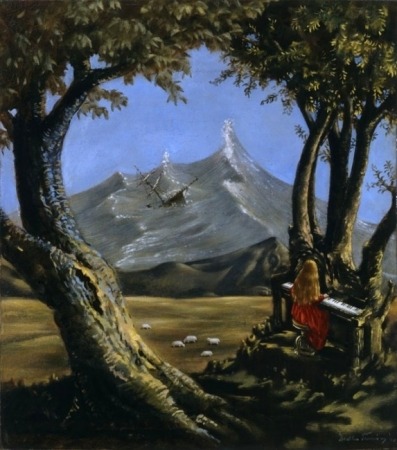
Music Hath Charms by Dorothea Tanning (1940)

Once back home in New York, Dorothea Tanning sought employment as a commercial artist and for a time worked on the advertisements for Macy’s department store, producing adverts for perfumery products, clothing and accessories.  She continued with her own art and in 1940 produced a small painting entitled Music Hath Charms.  It was the beginning of her love of Surrealism being translated into her own work.  The painting depicts a young girl, dressed in red, playing the piano formed by the roots of one of two large trees which act as a frame for the scene.  She has long blonde hair which runs down her back.  Look at the background and at first it seems to be just a snow-capped mountain but with closer inspection it is the gigantic wave of a stormy sea in which we see a sinking tall ship.  The terrifying sight of the doomed ship is in stark contrast with the pastoral scene of the middle-ground with the grazing sheep and yet there is more.  Look carefully at the dark brown/olive hills which divide the space between the sheep-grazing field and the wild stormy sea.  It is the prone body of a hybrid beast, part human in the shape of a woman’s body and part animal being the face of a wild cat. Again it, like the sea and the fields, is the juxtaposition of human and animal.  The creature stares at the girl as if mesmerised by the sound of the music.  The depiction implies that the melodious sounds emanating from the piano is causing a metamorphosis in the landscape with the creature materialising from the “softened rocks”.
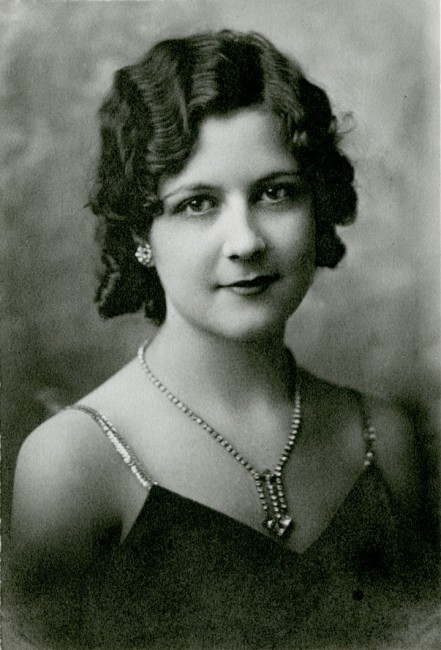
Portrait of Julien Levy by Jay Leyda (c.1932)

In 1942 after an up-and-down relationship and short marriage to Homer Shannon, the pair split up and Dorothea concentrated on her art and immersed herself in the artistic community and became great friends with Julien Levy, a gallery owner who offered her an exhibition at his gallery once she had built up a sizeable collection.  Levy had opened his new gallery in midtown Manhattan in November 1931 with a photography exhibition that included works by his friend and mentor, Alfred Stieglitz. As selling photographs became more difficult Levy shifted his gallery’s focus to Surrealism and to showing the work of artists like Salvador Dalí, Max Ernst, Man Ray and Joseph Cornell.

In May 1942 Julien Levy invited Dorothea Tanning to one of his afternoon soirees held in his Chelsea apartment.  Dorothea remembered stepping into Levy’s apartment and at that party, seeing her future road map lying before her:

“…A May afternoon as only May afternoons can be in the city.   And an apartment in Chelsea, all dark woof and those slated shutters peculiar to old New York.  A Recamier sofa, an iron sleigh-bed breathing Paris, a Bellmer doll, the Duchamp window and scattered everywhere, objects, pictures, books and more pictures.  Indeed, coming time, you were overwhelmed with vertigo that it was hard to register Julien’s easy, smiling introductions to – as I remember them – Yves Tanguy, Max Ernst, Kurt Seligmann, Kay Sage, Bob Motherwell with beauteous wife, Maria, Virgil Thomson, Max Ernst, Consuelo de Saint-Exupery, Peggy Guggenheim, Sylvia Marlowe, Max Ernst……Doesn’t the repetition say it all?  Because quite simply, this was a new door for me to open, and it was Julien Levy who held the key, who did it all, not deliberately – he didn’t believe in plans – who very nonchalantly launched my art and found me a life companion…”

………………………………….to be continued.

Most of the information in my blogs about Dorothea Tanning come from the excellent 2020 biography of the artist, entitled Dorothea Tanning: Transformations by Victoria Carruthers.

Many pictures of Dorothea came from the Dorothea Tanning Organisation website

Paul Fischer

Self-portrait, Nytorv in Winter by Paul Fischer (1909)

Paul Gustav Fischer was born July 22nd, 1860.  His ancestors, who were originally from Poland, were the fourth generation of the Fischer family to live in Denmark. His immediate family would be classed socially as upper-middle class. Paul was the son of Philip August Fischer and Gustafva Albertina Svedgren. Paul’s father had started as a painter, and later succeeded in the business of manufacturing paints and lacquers.  Paul first received art tuition from his father but later went on to have formal art tuition.  He was apprenticed for a year and a half at the terracotta manufacturer C. Møller and graduated from the Technical Institute to the Royal Danish Academy of Fine Arts where he attended the general preparatory class in May 1876 but failed to complete the course, leaving in January 1878.  Following on from this, he became an assistant in his father’s painting materials business and worked there for ten years.  During this time he still carried on with his own painting. At the start of his artistic career, Paul completed mostly sketches and illustrations which he submitted for inclusion in a number of magazines such as Out and Home, Illustrated Journal, Juleroser and Klods-hans.

Paul Fischer. Vesterbrogade
Vesterbrogade is the main shopping street of the Vesterbro district of Copenhagen, 

The standard of his paintings were such that he exhibited regularly at the Charlottenborg Spring Exhibition between 1884 and 1902. He has also had his work exhibited at the Salon in Paris and exhibitions in Munich, Berlin, Oslo and Stockholm.

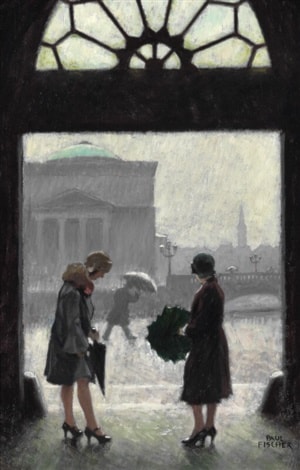
View from Ved Stranden in Copenhagen with two women sheltering from the rain
View from Ved Stranden in Copenhagen with two women sheltering from the rain by Paul Fischer

His early paintings depicted city life, and it was this genre that established him with the viewing public.  His depictions were often set in overcast or winter weather, but that was to change after his Paris trips when his works took on more colours and were warmer.  Paul Fischer stayed in Paris on two occasions in the 1890s and became influenced by the French Realists, Gustave Courbet and Jean-Baptiste-Camille Corot. 

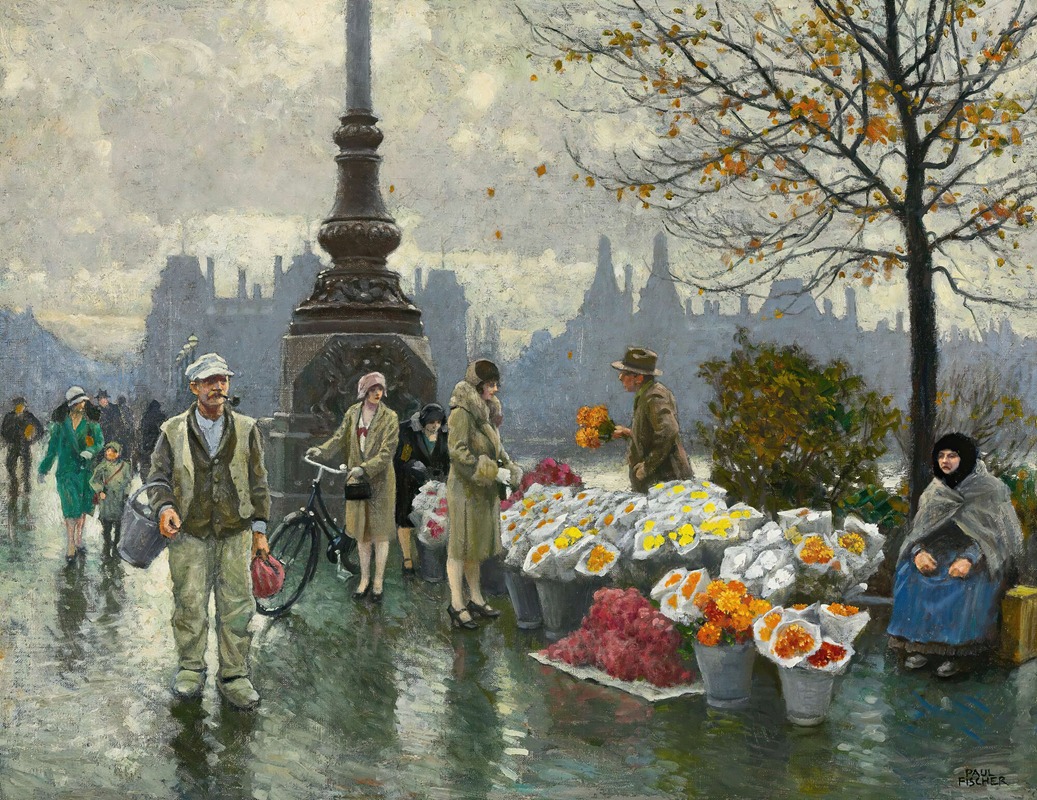
Paul Fischer - Flowersellers At Dr. Louises Bro (Queen Louise’s Bridge) In Copenhagen
Flower Sellers on Queen Louise Bridge, Copenhagen by Paul Fischer

Paul Fischer painted motifs from Queen Louise Bridge with views towards Ferdinand Meldahl’s two symmetrical palatial apartment buildings on Søtorvet – being some of the most French-influenced architecture in Copenhagen. Moreover, it was easy for him to compare the lakes on either side of the bridge with his beloved river Seine in Paris.

Højbro Plads seen from Højbro by Paul Fischer  (1900)

Especially famous are his colourful paintings, one of his most popular ones featuring the cityscape of Copenhagen is his 1900 work entitled Højbro Plads seen from Højbro.   Højbro Plads (High Bridge Square)  is a rectangular public square located between the adjoining Amagertorv and Slotsholmen Canal in the city centre of Copenhagen.  Højbro is a bridge in central Copenhagen, which connects the city centre to the small island of Slotsholmen, on which is the Christiansborg Palace.

See the source image
The Artist’s Wife, Dagny by Paul Fischer (1892)

Paul Fischer married Dagny Grønneberg on November 24th,1886.  Her father, Julius, was an art dealer and her Norwegian mother, Hulda Azora Tegner was a painter. 

See the source image
The Artist’s Daughter, Harriet Fischer by Paul Fischer

Paul and Dagny’s daughter, Harriet Fischer, was born on July 24th, 1890 and grew up in a busy artist’s studio and her father Paul Fischer persistently used household members as models, and often Harriet featured in some of his paintings both as a little girl and as a young girl, in portraiture and as a supporting figure in the street scenes.

Bondekvinde {Peasant Woman) by Hrriet Fischer

Harriet was admitted to the Royal Danish Academy of Fine Arts in Copenhagen, where she was from 1915-1920. From 1920-1940 she travelled on countless study trips to most of Europe. When their daughter began painting, it is known that she and her father exhibited together during the summer stays in Båstad in the years before World War I.

Harriet in the living room at Sofievej by Paul Fischer (1908)

Another beautiful painting featuring his daughter was his 1908 work entitled Harriet in the living room at Sofievej.

Winter Day with a Little Girl with a Sledge and a Large Red Knitted Hat by Paul Fischer

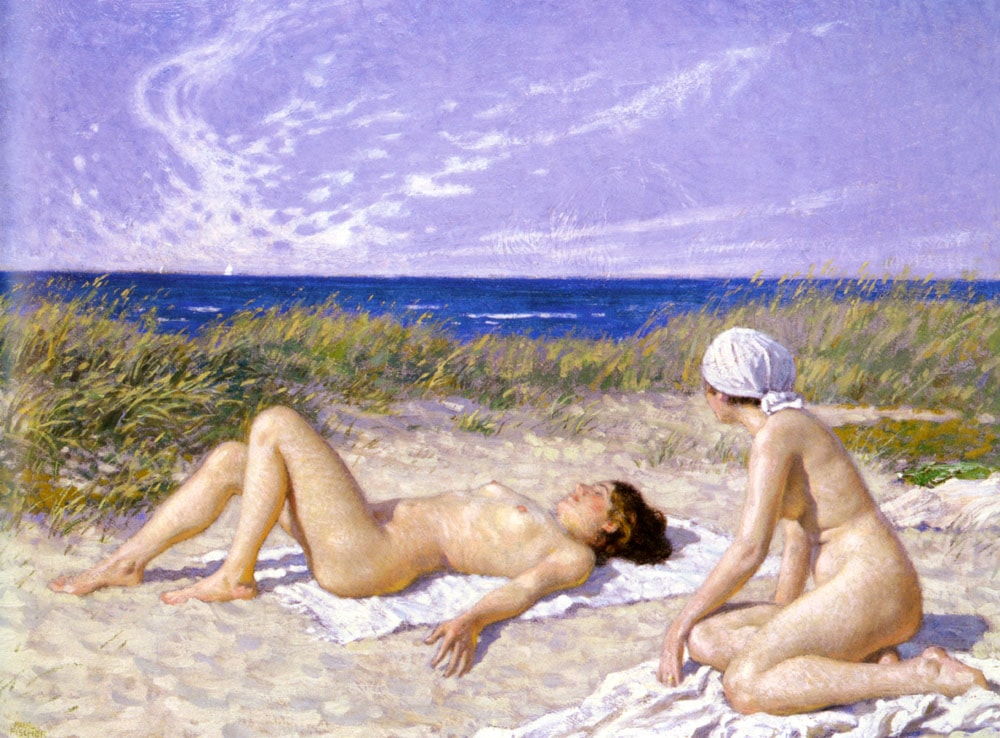
Paul Gustave Fischer was also well known for his amazingly natural sunbathers and his 1916 painting Sunbathing in the Dunes is a good example. 

Sunbathing in the Dunes
Sunbathing in the Dunes by Paul Fischer (1916)

The models seem to be happy to pose on the beach but I am sure were reluctant to parade nude in the icy waters of the Baltic.

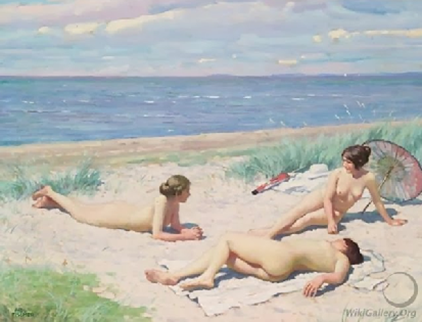
Nude Bathers on the Beach, by Paul Gustave Fischer (1916)

There are more than a dozen such works painted over a number of years, and it is interesting to note how, in the depiction, his striking  bathing beauties merge so wonderfully with the sands of the beach one which almost makes ignore the erotic overtones of the paintings. 

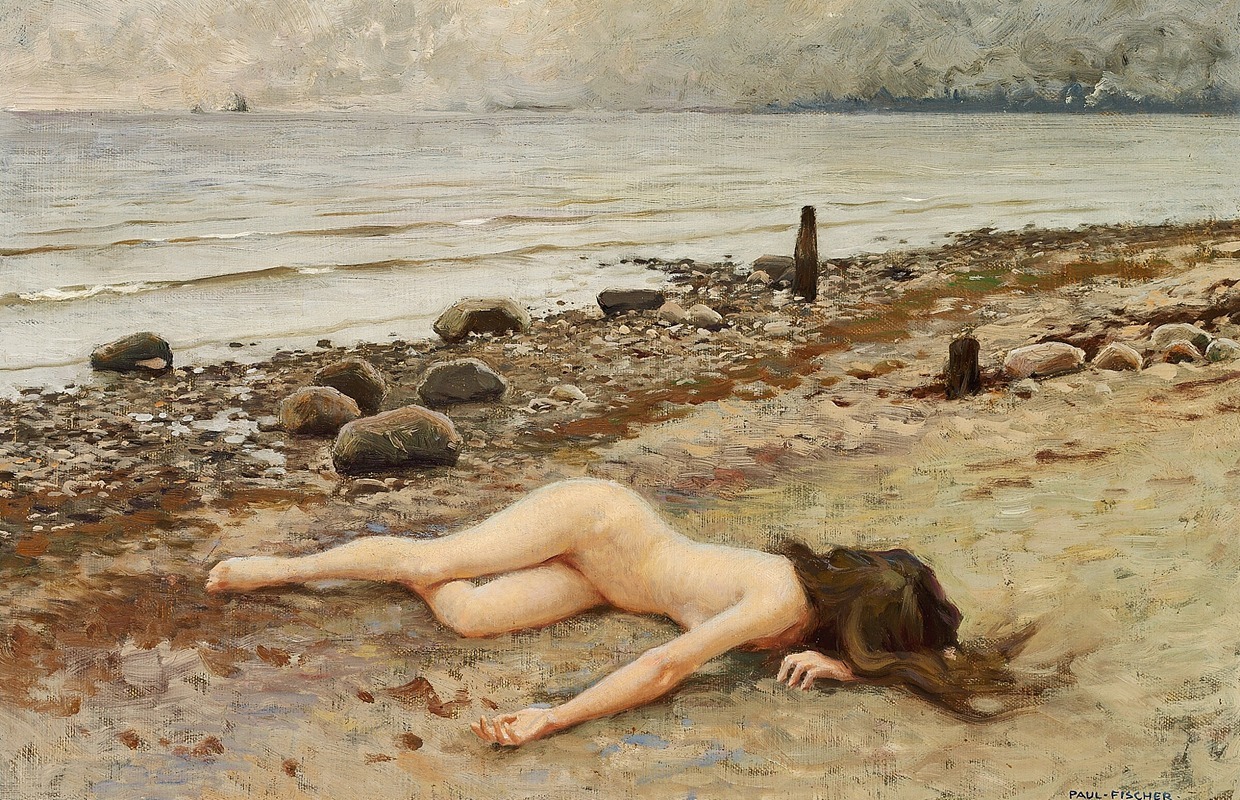
Vragnet (Wrecked) by Paul Fischer (1906)
Portrait of a Young Girl by Paul Fischer (1903)

Most of Fischer’s paintings are populated with female figure, some attractive older ones but also depicting young girls such as his 1903 tender Portrait of a Young Girl.

The Fire Engine by Paul Fischer (1900)

However, my favourite works of Paul Fischer are his everyday scenes of city life featuring people of all social classes and it is his depiction of the real lives of those around him which in part explains his popularity.  Take for example his 1900 painting The Fire Engine.   This is a depiction of a classic everyday occurrence.  It is a “busy” painting.  There are so many things happening in the depiction and your eye flits from one to another.  We, like the crowd, are drawn into the present dramatic happenings.  The red and gold coloured fire engine takes centre stage in the painting and, in a way, it is a salute to the industrial growth of the time.

Paul Fischer. Magasin du Nord at Kongens Nytorv, Copenhagen
Magasin du Nord at Kongens Nytorv, Copenhagen by Paul Fischer

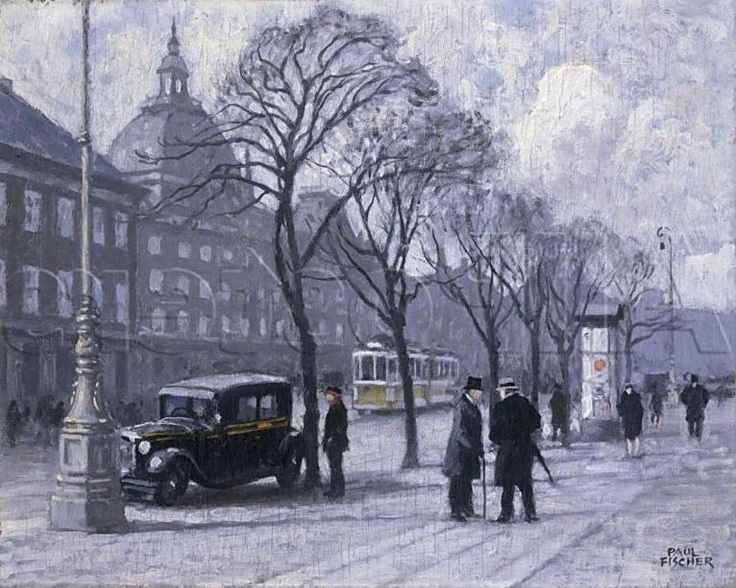
The late 19th and early 20th century in Denmark, like other European countries was rapidly changing and these changing times were captured in Paul Fischer’s cityscapes often populated with the motor cars, trams and other vehicles.

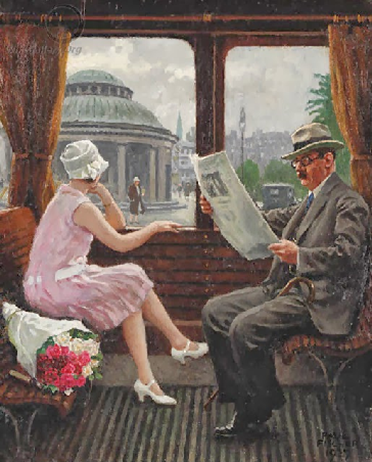
In the Tram Compartment by Paul Fischer (1927)

The 1927 work In the Tram Compartment by Paul Fischer is a fascinating depiction of everyday life.  The man reads his newspaper whilst the woman looks outside at the cityscape they are trundling past.  A bunch of flowers is on the bench next to her.  Maybe a gift from the man and yet he shows no interest n her and may just be a fellow passenger.  It is painting like these that you gaze at and make up a story of what you believe is going on!

See the source image
by Paul Fischer

Fischer depicted everyday life and tram rides on a number of occasions, such as the one above.  Maybe he was fascinated with this form of transport or maybe he was interested in the interaction between the passengers. Again we have a man reading a newspaper and a woman sitting next to a bunch of flowers.

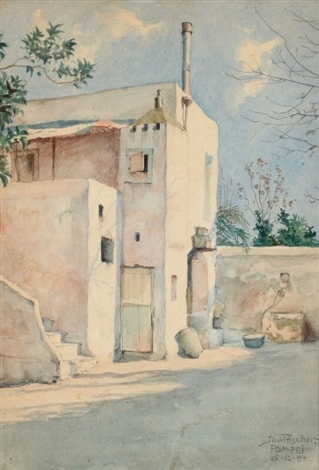
View from Pompei
View from Pompeii by Paul Fischer (1894)

Paul Fischer travelled through a number of European countries, sketching and painting.  One of his favoured countries was Italy and during the last decade of the nineteenth century he visited the area around Naples and the ruins of Pompeii.  In 1894 he produced a pencil and watercolour sketch of the area which was given the name View from Pompeii.

Italian Street Scene
Italian Street Scene by Paul Fischer

Another painting around this time was a work in oils, simply entitled Italian Street Scene.

In the early twentieth century Fischer’s paintings were selling well.  However, he was still in the shadow of his contemporary, the leading Danish painter of the time, Laurits Tuxen.  However, one would have that thought the life was good for Fischer.  He had a beautiful wife, Dagny, and a fine-looking and talented daughter, Harriet, but that was not the case as his marriage to Dagny ended in 1914. 

Portrait of Martha Vilhelmine Jensen, who became Mrs. Fischer by Paul Fischer (1913)

On June 17th, 1914, sixty-year-old Fischer married his second wife, twenty-five-year-old opera singer, Martha Vilhelmine Jensen whom he had been dating for some time.  His first wife, Dagny Grønneberg eventually went to live in Oslo where she died six years later on February 24th, 1920.

Paul Fischer died in Gentofte, a northern suburb of Copenhagen on May 1st 1934 aged 73

Eugène Boudin. Part 2.

Picture2

       Sky, Setting Sun, Bushes in Foreground. by Eugène Boudin (ca. 1848-1853)

One of Boudin’s earlier paintings which featured his mastery of depicting skies is his work entitled Sky, Setting Sun, Bushes in Foreground which he completed in the early 1850’s. In this work, Boudin has gone for a very high frame and in fact, the sea does not appear in the composition. In this work and many similar ones, there is just the faint outline of a low horizon.  More often than not, the clouds are the main, sometimes the only motif. At times, the subject becomes so fine or abstract that Boudin specified its meaning on the back of the work.  His love of the paintings by the Dutch Masters made Boudin strive to achieve skies that he had seen in their works of art.  Between 1850 and 1870 Boudin completed many such depictions and a note in his personal diary refers to them:

“…To swim in the open sky. To achieve the tenderness of clouds. To suspend these masses in the distance, very far away in the grey mist, make the blue explode. I feel all this coming, dawning in my intentions. What joy and what torment! If the bottom were still, perhaps I would never reach these depths. Did they do better in the past? Did the Dutch achieve the poetry of clouds I seek? That tenderness of the sky which even extends to admiration, to worship: it is no exaggeration…”

On  January 14th,  1863,  Boudin married the 28-year-old Breton woman Marie-Anne Guédès in Le Havre and the couple set up home in Paris but would return to the Normandy coast in the summers.

Eugène Boudin - Sur la plage à Trouville.jpg

                        On the Beach at Trouville by Eugène Boudin (1863)

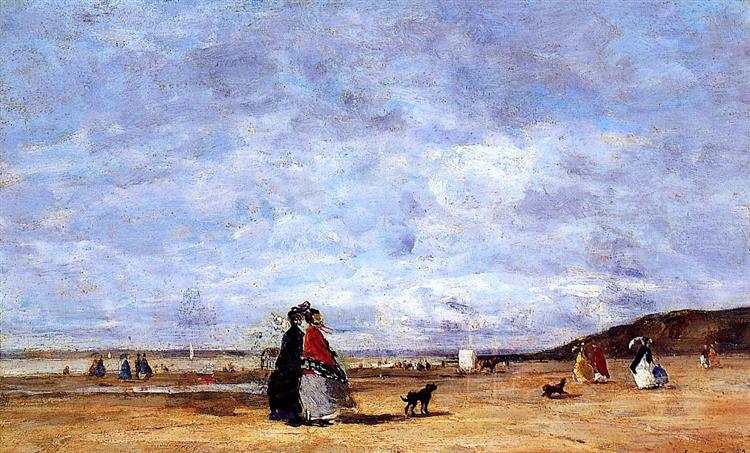
Boudin had started off his career painting seascapes, but he found his calling in the 1860’s depicting small beach scenes which he populated with affluent holidaymakers that had made the journey from Paris and outlying places.  These people spent summers sampling the health-giving benefits of sea bathing and the vibrant social life in the fast-emerging seaside resorts of Trouville and Deauville. Boudin created a few hundred examples of this type of painting, which enhanced his reputation.  He knew that genre was popular with the public once writing:

“…I shall do something else, but I shall always be a painter of beach scenes…”

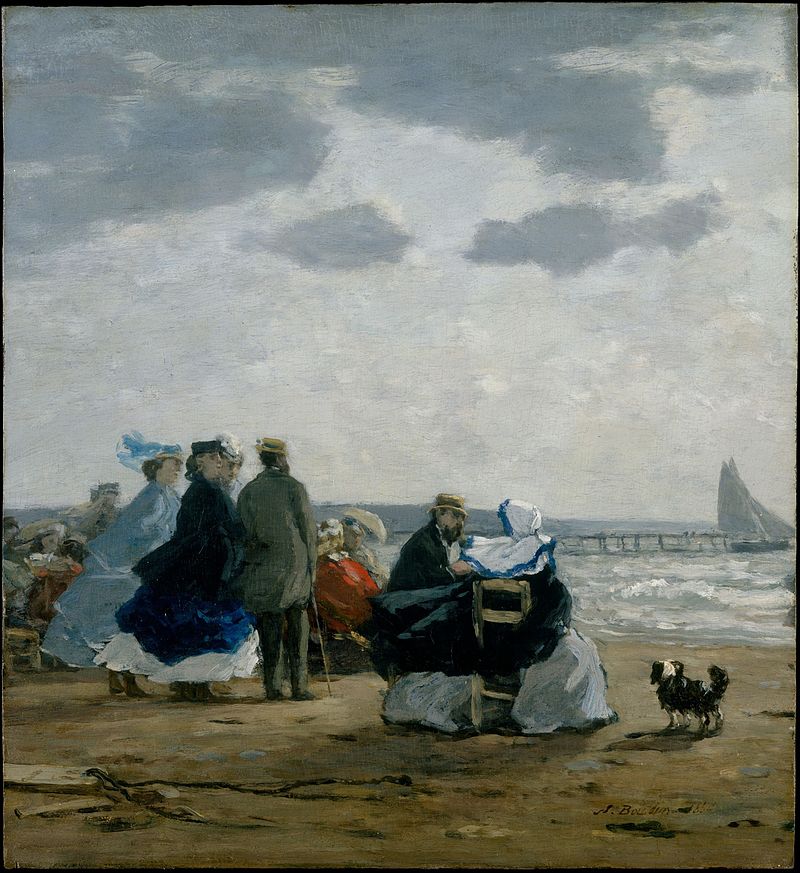
On the Beach, Dieppe MET DT11491.jpg

                                On the Beach, Dieppe by Eugène Boudin (1864)

An example of this type of work is his 1864 painting entitled On the Beach, Dieppe.   The setting is the beach of the Channel coastal town of Dieppe.

The changing skies of France’s Channel coast and the fashionable crowds on the resort beaches were Boudin’s lifelong subjects. These pictures were avidly collected, ensuring the artist’s success. In 1863 he commented:

“…They love my little ladies on the beach, and some people say that there’s a thread of gold to exploit there…”

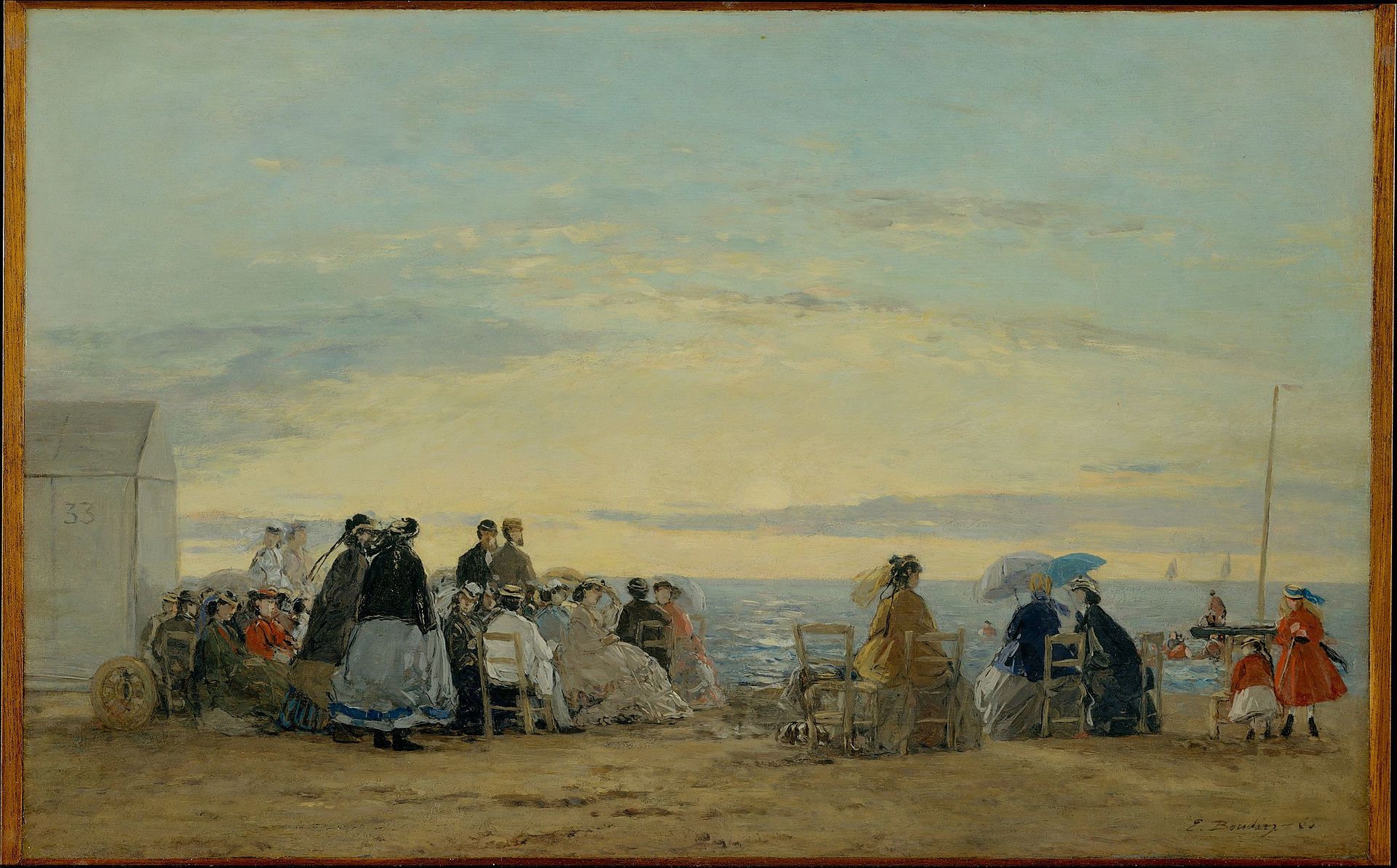
On the Beach, Sunset MET DT1031.jpg

                                 On the Beach, Sunset by Eugène Boudin (1865)

Around 1865 Eugène Boudin spent time painting on the Normandy coast along with Monet, Courbet and Whistler.  It is around this time that Boudin began a series of depictions of fashionable beaches and this was to carry on for the whole of that decade.  In his 1865 painting, On the Beach, Sunset, we see the well-dressed upper-class holidaymakers who have gathered together to catch the final light of the day.  The seaside towns of Trouville and Deauville had not only their beautiful sandy beaches to inveigle tourists to their town but also had racetracks and casinos to satisfy those who liked the thrill of a wager. 

Princess Pauline Metternich (1836–1921) on the Beach MET DT4425.jpg

                    Princess Metternich on the Beach by Eugène Boudin (1867)

Visits by famous people to the Normandy beaches, such as Napoleon III’s wife, the Empress Eugénie also enhanced their reputation. Another dignitary to visit the Normandy beaches was Princess Metternich, the famous Austrian socialite, and wife of the Austrian ambassador to France and one of the most notable women at the court of Napoleon III.  She visited the seaside times on many occasions and was often accompanied by Princess Eugénie.  Her visit was captured by Boudin in his small 1867 painting entitled Princess Metternich on the Beach.  The Impressionistic style of the painting gives us little idea of the woman herself, which may be a relief to the Princess, as commentators of the time described her as small, very slight of build and as having “a turned-up nose, lips like a chamber pot and the pallor of a figure from a Venetian masque”.

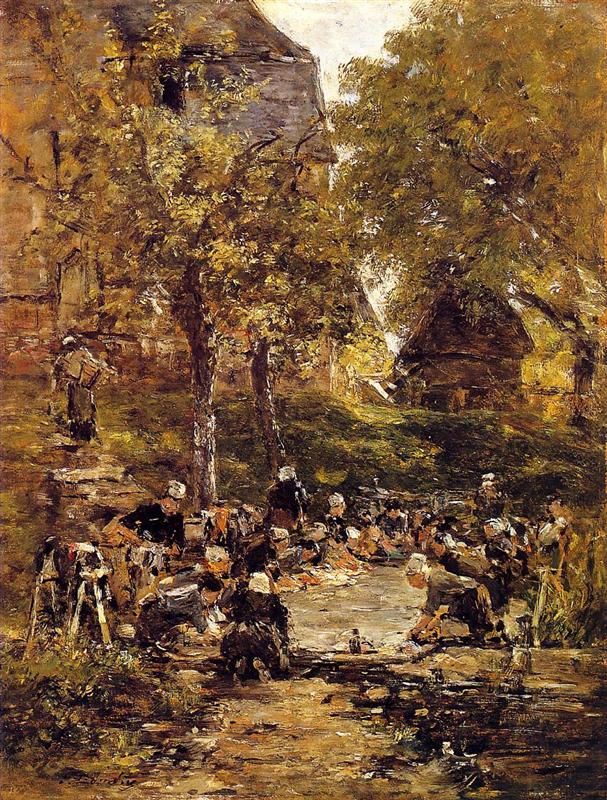
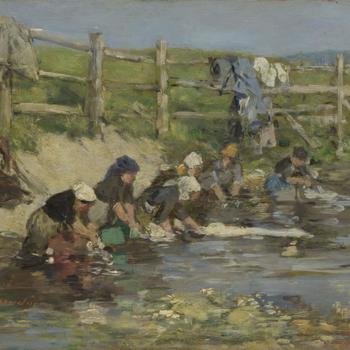
Laundresses by Eugène Boudin

For a period of time in 1867 Boudin left the beaches of Normandy and the luxurious lifestyle of the visiting rich and depicted the less well-off peasants and their daily routines.  Boudin could clearly see and understand the difference in the lives of the various social classes.  Did this bother him?  In a letter to his friend Ferdinand Martin, on August 28th, 1867, he condemned the social class system, writing:

“…I have a confession to make. When I came back to the beach at Trouville it seemed nothing more than a frightful masquerade.  If you have passed one month among the people condemned to hard work in the fields, with black bread and water, and you then find that gang of golden parasites with such a triumphant air, you can’t help feeling a bit of pity.  Fortunately, dear friend, the Creator has spread a little of his splendid and warming light everywhere, and what I reproduce is not so much this world as the element that envelops it…”

…….and yet in a letter to the same friend, Ferdinand Martin, a year later (September 3rd. 1868), he justifies his depictions of the wealthy on the Normandy beaches, writing:

“…The peasants have their painters, Millet, Jaque, Breton; and that is a good thing.  Well and good: but between you and me, the bourgeois walking along the jetty towards the sunset, has just as much right to be caught on canvas, ‘to be brought to the light’.  They too are often resting after a day’s hard work, these people who come from their offices and from behind their desks.  There’s a serious and irrefutable argument…”

Antwerp, Boats on the Scheldt by Eugène Louis Boudin, High Museum of Art.jpg
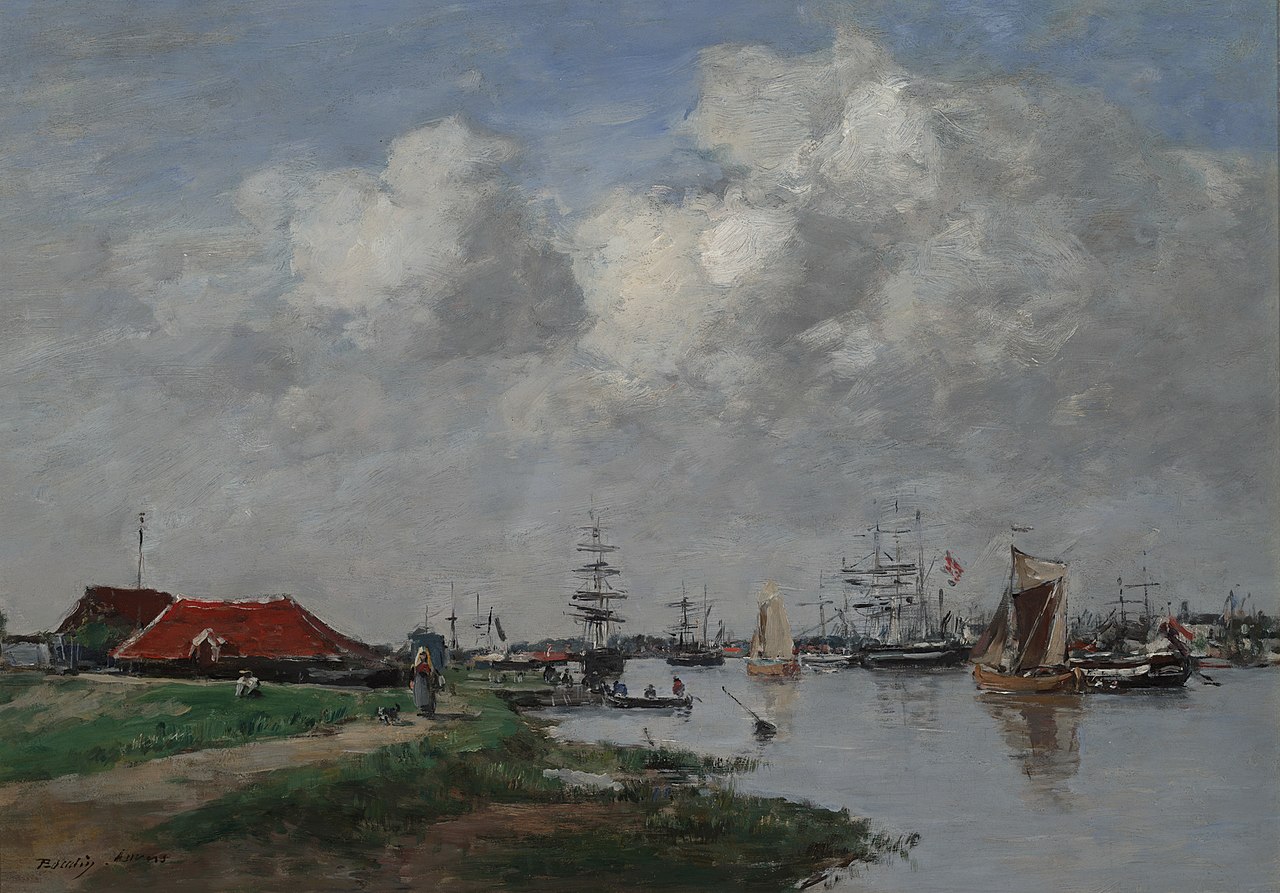
Antwerp, Boats on the Scheldt by Eugène Boudin (1871)

The Franco-Prussian War broke out in July 1870 and the Prussian army invaded the French capital the following month.  Both Boudin and Monet fled the country with Monet going to London whilst Boudin went north to Belgium and the city of Antwerp.  Whilst in Antwerp Boudin completed a number of maritime paintings, one of which was his 1871 work entitled Antwerp, Boats on the Scheldt.

Eugène Louis Boudin - The Escaut River in Antwerp - 1977.57 - Yale University Art Gallery.jpg
Antwerp, The Escaut River by Eugène Boudin (c.1871)

Another work around the same time was The Escaut River in Antwerp.

Low Tide. Portrieux by Eugène Boudin (1873)

With the Franco-Prussian war ending in 1871 and the bloody Paris Commune, which followed in the Spring of that year, coming to an end, it was safe to return to France.

Portrieux, in the bay of St. Brieuc, Côtes du Nord, was a popular village with painters and Boudin visited it on several of his trips to Brittany between 1865 and 1897.  His 1873 painting Low Tide, Portrieux depicts vessels he would have seen during his visits.  In this painting Boudin has focused on the fishing vessels from Newfoundland, the Terre-Neuvas, becalmed at low tide, and several of his paintings centred on this subject matter.   Boudin, who was the son of a ship’s captain, and who had worked as a cabin boy on ships sailing along the Channel coast, was well able to recognise, and record, the individual characteristics of the vessels he came across in the ports he visited.

The Dock at Deauville (1891)

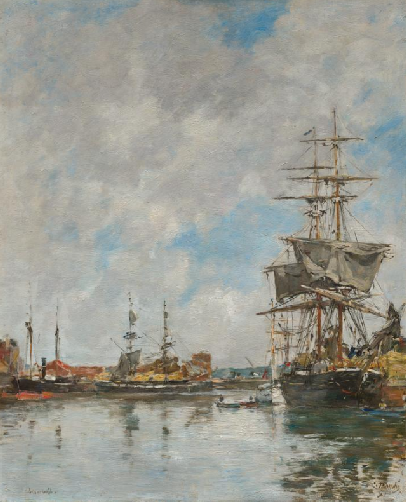
The Dock at Deauville by Eugène Boudin (1891)

One of Boudin’s paintings, The Dock of Deauville, which he completed in 1891, has a similar depiction, ships in a harbour.  This painting treats a common theme in Boudin’s later art, ships in harbours. For Boudin these paintings were all about tranquillity, harmony and the effect of natural light on subjects and, unlike other maritime painters, avoided depictions of busy dockside life and the arduous jobs carried out by dock workers.  In this work, one can see how he has combined lighter tones around the ships’ masts, often overlying the darker lines of the wood and rigging with white or grey tones as if to suggest the passing wind and ever-changing positions which were everyday aspects of nautical life.

Eugène Boudin - Voir d'Antibes au coucher du soleil.jpg

View of Antibes by Eugène Boudin (1893)

By the time the 1880’s came around Boudin had achieved widespread recognition as an accomplished painter and had finally achieved financial security once he had secured a contract with the art dealer Durand-Ruel.   Paul Durand-Ruel, who was a great supporter of Impressionism and the Impressionist artists. In 1883 he opened his new gallery on the Boulevard de la Madeleine in Paris with an exhibition of works by Boudin, comprising 150 paintings and other pastels and drawings.

Fair in Brittany by Eugène Boudin

In 1888 at an auction at Hôtel Drouot in Paris, a large auction house in Paris, known for fine art, antiques, and antiquities, which consisted of  sixteen halls hosting seventy independent auction firms, many of Boudin’s paintings were bought by avid collectors of his work. 

Venice: Santa Maria della Salute and the Dogana Seen from across the Grand Canal

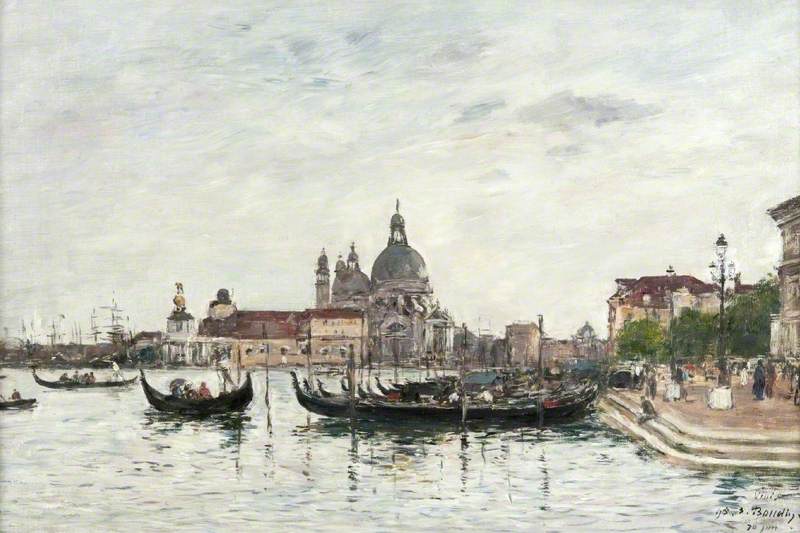
Venice: Santa Maria della Salute and the Dogana seen from across the Grand Canal, by Eugène Boudin (1895)

In 1889, 1890, and 1891, more successful exhibitions were organized at Galerie Durand-Ruel, and in 1890 Boudin was elected a member of the Société des Beaux-Arts.  His paintings travelled across the Atlantic and were shown in exhibitions in Boston in 1890 and 1891.  He continued to exhibit at the Paris Salons until his death and received a third-place medal at the Paris Salon of 1881, and a gold medal at the 1889 Exposition Universelle in Paris.  In 1892 Boudin was made a knight of the Légion d’honneur.  His wealth allowed him to travel and he visited Belgium, the Netherlands, and southern France, and from 1892 to 1895 made regular trips to Venice.
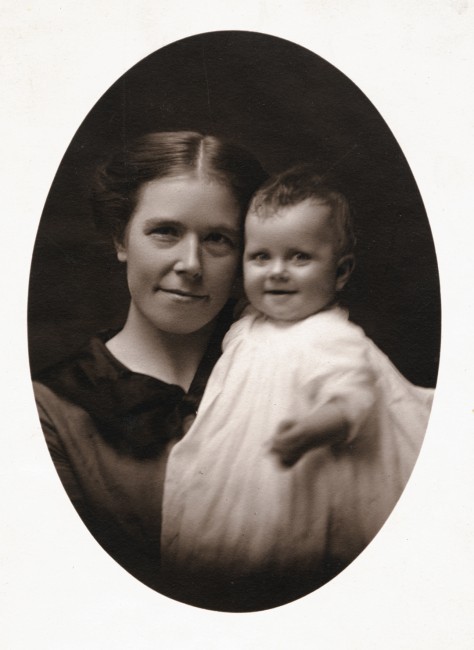
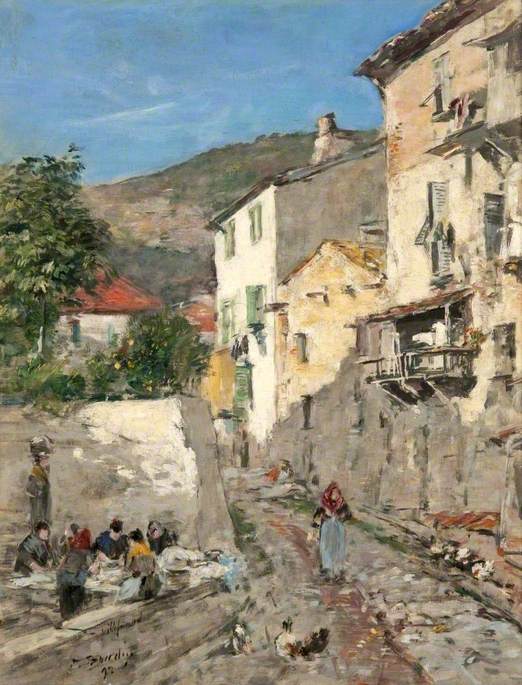
Villefranche

Villefranche by Eugène Boudin  (1892)

Boudin was now spending every winter in the south of France, returning to his beloved Normandy in the summer.  His wife died in 1889 and Boudin’s own health was in decline.  In 1898 Boudin must have realised he was dying as he decided to move back to his home in Deauville to die. 

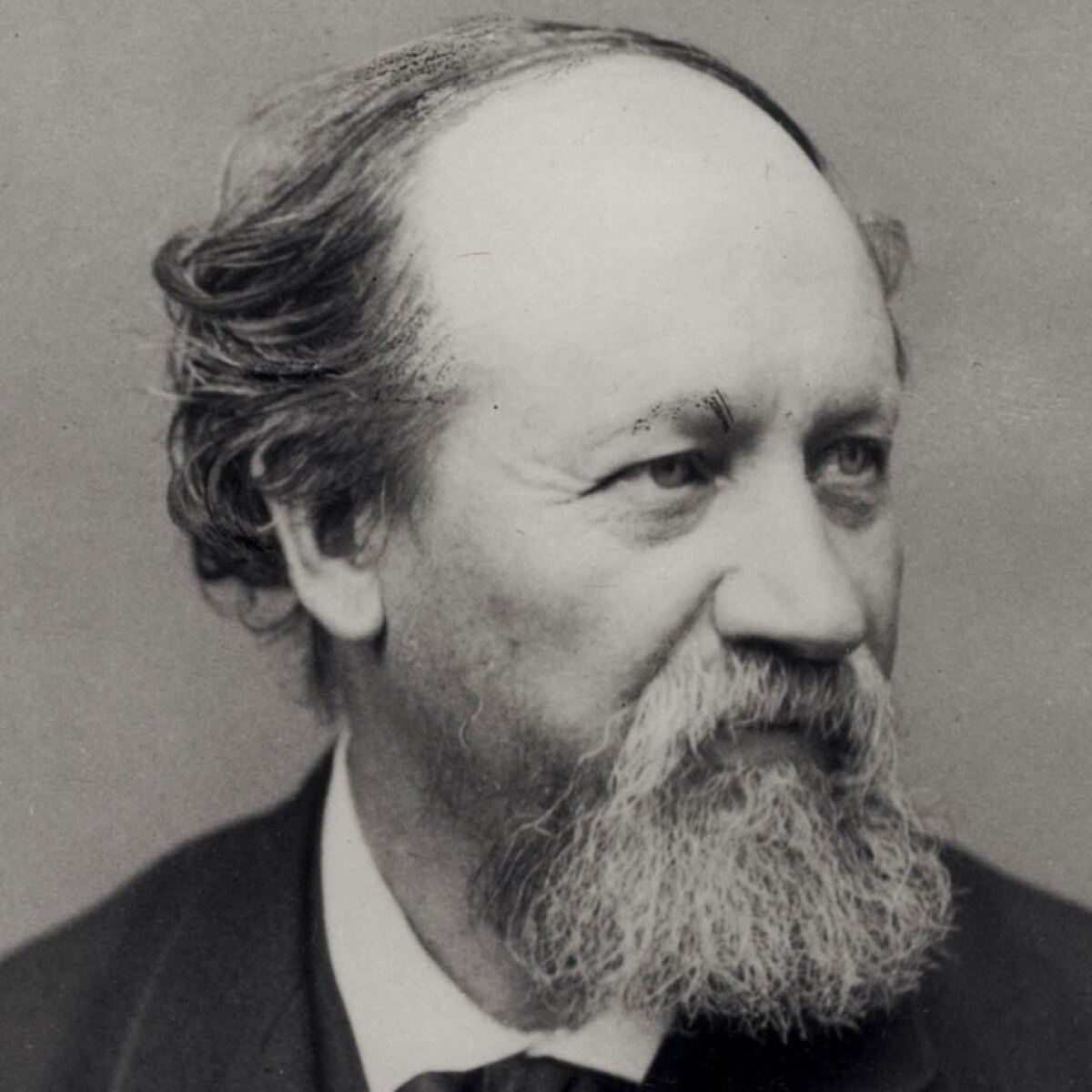
Eugène Louis Boudin died on August 8th 1898 aged 74.  He was buried according to his wishes in the Saint-Vincent Cemetery in Montmartre, Paris.  Boudin was a very modest man  and once said:

“…I may well have had some small measure of influence on the movement that led painters to study actual daylight and express the changing aspects of the sky with the utmost sincerity…”

But I will leave the last words to Claude Monet who said of Boudin:

“…If I have become a painter, I owe it to Eugène Boudin…”

Eugène Boudin. Part 1.

See the source image

My featured artist today is the nineteenth century French painter Eugène Boudin.  He was one of the earliest en plein air painters and is credited with introducing plein air painting to Monet.  He was a marine painter and his depictions focused on seascapes and the Normandy shorelines.

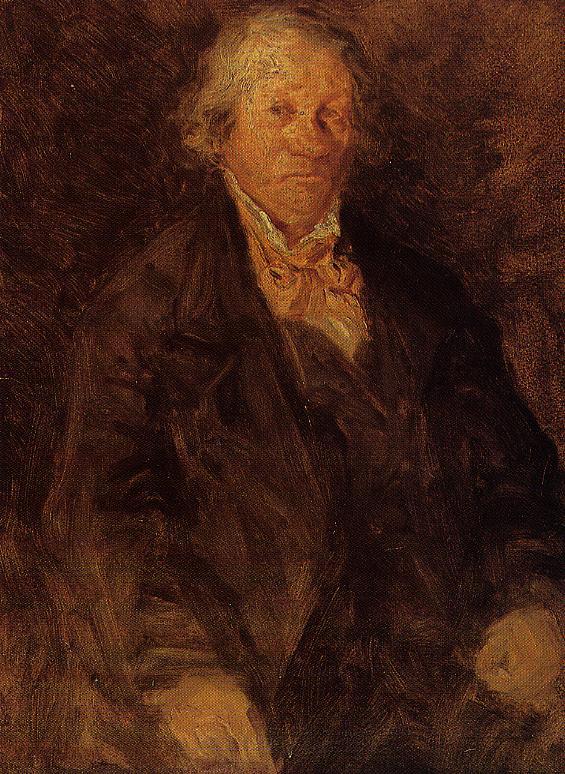
Portrait of the Artist’s Father  by Eugène Boudin (1850)

Eugène Louis Boudin was born in the coastal town of Trouville in Normandy on July 12th 1824. Leonard-Sebastien Boudin,  Boudin’s father, was a harbour pilot, and at the age of ten, young Boudin worked as a cabin boy on a steamboat that sailed across the Seine estuary between Le Havre and Honfleur and during those days on the water the young boy must have witnessed the constant fluctuations of the colours of the sea and sky which were aspects so important to plein air artists.  Boudin’s father gave up his seagoing life when Eugène was about twelve years of age.  In 1835, Eugène moved with his family to Le Havre where his father established himself as stationer and frame-maker. Eugène began work the following year as an assistant in the shop before opening his own small framing shop which he co-owned. It was whilst running this shop that he first met artists who were working in the area and used his shop to exhibit their paintings.  The most well-known of these were the landscape painter, Constant Troyon, Jean-Francois Millet, the portraiture artist, Jean-Baptiste Isabey and the history painter, Thomas Couture.  Eugène would receive encouragement from these painters to abandon the world of commerce and take up painting.  In 1846, aged twenty-two, Eugène Boudin took their advice and gave up the stationery shop and began to paint full time.  He had sold his share of the business to buy himself out of military service and in 1847, he travelled to Paris and spent time travelling through the Flanders region.  Boudin was profoundly influenced by the Dutch 17th-century Masters and when he met the Dutch painter Johan Jongkind, who had already made his mark in French artistic circles, Boudin was advised by his new friend to paint en plein air.  Three years later, in 1850 he won a scholarship that allowed him to move to Paris.  However, he never forgot his roots and would return to Normandy to paint and later take many painting trips to Brittany.  

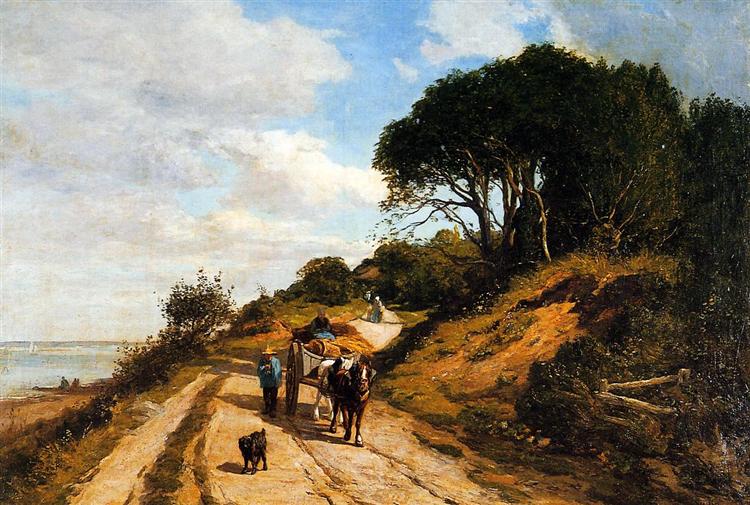
The Road from Trouville to Honfleur by Eugène Boudin (c.1852)

During that early period, Eugène painted rural landscapes, peasants, and still life works, but soon his love of the sea and the seaside progressively attracted his attention, and in 1862, he began to paint the crowds of fashionable tourists who had descended on the Normandy beaches.  Seaside resorts began to appear on the French Channel coast and in what was to become Belgium and the Netherlands in the late eighteenth century.  By the early nineteenth century the commercial sea-bathing habit was making an impact on Normandy. 

Fishermen by the Water by Eugène Boudin (1855)

Up until that time artists’ coastal scenes were rarely populated, and if they did include figures they were likely to be local fishermen. Boudin’s coastal scene paintings were adventurously modern in nature depicting smartly dressed holidaymakers engaging in leisure activities.

Elegant Women on the Beach by Eugène Boudin (1863)

His modus operandi was to sketch en plein air during the summer months and finish off the paintings in his studio during the winter months.  Boudin still respected the established tradition of outdoor painting.  His plein air sketches were merely studies rather than finished works and they had to be finalized in his studio utilizing the many sketches he had made as well as the meticulous notes he had recorded about atmospheric conditions and the time of day when the sketches had been made.  It was a painstaking operation as he once wrote in a letter to one of his students:

“… An impression is gained in an instant, but then it has to be condensed following the rules of art or rather your own feeling, and that is the most difficult thing – to finish a painting without spoiling anything…”

However, Boudin changed his methodology realising that there was an innate wrongness with his system of completing works indoors and so he would, from start to finish, complete his works en plein air.  This inherent immediacy of work painted outdoors allowed him to be aware of changing weather and light conditions.

The Beach at Villerville by Eugène Boudin (1864)

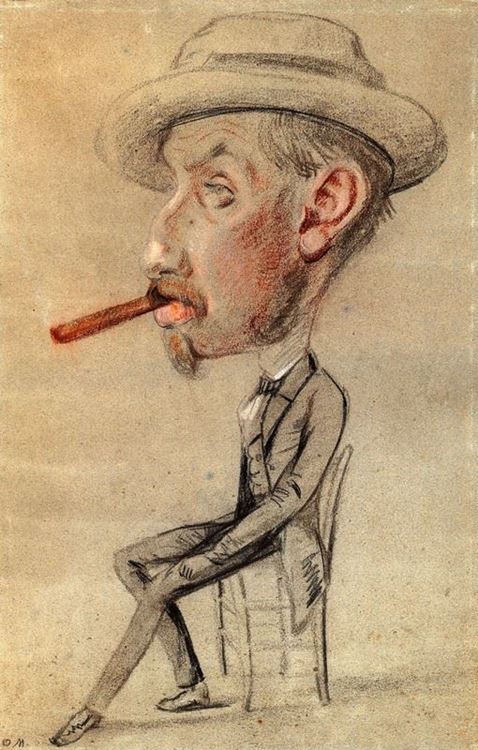
Claude Monet was born in Paris on November 14th 1840 and at the age of five moved with his family out of the French capital and went to live in Le Havre.  Monet was fourteen years younger than Boudin but it is said that around 1856, sixteen-year-old Monet met fellow artist Eugène Boudin, who then became his mentor and taught him to use oil paints. Boudin who befriended him also taught Monet the technique for outdoor painting.  This was to have a great influence on the young artist.  Up to the early meetings with Boudin, Monet had concentrated on his teenage caricatures but was persuaded by Boudin to focus all his time on landscape painting.  Monet recalled the time:

“…it was as if a veil had been torn from my eyes. I had understood, had grasped what painting could be. Boudin’s absorption of his work, and his independence, were enough to decide the entire future and development of my painting…”

Büyük Purolu Adam, 1855-1856 picture

Boudin helped Monet to love the bright hues and the play of light on water.  Monet remembered Boudin’s words of encouragement and later paid tribute to Boudin’s early influence:

“…Boudin without hesitation, came up to me, complimented me in his gentle voice and said ‘I always look at your sketches with pleasure, they are amusing, clever, bright.  You are gifted; one can see that at a glance.  But I hope you are not going to stop there.  It is all very well for a beginning, yet soon you will have had enough of caricaturing.  Study, learn to see and paint, draw, make landscapes.  The sea and the sky, the animals, the people and the trees are so beautiful, just as nature had made them, with their character, their genuineness, in the light, in the air, just as they are’…”

Laundresses by a Stream by Eugène Boudin

This would later become evident in Monet’s Impressionist paintings. Boudin offered Monet the chance to help him in his framing shop but the young man declined but later that summer he acquiesced.  The two remained lifelong friends and  it was probably through Monet that Boudin was asked to participate in the First Impressionist Exhibition in 1874.  

In 1859 Boudin met Gustave Courbet who introduced him to the poet and art critic, Charles Baudelaire, who was the first critic to draw Boudin’s talents to public attention when he made his debut at the 1859 Paris Salon.

Deauville Harbour by Eugène Boudin

Boudin was to later join Monet and his young friends in the first Impressionist exhibition in 1874, but he never considered himself a revolutionary trend-setter unlike some of the other artists.  So now Boudin’s work featured at both the Imressionist’s First Exhibition as well as at the Paris Salon that year.  In a way Boudin had created a vital connection between the past and future trends of French art, and by so doing won the admiration of his contemporaries.  Boudin could have become a regular member of the Impressionists but chose not to.

   Boudin had mental issues in the form of bouts of melancholia and he always seemed to doubt his own ability.  He was introverted and never felt the need to bolster his reputation which may have been enhanced if he had decided to live in the French capital and regularly mix within the Paris art circle.  Boudin preferred to remain living in Normandy.

In a letter, from Paris, dated June 14th 1869, to family-friend Ferdinand Martin Boudin tells of his desire to return to Normandy:

“…I dare not think of the sun-drenched beaches and the stormy skies, and of the joy of painting them in the sea breezes…”

The paintings that Boudin made of the coast were consistent with the ideals of the depiction of light which became popular with the Impressionist movement and so we must realise that Boudin continued to be an influence with the group.  
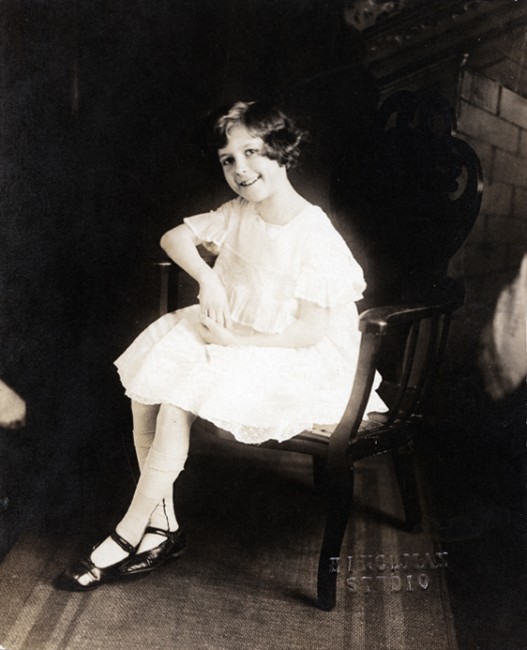
Beach at Trouville by Eugène Boudin

Boudin was a master when it came to depicting skies.   Fellow artists, like Corot, praised that aspect of Boudin’s paintings and nicknamed him King of the Skies.  In 1859 the poet Charles Baudelaire rhapsodically described the skies in Boudin’s paintings, shown at the Salon, ‘prodigious spells of air and water’.

………..to be continued.

Harold Harvey

Harold Harvey

Harold Harvey (1874 – 1941)

My featured artist today is one of the famous Newlyn School painters. The term Newlyn school applies to a group of artists who settled in Newlyn and St Ives in the late nineteenth century and whose work is characterised by an impressionistic style and embodies subject matter drawn from scenes of rural life.   It was founded by a group of artists led by Stanhope Forbes. who came to Newlyn in West Cornwall in 1884 and was immediately captivated by the scenery and people in the area. The ‘Newlyn School’ became famous for its superb realism, in ‘Plein-Air‘ painting.  The artist I am looking at today, Harold Harvey, made his name for his beautiful works featuring the Cornish countryside.

See the source image

The Old Slip, Newlyn by Harold Harvey

Harold Charles Francis Harvey was born on May 20th 1874 in North Parade, Penzance, Cornwall.  He was the eldest of eight children of Francis McFarland Harvey, a bank clerk, and Mary Bellringer whom he married in September 1872. Harold had six brothers, Percival George Harvey; Frank Harvey; Arthur William H Harvey; Wilfrid Vignes Harvey; Leonard Harvey, and Cyril Harvey along with one sister, Gladys Maud Harvey.  Harvey trained in painting at the Penzance Art School under the tutelage of Norman Garstin, an Irish artist, teacher, art critic and journalist associated with the Newlyn School of painters. After leaving the Penzance Art School at the age of nineteen, William travelled to France and attended the Académie Julian in Paris between 1894 and 1896.

Harold Harvey - Unloading the boats, Newlyn Harbour.jpg

Unloading the boats, Newlyn Harbour by Harold Harvey (1906)

In the early part of the twentieth century, Harold Harvey’s paintings were impressionistic in style and the depictions focused on people involved in the agricultural and fishing trade. 

In the Whiting Ground’ by Harold Harvey

In the Whiting Ground by Harold Harvey (c.1900)

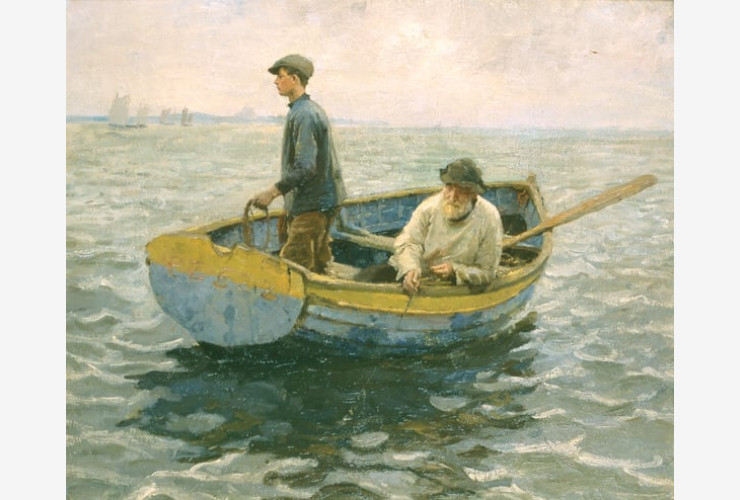
One such work was In the Whiting Ground which he completed around 1900 and depicts a small dinghy at sea with a young man standing holding a fishing line in his hands while an older man is holding a line in the water.  St Michael’s Mount the tidal island in Mount’s Bay, a large, sweeping bay on the English Channel coast of Cornwall, can be seen in the far distance.

Whiffing in Mount's Bay

Whiffing in St Mount’s Bay by Harold Harvey (c.1900)

A small painting completed around the same time by Harvey featuring three young men in a boat had the strange title of Whiffing in St Mount’s Bay.  Whiffing is a mode of fishing with a hand line.

The Seaweed Gatherers by Harold Harvey

The Seaweed Gatherers by Harold Harvey

Another of his paintings depicting life along the Cornish shoreline was one entitled The Seaweed Gatherers in which we see two men hauling a horse and cart laden with fresh seaweed.

The Close of a Summers Day by Harold Harvey. (1909)

The Close of a Summers Day by Harold Harvey (1909)

A more colourful painting is his beautiful work of idyllic tranquillity entitled The Close of a Summers Day which he completed in 1909.  It is at the end of a hot summers day and man and beast have need of a rest and refreshment.  The young farmworkers have been tasked with taking the horses down to the river for them to cool down and have a drink.  The white horse gently splashes in the water attempting to cool down its fetlocks.

From 1909 to 1913, Harvey was an Associate of the Royal Cambrian Academy of Art, Conwy and, in 1910, he became a member of the South Wales Art Society.

gertrude_harvey2_large

Gertrude Harvey by Harold Harvey

It was around this time that Harold Harvey met Gertrude Bodinnar.  She was born in 1879 and was the eighth of the ten children born to Ann Crews Bodinnar, (née Curnow), and her husband John Matthews Bodinnar, a cooper.  In her twenties, she acted as a model for students at the Forbes School of Painting, which had been founded in 1899 by Stanhope Forbes and his Canadian-born wife Elizabeth as their School of Painting and Drawing at Newlyn. It was indirectly through her work with students at this establishment that she first met Harold Harvey and agreed to act as his model.  Love blossomed and Harold and Gertrude married on April 19th 1911 and the couple set up home at Maen Cottage Elms Close Terrace, in Newlyn

Portrait of the Artist's Wife, Gertrude by Harold Harvey (1917)

Portrait of the Artist’s Wife, Gertrude by Harold Harvey (1917)

Gertrude appeared in a number of her husband’s paintings.  One example was his 1917 portrait of her entitled Portrait of the Artist’s Wife, Gertrude……

Gertrude Harvey with Parrot in the Artist's Home by Harold Harvey

….and Gertrude Harvey with Parrot in the Artist’s Home……

The Red Silk Shawl by Harold Harvey (1932)…..and The Red Silk Shawl in 1932.

Being around artists, including her husband, and watching them work fascinated her. She would often note down how the artists worked, and she soon realised that she had a talent for art and design.  Gertrude used mostly oil on canvas, board, card, or paper, but also tempera, gouache and though largely self-taught she became a talented artist in her own right, and her paintings were mainly of still-lifes, flowers and landscapes. 

Landscape

Landscape by Gertrude Harvey

Her paintings were good enough to be sold and exhibited at the Newlyn Art Gallery and in the twenties and thirties her work could be seen in many London galleries including the Leicester Gallery and the Royal Academy. Often, she showed work together with her husband in mixed and group shows.   Between 1930 and 1949, Gertrude Harvey had twenty works selected for Royal Academy exhibitions and from 1945 to 1949 she was regular exhibitor with the St Ives Society of Artists.  She was also proficient at needlework and clothing design.

Reflections by Harold Harvey (1916)

Reflections by Harold Harvey (1916)

Meanwhile Harold Harvey continued painting and exhibiting his work. The First World War began in 1914 but due to health issues, he was exempted from military service.  In that year, he started to paint a series of interiors often using his own home.  One such painting was his 1916 work entitled Reflections.
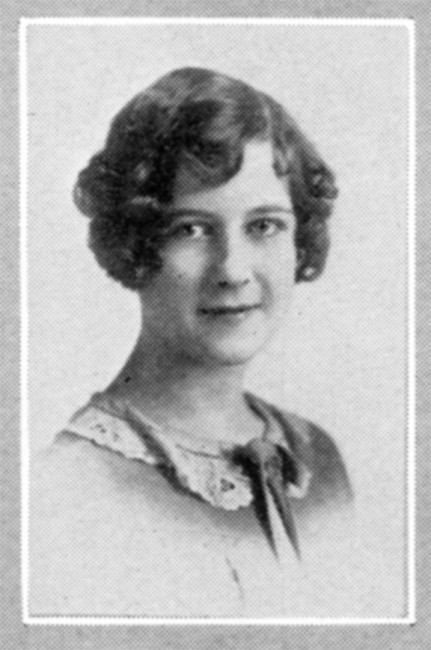
The Critics by Harold Harvey

The Critics by Harold Harvey

In another work entitled The Critics, we see three women enjoying coffee and an aperitif as they study some paintings, weighing up the merits of each one.

The Tea Table by Harold Harvey

The Tea Table by Harold Harvey (1920)

A depiction of domestic living can be best seen in Harold Harvey’s 1920 painting entitled The Tea Table.  It is a masterful depiction of a small dining room filled with shelves of crockery and ornaments.  It could almost be termed a still-life of household goods.

Girl on a Cliff by Harold Harvey (1926)

Girl on a Cliff by Harold Harvey (1926)

With such wonderful landscapes on his doorstep, it is no wonder that Harvey continued with his outdoor works featuring young models.  One example of this is his 1926 painting entitled Girl on a Cliff.  In a way, this is not a true plein air painting as the girl in the depiction is fourteen-year-old Cressida Wearne and Harvey painted her posing in the garden of his studio and he added the background at a later date.
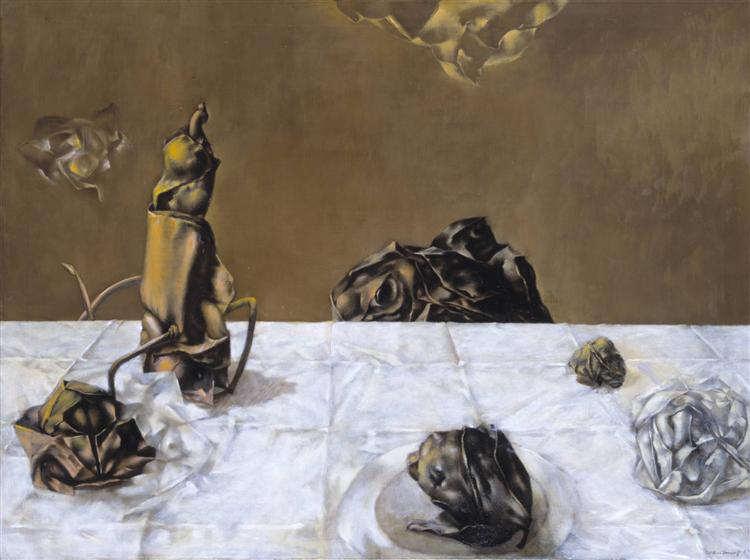
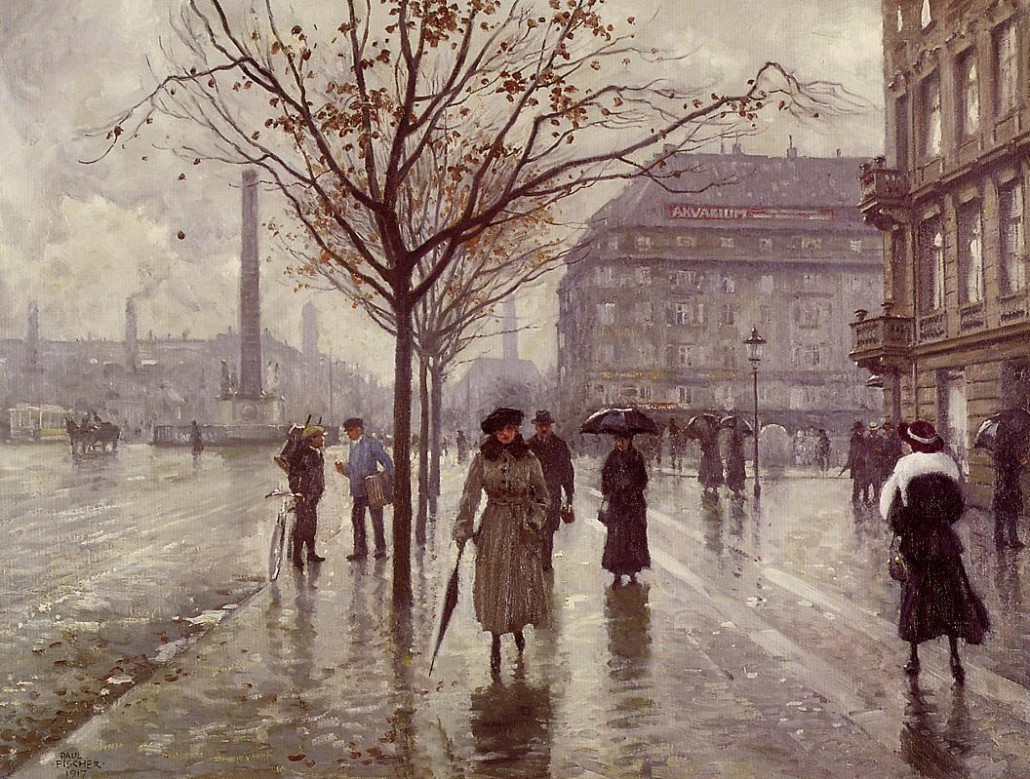
Clara

Clara by Harold Harvey (1922)

Again, we see this technique with his 1922 painting, Clara.  It is a full-length portrait of a girl standing by a wall set in a rolling landscape.  She is seen holding a rose and in several of Harvey’s portraits his female sitters are holding a single flower. The work is composed mainly of tones of grey and brown but it is the red of the rosebud which creates the focal point of the work.

Harvey, Harold C., 1874-1941; James Jewill Hill Junior

Portrait of James Jewill Hill by Harold Harvey (1920

Harold Harvey completed a number of portrait commissions, such as his 1920 portrait of the youngest son of James Jewill Hill, a partner in the solicitors firm Jewill Hill & Bennett, Penzance.

Harvey, Harold C., 1874-1941; John Humphreys (1850-1937), Professor of Dentistry
Portrait of John Humphreys, Professor of Dentistry; University of Birmingham; by Harold Harvey (1938)


Another portrait he completed was a 1938 commission to paint a portrait of John Humphreys, Professor of Dentistry.

In 1920, Harold Harvey and fellow Newlyn School artist, Ernest Procter, founded the School of Painting, in Newlyn, called the Harvey-Procter School, which ran throughout most of the 1920s. 

Harold Harvey died in Newlyn on 19 May 1941 and was buried in Penzance at the St Clare Cemetery. His wife, Gertrude, lived in their cottage until 1960 when she moved into the Benoni Nursing Home in St Just. She died six years late, aged 86.


Ásgrímur Jónsson, the Icelandic Impressionist.

This is just a short mini-blog to look at a twentieth century Impressionist from Iceland, Ásgrímur Jónsson

                                                               Ásgrímur Jónsson

Ásgrímur Jónsson wasat the forefront of Icelandic art.  He was a pioneer of Icelandic visual art and the first Icelander to become a professional painter. Ásgrímur was born on March 4th, 1876, in Suðurkot, a small town thirty kilometres south west of Reykjavik.

                                       Autumn Sunlight, Öskjuhlíð by Ásgrímur Jónsson (1920)

In 1897 he left home and went to Copenhagen.  In 1900, aged twenty-four,  he enrolled on a three-year art course at the Royal Academy of Fine Arts.  Once qualified, he toured a number of European countries before settling back down in Iceland in 1910.  On his journey home he visited Germany and the cities of Berlin and Weimar and it was during this period that he became influenced by the French Impressionists and the Post Impressionists, especially the landscape works of  the French painter Jean-Baptiste-Camille Corot.

                                          Hafnarfjörður Town by Ásgrímur Jónsson (1930)

Ásgrímur’s main painting genre was landscape art and especially that of his native Iceland and through his art many native artists would follow his lead.  His depictions of nature were fashioned by the romance of the nineteenth century.  He liked to focus his depictions on the changes of light and how it altered the view of the land.  He alternated between watercolours and oils but is best known for the former medium.

                           Mt. Strútur and Eiríksjökull Glacier, West Iceland by Ásgrímur Jónsson (1948)

He was a great believer in Naturalism in art – the broad movement in the nineteenth century which represented things closer to the way we see them.  However later his works were characterised by colourful expressionism.

                                           From a Folklore by Ásgrímur Jónsson (1957)

Ásgrímur also worked as a pioneer in the illustration of Icelandic legends and adventures.  He pictorially depicted Icelandic Folk Legends delving into the world of elves and trolls who lived in the semi-darkness of the old turf farmhouse and who would kidnap humans.  Tales of pastors haunting their wives-to-be, of witches flying to Satanic gatherings, of sheep-rustling and flying bulls.  A land where humans live inside hills, where witches flying on jawbones instead of broomsticks, and tales which rarely have happy endings.

                                                                  Troll painting by Ásgrímur Jónsson

Ásgrímur’s works on folklore themes were well received.  The art critics delighted in his depictions and that Iceland’s folktale heritage was being addressed, for the first time, by an Icelandic artist. Ásgrímur’s depictions of the appearance of elves and trolls also met with widespread approval from the public who believed he had succeeded in capturing the way that they imagined their folklore characters to be.  For Ásgrímur Jónsson it was all about the viewer’s own imagination when they looked at these folklore works and it was a reminder of the beauty of their land when they looked at his landscape paintings.  Today the folklore paintings form part of the unique cultural heritage conserved in the collections of the National Gallery of Iceland.

                        ÁSGRÍMUR JÓNSSON MUSEUM at BERGSTAÐASTRÆTI 74, 101 REYKJAVÍK

Ásgrímur Jónsson died on April 5th, 1958, aged 82.  The Ásgrímur Jónsson’s collection, which is today a department within the National Gallery of Iceland, originated in 1960 when a small gallery was opened in Ásgrímur’s studio and home, which he bequeathed to the Icelandic nation along with all of his works in his own possession upon his death. 

John Koch. Part 3.

                                                                        Interlude by John Koch (1963)

Dora featured in many of her husband’s paintings.  One such is his 1963 work entitled Interlude.  In a way it is a narrative painting recounted a day of painting for the artist.  Here we glimpse artist John Koch in his apartment studio with an African American model, said to be one of is favourites.  She dominates the foreground of the painting.  The contrast between the colour of her dark ebony skin, the white bed sheets, and the vibrant red robe of the third person in the painting make for a great contrast.  The shape of her graceful back echoes the lines of the nearby Queen Anne style chair.  The African American model, Rosetta Howard, dominates the foreground as Koch depicts her dark velvety back against the white bed sheet and the vibrant red robe of the third person in the painting, John Koch’s wife, Dora, who offers the model a cup of tea. The three figures neither engage with the viewer, nor do they engage in eye contact with each other.  The artist fixates on his partially completed canvas.  The artist’s wife in the red gown avoids looking at the naked body of the model, who in turn concentrates her gaze on the cup and saucer.  So, like other paintings by Koch, the figures and furniture have been set by the artist.  What are we to make of the depiction?  Is it just a simple portrayal of an artist and the model taking a break from their work or is it something more?  Could it be John Koch wanting to highlight a contentious role reversal – a white woman in 1963 serving a black woman !

                                                        The Breakfast Tray by John Kotch (1970)

Dora Koch appeared in the same red dress in her husband’s 1970 painting entitled The Breakfast Tray.  For John and Dora, breakfast on a tray was a daily ritual.  In this work we see the tray laden with their finest china.  The setting for the painting is the hallway of their Setauket, Long Island house.  John holds the tray in front of himself and it appears to be an offering to his elegantly robed wife who is mounting the stairs.

Photography by Dwight Primiano
                                                              Studio – End of the Day by John Koch

Rosetta Howard appeared in a number of John Koch’s paintings including His work, Studio – End of the Day in which artist and model finally take a rest from painting and posing.

Artwork Title: The Lesson - Artist Name: John Koch
                                                                            The Lesson by John Koch (1970)

Another painting to feature his wife was John Koch’s 1970 work entitled The Lesson in which we see Dora giving one of her piano lessons.

John Koch (1909-1978) Summer Night 78 x 44in (198.1 x 111.8cm) (Painted in 1965.)
                                                      Summer Night by John Koch (1965)

John Koch was known for his sophisticated and stylish depictions of trendy life in and around New York City. His 1965 painting, Summer Night, is a perfect example of the genre.  It was painted on a monumental scale (198 x 112 cms) and highlights Koch’s dextrous skill for assembling figures so as to highlight the interactions and intrigue between his subjects. The scene in this painting is set in the evening on a front porch of a wealthy home with people relaxing after drinks and a meal.  The scene exudes a laid-back and tranquil elegance of a family gathering on a warm evening.  Note how Koch has carefully arranged the props which translate into fastidiously arranged still life elements of the work.  The painting was first exhibited at the Kraushaar Galleries. His time working with the gallery brought him great commercial success for the remainder of his career.  The painting was last sold in 2020 at Bonhams, New York Auction for US$ 162,575

                                                                   The Sculptor by John Koch (1964)

There were a number of paintings by Koch that depicted both artist and sitter and one of my favourites is his painting entitled The Sculptor.  It is a quasi-self portrait with John Koch as the sculptor, surrounded by the tools of his craft, including a caliper, which he is holding – in fact, one should remember that John Koch was not only a painter but a sculptor.  The model in this work was Ernest Ulmer, one of Dora’s former student who was also the subject of Interior of Studio. Ulmer is painted in full view from the back, his muscular body extended in a classic pose.  The sculpture painted in the background was one that he had made. It is a scene from Greek mythology, with Hercules and Prometheus, a mythological individual who stole fire from the gods to bring it to humans. Koch has added a touch of humour to the depiction with the visual pun between that tale from Greek mythology and the depiction in the painting of the model handing a light to the sculptor for his cigarette.  In the painting we see Koch leaning forward with the cigarette in his mouth, and the flame from the lighter held by the model is cleverly reflected in his glasses, as if extending the spark to the man himself.

The Plasterers1957x633
                                                                       The Plasterers by John Koch (1957)

In 1967 John Koch completed one of his most important paintings.  It was entitled The Plasterers.   The two men have come to Koch’s apartment to make good repairs to the walls.  In the background there is a bank of windows, some of which are open.   Look through the windows and you can see that Koch has managed to depict a panoramic skyline, probably a view of the Hudson River from his apartment window at the El Dorado building at 300 Central Park West of the Hudson River.  In the left foreground there is once again depicted Koch’s sculpture, Prometheus, which we saw in his painting, The Sculptor.   Through the windows streams the daylight which dances on the highly polished floor and furniture. 

See the source image
                                             Gustave Caillebotte’s 1875 painting The Floor Scrapers

For some reason, it is this shiny wooden floor which always reminds me of Gustave Caillebotte’s 1875 painting The Floor Scrapers which depicts three workers scraping a wooden floor in a bourgeois apartment.   On May 9, 2009 at the Brunk Auctions in Asheville, North Carolina, the painting, along with six preparatory sketches for the painting, sold for $210,000.  The painting was shown at two major Koch exhibitions. The first in 1973 at the New York Cultural Centre. The second was in 2001-2002 at the New York Historical Society.   The New York Historical Society’s 2001 exhibition catalogue described the painting as:

“…a tour de force of (the artist’s) ability to bring the outside into an interior through reflection of light playing off surfaces…”

See the source image
                                                  The Window Washers by John Koch (1975)

Another painting featuring two workers in the setting of John and Dora’s apartment is the 1975 work entitled The Window Washers.

Artwork by John Koch, THE ACCIDENT NO. 2, Made of oil on canvas
                                                     The Accident No.2 by John Koch (1968)

Another unusual work by Koch was his 1968 painting entitled The Accident. No.2.  It is a narrative work.  In the depiction we are looking into the small artist’s studio, which could also act as the artist’s bedroom.  The props set up by John Koch are a small single-bed with ruffled sheets, a discarded red silk robe, a pair of bedroom slippers which have been casually abandoned, a hand-mirror propped on the rim of a waste.  The window is partially covered by a curtain pulled back and of course the artist’s workstation with his easel, canvas, and palette. The artist and his naked model have rushed to the window to view what is happening outside.  By the title of the painting the artist is telling us that they are looking out at an accident which has happened in the street below.  The model is pointing down to something in the road below which he is straining to see.  It is an unusual scenario as most depictions of artist and model focus on the single-minded concentration of the artist as he studies his absolutely motionless model.  Here the commotion outside has broken the spell of their sensual assignation.

                                                                                Night by John Koch (1964)

In his 1964 painting, Night, John Koch has presented us with the contrast of warmth and coolness.  The coolness of the bodies now divested of clothes and yet the oppressive heat and humidity of a New York summer night when one tries desperately to be able to sleep.  John liked the setting of his painting describing it:

“…a picture of a young couple before they go to bed at night, which I think is as splendid an idea for a picture as any could be…”

The woman has fallen asleep whilst the man bides his time by reading a newspaper.  Besides him the light from a lamp on the bedside table glows through his newspaper.  The bottom of the bed and the white sheets have been illuminated by the soft blue glow of a television which is on a stand at the end of their bed.

Artwork Title: The Bath - Artist Name: John Koch
                                                                            The Bath by John Koch (1973)

John Koch whose oeuvre contained a large number of nude depictions of couples or a single male or a single female.  He was adamant that the depictions were not envisioned to be erotic, even when they depicted couples in bed. If you look over the depictions featuring a male and a female in bed they are not in the middle of lovemaking but simply relaxing, even though it may be in a post-coital state.  The pair who could be lovers or married couples show neither indication of sexual stimulation, lustful craving nor agitated signs of conflict.  There is a kind of neutrality with regards the couple’s personal thoughts.  Koch’s agenda seemed to be one that was to offer viewers a normal heterosexual relationship – one of idyllic well-being, a sense of happiness unsullied by lust or anguish. In his 1973 painting, The Bath, we see a man drying himself on the edge of a tub. He takes time to glance back at the woman who remains in the water. In contrast to his rough and hirsute muscular and bronzed body hers is smooth, pale, and supple.

                                                    Back Scratcher by John Koch 

John Koch became an elected member of the American Academy and the National Institute of Arts and Letters in 1970. Five years later, he suffered a stroke and abandoned painting for the first time since his youth. John Koch died on April 18th 1978 from complications of another stroke.  He was 78.  His wife Dora died on September 9th 1987 aged 83.  John Koch’s art was dismissed by the more progressive art scene as just a society painter and was little known outside his circle of wealthy, connected patrons. However, he managed to capture scenes of a New York society that is mostly gone now and therefore many of his paintings were a historical record of a world which was more formal and refined.  His often stage-managed art is classed as being of a realism genre and yet the depictions of opulence were tinged by an element of fantasy.  Maybe it is a fantasy we all hold dear.