
Last week I spent a few days in the French city of Bordeaux and besides visiting must-see museums such as Cité du Vin, Musée d’Aquitaine, the cathedral and sampled the red wine and French cooking, I spent half a day looking around the Musée des Beaux Arts which had an excellent selection of paintings. The Musée des Beaux Arts Bordeaux is the oldest of Bordeaux’s museums and was founded in 1801 under the guidance of painter Pierre Lacour. This establishment ranks among the most significant art galleries in France beyond the confines of Paris.
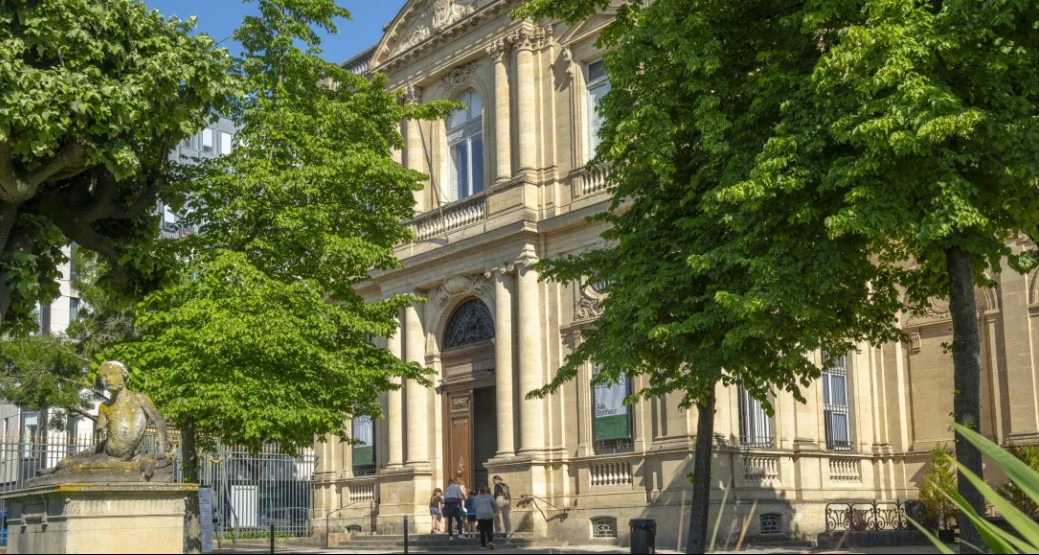
Lacour wing of the Musée des Beaux Arts, Bordeaux
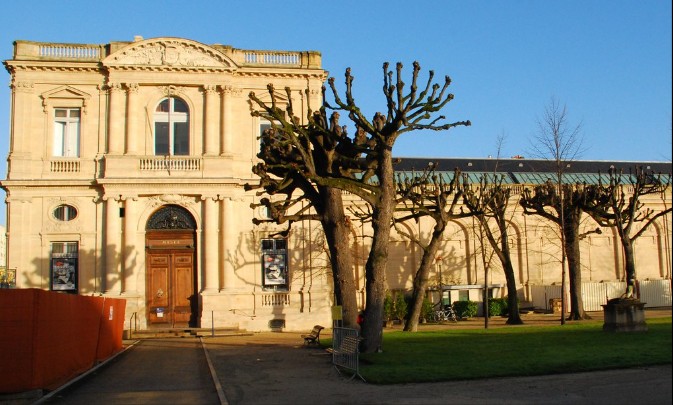
Bonheur Wing of the Musée des Beaux Arts, Bordeaux
The museum is located in the heart of Bordeaux, next to the town hall gardens. It is a veritable treasure trove of art and history, offering an exceptional selection of European painting and sculpture from the 15th to the 20th century. The museum consists of two buildings, housed in the north and south wings of the Palais Rohan, the current town hall. Its extensive permanent collection features major works by Flemish, Dutch, Italian, and French artists. Highlights include paintings by Peter Paul Rubens, Jean-Baptiste Chardin, Eugène Delacroix, and Odilon Redon, offering a journey through various artistic movements. The museum is not limited to old masters. It also has a fine selection of works from the 19th and early 20th centuries, reflecting the artistic developments of these periods.
In this first of two blogs I want to look at some of the works which were on show in the south wing of the museum, The Lacour Wing.
In the Lacour Wing the permanent exhibition starts with Renaissance art from Italy and Northern Europe in the 15th and 16th centuries with Titian amongst the paintings. The 17th century exhibition includes Baroque art with works of Paul Rubens and a section of Dutch painters including Jan van Goyen. Finally, in this wing there is an exhibition of 18th century paintings including a painting of the port and quais of Bordeaux by the building’s namesake, Pierre Lacour.
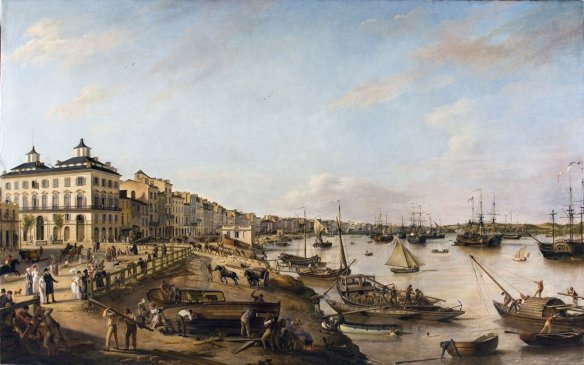
The view of the Chartrons and Bacalan Harbour and Waterfront Area in Bordeaux by Pierre Lacour Snr. (1804-1806)
The Port de la Lune, Bordeaux’s port since the Middle Ages, takes its name from the crescent-shaped bend of the Garonne on which the city was built. Since the 17th century, this panoramic view has been a favourite subject for artists from Bordeaux and beyond. Originally from Bordeaux, Pierre Lacour Snr. is one of the tutelary figures of the Musée des Beaux-Arts, a French painter and lithographer known for his views of the city and its surroundings. A professor and then director of the Academy of Painting, Lacour trained many generations of artists. Between 1804 and 1806, Pierre Lacour, the museum’s first curator, captured this urban landscape in his own vision of Bordeaux. The depiction takes in the view that depicts the facades of the Chartrons and Bacalan.

The Artist Painting a Family Portrait by Pierre Lacour Snr. (1798)
The Chartrons dates back to the 14th century when the Carthusian monks, the “Chartreux” in French, settled here giving the district its name. By the 17th century, the area had become the headquarters of Bordeaux’s booming wine trade. The Bacalan is the northern part of the city built around the port. For me, the joy of the painting is its focus on the smallest detailing of the human activities in this lively district. As day comes to an end, we see carters and their teams loaded with stones, also carriages and cabriolets. Shipwrights maintain the hulls of the canoes. In the background, a porter is unloading a cargo of stave wood used to create wine barrels. Further on, a carter is trying to pull up his team, loaded with stones, with his whip, while, further back, barrels are rolled on the ground from a barge, then pulled by means of ropes towards the warehouses. The work highlights all the socio-professional categories at the origin of the city’s economic prosperity: merchants, craftsmen, and boatmen. An impressive fleet of canoes and skiffs sailed around the tall ships that came to trade.

The young girl in the left foreground carrying a parasol is the painter’s daughter, and the man to whom she is addressing is Pierre Lacour himself. Leaning over the fence next to them is Pierre Lacour Jr.

Portrait, said to be of Aubin Vouet by Simon Vouet (c. 1620), Arles, musée Réattu
Aubin Vouet was a French painter, the son of Laurent Vouet and younger brother of Simon Vouet, both also painters. Aubin joined his brother Simon in Rome six years after his eldest brother had moved there. They were there together around 1619-1620 and they both lodged on Vicolo di San Silvestro. In Rome Aubin was strongly influenced by Caravaggio, as can be seen in this painting David Holding Goliath’s Head, and this influence labelled him as one of the Caravaggisti. Aubin returned to France, whereas his brother stayed in Rome a further six years until 1627. In 1621, on his return to France, Aubin was made painter in ordinary to Louis XIII.
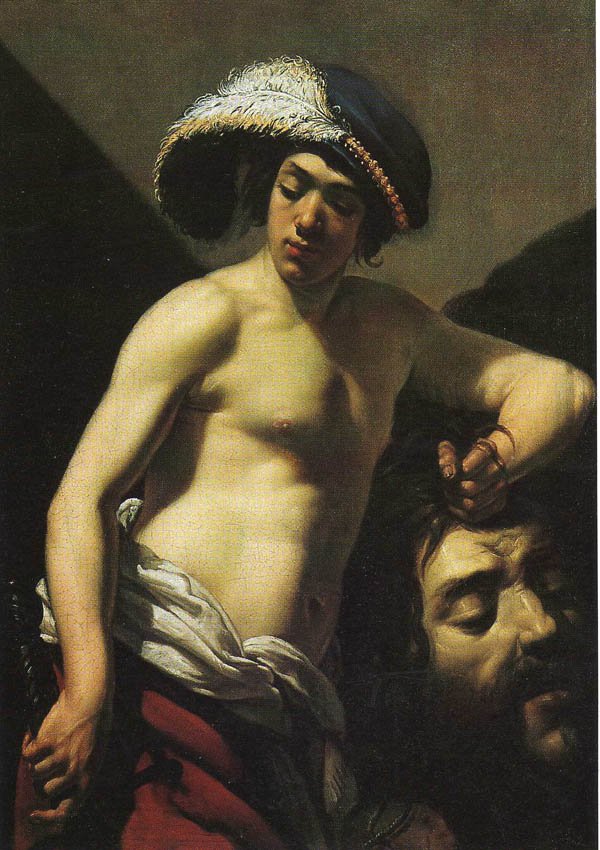
David holding the head of Goliath by Aubin Vouet (c.1620)
The battle between the Philistine giant Goliath and the young Jewish shepherd David, recorded in the Old Testament, ended the war that divided these two peoples as described in the First Book of Samuel, XVII, 48-54:
“…As the Philistine moved closer to attack him, David ran quickly toward the battle line to meet him. Reaching into his bag and taking out a stone, he slung it and struck the Philistine on the forehead. The stone sank into his forehead, and he fell face down on the ground. So, David triumphed over the Philistine with a sling and a stone; without a sword in his hand, he struck down the Philistine and killed him. David ran and stood over him. He took hold of the Philistine’s sword and drew it from the sheath. After he killed him, he cut off his head with the sword. When the Philistines saw that their hero was dead, they turned and ran. Then the men of Israel and Judah surged forward with a shout and pursued the Philistines to the entrance of Gath[f] and to the gates of Ekron. Their dead were strewn along the Shaaraim road to Gath and Ekron. When the Israelites returned from chasing the Philistines, they plundered their camp. David took the Philistine’s head and brought it to Jerusalem; he put the Philistine’s weapons in his own tent…”
Driven by his faith, David – often referred to as a “child,” “young,” and “handsome” defeated Goliath, a seasoned warrior, through trickery. Armed only with his slingshot, he knocked out his enemy with a stone and then took his sword to cut off his head. This biblical tale was favoured by many artists of the early seventeenth century such as Caravaggio and his emulators Domenico Feti, Artemisia Gentileschi, Bartolomeo Manfredi, Nicolas Régnier or Valentin de Boulogne. The theme depicted in this painting was favoured by artists during the first third of the 17the century. They all had a real liking for this biblical episode, the conclusion of the fight made it possible to represent the revulsion of death.
It is thought that Aubin Vouet was seduced by the violence of the Caravaggio masterpieces he had seen in Rome. In this work he chose to characterise David as the victorious hero, with his eyes lowered and his pout disdainful. The way in which Vouet has depicted youthful nudity is believed to be inspired not only by Florentine Renaissance sculpture but also by Caravaggio’s depictions of adolescents, and it cleverly contrasts the young man’s virile features with Goliath’s imposing head. The young David’s body is highlighted by the framing of two-thirds of the body, represented in a clever chiaroscuro. The elegance of the hat braided in gold and adorned with an ostrich feather adds a touch of refinement to David.
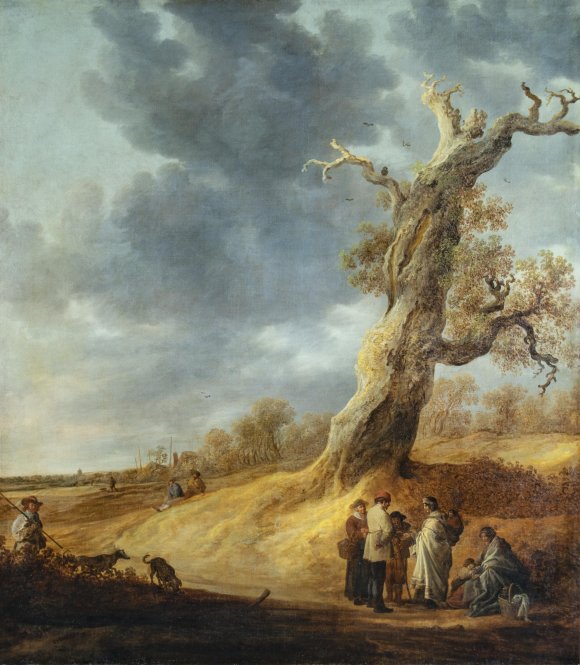
The Oak Struck by Lightning or The Fortune Teller by Jan Josephsz van Goyen (1638)
I have often written about my love of Dutch Golden Age paintings so it would be remiss of me not to include an example of work from this period. Jan Josephsz. van Goyen was one of the main pioneers of naturalistic landscape in early 17th-century Holland. His many drawings show that he travelled extensively in Holland and beyond. In 1634 he is recorded painting in Haarlem, in the house of Isaac, the brother of Salomon van Ruysdael, who was another of the pioneers of realistic landscape painting in the north Netherlands. Van Goyen was born at Leiden, and trained in Haarlem with Esaias van de Velde. After returning to Leiden he moved to The Hague in 1631, where he chiefly worked until his death. His earliest dated painting is from 1620. His daughter married his pupil Jan Steen, the famous painter of genre scenes, in 1649.
This painting, The Oak Struck by Lightning also known as The Fortune Teller, is one of the Dutch painter Jan Josephsz van Goyen’s masterpieces. The work is typical of the quasi-monochrome style van Goyen had developed between 1633 and 1644 in The Hague, after initially training in Haarlem. Before us we see a highly detailed view of a tree, which had been struck by lightening,. The depiction then opens out into an extensive panorama under a threatening dark sky which looms above this tree. The range of colours used by the artist is reduced down to simple shades of yellow and grey and changes towards a monochrome palette. In front of the tree, we see a bohemian-looking figure reading the palm of a villager.
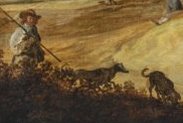
On the left of the painting, we see a well-dressed gentleman walking his dogs. This is a self-portrait of van Goyen !

The owl
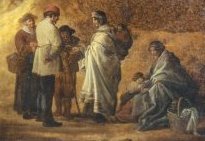
The Palm Reader
However, this is not simply a picturesque landscape scene. It is in fact an allegorical one. Van Goyen was a devout Christian who wanted to add a narrative to his painting. We need to look closely at some of the details to discover what van Goyen was “saying”. The red of the man’s beret symbolizes his inability to ignore superstition. The owl, perched in full daylight on a bare, dead branch of the oak tree, represents man’s blindness to chiromancy, the supposed prediction of a person’s future from interpreting the lines on the palms of their hands, in other words, palmistry which was a practice forbidden by the Church. Finally, the lightening evokes divine punishment.
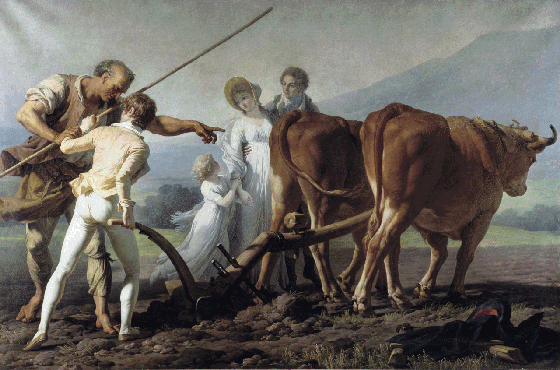
The Ploughing Lesson or The Agriculture Lesson or Agriculture by François-André Vincent
The next painting from the Lacour Wing of the museum which I am showcasing is The Ploughing Lesson by François-André Vincent, a French neoclassical painter. He was the son of the miniaturist François-Elie Vincent and studied under Joseph-Marie Vien. François-André Vincent was a pupil of École Royale des Éleves Protégés. From 1771 to 1775 he studied at the French Academy in Rome.
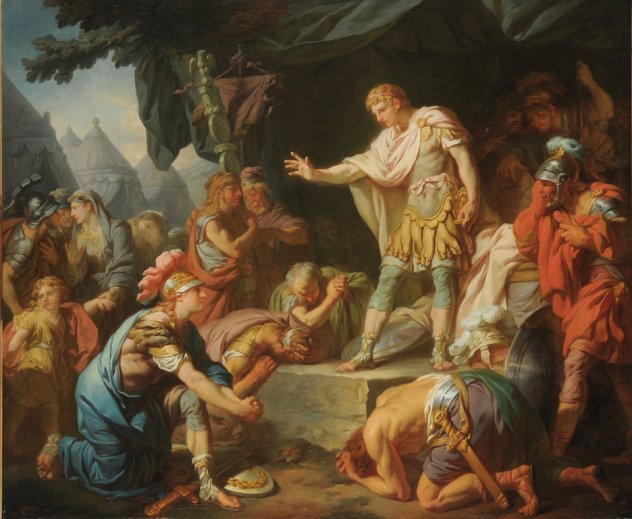
Germanicus Calms Sedition in his Camp by François-André Vincent (1768) Beaux-Arts Paris
He travelled to Rome after winning the Prix de Rome with his painting, Germanicus Calms Sedition in his Camp, in 1768, and it was then that he was installed at the Palais Mancini, where he painted numerous portraits, inspired by Jean-Honoré Fragonard’s style, who also was visiting Rome and Naples at the same time. He was a leader of the neoclassical and historical movement in French art, along with his rival Jacques-Louis David, another pupil of Vien. He was influenced by the art of classical antiquity, by the masters of the Italian High Renaissance, especially Raphael. François-André Vincent was one of the principal innovators of the subjects and themes in French art of Neoclassical style and his works were of a high standard.
The Ploughing Lesson, a genre painting completed in 1798, also features a series of portrait paintings as members of a wealthy family observe their son’s lesson in ploughing, aligning with the belief that a knowledge of agriculture was of vital importance following the French Revolution. In the background we have depicted the Pyrenees mountains. The painting was commissioned by the industrialist, financier and politician from Bordeaux and Toulouse, François-Bernard Boyer-Fonfrède. He was also an important patron of the arts who ran a cotton mill in Toulouse as well as a “Free School of Industry” for children from poor families who worked in the factory. The painting was intended to be part of a series, illustrating the virtues and the foundations of a good education. The painting was meant to depict that work in the fields was a noble occupation for children. This bringing together of the bourgeoise and the peasant suggests an idyllic alliance of two opposing social classes.
The painting depicts a strong-bodied farmer explaining to his pupil, a boy from a good family with fine features, how to hold the plough as it is pulled by a pair of oxen. Witnessing this lesson is the young man’s family. The painting was shown at the 1798 Paris Salon and was accompanied by a vignette:
“…Penetrated by the truth that agriculture is the basis of the prosperity of States, the painter has represented a father of a family who, accompanied by his wife and young daughter, comes to visit a ploughman in the middle of his work. He pays homage to him by attending the lesson he has asked him to give to his son, whose education he would consider imperfect without this knowledge. Note – Commerce and other interesting parts of education must form a sequel to this first table which, as well as this suite, are intended for citizen Boyer-Fonfrède, of Toulouse…”
Some art critics criticised the posture of the novice as being unseemly because the boy’s head is hidden, when by convention it should be turned towards the viewer.
The painting was acquired by the Musée des Beaux-Arts in Bordeaux in 1830.
……to be continued


