
Early life and the Sistene Chapel fresco.
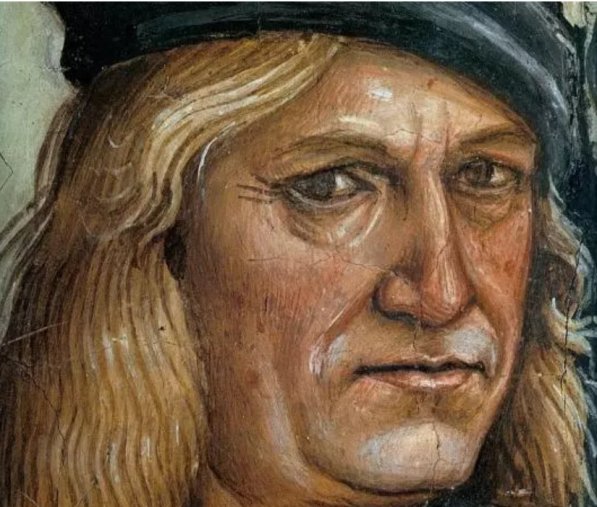
Luca Signorelli self portrait
As we have just had three important days in the Christian calendar I thought I would have today’s blog all about one of the great Italian religious painters, Luca Signorelli, sometimes known as Luca da Cortona because of the town of his birth. Signorelli is undoubtedly most revered for his portrayal of figures in action together with his incomparable grasp of the human anatomy which can best be seen in the beautiful Orvieto frescoes. Luca was a painter of the High Renaissance period which represents the summit of Renaissance art and the culmination of all the exploratory activities of the quattrocento, or millequattrocento, which is Italian for ‘fourteen hundred’ and means the fifteenth century. It therefore embraces cultural and artistic activities in painting, sculpture and architecture during the period 1400-1500.
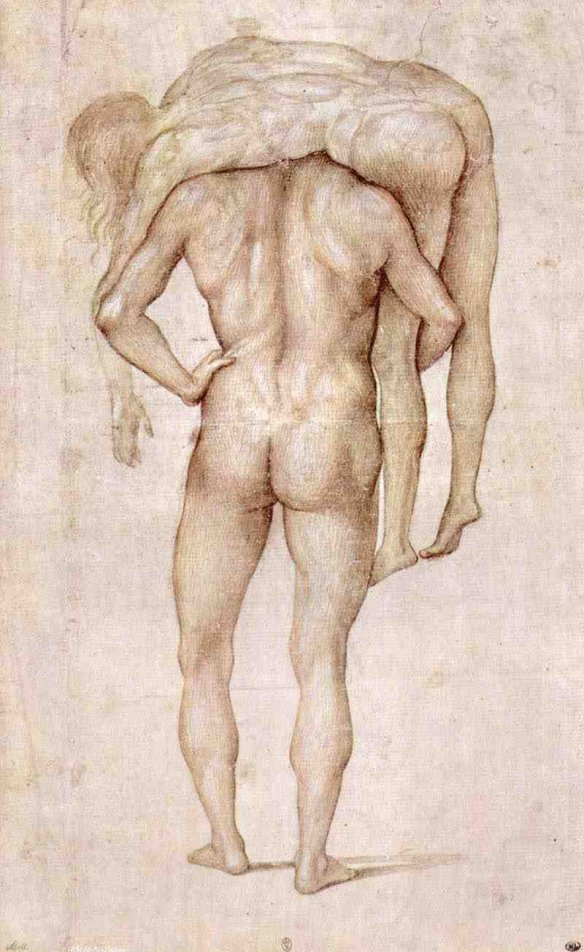
A Corpse-carrying Nude man by Luca Signorelli (1496). Musée du Louvre
Signorelli’s depictions of the human body were so precise that for him to have gained such knowledge and such levels of accuracy without carrying out actual dissections of the human body would have been impossible as at this time there was not sufficient literature that would have allowed an artist to learn so much about the different aspects of the human body. Artists sometimes could further knowledge of the human anatomy if they could dissect human bodies whilst others would dissect animals in order to develop their understanding of things like muscle balance. This close study of human anatomy resulted in artists being able to accurately go into much more detail when depicting the human body
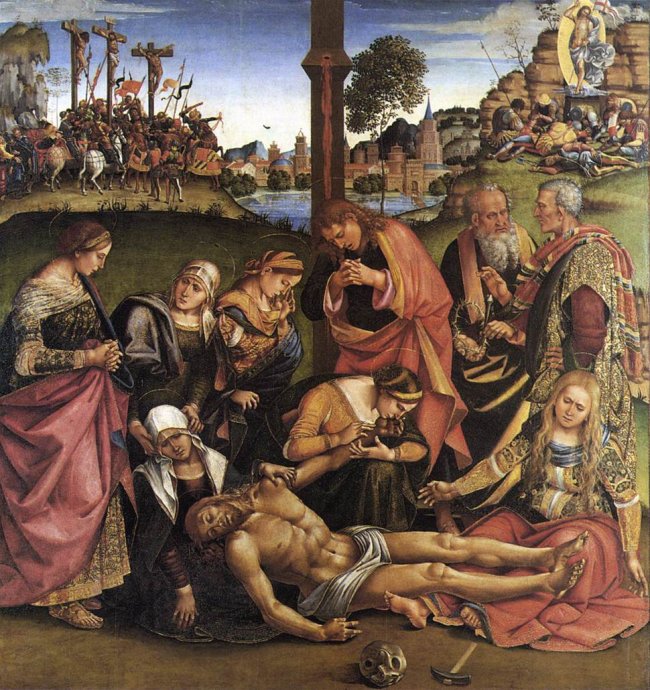
Lamentation over the Dead Christ by Luca Signorelli (1502)
Signorelli had built up such a great reputation as a painter that he was invited to form part of an elite group of artists which were sent for by Pope Sixtus IV to decorate the walls of the Sistine Chapel. The Italian Renaissance painter, architect, art historian, and biographer known for his work Lives of the Most Excellent Painters, Sculptors, and Architects, Giorgio Vasari, said of him:
“…he was an artist who with his profound mastery of design, particularly in nudes, and with his grace in invention and in the composition of scenes, opened to the majority of craftsmen the way to the final perfection of art…”
Luca’s childhood days are poorly documented, but it is thought that Luca d’Egidio di Ventura de’ Signorelli was born around 1450 in Cortona, a small hill town and commune in the province of Arezzo, in Tuscany.
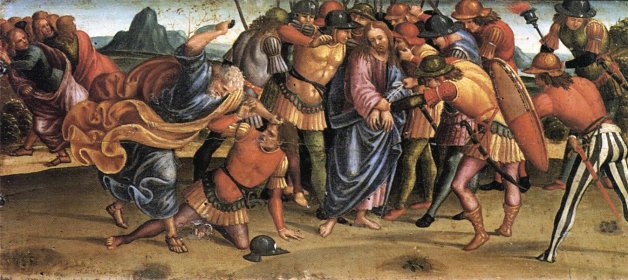
The Capture of Christ by Luca Signorelli (1502)
As a child he showed an interest in art and in the 1460s, Signorelli signed up to an apprenticeship with Early Renaissance painter, Piero della Francesca. He was said to have been a talented student and quickly took on board the principles of mathematics, geometry, and perspective that his tutor taught him. Around 1470, Signorelli, in his early twenties. married Gallizia di Piero Carnesecchi, and the couple went on to have three sons, Polidoro, a future painter and builder, Antonio who became assistant to his father, and Pier Tommaso. The couple also had two daughters, Gabriela, and Felicia. Documents show that in 1472 Luca was known to be living and working in the city of Arezzo, located about fifteen miles from his hometown of Cortona and two years later he was working in the nearby Città di Castello.
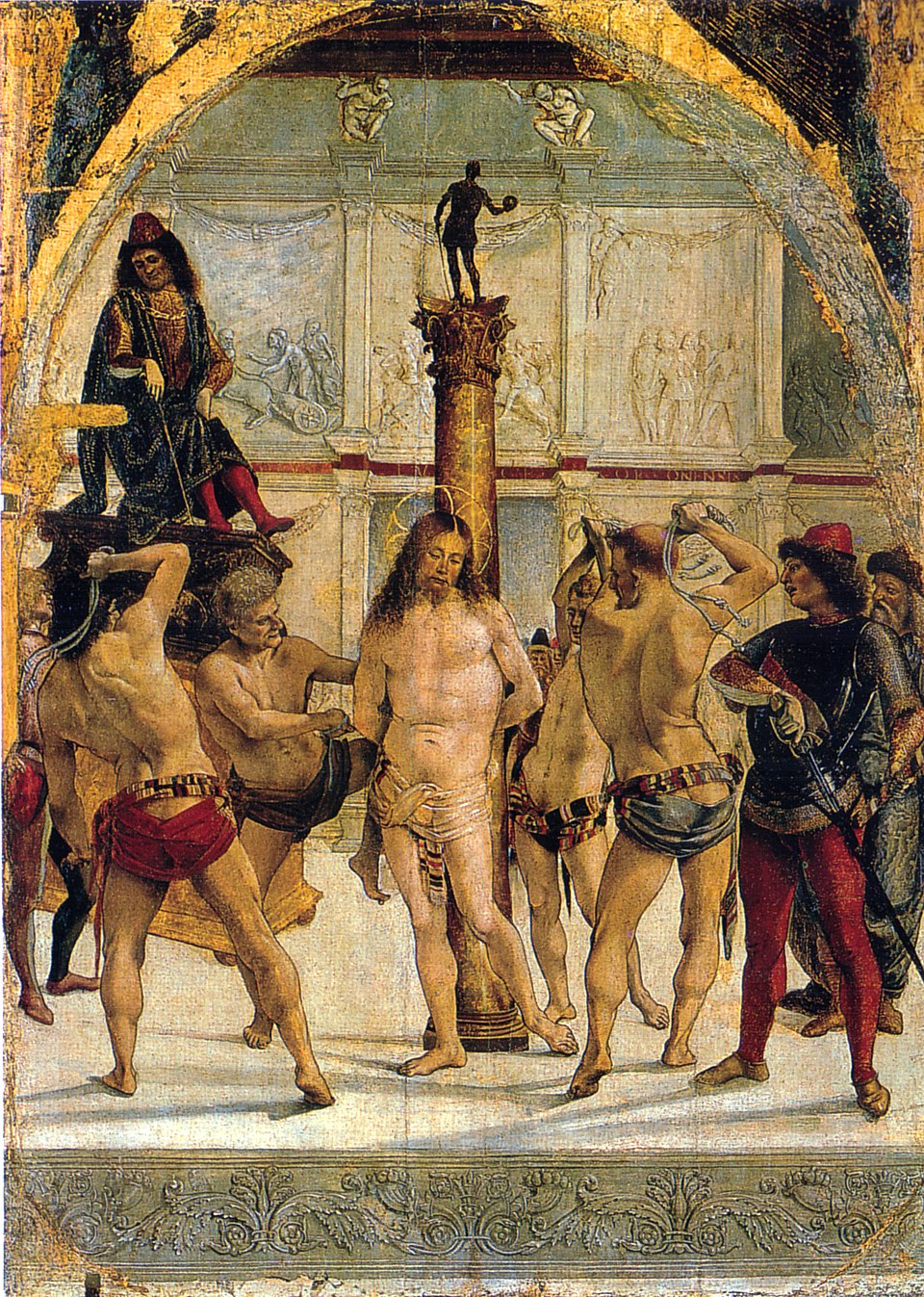
Stendardo della Flagellazione (The Flagellation Standa) by Luca Signorelli (c.1475)
One of Signorelli’s earliest extant paintings is his work entitled Stendardo della Flagellazione (The Flagellation Standa) and it is believed that it was completed around 1475. The work bears the artist’s signature, “OPUS LUCE CORTONENSIS,” confirming Signorelli’s authorship and reflecting his Cortona origins. The Flagellation Standard by Luca Signorelli, created as a double-sided processional banner for the Confraternity of the Raccomandati in Fabriano. Its role was to act as a primary devotional function by inspiring lay participants to engage in acts of penance and charity. The banner was carried during public processions, particularly those involving self-flagellation during Holy Week or times of crisis, with the banner’s vivid depiction of Christ’s scourging encouraging communal meditation on the Passion, fostering empathy and moral discipline among confraternity members who mimicked the Savior’s suffering to achieve spiritual redemption. The work was commissioned by the Confraternita dei Raccomandati di Santa Maria del Mercato church in Fabriano. The church is now destroyed. The commission was for a work of art which could be included in processional demonstrations of public flagellation. The depiction is based upon the biblical passages of John 19:1,
“…Then Pilate took Jesus and had him flogged…”
Jesus had been sentenced to death on the Cross by Pilate. But first he was to be flagellated, and soldiers tied him to a pillar and then scourged him. In his painting Signorelli depicted the event against an architectural background. The work is dated to the period prior to the artist’s journey to Rome in 1482, probably sometime around 1475.
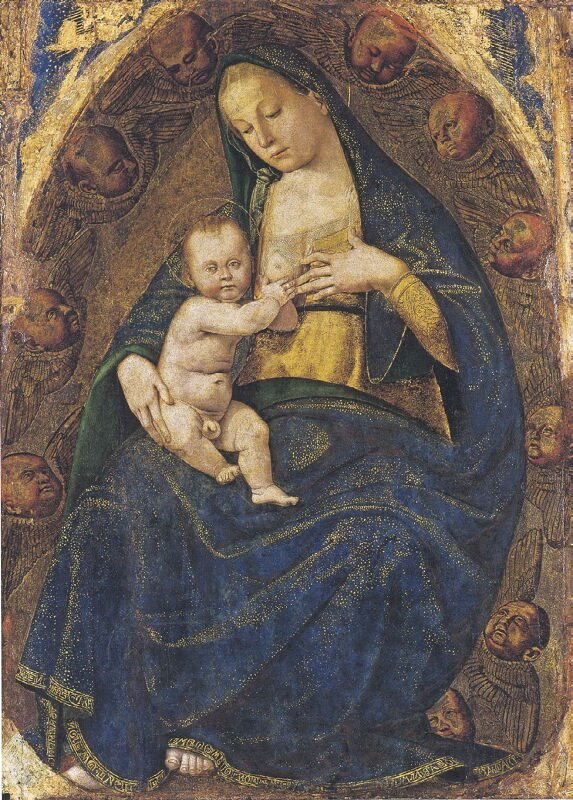
Nursing Madonna in Glory by Luca Signorelli (c.1475)
Signorelli’s work is thought to be one side of a double-sided panel, with the second side being The Nursing Madonna. The reason behind the second work being that the fraternity also carried out philanthropic work to help orphaned and abandoned children. At some point between the sixteenth and nineteenth centuries, the two sides were separated. Both sides are now in the Pinacoteca di Brera in Milan, to which they were brought in 1811 after the church’s suppression. The suppression of the Italian Church, particularly the Jesuits, during the Napoleonic era was a significant event in the history of Italy.
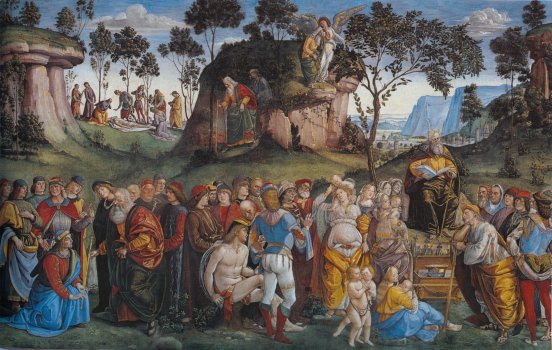
Moses’s Testament and Death by Luca Signorelli (1482)
Luca Signorelli was known as a master of fresco painting and one of his frescos can be seen at the Sistine Chapel in Rome. The 15th century decoration of the walls includes the false drapes, the Stories of Moses, and of Christ and the portraits of the Popes. It was completed by a team of painters made up initially of Pietro Perugino, Sandro Botticelli, Domenico Ghirlandaio, Cosimo Rosselli, Luca Signorelli and their respective workshops, which included Pinturicchio, Piero di Cosimo and Bartolomeo della Gatta. The fresco by Signorelli depicts the cycle of the life of Moses and can be found on the south wall of the chapel. Signorelli’s fresco entitled Moses’s Testament and Death illustrates the last chapters in the life of Moses.
Let us look closely at everything that is going on in this multi-populated fresco.
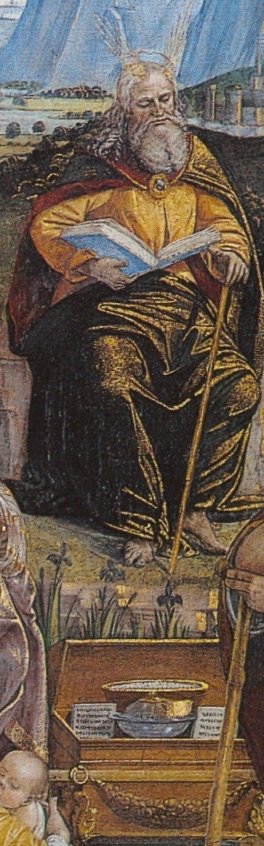
On the right foreground of the fresco sits the hundred-and-twenty-year-old Moses on a rise, holding his staff and with golden rays circling his head. At Moses’s feet stands the ark of the Covenant, opened to show the jar of manna inside and the two tablets of the law.
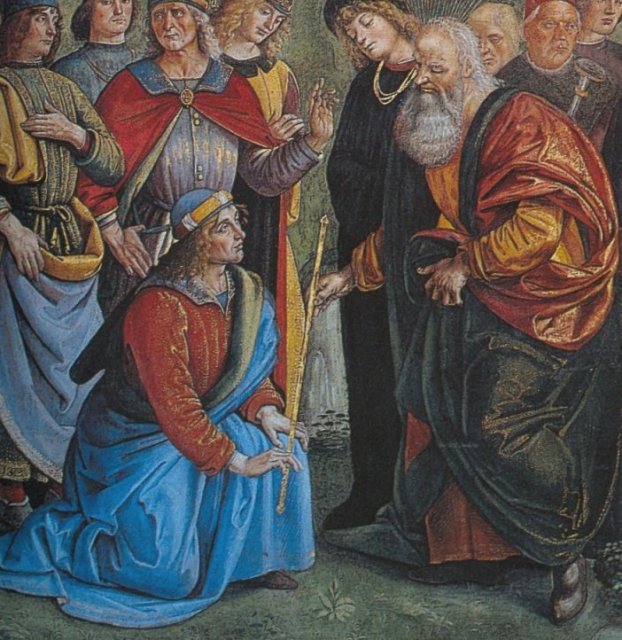
In the left foreground of the picture we see Joshua being appointed as Moses’s successor. Joshua kneels before Moses, who gives him his staff.
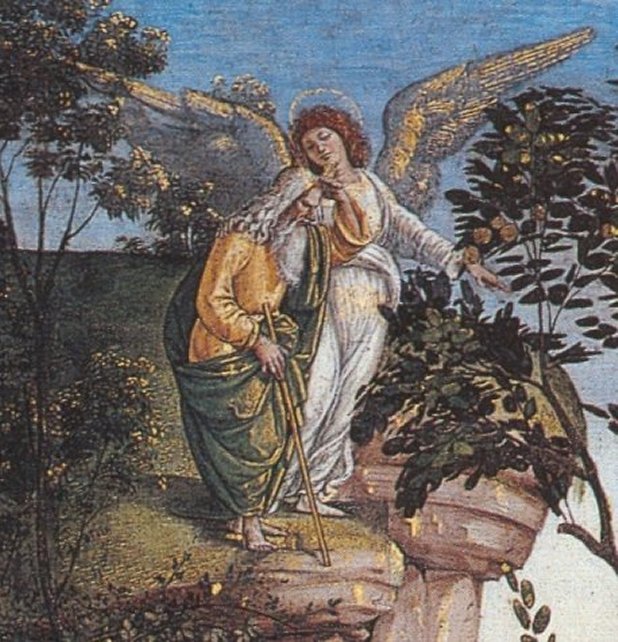
In the centre of the background, we see Moses being led by the angel of the Lord up Mount Nebo, from which he will be able to look across to the Promised Land that by the will of God he will never enter.
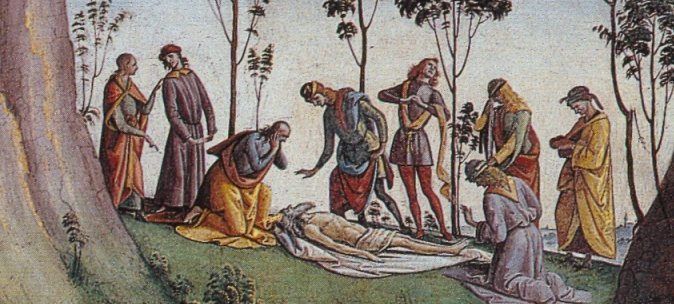
His death is depicted in the background, in the land of Moab, where the children of Israel mourned him for thirty days. Moses’s followers are shown mourning his passing in Moab. Here, he lays amidst the group, enshrouded in white linen. At the far left is the cave in which he will be entombed.
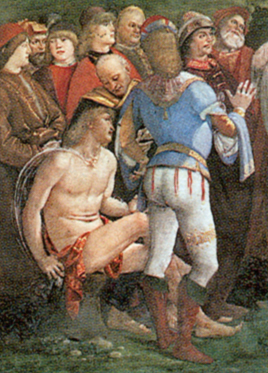
Art historians believe that Signorelli collaborated on this work with his friend, Bartolomeo della Gatta, a painter, illuminator, and architect. The more active figures being executed by Signorelli. One such figure, a seated nude youth in the centre of the foreground, is believed to have served as a reference for the twenty nude figures – what Michelangelo called the Ignudi – painted on his famous chapel ceiling 25 years later.
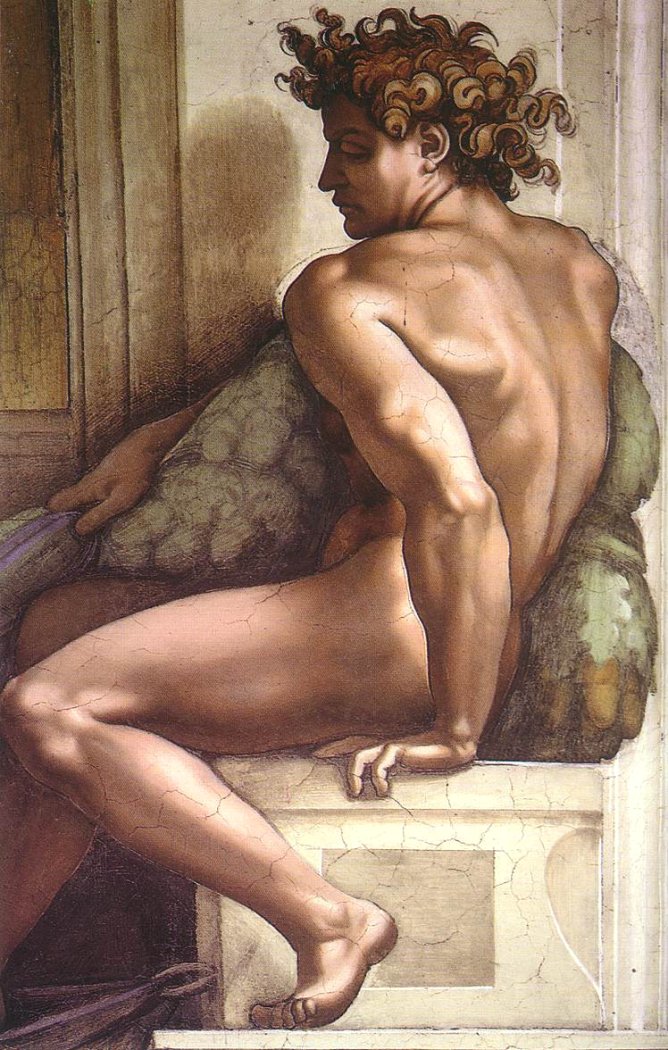
Ignudo, Fresco, Cappella Sistina, Vatican by Michelangelo (1509)
However Signorelli is probably best known for his frescos at the Chapel of St Brizio inside the Orvieto’s Duomo…………………………………..
…………………..to be continued.
The information for this blog came from a number of websites, the main ones being:


A huge talent, largely unknown. Thanks for the post, Jonathan!
Hello, I have a question about another blog post of yours for a research project, do you have an email address or anything where I can contact you? My dissertation is due soon so it’s quite urgent, please get back to me!!!
JayseeG@hotmail.com