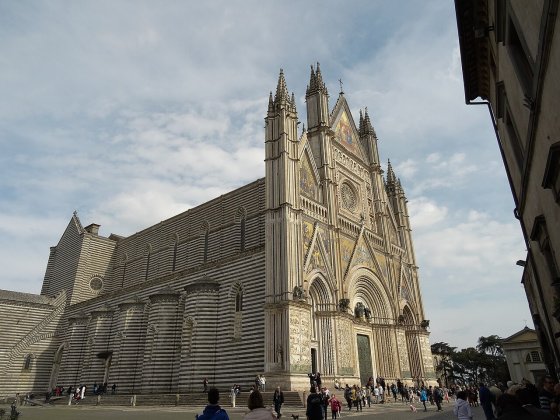
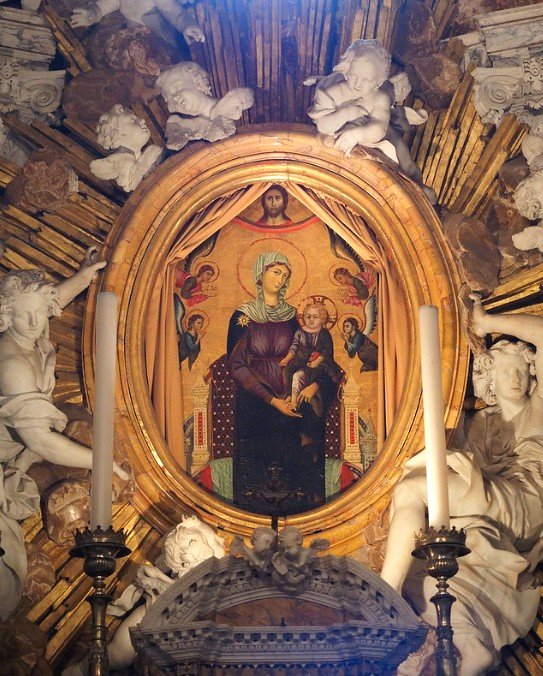
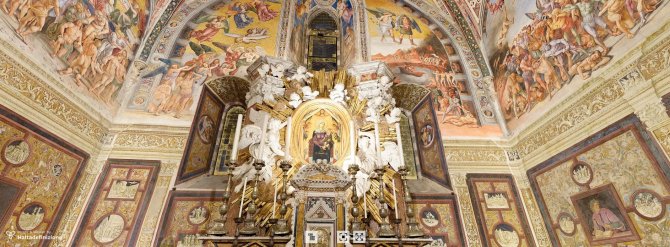
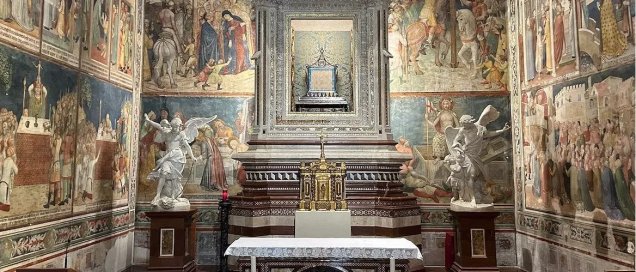
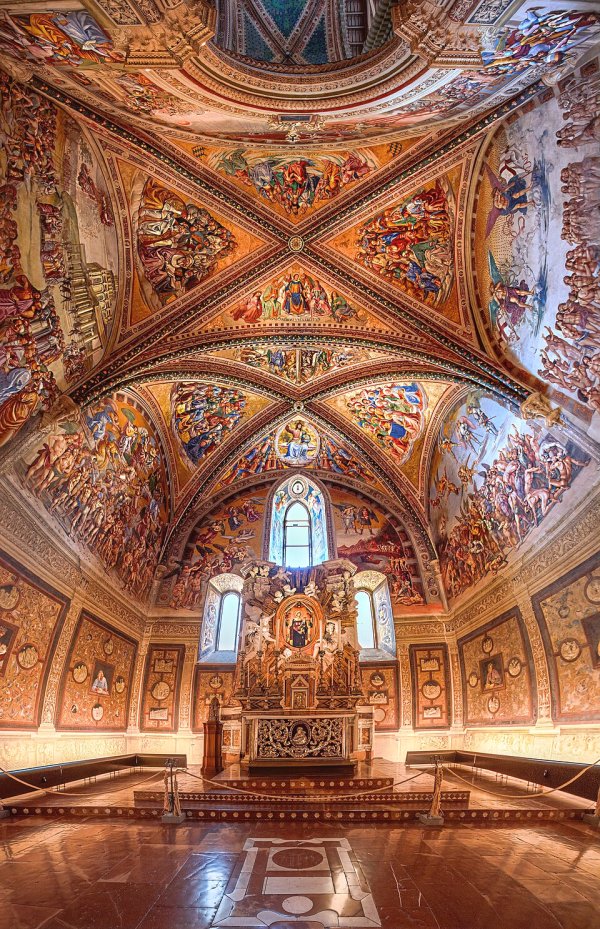
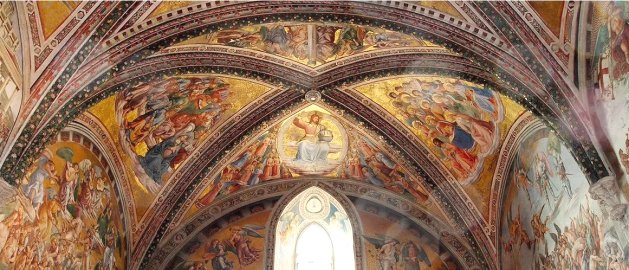
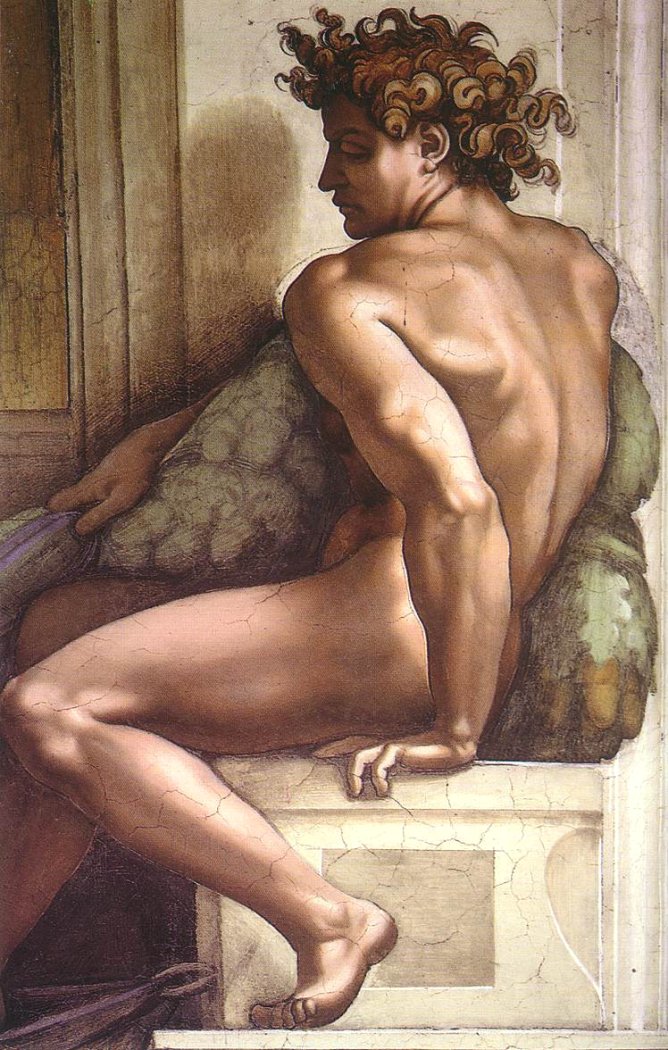
Frescos at the Chapel of St Brizio inside the Orvieto’s Duomo
Part 2.
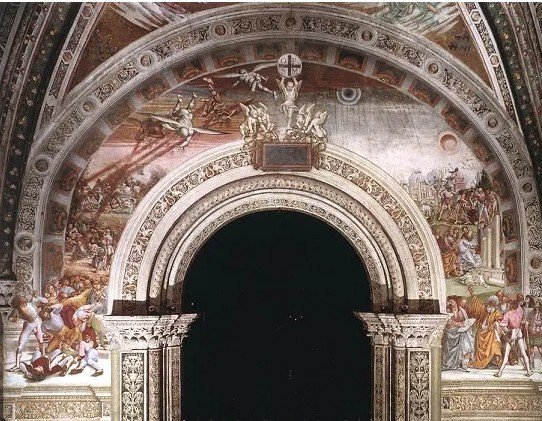
Destruction of the World by Luca Signorelli
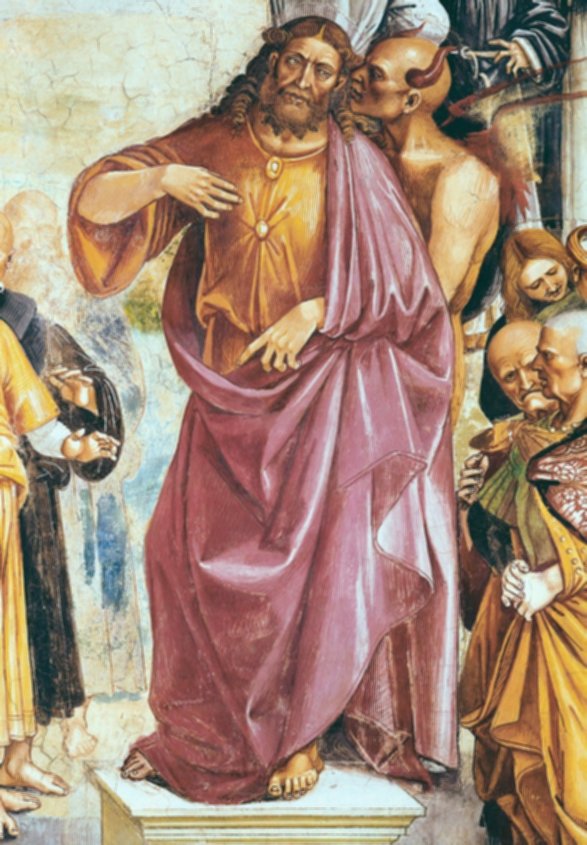
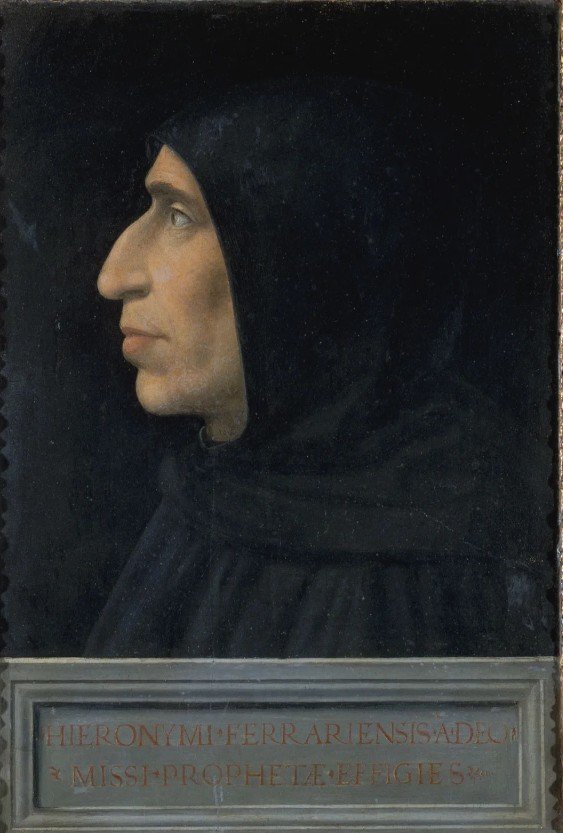
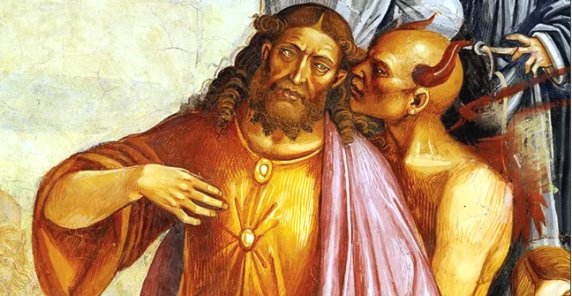
The events of the Apocalypse, in the form of the Destruction of the World, fill the space which surrounds the entrance into the large San Brizio chapel. These Apocalyptic frescos may not influence us now but one has to remember that at the beginning of the 16th century, at the time Signorelli was painting these masterpieces, life in Italy was much different in comparison to our lives now. Italy was affected with not just wars but various diseases which killed many of its citizens and so, sudden and painful death was looked upon as a distinct possibility causing a sense of spiritual paranoid. This terrible Apocalyptic hysteria jumbled minds and instilled fear into many. Add to this the prophecies of Girolamo Savonarola, a charismatic Dominican friar, regarded as the Antichrist, with his hell-fire sermons and his warnings about the end of time and the great battle between the spiritual and the worldly which would usher in the Last Judgement. According to the prediction in the Scriptures, the deeds of the Antichrist take place immediately before the end of the world. Add to this the words of Mark (13:24-27) in the bible recalling the words of Jesus whilst teaching his disciples on the Mount of Olives:
“…But in those days, after that tribulation, the sun will be darkened, and the moon will not give its light, And the stars will be falling from heaven, and the powers in the heavens will be shaken. And then they will see the Son of Man coming in clouds with great power and glory. And then he will send out the angels and gather his elect from the four winds, from the ends of the earth to the ends of heaven…”
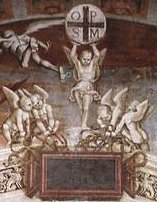
The position of this fresco is on the inner side of the Chapel portal. On looking at the work, we are immediately aware of the drama depicted in the fresco. The upper part depicts a group of cherubs that seem to blissfully wrestle with a ribbon plaque. At the centre stands a little winged creature holding high the herald of the ‘Opera del Duomo di Orvieto’ (O.P.S.M – the institution that promotes, manages and administers the work of the construction of the Cathedral).
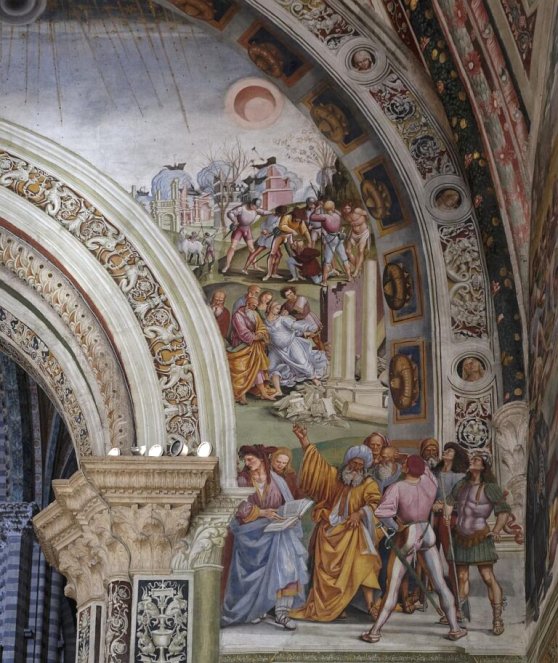
Destruction of the World (detail) by Luca Signorelli
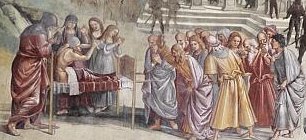
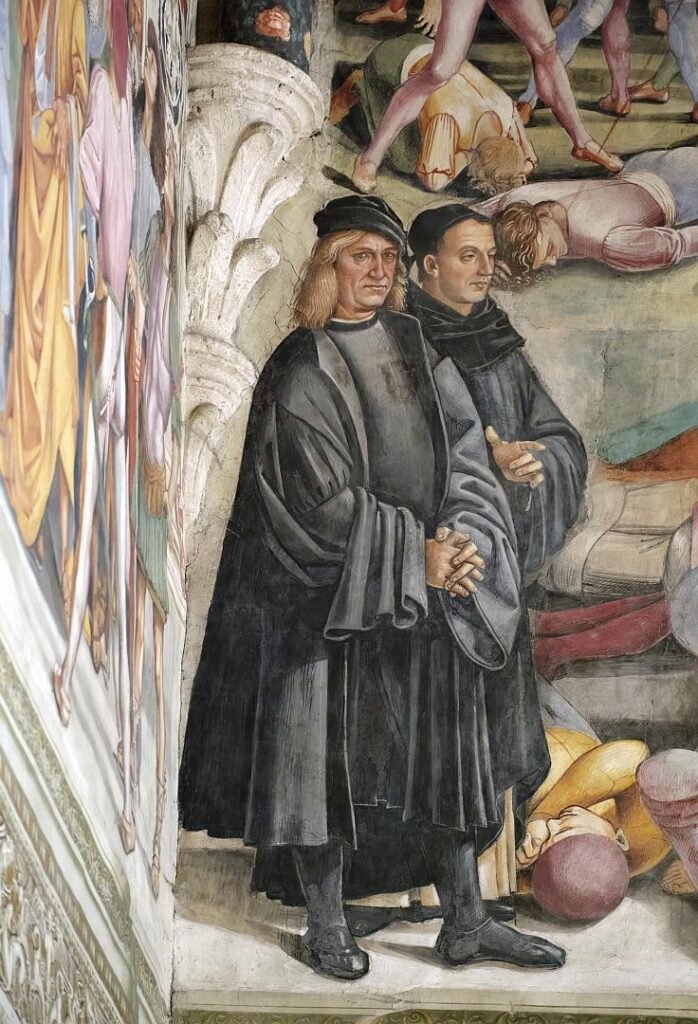
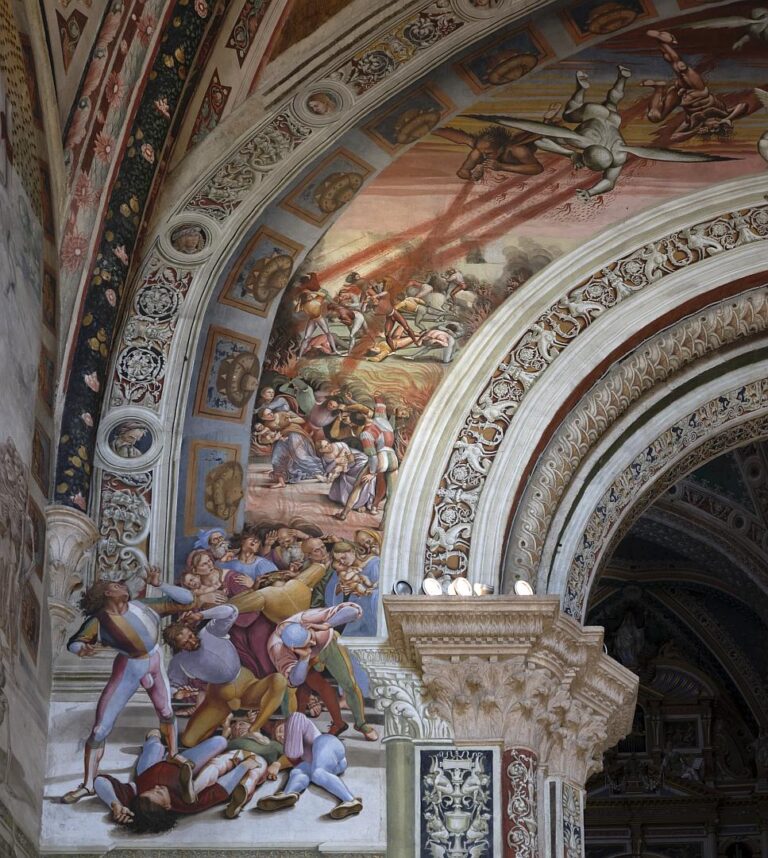
The depiction and narrative is divided on each side of the portal. To the right is a portrayal of the early signs of the end of times. We can see that the moon is growing dark, the raining of stars and the eclipse. The sky is overcast and the earth trembles in fear. In the background we see stormy waves whipping up the sea and threatening to engulf humanity. Of the people depicted in this fresco, Signorelli divides them into three groups. The group, on the right, consists of men and women shocked by the destruction of a marbled structure, maybe a temple. They gaze in horror at the remains of the three truncated pillars and the pile of broken pieces of the columns lie at their feet. In the foreground we observe the prophets and the philosophers who stand and study the devastation that lies before them in sombre trepidation.
Destruction of the World (detail) by Luca Signorelli
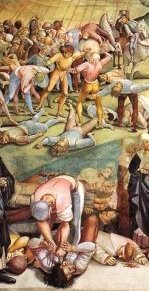
On the left of the portal, we see demons dance amongst the dangerous skies while disgorging floods of fire onto the pitiful survivors. These people under attack fall against each other like broken dolls. We see women with babies at their breasts screaming in pain whilst some men flee on horsebacks to escape the flames, but in vain. Lower down this side of the fresco Signorelli has depicted individuals of all ages being attacked. The elderly, youths and children are all victims of these savage attacks. We look at upturned faces, covered ears and fearful eyes which portray this terrible calamity which has befallen mankind
Signorelli had been commissioned originally to complete ceiling frescos that had been begun by Fra Angelico. The cathedral authorities had been so impressed by what he achieved with the vaulted ceiling that they decided to offer him a further commission to paint frescos on the seven side walls of the chapel.
The Resurrection of the Flesh by Luca Signorelli
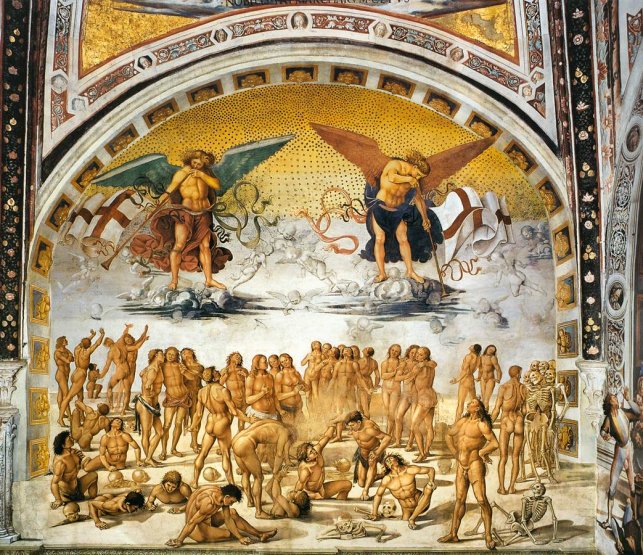
The next fresco in the series by Signorelli I am looking at is The Resurrection of the Flesh which is located in the first compartment on the right wall of the Chapel of San Brizio. This was another fresco depicting scenes from the end of time and illustrates the text found in the First Letter of Paul to the Corinthians (1 Cor. 15:51-52)
“…Behold! I tell you a mystery. We shall not all sleep, but we shall all be changed, in a moment, in the twinkling of an eye, at the last trumpet. For the trumpet will sound, and the dead will be raised imperishable, and we shall be changed…”
Signorelli was in his element with this work and his mastery of painting nude figures. The great art historian Vasari wrote of this artistic ability of Signorelli stating:
“…true method of making nudes and how, though only with craft and difficulty, they can be caused to be alive…”
Of Signorelli, Bernard Berenson the American art historian who specialized in the Renaissance said that he was one of the greatest of modern illustrators, and thanks to which his art is still an extremely important part of our figurative heritage.

Resurrection of the Flesh (detail) by Luca Signorelli
Viewed all together the huge frescoes in the Orvieto chapel give a feeling of overcrowding and of confusion which is far from being attractive, but we need to look closely at what is going on in the fresco. Look closely at the details and then we begin to recognise the genius of the artist. In the fresco, Resurrection of the Flesh, we observe the macabre but comical notion of the nude with his back to the observer who is carrying on a conversation with the skeletons.
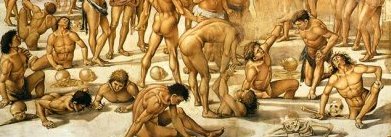
We see skulls surfacing through the cracks in the ground, who then put on their bodies as though they were a costume, and become human beings once again. This fresco demonstrates Signorelli’s ability to depict naked bodies with all of their well-defined musclature.
The Damned Cast into Hell by Luca Signorelli
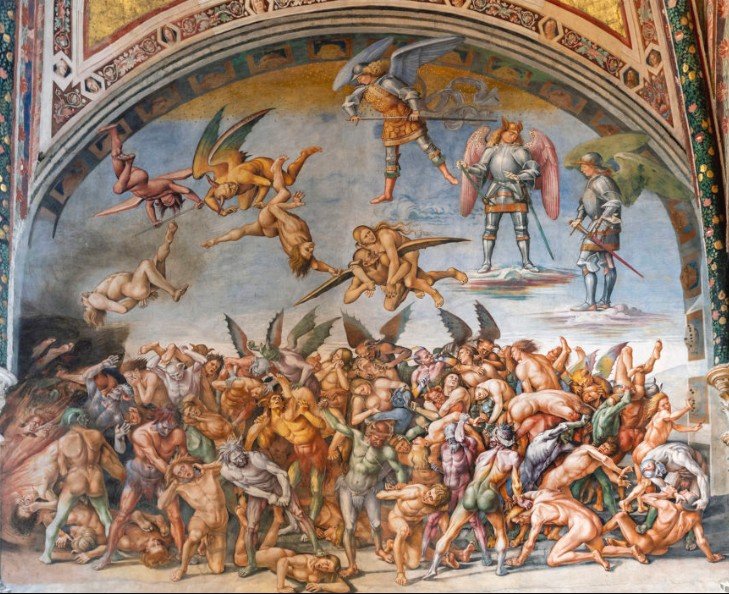
The next fresco on the wall of the Chapel San Brizio is entitled The Damned Cast into Hell. It is located next to the altar wall.
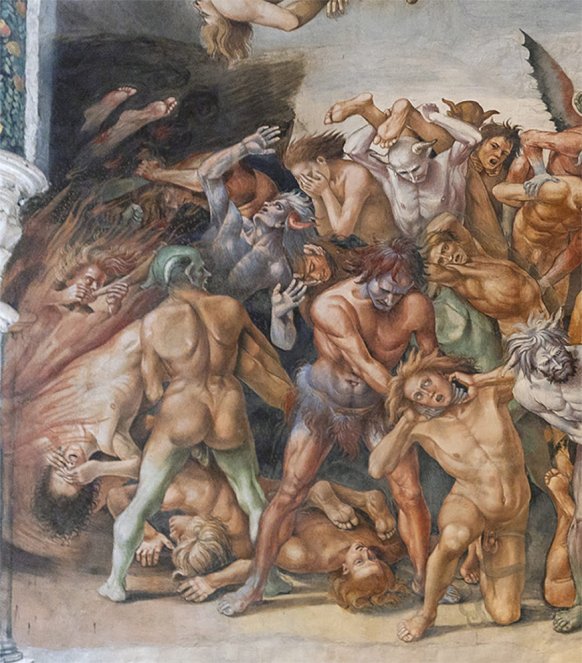
The Damned Cast into Hell (detail) by Luca Signorelli
Before us we have a “horror show” confronting the observer with men and women screaming, their nude bodies twisted in pain as they are tortured by gaudily coloured demons. The fresco represents one part of the End of Days narrative, when Christ returns to judge mankind, separating those who are destined to go to heaven designated the blessed from those who were to enter the fires of hell, designated the damned. The fresco depiction was based on the bible passage Gospel of Matthew (25:31-46), which describes the final day:
“…When the Son of Man comes in his glory, and all the angels with him, he will sit on his glorious throne. All the nations will be gathered before him, and he will separate the people one from another as a shepherd separates the sheep from the goats. He will put the sheep on his right and the goats on his left. Then the King will say to those on his right, ‘Come, you who are blessed by my Father; take your inheritance, the kingdom prepared for you since the creation of the world. For I was hungry and you gave me something to eat, I was thirsty and you gave me something to drink, I was a stranger and you invited me in, I needed clothes and you clothed me, I was sick and you looked after me, I was in prison and you came to visit me…”
In The Damned Cast into Hell, we see naked bodies tumble, twist, and writhe as they are seized by demons depicted in unnatural, acidic colours. The scene is both violent and chaotic, and yet, it is also amazingly structured, and every figure is anatomically precise a testament to Signorelli’s ability to portray nude figures. Muscles strain and limbs extend and recoil. Pain is depicted as a physical condition, not just an abstract punishment. Signorelli was constantly attentive to how human figures moved under stress: fear, agony, desperation. His figures are not emblematic dummies. They have a physicality and are clearly human.
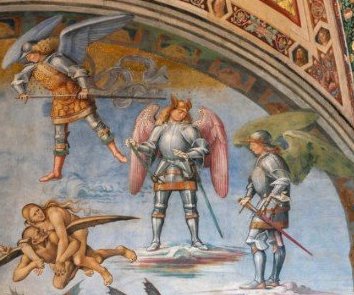
The Damned Cast into Hell (detail) by Luca Signorelli
Above the disturbing melee, below we see standing on small clouds, the three archangels, Michael, Gabriel, and Raphael. The triumvirate are fully clad in suits of armour, drawing their swords ready to battle.
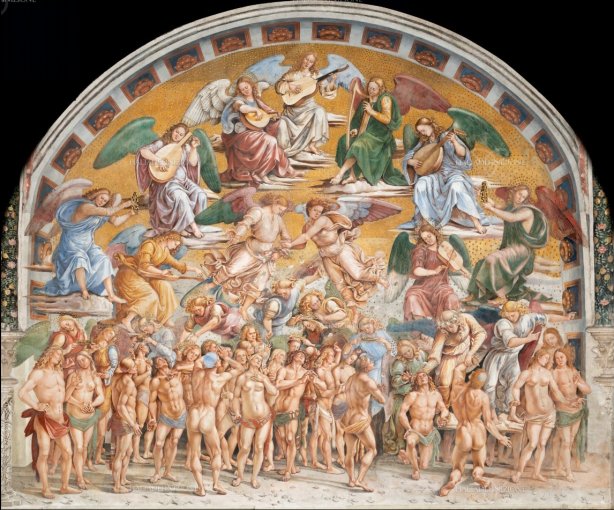
The Elect being called to Paradise by Luca Signorelli
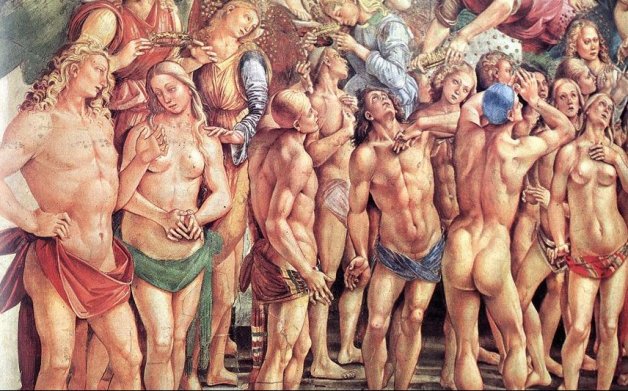
The Elect being called to Paradise (detail) by Luca Signorelli
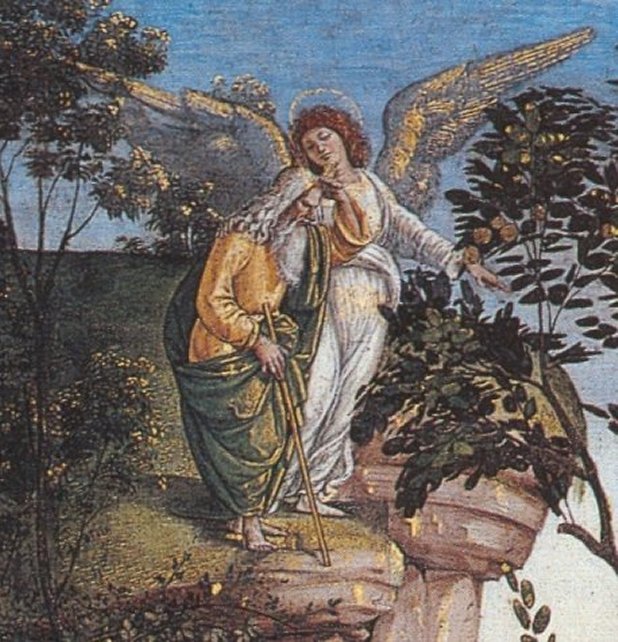
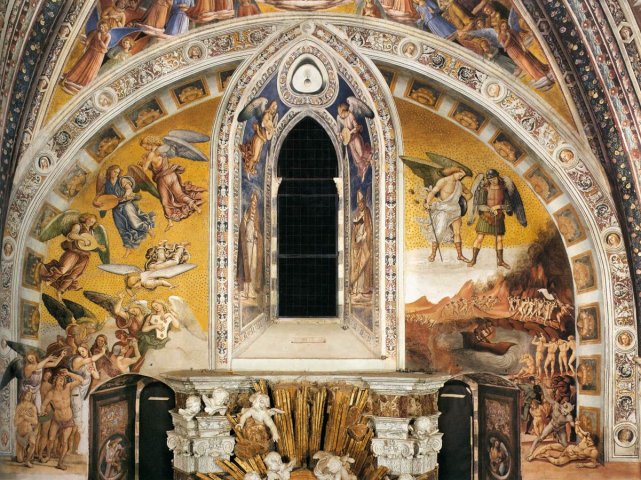
The last two frescos I am looking at are entitled The Elect being called to Paradise and The Damned. The frescos cover the south wall pierced by three lancet windows. Within the embrasures of the windows are painted the angels and the saints namely St Brizio, St Constantius, Archangel Michael is shown crushing a demon and Archangel Raphael guiding Tobias. Angels are seen guiding the chosen ones, the faithful, towards heaven. The golden skies radiate with glory while a choir of angels exalt with song and dance. The medieval musical instruments they play are both string and wind based. Once again the figures depicted in the fresco bear out the artist’s ability to portray the body of nude men and women.
The Damned by Luca Signorelli
The Damned (detail) by Luca Signorelli
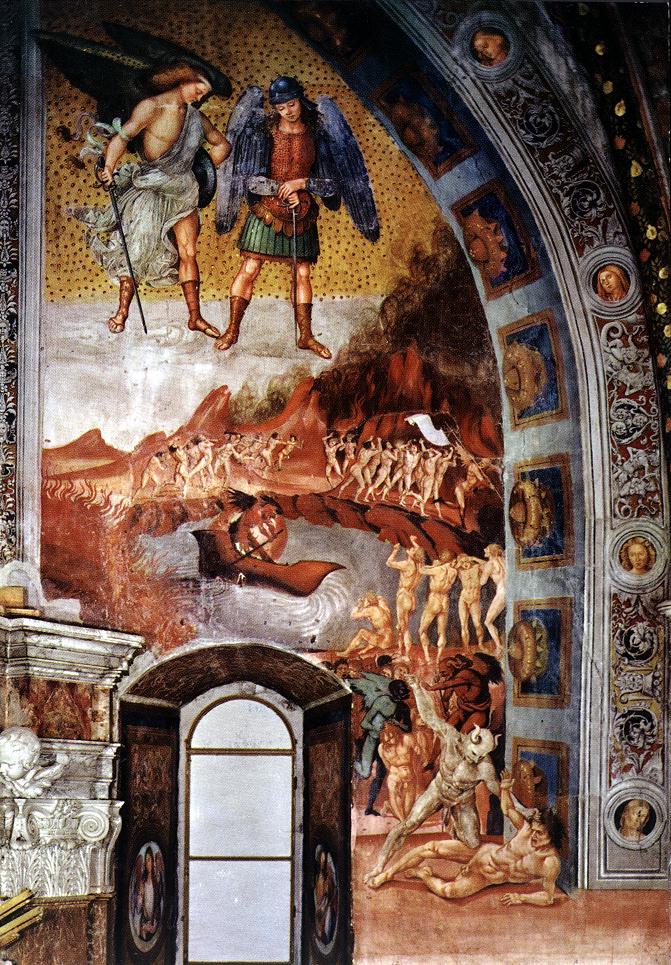
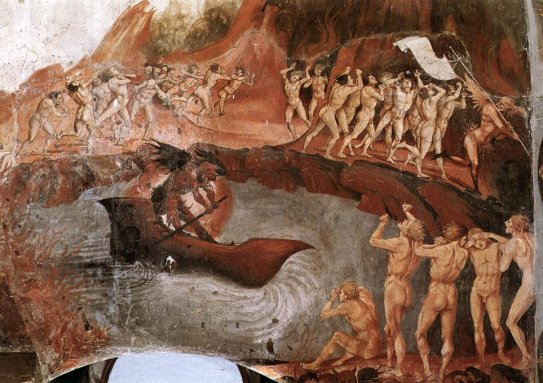
There is a striking contrast between The Elect being called to Paradise and the fresco entitled The Damned. In the former the people were joyous having been selected to be taken to heaven by the angels. In the latter the people who failed to pass the test to enter Heaven were consigned to Hell. Gone has the joyful singing to be replaced by the shrieks of those condemned to the fires of Hell. Two archangels, perched above the scene, look down and silently at the divine tragedy. The depiction is derived from Dante Alighieri’s Inferno part of his early fourteenth century narrative poem, Divine Comedy. Above are fading golden skies and below we see the icy waters of the rivers Styx and Acheron. The two waterways divide the world of the living from the world of the dead with flaming fires roar along the boundaries. Those who have been damned desperately howl and scream at their past foolishness which has brought them to this point. As we look at the raging pit, we can see a demon running around it holding a white flag mocking the sinners. A group of wailing sinners follow him as he leads them further along the road to Hell.
The Damned (detail) by Luca Signorelli
From Dante’s Inferno we recognise the famous ferryman Charon at the centre of this scene. As described in Dante’s poem, he is a spiteful winged demon. His role was to transport souls of the newly dead across the river into the underworld. The oar he holds was used to strike the stragglers.
In 1508 Pope Julius II summoned several artists to come to Rome, including Signorelli, Perugino, Pinturicchio, and Il Sodoma to paint the rooms he chose as his apartments in the Vatican Palace. Despite making a start on the commission, the Pope terminated their contract deciding that Raphael be solely in charge of the decorations. Luca Signorelli returned to Siena, but most of the rest of his life he lived in his hometown of Cortona. He became a highly respected citizen of the town, even entering the magistracy of the town as early as 1488 and holding a leading position by 1523, the year of his death.