Eugène Boudin. Part 2.

Picture2

       Sky, Setting Sun, Bushes in Foreground. by Eugène Boudin (ca. 1848-1853)

One of Boudin’s earlier paintings which featured his mastery of depicting skies is his work entitled Sky, Setting Sun, Bushes in Foreground which he completed in the early 1850’s. In this work, Boudin has gone for a very high frame and in fact, the sea does not appear in the composition. In this work and many similar ones, there is just the faint outline of a low horizon.  More often than not, the clouds are the main, sometimes the only motif. At times, the subject becomes so fine or abstract that Boudin specified its meaning on the back of the work.  His love of the paintings by the Dutch Masters made Boudin strive to achieve skies that he had seen in their works of art.  Between 1850 and 1870 Boudin completed many such depictions and a note in his personal diary refers to them:

“…To swim in the open sky. To achieve the tenderness of clouds. To suspend these masses in the distance, very far away in the grey mist, make the blue explode. I feel all this coming, dawning in my intentions. What joy and what torment! If the bottom were still, perhaps I would never reach these depths. Did they do better in the past? Did the Dutch achieve the poetry of clouds I seek? That tenderness of the sky which even extends to admiration, to worship: it is no exaggeration…”

On  January 14th,  1863,  Boudin married the 28-year-old Breton woman Marie-Anne Guédès in Le Havre and the couple set up home in Paris but would return to the Normandy coast in the summers.

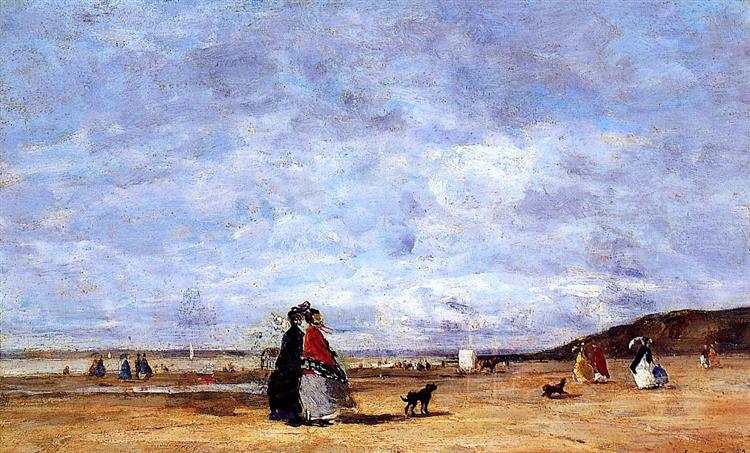
Eugène Boudin - Sur la plage à Trouville.jpg

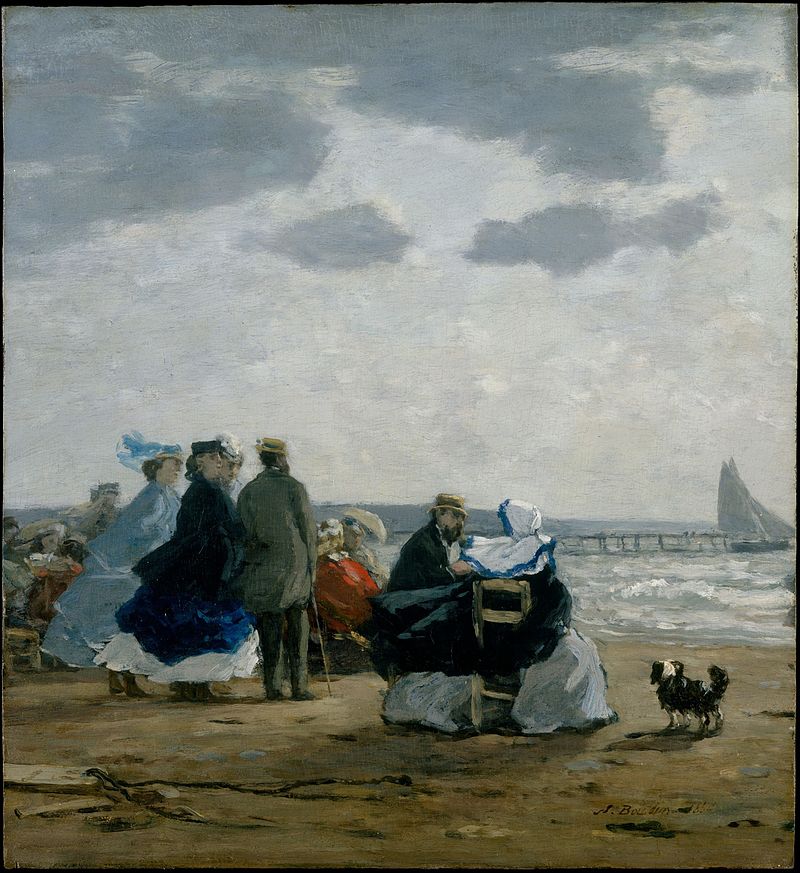
                        On the Beach at Trouville by Eugène Boudin (1863)

Boudin had started off his career painting seascapes, but he found his calling in the 1860’s depicting small beach scenes which he populated with affluent holidaymakers that had made the journey from Paris and outlying places.  These people spent summers sampling the health-giving benefits of sea bathing and the vibrant social life in the fast-emerging seaside resorts of Trouville and Deauville. Boudin created a few hundred examples of this type of painting, which enhanced his reputation.  He knew that genre was popular with the public once writing:

“…I shall do something else, but I shall always be a painter of beach scenes…”

On the Beach, Dieppe MET DT11491.jpg

                                On the Beach, Dieppe by Eugène Boudin (1864)

An example of this type of work is his 1864 painting entitled On the Beach, Dieppe.   The setting is the beach of the Channel coastal town of Dieppe.

The changing skies of France’s Channel coast and the fashionable crowds on the resort beaches were Boudin’s lifelong subjects. These pictures were avidly collected, ensuring the artist’s success. In 1863 he commented:

“…They love my little ladies on the beach, and some people say that there’s a thread of gold to exploit there…”

On the Beach, Sunset MET DT1031.jpg

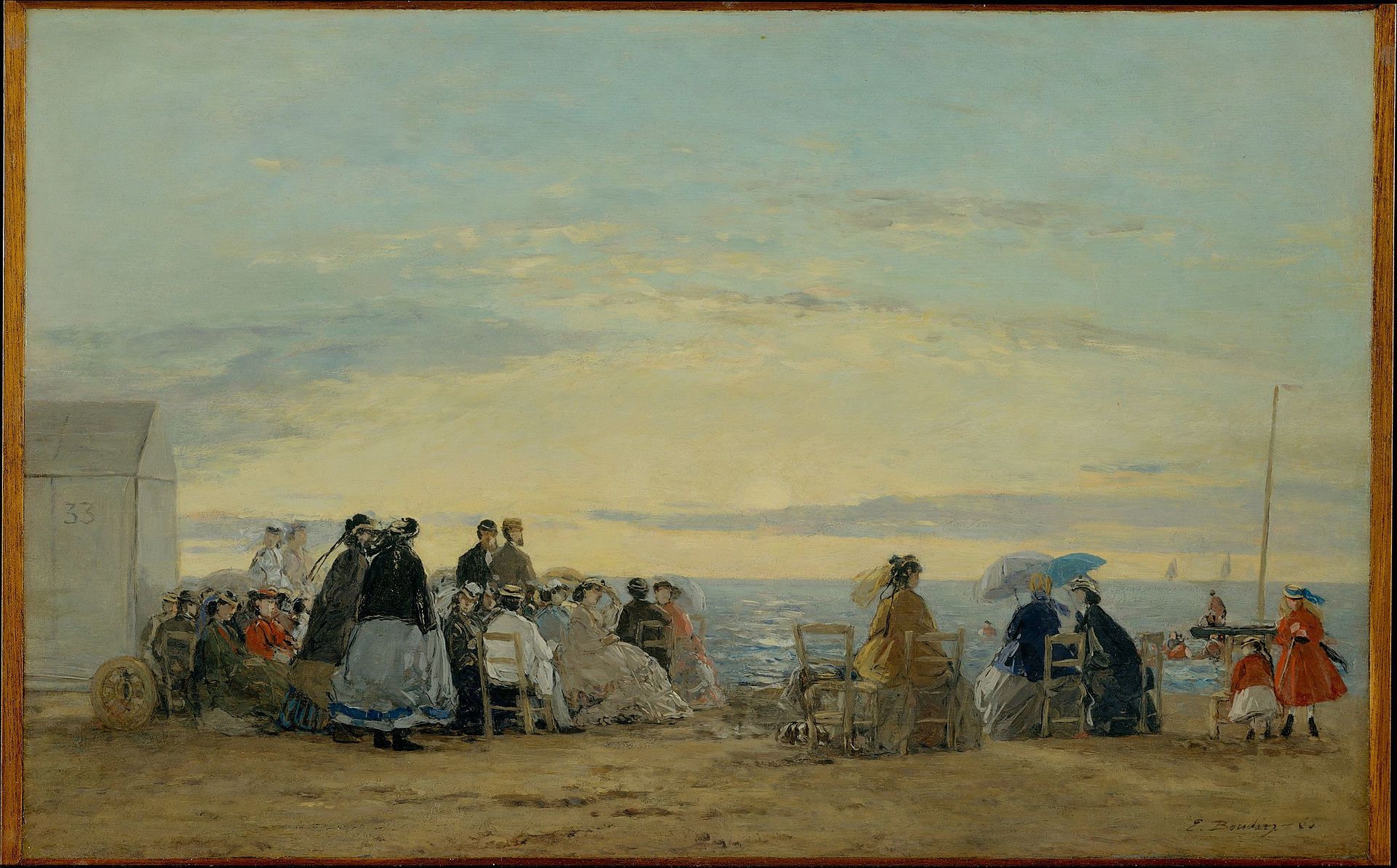
                                 On the Beach, Sunset by Eugène Boudin (1865)

Around 1865 Eugène Boudin spent time painting on the Normandy coast along with Monet, Courbet and Whistler.  It is around this time that Boudin began a series of depictions of fashionable beaches and this was to carry on for the whole of that decade.  In his 1865 painting, On the Beach, Sunset, we see the well-dressed upper-class holidaymakers who have gathered together to catch the final light of the day.  The seaside towns of Trouville and Deauville had not only their beautiful sandy beaches to inveigle tourists to their town but also had racetracks and casinos to satisfy those who liked the thrill of a wager. 

Princess Pauline Metternich (1836–1921) on the Beach MET DT4425.jpg

                    Princess Metternich on the Beach by Eugène Boudin (1867)

Visits by famous people to the Normandy beaches, such as Napoleon III’s wife, the Empress Eugénie also enhanced their reputation. Another dignitary to visit the Normandy beaches was Princess Metternich, the famous Austrian socialite, and wife of the Austrian ambassador to France and one of the most notable women at the court of Napoleon III.  She visited the seaside times on many occasions and was often accompanied by Princess Eugénie.  Her visit was captured by Boudin in his small 1867 painting entitled Princess Metternich on the Beach.  The Impressionistic style of the painting gives us little idea of the woman herself, which may be a relief to the Princess, as commentators of the time described her as small, very slight of build and as having “a turned-up nose, lips like a chamber pot and the pallor of a figure from a Venetian masque”.

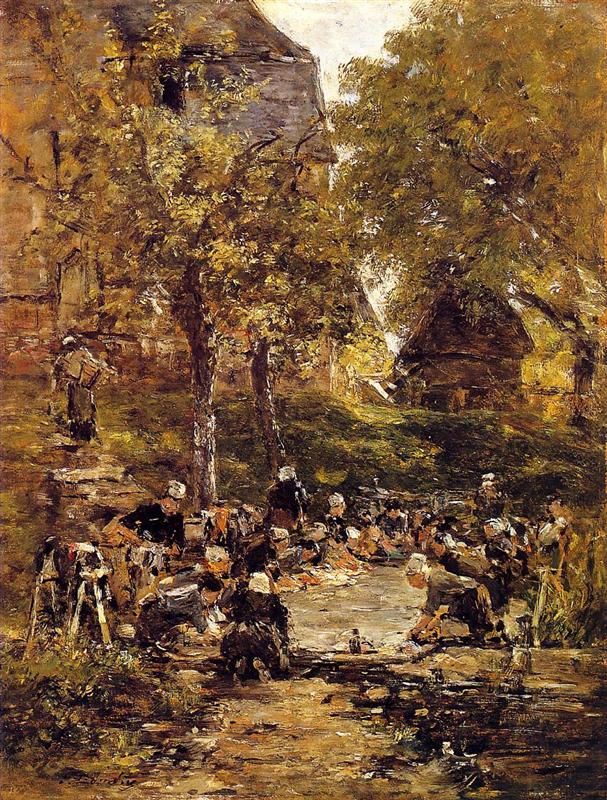
Laundresses by Eugène Boudin

For a period of time in 1867 Boudin left the beaches of Normandy and the luxurious lifestyle of the visiting rich and depicted the less well-off peasants and their daily routines.  Boudin could clearly see and understand the difference in the lives of the various social classes.  Did this bother him?  In a letter to his friend Ferdinand Martin, on August 28th, 1867, he condemned the social class system, writing:

“…I have a confession to make. When I came back to the beach at Trouville it seemed nothing more than a frightful masquerade.  If you have passed one month among the people condemned to hard work in the fields, with black bread and water, and you then find that gang of golden parasites with such a triumphant air, you can’t help feeling a bit of pity.  Fortunately, dear friend, the Creator has spread a little of his splendid and warming light everywhere, and what I reproduce is not so much this world as the element that envelops it…”

…….and yet in a letter to the same friend, Ferdinand Martin, a year later (September 3rd. 1868), he justifies his depictions of the wealthy on the Normandy beaches, writing:

“…The peasants have their painters, Millet, Jaque, Breton; and that is a good thing.  Well and good: but between you and me, the bourgeois walking along the jetty towards the sunset, has just as much right to be caught on canvas, ‘to be brought to the light’.  They too are often resting after a day’s hard work, these people who come from their offices and from behind their desks.  There’s a serious and irrefutable argument…”

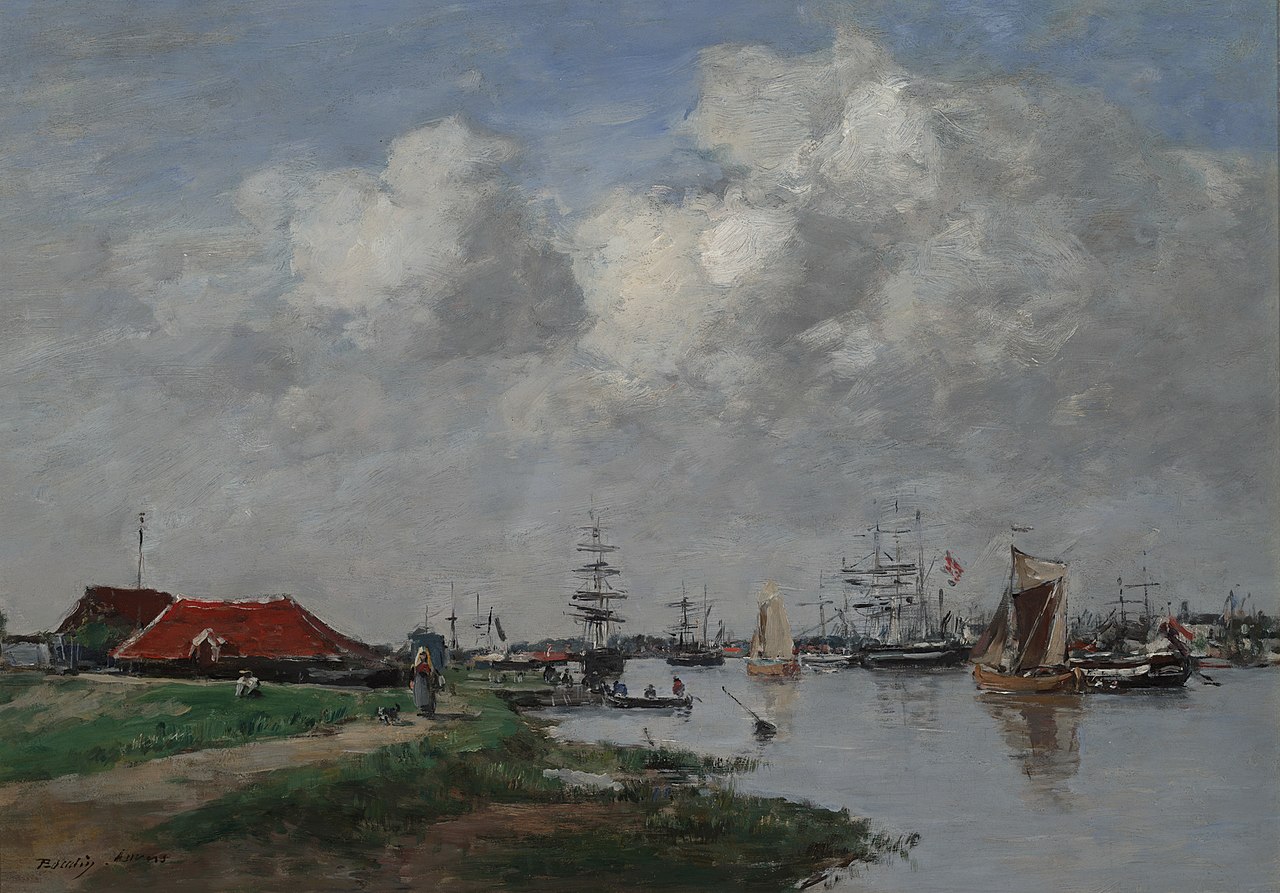
Antwerp, Boats on the Scheldt by Eugène Louis Boudin, High Museum of Art.jpg
Antwerp, Boats on the Scheldt by Eugène Boudin (1871)

The Franco-Prussian War broke out in July 1870 and the Prussian army invaded the French capital the following month.  Both Boudin and Monet fled the country with Monet going to London whilst Boudin went north to Belgium and the city of Antwerp.  Whilst in Antwerp Boudin completed a number of maritime paintings, one of which was his 1871 work entitled Antwerp, Boats on the Scheldt.

Eugène Louis Boudin - The Escaut River in Antwerp - 1977.57 - Yale University Art Gallery.jpg
Antwerp, The Escaut River by Eugène Boudin (c.1871)

Another work around the same time was The Escaut River in Antwerp.

Low Tide. Portrieux by Eugène Boudin (1873)

With the Franco-Prussian war ending in 1871 and the bloody Paris Commune, which followed in the Spring of that year, coming to an end, it was safe to return to France.

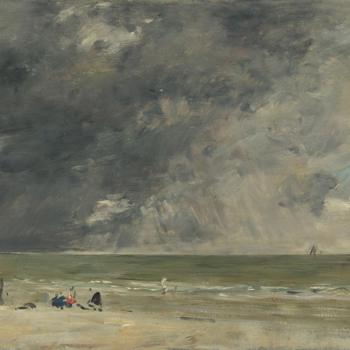
Portrieux, in the bay of St. Brieuc, Côtes du Nord, was a popular village with painters and Boudin visited it on several of his trips to Brittany between 1865 and 1897.  His 1873 painting Low Tide, Portrieux depicts vessels he would have seen during his visits.  In this painting Boudin has focused on the fishing vessels from Newfoundland, the Terre-Neuvas, becalmed at low tide, and several of his paintings centred on this subject matter.   Boudin, who was the son of a ship’s captain, and who had worked as a cabin boy on ships sailing along the Channel coast, was well able to recognise, and record, the individual characteristics of the vessels he came across in the ports he visited.

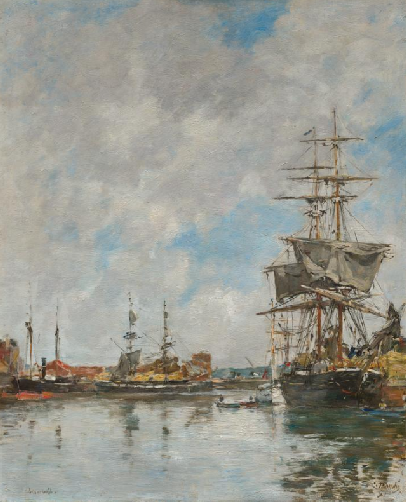
The Dock at Deauville (1891)

The Dock at Deauville by Eugène Boudin (1891)

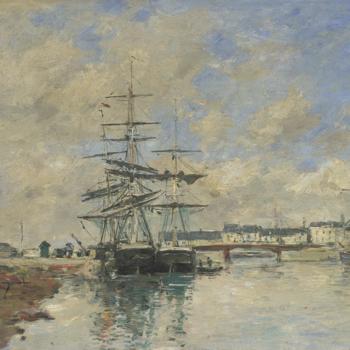
One of Boudin’s paintings, The Dock of Deauville, which he completed in 1891, has a similar depiction, ships in a harbour.  This painting treats a common theme in Boudin’s later art, ships in harbours. For Boudin these paintings were all about tranquillity, harmony and the effect of natural light on subjects and, unlike other maritime painters, avoided depictions of busy dockside life and the arduous jobs carried out by dock workers.  In this work, one can see how he has combined lighter tones around the ships’ masts, often overlying the darker lines of the wood and rigging with white or grey tones as if to suggest the passing wind and ever-changing positions which were everyday aspects of nautical life.

Eugène Boudin - Voir d'Antibes au coucher du soleil.jpg

View of Antibes by Eugène Boudin (1893)

By the time the 1880’s came around Boudin had achieved widespread recognition as an accomplished painter and had finally achieved financial security once he had secured a contract with the art dealer Durand-Ruel.   Paul Durand-Ruel, who was a great supporter of Impressionism and the Impressionist artists. In 1883 he opened his new gallery on the Boulevard de la Madeleine in Paris with an exhibition of works by Boudin, comprising 150 paintings and other pastels and drawings.

Fair in Brittany by Eugène Boudin

In 1888 at an auction at Hôtel Drouot in Paris, a large auction house in Paris, known for fine art, antiques, and antiquities, which consisted of  sixteen halls hosting seventy independent auction firms, many of Boudin’s paintings were bought by avid collectors of his work. 

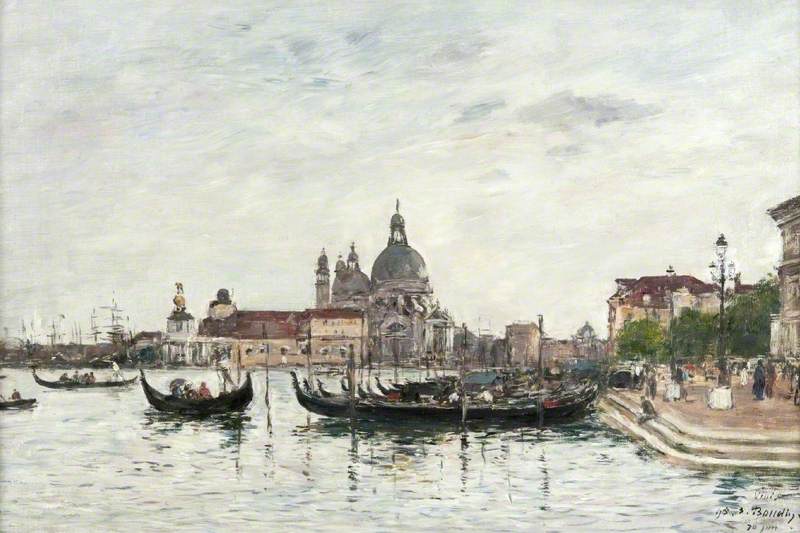
Venice: Santa Maria della Salute and the Dogana Seen from across the Grand Canal

Venice: Santa Maria della Salute and the Dogana seen from across the Grand Canal, by Eugène Boudin (1895)

In 1889, 1890, and 1891, more successful exhibitions were organized at Galerie Durand-Ruel, and in 1890 Boudin was elected a member of the Société des Beaux-Arts.  His paintings travelled across the Atlantic and were shown in exhibitions in Boston in 1890 and 1891.  He continued to exhibit at the Paris Salons until his death and received a third-place medal at the Paris Salon of 1881, and a gold medal at the 1889 Exposition Universelle in Paris.  In 1892 Boudin was made a knight of the Légion d’honneur.  His wealth allowed him to travel and he visited Belgium, the Netherlands, and southern France, and from 1892 to 1895 made regular trips to Venice.

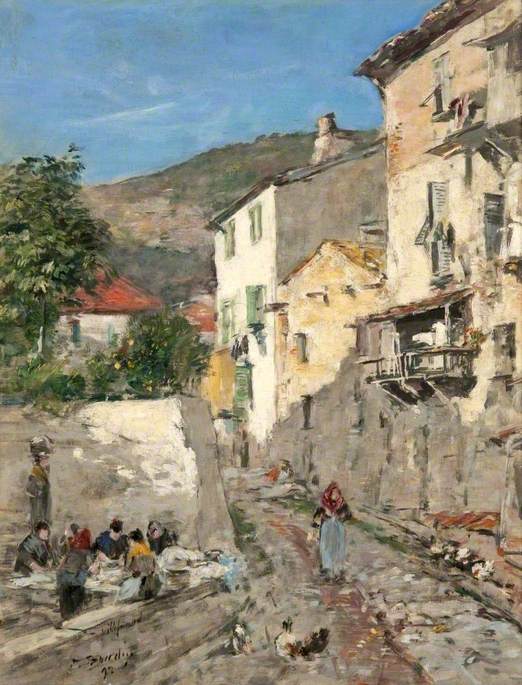
Villefranche

Villefranche by Eugène Boudin  (1892)

Boudin was now spending every winter in the south of France, returning to his beloved Normandy in the summer.  His wife died in 1889 and Boudin’s own health was in decline.  In 1898 Boudin must have realised he was dying as he decided to move back to his home in Deauville to die. 

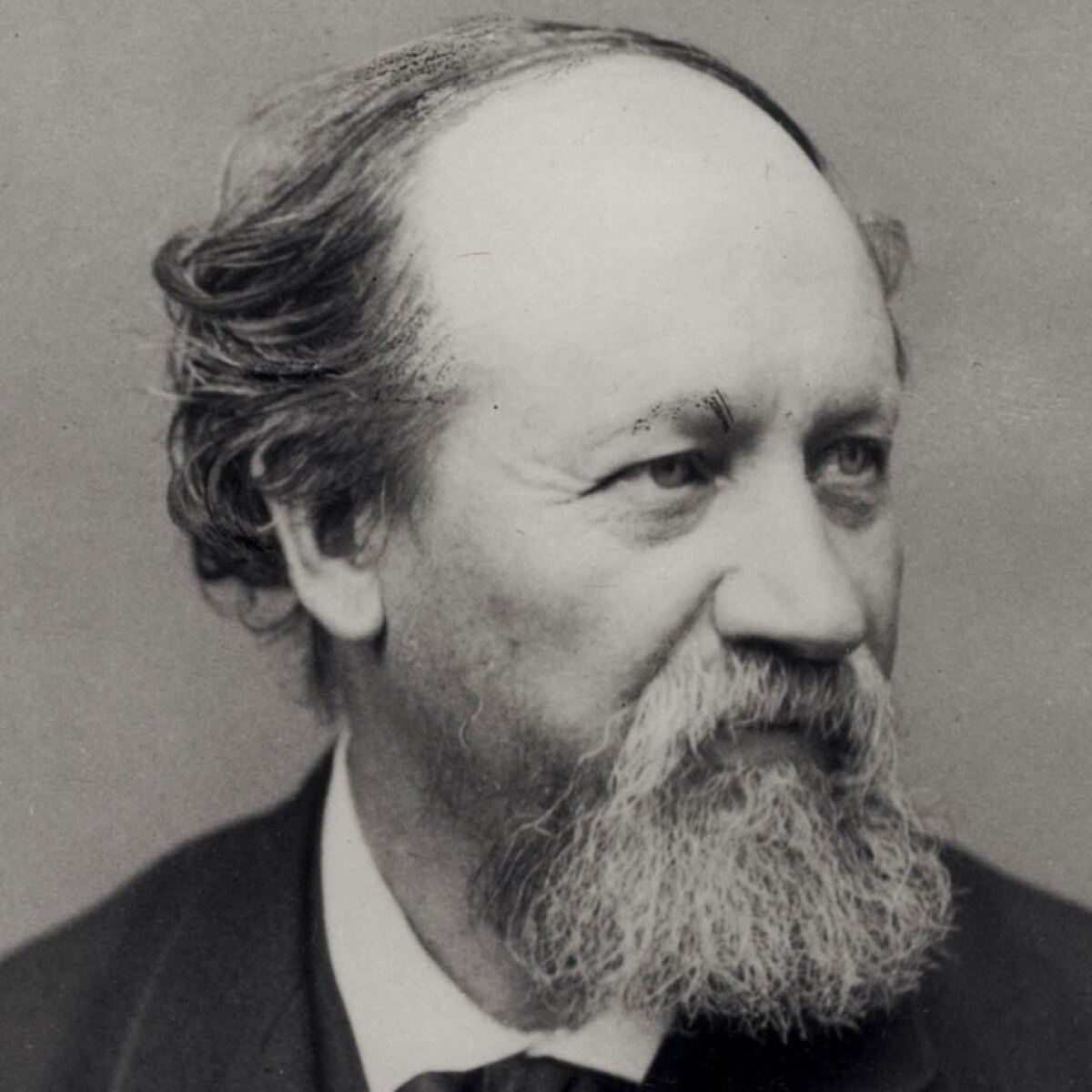
Eugène Louis Boudin died on August 8th 1898 aged 74.  He was buried according to his wishes in the Saint-Vincent Cemetery in Montmartre, Paris.  Boudin was a very modest man  and once said:

“…I may well have had some small measure of influence on the movement that led painters to study actual daylight and express the changing aspects of the sky with the utmost sincerity…”

But I will leave the last words to Claude Monet who said of Boudin:

“…If I have become a painter, I owe it to Eugène Boudin…”

Eugène Boudin. Part 1.

See the source image

My featured artist today is the nineteenth century French painter Eugène Boudin.  He was one of the earliest en plein air painters and is credited with introducing plein air painting to Monet.  He was a marine painter and his depictions focused on seascapes and the Normandy shorelines.

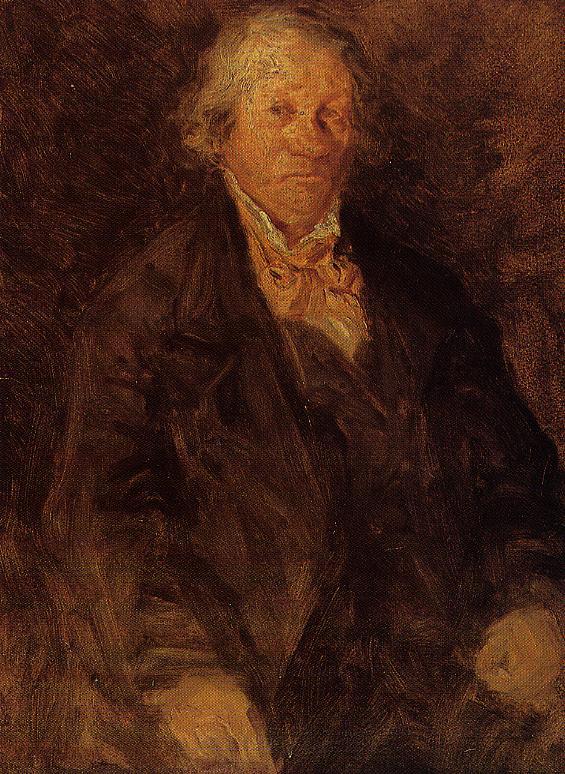
Portrait of the Artist’s Father  by Eugène Boudin (1850)

Eugène Louis Boudin was born in the coastal town of Trouville in Normandy on July 12th 1824. Leonard-Sebastien Boudin,  Boudin’s father, was a harbour pilot, and at the age of ten, young Boudin worked as a cabin boy on a steamboat that sailed across the Seine estuary between Le Havre and Honfleur and during those days on the water the young boy must have witnessed the constant fluctuations of the colours of the sea and sky which were aspects so important to plein air artists.  Boudin’s father gave up his seagoing life when Eugène was about twelve years of age.  In 1835, Eugène moved with his family to Le Havre where his father established himself as stationer and frame-maker. Eugène began work the following year as an assistant in the shop before opening his own small framing shop which he co-owned. It was whilst running this shop that he first met artists who were working in the area and used his shop to exhibit their paintings.  The most well-known of these were the landscape painter, Constant Troyon, Jean-Francois Millet, the portraiture artist, Jean-Baptiste Isabey and the history painter, Thomas Couture.  Eugène would receive encouragement from these painters to abandon the world of commerce and take up painting.  In 1846, aged twenty-two, Eugène Boudin took their advice and gave up the stationery shop and began to paint full time.  He had sold his share of the business to buy himself out of military service and in 1847, he travelled to Paris and spent time travelling through the Flanders region.  Boudin was profoundly influenced by the Dutch 17th-century Masters and when he met the Dutch painter Johan Jongkind, who had already made his mark in French artistic circles, Boudin was advised by his new friend to paint en plein air.  Three years later, in 1850 he won a scholarship that allowed him to move to Paris.  However, he never forgot his roots and would return to Normandy to paint and later take many painting trips to Brittany.  

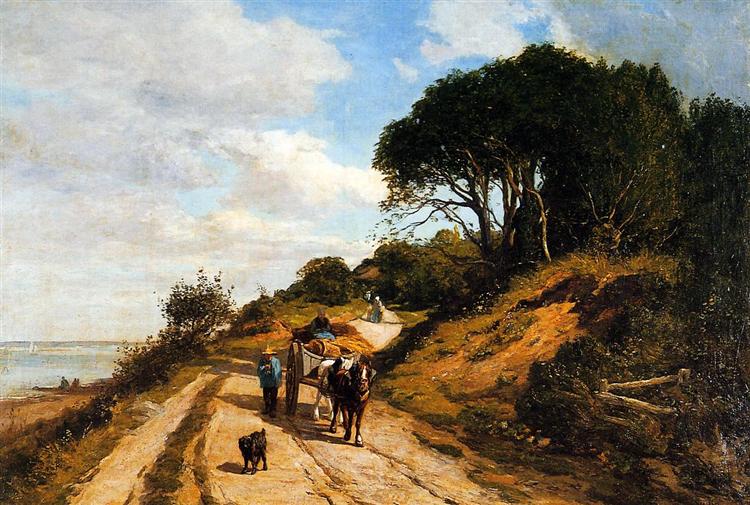
The Road from Trouville to Honfleur by Eugène Boudin (c.1852)

During that early period, Eugène painted rural landscapes, peasants, and still life works, but soon his love of the sea and the seaside progressively attracted his attention, and in 1862, he began to paint the crowds of fashionable tourists who had descended on the Normandy beaches.  Seaside resorts began to appear on the French Channel coast and in what was to become Belgium and the Netherlands in the late eighteenth century.  By the early nineteenth century the commercial sea-bathing habit was making an impact on Normandy. 

Fishermen by the Water by Eugène Boudin (1855)

Up until that time artists’ coastal scenes were rarely populated, and if they did include figures they were likely to be local fishermen. Boudin’s coastal scene paintings were adventurously modern in nature depicting smartly dressed holidaymakers engaging in leisure activities.

Elegant Women on the Beach by Eugène Boudin (1863)

His modus operandi was to sketch en plein air during the summer months and finish off the paintings in his studio during the winter months.  Boudin still respected the established tradition of outdoor painting.  His plein air sketches were merely studies rather than finished works and they had to be finalized in his studio utilizing the many sketches he had made as well as the meticulous notes he had recorded about atmospheric conditions and the time of day when the sketches had been made.  It was a painstaking operation as he once wrote in a letter to one of his students:

“… An impression is gained in an instant, but then it has to be condensed following the rules of art or rather your own feeling, and that is the most difficult thing – to finish a painting without spoiling anything…”

However, Boudin changed his methodology realising that there was an innate wrongness with his system of completing works indoors and so he would, from start to finish, complete his works en plein air.  This inherent immediacy of work painted outdoors allowed him to be aware of changing weather and light conditions.

The Beach at Villerville by Eugène Boudin (1864)

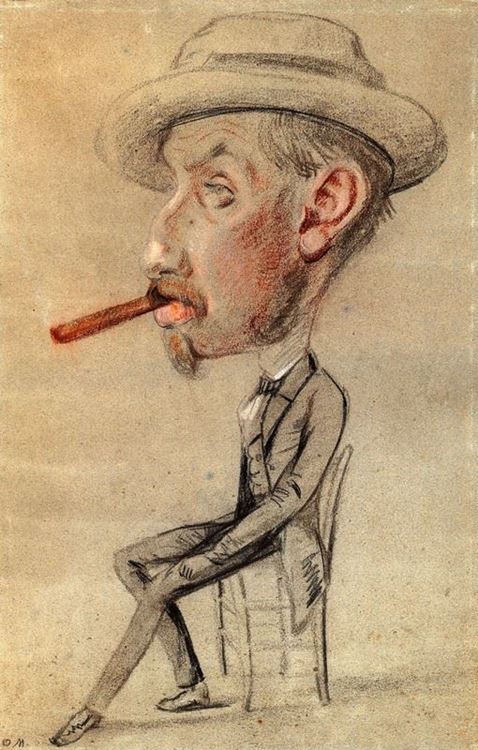
Claude Monet was born in Paris on November 14th 1840 and at the age of five moved with his family out of the French capital and went to live in Le Havre.  Monet was fourteen years younger than Boudin but it is said that around 1856, sixteen-year-old Monet met fellow artist Eugène Boudin, who then became his mentor and taught him to use oil paints. Boudin who befriended him also taught Monet the technique for outdoor painting.  This was to have a great influence on the young artist.  Up to the early meetings with Boudin, Monet had concentrated on his teenage caricatures but was persuaded by Boudin to focus all his time on landscape painting.  Monet recalled the time:

“…it was as if a veil had been torn from my eyes. I had understood, had grasped what painting could be. Boudin’s absorption of his work, and his independence, were enough to decide the entire future and development of my painting…”

Büyük Purolu Adam, 1855-1856 picture

Boudin helped Monet to love the bright hues and the play of light on water.  Monet remembered Boudin’s words of encouragement and later paid tribute to Boudin’s early influence:

“…Boudin without hesitation, came up to me, complimented me in his gentle voice and said ‘I always look at your sketches with pleasure, they are amusing, clever, bright.  You are gifted; one can see that at a glance.  But I hope you are not going to stop there.  It is all very well for a beginning, yet soon you will have had enough of caricaturing.  Study, learn to see and paint, draw, make landscapes.  The sea and the sky, the animals, the people and the trees are so beautiful, just as nature had made them, with their character, their genuineness, in the light, in the air, just as they are’…”

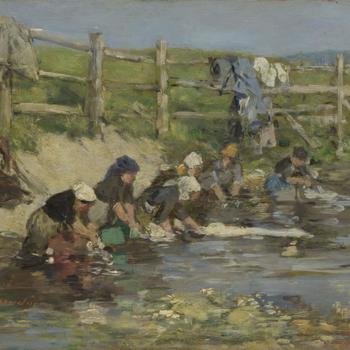
Laundresses by a Stream by Eugène Boudin

This would later become evident in Monet’s Impressionist paintings. Boudin offered Monet the chance to help him in his framing shop but the young man declined but later that summer he acquiesced.  The two remained lifelong friends and  it was probably through Monet that Boudin was asked to participate in the First Impressionist Exhibition in 1874.  

In 1859 Boudin met Gustave Courbet who introduced him to the poet and art critic, Charles Baudelaire, who was the first critic to draw Boudin’s talents to public attention when he made his debut at the 1859 Paris Salon.

Deauville Harbour by Eugène Boudin

Boudin was to later join Monet and his young friends in the first Impressionist exhibition in 1874, but he never considered himself a revolutionary trend-setter unlike some of the other artists.  So now Boudin’s work featured at both the Imressionist’s First Exhibition as well as at the Paris Salon that year.  In a way Boudin had created a vital connection between the past and future trends of French art, and by so doing won the admiration of his contemporaries.  Boudin could have become a regular member of the Impressionists but chose not to.

   Boudin had mental issues in the form of bouts of melancholia and he always seemed to doubt his own ability.  He was introverted and never felt the need to bolster his reputation which may have been enhanced if he had decided to live in the French capital and regularly mix within the Paris art circle.  Boudin preferred to remain living in Normandy.

In a letter, from Paris, dated June 14th 1869, to family-friend Ferdinand Martin Boudin tells of his desire to return to Normandy:

“…I dare not think of the sun-drenched beaches and the stormy skies, and of the joy of painting them in the sea breezes…”

The paintings that Boudin made of the coast were consistent with the ideals of the depiction of light which became popular with the Impressionist movement and so we must realise that Boudin continued to be an influence with the group.  

Beach at Trouville by Eugène Boudin

Boudin was a master when it came to depicting skies.   Fellow artists, like Corot, praised that aspect of Boudin’s paintings and nicknamed him King of the Skies.  In 1859 the poet Charles Baudelaire rhapsodically described the skies in Boudin’s paintings, shown at the Salon, ‘prodigious spells of air and water’.

………..to be continued.

The Talented Paxtons


William McGregor Paxton and his wife, Elizabeth Okie Paxton

William McGregor Paxton

Elizabeth Okie Paxton


       William McGregor Paxton                                               Elizabeth Okie Paxton

My blog today features an artistically talented husband and wife who were born in America in the late nineteenth century.  Let me acquaint you with Mr William “Bill” McGregor Paxton and his wife Mrs Elizabeth “Betty”  Okie Paxton.


Portraits by William Mc Gregor Paxton of his father and mother (1902)

William McGregor Paxton was born in Baltimore on June 22nd 1869.  He was the only child of James Paxton and Rose Doherty Paxton, a daughter of Irish immigrants.  The family left Baltimore before William’s teenage years and settled in Newton Corner, a village just west of Boston, where his father set up a baking and catering business.  Whilst at school, William became interested in art and became a very proficient painter, so much so, whilst still at the suburban high school he was accepted into the Cowles Art School in Boston which was one of the largest art schools in the city.  Cowles Art School offered instruction in figure drawing and painting from the flat cast and life, artistic anatomy, perspective, and composition, painting still life, drawing, and painting the head from life, drawing still life, oil and water colours. He studied with the American Impressionist Dennis Miller Bunker, a friend of John Singer Sargent, who was the chief instructor of figure and cast drawing, artistic anatomy, and composition at the school.  Bunker was so impressed by the work produced by Paxton that he persuaded him to travel to Paris to further his artistic tuition.

paxtoninstudio

In the Studio by William McGregor Paxton (1905)

From this Boston art school, William Paxton travelled to Paris in 1889 and studied at the Académie Julian.  Later he transferred to the government run, prestigious all male, art establishment, École des Beaux-Arts and studied under the French Academic painter, Jean-Léon Gérôme in his Paris atelier. William Paxton remained in Paris for four years and did not return to America until 1893.  On his return, William returned to the Cowles School and studied with Joseph DeCamp and became a junior instructor.   Around the same time, Elizabeth Vaughn Okie was also studying art at the Cowles Art School, under Ernest Lee Major and Joseph Rodefer DeCamp. 

Elizabeth Okie Paxton

Elizabeth Okie Paxton

Elizabeth Okie was born into a well-to-do family on March 17th, 1878 in Providence, Rhode Island.  She was the daughter of Dr. Howard Okie who had studied medicine in Germany and Elizabeth Coleridge Vaughn whose family were stockbrokers and bankers.  Elizabeth had a younger sister, Adele. Both Elizabeth and Adele were home-schooled by a governess which gives you an idea as to the financial status of the family.    While Adele loved music, Elizabeth loved her art and her parents enrolled her at Cowles Art School when she was sixteen-years-old.   One of her tutors at Cowles Art School was William Paxton during his brief tenure teaching at the school.  Love blossomed between teacher and pupil despite a nine-year age difference and in 1896, she and William became engaged. 

My Wife, Elizabeth (Wedding Portrait of Elizabeth Okie Paxton) (1899).

On January 3rd, 1899, just a few months before her twenty-first birthday, the couple married.  The long length of the engagement could well have been down to Elizabeth’s well-off parents being concerned with the future financial prospects of their future son-in-law.  After their marriage, William and Elizabeth lived with his parents at 43 Elmwood Street, and later bought a house at 19 Montvale Road in Newton Centre, one of a number of villages within the city of Newton in Middlesex County, Massachusetts.  William Paxton would continue to commute daily into Boston.

Elizabeth Vaughan Okie by William McGregor Paxton (1894)

In the collection of the Boston Athenæum’s is one of the earliest portraits of Elizabeth by her husband which he completed in 1894.  It is thought that it may have been painted specifically for her. It is fortunate that the work still survives as most of Paxton’s early paintings were destroyed in a studio fire in 1904, making this a rare survivor from that period of his professional life.

In 1906, now back in Massachusetts, William joined the faculty of the School of the Museum of Fine Arts in Boston as an instructor and became friends of Frank Weston Benson, head of the Painting department and the Impressionist painter, Edmund Tarbell.  These three artists and art educators believed passionately in teaching art and conveyed to their students an in-depth understanding of painting methods and composition. All three of them had studied at the Parisian art academies where demanding technical classes were coupled with an intensive study of the most well-known painters of the past. For them it was important to try and convey to their students what it was about the great paintings of the past that made them timeless.  William Paxton summed it up, saying:

“…Other people can look at pictures just for the pleasure they get out of them. We painters, when we are on the job, must always be looking to see how they achieve their effect. Just as an actor, when he goes to the theatre, never loses sight of the scenery, lighting, pulleys, gestures and tricks of inflection, the sum of which stirs the audience, so we painters must always be watching to discover the procedures by which the great masters produced beauty…”

Art of Impressionist Painter William McGregor Paxton

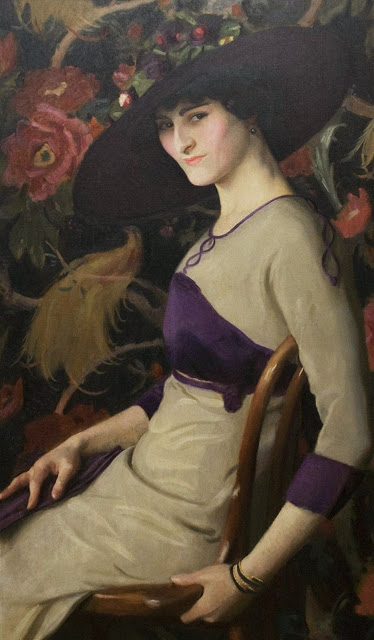
La Russe by William McGregor Paxton (1913)

William Paxton, along with Edmund C. Tarbell and Frank Weston Benson, was one of the founding members of a group of Boston-based painters active in the first three decades of the twentieth century, known as the Boston School.   Their preferred subject matter was of a genteel nature such as portraiture, picturesque landscapes, and young women posing in well-appointed interiors. They were influenced by artists such as John Singer Sargent, Claude Monet, and Jan Vermeer.  The Guild of Boston Artists was established in 1914 by the three artists and was created to be an artist-owned and artist-operated gallery. With the mission of promoting both emerging and established artists living in the region, the Guild developed a reputation for excellence in quality and presentation.

Elizabeth Okie Paxton featured in a number of her husband’s paintings.  One such example was his 1906 work entitled The Red Fan.

The Red Fan by William McGregor Paxton (1906)

The Red Fan (Portrait of Mrs Paxton) by William McGregor Paxton (1906)

Paxton had been brought up in a middle-class background and was well aware of Society’s hierarchical rules.  On getting back to America from his time in France William Paxton completed a number of paintings which featured the domestic opulence of the upper-class. His favoured depictions were those of composed females of the leisure class, often his patron’s wives, often with their domestic servants, with sumptuous backdrops of richly decorated interiors.  He was an important genre and portrait painter in the Beaux Arts style. 

paxtonfigurine

The Figurine by William McGregor Paxton (1921)

The females that featured in his genre and portraiture varied from dowagers and schoolgirls to servants, and his paintings helped identify idealized female roles of upper-class New Englanders at the beginning of the twentieth century.  It was all about female beauty and elegance which was in stark contrast to the work of the Ashcan School painters of New York who featured the gritty, and unglamorous realities of city life, often featuring New York women wandering down busy streets, flirting openly, and willingly catching the eye of passing strangers.  Paxton’s females oozed confidence and a sensual wistfulness but at the same time exuded demureness and respectability in stark contrast to the vulnerable yet gregarious Ashcan School’s women

William McGregor Paxton (1869–1941), Tea Leaves (1909),

Tea Leaves by William McGregor Paxton (1909)

A fine example of this is his 1909 painting entitled Tea Leaves.  We see two well-dressed young women taking tea together. The woman in the blue-trimmed hat looks closely at the leaves at the bottom of her cup, which was a popular way of telling one’s fortune. 

William McGregor Paxton (1869–1941), The String of Pearls (1908

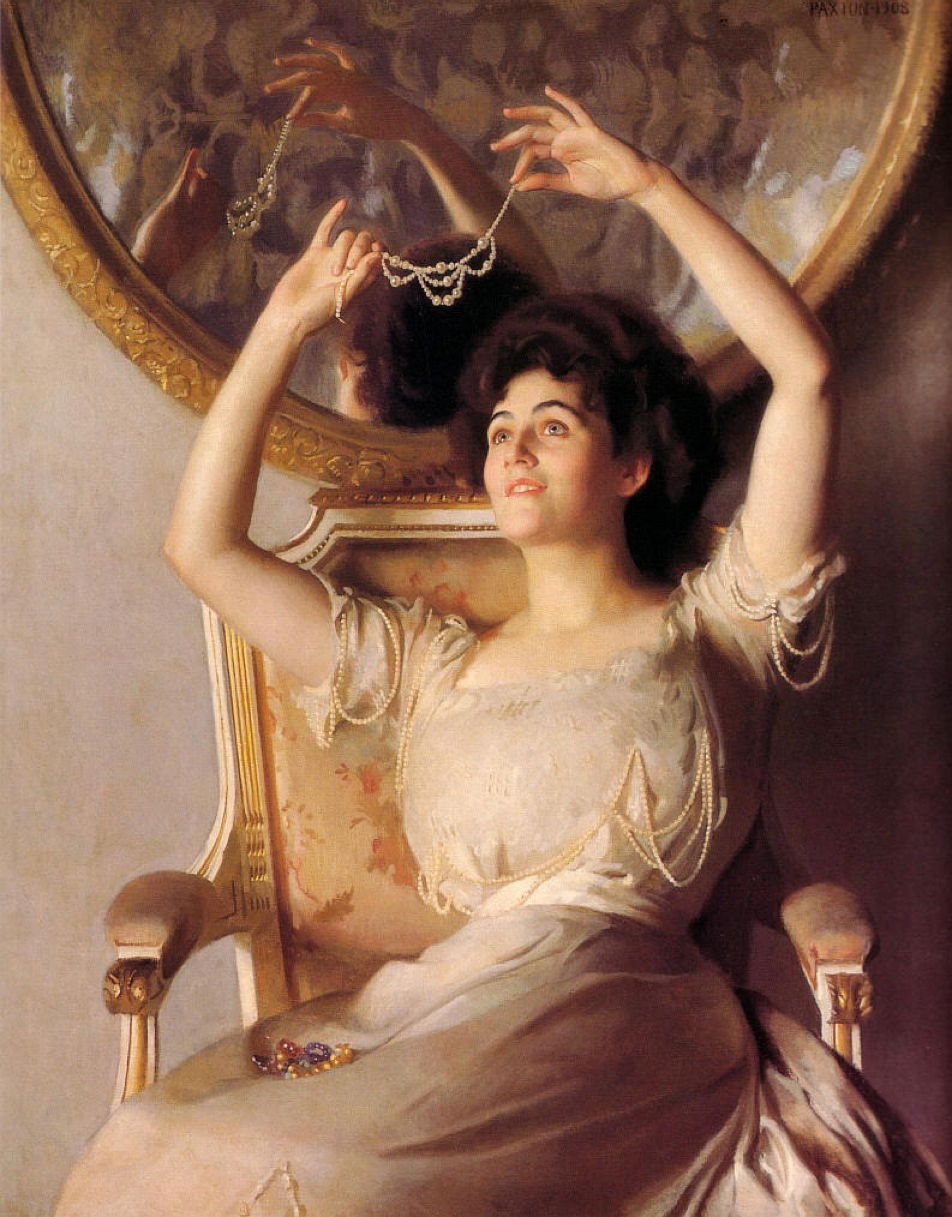
The String of Pearls by William Mc Gregor Paxton (1908)

His 1908 painting String of Pearls was another work which portrayed a sophisticated and cultured female enjoying a period of leisure, studying her pearl necklace.  Paxton often depicted ladies with expensive and beautiful accoutrements in luxurious settings.  For affluent male observers of Paxton’s works, it was if it were not just the furnishings and the jewellery which were items they would like to possess, but it was also the females themselves.


paxtonwomanwithbook

Woman with Book by William McGregor Paxton (1910)

Like many of his Boston colleagues, Paxton was influenced by the work of the seventeenth-century Dutch painter Johannes Vermeer. Paxton was fascinated not only with Vermeer’s imagery, but also with the system of optics he employed. He studied Vermeer’s works closely and discovered that only one area in his compositions was entirely in focus, while the rest were somewhat blurred. Paxton called it “binocular vision,” crediting Vermeer with recording the slightly different point of view of each individual eye that combine in human sight.  His painting, Woman with Book, we see the sunlight beaming through the window at the left, a woman (who even looks like one of Vermeer’s models) stands and reads a large book, with a painting on the wall behind her. The optical focus of the work appears to be the purse which the woman holds high against her left shoulder. 

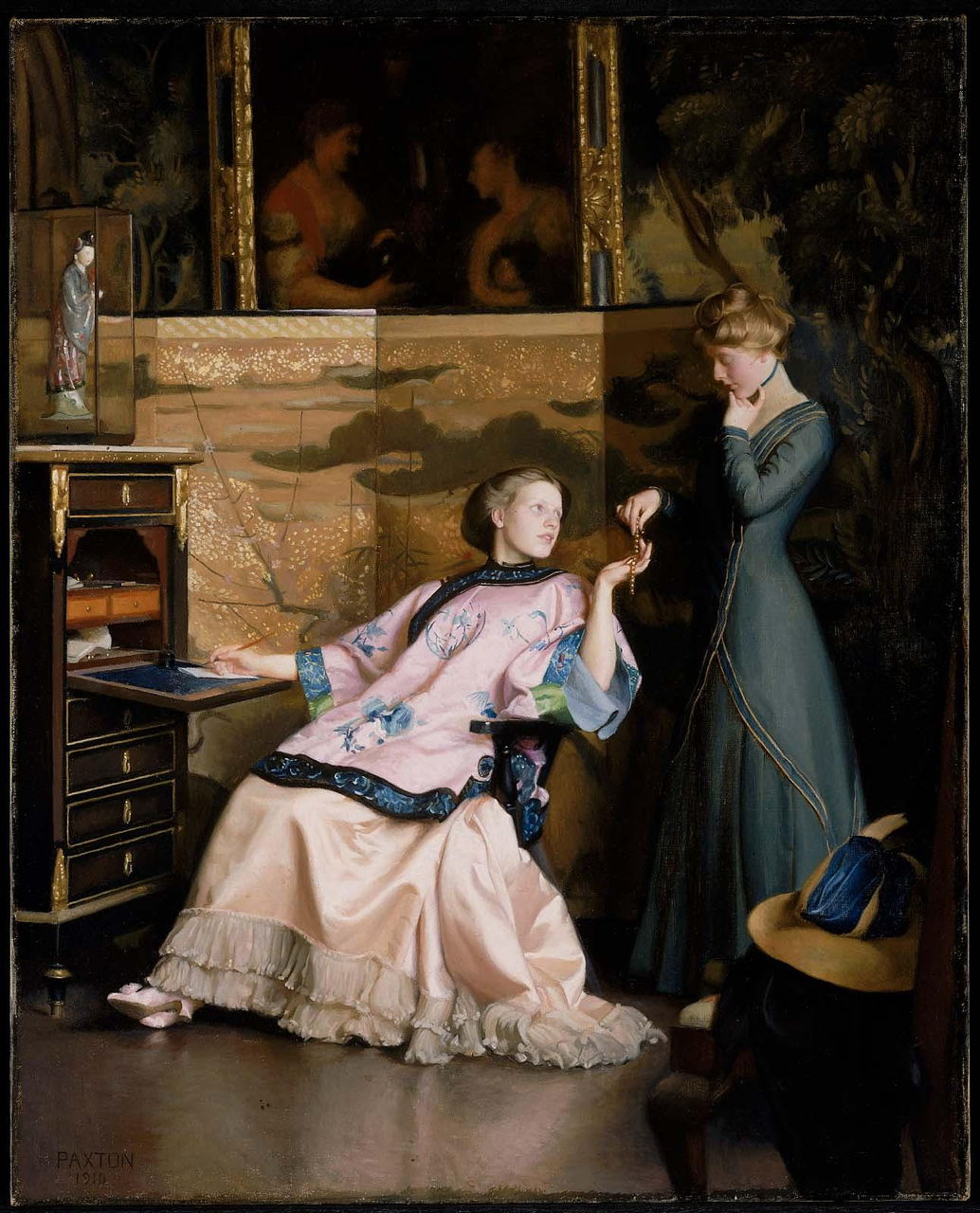
The New Necklace by William Paxton (1910)

William Paxton began to use this system in his own work, including his narrative painting The New Necklace, where only the gold beads are sharply defined while the rest of the objects in the composition have softer, blurrier edges.  The New Necklace, which he completed in 1910, is one of Paxton’s best-known paintings.  It is an intriguing work and we are made to wonder what is going on.  In the depiction, we see a younger woman, dressed in fashionably coloured clothes, sitting at a narrow bureau writing. She has turned her chair so that she can reach behind and hold out her left hand to receive the new necklace mentioned in the title. The jewellery is being placed into her hand by a slightly older woman, in a drabber dark blue-green dress.  She rests her chin on her left hand.  She purposefully does not make eye contact with the seated woman.  What is going on?  We, the observer, are provoked to use our imagination as to what is taking place in front of us.  There is obviously an air of subservience between the standing and seated woman but how does the handing over of the jewellery come into the story.  What hold does the seated woman have over the other?   I leave it for you to decide.

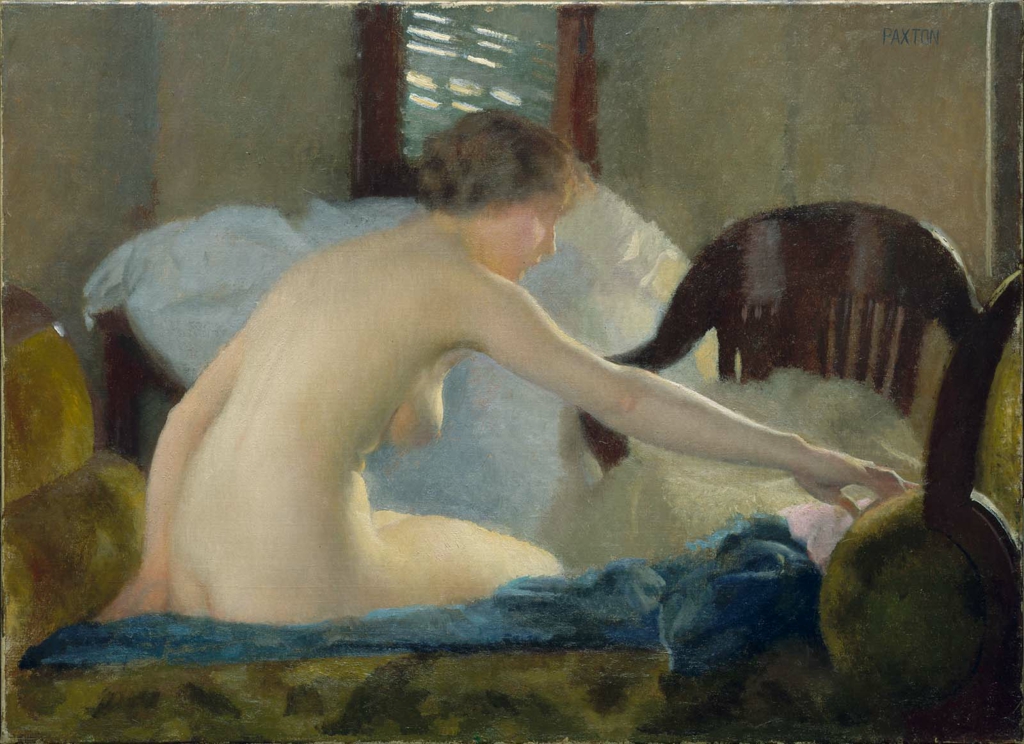
Nude by William Paxton

Nude by William McGregor Paxton (1915)

This blurring effect can be seen again in Paxton’s 1915 painting simply entitled Nude, which is part of Boston’s Museum of Fine Arts collection. In the depiction, we sees a young woman seated on a blue dress that is spread across the seat of a backless divan. She leans to the right as she reaches out for her pink underwear.  We observe the woman partly from the back and partly from the side.  Paxton has slightly blurred all the items in the room and the woman herself with the exception of her right breast and parts of her right arm.  From seeing the props used in this painting in other of his works, we know they are part of the trappings of his studio.

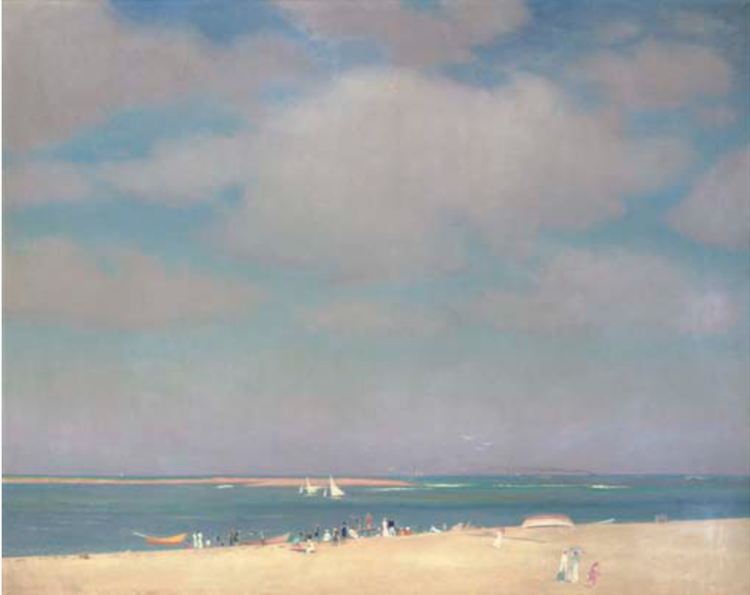
The Beach at Chatham by William Paxton (c.1915)

The Beach at Chatham by William McGregor Paxton (1915)

Paxton completed a number of landscape paintings such as his 1915 work Beach at Chatham.  Chatham is a town in Barnstable County, Massachusetts, located at the southeast tip of Cape Cod.  It is an unusual painting format with a low horizon line and seven-eighths of the work taken with the sky.   The result being the minute figures of those people on the shore.  However, the unusual format gives us, mere mortals, the feeling of how little we matter in the Grand Plan.  When Paxton began painting The Beach at Chatham, he envisioned the same problems that confronted the first Dutch landscape painters, namely, how to perfectly balance the visual expansiveness of a seascape with the presence of the human element. Adopting an extremely low horizon line and filling seven-eighths of the canvas with sky, the beachgoers appear diminutive, allowing the artist to promote the infinite over the everyday, and create a powerful, even awe-inspiring composition.

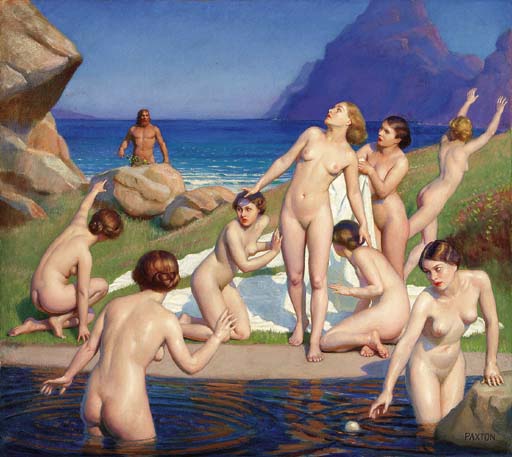
Nausicaa by William Paxton

Nausicaä by William McGregor Paxton

William McGregor Paxton delved into mythology with his painting Nausicaä.  It is based on Homer’s story of the trials and tribulations of Odysseus on his journey back home after the fall of Troy.  Odysseus has finally escaped on a raft from the clutches of Calypso and her island of Ogygia.  The raft is wrecked in a storm inflicted by Poseidon, and Odysseus has to swim ashore on the island of the Phaeacians.  After swimming along a river estuary he manages to clamber up the banks exhausted and naked and heads into a wood, where he falls asleep.  The next morning, Nausicaä, the daughter of King Alcinous and Queen Arete of Phaeacia, and her handmaidens go to the seashore to wash clothes. Awakened by their chatter and play, Odysseus emerges from the forest completely naked, scaring the servants away, and begs Nausicaä for aid.  William Paxton’s depiction is at the point in the story when the naked Odysseus approaches Nausicaä and her handmaidens.

See the source image

Red Apples by Elizabeth Okie Paxton (1920)

Elizabeth Paxton continued with her art studies under her husband’s guidance and became known for her beautiful still life paintings and her timeless works which featured everyday domestic objects, beautifully depicted with a sensitivity to light, colour, and form.  By shifting from interior scenes to still life works, Okie Paxton avoided competing with her husband’s subjects.  Elizabeth Okie Paxton painted still life works, finding a ready market with private collectors. Unfortunately, this meant that very few of her paintings are on show to the public in a museum.

ELIZABETH VAUGHAN OKIE PAXTON (American

Copper Jug with Apples by Elizabeth Okie Paxton

Copper Jug with Apples is a still life of a table covered partly by a white tablecloth upon which a copper-handled jug, three apples and a green cup and saucer.

Continental Breakfast by Elizabeth Okie Paxton (1907)

Another of her still life works is entitled Continental Breakfast which was exhibited at Rowland’s in Boston and described on May 17, 1907, and was described as:

“…she has set forth a dainty little breakfast, daintily arranged on a crisp, clean white tablecloth; there is a silver coffee-pot, a coffee-cup and a saucer of thin white porcelain, with a light green rim, a brown breakfast roll, a dish of fruit containing a half of a grapefruit and a bunch of grapes, and a covered dish of blue and white hawthorn ware. All these things are painted with so much delicacy and loving care, they are so pretty in themselves, and they are so well related together, that it is a pleasure to look at them. It is a long time since we have seen a better piece of still life work…”

Okie Paxton utilized light, texture, and colour like that of other artists of the Boston School. 

auoe5wxru3xb6zpvvkwv

The Breakfast Tray by Elizabeth Okie Paxton (c.1910)

In contrast to this pure still life work she also completed another work which featured a breakfast tray.  The painting is her famous 1910 work entitled The Breakfast Tray.  The painting requests our company into a world of femininity.  What we see before us is a scene of disorder and yet highly sensual, and utterly credible. It has a personality of its own.  Before us is not a depiction of staged harmonious domesticity but one that pricks our curiosity.  It is a provocative, almost erotic narrative work and yet it is almost a still-life work.  What at first glance appears to be a simple depiction 0f morning light streaming through an unseen window.  On the left falling we see the light falling upon the silver service of a breakfast tray which has been placed on a chair next to the unmade bed.  On the tray there is a small samovar, half a grapefruit, a bread roll, and a porcelain mug and jug.

Look at the artists depiction of light and shade.  See how the morning light bounces of the highly polished wooden leg and spindles of the Windsor chair.  It is still early morning and the sun has yet to rise high in the sky and so we see deep shadows under the shoes and along the rails of the chair as well as the space under the bed.  The bedding is rumpled.  A dressing gown has almost slid from the bed.  The lace-trimmed sheets and pillow, still with the marked impression of the sleeper’s head who has now risen and vacated the bedroom and it is all those aspects which prevent it being a still-life and steer it towards a narrative work.  So, what is going on?   The pillows on the bed are intimately close.  On the footboard of the bed there is another item of clothing. What is it?  Maybe another robe or a pair of trousers.  The more we stare and seek out minute details the more we become a voyeur.  A rumpled bed and abandoned shoes allow our mind to race towards the sexual nature of the scene and yet our erotic thoughts are dampened when we realise the breakfast tray is set for just one person.  Who brought the tray to the sleeping person – a servant, a lover?  Where has everybody gone? 

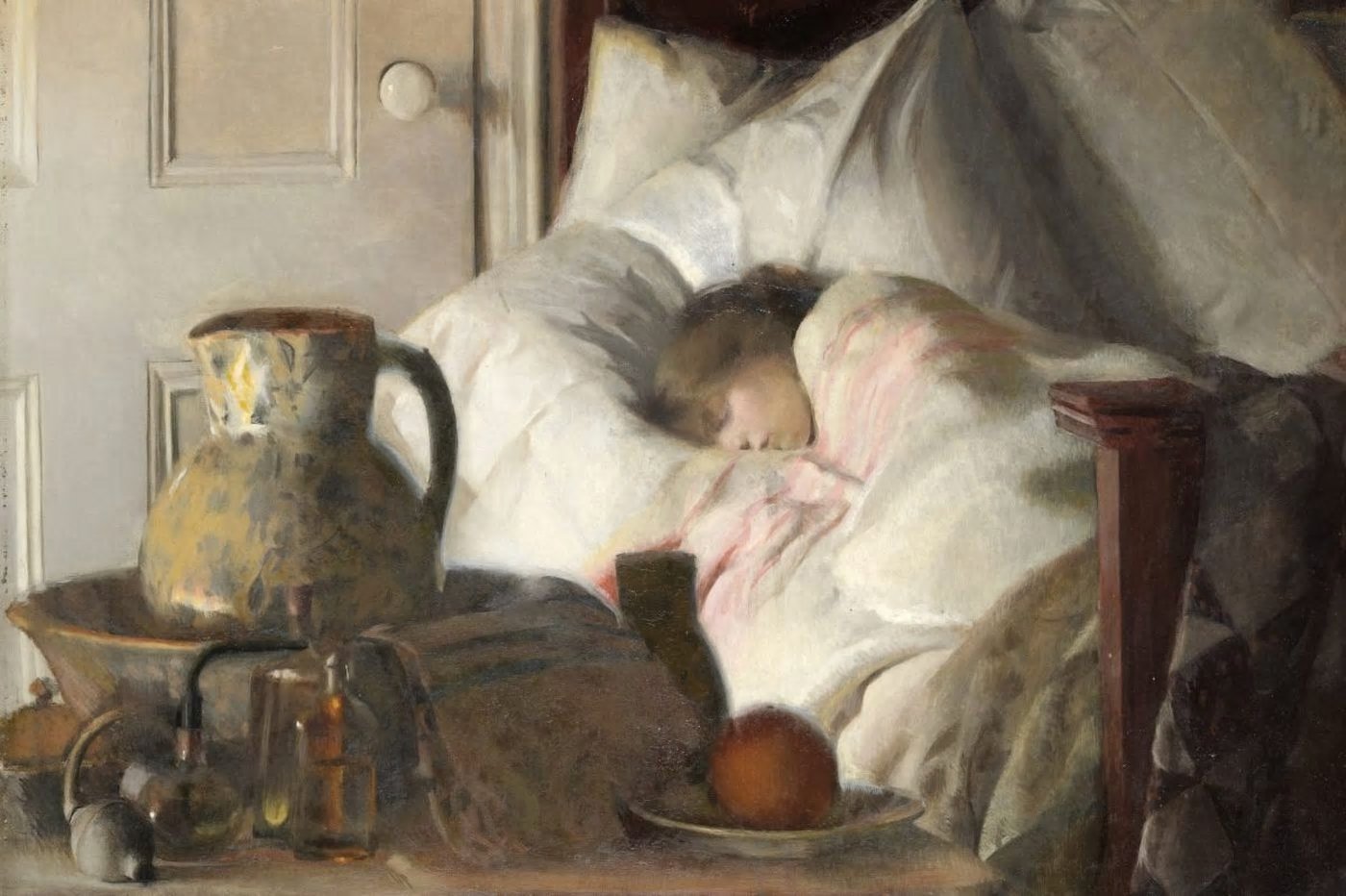
Elizabeth Okie Paxton's Sick a-Bed

Sick-a-bed by Elizabeth Okie Paxton (1916)

A similar setting can be seen in her 1916 painting entitled Sick a-bed. The painting was bought by the Pennsylvania Academy of the Fine Arts.  Academy officials said that the work would serve to bolster the museum’s effort to build its contemporary holdings and add to its growing body of art by women.

Is this all just a figment of my imagination and yet I say to you never just flick your gaze over a work of art, study it and imagine what was in the artist’s mind when they put brush to canvas and the painting makes us want to know more about the artist who created it.  What little we know about her is that Elizabeth Okie Paxton enjoyed a harmonious marriage, who would selflessly endorse her husband’s career.  They loved and respected each other.  She was a beautiful woman who also served as her husband’s muse, and often modelled for many of his paintings.  Although she painted The Breakfast Tray which some considered a risqué work, she enjoyed painting less controversial still life works. She and her husband were not blessed with children and consequently her life was devoted to both her and her husband’s art. She continued to manage her husband’s business affairs after his death with correspondence regarding his art estate until 1970, apparently paying even more attention to his posthumous career than her own active one. Of course, this leads to the obvious question – could she have been better known as a painter had she not married William? On the other hand, if she had not married William Paxton would she have missed meeting influential people and teachings that subsequently propelled her own development?   It is just the age-old question “what if?”

paxtonhousemaid

The House Maid by William McGregor Paxton(1910)

Over the decades that followed, both William and Elizabeth became successful artists, William best known as an accomplished portrait painter who painted two US presidents, Grover Cleveland and Calvin Coolidge and Elizabeth gained fame as a painter of still-lifes and interiors.  William Paxton was made a full member of the National Academy of Design in 1928.  He was working on his last painting, a view of his living room at 19 Montvale Road, with his wife posing for him, when he was stricken with a heart attack and died in 1941, at the age of 72.  After her husband’s death Elizabeth once again gave up her own art to focus on promoting her husband’s art and legacy.

Elizabeth Okie Paxton died on April 2, 1972 in Boston, aged 94.


Harold Harvey

Harold Harvey

Harold Harvey (1874 – 1941)

My featured artist today is one of the famous Newlyn School painters. The term Newlyn school applies to a group of artists who settled in Newlyn and St Ives in the late nineteenth century and whose work is characterised by an impressionistic style and embodies subject matter drawn from scenes of rural life.   It was founded by a group of artists led by Stanhope Forbes. who came to Newlyn in West Cornwall in 1884 and was immediately captivated by the scenery and people in the area. The ‘Newlyn School’ became famous for its superb realism, in ‘Plein-Air‘ painting.  The artist I am looking at today, Harold Harvey, made his name for his beautiful works featuring the Cornish countryside.

See the source image

The Old Slip, Newlyn by Harold Harvey

Harold Charles Francis Harvey was born on May 20th 1874 in North Parade, Penzance, Cornwall.  He was the eldest of eight children of Francis McFarland Harvey, a bank clerk, and Mary Bellringer whom he married in September 1872. Harold had six brothers, Percival George Harvey; Frank Harvey; Arthur William H Harvey; Wilfrid Vignes Harvey; Leonard Harvey, and Cyril Harvey along with one sister, Gladys Maud Harvey.  Harvey trained in painting at the Penzance Art School under the tutelage of Norman Garstin, an Irish artist, teacher, art critic and journalist associated with the Newlyn School of painters. After leaving the Penzance Art School at the age of nineteen, William travelled to France and attended the Académie Julian in Paris between 1894 and 1896.

Harold Harvey - Unloading the boats, Newlyn Harbour.jpg

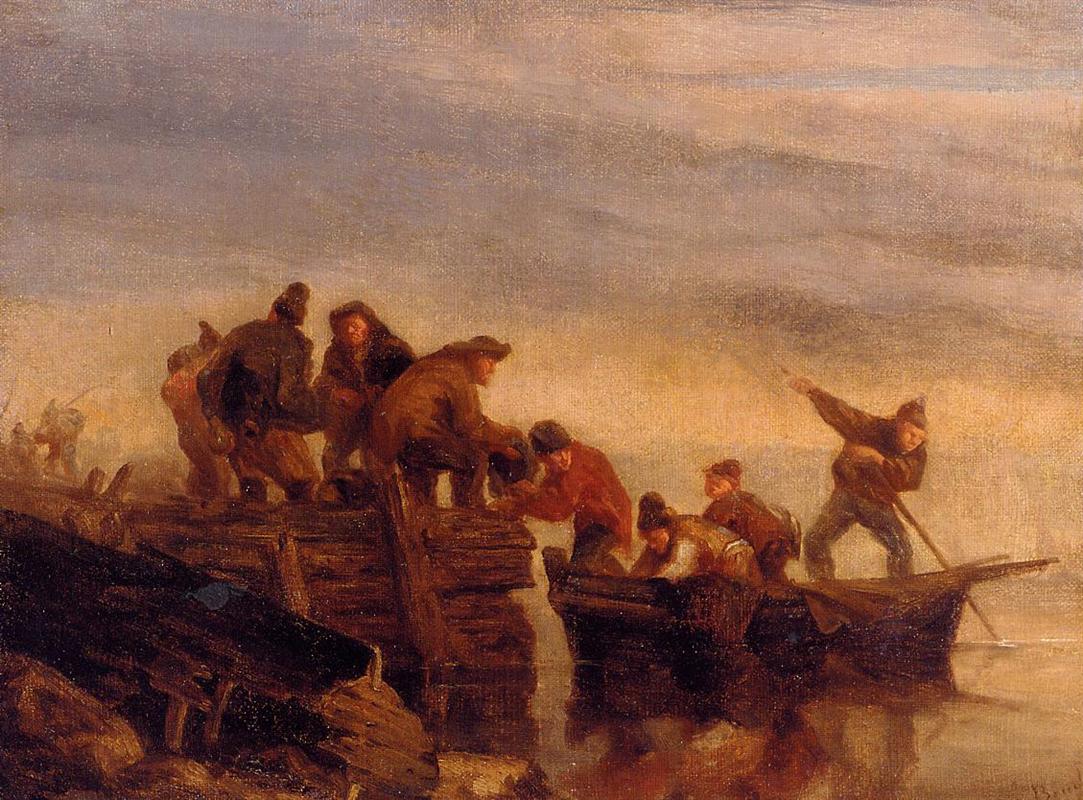
Unloading the boats, Newlyn Harbour by Harold Harvey (1906)

In the early part of the twentieth century, Harold Harvey’s paintings were impressionistic in style and the depictions focused on people involved in the agricultural and fishing trade. 

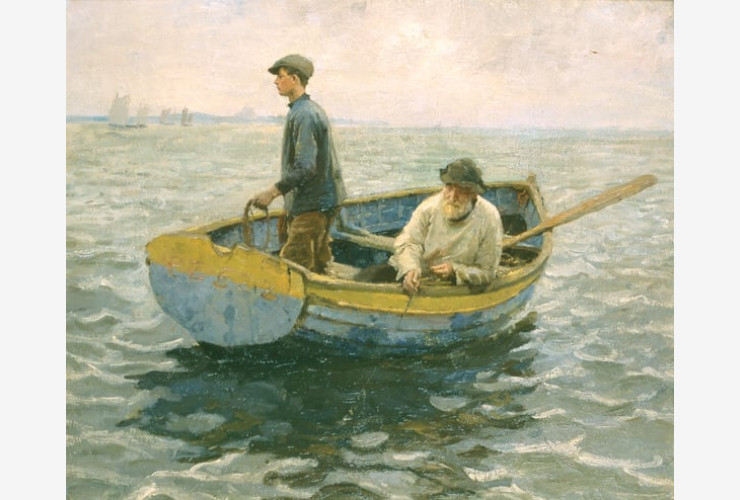
In the Whiting Ground’ by Harold Harvey

In the Whiting Ground by Harold Harvey (c.1900)

One such work was In the Whiting Ground which he completed around 1900 and depicts a small dinghy at sea with a young man standing holding a fishing line in his hands while an older man is holding a line in the water.  St Michael’s Mount the tidal island in Mount’s Bay, a large, sweeping bay on the English Channel coast of Cornwall, can be seen in the far distance.

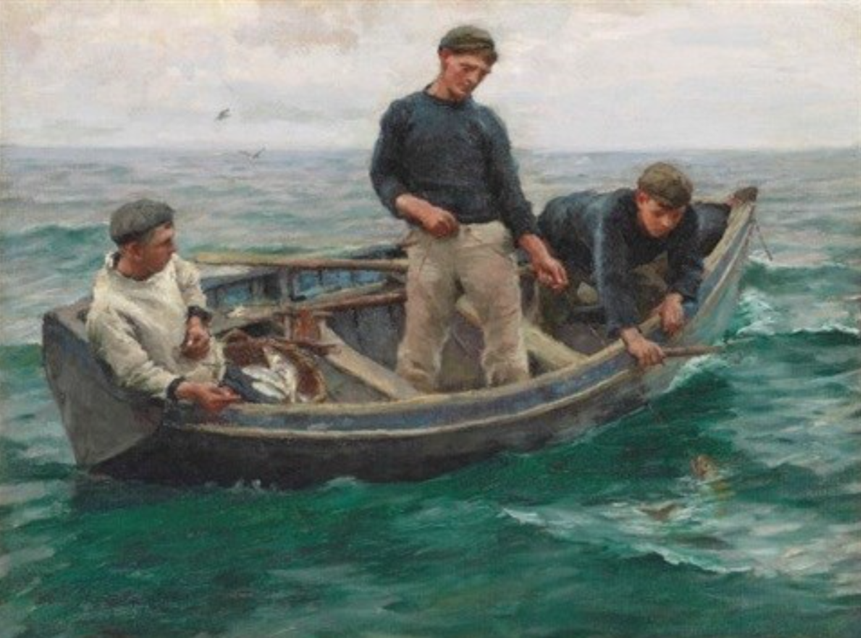
Whiffing in Mount's Bay

Whiffing in St Mount’s Bay by Harold Harvey (c.1900)

A small painting completed around the same time by Harvey featuring three young men in a boat had the strange title of Whiffing in St Mount’s Bay.  Whiffing is a mode of fishing with a hand line.

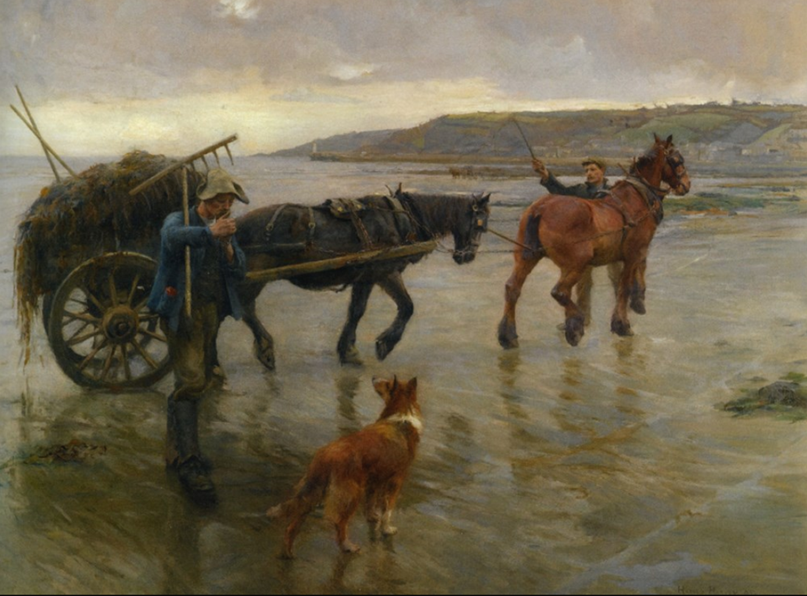
The Seaweed Gatherers by Harold Harvey

The Seaweed Gatherers by Harold Harvey

Another of his paintings depicting life along the Cornish shoreline was one entitled The Seaweed Gatherers in which we see two men hauling a horse and cart laden with fresh seaweed.

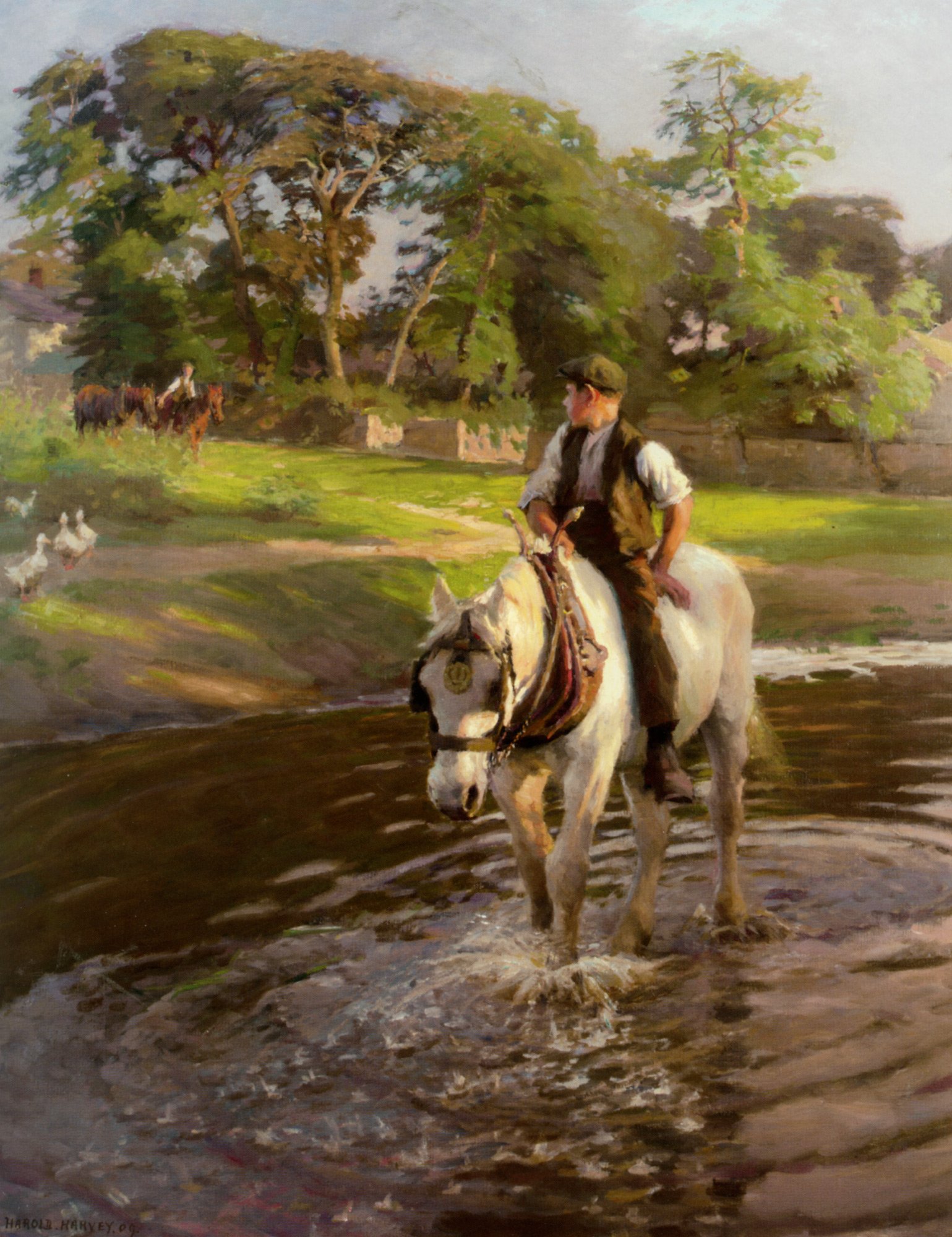
The Close of a Summers Day by Harold Harvey. (1909)

The Close of a Summers Day by Harold Harvey (1909)

A more colourful painting is his beautiful work of idyllic tranquillity entitled The Close of a Summers Day which he completed in 1909.  It is at the end of a hot summers day and man and beast have need of a rest and refreshment.  The young farmworkers have been tasked with taking the horses down to the river for them to cool down and have a drink.  The white horse gently splashes in the water attempting to cool down its fetlocks.

From 1909 to 1913, Harvey was an Associate of the Royal Cambrian Academy of Art, Conwy and, in 1910, he became a member of the South Wales Art Society.

gertrude_harvey2_large

Gertrude Harvey by Harold Harvey

It was around this time that Harold Harvey met Gertrude Bodinnar.  She was born in 1879 and was the eighth of the ten children born to Ann Crews Bodinnar, (née Curnow), and her husband John Matthews Bodinnar, a cooper.  In her twenties, she acted as a model for students at the Forbes School of Painting, which had been founded in 1899 by Stanhope Forbes and his Canadian-born wife Elizabeth as their School of Painting and Drawing at Newlyn. It was indirectly through her work with students at this establishment that she first met Harold Harvey and agreed to act as his model.  Love blossomed and Harold and Gertrude married on April 19th 1911 and the couple set up home at Maen Cottage Elms Close Terrace, in Newlyn

Portrait of the Artist's Wife, Gertrude by Harold Harvey (1917)

Portrait of the Artist’s Wife, Gertrude by Harold Harvey (1917)

Gertrude appeared in a number of her husband’s paintings.  One example was his 1917 portrait of her entitled Portrait of the Artist’s Wife, Gertrude……

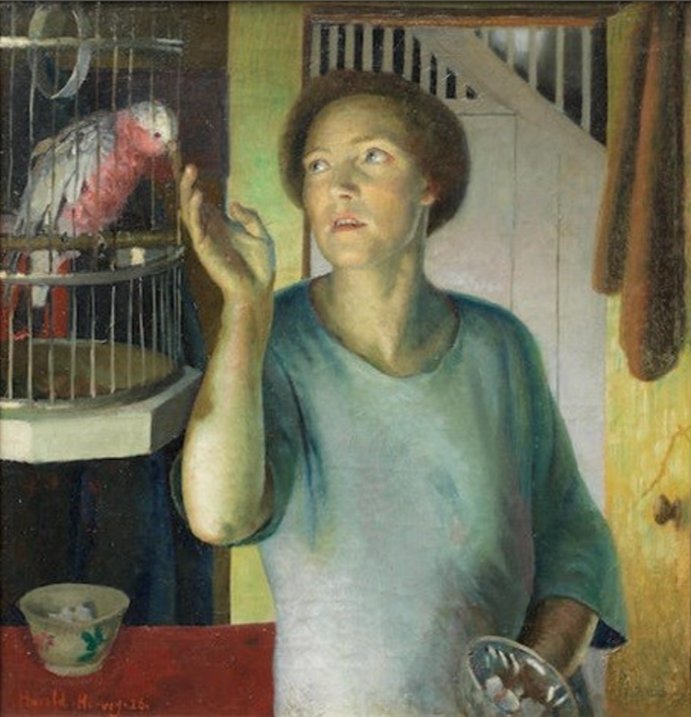
Gertrude Harvey with Parrot in the Artist's Home by Harold Harvey

….and Gertrude Harvey with Parrot in the Artist’s Home……

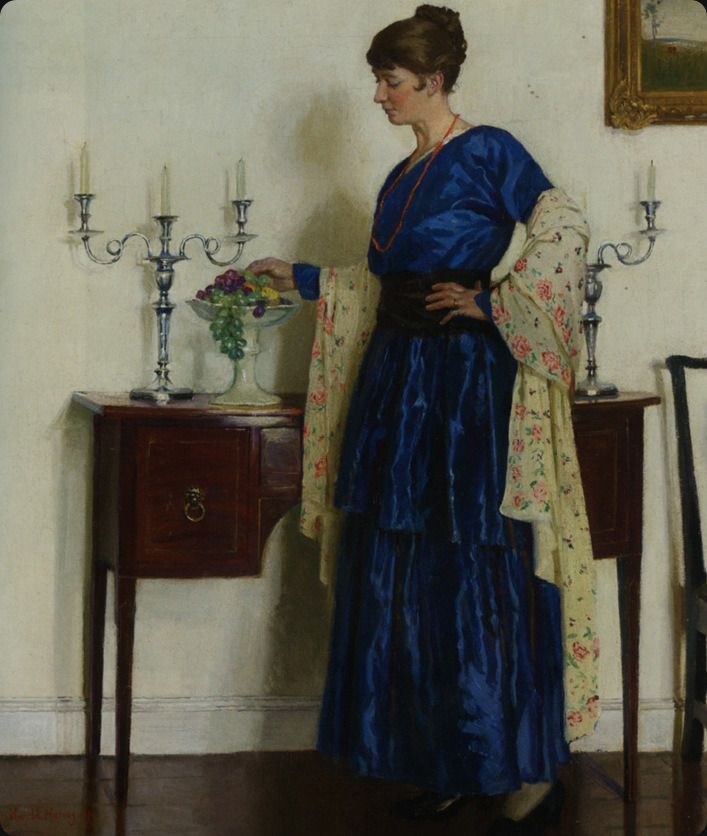
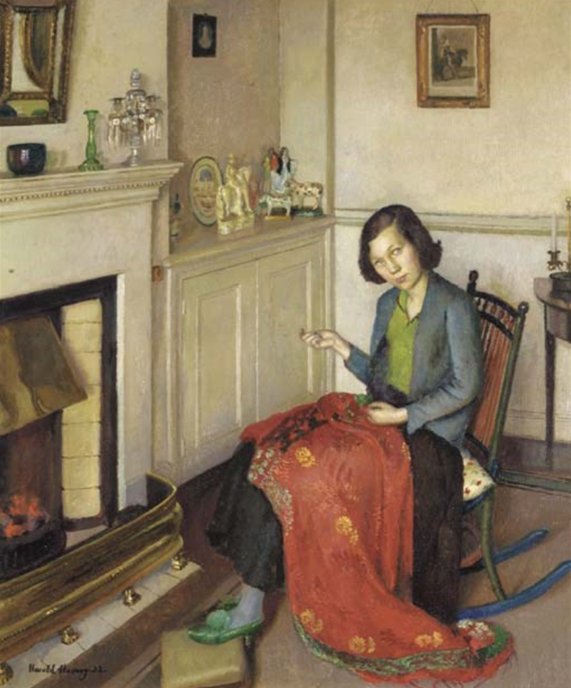
The Red Silk Shawl by Harold Harvey (1932)…..and The Red Silk Shawl in 1932.

Being around artists, including her husband, and watching them work fascinated her. She would often note down how the artists worked, and she soon realised that she had a talent for art and design.  Gertrude used mostly oil on canvas, board, card, or paper, but also tempera, gouache and though largely self-taught she became a talented artist in her own right, and her paintings were mainly of still-lifes, flowers and landscapes. 

Landscape

Landscape by Gertrude Harvey

Her paintings were good enough to be sold and exhibited at the Newlyn Art Gallery and in the twenties and thirties her work could be seen in many London galleries including the Leicester Gallery and the Royal Academy. Often, she showed work together with her husband in mixed and group shows.   Between 1930 and 1949, Gertrude Harvey had twenty works selected for Royal Academy exhibitions and from 1945 to 1949 she was regular exhibitor with the St Ives Society of Artists.  She was also proficient at needlework and clothing design.

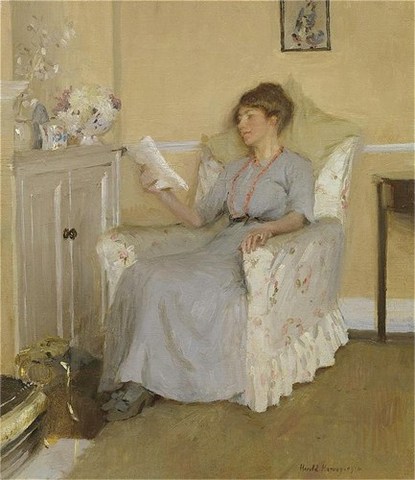
Reflections by Harold Harvey (1916)

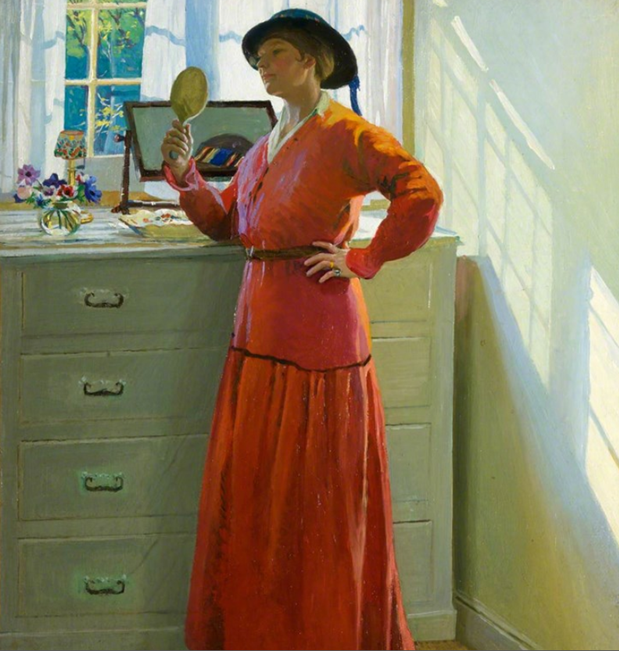
Reflections by Harold Harvey (1916)

Meanwhile Harold Harvey continued painting and exhibiting his work. The First World War began in 1914 but due to health issues, he was exempted from military service.  In that year, he started to paint a series of interiors often using his own home.  One such painting was his 1916 work entitled Reflections.

The Critics by Harold Harvey

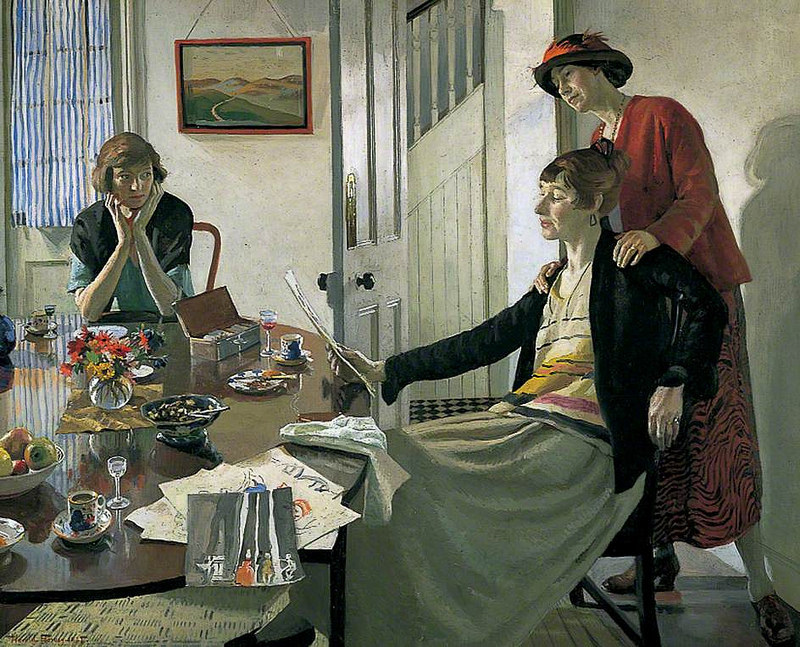
The Critics by Harold Harvey

In another work entitled The Critics, we see three women enjoying coffee and an aperitif as they study some paintings, weighing up the merits of each one.

The Tea Table by Harold Harvey

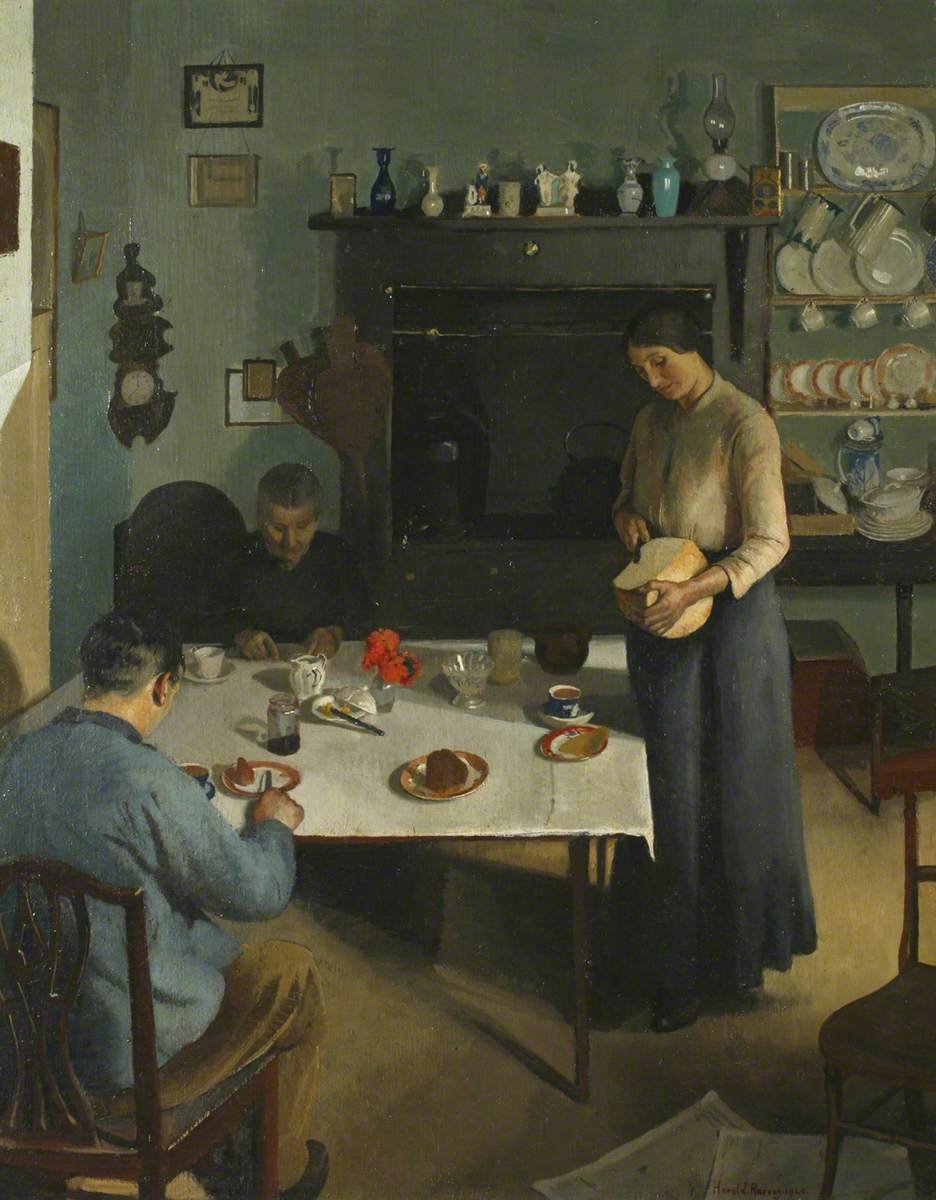
The Tea Table by Harold Harvey (1920)

A depiction of domestic living can be best seen in Harold Harvey’s 1920 painting entitled The Tea Table.  It is a masterful depiction of a small dining room filled with shelves of crockery and ornaments.  It could almost be termed a still-life of household goods.

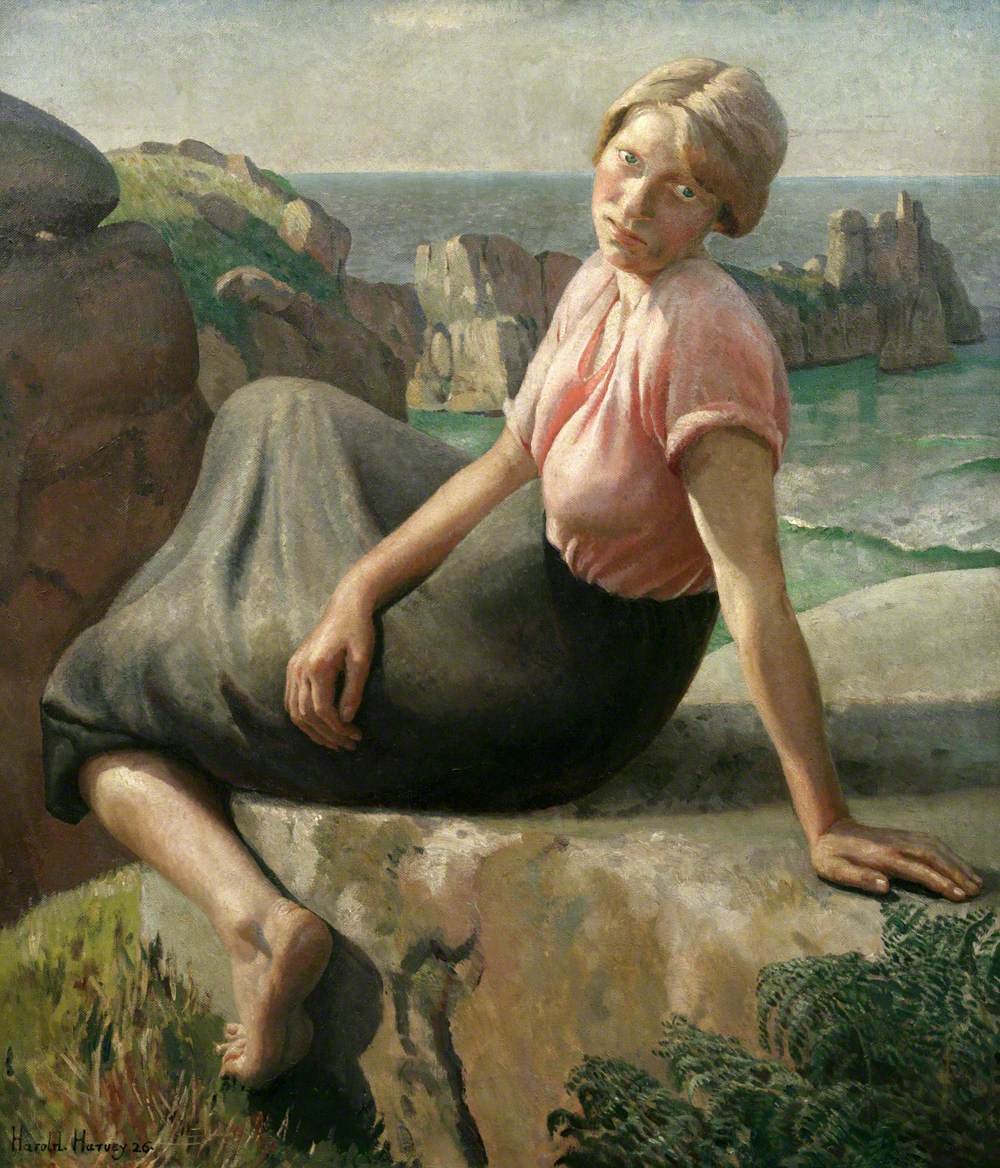
Girl on a Cliff by Harold Harvey (1926)

Girl on a Cliff by Harold Harvey (1926)

With such wonderful landscapes on his doorstep, it is no wonder that Harvey continued with his outdoor works featuring young models.  One example of this is his 1926 painting entitled Girl on a Cliff.  In a way, this is not a true plein air painting as the girl in the depiction is fourteen-year-old Cressida Wearne and Harvey painted her posing in the garden of his studio and he added the background at a later date.

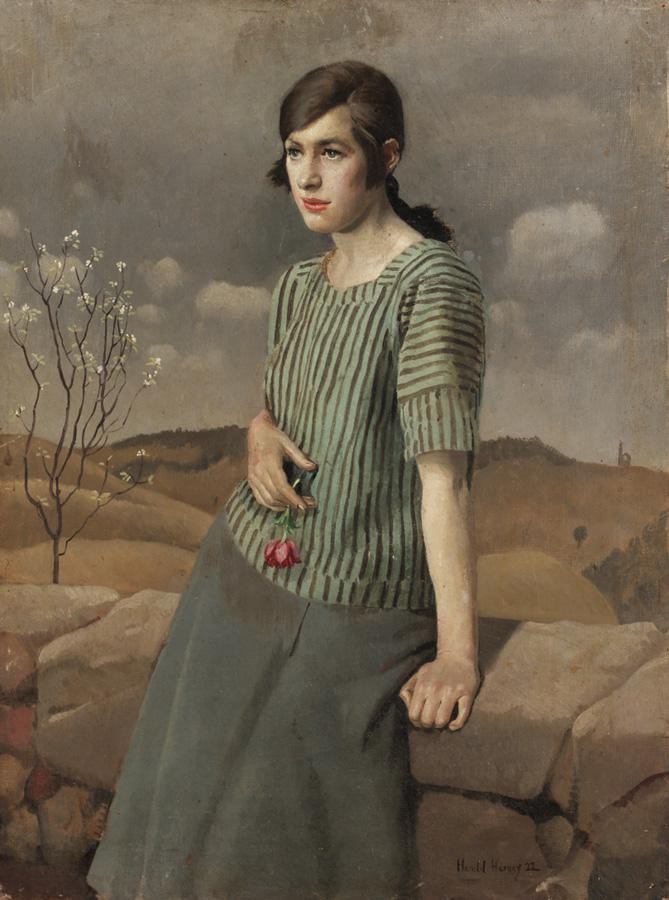
Clara

Clara by Harold Harvey (1922)

Again, we see this technique with his 1922 painting, Clara.  It is a full-length portrait of a girl standing by a wall set in a rolling landscape.  She is seen holding a rose and in several of Harvey’s portraits his female sitters are holding a single flower. The work is composed mainly of tones of grey and brown but it is the red of the rosebud which creates the focal point of the work.

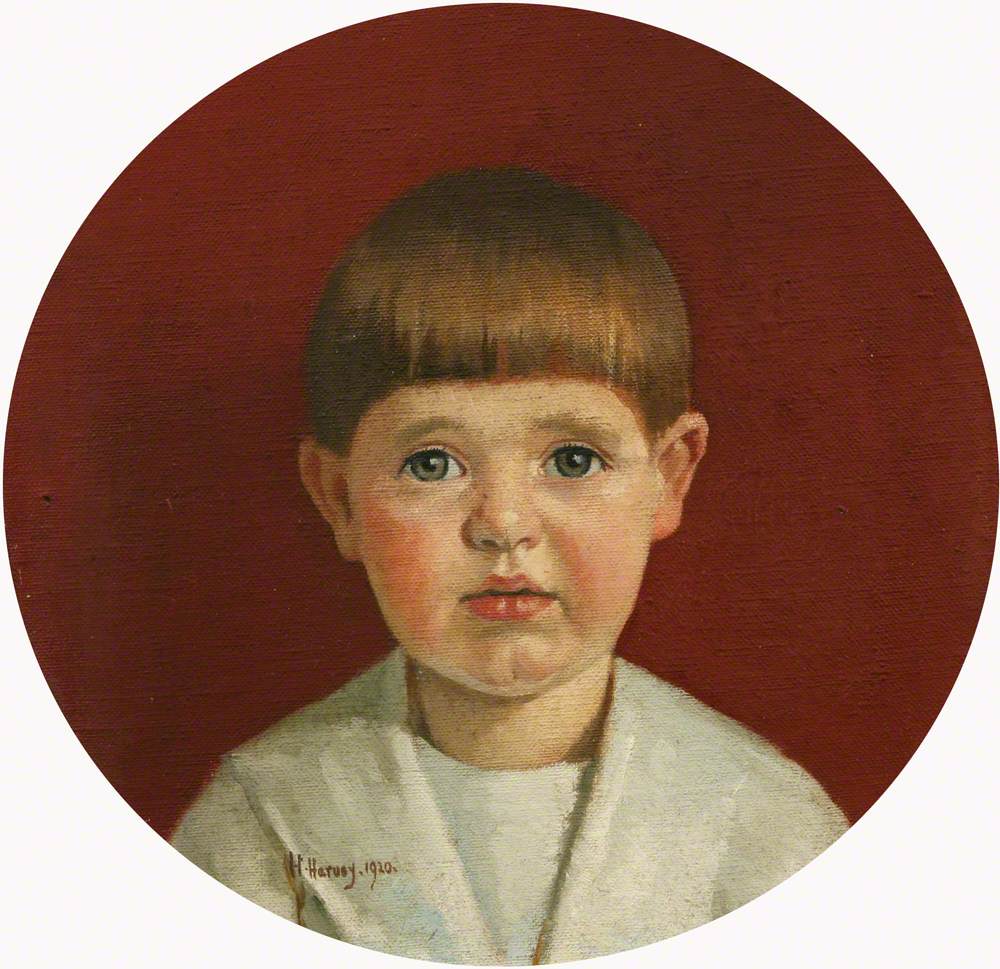
Harvey, Harold C., 1874-1941; James Jewill Hill Junior

Portrait of James Jewill Hill by Harold Harvey (1920

Harold Harvey completed a number of portrait commissions, such as his 1920 portrait of the youngest son of James Jewill Hill, a partner in the solicitors firm Jewill Hill & Bennett, Penzance.

Harvey, Harold C., 1874-1941; John Humphreys (1850-1937), Professor of Dentistry
Portrait of John Humphreys, Professor of Dentistry; University of Birmingham; by Harold Harvey (1938)


Another portrait he completed was a 1938 commission to paint a portrait of John Humphreys, Professor of Dentistry.

In 1920, Harold Harvey and fellow Newlyn School artist, Ernest Procter, founded the School of Painting, in Newlyn, called the Harvey-Procter School, which ran throughout most of the 1920s. 

Harold Harvey died in Newlyn on 19 May 1941 and was buried in Penzance at the St Clare Cemetery. His wife, Gertrude, lived in their cottage until 1960 when she moved into the Benoni Nursing Home in St Just. She died six years late, aged 86.


Ásgrímur Jónsson, the Icelandic Impressionist.

This is just a short mini-blog to look at a twentieth century Impressionist from Iceland, Ásgrímur Jónsson

                                                               Ásgrímur Jónsson

Ásgrímur Jónsson wasat the forefront of Icelandic art.  He was a pioneer of Icelandic visual art and the first Icelander to become a professional painter. Ásgrímur was born on March 4th, 1876, in Suðurkot, a small town thirty kilometres south west of Reykjavik.

                                       Autumn Sunlight, Öskjuhlíð by Ásgrímur Jónsson (1920)

In 1897 he left home and went to Copenhagen.  In 1900, aged twenty-four,  he enrolled on a three-year art course at the Royal Academy of Fine Arts.  Once qualified, he toured a number of European countries before settling back down in Iceland in 1910.  On his journey home he visited Germany and the cities of Berlin and Weimar and it was during this period that he became influenced by the French Impressionists and the Post Impressionists, especially the landscape works of  the French painter Jean-Baptiste-Camille Corot.

                                          Hafnarfjörður Town by Ásgrímur Jónsson (1930)

Ásgrímur’s main painting genre was landscape art and especially that of his native Iceland and through his art many native artists would follow his lead.  His depictions of nature were fashioned by the romance of the nineteenth century.  He liked to focus his depictions on the changes of light and how it altered the view of the land.  He alternated between watercolours and oils but is best known for the former medium.

                           Mt. Strútur and Eiríksjökull Glacier, West Iceland by Ásgrímur Jónsson (1948)

He was a great believer in Naturalism in art – the broad movement in the nineteenth century which represented things closer to the way we see them.  However later his works were characterised by colourful expressionism.

                                           From a Folklore by Ásgrímur Jónsson (1957)

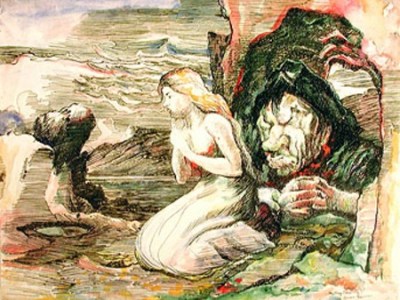
Ásgrímur also worked as a pioneer in the illustration of Icelandic legends and adventures.  He pictorially depicted Icelandic Folk Legends delving into the world of elves and trolls who lived in the semi-darkness of the old turf farmhouse and who would kidnap humans.  Tales of pastors haunting their wives-to-be, of witches flying to Satanic gatherings, of sheep-rustling and flying bulls.  A land where humans live inside hills, where witches flying on jawbones instead of broomsticks, and tales which rarely have happy endings.

                                                                  Troll painting by Ásgrímur Jónsson

Ásgrímur’s works on folklore themes were well received.  The art critics delighted in his depictions and that Iceland’s folktale heritage was being addressed, for the first time, by an Icelandic artist. Ásgrímur’s depictions of the appearance of elves and trolls also met with widespread approval from the public who believed he had succeeded in capturing the way that they imagined their folklore characters to be.  For Ásgrímur Jónsson it was all about the viewer’s own imagination when they looked at these folklore works and it was a reminder of the beauty of their land when they looked at his landscape paintings.  Today the folklore paintings form part of the unique cultural heritage conserved in the collections of the National Gallery of Iceland.

                        ÁSGRÍMUR JÓNSSON MUSEUM at BERGSTAÐASTRÆTI 74, 101 REYKJAVÍK

Ásgrímur Jónsson died on April 5th, 1958, aged 82.  The Ásgrímur Jónsson’s collection, which is today a department within the National Gallery of Iceland, originated in 1960 when a small gallery was opened in Ásgrímur’s studio and home, which he bequeathed to the Icelandic nation along with all of his works in his own possession upon his death. 

John Koch. Part 3.

                                                                        Interlude by John Koch (1963)

Dora featured in many of her husband’s paintings.  One such is his 1963 work entitled Interlude.  In a way it is a narrative painting recounted a day of painting for the artist.  Here we glimpse artist John Koch in his apartment studio with an African American model, said to be one of is favourites.  She dominates the foreground of the painting.  The contrast between the colour of her dark ebony skin, the white bed sheets, and the vibrant red robe of the third person in the painting make for a great contrast.  The shape of her graceful back echoes the lines of the nearby Queen Anne style chair.  The African American model, Rosetta Howard, dominates the foreground as Koch depicts her dark velvety back against the white bed sheet and the vibrant red robe of the third person in the painting, John Koch’s wife, Dora, who offers the model a cup of tea. The three figures neither engage with the viewer, nor do they engage in eye contact with each other.  The artist fixates on his partially completed canvas.  The artist’s wife in the red gown avoids looking at the naked body of the model, who in turn concentrates her gaze on the cup and saucer.  So, like other paintings by Koch, the figures and furniture have been set by the artist.  What are we to make of the depiction?  Is it just a simple portrayal of an artist and the model taking a break from their work or is it something more?  Could it be John Koch wanting to highlight a contentious role reversal – a white woman in 1963 serving a black woman !

                                                        The Breakfast Tray by John Kotch (1970)

Dora Koch appeared in the same red dress in her husband’s 1970 painting entitled The Breakfast Tray.  For John and Dora, breakfast on a tray was a daily ritual.  In this work we see the tray laden with their finest china.  The setting for the painting is the hallway of their Setauket, Long Island house.  John holds the tray in front of himself and it appears to be an offering to his elegantly robed wife who is mounting the stairs.

Photography by Dwight Primiano
                                                              Studio – End of the Day by John Koch

Rosetta Howard appeared in a number of John Koch’s paintings including His work, Studio – End of the Day in which artist and model finally take a rest from painting and posing.

Artwork Title: The Lesson - Artist Name: John Koch
                                                                            The Lesson by John Koch (1970)

Another painting to feature his wife was John Koch’s 1970 work entitled The Lesson in which we see Dora giving one of her piano lessons.

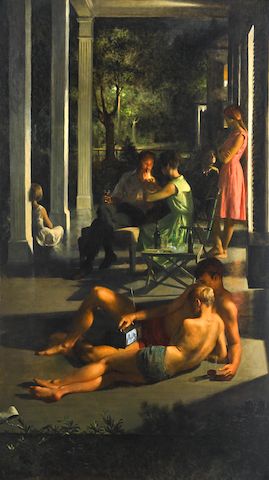
John Koch (1909-1978) Summer Night 78 x 44in (198.1 x 111.8cm) (Painted in 1965.)
                                                      Summer Night by John Koch (1965)

John Koch was known for his sophisticated and stylish depictions of trendy life in and around New York City. His 1965 painting, Summer Night, is a perfect example of the genre.  It was painted on a monumental scale (198 x 112 cms) and highlights Koch’s dextrous skill for assembling figures so as to highlight the interactions and intrigue between his subjects. The scene in this painting is set in the evening on a front porch of a wealthy home with people relaxing after drinks and a meal.  The scene exudes a laid-back and tranquil elegance of a family gathering on a warm evening.  Note how Koch has carefully arranged the props which translate into fastidiously arranged still life elements of the work.  The painting was first exhibited at the Kraushaar Galleries. His time working with the gallery brought him great commercial success for the remainder of his career.  The painting was last sold in 2020 at Bonhams, New York Auction for US$ 162,575

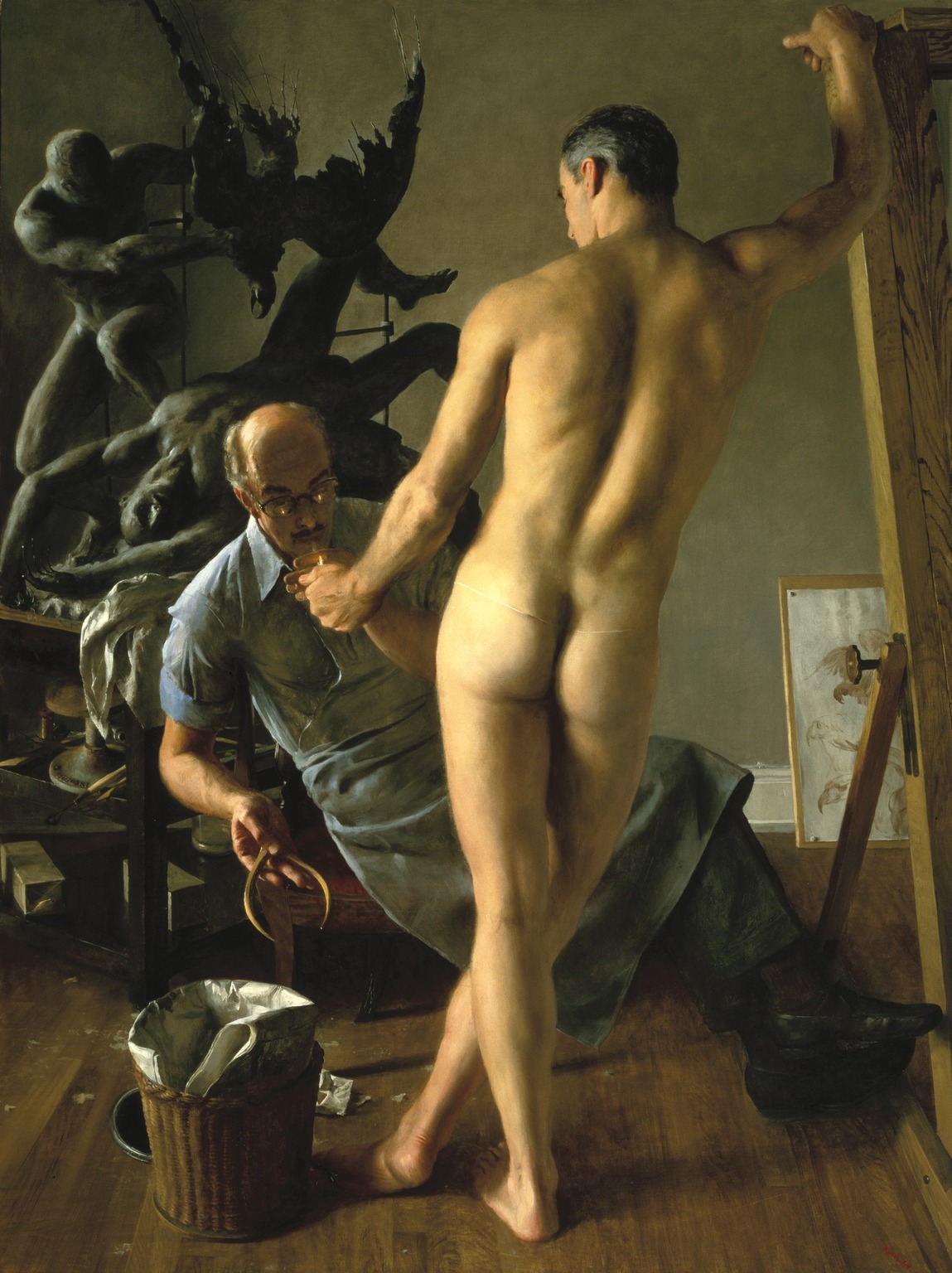
                                                                   The Sculptor by John Koch (1964)

There were a number of paintings by Koch that depicted both artist and sitter and one of my favourites is his painting entitled The Sculptor.  It is a quasi-self portrait with John Koch as the sculptor, surrounded by the tools of his craft, including a caliper, which he is holding – in fact, one should remember that John Koch was not only a painter but a sculptor.  The model in this work was Ernest Ulmer, one of Dora’s former student who was also the subject of Interior of Studio. Ulmer is painted in full view from the back, his muscular body extended in a classic pose.  The sculpture painted in the background was one that he had made. It is a scene from Greek mythology, with Hercules and Prometheus, a mythological individual who stole fire from the gods to bring it to humans. Koch has added a touch of humour to the depiction with the visual pun between that tale from Greek mythology and the depiction in the painting of the model handing a light to the sculptor for his cigarette.  In the painting we see Koch leaning forward with the cigarette in his mouth, and the flame from the lighter held by the model is cleverly reflected in his glasses, as if extending the spark to the man himself.

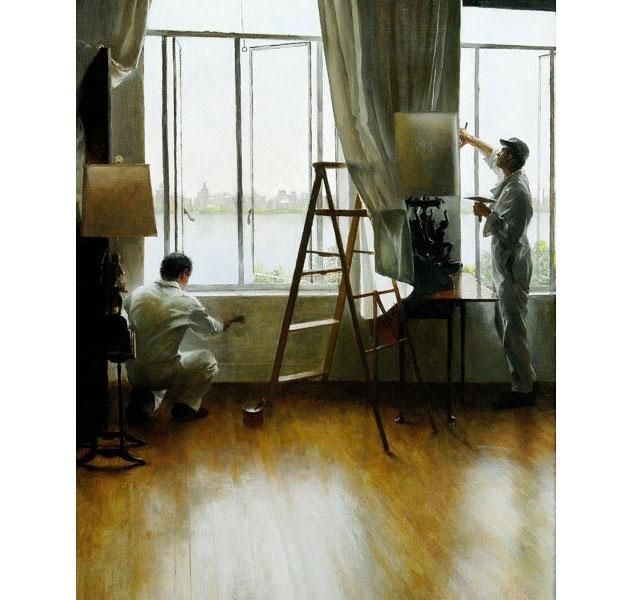
The Plasterers1957x633
                                                                       The Plasterers by John Koch (1957)

In 1967 John Koch completed one of his most important paintings.  It was entitled The Plasterers.   The two men have come to Koch’s apartment to make good repairs to the walls.  In the background there is a bank of windows, some of which are open.   Look through the windows and you can see that Koch has managed to depict a panoramic skyline, probably a view of the Hudson River from his apartment window at the El Dorado building at 300 Central Park West of the Hudson River.  In the left foreground there is once again depicted Koch’s sculpture, Prometheus, which we saw in his painting, The Sculptor.   Through the windows streams the daylight which dances on the highly polished floor and furniture. 

See the source image
                                             Gustave Caillebotte’s 1875 painting The Floor Scrapers

For some reason, it is this shiny wooden floor which always reminds me of Gustave Caillebotte’s 1875 painting The Floor Scrapers which depicts three workers scraping a wooden floor in a bourgeois apartment.   On May 9, 2009 at the Brunk Auctions in Asheville, North Carolina, the painting, along with six preparatory sketches for the painting, sold for $210,000.  The painting was shown at two major Koch exhibitions. The first in 1973 at the New York Cultural Centre. The second was in 2001-2002 at the New York Historical Society.   The New York Historical Society’s 2001 exhibition catalogue described the painting as:

“…a tour de force of (the artist’s) ability to bring the outside into an interior through reflection of light playing off surfaces…”

See the source image
                                                  The Window Washers by John Koch (1975)

Another painting featuring two workers in the setting of John and Dora’s apartment is the 1975 work entitled The Window Washers.
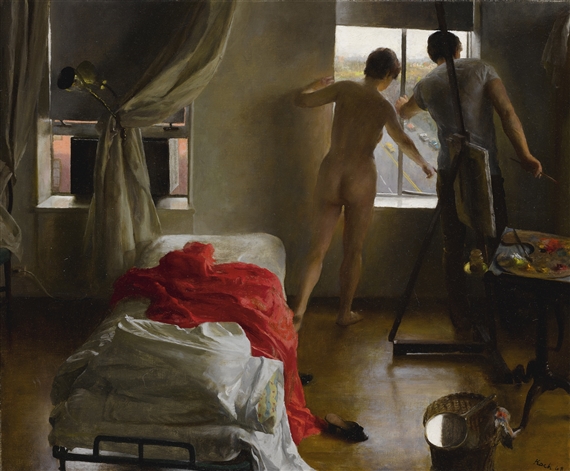
Artwork by John Koch, THE ACCIDENT NO. 2, Made of oil on canvas
                                                     The Accident No.2 by John Koch (1968)

Another unusual work by Koch was his 1968 painting entitled The Accident. No.2.  It is a narrative work.  In the depiction we are looking into the small artist’s studio, which could also act as the artist’s bedroom.  The props set up by John Koch are a small single-bed with ruffled sheets, a discarded red silk robe, a pair of bedroom slippers which have been casually abandoned, a hand-mirror propped on the rim of a waste.  The window is partially covered by a curtain pulled back and of course the artist’s workstation with his easel, canvas, and palette. The artist and his naked model have rushed to the window to view what is happening outside.  By the title of the painting the artist is telling us that they are looking out at an accident which has happened in the street below.  The model is pointing down to something in the road below which he is straining to see.  It is an unusual scenario as most depictions of artist and model focus on the single-minded concentration of the artist as he studies his absolutely motionless model.  Here the commotion outside has broken the spell of their sensual assignation.

                                                                                Night by John Koch (1964)

In his 1964 painting, Night, John Koch has presented us with the contrast of warmth and coolness.  The coolness of the bodies now divested of clothes and yet the oppressive heat and humidity of a New York summer night when one tries desperately to be able to sleep.  John liked the setting of his painting describing it:

“…a picture of a young couple before they go to bed at night, which I think is as splendid an idea for a picture as any could be…”

The woman has fallen asleep whilst the man bides his time by reading a newspaper.  Besides him the light from a lamp on the bedside table glows through his newspaper.  The bottom of the bed and the white sheets have been illuminated by the soft blue glow of a television which is on a stand at the end of their bed.

Artwork Title: The Bath - Artist Name: John Koch
                                                                            The Bath by John Koch (1973)

John Koch whose oeuvre contained a large number of nude depictions of couples or a single male or a single female.  He was adamant that the depictions were not envisioned to be erotic, even when they depicted couples in bed. If you look over the depictions featuring a male and a female in bed they are not in the middle of lovemaking but simply relaxing, even though it may be in a post-coital state.  The pair who could be lovers or married couples show neither indication of sexual stimulation, lustful craving nor agitated signs of conflict.  There is a kind of neutrality with regards the couple’s personal thoughts.  Koch’s agenda seemed to be one that was to offer viewers a normal heterosexual relationship – one of idyllic well-being, a sense of happiness unsullied by lust or anguish. In his 1973 painting, The Bath, we see a man drying himself on the edge of a tub. He takes time to glance back at the woman who remains in the water. In contrast to his rough and hirsute muscular and bronzed body hers is smooth, pale, and supple.

                                                    Back Scratcher by John Koch 

John Koch became an elected member of the American Academy and the National Institute of Arts and Letters in 1970. Five years later, he suffered a stroke and abandoned painting for the first time since his youth. John Koch died on April 18th 1978 from complications of another stroke.  He was 78.  His wife Dora died on September 9th 1987 aged 83.  John Koch’s art was dismissed by the more progressive art scene as just a society painter and was little known outside his circle of wealthy, connected patrons. However, he managed to capture scenes of a New York society that is mostly gone now and therefore many of his paintings were a historical record of a world which was more formal and refined.  His often stage-managed art is classed as being of a realism genre and yet the depictions of opulence were tinged by an element of fantasy.  Maybe it is a fantasy we all hold dear.

John Koch. Part 2.

                                                             The Monument by John Koch (1950)

John Koch’s reputation was further enhanced in 1950, when his painting The Monument was exhibited at The Metropolitan Museum of Art’s national competitive exhibition American Painting Today.

                                                       The iconic El Dorado Apartments, Manhattan

In 1953 John and Dora spent five months in Paris and on their return to New York they moved into a fourteen-room apartment on the tenth floor at the El Dorado at 300 Central Park West, one of the twin-towered pre-war apartment buildings that presents such an iconic and distinctive vista on the Central Park West skyline. It was whilst living here that John and Dora became one of the uptown bohemian set which also included an ever-expanding number of Upper West Side artists, writers, and musicians.  A short time later, the couple purchased the adjacent apartment on their floor to be used as Dora’s music studio, where she continued her practice as a private tutor.

                                              Forbes family portrait by John Koch (1956)

Portraiture had always been a financially rewarding genre for artists and so it was for John Koch.  His forte was group portraits and in 1956 he completed a group portrait for Malcolm Forbes, an American entrepreneur most prominently known as the publisher of Forbes magazine.  It is a very informal depiction of the family.  Malcolm Forbes relaxes at home shortly after the birth of a new daughter, Moira.  We see Malcolm and his wife, who cradles the baby, along with their four sons, Steve (Malcolm Jnr)., Robert, Christopher, and Timothy. It is interesting to note Koch’s methodology in how he paints group portraits.  He would make studies of each individual, then to join these studies as a group against the backdrop of a chosen interior. He stated:

“…In all the pictures, the models never pose together.  What is more important than whether there is or is not someone posing for you is the relationship between them…”

John Koch carefully arranged where each person would stand or sit in the portraits just as he would when arranging the objects in the still life and interiors he painted. He was ultra-meticulous when considering where people and objects were placed.  It was if he was an interior designer.  This painstaking thoroughness was also a reflection of his own lifestyle in the way he dressed, the way he carefully chose his circle of cultured friends and acquaintances, and what fine art and antiques he would bring into his tastefully appointed apartment which he shared with his wife, Dora.  Leslie Cheek Jnr., Director of the Virginia Museum of Fine Arts, between 1948 and 1968, wrote about John Koch’s interior depictions:

“…His pictures of his particular slice of our world today are vigorous and appealing. One enjoys with him his love of fine furniture, elegant mirrors, rich fabrics, and fresh flowers-all glowing with the individual reflections which light, his particular forte, gives to each…”

Artwork Title: The Cocktail Party - Artist Name: John Koch
                                                            The Cocktail Party by John Koch (1956)

For some, Koch’s depiction of afternoon soirées are too good to be true, but does it matter?  Maybe Koch had decided to pictorially represent how life should be rather than how it was.   Probably his best-known painting is his 1956 work entitled The Cocktail Party.  It never happened but it was a depiction of what Koch imagined what a great soirée would have been and the guests he would have invited.  Koch described his social circle as:

“…people of our own making, our own way of looking at things…”

The attendees at this party were all acquaintances of the John and Dora Koch in the mid-1950s and as I explained before, Koch’s modus operandi was to paint each individual separately and then fit them into the painting which was set in his living room at the El Dorado where John and Dora were the consummate hosts.

Artwork Title: The Cocktail Party - Artist Name: John Koch

The characters in the work are Leo Lerman (author and editor), in the foreground in profile (with dark beard) conversing with pianist Ania Dorfmann. The other guests, left to right, are artist Roger Baker, artist and critic Maurice Grosser, the Dr. Leonard Smileys, the painter John Koch, standing at the bar, busy mixing drinks, Mrs. Edgar Feder, an unidentified woman, composer Virgil Thomson (composer), music critic Noel Straus, Dora Koch seen standing and bending forward to attend to the seated music critic Noel Strauss. , an unknown seated woman, artist Felicia Meyer Marsh, artist Aaron Shikler, art dealer Roy Davis, butler Leroy Lowry, artist Raphael Soyer, and biographer Frances Winwar.  The painting was John’s idea of the perfect guest list for his perfect party.  He liked the painting so much that it remained in his possession for the rest of his life.

                                                                 Three Musicians by John Koch (1958)

It is fascinating to view some of Koch’s paintings which feature interiors once you realise he has stage managed the depiction.  It is as if in Koch’s life as in his art, his and Dora’s apartment simply acted as the stage for a play-in-progress.  The props in the form of furniture and wall hangings were, like the figures, merely theatrical props, and John, with the help of Dora, was the director and often the lead actor.  In his 1958 painting entitled Three Musicians there are three “actors”. There is the artist’s wife, Dora, as well as Leo Lerman, an American writer and editor who worked for Condé Nast Publications for more than 50 years, who is shown seated closest to the cello. The model for the third figure in the white shirt is probably Paul Rotella, who, like Dora Koch, was a pianist and music teacher.

                                                 Family Group by John Koch

I also like his “stage-managed” family portrait simply entitled Family Group.  Such a happy family gathering of husband, wife and two sons.  So contented in a sumptuously furnished room.  Everything is placed just so to give the observer a view of a perfect lifestyle.  For John and Dora Koch, paintings like this were just a chance to construct a perfect lifestyle, a world of their own conception.

                                                                              At Home by John Koch (1953)

John and Dora’s lifestyle was one of afternoon cocktails, musical recitals in their large living room and eagerly expected painting unveilings but they still had to be financially sound and this was achieved by Dora’s musical tutorials and John’s commissioned portraits.  Let us not think for one moment that the Koch’s elegant lifestyle was achieved without hard work by the couple.  It was their dedication to the arts, painting for John, music for Dora that gave them the greatest pleasure.  We should also remember that the couple came from completely different upbringings.  John was the son of liberal Midwesterners.  His mother was of Irish descent who had a non-religious epiphany and left the church after her son’s baptism while his father, albeit a charismatic man was a business failure and later a political failure when he failed in all his attempts to become governor of Michigan on the Socialist ticket. On the other hand, Dora Zaslavsky was a Jewish immigrant, born in the Ukraine, whose father’s early occupation was that of a poverty-stricken peddler.

                                                                       My Studio by John Koch (1952)

The closeness of the couple and the way they worked hand in hand can be seen in John Koch’s 1952 painting My Studio.   A nude model looks out at us as she reclines on a chaise longue.  John is perched upon a stool in front of his easel.  A trolly holds his palette whilst on the shelves underneath it is all the oils and paraphernalia needed by the artist.  Dora, holding a book of sheet music, stares out at the river scene.  All is serene.  It is a truly untroubled and harmonious life. 

John Koch (1909-1978) Siesta 30 1/8 x 25 1/4in (76.5 x 64.1cm) (Painted in 1962.)
                                                                  Siesta by John Koch (1962)

John Koch’s art was not just depictions of wealthy people living in opulent settings.  Many of his works featured nudes, sometimes nude women, sometimes nude men and sometimes both.  These like his group portraits were beautifully finished works of art.  In 1962 he completed a work entitled Siesta which focused on human sexuality and the intricacies and complications of the male-female relationship.  We see two figures, one, a nude female with her back to us, sitting in a chair at a desk brushing her hair.  She is glancing in the mirror at her lover who lies asleep on the bed.  We can just make out her flushed face, flushed from her early lovemaking.  The other figure, her lover, is partly wrapped in a blue sheet, which is raked by the afternoon sunlight which has penetrated the bedroom.  The large bed is centre stage of the painting.   The depiction exudes an air of intimacy.  It is not a condemnation of sexual activity but an at-ease acknowledgement of a tender relationship and the pleasurable sensuality of sex.   Koch has composed his two figures in an idyllic state, contentedly relaxing in warm light that spills through the windows. 

Time Magazine, January 24, 1964, vol. 83, no. 4, front cover illustration featuring Siesta painting by John Koch

The work of art, through its domestic bedroom scene depicts the complexities of the male-female relationship. John Koch’s painting was chosen for the cover of Time Magazine in 1964 for a special issue entitled SEX in the U.S.: Mores & Morality, accompanied by an article Morals: The Second Sexual Revolution which ended with the following paragraph:

“…The difference between the ’20s and ’60s comes down, in part, to a difference between people. The rebels of the ’20s had Victorian parents who laid down a Victorian law; it was something concrete and fairly well-defined to rise up against. The rebels of the ’60s have parents with only the tattered remnants of a code, expressed for many of them in Ernest Hemingway’s one-sentence manifesto: “What is moral?…”

The painting went to auction at Bonhams American Art Sale on July 29th, 1962 and although had an estimate of between $40,000 and $60,000 it eventually sold for $596,075 !   Jennifer Jacobsen, Bonhams’ Director of American Art, commented:

 “…We are thrilled with the success of our most recent sale of American Art. We saw competitive bidding across all of the genres offered in the category, demonstrating collectors’ demand for quality works and the strength of the current market. We are honoured to have achieved such a strong price for John Koch’s elegant, beautifully painted work Siesta, which is now his second highest price at auction and a near miss of his world auction record…”

……………………………..to be concluded.

Frants Henningsen

Today I am looking at the life and works of the Danish painter and illustrator, Frants Peter Diderik Henningsen.  Henningsen was born in Copenhagen on June 26th 1850. He was the oldest of three children of Frants Christian Henningsen, a wholesaler and his wife Hilda Christine Charlotte Schou.  Frants had a younger sister Euphemia and a younger brother Erik. Henningsen attended the Borgerdyd School in the Christianshavn district of Copenhagen and after graduating from there he enrolled at the Christian Vilhelm Nielsen drawing school in preparation for admission to the Royal Danish Academy of Fine Arts School of Architecture which he attended from October 1870 on a five-year course.  After completion of the Academy course, he, like many other aspiring painters, decided to further his art education in Paris.  In 1877 he enrolled at the atelier of Léon Bonnat, which was attended by other Danish students.

En rygvendt bondekone, der arbejder i solen
Farm woman working in the sun by Frants Henningsen

Frants Henningsen, although in France and in the midst of plein air painting and Impressionism, was more of an Academic painter who created his artwork in a studio.  He was very much influenced by the Realism genre of painting and the socially oriented naturalism of Jules Bastien-Lepage, Jean-François Millet and Jules Breton.  Henningsen’s paintings often added the human dimension to the depictions of deprivation, human suffering and poverty.

A Funeral by Frants Henningsen (1893)

One of his most famous painting is his 1893 work entitled A Funeral.  It is a poignant depiction of a funeral and one which Henningsen has cleverly manipulated to add to the sense of sadness.  The setting is the Assistens graveyard in the Nørrebro area of Copenhagen, which was originally a burial site for the poor and was laid out to relieve the crowded graveyards inside the walled city, but which at the start of the nineteenth century had become fashionable and many leading luminaries of the Danish Golden Age, such as Hans Christian Andersen, Søren Kierkegaard, Christoffer Wilhelm Eckersberg, and Christen Købke were laid to rest here.   Henningsten, using dark tones, has depicted the setting as a very gloomy winter’s day.   The wall of the cemetery is grey and devoid of any colour.  There seems to be only a few people who will be taking part in the funeral service.  The main character is the widow, a pregnant woman who takes the arm of an elderly gentleman, whom we presume is her father.  She looks down as she is about to enter the cemetery.  Her face is drawn and she has a greyish-white facial complexion.  In front of her are her two children.  In the background we see two men, standing apart from the mourners, gazing at the family.  Like them, we are merely spectators witnessing the harrowing event.  Henningsen received a great deal of praise for the painting, which was immediately bought by the National Gallery of Denmark.

See the source image
En lille pige sælger violer (A little girl sells violets) by Frants Henningsen (1891)

In the Spring of 1878 Henningsen along with fellow Danish painters, Peder Severin Krøyer, Frans Schwartz and the German artist, Julius Lange travelled to Spain,where they studied the works of the great Spanish painters such as Velazquez and Francisco de Zurbarán.

Walking Trip, Jutland by Frants Henningsen (1877)

In November 1880, in Copenhagen, thirty-year-old Frants Henningsen married twenty-one-year-old, Thora Vermehren.  She was the daughter of Frederik Vermehren, the genre and portrait painter in the realist style. The couple went on to have five children, four sons and a daughter.

r/museum - Frants Henningsen - A Hero from 1864 (1901)
A Hero from 1864 by Frants Henningsen (1901)

The Second Schleswig War was the second military conflict of the nineteenth century over the Schleswig-Holstein Question . The war began on February 1st 1864, when Prussian and Austrian forces crossed the border into Schleswig. The army of Denmark fought the Kingdom of Prussia and the Austrian Empire and Henningsen depicts a conflict between the two sides in his great 1901 work entitled A Hero from 1864.  The setting is a country road in Schleswig. In it we see a lone Danish Hussar facing a large group of the enemy invaders.  His heroics are captured in the painting but we know his fate is sealed.

En falden tysk husar
A Fallen German Hussar by Frants Henningsen (1901)

Another casualty of the war was depicted in Henningsen’s 1901 painting A Fallen German Hussar. Once again we see the result of battle.

Summer day on the beach at Hornbæk with children playing
Summer day on the beach at Hornbæk with children playing by Frants Henningsen

In the late 18th century, it was common practice for artists from Copenhagen to spend their summers in the countryside and seaside north of the city and a number of artists began lodging in Hornbæk, either in the local inns or privately. Hornbæk is a seaside resort town on the north coast of the Danish island of Sjælland, facing the Øresund which separates Denmark from Sweden.

From the beach at Hornbæk by Frants Henningsen (1883).

In 1873, twenty-two-year-old  P.S. Krøyer, the celebrated Danish painter, arrived in Hornbæk along with three artist friends Frants Henningsen, Viggo Johansen and Kristian Zahrtmann. Later many other painters would follow in their footsteps.  The four young artists settled along the northern coastline of Zealand, fascinated by the sea, the broad beaches, and the blue hills of Kullen on the Swedish mainland on the horizon. 

Fisherman with Red Kerchief
Fisherman with Kercheif by Frants Henningsen (1880)

They were also fascinated by the weather-beaten faces of the local fishermen and listened intently to their tales of peril on the sea.  P.S. Krøyer, reported on his first time in Hornbæk with his friends:

“…I had a splendid summer this year – well, not as far as the weather was concerned, for it was stormy and restless – but rather because I was, for the first time ever, able to spend an entire summer in the countryside out in the open air, far removed from the troubles and drudgeries of the city, and with three other painters whom I count among my very best acquaintances; all this has been to me a tremendous pleasure. We enjoyed some lovely trips (being based in Hornbæk on the north coast of Zealand); we went on a sailing trip to Kullen, on excursions to Gurre, Nakkehoved, to Tisvilde on Midsummer Night and to various places besides. The way of life there was utterly attractive: to venture out into the fresh, clear water en compagnie in the mornings (I learnt to swim there); and the pleasant evenings spent either walking in the woods or the beaches or in conversation back home in our pleasant digs, speaking and smoking our pipes; a splendid, idyllic life…”

Forladt. Dog ej af venner i nøden
Abandoned by Frants Henningsen (1888)

One of my favourite paintings by Henningsen is his 1888 Realist work with the strange title, Forladt. Dog ej af venner i nøden, which translates to Abandoned. However, Not By Friends in Need.   Many of his paintings depict unfortunate occurrences in the lives of middle-class people living in Copenhagen during difficult times. In this work, it is all about the fate of the single mother. It is interesting to note that Frants Henningsen painted this picture in the same year as the law that allowed single mothers to receive money from absent fathers in the form of child support until the child reached the age of ten.  It was not until a law was passed on May 27th 1908, that child support was to be provided until the child reached the age of eighteen.  However, even around the turn of the nineteenth century, the single unmarried mother had very little chance of being able to keep her child with her and many of these children therefore went to orphanages.

Hos pantelåneren
Hos pantelåneren (At the Pawnbroker) by Frants Henningsen (1893)

One of his best loved genre pieces is his painting entitled Hos pantelåneren (At the Pawnbroker) in which he depicts a group of visitors to the emporium, both young and old, examining the goods on offer, all eager to find a bargain.

Industricafeen
A Café in Copenhagen by Frants Henningsen (1906)

It was not just the working classes that featured in Henningsen’s paintings. The upper class lifestyle was on view in his depiction of Copenhagen café life in his 1906 painting Industricafeen (A Café in Copenhagen).

Frants Henningsen died in Copenhagen on  March 20th 1908, aged 57.

Lilla Cabot Perry. Part 2.

                                                 Portrait of Alice Frye Leach by Lilla Cabot Perry (c.1880)

It was in 1889 that Lilla Cabot Perry first encountered Claude Monet’s work at the prestigious Galerie Georges Petit in Paris which staged a Monet/Rodin collaboration exhibition (Claude Monet-Auguste Rodin, centenaire de l’exposition de 1889), that opened on June 21st.  It was also in that summer of 1889 that Lilla and her husband first met the great French painter.  According to an article written by Lilla, which appeared in the March 1927 edition of the American Magazine of Art, a young American sculptor who was living in Paris mentioned to her and her husband that he had a letter of introduction to meet Monet but he was very nervous and shy with going on his own to the great man’s house so asked the couple if they would accompany him on his visit.  Lilla and Thomas Perry were delighted to accept the invitation as they had greatly appreciated what they had seen at the Claude Monet-Auguste Rodin exhibition.

In the article Lilla recounts her first impressions of Monet.  She wrote:

“… The man himself with his rugged honesty, his disarming frankness, his warm and sensitive nature, was fully as impressive as his pictures and from this first visit dates a friendship which led us to spend ten summers at Giverny.  For some seasons, indeed, we had the house and garden next to his and he would sometimes stroll in and smoke his afternoon-luncheon cigarette in our garden before beginning on his afternoon work…”

The Impressionism style that Lilla encountered with the art of Monet was an epiphany moment for her. She immediately took to this style even though it was still rejected and scorned by the art world around her.  The way the Impressionists managed the colour and light was a great inspiration to her and during those summer days at Giverny she also worked with many American artists, who had found their way to the small French town to sample the joys of plein air painting in the rural surroundings, such as Theodore Robinson, John Breck, and Theodore Earl Butler.

                                               La Petite Angèle, II, by Lilla Cabot Perry (1889)

One of her painting during her time in Giverny was her 1889 work entitled La petite Angèle II.  It is impressionistic in style with its free form brushstrokes that capture the impression of light and colour.   Claude Monet, inspired Perry to work en plein air, and use impressionistic brushstrokes, soft colours, and poppy red. If you look through the window depicted in this work you should note the early stages of what would become Lilla’s love affair with the way the Impressionists treated landscape depictions.

Angela by Lilla Cabot Perry, 1891, High Museum of Art.jpg
                                                                  Angela by Lilla Cabot Perry, (1891)

A similar work by Lilla was entitled Angela.  It was a portrait of one of her favourite models in Giverny. The clearly defined figure posed in a freely brushed and light-filled setting typifies academic American Impressionism of the time.

A Little Girl in a Lane in Giverny - Lilla Cabot Perry Painting
                                            A Little Girl in a Lane in Giverny by Lilla Cabot Perry

In late 1889 Lilla Cabot Perry and her husband left Giverny and embarked on a tour of Belgium and the Netherlands.  In 1891 she returned to Boston with her family bringing home a painting by Monet and a number of landscapes works by John Breck.  Once back in Boston she began to spread the word of Impressionism especially the works of Monet.  However, like many art critics in France, Impressionism was not favoured by either the American critics or the buying public and Lilla had to begin with a hard-sell of his works.  She would exhibit his works at her home and give talks about him and the world of Impressionism to the Boston Art Students’ Association. 

                      Portrait of Baroness R by Lilla Cabot Perry, (1895)

Whether Bostonians accepted the merit of Monet’s work or not, the one thing for sure was that they appreciated the paintings of Lilla Cabot Perry, especially her portraiture.  Several of her paintings were exhibited at the 1893 World’s Columbian Exhibition in Chicago and were greeted with great acclaim.   In 1897 she exhibited work at the St Botolphs Club in Boston and the art critic of the Boston Evening Transcript wrote:

“…Mrs Perry is one of the most genuine, no-nonsense, natural painters that we known of………………Such work must be taken seriously…”

The Letter, 1893 - Lilla Cabot Perry
                                           The Letter (Alice Perry) by Lilla Cabot Perry (1893)

Lilla Perry’s artistic success in 1889 had made it possible for her to be one of the select few young artists to be admitted to Alfred Stevens’ class in Paris.  The works of Lilla Perry were often influenced by the time she spent with Stevens. A good example of this is her 1893 painting entitled The Letter [Alice Perry] and the way she has depicted the chair, especially the careful attention she has paid to  the colouration of the wood, and the way she has depicted her youngest daughter’s clothes in such detail.  It is a loving portrait of a nine-year-old daughter by her mother.

Black-and-white interior photograph of a light-skinned adult woman in profile with dark hair in a bun and a light-color dress. She stands in front of an easel and holds a palatte and brushes in her left hand. She rests her right hand on a painting of a light-skinned young girl.
                                                                       Lilla Cabot Perry at work (c.1890)
Lilla Cabot Perry, 1896 - Haystacks, Giverny.jpg
Haystacks, Giverny by Lilla Cabot Perry (1896)

In 1894, sheonce again exhibited her impressionism paintings at the St. Botolph Club in Boston together with other Impressionism artists, including Edmund Tarbell, Phillip Hale, Theodore Wendel, and the British-born painter Dawson-Watson. Three years later, and in the same gallery, Lilla held a solo exhibition.  On show were her Impressionist-style portraits and landscapes. 

Giverny Landscape, in Monet’s Garden by Lilla Cabot Perry (1897)

This proved to be a major turning point for Lilla Perry as it showed that her work was gaining the recognition of the American art world and that Impressionism was finally being acknowledged as a legitimate artistic expression. Lilla Perry was a devoted Impressionist painter and she loved the work of the Impressionists, especially the works of her friend Claude Monet.  Now back in America she took every opportunity to endorse French Impressionism and urged her friends to invest in their work.  She also gave many lectures and wrote essays for journals and magazines supporting this French art movement.

In a Japanese Garden by Lilla Cabot Perry (1901)

Between 1868 and 1872, Lilla’s husband, Thomas Perry, was a tutor in German at Harvard and from 1877 to 1881, he was an English instructor in English as well as being a lecturer in English literature from 1881 to 1882. Thomas Perry was offered a new challenge in 1897 when he was presented with the opportunity to take up a teaching position in Japan as an English professor at the Keio Gijuku University in Tokyo.  Lilla and her husband along with their three children left America and travelled to Japan.  Not only was this and exciting time for her husband it was also a stimulating time for Lilla and offered her new opportunities to paint.

In 1898, he became professor of English literature in the Keio University, in Tokyo, Japan.  The Perry family lived in Japan for three years and Lilla immersed herself in its artistic community.  Lilla Perry met Okakura Kakuzō, one of the Imperial Art School co-founders and became an honorary member of the Nippon Bijutsu-In Art Association, an artistic organization in Japan dedicated to a Japanese style painting known as Nihonga.

Portrait of a Young Girl with an Orange by Lilla Cabot Perry (1898-1901)

Such an involvement in the Japanese art and Asian art in general helped Lilla develop her unique style which fused western and eastern artistic traditions.

Child in Kimono by Lilla Cabot Perry (1898)

The result of this coming together of east and west can be seen in her Impressionist portraits.  

Lilla Cabot Perry, Mount Fuji with Gravestones, Harvard.jpg
Lilla Cabot Perry, Mount Fuji with Gravestones, 1898-1901

It was not just her portraiture that Lilla focused on during her three-year stay in Japan, she also completed a number of landscape works.  By far her most favoured subjects were ones depicting Mount Fuji.  Of about eighty paintings she completed whilst in Japan, thirty-five depicted the iconic mountain.

Open Air Concert by Lilla Cabot Perry (1890)

Lilla and her family left Japan for America in 1901 and settled back into their house in Boston.  Her three daughters were now all in their twenties and their mother had completed a number of paintings feature all of them or as individuals. In an early painting entitled Open Air Concert, which she completed in 1890, she depicts her three daughters in a garden setting with her eldest, Margaret, with her back to us, posed playing the violin.

The Trio, Tokyo, Japan by Lilla Cabot Perry (1901)

Almost ten years later Lilla’s three musically-talented daughters featured in her 1901 painting entitled The Trio, Tokyo, Japan (Alice, Edith and Margaret Perry).  In 1903 Lilla and Thomas Perry bought a farm in Hancock, New Hampshire.  She said she immediately fell in love with the area as it reminded her of Normandy, an area she knew well from her days at Giverny. 

Portrait of Mrs Joseph Clark Grew (Alice Perry) by Lilla Cabot Perry (1905)

Alice Perry, Lilla’s youngest daughter featured in her mother’s portrait entitled Portrait of Mrs. Joseph Clark Grew [Alice Perry].  Joseph Grew married Alice Perry on October 7th, 1905 and became her husband’s life partner and helper as promotions in the diplomatic service took them around the world.   The couple went on to have two daughters, Lilla Cabot in 1907 and Elizabeth Alice in 1912.  Lilla’s portrait of her daughter won her a bronze medal at the prestigious International Louisiana Purchase Exhibition in St. Louis.

Portrait of William Dean Howells by Lilla Cabot Perry (1912)

In the first decade of the twentieth century Lilla Cabot Perry divided her time between Boston and France but her health had started to deteriorate possibly due to all the travel she was doing but also because of financial problems.  Her inheritance had dwindled and she was the main source of the family income through the sale of her paintings.   The financial difficulties the family were experiencing meant that she had to spend a lot of her time completing portraiture commissions to make up for the money that her family was losing in investments.  She once declared that she had had to complete thirteen portraits in thirteen weeks, four sitters a day at two hours each.   It also rankled with her that she had to concentrate on portraiture as her Impressionistic landscapes were viewed as too experimental by her conservative patrons.  An example of her portraiture work around this time was her 1912 Portrait of William Dean Howells, the prolific American novelist, playwright and literary critic.

See the source image
Portrait of Edith Perry Ballantine and Edward Ballantine by Lilla Cabot Perry

In 1923 Lilla was struck down with diphtheria and at the same time she was struggling to support her middle daughter, Edith, who had suffered a mental breakdown and was admitted to a private mental health institution in Wellesley, Massachusetts.  Lilla spent two years convalescing in Charleston, South Carolina.

Lilla Perry, like many other nineteenth century painters, was unhappy with the new avant-garde trends in Modern art such as Fauvism led by Henri Matisse and André Derain and so in 1914 she, along with Edmund Tarbell, William Paxton and Frank Benson, helped form the ultra-conservative Guild of Boston Artists in order to oppose the art world’s avant-garde trends.  In 1920 Perry received a commemoration for giving six years of loyal service to the Guild.

A Snowy Monday by Lilla Cabot Perry

During her time convalescing she discovered a new inventiveness for her landscape works, what she termed as “snowscapes.” These beautiful winter landscapes laden with snow became a craving 0f Lilla’s and she would go to extreme lengths to capture winter scenes en plein air, even bundling herself up in blankets and hot water bottles in order to capture the beauty of a 4 a.m. sunrise. One of her most famous “snowscapes” was her 1926 work entitled A Snowy Monday.

Lilla Perry by Frederick A Bosley (1931)

Her summer home in Hancock soon became her main residence and she and her husband Thomas settled into village life in the picturesque New Hampshire foothills.   Thomas Perry died of pneumonia on May 7th 1928, aged 83.  Lilla Cabot Perry continued to paint prolifically until her death on February 28th, 1933.   Lilla and Thomas Perrys’ ashes are buried at Pine Ridge Cemetery in Hancock.

Lilla Cabot Perry. Part 1.

Lilla Cabot Perry, self portrait
                                               Self portrait by Lilla Cabot Perry (1913)

The artist I am looking at today, born Lilla Cabot, comes from a long line of powerful and wealthy descendants.  The Cabot family was part of the Boston Brahmin, also known as the “first families of Boston.  It all goes back to John Cabot, who was born on the Isle of Jersey on April 7th 1680.  At the age of twenty he set sail for America and settled in Salem, Massachusetts in 1700.  John was not part of the first community to have arrived in the New World but by the end of the eighteenth century, the Cabots were the pre-eminent family of New England.  By 1800 John and his son Joseph Cabot were extremely wealthy, largely because of their privateering during the American Revolution, smuggling, and trading in slaves and opium.  Shipping during the eighteenth century was the lifeblood of most of Boston’s first families.  In the nineteenth century, the Cabot enterprises multiplied and took in oil and gas production, railroads, and chemicals.  The Cabots maintained their wealth and social status into the twentieth century, in the main, by educating most of their sons at Harvard and carefully arranging their marriages and the marriages of their daughters.

Lilla Cabot was born in Boston, Massachusetts on January 13th, 1848.  She was the eldest of eight children of Doctor Samuel Cabot III and her mother, Hannah Lowell Jackson.  She had six brothers and one sister.  Her family was one of the most important in Boston society, and the family were on friendly terms with such literary luminaries as Louisa May Alcott, and Ralph Waldo Emerson.

                                         Child in Window by Lilla Cabot Perry (1891)

Lilla had a good and fulfilling childhood and was given the freedom to think for herself by her parents.  She was an avid reader and liked taking part in outdoor sports.  During her school years she studied literature, language, poetry, and music but during her early teenage years there she had no great interest in painting and drawing except that occasionally she would take part in sketching sessions with her friends.  As a child and teenager she never received any formal art training, This would not happen until she was thirty-six years of age !

The Cabots played an active role in Boston society and through that young Lila came into contact with many people who would congregate at the Cabot residence.  On April 12th, 1861, when Lila was just thirteen years old, the American Civil War began.  Her parents, coming from the North, were passionate abolitionists and they took a hands-on role in the war effort by offering care to wounded soldiers and helping to safeguard runaway slaves.  Lilla Cabot was seventeen when the Civil War finally ended and it was around this time that her father moved his family out of the city and relocated them to farmstead in Canton, Massachusetts, a small rural town about 15 miles southwest of downtown Boston.  It was probably here that Lilla Cabot became interested in landscapes and rural life.

Portrait of Thomas Sergeant Perry by Lilla Cabot Perry, (1889)

Thomas Sergeant Perry was an American editor, academic, literary critic, literary translator, and literary historian. From his early childhood days, he was a close friend and associate of Henry James who would become one of Americas greatest novelists.   Perry was a member of the faculty at Harvard University and after graduating in 1866, went to study in Germany.  He returned to America and in 1872 worked for the literary magazine, North American Review. He was the grandnephew of U.S. Navy Commodore Matthew Perry and a Harvard professor who was once described as ‘the best-read man in Boston’.  He and Lilla Cabot became friends and the relationship turned into love and on April 9th, 1874, twenty-six-year-old Lilla Cabot married twenty-nine-year-old Thomas Sergeant Perry.   The couple went on to have three daughters, Margaret born in 1876, Edith in 1880, and Alice in 1884.

Lilla Cabot Perry, Portrait of an Infant, Margaret Perry.JPG
                               Portrait of an Infant, Margaret Perry, by Lilla Cabot Perry (c.1877)

The answer to why Lilla became interested in art is thought to be due to the encouragement to take up painting by her husband’s brother in-law John LaFarge, an artist famous for his stained-glass windows, and the husband of Thomas Sergeant Perry’s sister Margaret.  One of Lilla’s first works was that of her infant daughter Margaret.

Lilla Cabot Perry, The Beginner, 1885, University of Arizona Art Museum.jpg
                  The Beginner (Margaret with a Violin) by Lilla Cabot Perry (1885)

In the same year that Lilla’s youngest daughter was born she enrolled on her first artistic course.  She began with private lessons in 1885, with the portrait painter Alfred Quentin Collins and one of the first works she completed under the tutelage of Collins was the 1885 work entitled The Beginner which depicts her ten-year-old daughter Margaret playing the violin.

See the source image
     Portrait of Alexander Stewart Wetherill by Alfred Quentin Collins

Looking at this portrait of her daughter playing the violin, it can be seen the input Collins must have had on Lilla as seen in Collins’ Portrait of Alexander Stewart Wetherill.  The depiction has the same dark background and the sitter has the same serious facial expression.   

See the source image
                                     Robert Vonnoh, Self portrait

In 1885, Lilla’s father died and left her an inheritance and this financial backing gave her the chance to enrol at art institutions which would afford her the chance to study art more earnestly. In January 1886, she began to study with Robert Vonnoh, an American Impressionist painter known for his portraits and landscapes.  At the time, Vonnoh taught at both the Cowles Art School in Boston and at the School of the Museum of Fine Arts, Boston.  Lilla was inspired with Vonnoh’s more unorthodox work which was very different to that of Alfred Collins and it was to be the beginning of her artistic journey and lifelong commitment to Impressionism.  Another tutor she worked under at Cowles School was Dennis Miller Bunker, a leading American Impressionist, who was the Cowles School chief instructor of figure and cast drawing, artistic anatomy, and composition.

                                          The Red Hat,” or “Edith,” by Lilla Cabot Perry

In 1887 Lilla Cabot Perry received a commission to paint the portraits of the three daughters of Aaron Lufkin Dennison, one of the founders of the Waltham Watch Company.  It was a valuable assignment and covered the cost of first-class sea voyage to Europe in June 1887 for her and her husband.  Upon arriving in France, Perry enrolled in the Académie Colarossi where she worked with Gustave Courtois and Joseph Blanc. She also studied with Felix Borchardt, a German painter. In addition to receiving formal academic training, Perry spent much of her time studying the old masters at the Louvre in Paris.  She also travelled to Madrid and spent time copying works at the Museo del Prado. Her 1888 painting The Red Hat, is testament to her previous formal training she had received back in America as well as the time she spent in Europe studying the works of the old Masters, especially the work of Sandro Botticelli.

                                                   Fritz von Udhe in his studio

In 1888 Perry travelled to Munich where she studied with the German painter Fritz von Uhde, who mainly worked with genre painting and religious motifs .  Over the years, his colour palette became stronger and more colourful, similar to those of his impressionist artist colleagues.  His painting style could be described as being between Realism and Impressionism, and he was once known as “Germany’s outstanding impressionist” Fritz von Udhe became one of the first painters to introduce plein-air painting in Germany.

                                                                     Tony  Robert-Fleury in his studio

Lilla Cabot Perry left Germany in the Autumn of 1888 and returned to Paris where she enrolled in art classes at Académie Julian under the tutelage of Tony Robert-Fleury, a French painter, known primarily for historical scenes.

                       Le Grand Salon, Musée Jacquemart-André, by Walter Gay (1913)

One of Lilla’s fellow artist friends was Walter Gay, the Massachusetts born painter who was residing in Paris.  Many young American artists who arrived in Paris in the late 19th-century became Gay’s pupils so much so that the New York Times labelled him the “Dean of American Artists in Paris”.  At the start of his career he would often depict realist scenes of French peasantry but later in life he began to depict stylish interiors with exquisite furnishings.  It was Walter Gay, in 1889, who persuaded Lilla to put forward two of her paintings for inclusion at an exhibition held by the Société des Artistes Indépendants

See the source image
                                    The Red Tunic(Portrait of Edith Perry) by Lilla Cabot Perry (1889)

The paintings were portraits of her husband, Thomas Sergeant Perry, (seen earlier on) and one of her middle child, nine year old daughter, Edith, also known as The Red Tunic.  They were accepted into the exhibition and that success marked the start of Lilla Cabot Perry’s artistic career. 

                                                            Elegant Figures in a Salon by Alfred Stevens

The success of her paintings also enhanced her reputation as an artist, so much so that she was admitted as a student at one of Belgium artist’s Alfred Stevens’ class in Paris.  Stevens like Walter Gay depicted opulent French interiors but in his case he added genteel ladies to his depictions.

In the summer of 1889 Lilla and her husband met Claude Monet…………………

……………………………….to be continued.