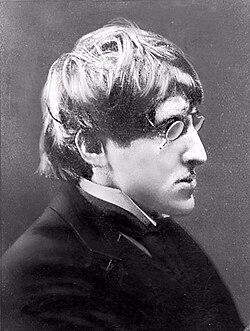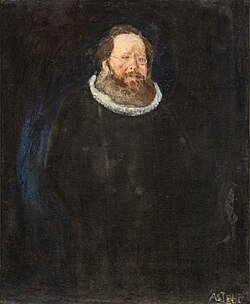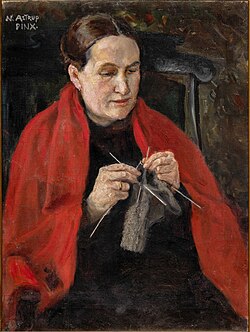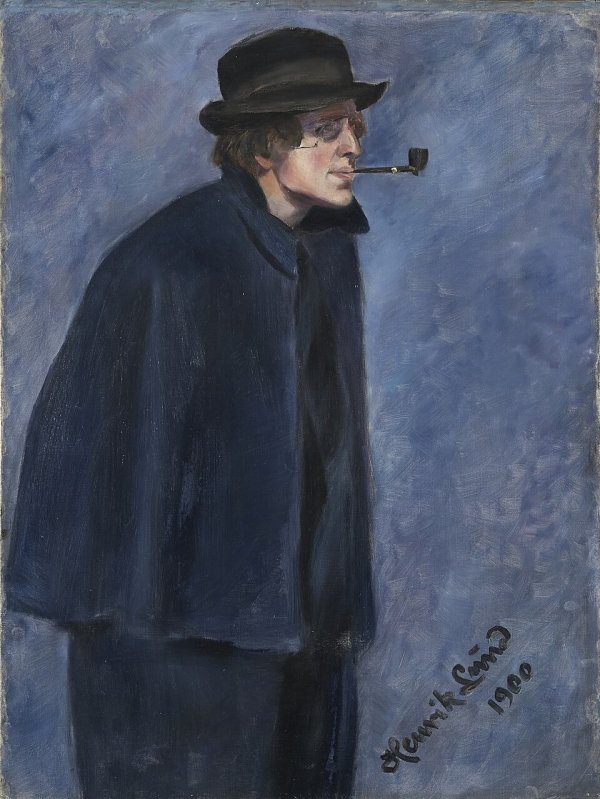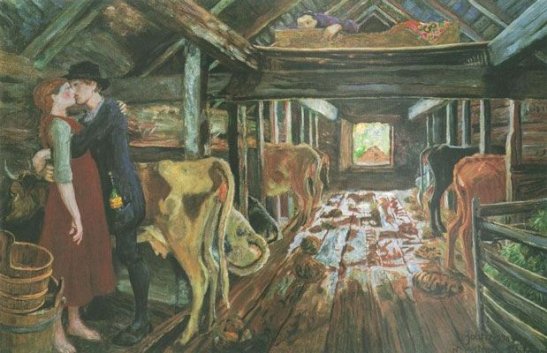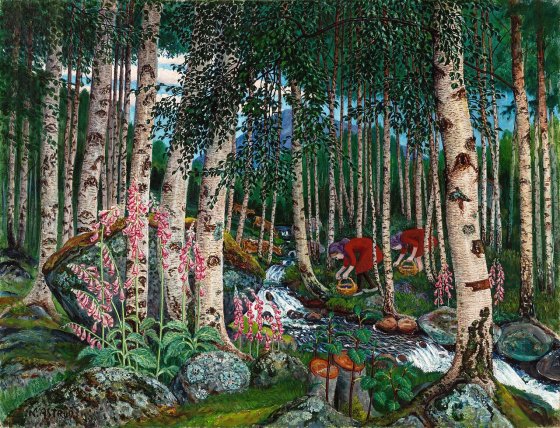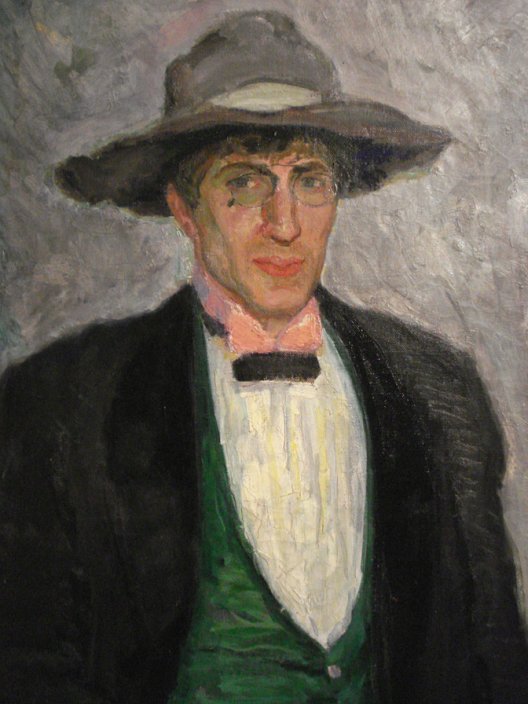
Portrait of Nikolai by Bernhard Folkestad (1910)
Now back home in Jølster Nikolai wanted to put into practice all that he had learnt in France and Germany. He decided not to go back to the city of Kristiania but instead return to what he termed his “homeland” the village of Jølster and the large nearby lake the Jølstervatnet. His idea was to find a way to depict pictorially this area, the area he referred to as his “kingdom of childhood”
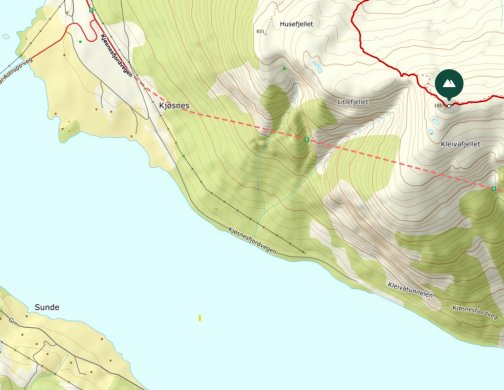
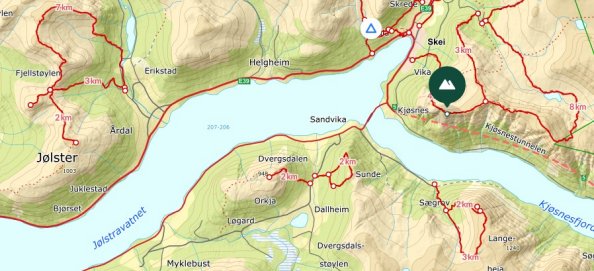
Maps showing the Kleivafjellet mountain and the village of Sunde where Engel’s father’s farm was located. Jolster was were Nikolai was living at the time.
For the first few years Nikolai lived at the vicarage and produced many paintings. On December 23rd 1907, he married Engel Marie Sunde. At the time of the wedding, she was still a month away from her sixteenth birthday, while Nikolai was twenty-seven. Her young age caused controversy in the village. There is an unusual story about how Nikolai and Engel met and became friends. Nikolai wanted to paint a landscape picture featuring the Kleivafjellet, a mountain on the north side of the Kjøsnesfjord but the best view of the mountain was found on the Sunde farm, on the opposite side of the Kjøsnesfjord lake.
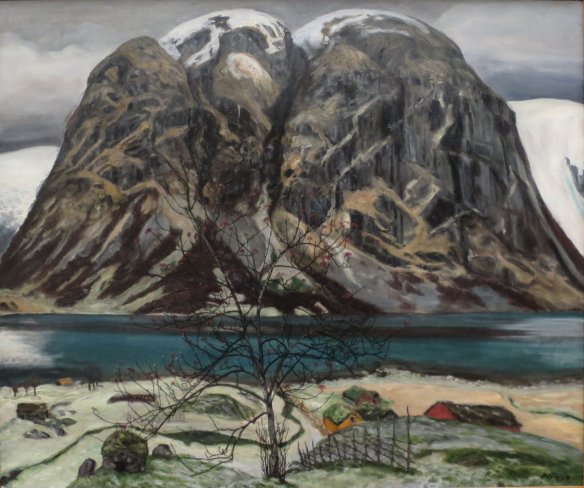
Kollen by Nikolai Astrup (1906) Sunde farm in the foreground.
The Sunde Farm was owned by Anders Jensen Sunde who had a daughter Engel Marie. Nikolai asked for permission to stand in a room on the Sunde farm on the opposite side of the lake, where there was a great view of the mountain and paint the mountain using the farmhouse as his base. Nikolai was allowed to position himself and his easel in a room in one of the farm buildings. He completed the work in late 1906 and it was entitled Raw November Morning at Sunde in Jølster but later known as Kollen (The Fell). Nikolai and Engel’s friendship grew into love and eventually marriage on December 23rd 1907. Nikolai was twenty-seven and his bride had yet to celebrate her sixteenth birthday. For a time Nikolai believed that due to the age of his very young wife he was at risk of losing an art grant due to the controversy. In a letter to his friend Henrik Lund, Astrup wrote:
“…It is true that I married a rather young girl but I do not think that it is immoral to a degree that I should be deprived of my stipend for that reason…”
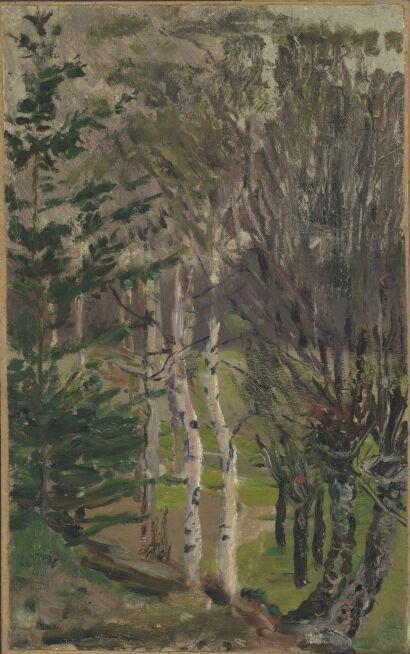
Vårlandskap (Spring landscape) by Nikolai Astrup (1908)
Nikolai and Engel Astrup went on to have eight children. Their first child, a daughter, Kari, was born in 1911 followed by their eldest son who was named Arnold Böcklin Astrup. Engel was a significant inspiration to her husband and was a source of positive sentiments for him. Unfortunately Nikolai despite his health problems, wrote in 1909 about how much his wife had enhanced his life in a letter in 1909:
“…I cannot afford to lose her, I had almost given up hope in life when I met her, and thanks to her my life-force re-ignited…”
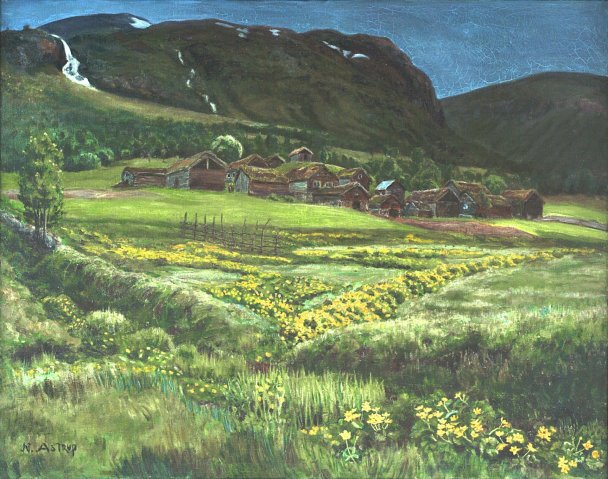
June Night and Old West Country Farmyard by Nikolai Astrup (1907)
A recurring motif in Astrup’s landscape paintings were views local to where he lived in the municipality of Jølster. In his painting, June Night and Old West Country Farmyard, a twilight depiction of Ålhustunet in Jølster that seems to have a special meaning for Nikolai Astrup and it was one which he painted several versions of. In the middle ground of the picture we see a cluster of buildings (klyngetunet), one that was situated above Astrup’s childhood home, the vicarage at Ålhus. This cluster of log buildings indicated the presence of human life within this idyllic setting. In the background we see an imposing mountain looming behind the farm, and the rushing waterfall, the Kleberfossen, can be seen cascading down its side. For Astrup, the main aspect which seems to have captured his interest is the lush meadow full of bright yellow buttercups that we see in the picture’s foreground, translucent and shimmering in the clear summer night. The buttercups in this twilight scene are important as they do not close at sunset. Their role are to be points of light in the shadowy landscape. It is believed that Nikolai had to travel elsewhere to study buttercups as the marsh at Ålhustunet had been drained some years prior and thus the marsh-loving flowers had long since died out.
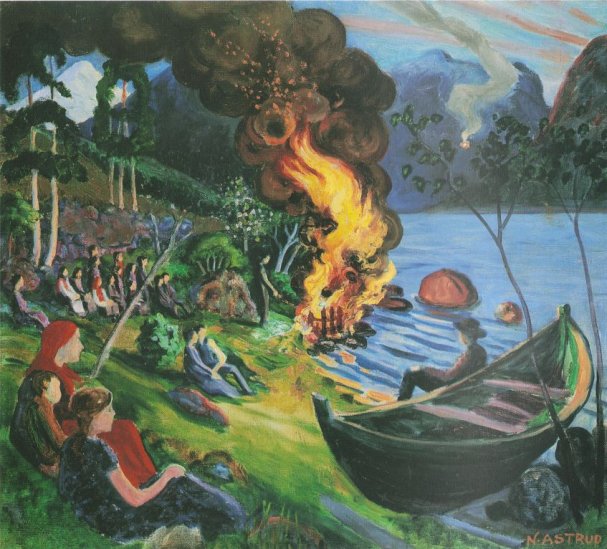
St. Hansbål ved Jølstravatnet (Midsummer Eve Bonfire) by Nikolai Astrup (1909)
Nikolai’s father, the clergyman, was a devout religious believer who condemned the pagan celebration of Midsummer Eve and would not allow his son to attend these festivals when he was young. However his son would often sneak out of the house and attend the festivities. In a letter to Mayor Aslaksen of Arendal, Nikolai recalled his time as a teenager during the Midsummer Eve celebrations:
”…it was sinful for Christians to join the [pagan] celebration. Then […] I had to stand back behind the fence and look and listen while the others danced around the bonfire and whooped for joy […] It struck me that the bonfire was something sinful, something bad being practiced in the green dusk – it was pagan. This idea was reinforced by the jealousy festering inside me when the other children could attend, but I had to stand behind the fence…”
In 1909 Nikolai Astrup completed a painting entitled St. Hansbål ved Jølstravatnet (Midsummer Eve Bonfire). It is a vibrantly coloured painting, in which we see a group of people sitting in the grass at the edge of a large lake, the Brenden. There is a large yellow-orange bonfire from which we witness orange sparks and black smoke billowing upward. On the far side of the lake there are tall, dark mountains appearing in the background. We can see another bonfire with its grey smoke rising into the sky on that mountainside in or around the village of Ålhus.
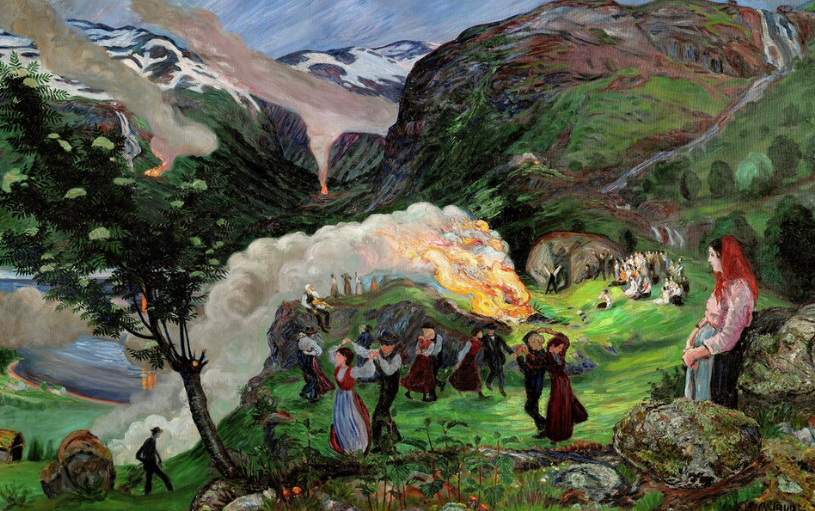
Midsummer Eve Bonfire by Nikolai Astrup
The Midsummer Eve bonfires depicted in this painting were part of pagan fertility celebrations and rituals dating back to ancient times. In this version, the spectators sit and watch quietly, in other versions they participate in lively dancing and music-making, such as fiddle-playing, as music and folk dancing were also important aspects of the Midsummer Eve celebrations.
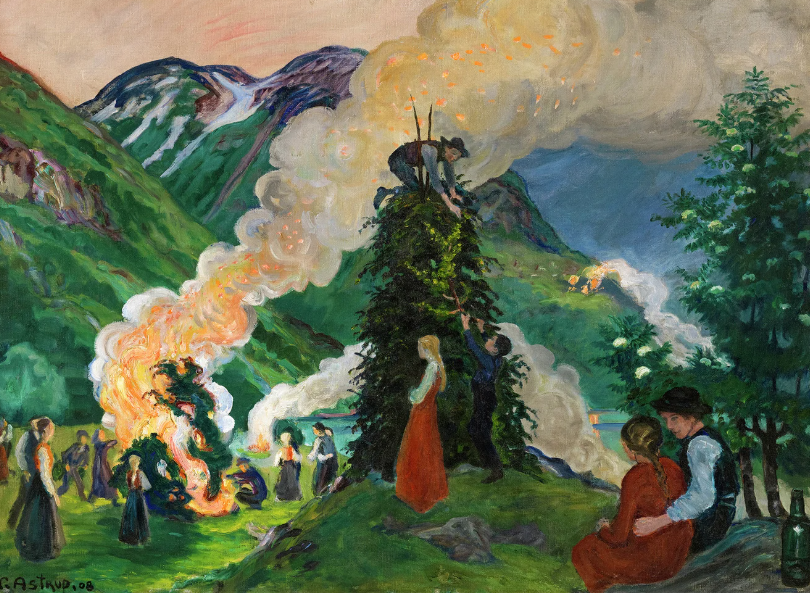
Of Nikolai Astrup’s many Midsummer Eve paintings, the art critic Claudia Massie, noted:
“…as a Christian child, Astrup was forbidden to participate in these rituals. Instead, he had to watch, simultaneously seduced and scared by what he saw […] This conflict is evident in the work. Astrup is an observer, not a participant, and what might in another artist’s hands be a glib, gleeful scene becomes something profound and unnerving; the prelapsarian seen through the pastor…”
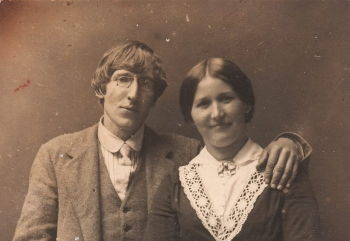
Nikolai and Engel Astrup
Nikolai and Engel Astrup bought a dilapidated smallholding on a steep hill at Sandalstrand (now called Astruptunet) in 1912 and he, his wife and young daughter moved there in 1913. Astrup was interested in old building traditions and built up the farm on his own.The property was on thirty acres of land and lay three kilometres from the town of Myklebust where he had his studio. Eventually after two years of hard work he renovated the house and created a studio within it. Today it is part of Sogn og Fjordane Art Museum.
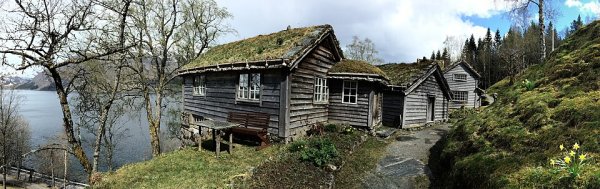
Astruptunet on the south side of Jølstravatnet, Nikolai and Engel Astrup’s home 1914–1928, is today part of Sogn og Fjordane Art Museum Photo: Panorama with distorted perspective, spring 2015.
Engel Astrup left her distinctive mark on the artist’s home. She collected antiques and textiles and had a large collection of historical Jølster yoke clothes in various patterns. Gradually, Engel Astrup also developed as a textile artist and became particularly known for her fabric prints, and especially for national costume aprons in up to three-coloured patterns. In 1939 she exhibited hand-printed tablecloths at Bergens Kunstforening, and was also elected vice-chairman of Jølster Husflidslag.
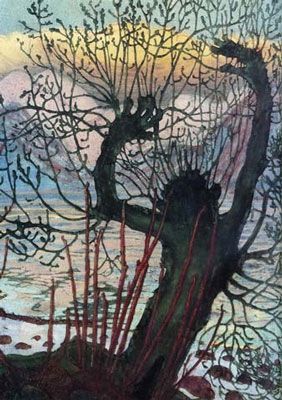
Vårnatt og seljekall (Spring Night and the Call of the Goat Willow) Hand coloured woodcut by Nikolai Astrup (1917)
During his studies in Paris in 1901, Nikolai Astrup became fascinated with Japanese woodcuttings and the world of Japonisme, a French term that refers to the popularity and influence of Japanese art and design among a number of Western European artists in the nineteenth century following the forced reopening of foreign trade with Japan in 1858.
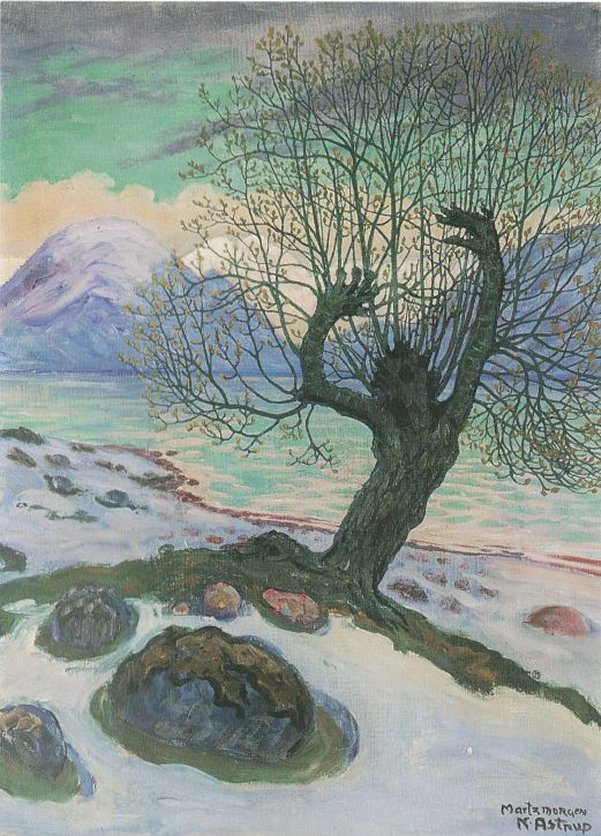
Martzmorgen by Nikolai Astrup (1917). Oil on canvas.
It was not until 1914 when he was back in Norway that Nikolai began to produce his own woodcuts. One of his best-known woodcuts is entitled (Spring night and the call of the willow) which he completed in 1917. The title of the work refers to the whispering sound made by the wind as it blows past the Selje tree (willow tree). In the centre of his depiction, inside the tree, Nikolai has depicted the tree and its branches in such a way that we can see a round head-like shape with protrusions that look like ears, and on either side of this, arm-like branches each with five “fingers” reaching upward. The tree itself is silhouetted against a natural background with a lake and mountains beyond which he has rendered with light pastel colours.
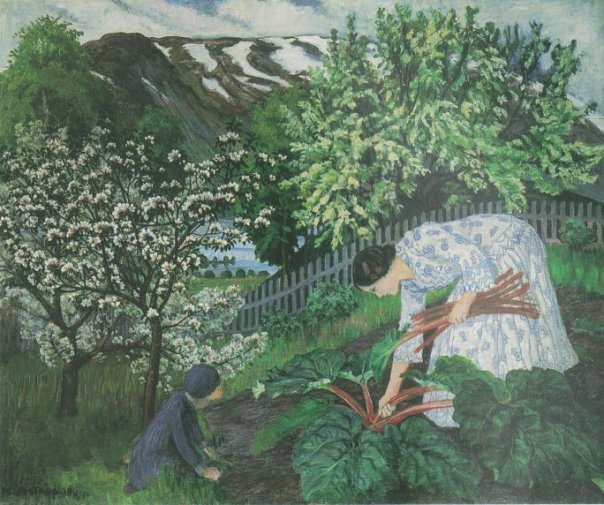
Engel Astrup in the Garden by Nikolai Astrup
In addition to farming and maintaining his growing family, (his eighth child was born in 1924), Nikolai continued with his artistic work, but his finances were very tight, and he struggled with poor health. Nikolai’s farm, being situated on a steep terrain, was so steep that he had to build terraces to make room for fields and meadows. One of the crops he grew was many types of rhubarb, which he would often depict in several of his paintings featuring his and Engel’s garden.
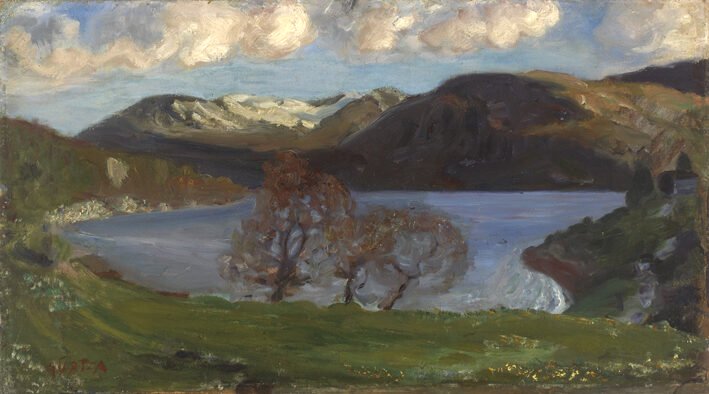
Vårkveld ved Jølstervannet (Spring evening by Jølstervannet) by Nikolai Astrup (1900)
Astrup was plagued by asthma from childhood. The frequent seizures often forced him to go outside at night to catch his breath and his illness is frequently mentioned in his letters. It is thought that the medication he used at times probably caused problems with his sight. For someone suffering from this ailment, where he lived affected his health as the climate in Jølster and the waterlogged soil at Ålhus probably had exacerbated his illness. In 1906 he was severely affected by tuberculosis, and he medicated himself with adrenaline in injection form. In a letter from 1909, he writes that he had been declared free of infection.
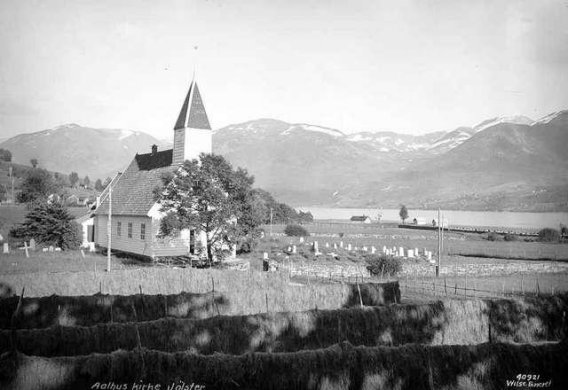
Ålhus church, where Nikolai’s father was a priest, with Sandalstrand on the opposite side of Jølstravatnet. Astrup was buried at Ålhus church at the family gravesite.
In early January 1928 he travelled in an open car to Førde, caught a cold and died of pneumonia on January 21st 1928, aged 47. He was buried at Ålhus church and the funeral was paid for by the Jølster municipality. Engel was left alone, a widow with eight children under the age of 17. She died Dec 29th 1966 at age 74 in Jølster, Sogn og Fjordane.
Information for this blog came from various Wikipedia websites as well as websites alluded to in Nikolai Astrup. Part 1.