Cornelius Johnson

Portraiture is an art form which goes back to ancient times and before the advent of photography it was the only way to chronicle the appearance of someone.  However the way the sitter was portrayed by the artist afforded them the illusion of power, importance, virtue, beauty, wealth, taste, learning or other qualities of the sitter. Often it was the artist’s “duty” to depict the sitter in a flattering way, although some portraitists, like William Hogarth, refused to flatter, and would often have their works rejected by the person who had commissioned the portrait.   The artist I am featuring in today’s blog was one of the leading portrait artists of the seventeenth century. He painted everything from miniatures to small scale royal portraits, portraying aristocracy, lawyers, gentry and merchants

Cornelius Johnson or Cornelis Janssens van Ceulen (Cologne) was born in October 1593 in London to a Flemish/German protestant family . He was baptised at the London Dutch Reform Church at Austin Friars much used by the Netherlandish community in London.  His father was Cornelius Johnson who had been a religious refugee from Antwerp and his paternal grandfather had come from Cologne.  His mother was Johanna le Grand.  It was thought that Cornelius could have received his first artistic training, whilst in the Netherlands, from Michiel Jansz. van Mierevelt.  It is known that Cornelius had definitely returned to England by 1619 for it is recorded that he was a witness at the baptism of his nephew, Theodore Russell.  During the 1620’s he lived and had his studio in the London parish of St Ann, Blackfriars, as did the other leading portraiture artist, Anthony van Dyck and the English father and son miniaturists, Isaac and Peter Oliver. 

Portrait of a Woman, Traditionally Identified as the Countess of Arundel  by Cornelius Johnson (1619)

His earliest paintings date from 1619 and soon he had created a large number of portraits with his sitters coming from various upper levels of society.  One of his early works was a portrait of Alathea Talbot, Countess of Arundel, a famous patron and art collector, and one of England’s first published female scientists.  She was the third daughter of George Talbot, 7th Earl of Shrewsbury, K.G. and his step-sister Mary, daughter of Sir William Cavendish, who married in 1606 Thomas Howard, Earl of Arundel. Johnson has depicted the countess wearing a red dress trimmed with lace with a white lace collar and a gold earring with a blackbird pendant in her right ear.

On July 16th 1622 at the Dutch Church in London, Cornelius married Elizabeth Beke, a lady from a migrant family based in Colchester.  Their first son, James, was born on September 30th 1623 but died young.  Another son, Cornelius Junior, was born in London in August 1634 and went on to follow in his father’s footsteps, and become a painter.
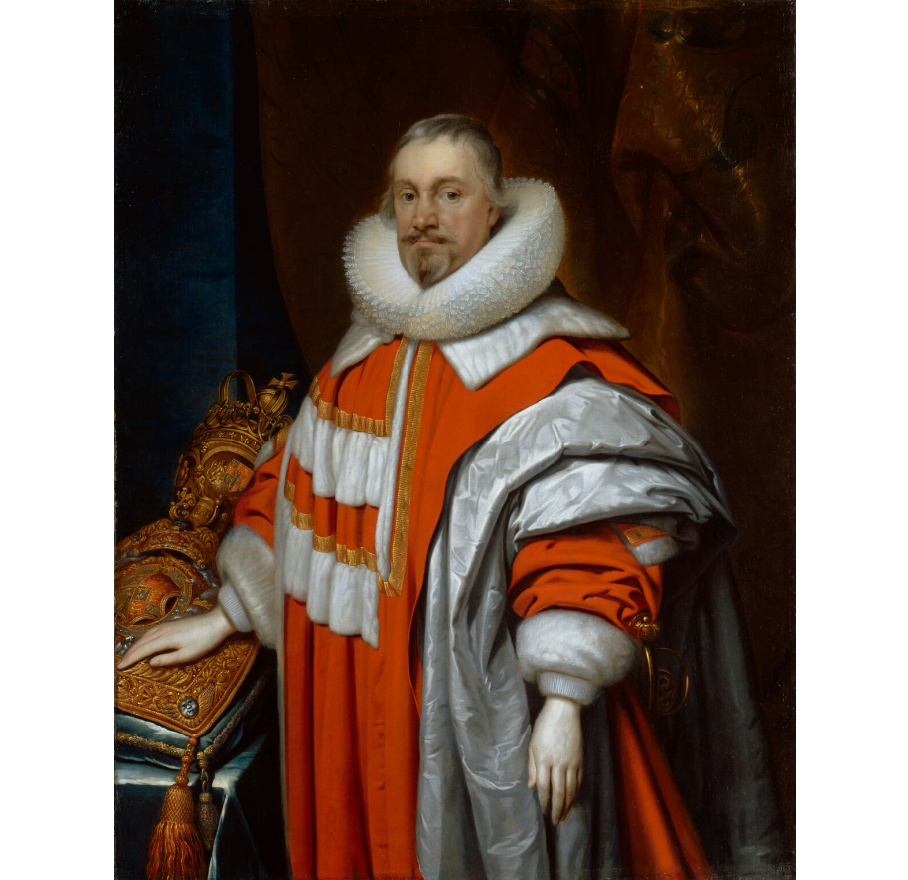
Thomas Coventry, 1st Baron Coventry by Cornelius Johnson ( 1639)

During the 1620’s his fame as an artist soon spread.  Johnson’s most constant client was a lawyer, Thomas, 1st Baron Coventry of Aylesborough, a prominent English lawyer, politician and judge.  He sat for Johnson on at least five different occasions during the 1620s and 1630s. This portrait, shows him with the bag of the Lord Keeper of the Great Seal, and the mace of the Speaker.

John Finch, Lord Finch of Fordwich, formerly known as Sir Nicholas Hyde by Cornelius Johnson

Cornelius Johnson painted the portraits of many senior legal figures including Sir John Finch. Finch was Speaker between 1628–1629. On 10 March 1629, as Speaker, he tried to adjourn the House of Commons on the King’s command, following a disagreement between the King and Members of Parliament over King Charles I’s belief that by the royal prerogative he could govern without the advice and consent of Parliament. Civil War was creeping ever closer.

Lady Margaret Hungerford by Cornelius Johnson (1631)

Another dignitary to sit for Johnson was Lady Margaret Hungerford, the daughter of a wealthy London alderman who had married Sir Edward Hungerford in 1621.  Her husband owned vast tracts of land in England and were spent much of their time at Corsham House in Wiltshire and Farleigh Hungerford Castle in Somerset.  We see the sitter wearing an orange patterned dress with a large white lace collar, a gold-and-black jewel necklace and an orange flower in her hair. In the top right-hand corner of the picture, there is a coat of arms. It is a sumptuous depiction of the details of the costly lace, her embroidered and spangled dress and silver braided ribbons, topped off with expensive jewellery. It must have taken Johnson many hours to perfect the depiction.

Charles I by Cornelius Johnson after Daniel Mytens (1632)

Cornelius Johnson collaborated with Daniel Mytens, a Dutch Golden Age portrait painter, in a full-length portrait of the monarch, Charles I, in 1631.  Mytens had moved from the Netherlands to London in 1618 and had become one of James I and Charles I’s court painters. In the background is a view of Windsor Castle and at the king’s feet is his trusty King Charles spaniel.

Charles I by Anthony van Dyke (1634)

In 1632 Johnson was appointed one of King Charles I’s court painters.  The appointment was termed

“…his Majesty’s servant in ye quality of Picture Drawer to his Majesty…”

Around 1634 Daniel Mytens returned to the Netherlands where he worked and continued to paint but also was an art dealer in The Hague.  This you may think gave Johnson the advantage as being the lead court painter but it was not to be as another artist came on to the scene.  Of all the Stuart kings, Charles I was the most passionate collector of art as he viewed paintings as a way of endorsing the lofty view of the monarchy.  Antwerp-born, Anthony van Dyke arrived in England in April 1632.  It was not van Dyke’s first time in London as he had spent six months there at the end of 1620 before heading off to Italy.  Although he was travelling around Italy Van Dyck remained constantly in touch with the courts of James I and Charles I’s and whilst travelling around Italy he helped King Charles’s agents in their search for paintings. He also sent to England some of his own works.  In April 1632 van Dyck returned to London and immediately became a court favourite as well as being welcomed by king Charles who knighted him in July and set out that van Dyke should receive a pension of £200 a year  The wording of the grant document referred to Van Dyke as principalle Paynter in ordinary to their majesties.  He was provided with a house on the River Thames at Blackfriars, then just outside the City of London, thus avoiding the monopoly of the Worshipful Company of Painter-Stainers.  Van Dyke’s Blackfriars studio was frequently visited by the King and Queen and later a special causeway was built to ease their access from the river. Charles rarely sat for another painter while van Dyck lived.

The artistic trajectory of Cornelius Johnson was stalled.

Charles II as a Boy by Cornelius Johnson (1639)

In 1639 Johnson received a royal commission to paint the three young children of Charles I and his French princess wife Henrietta Maria.  First was a portrait of Charles’ eldest son, Charles, who would later become Charles II.  It depicts the nine year-old-boy as a boy soldier, which appears to be a powerful piece of propaganda. Charles I was executed in January 1649 at the climax of the English Civil War and the country became a de facto republic led by Oliver Cromwell. When Cromwell died in 1658, the English monarchy was restored and Charles II became monarch on his thirtieth birthday on May 29th 1660.
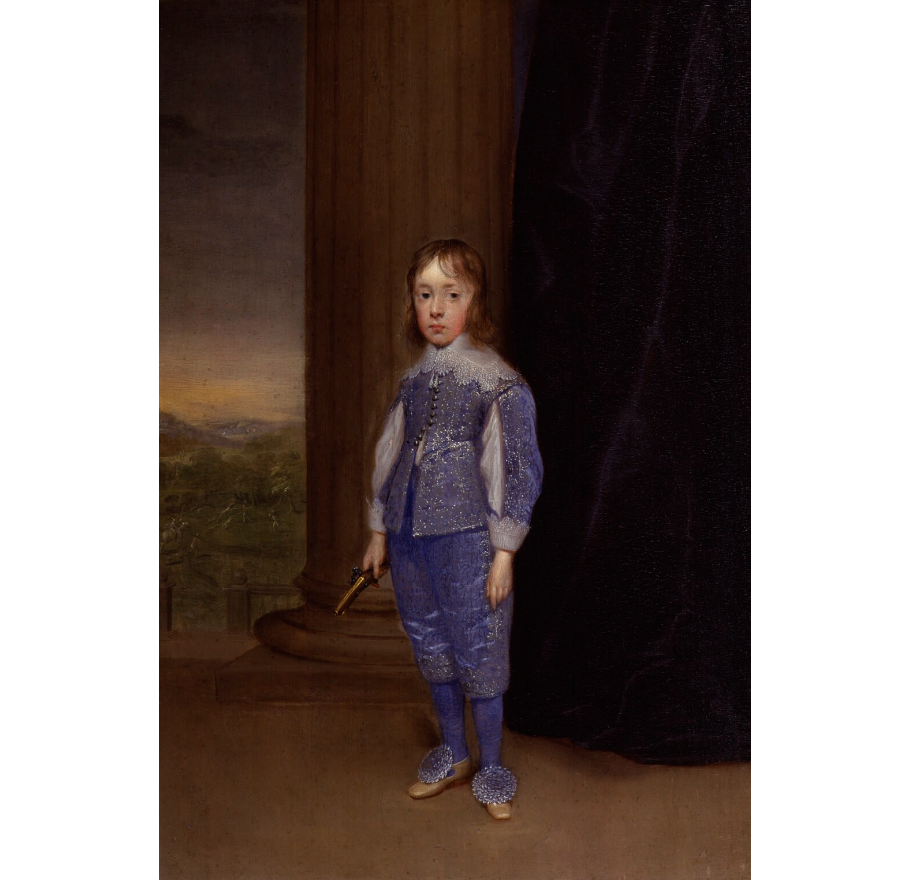
James II as a Boy by Cornelius Johnson (1639)

Cornelius Johnson painted the portrait of Charles I’s second son, James, when he was six-years-old. It was not until forty-six years later, in 1685, on the death of his brother, Charles II, that he became king of England.
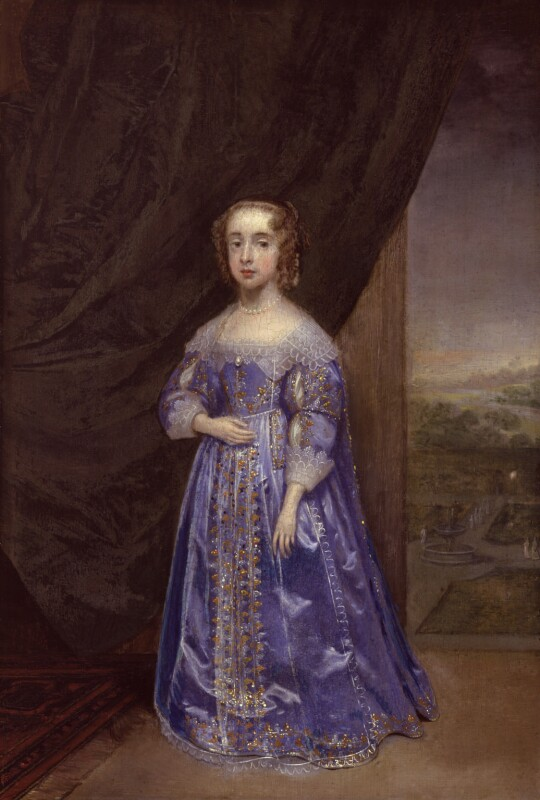
Princess Mary by Cornelius Johnson (1639)

The third 1639 royal portrait by Johnson was of the English princess, Mary, who was the eldest of Charles I’s children and the sister of Charles II and James I.  She was eight years old at the time of the painting.
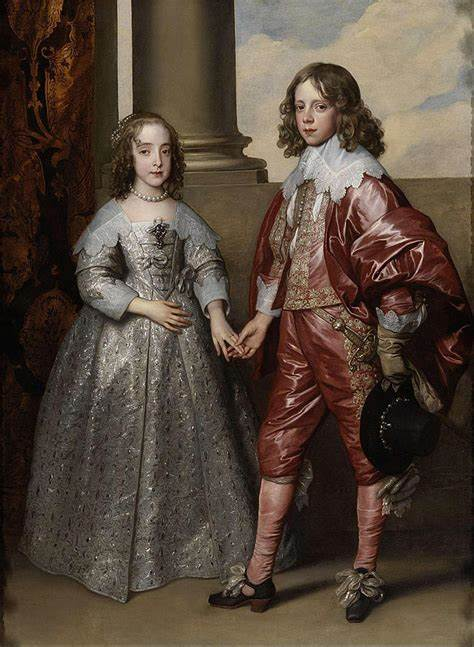
William II, Prince of Orange and his bride Mary Stuart by Anthony van Dyke (1641)

Two years later, in 1641, Mary who was just nine years of age was married to the future stadtholder of the Netherlands, fifteen-year-old William II of Orange. Eight days after her husband’s death in 1650, Mary gave birth to a son, William III of Orange, who later became King of England.  After the restoration of the monarchy in England in 1660, Mary left the Netherlands to join in the celebrations in London, where she fell ill with smallpox and died, aged 29.

Robert, Lord Bruce, later 2nd Earl of Elgin by Cornelius Johnson (1635)

Johnson painted many portraits of children, either individually or in pairs, and consequently was much in demand with English and Scottish clients.  An example of this genre was Johnson’s 1635 portrait entitled Robert, Lord Bruce, later 2nd Earl of Elgin and 1st Earl of Ailesbury.  We see before us a fashionably dressed young sitter, Robert, Lord Bruce, who was the only child and heir of the Scottish nobleman Thomas Bruce, 1st Earl of Elgin. As a young child, Bruce received little formal education, but once he became a teenager, he travelled to Europe and was one of the first Scots to embark on the Grand Tour. By 1659, twenty-three-year-old Bruce had become an active royalist conspirator and was involved in plans for an uprising against the government, which led to his arrest.  

Thomas Bruce, 1st Earl of Elgin by Cornelius Johnson (1638)

The portrait had been commissioned by the boy’s father, Thomas Bruce.  One must believe that Thomas Bruce was pleased with the resulting portrait of his son as three years later, in 1638, he commissioned Johnson to paint a full-length portrait of himself.
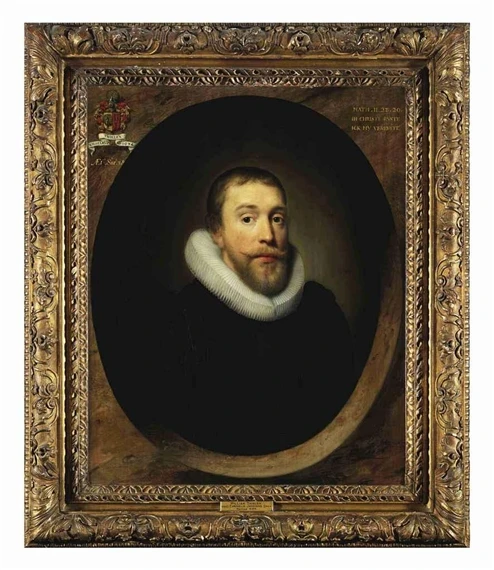
Portrait of Willem Thielen by Cornelius Johnson

The community that Cornelius Johnson lived among centred itself around the Austin Friars, the Dutch church in London.  At the time of the late sixteenth century the Dutch community was the largest group of expatriates living in London and numbered around five thousand out of the total population of one hundred thousand at the time. About half of the Dutch residing in London were Protestants who had fled the Flemish Low Countries due to religious persecution.   Others were skilled craftsman, including brewers, tile makers, weavers, artists, printers and engravers, who came to England for economic opportunities. Johnson was commissioned to paint portraits of many of these distinguished members of this Netherlandish community. 

Portrait of Madame Thielen by Cornelius Johnson

One such pair were Willem Thielen, the Minister of Austin Friars, and his wife Maria de Fraeye.

The 1st Baron Capel and his Family by Cornelius Johnson (c.1640)

From left to right: Arthur Capel 1st Earl of Essex (1631-1683), his father Arthur Capel 1st Baron Capel (1604-1649), Henry Capel 2nd Baron Capel (1638-1896), Elizabeth, Lady Capel (died 1661), Charles Capel (died 1657), Elizabeth Countess of Carnarvon (1633-1678), and Mary Duchess of Beaufort.

It was around 1640 that Cornelius John received the commission to paint a large family group portrait of the 1st Baron Capel and his wife and their five surviving children. It is a depiction which celebrates fecundity, good health, good looks and stylish elegance. Lord Capel was a diehard Royalist. Appropriately, given the horticultural interests of the Capels, the family are pictured here posing in front of their formal garden at Little Hadham Hall in Hertfordshire. The baron’s wife is dressed modestly and somewhat behind the times. She is seen wearing a two-tiered cape trimmed with lace to conceal her bodice, but her daughters wear lace collars that were démodé for about five years.
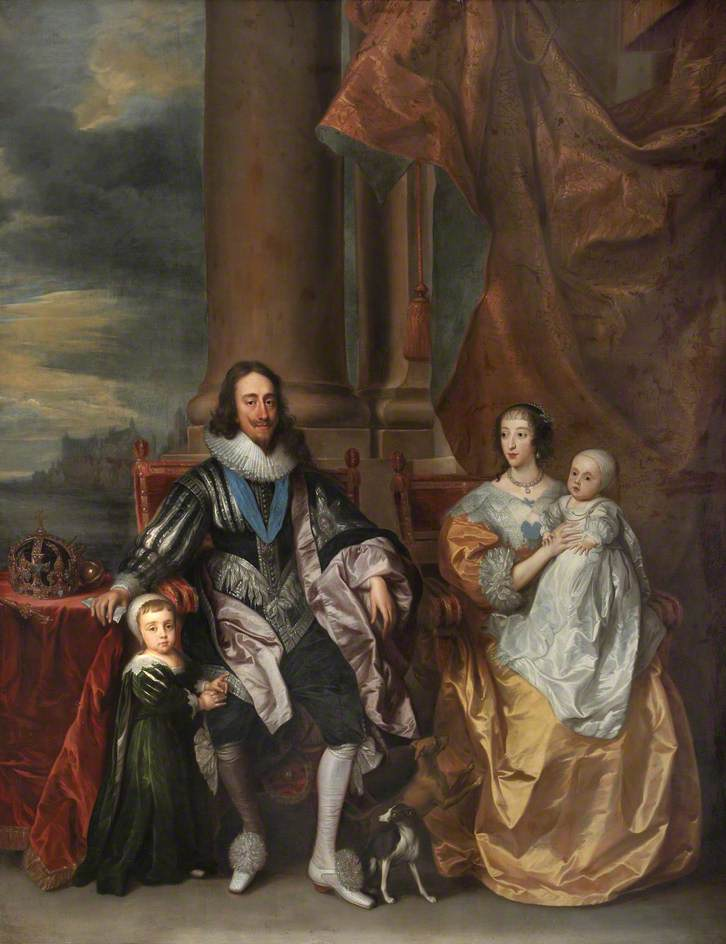
The Greet Peece by van Dyke (1632)

The set-up for Cornelius Johnson’s depiction of the Capel Family was thought to have come from van Dyke’s 1632 depiction of Charles I and his family.

Anthony van Dyke died in 1641 and this should have added to the opportunities for Johnson whose work and reputation had been overshadowed by van Dyke.  However, Johnson was not to have that boost in England because at the time of van Dyke’s death the political situation in England was fast deteriorating and by 1642 Charles I had fled from London.  George Vertue, an English engraver and antiquary, whose notebooks on British art of the first half of the 18th century are a valuable source for the period, in October 1843 he wrote of Cornelius Johnson’s predicament:

“…being terrifyd with those apprehensions & the constant perswasions of his wife, the family emigrated to the Netherlands…”

In Alexander Finberg’s 1922 book A Chronological List of Portraits by Cornelius Johnson he talks about Johnson’s “pass”, parliamentary permission to travel and leave England. Finberg wrote:

“…Cornelius Johnson, Picture Drawer, shall have Mr Speaker’s Warrant to pass beyond the seas with Emmanuel Pass and George Hawkins and to carry with him such pictures and colours, bedding, household stuff, pewter and brass as belonged to himself…”

On October 27th 1643 Johnson left London and sailed to Middelbourg, Zeeland, a city in Southwest Netherlands. Middlebourg was part of the The United Provinces often referred to as  Netherlands, or the Republic of the Seven United Netherlands.

Apolonius Veth by Cornelius Johnson (1644)

Once residing in Middelbourg Johnson joined the painter’s guild, The Guild of St Luke. One of Johnson’s first commissions was a lucrative and prestigious one. It came from Apolonius Veth, who was the burgomaster of Middelbourg.
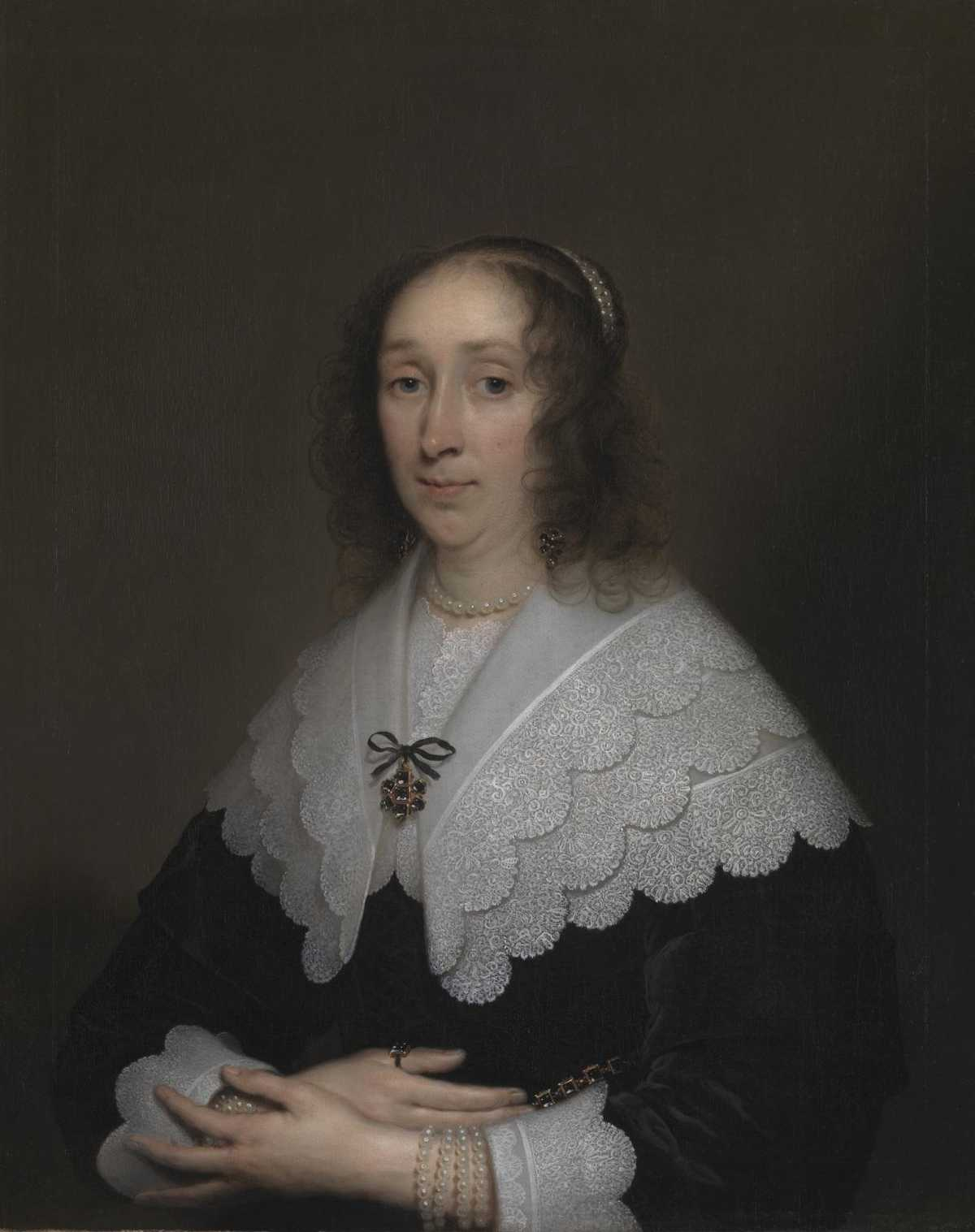
Cornelia Veth by Cornelius Johnson (1644)

Apolonia Veth also commissioned Johnson to paint a portrait of his wife, Cornelia.

The Hague Magistrates by Cornelius Johnson (1647)

For a time, Cornelius Johnson and his family left Middelbourg and went to live in Amsterdam. Cornelius carried on with his portrait commissions but also took on multi-figure commissions. One such was his 1647 painting entitled The Hague Magistrates.
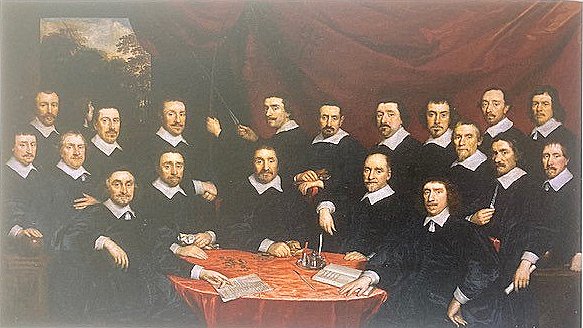
The Middelburg Archers’ Guild by Cornelius Johnson (1650)

Another of Johnson’s multi-figured civic portraits was his 1650 painting entitled The Middelburg Archers’ Guild. One presumes the Guild commissioned Johnson for the painting. Johnson’s old client Apolonius Veth was Deacon of the Guild the year Johnson worked on the painting so, as he appears in the depiction, maybe he was the person who commissioned the work.

Regulierskerk in Utrecht

During 1652 Johnson relocated his family to Utrecht and resided in the high-status address of Herrenstraat. Portrait commissions kept rolling in from the elite families of Utrecht and Johnson was soon regarded as a leading portrait painter. Cornelius Johnson sometimes known as Cornelis Jonson van Ceulen died on August 5th 1661, aged 67 and the funeral service was held in the Regulierskerk in Utrecht
Clara Peeters – The Queen of Still Life paintings

I suppose painters challenge us with trompe l’oeil aspect of their depictions partly as a joke, as in the case of M C Escher and partly as an outward show of their technical brilliance. Trompe l’oeil (trick of the eye) is often incorporated in still life paintings and in many facets of a still life work we can appreciate the expertise of the artist.  The words still life derive from a Dutch word stilleven while the French prefer nature morte and Italian, natura morta meaning dead nature.  Still life paintings are those which depict inanimate objects, whether they be such things as musical instruments, kitchen utensils and tableware as well as portrayal of dead animals, foliage or musical instruments etc.  Often the inclusion of an inanimate object in a painting has a symbolic meaning whilst at other times it is simply art for art’s sake.

What Is Vanitas
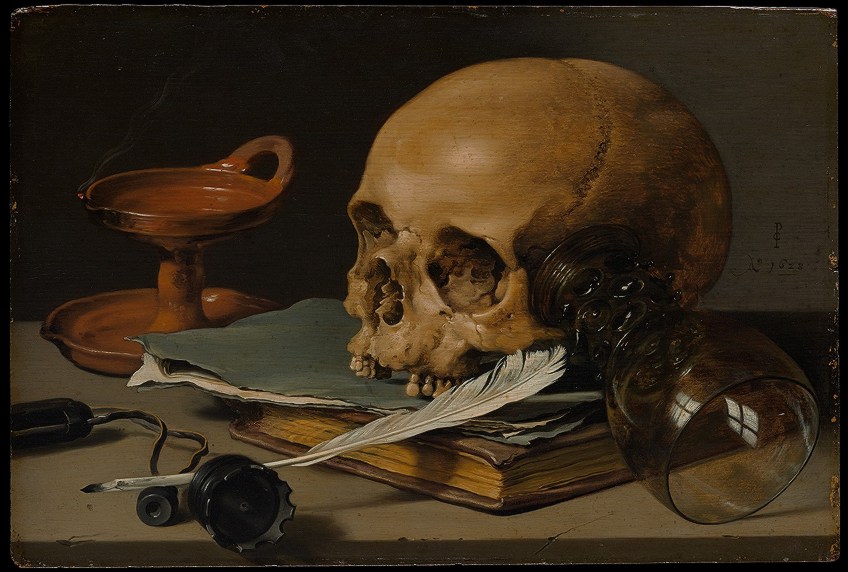
Vanitas Still Life with a Skull and a Quill (1628) by Pieter Claesz

The term memento mori, a Latin phrase meaning ‘remember you must die’ is often a term used when describing certain types of still life works.  Paintings, for example, which may include a portrait with a skull but other symbols commonly found are hour glasses or clocks, extinguished or guttering candles, fruit, and flowers.  Closely related to the memento mori picture is the vanitas still life.  I find the depiction of these inanimate objects fascinating and feel that they are completed by the most talented artists. 

Basket of Flowers by Balthasar van der Ast (1622)

Unlike me, the French Academy of the seventeenth century did not agree.  According to the French Academy their hierarchy of genres (or subject types) for art established in the seventeenth century, still life paintings were ranked at the bottom – fifth after history painting, portraiture, genre painting (scenes of everyday life) and landscape. It is thought that still life and landscape paintings were considered lowly because they did not involve human subject matter.

Still Life with Jug, Berkemeyer and Smoking Utensils_Pieter Claesz_17th century
Still Life with Jug, Berkemeyer and Smoking Utensils by Pieter Claesz (1640)

We know people buy portraiture to remember someone.  People buy landscapes and seascapes for their beauty and often to remind themselves of places they loved to visit.  Genre paintings were scenes of everyday life which often were also pictorial tales of morals and sometimes the realist genre paintings told of harsh times suffered by the less fortunate.  But who would buy still life paintings?  I suppose a beautiful flower arrangement depicted in a floral still life lights up a room but what about still life paintings which depict dead animals, food and expensive homeware?  Buyers of such work may believe that the painting reflects their affluence or hunting prowess.

The spoils of the chase guarded by a dog by Jan Fyt (c.1630)

When you look through the list of sixteenth and seventeenth still life painters, very few women’s names appear and yet there are a few.  The most obvious are the seventeenth century artists, Rachel Rausch with her floral still life works and Judith Leyster.   Today I want to look at the life and works of the greatest female still life painters, Clara Peeters.  She was by far the best-known female Flemish artist of this era and one of the few women artists who became a professional artist in seventeenth-century Europe, and she achieved that status despite constraints on women’s access to artistic training and membership in guilds.

Still Life Self portrait by Clara Peeters (c.1610)

Clara Peeters was born in Antwerp but when it comes to her date of birth there is some confusion.  It is known that a Clara Peeters, the daughter of Jean (Jan) Peeters was baptized on May 15th 1594 in the Church of St. Walburga, Antwerp and other records indicate that Clara Peeters and Henric Joosen were married in the same church on May 31st 1639.  So is that Clara Peeters the famous artist?  Although she is a major figure in the history of European still life painting, almost nothing is known about Clara Peeters’s life with certainty. Early researchers confused her with other women bearing the same relatively common name, ranging from an Antwerp heiress to an Amsterdam prostitute.  Also, we have to be wary of jumping to conclusions as Peeters was a very common name in Antwerp.

Still Life by Clara Peeters (1607)

Another factor which casts doubt on the birthdate of 1594 as her paintings, which were dated 1607, would mean she completed them she was just thirteen years of age and that is extremely unlikely so the conclusion is Clara was born in the 1580’s.

Still Life with Fish, a Candle, Artichokes, Crab, and Prawns by Clara Peeters (1611)

At a point in time when she was living in Amsterdam Clara Peeters produced one of her still life masterpieces in 1911.  It was entitled Still Life with Fish, a Candle, Artichokes, Crab, and Prawns.  Before us we see what looks like a wooden table upon which is a selection of seafood, such as boiled crabs and shrimp, several freshwater fish including two carp, a roach, several ide or orfe, and a northern pike.  Behind the food there is a dark glass goblet, a brass candlestick with an unlit but partially burnt out candle, a Rhenish stoneware jug, a copper strainer with a brass colander in which are two artichokes. 

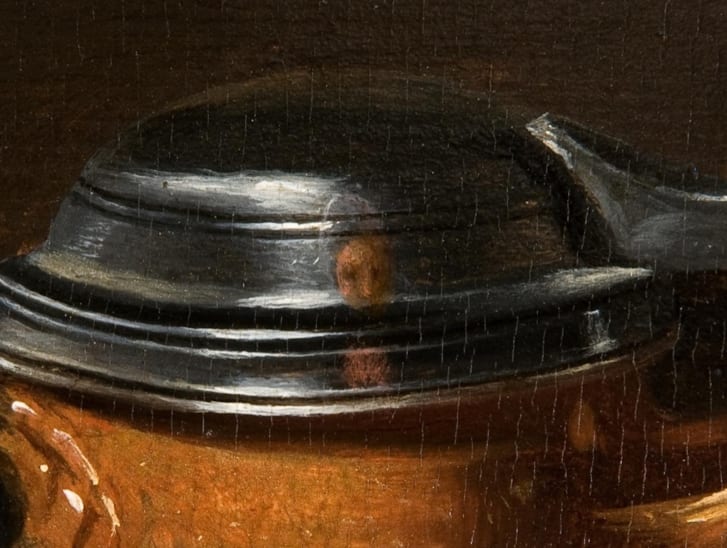
The reflected face

Although you will not see it in the main picture if you were able to take a close look at the lid of the jug you would see a reflection/self portrait of Clara wearing a large headpiece.  She, like a number of famous artists, included her own portrait in a number of her paintings.

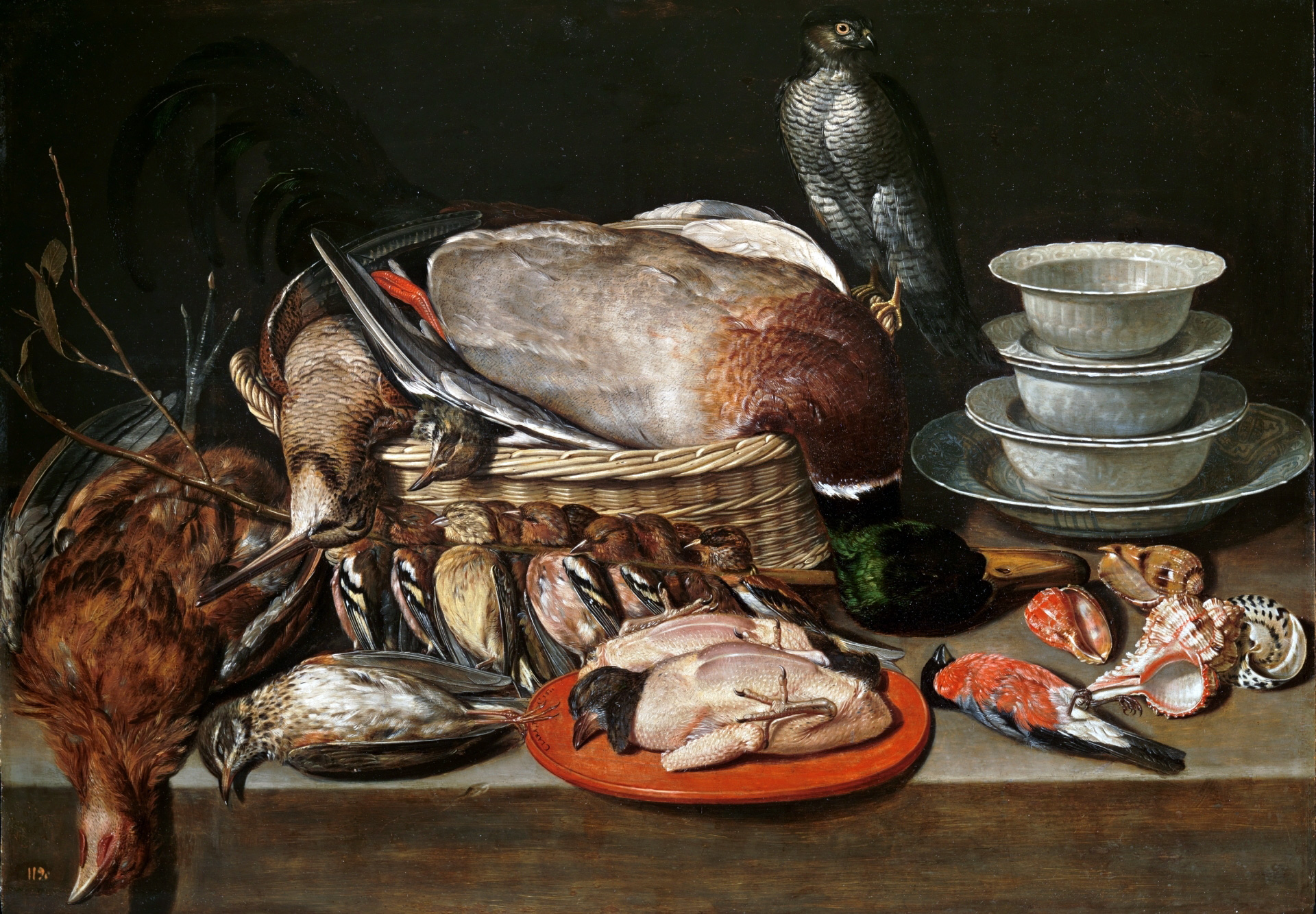
Still Life with Sparrow Hawk, Fowl, Porcelain and Shells, zoomed in
Still life with Sparrow Hawk, Fowl, Porcelain and Shells by Clara Peeters (1611)

Another painting in the Prado collection by Clara Peeters is her 1611 work entitled Still Life with a Sparrow Hawk, Fowl, Porcelain and Shells and is thought to have been in the Spanish royal collection.  In this work we see a life-sized Eurasian sparrow hawk balanced on the edge of a wicker basket.  Due to its large size we believe it to be the female of the species.  Sparrow hawks would typically be used in the gardens surrounding a palace or a city, and not only by men but also by women and children learning the art of falconry.  Lying lifeless in the basket is a large mallard, and a woodcock.  At the left, with its head hanging from the table is a hen.  A dead thrush lies on the table.  The small red bird to the right is a common bullfinch.   The bullfinch often appeared in Clara’s still life paintings and this could well be because of its vivid red colouring and in this work contrasts well with the green head of the mallard.  Along the side of the wicker basket are a line of dead finches, hanging by their necks.    One question you might ask yourself is why have one live bird depicted among so many dead ones.  I think the reason is that the smaller dead birds could well be the prey of the living sparrow hawk.  Again in this painting, as it was in the previous one, note how Clara has contrasted the soft feathered bodies of the birds with the harder and finer surfaces of the shells and porcelain dishes.

Kraak bowl (c.1600)

The several plates and bowls of white kraak porcelain are stacked on top of a blue and white kraak plate, an item which appeared in a number of Peeters’ paintings.  In this painting the blue colour of this dish has faded and this is probably due to the cobalt-based pigment used.  Kraak ware or Kraak porcelain is a type of Chinese export porcelain produced mainly in the late Ming Dynasty, in the Wanli reign.   It was among the first Chinese export wares to arrive in Europe from the late sixteenth century via Portugal and Spain, and spread throughout the continent mainly through Habsburg networks.  It often featured in Dutch Golden Age paintings of still life subjects which included foreign luxuries.

Image result for still life with flowers, gilt goblet, almonds, dried fruits, sweets, biscuits, wine and a pewter flagon
Still life with flowers, a Silver Gilt Goblet, Dried Fruits, Sweetmeats, Bread Sticks, wine and a Pewter Flagon by Clara Peeters (1611)

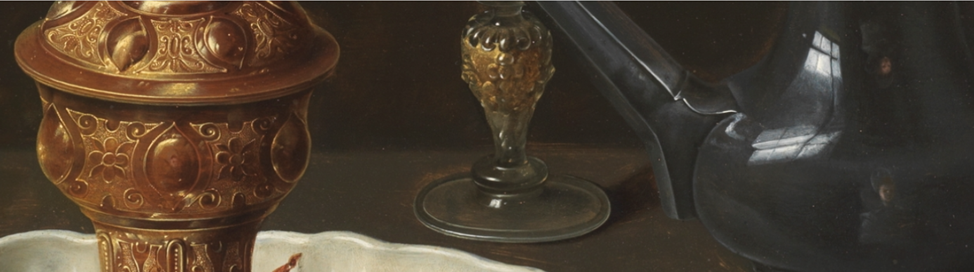
For the less squeamish but keeping to the subject of food I give you Clara Peeters’ 1621 painting entitled Table with Cloth, Salt Cellar, Gilt Standing Cup, Pie, Jug, Porcelain Plate with Olives and Cooked Fowl.  There are no dead animals on this table, just simple and tasty fare.  The arrangement of inanimate objects would appear random when in fact Peeters probably spent much time with the arrangement.  Firstly, she would want what was placed on the table to look like an everyday table set for a feast.  However, she would ensure that none of the objects blocked the view of another. The glass in the background containing the red wine is a fluted façon de Venise glass and was the type that was being manufactured in Antwerp by Italian glassblowers at the time. It is probable that the red wine had been imported from France, Italy or Spain. At the time of the painting much of food in the Dutch capital, such as wine, oil, salt, raisins and figs had come from Spain.  In this painting we see these fruits, together with almonds and sugar candy, in a large wide bowl known as a bianchi di Faenza vessel, a type of earthenware made in Faenza, an Italian city in the province of Ravenna, in the late sixteenth and early seventeenth centuries..

Reflections

Look carefully at the gilt goblet and the pewter flagon.  These are objects that appear in other of her still life paintings and also once again, she painted her self-portrait – three times in the raised parts of the goblet and four times in a vertical line on the pewter jug. This inclusion of herself portraits in some of her works is believed to be a form of a proclamation that she was a female painter and proud to be one in a profession dominated by men.

Clara Peeters - Still Life with Cheeses, Almonds and Pretzels.jpg
Still Life with Cheeses, Almonds and Pretzels by Clara Peeters (1615)

The Still Life with Cheeses, Almonds and Pretzels which she completed in 1615 is one of Clara Peeters’ best works and is part of the Mauritshuis collection. The depiction features a stone table top on which is a tin plate with three cheeses on it.  Above the cheeses is a smaller plate of butter shavings. In the foreground, on the left there are two pretzels, next to which is a knife with a beautifully decorated silver handle, three almonds and a blue-white plate of Wan Li porcelain filled with dried figs, almonds and raisins.  In the background we see a stoneware jar and a partially gilded lidded glass à la façon de Venise.  On the right side of the table there is also a sandwich and two raisins.  It is a meticulous depiction even down to small damages to some of the items and the hole in the cheese where a testing tube had been inserted.  As with all her still life works she has a remarkable ability to depict textures.  Look how she has depicted the crumbly nature of the dark green cheese and the softness of the shavings of butter as well as the reflective quality of the wine glass.  Her colour palette consists mainly of delicately harmonised yellow and reddish-brown shades and by doing this she has added warmth to the depiction but it is contrasted by the cool blue and white bowl at the right foreground.  The dark background and the way she has placed the objects in close proximity to each other offers a scene of intimacy.

The ornate knife

Look at the knife in the foreground that overhangs the edge of the table. The blade has an Antwerp mark, but more of interest is the ornate handle, which is decorated with ornaments and figures that signify love and marriage.  Although not clear in the picture, at the top a vignette of entangled hands with a burning heart and below it the allegorical figures of Faith and Temperance.  This type of knife, along with a matching fork in a pouch, was given as a wedding cutlery as a gift at weddings.  Even more interesting is the side of this bridal knife, on which Clara has put her name in the form of an engraved inscription, which is unusual as it is one of the few still lifes that she has signed her name in full, rather than her usual signature on her paintings “CLARA P”.    Maybe the reason for the full name on the knife handle was because it was her own wedding gift. However, whether she ever married is still unknown. 

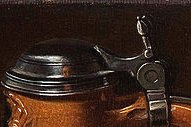
Face of Clara in the lid of the jug

Once again we see the added personal touch to this still life work for if you take a closer look you can uncover in the metal lid of the stone jug the reflection of a face with a white cap: this is Clara herself and as in other paintings by her this reflection appears to be a secondary “signature”.  This incorporation of a self portrait in a painting soon caught on and many other artists followed suit.

Florero (2)
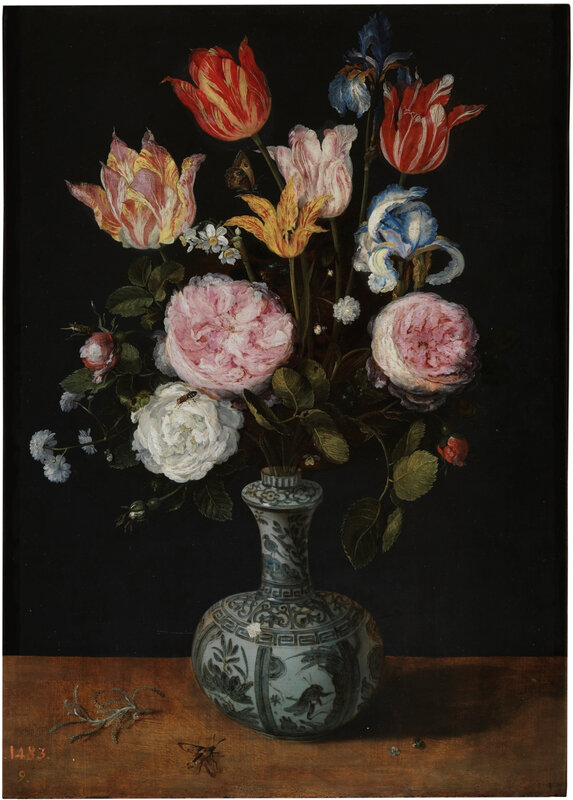
Vase of Flowers by Jan Brueghel the Elder (Jan Velvet Brueghel), 1609

Paintings depicting vases of flowers were very popular at the time.  One of the leading exponents was Jan Breughel the Elder.

Bouquet of Flowers by Clara Peeters (c.1612)

One of Clara Peeters’ floral still life paintings is in the Met Museum of New York. The painting depicts a luxurious bouquet of flowers in a roemer glass, which stands on a low stone shelf. The painting is awash with primary colours which make it stand out against a plain dark background.  The bunch is a mix of late spring and early summer blooms and include roses, tulips, narcissi, carnations, and irises. We see that some of the flowers have shed their petals which now lie on the pitted ledge.  Clara Peeters was an expert when it came to depicting reflective surfaces, an example of this is her depiction of the glass with its ornamented base and serrated foot. We see a butterfly perched on the stem of a fallen flower and in a way, this brings to life this still life work.

One has to presume that Clara Peeters’ choice of still life paintings is a result of the restrictions imposed on female artists. Female artists rarely followed an art education, certainly never being allowed to paint naked models, a must-do requirement if you wanted to become a history painter.  On the other hand, everyday objects were within reach of female painters.  Peeters’ still life artwork was in great demand with the buying public.  Already in the first half of the 17th century there was work by her in collections in the Northern Netherlands as well as her still lifes in the royal collection in Madrid. As was explained at the beginning of this blog the date of her birth is not precisely known.  It is the same for the date of her passing but it is presumed to be sometime after 1657.

Thomas LeClear

Thomas LeClear

The artist I am featuring today is an American, born in New York State and was considered to be one of the major artists of Buffalo’s first golden age in the mid 1800s. He is Thomas LeClear who is recognized for his beautifully crafted depiction of children.

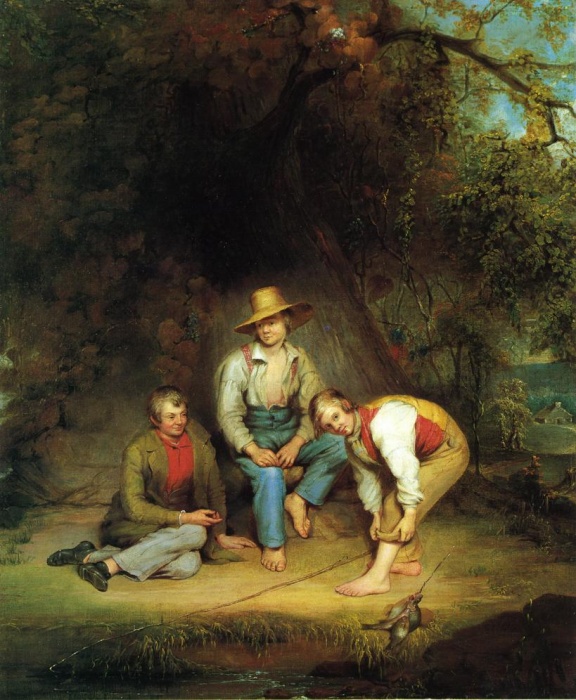
Boys Fishing by Thomas LeClear (1846)

Thomas LeClear was born in the village of Candor, near Owego, in upstate New York on March 11th 1818.  Even at a young age LeClear showed and interest and aptitude in painting.  In Henry T. Tuckerman’s Book of the Artists, which was first published in 1867, he regaled how LeClear, at the tender age of twelve, completed a painting of Saint Matthew, which was so admired by his neighbours that they were willing to pay him two and a half dollars for copies.  In 1832, at the age of thirteen, his family moved to Ontario, Canada, and a few years later LeClear became an itinerant portrait artist and decorative painter in upstate New York and travelling as far west as Green Bay, Wisconsin.  In 1834 he went to Goodrich, a town on the shores of Lake Huron, where he took up a commission to decorate panels on a steamboat under the guidance of its owner.  The finished paintings pleased the owner but were not what LeClear had wanted to paint as he had hoped to depict scenes from American history.  LeClear left Goodrich and moved to Norfolk in the state of New York situated close to the St Lawrence Seaway.  He remained there for two years carrying out portrait commissions and when the money from the sale of them dried up he would do any manual job that was on offer but slowly but surely his money was fast running out.  He moved on to Green Bay but there was no work for him in that city so he decided to head south to New York

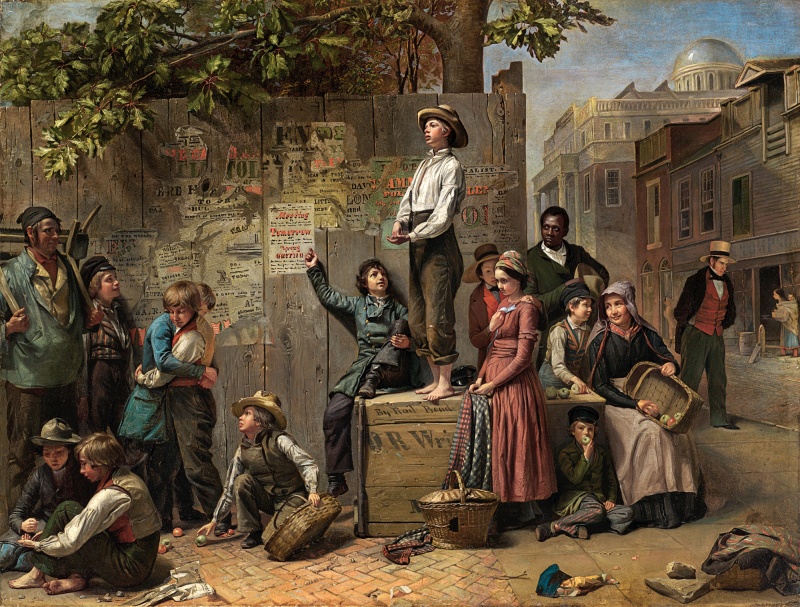
Young America by Thomas LeClear (c.1863)

In 1839 LeClear moved to New York City.  According to Tuckerman’s biography of LeClear. The young artist arrived in the city in a poor financial state but still had enough to open a studio at 1271 Broadway which he would later share with Albert Bierstadt. LeClear had said that the seven years of wandering, looking for work, were the darkest period of his life.  He reportedly studied for several years with Henry Inman, an American portrait, genre, and landscape painter, who was at that time, reckoned to be one of the city’s leading artists. By 1847 , still a year short of his thirtieth birthday,  LeClear had gained a reputation as a talented painter and had gained substantial recognition for his work. He began exhibiting at the National Academy of Design in 1845, and in the next few years several of his genre paintings were acquired by the American Art Union.

Hi-Jack Game by Thomas LeClear (c.1861)

The year was 1847 and LeClear had arrived in Buffalo, New York.  He reckoned, with Buffalo now a very busy commercial port, there would be many possibilities for a successful career. His calculations proved correct. In short order he became an important member of Buffalo’s art community and acquired many wealthy local patrons. He was a founding member of the Buffalo Fine Arts Academy which later became the Albright-Knox Art Gallery. LeClear served on its board for many years. In addition to portraits, he also produced a substantial number of genre paintings. Many of the latter were street life scenes, in which children were featured in whimsical situations. In the early 1860s LeClear moved back to New York City. where he was elected to full membership in the National Academy of Design in 1863. Within a decade of his return to the city, he was believed to be one of the most prominent portrait painters on the East Coast.

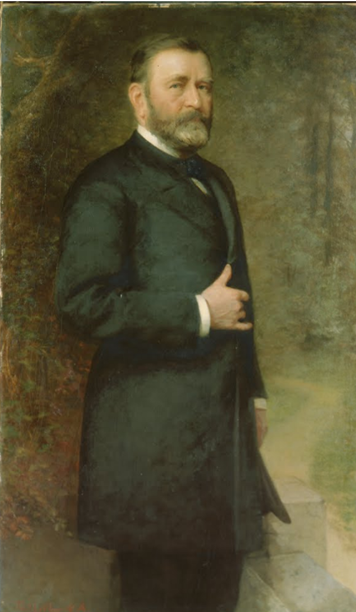
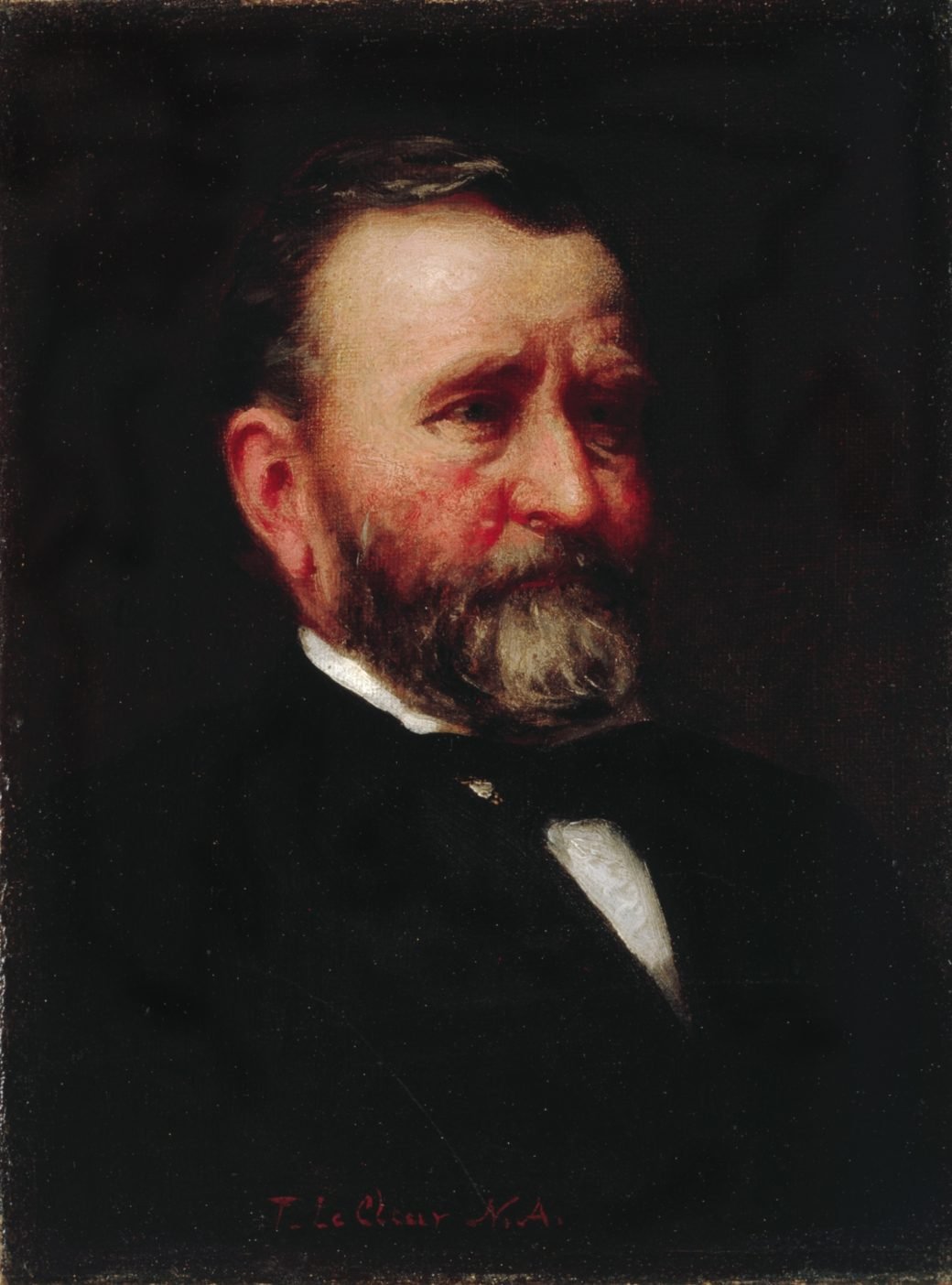
Ulysses S Grant by Thomas LeClear (c.1880)

In the spring of 1861, Ulysses S Grant looked unlikely to be remembered for his greatness. He had resigned his army captain’s commission in 1854, and was struggling to survive financially as a humble clerk. This was all to change with the outbreak of the Civil War. He reenlisted in the army, and soon worked his way up through the ranks becoming a general. By war’s end, he was commander of all Union land forces and, as the chief architect of the South’s defeat, had become one of the country’s heroes. His popularity led him to be elected as US President in 1868. Grant posed for this portrait shortly after he returned from a triumphant world tour following his presidency. Thomas LeClear painted two versions. This one was originally owned by Grant himself, while the second one became part of the White House collection.

Ulysses S Grant by Thomas LeClear (1880)

President U.S. Grant was painted in a number of portraits by Thomas Le Clear, for whom the former president sat in New York in 1879, two years after the end of his presidency. The sitting led to three portraits, two of which are in the White House whilst the other hangs in the National Portrait Gallery of the Smithsonian Institution.  This small bust portrait was not purchased by the government until the 20th century, and was produced by the painter in 1880.

Buffalo Newsboy by Thomas LeClear (1853)

Buffalo Newsboy was painted by LeClear in 1853 whilst living in Buffalo and twenty years after history’s first paperboy.  The story goes that the publisher of The New York Sun had placed an advert for newspaper hawkers stipulating that only “steady men” should apply. A ten-year-old boy, Barney Flaherty, asked to be considered and he was hired on September 4th, 1833 which is why that date is national newsboy day.  LeClear, who was a founding member and first superintendent of the Buffalo Fine Arts Academy, which would later become the Albright-Knox, and the institution has the work in its collection.

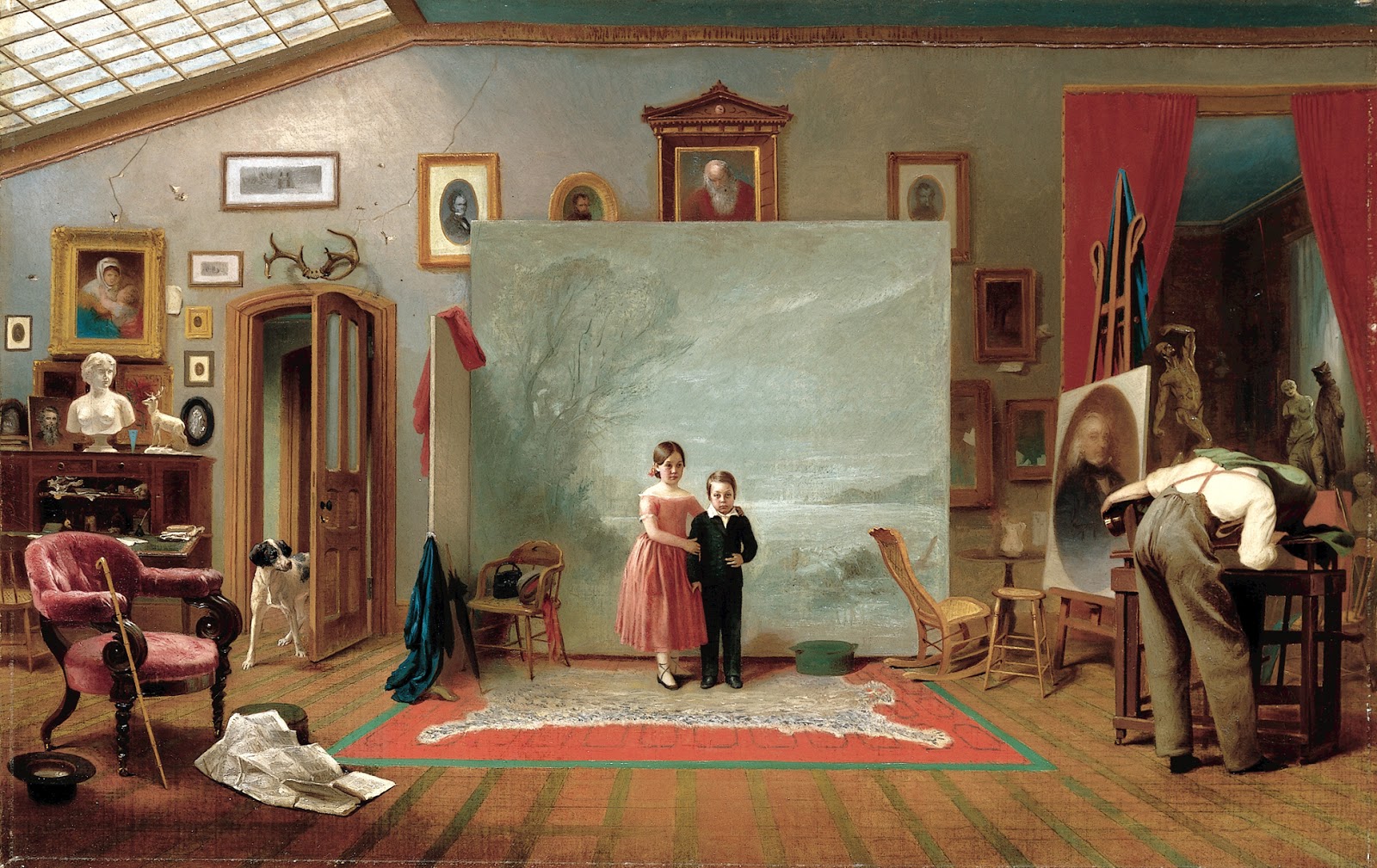
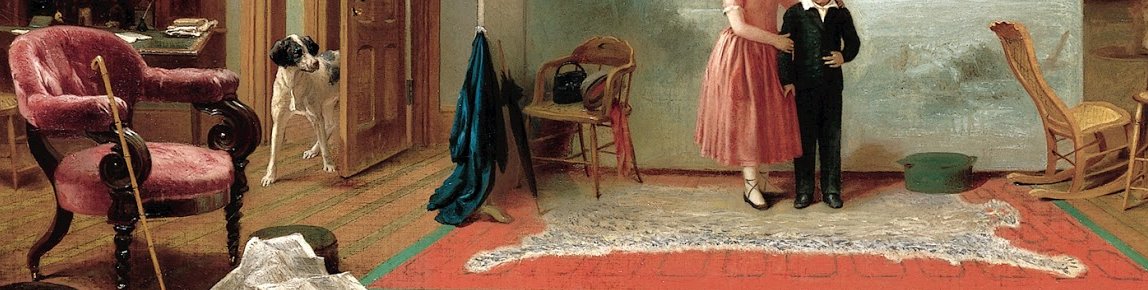
Interior with Portraits by Thomas LeClear (1865)

The most fascinating of Thomas LeClear’s works is his 1865 painting entitled Interior with Portraits.  The painting was commissioned by Franklin Sidway, an American businessman and banker from Buffalo, New York and is currently held by the Smithsonian American Art Museum in Washington, D.C.

The setting for the painting is a studio in the famous New York artist building known as the  10th Street Studio Building.  It was constructed in New York City in 1857 and was the first modern facility designed solely to serve the needs of artists. It became the centre of the New York art world for the remainder of the 19th century.  The painting depicts much of the trappings of the professional artist such as a sculpted bust, animal sculptures, prints and copies after the old masters. This was the home of an artist not a photographer.  This was the home of an artist who revered the artists of the past and their works such as the Borghese Gladiator and the Venus de Milo, copies of which we see in the studio.

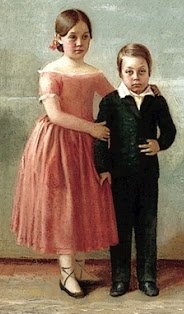
Parnell and James Sidway

In the painting we see two young children standing side by side.  These are Sidway’s siblings, James and Parnell, who are posing for a photograph in an artist’s studio. But all is not as it seems as both were dead when this painting was made.  The young boy on the right, James Sidway, was a volunteer firefighter, and had died in 1865, aged twenty-five whilst attending a hotel blaze.  The painting was commissioned by his brother shortly after James’ death.  The girl in the painting, Parnell Sidway, was an adolescent when she died of illness in 1850.  LeClear, having no live models for the portrait, has utilised family daguerreotypes to aid him.  Daguerreotypes were photographs taken by an early photographic process employing an iodine-sensitized silvered plate and mercury vapour and were invented by Louis Daguerre, a French artist and photographer.  Painting using photographs was very contentious at the time and many artists were suspicious of the practice and maybe there are references to those hostilities in the painting.  It marked the arrival of a new technological form of virtual reality into the painter’s traditional territory.  Artists everywhere felt threatened by this new photography. Many vowed never to use photographs as painting aids and would rather acclaim the very special qualities that they believed made painting superior to photography

The two children stand before a landscape painting which has become part of the photographic trickery. This fact alone must have incensed the like of the Hudson River painters and the Western landscapes painters whose works were so dominant in the public exhibition rooms at the time.

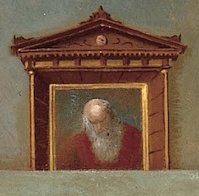
An Old Master

Look above the landscape painting and you will see an old patriarch looking disapprovingly over the scene. Is it a mere coincidence that his portrait is partly obscured by the backdrop?  Is this hinting at the Masters are being relegated to the past by the advent of photography?

There is much to see in the work regarding the tension between painting versus photography.  The children are surrounded by painted portraits, and the demonised photographer has his back to us obscuring his face.  Does this symbolise his reluctance to be part of the photography/painting argument?  Of course, early photography had its own problems especially when it involved long exposure time and it being necessary for the subjects remaining absolutely still during the long exposure. Children were a special challenge for photographers. They sometimes used braces and ties and other torturous to keep people from moving.   Note in this painting how the girl holds onto her brother to stop him moving as a comment on the “keep still” factor.

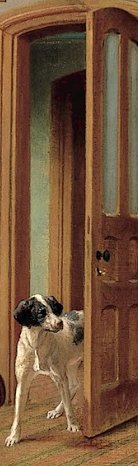
Dog at the door

In the doorway we see a dog is depicted just about to rush into the studio, again highlighting the problem with photography as opposed to painting.  But what happens when the dog chooses just that moment to come in? Well, if you’re an artist, you would capture the moment of him in the doorway. However, if you’re a photographer, you would probably have to start over again.

Three empty chairs

Looking closely at the work of art we have another conundrum to solve.  There are three chairs dotted around but none have a sitter. One, which is positioned in front of the easel, which holds a painting of a bearded man. This had presumably once been occupied by the artist. On another chair we see a lady’s hat, shawl, and purse and the third unoccupied chair with its walking stick and discarded newspaper must have once been occupied by a gentleman.  But where are the three now? The answer is probably quite simple – they are all out here with us, the viewers. We are all standing side by side just outside the picture frame, watching the scene before us. So LeClear is now telling us that instead of there only being three people involved in the painting, there were actually six ! 

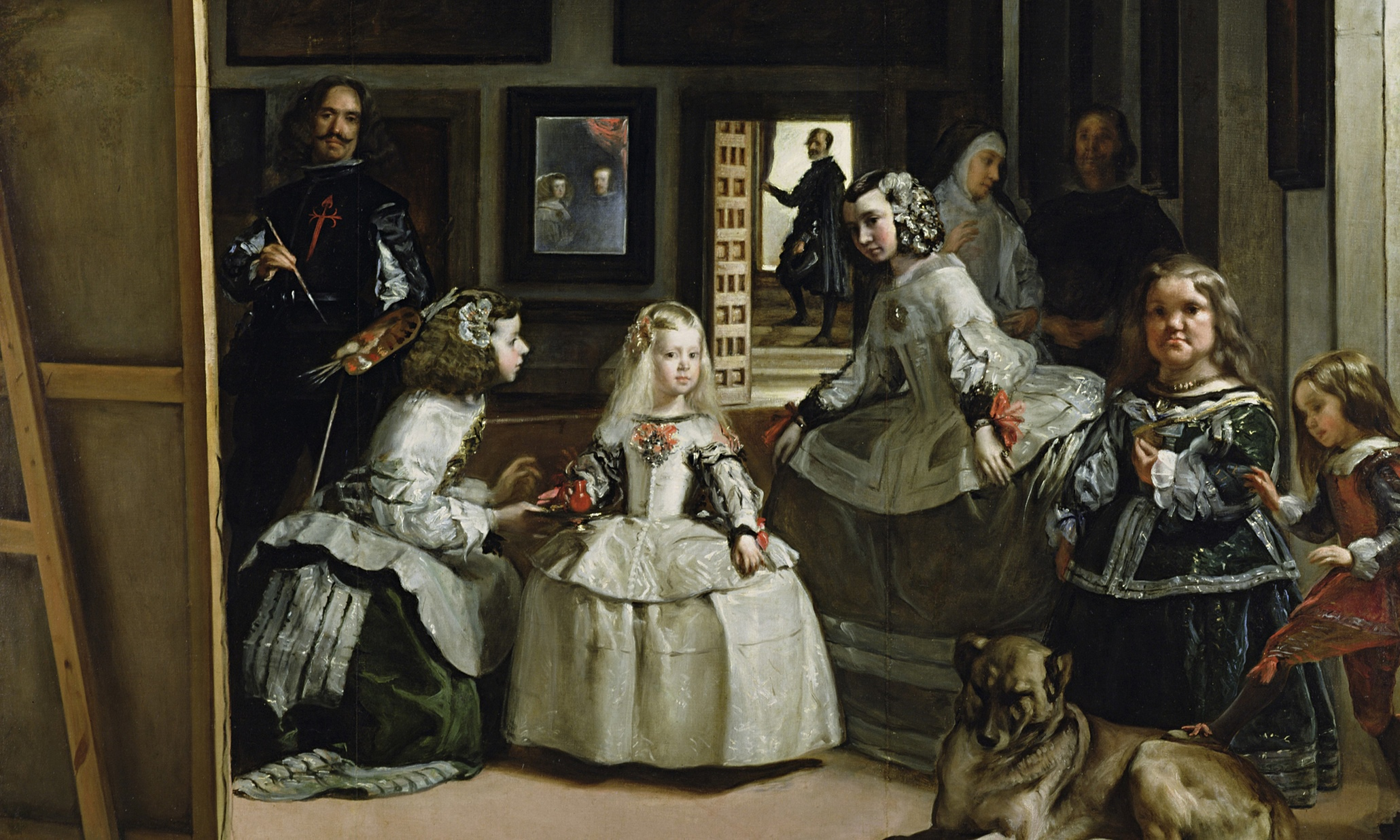
Las Meninas by Velazquez

It is thought that by using this illusion he was paying homage to Velazquez’z painting Las Meninas, which if we look at the figures in the mirror, used the same stratagem.

Two years after completing his portraits of the former president Ulysses S Grant, Thomas LeClear died of pleurisy in Rutherford Park, New Jersey on November 26th 1882 at the age of sixty-four. His wife Caroline had died thirteen years earlier when only forty-six-years of age.

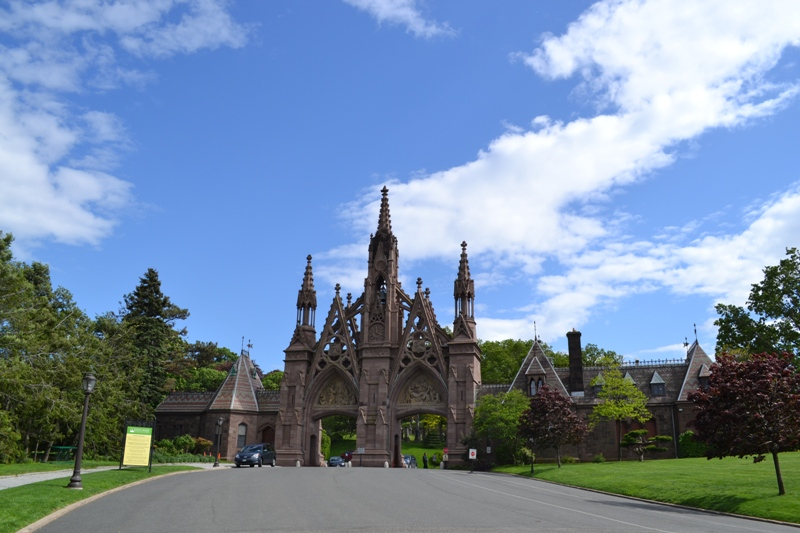
Green-Wood Cemetery, Brooklyn.

The two lie together in Green-Wood Cemetery, Brooklyn, Kings County, New York.

Mary Blood Mellen and Fitz Henry Lane – Pupil and Master.

Mary Taylor Blood was born on May 13th, 1819.  Her father was Reuben Blood, Jr. and her mother was Sally Taylor Blood and they lived in Sterling Massachusetts.  Mary had two older brothers but was the eldest of four sisters.  When she was still only a child, she was enrolled in Miss Thayer’s school, where she learned to paint with watercolours. Having shone as a potential artist she later moved to the Quaker’s Fryville Seminary in Bolton, Massachusetts.  This school was established in 1823 by Thomas Fry, a local Quaker, as a co-educational preparatory school.  It was here that she improved her skill as an artist and developed her early talent for sketching and painting.

Taking in the Sail by Mary Blood Mellen

Whilst still a teenager, the family moved to Fitzwilliam, New Hampshire and as fate would have it a young Universalist minister, Reverend Charles W. Mellen, arrived to act as pastor in the neighbouring towns. Reverend Mellen came from a family of farmers from nearby Phillipston and soon after, he and Mary met and the couple fell in love. In 1840 Mary and the Reverend Charles Mellen, married and went to live in Gloucester, Massachusetts.  Mary and her husband relocated many times due to his pastoral work and in 1846 while living in the Massachusetts town of Foxborough, Mary gave birth to a daughter, Amanda. Sadly the baby only survived for forty-eight hours and the gravestone they erected at the site of the grave had the poignant inscription:

“…Our short-lived flower returned unto God…”

Even sadder was the fact that the couple never had any other children.  Mary was fortunate that she had the support of her husband during these sad times and he was also very supportive with regards Mary’s artistic work.

Field Beach, Stage Fort Park by Mary Blood Mellen (c.1850)

Mary’s brother-in-law, William Grenville Roland Mellen, was also a Universalist minister and in the late 1840’s had his ministry in Cambridge Massachusetts and Mary and her husband made a number of visits to visit him in the city.  Cambridge was a metropolitan suburb of Boston and at the time Boston was considered to be the New England’s centre of culture.  In the city there was the Boston Athenaeum which is one of the oldest independent libraries in the United States.   In the years 1872–1876, Boston’s Museum of Fine Arts exhibited in the Athenaeum’s gallery space while waiting for construction of its own building to be completed and at that time it boasted the largest art collection in New England.  One can be sure that Mary Mellen, whilst visiting her brother-in-law and his family, found time to visit the building and discover the artistic treasures it held.  Some of the works on display which Mary would have seen were by the American painter and printmaker, Fitz Henry Lane.

Ship at Sea by Mary Blood Mellen

Fitz Henry Lane was born in the fishing port of Gloucester, Massachusetts on December 18th,1804.  He was actually born Nathaniel Rogers Lane but in 1831, when he was twenty-seven, he legally changed his first and middle names, becoming known as Fitz Henry Lane. He suffered various illnesses as a young child.  The most severe was paralysis due to infantile polio and after this illness he had to use crutches. Lane learned the basic art techniques while in his teens and in 1832 he started work with a firm of lithographers in Gloucester. Later in 1832, he moved to Boston for formal training and enrolled as an apprentice with William S. Pendleton, who owned one of the city’s most important lithographic firm. Lane stayed working for Pendleton until 1837, during which time he produced many illustrations for sheet music and scenic views.

Salem Harbour by Fitz Henry Lane (1853)

Whilst living in in Boston, Lane became aware of the artistic works of the English-born artist Robert Salmon, who was looked upon as the most accomplished marine painter in the area. Works of art by Salmon with their precisely detailed ships and sharply rendered effects of light and atmosphere had a pivotal influence on Lane’s early style. By 1840, Lane had produced his first oil paintings and soon he was listed in a Boston almanac as a “Marine Painter.” His works were first exhibited at the Boston Athenaeum in 1841 and, after 1845, his works were regularly shown there.

Clipper Ship Sweepstakes by Fitz Henry Lane (1853)

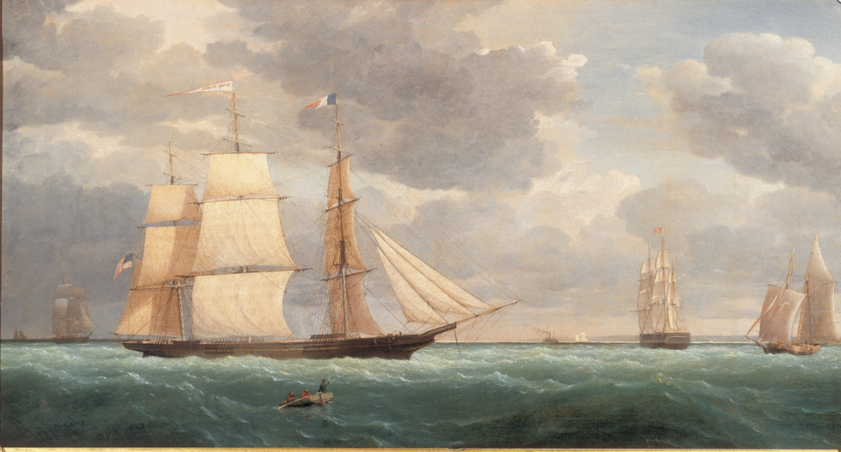
One of his very fine ship portrait is his 1853 painting entitled Clipper Ship Sweepstakes. The work is thought to be a pendant piece of his 1854 work entitled The “Golden State” Entering New York Harbor, The Golden State was another clipper ship owned by Chambers and Heiser who probably commissioned both works.

The Golden State entering New York Harbor by Fitz Henry Lane (1853)

This large work, The Golden State entering New York Harbor, was some four feet wide, and is considered one of Lane’s masterpieces.  The location in the depiction is not known, but it could well be the broad bay at the mouth of New York harbour. It is a blustery day with scudding clouds and a frothy chop in the very green water. The ship is flying a blue-and-white swallowtail pennant with a red tail—the house flag of Chambers and Heiser—on its foremast. An American flag flies off its stern.

View of Coffin’s Beach by Fitz Henry Lane (1862)

However, although there is no evidence that Mary Blood Mellon was formally apprenticed to Fitz Henry Lane, his early years spent working in various lithography workshops would have impressed upon him the value of having an apprentice and the connection became an asset to both the master and the student. By the mid-1850s, it seems that Mary Mellen was working alongside Lane in his Gloucester studio, and the “coupling” was working well as it appears that Lane had given Mary free access to his drawings and on some occasions allowed her to make copies from his canvases.   Her copies were so good and her stylistic faithfulness increased, such that, at a later time, even Lane himself appeared uncertain as to which was his when both were shown side by side. 

Owl’s Head, Penobscot, Maine by Fitz Henry Lane in 1862

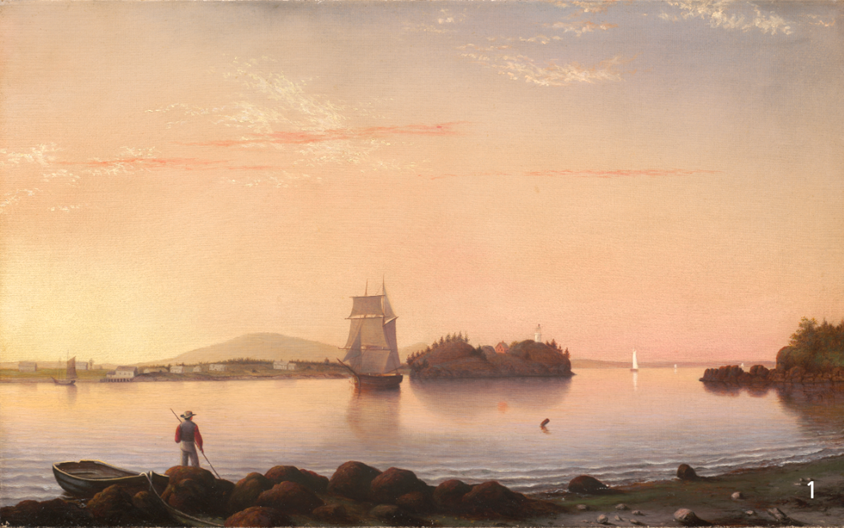
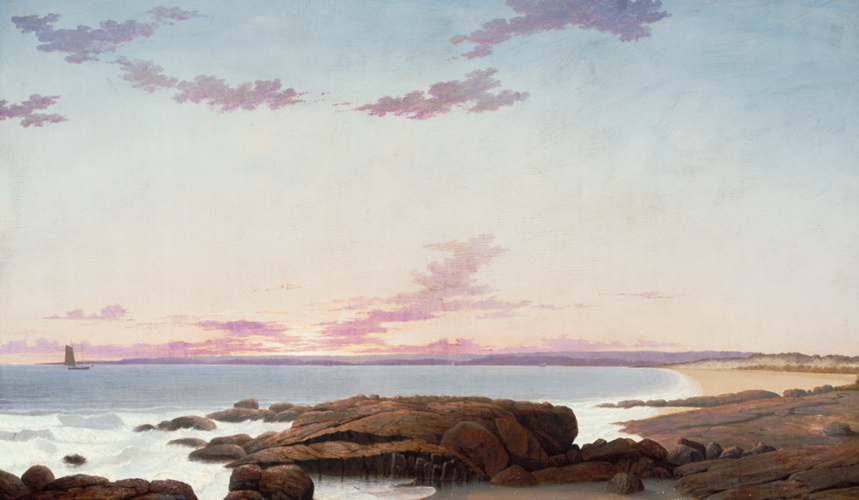
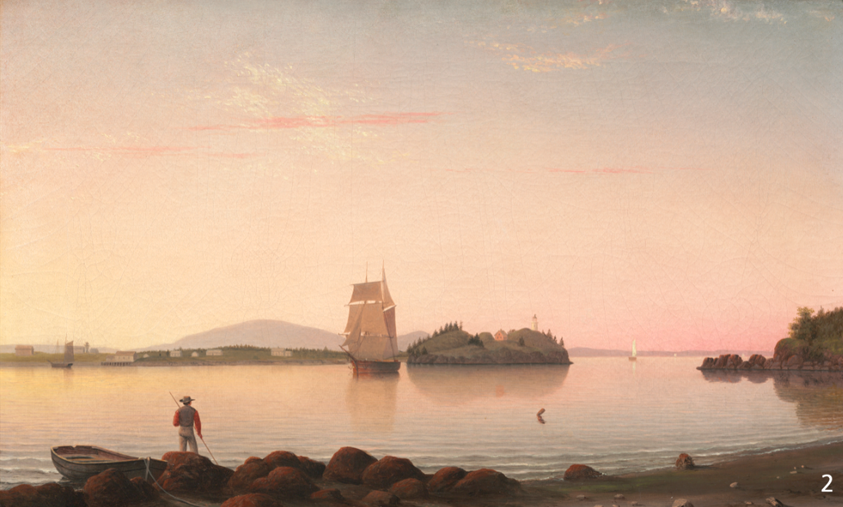
A classic example of the this can be seen when you look at both their renditions of a scene entitled Owl’s Head, a coastal town in Knox County, Maine.  Fitz Lane completed his painting (2) Owl’s Head, Penobscot, Maine in 1862.   Lane painted Owl’s Head, (1), named for its distinctive profile, from the east, with the Camden Hills beyond. The land formations delicately mirrored in still water, the clear sky, and the pale, salmon colours of early morning emphasize the atmosphere rather than the topography of the site.  On the back of the painting, an inscription in Lane’s handwriting establishes it as his own work: Owl’s Head–Penobscot Bay, by F.H. Lane, 1862.

Owl’s Head by Mary Mellen (1860’s)

The curators and conservators of the Museum of Fine Arts, Boston compared paint application and the use of colour in the paintings by Mellen (1) and Lang (2). In general, they stated that Lane’s brushstrokes seem crisper, and he more precisely defines compositional elements such as the pine trees. They also concluded that Lane’s palette is also cooler than Mellen’s. Yet on careful examination, they agreed that these details can sometimes be too close to definitively separate the authorship and it could be entirely possible that, in studio tradition, Lane contributed to Mellen’s paintings, even if she signed them, and this complicates the issues of attribution even further.

Mary Mellen was said to have copied Lane’s style so that even he could not tell which was his own painting. In his 2006 book, Fitz H. Lane: An Artist’s Voyage through Nineteenth-Century America (2006), the author James A Craig wrote:

“…Mrs. Mellen is so faithful in the copies of her master that even an expert might take them for originals. Indeed, an anecdote is related of her, which will exemplify her power in this direction. She had just completed a copy of one of Mr. Lane’s pictures when he called at her residence to see it. The copy and the original were brought down from the studio together and the master, much to the amusement of those present, was unable to tell which was his own, and which was the pupil’s…”

This copying was not unusual in an artist-apprentice relationship.  What confuses some art historians as to the attribution of a painting as it appears as though Mellen had a hand in completing parts of several Lane paintings, or may have even sketched certain landscape views that would have been difficult for Lane to access, given his lameness

Coast of Maine by Fitz Henry Lane and Mary Mellen (c.1850)

There is only one known work signed by both Lane and Mellen, and this is their 1850’s work entitled Coast of Maine. Both Mellen and Lane signed the back of the canvas of the small tondo.

Blood Family Homestead (ca. 1859) by Mary Blood Mellen

In August 1859 Mary Mellen and Fitz Henry Lane travelled together to to visit the Blood family residence in Sterling, Massachusetts, where they both created paintings of the Blood homestead with the two paintings depicting a different season.

FITZ HENRY LANE (Massachusetts, 1804-1865), "The Blood Family Homestead"., Oil on canvas, 18" x 30". Framed 22" x 35".
The Blood Family Homestead by Fitz Henry Lane

It is thought that by 1861 the Mary Mellen and her husband were living in Dorchester, Massachusetts, which was only a short distance from Gloucester. Three years later, the couple moved again, this time to Taunton, Massachusetts, which was about forty miles south of Boston.

Mary Mellen suffered duel losses in the mid 1860’s.  Fitz Henry Lane had been unwell throughout 1864 and 1865 and this culminated in a bad fall in August 1865, followed by a heart attack. He died in his home on Duncan’s Point on August 14th, 1865 and is buried in Oak Grove Cemetery. One of Boston’s newspapers described his death as “a national loss,” however Lane’s reputation during his lifetime was mainly local and after his death he and his works were largely forgotten outside Gloucester. A year later Mary’s husband, Reverend Charles W. Mellen, died suddenly and unexpectedly at the age of forty-eight.  Following Lane’s death in 1865 and Charles Mellen’s death in 1866, Mary Mellen, now widowed and childless, moved to Connecticut to live with her widowed sister-in-law, Sophronia Haskell.

Fitz Henry Lane (c.1860’s)

Mary Mellen carried on painting until her death on February 11th,1886, when she died of typhoid at the age of sixty-six in Sterling, Massachusetts. Her passing was noted in several newspapers with obituaries acclaiming her as “a woman of great acquirements and an artist of prominence. Her specialty was marine work and her pictures were very popular.” Her will, which she had made in 1882 stipulated to which niece and nephew each of her original paintings by Fitz Lane should go. She also insisted that Lane’s nephew Fitz Henry Winter should receive a painting by Fitz Lane, as well as a portrait of him that was in her collection.  In recent years, art historians recognize Mary Blood Mellen as one of the most accomplished artists to work on Cape Ann in the years immediately preceding the Civil War.

Barber Institute of Fine Arts. Part 3.

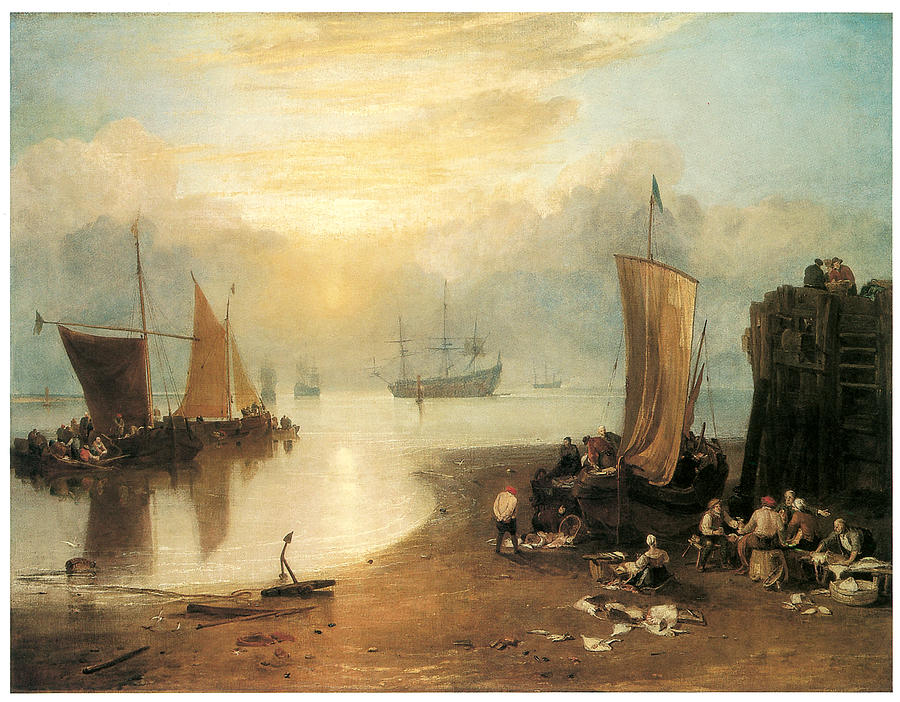
The Sun Setting Through Vapour by Turner (c.1809)

Joseph Mallord William Turner’s painting The Sun Rising Through Vapour was described at the time as masterly, and his early reputation was founded on a series of dramatic seascapes that he regularly showed at the Royal Academy, the British Institution and in his own gallery until about 1810.  The sun disperses the clouds and infuses sand and sea with a golden glow. In the foreground against a seascape with the setting sun which casts a golden light over the entire picture, we see a group of fishermen and women unloading their catch and laying it out on the beach for sale.    In the distance we see a number of ships at anchor including a man-of-war and a dismasted hulk which was being used as a prison ship, which is a stark reminder that at the time Turner completed the work, France and England were still at war.  Turner painted numerous marine subjects early in his career. As here, he sought to make his reputation by matching the Dutch masters of the 17th century.  Throughout his life Turner was fascinated with including the sun in his paintings

See the source image
The Sun Rising through Vapour by Turner (1807-09). National Gallery London

A similar painting can be found in the National Gallery, London entitled The Sun Rising through Vapour. The setting is low tide in the early morning and fishermen unload their catch from a boat beached high and dry on the shore. Some of the people are partaking of a meal whilst others prepare the catch for sale. There is a noticeable contrast between the human activity on the shore with the stillness of the glassy sea which, like a mirror, reflects the hazy sunlight. The sun is just a pale yellow glow and has yet the power to burn off the sea mist which is alluded to with the word ‘vapour’ in the picture’s title.

See the source image
The Adoration of the Magi by Bassano (c.1556)

My next offering is by the Italian painter, Jacopo dal Ponte, better known as Jacopo Bassano, named after, Bassano dal Grappa, a village northwest of Venice, where he was born in the first decade of the sixteenth century.  He was probably first trained by his father, Francesco, before becoming an apprentice in Bonifazio Veronese’s large Venetian workshop. He was mainly active, throughout his long life, in Bassano, where he painted landscapes and genre scenes. In his painting, Adoration of the Magi sometimes known as the Adoration of the Kings he depicted the Three Kings, or Magi, carrying their gifts, as they approached the infant Christ. It’s a scene that has been caught countless times on canvas.  Despite their status and wealth, they bow to Christ who they acclaim as the King of Kings. The setting, is the inside of a ruined classical building and has a symbolic meaning.  The decaying building symbolises the decline of the pagan world and the old gods.  They will be further ruined as a result of Christ’s divine mission. Look at the various aspects of this picture.  Look how Bassano has painted the sumptuously extravagant robes and depicted a splendid collection of animals and servants. Look how the light comes through the decaying architecture and settles on the head of the baby Jesus.  This is looked upon as being a light source emanating from God the Father.

Visual search query image
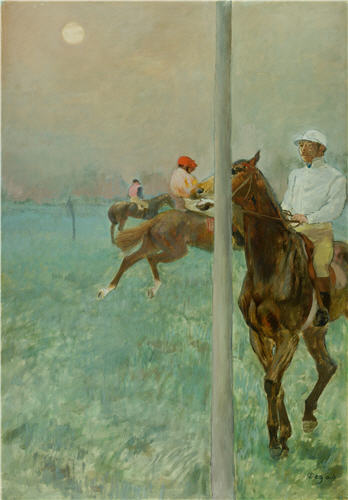
Jockeys Before the Race by Edgar Degas (1879)

I wrongly associated paintings solely depicting ballerinas with the French painter Edgar Degas but in fact he had another favourite theme for his work – horse racing.  Horse racing was a popular pastime in the nineteenth century in  France under Louis-Philippe and Napoleon III. Degas became fascinated by the sport while visiting friends in Normandy. During his lifetime, Degas created forty-five oils, twenty pastels, two hundred and fifty drawings, and seventeen sculptures related to horses.  One such work featuring horse racing is in the Barber Institute collection, entitled Jockeys Before the Race.   It is a painting, made using oil essence, gouache, and pastel, which he completed in 1879.  It is an image of three jockeys on horseback readying themselves at the start of a race on a dull winter’s day with its watery sun. This very large work (107 x 73cms) was exhibited at the Fourth Impressionist Exhibition in 1879.  There is a definite lack of symmetry about this work as the vertical starting post is placed two-thirds from the left-hand side.  The warm red and pink colours of the jockey’s clothes on the left of the painting are balanced by the lighter white/blue colours of the clothes worn by the jockey, who sits astride his horse in the right foreground.

The Castle by the Sea
Castle by the Sea by Caspar Nepomuk Scheurer (1860)

My next choice of painting is both unusual and yet strangely beautiful.  It is a 1860 watercolour over pen and pencil, partly heightened with white and gold work by Caspar Nepomuk Scheuren, a German landscape painter and etcher.  It is thought to have been commissioned as a prize in a lottery held by Kristiania Kunstforenings, Oslo, the oldest art gallery in Norway, which is why the Norwegian coat of arms is at the top centre of the work.   It is an elicitation of a poem by the German nineteenth century poet, Ludwig Uhland which tells of a legendary magical castle, depicted in the centre of the painting, which reaches up towards the moonlit sky and down to the shimmering sea.   On one side we see a king and queen and on the other, their musical daughter, who serenades passers-by with a tearful lament, whose premature death forms the focus of the poem’s lament. The castle and characters are surrounded by an architectural framework, in which the separate compartments serve to isolate episodes of the unfolding narrative.  The tragic fate of all three characters is depicted at the bottom of the painting.  In the centre the king and queen are seen dressed in mourning clothes.  To the left we see the tomb of their daughter and to the right we see a depiction of their own tomb.  Below is the poem which tells the sad story.

The Castle By The Sea

By Johann Ludwig Uhland

‘Hast thou seen that lordly castle, 
That Castle by the Sea? 
Golden and red above it 
The clouds float gorgeously. 

‘And fain it would stoop downward 
To the mirrored wave below; 
And fain it would soar upward 
In the evening’s crimson glow.’ 

‘Well have I seen that castle, 
That Castle by the Sea, 
And the moon above it standing, 
And the mist rise solemnly.’ 

‘The winds and the waves of ocean, 
Had they a merry chime? 
Didst thou hear, from those lofty chambers, 
The harp and the minstrel’s rhyme?’ 

‘The winds and the waves of ocean, 
They rested quietly, 
But I heard on the gale a sound of wail, 
And tears came to mine eye.’ 

‘And sawest thou on the turrets 
The King and his royal bride? 
And the wave of their crimson mantles? 
And the golden crown of pride? 

‘Led they not forth, in rapture, 
A beauteous maiden there? 
Resplendent as the morning sun, 
Beaming with golden hair?’ 

‘Well saw I the ancient parents, 
Without the crown of pride; 
They were moving slow, in weeds of woe, 
No maiden was by their side!’

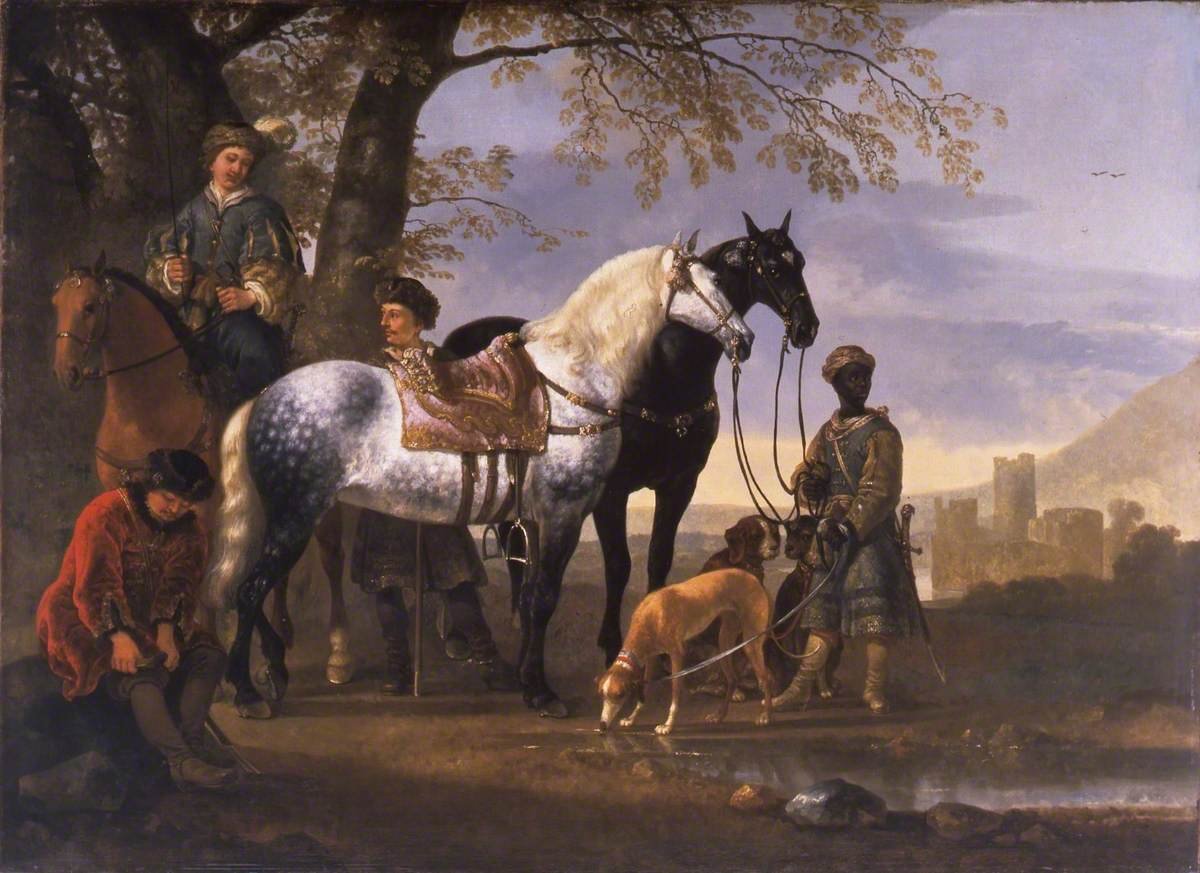
Huntsmen Halted by Aelbert Cuyp (1655)

One of my favourite Dutch painters and one who is regarded as one of the finest artists of the so-called “Golden Age” of Dutch painting, a period during and after the later part of the Eighty Years’ War (1568–1648) for Dutch independence is Aelbert Cuyp.  Cuyp was born and raised in the town of Dordrecht where he completed paintings for his patrons.  His notoriety as a great painter only came the late eighteenth century when British aristocratic collectors began to collect his pictures.  His works were admired for the way he combined his figures with his beautiful landscapes and the British aristocracy particularly liked his many depictions of equestrian and hunting themes.  Although Cuyp did not visit Italy himself, but he studied those Dutch artists who had been there and who had adopted the poetic light of the paintings by the French artist, Claude Lorrain.  In fact, Cuyp was dubbed the Dutch Claude.
In this work we see a party of hunters at rest under the shade of a large tree.  The huntsmen we see depicted are the three sons of Cornelis van Beveren, Cuyp’s wealthiest patron. De Beveren was the most powerful man in mid-seventeenth century Dordrecht.  On five occasions he had been appointed burgomaster of the town, representative to the Staaten-General and ambassador to England, as well as to France.  The van Beverens were not classed as aristocrats but undoubtedly prosperous members of the so-called “striving classes” – the nouveau riche.
The three riders wear fashionable Hungarian hunting costume and are accompanied by an exotically dressed black servant, another sign of their wealth. Why Hungarian costumes?  The reason was probably because Hungarians were admired by the Dutch not only for their famed equestrian skills but also for their staunch support of the Protestant cause, which also reflected a newfound sense of Dutch national pride and independence from the Catholic Spanish rule. The depiction shows the hunting party has come to rest in a landscape bathed in a warm golden light more associated with southern Europe than Holland. The right to hunt had once been jealously guarded by royalty and aristocracy, and thus those who hunted were afforded a traditional mark of the very highest status.  However, in the region of Zuid Holland, which governed Dordrecht, regulations had been altered in 1623 expanding hunting privileges to owners of country estates and to citizens with an annual income of more than 100 guilders.

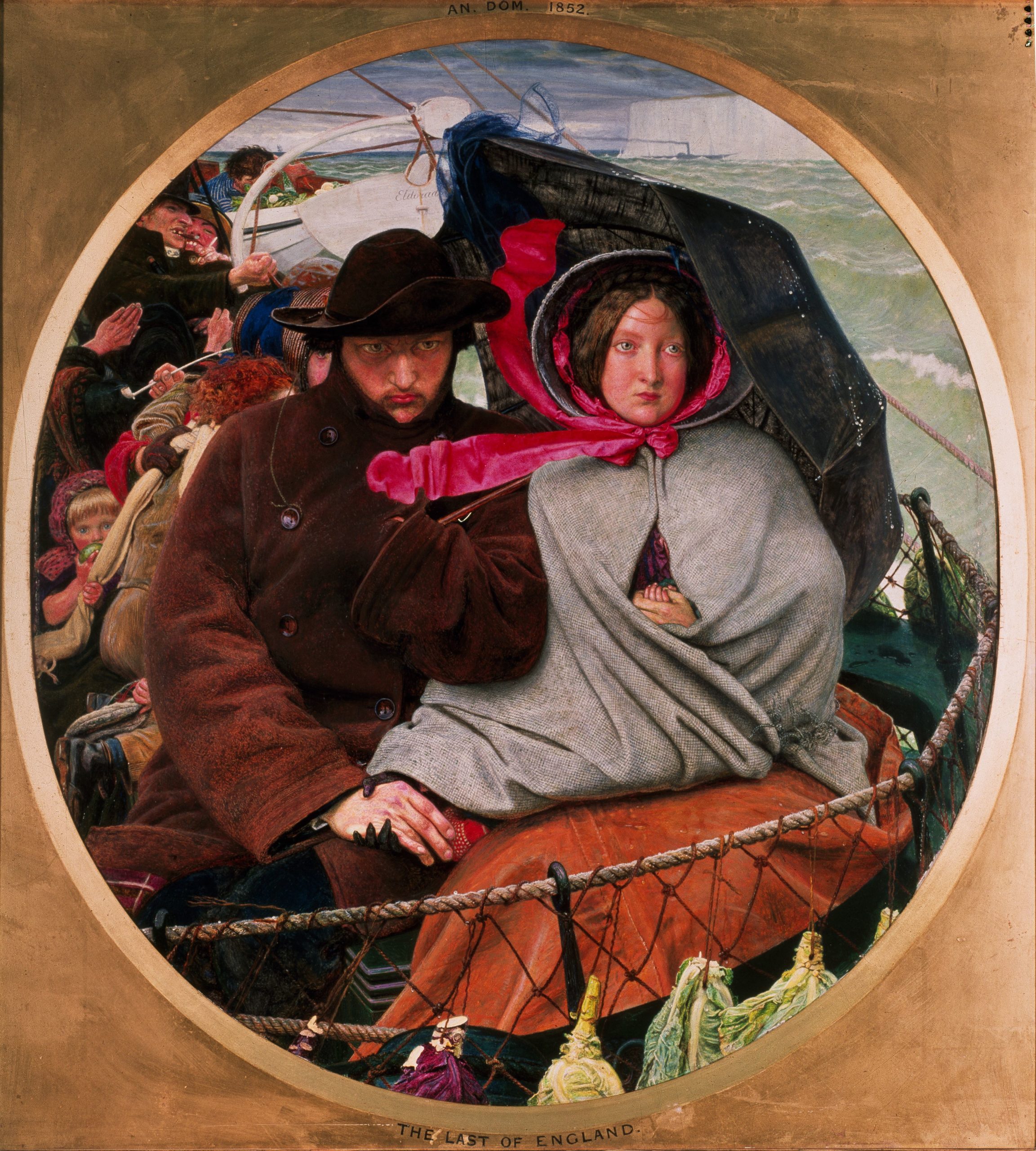
The Last of England by Ford Madox Brown (1855)

For my last offering I want to look at a painting which is part of the collection usually on display at Birmingham Museum and Art Gallery, but as I said at the start of Part One of this blog, the main Birmingham Museum is closed for renovations and this painting was then loaned out to the Barber Institute.   The Last of England was completed in 1855 by the leading Pre-Raphaelite artist Ford Madox Brown and is recognised as a masterpiece of Victorian painting. In the depiction we see a young family huddling together on an open boat as they say farewell to the shores of England and head off to find a better life and a fresh start in Australia.  This oval shape of the work which is almost circular, makes us concentrate our focus on the faces of the young couple, who have literally turned their backs on their homeland.   In the picture we see a father, mother and two children wrapped up well against the cold sea breezes as the ship leaves the familiar shores of their English homeland.   The picture, in some way, was inspired by the emigration to Australia of Maddox Brown’s friend, the sculptor Thomas Woolner in 1852.  It is ironic that although Maddox Brown started the painting the year Woolner departed from England, he had returned to England the following year, disillusioned by the false promises of wealth to be had from the gold rush.  This was some two years before Ford Madox Brown had completed the work.  Thousands of working-class and lower middle-class people, who were totally disillusioned with their life of poverty and slum-like dwellings of England, just packed up the few possessions they had and made this long and momentous journey to the other side of the world.  There were about fifty thousand free immigrants arriving each year in Australia.  The immigrants were following their dream and although they believed the “grass would be greener” for them in Australia, they would a little as to whether they had made the right decision.  Such worry and doubt was etched on the faces of the couple in the painting and in some ways we can empathise with them even though we know they had a free choice in the matter. 

In the background we can make out the white cliffs of England as they fade away in the distance.  This rock structure of white chalk is often depicted in paintings which highlight the coast of England.  In contrast to the white rock formation, we see a black steamship, with billowing black smoke coming from its funnel, heading for port.  The ship that the family is sailing on is surrounded by choppy green seas topped with white crests and this may in some way allude to the testing and difficult times ahead for our emigrants.  It is interesting to see in the foreground netting around the lifeboat deck, hanging on which are some of the ship’s fresh vegetable supplies.  We can see some cabbages and wonder how long they will remain fresh during this long, probably six-to-eight-week journey.  If we look behind “our family” we can see a small child wearing a pink bonnet, her right hand grasping the scarf warn by her mother, whilst she eats an apple held in her other hand.  Somebody, slightly hidden from view, can be seen smoking a long clay pipe but the characters that amuse me the most, and who are just visible in the background in this painting, are a pair of angry men arguing.  The man wearing the top hat has turned away and as he looks back at the departing coastline, waves his fist at it.   To this man, his departure from England is a thing of joy and for some reason he seems to be cursing the country he has just left behind.

The main characters in this painting are the father and mother and these are portraits of the artist himself and his second wife and beloved model Emma Hill.  The small fair-haired girl in the background eating the apple is their daughter Katty and the baby hidden from view is their son, Oliver.  The father is tightly wrapped up in his warm brown woollen coat.  His hat is being buffeted by the strong winds but see how there is a “safety string” from the hat attached to and wrapped around a button of his coat.  The sight of the father with his grim determined face says it all for me.  This is a journey into the unknown and probably he is still racked with doubt with regards his decision to remove his family from the safe environment of their home and whisking them off to a foreign land.  It still troubles him but he knows that he and his family cannot go back now and so his resolute look tells us that he is determined to see the venture through to its conclusion.  The look on the face of his wife is indicative that she too has concerns about their venture.  Her small, slim black leather gloved-hand tightly grasps her husband’s bare workman-like hand, the force of which wrinkles his skin.  It is, in a way, a sign that she supports him and it lets him know that fact.   Her other hand is holding the tiny fingers of the baby she cradles in her arm and which is hidden from view inside her warm woollen cape.  She is wearing a pink bonnet which is partly covered by the grey hood of her cape but we see the pink ribbons of her bonnet flying horizontally in the gale-force wind.   It is a touching picture of a family on the move.

This tense and challenging time for our emigrants was mirrored by the testing times felt by the artist himself.  Commenting on his frame of mind at the time of the painting, Maddox Brown said:

“…I am intensely miserable, very hard up and not a little mad…”

And it was at these times that he, himself, thought about emigrating to Australia.

That is my final blog about the works held in the Barber Institute of Fine Arts’ collection and if you ever visit Birmingham, England, I hope you will visit this excellent institution.

The Barber Institute of Fine Arts. Part 1.

I had a short city break in Birmingham the other day when I had intended to visit some of the main art galleries.  Unfortunately, the main Birmingham Museum and Art Gallery in the centre of the city was closed until late April, for essential electrical works and so I was able to concentrate my cultural journey on a visit to the Barber Institute of Fine Arts at the centre of the Birmingham University Campus.  I had been here once before, five years ago and especially fell in love with two of the paintings.   The Barber Institute is a smaller gallery in comparison to the main one in the Birmingham centre and yet it is full of artistic treasures by the most famous artists.  In my next three blogs I will introduce you to and tell you about some of the wonderful paintings in their permanent collection, so as to tempt you to visit the museum.

See the source image
The Barber Institute of Fine Arts, Birmingham, England.

The Barber Institute of Fine Arts is housed in one of Birmingham’s finest Art Deco buildings and was opened in 1939.  The architect tasked with designing the building was Robert Atkinson, one of Britain’s leading architects of the 1920s and ’30s. The building is laid out around the central music auditorium, surrounded by corridors. On the Ground floor these form offices and lecture halls for the Departments of Music and History of Art, as well as a dedicated Art History library. The galleries occupy the same space on the first floor, approached by a stunning travertine staircase directly opposite the entrance.

See the source image
Ramsau by Thomas Fearnley (1832)

The first painting I want to present to you is one of my all-time favourite landscape works.  The 1832 work, entitled Ramsau, is by Thomas Fearnley.  Fearnley was born in Norway, but studied abroad, often with his fellow countryman Johan Christian Dahl.  It was whilst working alongside Dahl that Fearnley developed the habit of painting directly en plein air.  Fearnley was travelling to Italy when he and his party stopped at the village of Ramsau, a small town located on the Königssee in the district of Berchtesgadener Land in Bavaria.  In the painting we can see the road winding and disappearing around a corner of the village before we catch a glimpse of it again as it heads off towards their destination, the snow-covered Alps and the beautiful snow-capped Hoher Göll, which straddles the border between the German state of Bavaria and the Austrian city of Salzburg.    It is such a beautifully tranquil scene.  In the middle ground of the depiction, we see a lone farmer collecting hay.  Such hard work was so important so as to have food for his animals during the harsh and bitterly cold winter, which was fast approaching.  This en plein air work would have taken Fearnley several sittings during the week-long stay, on each occasion adding another layer of colour.

The Wrath of Ahasuerus by Jan Steen (c.1670)

I have always loved the works of the Dutch Golden Age painter, Jan Steen, so I was pleased to see one of his works in the Barber Institute’s collection.  It was not one of his exuberant genre scenes but a Biblical painting.   It was his painting The Wrath of Ahasuerus which he completed around 1670.  The characters who appear in the painting come from the Old Testament Book of Esther.  The depiction before us is an episode in the life of the Persian king Ahasuerus and his Jewish wife Esther.  King Ahasuerus had sought a new wife after his queen, Vashti, had refused to obey him, and Esther, the adopted daughter of the Jew Mordecai, was chosen for her beauty.  The subject of the painting is from Esther vii, 1-7.  Haman, the king’s First Minister had issued a decree that all the Jews in Persia should be killed.  Esther, the wife of the king, held a banquet and at it she confessed that she was a Jew, and that she too was threatened by Haman.  So we see in the painting, on hearing what his wife had to say about Haman, her husband jumps up in a violent reaction to what he has just heard.  Ahaseurus explosive and exaggerated gesture, eyes bulging, red in the face, fists clenched, jumps up knocking over a vase and the peacock pie.  Haman, on the left, cowers away from the king’s fury. The peacock is a symbol of pride and is a reference to Haman’s fallen pride and his downfall.  The king ordered Haman to be hung.  This story of Esther’s triumph over the evil Haman was popular with the Dutch people who could see the similarity between her battle and their plight against the mighty, and in their eyes, the evil Spanish invaders and occupiers of their country, being a similar story.

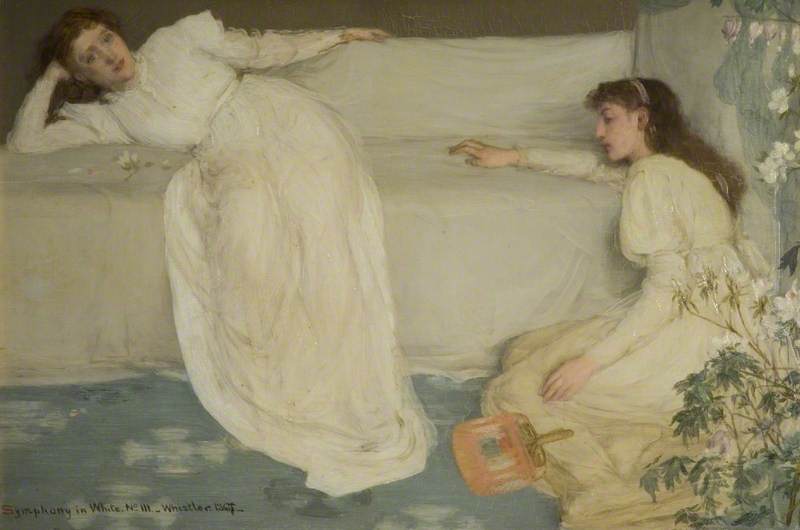
Symphony in White, No. III
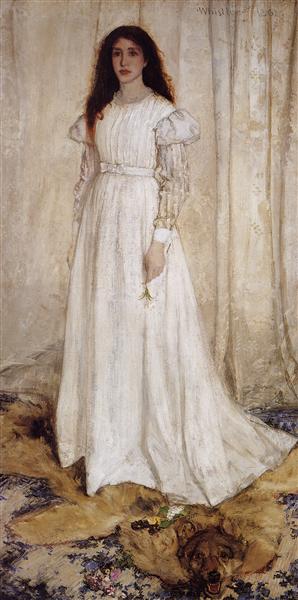
Symphony in White No. III by James McNeill Whistler (c.1867)

James McNeill Whistler completed Symphony in White No. 3 in 1867 and it is now part of the Barber Institute collection.  It was thought to have been originally entitled Two Little White Girls.   Two women are depicted in the painting.  One, sitting on a sofa, is Joanna Heffernan, Whistler’s mistress.  The other, resting on the floor in the cream/yellow dress, is Millie Jones, the wife of an actor friend.  Laying on the floor is an Oriental fan which is a reminder of the popular Japonisme cult of the time.  Japonisme was a French term that referred to the popularity and influence of Japanese art and design among a number of Western European artists in the nineteenth century.  Whistler had embarked on this painting in July 1865 and within a month, he had completed the preliminary sketches and by September he had completed the work and had signed and dated it. 

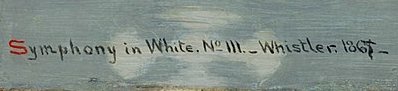
However, he was not happy with what he saw and began to rework it and Whistler was not finally satisfied with it until 1867 when it was exhibited at the Royal Academy. He painted over the final “5” in the original date, and replaced it with a “7”, to mark the changes it had undergone.   

Whistler chose the term ‘Symphony’ to highlight to visitors to the exhibition that it was purely a study in colour and the connection of two branches of the Arts, music and art..  It was the first of Whistler’s paintings to be exhibited with a musical title.  And so, why was it entitled “No. 3”? 

See the source image
Symphony in White. No 1. by Whistler. NGA Washington.

The reason behind this numerical conundrum was that Whistler’s 1863 painting was given the title White Girl but Paul Mantz, a French art historian and writer for the Gazette des Beaux-Arts, called it ‘Symphonie du blanc‘, and so it was later renamed Symphony in White. No. 1. 

Symphony in White No.2 by Whistler. Tate Britain.

In 1864 Whistler completed a second similar work entitled The Little White Girl, which later became known as Symphony in White. No. 2.  In their 1908 biography of Whistler, The Life of James McNeill Whistler, Elizabeth and Joseph Pennell, make the point that this may have been a factor that influenced Whistler in his choice of titles for the third in the series. 

Edgar Degas - Portrait de Mlle Eugénie Fiocre in the Ballet "La Source"
Portrait de Mlle Eugénie Fiocre in the Ballet “La Source” by Degas (1868). Brooklyn Museum.

The work was greatly admired by all who saw it.  It is thought that Deagas drew inspiration from Whistler’s painting when he worked on his painting, Portrait de Mlle Eugénie Fiocre in the Ballet “La Source”

However, there were some critics who were not altogether in love with the work.  Philip Hamerton, an English artist, art critic and author, writing for the Saturday Review on 1 June 1867, remarked:

“…In the “Symphony in White No. III.” by Mr. Whistler there are many dainty varieties of tint, but it is not precisely a symphony in white. One lady has a yellowish dress and brown hair and a bit of blue ribbon, the other has a red fan, and there are flowers and green leaves. There is a girl in white on a white sofa, but even this girl has reddish hair; and of course, there is the flesh colour of the complexions…”

Whistler was horrified by what had been written in the journal and wrote a letter to the editor but he would not print it.  However in Whistler’s own book, The Gentle Art of Making Enemies, he reproduced the letter in which he had written:

“…How pleasing that such profound prattle should inevitably find its place in print!…Bon Dieu! did this wise person expect white hair and chalked faces ? And does he then, in his astounding consequence, believe that a symphony in F contains no other note, but shall be a continued repetition of F, F, F ? . . . Fool!…”

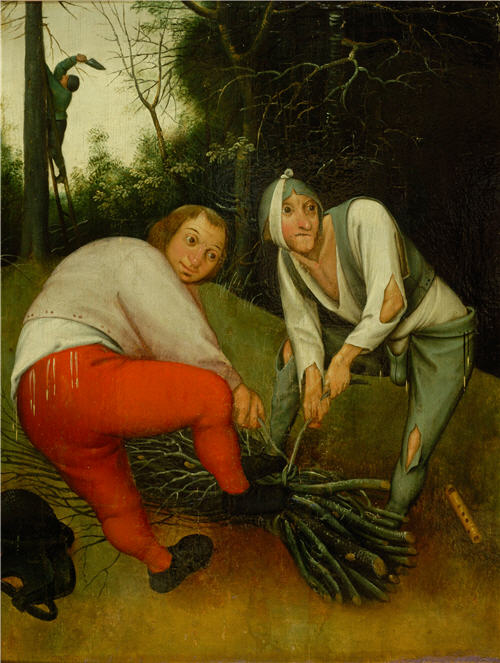
Two Peasants binding Faggots by Pieter Brueghel (c.1615)

For my last offering in Part One of my blog relating to my best-loved works in the collection of the Barber Institute I have reverted to one of my favourite painters, Pieter Brueghel the Younger.   He was the son of one of the greatest sixteenth century artists, Pieter Bruegel the Elder, and the brother of Jan Breughel.  This amusing and fascinating painting entitled Two Peasants binding Faggots, was completed around 1615, and it was the type of work which was popular in the seventeenth century.  It was entitled Two Peasants binding Faggots. It is a depiction of peasants binding a bundle of stolen branches for firewood whilst their fellow accomplice is seen in the background cutting the branches of a tree.  The two peasants in the foreground glance around furtively and from that we gather that they are up to no good,  The larger of the two, on the left, is stout symbolising the sin of gluttony whilst his thinner and gaunt accomplice with a paler face and wearing a codpiece has a bandage around his head and it is thought that Brueghel has depicted this as it relates to the Flemish proverb “to have toothache behind the ears” meaning a malingerer. On the ground, next to the gaunt-looking man, is a pipe which is a traditional phallic symbol and represents the sin of lechery.

Bruegel Netherlandish Proverbs@0
Netherlandish Proverbs by Pieter Bruegel the Elder (c.1525). Staatliche Museen Berlin.

The artist’s father, Pieter Bruegel the Elder, had painted a large work, Netherlandish Proverbs, in 1559, which featured a large number of similar characters each representing various Netherlandish proverbs which today is part of the Staatliche Museen collection in Berlin.

…………….to be continued.

Bernardo Bellotto. Part 2.

Bernardo Bellotto.jpg
Detail of Self-portrait as Venetian ambassador

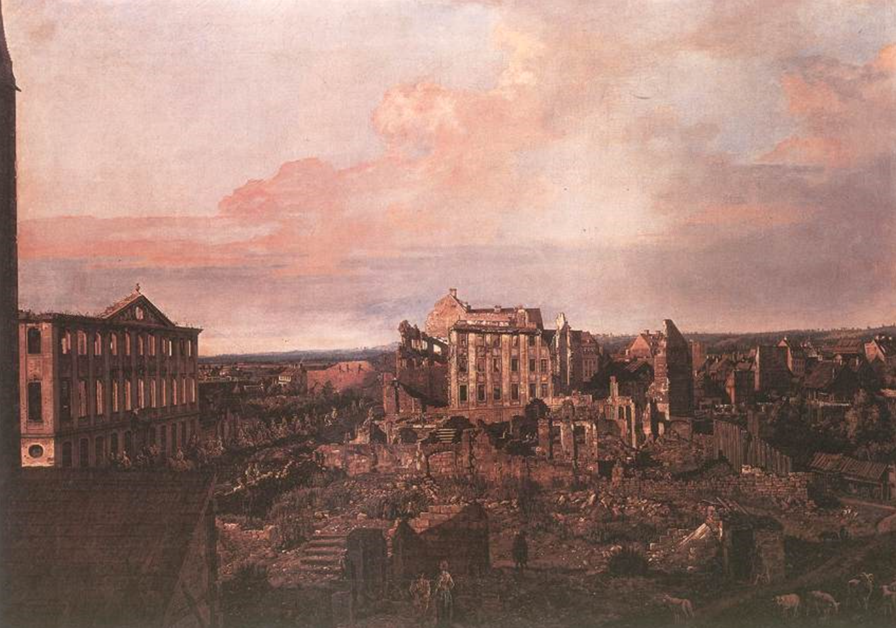
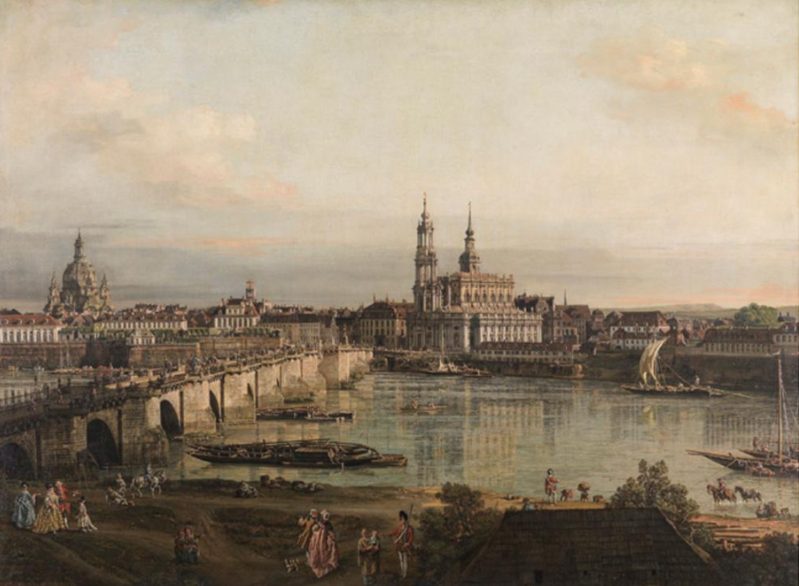
At the end of 1761 Bellotto returned to his home Dresden to find it had been devastated during the Prussian invasion.  Worse, was the fact that he found himself in great financial difficulty arising from the death of two of his major patrons, Augustus III, Elector of Saxony and King of Poland and Count Heinrich Bruhl, the prime minister of Saxony in 1763. 

View of the Kreuzkirche in Ruins by Bellotto (1765)

Their deaths and his financial situation made Bellotto melancholic and it was around this time that he painted the Kreuzkirche which now lay in ruins.  It had been partially destroyed during the Seven Year War, at a time when Bellotto had been forced to flee the city.  The painting is entitled View of the Kreuzkirche in Ruins and was completed by Bellotto in 1765.  The Kreuzkirche is the oldest church in Dresden and, during the conflict, was shelled by Prussian artillery.   The building was set ablaze and finally collapsed. The church tower, though damaged, remained standing.  Work commenced on the reconstruction the church and it was decided to preserve the original tower. Unfortunately, in June 1765, with the construction of the new church already under way, the greater part of the tower collapsed.  The painting is a good example of how Bellotto unique, capacity to capture the spirit of an event.  His depiction of the ruin  is an unusual one for it is not an ancient ruin as far as the artist was concerned.  It was a relatively new one as the destruction had only occurred five years earlier.   Bellotto had completed a work depicting the great church some years earlier (see painting in the previous blog).   However, in this work, we see the jagged remnants of the church rear up skywards.   The cleanliness of the once beautiful church has gone.  There is nothing clean about the church now.   The scene before us is just a mass of noise and dirt.  It is a chaotic scene which we find hard to believe that it could ever be put back to its former glory.   The Church, as the body of Christ, has been violated all over again and the civic wounds of the German city have been violently opened for all to see.  This is the price to be paid when once we set forth to war.  In the painting we see many of Dresden citizens.  Close to the ruins we can just make out craftsmen as they start their preparations to rebuild the once –beautiful edifice.  On the periphery we see men and women dressed in their best clothes staring at the ruin.  For them it was just a day out to visit the site where the destruction had taken place.  For them it was just blatant voyeurism.

Dresden, the Ruins of the Pirnaische Vorstadt by Bellotto (1763)

Another melancholic landscape Bellotto painted around this time was his bleak depiction of the town where he used to live, Pirna, destroyed by Prussian artillery fire.

In the mid 1760’s there was a revival of classical antiquity in art and Bellotto turned to painting idealised views featuring classical motifs that he had once drawn when living in Venice and Rome. In 1764 the Dresden Academy of Fine Art was founded by order of the Prince-Elector Frederick Christian and at that time, Christian Ludwig von Hagerdorn was the Academy’s general director of the Saxon Art Collections.  Hagerdorn disliked Bellotto and by-passed him when he applied to become a professor of the Academy.  It could be the fact that Bellotto could not speak German which rankled him or maybe it was Bellotto’s style of painting as Hagerdorn once wrote of Bellotto:

“…He loses no opportunity of bringing up the subject of his dreary art and his enormous family…”

Dresden from the Neustädter Bridgehead, by Bellotto (1765)

Franz Xavier who had taken on the role of the regency of the Electorate of Saxony together with his sister-in-law, the Dowager Electress Maria Antonia of Bavaria intervened and Bellotto was admitted to the Academy and granted a three-year teaching post and given the title of “associate member for perspective”.  Belloto’s reception piece was his 1765 painting, Dresden from the Neustädter Bridgehead.

Architectural Capriccio with a Self-Portrait in the costume of a Venetian Nobleman by Bellotto (1765)

Bellotto took part in the Academy’s first exhibition on March 5th 1765.  He submitted four of his works, one of which was his painting entitled Architectural Capriccio with a Self-Portrait in the costume of a Venetian Nobleman.  It is an idealised setting incorporating a number of famous Venetian buildings including the Marciana Library.  The gentleman in the foreground wearing the red robes and a heavily embroidered sash on his left shoulder of a Venetian procurator is thought to be a self-portrait.  Look closely at the pillar behind the dignitary and you will see a handbill.  On it is a quotation by the Roman poet Horace:

Pictoribus atque poetis

Quidlibet audendi semper fuit aequa postestas

which translates to:


Painters and poets have always shared an equal right to dare to do whatever they wanted.

One can only believe that Bellotto added this poster with the saying of Horace to remind people that it is correct to believe that anything is possible.

View of Warsaw from the Royal Palace by Bellotto (1773)

Bellotto was not happy at the Academy and found it harder and harder to work under Hagedorn and so, half way through his three year tenure he requested a leave of absence so that he could travel to St Petersburg. Russia at the time was ruled by Catherine the Great who was known for her support for foreign artists.  On his way to Saint Petersburg, however, Bellotto accepted an invitation in 1764 from Poland’s newly elected King Stanislaus Augustus Poniatowski to become one of his court painters in Warsaw. Poniatowski was an avid art collector who wanted to add to his collection. Bellotto wrote to the Dresden Academy asking for an extension to his leave of absence and once granted he summoned his wife and daughters to come and live in Warsaw. His wages as court painter managed to elevate him financially to his former status.

Ujazdów Castle, by Bellotto (“Canaletto”) about 1775

Bellotto started to work on his royal commission to provide a number of paintings depicting panoramic cityscapes of both Warsaw and Rome to be hung at the royal palace, the Ujazdów Castle, which was situated just outside the city and was, at that time, being refurbished.   The idea of having depictions of the two cities side by side was to infer that Warsaw was the “new Rome”.   He was allocated the large room on the ground floor of the castle for his large works.  However, the refurbishments met with financial problems and the work was eventually abandoned, and in 1777, Bellotto’s paintings were moved to the Royal Castle in Warsaw.   As Bellotto painted more views of Warsaw, they took the place of some of the paintings depicting Rome.  His paintings were hung in the antechamber outside the Throne Room and were visible to the ambassadors and other dignitaries who had come for an audience with the king.  The room became known as the Canaletto Room and Bellotto’s paintings today are still to be seen in that room.

Views of Warsaw from the Suburbs of Praga by Bellotto (1770)

In its place at the centre of the south wall of the antechamber is Bellotto’s masterpiece, View of Warsaw from the Suburb of Praga.

The artist at work

It is an all-encompassing panoramic view of Warsaw which also incorporates a self-portrait of the artist sitting at his easel in the far left foreground.

Miodowa Street by Bellotto (1777)

Bellotto remained in Warsaw for sixteen years and died suddenly from a stroke in the city on November 17th, 1780 at the age of 59.  He was buried in the Capuchin Church at Miodowa Street. The street was the subject of his 1777 painting and the church where he was buried can be seen in the left background emerging from behind the trees. Bellotto’s wife, Elisabetta, died five years later and their daughter Theresia Francisca left the city with her husband and hundreds of her father’s paintings and went to live in Vilnius, Lithuania.

Bellotto completed more than three hundred paintings, about a third of which were cityscapes which glorified some of the great capitals of Europe.  The paintings were highly original but always managed to meet with the social and political demands of his patrons.

Bernardo Bellotto. Part 1.

In this blog I am returning to an artist I talked about almost nine years ago.  My artist today is Bernardo Bellotto who was born in Venice on May 22nd 1722.  He was the third-born child of Lorenzo Antonio Bellotto and Fiorenza Domenica Canal, who was the eldest of three sisters of Giovanni Antonio Canal, better known to us as Canaletto.  Bellotto’s started his initial artistic training at the age of fourteen when he worked in his uncle’s workshop.  Two years later, at the age of sixteen, Bellotto became a member of the Fraglia dei Pittori (Venetian painters’ guild). Bellotto trained in Canaletto’s studio and would help him to satisfy the growing demand for Venetian scenes. Bellotto would later point out the family connection by signing some of his works ‘Bernardo Canaletto’ or ‘Bellotto de Canaletto’.

Rio dei Mendicanti and the Scuola di San Marco, 1738 - Bernardo Bellotto
Rio dei Mendicanti and the Scuola di San Marco by Bellotto (1738)

In around 1741, he and his uncle, Canaletto, took a trip along the Brenta canal to Dolo and Padua and during this time the two painters amassed a number of sketches which would be later transformed into completed oil paintings. On October 5th, 1741 a marriage contract was drawn up by Bellotto and his future father-in-law Giambattista Pizzorno, for permission for the artist to marry Elisabetta Pizzorno. On November 5th 1741, Bellotto married Elisabetta Pizzorno at Il Redentore church in Venice. A dowry of 850 ducats was agreed to be paid by the bride’s family to the groom at the time of marriage.  Their first child, Lorenzo, was born on October 15th, 1742. A further insight into Bellotto’s life around this time is a document submitted by his mother in which she declares that the family has been abandoned by her husband Lorenzo and that the only goods in her possession are those procured for her by Bernardo who, with his work, maintained her and his brother Pietro, both of them being resident in Bernardo’s home. The brother Pietro Bellotto, who was also an artist, also declared before the same notary to have learned the art of painting from Bernardo. In order to continue living with his brother and improve in his profession Pietro signs a pledge to give him one hundred and twenty ducats a year.

Arno in Florence, c.1742 - Bernardo Bellotto
Arno in Florence by Bellotto (1742)

In 1742 Bellotto set off on a painting trip and travelled extensively around the Northern Italian cities, stopping off at Florence and Lucca and during each stop he would complete a verduta of the place.   A verduta is a highly detailed, usually large-scale painting of a cityscape or some other vista.   These painting were very popular with the foreigners who travelled around Italy on their Grand Tour and wanted to bring home something to remind them of the places they had visited.

The Old Bridge over the River Po, Turin by Bellotto (1746)

Bellotto made a number of painting trips to Lombardy and during a stopover and around 1746 whilst in Turin he painted a view of the city. It was entitled The Old Bridge over the River Po, Turin and it was a commission he received from Charles Emmanuel, King of Sardinia and Duke of Saxony. If you look closely to the extreme left of the painting you will see an artist sitting before his easel which was presumably a reference to himself.   This and his other Turin depictions were large measuring 127 x 171cms and they were, as this was, sweeping panoramic views with such exquisite architectural detail of the brick tower and the bridge in the foreground. Look how well he has used light and colour to portray the reflections on still water and the hint with regards the moving currents. Bellotto eventually arrived in Rome where he studied study architectural and topographical painting and would remain in the Italian capital until 1743 at which time he journeyed back home to Venice.

Kreuzkirche by Bellotto (1747-56)

In May 1746 Bellotto’s uncle Canaletto left Venice for England where his paintings were in great demand.  A year later Bellotto also left Venice.  His destination was Germany and the city of Dresden where he hoped to forge a career and avail himself of some lucrative commissions.  His desire for commissions materialised within a year of his arrival as he became the court painter at the court of Friedrich August II, Elector of Saxony and soon Bellotto was the highest paid artist at the Saxon court.  The following decade was to be Bellotto’s most successful.

Dresden from the Left Bank of the Elbe, below the Fortifications by Bellotto (1748)

The city of Dresden and the outlying districts, such as the villages of Pirna, and Königstein with its magnificent Königstein hilltop fortress, all of which offered Bellotto the chance to paint beautiful cityscapes and rural landscapes. In all, Bellotto completed thirty different paintings for the Elector.  Fourteen depicting views of the city of Dresden and its wonderful buildings, eleven of Pirna and its surrounding rural landscapes and five of the magnificent Königstein fortress.

The Neumarkt from the Judenhof, Dresden by Bellotto (1748-9)

View of Pirma from the Sonnenstein Castle by Bellotto (1755)

The city of Dresden and the outlying districts, such as the villages of Pirna with the nearby Sonnenstein Castle, and Königstein with its magnificent Königstein hilltop fortress, all of which offered Bellotto the chance to paint beautiful cityscapes and rural landscapes. In all, Bellotto completed thirty different large scale paintings for the Elector, each between two and three metres wide.  Fourteen depicting views of the city of Dresden and its wonderful buildings, eleven of Pirna and its surrounding rural landscapes and five of the magnificent Königstein fortress. The finished works were to be hung in the royal painting gallery in the Stallhof, which forms part of the Royal Palace in Dresden. Bellotto’s depictions of the city of Dresden were remarkable for their topographical meticulousness, mathematical perspective and the way in which he portrayed the way the light played on the various architectural structures.  The way he handled the light was truly remarkable.

The Fortress of Königstein by Bellotto (1756-58)

This painting is part of the NGA Washington. This depiction by Bellotto of the Fortress of Königstein is one of five large canvases, commissioned by Augustus III in the spring of 1756 but never delivered, depicting the renovated medieval fortress in the countryside near Dresden. 

The Fortress of Königstein from the North by Bellotto (1756-58)

Bellotto having received the royal commission to complete thirty large scale paintings of Dresden, Pirna and Königstein was proceeding well with the commission.  The Elector’s commission had enabled Bellotto to live a life of luxury.  He had an seven reception rooms in his Dresden apartment which was awash with luxurious furnishings, Venetian mirrors and fine wallpapers and fabrics.  Life could not have been better.  What could possibly go wrong?  The answer to that question was the Seven Year War, which broke out involving all the main European “players”.  The Prussian army invaded Saxony and entered the city of Dresden and Augustus, the Elector of Saxony and Bellotto’s patron fled the city and barricaded himself in at the Königstein fortress for several months before escaping to Warsaw.  Bellotto left Dresden and his luxurious home and went to Pirna. 

The Fortress of Königstein: Courtyard with the Magdalenenburg by Bellotto (1756-58)

This view from the south of Königstein includes several buildings within the fortification: the southern end of the Brunnenhaus facing us to the left, the Georgenburg oblique behind it, and the Magdalenenburg in the foreground

Dominican Church, Vienna by Bellotto

In 1758 Bellotto and his sixteen-year-old son obtained passports to travel to Bayreuth from where he completed an onward journey to Vienna.

Canaletto (I) 037.jpg
Schloss Hof by Bellotto

Shortly after his arrival in Vienna, Bellotto received a couple of private painting commissions.  One was from Prince of Liechenstein and one from Wenzel Anton, the Prince of Kaunitz who was also chancellor to Empress Maria Theresa.  Not only were they lucrative commissions it gave Bellotto a chance to receive a thirteen painting commission from the Empress herself.  The commission tasked the artist to complete six depictions of the city of Vienna and seven much larger panoramic views of Schönbraun and Schloss Hof imperial palaces and their gardens.

The Dominican Church in Vienna by Bellotto (1758)

For the two years Bellotto was in Vienna with his son he worked non-stop producing paintings for the Empress’ commission and other commissions for members of her court. This phenomenal output can also be put down to the help he received from his son Lorenzo. The resulting depictions were amazing and offered to serve as testimony of Vienna’s imperial magnificence

Nymphenburg Palace, Munich, by Bellotto (c. 1761)

In 1761, after almost two years in Vienna, Bellotto left the city and travelled, not to Dresden where his wife and daughters lived, but to Munich.  This could have been because of the on-going troubles with the Prussian invaders.  He had been given authorisation to visit the German city through a letter from Empress Marie Theresa to her cousin Maria Antonia, the Princess of Bavaria, who had fled from Dresden since the Prussian siege.  Once there Bellotto was commissioned to paint panoramic views of Munich and the Baroque Nymphenburg Palace in the western suburbs of the city, which was Maria Antonia’s birthplace and summer residence.

The Ruins of the Old Kreuzkirche in Dresden by Bellotto (1765)

At the end of 1761 Bellotto returned to his home Dresden to find it devastated during the Prussian invasion.  Worse, was the fact that he found himself in great financial difficulty arising from the death of two of his major patrons, Augustus III, Elector of Saxony and King of Poland and Count Heinrich Bruhl, the prime minister of Saxony in 1763.  Their deaths and his financial situation made Bellotto melancholic and it was around this time that he painted the Kreuzkirche which now lay in ruins.  It had been partially destroyed during the Seven Year War, at a time when Bellotto had been forced to flee the city.  The painting is entitled View of the Kreuzkirche in Ruins and was completed by Bellotto in 1765.  The Kreuzkirche is the oldest church in Dresden and, during the conflict, was shelled by Prussian artillery.   The building was set ablaze and finally collapsed. The church tower, though damaged, remained standing.  Work commenced on the reconstruction of the church and it was decided to preserve the original tower. Unfortunately, in June 1765, with the construction of the new church already under way, the greater part of the tower collapsed.  The painting is a good example of how Bellotto unique, capacity to capture the spirit of an event.  His depiction of the ruin  is an unusual one for it is not an ancient ruin as far as the artist was concerned.  It was a relatively new one as the destruction had only occurred five years earlier.   Bellotto had completed a work depicting the great church some years earlier (see painting earlier in the blog).   However, in this work, we see are the jagged remnants of the church rear up skywards.   The cleanliness of the once beautiful church has gone.  There is nothing clean about the church now.   The scene before us is just a mass of noise and dirt.  It is a chaotic scene which we find hard to believe that it could ever be put back to its former glory.   The Church, as the body of Christ, has been violated all over again and the civic wounds of the German city have been violently opened for all to see.  This is the price to be paid when once we set forth to war.  In the painting we see many of Dresden citizens.  Close to the ruins we can just make out craftsmen as they start their preparations to rebuild the once –beautiful edifice.  On the periphery we see men and women dressed in their best clothes staring at the ruin.  For them it was just a day out to visit the site where the destruction had taken place.  For them it was just blatant voyeurism.

Dresden Kreuzkirche 2008.jpg
Kreuzkirche , Dresden (2008)

……………………………….to be continued.

Pinturicchio . The Master of Frescoes – The Baglioni Chapel

In my last blog I looked at the Pinturicchio frescoes in the Bufalini Chapel and although the artist had painted numerous frescoes in many places of worship, in this blog, I just want to focus on his artistry in the Bagnoli Chapel, part of the Collegiate church of Santa Maria Maggiore, in the town of Spello, Perugia and the frescoes executed by him at the start of the sixteenth century during one of last major commissions.

Datei:Pinturicchio - Christ among the Doctors (detail) - WGA17775.jpg
Troilo Baglino (left), fresco detail by Pinturicchio in the Baglioni Chapel 

Troilo Baglioni was the prior, later bishop and protonotary of the Church of Santa Maria Maggiore in Spello, an ancient town and commune of Italy, in the province of Perugia in east central Umbria. He was in charge of the management of the chancellery of that church and the diocese and it was he, who, in 1500, commissioned Pinturicchio to decorate the walls of the Cappella Bella which later became known as the Baglioni Chapel .  Pinturicchio and his workers set about the task in the Autumn of 1500 and completed the commission in the Spring of 1501.  The paintings, typically for Pinturicchio, were completed in such a short period as he had around him, a well-organized workshop, with other masters painting above his drawings. The finished product ensured his artistic reputation and prominence in Umbria.

Baglioni Chapel

The chapel has a quadrangular floor plan with a cross-vault. The entire chapel, all three walls and the ceilings, are covered in frescoes.  The frescoes are themed stories about the childhoods of Mary and of Jesus. a pictorial account of the Annunciation, the Adoration of the Shepherds, and Jesus at the Temple..

The vaulted ceiling of the Baglioni Chapel

On the vaulted ceiling, we see depicted four Sibyls, female prophets, Tiburtina, Eritrea, Europea and Samia, seated on thrones and flanked by cartouches with prophecies of the coming of Jesus Christ.

As you enter the chapel, on the left wall, there is Pinturecchio’s fresco of the Annunciation, which is set in a large Renaissance loggia.  As we look at it our eyes are drawn through, what is termed, the hortus conclusus (enclosed garden) towards the handsomely and meticulously detailed landscape background.  The two main characters in the fresco are Mary and an angel.  Mary had been reading a book which was on a tall ornate wooden lectern but has now been distracted by the angel, who kneels before her with a white lily in one hand, symbolising  virginal purity.  Above them we see God the Father depicted encircled by angels and giving off a ray of light which incorporates the Holy Ghost in the form of a dove (just above the lectern).

Look to the lower right of this fresco.  What is strange about this fresco is that if you look closely under the small bookshelf, you will see a portrait.  In fact, it is a self-portrait of Pinturicchio, featuring the bejewelled inscription, “BERNARDINVS PICTORICIVS PERVSIN[VS]” referring to Pinturicchio’s birth name of Bernardino di Betto.

The Adoration of the Shepherds by Pinturicchio (1501)

The rear wall of the Baglioni Chapel features the fresco depicting the Adoration of the Shepherds. It is a depiction of an idyllic scene within an extensive landscape and includes a number of  secondary motifs. In the background, we can see the arrival of the camels of the Magi procession.  The setting in the foreground is a grassy area in front of the stable, and a line of shepherds who have come to visit and bring gifts to the mother and the new-born child.  

The Shepherds by Pinturicchio

The three shepherds stand out as being over-sized.   They have expressive and detailed features, after the fashion of early Netherlandish painting which influenced Pinturicchio. Their facial characteristics are in a way crude, almost scowling and differ greatly from anything else in Pinturicchio’s repertoire of figures. The one exception is the young man on the left with a goat. This is depicted with a more idealized beauty, inspired by ancient reliefs with sacrifice motifs.

The central panel of the Portinari Altarpiece by Hugo van Goes (1472)

Art historians have put down Pinturicchio’s depiction of his “crude scowling” shepherds as being influenced by the figures of the shepherds in the Portinari Altarpiece which was painted by Hugo van der Goes around 1472.

The figures of the shepherds in the Portinari Altarpiece

In the left background of the fresco on the rear wall we see a meticulously drawn town at the foot of a mountain.  To the right we see a temple-like stable with a window through which we can see a mountainous landscape.  On the roof of the stable sits a peacock, a symbol of immortality. 

In the sky above the nativity scene we observe a cluster of angels on a bank of clouds.  They are celebrating the birth of Jesus in song.

On the right-hand wall as you enter the Baglioni Chapel there is a large fresco pictorially recounting the story of the Dispute with the Doctors. .  It is based on an occurrence in the early life of Jesus depicted in Chapter 2 of the Gospel of Luke.  Twelve-year-old Jesus had accompanied Mary and Joseph, and a large group of their relatives and friends to Jerusalem on a Passover pilgrimage.. On the day of their return, Jesus hung back in the Temple, but Mary and Joseph thought that he was among their group and she and Joseph headed back home.  It was not until a day after they returned that they realised Jesus was missing, so they returned to Jerusalem, finding Jesus three days later among a group of philosophers.   

In the background we see the Temple of Jerusalem with its large dome.  The scene follows an arrangement which Pinturicchio had already used in his fresco on the wall of the Bufalini Chapel, which itself originated from a Perugino fresco in the Sistine Chapel, Delivery of the Keys.  At the centre of the depiction stands the Child Jesus who is debating with and surrounded by two groups of philosophers from the Temple of Jerusalem. His books are scattered on the pavement in front of him. By contrast, the richly dressed scholars either clutch their books close to their chests or read aloud from them. The temple can be seen in the background and is characterized by a large dome. The crowd is formed by standard set of characters which includes young spouses, wise men, toothless women and others, all of whom are witnessing the dispute.

On the left of the crowd, dressed in the dark robes of a protonotary apostolic (a prelate who is a member of a college charged with the registry of important pontifical proceedings). It is a portrait of Troilo Baglioni, who commissioned the frescoes for his chapel

[Photo Credits: tyle_r]
Pinturicchio’s frescoes in the Piccolomini Library

Pinturicchio’s many paintings and frescoes can be seen throughout Italy.  Between 1481 and 1482, he worked in Rome, and collaborated with Perugino on the frescoes of the Sistine Chapel. From this his career flourished and he worked uninterruptedly in the service of five popes: from Sixth IV to Julius II, passing through Innocent VIII, Alexander VI, and Pius III.  He also received commissions from well-to-do and important clients such as the della Rovere family and Pandolfo Petrucci, the lord of the Italian Republic of Siena.. In Siena, among the many works, he created the extraordinary cycle of the Piccolomini Library in the Duomo of Sienna, and completed frescoes in the chapel of San Giovanni Battista.

Bernardino di Betto (Benedetto), the Italian painter known as  II Pinturicchio dies in Sienna in 1513 aged 61.

Pinturicchio the Master of the Fresco. Part 1.

Over recent months I seem to have concentrated on writing about artists who were practicing their trade during the Victorian period and the first couple of decades of the twentieth century.  Yet, when I look back on my earliest blogs I seemed to have favoured the Dutch and Flemish painters of the sixteenth and seventeenth centuries.  Today I am going to deviate again and look at the life and work of the fifteenth century Italian Renaissance painter Pinturicchio.  I came across the artist and one of his major fresco commissions when I read the excellent blog io sto a casa, written by Jackie, an American teacher who lives with her Italian husband in Le Marche, Italy. She and her husband are lovers of art and often travel around the country visiting places of interest which hold artistic treasures.  It was she who mentioned the artist Pinturicchio in one of her recent blogs.

2008 Italian postage stamp

Bernardino di Betto was born around 1454 in the Italian city of Perugia.  He was also known by his nickname, Il Pinturicchio, meaning “little painter” because of his small stature.  His parents were a family of artisans, his father being a cloth tanner.  His early life seems to have been filled with unhappiness, compounded by the death of his father from the plague when Pinturicchio, was just a teenager.  His first foray into the world of  fine art came when the talented miniaturist, Giapeco Caporali opened a bottega (a workshop of a major artist in which other artists may participate in the execution of the projects or commissions of the major artist) close to Pinturicchio’s father’s house at Porta Sant’Angelo. Pinturicchio worked there for a time and would take a share of the profits of the work completed in the studio.  In 1481 Pinturicchio joined the painters’ guild in Perugia.  Perugia was at that time experiencing a great artistic fervour and the central Italian city was becoming a renowned hub for artistic activities of which Pinturicchio contributed. Once Pinturicchio had enrolled in the guild of Artists and Painters in Porta Sant’Angelo, Perugia, his output began to be recorded.  He received many commissions and joint commissions for his fresco work.

Basilica of Santa Maria in Aracoeli in Rome

Meanwhile, in Rome, the first phase of the work on the Sistine Chapel had been on-going.  The fresco work had been carried out by some of the Italian Masters, such as Botticelli, Perugino, Ghirlandaio, Signorelli,  Cosimo Rosselli and Pinturicchio.  The first phase of this massive undertaking came to an end around 1482 and most of these Italian Masters returned to their home cities.  This is with the exception of Pinturicchio who did not go home but instead remained in the city and set up a workshop. as he could take advantage of the opening left by the other great artists. He then chose a group of Italian painters who had collaborated with him at the papal chapel.  His group contained artists from the many regions of the country who were willing to remain in Rome and work for him.    Having set up this group and with many of the renowned artists having left the eternal city he was awarded his first commission in Rome by Nicolò Manno (Riccomanno) Angeli Bufalini, a consistorial lawyer and one-time bishop of Venafro, for his family chapel which was part of the Basilica of Santa Maria in Aracoeli in Rome, which stands on the Capitalone hill. Pinturicchio’s frescos in the Bufalini Chapel depicted scenes from the life of Saint Bernardino of Siena and Saint Francis. The commission was to remember the reconciliation that took place between the Bufalini family and the Baglioni of Perugia, thanks to St. Bernardino.

Bufalini Chapel ceiling

Pinturicchio and his team set to work on the chapel around 1484.  On the vaulted ceiling there are depictions of the four Evangelists, Matthew, Mark, Luke and John, each seated on a cloud, in front of a dark blue, star-studded background.  

Bufalini Chapel floor

The chapel itself has a quadrangular base, with the vault and floor decorated with cosmatesque mosaics. The Cosmatesque style takes its name from the family of the Cosmati, which flourished in Rome during the twelfth and thirteenth centuries and practiced the art of mosaic.   The inside of the chapel comprises of three sides and the frescoes on the three walls are dedicated to the life and miracles of St. Bernardino of Siena, an Italian priest and Franciscan missionary, who was canonized as a saint in 1450, and who was very popular during the Renaissance.  The frescos also featured two stories of St. Francis.

The back wall of the chapel, the altar wall, is decorated by a fresco entitled The Glory of Saint Bernardino.  It is horizontally divided into two sections.  The lower section depicts San Bernardino standing on a rock with outstretched arms.  His right hand points up to Christ. In his left hand he holds an open book in which one can read:

PATER MANIFESTAVI NOMEN TVVM OMNIBVS

“Father, I have shown your name to everyone”,

Above him are two angels who are in the process of crowning him.  Either side of him stand two saints,.  On his right is St. Louis of Toulouse adorned in in his solemn episcopal robes and on his left stands Saint Anthony of Padua in a Franciscan habit..  In one of St Anthony’s hands he holds the flame symbolising his piety whilst in the other he holds a book symbolising his knowledge.  The background of this lower section is a landscape with rocks, lakes and mountains, which extends the depth of the space.  This scene is probably one Pinturicchio would have recalled from his homeland.

In the upper part of the fresco we see Christ in the act of blessing.  His figure is encased in a mandorla. The term mandorla means an almond-shaped frame that surrounds the totality of an iconographic figure.  Surrounding Christ are worshiping and music-making angels.

Left-hand wall of the Bufalini Chapel

On entering the Bufalini Chapel, the wall to the left comprises of two scenes one atop the other, divided by a painted frieze. The upper part is a lunette, a half-moon shaped, or semi-circular, arch, which depicts St. Bernardino being penitent before the Porta Tufi in Siena and this fresco shows a young Bernardino’s first hermitage.

Upper lunette

The fresco on the lower part of the left-hand wall is much more interesting.  It depicts the Funeral of Saint Bernardino. 

The fresco on the lower part of the left-hand wall is much more interesting.  It depicts the Funeral of Saint Bernardino.  The setting is a city scene with a chessboard-like pavement.  It is painted using geometrical perspective, which enables the depiction of a three-dimensional form as a two-dimensional image which carefully looks like the scene as visualized by the human eye.  The vanishing point is a building similar to one depicted in Perugino’s painting, Delivery of the Keys, although Pinturicchio has two buildings of different heights at the sides. On the left is a loggia,  a covered exterior gallery or corridor, supported by piers decorated with fanciful gilded candelabra. On the right is a cubic building connected through a double loggia to the landscape and the bright sky in the background.

See the source image
Pietro Perugino’s painting, Delivery of the Keys.(1482)

The foreground is dominated by the Saint Bernardino’s funeral. We see his body laid out on what is termed a catafalque, a decorated wooden framework supporting the coffin of a distinguished person during a funeral or while lying in state. Its presence increases the sense of spatial depth

Riccomanno Bufalini

All sorts of folk, friars, pilgrims and the “common” people approach the body to pay their respect. Look at the tall figure in the left foreground wearing the brown robe, with a fur-lined hood and gloves.  He is Riccomanno Bufalini, the person who commissioned the frescoes.

Sight restored.

The remaining characters we see standing around the coffin often portray a series of miracles attributed to Bernardino during his life.  We see the once-blind man who was healed and given back his sight by the body of Bernardino, standing by the head of the coffin pointing to his eyes.  There is the resurrection of someone possessed by the Devil, the healing of the stillborn baby of John and Margaret Basel, the healing of Lorenzo di Niccolo da Prato, wounded by a bull, and the pacification of the warring Umbrian Bufalini and Baglioni families.

The Blessing
The peacock

The right wall of the Bufalini Chapel features a double mullioned window.   Pinturicchio has implemented an illusionistic perspective, when he painted two imitation symmetrical windows, one depicting a blessing from God the Father and the other featured a peacock which was an early Christian symbol of immortality.

There is also a fresco featuring, on the left, a scene from the life of St. Bernardino of Siena in which we see him receiving the religious habit. It is set in an oblique perspective that exploits the decorated pillars with a grotesques arch. Finally, there is a small scene on the right featuring, in the background, a view of the Verna Sanctuary over a rocky peak which depicts St. Francis in the act of receiving the stigmata, in honour of the Franciscan foundation of the Aracoeli.

Under the real window is an illusory opening depicting five characters: among them is an aged friar, perhaps the convents prior, and a lay figure that resembles him, perhaps an administrator of the basilica.

In the next blog I will be looking at the frescoes by Pinturicchio on the walls of the Baglioni Chapel in Spello.

………………………………to be continued.