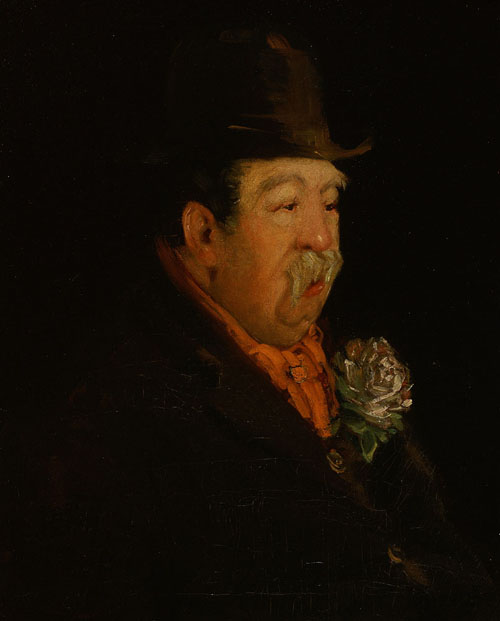
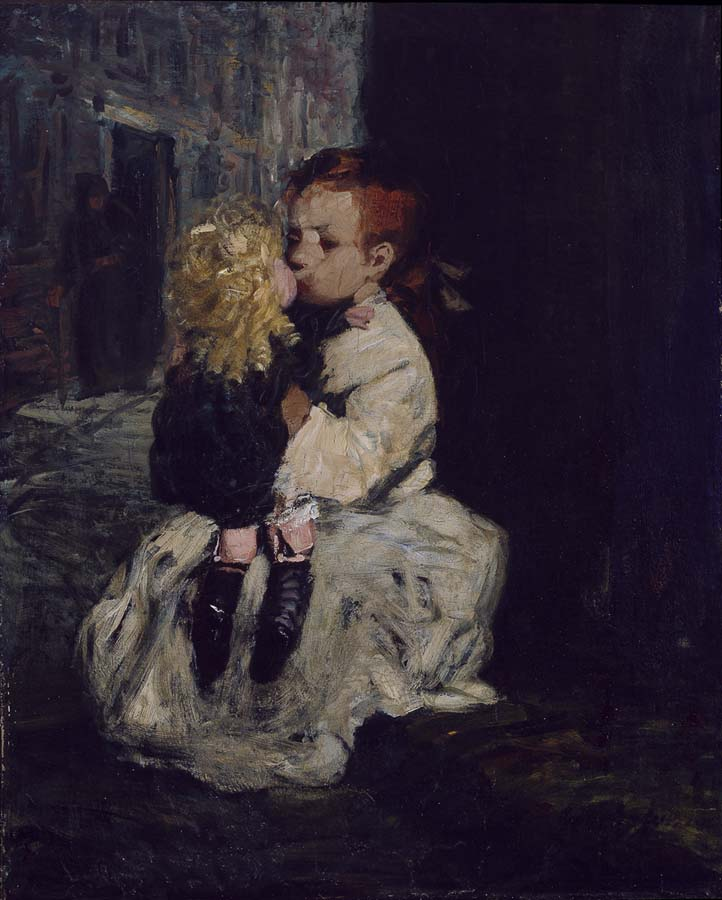
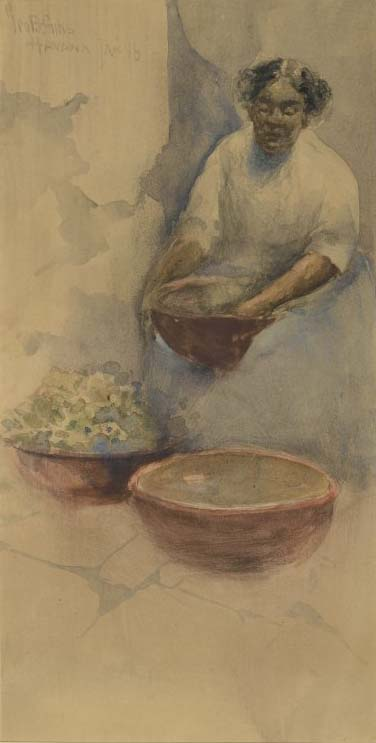
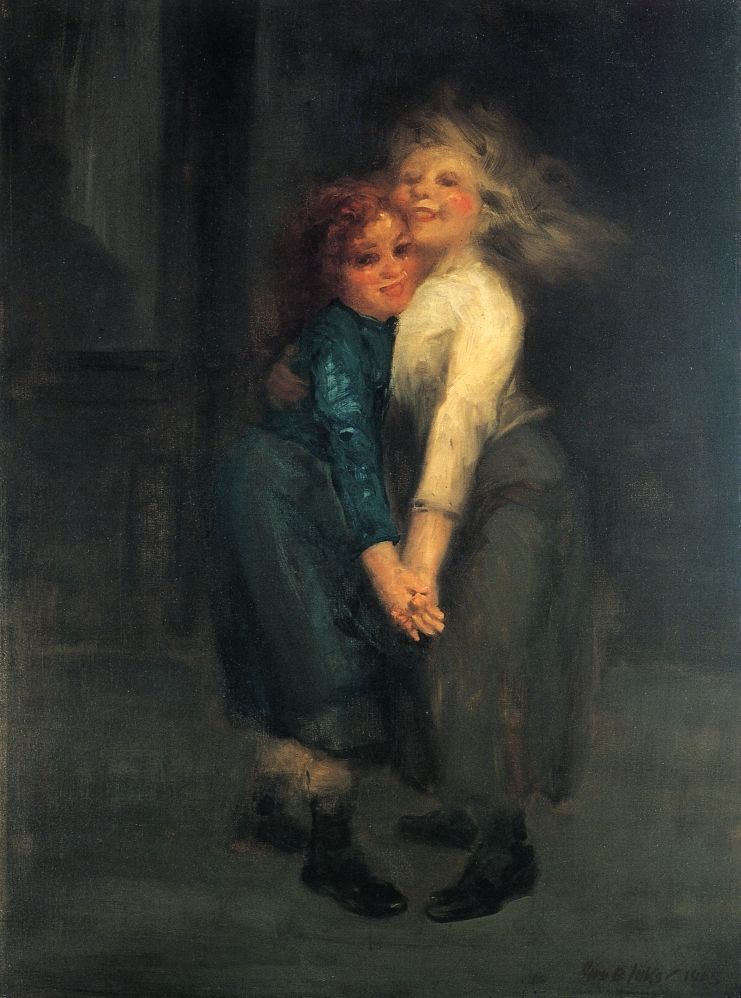
Clara Klinghoffer. Part 1.

Early childhood and teenage years

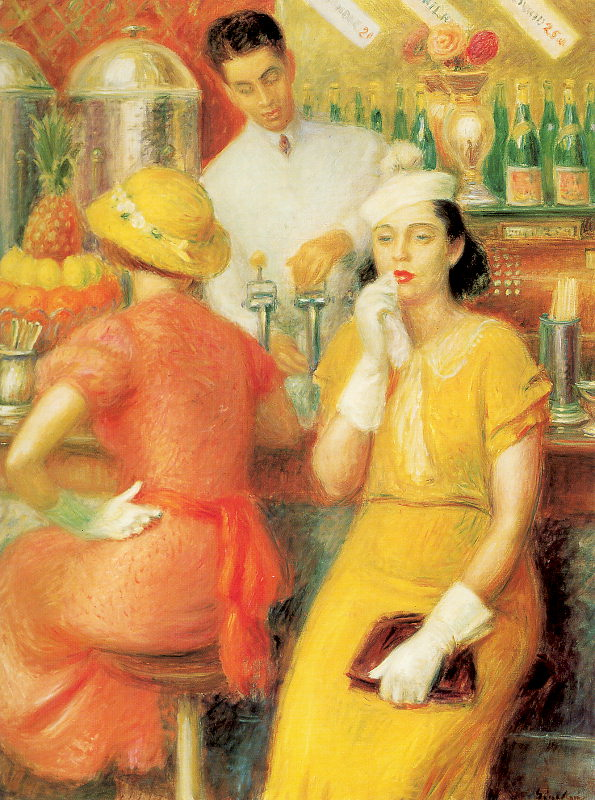
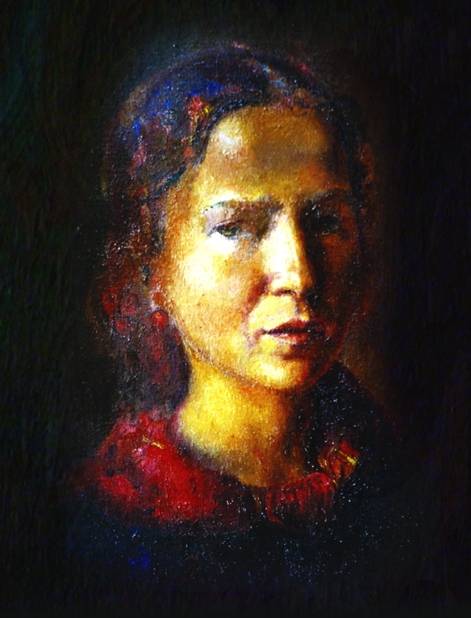
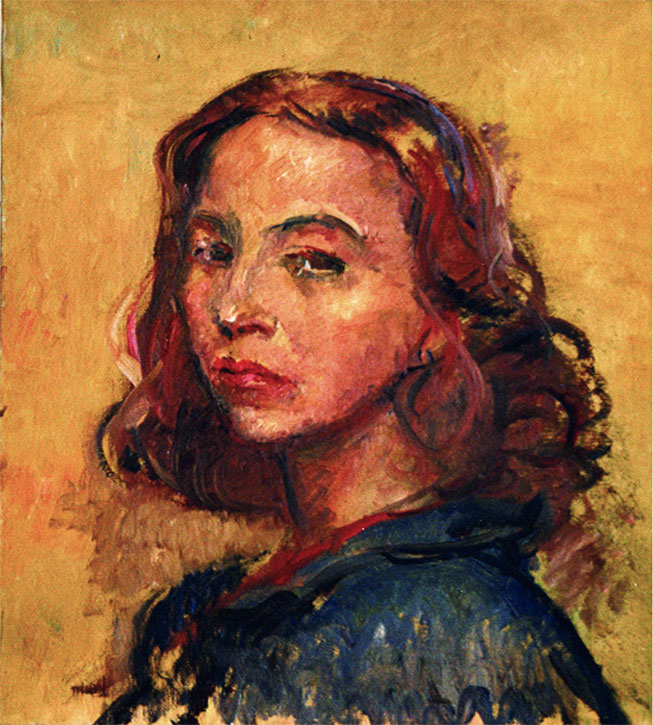
Self portrait by Clara Klinghoffer (1937)

“…Now universally recognized as one of the greatest English woman painters, she was a poor and utterly unknown young girl from the East End when her first exhibition took the artistic world by storm in 1919. Hailed everywhere as the girl who could draw like Raphael, her superb technique has always been compared with the Old Masters, but at the time of her first show she had never seen any of the great Old Masters pictures…”    

–Women of Today, 1932

My blog today looks at the rise of one of the great female artists. For Clara Klinghoffer’s life story, I want to go back to her paternal grandparents, Abel and Witie Stark who lived in in Szerzezec, a village some forty minutes by train away from the large town of Lemberg, known to us now as the Ukranian city of Lviv, but at the time of Clara’s birth in 1900 it was part of the contested region that was once Polish Galicia, but was then part of the Austro-Hungarian Empire.  Since Galicia had split from Poland and came under Austrian control, life had been good.  The majority of the population of the small town of Szerzezec were Jewish but they had a good working and social relationship with their fellow Christian citizens.  It was an easy-going and liberal place to live where both Jews and Christians realised they needed each other.  Abel Stark ran a grain business and had achieved lucrative contracts with the Austrian military.

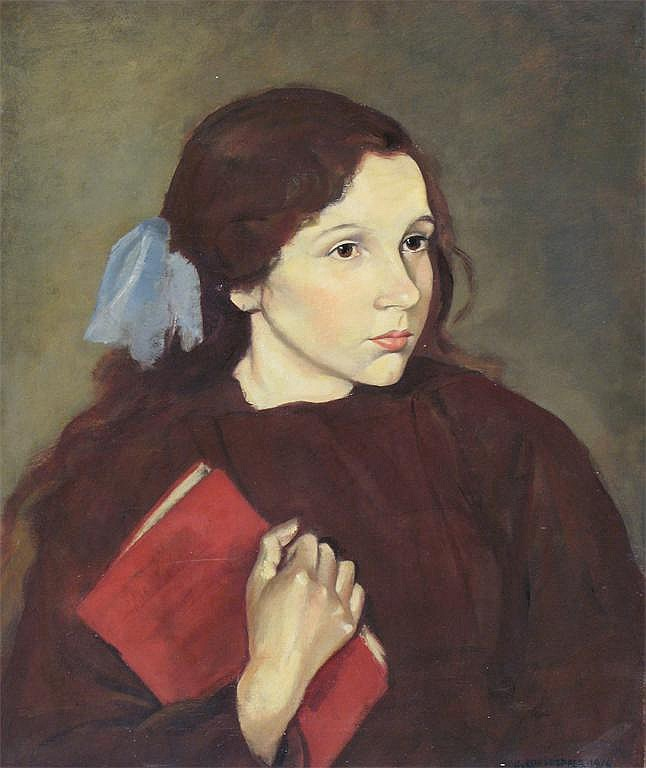
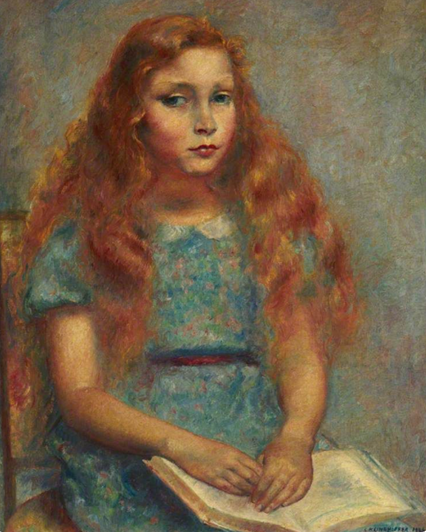
 Portrait of Annie Salomans with her book by Clara Klinghoffer (1918)

In 1898 Abel and Witie had one major problem to solve.  Their eldest daughter, Chana Riza (Hannah), was twenty four years old and despite her father and mother’s attempts to find her a husband and that of the local shadchan (matchmaker), she remained unwed !  If it was a problem for them, it was also a problem for her two younger sisters, Sarah and Leah, as according to ancient custom, they were not allowed to marry until the eldest sister married first.  Eventually a “marriage candidate” arrived who was acceptable to both parents and Chana Riza.  He was Salman Klinghoffer.  To Chana’s father, Salman was ideal and would be able to work in the family business whilst to Chana herself he had all the physical attributes she found pleasing. 

Self portrait by Clara Klinghoffer (1955)

Chana Riza and Salman Klinghoffer were married on March 1st 1898 at a large ceremony attended by most of the townsfolk and the merriment lasted for many days.  The newly-weds moved into her parents home and Salaman began working for his father in law but Salman and his father-in-law did not get on well.  They were two totally different characters.  Abel Stark was shrewd, dynamic and very determined which was the reason for his success in business.  On the other hand, Salaman was a quiet and contemplative man and somebody who shied away from confrontations.  Chalk and cheese !  Abel soon became aware that Salman would not eventually be able to take over the family grain business in a partnership with Abel’s son Ephraim and Salman riled at being treated like a lackey by his father in law..

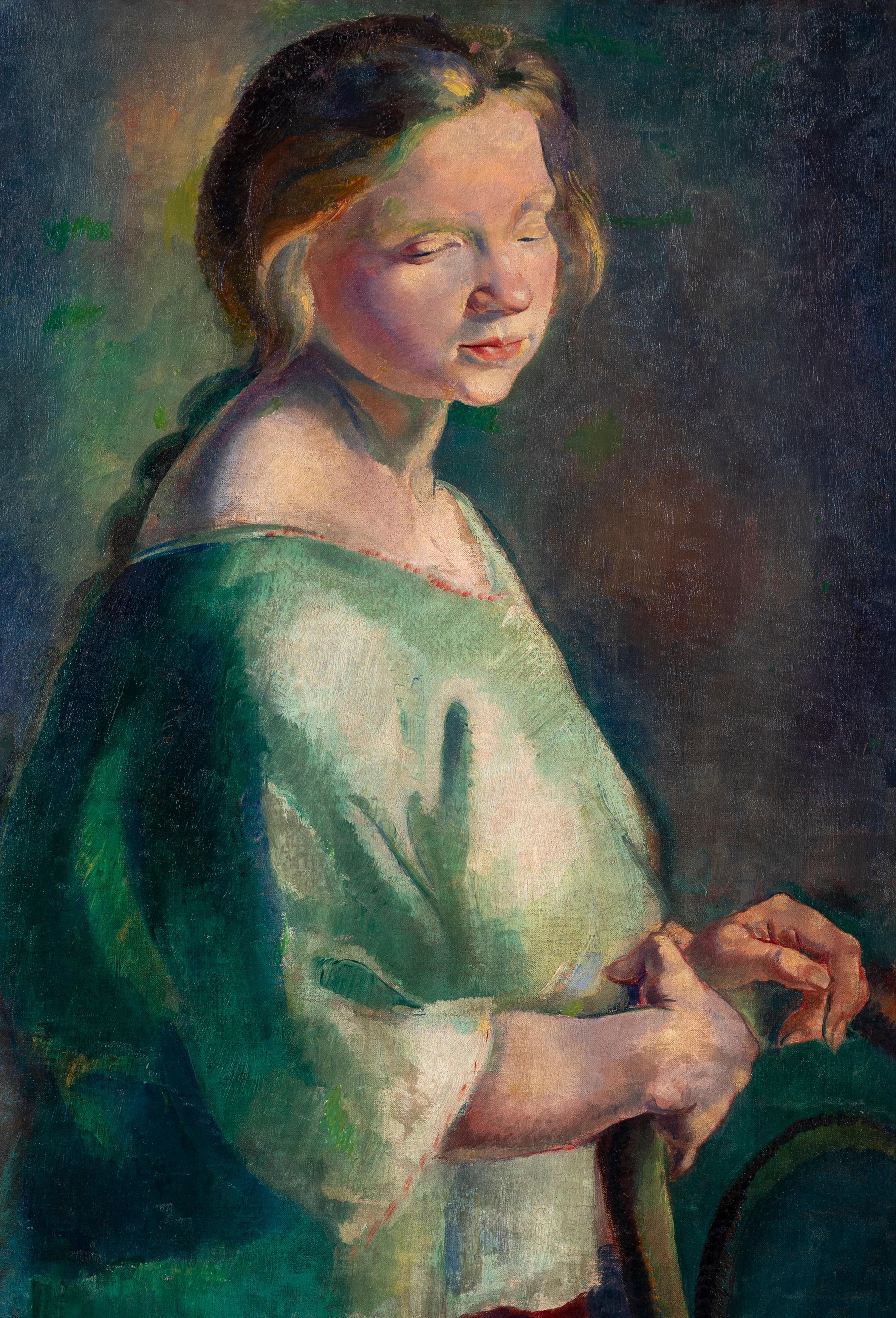
Untitled (Young Woman) by Clara Klinghoffer

Salman and Chana Rizi had their first child, Fegele, in early 1899 and later that year Chana became pregnant once more.  Her second child was born on May 18th 1900.  This second daughter was named Chaje Esther after her late maternal grandmother.  A third child, another daughter, Reisel, was born on April 4th 1902.  Although the grandparents were happy with the grandchildren, their happiness, at least in the eyes of Axel, was tempered by the fact that Chana Rizi had not given birth to any male offsprings.

Portrait of a Girl Reading by Clara Klinghoffer (1946)

Salman was fed up with life and working for Abel and soon on hearing many stories about the golden land of America decided that his future lay there and he would head there alone, get a job and then send for his wife and children.  Sadly Salman was a dreamer.    He broached the subject with Abel and Witie who did not oppose his dream and seemed to be pleased to be rid of him.  His wife viewed it differently but because she knew her husband was very unhappy, she believed he should grasp the chance to better his life and any way, soon she would join him.

Giuseppina by Clara Klinghoffer (1934)

Salman left Szerzezec but instead of going to America arrived in England in the city of Manchester and took a job as a presser in a tailor’s shop.  Nobody knows why he changed his plans of fulfilling his American Dream but maybe he had contacts in the northern English city.   At first he corresponded with his wife back home telling her what he was doing but there was never an invite for her and his three children to join him.  The arrival of letters from her husband soon became infrequent and eventually stopped altogether.  What had happened to him?  Had he taken up with another woman?  Had he become seriously ill?  Had he decided to journey on to America?  All were questions that Chana Rizi contemplated.  So in 1903, she took the momentous decision to go to Manchester with their two children Fegele and Chaje and look for her husband. Her youngest daughter, Reisel, was left with her grandparents.  Chana Rizi was just thirty years old and solo travel was hazardous and she would be arriving in a country whose language she could neither speak nor understand.  However, she did arrive in Manchester after a long boat trip during which time she was violently seasick and she eventually located her husband, much to his surprise.

Pastel portrait of Lucien Pissarro by Clara Klinghoffer (1928)

Salman was paid a pittance as a presser but Chana Rizi was determined to stay by his side so they could build a life together even if they all had to endure poverty.  It was also at this time that they changed the children’s first names.  Fegele became Fanny and Chaje Esther became Clara – Clara Klinghoffer.  The family could not make ends meet and so they moved to the Staffordshire town of Hanley.  Salman’s wages were better and Clara enjoyed the peace of the small rural town which compared favourably with the noisy and polluted city of Manchester but all was not well with the family dynamics and there was a rumour that Salman was having an affair with a local woman.  Chana Rizi, who was pregnant with her fourth child, packed their bags and demanded they returned to Manchester.

Harriet Cohen (pianist) by Clara Klinghoffer (1925)

The family arrived back in the city and rented a property at 18 Irwell Street in the Cheetham Hill district of the city and it was here in late June 1904 that Chana Rizi’s fourth child, another daughter, Rachel, was born.  Many years later, Chana went to visit a friend in London and when she returned to Manchester she announced to her family that they were going to move to the English capital and there would be a job waiting for her husband as manager of a drapery shop in Poplar in the East End of London, which would suit him better as the physical strain on him as a presser was proving too much for him and was affecting his health.  Salman went first to London to secure somewhere for the family to live.  He managed to rent a small East End flat in Puma Court, a tenement block off Whitechapel Road, close to Spitalfields fruit market.  Very little good could be said about their accommodation in their Puma Court flat or the neighbourhood and the smell of rotting fruit and veg coming from the market.

Clara’s early schooldays were ones she would rather forget.  Ferocious teachers who often meted out corporal punishment with a birch and unfriendly fellow pupils were things she had to put up with.  Added to that, her mother fell down the steps of their flat and broke her leg in a number of places which meant she had to rest up in bed with her leg in a heavy cast.

Pen & Ink fashion sketch from Clara’s childhood sketchbook (1913)

Salman was not happy working as manager at his cousin’s drapery shop.  He wanted to be answerable just to himself and so he looked to become self-employed.  He wanted to be his own boss.  He travelled back to Manchester where he set himself up as a “mill end” trader and arranged for bags of “end of roll” materials to be sent to his London home where they were stored in one of their rooms.  He and Clara’s mother then sorted them and Salman took them around various tailors selling the cloth.  The tailors in those days partly made their livelihood from repairing clothes and so needed various pieces of material.  Salman’s business prospered and he was soon able to lease his own shop in Grove Street, off Mile End Road in London’s East End, from where he would run his business and there would be accommodation above for the family.  Throughout the day, tailors would call at the shop looking for material.  Thanks to the support and ambition of his wife Chana, Salman had become a merchant – a profit-making businessman.  Around the early part of 1910 the family moved to another East End property, a roomier three-storey house at 148 Cannon Street Road where Clara’s mother had a dress shop and in April 1914 Salman Klinghoffer applied for naturalisation, probably due to the prospect of war in his homeland .

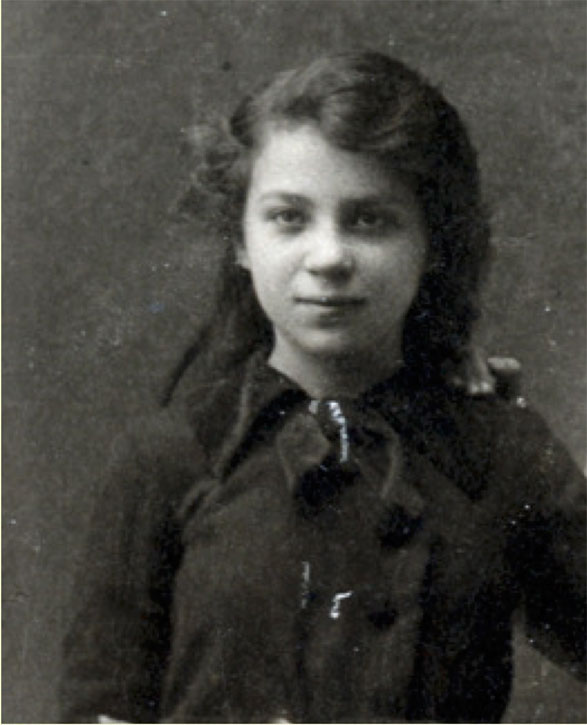
Photograph of Clara (c.1913)

Clara enrolled at St Mark’s School, a parish school serving poor and largely immigrant children, in nearby Cable Street and despite her sense of foreboding, she found she enjoyed school life and her favourite subjects were history drawing.  After school, Clara would return home and spend time in her mother’s dress shop and began to sketch some of the clients.  She would also spend time in the large attic which ran the whole width of their house and was used as a room to store her father’s mill ends. However there was a table in the attic at which she sat and sketched. This was her first “studio”.

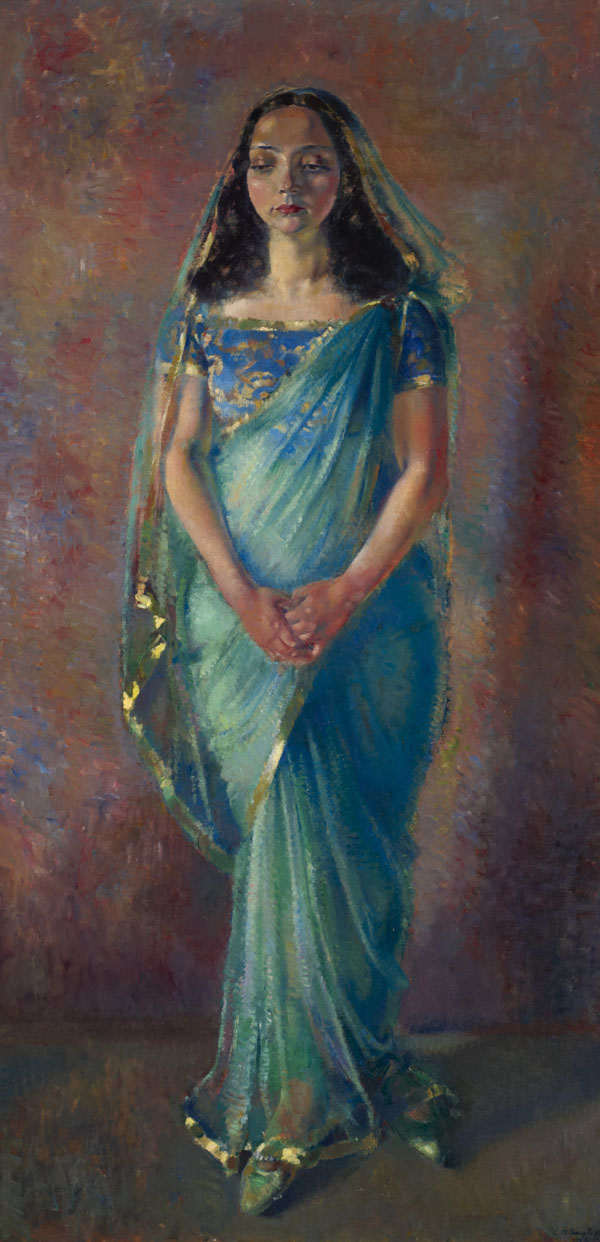
Girl in Green Sari by Clara Klinghoffer

One of her mother’s clients, a young man, who saw Clara’s sketches told Clara’s mother that her daughter was very talented and she should take art lessons.  Clara’s mother was intrigued by the suggestion and she and her husband decided to do something to help their daughter. Studying art at an art school was very expensive but her father and mother managed to raise enough for her to enrol at the John Cass Institute, in Jewry Street, Aldgate. 

………….to be continued


Information for this blog was found in many sources but the most important ones were:

Clara Klinghoffer – 20th century English Artist

Clara Klinghoffer: the girl who drew like Raphael and Leonardo

Cedric Morris

Self portrait by Cedric Morris (1919)

Cedric Lockwood Morris was born on December 11th 1889 at Matcham Lodge, Sketty, Swansea.  He was the first-born child of George Lockwood Morris, an industrialist, iron founder and prominent rugby player who had played for Wales and his wife Wilhelmina (née Cory).  Both of Cedric’s mother and father hailed from well-to-do families who owned industrial businesses. Cedric had two sisters, Muriel who died in her teens and Nancy who was four years his junior. In 1947, when Cedric’s father, George, was eighty-eight, he succeeded to the baronetcy which had been created for his great grandfather. Sir John Morris, a copper and coal magnate.  This prestigious event came three months before he died and the baronetcy passed on to fifty-eight-year-old Cedric Morris, who became the 9th Baronet in November 1947. 

Cedric was sent away to St Cyprian’s School, Eastbourne, an English preparatory boarding school for boys, which trained pupils to proceed to leading public schools, and so providing a taster to boarding school life.  From here Cedric, aged thirteen, was enrolled at Charterhouse, an English public school.  He achieved very little academically at these schools and sat the examinations to enter the army, which he failed. In 1907, aged seventeen, Cedric, at his mother’s suggestion, travelled to Canada to work on a farm in Ontario.  That did not suit him and after a number of menial low-paid jobs he returned to Wales.  He briefly studied music at the Royal College of Music where he hoped to become a singer but again he failed in that venture.  In April 1914, at the age of twenty-four, he travelled to Paris and enrolled at the Académie Delacluse in the Montparnasse district of the French capital.  His stay in Paris was curtailed due to the outbreak of the First World War and he returned to England and joined the Artists’ Rifles, an active-duty volunteer reserve force of the British Army.  Many of those who joined were artists, actors, musicians and architects and its first headquarters was located at Burlington House. Its first commanders were the painters Henry Wyndham Phillips and Frederic Leighton. However like many of his previous aspirations, this came to naught, when he was medically discharged due to a childhood operation which affected his hearing and so he never made it to the Front.  However, Cedric who was an accomplished horseman, took up his next position as part of the  war effort when he joined the Remounts Service which was responsible for the provisioning and training horses and mules which were bound for the Front.  He worked under Cecil Aldin, a Remount Purchasing Officer who was also an amateur artist.  In 1916 the Remounts Service was taken over by the Army and became the Army Service Corps Remounts Service and as Cedric was a civilian he had to leave the organisation.
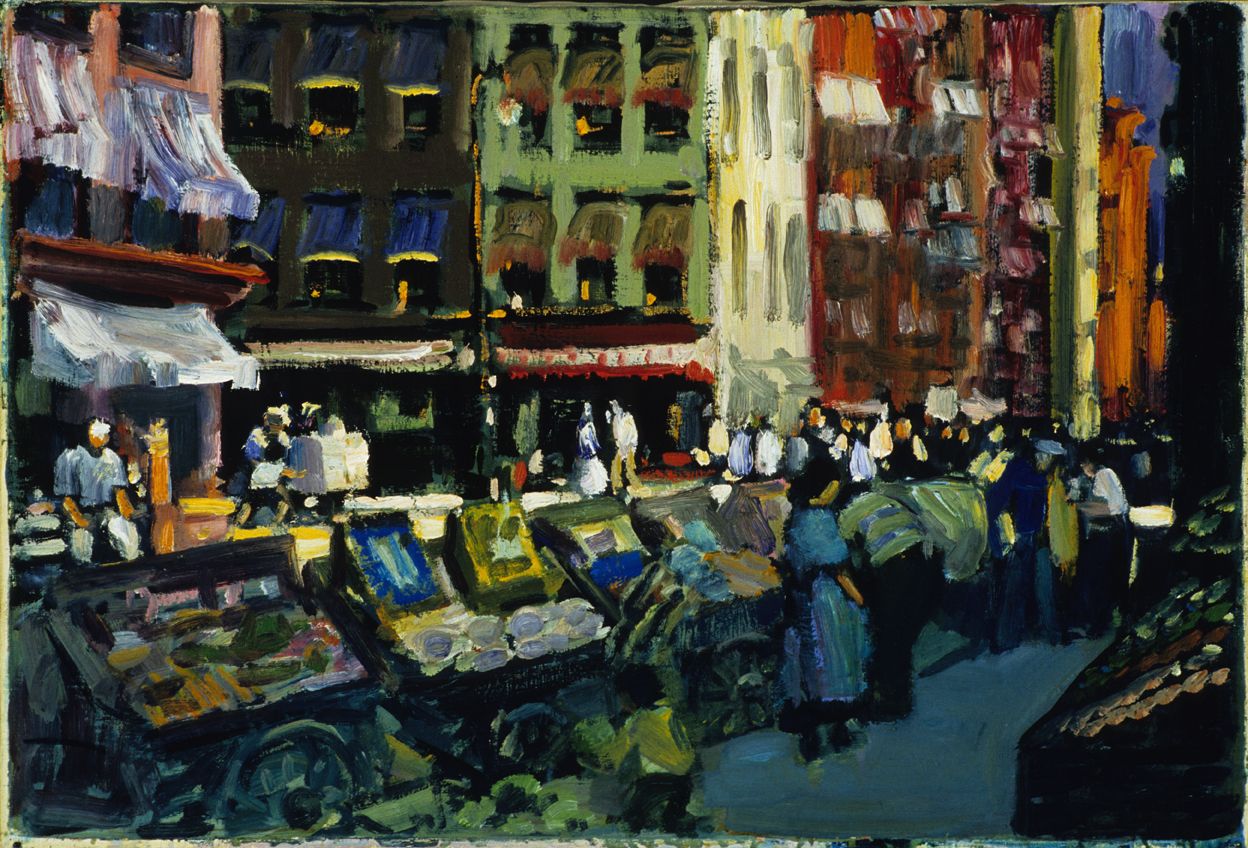
Frances Hodgkins by Cedric Morris (1917)

In 1917 Morris travelled to Zennor, a village in south-west Cornwall, close to St Ives, where he stayed for twelve months painting in watercolours and studying the plants and fauna of the area.  It was here that he met the New Zealand painter, Frances Hodgkins.

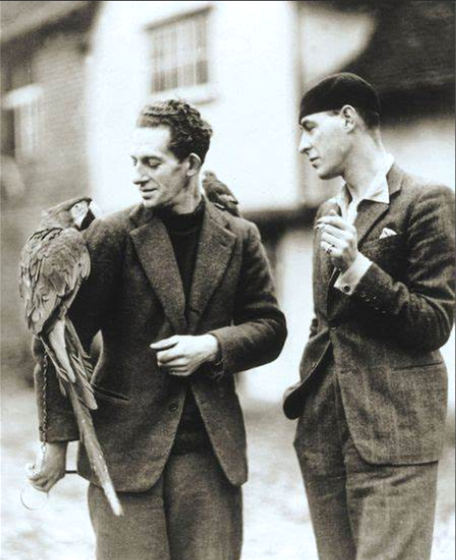
Cedric Morris (Man with Macaw) by Frances Hodgkins (1930)

As well as his painting of her Frances painted one of him with a macaw in 1930.

Arthur Lett Haines

By the time of the Armistice and the end of the Great War on November 13th, 1918, Morris had left Cornwall and returned to London and it was on Armistice Day that he first met Arthur Lett Haines and fell in love with the painter and sculptor despite Haines living with his wife of two years, Gertrude Aimee Lincoln, an American and granddaughter of Abraham Lincoln.  Cedric Morris moved into the Lett Hains’ household in Carlyle Square, Chelsea and the trio had planned to move together to America.  However, the three-person tryst ended and Aimee moved alone to America.  With Aimee out of the picture, the two men travelled to Newlyn, Cornwall and set up home. Arthur Lett Haines, known by his middle-name Lett, was five years younger than Morris, being born on November 2nd 1894.  He was educated at St Paul’s School Public School, London and went on to serve in the British Army during the Great War.

Atelier Tapisseries, Djerba, Tunisia by Cedric Morris (1926)

Cedric Morris and Lett Haines moved to Cornwall to set up home in 1919 and at the same time they sub-let their London flat to Frances Hodgkins.  They moved houses a couple of times before settling in a house known as The Bowgie, which was a combination of a row of old cottages overlooking Newlyn harbour, and became a holiday home for the pair.  At Christmas 1920 they sold The Bowgie and moved to Paris. 

Cedric Morris and Lett Haines

The Paris that Morris and Lett Haines arrived at was said to have been a melting pot of artistic creativity. The pair would devote their evenings mingling in the cafes and bars in Montparnasse and mixed with such artistic luminaries as Marcel Duchamp, Peggy Guggenheim and the photographer, Man Ray.  The one thing that Cedric Morris had difficulty with whilst in Paris was his dislike of crowds and so he and Lett Haines would take every opportunity to escape the hubbub of city life and although living in Paris for the next five years, it was just a base they used as the two painters, along with friends, went off on their European travels. 

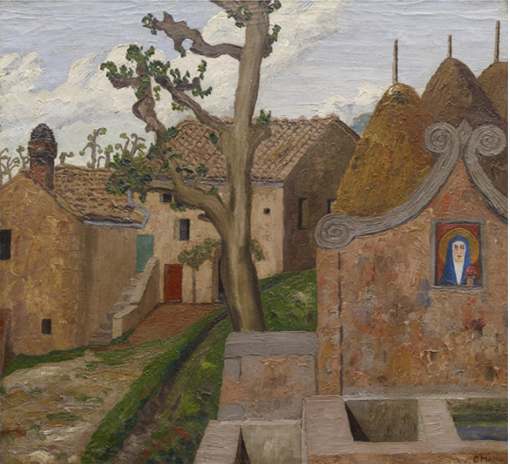
The Italian Hill Town by Cedric Morris (1922)

They went to North Africa in 1921, 1925 and 1926 and spent time in Germany in 1921 before journeying to Italy where they travelled the country for most of 1922.  Cedric held his first one-man exhibition at the Casa d’Arte Bragaglia in Rome which opened at the beginning of November 1922.  Casa d’Arte Bragaglia was an exhibition space for Futurist art and a meeting point for intellectuals and artists.  Unfortunately the exhibition opening coincided with Mussolini’s March on Rome, an organized mass demonstration and a coup d’état which resulted in Benito Mussolini’s National Fascist Party ascending to power in the Kingdom of Italy.  Futurist art was condemned by Mussolini and his Fascist followers and the exhibition was closed down.

Patisseries and a Croissant by Cedric Morris (c.1922)

Although living in Paris, Cedric Morris held the first of his two one-man exhibitions in London. The first was in June 1924. which was held at Gower Street, and organised by the Arts League of Service, a little-known cultural organisation founded in Britain in 1919 with the singular aim of bringing art and the ‘higher forms of entertainment’ to the masses. Cedric exhibited forty-four paintings and twelve drawings.

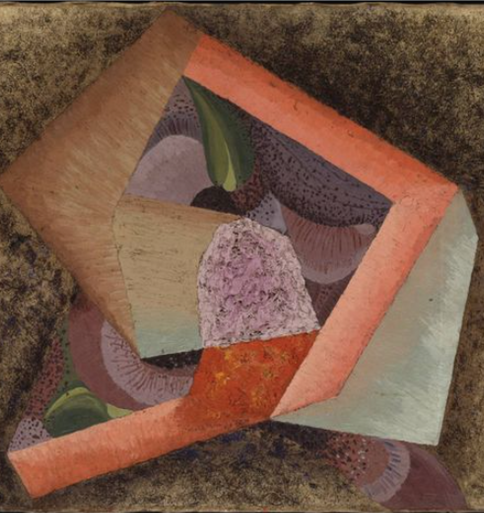
Experiment in Textures by Cedric Morris, (1923)

It was also in the 1920s that Morris dabbled with Abstract Art.

The Brothel by Cedric Morris (1922)

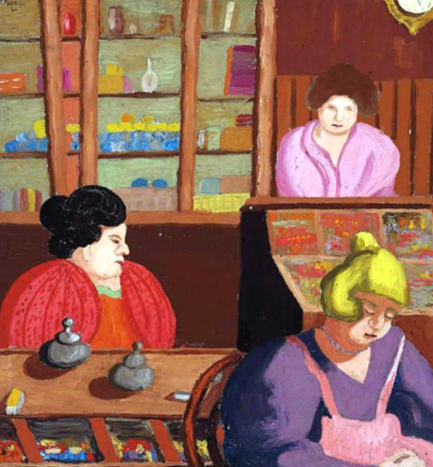
Cedric Morris and Lette Haines were great “people watchers” and Parisian streets, boulevards and bars were great places to study the locals. Morris took delight in recording the activities and idiosyncrasies of the people as we can see in the paintings he completed around that time. One example is his painting entitled The Brothel.

Les Bocks à Montparnasse (1922)

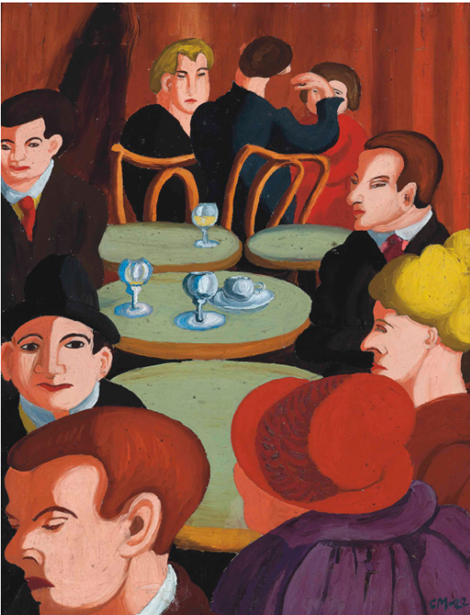
Another was his café scene for his painting entitled Les Bocks à Montparnasse.

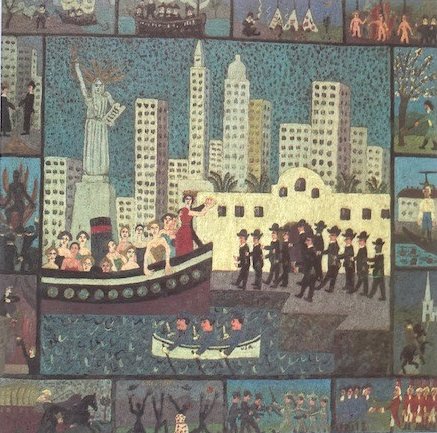
The Entry of Moral Turpitude into New York Harbour by Cedric Morris (1926)

One of Cedric Morris’ unusual paintings around this time was one he completed in 1926, entitled The Entry of Moral Turpitude into New York Harbour, a painting bought by his friend, Vita Sackville-West. This painting’s compartmented depiction is unique in Morris’ work.  The idea for this depiction came about with the dramatic and scandalous case of the time when the United States immigration authorities refused to allow a titled Englishwoman to land and enter into New York after a sea passage from England.  The Immigration officials stated that their refusal was based on their belief that she was allegedly guilty of “moral turpitude”.  Moral turpitude refers to conduct that is considered contrary to community standards of justice, honesty, or good morals and so covers numerous types of misdemeanours.  In the case of the English women her misdemeanour was having been divorced by her husband and the man, also titled, travelling with her had been cited in the divorce case.  She and her companion are depicted in Morris’ painting standing at the bow of the ship wearing coronets.  Their transatlantic ship is being approached by uniformed officials in a boat marked “USA”.  On the quayside we see a group of men wearing black suits, large hats and white collars waiting for the ship’s arrival.  They are meant to be ministers of the church. 

A legal battle followed and their deportation order was eventually quashed.  The news of the case travelled back to England and the English Foreign Secretary at the time was asked if England should refuse entry to Britain of American divorcees.  The main painting is surrounded by fourteen smaller paintings that were meant to draw attention to contrasting impulses in America towards liberty and oppression, the latter being an obvious message in the main painting.  Other scenes depicted in the smaller peripheral paintings include Landing of Christopher Columbus, Landing of the Mayflower, fraternisation between colonists and American Indians, burning of witches, George Washington cutting down the cherry tree, assassination of Lincoln, to name but a few.  Cedric Morris, probably due to his sexuality, disliked and found offensive the more restrictive aspects of morality taught by the churches

Herbs, Salads and Seasoning by Marcel Boulestin, illustrated by Cedric Morris

Probably because of Morris’ dislike of big cities, he and Lett Haines left Paris and returned to England, staying for a time in the late summer of 1926 with his sister Nancy who lived in the Dorset village of Corfe whilst at the same time they were searching out studio space in London.  At around this time he met Marcel Boulestin who had wanted an illustrator for his soon-to-be-published book, Herbs, Salads and Seasoning.  Cedric Morris accepted the commission to illustrate the book.

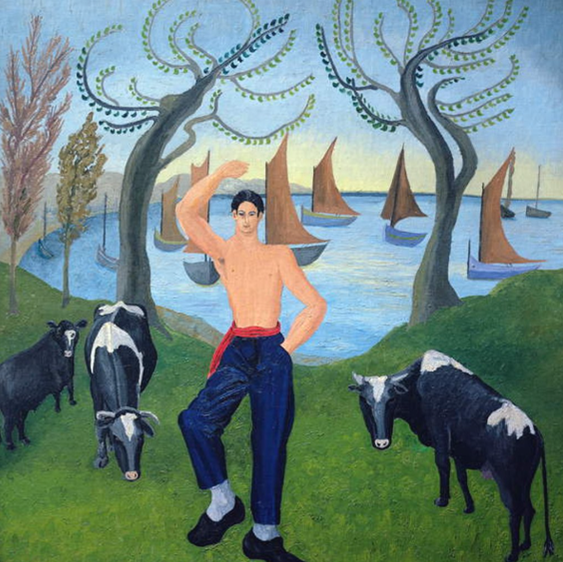
The Dancing Sailor by Cedric Morris (1925)

Morris eventually found a large studio in London which catered for all his needs.  It was at 32 Great Ormond Street and early in 1927 Cedric and Lett Haines moved in.  It seems strange that Morris should leave the over-crowded French capital because of the suffocating atmosphere and yet locate his studio in London but it is thought that Lett Haines had persuaded him to make the move to the English capital as it would be possible to launch Cedric into the British art scene.  The Great Ormond Street studio became a very popular meeting place and party venue for the great and the good of the Bloomsbury Set.  The Bloomsbury Set was a group of English writers, intellectuals, philosophers and artists in the first half of the 20th century which included Virginia Woolf, Vanessa Bell, Roger Fry, John Maynard Keynes, E. M. Forster and Lytton Strachey.

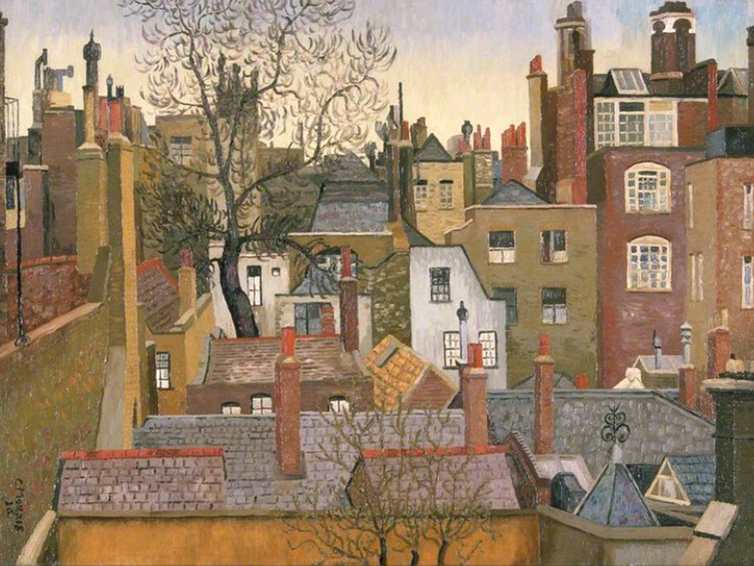
From a Bedroom Window at 45 Brook Street, W1 by Cedric Morris (1926)

Soon after settling down in London, Morris became a member of the Seven and Five Society, an art group of seven painters and five sculptors, including artist Ben Nicholson and sculptors Henry Moore and Barbara Hepworth.  Morris submitted many of his works to exhibitions but one of his greatest successes was at his one-man exhibition at Arthur Tooth & Sons Gallery in New Bond Street, an art gallery founded in London, in 1842 by Charles Tooth.  It was a great success with thirty-one of his thirty-nine painting selling at the private viewing and the remaining ones sold by the time the exhibition closed.

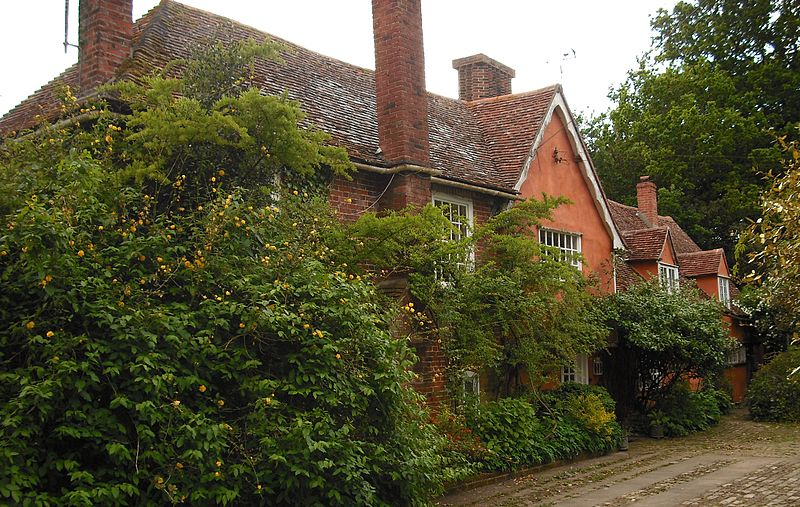
Pound Farm, Higham

Not only was Cedric Morris a great artist who loved to paint, he also had another great love – a love of horticulture.  He was a true plantsman but living in London hindered that love and so he and Lett chose the country life in order to pursue Cedric’s passion for horticulture. And so, early in 1929, Cedric and Lett took the lease of Pound Farm, Higham, Suffolk, and in February 1930 they gave up their London studio. The farm was owned by the wealthy landlady and student, Mrs Vivien Doyle Jones. In 1932 their landlady died and bequeathed the farm to Cedric Morris. It was here that Morris lovingly created a memorable garden.

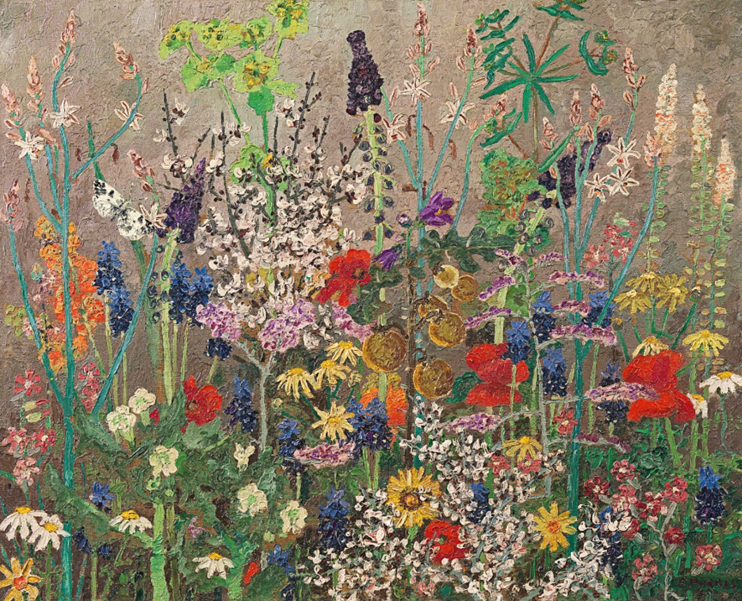
Flowers by Cedric Morris (c.1926)

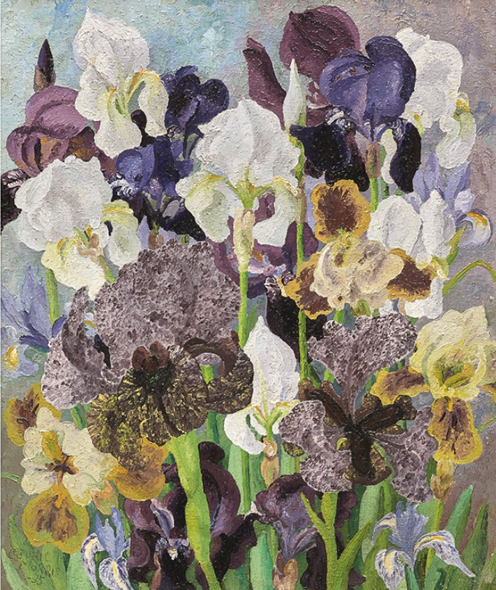
Morris had always been interested in floral painting and now, at Pound Farm, he found the ideal location. He also became a successful and well-known breeder of irises.

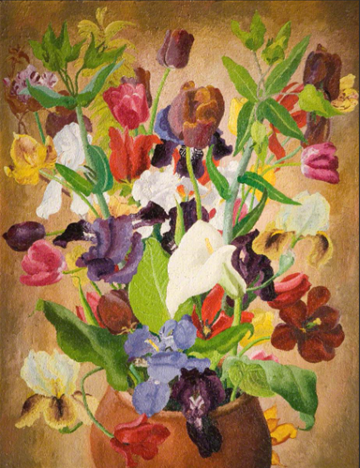
Irises and Tulips by Cedric Morris

Cedric Morris had a great passion and extensive knowledge of gardening and one of his favourite hobbies was breeding irises.  In his painting Irises and Tulips we see a colourful arrangement of irises and tulips and an impressive white Arum Lily along with two stems of the Great Yellow Gentian.  The tulips are shown as starting to collapse which hints at this painting being carried out in the early part of summer.

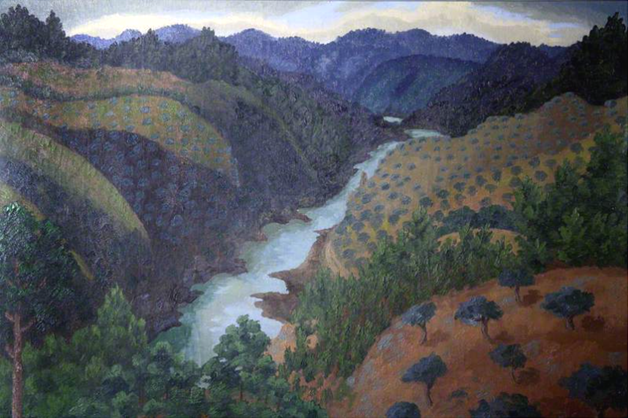
River Zezere, Portugal by Cedric Morris (1950)

Three miles to the south-west of Pound Farm was the small town of Dedham, which a century earlier, was the home of the great English painter, John Constable.  On April 12th 1937 Cedric Morris and Lett Haines opened the East Anglian School of Painting and Drawing in an old house in the centre of Dedham.  Lett-Haines taught theory, whilst Morris taught by encouragement and example.  It is interesting to note that the school was described in a prospectus as “an oasis of decency for artists outside the system”.  It was a great success from the very start and by the end of the year, it had sixty students. 

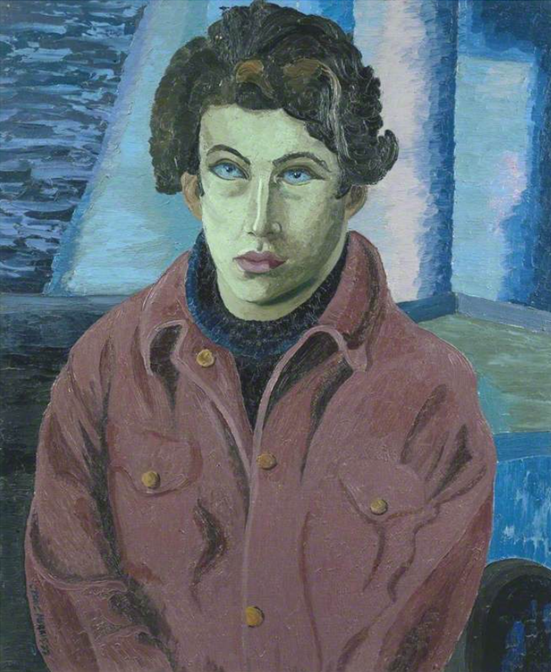
Lucian Freud by Cedric Morris (1941)

In 1939 a seventeen-year-old student by the name of Lucian Freud enrolled at the school, after he had spent a short time studying at the Central School of Art in London. 

May Flowering Irises. No.2. by Cedric Morris (1935)

In July 1939, disaster struck when the old Dedham house was destroyed by fire. Living nearby was the artist Alfred Munnings, who would become the President of the Royal Academy in 1944. He was one of England’s finest painters of horses, and an outspoken critic of Modernism which Cedric Morris practiced   He shed no tears when the Dedham art establishment of Morris and Lett Haines burnt to the ground and it was reported that he had his chauffer drive him around the burnt-out house, gloating at its destruction, and cheered loudly at the destruction of what he saw as an odious development in art . 

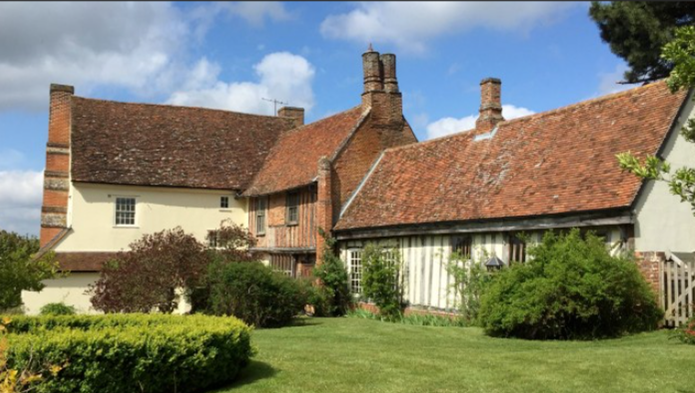
Benton End, the home to the East Anglian School of Painting and Drawing (Photo: Benton End House & Garden Trust)

Not to be deterred by this disaster, at the end of 1939, Morris and Lett Haines discovered Benton End, a rambling 16th-century house with gardens, on the outskirts of Hadleigh in Suffolk.  The large size of the place allowed the artists to live and run their school and also accommodate their students in one place, which hadn’t been possible at the previous venue.

In 1946, Cedric Morris and Lett-Haines became founder members of Colchester Art Society and later Morris became the society’s president.  In 1947, on the death of his father, Cedric became Sir Cedric Lockwood Morris, 9th Baronet.  Deteriorating eyesight in the mid 1970s curtailed most of his art.  The Dedham school closed shortly after Lett Haines died on February 25th 1978, aged 84.

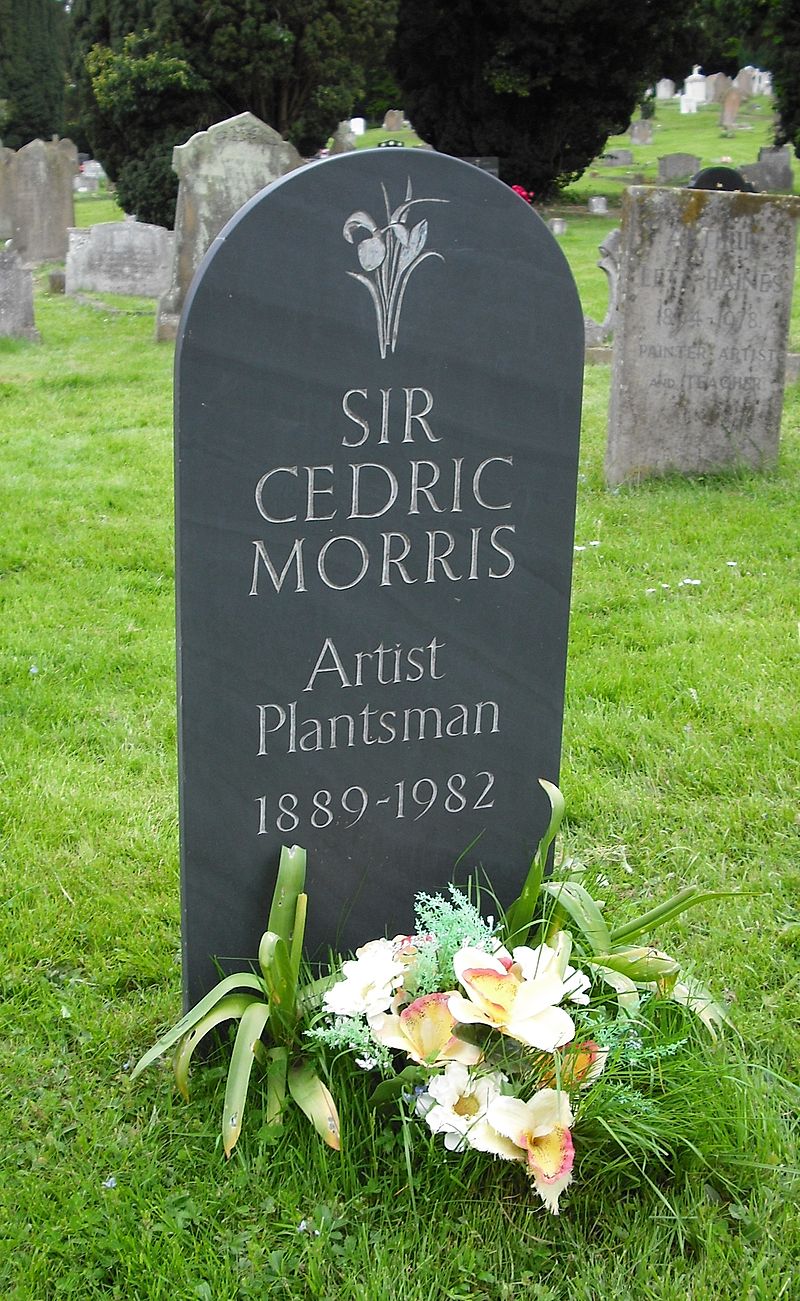
Cedric Morris continued to live at Benton End until his own death on February 8th 1982, aged 92.   The two are buried near each other at Hadleigh Cemetery in Hadleigh.  Morris’s gravestone, in front, and Lett-Haines, in back on the right.


The information for this blog came from the many websites about the life of Cedric Morris and Lett Haines as well as Richard Morphet’s Tate Gallery book on Cedric Morris, the great Welsh artist.

Benjamin Robert Haydon. Part 4.

The sad ending to life.

In the previous blog I told you about Benjamin Haydon’s trip to Paris with his friend David Wilkie.   The journey began at the end of May 1814 when the pair were able to take advantage of the ending of hostilities between England and France.  Whilst in the French capital the two artists spent time at the Louvre  and see the art collections gathered by Napoleon from across Europe.  

Portrait of Emperor Napoleon I by François Gérard (1815)

They also visited François Gérard’s studio.  Gérard was one of the foremost portrait-painters of the day and had eight of his portraits accepted at the 1808 Salon and fourteen in the Salon of 1810.  His portraiture depicted all of the leading figures of the French Empire and of the Bourbon Restoration, as well as all of the most celebrated men and women of Europe and his Paris studio was often a meeting place for upper-class society. 

Napoleon Bonaparte as First Consul by François Gérard (1803)

When Haydon and Wilkie visited the studio Haydon was most impressed by Gérard’s portraits of Napoleon Bonaparte and he became captivated by the French leader.

Napoléon Bonaparte (‘Napoléon on St Helena’) by Benjamin Haydon (1830)

Haydon painted over two dozen of pictures of Napoleon, even bought his death mask and tried on one of the emperor’s hats.  In his portrait of Napoleon entitled Napoleon on St Helena we see the French leader in a thoughtful, meditative mood, pondering on his past triumphs and calamities.  One of the first of Haydon’s Napoleon portraits was for the lawyer, Thomas Kearsey, in 1829 and the following year it was exhibited at the Western Exchange.   A whole-length version above, entitled Napoleon Musing at St Helena was commissioned by Sir Robert Peel. Many others followed including Napoleon Meditating at Marengo and Napoleon Contemplating his Future Grave.

Arthur Wellesley, 1st Duke of Wellington by Benjamin Haydon (1839)

Having completed the depiction of the French leader pondering his triumphs and failures whilst on St Helena, Haydon wanted to produce a companion piece featuring the great British military leader, Arthur Wellesley, the Duke of Wellington.  The painting was to depict  Wellington overlooking the rolling fields at Waterloo at sunrise, a companion piece to Napoleon Bonaparte on St Helena gazing across the sea at St Helena.

In a way the portrait has an element of sadness as we see the ageing hero, who is not adorned in his military uniform but is dressed in civilian clothes.  The painting completed in 1839 by Haydon is almost twenty-five years after the Battle of Waterloo and twenty years after Wellesley finally left the military and entered the world of politics.  In the work we see Wellesley looking out over the scene of his greatest triumph at Waterloo. The Duke who was seventy at the time of the portrait disliked sitting for his portrait, or at least he did at this time of his life

He was even more disinclined to lend Haydon the helmet and sword which we see in the left foreground. Haydon eventually persuaded the Duke to allow them to be used as “stage settings” for the work.  Haydon went on to paint twenty-five variants of the portrait, signifying his almost obsessive interest in the Duke.

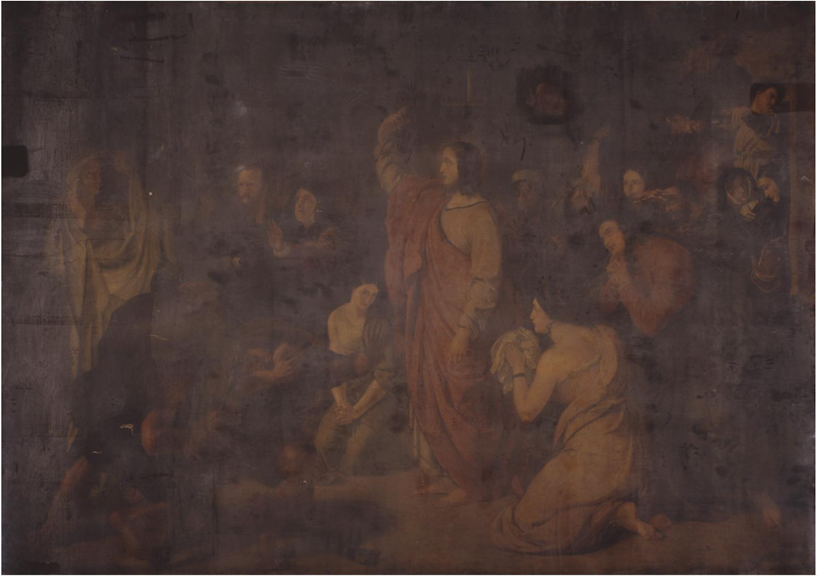
The Raising of Lazarus by Benjamin Haydon (1821-23)

When Haydon began painting The Judgement of Solomon he had debts of more than £600. Two years later when he completed the work the size of his debt had doubled. In 1821 he embarked on his largest ever canvas (426 x 632 cms), The Raising of Lazarus and in that year, Haydon’s financial problems came to a head when he couldn’t fulfil his obligations to some people who had lent him money. He was admonished but only just avoided imprisonment.

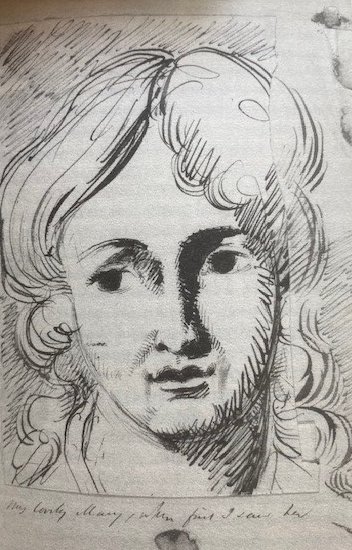
Mary Hyman – a sketch by Benjamin Haydon

It was in late Spring that Haydon first caught sight of Mary Cawrse Hyman whilst he was walking with his friend, Maria Foote, and he recounted that first glimpse of Hyman. In his journal he recorded the moment:

“…Not far from my house she requested me to stop a moment whilst she left a letter with a lady who was going into Devonshire. I waited; a servant came down, and requested I walk up……and in one instant the loveliest face that was ever created since God made Eve smiled gently at my approach…”

Haydon was besotted with her beauty and would spend hours walking by her home hoping to catch a glimpse of her. One “fly in the ointment” with Haydon’s hopes of happiness was that she was married and had two young sons, Orlando and Simon.

Later he made a sketch of her, from memory, in his journal and inscribed it:

“…My lovely Mary when first I saw her…”

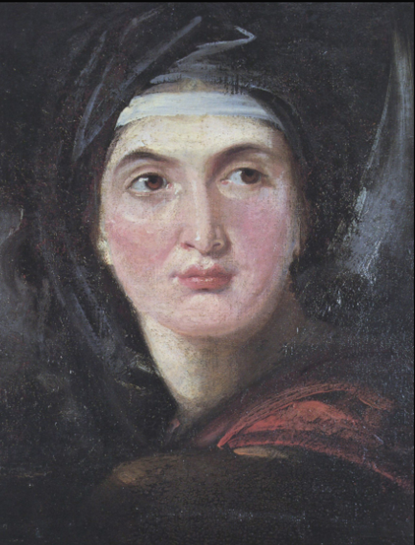
Mary Haydon as the Delphic Sibyl, by Benjamin Robert Haydon (1821)

Mary’s husband, a Devonport jeweller, was much older than his wife and was unwell. He actually died in 1821, three years after Hayman had had that first encounter with Mary. Mary Hyman and Benjamin Haydon married on October 10th 1821 at Church of St Mary le Bone. His friend David Wilkie witnessed the ceremony and he and Haydon drank many toasts to a successful marriage. This ready-made family added more financial pressure on Haydon and a day after the marriage ceremony Haydon was arrested because of he was unable to pay his creditors. Haydon, accompanied by the Sheriff’s Officer, went to the home of David Wilkie to see if his friend would stand guarantor for the debt but Wilkie was reluctant until Haydon managed to negotiate with his landlord a longer time to repay him and so Wilkie agreed to help his friend. Haydon in typical fashion wrote to Wilkie the following day berating him for his unfriendly behaviour. Wilkie, who had reluctantly agreed to stand guarantor, was horrified by Haydon’s words, said to be a mixture of sarcasm and truth, upbraiding him for his unfriendly behaviour.

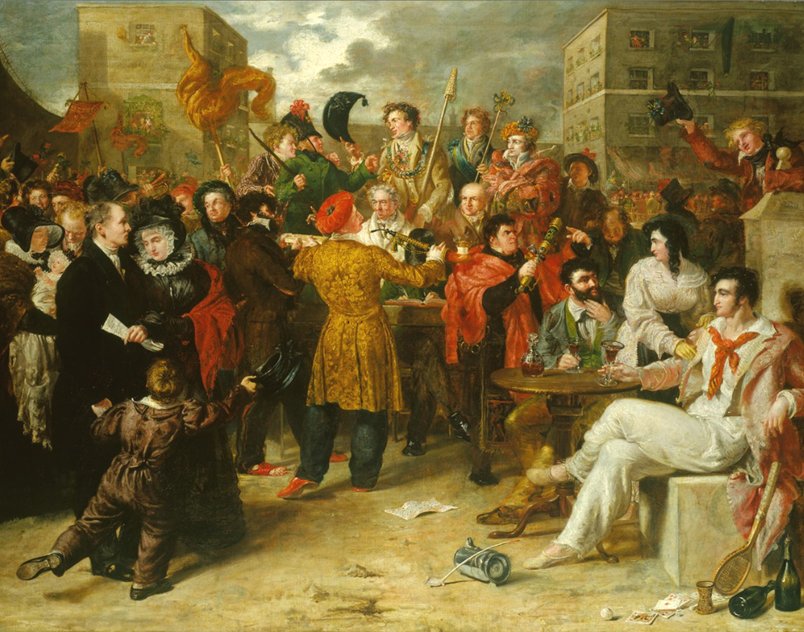
The Mock Election by Benjamin Haydon (1827)

On December 12th 1822 Mary gave birth to their first child, a son, Frank. He was the first of eight children fathered by Haydon, although sadly, five died in infancy. Haydon’s financial difficulties increased with the enlargement of the family and lack of sales of some of his works and this resulted him spending time in the debtor’s prison on a number of occasions.

His second such incarceration was in 1827 when Haydon was in King’s Bench Prison for debt. It was whilst staying here that he observed other inmates putting on a sham election in order to open a poll for the election of a member to plead for their parliamentary rights, which had been taken from them once they were imprisoned. It was proposed that they should elect a member of parliament to represent Tenterden, (a slang name for the prison).  Three candidates stood for election, one of whom was Lieutenant Meredith, a veteran of the Peninsula War. It was just like a normal election with addresses made by the candidates’ placards were printed and affixed to the walls of the prison and the electors were invited to attend the poll on Monday morning, the 16th of July.  Haydon recalled the riotous scene:

“…… As I approached the unfortunate, but merry, crowd, to the last day of my life I shall ever remember the impression… baronets and bankers, authors and merchants, painters and poets… dandies of no rank in rap and tat-ters… all mingled in indiscriminate merriment, with a spiked wall, twenty feet high, above their heads…”

King George IV bought the painting and gave Haydon 500 guineas.

Chairing the Member by Benjamin Robert Haydon (1828)

Probably Haydon’s best-known non-biblical works were painted around 1829.  In August 1828 he completed his large oil on canvas work entitled Chairing the Member. Haydon had been so encouraged by the sale of The Mock Election to George IV that he painted a companion piece, Chairing the Member, and returned to the prison to make drawings of some of the inmates. Later a third painting of contemporary life depicted in his painting entitled Punch and May Day in the New Road at Marylebone. He had great hopes that George IV would buy these works as well but he was to be disappointed, a setback he blamed on the actions of the Keeper of the King’s Pictures, William Seguier.

Chairing the Member is a crowd scene, the main characters of which are in a riotous mood brought on by an excess of alcohol.  In the background, we can see two men being hoisted aloft on the shoulders of their friends.  In the centre foreground we observe a man wearing a red waistcoat and coat, white breeches and a Napoleonic hat carrying a long pole attempts to challenge three guards, who stand on guard, seemingly unaffected by the riotous behaviour of the crowd.  A small child also grips the pole.  To the right we see a man slouched drunkenly on a stool still gripping a bottle of ale.  A woman, adorned in a black dress and wearing a white bonnet with pink ribbons, holds the man’s shoulders to prevent him falling off the stool.  A small child with a hoop stands in front of the seated man and places her hand on his thigh in order to steady him.  To the left, on the ground, we see a man slumped under a table, atop of which are glasses and glass decanters of wine.  Also, below the table, on the ground by the fallen man’s feet, is a small barrel in which are a pineapple and two other bottles wine. The whole disorderly scene is closely watched by an elderly man from an upstairs window on the right and, to the left, another man hangs out of an upper window below a red flag and toasts the revellers.  The painting is now part of the Tate Britain collection.

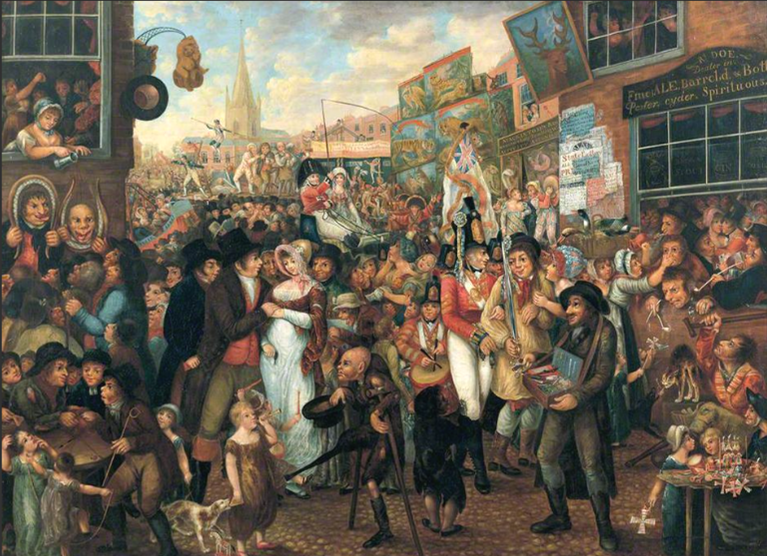
Punch or May Day by Benjamin Haydon (1829)

In 1829, a year after the completion of Chairing the Member, Haydon completed another work that depicted people enjoying themselves.  Initially Haydon had thought to entitle the work, Life, as it would encapsulate everyday life of everyday people but he later gave the work the title, Punch or May Day.  Hayden resolved to highlight the contrasts of everyday life. We see a crowd of mixed classes, ages and races who happily mingle with a costumed procession and a Punch and Judy show in the Marylebone Road.   On the right we see a marriage coach in which are a bride and groom.  In the background we see a hearse.  The newlyweds, tranquil and happy, look out of the window of their coach at the mayhem of the Punch and Judy performance with all its violence.  Even the May Day celebrations and procession in Marylebone Road, which were pagan traditions, is set against a backdrop which includes the Christian church of St Marylebone.  Taking part in this parade is a young dancing chimney sweep with blonde curls and soot-blackened face. The boy’s lively countenance contrasts with the artist’s treatment of the austere black footman standing at the back of the wedding coach.  In the left foreground we see a barefooted female slumped on the ground next to a table of wares which she is trying to sell.  Haydon believed he was a great history painter but also believed, like the woman selling her goods, he and his paintings were similarly under-appreciated.  In contrast, next to the beggar woman, and attentively watching the Punch & Judy show is a man dressed in the finest expensive clothes.  Look closely and you will see he is just about to have his pockets picked by a young pick-pocketer. Standing by the wedding coach and peering around the cavalry officer is a Bow Street runner, who is watching the antics of the thief. Behind the dandy is a rosy-cheeked farmer up from the country. Close to the Punch & Judy stage, a woman holds up her baby aloft so she could see the puppets close up. Haydon had been living in London for twenty-five years and he had enjoyed the capital’s vibrancy and in this painting he had aimed to encapsulate this energy and the diversity of the inhabitants.

Venus and Anchises by Benjamin Haydon (1826)

Haydon became well known as a lecturer on painting, and in 1835 he began to travel around England and Scotland on lecture tours. He was also a fervent believer that the country’s public buildings should be decorated with history paintings showing the glories of the nation’s past.  No doubt he believed he could supply such great works.

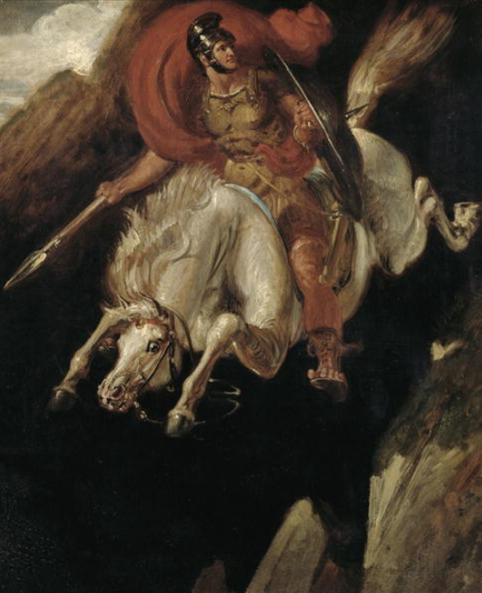
Curtius Leaping into the Gulf by Benjamin Haydon (1843)

Curtius Leaping into the Gulf was a painting Haydon completed in 1843 and depicts an ancient Roman legend, the young Marcus Curtius, throwing himself into a huge crack in the ground that had opened up in Rome. According to legend, the Roman gods were satisfied with Curtius’s sacrifice and the crack closed again.  In this work, Curtius is a self-portrait of Haydon Whether it was just a coincidence that Haydon should choose the act of suicide for his Curius painting we will never know but what is known that Haydon talked about suicide as an escape from his own life on a number occasions and he had often discussed suicide and the reasons why a person would end their own life.  He was a devote Catholic, so for religious reasons he would never countenance the taking of his own life and yet by the mid-1840s life had become very difficult as a result of his financial difficulties and his constant begging of his friends to alleviate his poverty.  He was becoming desperate.  The day before his death he was out walking with his son, Frank, and expressed how he gained pleasure on the idea of throwing himself off the Monument and dashing his head to pieces.  The viewing gallery at the top of the Monument in London was a favourite place for people wanting to commit suicide and this was only curtailed when the whole of the gallery was encased in an iron cage.  Frank was worried by his father’s mood and pleaded with him to discard any thoughts of taking his own life.  Back home, Frank told his mother about her husband’s dark thoughts but she laughed it off. 

Bartholomew Fair by Benjamin Haydon

The next morning Haydon asked his wife to travel to Brixton to invite over one of his journalist friends, David Coulton, to discuss some business.  That next morning with his wife out of the house, Haydon went to the premises of Isaac Rivière, a gun-maker, and bought himself a pocket-sized pistol.  He arrived back home within the hour and locked himself in his painting studio, with his unfinished work, The Blessings of Justice: Alfred and the First Trial by Jury on an easel.  A portrait of his wife sat on a smaller easel.  He wrote a will, but as it had not been witnessed, was invalid.  He wrote short letters to some of his friends.  One letter was to Sir Robert Peel in which he wrote:

“…Life is unsupportable!  Accept my gratitude for always feeling for me in adversity – I hope I have earned for my dearest Wife security from Want…”

He also wrote a letter to his wife:

“…God bless thee, dearest love.  Pardon this last pang, many thou has suffered from me.  God bless thee in dear widowhood.  I hope Sir Robert Peel will consider I have earned a pension for thee.  A thousand kisses.  Thy husband & love to the last…”

He also wrote a short note to each of his sons and daughter asking them to look after their mother and lead a good and honest life.  He then opened his diary which he had been keeping for the last thirty-eight years and wrote in it:

God forgive me – Amen

Finis

Of B.R.Haydon

‘Stretch me no longer on this tough World’ – Lear

End

He then cocked his pistol and shot himself in the head.  His wife and daughter heard the bang but thought it came from the nearby barracks and ignored it.  The pistol Haydon had bought that morning was of such a low calibre the bullet although fracturing his skull, did not penetrate his brain.   Not to be thwarted he picked up one of his razors and made two cuts to his neck and throat.  His wife and daughter still had no idea of what was happening and both left the house.  Benjamin Robert Haydon lay on the floor and bled to death.

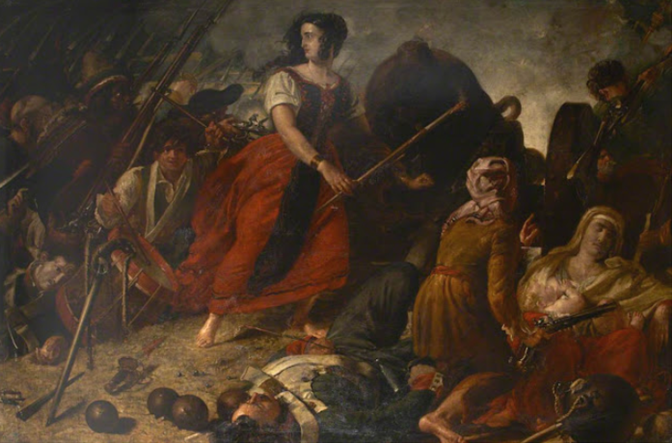
The Maid of Saragossa by Benjamin Haydon

Benjamin Robert Haydon died in his London home on June 22nd 1846, aged 60.  His wife survived him by eight years, dying on July 25th 1858 aged 61.

I recounted this life story of Haydon over four blogs and yet I have only scratched the surface of his life.  Before you judge Haydon, and if you would like to find out more about this talented painter, then I do recommend you reading  Paul O’Keeffe’s biography: A Genius for Failure, The Life of Benjamin Robert Haydon. It was from this book that I got the majority of information for these blogs.

The Tokaido Road Trip. Part 3.

The end is in sight

The Tokaido Road

Hiroshige’s journey is over two-thirds complete. In the last blog he and his party had arrived at Arai and now the Tokaido Road travellers head in a westerly direction, following the coast as it approaches Shiomizaka,

No.37. Akasaka: Inn with Serving Maids by Hiroshige
Along with the preceding post stations of Yoshida and Goyu, the one at Akasaka was well known for its meshimori onna. Meshimori onna, which literally translates to “meal-serving woman,” is the Japanese term for the women who were hired by the hatago inns on the Tokaido Road post stations. At first their role was that of simply maidservants on the payroll of the inns, but as the traffic along became busier and the kaidō (road) grew,  competition between the inns increased, and the ladies were often engaged in prostitution.  However, in 1718 the Tokugawa shogunate laid down a law which stated that the number of meshimori onna working at each inn would be limited to two and this was seen as tacit permission to employ a limited number of prostitutes.  Hiroshige’s print depicts a typical inn and it is divided in half by a sago palm in the centre of the work. To the left we see travellers partaking of an evening meal.  On the right, we see prostitutes  putting on make-up and preparing for the evening entertainment.
No.38. Fujikawa: Scene at Post Outskirts by Hiroshige

At its peak, Fujikawa was once a large stop over town with 302 buildings. Its total population was approximately 1,200 people. In this ukiyo-e print by Hiroshige the artist has depicted a daimyō procession on their trek along the Tokaido Road entering the post station.  We see three commoners kneeling as the lord’s retinue passes by.  A line of old pine trees extend for approximately a kilometre mark the location of the Tōkaidō Road.

No.39. Okazaki: Yahagi Bridge by Hiroshige

Okazaki was a part of the thriving castle town which encircled Okazaki Castle, the headquarters for Okazaki Domain. The thirty-ninth print of the series depicts the Yahagibashi bridge.  This magnificent structure was one of the few bridges that people were permitted to use on the Tokaido Road by the Tokugawa shogunate.  It was one of the longest bridges built in Japan during the early Edo period. On the opposite bank of the river we can see Okazaki Castle.

No.40. Chiryū: Early Summer Horse Fair

Chiryū was the thirty-ninth of fifty-three stations of the Tōkaidō and counting the print featuring the Edo starting point at Nihonbashi, the fortieth of the woodblock series.  Reaching this point meant the travellers had trekked for three hundred and thirty kilometres and would have probably taken, on average, two weeks.  The town was famed for its horse market which took place in late April and early May.  Tall pine trees can be seen and the shogun, Tokugawa Ieyasu, ordered that the post station plant pine trees along through route of the highway before and after the town.  These all survived until the Isewan Typhoon of 1959 which destroyed most of them.

No.41. Narumi: Famous Arimatsu Tie-dyed Fabric

 The woodblock print depicts travellers passing by open-fronted shops selling tie-died cloth. Clothing such as the yukata kimono, the unlined kimono for summer use, which was a local speciality of the region.

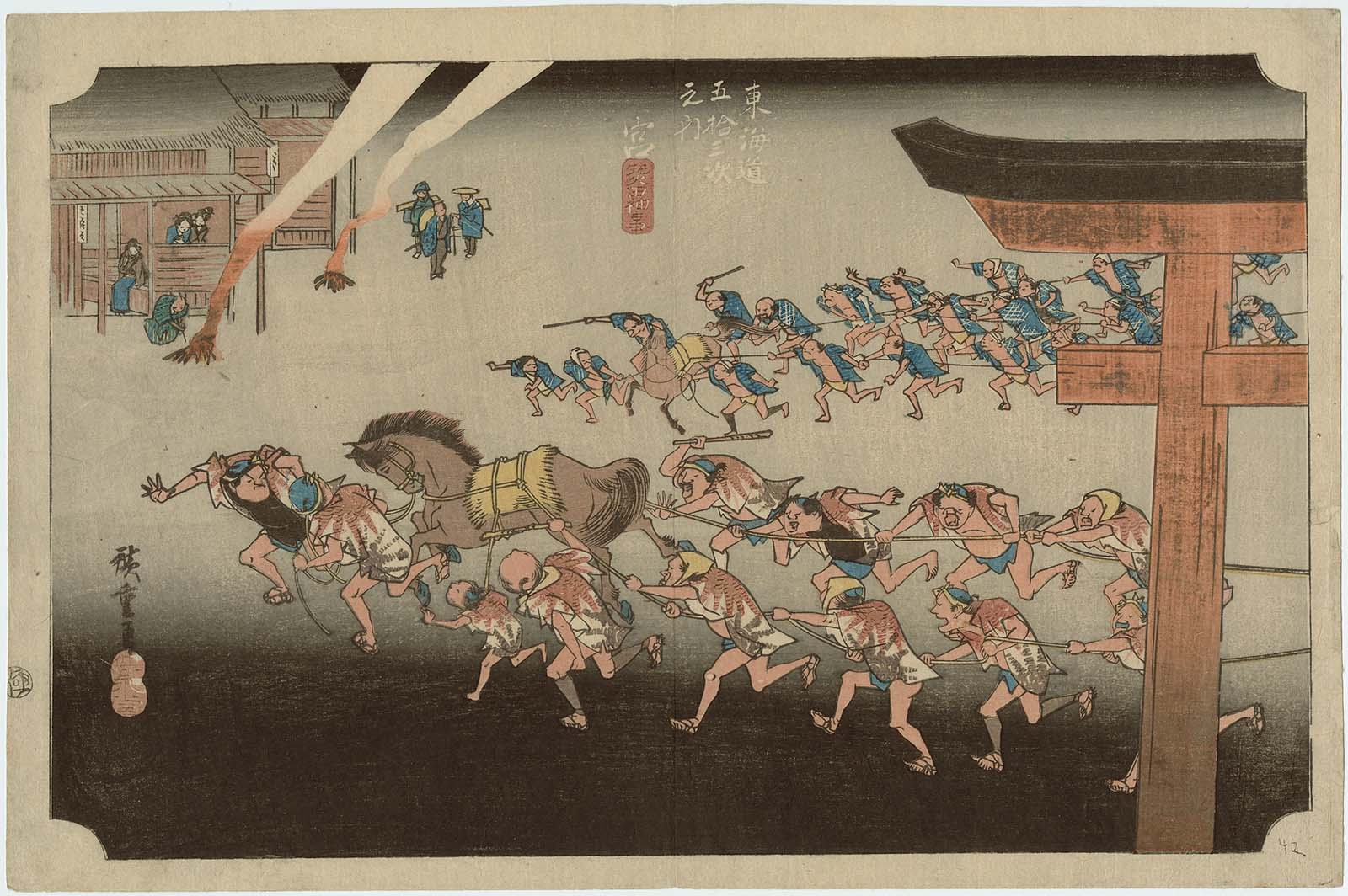
No.42. Miya: Festival of the Atsuta Shrine

The Tokaido Road post station at Miya also acts as a post station on the The Nakasendō, the Central Mountain Route, also known as the Kisokaidō, which was one of the five routes of the Edo period, that connected Edo and Kyoto.  Hiroshige’s print depicts two gangs of men dragging a portable shrine cart which is just out of the picture, past a huge torii gate. The torii gate is the symbol of a Shinto shrine, and the name of the town, “Miya” also means a “Shinto shrine. The shrine in question is the famous Atsuta Shrine, one of the most famous in Japan and a popular pilgrimage destination in the Edo period.

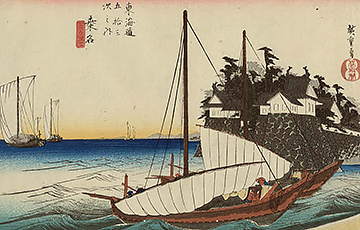
No.43. Kuwana: Shichiri Crossing

The Kuwana post station was found in the castle town of Kuwana Domain, which was a major security installation on the Tōkaidō Road for the Tokugawa shogunate. The actual post station could be found located on the western shores of the Ibi River. Hiroshige’s print of Kuwana depicts two large ships of the Shichiri no watashi ferries about to set sail with travellers from in front of Kuwana Castle, whilst in the background we can see other ships sailing away on their voyages.

No. 44. Yokkaichi: Mie River by Hiroshige

Hiroshige’s ukiyo-e print of Yokkaichi  illustrates a stormy day and we see a man running after his hat which has been blown from his head.  Another man crosses a small bridge over the Sanju River  The roofs of the small group of huts which form the post station can be seen in the middle of a marsh are almost hidden by the reeds.

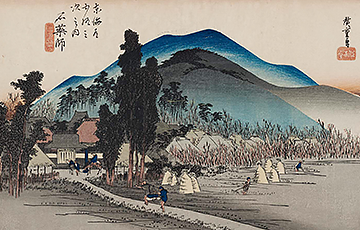
No. 45. Ishiyakushi: Ishiyakushi Temple by Hiroshige

The Ishiyakushi post station derived that name from the nearby Buddhist temple which is said to have been founded in 726 AD by the shugendō monk Taichō. According to the temple legend, Kūkai carved an image of Yakushi Nyorai on a huge boulder that was found in the forest, and Taichō later built a temple around this image. A settlement gradually developed around the temple.  Utagawa Hiroshige’s ukiyo-e print of Ishiyakushi depicts the temple in the midst of a grove of trees on the left and a village on the right.  Rising in the background are the Suzuka Mountains.  In the foreground we can see bales of rice which means that this is an Autumn depiction and tells us that this post station is at the heart of the countryside.

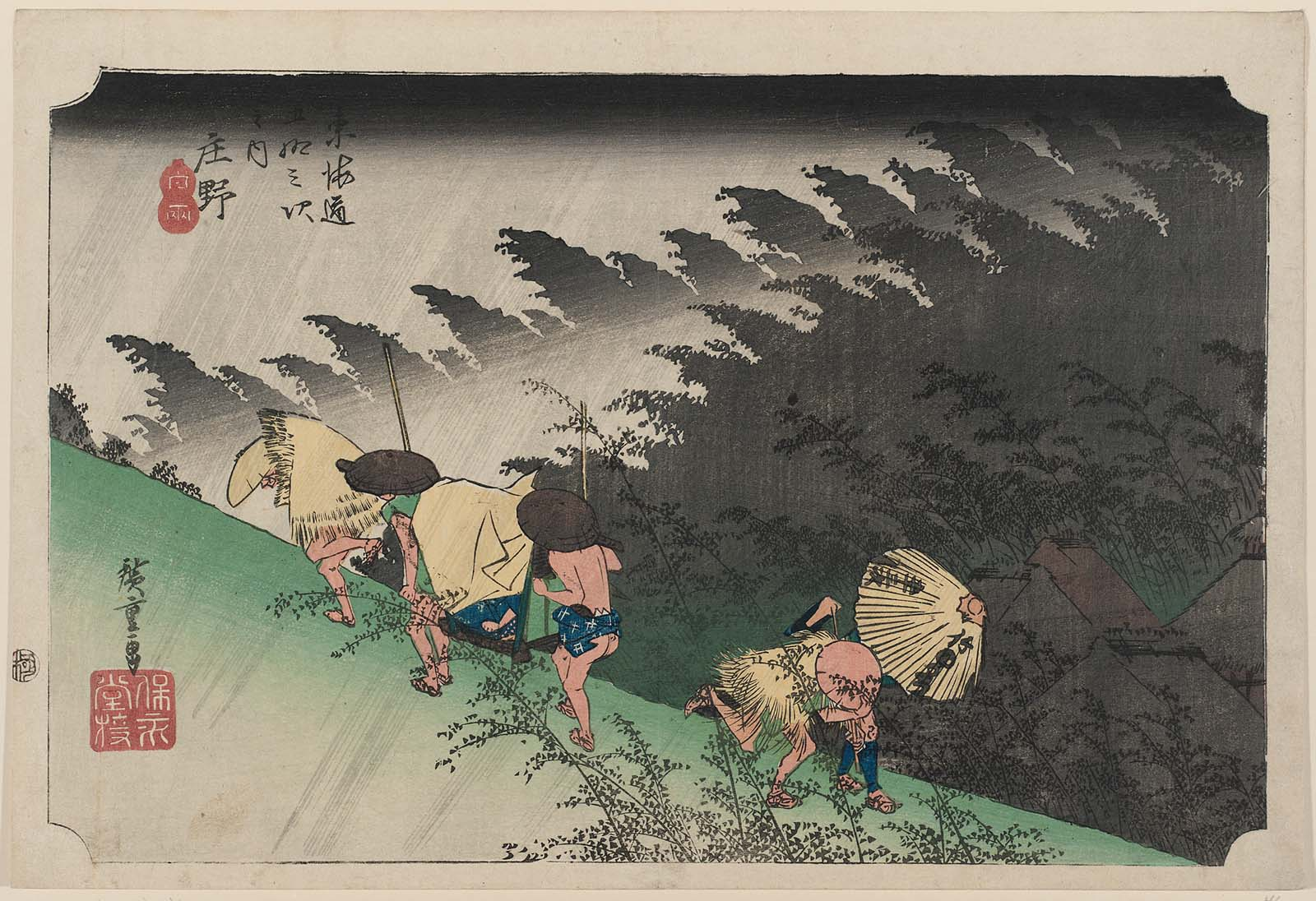
No.46. Shōno: Driving Rain

The weary travellers are suddenly caught out by torrential downpour as they arrive at the town of Shōno in Ise Province. On the right we see two men heading down hill, one holding an umbrellas and the other wearing a hat and cloak. There are two inscriptions on the umbrella. One is Takenouchi who was the publisher of the series of prints and the other is Gojūsan-tsugi, which was part of the Japanese name of the Tokaido Road woodblock series Tōkaidō Gojūsan-tsugi no uchi. To the left of these men we see another man wearing a hat and a cloak walking uphill followed by two litter-bearers. The falling of heavy rain is depicted like a grey curtain.

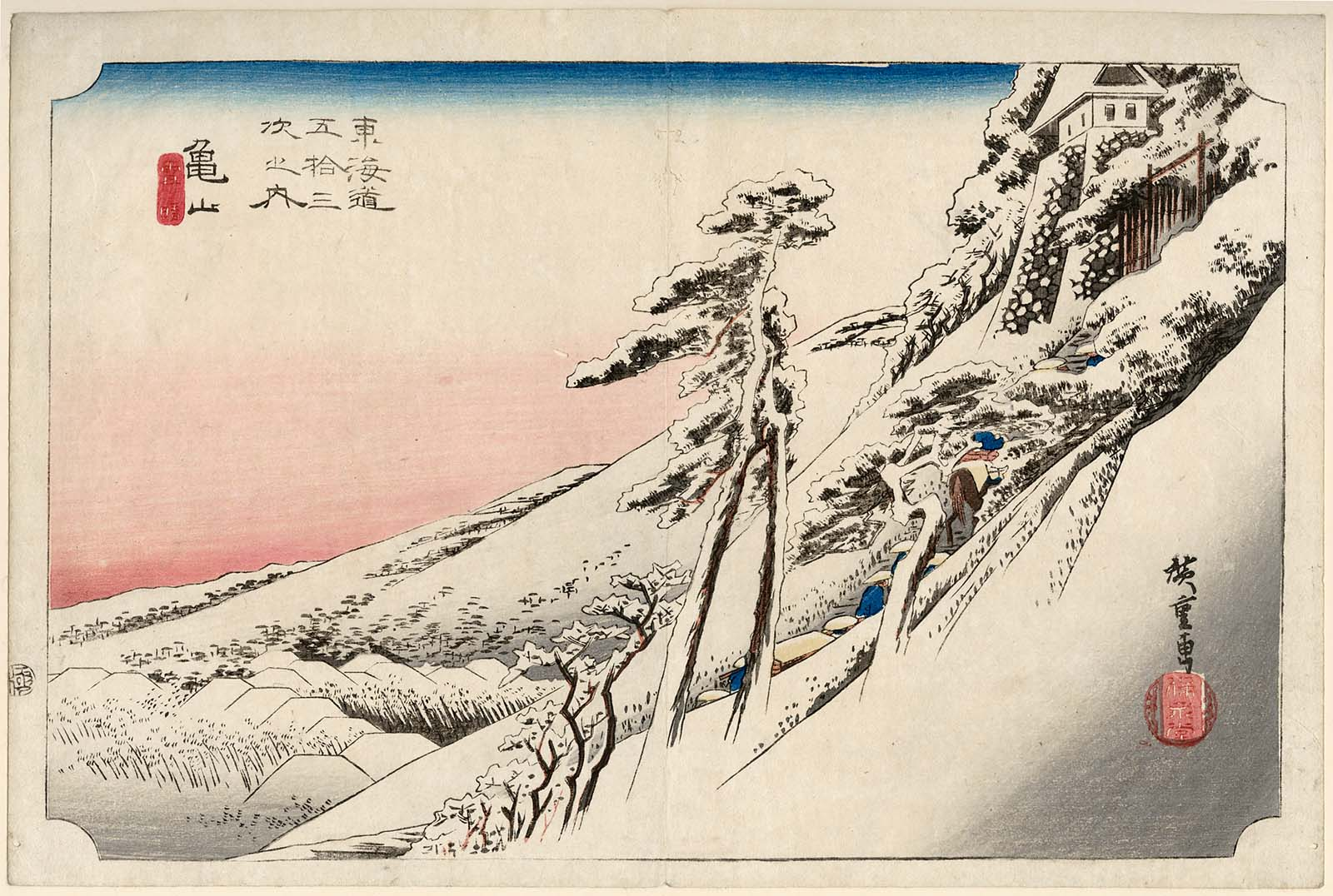
No.47. Kameyama: Clear Weather after Snow

The procession of travellers continue on an upward trajectory. The steep path takes them past the castle of Ishikmawa daimyo and we can just see the town of Kameyama in the valley to the left. The castle was home to the Ishikawa clan,  daimyō of Ise-Kameyama Domain.  The setting is early sunrise and the sky is reddened by the early morning sun. Kameyama was a well fortified city from the middle of the sixteenth century at the time of the building of the castle. In 1854, twenty years after Hiroshige’s woodblock print series was published, the castle was destroyed by the great Ansei earthquake. However in 1855 Hiroshige produced a vertical woodblock series of the Tokaido Road journey and in that series, despite the destruction of the castle, it is depicted in an unblemished state !

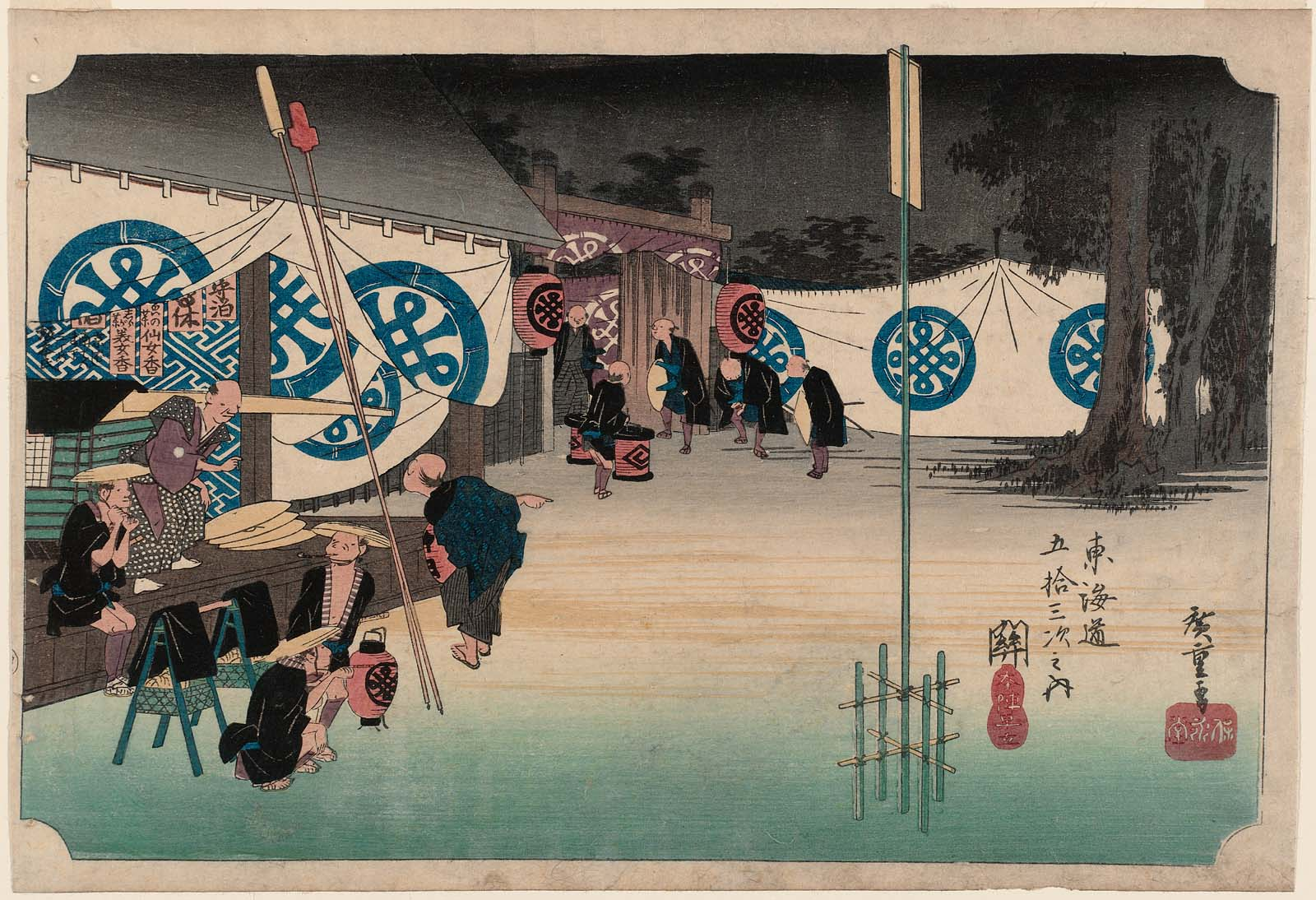
No.48. Seki: Early Departure of a Daimyō

The next depiction in the Tokaido series is that of the inn at Seki where the travellers had rested for the night. It is early the next morning and still somewhat dark. The people prepare to set off on the day’s travels. The innkeeper dressed in his traditional kamishimo, a formal kimono for men, stands on the verandah issuing instructions to one of his servants. To the left of the table we see a palanquin (litter) on the ground with the palanquin bearers standing by. The banners we see hanging around the courtyard of the inn probably bear the emblem of the daimyō who has spent the night at the inn. You can see some small brown signs hanging above the head of the innkeeper – they are advertising the availability at the inn of the famous Senjoko and Biojoko brands of white face-powder.

Snow landscape with a gate: Seki by Hiroshige (1855)

The town of Seki also appeared in the 1855 version of Hiroshige woodblock series of the Tokaido Road, the so-called Reisho Tokaido. In this depiction it is late afternoon on a snowy day and we see a few travellers passing the gate to the pilgrim’s route to Iso.

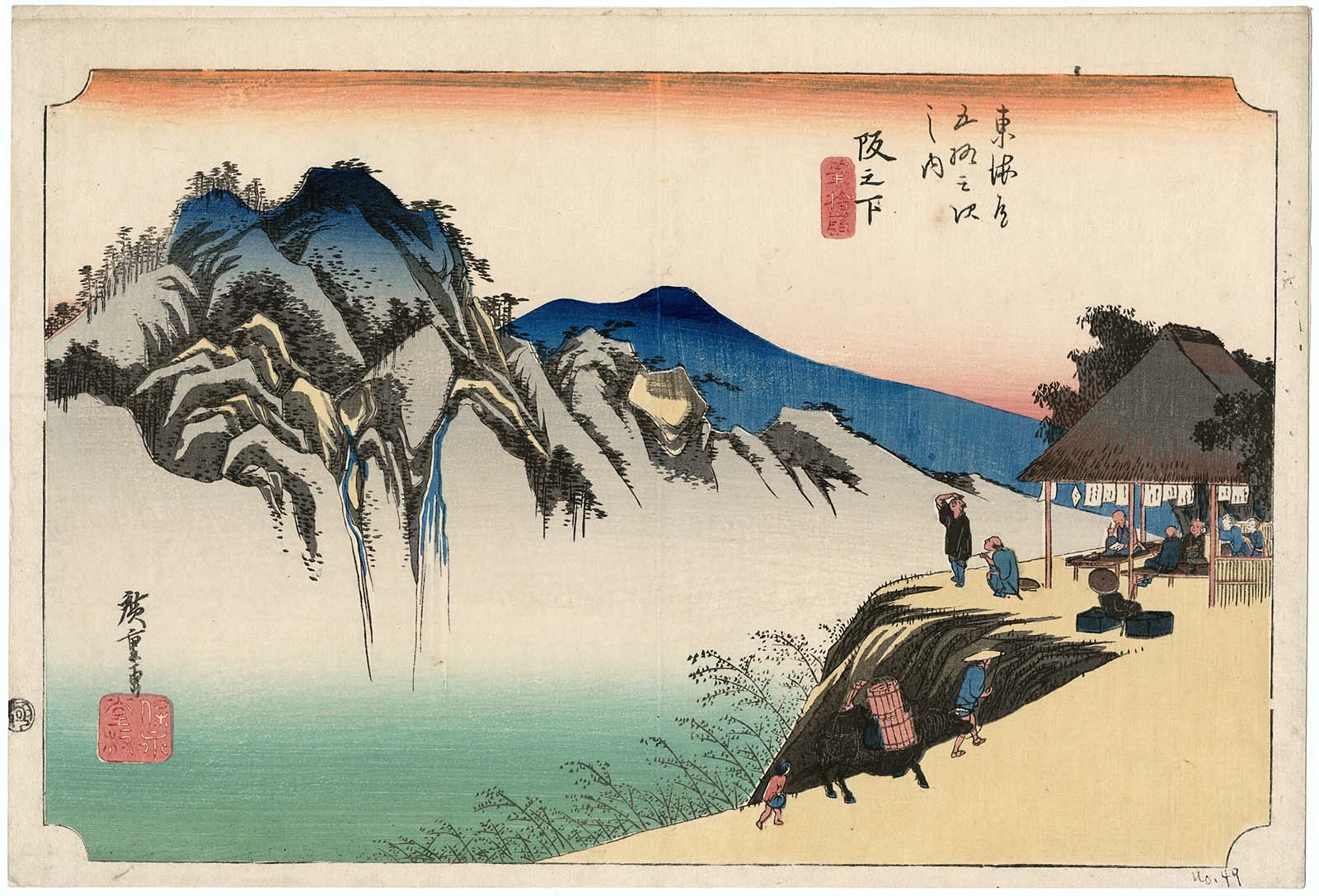
No.49. Sakanoshita: Fudesute Mountain by Hiroshige (c.1833)

Having left Seki, the travellers move deeper inland and have reached the summit of the Fudesute Mountain. The mountain derives its unusual name from an incident in which the celebrated artist Kano Motonobu threw away (sute) his brushes (fude) when he could not capture the beauty of the mountain in a painting.  

Another version by Hiroshige of Fudesute Mountain at Sakanoshita.

No.50. Spring Rain at Tsuchiyama by Hiroshige (c.1833)

The fiftieth print in the series depicts a daimyō procession.  They are enduring torrential rain as they traverse the crossing surrounded by a raging torrent which rushes below a wooden bridge. The post station, with its darkly coloured buildings, partly hidden by trees, are seen to the left of the picture.

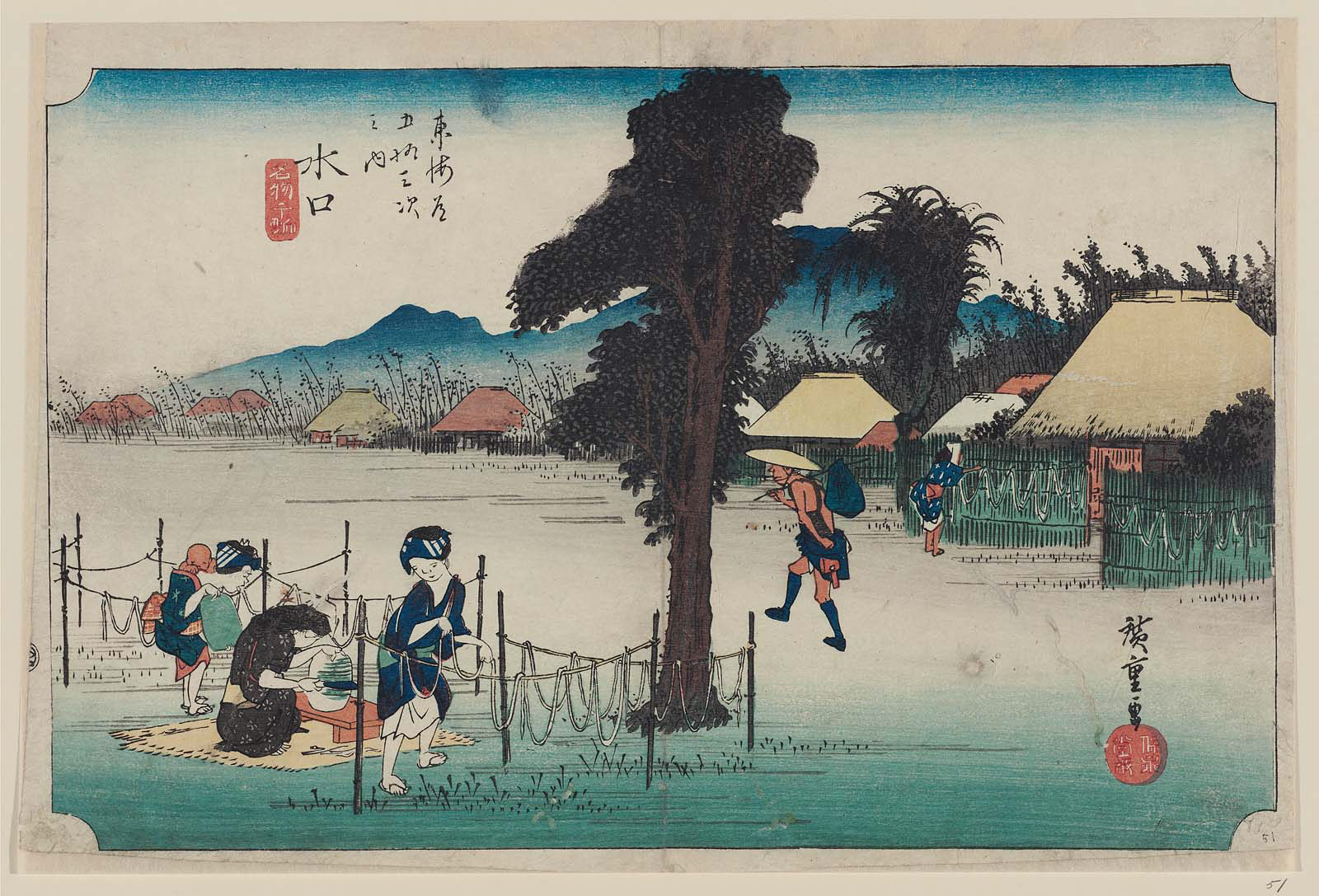
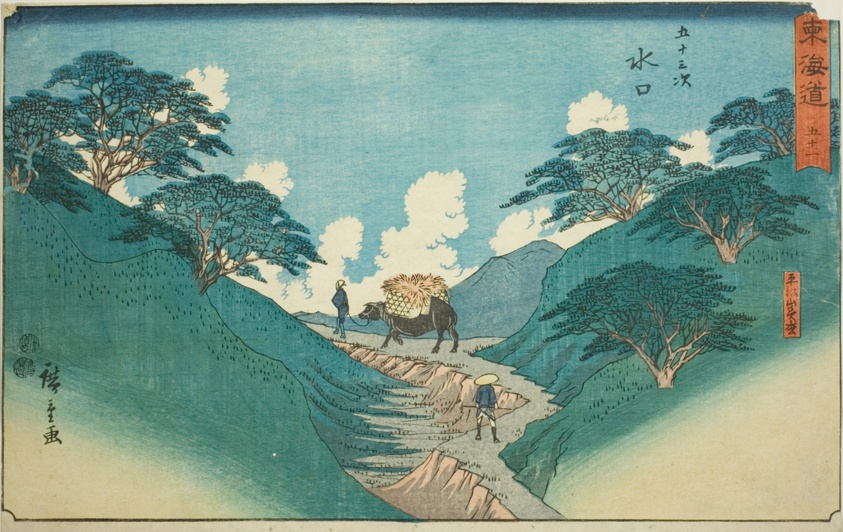
Below are two prints made by Hiroshige of the remote Minakuchi layby station. One was part of the 1833 series and the other from the later series which was published around 1852 and known as the Reisho Tokaido or the Marusei Tokaido..

No.51. Minakuchi: Famous Dried Gourd by Hiroshige (c.1833)

In the 1833 print we see a lone traveller walking through the village of Minakuchi. In the foreground we observe women peeling and drying gourds In the background there is a range of hills. This resting station is located in a desolate rural area and was famous for its production of dried gourd shavings which were often used for Japanese dishes. These women we see are busy producing them. One is shaving a gourd, one, with a baby slung on her back, is helping the shaver, whilst another one is drying the shaved gourd on a rope.

The beautiful pines at Hiramatsuyama by Hiroshige (1851-2)

In this 1852 edition of the Reisho Tokaido we see a peasant leading an ox laden with produce making their way slowly along the winding uphill path. Another man follows. The setting of this print is the steep road leading to the next stop-over point at Ishibe and just to the left of the Tokaido Road. This hill between the villages of Harimura and Kojibukuro, although it only reaches an elevation of two hundred and twenty-eight metres, is known as Mount Hiramatsu. The striking thing about the depiction are the pine trees on either side of the road. Normally pine trees along the side of the road have been planted but these are said to have grown there on their own accord. Note in the background the white clouds depicted by Hiroshige. These cumulus clouds were a Western element, one which only rarely appeared in Hiroshige’s prints.

No. 52. Ishibe: Megawa Village by Hiroshige

Utagawa Hiroshige’s ukiyo-e Hōeidō edition print of Ishibe does not actually show the post station at all, but instead we see a tea house known as Ise-ya, which was located at Megawa no Sato, on the road between Kusatsu and Ishiba.  This shop was well-known for its tokoroten, a sticky sweet made from agar, and kuromitsu, a black sugar syrup. We see depicted in the print a group of travellers who seem to be dancing and cavorting in front of the shop.  They are observed by three women who are wearing travelling hats and walking sticks.  A couple of other travellers, some distance further down the road, are seen to be heavily laden, and struggling with their trek.

No.53. Kusatsu: Famous Post House by Hiroshige (1833)

The post station on the Tokaido Road at Kusatu was also a post station for the The Nakasendō (Central Mountain Route), also known as the Kisokaidō, both being one of the five routes of the Edo period.  Looking at the print we observe a busy scene within the post station itself in front of the open-fronted Yōrō-tei, a tea house in which many patrons are probably partaking in their famous Ubagamochi, a sweetened sticky rice cake which was a speciality of Kusatsu.   In front of the tea house, on the road itself, we see a passenger in an open kago (palanquin) holding desperately on to a rope as the porters rush him to his destination  Moving in the opposite direction we see a larger green, covered kago, and this is probably transporting a high status passenger.

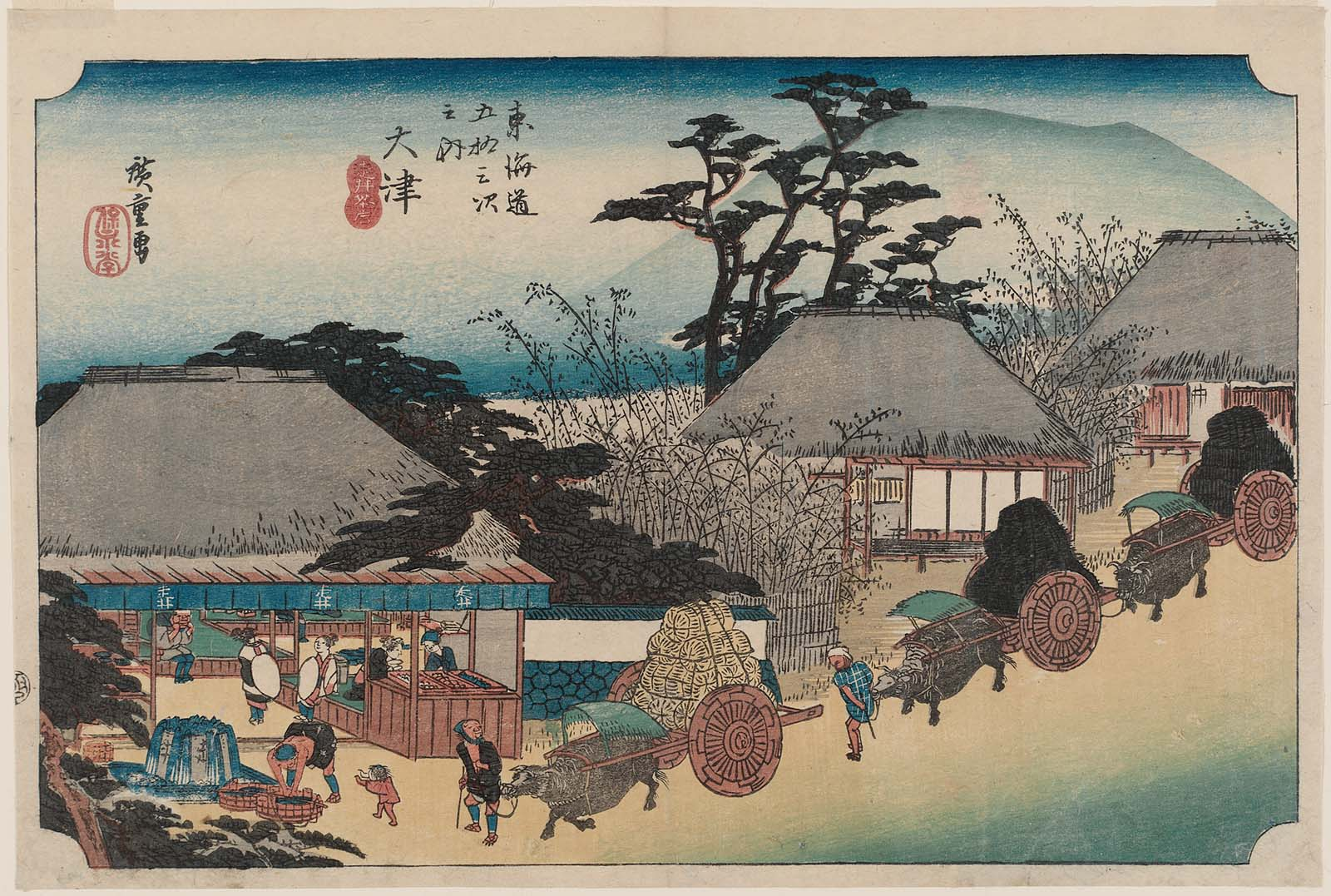
No. 54. Ōtsu: Hashirii Teahouse by Hiroshige

The Ōtsu post station was the last of the fifty-three stations of the Tōkaidō as well as the last of the sixty-nine stations of the Nakasendō. In Hiroshige’s 1833 depiction we see oxcarts, heavily laden with bushels of rice or charcoal descending the street. The oxcarts pass in front of the open front of the Hashirii teahouse, which was a popular resting point on the highway, and was well known for its delicacy known as Hashirii Mochi, a sweet rice cake, which is still a local specialty of Ōtsu.  In front of the teahouse is a well from which fresh water gushes out.

No. 55. Kyōto: The Great Bridge at Sanjō by Hiroshige

Finally the weary travellers arrive at the Great Sanjō Bridge over the Kamo River in Kyoto, the imperial capital and the terminal of the Tōkaidō. The bridge is well known because it served as the final location for journeying on both the Nakasendō and the Tōkaidō, two of the famous “Five Routes” for long distance travelers during the Edo period in Japan’s past. In the background we can see houses, temples, and villas at the foot of Higashiyama. Mount Hiei, which is an important Buddhist centre, is silhouetted in distance.

That is the end of our 500 kilometres journey. Most of the pictures came from the website: The Fifty-three Stations of the Tōkaidō Road

(https://hiroshige.org.uk/Tokaido_Series/Tokaido_Great.htm)

The information about the journey came from the usual internet sources and a great book I found in a second-hand bookshop entitled Hiroshige, a Royal Academy of Arts, Publication, produced at the time of their 1997 exhibition of Hiroshige’s work.

The Tokaido Road Trip. Part 2.

The middle part of the journey.

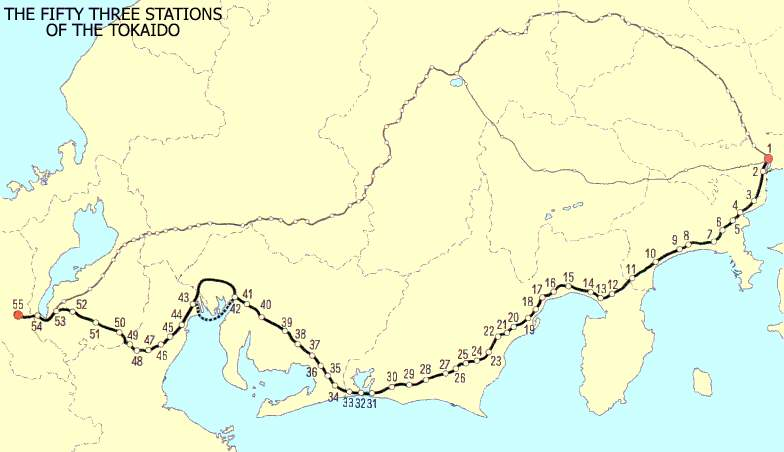
The Tokaido Road Post Stations: Edo (1) to Kyoto (55)

 The Takaido Road journey was about 500 kilometres long and most travellers made the tiring journey on foot, aiming to accomplish several stages per day although in some cases the travellers would spend several nights at one station.  The whole trip, on average, would take two weeks but the more athletic could cut that time  by half.  One of the determining factors was the weather and bad weather could make the journey last up to a month.  As I said in Part 1, one set of travellers who made the annual pilgrimage was the procession of the great daimyo (powerful Japanese magnates, feudal lords), who were commanded to spend every other year at the Shōgun’s court.  The reason for this being to prevent them from organizing rebellions and the large entourage travelled back and forth in huge processions numbering hundreds of people.

No.17. Yui: Satta Peak by Hiroshige (c.1833).

At the end of the last blog Hiroshige had reached the snow covered village of Kambara. He and his group have moved further south west and arrived at the Satta Pass. In this depiction we see a few travellers on the cliff-top pass looking out at the panoramic Kiyomi Bay, a bay on the Pacific coast of Honshū. The Satta Pass was carved out of the rocks in 1655. Two pine trees can be seen leaning over and twisted in the wind and in the background we once again see Mount Fuji.

Yui: The Dangerous Satta Pass by Hiroshige (1855)

Hiroshige completed another print of the Satta Pass in his 1855 Tokaido Road series.

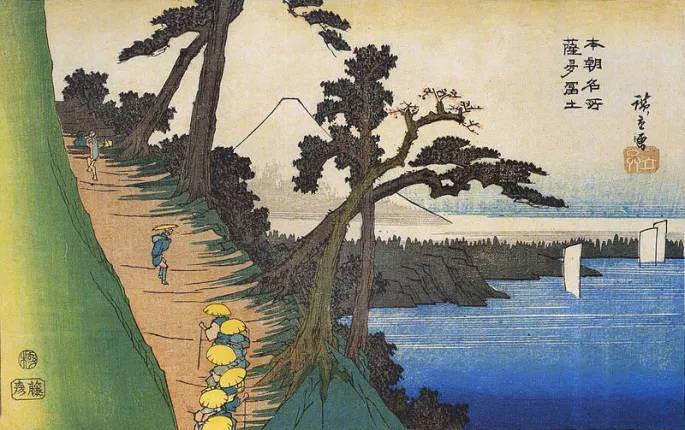
Travellers on a mountain path along the coast by Hiroshige (c.1837)

Hiroshige must have been fascinated by the view afforded to him from the Satta Pass and Mount Fuji as one of his prints from his Famous Views of our Country is entitled Travellers on a Mountain Path along the Coast and once again we see travellers trekking along the Satta Path.

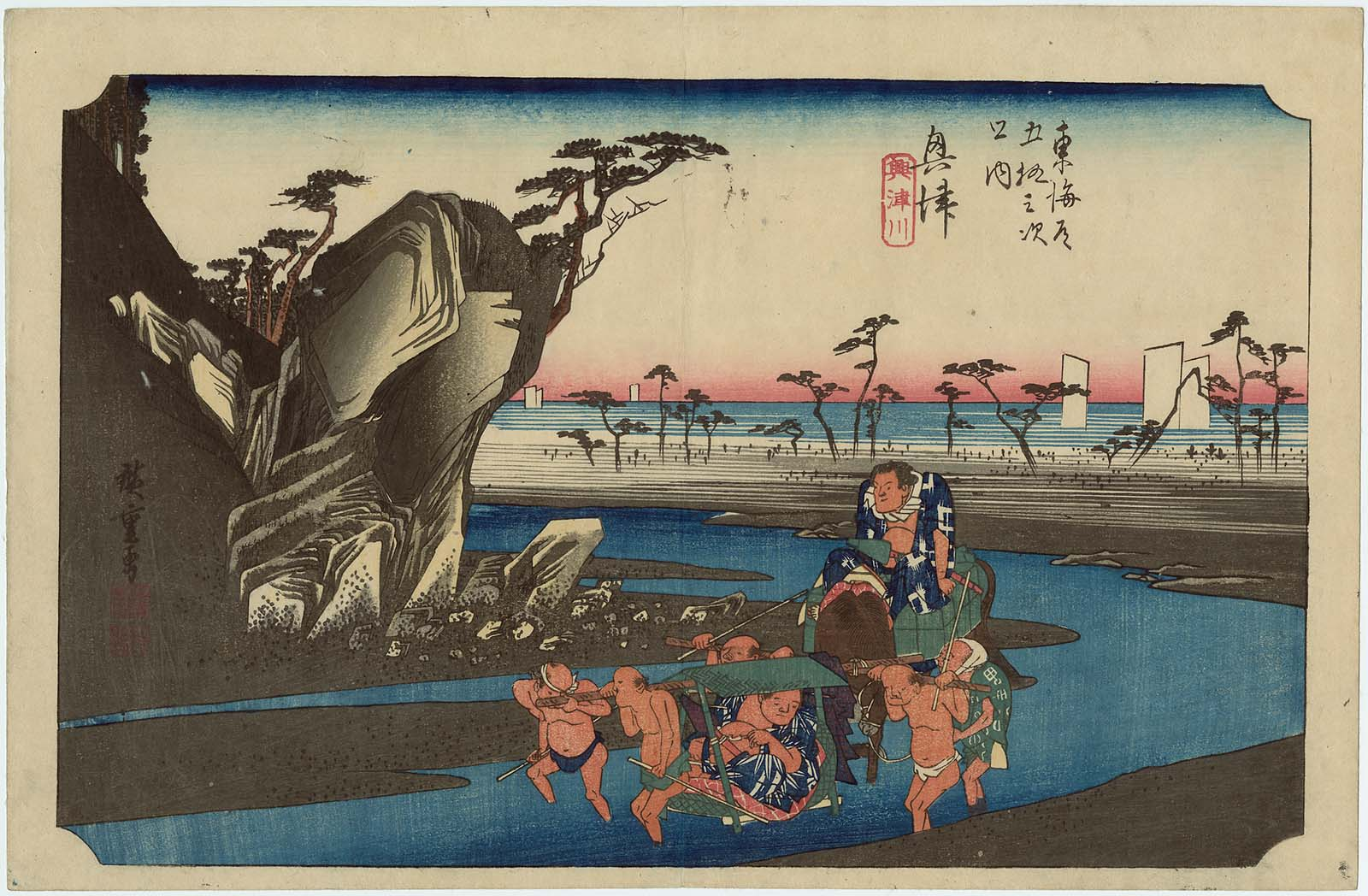
No.18. Okitsu: The Okitsu River by Hiroshige.

The Takaido Road travellers leave Yui and the Satta Pass and cross the Okitsu River towards the layby station at Okitsu. The classic ukijo-e print by Hiroshige depicts two sumo wrestlers being carried across the Okitsu River, one on a packhorse and the other in a kago, which is a type of litter used as a means of human transportation by the non-samurai class in feudal Japan.

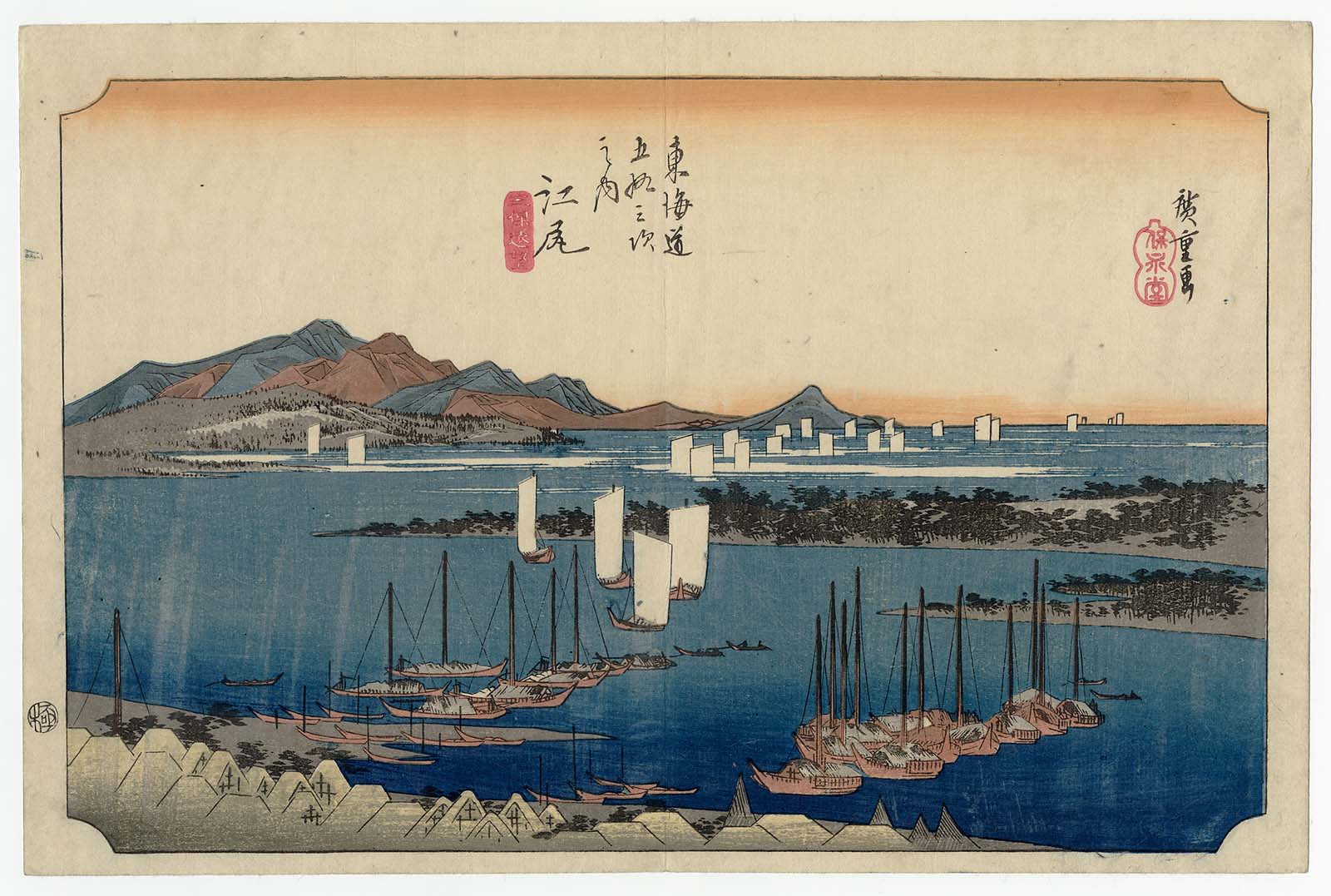
No.19. Ejiri: Distant View of Miho by Hiroshige (c.1833).

Further along the Takaido Road the travellers are able to look towards the sea and the harbour town of Ejiri. Ejiri was a castle town.  Ejiri castle was built in 1570, but the town of Ejiri was not officially designated a post station until the early 17th century.  The print depicts a view over the Miho no Matsubara,(pine grove at Miho), a scenic area on the Miho Peninsular of Shizuoka City. Its seven-kilometre seashore is lined with pine trees. with boats anchored in the foreground in front of a fishing village, while others can be seen sailing in Suruga Bay.

No.20. Fuchū: The Abe River by Hiroshige (c.1833).

The weather was always a determining factor for how long the five hundred kilometre journey would take but the other factor was the crossing of rivers that traversed their path. One such was the Abe River which proved a great challenge. depicts travellers crossing the Abe River to the west of the post station. A woman is being carried in a kago (another type of litter, while other people are fording the stream on foot.

No.21. Mariko – Local Specialities Shop by Hiroshige (c.1833).

We have now arrived at the twenty-first stop over point near Mariko and in this depiction we see two travellers who have stopped their journey for refreshments at a roadside stall. Tea is being served with a local speciality known as tororoshiru, which is a paste made from grated yam. The two men are being served by a woman who has a baby strapped to her back. To the left of the stall we see a man on his way along the road with his back to us. He is smoking a pipe and his rain jacket and hat are tied to a stick which he carries over his shoulder.

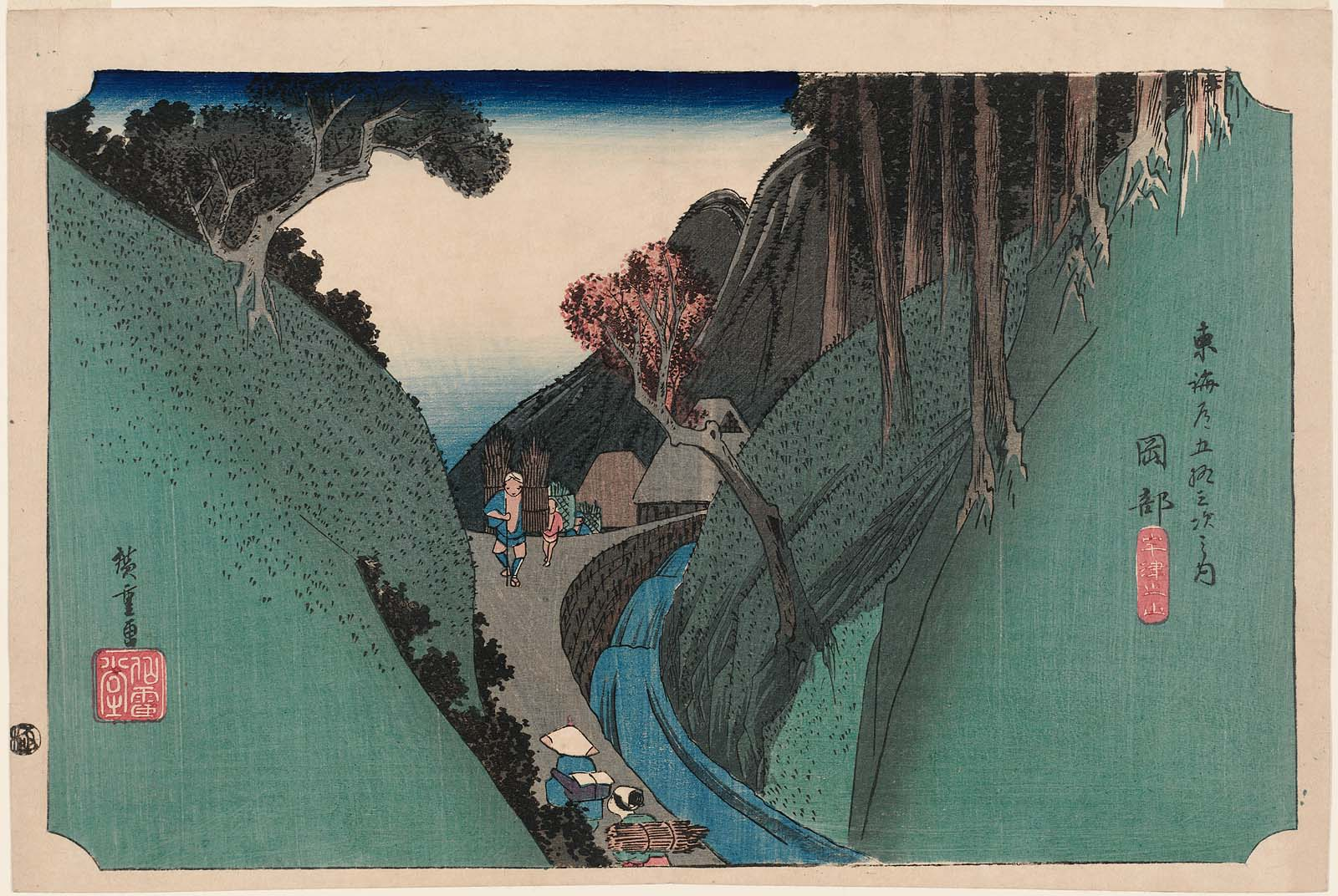
No.22. Okabe: Utsu Mountain by Hiroshige (c.1833).

Once again the travellers had to struggle along the tiring uphill stretch of the Tokaido Road as they move slowly over the Utsu Mountain pass. Most of the post stations I am highlighting in these three blogs were built around 1602 but the one at Okabe was not completed until a year later.  At the time it was built, the population there was just sixteen and thirty-five years later, had only risen to one hundred.  The print depicts a mountain stream between steep green banks, with the roadway a narrow path walled in on one side by a stone wall.  it was destroyed by fire in 1834. After it was rebuilt in 1836, it was eventually named nationally designated Important Cultural Property.  In 2000, it was reopened as an archives museum.

No. 23. Fujieda: Changing Porters and Horses by Hiroshige (c.1833).

Such a long journey along the 500 km Tokaido Road necessitated a frequent change of horses and men who have been employed to carry people and supplies across fast flowing rivers and up steep mountain trails. Fujieda was one of these stop-off points between the Abe and Ōi rivers, where fresh horses and men could be employed for the onward route.

No. 24. Shimada: The Suruga Bank of the Ōi River by Hiroshige (c.1833)

With fresh horses and a new group of porters to carry supplies, the palanquins and the party were ready to cross the Ōi River which flowed down from the Akaishi mountains, part of the  the Japanese Southern Alp that form the border between Shizuoka, Nagano and Yamanashi prefectures. From the print we can see that the crossing was an immense challenge. The Tokugawa Shogunate was very mindful about the defence of Edo and that included the outer limits of the city.  It was then deemed necessary to stop any easy access to Edo expressly forbidding the building of bridges or allowing a ferry service to cross the Ōi River.  All travellers had to wade across the shallowest parts of the river but this was impossible during times of heavy rain which caused the river to flood.  During those times travellers had to spend days at Shimada, which of course made the tea houses and shop owners very happy.

No.25. Kanaya: The Far Bank of the Ōi River by Hiroshige (c.1833)

The twenty-fifth woodcut print of the Tokaido Road series by Hiroshige depicts the party at the end of their struggle to cross the Ōi River and to approach the Kanaya post town. Kanaya was located on the west bank of the Ōi River and like Shimada, prospered from the Tokugawa Shogunate’s defence policy of not allowing any bridge or ferry to be established on the Ōi River. This meant reaching the town from the east was often difficult if the river flow, after heavy rain, was too fast for travellers to cross and they had to wait before entering the river finding themselves trapped for days on either side awaiting the water level to drop.

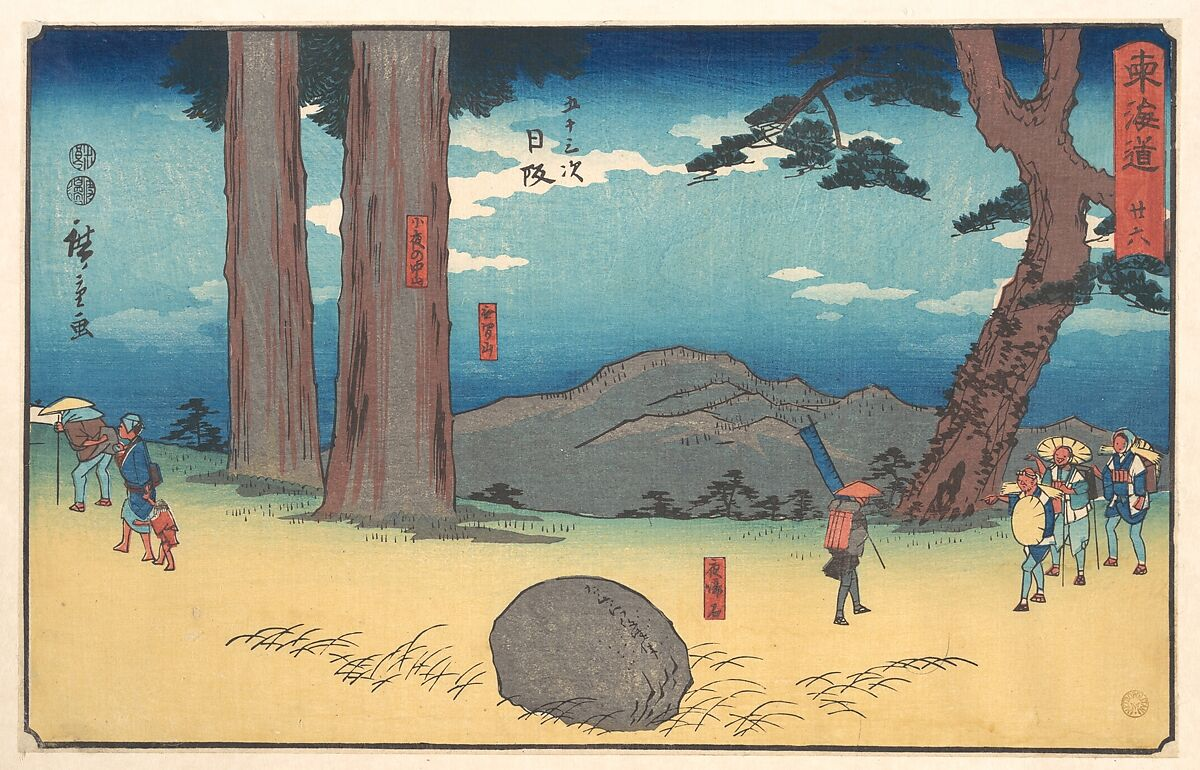
No.26. Nissaka. Sayo Mountain Pass by Hiroshige (c.1833)

Having crossed the Ōi River the party of travellers moves into the Sayo mountains and once again face a steep up-hill climb. On the path we see a large stone. This object appears in a later woodcut print by Hiroshige.

Nissaka by Hiroshige (1849)

The stone features prominently in this print. It is known as the Night-Weeping Stone and according to legend a pregnant woman was killed by bandits, and her blood fell on the stone. After she died, a passing priest heard the stone call out for him to rescue the surviving infant. The tale goes that the stone has cried at night for her.

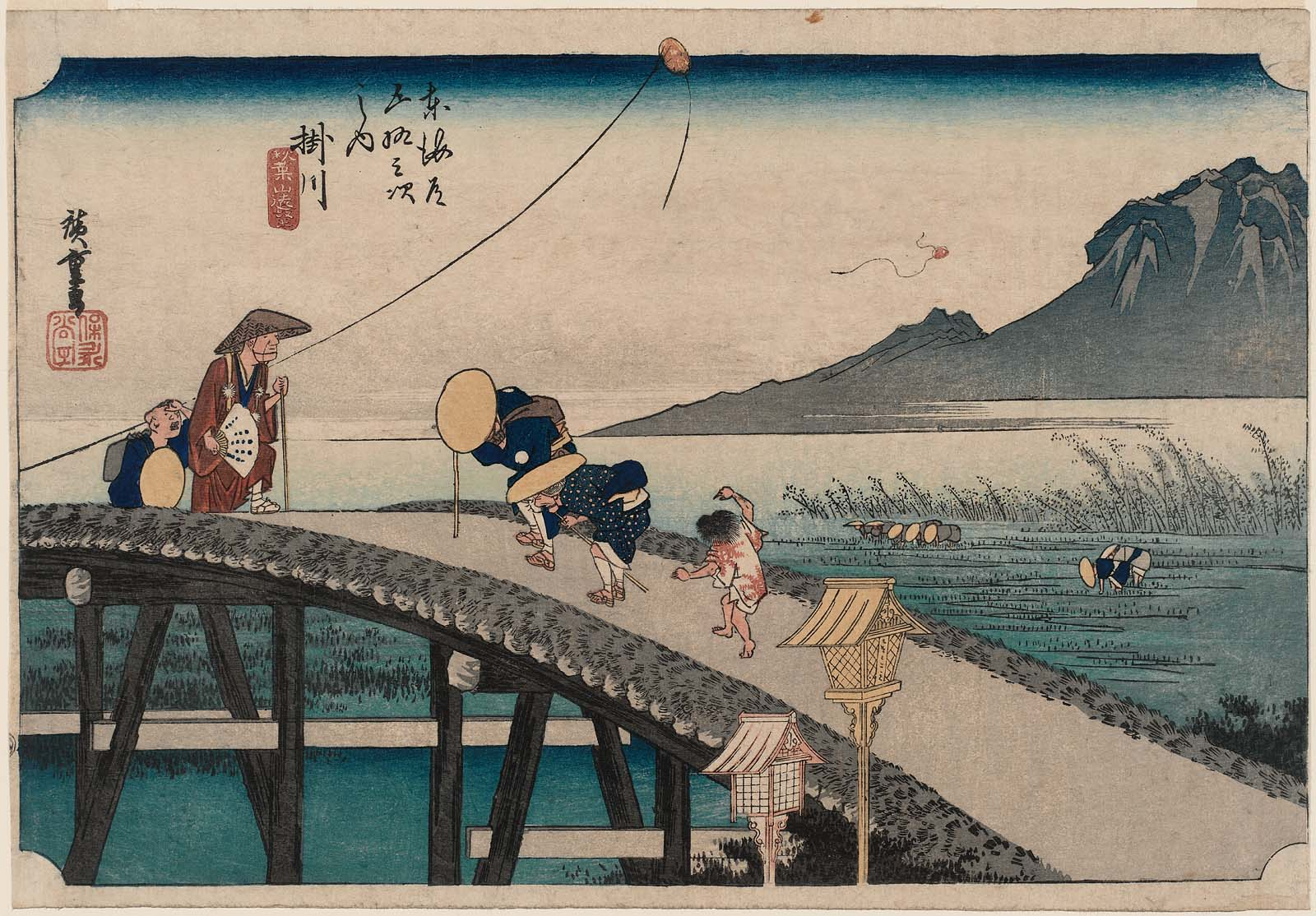
No.27. Kakegawa – View of Akiba Mountain by Hiroshiga (c.1833)

This woodblock print depicts a priest and boy and elderly pilgrims crossing the trestle bridge. To the right we see farmers planting crops in the fields, and in the background on the right we get a distant view of Mount Akiba. An old couple is struggling against a strong wind, followed by a boy making a mocking gesture; another boy is watching a kite floating up in the air.

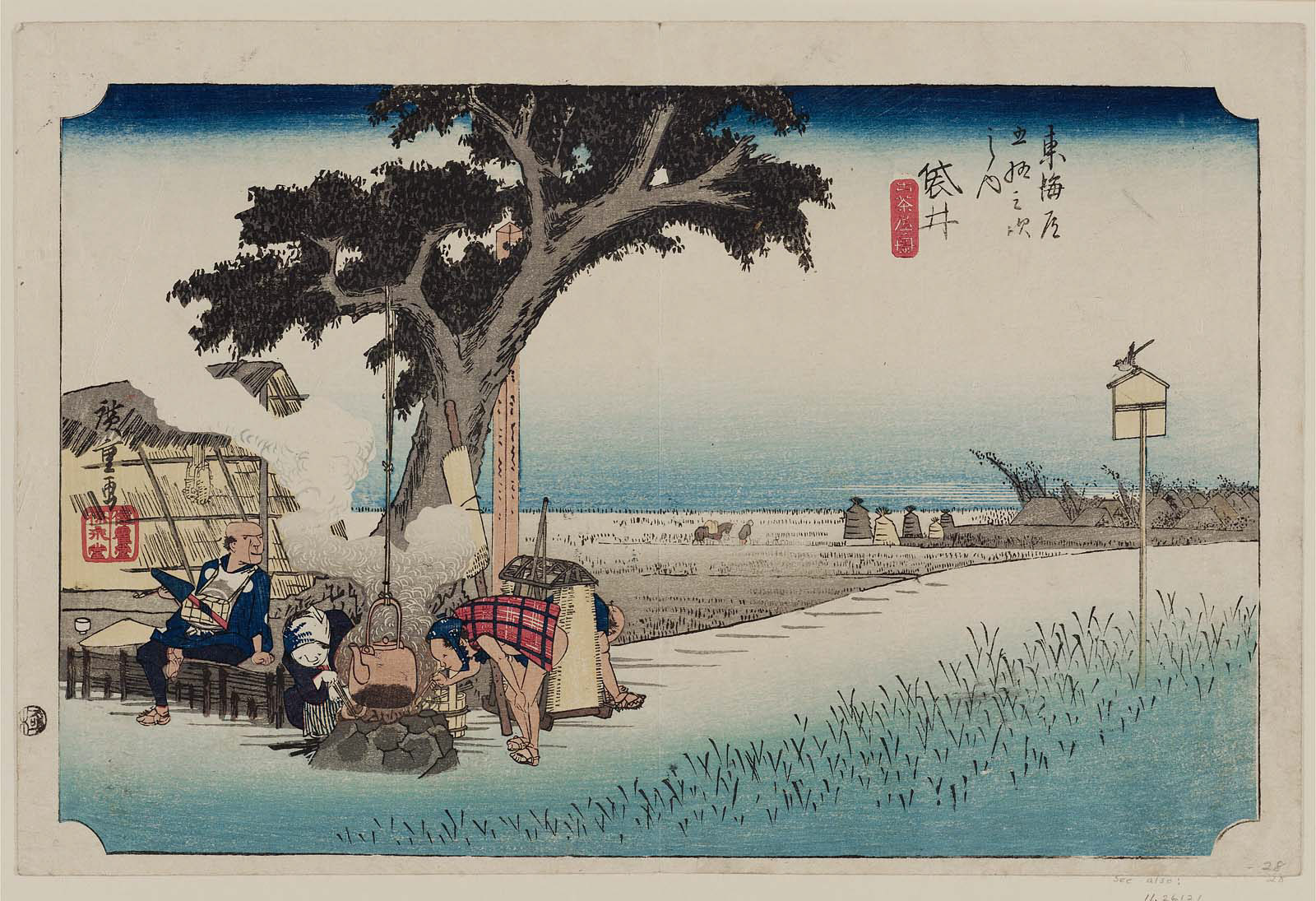
No. 28. Fukuroi: Tea Stall by Hiroshige (c.1833)

The twenty-eighth print in the Tokaido Road series is one depicting a tea stall at the small town of Fukuroi. This was a much needed and much appreciated stop-off point for the travellers who had trekked up steep mountain passes and forded fast flowing rivers. Although only a small town at the time of Hiroshige’s visit, within a hundred and twenty-five years it had grown and was given city status in 1958. We see a couple of travelers sheltering at a wayside lean-to, in front of which a woman stirs a large kettle which hangs from the branch of a large tree. The surrounding area appears to be featureless rice fields, with little indication of a post town.

No.29. Mitsuke: Tenryū River View by Hiroshige (c.1833)

The Tokaido Road procession has reached the town of Mitsuke and are facing yet another river to cross. This time it is the Tenryū River which has flowed two hundred kilometres south from its source, Lake Suwa. The river drains into a wide coastal plain noted for fruit and rice production. The print portrays a close-up scene along the Tokaido Road which depicts the difficult and laborious crossing of the Tenryu River close to the point it reaches the sea. In the foreground, we see two ferrymen waiting for their passengers who are on this long trek.

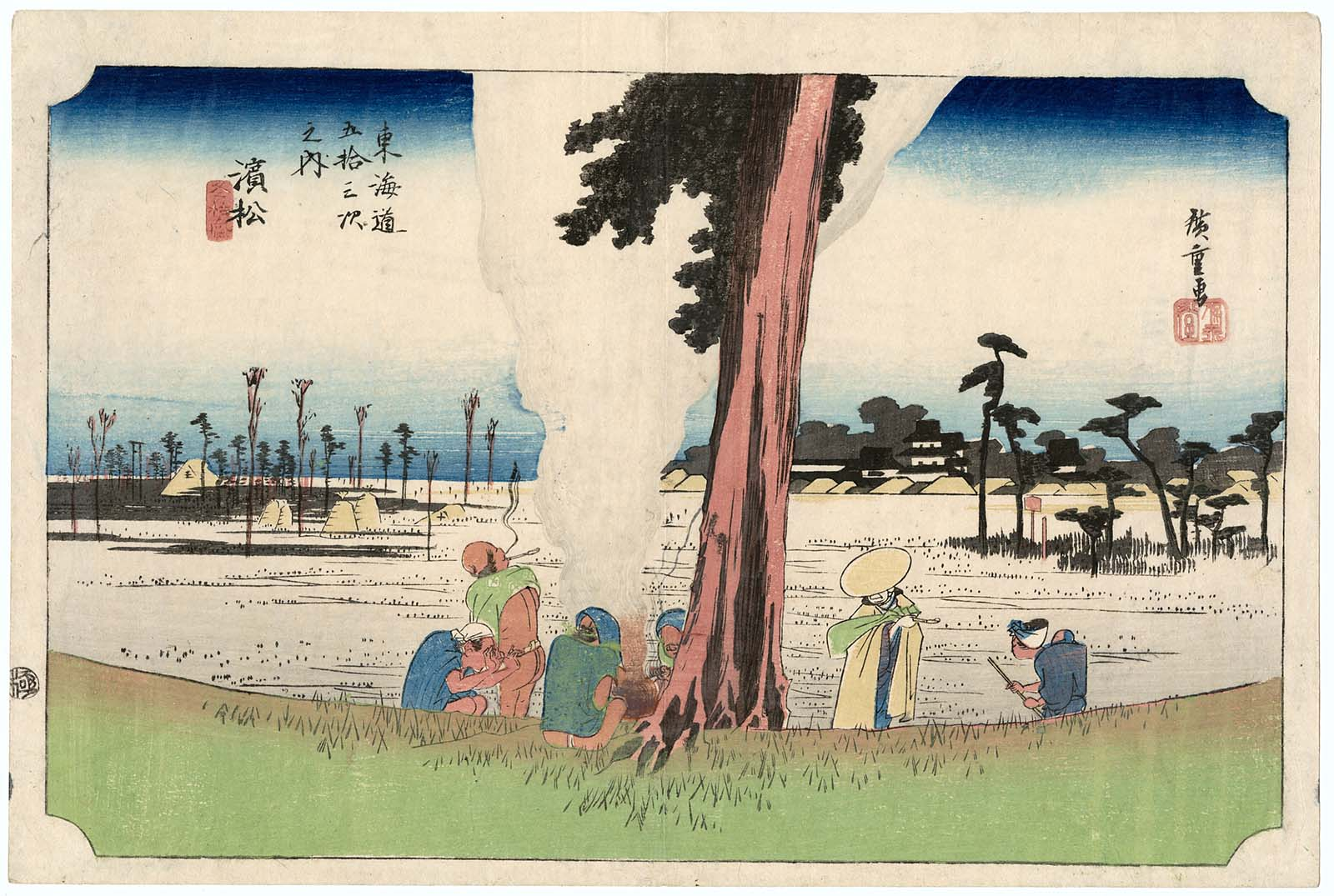
No.30. Hamamatsu: Winter Scene by Hiroshige (c.1833)

The party of Tokaido Road travellers have successfully crossed the Tenryū River and arrived at Hamamatsu. Hamamatsu flourished during the Edo Period under a succession of Daimyo rulers as a castle city, and a postal city on the Tokaido Road. In this print we see some of the procession huddled together trying to counteract the harsh winter conditions.

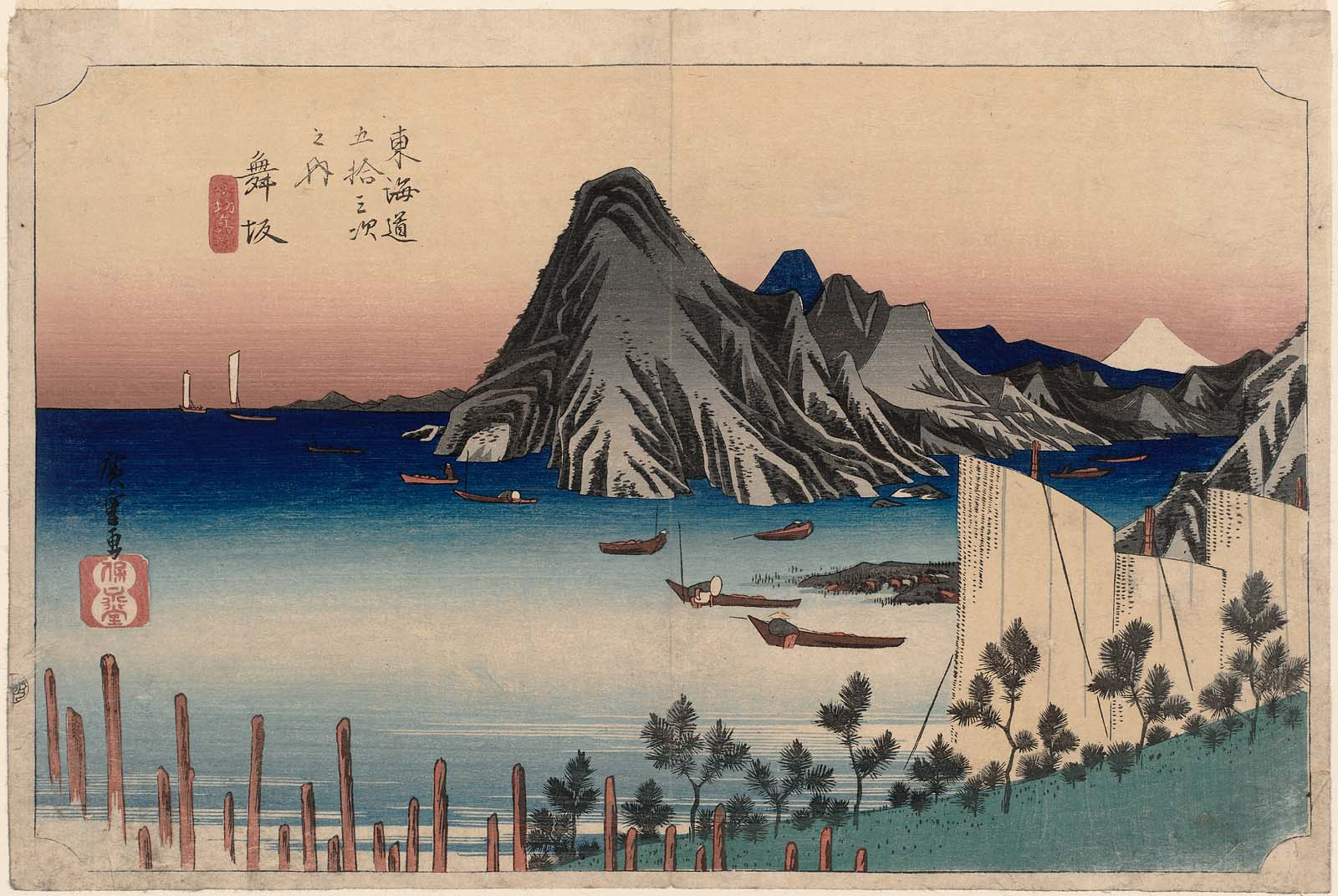
No.31. Maisaka: View of Imagiri by Hiroshige

The party arrive at Maisaka and the woodblock print is looking back at the Imagiri Promontory.  As the Tokaido Road links the shogun’s headquarters in Edo with the imperial capital in Kyoto, its route runs along the Pacific coast and so many of the woodcut print images from the series are seascapes. The depiction we see shows a view of Imagiri Beach near Maisaka. We look inland from the beach and see Lake Hamana, which empties into the Pacific Ocean. Our group of travellers heading west had to take a ferry across the lake. In the foreground we see brown-red pilings which were erected to protect the ferry port from the open sea.

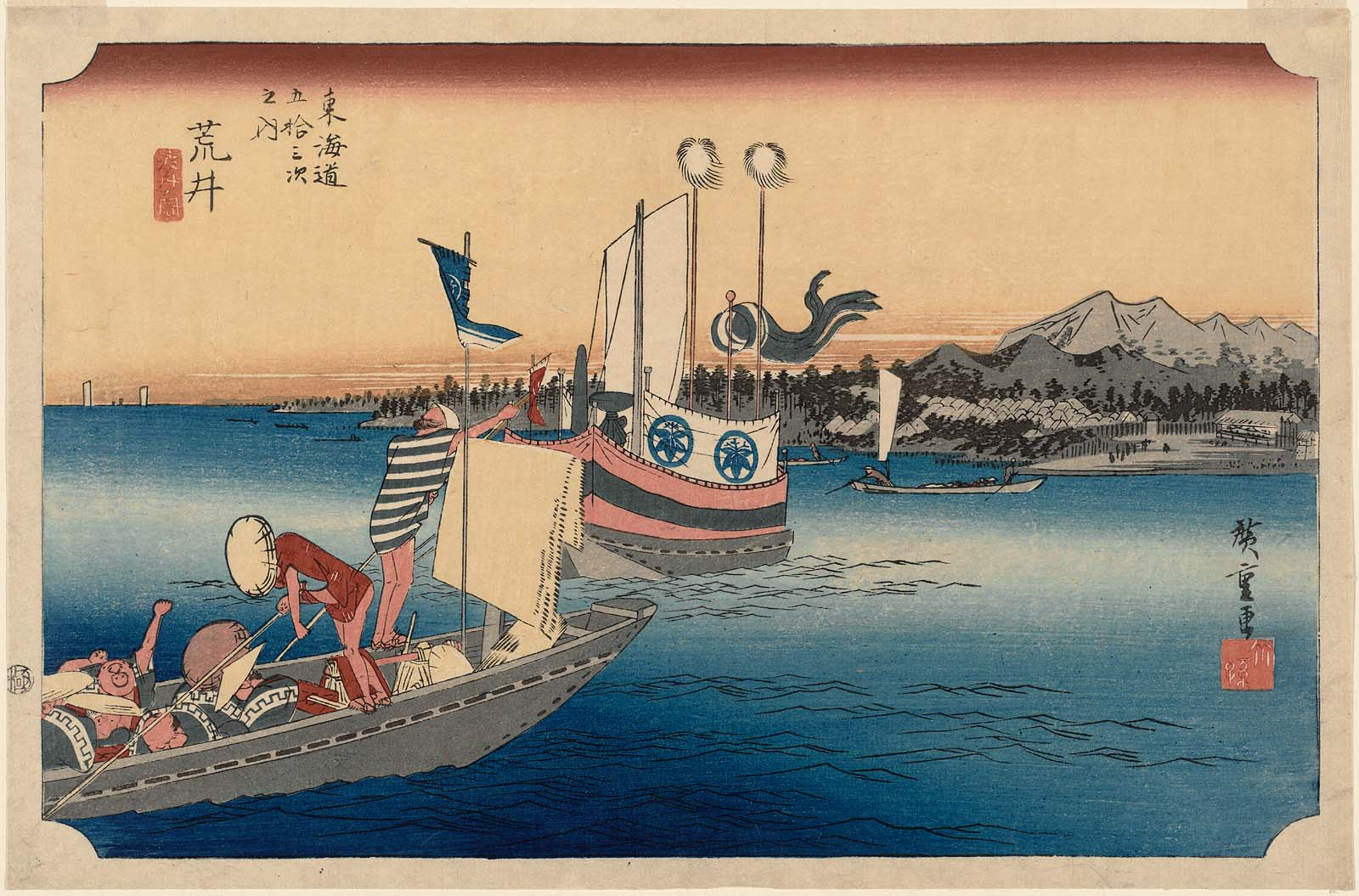
No.32. Arai Ferryboat by Hiroshige (c.1833)

Hiroshige left Maisaka with his party which included one of Japan’s powerful lords, known as a diamyo, along with his entourage and headed for the next lay-over station at Arai.  However, to reach Arai they had to cross a large stretch of water, Lake Hamana.  To accomplish this the party organised boats to transport the people and provisions.

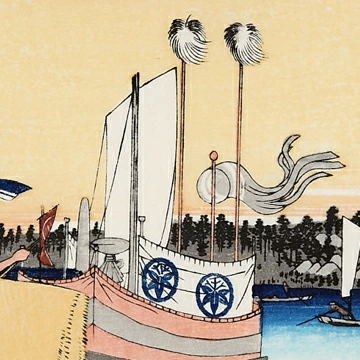
The diamyo’s boat

In the centre of the painting we see a ferry, carrying the daimyo, crossing the water, heading to Arai.  The large boat is fitted with a  sea curtain to protect the powerful dignitary from any inclement weather they should encounter during the crossing.  It has hangings marked with circular symbols, the lord’s family crest.

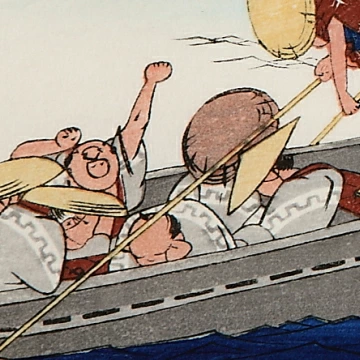
The Attendants

In the foreground, we can observe the daimyo’s attendants in a separate boat.  It is interesting to look at their facial expressions and their countenances. Some looked bored while others yawn or lie back asleep.  They are fed up and exhausted after their long trek.

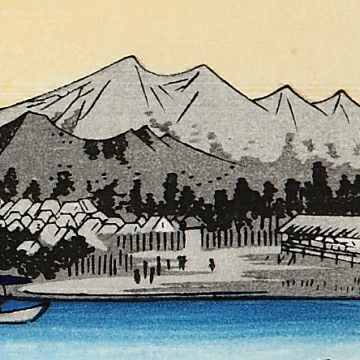
The Arai Fortification

On the far side of the lake we can see the Arai barrier which was a fortification built by Tokugawa Ieyasu around 1600.

No.33. Shirasuka: View of Shiomizaka by Hiroshige (c.1833)

The post station of Shirasuka is seen in this depiction situated on a high plateau.  However this was not the original site of Shirasuka as originally it was found close to the shore.  This all changed with the earthquake which hit the country in 1707, with the ensuing tsunami overwhelming the region and destroying the twenty-seven inns.  Following this natural disaster the post station was moved to site high above the coastal plain.  The next stop along the coast will be Futagawa.  Many hill roads in Japan bear the name Shiomizaka. The name has two meanings in the Japanese language, the most common is one is “watch the tide” and another is “see death.” 

No.34. Futagawa: Monkey Plateau by Hiroshige (c.1833)

The town of Futagawa was formed in 1601 with the merging of two villages, Futagawa and Ōiwa which were a kilometre apart and the townspeople were instructed to look after the travellers who were making the trek along the Tokaido highway.  This didn’t work well and so, in 1644, the Tokugawa shogunate had the village of Futagawa moved westwards and the village of Ōiwa moved further to the east.  The post station was re-established in Futagawa’s new location, and an Ai no Shuku was built in Ōiwa.  Ai no Shuku were unofficial post stations but were not officially designated rest areas, and travellers along the roads were not allowed to stay in these post stations. The print depicts a rather gloomy landscape and we see the weary travellers having scaled the hill, arrive at a free-standing tea house. The quality of the soil in this area is poor and the area as become a barren wasteland with only small pine trees and shrubs seen to be growing.

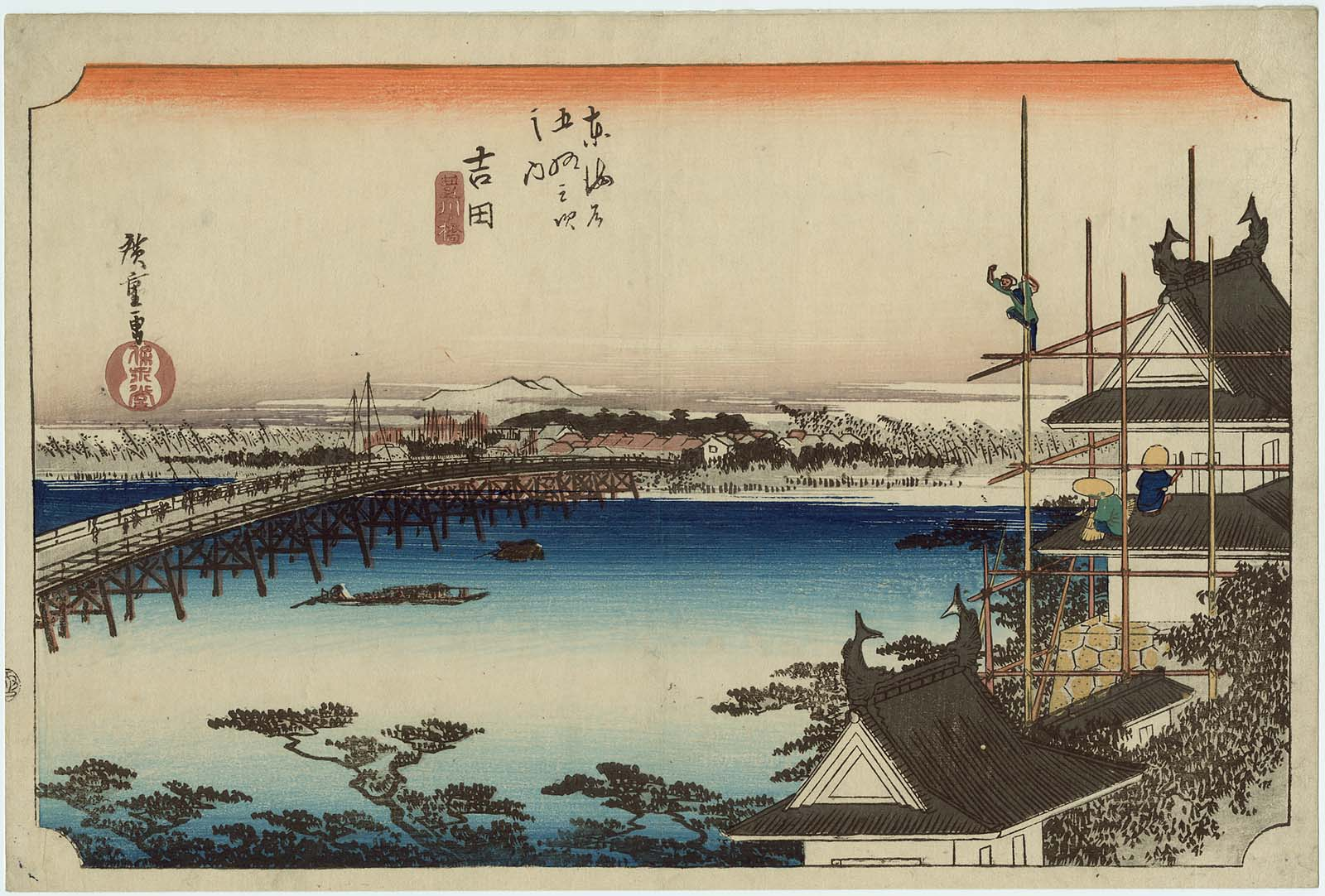
No.35. Yoshida: The Toyokawa River Bridge by Hiroshige

The post station of Yoshida was two hundred and eighty-seven kilometres from the starting point of the journey at Edo. The travellers had covered just over half their long journey. Yoshida lay almost half way between the post station of Nihonbashi to the west, and Futagawa to the east. The post station within the castle town of Yoshida came into being in 1601.  At Yoshida there was a long bridge which spanned the Tokugawa River.  This was an important bridge for the travellers as it was the only one they could use as deemed by the Tokugawa shogunate.  The post station at Yoshida was one of the largest stations and stretched two and a half kilometres along the Tōkaidō Road and the census of 1802 noted that the station comprised of two honjin (inns for government officials), one  waki-honjin (secondary inn in a post-town which provided lodging to second ranking official travellers)  and sixty-five hatago (lodging housess for travellers).  The print by Hiroshige depicts the famous bridge at Yoshida, as well as Yoshida Castle.

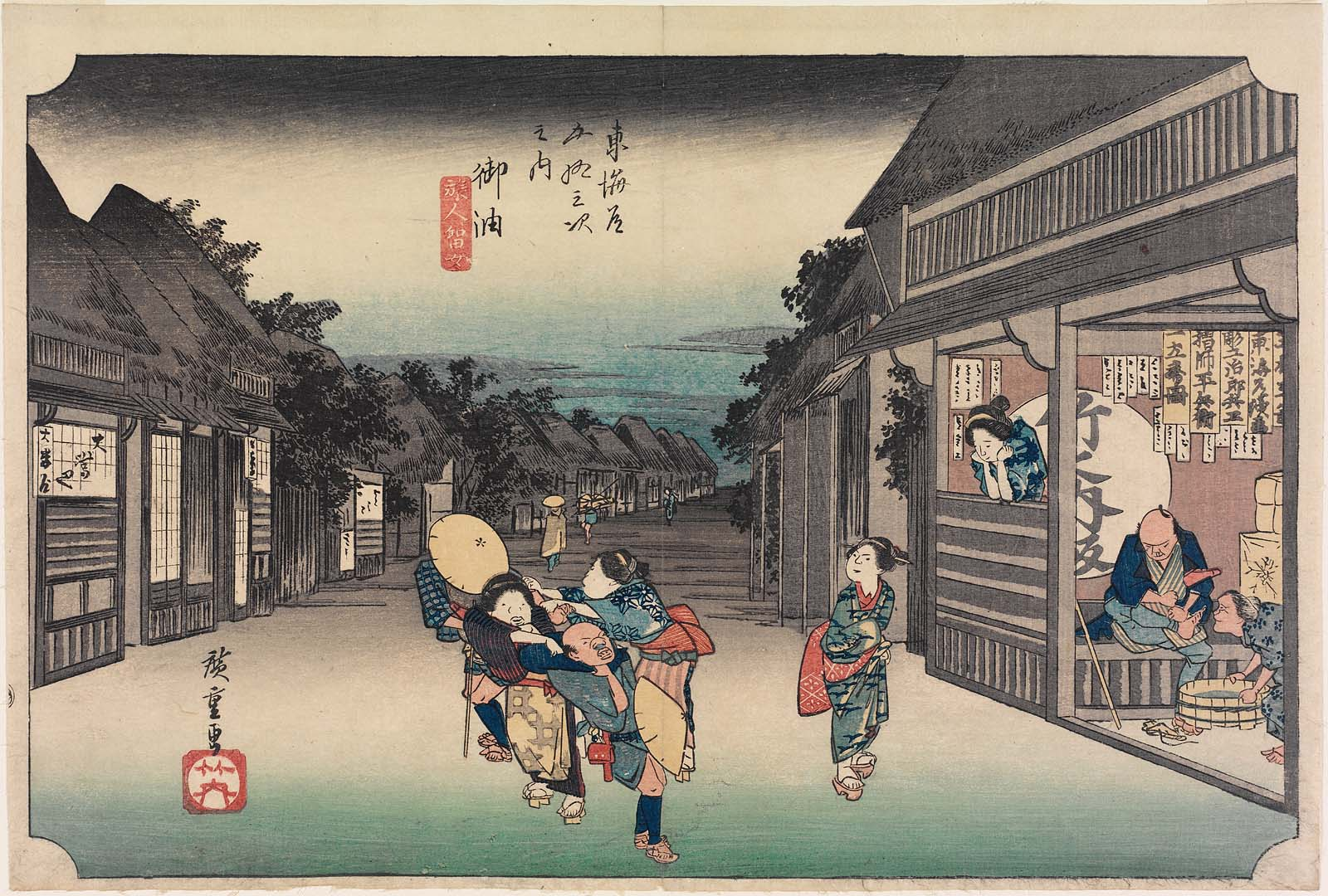
No. 36. Goyu: Women Stopping Travellers by Hiroshige

This classic ukiyo-e print by Andō Hiroshige depicts the main street of the post town at Goyu at dusk, with aggressive female touts, who were infamous characters around this post station.  Their “role” was to entice/drag travellers into the teahouses and inns for a night of entertainment.

In the next blog I will look at the final stages of the Tokaido Road trek which Hiroshige took part in 1832.

The Tokaido Road Trip. Part 1.

Leaving Edo

The next three blogs today are all about a journey.  I hope you will join me on this journey and look at the artwork associated with the long trek.  Most of you will have heard of the Camino de Santiago or in English, The Way of St James, which has a number of various starting points, but all paths on the Camino pilgrimage route lead to the Spanish town of Santiago de Compostela, where the remains of St James, (Sant Iago), were discovered in the ninth century. I will be guiding you along the Tokaido Road as seen and recorded in woodblock prints by the Japanese artist Utagawa Hiroshige.

The Tōkaidō Road,  which literally means the Eastern Sea Road, was once the main road of feudal Japan. It ran for about five hundred kilometres between the old imperial capital of Kyoto, the home of the Japanese  Emperor  and the country’s de facto capital since 1603, Edo, now known as Tokyo, where the Shogun lived.

The Tokaido mainly followed the Pacific coast and places where mountains suddenly meet the sea. It then ran across the mountains, and around the southern end of Lake Biwa, to Kyōto.

Memorial portrait of Utagawa Hiroshige by Utagawa Kunisada I (1858)

Hiroshige completed fifty-five woodcut prints 0f the fifty-three stop-over stations plus the two termini, which later became post-towns established along it.  These consisted of horse and porter stations, along with providing a range of lodgings, food, etc, establishments for the use of travellers. The horses were mainly for use by official messengers, but in some cases travellers wearied by their long journey could also hire horses.

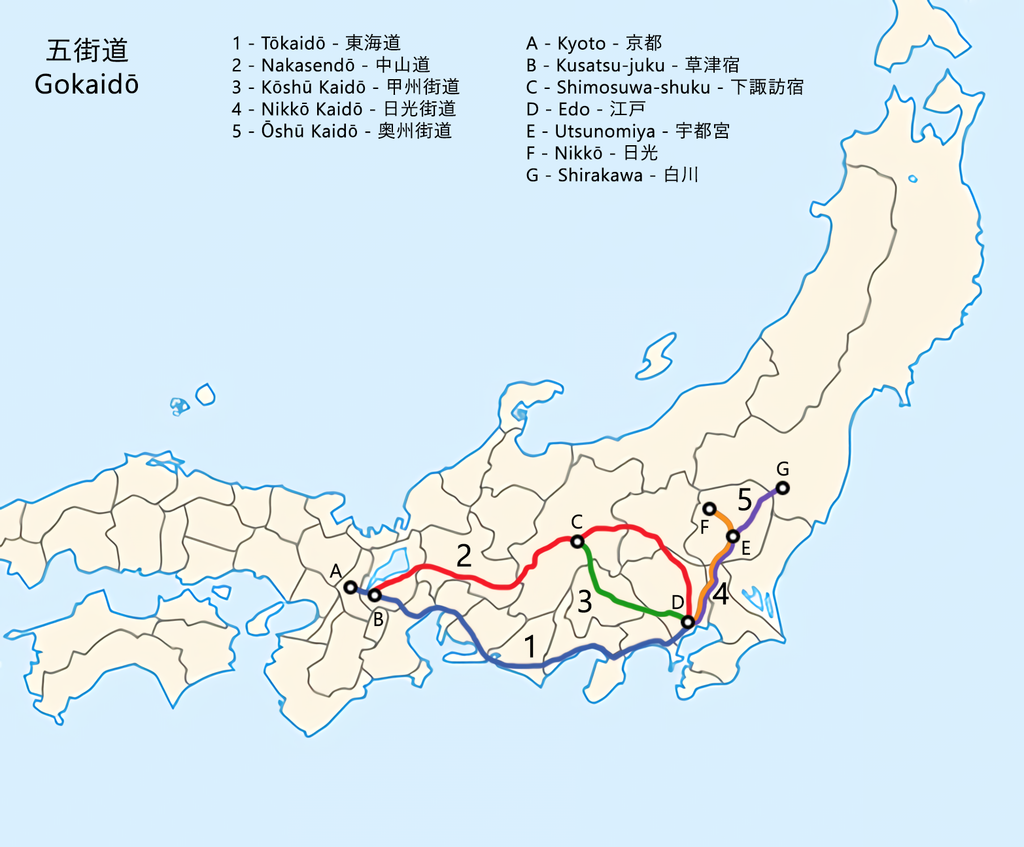
The Five Routes (五街道, Gokaidō)

The Five Routes (Gokaidō), sometimes translated as “Five Highways”, were the five centrally administered routes that connected Edo, the de facto capital of  Japan, with the outer provinces during the Edo period (1603-1868).  Two of these routes appeared in a series of woodblock prints completed by Utagawa Hiroshige. In this blog we will be following his journey along the Tōkaidō Road.

No.1. Nihon Bridge: Morning Scene.

In 1832 Hiroshige travelled with an entourage of the Shogun’s officials from Edo to Kyoto along the Tokaido Road. This journey proved to be an eye opening and life changing experience for him. One has to remember that Hiroshige was an urban man of Edo, and his life had been centred around Edo. This journey he undertook along the Tokaido, entering rural villages and observing the beauty of his country made a great impression on the artist, so much so that he immediately returned to Edo once the journey had been completed and started on his woodblock series using the sketches he had made during the long trek.   They were then published as the Fifty-three stations of the Tokaido or Hoeido Tokeido.  The publication earned him great critical acclaim during his lifetime and for future generations.   Hiroshige was part of an official delegation which was tasked with transporting horses, a gift from the shogun Tokugawa leyasu, the hereditary commander-in-chief in feudal Japan, to the imperial court of the Emperor Ayahito.  The horses were a gift from him which symbolised the power structure in Japan and how the shogun recognised the divine rights of the emperor.

Travelling along the Tokaido Road had some restrictions and checkpoints, known as seki, were set up by the Tokugawa government, where guards stood watch, and turned back those who did not have the appropriate passes. Even in the city of Edo there were restrictions and each section of the city, known as machi was closed off by wooden gates called kido.  These gates were shut every night, and re-opened early in the morning and so a traveller wishing to start on the first stage of the Tokaido route, at the Nihon-bashi literally “Japan Bridge” in the heart of Edo would have to wait until the kido at the bridge was opened.

Nihonbashi: Daimyō Procession Setting Out

Hiroshige’s journey started in the eighth month of 1832 at the Nihonbashi starting point. It was also from here that the Daimyō Procession started their annual pilgramige. Among the travellers on the Tōkaidō were the processions of the great daimyō, powerful Japanese magnates, and  feudal lords who, from the 10th century to the middle 19th century, ruled most of Japan from their vast, hereditary land holdings. They were subordinate to the shogun.  They were directed to spend every other year at the Shōgun’s court to prevent them from organizing rebellions, and the group travelled back and forth in huge processions numbering hundreds of people.

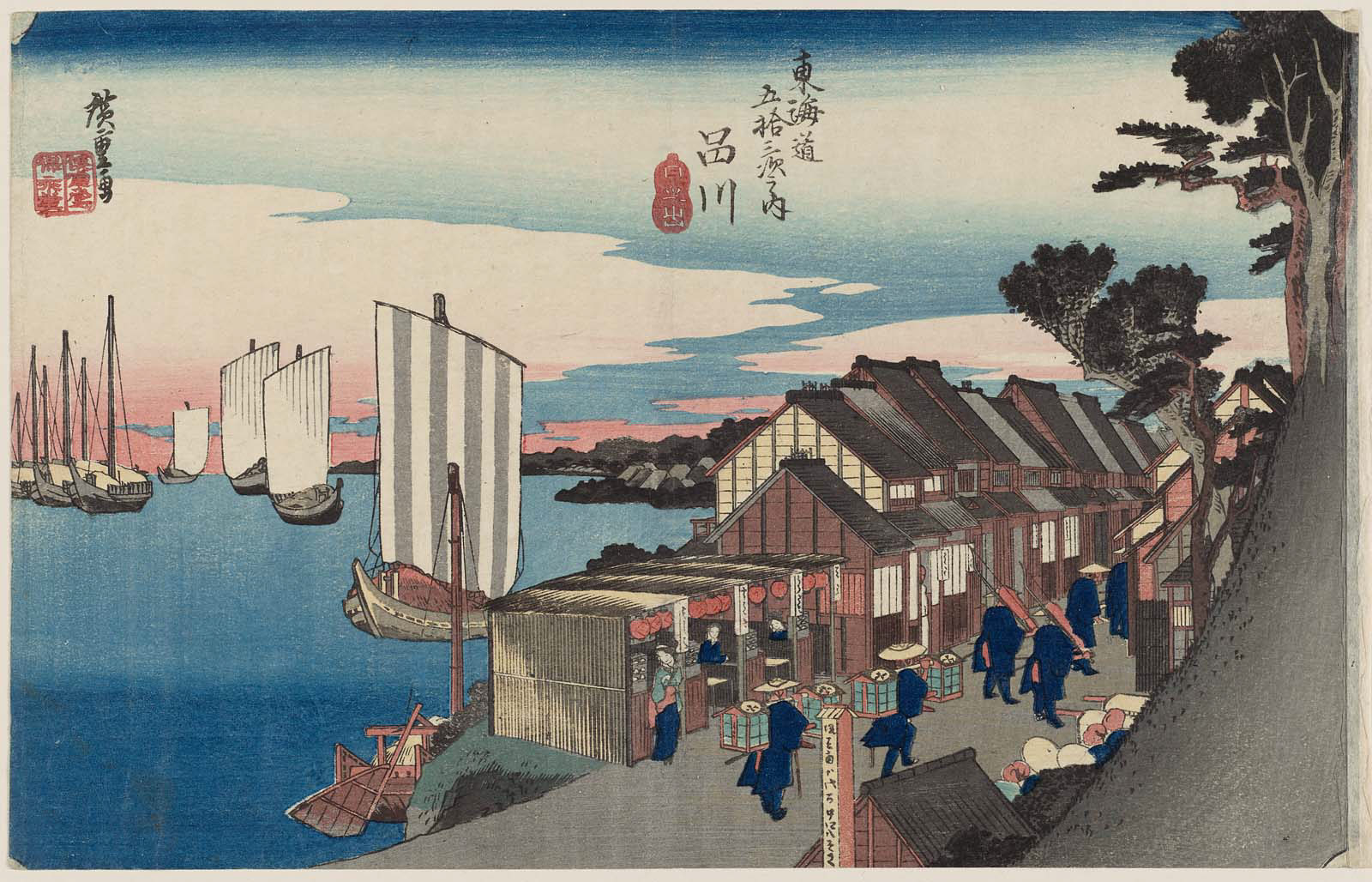
No.2.  Shinagawa: Sunrise by Hiroshige

The first stop-off point on Hiroshige’s journey along the Tokaido Road journey was at Shingawa, a suburb of Edo.

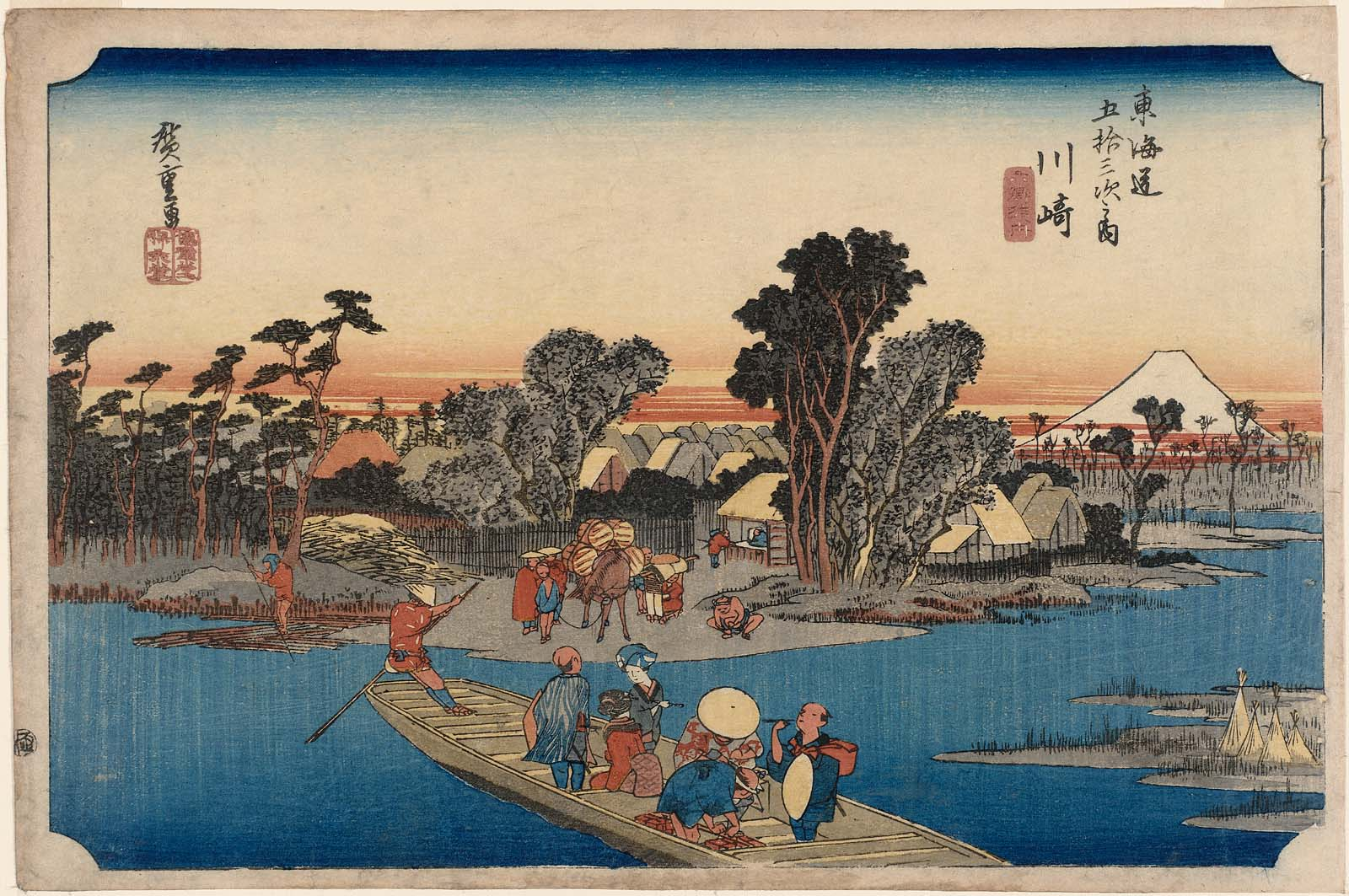
No.3. Kawasaki: The Rokugo Ferry by Hiroshige (1833).

In the third of the series we see the Rokugo Ferry at Kawasaki depicted.  It is a tranquil river scene in which we witness a ferry carrying six passengers.  On the Kawasaki shore we see future passengers along with their horse who have to wait for the ferry’s return.  Mount Fuji appears in the upper-right of the print.

No.4. Kanagawa: View of the Embankment by Hiroshige (c.1833).

The fourth of the fifty three woodcuts was of travellers arrival at Kanagawa.

The setting of the woodcut print is the town of Kanagawa and it is an evening scene.  We see the weary travellers slowly ascending the hill, being propositioned by young girls who try to entice them into the tea-houses.

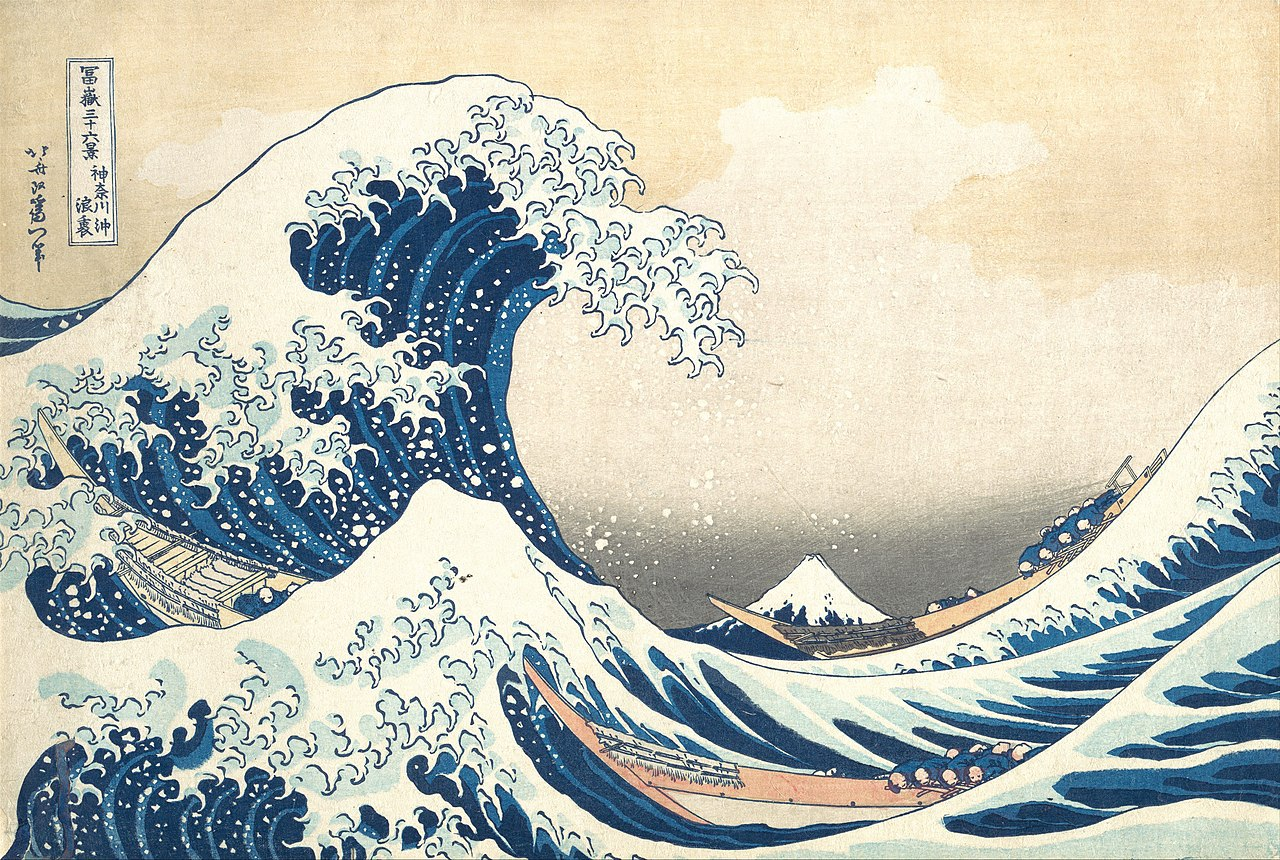
The Great Wave off Kanagawa by Hokusai’s  (c. 1829–1832)

Kanagawa is also the famous setting for Japan’s most famous artwork – Hokusai’s print entitled The Great Wave off Kanagawa. In 1923 the town was devastated by the Great Kanto earthquake.

No.5. Hodogaya: Shinmachi Bridge by Hiroshige.

The next stop for Hiroshige was at the lay-over station of Hodogaya on the bank of the Katabira River.  This town, now a suburb of Yokohama, was formed by combining the towns of Katabira, Godo, Iwama and Hodogaya. For that reason, the Katabira Bridge across the Katabira River was called the Shinmachi Bridge (meaning New Town Bridge). Begging Zen priests of the Fuke sect and palanquin bearers are seen crossing the bridge, and beyond them women of the small restaurants stand around and chat.

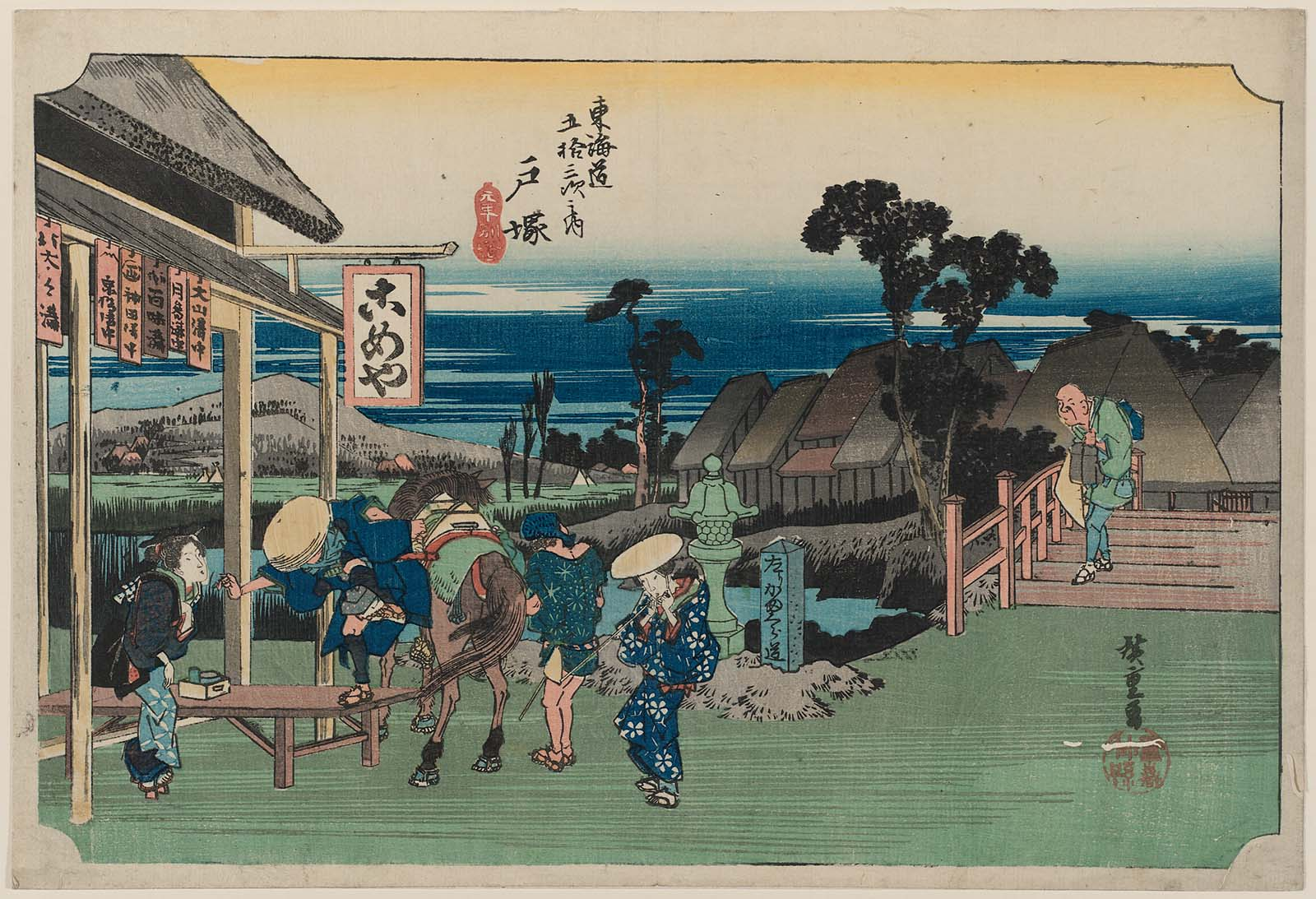
No.6. Totsuka: Motomachi Fork by Hiroshige

The next layby station on Hiroshiga’s journey is another suburb of Yokohama called Totsuka.  In this print we see a man dismounting from his horse in front of an open tea-house, while a waitress stands by to receive him. Beyond this station, the highway was lined with finely shaped pine trees.

No.7. Ōiso: Tora’s Rain by Hiroshige

Once Hiroshige and his party had departed from Totsuka and passed through Fujisawa and Hiratsuka the travellers arrived at Ōiso, a coastal town located in Kanagawa Prefecture.   In his depiction of Ōiso, dark black skies dominate and we see a small group of travellers entering the town sheltering from the downpour.  To the right of the road we can see Mount Korai and to the left we have a sea view.  The inclement weather is highlighted by the menacing black cloud which hovers above the horizon in the yellowish sky. The town of Ôiso at one time had been the home of Ôiso no Tora, also known as Tora Gozen. She was a courtesan based at the Chôtei brothel in Ôiso and the mistress of Soga no Juro and features in numerous kabuki plays.  Soga and his younger brother Goro slew Kudō Suketsune, avenging the death of their father.  Shortly afterwards the two brothers were executed.  This historical event later featured in many Noh and puppet theatre.  According to the stories, following Jûrô’s death, Tora became a nun and devoted the remainder of her life to praying for his soul.  Tora Gozen was later metamorphosed into a stone, which is one of the sites that can be seen in Ôiso. It is said that she cried on the 28th day of the Fifth Month, the day of Juro’s death and the title of the woodcut Tora’s Rain is reference to this event.

No.10. Odawara: The Sakawa River by Hiroshige (c.1833)

Hiroshige and the travellers left Oiso and headed south-west towards their next stop, Odawara but to reach that stop-over town they had to cross the Sakawa River. In those days travellers made the crossing on the backs of waders, or for the very rich traveller, they would cross the water seated in a palanquin or litter. On the middle-ground on the right of the print we can see the low-lying town of Odawara. Further to the right we observe the fifteenth-century castle of Odawara which nestles below a tree-covered hill.

No.11. Hakone: View of the Lake by Hiroshige (c.1833)

Having left Odawara Hiroshige and the travelling party headed for Hakone and Mishima.  To reach Hakone the travellers had to trek through mountainous regions close to their destination.  The mountains close to Hakone rose more than a thousand metres and the way to Hakone was a constant up and down and then circling Lake Ashi through the Hakone Pass to reach the Hakone stop-off station.  The woodcut print depicts Lake Ashi on the left and in the distance we can make out Mount Fuji silhouetted against a reddish sky.  The presence of Mount Fuji is all about artistic licence as from the position we are looking from, the mountain would not have been visible.

No.12. Mishima: Morning Mist by Hiroshige (c.1833)

The next stop on the Tokaido Road is the town of Mishima. During the time of Hiroshige, Mishima prospered as an inn town on the old Tokaido Road, a gateway to Mt. Fuji, Hakone and the Izu peninsula.  In the woodcut print we can see a small company of travellers passing through the town.  In the depiction, through the morning mist, we can clearly see two stone lanterns of the Mishima shrine.  To the left we see the roofs of the town and a few further figures.  As the shrine is on the right-hand side of the road the travellers are heading to Edo and the party is carrying a palanquin which would come in use for the journey ahead over the mountain pass.

Mount Fuji seen across a Plain: Numazu by Hiroshige (c.1852)

No.13. Numazu: Twilight by Hiroshige (c.1833)

Present day Numazu with Mount Fuji in the background

Having passed through the mountains of Hakone Hiroshige’s party descend down to the plain which gives them the perfect view of the imposing Mount Fuji. The background of the upper print, completed in 1852 by Hiroshige, is a yellow sky with the smaller Mount Ashitaka on the right. In the right foreground we can just make out the castle of Numazu which was completed in 1579 and two hundred years later it was destroyed and rebuilt.

No.14. Hara: Mount Fuji in the Morning by Hiroshige (c.1833-34)

At Hiroshige’s next layby station at Hara, which literally means “field”, the view of Mount Fuji is virtually unobstructed. It is here that one gets the best view of the majestic mountain.  The mountain’s imposing height is emphasized as its peak extends beyond the frame of the picture. This was a technique used by Hiroshige in many of his prints depicting the mountain.  Two women, accompanied by a male attendant in traveling dress, seem awestruck by the breath-taking view.  The early morning sun reddens the sky.  To the right of Mount Fuji is Mount Ashitakayama.  The small party depicted in this painting are en route to the next stop over point, Yoshiwara,  The area around Hara is dotted with ponds and pools which are habitat for eels and the presence of two cranes in the field is evidence that they are hunting for food from one of these pools.  The jacket of the porter bears a pattern that later appears regularly on Hiroshige’s prints as his seal, consisting of two signs for “Hiro”.

No.15. Yoshiwara: Mount Fuji on the Left by Hiroshige. (1833).

No.16. Kanbara: Night Snow by Hiroshige (c.1833)

Deep snow covers the slope of Kanbara in the evening and we can see fresh flakes falling on the houses. Trees, and mountains create a quiet scene only broken by the perceived crunch of the travellers’ footsteps in the snow. Two travellers wearing cloaks and hats trudge up the hill.  To the left of them there is another man dressed in blue holding an umbrella and a walking stick.  The mountains in the background and the houses in the middle ground stand out against a grey sky.  Once again Hiroshige has added a dark strip along the upper edge of the painting to denote that it is evening.  This painting is another case of artistic licence as it rarely snows in the Kanbara area, which is in present-day Shizuoka.

Hiroshige’s journey along the Tokaido Road continues in Part 2 of the blog.

William James Muller. Part 2.

The Later years

The Gaol Burning and St Paul’s Bedminster by William Muller (c.1831)

William Muller’s home in the city of Bristol was rocked by civil unrest in 1831.  The Reform Riots, as they became known, took place between the 29th and 31st of October and were part of the 1831 riots in England. The riots came about because of the second Reform Bill which was voted down in the House of Lords, and consequently shelved efforts at electoral reform.  The Bristol Riots were a reaction to the statement in Parliament of a senior judge, Sir Charles Wetherell, that the people of Bristol were not in favour of reform, despite 17,000 signatures on a petition supporting the reforms. 

The Burning of the Bishop’s Palace by William Muller (c.1831)

It was at a time when only five per cent of the population, (and they had to be men!) had the right to vote which was based on their wealth.  Wetherell  came to Bristol on his annual visit to Bristol, public meetings were organised in Queen Square on 10th, 11th and 12th October to decide on how to carry the fight forward. Demonstrators met Wetherell on his arrival in Bristol on October 29th, and soon, full scale rioting broke out, with angry crowds of protesters taking control of the city for two days. 

The Burning of the Mansion House, Queens Square by William Muller (1831)

Troops were brought in to end the riots and Wetherell escaped dressed as a woman while the crowds stayed, looting the wine cellar of the Mansion House and becoming drunk and reckless. Over the next two days rioters broke into Bridewell Jail and Lawford’s Gate Prison and set prisoners free. The Tollhouses, the Bishop’s Palace and, in Queen Square, the Mansion House and the Custom House, were all attacked.

Ruins of Warehouses in Prince Street by William Muller (c.1831)

Nineteen-year-old William Muller and his younger brother, Edmund, witnessed the riots first hand.  William made several sketches of the buildings in flames and the ruins of what remained.   Later he turned the sketches into a number of paintings such as Rioting in Queen’s Square, The Remains of the Mansion House, Ruins of the Custom House, with only the bare and broken columns standing.  He also completed a work entitled Removing the Prisoners at night to the Gaol, with the glare of burning buildings all around.

Of all Muller’s painting trips he undertook, North Wales was one of his favourite destinations. In a letter to a friend he called the area, Our English Switzerland. His first foray to the region was in June 1833 when he along with fellow artists, John Skinner Prout and Samuel Jackson left Bristol, crossed the River Severn and traversed the Brecon Beacons, finally arriving at the foothills of Cader Idris.

Llyn y Cau by Richard Wilson (1765)

The three men climbed part of the way up the mountain to gain a view of Llyn-y-Cau, a lake Muller referred to as Wilson’s Lake after Richard Wilson’s magnificent depiction of the lake in his 1765 painting.

Swallow Falls, Betwys y Coed by William Muller (1837)

Muller and Prout parted company with Jackson and explored the Conwy Valley from Betwys-y-Coed, all the way down to the sea. Muller was so taken with what he saw that he returned to the area on several occasions. During the winter of 1841 he and his brother travelled to North Wales and stayed at an inn in “Roe” now the small village of Rowen which was up-river from the coastal town of Conwy. He returned the following summer to paint en plein air in oils. In a letter to a fellow artist he wrote:

“…I paint in oil on the spot, and rather large, indeed. I am more than ever convinced in the actual necessity of looking at nature with a much more observant eye than the mass of young artists do, and in particular at skies. These are generally neglected…”

Salmon Trap on the River Lledr by William Muller (1842)

Interior with Goats, Betwys y Coed by William Muller (c.1833)

In July 1834, twenty-two year old Muller set off for Europe on a seven-month journey of discovery along with his good friend and fellow artist, the watercolourist, George Arthur Fripp.  They left Bristol docks on a schooner and sailed to Antwerp.  Having disembarked they went to Brussels and then moved across the German border, arriving in Cologne.  They then followed the river south, eventually arriving at Heidelberg where they rested for several days.

The Doge’s Palace, Venice by William Muller (1834)

The pair crossed the Alps and arrived in Northern Italy, visited the area around Lake Maggiore and staying in the lakeside town of Baverno.  Finally they arrived in Venice where they stayed for almost two months.

The Falls of Tivoli by William Muller (1837)

At the end of November 1834 they moved to Florence on their way to Rome where they spent that Christmas.  The one place Muller was determined to visit was Tivoli a town 30 kilometres north-east of Rome, where many British watercolourists had visited and stayed to capture the spectacular views.  Muller made many sketches and in 1837 completed his painting The Falls of Tivoli.

View of Bristol from Clifton Wood by William Muller (1837)

Muller returned to Bristol from his European tour in February 1835 and he set about converting his European and North Wales sketches into finished oil paintings.   In 1838 he once again left the shores of England and this time his ultimate destination was Egypt.  He went via Paris where he managed to visit the Louvre and was impressed by the landscape works of the Dutch painter, Jacob van Ruisdael and the Swiss painter, Francisco Mola.  Muller travelled overland to Marseille and then embarked on a sea passage to Malta and Constantinople.  From there he took a boat to the Greek island of Siros and then journeyed to Piraeus and Athens where he stayed for six weeks.

Temple of Theseus by William Muller (1839)

Whilst in the Greek capital Muller completed more than forty watercolours, many of which were of the Acropolis or views from this elevated monument.   Athens had been a popular destination for artists and this love of the area could be put down to James Stuart and Nicholas Revett’s 1762 book, Antiquities of Athens.  It was the first of four volumes and was the first accurate survey of ancient Greek architecture ever completed. Their detailed drawings done at the sites of the ancient ruins between 1751 and 1754 transformed our understanding of Greek architecture.

In November 1838 Muller left Greece and set sail on a French steamer for Egypt.  He disembarked at Alexandria.  Although earlier artists, such as Turner, and the marine painter Clarkson Stanfield, had produced drawing of Egyptian sites using sketches made by amateur artists, none had actually visited the country and it is thought that William Muller was one of the first established European artists to set foot in Egypt. 

Prayers in the Desert by William Muller (Exhibited at the RA in 1943)

Muller was impressed with Alexandria, likening it to a kaleidoscope of humanity but the Egyptian town was, in his view, bettered by what he saw when he visited Cairo with its long delicate minarets and Asyut but it was the mass of people of these cities that astonished him the most.  His most exciting time was when he mingled with the people at the slave market and he liked to immerse himself amongst the crowds dressed in their highly coloured clothes.

The Ramesseum at Thebes, Sunset by William Muller (1840)

In December 1838, Muller left Cairo and journeyed down the River Nile and on December 10th got his first sight of the pyramids at Giza.  In his book, An Artist’s Tour of Egypt he recounted life on the small river boat:

“…it is tedious, to an extent one can form little conception of, to be shut up in a small boat, with not enough room to stand upright – 9 feet long and in its widest 6 – with little to do but shoot from its windows at crocodiles, pelicans and other birds, in particular vultures;  of these being particularly fond of objects of Natural History, I made a tolerably numerous collection…..Shooting, sketching and smoking, at the expiration of twenty days I found I had arrived at Dundara…”

The Entrance to a Small Temple at Medinet Habu, Luxor, by William Muller (1840)

On January 1st 1839, at the end of his four hundred mile journey up the Nile, Muller arrived at Thebes.  Here on the eastern banks were temples at Luxor and Karnak and on the western side the Ramesseum,  the ruined mortuary temple of Ramesses II at Qurnah, the Valley of the Kings, the Valley of the Queens and many more monuments. 

The Pyramids by William Muller (1843)

Despite the sometimes treacherous conditions, his expedition resulted in some of the finest travel records of any artist of the 1840s.  Muller eventually returned home to Bristol via Malta, Naples, Rome and London in March 1839.  Once home he set about completing paintings from sketches he made during is long journey.

In late Autumn 1839 William decided that he needed metropolitan success with his work and left Bristol and moved to London and he and fellow artist, Edward Dighton moved into a residence on Rupert Street, Haymarket and later 22 Charlotte Street, Bloomsbury.  Muller and Dighton joined the Clipstone Street Academy at which figurative painting was taught using models and life classes and this was important to Muller who had been weak when it came to drawing figures.

Tomb in the Water, Telmessos, Lycia by William Muller (1845)

Muller, along with fellow artist, Harry Johnson, visited the eastern Mediterranean for the second time when the pair travelled to Lycia, a remote part of south west Turkey, in September 1843.  There, he had camped for months and encountered ferocious storms, torrential rain, and endured living close to malarial swamps.  Muller eventually made his way home in April 1844 after being away for eight months.  He left his numerous sketches in London to be framed and headed to Bristol to stay with his brother.  He contacted his patron, William Wethered, and and on May 7th 1884, wrote to him about the Lycia expedition:

“…I am home at last – after a most fatiguing travel…….I will look forward to showing you what I have done in sketches – they are satisfactory I believe, & contain some splendid subjects – but I almost question if I had foreseen what I have had to go through to obtain them if I should ever have visited the country…”

Flower Piece by William Muller (1845)

In early 1845 William Muller became ill, probably exhausted due to overworking.  He had at that time numerous commissions to complete and he believed they would lead to him becoming a very successful painter.  He was disappointed and annoyed with how is paintings were exhibited at that year’s Royal Academy exhibition but nevertheless carried on painting despite his rapidly deteriorating health.  His fingers became swollen and he was finding it difficult to hold a paint brush.  On September 8th 1845 whilst his brother was setting his palette for him to work on a still-life painting, William Muller fell back and died aged just 33.

Wooded Landscape with Children by William Muller (1845)

Muller is buried in the Unitarian burial ground, Brunswick Cemetery, off Brunswick Square, Bristol. His grave is marked by a simple polished black stone slab inscribed Sacred to the memory of William James Muller who died Sep 8th 1845.   A bust of the painter is located at the entrance to the cloister in Bristol Cathedral.

Stacey Gillian Abe

When I was in London last week I made my first visit to the Unit London Gallery.  The gallery is in the heart of London’s Mayfair at No.3 Hanover Square which is off Regent Street, very close to Oxford Street underground station.  It is well known for representing some of the finest local and international talent, and provide an unhindered showcase for artists who operate outside of the mainstream art world  and by so doing, has successfully launched and enhanced the careers of many influential contemporary artists.

Unit London

The gallery was hosting two exhibitions and my blog today is all about one of those, which closed at the end of January.  It was a large display of work by the Ugandan multi-disciplinary contemporary artist, Stacey Gillian Abe entitled Shrub-let of Old Ayivu.  Like my previous blog featuring Kyu Hun Kim the artwork is best described as unusual but this does not detract from its beauty.

Bibiana’s Window, by Stacey Gillian Abe (2022)

The name of the exhibition is unusual but Stacey says it can be traced back to the clan  is a descendant of.  She explains:

 “…Ayivu is one of the major clans of the Lugbara-speaking people from Arua in the West Nile region of Uganda.  We are a tribe intersecting three countries that is Democratic Republic of Congo, Sudan and Uganda. Our people are spread out within these countries, and I belong to the Ayivu clan in Uganda.  Shrublet of Old Ayivu is a metaphoric term which alludes to growths that have originated for a long time from a place of great significance that eventually create the perfect conditions for shrub-lets to morph and branch out of the old ways to form new connections independent of their origin.  The shrub-let is representative of this transportation from traditions, mindsets, norms and past lives, places to mention but a few…”

The Farmer’s Daughter by Stacey Gillian Abe (2022)

She goes on to say that the imagery of the plant life also extends to the colour of the models themselves. Jute is seen as a symbol of the Ayivu clan, and it is a motif that unites all of the work on display.  She reveals that jute is a plant of many uses, so this totem recurring in the work is a symbol of possibilities and growth.

Stacey Gillian Abe was born in Kampala, Uganda, in 1991. From an early age she loved art. For her, it all started with painting and drawing in high school in 2008. In 2014, she graduated from Kyambogo University, Kampala, with a BA in Art and Industrial Design.

Forbes Africa Under 30

In 2018 Abe made it onto the 2018 FORBES AFRICA Under 30 list which is the definitive list of Africa’s most promising young change-makers.  There are thirty “game-changers”, all under the age of 30, in each of the three sectors – business, technology and creative, a total of ninety young African people who were said to be challenging conventions and rewriting the rules for the next generation of entrepreneurs, creatives and tech gurus.  Abe was placed in the “creative” group of thirty.  Over six hundred candidates had been put forward and months were spent researching, verifying and investigating them.

Of herself, Abe describes herself as being reticent:

“…My passion started from the need to express myself more, I am not an introvert but a bit reserved…”.

Her way of expressing herself is through her art.  She says that a huge part of her practice now revolves around highlighting complex situations as autobiographical documentations of past and continuous experiences.

Fatou by Gillian Stacey Abe (2022)

Unit London gallery describes the exhibition I went to see:

“…Stacey Gillian Abe’s first solo exhibition at their gallery as an exploration of memory, time and emotion. It focuses on the concept of shared memory, Abe’s latest body of work examines how memories have been passed down through her family’s lineage, alluding to the ways in which traditions are absorbed and transformed from generation to generation.  These ideas are represented in the jute plant and flowers that are detailed in various paintings. A fibrous plant with multiple uses, jute is a totem for the Ayivu clan, one of the major clans in Arua in the West Nile Region of the artist’s native Uganda. The shrublet appears in sections of embroidery that decorate Abe’s paintings, becoming a motif that connects each canvas. Most importantly, Shrub-let of Old Ayivu questions how memory can be shared. With her paintings, Abe explores the transference of abstract memory, of subjects that are not easily explained visually. These notions do not simply materialise through composition or through the artist’s own subjectivity. Instead, they take shape within the space of the canvas itself, seemingly forming from the subject’s own consciousness. Each painting and each figure tell a different story, becoming part of a tapestry of interwoven threads…”

The Sitting I by Gillian Stacey Abe (2022)

The colour Abe uses for her figures is further explained by the gallery:

“…These ideas of generational memory link to Abe’s striking use of the colour indigo. Acutely aware of the colour’s presence in African history, the artist acknowledges its role in centuries-old textile traditions in West Africa. The rich dye was subsequently introduced to East Africa through the exchange of textiles, facilitating the East African slave trade or the Arab Slave Trade and the Indian Ocean Trade. Here, Abe references Catherine McKinley’s study Indigo: In Search of the Colour that Seduced the World (2011), which details that one length of indigo was equivalent to one human body. Through the Indian Ocean trade, Abe’s home country of Uganda also encountered trade routes from the coast to the mainland in the mid-1800s. Her village of Arua, positioned at the intersection of Democratic Republic of Congo, Sudan and Uganda, saw many Congolese people from the surrounding areas abducted into the slave trade to work in silk production…”

What We Wanted by Gillian Stacey Abe

In Abe’s own words:

“…Indigo for a skin tone in my work signifies a tribe, a breed of black, a people that are not limited to social, economic, cultural, political or historical constraints…”

In the exhibition, Shrub-let of Old Ayivu, Abe also shows us her fascination with indigo via its connection to cloth and material. She is fascinated with the colour and this manifests itself as an exploration of the relationship between cloth and the body. Through embroidery and the cloth there is a strong visual element throughout Abe’s body of work, which allows her to revisit the traditional, historical and personal significance attached to fabric.

See you Later, Again. by Gillian Stacey Abe

During the last three years Abe has carried out wide-ranging research on  the colour indigo.  It is a colour that has been viewed as both very rich and very valuable, but in her mind also one that has fashioned narratives around the black body. She says that indigo is a dominant colour in her work and she utilises it as a skin tone for her subjects. In a strange way it allows the observer  to behold  the black body in a different light.

Too Much and Not the Mood by Gillian Stacey Abe

Like my previous blog featuring the work of Hun Kyu Kim, Abe’s work is one you either love or hate. I actually found the exhibition fascinating.

Rupert Bunny

Rupert Bunny

In my last blog, I looked at the life and works of the Australian painter Agnes Goodsir, who had spent a large part of her life in Paris.  Today I am showcasing another Australian artist, Rupert Bunny, who also spent many years in the French capital and was one of the most successful expatriate Australian artists of his generation.

Self portrait by Rupert Bunny (c.1920)

Rupert Charles Wulsten Bunny was born in St Kilda, Melbourne on September 29th 1864.  Rupert was the third son of a English-born, Eton educated, Brice Frederick Bunny.  His father had studied law and was called to the Bar in 1844, becoming a talented equity barrister in London.  The news of the discovery of gold in the 1850s in New South Wales and Victoria whetted Brice’s appetite and in October 1852 he arrived on Australian soil intending to make a quick fortune before returning to London.  However neither of his plans materialised, as after six months of prospecting he had nothing to show. However, the one bit of luck he had was when he emigrated to Australia he brought with him all his law books and so, after his failed prospecting period, he went to Melbourne and resurrected his legal career in October 1853.  In June 1856 Rupert Bunny’s father married German-born Maria Hedwig Dorothea Wulsten, who had followed him to Australia. They set up home in St Kilda, where he was active in the Municipal Council.  In 1873 Brice Bunny was appointed an acting County Court judge but his health started to deteriorate and he had to resign from the legal profession.  He died on 2 June 1885 at St Kilda, Victoria, leaving three sons, one of them a barrister, and three daughters. His wife, Rupert’s mother, died in 1902.

Hair Drying by Rupert Bunny (c.1908)

Rupert Bunny had three sisters, Alice and Annette who were five and two years older than him and Hilda who was three years younger.  He also had two older brothers, Herman and George and a younger brother Brice. Rupert attended the Alma Road Grammar School in St Kilda, and later the Hutchins School in Hobart.  In 1881 he enrolled at the University of Melbourne where he studied civil engineering.  He was not happy with the course and abandoned it.  At one time he decided he wanted to become an actor, but this future path was abruptly blocked by his parents.  Maybe as a compromise between his desires and those of his parents, he settled for joining the National Gallery Schools under British-born Oswald Rose Campbell and Irish-born George Frederick Folingsby, who was the director of the National Gallery and master in the School of Art.  Whilst there he became friends with his fellow students including Frederick McCubbin, E. Phillips Fox and Louis Abrahams.

The Descent from the Cross by Rupert Bunny (1898)

The painting was hung at the 1898 Royal Academy in London

In 1884, at the age of twenty, Rupert Bunny left Australia and went to London.  Once in the English capital he enrolled at St Johns Wood Art School where one of his tutors was the English painter, Philip Calderon. Two years later, in 1886, he left England and headed for Paris to study under Jean-Paul Laurens in his studio at the Académie Julian. He left Laurens in 1886 and went to study at the Académie Colarossi where he studied under the French painter, Pierre Paul Léon Glaize.  His studies here made him an accomplished academic history painting – paintings on a large scale, with complex compositions based on mythological, historical and biblical subjects, and the depictions would characteristically contain multiple figures. From 1888, now in Paris, Bunny exhibited at the Parisian Salon de la Société des Artistes Français (Old Salon).

The Tritons by Rupert Bunny (1890)

During the late 1880s he produced a series of large-scale, delicately coloured sea idylls peopled with mythological and pagan creatures including mer-folk. Having a German mother, Rupert remembered the German myths and legends. Bunny often drew inspiration from the German myths and legends that she would read to him and characters from these often appeared in his depictions.  These stories were balanced by his father telling his son tales from the bible and Greek and Roman mythology.  One such painting was entitled The Tritons which Bunny completed in 1890. The painting was exhibited in Paris at the Old Salon in 1890, and it was the first painting by an Australian to receive an honourable mention at the event. The painting depicts a group of tritons, who were legendary creatures that lived both on land and at sea.  They are enjoying a lazy moment in their calm surroundings.  Rupert Bunny, in this work, lays before us some of the features which would become characteristics of his work, such as an attraction he had for mythological subjects and the depiction of the mystery and glamour within an intimate setting. Look how he has expertly shaped a twilight atmosphere by the use of subtle colour schemes, as is the case where the pale blue, silvery ocean and pink-toned sky are quietly reflected in the flesh tones of the figures.

Pastoral by Rupert Bunny (1893)

His 1893 painting entitled Pastoral is a good example of the large-scale mythological works Bunny painted during his early years in France.  The painting is an allegory about the life-changing power of music. Before us we see youths and pagan beings who are all mesmerised by the strains of the pipes and soothed into a state of heightened consciousness.  The figures we see in the painting are contemporary youths and Rupert used their inclusion to show that Arcadia was not something we read about in days gone by but a state of mind.  There is a dream-like quality about the depiction and note the inclusion of vermillion poppies, a flower which symbolised sleep.

Madame Melba by Rupert Bunny (1902)

Rupert Bunny, besides being a great artist, was also a talented pianist and composer.   The love of all things musical probably persuaded him to paint a number of portraits of the Australian soprano, Dame Nellie Melba.  She had, during the latter days of the nineteenth century, moved to Europe to cement a career as a professional singer.  Rupert’s portrait of her entitled Madame Melba was completed around 1902.  Rupert had known her since the 1880s.  The painting, once completed, hung in the singer’s London home.  Later, she presented it to Her Majesty’s Theatre in Melbourne.  The National Gallery of Victoria bought the painting in 1980 and later it was loaned to Government House in Melbourne Victoria.

Percy Grainger by Rupert Bunny (1904)

Bunny created portraits of a number of Europe-based Australian musicians and performers.  He was commissioned, by twenty-two-years-old Australian pianist and composer, Percy Grainger, to paint his portrait in the early days of his professional musical career.  Grainger became acquainted with Bunny through Nellie Melba. Whilst living in London Rupert Bunny attended gatherings at Grainger’s rooms at King’s Road where the guests would sing many of Grainger’s compositions.  In this portrait, the young musician is portrayed as a relaxed young gentleman in the tradition of what was termed the ‘swagger’ portrait, which aptly reflected Grainger’s own ambitions. In Grainger’s left hand is a sheet of music, a conscious reference to Grainger’s celebrated career.

Portrait of the Artist’s Wife by Rupert Bunny (c.1895)

Portrait of the Artist’s Wife, Jeanne Morel by Rupert Bunny (1902)

In 1892, Rupert Bunny met his future wife, Jeanne Heloise Morel who was a fellow art student.  It was love at first sight as Bunny was bowled over by her beauty.  John Longstaff, a fellow Australian painter who was living in Paris, remembers the first meeting between Rupert and Jeanne, saying:

“…I remember … the very night they met, and how he fell in love with her at first sight.  She was a regular Dresden china girl with a deliciously tip-titled nose…”

The meeting was to prove a turning point in Rupert’s life, not just with the romance which followed, but by his change in his artistic style.  A colleague of Bunny commented:

“…  Jeanne changed not only Bunny’s life but also his art, which now focused on subjects in which beautiful women played the central role, with Jeanne as his favourite model…”

Rupert Bunny was influenced by Morel and she became his favourite model who featured in his depictions of the idyllic and leisured lifestyle of the Belle Epoque. Her graceful form and sensuous features were seen in many of his works, embodying Bunny’s feminine ideal. Bunny was also greatly influenced by the English Pre-Raphaelite painters such as John Everett Millais.

 Portrait of Mlle Morel by Rupert Bunny (1895)

 Portrait of Mlle Morel by Rupert Bunny, which he completed in 1895, is the first, major full-length portrait by Bunny of Morel. It is a tender depiction of his then girlfriend that he painted and was submitted and accepted into the Paris Salon that year.  It was a painting which marked the turning point of Rupert Bunny’s art from the Allegorical to the Belle Époque.

A Summer Morning by Rupert Bunny (1905)

Jeanne Heloise Morel was born on July 29th 1871 in Paris.  Her mother was Marguerite Morel, an unmarried servant. Her father, who was never named on the birth certificate, was said by Jeanne to be Eugénie François Morel, who served as an officer in the French Navy.  Jeanne received training in Fine Arts at the Orphanage of Arts at 96 rue de Vannes in Paris.  In 1884, when she was thirteen-years-old, Jeanne made her public debut at the Société des Artistes and subsequently exhibited at the Société Nationale des Beaux-Arts, working in oils.  Jeanne-Heloise Morel married Rupert Bunny in London in March 1902.

Dolce Far Niente (Sweet Idleness) by Rupert Bunny (c.1897)

The painting’s title means sweet idleness or the sweetness of doing nothing. Rupert Bunny would paint numerous similarly composed works featuring  groups of women relaxing, dreaming, dressing or undressing close by expanses of water.  The French art critic Gustave Geffroy was a great believer in Rupert Bunny and loved his work, Dolce Far Niente and in a review of the Salon of 1897 at which the painting was exhibited, he wrote:

“…To discover the promises and creations of newcomers, it is necessary to research, to go to canvases attracted by a soft radiance, a quiet force, a secret charm….I like the poetry of Dolce Far Nniente by Mr Bunny [of] women with graceful bodies, and beautiful and instinctive faces, who dream by the sea…”

Gustave Geffroy was a great advocate of Bunny’s work for the next three decades and in a 1917 review he wrote:

“He is a brilliant and spirited artist…at one and the same time, a realist and a visionary, an observer of truth and a poet of the world of dreams…”

Endormies by Rupert Bunny (c.1904)

Rupert Bunny’s 1904 painting entitled Endormies (Sleepy) portrays two female figures at the water’s edge relaxing and lost in a world of dreams. Rupert modelled the sleeping figure once again on his wife Jeanne Morel.  Her elegant and sensuous physical qualities enhanced many of his paintings.  In this depiction the artist has included a rose by the side of one of the sleeping women.  The rose was a traditional symbol of love and sensuous power.  The white swans we see in the background symbolise the attributes of grace and beauty. Rupert, like many artists also used the motif of a small dog, which often signifies marital fidelity.  In this painting Rupert has placed the animal sleeping at the feet of his mistress.

Summer Time by Rupert Bunny (1907)

In all Rupert Bunny’s depictions of his wife Jeanne and her friends there was an aura of beauty and elegance.  The clothes which adorned the females were typified in their fashionable trimmings and reflected the stylishness of the apparently endless summers that was La Belle Époque. The public loved these works of art and they became the most commercially and critically successful works of his career. Rupert Bunny’s 1907 work entitled Summer Time splendidly validates his skill as a draughtsman and his consummate treatment of large-scale works such as this one which measures 250 x 300 cms. It was exhibited at that year’s Paris Salon. It was his most ambitious work.

in situ at the Art Gallery of New South Wales

The painting depicts a spirit of leisure and sensuality as we observe seven voluptuous women relaxing inside a bathhouse on the Seine. It is a floating swimming pool sealed off from public view where women could bathe modestly. We see 0ne of the women is undressing preparing to climb down into the water while another female, on the left of the painting, is getting dressed before she emerges into public view.

The Rape of Persephone by Rupert Bunny (1913)

Rupert Bunny was never afraid to shy away from changing his artistic style.  He had a refreshing willingness to keep reinventing himself and during his life, he simply kept an eye on what was the most fashionable style, so that his popularity would not wane.  Of the painting, The Rape of Persephone, one art critic, George Bell, described it as:

“…a glorious riot of colour from the finest imaginative Australia has produced…”

Fresque by Rupert Bunny (1921)

Rupert Bunny moved through successive styles and was strongly influenced by British pre-Raphaelites French primitives, symbolists and Post-Impressionists.  He was particularly influenced by Matisse and his love of Sergei Diaghilev’s Ballet Russes, an itinerant ballet company begun in Paris that performed throughout Europe between 1909 and 1929. 

Salome by Rupert Bunny (c.1919)

The paintings of Rupert Bunny around this time began to be ones of heightened colour and abstracted, rhythmical forms.

In 1933, Bunny returned to live in Melbourne where he continued to paint until his mid-70s. He died on May 25th 1947, aged 82.  Rupert’s forte was his ability to change with the times and he was always open to new artistic influences.  Throughout his life he had always been motivated when it came to his painting. He never tired of experimenting with colour combinations and was never afraid to take risks. He was a master colourist.

Much has been written about Rupert Bunny and this blog has just scratched at the surface of his life but I hope it will tempt you into reading more about this great Australian painter.

.

Christmas and Snow

Somebody once said that the only way to enjoy the sight of snow is when looking at a postcard or a painting.  I have spent a number of Christmas Days in hot climes such as Karachi and Melbourne and know that Christmas is not Christmas without snow.  So for this Christmas blog I want to look at some of the beautiful winter landscapes created by famous and not-so-famous artists to remind me of a snowy Christmas, many of which have featured in earlier blogs.

View of Bazincourt, Snow Effect Sunset by Camille Pissarro (1892)

Camille Pissarro depicted the small town of Bazincourt-sur-Epte at all times of the day, and in all seasons, in a number of his paintings.  In 1892 he completed his work entitled View of Bazincourt, Snow Effect, Sunset.  In this Impressionistic-style painting we can see how Pissarro has managed to infuse a warmth to the scene by his use of violet for the trees and the way the sun has illuminated the clouds.

Snow Scene at Argenteuil by Claude Monet (1875)

The great Claude Monet, known for his lily ponds at Givenchy, also painted a number of winter landscapes.  The first one I am looking at is his work entitled Snow Scene at Argenteuil.  Monet and his family moved to Argenteuil a small Parisian suburb twelve kilometres north-west of the heart of the French capital and was accessible from central Paris with a short train ride.  Monet painted many scenes in and around Argenteuil featuring the riverbanks of the Seine, the railway bridge which straddles the French river, which often featuring a steam train chugging across the structure.  The painting I have chosen was one of eighteen that Monet completed which depicted the snowy winter of 1874/5. It is a depiction of the Boulevard Saint-Denis, near Monet’s home. It looks towards its junction with the rue de la Voie des Bans, with the River Seine beyond.  The figures we see in the painting are plodding along the road and it could be that they are making their way to or from the nearby railway station which lies behind the artist.  The station would have been used by holiday makers and commuters on their way from Paris.  The snowy road surface has dark brown furrows made by passing carts and as we follow them we can see the town in the background.  This painting was one of the largest (71 x 91cms) snowscapes that Monet completed but does not have some of the finer details in Monet’s smaller winter paintings.

La Pie (The Magpie) by Claude Monet (1869)

My favourite winter painting by Monet was completed in 1869,  six years before the Argenteuil work.  He painted it during the winter of 1868–1869 whilst he and his girlfriend, Camille Doncieux were living near the commune of Étretat in Normandy in a house Monet’s patron, Louis Joachim Gaudibert, had arranged for them.  This is Monet’s largest (89 x 130cms) winter painting. The painting depicts a solitary magpie which has alighted on a gate which has been fitted between parts of a wattle fence. Sunlight falls upon freshly fallen snow producing blue shadows.   This “blue shadow” phenomenon later became associated with the Impressionist movement artists. Monet and those Impressionists exploited the use of coloured shadows to symbolise the actual, changing circumstances of light and shadow as witnessed in nature, and by so doing, they defied the academic convention of painting shadows black.   However all were not pleased with this new concept which led to its rejection by the Paris Salon of 1869. However present art historians today believe that The Magpie is one of Monet’s best snowscape paintings.  The painting was acquired by the Musée d’Orsay in 1984 and is considered one of the most popular paintings in their permanent collection.

Snow at Louveciennes by Alfred Sisley (1874)

It is believed that due to a series of severe winters in France in the 1870s it contributed to a sudden increase in the number of winter landscapes produced by Impressionists.  My next painting I am showcasing is one created by Alfred Sisley in 1874, entitled Snow at Louveciennes.  Before us we see a picturesque scene of stillness set in early winter’s morning in Louveciennes, a small village in the Île-de-France region in north-central France, located in the western suburbs of Paris, between Versailles and Saint-Germain-en-Laye.  Sisley depicts the sky in white, crisp blue, and grey hues. His use of perspective guides the viewer along a winding road which vanishes into the background.  The buildings in the paintings are covered with snow and we see a lone woman holding an umbrella strolling along the pathway, which has trees on either side. The artist is willing us to take a walk with the woman as she heads towards the village.  Sisley was entranced by views of the countryside during the winter months.  In fact, unlike most of us who dreaded heavy snowfall Sisley was inspired by what he saw and was especially attracted by how the variations in light came into play in snow scenes.


Effect of Snow on Petit-Montrouge by Manet (1870)

The oil on canvas painting entitled Effect of Snow on Petit-Montrouge was painted by Edouard Manet and depicts a winter view of Petit-Montrouge, in the 14th Arondissment of Paris.  Manet completed the work in 1870 whilst he was serving in the National Guard during the 1870–71 Siege of Paris in the Franco-Prussian War. There was no hint of the war, no heroic view of the battle or the bloody fighting, which was raging around the French capital, as often seen in the work of other artists’ paintings of the time.  This painting, although a snowy scene, is awash with shades of brown and black giving it a dark and foreboding ambience which could well be because the way Manet was feeling about the course of the ongoing war.  During this time Manet wrote to his wife:

“…My soldier’s knapsack serves…to hold everything necessary for painting. I shall soon start some sketches from life. They will be souvenirs that will one day have value…”

The painting depicts a view of the church of Saint-Pierre at Petit-Montrouge, and it is inscribed:

“…â mon ami H. Charlet 28 Xbre 1870. Charlet…”

 Charlet is thought to have been a comrade in the National Guard.  The dark image reflects Manet’s loss of hope regarding the impending military defeat and his deep loneliness, the deprivation and his bouts of depression he suffered during this time. It is one of the few landscapes in Manet’s oeuvre and is one of Manet’s first plein air paintings. Today it is in the collection of the National Museum Cardiff.

The Rooks have returned by Alexi Savrasov (1871)

Having looked at a painting by Monet featuring a black coloured bird against the white of the snow I had to give you one of my favourite works of art and this too features black birds and snow.  It is not quite a winter scene more “a coming of Spring motif”.  It is Alexi Savrasov’s painting entitled The Rooks have Returned, which I saw at the Tretyakov Gallery when I was in Moscow.  Savrasov was one of the most important, some would say, the most important of all the 19th century Russian landscape painters, and he was  deemed the creator of the “lyrical landscape style”. It is Savrasov’s most famous painting, and the painting is considered by many critics as being the high point in Savrasov’s artistic career.  The depiction witnesses the coming of spring as signalled by the return of the rooks.  The work is testament to Savrasov’s love for the rural Russian landscape, and he was very influenced by John Constable. The depiction we see before us is a simple, and depicts the somewhat inconsequential occurrence of birds returning home in spring to an extremely unpretentious landscape, but it was Savrasov’s way of communicating the change of seasons from Winter to Spring. Simple and yet beautiful.  The great Russian painter, the classical landscape painter, Isaac Levitan commented about its simplicity saying that although the painting was very simple, beneath its simplicity there is the tender artist’s soul, who loves nature and values it.  The painting enhanced Savrasov’s reputation as a landscape painter and it contributed to the success of the first exhibition organized by the Peredvizhniki.

Queue to a Resrvoir by Vasily Perov (1865)

Another depiction of a harsh winter and its effect on the people is Vasily Perov’s work entitled Queue to a Reservoir depicting people in freezing conditions to get themselves some water. It is a reminder of what is happening even nowadays.

Winter Landscape by Caspar David Friedrich (1811) Staatliches Museum, Schwerin.

If your taste in winter landscape paintings is not so much for aesthetic beauty but for depictions that are full of atmosphere then you should look no further than the winter scenes painted by the great German artist, Caspar David Friedrich.  His two Winter Landscape paintings of 1811 relate a poignant story.  One of the works is housed in the Staatliches Museum, Schwerin whilst the other is in the National Gallery, London. In the Schwerin picture, we observe a tiny figure, leaning on a crutch.  He gazes out on a deserted snow-covered landscape.  The sky is coloured grey/black adding to the ominous feel to the work.  The man meanders between dead or dying oak trees, and the stumps of felled trees.  It is a depiction of total barrenness and this bleakness adds to the feeling of hopelessness.  Life for him could not get any worse.

Winter Landscape with Church by Caspar David Friedrich (c.1811). National Gallery London.

However the National Gallery painting, a companion piece to the one in Schwerin, offers us a glimmer of hope for the man. This painting signifies the hope of resurrection through Christian faith. Look carefully at the snow in this work and you will see shoots of grass pushing through the snow and the evergreen trees and faint pink glow of approaching dawn affirm its message of renewal and rebirth. It is a fine example of Friedrich’s use of landscape painting as a vehicle for religious feeling and personal symbolism. As he stated, his aim was not ‘the faithful representation of air, water, rocks and trees … but the reflection of [the artist’s] soul and emotion in these objects.’

Man praying and abandoned crutches

The painting depicts a man, an invalid, who, in the Schwerin painting, we saw wandering helplessly in the snow, has now thrown away his crutches and lies against a large boulder as he prays in front of a shining crucifix protected by three fir trees, symbolising the Christian Trinity. In the background we see the silhouette of a German Gothic cathedral which is partially covered by a grey mist.  Unlike the hopelessness of the man’s situation in the first painting, Friedrich has instilled a sense of hope of a new life through Christian faith.

Hunters in the Snow by Pieter Bruehel the Elder (1565)

No compilation of winter landscape paintings would be complete without the inclusion of such works by Pieter Bruegel the Elder.  In 1565 he completed his oil on wood painting entitled The Hunters in the Snow which is also referred to as The Return of the Hunters.  The work is part of the Kunsthistorisches Museum in Vienna, Austria.  It is one of his great genre painting scene with an aeriel viewpoint of a winter’s scene.  The painting was one of a twelve-work series depicting different times of the year and this one is set in the depths of winter during the months of December/January.  Before us we observe a wintry scene and in the left foreground, we see three hunters who are returning from an outing along with their dogs. They are heading down a snow-covered slope towards a small village.  Looking at the men trudging resignedly home with their dogs it appears not to have been a successful hunt with only one of the men carrying over his shoulder one dead fox, the fruit of their labour.  As if to taunt them, there are footprints of rabbits around them, which they failed to ensnare.   It is a cold overcast winters day with little or no wind as we can see by the lack of movement of the wood smoke.  Bruegel has used muted white and grey colours in this composition to give it an air of melancholy.  On the leafless trees we see crows perched on the bare branches. The setting is a flat-bottomed valley through which a river meanders. 

In the background we see an idealised landscape depicting jagged mountain summits which do not exist in Bruegel’s homeland but which would have been seen with him during his time in the Alps.   At the bottom right of the painting we see the large wheel of a watermill which has been frozen stiff.  Below on the frozen lake people are ice skating.  To the returning hunter’s left we can see an inn with villagers preparing a roaring fire in preparation of roasting a pig.  The sign on inn is hanging askew.  The image on the sign depicts a stag named Saint Hubertus, who is the patron saint of hunters. The words are in Dutch, Dit is Guden Hert, which means in English “This is the Golden Deer”.

The Census at Bethlehem by Pieter Bruegel the Elder (1566)

Another winter painting by Bruegel the Elder is his 1566 work entitled The Census at Bethlehem, also known as The Numbering at Bethlehem.  It depicts the collecting of names of the villagers so as to enforce a tax collecting regime.  Bruegel would have painted this following the harsh winter of 1565.  In this work Bruegel depicts a scene which pre-dates the Nativity and the birth of Christ. The scene before us takes inspiration from the Gospel of Luke, chapter 2, verses 1 to 5.

“…In those days a decree went out from Emperor Augustus that all the world should be registered in their own towns. Joseph also went from the town of Nazareth to the city of David called Bethlehem … with Mary with whom he was engaged and who was expecting a child…”

Although the story behind the painting is set in the Holy Land, Bruegel Bruegel combines this biblical narrative with life during his own time.  He has set his work in a Flemish village in winter at sunset with the ruined castle in the right-hand side of the background being based on the towers and gates of Amsterdam. People are gathered at a building on the left registering their details.  We can just about make out the Habsburg double-headed eagle on a sign on the building.  Villagers are streaming towards the census point, two of whom are Joseph and the Virgin Mary, who is with child, riding on a donkey. People are mingling in the cold, and we see happy children playing with toys on the ice and having snowball fights. There is the strange sight of a spoked wheel at the centre of the painting and this has occasionally be deemed to symbolise the wheel of fortune. To the right, a man in a small hut is shown holding a clapper, a warning to keep away from leprosy. Leprosy was endemic in that part of Europe when the painting was created. There is a begging bowl in front of the hut. In the background, men drink at a makeshift bar, and in the distance we see a well-kept church and a crumbling castle.

Bruegel once again treats a biblical story, in this case, the Census of Quirinius, as a contemporary event. He wants to liken the harsh events of the Roman occupation with the severity of the Spanish administration, who at Bruegel’s time, were ruling the southern Netherlands.  It is also thought that Bruegel was condemning the bureaucracy he was having to fight on a daily basis.

Census at Bethlehem by Pieter Bruegel the Younger (c.1590)

Pieter Brueghel the Elder’s son Pieter Bruegel the Younger and his studio made dozens of copies of his father’s painting after he died in 1569.  One, thought to be completed before 1600, was sold at auction for $10 million in 2013. One other copy, dated from 1610, is also at Royal Museums of Fine Arts of Belgium in Brussels.

Love of Winter by George Bellows (1914)

I will almost end this compilation of winter scenes by highlighting two works completed by the distinguished American artist, George Bellows.  George Bellows was born in Columbus, Ohio in 1882 and after passing through the various school years arrived at Ohio State University at the age of nineteen.  It was here that his sporting prowess came to the fore and at one time it was thought that he may take up baseball professionally.  During his time at the university, he funded himself by working as a commercial illustrator.  However, Bellows had one aim in life and that was to become an artist, so much so, that he quit the university just before he was due to graduate and moved to New York to study art.

He enrolled in the New York School of Art and became a student of Robert Henri.  It was through Henri that Bellows came into contact with a group of artists known as The Eight and later became part of  The Ashcan School.  The Eight was a group of artists whose fame derives from, and for what they will always be remembered for, their one and only joint exhibition in 1908 at the Macbeth Gallery in New York.  The exhibition was a sensation and it is now looked upon as one of the most important events in the development of twentieth-century American art.

It is said that Bellows wrote to a friend in January 1914:

“…There has been none of my favourite snow. I must always paint the snow at least once a year.”

Unknown to him these were prophetic words as on February 13th 1914 New York City was hit by a major blizzard and it was this occurrence which led to Bellows painting his famous 1914 work entitled Love of Winter.  The whole winter scene was intensified by Bellows with his use of bright reds, yellows, and greens and the feel of movement in the painting is achieved by his broad slashing brushstrokes.  The enthusiastic group of skaters and onlookers of differing ages, differing social classes echoes the diverse populations who appreciated  the public parks and the leisure activities on offer to them in early 20th-century New York City.

Blue Snow, The Battery by George Bellows (1910)

His other snow scene I wanted to show you is entitled Blue Snow, The Battery which he completed in 1910.  The setting for the painting is Battery Park which lies adjacent to the financial district of Manhattan.  There is a breathtaking beauty about this work of art.  His imaginative and powerful use of blue energizes the scene of the southern tip of Manhattan.  Bellows painted a number of scenes with New York City under snowfall and as with this work it is amazing how he has developed a strong sense of light and visual texture contrasting the white and blue of the snow and the dark grimy outline of the old buildings.  It is a beautiful strong composition which is normally housed at the Columbus Museum of Art.

Winter Landscape by Wassily Kandinsky (1909)

The inclusion of a blue tint in the depiction of the snow gave Bellows’ winter scene a colder ambience. Snow is white but a tinge of blue adds to its portrayal but what about other colours for snow? Wassily Kandinsky’s painting Winter Landscape is one of the works in which the individualities of the artist, who was one of the founders of abstract art, are shown in the full extent. The motif of thin black trunks is often used by Kandinsky in his landscapes. Bright colouring with predominant pink, yellow, blue and black is based on immediate visual impressions: the artist seeks to convey various light effects in the snow illuminated by the setting sun. Kandinsky explained his choice of colours:

“…Colour provokes a psychic vibration. Colour hides a power still unknown but real, which acts on every part of the human body…”

Your thoughts ?

I hope you enjoy this over-long blog but it is holiday time and hopefully you have plenty of time to read it. I end by wishing you a Happy Hanukkah, A Happy Christmas and a peaceful and prosperous New Year.

Jonathan