Rupert Bunny

Rupert Bunny

In my last blog, I looked at the life and works of the Australian painter Agnes Goodsir, who had spent a large part of her life in Paris.  Today I am showcasing another Australian artist, Rupert Bunny, who also spent many years in the French capital and was one of the most successful expatriate Australian artists of his generation.

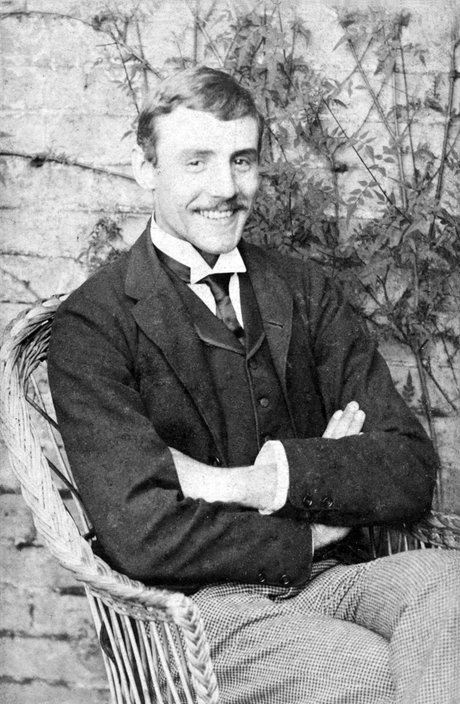
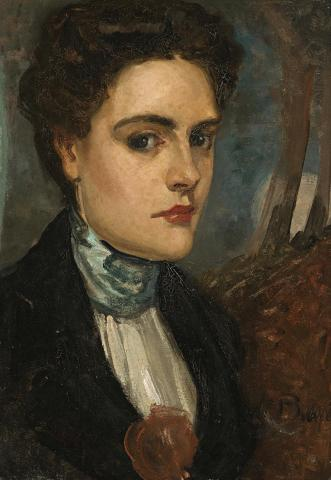
Self portrait by Rupert Bunny (c.1920)

Rupert Charles Wulsten Bunny was born in St Kilda, Melbourne on September 29th 1864.  Rupert was the third son of a English-born, Eton educated, Brice Frederick Bunny.  His father had studied law and was called to the Bar in 1844, becoming a talented equity barrister in London.  The news of the discovery of gold in the 1850s in New South Wales and Victoria whetted Brice’s appetite and in October 1852 he arrived on Australian soil intending to make a quick fortune before returning to London.  However neither of his plans materialised, as after six months of prospecting he had nothing to show. However, the one bit of luck he had was when he emigrated to Australia he brought with him all his law books and so, after his failed prospecting period, he went to Melbourne and resurrected his legal career in October 1853.  In June 1856 Rupert Bunny’s father married German-born Maria Hedwig Dorothea Wulsten, who had followed him to Australia. They set up home in St Kilda, where he was active in the Municipal Council.  In 1873 Brice Bunny was appointed an acting County Court judge but his health started to deteriorate and he had to resign from the legal profession.  He died on 2 June 1885 at St Kilda, Victoria, leaving three sons, one of them a barrister, and three daughters. His wife, Rupert’s mother, died in 1902.

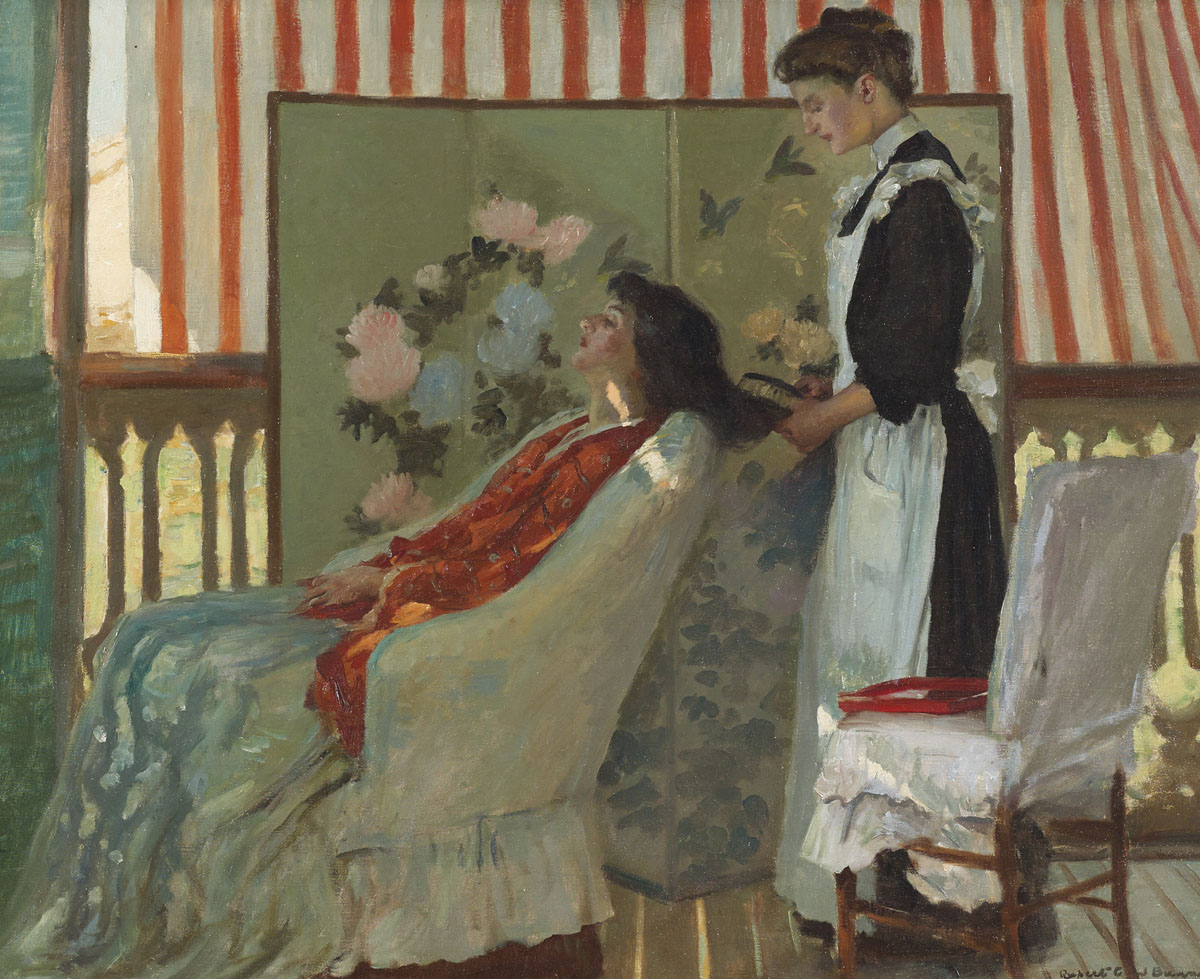
Hair Drying by Rupert Bunny (c.1908)

Rupert Bunny had three sisters, Alice and Annette who were five and two years older than him and Hilda who was three years younger.  He also had two older brothers, Herman and George and a younger brother Brice. Rupert attended the Alma Road Grammar School in St Kilda, and later the Hutchins School in Hobart.  In 1881 he enrolled at the University of Melbourne where he studied civil engineering.  He was not happy with the course and abandoned it.  At one time he decided he wanted to become an actor, but this future path was abruptly blocked by his parents.  Maybe as a compromise between his desires and those of his parents, he settled for joining the National Gallery Schools under British-born Oswald Rose Campbell and Irish-born George Frederick Folingsby, who was the director of the National Gallery and master in the School of Art.  Whilst there he became friends with his fellow students including Frederick McCubbin, E. Phillips Fox and Louis Abrahams.

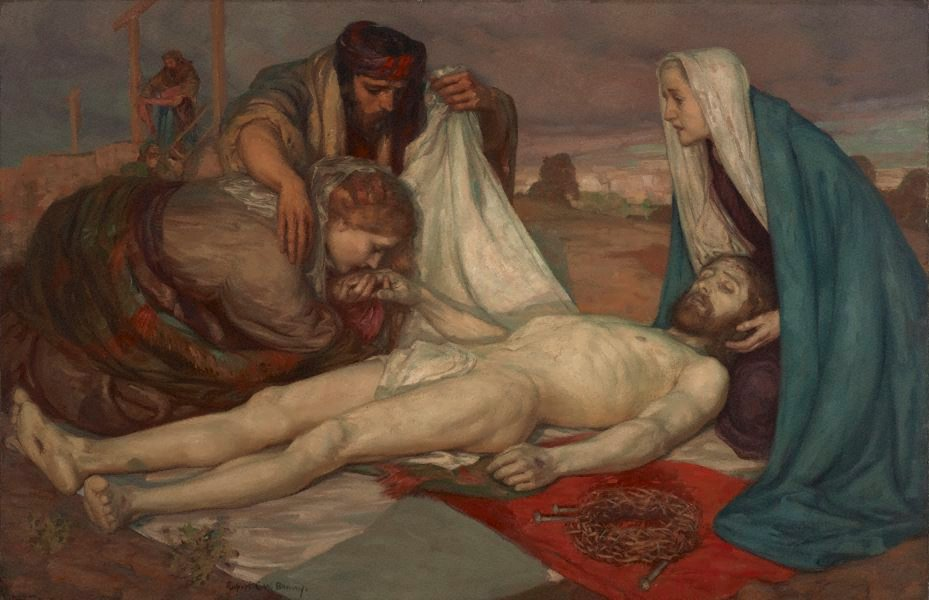
The Descent from the Cross by Rupert Bunny (1898)

The painting was hung at the 1898 Royal Academy in London

In 1884, at the age of twenty, Rupert Bunny left Australia and went to London.  Once in the English capital he enrolled at St Johns Wood Art School where one of his tutors was the English painter, Philip Calderon. Two years later, in 1886, he left England and headed for Paris to study under Jean-Paul Laurens in his studio at the Académie Julian. He left Laurens in 1886 and went to study at the Académie Colarossi where he studied under the French painter, Pierre Paul Léon Glaize.  His studies here made him an accomplished academic history painting – paintings on a large scale, with complex compositions based on mythological, historical and biblical subjects, and the depictions would characteristically contain multiple figures. From 1888, now in Paris, Bunny exhibited at the Parisian Salon de la Société des Artistes Français (Old Salon).

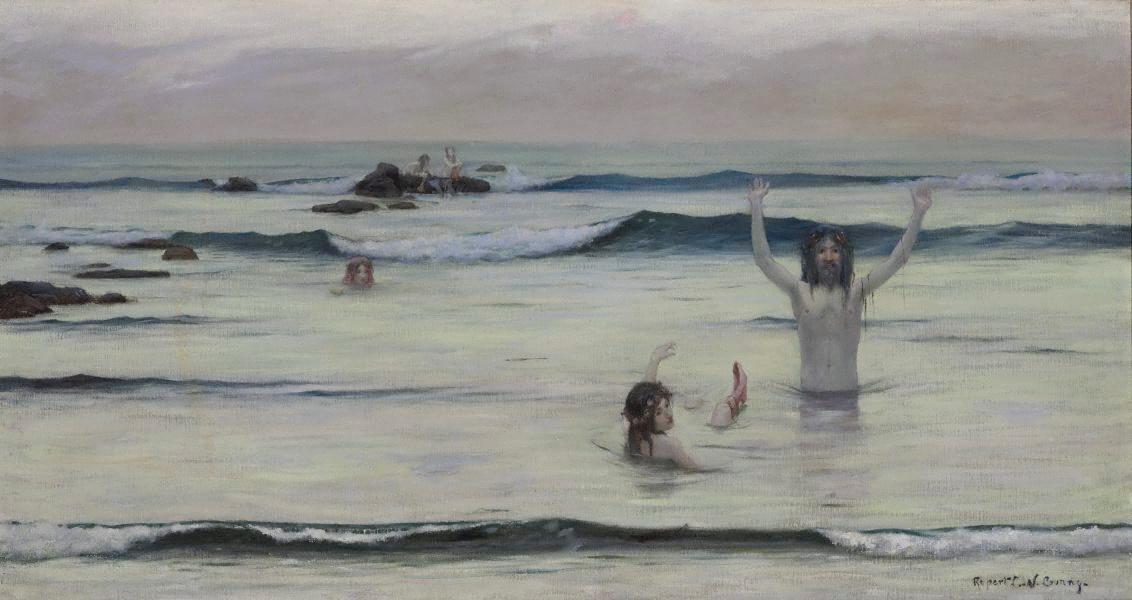
The Tritons by Rupert Bunny (1890)

During the late 1880s he produced a series of large-scale, delicately coloured sea idylls peopled with mythological and pagan creatures including mer-folk. Having a German mother, Rupert remembered the German myths and legends. Bunny often drew inspiration from the German myths and legends that she would read to him and characters from these often appeared in his depictions.  These stories were balanced by his father telling his son tales from the bible and Greek and Roman mythology.  One such painting was entitled The Tritons which Bunny completed in 1890. The painting was exhibited in Paris at the Old Salon in 1890, and it was the first painting by an Australian to receive an honourable mention at the event. The painting depicts a group of tritons, who were legendary creatures that lived both on land and at sea.  They are enjoying a lazy moment in their calm surroundings.  Rupert Bunny, in this work, lays before us some of the features which would become characteristics of his work, such as an attraction he had for mythological subjects and the depiction of the mystery and glamour within an intimate setting. Look how he has expertly shaped a twilight atmosphere by the use of subtle colour schemes, as is the case where the pale blue, silvery ocean and pink-toned sky are quietly reflected in the flesh tones of the figures.

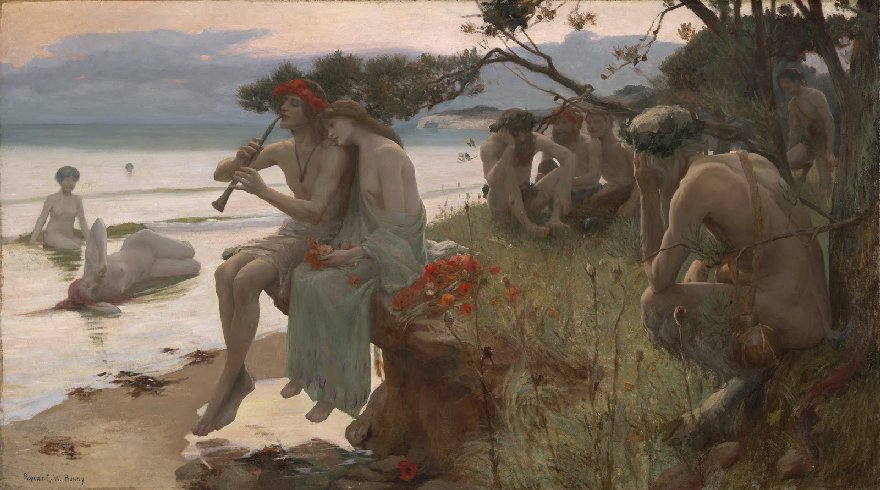
Pastoral by Rupert Bunny (1893)

His 1893 painting entitled Pastoral is a good example of the large-scale mythological works Bunny painted during his early years in France.  The painting is an allegory about the life-changing power of music. Before us we see youths and pagan beings who are all mesmerised by the strains of the pipes and soothed into a state of heightened consciousness.  The figures we see in the painting are contemporary youths and Rupert used their inclusion to show that Arcadia was not something we read about in days gone by but a state of mind.  There is a dream-like quality about the depiction and note the inclusion of vermillion poppies, a flower which symbolised sleep.

Madame Melba by Rupert Bunny (1902)

Rupert Bunny, besides being a great artist, was also a talented pianist and composer.   The love of all things musical probably persuaded him to paint a number of portraits of the Australian soprano, Dame Nellie Melba.  She had, during the latter days of the nineteenth century, moved to Europe to cement a career as a professional singer.  Rupert’s portrait of her entitled Madame Melba was completed around 1902.  Rupert had known her since the 1880s.  The painting, once completed, hung in the singer’s London home.  Later, she presented it to Her Majesty’s Theatre in Melbourne.  The National Gallery of Victoria bought the painting in 1980 and later it was loaned to Government House in Melbourne Victoria.

Percy Grainger by Rupert Bunny (1904)

Bunny created portraits of a number of Europe-based Australian musicians and performers.  He was commissioned, by twenty-two-years-old Australian pianist and composer, Percy Grainger, to paint his portrait in the early days of his professional musical career.  Grainger became acquainted with Bunny through Nellie Melba. Whilst living in London Rupert Bunny attended gatherings at Grainger’s rooms at King’s Road where the guests would sing many of Grainger’s compositions.  In this portrait, the young musician is portrayed as a relaxed young gentleman in the tradition of what was termed the ‘swagger’ portrait, which aptly reflected Grainger’s own ambitions. In Grainger’s left hand is a sheet of music, a conscious reference to Grainger’s celebrated career.

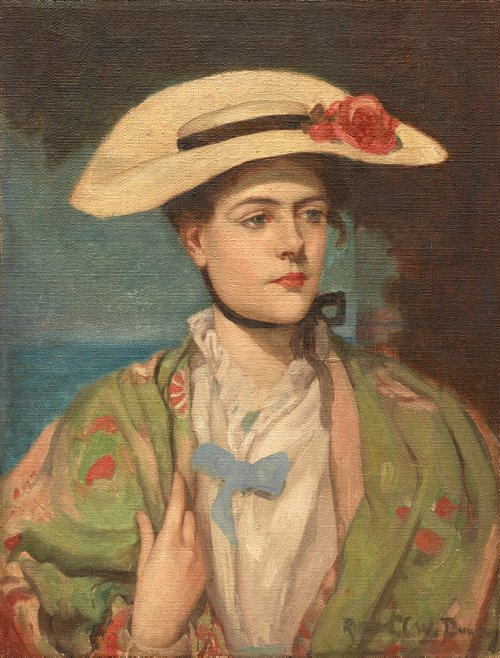
Portrait of the Artist’s Wife by Rupert Bunny (c.1895)

Portrait of the Artist’s Wife, Jeanne Morel by Rupert Bunny (1902)

In 1892, Rupert Bunny met his future wife, Jeanne Heloise Morel who was a fellow art student.  It was love at first sight as Bunny was bowled over by her beauty.  John Longstaff, a fellow Australian painter who was living in Paris, remembers the first meeting between Rupert and Jeanne, saying:

“…I remember … the very night they met, and how he fell in love with her at first sight.  She was a regular Dresden china girl with a deliciously tip-titled nose…”

The meeting was to prove a turning point in Rupert’s life, not just with the romance which followed, but by his change in his artistic style.  A colleague of Bunny commented:

“…  Jeanne changed not only Bunny’s life but also his art, which now focused on subjects in which beautiful women played the central role, with Jeanne as his favourite model…”

Rupert Bunny was influenced by Morel and she became his favourite model who featured in his depictions of the idyllic and leisured lifestyle of the Belle Epoque. Her graceful form and sensuous features were seen in many of his works, embodying Bunny’s feminine ideal. Bunny was also greatly influenced by the English Pre-Raphaelite painters such as John Everett Millais.

 Portrait of Mlle Morel by Rupert Bunny (1895)

 Portrait of Mlle Morel by Rupert Bunny, which he completed in 1895, is the first, major full-length portrait by Bunny of Morel. It is a tender depiction of his then girlfriend that he painted and was submitted and accepted into the Paris Salon that year.  It was a painting which marked the turning point of Rupert Bunny’s art from the Allegorical to the Belle Époque.
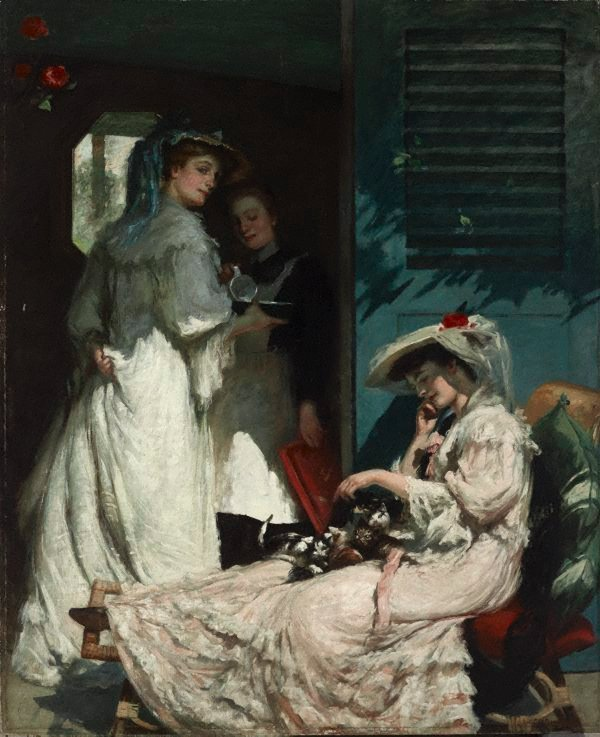
A Summer Morning by Rupert Bunny (1905)

Jeanne Heloise Morel was born on July 29th 1871 in Paris.  Her mother was Marguerite Morel, an unmarried servant. Her father, who was never named on the birth certificate, was said by Jeanne to be Eugénie François Morel, who served as an officer in the French Navy.  Jeanne received training in Fine Arts at the Orphanage of Arts at 96 rue de Vannes in Paris.  In 1884, when she was thirteen-years-old, Jeanne made her public debut at the Société des Artistes and subsequently exhibited at the Société Nationale des Beaux-Arts, working in oils.  Jeanne-Heloise Morel married Rupert Bunny in London in March 1902.

Dolce Far Niente (Sweet Idleness) by Rupert Bunny (c.1897)

The painting’s title means sweet idleness or the sweetness of doing nothing. Rupert Bunny would paint numerous similarly composed works featuring  groups of women relaxing, dreaming, dressing or undressing close by expanses of water.  The French art critic Gustave Geffroy was a great believer in Rupert Bunny and loved his work, Dolce Far Niente and in a review of the Salon of 1897 at which the painting was exhibited, he wrote:

“…To discover the promises and creations of newcomers, it is necessary to research, to go to canvases attracted by a soft radiance, a quiet force, a secret charm….I like the poetry of Dolce Far Nniente by Mr Bunny [of] women with graceful bodies, and beautiful and instinctive faces, who dream by the sea…”

Gustave Geffroy was a great advocate of Bunny’s work for the next three decades and in a 1917 review he wrote:

“He is a brilliant and spirited artist…at one and the same time, a realist and a visionary, an observer of truth and a poet of the world of dreams…”

Endormies by Rupert Bunny (c.1904)

Rupert Bunny’s 1904 painting entitled Endormies (Sleepy) portrays two female figures at the water’s edge relaxing and lost in a world of dreams. Rupert modelled the sleeping figure once again on his wife Jeanne Morel.  Her elegant and sensuous physical qualities enhanced many of his paintings.  In this depiction the artist has included a rose by the side of one of the sleeping women.  The rose was a traditional symbol of love and sensuous power.  The white swans we see in the background symbolise the attributes of grace and beauty. Rupert, like many artists also used the motif of a small dog, which often signifies marital fidelity.  In this painting Rupert has placed the animal sleeping at the feet of his mistress.

Summer Time by Rupert Bunny (1907)

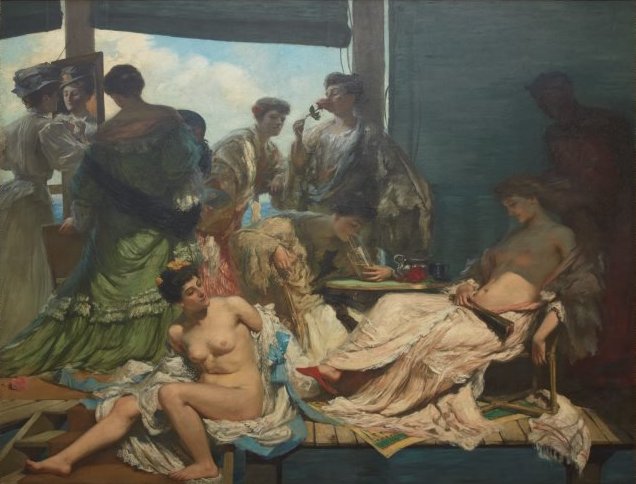
In all Rupert Bunny’s depictions of his wife Jeanne and her friends there was an aura of beauty and elegance.  The clothes which adorned the females were typified in their fashionable trimmings and reflected the stylishness of the apparently endless summers that was La Belle Époque. The public loved these works of art and they became the most commercially and critically successful works of his career. Rupert Bunny’s 1907 work entitled Summer Time splendidly validates his skill as a draughtsman and his consummate treatment of large-scale works such as this one which measures 250 x 300 cms. It was exhibited at that year’s Paris Salon. It was his most ambitious work.

in situ at the Art Gallery of New South Wales

The painting depicts a spirit of leisure and sensuality as we observe seven voluptuous women relaxing inside a bathhouse on the Seine. It is a floating swimming pool sealed off from public view where women could bathe modestly. We see 0ne of the women is undressing preparing to climb down into the water while another female, on the left of the painting, is getting dressed before she emerges into public view.

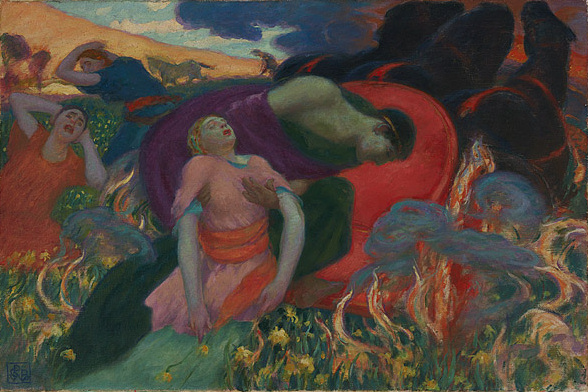
The Rape of Persephone by Rupert Bunny (1913)

Rupert Bunny was never afraid to shy away from changing his artistic style.  He had a refreshing willingness to keep reinventing himself and during his life, he simply kept an eye on what was the most fashionable style, so that his popularity would not wane.  Of the painting, The Rape of Persephone, one art critic, George Bell, described it as:

“…a glorious riot of colour from the finest imaginative Australia has produced…”

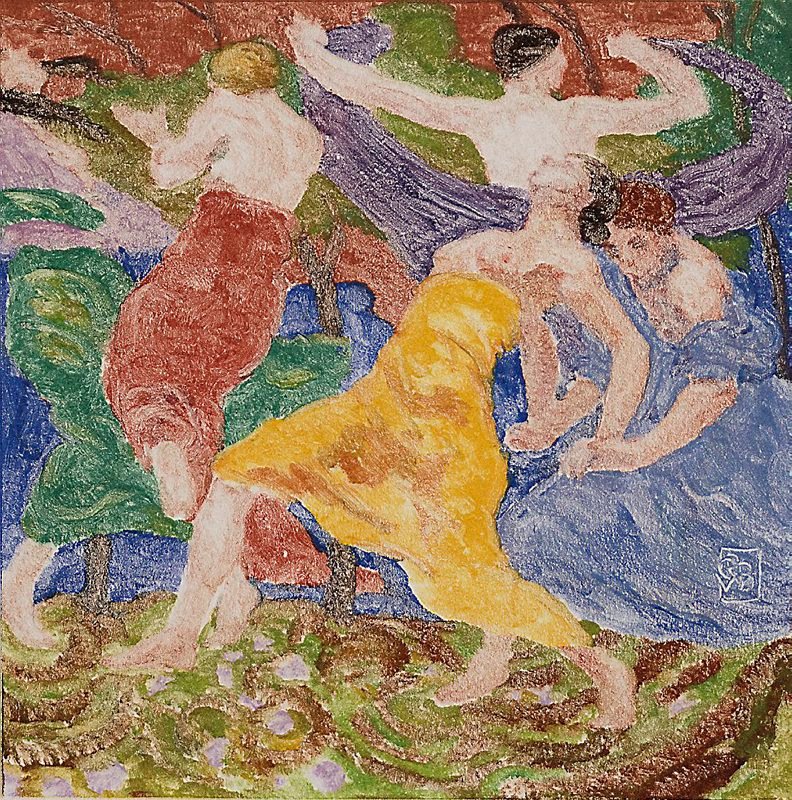
Fresque by Rupert Bunny (1921)

Rupert Bunny moved through successive styles and was strongly influenced by British pre-Raphaelites French primitives, symbolists and Post-Impressionists.  He was particularly influenced by Matisse and his love of Sergei Diaghilev’s Ballet Russes, an itinerant ballet company begun in Paris that performed throughout Europe between 1909 and 1929. 

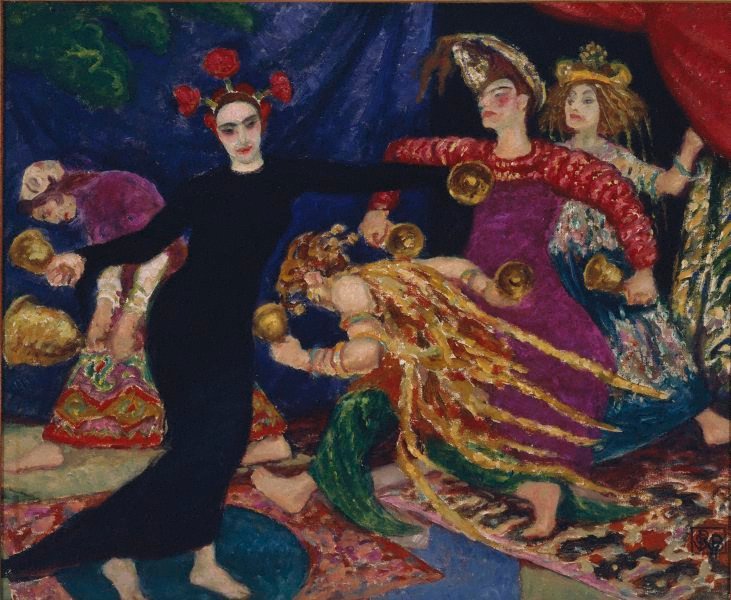
Salome by Rupert Bunny (c.1919)

The paintings of Rupert Bunny around this time began to be ones of heightened colour and abstracted, rhythmical forms.

In 1933, Bunny returned to live in Melbourne where he continued to paint until his mid-70s. He died on May 25th 1947, aged 82.  Rupert’s forte was his ability to change with the times and he was always open to new artistic influences.  Throughout his life he had always been motivated when it came to his painting. He never tired of experimenting with colour combinations and was never afraid to take risks. He was a master colourist.

Much has been written about Rupert Bunny and this blog has just scratched at the surface of his life but I hope it will tempt you into reading more about this great Australian painter.

.

Christmas and Snow

Somebody once said that the only way to enjoy the sight of snow is when looking at a postcard or a painting.  I have spent a number of Christmas Days in hot climes such as Karachi and Melbourne and know that Christmas is not Christmas without snow.  So for this Christmas blog I want to look at some of the beautiful winter landscapes created by famous and not-so-famous artists to remind me of a snowy Christmas, many of which have featured in earlier blogs.

View of Bazincourt, Snow Effect Sunset by Camille Pissarro (1892)

Camille Pissarro depicted the small town of Bazincourt-sur-Epte at all times of the day, and in all seasons, in a number of his paintings.  In 1892 he completed his work entitled View of Bazincourt, Snow Effect, Sunset.  In this Impressionistic-style painting we can see how Pissarro has managed to infuse a warmth to the scene by his use of violet for the trees and the way the sun has illuminated the clouds.

Snow Scene at Argenteuil by Claude Monet (1875)

The great Claude Monet, known for his lily ponds at Givenchy, also painted a number of winter landscapes.  The first one I am looking at is his work entitled Snow Scene at Argenteuil.  Monet and his family moved to Argenteuil a small Parisian suburb twelve kilometres north-west of the heart of the French capital and was accessible from central Paris with a short train ride.  Monet painted many scenes in and around Argenteuil featuring the riverbanks of the Seine, the railway bridge which straddles the French river, which often featuring a steam train chugging across the structure.  The painting I have chosen was one of eighteen that Monet completed which depicted the snowy winter of 1874/5. It is a depiction of the Boulevard Saint-Denis, near Monet’s home. It looks towards its junction with the rue de la Voie des Bans, with the River Seine beyond.  The figures we see in the painting are plodding along the road and it could be that they are making their way to or from the nearby railway station which lies behind the artist.  The station would have been used by holiday makers and commuters on their way from Paris.  The snowy road surface has dark brown furrows made by passing carts and as we follow them we can see the town in the background.  This painting was one of the largest (71 x 91cms) snowscapes that Monet completed but does not have some of the finer details in Monet’s smaller winter paintings.

La Pie (The Magpie) by Claude Monet (1869)

My favourite winter painting by Monet was completed in 1869,  six years before the Argenteuil work.  He painted it during the winter of 1868–1869 whilst he and his girlfriend, Camille Doncieux were living near the commune of Étretat in Normandy in a house Monet’s patron, Louis Joachim Gaudibert, had arranged for them.  This is Monet’s largest (89 x 130cms) winter painting. The painting depicts a solitary magpie which has alighted on a gate which has been fitted between parts of a wattle fence. Sunlight falls upon freshly fallen snow producing blue shadows.   This “blue shadow” phenomenon later became associated with the Impressionist movement artists. Monet and those Impressionists exploited the use of coloured shadows to symbolise the actual, changing circumstances of light and shadow as witnessed in nature, and by so doing, they defied the academic convention of painting shadows black.   However all were not pleased with this new concept which led to its rejection by the Paris Salon of 1869. However present art historians today believe that The Magpie is one of Monet’s best snowscape paintings.  The painting was acquired by the Musée d’Orsay in 1984 and is considered one of the most popular paintings in their permanent collection.

Snow at Louveciennes by Alfred Sisley (1874)

It is believed that due to a series of severe winters in France in the 1870s it contributed to a sudden increase in the number of winter landscapes produced by Impressionists.  My next painting I am showcasing is one created by Alfred Sisley in 1874, entitled Snow at Louveciennes.  Before us we see a picturesque scene of stillness set in early winter’s morning in Louveciennes, a small village in the Île-de-France region in north-central France, located in the western suburbs of Paris, between Versailles and Saint-Germain-en-Laye.  Sisley depicts the sky in white, crisp blue, and grey hues. His use of perspective guides the viewer along a winding road which vanishes into the background.  The buildings in the paintings are covered with snow and we see a lone woman holding an umbrella strolling along the pathway, which has trees on either side. The artist is willing us to take a walk with the woman as she heads towards the village.  Sisley was entranced by views of the countryside during the winter months.  In fact, unlike most of us who dreaded heavy snowfall Sisley was inspired by what he saw and was especially attracted by how the variations in light came into play in snow scenes.


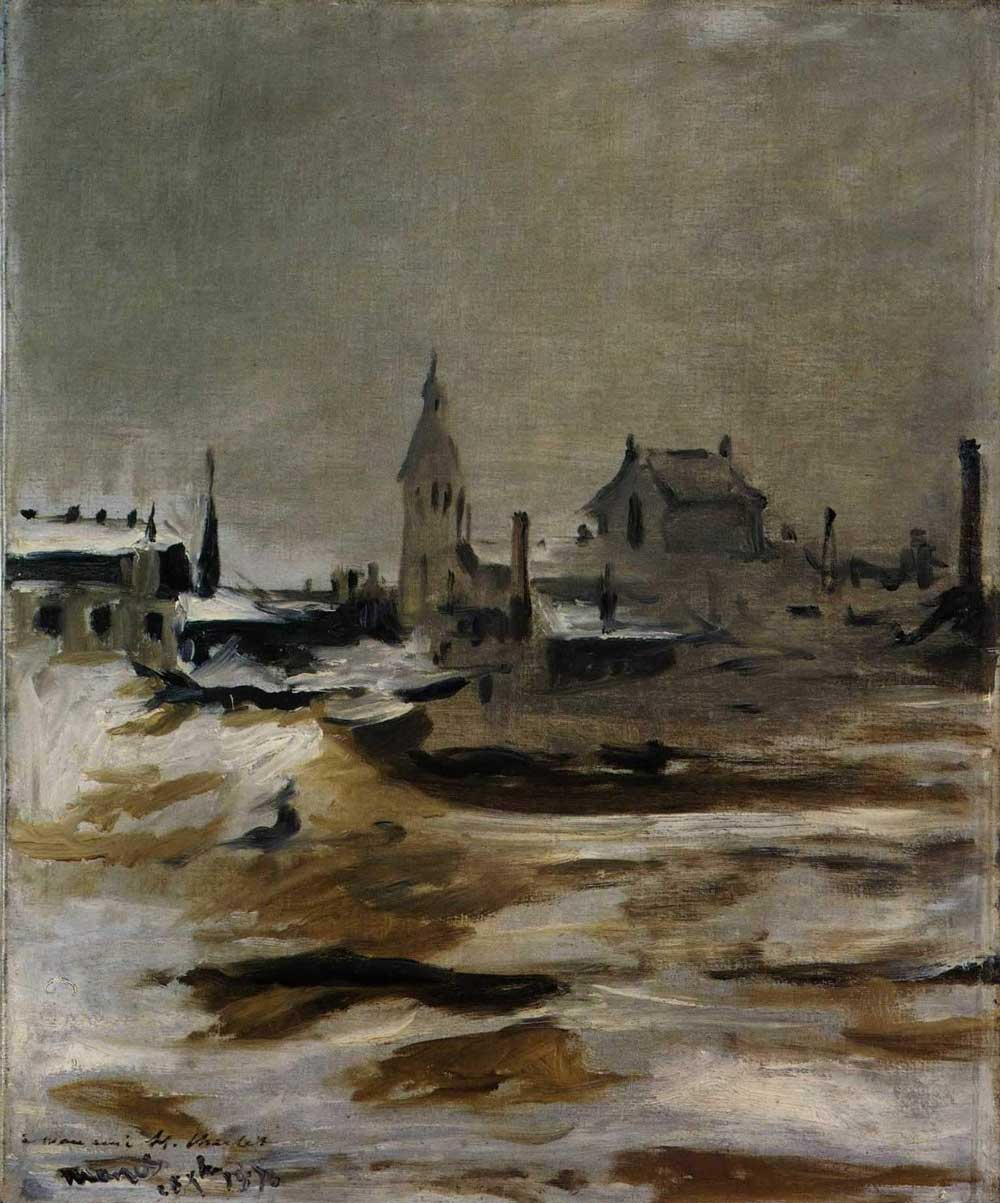
Effect of Snow on Petit-Montrouge by Manet (1870)

The oil on canvas painting entitled Effect of Snow on Petit-Montrouge was painted by Edouard Manet and depicts a winter view of Petit-Montrouge, in the 14th Arondissment of Paris.  Manet completed the work in 1870 whilst he was serving in the National Guard during the 1870–71 Siege of Paris in the Franco-Prussian War. There was no hint of the war, no heroic view of the battle or the bloody fighting, which was raging around the French capital, as often seen in the work of other artists’ paintings of the time.  This painting, although a snowy scene, is awash with shades of brown and black giving it a dark and foreboding ambience which could well be because the way Manet was feeling about the course of the ongoing war.  During this time Manet wrote to his wife:

“…My soldier’s knapsack serves…to hold everything necessary for painting. I shall soon start some sketches from life. They will be souvenirs that will one day have value…”

The painting depicts a view of the church of Saint-Pierre at Petit-Montrouge, and it is inscribed:

“…â mon ami H. Charlet 28 Xbre 1870. Charlet…”

 Charlet is thought to have been a comrade in the National Guard.  The dark image reflects Manet’s loss of hope regarding the impending military defeat and his deep loneliness, the deprivation and his bouts of depression he suffered during this time. It is one of the few landscapes in Manet’s oeuvre and is one of Manet’s first plein air paintings. Today it is in the collection of the National Museum Cardiff.

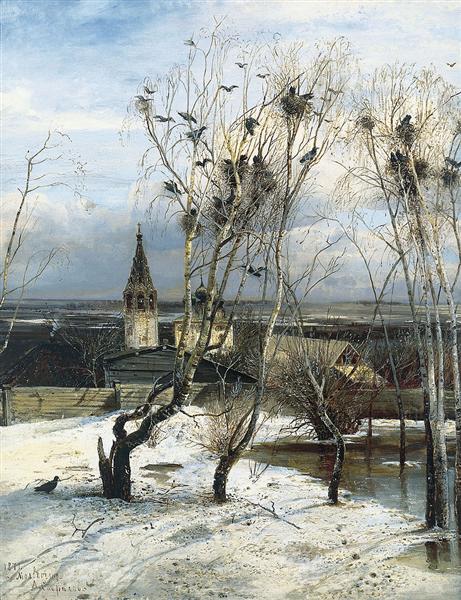
The Rooks have returned by Alexi Savrasov (1871)

Having looked at a painting by Monet featuring a black coloured bird against the white of the snow I had to give you one of my favourite works of art and this too features black birds and snow.  It is not quite a winter scene more “a coming of Spring motif”.  It is Alexi Savrasov’s painting entitled The Rooks have Returned, which I saw at the Tretyakov Gallery when I was in Moscow.  Savrasov was one of the most important, some would say, the most important of all the 19th century Russian landscape painters, and he was  deemed the creator of the “lyrical landscape style”. It is Savrasov’s most famous painting, and the painting is considered by many critics as being the high point in Savrasov’s artistic career.  The depiction witnesses the coming of spring as signalled by the return of the rooks.  The work is testament to Savrasov’s love for the rural Russian landscape, and he was very influenced by John Constable. The depiction we see before us is a simple, and depicts the somewhat inconsequential occurrence of birds returning home in spring to an extremely unpretentious landscape, but it was Savrasov’s way of communicating the change of seasons from Winter to Spring. Simple and yet beautiful.  The great Russian painter, the classical landscape painter, Isaac Levitan commented about its simplicity saying that although the painting was very simple, beneath its simplicity there is the tender artist’s soul, who loves nature and values it.  The painting enhanced Savrasov’s reputation as a landscape painter and it contributed to the success of the first exhibition organized by the Peredvizhniki.

Queue to a Resrvoir by Vasily Perov (1865)

Another depiction of a harsh winter and its effect on the people is Vasily Perov’s work entitled Queue to a Reservoir depicting people in freezing conditions to get themselves some water. It is a reminder of what is happening even nowadays.

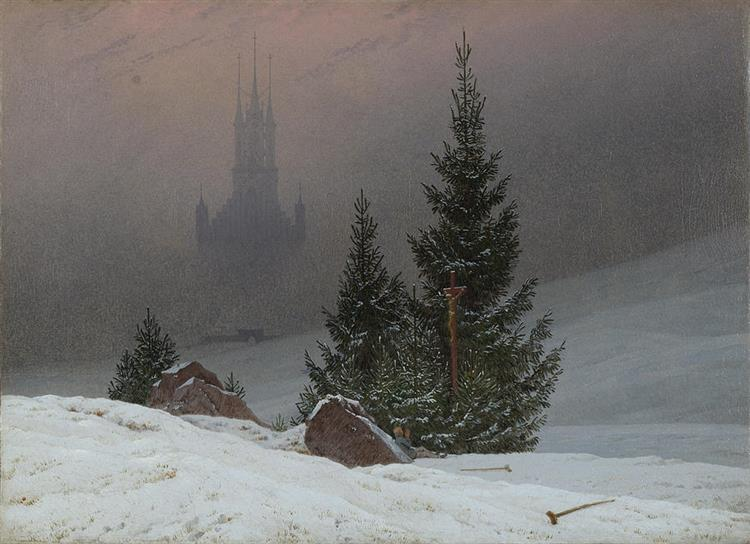
Winter Landscape by Caspar David Friedrich (1811) Staatliches Museum, Schwerin.

If your taste in winter landscape paintings is not so much for aesthetic beauty but for depictions that are full of atmosphere then you should look no further than the winter scenes painted by the great German artist, Caspar David Friedrich.  His two Winter Landscape paintings of 1811 relate a poignant story.  One of the works is housed in the Staatliches Museum, Schwerin whilst the other is in the National Gallery, London. In the Schwerin picture, we observe a tiny figure, leaning on a crutch.  He gazes out on a deserted snow-covered landscape.  The sky is coloured grey/black adding to the ominous feel to the work.  The man meanders between dead or dying oak trees, and the stumps of felled trees.  It is a depiction of total barrenness and this bleakness adds to the feeling of hopelessness.  Life for him could not get any worse.

Winter Landscape with Church by Caspar David Friedrich (c.1811). National Gallery London.

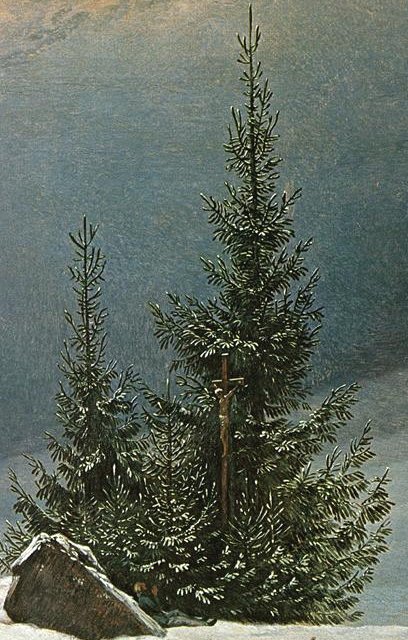
However the National Gallery painting, a companion piece to the one in Schwerin, offers us a glimmer of hope for the man. This painting signifies the hope of resurrection through Christian faith. Look carefully at the snow in this work and you will see shoots of grass pushing through the snow and the evergreen trees and faint pink glow of approaching dawn affirm its message of renewal and rebirth. It is a fine example of Friedrich’s use of landscape painting as a vehicle for religious feeling and personal symbolism. As he stated, his aim was not ‘the faithful representation of air, water, rocks and trees … but the reflection of [the artist’s] soul and emotion in these objects.’

Man praying and abandoned crutches

The painting depicts a man, an invalid, who, in the Schwerin painting, we saw wandering helplessly in the snow, has now thrown away his crutches and lies against a large boulder as he prays in front of a shining crucifix protected by three fir trees, symbolising the Christian Trinity. In the background we see the silhouette of a German Gothic cathedral which is partially covered by a grey mist.  Unlike the hopelessness of the man’s situation in the first painting, Friedrich has instilled a sense of hope of a new life through Christian faith.

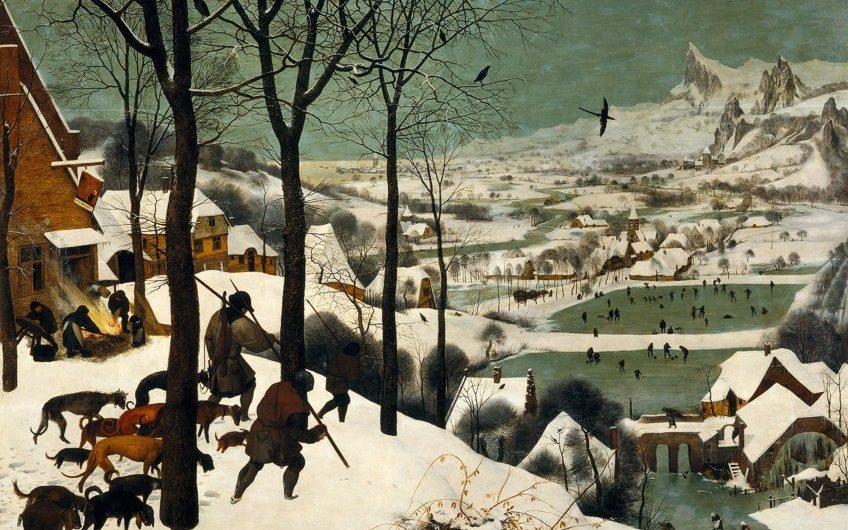
Hunters in the Snow by Pieter Bruehel the Elder (1565)

No compilation of winter landscape paintings would be complete without the inclusion of such works by Pieter Bruegel the Elder.  In 1565 he completed his oil on wood painting entitled The Hunters in the Snow which is also referred to as The Return of the Hunters.  The work is part of the Kunsthistorisches Museum in Vienna, Austria.  It is one of his great genre painting scene with an aeriel viewpoint of a winter’s scene.  The painting was one of a twelve-work series depicting different times of the year and this one is set in the depths of winter during the months of December/January.  Before us we observe a wintry scene and in the left foreground, we see three hunters who are returning from an outing along with their dogs. They are heading down a snow-covered slope towards a small village.  Looking at the men trudging resignedly home with their dogs it appears not to have been a successful hunt with only one of the men carrying over his shoulder one dead fox, the fruit of their labour.  As if to taunt them, there are footprints of rabbits around them, which they failed to ensnare.   It is a cold overcast winters day with little or no wind as we can see by the lack of movement of the wood smoke.  Bruegel has used muted white and grey colours in this composition to give it an air of melancholy.  On the leafless trees we see crows perched on the bare branches. The setting is a flat-bottomed valley through which a river meanders. 

In the background we see an idealised landscape depicting jagged mountain summits which do not exist in Bruegel’s homeland but which would have been seen with him during his time in the Alps.   At the bottom right of the painting we see the large wheel of a watermill which has been frozen stiff.  Below on the frozen lake people are ice skating.  To the returning hunter’s left we can see an inn with villagers preparing a roaring fire in preparation of roasting a pig.  The sign on inn is hanging askew.  The image on the sign depicts a stag named Saint Hubertus, who is the patron saint of hunters. The words are in Dutch, Dit is Guden Hert, which means in English “This is the Golden Deer”.

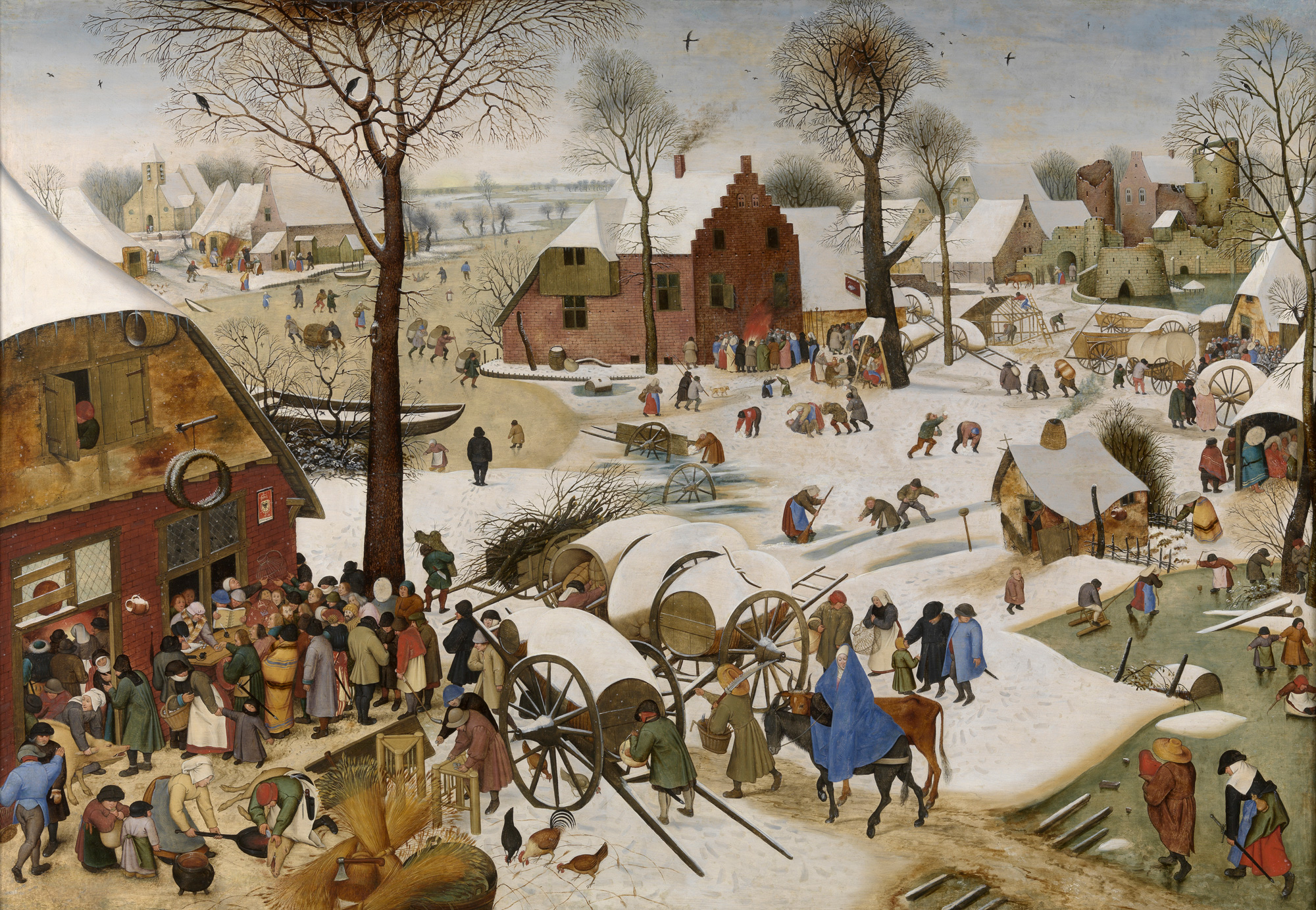
The Census at Bethlehem by Pieter Bruegel the Elder (1566)

Another winter painting by Bruegel the Elder is his 1566 work entitled The Census at Bethlehem, also known as The Numbering at Bethlehem.  It depicts the collecting of names of the villagers so as to enforce a tax collecting regime.  Bruegel would have painted this following the harsh winter of 1565.  In this work Bruegel depicts a scene which pre-dates the Nativity and the birth of Christ. The scene before us takes inspiration from the Gospel of Luke, chapter 2, verses 1 to 5.

“…In those days a decree went out from Emperor Augustus that all the world should be registered in their own towns. Joseph also went from the town of Nazareth to the city of David called Bethlehem … with Mary with whom he was engaged and who was expecting a child…”

Although the story behind the painting is set in the Holy Land, Bruegel Bruegel combines this biblical narrative with life during his own time.  He has set his work in a Flemish village in winter at sunset with the ruined castle in the right-hand side of the background being based on the towers and gates of Amsterdam. People are gathered at a building on the left registering their details.  We can just about make out the Habsburg double-headed eagle on a sign on the building.  Villagers are streaming towards the census point, two of whom are Joseph and the Virgin Mary, who is with child, riding on a donkey. People are mingling in the cold, and we see happy children playing with toys on the ice and having snowball fights. There is the strange sight of a spoked wheel at the centre of the painting and this has occasionally be deemed to symbolise the wheel of fortune. To the right, a man in a small hut is shown holding a clapper, a warning to keep away from leprosy. Leprosy was endemic in that part of Europe when the painting was created. There is a begging bowl in front of the hut. In the background, men drink at a makeshift bar, and in the distance we see a well-kept church and a crumbling castle.

Bruegel once again treats a biblical story, in this case, the Census of Quirinius, as a contemporary event. He wants to liken the harsh events of the Roman occupation with the severity of the Spanish administration, who at Bruegel’s time, were ruling the southern Netherlands.  It is also thought that Bruegel was condemning the bureaucracy he was having to fight on a daily basis.

Census at Bethlehem by Pieter Bruegel the Younger (c.1590)

Pieter Brueghel the Elder’s son Pieter Bruegel the Younger and his studio made dozens of copies of his father’s painting after he died in 1569.  One, thought to be completed before 1600, was sold at auction for $10 million in 2013. One other copy, dated from 1610, is also at Royal Museums of Fine Arts of Belgium in Brussels.

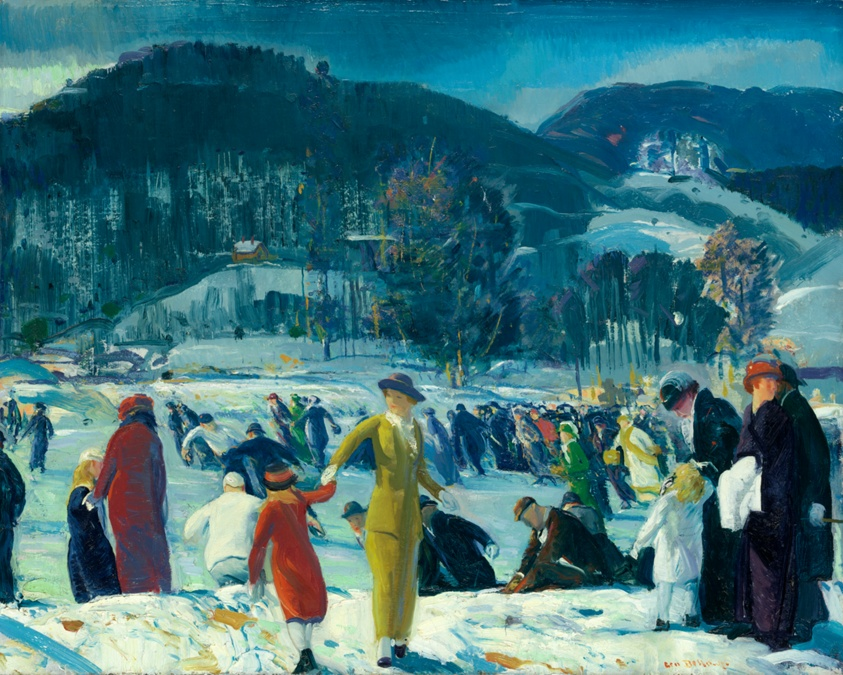
Love of Winter by George Bellows (1914)

I will almost end this compilation of winter scenes by highlighting two works completed by the distinguished American artist, George Bellows.  George Bellows was born in Columbus, Ohio in 1882 and after passing through the various school years arrived at Ohio State University at the age of nineteen.  It was here that his sporting prowess came to the fore and at one time it was thought that he may take up baseball professionally.  During his time at the university, he funded himself by working as a commercial illustrator.  However, Bellows had one aim in life and that was to become an artist, so much so, that he quit the university just before he was due to graduate and moved to New York to study art.

He enrolled in the New York School of Art and became a student of Robert Henri.  It was through Henri that Bellows came into contact with a group of artists known as The Eight and later became part of  The Ashcan School.  The Eight was a group of artists whose fame derives from, and for what they will always be remembered for, their one and only joint exhibition in 1908 at the Macbeth Gallery in New York.  The exhibition was a sensation and it is now looked upon as one of the most important events in the development of twentieth-century American art.

It is said that Bellows wrote to a friend in January 1914:

“…There has been none of my favourite snow. I must always paint the snow at least once a year.”

Unknown to him these were prophetic words as on February 13th 1914 New York City was hit by a major blizzard and it was this occurrence which led to Bellows painting his famous 1914 work entitled Love of Winter.  The whole winter scene was intensified by Bellows with his use of bright reds, yellows, and greens and the feel of movement in the painting is achieved by his broad slashing brushstrokes.  The enthusiastic group of skaters and onlookers of differing ages, differing social classes echoes the diverse populations who appreciated  the public parks and the leisure activities on offer to them in early 20th-century New York City.

Blue Snow, The Battery by George Bellows (1910)

His other snow scene I wanted to show you is entitled Blue Snow, The Battery which he completed in 1910.  The setting for the painting is Battery Park which lies adjacent to the financial district of Manhattan.  There is a breathtaking beauty about this work of art.  His imaginative and powerful use of blue energizes the scene of the southern tip of Manhattan.  Bellows painted a number of scenes with New York City under snowfall and as with this work it is amazing how he has developed a strong sense of light and visual texture contrasting the white and blue of the snow and the dark grimy outline of the old buildings.  It is a beautiful strong composition which is normally housed at the Columbus Museum of Art.

Winter Landscape by Wassily Kandinsky (1909)

The inclusion of a blue tint in the depiction of the snow gave Bellows’ winter scene a colder ambience. Snow is white but a tinge of blue adds to its portrayal but what about other colours for snow? Wassily Kandinsky’s painting Winter Landscape is one of the works in which the individualities of the artist, who was one of the founders of abstract art, are shown in the full extent. The motif of thin black trunks is often used by Kandinsky in his landscapes. Bright colouring with predominant pink, yellow, blue and black is based on immediate visual impressions: the artist seeks to convey various light effects in the snow illuminated by the setting sun. Kandinsky explained his choice of colours:

“…Colour provokes a psychic vibration. Colour hides a power still unknown but real, which acts on every part of the human body…”

Your thoughts ?

I hope you enjoy this over-long blog but it is holiday time and hopefully you have plenty of time to read it. I end by wishing you a Happy Hanukkah, A Happy Christmas and a peaceful and prosperous New Year.

Jonathan

Anton Pieck

Anton Pieck

When one thinks of artists, one looks to the greats such as Veronese or Goya or Turner and some are maybe somewhat “sniffy” when graphic artists and illustrators are lumped together with such luminaries.  My artist today was reviled by serious art lovers for his artwork being petty kitsch. Still, friend and foe had to admit that he was an accomplished draftsman with a highly unique, instantly recognizable and barely imitated style. However, whether you love or hate his work my featured artist today is one of the great illustrators of his time and whose works have brought unbridled happiness to many.  For those who have never seen any of his works, let me introduce you to the Dutch graphic artist Anton Pieck.

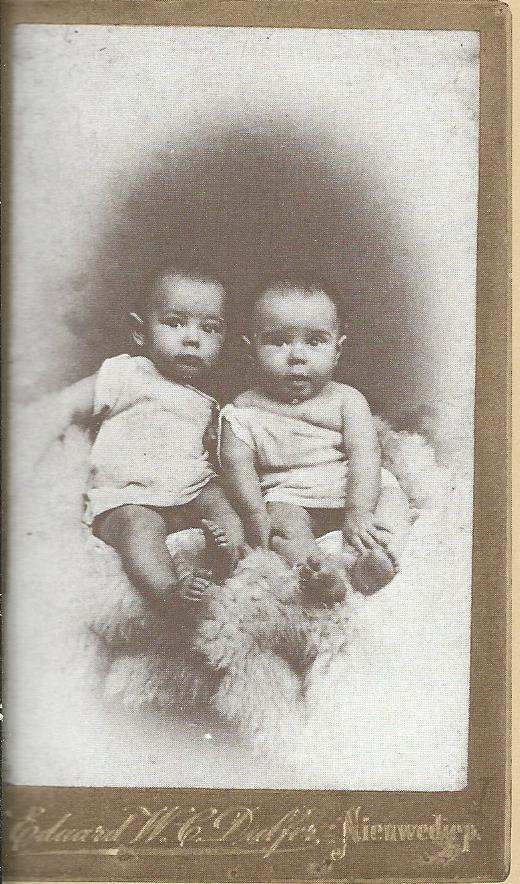
Anton Pieck aged 1 year-old, on the left, next to his twin brother Henri Pieck

Anton Franciscus Pieck and his twin brother, Henri, were born in the Dutch town of Den Helder on April 19th, 1895.  He was the son of Henri Christiaan Pieck, who was a machinist in the Royal Dutch Navy, so he was often away from home for lengths of time. His wife was Stofffelina Petronella Neijts who gave birth to their first child, Coenraad, in 1891 but who died when he was just one year old.   Anton’s twin brother Henri Christiaan became a Dutch architect, painter and graphic artist but who would lead a different, more exciting and dangerous life than his brother Anton. As an adult Henri became active within the Dutch Communist Party, and was recruited as a spy for Soviet Russia. Henri’s artistic interests differed from those of Anton as his main love was modern art, whereas Anton loved old-fashioned illustrations and paintings . When the twins were six years old, they took drawing lessons from J. B. Mulders, who ran after-school art classes at their school. He recognized the talent of the twins and taught them the basics of perspective and proportion, and these lessons quickly bore fruit.  When he was ten, Anton won a prize at an exhibition for his still life watercolour depicting a brown pot on an old stove, and in recognition, among other things, he received five tubes of watercolour paints.  More awards followed during his teenage years.

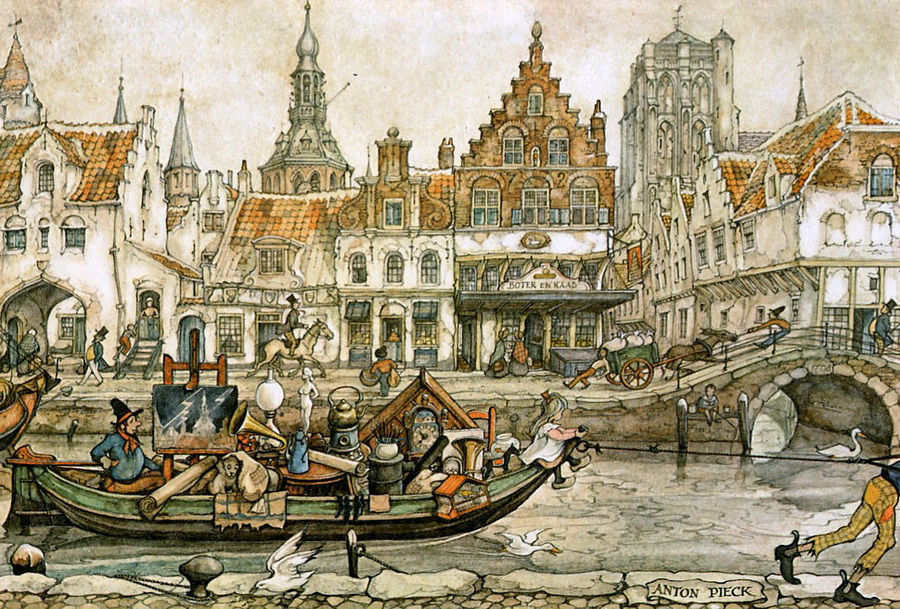
River Spaarne and the Bakenesser Tower by Anton Pieck

In 1906, after Anton’s father retired, the family moved to live in The Hague. Anton and his brother, after finishing secondary school, enrolled on a drawing course in the evenings at the Royal Academy of Art. They later received training at the drawing institute Bik and Vaandrager.  When the brothers were aged fourteen, they obtained the first stage of their teaching certificate and 3 years later they completed their teaching certificates and were able to call themselves drawing teachers.  Anton went to teach at his old school, Bik and Vaandrager. Henri Pieck was considered the better artist of the twins and is allowed to go to the Academy of Fine Arts in Amsterdam. This was a personal blow to Anton who never came to terms with the fact that his twin brother was looked upon as the more skillful artist. One could almost say that Henri was looked upon as an artist whereas Anton was looked upon as a drawing teacher!

During the First World War the Netherlands remained neutral, but still many young Dutchmen were mobilized so as to be on standby in case their country became embroiled in the fighting.  Anton Pieck was one of those men and became a sergeant, however he spent most of his spare time sketching for his fellow recruits. A somewhat damning psychological army report on him in 1915 described Pieck as:

“…someone who looks more at the past than the future and will therefore never amount to anything…”

Not considered as “fighting material” and unlikely to be used for military duties, Pieck was sent back to The Hague, where he gave drawing lessons to other soldiers. This was pure heaven for Anton as for four evenings a week he would oversee two-hour sketching lessons.   Pieck was then able to spend all his time doing what he loved best.

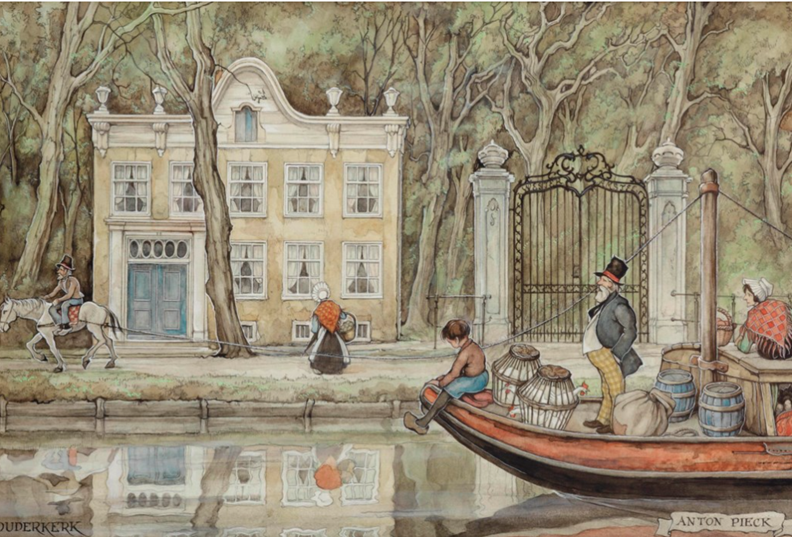
A boat on the River Amstel near Ouderkerk with the house “Wester Amstel” by Anton Pieck

When Anton graduated from the Bik en Vaandrager Institute, they offered him the position as an art teacher which he accepted and held the position until 1920.  He then applied and was accepted as an art teacher at the newly established Kennemer Lyceum, a high school in the Haarlem suburb of Overeen.  He would continue to work there until his retirement in 1960 at the age of 65.  Throughout those years teaching students, he always made time for his own work.

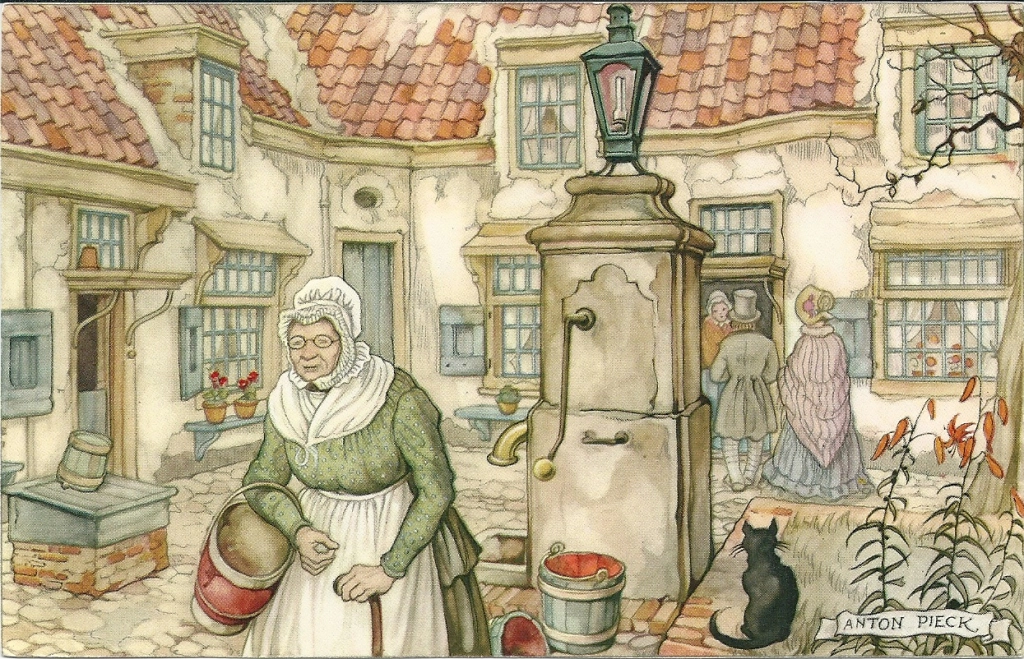
Hofje van Loo with communal water pump by Anton Piecke. The Hofje (Courtyard) van Loo is a hofje on the Barrevoetstraat 7 in Haarlem

Teaching art was not his great love and he was never quite satisfied with his job and he couldn’t wait for his daily teaching duties to end so that he could dash home and continue drawing and painting. However, being employed as a teacher gave him financial stability and this in turn gave him the comfort of only choosing commissions which pleased him, rather than being forced to work on work he disliked. Whilst employed at the school as a teacher, Anton would also illustrate diplomas, bulletins, ex-libris bookplates, birth cards and other administrative documents for his school.

The River Spaarne with the Waag building designed by Lieven de Key at the end of the 16th century by Anton Pieck

In the 1920’s Anton Pieck published his first drawings. It was also around this time that Anton forged a close friendship with the Flemish novelist Felix Timmermans and it is said that Timmermans’ jovial attitude rubbed off on Pieck whom he advised to “lighten up” and be more spontaneous and follow his own spirit.

A recent edition of Felix Timmerman’s book.

For the 10th edition of Timmerman’s very successful book, Pallieter, published in 1921, Timmermans asked Pieck to provide the illustrations to go side-by-side with the text. Through correspondence, Timmermans indicated what he wanted to see on the illustrations. The book was described as an ‘ode to life’ written after a moral and physical crisis. Pallieter was warmly received as an antidote to the misery of World War I in occupied Belgium. For Pieck, this was just a start of his book illustration journey as he went on to illustrate about 350 books. 

In 1921 Pieck illustrated Felix Timmermans’ book Pallieter by the Flemish author Felix Timmermans.  As the book was set in Flanders Pieck decided to visit there to soak up the atmosphere in the various towns.  Above is an ink illustration from one of the chapters, A beautiful winter day in which the main character, Pallieter, goes out on a clear winter day and hears organ music. He heads towards the sound, but only sees two children playing with mud.

Anton Pieck’s way of announcing the birth of son Max Pieck sent to all the staff of the Kennemer Lyceum in 1928

In 1917, Anton Pieck met Jo van Poelvoorde, the sister of fellow soldier Hendrik van Poelvoorde. Jo was a teacher at the Royal Dutch Weaving School. Her first impressions of Anton were that he was friendly, but also taciturn and absent. Gradually he opened up more and became more talkative. Anton and Jo entered into a relationship and twenty-seven-year-old Anton Pieck married twenty-nine-year-old Josephina Johanna Lambertina (Jo) van Poelvoorde, on March 8th 1922 at The Hague. After the marriage the couple moved to Overveen. From their marriage three children were born, Elsa, Anneke and Max.

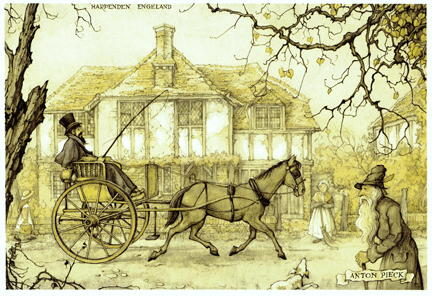
Harpenden Engeland by Anton Pieck

Throughout his life, Anton was an enthusiastic traveller and visited England, France, Ireland, Germany, Sweden, Switzerland, Austria, Italy, Poland and Morocco during which he built up a collection of sketches.  He was a great lover of quaint buildings and had no interest in modern architecture.  For him, it was a joy to study nature as well as picturesque cities and villages. He was so in love with Belgium and England that he termed them “his second mother countries” as their towns had not been “ruined” by modernisation as had happened in his homeland The Netherlands.

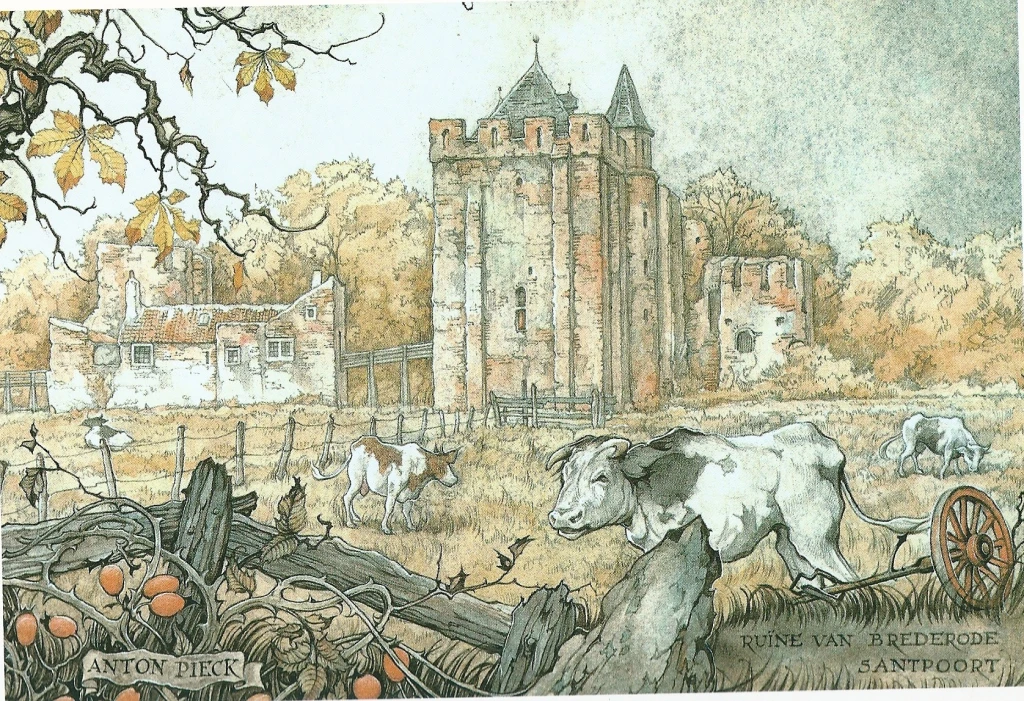
The ruins of Brederode in Santpoort by Anton Pieck (c.1950)

Anton Pieck was a twentieth century man as he only lived his first five years in the nineteenth century.  Having said that, Pieck loved to look back with pleasure on what he considered to be a more appealing century – the nineteenth century.

The Warmoesstraat, Amsterdam by Anton Pieck

He had fallen in love with the Dickensian era and had completed many paintings, drawings, etchings and engravings depicting Dickensian scenes. He depicted gentlemen in high hats or ladies adorned in crinoline, people taking coach rides, watching a magic lantern show or listening to barrel organs or chamber concerts.  All such scenes gave him great pleasure and they all contributed to his artistic ideal. Anton Pieck was adamant that when it came to commissions, he would only accept those which allowed him to illustrate novels or short stories set in bygone days.
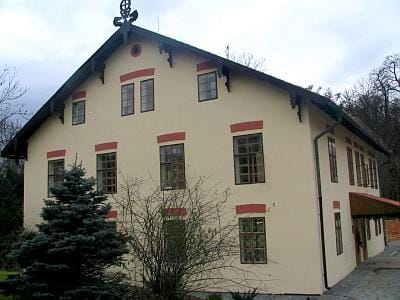
Greeting card of Winchester by Anton Pieck

What Pieck liked to depict were things which looked old or dilapidated.   Buildings and their interiors which were crooked and looked ramshackle and run-down.  For Anton, nothing was to look new or be built completely straight. Anton’s first visit to England appears to have been around 1937 when, on a voyage by ship to North Africa, he had managed to come ashore in Southampton and was able to made sketches of some of the old commercial buildings and to visit the city of Winchester where he sketched some of the old Tudor buildings and historic inns, one of which was turned into a greetings card.

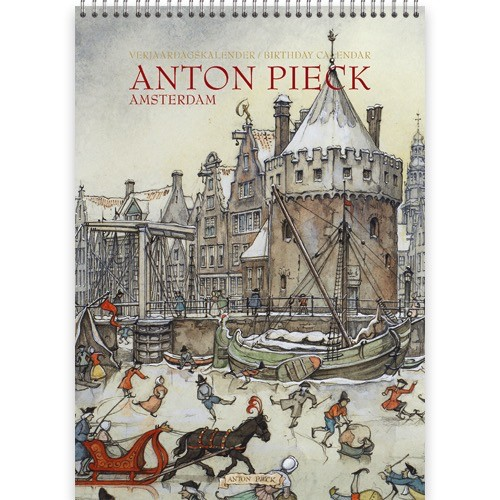
Besides prints and greeting cards, calendars were produced each year with a selection of Anton Pieck’s drawings.

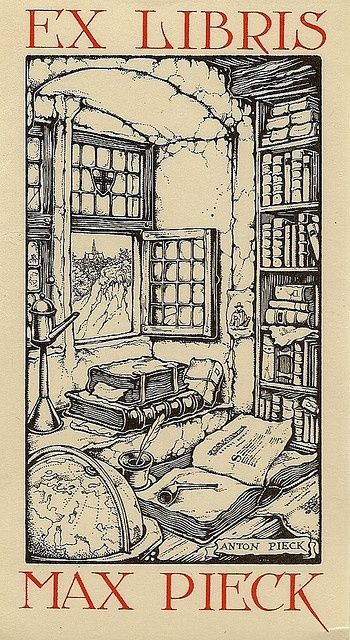
He would also produce a number of ex libris bookplates, a book owner’s identification label that was usually pasted to the inside front cover of a book. Above is one he created for his son, Max. 

Anton Pieck’s vision for De Efteling

Anton Pieck’s work over the years and his popularity with the Dutch people was probably in the minds of  the mayor of Loon op Zand, R.J. van der Heijden and filmmaker Peter Reijnders who had envisioned the building of a fantasy-themed amusement park, De Efteling, in Kaatsheuvel in the Dutch province of North Brabant in 1951, named after a 16th-century farm named Ersteling.  The men approached Anton Pieck to design the theme park but he initially refused but later changed his mind on the proviso that only original materials are used for building the houses, such as coloured roof tiles and old stones.  Anton then set about designing het Sprookjesbos, the fairy tale forest.

Anton Pieck at Efteling

Initially, the Fairy Tale Forest was designed and based upon ten different fairy tales, all of which were brought to life using original drawings by Pieck.  Added to Pieck’s designs were mechanics, lighting and sound effects designed by the Dutch filmmaker Peter Reijnders. The life-sized dioramas, shown together in an atmospheric forest, were a incredible success and in 1952, the first full year, Efteling was open, it had 240,000 visitors and since 1978, the park has grown in size and is now become one of the most popular theme parks in the world.

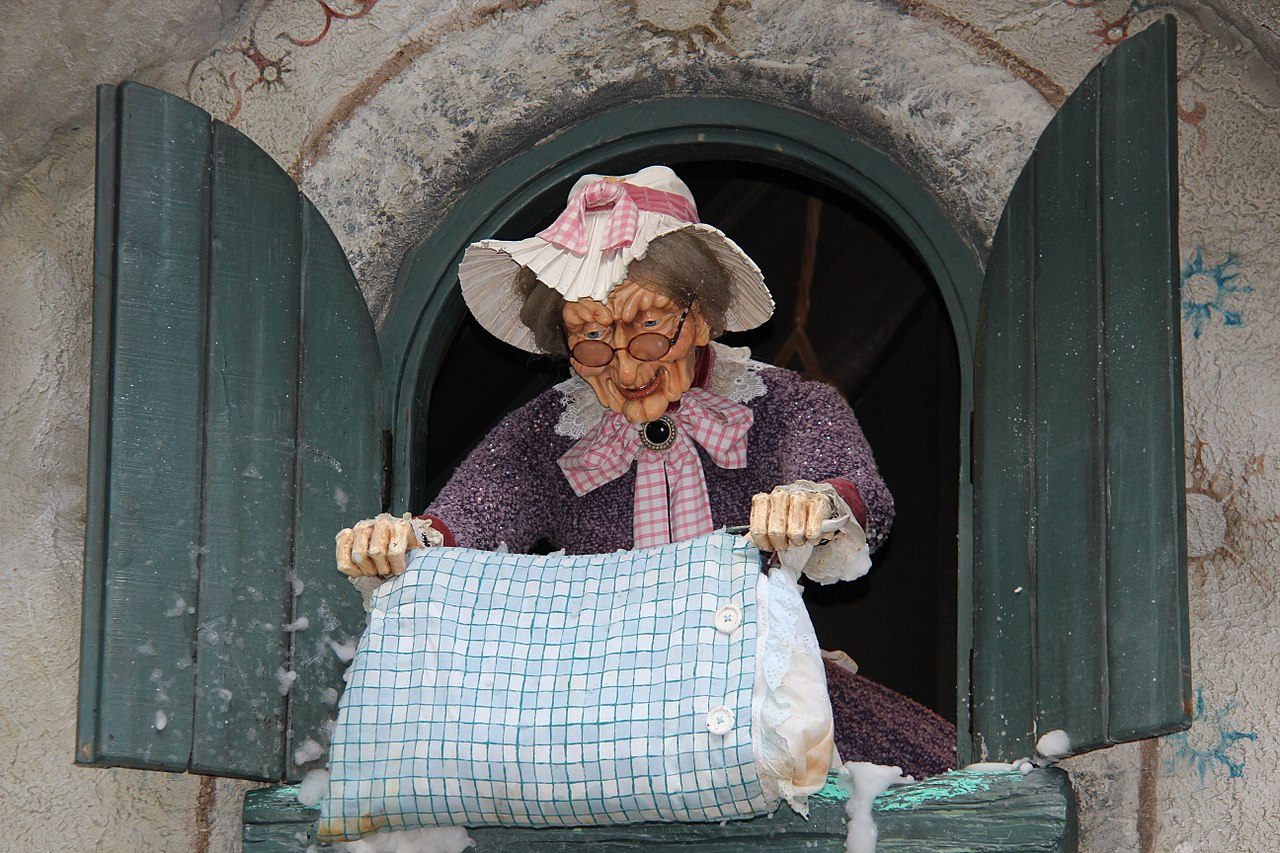
Frau Holle at Efteling

Pieck designed all the houses, buildings and the special animatronic inhabitants who were inhabitants of the fairy tale forest, such as Little Red Riding Hood at her grandma’s house, Sleeping Beauty’s castle, Frau Holle’s well and Hansel and Gretel’s gingerbread house.  Frau Holle, also known as Mother Hulda, is a German fairy tale character from the 1812 book, The Grimm Brothers’ Children’s and Household Tales (Grimms’ Fairy Tales). 

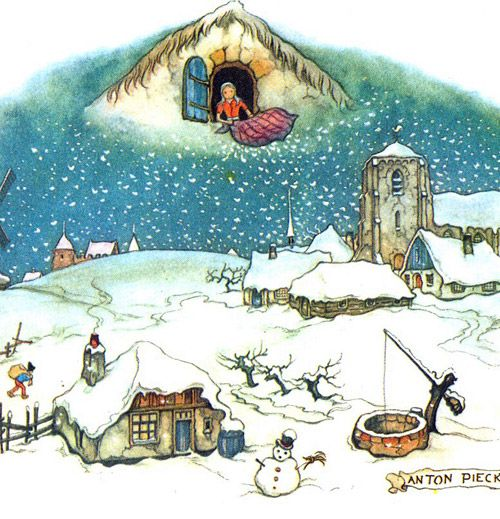
Frau Holle by Anton Pieck

Frau Holle is often depicted shaking out bed linen over an outside balcony then it begins to snow.  It is still a common expression in Hesse and Southern parts of the Netherlands and beyond to say “Hulda is making her bed” when it begins to snow.  Like many other tales collected by the Brothers Grimm, the story of Frau Holle was also a moral tale explaining that hard work is rewarded and laziness is punished.

Anton Pieck Museum

Anton Pieck retired from teaching in 1960.  He was made a Knight in the Order of Orange-Nassau. Pieck died on November 24th 1987 at the age of 92. Three years before his death the Anton Pieck Museum House for Anton Pieck was opened in Hattem,  a municipality and a town in the eastern Netherlands.

Anton Pieck loved nature, the past and Dutch cityscapes. Sadly, during the course of the 20th century, large swathes of that old Netherlands he loved disappeared due to bombing during the war, the renovation and rejuvenation of the city centers from the 1960’s and the construction of the complicated road network. As a result, Anton became sad and depressed at what he witnessed during his latter years, saying in 1985:

“… Yes, I have known this country very well. What is still there now, I see as a mess of the past. That makes me sad, yes…”
Whatever you may think about the artistic style of Anton Pieck, one has to feel warmed by the depictions and undergo a desire to be back in olden days when life may have been simpler, or was it ?

Anne Goldthwaite

Anna Goldthwaite Self Portrait

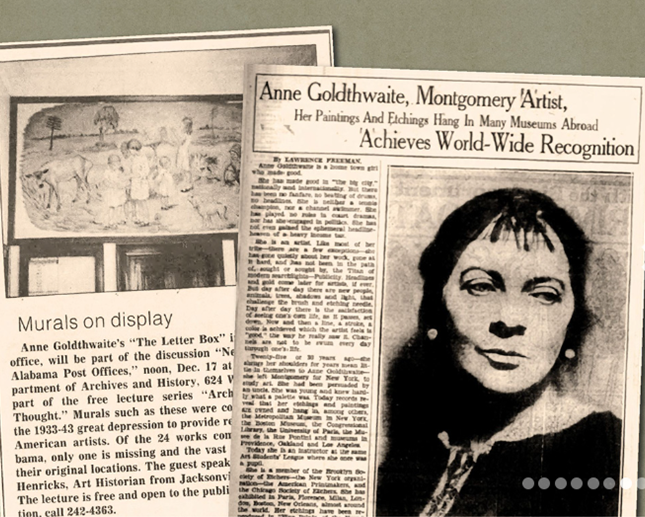
The artist I am showcasing today is a lady who hailed from the American Deep South.  Anne Wilson Goldthwaite was born into a genteel Montgomery, Alabama family on June 28th, 1869.  She was a true daughter of the South and the oldest of four siblings. Her father was Richard Wallach Goldthwaite, who served as an artillery captain for the Confederacy during the Civil War and the son of Alabama senator George Goldthwaite.

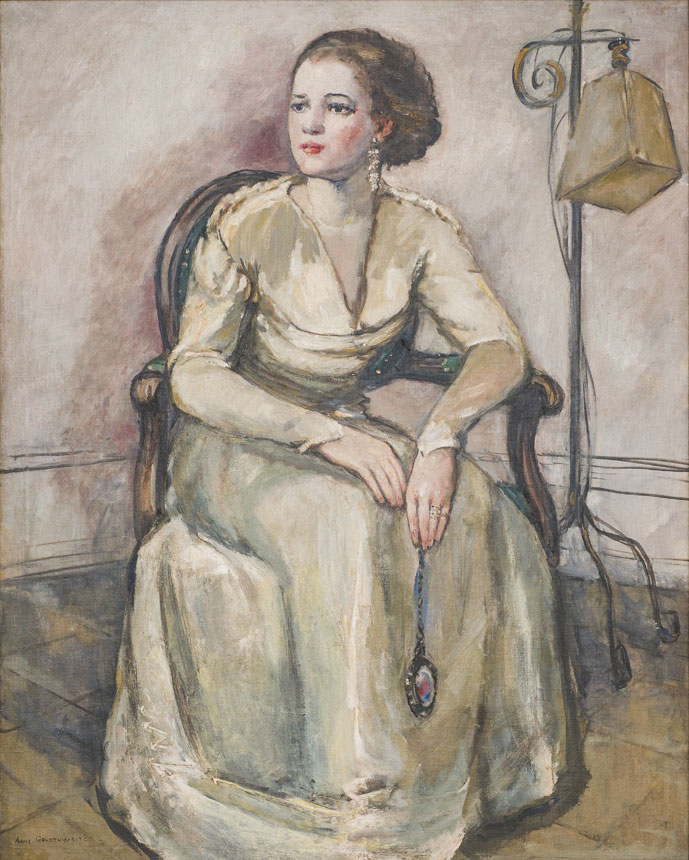
Portrait of a Young Man by Anna Goldthwaite (1913)

Her family moved to Dallas,Texas when she was young and remained there for the majority of her childhood while her father looked for work.  After her parents both died, in the early 1880s, she and her siblings were taken back to Alabama where they lived with different relations. Anne went to live with her aunt Molly Arrington and her aunt’s nine children.  Her aunt presented her to society as a promising young debutante who was destined to become a southern belle. However this ended when her fiancé was killed in a duel.


As a teenager Anne liked to sketch and paint and soon developed into a talented artist, so much so, that in 1898, one of her uncles, Henry Goldthwaite, who was so impressed by her artistic talent, he offered to pay for her to have private art tuition.  He offered to support her financially for up to ten years if she relocated to New York City to study art. Anne Goldthwaite accepted his offer and arrived in New York around 1898.  She then enrolled at the National Academy of Design, where she studied etching with the German-born immigrant, Charles Mielatz and was tutored in painting by the Scottish-American painter and illustrator, Walter Shirlaw and American artist, Francis Coates Jones.

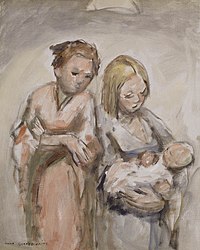
Young Mother by Anne Goldthwaite

She also spent one summer in Princeton, New Jersey, in the 1890’s, where she met then-professor Woodrow Wilson who had been appointed by Princeton to the Chair of Jurisprudence and Political Economy.  Two decades later he would become the twenty-eighth President of the United States.  He commissioned her to paint a portrait of his wife.

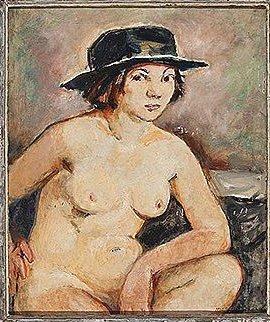
Young Nude Woman in a Hat by Anne Goldthwaite

In 1906, Anne Goldthwaite decided to travel to Paris to further her interest in the early modern painting styles of Fauvism and Cubism.

4 Rue de Chevreuse, Paris by Anne Goldthwaite (1908)

On her arrival in Paris Anne headed for the American Girls Art Club at 4 rue de Chevreuse, on the Left Bank.   The property was built by the Duc de Chevreuse and back in the 18th century it was the Dagoty porcelain factory. Later, in 1834,  it was turned into a Protestant school for boys called the Keller Institute.  It was in the 1890’s that Elisabeth Mills Reid, a wealthy American philanthropist and wife of the American ambassador, had the idea to turn it into a residential club for American women artists in Paris.  Anne Goldthwaite made this her base for the next six years.  According to Mariea Caudill Dennison’s article in the Woman’s Art Journal (2005) entitled The American Girls’ Club in Paris: The Propriety and Imprudence of Art Students, 1890-1914, Anne viewed the Club as a “chateau that was not a club at all, but a glorified pension for American women art students. We paid little board and lived in the midst of luxury and romance”

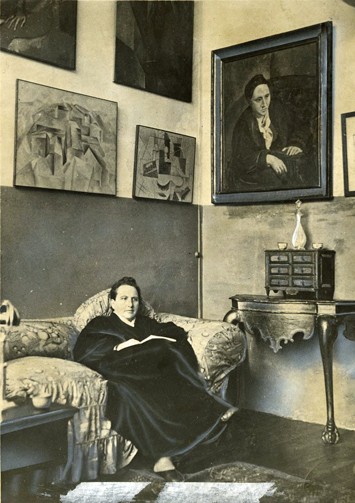
One day, while she was at the Luxembourg Gardens sketching, she met American writer Gertrude Stein. After a long conversation, Stein invited Anne to visit her apartment, but Anne was somewhat wary due to Stein’s scruffy appearance but eventually she agreed. Goldthwaite recalls Stein describing her as

“…a large, dark woman…who looked something like an immense brown egg. She wore, wrapped tight around her, a brown kimono-like garment and a large flat black hat, and stood on feet covered with wide sandals…”

Gertrude Stein’s legendary Montparnasse apartment at 27 rue de Fleurus

Despite Anne having doubts about Gertrude Stein, she was impressed with what she saw in Stein’s apartment.  A large collection of contemporary paintings hung on the walls.  Little did Anne realise that this chance meeting with Gertrude Stein, the most influential pre-war and avant-garde person of the time, would provide her with an opportunity to join the art circle of Henri Matisse and Pablo Picasso. In her memoirs, Goldthwaite wrote about he visit to Stein’s apartment:

“…Crossing a little pebbled court, we went into a beautiful large studio filled with antique Italian furniture. The walls were covered with the most remarkable pictures I had ever seen. I knew they must be pictures because they were framed and hanging on the walls […] There was what I know now was a head by Picasso, looking like a design made of the backbones of fish; “Le Joie de Vivre [sic] ” by Matisse; a small grey canvas by Cezanne, and a yellow nude on a peach-colored background, the feet hanging down as in an ascension […] This was my introduction to what we now call Modern Art, made some six days after my arrival in Paris. It was with surprise, later, that I saw American students who had been in Paris a long time, yet had not heard the names of Matisse, Picasso, et. al., and had never heard of l’Art Moderne, or if they had, thought it completely negligible …”

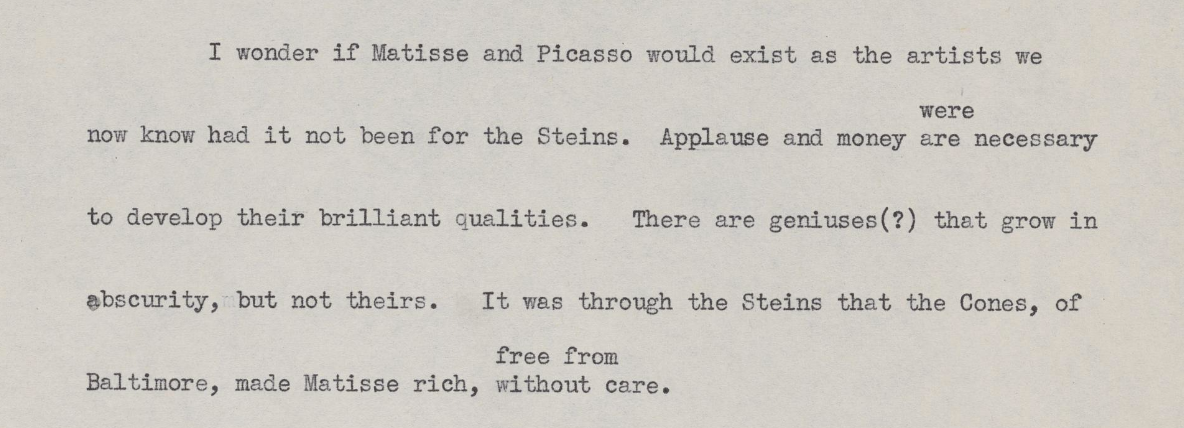
Anne was adamant that but for Gertrude Stein, Modernism would not have arrived in America. A page from her unpublished memoirs testifies to this belief. She wrote:

Page from the memoirs of Anne Goldthwaite

“Cones” refers to the Baltimore Cone sister, Dr Claribel and Etta Cone, who from 1898 to 1949 amassed a collection of primarily post-impressionist and modern French masterpieces.

Anne Goldthwaite later recalled her time in Paris and wrote:

“…Fate gave me several years in Paris at the most exciting time: during the great reconstruction from art to modern art…”

During her stay in Paris Anne moved from one atelier to another searching for a teacher that she could work with.  Eventually, she joined a small group of young artists called Académie Moderne.  This was a free art school in Paris, founded by Fernand Léger and Amédée Ozenfant who also taught at the academy.  The school attracted students from Europe and America.  They also held an exhibition each spring and their work was periodically critiqued by the post-impressionist painter, Charles Guerin.

The House on the Hill by Anne Goldthwaite (1911)

According to an article in the American Art Annual published in 1911, Anne served as president of the American Woman’s Art Association (AWAA) which was based at the The American Girl’s Club, from 1910-1911.

Cottage in Alabama by Anne Goldthwaite (c.1920)

In 1913, the Association of American Painters and Sculptors, also known as the International Exhibition of Modern Art organised a grand art exhibition.  It was the first large exhibition of modern art in America, and a shocking introduction of Modernism to an American audience. It was an exhibition that had been held in the vast spaces of U.S. National Guard armories.  It was a three-city exhibition which started in New York City’s 69th Regiment Armory, on Lexington Avenue between 25th and 26th Streets, on February 17th and ran until March 15th.   The exhibition then moved to the Art Institute of Chicago and finally arrived at The Copley Society of Art in Boston.  The Armory exhibition, as it became known, was an important event in the history of American art for it introduced Americans, who were accustomed to realistic art, to the experimental styles of the European avant-garde, which included Fauvism and Cubism. The show acted as a catalyst for American artists, who wanted to become more independent and by so doing, create their own artistic language.  Upon her return to America in 1913, Anne Goldthwaite exhibited two of her works at the New York Armory exhibition.  One was entitled The Church on the Hill, now known as The House on the Hill which she had completed around 1911.  The other painting was entitled Prince’s Feathers.

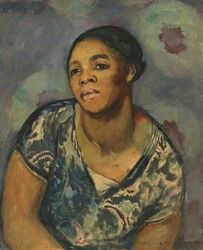
Rebecca by Anne Goldthwaite (c.1925)

Now back in America, Anne lived most of her adult years in New York but travelled south during the summer months to spend time with her family.  She became a member of the Dixie Art Colony in Wetumpka, Alabama, which was thought to be one of the Deep South’s first art colonies. These summers she spent in and around Montgomery established Anne Goldthwaite as one of the South’s most important regional artists for the period.  During this time she often depicted rural African Americans in their post-slavery contexts in oil paintings, watercolours, and etchings.

Women’s suffrage march on New York’s Fifth Ave. in 1915

Anne Goldthwaite’s politics were said to be progressive and she was a staunch supporter of women’s suffrage, serving on the organizing committee for the 1915 Exhibition of Painting and Sculpture by Women Artists for the Benefit of the Women’s Suffrage Campaign, open from September 27-October 18, 1915 at the Macbeth Gallery in New York which coincided with the Women’s Suffrage March held that year in New York during which it was said that 20,000 supporters attended.

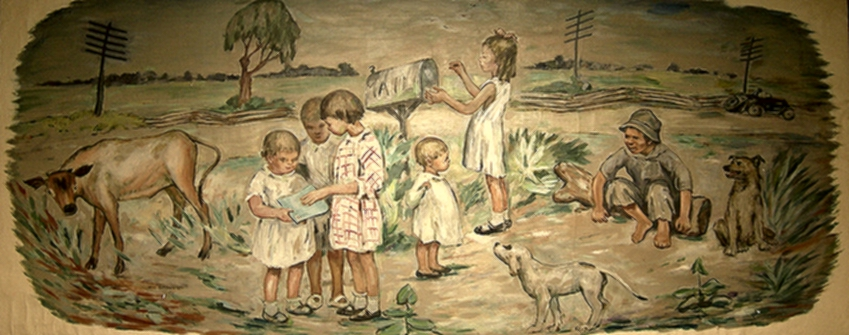
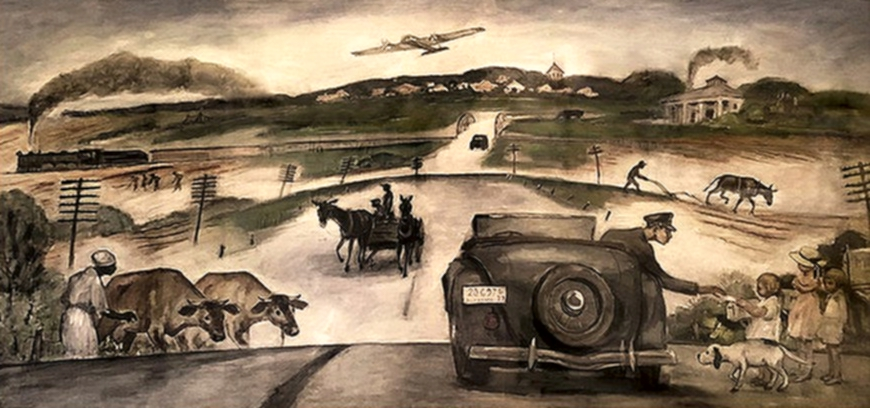
The Atmore Post Office mural: The Letter Box, by Anne Goldthwaite, 1938

The Atmore, Alabama Post Office

The Great Depression hit America at the end of 1929 and lasted almost ten years.  It was both a financial depression and a mental depression which affected many American citizens.  The American government thought that cheering people up during these hard times was something they needed to achieve.  It was part of the New Deal, a series of programs, public works projects, financial reforms, and regulations enacted by President Franklin D. Roosevelt in the United States between 1933 and 1939.  One of the projects in the New Deal was the Public Works of Art Project which was developed to bring artist workers back into the job market and assure the American public that better financial times were on the way. The idea was to employ artists to beautify American government buildings.  The mission of the post office murals was multifaceted – to boost morale in communities, employ artists by the thousands and create world-class art that was accessible to everyone. The murals revolved around local folklore, landscapes, industry and, unsurprisingly, mail delivery. They told the story of life across the United States.

Tuskegee Post Office mural: The Road to Tuskegee, by Anne Goldthwaite, 1937

Anne Goldthwaite had two of her murals accepted for Alabama post offices.  One was in the town of Atmore, the other was in the town of Tuskegee. The Road to Tuskegee mural painted in 1937 by Anne Goldthwaite was restored and moved to the new Tuskegee post office in 1996.

Portrait of Frances Greene Nix by Anne Goldthwaite (c.1940)

Anne Goldthwaite executed a number of portrait commissions, one being that of Frances Nimmo Greene Nix, the Museum Director, Artist, Portrait Painter, and Writer.  Frances was clerk, director, and curator of the Montgomery Museum of Fine Arts and studied with Anne Goldthwaite.

Goldthwaite’s work is included in the permanent collections of The Metropolitan Museum, Whitney Museum, Montgomery Museum, Montgomery Alabama, Greenville County Museum of Art and History, Greenville, South Carolina.  She was a member of the National Association of Women Artist, New York (Co-founder), Watercolor Society, Salons of America and the Society American Etchers/Brooklyn Society of Etchers.  Goldthwaite began teaching at the Art Students League, where she was a very popular teacher until her death in 1944.

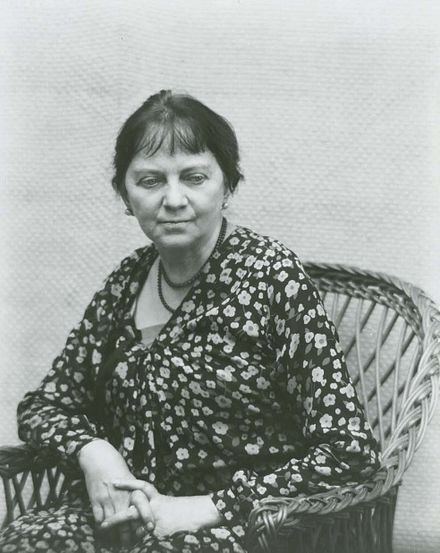
Anne Goldthwaite (1869-1944)

Anne Goldthwaite died in New York City on January 29th 1944, aged 74.

Zdenka Rosalina Augusta Braunerová

In my blog today I am looking at the life and works of the nineteenth century Czech painter, Zdenka Rosalina Augusta Braunerová. Her views and lifestyle influenced many painters and writers, many of whom were her friends. She became a patron of many artists, but she also supported folk art, especially in Moravian Slovakia and Horňácko. She was graceful and educated, and also extremely talented. She decided to devote her whole life to painting and graphics and never regretted it. She almost married several times and yet died unmarried. The life of this girl from a good family was unconventional, but definitely interesting.

A Bend in the Vlatava River by Zdenka Braunerová

Zdenka was born in Prague on April 9th 1858 and was baptized as Zdislava Rosalina Augusta.  She was born into a wealthy family and was the last of four children of the well-known Czech politician and prominent lawyer, František August Brauner and his wife Augusta, née Neumannová She had two older brothers, Vladamir and Bohuslav and an older sister, Anna.  Zdenka showed interest in drawing and painting since her childhood, when she spent long hours in her children’s room, where she spent hours painting. She was encouraged to paint by her mother, who was herself an amateur painter and who came from an old noble family. 

View at Brod by Amálie Mánesová,

Zdenka’s parents further encouraged their daughters interest in art and sent Zdenka to study with Amálie Mánesová, a talented landscape artist who ran a private painting school for ladies and girls from aristocratic and bourgeois families. This early art education, like the teaching of young children to play a musical instrument, was common for children in families of similar status at that time. It was part of the fashionable manner in which young girls became young ladies. Zdenka loved to paint and draw so much so that her normal schoolwork suffered and she received mediocre grades for her school work.  Notwithstanding this deterioration of her exam results, Zdenka pressed on with her art tuition at a girls’ college, where the director was the prominent Czech painter, Soběslav Hipplolyt Pinkas.

One of her tutors was Antonin Chitussi, a Czech Impressionist landscape and cityscape painter, and he was unclear as to whether painting to Zdenka was merely a hobby and not a future profession and, in truth, Zdenka was also undecided as to whether painting or her singing would become a future pathway. Antonín Chittussi was not only one of her first art teachers, he was her first love and during her time with him she devoted herself mainly to landscape painting. Chittussi introduced her to the technical secrets of drawing and painting, urging her to diligence, study nature and the right choice of motifs. Zdenka wanted to move the relationship with Chittussi to another level, that of an equal union of two independent artists who would inspire each other.  This was a step too far for Chittussi and the relationship died.

Following the the death of her father in 1880, Zdeňka began attending the Académie Colarossi in Paris.  Here her teacher was Francoise Courtoise, with whom she concentrated mainly on figurative and historical painting.

Élémir Bourges and the two Brauner sisters – 1883

After her sister Anne’s marriage to the French writer Élémir Bourges, Zdenka adapted her lifestyle to her future profession as a painter. She often travelled between Paris and Prague, still attending the Colarossi School and at the same time wanting to be close to her mother back home in Prague.

Julius Zeyer

Another of her many relationships came three years later with a young poet, Julius Zeyer, an artist seventeen years her junior, but maybe because of the age difference, this was not a long-lasting liaison. Another reason according to some historians, was that Julius Zeyer was homosexual and his relationship with the very attractive Zdenka remained only platonic.

Vilém Mrštík

In the spring of 1894 in Oslavany, the thirty-one-year-old Czech playwright and literary critic Vilém Mrštík met thirty-six-year-old Zdenka Braunerová.  She was five years older than him, which was somewhat strange as previously Vilém only had relationships with much younger women.  Mrštík actually perceived her as an old lady describing her as:

 “…An interesting person, she has enough of the world, enough of Prague, and with all the fire a lady approaching old virginity, but still strong and with the lush decoration of the former beauty…”

Brauner was equally scathing about Mrštík either, saying:

“….He is not pretty. The nose is plebeian, the eyes small, black, short-sighted with a stud, and the mouth with strong lips…”

Landscape near Tabor by Zdenka Braunerová.

Suprisingly, a relationship developed between them.  It was not an even relationship as Zdenka was cautious at first and only considered friendship. But Mrštík, fell in love with Zdenka and the “friendship” developed into a love affair.  The well-educated Brauner was probably attracted to Mrštík by his goodness, earthiness and often violent reactions. She tended to choose men who were painful, complex, and depressed.  Zdenka had a habit of wanting to protect, educate and form men in her own way.  She was manipulative and looked upon men as being people she could mould into her perfect person.  This was not the basis of a long-lasting relationship and was doomed.  However, she thought Mrštík would be different.  Mrštík was not the intellectual type and unlike her, did not discuss art passionately. He was an earthy Moravian. To Zdenka, he even seemed naïve but this trait endeared him to her but the relationship was doomed. 

St Lawrence on Petrin Hill by Zdenka Braunerova

In early 1896, Mrštík even began to talk about marriage and Zdenka agreed but they broke up in March 1897, just before the wedding, . They finally separated. Mrštík was convinced that he had fallen in love with an idea and not the woman. He became very bitter with the break-up and in an ungentlemanly way he said various unpleasant things about Zdenka – about her overripe old virginity and few talents in the intimate area.  Zdenka, in turn, stated that his writing to be inferior. It was not an edifying ending to the affair

VEČERNÍ KRAJINA by Zdenka Braunerova

Although having attended the private Collarossi Academy, she was not satisfied with the tuition and returned to her homeland. Zdenka was still extremely interested and found inspiration in French art, but still retained the patriotism for her country. The more time she spent in Paris the more she missed her homeland.  In Paris, with her sense of patriotism, she would dance in Czech costume and  sang Czech national songs, and by doing so, she would move closer to the Czech culture and art. This love of her homeland inspired many French artists and helped forge lasting friendships there.  One such artist who was swayed by Zdenka’s love of her homeland was Auguste Rodin who visited Bohemia and Moravia at her invitation in 1905. 

Brauner’s Mill in Solutions

Zdenka often spent time working in a studio in Solutions, a small town, west of Prague.  Her studio was in the so-called Brauner’s mill.

Zdenka Braunerová lived in Prague’s Lesser Town in Všehrdova Street. She died there on May 23rd 1934, aged 76, and is buried in the Vyšehrad cemetery.

Holger Drachmann

The Artist, the Poet, the Lover of Women.

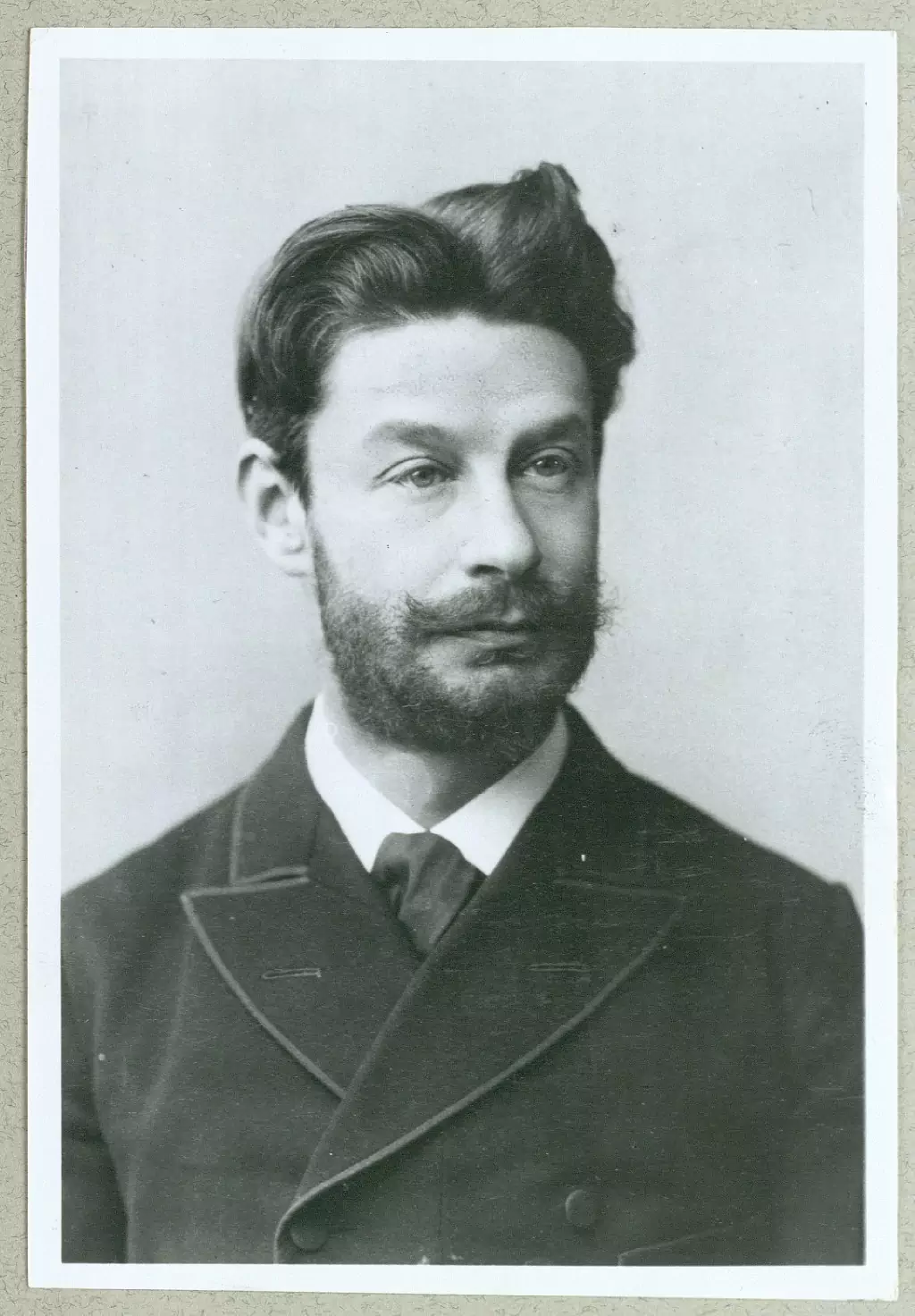
Holger Drachmann

The subject of this week’s blog is the nineteenth century Danish poet, dramatist and painter Holger Drachmann. Holger Henrik Herholdt Drachmann was born on October 9th, 1846 in Copenhagen. He was the son of Andreas Drachmann and his wife Vilhelmine.  Holger was one of five children, having an older sister, Erna and three younger sisters, Mimi, Johanne and Harriet.

Andreas Drachmann

His father. Andreas, initially trained as a barber whilst studying for his medical exams. In 1831 he was an assistant to a surgeon in the Danish navy and eventually passed his exams to become a surgeon in 1836.  He left the navy in 1845 and became a physician at Langgaard’s orthopaedic institute and in  1859 he founded the first institute of medical gymnastics in Copenhagen.

Coastal party north of Årsdale, by Holger Drachmann (1869.)

In March 1857, when Holger was ten years old, his mother Vilhelmine died.  She was just thirty-six years old.  Once he completed his schooling in 1865 he went to University where he remained for three years.  He then transferred to the Academy of Fine Arts and studied under Carl Frederik Sørensen, a noted marine painter and soon Holger developed a love for that painting genre.  Art was a great love of Holger but around this time he developed another love, a love of literature. 

View of the island of Maïre west of the Goudes district, Marseille by Holger Drachmann

This painting above is thought to have been painted by Holger during his voyage around the Mediterranean in 1867.

Rocky Coast by Holger Drachmann

The beauty and ferocity of the sea is captured in Drachmann’s painting entitled Rocky Coast. It depicts the unstoppable waves of the blue-green sea crashing violently against a towering rock formation in the foreground of the painting.  To the left, we see heavy grey storm clouds.  It is a depiction which is devoid of figures and one’s focus is simply concentrating on the violent force of nature.  There is nothing noted as to the location of the scene but during his lifetime he visited many places, such as the Orkney Isles, and Norway, with their rocky coasts and archipelagos or it could have been locations in Newfoundland or Nova Scotia, places he visited during his long trip to North America.

Våde ovn, Bornholm. by Holger Drachmann

To further his interest in marine painting, Holger went to stay on the island of Bornholm.  This Danish island is located in the Baltic Sea, to the east of mainland Denmark, and south of Sweden.  It was here he painted a number of seascapes. One of his Bornholm paintings depicted Vade Ovn, a notable rock or group of rocks attached to the underlying bedrock. It is a grotto, part of the area known as Helligdomsklipperne.

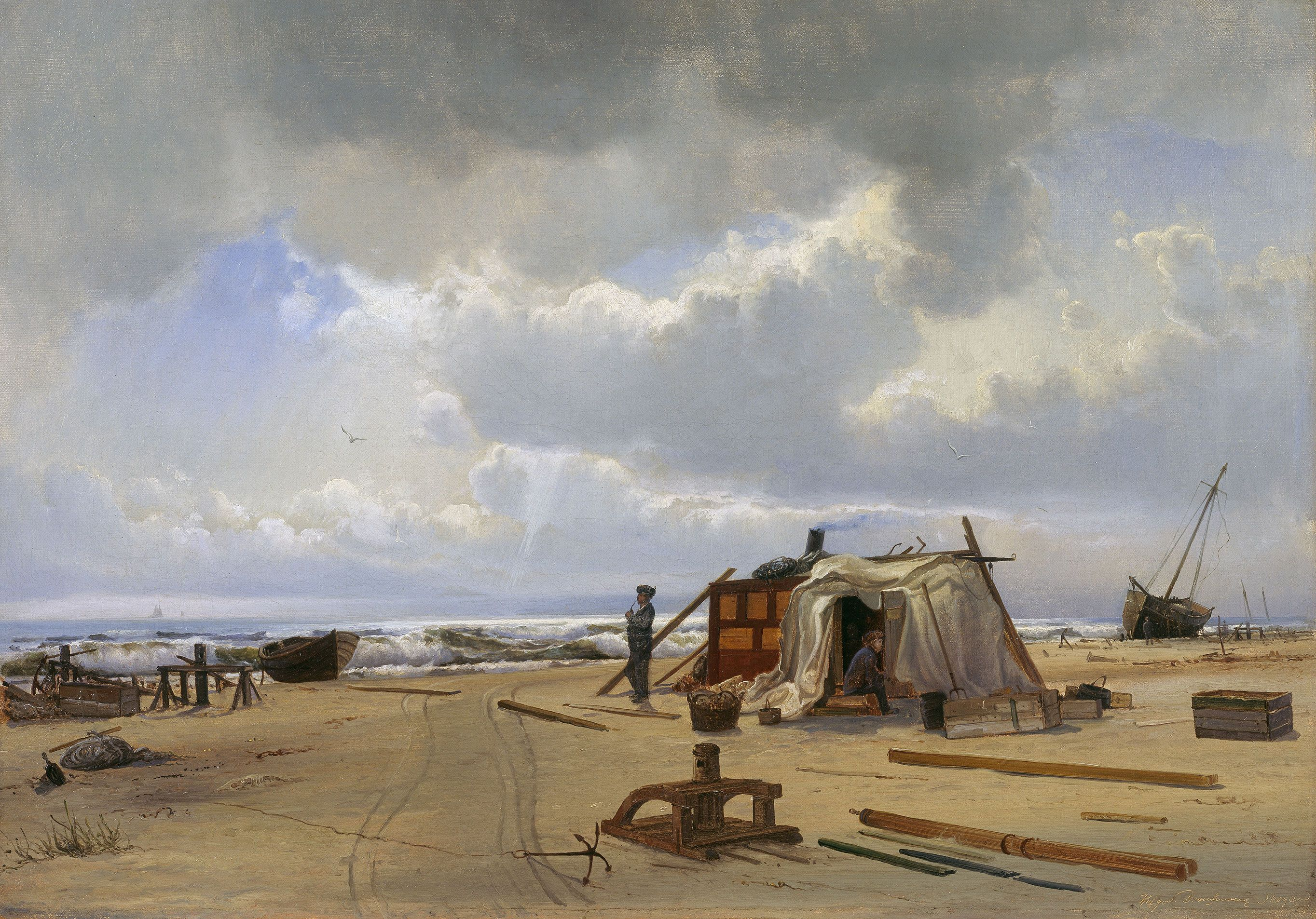
A wreck hut on Skagen’s beach by Holger Drachmann

The Skagen artists’ colony is now as famous as the ones at Barbizon or Newlyn and Holger Drachmann was an important figure in the history of the Skagen artists’ colony, for it was he, who first arrived there in 1872 together with Norwegian Frits Thaulow, and he then persuaded many artists to go there with him during the following years. He fell in love with the area with its  breath-taking nature and the simple life it afforded people.

View from Knippelsbro with the Sugar Factory by Holger Drachmann
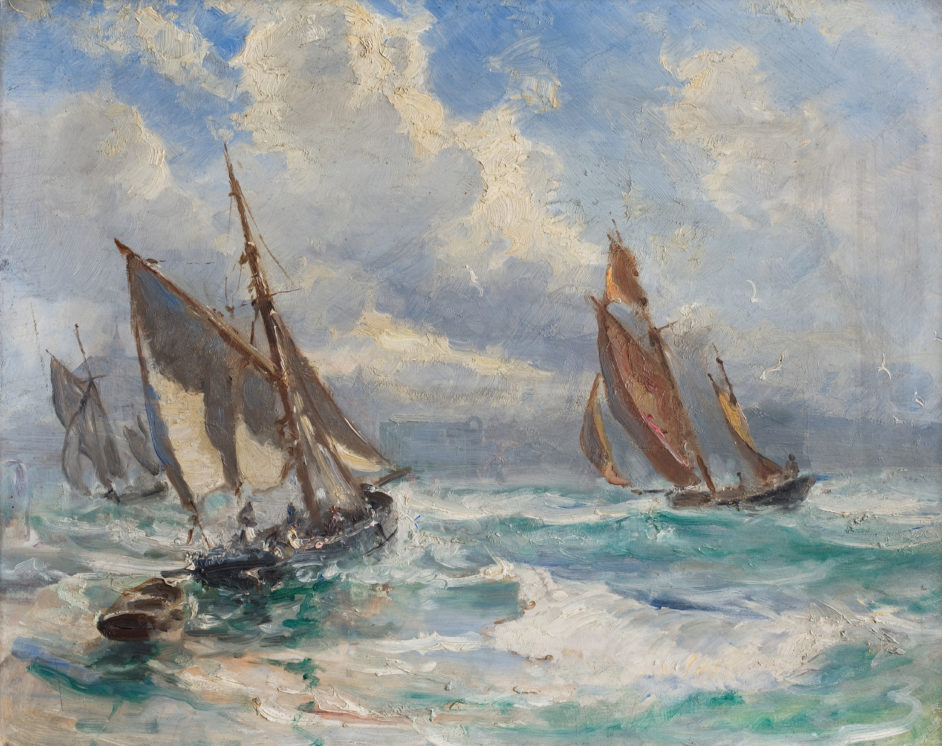
Fishing boats in Stormy Weather by Holger Drachmann

Besides his love of painting and fame as an artist, Holger Drachmann had two other great loves. He had the love of literature and poetry and was a renowned poet. He was part of the Scandinavian Modern Breakthrough Movement which was a movement of naturalism and which debated the literature of Scandinavia, which replaced romanticism near the end of the 19th century.

Georg Brandes

Around 1870, Drachmann became motivated by the writings of the Danish critic and scholar Georg Brandes, who had greatly influenced Scandinavian and European literature.  It was a time when art became secondary to literature in Drachmann’s life.  He had travelled quite extensively around England, Scotland, France Spain and Italy and had started a habit of sending accounts of his travels to the Danish newspapers. 

Digte (Poems)

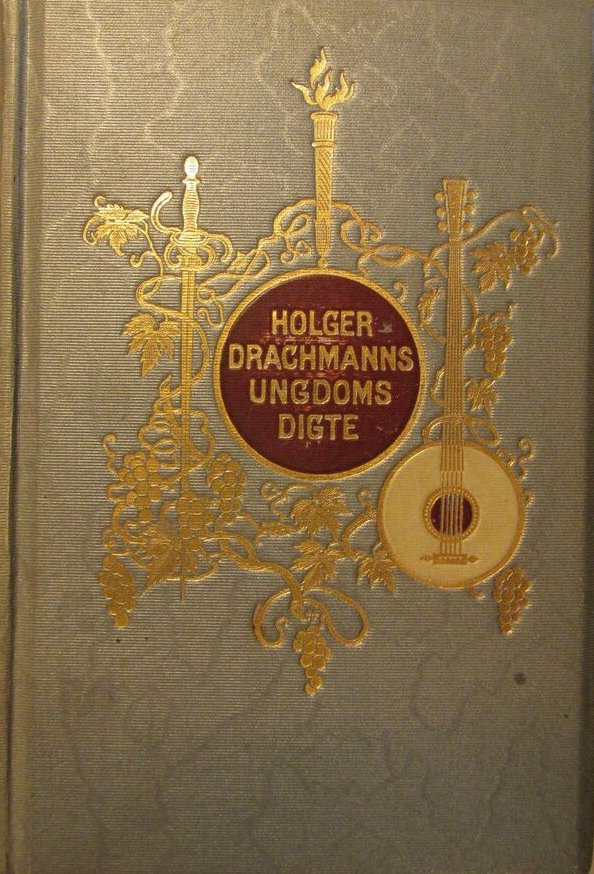
Drachmann made his debut in 1872 as a prose writer with the collection With Coal and ChalkIn and that same year he had a book of his poems entitled Digte (Poems) published. He also joined the group of young Radical writers who were also followers of Brandes.  For Drachmann it was a time of contemplation and soul searching as to whether painting or writing would be his prime driving force. Drachmann established his position as the greatest poet of the Danish modern movement of his time with such collections as Dæmpede Melodier (1875; “Muted Melodies”), Sange ved Havet (“Songs by the Sea”) and Venezia (both 1877), and Ranker og Roser (1879; “Weeds and Roses”). The prose Derovre fra Grænsen (1877; “From Over the Border”) and the verse fairy tale Prinsessen og det Halve Kongerige (1878; “The Princess and Half the Kingdom”), demonstrated a patriotic and romantic trend that brought him into conflict with the Brandes group.   Drachmann was one of the most popular Danish poets of modern time though much of his work is now forgotten. He unites modern rebellionist attitudes and a really romantic view of women and history. 

Kristian Zahrtmann – Portrait of Vilhelmine Erichsen (1867)

Earlier I said that Drachmann had two great loves other than his art. He loved writing and poetry as I have just recorded but his other great love was women !

Whilst on the island of Bornholm in 1869, Holger Drachmann met his first wife Vilhelmine Charlotte Erichsen, She had been a good friend and muse for both Drachmann and another artist, Kristian Zahrtmann who was also living on Bornholm and who had painted her portrait when she was fourteen-years-old.   Zahrtmann was besotted with the young girl who modelled for him.  In a letter in 1868 to his friend and fellow artist August Jerndorff ,  he wrote:

“…I have had a young girl of mine of mine painting who interests me greatly. An adorable child – she is 16 years old – cannot be seen; After all, she is at an unfortunate age for most people, to which is added an extraordinary height and width, a short neck and stooped posture, but these are flaws that only all the more accentuate her beauty. A more regular face is unthinkable- – Her hair and eyes are almost black, her mouth bulging, and the pale yellow color, with its vexing and the utterly regular, narrow eyebrows, becomes so southern and melancholic dreamy that I can be so seized by it that the brush shakes in my hand. She herself does not know that she is beautiful, on the contrary, I think that she considers the yellow-laden color hideous, and at all she knows very little, both of knowledge and of what life is and gives…”

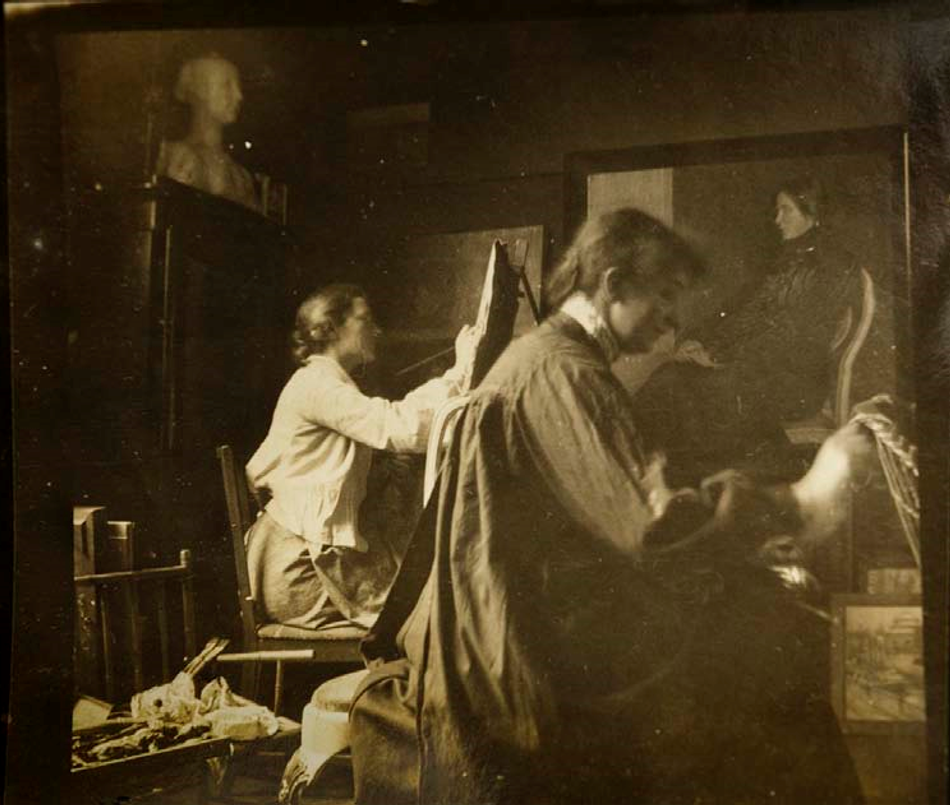
Marie Henriques (on the left) and Eva Drachmann painting, probably at the Art School for Women in Copenhagen, (c.1900)

But three years later, in 1869, when she was seventeen, Vilhelmine fell in love with twenty-three-year-old Drachmann and they got engaged.  Two years later, on November 3rd 1871 Holger and nineteen-year-old Vilhelmine married  in Gentofte Sogn, København.  To be able to marry Vilhelmine had to lie about her age, declaring that she was twenty-one.   Holger was twenty-five years old and so did not need her parents’ permission for the marriage.  On November 4th 1874 they had a daughter, Eva, but at the end of that year, they separated and finally divorced in 1878. It was a bad-tempered divorce and in a fit of rage Vilhelmine destroyed all correspondence and manuscripts from Holger that she possessed. Eva Drachmann wrote about her mother and father in her 1953 book Vilhelmine, my mother:

“…They divorced after 4 years of marriage. As the poet’s muse, Vilhelmine had entered into a cohabitation of whose seriousness and difficulties none of them had the slightest concept. Of the two, she was the largest child. She didn’t have time to grow up before it was all over. As an old woman, she reflected on how fateful the disaster came………. After all, in childhood and growing up, she had done nothing useful – nothing but dream…”

Eva Drachmann married for the first time in 1899 and the ceremony was held in a local manor house as the parish priest of the local Flade Church, refused to marry the couple in the parish church, citing Eve’s father’s godless lifestyle.

Polly Culmsee

Around 1866, three years before he met his first wife, Vilhelmine, Holger Drachmann had struck up a friendship with Valdemar Culmsee, the son of Frederick Culmsee, the owner of the Havreholm Paper Mill on the Danish island of Zealand.  It was during a visit to their home in 1866 that he met Emmy Culmsee, Valdemar’s twelve-year-old sister and her older sister Polly who was sixteen. Polly had later married Charles Thalbitzer and had two children with him but around the time Holger Drachmann and his wife had separated in 1874 she had a relationship with Holger and had his child, Agnes Gerda.  Polly eventually divorced her husband and she and Holger left Denmark for Sweden because of the social scandal they had created in Copenhagen.  They intended to be married in Paris when Drachmann was legally divorced from his wife. Now living in the Swedish town of Lund, Polly fell ill and Drachmann took her to a local doctor, Alphons Theorin, and sought his help with the care of Polly. Bizarrely, Polly transferred her affection from Holger to the doctor who in turn fell passionately in love with his patient which created yet another scandal as the doctor abandoned his wife and their three children and ran off with Polly to the central Swedish town of Sveg, where he managed to arrange a position as a provincial doctor.

Emmy Culmsee

The bizarre story of Holger Drachmann love life does not end there.  Polly’s younger sister Emmy had moved with her parents to Kristiania, where she stayed until she travelled to Hamburg in 1876 to study languages and it was in this German city that she once again met Holger.  He told her he was devastated by a relationship break-up and she was very comforting.  However he failed to impart to her that the relationship had been with her married sister, Polly. On finding out about the involvement of her sister she broke off with Holger and settled into a life as a German language teacher.  However, in 1878 whilst on holiday in Hamburg, out of the blue, she received a call from Copenhagen from Holger Drachmann’s married sister Erna Juel-Hansen. She told Emmy that Holger had suffered a breakdown when Polly left him.  Emmy went to Copenhagen and cared for Holger and nursed him back to full health.  Emmy and Holger married and they adopted his and Polly’s daughter, Agnes Gerda.  Emmy and Holger went on to have four more children of their own. 

Amanda Jensine Nielsen (Edith)

Sadly in 1887 Holger, for whatever reason, began an affair with Amanda Jensine Nielsen a cabaret artist in Copenhagen, despite the fact that he was married and twice her age.  He and Amanda became lovers and he would refer to her as Edith.  He even mentioned her in his 1890 novel Forskrevet, a depiction of Denmark in 1880 and the then political dispute between Right and Left, as well as the cultural dispute between citizen and bohemian

Holger Drachmann by Peder Severin Kroyer

Eventually Holger grew tired of his affair with Edith and moved on to another young actress.  His many scandalous affairs with his “muses” were often the fuel of his inspiration.  On his deathbed he said that his two biggest muses were Vilhelmine and Edith.

Drachmanns Hus in Skagen

Holger Drachmann died in Copenhagen on January 14th 1908, aged 61.   He is buried in the sand dunes at Grenen, near Skagen and following his death his Skagen home, Drachmanns Hus, became a museum.

Rudolph von Alt

Self-portrait (1890)

The focus of my blog today is to look at the life and work of the nineteenth century Austrian painter Rudolph Ritter von Alt.  The word “Ritter”is used as a title of nobility in German-speaking areas.  It translates approximately to the British designation “Sir”, denoting a Knight.  It is not a first or middle name of the person.  The artist was born Rudolph Alt and used the title of a Ritter after he gained nobility in 1889.

View from the Artist’s Studio in Alservorstadt toward Dornbach by Jakob Alt (1836)

Rudolph was born in Vienna on August 28th 1812.  His father, Jakob Alt, the son of a carpenter, was a German landscape painter and lithographer who was born in Frankfurt am Main in 1789 where he received his first artistic tuition and later moved to Vienna where he enrolled at the city’s Academy of Fine Arts.  Jakob Alt travelled through Austria and Italy, hiking through the Austrian Alps, all the while painting scenes of beauty. He also depicted many scenes of the neighbourhood along the River Danube and in the city of Vienna.

Room of Archduke Ludwig Victor in the Hofburg, Vienna by Franz Alt (1861)

Rudolph Alt had a younger brother, Franz, who was nine years his junior and who also became a famed Austrian landscape painter. His work can be seen in the collection of the Metropolitan Museum of Art, the Cooper Hewitt Museum (Smithsonian), the Albertina Museum, the Museum of Fine Arts, Budapest and other international collections.

The Dachstein Mountain from Lower Lake Gosau by Rudolphe von Alt (1838)

Rudolphe, like his father before him, went on many hiking-trips through the Austrian Alps and northern Italy and fell in love with the spectacular landscapes he witnessed.

View of the Strada Nuova against the Giardini Pubblici in Venice by Rudolph von Alt (1834)

 In 1833, he travelled to Venice where he pictorially recorded his visit. He was inspired by the city of Venice and took the opportunity to visit neighbouring areas as well as the Italian capital, where he completed a number of architectural paintings

The Capitol in Rome by Rudolphe von Alt (1835)

Rudolphe von Alt was a talented watercolourist and during his journeys around Italy he completed many watercolours featuring various Italian cities.

Port of Santa Lucia, Naples by Rudolphe von Alt (1935)

In 1830, five years before he took the throne, Emperor Ferdinand I of Austria started to develop a plan which entailed the commissioning of paintings depicting the most beautiful views of the Austrian Empire. Jakob Alt, and his eldest son, Rudolf were two of the commissioned artists and between them they painted about one hundred and seventy of the three hundred completed works.  The project came to an end in 1849 a year after Ferdinand abdicated.

The Josef square in Vienna by Rudolphe von Alt (1831)
The St. Stephen’s Cathedral in Vienna by Rudolphe von Alt (1831)
View of Salzburg by Rudolpe von Alt (1831)

Der Hohe Markt in Wien  by Rudolphe von Alt (1836)

Rudolphe’s watercolour depictions of interiors of wealthy patrons’ residences brought him more recognition from the Austrian public

Interior at Palais Windischgrätz in Renngasse in Vienna by Rudolphe von Alt (1848)

Salon in the Apartment of Count Lanckoroński in Vienna by Rudolphe von Alt (1881)

The library in the Palais Dumba by Rudolphe von Alt (1877)
The Blue Drawing Room at the Valtice Palace by Rudolphe von Alt (1845)

The grandeur of the interior of many palaces was captured by Rudolphe in his magnificent watercolour paintings. Originally the Gothic Valtice palace was founded in the 12th century by the bishops of Passau and in 1530 Valtice became the place of residence of the princely family of Liechtenstein, one of the wealthiest families in Europe. 

Drawing Room at the Rasumofsky Palace by Rudolphe von Alt (1836)

A less formal room was captured by Rudolphe von Alt in his 1836 watercolour entitled Drawing Room at the Rasumofsky Palace. The palace was commissioned by Prince Andrey Razumovsky  as a Neoclassic embassy which would be worthy of the representative of the Russian Tsar, Alexander I. It was built at the prince’s own expense on Landstraße, close to the centre of Vienna. Razumovsky then filled the rooms of the palace with antiquities and modern works of art.

The Staircase of the State Opera Thatre, Budapest by Rudolphe von Alt (1873)

A large number of Rudolphe von Alt’s paintings are held in the Princely House of Liechtenstein collections in Vaduz, Liechtenstein and Vienna.  The Princely House of Liechtenstein is one of the oldest noble lineages in Europe being first mentioned in the twelfth century.  The Princely House of Liechtenstein is one of the oldest still extant noble lineages in Europe. The first documented bearer of this name was a Hugo von Liechtenstein, mentioned in archival sources dating to between 1120 and 1143.

View from the Klausen Valley to Modling Castle by Rudolphe von Alt (1827)

The family’s art collection had its beginnings in the sixteenth century and has been influenced over time by the varying interests of individual princes.  The collection has been assembled over several centuries, and now the Collections of the Prince von und zu Liechtenstein are one of the most important private art collections in the world, containing around 1,600 paintings with masterpieces ranging from the early Renaissance to the second half of the nineteenth century, including works by Lukas Cranach the Elder, Quentin Massys, Raphael, Peter Paul Rubens, Anthony van Dyck, Frans Hals, Rembrandt, Ferdinand Georg Waldmüller, Friedrich von Amerling and Hans Makart and today’s artist, Rudolphe von Alt,

Organ Base by Master Anton Pilgram in St Stephen’s Cathedral, Vienna by Rudolphe von Alt (1876)

Alt demonstrated a remarkable talent for expressing certain peculiarities in nature. He managed to paint nature authentically by focusing on the different hues of sky, the colour-tone of the air and the vegetation.

Ansicht von Jägerndorf mit ländlicher Staffage by Rudolphe von Alt

His later works were more Impressionistic in style but maybe above all von Alt will be remembered for his exquisite architectural and indoor scenes, genres that made him famous in Vienna.

Alservorstadt, Vienna

Rudolphe Ritter von Alt died in Vienna on March 12th 1905, aged 92. Most of his paintings are held by various museums in Vienna.

Carl and Karin Larsson. Part 2.

Karin Larsson with her firstchild, Suzanne (1885)

Carl and Karin Larsson married in late 1882 and in 1884 their first child, Suzanne was born.  Their second child, a son Ulf, was born in 1887 but sadly died when he was eighteen. In all, Carl and Karin had eight children.  After Ulf came Pontus in 1888, Lisbeth in 1891, Brita in 1893, Mats in 1894 but he died aged just two months, Kersti in 1896 and finally Esbjörn in 1900.  It is quite obvious that Karin’s time was taken with the upbringing of their children.

Lilla Hyttnäs by Carl Larsson

In 1888 the couple returned to Sweden with their two children and on deciding to settle permanently in Sweden Karin’s father, Adolf Bergöö, gave them a wooden cottage in the countryside of central Sweden, which had belonged to relatives. The house named Lilla Hyttnäs, was situated in the town of Sundborn, in Falun Municipality, 250 kilometres north-west of Stockholm. 

Ett Hem by Carl Larsson

Carl remembered his first visit to the cottage accompanied by his father-in-law and in his 1899 book, Ett Hem (A Home) he wrote:

“…The cottage stood right on a bend in the Sundborn River, just where it gets a smidgeon wider. Everything inside was spick and span, the furniture was simple, but old fashioned and robust, handed down by their parents, who had lived in the vicinity. While I was here, I experienced an indescribably delightful feeling of seclusion from the hustle and bustle of the world, which I have only experienced once before (and that was in a village in the French countryside). When my Father in law suggested buying me a small property in the same village, I declined, saying that only something resembling this little idyll would suit an artist…”

The Kitchen by Carl Larsson (1898)

Lilla Hyttnäs soon became Carl and Karin’s mutual art project in which their artistic talents found expression in a very modern and personal choice of colour schemes and interior design. The couple favoured bright colours, and filled the rooms with handcrafts, which mirrored the Arts and Crafts Movement which had inspired them.  The Arts and Crafts movement was an international trend in the decorative and fine arts that first emerged in the mid-nineteenth century in the British Isles and then spread to the rest of Europe and America.

Karin Larsson weaving.

Karin Larsson was a young mother, but on top of that she was an ambitious woman who although she had stepped back from her painting, she had replaced the canvas with other artistic goals that would see her use needles, thread and silks instead of brushes and paint.  She would now concentrate on home furnishings which would brighten up the old cottage.  The cottage interior had now taken the place of the canvas.  Her great inspiration was William Morris, who was a leader of the English Arts and Crafts movement, and she liked to incorporate foliage designs across her upholstery.  Karin’s husband, Carl, created a series of twenty-six watercolours, entitled A Home which depicted the beautiful interior designs of his wife.

The Studio (From “A Home” watercolor series) by Carl Larsson

Karin Larsson spent mch time designing fabrics for their furniture. One example of this is the chair cover (below).

Chair cover designed by Karin Larsson

Her beautifully, highly colourful designs were used for bench cushion covers.

Bench cushion cover designed by Karin Larsson

The transition from painting to textile art and home furnishings by married females was in those days an acceptable evolution and was not seen as something forced upon them by their husbands.  In the work she lovingly put together to create their home she was able to express herself through the medium of textiles, and furniture design.

Rocking Chair designed by Karin Larsson

Karin’s life at Lilla Hyttnäs was tiring.  She had to cope with the everyday house chores and eight children to manage.  Her eighth child, a son, Esbjorn had been born in 1900.  However, she still found time to design and weave a large amount of the textiles which she utilised in her home.  She also spent time embroidering, and designing clothes for herself and the children.   The aprons, known as karinförkläde in Swedish, were worn by her and the other women who worked at the house.

Daddy’s Room by Carl Larsson

Carl Larsson’s bedroom at Lilla Hyttnäs was a through-room. The door is wide open to the end room where his wife and the smaller children slept. The white four-poster bed with embroidered curtains stands in the middle of the floor. It has several ingenious features, such as a bench, a chamber-pot cupboard and a small, built-in bedside table. Look closely at the background and you will see that this is also a self portrait as we can just observe the artist, looking in a mirror, doing up his collar buttons.

Cosy Room by Carl larsson

The interiors of the Larsson home were characterised by rural simplicity. Nevertheless, every detail was carefully designed, with influences from England, Scotland and Japan.

The Kitchen by Carl Larsson

The kitchen, which was first and foremost a place for household chores, did not display the same modern interior style and comfort as the rest of the house.

Through Larsson’s paintings and books their house has become one of the most famous artist’s homes in the world. The descendants of Carl and Karin Larsson now own this house and keep it open for tourists each summer from May until October. The rooms of the house featured in many of Carl’s paintings and books.

Self portrait in New Studio by Carl Larsson

Besides depictions of their home featuring in his artwork which highlighted Karin as a talented interior designer, Carl featured his wife and children in many of his paintings.

Karin and her first child Suzanne by Carl Larsson (1887)

In 1905 Carl featured his seventh child, eleven-year-old Kersti in his watercolour work.

Kersti in Black by Carl Larsson (1907)

In his 1890 watercolour it was his third-born child, two-year-old son, Pontus, who featured.

Pontus on the Floor by Carl Larsson (1890)

The Christmas spirit was captured in some of his family portraits.

Brita dressed as Iduna

Carl and Karin’s fifth child, daughter Brita, was depicted as Idun or Iduna, the Norse goddess of Spring and rejuvenation.  Norse mythology tells us that Idun was the keeper of the magic apples of immortality, which the gods must eat to preserve their youth.  Iduna carried her apples in a box made of ash (called an eski), along with her fruit, and this box served as one of Idun’s major symbols. 

Azalea by Carl Larsson featuring his wife Karin

Carl Larsson travelled away on a number of occasions leaving the household and his children the sole responsibility of his wife.  Karin employed the carpenters and painters needed to transform Lilla Hyttnäs and was the one who made all the decisions with regards its interior.  He never underestimated the role she played in their marriage and this was evident when you look at his artwork and read his books.

In the Corner by Carl Larsson

In his book Ett Hem, there is an amusing watercolour by Carl of his son Pontus sitting rather gloomily on his chair in an empty room.  Larsson talked about the depiction saying that he took the idea from the sight of a gloomy little boy who had been sent from the table as he had misbehaved during the family meal and had been left to deliberate on his misbehaviour whilst languishing in the beautiful room. Pontus’ bad behaviour was probably not a factor in this work but his punishment was real, that of having to sit still for such a long period whilst his father sketched the scene !  The depiction is probably more about the room itself and the combination of the striped chair covers and rugs, with the tiles of the fireplace.

The Door

The central part of the painting is taken up by the door.  The design of which is a mix of irregularity on the lower panel whilst the panel above  is a drawing based on a poem by the English Victorian artist and writer Kate Greenaway’s poem:  There was an old woman, who lived on a  hill and changed by the artist to There was a little woman who lived with Carl Larsson.  Above the door we see decorations, and even though it was a classical temple, it is surrounded by leaves.

The Reading Room by Carl Larsson

In many of his paintings featuring the interior of Lilla Hyttnäs and his family, reading was a recurring topic and was probably a means of enhancing the idea that his young family were well educated, unlike himself, during his torrid childhood.

Karin Reading by Carl Larsson (1904)

Homework by Carl Larsson

Carl and Karin Larsson’s popularity increased considerably with the progress of colour reproduction technology in the 1890s.   The Swedish publishing house Bonnier published books written and illustrated by Carl Larsson and containing full colour reproductions of his watercolours, such as Ett Hem. (A Home).

Das Haus in der Sonne by Carl Larsson

However, the print runs of these rather expensive art books were small in comparison to those published in 1909 by the German publisher Karl Robert Langewiesche.  He had chosen a number of Carl’s watercolours, drawings and text by the artist, which culminated in the publication in 1909 0f Das Haus in der Sonne (The House in the Sun), which became one of the German publishing industry’s best-sellers of the year with forty thousand copies sold in three months, and which required more than forty print runs.  Carl and Karin were delighted with the success.

 Car Larsson’s 1907 mural Gustav Vasa’s procession into Stockholm, 1523  (7 x 14 metres)
Nationalmuseum Stockholm.

For all his paintings depicting his wife, children and beloved home, all his illustrating work for books and newspapers, he considered his large-scale frescoes as his most important work.  He created frescoes for schools, museums and other public buildings.  In 1907, Larsson completed his mural of Gustav Vasa’s procession into Stockholm, 1523, which was hung with his other commissioned murals in the National Museum in Stockholm, part of a series of murals which he had been working on since the mid-1890s.

Midvinterblot (Midwinter Sacrifice) by Carl Larsson (1915)

In 1915 Carl had just completed his last monumental work, Midvinterblot (Midwinter Sacrifice), which measured 6 x 14 metres (20ft x 46ft). This was yet another fresco commission he had received from the National Museum in Stockholm and this would like several other of his works adorn the walls of the museum. This new fresco painting would be placed on the wall of the hall which led to the central staircase of the museum.  The painting, entitled Midvinterblot (Midwinter Sacrifice) depicts a legend from Norse mythology in which the Swedish king Domalde is sacrificed at the Temple of Uppsala in order to avert famine. Larsson was rightly excited with the commission but devastated when the museum rejected the finished work.  Larsson was extremely bitter with the museum’s decision.  In his autobiography, he wrote:

“…The fate of Midvinterblot broke me! This I admit with a dark anger. And still, it was probably the best thing that could have happened, because my intuition tells me – once again! – that this painting, with all its weaknesses, will one day, when I’m gone, be honoured with a far better placement…”

Later in the book Larsson admitted that the paintings depicting his family and home:

“…became the most immediate and lasting part of my life’s work. For these pictures are of course a very genuine expression of my personality, of my deepest feelings, of all my limitless love for my wife and children…”

The controversial rejection of Larsson’s painting rumbled on well past his death in 1919.  Some schools of Swedish artists loved the work whilst others hated it.  The painting was never hung in its designated space and the wall remained bare. 

The painting’s final resting place.

In 1987, one artist from the “school of detractors” offered the museum a monumental painting for free, provided it would adorn the empty space but the museum declined the offer.  The painting was then sold to a Japanese art collector, Hiroshi Ishizuka, who in 1992, agreed to lend it back to the museum for its major Carl Larsson exhibition.  The painting was hung exactly where Larsson had intended.  On seeing the giant painting, the public loved it and wanted the museum to buy it from the Japanese owner.  With the aid of public and private donations, the museum and the Japanese owner came to an agreed price and in 1997 the painting was purchased by the museum and the painting remained in its “rightful” place and it remains part of the museum collection.

Carl Larsson died on January 22nd 1919 aged 65. His wife Karin died nine years later on February 18th 1928 aged 68.

Abram Yefimovich Arkhipov and the Peredvizhniki.

In past blogs about Russian artists I talked about an artistic group known as the Peredvizhniki, often referred to as The Wanderers or The Itinerants and the artist I am looking at today was also a member of this group.  The Wanderers gave a voice to Russian art for the first time in the country’s history. Their art answered the people’s search for solutions to their country’s problems. Many of these artists completed works which were parodies of Russian life and were, through their depictions, critical political statements about the Russian ruling class.   Russian art critics had voiced their concern with regards the state of Russian art stating that it was devoid of any originality.  They wanted artists to focus more on native themes rather than concentrating on what they termed “cosmopolitan garb”. 

In 1863 a group of fourteen students, led by Ivan Kramskoi, who were studying at the Imperial Academy of Arts in Saint Petersburg found the rules of the Academy too limiting.  They also believed their tutors were too conservative and so decided to take a stand.  They believed art should be available to all people and, as many could not visit the grand city galleries, they would take their art to the people. They formed Артель художников, the Petersburg Cooperative of Artists (Artel of Artists).  The society resolutely maintained independence from Russian state support and took their art, which depicted the contemporary life of the people from Moscow and Saint Petersburg, to the provinces.  In 1870, this organization was succeeded by the Peredvizhniki.   The Wanderers established a new social artistry that depicted the lower classes and highlighted the issues surrounding social injustices. Of the aims of the Group, Kramskoi believed that their paintings should, as well as being beautiful, be both wise and educational.  Among the movements leading members were Ilya Repin, Ivan Shishkin, Konstantin Makovsky, Vasily Perov and Vasily Polenov.

Abram Arkhipov; Portrait by Ilya Repin

Today’s artist under the spotlight is Abram Yefimovich Arkhipov who was also a member of the group.  Abram was born Abram Efimov[ich] Pyrikov on August 15th 1862, the son of Efim Nikitich and Arina Fedorovna Pyrikovs.  He was raised in an impoverished household in the small and remote village of Yegorovo, in the Ryazan province, two hundred kilometres south-east of Moscow.  He would later adopt the surname “Arkhipov” in honour of his great-grandfather, Arkhip Rodionovich.

Winter by Abram Yefimovich Arkhipov

Abram showed an interest in art when he was a young boy at the village school.  However, the only artistic tuition Abram received whilst at home was from traveling icon painters, one of whom, Zaykov, who had connections with the Moscow School of Painting, which was formed by the 1865 merger of a private art college, established in Moscow in 1832 and the Palace School of Architecture, which had been established in 1749.  It was one of the largest educational institutions in Russia. Zaykov was impressed by the Abram’s artistic talent and encouraged him to enter the School. His parents were proud of him and offered him great encouragement to continue with his love art.  In 1877, despite being impoverished peasants they managed to collect enough money to send him to study at the School of Art, Sculpture and Architecture in Moscow.


Sunset over a Winter Landscape by Abram Yefimovich Arkhipov

Abram was accepted at the School in 1877 and he studied there for five years. Here he studied alongside future greats in Russian art such as Ryabushkin, Kasatkin and Nesterov and he was tutored by the leading painters of the time, Vasily Perov, Makovsky, Polenov and Savrasov.  Arkhipov left the Moscow School and in 1884 transferred to the Academy of Arts in St. Petersburg. Here he was academically successful and some of his paintings were selected for permanent storage at the Academy’s Museum. 

Village Iconographer by Abram Yefimovich Arkhipov

Something, however, was not right and Abram broke off his studies at the St Petersburg Academy and in 1887 returned to study at the Moscow School of Art, Sculpture and Architecture . The reason for his sudden departure from St Petersburg is not fully known but it is thought that he was discouraged by the Academy’s strict way of teaching art.  However, the reason could have been more mundane, and he simply had no financial means to continue his studies in St Petersburg.

Sick Woman by Abram Arkhipov (1885)

Arkhipov had completed a painting entitled Sick Woman in 1885 and two years later at the Moscow School’s student’s exhibition he exhibited it.  It depicts two women in a dark and dank interior.  The artist’s mother sits with her head dejectedly inclined, her eyes fixed at one point,  Next to her sitting on a straw-filled bed is her neighbour who had come to pay the sick woman a visit. She too has the same dimmed sorrowful look in her eyes The postures of the two women, with their tired, unhappy faces is a depiction of their humility, despondency and misery. The only uplifting aspect to this painting is the sunlight, emanating through the open door.  Maybe Arkhipov wanted to remind us that happiness and beauty do exist somewhere. It is a work that gives out both quiet sadness and an air of deep compassion for human suffering.  The painting proved to be a major breakthrough in Archipov’s life as the work was bought directly from the student exhibition by Pavel Tretyakov, the art collector and owner of the Tretyakov Gallery in Moscow.

On The River Volga by Abram Arkhipov (1889)

Once Abram had completed his studies, he decided to embark on a painting trip with some of his former students, along the River Volga.  From this journey he completed a number of paintings like his 1889 work, On the Volga. It proved to be a successful fusion of a genre scene and lyrical landscape.

Along the River Oka by Abram Arkhipov

A similar river scene which Arkhipov painted at that time was Along the River Oka. It depicts a barge floating along the river filled with weary peasants, who seem lost in thought. It should not just be taken on face value as a river scene as it is a story about impoverished people who are capable of enduring a great deal without losing their strength and resoluteness. It is both a declaration of the beauty of Russian nature, with its blue horizons, the spring flooding of its rivers, and its streams of sunlight. Arkhipov has used a subdued colour scheme which is in accord with the general mood of the painting. His artistic style has changed. Compared to the careful detail of his early works, his style has become more free, expansive and passionate.  Of the painting, the Russian art critic Vladamir Stasov wrote:

“…The whole picture is painted in sunlight and this can be felt in every patch of light and shade, and in the overall wonderful impressions among the people on the barge, the four women—idle, tired, despondent, sitting in silence on their bundles—are portrayed with magnificent realism…”

In the Evening by Abram Yefimovich Arkhipov

The work earned Arkhipov membership of the Society for Traveling Art Exhibitions in 1890.  He was now one of the Peredvizhniki.  It was the largest art association of the second half of the nineteenth century and their exhibitions were held in Russian cities such as Riga, Kiev, Kharkov, and Odessa. Its objectives was three-fold:

Delivery to the inhabitants of the provinces the possibility of contacts with Russian art

Development and love of the arts in society

Making it easier for artists to sell their works.

Radonitsa (Before the Church Service) by Abram Yefimovich Arkhipov (1892)

Many of Arkhipov’s paintings were juxtapositions of landscape and genre works such as his 1892 painting entitled Radonitsa or Waiting for Church in which we see a large group of peasants sitting on the floor outside a church waiting for the doors to open and the service begin, but this is not just any service, this is Radonitsa.  Radonitsa is a universal church day when relatives and friends of the deceased celebrate the commemoration of those who have died.  In the Russian Orthodox Church it is this commemoration of the departed which is observed on the second Tuesday of Easter.  The word derives from the Slavic word radost meaning joy and so it is not looked upon a s a mournful day but one of joyful remembrance.  It is the Christian belief that lies behind this joy, is the remembrance of the resurrection of Jesus and the joy and hope it brings to all.

The Ice is Gone by Abram Yefimovich Arkhipov (1895)

Another of Arkhipov’s paintings which is a mixture of genre and landscape is his 1895 work entitled The Ice is Gone.  The painting depicts the connection between nature and the peasants. In a way, it is like the previous work.  It is a celebration.  The celebration is because the Spring has finally arrived and the ice on the rivers has melted and once more the peasants can use the flowing rivers to their advantage.

Women Labourers at the Iron Foundry by Abram Yefimovich Arkhipov (1896)

Many of Arkhipov’s paintings depicted the harsh plight of female peasant workers and their brutal working environment.  One such work was his 1896 painting entitled Women Labourers at the Iron Foundry in which we see two women sitting outside the foundry in the relentless hot sun, trying to relax from their physical labour.  Black smoke rises against a backdrop of low, wooden workshops.

The plight of the female worker was again highlighted in two paintings by Akhipov entitled Washer Women which he completed 1899.  One hangs in the Tretyakov Gallery in Moscow and one in the State Russian Museum in St Petersburg. They were based on a series of studies Abram made of life in the wash-house and are depicted in the muted colours associated with Realism paintings.  We see the bent backs of prematurely aged women, toiling amid the steam and heat of their workplace.

Washer Women by Abram Yefimovich Arkhipov (1899)

Washer Women by Abram Yefimovich Arkhipov (1899)

In one work he depicts many peasant women working to clean the village’s laundry. For an accurate portrayal, Abram visited many washhouses making sketches always keen to find figures which would enhance his final work.  Eventually he found his “perfect” model and rearranged the depiction around her.  She was an elderly woman whom we see on the left of the second work, sitting hunched over, totally exhausted. All the women look defeated and overcome by their physical efforts.  These two works by Arkhipov’s highlight the plight of woman who had to work in such harsh, almost inhuman conditions just to earn some money to feed their families.  Again, like his other Reailist paintings he has used muted colours, the works only lit up by the light coming in from the small window at the rear, which shows up the steam coming up from under their hands as they wash the clothing. Many of the details stay the same in both works, for example, their hair being tightly tied back and the same women appearing in the background of both paintings. The women are all hard at work in the upper painting, whereas the lower work focuses on the elderly woman talking a break.

Arkhipov’s paintings are brutally realistic and are important pieces in history revealing much about the conditions in the USSR during this time by showing the truth behind the closed doors of the washhouses. The opportunity for women to get better and less arduous jobs was just not available to them.

Northern Village by Abram Yefimovich Arkhipov (1902)
In the North by Abram Yefimovich Arkhipov !903)

In 1902 Arkhipov took the first of a number of trips to the White Sea and from the sketches he made during these journeys he produced two memorable landscape works. A Northern Village in 1902 and In the North in 1903.  They signalled a move away from Realism works and a move towards the landscape genre of paintings.

Around 1903 came the formation of the Union of Russian Artists which was the coming together of former Peredvizhniki members and those who had been part of the World of Art, an artistic movement inspired by an art magazine which served as its manifesto de facto, which was a major influence on the Russians who helped revolutionize European art during the first decade of the 20th century.  Arkhipov became one of its founding member in 1903.

Around 1903 came the formation of the Union of Russian Artists which was the coming together of former Peredvizhniki members and those who had been part of the World of Art. The Union of Russian Artists lasted until their exhibition in 1910 when due to a split between St. Petersburg and Moscow artists due to harsh words and denouncements of the paintings by various factions.  Arkhipov decided that he had had enough of the constant bickering and resigned.

The Visit (also known as On a Visit; A Festive Spring Day) by Abram Yefimovich Arkhipov (1915)

Following his resignation from the group he reverted to his favoured painting style, that of genre painting and the depiction of peasants. However, the muted coloured realist paintings soon gave way to a more colourful Impressionist style as seen by his 1915 work entitled The Visit (also known as On a Visit; A Festive Spring Day)

The Tea Party by Abram Yefimovich Arkhipov (1919)

Another highly colourful painting was his 1919 work entitled The Tea Party.

Around 1920, Arkhipov became interested in the genre of psychological portraiture.  Psychological portraiture is when an artist tries for something more than a simple physical representation of the sitter but tries to reflectand depice the character of the portrayed person. In essence the painter is endeavouring to capture a range of the sitter’s emotions in fractions of a second or for the finished work to tell us more about the personality of the person in a single image.

A Girl with a Jug by Abram Yefimovich Arkhipov (1927)

Arkhipov painted an unusual series of portraits of peasant women and girls from the Ryazan and Nizhny Novgorod regions. They are all dressed in bright national costumes. with embroidered  scarves and beads. Painted with broad lively strokes, the paintings are marked by their decorative nature and buoyant colours, with rich reds and pinks predominating. The most famous of his portraits is his 1927 painting entitled Girl with a Jug. It depicts a Russian woman dressed in an orange top, a bright red bottom, an apron with a bright pattern.  In her hands she holds a bright blue cup and a jug of milk.  The dark background, painted by the artist, sets off the girl.  Her figure is hidden from us by the wide sleeves and a skirt.  She smiles confidently as she looks out at us with an affectionate countenance.  The painting is a mass of colour and yet Arkhipov seems to also focus on the inner beauty of the woman which he believes is a window into the Russian soul, strong and yet truthful, open-minded, and generous.  In this colourful cycle of painting female peasants, Arkhipov has loosened the shackles of his gloomy realist depictions and his shown us a different side to his art.

Young Girl by Abram Yefimovich Arkhipov (1920)

In 1924 Arkhipov joined the Association of Artists of Revolutionary Russia, and in 1927, to mark his fortieth year as an artist, he was among the first artist who was awarded the title of *People’s Artist of the Russian Republic*.

Abram Yefimovich Arkhipov died in Moscow on September 25th, 1930 aged 68.

John Downton

Self portrait by John Downton (c.1928)

My featured artist today is the lesser-known British painter John Downton who was born on March 27th, 1906 in the Kent town of Erith, some twenty kilometres south-east of London.  He was the youngest of three children of Albert Victor and Flora Edith Downton (née Mitchell).  John had two older sisters, Hilda and Mary both of whom had intended to study medicine but their plans were thwarted by family circumstances and health reasons.

At the age of four John attended the Erith Convent where he was a pupil for the next four years.  In 1914 he transferred to the Erith Grammar School.  It was around this time that John developed a love for music.  His father played the flute and the piano and was a prominent member of the local church choir.  John’s uncle, Hedley, gave John a violin and during the following years John became an important member of the school orchestra.  The other great love of the teenager was his desire to read, particularly books by ancient philosophers and other “serious” works of English literature.

Portrait of a Young Woman by John Downton (1929)

Apart from his music and books, John had an overriding passion for art and even built a summer house/studio in the family garden where he did his painting.  When he was seventeen the school entered his pencil sketch, Biplanes: A Study, into the Royal Drawing Society at the Guildhall, London and he was awarded a Silver Medal.  As a teenager he was fascinated by all things military and penned many sketches of war machines and yet, later in life he became a pacifist.

Woman at the Window by John Downton (1934)

In 1922, when he was sixteen years old, his mother noticed an advert in The Times which stated that a Professor Gaugot, who was a lecturer at the Sorbonne, was willing to teach an English boy to speak French and so young John Downton headed to Paris where he stayed with the Gaugot family.

Child with Roses by John Downton (1936)

A year later in 1923 John accompanied his two sisters to Italy where they visited Venice and the Northern Italian Lakes as well as the Swiss towns of Lucerne and Lugano.  This was the start of John’s love affair with travel.  His favourite destinations were Northern Italy and Switzerland.

Having completed his schooling John was accepted into Queen’s College, Cambridge.  Initially he took Part 1 of the English Tripos and in 1927 was placed into the Second Class but the following year he decided to abandon English and instead enrolled in the History of Art course and once completed, he received a First Class degree.  During his three years at the university John immersed himself in their musical activities.

Hilda Downton by John Downton (1929)

In the Autumn of 1928, having completed his three-year degree course, John Downton enrolled at the Slade School of Art which at the time was presided over by Henry Tonks, a British surgeon and later draughtsman and painter of figure subjects, chiefly interiors, and a caricaturist who was Slade Professor of Fine Art from 1918 to 1930.  John, like many of the Old Masters of the past, preferred the medium of tempera but the Slade tutors wanted him to change his favoured painting medium and embrace a more modern style of painting.  There was to be no common ground and so on May 21st 1929, John resigned.  In a forward to John Downton’s 1937 book, The Death of Art, an art critic and author wrote about Downton’s falling out of love with the Slade and the Academy’s thoughts on art.  He wrote:

“…A certain kind of rather drably coloured, sober urban realism was the style in favour.  Not for Downton though: he had pretty certainly made up his mind what he wanted to do and what sort of painter he wanted to be well before he arrived at the Slade and it has much more to do with the legacy of Piero della Francesca than that of Sickert and Cezanne…”

Downton’s art was a return to the art of the early Renaissance.

In 1930 John Downton and his sister set off on an European trip.  They based themselves in the Côte d’Azur town of Menton and from there they took day trips out to the Italian Riviera towns of Ventimiglia and Genoa.  Much longer trips were taken by the pair when they visited Milan and Lugano as well as his beloved Italian Lakes.

Portrait of a Young Lady by John Downton (1929)

Around 1930, John bought Park Cottage in the Kent village of Sundridge, some twenty miles, south-east of London.  He spent much of his time renovating the property and buying antique furniture at auction to furnish the rooms.  After two years living there, he realised it was too small for him and his artwork and so he moved out and rented the cottage to a fellow artist, Vincent New.

In April 1932 John Downton was awarded his M.A. and, as if to celebrate the successful completion of his studies, he took a trip to Tunis and returned via Naples, where he remained for a few months.  On arriving back to England John searched for a new home and eventually purchased a property with a north-facing conservatory in which he could paint.  The property was in Observatory Gardens, in the London borough of Kensington.

Frances Witts by John Downton (1935)

Around 1935, John Downton completed a poignant in memoriam portrait of his cousin Frances Witts.  She had died of pneumonia aged just twenty-six.  He used a family photograph for this work.

Portrait of a Lady in Yellow by Alesso Baldovinetti (1465)

Downton was influenced by profile portraits executed by Florentine painters such as Baldovinetti’s 1465 work entitled Portrait of a Lady in Yellow but art historians believe this portrait of his cousin was influenced by the Milanese painter, Ambrogio’ de Predis and his c.1490 work, Beatrice d’Este, which was once attributed to Leonardo da Vinci. 

Portrait of a Lady (Beatrice d’Este) by Ambrogio’ de Predis

Downton’s memorial portrait has a dark and rich tonal quality and he has based it on a conservative portrait of the past and has accomplished an image that is both solemn and inspiring.  The woman in Downton’s portrait, like the Italian females in the portraits mentioned earlier, includes a necklace with diminishing size of beads whilst her hair is similarly geometric but in Frances Witts’ case it is gathered at the sides rather than at the back of the head.

Nora Russell by John Downton (1936)

Between 1936 and 1940 John Downton exhibited work at the Royal Academy Summer Exhibition.  His two submissions in 1936, which were considered to be his masterpieces, were The Battle and and Nora Russell.  The latter painting was executed in egg tempera and, despite it being a simple depiction of a young schoolgirl, it is evocative in the way it reminds us of the spirit of Quattrocento female portraiture, that is to say, female portraiture in fifteenth-century Italy, which portrayed womanly perfection as established in Catholic doctrine, illustrating the special social roles that upper-class women fulfilled at the time.

The Battle by John Downton (1935)

The title, The Battle, the second of his submitted painting to the 1936 Royal Academy Summer Exhibition, is to do with conflict but not a battlefield scene, as you may have expected.  It is all about the battle between modern industrialisation and the ideal of Renaissance humanism, which was a revival in the study of classical antiquity, at first in Italy and then spreading across Western Europe in the 14th, 15th, and 16th centuries, a cultural legacy, literary legacy, and moral philosophy of classical antiquity.

Erasmus of Rotterdam by Hans Holbein the Younger (1523)

The figure and its stance in the painting is based upon Holbein’s 1523 work, Erasmus of Rotterdam.  Erasmus was the leading humanist at the time.  Both works accentuate the hands of the sitter.  In the Louvre collection there are studies of hands made by Holbein as preliminaries for his painting.  In Downton’s painting we see through the window an abstract depiction of a modern factory.

Joan Harris by John Downton (1937)

John Downton was always on the move and made many more house relocations and in August 1937 he took up residence in Cambridge.  That year he submitted his work entitled Joan Harris to the Royal Academy Summer Exhibition where it was subsequently chosen to be shown in The Prominent Living Artists Exhibition which was staged at the Russell-Cotes Museum in Bournemouth.  Joan Harris was the daughter of John Downton’s Cambridge neighbour.  From a letter she wrote him during the sittings for the portrait we can gather that Downton completed more than just this one portrait of her.  She wrote:

“…I hope you will finish the picture soon; but if you ever want me to come and sit for you again, just let me know and I will come any time that I am able.

When you have finished the picture I hope I will be able to see it and if you get the first picture back in Cambridge I would like to see it, and I know Mummy and Daddy would love to see it as they never saw it when it was completed…”

Portrait of a Girl by John Downton (1938)

Downton’s 1938 submission to the RA Summer Show was Portrait of a Girl which unusually for Downton depicted the model against a landscape background giving the impression that it was a plein air portrait.  There is a definite resemblance to the style of one of my favourite portrait artists, Gerald Brockhurst.

Portrait of a Woman by John Downton (1955)

A strange looking portrait going under the title Portrait of a Woman was completed by John Downton in 1955. 

Edith Sitwell by Pavel Tchelitchew (1935)

It is thought that the depiction was loosely based on the Polish painter, Pavel Tchelitchew’s portrait of his good friend Edith Sitwell in 1935.

Girl Conducting by John Downton (1940)

In 1938, now living in Cambridge, Downton was having to cope with the rejection by Faber & Faber of his manuscript, The Death of Art, but which was published years later. In 1940 Downton submitted three paintings to the Royal Academy Summer Exhibition, Eve, A Girl Conducting, and A Child. His painting entitled Girl Conducting is all about his depiction of the girl’s hands and it is such a facet in many of his works. The finished product did not come easily for Downton, who made numerous sketches of hands until he had perfected them. Many of the depictions were influenced by Renaissance paintings. The three paintings Downton submitted to the RA that year were to be the last of his offerings to that establishment.

Woman in Flemish Head Dress by John Downton

So why did Downton stop exhibiting his work at the RA ? In the foreword to Downton’s book The Death of Art, which his sister, Hilda, finally had published in 1995, the writer and critic John Russell Taylor explained:

“…He seems to have felt himself marginalised in a world increasingly unsympathetic to everything he stood for. In 1939 he moved to Florence in an attempt to escape the materialist twentieth century, but then almost immediately had to return to Britain at the outbreak of war. The war itself was even more of an alienating factor, a total outrage to his dearly held pacifist principles. And a general feeling that the mainstream of British Art was moving further and further away from his own ideals, first into luxuriant Romanticism and then into freeform abstraction, caused him to withdraw altogether from exhibiting his own art after 1940…”

Bearded Profit by John Downton (1975)

Now back home in England with the war waging in Europe, John Downton received his conscript papers.  Downton had always been a pacifist and went before the Review Board to argue his case for not fighting.  The Board accepted that he was a genuine conscientious objector and so, in September 1940, he was put to work on a farm near Ludlow.  That same year his two sisters moved north to Pitlochry in Scotland and later Downton moved north to be with them and work on the land of the local farmer.

Portrait of a Woman by John Downton (1940)

When the war ended Downton moved south and took up residence in the Kent town of Sevenoaks.  He remained there for two years but then returned to Cambridge where he stayed until 1964 but when his lease ran out on the property he was renting in 1971 he moved back to Sevenoaks and rented a large ground floor flat with a cellar, close to where his sisters, Hilda and Mary were then living.  Mary became very ill with asthma in 1986 and died.   In December 1990 a water pipe burst in the cellar and caused a flood which partly destroyed some of his books and manuscripts he had stored in the room.  He struggled to save and move the heavy boxes of books and this exertion damaged his heart.  He was confined to hospital for two weeks and on discharge went to live with his sister, Hilda, who looked after him during his final days.  John Downton died on July 31st 1991, aged 85.

John never married but was in no way a recluse as his time was taken up with his painting and his love of music.  He had many friends who valued his company.  His sister, Hilda died in 2006, aged 104.