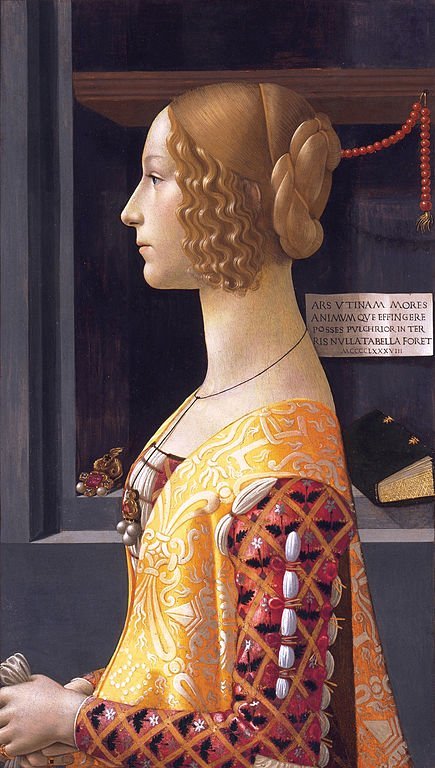
Portrait of Giovanna degli Albizzi Tornabuoni by Domenico Ghirlandaio

Portrait of Giovanna degli Albizzi Tornabuoni by Domenico Ghirlandaio (1488)

When you walk around an art gallery I wonder how long you spend in front of each painting.  I suppose it depends on the type of painting and whether it is part of a crowded special exhibition when you are jostled from one painting to the next by a crowded sea of viewers.  I suppose it also depends on your time management as if you are coming to the end of your allotted time you tend to jump from one picture to the next in a desperate attempt to not miss a single one, although in a way your hurried state probably means that the last few painting remain just a blur in your mind.   So why do I ask this question about time management and carefully appreciating the paintings before us?   The answer is that during a recent visit to the Thyssen-Bornemisza Museum in Madrid I had left the room, which housed the fifteenth century art collection till last and I was constantly aware that my time at the museum was running out.   I found myself flitting from one painting to another and I have to admit by doing so I failed to take in the beauty of the works in that section of the gallery.   That was until I came across two stunning works which I could hardly drag myself away from.  They were just such beautiful paintings.  Yes, I know beauty is in the eye of the beholder but for me they were truly exquisite.   I stood before them, totally mesmerised by their intrinsic charm and so I am dedicating my next two blogs to those two 15th century works. 
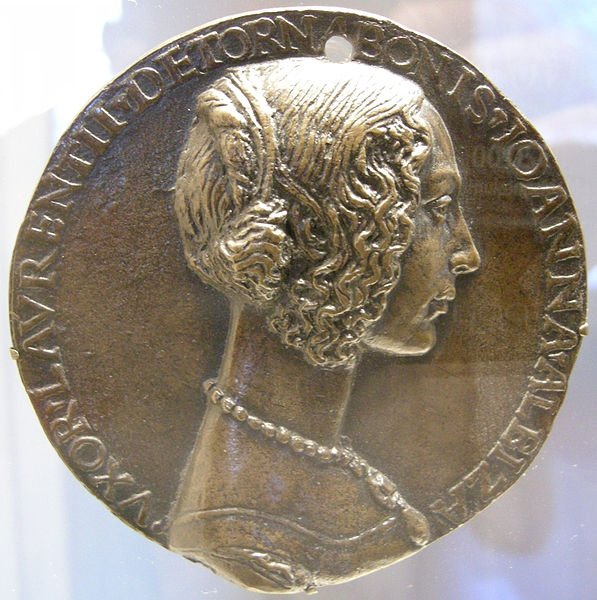
The Wdding Medalion
The Wdding Medalion

Today I want to offer you a beautifully crafted portrait by the 15th century Italian artist Domenico Ghirlandaio entitled Portrait of Giovanna degli Albizzi Tornabuoni which he completed in 1490 and which is now part of the permanent collection at Madrid’s Thyssen-Bornemisza Museum.   Giovanna was the wife of Lorenzo Tornabuoni who came from the wealthy Florentine banking family and whose father, Giovanni was Domenico Ghirlandaio’s patron.  We know this is the image of Giovanna as at the time of her marriage to Lorenzo a series of bronze portrait medals with her image were made to commemorate the event and the likeness of the figure on the medal and in the painting is undeniable.   Lorenzo and Giovanna married in June 1486 but sadly she died giving birth to her second son in 1488, at just twenty years of age.  As the portrait was completed after she died, it is thought that it could be looked upon as a kind of remembrance painting.   The painting hung in her husband’s private rooms in the Tornabuoni Palace.

We see Giovanna before us, half-length, in a somewhat rigid profile.  In her hands she clasps a handkerchief.  Giovanna is dressed in the most sumptuous way.  She wears a giornea which is an open-sided over-gown, which is brocaded.  The design on the brocade features the letter “L” and a diamond.   The “L” is her husband, Lorenzo’s initial and the diamond was the Tornabuoni family emblem.  There is no doubt that she is one of Florence’s élite by the way she wears her hair in the very latest Florentine fashion.  The jewels she wears around her neck comprise of two rings and pendant which were given to her by Lorenzo’s family as a wedding gift.  If you look closely at the pendant she wears you will also notice a matching brooch designed in the shape of a dragon which lies on a shelf behind her.   The jewel with its dragon, two pearls and a ruby formed a set with the pendant hanging from a silk cord around her neck.   Behind her, on the shelf, is a prayer book which is thought to be the libriccino da donna (little ladies’ book).  Above the book hangs a string of coral beads which have been identified as a rosary.   Ghirlandaio’s inclusion of this prayer book and the rosary in the painting was testament to Giovanna’s religious beliefs and her piety. 

What did Ghirlandaio think of his sitter?  Will we ever know?  Actually the answer lies within the painting itself because just behind Giovanna’s neck we can see attached to the shelf a cartellino.   A cartellino (Italian for small piece of paper) was a piece of parchment or paper painted illusionistically, often as though attached to a wall or parapet in a painting.  On the cartellino added by Ghirlandaio in this painting are the words:

ARS UTINAM MORES

ANIMUMQUE QUE EFFINGERE

POSSES PULCHRIOR IN TERRIS NULLA TABELLA FORET


which translates to:


“…Would that you, Art, could portray her character and spirit ;  for then there would be no fairer painting in the world..”.

At the bottom there is the date:

“MCCCCLXXXVIII”. (1488)

By these words there is no doubt Ghirlandaio is excusing himself to Giovanna for his belief that he has not been able to show her real inner beauty.  These are fine words from our artist but in fact they were not quite his own as they are a slight variation on the words of an epigram (a short and concise poem) of the Latin poet Marcus Galerius Martial, whose works were all the rage with the Florentine aristocracy of the day.

My featured artist today was born Domenico di Tommaso Curradi di Doffo Bigordi.  The name was derived in part from his father’s surname Curadi and the surname of his grandfather Bigordi.  He was born in Florence in 1449, the eldest child of Tommaso Bigordi and Antonia di ser Paolo Paoli.  His father was a goldsmith and was well-known for creating metallic garland-like necklaces which were worn by the ladies of Florence, and it was for that reason that Domenico was given the nickname Il Ghirlandaio (garland-maker).   Domenico worked in his father’s jewellery shop and it was during his time there that he started sketching portraits of customers and passers-by.   According to the famous biographer of artists, Giorgio Vasari, Domenico’s father decided to afford his son some formal artistic training and had him apprenticed to the Florentine painters, Alesso Baldovinetti and later Andrea del Verrocchio.

Domenico will always be remembered for his exquisite detailed narrative frescos in which he would incorporate portraits of the local aristocracy resplendent in their finery.  Many of his frescos appeared in local Florentine churches.  In 1482, he also completed a Vatican commission for Pope Sixtus IV – a fresco in the Sistine Chapel entitled Calling of the First Apostles.  The frescos he will probably be best remembered for were two major fresco cycles, which he completed with the help of his brothers, Davide and Benedetto along with his brother-in-law, Bastiano Mainardi, who was one of Domenico’s pupils.


The Resurrection of the Boy by St. Francis by Girlandaio
The Resurrection of the Boy by St. Francis by Ghirlandaio

The first of these frescos was for the Sassetti Chapel in the church of St Trinita in Florence.  It had been commissioned by Francesco Sassetti, a rich and powerful banker who worked for the Medici family.  This cycle of frescos was in six parts and depicted the life and times of St. Francis of Assisi, who was Sassetti’s patron saint. Seen within the frescos were a number of portraits of members of the Sassetti family along with some of the leading figures from the Medici family.  To look at the two families within the frescos one would be forgiven for coming to the conclusion that the Sassettis and the Medicis were very close, which of course was precisely the allusion Francesco Sassetti had wished to convey.  Alas for him, the close bond between the two families was all in his mind!

Visitation by Domenico Ghirlandaio

The second fresco cycle, Ghirlandaio’s last, and many art historians believe was his greatest, was commissioned to decorate the Capella Maggiore of the Santa Maria Novella Church in Florence by another banker, Giovanni Tornabuoni, who was related by marriage to the Medicis.   There was a connection between the two fresco cycles as Sassetti had the rights to decorate the Capella Maggiore of the Santa Maria Novella Church and he had wanted to have the frescos in the church depict the life of St Francis.   However the church was in trust to the Dominican order and they refused to allow such a design, so it was then that Sassetti decided to have the St Francis frescos painted instead in the Sassetti Chapel of the St Trinita Church in Florence and he sold the rite to decorating the Capella Maggiore to Giovanni Tornabuoni

 Ghirlandaio had not even completed the Sassetti fresco cycle when he was given this second large scale commission and he had to bring in most of the workers from his large Florentine studio to help him in this four-year project which was finally completed in 1490.  

The reason for talking about this fresco cycle is that I want you look closely at Ghirlandaio’s fresco, the part entitled Visitation.  Look at the third woman from the right.  Do you recognise her?   It is a full length portrait of Giovanna Tornabuoni who was the wife of Lorenzo Tornabuoni whose father, Giovanni was the commissioner of the fresco work and who was also my subject of today’s featured work.

The painting had a number of owners but in 1907 the American millionaire financier and philanthropist and founder of the J.P. Morgan bank,  J. Pierpont Morgan bought it in 1907.  It is believed that he adored the painting as it reminded him of his first wife, Amelia Sturgis, who like Giovanna had died very young.  She died of tuberculosis at the age of twenty-six, just four months after she and J.P. had married.   It entered the Thyssen-Bornemisza collection from the Morgan Library, New York, in 1935.

Whereas J.P. Morgan had his painting on view in his home to remind him of his wife I have a print of it on my breakfast room wall to remind me of Giovanna’s beauty as I serve guests with their breakfasts.

Frederic Edwin Church, Part 2

For those of you who have just landed on this page I suggest you go back to my previous blog which looks at Frederic Church’s early life and talks a little about his exhibition at the National Gallery, London which I visited last week.

Our Banner in the Sky by Frederic Edwin Church (1861)

Another beautiful and moving historical painting by Frederic Church which was on display at the exhibition and which I found very moving was a small oil painting entitled Our Banner in the Sky which Frederic Church completed in 1861.  I stood before this work, fascinated by the way in which Church had cleverly depicted the image of the Stars and Stripes American flag in tatters against an amazing daybreak landscape with its red and white bands of clouds.  Church had painted this shortly after the attack on Fort Sumter by General Beauregard and his Confederate troops in January 1861 , which signalled the start of the American Civil War, which tragically went on to cost so many American lives.   In the work we see a bare and tall tree slightly leaning over, which acts as a flagpole for the flag which blends in with the early morning sky.  In it, we see the North Star depicted through a patch of blue sky.  Church has cleverly managed to create a highly patriotic scene which in some ways connects the American landscape with the Northern cause.  It was a heartfelt cry for unity which sadly was not listened to. It was such a popular work that the Manhattan art dealer, Goupil & Co. commissioned Church to produce a chromolithograph of the work and, within a few months, hundreds of copies were bought up by the public.

Isabel Carnes Church by Frederic Church (1860)

It was during the New York exhibition of his Andes painting that Frederic Church met Isabel Carnes.  In 1860 just three months before his marriage to Isabel, Church bought some 126 acres of farmland, close to the towns of Hudson and Catskill and situated on a south sloping hill, overlooking the Hudson River.  He was familiar with this site as he had visited the area whilst on a painting trip with Thomas Cole in 1845.   As he still lived in New York, this new acquisition would be the family country get-away.   Church employed the foremost architect of the time, Richard Morris Hunt, to construct a cottage and design this ferme ornée.  The term means an ‘ornamented farm’, and describes a country estate laid out partly according to aesthetic principles and partly for farming.  Church and his wife referred to the small cottgae on the estate as their Cosy Cottage and it was surrounded by gardens and orchards and Church even had a section of marshland drained so as to build his own expansive ten acre lake.  Over time he bought up more of the adjoining land and eventually his estate encompassed 250 acres.

Fern Walk, Jamaica by Frederic Church (1865)

He and his wife lead a settled and happy life and he spent most of his time tending to his farm but his happiness was shattered in March 1865 when both his young children contracted diphtheria and died a week apart.  In an attempt to counteract the intense grief suffered after their children’s death, he and his wife along with some friends travelled to Jamaica where, for five months, Frederic immersed himself in a painting frenzy whilst his wife collected numerous species of ferns which she would later bring back home and which would form part of her fern garden.  Isabel’s interest in ferns and Frederic’s love of depicting nature in his painting were combined in his 1865 work entitled Fern Walk, Jamaica in which Church depicts a narrow path winding through luxuriant plants and ferns.  The shades of greens and browns which he used in depicting the native flora is breathtaking.  Frederic Church loved his stay in Jamaica.  He loved sketching plein air in the tropical light and, on his return to America, would often encourage other landscape artists to venture on painting trips to the Caribbean island.  In a letter he wrote to the landscape artist, Charles de Wolf Bramwell, he extolled the Fern Walk area of the island, writing:

“…the vegetation, next to that on the Magdalena River, the finest I ever saw –– The ferns, especially in the region known as Fern Walk — excelled every place…”

Ed Deir, Petra Jordan by Frederic Church (1868)

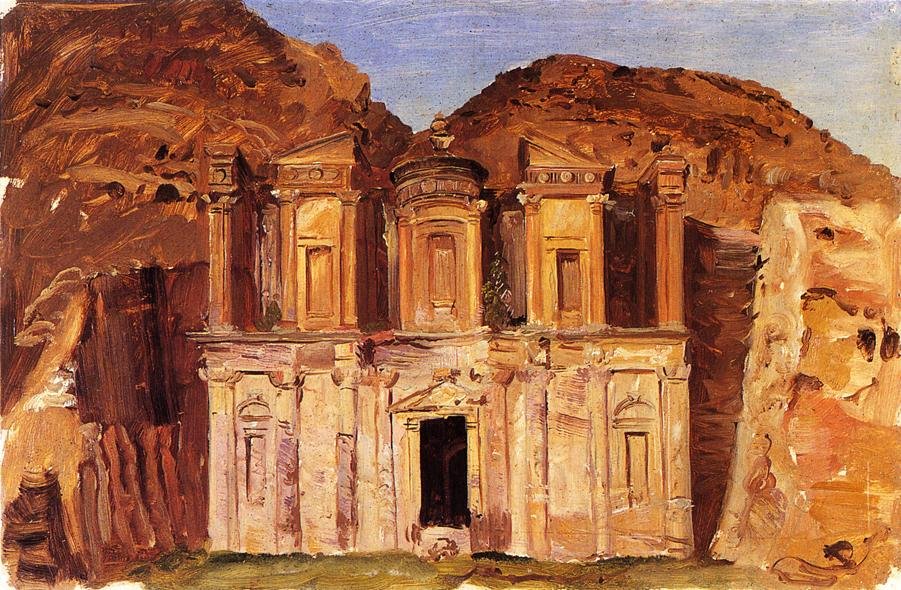
The couple returned home from Jamaica and in 1866 Isabel Church gave birth to a son, Frederic Junior.   The following year Frederic and Isabel, along with their son and Isabel’s mother, set off on a two-year long journey of Europe and the Holy Land.   They visited Jerusalem and from there headed to Jordan where Church, after an arduous ten day journey by mule, arrived at the ancient city of Petra.  During the long trip Church continually sketched and painted.  It was a trip which was fraught with danger from not only local bandits, but from the native porters which were helping Church’s party get to their destination.  These Arabs were very superstitious about his sketching but were eventually won over by his skill.  He finally arrived at Petra and made the long climb up above the city to the monastery of Ed Deir, which in the first century AD was a Nabatean temple.   Frederic Church completed his beautiful oil and graphite painting entitled Ed Dier, Petra, Jordan,   Unbelievable at it may sound but Church completed the work in just one sitting, in 1868.

Königsee by Frederic Church (1868)

From the Holy Land, Frederic Church returned to Europe visiting Rome and Athens and also the Bavarian Alpine region, Switzerland and Austria which had always been a popular venue for landscape painters.  Church was drawn to this area as he was always searching for beautiful vistas to paint.   He liked the area as he believed there was a marked similarity between the geography of the area and that of the rugged American landscapes which he knew so well.  In July 1868 he visited the Königsee, the beautiful Upper Bavarian lake which nestles amongst steep-sided cliffs.  Sheltered from the weather,  the surface of the lake is often mirror-like reflecting the surrounding mountains.   He completed a beautiful work entitled Königsee that month and it is a poignant reminder to me of the times I have visited the lake and stood in awe before it, mesmerised by its beauty.

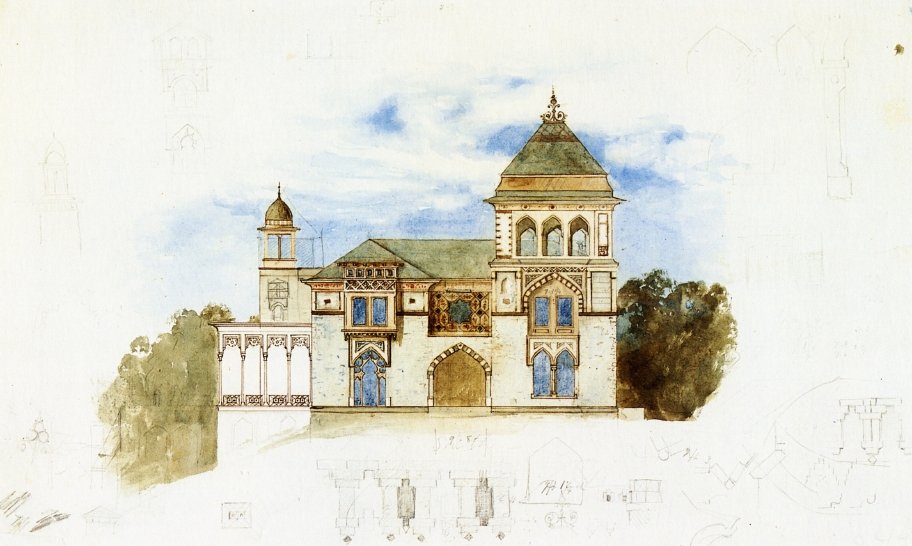
South West Facade of Olana by Frederic Church (1870)
South West Facade of Olana
A watercolour by Frederic Church (1870)

Frederic Church in 1867 was becoming homesick and wanted to return to America and his country estate.  Since he bought it seven years earlier he had been constantly planning the landscape design for the land and the architectural design for a large house on the top of the hill.  Richard Morris Hunt, his architect, had submitted plans for a large French chateau-style house and Church had liked the idea and agreed to the design.   However having returned from his tour of the Levant and studied the architecture of the area, he changed his mind.  He decided to discharge Hunt and take on the British-born American architect and landscape designer Calvert Vaux who was based in Manhattan and had in 1858, along with Frank Law Olmstead had won a design competition to improve and expand New York’s Central Park.

Olana Historic Site
Olana Historic Site

Frederic Church and Vaux worked on the plans for the design of the house which was to be the centrepiece of  Church’s estate, which he and his wife Isabel named Olana after a fortress-treasure house in ancient Persia which like Church’s estate also overlooked a river valley.  The building project was completed in 1872.

As Church got older he spent more and more time on his farm and concentrated his time running the estate.  From the 1870’s onwards Church suffered badly from rheumatoid arthritis which badly affected his right arm curtailing much of his art work although he did teach himself to paint with his left hand.  Frederic Church died in 1900, aged 74 and is buried in Spring Grove Cemetery in Hartford, Connecticut.

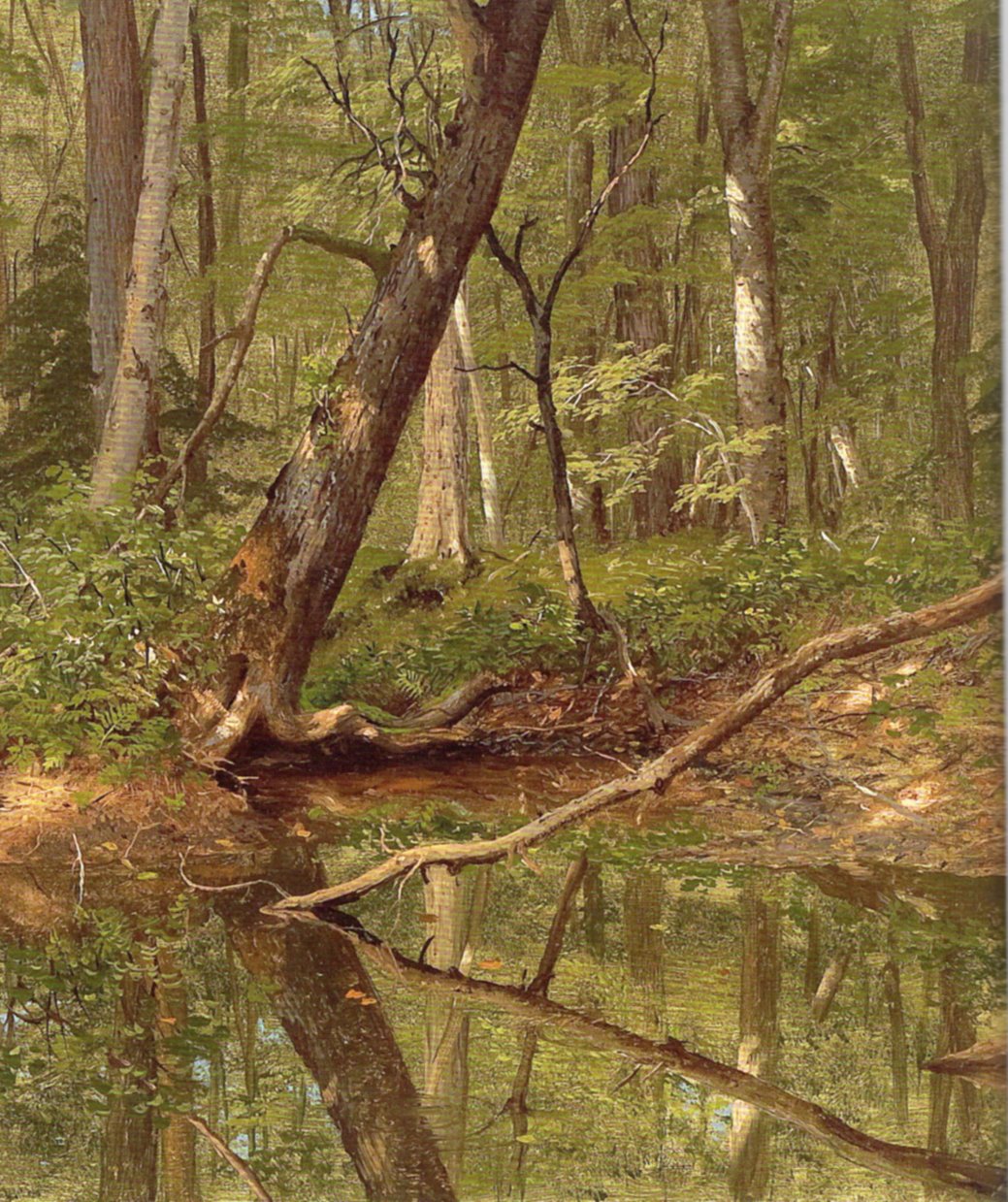
Forest Pool by Frederic Church (1860)

I will finish this blog with a look at the painting by Frederic Church, which most impressed me at the exhibition.  It is entitled Forest Pool and was completed by Frederic Church around 1860.  It was almost the first work I came across as I entered the exhibition room and I had to keep coming back to it in order to savour its beauty.   I stood before it and could not believe the quality of the painting.  Such beautifully drawn details.  Such beautiful colour and tones.  The work was a close-up view of a dense forest and a small forest pool.   Every square inch of the work is covered in rich shades of green and brown and although it was a study for a larger painting, it seems as if it is a finished work.  The artist has delightfully depicted the tranquillity of the forest scene with the calm surface of the pond offering up reflections of the trees and their branches and spots of sunlight.  If you look closely at the upper middle part of the composition you will just be able to make out a hint of blue sky which is otherwise blocked by the screen of trees.

The Frederic Church exhibition at the National Gallery is worth going to see for this painting alone.

“Moonlights” by John Atkinson Grimshaw

Moonlight, Wharfdale by Atkinson Grimshaw (1865)

Today I am featuring some works by the English Victorian painter John Atkinson Grimshaw, who was born in Leeds in 1836.  His father, David, at various times during his life, served as a policeman, worked for Pickfords and then as a Great Northern Railway worker in Leeds.  His mother was Mary Grimshaw née Atkinson.  John Atkinson Grimshaw was the eldest of six children.  He and his siblings were brought up in a very religious household with both his parents being strict Baptists.  He left school at the age of sixteen and became a clerk at the Great Northern Railway headquarters in Leeds.  It was whilst working and living in Leeds that he was able to visit one of the many art galleries and see the works of some of the Pre-Raphaelite painters such as Holman Hunt and Henry Wallis.  He also loved and was influenced by the works of the Leeds-born Pre-Raphaelite landscape artist John William Inchbold.   While he was employed as a clerk much of Atkinson’s free time was taken up by his love of art.  He was a self-taught artist who received no formal training.

In 1857 Atkinson Grimshaw married his cousin Frances Theodosia Hubbard and the couple went on to have twelve children although sadly only six survived to be become teenagers.  Of those who survived, many went on to become artists like their father.  In 1861, much to his parents’ horror Grimshaw, gave up his work at the railway company and decided to become a professional artist.   He first exhibited som of his art work in 1862 and at this time he had concentrated on still life works depicting fruit and blossom and some paintings of birds.  He also managed to gain his first commissions from the Leeds Philosophical and Literary Society.  Over time, Grimshaw developed his own highly individual style, and subject matter.   He became a talented painter of autumnal scenes and also works which depicted twilight and night time scenes, lit by moonlight reflected on the wet cobbled streets, sometimes depicting horse-drawn traffic and handsome cabs.  These were known as his “moonlights”.  His paintings would often depict street scenes swathed in fog and smog from pollution that so often enveloped cities and towns at that time.

Shipping on the Clyde by Atkinson Grimshaw (1881)

 He also painted many nocturnal harbour and dockyard scenes with the spiky outlines of the ships’ masts rearing up against a darkening sky.  Examples of this type of work can be seen in his paintings such as Liverpool from Wapping (1875), Nightfall down the Thames (1880),  Shipping on the Clyde (1881),  The Thames by Moonlight (1884),  Liverpool Quay by Moonlight (1887) and Prince’s Dock, Hull (1887).   Grimshaw’s works were more varied than just this as he painted many portraits, fairy pictures, and the most elaborate pictures of attractively dressed young women in opulent interiors.  During his early period he signed his paintings “J.A. Grimshaw” or “JAG” but in 1867 Grimshaw dropped his first name, John, and from then on signed his works “Atkinson Grimshaw”.

Atkinson Grimshaw always considered himself to be a Northerner, a Yorkshire man and Leeds, for most of his life, remained his base.  Grimshaw rarely travelled to London although he did set up a studio and live there for a short time in the mid 1880’s, and it was during this time he became friends with James McNeil Whistler.  His reputation as an artist was further enhanced when one of his paintings was accepted for exhibition at the Royal Academy.   However the fact that over the years, he only ever submitted five of his paintings to the Royal Academy  probably meant that he set little store by what the RA could do for him and he knew he had numerous northern business men queuing up to buy his work.  Over time, he slowly built up a large clientele for his work, including some London art dealers, especially the William Agnew Gallery, and with this artistic success came wealth, so much so that in 1870 he was able to move his family into Knostrop Hall on the outskirts of the city.

Knostrop Old Hall, Leeds by Atkinson Grimshaw

Knostrop Hall was a magnificent 17th century stone-built manor house, which featured in many of his paintings.  He also had a house in Scarborough for use in the summer.  He called it Castle-by-the-sea.

Atkinson Grimshaw died of cancer in October 1893 at Knostrop Old Hall, and was buried in Woodhouse cemetery in Leeds. He was especially appreciated by middle-class clients, many of whom were northern industrialists.   Grimshaw’s dock scenes of Liverpool, Hull and Glasgow, and the manor houses seen at the end of leafy, stone-walled suburban lanes, along which a single figure walks, were especially popular.

Atkinson Grimshaw had campaigned for a number of years for the building of Leeds City Art Gallery.  After much wrangling and a prolonged struggle with the authorities the Leeds Art Gallery opened in October 1888 and was financed by public subscription, collected in honour of Queen Victoria’s Golden Jubilee in 1887. The artist Hubert Herkomer formally opened the building, and presented an example of his work to the collection.  The Gallery mounted annual spring exhibitions in which Grimshaw always put forward works for inclusion.

 Atkinson Grimshaw had a unique style and is remembered as one of the minor Victorian masters and his place in art history will be assured by his depiction of Victorian life and his haunting moonlight which became his trademark.

Having said that, there was an element of controversy about his work.  As I said at the start of his biography, Atkinson had not received any formal artistic tuition, got married at the age of twenty-one and four years later despite now being a family man, had given up his job as a railway clerk to become a professional artist.  He had now to make money from his art work and to do this had to reach a level of artistic competence which would guarantee that his work would sell.  So how did he achieve such a feat?   John Ruskin, the art critic had recommended that artists should paint directly from nature but to do this one had to have had some training in draughtsmanship and perspective and so Atkinson Grimshaw in a way decided to “cheat”.   He discovered that by projecting a photograph or a lantern slide on to a blank canvas he was able to produce an immediate composition.  Then he would go over the outlines in pencil.  Over which he would add colours and the end result was a glossy finish which had removed all traces of the pencilled outline.  The finished landscapes and cityscapes sold well and for a time made him very wealthy.  However despite his success, other artists who had studied and trained in traditional academic methods for years despised his productions and in one of Grimshaw’s obituary notices it was written:

  “…[his pictures] excited considerable controversy among contemporary artists, not a few [of whom] were doubtful whether they could be accepted as paintings at all…

To be fair to Grimshaw the technique he used would not have caused such controversy nowadays and the question remains, does the end justify the means?  So let me finish with a kinder obituary notice which simply stated:

“…A Leeds artist of very great ability has passed away.  He may be regarded as self-taught in all that gave character and distinction to his art. His methods, treatment and colouring were quite unlike anything in ordinary practice…”

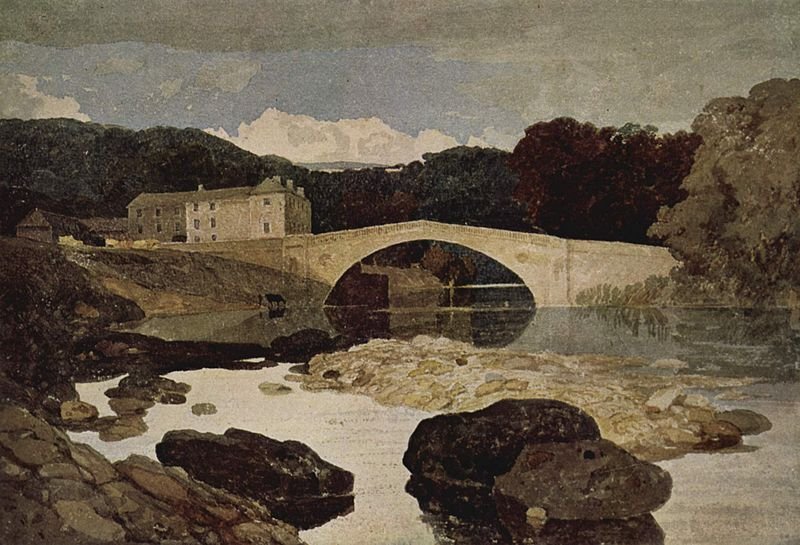
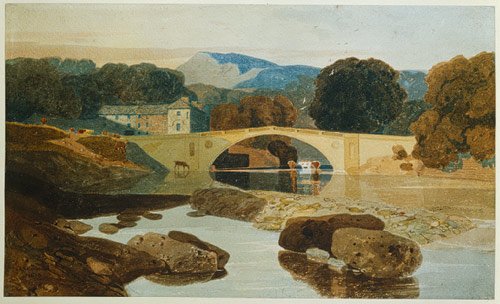
Greta Bridge by John Sell Cotman

Greta Bridge by John Sell Cotman (1805)British Museum
Greta Bridge by John Sell Cotman (1805)
British Museum

I try to visit my children, who live in London, every couple of months and take the opportunity to visit new art exhibition at one of the many city galleries.  As they are all away on extended breaks in far-off lands I will not be heading south until the end of January and this will sadly mean I will miss the Dulwich Picture Gallery exhibition, Cotman in Normandy which is an exhibition of works by the watercolourist, John Sell Cotman, which ends on January 13th.  For most of the twentieth century, Cotman was the most widely admired English watercolourist, surpassing even Turner in popularity.

John Sell Cotman was a marine and landscape painter, mainly in watercolour, who was born in Norwich in 1782.  He was the eldest of ten children.  His father, Edmund Cotman, formerly a barber but latterly a draper by trade, had married Ann Sell.   He initially studied at the Norwich School, which is one of the oldest schools in the world having been founded in 1096.   John’s father had intended that once his son had completed his education he would join him in his family business.  However during his time at school John Cotman had developed a love of art and being determined that he would not spend his working life behind a shop counter, at the age of 16, left home and went to London to study art.

Whilst in London he managed to earn a living by colouring aquatints for Anglo-German lithographer and publisher, Rudolph Ackerman, who in 1795 established a print-shop and drawing-school in The Strand.   Ackermann had set up a lithographic press and begun a trade in prints. It was whilst he was in London that he also met Doctor Thomas Monro, who was an avid art collector.   He was Principal Physician of the Bethlem Royal Hospital and one-time consulting physician to King George III.  Besides being an amateur painter and art collector he was also a patron to a number of young aspiring artists including Thomas Girtin.  He had a house in Adelphi Terrace, London where he had his studio and a country house in Merry Hill, a suburb of Bushey just fifteen miles from the capital.  Monro liked to surround himself with other artists and J.M.W. Turner was a frequent visitor.  He ran an art Academy where he would offer evening art classes, some of which were attended by John Sell Cotman.

John Sell Cotman managed to gain the patronage of Monro and through him met many of the leading British artists of the time and it was through his friendship with Turner, Girtin and Peter de Wint that Cotman continued his artistic development.  He enjoyed taking trips out to sketch and it is believed that in 1800 he accompanied Thomas Girtin on a sketching trip to North Wales. Considering Cotman had had no formal art tuition it is amazing the artistic standard he had reached for someone of such a young age for when he was aged just eighteen, he first exhibited at the Royal Academy  showing five works, four depicting scenes from the Surrey countryside and one was of Harlech Castle.   The following year, 1801, John Cotman joined the Brothers, a sketching society, founded by Thomas Girtin, for both professional artists and talented amateurs. During the next two summers he spent much of his time travelling around Wales, sketching scenes many of which were exhibited at the Royal Academy in 1801 and 1802.

For the next three summers John Cotman spent time at Brandsby Hall in North Yorkshire, which was the home of Francis Cholmeley, an avid art collector and a patron of Cotman.  During his stay at the Hall, Cotman acted as the drawing tutor to the Cholomeley family.  Whilst there he also met the politician and art collector, Walter Ramsden Hawkesworth Fawkes, whose stately home was Farnley Hall and who was a very close friend of the artist, J.M.W. Turner who often stayed at Farnley Hall.

The success he had hoped for in London never materialised and in 1806 Cotman returned to his hometown of Norwich and earned his living as an art tutor.  On returning home he also joined the Norwich Society an art society formed the previous year by the Norfolk landscape painter John Crome.  This society met fortnightly, held artistic discussions and organised exhibitions of their work.  John Cotman became the vice president and he and Crome were the leading lights of the society.  The ethos of the Society was laid down as being:

“…An Enquiry into the Rise, Progress and present state of Painting, Architecture and Sculpture, with a view to point out the Best Methods of study to attain to Greater Perfection in these Arts…”

The artistic styles of Crome and Cotman were different and the Society members were, to some extent, divided into those who followed Crome’s realist manner, and those working in the more free style of Cotman, who was not above painting pictures of places he had not personally visited, working from other artists’ sketches.  The subjects of the Norwich School painters were typically landscapes, coasts and marine scenes from around Norwich and Norfolk.  John Cotman became president of the Norwich Society of Artists in 1811.

In 1809, Cotman married Ann Mills, the daughter of a farmer from the nearby village of Felbrigg and the couple went on to have five children.  During his time as a drawing master he taught the local banker, botanist and antiquary Dawson Turner and his children.  They became close friends and Dawson Turner introduced him to many prospective students. Cotman issued the first of his sets of etchings in 1811. He moved from Norwich and for the next ten years he lived in the Norfolk coastal town of Yarmouth and this gave him the opportunity to complete a number of seascapes.   It was around this time that Cotman concentrated on printmaking.  The majority of his etchings were architectural in nature, with numerous ones of old Yorkshire and Norfolk buildings.  It is more than likely that this move towards etchings and printmaking was due to, and inspired in part by, his friend and patron, Dawson Turner.   In 1817, Cotman , with help from his patron, made the first of three tours of Normandy and out of these journeys came a book in 1822 entitled, Architectural Antiquities of Normandy, one of various books he illustrated with his etchings.

In 1824, for business reasons he moved back to Norwich.  Cotman took up painting again with renewed energy, in watercolour and in oil; he exhibited more frequently in the city and also in London. In January 1834, through the good auspices of J.M.W.Turner, he gained the post of Master of Landscape Drawing at King’s College School in London, which he held until his death.  He and his family moved home to the London borough of Bloomsbury. Two years later, his eldest son Miles Edmond Cotman was appointed to assist him.  The taking up of the position at King’s College could not have come at a more fortuitous time as Cotman was beginning to have financial problems.   Sadly, with these financial problems, which had afflicted him during most of his working life, came bouts of depression, ill health and despondency brought on by the poor sales of his work.  During John Cotman’s tenure at King’s College he taught many artists including Dante Rossetti.  His last visit to his homeland of Norfolk was in the autumn of 1841, just nine months before his death in London in July 1842.

The 20th century art historian and painter, Charles Collins Baker, said of John Sell Cotman:

“…a great colourist, whose earlier palette produced that rare plenitude that only masters of exquisite simplicity and restraint compass: from his palette the brown glebe, the black reflection of massed trees in a still river, the grey and gold of weathered stone and plaster, the glinting gold on foliage and the gilded green of translucent leaves have a special and supernal quality of dream pageants rather than of actuality…”

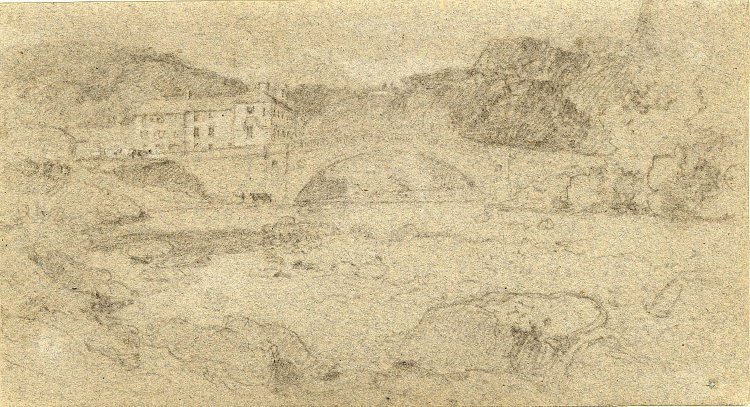
Preliminary sketch of Greta Bridge by John Sell Cotman

My Daily Art Display featured painting today is a watercolour entitled Greta Bridge (22cms x 33cms), which Cotman completed in 1805 can be found in the British Museum. A second version of the painting, a much larger one, (30cms x 50cms), was completed by Cotman in 1810 and is housed in the Norwich Castle Museum.  Both watercolours recreate the rural solitude and tranquillity of the Greta area of North Yorkshire, where Cotman spent the summers of 1803 – 1805.   The Greta Bridge in this painting  spanned the river Greta in North Yorkshire near the gates of Rokeby Park. John Cotman had arrived at Rokeby on the evening of 31 July 1805, accompanied by his friend and patron, Francis Cholmeley. It had been arranged in advance that the two men were to stay as guests of the owner of Rokeby Park, John Bacon Sawrey Morritt.  Cotman stayed at the house for about three weeks and when his hosts left on business, he remained nearby, taking up lodgings in a room at the local inn, which is the large building to the left of the bridge. Cotman then continued the work he had begun along the river Greta that skirts the park.  It is a wonderfully balanced composition depicting the Greta Bridge, with its striking, single arch, which runs horizontally across the picture, in some way dividing it in two and yet uniting it into a single scene.  The arch of the bridge epitomizes a great feat of engineering, which Cotman, with his love of architecture, admired. The structure we see before us was designed by John Carr of York, and built in 1773 for Morritt’s father, John Sawrey Morritt, who was a well-known collector of classical antiquities. The bridge replaced a Roman single-arched bridgeof the same design.  Cotman had a love of bridges and sketched many.  For him, a bridge was a meeting point or landmark for travellers, and would often be a point of reference on maps where rivers and roads meet. Cotman was fascinated by the interaction of this man-made feature and how it harmoniously interacted with a natural setting

Greta Bridge by John Sell Cotman (1810)Norwich Castle Museum
Greta Bridge by John Sell Cotman (1810)
Norwich Castle Museum

The foreground of the painting is dominated by its rocky intrusions. In the background, above the bridge we see in the 1805 version, a forest of trees and  large white clouds and yet in the 1810 version a mountain ridge, which, in reality, does not actually exist, has substituted the individual clouds. So why did he make this fundamental change and add the idealised rocky structure?  It is believed that Cotman decided to add the mountain ridge in the later watercolour so as to strengthen the sense of perspective and by so doing have the viewers eye drawn through the landscape, starting from the rocks in the foreground, through the arch of the bridge to the trees in the middle ground as far as the mountain ridge and the sky in the background.

Although John Sell Cotman and Turner were strongly influenced by the work of Thomas Girtin, Cotman’s landscape style in comparison to Turner’s was different.  Cotman’s landscapes were not as detailed as either Girtin’s or Turner’s.  In his landscapes, Turner’s was more precise with the details.  Many believed his “every-single-branch-and-bud” precision was somewhat overwhelming, and said that the result was that the viewer stared at the same copse for too long.   In contrast, Cotman’s landscapes could be taken in with just a single glance.  In today’s work one can see the beauty of the watercolour despite the lack of minute detail.  In these watercolours, Cotman strived to capture the feeling and atmosphere of a place through the use of pattern and abstract shapes. Look how he has painted the boulders, which we see in the river.  They are smooth, rounded shapes sprinkled with spots of colour.  Cotman’s technique of using colour washes has accentuated the smooth roundness of the landscape.  His trees are rounded and block-like, in varying shades of green and brown and in the 1810 version the mountain ridge in the background is softly shaped.

This watercolour is a prime example of his balanced and sensitive technique which he used in his landscape work.   In this work he has used very muted colours for his high cloudy sky, which echo the colour of the river surface.  Below the dark clouds we see a suggestion of better weather to come with a hint of blue sky and thick white clouds.  The watercolour is built up in distinct patches of restrained colour, held in a precise pattern of tone and line, which were the hallmarks of Cotman’s inimitable style. The presence of the sun and the large trees around the flowing river causes crisp shadows on the building, bridge and water surface.

I love this watercolour and would love to visit Norwich were a number of his works are housed.  It would also be good to visit the Greta River area and take in the landscape, which inspired this talented artist.

Bringing in the Maple Sugar by Grandma Moses

Bringing in the Maple Sugar by Grandma Moses (1939)

Grandma Moses – Part 2

This is the second part of my story about Grandma Moses and if you have just alighted on this page, you should go back to my last blog in which I looked at her early life.

I ended my last blog about Grandma Moses in the year 1927.  This was the year when her husband of almost forty years, Thomas Salmon Moses, died and Anna May Robertson Moses became a sixty-seven year old widow.  Following her husband’s death, she remained on her Mount Nebo farmstead along with her youngest son Hugh, who took over the running of the farm along with his wife Dorothy.  One of Grandma Moses’ other daughters, Anna, lived close by in the town of Bennington with her husband Frank, who was her first cousin, and their two children Walter and Thomas.   Anna had contracted tuberculosis and had become very ill.  Grandma Moses spent a lot of time with her and her family taking care of her two grandchildren.  Anna Moses died in 1933 and Grandma Moses stayed on at their Bennington home for the next two years looking after her son-in-law and his children.  This arrangement continued until 1935, at which time Frank Moses remarried and Grandma Moses was then able to return to her home.

Over those past years Grandma Moses found more time to carry on with her embroidery and needlepoint work.  Once when her sister Celestia came to Mount Nebo for a visit she saw some of her sister’s work and suggested that she should concentrate more on painting rather than embroidery.  This advice, together with the fact that Grandma Moses was suffering badly from arthritis of the hands, persuaded her to heed her sister’s advice and she began to concentrate all her artistic efforts, not in yarn but in oils.

I ended my last blog by mentioning Grandma Moses “big break” as far as her artistic opportunities were concerned.   This came in 1938 when her daughter-in-law, Dorothy persuaded her to let her take some of her embroidered work and painted pictures down to the Woman’s Exchange in the W.D. Thomas drugstore in Hoosick Falls and it was at this point that fate stepped in and took a hand,  for passing through the town during his Easter vacation was Louis Calder, a New York amateur art collector and engineer.  He spotted Grandma Moses’ works displayed in the drugstore window, priced between $3 and $5 and he bought them all.  He then enquired about the artist of his recent acquisitions and went to visit her.  He then bought a further ten of her works.

Louis Calder returned to New York and tried to interest people in Grandma Moses’ works.  There was little interest.  Somewhat despondent Calder had virtually given up hope of re-selling his newly bought acquisitions.  However the following year, 1939, he got to hear about an exhibition being held in the Members Room of the city’s Museum of Modern Art that was to open on October 18th and run for a month.  The exhibition was to be entitled Contemporary Unknown American Painters.  Calder went to the organiser of the show, Sidney Janis and showed him the works of Grandma Moses which he had just bought the previous year.   Janis agreed to exhibit three of the paintings, Home,  Maple Sugar Days and The First Automobile.   None of the paintings sold but Calder was not disheartened and contacted Grandma Moses urging her to produce further works for him.

In the meantime Louis Calder went on searching for prospective buyers for the paintings.  It was at the end of 1939 that he heard of a new gallery, Galerie St Etienne, which had recently been opened by Otto Kallir on Manhattan’s West 57th Street.   In 1938, Otto Kallir, then known as Otto Nierenstein, was one of Vienna’s most prominent Jewish art dealers but had fled the Nazi regime and emigrated to the United States.  He then, in 1939, established his gallery and helped to introduce Expressionism to America.   Later in the 1940’s and 1950’s, Kallir would give numerous important Austrian and German modernists, including Gustav Klimt, Oskar Kokoschka, Alfred Kubin, Paula Modersohn-Becker and Egon Schiele their first American exhibitions in his gallery.   Otto Kallir was known to be interested in folk art and primitive art and so Louis Calder arranged for him to see some of Grandma Moses’ art work.

One of the paintings which Kallir really liked was entitled Bringing in the Maple Sugar and it is this painting which I have featured in My Daily Art Display blog today.   Grandma Moses completed the work in 1839 and it depicts a sugaring-off scene in which people are collecting sap from the maple trees.  It is a winter scene set in a snow-covered clearing and we can see people busying themselves with the task in hand of collecting the precious tree sap to be used in making maple syrup.  Once the sap is collected in the buckets it is carried over and poured into kettles which dangle over fires.  Besides the hard-working adults in the scene, Grandma Moses has added the figures of children happily playing in the snow and waiting for some maple syrup candy which is being prepared by a man on the left who is busily stirring the pot.   To the right of the picture we can see a horse-driven sleigh loaded with timber which will be used to keep the fires burning.  In the left mid-ground we see a team of oxen approaching, pulling their sleigh full of wood.  It is a painting full of activity but what impressed Kallir most of all was not the way the artist had painted the figures, which he considered rather clumsy, but the way she had painted the landscape background.  He commented that although he believed Grandma Moses had never heard of any rules of perspective, she had managed to achieve an impression of depth in the way she had depicted the tall bare trees in the foreground to smaller ones in the background and the clearly outlined larger figures in the foreground to the smaller, hazy-detailed figures in the background.   He also liked how she had almost merged the smoke which billowed and rose from the chimney of the hut and the bluish gray sky of an early morning in winter.  For Kallir it was Grandma Moses’ ability to convey a true atmosphere and a oneness with nature that appealed to him.

Otto Kallir agreed to exhibit Grandma Moses’ works in a “one-man show” at his gallery.  It opened on October 9th 1940 and was entitled What a Farm Wife Painted and consisted of thirty-three of her paintings and one of her embroidered works.  The New York Times of October 8th previewed the exhibition and part of the article read:

“…Mrs Anna May Robertson Moses, known to the countryside around Greenwich, New York, as Grandma Moses, began painting three years ago, when she was approaching 80…”

From that day on Anna Mary Robertson Moses became known as Grandma Moses.

The Old Hoosick Bridge by Grandma Moses

The Old Hoosick Bridge by Grandma Moses (1847)

For the last few blogs I have been looking at the lives of artists who were taken from us at a very young age, and in very sad circumstances.   I looked at the lives and works of the French artist Fréderic Bazille and the English painter Brian Hatton both of whom gave up their lives for their country on the battlefield at the age of twenty-nine and in my last two blogs I showcased the life and work of the German Expressionist Paula Modersohn-Becker who died suddenly after giving birth to her first and only child at the young and tender age of thirty-one.  The three painters promised so much and we were cruelly robbed of their artistic talents.  For my next three blogs I wanted to lift spirits and talk about an artist who did not die young, in fact lived to the age of 101.  She is probably far better known in her native America than in the rest of the world.  Let me introduce you to Anna Mary Robertson Moses who became better known as Grandma Moses, the most famous of American naive painters.  Naive art is defined as art produced in more or less sophisticated societies but lacking or rejecting conventional expertise in representational skills.  It is art that is often typified by a childlike simplicity in the subjects it depicts and in its methodology.   There is often a lack of perspective, with objects being depicted the same size notwithstanding whether they are in the foreground or background.  Again, there is no diminishment in detail or strength of colour between objects in the foreground and the background.  There is a simplicity about this type of art and it has become ever more popular.

Anna Mary Robertson was born on September 7th 1860, on a farm in Greenwich, upstate New York.  She was the third of ten children born to Russell King Robertson, a flax grower, and Margaret Shannahan.    She had a simple and happy early life and she recalled those happy days some eighty-five years later in an autobiographical sketch of her early life which she wrote in 1945:

“…I Anna Mary Robertson was born back in the green meadow and wild woods, on a Farm in washington, Co., in the year of 1860, Sept 7, of Scotch Irish Paternal ancestry.   Here I spent my life with mother Father and Sisters and Brothers, those were my Happy days, free from care or worry, helping mother, rocking Sisters cradle taking sewing lessons from mother sporting with my Brothers, making rafts to float over the mill-pond, Roam the wild woods gathering Flowers, and building air castles…”

Her schooling was limited.  She attended a one-room schoolhouse with her brothers and sisters.  She said that schooling was just confined to three months in the summer and three months in the winter but few young girls went to school in the winter as it was so cold and they did not have enough warm clothing.   When she was twelve years of age, she left home and for the next fifteen years she earned a living as a “hired girl”, working at neighbourhood farms.  The work was often hard but she recounted how she benefited from the experience:

“….I left home to earn my own living as then was called a hired girl.   This was a grand education for me, in cooking, House Keeping, in moralizeing and mingleing with the outside world…”

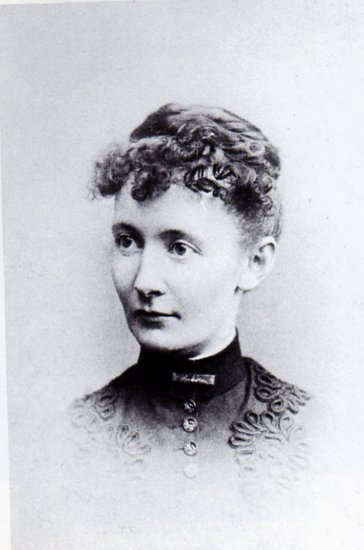
Anna Mary Robertson
the bride (1887)

She spent time living with the Whitesides family who she liked and they looked upon her as one of their own.  They were an elderly couple, devout Presbyterians and every Sunday she would drive them to church in their horse and carriage.  The wife, who was an invalid, was quite ill and Anna for three years cared for her.   When she died she stayed and looked after the husband and his nephew and wife moved in to run the farm.  Anna stayed until Mr Whiteside died and after that just drifted away from the neighbourhood still working as a “hired girl”.

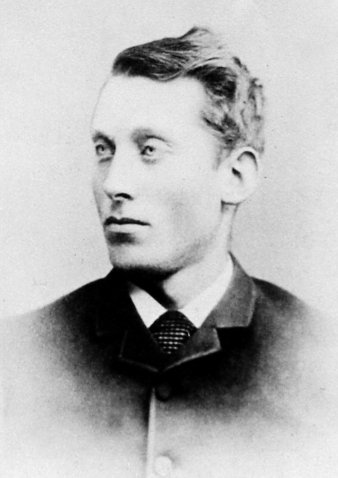
Thomas Salomon Moses
the bridegroom (1887)

In 1887, at the age of 27, she married Thomas Salmon Moses, a farmer by occupation, and the couple left the area for North Carolina, where they were going to run a horse ranch.  However they never made it to North Carolina as once they arrived in Staunton Virginnia, they were offered the chance to run a farm.  The farm had lost all its coloured workers after the war and people were desperate to employ others to fill their places They accepted the offer and lived there for a year before moving on to live and work on a six hundred acre dairy farm.  She wrote about her life there:

“… Here I commenced to make Butter in pound prints and ship to the White Sulphur Springs, W, Va.   I also made potato chips, which was a novelty in tho days, this we continued for several years…”

She gave birth to ten children, five of whom died in infancy. In a letter she looked back at that time with the birth and death of her children, writing:

“… Here our ten children were Born and there I left five little graves in that beautiful Shenadoah Valley…”

She, along with her husband and their five surviving children, Winona, Forrest, Lloyd, Anna and Hugh, left Virginia at the end of 1905 and moved north to the hamlet of Eagle Bridge in Rensselaer County, New York State which was not far from her birthplace.  The couple bought a farm, which was known locally as Mount Nebo, named after Moses’ biblical resting place and went into the dairy business, selling milk.  Over the years one of her daughters, Anna, got married and left home and two of her sons, Forrest and Lloyd, went to live on a farm which they had bought themselves.   In 1927 Anna’s husband Thomas died and their youngest son Hugh and his wife Dorothy took over the running of the farm.  Anna Mary Moses was then sixty-seven years of age.

You may find it strange that up to this point in my account of Anna’s life I have never mentioned her art.  I haven’t mentioned drawing lessons or her desire to be an artist.  The reason is quite simple – art never became a serious part of her life although her father, whol liked to draw,  would give her and her brothers paper and he would like to watch them all draw pictures and she would often colour her drawings using grape juice or juice from other berries.  However with all her work as a “hired girl” and later as a young wife she never had time on her hands to continue with her painting.  However, soon after her husband died  and she was becoming too fragile to carry on with her housework, she needed something to occupy her time, as she wrote in her autobiographical sketch:

“…Here Jan 15, 1927, my Husband died, my youngest son and wife taking over the farm,

Leaving me unoccupied, I had to do something, so took up painting pictures in worsted, then in oil…”

The Old Hoosick Bridge 1818
Embroidery by Grandma Moses

My Daily Art Display featured painting today is entitled The Old Hoosick Bridge which Grandma Moses painted in 1947.  The reason for featuring this work, although she painted it when she was 87 years of age, was that she had in her early days depicted a similar scene, but as a work of embroidery, which was entitled, The Old Hoosick Bridge, 1818. (above)   Initially Anna started making pictures out of worsted wool which she designed herself and were awash with very bright colours.  This scene was typical of her early works which were from memories of her early childhood and as a farmer’s wife.  The old covered bridges were landmarks in her early days but at the time she painted this picture the bridge had well gone.

In my next blog I will continue with her life story and recall how she got her big “break” as far as her art was concerned.

James Tissot and Kathleen Newton

Kathleen Newton in an Armchair by James Tissot (1878)

My blog today is the second part of the life of the French painter James Tissot.  In my last offering I looked at one of his beautiful and unusual religious paintings and I told you a little about the life of the artist but purposely left out his relationship with the special lady in his life, which I wanted to save for today.

In 1870 France was in turmoil.  The Franco-Prussian war had broken out, which was the conflict between France, under Napoleon III and the Kingdom of Prussia and was the final straw in the conflict between the two nations.  France was defeated and Paris was eventually occupied by the Prussian army.  Tissot was a member of the Garde Nationale which was tasked with defending the French capital and later became a member of the Paris Commune, which was a quasi-government that briefly ruled Paris and acted as protectors of the Parisians and their property from March to May in 1871.   However, Tissot, whether through business reasons or concerns he had for his personal safety, decided to leave his homeland and that year went to England where, through his art, he had built up a network of friends and business contacts.  One of these was Thomas Gibson Bowles, the proprietor of the popular magazine Vanity Fair.  Bowles not only provided Tissot with a place to stay in London but he also employed him as a caricaturist on the magazine.  Whilst in London Tissot also exhibited at the Royal Academy.  As was the case when he was in France, Tissot depicted in his paintings many of the chic ladies of London and he was a genius in the way he depicted them bedecked in the most expensive and sumptuous clothing which he carefully detailed.   These paintings were very popular and soon, through their sales, he managed to buy his own house in St John’s Wood, which, at that time, had become a popular and much sort after enclave for artists.  Tissot was not only admired as a great artist by the London Society but through the auspices of Thomas Bowles he was given entry into the social and artistic circles of London.

This particular time, 1874, was the starting point for the French Impressionists and his friend Degas tried to persuade Tissot to exhibit at their first exhibition but he declined the offer.  His decision to refuse to exhibit did not in any way cut him off from his Impressionist friends as he remained great friends with Berthe Morisot who visited him at his London home and also he remained very friendly with Edouard Manet.  The following year, 1875, the two travelled to Venice on a painting trip. It was around 1875 that he first met Kathleen Newton, a stunningly beautiful divorcee and it was Tissot’s relationship with her that afforded him, as an adult, his only period of a real family life.  She would dominate the subject matter of his paintings.

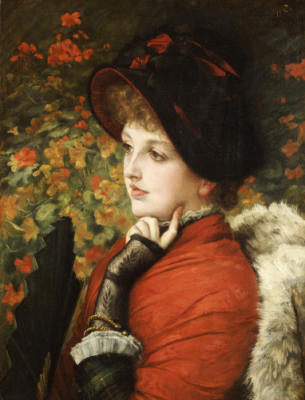
A Type of Beauty by James Tissot (1880)

Kathleen Irene Ashburnham Kelly was born in 1854 and brought up in Lahore and Agra.  She was the youngest of five children and came from an Irish Catholic family.   Her grandfather, Charles Kelly, left Ireland and practiced medicine in London. His son, and Mary’s father, Charles Frederick Kelly joined the East India Company and was stationed in Lahore where he worked as a clerk.  He married Flora Boyd, whose family came from the North of Ireland, and the couple had five children, Charles (Charley), Frederick WD (Freddie), George Lloyd (George), Mary Pauline (Polly) and Kathleen Irene (Kate).   In 1858, Charles Kelly, who had now added the family name “Ashburnham” to his own name, was transferred to Agra.   Kathleen’s father finally achieved the rank of chief adjutant and accountant officer in Agra and eventually retired around 1865, left India and returned with his wife and daughters to live in London.  When Kathleen was sixteen she travelled back to India to marry Isaac Newton, who was a surgeon attached to the Indian Civil Service. This was to be an arranged marriage orchestrated by her father and she had little or no input into the choosing of her future husband.

During the sea passage to India she was befriended by a Captain Palliser of the Bengal Rifles regiment who was returning to the sub-continent to rejoin his regiment.  (Other versions of her life state that Palliser, although a captain, was a naval officer).  Their friendship grew during the long sea passage and they became lovers and despite his pleas to her to cancel her wedding plans, she and Isaac were married in January 1870.  Being a devout Catholic, Kathleen decided to tell the local priest of her affair with Captain Palliser.  For him to forgive her of her sins the priest told her she should first tell her husband about this relationship.  She took the priests advice and told her husband who was horrified and as their marriage had not been consummated; her husband immediately instigated divorce proceedings on the grounds that his wife had not been a virgin on her marriage day.  Kathleen returned to England, the sea passage being paid for by the lovestruck Captain Palliser, who accompanied her, as a gesture of good will for her agreeing to be his mistress.  Their affair continued and she became pregnant but still refused to marry him.    When she arrived back in England she went to stay with her father, who was at the time courting a widow.  Kathleen’s daughter Muriel Mary Violet Newton was born there on 20 December 1871, which was also the same day as her Decree Nisi came through.   Later Kathleen and her daughter Violet went to live with her sister Polly and her husband at Hill Road, St John’s Wood.

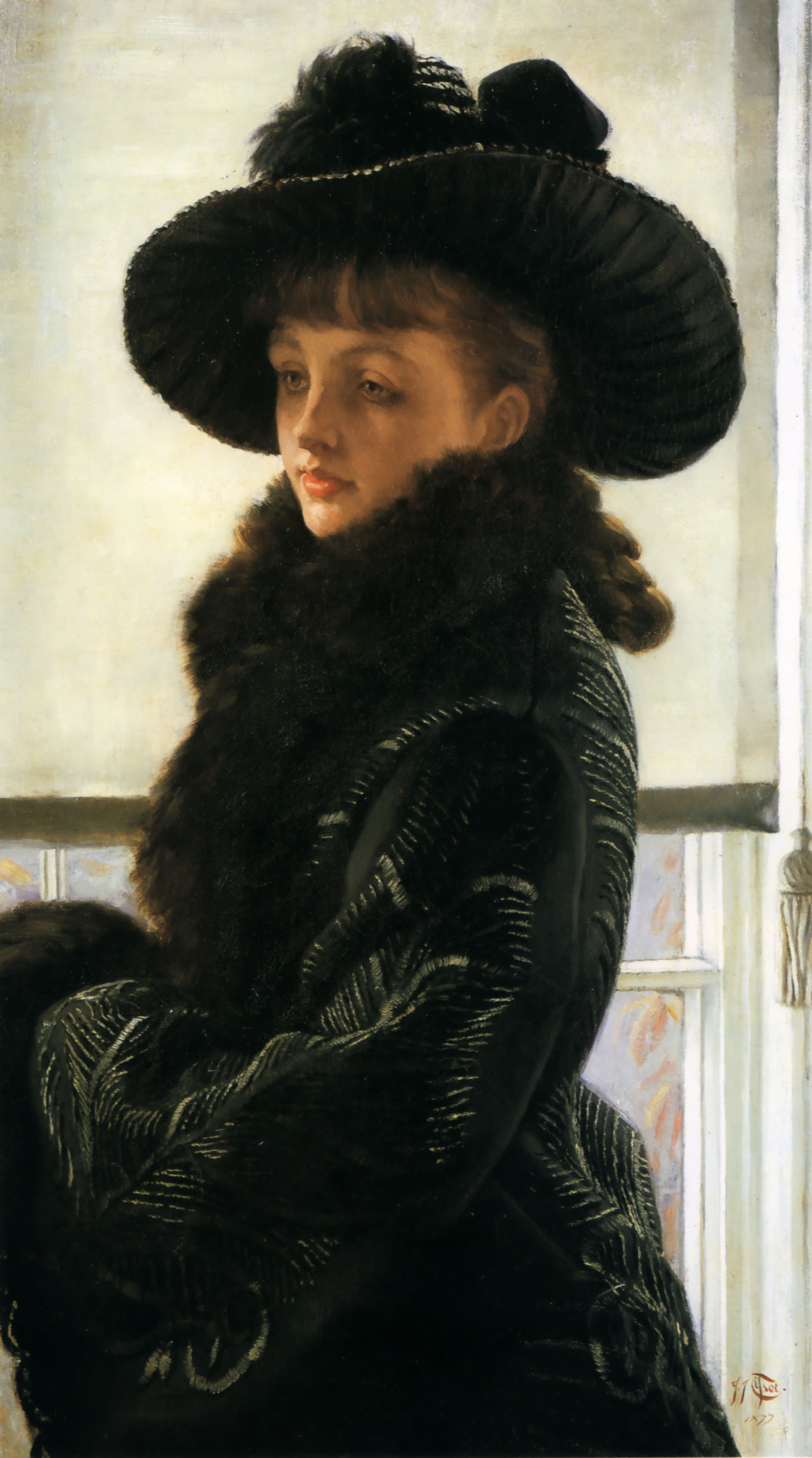
Mavourneen (Portrait of Kathleen Newton) by James Tissot (1877)

It was about four years later around 1875, that James Tissot, who was also living in St John’s Wood, London, met Kathleen Newton née Kelly.  The next step in their relationship came in March 1876 when Kathleen gave birth to a son, Cecil George Newton Ashburnham, who it is believed had been fathered by Tissot. Kathleen and James Tissot became lovers and she moved in with Tissot.  (It should be noted that census records cast some doubt whether they lived together and it is thought that Kathleen’s two children spent most or all of their time living with their aunt Polly and her family).   For Tissot, as was the case with Captain Pallister some five years earlier, he was smitten by this stunningly beautiful young woman.  His terms of endearment for her were mavoureen (Irish Gaelic for my love) and his native French phrase ravissante Irlandaise (lovely Irish).  Kathleen Newton became the love of Tissot’s life, his muse and adored lover.  Tissot described his time with Kathleen as one of “domestic bliss” and the happiest times of his life.  He completed many paintings featuring Kathleen of which I have featured some in my blog today.

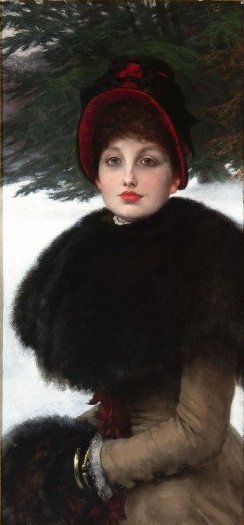
A Winter’s Walk by James Tissot (1878)

There was one great setback with his relationship with Kathleen for James Tissot.  Although it was not uncommon for successful and wealthy men to keep a mistress they did not, like Tissot, parade them around openly and advertise their liaison.   Tissot’s open and very public display of his affair with Kathleen shocked the London society which had once welcomed him with open arms and he had to choose between his social life and Kathleen.   For Tissot there was no question as to which course of action he would choose.  Kathleen was the love of his life and he chose her over life amongst London society.  He and Kathleen settled down to a life of domesticity and were happy to mix with their many artistic friends who continued to support them.  They never married and this may be due to their rigid Roman Catholic upbringing and beliefs.

Kathleen Newton in the Garden by James Tissot

This charming painting shows Kathleen sitting on a rug in the garden next to her daughter Violet.  The other small girl holding the parasol is her niece, Lillian Hervey. Sitting on the wall is her sister, Mary Hervey (Polly), who you can see ruffling the hair of Cecil George Newton who is thought to be the son of James Tissot.

————————————————————————————————————————————–

In the late 1870s Kathleen’s health started to deteriorate with the onset of tuberculosis.  Tissot remained devoted to her.  In 1882, Kathleen’s health declined rapidly with the onset of consumption.  The illness gave her great pain and Tissot was visibly distraught by the physical state of his wife and her sufferings.   Kathleen was aware that she was dying and she was saddened to witness how heartbroken her husband was, witnessing her long lingering death and so in November 1882, aged just twenty eight, she took an overdose of laudanum and died.  Sadly because she had committed suicide she was not able to be buried in consecrated ground.

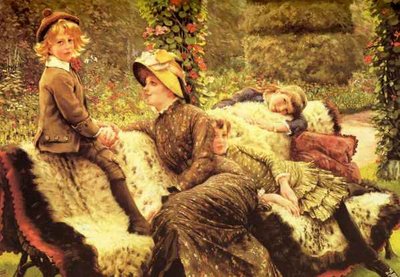
The Garden Bench by James Tissot (1882)

The painting above shows Kathleen Newton and her children, Cecil George and Violet and her niece, Lilian Hervey, the daughter of her sister Polly.  Although Tissot exhibited the painting, he would not sell it and kept it with him as a memorial until his death.

————————————————————————————————————————————–

One week after Kathleen’s death, Tissot left his London home at St John’s Wood, and never returned to it. The house was later bought by the artist Alma-Tadema.  Tissot was inconsolable and never really recovered from Kathleen’s death. Tissot never married and like many people who are devastated by the loss of a loved one he turned to Spiritualism, and on a number of occasions tried to contact his beloved Kathleen.

This somewhat sad story about a French artist and his fallen women is one of the great 19th century English love stories.   My interest in James Tissot was born out of a comment I received from Lucy Paquette who said she was publishing an eBook this autumn, entitled Hammock, a novel based on the life of James Tissot.  I hope, like me, you will be looking out for this publication.

Patricia O’Reilly has also written a novel about Kathleen Newton entitled A Type of Beauty: The Story of Kathleen Newton (1854-1882) which I am hoping to buy as novels based on lives of artists or one of their paintings always fascinate me.

A View of the Westerkerk, Amsterdam by Jan van der Heyden

Today I am going to leave 19th century French art and Impressionism, which has featured in my recent blogs, and look at some 16th and 17th Dutch and Flemish art and artists.  Dutch art has always been very popular and admired for the realism it portrayed of everyday life and it has always proved to be highly collectible.  Before I look at some of the art of that time it may be interesting to look at a brief history of the region which has a bearing on the style of art.   I am probably laying myself open for criticism from Dutch historians for my understanding of this period of the history of the Netherlands and Holland but all I am trying to do is give you a brief insight into Flemish and Dutch art of the 16th and 17th centuries.

The Netherlands back in the fifteenth century was a conglomerate of the Seventeen Provinces often referred to as the Burgundian Netherlands, which included part of today’s Germany, Belgium, France and Luxembourg.  It was controlled from 1506 by Charles V who was the Holy Roman Emperor and also the King of Spain.   In 1556, Charles V abdicated and the power passed to his son, Philip II.  With Spanish rule came the imposition of the Catholic religion on the people of the Netherlands.  This policy of strict religious uniformity was imposed by the Inquisition with enormous amounts of brutality.  However the rise of the Protestantism in the forms of the Lutheran and Anabaptist movements and Calvinism were starting to gain ground with the populace.   The beginning of the break-up of Philip’s control of the Seventeen Provinces started with the Dutch people being unhappy at the high level of taxation levelled on them by Philip and his brutal repression of anti-Catholic movements.  To subdue the unrest, Philip sent his Spanish troops to the area under the leadership of the Duke of Alba and their presence and their cruelty further fanned the flames of rebellion.  Control of the vast area was becoming more of a problem for Philip, added to which there was now a threat coming from the French along the southern borders.  Philip II’s troops were moved from the north to the south leaving the north less well controlled and this led to the start of the Eighty Years’ War often termed as the Dutch War of Independence.   After the initial stages, Philip II deployed his armies and regained control over most of the rebelling provinces. However, under the leadership of the exiled William of Orange, the Northern provinces continued their resistance and managed to oust the Spanish armies, and established the Republic of the Seven United Netherlands, Holland, in 1609. The Dutch Revolt had officially ended and the Dutch republic of Holland was officially recognised by France and England. The end of the Eighty years War however did not end for another forty years.

The Netherlands was now split along an almost North/South divide.  The north, Holland, became a haven for Protestantism with Calvinism becoming the main religion.  There were no Catholic churches in this northern territory.   It soon became one of the world’s most economically powerful and wealthy maritime nations in the world and Amsterdam became its capital.   As far as far as art was concerned there was also a north/south divide.   The Spanish Catholic south, Flanders, with its capital Antwerp, still had most of its art commissioned by the Catholic Church or the Spanish Catholic rulers and would more often than not therefore depict religious scenes, whereas now the Dutch north where religion was mainly a Reformed Calvinistic one would not allow church’s money to be spent frivolously on the commissioning of art.   Dutch art had new patrons.  Now works were commissioned by the territory’s wealthy merchants and ship owners.  Often the subjects they commissioned had little to do with religion and more to do with their wealth and their status in society.

Today I want to feature an artist from the southern region, Flanders.  Jan van der Heyden was born in 1637 in Gorinchem, which now lies in south west Holland.  In 1650, when he was thirteen years old, the family moved to Amsterdam and lived in a house on Dam Square.   Sadly however, his father, who was a follower of the ethno-religious Mennonite group, died the year of their move.  Jan’s early artistic training began in Gorinchem with drawing lessons at his elder brother’s studio.  He also learnt, from a local artist, the reverse technique of glass painting.  Although we are looking at van der Heyden as an artist his overwhelming love was not art, although he continued to paint all his life, it was his love of engineering and inventions.   He was an artist but he also was an inventor and an engineer.  He designed many things such as the street lighting system in Amsterdam.  Shortly after he and his family moved to Amsterdam he witnessed a fire at the old town hall and the futile efforts that were made to hold back the flames.   He probably never forgot that incident for later, along with the help of his brother Nicolaes van der Heyden, a hydraulic engineer; he invented a fire engine fitted with pump driven hoses which was to change the effectiveness of fire fighting.

In 1661 Jan van der Heyden married and he and his wife moved to a house along the Herengracht, a fashionable area of Amsterdam.  As a painter, Jan van der Heyden, will always be remembered for his beautiful townscapes and his architectural designs certainly dominate these works.   Although he painted many townscapes he also painted scenes featuring village streets and country houses.  He loved to paint old and new buildings and paid particular attention to their facades.  He also completed more than forty landscapes although his landscape art was never in the same league as his contemporaries, Meindert Hobbema and Jacob van Ruisdael.   He worked in partnership with Adriaen van der Velde,  the Dutch animal and landscape painter, and Johannes Lingelbach, a Dutch Golden Age painter, who would often add figures to van der Heyden’ architectural scenes and add landscape effects as a finishing touch to the paintings.   His main subjects were Amsterdam and the region surrounding the Dutch-German border where he and his family visited on many occasions.

In 1672, Adriaen van de Velde died and Jan van der Heyden artistic output dwindled as he concentrated on his main employment that of superintendent of the lighting in Amsterdam and he also devoted much of his time as the director of the Amsterdam Fireman’s Guild.  He died a wealthy man in 1712, aged 75.

View of the Westerkerk, Amsterdam by Jan van der Heyden (c.1660)
(National Gallery, London)

My featured painting today is entitled View of the Westerkerk, Amsterdam.    The building work on the protestant church commenced in 1620 and was designed by the foremost architect of the time, Hendrick de Keyser, the father of the Dutch painter Thomas de Keyser.  The construction was completed eighteen years later and at the time its tower was the highest in the city.  Jan van der Heyden painting is of the church, seen from the east, across from the Keizersgracht, the new Emperor canal.  Buried within the church are the painters Nicolaes Berchem, Rembrandt and his son Titus.

There are two versions of this paintings housed in galleries in London.  Both were painted between 1660 and 1670.   In both cases these are, like many of his townscapes and landscapes, only loosely based on actual views as topographical accuracy was not in the forefront of his mind when he started to work on his paintings.  It was almost as if he wanted to bring into his painting all that was beautiful about the town, whether it be its landscape or its architecture.  It was simply an idealised townscape which I believe does not lessen the beauty of the finished work.  The difference between these paintings and others he did was that in View of Westerwerk, Amsterdam he has paid great attention to the detail of the buildings whereas in other townscapes the main buildings may look half finished with the emphasis being placed on surrounding structures and open spaces.

Let us look at the version which is at the National Gallery in London.  Look at the clarity of this work.  Marvel at the detail van der Heyden has put into this painting.  In the foreground we can see four wooden casings which protect the young tree saplings.  One can almost read the writing on the torn posters which have been affixed to the casings.   This version is much larger than the one in the Wallace Collection, measuring 91cms x 114cms and almost three times the normal size of van der Heyden’s previous works.  It is believed that it was commissioned by the governors of the Westerkerk, for their meeting room, where it remained until 1864.   I love the details of the red-brick buildings but look at the contrast in colour of them with how the artist has depicted the blue sky with all its luminosity, the yellow cobblestone path in the foreground which runs parallel to the stretch of the canal and the glass-like stillness of the water.  It is probable that another artist painted the people and animals shown in the work.

View of the Westerkerk, Amsterdam by Jan van der Heyden (c.1665-1670)
(Wallace Collection, London)

I went to the Wallace Collection last week and saw this other version of the painting.  It is much smaller in size, measuring just 41cms x 59cms.  The artist’s signature can be seen in the lower right on the coping of the canal wall.  To the left of the church is the Westmarkt and if you look carefully between the trees you can just make out the Westerhal, which housed a meat market on the ground floor and above it was a guard house.   The house which we see to the right of the church is Keizersgracht no, 198 and was at that time the residence of Lucas van Uffelen a wealthy Flemish merchant and art collector.  What is very striking about this small painting is the sharp contrasts of colour, light and texture with shadows slanting across the front of the church.  Look at the contrast between the angular roofs and the luminous blue sky.  See how the artist has contrasted the trees heavy in leaf with the red brick buildings and in the case of the house on the right of the painting, its whitewashed frontage.  In this painting, unlike the one at the National Gallery, the artist(s?) have depicted reflections in the still water of the canal.  It should be remembered that this painting was completed after the one which now hangs in the National Gallery and is probably a re-working of the scene.  It could be that Jan van der Heyden was not completely satisfied with his first effort and wanted to make some artistic improvements.

If you are in London, why not take a chance to visit both galleries and compare the two paintings and decide which you like the best.

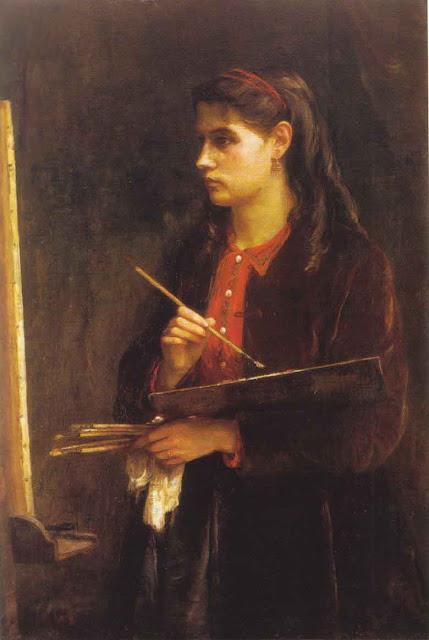
Berthe Morisot by Edma Morisot

Berthe Morisot by Edma Morisot (1865)

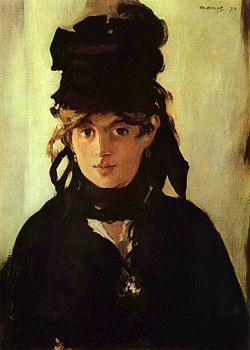
For the next few blogs I want to look at the life and works of Berthe Marie Pauline Morisot and some of the paintings other artists have done of her.  As I told you in my last offering I visited the Musée Marmottan Monet last week whilst in Paris and they were currently staging a retrospective of her work.  I have already featured one of her works, Le Bercau (The Cradle) in My Daily Art Display of August 10th 2011 and briefly told you about her life.  Today I am going to look again at her early life and feature a painting, not by the artist herself,  but a stunningly portrait of her, painted by her sister, Edma.

The world of French art between 1839 and 1841 was surely blessed as it was in that two-year period that the world witnessed the birth of four of the greatest French artists.  Paul Cezanne was born in January 1839, Claude Monet was born in November 1840 and Berthe Morisot and Pierre-Auguste Renoir were born in January and February 1841 respectively.  Berthe Morisot was born in Bourges, a city in central France.  She had distant roots in French art as she was an indirect and distant descendent on her father’s side of none other than the French Rococo painter Jean-Honoré Fragonard and the French 18th century female painter, Marguerite Gérard.  Berthe was one of four children.  She had two sisters, Marie-Elizabeth Yves born in 1838, known simply as Yves and Marie Edma Caroline born in 1839, known simply as Edma.  She also had a younger brother, Tiburce, born in1848.  Berthe was brought up in a successful and financially secure household.  Her mother was Marie-Cornélie Thomas, who came from a family of high level government officials, chief treasurers and paymasters of the province.   Her father was Edmé-Tiburce Morisot, who was an architectural graduate and who at the age of twenty-six founded an architectural journal.  However the venture collapsed when his co-founders absconded with all the money and left Tiburce to face the creditors.  He eventually had to hurriedly leave town, leaving all his furniture and possessions to his landlord in lieu of rent, and fled to Greece.  A year later in 1835 he returned to France penniless but his good looks and charm won him the hand of Marie-Cornélie in marriage.  She was sixteen years old and he was thirteen years older.   Marie’s father, who was the personnel director at the Ministry of Finance, managed to arrange employment for Tiburce Morisot as subprefect at the city of Yssingeaux, in the Haute-Loire region.  Tiburce worked hard and soon impressed his employers.  Promotions followed and at the time of his daughter Berthe’s birth, he was the prefect of the Department of Cher, the monarch’s chief administrator for the entire province.

In 1848 when Berthe was just seven years of age, because of the Third French Revolution which eventually led to the creation of the French Second Republic, Berthe’s father decided to move his family from Bourges to the Parisian suburb of Passy.   When Berthe was aged sixteen years of age, her mother, Marie-Cornélie Morisot decided to enrol her three daughters in private drawing classes.  At that time the prestigious École des Beaux-Arts would not admit female students and maintained that sexist doctrine until the last few years of the nineteenth century.  The sisters’ first tutor was Geoffroy-Alphonse Chocarne who taught the girls the fundamentals of drawing.  Yves love of art waned quickly and she gave up on her art tuition after a few months leaving just Edma and Berthe to carry on with their artistic studies.

Edma and Berthe then enrolled to study with Joseph Guichard, who had once been a student of Ingres and now lived in the same street in Passy as the Morisot family.  Guichard taught the girls all about classical art in the academic tradition.  He was there tutor from 1857 and 1860 and in 1858 Berthe registered as a copyist at the Louvre.  It was under the guidance of Guichard that Berthe Morisot first experimented in oil painting.  En plein-air,  painting outdoors in natural light,  became very important to the Impressionist painters and those from the Barbizon School and the two girls told Guichard that they wanted to learn more about that technique and so, in 1863, in consultation with Jean-Baptiste Camille Corot, a leader of the Barbizon School of painters it was arranged that the girls would study under Achille Oudinot, the French landscape painter.  In the spring of 1864 after seven years of intensive artistic training Berthe and Edma Morisot were admitted to the official Salon.  Berthe would exhibit at the Salon regularly and Edma would until her marriage in 1869 at which time she virtually gave up painting.

It is said that behind every great woman, there is another woman, often a close relative.  In nineteenth century England we saw it with the likes of the talented Bronte sisters who had each other for constructive critical support.  Although Morisot’s upbringing in a wealthy household bears no resemblance to the upbringing of the Bronte sisters,what she did have in her formative years, similar to the Bronte sisters, was the luxury of having a very loyal and supportive sister.  Standing unwaveringly behind Berthe was her sister Edma.  The sisters’ artistic collaboration came to an end in 1869, when Edma married her husband, Adolphe Pontillon, a naval officer.  In some ways Edma regretted the end of their artistic partnership and the close friendship which came with it.  They kept in contact by letter and in one Edma wrote:

“…I am often with you in thought, dear Berthe.  I’m in your studio and I like to slip away, if only for a quarter of an hour, to breathe that atmosphere that we shared for many years…”

Berthe Morisot with a Bouquet of Violets by Édouard Manet (1872)

And so I come to today’s featured painting.  There have been many portraits painted of Berthe Morisot , probably the best known being the one of her entitled, Berthe Morisot with a Bouquet of Violets which was painted by her brother-in-law, Édouard Manet in 1872 and which is housed in the Musée d’Orsay.  I have always thought that his has made her look rather dowdy, so today I have featured one of my two favourite portraits of the artist.  This one is simply entitled Berthe Morisot and was painted by her sister Edma in 1865 and is held in a private collection.  This beautiful portrait in some ways bears out the close relationship between the sisters and reveals the shared interest both had in painting.  In this work Edma has depicted her sister Berthe holding her palette and brush concentrating earnestly at the picture she is painting.  Look how well Edma has captured the intensity in Berthe’s expression.  Our eyes are immediately drawn to the face of Berthe, which is bathed in light and which contrasts well with the darkened background and also echoes the whites of the side of the canvas and the rag she holds.  This painting of Berthe Morisot depicts her indisputable beauty which often other portraits fail to achieve.  This is indeed a portrait of an extremely delightful young woman in her mid-twenties and one I fell in love with when I first saw it.

Musée Marmottan Monet in Paris

Musée Marmottan Monet

For my blog today I am not showcasing an artist or a painting but a small museum , the Musée Marmottan Monet, which I visited last week when I was in Paris and I hope that for any of you who are intending to visit the French capital and want to take in some of its artistic heritage you will make time to visit this museum.  I can assure you that you will not be disappointed.  The museum is situated at 2 rue Louis Boilly in the vibrant and colourful 16th arondissement and is easy to get to as there are two nearby Metro stations, La Muette and Ranelagh.

I have often advocated that when one goes to London one should not always head for the major art galleries such as the National Gallery or the two Tate galleries as they are so big that one has no hope of seeing everything in one session and trying to often means that you skimp on the time each painting deserves.  A better plan of action if your time is limited is to go and visit one of the smaller galleries.  In London one has the Wallace Collection, the Courtauld Gallery and the Dulwich Picture Gallery, to mention just a few.  So to practice what I preach, when I was in Paris last week I didn’t revisit the Louvre or the Musée d’Orsay, instead I visited, for the first time, the Musée Marmottan Monet and it was unquestionably a most worthwhile visit.

The building was originally constructed as a hunting lodge for the Duke of Valmy and a few years later was sold to Jules Marmottan which on his death along with all his belongings was bequeathed to his son Paul.  Paul Marmottan later built a small pavilion in the courtyard as the original building was too small to house all of his paintings, furniture and bronzes.  Paul Marmottan bequeathed his home and collection to the Académie des Beaux-Arts, which opened up the house and collection as the Museum Marmottan in 1934.

If you like the work of the Impressionists and in particular the works of Claude Monet then look no further as this museum houses the largest collection of Monet’s work in the world and this is partly due to the fact that Monet’s youngest son Michel donated his father’s paintings from Giverny to the museum.  The building originally had two floors, the ground floor and an upper floor but to exhibit all the works they had to build a large underground room.  A number of bequests to the museum over the years have filled the building with beautiful and priceless art treasures.

The Duhem Collection was bequeathed to the museum by the daughter of the French painter, Henri Duhem.  These included works by Boudin, Caillebotte, Corot, Gaugin,  Monet and Renoir.  In 1980 an amazing group of illuminations spanning the 13th to 16th century was donated to the museum by Daniel Wildenstein.  The collection is exceptional for both the quantity and quality of the works.  There are over three hundred miniatures.  In 1996 the museum received an extraordinary donation from Annie Rouart.  Her husband was Denis Rouart, the grandson of Berthe Morisot and Eugène Manet.  Among the paintings given to the museum by Annie Rouart were masterpieces by Degas, Manet, Monet and Renoir and of course works by the famous female Impressionist Berthe Morisot.

Berthe Morisot Exhibition

For those of you who love the work of Berthe Morisot, and I include myself in that particular fan club, there is currently running a brilliant exhibition of her work.  It is housed in the basement.   It opened on March 8th and runs until July 1st 2012.  It presents the first major retrospective of the work of Berthe Morisot to be held in Paris for almost half a century.  One hundred and fifty paintings, pastels, watercolours and drawings in red chalk and charcoal, from museums and private collections all over the world, retrace the career of the Impressionist movement’s best-known woman painter. Works which have been selected for the exhibition cover the whole of Berthe Morisot’s artistic career, from her earliest works around 1860, to her untimely death at the age of 54, in 1895.  In my next few blogs I will feature a few  of the many paintings I saw when I walked around the museum.