Benjamin Robert Haydon. Part 2

His lifelong quarrel with the Royal Academy,

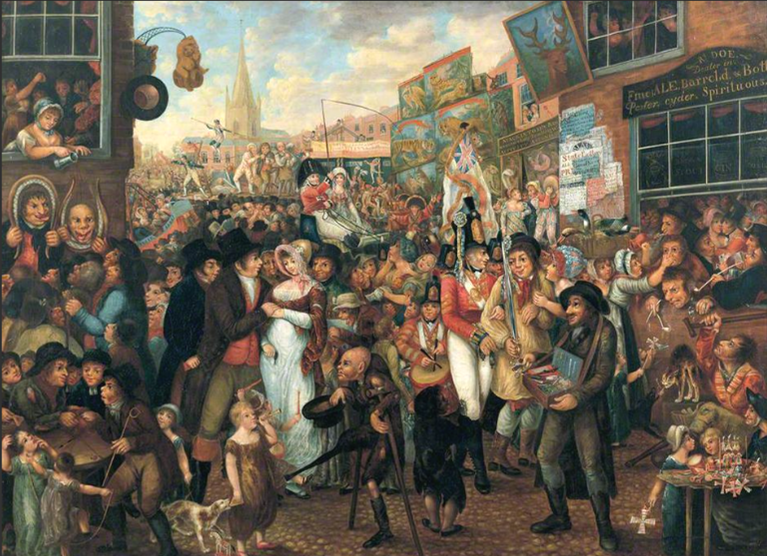
In 1805 Hayden met another student who had arrived to study at the Royal Academy Schools and the two became great friends.  He was David Wilkie, who had begun his artistic training at Edinburgh’s Trustees Academy at the age of fifteen.

Pitlessie Fair by David Wilkie (1804)

One of his first paintings Wilkie exhibited was Pitlessie Fair which was inspired by examples of seventeenth century Dutch and Flemish paintings and also by Scottish folklore and cultural traditions celebrated in contemporary literature. This was well liked when shown in London and resulted in several prestigious commissions. The first meeting of Haydon and Wilkie was described in Wilkie’s biography, Life of Sir David Wilkie by Allan Cunningham.  Haydon recalls that meeting at the RA:

“…We sat and drew in silence for some time; at length Wilkie rose, came and looked over my shoulder, said nothing, and resumed his seat.  I rose, went and looked over his shoulder, said nothing, and resumed my seat.  We saw enough to satisfy us as to each other’s skills…”

‘The Egyptian Room’ by Thomas Hope as seen in the magazine ‘Household Furniture & Interior Decoration’ (1807).

In 1807, when twenty-one-year-old Haydon had his first work shown at the Royal Academy exhibition.  It was his work entitled The Repose in Egypt, and it was purchased by Thomas Hope for the Egyptian Room at his town house, a house designed by Robert Adam in Duchess Street, Portland Place, London, which he remodelled with a series of themed interiors.

In November 1807 Haydon’s mother who had been seriously ill travelled from Plymouth with Haydon and his sister to get further medical help in London. However she never made it to the English capital and died at the Windmill Inn, a coach stop at Salt Hill, just west of Slough.

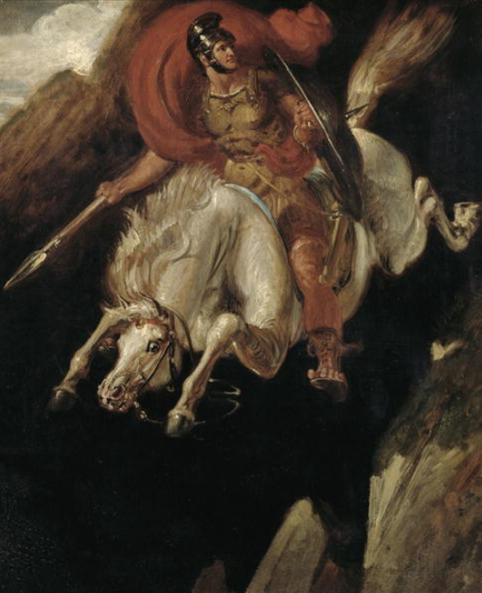
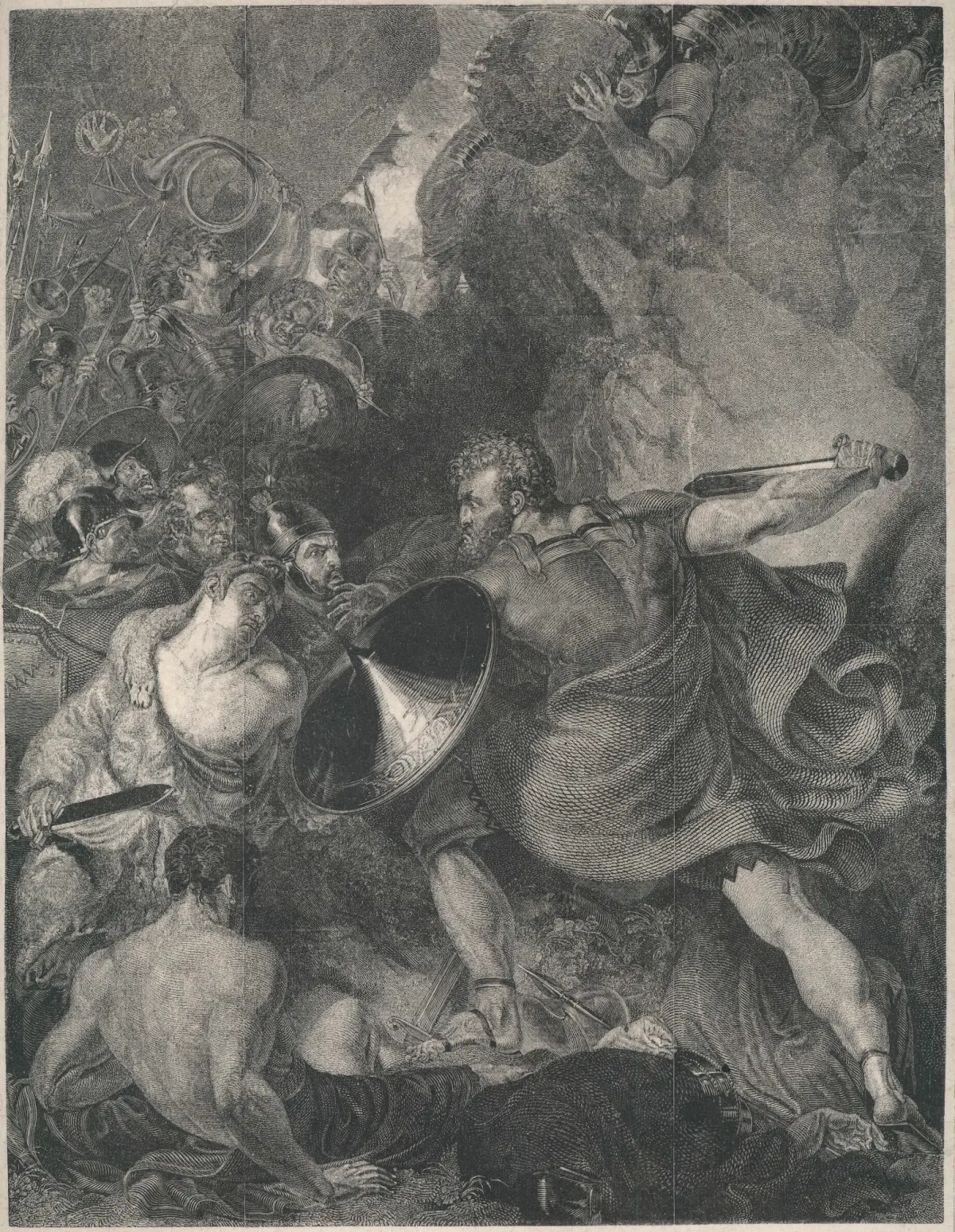
Assassination of L. S. Dentatus,   After Benjamin Robert Haydon. Engraving by William Harvey (1821)

As far as his artwork was concerned, Haydon could not have wished for a better start to his professional career as an artist. Following on shortly after the sale of his biblical painting Haydon received a commission from the Henry Phipps, 1st Earl of Mulgrave, for a large history painting featuring the Roman general, Lucius Siccius Dentatus.  Mulgrave himself had been a general in the Army as well as a prominent politician.   The subject of the work was that of the celebrated Roman Tribune, Dentatus, who is seen making his last desperate effort against his own soldiers, who attacked and murdered him in a narrow pass. It took Haydon two years to complete and was ready for exhibiting at the 1809 Royal Academy Exhibition. 

With his historical painting of Dentatus completed Haydon had to decide where it should be exhibited.  Many of his friends such as Sir George Beaumont and David Wilkie, as well as his tutor, Fuseli, had seen the painting and were full of praise for what he had achieved.  Beaumont pressed Haydon to exhibit the work at the British Institution where it could vie for the 100 guinea premium (prize) which was awarded to the best painting of historical or poetical composition but Haydon wanted this new work of his to be exhibited along with the greats of the Royal Academy.  He was scornful with regards the standard of art and artists showing at the British Institution and dismissive of the prize money, saying:

“…If [Benjamin] West and all the Academicians were to be my competitors, nothing would give me greater delight, even if I lost it – less glory would be lost, and more won if I gained it.  But to contend with a parcel of mannered, ignorant, illiterate boys, without science or principle [at the British Institution], if I were successful would be no honour, and if, unsuccessful, I should never hold up my head again.  Besides what do I care for prizes?  I want public approbation and fame – this is the only prize I esteem…

It is that last sentence that tells us so much about Haydon’s character !

  Haydon believed to achieve this sought after fame his work had to be shown in the Great Hall of the Royal Academy’s Exhibition.  One morning on April 1809, Haydon and a couple of companions carried the massive painting along The Strand and deposited it at the Royal Academy in Somerset House.  The full title of Haydon’s beloved work was The Celebrated Old Roman Tribune, Dentatus, Making his Last Desperate Effort against his own Soldiers, who Attacked and Murdered him in a Narrow Pass.

The Hanging Committee selected Haydon’s work for the exhibition and Fuseli had positioned it in the Great Hall.  However Benjamin West, the President of the Royal Academy had it moved to the dark Ante-Room, which is the way Haydon described its positioning, albeit others disagreed.  West’s reasoning being that the Great Hall was a space reserved for Academicians’ paintings.  Haydon never forgave the Academy for what he looked upon as a personal insult.  Twenty-five years later he recounted his feelings with regards the affair.  He wrote:
“…I lost my Patrons – & sunk into a species of despair & embarrassment from which I have had occasional gleams of Sunshine but never permanent fortune….[It] threw a cloud on the whole of my life – embarrassments, exasperations followed….I lost all employment & sunk to a Prison…”

Lord Mulgrave did buy the painting and paid Haydon two hundred and ten guineas.

Haydon’s fury at how his painting had been treated by the Academy festered for many years despite being warned by some of the Academicians, including Constable, that his attitude towards the Academy and the Academicians was unacceptable and would work against him.

Although the leading lights of the Royal Academy did not agree with Haydon, regarding the positioning of his painting at the Academy Exhibition, the well-known writer and art critic wrote the following in the May 29th 1809 edition of The Examiner:

“…From the trash with which it is mostly filled and from its indistinct light the Anti-room seems to be considered by the Academy, as I am sure it is by the tasteful visitor, little more than a mere vestibule to the larger room and is therefore frequently hurried over with scarcely a glance.  If however the visitor will allow me to be his intellectual caterer, I advise him to pause as he enters this sepulchral Anti-room and I am confident that in Mr Haydon’s picture of Dentatus making his last desperate effort against his soldiers who murdered him in a narrow pass, no.259, he will enjoy a treat served up by the hand of a genius and displayed with a refinement of science and of art…”

A Life Class at the Royal Academy, Somerset House by Thomas Rowlandson (1811)

Following shortly after Haydon’s clash with the Royal Academy he was engaged in a protracted argument with one of his patrons, Sir George Beaumont, over a commission to paint Macbeth.  It was all to do with the size of the painting and the figures within the depiction. Haydon was not deterred by this unfortunate situation as he felt that the work could be exhibited at the British Institution and he would secure the three hundred guineas prize. On the strength of that hope Haydon began to borrow money. Alas, the three hundred pound prize was not given to Haydon who was offered just thirty guineas to cover the cost of framing. Haydon was devastated. To add to his worries, his success on selling some of his work had a downside. His father viewing his son’s success stopped paying him his annual allowance of £200 which added to his son’s financial problems.

Having passed the test of drawing from plaster Haydon was allowed to enter the life-drawing sessions using live models.  An idea of what those classes were like can be gleaned from Thomas Rowlandson’s image of these classes, such as his 1811 painting entitled A Life Class at the Royal Academy, Somerset House.  It depicts Royal Academy students and Royal Academicians seated on semi-circular benches facing the model on a platform.  These classes ran for two hours every night during term-time.  Tuition at these classes was provided by visiting artists who were Royal Academicians.  There were nine visitors each year and their stint lasted one month.   The Royal Academy website offers an amusing anecdote about Rowlandson and his image of the Life Drawing class:

“…Rowlandson was himself a student at the Royal Academy from 1772-1778 when the life class was still in Old Somerset House. He is said to have nearly been expelled after firing a pea- shooter at the female model during the life class.  This characterisation of the Academicians and RA students as lechers is typical of Rowlandson’s caricatures…”

In Patricia Phagan’s 2011 book,  Thomas Rowlandson: Pleasures and Pursuits in Georgian England, she talks about Rowlandson’s interest in the Royal Academy School’s life drawing classes:

“…there was something compulsive in his repeated depiction of the seductive or voyeuristic relationships of grotesque old men and busty young women, or of the traitorous triangle of young wife, young lover, and old husband…”

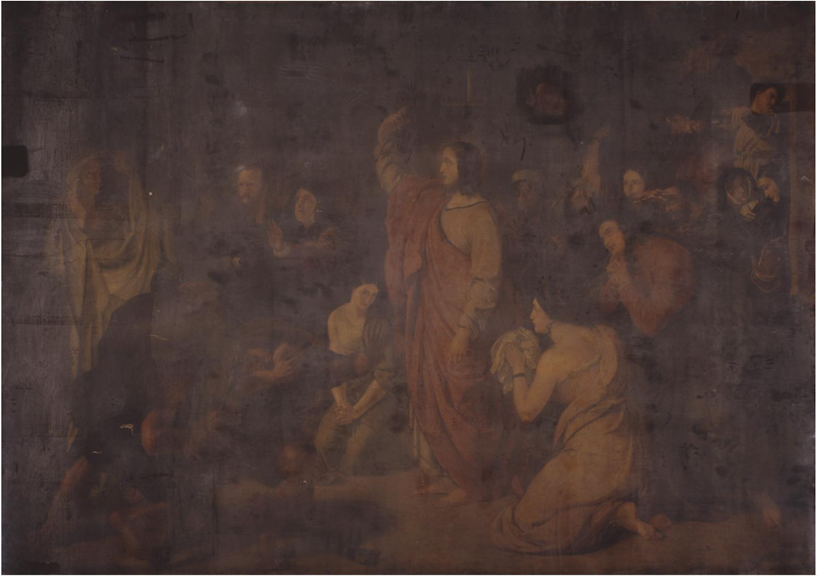
The Judgement of Solomon by Benjamin Haydon (1812)

In 1812 Haydon made a start on his new painting that would be entitled The Judgement of Solomon.  The new painting was a depiction based on the Hebrew biblical story about King Solomon who made a ruling in a case featuring two women both claiming to be the mother of a child. Solomon revealed their true feelings and relationship to the child by suggesting the baby be cut in two, each woman to receive half. With this strategy, he was able to discern the fraudulent mother as the woman who entirely approved of this proposal, while the actual mother begged that the sword might be sheathed and the child committed to the care of her rival.

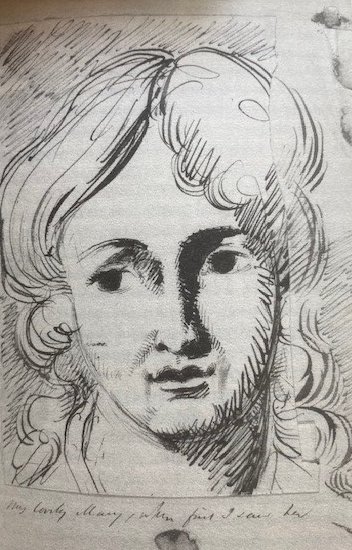
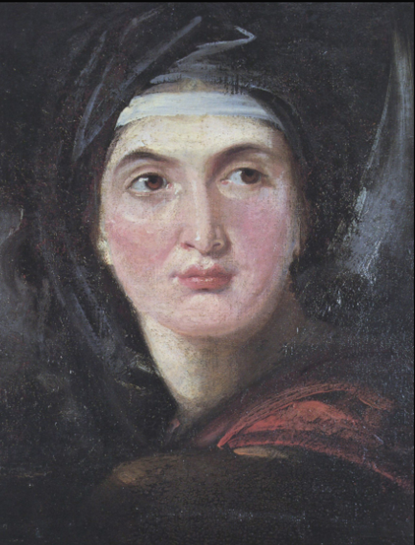
Study of head for ‘The Judgement of Solomon” by Benjamin Robert Haydon, c.1812–4

At this juncture in Haydon’s life, he was in debt, owing six hundred pounds to various creditors and he was constantly approaching friends for more financial help, many of whom had already loaned him money and had not been paid back. This was the start of Haydon’s financial decline and it was beginning to affect Haydon’s mental health.

………….to be continued

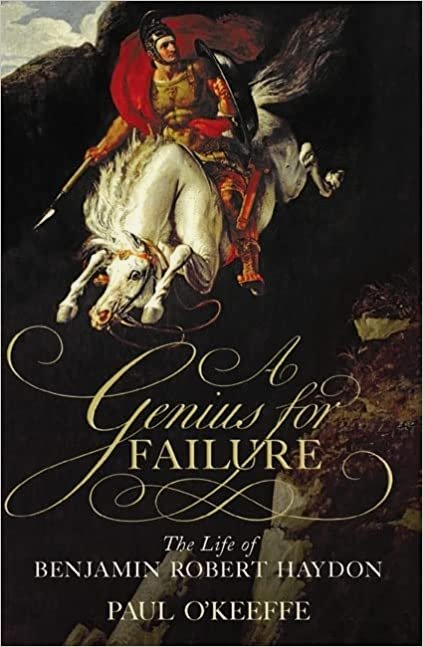
The majority of the information I have used in this and the subsequent blogs on the life of Benjamin Haydon came from an excellent second-hand book, published in 1998, I came across entitled A Genius for Failure, The Life of Benjamin Robert Haydon by Paul O’Keefe. If you are interested in Haydon’s life, I can highly recommend you try to get yourself a copy.

Benjamin Robert Haydon

The beginning.

Benjamin Robert Haydon

I was watching the film Mr Turner for the second time the other day and often on a second viewing of a film or the second reading of a book you come across things that you didn’t see the first time around.  During the second viewing of the film about Turner I noticed a minor character in it who Turner referred to as Haydon.  He was depicted as a “fussy” man who had great money troubles and was constantly approaching Turner for a financial loan.  I had never come across an artist named Haydon and it peaked my interest.  So, let me share with you a look at the life and works of a very troubled, whom some would say, was a very talented English artist.  Let me introduce you to Benjamin Robert Haydon.

Benjamin Robert Haydon by William Nicholson RSA (c.1820)

Benjamin Robert Haydon was born in Wimpole Street in the south coast English garrison town of Plymouth on January 26th, 1876.  He had a younger sister Harriet; another sister, Sarah, had died in infancy.  His father was Benjamin Robert Haydon who had married his wife Mary, one of eight children and the second daughter of the Rev. Benjamin Cobley, curate of Shillingford and later, the rector of Dodbrook, near Kingsbridge, in the county of Devon.  Haydon’s father was a well-to-do printer, stationer and publisher and had a shop in Plymouth at 75 Market Place.  He was also an amateur “special correspondent” to the Bristol Journal, who as he lived in a garrison town, he enjoyed writing about the valorous exploits of the English military heroes fighting for their country in various parts of the world.

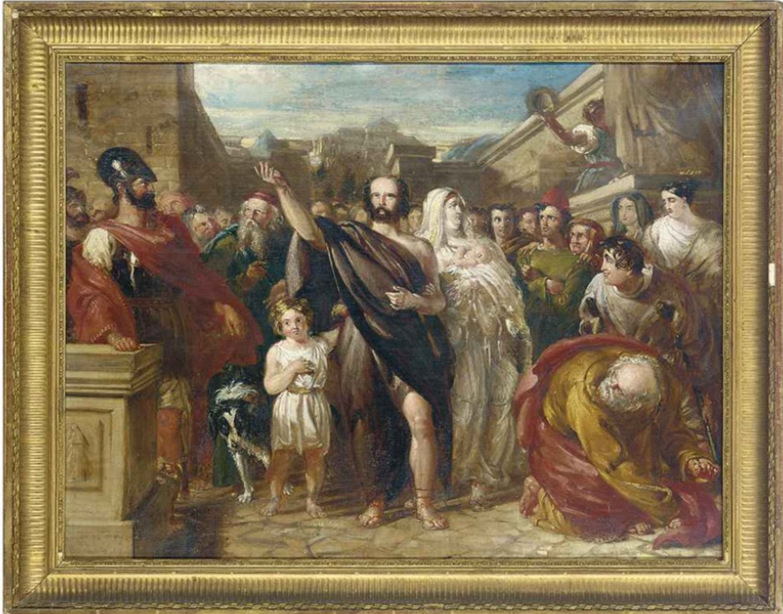
The Banishment of Aristides from Athens by Benjamin Haydon

In 1792 Benjamin Haydon, then aged six, first attended school and it was the start of his interest in sketching and he would often draw rough portraits of his school friends..  The following year, 1793, England and France went to war and it was that same year that seven-year-old Benjamin Haydon attended the Plymouth Grammar School run by the headmaster, the Reverend Dr. Bidlake.  Bidlake, Haydon recalled the head painted and played the organ and realising the young Haydon had a love and aptitude for sketching gave him and one of his fellow pupils some painting lessons.    That fellow student was Samuel Prout who would later become a renowned watercolourist, and one of the masters of watercolour architectural painting.  Bidlake encouraged Haydon to paint landscapes en plein air but this was countered by the advice given to him by a Neapolitan worker in his father’s business, a Mr. Fenzi, who would regale excitedly about the works of Raphael and Michelangelo.  Haydon was excited about what he saw and heard and remembered Fenzi’s words of advice about ignoring landscape painting and concentrate on figurative painting:

“…Do not draw de landscape; draw de feegoore, Master Benjamin…”

When Haydon was eleven years old he contracted measles and was laid up in bed.  He recalled the time well, as his father visited his bedside to excitedly announce the British naval victory at Cape St Vincent.  Later Haydon recalled the excitement in the household with the news of Horatio Nelson’s naval victories.

Plympton Grammar School

(Photograph taken 28 August 2001 © Mr Gerald Rendle)

In 1798, at the age of twelve, Haydon left Plymouth Grammar School and was admitted as a boarder to All Hallows School in Honiton, some sixty miles from his home.  Here the headmaster was Reverend William Hayne who was tasked by Haydon’s father to help his son improve his art.  In 1800 Reverend William Hayne was offered a teaching post at Plympton Grammar School and he accepted and moved his family and pupils to Plympton St Maurice.  In a way it was a return home for Haydon who had spent his early years nearby.  Fifty years earlier the grammar school had been where the artist, Sir Joshua Reynolds, studied and Reynold’s father had been the headmaster.  In all, Haydon had been under the tutelage of Reverend Hayne for two years at Honiton and a further six months at Plympton Grammar where he rose to become head boy at the age of fifteen and by which time he had acquired a good understanding of the Latin, Greek, and French languages.

Haydon left the school and the world of the classic literature and had to decide on his next move.  However, that decision was taken away from him by his father who saw his son as being his successor in the family business and so had his son move to Exeter where he studied business and as Haydon saw it, the dry tuition of profit/loss and ledgers.  He was not enamoured by the world of finance and bookkeeping.  His course lasted six months at which time he returned home to Plymouth where he was indentured for a period of seven years as an apprentice to his father.  Life could not have been worse according to young Haydon who hated everything about the job.  He hated everything – his father’s customers, serving behind the counter in his father’s shop, working on his father’s accounts.  Nothing pleased him and he would spend long periods of time sulking at his lot in life.

Benjamin Haydon came to the conclusion that his future lay ahead as an artist.  His father and his grandfather both had similar thoughts at Benjamin’s age but they soon faded and Benjamin’s father believed the same would happen to his son’s great artistic ambitions.  Heated and constant family arguments followed on a daily basis over young Haydon’s future, so much so, Haydon became ill and suffered severe inflammation of his eyes.  Benjamin’s father believed this would put an end to his son’s fantasies of becoming an artist and told him he could never become an artist as he couldn’t see properly, but he was mistaken for his son was not to be deflected.

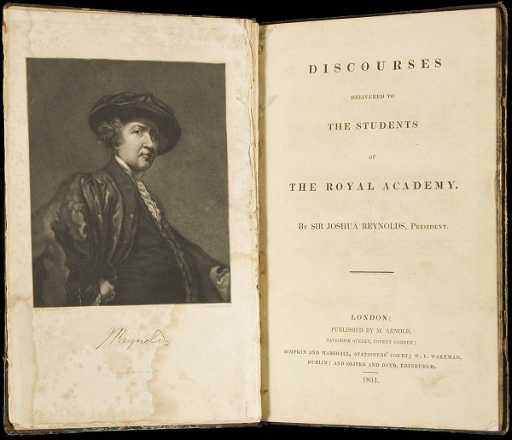
Discourses by Sir Joshua Reynolds

Haydon believed that his eyesight problem was not a major stumbling block and he was buoyed by the words of Joshua Reynolds in his first Discourse he delivered to the Royal Academy during the opening session in January 1769. Reynolds set out his theories on art in a series of fifteen lectures in the Royal Academy Schools, which were later published as Discourses on Art.  It was all about the fact that nothing would be achieved without hard work.  Reynolds said:

“…But young men have not only this frivolous ambition of being thought masters of execution inciting them on one hand, but also their natural sloth tempting them on the other. They are terrified at the prospect before them of the toil required to attain exactness. The impetuosity of youth is disgusted at the slow approaches of a regular siege, and desires, from mere impatience of labor, to take the citadel by storm. They wish to find some shorter path to excellence and hope to obtain the reward of eminence by other means than those w4iich the indispensable rules of art have prescribed. They must, therefore, be told again and again that labor is the only price of solid fame, and that whatever their force of genius may be, there is no easy method of becoming a good painter…”

Haydon met Samuel Northcote, one of his father’s customers and hearing of young Haydon’s wish to become an artist Northcote advised him to study anatomy.  Haydon took that advice and purchased a book at the Plymouth Naval Hospital Auction entitled Tables of the Skeleton and Muscles of the Human Body written by Bernhard Siegfried Albinus in 1749   It cost him two pounds ten shillings, an amount he did not have !  This attitude to buying things he could not afford would haunt him all his life.  Haydon rushed home and spoke to his father who grudgingly gave him the money.  Haydon immersed himself in the anatomy book and after two weeks of constant studying the drawings and information, he claimed that he knew every muscle and every bone in the human body.

Haydon’s constant battle with his mother and father as to his future continued with neither side relaxing their stance.  However, he must have finally worn them down as they finally agreed to him travelling to London and enrolling on a two-year course at the Royal Academy Schools.  They gave him an initial twenty pounds to cover the cost of lodgings which he secured in the Strand, close to Somerset House, the home of the Royal Academy.  The course was free of charge but to get a place on the course one had to be recommended by an Academician.  This was achieved through Haydon’s uncle Benjamin Cobley who contacted his friend and Academician, Prince Hoare.   Haydon left Plymouth on an overnight coach on the morning of May 4th 1804 and arrived in London the next day.

Haydon, on arrival in London, took lodgings at 3 Broad Street, Carnaby Market. One of the first outings Haydon made was to the Royal Academy’s thirty-sixth annual exhibition which was being held at Somerset House (The Royal Academy did not move to its present location at Burlington House on Piccadilly until 1868).  There was a one shilling entrance fee which entitled you to a catalogue and according to the catalogue outlined the reason for the charge:

“…it was to prevent the Rooms from being filled  by improper Persons, to the entire Exclusion of those for whom the Exhibition is apparently intended…”

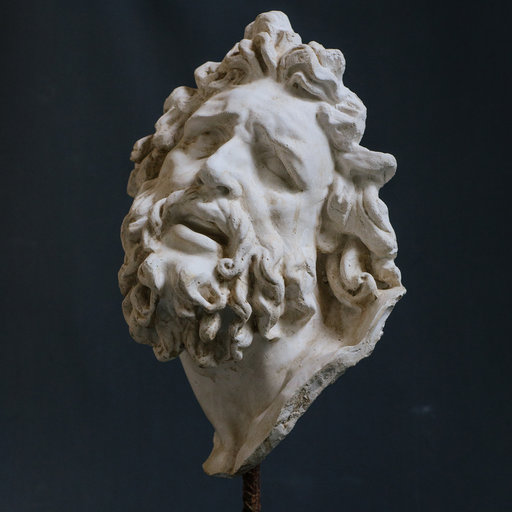
Laocoön’s head

Haydon settled into his course at the Royal Academy Schools and studied hard.  He decided that his favoured painting genre would be that of historical paintings. The first stage of his admission to the Royal Academy Schools was to present a drawing from plaster casts and so he immediately went to a seller of plaster casts who had a shop in nearby Drury Lane.  Here he purchased a cast of Laocoön’s head, a famous pieces of Hellenistic sculpture, along with some casts of arms, hands and feet and these together with his copy of Albinus’ anatomy book he set about creating acceptable drawings.  He worked non-stop and described his daily ritual:
“…I rose when I woke, at three, four or five; drew at anatomy until eight, in chalk from my casts from nine to one and from half-one until five – then walked, dined and to anatomy again from seven to ten and eleven…”

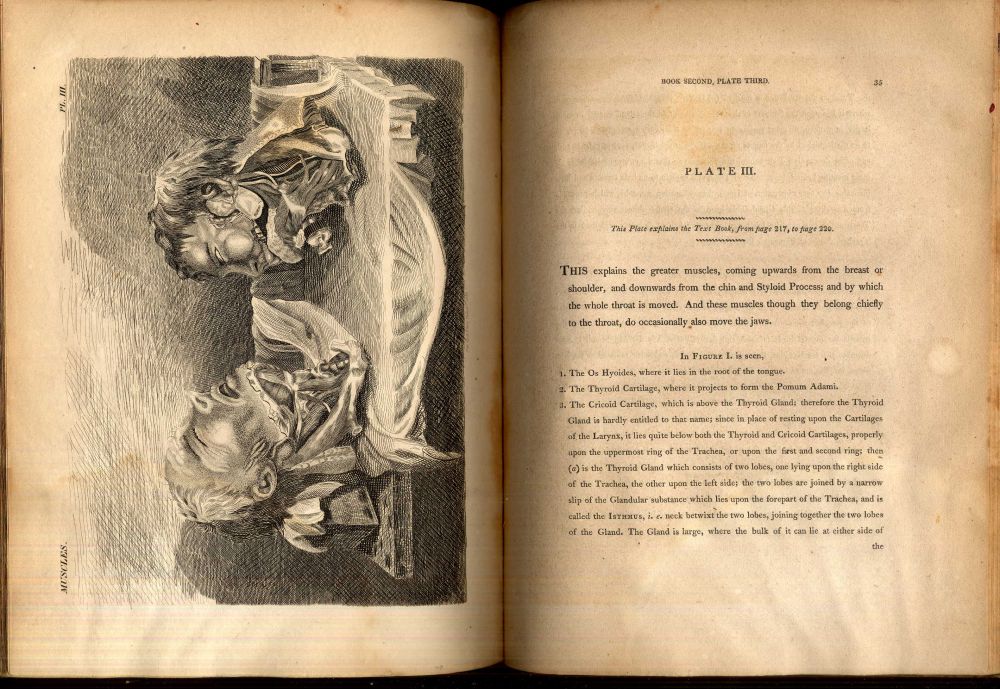
Dissection of the neck from the 1794 book ‘Engravings, Explaining the Anatomy of the Bones, Muscles and Joints’ by John Bell.

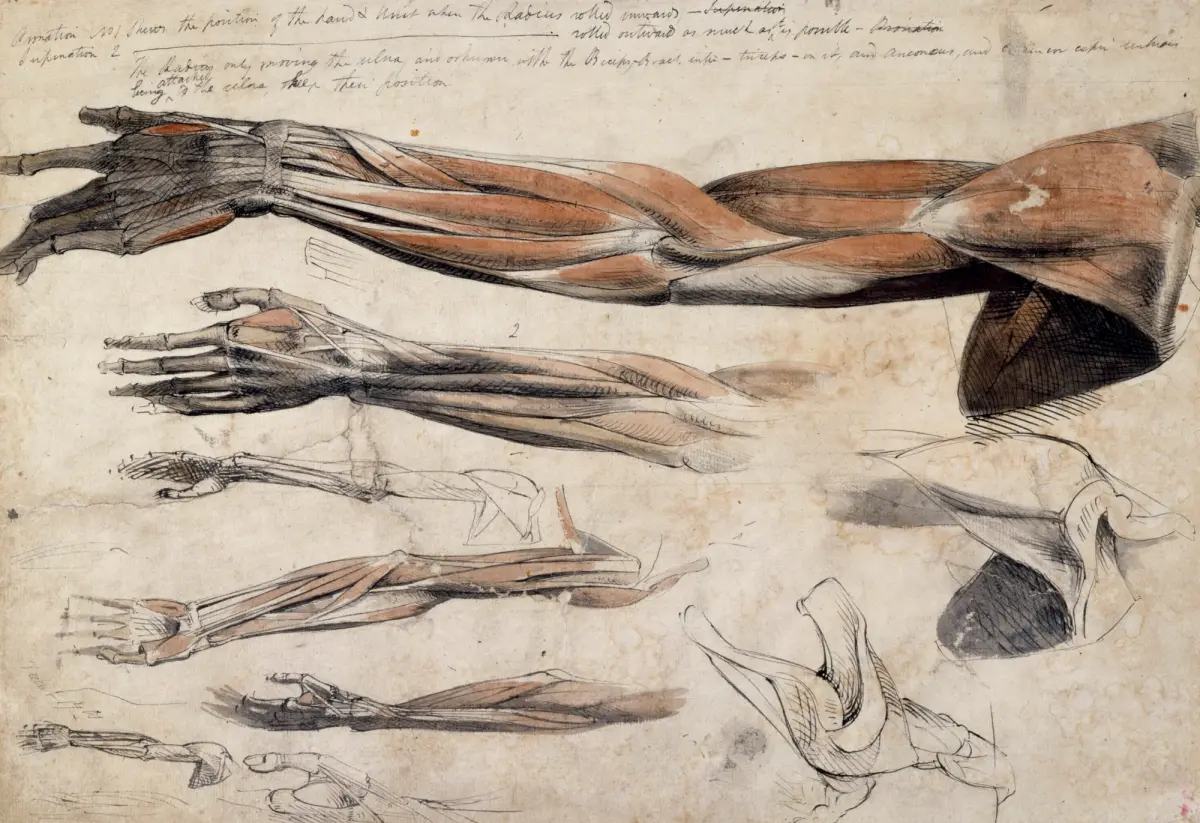
Another early purchase Haydon made was a copy of the 1794 book Anatomy of the Bones, Muscles and Joints by John Bell and this was to supplement his Albinus book on anatomy.

 It took a while before he made meaningful friendships with the exception of his sponsor and Royal Academy’s Secretary of Foreign Correspondence, Prince Hoare, who, on seeing Haydon’s sketches introduced him to John Opie and James Northcote.  Opie concurred with Haydon as to the importance of studying anatomy whereas Northcote advised Haydon to forget about anatomy and historical paintings and concentrate on portraiture but Haydon would not be deterred.  At the meetings Haydon spoke to the two artists about whether he should take lessons from a master.  Once again Opie and Northcote had differing views.  Opie was for it, Northcote against it saying Opie was only interested in extracting money from Haydon and Haydon’s father.  In the end he decided to follow Opie’s advice about studying anatomy but Northcote’s advice with regards not working under a master painter.

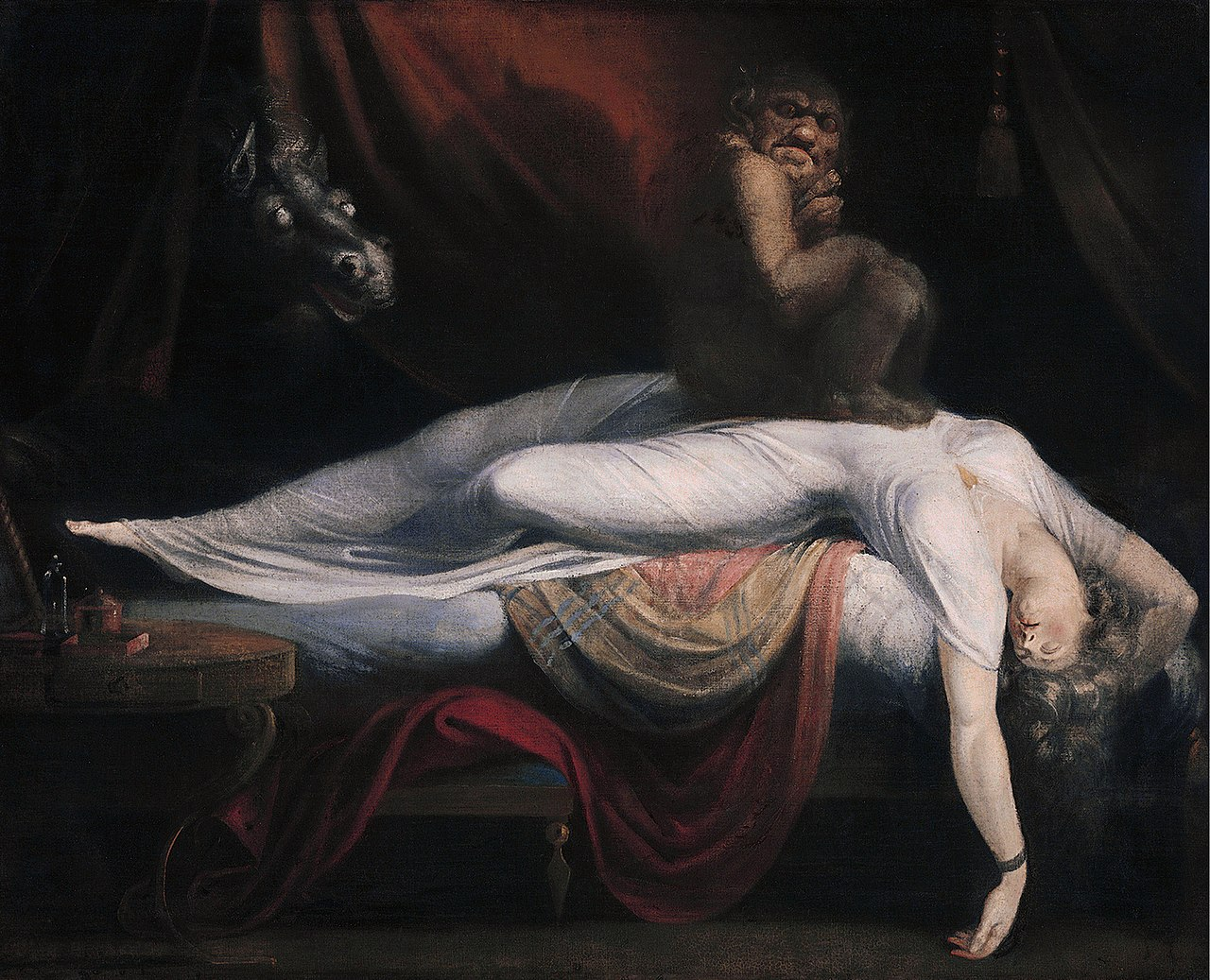
The Nightmare by Fuseli (1781)

On Christmas Eve 1804 Prince Hoare introduced Haydon to the Academy’s Professor of Painting, the Swiss-born painter John Henry Fuseli.  Fuseli held the position at the Royal Academy as Keeper, who carried overall responsibility for the Royal Academy Schools.  Haydon had seen Fuseli’s “strange” works such as his 1781 painting The Nightmare and his 1802 painting, Uriel watches Saturn on his Flight to Earth, a print of which he remember seeing in his father’s shop and so was delighted to visit this great master in early January and show him his sketches.  Fuseli was duly impressed with Haydon’s works and granted him admission to the RA Schools as a Probationer.

A sheet of anatomical drawings of the bones, muscles and tendons of the arm and hands by Benjamin Haydon  (ca. 1805)

One of Haydon’s early tasks he had to perform at the RA School was to copy a cast but the object was set up some distance from him and he realised that his poor sight was going to pose a problem and so had to purchase a pair of spectacles.  Haydon continued to work hard and such attitude found favour with Fuseli. 

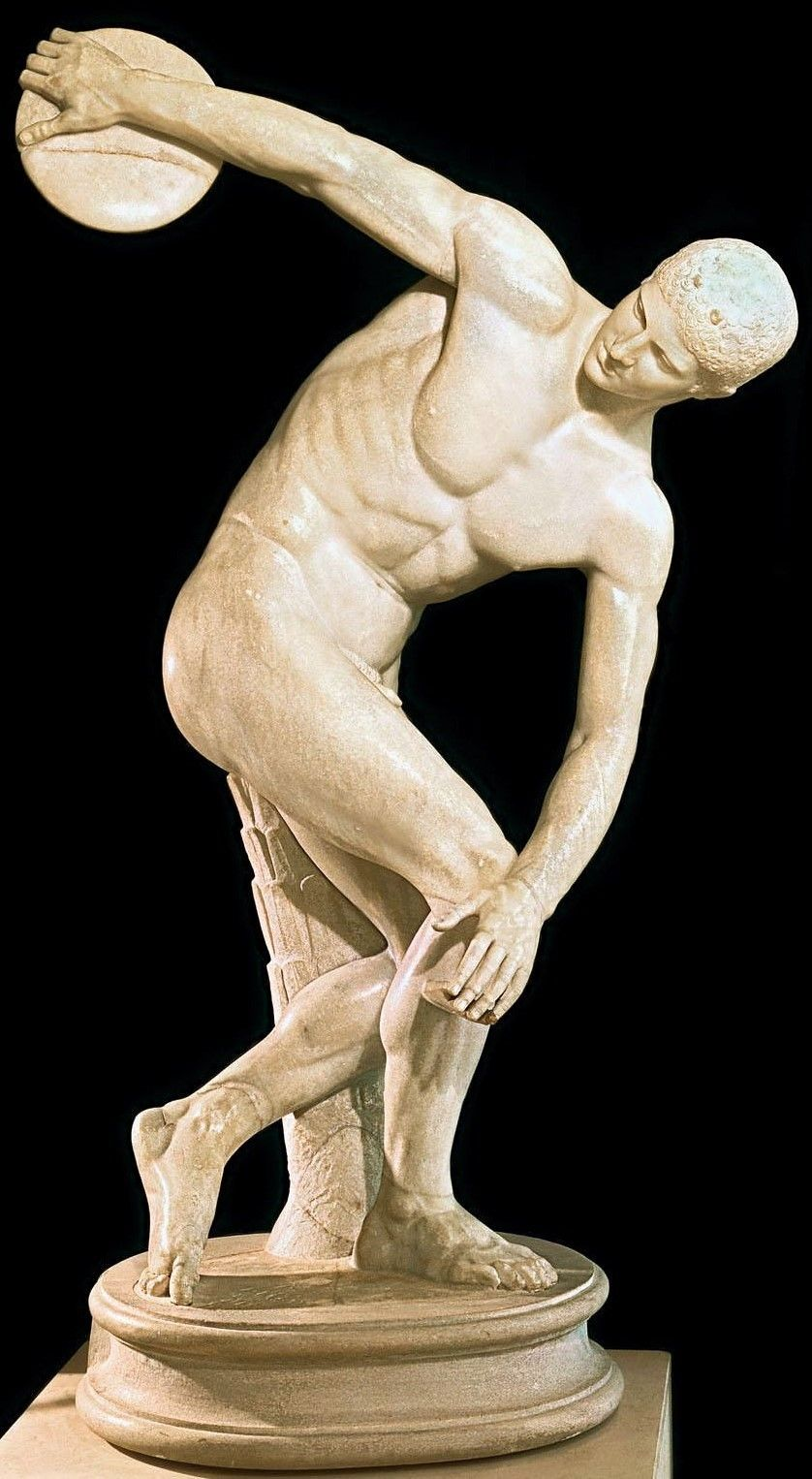
The statue of the athlete Discobulus by Myron (c.450BC)

In March 1804, having completed the task of drawing the figure of Discobolus he received his “ticket” and became a ”Student of Painting”.  Shortly after, Haydon was summoned home by his family as his father was dying.  However, despite still being a patient at Royal Naval Hospital in Plymouth his father had recovered and Haydon remained in the city that summer.  Haydon immediately sought permission from the hospital authorities to draw from their collection of preserved human bones with dried muscle. He drew obsessively, combining his depiction of the specimens with poses typically found in anatomical textbooks. 

Anatomical drawing of the bones and muscles of the lower leg by Benjamin Haydon (1805)

The result was an album with a collection of anatomical drawings.  Haydon believed that anatomy was the key to comprehending the ‘principles of heroic form’ which would then result in successful completion of grand historical works which was still his artistic aim. His ambition was to become the greatest historical painter England had ever known.

……to be continued


The majority of the information I have used in this and the subsequent blogs on the life of Benjamin Haydon came from an excellent second-hand book, published in 1998, I came across entitled A Genius for Failure, The Life of Benjamin Robert Haydon by Paul O’Keefe. If you are interested in Haydon’s life, I can highly recommend you try to get yourself a copy.

The Tokaido Road Trip. Part 3.

The end is in sight

The Tokaido Road

Hiroshige’s journey is over two-thirds complete. In the last blog he and his party had arrived at Arai and now the Tokaido Road travellers head in a westerly direction, following the coast as it approaches Shiomizaka,

No.37. Akasaka: Inn with Serving Maids by Hiroshige

Along with the preceding post stations of Yoshida and Goyu, the one at Akasaka was well known for its meshimori onna. Meshimori onna, which literally translates to “meal-serving woman,” is the Japanese term for the women who were hired by the hatago inns on the Tokaido Road post stations. At first their role was that of simply maidservants on the payroll of the inns, but as the traffic along became busier and the kaidō (road) grew,  competition between the inns increased, and the ladies were often engaged in prostitution.  However, in 1718 the Tokugawa shogunate laid down a law which stated that the number of meshimori onna working at each inn would be limited to two and this was seen as tacit permission to employ a limited number of prostitutes.  Hiroshige’s print depicts a typical inn and it is divided in half by a sago palm in the centre of the work. To the left we see travellers partaking of an evening meal.  On the right, we see prostitutes  putting on make-up and preparing for the evening entertainment.
No.38. Fujikawa: Scene at Post Outskirts by Hiroshige

At its peak, Fujikawa was once a large stop over town with 302 buildings. Its total population was approximately 1,200 people. In this ukiyo-e print by Hiroshige the artist has depicted a daimyō procession on their trek along the Tokaido Road entering the post station.  We see three commoners kneeling as the lord’s retinue passes by.  A line of old pine trees extend for approximately a kilometre mark the location of the Tōkaidō Road.

No.39. Okazaki: Yahagi Bridge by Hiroshige

Okazaki was a part of the thriving castle town which encircled Okazaki Castle, the headquarters for Okazaki Domain. The thirty-ninth print of the series depicts the Yahagibashi bridge.  This magnificent structure was one of the few bridges that people were permitted to use on the Tokaido Road by the Tokugawa shogunate.  It was one of the longest bridges built in Japan during the early Edo period. On the opposite bank of the river we can see Okazaki Castle.

No.40. Chiryū: Early Summer Horse Fair

Chiryū was the thirty-ninth of fifty-three stations of the Tōkaidō and counting the print featuring the Edo starting point at Nihonbashi, the fortieth of the woodblock series.  Reaching this point meant the travellers had trekked for three hundred and thirty kilometres and would have probably taken, on average, two weeks.  The town was famed for its horse market which took place in late April and early May.  Tall pine trees can be seen and the shogun, Tokugawa Ieyasu, ordered that the post station plant pine trees along through route of the highway before and after the town.  These all survived until the Isewan Typhoon of 1959 which destroyed most of them.

No.41. Narumi: Famous Arimatsu Tie-dyed Fabric

 The woodblock print depicts travellers passing by open-fronted shops selling tie-died cloth. Clothing such as the yukata kimono, the unlined kimono for summer use, which was a local speciality of the region.

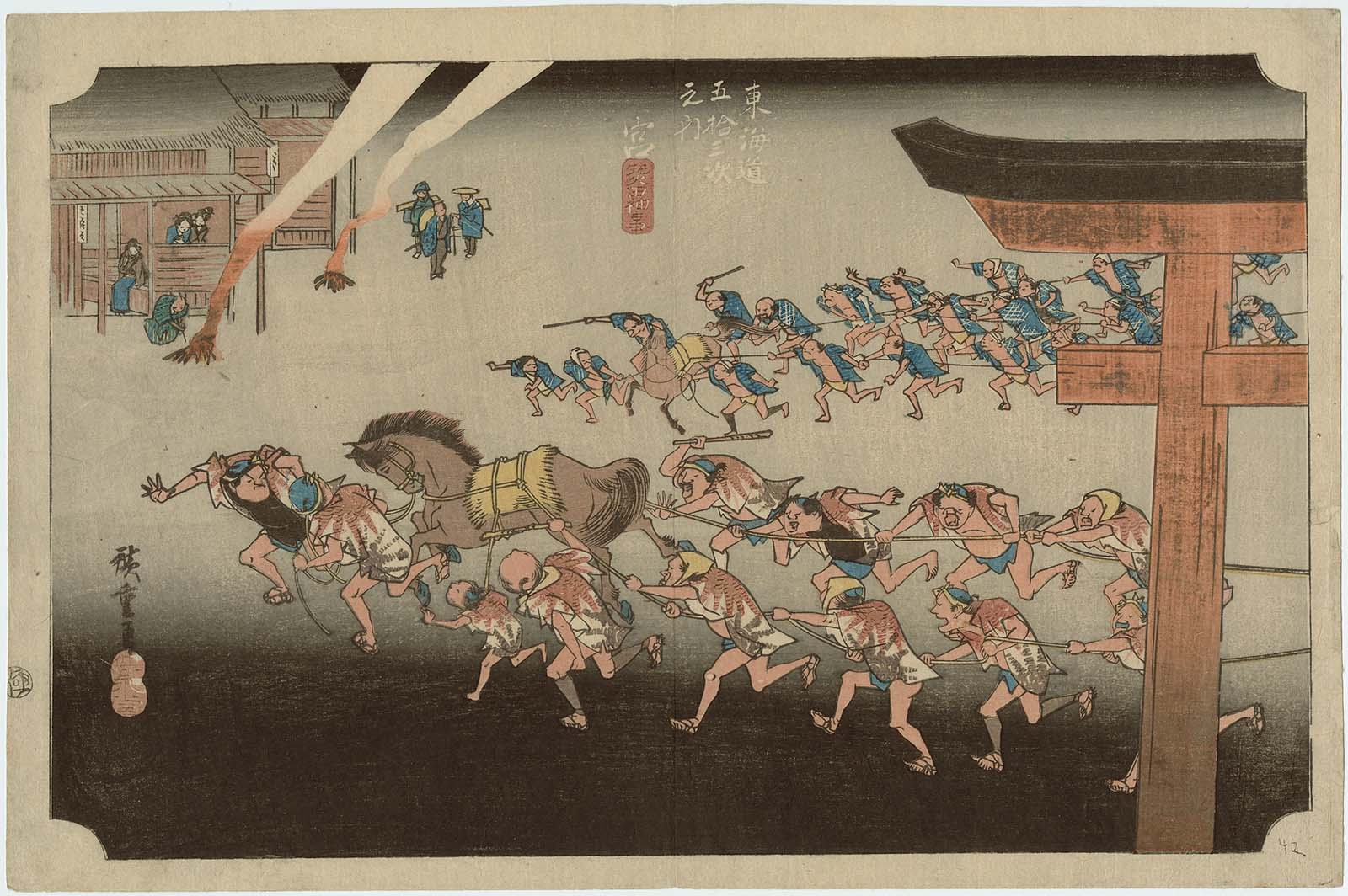
No.42. Miya: Festival of the Atsuta Shrine

The Tokaido Road post station at Miya also acts as a post station on the The Nakasendō, the Central Mountain Route, also known as the Kisokaidō, which was one of the five routes of the Edo period, that connected Edo and Kyoto.  Hiroshige’s print depicts two gangs of men dragging a portable shrine cart which is just out of the picture, past a huge torii gate. The torii gate is the symbol of a Shinto shrine, and the name of the town, “Miya” also means a “Shinto shrine. The shrine in question is the famous Atsuta Shrine, one of the most famous in Japan and a popular pilgrimage destination in the Edo period.

No.43. Kuwana: Shichiri Crossing

The Kuwana post station was found in the castle town of Kuwana Domain, which was a major security installation on the Tōkaidō Road for the Tokugawa shogunate. The actual post station could be found located on the western shores of the Ibi River. Hiroshige’s print of Kuwana depicts two large ships of the Shichiri no watashi ferries about to set sail with travellers from in front of Kuwana Castle, whilst in the background we can see other ships sailing away on their voyages.

No. 44. Yokkaichi: Mie River by Hiroshige

Hiroshige’s ukiyo-e print of Yokkaichi  illustrates a stormy day and we see a man running after his hat which has been blown from his head.  Another man crosses a small bridge over the Sanju River  The roofs of the small group of huts which form the post station can be seen in the middle of a marsh are almost hidden by the reeds.

No. 45. Ishiyakushi: Ishiyakushi Temple by Hiroshige

The Ishiyakushi post station derived that name from the nearby Buddhist temple which is said to have been founded in 726 AD by the shugendō monk Taichō. According to the temple legend, Kūkai carved an image of Yakushi Nyorai on a huge boulder that was found in the forest, and Taichō later built a temple around this image. A settlement gradually developed around the temple.  Utagawa Hiroshige’s ukiyo-e print of Ishiyakushi depicts the temple in the midst of a grove of trees on the left and a village on the right.  Rising in the background are the Suzuka Mountains.  In the foreground we can see bales of rice which means that this is an Autumn depiction and tells us that this post station is at the heart of the countryside.

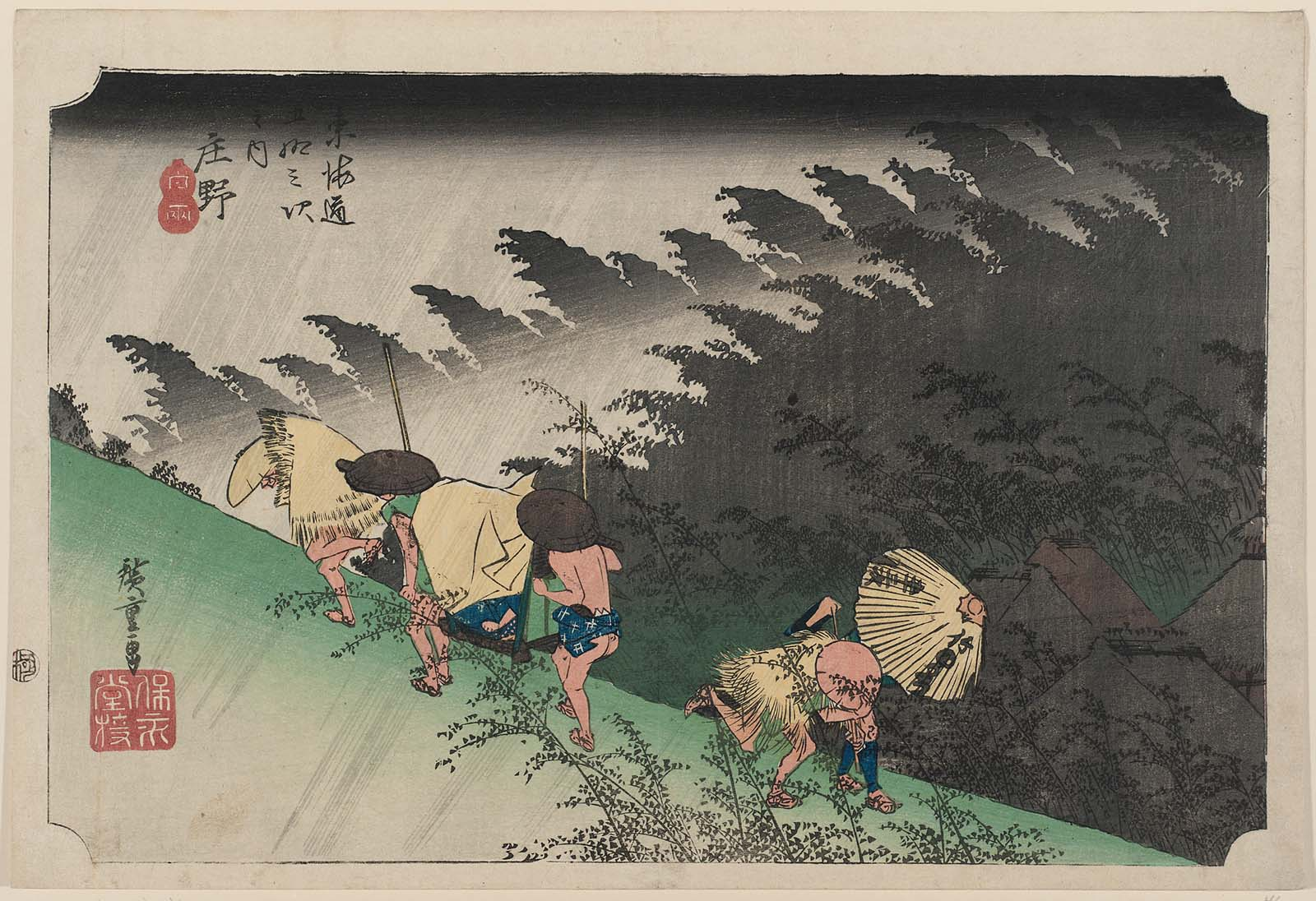
No.46. Shōno: Driving Rain

The weary travellers are suddenly caught out by torrential downpour as they arrive at the town of Shōno in Ise Province. On the right we see two men heading down hill, one holding an umbrellas and the other wearing a hat and cloak. There are two inscriptions on the umbrella. One is Takenouchi who was the publisher of the series of prints and the other is Gojūsan-tsugi, which was part of the Japanese name of the Tokaido Road woodblock series Tōkaidō Gojūsan-tsugi no uchi. To the left of these men we see another man wearing a hat and a cloak walking uphill followed by two litter-bearers. The falling of heavy rain is depicted like a grey curtain.

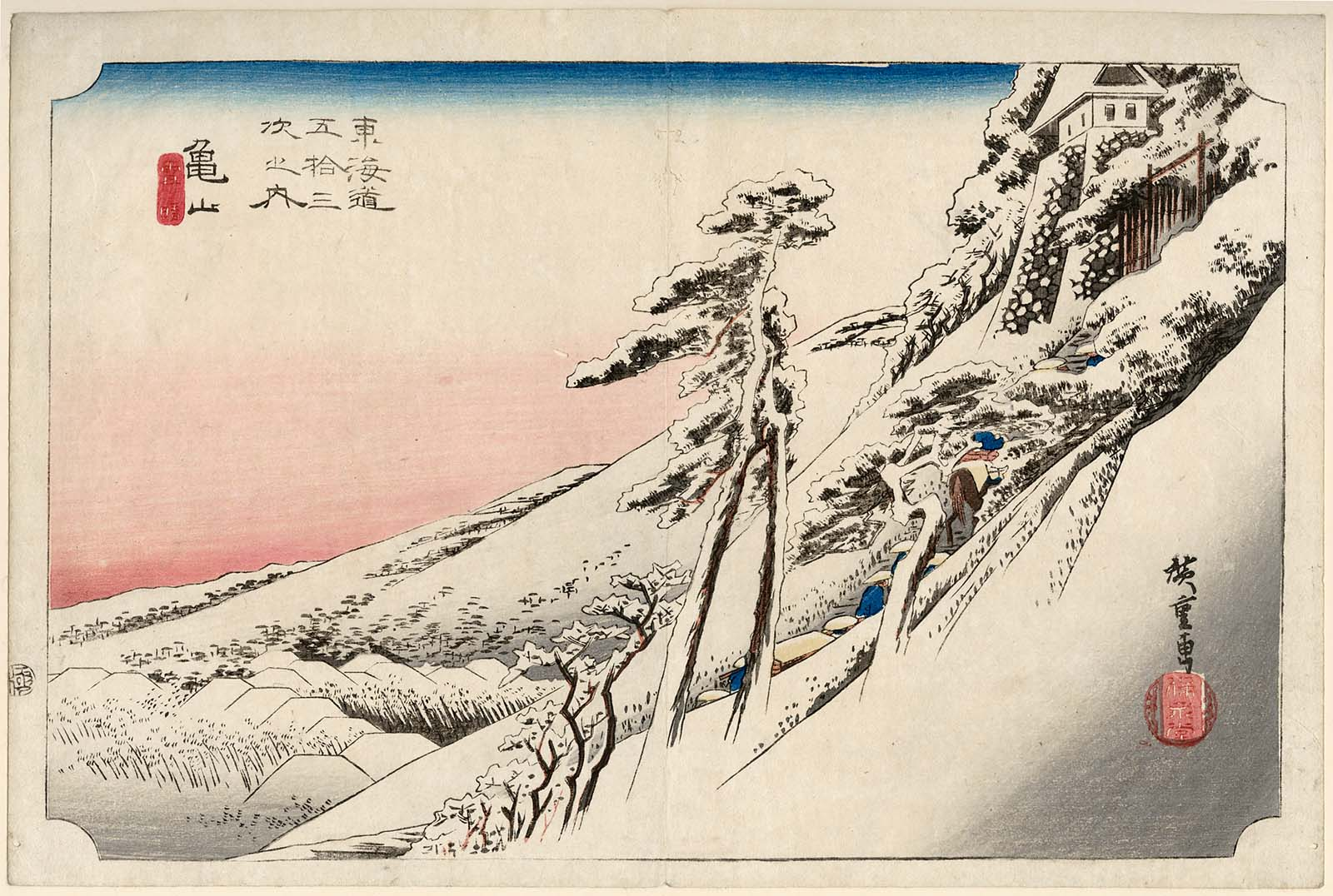
No.47. Kameyama: Clear Weather after Snow

The procession of travellers continue on an upward trajectory. The steep path takes them past the castle of Ishikmawa daimyo and we can just see the town of Kameyama in the valley to the left. The castle was home to the Ishikawa clan,  daimyō of Ise-Kameyama Domain.  The setting is early sunrise and the sky is reddened by the early morning sun. Kameyama was a well fortified city from the middle of the sixteenth century at the time of the building of the castle. In 1854, twenty years after Hiroshige’s woodblock print series was published, the castle was destroyed by the great Ansei earthquake. However in 1855 Hiroshige produced a vertical woodblock series of the Tokaido Road journey and in that series, despite the destruction of the castle, it is depicted in an unblemished state !

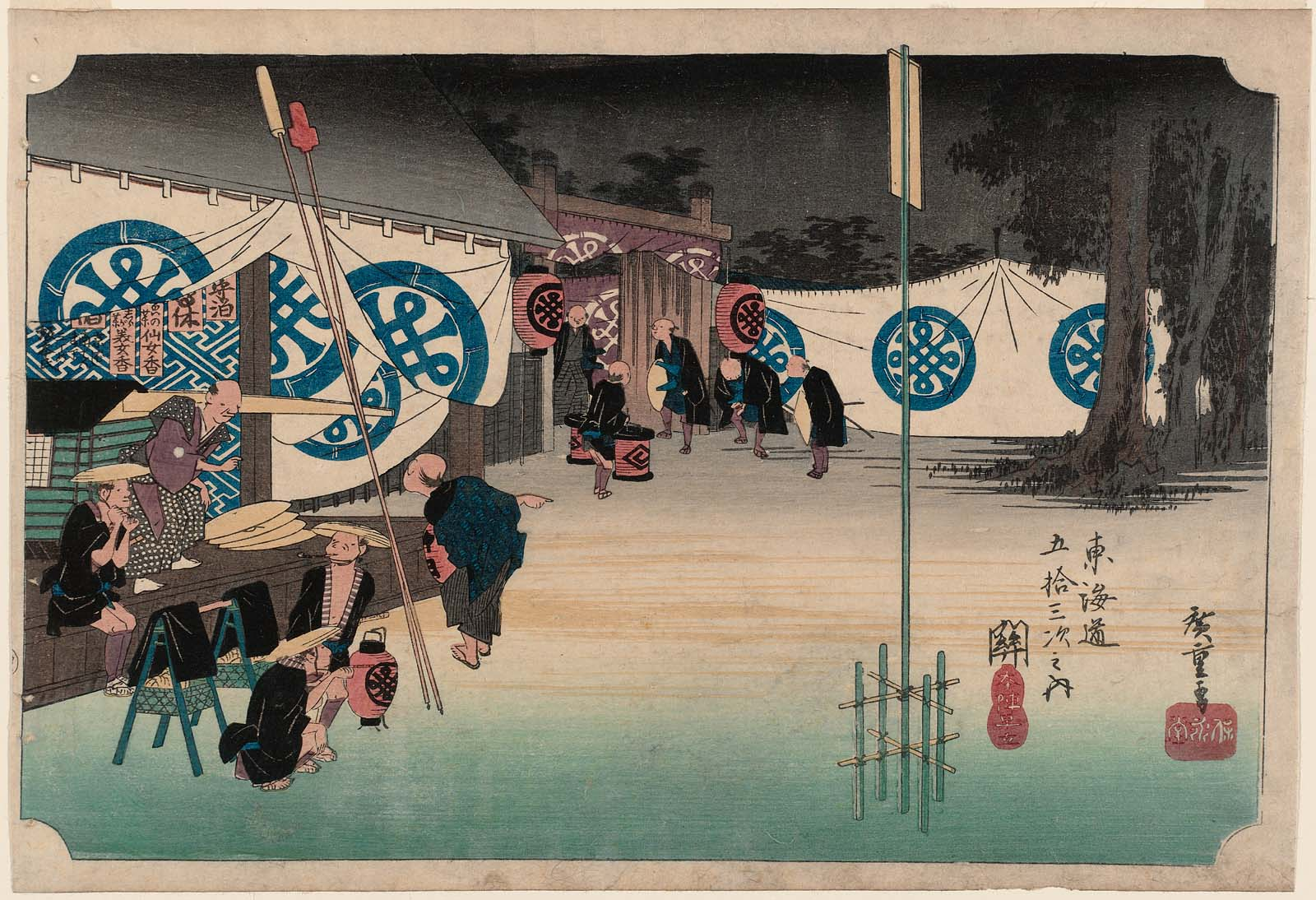
No.48. Seki: Early Departure of a Daimyō

The next depiction in the Tokaido series is that of the inn at Seki where the travellers had rested for the night. It is early the next morning and still somewhat dark. The people prepare to set off on the day’s travels. The innkeeper dressed in his traditional kamishimo, a formal kimono for men, stands on the verandah issuing instructions to one of his servants. To the left of the table we see a palanquin (litter) on the ground with the palanquin bearers standing by. The banners we see hanging around the courtyard of the inn probably bear the emblem of the daimyō who has spent the night at the inn. You can see some small brown signs hanging above the head of the innkeeper – they are advertising the availability at the inn of the famous Senjoko and Biojoko brands of white face-powder.

Snow landscape with a gate: Seki by Hiroshige (1855)

The town of Seki also appeared in the 1855 version of Hiroshige woodblock series of the Tokaido Road, the so-called Reisho Tokaido. In this depiction it is late afternoon on a snowy day and we see a few travellers passing the gate to the pilgrim’s route to Iso.

No.49. Sakanoshita: Fudesute Mountain by Hiroshige (c.1833)

Having left Seki, the travellers move deeper inland and have reached the summit of the Fudesute Mountain. The mountain derives its unusual name from an incident in which the celebrated artist Kano Motonobu threw away (sute) his brushes (fude) when he could not capture the beauty of the mountain in a painting.  

Another version by Hiroshige of Fudesute Mountain at Sakanoshita.

No.50. Spring Rain at Tsuchiyama by Hiroshige (c.1833)

The fiftieth print in the series depicts a daimyō procession.  They are enduring torrential rain as they traverse the crossing surrounded by a raging torrent which rushes below a wooden bridge. The post station, with its darkly coloured buildings, partly hidden by trees, are seen to the left of the picture.

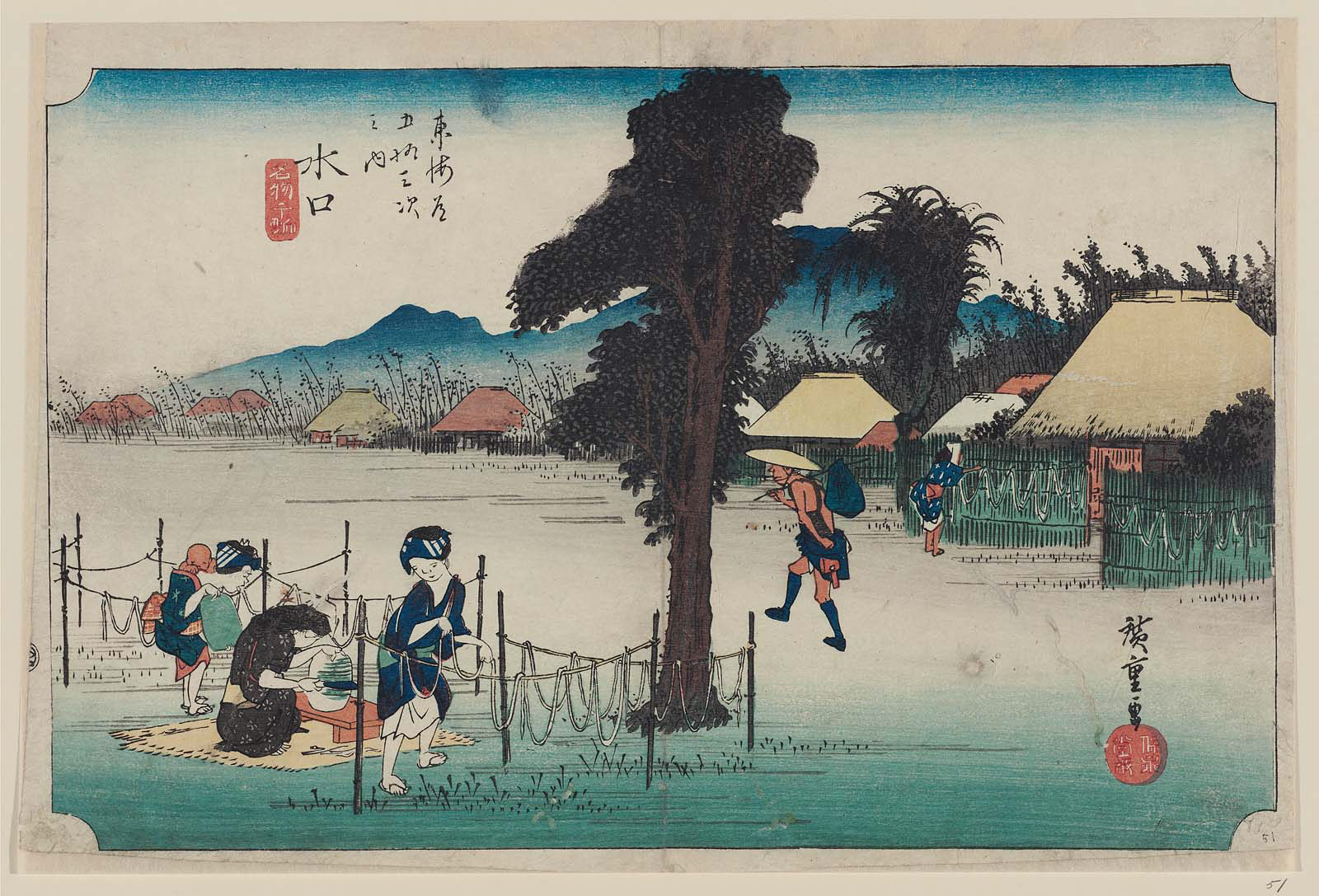
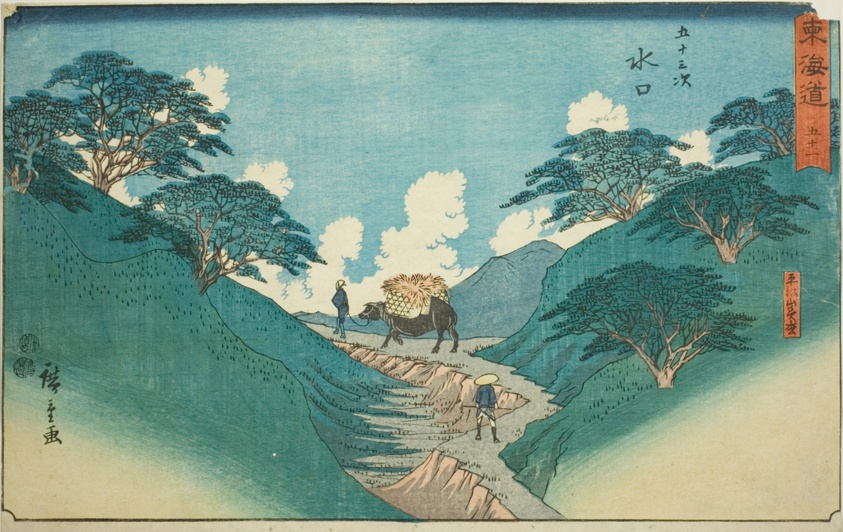
Below are two prints made by Hiroshige of the remote Minakuchi layby station. One was part of the 1833 series and the other from the later series which was published around 1852 and known as the Reisho Tokaido or the Marusei Tokaido..

No.51. Minakuchi: Famous Dried Gourd by Hiroshige (c.1833)

In the 1833 print we see a lone traveller walking through the village of Minakuchi. In the foreground we observe women peeling and drying gourds In the background there is a range of hills. This resting station is located in a desolate rural area and was famous for its production of dried gourd shavings which were often used for Japanese dishes. These women we see are busy producing them. One is shaving a gourd, one, with a baby slung on her back, is helping the shaver, whilst another one is drying the shaved gourd on a rope.

The beautiful pines at Hiramatsuyama by Hiroshige (1851-2)

In this 1852 edition of the Reisho Tokaido we see a peasant leading an ox laden with produce making their way slowly along the winding uphill path. Another man follows. The setting of this print is the steep road leading to the next stop-over point at Ishibe and just to the left of the Tokaido Road. This hill between the villages of Harimura and Kojibukuro, although it only reaches an elevation of two hundred and twenty-eight metres, is known as Mount Hiramatsu. The striking thing about the depiction are the pine trees on either side of the road. Normally pine trees along the side of the road have been planted but these are said to have grown there on their own accord. Note in the background the white clouds depicted by Hiroshige. These cumulus clouds were a Western element, one which only rarely appeared in Hiroshige’s prints.

No. 52. Ishibe: Megawa Village by Hiroshige

Utagawa Hiroshige’s ukiyo-e Hōeidō edition print of Ishibe does not actually show the post station at all, but instead we see a tea house known as Ise-ya, which was located at Megawa no Sato, on the road between Kusatsu and Ishiba.  This shop was well-known for its tokoroten, a sticky sweet made from agar, and kuromitsu, a black sugar syrup. We see depicted in the print a group of travellers who seem to be dancing and cavorting in front of the shop.  They are observed by three women who are wearing travelling hats and walking sticks.  A couple of other travellers, some distance further down the road, are seen to be heavily laden, and struggling with their trek.

No.53. Kusatsu: Famous Post House by Hiroshige (1833)

The post station on the Tokaido Road at Kusatu was also a post station for the The Nakasendō (Central Mountain Route), also known as the Kisokaidō, both being one of the five routes of the Edo period.  Looking at the print we observe a busy scene within the post station itself in front of the open-fronted Yōrō-tei, a tea house in which many patrons are probably partaking in their famous Ubagamochi, a sweetened sticky rice cake which was a speciality of Kusatsu.   In front of the tea house, on the road itself, we see a passenger in an open kago (palanquin) holding desperately on to a rope as the porters rush him to his destination  Moving in the opposite direction we see a larger green, covered kago, and this is probably transporting a high status passenger.

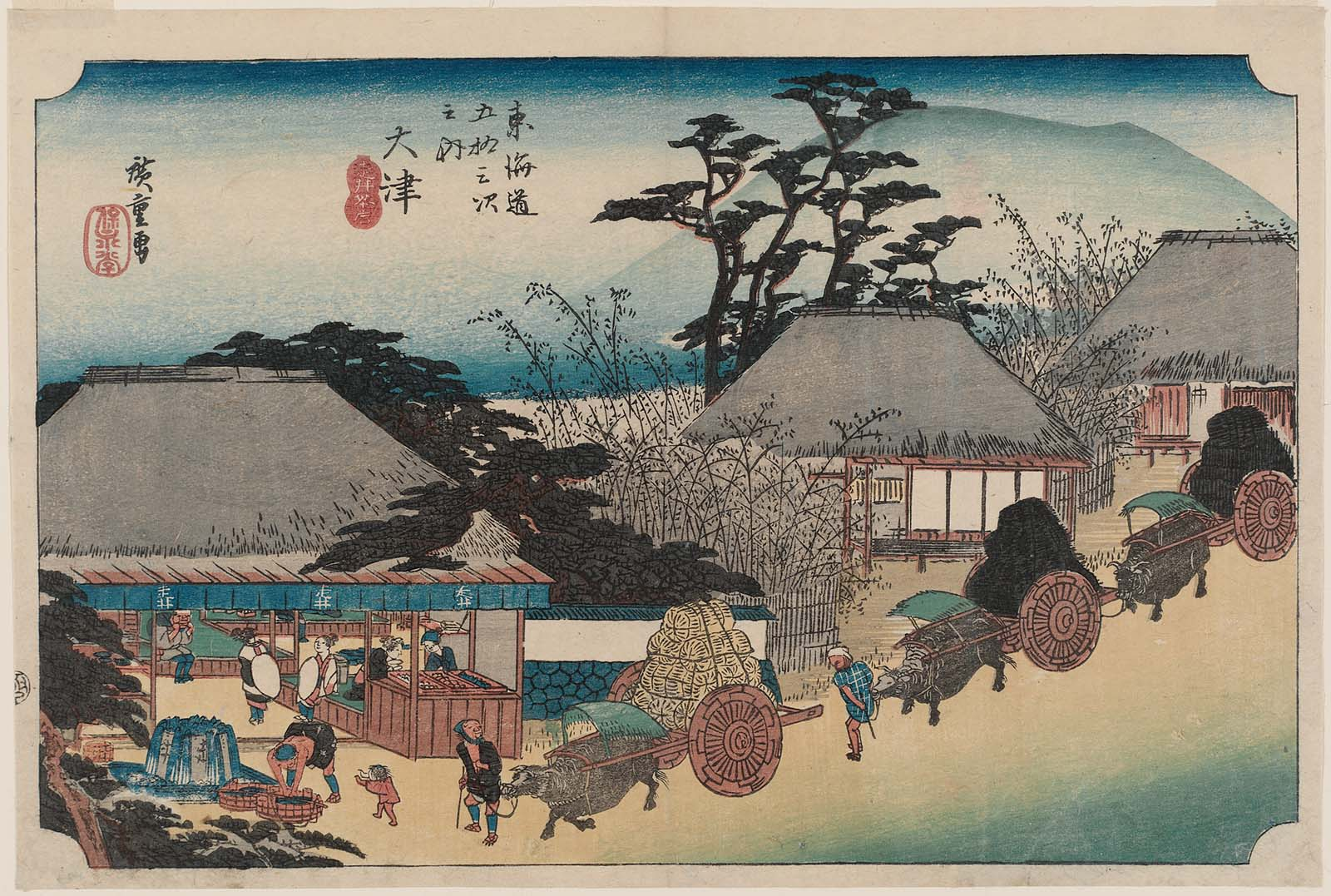
No. 54. Ōtsu: Hashirii Teahouse by Hiroshige

The Ōtsu post station was the last of the fifty-three stations of the Tōkaidō as well as the last of the sixty-nine stations of the Nakasendō. In Hiroshige’s 1833 depiction we see oxcarts, heavily laden with bushels of rice or charcoal descending the street. The oxcarts pass in front of the open front of the Hashirii teahouse, which was a popular resting point on the highway, and was well known for its delicacy known as Hashirii Mochi, a sweet rice cake, which is still a local specialty of Ōtsu.  In front of the teahouse is a well from which fresh water gushes out.

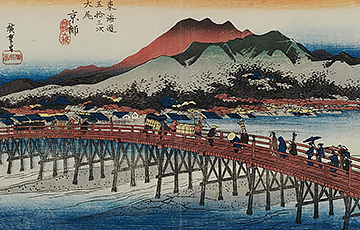
No. 55. Kyōto: The Great Bridge at Sanjō by Hiroshige

Finally the weary travellers arrive at the Great Sanjō Bridge over the Kamo River in Kyoto, the imperial capital and the terminal of the Tōkaidō. The bridge is well known because it served as the final location for journeying on both the Nakasendō and the Tōkaidō, two of the famous “Five Routes” for long distance travelers during the Edo period in Japan’s past. In the background we can see houses, temples, and villas at the foot of Higashiyama. Mount Hiei, which is an important Buddhist centre, is silhouetted in distance.

That is the end of our 500 kilometres journey. Most of the pictures came from the website: The Fifty-three Stations of the Tōkaidō Road

(https://hiroshige.org.uk/Tokaido_Series/Tokaido_Great.htm)

The information about the journey came from the usual internet sources and a great book I found in a second-hand bookshop entitled Hiroshige, a Royal Academy of Arts, Publication, produced at the time of their 1997 exhibition of Hiroshige’s work.

The Tokaido Road Trip. Part 2.

The middle part of the journey.

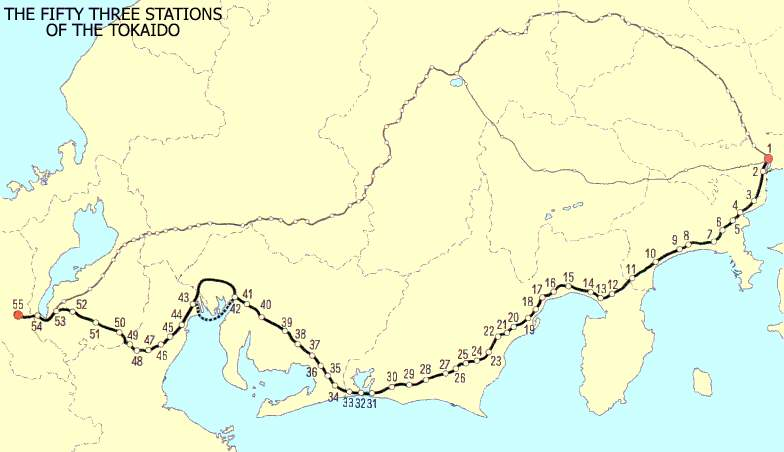
The Tokaido Road Post Stations: Edo (1) to Kyoto (55)

 The Takaido Road journey was about 500 kilometres long and most travellers made the tiring journey on foot, aiming to accomplish several stages per day although in some cases the travellers would spend several nights at one station.  The whole trip, on average, would take two weeks but the more athletic could cut that time  by half.  One of the determining factors was the weather and bad weather could make the journey last up to a month.  As I said in Part 1, one set of travellers who made the annual pilgrimage was the procession of the great daimyo (powerful Japanese magnates, feudal lords), who were commanded to spend every other year at the Shōgun’s court.  The reason for this being to prevent them from organizing rebellions and the large entourage travelled back and forth in huge processions numbering hundreds of people.

No.17. Yui: Satta Peak by Hiroshige (c.1833).

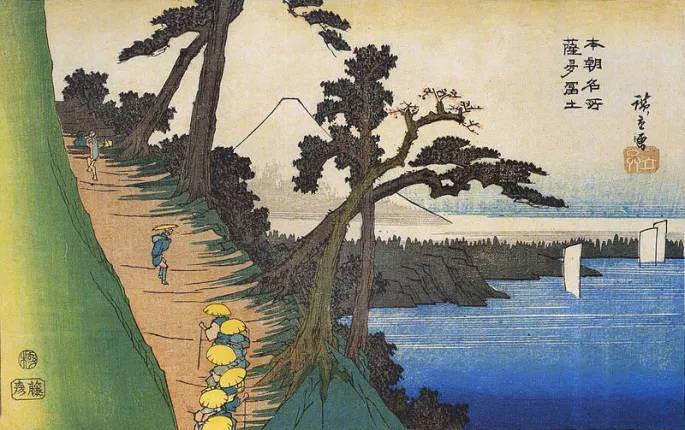
At the end of the last blog Hiroshige had reached the snow covered village of Kambara. He and his group have moved further south west and arrived at the Satta Pass. In this depiction we see a few travellers on the cliff-top pass looking out at the panoramic Kiyomi Bay, a bay on the Pacific coast of Honshū. The Satta Pass was carved out of the rocks in 1655. Two pine trees can be seen leaning over and twisted in the wind and in the background we once again see Mount Fuji.

Yui: The Dangerous Satta Pass by Hiroshige (1855)

Hiroshige completed another print of the Satta Pass in his 1855 Tokaido Road series.

Travellers on a mountain path along the coast by Hiroshige (c.1837)

Hiroshige must have been fascinated by the view afforded to him from the Satta Pass and Mount Fuji as one of his prints from his Famous Views of our Country is entitled Travellers on a Mountain Path along the Coast and once again we see travellers trekking along the Satta Path.

No.18. Okitsu: The Okitsu River by Hiroshige.

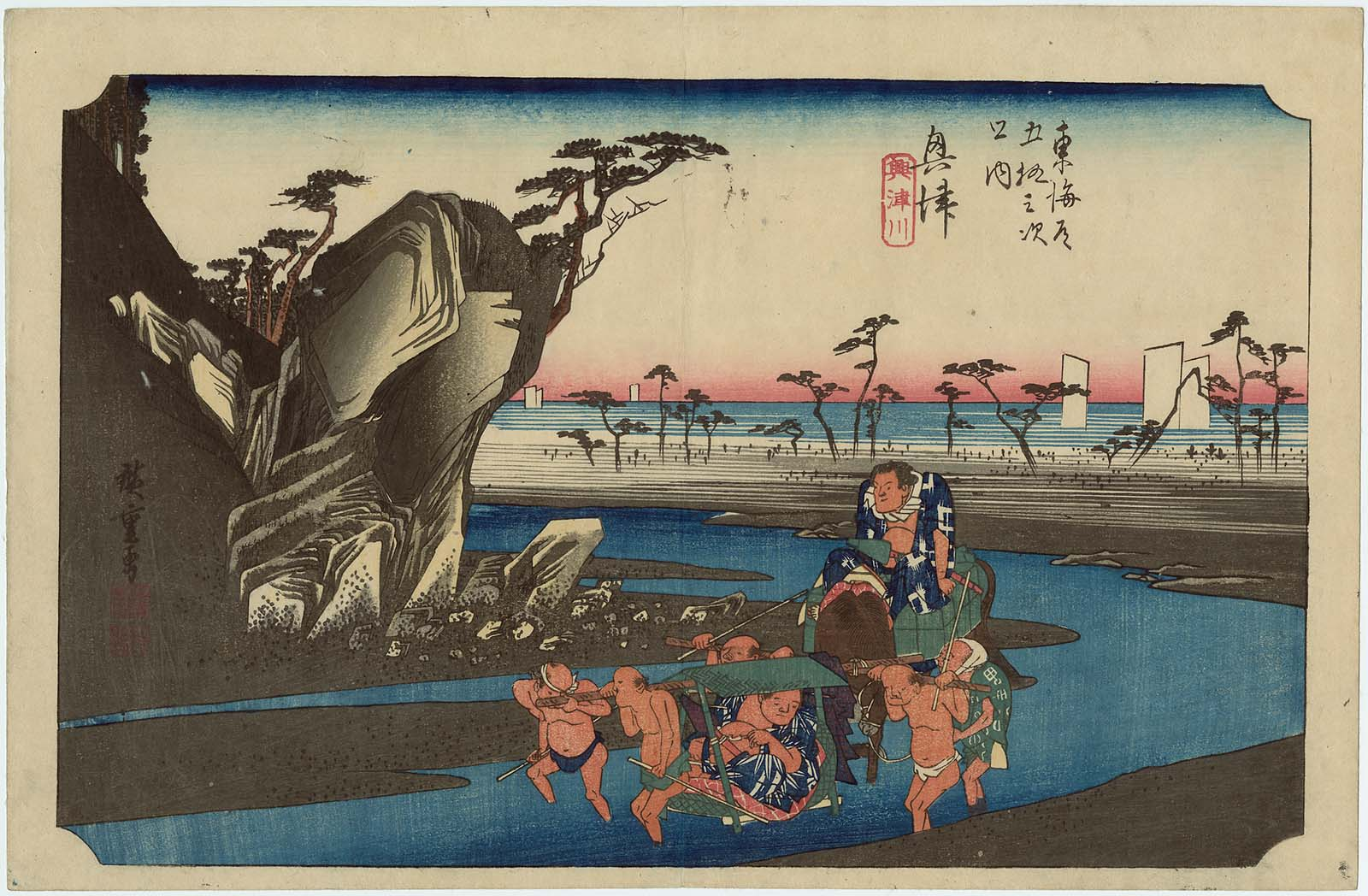
The Takaido Road travellers leave Yui and the Satta Pass and cross the Okitsu River towards the layby station at Okitsu. The classic ukijo-e print by Hiroshige depicts two sumo wrestlers being carried across the Okitsu River, one on a packhorse and the other in a kago, which is a type of litter used as a means of human transportation by the non-samurai class in feudal Japan.

No.19. Ejiri: Distant View of Miho by Hiroshige (c.1833).

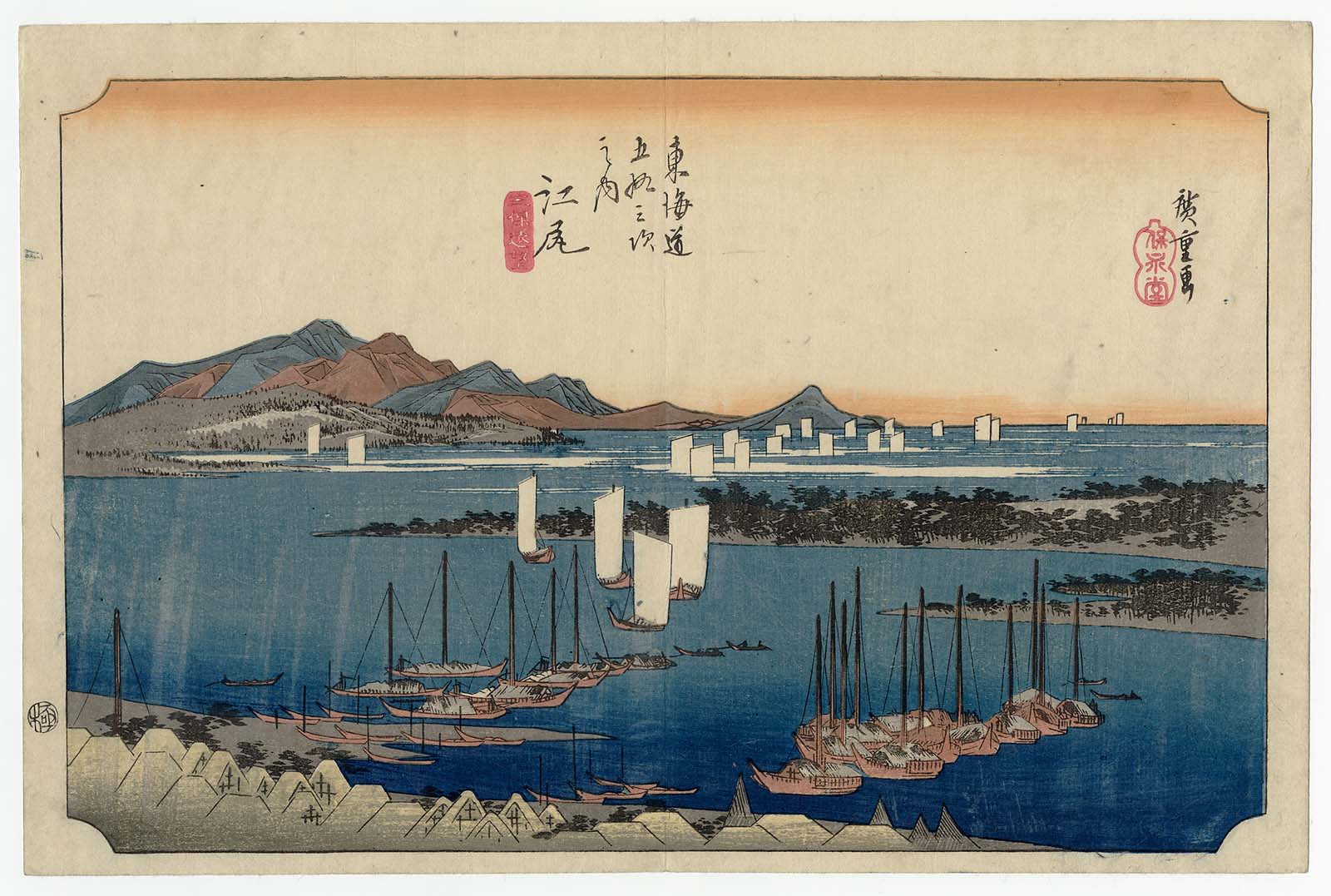
Further along the Takaido Road the travellers are able to look towards the sea and the harbour town of Ejiri. Ejiri was a castle town.  Ejiri castle was built in 1570, but the town of Ejiri was not officially designated a post station until the early 17th century.  The print depicts a view over the Miho no Matsubara,(pine grove at Miho), a scenic area on the Miho Peninsular of Shizuoka City. Its seven-kilometre seashore is lined with pine trees. with boats anchored in the foreground in front of a fishing village, while others can be seen sailing in Suruga Bay.

No.20. Fuchū: The Abe River by Hiroshige (c.1833).

The weather was always a determining factor for how long the five hundred kilometre journey would take but the other factor was the crossing of rivers that traversed their path. One such was the Abe River which proved a great challenge. depicts travellers crossing the Abe River to the west of the post station. A woman is being carried in a kago (another type of litter, while other people are fording the stream on foot.

No.21. Mariko – Local Specialities Shop by Hiroshige (c.1833).

We have now arrived at the twenty-first stop over point near Mariko and in this depiction we see two travellers who have stopped their journey for refreshments at a roadside stall. Tea is being served with a local speciality known as tororoshiru, which is a paste made from grated yam. The two men are being served by a woman who has a baby strapped to her back. To the left of the stall we see a man on his way along the road with his back to us. He is smoking a pipe and his rain jacket and hat are tied to a stick which he carries over his shoulder.

No.22. Okabe: Utsu Mountain by Hiroshige (c.1833).

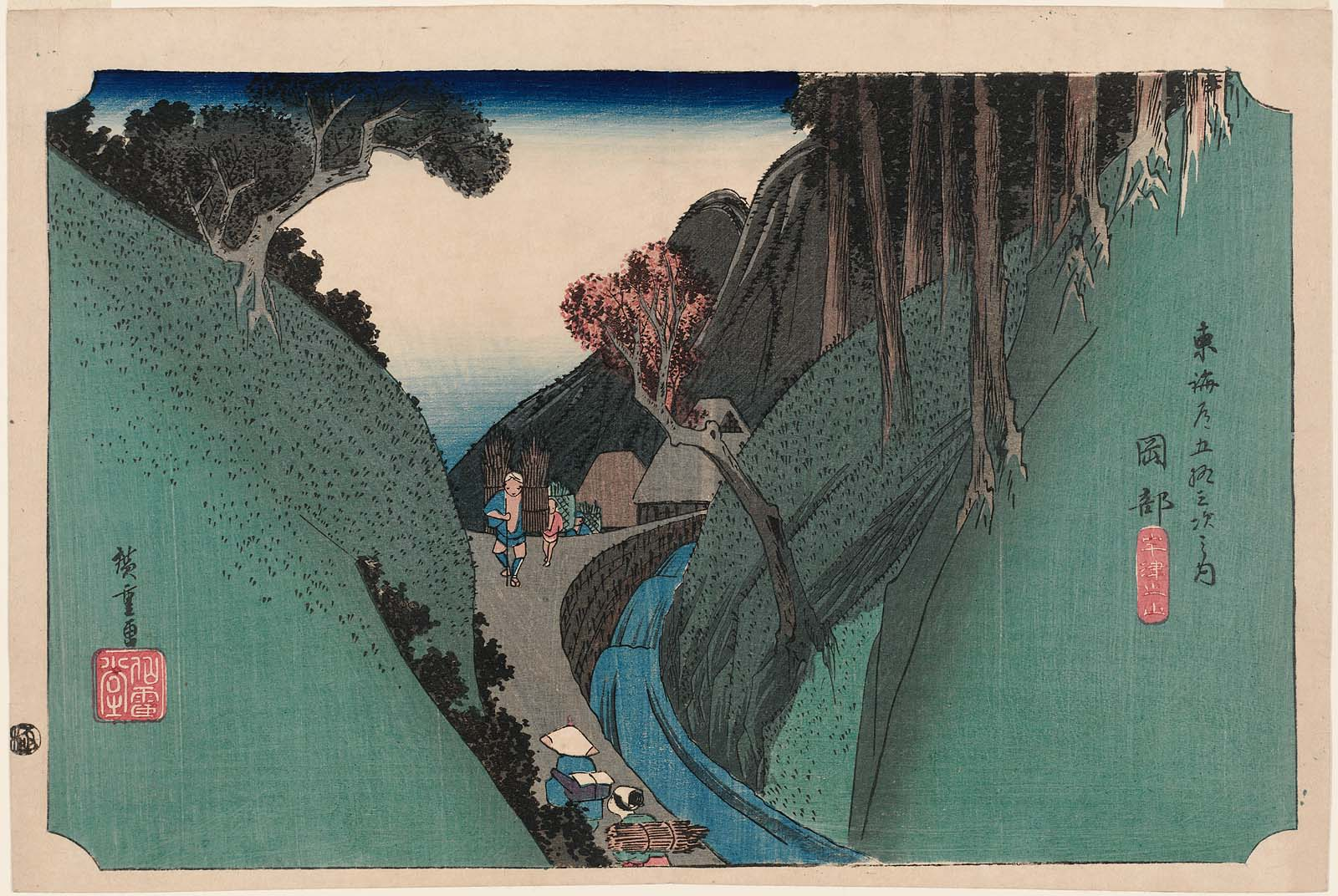
Once again the travellers had to struggle along the tiring uphill stretch of the Tokaido Road as they move slowly over the Utsu Mountain pass. Most of the post stations I am highlighting in these three blogs were built around 1602 but the one at Okabe was not completed until a year later.  At the time it was built, the population there was just sixteen and thirty-five years later, had only risen to one hundred.  The print depicts a mountain stream between steep green banks, with the roadway a narrow path walled in on one side by a stone wall.  it was destroyed by fire in 1834. After it was rebuilt in 1836, it was eventually named nationally designated Important Cultural Property.  In 2000, it was reopened as an archives museum.

No. 23. Fujieda: Changing Porters and Horses by Hiroshige (c.1833).

Such a long journey along the 500 km Tokaido Road necessitated a frequent change of horses and men who have been employed to carry people and supplies across fast flowing rivers and up steep mountain trails. Fujieda was one of these stop-off points between the Abe and Ōi rivers, where fresh horses and men could be employed for the onward route.

No. 24. Shimada: The Suruga Bank of the Ōi River by Hiroshige (c.1833)

With fresh horses and a new group of porters to carry supplies, the palanquins and the party were ready to cross the Ōi River which flowed down from the Akaishi mountains, part of the  the Japanese Southern Alp that form the border between Shizuoka, Nagano and Yamanashi prefectures. From the print we can see that the crossing was an immense challenge. The Tokugawa Shogunate was very mindful about the defence of Edo and that included the outer limits of the city.  It was then deemed necessary to stop any easy access to Edo expressly forbidding the building of bridges or allowing a ferry service to cross the Ōi River.  All travellers had to wade across the shallowest parts of the river but this was impossible during times of heavy rain which caused the river to flood.  During those times travellers had to spend days at Shimada, which of course made the tea houses and shop owners very happy.

No.25. Kanaya: The Far Bank of the Ōi River by Hiroshige (c.1833)

The twenty-fifth woodcut print of the Tokaido Road series by Hiroshige depicts the party at the end of their struggle to cross the Ōi River and to approach the Kanaya post town. Kanaya was located on the west bank of the Ōi River and like Shimada, prospered from the Tokugawa Shogunate’s defence policy of not allowing any bridge or ferry to be established on the Ōi River. This meant reaching the town from the east was often difficult if the river flow, after heavy rain, was too fast for travellers to cross and they had to wait before entering the river finding themselves trapped for days on either side awaiting the water level to drop.

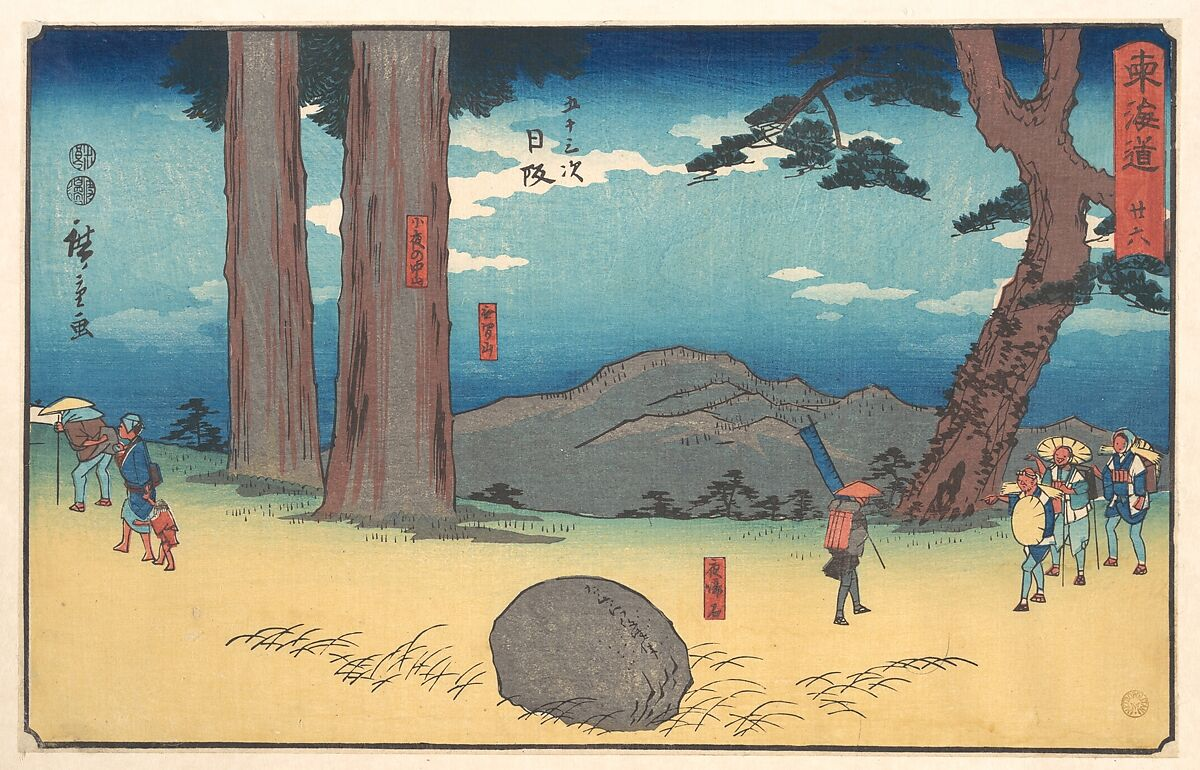
No.26. Nissaka. Sayo Mountain Pass by Hiroshige (c.1833)

Having crossed the Ōi River the party of travellers moves into the Sayo mountains and once again face a steep up-hill climb. On the path we see a large stone. This object appears in a later woodcut print by Hiroshige.

Nissaka by Hiroshige (1849)

The stone features prominently in this print. It is known as the Night-Weeping Stone and according to legend a pregnant woman was killed by bandits, and her blood fell on the stone. After she died, a passing priest heard the stone call out for him to rescue the surviving infant. The tale goes that the stone has cried at night for her.

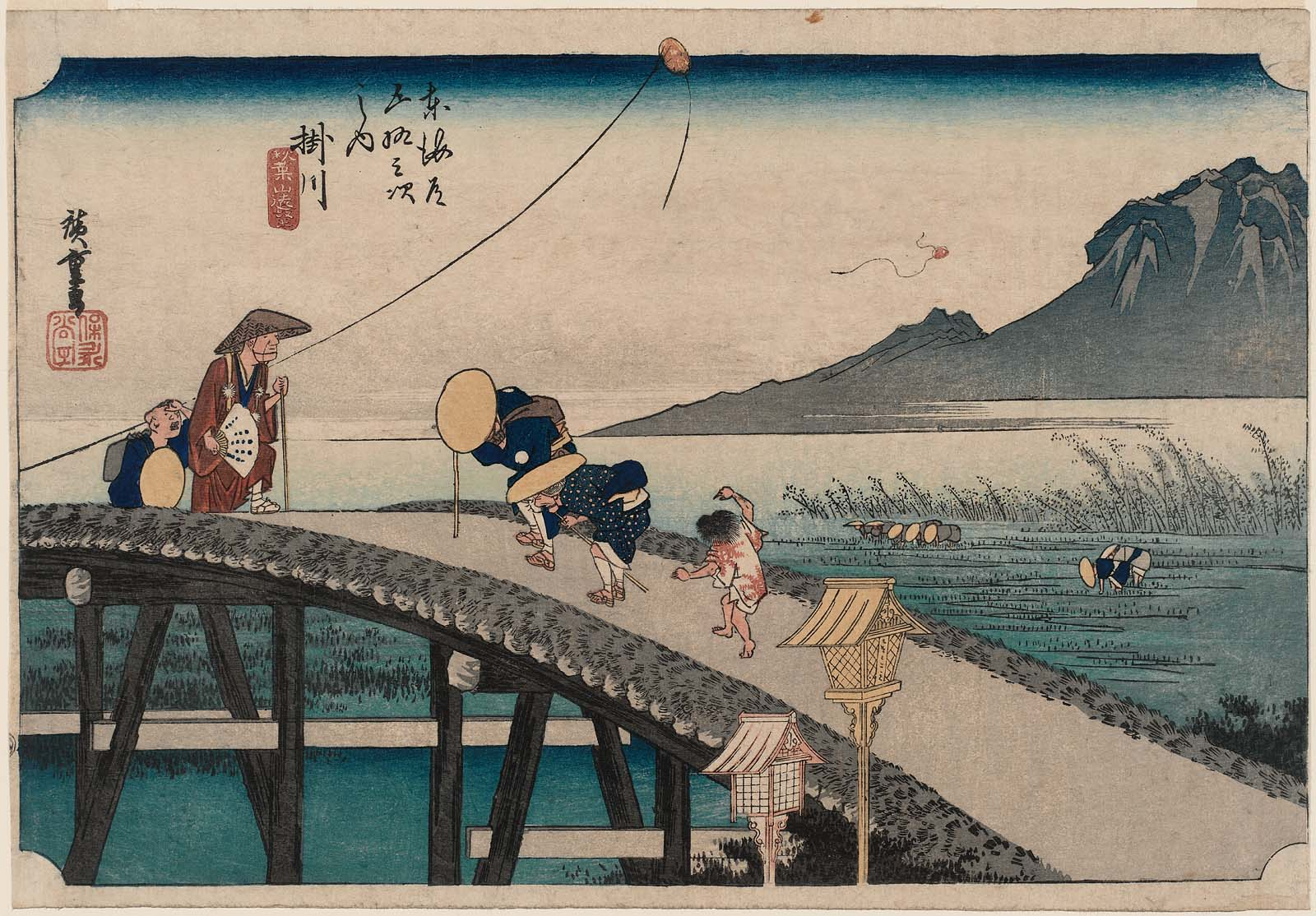
No.27. Kakegawa – View of Akiba Mountain by Hiroshiga (c.1833)

This woodblock print depicts a priest and boy and elderly pilgrims crossing the trestle bridge. To the right we see farmers planting crops in the fields, and in the background on the right we get a distant view of Mount Akiba. An old couple is struggling against a strong wind, followed by a boy making a mocking gesture; another boy is watching a kite floating up in the air.

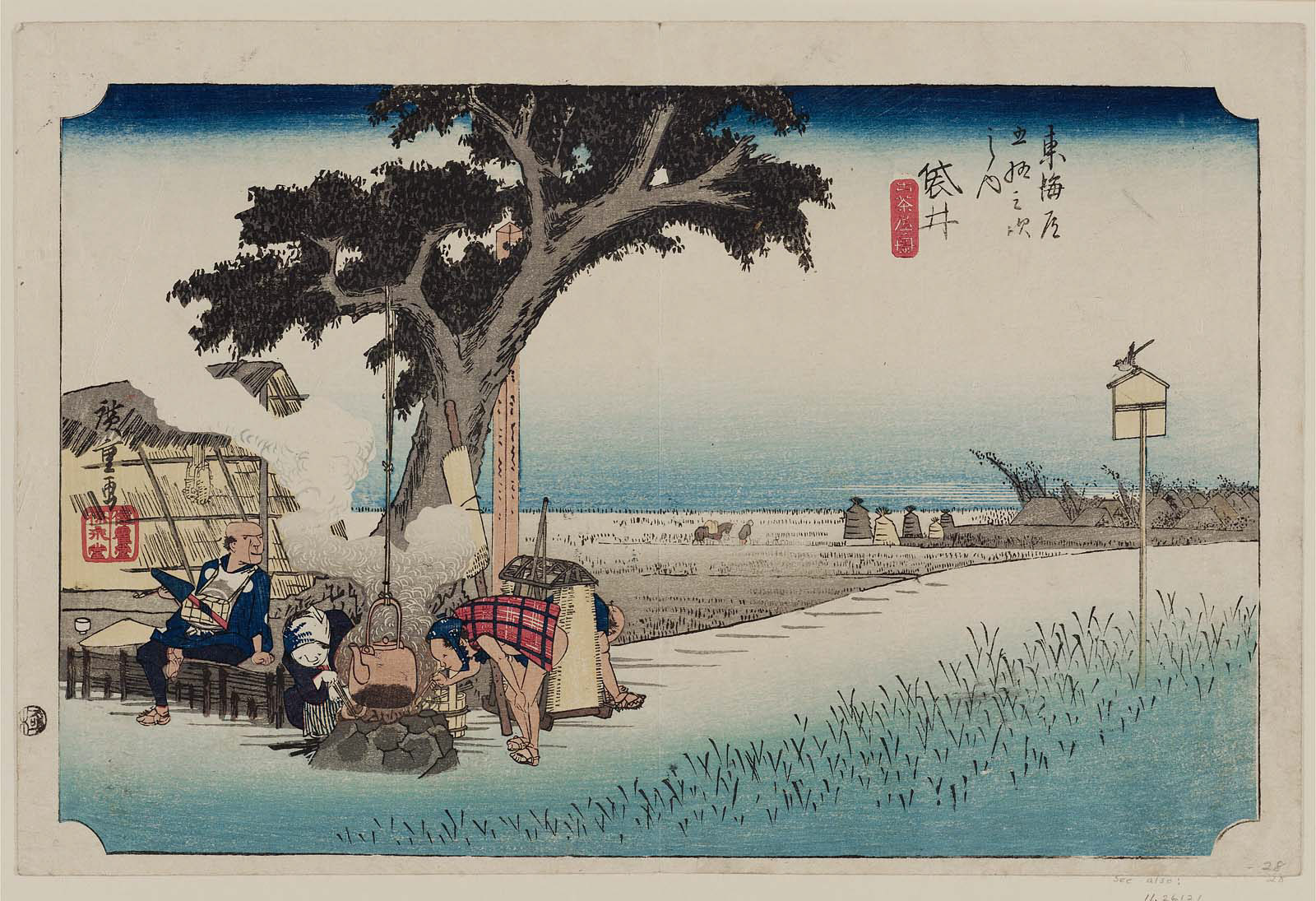
No. 28. Fukuroi: Tea Stall by Hiroshige (c.1833)

The twenty-eighth print in the Tokaido Road series is one depicting a tea stall at the small town of Fukuroi. This was a much needed and much appreciated stop-off point for the travellers who had trekked up steep mountain passes and forded fast flowing rivers. Although only a small town at the time of Hiroshige’s visit, within a hundred and twenty-five years it had grown and was given city status in 1958. We see a couple of travelers sheltering at a wayside lean-to, in front of which a woman stirs a large kettle which hangs from the branch of a large tree. The surrounding area appears to be featureless rice fields, with little indication of a post town.

No.29. Mitsuke: Tenryū River View by Hiroshige (c.1833)

The Tokaido Road procession has reached the town of Mitsuke and are facing yet another river to cross. This time it is the Tenryū River which has flowed two hundred kilometres south from its source, Lake Suwa. The river drains into a wide coastal plain noted for fruit and rice production. The print portrays a close-up scene along the Tokaido Road which depicts the difficult and laborious crossing of the Tenryu River close to the point it reaches the sea. In the foreground, we see two ferrymen waiting for their passengers who are on this long trek.

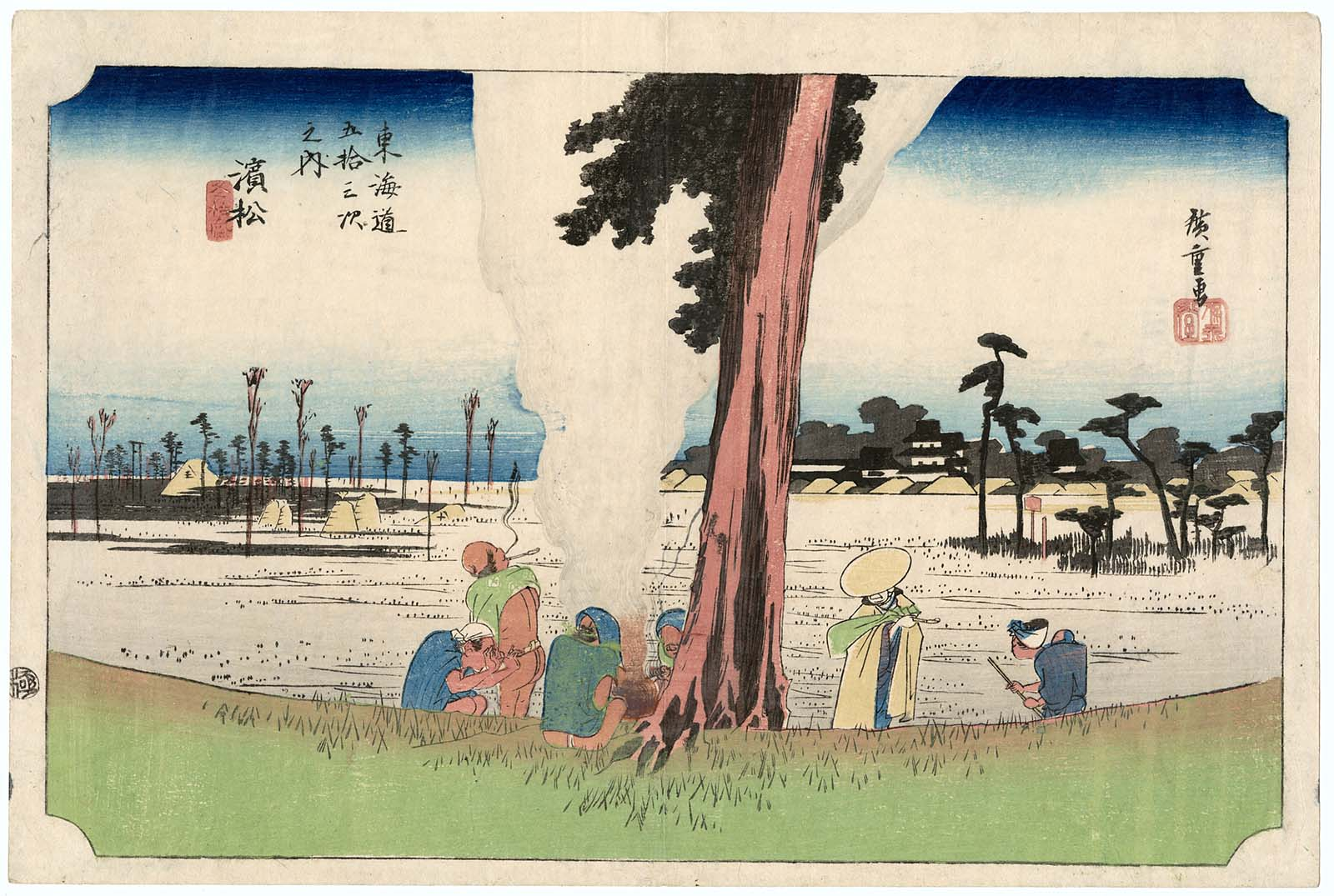
No.30. Hamamatsu: Winter Scene by Hiroshige (c.1833)

The party of Tokaido Road travellers have successfully crossed the Tenryū River and arrived at Hamamatsu. Hamamatsu flourished during the Edo Period under a succession of Daimyo rulers as a castle city, and a postal city on the Tokaido Road. In this print we see some of the procession huddled together trying to counteract the harsh winter conditions.

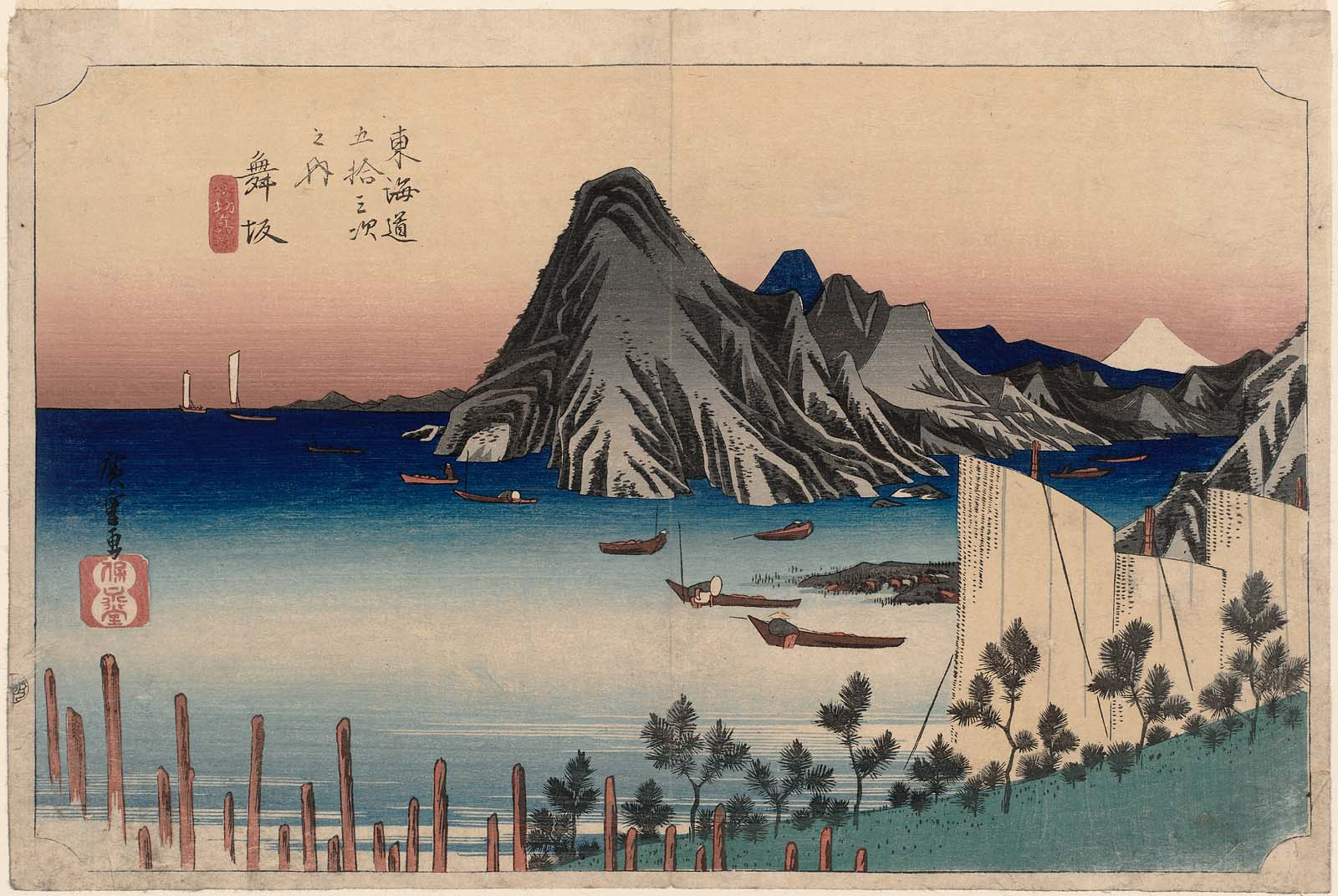
No.31. Maisaka: View of Imagiri by Hiroshige

The party arrive at Maisaka and the woodblock print is looking back at the Imagiri Promontory.  As the Tokaido Road links the shogun’s headquarters in Edo with the imperial capital in Kyoto, its route runs along the Pacific coast and so many of the woodcut print images from the series are seascapes. The depiction we see shows a view of Imagiri Beach near Maisaka. We look inland from the beach and see Lake Hamana, which empties into the Pacific Ocean. Our group of travellers heading west had to take a ferry across the lake. In the foreground we see brown-red pilings which were erected to protect the ferry port from the open sea.

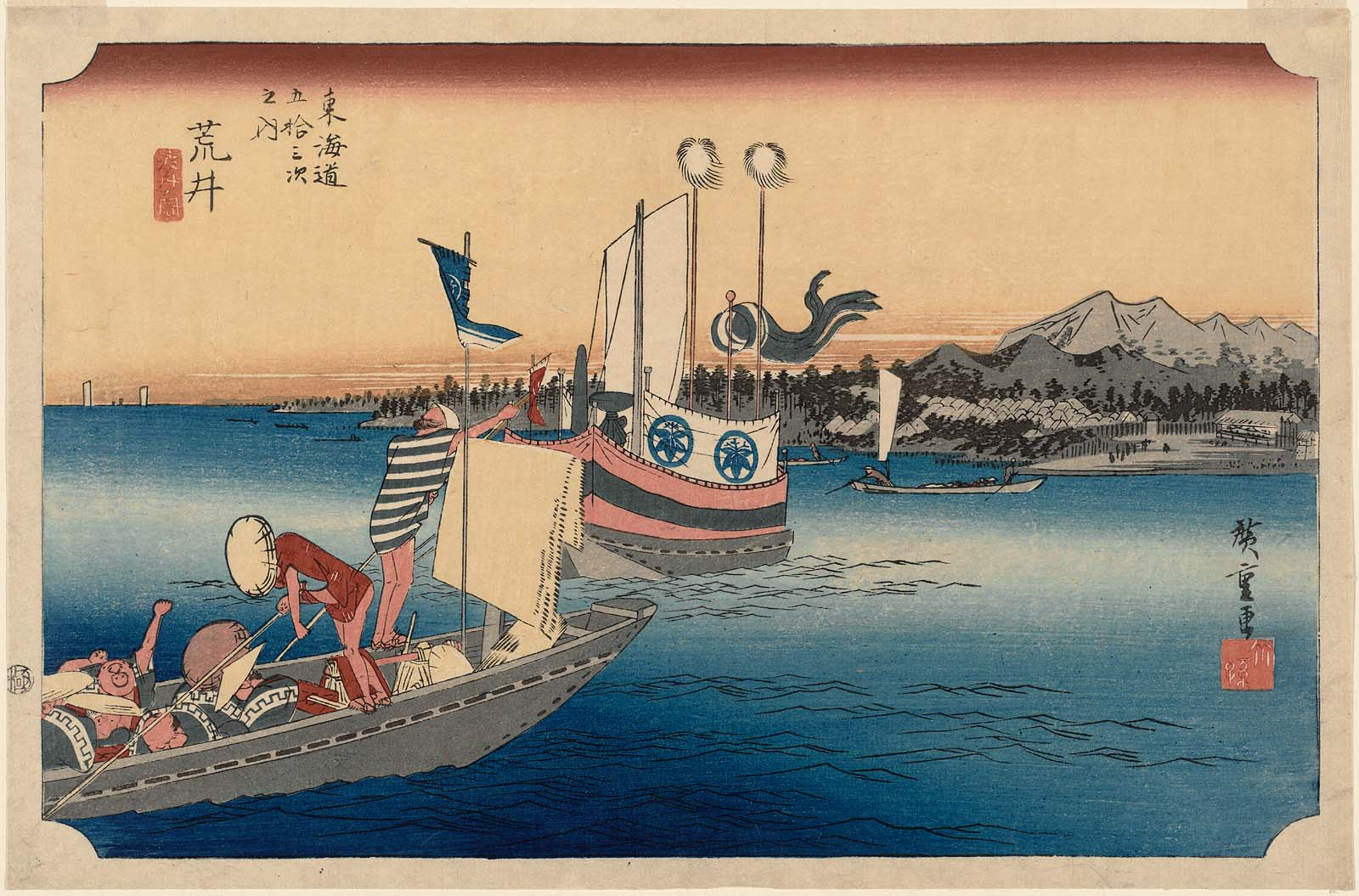
No.32. Arai Ferryboat by Hiroshige (c.1833)

Hiroshige left Maisaka with his party which included one of Japan’s powerful lords, known as a diamyo, along with his entourage and headed for the next lay-over station at Arai.  However, to reach Arai they had to cross a large stretch of water, Lake Hamana.  To accomplish this the party organised boats to transport the people and provisions.

The diamyo’s boat

In the centre of the painting we see a ferry, carrying the daimyo, crossing the water, heading to Arai.  The large boat is fitted with a  sea curtain to protect the powerful dignitary from any inclement weather they should encounter during the crossing.  It has hangings marked with circular symbols, the lord’s family crest.

The Attendants

In the foreground, we can observe the daimyo’s attendants in a separate boat.  It is interesting to look at their facial expressions and their countenances. Some looked bored while others yawn or lie back asleep.  They are fed up and exhausted after their long trek.

The Arai Fortification

On the far side of the lake we can see the Arai barrier which was a fortification built by Tokugawa Ieyasu around 1600.

No.33. Shirasuka: View of Shiomizaka by Hiroshige (c.1833)

The post station of Shirasuka is seen in this depiction situated on a high plateau.  However this was not the original site of Shirasuka as originally it was found close to the shore.  This all changed with the earthquake which hit the country in 1707, with the ensuing tsunami overwhelming the region and destroying the twenty-seven inns.  Following this natural disaster the post station was moved to site high above the coastal plain.  The next stop along the coast will be Futagawa.  Many hill roads in Japan bear the name Shiomizaka. The name has two meanings in the Japanese language, the most common is one is “watch the tide” and another is “see death.” 

No.34. Futagawa: Monkey Plateau by Hiroshige (c.1833)

The town of Futagawa was formed in 1601 with the merging of two villages, Futagawa and Ōiwa which were a kilometre apart and the townspeople were instructed to look after the travellers who were making the trek along the Tokaido highway.  This didn’t work well and so, in 1644, the Tokugawa shogunate had the village of Futagawa moved westwards and the village of Ōiwa moved further to the east.  The post station was re-established in Futagawa’s new location, and an Ai no Shuku was built in Ōiwa.  Ai no Shuku were unofficial post stations but were not officially designated rest areas, and travellers along the roads were not allowed to stay in these post stations. The print depicts a rather gloomy landscape and we see the weary travellers having scaled the hill, arrive at a free-standing tea house. The quality of the soil in this area is poor and the area as become a barren wasteland with only small pine trees and shrubs seen to be growing.

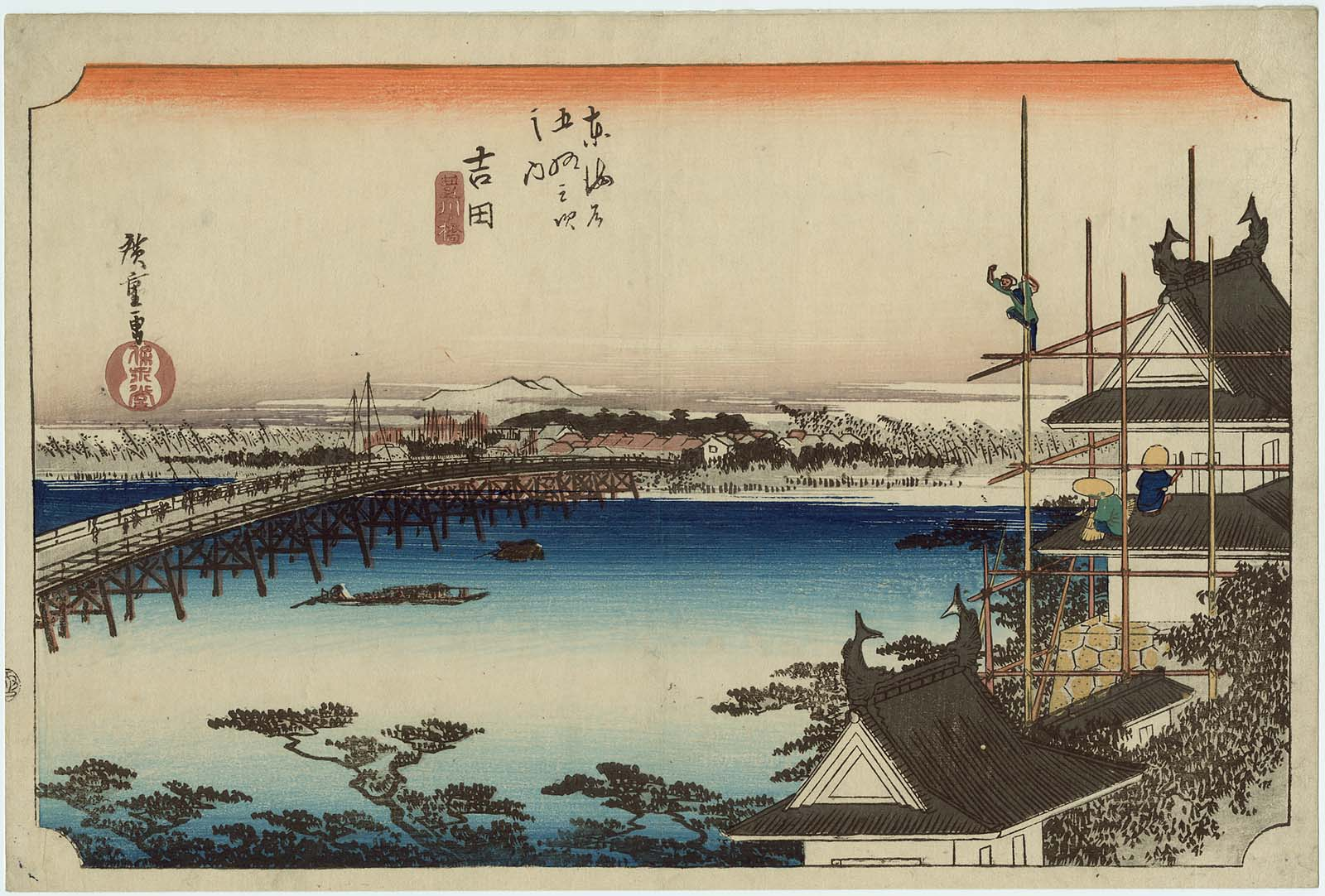
No.35. Yoshida: The Toyokawa River Bridge by Hiroshige

The post station of Yoshida was two hundred and eighty-seven kilometres from the starting point of the journey at Edo. The travellers had covered just over half their long journey. Yoshida lay almost half way between the post station of Nihonbashi to the west, and Futagawa to the east. The post station within the castle town of Yoshida came into being in 1601.  At Yoshida there was a long bridge which spanned the Tokugawa River.  This was an important bridge for the travellers as it was the only one they could use as deemed by the Tokugawa shogunate.  The post station at Yoshida was one of the largest stations and stretched two and a half kilometres along the Tōkaidō Road and the census of 1802 noted that the station comprised of two honjin (inns for government officials), one  waki-honjin (secondary inn in a post-town which provided lodging to second ranking official travellers)  and sixty-five hatago (lodging housess for travellers).  The print by Hiroshige depicts the famous bridge at Yoshida, as well as Yoshida Castle.

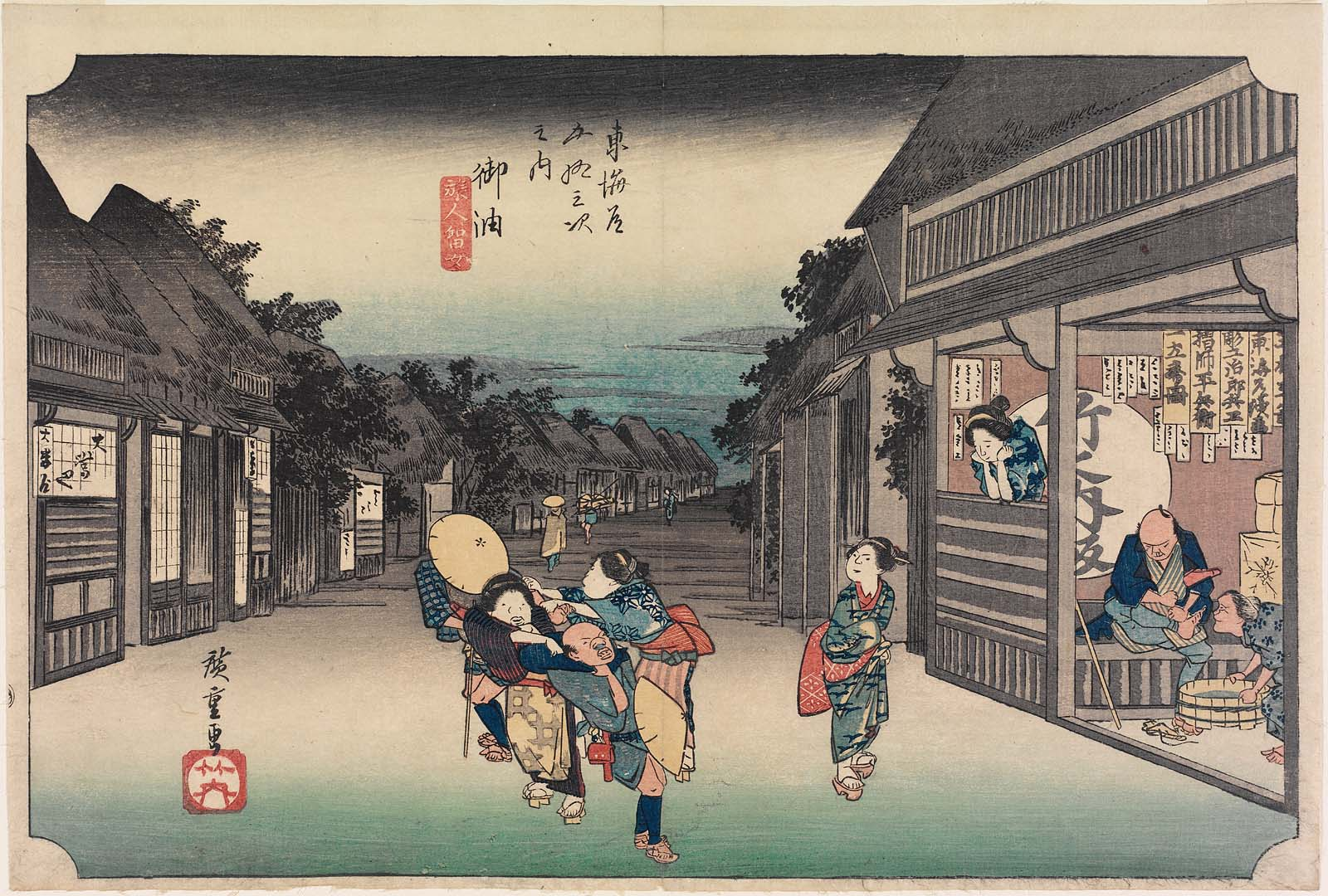
No. 36. Goyu: Women Stopping Travellers by Hiroshige

This classic ukiyo-e print by Andō Hiroshige depicts the main street of the post town at Goyu at dusk, with aggressive female touts, who were infamous characters around this post station.  Their “role” was to entice/drag travellers into the teahouses and inns for a night of entertainment.

In the next blog I will look at the final stages of the Tokaido Road trek which Hiroshige took part in 1832.

Agnes Goodsir

The subject of my blog today is the Australian portrait and still life painter Agnes Noyes Goodsir. 

Agnes Goodsir was born in Portland, in South-west Victoria, Australia, on June 18th 1864, and was the second daughter and fifth of the eleven children of David James Cook Goodsir, who held the post of Commissioner of Customs at Melbourne, and Elizabeth Archer, née Tomlins.  Goodsir enjoyed painting and sketching and concentrated on still life works.  She started formal art training at the Bendigo School of Mines around 1898.  Her tutor was the painter and educator, Arthur Thomas Woodward.  Woodward was born in Birmingham, England, and had received his art education at the Birmingham School of Art where Edward Richard Taylor was headmaster and one of his tutors.   Later he attended the South Kensington Art Schools, in London where he was a gold medallist. He emigrated to Victoria, Australia and in 1894 he was appointed Head of the School of Art and Design at the Bendigo School of Mines.  He was an excellent educator who was aware of the trends in European fine arts and introduced methods and syllabi based on it, including en plein air art classes and life drawing, thus offering the opportunity for his students to move to France, immerse themselves in French culture and enroll at French academies, where they would be able to study art internationally.  Agnes Goodsir was open to the idea of travelling to France and in 1899, aged thirty-five, she decided to increase her knowledge of art by moving half way round the world to Paris but to achieve that goal she needed money. This was achieved when a one-woman show of her paintings was held in Bendigo.  Sufficient money was raised by the sale of her work and in 1900 she set sail for France.

Self portrait by Agnes Goodsir (1900)

This self-portrait by Agnes Goodsir is hanging in the National Portrait Gallery in Canberra.   It is dated 1900, around the time Agnes arrived in Paris.  It is a beautiful oil on canvas work.  It combines a formal representation with a dark sobriety that Goodsir presumably believed brought gravitas to the depiction.  At the time of the portrait Agnes would have been studying at Académie Delécluse and the Académie Julian and this could be the reason for this academic-styled depiction with its dark background providing an appropriate backdrop and contrast with the artist’s pearly features and beautifully depicted draped hand.  This signaled the starting point of her illustrious artistic career in France. 

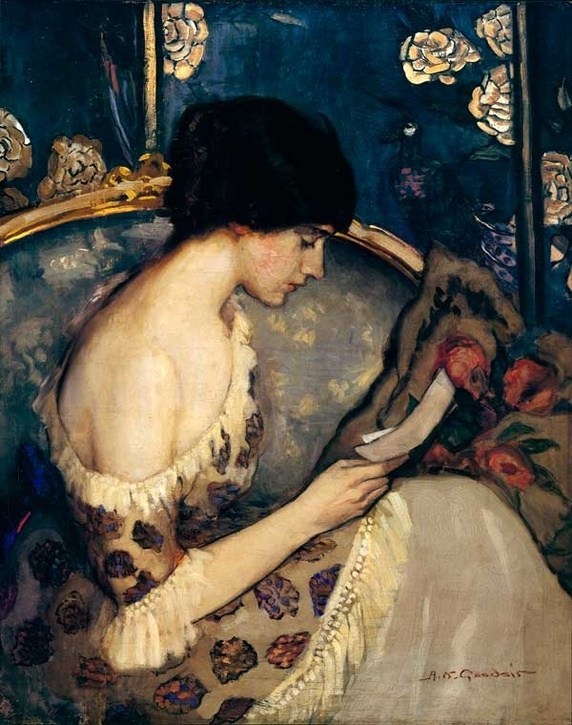
The Letter by Agnes Goodsir (1926)

On arrival in the French capital Agnes enrolled at the Académie Delacluse, an atelier-style art school founded in the late 19th century and named after its founder, the painter Auguste Joseph Delécluse.  Later she would take courses at the Académie Julian, under Jean-Paul Laurens, where she was twice placed first in Composition, the Académie de la Grande Chaumière where she won the 1904 silver medal for portraiture, and finally the Académie Colarossi.  Agnes made a number of visits to London and at the outbreak of the First World War she left Paris and went back to London.   While in London during the war, Agnes became close friends with Bernard Roelvink and his American wife Rachel. Rachel later divorced Roelvink and she reverted to her maiden name, Mrs Rachel Dunn, but to her friends she was known by her nickname ‘Cherry’.

A Letter from the Front by Agnes Goodsir (1914)

Once the Great War had ended Agnes and her beloved companion and muse, Cherry, left the English capital and moved to Paris where they set up home in an apartment at 18 rue de l’Odéon, which is in the sixth arrondissement of Paris on the Left Bank of the Seine, a short walk from the Luxembourg Gardens.  Agnes’ work was well received on both sides of the Channel and exhibited at the New Salon, the Salon des Indépendants and the Société Nationale des Beaux-Arts in Paris.

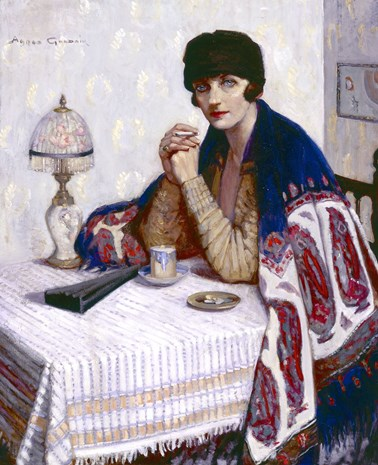
Girl with a Cigarette by Agnes Goodsir (1925)

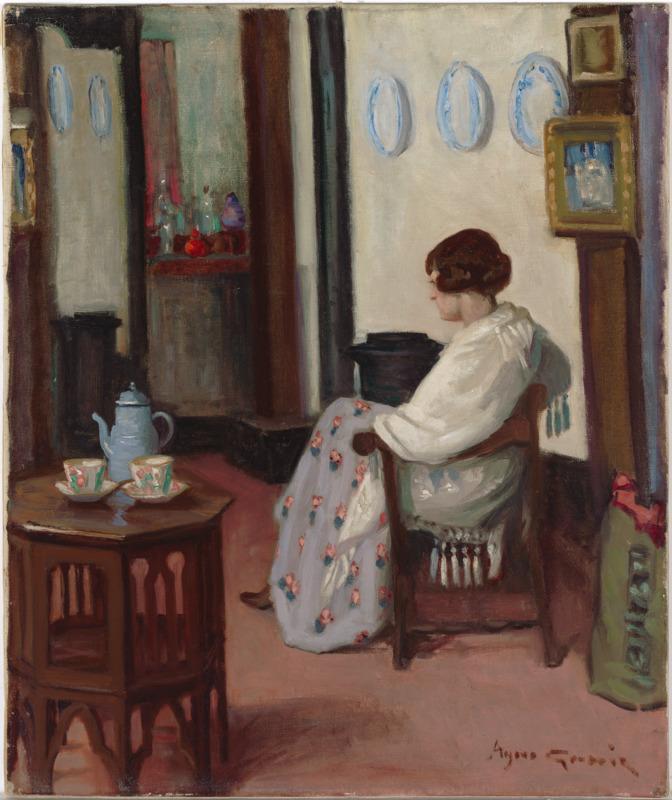
Paris in the 1920s was the centre of artistic activity, with writers, artists, performers and musicians from all around the world gathering together. Paris’ 6th arrondissement where Agnes and Rachel lived was in the heart of the “action” and was referred to as the Latin Quarter.  One of Agnes’ famous portraits of Rachel, which she completed in 1925, was entitled Girl with a Cigarette. Rachel is stylishly dressed, with a colourful wrap and chic accessories. It is the archetypal depiction of a 1920s flapper seen enjoying her coffee and cigarette.  She is both self-assured and relaxed within the cafe environment.

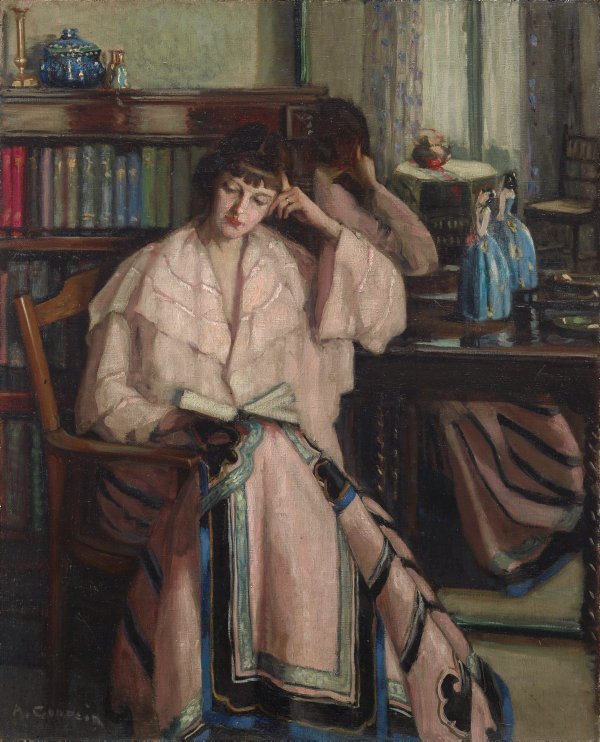
The Chinese Skirt by Agnes Goodsir (1933)

Agnes Goodsir and Rachel Dunn lived together  in Paris,  and Goodsir  often depicted Dunn as  the  unflinching  liberated  and trendy  woman that she undoubtedly was.  Once again in her 1933 painting The Chinese Skirt, like many of Goodsir’s works, the subject of the portrait is her lover, Rachel Dunn.  In this painting we see Rachel adorned in an elegant and fashionable Chinese-inspired skirt. To the right of her, on a table, are two ceramic figures the colour of which is echoed in the blue embroidery of her skirt, a couple of books in the bookcase seen in the background and the pot sitting atop this piece of furniture.

The Australian newspaper, The Australasian  newspaper described Goodsir’s work at the time as being:

“…a galaxy of beautiful, and even more beautiful women, doing feminine things: taking morning tea, posing before a mirror, reading, wearing blue hats or Chineseshawls…”

The Parisienne by Agnes Goodsir (c.1924)

Goodsir lived in Paris with Rachel during the period between the two World Wars.  France, like other participating countries of the Great War, had lost so many men in the fighting and with this lost generation of men the social life in the French capital was more a feminine affair, and the city between wars was a place for innovative women.  Paris was also a place for lesbian couples to live their lives publicly and in peace.  The Parisienne depicts Cherry in a modernist style. She is seen in masculine attire, wearing a cloche hat and high collar which encloses her face. Her hands are relaxed in lap, with a cigarette evoking an air of self-confidence and independence.

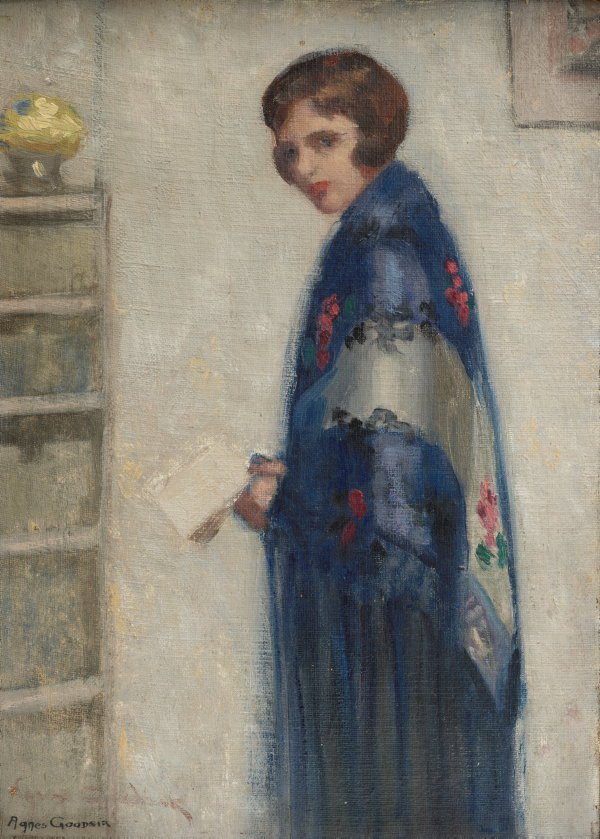
The Hungarian Shawl by Agnes Goodsir (c.1927)

Following a period of spending time in England, Agnes and Rachel settled down in their rue de l’Odéon apartment in Paris. Agnes painted subjects of the domestic interior of their apartment like a series of still life compositions, continually rearranging views of her everyday life, and often using them as a means to explore the expressive potential of colour combinations. Dunn repeatedly featured as Goodsir’s model, imaged in states of repose and gowned in flamboyant dress creating a sense of a domestic theatre that hovers between pretence and realism.  In her 1927 painting entitled The Hungarian Shawl it is all about colour.  The background is almost bare and uncluttered allowing us to concentrate on the figure.  It is all about the patterns on the shawl’s silky fabric design set against an almost monochromatic background. The depiction is instilled with the diffused interior light and almost resembles a small sketch-like work but at the same time conjures up a luminous sense of colour.

 Agnes Goodsir (left) and Rachel Dunn (aka Cherry) (second from left) at Valerie en Caix, c. 1930

In 1926, Goodsir was made a member of France’s Société Nationale des Beaux Arts, one of few Australians to receive the honour.

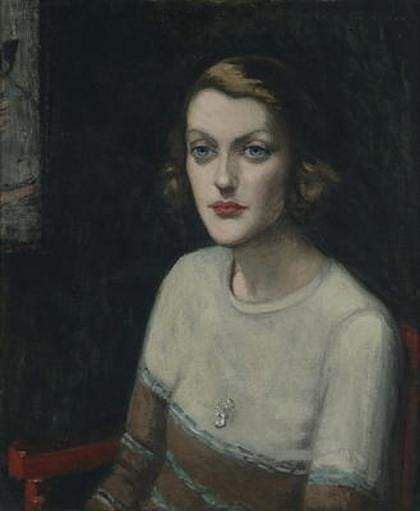
Portrait of Sunday Baillieu Quinn, Paris by Agnes Goodsir (1929)

Although Agnes Goodsir’s lifestyle was looked upon, during her lifetime, as being somewhat controversial, it was nothing compared to the colourful lifestyle of the sitter of a portrait Agnes completed in 1929.  The painting was entitled Portrait of Sunday Baillieu Quinn, Paris.  Sunday Reed who was born Lelda Sunday Baillieu in Melbourne on October 15th 1905,  who later with her second husband, became patrons of the arts and established in Bulleen, a suburb of Melbourne, the Heide Museum of Modern Art, also simply known as Heide .  She was the third of four children of Arthur Sydney Baillieu and Ethel Mary Baillieu (née Ham) and was a member of the very affluent Melbourne’s Baillieu family and the niece of William Baillieu, one of Australia’s richest men. She was the third of four children and after being home-schooled from a young age by a governess, completed her education at the prestigious boarding school, St Catherine’s School in Toorak.  In 1924 she accompanied her family to England, where she was presented at court during the débutante season. In 1926, when she was twenty-one, she married an American, Leonard Quinn and the couple left Australia and visited England and France.  In 1929, around about the time of the portrait Lelda, she was diagnosed with gonorrhoea and had to endure several operations including a hysterectomy which left her unable to bear children and causing deafness in her right ear.  Shortly afterwards, her husband deserted her in England and her father and brother had to travel to London to bring her home. By the end of the year the couple were divorced.  

John and Sunday Reed on their wedding day in 1932.

Whilst still convalescing in late 1930, Lelda met her second husband, lawyer John Harford Reed at a tennis party.  Despite the difficulty of obtaining a divorce, powerful family influence and connections prevailed and Sunday’s divorce was finalised in June 1931. She and Reid married in January 1932 in a civil ceremony.  In 1934 John Reid and his wife bought a former dairy farm on the Yarra River at Bulleen, Victoria, which became known as “Heide”.  The couple lived on the property until their deaths in 1981, a short time after, the property had become the Heide Museum of Modern Art.

In the Latin Quarter Studio by Agnes Goodsir (c.1922)

Goodsir’s reputation as a great portrait artist, coupled with her social connections, allowed her to complete portrait commissions of many famous people such as the Australian author and journalist Banjo Patterson, English actress, Ellen Terry, Mussolini, Tolstoy and the Australian soprano, Dame Nellie Melba.  Despite those portraits of famous people Agnes Goodsir will be remembered for her portraits featuring Rachel Dunn.

In a Paris Studio by Agnes Goodsir (1926)

Although Goodsir was fond of her Australian birthplace, it was Paris that she loved and where she would spend her final days with Rachel. Agnes Goodsir died in Paris on August 11th 1939, aged 75. All of Agnes’s paintings were left to Rachel. Rachel sent forty of her painting to Agnes’s family in Australia and others to Australian galleries. The Goodsir Scholarship of the Bendigo Art Gallery, one of Australia’s oldest and largest regional art gallery, is named in memory of her. Rachel died in 1950 and was buried in the same grave as her constant companion in a cemetery on the outside Paris.

Hans Makart Revisited

Self Portrait by Hans Makart (1878)

The artist I am looking at today, and had written about in 2013, was one who was revered by many of the art critics of the time and yet hated by others, who baulked at his general lack of interest in factual accuracy in his depictions and for disparaging important episodes in history by including unwarranted female nudity in his paintings.    It would appear that he refused to tone down his flamboyant lifestyle and was known as much for the outrageous society parties he held in his studio as for his works of art.  Let me introduce you to the Austrian painter, Hans Makart.
Mirabell Palace and Gardens, Salzburg

“Hans” Johann Evangelist Ferdinand Apolinaris Makart was born to Johann Makart and Maria Katharina Rüssemayr in Salzburg on May 28th, 1840. His father, an amateur painter, worked as the chamberlain of the Mirabell Palace, which was the home of the powerful Prince-Archbishop. Few facts are known about the early years of Makart, but because of his father’s job, it is thought that he grew up surrounded by the Neoclassical grandeur of this magnificent palace and its extensive Baroque gardens.  It is more than likely that living amongst the splendour of the palace with its luxurious furnishings influenced young Makart who would later in life indulge in the excesses of extravagance and ornamentation as depicted in his artwork as well as his work as a designer and decorator.

The Valkyrie by Hans Makart (1877)

It seems likely that his father, having failed as an artist, urged his young son to take up painting and to endeavour to succeed where he had been unsuccessful.  Sadly, in 1849, Hans Makart’s father died shortly after his son had celebrated his tenth birthday. A year after his father’s death the family moved to Vienna and Makart went to study painting under the Austrian painter, Johan Fischbach, at the Academy of Fine Arts, a public art school in Vienna. Living in Vienna, Makart immersed himself into the worldly life of the great capital, where the women were beautiful and elegant, where dress was held of paramount importance, and where Society balls and entertainments went on through the greater part of the year. In the midst of living such a life, the world Makart witnessed was seen on its brightest most appealing side, and as a young man his ideas were developed into a passion for beauty. From his time and experiences of life in Vienna, Makart could never paint a woman unless she was adorned in the most sumptuous clothes, and he could never help depicting the female with the grace and beauty that distinguished the ladies of the Austrian capital.

Die Japanerin by Hans Makart (1870)

However, Makart’s time at the Academy did not go well and as I have recounted many times in previous blogs, he, like many young aspiring painters, could not accept the precise structure and order of the Academy, as far as the teaching methodology and the type of artwork which those in charge celebrated. He was impatient to escape the endless routine of art school drawing. It was not for him and his stay at the Academy ended in 1851 when he was dismissed after only one year.  Those in authority at the Academy gave the reason for his dismissal as his lack of natural talent.  It could well have been that Makart’s love of intense colour, movement, and sensuality, a style which was similar to that of Titian or Rubens was unacceptable to the Academy hierarchy who wanted students to follow a more sombre, well-ordered classicism that still dictated academic art at the time.  Makart would develop his own recognisable style but that would be ten years in the future.

Die Liebesbrief (The Love Letter) by Hans Makart

Makart believed in himself and was completely impervious to criticism, whether it be his artistic style or his decadent lifestyle.  He was a rebel and proud of it.  He left Vienna and travelled to Munich where the next two years passed without him receiving any formal artistic tuition.  Makart became aware that he needed to learn the technique of his business — the mechanical side of it, so to speak — in short, to learn to paint and for that to happen he needed a good tutor. 

Sarah Bernhardt by Hans Makart (1881)

In 1853, Makart enrolled in the Munich Academy where he was tutored by the German realist painter Karl von Piloty, who was noted for his historical subjects, and recognised as the foremost representative of the realistic school in Germany.

Moderne Amoretten (Modern Cupids) by Hans Makart (1868)

In 1864, after studying under Piloty for some years, twenty-four-year-old Makart left Munich.  His confidence in his ability had been heightened during the years under the guidance of Piloty.  He was now full of self-confidence. During this early period, he perfected his highly decorative style. Makart also journeyed to London, Paris and Rome visiting all the major art galleries. In 1868, while he was staying in the Italian capital, Makart was invited to submit a piece for the opening of the Austria Artists’ Society in Vienna. Makart sent over his colossal three-part work Modern Cupids, along with painstaking instructions on how it should be displayed. All three paintings were bought by the Count Johann Palffy, who became one of Makart’s regular patrons. 

Dame mit Federhut in Rückenansicht (Lady with Feather Hat from Behind) by Hans Makart (1875)

It has to be said that Makart was neither totally impressed by Raphael’s Madonnas which he saw in Rome, nor was he moved by the gilded glories that crown the virgin martyrs, and there can be no doubt that the Italian capital failed to fire his soul.  However, when he moved to Venice all that was to change. It was the art he witnessed in that city that fired his imagination and would influence him for the rest of his life.  Makart had always been a devoted colourist and in Venice he witnessed the colourful works of Veronese, Titian and Tintoretto. These three Italian (Venetian) Masters were to be his mentors.  To him, they were inspirational.

Hans Makart’s Studio in Vienna

Makart’s artistic achievements came to be noticed by the Emperor of Austria, Franz Joseph who, in 1869, summoned him to work in Vienna.  Buoyed up by this prestigious support, Makart requested set of lavish apartments.  That request was denied but instead the Emperor arranged for Makart to be given a studio which had been converted from a disused foundry. Far from being disheartened, Makart transformed this industrial space into the plush, decadent heart of Viennese society. It was not just his art which was colourful.  His lifestyle was equally flamboyant and rich in vibrancy.  His studio, in the Ring-Strasse, at the heart of Vienna, was resplendent.  It was transformed into a ballroom-like space and decorated in lustrous colours.  It was here that he depicted females adorned in beautiful satin gowns in shimmering satin tones.  In his studio he surrounded himself with richly ornamented German chests of the Renaissance, Chinese idols, Greek terracotta, Smyrna carpets and old Italian and Netherlandish pictures mingling beside antique and medieval weapons.  The walls of his studio were covered with splendid vessels, weapons, sculpture and costumes. Makart turned his hand to interior design, costume design, furniture design and soft-decoration, and his studio overflowed with statues, flowers, fine fabrics, and music. It acted thus as the perfect artistic backdrop for his models – largely nude women – who were also welcomed into his high-society circle.

The Espousals of Catterina Cornaro by Hans Makart (c.1873)

A good example of Makart’s large colourful paintings is his work entitled  The  Espousals  of  Catterina  Cornaro, (Venice pays tribute to Caterina Cornaro), which he completed around 1873.  Caterina Cornaro was the last monarch of the Kingdom of Cyprus, also holding the titles of the Queen of Jerusalem and Armenia. She had been engaged by proxy to the King of Cyprus, James II Lusignan, since 1468, when she was just fourteen years old, and at the same time she was declared the daughter of the Republic of Venice. It was not until 1472 that she went to Cyprus for her wedding.  The painting depicts representatives from  Cyprus  and  Venice,  of  dignified  men, of  procurators  of  St.  Mark, of women in foreign garb of  bright colour,  who  crowd  round  their  young  mistress,  the  queen  of the  feast,  rejoicing,  amid  the  splendid  architecture  of  the piazza.  Sadly the marriage did not last long as eight months after the ceremony.  James died and according to his will Catherine, who was carrying his child, became regent.  Caterina’s son James died under suspicious circumstances in 1474 before his first birthday.

Death of Cleopatra by Hans Makart (1876)

Around 1875 Makart completed some paintings depicting the death of Cleopatra.  They both portray Cleopatra, the legendary queen of Egypt, contemplating suicide. The Roman Emperor Octavian’s forces had fought their way into Alexandria, and knowing that her country had fallen, Cleopatra withdrew to her tomb with her closest attendants, Iras and Charmion.  In one of the paintings, we see Cleopatra reclining on a bed of fabrics, semi-nude and wearing jewelry and her crown. To her left, one of her servants weeps, whilst just below the queen another has already died. A brazier burns on the left-hand side.

Death of Cleopatra by Hans Makart (1875)

In both paintings the asp is menacingly depicted.  It is a thin, black form with a tiny wisp of a tongue, and stands out against Cleopatra’s breast.  This adds a sense of eroticism, and danger to the painting which reminds us of the line from Shakespeare’s play, Anthony and Cleopatra:

“…The stroke of death is as a lover’s pinch, which hurts and is desired…”

There is a sensuous decadence about Makart’s depiction of Cleopatra’s naked, bejeweled body and the way his use of chiaroscuro picks out the stark whiteness of Cleopatra’s body, as if she were spot-lit on a stage.

Das Schlafende Schneewittchen (The Sleeping Snow White) by Hans Makart (1872)

Makart’s life in Vienna enabled him to immerse himself into the worldly life of the great Austrian capital, a city where the women were beautiful and elegantly dressed and where Society balls and entertainments are held throughout the greater part of the year. In the midst of living such a life, the world the painter witnessed was seen on its brightest side, and consequently, as a young man his ideas were developed into a passion for beauty.

The Dream after the Ball by Hans Makart

In 1878, Makart took a post as a professor at the Viennese Academy in 1878.  This was the very same institution which had expelled him for lack of artistic talent in the late 1850s. Two years later, he became the institution’s head of a particular school for historical painting, a position he held until he died. It was during this time that Makart, as teacher, met Klimt, one of his students. Klimt had an important role in continuing Makart’s legacy after his death. In addition to his position as a professor, Makart’s work kept him well-off and well-known. Even the negative comments regarding his art appeared to simply inspire him to strive more.

Statue of Hans Makart in Vienna City Park (“Stadtpark”)

Hans Makart died on October 3rd 1884, aged 44. He was buried in the Wiener Zentralfriedhof in Vienna. Makart influenced many painters who followed him, the most notable being Gustav Klimt, who is said to have idolized him. It can be seen in Klimt’s early style which is based in historicism and has clear similarities to Makart’s paintings. Jugendstil, the Austrian Art Nouveau, of which Klimt was a part and it has been suggested that primacy of sexual symbolism in Jugendstil artworks were influenced by the sensuality in many of Makart’s paintings.
Eppo Doeve

Eppo Doeve

After my blog on Anton Pieck the other week, I received a comment from Barbara Matthias, who asked me to look at the life and work of another Dutch painter, Eppo Doeve.  Having never heard of him, I was intrigued.  I managed to scrape together some information about his life and works of art he had completed, so here is a blog on the twentieth century painter and cartoonist.

Aardappeleters (Potato Eaters) by Eppo Doeve

Jozef Ferdinand (Eppo) Doeve was born on July 2nd 1907 in Bandung, the capital city of the Indonesian province of West Java in the Dutch East Indies.  He was the eldest child of a civil servant, Justin Theodorus Doeve and his wife Helena Rosina Kepel and he had four sisters. Both parents were of mixed European and Indian blood.  Eppie, as Doeve was called at home, went to a Catholic School run by the Ursuline Sisters and then later went through the local secondary education system.   Once Doeve had been awarded his diploma, he was allowed to make some trips through the Dutch East Indies. Because of his parents, Eppi developed a love and interest for plants and flowers and this made him choose to study agronomy in the Netherlands.  Agronomy is the science and technology of producing and using plants by agriculture for food, fuel, fibre, chemicals, recreation, or land conservation .  Of his dream for his future Doeve said:

“… I wanted to be a tea planter, somewhere near Garoet, there is nothing more delicious imaginable, isn’t there?…” 

A portrait of the actor Louis van Gasteren Senior by Eppo Doeve (1944)

Besides his love of plants and flowers, Doeve was a multi-talented child and was very artistic from an early age. He played various instruments and could draw well. He was also very humble and did not consider himself very special, despite the fact that he received painting commissions whilst he was still young but he still looked upon drawing and playing music as hobbies and, not being in any way, future professions.

Winston Churchill by Eppo Doeve

When Doeve was twenty he attended the Landbouwhoogeschool (Agricultural science college) in Wageningen in The Netherlands. He enjoyed student life and would contribute drawings to the monthly college magazine, Wagenische Studentencorps.  His love of music was also sated at the college as he was very busy with the jazz band of the association. All his plans and aspirations ended in the early 1930s after the tea market in India collapsed and it was a turning point in his life and his future plans had to be revisited.

Fisherwoman in Regional Costume by Eppo Doeve (1968)

Above all, Doeve wanted to stay in The Netherlands and not return to the Dutch East Indies, to do this he had to find a way to achieve that goal.  He realised that his drawing ability may be the secret to a new life.  He had already earned some money at the Amsterdam advertising agency De LaMar Advertising Company and was able to work regularly at the agency from 1932 onwards. Doeve went from there to other advertising companies and publishers, such as De Groene Amsterdammer, an independent Dutch weekly news magazine published in Amsterdam, and later he moved to the large publishing house, Haagsche Post. In the 1930s Doeve also worked on the Belgian magazine Radiobode, which listed radio programmes.   The magazine was first published in 1931 and had a circulation of approximately 20,000 copies. His graphic work for the Radiobode was loved and became collectables and was praised by such contemporary luminaries such as the young and up-and-coming illustrator, Fiep Westendorp, and one of Doeve’s young colleagues, Marten Toonder, a Dutch comic strip creator, born in Rotterdam and who became the most successful comic artist in the Netherlands

In 1953, Doeve became an even more famous Dutchman when he provided the sketch of Hugo de Groot,  the Dutch diplomat, lawyer, theologian and jurist, for the new 10 Guilden banknote.

1940 issue of Radio Bode with Eppo Doeve’s graphics for the Paul Vlaanderen series

In the 100th issue of Aether, the magazine about the history of broadcasting and phonography, published in July 2011, there is a drawing by Doeve with an article about radio plays. It is a drawing for the well-known AVRO radio play Paul Vlaanderen.  Paul Vlaanderen was the name of the fictional Dutch detective and was based on the novelist, Francis Durbridge’s character Paul Temple, who was a fictional detective in a long-running English radio serial, which first broadcast in 1938.

One of the many advert posters for Heineken Beer designed by Eppo Doeve

Doeve became skilled at every form of graphic art, without having had a formal education. He was commissioned to illustrate commercials, stage sets, book illustrations, and just simple paintings.   Doeve mastered them all.  One of his colleagues, Alexander Pola, commented:

“…He could do everything he wanted, and wanted everything he could…”

For the Dutch weekly magazine, Elseviers Weekblad, he submitted articles, illustrations and political prints.  In addition, he regularly appeared on television. After years of being called J.F. Doeve in the press, he was then referred to by his nickname Eppo.
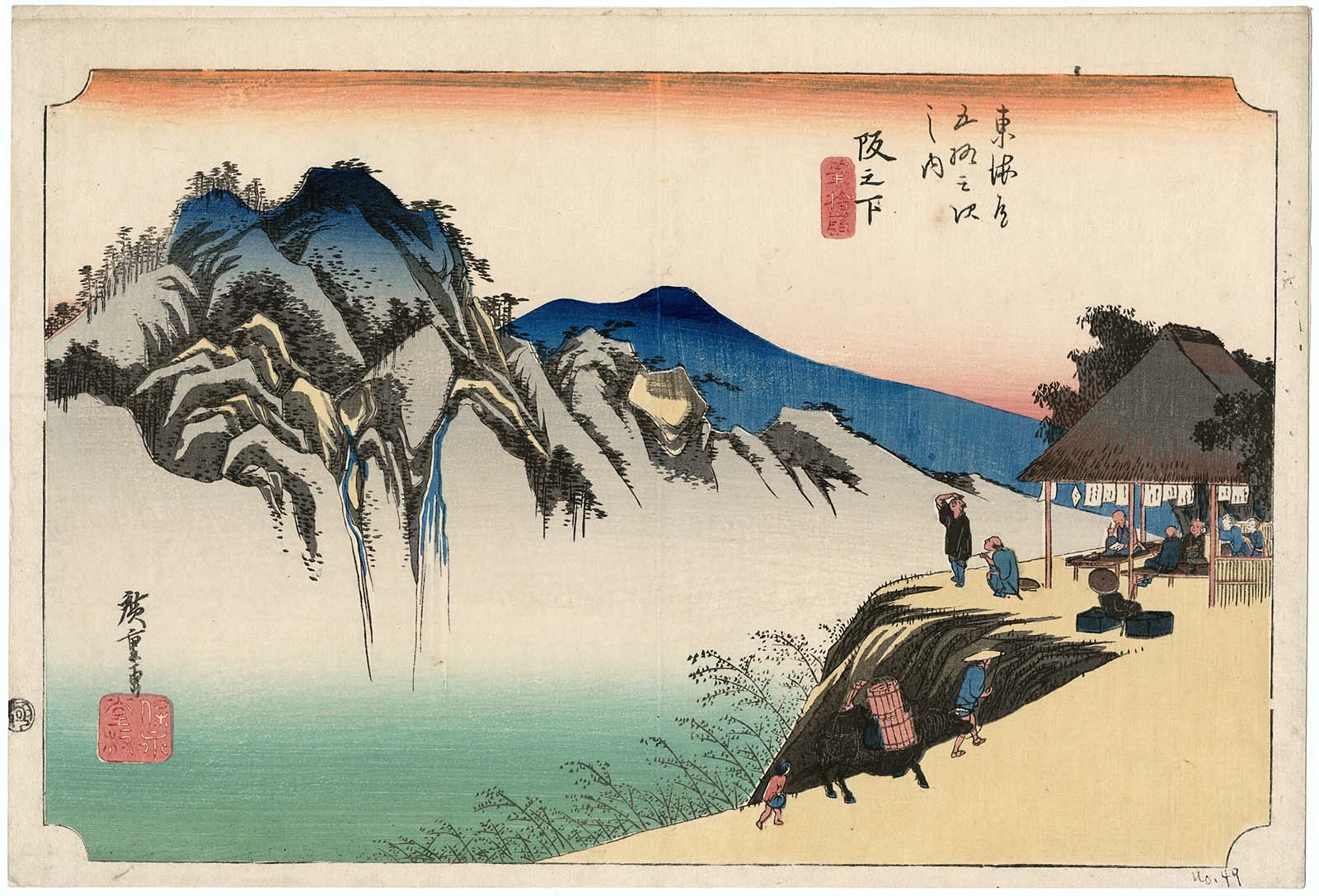
Portrait of Tinnie van der Elzen by Eppo Doeve (1940)

Eppo Doeve was also a fine portrait artist as can be seen in his 1940 work entitled Portrait of Eugenia Henriette Maria (Tinnie) van der Elzen.  She was Doeve’s first wife, the daughter of a well-to-do family in Arnhem, whom he married in July 1934.  In the background, a landscape is visible in which the castle of Cannenburgh (Vaassen) can be identified.

Poster for Eppo Doeve Retrospective

This painting was exhibited during the retrospective exhibition Eppo Doeve Terug in Wageningen in 2019. Doeve painted the portrait in the typical ‘magisch realisme‘ (magic realism) style of the late 1930’s, an artistic genre in which realistic narrative and naturalistic technique are combined with surreal elements of dream or fantasy.

Portrait of the artist André van der Burght at the age of 63 by Eppo Doeve

Jozef Ferdinand (Eppo) Doeve died on June 11th 1981, aged 73. After his death, piles of beautiful drawings were discovered in his studio.

Eppo Doeve in his studio (August 1954)

The studio was a chaotic mess and many sketches were found behind the heater and at the bottom of the cupboards, almost as if he had hidden them.

Joseph Farquharson RA

Self Portrait (1882)

We are approaching a time when we have to expect very cold weather and for some of us the oncoming of snow.  So as we are at the beginning of the Christmas month I thought I would treat you to some snowy scenes by one of the greatest exponent of such panoramas.  Permit me to introduce the nineteenth century Scottish painter, Joseph Farquharson, whose snowy winter landscape paintings were featured on many Christmas cards.

Joseph Farquharson was born in Edinburgh on May 4th 1846.  He was the son of Francis Farquharson, a doctor and laird of Finzean in Kincardineshire. Joseph’s brother Robert was a highly respected physician and local Member of Parliament.  Joseph’s mother, Alison Mary Ainslie, was a celebrated beauty, one of the daughters of the lawyer Robert Ainslie, who was a close friend of the poet Robert Burns.

Road to Loch Maree by Joseph Farquharson

Joseph’s early days were spent in his father’s house in Northumberland Street Edinburgh, below the Queen Street Gardens.  Later the family moved to Edinburgh’s Eaton Terrace and finally to the family estate at Finzean, in Aberdeenshire. Joseph was brought up in a strict family environment and was educated in Edinburgh.  Although his father encouraged him to sketch and paint and even let him use his own set of paints, he only allowed his son to paint on Saturdays.  Joseph developed his artistic skills and at the age of twelve, Francis Farquharson bought his son his first set of paints and a year later Joseph exhibited his first painting at the Royal Scottish Academy.

Joseph Farquharson’s first formal art training came in the 1860’s when he enrolled at the Trustees’ Academy in Edinburgh, the forerunner of the Edinburgh School of Art where his tutors included the landscape painter, Peter Graham R.A. who would be a constant influence on Farquharson and Graham’s style can be seen in many of Joseph’s works.  Joseph then spent time at the Life School of the Royal Scottish Academy.

Day’s Dying Glow by Joseph Farquharson (1873)

Joseph Farquharson’s first exhibit at the Royal Academy, was in 1873 when his 1873 painting, Day’s Dying Glow, was on display.

Mrs Farquharson of Finzean (the artist’s stepmother) by Joseph Farquhardson (1871)

Farquharson followed the trend of other leading Scottish artists and concentrated on exhibiting his work in London rather than Edinburgh and Glasgow, as this was where the opportunity to sell their work was the greatest.  Besides his Scottish landscape scenes, Joseph was also a a talented portrait painter and his first portrait to be exhibited was of his stepmother, Mary Ann Girdwood Farquharson, which he completed in 1871.

A Scottish Interior, the Box Bed by Joseph Farquharson (c.1874)

Joseph Farquharson produced a realist genre painting around 1874 entitled A Scottish Interior, the Box Bed which depicts a bed inside a cupboard and table and chair in a kitchen/bedroom/living room. The free-standing box or press bed developed into a very sophisticated piece of furniture, when cabinet-makers designed “secret” press beds disguised as wardrobes or sideboards, or hidden behind rows of bookshelves and drawers, even when there was no pressure on space, and no need to provide a mini-bedroom within a shared living area.

The Joyless Winter’s Day by Joseph Farquharson (1883)

However, Joseph Farquharson will be remembered for his bleak wintry landscapes often depicting sheep and the shepherd. One such painting can be seen in London’s Tate Britain, entitled The Joyless Winter’s Day which he completed in 1883. Despite blizzard conditions, Farquharson painted this en plein air although, he was in the relative comfort of his specially constructed mobile painting hut, which had the added benefit of a stove. This relative comfort enabled Farquharson to capture the remarkably realistic effects of a snow storm. Before you worry about the health of the sheep I have to tell you that those you see were made in plaster by a local sculptor

Sheep in a Snowstorm by Joseph Farquharson

Farquharson was famed for his Scottish snow scenes, and with the exception of 1914, he had a new painting exhibited at the Royal Academy every year between 1894 and 1925. . Farquharson combined a career as an artist with his inheritied responsibility as laird of the Finzean estate in Aberdeenshire, where many of his landscapes were painted.

The Stormy Blast by Joseph Farquharson (1898)

But it was not just about snow and blizzards.

The Winding Dee by Joseph Farquharson (1889)

Some of his landscape paintings depicted the beauty of the Highlands, such as his 1889 painting featuring the River Dee, which rises in the Cairngorms and flows through southern Aberdeenshire to reach the North Sea at Aberdeen.

Corn Stooks by Joseph Farquharson (1880)

Harvesting, Forest of Birse, Aberdeenshire (1900)

Some of his paintings depicted the agricultural times in rural communities during the summer months.

When the West with Evening Glows by Joseph Farquharson (1901)

One of Farquharson’s greatest skills was his ability to depict scenes at sunrise and sunset as this can be seen in his beautiful 1901 painting entitled When the West with Evening Glows. It is a snowy winter landscape, and we look along a snow-covered path, which runs through fields, with groups of trees on either side, as seen in the mid ground of the painting. In foreground we see freshly-made footprints in the deep snow, with three crows having landed close to the footprints. The whole scene is illuminated by the warm glow of the rising sun from behind the hills in the background.

When the West with Evening Glows by Joseph Farquharson (1910)

The above 1910 painting is a slightly smaller version of the work which is owned by the Royal Academy. This version was exhibited at the Royal Academy in 1910 and now hangs in the collection of the Bristol Museum & Art Gallery. This painting was a commission Farquharson received from one of his patrons, who failed in his bid to buy the larger original version. Farquharson often copied his own paintings in order to satisfy his clients’ requests, or to provide an original for engravers tasked with the reproduction of a successful composition. It was such a popular painting with the public that thousands of prints of this work were sold. In his 1913 essay in the Christmas edition of the Art Annual, The Art of Joseph Farquharson, A.R.A, Archdeacon William Macdonald wrote about these popular works:

“…There is not one of Farquharson’s pastoral landscapes which is not treated from the contemplative or poetic point of view: the poetry of snow either in its suggestion of desolation, or of the endurance of peasantry life, or the exquisite beauty of rare tints in the sun or moon on deep snow surfaces and seen through leafless trees… and the varied voices with which Nature elevates us from the prosaic, the commonplace and the ugly in her countless moods…”

Market on the Nile by Joseph Farquharson (1893) 

The Orange Seller by Joseph Farquharson (1893)

For the first four years of the 1880’s Farquharson spent the winters in Paris and studied with Carolus-Duran who installed in the minds of his students the importance of using the brush straight away and to think in terms of form and colour. In 1885 Farquharson went to North Africa. Among the works created during the subsequent 8 years were The Egyptian and On the Banks of the Nile opposite Cairo

On the Banks of the Nile opposite Cairo by Joseph Farquharson

Joseph Farquharson was elected Associate of the Royal Academy in July 1900, Royal Academician in February 1915 and finally, Senior Royal Academician in 1922.

Beneath the Snow Encumbered Branches by Joseph Farquharson (1901)

In addition to exhibiting over 200 works at the Royal Academy he showed seventy-three at the Royal Society of Arts and one hundred and eighty-one at the Fine Art Society. He also exhibited at the Royal College of Art and Tate Britain. The renowned artist-critic, Walter Sickert made Farquharson the subject of an essay comparing him favourably with Gustave Courbet. In it he extolled Farquharson’s tension and realism and criticized the pretension of his polar opposites, the Bloomsbury Group, who he wrote “fortunately does not run in the North of Scotland”. The remarkable realism of Farquharson’s work can be attributed to his desire to work en plein air. Farquharson painted so many scenes of cattle and sheep in snow he was nicknamed ‘Frozen Mutton Farquharson’

Farquharson inherited the title of Laird in 1918 after the death of his elder brother Robert. Joseph Farquharson died on April 15th 1935, three weeks before his eighty-ninth birthday..

Anne Goldthwaite

Anna Goldthwaite Self Portrait

The artist I am showcasing today is a lady who hailed from the American Deep South.  Anne Wilson Goldthwaite was born into a genteel Montgomery, Alabama family on June 28th, 1869.  She was a true daughter of the South and the oldest of four siblings. Her father was Richard Wallach Goldthwaite, who served as an artillery captain for the Confederacy during the Civil War and the son of Alabama senator George Goldthwaite.

Portrait of a Young Man by Anna Goldthwaite (1913)

Her family moved to Dallas,Texas when she was young and remained there for the majority of her childhood while her father looked for work.  After her parents both died, in the early 1880s, she and her siblings were taken back to Alabama where they lived with different relations. Anne went to live with her aunt Molly Arrington and her aunt’s nine children.  Her aunt presented her to society as a promising young debutante who was destined to become a southern belle. However this ended when her fiancé was killed in a duel.


As a teenager Anne liked to sketch and paint and soon developed into a talented artist, so much so, that in 1898, one of her uncles, Henry Goldthwaite, who was so impressed by her artistic talent, he offered to pay for her to have private art tuition.  He offered to support her financially for up to ten years if she relocated to New York City to study art. Anne Goldthwaite accepted his offer and arrived in New York around 1898.  She then enrolled at the National Academy of Design, where she studied etching with the German-born immigrant, Charles Mielatz and was tutored in painting by the Scottish-American painter and illustrator, Walter Shirlaw and American artist, Francis Coates Jones.

Young Mother by Anne Goldthwaite

She also spent one summer in Princeton, New Jersey, in the 1890’s, where she met then-professor Woodrow Wilson who had been appointed by Princeton to the Chair of Jurisprudence and Political Economy.  Two decades later he would become the twenty-eighth President of the United States.  He commissioned her to paint a portrait of his wife.

Young Nude Woman in a Hat by Anne Goldthwaite

In 1906, Anne Goldthwaite decided to travel to Paris to further her interest in the early modern painting styles of Fauvism and Cubism.

4 Rue de Chevreuse, Paris by Anne Goldthwaite (1908)

On her arrival in Paris Anne headed for the American Girls Art Club at 4 rue de Chevreuse, on the Left Bank.   The property was built by the Duc de Chevreuse and back in the 18th century it was the Dagoty porcelain factory. Later, in 1834,  it was turned into a Protestant school for boys called the Keller Institute.  It was in the 1890’s that Elisabeth Mills Reid, a wealthy American philanthropist and wife of the American ambassador, had the idea to turn it into a residential club for American women artists in Paris.  Anne Goldthwaite made this her base for the next six years.  According to Mariea Caudill Dennison’s article in the Woman’s Art Journal (2005) entitled The American Girls’ Club in Paris: The Propriety and Imprudence of Art Students, 1890-1914, Anne viewed the Club as a “chateau that was not a club at all, but a glorified pension for American women art students. We paid little board and lived in the midst of luxury and romance”

One day, while she was at the Luxembourg Gardens sketching, she met American writer Gertrude Stein. After a long conversation, Stein invited Anne to visit her apartment, but Anne was somewhat wary due to Stein’s scruffy appearance but eventually she agreed. Goldthwaite recalls Stein describing her as

“…a large, dark woman…who looked something like an immense brown egg. She wore, wrapped tight around her, a brown kimono-like garment and a large flat black hat, and stood on feet covered with wide sandals…”

Gertrude Stein’s legendary Montparnasse apartment at 27 rue de Fleurus

Despite Anne having doubts about Gertrude Stein, she was impressed with what she saw in Stein’s apartment.  A large collection of contemporary paintings hung on the walls.  Little did Anne realise that this chance meeting with Gertrude Stein, the most influential pre-war and avant-garde person of the time, would provide her with an opportunity to join the art circle of Henri Matisse and Pablo Picasso. In her memoirs, Goldthwaite wrote about he visit to Stein’s apartment:

“…Crossing a little pebbled court, we went into a beautiful large studio filled with antique Italian furniture. The walls were covered with the most remarkable pictures I had ever seen. I knew they must be pictures because they were framed and hanging on the walls […] There was what I know now was a head by Picasso, looking like a design made of the backbones of fish; “Le Joie de Vivre [sic] ” by Matisse; a small grey canvas by Cezanne, and a yellow nude on a peach-colored background, the feet hanging down as in an ascension […] This was my introduction to what we now call Modern Art, made some six days after my arrival in Paris. It was with surprise, later, that I saw American students who had been in Paris a long time, yet had not heard the names of Matisse, Picasso, et. al., and had never heard of l’Art Moderne, or if they had, thought it completely negligible …”

Anne was adamant that but for Gertrude Stein, Modernism would not have arrived in America. A page from her unpublished memoirs testifies to this belief. She wrote:

Page from the memoirs of Anne Goldthwaite

“Cones” refers to the Baltimore Cone sister, Dr Claribel and Etta Cone, who from 1898 to 1949 amassed a collection of primarily post-impressionist and modern French masterpieces.

Anne Goldthwaite later recalled her time in Paris and wrote:

“…Fate gave me several years in Paris at the most exciting time: during the great reconstruction from art to modern art…”

During her stay in Paris Anne moved from one atelier to another searching for a teacher that she could work with.  Eventually, she joined a small group of young artists called Académie Moderne.  This was a free art school in Paris, founded by Fernand Léger and Amédée Ozenfant who also taught at the academy.  The school attracted students from Europe and America.  They also held an exhibition each spring and their work was periodically critiqued by the post-impressionist painter, Charles Guerin.

The House on the Hill by Anne Goldthwaite (1911)

According to an article in the American Art Annual published in 1911, Anne served as president of the American Woman’s Art Association (AWAA) which was based at the The American Girl’s Club, from 1910-1911.

Cottage in Alabama by Anne Goldthwaite (c.1920)

In 1913, the Association of American Painters and Sculptors, also known as the International Exhibition of Modern Art organised a grand art exhibition.  It was the first large exhibition of modern art in America, and a shocking introduction of Modernism to an American audience. It was an exhibition that had been held in the vast spaces of U.S. National Guard armories.  It was a three-city exhibition which started in New York City’s 69th Regiment Armory, on Lexington Avenue between 25th and 26th Streets, on February 17th and ran until March 15th.   The exhibition then moved to the Art Institute of Chicago and finally arrived at The Copley Society of Art in Boston.  The Armory exhibition, as it became known, was an important event in the history of American art for it introduced Americans, who were accustomed to realistic art, to the experimental styles of the European avant-garde, which included Fauvism and Cubism. The show acted as a catalyst for American artists, who wanted to become more independent and by so doing, create their own artistic language.  Upon her return to America in 1913, Anne Goldthwaite exhibited two of her works at the New York Armory exhibition.  One was entitled The Church on the Hill, now known as The House on the Hill which she had completed around 1911.  The other painting was entitled Prince’s Feathers.

Rebecca by Anne Goldthwaite (c.1925)

Now back in America, Anne lived most of her adult years in New York but travelled south during the summer months to spend time with her family.  She became a member of the Dixie Art Colony in Wetumpka, Alabama, which was thought to be one of the Deep South’s first art colonies. These summers she spent in and around Montgomery established Anne Goldthwaite as one of the South’s most important regional artists for the period.  During this time she often depicted rural African Americans in their post-slavery contexts in oil paintings, watercolours, and etchings.

Women’s suffrage march on New York’s Fifth Ave. in 1915

Anne Goldthwaite’s politics were said to be progressive and she was a staunch supporter of women’s suffrage, serving on the organizing committee for the 1915 Exhibition of Painting and Sculpture by Women Artists for the Benefit of the Women’s Suffrage Campaign, open from September 27-October 18, 1915 at the Macbeth Gallery in New York which coincided with the Women’s Suffrage March held that year in New York during which it was said that 20,000 supporters attended.

The Atmore Post Office mural: The Letter Box, by Anne Goldthwaite, 1938

The Atmore, Alabama Post Office

The Great Depression hit America at the end of 1929 and lasted almost ten years.  It was both a financial depression and a mental depression which affected many American citizens.  The American government thought that cheering people up during these hard times was something they needed to achieve.  It was part of the New Deal, a series of programs, public works projects, financial reforms, and regulations enacted by President Franklin D. Roosevelt in the United States between 1933 and 1939.  One of the projects in the New Deal was the Public Works of Art Project which was developed to bring artist workers back into the job market and assure the American public that better financial times were on the way. The idea was to employ artists to beautify American government buildings.  The mission of the post office murals was multifaceted – to boost morale in communities, employ artists by the thousands and create world-class art that was accessible to everyone. The murals revolved around local folklore, landscapes, industry and, unsurprisingly, mail delivery. They told the story of life across the United States.

Tuskegee Post Office mural: The Road to Tuskegee, by Anne Goldthwaite, 1937

Anne Goldthwaite had two of her murals accepted for Alabama post offices.  One was in the town of Atmore, the other was in the town of Tuskegee. The Road to Tuskegee mural painted in 1937 by Anne Goldthwaite was restored and moved to the new Tuskegee post office in 1996.

Portrait of Frances Greene Nix by Anne Goldthwaite (c.1940)

Anne Goldthwaite executed a number of portrait commissions, one being that of Frances Nimmo Greene Nix, the Museum Director, Artist, Portrait Painter, and Writer.  Frances was clerk, director, and curator of the Montgomery Museum of Fine Arts and studied with Anne Goldthwaite.

Goldthwaite’s work is included in the permanent collections of The Metropolitan Museum, Whitney Museum, Montgomery Museum, Montgomery Alabama, Greenville County Museum of Art and History, Greenville, South Carolina.  She was a member of the National Association of Women Artist, New York (Co-founder), Watercolor Society, Salons of America and the Society American Etchers/Brooklyn Society of Etchers.  Goldthwaite began teaching at the Art Students League, where she was a very popular teacher until her death in 1944.

Anne Goldthwaite (1869-1944)

Anne Goldthwaite died in New York City on January 29th 1944, aged 74.

Zdenka Rosalina Augusta Braunerová

In my blog today I am looking at the life and works of the nineteenth century Czech painter, Zdenka Rosalina Augusta Braunerová. Her views and lifestyle influenced many painters and writers, many of whom were her friends. She became a patron of many artists, but she also supported folk art, especially in Moravian Slovakia and Horňácko. She was graceful and educated, and also extremely talented. She decided to devote her whole life to painting and graphics and never regretted it. She almost married several times and yet died unmarried. The life of this girl from a good family was unconventional, but definitely interesting.

A Bend in the Vlatava River by Zdenka Braunerová

Zdenka was born in Prague on April 9th 1858 and was baptized as Zdislava Rosalina Augusta.  She was born into a wealthy family and was the last of four children of the well-known Czech politician and prominent lawyer, František August Brauner and his wife Augusta, née Neumannová She had two older brothers, Vladamir and Bohuslav and an older sister, Anna.  Zdenka showed interest in drawing and painting since her childhood, when she spent long hours in her children’s room, where she spent hours painting. She was encouraged to paint by her mother, who was herself an amateur painter and who came from an old noble family. 

View at Brod by Amálie Mánesová,

Zdenka’s parents further encouraged their daughters interest in art and sent Zdenka to study with Amálie Mánesová, a talented landscape artist who ran a private painting school for ladies and girls from aristocratic and bourgeois families. This early art education, like the teaching of young children to play a musical instrument, was common for children in families of similar status at that time. It was part of the fashionable manner in which young girls became young ladies. Zdenka loved to paint and draw so much so that her normal schoolwork suffered and she received mediocre grades for her school work.  Notwithstanding this deterioration of her exam results, Zdenka pressed on with her art tuition at a girls’ college, where the director was the prominent Czech painter, Soběslav Hipplolyt Pinkas.

One of her tutors was Antonin Chitussi, a Czech Impressionist landscape and cityscape painter, and he was unclear as to whether painting to Zdenka was merely a hobby and not a future profession and, in truth, Zdenka was also undecided as to whether painting or her singing would become a future pathway. Antonín Chittussi was not only one of her first art teachers, he was her first love and during her time with him she devoted herself mainly to landscape painting. Chittussi introduced her to the technical secrets of drawing and painting, urging her to diligence, study nature and the right choice of motifs. Zdenka wanted to move the relationship with Chittussi to another level, that of an equal union of two independent artists who would inspire each other.  This was a step too far for Chittussi and the relationship died.

Following the the death of her father in 1880, Zdeňka began attending the Académie Colarossi in Paris.  Here her teacher was Francoise Courtoise, with whom she concentrated mainly on figurative and historical painting.

Élémir Bourges and the two Brauner sisters – 1883

After her sister Anne’s marriage to the French writer Élémir Bourges, Zdenka adapted her lifestyle to her future profession as a painter. She often travelled between Paris and Prague, still attending the Colarossi School and at the same time wanting to be close to her mother back home in Prague.

Julius Zeyer

Another of her many relationships came three years later with a young poet, Julius Zeyer, an artist seventeen years her junior, but maybe because of the age difference, this was not a long-lasting liaison. Another reason according to some historians, was that Julius Zeyer was homosexual and his relationship with the very attractive Zdenka remained only platonic.

Vilém Mrštík

In the spring of 1894 in Oslavany, the thirty-one-year-old Czech playwright and literary critic Vilém Mrštík met thirty-six-year-old Zdenka Braunerová.  She was five years older than him, which was somewhat strange as previously Vilém only had relationships with much younger women.  Mrštík actually perceived her as an old lady describing her as:

 “…An interesting person, she has enough of the world, enough of Prague, and with all the fire a lady approaching old virginity, but still strong and with the lush decoration of the former beauty…”

Brauner was equally scathing about Mrštík either, saying:

“….He is not pretty. The nose is plebeian, the eyes small, black, short-sighted with a stud, and the mouth with strong lips…”

Landscape near Tabor by Zdenka Braunerová.

Suprisingly, a relationship developed between them.  It was not an even relationship as Zdenka was cautious at first and only considered friendship. But Mrštík, fell in love with Zdenka and the “friendship” developed into a love affair.  The well-educated Brauner was probably attracted to Mrštík by his goodness, earthiness and often violent reactions. She tended to choose men who were painful, complex, and depressed.  Zdenka had a habit of wanting to protect, educate and form men in her own way.  She was manipulative and looked upon men as being people she could mould into her perfect person.  This was not the basis of a long-lasting relationship and was doomed.  However, she thought Mrštík would be different.  Mrštík was not the intellectual type and unlike her, did not discuss art passionately. He was an earthy Moravian. To Zdenka, he even seemed naïve but this trait endeared him to her but the relationship was doomed. 

St Lawrence on Petrin Hill by Zdenka Braunerova

In early 1896, Mrštík even began to talk about marriage and Zdenka agreed but they broke up in March 1897, just before the wedding, . They finally separated. Mrštík was convinced that he had fallen in love with an idea and not the woman. He became very bitter with the break-up and in an ungentlemanly way he said various unpleasant things about Zdenka – about her overripe old virginity and few talents in the intimate area.  Zdenka, in turn, stated that his writing to be inferior. It was not an edifying ending to the affair

VEČERNÍ KRAJINA by Zdenka Braunerova

Although having attended the private Collarossi Academy, she was not satisfied with the tuition and returned to her homeland. Zdenka was still extremely interested and found inspiration in French art, but still retained the patriotism for her country. The more time she spent in Paris the more she missed her homeland.  In Paris, with her sense of patriotism, she would dance in Czech costume and  sang Czech national songs, and by doing so, she would move closer to the Czech culture and art. This love of her homeland inspired many French artists and helped forge lasting friendships there.  One such artist who was swayed by Zdenka’s love of her homeland was Auguste Rodin who visited Bohemia and Moravia at her invitation in 1905. 

Brauner’s Mill in Solutions

Zdenka often spent time working in a studio in Solutions, a small town, west of Prague.  Her studio was in the so-called Brauner’s mill.

Zdenka Braunerová lived in Prague’s Lesser Town in Všehrdova Street. She died there on May 23rd 1934, aged 76, and is buried in the Vyšehrad cemetery.