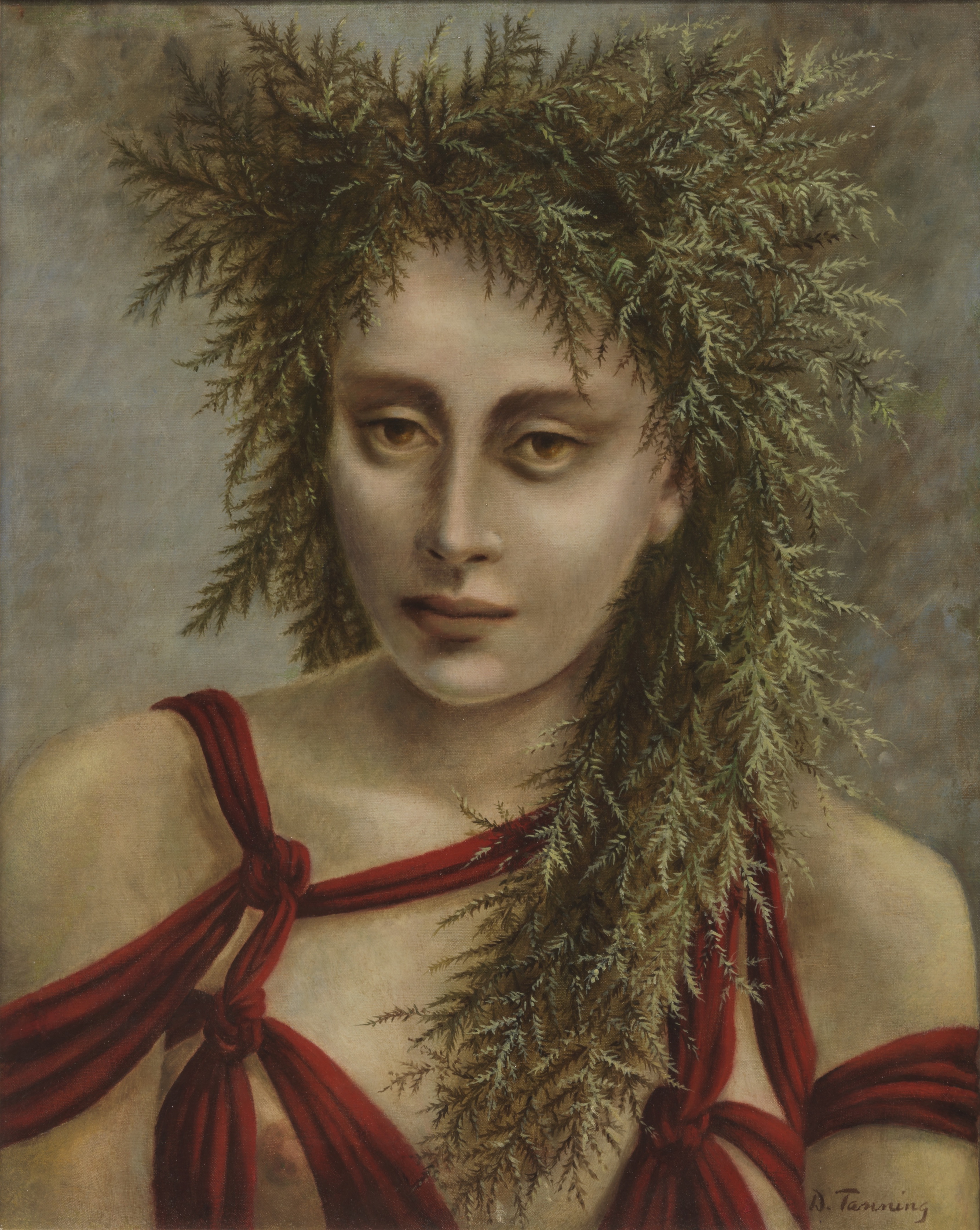
Dorothea Tanning, her early life and her love of Surrealism. Part 3

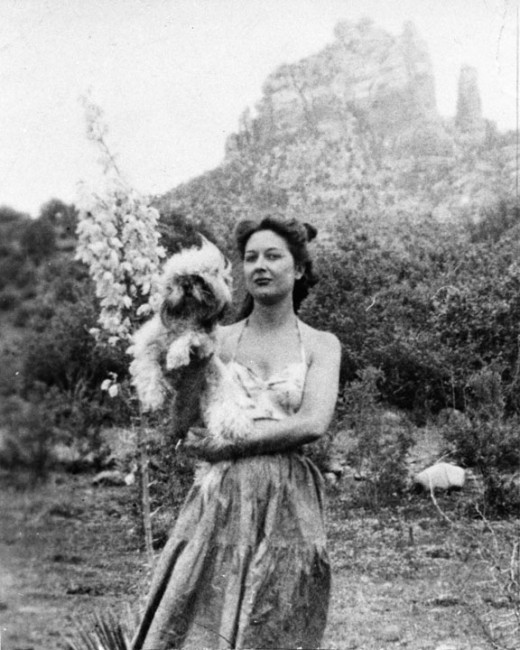
Dorothea Tanning, Sedona, Arizona
Dorothea Tanning in Sedona (1943)

Dorothea and Max Ernst divided their time between their Arizona home in Sedona and their apartment in New York.  Often Tanning would return to New York to show her work at the Julien Levy Gallery in Midtown Manhattan.  In April 1944, the Julien Levy Gallery held Dorothea’s first one-person exhibition.

See the source image
Fête Champêtre by Dorothea Tanning (1944)

That same year, 1944, Dorothea completed her painting entitled Fête Champêtre depicting a popular form of entertainment in Baroque France during the 18th century, taking the form of a garden party.  In Tanning’s work an unusual desert landscape provides the setting and she has added a marble mantelpiece and an ornate rococo clock.  She has also populated the depiction with a number of unidentifiable figures, some of which are human others are anthropomorphic, adding human characteristics to nonhuman things.  However, we can clearly see a bearded man and a girl who sits beside him, both staring out at something invisible to us.  The whole depiction remains a mystery as to what it is all about.

The Temptation of St Anthony by Dorothea Tanning (1945)

Whilst in New York,in 1945, Dorothea Tanning, completed a work which focused on a biblical scene that has been depicted by many famous artists, such as Dali and Hieronymus Bosch.  The painting is entitled The Temptation of St Anthony, which is now the property of Philadelphia’s La Salle University Art Museum. The painting portrays the supernatural temptation reportedly faced by Saint Anthony the Great during his stay in the Egyptian desert.  Saint Anthony, then aged 35, decided to spend the night alone in an abandoned tomb. A great multitude of demons came and started beating him, wounding him all over. He lay on the ground as if dead and the claws of the demons prevented him from getting up. According to the hermit the suffering caused by this demonic torture was comparable to no other.  Terrified and brought to his knees in fear, the habit that he is wearing wafts upwards as if caught in a gale-force updraft.  The blue, green and pink folds of the habit expose images of feminine shapes that seem to be the cause of his anguish. 

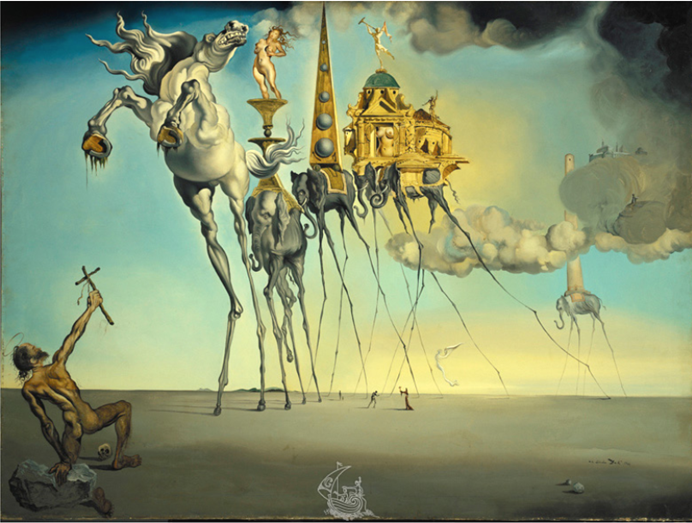
The Temptation of St Anthony by Salvador Dali. His entry to the Bel Ami competition

Dorothea created the work for the Bel Ami International Art Competition, where twelve surrealist and magic realist painters were asked to submit a painting to be used in Albert Lewin’s film The Private Affairs of Bel Ami, based on Guy de Maupassant’s novel Bel Ami. The rules of the competition for a cash prize were that the painting should be 36 × 48 inches and on the subject of the temptation of Saint Anthony. It would be shown as the only colour segment in the otherwise black and white film in which paintings of The Temptation of St. Anthony. Both American and European artists participated, including Ivan Albright, Eugene Berman, Leonora Carrington, Salvador Dalí, Paul Delvaux, Max Ernst, O. Louis Gugliemi, Abraham Rattner, Horace Pippin, Sydney Spencer, Leonor Fini and Dorothea Tanning.  All artists who submitted a painting received $500, while the winner received a prize of $3000. Max Ernst won the competition and his painting was shown in the film. Dali’s entry also became famous in its own right.

The Temptation of Saint Anthony (Ernst painting).png
The Temptation of Saint Anthony. The winning entry by Max Ernst

The competition was judged by Marcel Duchamp, Alfred H. Barr, Jr., and Sidney Janis. Max Ernst wining submission was not loved by all as the film critic Bosley Crowther of The New York Times called Ernst’s painting “downright nauseous” and wrote that it “looks like a bad boiled lobster.

Of her work and the meaning behind the depiction Dorothea Tanning wrote:

“…It seems to me that a man like our St. Anthony, with his self-inflicted mortification of the flesh, would be most crushingly tempted by sexual desires and, more particularly, the vision of woman in all her voluptuous aspects.  It is this phase which I have tried to depict in my painting. St. Anthony, alone in the desert, struggles against his visions; half-formed, moving in indolent suggestion, colored with the beautiful colors of sex, his desires take shape even in the folds of his own wind-tossed robes…”

Dorothea Tanning painting the Temptation of St Anthony (1945)

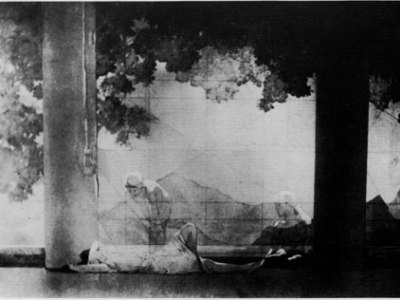
A photographer took a picture of Dorothea whilst she was working on the St Anthony portrait as a promotional photograph for the Bel Ami competition.  It was at a time when she had been ill and had contracted encephalitis and the photographer had to prop her up for the shot as she was so unwell.  She has her back to us but we see her long flowing locks of hair and on the wall is her famous Birthday self-portrait.  In her autobiography, Between Lives, she tells of how the illness caused her and her soon-to-be husband Max to return to the peace of Sedona in 1946 and sub-let their New York apartment to their friend, Marcel Duchamp.  Dorothea and Max married in October 1946.  Although they had regular guests come to their Sedona home, Dorothea always maintained that the period in Sedona, when it was just her and her husband, were the happiest days of her life.

The newlywed couple would separately paint all day and then come together in the evenings to listen to music, read and often play chess which was one of their favourite pastimes.

Max in a Blue Boat, 1947 - Dorothea Tanning
Max in a Blue Boat by Dorothea Tanning (1947)

Their love of chess is depicted in Dorothea’s 1947 work entitled Max in a Blue Boat.  It depicts the couple in the boat in the midst of a desert landscape and they seem to move effortlessly despite the lack of water.

Maternity, 1946 - 1947 - Dorothea Tanning
Maternity by Dorothea Tanning (1947)

In 1947 Dorothea completed the work entitled Maternity, which focused on motherhood and the psychological and physical problems associated with bearing and raising a child.  In the setting of a sand-strewn desert we see a young woman holding a young child in a shielding encirclement.  At the feet of the woman, on the rug, lies her dog which has a child’s solemn face staring out at us.  The features of the dog resembled her own Lhasa Apso dog, named Katchina.  Mother, child and dog make for a strong family unit set against a hostile setting.

The dog was depicted in one of her favourite works entitled Tableau Vivant.  It was then purchased by the National Galleries of Scotland. The painting was the first by Dorothea Tanning that they had acquired and joined up with major artworks by Surrealists Leonora Carrington, Salvador Dalí and René Magritte held at the Scottish National Gallery of Modern Art (SNGMA).  The work was first shown at Tanning’s first exhibition in France in May 1954 at the Galerie Furstenberg, Dorothea Tanning: Peintures 1949-1954.   She had inscribed the title L’Etreinte on the verso, which can be translated as The Embrace.   A few months later the inscription was crossed out and substituted with Tableau Vivant and it was under its new title, Tableau Vivant that it was included in the artist’s first exhibition in Britain, at the Arthur Jeffress Gallery, London in 1955.

Tableau Vivant by Dorothea Tanning (1954)

It was not uncommon for Surrealist artists to include animals in their paintings.  Numerous Surrealist artists took animal embodiments which played the role of their alter-ego in their work: Max Ernst used a bird, Leonora Carrington favoured a horse; and Tanning took Katchina. Whreas other Surrealist depicted various types of the animal, Tanning’s choice was more specific.  It was her own pet, Katchina, whose insertion into Tanning’s work was not of necessity a personification of the artist; sometimes it acted as a witness, other times as a protagonist, the Katchina affected different roles in different works. These works started a change of Tanning’s painting style.  She moved away from the meticulous, controlled, illustrative technique which was the hallmark of her Surrealist work. In its place she began to decide on much looser, softer, more painterly brushwork and her colour switched from bright, intense primaries to ashes and ochres.  It was a move towards her Abstract period.

The painting is a depiction of many feelings.   Power, love, the erotic, the humorous, the dream and the nightmare, Tableau Vivant brings together many key moments in the artist’s life and career. Tanning loved the painting and it was included in almost every major exhibition of her work, notably her solo shows in Brussels in 1967, Paris in 1974, and the Malmö Konsthall and Camden Art Centre in 1993. The work of art remained with her for the remainder of her life until 2012, when she died at the age of 101, almost sixty years after painting it. Towards the end of her life, she specified it as one of a small number of works reserved only for sale to a museum.  Simon Groom, Director of Modern and Contemporary Art at the National Galleries of Scotland said of the painting:

“…We’ve been looking for a major painting by Dorothea Tanning for many years. This was one of her favourite works: she kept it for more than sixty years, hanging it above her desk in her apartment in New York. It’s a stunning addition to the Galleries’ world-famous collection of Surrealist art…”

Sarah Philp, Director of Programme and Policy at Art Fund, which helped the National Galleries of Scotland financially with the purchase of the work which cost £205K  said:

“…Tableau Vivant is an astonishing work with a fascinating biography and we are proud to help National Galleries of Scotland purchase this painting for their outstanding Surrealist art collection…”

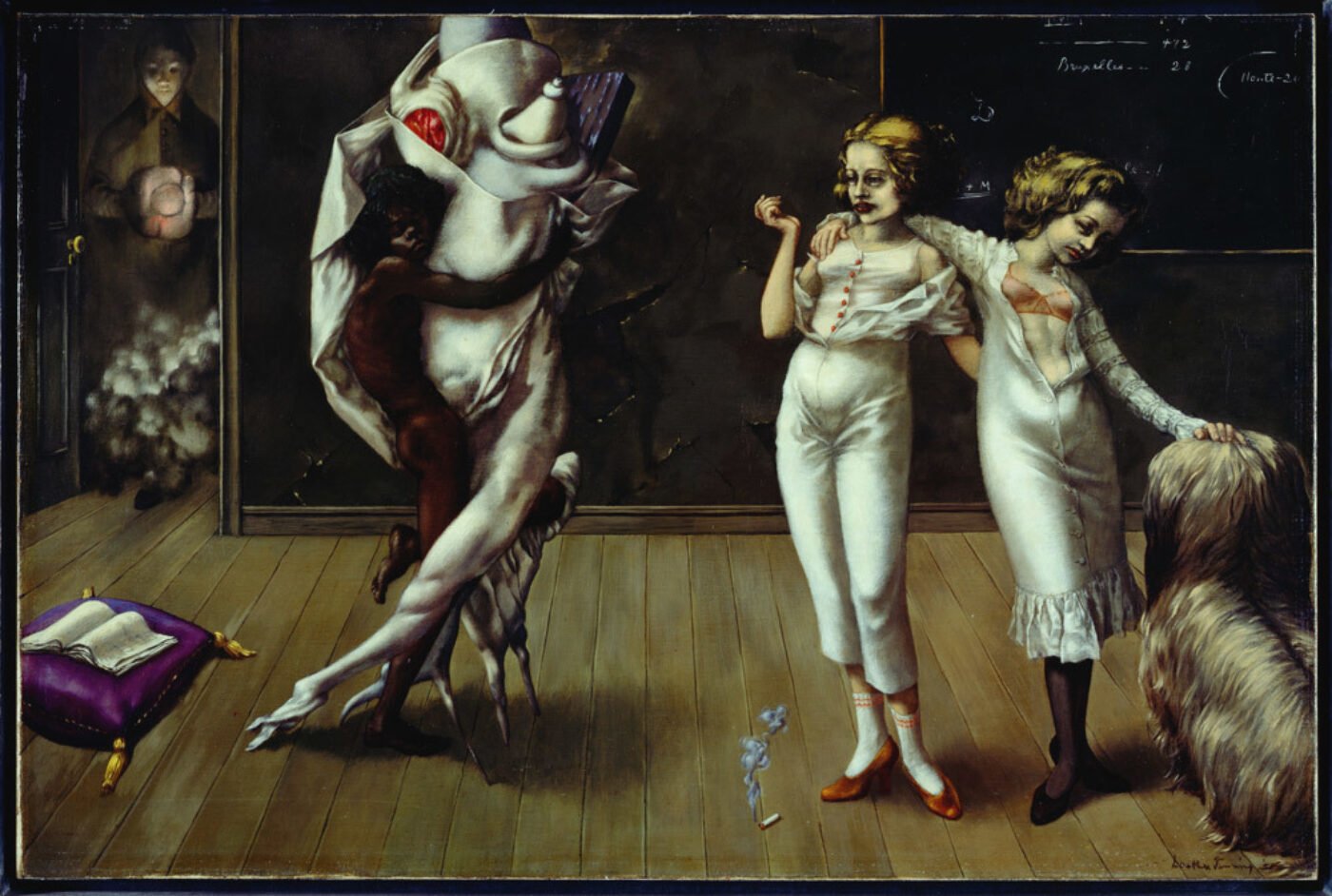
Interior with Sudden Joy by Dorothea Tanning (1951)

The Tableau Vivant dog appeared in a number of her paintings after 1946, including Interior with Sudden Joy.

Interior with Sudden Joy is a strange painting.  In the depiction we see two girls standing to the right. They strike a provocative pose.  They are both dressed in white garments which harmonise with their pale skin, the buttons are unfastened and expose a camisole top and red bra, which reminds one of the bared chest in Tanning’s self-portrait Birthday. The girls pose with their arms wrapped around each other and both exude an air of nonchalance. They are young women and are only too aware of their sexuality.  The girl furthest to the right pats the head of a large shaggy dog.  The dog, which faces away from us, takes little notice of the two girls and instead stares at the blackboard on the back wall like a pupil ready to learn. On the blackboard there is chalked writing. In her memoir, Tanning says she took writings written in poet Arthur Rimbaud’s ‘secret notebooks’ and put them on the blackboard in this painting.  Rimbaud was admired by the surrealists because of his belief that poetry passed through the body in the manner of a musical instrument, which reaffirmed the surrealist idea of automatism as a creative outlet using the body as a vehicle.

The Boy

On the floor, close to the feet of one of the girls, lies a burning cigarette.  The girl’s hand is held up as though the cigarette had once been held between her fingers. To the left of them is a naked boy embracing a strange amorphous mass which imitates a human figure and wraps itself around him. The whiteness of its fabric-like flesh contrasts with the boy’s dark skin, and abundance of dark curls which form a halo around the boy’s head. The boy looks completely at peace. If the painting’s title Sudden Joy derives from any part of the depiction it is from him. In her memoir, Tanning described the girls as being like Sodom and Gomorrah.  On the floor in the left-hand corner of Tanning’s painting is an open book atop an ornate purple cushion. Its pages are blank, perhaps waiting to be written in. It is an eerie depiction.  We see a figure standing in the doorway in the left-hand top corner of the painting, and the black door stands ajar waiting for someone or something to enter the room.

 Dorothea Tanning died on January 31st 2012, at her Manhattan home at age 101. Her husband Max Ernst had died thirty-six years earlier.

Most of the information in my blogs about Dorothea Tanning come from the excellent 2020 biography of the artist, entitled Dorothea Tanning: Transformations by Victoria Carruthers.

Dorothea Tanning, her early life and her love of Surrealism. Part 1.

Dorothea Tanning
Dorothea Tanning aged 18. (1928)

What does one mean when one says they like art.  What is art?  By definition, art is a diverse range of human activities involving creative imagination to express technical proficiency, beauty, emotional power, or conceptual ideas and it encompasses the three classical branches of visual art are painting, sculpture, and architecture, but the term “art” also embraces theatre, dance, and other performing arts, as well as literature, music, film and other media such as interactive media. So, I need to narrow down what I mean when I say I love art.  I should maybe say I love visual art and yet I am not a fan of conceptual or performance art.   I love the paintings created by numerous artists.  However, that is not quite true as I do not love all painting genres.  I neither find pleasure in looking at works of abstract art such as those by Kurt Schwitters nor the black lines and blocks of colour by Mondrian nor the works of abstract expressionist painters such as those by Robert Delaunay, Jackson Pollock, Mark Rothko and Willem de Kooning nor the disturbing imagery of Francis Bacon. Having told you what I do not like I suppose I should tell you what I do like but if you have been following my blogs over the years, you will probably already know.

I love the paintings of the Dutch and Flemish Masters.  I like many of the painters of the Victorian era.  I like “busy” multi-figure paintings and love to delve into the depiction to see what is happening in narrative paintings.  I like narrative paintings which have a tale to tell or a moral to enforce.  Surprisingly, having said all that I also have a reluctant love of Surrealism and enjoy trying to figure out what the depiction is all about and what was in the painter’s mind when he or she put brush to canvas.

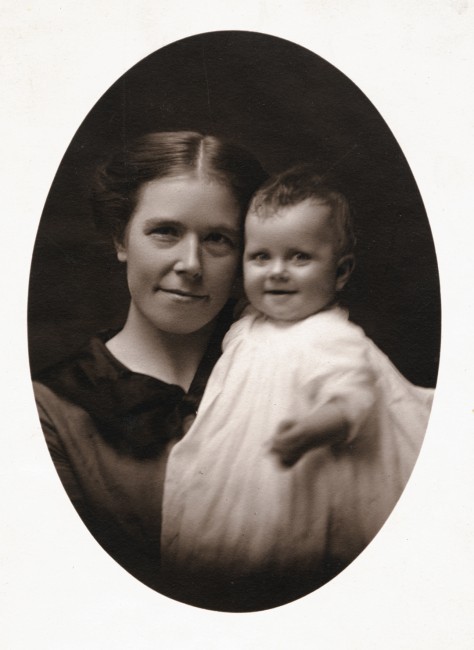
Dorothea Tanning with her mother, Amanda Tanning
Dorothea Tanning with her mother, Amanda Tanning, 1911

This was a somewhat long-winded introduction to today’s artist, the American Surrealist painter, printmaker, sculptor, writer, and poet, Dorothea Margaret Tanning.  Tanning was born on August 25th 1910.  She was the middle child of Andrew Tanning and Amanda Marie Tanning (née Hansen), who were of Swedish descent.  She had an elder sister Maurine and a younger sister Mary Louise.  Andrew Tanning, born Andreas Peter Georg Thaning, came alone from Skåne in the southernmost county of Sweden and settled in the conservative Midwestern town of Galesburg, Illinois.  In her memoirs Dorothea Tanning recounted that both her parents were very loving, indulgent and imaginative, the latter trait which she believed led to her creativity.  In her 2001 autobiography, Between Lives, Tanning wrote lovingly of her mother:

“…How could a tiny artist grow into a big one without the quilt of maternal love with its pattern of solace for hurts, its curving comfort, cloud-soft, its consolation for having to exist, its sweet smell?  The mother-goddess (the term would have embarrassed her), doctor and protector hovered over us in the full conviction that we were worth the trouble…”

Dorothea Tanning
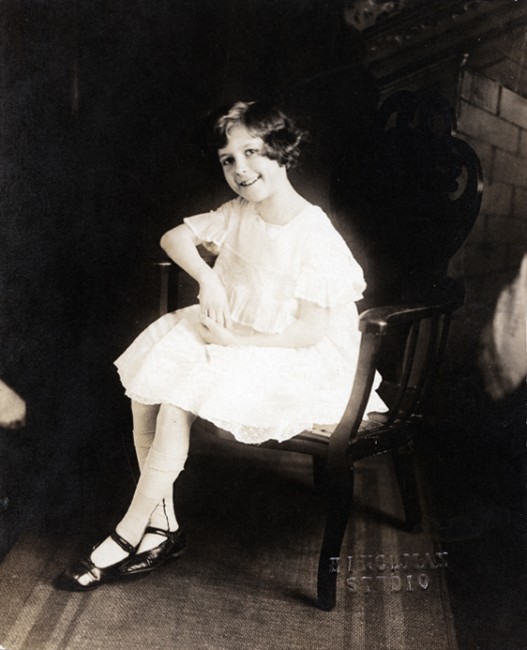
Dorothea Tanning, aged 5. (1915)

By her own admission Dorothea was a small and delicate child prone to bouts of illness which often confined her to bed.  Like similar stories of young children who became well-known artists, it was this time during bed rest that she developed artistic skills and immersed herself into reading picture books.  Her favourites were the fairy tales of the Brothers Grimm, and the stories and colourfully mesmerising characters from Greek mythology and the Bible.  It was from the likes of these that Dorothea gained an insight of the outside world, a world free from a cosseting mother.  She would also amuse herself by the simple game of staring at patterns on the wallpaper or furnishings and allow her imagination to form images which were not real.  In a way she was slipping from the real world into an imagined parallel existence.  Maybe it was this which would eventually lead her into the world of Surrealism.

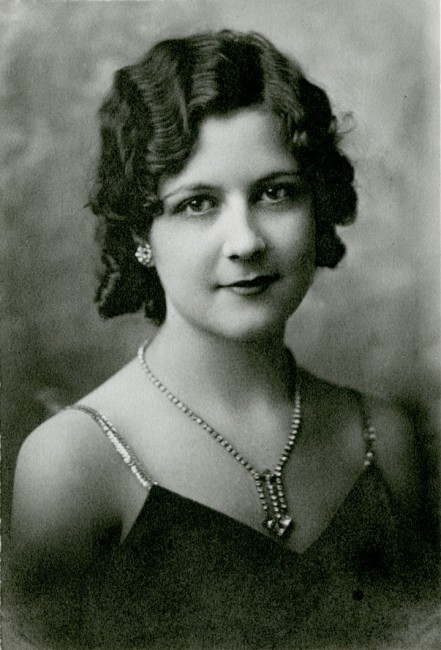
Dorothea Tanning, Galesburg High School Yearbook, Senior Year
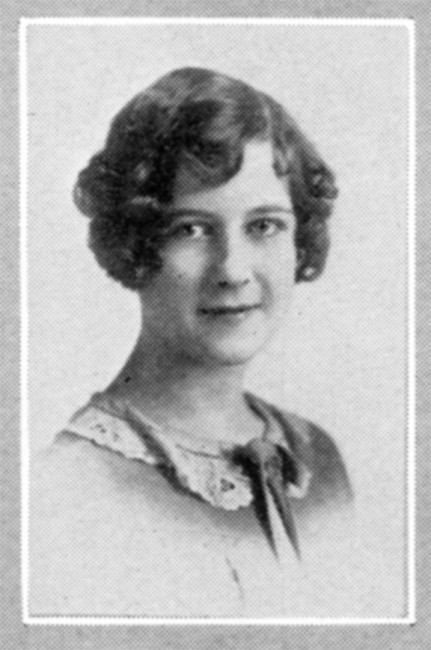
Dorothea Tanning, Galesburg High School Yearbook, Senior Year, 1926

In 1926, aged sixteen, Dorothea Tanning graduated from Galesburg Public High School.  The following year she managed to get a part-time job at Galesburg Public Library which gave her access to a world of literature.  She termed it the House of Joy.  One of her earlier jobs was cataloguing the books with a senior assistant who decided on whether the contents were deigned immoral and unfit for minors and were marked with a red cross in the catalogue.  Dorothea said that it was then much easier to find the “best” books.  In her biography she wrote about the time at the library and how it made her consider her future:

“…Over the years, the library became my haven, its treasures slyly challenging the voice of “art” in the tug-of-war for my ambitions, its sirens singing and crying by turns, its weight crushing my famous certitudes forever…”

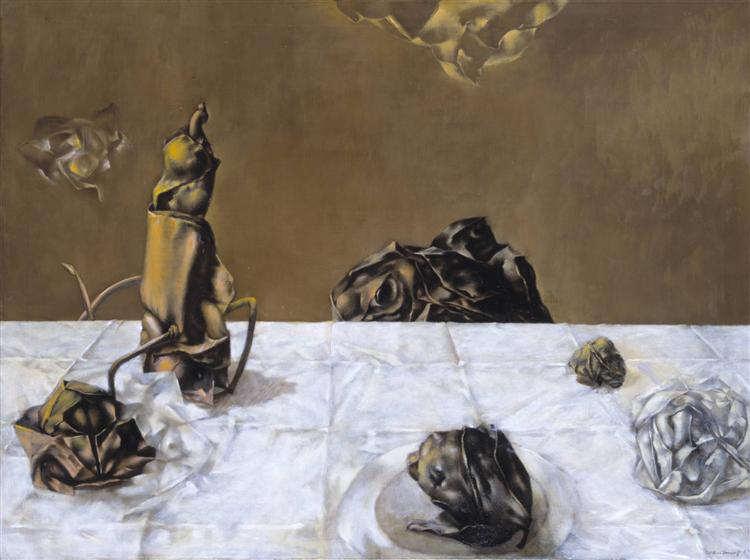
Some Roses and Their Phantoms, 1952 - Dorothea Tanning
Some Roses and Their Phantoms by Dorothea Tanning (1952) represents a domestic world transformed by mysterious eruptions and inhabited by unnamed creatures. The table top setting, with its crisp white tablecloth and marks of ironed folds, suggests a safe world of bourgeois ritual. A recurrent motif, the white table cloth can also be found in other works of the same period. 

In 1928 she enrolled at Knox College in Galesburg and remained there for two years.  In 1930 she quit the college in order to pursue an artistic career and set off for Chicago under the guise of meeting up with a friend.  She had surreptitiously packed a trunk with her belongings which she left in her bedroom and later, once in Chicago, asked her parents to forward it to her !

Chicago at the time of Dorothea’s arrival, was a city in the grip of Prohibition, jazz-filled nightclubs and violent gang wars.  She lodged with an ex-library colleague.  She revelled in the nightlife of the Windy City and began a relationship with the writer, Homer Shannon.  To earn a living, she took on a number of jobs including waitressing at the Colonial Room.  She operated marionettes in the 1933 Chicago World Fair.  She must have accumulated some money as she loved to travel going to New Orleans in 1934 where she exhibited some of her watercolours. 

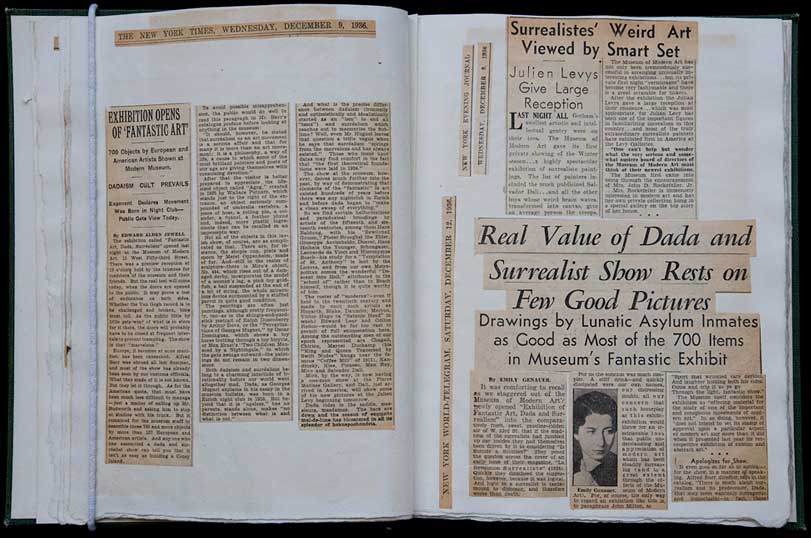
December 1936 newspaper cuttings about the Fantastic Art, Dada and Surrealism exhibition. 

She also made a number of trips to New York searching for work as a commercial artist and during one visit in 1936 visited the Museum of Modern Art to see the Fantastic Art, Dada and Surrealism exhibition.  The exhibition was rife with controversy and provoked fierce reactions from battling factions among the Dadaists and the Surrealists.  The press release by MOMA identified Surrealism and Dadaism as such:

“…”Surrealism, which developed in Paris around 1924, was the direct descendent of the Dadaist interest in the bizarre, the spontaneous, and the anti-rational. But while the Surrealist program carried on the iconoclasm of Dada it added serious research into subconscious images, dreams, visions, automatic and psychoanalytic drawings. Surrealism, so far as its serious adherents are concerned, is more than a literary or an art movement: it is a philosophy, a way of life, a cause which has involved some of the most brilliant painters and poets of our age…”

In a later interview Dorothea said of the exhibition:

“…For me it was the revelation, and I wasn’t the only one.  I would even say that most American artists – as well as poets – were deeply affected by that explosive event.  So, I became more impatient than ever – I just had to live in Paris…”

Once again in her autobiography Dorothea was certain that what she saw at the exhibition at the MOMA was a turning point in her artistic life.  She wrote:

“…Here, gathered inside an innocent concrete building, are signposts so imperious, so laden, so seductive and yes, so perverse that, like the insidious revelations of the Galesburg Public Library, they would possess me utterly…”

Deirdre
Deirdre by Dorothea Tanning (1940)

Dorothea had now caught the Surrealism bug and knew to explore the genre more she had to go to Paris.  She set sail on SS. Amsterdam for the France in July 1939 with the intention of meeting some of the Surrealist artists living there but her plans were thwarted by the onset of the Second World War.  Artists had hurriedly escaped from Paris and she managed to escape France and makes her way through Holland Belgium Germany and Sweden in August to the home of her paternal relatives. From there, in October, she managed to gain passage back to America on the SS. Gripsholm.  Another artist to take flight from France and journey to America was the leader of the Surrealism Movement, German-born Max Ernst who before his salvation had been interned twice in 1939, once by the French government having been labelled an “undesirable foreigner” and once by the Gestapo but he managed to escape with the help of Peggy Guggenheim, a member of a wealthy American art collecting family, and the journalist Varian Fry. 

Dorothea Tanning, Music Hath Charms. 1940.
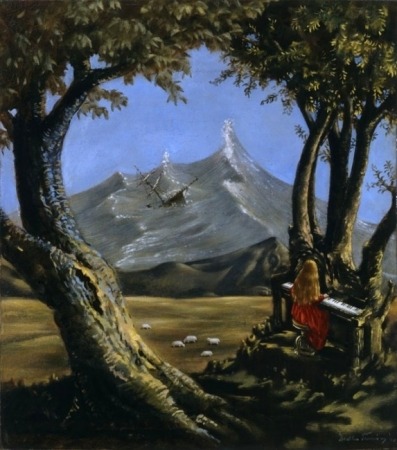
Music Hath Charms by Dorothea Tanning (1940)

Once back home in New York, Dorothea Tanning sought employment as a commercial artist and for a time worked on the advertisements for Macy’s department store, producing adverts for perfumery products, clothing and accessories.  She continued with her own art and in 1940 produced a small painting entitled Music Hath Charms.  It was the beginning of her love of Surrealism being translated into her own work.  The painting depicts a young girl, dressed in red, playing the piano formed by the roots of one of two large trees which act as a frame for the scene.  She has long blonde hair which runs down her back.  Look at the background and at first it seems to be just a snow-capped mountain but with closer inspection it is the gigantic wave of a stormy sea in which we see a sinking tall ship.  The terrifying sight of the doomed ship is in stark contrast with the pastoral scene of the middle-ground with the grazing sheep and yet there is more.  Look carefully at the dark brown/olive hills which divide the space between the sheep-grazing field and the wild stormy sea.  It is the prone body of a hybrid beast, part human in the shape of a woman’s body and part animal being the face of a wild cat. Again it, like the sea and the fields, is the juxtaposition of human and animal.  The creature stares at the girl as if mesmerised by the sound of the music.  The depiction implies that the melodious sounds emanating from the piano is causing a metamorphosis in the landscape with the creature materialising from the “softened rocks”.

Portrait of Julien Levy by Jay Leyda (c.1932)

In 1942 after an up-and-down relationship and short marriage to Homer Shannon, the pair split up and Dorothea concentrated on her art and immersed herself in the artistic community and became great friends with Julien Levy, a gallery owner who offered her an exhibition at his gallery once she had built up a sizeable collection.  Levy had opened his new gallery in midtown Manhattan in November 1931 with a photography exhibition that included works by his friend and mentor, Alfred Stieglitz. As selling photographs became more difficult Levy shifted his gallery’s focus to Surrealism and to showing the work of artists like Salvador Dalí, Max Ernst, Man Ray and Joseph Cornell.

In May 1942 Julien Levy invited Dorothea Tanning to one of his afternoon soirees held in his Chelsea apartment.  Dorothea remembered stepping into Levy’s apartment and at that party, seeing her future road map lying before her:

“…A May afternoon as only May afternoons can be in the city.   And an apartment in Chelsea, all dark woof and those slated shutters peculiar to old New York.  A Recamier sofa, an iron sleigh-bed breathing Paris, a Bellmer doll, the Duchamp window and scattered everywhere, objects, pictures, books and more pictures.  Indeed, coming time, you were overwhelmed with vertigo that it was hard to register Julien’s easy, smiling introductions to – as I remember them – Yves Tanguy, Max Ernst, Kurt Seligmann, Kay Sage, Bob Motherwell with beauteous wife, Maria, Virgil Thomson, Max Ernst, Consuelo de Saint-Exupery, Peggy Guggenheim, Sylvia Marlowe, Max Ernst……Doesn’t the repetition say it all?  Because quite simply, this was a new door for me to open, and it was Julien Levy who held the key, who did it all, not deliberately – he didn’t believe in plans – who very nonchalantly launched my art and found me a life companion…”

………………………………….to be continued.
Most of the information in my blogs about Dorothea Tanning come from the excellent 2020 biography of the artist, entitled Dorothea Tanning: Transformations by Victoria Carruthers.

Many pictures of Dorothea came from the Dorothea Tanning Organisation website

Paul Fischer

Self-portrait, Nytorv in Winter by Paul Fischer (1909)

Paul Gustav Fischer was born July 22nd, 1860.  His ancestors, who were originally from Poland, were the fourth generation of the Fischer family to live in Denmark. His immediate family would be classed socially as upper-middle class. Paul was the son of Philip August Fischer and Gustafva Albertina Svedgren. Paul’s father had started as a painter, and later succeeded in the business of manufacturing paints and lacquers.  Paul first received art tuition from his father but later went on to have formal art tuition.  He was apprenticed for a year and a half at the terracotta manufacturer C. Møller and graduated from the Technical Institute to the Royal Danish Academy of Fine Arts where he attended the general preparatory class in May 1876 but failed to complete the course, leaving in January 1878.  Following on from this, he became an assistant in his father’s painting materials business and worked there for ten years.  During this time he still carried on with his own painting. At the start of his artistic career, Paul completed mostly sketches and illustrations which he submitted for inclusion in a number of magazines such as Out and Home, Illustrated Journal, Juleroser and Klods-hans.

Paul Fischer. Vesterbrogade
Vesterbrogade is the main shopping street of the Vesterbro district of Copenhagen, 

The standard of his paintings were such that he exhibited regularly at the Charlottenborg Spring Exhibition between 1884 and 1902. He has also had his work exhibited at the Salon in Paris and exhibitions in Munich, Berlin, Oslo and Stockholm.

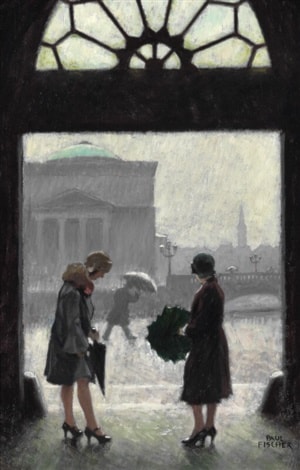
View from Ved Stranden in Copenhagen with two women sheltering from the rain
View from Ved Stranden in Copenhagen with two women sheltering from the rain by Paul Fischer

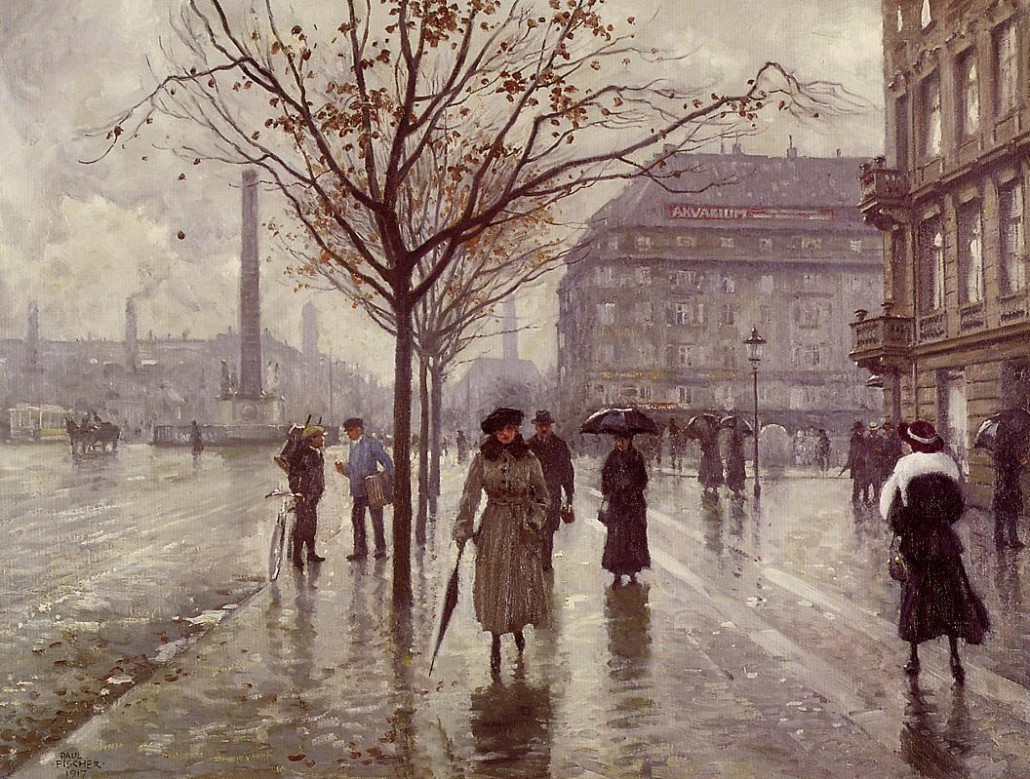
His early paintings depicted city life, and it was this genre that established him with the viewing public.  His depictions were often set in overcast or winter weather, but that was to change after his Paris trips when his works took on more colours and were warmer.  Paul Fischer stayed in Paris on two occasions in the 1890s and became influenced by the French Realists, Gustave Courbet and Jean-Baptiste-Camille Corot. 

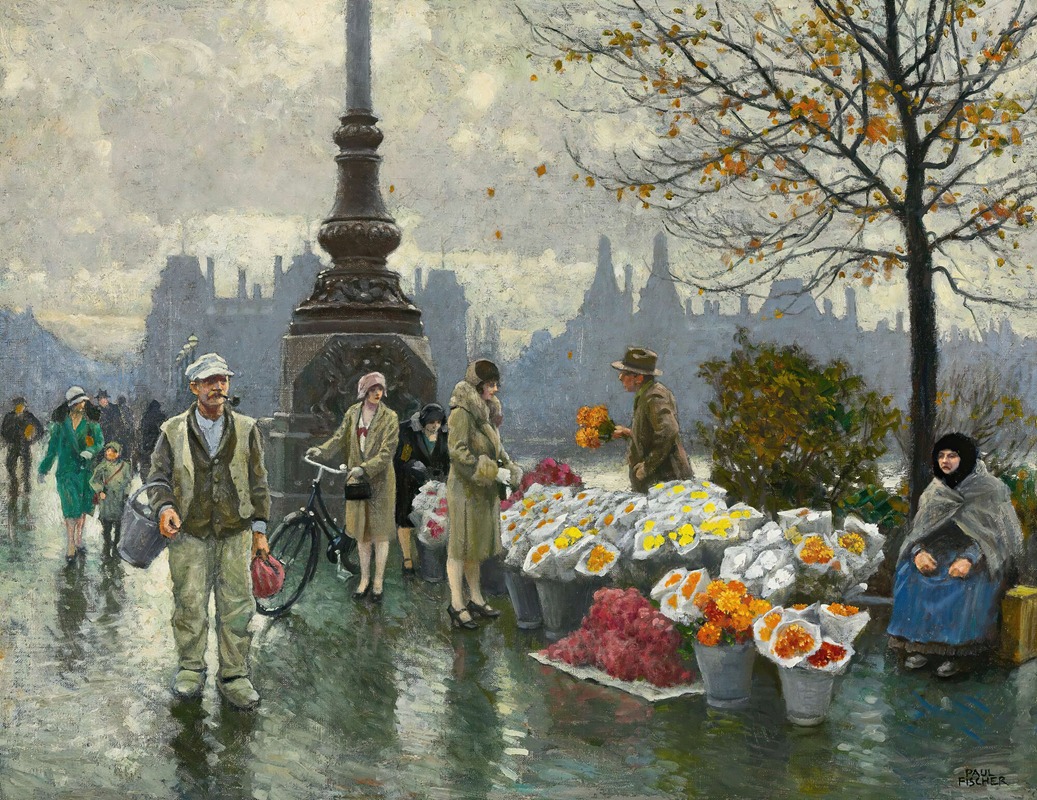
Paul Fischer - Flowersellers At Dr. Louises Bro (Queen Louise’s Bridge) In Copenhagen
Flower Sellers on Queen Louise Bridge, Copenhagen by Paul Fischer

Paul Fischer painted motifs from Queen Louise Bridge with views towards Ferdinand Meldahl’s two symmetrical palatial apartment buildings on Søtorvet – being some of the most French-influenced architecture in Copenhagen. Moreover, it was easy for him to compare the lakes on either side of the bridge with his beloved river Seine in Paris.

Højbro Plads seen from Højbro by Paul Fischer  (1900)

Especially famous are his colourful paintings, one of his most popular ones featuring the cityscape of Copenhagen is his 1900 work entitled Højbro Plads seen from Højbro.   Højbro Plads (High Bridge Square)  is a rectangular public square located between the adjoining Amagertorv and Slotsholmen Canal in the city centre of Copenhagen.  Højbro is a bridge in central Copenhagen, which connects the city centre to the small island of Slotsholmen, on which is the Christiansborg Palace.

See the source image
The Artist’s Wife, Dagny by Paul Fischer (1892)

Paul Fischer married Dagny Grønneberg on November 24th,1886.  Her father, Julius, was an art dealer and her Norwegian mother, Hulda Azora Tegner was a painter. 

See the source image
The Artist’s Daughter, Harriet Fischer by Paul Fischer

Paul and Dagny’s daughter, Harriet Fischer, was born on July 24th, 1890 and grew up in a busy artist’s studio and her father Paul Fischer persistently used household members as models, and often Harriet featured in some of his paintings both as a little girl and as a young girl, in portraiture and as a supporting figure in the street scenes.

Bondekvinde {Peasant Woman) by Hrriet Fischer

Harriet was admitted to the Royal Danish Academy of Fine Arts in Copenhagen, where she was from 1915-1920. From 1920-1940 she travelled on countless study trips to most of Europe. When their daughter began painting, it is known that she and her father exhibited together during the summer stays in Båstad in the years before World War I.

Harriet in the living room at Sofievej by Paul Fischer (1908)

Another beautiful painting featuring his daughter was his 1908 work entitled Harriet in the living room at Sofievej.

Winter Day with a Little Girl with a Sledge and a Large Red Knitted Hat by Paul Fischer

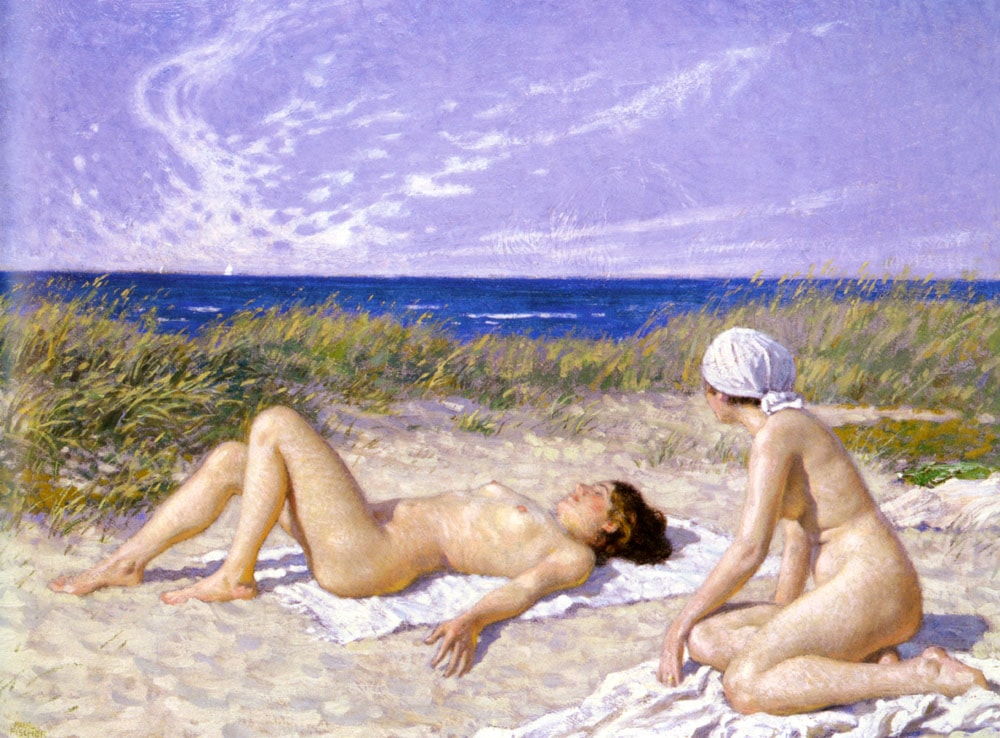
Paul Gustave Fischer was also well known for his amazingly natural sunbathers and his 1916 painting Sunbathing in the Dunes is a good example. 

Sunbathing in the Dunes
Sunbathing in the Dunes by Paul Fischer (1916)

The models seem to be happy to pose on the beach but I am sure were reluctant to parade nude in the icy waters of the Baltic.

Nude Bathers on the Beach, by Paul Gustave Fischer (1916)

There are more than a dozen such works painted over a number of years, and it is interesting to note how, in the depiction, his striking  bathing beauties merge so wonderfully with the sands of the beach one which almost makes ignore the erotic overtones of the paintings. 

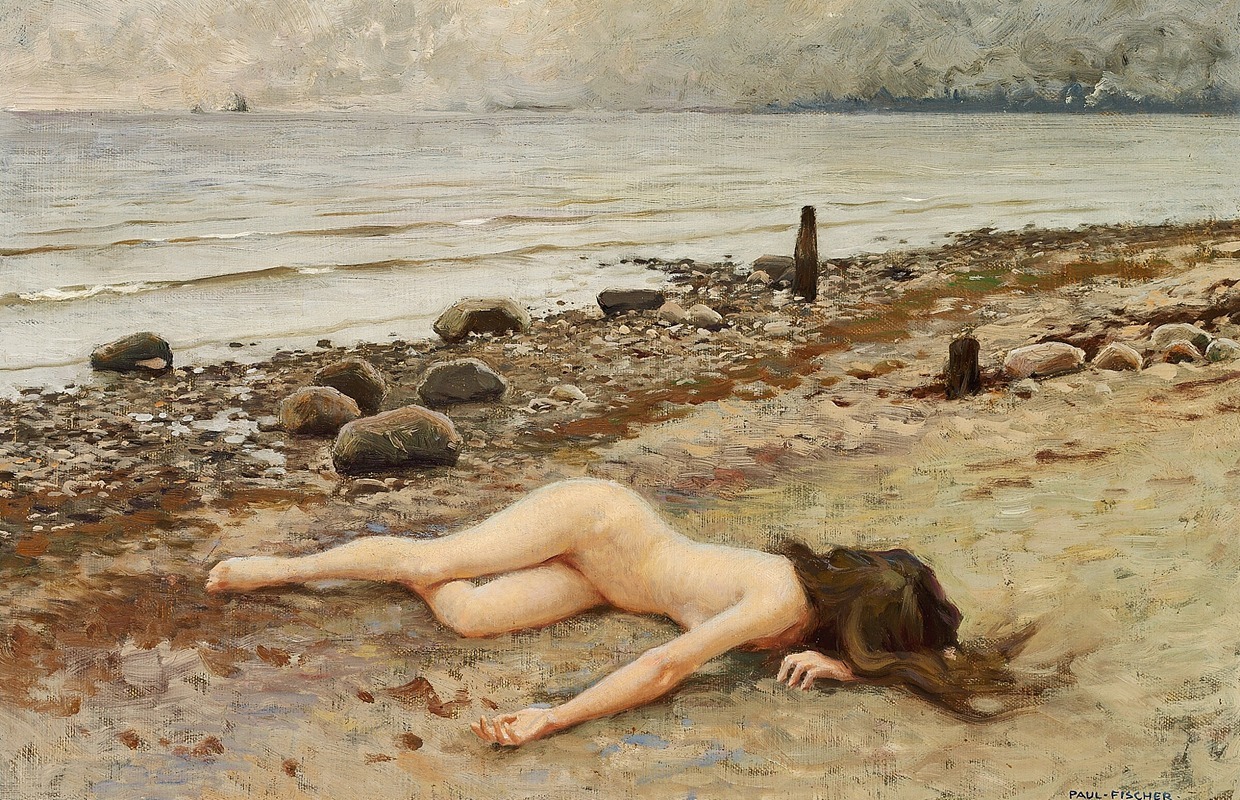
Vragnet (Wrecked) by Paul Fischer (1906)
Portrait of a Young Girl by Paul Fischer (1903)

Most of Fischer’s paintings are populated with female figure, some attractive older ones but also depicting young girls such as his 1903 tender Portrait of a Young Girl.

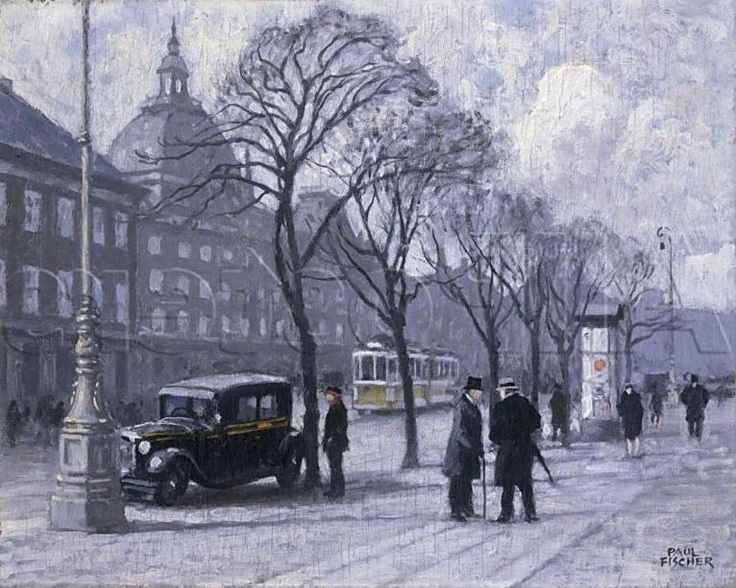
The Fire Engine by Paul Fischer (1900)

However, my favourite works of Paul Fischer are his everyday scenes of city life featuring people of all social classes and it is his depiction of the real lives of those around him which in part explains his popularity.  Take for example his 1900 painting The Fire Engine.   This is a depiction of a classic everyday occurrence.  It is a “busy” painting.  There are so many things happening in the depiction and your eye flits from one to another.  We, like the crowd, are drawn into the present dramatic happenings.  The red and gold coloured fire engine takes centre stage in the painting and, in a way, it is a salute to the industrial growth of the time.

Paul Fischer. Magasin du Nord at Kongens Nytorv, Copenhagen
Magasin du Nord at Kongens Nytorv, Copenhagen by Paul Fischer

The late 19th and early 20th century in Denmark, like other European countries was rapidly changing and these changing times were captured in Paul Fischer’s cityscapes often populated with the motor cars, trams and other vehicles.

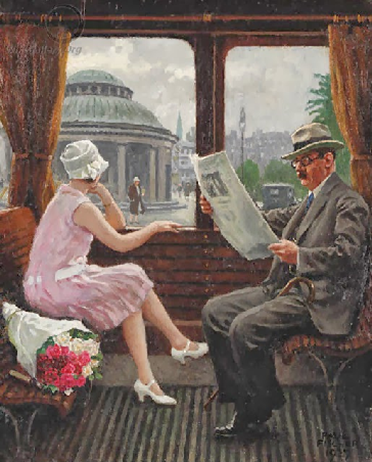
In the Tram Compartment by Paul Fischer (1927)

The 1927 work In the Tram Compartment by Paul Fischer is a fascinating depiction of everyday life.  The man reads his newspaper whilst the woman looks outside at the cityscape they are trundling past.  A bunch of flowers is on the bench next to her.  Maybe a gift from the man and yet he shows no interest n her and may just be a fellow passenger.  It is painting like these that you gaze at and make up a story of what you believe is going on!

See the source image
by Paul Fischer

Fischer depicted everyday life and tram rides on a number of occasions, such as the one above.  Maybe he was fascinated with this form of transport or maybe he was interested in the interaction between the passengers. Again we have a man reading a newspaper and a woman sitting next to a bunch of flowers.

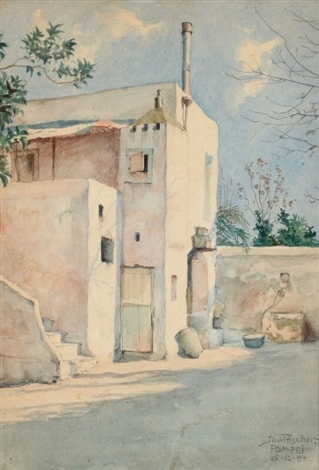
View from Pompei
View from Pompeii by Paul Fischer (1894)

Paul Fischer travelled through a number of European countries, sketching and painting.  One of his favoured countries was Italy and during the last decade of the nineteenth century he visited the area around Naples and the ruins of Pompeii.  In 1894 he produced a pencil and watercolour sketch of the area which was given the name View from Pompeii.

Italian Street Scene
Italian Street Scene by Paul Fischer

Another painting around this time was a work in oils, simply entitled Italian Street Scene.

In the early twentieth century Fischer’s paintings were selling well.  However, he was still in the shadow of his contemporary, the leading Danish painter of the time, Laurits Tuxen.  However, one would have that thought the life was good for Fischer.  He had a beautiful wife, Dagny, and a fine-looking and talented daughter, Harriet, but that was not the case as his marriage to Dagny ended in 1914. 

Portrait of Martha Vilhelmine Jensen, who became Mrs. Fischer by Paul Fischer (1913)

On June 17th, 1914, sixty-year-old Fischer married his second wife, twenty-five-year-old opera singer, Martha Vilhelmine Jensen whom he had been dating for some time.  His first wife, Dagny Grønneberg eventually went to live in Oslo where she died six years later on February 24th, 1920.

Paul Fischer died in Gentofte, a northern suburb of Copenhagen on May 1st 1934 aged 73

Eugène Boudin. Part 2.

Picture2

       Sky, Setting Sun, Bushes in Foreground. by Eugène Boudin (ca. 1848-1853)

One of Boudin’s earlier paintings which featured his mastery of depicting skies is his work entitled Sky, Setting Sun, Bushes in Foreground which he completed in the early 1850’s. In this work, Boudin has gone for a very high frame and in fact, the sea does not appear in the composition. In this work and many similar ones, there is just the faint outline of a low horizon.  More often than not, the clouds are the main, sometimes the only motif. At times, the subject becomes so fine or abstract that Boudin specified its meaning on the back of the work.  His love of the paintings by the Dutch Masters made Boudin strive to achieve skies that he had seen in their works of art.  Between 1850 and 1870 Boudin completed many such depictions and a note in his personal diary refers to them:

“…To swim in the open sky. To achieve the tenderness of clouds. To suspend these masses in the distance, very far away in the grey mist, make the blue explode. I feel all this coming, dawning in my intentions. What joy and what torment! If the bottom were still, perhaps I would never reach these depths. Did they do better in the past? Did the Dutch achieve the poetry of clouds I seek? That tenderness of the sky which even extends to admiration, to worship: it is no exaggeration…”

On  January 14th,  1863,  Boudin married the 28-year-old Breton woman Marie-Anne Guédès in Le Havre and the couple set up home in Paris but would return to the Normandy coast in the summers.

Eugène Boudin - Sur la plage à Trouville.jpg

                        On the Beach at Trouville by Eugène Boudin (1863)

Boudin had started off his career painting seascapes, but he found his calling in the 1860’s depicting small beach scenes which he populated with affluent holidaymakers that had made the journey from Paris and outlying places.  These people spent summers sampling the health-giving benefits of sea bathing and the vibrant social life in the fast-emerging seaside resorts of Trouville and Deauville. Boudin created a few hundred examples of this type of painting, which enhanced his reputation.  He knew that genre was popular with the public once writing:

“…I shall do something else, but I shall always be a painter of beach scenes…”

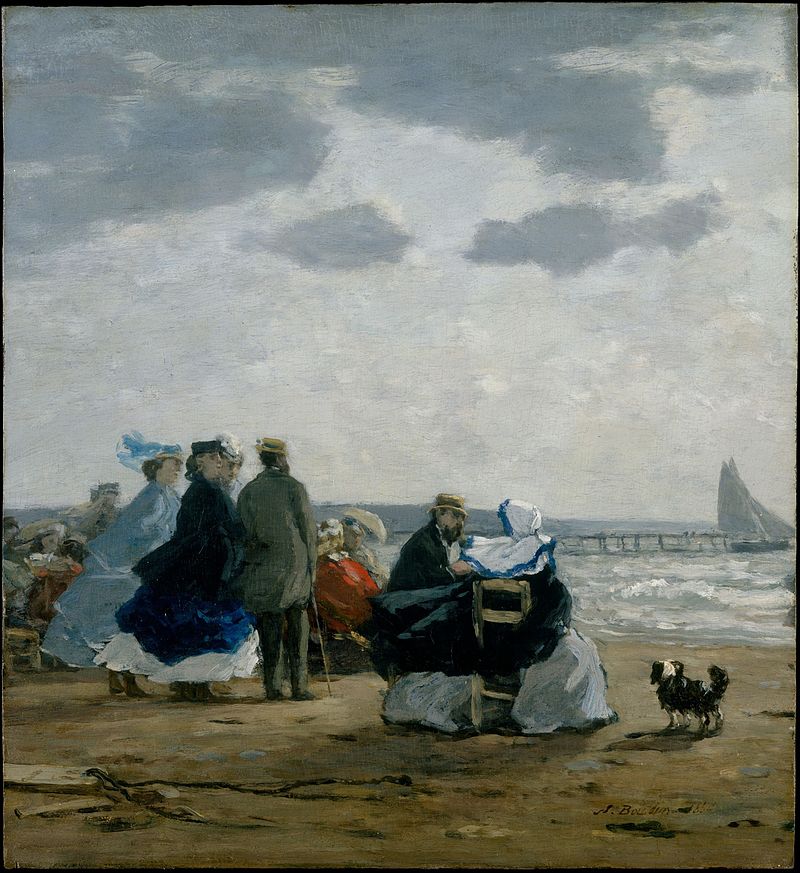
On the Beach, Dieppe MET DT11491.jpg

                                On the Beach, Dieppe by Eugène Boudin (1864)

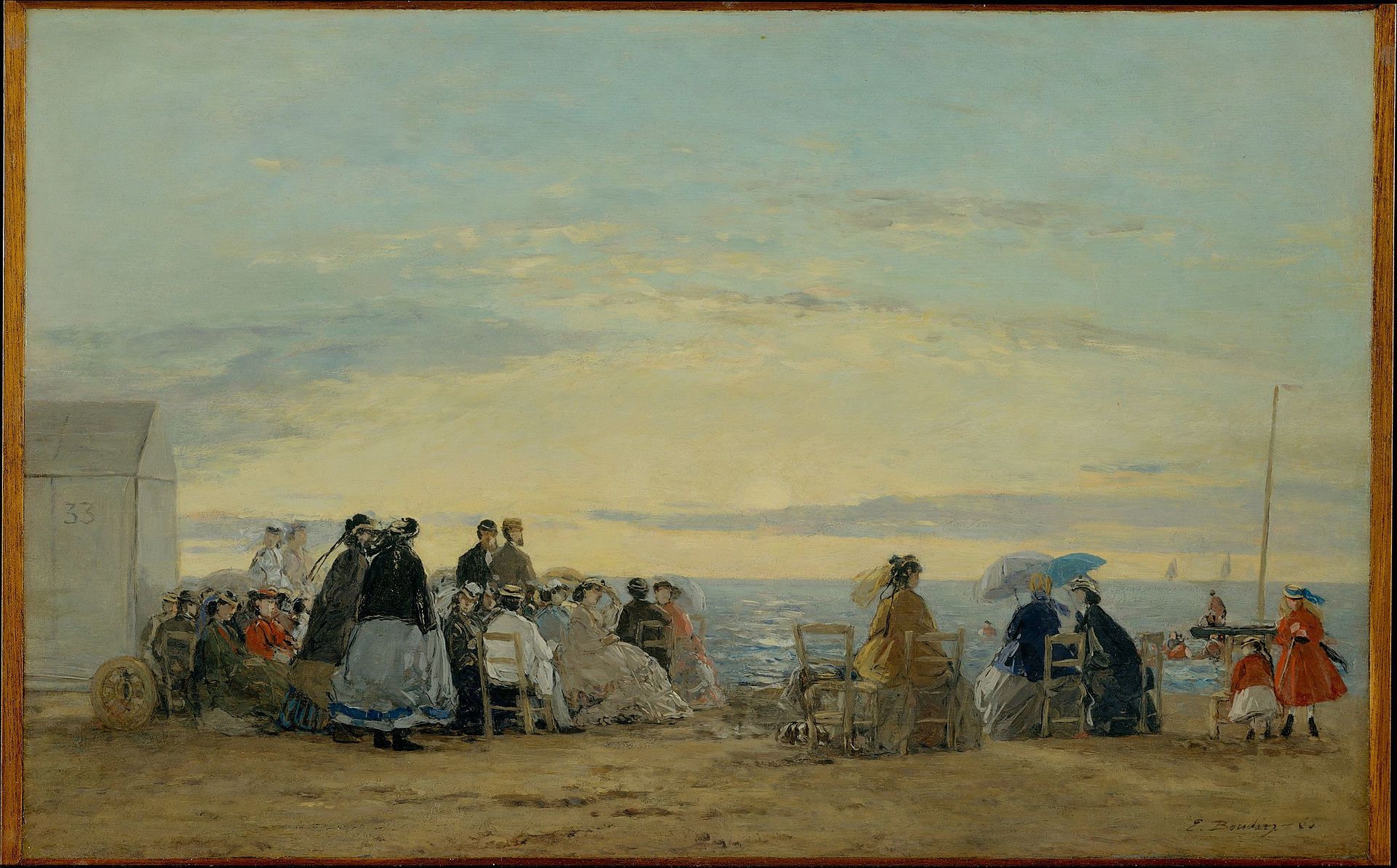
An example of this type of work is his 1864 painting entitled On the Beach, Dieppe.   The setting is the beach of the Channel coastal town of Dieppe.

The changing skies of France’s Channel coast and the fashionable crowds on the resort beaches were Boudin’s lifelong subjects. These pictures were avidly collected, ensuring the artist’s success. In 1863 he commented:

“…They love my little ladies on the beach, and some people say that there’s a thread of gold to exploit there…”

On the Beach, Sunset MET DT1031.jpg

                                 On the Beach, Sunset by Eugène Boudin (1865)

Around 1865 Eugène Boudin spent time painting on the Normandy coast along with Monet, Courbet and Whistler.  It is around this time that Boudin began a series of depictions of fashionable beaches and this was to carry on for the whole of that decade.  In his 1865 painting, On the Beach, Sunset, we see the well-dressed upper-class holidaymakers who have gathered together to catch the final light of the day.  The seaside towns of Trouville and Deauville had not only their beautiful sandy beaches to inveigle tourists to their town but also had racetracks and casinos to satisfy those who liked the thrill of a wager. 

Princess Pauline Metternich (1836–1921) on the Beach MET DT4425.jpg

                    Princess Metternich on the Beach by Eugène Boudin (1867)

Visits by famous people to the Normandy beaches, such as Napoleon III’s wife, the Empress Eugénie also enhanced their reputation. Another dignitary to visit the Normandy beaches was Princess Metternich, the famous Austrian socialite, and wife of the Austrian ambassador to France and one of the most notable women at the court of Napoleon III.  She visited the seaside times on many occasions and was often accompanied by Princess Eugénie.  Her visit was captured by Boudin in his small 1867 painting entitled Princess Metternich on the Beach.  The Impressionistic style of the painting gives us little idea of the woman herself, which may be a relief to the Princess, as commentators of the time described her as small, very slight of build and as having “a turned-up nose, lips like a chamber pot and the pallor of a figure from a Venetian masque”.

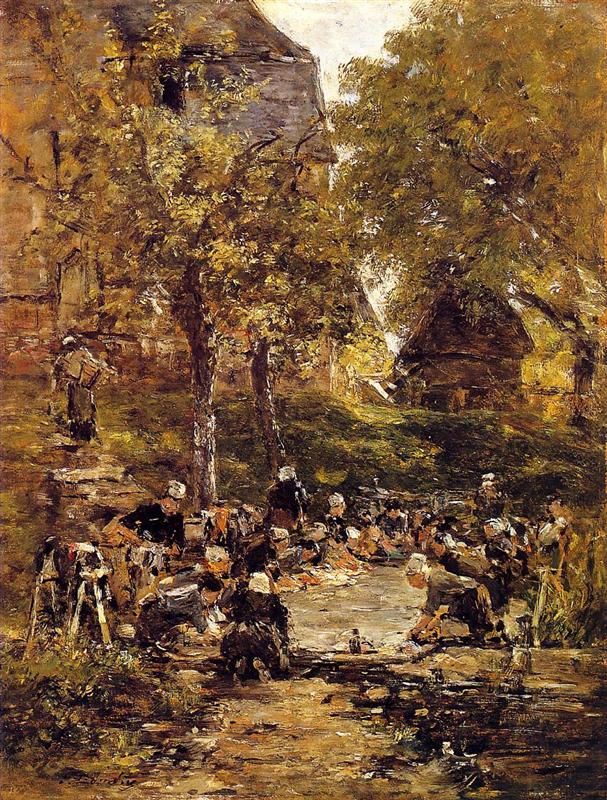
Laundresses by Eugène Boudin

For a period of time in 1867 Boudin left the beaches of Normandy and the luxurious lifestyle of the visiting rich and depicted the less well-off peasants and their daily routines.  Boudin could clearly see and understand the difference in the lives of the various social classes.  Did this bother him?  In a letter to his friend Ferdinand Martin, on August 28th, 1867, he condemned the social class system, writing:

“…I have a confession to make. When I came back to the beach at Trouville it seemed nothing more than a frightful masquerade.  If you have passed one month among the people condemned to hard work in the fields, with black bread and water, and you then find that gang of golden parasites with such a triumphant air, you can’t help feeling a bit of pity.  Fortunately, dear friend, the Creator has spread a little of his splendid and warming light everywhere, and what I reproduce is not so much this world as the element that envelops it…”

…….and yet in a letter to the same friend, Ferdinand Martin, a year later (September 3rd. 1868), he justifies his depictions of the wealthy on the Normandy beaches, writing:

“…The peasants have their painters, Millet, Jaque, Breton; and that is a good thing.  Well and good: but between you and me, the bourgeois walking along the jetty towards the sunset, has just as much right to be caught on canvas, ‘to be brought to the light’.  They too are often resting after a day’s hard work, these people who come from their offices and from behind their desks.  There’s a serious and irrefutable argument…”

Antwerp, Boats on the Scheldt by Eugène Louis Boudin, High Museum of Art.jpg
Antwerp, Boats on the Scheldt by Eugène Boudin (1871)

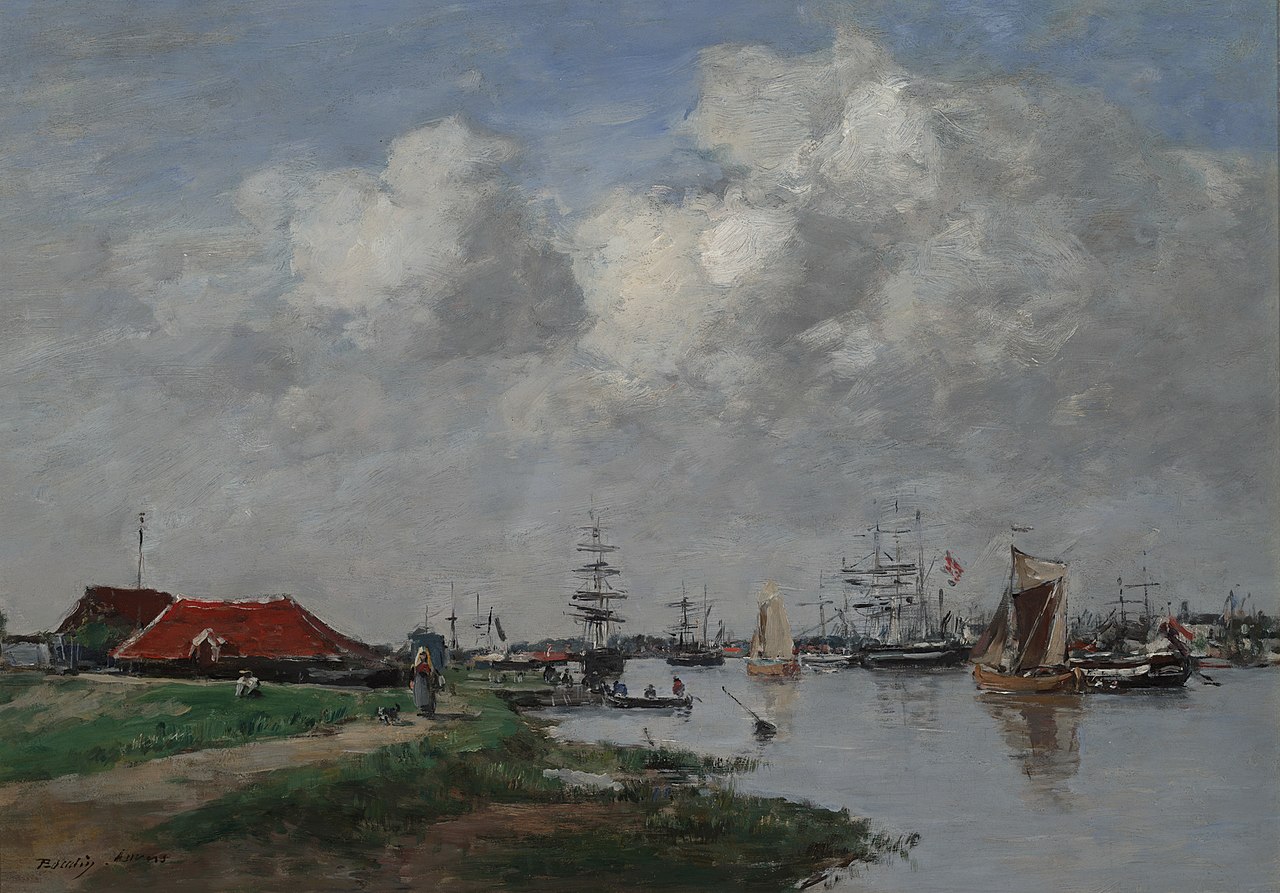
The Franco-Prussian War broke out in July 1870 and the Prussian army invaded the French capital the following month.  Both Boudin and Monet fled the country with Monet going to London whilst Boudin went north to Belgium and the city of Antwerp.  Whilst in Antwerp Boudin completed a number of maritime paintings, one of which was his 1871 work entitled Antwerp, Boats on the Scheldt.

Eugène Louis Boudin - The Escaut River in Antwerp - 1977.57 - Yale University Art Gallery.jpg
Antwerp, The Escaut River by Eugène Boudin (c.1871)

Another work around the same time was The Escaut River in Antwerp.

Low Tide. Portrieux by Eugène Boudin (1873)

With the Franco-Prussian war ending in 1871 and the bloody Paris Commune, which followed in the Spring of that year, coming to an end, it was safe to return to France.

Portrieux, in the bay of St. Brieuc, Côtes du Nord, was a popular village with painters and Boudin visited it on several of his trips to Brittany between 1865 and 1897.  His 1873 painting Low Tide, Portrieux depicts vessels he would have seen during his visits.  In this painting Boudin has focused on the fishing vessels from Newfoundland, the Terre-Neuvas, becalmed at low tide, and several of his paintings centred on this subject matter.   Boudin, who was the son of a ship’s captain, and who had worked as a cabin boy on ships sailing along the Channel coast, was well able to recognise, and record, the individual characteristics of the vessels he came across in the ports he visited.

The Dock at Deauville (1891)

The Dock at Deauville by Eugène Boudin (1891)

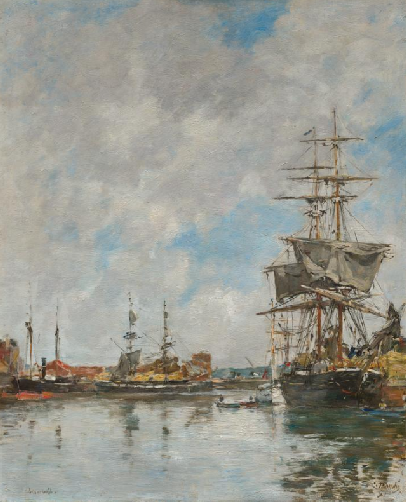
One of Boudin’s paintings, The Dock of Deauville, which he completed in 1891, has a similar depiction, ships in a harbour.  This painting treats a common theme in Boudin’s later art, ships in harbours. For Boudin these paintings were all about tranquillity, harmony and the effect of natural light on subjects and, unlike other maritime painters, avoided depictions of busy dockside life and the arduous jobs carried out by dock workers.  In this work, one can see how he has combined lighter tones around the ships’ masts, often overlying the darker lines of the wood and rigging with white or grey tones as if to suggest the passing wind and ever-changing positions which were everyday aspects of nautical life.

Eugène Boudin - Voir d'Antibes au coucher du soleil.jpg

View of Antibes by Eugène Boudin (1893)

By the time the 1880’s came around Boudin had achieved widespread recognition as an accomplished painter and had finally achieved financial security once he had secured a contract with the art dealer Durand-Ruel.   Paul Durand-Ruel, who was a great supporter of Impressionism and the Impressionist artists. In 1883 he opened his new gallery on the Boulevard de la Madeleine in Paris with an exhibition of works by Boudin, comprising 150 paintings and other pastels and drawings.

Fair in Brittany by Eugène Boudin

In 1888 at an auction at Hôtel Drouot in Paris, a large auction house in Paris, known for fine art, antiques, and antiquities, which consisted of  sixteen halls hosting seventy independent auction firms, many of Boudin’s paintings were bought by avid collectors of his work. 

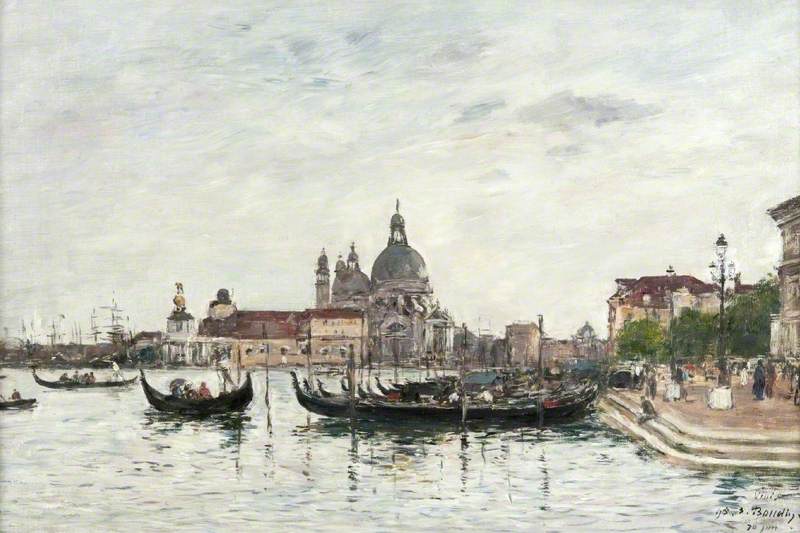
Venice: Santa Maria della Salute and the Dogana Seen from across the Grand Canal

Venice: Santa Maria della Salute and the Dogana seen from across the Grand Canal, by Eugène Boudin (1895)

In 1889, 1890, and 1891, more successful exhibitions were organized at Galerie Durand-Ruel, and in 1890 Boudin was elected a member of the Société des Beaux-Arts.  His paintings travelled across the Atlantic and were shown in exhibitions in Boston in 1890 and 1891.  He continued to exhibit at the Paris Salons until his death and received a third-place medal at the Paris Salon of 1881, and a gold medal at the 1889 Exposition Universelle in Paris.  In 1892 Boudin was made a knight of the Légion d’honneur.  His wealth allowed him to travel and he visited Belgium, the Netherlands, and southern France, and from 1892 to 1895 made regular trips to Venice.

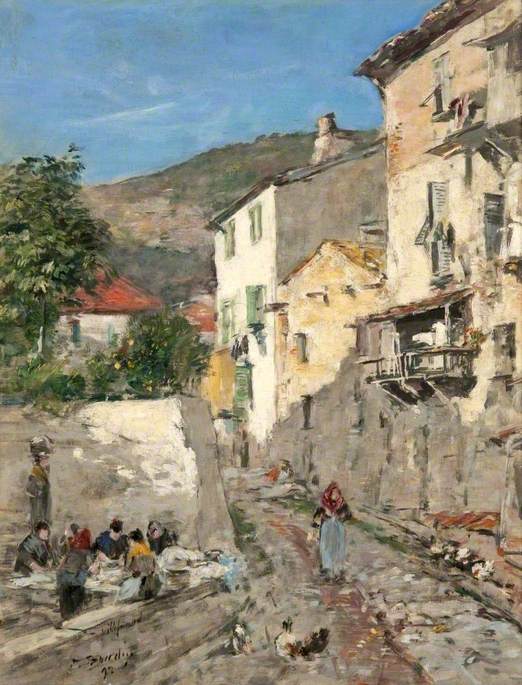
Villefranche

Villefranche by Eugène Boudin  (1892)

Boudin was now spending every winter in the south of France, returning to his beloved Normandy in the summer.  His wife died in 1889 and Boudin’s own health was in decline.  In 1898 Boudin must have realised he was dying as he decided to move back to his home in Deauville to die. 

Eugène Louis Boudin died on August 8th 1898 aged 74.  He was buried according to his wishes in the Saint-Vincent Cemetery in Montmartre, Paris.  Boudin was a very modest man  and once said:

“…I may well have had some small measure of influence on the movement that led painters to study actual daylight and express the changing aspects of the sky with the utmost sincerity…”

But I will leave the last words to Claude Monet who said of Boudin:

“…If I have become a painter, I owe it to Eugène Boudin…”

Ásgrímur Jónsson, the Icelandic Impressionist.

This is just a short mini-blog to look at a twentieth century Impressionist from Iceland, Ásgrímur Jónsson

                                                               Ásgrímur Jónsson

Ásgrímur Jónsson wasat the forefront of Icelandic art.  He was a pioneer of Icelandic visual art and the first Icelander to become a professional painter. Ásgrímur was born on March 4th, 1876, in Suðurkot, a small town thirty kilometres south west of Reykjavik.

                                       Autumn Sunlight, Öskjuhlíð by Ásgrímur Jónsson (1920)

In 1897 he left home and went to Copenhagen.  In 1900, aged twenty-four,  he enrolled on a three-year art course at the Royal Academy of Fine Arts.  Once qualified, he toured a number of European countries before settling back down in Iceland in 1910.  On his journey home he visited Germany and the cities of Berlin and Weimar and it was during this period that he became influenced by the French Impressionists and the Post Impressionists, especially the landscape works of  the French painter Jean-Baptiste-Camille Corot.

                                          Hafnarfjörður Town by Ásgrímur Jónsson (1930)

Ásgrímur’s main painting genre was landscape art and especially that of his native Iceland and through his art many native artists would follow his lead.  His depictions of nature were fashioned by the romance of the nineteenth century.  He liked to focus his depictions on the changes of light and how it altered the view of the land.  He alternated between watercolours and oils but is best known for the former medium.

                           Mt. Strútur and Eiríksjökull Glacier, West Iceland by Ásgrímur Jónsson (1948)

He was a great believer in Naturalism in art – the broad movement in the nineteenth century which represented things closer to the way we see them.  However later his works were characterised by colourful expressionism.

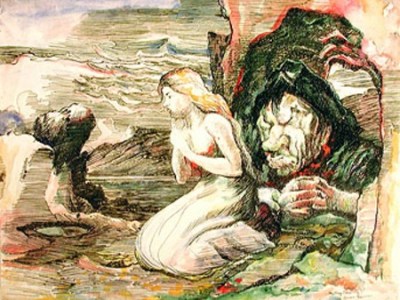
                                           From a Folklore by Ásgrímur Jónsson (1957)

Ásgrímur also worked as a pioneer in the illustration of Icelandic legends and adventures.  He pictorially depicted Icelandic Folk Legends delving into the world of elves and trolls who lived in the semi-darkness of the old turf farmhouse and who would kidnap humans.  Tales of pastors haunting their wives-to-be, of witches flying to Satanic gatherings, of sheep-rustling and flying bulls.  A land where humans live inside hills, where witches flying on jawbones instead of broomsticks, and tales which rarely have happy endings.

                                                                  Troll painting by Ásgrímur Jónsson

Ásgrímur’s works on folklore themes were well received.  The art critics delighted in his depictions and that Iceland’s folktale heritage was being addressed, for the first time, by an Icelandic artist. Ásgrímur’s depictions of the appearance of elves and trolls also met with widespread approval from the public who believed he had succeeded in capturing the way that they imagined their folklore characters to be.  For Ásgrímur Jónsson it was all about the viewer’s own imagination when they looked at these folklore works and it was a reminder of the beauty of their land when they looked at his landscape paintings.  Today the folklore paintings form part of the unique cultural heritage conserved in the collections of the National Gallery of Iceland.

                        ÁSGRÍMUR JÓNSSON MUSEUM at BERGSTAÐASTRÆTI 74, 101 REYKJAVÍK

Ásgrímur Jónsson died on April 5th, 1958, aged 82.  The Ásgrímur Jónsson’s collection, which is today a department within the National Gallery of Iceland, originated in 1960 when a small gallery was opened in Ásgrímur’s studio and home, which he bequeathed to the Icelandic nation along with all of his works in his own possession upon his death. 

Maxfield Parrish. Part 4.

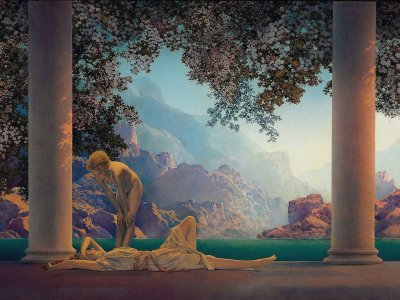
                                                           Daybreak, by Maxfield Parrish (1922)

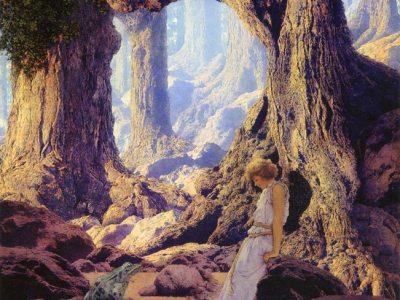
Maxfield Parrish referred to Daybreak as his Magnus Opus.  It is a blend of the sentimentality of the works by the Pre-Raphaelites but also retains the Old Master technique of adhering to the rules of proportion.  It is a gateway to an Arcadian fantasy where we are welcomed into a dazzling landscape bathed in dawn’s rising sun which is testament to Parrish’s ability to master light and colour.

Maxfield took a complex approach to how the composition should be worked out.  He used photography, paper cut-outs of the figures that he planned to include in the painting, props and models constructed in his workshop so that he could decide on the ultimate layout.  He would first complete the landscape and then use a stencil of the silhouette to impose the figure on top.  Once the composition had been decided by doing it in this way, he was able to concentrate on what colours he would use.  The beauty of this painting comes from Parrish’s painstaking and laborious process of painting with glazes, a process used by many of the Old Masters to achieve wonderful luminosity and strength of colour.  Look at the penetrating blue of the sky which radiates out from behind the foliage.  This cobalt blue became known as Parrish Blue.  He often used clever methods of reproducing grand components in his studio, for mountainous landscapes such as the one in Daybreak he used broken quartz rocks placed on a mirror. He created the effect of natural light and shadows through artificial methods, shining lamps on models and props.  The scenery for the painting bears a resemblance to a theatre set with its prescribed layout.

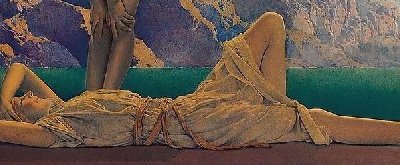
                                                                              Kitty Owen Spence

Lying on the floor in the left foreground is a young woman who was “part-modelled” by eighteen-year-old Kitty Owen Spence.  Kitty came from a world of social privilege, wealth, and opportunity being the granddaughter of William Jennings Bryan, a three-time US Presidential candidate.  According to the provenance of the painting, Kitty Owen Spence was said to have actually owned the work from around the 1940’s until 1974.  However, it turned out that William Jennings Bryan, her grandfather, had bought it for a fairly high amount, but because he had political ambitions and did not want it known that he had spent a large sum of money on a painting and this could be the reason that the provenance of the work was attributed to his granddaughter.

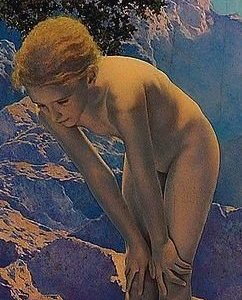
                                                                        Jean Parrish

Maxfield Parrish’s daughter, Jean, who was eleven at the time, posed as the standing figure who is bent over the prone figure.

                                                         Preparatory drawing of Daybreak

However, what is more intriguing is the figure that does not appear in the final work and this we know, if we look at his preliminary sketch of how he wanted the composition to be.  Maxfield had initially intended to have a third figure seated near the base of the column in the right foreground. It is also believed that this figure was intended to be posed by Susan Lewin, Maxfield’s housekeeper, his favourite model and lover.  Alma Gilbert, art dealer, curator, author, and broker specializing in Maxfield Parrish, speculates in her 2001 book Maxfield Parrish: The Masterworks that because his long-time model and probable mistress Susan Lewin posed for that third figure, Parrish’s daughter asked him to remove her.  In the end, however, Parrish used Lewin’s body as the model for the reclining figure and gave it the face of Kitty Owen.

Just two other interesting things about the painting I must recount.  As you know, I like a good story behind a painting and so did the House of Art who had commissioned the work.  They asked Maxfield to write a paragraph to accompany the work, but he declined, stating:

“…Alas, you have asked the very one thing that is entirely beyond me, to write a little story of Daybreak, or, in fact, of any other picture. I could do almost anything in the world for you but that. I know full well that public want a story, always want to know more about a picture than the picture tells them but to my mind if a picture does not tell its own story, it’s better to have the story without the picture. I couldn’t tell a single thing about Daybreak because there isn’t a single thing to tell; the picture tells all there is, there is nothing more…”

And so, it is up to viewers of the painting to create their own personal meaning of Daybreak.

Much has been written about the painting and I have tried to condense the information I have gleaned from various books and websites but I decided not to attempt to explain the compositional rules followed by Maxfield Parrish when he planned the work.  It has all to do with Jay Hambridge’s rules of dynamic symmetry and I will leave you great artists to read about that yourself.  It is far too complex for me!

                                                Michael Jackson and Lisa Marie Presley

And finally, does the scene of the naked figure bending over the young woman who lies prone on the floor remind you of a similar, more recent scene ???  Caste your mind back to 1992 and the Michael Jackson music video for his song, You are not alone, in which he appears in an affectionate semi-nude scene lying on the ground with his then-wife, Lisa Marie Presley, bent over, looking down at him.  The painting has surprisingly always been in private ownership. On May 25th, 2006, Daybreak was purchased by a private collector, Mel Gibson’s then-wife, Robyn, at auction at Christie’s for US $7.6 million. This set a record price for a Parrish painting. Five years later, on May 21st, 2010, it was sold again for US$5.2 million.

In September 1918 Maxfield Parrish left Philadelphia and moved to an apartment at 75 East 81st Street, New York where he would be close to his two older sons who were attending the Teacher’s College.  Parrish asked Sue Lewin to accompany him and the two lived together there for almost a year.  By now it must have been obvious to him that people and the media were becoming interested in his relationship with his wife Lydia and his model, Sue Lewin.  Rumours were rife but Parrish would not comment on their enquiries about his relationship with Sue.  Maxfield Parrish was aware how scandal could devastate his life and career as he had witnessed the furore first-hand when his mother had left his father to join a Californian commune.  Sue was in full agreement with Maxfield about not commenting on their relationship and in a reply to a salacious question, she said:

“…I’ll have you know that Mr Parrish has never seen my bare knee…”

                  Edison Mazda 1921 calendar

This denial could well be taken with a “pinch of salt” as she had posed nude for his illustrations for the Mazda Lamp calendar of 1921.  After Parrish and Lewin had passed away, construction workers at the estate found a secret compartment where Parrish had hidden the nude photographs he had taken of Lewin.

By 1921, Parrish’s wife Lydia had had enough of the ménage à trois and confided with her friend and neighbour Mabel Churchill.  Mabel and her husband spoke to Maxfield and told him that his marriage to Lydia would not survive whilst Sue was living with him in the studio.  To help solve the problem Lydia went off to Europe with the Churchills and Sue moved from the studio at The Oaks and into Winston and Mabel Churchill’s vacated home.  On October 26th, 1923, in a cruel twist of fate the Churchill’s home, Harlakenden, burned to the ground and Sue had to return to living in the studio of The Oaks.  She would remain there for the next forty years!   The villagers from the tiny farm town were scandalized by this living arrangement and even sent a delegation out to the estate to confront Parrish, but Parrish and Lewin both contended that their relationship was purely platonic.

                          The Knave of Hearts by Louise Saunders

Lydia Parrish returned from her European journey to find the living arrangements of Sue Lewin had not changed.  She must have been both angry and sad but probably weighed up the pros and cons of divorcing her husband and reluctantly decided to remain living at The Oaks whilst Maxfield and Sue lived in the studio complex.  Sue Lewin continued to model for Parrish and appeared in many of the children’s book illustrations.  One such book was the Knave of Hearts written by Louise Saunders in which Sue posed for the characters of Lady Violetta, Ursula, and the Knave.

                                              The Enchanted Prince by Maxfield Parrish (1934)

The last time Sue modelled for one of Parrish’s paintings was in 1934 when she was forty-five-years-old, although the final model was Kathleen Philbrick Read.  It was entitled The Enchanted Prince and it depicts a beautiful young woman contemplating the frog which is perched in front of her.  When Maxfield completed the work, he decided not to sell it and instead, gave it to Sue.  In Alma Gilbert’s book, The Make-believe World of Maxfield Parrish and Sue Lewin, she wrote that this gift could be to let her know that she was the youthful maiden who had dissipated his loneliness and returned him to rule over some enchanted kingdom.

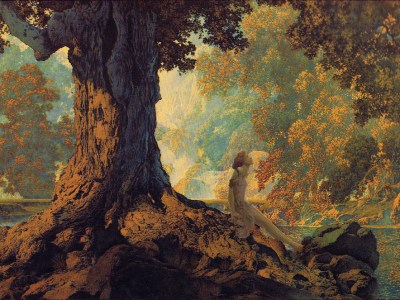
                                                  Dreaming by Maxfield Parrish (1928)

From around 1930 Parrish’s paintings were landscape works.  One reason could have been that his favoured model Sue Lewin was now into her forties and could no longer pose as a lithe young female. In his 1928 painting, Dreaming, he completed for Reinthal Newman’s House of Art in 1928, we see a young girl sitting underneath a tree beside a lake in a tranquil autumn setting. 

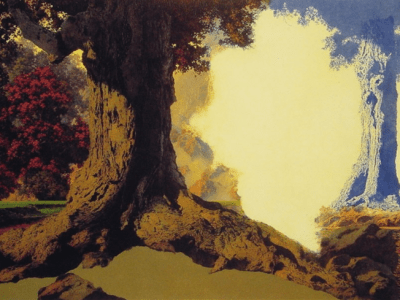
                                  Dreaming/October by Maxfield Parrish (1932)

In his 1932 version of the work, entitled Dreaming/October, which was Maxfield’s last work he had created for General Electric Mazda company, he removed the figure and turned the work into a pure landscape painting.

Like all good novels, the reader cannot wait to read the last chapter to see what happens in the end.  So, let me tell you how it all ended for the three main protagonists of these blogs, Maxfield, his wife Lydia and his favoured model, Sue Lewin.  Maxfield Parrish continued with his close relationship with Sue despite being married to Lydia.  His children had all married and moved away from the family home, The Oaks.

Slave Songs of the Georgia Sea Islands by Lydia Parrish (1942)

Lydia who had often spent an annual vacation on St. Simmons Island, the largest of the Golden Isles along south Georgia’s Atlantic coast, which she had first visited in 1912.  She eventually bought herself a cottage and some land on the island and became interested in old plantation songs and eventually in 1942 had a book published, Slave Songs of the Georgia Sea Islands.  Lydia died alone of cancer on Saint Simmons Island on March 29th 1953, aged eighty-one.  Lydia was buried on the island at the Oglethorpe Memorial Gardens.  At the time of her death, she had been married to Maxfield for fifty-eight years.

                                                     Susan Lewin (c.1970’s)

Maxfield was now a widower and had the opportunity to move his close and intimate relationship with Sue Lewin to a marriage status but that did not happen.  Whether Sue held out the hope that he would propose we cannot be sure but she stayed with him for a further seven years until in 1960 when she was 71 and Maxfield was 90, she left him and married Earl Colby who had been her childhood sweetheart and had once courted her whilst she lived and worked at The Oaks.  The question of why Maxfield never proposed marriage to Sue is not known.  Maybe he believed it was just too late in his life or maybe he remembered the problems with his marriage to Lydia and also the failed marriage of his father and of course he had always denied that he and Sue had had an intimate relationship.  Shortly after Sue married Earl Colby, Maxfield Parrish made a new will which started by stating that firstly, all his debts were to be paid off and then secondly:

“…I give and bequeath to SUSAN LEWIN COLBY the sum of Three Thousand Dollars ($3000) and direct that any inheritance, estate, death, succession or other tax imposed by the Federal Government or any State Government on this bequest be paid out of my residuary estate…”

For a rich man, giving the sum of three thousand dollars to somebody he had known for fifty-five years may be looked upon as a trifling amount.  Why was it such a small amount?  Had an earlier will bequeathed her more?  Was it an act of revenge for her marrying Colby?  It was if the amount was a suitable sum for one of his servants which would, of course, substantiate his declaration that there had never been a close relationship between him and Sue.  Or was the fact that Sue was mentioned in the will a declaration by Parrish and acknowledgement of his relationship with her.  We will just never know.  Earl Colby died in 1968. Colby had children from a previous marriage who inherited his house. Sue then moved into her Aunt’s home. Her aunt then left the dwelling to Sue in her will and this was where she lived for the rest of her life.   Sue Lewin Colby passed away on January 27th 1978 and was interred that Spring alongside her late husband in the Plainfield cemetery.

                                             Getting Away From It All by Maxfield Parrish

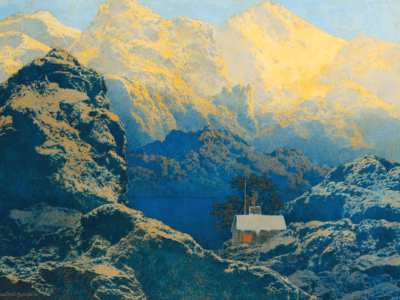
Maxfield Parrish continued with his painting until 1961 when, he was ninety-one-years-old.  His arthritis prevented him from painting any more.  His last work was a small landscape painting entitled Getting Away From It All and can be viewed as Parrish’s ultimate expression of his love of nature.  It is a beautiful depiction, showing one small, snow-covered cottage which appears dwarfed by the towering mountains surrounding it, yet the window of the home persistently glows with warmth from within. It is a more exceptional work in that Parrish chose to paint the subject solely for himself and remained with him, in his studio, for the remainder of his life and maybe the title of the painting recognises that, with this work complete, he was giving up his career as an artist.

Maxfield Parrish spent his last years in a wheelchair and was looked after in his house by a live-in nurse.  On March 30th 1966, he died, aged 95.  He was buried at Plainfield Cemetery, Sullivan County, New Hampshire.  Three years later, his eldest son, John Dilwyn Parrish, who died on January 4th 1969, was buried besides him.

Alphonse Mucha. Part 2

             Exposition Universelle et Internationale de Paris (World’s Fair) 1900

The year 1900 was a momentous one for Paris as it staged the Exposition Universelle et Internationale de Paris (World’s Fair) between April 15th and November 12th.    The event was to be a grand celebration of the past century’s achievements and a look forward to the innovations of the new century.  The planning had begun in 1892 and it had been fully budgeted by 1896.  At this time Alphonse Mucha had already burst on to the Parisian art scene and in 1897 had held a highly successful one-man exhibition at the Galerie de la Bodinière followed by a major show at the Salon des Cent.

Everyone was excited by the forthcoming event and La Plume magazine, a French bi-monthly literary and artistic review, dedicated a special issue to the exhibition and Alphonse Mucha, whose illustration appeared on the cover of the January 1898 edition, and was a ‘hot’ topic within the city’s artistic circle.

Alphonse Mucha’s design for the Menu for the Bosnian Pavilion Restaurant at the Paris Exhibition 1900

Alphonse was inundated with commissions for projects appertaining to the World’s Fair from both local companies and the French government.  Some were for posters advertising the event and also the installation of display stands and the design of exhibition halls, which provided him with an opportunity to work with a three-dimensional space.

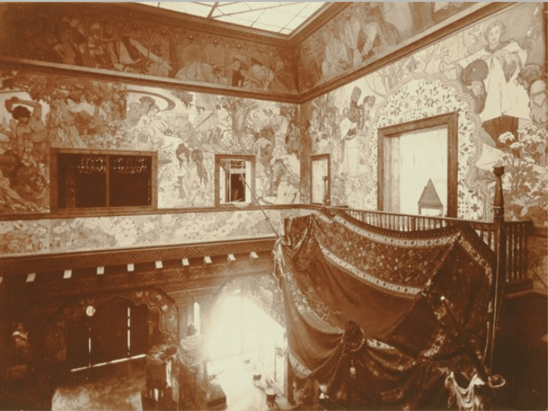
Bosnia & Herzegovina Pavilion at the Paris Exhibition 1900 interior view with Mucha’s wall paintings (1900)

Beside the peripheral commissions Mucha was tasked with painting the murals for the Pavilion of Bosnia-Herzegovina, which was a region that had come under the control of Austria-Hungary in 1878 and was one of three pavilions exhibited by the Austro-Hungarian Empire. For Alphonse Mucha, this was a highly prestigious commission.  Mucha transformed the pavilion into a commemoration of the history and the cultural diversity of Bosnia and Herzegovina which pleased the Austro-Hungarian leaders but Mucha would rather have highlighted the Slavic struggle against that vast nation.  He could well have thought about that as he planned the murals for the pavilion and maybe he promised himself that in the near future he would tell the real story of the persecution and suffering of the Slav nation and the Slav people.  His grand plan would not start until 1911 and it would take him fifteen years to complete.  It would be known as The Slav Epic

                    Facade of the jeweler’s boutique Georges Fouquet located at 6 rue Royale, Paris

Georges Fouquet, a prominent Parisian jeweller and jewellery designer had worked together with Alphonse Mucha on a number of jewellery pieces for Fouquet’s stand at the 1900 Exposition Universelle. After the 1900 Paris Exposition, Georges Fouquet who was best known for his Art Nouveau creations opened a new jewellery store at 6 rue Royale in Paris which was right across the street from the famous restaurant, Maxim’s. He approached Mucha to design all aspects of his shop, both exterior and interior, as well as the contents including the furniture, light fittings and show cases.  

                    Interior of Georges Fouquet’s shop designed by Alphonse Mucha

The centrepiece of the design was two peacocks, which were the traditional symbol of opulence.  They were made of bronze and wood with coloured glass decoration. To one side of them was a shell-shaped fountain, with three gargoyles spouting water into basins, surrounding the statue of a nude woman. The shop opened in 1901, but, sadly for Georges, it was at a time when tastes were beginning to change, and the yearning to have Art Nouveau pieces was superseded by people wanting jewellery with more naturalistic patterns.  Mucha’s shop designs remained in place until 1923 when it was replaced with more up-to-date fittings. 

                                                      Interior of Georges Fouquet’s Paris jewellery store

Realising that Mucha’s designs for the shop’s interior were of importance in art history, most of the original decoration were preserved. In 1941 Fouquet gave each piece of Mucha’s revolutionary design to the Musée Carnavalet for safekeeping. In 1989 the Musée Carnavalet completed the painstaking job of reconstructing the boutique. It remains one of the most spectacular examples of Art Nouveau decorative design.  It is still on display at the museum.

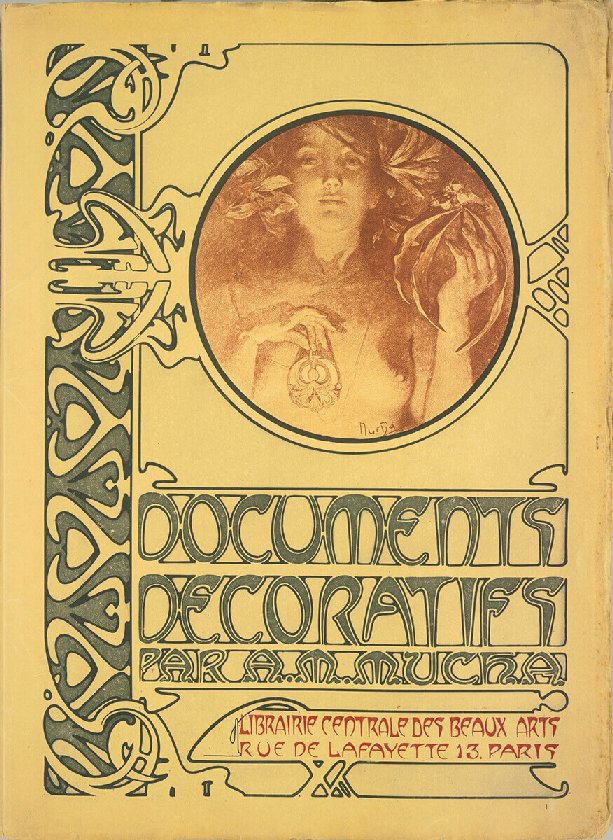
                                             Documents Decoratifs by Alphonse Mucha published in 1902

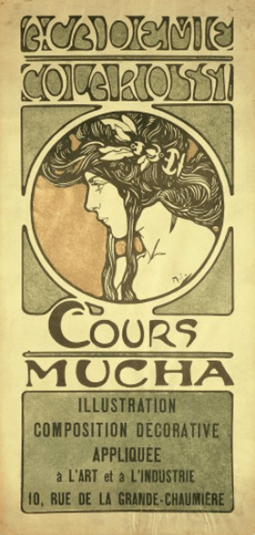
Alphonse Mucha’s reputation as an artist was now established and he became one of the most popular and successful of Parisian artists.  He became inundated with commissions for theatre posters, advertising posters, decorative panels, magazine covers, menus, postcards, calendars. He even started to provide designs for jewellery, cutlery, tableware, fabrics etc which were in so much demand that he conceived the idea of creating a handbook for craftsmen, which would offer all the necessary patterns for creating an Art Nouveau lifestyle.  His book, Documents Décoratifs, a style book published in Paris in 1902, was by the Librairie Central des Beaux-Arts, and is an encyclopaedia of his decorative work. The Documents Décoratifs is comprised of 72 exquisite plates of elaborate designs for brooches and other pieces, with swirling arabesques and vegetal forms, with incrustations of enamel and coloured stones.  It epitomized everything the Art Deco movement is remembered for: decor, women, flowers, natural forms, structures, jewellery.  Alphonse also spent an increasing amount of his time teaching, first at the Académie Colarossi and later, with Whistler, at the Académie Carmen.

                                Portrait of Mucha’s Wife, Maruska (1908)

In 1902, Alfonse Mucha accompanied his friend Auguste Rodin to Prague on the occasion of Rodin’s exhibition at Jan Kotera’s new Mánes Pavilion in Prague.  A gala night was held at the National Theatre of Prague to welcome the renowned sculptor and it was here that Alphonse Mucha first met Marie Chytilová, an aspiring artist, who was studying at the School of Applied Arts in Prague and who admired the work of Mucha.

Marie Chytilová in Mucha’s studio in rue du Val-de-Grâce, Paris. 1903

A year later whilst visiting Paris with her family, Marie solicited the help of her uncle, the eminent Czech art historian Dr. Karel Chytil, to arrange art classes with Mucha.  Alphonse agreed and got Maria to also to take classes at the Académie Calarossi where he was teaching and they spent each of the remaining days of her month-long sojourn together.  Love blossomed between the two despite an age difference of twenty-two years.  However, despite the intense amour between Alphonse and Marie, he left her in Europe whilst he made his first trip to America thanks to letters of introduction, which he had received from Baroness Salomon de Rothschild.  There must have been some great pull which made him abandon Marie and cross the Atlantic, and to find that reason we must go back to when he was painting his murals at the Paris World Fair for the Bosnia-Herzegovina pavilion and his promise to himself that he would one day complete a series of paintings which would illustrate the Slav fight for independence.  He needed financial backing and where better to go to find funds – America.

                                                                          Charles Richard Crane in 1909

Alphonse Mucha was by no means an unknown artist in America.  In fact, he was a celebrity in the United States as his posters had been widely displayed during Sarah Bernhardt’s annual American tours since 1896. He stayed at a rented studio near Central Park and continued to paint as well as giving interviews and lectures. More importantly, he was able to contact Pan-Slavic organizations with regards to his money-raising idea to support his proposed Slavic Saga series of history paintings. At one of the Pan-Slavic banquets held in his honour he was introduced to Charles Richard Crane, a wealthy businessman and philanthropist, who was a passionate Slavophile. Crane was enthusiastic with Mucha’s vision for a series of monumental paintings depicting Slavic history, and he became Mucha’s most important patron. 

Cours Mucha poster at Académie Colarossi

Alphonse returned home to Paris in May 1904, to complete some commissions but in January 1905 he returned to America.  During this visit he gives classes, known as the cours Mucha, at the New York School of Applied Design for Women, similar to those he held at Académie Colarossi.  He was enjoying life in America and wrote to his folks back in Moravia:

“…You must have been very surprised by my decision to come to America, perhaps even amazed. But in fact, I had been preparing to come here for some time. It had become clear to me that that I would never have time to do the things I wanted to do if I did not get away from the treadmill of Paris, I would be constantly bound to publishers and their whims…in America, I don’t expect to find wealth, comfort, or fame for myself, only the opportunity to do some more useful work…”

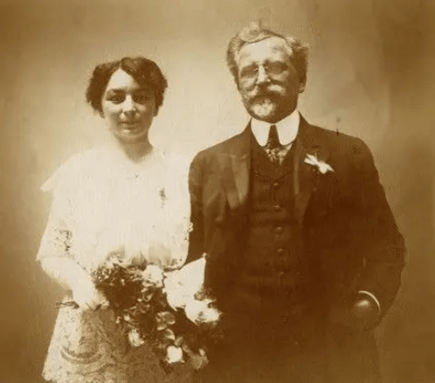
        Alphonse and Marie on their wedding day, June 10th 1906.

On June 10th 1906, forty-five-year-old Alphonse Mucha, and twenty-three-year-old Marie Chytilová married shortly after his return to Prague from New York.  Marie was everything Alphonse could have wanted.  She was extremely attractive, she was well-educated and well-read, musical, a great lover of art, and from an old Czech family. 

                                                                               Husband and wife

She was to become his muse and was incredibly supportive of his art.  For their honeymoon, the couple travelled to the highlands of South Bohemia and stayed in the small village of Pec.  Once the honeymoon was over the couple travelled to Chicago where Alphonse was given a post as teacher at the Art Institute

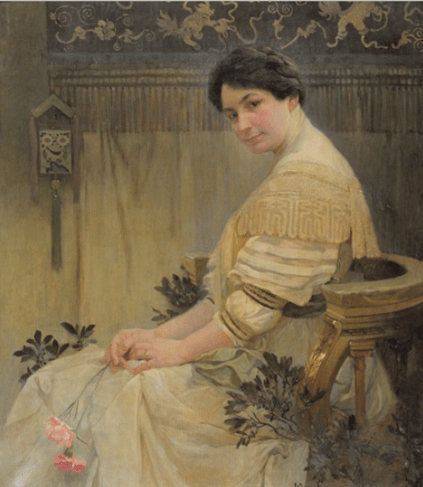
                                    Portrait of Maruška, the artist’s wife by Alphonse Mucha (1905)

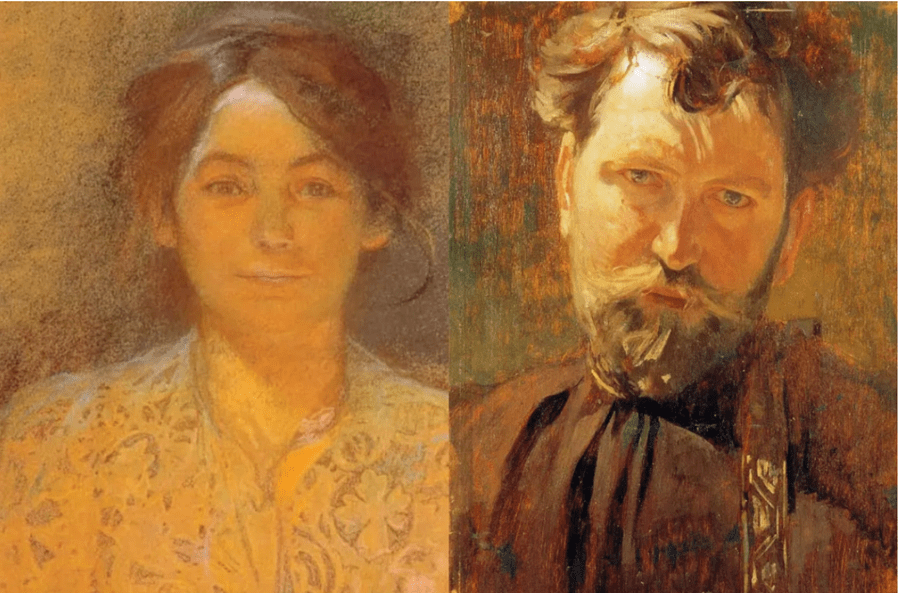
Alphonse painted a number of portraits of his wife.  One such painting was entitled Portrait of Mucha’s wife, Maruška.   Maruška is a diminutive of ‘Marie’.

Tragedy – study for a mural for the German theatre New York (1908)

In 1908 Alphonse also worked on a large decoration project, for the interior of the German Theatre of New York.  He was commissioned to produce five large decorative panels, the stage curtain, and decorative elements for the foyer, the corridor, the staircase, and the auditorium. The three large allegorical murals would be depicted in the Art Nouveau style, and would represent Tragedy, Comedy and Truth.  In his depiction, Tragedy, the female protagonist is modelled on the lead tragedienne of the Max Reinhardt Theatre, Miss Reichl.

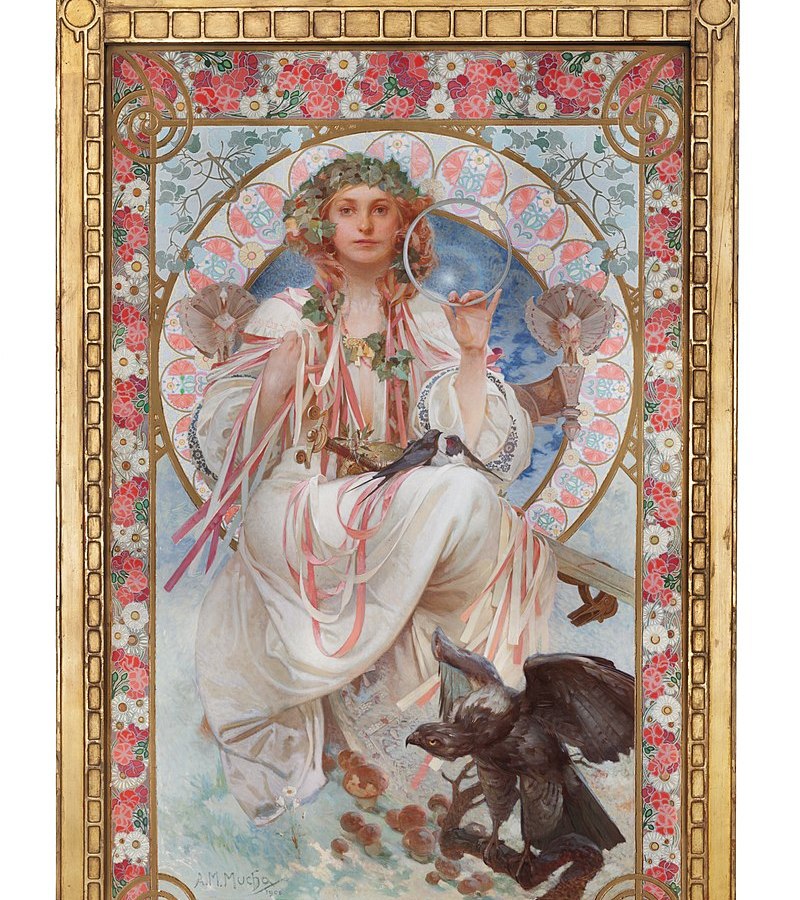
                                              Painting of Josephine Crane Bradley as Slavia (1908)

In that same year, 1908, Charles Crane commissioned Mucha to make two separate portraits in a traditional Slavic style of his two daughters, Josephine, and Frances.  The painting of Josephine, as the Slav goddess, Slavia, was to mark her marriage to Harold C. Bradley.   The portrait was to be incorporated into the interior decoration of a new house that Crane was building for the newlyweds.   It was looked upon by critics as his finest work in America.

   Alphonse Mucha-designed artwork on a 1920 Czechoslovak Republic 100 Czechoslovak korun note

In fact, ten years later, when Mucha was asked to design the Czechoslovak 100-koruna banknote he once again used her portrait as a model for Slavia.

       Mucha’s daughter Jaroslava is born on March 15th 1909 in New York.

On March 15th 1909, in New York, Alphonse and Marie hade their first child, a daughter, Jaroslava

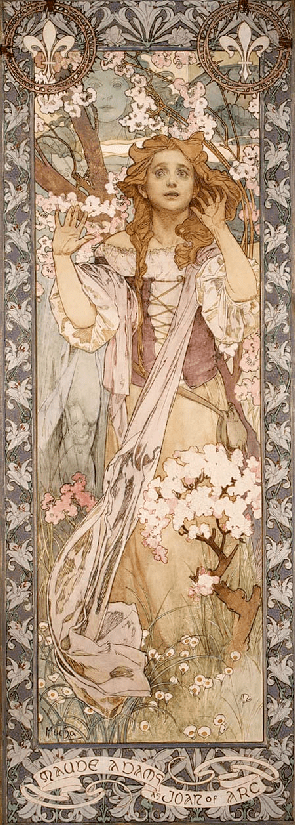
Die Jungfrau von Orleans (The Maid of Orleans)

That same year (1909) Alphonse was commissioned to design a poster depicting the highly paid prominent American actress, Maude Adams, in her role as Joan of Arc in a translation of Friedrich Schiller’s Die Jungfrau von Orleans (The Maid of Orleans).  The play was staged on June 22nd for a crowd of around two thousand spectators in a one-night gala performance at Harvard University Stadium.  The portrait served as a poster for the event and Alphonse was also responsible for designing the costumes and sets.  The painting depicts the medieval heroine, Joan of Arc, gesturing in amazement at the apparition behind her, which was inspiring her to lead French troops into battle. The stylized floral patterns, swirling hair and garments, and flat, graphic quality of the composition was typical of Mucha’s work and he also designed the complementary frame.

                                      Zbiroh Castle with the town of Zbiroh in the left background.

In 1909 Alphonse Mucha leaves America satisfied that he had Charles Crane’s financial backing for his grand plan to paint a series of works outlining the Slav struggles.   Alphonse rented a studio and apartment in Zbiroh Castle, a 12th century château in West Bohemia. He began by visiting the places he intended to depict in the cycle such as Russia, Poland, and the Balkans, including visits to the Orthodox monasteries of Mount Athos.   He now spent all his free time studying all the books he could find with regards the history of the Slavs and also contacted specialists in the field, such as Ernest Denis who Alfonse meets in Paris in 1911.  Ernest Denis was considered to be one of the most highly regarded 20th-century historians of the Slav world in France and who played a major role in the establishment of the Czechoslovak state in 1918.  Alphonse’s dream of the Slav Saga series of paintings had now started.  For anybody who might look upon Alphonse Mucha as an illustrator and a poster designer, the next three blogs will change that opinion…………………

………………………….to be continued.


Much of the information for this came from the excellent website The Mucha Foundation


Ralph Hedley. Part 2.

                                       In School by Ralph Hedley (1883)

Another of Hedley’s paintings projecting school life was his 1883 work, In School.  The boy in the painting was John Irwin, the younger brother of Tom Irwin, who worked at Ralph Hedley’s woodcarving shop.

                         The Ballad Seller, the Black Gate by Ralph Hedley (1884)

Hedley used Irwin in a number of his painting. one of which was his 1884 work known as The Ballad Seller.  The setting is the Black Gate in Newcastle with Castle Garth in the background.  The red roofs of Castle Garth can be seen behind the Black Gate in Ralph Hedley’s depiction. The Black Gate formed the entrance to the street, which had been built inside the castle walls. There was only a short stretch of street left standing by the time Hedley painted this picture. It has now all been demolished, though the outline of the street can still be seen.  It is thought that Hedley made many plein air sketches for the background.  In the painting we can see the rough wooden fence that had been put up around the Black Gate in 1883 by the Newcastle Society of Antiquaries during the renovation work.  Hedley’s painting depicts broken and missing stones as well as damaged window glass.  The Black Gate of the Norman castle, which was completed at the end of the thirteenth century, had become run down.  However, the painting is all about the trade of selling ballads.  Ballad sellers were looked upon in the eighteenth century as impoverished, uneducated, and morally-lacking people who were allegedly conspiring with pickpockets.  It was suspected that whilst plying their trade, they hoped to distract their audience with their songs while the pickpockets went to work.  Later, they would share their ill-gotten gains.  Ralph Hedley would have witnessed poor women street sellers having to take their children with them, like the baby in the ballad-seller’s arms in this picture.  John Irwin was once again used as a model for one of the boys.

                             Shoeing a refractory horse (Shoeing the Bay Mare) by Ralph Hedley (1883)

Older brother Tom Irwin was himself the model for one of the men in Hedley’s 1885 painting Shoeing a refractory horse in the stocks – Shoeing the bay mare.  He was the man standing on the right wearing the brown cap, velvet jacket and velvet trousers.  He was seventeen years of age when he modelled for the work.  Tom Irwin, who worked at Ralph Hedley’s woodcarving workshop, and his family arrived in Newcastle around 1880.  He remembered the first meeting with Hedley and how the artist had admired their clothes:

“… When we came from the country where we had been farming, we brought several quaint articles of clothing, caps, clogs, baskets etc, which proved invaluable to your father’ work, and… which we know were much appreciated by him… “

                                    Going Home by Ralph Hedley (1888)

Ralph Hedley believed that art should be a pictorial record of the working lives of local people, and his paintings were particularly valuable for the record they provide of everyday life on Tyneside in the late 19th and early 20th centuries.  His 1888 painting, Going Home, is a depiction of two coal miners returning home from working at the pit at Blaydon, near Gateshead. The younger of the two men wears a cap to protect his head from the low beams, and he wears a pair of shorts because of the heat in the mine. In his hand is a safety lamp and a sack to kneel on. This was an extremely popular painting and a print of it was made the following year which proved extremely popular with the public.

                                                   Go, and God’s will be done! by Ralph Hedley (1891)

One of Ralph Hedley’s 1891 paintings, Go, and God’s Will be Done, fascinates me as there is a story behind the depiction.  At first glance there is obviously something dramatic happening in this painting, but what is it all about?  On the floor in the left foreground a cat sleeps peacefully before the fire, unaware of the chaotic happenings going on in the room.   This is the home of a lifeboatman and in the bed is his wife who is very ill.  The husband, in his shirt sleeves, leans over to talk to her.  Next to him stands a lifeboatman who has come to take him away to their lifeboat.  The door of his cottage is held open by his daughter and we can see that outside there is a gale force wind blowing over rough seas, in which is a boat in trouble.  The call has gone out for all the local lifeboatmen to rush to launch the lifeboat and the wife’s husband is torn between his duty to his sick wife and his duty to the lifeboat rescue.  The painting is based on the English poet and journalist, George Roberts Simms poem, The Lifeboat.  The words of the poem which Hedley has illustrated so beautifully are:

“…I didn’t move, but pointed to the white face on the bed-

“I can’t go, mate,” I murmured; “in an hour she may be dead,

I cannot go and leave her to die in the night alone.”

As I spoke Ben raised the lantern, and the light on my wife was thrown;

And I saw her eyes fix strangely with a pleading look on me,

While a tremblin’ finger pointed through the door to the ragin’ sea,

Then she beckoned me near and whispered “Go, and God’s will be done!

For every lad on that ship, John, is some poor mother‘s son…”.

So how did the story end?   It had a happy conclusion.  The husband went with the lifeboat and helped to save the crew of the sinking ship. One of them was his long-lost son, and when he took him home, his mother was overjoyed and recovered from her illness.  The poem was quoted in the exhibition catalogues when the work was exhibited in 1891 and 1892, in Newcastle, Liverpool, Leeds, and South Shields, and in the Royal Academy.  The painting is now in the collection at Harris Museum and Art Gallery, Preston.

                       Ars Longa. Vita Brevis by Ralph Hedley (1900)

Hedley completed an interesting work in 1900 entitled Ars Longa, Vita Brevis which was exhibited at that year’s Royal Academy Exhibition.  It would almost be classed as a Vanitas painting focusing on the unstoppable transience of life but it does not have the usual Vanitas symbols such as burnt out candles and skulls.  And yet the title of the painting, Ars longa, Vita Brevis meaning Art is long, life is short is the perfect title for a Vanitas work.  The painting is one that elicits our sympathy for the aging artist we see before us.  Look how the depiction evokes this feeling.  The setting is a small drably-coloured attic space in which we see the artist sitting on his bed in front of an easel.  He loosely holds his palette and brushes and yet he has to rest them on his knees.  He has nodded off to sleep in the middle of his work.  Is it that he is tired or is it a sign that he has almost given up on life?  What are his circumstances and what are his thoughts?  Is he lonely and without friends?  Does he mull over his past life and consider past decisions that he has made and which have brought him to this point in his life?  I will leave you to decide.

                                                                          Duty Paid by Ralph Hedley (1886)

In the foreground of his 1886 painting, Duty Paid, we see a man has come to an office on the quayside to collect a parcel brought in by the ship. He puts his money on the table which is due in Custom’s Duty and one of the Customs officers meticulously fills in details of the payment in a ledger. On the other side of the table, another official seals the parcel with red wax, evidencing that duty has been paid. This is a typical Ralph Hedley depiction of local people and local scenes. His oeuvre provided us with an important record of life in the region in that period between the late 19th to early 20th centuries.

     John Graham Lough in His Studio by Ralph Hedley

One of the strangest paintings by Ralph Hedley depicted John Graham Lough an English sculptor who was recognised for his funerary monuments and a variety of portrait sculpture. He also produced ideal classical male and female figures.  Lough had come to London in 1824 to study the Elgin Marbles at the British Museum.  He was living and had his studio on the first floor of a house in his Burleigh Street lodgings, above a greengrocer’s shop, and it was there that he embarked on a mould for his massive statue of Milo of Croton based on his studies of the Elgin Marbles and the work of Michelangelo.  According to Joshua Lax’s 1884 book, Historical and Descriptive Poems, this was the sculptor’s big chance at being a successful sculptor.   The biggest problem Lough faced was that his studio was too small and the ceiling height was too low for him to complete the statue.   Joshua Lax explains:

“…With the recklessness of a bold genius reduced to desperation, he actually broke through the ceiling of the room above him and made for himself sufficient space to work at his statue. The owner began to take steps for instituting legal proceedings, and even consulted Mr. Brougham (afterwards Lord Brougham) for this purpose. Brougham went to look at the Milo, and see for himself what Lough had done… The news of the strange affair soon spread, and, before long, the whole street where Lough’s room was situated was lined with the carriages of ladies and gentlemen, who had come to view the place, and to see Milo…”

In the painting we see the unhappy landlord and his lawyer, Henry Brougham at the base of the sculpture whilst the sculptor is at work on the upper part of the work, unrepentant with his destruction of the ceiling in his lodgings.

                                                         The Tournament by Ralph Hedley (1898)

In 1898 Hedley completed a painting which was to realise the highest price for one of his paintings at auction, (£43,020 at Bonhams in 2004).  It was entitled  The Tournament.  Hedley was influenced stylistically by the Newlyn school and other social realist painters.  He also focused on life in his much-loved Newcastle and the surrounding Tyneside area for his subject matter. The scope of his depictions was enormous.  It ranged from the uncompromising realism of workers on the dockside and miners to the delightful naivety of children at play, as we see depicted in The Tournament.

                                                           One-time home of Ralph Hedley in Newcastle.

Ralph Hedley’s involvement with the Bewick club, as successful exhibitor, committee member and eventually as president, guaranteed him a number of wealthy patrons for both his wood carvings and his paintings. However, his work was also loved by the working class, the subject of many of his works, and they gained access to his work through the many reproductions of his most well-known works could be found in local papers, tea promotions and adverts for cigarettes. He became a member of the Royal Society of British Artists and exhibited a number of paintings at the Royal Academy.

                                                                                          Blue Plaque

Ralph Hedley died on June 11th 1913 aged 64 at his terraced home in 19 Belle Grove Terrace, Newcastle-on-Tyne.  There is a blue plaque commemorating Ralph Hedley who lived in the house from 1888 to his death in 1913.

Ernest Biéler

                                           The Braiding of Straw by Ernest Biéler

If you went into a room, on the walls of which were a large number of paintings by the great artists of the past but without identifying labels, how many do you think you would recognise?   If there were three painting in the room done by each artist, although not grouped together, how many would you be able connect to each artist.   For the art history aficionados, maybe the brushstrokes would act like fingerprints.  Maybe the colours used by the individual artists would lead you to solve the quest.  If they are figurative paintings maybe an artist has his/her own way of depicting them.  The reason for those questions is that my artist today has such recognisable paintings that I am sure after reading this blog and looking at his paintings you will be able to identify his work when you see it.  Let me introduce you to the nineteenth century Swiss painter Ernest Biéler.  He was a multi-talented artist, draughtsman, and printmaker. He worked in oil, tempera, watercolour, gouache, ink, charcoal, pastels, acrylic and pencil. He also created mosaics and stained-glass windows.

Portrait of Nathalie Biéler, the artist’s mother by Ernest Biéler(1906)


Portrait of Samuel Biéler,the artist’s father by Ernest Biéler (1906)


Ernest Biéler was born on July 31st, 1863, in Rolle in the Canton of Vaud in Switzerland. It is located on the north-western shore of Lake Geneva between Nyon and Lausanne.  His father, Samuel Biéler, was a veterinarian and his mother Natalie de Butzow, of Finnish-Polish descent, was a teacher of music and art. Ernest’s maternal grandfather was in the diplomatic corps, and was a one-time Finnish ambassador to Switzerland until his sudden death, which  brought difficult financial times to the family.

                                                       Paysage a Saviese by Ernest Biéler (1925)

Samuel Biéer and his wife Nathalie had nine children, two of whom died in infancy. With finances tight, Ernest’s father moved his family to Lausanne, where he had been offered a well-paid post as a lecturer in zoology at the University of Lausanne. Although little is known with regards Ernest Biéler’s early childhood, it is understood that in 1880, aged seventeen he graduated from the College of Art in Lausanne and then, went to Paris to study art at the Académie Julian.

                                                                                               Savièse

Often in our lives we do something that unbeknown to us at the time will affects our future plans.  For twenty-one-year-old Ernest Biéler the time was the summer of 1884 during a walking holiday in the high peaks of the Vallais region, in the southwest of Switzerland. To its south lies Italy and the Aosta Valley and Piedmont and to the southwest France the Auvergne-Rhône-Alpes of France.  During his hike, Ernest visited the remote mountain village of Savièse. 

                                    Girl with Scarf by Ernest Biéler

From there, the beautiful landscapes stretched in all directions, and the people that inhabited the village seemed to almost have circumvented civilization.  The village, its people and the spectacular landscape had a great effect on Biéler and would feature in many of his works.  This village was to become a great part of his life and through his depictions of the village and the people it would cement his place in the art world which was what he had always strived for.

         Devant l’église de Saint-Germain à Savièse (Outside the Church of Saint-Germain in Savièse)                                                                                           by Ernest Biéler (1886)

Biéler was fascinated by the Savièse folk and their traditions.  Add to this the ideal outdoor conditions with the brilliant light, which was ideal for plein air painting  He went back to the Savièse in the autumn of 1886 and completed numerous sketches that he would use later for one of his masterpieces.  He organised for the following summer to have a large stretcher delivered to his Paris studio for him to complete his ambitious work. Biéler completed the painting in his Parisian studio using his preliminary sketches.  The finished work entitled Devant l’église de Saint-Germain à Savièse (Outside the Church of Saint-Germain in Savièse) was extremely large, measuring 204 x 302cms. The setting for this work was not one particular church in a particular village but rather a commonplace church with its mighty stone pier and its arched doorway.  Before us we see a large group of women gathered together in the warm sunlight.  They are all turned out in their dark blue Sunday dresses and are following the mass from the outside.  Some are diligently studying their prayer books whilst others have been designated as child minders.  By its composition and handling, the work was bound to arouse the interest of avant-garde circles: the figures are made monumental by the close framing.  Look at the way Biéler has referenced the effect of the intense sunlight. The way the folds of the clothes reflects this penetrating light.  The effect of the light can be seen in the way the artist has added the bluish shadows, applied in broad brushstrokes, to the walls.  We can see in this work how Biéler was influenced by the French Impressionists.   The painting was seen by a counsellor of state from Vaud, Eugène Ruffy, who bought it for the Musée cantonal des Beaux-Arts in Lausanne.  The one stipulation of the sale was that Biéler was allowed to keep the painting for a while so that he could present it at the Salon of 1887 in Paris.

                                                                 Retour du bapteme by Ernest Biéler

Many painters in the late nineteenth century clung to the beauty of rural life and religious ceremonies in a way of counteracting the swiftly changing world due to industrialisation which witnessed rural people leaving their communities to search for their dreams in the towns and cities.  Biéler and many artists such as Jules Breton and Jean-François Millet depicting such ceremonies and village communities was a way of remembering the peaceful times in rural communities.

                                                             Mother and Child by Ernest Biéler

In 1892, Biéler was struggling financially and had to sell his property to pay off the many debts he had accumulated. He left Paris and settled in Geneva and was fortunate enough to receive a commission to paint the ceiling in the new concert hall, the Victoria Hall. The building came about thanks to the Consul of England, Daniel Fitzgerald Packenham Barton, who was based in Geneva and had two great passions, navigation, and music, and being one of the extremely rich could satisfy both of them. He arranged that the Geneva architect John Camoletti built the Hall, and he dedicated it to his sovereign Queen Victoria.   In 1894, the building was completed.  The theme of Biéler’s ceiling paintings was Harmonia, queen of Thebes, the mythical figure of harmony.
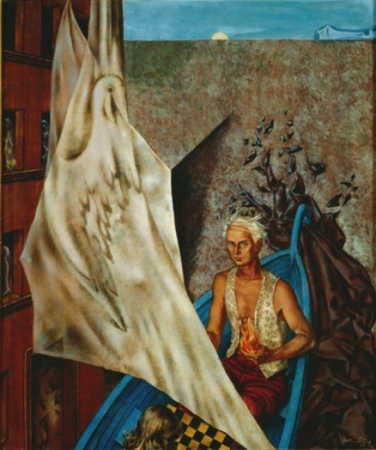
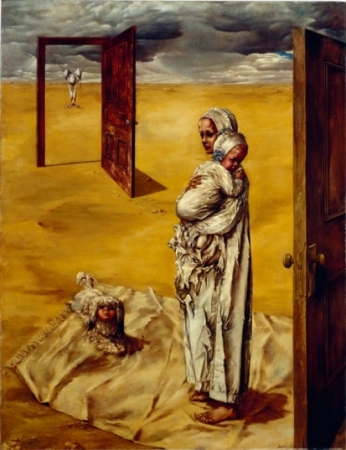
                                 Sketch for the ceiling of the Victoria Hall mural by Ernest Bieler (1893)

On September 16th 1984, the concert hall was engulfed in flames that partly destroyed the interior décor. That night the interior of the Hall was devastated and the world-famous organ simply melted and collapsed. It was soon decided to restore the interior of the hall as far as possible in the original style, which was flamboyant and heavily decorated. The City having decided to restore the building, also decided that the ceiling décor which had been painted by Ernest Biéler had to be replaced by a contemporary work by Dominique Appia.

                                                               Naked, Ringing the Bell by Ernest Biéler

One original ceiling image which caused a controversy at the time was Biéler’s painting, Naked, ringing the bell.  However, the commission was hailed a success and Biéler’s reputation grew, bringing financial rewards.

                                                                     La Râclette, by Ernest Biéler (1903)

In 1896, Biéler rented a house for a workshop in Savièse, and immersed himself in village life but he had to return to Paris so as to carry on with his studies at the Académie Julian.  Along with fellow artists, such as Édouard Eugène Francis Vallet, Raphaël Ritz, and others, Biéler founded the Ecole of Savièse. This name became synonymous with his unique style of work, in which we see an extraordinary level of detail, that became extremely popular with the public.  In the first decade of the twentieth century, Ernest Beeler began building a large house of his own in Savièse with his own workshop and various auxiliary facilities.   In 1900, aged 37, he exhibited two works that earned him a silver medal in the Paris Salon and was made a Knight of the Legion of Honour.

                                                                   Vue de Savièse by Ernest Biéler

Around 1906, Biéler became undecided about his painting style.  Should he abandon his realistic painting style in favour of modernism, which rejected history and conservative values such as realistic depiction of subjects and which adopted a period of experimentation in the arts from the late 19th to the mid-20th century.  When asked whether he was a realist or an idealist, he simply replied:

“…An artist can strive for both. One does not exclude the other. The national feeling has nothing to do with art…”

                                               Le vieux duc de savize cloutiergranois by Ernest Biéler

In 1909, at the age of 46, Ernest Biéler married a Parisian divorcee, Michelle Laronde, who already had a young son and was an art tutor.  They decided to live in Paris rather than the village of Savièse.  The reason, as he wrote to a friend, was because his new wife was “too urban to live in Savièse.” In fact she did not want to have anything to do with Switzerland which caused a problem for Biéler, as his main source of income was from Switzerland, where he was still receiving numerous commissions, and for that reason he had to stay for long periods in Switzerland without his new wife.

                                                        Deux jeunes Valaisannes by Ernest Biéler

The second decade of the twentieth century proved to be a problematical and difficult period for Biéler.    In 1911 his father died.  Seven years later his mother died and during that intervening period war raged in Europe.  In 1916, Biéler reluctantly decided to leave his wife and the French capital and move to Vevey, a Swiss town, close to Lake Geneva and about thirty miles north-west of his beloved Savièse.  In 1917 he buys a house in Montellier-sur-Rivaz.  Now living apart from his wife, there followed the inevitable divorce in 1921.

                                   L’Eau mysterieuse (Mysterious Waters) by Ernest Biéler (1912)

During this decade, it was not just these personal problems of death and divorce that he had to deal with, he also had an artistic setback.  He had been working for four years on his exceptionally large (146.3 x 376.4 cms) painting, L’Eau mysterieuse (Mysterious Waters).  Although it was acclaimed when it was shown in Paris in 1912 and subsequently bought by the Gottfried Keller Foundation, after it was exhibited in Switzerland, it failed to persuade him to remain in the French capital.  Biéler had meant the work to be an art nouveau manifesto with the aim to establish in Paris the importance of this graphic style and of the seldom-used medium of egg tempera.  The work is painted on sheets of paper mounted on canvas and set within a large wooden frame which had been fashioned to Biéler’s instructions. Its long, narrow format recalls the works seen on cassoni, or marriage chests which are a rich and showy Italian type of chest.  These long and narrow paintings had been revived by the English Pre-Raphaelite Edward Burne-Jones. The smooth-flowing depiction is of thirteen princesses fanning out in the foreground which is offset by a number of the trees in the background. The basin into which the women stare, occupies nearly half of the painting.  The setting is autumn with fallen leaves on the ground and the surface of the pond.  The women are kneeling, gazing into the pond, fascinated by their own reflections and worry at what they see – their unstoppable ageing.  However, this depiction is all about Ovid’s myth of Narcissus, enchantment and the feminisation of heroes which was popular at we entered the twentieth century.

                                              Jeune Chevrier (Young Goatherd) by Ernest Biéler

In 1917 Ernest set up shop in a vast studio in Montellier near Rivaz and there he began producing the great decorative works that will ensure him lasting fame. He created stained-glass windows for churches (Saint Francis, Lausanne; Saint Martin, Vevey; Saint Germain, Savièse), mounted-canvas ceilings (Victoria Hall, Geneva; Theatre of Bern) and frescoes (Jenisch Museum, Vevey; the main hall of the Greater Council, Sion).  

                                                       L’Homme des Camps by Ernest Biéler, (1917)

From 1923, Beeler spent the last 25 years of his life in Savièse. In 1928, when he was sixty-five years of age, he married for the second time.  His second wife was Madeleine de Kerenville, who was 20 years his junior.

Ernest Biéler died in Lausanne on June 25th, 1948 and is buried in St. Martin’s Cemetery in Vevey.

Hilda Rix Nicholas. Part 4.

                                                                            Hilda Rix Nicholas (1910)

Many of Hilda’s works were sold and the success of the exhibition led to many of her Australian works of art touring London and British regional art galleries.   The most prestigious of these being at the Royal Academy in London and at the International Society of Sculptors, Painters and Gravers,

                                                                          His Land by Hilda Rix Nicholas

A solo exhibition of her work was on view in December 1924 at the Beaux Arts Gallery, London, and one of the works on display was His Land, which was described as having “the rare quality of conveying the spirit of life in the Commonwealth.  Back in Australia, the December 5th 1925 edition of the Newcastle Morning Herald printed an article about the painting and the exhibition:

AUSTRALIAN WOMAN ARTIST.

Something of the beauty and grandeur of life in Australia is to be found in the art exhibition opened at the Beaux Arts Gallery, Bruton-place, by the Australian High Commissioner. The artist. Mrs.Hilda RIx Nicholas, is an Australian and her works possess the rare quality of conveying, the spirit of life in the Commonwealth as well as portraying) that life pictorially. “His Land.” The most important work of the exhibition. might almost be termed great. It is a perfect example of the difficult art oil figure and’ landscape combination. In the foreground ‘is a young settler on horseback; contemplating a vast sunlit valley, which stretches away to the distant Blue Mountains. A. J. Munnings himself could not have painted horse and rider better. The trees, fields, and mountains are brightly coloured, and the whole picture. seems.to convey, the sunny heat-laden atmosphere of Australia.

It was not just in English galleries that her work was exhibited,  for in Paris, she appeared at the Société Nationale des Beaux-Arts Spring exhibition in Paris, in which she had eight works, a very large number for a single artist. The Société not only hung many of her paintings and drawings, she was elected an Associate to the organisation in that year.

            Les fleurs dédaignées by Hilda Rix Nicholas (1925)

One of her most famous paintings was completed in 1925 whilst she was living in Paris.  It was entitled Les fleurs dédaignées (The scorned flowers).  It was a monumental painting, the largest of all her works, measuring 193.0 x 128.5 cm (76 x 51 inches).  Rix Nicholas concentrated on details of costume and decoration.  The ornate eighteenth-century-style floral dress we see on the model was created by the artist specifically for the painting.  The female stands indoors before an early twentieth-century pastiche of a seventeenth-century Flemish tapestry, which was once owned by the artist.   So, what is going on in the depiction we see before us?  Look at the female.  Her pale skin appears smooth and without blemish, almost like a porcelain doll.  Her head looks so small in relation to her voluminous dress.  The model for this work was a Parisian professional model and a prostitute, apparently with a reputation for being moody and cantankerous and this comes across as we study her face.  She stands upright in a dignified but arrogant manner.  She pouts.  What is she thinking? Look at her facial expression, is it an expression of contempt or maybe sullenness?   On the floor at her feet, we can see a bouquet of flowers which she has discarded and which are mirrored in the pattern of her dress.  What was the artist’s reason for that?   Are they from her lover who she has now rejected?  Look at her gaze.  Who is she looking at out the corner of her eyes?    So many unanswered questions.  Many art historians have had their say but few agree and so it is up to you to come up with answers!

When the work was displayed in Sydney in 1927, the art correspondent for The Sydney Morning Herald of June 27th wrote:

“…For combination of grace, dramatic strength, and clearness in technique this picture would be difficult to surpass. There is nothing finicky about it; it tells its story with vivid directness. As a background to the figure Mrs. Rix Nicholas has set a piece of antique tapestry, so that the trees on either side lean in arch-wise over the head, the face and shoulders stand out clearly against an expanse of sky, and behind the body and limbs extends a countryside full of towers and rivers and trees. The quaint conventionality of this background accords exactly with the late eighteenth-century costume, all sprigged with roses and heliotrope; and the whole mass of detail harmonies [sic] perfectly with the type of the model’s face. It is a cold, selfish face. The artist has brought out with revealing strokes an expression of vindictive malice which is for the moment resting there; and the hands, the fingers of one grasped tightly by the other, give a clear indication of nervous tension within. The treatment of flesh tones and the general arrangement [sic], drawing attention gently but not too obtrusively to the columbines scattered on the polished floor—those are excellent…”

The painting was purchased by the National Gallery of Australia in 2008 from the artist’s son, Rix Wright.

                                               Le Bigdouen by Hilda Rix Nicholas (1925)

During her period in France Hilda put together a number of new paintings including portraits of traditional life and costume, whilst she spent her summers in Brittany.  Before she left Europe, she had Le Bigouden, a painting she completed in 1925, hung at the Royal Academy’s 1926 Summer Exhibition.  Le Bigouden and La Bigoudène were the names given to men and women who inhabited the Pont-l’Abbé region of Brittany

                                                      The Fair Musterer by Hilda Rix Nicholas (1935 )

At the end of 1926, Hilda Rix Nicholas and Dorothy Richmond returned together to Australia. They decided to continue with their painting adventures and bought a car, modified it to hold all their painting paraphernalia and set off to roam New South Wales and Queensland and paint the Australian landscape from Canberra and the Monaro plains to the south, up into central Queensland .  Hilda returned to Delegate where she had spent time before setting sail to Europe.  Once again, she met up with farmers, Neil, and Edgar Wright.  For Hilda it was a welcome return to the man she loved and On June 2nd 1928 she and Edgar Wright married in Melbourne.   In 1930, Hilda and her husband had their only child, a son, whom they named Rix.  Hilda stopped painting during their son’s infancy but once he became a young boy, she resumed with her art.  Coincidentally, her friend and travel companion, Dorothy Richmond, married Edgar Wright’s cousin, Walter, and settled in the same region.

                 The Shepherd of Knockalong by Hilda Rix Nicholas (1933)

Hilda and Edgar Wright went to live in a property called Knockalong in the Tombong valley which was situated close to Delegate.  It was a large and successful pastoral station, run by Edgar and his station hands and he is represented as the Shepherd of Knockalong in Hilda’s 1933 painting.  The painting, which is one of the first works that Hilda Rix Nicholas produced, following her return to painting in 1934, after the birth of her only child,  was one of many which depicted the life on the land in the Monaro of New South Wales, which is one of the centres of Australia’s rich and productive farmland.

                                                    Rix – The artists son by Hilda Rix Nicholas (c.1948 )

Their son, Rix attended boarding school at Tudor House and then at Geelong Grammar. It was whilst attending the grammar school that he fell in love with sculpting. in fact, he created the two gateway sculptures that still adorn the entrance today.  There was a differing of opinion between mother and father as to what their son’s future path should be.  His father wanted him to take over the Merino stud and his mother wanted him to pursue an art career. In the end, to keep both happy, he combined his love for the southern Monaro landscape and his sculpting He managed the property and when he had free time, he created his sculpted works of art.

                                                                     The Shearer by Rix Wright (1949)

Rix created The Shearer when he was just 19 years old. Cast in bronze, The Shearer bends at the hip over a held sheep, its fleece almost entirely removed and laying at its feet.

Hilda carried on producing works of art for the next twenty-five years and had them shown at numerous exhibitions but by the time of her last exhibition, her love of painting was diminishing and the thoughts of what she had achieved and what was her future began to depress her.  In a letter to her son she talked of that depression, writing:

“…Not doing anything creative is nearly killing me. The trouble is that there is no one near me who cares whether I ever do any more work or not … I feel the artist in me is dying and the dying is an agony … only one’s self knows the craving and the best part in one is aching unsatisfied…”

                   Rix Wright, son of Hilda Rix Nichols Wright

At this juncture in her life, with her health deteriorating, and her fervour for art fading, she did exhibit for the final time in 1954 in Sydney.  It was a group exhibition with two of her oil paintings shown alongside her son’s sculpture The Shearer also on display.

Hilda Rix Nicholas Wright died in Delegate on 3 August 1961, a month before her seventy-seventh birthday.