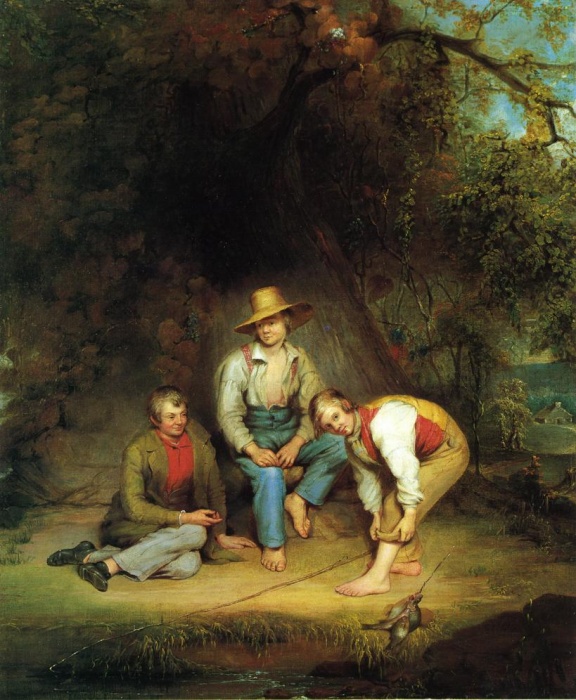
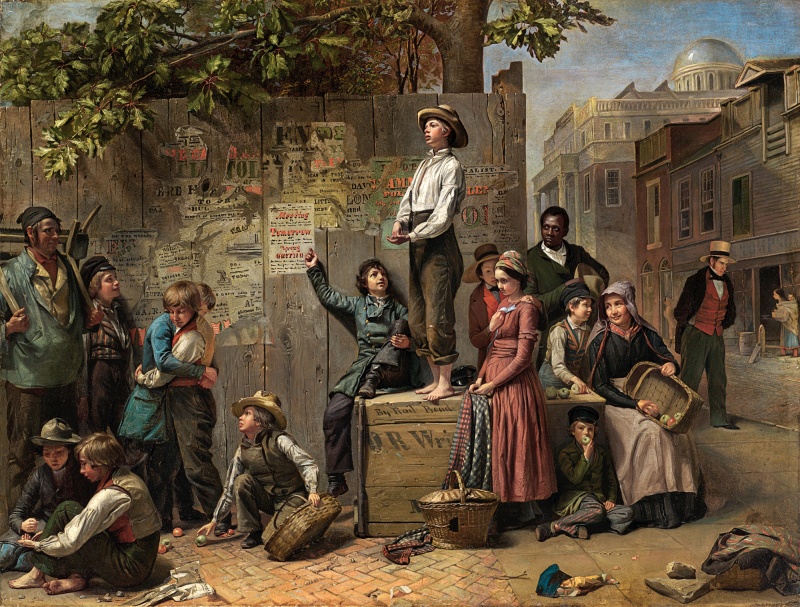
Mary Blood Mellen and Fitz Henry Lane – Pupil and Master.

Mary Taylor Blood was born on May 13th, 1819.  Her father was Reuben Blood, Jr. and her mother was Sally Taylor Blood and they lived in Sterling Massachusetts.  Mary had two older brothers but was the eldest of four sisters.  When she was still only a child, she was enrolled in Miss Thayer’s school, where she learned to paint with watercolours. Having shone as a potential artist she later moved to the Quaker’s Fryville Seminary in Bolton, Massachusetts.  This school was established in 1823 by Thomas Fry, a local Quaker, as a co-educational preparatory school.  It was here that she improved her skill as an artist and developed her early talent for sketching and painting.

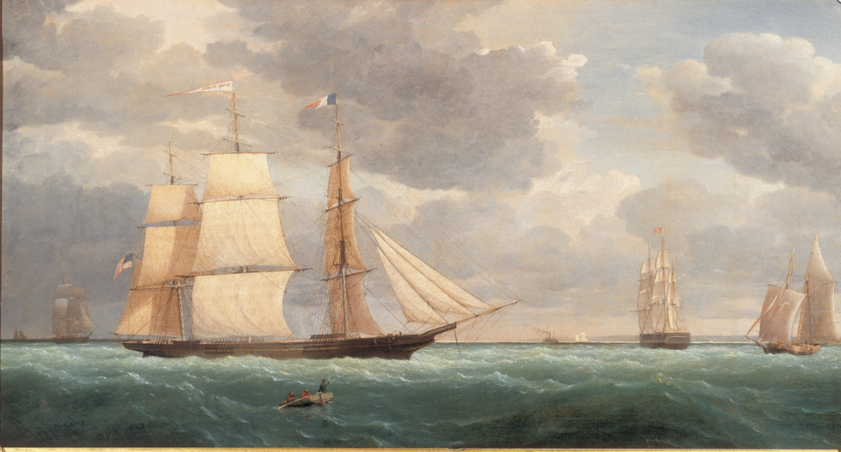
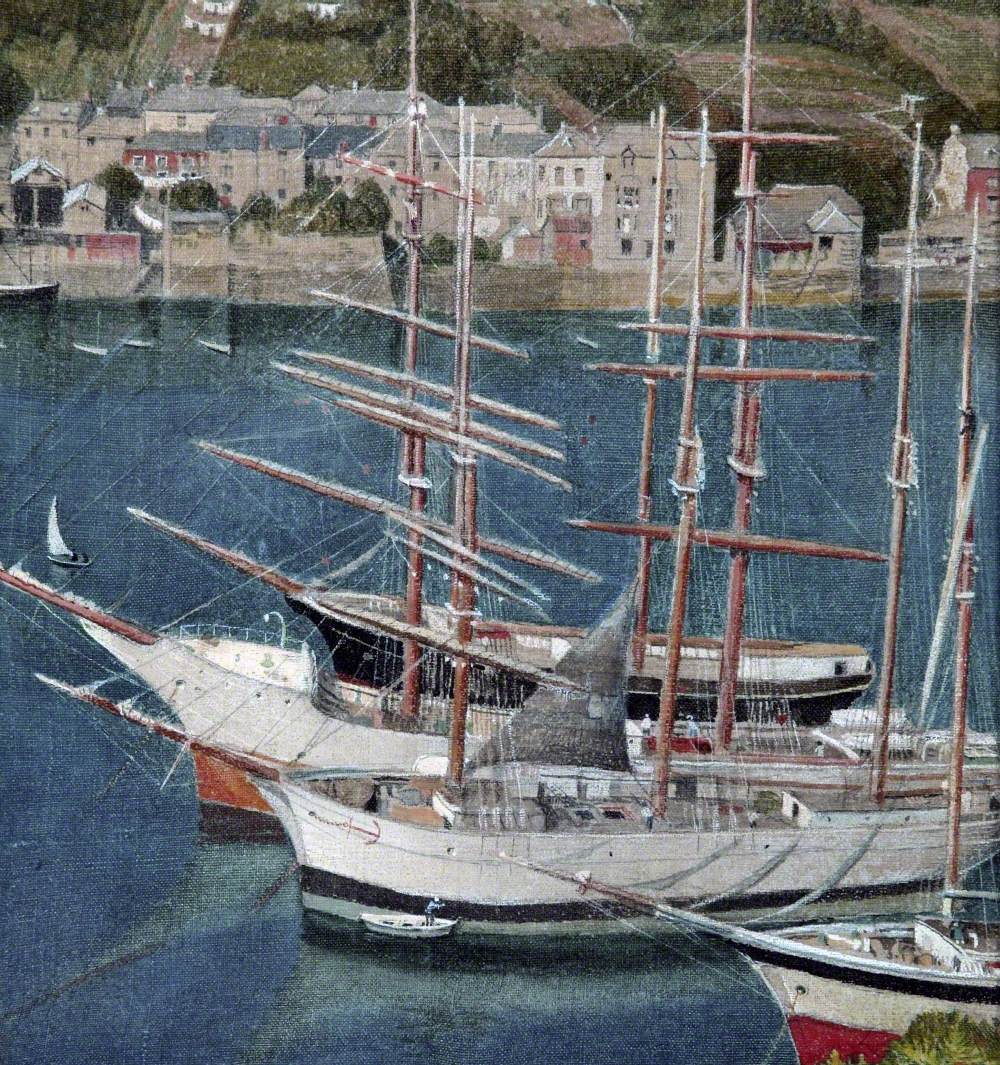
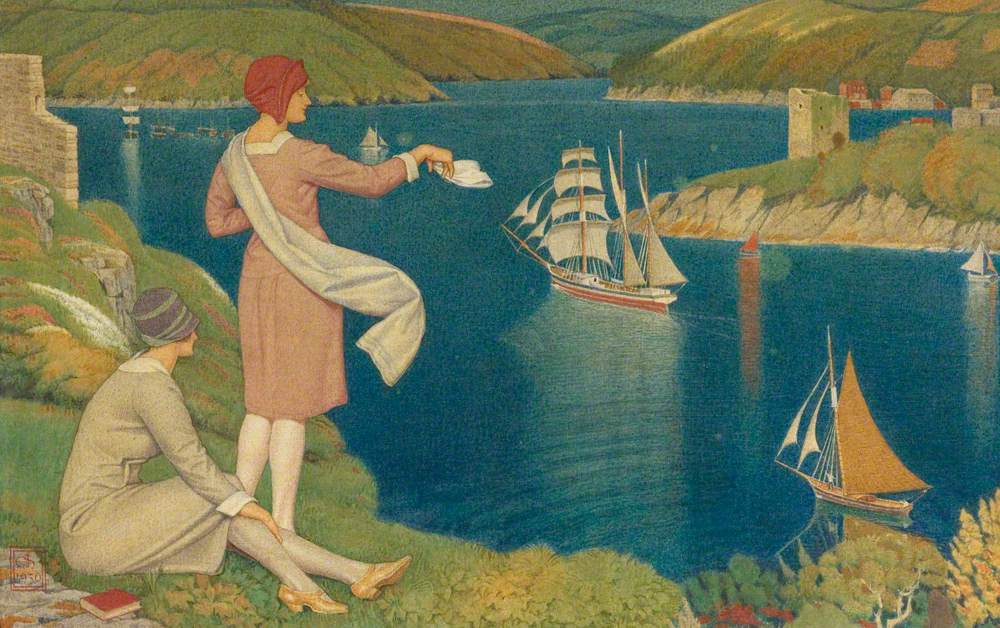
Taking in the Sail by Mary Blood Mellen

Whilst still a teenager, the family moved to Fitzwilliam, New Hampshire and as fate would have it a young Universalist minister, Reverend Charles W. Mellen, arrived to act as pastor in the neighbouring towns. Reverend Mellen came from a family of farmers from nearby Phillipston and soon after, he and Mary met and the couple fell in love. In 1840 Mary and the Reverend Charles Mellen, married and went to live in Gloucester, Massachusetts.  Mary and her husband relocated many times due to his pastoral work and in 1846 while living in the Massachusetts town of Foxborough, Mary gave birth to a daughter, Amanda. Sadly the baby only survived for forty-eight hours and the gravestone they erected at the site of the grave had the poignant inscription:

“…Our short-lived flower returned unto God…”

Even sadder was the fact that the couple never had any other children.  Mary was fortunate that she had the support of her husband during these sad times and he was also very supportive with regards Mary’s artistic work.

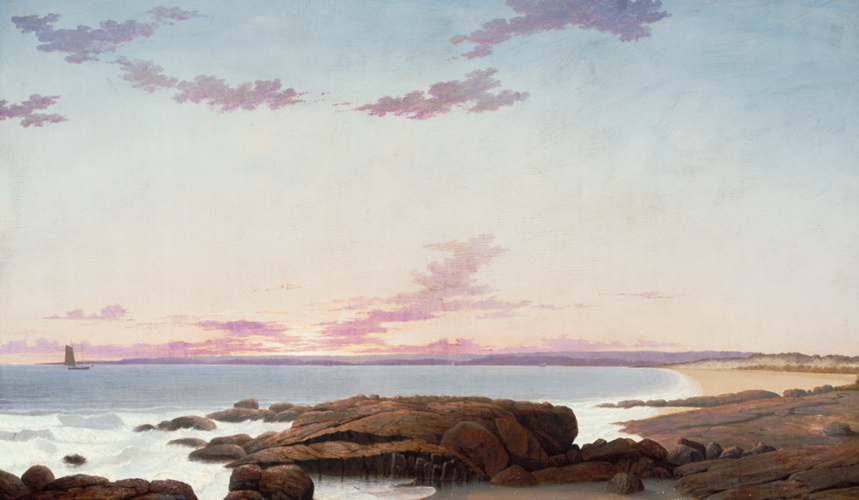
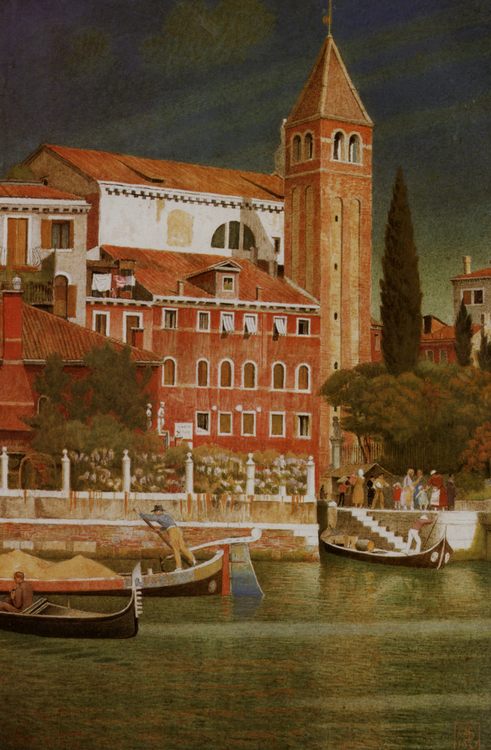
Field Beach, Stage Fort Park by Mary Blood Mellen (c.1850)

Mary’s brother-in-law, William Grenville Roland Mellen, was also a Universalist minister and in the late 1840’s had his ministry in Cambridge Massachusetts and Mary and her husband made a number of visits to visit him in the city.  Cambridge was a metropolitan suburb of Boston and at the time Boston was considered to be the New England’s centre of culture.  In the city there was the Boston Athenaeum which is one of the oldest independent libraries in the United States.   In the years 1872–1876, Boston’s Museum of Fine Arts exhibited in the Athenaeum’s gallery space while waiting for construction of its own building to be completed and at that time it boasted the largest art collection in New England.  One can be sure that Mary Mellen, whilst visiting her brother-in-law and his family, found time to visit the building and discover the artistic treasures it held.  Some of the works on display which Mary would have seen were by the American painter and printmaker, Fitz Henry Lane.

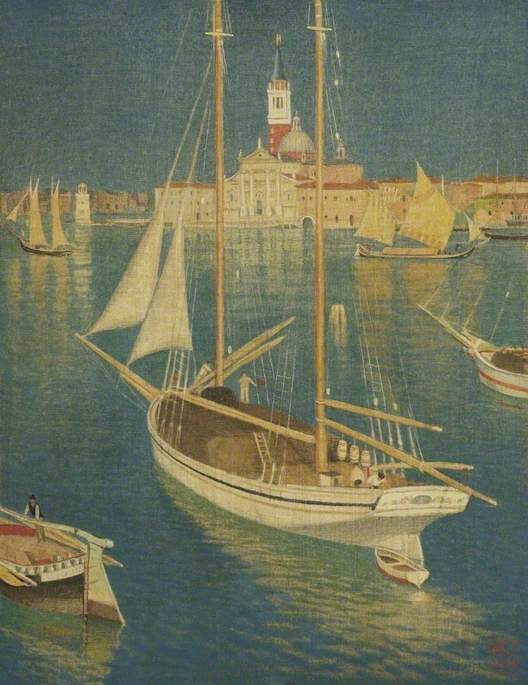
Ship at Sea by Mary Blood Mellen

Fitz Henry Lane was born in the fishing port of Gloucester, Massachusetts on December 18th,1804.  He was actually born Nathaniel Rogers Lane but in 1831, when he was twenty-seven, he legally changed his first and middle names, becoming known as Fitz Henry Lane. He suffered various illnesses as a young child.  The most severe was paralysis due to infantile polio and after this illness he had to use crutches. Lane learned the basic art techniques while in his teens and in 1832 he started work with a firm of lithographers in Gloucester. Later in 1832, he moved to Boston for formal training and enrolled as an apprentice with William S. Pendleton, who owned one of the city’s most important lithographic firm. Lane stayed working for Pendleton until 1837, during which time he produced many illustrations for sheet music and scenic views.

Salem Harbour by Fitz Henry Lane (1853)

Whilst living in in Boston, Lane became aware of the artistic works of the English-born artist Robert Salmon, who was looked upon as the most accomplished marine painter in the area. Works of art by Salmon with their precisely detailed ships and sharply rendered effects of light and atmosphere had a pivotal influence on Lane’s early style. By 1840, Lane had produced his first oil paintings and soon he was listed in a Boston almanac as a “Marine Painter.” His works were first exhibited at the Boston Athenaeum in 1841 and, after 1845, his works were regularly shown there.

Clipper Ship Sweepstakes by Fitz Henry Lane (1853)

One of his very fine ship portrait is his 1853 painting entitled Clipper Ship Sweepstakes. The work is thought to be a pendant piece of his 1854 work entitled The “Golden State” Entering New York Harbor, The Golden State was another clipper ship owned by Chambers and Heiser who probably commissioned both works.

The Golden State entering New York Harbor by Fitz Henry Lane (1853)

This large work, The Golden State entering New York Harbor, was some four feet wide, and is considered one of Lane’s masterpieces.  The location in the depiction is not known, but it could well be the broad bay at the mouth of New York harbour. It is a blustery day with scudding clouds and a frothy chop in the very green water. The ship is flying a blue-and-white swallowtail pennant with a red tail—the house flag of Chambers and Heiser—on its foremast. An American flag flies off its stern.

View of Coffin’s Beach by Fitz Henry Lane (1862)

However, although there is no evidence that Mary Blood Mellon was formally apprenticed to Fitz Henry Lane, his early years spent working in various lithography workshops would have impressed upon him the value of having an apprentice and the connection became an asset to both the master and the student. By the mid-1850s, it seems that Mary Mellen was working alongside Lane in his Gloucester studio, and the “coupling” was working well as it appears that Lane had given Mary free access to his drawings and on some occasions allowed her to make copies from his canvases.   Her copies were so good and her stylistic faithfulness increased, such that, at a later time, even Lane himself appeared uncertain as to which was his when both were shown side by side. 

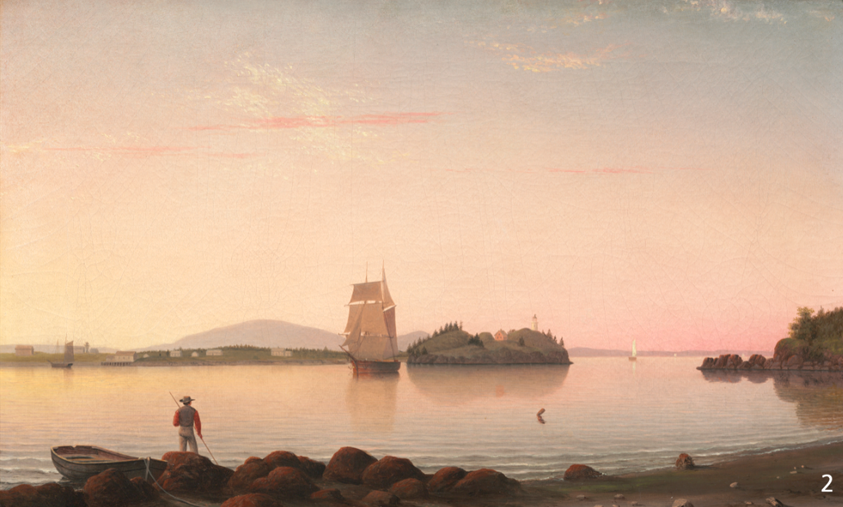
Owl’s Head, Penobscot, Maine by Fitz Henry Lane in 1862

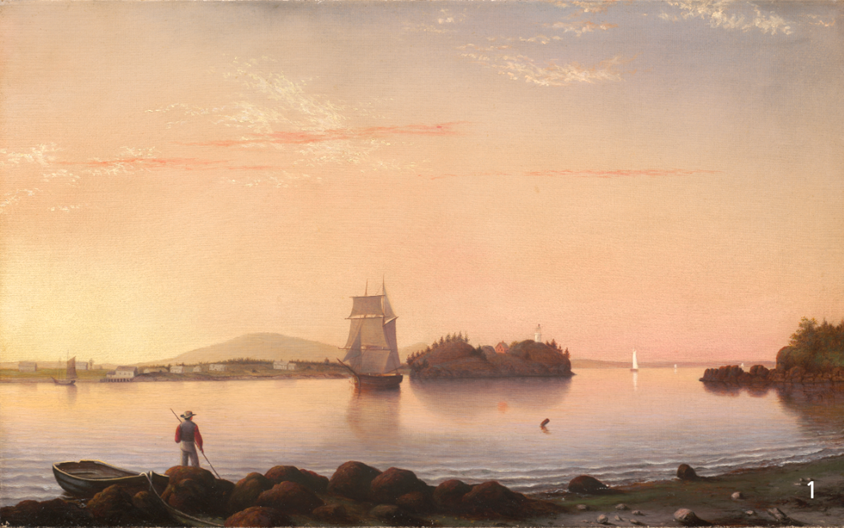
A classic example of the this can be seen when you look at both their renditions of a scene entitled Owl’s Head, a coastal town in Knox County, Maine.  Fitz Lane completed his painting (2) Owl’s Head, Penobscot, Maine in 1862.   Lane painted Owl’s Head, (1), named for its distinctive profile, from the east, with the Camden Hills beyond. The land formations delicately mirrored in still water, the clear sky, and the pale, salmon colours of early morning emphasize the atmosphere rather than the topography of the site.  On the back of the painting, an inscription in Lane’s handwriting establishes it as his own work: Owl’s Head–Penobscot Bay, by F.H. Lane, 1862.

Owl’s Head by Mary Mellen (1860’s)

The curators and conservators of the Museum of Fine Arts, Boston compared paint application and the use of colour in the paintings by Mellen (1) and Lang (2). In general, they stated that Lane’s brushstrokes seem crisper, and he more precisely defines compositional elements such as the pine trees. They also concluded that Lane’s palette is also cooler than Mellen’s. Yet on careful examination, they agreed that these details can sometimes be too close to definitively separate the authorship and it could be entirely possible that, in studio tradition, Lane contributed to Mellen’s paintings, even if she signed them, and this complicates the issues of attribution even further.

Mary Mellen was said to have copied Lane’s style so that even he could not tell which was his own painting. In his 2006 book, Fitz H. Lane: An Artist’s Voyage through Nineteenth-Century America (2006), the author James A Craig wrote:

“…Mrs. Mellen is so faithful in the copies of her master that even an expert might take them for originals. Indeed, an anecdote is related of her, which will exemplify her power in this direction. She had just completed a copy of one of Mr. Lane’s pictures when he called at her residence to see it. The copy and the original were brought down from the studio together and the master, much to the amusement of those present, was unable to tell which was his own, and which was the pupil’s…”

This copying was not unusual in an artist-apprentice relationship.  What confuses some art historians as to the attribution of a painting as it appears as though Mellen had a hand in completing parts of several Lane paintings, or may have even sketched certain landscape views that would have been difficult for Lane to access, given his lameness

Coast of Maine by Fitz Henry Lane and Mary Mellen (c.1850)

There is only one known work signed by both Lane and Mellen, and this is their 1850’s work entitled Coast of Maine. Both Mellen and Lane signed the back of the canvas of the small tondo.

Blood Family Homestead (ca. 1859) by Mary Blood Mellen

In August 1859 Mary Mellen and Fitz Henry Lane travelled together to to visit the Blood family residence in Sterling, Massachusetts, where they both created paintings of the Blood homestead with the two paintings depicting a different season.

FITZ HENRY LANE (Massachusetts, 1804-1865), "The Blood Family Homestead"., Oil on canvas, 18" x 30". Framed 22" x 35".
The Blood Family Homestead by Fitz Henry Lane

It is thought that by 1861 the Mary Mellen and her husband were living in Dorchester, Massachusetts, which was only a short distance from Gloucester. Three years later, the couple moved again, this time to Taunton, Massachusetts, which was about forty miles south of Boston.

Mary Mellen suffered duel losses in the mid 1860’s.  Fitz Henry Lane had been unwell throughout 1864 and 1865 and this culminated in a bad fall in August 1865, followed by a heart attack. He died in his home on Duncan’s Point on August 14th, 1865 and is buried in Oak Grove Cemetery. One of Boston’s newspapers described his death as “a national loss,” however Lane’s reputation during his lifetime was mainly local and after his death he and his works were largely forgotten outside Gloucester. A year later Mary’s husband, Reverend Charles W. Mellen, died suddenly and unexpectedly at the age of forty-eight.  Following Lane’s death in 1865 and Charles Mellen’s death in 1866, Mary Mellen, now widowed and childless, moved to Connecticut to live with her widowed sister-in-law, Sophronia Haskell.

Fitz Henry Lane (c.1860’s)

Mary Mellen carried on painting until her death on February 11th,1886, when she died of typhoid at the age of sixty-six in Sterling, Massachusetts. Her passing was noted in several newspapers with obituaries acclaiming her as “a woman of great acquirements and an artist of prominence. Her specialty was marine work and her pictures were very popular.” Her will, which she had made in 1882 stipulated to which niece and nephew each of her original paintings by Fitz Lane should go. She also insisted that Lane’s nephew Fitz Henry Winter should receive a painting by Fitz Lane, as well as a portrait of him that was in her collection.  In recent years, art historians recognize Mary Blood Mellen as one of the most accomplished artists to work on Cape Ann in the years immediately preceding the Civil War.

Barber Institute of Fine Arts. Part 3.

The Sun Setting Through Vapour by Turner (c.1809)

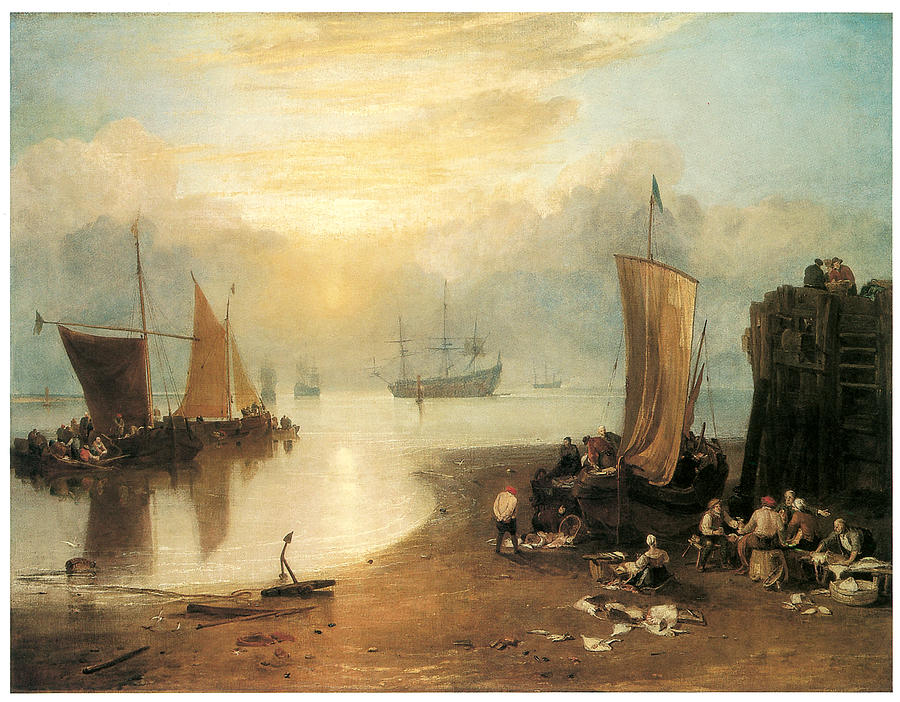
Joseph Mallord William Turner’s painting The Sun Rising Through Vapour was described at the time as masterly, and his early reputation was founded on a series of dramatic seascapes that he regularly showed at the Royal Academy, the British Institution and in his own gallery until about 1810.  The sun disperses the clouds and infuses sand and sea with a golden glow. In the foreground against a seascape with the setting sun which casts a golden light over the entire picture, we see a group of fishermen and women unloading their catch and laying it out on the beach for sale.    In the distance we see a number of ships at anchor including a man-of-war and a dismasted hulk which was being used as a prison ship, which is a stark reminder that at the time Turner completed the work, France and England were still at war.  Turner painted numerous marine subjects early in his career. As here, he sought to make his reputation by matching the Dutch masters of the 17th century.  Throughout his life Turner was fascinated with including the sun in his paintings

See the source image
The Sun Rising through Vapour by Turner (1807-09). National Gallery London

A similar painting can be found in the National Gallery, London entitled The Sun Rising through Vapour. The setting is low tide in the early morning and fishermen unload their catch from a boat beached high and dry on the shore. Some of the people are partaking of a meal whilst others prepare the catch for sale. There is a noticeable contrast between the human activity on the shore with the stillness of the glassy sea which, like a mirror, reflects the hazy sunlight. The sun is just a pale yellow glow and has yet the power to burn off the sea mist which is alluded to with the word ‘vapour’ in the picture’s title.

See the source image
The Adoration of the Magi by Bassano (c.1556)

My next offering is by the Italian painter, Jacopo dal Ponte, better known as Jacopo Bassano, named after, Bassano dal Grappa, a village northwest of Venice, where he was born in the first decade of the sixteenth century.  He was probably first trained by his father, Francesco, before becoming an apprentice in Bonifazio Veronese’s large Venetian workshop. He was mainly active, throughout his long life, in Bassano, where he painted landscapes and genre scenes. In his painting, Adoration of the Magi sometimes known as the Adoration of the Kings he depicted the Three Kings, or Magi, carrying their gifts, as they approached the infant Christ. It’s a scene that has been caught countless times on canvas.  Despite their status and wealth, they bow to Christ who they acclaim as the King of Kings. The setting, is the inside of a ruined classical building and has a symbolic meaning.  The decaying building symbolises the decline of the pagan world and the old gods.  They will be further ruined as a result of Christ’s divine mission. Look at the various aspects of this picture.  Look how Bassano has painted the sumptuously extravagant robes and depicted a splendid collection of animals and servants. Look how the light comes through the decaying architecture and settles on the head of the baby Jesus.  This is looked upon as being a light source emanating from God the Father.

Visual search query image
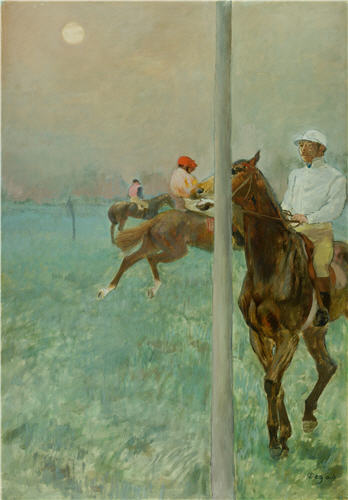
Jockeys Before the Race by Edgar Degas (1879)

I wrongly associated paintings solely depicting ballerinas with the French painter Edgar Degas but in fact he had another favourite theme for his work – horse racing.  Horse racing was a popular pastime in the nineteenth century in  France under Louis-Philippe and Napoleon III. Degas became fascinated by the sport while visiting friends in Normandy. During his lifetime, Degas created forty-five oils, twenty pastels, two hundred and fifty drawings, and seventeen sculptures related to horses.  One such work featuring horse racing is in the Barber Institute collection, entitled Jockeys Before the Race.   It is a painting, made using oil essence, gouache, and pastel, which he completed in 1879.  It is an image of three jockeys on horseback readying themselves at the start of a race on a dull winter’s day with its watery sun. This very large work (107 x 73cms) was exhibited at the Fourth Impressionist Exhibition in 1879.  There is a definite lack of symmetry about this work as the vertical starting post is placed two-thirds from the left-hand side.  The warm red and pink colours of the jockey’s clothes on the left of the painting are balanced by the lighter white/blue colours of the clothes worn by the jockey, who sits astride his horse in the right foreground.

The Castle by the Sea
Castle by the Sea by Caspar Nepomuk Scheurer (1860)

My next choice of painting is both unusual and yet strangely beautiful.  It is a 1860 watercolour over pen and pencil, partly heightened with white and gold work by Caspar Nepomuk Scheuren, a German landscape painter and etcher.  It is thought to have been commissioned as a prize in a lottery held by Kristiania Kunstforenings, Oslo, the oldest art gallery in Norway, which is why the Norwegian coat of arms is at the top centre of the work.   It is an elicitation of a poem by the German nineteenth century poet, Ludwig Uhland which tells of a legendary magical castle, depicted in the centre of the painting, which reaches up towards the moonlit sky and down to the shimmering sea.   On one side we see a king and queen and on the other, their musical daughter, who serenades passers-by with a tearful lament, whose premature death forms the focus of the poem’s lament. The castle and characters are surrounded by an architectural framework, in which the separate compartments serve to isolate episodes of the unfolding narrative.  The tragic fate of all three characters is depicted at the bottom of the painting.  In the centre the king and queen are seen dressed in mourning clothes.  To the left we see the tomb of their daughter and to the right we see a depiction of their own tomb.  Below is the poem which tells the sad story.

The Castle By The Sea

By Johann Ludwig Uhland

‘Hast thou seen that lordly castle, 
That Castle by the Sea? 
Golden and red above it 
The clouds float gorgeously. 

‘And fain it would stoop downward 
To the mirrored wave below; 
And fain it would soar upward 
In the evening’s crimson glow.’ 

‘Well have I seen that castle, 
That Castle by the Sea, 
And the moon above it standing, 
And the mist rise solemnly.’ 

‘The winds and the waves of ocean, 
Had they a merry chime? 
Didst thou hear, from those lofty chambers, 
The harp and the minstrel’s rhyme?’ 

‘The winds and the waves of ocean, 
They rested quietly, 
But I heard on the gale a sound of wail, 
And tears came to mine eye.’ 

‘And sawest thou on the turrets 
The King and his royal bride? 
And the wave of their crimson mantles? 
And the golden crown of pride? 

‘Led they not forth, in rapture, 
A beauteous maiden there? 
Resplendent as the morning sun, 
Beaming with golden hair?’ 

‘Well saw I the ancient parents, 
Without the crown of pride; 
They were moving slow, in weeds of woe, 
No maiden was by their side!’

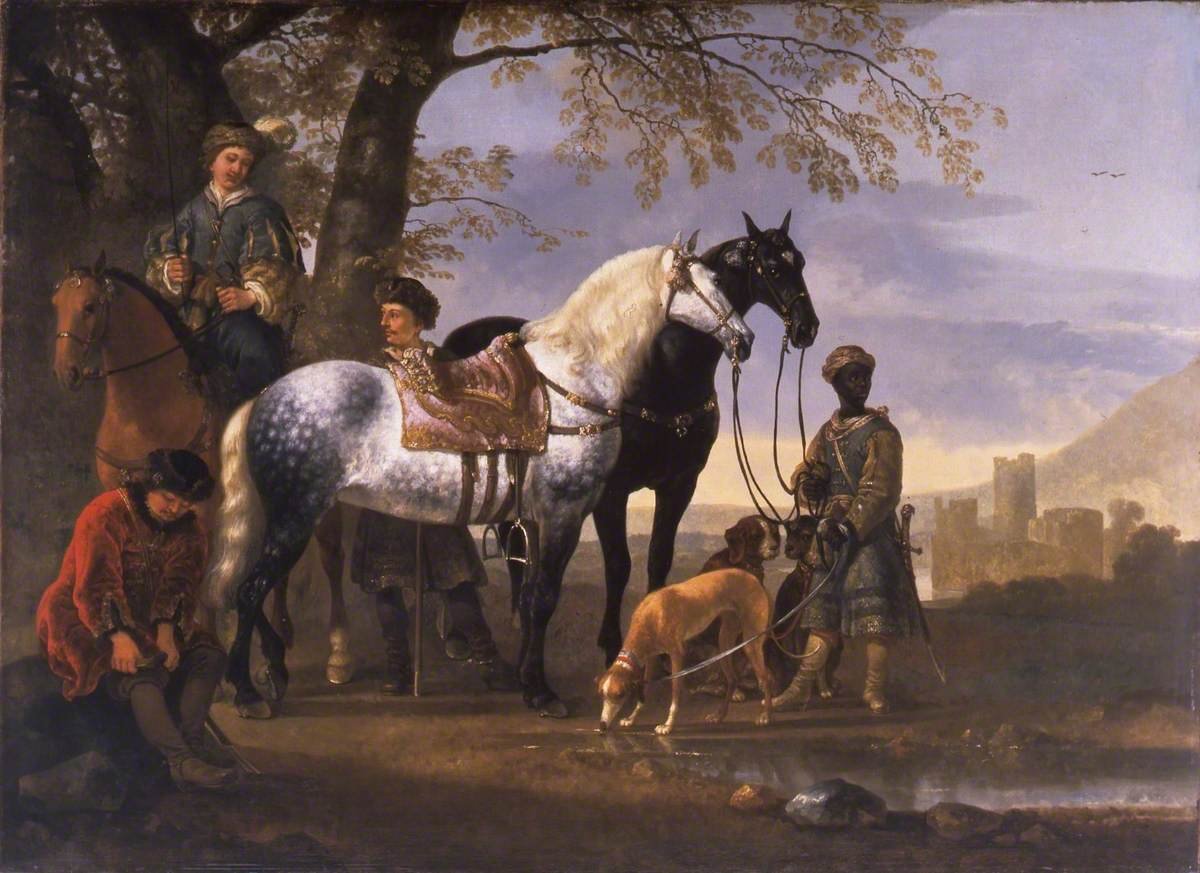
Huntsmen Halted by Aelbert Cuyp (1655)

One of my favourite Dutch painters and one who is regarded as one of the finest artists of the so-called “Golden Age” of Dutch painting, a period during and after the later part of the Eighty Years’ War (1568–1648) for Dutch independence is Aelbert Cuyp.  Cuyp was born and raised in the town of Dordrecht where he completed paintings for his patrons.  His notoriety as a great painter only came the late eighteenth century when British aristocratic collectors began to collect his pictures.  His works were admired for the way he combined his figures with his beautiful landscapes and the British aristocracy particularly liked his many depictions of equestrian and hunting themes.  Although Cuyp did not visit Italy himself, but he studied those Dutch artists who had been there and who had adopted the poetic light of the paintings by the French artist, Claude Lorrain.  In fact, Cuyp was dubbed the Dutch Claude.

In this work we see a party of hunters at rest under the shade of a large tree.  The huntsmen we see depicted are the three sons of Cornelis van Beveren, Cuyp’s wealthiest patron. De Beveren was the most powerful man in mid-seventeenth century Dordrecht.  On five occasions he had been appointed burgomaster of the town, representative to the Staaten-General and ambassador to England, as well as to France.  The van Beverens were not classed as aristocrats but undoubtedly prosperous members of the so-called “striving classes” – the nouveau riche.

The three riders wear fashionable Hungarian hunting costume and are accompanied by an exotically dressed black servant, another sign of their wealth. Why Hungarian costumes?  The reason was probably because Hungarians were admired by the Dutch not only for their famed equestrian skills but also for their staunch support of the Protestant cause, which also reflected a newfound sense of Dutch national pride and independence from the Catholic Spanish rule. The depiction shows the hunting party has come to rest in a landscape bathed in a warm golden light more associated with southern Europe than Holland. The right to hunt had once been jealously guarded by royalty and aristocracy, and thus those who hunted were afforded a traditional mark of the very highest status.  However, in the region of Zuid Holland, which governed Dordrecht, regulations had been altered in 1623 expanding hunting privileges to owners of country estates and to citizens with an annual income of more than 100 guilders.

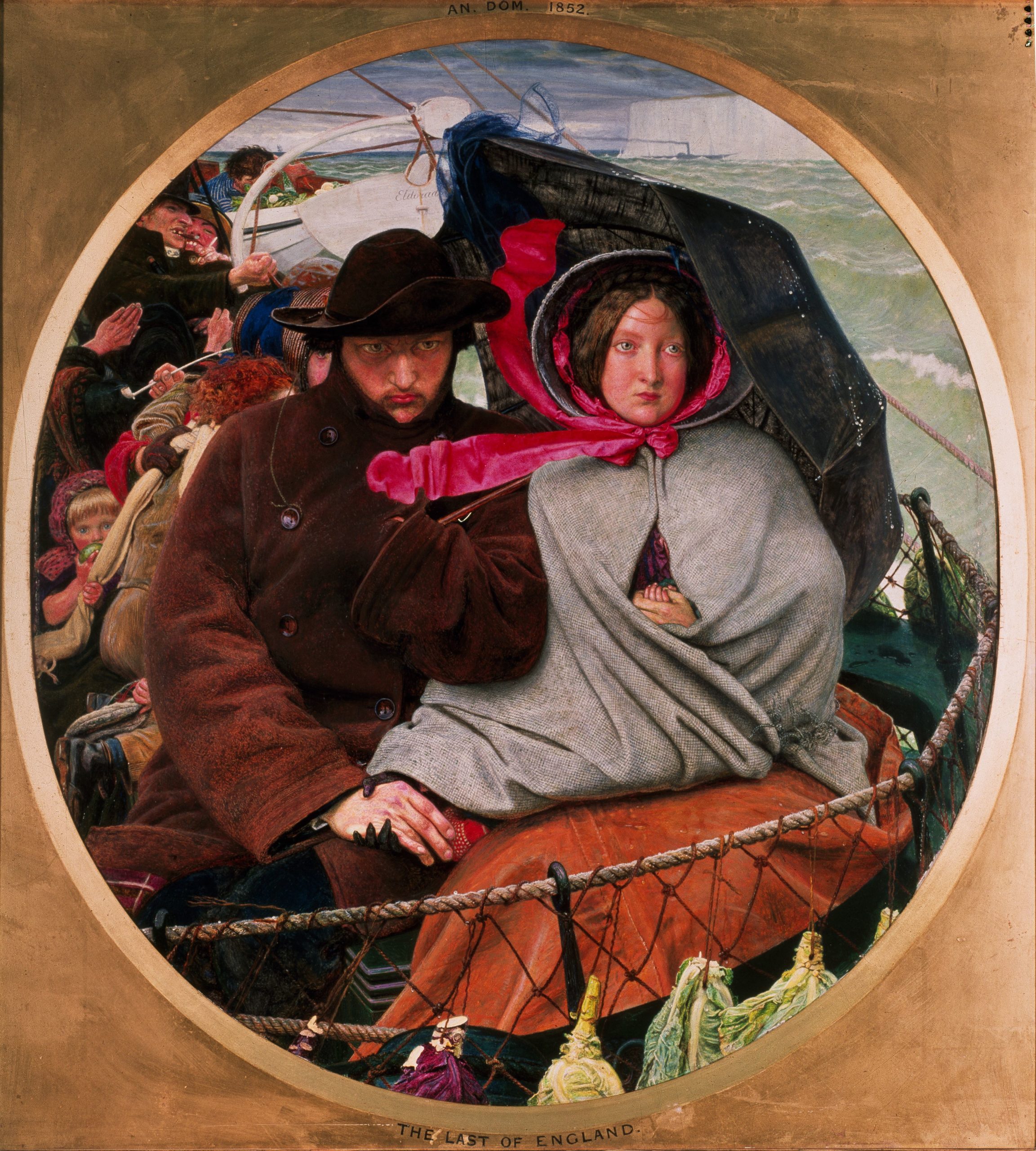
The Last of England by Ford Madox Brown (1855)

For my last offering I want to look at a painting which is part of the collection usually on display at Birmingham Museum and Art Gallery, but as I said at the start of Part One of this blog, the main Birmingham Museum is closed for renovations and this painting was then loaned out to the Barber Institute.   The Last of England was completed in 1855 by the leading Pre-Raphaelite artist Ford Madox Brown and is recognised as a masterpiece of Victorian painting. In the depiction we see a young family huddling together on an open boat as they say farewell to the shores of England and head off to find a better life and a fresh start in Australia.  This oval shape of the work which is almost circular, makes us concentrate our focus on the faces of the young couple, who have literally turned their backs on their homeland.   In the picture we see a father, mother and two children wrapped up well against the cold sea breezes as the ship leaves the familiar shores of their English homeland.   The picture, in some way, was inspired by the emigration to Australia of Maddox Brown’s friend, the sculptor Thomas Woolner in 1852.  It is ironic that although Maddox Brown started the painting the year Woolner departed from England, he had returned to England the following year, disillusioned by the false promises of wealth to be had from the gold rush.  This was some two years before Ford Madox Brown had completed the work.  Thousands of working-class and lower middle-class people, who were totally disillusioned with their life of poverty and slum-like dwellings of England, just packed up the few possessions they had and made this long and momentous journey to the other side of the world.  There were about fifty thousand free immigrants arriving each year in Australia.  The immigrants were following their dream and although they believed the “grass would be greener” for them in Australia, they would a little as to whether they had made the right decision.  Such worry and doubt was etched on the faces of the couple in the painting and in some ways we can empathise with them even though we know they had a free choice in the matter. 
In the background we can make out the white cliffs of England as they fade away in the distance.  This rock structure of white chalk is often depicted in paintings which highlight the coast of England.  In contrast to the white rock formation, we see a black steamship, with billowing black smoke coming from its funnel, heading for port.  The ship that the family is sailing on is surrounded by choppy green seas topped with white crests and this may in some way allude to the testing and difficult times ahead for our emigrants.  It is interesting to see in the foreground netting around the lifeboat deck, hanging on which are some of the ship’s fresh vegetable supplies.  We can see some cabbages and wonder how long they will remain fresh during this long, probably six-to-eight-week journey.  If we look behind “our family” we can see a small child wearing a pink bonnet, her right hand grasping the scarf warn by her mother, whilst she eats an apple held in her other hand.  Somebody, slightly hidden from view, can be seen smoking a long clay pipe but the characters that amuse me the most, and who are just visible in the background in this painting, are a pair of angry men arguing.  The man wearing the top hat has turned away and as he looks back at the departing coastline, waves his fist at it.   To this man, his departure from England is a thing of joy and for some reason he seems to be cursing the country he has just left behind.

The main characters in this painting are the father and mother and these are portraits of the artist himself and his second wife and beloved model Emma Hill.  The small fair-haired girl in the background eating the apple is their daughter Katty and the baby hidden from view is their son, Oliver.  The father is tightly wrapped up in his warm brown woollen coat.  His hat is being buffeted by the strong winds but see how there is a “safety string” from the hat attached to and wrapped around a button of his coat.  The sight of the father with his grim determined face says it all for me.  This is a journey into the unknown and probably he is still racked with doubt with regards his decision to remove his family from the safe environment of their home and whisking them off to a foreign land.  It still troubles him but he knows that he and his family cannot go back now and so his resolute look tells us that he is determined to see the venture through to its conclusion.  The look on the face of his wife is indicative that she too has concerns about their venture.  Her small, slim black leather gloved-hand tightly grasps her husband’s bare workman-like hand, the force of which wrinkles his skin.  It is, in a way, a sign that she supports him and it lets him know that fact.   Her other hand is holding the tiny fingers of the baby she cradles in her arm and which is hidden from view inside her warm woollen cape.  She is wearing a pink bonnet which is partly covered by the grey hood of her cape but we see the pink ribbons of her bonnet flying horizontally in the gale-force wind.   It is a touching picture of a family on the move.

This tense and challenging time for our emigrants was mirrored by the testing times felt by the artist himself.  Commenting on his frame of mind at the time of the painting, Maddox Brown said:

“…I am intensely miserable, very hard up and not a little mad…”

And it was at these times that he, himself, thought about emigrating to Australia.

That is my final blog about the works held in the Barber Institute of Fine Arts’ collection and if you ever visit Birmingham, England, I hope you will visit this excellent institution.

The Barber Institute of Fine Arts. Part 1.

I had a short city break in Birmingham the other day when I had intended to visit some of the main art galleries.  Unfortunately, the main Birmingham Museum and Art Gallery in the centre of the city was closed until late April, for essential electrical works and so I was able to concentrate my cultural journey on a visit to the Barber Institute of Fine Arts at the centre of the Birmingham University Campus.  I had been here once before, five years ago and especially fell in love with two of the paintings.   The Barber Institute is a smaller gallery in comparison to the main one in the Birmingham centre and yet it is full of artistic treasures by the most famous artists.  In my next three blogs I will introduce you to and tell you about some of the wonderful paintings in their permanent collection, so as to tempt you to visit the museum.

See the source image
The Barber Institute of Fine Arts, Birmingham, England.

The Barber Institute of Fine Arts is housed in one of Birmingham’s finest Art Deco buildings and was opened in 1939.  The architect tasked with designing the building was Robert Atkinson, one of Britain’s leading architects of the 1920s and ’30s. The building is laid out around the central music auditorium, surrounded by corridors. On the Ground floor these form offices and lecture halls for the Departments of Music and History of Art, as well as a dedicated Art History library. The galleries occupy the same space on the first floor, approached by a stunning travertine staircase directly opposite the entrance.

See the source image
Ramsau by Thomas Fearnley (1832)
The first painting I want to present to you is one of my all-time favourite landscape works.  The 1832 work, entitled Ramsau, is by Thomas Fearnley.  Fearnley was born in Norway, but studied abroad, often with his fellow countryman Johan Christian Dahl.  It was whilst working alongside Dahl that Fearnley developed the habit of painting directly en plein air.  Fearnley was travelling to Italy when he and his party stopped at the village of Ramsau, a small town located on the Königssee in the district of Berchtesgadener Land in Bavaria.  In the painting we can see the road winding and disappearing around a corner of the village before we catch a glimpse of it again as it heads off towards their destination, the snow-covered Alps and the beautiful snow-capped Hoher Göll, which straddles the border between the German state of Bavaria and the Austrian city of Salzburg.    It is such a beautifully tranquil scene.  In the middle ground of the depiction, we see a lone farmer collecting hay.  Such hard work was so important so as to have food for his animals during the harsh and bitterly cold winter, which was fast approaching.  This en plein air work would have taken Fearnley several sittings during the week-long stay, on each occasion adding another layer of colour.

The Wrath of Ahasuerus by Jan Steen (c.1670)

I have always loved the works of the Dutch Golden Age painter, Jan Steen, so I was pleased to see one of his works in the Barber Institute’s collection.  It was not one of his exuberant genre scenes but a Biblical painting.   It was his painting The Wrath of Ahasuerus which he completed around 1670.  The characters who appear in the painting come from the Old Testament Book of Esther.  The depiction before us is an episode in the life of the Persian king Ahasuerus and his Jewish wife Esther.  King Ahasuerus had sought a new wife after his queen, Vashti, had refused to obey him, and Esther, the adopted daughter of the Jew Mordecai, was chosen for her beauty.  The subject of the painting is from Esther vii, 1-7.  Haman, the king’s First Minister had issued a decree that all the Jews in Persia should be killed.  Esther, the wife of the king, held a banquet and at it she confessed that she was a Jew, and that she too was threatened by Haman.  So we see in the painting, on hearing what his wife had to say about Haman, her husband jumps up in a violent reaction to what he has just heard.  Ahaseurus explosive and exaggerated gesture, eyes bulging, red in the face, fists clenched, jumps up knocking over a vase and the peacock pie.  Haman, on the left, cowers away from the king’s fury. The peacock is a symbol of pride and is a reference to Haman’s fallen pride and his downfall.  The king ordered Haman to be hung.  This story of Esther’s triumph over the evil Haman was popular with the Dutch people who could see the similarity between her battle and their plight against the mighty, and in their eyes, the evil Spanish invaders and occupiers of their country, being a similar story.

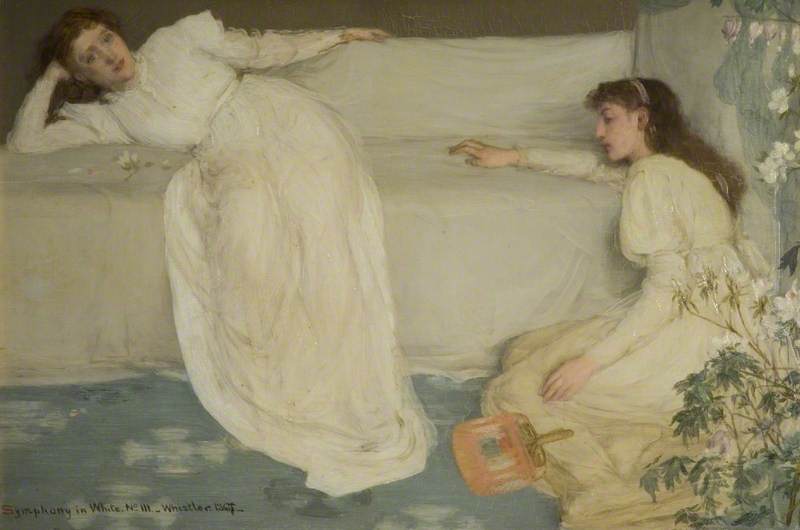
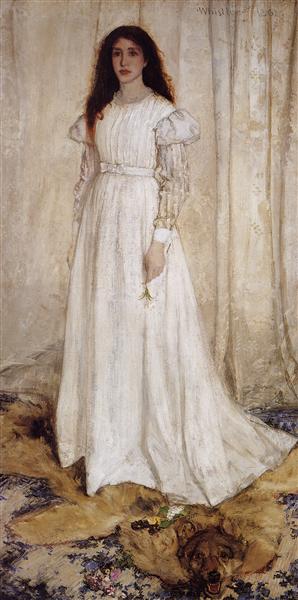
Symphony in White, No. III
Symphony in White No. III by James McNeill Whistler (c.1867)

James McNeill Whistler completed Symphony in White No. 3 in 1867 and it is now part of the Barber Institute collection.  It was thought to have been originally entitled Two Little White Girls.   Two women are depicted in the painting.  One, sitting on a sofa, is Joanna Heffernan, Whistler’s mistress.  The other, resting on the floor in the cream/yellow dress, is Millie Jones, the wife of an actor friend.  Laying on the floor is an Oriental fan which is a reminder of the popular Japonisme cult of the time.  Japonisme was a French term that referred to the popularity and influence of Japanese art and design among a number of Western European artists in the nineteenth century.  Whistler had embarked on this painting in July 1865 and within a month, he had completed the preliminary sketches and by September he had completed the work and had signed and dated it. 

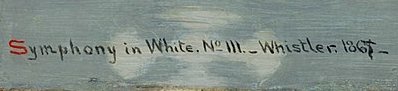
However, he was not happy with what he saw and began to rework it and Whistler was not finally satisfied with it until 1867 when it was exhibited at the Royal Academy. He painted over the final “5” in the original date, and replaced it with a “7”, to mark the changes it had undergone.   

Whistler chose the term ‘Symphony’ to highlight to visitors to the exhibition that it was purely a study in colour and the connection of two branches of the Arts, music and art..  It was the first of Whistler’s paintings to be exhibited with a musical title.  And so, why was it entitled “No. 3”? 

See the source image
Symphony in White. No 1. by Whistler. NGA Washington.

The reason behind this numerical conundrum was that Whistler’s 1863 painting was given the title White Girl but Paul Mantz, a French art historian and writer for the Gazette des Beaux-Arts, called it ‘Symphonie du blanc‘, and so it was later renamed Symphony in White. No. 1. 

Symphony in White No.2 by Whistler. Tate Britain.

In 1864 Whistler completed a second similar work entitled The Little White Girl, which later became known as Symphony in White. No. 2.  In their 1908 biography of Whistler, The Life of James McNeill Whistler, Elizabeth and Joseph Pennell, make the point that this may have been a factor that influenced Whistler in his choice of titles for the third in the series. 

Edgar Degas - Portrait de Mlle Eugénie Fiocre in the Ballet "La Source"
Portrait de Mlle Eugénie Fiocre in the Ballet “La Source” by Degas (1868). Brooklyn Museum.

The work was greatly admired by all who saw it.  It is thought that Deagas drew inspiration from Whistler’s painting when he worked on his painting, Portrait de Mlle Eugénie Fiocre in the Ballet “La Source”

However, there were some critics who were not altogether in love with the work.  Philip Hamerton, an English artist, art critic and author, writing for the Saturday Review on 1 June 1867, remarked:

“…In the “Symphony in White No. III.” by Mr. Whistler there are many dainty varieties of tint, but it is not precisely a symphony in white. One lady has a yellowish dress and brown hair and a bit of blue ribbon, the other has a red fan, and there are flowers and green leaves. There is a girl in white on a white sofa, but even this girl has reddish hair; and of course, there is the flesh colour of the complexions…”

Whistler was horrified by what had been written in the journal and wrote a letter to the editor but he would not print it.  However in Whistler’s own book, The Gentle Art of Making Enemies, he reproduced the letter in which he had written:

“…How pleasing that such profound prattle should inevitably find its place in print!…Bon Dieu! did this wise person expect white hair and chalked faces ? And does he then, in his astounding consequence, believe that a symphony in F contains no other note, but shall be a continued repetition of F, F, F ? . . . Fool!…”

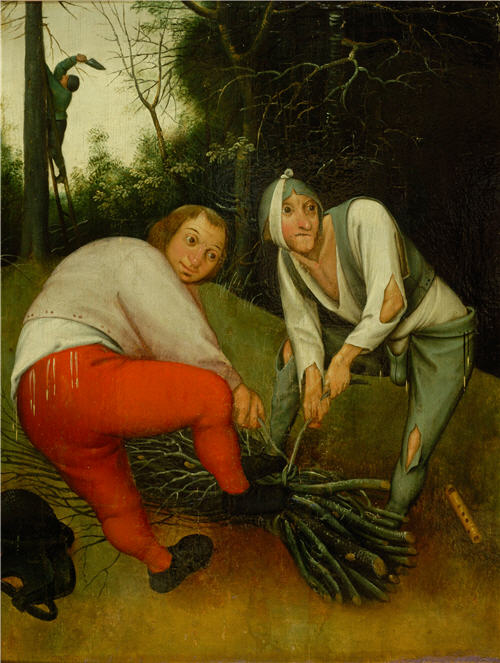
Two Peasants binding Faggots by Pieter Brueghel (c.1615)

For my last offering in Part One of my blog relating to my best-loved works in the collection of the Barber Institute I have reverted to one of my favourite painters, Pieter Brueghel the Younger.   He was the son of one of the greatest sixteenth century artists, Pieter Bruegel the Elder, and the brother of Jan Breughel.  This amusing and fascinating painting entitled Two Peasants binding Faggots, was completed around 1615, and it was the type of work which was popular in the seventeenth century.  It was entitled Two Peasants binding Faggots. It is a depiction of peasants binding a bundle of stolen branches for firewood whilst their fellow accomplice is seen in the background cutting the branches of a tree.  The two peasants in the foreground glance around furtively and from that we gather that they are up to no good,  The larger of the two, on the left, is stout symbolising the sin of gluttony whilst his thinner and gaunt accomplice with a paler face and wearing a codpiece has a bandage around his head and it is thought that Brueghel has depicted this as it relates to the Flemish proverb “to have toothache behind the ears” meaning a malingerer. On the ground, next to the gaunt-looking man, is a pipe which is a traditional phallic symbol and represents the sin of lechery.

Bruegel Netherlandish Proverbs@0
Netherlandish Proverbs by Pieter Bruegel the Elder (c.1525). Staatliche Museen Berlin.

The artist’s father, Pieter Bruegel the Elder, had painted a large work, Netherlandish Proverbs, in 1559, which featured a large number of similar characters each representing various Netherlandish proverbs which today is part of the Staatliche Museen collection in Berlin.

…………….to be continued.

Bernardo Bellotto. Part 2.

Bernardo Bellotto.jpg
Detail of Self-portrait as Venetian ambassador

At the end of 1761 Bellotto returned to his home Dresden to find it had been devastated during the Prussian invasion.  Worse, was the fact that he found himself in great financial difficulty arising from the death of two of his major patrons, Augustus III, Elector of Saxony and King of Poland and Count Heinrich Bruhl, the prime minister of Saxony in 1763. 

View of the Kreuzkirche in Ruins by Bellotto (1765)

Their deaths and his financial situation made Bellotto melancholic and it was around this time that he painted the Kreuzkirche which now lay in ruins.  It had been partially destroyed during the Seven Year War, at a time when Bellotto had been forced to flee the city.  The painting is entitled View of the Kreuzkirche in Ruins and was completed by Bellotto in 1765.  The Kreuzkirche is the oldest church in Dresden and, during the conflict, was shelled by Prussian artillery.   The building was set ablaze and finally collapsed. The church tower, though damaged, remained standing.  Work commenced on the reconstruction the church and it was decided to preserve the original tower. Unfortunately, in June 1765, with the construction of the new church already under way, the greater part of the tower collapsed.  The painting is a good example of how Bellotto unique, capacity to capture the spirit of an event.  His depiction of the ruin  is an unusual one for it is not an ancient ruin as far as the artist was concerned.  It was a relatively new one as the destruction had only occurred five years earlier.   Bellotto had completed a work depicting the great church some years earlier (see painting in the previous blog).   However, in this work, we see the jagged remnants of the church rear up skywards.   The cleanliness of the once beautiful church has gone.  There is nothing clean about the church now.   The scene before us is just a mass of noise and dirt.  It is a chaotic scene which we find hard to believe that it could ever be put back to its former glory.   The Church, as the body of Christ, has been violated all over again and the civic wounds of the German city have been violently opened for all to see.  This is the price to be paid when once we set forth to war.  In the painting we see many of Dresden citizens.  Close to the ruins we can just make out craftsmen as they start their preparations to rebuild the once –beautiful edifice.  On the periphery we see men and women dressed in their best clothes staring at the ruin.  For them it was just a day out to visit the site where the destruction had taken place.  For them it was just blatant voyeurism.

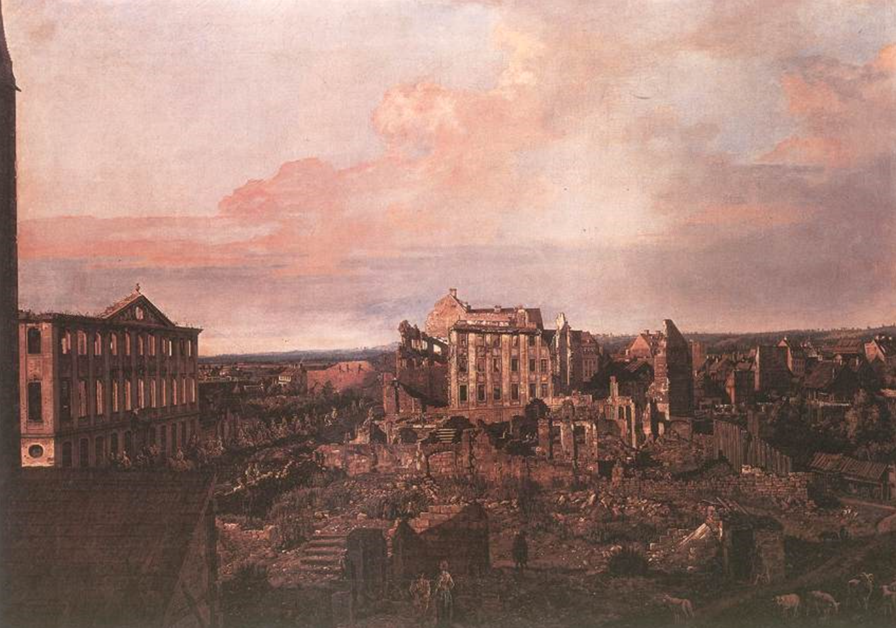
Dresden, the Ruins of the Pirnaische Vorstadt by Bellotto (1763)

Another melancholic landscape Bellotto painted around this time was his bleak depiction of the town where he used to live, Pirna, destroyed by Prussian artillery fire.

In the mid 1760’s there was a revival of classical antiquity in art and Bellotto turned to painting idealised views featuring classical motifs that he had once drawn when living in Venice and Rome. In 1764 the Dresden Academy of Fine Art was founded by order of the Prince-Elector Frederick Christian and at that time, Christian Ludwig von Hagerdorn was the Academy’s general director of the Saxon Art Collections.  Hagerdorn disliked Bellotto and by-passed him when he applied to become a professor of the Academy.  It could be the fact that Bellotto could not speak German which rankled him or maybe it was Bellotto’s style of painting as Hagerdorn once wrote of Bellotto:

“…He loses no opportunity of bringing up the subject of his dreary art and his enormous family…”

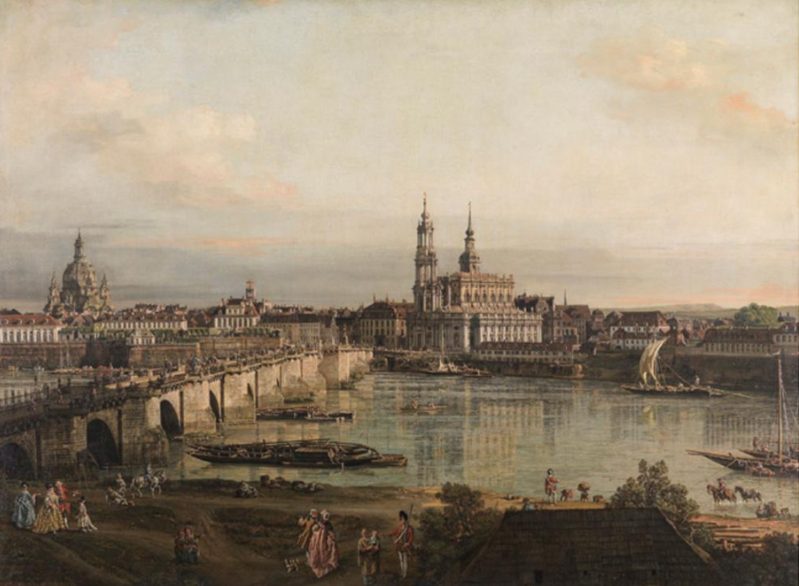
Dresden from the Neustädter Bridgehead, by Bellotto (1765)

Franz Xavier who had taken on the role of the regency of the Electorate of Saxony together with his sister-in-law, the Dowager Electress Maria Antonia of Bavaria intervened and Bellotto was admitted to the Academy and granted a three-year teaching post and given the title of “associate member for perspective”.  Belloto’s reception piece was his 1765 painting, Dresden from the Neustädter Bridgehead.

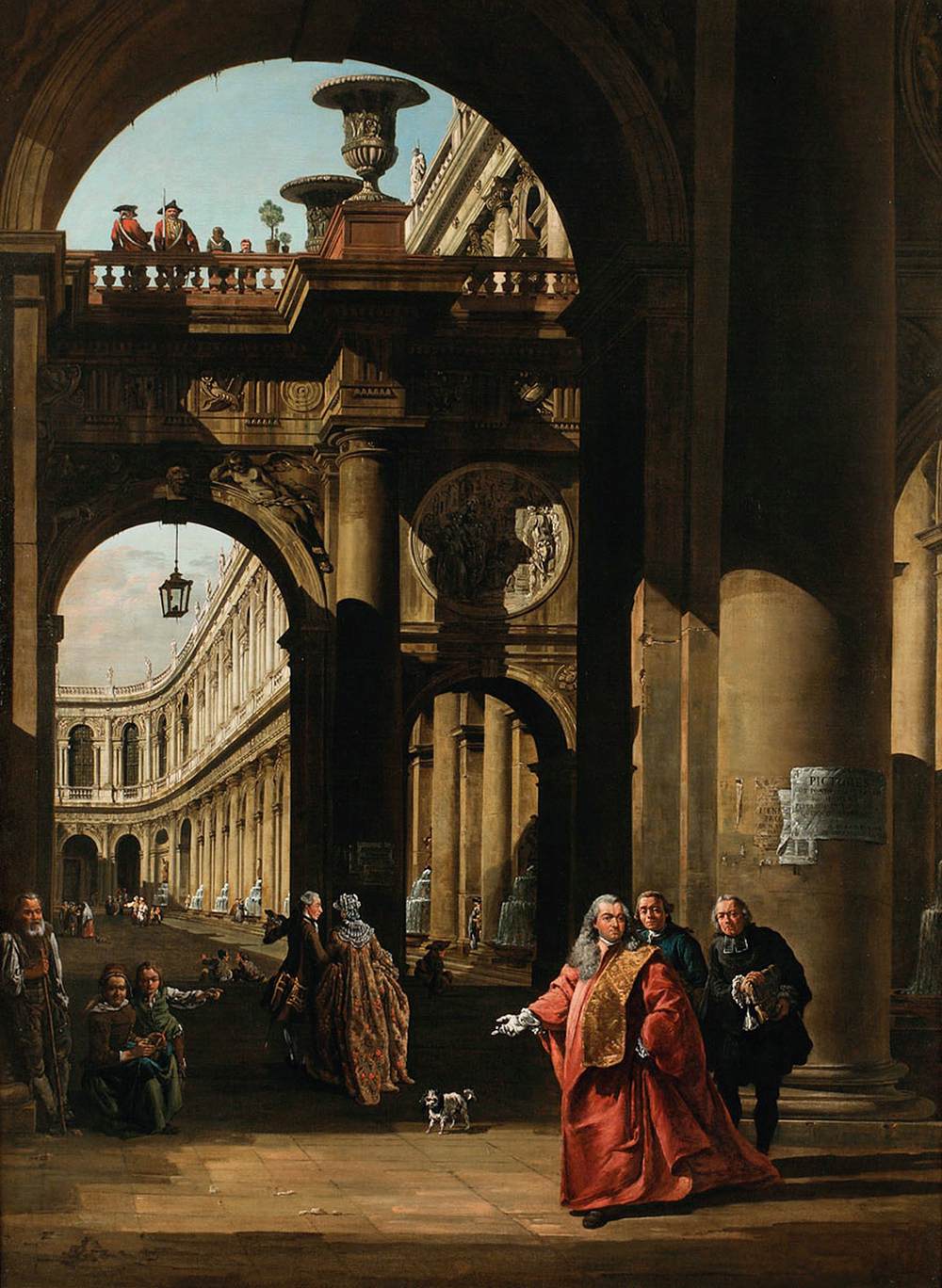
Architectural Capriccio with a Self-Portrait in the costume of a Venetian Nobleman by Bellotto (1765)

Bellotto took part in the Academy’s first exhibition on March 5th 1765.  He submitted four of his works, one of which was his painting entitled Architectural Capriccio with a Self-Portrait in the costume of a Venetian Nobleman.  It is an idealised setting incorporating a number of famous Venetian buildings including the Marciana Library.  The gentleman in the foreground wearing the red robes and a heavily embroidered sash on his left shoulder of a Venetian procurator is thought to be a self-portrait.  Look closely at the pillar behind the dignitary and you will see a handbill.  On it is a quotation by the Roman poet Horace:

Pictoribus atque poetis

Quidlibet audendi semper fuit aequa postestas

which translates to:


Painters and poets have always shared an equal right to dare to do whatever they wanted.

One can only believe that Bellotto added this poster with the saying of Horace to remind people that it is correct to believe that anything is possible.

View of Warsaw from the Royal Palace by Bellotto (1773)

Bellotto was not happy at the Academy and found it harder and harder to work under Hagedorn and so, half way through his three year tenure he requested a leave of absence so that he could travel to St Petersburg. Russia at the time was ruled by Catherine the Great who was known for her support for foreign artists.  On his way to Saint Petersburg, however, Bellotto accepted an invitation in 1764 from Poland’s newly elected King Stanislaus Augustus Poniatowski to become one of his court painters in Warsaw. Poniatowski was an avid art collector who wanted to add to his collection. Bellotto wrote to the Dresden Academy asking for an extension to his leave of absence and once granted he summoned his wife and daughters to come and live in Warsaw. His wages as court painter managed to elevate him financially to his former status.

Ujazdów Castle, by Bellotto (“Canaletto”) about 1775

Bellotto started to work on his royal commission to provide a number of paintings depicting panoramic cityscapes of both Warsaw and Rome to be hung at the royal palace, the Ujazdów Castle, which was situated just outside the city and was, at that time, being refurbished.   The idea of having depictions of the two cities side by side was to infer that Warsaw was the “new Rome”.   He was allocated the large room on the ground floor of the castle for his large works.  However, the refurbishments met with financial problems and the work was eventually abandoned, and in 1777, Bellotto’s paintings were moved to the Royal Castle in Warsaw.   As Bellotto painted more views of Warsaw, they took the place of some of the paintings depicting Rome.  His paintings were hung in the antechamber outside the Throne Room and were visible to the ambassadors and other dignitaries who had come for an audience with the king.  The room became known as the Canaletto Room and Bellotto’s paintings today are still to be seen in that room.

Views of Warsaw from the Suburbs of Praga by Bellotto (1770)

In its place at the centre of the south wall of the antechamber is Bellotto’s masterpiece, View of Warsaw from the Suburb of Praga.

The artist at work

It is an all-encompassing panoramic view of Warsaw which also incorporates a self-portrait of the artist sitting at his easel in the far left foreground.

Miodowa Street by Bellotto (1777)

Bellotto remained in Warsaw for sixteen years and died suddenly from a stroke in the city on November 17th, 1780 at the age of 59.  He was buried in the Capuchin Church at Miodowa Street. The street was the subject of his 1777 painting and the church where he was buried can be seen in the left background emerging from behind the trees. Bellotto’s wife, Elisabetta, died five years later and their daughter Theresia Francisca left the city with her husband and hundreds of her father’s paintings and went to live in Vilnius, Lithuania.

Bellotto completed more than three hundred paintings, about a third of which were cityscapes which glorified some of the great capitals of Europe.  The paintings were highly original but always managed to meet with the social and political demands of his patrons.

Bernardo Bellotto. Part 1.

In this blog I am returning to an artist I talked about almost nine years ago.  My artist today is Bernardo Bellotto who was born in Venice on May 22nd 1722.  He was the third-born child of Lorenzo Antonio Bellotto and Fiorenza Domenica Canal, who was the eldest of three sisters of Giovanni Antonio Canal, better known to us as Canaletto.  Bellotto’s started his initial artistic training at the age of fourteen when he worked in his uncle’s workshop.  Two years later, at the age of sixteen, Bellotto became a member of the Fraglia dei Pittori (Venetian painters’ guild). Bellotto trained in Canaletto’s studio and would help him to satisfy the growing demand for Venetian scenes. Bellotto would later point out the family connection by signing some of his works ‘Bernardo Canaletto’ or ‘Bellotto de Canaletto’.

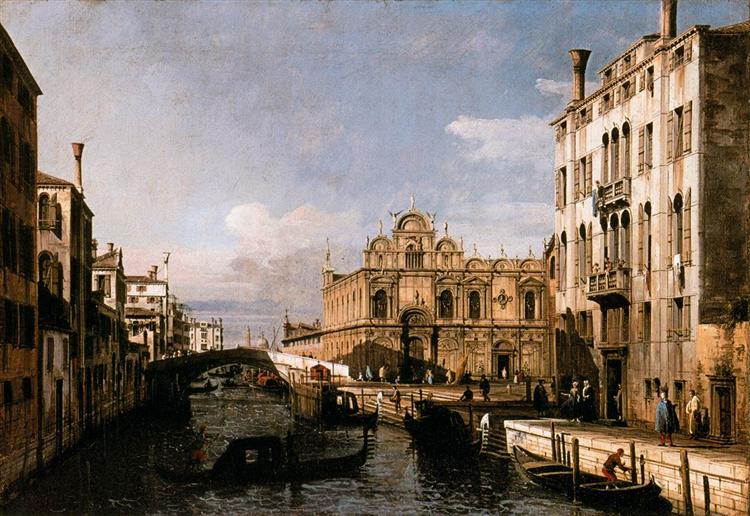
Rio dei Mendicanti and the Scuola di San Marco, 1738 - Bernardo Bellotto
Rio dei Mendicanti and the Scuola di San Marco by Bellotto (1738)

In around 1741, he and his uncle, Canaletto, took a trip along the Brenta canal to Dolo and Padua and during this time the two painters amassed a number of sketches which would be later transformed into completed oil paintings. On October 5th, 1741 a marriage contract was drawn up by Bellotto and his future father-in-law Giambattista Pizzorno, for permission for the artist to marry Elisabetta Pizzorno. On November 5th 1741, Bellotto married Elisabetta Pizzorno at Il Redentore church in Venice. A dowry of 850 ducats was agreed to be paid by the bride’s family to the groom at the time of marriage.  Their first child, Lorenzo, was born on October 15th, 1742. A further insight into Bellotto’s life around this time is a document submitted by his mother in which she declares that the family has been abandoned by her husband Lorenzo and that the only goods in her possession are those procured for her by Bernardo who, with his work, maintained her and his brother Pietro, both of them being resident in Bernardo’s home. The brother Pietro Bellotto, who was also an artist, also declared before the same notary to have learned the art of painting from Bernardo. In order to continue living with his brother and improve in his profession Pietro signs a pledge to give him one hundred and twenty ducats a year.

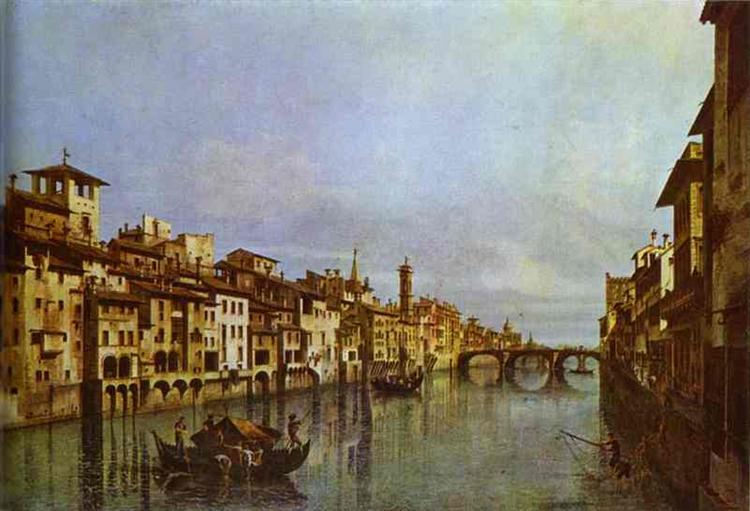
Arno in Florence, c.1742 - Bernardo Bellotto
Arno in Florence by Bellotto (1742)

In 1742 Bellotto set off on a painting trip and travelled extensively around the Northern Italian cities, stopping off at Florence and Lucca and during each stop he would complete a verduta of the place.   A verduta is a highly detailed, usually large-scale painting of a cityscape or some other vista.   These painting were very popular with the foreigners who travelled around Italy on their Grand Tour and wanted to bring home something to remind them of the places they had visited.

The Old Bridge over the River Po, Turin by Bellotto (1746)

Bellotto made a number of painting trips to Lombardy and during a stopover and around 1746 whilst in Turin he painted a view of the city. It was entitled The Old Bridge over the River Po, Turin and it was a commission he received from Charles Emmanuel, King of Sardinia and Duke of Saxony. If you look closely to the extreme left of the painting you will see an artist sitting before his easel which was presumably a reference to himself.   This and his other Turin depictions were large measuring 127 x 171cms and they were, as this was, sweeping panoramic views with such exquisite architectural detail of the brick tower and the bridge in the foreground. Look how well he has used light and colour to portray the reflections on still water and the hint with regards the moving currents. Bellotto eventually arrived in Rome where he studied study architectural and topographical painting and would remain in the Italian capital until 1743 at which time he journeyed back home to Venice.

Kreuzkirche by Bellotto (1747-56)

In May 1746 Bellotto’s uncle Canaletto left Venice for England where his paintings were in great demand.  A year later Bellotto also left Venice.  His destination was Germany and the city of Dresden where he hoped to forge a career and avail himself of some lucrative commissions.  His desire for commissions materialised within a year of his arrival as he became the court painter at the court of Friedrich August II, Elector of Saxony and soon Bellotto was the highest paid artist at the Saxon court.  The following decade was to be Bellotto’s most successful.

Dresden from the Left Bank of the Elbe, below the Fortifications by Bellotto (1748)

The city of Dresden and the outlying districts, such as the villages of Pirna, and Königstein with its magnificent Königstein hilltop fortress, all of which offered Bellotto the chance to paint beautiful cityscapes and rural landscapes. In all, Bellotto completed thirty different paintings for the Elector.  Fourteen depicting views of the city of Dresden and its wonderful buildings, eleven of Pirna and its surrounding rural landscapes and five of the magnificent Königstein fortress.

The Neumarkt from the Judenhof, Dresden by Bellotto (1748-9)

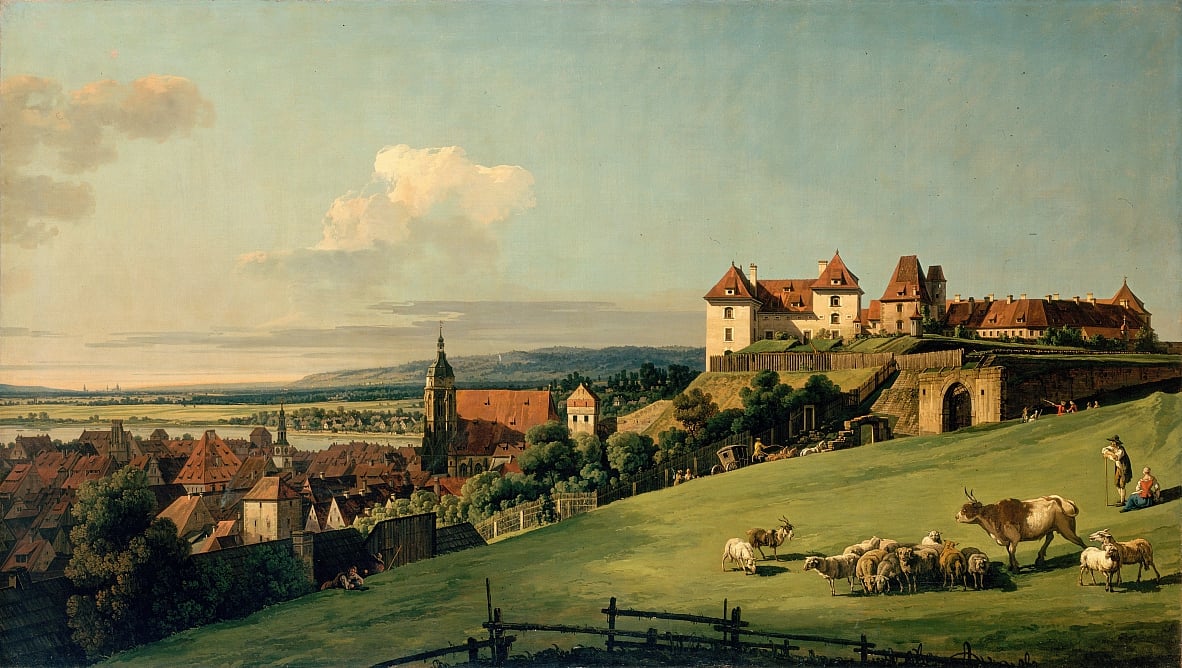
View of Pirma from the Sonnenstein Castle by Bellotto (1755)

The city of Dresden and the outlying districts, such as the villages of Pirna with the nearby Sonnenstein Castle, and Königstein with its magnificent Königstein hilltop fortress, all of which offered Bellotto the chance to paint beautiful cityscapes and rural landscapes. In all, Bellotto completed thirty different large scale paintings for the Elector, each between two and three metres wide.  Fourteen depicting views of the city of Dresden and its wonderful buildings, eleven of Pirna and its surrounding rural landscapes and five of the magnificent Königstein fortress. The finished works were to be hung in the royal painting gallery in the Stallhof, which forms part of the Royal Palace in Dresden. Bellotto’s depictions of the city of Dresden were remarkable for their topographical meticulousness, mathematical perspective and the way in which he portrayed the way the light played on the various architectural structures.  The way he handled the light was truly remarkable.

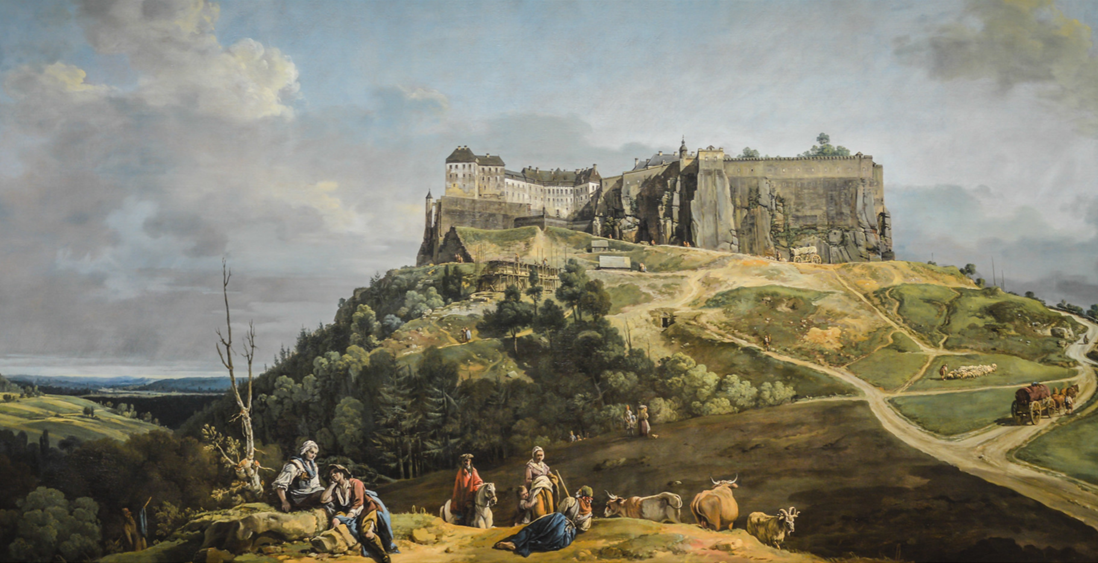
The Fortress of Königstein by Bellotto (1756-58)

This painting is part of the NGA Washington. This depiction by Bellotto of the Fortress of Königstein is one of five large canvases, commissioned by Augustus III in the spring of 1756 but never delivered, depicting the renovated medieval fortress in the countryside near Dresden. 

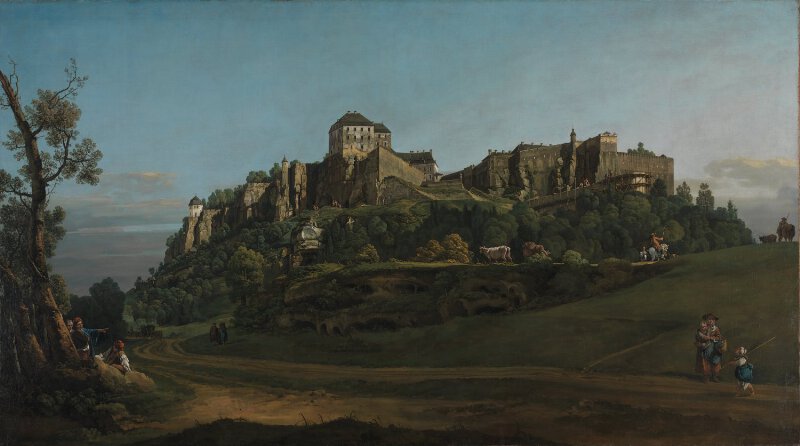
The Fortress of Königstein from the North by Bellotto (1756-58)

Bellotto having received the royal commission to complete thirty large scale paintings of Dresden, Pirna and Königstein was proceeding well with the commission.  The Elector’s commission had enabled Bellotto to live a life of luxury.  He had an seven reception rooms in his Dresden apartment which was awash with luxurious furnishings, Venetian mirrors and fine wallpapers and fabrics.  Life could not have been better.  What could possibly go wrong?  The answer to that question was the Seven Year War, which broke out involving all the main European “players”.  The Prussian army invaded Saxony and entered the city of Dresden and Augustus, the Elector of Saxony and Bellotto’s patron fled the city and barricaded himself in at the Königstein fortress for several months before escaping to Warsaw.  Bellotto left Dresden and his luxurious home and went to Pirna. 

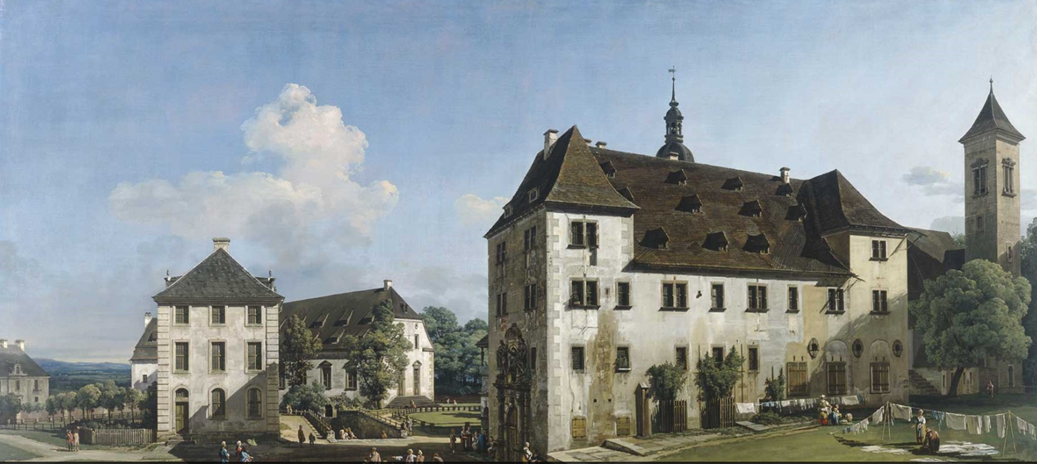
The Fortress of Königstein: Courtyard with the Magdalenenburg by Bellotto (1756-58)

This view from the south of Königstein includes several buildings within the fortification: the southern end of the Brunnenhaus facing us to the left, the Georgenburg oblique behind it, and the Magdalenenburg in the foreground

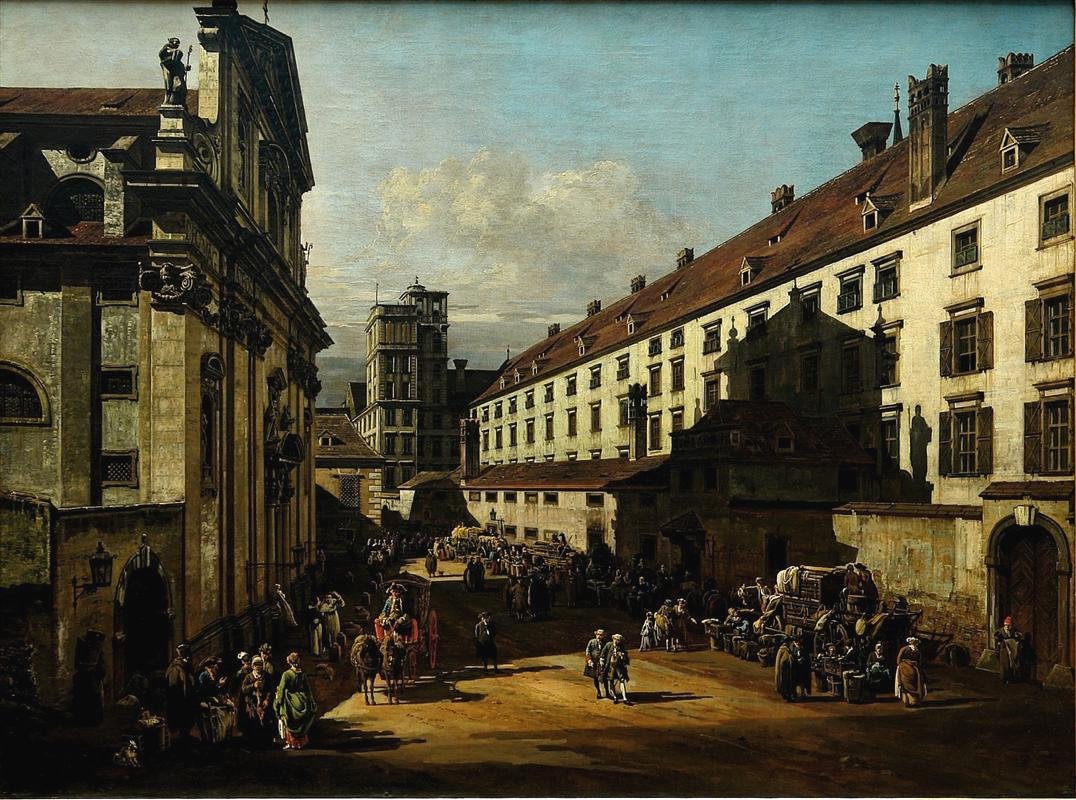
Dominican Church, Vienna by Bellotto

In 1758 Bellotto and his sixteen-year-old son obtained passports to travel to Bayreuth from where he completed an onward journey to Vienna.

Canaletto (I) 037.jpg
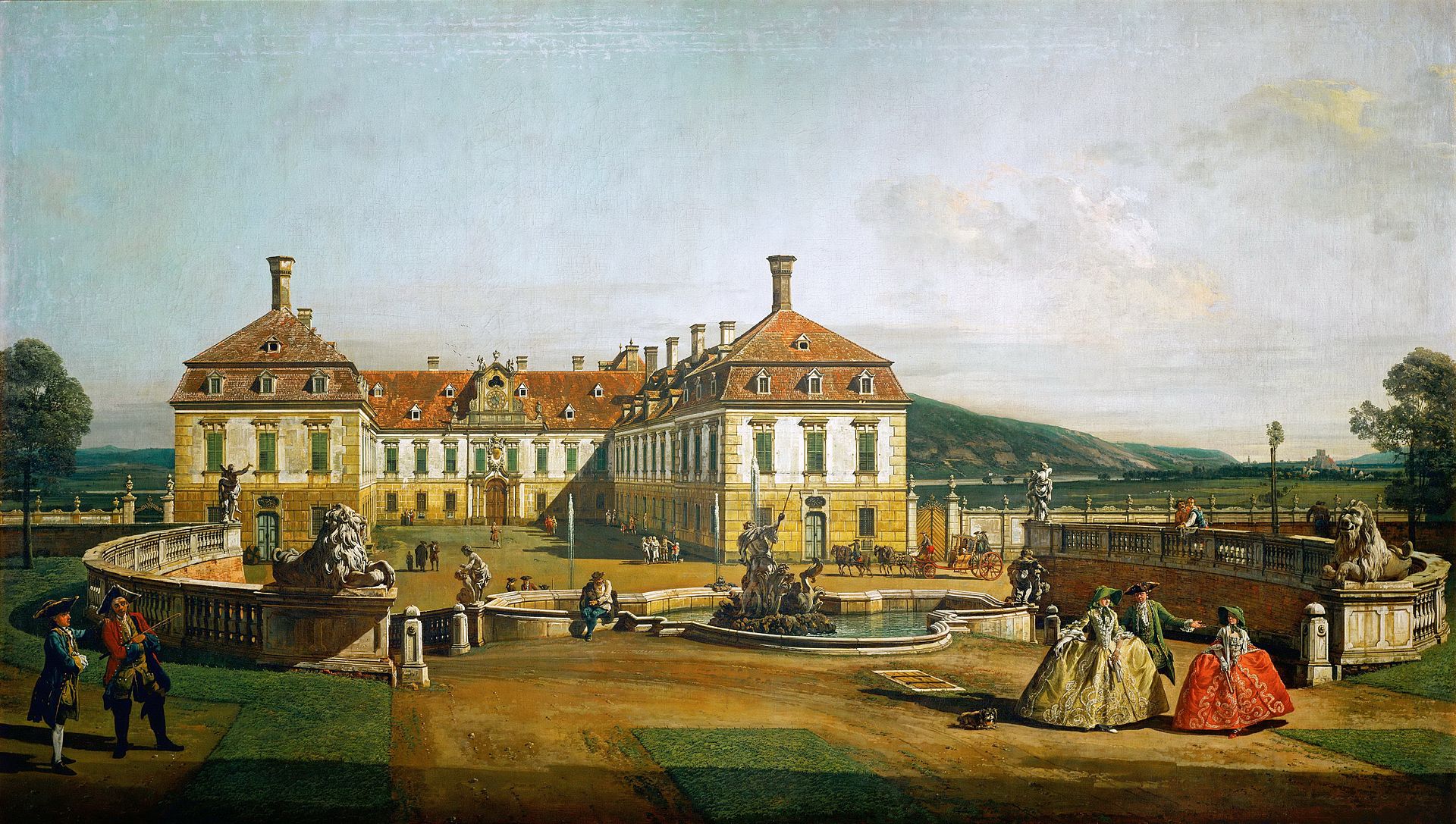
Schloss Hof by Bellotto

Shortly after his arrival in Vienna, Bellotto received a couple of private painting commissions.  One was from Prince of Liechenstein and one from Wenzel Anton, the Prince of Kaunitz who was also chancellor to Empress Maria Theresa.  Not only were they lucrative commissions it gave Bellotto a chance to receive a thirteen painting commission from the Empress herself.  The commission tasked the artist to complete six depictions of the city of Vienna and seven much larger panoramic views of Schönbraun and Schloss Hof imperial palaces and their gardens.

The Dominican Church in Vienna by Bellotto (1758)

For the two years Bellotto was in Vienna with his son he worked non-stop producing paintings for the Empress’ commission and other commissions for members of her court. This phenomenal output can also be put down to the help he received from his son Lorenzo. The resulting depictions were amazing and offered to serve as testimony of Vienna’s imperial magnificence

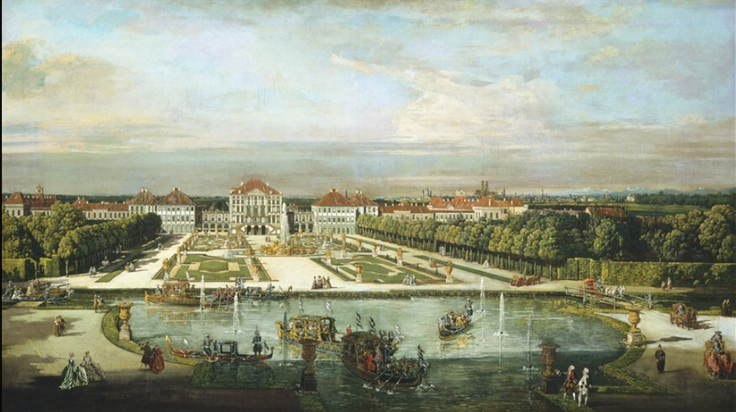
Nymphenburg Palace, Munich, by Bellotto (c. 1761)

In 1761, after almost two years in Vienna, Bellotto left the city and travelled, not to Dresden where his wife and daughters lived, but to Munich.  This could have been because of the on-going troubles with the Prussian invaders.  He had been given authorisation to visit the German city through a letter from Empress Marie Theresa to her cousin Maria Antonia, the Princess of Bavaria, who had fled from Dresden since the Prussian siege.  Once there Bellotto was commissioned to paint panoramic views of Munich and the Baroque Nymphenburg Palace in the western suburbs of the city, which was Maria Antonia’s birthplace and summer residence.

The Ruins of the Old Kreuzkirche in Dresden by Bellotto (1765)

At the end of 1761 Bellotto returned to his home Dresden to find it devastated during the Prussian invasion.  Worse, was the fact that he found himself in great financial difficulty arising from the death of two of his major patrons, Augustus III, Elector of Saxony and King of Poland and Count Heinrich Bruhl, the prime minister of Saxony in 1763.  Their deaths and his financial situation made Bellotto melancholic and it was around this time that he painted the Kreuzkirche which now lay in ruins.  It had been partially destroyed during the Seven Year War, at a time when Bellotto had been forced to flee the city.  The painting is entitled View of the Kreuzkirche in Ruins and was completed by Bellotto in 1765.  The Kreuzkirche is the oldest church in Dresden and, during the conflict, was shelled by Prussian artillery.   The building was set ablaze and finally collapsed. The church tower, though damaged, remained standing.  Work commenced on the reconstruction of the church and it was decided to preserve the original tower. Unfortunately, in June 1765, with the construction of the new church already under way, the greater part of the tower collapsed.  The painting is a good example of how Bellotto unique, capacity to capture the spirit of an event.  His depiction of the ruin  is an unusual one for it is not an ancient ruin as far as the artist was concerned.  It was a relatively new one as the destruction had only occurred five years earlier.   Bellotto had completed a work depicting the great church some years earlier (see painting earlier in the blog).   However, in this work, we see are the jagged remnants of the church rear up skywards.   The cleanliness of the once beautiful church has gone.  There is nothing clean about the church now.   The scene before us is just a mass of noise and dirt.  It is a chaotic scene which we find hard to believe that it could ever be put back to its former glory.   The Church, as the body of Christ, has been violated all over again and the civic wounds of the German city have been violently opened for all to see.  This is the price to be paid when once we set forth to war.  In the painting we see many of Dresden citizens.  Close to the ruins we can just make out craftsmen as they start their preparations to rebuild the once –beautiful edifice.  On the periphery we see men and women dressed in their best clothes staring at the ruin.  For them it was just a day out to visit the site where the destruction had taken place.  For them it was just blatant voyeurism.

Dresden Kreuzkirche 2008.jpg
Kreuzkirche , Dresden (2008)

……………………………….to be continued.

Pinturicchio . The Master of Frescoes – The Baglioni Chapel

In my last blog I looked at the Pinturicchio frescoes in the Bufalini Chapel and although the artist had painted numerous frescoes in many places of worship, in this blog, I just want to focus on his artistry in the Bagnoli Chapel, part of the Collegiate church of Santa Maria Maggiore, in the town of Spello, Perugia and the frescoes executed by him at the start of the sixteenth century during one of last major commissions.

Datei:Pinturicchio - Christ among the Doctors (detail) - WGA17775.jpg
Troilo Baglino (left), fresco detail by Pinturicchio in the Baglioni Chapel 

Troilo Baglioni was the prior, later bishop and protonotary of the Church of Santa Maria Maggiore in Spello, an ancient town and commune of Italy, in the province of Perugia in east central Umbria. He was in charge of the management of the chancellery of that church and the diocese and it was he, who, in 1500, commissioned Pinturicchio to decorate the walls of the Cappella Bella which later became known as the Baglioni Chapel .  Pinturicchio and his workers set about the task in the Autumn of 1500 and completed the commission in the Spring of 1501.  The paintings, typically for Pinturicchio, were completed in such a short period as he had around him, a well-organized workshop, with other masters painting above his drawings. The finished product ensured his artistic reputation and prominence in Umbria.

Baglioni Chapel

The chapel has a quadrangular floor plan with a cross-vault. The entire chapel, all three walls and the ceilings, are covered in frescoes.  The frescoes are themed stories about the childhoods of Mary and of Jesus. a pictorial account of the Annunciation, the Adoration of the Shepherds, and Jesus at the Temple..

The vaulted ceiling of the Baglioni Chapel

On the vaulted ceiling, we see depicted four Sibyls, female prophets, Tiburtina, Eritrea, Europea and Samia, seated on thrones and flanked by cartouches with prophecies of the coming of Jesus Christ.

As you enter the chapel, on the left wall, there is Pinturecchio’s fresco of the Annunciation, which is set in a large Renaissance loggia.  As we look at it our eyes are drawn through, what is termed, the hortus conclusus (enclosed garden) towards the handsomely and meticulously detailed landscape background.  The two main characters in the fresco are Mary and an angel.  Mary had been reading a book which was on a tall ornate wooden lectern but has now been distracted by the angel, who kneels before her with a white lily in one hand, symbolising  virginal purity.  Above them we see God the Father depicted encircled by angels and giving off a ray of light which incorporates the Holy Ghost in the form of a dove (just above the lectern).

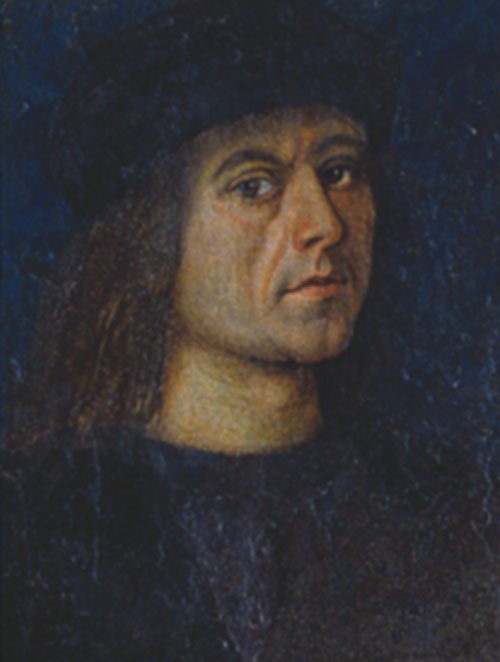
Look to the lower right of this fresco.  What is strange about this fresco is that if you look closely under the small bookshelf, you will see a portrait.  In fact, it is a self-portrait of Pinturicchio, featuring the bejewelled inscription, “BERNARDINVS PICTORICIVS PERVSIN[VS]” referring to Pinturicchio’s birth name of Bernardino di Betto.

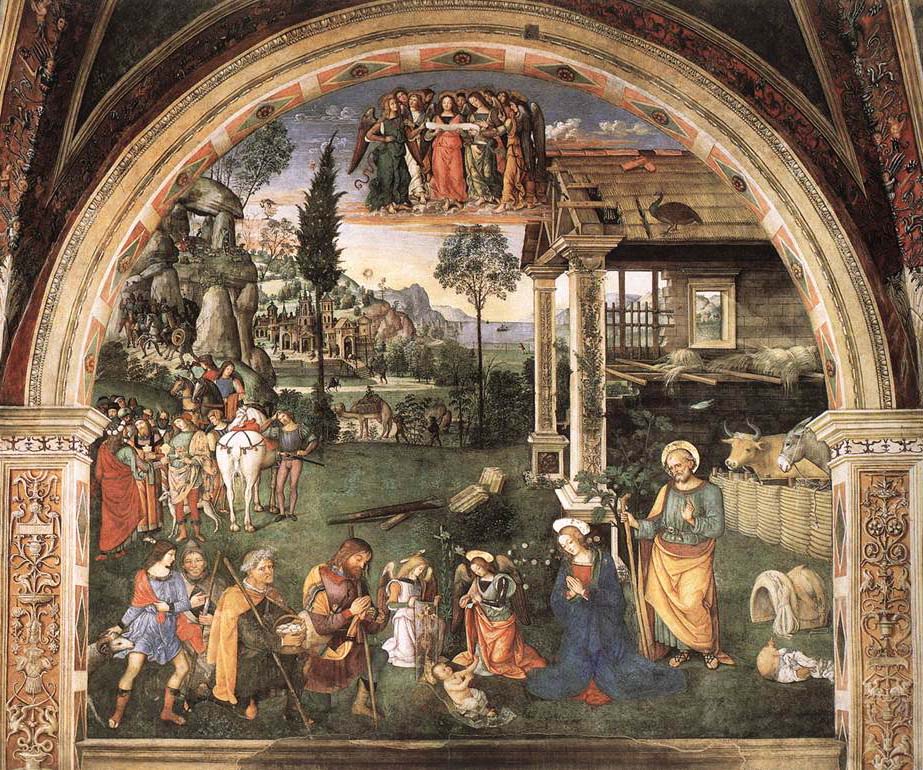
The Adoration of the Shepherds by Pinturicchio (1501)

The rear wall of the Baglioni Chapel features the fresco depicting the Adoration of the Shepherds. It is a depiction of an idyllic scene within an extensive landscape and includes a number of  secondary motifs. In the background, we can see the arrival of the camels of the Magi procession.  The setting in the foreground is a grassy area in front of the stable, and a line of shepherds who have come to visit and bring gifts to the mother and the new-born child.  

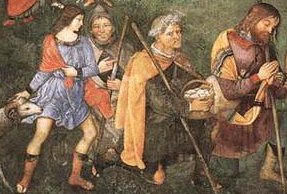
The Shepherds by Pinturicchio

The three shepherds stand out as being over-sized.   They have expressive and detailed features, after the fashion of early Netherlandish painting which influenced Pinturicchio. Their facial characteristics are in a way crude, almost scowling and differ greatly from anything else in Pinturicchio’s repertoire of figures. The one exception is the young man on the left with a goat. This is depicted with a more idealized beauty, inspired by ancient reliefs with sacrifice motifs.

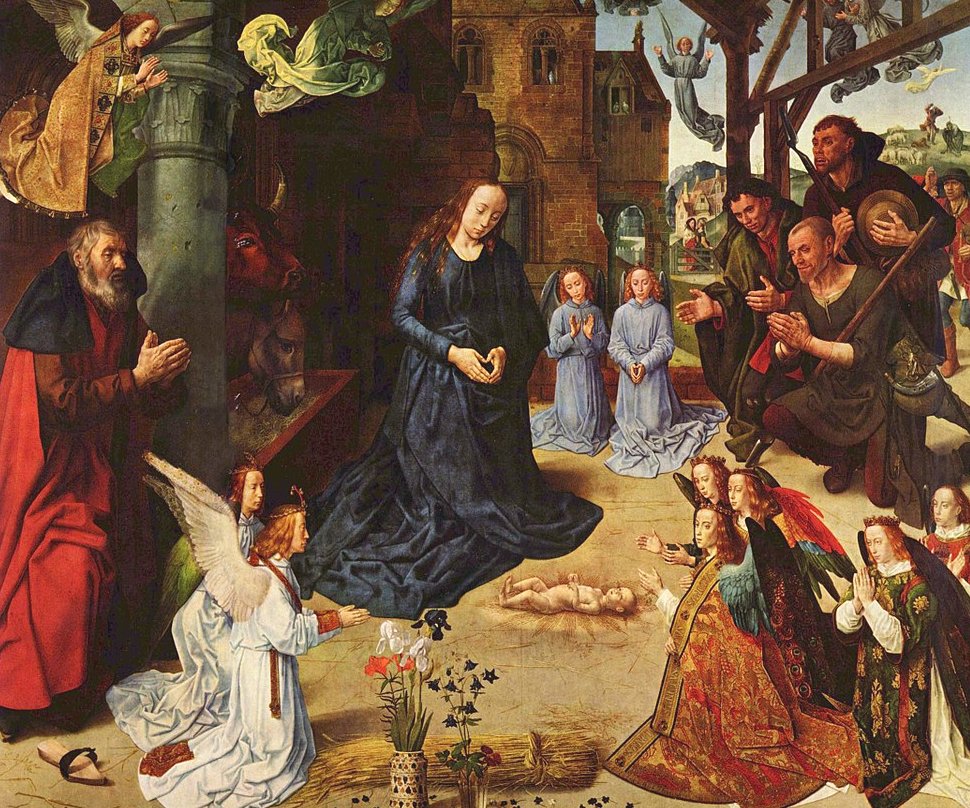
The central panel of the Portinari Altarpiece by Hugo van Goes (1472)

Art historians have put down Pinturicchio’s depiction of his “crude scowling” shepherds as being influenced by the figures of the shepherds in the Portinari Altarpiece which was painted by Hugo van der Goes around 1472.

The figures of the shepherds in the Portinari Altarpiece

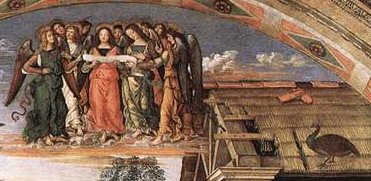
In the left background of the fresco on the rear wall we see a meticulously drawn town at the foot of a mountain.  To the right we see a temple-like stable with a window through which we can see a mountainous landscape.  On the roof of the stable sits a peacock, a symbol of immortality. 

In the sky above the nativity scene we observe a cluster of angels on a bank of clouds.  They are celebrating the birth of Jesus in song.

On the right-hand wall as you enter the Baglioni Chapel there is a large fresco pictorially recounting the story of the Dispute with the Doctors. .  It is based on an occurrence in the early life of Jesus depicted in Chapter 2 of the Gospel of Luke.  Twelve-year-old Jesus had accompanied Mary and Joseph, and a large group of their relatives and friends to Jerusalem on a Passover pilgrimage.. On the day of their return, Jesus hung back in the Temple, but Mary and Joseph thought that he was among their group and she and Joseph headed back home.  It was not until a day after they returned that they realised Jesus was missing, so they returned to Jerusalem, finding Jesus three days later among a group of philosophers.   

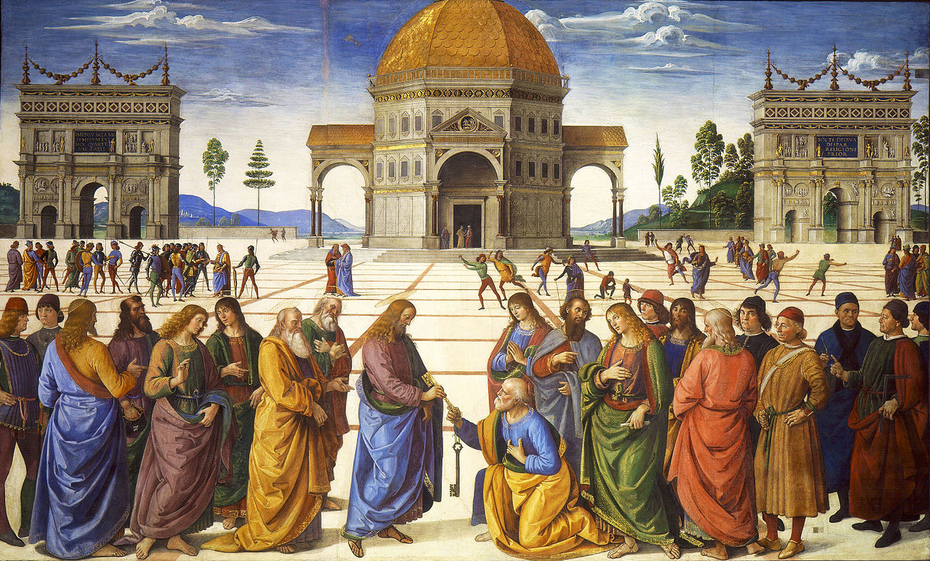
In the background we see the Temple of Jerusalem with its large dome.  The scene follows an arrangement which Pinturicchio had already used in his fresco on the wall of the Bufalini Chapel, which itself originated from a Perugino fresco in the Sistine Chapel, Delivery of the Keys.  At the centre of the depiction stands the Child Jesus who is debating with and surrounded by two groups of philosophers from the Temple of Jerusalem. His books are scattered on the pavement in front of him. By contrast, the richly dressed scholars either clutch their books close to their chests or read aloud from them. The temple can be seen in the background and is characterized by a large dome. The crowd is formed by standard set of characters which includes young spouses, wise men, toothless women and others, all of whom are witnessing the dispute.

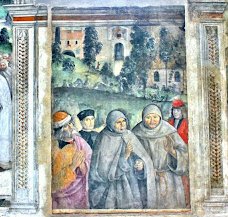
On the left of the crowd, dressed in the dark robes of a protonotary apostolic (a prelate who is a member of a college charged with the registry of important pontifical proceedings). It is a portrait of Troilo Baglioni, who commissioned the frescoes for his chapel

[Photo Credits: tyle_r]
Pinturicchio’s frescoes in the Piccolomini Library

Pinturicchio’s many paintings and frescoes can be seen throughout Italy.  Between 1481 and 1482, he worked in Rome, and collaborated with Perugino on the frescoes of the Sistine Chapel. From this his career flourished and he worked uninterruptedly in the service of five popes: from Sixth IV to Julius II, passing through Innocent VIII, Alexander VI, and Pius III.  He also received commissions from well-to-do and important clients such as the della Rovere family and Pandolfo Petrucci, the lord of the Italian Republic of Siena.. In Siena, among the many works, he created the extraordinary cycle of the Piccolomini Library in the Duomo of Sienna, and completed frescoes in the chapel of San Giovanni Battista.

Bernardino di Betto (Benedetto), the Italian painter known as  II Pinturicchio dies in Sienna in 1513 aged 61.

Pinturicchio the Master of the Fresco. Part 1.

Over recent months I seem to have concentrated on writing about artists who were practicing their trade during the Victorian period and the first couple of decades of the twentieth century.  Yet, when I look back on my earliest blogs I seemed to have favoured the Dutch and Flemish painters of the sixteenth and seventeenth centuries.  Today I am going to deviate again and look at the life and work of the fifteenth century Italian Renaissance painter Pinturicchio.  I came across the artist and one of his major fresco commissions when I read the excellent blog io sto a casa, written by Jackie, an American teacher who lives with her Italian husband in Le Marche, Italy. She and her husband are lovers of art and often travel around the country visiting places of interest which hold artistic treasures.  It was she who mentioned the artist Pinturicchio in one of her recent blogs.

2008 Italian postage stamp

Bernardino di Betto was born around 1454 in the Italian city of Perugia.  He was also known by his nickname, Il Pinturicchio, meaning “little painter” because of his small stature.  His parents were a family of artisans, his father being a cloth tanner.  His early life seems to have been filled with unhappiness, compounded by the death of his father from the plague when Pinturicchio, was just a teenager.  His first foray into the world of  fine art came when the talented miniaturist, Giapeco Caporali opened a bottega (a workshop of a major artist in which other artists may participate in the execution of the projects or commissions of the major artist) close to Pinturicchio’s father’s house at Porta Sant’Angelo. Pinturicchio worked there for a time and would take a share of the profits of the work completed in the studio.  In 1481 Pinturicchio joined the painters’ guild in Perugia.  Perugia was at that time experiencing a great artistic fervour and the central Italian city was becoming a renowned hub for artistic activities of which Pinturicchio contributed. Once Pinturicchio had enrolled in the guild of Artists and Painters in Porta Sant’Angelo, Perugia, his output began to be recorded.  He received many commissions and joint commissions for his fresco work.

Basilica of Santa Maria in Aracoeli in Rome

Meanwhile, in Rome, the first phase of the work on the Sistine Chapel had been on-going.  The fresco work had been carried out by some of the Italian Masters, such as Botticelli, Perugino, Ghirlandaio, Signorelli,  Cosimo Rosselli and Pinturicchio.  The first phase of this massive undertaking came to an end around 1482 and most of these Italian Masters returned to their home cities.  This is with the exception of Pinturicchio who did not go home but instead remained in the city and set up a workshop. as he could take advantage of the opening left by the other great artists. He then chose a group of Italian painters who had collaborated with him at the papal chapel.  His group contained artists from the many regions of the country who were willing to remain in Rome and work for him.    Having set up this group and with many of the renowned artists having left the eternal city he was awarded his first commission in Rome by Nicolò Manno (Riccomanno) Angeli Bufalini, a consistorial lawyer and one-time bishop of Venafro, for his family chapel which was part of the Basilica of Santa Maria in Aracoeli in Rome, which stands on the Capitalone hill. Pinturicchio’s frescos in the Bufalini Chapel depicted scenes from the life of Saint Bernardino of Siena and Saint Francis. The commission was to remember the reconciliation that took place between the Bufalini family and the Baglioni of Perugia, thanks to St. Bernardino.

Bufalini Chapel ceiling

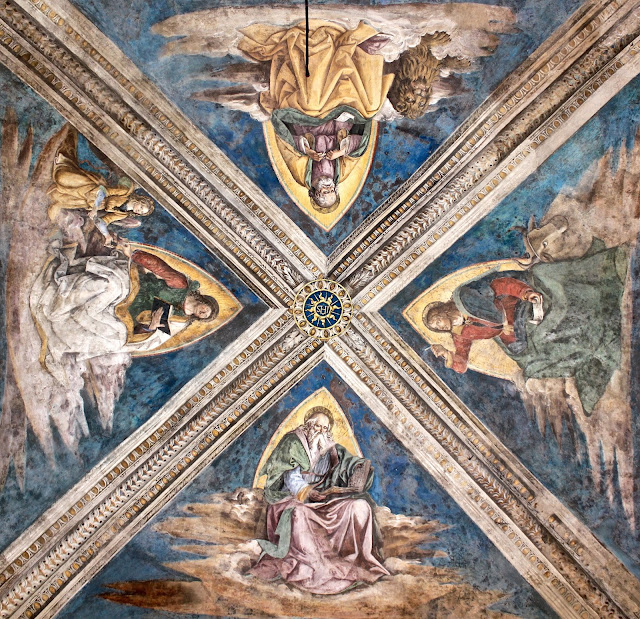
Pinturicchio and his team set to work on the chapel around 1484.  On the vaulted ceiling there are depictions of the four Evangelists, Matthew, Mark, Luke and John, each seated on a cloud, in front of a dark blue, star-studded background.  

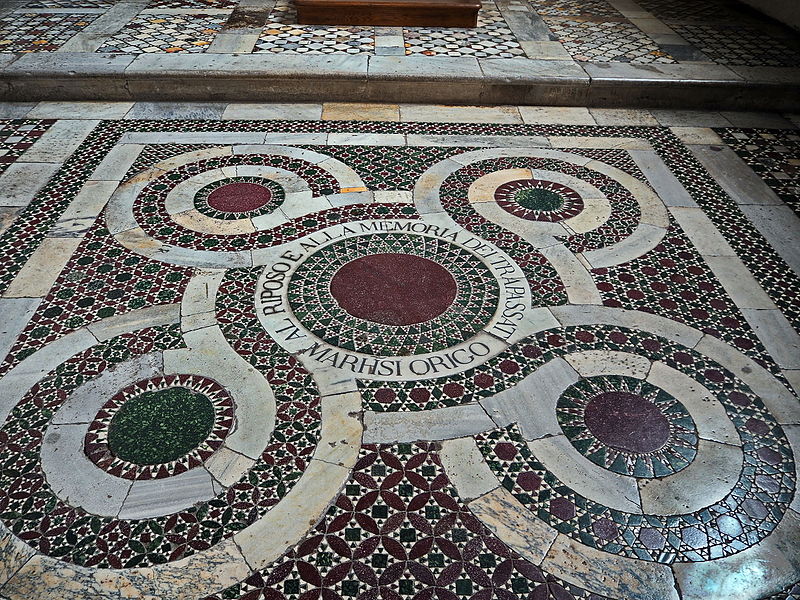
Bufalini Chapel floor

The chapel itself has a quadrangular base, with the vault and floor decorated with cosmatesque mosaics. The Cosmatesque style takes its name from the family of the Cosmati, which flourished in Rome during the twelfth and thirteenth centuries and practiced the art of mosaic.   The inside of the chapel comprises of three sides and the frescoes on the three walls are dedicated to the life and miracles of St. Bernardino of Siena, an Italian priest and Franciscan missionary, who was canonized as a saint in 1450, and who was very popular during the Renaissance.  The frescos also featured two stories of St. Francis.

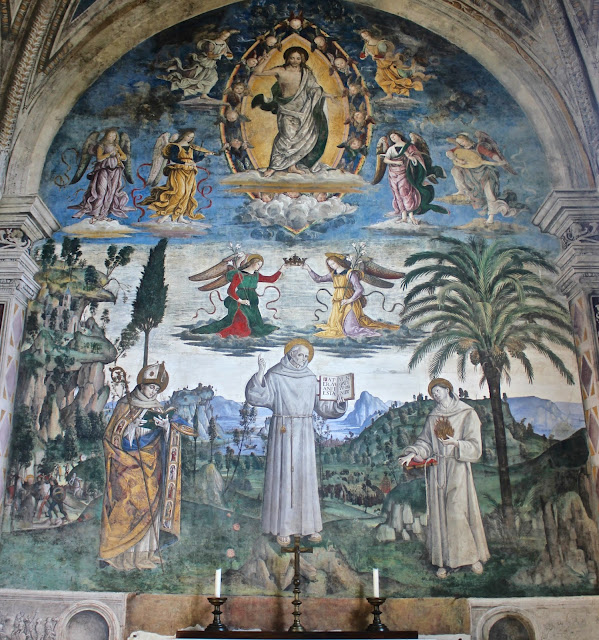
The back wall of the chapel, the altar wall, is decorated by a fresco entitled The Glory of Saint Bernardino.  It is horizontally divided into two sections.  The lower section depicts San Bernardino standing on a rock with outstretched arms.  His right hand points up to Christ. In his left hand he holds an open book in which one can read:

PATER MANIFESTAVI NOMEN TVVM OMNIBVS

“Father, I have shown your name to everyone”,

Above him are two angels who are in the process of crowning him.  Either side of him stand two saints,.  On his right is St. Louis of Toulouse adorned in in his solemn episcopal robes and on his left stands Saint Anthony of Padua in a Franciscan habit..  In one of St Anthony’s hands he holds the flame symbolising his piety whilst in the other he holds a book symbolising his knowledge.  The background of this lower section is a landscape with rocks, lakes and mountains, which extends the depth of the space.  This scene is probably one Pinturicchio would have recalled from his homeland.

In the upper part of the fresco we see Christ in the act of blessing.  His figure is encased in a mandorla. The term mandorla means an almond-shaped frame that surrounds the totality of an iconographic figure.  Surrounding Christ are worshiping and music-making angels.

Left-hand wall of the Bufalini Chapel

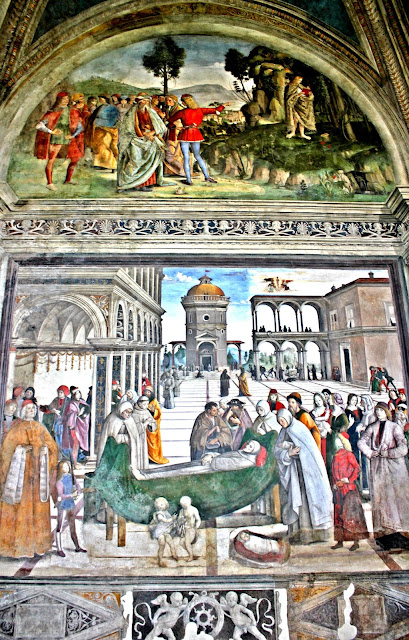
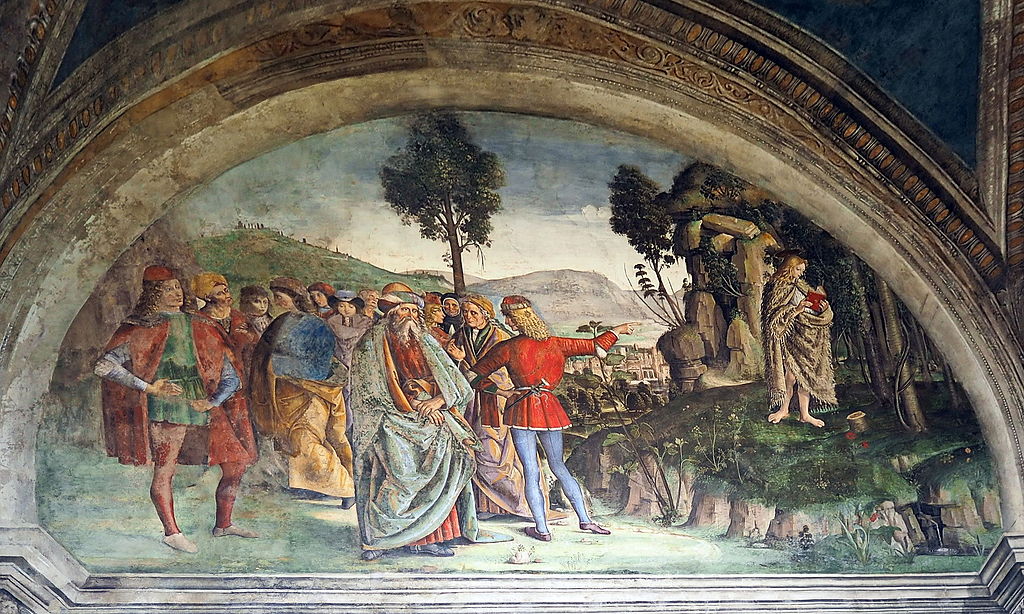
On entering the Bufalini Chapel, the wall to the left comprises of two scenes one atop the other, divided by a painted frieze. The upper part is a lunette, a half-moon shaped, or semi-circular, arch, which depicts St. Bernardino being penitent before the Porta Tufi in Siena and this fresco shows a young Bernardino’s first hermitage.

Upper lunette

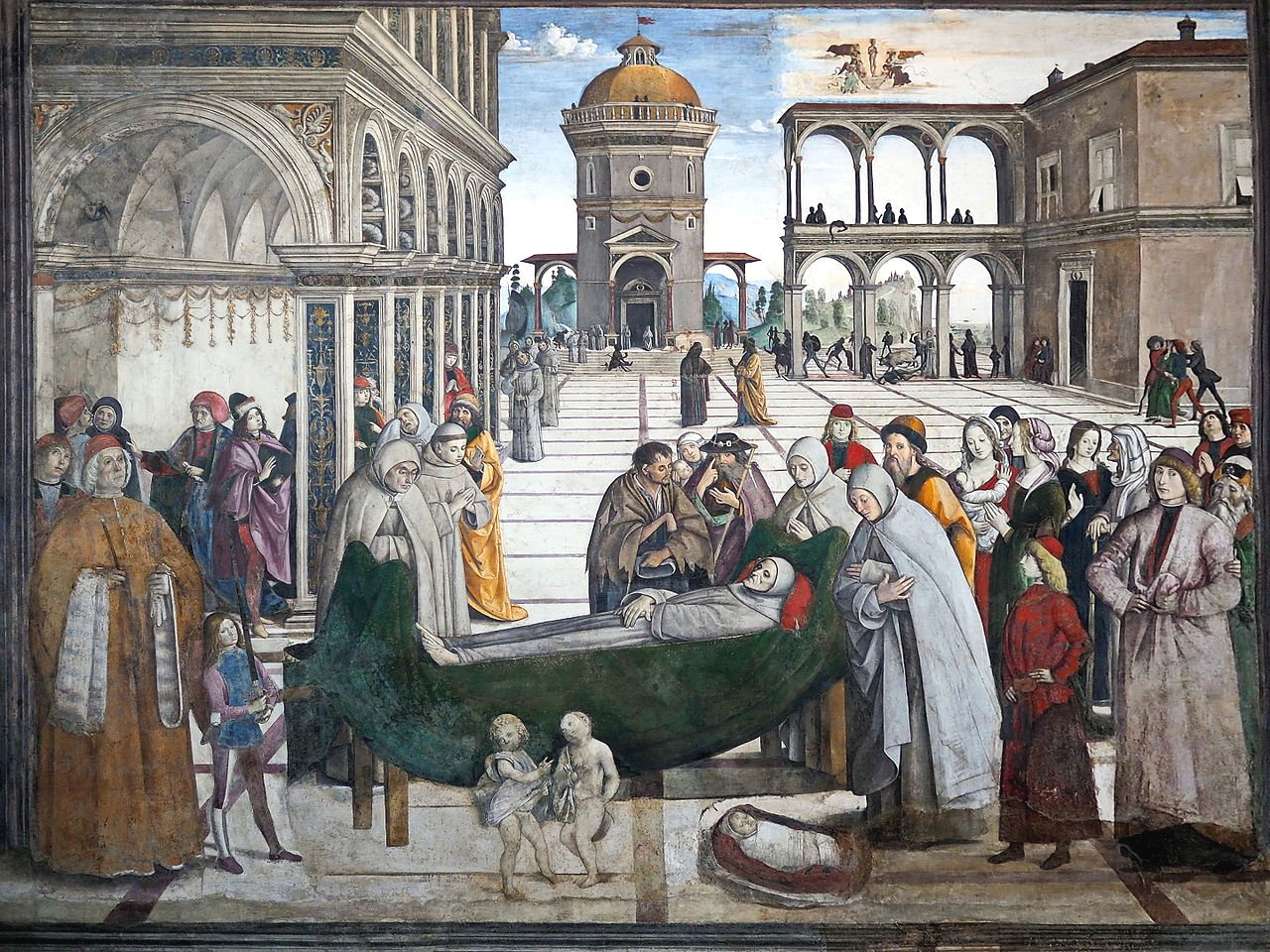
The fresco on the lower part of the left-hand wall is much more interesting.  It depicts the Funeral of Saint Bernardino. 

The fresco on the lower part of the left-hand wall is much more interesting.  It depicts the Funeral of Saint Bernardino.  The setting is a city scene with a chessboard-like pavement.  It is painted using geometrical perspective, which enables the depiction of a three-dimensional form as a two-dimensional image which carefully looks like the scene as visualized by the human eye.  The vanishing point is a building similar to one depicted in Perugino’s painting, Delivery of the Keys, although Pinturicchio has two buildings of different heights at the sides. On the left is a loggia,  a covered exterior gallery or corridor, supported by piers decorated with fanciful gilded candelabra. On the right is a cubic building connected through a double loggia to the landscape and the bright sky in the background.

See the source image
Pietro Perugino’s painting, Delivery of the Keys.(1482)

The foreground is dominated by the Saint Bernardino’s funeral. We see his body laid out on what is termed a catafalque, a decorated wooden framework supporting the coffin of a distinguished person during a funeral or while lying in state. Its presence increases the sense of spatial depth

Riccomanno Bufalini

All sorts of folk, friars, pilgrims and the “common” people approach the body to pay their respect. Look at the tall figure in the left foreground wearing the brown robe, with a fur-lined hood and gloves.  He is Riccomanno Bufalini, the person who commissioned the frescoes.

Sight restored.

The remaining characters we see standing around the coffin often portray a series of miracles attributed to Bernardino during his life.  We see the once-blind man who was healed and given back his sight by the body of Bernardino, standing by the head of the coffin pointing to his eyes.  There is the resurrection of someone possessed by the Devil, the healing of the stillborn baby of John and Margaret Basel, the healing of Lorenzo di Niccolo da Prato, wounded by a bull, and the pacification of the warring Umbrian Bufalini and Baglioni families.

The Blessing
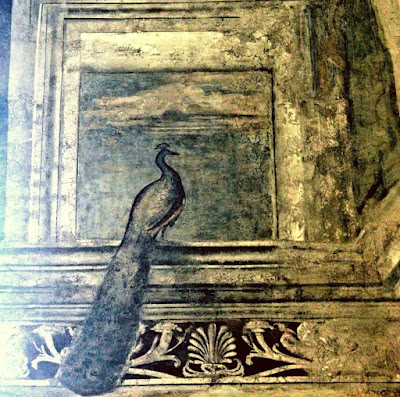
The peacock

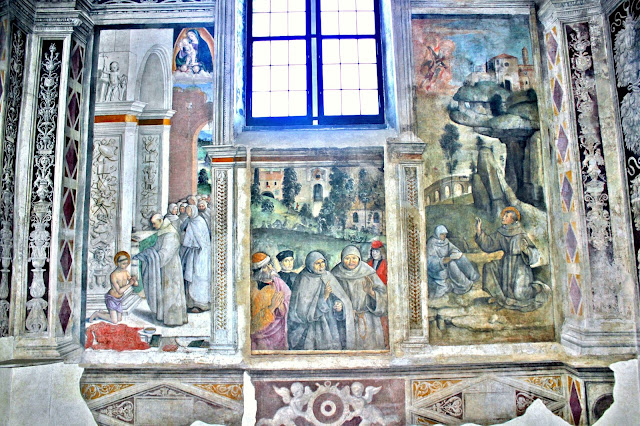
The right wall of the Bufalini Chapel features a double mullioned window.   Pinturicchio has implemented an illusionistic perspective, when he painted two imitation symmetrical windows, one depicting a blessing from God the Father and the other featured a peacock which was an early Christian symbol of immortality.

There is also a fresco featuring, on the left, a scene from the life of St. Bernardino of Siena in which we see him receiving the religious habit. It is set in an oblique perspective that exploits the decorated pillars with a grotesques arch. Finally, there is a small scene on the right featuring, in the background, a view of the Verna Sanctuary over a rocky peak which depicts St. Francis in the act of receiving the stigmata, in honour of the Franciscan foundation of the Aracoeli.

Under the real window is an illusory opening depicting five characters: among them is an aged friar, perhaps the convents prior, and a lay figure that resembles him, perhaps an administrator of the basilica.

In the next blog I will be looking at the frescoes by Pinturicchio on the walls of the Baglioni Chapel in Spello.

………………………………to be continued.

Joseph Edward Southall

See the source image
Joseph Edward Southall

The Arts and Crafts Movement was a design movement which emerged from the Pre-Raphaelite circle with the founding of the design firm Morris and Co. in 1861 by William Morris.  It was a design movement which aspired to enhance the quality of design and make it available to the widest possible audience.  The term was not coined until 1887 and the Arts and Crafts Movement officially started when Morris and fellow artist, Edward Burne-Jones established a group that they called the Birmingham Set or Birmingham Group.   They were an informal collective of painters and craftsmen who worked in Birmingham, England in the late 19th and early 20th centuries. My featured artist today, Joseph Edward Southall, was one of the leaders of this group.  He was probably the most important, if not the most celebrated artist of that group and was looked upon as among the most dedicated.

See the source image
Self portrait by Joseph Southall (1925)

Joseph Edward Southall was born in Nottingham on August 23rd 1861, the son of a grocer, Joseph Sturge Southall, and his wife Elizabeth Maria Baker, both offsprings of distinguished Quaker families. Just a year after the birth of Joseph Southall his father died aged twenty-seven and Joseph and his mother had to go and live with his maternal grandmother in Edgbaston, a suburb of Birmingham

Joseph Southall’s education was to attend Quaker schools.  He attended the Friends’ School at Ackworth and in 1872, at the age of eleven, transferred to the Friends’ School at Bootham, York, where he received his first tuition in art when he was taught watercolour painting by the English artist and educator, Edwin Moore. From the school at Bootham he went to a school in Scarborough while still carrying on with private lessons with Moore.   On September 1st 1878, following on a few days after his seventeenth birthday, Joseph Southall completed his schooling and began an apprenticeship at the offices of the renowned Birmingham architectural partnership of Martin and Chamberlain.  He remained with the firm for four years but continued his art studies at evening classes at the Birmingham School of Art.  Both the architectural company and the School of Art were steeped in the spirit of John Ruskin and the Arts and Crafts movement.  The architect John Henry Chamberlain was a founder and trustee of the Guild of St George, while the Principal of the School of Art, Edward R. Taylor, was a pioneer of Arts and Crafts education and a friend of William Morris and Edward Burne-Jones.  It was also around this time that Joseph took to reading books written by Ruskin and William Morris, and what he gained from this would remain with him for the rest of his life.

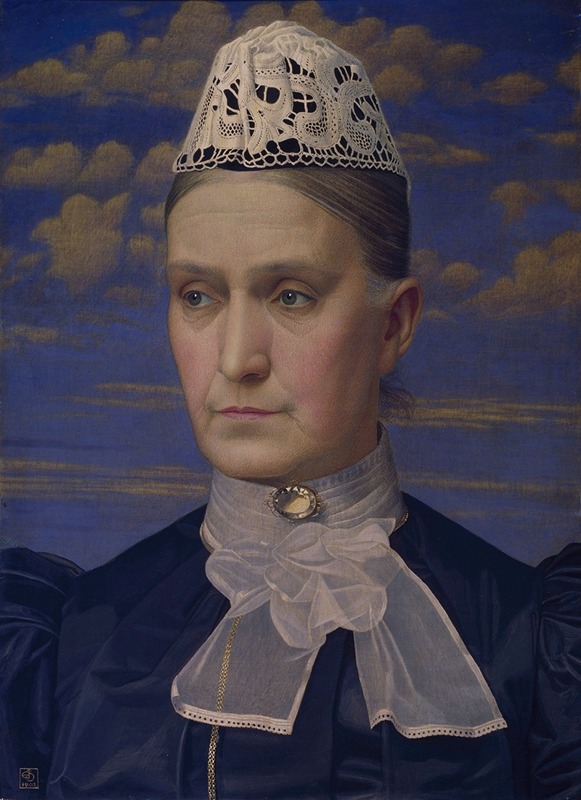
Portrait of the Artist’s Mother by Joseph Southall (1902)

Southall however felt unfulfilled with his architectural training.  Southall left the architectural practice to pursue his studies in painting and carving.   For him, architecture should embrace and craft disciplines such as painting and carving and with that in mind and having been inspired by his reading of Ruskin and Morris he decided to go on trips to Europe to broaden his artistic education.  In 1882 he visited Bayeux, Rouen and Amiens in Northern France where he was enthralled by the ancient cities with their Gothic cathedrals.   In 1883, now a free agent, he, accompanied by his mother,  journeyed to Italy and spent thirteen weeks visiting Pisa, Florence, Siena, Orvieto, Rome, Bologna, Padua, Venice and Milan.  It was during his stay in Italy that he fell in love with the works of the painters of the Italian Renaissance and the frescoes of the fifteenth century painter, Benozzo Gozzoli

Southall returned home with an overwhelming appreciation of the Italian Primitives and set his mind to study and practise the art of painting in tempera, a painting medium he had witnessed whilst in Italy.  In an essay by Peyton Skipwith in the book of paintings, Joseph Southall: 1861-1944. Sixty works by Joseph Southall, 1861-1944, from the Fortunoff Collection, he quotes Southall’s recollection of his time in Italy:

“…the thrill of joy which I experienced when, without any knowledge of what I was about to see, I stepped inside the enchanting cloisters of the great Campo Santo of Pisa. There I found myself at 21 years of age face to face with a vast series of frescoes, so quiet and yet so gay, so reticent in manner and so lively in essence that words must ever fail to convey even the faintest expression of what I felt…”

See the source image
Beauty Seeing the Image of her Home in the Fountain.by Joseph Southall (1898)

After returning to England Southall began to experiment with the tempera medium whilst at the Birmingham School of Art.  It was at the Birmingham School of Art that he met Arthur Gaskin, who became his closest friend.  The School of Art was run by the enigmatic head, Edward R. Taylor who had made the Birmingham school one of the leading schools of art in Britain, and the foremost for the study of the crafts. One of Southall’s great work using tempera was his 1898 painting entitled Beauty Seeing the Image of her Home in the Fountain.

Sailing Ships
Sailing Ships by Joseph Southall (1910)

On his return to Birmingham Joseph Southall settled in the house of his uncle, George Baker, at 13 Charlotte Road, in the city suburb of Edgbaston and it would be here that he would remain for the rest of his life.  George Baker was a charismatic man and a friend of John Ruskin.  He was a staunch Quaker and a life-long admirer of John Ruskin’s Utopian ideals.  Baker became a prominent member of Ruskin’s Guild of St George and succeeded him to become the second master of the Guild on Ruskin’s death in 1900.  He also showed Ruskin some of his nephew’s 1883 Italian drawings.  Ruskin was so taken by Southall’s architectural knowledge that in 1885 he gave Southall his first major commission.  Ruskin wanted Joseph Southall to design a museum for the Guild of St George and have it built on Joseph’s uncle’s land near Bewdley, Worcestershire. To gather ideas for this project, Southall made a second trip to Italy in 1886, again visiting Pisa, Florence, Siena and Assisi, so as to do research into Ruskin’s commission.  Unfortunately for Southall, the project was abandoned by Ruskin who reverted to his original plans to build a museum in Sheffield. Southall was very disappointed at the turn of events saying that his chance of becoming an architect vanished and he was destined to spend years of obscurity, followed by a little bitterness of soul. The years that followed this disappointment and his love of tempera began to wane. He was generally frustrated with the medium and eventually abandoned it leading him to favour painting with oils.

Fisherman Carrying a Sail
Fisherman Carrying a Sail by Joseph Southall (c.1907)

After a third visit to Italy in 1890, he once again became interested with the works by the Italian Primitives and slowly and once again experimented with the painting medium of tempera. His great influence now that he had returned to Birmingham, was his fellow Brummie artist, Sir Edward Burne-Jones. 

Beauty Seeing the Image of Her Home in the Fountain
Beauty Seeing the Image of Her Home in the Fountain by Joseph Southall (1898)

It was he who congratulated Southall on his 1898 tempera painting Beauty Seeing the Image of her Home in the Fountain.  It was also Burne-Jones who in 1897 sent Southall’s tempera self-portrait, Man with a Sable Brush, to the New Gallery, along with his own work.   These paintings and others like them, confirmed Southall as one of the foremost British tempera painters and as such led to his participation in the exhibitions of the Arts and Crafts Exhibition Society and the exhibition of Modern Paintings in Tempera at Leighton House.  The latter immediately preceded the foundation of the Tempera Society, of which Southall became one of the foremost members.

Portrait of Anne Elizabeth Baker by Joseph Southall (1887)

For a number of years Joseph Southall had been very close companions with his cousin Anna Elizabeth Baker, known as Bessie, who was two years older than Joseph.  He completed a number of portraits of her including his 1887 portrait of her when she was twenty years of age.

Coral Necklace by Joseph Southall (1895)

Another early portrait of Anna was John Southall’s 1895 painting entitled Coral Necklace.

Hortus Inclusus by Joseph Southall

She also appeared in his 1898 painting Hortus Inclusus which means private garden.  The setting is just such a garden with tall yew hedges in the background.  It is a portrait of Southall’s wife-to-be although the wedding would not take place for another five years. It is an idyllic scene with Anna sitting on a bench in the garden with her cat by her side.

The Agate (Portrait of the Artist and his Wife) by Joseph Southall (1911)

In June 1903 Joseph Southall and his long-time fiancé, Anna Elizabeth Baker were married.  He was forty-two and she was forty-four.  Their relationship started when they were both youths.  Over time their relationship became more intimate and they eventually became engaged to be married.  However, as they were cousins, this close kinship made the couple deliberately put off marriage until Anna was past child-bearing age.  Probably my favourite portrait by Southall is the one which depicts he an Anna, eight years after they married. The setting is a beach, more than likely Southwold on the Suffolk coast, which is where they spent their honeymoon and returned their many times more.  The title of the painting, The Agate, derives from Bessie seen in the depiction handing her husband an agate, a gemstone which can be found on the seashore in this area. This handing of the agate to her husband can be seen as a symbol of the couple’s collaboration, as we know that the agate gemstone is used by craftspeople to burnish the gilding on picture frames and Southall’s wife Anna, who was  a talented craftswoman, would make the picture frames ready for her husband’s paintings.

The Sleeping Beauty
The Sleeping Beauty by Joseph Southall (1903)

Joseph Southall’s popularity and recognition as a great painter grew.  He was at the height of his career during the latter years of the 1890’s until the start of World War I.  His work was shown at numerous exhibitions, not just in Britain but in Europe and America and he was elected a member of the Royal Birmingham Society of Artists, the Art Workers Guild and the Union Internationale des Beaux-Arts et des Lettres. His major exhibition in England was held in 1907 at the Fine Art Society in London and three years later a major one-man exhibition was held at the Galeries Georges Petit in Paris.  At the Paris exhibition Southall’s work was snapped up and following the event he received a number of lucrative commissions. 

Contentment by Joseph Southall (1928)

With the onset of war in 1014 Southall’s output as an artist waned.  Southall being brought up a Quaker and followed their beliefs all his life had him take an anti-War stance at the onset of hostilities.    Southall’s output as a painter declined considerably with the outbreak of World War I, as the pacifism inherent in his Quaker faith led him to devote his energies to anti-war campaigning. He abandoned his commitment to the Liberal Party and joined the Independent Labour Party, becoming Chairman of the Birmingham City Branch; the Party was the one left-wing body that always upheld its opposition to the war.  Southall also chaired the Birmingham Auxiliary of the Peace Society and was a joint Vice-president of the Birmingham and District Passive Resistance League.  His main artistic output during this period were anti-war cartoons printed in pamphlets and magazines, and art historians reckon they number among his most powerful works.

See the source image
The anti-war pamphlet Ghosts of the Slain by Joseph Southall

In the above cartoon we see depicted ‘all those who sit in the high places and cast the people into the pit’. A diplomat and a businessman push a blindfolded officer towards a precipice, whilst a fashionable society woman looks on and a cleric of the Established Church appears as the priest who ‘blessed our banners and bade speed to our swords’. Apart from Death, who gleefully accompanies this performance on his drum, only the diplomat sees what is happening; the others all have their eyes covered.

‘The Obliterator’ appeared in his anti-war pamphlet Fables and Illustrations opposite a mock sales promotion advertising the Obliterator’s record of leaving ‘nothing standing and nothing breathing’ while making ‘a clean sweep of civilisation’. Southall’s woodcuts and satirical fables were published when most of his wartime energies were consumed by pacifist activism in Birmingham and print caricature provided him a convenient alternative artistic output. The essence of his moral standpoint is an unshakable absolute conviction of conscience, clearly articulated in his fable ‘Inscription from Babylon’: although citizens ‘ought to be law-abiding’, in the final analysis, pacifism is justified by faith that ‘Divine law stood above human laws’ in the form of the the sixth Commandment: ‘Thou shalt not kill’

The Castle of Angers, France
The Castle at Angers by Joseph Southall (1933)

During the two decades of peace between the two world wars, Southall and his wife made regular trips to Europe, visiting France and Italy in the Spring and Autumn.  Their European holidays were combined with their shorter summer holidays to their beloved Southwold on the Suffolk coast and Cornish breaks on the Fowey estuary, all of which gave Southall opportunities to paint the various places.  At this time Southall’s favoured painting medium was watercolours.  Many of these paintings were exhibited at the Alpine or Leicester Galleries in London and the Ruskin Galleries in Birmingham, as well as at the Royal Birmingham Society of Artists, the Royal Academy, and the Paris Salon. 

Portrait of Sir Whitworth Wallace by Joseph Southall (1927)

Between holidays Southall spent time on lucrative commissions, painting portraits for wealthy patrons, who would often be from the Quaker community. One such work was his portrait of Sir Whitworth Wallace  the first director of the Birmingham Museum and Art Gallery which opened in 1885.

The Return
The Return by Joseph Southall (1930)

At the 1930 Winter Exhibition at the Royal Academy, Southall exhibited his painting The Return. The painting depicts two women high up on the banks of a river, possibly the River Fowey, one seated on the grass in grey dress, with mustard coloured shoes and a blue hat with green bands. There is a red book on a rock beside her. The other woman stands. She wears a red hat, a salmon-coloured dress with white collar and cuffs. She waves a handkerchief and her white scarf also waves in the wind. On the still water below are sailing ships, casting long reflections on the water. On a small boat lower right, two figures appear to return the woman’s wave.

The Tower of San Vitale :: Joseph Edward Southall - Italy ôîòî
The Tower of San Vitale by Joseph Southall (1933)

Many of the works at this exhibition focused on Southall’s Italian paintings, many done using tempera.  So popular were paintings in that medium that the following Summer Exhibition 1n 1931 allotted one room for works using tempera. This was indeed a change of heart by the Academy Hanging Committee jurists who had scorned that painting medium and could not decide whether such works fell into a watercolour or oil classification.

San Giorgio, Venice
San Giorgio, Venice by Joseph Southall (1927)

Joseph and Bessie Southall made many trips to Italy and one of their favourite haunts was Venice which he depicted in a number of his works.

The Right Honourable F. W. Jowett by Joseph Southall (1944)

The couple made their last trip to Venice in the Spring of 1937 but later that year Southall was taken ill and had to undergo major surgery from which he never fully recovered. Doctors struggled to make a proper diagnosis of what was ailing Southall and he had to return to hospital on a number of occasions.  Notwithstanding his poor health he still determinedly carried on painting.  One of his last paintings was his memorial portrait in tempera of the Bradford MP, Frederick William Jowett who was a founder member of the Independent Labour Party. In the depiction we see a copy of the Independent Labour Party newspaper with a headline

“…IS THIS WHAT YOUR MEN FIGHT FOR?…”

Jowett had died in February 1944 and Southall had not quite finished it when he died nine months later.  The work was then completed by Maxwell Armfield, before being presented to the City of Bradford.

Joseph Edward Southall died of heart failure at his home in Edgbaston in 1944, aged 83.

Ivan Fedorovich Choultsé

779648b48202df7819210fa53eb5c0ce

When my featured artist today had an exhibition of his work in London, the London Times summed up his works by saying “it must be seen to be believed”.  In America the art critics designated him as “the magician of light”.  His paintings are extraordinary.  They are magnificent.  Let me introduce you to the Russian landscape and staunch realist painter, Ivan Fedorovich Choultsé.

Sevanavank Monastery on Lake Sevan by Ivan Fedorovich Choultsé

Ivan Fedorovich Choultsé was born in St. Petersburg on October 21st 1874.  His ancestors hailed from Germany but emigrated to Russia in the eighteenth century.  The original spelling of his family name, which was of German origin, was Schultze.  His story was not one of a child dreaming of becoming a professional artist.  His fascination at an early age was electricity and its production through hydro power especially the electricity generated by the Imatra waterfall in South Karelia.  His interest in science was sated by an engineering education, although he continued to convey his creative side and during those early days as a teenager, he would spend his spare time painting small sketches.  He headed up an engineering project in Finland but something went badly wrong and he lost all his money and was declared bankrupt.

Winter Sunset by Ivan Fedorovich Choultsé

Ivan realised he had to earn money from another source and decided to concentrate on his drawing and painting abilities.  Along with his early paintings which he had fortunately not discarded, he approached the academician, famous landscape painter and drawing teacher, Konstantin Yakovlevich Kryzhitsky, who had been a court painter to Tsar Nicholas II and was a painter of miniatures.  His talent was apparent to Kryzhitsky and he enabled Ivan to be admitted to the Imperial Academy of Arts in St Petersburg. In addition to Kryzhitsky, Choultsé was influenced by other tutors, the Russian landscape artist Arkhip Kuindzhi and the Swiss landscape painter Alexander Kalam.  In 1903 Choultsé held his first Academy exhibition which gained him early fame and recognition as a talented artist. His exhibition was a great success and he went on to exhibit his work at other major galleries in St. Petersburg and Moscow.  He was eventually elected as a court painter to Tsar Nicholas II.

See the source image

Park in Neskuchnoye by Ivan Choultse

In 1910 Choultsé embarked on an Arctic painting trip with Kryzhitsky.  They visited the north of Norway and island of Spitzbergen.  From that trip Choultsé produced a number of glorious paintings of the arctic landscape.  In 1910 and 1911 Choultsé lost two of his most influential mentors, Kuindzhi in July 1910 and fifty-two year old Kryzhitsky who committed suicide in April 1911.  Following the untimely death of Konstantin Kryzhitsky, Choultsé had his works shown at exhibitions which had been arranged by the society created by Grand Duchess Olga Alexandrovna, also a student of Konstantin Kryzhitsly, in his name.  Choultsé frequently participated in its exhibitions that took place in the Grand Duchess’ palace on Sergeevskaya street in St Petersburg.

Silver Frost, Engadine, 1910  by Ivan Fedorovich Choultse

Silver Frost, Engadine, by Ivan Fedorovich Choultsé 

Cholutsé reputation as a painter grew as did the sale of his work which was confirmed by the fact that the brother of Tsar Nicholas II, Mikhail Alexandrovich, regularly commissioned his works.  In 1917 the Russian Revolution took place and for Choultsé he had to make an important decision.  He was an academic painter and a supporter of the Academy system which meant staying in Russia under the new regime which was probably fraught with difficulty and so in 1917 he set off on a two-year trip of Europe.  For those two years Choultsé was able to see and depict on canvas the beautiful landscapes of the mountainous regions of Northern Italy, Switzerland and Southern France where he painted the Mediterranean landscapes.

Ivan Fedorovich Choultse view of Engadine

Vers Le Soir, Engadine’ by Ivan Fedorovich Choultsé

It could well have been the snowy Swiss landscape that brought back memories of his homeland or it could have been because he was mesmerised by the panoramic views of the likes of the long high Alpine valley region of Engadine and St. Moritz, but whatever it was, it profoundly affected Choultsé.

See the source image
November by Ivan Choultsé

Choultsé finally settled back in Russia in 1921 as he still held out hope that he could remain a professional artist in his homeland under the new Soviet regime.  He joined the Society of Individualist Artists in St. Petersburg and took part in the society’s first two exhibitions that year. After a while he lost hope that everything would be the same as it was in the pre-Revolution days and finally took the decision to leave his country of birth and go to Paris.  He settled in the French capital in an apartment on the Boulevard Pereire, close to the Porte Maillot and it was here that the second stage of his career as a Russian immigrant began.

See the source image
A Storm on the Horizon by Ivan Choultse (c.1926)

Choultsé artistic breakthrough in Paris came with his first solo exhibition of his work on November 23rd 1922, at the Galleries Gérard Frères.  All fifty of his works were sold on the opening day of the show. This was extraordinary as the artistic environment of Paris was one of an over-abundance with all sorts of artistic offerings and gallery presentations.  However, his success was indicative of the artist’s amazing talent.  He became inundated with painting commissions and often did not have enough time to fulfil all the assignments.

See the source image
St. Moritz by Ivan Choultsé

There is no doubt that Choultsé was influenced by the the snowy Swiss landscape which probably reminded him of his native Russia.  He said that he had fallen in love with the immense vistas of Engadine and St. Moritz.  He was deeply moved by what he saw there and would concentrate on studying the effects of light on nature and by doing this created his best-known themes of beautiful snow-filled landscapes. In 1923, Ivan Fedorovich’s Choultsé’s paintings were exhibited in the Paris Spring Salon.  His works were an amazing success with the public and the art critics alike and he was touted as the most admired artists of the Salon. With all success, there is an element of luck and Choultsé’s good fortune emanated from having contacts with good art dealers and owners of art galleries.  He was represented by the gallery of Leon Gerard, which not only successfully sold his works of art but also regularly arranged his personal exhibitions. In 1927, Choultsé received his French citizenship.

File:Ivan Fedorovich Choultsé, Sailing boat at sunset on the gulf of Finland.jpg
Sailing boat at sunset on the gulf of Finland by Ivan Choultsé (1916)

Success in Europe was soon followed by success in America.   In 1928, Choultsé met Eduard Jonas, who took most of Choultsé’s works to America. Jonas was a prominent figure in French and international art market, owner of exhibition halls and galleries both in Paris and New York, and also offered an exclusive plan of exposing Choultsé’s works in the States. Choultsé was delighted with the opening up of the American market.  In a letter to his daughter, he wrote:

“…”I met a very interesting dealer. And how good it is that now, sitting in Paris, I can sell my work for dollars!…”

A contemporary of Choultsé, the Russian writer and critic, Nikolai Breshko-Breshkovsky wrote about the artist’s newly found fame and fortune in America:

“…In America, Choultsé’s snow and sun paintings are highly esteemed and worth of great price…”.

La Corniche (Côte d’Azur) by Ivan Fedorovich Choultsé 

Although based in Paris, Choultsé  regularly travelled to the Mediterranean and enjoyed painting many summer landscapes around the Côte d’Azur .

Adriatic Sunset by Ivan Choultsé

He also completed many paintings depicting scenes around the Italian coast.

In 1933 Choultsé moved his permanent residence to Nice. One of the last exhibitions of his work was in March 1936 held at the Breton Castle on rue Saint Antoine in Nice. Ivan Fedorovich Choultsé died in 1939, aged 64 and was buried in the Cimetière Caucade in Nice,

Quiet Mediterranean Evening by Ivan Choultsé

The Toronto dealer, G.Blair Laing, wrote in his 1979 book, Memoirs of an Art Dealer that Choultsé “painted spectacular snow scenes in which light seems to come from behind the canvas and glow

In 1935 the New York Hammer Galleries held a jubilee exhibition entitled ‘150 Years of Russian Painting’ and described Choultsé’s reputation as “beloved among American collectors as a great master of snowy landscapes gilded by slanted sunbeams”.

For all my readers who celebrate this festive period may I wish you all a Merry Christmas.

Jean-Eugène Buland

Jean-Eugene Buland photo.jpg
Jean-Eugène Buland

Jean-Eugène Buland was born in the French capital on October 26th 1852.  He was the son of an engraver, as was his younger brother, Jean-Émile Buland.  Jean-Eugène’s artistic career began when he entered the École des Beaux-Arts in Paris in the studio of Alexandre Cabanel.  Cabanal was a renowned French artist who painted historical, classical and religious subjects in the academic style and was also well known as a portrait painter. He had been a professor at the art establishment since 1864 and was highly regarded by Emperor Napoleon III.  There can be no doubt that Buland was influenced by Cabanel’s choice of subjects for his paintings and his academic painting style.   Success came early on for Buland when he gained the Deuxième Prix de Rome in 1878 and once again in 1879.  The Prix de Rome was a French scholarship for arts students, initially for painters and sculptors, that was established in 1663 during the reign of Louis XIV of France. Winners were awarded a bursary that allowed them to stay at the Villa Medicis in Rome for three to five years funded by the French government. 

See the source image
The Illustrator and His Daughter in the Workshop by Jean Eugène Buland (1891)

On his return to France Buland soon became aware of the popularity of the French painter, Jules Bastien-Lepage, and his success with his Naturalist paintings depicting realistic themes so much so, he decided to forego his depictions of historical works and concentrate on scenes of everyday life.  Bastien-Lepage, like Buland, was also awarded the Deuxième Prix de Rome in 1875 and 1876 but declined the opportunity to study in Rome as the classical training held no interest for him although winning the prize had been a great honour.  Buland joined the Naturalist painting movement with Bastien-Lepage and found that by utilising photography it allowed him to paint his models with the most precision.

Alms of a Beggar by Jean-Eugène Buland (1880)

In 1880 he completed one of his best loved works, Alms of a Beggar, in which we see a young woman beautifully dressed in white sitting outside a church in search of charity. From her left, we see a man, who is a beggar himself, coming towards her with a coin held out in his right hand. His clothes are a mass of patches, and they are pale and dirty.  On his feet he wears scruffy old wooden shoes. From his demeanour he would appear sightless. It is a fascinating depiction that raises all manner of questions.  Why is the well-dressed woman begging?  Is she as poor as the man in the depiction or is Buland telling us that you do not have to be badly dressed to be poor?  Is there such a thing as inward poverty – a poverty that has nothing to do with lack of money?  Look at the painting and make your own mind up.

See the source image
Le Tripot by Jean Eugène Buland (1883)

Three years later, in 1883, Buland completed a painting entitled Le Tripot which is a French word meaning gambling house or gambling den.  This work by Buland is one of his masterpieces.  The setting is a sleazy back-street gambling den and depicts five unsentimental-looking gamblers facing us whilst sitting at a gaming table.  The air is thick with cigarette and cigar smoke, the walls of the establishment are in need of redecoration.

To the left we see an elderly woman, probably a widow, diminutive in stature, dressed all in black.  She pushes some paper money towards the pot.  Looking over her shoulder is a middle-aged man. Is he just a merely a passing observer or is there more to his presence?

Next to the old woman is a man showing an air of confidence as to his ability as a gambler and yet the pile of winnings in front of him is small.  He is slightly laid back and seems to be worry-free.  With cigarette in hand he glances to his right. 

By far the most interesting person in this group portrait is one at the centre.  An elderly man gazes out at us with an almost blank look as if he is not registering what he is seeing.  He is completely lost in his own thoughts.  Why did Buland depict him as almost having no part in what is happening around him ?

Is he just another gambler or is he the croupier as we see his wooden rake which is used to collect money from the gaming table at his side and a large pool of money which could be the “bank”.

The remaining gamblers are to the right of the painting. The man with the long hair and ringlets would appear to be of Jewish origin akin to the likes of Fagan and Shylock and in a way this depiction has a sort of anti-Semitic tone to it. Before him, we see that he has accrued a large amount of winnings, which could have been Buland’s thoughts on the reputation of the Jewish people’s love of money. In contrast, next to him, on his left, is a young man who looks totally bemused and is certainly down on his luck. From his bored facial expression we can see he is completely resigned to losing the last of his money. Behind the pair we see a couple ladies of the night who are looking to see who is winning and thus who is worth approaching for their services.

The question as to why has Buland chosen these five main characters, four of whom are definititely gambling is questionable. Is he trying to put across his belief that all types of people fall into the clutches of gambling? The run-down setting maybe his way of not glorifying the “sport” of gambling.

Jean-Eugène Buland - Bonheur des parents (1903).jpg
Bonheur des Parents by Jean-Eugène Buland (1903)

If you wanted to have an artistic depiction of tenderness and young love Buland’s 1903 offering of Bonheur des parents probably could not be topped.  The painting’s title translates to Parental Happiness and it depicts a young man and his young wife with their newly born baby. The setting is a small room of a stone-built cottage.  It is a new experience for the couple and we can see the woman looking down at her baby as it breast-feeds.   You can see the utter tiredness in the eyes of the young mother and the nervousness in the father’s expression.  It is all new to them and they are having to survive alone with the nurturing of their child. They have been given a precious gift.

Mariage innocent (Innocent marriage) by Jean-Eugène Buland (1884)

Another depiction of young love was his 1884 painting entitled Mariage innocent. It is an idyllic portrayal of young happiness with its young couple walking arm in arm through fields against a backdrop of a village and blossoming flowers in the foreground. 

La Lecture by Jean-Eugène Buland (1901)

In 1886, Buland left Paris to settle in Charly-sur-Marne, a little village just east of the capital, in the French department of Aisne, near Château-Thierry, shunning the art scene of the French capital. From this quiet village life Buland derived inspiration from simple everyday life, which he painted with the greatest fastidiousness. His works gained popularity and he obtained many commissions including ones from a number of  art institutions, such as the Luxembourg Museum in Paris and many other provincial museums.  During these early years he submitted many of his works for the Salon des Sciences in the Paris’ City Hall and some were used to decorate the ceiling of the City Hall of Château-Thierry.  His painstaking realist depictions were well-received at the Salon, where he won a number of medals.  He gained a third-class medal at the Universal Exhibition in Barcelona in 1888.  In the following year he was awarded a silver medal at the Exposition Universelle in Paris and was also awarded during the International Exhibition in London in 1890.  The ultimate honour came in 1894 when he received the Legion of Honour.

Un Patron or The Lesson of the Apprentice by Jean-Eugène Buland (1888)

In France during the start of industrialization realist painters were often given official assignments from the state to depict themes from the new and progressive metal industry. In his 1888 painting, entitled Un Patron, sometimes referred to as The Lesson of the Apprentice, Buland used photographs as a basis for the work catching all the details of what was a combination of a smithy and a mechanical workshop. In the painting we see the head mechanic is using a drill while working on a cogwheel. The painting depiction had a political propaganda aspect to it.  France had suffered after a heavy and costly defeat in the Franco-Prussian War of 1870 and the country was now striving to recover through its advances in its industry and manufacturing and the depiction of the young apprentice learning a trade in engineering highlighted the country’s determination to become an industrial powerhouse.

bulandtinker
The Tinker by Jean-Eugène Buland (1908)

The term ethnography is the scientific description of peoples and cultures with their customs, habits, and mutual differences.  Eugène Buland was a meticulous painter who never overlooked any details with regards to the figures populating his paintings.  He spent a great deal of time depicting their appearance and their costumes and an equal amount of time was spent on the details of the inanimate objects that completed the works.   Through his painstaking way in which he used light and shadow on his figures and on the settings, Buland paintings became true works of art. His paintings are like an everyday chronicle of life combining portraiture with genre scenes.  One good example of this is his 1908 painting entitled The Tinker.  We see the man busy at work, repairing damaged pots, pans, and domestic metal objects. Look at the varying textures of these objects.  Look closely at the wall of the room and see how Buland, with touches of white has a glistening effect which highlights the dampness on the stone wall.

bulandpropaganda
Propaganda Campaign by Jean-Eugène Buland (1889)

I like two of Buland’s works which have a political overtone to them.  In 1889 he painted Propaganda Campaign in which we see a travelling salesman has arrived at the home of a poor family and he is trying to offload books and coloured prints to the head of the household. However, he was not just a salesman as he combined his sales pitch with his political thoughts.  In the salesman’s left hand he holds a poster of General Boulanger, a French general and politician who was an enormously popular public figure during the 1880’s and the buttonhole rosette in the salesman’s jacket lapel identifies him as a canvasser for the General.

bulandmunicipalcouncil
Municipal Council and Commission of Pierrelaye Organizing a Festival by Jean-Eugène Buland (1891)

The other political painting by Buland which I like is his provincial municipal depiction of a group of local councilors.  The 1891 work is entitled Municipal Council and Commission of Pierrelaye Organizing a Festival.   Pierrelaye is a commune in the Val-d’Oise department in Île-de-France in northern France.  It is almost certainly a painting commissioned by the very councilors who are depicted in the work.  They all exude an aura of importance and solemnity.  For those who would look at this group portrait by Buland there would be no doubt that the councilors would be worth every penny of their wages !!!!

Ouvriers Se Chauffant (Workers Warming Themselves) by Jean-Eugène Buland (1906)

My final choice of Buland’s paintings is a dark and somewhat brooding study of two workmen sitting on a large log, who are trying to fight off the cold by warming themselves in front of a brazier.  Maybe they are woodsmen who have just come inside the hut for a rest having been working outside in the cold.  The room is dark and dank and the two figures are just about lit up by a thin beam of daylight penetrating a small window high up in the wall.

Jean-Eugène Buland died on March 18th 1926, aged 73.