The Resurrection by Piero della Francesca

The Resurrection by Piero della Francesca (c.1468)

For today’s blog I am staying with Italian Renaissance art and looking at a work by, some say, the greatest Early Renaissance painter, Piero della Francesca.  This is the second time I have featured this artist in one of my blogs.  The first being The Flagellation of Christ (My Daily Art Display, September 29th 2011).   Today I want to look at his beautiful fresco entitled The Resurrection which he completed around 1468.

Piero della Francesca or as he was known in his day, Piero di Benedetto de’ Franceschi, was born around 1415 in the Tuscan market town of Borgo San Sepolcro, which is now known as Sansepolcro,  a small town located on the plains of the Upper Tiber Valley in the southeast of Tuscany, bordering Umbria and The Marches.  His family were merchants dealing in leather and wool and his father, Benedetto di Franceschi, hoped that his son would follow in his footsteps.  With that in mind, Piero was sent to school to learn arithmetic and the ability to calculate weights and measures, assess the volumes of barrels and bales, and most importantly, learn how to keep accounts.  Piero was academically gifted and became well known as a mathematician and in fact after his death he was revered not so much as a painter but for his mathematical knowledge.

Piero’s initial artistic training came as an apprentice to Antonio di Giovanni, a local painter, who was based in Anghiari, a town across the Tiber Valley from Borgo San Sepolcro.  From being Antonio di Giovanni’s apprentice, he soon became his assistant and during the 1430’s the two of them worked jointly on commissions around Borgo San Sepolcro.  Piero went to Florence for the chance to gain more work and he worked on commissions as an assistant alongside another young artist, Domenico Veneziano.  It was during this time spent in Florence that Piero would have probably come into contact with the great Florentine artists of the time such as Fra Angelico, Mantegna and the architect, Brunelleschi.

In 1442, Piero returned to Sansepolcro and three years later, in 1445, Piero received a large commission from the Compagnia della Misericordia, a confraternity of Borgo San Sepolcro, for a polyptych, Polyptych of the Misericordia: Madonna of Mercy, as an altarpiece for the local church, Church of the Misericordia.  The confraternity had asked Piero to complete the work in three years, setting the anticipated completion date as 1445.   Piero however did not feel constrained by this suggested timeline and any way he had many other projects on the go at the time and in the end did not complete the altarpiece until 1462, some seventeen years late!

Piero moved around the country a good deal during his life, living in Ferrara and Rimini before arriving in Rome in 1455.  Here he painted frescoes in the Vatican for Nicholas V and continued to work in the Vatican Palace for Pius II. Sadly his works were destroyed to make room for paintings by Raphael.

Piero’s birthplace, the town of Borgo San Sepolcro which literally means “Town of the Holy Sepulchre” derives its name from the story of its founding back in the tenth century.   The story of its coming into being would have us believe that two saints, Saint Arcano and Saint Egidio were returning from a pilgrimage to the Holy Land bearing some wood shavings from the sepulchre in which Christ had been buried, when they were miraculously instructed to create a new settlement – Borgo San Sepolcro.   These sacred relics have been preserved in the local Benedictine abbey and so when the town hall of Borgo San Sepolcro was renovated and extended in the late 1450s, Piero was commissioned to paint the fresco on the appropriate subject of The Resurrection for the building’s state chamber. This room was set aside for the use of the Conservatori, the chief magistrates and governors.  Before holding their councils, these four appointed guardians of the town would solemnly kneel before Piero’s image, to pray for the grace of God to descend upon them during their deliberations. The room is now the civic museum.

My featured painting today is a fresco which exudes an air of peace and tranquillity.   In the painting, the risen Christ can be seen in the centre of the composition.  He is portrayed at the moment of his resurrection, as we see him with his left foot on the parapet as he climbs purposefully out of his marble tomb clutching the banner in his right hand, as if he is declaring his victory over death.   He looks formidable as he stands tall.   We don’t see the lid of the tomb but look to the bottom right of the painting and we can see Piero has depicted a large rock which probably harks back to the biblical tale which told of a rock being rolled away from the entrance of Christ’s tomb.   In most resurrection paintings we are used to seeing Christ dressed in white burial clothes and yet Piero has depicted him in red robes, which was probably done to infer royalty and signify that this resurrected person is Christ the King.  Piero has portrayed the pale body of the risen Christ as almost blemish-free with the exception of the wound to his side and the wound in the back of both his hands made by the crucifixion nails.   In his depiction of Christ he has not let us forget that this central figure is both man and God, for if you look closely at the stomach of Christ we notice that the artist has given it an almost human appearance.  It has a slightly wrinkled appearance caused by the folds of the skin happening as he raises his leg to exit the tomb.

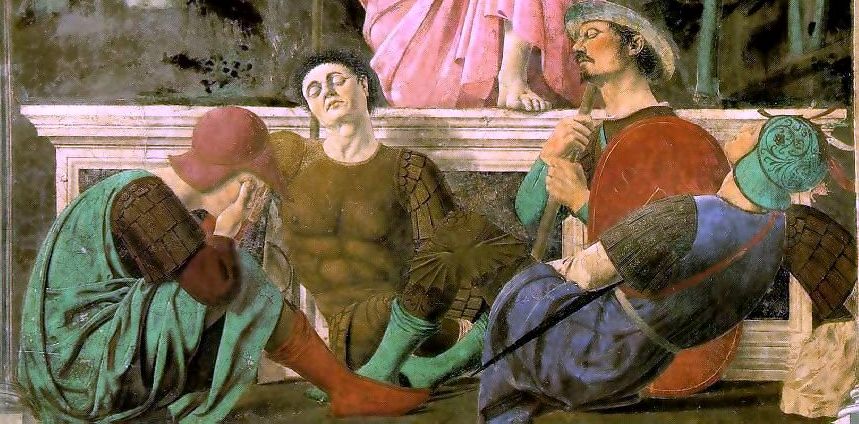
The sleeping guards

The alertness of the risen Christ in the painting contrasts starkly with the four soldiers who instead of keeping guard on the tomb, lie asleep.  The Renaissance painter and biographer of artists, Vasari, would have us believe that Piero included his own self-portrait in this fresco.

Piero della Francesca

It is the face of the second soldier from the left, and Vasari postulates that Piero did this as a sign of his own hopes of awaking one day to redemption. It is also interesting to note the contrast in the way Piero has depicted the risen Christ and the four soldiers.  Christ is shown in a solid vertical stance looking straight out at us, whereas the sleeping soldiers are depicted in diagonal poses and viewed at various oblique angles.  The way the artist has portrayed Christ almost gives one the feeling that he is about to step out of the painting to join us, the viewer.  In some ways the expression on the face of Christ is disturbing.  It is a penetrating glance and one art critic commented that it was if he was looking into the soul of the viewer.

The landscape is bathed in the new cold and clear light of a Tuscan dawn.  Look carefully at the trees on the right of the painting and those on the left side.  Do you spot the difference?   The ones on the right are depicted as flourishing specimens adorned with leaves and healthy green shoots whereas the trees on the left of the painting are grey in colour and bare as if on the point of dying.   This contrast almost certainly alludes to the renewal of mankind through the Resurrection of Christ

It is likely that Piero painted his striking image of the risen Christ stepping resolutely, banner in hand, from the tomb, to represent not only the resurrection of Jesus but also the resurgence of the town of Sansepolcro.  After a few years under the rule of Florence from 1441, Sansepolcro regained its identity and dignity in 1456 when the Florentines returned the use of the Palazzo to the Conservatori. The church Council which the young Piero had witnessed in Florence had thus had unforeseen consequences for Sansepolcro. The Pope, his treasury depleted by his lavish Council, defrayed some of the costs by ceding Sansepolcro to Florence which was later returned by Florentine authorities to the citizens of Sansepolcro on February 1st 1459, as a sign of the restoration of some measure of autonomy to the Borgo.

One interesting end note to the tale of this painting comes from a BBC article which tells the story of how a British artillery officer, Tony Clarke, during World War II, defied orders and held back from using his troop’s guns to shell the town of Sansepolcro and his decision is believed to have saved this beautiful fresco.   To read the full story click on:

http://www.bbc.co.uk/news/magazine-16306893

The Transfiguration by Raphael

The Transfiguration by Raphael (1520)

In my last blog I looked at The Raising of Lazarus by Sebastiano del Piombo and talked about how this and a painting by Raphael, entitled Transfiguration, had been commissioned in 1517 by Cardinal Giulio de’ Medici as a high end altarpiece for the French Cathedral of S. Giusto Narbonne.  Raphael was, at the time, busy on other commissions.  He had been summoned to Rome by Pope Julius II to paint frescoes on the rooms of his private Vatican apartment, the Stanza della Segnatura and the Stanza di Eliodor and at the same time he was busy working on portraits and altarpieces as well as working alongside Sebastiano del Piombo on frescoes for Agostino Chigi’s Villa Farnesina.   It is thought that Giulio de Medici was so concerned with the time it was taking Raphael to complete The Transfiguration altarpiece that he commissioned Sebastiano di Piombo to paint the Raising of Lazarus for the cathedral in an effort to stimulate Raphael to work faster on his commission.

Today I am featuring Raphael’s work, The Transfiguration, which was considered the last painting by the Italian High Renaissance master.  Giorgio Vasari, the sixteenth century Italian painter, writer, historian, and who is famous today for his biographies of Renaissance artists, called Raphael a mortal God and of today’s painting, he described it as:

“…the most famous, the most beautiful and most divine…”

Although Raphael Sanzio was only thirty-four years of age when he was given the commission, bad health prevented him from finishing it. It was left unfinished by Raphael, and is believed to have been completed by his pupils, Giulio Romano and Giovanni Francesco Penni, shortly after his death on Good Friday 1520.

If we look closely at this work of art we can see two things going on simultaneously both of which are described in successive episodes of the Gospel of Matthew.   In the upper part of the painting we have the Transfiguration, which is described in Matthew’s Gospel (Matthew 17: 1-7):

“…After six days Jesus took with him Peter, James and John the brother of James, and led them up a high mountain by themselves.  There he was transfigured before them. His face shone like the sun, and his clothes became as white as the light.  Just then there appeared before them Moses and Elijah, talking with Jesus.   Peter said to Jesus, “Lord, it is good for us to be here. If you wish, I will put up three shelters—one for you, one for Moses and one for Elijah.”    While he was still speaking, a bright cloud covered them, and a voice from the cloud said, “This is my Son, whom I love; with him I am well pleased. Listen to him!”   When the disciples heard this, they fell facedown to the ground, terrified.  But Jesus came and touched them. “Get up,” he said. “Don’t be afraid…”

We see the transfigured Christ floating aloft, bathed in a blue/white aura of light and clouds.  To his left and right are the figures of the prophets, Moses and Elijah.  Below Christ we see the three disciples on the mountain top shielding their eyes from the radiance and maybe because of their own fear of what is happening above them.   The two figures kneeling to the left of the mountain top are said to be the martyrs Saint Felicissimus and Saint Agapitus of Palestrina.

 In the lower part of the painting we have a depiction by Raphael of the Apostles trying, with little success, to liberate the possessed boy from his demonic possession. The Apostles fail in their attempts to save the ailing child until the recently-transfigured Christ arrives and performs a miracle.  Matthew’s Gospel (Mathew 17:14-21) recounts the happening:

“…When they came to the crowd, a man approached Jesus and knelt before him.  “Lord, have mercy on my son,” he said. “He has seizures and is suffering greatly. He often falls into the fire or into the water.  I brought him to your disciples, but they could not heal him.”    “You unbelieving and perverse generation,” Jesus replied, “how long shall I stay with you? How long shall I put up with you?  Bring the boy here to me.”   Jesus rebuked the demon, and it came out of the boy, and he was healed at that moment.   Then the disciples came to Jesus in private and asked, “Why couldn’t we drive it out?”   He replied, “Because you have so little faith. Truly I tell you, if you have faith as small as a mustard seed, you can say to this mountain, ‘Move from here to there,’ and it will move. Nothing will be impossible for you…”

Observe this lower scene.  The young boy, with arms outstretched and distorted in a combination of fear and pain, is possessed by some sort of demonic spirit.   He is being led forward by his elders towards Christ who is about to descend from the mountain.   The boy is crying and rolling his eyes heavenwards.   His body is contorted as he is unable to control his movement.   The old man behind the boy struggles to control him.  The old man, with his wrinkled brow has his eyes wide open in fear as to what is happening to his young charge.  He looks directly at the Apostles, visually pleading with them to help the young boy.    See how Raphael has depicted the boy’s naked upper body.  We can see the pain the boy is enduring in the way the artist has portrayed the pale colour of his flesh, and his veins, as he makes those violent and fearsome gestures.   The raised arms of the people below pointing to Christ, who is descending, links the two stories within the painting.  A woman in the central foreground of the painting kneels before the Apostles.  She points to the boy in desperation, pleading with them to help alleviate his suffering.

Contrapposto

The contorted poses of some of the figures at the bottom of the painting along with the torsion of the woman in what Vasari calls a contrapposto pose were in some way precursors to the Mannerist style that would follow after Raphael’s death.   Vasari believed that this woman was the focal point of the painting.     She has her back to us.  She kneels in a twisted contrapposto pose. Her right knee is thrust forward whilst she thrusts her right shoulder back.   Her left knee is positioned slightly behind the right and her left shoulder forward.  Thus her arms are directed to the right whilst her face and gaze are turned to the left.  Raphael gives her skin and drapery much cooler tones than those he uses for the figures in heavy chiaroscuro in the lower scene and by doing so illuminates her pink garment.  The way he paints her garment puts emphasis on her pose.  She and her clothes are brilliantly illuminated so that they almost shine as bright as the robes of the transfigured Christ and the two Old Testament Prophets who accompany him.   There is an element about her depiction which seems to isolate from the others in the crowd at the lower part of the painting and this makes her stand out more.

The unfinished painting was hung over the couch in Raphael’s studio in the Borgo district of Rome for a couple of days while he was lying in state, and when his body was taken for its burial, the picture was carried by its side.   Cardinal Giulio de’ Medici kept the painting for himself, rather than send it to Narbonne and it was placed above Raphael’s tomb in the Pantheon.   In 1523, three years after the death of Raphael, the cardinal donated the painting to the church of San Pietro in Montorio, Rome. In 1797, following the end of the war in which Napoleon’s Revolutionary French defeated the Papal States; a Treaty of Tolentino was signed.    By the terms of this treaty, a number of artistic treasures, including Raphael’s Transfiguration, were confiscated from the Vatican by the victorious French.   Over a hundred paintings and other works of art were moved to the Louvre in Paris.   The French commissioners reserved the right to enter any building, public, religious or private, to make their choice and assessment of what was to be taken back to France. This part of the treaty was extended to apply to all of Italy in 1798 by treaties with other Italian states.   It was not until 1815, after the fall of Napoleon, that the painting was returned to Rome. It then became part of the Pinacoteca Vaticana of Pius VII where it remains today.

The Raising of Lazarus by Sebastiano del Piombo

The Raising of Lazarus by Sebastiano del Piombo (1520)

My next two blogs feature paintings by two different artists, commissioned almost at the same time by the same person, one of which is often looked upon as the greatest painting ever.

My featured artist today is Sebastiano Luciani, who would be better known later as Sebastiano del Piombo for reasons I will explain later.   Sebastiano was born around 1485 and his birthplace is thought to have been Venice as he often signed his works Sebastianus Venetus.   His first thoughts, regarding what he should do with his life, were to join a religious order and he may well have started along the path towards the priesthood. His first love was not drawing and painting but music.  He had a great interest in music and was an accomplished singer and also played many musical instruments, including the lute, which was his favourite.  This musical talent of his made him very popular in Venetian society.   He did however eventually turn his attention to art when he was about eighteen years of age and his first artistic tuition came from Giovanni Bellini, who was a member of the great Bellini family of Venetian artists and brother-in-law of Andrea Mantegna.   Having learnt the basics of art from Bellini he left the studio and became a pupil of Giorgione da Castelfranco, whom he had first met through their joint love of music.  Sebastiano and Giorgione had a long association and the early works of the young aspiring painter were greatly influenced by the style and technique of his master, so much so, that some of his early paintings were confused with those of Giorgione.

Giorgione died in 1510 and the other great Venetian artist, Tiziano Vecelli (Titian) was away, working in Padua.   Sebastiano was now looked upon as the leading painter in Venice.   In early 1511, the Siennese banker, Agostino Chigi, who had become one of the richest men in Rome and a financial backer of the Popes,  visited Venice and persuaded Sebastiano to return with him to Rome.  Chigi believed that Sebastiano was the greatest living painter in Venice and he wanted him to carry out some work in his newly acquired villa.   Chigi was a great lover of the Arts and a wealthy patron of art and literature.  Chigi, at that time, owned a suburban villa on the shore of the River Tiber, known as Viridario, but later owners changed its name and it became known asVilla Farnesina.  Chigi wanted his residence to be one of the most opulent in the city befitting a man of his standing in society and wanted the best artists of the time to come and decorate the interior.  Besides summoning Sebastiano he invited other great painters to put their mark on the villa, such as Giovanni da Udine, Giulio Romano, Sodoma and Raphael Sanzio.  Sebastiano worked alongside Raphael on the frescoes for the villa which depicted scenes from Ovid’s Metamorphoses.

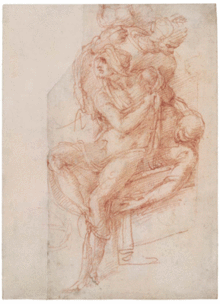
It was whilst working in Rome that Sebastiano became acquainted with, and became one of the rare and trusted friends of, Michelangelo Buonarroti.   According to Vasari, Michelangelo befriended Sebastiano and offered him pictorial designs for him to develop in paint.  This friendship however drew Sebastiano into the long running rivalry Michelangelo had with Raphael Sanzio but in a way it had a lot to do with today’s featured work.  It is believed that through the good auspices of Michelangelo, Sebastiano was, at the end of 1516, commissioned by Cardinal Giulio de’ Medici to paint a large altarpiece, depicting the Raising of Lazarus.  Cardinal Giulio de’ Medici was appointed to the see of Narbonne, in south-west France, by his cousin Pope Leo X.  The painting, along with its proposed companion piece the Transfiguration, which the cardinal had commissioned, shortly before, from Raphael, were to be sent to the cathedral in the Cardinal’s own bishopric in Narbonne, which owned a relic relating to the story of Lazarus.  There seems nothing strange about the cardinal commissioning two paintings for the same cathedral but Vasari would have us believe that there was a little devilment with the cardinal’s request as, in a way, it was to pit the two artists against one another and of course the cardinal was well aware of the rivalry between Michelangelo and Raphael as we know Raphael’s “artistic enemy” was Michelangelo, who was therefore only too willing to lend Sebastiano a hand with the work by supplying him with sketches that could be incorporated into the Raising of Lazarus.

Michelangelo’s sketch of Lazarus

The featured painting today, the Raising of Lazarus by Sebastiano, is a great example of the highly colourful style of Venetian painting of the time.   Sebastiano completed the painting in January 1519 and it was immediately hailed as an artistic triumph.  Raphael was concerned that his painting of the Transfiguration was not compared with Sebastiano’s Raising of Lazarus but the two were seen together in April of the following year, a couple of days after Raphael’s death.  Raphael’s painting never went to Narbonne, remaining in Rome whereas Sebastiano’s Raising of Lazarus eventually went to the French city.

The biblical tale tells us about the request of the sisters Martha and Mary for Jesus to visit the grave of their brother Lazarus and raise him from the dead.  In his Gospel, St John divided the story of the miracle into three parts. Firstly, Jesus bids the people to take the stone from the tomb.  Next he tells his friend, Lazarus to rise, and finally Jesus tells Lazarus to unbind his shroud and it is this third command to Lazarus that we see in the painting.  The painting we see before us is a depiction of a biblical story from the Gospel of Saint John (John: 11).  Verses 40 to 44 recount the event:

“…Jesus, once more deeply moved, came to the tomb. It was a cave with a stone laid across the entrance.   “Take away the stone,” he said.  “But, Lord,” said Martha, the sister of the dead man, “by this time there is a bad odor, for he has been there four days.”    Then Jesus said, “Did I not tell you that if you believe, you will see the glory of God?”   So they took away the stone. Then Jesus looked up and said, “Father, I thank you that you have heard me.    I knew that you always hear me, but I said this for the benefit of the people standing here, that they may believe that you sent me.”  When he had said this, Jesus called in a loud voice, “Lazarus, come out!” The dead man came out, his hands and feet wrapped with strips of linen, and a cloth around his face.  Jesus said to them, “Take off the grave clothes and let him go.”

In the background of the painting, we see a cloudy sky being penetrated by a shaft of light.  We can make out a distant town by a lake or river. The town is more a depiction of a high-walled fortified Roman town with its large and solidly built bridge, rather than a depiction of somewhere from Sebastiano’s birthplace, Venice.   It feels Roman more than Venetian. We see the figure of Christ standing in the foreground, slightly left of centre,   He is portrayed theatrically pointing towards the seated figure of Lazarus, who is still partly covered by his burial shroud.  It is almost as if Jesus is giving a speech.   Jesus needs all his powers of persuasion to bring back Lazarus. It is not so much a command Jesus is giving to Lazarus, more that he is appealing to the old man, his friend, to rise from the dead.

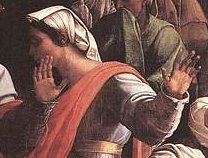
All around, and squeezed tightly into the composition, are men and women all of who pose in a most theatrical manner, due to their shock at seeing Lazarus coming back to life.   In the left mid-ground we see a group of Pharisees unimpressed by what they have seen and are still hell-bent on plotting the death of the so-called miracle maker.    The various figures in the painting are all clothed differently.  It is interesting to take time and study each figure.  There is an old man knelt on the lower left, hands clasped in a prayer-like manner as he looks up at Jesus.    Look how some of the men and women hold their hands up in horror and look away rather than cast a glimpse on the back-from-the-dead figure of Lazarus.  Dramatic poses have been given to Martha and Mary, the sisters of Lazarus.   Mary is on her knees to the right of Jesus, her hand placed over her heart.   Martha, dressed in a blue robe with a red sash, stands to the right of Jesus, recoiling from what the Biblical passage termed “the bad odour”.

Martha recoiling at the sight and smell of Lazarus

Others talk together discussing what they see before them.   Take time and look at all the various expressions on the faces of the people.   All these figures are painted in bright colours.  The artificial and theatrical gestures we see before us seem almost as if time has come to a standstill.  It is like a freeze-frame shot from a film.   Lazarus is indeed a strong, mature man and Sebastiano used the red and black chalk drawings given to him by Michelangelo for a preliminary study of the figure of Lazarus and some of his attendants. Three of these drawings still exist and one can be seen at the British Museum in London.   The way the figures are portrayed by Sebastiano are depicted in a Michelangelo’s style. A prime example is the depiction of Lazarus.  Look at the way Sebastiano has shown him half turned which is often the way a sculptor would position his figure.  The arms and legs of Lazarus are so positioned to show off his musculature and sinews.  It is so like the work of Michelangelo.

Cardinal Giulio de’ Medici chose to keep Raphael’s Transfiguration for himself and it is now housed in the Vatican Gallery.  He sent Sebastiano’s painting to Narbonne.   The Raising of Lazarus in now housed in the National Gallery, London.    After Raphael’s death, Sebastiano became the leading painter in Rome and he was the first artist to return there after the 1527 Sack of Rome.  In 1531, the Pope rewarded his service by making him Keeper of the Papal Seal and it was from this position that Sebastaino became known as Sebastiano del Piombo, (piombo being the Italian word for lead which was used for sealing).

Tomorrow I will look at the companion piece or some would say the “competition” piece to Sebastiano’s Raising of Lazarus – Raphael Sanzio’s Transfiguration, a painting many art historians believe to be the greatest painting of all time.

The Clothed Maja and The Nude Maja by Goya

La Maja Desnuda (The Naked Maja) by Goya (c.1797-1800)

I ended my last blog with the tantalising statement:

“…I will offer you a work by another famous Spanish artist, Francisco Goya, and tell you about the connection it has with myself, as a naughty schoolboy, and my first sighting of erotica !!!!…”

I suppose I will be accused of cynically employing cheap tactics in order to get people to read my blog but there is a connection between the two Goya paintings I am featuring in this blog with the dubious habits of a young school boy.   My early school days were back in the late 50’s and the first sight of what I loosely termed as “early erotica” came in the form of a pen.  It was not just any pen.  It was a pen which had a picture of a beautiful and fully clothed young woman.  However the titillating aspect about the pen was that if you  turned the pen upside-down the clothed lady slowly shed all her clothes !!!

La Maja Vestida (The Clothed Maja) by Goya (c.1800)

Today I am looking at, not one painting by Francisco Goya, but two, albeit as you will realise, they are almost the same except for one major exception.  His two paintings are entitled La maja vestida (The Clothed Maja) and La maja desnuda (The Nude Maja) were painted around 1800 and 1803 and the only difference between the two is that in one the woman is fully clothed whilst in the other she is naked.  I suppose the first question that comes to one’s mind is who is this lady and how come Goya painted her reclining portrait.  The question has never really been answered but the names of two ladies are often bandied about by historians as being this sultry temptress.  The two candidates are the 13th Duchess of Alba and Pepita Tudó.

The Duchess of Alba or to give her, her full title, Doña María del Pilar Teresa Cayetana de Silva-Álvarez de Toledo y Silva, the 13th Duchess of Alba de Tormes was a Spanish aristocrat who featured in a number of Goya’s paintings.  Francisco de Goya profited from wealthy patronage probably more than any other artist. He was without doubt the darling of the Spanish monarchy.  His first appointment as court painter came from King Charles IV of Spain. The King and his wife, Queen Maria Luisa, sat for the artist themselves many times.   For their portraits they would dress in the most colourful and showy costumes adorned with the royal regalia.  Besides the royal portraits Goya received many lucrative commissions from other high-ranking government officials as well as requests for altarpieces for churches and cathedrals.  However without doubt and notwithstanding his many prominent sitters, one stands out above all the others – the 13th Duchess of Alba.

The Duchess of Alba was not just any royal courtier.  She was a very wealthy and powerful woman in her own right.  She was a  member of Spanish nobility and held the title of 13th Duchess of Alba.  She married José María Alvarez de Toledo y Gonzaga, who was the 15th Duke of Medina-Sidonia, and she became the wealthiest woman in Spain. She was quite a character.  Besides her natural beauty, she was the height of eccentricity, and very strong-willed.  Goya was besotted by her and rumours had it that, at one time, the two were lovers.  He recounted the time she came to his studio and asked him to apply her make-up:

“…the Alba woman, who yesterday came to the studio to make me paint her face, and she got her way; I certainly enjoy it more than painting on canvas, and I still have to do a full-length portrait of her…”

It has been suggested that the two paintings were originally owned by the Duchess of Alba and later acquired by Manuel de Godoy after her death. Goya’s close and intimate relationship with the Duchess of Alba has made her the most popular candidate as a model for the Majas, or at least as a source of inspiration.  Another persuasive argument in favour of this candidate is the many drawings of herself and members of her household Goya made during his visits to the Duchess’s country estate. However the face of the Majas does not show a close resemblance to the facial qualities of the drawings of her but this could be put down to the need to conceal her identity.

The second candidate for the model in Goya’s two paintings was Pepita Tudó, whose full name was Josefa de Tudó, 1st Countess of Castillo Fiel.  Pepita being the diminutive of Josefa.    She was born in Cadiz.  When she was just sixteen years of age, she along with her mother and two sisters, were living in the household of Manuel de Godoy.  Five years later, aged twenty-one, she became the mistress of Godoy who was then Spanish Prime Minister and because of the influence he had with King Charles IV and his wife Queen Maria-Louisa he became one of the most powerful men in Spain.  In 1797, Queen Maria Luisa arranged a marriage for Godoy toMaría Teresa de Borbón y Vallabriga, 15th Countess of Chinchón, the granddaughter of Philip V of Spain, despite him still having Pepita as his mistress.  This was an arranged marriage, set up by the queen as the bride and groom had never met.  The Queen ensured that the partnership was financially advantageous to both bride and groom.  So what was in it for the Queen?  Historians would have us believe that the queen’s ulterior motive was two-fold.  Firstly she had hoped that the marriage was a way of ending Godoy’s dalliance with Pepita and secondly the marriage would act as a cover for her own relationship with Godoy. Godoy was pleased with the arrangement as it boosted his finances and despite what the queen had hoped for, he continued his liaison with his mistress Pepita,  who bizarrely lived in the same house as his wife.  In 1805, Godoy’s wife gave birth to a son, Manuel, and in 1807, she gave birth to another son, Luis.  His wife died in 1828 and Godoy married Pepita although rumour had it that they had married years earlier.  Godoy was a very amorous and amoral man and had many lovers but who was his one true love –the Duchess of Alba or Pepita?  According to the ninety-year old Pepita who died in 1869, Godoy had one, and only one true love, and that was Queen Maria Luisa.

The paintings I am featuring today were possibly first owned by Manuel de Godoy.   The Clothed Maja was hung in a room in his house and placed on top of The Naked Maja.  He had arranged a pulley mechanism to be attached to The Clothed Maja so that it could be raised, revealing the naked version which was behind it !!!

In 1807 Godoy was at the height of his power and as prime minister had negotiated the Treaty of Fontainebleau with Napoleon and the French, which in essence carved up Portugal and Godoy was awarded the “Principality of the Algarves”, under the protectorate of the King of Spain. However as is the case of most powerful men he had made a number of enemies, one of whom was the heir to the Spanish throne, Ferdinand VII.   Unfortunately for Godoy France did not keep to their non-aggression treaty with Spain and Godoy, along with King Charles IV and Queen Maria Louisa went into exile in Bayonne.  Charles IV was forced to abdicate and Ferdinand VII, Godoy’s enemy, became king of Spain.

The following year, in 1808, all Godoy’s fate was sealed.  His property was seized by the Spanish monarch and in 1813 the Spanish Inquisition confiscated both of the La Maja works considering them to be obscene.  In 1815 Goya was denounced to the Inquisition as being the artist who painted the two “obscene” works.  In May of that year he was summoned to appear before the Inquisition and pressure was brought to bear on him to reveal who had commissioned the works, who were the women and what were his intentions for such paintings.  Alas, it is not known what Goya told his inquisitors.

Las Majas at the Prado Museum, Madrid

The two paintings were eventually returned in 1836 and housed in the Academy of Fine Arts of San Fernando.   We will probably never be one hundred per cent sure as to who modelled for the two paintings.  Since 1901, both The Clothed Maja and  The Nude Maja have been exhibited side by side in the same room at the Prado Museum in Madrid.

Thankfully there was no Inquisition around when, as a pre-teenager, I giggled as I watched the woman’s clothes disappear with just a flick of my prized pen !!!!

I send this blog from a very hot Spain and I am reluctant to return to the cold and wet place I call my home.

An Old Woman Cooking Eggs by Velazquez

An Old Woman Cooking Eggs by Velazquez (1618)

My featured painting today is another by Velazquez.  It is entitled An Old Woman Cooking Eggs and Velazquez completed it in 1618.  It is an example of his kitchen scene creations which he made popular in the early seventeenth century and became known as a bodegón, which showed peasants eating or preparing meals and the utensils they used to prepare and serve them.  It should not be forgotten that when Velazquez completed this work he was barely nineteen years of age.   It, without doubt, demonstrates his talent for painting people and everyday objects directly from life.  In some ways this painting was demonstrating his masterly painting technique for all to see and as we will see later,  it was his to be his calling card for use in his search for lucrative patronage.

The background of this painting, like Velazquez’s Waterseller of Seville, in my last blog, is dark and indistinct, and is in marked contrast to the often over-crowded colourful backgrounds of Dutch and Flemish kitchen scene paintings of the time, which were full of animated happenings.  This is a more sombre scene.  Like many of Velazquez’s early works, it demonstrates the influence of chiaroscuro, the artistic technique developed during the Renaissance, referring to the use of exaggerated light contrasts in order to create the illusion of volume.  In this painting we have a strong light source coming in from the left, illuminating the woman, her utensils and the poaching eggs but at the same time casting the background and the boy into deep shadow.  It is a wonderful display of the contrast of light and shadow, and as was the case with the Waterseller of Seville, Velazquez has utilised subtle hues and a palette dominated by ochres and browns.

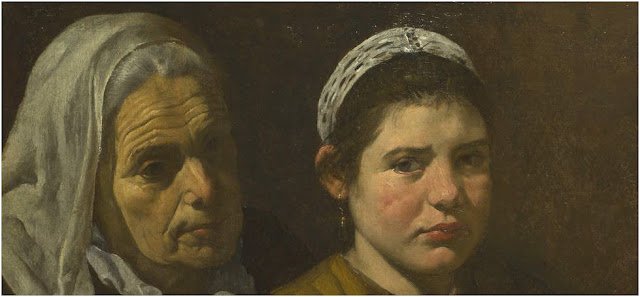
Christ in the house of Martha and Mary (1618) (detail)

Before us we have two characters, an elderly woman and a young boy.   I can find no evidence of a relationship between the artist and the old woman but what we do know is that he used her as a model in another of his works, Christ in the House of Martha and Mary, which he painted that same year and thus one assumes he knew the woman well because he has portrayed her so beautifully.  She is sitting in front of a small clay vessel in which she is cooking eggs over a charcoal fire. From her facial features, such as her high cheekbone, we know that in her early days she would have been a true beauty but now these facial qualities are somewhat worn and we are aware that she has lived a hard life, which has taken its toll on her.   Velazquez has imbued her with a solemn and contemplative quality. She seems transfixed by some unknown apprehension and appears to be lost in a world of her own and looks to have lost concentration with the cooking of her eggs. The woman holds a spoon poised over the pan in one hand and an unbroken egg in the other, as the whites of the eggs in the boiling liquid below thicken.   It is almost as if she is just going through the motions of the food preparation and her mind is somewhere else.

The boy on the left of the painting, which looks to be the same model Velazquez used in his Waterseller of Seville painting, strangely makes no eye contact with the old lady.  He looks out at us and his demeanour is somewhat grave.  Although not looking at the woman he is helping her as we see him proffering a glass cruet full of a liquid.  It could be vinegar or oil but whatever it is, it has obviously been called for by the cook.  His right hand cradles a large trussed honeydew melon.  The contrast in the ages of the cook and her helper, as well as the egg the old lady holds in her hand, maybe symbolic of the passing of time and the transience of life as in a Vanitas painting, but maybe that is reading too much into the painting.

However the beauty of this painting is not the depiction of the old woman or the boy but Velazquez’s mastery of his portrayal of the inanimate objects seen in the painting.   In this kitchen scene, the common utensils used in preparing food, such as a mortar and pestle, pots, ladles, bowl and jugs have at least as important a place as the two characters themselves. Look how all these utensils are lit up against a much darker background.  Look how Velazquez has incorporated into this work items made from various materials such as clay, wood, glass, brass, copper and pewter and how he has illustrated how the light affects them differently.    Note the curved shadow of the knife which balances on the chipped rim of the bowl on the table.   See how Velazquez has depicted the moist surface of the inside of the pan as it glistens above the egg whites.   Observe how Velazquez has skilfully depicted the various textures of the items on display such as the eggshell, the straw of the basket which hangs on the wall in the background, the skin of the melon the boy is holding, the onion which lies on the table to the left of the woman, as well as the textures of the linen clothing and the string wrapped around the melon.  It appears that Velazquez was fascinated with the different materials and textures and how the light and shadow danced upon both the opaque and reflective surfaces.   All of these brilliant touches showcase the artist’s virtuoso performance.  This is indeed a case of an artist showcasing his masterly painting techniques and offering proof of his artistic ability to the viewer of this work, who maybe a prospective patron.

Velázquez was born in 1599 in Seville.   At the age of eleven, Velázquez was apprenticed to Francisco Pacheco, who at the time was Seville’s most famous artist and art theorist.  Pacheco taught Velazquez the technical skills of drawing and painting, still-life and portraiture and soon the young artist outshone his tutor.  In 1617, Velázquez completed his apprenticeship and was allowed to set up his own studio. Pacheco said of his young pupil and future son-in-law:

“…After five years of education and training, I married him to my daughter, moved by his virtue, integrity, and good parts and by the expectations of his disposition and great talent…”

The following year, 1618, Velazquez married Pacheco’s daughter Juana and by 1621, the couple had two daughters.  In 1623, due to his father-in-law’s connections, Velázquez was asked to paint a portrait of the young King Philip IV, the ruler of Spain.   The portrait was viewed as such a success by the sitter that he immediately appointed Velázquez as one of his court painters, and from then on would allow no one else to paint him.

This was the second of my Velazquez paintings which I wanted to give you before I headed for the sunnier days of Madrid.  In my next blog, which I hope to send from the pool side of our parador, I will offer you a work by another famous Spanish artist, Francisco Goya and tell you about the connection it has with myself, as a naughty schoolboy, and my first sighting of erotica !!!!

The Waterseller of Seville by Velazquez

The Watersellerof Seville by Velazquez (1623)
Apsley House, London

At the end of this week we are off on a five-day jaunt to Spain to sample the delights of the Spanish Paradores and so I thought it would be fitting to have my next few blogs focus on Spanish painters.   Today I want to start by looking look at the connection between a famous Spanish painter and an English fighting hero.  I want to explore the connection between the talented Spanish artist Velazquez and the great British general, Arthur Wellesley, the Duke of Wellington.

My Daily Art Display today features not just one work but three very similar works, which were completed by the young aspiring Spanish artist in the early 1620’s and who was to become one of the greatest painters of all time.  His name was Diego Rodriguez da Silva Velazquez.  The works I want to look at today were all painted when he was in his early twenties. The paintings in which Velazquez specialised during his early career were known as “bodegones“.  The word derives from the Spanish word, bodegón which lierally means taven or public eating place.   In Spanish art, a bodegón is a still life painting depicting the preparation or eating of food, pantry items, such as victuals, game, and drink, often arranged on a simple stone slab, and also a painting with one or more figures, but significant still life elements, typically set in a kitchen or tavern. These works often depicted scenes of lowlife in earthy tones, and with a sense of sombre pathos, which were unlike similar works by the contemporary the highly-colourful Dutch and Flemish genre scenes by the likes of Jan Steen and Pieter Aertsen with their depictions of the happy, but poor, peasants.

The title of Velazquez’s  three painting is The Waterseller of Seville.   Hecompleted these works during the period from 1618-1622.    Art historians would have us believe that these works were the greatest of all his Seville paintings.   Velazquez painted three versions of the work.  The one shown above can be seen in the Apsley House in London.  Another version of the painting, which was completed three years earlier, can be found in the Uffizi Gallery of Florence.  The third version of the work hangs in the Walters Art Museum  in Baltimore.

Let us take a look at the paintings in detail.  Before us Velazquez has portrayed a waterseller in the city of Seville. During the scorching heat of a Spanish day, to come across a waterseller would be a godsend.   The role of a waterseller in Spain in those days was a common trade for the lower classes in Seville.  The aguador was often mentioned in popular satirical Spanish literature, plays and popular imagery.  The aquador or waterseller was frequently portrayed as a scoundrel or pathetic peddler, who operated on the fringes of urban society and hawked his often dubious wares to an unsuspecting public.  This street water-seller was nicknamed the Corsican of Seville and who, according to accounts from the end of the 17th century, wore a smock with holes in it to show his scabs and sores to potential customers so as to eke out some sympathy whilst at the same time, boost trade.     In Velazquez’s painting we can see that the vendor of water has two customers.  One is a young boy and it is thought that the artist has used the same model for this work that he used in his earlier works, entitled The Lunch and Old Woman Cooking Eggs, a painting I will look at in my next blog.  In the background and somewhat harder to discern is another young man who has also purchased a small jug of water from the seller.

In the foreground of the painting we have very large jugs of water.  Rivulets and glistening water drops slowly run down the ridges of this massive jug.   Observe how Velazquez has cleverly depicted this main jug.  It appears so close to us.  It almost seems to bulge out of the painting.   The chalice-like goblet, held by the young boy, holds centre stage as the light falls on it.  Look carefully at the glass.  It is not just a simple glass of pure water but in it floats a fig.  This addition of the fruit was to act as a kind of perfumer with the intention of making the water taste fresher.

The Waterseller of Seville by Velazquez, (1618)
The Uffizi Gallery, Florence

The most striking aspect of this painting is how Velazquez has portrayed the water seller.   This is not a rich man.  This is a man who has had to eke out every peseta the hard way.    His facial expression is downcast. He has a look of resignation as he hands the boy the glass of water.  The man behind, who is shown full face, can be seen quaffing water from a lifted jar.  He has almost faded into the darkness of the background.   The features of the water seller, due to his days on end of standing out in the harsh sunlight, have taken its toll.  His face is rather haggard with age and ravaged and wrinkled by its exposure to the sun.  He has been plying his trade for many years, never able to accrue enough to retire.   The Apsley House version of the painting shows the seller bare-headed and in this version we can observe his short shaved hair.   Velazquez’s aged aguador stands in profile in the company of two of his clients.   He is dressed in coarse, monk-like robes.  Look at his eyes.  There is little or no eye contact between him and the boy.  He gazes blankly.  He seems to be lost in thought and has little or no regards to what is happening around him.   The offering of water seems to be just a mechanical movement.   The boy whose downcast, three-quarter glance is highlighted by a stream of light, hesitantly grasps the proffered goblet of water.  He does not make eye contact with the waterseller.  Is he too embarrassed by the plight of the old man?  Velazquez in his depiction of the man and the boy has highlighted the sharp contrast in their lives.  The battered and scarred face of the water seller contrasts greatly with the smooth white facial features of the young boy.

The Waterseller of Seville by Velazquez,(1620)
Walters Art Museum Baltimore

Velázquez’s portrayal of the waterseller is very profound.  One can see that he sympathises with the man and his terrible “lot in life”, by the way he has portrayed the man.  We can see that he shows consideration for  the poverty and age of the street-seller, and has, in some ways, given him an air of quiet dignity .  Velazquez by his depiction has represented a true-to life depiction of the waterseller and his trade.  His carefully crafted work encapsulates the imperfections of the seller’s pots, the saturations of dampness on their sides, the glistening of the light on the small drops of water and the glass, and the realistic expressions of the characters.

So what about the connection I mentioned in my introduction that this painting, the one which presently resides in Apsley House,  had a connection with Arthur Wellesley, 1st Duke of Wellington?   Apsley House, also known as ‘Number One, London’ stands on the north side of Hyde Park Corner. It is the magnificent former home of the Duke of Wellington and was granted to him by a grateful nation.

The “Waterseller” painting originally was a prized part of the Spanish royal collection.   In 1700 it figured in the inventory of the Buen Retiro Palace in Madrid.   By the late 18th century it hung in the Royal Palace in Madrid. There it struck the fancy of Napoleon’s brother Joseph Bonaparte, who was the commander of French forces in Spain during the Peninsular War and, who for a short time was the usurper of the Spanish throne.  When the French realized they were about to be driven from Spain by the Duke of Wellington, Joseph Bonaparte decided to leave Madrid but he was not going to leave the city empty-handed as he plundered numerous royal treasures before quickly retreating northward with his troops.  However Joseph Bonaparte was not able to reach the sanctuary of France as he was caught by Wellington and his troops just as he was about to cross the Pyrenees.  Wellington defeated Bonaparte at Vitoria and recovered from Bonaparte’s baggage train a number of Spanish paintings that had been cut from their frames, including the “Waterseller”.   Wellington wanted to return the artistic treasures to the Spanish nation but the restored Spanish monarch Ferdinand VII gave them all to Wellington as a gift from a grateful Spanish nation. In the dining room of Wellington’s magnificent London mansion, Apsley House, the Waterseller of Seville hangs today as a fitting tribute to its liberator.

View of the Kreuzkirche in Ruins by Bernardo Bellotto

View of the Kreuzkirche in Ruins by Bernardo Bellotto (1765)

My choice of painting for My Daily Art Display blog today is based on a modicum on nostalgia and the return of a small amount of wanderlust.   Next year, at the end of May, I am contemplating a week away on my own to coincide with my wife’s week long vacation with “les girls” and so I am trying to decide where to take myself off to.  I need to decide whether to spend a week looking out at the blue seas of the Mediterranean or have a cultural week looking around the art galleries and museums of a city.  At the moment, and because the sea may not be that warm at the end of May, I am leaning towards the artistic route as my get away.  Presently I am toying with the idea of either Palermo in Sicily, a place I have never visited or maybe I will return to Germany after many years away from this beautiful country and spend some time in either Munich and/or Dresden.   The nostalgia aspect of this blog is to do with Dresden, a city I visited with my children about five years ago.  I fell in love with this beautiful city with its magnificent buildings and I have always wanted to return.   The nostalgia was brought on when I came across a painting the other day which jogged my memory of the happy times we had in this former East German city and some of its beautiful architecture.  The featured painting today is entitled View of the Kreuzekirche in Ruins by the eighteenth century Italian artist Bernardo Bellotto.

Bernardo Bellotto was born in Venice in 1721.  He was the son of Lorenzo Antonio Bellotto and Fiorenza Domenica Canal, the sister of Giovanni Antonio Canal, better known to us as Canaletto.  Bellotto’s initial artistic training was in his uncle’s workshop where he worked from the age of fourteen.  At the age of eighteen Bellotto became a member of the Fraglia dei Pittori (Venetian painters’ guild).  In the early 1740’s he and his uncle, Canaletto, took a trip along the Brenta canal to Padua during which time the two amassed a number of sketches which were later translated into completed oil paintings.

In 1742 Bellotto left Venice and travelled extensively around the Northern Italian cities, stopping off at Florence and Lucca and at each stop he would complete a verduta of the place.   A verduta is a highly detailed, usually large-scale painting of a cityscape or some other vista.   These painting were very popular with the foreigners who travelled around Italy on their Grand Tour and wanted to bring home something to remind them of the places they had visited.  He eventually arrived in Rome where he studied study architectural and topographical painting.   He remained in Rome until 1743 at which time he journeyed back to Venice.

Bellotto left Italy for good in 1747.  The rest of his life was spent travelling around the capital cities of Europe and picking up commissions from the various royal courts.  He was invited to Dresden in 1747 by the then ruler Frederick-Augustus II, Elector of Saxony who was also King Augustus III of Poland.  Some historians believe that Augustus actually wanted Canaletto but as he was bound for England at the time, he had to settle for his nephew !  Bellotto, who was by now a married man and had a son, Lorenzo, was suffering financially from a declining art market in Venice and jumped at the chance to work for Augustus.   The money Augustus offered Bellotto was the most paid to an artist working at the court of Saxony.   Bellotto worked in Dresden for eleven years as court painter.  His commission from Augustus was to paint twenty-nine large-sized canvases, some measuring almost three metres wide, depicting scenes of the cities of Dresden and Pirna and of the fortresses of Sonnenstein and Königstein.  These canvases, most of them almost two and a half metres wide, were to be hung in the royal painting gallery in the Stallhof, which forms part of the Royal Palace in Dresden.  Bellotto’s depictions of the city of Dresden were remarkable for their topographical meticulousness, mathematical perspective and the way in which he portrayed the way the light played on the various architectural structures.  The way he handled the light was truly remarkable.

In 1756, the fierce conflict of the Seven Year War, which had affected many European countries, arrived in Dresden and within months the city of Dresden was overrun by Prussian troops.    Augustus fled to Warsaw and Bellotto moved away from Dresden and took up residence in Pirna.  In 1758 Bellotto left his wife and daughters behind in Pirna and with his son travelled to Vienna as he had been fortunate to have received an invitation from Empress Maria Theresa to come to city and paint a number of cityscapes depicting many of the city’s buildings, royal residences and monuments.   In 1763, just as the Seven Year War was coming to an end Bellotto decided to leave Vienna and return to his wife and daughters in Dresden to see if his erstwhile patron August III could give him some work.   Bellotto, on the way to Dresden, stopped off at Munich, where with a letter of recommendation from Maria Theresa to the Electress of Bavaria, Maria Antonia, who also happened to be Augustus’ daughter was given commissioned to paint some panoramic views of the city and the palace of Nymphenburg.   He then headed back to Dresden full of hope for future commissions from his erstwhile royal patron.   However Bellotto’s best made plans failed as the war had played havoc with the city of Dresden which lay in ruins and his former patron, August III had died.  Dresden had run out of money and there was no longer a post for him as court painter.   The commissioning and purchasing of art for the city was no longer in the hands of the ruler but was now controlled by the city’s newly formed Dresden Academy of Fine Arts which had been established in 1764.

With little work in prospect Bellotto left Dresden in 1767 and travelled to Warsaw.  Here he was employed by King Stanislaus Poniatowski, who commissioned Bellotto to complete a number of large-scale paintings depicting the city of Warsaw.  In all Bellotto completed twenty views of Warsaw itself and four of Wilanow Palace. Almost all of these paintings can be found in the Canaletto Hall in the Royal Palace of Warsaw.

Bellotto remained in Warsaw for sixteen years and died in the city in 1780 at the age of 59.

The Kreuzekirche in Dresden by Bellotto (1747-56)

My Daily Art Display features Bellotto’s depiction of the ruins of the Kreuzkirche in Dresden, which had been partially destroyed during the Seven Year War, at a time when Bellotto had been forced to flee the city.  The painting is entitled View of the Kreuzkirche in Ruins and was completed by Bellotto in 1765.  The Kreuzkirche is the oldest church in Dresden and, during the conflict, was shelled by Prussian artillery.   The building was set ablaze and finally collapsed. The church tower, though damaged, remained standing.  Work commenced on the reconstruction the church and it was decided to preserve the original tower. Unfortunately in June 1765, with the construction of the new church already under way, the greater part of the tower collapsed.

This painting is one of Bellotto’s later works, painted during his second stay in Saxony. It demonstrates his quite extraordinary, perhaps unique, capacity to capture the spirit of an event.  This ruin, painted by Bellotto is an unusual one for it is not an ancient ruin as far as the artist was concerned.  It was a relatively new one as the destruction had only occurred five years earlier.   Bellotto had completed a work depicting the great church some years earlier (see above).   However in today’s featured work all we see are the jagged remnants of the church rear up skywards.   The cleanliness of the once beautiful church has gone.  There is nothing clean about the church now.   The scene before us is just a mass of noise and dirt.  It is a chaotic scene which we find hard to believe that it could ever be put back to its former glory.   The Church, as the body of Christ, has been violated all over again and the civic wounds of the German city have been violently opened for all to see.  This is the price to be paid when once we set forth to war.

As we look at the painting, our first thoughts are that Bellotto had actually painted an ancient ruin but of course he hadn’t.  The great medieval church which was situated in central Dresden was the subject of earlier paintings by Bellotto showing it in all its glory and so the artist was probably grief-stricken as he looked upon what was once his beloved church and which had now been partially destroyed by the advancing Prussian artillery

In the painting we see many of Dresden citizens.  Close to the ruins we can just make out craftsmen as they start their preparations to rebuild the once –beautiful edifice.  On the periphery we see men and women dressed in their best clothes staring at the ruin.  For them it was just a day out to visit the site where the destruction had taken place.  For them it was just blatant voyeurism.

For those of you interested in the history of this great church, here is a potted history of the building:

The Kreuzkirche or Holy Cross Church is the main reformed church of Dresden.
Its history started in 1206, when at his spot a small chapel was located for travelling tradesmen.
In 1215 a Basilica was built named “Nikolaikirche”, after the protecting saint for the tradesmen.
In 1388 the Meißen Bishop renamed the church into Holy Cross Church (as in 1234 a splinter of the original cross was given to and stored inside the church).
In 1491 the church is destroyed by fire. A new church is built in Gothic style.
In 1539 the first Lutheran service is held in the church, now being the main reformed church of town.
In 1584 the tower is added to the church, but in 1689 is destroyed by fire and rebuilt.
In 1760 the church gets damaged during the seven year war.

In 1792 a new church is built in Baroque style; much of the outer design is still visible in the present building.
In 1897 another fire damaged the center section; the reconstruction is done in Jugenstil.
In 1945 the church is burned to the ground during the bombardments.
In 1955 the church is reopened again, but the building is restored and improved in the years after.

The Melun Diptych by Jean Fouquet

The Melun Diptych by Jean Fouquet (c.1450)

In my last blog I looked at an altarpiece by Michael Pacher and discussed terms such as diptych, triptych and polyptych, which all referred to panel paintings which were hinged together.  Although we looked at a triptych altarpiece this form of art was not only used in the depiction of religious personages.   There were many commissions for the diptych when it came to secular portraiture.  Often it would be the portrait of the husband on one panel with the portrait of his wife on the other.  The diptych was quite a common format in the Early Netherlandish paintings of the 15th and 16th centuries. In my blog today I want to look at a fifteenth century diptych, known as the Melun Diptych, which was the work of the great French painter and manuscript illustrator, Jean Fouquet.  Although the attached photograph above shows the two paintings as a diptych, the two panels are now separated.  Up until 1775, the diptych remained in the church of Notre Dame in Melun. However the church fell on hard times and needed money to help pay for the building’s restoration.  The elders of the church decided to raise funds for the building work by selling the diptych.  The right wing with the Madonna and Child was sold to the mayor of Antwerp and it has remained in the Belgian city ever since.  It is now housed in Koninklijk Museum voor Schone Kunsten, Antwerp (The Royal Museum of Fine Arts).    The left hand panel of Chevalier and St Stephen was purchased by Clemens Brentano, the German poet and novelist in 1896.  This panel is now housed in Staatliche Museen, Berlin.   Each of the wood panels measure 93cms x 85cms.

Jean Fouquet was born in Tours, a town in the Loire Valley, around 1420.  It is thought that Fouquet’s initial artistic training was at a studio in Paris, where he was educated in the ways of a manuscript illuminator and painting of miniatures.   It is also believed that he may have worked as an apprentice in the Bourges workshops of the Netherlandish painter, Jacob de Littemont, who was the court painter to Charles VII and later, Louis XI, a position that Fouquet himself would hold in 1475.    His first recorded painting dates back to 1440, and was entitled The Court Jester Gonella, who was the court jester of Nicholas III d’Este.  I featured that painting in My Daily Art Display of December 14th 2010.

Portrait of Charles VII by Jean Fouquet (c.1445)

In 1445 he completed one of his first very large panel portraits entitled Portrait of King Charles VII.  It was the portrait of the French ruler, Charles VII.  The king is painted between drawn curtains. The artist has painted the king in three-quarters profile and the inscription on the frame “le trés victorieux roy de France” reminded everybody that this was the ruler who brought the Hundred Years’ War to a triumphant end.   Ironically it was one of the few battlefield victories achieved by the ruler.

In 1446, Fouquet accompanied a French delegation, as court painter on a mission to Rome, as records of the trip where chronicled by the Italian artist Antonio Filarete.  The following year, Fouquet completed the commission to produce a portrait of Pope Eugenius IV with his two nephews, which was hung in the sacristy of the Dominican convent of Basilica of Saint Mary Above Minerva in Rome.  It was probably this connection with the Dominican convent that led him to be introduced to the great Italian Renaissance painter and Dominican friar, Fra Angelico, who was at that time working on the frescoes in the chapel of Saint Peter,

When Fouquet returned to France in 1448, he opened a workshop in Tours and married.   He worked for the French court and carried out commissions for King Charles VII, the king’s treasurer Etienne Chevalier, and the king’s chancellor Guillaume Jouvenel des Ursins. A number of these commissions were miniatures, such as the Book of Hours of Étienne Chevalier.  In 1475, Jean Fouquet became the court painter to Louis XI.   Fouquet died in Tours in November 1481.

My Daily Art Display featured painting today is the Melun Diptych, so named as its original resting place was the cathedral at Melun, a town in the south-eastern suburbs of Paris.   This was a commission Fouquet received from Etienne Chevalier.  Estienne Chevalier came from Melun and worked for the government.  His initial posting was as French Ambassador to England in 1445.  Six years later he became Treasurer to Charles VII of France. Once Fouquet had completed the diptych, Chevalier presented it to his home town.  The diptych was made to be placed above the tomb of Chevalier’s wife, Catharine Bude, in the Collegiate Church of Notre-Dame, in Melun.  As I said in my introduction the diptych doesn’t exist anymore as a hinged pair and sadly, another thing we cannot see is the original framing.  According to a description of the paintings by Denis Godefroy, a seventeenth century historian, the original frames were covered in blue velvet. Around each picture were strands of gold and silver thread, in which the donor’s initials were woven in pearls. There were also gilded medallions on which stories of the saints were represented.

The Left wing of the diptych
Etienne Chevalier and St Stephen

Let us first look at the left hand panel of the diptych.  On the left wing of the diptych, Etienne Chevalier had himself painted next to his patron saint, Stephen (“Etienne” when translated into the English language is “Stephen).  Chevalier kneels in a red robe with his hands clasped in prayer.  The red colour of the robe indicates the status of Chevalier as it was the most expensive coloured dye and was reserved for high-ranking magistrates.   Next to him we have Saint Stephen wearing the dark robes of a deacon with its gold trim.  Stephen’s right arm is draped around the shoulders of Etienne Chevalier in a protective manner.   In the left hand of the saint there is a book, on which a jagged stone is lying.  This symbolises his martyrdom (St Stephen was stoned to death).  The background consists of Italian Renaissance style architecture with pilasters, in between which are inlaid marble panels.  The floor is made of neutral coloured tiles, which allows a glaring contrast with the highly coloured clothing of then two figures.  On the wall, receding in perspective, the name of Estienne Chevalier (IER ESTIEN ) is inscribed.   The two men look to their left at the Madonna and Child, who is portrayed on the right wing of the diptych and in some way if we look at the two panel paintings of the diptych together, it appears that St Stephen is introducing Etienne Chevalier to the Madonna and Child.  The plunging perspective Fouquet has used in this painting has in some way moved the two characters closer to us and they dominate the work.

The Right wing of the diptych
Madonna and Child

Now let us look at the right hand wing of the diptych, which is entitled Madonna and Child.  The first thing that strikes the observer is the strange and vibrant colouring used in the painting.  The unnatural colours have been attributed to represent the heraldic colours of the French king, being red, white, and blue.   It is generally agreed by art historians that the features of the Madonna are those of Agnès Sorel.  She was a favourite mistress of Charles VII and bore him three daughters.  She was known by the nickname, Dame de beauté.  In 1450, Charles was away on a campaign at Jumièges.  Agnès Sorel was at her home in Chinon, which the king had provided for her, but she wanted to be with Charles to give him some moral support.    Despite being pregnant with their fourth child and it being a cold mid-winter day, she journeyed from her residence to join Charles at the village of Le Mesnil-sous-Jumièges.  It was here that she suddenly became ill and died at the age of 28.   While the cause of death was originally thought to be dysentery, in 2005 French forensic scientist Philippe Charlier examined her remains and determined that the cause of death was mercury poisoning, but offered no opinion about whether she was murdered.   Agnès Sorel held great influence over the king and many historians believe that this made her many enemies, including the king’s son, the future king, Louis XI, and it could well be that she had been deliberately poisoned by her enemies.  However this theory does not receive unanimous agreement as historians point out that, at that time, mercury was sometimes used in cosmetic preparations or to treat worms and that might have brought about her death.

However there is another theory about the identification of the lady in the painting.  Jan Schafer in his 1994 book, Jean Fouquet an der Schwelle zur Renaissance, stated that he believed that the woman in the painting could have been Etienne Chevalier’s wife, Catherine Bude, over whose tomb the diptych was hung in Notre Dame, Melun.

This right-hand panel depicts the Virgin and Child seated on a jewelled throne with its marble panels and adorned with large gold tassels.  The Virgin and Child are surrounded by red and blue coloured cherubs and seraphims, which greatly contrast with the pale skin of the Virgin and child. The Madonna wears a blue dress, white mantle and a jewel-encrusted crown.  Once again we have the colour combination of red, white and blue.  The bodice of the dress is unlaced, giving us a view of her perfectly spherical left breast, which she has offered to the Child on her knee.  She has the bulging shaved forehead which was fashionable at that time. Her facial and skin tone, as well as the body of the Infant Jesus, are of a pale grey-white colour, as if painted in grisaille (painted entirely in monochrome or near-monochrome).  The colour Fouquet has used to depict her skin and the grey-blue colour he has used to depict her robe gives the Madonna a look of lethargy and sleepiness. The child ignores the proffered breast and instead looks at and points towards Chevalier and St Stephen.

The prominent Dutch historian Johan Huizinga wrote about this panel in his 1919 book entitled Herfsttij der Middeleeuwen which was translated five years later as The Waning of the Middle Ages.  He condemned the work as “blasphemous libertarianism”.  In his book he wrote about how he considered this painting a fine example of decadence in the late Middle Ages, when religious feelings came close to erotic ones. He wrote:

“…No instance of this dangerous association of religious with amatory sentiments could be more striking than the Madonna ascribed to Foucquet…”

“…The bizarre inscrutable expression of the Madonna’s face, the red and blue cherubim surrounding her, all contribute to give this painting an air of decadent impiety in spite of the stalwart figure of the donor…”

“..There is a flavour of blasphemous boldness about the whole, unsurpassed by any artist of the Renaissance…”

And so the two halves of the diptych were split up and never re-united.  Well actually they were, for in 1904, France borrowed the panels from Berlin for an exhibition of French primitives.

There are many unanswered questions with regards to these paintings and the background to their composition:

Was the Madonna based on Agnès Sorel or Catharine Bude?

Did Agnès Sorel die of dysentery during the birth of her stillborn fourth child or was she murdered on the orders of Charles VII’s son, the future King Louis XI?

Was there a third panel and in fact what we are seeing is two parts of a triptych?  The third panel was rumoured to be depicting Etienne Chevalier’s wife Catharine.

Besides Agnès Sorel being King Charles VII’s mistress was she also the mistress of Etienne Chevalier?

I am sure you will agree that we have before us today two beautiful wood panel paintings and the story behind them is fascinating.

The Altarpiece of the Church Fathers by Michael Pacher

Altarpiece of the Church Fathers by Michael Pacher (1471-1475)

For My Daily Art Display today I am going to look at an altarpiece by the fifteenth century Austrian painter and sculptor Michael Pacher.  As far as I can remember, I have only presented one other altarpiece in my blog and that was way back on December 7th 2010 when I talked about the exquisite Isenheim Altarpiece crafted by Matthias Grünewald.   Before I go into details of Pacher’s altarpiece let me talk in general about altarpieces.

Altarpieces are normally carvings, sculptures or paintings or a combination of all three.  They can be split into two main categories.  One type is known as the reredosIt is this type which is positioned behind the altar, rising from ground level and acting as a backdrop to the altar.  The other category is known as the retable, and these altarpieces stand either on the back of the altar itself or on a pedestal behind it.   In some churches, one can see both types of altarpieces.  The actual positioning of the altarpieces is often dictated by their size.

In the early days, before the use of canvas was the norm for painting, altarpieces were usually constructed of two or more separate wooden panels on which a set of religious depictions would be painted.  When the altarpiece comprised of just two panels, usually hinged together, it would be known as a diptych.  If the altarpiece construction was made of three hinged panels, a central panel and two side panels, then it was known as a triptych.  There were some altarpieces which consisted of many panels hinged together, side to side, but these side panels were also split horizontally giving small top and bottom independently hinged panels.  These were known as polyptychs.

Within the anatomy of altarpieces with their central and side panels,there are also such things as roundels, spandrels, predellas and pilasters and I won’t go into great detail about each of these but suggest you look at the website below which graphically explains the various “add-ons” that artists used to give to their altarpieces.  The website is:

http://www.nationalgallery.org.uk/anatomy-of-an-altarpiece

Today I want to concentrate on one particular altarpiece which Michael Pacher created for the Neustift Monastery high in the mountains close to Brixen, the south Tyrol town in northern Italy, known by the Italians as Bressanone.  The altarpiece which is part painting and part sculpture is entitled The Altarpiece of the Church Fathers and Pacher completed it in 1483.  Art historians have ranked this altarpiece as Pacher’s second most famous work, only being bested by the altarpiece he conjured up for the Church of St Wolfgang two years earlier.  My reason for choosing the one I have is that I liked the various stories attributed to each of the panels.  However before I look in detail at the altarpiece let me tell you a little bit about its creator.

Michael Pacher, an Austrian by birth, was born around 1435 in or around the town of Brixen, which presently lies on the southern slopes of the Italian Alps, close to the border with Austria.  Little is known about his upbringing or his early life except that he is thought to have trained under the Tyrolean artist, Hans Von Brubeck, who had a painting school in the area.  Records show that Michael Pacher set up his own workshop in the town of Bruneck (Italian: Brunico) in the southern Tyrol region about 35 kms from Brixen.    It was here that he fashioned his altarpieces.  In the days of Michael Pacher, the town of Bruneck, which lies in the Puster Valley, was on a well used trade route between Augsburg in Germany and Venice and the small town became a stopping off for both merchants and their goods and with that,  came affluence and fame for the small town.  The town of Bruneck is now often referred to as Michael-Pacher-Stadt.

Most of the work carried out by Michael Pacher was commissioned by the church and it was mainly his altarpieces which were in great demand.  Pacher was not just a skilled painter but a master wood carver and his altarpieces often consisted of a beautifully carved figurative centrepiece flanked by religious paintings on the side panels.  He spent most of his time in the area around Brixen and Bruneck although he did travel, on a couple of occasions, south to Mantua and Padua.  It was when he was in his late fifties that he moved to Salzburg where he took on the large commission for the high altar of theFranziskanerkirche, the Franciscan church, but he was never to finish the commission, dying in Salzburg in 1498.  Unfortunately what he did complete has not been preserved.   Fortunately though , the statue of the Madonna with Child, one of Michael Pacher’s masterpieces, was integrated in the high altar designed two centuries later by Fischer von Erlach and has been preserved for posterity.

And so to My Daily Art Display featured work, The Altarpiece of the Church Fathers.  The picture shows the internal panels of the Altarpiece, the ones seen when the altarpiece is fully opened.  It is a combination of carved shrines and wood panel paintings.  The altarpiece is divided into a centre panel which consist of two separate works and two hinged side panels, which have paintings on both sides.  Each panel depicts one of the four Great Doctors of the Western Church.  Each of the depictions serve to remind us of a legend attached to the depicted saint.  The Catholic Church bestowed the title Great Doctors of the Western Churchon saints whose writings the whole Church is held to have derived great advantage from and to whom “eminent learning” and “great sanctity” have been attributed by a proclamation of a pope or of an ecumenical council.  The four men we see on Michael Pacher’s altarpiece are Saint Ambrose, Saint Augustine, Saint Jerome and Pope Gregory I all of whom were the original Doctors of the Church and were named as such in 1298. They were early and influential theologians, eminent Christian teachers and great bishops and are known collectively as the Great Doctors of the Western Church.

St Jerome

On the inner left side panel of the altarpiece we have Saint Jerome.   Jerome of Stridonium, who was born around 347AD, is best known for the legend in which he drew a thorn from a lion’s paw, and in Michael Pacher’s depiction of the saint, we see him draped in the red robes of a cardinal, stroking the lion.  Jerome was also a great scholar and was the translator of the Bible from Greek and Hebrew into Latin. Jerome’s edition of the Bible, the Vulgate, is still an important text of Catholicism.   Jerome was a noted Christian apologist, a term given to people who present a rational basis for the Christian faith, and who defend the faith against objections, and by doing so attempt to expose the errors of other world views.

St Augustine

If we move to the right of the St Jerome panel we come to the central part of the altarpiece which is formed by two separate panels.   The left hand side of this central panel depicts St Augustine.  Augustine, the Bishop of Hippo Regius (now the Algerian town of Annaba),  was born around 355AD.  He was a philosopher and theologian. Augustine is looked upon as one of the most important figures in the development of Western Christianity. Augustine was greatly influenced by the writings of the great Classical Greek philosopher, Plato.   He framed the concepts of original sin and just wars as they are understood in the West. If you look closely at the panel painting you will see a small child sat at the feet of St Augustine.  The reason for the child’s inclusion harks back to the legend regarding St Augustine and his struggle to understand the mystery of the Holy Trinity, which goes as follows:

 The scene is the seashore, where there is a small pool, a little boy with a seashell, and a sandy beach on which St. Augustine, clad in his Episcopal robes, is walking, pondering with difficulty the mystery of the Most Holy Trinity.

 “Father, Son, Holy Spirit; three in one!” he muttered, shaking his head.

As he approached the little boy who was running back and forth between the sea and the pool with a seashell of water, Augustine craned his neck and asked him: “Son, what are you doing?”

Can’t you see?” said the boy. “I’m emptying the sea into this pool!”

Son, you can’t do that!” Augustine countered. “I will sooner empty the sea into this pool than you will manage to get the mystery of the Most Holy Trinity into your head!”

Upon saying that, the boy, who was an angel according to legend, quickly disappeared, leaving Augustine alone with the mystery of the Most Holy Trinity.

St Gregory

The right hand side of the central panel depicts Pope Gregory I.  Saint Gregory, or Gregory the Great as he was known,  was born around 540AD and was made pope in 590AD and held that high office until his death in 604.  He was also known as Gregorius Dialogus (Gregory the Dialogist) because of his four-volume Dialogues, in which he wrote of the lives and miracles of the saints of Italy and of the afterlife.  In the panel painting we see him seated in conversation with a man wearing a crown and who appears to be standing in the middle of a fire.  So what is this all about?

The legend surrounding  Pope Gregory the Great, was that while he was walking through the Forum of Trajan, he thought of the justice of that emperor towards a poor widow deprived of her only son by a violent death.  On entering St. Peter’s he prayed that the soul of so virtuous an emperor might not be forever lost, and his prayers were answered.  The panel painting depicts Gregory rescuing the Roman Emperor Trajan from Purgatory by the power of prayer.

St Ambrose

The right hand side panel is of Aurelius Ambrosius, who would later be known as St. Ambrose of Milan,   Ambrose, who was born around 330AD,  was the  bishop of Milan and who became one of the most influential ecclesiastical figures of the 4th century .   In the side panel we see Ambrose sitting at writing desk but more interestingly at his feet is a baby in a cradle.  Once again there is a reason for the baby’s inclusion and, like the other wood panel depictions, it is all about a legend, which is attributed to the main character in the painting.  In this case it is a legend about Ambrose when he was a baby.  Legend has it that a swarm of bees settled on Ambrose’s his face while he lay in his cradle, leaving behind a drop of honey. His father considered this a sign of his future eloquence and “honeyed tongued”.  For this reason, bees and beehives often appear in depictions of St Ambrose.

In each of the paintings the four Church Fathers are depicted with a dove, which symbolised the presence of the Holy Spirit so as to represent their holiness.  All four are set inside beautifully decorated individual recesses, but appear to jut out from the picture plane into the viewer’s space.   One gets a feel of deep perspective as we look at the altarpiece and this is due to the way Pacher has foreshortened the floor tiles and by the way in which he has given the four overhead canopies a feeling of depth which make them appear as they are jutting out towards us.

On the reverse sides of the two wing panels there are two further paintings which can only be viewed when the altarpiece is closed.  One of these depicts St Augustine liberating a prisoner whilst the other depicts the Vision of St Sigisbert.

James Tissot and Kathleen Newton

Kathleen Newton in an Armchair by James Tissot (1878)

My blog today is the second part of the life of the French painter James Tissot.  In my last offering I looked at one of his beautiful and unusual religious paintings and I told you a little about the life of the artist but purposely left out his relationship with the special lady in his life, which I wanted to save for today.

In 1870 France was in turmoil.  The Franco-Prussian war had broken out, which was the conflict between France, under Napoleon III and the Kingdom of Prussia and was the final straw in the conflict between the two nations.  France was defeated and Paris was eventually occupied by the Prussian army.  Tissot was a member of the Garde Nationale which was tasked with defending the French capital and later became a member of the Paris Commune, which was a quasi-government that briefly ruled Paris and acted as protectors of the Parisians and their property from March to May in 1871.   However, Tissot, whether through business reasons or concerns he had for his personal safety, decided to leave his homeland and that year went to England where, through his art, he had built up a network of friends and business contacts.  One of these was Thomas Gibson Bowles, the proprietor of the popular magazine Vanity Fair.  Bowles not only provided Tissot with a place to stay in London but he also employed him as a caricaturist on the magazine.  Whilst in London Tissot also exhibited at the Royal Academy.  As was the case when he was in France, Tissot depicted in his paintings many of the chic ladies of London and he was a genius in the way he depicted them bedecked in the most expensive and sumptuous clothing which he carefully detailed.   These paintings were very popular and soon, through their sales, he managed to buy his own house in St John’s Wood, which, at that time, had become a popular and much sort after enclave for artists.  Tissot was not only admired as a great artist by the London Society but through the auspices of Thomas Bowles he was given entry into the social and artistic circles of London.

This particular time, 1874, was the starting point for the French Impressionists and his friend Degas tried to persuade Tissot to exhibit at their first exhibition but he declined the offer.  His decision to refuse to exhibit did not in any way cut him off from his Impressionist friends as he remained great friends with Berthe Morisot who visited him at his London home and also he remained very friendly with Edouard Manet.  The following year, 1875, the two travelled to Venice on a painting trip. It was around 1875 that he first met Kathleen Newton, a stunningly beautiful divorcee and it was Tissot’s relationship with her that afforded him, as an adult, his only period of a real family life.  She would dominate the subject matter of his paintings.

A Type of Beauty by James Tissot (1880)

Kathleen Irene Ashburnham Kelly was born in 1854 and brought up in Lahore and Agra.  She was the youngest of five children and came from an Irish Catholic family.   Her grandfather, Charles Kelly, left Ireland and practiced medicine in London. His son, and Mary’s father, Charles Frederick Kelly joined the East India Company and was stationed in Lahore where he worked as a clerk.  He married Flora Boyd, whose family came from the North of Ireland, and the couple had five children, Charles (Charley), Frederick WD (Freddie), George Lloyd (George), Mary Pauline (Polly) and Kathleen Irene (Kate).   In 1858, Charles Kelly, who had now added the family name “Ashburnham” to his own name, was transferred to Agra.   Kathleen’s father finally achieved the rank of chief adjutant and accountant officer in Agra and eventually retired around 1865, left India and returned with his wife and daughters to live in London.  When Kathleen was sixteen she travelled back to India to marry Isaac Newton, who was a surgeon attached to the Indian Civil Service. This was to be an arranged marriage orchestrated by her father and she had little or no input into the choosing of her future husband.

During the sea passage to India she was befriended by a Captain Palliser of the Bengal Rifles regiment who was returning to the sub-continent to rejoin his regiment.  (Other versions of her life state that Palliser, although a captain, was a naval officer).  Their friendship grew during the long sea passage and they became lovers and despite his pleas to her to cancel her wedding plans, she and Isaac were married in January 1870.  Being a devout Catholic, Kathleen decided to tell the local priest of her affair with Captain Palliser.  For him to forgive her of her sins the priest told her she should first tell her husband about this relationship.  She took the priests advice and told her husband who was horrified and as their marriage had not been consummated; her husband immediately instigated divorce proceedings on the grounds that his wife had not been a virgin on her marriage day.  Kathleen returned to England, the sea passage being paid for by the lovestruck Captain Palliser, who accompanied her, as a gesture of good will for her agreeing to be his mistress.  Their affair continued and she became pregnant but still refused to marry him.    When she arrived back in England she went to stay with her father, who was at the time courting a widow.  Kathleen’s daughter Muriel Mary Violet Newton was born there on 20 December 1871, which was also the same day as her Decree Nisi came through.   Later Kathleen and her daughter Violet went to live with her sister Polly and her husband at Hill Road, St John’s Wood.

Mavourneen (Portrait of Kathleen Newton) by James Tissot (1877)

It was about four years later around 1875, that James Tissot, who was also living in St John’s Wood, London, met Kathleen Newton née Kelly.  The next step in their relationship came in March 1876 when Kathleen gave birth to a son, Cecil George Newton Ashburnham, who it is believed had been fathered by Tissot. Kathleen and James Tissot became lovers and she moved in with Tissot.  (It should be noted that census records cast some doubt whether they lived together and it is thought that Kathleen’s two children spent most or all of their time living with their aunt Polly and her family).   For Tissot, as was the case with Captain Pallister some five years earlier, he was smitten by this stunningly beautiful young woman.  His terms of endearment for her were mavoureen (Irish Gaelic for my love) and his native French phrase ravissante Irlandaise (lovely Irish).  Kathleen Newton became the love of Tissot’s life, his muse and adored lover.  Tissot described his time with Kathleen as one of “domestic bliss” and the happiest times of his life.  He completed many paintings featuring Kathleen of which I have featured some in my blog today.

A Winter’s Walk by James Tissot (1878)

There was one great setback with his relationship with Kathleen for James Tissot.  Although it was not uncommon for successful and wealthy men to keep a mistress they did not, like Tissot, parade them around openly and advertise their liaison.   Tissot’s open and very public display of his affair with Kathleen shocked the London society which had once welcomed him with open arms and he had to choose between his social life and Kathleen.   For Tissot there was no question as to which course of action he would choose.  Kathleen was the love of his life and he chose her over life amongst London society.  He and Kathleen settled down to a life of domesticity and were happy to mix with their many artistic friends who continued to support them.  They never married and this may be due to their rigid Roman Catholic upbringing and beliefs.

Kathleen Newton in the Garden by James Tissot

This charming painting shows Kathleen sitting on a rug in the garden next to her daughter Violet.  The other small girl holding the parasol is her niece, Lillian Hervey. Sitting on the wall is her sister, Mary Hervey (Polly), who you can see ruffling the hair of Cecil George Newton who is thought to be the son of James Tissot.

————————————————————————————————————————————–

In the late 1870s Kathleen’s health started to deteriorate with the onset of tuberculosis.  Tissot remained devoted to her.  In 1882, Kathleen’s health declined rapidly with the onset of consumption.  The illness gave her great pain and Tissot was visibly distraught by the physical state of his wife and her sufferings.   Kathleen was aware that she was dying and she was saddened to witness how heartbroken her husband was, witnessing her long lingering death and so in November 1882, aged just twenty eight, she took an overdose of laudanum and died.  Sadly because she had committed suicide she was not able to be buried in consecrated ground.

The Garden Bench by James Tissot (1882)

The painting above shows Kathleen Newton and her children, Cecil George and Violet and her niece, Lilian Hervey, the daughter of her sister Polly.  Although Tissot exhibited the painting, he would not sell it and kept it with him as a memorial until his death.

————————————————————————————————————————————–

One week after Kathleen’s death, Tissot left his London home at St John’s Wood, and never returned to it. The house was later bought by the artist Alma-Tadema.  Tissot was inconsolable and never really recovered from Kathleen’s death. Tissot never married and like many people who are devastated by the loss of a loved one he turned to Spiritualism, and on a number of occasions tried to contact his beloved Kathleen.

This somewhat sad story about a French artist and his fallen women is one of the great 19th century English love stories.   My interest in James Tissot was born out of a comment I received from Lucy Paquette who said she was publishing an eBook this autumn, entitled Hammock, a novel based on the life of James Tissot.  I hope, like me, you will be looking out for this publication.

Patricia O’Reilly has also written a novel about Kathleen Newton entitled A Type of Beauty: The Story of Kathleen Newton (1854-1882) which I am hoping to buy as novels based on lives of artists or one of their paintings always fascinate me.