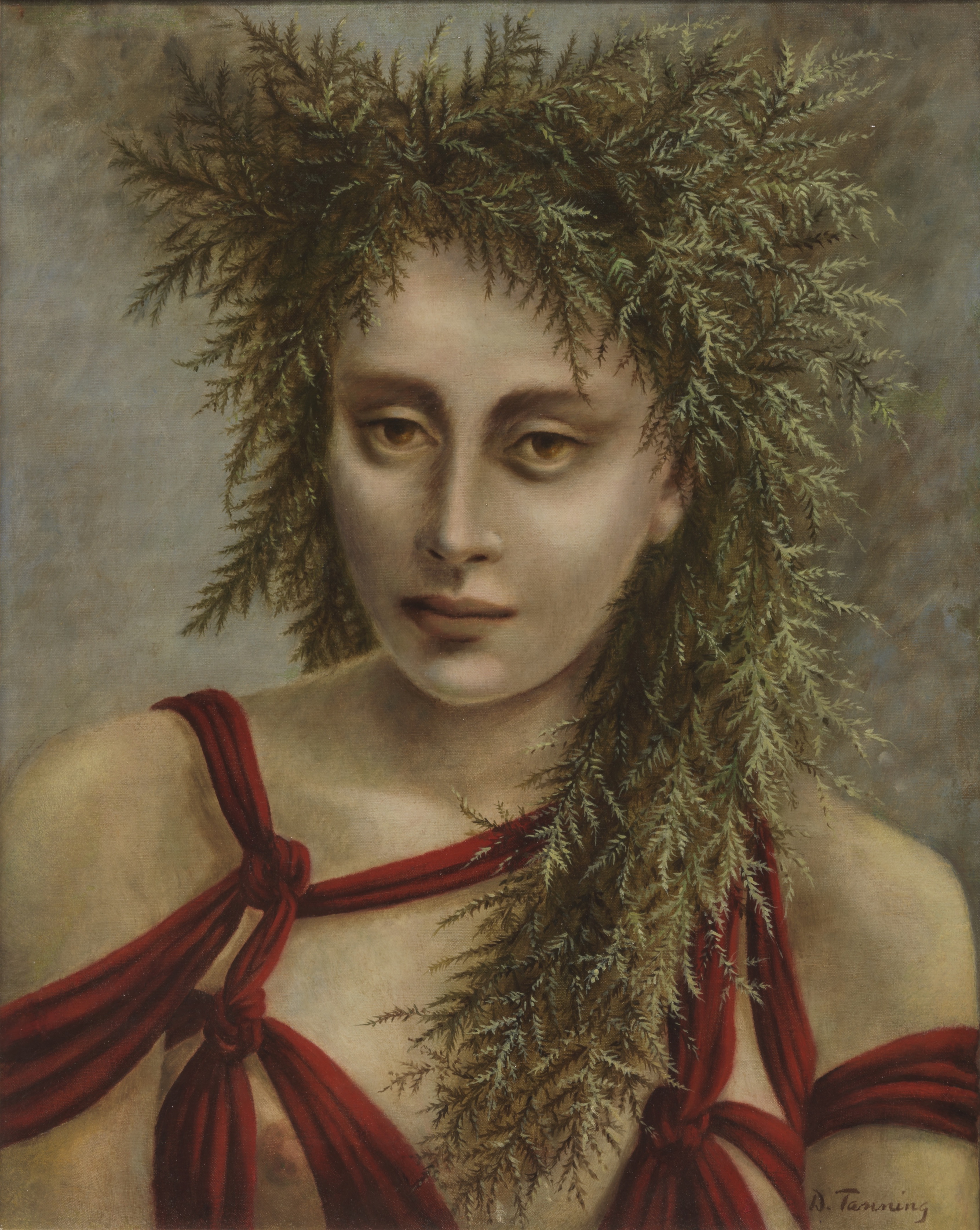
Dorothea Tanning, her early life and her love of Surrealism. Part 3

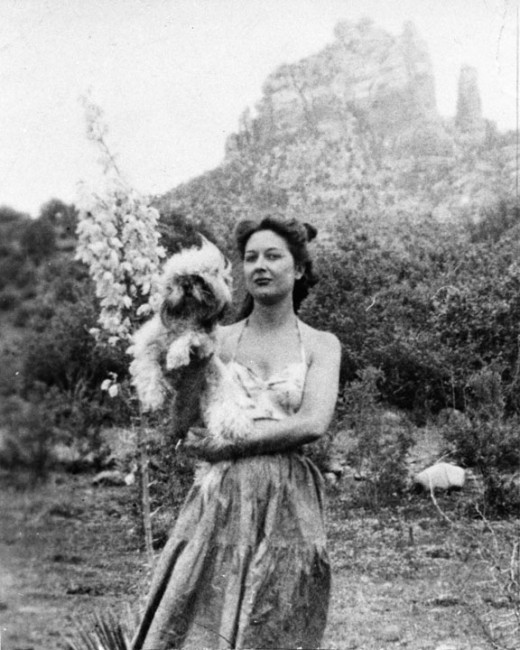
Dorothea Tanning, Sedona, Arizona
Dorothea Tanning in Sedona (1943)

Dorothea and Max Ernst divided their time between their Arizona home in Sedona and their apartment in New York.  Often Tanning would return to New York to show her work at the Julien Levy Gallery in Midtown Manhattan.  In April 1944, the Julien Levy Gallery held Dorothea’s first one-person exhibition.

See the source image
Fête Champêtre by Dorothea Tanning (1944)

That same year, 1944, Dorothea completed her painting entitled Fête Champêtre depicting a popular form of entertainment in Baroque France during the 18th century, taking the form of a garden party.  In Tanning’s work an unusual desert landscape provides the setting and she has added a marble mantelpiece and an ornate rococo clock.  She has also populated the depiction with a number of unidentifiable figures, some of which are human others are anthropomorphic, adding human characteristics to nonhuman things.  However, we can clearly see a bearded man and a girl who sits beside him, both staring out at something invisible to us.  The whole depiction remains a mystery as to what it is all about.

The Temptation of St Anthony by Dorothea Tanning (1945)

Whilst in New York,in 1945, Dorothea Tanning, completed a work which focused on a biblical scene that has been depicted by many famous artists, such as Dali and Hieronymus Bosch.  The painting is entitled The Temptation of St Anthony, which is now the property of Philadelphia’s La Salle University Art Museum. The painting portrays the supernatural temptation reportedly faced by Saint Anthony the Great during his stay in the Egyptian desert.  Saint Anthony, then aged 35, decided to spend the night alone in an abandoned tomb. A great multitude of demons came and started beating him, wounding him all over. He lay on the ground as if dead and the claws of the demons prevented him from getting up. According to the hermit the suffering caused by this demonic torture was comparable to no other.  Terrified and brought to his knees in fear, the habit that he is wearing wafts upwards as if caught in a gale-force updraft.  The blue, green and pink folds of the habit expose images of feminine shapes that seem to be the cause of his anguish. 

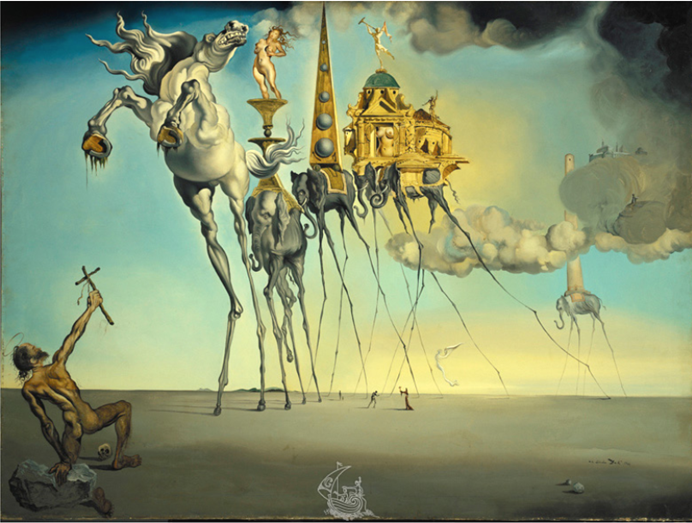
The Temptation of St Anthony by Salvador Dali. His entry to the Bel Ami competition

Dorothea created the work for the Bel Ami International Art Competition, where twelve surrealist and magic realist painters were asked to submit a painting to be used in Albert Lewin’s film The Private Affairs of Bel Ami, based on Guy de Maupassant’s novel Bel Ami. The rules of the competition for a cash prize were that the painting should be 36 × 48 inches and on the subject of the temptation of Saint Anthony. It would be shown as the only colour segment in the otherwise black and white film in which paintings of The Temptation of St. Anthony. Both American and European artists participated, including Ivan Albright, Eugene Berman, Leonora Carrington, Salvador Dalí, Paul Delvaux, Max Ernst, O. Louis Gugliemi, Abraham Rattner, Horace Pippin, Sydney Spencer, Leonor Fini and Dorothea Tanning.  All artists who submitted a painting received $500, while the winner received a prize of $3000. Max Ernst won the competition and his painting was shown in the film. Dali’s entry also became famous in its own right.

The Temptation of Saint Anthony (Ernst painting).png
The Temptation of Saint Anthony. The winning entry by Max Ernst

The competition was judged by Marcel Duchamp, Alfred H. Barr, Jr., and Sidney Janis. Max Ernst wining submission was not loved by all as the film critic Bosley Crowther of The New York Times called Ernst’s painting “downright nauseous” and wrote that it “looks like a bad boiled lobster.

Of her work and the meaning behind the depiction Dorothea Tanning wrote:

“…It seems to me that a man like our St. Anthony, with his self-inflicted mortification of the flesh, would be most crushingly tempted by sexual desires and, more particularly, the vision of woman in all her voluptuous aspects.  It is this phase which I have tried to depict in my painting. St. Anthony, alone in the desert, struggles against his visions; half-formed, moving in indolent suggestion, colored with the beautiful colors of sex, his desires take shape even in the folds of his own wind-tossed robes…”

Dorothea Tanning painting the Temptation of St Anthony (1945)

A photographer took a picture of Dorothea whilst she was working on the St Anthony portrait as a promotional photograph for the Bel Ami competition.  It was at a time when she had been ill and had contracted encephalitis and the photographer had to prop her up for the shot as she was so unwell.  She has her back to us but we see her long flowing locks of hair and on the wall is her famous Birthday self-portrait.  In her autobiography, Between Lives, she tells of how the illness caused her and her soon-to-be husband Max to return to the peace of Sedona in 1946 and sub-let their New York apartment to their friend, Marcel Duchamp.  Dorothea and Max married in October 1946.  Although they had regular guests come to their Sedona home, Dorothea always maintained that the period in Sedona, when it was just her and her husband, were the happiest days of her life.

The newlywed couple would separately paint all day and then come together in the evenings to listen to music, read and often play chess which was one of their favourite pastimes.

Max in a Blue Boat, 1947 - Dorothea Tanning
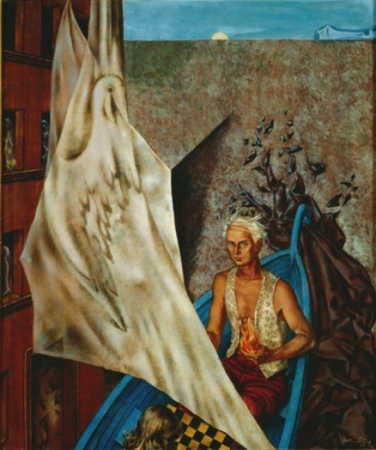
Max in a Blue Boat by Dorothea Tanning (1947)

Their love of chess is depicted in Dorothea’s 1947 work entitled Max in a Blue Boat.  It depicts the couple in the boat in the midst of a desert landscape and they seem to move effortlessly despite the lack of water.

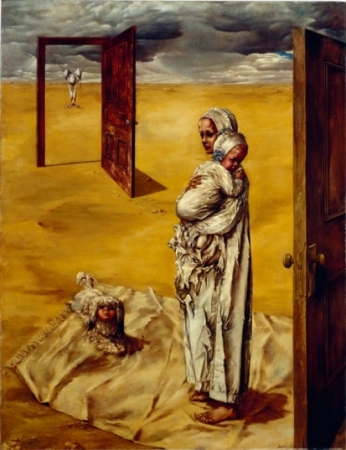
Maternity, 1946 - 1947 - Dorothea Tanning
Maternity by Dorothea Tanning (1947)

In 1947 Dorothea completed the work entitled Maternity, which focused on motherhood and the psychological and physical problems associated with bearing and raising a child.  In the setting of a sand-strewn desert we see a young woman holding a young child in a shielding encirclement.  At the feet of the woman, on the rug, lies her dog which has a child’s solemn face staring out at us.  The features of the dog resembled her own Lhasa Apso dog, named Katchina.  Mother, child and dog make for a strong family unit set against a hostile setting.

The dog was depicted in one of her favourite works entitled Tableau Vivant.  It was then purchased by the National Galleries of Scotland. The painting was the first by Dorothea Tanning that they had acquired and joined up with major artworks by Surrealists Leonora Carrington, Salvador Dalí and René Magritte held at the Scottish National Gallery of Modern Art (SNGMA).  The work was first shown at Tanning’s first exhibition in France in May 1954 at the Galerie Furstenberg, Dorothea Tanning: Peintures 1949-1954.   She had inscribed the title L’Etreinte on the verso, which can be translated as The Embrace.   A few months later the inscription was crossed out and substituted with Tableau Vivant and it was under its new title, Tableau Vivant that it was included in the artist’s first exhibition in Britain, at the Arthur Jeffress Gallery, London in 1955.

Tableau Vivant by Dorothea Tanning (1954)

It was not uncommon for Surrealist artists to include animals in their paintings.  Numerous Surrealist artists took animal embodiments which played the role of their alter-ego in their work: Max Ernst used a bird, Leonora Carrington favoured a horse; and Tanning took Katchina. Whreas other Surrealist depicted various types of the animal, Tanning’s choice was more specific.  It was her own pet, Katchina, whose insertion into Tanning’s work was not of necessity a personification of the artist; sometimes it acted as a witness, other times as a protagonist, the Katchina affected different roles in different works. These works started a change of Tanning’s painting style.  She moved away from the meticulous, controlled, illustrative technique which was the hallmark of her Surrealist work. In its place she began to decide on much looser, softer, more painterly brushwork and her colour switched from bright, intense primaries to ashes and ochres.  It was a move towards her Abstract period.

The painting is a depiction of many feelings.   Power, love, the erotic, the humorous, the dream and the nightmare, Tableau Vivant brings together many key moments in the artist’s life and career. Tanning loved the painting and it was included in almost every major exhibition of her work, notably her solo shows in Brussels in 1967, Paris in 1974, and the Malmö Konsthall and Camden Art Centre in 1993. The work of art remained with her for the remainder of her life until 2012, when she died at the age of 101, almost sixty years after painting it. Towards the end of her life, she specified it as one of a small number of works reserved only for sale to a museum.  Simon Groom, Director of Modern and Contemporary Art at the National Galleries of Scotland said of the painting:

“…We’ve been looking for a major painting by Dorothea Tanning for many years. This was one of her favourite works: she kept it for more than sixty years, hanging it above her desk in her apartment in New York. It’s a stunning addition to the Galleries’ world-famous collection of Surrealist art…”

Sarah Philp, Director of Programme and Policy at Art Fund, which helped the National Galleries of Scotland financially with the purchase of the work which cost £205K  said:

“…Tableau Vivant is an astonishing work with a fascinating biography and we are proud to help National Galleries of Scotland purchase this painting for their outstanding Surrealist art collection…”

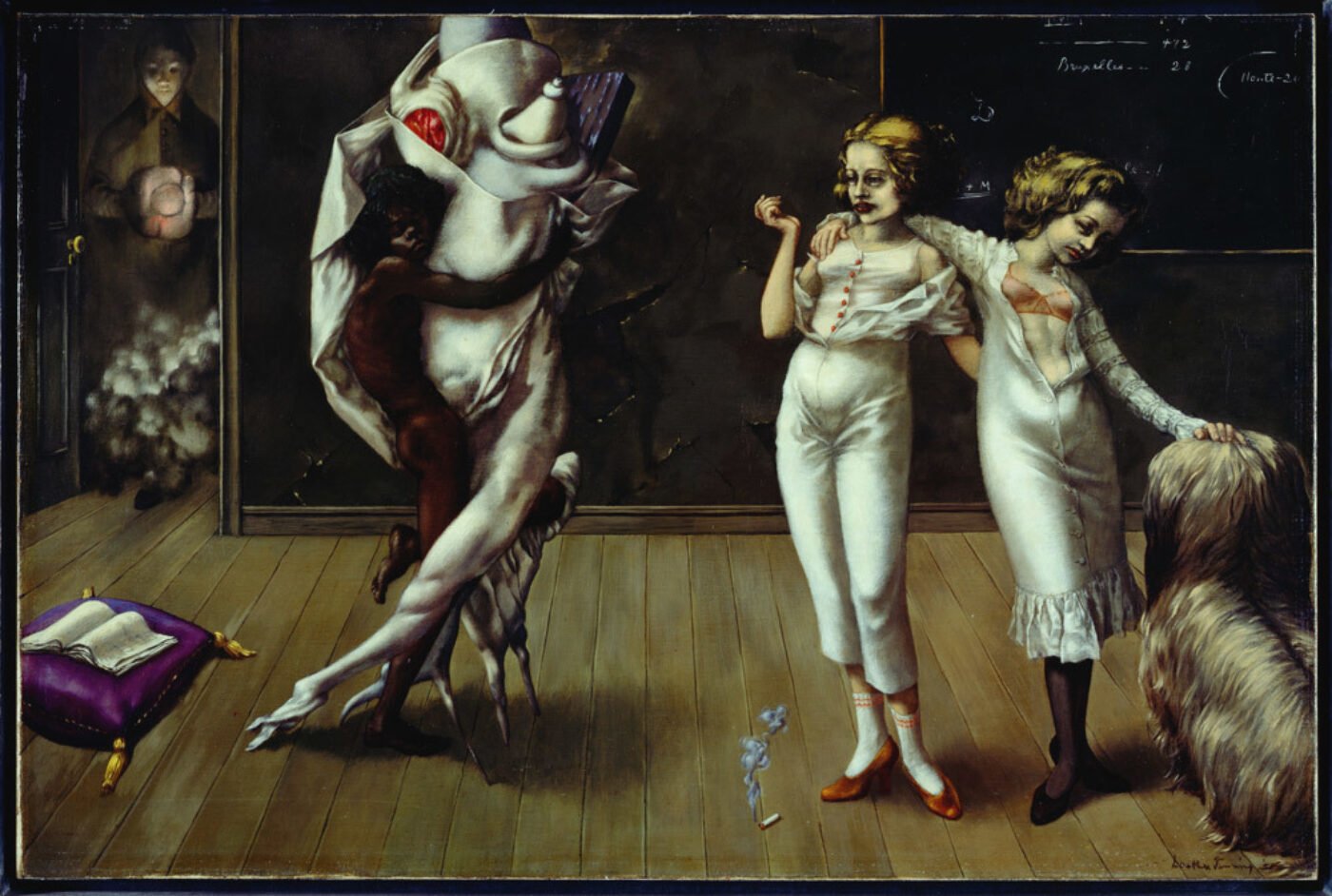
Interior with Sudden Joy by Dorothea Tanning (1951)

The Tableau Vivant dog appeared in a number of her paintings after 1946, including Interior with Sudden Joy.

Interior with Sudden Joy is a strange painting.  In the depiction we see two girls standing to the right. They strike a provocative pose.  They are both dressed in white garments which harmonise with their pale skin, the buttons are unfastened and expose a camisole top and red bra, which reminds one of the bared chest in Tanning’s self-portrait Birthday. The girls pose with their arms wrapped around each other and both exude an air of nonchalance. They are young women and are only too aware of their sexuality.  The girl furthest to the right pats the head of a large shaggy dog.  The dog, which faces away from us, takes little notice of the two girls and instead stares at the blackboard on the back wall like a pupil ready to learn. On the blackboard there is chalked writing. In her memoir, Tanning says she took writings written in poet Arthur Rimbaud’s ‘secret notebooks’ and put them on the blackboard in this painting.  Rimbaud was admired by the surrealists because of his belief that poetry passed through the body in the manner of a musical instrument, which reaffirmed the surrealist idea of automatism as a creative outlet using the body as a vehicle.

The Boy

On the floor, close to the feet of one of the girls, lies a burning cigarette.  The girl’s hand is held up as though the cigarette had once been held between her fingers. To the left of them is a naked boy embracing a strange amorphous mass which imitates a human figure and wraps itself around him. The whiteness of its fabric-like flesh contrasts with the boy’s dark skin, and abundance of dark curls which form a halo around the boy’s head. The boy looks completely at peace. If the painting’s title Sudden Joy derives from any part of the depiction it is from him. In her memoir, Tanning described the girls as being like Sodom and Gomorrah.  On the floor in the left-hand corner of Tanning’s painting is an open book atop an ornate purple cushion. Its pages are blank, perhaps waiting to be written in. It is an eerie depiction.  We see a figure standing in the doorway in the left-hand top corner of the painting, and the black door stands ajar waiting for someone or something to enter the room.

 Dorothea Tanning died on January 31st 2012, at her Manhattan home at age 101. Her husband Max Ernst had died thirty-six years earlier.

Most of the information in my blogs about Dorothea Tanning come from the excellent 2020 biography of the artist, entitled Dorothea Tanning: Transformations by Victoria Carruthers.

Dorothea Tanning, her early life and her love of Surrealism. Part 1.

Dorothea Tanning
Dorothea Tanning aged 18. (1928)

What does one mean when one says they like art.  What is art?  By definition, art is a diverse range of human activities involving creative imagination to express technical proficiency, beauty, emotional power, or conceptual ideas and it encompasses the three classical branches of visual art are painting, sculpture, and architecture, but the term “art” also embraces theatre, dance, and other performing arts, as well as literature, music, film and other media such as interactive media. So, I need to narrow down what I mean when I say I love art.  I should maybe say I love visual art and yet I am not a fan of conceptual or performance art.   I love the paintings created by numerous artists.  However, that is not quite true as I do not love all painting genres.  I neither find pleasure in looking at works of abstract art such as those by Kurt Schwitters nor the black lines and blocks of colour by Mondrian nor the works of abstract expressionist painters such as those by Robert Delaunay, Jackson Pollock, Mark Rothko and Willem de Kooning nor the disturbing imagery of Francis Bacon. Having told you what I do not like I suppose I should tell you what I do like but if you have been following my blogs over the years, you will probably already know.

I love the paintings of the Dutch and Flemish Masters.  I like many of the painters of the Victorian era.  I like “busy” multi-figure paintings and love to delve into the depiction to see what is happening in narrative paintings.  I like narrative paintings which have a tale to tell or a moral to enforce.  Surprisingly, having said all that I also have a reluctant love of Surrealism and enjoy trying to figure out what the depiction is all about and what was in the painter’s mind when he or she put brush to canvas.

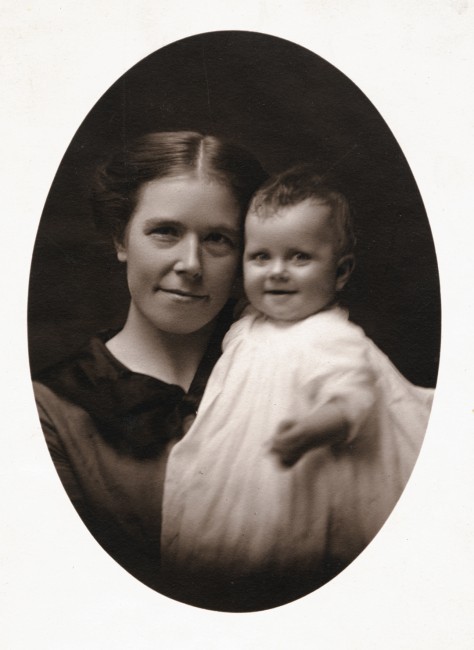
Dorothea Tanning with her mother, Amanda Tanning
Dorothea Tanning with her mother, Amanda Tanning, 1911

This was a somewhat long-winded introduction to today’s artist, the American Surrealist painter, printmaker, sculptor, writer, and poet, Dorothea Margaret Tanning.  Tanning was born on August 25th 1910.  She was the middle child of Andrew Tanning and Amanda Marie Tanning (née Hansen), who were of Swedish descent.  She had an elder sister Maurine and a younger sister Mary Louise.  Andrew Tanning, born Andreas Peter Georg Thaning, came alone from Skåne in the southernmost county of Sweden and settled in the conservative Midwestern town of Galesburg, Illinois.  In her memoirs Dorothea Tanning recounted that both her parents were very loving, indulgent and imaginative, the latter trait which she believed led to her creativity.  In her 2001 autobiography, Between Lives, Tanning wrote lovingly of her mother:

“…How could a tiny artist grow into a big one without the quilt of maternal love with its pattern of solace for hurts, its curving comfort, cloud-soft, its consolation for having to exist, its sweet smell?  The mother-goddess (the term would have embarrassed her), doctor and protector hovered over us in the full conviction that we were worth the trouble…”

Dorothea Tanning
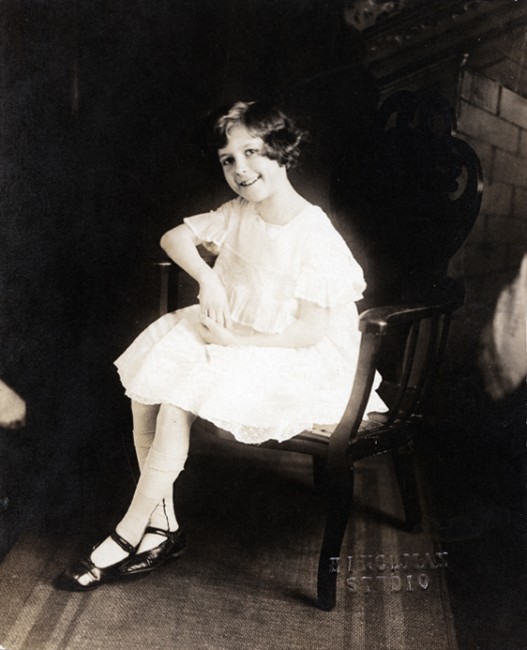
Dorothea Tanning, aged 5. (1915)

By her own admission Dorothea was a small and delicate child prone to bouts of illness which often confined her to bed.  Like similar stories of young children who became well-known artists, it was this time during bed rest that she developed artistic skills and immersed herself into reading picture books.  Her favourites were the fairy tales of the Brothers Grimm, and the stories and colourfully mesmerising characters from Greek mythology and the Bible.  It was from the likes of these that Dorothea gained an insight of the outside world, a world free from a cosseting mother.  She would also amuse herself by the simple game of staring at patterns on the wallpaper or furnishings and allow her imagination to form images which were not real.  In a way she was slipping from the real world into an imagined parallel existence.  Maybe it was this which would eventually lead her into the world of Surrealism.

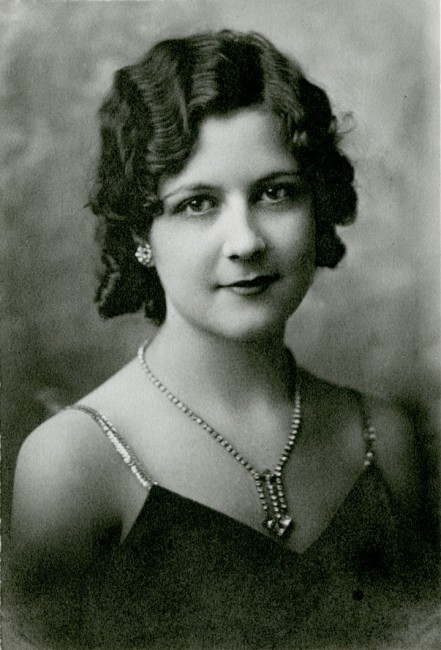
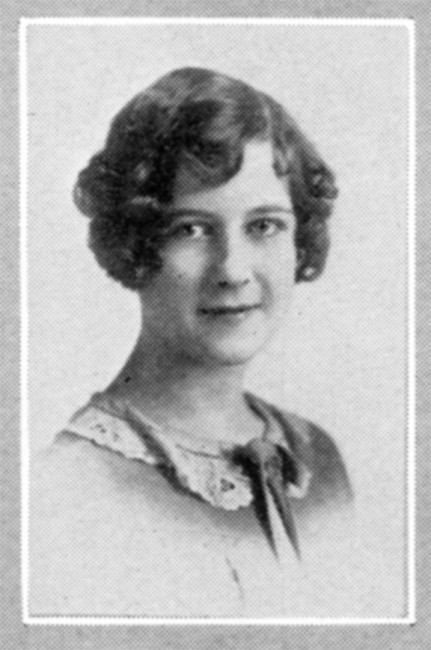
Dorothea Tanning, Galesburg High School Yearbook, Senior Year
Dorothea Tanning, Galesburg High School Yearbook, Senior Year, 1926

In 1926, aged sixteen, Dorothea Tanning graduated from Galesburg Public High School.  The following year she managed to get a part-time job at Galesburg Public Library which gave her access to a world of literature.  She termed it the House of Joy.  One of her earlier jobs was cataloguing the books with a senior assistant who decided on whether the contents were deigned immoral and unfit for minors and were marked with a red cross in the catalogue.  Dorothea said that it was then much easier to find the “best” books.  In her biography she wrote about the time at the library and how it made her consider her future:

“…Over the years, the library became my haven, its treasures slyly challenging the voice of “art” in the tug-of-war for my ambitions, its sirens singing and crying by turns, its weight crushing my famous certitudes forever…”

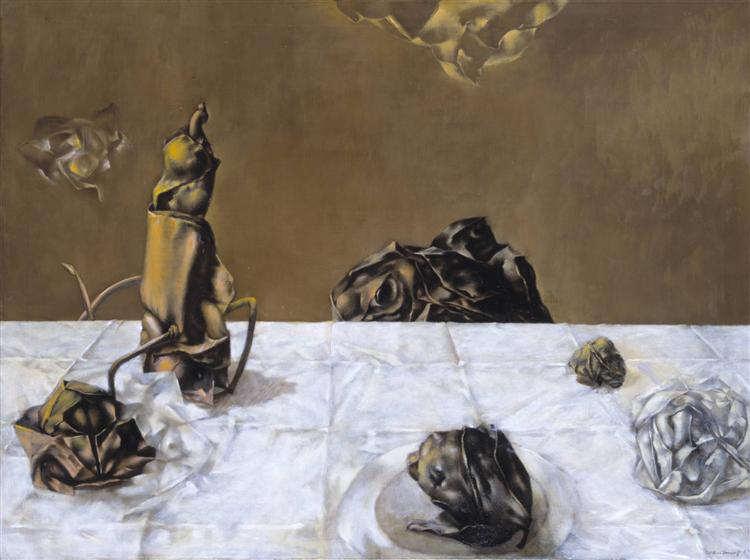
Some Roses and Their Phantoms, 1952 - Dorothea Tanning
Some Roses and Their Phantoms by Dorothea Tanning (1952) represents a domestic world transformed by mysterious eruptions and inhabited by unnamed creatures. The table top setting, with its crisp white tablecloth and marks of ironed folds, suggests a safe world of bourgeois ritual. A recurrent motif, the white table cloth can also be found in other works of the same period. 

In 1928 she enrolled at Knox College in Galesburg and remained there for two years.  In 1930 she quit the college in order to pursue an artistic career and set off for Chicago under the guise of meeting up with a friend.  She had surreptitiously packed a trunk with her belongings which she left in her bedroom and later, once in Chicago, asked her parents to forward it to her !

Chicago at the time of Dorothea’s arrival, was a city in the grip of Prohibition, jazz-filled nightclubs and violent gang wars.  She lodged with an ex-library colleague.  She revelled in the nightlife of the Windy City and began a relationship with the writer, Homer Shannon.  To earn a living, she took on a number of jobs including waitressing at the Colonial Room.  She operated marionettes in the 1933 Chicago World Fair.  She must have accumulated some money as she loved to travel going to New Orleans in 1934 where she exhibited some of her watercolours. 

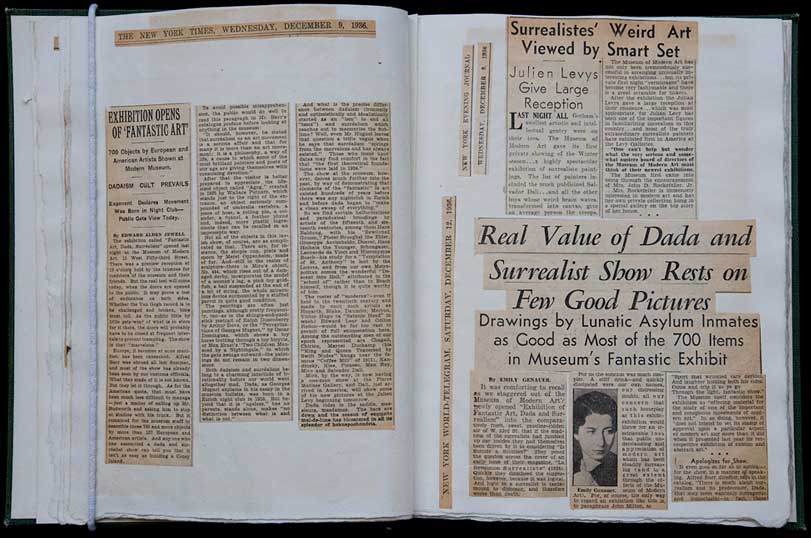
December 1936 newspaper cuttings about the Fantastic Art, Dada and Surrealism exhibition. 

She also made a number of trips to New York searching for work as a commercial artist and during one visit in 1936 visited the Museum of Modern Art to see the Fantastic Art, Dada and Surrealism exhibition.  The exhibition was rife with controversy and provoked fierce reactions from battling factions among the Dadaists and the Surrealists.  The press release by MOMA identified Surrealism and Dadaism as such:

“…”Surrealism, which developed in Paris around 1924, was the direct descendent of the Dadaist interest in the bizarre, the spontaneous, and the anti-rational. But while the Surrealist program carried on the iconoclasm of Dada it added serious research into subconscious images, dreams, visions, automatic and psychoanalytic drawings. Surrealism, so far as its serious adherents are concerned, is more than a literary or an art movement: it is a philosophy, a way of life, a cause which has involved some of the most brilliant painters and poets of our age…”

In a later interview Dorothea said of the exhibition:

“…For me it was the revelation, and I wasn’t the only one.  I would even say that most American artists – as well as poets – were deeply affected by that explosive event.  So, I became more impatient than ever – I just had to live in Paris…”

Once again in her autobiography Dorothea was certain that what she saw at the exhibition at the MOMA was a turning point in her artistic life.  She wrote:

“…Here, gathered inside an innocent concrete building, are signposts so imperious, so laden, so seductive and yes, so perverse that, like the insidious revelations of the Galesburg Public Library, they would possess me utterly…”

Deirdre
Deirdre by Dorothea Tanning (1940)

Dorothea had now caught the Surrealism bug and knew to explore the genre more she had to go to Paris.  She set sail on SS. Amsterdam for the France in July 1939 with the intention of meeting some of the Surrealist artists living there but her plans were thwarted by the onset of the Second World War.  Artists had hurriedly escaped from Paris and she managed to escape France and makes her way through Holland Belgium Germany and Sweden in August to the home of her paternal relatives. From there, in October, she managed to gain passage back to America on the SS. Gripsholm.  Another artist to take flight from France and journey to America was the leader of the Surrealism Movement, German-born Max Ernst who before his salvation had been interned twice in 1939, once by the French government having been labelled an “undesirable foreigner” and once by the Gestapo but he managed to escape with the help of Peggy Guggenheim, a member of a wealthy American art collecting family, and the journalist Varian Fry. 

Dorothea Tanning, Music Hath Charms. 1940.
Music Hath Charms by Dorothea Tanning (1940)

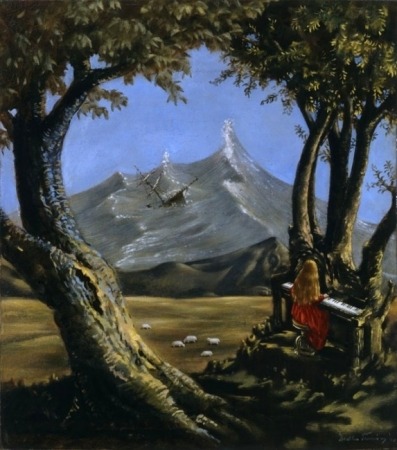
Once back home in New York, Dorothea Tanning sought employment as a commercial artist and for a time worked on the advertisements for Macy’s department store, producing adverts for perfumery products, clothing and accessories.  She continued with her own art and in 1940 produced a small painting entitled Music Hath Charms.  It was the beginning of her love of Surrealism being translated into her own work.  The painting depicts a young girl, dressed in red, playing the piano formed by the roots of one of two large trees which act as a frame for the scene.  She has long blonde hair which runs down her back.  Look at the background and at first it seems to be just a snow-capped mountain but with closer inspection it is the gigantic wave of a stormy sea in which we see a sinking tall ship.  The terrifying sight of the doomed ship is in stark contrast with the pastoral scene of the middle-ground with the grazing sheep and yet there is more.  Look carefully at the dark brown/olive hills which divide the space between the sheep-grazing field and the wild stormy sea.  It is the prone body of a hybrid beast, part human in the shape of a woman’s body and part animal being the face of a wild cat. Again it, like the sea and the fields, is the juxtaposition of human and animal.  The creature stares at the girl as if mesmerised by the sound of the music.  The depiction implies that the melodious sounds emanating from the piano is causing a metamorphosis in the landscape with the creature materialising from the “softened rocks”.

Portrait of Julien Levy by Jay Leyda (c.1932)

In 1942 after an up-and-down relationship and short marriage to Homer Shannon, the pair split up and Dorothea concentrated on her art and immersed herself in the artistic community and became great friends with Julien Levy, a gallery owner who offered her an exhibition at his gallery once she had built up a sizeable collection.  Levy had opened his new gallery in midtown Manhattan in November 1931 with a photography exhibition that included works by his friend and mentor, Alfred Stieglitz. As selling photographs became more difficult Levy shifted his gallery’s focus to Surrealism and to showing the work of artists like Salvador Dalí, Max Ernst, Man Ray and Joseph Cornell.

In May 1942 Julien Levy invited Dorothea Tanning to one of his afternoon soirees held in his Chelsea apartment.  Dorothea remembered stepping into Levy’s apartment and at that party, seeing her future road map lying before her:

“…A May afternoon as only May afternoons can be in the city.   And an apartment in Chelsea, all dark woof and those slated shutters peculiar to old New York.  A Recamier sofa, an iron sleigh-bed breathing Paris, a Bellmer doll, the Duchamp window and scattered everywhere, objects, pictures, books and more pictures.  Indeed, coming time, you were overwhelmed with vertigo that it was hard to register Julien’s easy, smiling introductions to – as I remember them – Yves Tanguy, Max Ernst, Kurt Seligmann, Kay Sage, Bob Motherwell with beauteous wife, Maria, Virgil Thomson, Max Ernst, Consuelo de Saint-Exupery, Peggy Guggenheim, Sylvia Marlowe, Max Ernst……Doesn’t the repetition say it all?  Because quite simply, this was a new door for me to open, and it was Julien Levy who held the key, who did it all, not deliberately – he didn’t believe in plans – who very nonchalantly launched my art and found me a life companion…”

………………………………….to be continued.

Most of the information in my blogs about Dorothea Tanning come from the excellent 2020 biography of the artist, entitled Dorothea Tanning: Transformations by Victoria Carruthers.

Many pictures of Dorothea came from the Dorothea Tanning Organisation website

Paul Fischer

Self-portrait, Nytorv in Winter by Paul Fischer (1909)

Paul Gustav Fischer was born July 22nd, 1860.  His ancestors, who were originally from Poland, were the fourth generation of the Fischer family to live in Denmark. His immediate family would be classed socially as upper-middle class. Paul was the son of Philip August Fischer and Gustafva Albertina Svedgren. Paul’s father had started as a painter, and later succeeded in the business of manufacturing paints and lacquers.  Paul first received art tuition from his father but later went on to have formal art tuition.  He was apprenticed for a year and a half at the terracotta manufacturer C. Møller and graduated from the Technical Institute to the Royal Danish Academy of Fine Arts where he attended the general preparatory class in May 1876 but failed to complete the course, leaving in January 1878.  Following on from this, he became an assistant in his father’s painting materials business and worked there for ten years.  During this time he still carried on with his own painting. At the start of his artistic career, Paul completed mostly sketches and illustrations which he submitted for inclusion in a number of magazines such as Out and Home, Illustrated Journal, Juleroser and Klods-hans.

Paul Fischer. Vesterbrogade
Vesterbrogade is the main shopping street of the Vesterbro district of Copenhagen, 

The standard of his paintings were such that he exhibited regularly at the Charlottenborg Spring Exhibition between 1884 and 1902. He has also had his work exhibited at the Salon in Paris and exhibitions in Munich, Berlin, Oslo and Stockholm.

View from Ved Stranden in Copenhagen with two women sheltering from the rain
View from Ved Stranden in Copenhagen with two women sheltering from the rain by Paul Fischer

His early paintings depicted city life, and it was this genre that established him with the viewing public.  His depictions were often set in overcast or winter weather, but that was to change after his Paris trips when his works took on more colours and were warmer.  Paul Fischer stayed in Paris on two occasions in the 1890s and became influenced by the French Realists, Gustave Courbet and Jean-Baptiste-Camille Corot. 

Paul Fischer - Flowersellers At Dr. Louises Bro (Queen Louise’s Bridge) In Copenhagen
Flower Sellers on Queen Louise Bridge, Copenhagen by Paul Fischer

Paul Fischer painted motifs from Queen Louise Bridge with views towards Ferdinand Meldahl’s two symmetrical palatial apartment buildings on Søtorvet – being some of the most French-influenced architecture in Copenhagen. Moreover, it was easy for him to compare the lakes on either side of the bridge with his beloved river Seine in Paris.

Højbro Plads seen from Højbro by Paul Fischer  (1900)

Especially famous are his colourful paintings, one of his most popular ones featuring the cityscape of Copenhagen is his 1900 work entitled Højbro Plads seen from Højbro.   Højbro Plads (High Bridge Square)  is a rectangular public square located between the adjoining Amagertorv and Slotsholmen Canal in the city centre of Copenhagen.  Højbro is a bridge in central Copenhagen, which connects the city centre to the small island of Slotsholmen, on which is the Christiansborg Palace.

See the source image
The Artist’s Wife, Dagny by Paul Fischer (1892)

Paul Fischer married Dagny Grønneberg on November 24th,1886.  Her father, Julius, was an art dealer and her Norwegian mother, Hulda Azora Tegner was a painter. 

See the source image
The Artist’s Daughter, Harriet Fischer by Paul Fischer

Paul and Dagny’s daughter, Harriet Fischer, was born on July 24th, 1890 and grew up in a busy artist’s studio and her father Paul Fischer persistently used household members as models, and often Harriet featured in some of his paintings both as a little girl and as a young girl, in portraiture and as a supporting figure in the street scenes.

Bondekvinde {Peasant Woman) by Hrriet Fischer

Harriet was admitted to the Royal Danish Academy of Fine Arts in Copenhagen, where she was from 1915-1920. From 1920-1940 she travelled on countless study trips to most of Europe. When their daughter began painting, it is known that she and her father exhibited together during the summer stays in Båstad in the years before World War I.

Harriet in the living room at Sofievej by Paul Fischer (1908)

Another beautiful painting featuring his daughter was his 1908 work entitled Harriet in the living room at Sofievej.

Winter Day with a Little Girl with a Sledge and a Large Red Knitted Hat by Paul Fischer

Paul Gustave Fischer was also well known for his amazingly natural sunbathers and his 1916 painting Sunbathing in the Dunes is a good example. 

Sunbathing in the Dunes
Sunbathing in the Dunes by Paul Fischer (1916)

The models seem to be happy to pose on the beach but I am sure were reluctant to parade nude in the icy waters of the Baltic.

Nude Bathers on the Beach, by Paul Gustave Fischer (1916)

There are more than a dozen such works painted over a number of years, and it is interesting to note how, in the depiction, his striking  bathing beauties merge so wonderfully with the sands of the beach one which almost makes ignore the erotic overtones of the paintings. 

Vragnet (Wrecked) by Paul Fischer (1906)
Portrait of a Young Girl by Paul Fischer (1903)

Most of Fischer’s paintings are populated with female figure, some attractive older ones but also depicting young girls such as his 1903 tender Portrait of a Young Girl.

The Fire Engine by Paul Fischer (1900)

However, my favourite works of Paul Fischer are his everyday scenes of city life featuring people of all social classes and it is his depiction of the real lives of those around him which in part explains his popularity.  Take for example his 1900 painting The Fire Engine.   This is a depiction of a classic everyday occurrence.  It is a “busy” painting.  There are so many things happening in the depiction and your eye flits from one to another.  We, like the crowd, are drawn into the present dramatic happenings.  The red and gold coloured fire engine takes centre stage in the painting and, in a way, it is a salute to the industrial growth of the time.

Paul Fischer. Magasin du Nord at Kongens Nytorv, Copenhagen
Magasin du Nord at Kongens Nytorv, Copenhagen by Paul Fischer

The late 19th and early 20th century in Denmark, like other European countries was rapidly changing and these changing times were captured in Paul Fischer’s cityscapes often populated with the motor cars, trams and other vehicles.

In the Tram Compartment by Paul Fischer (1927)

The 1927 work In the Tram Compartment by Paul Fischer is a fascinating depiction of everyday life.  The man reads his newspaper whilst the woman looks outside at the cityscape they are trundling past.  A bunch of flowers is on the bench next to her.  Maybe a gift from the man and yet he shows no interest n her and may just be a fellow passenger.  It is painting like these that you gaze at and make up a story of what you believe is going on!

See the source image
by Paul Fischer

Fischer depicted everyday life and tram rides on a number of occasions, such as the one above.  Maybe he was fascinated with this form of transport or maybe he was interested in the interaction between the passengers. Again we have a man reading a newspaper and a woman sitting next to a bunch of flowers.

View from Pompei
View from Pompeii by Paul Fischer (1894)

Paul Fischer travelled through a number of European countries, sketching and painting.  One of his favoured countries was Italy and during the last decade of the nineteenth century he visited the area around Naples and the ruins of Pompeii.  In 1894 he produced a pencil and watercolour sketch of the area which was given the name View from Pompeii.

Italian Street Scene
Italian Street Scene by Paul Fischer

Another painting around this time was a work in oils, simply entitled Italian Street Scene.

In the early twentieth century Fischer’s paintings were selling well.  However, he was still in the shadow of his contemporary, the leading Danish painter of the time, Laurits Tuxen.  However, one would have that thought the life was good for Fischer.  He had a beautiful wife, Dagny, and a fine-looking and talented daughter, Harriet, but that was not the case as his marriage to Dagny ended in 1914. 

Portrait of Martha Vilhelmine Jensen, who became Mrs. Fischer by Paul Fischer (1913)

On June 17th, 1914, sixty-year-old Fischer married his second wife, twenty-five-year-old opera singer, Martha Vilhelmine Jensen whom he had been dating for some time.  His first wife, Dagny Grønneberg eventually went to live in Oslo where she died six years later on February 24th, 1920.

Paul Fischer died in Gentofte, a northern suburb of Copenhagen on May 1st 1934 aged 73

John Koch. Part 1.

                                                               John Koch

The artist I am looking at today is the twentieth century American painter John Koch.  I will also look at the life he had with his extremely musically talented wife Dora.  Both their successes came from hard work and their mutual support of each other.  For them, it was hard work that achieved you a grand lifestyle which the couple enjoyed during their married life.  He is best known for his portraits, nudes, and paintings of genteel urban interiors, often set in his own light-filled Manhattan apartment.

See the source image
                                                  Portrait of the Artist’s Father by John Koch (1951)

John Koch was the son of Marian Joan and Edward John Koch and was born in his grandmother’s house in Toledo, Ohio on August 18th, 1909.   He spent most of his childhood and teenage years in the university town of Ann Arbor, a city in the U.S. state of Michigan, where his father was in the furniture business but unfortunately, failed to make a success of it.  John Koch described his father as a man of great charm, a great reader, but a poor businessman.  His father also unsuccessfully ran for governor of Michigan on the Socialist ticket.

In his early teens John Koch developed a love of art and, later in life, he revealed in an interview:

“…The possibility of being other than a painter never seriously occurred to me. Ever since I could hold a pencil, the desire I had to reproduce amounted to passion…”

In 1923, at the age of 14, John, for a short period, took some lessons in drawing in charcoal and that was essentially the only formal art training he received. During high school, he did however spend two summer vacations at the artists’ colony in Provincetown, Massachusetts, and around 1928, shortly after graduation he sailed to Paris, not to enroll at an artistic establishment, but to simply paint by himself and savour the life of an artist in the European capital of art.   His self-tuition focused on going to the Louvre and copying the work of the Masters.  According to John, the Louvre was his master.  John became so skilled at copying the famous works that he once produced an imitation of a painting by Gustave Courbet that was subsequently mistaken for a genuine work.  In 1929, Koch exhibited his work at the Salon des Tuileries and the Salon de Printemps and received an honourable mention, which was to be the first of his many awards.

Artwork Title: Father and Son - Artist Name: John Koch
                                                         Father and Son by John Koch (1955)

In his early twenties, John Koch joined the Internationale Union des Intellectuals, where he mixed with such luminaries as André Gide, the French author and winner of the Nobel Prize in Literature, André Malraux, the French novelist, art theorist, who later became Minister of Cultural Affairs, and Jean Cocteau, the poet, playwright, novelist, designer, filmmaker, visual artist, and critic.  This group would assemble in the homes of its members and presented Koch with his first exposure to the lives of artists and intellectuals.  It also gave him the opportunity to sit in on discussions about Surrealism and, swayed by what he heard and seen, even painted a few Surrealist works himself but was unhappy with his attempts and gave up on that genre.

                                                                      The Plasterers by John Koch

John spent over four years in Paris and during that time he developed a formidable technique, evident in his beautiful rendering of light playing on surfaces.  A good example of this can be seen in his later painting, The Plasterers which he completed in 1967.  It was described in the New York Historical Society’s 2001 exhibition catalogue as:

“… a tour de force of (the artist’s) ability to bring the outside into an interior through reflection of light playing off surfaces…

The Plasterers stands among John Koch’s most important paintings.

                                                             Dora Zaslavsky Schwarz (1925)

Before John had set sail for Paris in 1928, it is thought he had met the newly married, Dora Schwartz, and was impressed by both her beauty and her talent as a pianist.  The two quickly became friends, but their mutual affinity was put on hold when John sailed for Paris, intent on pursuing his life as a painter in the world’s art capital.  Dora Schwartz (née Zaslawskaya) was a Jewish immigrant, born on July 18th 1904 in the Ukraine city of Kremenchuk in the oblast of Poltava.  Her father Max had immigrated to the United States the previous year and she then travelled by ship to a new life in America with her mother Celia and her older siblings Joseph and Fay, along with a young cousin. Another of her brothers, Israel, was born six years later.  Dora’s father’s early occupation was as a peddler and family legends has it that Dora’s musical talent was discovered thanks to a large toy piano with real black and white keys that her father brought home for her.  This was the start of her musical career !   Eventually after a lot of training, she became a gifted pianist, which led to a career as a piano teacher and she would go on to coach some of the outstanding concert pianists of the day.  Later she became head of the piano department at the Manhattan School of Music and developed its chamber music section.  On September 12th 1927, Dora Zaslawskaya, aged 23, married New Yorker Herbert S. Schwartz   Herbert was also a talented musician and his family had hoped that one day, he would become a concert pianist, a similar aspiration was had by Dora’s mother for her daughter.  Herbert Schwartz, however, chose to pursue a college education rather than continue studying music and when he and Dora married, he was beginning his third undergraduate year at the University of Michigan in Ann Arbor, with the hope of eventually becoming a physician. He was accepted into medical school but dropped out after one semester.  Following his rejection of medical studies, he enrolled at Columbia University the following fall to study philosophy and graduated in 1933.  By this time, the marriage between Dora Zaslavsky and Herbert Schwartz was almost over and they decided to end the relationship in an amicable divorce.  However, in the state of New York the only grounds for divorce was adultery and so in 1934 they arranged for, and staged a fraudulent act of adultery, at which the said defendant, Herbert T. Schwartz, was not even present !  The divorce decree was granted on August 10th, 1935.  There were repercussions with regards this fake adultery set up which are complicated and too long for me to go into the details but you can read about the Ohio Court of Appeal case in 1960, Schwartz v Schwartz 

                                                                       Ocean Liner SS. Minnetonka

Meanwhile, John Koch left Paris in 1934 and returned to America, settling in Manhattan, initially staying at a friend’s apartment on Washington Square.  He already knew Dora Schwartz.  He could well have met her and her husband in Paris.  They had sailed to Europe on the SS. Minnetonka on September 26th 1932.  When he settled in Manhattan in 1934 and heard about her impending divorce, he was determined to make her his wife.  John went to live in an apartment block in Manhattan at 56th & Madison, in a room next door to the apartment Dora was sharing with her sister Fay.  A year later, the couple sealed their love by marrying on December 23rd, 1935 and moved into their first “together home”, an apartment at 865 First Avenue, between 48th and 49th Streets, in Midtown Manhattan. It catered for both their needs with the bedroom served as John’s studio and the living room with piano was Dora’s studio.  The newlyweds hosted parties driven by sharp business acumen: as John served cheap port to his wife’s students and their parents, Dora worked the room, procuring portrait commissions for her husband.

Artwork Title: The Bridge - Artist Name: John Koch
                                                                               The Bridge by John Koch (1950)

In 1935 John Koch exhibited works at his first New York exhibition which was held at the Valentine Dudensing Gallery.  His work was well received and Emily Genauer, the art critic of the New York World-Telegram described John as:

“…the man to watch……a young man with a great gift…”

In 1939 John held a sell-out one man show of his works at the Kraushaar Gallery, a long-established gallery run by the niece of the founder, Antoinette M. Kraushaar.  John Koch had a special relationship with the gallery and its owners and during the next thirty-five years the Gallery held a further dozen one-man exhibitions of his work.

                                                         East River by John Koch (1939)

It was in the thirties that John’s painting East River was acquired by the Brooklyn Museum of Art and it was one the first museum acquisitions of his work.

Cover for 1941 Annual Exhibition of Paintings by American Artists Under 40 catalogue
Cover for 1941 Annual Exhibition of Paintings by American Artists Under Forty catalogue

In 1941, starting on November 12th and carrying on until December 30th, the Whitney Museum of Art held its Forty under Forty Exhibition.   It was the museum’s Annual Exhibition and that year it was an Exhibition of Contemporary American Painting, chosen by members of the Museum staff from the work of artists forty years of age, or younger.  John Knox submitted two paintings, Marble Quarry and Portrait of Mary.  That same year he also exhibited at the 51st Annual Exhibition of the Art Institute of Chicago.

By the 1940s, John Koch’s success and recognition continued to grow. From 1942-45 he joined the United Service Organizations in the art sketching and portrait division in veterans’ hospitals and from 1944-46, Koch took up the post as tutor and taught figure painting at the Art Students League in New York. However, with regards financial success he became one of the featured artists of classical portraits at Portraits Inc. Portraits, Inc., was founded in 1942 by Lois Shaw, an art and antiques dealer and socialite. In the early 1940’s, Mrs. Shaw partnered with the USO to give weekly studio parties in her Park Avenue gallery that often centred on portraiture. She contacted a number of portrait artists and asked them to contribute their services by doing life drawings of the military men and women in uniform who attended the parties. This allowed Koch to earn a substantial income.  The joint income of John and Dora was such that they managed to buy a summer residence at Setauket on Long Island.

……………………………………to be continued

Maxfield Parrish. Part 2.

                                           Maxfield Parrish in 1896

More and more illustration commissions came in to Maxfield and soon he was becoming financially sound.  In 1898, with money earnt and financial help from his father, Maxfield and Lydia felt able to purchase some land atop a hill in Plainfield, New Hampshire, which overlooked Mount Ascutney.  Here Maxfield built a one-room cabin.  Lydia would often remain in Philadelphia to carry on teaching which also allowed Maxfield to carry on with his own work as well as planning and building a larger home for them.  Maxfield and Lydia would stay with his parents at their large home, Northcote, whilst their new home was being built. Maxfield’s father and mother had moved to Cornish, New Hampshire in 1894 where there was a thriving artist’s colony founded by the American sculptor, Augustus St. Gaudens. 

                                 An aerial view of The Oaks, the former estate of Maxfield Parrish.

Maxfield and Lydia’s new home, known as The Oaks, was built on a large tract of land on an isolated hillside across the valley from his father’s home and close to the Vermont-New Hampshire border.  It comprised of a guest house, studio, and 45 acres of hillside land and was so named because of the magnificent trees next to their home especially one giant old oak tree. 

Maxfield Parrish drew inspiration from his Plainfield, New Hampshire home, “The Oaks,”

The Oaks was built around the trees and rocks on the hillside site. The largest white oak in Sullivan County, New Hampshire, stands near what was the front entrance of the house, and the ground floor was built on two levels to accommodate a large rock ledge.

Night in the desert by Maxfield Parrish. From “The Great South West” by Ray Stannard Baker (1902)

Two years after Maxfield and Lydia had moved into their newly built home,  he had a health scare.  Lydia, whilst teaching at the Drexel Institute in Philadelphia, received an urgent telegram from her father-in-law telling her that Maxfield had been taken seriously ill and she should return home immediately.  Lydia instantly left her school and took the train to Windsor.  She would never return to her teaching position at Drexel nor would she carry on with the private students she had been tutoring.  Maxfield Parrish was diagnosed as contracting tuberculosis which at the time was a deadly illness.  Lydia stayed with her husband despite the disease being highly contagious.   After being discharged from hospital, Lydia followed her husband to a Saranac Lake sanatorium in New York State where he underwent treatment and began his recuperation.   The sanatorium treatment was expensive but financial help came to Maxfield through a cheque for five hundred dollars given to him by his best friend and neighbour, the American writer, Winston Churchill.  Churchill who had also settled in the area in the same year as Maxfield in 1898, became great friends. The two were of a similar age, and Churchill had married the same year as Maxfield and Lydia.  During the convalescent years between 1900 and 1901 Parrish painted at Saranac Lake, New York and at Hot Springs, Arizona,

Cowboys by Maxfield Parrish. From “The Great South West” by Ray Stannard Baker (1902)

Whilst convalescing at Saranac Lakes Parrish received a commission from Century Magazine to illustrate the Ray Stannard Baker series entitled Great South West and from the money Parrish received, he was able to afford to further convalesce in Castle Creek Hot Springs in Arizona during the winter of 1901-02.  Maxfield and Lydia returned home to The Oaks in April 1902.  The Spring and summer of 1902 up until 1904 was probably the happiest Lydia had ever been.  No children as yet, she was able to devote time to cultivate the garden and time for her to paint, it was just as life should be for her.

             Edith Wharton’s book Italian Villas and Their Gardens, illustrated by Maxfield Parrish

Maxfield’s health had improved and he was now looking out for new commissions.  In 1903 Maxfield accepted a commission from Century Magazine to illustrate Edith Wharton’s book Italian Villas and Their Gardens which they were going to serialise.

Villa d’Este, Tivoli, near Rome. The Pool at Villa d’Este, illustration by Maxfield Parrish (1903) for Edith Wharton’s book.

For him to complete this commission Maxfield decided to travel to Italy and photograph and then paint the different villas that Wharton would be writing about in her book. Days after his marriage he had “abandoned” his wife to go to Europe on his own but this time she accompanied him, and in a way, it made up for the honeymoon they had missed at the time of their wedding.  It was a time when Maxfield and Lydia became very close.  Sadly, for her, it was to be the only trip she would make with him.

Scribner’s Magazine (October 1900) by Maxfield Parrish

All artists need models and many married male artists often use their young wives.  Before Lydia Parrish gave birth to their first child in 1904, she was Maxfield’s model in a number of his works including the Scribner Magazine October 1900 cover.

                                                          Page from the book Story of Ann Powel

She also modelled for Maxfield’s beautiful full-page drawing of Ann Powel, framed by a simple doorway, to accompany Annie Tynan’s piece in the 1900 Century Illustrated Monthly Magazine, The Story of Ann Powel.

                                              Potpourri by Maxfield Parrish (1905)

Maxfield Parrish also used himself as a model for some of his paintings.  One example of this is his 1905 illustration, Potpourri, which featured in Scribner’s Magazine in August 1905.   The illustration depicts a nude boy picking flowers in the forest. The large sun is peeking through the foliage and typically of Parrish there are two columns and a large fountain or urn. It is reputed that Parrish attached a string to his camera and snapped the photo of himself to use as the model for the illustration.  The illustration was drawn to illustrate a poem by H.C. Dwight and the line:

“…Ah, never in the world were there such roses as ones from that enchanted trellis hung…”

                                                                                   Lydia Parrish (1895)

Lydia Parrish’s modelling days had come to an end in 1904 when she became pregnant with their first child, John Dilwyn, who was born that December.  For the previous years, Lydia Parrish had been an equal partner with her husband.  She would entertain his and her friends as well as prospective clients.  She ably ran the household, managed the household finances, and oversaw the domestic help that had finally come to assist her after the birth of Dillwyn in December 1904. In 1905, she was expecting their second child, and was struggling to look after her first child as well as running the household for her husband, not to mention the lack of time she had for her own art and her writing.  It was decided that Lydia needed more help and so, Maxfield and Lydia Parrish hired sixteen-year-old Susan Lewin who had been working at Maxfield Parrish’s father’s house, Northcote, since she was fourteen and was pleased at Stephen Parrish’s suggestion that she should help his son and daughter-in-law.  She received a wage of a dollar a day plus board and lodgings.  Sadly, life for Maxfield and Lydia would never be the same again !!!

                                                                                          Susan Lewin

Young Susan Lewin was born in the farm town of Harland Vermont on November 22nd 1889.  She was one of six children of Elmer and Nellie Lewin and because of the household’s financial problems had to abandon school after only two years in order to become a wage earner.  She was a tall and willowy young woman with thick cascading hair and an oval face with large expressive eyes and a classic profile. She first met Maxfield when she was working for his father at Northcote and his good looks and charm was not lost on her.  She had just the romantic appearance which reminded Maxfield of the ladies depicted in the Pre-Raphaelite paintings, which he loved, and her good looks and charm was probably not lost on him! 

                                                                                       Susan Lewin

The arrival of their first child caused problems for Maxfield as he was constantly being interrupted by noise whist trying to concentrate on his painting and so, had a builder, George Ruggles, build a fifteen-room studio, some forty feet across the lawn from the main house.   The building comprised of three bedrooms, a kitchen, two painting rooms, two bathrooms, a dark room for his photography and rooms to store all his artistic paraphernalia which he used to construct his compositions.  Here he could paint in peace.  For his wife Lydia, her painting days were over.  She had to look after their children and keep them from disturbing her husband! The relationship between Maxfield Parrish and Susan Lewin was symbiotic.  She tended to him hand and foot.  She was passive and obedient and always eager to please and was amenable to all his wishes.  She was an excellent cook and a perfect servant to her master.  Later her two sisters, Annie and Emily joined the household as extra help for Mrs Parrish.

                                                             Harvest by Maxfield Parrish (1905)

In the early days of Sue Lewin’s stay at The Oaks she did receive a number of suitors but nothing became of them.  However, one suitor, Kimball Daniels, also began courting Sue’s sister Annie and eventually in 2011 the two were married.  He worked for the Parrish family tending their sheep and cows as well as harvesting the crops.  Kimball was the model for Parrish’s 1905 painting, Harvest.  We see him standing proudly on a hillock, scythe in hand.  Tragically he was found dead from a broken neck on the property twenty months after his marriage.

                                Land of Make Believe by Maxfield Parrish (1905)

Not only did Susan Lewin help Maxfield’s wife with childcare she also became a model for some of Maxfield’s paintings.   The first painting for which the sixteen-year-old girl posed was entitled Land of Make-Believe.  The painting depicts two figures in a verdant and enchanted garden. The taller figure on the right is based on a photograph of Susan Lewin in costume.  She stands in a contrapposto pose among blooming climbing roses. The two figures are attired in medieval costume and this adds to the unreality of the scene. Maxfield Parrish’s idealized fantasy worlds he created in his painting, such as this one, appealed to the buying public. These works were simply pictorial escapism and his fantasy world helped them believe there were safe and gentle places which were so different from the world they currently lived in.  Parrish’s illustration was used as the frontispiece to Rosamund Marriott Watson’s Make-Believe published in Scribner’s Magazine in August 1912. Marriott Watson’s poem reminisces about the care-free childhood world of “let’s pretend” filled with enchanted woods, castles, and witches.

In the 1995 book, Maxfield Parrish: A Retrospective, by Laurence and Judy Cutler, they wrote about Maxfield’s delight at having Susan in the household:

“…When Susan bounded around The Oaks with babes in arms, Parrish watched her with fascination. He imagined her as his counterpart to Lord Leighton’s companion model, Dene. When he first asked her to model for him and that first pose resulted in the painting Land of Make-Believe, Parrish was so happy with the outcome that he began to use Susan as his constant model…”

In the Land of Make-Believe, look closely at the way Parrish has lit up this depiction.  There is a double lighting effect.    The figures in the foreground are illuminated by soft and delicate light, while if you study the cliffs in the background you can see that they glow luminously from the radiance of the setting sun giving the work a feeling of depth whilst the two enormous columns in the middle ground of the depiction anchor Maxfield’s painting as well as acting as a frame for both the foreground and background.  The inclusion of monumental columns like these appear in one of his most famous works – the 1922 painting entitled Daybreak, which turned out to be one of the most replicated paintings in American history and will be discussed in the next part of this series.

Pied Piper mural by Maxfield Parrish (1909)

By 1909 Parrish’s demands on Sue to model for his paintings were becoming increasingly intense.  In 1909 she posed for a number of characters of his large-scale mural The Pied Piper which had been commissioned by the Palace Hotel in San Francisco for their Pied Piper bar and restaurant, a favoured spot of locals and visitors from around the world. 

                                                         Pied Piper bar with Maxfield Parrish mural

The Pied Piper, originally named The Happy Valley Bar, made its grand opening in 1909. Composed specifically for the re-opening after the 1906 earthquake, Maxfield Parrish created The Pied Piper of Hamelin painting, which still graces the hotel after over 100 years.

                   Sweet Nothings – part of the Florentine Fete mural by Maxfield Parrish

In 1910, Edward Bok, the director of Ladies Home Journal offered Maxfield a commission to paint eighteen panels for The Girls’ Dining Room at the Curtis Publishing building in Philadelphia, which was under construction at 6th and Walnut. Each painting would be placed between the windows which overlooked the street. Bok, because the company employed so many females, decided that they should have their own dining room on the top floor.   It was a mammoth assignment and Bok wanted it completed within twelve months and agreed to pay Parrish $2000 per panel.  Parrish completed the first piece, Florentine Fête Mural in July 1910 and he sent it to the building’s architect, Robert Seeler, for him to approve, writing:

“…The scene will be in white marble loggia:  the foreground will be a series of wide steps extending across the entire picture leading up to three arches and supporting columns…It will be my aim to make it joyous, a little unreal, a good place to be in, a sort of happiness of youth…”

Sue Lewin posing for the Sweet Nothings panel (see figure in far right of the mid-ground)

There are over a hundred figures in the panels of the murals and Maxfield had Sue Lewin to model for all but two of them.  It was such a monumental project that both Maxfield and Sue moved out of the main residence at The Oaks and lived in his studio whilst Maxfield’s wife remained at the big house with the children.  Maxfield Parrish was forty-six years of age when he completed the commission and it is interesting to read in Alma Gilbert’s 1990 book, The Make Believe World of Maxfield Parrish and Sue Lewin, the artist thought of himself as being much younger.  She wrote:

“…Sue Lewin was the woman who ‘youthened’ Parrish’s spirit.  The Florentine Fête panels are his tribute to that wish to remain young, as embodied by the beautiful young woman who so dominated his art and his thoughts during the midpoint of his life…”

Parrish completed all but one of the mural paintings by 1913 and the final one was finished in 1916.

……………………………….to be continued.


Much of the information for these Maxfield Parrish blogs comes from the excellent 1990 book by Alma Gilbert: The Make Believe World of Maxfield Parrish and Sue Lewin,

Ralph Hedley. Part 2.

                                       In School by Ralph Hedley (1883)

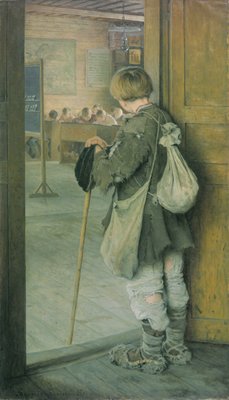
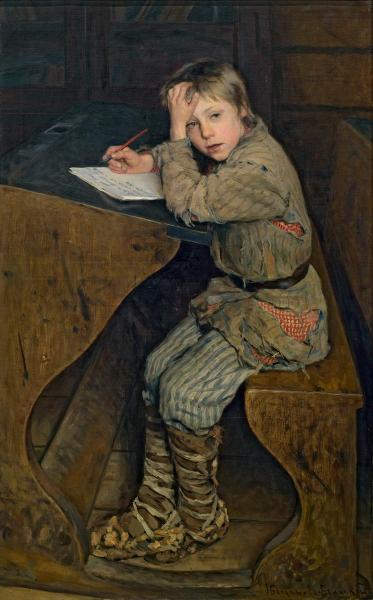
Another of Hedley’s paintings projecting school life was his 1883 work, In School.  The boy in the painting was John Irwin, the younger brother of Tom Irwin, who worked at Ralph Hedley’s woodcarving shop.

                         The Ballad Seller, the Black Gate by Ralph Hedley (1884)

Hedley used Irwin in a number of his painting. one of which was his 1884 work known as The Ballad Seller.  The setting is the Black Gate in Newcastle with Castle Garth in the background.  The red roofs of Castle Garth can be seen behind the Black Gate in Ralph Hedley’s depiction. The Black Gate formed the entrance to the street, which had been built inside the castle walls. There was only a short stretch of street left standing by the time Hedley painted this picture. It has now all been demolished, though the outline of the street can still be seen.  It is thought that Hedley made many plein air sketches for the background.  In the painting we can see the rough wooden fence that had been put up around the Black Gate in 1883 by the Newcastle Society of Antiquaries during the renovation work.  Hedley’s painting depicts broken and missing stones as well as damaged window glass.  The Black Gate of the Norman castle, which was completed at the end of the thirteenth century, had become run down.  However, the painting is all about the trade of selling ballads.  Ballad sellers were looked upon in the eighteenth century as impoverished, uneducated, and morally-lacking people who were allegedly conspiring with pickpockets.  It was suspected that whilst plying their trade, they hoped to distract their audience with their songs while the pickpockets went to work.  Later, they would share their ill-gotten gains.  Ralph Hedley would have witnessed poor women street sellers having to take their children with them, like the baby in the ballad-seller’s arms in this picture.  John Irwin was once again used as a model for one of the boys.

                             Shoeing a refractory horse (Shoeing the Bay Mare) by Ralph Hedley (1883)

Older brother Tom Irwin was himself the model for one of the men in Hedley’s 1885 painting Shoeing a refractory horse in the stocks – Shoeing the bay mare.  He was the man standing on the right wearing the brown cap, velvet jacket and velvet trousers.  He was seventeen years of age when he modelled for the work.  Tom Irwin, who worked at Ralph Hedley’s woodcarving workshop, and his family arrived in Newcastle around 1880.  He remembered the first meeting with Hedley and how the artist had admired their clothes:

“… When we came from the country where we had been farming, we brought several quaint articles of clothing, caps, clogs, baskets etc, which proved invaluable to your father’ work, and… which we know were much appreciated by him… “

                                    Going Home by Ralph Hedley (1888)

Ralph Hedley believed that art should be a pictorial record of the working lives of local people, and his paintings were particularly valuable for the record they provide of everyday life on Tyneside in the late 19th and early 20th centuries.  His 1888 painting, Going Home, is a depiction of two coal miners returning home from working at the pit at Blaydon, near Gateshead. The younger of the two men wears a cap to protect his head from the low beams, and he wears a pair of shorts because of the heat in the mine. In his hand is a safety lamp and a sack to kneel on. This was an extremely popular painting and a print of it was made the following year which proved extremely popular with the public.

                                                   Go, and God’s will be done! by Ralph Hedley (1891)

One of Ralph Hedley’s 1891 paintings, Go, and God’s Will be Done, fascinates me as there is a story behind the depiction.  At first glance there is obviously something dramatic happening in this painting, but what is it all about?  On the floor in the left foreground a cat sleeps peacefully before the fire, unaware of the chaotic happenings going on in the room.   This is the home of a lifeboatman and in the bed is his wife who is very ill.  The husband, in his shirt sleeves, leans over to talk to her.  Next to him stands a lifeboatman who has come to take him away to their lifeboat.  The door of his cottage is held open by his daughter and we can see that outside there is a gale force wind blowing over rough seas, in which is a boat in trouble.  The call has gone out for all the local lifeboatmen to rush to launch the lifeboat and the wife’s husband is torn between his duty to his sick wife and his duty to the lifeboat rescue.  The painting is based on the English poet and journalist, George Roberts Simms poem, The Lifeboat.  The words of the poem which Hedley has illustrated so beautifully are:

“…I didn’t move, but pointed to the white face on the bed-

“I can’t go, mate,” I murmured; “in an hour she may be dead,

I cannot go and leave her to die in the night alone.”

As I spoke Ben raised the lantern, and the light on my wife was thrown;

And I saw her eyes fix strangely with a pleading look on me,

While a tremblin’ finger pointed through the door to the ragin’ sea,

Then she beckoned me near and whispered “Go, and God’s will be done!

For every lad on that ship, John, is some poor mother‘s son…”.

So how did the story end?   It had a happy conclusion.  The husband went with the lifeboat and helped to save the crew of the sinking ship. One of them was his long-lost son, and when he took him home, his mother was overjoyed and recovered from her illness.  The poem was quoted in the exhibition catalogues when the work was exhibited in 1891 and 1892, in Newcastle, Liverpool, Leeds, and South Shields, and in the Royal Academy.  The painting is now in the collection at Harris Museum and Art Gallery, Preston.

                       Ars Longa. Vita Brevis by Ralph Hedley (1900)

Hedley completed an interesting work in 1900 entitled Ars Longa, Vita Brevis which was exhibited at that year’s Royal Academy Exhibition.  It would almost be classed as a Vanitas painting focusing on the unstoppable transience of life but it does not have the usual Vanitas symbols such as burnt out candles and skulls.  And yet the title of the painting, Ars longa, Vita Brevis meaning Art is long, life is short is the perfect title for a Vanitas work.  The painting is one that elicits our sympathy for the aging artist we see before us.  Look how the depiction evokes this feeling.  The setting is a small drably-coloured attic space in which we see the artist sitting on his bed in front of an easel.  He loosely holds his palette and brushes and yet he has to rest them on his knees.  He has nodded off to sleep in the middle of his work.  Is it that he is tired or is it a sign that he has almost given up on life?  What are his circumstances and what are his thoughts?  Is he lonely and without friends?  Does he mull over his past life and consider past decisions that he has made and which have brought him to this point in his life?  I will leave you to decide.

                                                                          Duty Paid by Ralph Hedley (1886)

In the foreground of his 1886 painting, Duty Paid, we see a man has come to an office on the quayside to collect a parcel brought in by the ship. He puts his money on the table which is due in Custom’s Duty and one of the Customs officers meticulously fills in details of the payment in a ledger. On the other side of the table, another official seals the parcel with red wax, evidencing that duty has been paid. This is a typical Ralph Hedley depiction of local people and local scenes. His oeuvre provided us with an important record of life in the region in that period between the late 19th to early 20th centuries.

     John Graham Lough in His Studio by Ralph Hedley

One of the strangest paintings by Ralph Hedley depicted John Graham Lough an English sculptor who was recognised for his funerary monuments and a variety of portrait sculpture. He also produced ideal classical male and female figures.  Lough had come to London in 1824 to study the Elgin Marbles at the British Museum.  He was living and had his studio on the first floor of a house in his Burleigh Street lodgings, above a greengrocer’s shop, and it was there that he embarked on a mould for his massive statue of Milo of Croton based on his studies of the Elgin Marbles and the work of Michelangelo.  According to Joshua Lax’s 1884 book, Historical and Descriptive Poems, this was the sculptor’s big chance at being a successful sculptor.   The biggest problem Lough faced was that his studio was too small and the ceiling height was too low for him to complete the statue.   Joshua Lax explains:

“…With the recklessness of a bold genius reduced to desperation, he actually broke through the ceiling of the room above him and made for himself sufficient space to work at his statue. The owner began to take steps for instituting legal proceedings, and even consulted Mr. Brougham (afterwards Lord Brougham) for this purpose. Brougham went to look at the Milo, and see for himself what Lough had done… The news of the strange affair soon spread, and, before long, the whole street where Lough’s room was situated was lined with the carriages of ladies and gentlemen, who had come to view the place, and to see Milo…”

In the painting we see the unhappy landlord and his lawyer, Henry Brougham at the base of the sculpture whilst the sculptor is at work on the upper part of the work, unrepentant with his destruction of the ceiling in his lodgings.

                                                         The Tournament by Ralph Hedley (1898)

In 1898 Hedley completed a painting which was to realise the highest price for one of his paintings at auction, (£43,020 at Bonhams in 2004).  It was entitled  The Tournament.  Hedley was influenced stylistically by the Newlyn school and other social realist painters.  He also focused on life in his much-loved Newcastle and the surrounding Tyneside area for his subject matter. The scope of his depictions was enormous.  It ranged from the uncompromising realism of workers on the dockside and miners to the delightful naivety of children at play, as we see depicted in The Tournament.

                                                           One-time home of Ralph Hedley in Newcastle.

Ralph Hedley’s involvement with the Bewick club, as successful exhibitor, committee member and eventually as president, guaranteed him a number of wealthy patrons for both his wood carvings and his paintings. However, his work was also loved by the working class, the subject of many of his works, and they gained access to his work through the many reproductions of his most well-known works could be found in local papers, tea promotions and adverts for cigarettes. He became a member of the Royal Society of British Artists and exhibited a number of paintings at the Royal Academy.

                                                                                          Blue Plaque

Ralph Hedley died on June 11th 1913 aged 64 at his terraced home in 19 Belle Grove Terrace, Newcastle-on-Tyne.  There is a blue plaque commemorating Ralph Hedley who lived in the house from 1888 to his death in 1913.

Ernest Biéler

                                           The Braiding of Straw by Ernest Biéler

If you went into a room, on the walls of which were a large number of paintings by the great artists of the past but without identifying labels, how many do you think you would recognise?   If there were three painting in the room done by each artist, although not grouped together, how many would you be able connect to each artist.   For the art history aficionados, maybe the brushstrokes would act like fingerprints.  Maybe the colours used by the individual artists would lead you to solve the quest.  If they are figurative paintings maybe an artist has his/her own way of depicting them.  The reason for those questions is that my artist today has such recognisable paintings that I am sure after reading this blog and looking at his paintings you will be able to identify his work when you see it.  Let me introduce you to the nineteenth century Swiss painter Ernest Biéler.  He was a multi-talented artist, draughtsman, and printmaker. He worked in oil, tempera, watercolour, gouache, ink, charcoal, pastels, acrylic and pencil. He also created mosaics and stained-glass windows.

Portrait of Nathalie Biéler, the artist’s mother by Ernest Biéler(1906)


Portrait of Samuel Biéler,the artist’s father by Ernest Biéler (1906)


Ernest Biéler was born on July 31st, 1863, in Rolle in the Canton of Vaud in Switzerland. It is located on the north-western shore of Lake Geneva between Nyon and Lausanne.  His father, Samuel Biéler, was a veterinarian and his mother Natalie de Butzow, of Finnish-Polish descent, was a teacher of music and art. Ernest’s maternal grandfather was in the diplomatic corps, and was a one-time Finnish ambassador to Switzerland until his sudden death, which  brought difficult financial times to the family.

                                                       Paysage a Saviese by Ernest Biéler (1925)

Samuel Biéer and his wife Nathalie had nine children, two of whom died in infancy. With finances tight, Ernest’s father moved his family to Lausanne, where he had been offered a well-paid post as a lecturer in zoology at the University of Lausanne. Although little is known with regards Ernest Biéler’s early childhood, it is understood that in 1880, aged seventeen he graduated from the College of Art in Lausanne and then, went to Paris to study art at the Académie Julian.

                                                                                               Savièse

Often in our lives we do something that unbeknown to us at the time will affects our future plans.  For twenty-one-year-old Ernest Biéler the time was the summer of 1884 during a walking holiday in the high peaks of the Vallais region, in the southwest of Switzerland. To its south lies Italy and the Aosta Valley and Piedmont and to the southwest France the Auvergne-Rhône-Alpes of France.  During his hike, Ernest visited the remote mountain village of Savièse. 

                                    Girl with Scarf by Ernest Biéler

From there, the beautiful landscapes stretched in all directions, and the people that inhabited the village seemed to almost have circumvented civilization.  The village, its people and the spectacular landscape had a great effect on Biéler and would feature in many of his works.  This village was to become a great part of his life and through his depictions of the village and the people it would cement his place in the art world which was what he had always strived for.

         Devant l’église de Saint-Germain à Savièse (Outside the Church of Saint-Germain in Savièse)                                                                                           by Ernest Biéler (1886)

Biéler was fascinated by the Savièse folk and their traditions.  Add to this the ideal outdoor conditions with the brilliant light, which was ideal for plein air painting  He went back to the Savièse in the autumn of 1886 and completed numerous sketches that he would use later for one of his masterpieces.  He organised for the following summer to have a large stretcher delivered to his Paris studio for him to complete his ambitious work. Biéler completed the painting in his Parisian studio using his preliminary sketches.  The finished work entitled Devant l’église de Saint-Germain à Savièse (Outside the Church of Saint-Germain in Savièse) was extremely large, measuring 204 x 302cms. The setting for this work was not one particular church in a particular village but rather a commonplace church with its mighty stone pier and its arched doorway.  Before us we see a large group of women gathered together in the warm sunlight.  They are all turned out in their dark blue Sunday dresses and are following the mass from the outside.  Some are diligently studying their prayer books whilst others have been designated as child minders.  By its composition and handling, the work was bound to arouse the interest of avant-garde circles: the figures are made monumental by the close framing.  Look at the way Biéler has referenced the effect of the intense sunlight. The way the folds of the clothes reflects this penetrating light.  The effect of the light can be seen in the way the artist has added the bluish shadows, applied in broad brushstrokes, to the walls.  We can see in this work how Biéler was influenced by the French Impressionists.   The painting was seen by a counsellor of state from Vaud, Eugène Ruffy, who bought it for the Musée cantonal des Beaux-Arts in Lausanne.  The one stipulation of the sale was that Biéler was allowed to keep the painting for a while so that he could present it at the Salon of 1887 in Paris.

                                                                 Retour du bapteme by Ernest Biéler

Many painters in the late nineteenth century clung to the beauty of rural life and religious ceremonies in a way of counteracting the swiftly changing world due to industrialisation which witnessed rural people leaving their communities to search for their dreams in the towns and cities.  Biéler and many artists such as Jules Breton and Jean-François Millet depicting such ceremonies and village communities was a way of remembering the peaceful times in rural communities.

                                                             Mother and Child by Ernest Biéler

In 1892, Biéler was struggling financially and had to sell his property to pay off the many debts he had accumulated. He left Paris and settled in Geneva and was fortunate enough to receive a commission to paint the ceiling in the new concert hall, the Victoria Hall. The building came about thanks to the Consul of England, Daniel Fitzgerald Packenham Barton, who was based in Geneva and had two great passions, navigation, and music, and being one of the extremely rich could satisfy both of them. He arranged that the Geneva architect John Camoletti built the Hall, and he dedicated it to his sovereign Queen Victoria.   In 1894, the building was completed.  The theme of Biéler’s ceiling paintings was Harmonia, queen of Thebes, the mythical figure of harmony.

                                 Sketch for the ceiling of the Victoria Hall mural by Ernest Bieler (1893)

On September 16th 1984, the concert hall was engulfed in flames that partly destroyed the interior décor. That night the interior of the Hall was devastated and the world-famous organ simply melted and collapsed. It was soon decided to restore the interior of the hall as far as possible in the original style, which was flamboyant and heavily decorated. The City having decided to restore the building, also decided that the ceiling décor which had been painted by Ernest Biéler had to be replaced by a contemporary work by Dominique Appia.

                                                               Naked, Ringing the Bell by Ernest Biéler

One original ceiling image which caused a controversy at the time was Biéler’s painting, Naked, ringing the bell.  However, the commission was hailed a success and Biéler’s reputation grew, bringing financial rewards.

                                                                     La Râclette, by Ernest Biéler (1903)

In 1896, Biéler rented a house for a workshop in Savièse, and immersed himself in village life but he had to return to Paris so as to carry on with his studies at the Académie Julian.  Along with fellow artists, such as Édouard Eugène Francis Vallet, Raphaël Ritz, and others, Biéler founded the Ecole of Savièse. This name became synonymous with his unique style of work, in which we see an extraordinary level of detail, that became extremely popular with the public.  In the first decade of the twentieth century, Ernest Beeler began building a large house of his own in Savièse with his own workshop and various auxiliary facilities.   In 1900, aged 37, he exhibited two works that earned him a silver medal in the Paris Salon and was made a Knight of the Legion of Honour.

                                                                   Vue de Savièse by Ernest Biéler

Around 1906, Biéler became undecided about his painting style.  Should he abandon his realistic painting style in favour of modernism, which rejected history and conservative values such as realistic depiction of subjects and which adopted a period of experimentation in the arts from the late 19th to the mid-20th century.  When asked whether he was a realist or an idealist, he simply replied:

“…An artist can strive for both. One does not exclude the other. The national feeling has nothing to do with art…”

                                               Le vieux duc de savize cloutiergranois by Ernest Biéler

In 1909, at the age of 46, Ernest Biéler married a Parisian divorcee, Michelle Laronde, who already had a young son and was an art tutor.  They decided to live in Paris rather than the village of Savièse.  The reason, as he wrote to a friend, was because his new wife was “too urban to live in Savièse.” In fact she did not want to have anything to do with Switzerland which caused a problem for Biéler, as his main source of income was from Switzerland, where he was still receiving numerous commissions, and for that reason he had to stay for long periods in Switzerland without his new wife.

                                                        Deux jeunes Valaisannes by Ernest Biéler

The second decade of the twentieth century proved to be a problematical and difficult period for Biéler.    In 1911 his father died.  Seven years later his mother died and during that intervening period war raged in Europe.  In 1916, Biéler reluctantly decided to leave his wife and the French capital and move to Vevey, a Swiss town, close to Lake Geneva and about thirty miles north-west of his beloved Savièse.  In 1917 he buys a house in Montellier-sur-Rivaz.  Now living apart from his wife, there followed the inevitable divorce in 1921.

                                   L’Eau mysterieuse (Mysterious Waters) by Ernest Biéler (1912)

During this decade, it was not just these personal problems of death and divorce that he had to deal with, he also had an artistic setback.  He had been working for four years on his exceptionally large (146.3 x 376.4 cms) painting, L’Eau mysterieuse (Mysterious Waters).  Although it was acclaimed when it was shown in Paris in 1912 and subsequently bought by the Gottfried Keller Foundation, after it was exhibited in Switzerland, it failed to persuade him to remain in the French capital.  Biéler had meant the work to be an art nouveau manifesto with the aim to establish in Paris the importance of this graphic style and of the seldom-used medium of egg tempera.  The work is painted on sheets of paper mounted on canvas and set within a large wooden frame which had been fashioned to Biéler’s instructions. Its long, narrow format recalls the works seen on cassoni, or marriage chests which are a rich and showy Italian type of chest.  These long and narrow paintings had been revived by the English Pre-Raphaelite Edward Burne-Jones. The smooth-flowing depiction is of thirteen princesses fanning out in the foreground which is offset by a number of the trees in the background. The basin into which the women stare, occupies nearly half of the painting.  The setting is autumn with fallen leaves on the ground and the surface of the pond.  The women are kneeling, gazing into the pond, fascinated by their own reflections and worry at what they see – their unstoppable ageing.  However, this depiction is all about Ovid’s myth of Narcissus, enchantment and the feminisation of heroes which was popular at we entered the twentieth century.

                                              Jeune Chevrier (Young Goatherd) by Ernest Biéler

In 1917 Ernest set up shop in a vast studio in Montellier near Rivaz and there he began producing the great decorative works that will ensure him lasting fame. He created stained-glass windows for churches (Saint Francis, Lausanne; Saint Martin, Vevey; Saint Germain, Savièse), mounted-canvas ceilings (Victoria Hall, Geneva; Theatre of Bern) and frescoes (Jenisch Museum, Vevey; the main hall of the Greater Council, Sion).  

                                                       L’Homme des Camps by Ernest Biéler, (1917)

From 1923, Beeler spent the last 25 years of his life in Savièse. In 1928, when he was sixty-five years of age, he married for the second time.  His second wife was Madeleine de Kerenville, who was 20 years his junior.

Ernest Biéler died in Lausanne on June 25th, 1948 and is buried in St. Martin’s Cemetery in Vevey.

Hilda Rix Nicholas. Part 4.

                                                                            Hilda Rix Nicholas (1910)

Many of Hilda’s works were sold and the success of the exhibition led to many of her Australian works of art touring London and British regional art galleries.   The most prestigious of these being at the Royal Academy in London and at the International Society of Sculptors, Painters and Gravers,

                                                                          His Land by Hilda Rix Nicholas

A solo exhibition of her work was on view in December 1924 at the Beaux Arts Gallery, London, and one of the works on display was His Land, which was described as having “the rare quality of conveying the spirit of life in the Commonwealth.  Back in Australia, the December 5th 1925 edition of the Newcastle Morning Herald printed an article about the painting and the exhibition:

AUSTRALIAN WOMAN ARTIST.

Something of the beauty and grandeur of life in Australia is to be found in the art exhibition opened at the Beaux Arts Gallery, Bruton-place, by the Australian High Commissioner. The artist. Mrs.Hilda RIx Nicholas, is an Australian and her works possess the rare quality of conveying, the spirit of life in the Commonwealth as well as portraying) that life pictorially. “His Land.” The most important work of the exhibition. might almost be termed great. It is a perfect example of the difficult art oil figure and’ landscape combination. In the foreground ‘is a young settler on horseback; contemplating a vast sunlit valley, which stretches away to the distant Blue Mountains. A. J. Munnings himself could not have painted horse and rider better. The trees, fields, and mountains are brightly coloured, and the whole picture. seems.to convey, the sunny heat-laden atmosphere of Australia.

It was not just in English galleries that her work was exhibited,  for in Paris, she appeared at the Société Nationale des Beaux-Arts Spring exhibition in Paris, in which she had eight works, a very large number for a single artist. The Société not only hung many of her paintings and drawings, she was elected an Associate to the organisation in that year.

            Les fleurs dédaignées by Hilda Rix Nicholas (1925)

One of her most famous paintings was completed in 1925 whilst she was living in Paris.  It was entitled Les fleurs dédaignées (The scorned flowers).  It was a monumental painting, the largest of all her works, measuring 193.0 x 128.5 cm (76 x 51 inches).  Rix Nicholas concentrated on details of costume and decoration.  The ornate eighteenth-century-style floral dress we see on the model was created by the artist specifically for the painting.  The female stands indoors before an early twentieth-century pastiche of a seventeenth-century Flemish tapestry, which was once owned by the artist.   So, what is going on in the depiction we see before us?  Look at the female.  Her pale skin appears smooth and without blemish, almost like a porcelain doll.  Her head looks so small in relation to her voluminous dress.  The model for this work was a Parisian professional model and a prostitute, apparently with a reputation for being moody and cantankerous and this comes across as we study her face.  She stands upright in a dignified but arrogant manner.  She pouts.  What is she thinking? Look at her facial expression, is it an expression of contempt or maybe sullenness?   On the floor at her feet, we can see a bouquet of flowers which she has discarded and which are mirrored in the pattern of her dress.  What was the artist’s reason for that?   Are they from her lover who she has now rejected?  Look at her gaze.  Who is she looking at out the corner of her eyes?    So many unanswered questions.  Many art historians have had their say but few agree and so it is up to you to come up with answers!

When the work was displayed in Sydney in 1927, the art correspondent for The Sydney Morning Herald of June 27th wrote:

“…For combination of grace, dramatic strength, and clearness in technique this picture would be difficult to surpass. There is nothing finicky about it; it tells its story with vivid directness. As a background to the figure Mrs. Rix Nicholas has set a piece of antique tapestry, so that the trees on either side lean in arch-wise over the head, the face and shoulders stand out clearly against an expanse of sky, and behind the body and limbs extends a countryside full of towers and rivers and trees. The quaint conventionality of this background accords exactly with the late eighteenth-century costume, all sprigged with roses and heliotrope; and the whole mass of detail harmonies [sic] perfectly with the type of the model’s face. It is a cold, selfish face. The artist has brought out with revealing strokes an expression of vindictive malice which is for the moment resting there; and the hands, the fingers of one grasped tightly by the other, give a clear indication of nervous tension within. The treatment of flesh tones and the general arrangement [sic], drawing attention gently but not too obtrusively to the columbines scattered on the polished floor—those are excellent…”

The painting was purchased by the National Gallery of Australia in 2008 from the artist’s son, Rix Wright.

                                               Le Bigdouen by Hilda Rix Nicholas (1925)

During her period in France Hilda put together a number of new paintings including portraits of traditional life and costume, whilst she spent her summers in Brittany.  Before she left Europe, she had Le Bigouden, a painting she completed in 1925, hung at the Royal Academy’s 1926 Summer Exhibition.  Le Bigouden and La Bigoudène were the names given to men and women who inhabited the Pont-l’Abbé region of Brittany

                                                      The Fair Musterer by Hilda Rix Nicholas (1935 )

At the end of 1926, Hilda Rix Nicholas and Dorothy Richmond returned together to Australia. They decided to continue with their painting adventures and bought a car, modified it to hold all their painting paraphernalia and set off to roam New South Wales and Queensland and paint the Australian landscape from Canberra and the Monaro plains to the south, up into central Queensland .  Hilda returned to Delegate where she had spent time before setting sail to Europe.  Once again, she met up with farmers, Neil, and Edgar Wright.  For Hilda it was a welcome return to the man she loved and On June 2nd 1928 she and Edgar Wright married in Melbourne.   In 1930, Hilda and her husband had their only child, a son, whom they named Rix.  Hilda stopped painting during their son’s infancy but once he became a young boy, she resumed with her art.  Coincidentally, her friend and travel companion, Dorothy Richmond, married Edgar Wright’s cousin, Walter, and settled in the same region.

                 The Shepherd of Knockalong by Hilda Rix Nicholas (1933)

Hilda and Edgar Wright went to live in a property called Knockalong in the Tombong valley which was situated close to Delegate.  It was a large and successful pastoral station, run by Edgar and his station hands and he is represented as the Shepherd of Knockalong in Hilda’s 1933 painting.  The painting, which is one of the first works that Hilda Rix Nicholas produced, following her return to painting in 1934, after the birth of her only child,  was one of many which depicted the life on the land in the Monaro of New South Wales, which is one of the centres of Australia’s rich and productive farmland.

                                                    Rix – The artists son by Hilda Rix Nicholas (c.1948 )

Their son, Rix attended boarding school at Tudor House and then at Geelong Grammar. It was whilst attending the grammar school that he fell in love with sculpting. in fact, he created the two gateway sculptures that still adorn the entrance today.  There was a differing of opinion between mother and father as to what their son’s future path should be.  His father wanted him to take over the Merino stud and his mother wanted him to pursue an art career. In the end, to keep both happy, he combined his love for the southern Monaro landscape and his sculpting He managed the property and when he had free time, he created his sculpted works of art.

                                                                     The Shearer by Rix Wright (1949)

Rix created The Shearer when he was just 19 years old. Cast in bronze, The Shearer bends at the hip over a held sheep, its fleece almost entirely removed and laying at its feet.

Hilda carried on producing works of art for the next twenty-five years and had them shown at numerous exhibitions but by the time of her last exhibition, her love of painting was diminishing and the thoughts of what she had achieved and what was her future began to depress her.  In a letter to her son she talked of that depression, writing:

“…Not doing anything creative is nearly killing me. The trouble is that there is no one near me who cares whether I ever do any more work or not … I feel the artist in me is dying and the dying is an agony … only one’s self knows the craving and the best part in one is aching unsatisfied…”

                   Rix Wright, son of Hilda Rix Nichols Wright

At this juncture in her life, with her health deteriorating, and her fervour for art fading, she did exhibit for the final time in 1954 in Sydney.  It was a group exhibition with two of her oil paintings shown alongside her son’s sculpture The Shearer also on display.

Hilda Rix Nicholas Wright died in Delegate on 3 August 1961, a month before her seventy-seventh birthday.

Hilda Rix Nicholas. Part 3.

The Pink Scarf by Hilda Rix Nicholas (1918)

In March 1918, Hilda Rix Nicholas left England on a sea voyage back to Australia.  She and her late husband’s brother, Athol Nicholas, arrived in Melbourne on May 10th. She needed to get her love of painting back on track and she did this through the city’s Women’s Art Club and the support of Henrietta Maria Gulliver, one of its founding members.  She was soon back in the groove and in November she was amongst the members of the Art Club whose works were displayed at the Athenaeum Hall.  The art correspondent of the Punch magazine (November 21st, 1918) wrote:

“…The dominating personality of the show is Mrs Hilda Rix Nicholas, who exhibits a charming profile of a young girl entitled The Pink Scarf which is painted in Mrs Nicholas’ most arresting manner…”

                                                        In Picardy by Hilda Rix Nicholas (c.1914)

When she travelled to Australia Hilda brought with her the sketches and paintings she had completed during her time in Europe and North Africa and over a hundred were exhibited at the Melbourne’s Guild Hall.  The exhibition was a great success and many of her paintings were sold including her 1914 work, In Picardy, which was purchased by National Gallery of Victoria.  The exhibition moved to Sydney and more of her paintings were bought by private collectors as well as several purchased by National Gallery of Victoria.

       Australian Official War Artists by George Coates (1920)

Hilda left Melbourne and moved to Mosman, a coastal suburb on the Lower North Shore of Sydney.  She continued to exhibit her portraits of Australian military men.   She painted heroic images of soldiers which accentuated the spiritual aspects of war and was in line with the thoughts of the day with regards Anzac mythology and the unashamed masculinity of the Australian nationhood.  The paintings were works of unapologetic patriotism.  They were loved by the public but more conservative critics were troubled by the modern and ‘masculine’ characteristics of the exhibition.  With the public liking her patriotic paintings she tendered for a war memorial mural at the Melbourne Public Library but was not chosen.  The mural commission was given to Harold Septimus Power.  An official portrait by George Coates in 1920 depicted the Australian War Artists. The group portrait includes the official War Artists; standing l-r: (Sir) John LongstaffCharles BryantGeorge LambertA. Henry FullwoodJames QuinnSeptimus PowerArthur Streeton, seated back l-r: Will DysonFred Leist, front: George Bell.  Note they are all male !

                                                A Man by Hilda Rix Nicholas (1921)

One of her patriotic works was her painting simply entitled A Man.  For her model Hilda chose a returned serviceman.  She must have thought about her late husband as she painted this work.  Look at the way that through her brushstrokes she has affectionately fashioned pockets, buttons, pouches for ammunition and creases in the sleeve.  This anonymous ANZAC hero is framed by stormy skies and with so many of the troops dying on the battlefield one realises that despite the uniform, the tin helmet and rifle they all failed to keep him safe.  Although this is a patriotic depiction it is also a portrayal of defencelessness as much as it is of military might.  Having failed to receive the commission for a war memorial mural at the Melbourne Public Library, Hilda abandoned her military portraiture work and began to concentrate on painting local landscapes and portraits.  

                                                                                         Australian Stamp issue

Hilda believed that the public’s taste in art had changed.  Despite the numerous Australian casualties in the First World War, estimated at 62,000 killed and 156,000 wounded, gassed, or taken prisoner. The Australian population wanted not just to think of their dead but consider the future and a reminder of this was to reflect on their beautiful land and the hard-working Australians who remained and were carrying on with their life.  It was not just in art that this desire to look forward was seen, as many writers of the time, such as Henry Lawson and Banjo Paterson, penned stories who eulogised about the merits of pioneer life.

                               In the Bush, Dorothy Richmond on Horseback by Hilda Rix Nicholas

In 1922, accompanied by her friend Dorothy Richmond, whom she had met in Sydney around 1919, Hilda set out to paint in rural New South Wales and one of the paintings she completed around this time was one depicting her friend on a horse.  The painting was entitled In the Bush, Dorothy Richmond on Horseback.

                  Une Australienne (Dorothy Richmond), 1926 by Hilda Rix Nicholas

Hilda completed a portrait of her friend, Dorothy Richmond in 1926, entitled Une Australienne, Dorothy Richmond.  It is a strong portrait of her good friend.  Dorothy is dressed in the height of fashion.  She looks out at us with a forceful pose, one of belief in her self-importance, almost haughty but the look gives her a sense of empowerment.  She has posed with her head turned causing tension on her neck muscles.  This was one of eight pictures Hilda Rix Nicholas had exhibited in the Salon of 1926. The Salon judges were impressed with her work, and she was made an Associate of the Société Nationale des Beaux-Arts as a result.

                                                         In Australia, His Land by Hilda Rix Nicholas

Around 1923, Hilda and Dorothy first travelled to Delegate on a painting trip.  The small New South Wales town was situated just a few kilometres from the state border between New South Wales and Victoria. The area was ideal for landscape painting.  The couple stayed in a property owned by the Wright family and soon Hilda became friendly with Ned Wright and his cousin Edgar.  It was during their stay at Delegate with the Wrights that she completed one of her most well-known works, In Australia, His Land.  The painting was a portrait of Ned Wright, the manager of the property at Delegate.  He is depicted on horseback, with his pipe clasped between his teeth.  His stance is casual, self-assured, and heroic, which was consistent with the up-beat nationalism of Australia at the time. The backdrop to the portrait is a panoramic view of an Australian pastoral landscape.  

             Through the gum trees, Toongabbie by Hilda Rix Nicholas (c.1920)

A similar setting can be seen in her 1920 work, Through the Gum Trees, Toongabbie. It is a commemorative depiction of the Australian landscape, which she held so dearly. For Hilda it was a way of paying homage to the land of her birth.  It is a painting full of light and for Hilda it was all about recording the beautiful landscape.  We can imagine the joy and pride she got from painting the scene as we look at the distant land through the trees which have cast giant shadows on the ground.  She commented on why she wanted to spend her time depicting the Australian landscape, giving her reason as:

“…show the people [of Europe] what is possessed in a land of beauty where the colour scheme is so different, and which sent so many gallant men to the struggle for liberty…”

                              The Three Sisters, Blue Mountains by Hilda Rix Nicholas (c.1922)

Another of her paintings, Three Sisters, Blue Mountains of that time captured the spectacular view of the Three Sisters.  It is an unusual rock formation representing three sisters who according to Aboriginal legend were turned to stone. The character of the Three Sisters changes throughout the day and throughout the seasons as the sunlight brings out the magnificent colours.  The Aboriginal dream-time legend has it that three sisters, ‘Meehni’, ‘Wimlah’ and ‘Gunnedoo’ lived in the Jamison Valley as members of the Katoomba tribe.  These beautiful young ladies had fallen in love with three brothers from the Nepean tribe, yet tribal law forbade them to marry.  As the lives of the three sisters were seriously in danger, a witchdoctor from the Katoomba tribe took it upon himself to turn the three sisters into stone to protect them from any harm. While he had intended to reverse the spell when the battle was over, the witchdoctor himself was killed. As only he could reverse the spell to return the ladies to their former beauty, the sisters remain in their magnificent rock formation as a reminder of this battle for generations to come.

 It was always in Hilda’s plans to return to Europe and take with her the collection of landscape works she had built up in the previous six years and so, after a successful exhibition of her work in Sydney in 1923 she packed up her things and was ready to return to France.  In 1924, Hilda, along with her travelling companion, Dorothy Richmond, set sail, on the SS Ormonde, for France, with the intention of exhibiting her work.  Also, aboard the vessel was the Australian Olympic team travelling to the 1924 Paris Summer Olympics and the Adelaide Chronicle of July 19th 1924 carried a fascinating story about an incident on the voyage:

“…The Australian artist, Mrs. Rix Nicholas, has been included amongst Australia’s aspirants for Olympic honours. This surprising information comes from a member of the team in a letter to his parents, received only this week. On the voyage home aboard the Ormonde it was noticed that one of the passengers paid particular attention to the athletes when they were on deck for daily training.  Day by day she continued to study every member at work. Eventually she summoned sufficient courage to approach the manager (Mr Merrett), with the request that the team be lined up. He agreed, and Mrs. Nicholas selected a certain member as a model. Although somewhat embarrassed, he agreed to pose. When the team arrived in Paris it was learned that an artists’ competition was to be held, in conjunction with the Olympic games, and it was decided that Mrs. Nicholas should represent Australia as the Olympic candidate. The painting, when completed, will be entered m the competition for artists.  It was on this account that she was included, and all were overjoyed at having a Woman representative…”

Hilda and Dorothy arrived in Paris in June 1924 and rented a studio in Montparnasse which had formerly been the home of the French painter Rosa Bonheur.  In 1925, Hilda’s works were exhibited at the Georges Petit Galerie in Paris, which was a popular alternative exhibition space to the official Salon.  Her paintings were much admired by the critics and public and the exhibition was deemed a great success.  Her success in Paris was recorded in the February 28th 1925 edition of the Sydney newspaper, The World News, a newspaper published in Sydney, Australia from 1901 to 1955.

GIFTED VICTORIAN ARTIST.

SHOWS “AUSTRALIA” IN PARIS.

Fashioned of the stuff that good and true women are built of, there is little wonder in the cabled news that Mrs. Hilda Rix Nicholas, the clever painter from, the southern Australian State, Victoria, has made good as an artist in Paris, one of the great art centres of Europe.  She is an intensely patriotic Australian, and, swayed by this fine feeling, recently gave an exhibition of her country’s typical scenery and atmosphere in a series of exquisite paintings that attracted the Parisian critics and the public. Notwithstanding that she was already represented in the Luxembourg National Gallery, the French Government purchased one of the group, entitled “In Australia,” for the same gallery, which has only two other Australian artists represented, viz.. [Arthur] Streeton and [Rupert]Bunny.

………………..to be concluded.

Hilda Rix Nicholas. Part 2. Morocco and many family tragedies

Morocco, marketplace with pile of oranges by Hilda Rix Nichols painted during one of her two trips to Tangier

It would have been almost impossible to actually paint plein air in oils in the chaotic marketplaces, so Hilda resorted to completing many outdoor pencil and crayon sketches and then later fashioned a completed work when she returned to her hotel.  Her painting style had changed and was now more in line with the Post Impressionists.  An example of this is her work entitled Morocco Marketplace with the Pile of Oranges.  It is a good example of the changes that her style underwent in Morocco. Now she is painting with flowing brush strokes in thick slabs of impasto, a technique used in painting, where paint is laid on an area of the surface in very thick layers, usually thick enough that the brush or painting-knife strokes are visible. The scene is framed by buildings in the background and strewn across the foreground we see a large pile of oranges. The mountain women are wearing red striped skirts and bright haiks, the large pieces of cotton, silk, or wool cloth worn as an outer garment by some Moroccan women.   

                            Men in the Marketplace by Hilda Rix (1914)

In 1914 she completed her painting entitled Men in the Market Place, Tangier.   It is set during the late afternoon once all the shops had closed and in front of us are a group of men deep in conversation.  She has cleverly used a much-reduced palette of pale blues, creams, browns, and yellows.  We do not see the facial feature of the men as they are bathed in a dark grey shadow whilst the buildings behind them are bathed in late afternoon light.  Hilda wrote a letter home describing how she had to endure the strong sunlight coming from the low sun.  She wrote:

“…’The sun has sunken down in a daffodil bed – feeling he has well earned his rest. (But I have a bone to pick with him – he burnt my arms while sketching till they positively hurt – next time I’ll fool him & put gloves over them). The Moors have turned around from their haggling & marketing, gossiping & dreaming & murmuring to face the setting sun, their lips moving in prayer, their eyes beautiful to look upon – The pale yellow light giving a weird pallidness to the sheet of faces …”

                                                       Grande Marché, Tangier by Hilda Rix (1916)

Hilda completed a pastel drawing, Grand Marche, Tangier, which she later copied in oils.  When it was exhibited in her show at Paris’ Galerie J. Chaine and Simonson in 1912 it was much admired and was bought by the French government for the collection of the Musée du Luxembourg.  Centre stage in the depiction we see two women wearing red-and-white-striped cotton dresses or skirts, covered by white robes.  Their legs are bare and they wear red shoes and socks. One of them pulls her white robe tighter across her upper body. The other, who has her back turned to the viewer, is carrying something on her back, which could be her young child.  The art critics for the French edition of the New York Herald was impressed by Hilda Rix’s realist art, stating that in his opinion the figures in her compositions must surely have been sketched and later added to the finished work.  He further commented:

“…’This artist has the ability to make lifelike images in remarkable compositions bringing outstanding realism and accurate impressions that capture the ‘types’ to be found among the Moroccan people…”

Not everybody loved the painting as the art critic of The Sydney Morning Herald commented that:

“…the drawing and colour are eccentric, after the post-impressionist manner” and described the central figure as “grotesque in its want of finish…”

 Moroccan Market Scene by Hilda Rix Nicholas (crayon and pastel on paper)

The paintings which she did during her periods in North Africa led art historians to compartmentalise her as an Orientalist, a term which referred to the depiction of people or places in present-day Greece, Turkey, North Africa or the Middle East, by painters from the West.  In addition to displaying the results of her trip at the Salon, she also had her Tangier works exhibited in 1913 and 1914 at the Société des Peintres Orientalistes Français, an art society which staged not only Orientalist paintings, but also encouraged the travel of French artists in the Far East. Her work was illustrated in the Notre Gazette, reflecting her emerging status as an important artist, and there were many column inches in the French about her exhibitions.

                           Moroccan Loggia by Hilda Rix Nicholas (1912-1914)

Her colourful paintings featuring life in Morocco highlighted the powerful North African light and concentrated on the people and their colourful clothing and sometimes the local architecture.  It could be levied against her that many of her depictions were idealised versions of life in Morocco and steered clear of the more squalid aspects of the poverty that pervades the area and yet in Jeanette Hoorn’s 2012 biography, Hilda Rix Nicholas and Elsie Rix’s Moroccan Idyll : Art and Orientalism, she takes the opposite view, writing:

“…She did not seek out or embellish her pictures with the “orientalist” stereotypes that she had learned while growing up in Melbourne…In her writing and painting, she actively campaigned against what she saw as the fakery of “orientalism”. Her pastel drawings and oils strive to present an accurate account of the dress, manners and appearance of her subjects…”

Hoorn believed that Rix and her sister were, to a significant extent, counter-orientalist as they endeavoured to portray everyday life in Tangier as they found it, rather than presenting generalised views of the orient.  Rix adopted a counter-orientalist position in lectures and articles upon her return to Australia.   There were some that viewed her North African depictions as being somewhat abstract and flat and that could well be due to the influence Matisse had on her. 

                             Hilda Rix painting in Tangier market place (1914)

Matisse returned to Morocco in October of that year while it was two years later that Rix returned to North Africa, this time accompanied by her sister, who also sketched and wrote but whose main function was to be company for her sister and provide assistance and protection from enquiring bystanders while Hilda painted.  Hilda was surrounded by spectators as she sketched and painted and her audience would, on occasions, halt the flow of the traffic

                                         The Arab Sheep Market Tangier by Hilda Rix Nicholas (1914)

Another of her works from her second trip to Morocco was her 1914 painting entitled The Arab Sheep Market, Tangier.   The searing North African sunlight illuminates the whitewashed buildings and the textured garments worn by the shepherds.  Hilda Rix has used a striking palette of pinks, purples and oranges which is an acknowledgement of the Fauvism style of painting.  Sadly, a house fire claimed many works from her African series of paintings.

                                Grandmère by Hilda Rix Nicholas (1914)

Hilda and Elise returned to France in 1914. Around this time, whilst she was in her studio at Étaples, she completed a work entitled Grandmère.  It is a plein air work which shows an elderly peasant woman in a beautiful garden setting affording the work a luminously colourful background.  Many of Hilda’s paintings were bought by the French government, exhibited in the Salon and the Société des Peintres Orientalistes Français, and she was elected an Associate of the Société Nationale des Beaux-Arts. 

                                           Hilda with her mother and sister during European trip.

Hilda still had studios in Paris and one for the summer months spent in Étaples.  The summer of 1914 she was at Étaples but the outbreak of World War I on July 28th 1914 resulted in Hilda, along with her sister Eliseand her mother evacuating to London.  If that upheaval was not enough, Hilda had to endure a number of family tragedies.  Her mother had been taken unwell during the Channel crossing and was admitted to hospital on arrival in England.  Although Hilda’s mother was not fully recovered, she left hospital and went to recuperate at a nursing home.  At the same time as the mother was extremely ill, Hilda’s sister Elise contracted typhoid and died on September 2nd 1914, aged 37.  Hilda kept the death of her sister a secret from her mother who she believed was too ill to receive such sad news.   Her mother slowly recovered and was later told of the death of her daughter.  For the next eighteen months Hilda Rix painted few paintings presumably because she spent all her time looking after her mother and was too tired to concentrate on her paintings.  She remembered the time saying:

“… I could scarcely put one foot in front of the other and walked like an old thing…”

 Finally, in March 1916 Hilda’s mother, Elizabeth died.

Hilda and Matson after the marriage

Enter onto the scene, Major George Matson Nicholas, a soldier from Melbourne.   George, usually referred to as Matson, was the eldest of six brothers.  Before he enlisted in the Australian army in April 1915, he had been a schoolteacher.  He fought at the Battle of Gallipoli and was wounded.  Once recovered he was sent to France where he was awarded a Distinguished Service Order at Pozieres, single-handedly capturing an enemy machine gun post.   His regiment was based in Étaples, and according to Hilda’s stories, he found her paintings which she had left behind when she had had to quickly abandon her Étaples studios.  Then, during his leave he travelled to London in pursuit of Hilda. They met in September 1916, love blossomed between the two, and on October 7th 1916 they married in St Saviour’s, Warwick Avenue in London.   

Major George Matson Nicholas charcoal and pastel drawing by Hilda Rix Nicholas drew this portrait of her new husband two days after their wedding on October 9th 1916

Two days after the wedding Hilda completed a sketch of her husband. Three days after the wedding Major George Matson Nicholas returned to the front and assumed command of the 24th Battalion,  He was shot and killed in action at the Normandy town of Flers on the Western Front on November 14th, aged 39.

                                           These Gave the World Away by Hilda Rix Nicholas, (1917)

Hilda was devastated and in a diary entry she wrote that she had lost the will to live.  In her grief Hilda Rix Nicholas painted morbid images, symbolic of death and sacrifice in war which contrast markedly with the light and life of her French and Moroccan works.  One such work was entitled These gave the world away which she completed in 1917.

                                               Central panel of Pro Humanitate by Hilda Rix Nicholas (1917)

Another of her war paintings was Pro Humanitate, the central panel of a triptych. It clearly depicts the futility of war and more personally for Hilda, the tragedy of her short marriage to Nicholas.  The work comprised of three panels.  The left-hand panel depicted an outdoor scene with a happy couple standing on top of a hill contemplating their future together; the central panel depicts a soldier husband giving his life for the cause of humanity.  Hilda Rix has depicted the soldier at the moment of his death with arms outstretched in a crucifixion pose.  The right-hand panel of the triptych portrays the heartbroken wife grieving and is watched over by the shadowy figure of her lost hero.  Rix Nicholas offered her triptych Pro Humanitate, which depicted Australian soldiers, to the  Australian War Memorial, which was building a collection of art commemorating the war, but it was rejected; the acquisitions committee described it as “of too intimate a character for inclusion in a public collection.

                                                           Desolation by Hilda Rix Nicholas (c.1917)

She painted a strange and moving painting around 1917 entitled Desolation.  This work depicts an emaciated woman crying.  She is shrouded in a black cloak and is squatted down staring at us.  The setting is a battle-scarred landscape which lacks any vegetation.   The National Gallery of Australia holds a charcoal drawing made as a study for the work.  In a review, the Arts correspondent for the Sydney Morning Herald, wrote:

“…Desolation is almost gruesome in the grim delineation of the figure typifying all the widowed world in one lone woman. There she sits, lost in an awful reverie, over the stricken battlefield.  The work is an epitome of wasteful ruin …”

Sadly, both Desolation and Pro Humanitate were destroyed in a fire.

…………………………….to be continued.