Osman Hamdi Bey

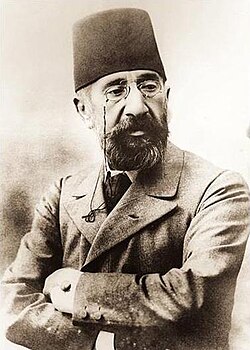
Today I am going to look at the life and work of a nineteenth century Orientalist painter who is regarded as the greatest Turkish artist in this genre.  Turkey has produced an abounding collection of artists whose works span from Ottoman-era realism to contemporary modernism, all leaving a lasting impact on both national and international art.   Osman Hamdi Bey was a key figure in redefining Ottoman art and establishing many of the empire’s cultural institutions.

Ibrahim Edhem Pasha, the artist’s father (1877)

Osman Hamdi Bey was born on December 30th, 1842. He was the eldest of four siblings.    He had two younger brothers, Halil Ethem, and İsmail Galip and a younger sister, Nazli.   He was the son of Fatma Hanım and Ibrahim Edhem Pasha.  His father, Ibrahim, had been born in a Christian Greek Orthodox village on the island of Chios.  In 1822, three-years-old Ibrahim was orphaned and captured by Ottoman soldiers during the massacre of the Greek population of Chios. He was sold into slavery, and transported to Constantinople, where he was adopted by Kaptan-ı Derya (Grand Admiral) Hüsrev Pasha who would later become Grand Vizier, the title of the effective head of government of many sovereign states in the Islamic world.   Not having his own children and family, Hüsrev Pasha raised about ten children who had been orphaned or bought as slaves, many of whom later ascended to important positions including Ibrahim, who rose in the ranks serving as Minister of Interior and was later appointed ambassador to Berlin and Vienna.
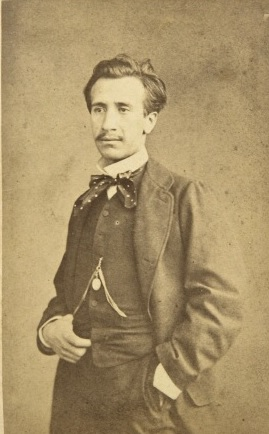
Osman Hamdi Bey as a youth

In 1856, Osman Hamdi studied law in Istanbul, and in 1860, aged eighteen, he went to Paris to continue his studies. It was whilst living in the French capital that he met the French Orientalist painters Jean-Léon Gérôme and Gustave Boulanger and his life changed.  He decided to pursue his interest in painting instead of law and left the Law programme and trained under French orientalist painters Jean-Léon Gérôme and Gustave Boulanger.   He began to study painting under their guidance and remained in Paris for nine years where he also studied archaeology, taking time to visit museums, and immerse himself in the cultural and social life of Paris.
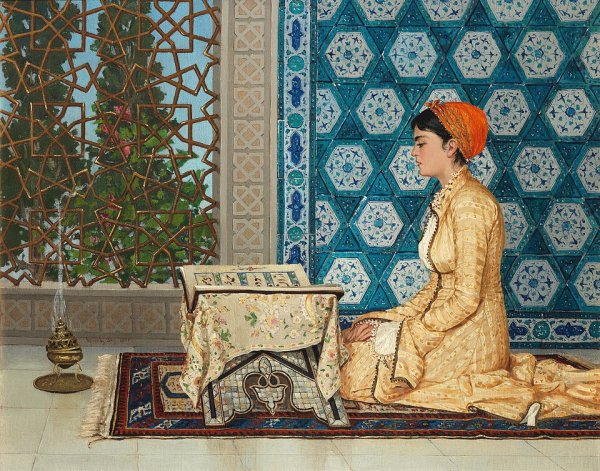
Young girl reading the Qur’an by Osman Hamdi Bey (1880)

Young Woman Reading, known more commonly as Young Woman Reading the Qur’an, the 1880 painting by Osman Handi Bey, depicts a young woman sitting on her knees in front of the Qur’an.  On September 27th, 2019, the work was sold by Bonhams auction house in London for GBP 6.69 million, way above its estimate, making it the most expensive Turkish painting.  The palette is dominated by warm browns, creams, reds, and muted greens, giving the interior a warm, enclosed atmosphere. Light falls across the girl’s clothing and the surrounding architectural surfaces, helping to distinguish different textures. Her body is relaxed but her attention is concentrated on the text. We don’t see a dramatic facial expression; instead, the painting communicates emotion through stillness and posture. Her lowered head and absorbed concentration make the scene feel private, almost as though the viewer has momentarily entered a space of personal devotion.Rather than using dramatic illumination, Hamdi Bey uses relatively controlled light to create a contemplative mood. In the painting, we witness the self-contained pose of a young woman as she reads.  The painting has a decidedly formal aspect to it but also is a depiction which highlights the importance and intricacy of fabric and her dress and evokes the more modest harem pictures.  In many Orientalist paintings featuring lavish interiors there is a familiar eroticism associated with the harem but in this work, there is no such allusion to sexual happenings.  The depiction has been moderated by the buttoned-up clothing of the female figure and her self-contained pose.
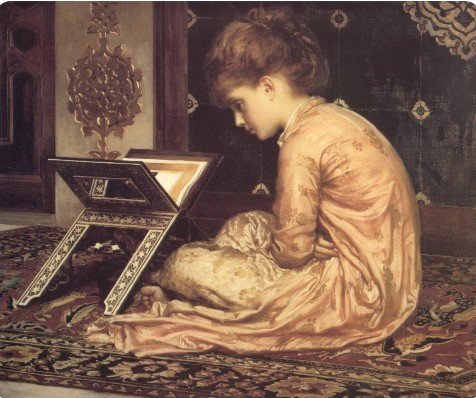
Study at a Reading Desk by Frederic Leighton (1877)

Three years before Osman Handi Bey completed Young Woman Reading, the English painter Frederic Leighton had completed his work entitled Study at a Reading Desk.  Look at the similarity between the two works and one must wonder whether Osman had seen Leighton’s depiction.

The Tortoise Trainer by Osman Hamdi Bey (1906)

One of Osman Handi Bey’s most well-known works is The Tortoise Trainer, which combines elements of Orientalism with a critical view of Ottoman society.  Osman Hamdi Bey’s The Tortoise Trainer (Kaplumbağa Terbiyecisi) is one of the most famous paintings of late Ottoman art. It was painted in 1906, in oil on canvas, and measures 221.5 × 120 cm. The original is now in the Pera Museum in Istanbul. We see an elderly, dervish-like man standing in an elaborately tiled interior, seemingly attempting to train several tortoises. He carries a ney (a reed flute) behind his back and a small nakkare drum. The setting has been identified as an upper chamber of Bursa’s Yeşil Camii (Green Mosque). The absurdity of the depiction is deliberate: tortoises are extraordinarily slow and difficult to command, while the trainer patiently tries to influence them through music rather than force.

So what does it all mean ? The most common interpretation is that the tortoises represent the slow pace of Ottoman reform. Hamdi Bey painted the work during a period of considerable political and social tension, and the apparently futile task of training the tortoises can be read as a satirical comment on attempts to modernise an increasingly troubled empire. There is an important ambiguity, though. The painting was not immediately understood simply as political satire. The interpretation became particularly powerful after the Young Turk Revolution of 1908, when viewers could read the old-fashioned figure and his hopeless task in the light of the Ottoman political crisis. The trainer depicted in the work may actually be Hamdi Bey himself. He frequently used photographs of himself as models for figures in his paintings, and the Pera Museum identifies the dervish-like figure as a self-representation. The painting also has a wonderfully paradoxical quality: the trainer is trying to bring about change through patience, culture and art, but his subjects barely respond. That makes the picture work simultaneously as a joke, a political allegory, and a reflection on the frustrating process of cultural reform.

The first version of Hamdi’s painting was exhibited at the Grand Palais in the 1906 Paris Salon, under the title L’homme aux Tortues (“Man with tortoises”). It was formerly in the collection of Turkish businessman Erol Aksoy. It was sold for US$3.5 million in 2004 and is currently displayed at the Pera Museum in Istanbul.

This painting was completed in two different versions.  
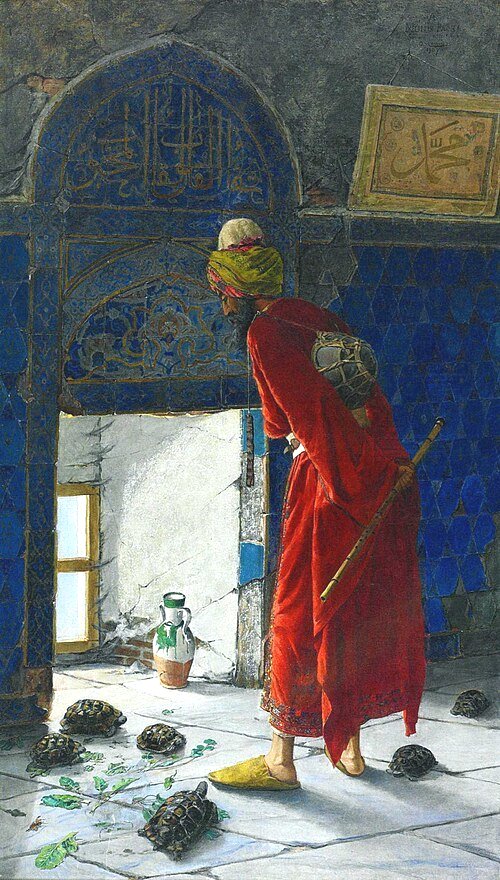
A year later he completed a smaller version which he dedicated to his child’s father-in-law, Salih Münir Pasha.
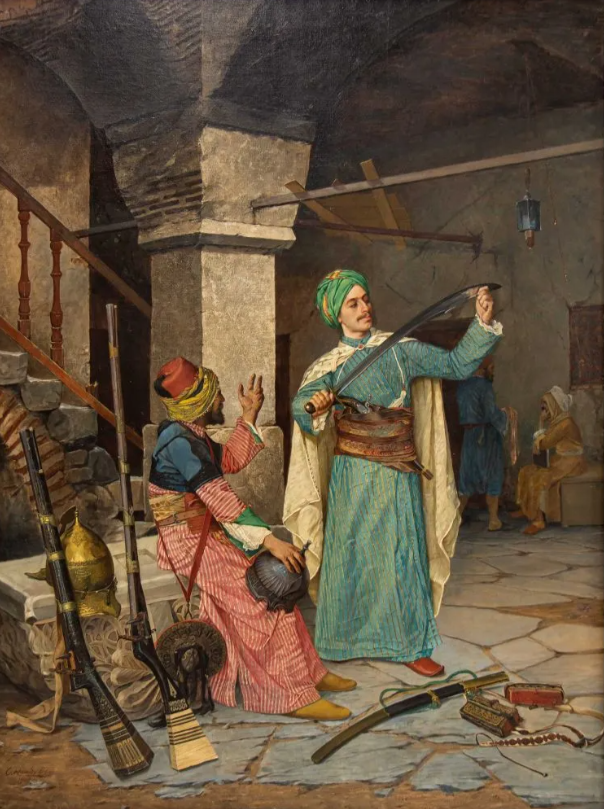
The Weapon Merchant by Osman Hamdi Bey (1908)

Osman Hamdi Bey’s painting entitled The Weapon Merchant uses the detailed setting almost like a stage. Weapons, costumes, architecture and textiles are meticulously observed, while the human interaction becomes the focal point of the work. Before us we see a bearded man on the left, which is believed to be Osman Hamdi himself.  His demeanour is one of a merchant. His posture is unusually authoritative: and is seen gesturing toward the younger man as if giving him advice.  According to the Turkish Ministry of Culture the two principal figures are Osman Hamdi and his son Edhem and interprets their relationship in terms of generations, continuation of the family line, and mortality. In the depiction we note that the son, Edhem, physical depiction is one of strength and is almost the opposite of his father’s demeanour. Edhem is upright, tense and energetic, while his father is seated and contemplative.  It is Edhem that holds the unsheathed sword which is a metaphor for power being passed from one generation to another. 

Osman Hamdi painted the work in 1908, just two years before his death.
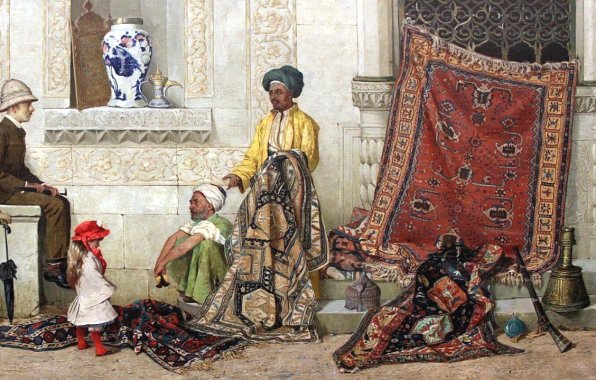
The Carpet Merchant by Osman Hamdi Bey (1888)

The Carpet Merchant (Halı Taciri) is another painting by Osman Hamdi Bey, dated 1888. It is presently part of the Staatliche Museen zu Berlin collection.  It is a depiction of carpet merchants offering up their textiles to Western visitors in an Ottoman setting. We see one merchant standing in a yellow robe, holding up a richly patterned carpet, while another sits beside him. Several carpets are spread across the ground and hang in the background.  Osman Hamdi rendered their patterns with extraordinary precision, and art historians have identified particular carpets as Anatolian and Caucasian examples.  The encounter between the Ottoman merchants and Western visitors can therefore be read as a representation of the cultural and commercial relationship between East and West. The carpets function almost as a bridge between the two groups.

The Carpet Merchant by Jean-Léon Gérôme (1887)

There is also an interesting connection to Jean-Léon Gérôme, who was one of Osman Hamdi’s teachers. Gérôme painted The Carpet Merchant in Cairo in 1887, and Osman Hamdi’s composition similarly focuses on merchants, carpets, architecture, and highly detailed Orientalist imagery.
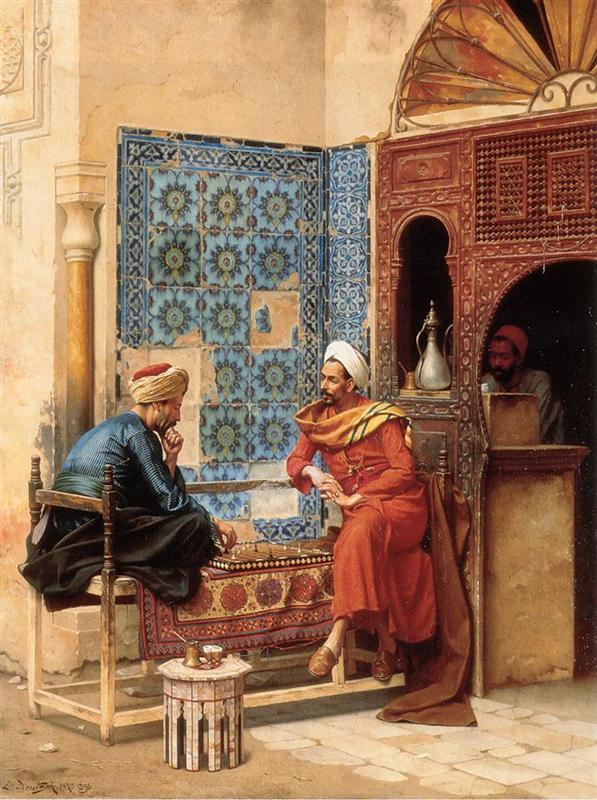
Chess by Osman Hamdi Bey

Osman Hamdi Bey’s painting entitled Chess is in the collection of the Istanbul Metropolitan Municipality City Museum.  This casual pastime invites interpretations involving intellect, strategy, contemplation, and the tensions of Ottoman society during a period of modernization.  Both opponents wear long Ottoman robes, rather than Western-style suits.  Their robes are made from richly patterned textiles, with contrasting layers and borders.  The men wear Ottoman-style turbans/head coverings associated with learned or elite men.  Their clothing deliberately evokes an earlier Ottoman period and Bey frequently used historical costumes in his paintings.

The floor is covered with an elaborate Oriental carpet, characteristic of the luxurious interiors Hamdi Bey depicted in many of his works of art.  Additional textiles, including cushions and draperies, support the sense of an elite Ottoman domestic or scholarly environment.   The painting was a good example of how Handi Bey wanted to portray Ottoman intellectual life and counter the exotic “Orient” often seen in European Orientalism.  One of the interesting aspect about Chess is that the setting is almost as important as the game. Hamdi Bey wasn’t just depicting two men playing chess; he was constructing an image of Ottoman intellectual and material culture.
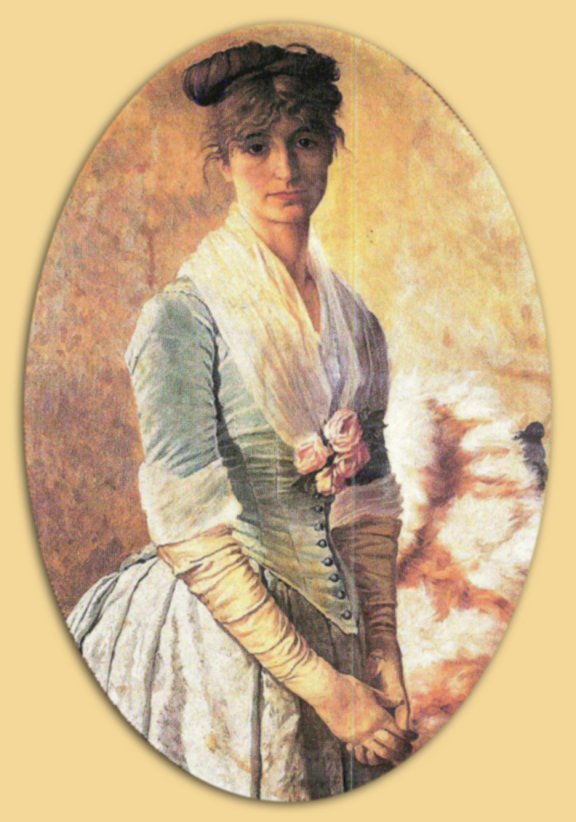
Portrait of woman (His second wife Naile Hanim) by Osman Hamdi Bey

Osman Hamdi Bey was married twice, both times to French women he met during his years connected with Paris and Europe. His first wife was Agarite Gay, a French woman whom he met in Paris. They were married around the mid-1860s and remained together for roughly ten years. They had two daughters: Fatma who was born in 1866 and Melek who was born a year later.  Their marriage ended around 1875 and Agarite returned to France, while the couple’s daughters were divided between the parents: Fatma remained in Istanbul with her father, while Melek went to France with her mother.

Naile Hanım Portresi , Hamdi Bey’s second wife by Osman Hamdi Bey

His second wife was Marie Palyart, who was born in France in 1863. After marrying Osman Hamdi Bey, she became known as Naile Hanım. She is the wife whom he portrayed repeatedly in his paintings.  The couple had three children:  Leyla (1880–1950), Edhem (1882–1957) and Nazlı (1893–1958).  Naile Hanım survived Osman Hamdi by 33 years, dying in 1943. She spent her final years between Istanbul and Paris and was buried in the Feriköy Latin Catholic Cemetery in Istanbul.
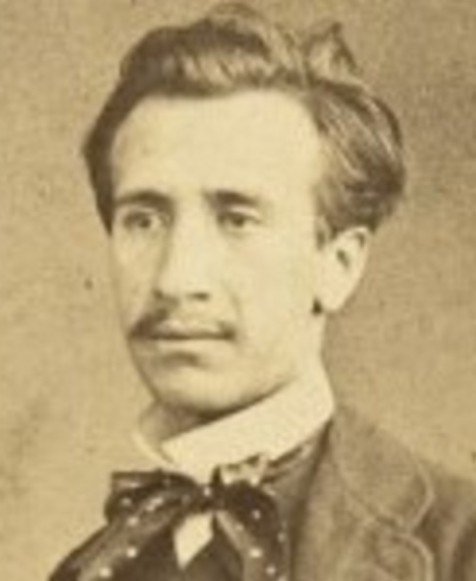
Osman Hamdi Bey (c.1860s)

Osman Hamdi Bey was not just an Ottoman painter, he was an archaeologist, museum curator, and intellectual. He is one of the most important figures in 19th-century Ottoman art and museology.  In Archaeology he led important excavations, particularly at Sidon in present-day Lebanon, where the famous Alexander Sarcophagus was discovered.  His work at museums was of great importance with him becoming director of the Imperial Museum (Müze-i Hümayun) and played a major role in establishing modern archaeological preservation in the Ottoman Empire.

Osman Hamdi Bey died on February 24th 1910 aged 67.

Théophile “Théo” van Rysselberghe Part 1.

The artist I am looking at today is Théophile “Théo” van Rysselberghe a Belgian neo-impressionist painter, who was a major protagonist in the European art scene at the turn of the twentieth century.

Self-portrait in a Green Waistcoat (1924)

Théo was born in Ghent on November 23rd 1862, the youngest child of Jean-Baptiste and Melanie van Rysselberghe and had five bothers and a sister. He was brought up in a French-speaking middle-class home. His first art training occurred when he attended the Royal Academy of Fine Arts in Ghent studying under the Belgian painter, Theo Canneel.

Oriental Beauty by Jean-François Portaels

In 1879 he enrolled at the Académie Royale des Beaux-Arts in Brussels under the directorship of Jean-François Portaels, a Belgian painter of genre scenes, biblical stories, landscapes, portraits and orientalist subjects. Portaels is regarded as the founder of the Belgian Orientalist school and his North African paintings had started an orientalist fashion in Belgium. This aspect of Portaels’ work had a great influence on the young Théo van Rysselberghe, so much so that he made three extended painting trips to Morocco between 1882 and 1888.

Self-portrait with Pipe by Théophile “Théo” van Rysselberghe (1880)

In 1880, when Theo was eighteen years of age he submitted and had accepted two portraits to the Salon of Ghent and that year completed a self-portrait entitled Self Portrait with Pipe. In 1881, he exhibited for the first time at the Salon in Brussels.

Portrait of a Young Spanish Woman by Théophile “Théo” van Rysselberghe

Spanish Woman by Théophile “Théo” van Rysselberghe (1880)

In 1881 Theo made his first trip to Spain and Morocco, along with his friend Frantz Charlet, a Belgian painter, etcher, and lithographer and the Asturian painter Darío de Regoyos. It was Theo’s intention to follow in the footsteps of his mentor, Jean-François Portaels.

Descent from the Cross by Pedro Campaña (1547)

Whilst in Madrid he visited the Museo del Prado and later the trio visited Seville where Théo met Constantin Meunier, who had been commissioned by the Belgian government to copy Pedro Campaña’s Descent from the Cross which was mounted on the back wal of the Sacristia Mayor of Seville Cathedral.

Dario de Regoyos playing the guitar by Théo Van Rysselberghe (1882)

During Théo’s stay in Spain he made time to complete a portrait of his fellow traveller, Darío de Regoyos, playing his guitar.

Arabian Street Cobbler by Théo Van Rysselberghe

Moroccan Market by Théo Van Rysselberghe (1883)

Théo arrived in Tangier at the end of October 1882 and suddenly he realised that he had entered a “new” world, so different from the Europe he had come from. He stayed in the town for four months continually sketching and painting street scenes, the kasbah and the souk.

The Oyster Eater by James Ensor (1883)

In April 1883 he exhibited these scenes of everyday Mediterranean life at the Salon L’Essor, in Brussels. L’Essor was an association of visual artists in Brussels, which was active from 1876 to 1891. Its original aim was to rebel against the conservative tendencies of the art institutions and art circles in Brussels. However in 1883 some of the artists of this group were dissatisfied with the ruling body of the group with regards its admission policy, lack of direction and their controversial decision to reject Belgian Expressionist painter James Ensor’s The Oyster Eater in the 1883 L’Essor Salon. However, it has to be remembered that the previous year the Antwerp Salon jurists had rejected the same painting. It is thought that the rejection was because of the sexual overtones suggested by a single young woman eating oysters, which at the time was considered to be an aphrodisiac.

Portraits of or work by the 11 original founders of Les XX. Upper register, left to right: Darío de Regoyos y Valdés, Guillaume van Strydonck, Théo van Rysselberghe, Fernand Khnopff and a portrait of Willy Finch by Magnus Enckell. Bottom, left to right: La donna morta by Willy Schlobach, Rodolphe Wytsman, Le viatique qui passa (1884) by Charles Goethals, a medal made by Paul Du Bois, and a painting by Frantz Charlet. Right, larger image: James Ensor.

Portrait of Octave Maus by Théo Van Rysselberghe

Portrait of Octave Maus by Théo Van Rysselberghe (1885)

Van Rysselberghe and James Ensor were two of the eleven artists who left L’Essor and became founding members of the breakaway group, Les XX. Les XX became a group of twenty Belgian painters, designers and sculptors, formed by the Brussels lawyer, publisher, and entrepreneur Octave Maus, who, with his wife, featured in a number of van Rysselberghe’s portraits between 1883 and 1890, Each year twenty other international artists were also invited to participate in the Les XX exhibitions. Among the most notable members were James Ensor, Willy Finch, Fernand Khnopff, Félicien Rops, and later Auguste Rodin and Paul Signac.

Emile Verhaeren by Théo Van Rysselberghe

Emile Verhaeren by Théo Van Rysselberghe ((1892)

Rysselberghe completed many portraits and it was around 1882 that he struck up a close friendship with the poet and art critic Emile Verhaeren who featured in many of Théo’s portrait works. The lower work was viewed as a masterpiece of Neo-Impressionist drawing and aroused the passions of true connoisseurs. The sketch sold for 150,000 euros in 2006, it was offered at the same auction house, Christie’s Paris, on 21 October 2023 with an astonishing estimate of 60-80,000 euros. After a fierce bidding war, it sold for €240,000. This works out at €302,000, with the buyer paying the substantial sales costs.

Portrait of Marguerite van Mons by Théo Van Rysselberghe (1886)

Another of Rysselberge’s portraits featured the daughters of his friend Emile van Mons, a lawyer and well-known art lover. The June 1886 Portrait of Marguerite van Mons features ten-year-old Marguerite shortly after the death of her mother. She stands facing us wearing a simple black dress in front of a pastel blue door on which are a number of gilded ornaments. Her right hand holds the doorknob as if she had just entered or was about to leave the room. There is an air of mystery and melancholia about the depiction as the pale-faced girl stares absently out at us

Portrait of Camille van Mons by Théo Van Rysselberghe (1886)

Months earlier van Rysselberghe had completed a portrait of Marguerite’s elder sister, Camille.

……. to be continued

.


Most of this information for this blog came from various Wikipedia sites.

Hilda Rix Nicholas. Part 2. Morocco and many family tragedies

Morocco, marketplace with pile of oranges by Hilda Rix Nichols painted during one of her two trips to Tangier

It would have been almost impossible to actually paint plein air in oils in the chaotic marketplaces, so Hilda resorted to completing many outdoor pencil and crayon sketches and then later fashioned a completed work when she returned to her hotel.  Her painting style had changed and was now more in line with the Post Impressionists.  An example of this is her work entitled Morocco Marketplace with the Pile of Oranges.  It is a good example of the changes that her style underwent in Morocco. Now she is painting with flowing brush strokes in thick slabs of impasto, a technique used in painting, where paint is laid on an area of the surface in very thick layers, usually thick enough that the brush or painting-knife strokes are visible. The scene is framed by buildings in the background and strewn across the foreground we see a large pile of oranges. The mountain women are wearing red striped skirts and bright haiks, the large pieces of cotton, silk, or wool cloth worn as an outer garment by some Moroccan women.   

                            Men in the Marketplace by Hilda Rix (1914)

In 1914 she completed her painting entitled Men in the Market Place, Tangier.   It is set during the late afternoon once all the shops had closed and in front of us are a group of men deep in conversation.  She has cleverly used a much-reduced palette of pale blues, creams, browns, and yellows.  We do not see the facial feature of the men as they are bathed in a dark grey shadow whilst the buildings behind them are bathed in late afternoon light.  Hilda wrote a letter home describing how she had to endure the strong sunlight coming from the low sun.  She wrote:

“…’The sun has sunken down in a daffodil bed – feeling he has well earned his rest. (But I have a bone to pick with him – he burnt my arms while sketching till they positively hurt – next time I’ll fool him & put gloves over them). The Moors have turned around from their haggling & marketing, gossiping & dreaming & murmuring to face the setting sun, their lips moving in prayer, their eyes beautiful to look upon – The pale yellow light giving a weird pallidness to the sheet of faces …”

                                                       Grande Marché, Tangier by Hilda Rix (1916)

Hilda completed a pastel drawing, Grand Marche, Tangier, which she later copied in oils.  When it was exhibited in her show at Paris’ Galerie J. Chaine and Simonson in 1912 it was much admired and was bought by the French government for the collection of the Musée du Luxembourg.  Centre stage in the depiction we see two women wearing red-and-white-striped cotton dresses or skirts, covered by white robes.  Their legs are bare and they wear red shoes and socks. One of them pulls her white robe tighter across her upper body. The other, who has her back turned to the viewer, is carrying something on her back, which could be her young child.  The art critics for the French edition of the New York Herald was impressed by Hilda Rix’s realist art, stating that in his opinion the figures in her compositions must surely have been sketched and later added to the finished work.  He further commented:

“…’This artist has the ability to make lifelike images in remarkable compositions bringing outstanding realism and accurate impressions that capture the ‘types’ to be found among the Moroccan people…”

Not everybody loved the painting as the art critic of The Sydney Morning Herald commented that:

“…the drawing and colour are eccentric, after the post-impressionist manner” and described the central figure as “grotesque in its want of finish…”

 Moroccan Market Scene by Hilda Rix Nicholas (crayon and pastel on paper)

The paintings which she did during her periods in North Africa led art historians to compartmentalise her as an Orientalist, a term which referred to the depiction of people or places in present-day Greece, Turkey, North Africa or the Middle East, by painters from the West.  In addition to displaying the results of her trip at the Salon, she also had her Tangier works exhibited in 1913 and 1914 at the Société des Peintres Orientalistes Français, an art society which staged not only Orientalist paintings, but also encouraged the travel of French artists in the Far East. Her work was illustrated in the Notre Gazette, reflecting her emerging status as an important artist, and there were many column inches in the French about her exhibitions.

                           Moroccan Loggia by Hilda Rix Nicholas (1912-1914)

Her colourful paintings featuring life in Morocco highlighted the powerful North African light and concentrated on the people and their colourful clothing and sometimes the local architecture.  It could be levied against her that many of her depictions were idealised versions of life in Morocco and steered clear of the more squalid aspects of the poverty that pervades the area and yet in Jeanette Hoorn’s 2012 biography, Hilda Rix Nicholas and Elsie Rix’s Moroccan Idyll : Art and Orientalism, she takes the opposite view, writing:

“…She did not seek out or embellish her pictures with the “orientalist” stereotypes that she had learned while growing up in Melbourne…In her writing and painting, she actively campaigned against what she saw as the fakery of “orientalism”. Her pastel drawings and oils strive to present an accurate account of the dress, manners and appearance of her subjects…”

Hoorn believed that Rix and her sister were, to a significant extent, counter-orientalist as they endeavoured to portray everyday life in Tangier as they found it, rather than presenting generalised views of the orient.  Rix adopted a counter-orientalist position in lectures and articles upon her return to Australia.   There were some that viewed her North African depictions as being somewhat abstract and flat and that could well be due to the influence Matisse had on her. 

                             Hilda Rix painting in Tangier market place (1914)

Matisse returned to Morocco in October of that year while it was two years later that Rix returned to North Africa, this time accompanied by her sister, who also sketched and wrote but whose main function was to be company for her sister and provide assistance and protection from enquiring bystanders while Hilda painted.  Hilda was surrounded by spectators as she sketched and painted and her audience would, on occasions, halt the flow of the traffic

                                         The Arab Sheep Market Tangier by Hilda Rix Nicholas (1914)

Another of her works from her second trip to Morocco was her 1914 painting entitled The Arab Sheep Market, Tangier.   The searing North African sunlight illuminates the whitewashed buildings and the textured garments worn by the shepherds.  Hilda Rix has used a striking palette of pinks, purples and oranges which is an acknowledgement of the Fauvism style of painting.  Sadly, a house fire claimed many works from her African series of paintings.

                                Grandmère by Hilda Rix Nicholas (1914)

Hilda and Elise returned to France in 1914. Around this time, whilst she was in her studio at Étaples, she completed a work entitled Grandmère.  It is a plein air work which shows an elderly peasant woman in a beautiful garden setting affording the work a luminously colourful background.  Many of Hilda’s paintings were bought by the French government, exhibited in the Salon and the Société des Peintres Orientalistes Français, and she was elected an Associate of the Société Nationale des Beaux-Arts. 

                                           Hilda with her mother and sister during European trip.

Hilda still had studios in Paris and one for the summer months spent in Étaples.  The summer of 1914 she was at Étaples but the outbreak of World War I on July 28th 1914 resulted in Hilda, along with her sister Eliseand her mother evacuating to London.  If that upheaval was not enough, Hilda had to endure a number of family tragedies.  Her mother had been taken unwell during the Channel crossing and was admitted to hospital on arrival in England.  Although Hilda’s mother was not fully recovered, she left hospital and went to recuperate at a nursing home.  At the same time as the mother was extremely ill, Hilda’s sister Elise contracted typhoid and died on September 2nd 1914, aged 37.  Hilda kept the death of her sister a secret from her mother who she believed was too ill to receive such sad news.   Her mother slowly recovered and was later told of the death of her daughter.  For the next eighteen months Hilda Rix painted few paintings presumably because she spent all her time looking after her mother and was too tired to concentrate on her paintings.  She remembered the time saying:

“… I could scarcely put one foot in front of the other and walked like an old thing…”

 Finally, in March 1916 Hilda’s mother, Elizabeth died.

Hilda and Matson after the marriage

Enter onto the scene, Major George Matson Nicholas, a soldier from Melbourne.   George, usually referred to as Matson, was the eldest of six brothers.  Before he enlisted in the Australian army in April 1915, he had been a schoolteacher.  He fought at the Battle of Gallipoli and was wounded.  Once recovered he was sent to France where he was awarded a Distinguished Service Order at Pozieres, single-handedly capturing an enemy machine gun post.   His regiment was based in Étaples, and according to Hilda’s stories, he found her paintings which she had left behind when she had had to quickly abandon her Étaples studios.  Then, during his leave he travelled to London in pursuit of Hilda. They met in September 1916, love blossomed between the two, and on October 7th 1916 they married in St Saviour’s, Warwick Avenue in London.   

Major George Matson Nicholas charcoal and pastel drawing by Hilda Rix Nicholas drew this portrait of her new husband two days after their wedding on October 9th 1916

Two days after the wedding Hilda completed a sketch of her husband. Three days after the wedding Major George Matson Nicholas returned to the front and assumed command of the 24th Battalion,  He was shot and killed in action at the Normandy town of Flers on the Western Front on November 14th, aged 39.

                                           These Gave the World Away by Hilda Rix Nicholas, (1917)

Hilda was devastated and in a diary entry she wrote that she had lost the will to live.  In her grief Hilda Rix Nicholas painted morbid images, symbolic of death and sacrifice in war which contrast markedly with the light and life of her French and Moroccan works.  One such work was entitled These gave the world away which she completed in 1917.

                                               Central panel of Pro Humanitate by Hilda Rix Nicholas (1917)

Another of her war paintings was Pro Humanitate, the central panel of a triptych. It clearly depicts the futility of war and more personally for Hilda, the tragedy of her short marriage to Nicholas.  The work comprised of three panels.  The left-hand panel depicted an outdoor scene with a happy couple standing on top of a hill contemplating their future together; the central panel depicts a soldier husband giving his life for the cause of humanity.  Hilda Rix has depicted the soldier at the moment of his death with arms outstretched in a crucifixion pose.  The right-hand panel of the triptych portrays the heartbroken wife grieving and is watched over by the shadowy figure of her lost hero.  Rix Nicholas offered her triptych Pro Humanitate, which depicted Australian soldiers, to the  Australian War Memorial, which was building a collection of art commemorating the war, but it was rejected; the acquisitions committee described it as “of too intimate a character for inclusion in a public collection.

                                                           Desolation by Hilda Rix Nicholas (c.1917)

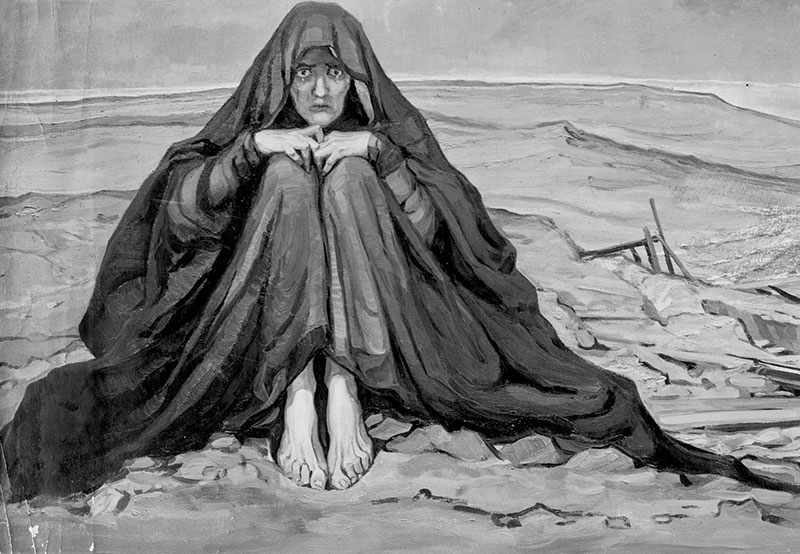
She painted a strange and moving painting around 1917 entitled Desolation.  This work depicts an emaciated woman crying.  She is shrouded in a black cloak and is squatted down staring at us.  The setting is a battle-scarred landscape which lacks any vegetation.   The National Gallery of Australia holds a charcoal drawing made as a study for the work.  In a review, the Arts correspondent for the Sydney Morning Herald, wrote:

“…Desolation is almost gruesome in the grim delineation of the figure typifying all the widowed world in one lone woman. There she sits, lost in an awful reverie, over the stricken battlefield.  The work is an epitome of wasteful ruin …”

Sadly, both Desolation and Pro Humanitate were destroyed in a fire.

…………………………….to be continued.