Today I am going to look at the life and work of a nineteenth century Orientalist painter who is regarded as the greatest Turkish artist in this genre. Turkey has produced an abounding collection of artists whose works span from Ottoman-era realism to contemporary modernism, all leaving a lasting impact on both national and international art. Osman Hamdi Bey was a key figure in redefining Ottoman art and establishing many of the empire’s cultural institutions.

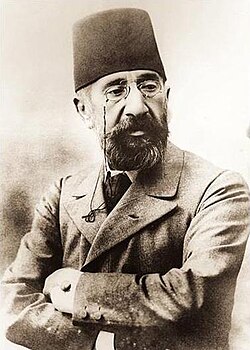
Ibrahim Edhem Pasha, the artist’s father (1877)
Osman Hamdi Bey was born on December 30th, 1842. He was the eldest of four siblings. He had two younger brothers, Halil Ethem, and İsmail Galip and a younger sister, Nazli. He was the son of Fatma Hanım and Ibrahim Edhem Pasha. His father, Ibrahim, had been born in a Christian Greek Orthodox village on the island of Chios. In 1822, three-years-old Ibrahim was orphaned and captured by Ottoman soldiers during the massacre of the Greek population of Chios. He was sold into slavery, and transported to Constantinople, where he was adopted by Kaptan-ı Derya (Grand Admiral) Hüsrev Pasha who would later become Grand Vizier, the title of the effective head of government of many sovereign states in the Islamic world. Not having his own children and family, Hüsrev Pasha raised about ten children who had been orphaned or bought as slaves, many of whom later ascended to important positions including Ibrahim, who rose in the ranks serving as Minister of Interior and was later appointed ambassador to Berlin and Vienna.
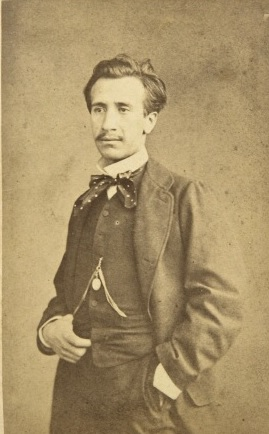
Osman Hamdi Bey as a youth
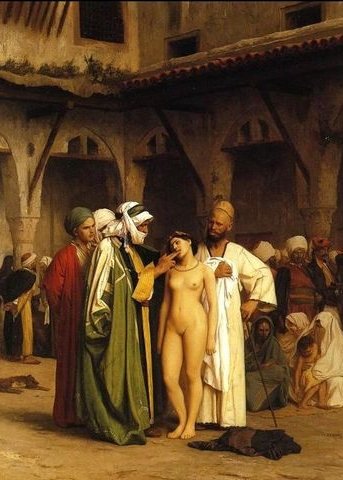
In 1856, Osman Hamdi studied law in Istanbul, and in 1860, aged eighteen, he went to Paris to continue his studies. It was whilst living in the French capital that he met the French Orientalist painters Jean-Léon Gérôme and Gustave Boulanger and his life changed. He decided to pursue his interest in painting instead of law and left the Law programme and trained under French orientalist painters Jean-Léon Gérôme and Gustave Boulanger. He began to study painting under their guidance and remained in Paris for nine years where he also studied archaeology, taking time to visit museums, and immerse himself in the cultural and social life of Paris.
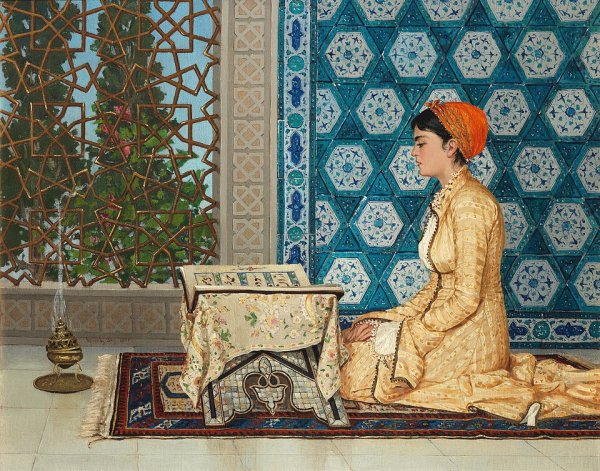
Young girl reading the Qur’an by Osman Hamdi Bey (1880)
Young Woman Reading, known more commonly as Young Woman Reading the Qur’an, the 1880 painting by Osman Handi Bey, depicts a young woman sitting on her knees in front of the Qur’an. On September 27th, 2019, the work was sold by Bonhams auction house in London for GBP 6.69 million, way above its estimate, making it the most expensive Turkish painting. The palette is dominated by warm browns, creams, reds, and muted greens, giving the interior a warm, enclosed atmosphere. Light falls across the girl’s clothing and the surrounding architectural surfaces, helping to distinguish different textures. Her body is relaxed but her attention is concentrated on the text. We don’t see a dramatic facial expression; instead, the painting communicates emotion through stillness and posture. Her lowered head and absorbed concentration make the scene feel private, almost as though the viewer has momentarily entered a space of personal devotion.Rather than using dramatic illumination, Hamdi Bey uses relatively controlled light to create a contemplative mood. In the painting, we witness the self-contained pose of a young woman as she reads. The painting has a decidedly formal aspect to it but also is a depiction which highlights the importance and intricacy of fabric and her dress and evokes the more modest harem pictures. In many Orientalist paintings featuring lavish interiors there is a familiar eroticism associated with the harem but in this work, there is no such allusion to sexual happenings. The depiction has been moderated by the buttoned-up clothing of the female figure and her self-contained pose.
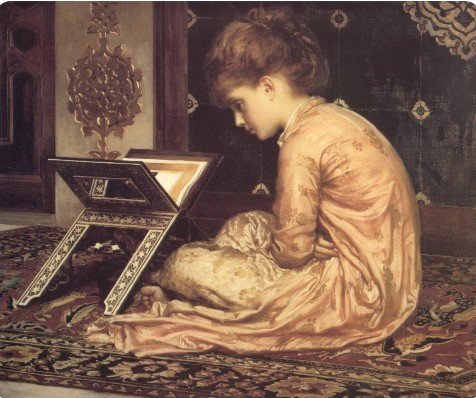
Study at a Reading Desk by Frederic Leighton (1877)
Three years before Osman Handi Bey completed Young Woman Reading, the English painter Frederic Leighton had completed his work entitled Study at a Reading Desk. Look at the similarity between the two works and one must wonder whether Osman had seen Leighton’s depiction.

The Tortoise Trainer by Osman Hamdi Bey (1906)
One of Osman Handi Bey’s most well-known works is The Tortoise Trainer, which combines elements of Orientalism with a critical view of Ottoman society. Osman Hamdi Bey’s The Tortoise Trainer (Kaplumbağa Terbiyecisi) is one of the most famous paintings of late Ottoman art. It was painted in 1906, in oil on canvas, and measures 221.5 × 120 cm. The original is now in the Pera Museum in Istanbul. We see an elderly, dervish-like man standing in an elaborately tiled interior, seemingly attempting to train several tortoises. He carries a ney (a reed flute) behind his back and a small nakkare drum. The setting has been identified as an upper chamber of Bursa’s Yeşil Camii (Green Mosque). The absurdity of the depiction is deliberate: tortoises are extraordinarily slow and difficult to command, while the trainer patiently tries to influence them through music rather than force.
So what does it all mean ? The most common interpretation is that the tortoises represent the slow pace of Ottoman reform. Hamdi Bey painted the work during a period of considerable political and social tension, and the apparently futile task of training the tortoises can be read as a satirical comment on attempts to modernise an increasingly troubled empire. There is an important ambiguity, though. The painting was not immediately understood simply as political satire. The interpretation became particularly powerful after the Young Turk Revolution of 1908, when viewers could read the old-fashioned figure and his hopeless task in the light of the Ottoman political crisis. The trainer depicted in the work may actually be Hamdi Bey himself. He frequently used photographs of himself as models for figures in his paintings, and the Pera Museum identifies the dervish-like figure as a self-representation. The painting also has a wonderfully paradoxical quality: the trainer is trying to bring about change through patience, culture and art, but his subjects barely respond. That makes the picture work simultaneously as a joke, a political allegory, and a reflection on the frustrating process of cultural reform.
The first version of Hamdi’s painting was exhibited at the Grand Palais in the 1906 Paris Salon, under the title L’homme aux Tortues (“Man with tortoises”). It was formerly in the collection of Turkish businessman Erol Aksoy. It was sold for US$3.5 million in 2004 and is currently displayed at the Pera Museum in Istanbul.
This painting was completed in two different versions.
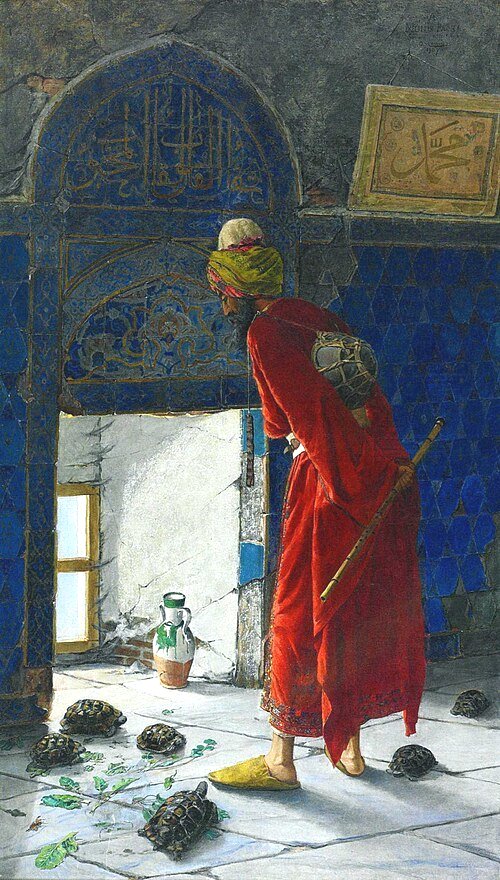
A year later he completed a smaller version which he dedicated to his child’s father-in-law, Salih Münir Pasha.
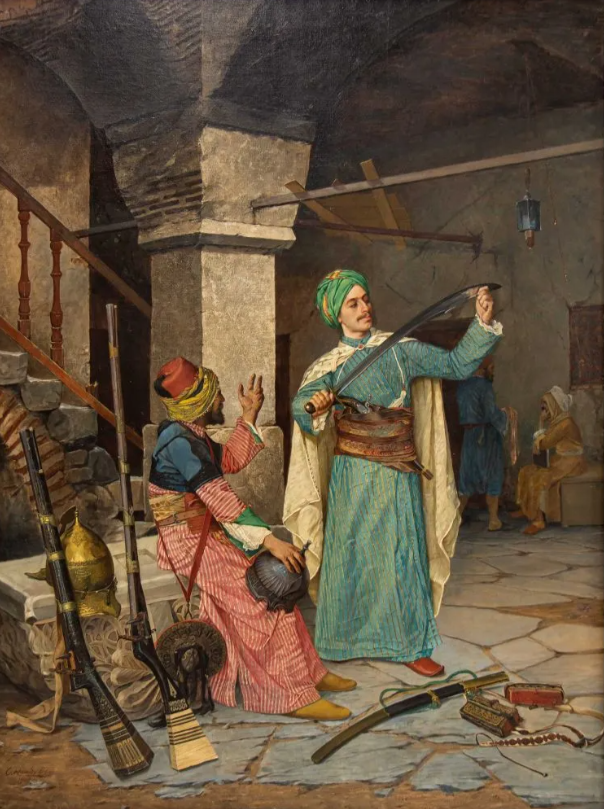
The Weapon Merchant by Osman Hamdi Bey (1908)
Osman Hamdi Bey’s painting entitled The Weapon Merchant uses the detailed setting almost like a stage. Weapons, costumes, architecture and textiles are meticulously observed, while the human interaction becomes the focal point of the work. Before us we see a bearded man on the left, which is believed to be Osman Hamdi himself. His demeanour is one of a merchant. His posture is unusually authoritative: and is seen gesturing toward the younger man as if giving him advice. According to the Turkish Ministry of Culture the two principal figures are Osman Hamdi and his son Edhem and interprets their relationship in terms of generations, continuation of the family line, and mortality. In the depiction we note that the son, Edhem, physical depiction is one of strength and is almost the opposite of his father’s demeanour. Edhem is upright, tense and energetic, while his father is seated and contemplative. It is Edhem that holds the unsheathed sword which is a metaphor for power being passed from one generation to another.
Osman Hamdi painted the work in 1908, just two years before his death.
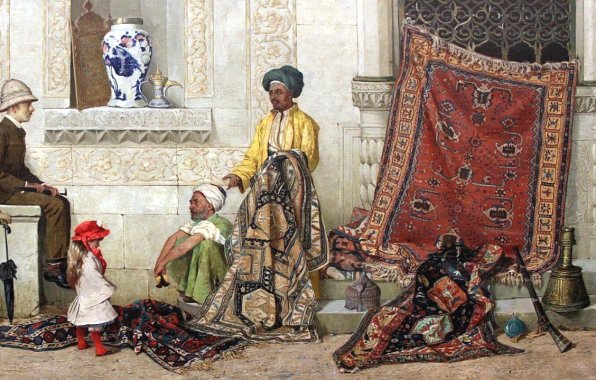
The Carpet Merchant by Osman Hamdi Bey (1888)
The Carpet Merchant (Halı Taciri) is another painting by Osman Hamdi Bey, dated 1888. It is presently part of the Staatliche Museen zu Berlin collection. It is a depiction of carpet merchants offering up their textiles to Western visitors in an Ottoman setting. We see one merchant standing in a yellow robe, holding up a richly patterned carpet, while another sits beside him. Several carpets are spread across the ground and hang in the background. Osman Hamdi rendered their patterns with extraordinary precision, and art historians have identified particular carpets as Anatolian and Caucasian examples. The encounter between the Ottoman merchants and Western visitors can therefore be read as a representation of the cultural and commercial relationship between East and West. The carpets function almost as a bridge between the two groups.

The Carpet Merchant by Jean-Léon Gérôme (1887)
There is also an interesting connection to Jean-Léon Gérôme, who was one of Osman Hamdi’s teachers. Gérôme painted The Carpet Merchant in Cairo in 1887, and Osman Hamdi’s composition similarly focuses on merchants, carpets, architecture, and highly detailed Orientalist imagery.
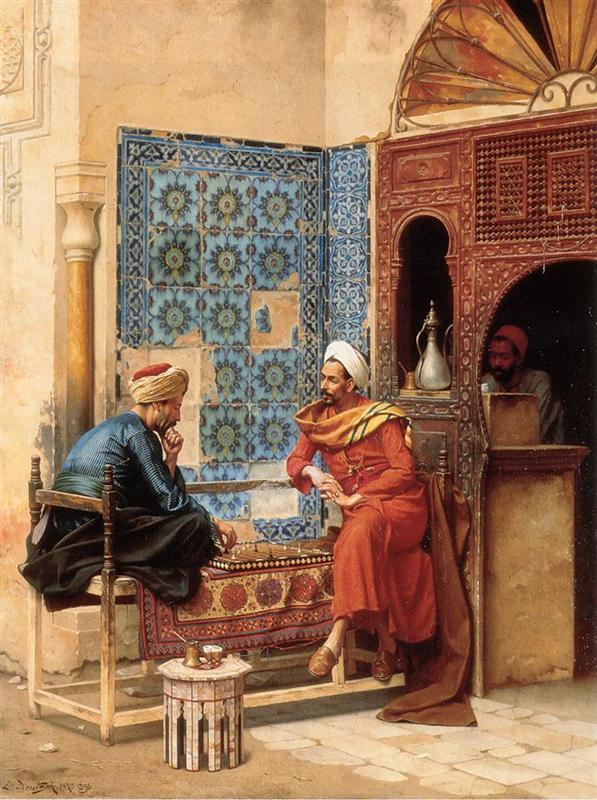
Chess by Osman Hamdi Bey
Osman Hamdi Bey’s painting entitled Chess is in the collection of the Istanbul Metropolitan Municipality City Museum. This casual pastime invites interpretations involving intellect, strategy, contemplation, and the tensions of Ottoman society during a period of modernization. Both opponents wear long Ottoman robes, rather than Western-style suits. Their robes are made from richly patterned textiles, with contrasting layers and borders. The men wear Ottoman-style turbans/head coverings associated with learned or elite men. Their clothing deliberately evokes an earlier Ottoman period and Bey frequently used historical costumes in his paintings.
The floor is covered with an elaborate Oriental carpet, characteristic of the luxurious interiors Hamdi Bey depicted in many of his works of art. Additional textiles, including cushions and draperies, support the sense of an elite Ottoman domestic or scholarly environment. The painting was a good example of how Handi Bey wanted to portray Ottoman intellectual life and counter the exotic “Orient” often seen in European Orientalism. One of the interesting aspect about Chess is that the setting is almost as important as the game. Hamdi Bey wasn’t just depicting two men playing chess; he was constructing an image of Ottoman intellectual and material culture.
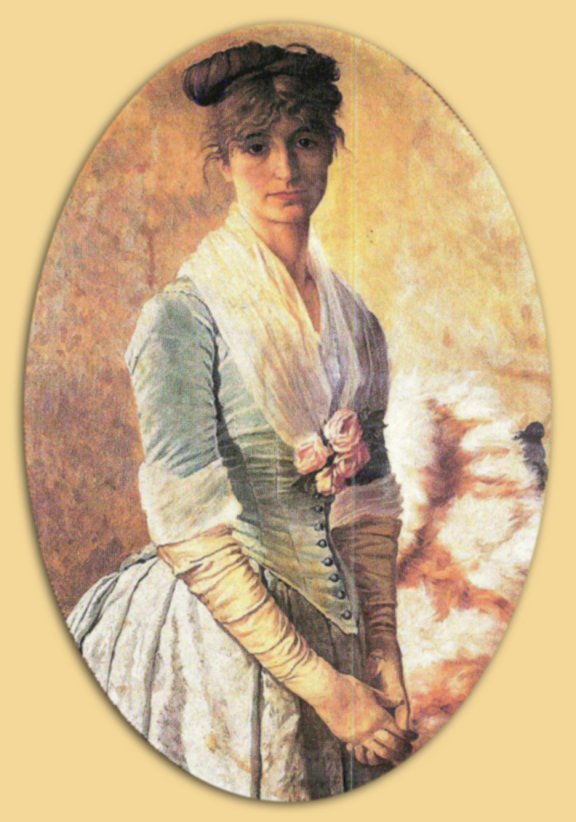
Portrait of woman (His second wife Naile Hanim) by Osman Hamdi Bey
Osman Hamdi Bey was married twice, both times to French women he met during his years connected with Paris and Europe. His first wife was Agarite Gay, a French woman whom he met in Paris. They were married around the mid-1860s and remained together for roughly ten years. They had two daughters: Fatma who was born in 1866 and Melek who was born a year later. Their marriage ended around 1875 and Agarite returned to France, while the couple’s daughters were divided between the parents: Fatma remained in Istanbul with her father, while Melek went to France with her mother.

Naile Hanım Portresi , Hamdi Bey’s second wife by Osman Hamdi Bey
His second wife was Marie Palyart, who was born in France in 1863. After marrying Osman Hamdi Bey, she became known as Naile Hanım. She is the wife whom he portrayed repeatedly in his paintings. The couple had three children: Leyla (1880–1950), Edhem (1882–1957) and Nazlı (1893–1958). Naile Hanım survived Osman Hamdi by 33 years, dying in 1943. She spent her final years between Istanbul and Paris and was buried in the Feriköy Latin Catholic Cemetery in Istanbul.
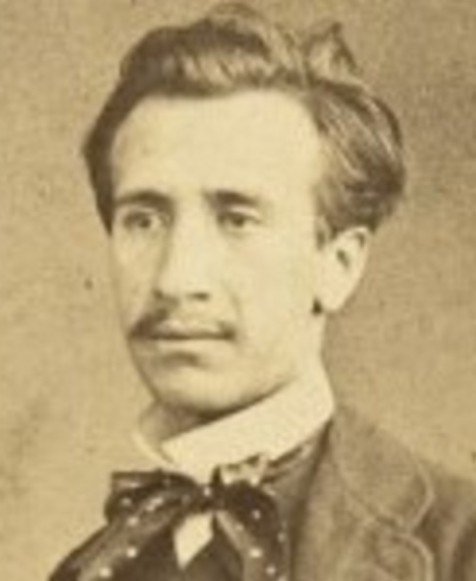
Osman Hamdi Bey (c.1860s)
Osman Hamdi Bey was not just an Ottoman painter, he was an archaeologist, museum curator, and intellectual. He is one of the most important figures in 19th-century Ottoman art and museology. In Archaeology he led important excavations, particularly at Sidon in present-day Lebanon, where the famous Alexander Sarcophagus was discovered. His work at museums was of great importance with him becoming director of the Imperial Museum (Müze-i Hümayun) and played a major role in establishing modern archaeological preservation in the Ottoman Empire.
Osman Hamdi Bey died on February 24th 1910 aged 67.