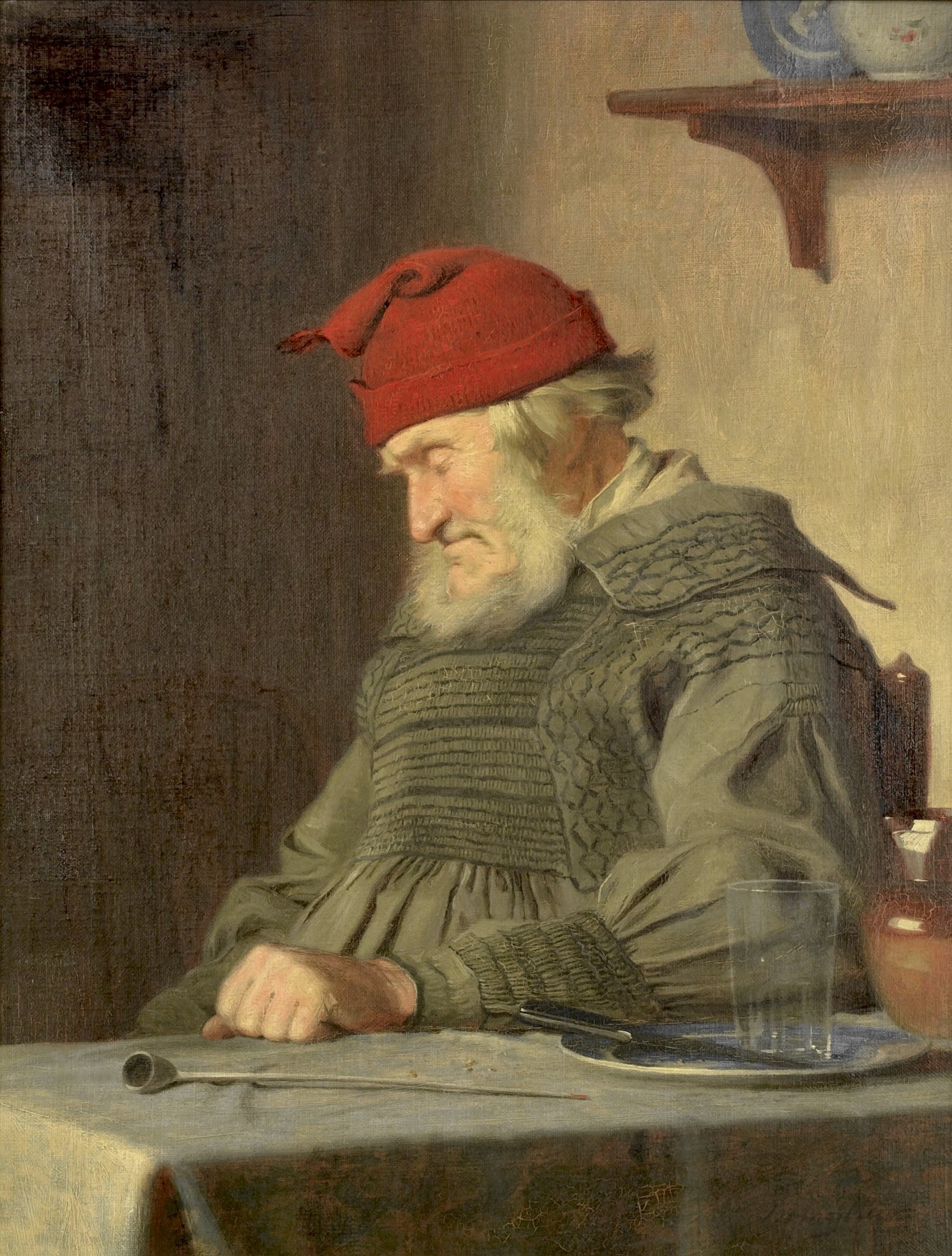
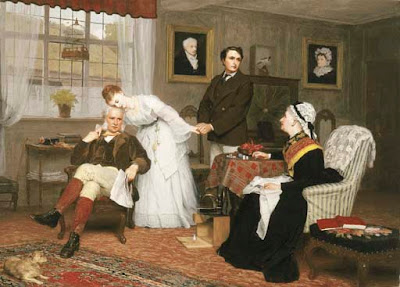
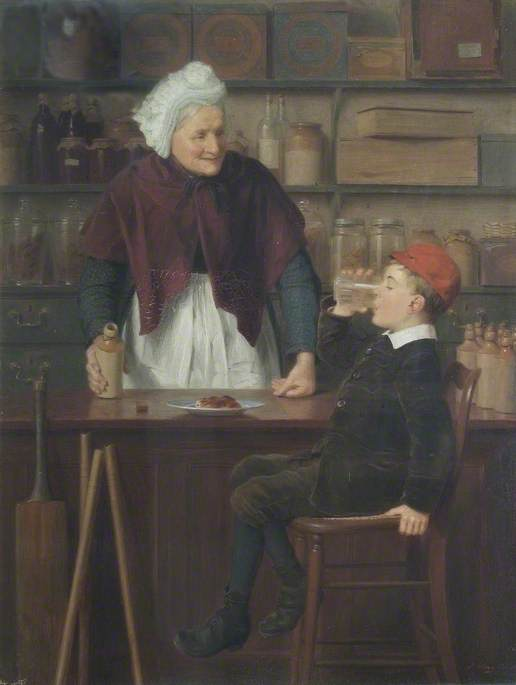
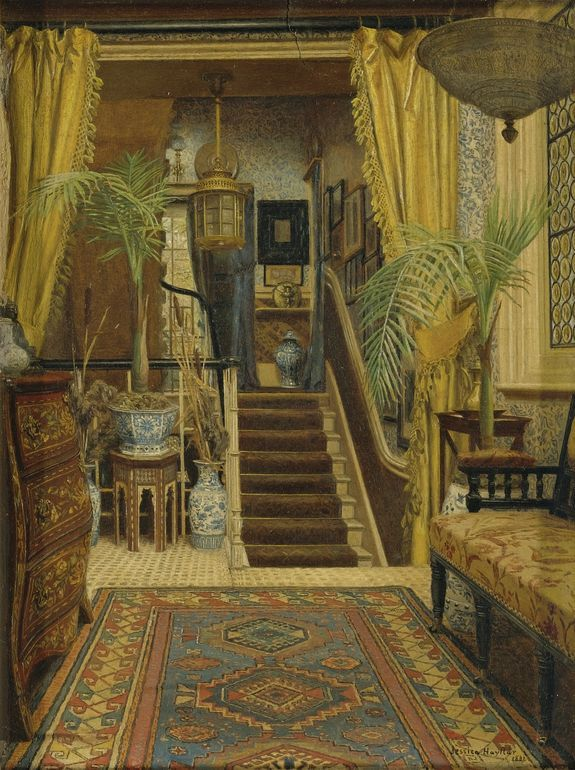
Charles Frederick Ulrich

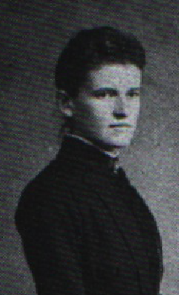
Charles Frederic Ulrich (c. 1895)

My featured artist today is Charles Frederick Ulrich, the late nineteenth-century realist painter of portraits and genre scenes who spent much of his life as an expatriate in Europe.  He was born on October 18th, 1858 in New York, the son of a German émigré photographer and painter, Friedrich Ulrich and his wife, Caroline Ulrich (née Hartje) .  Following his ordinary schooling, he studied at the National Academy of Design in New York and it is thought that he spent some time studying at the Cooper Union School of Art.  From there, in October 1875, at the age of seventeen he crossed the Atlantic and travelled to Munich where he enrolled at the Royal Academy of Fine Arts in Munich.  Here he learnt all about how to capture the subtle effects of daylight and became influenced by seventeenth century Dutch genre paintings as well as the genre paintings by contemporary German artists.  In 1879 one of his paintings was awarded a bronze medal.  His primary instructors were the German landscape and genre painter, Ludwig von Löfftz and the German history painter, Wilhelm von Lindenschmit. He also became friends with the American painter, John Henry Twachtman, who was a fellow student in Löfftz’s class and joined the circle of American-born artists who associated with Frank Duveneck in Munich and the Bavarian town of Polling.  The two artists travelled together to Polling, Germany, where an American artists’ colony had formed and they signed the guestbook sequentially in the spring of 1876. 

Around 1882 Ulrich returned to New York and began exhibiting his work at the National Academy of Design. The next five years were highly productive, resulting in most of the artist’s best-known works.

The Wood Engraver by Charles Frederick Ulrich (1882)

His first painting to be exhibited at New York’s National Academy of Design was his 1882 work entitled The Wood Engraver. It was hailed a resounding success by the critics who considered the painting to be “his best.” A New York Times review of the National Academy exhibition described the painting as:

“…a picture of a woman at work before a window engraving a wood block. It is excellently painted both in figure and interior by Charles Frederick Ulrich…”

The Glass Engraver by Charles Frederick Ulrich (1883)

His painting, The Wood Engraver signified a peak period of his career, and later he would produce a series of works depicting workers. It was a subject for which he is best known for.

 In the Land of Promise, Castle Garden by Charles Frederic Ulrich (1884)

In 1883 he was elected an associate member of the National Academy. In 1884 Ulrich completed one of his most famous paintings entitled, In the Land of Promise—Castle Garden.  Castle Clinton or Fort Clinton, previously known as Castle Garden, is a circular sandstone fort located in Battery Park, in Manhattan, New York City. Built from 1808 to 1811, it was the first American immigration station, where more than 8 million people arrived in the United States from 1855 to 1890. The painting depicts a scene in Castle Garden, and Ulrich has us concentrate on a young immigrant mother at the reception station. She is sitting on her trunk which probably contains all of her worldly possessions. She breastfeeds her baby as her daughter looks off to the left.  Look behind the mother and daughter and you will see a bowler-hatted man tending to his ailing wife. Disease was rife in Castle Garden with cholera and smallpox being rampant in the crowded conditions, although it has to be said that in New York City itself, the conditions were no better. The centre was closed by the government due to cholera and smallpox epidemics and Castle Garden was replaced by another immigration resort that has become much more emblematic in collective memories, the small island of Ellis Island, where immigration services were active from 1892 to 1954

Portrait of Thomas B. Clarke, by Charles Frederic Ulrich (1884)

The painting, In the Land of Promise—Castle Garden, attracted the attention of Thomas B. Clarke, a lace and linen manufacturer who had become the country’s foremost collector of contemporary American art. Clarke was influential in numerous aspects of the New York art world, for he was treasurer of the National Society of Arts, chair of the Union League Club’s art committee, president of the New York School of Applied Design for Women, and a founding member of both the National Sculpture Society and the National Arts Club. Ulrich won the National Academy’s first Thomas B. Clarke Prize for Best American Figure Composition and as an expression of his gratitude, Ulrich painted the portrait of the collector.

An old fire-place / Granny by Charles Frederic Ulrich (1882)

In the mid 1880’s, Charles Frederic Ulrich built up a standing that was largely based on his small-scale genre scenes.  One of example of this was his 1882 painting entitled An Old Fireplace which was often referred to as A Granny.  The setting for this painting is believed to be the Ephrata Cloister, a historic German Anabaptist hermitage located west of Philadelphia which was founded in 1732. Ulrich’s austere depiction of the interior reflects the long history of Ephrata and is reinforced by the sitter’s old age and plain and simple dress.  It depicts life there as it was during his own time with its original hearth converted into a simple kitchen.

The Village Printing Shop, Haarlem, Holland by Charles Frederic Ulrich (1884)

In the summer of 1884, Ulrich returned to Europe and journeyed through Belgium and Holland.  He had made this trip with fellow American artists, William Merritt Chase and Robert Blum.  Ulrich and Blum became great friends over the next three years.  Whilst in the town of Haarlem in the Netherlands, Ulrich completed one of his best known works, The Village Printing Shop, Haarlem. The setting for the painting is a spartan workroom illuminated by the light coming through an open window. Ulrich depicts a boy who has paused during his work to allow himself to take a drink of water.  He stares at the blank wall in front of him and we wonder what is he thinking.  In the background we see two men operating a platen printing press.  Look how Ulrich has enriched the work with his attention to detail such as the ornament on the cast-iron stove.  Look at the clutter on the tabletop in front of the boy, where a bottle of water and a chipped second cup are casually placed amidst stacked blocks of type and other printing-related paraphernalia.

Glassblowers of Murano by Charles Frederic Ulrich (1886)

Ulrich left Europe and returned to New York in late 1884.  He so enjoyed his time in Europe that he immediately started to plan another voyage to there the following year and this time he planned to remain for a longer period.  It was not just his love of Europe that made him want to leave the shores of America but the lack of sales of his paintings.  According to a critic of the era, his abrupt departure was due to his “proclaimed disgust at the sordidness of an unappreciative public, which refused to bankrupt itself in the purchase of over-priced pictures.”

Ulrich went back to Holland and then moved to Venice, where he established a home in 1886.  It was here that he completed his painting, Glass Blowers of Murano which now hangs in the Metropolitan Museum of Art, in New York.   Ulrich depicts workers blowing glass, a craft which was revived in Venice during the late nineteenth century. The setting for the work is the city’s glassmaking centre on the island of Murano.   Murano’s reputation as a centre for glassmaking was born when the Venetian Republic, fearing fire and the destruction of the city’s mostly wooden buildings, ordered glassmakers to move their furnaces to Murano in 1291. Murano glass is still associated with Venetian glass.  Ulrich’s was fascinated with artisan subjects which came at the time of the international Arts and Crafts movement, which valued old-fashioned handicraft rather than industrial production. Ulrich was awarded a substantial cash award in 1886 at the National Academy of Design’s second Prize Fund Exhibition.  This indicated the degree to which an international taste had emerged in American art.

Charles Frederick Hugo Otto Ulrich

Although he maintained contact with Blum and Chase, organized exhibitions of American art in Munich in 1888 and 1892, and visited New York briefly in 1891, Ulrich remained in Europe.  He exhibited at the London Royal Academy in 1889 and 1890, in Munich at the Glaspalast, and after 1893 at the Secession exhibitions. He contributed three works to the art display at the World’s Columbian Exposition in Chicago in 1893, but he focused mainly on showing his paintings widely in Europe. As a result, his work is now relatively little known in the United States. In 1897, in Munich, thirty-nine-year-old Ulrich married twenty-year-old Margarethe Oppenheim, the daughter of the banker, Hugo Oppenheim.  The couple had one son, Charles Frederick Hugo Otto Ulrich, who was born on July 29th 1901.

Waifs in an Orphanage by Charles Frederic Ulrich (1884)

In 1906, Ulrich’s name appears on the membership list of the Deutscher Künstlerbund, making him one of its earliest members.  The aim of the Deutscher Künstlerbund (Association of German Artists) was to ensure the freedom of art, to offer a public forum for different artistic trends and to support young artists.  These intentions were taken into account at annual exhibitions which took place in various German cities and sometimes in foreign countries.

Charles Frederic Ulrich died of pneumonia on May 15th 1908, aged 49.

Clara Peeters – The Queen of Still Life paintings

I suppose painters challenge us with trompe l’oeil aspect of their depictions partly as a joke, as in the case of M C Escher and partly as an outward show of their technical brilliance. Trompe l’oeil (trick of the eye) is often incorporated in still life paintings and in many facets of a still life work we can appreciate the expertise of the artist.  The words still life derive from a Dutch word stilleven while the French prefer nature morte and Italian, natura morta meaning dead nature.  Still life paintings are those which depict inanimate objects, whether they be such things as musical instruments, kitchen utensils and tableware as well as portrayal of dead animals, foliage or musical instruments etc.  Often the inclusion of an inanimate object in a painting has a symbolic meaning whilst at other times it is simply art for art’s sake.

What Is Vanitas
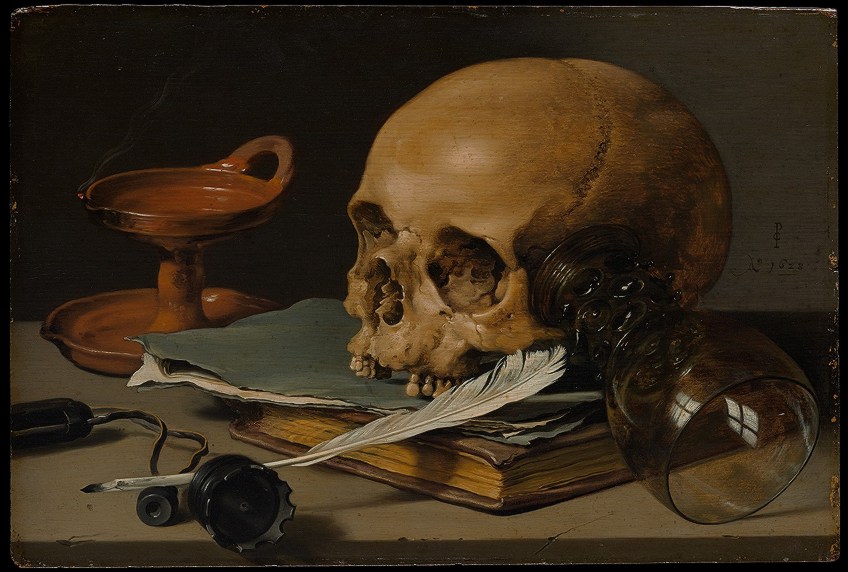
Vanitas Still Life with a Skull and a Quill (1628) by Pieter Claesz

The term memento mori, a Latin phrase meaning ‘remember you must die’ is often a term used when describing certain types of still life works.  Paintings, for example, which may include a portrait with a skull but other symbols commonly found are hour glasses or clocks, extinguished or guttering candles, fruit, and flowers.  Closely related to the memento mori picture is the vanitas still life.  I find the depiction of these inanimate objects fascinating and feel that they are completed by the most talented artists. 

Basket of Flowers by Balthasar van der Ast (1622)

Unlike me, the French Academy of the seventeenth century did not agree.  According to the French Academy their hierarchy of genres (or subject types) for art established in the seventeenth century, still life paintings were ranked at the bottom – fifth after history painting, portraiture, genre painting (scenes of everyday life) and landscape. It is thought that still life and landscape paintings were considered lowly because they did not involve human subject matter.

Still Life with Jug, Berkemeyer and Smoking Utensils_Pieter Claesz_17th century
Still Life with Jug, Berkemeyer and Smoking Utensils by Pieter Claesz (1640)

We know people buy portraiture to remember someone.  People buy landscapes and seascapes for their beauty and often to remind themselves of places they loved to visit.  Genre paintings were scenes of everyday life which often were also pictorial tales of morals and sometimes the realist genre paintings told of harsh times suffered by the less fortunate.  But who would buy still life paintings?  I suppose a beautiful flower arrangement depicted in a floral still life lights up a room but what about still life paintings which depict dead animals, food and expensive homeware?  Buyers of such work may believe that the painting reflects their affluence or hunting prowess.

The spoils of the chase guarded by a dog by Jan Fyt (c.1630)

When you look through the list of sixteenth and seventeenth still life painters, very few women’s names appear and yet there are a few.  The most obvious are the seventeenth century artists, Rachel Rausch with her floral still life works and Judith Leyster.   Today I want to look at the life and works of the greatest female still life painters, Clara Peeters.  She was by far the best-known female Flemish artist of this era and one of the few women artists who became a professional artist in seventeenth-century Europe, and she achieved that status despite constraints on women’s access to artistic training and membership in guilds.

Still Life Self portrait by Clara Peeters (c.1610)

Clara Peeters was born in Antwerp but when it comes to her date of birth there is some confusion.  It is known that a Clara Peeters, the daughter of Jean (Jan) Peeters was baptized on May 15th 1594 in the Church of St. Walburga, Antwerp and other records indicate that Clara Peeters and Henric Joosen were married in the same church on May 31st 1639.  So is that Clara Peeters the famous artist?  Although she is a major figure in the history of European still life painting, almost nothing is known about Clara Peeters’s life with certainty. Early researchers confused her with other women bearing the same relatively common name, ranging from an Antwerp heiress to an Amsterdam prostitute.  Also, we have to be wary of jumping to conclusions as Peeters was a very common name in Antwerp.

Still Life by Clara Peeters (1607)

Another factor which casts doubt on the birthdate of 1594 as her paintings, which were dated 1607, would mean she completed them she was just thirteen years of age and that is extremely unlikely so the conclusion is Clara was born in the 1580’s.

Still Life with Fish, a Candle, Artichokes, Crab, and Prawns by Clara Peeters (1611)

At a point in time when she was living in Amsterdam Clara Peeters produced one of her still life masterpieces in 1911.  It was entitled Still Life with Fish, a Candle, Artichokes, Crab, and Prawns.  Before us we see what looks like a wooden table upon which is a selection of seafood, such as boiled crabs and shrimp, several freshwater fish including two carp, a roach, several ide or orfe, and a northern pike.  Behind the food there is a dark glass goblet, a brass candlestick with an unlit but partially burnt out candle, a Rhenish stoneware jug, a copper strainer with a brass colander in which are two artichokes. 

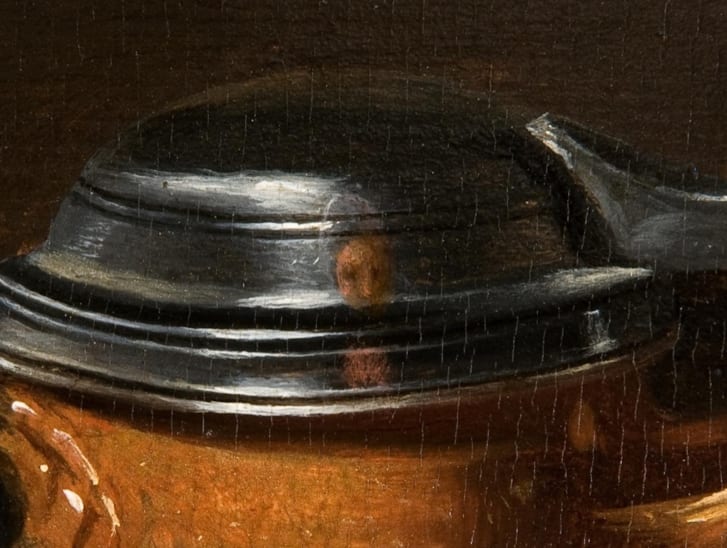
The reflected face

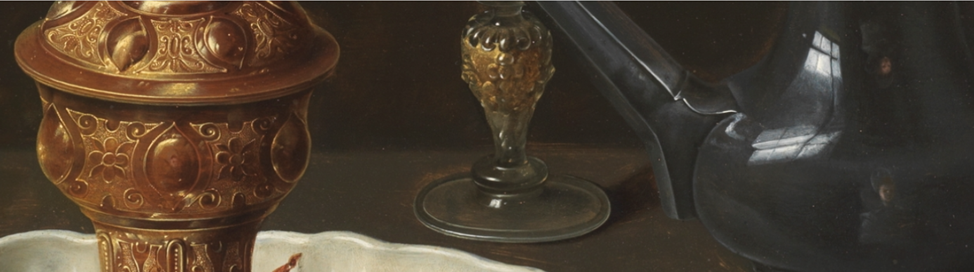
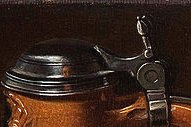
Although you will not see it in the main picture if you were able to take a close look at the lid of the jug you would see a reflection/self portrait of Clara wearing a large headpiece.  She, like a number of famous artists, included her own portrait in a number of her paintings.

Still Life with Sparrow Hawk, Fowl, Porcelain and Shells, zoomed in
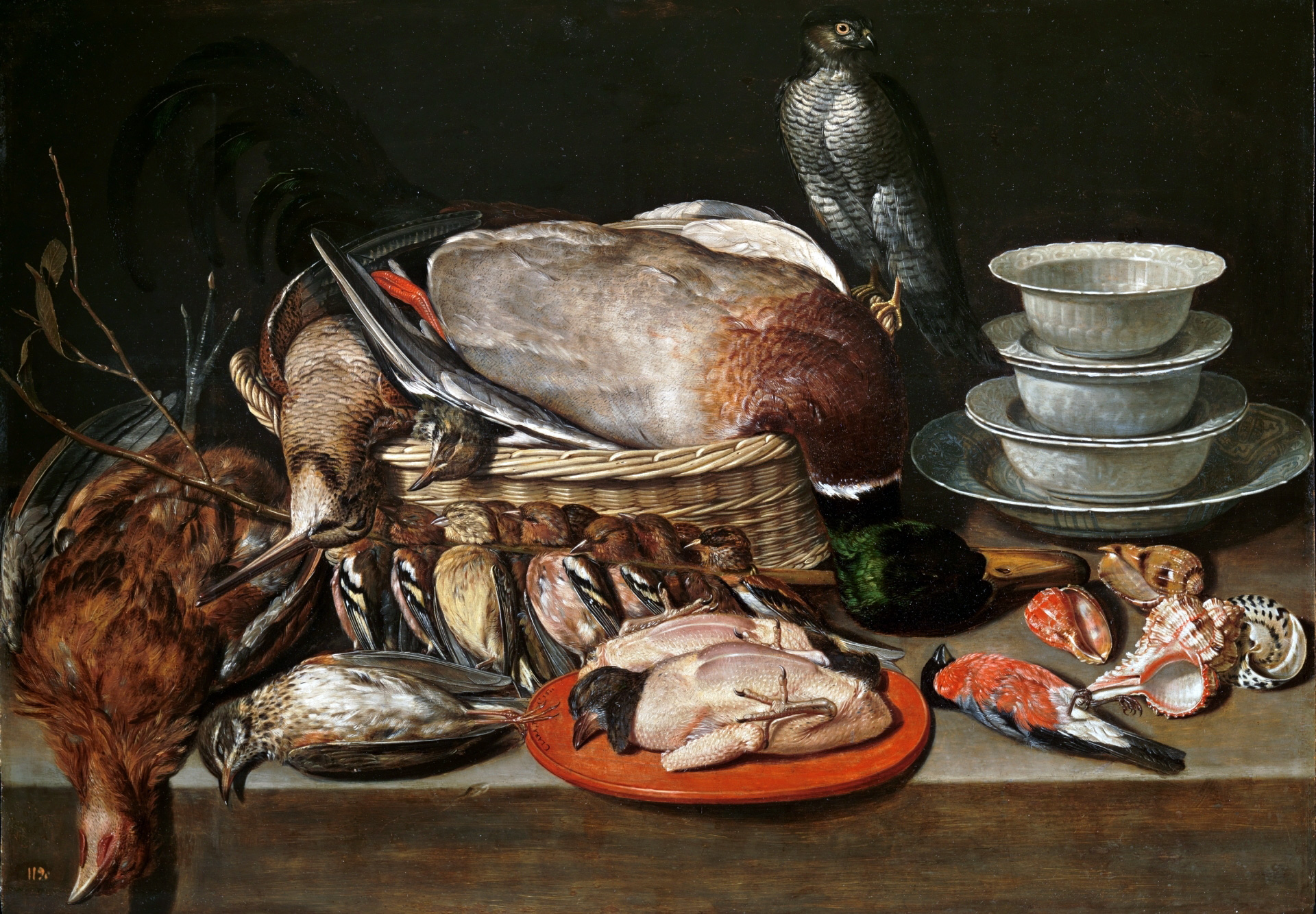
Still life with Sparrow Hawk, Fowl, Porcelain and Shells by Clara Peeters (1611)

Another painting in the Prado collection by Clara Peeters is her 1611 work entitled Still Life with a Sparrow Hawk, Fowl, Porcelain and Shells and is thought to have been in the Spanish royal collection.  In this work we see a life-sized Eurasian sparrow hawk balanced on the edge of a wicker basket.  Due to its large size we believe it to be the female of the species.  Sparrow hawks would typically be used in the gardens surrounding a palace or a city, and not only by men but also by women and children learning the art of falconry.  Lying lifeless in the basket is a large mallard, and a woodcock.  At the left, with its head hanging from the table is a hen.  A dead thrush lies on the table.  The small red bird to the right is a common bullfinch.   The bullfinch often appeared in Clara’s still life paintings and this could well be because of its vivid red colouring and in this work contrasts well with the green head of the mallard.  Along the side of the wicker basket are a line of dead finches, hanging by their necks.    One question you might ask yourself is why have one live bird depicted among so many dead ones.  I think the reason is that the smaller dead birds could well be the prey of the living sparrow hawk.  Again in this painting, as it was in the previous one, note how Clara has contrasted the soft feathered bodies of the birds with the harder and finer surfaces of the shells and porcelain dishes.

Kraak bowl (c.1600)

The several plates and bowls of white kraak porcelain are stacked on top of a blue and white kraak plate, an item which appeared in a number of Peeters’ paintings.  In this painting the blue colour of this dish has faded and this is probably due to the cobalt-based pigment used.  Kraak ware or Kraak porcelain is a type of Chinese export porcelain produced mainly in the late Ming Dynasty, in the Wanli reign.   It was among the first Chinese export wares to arrive in Europe from the late sixteenth century via Portugal and Spain, and spread throughout the continent mainly through Habsburg networks.  It often featured in Dutch Golden Age paintings of still life subjects which included foreign luxuries.

Image result for still life with flowers, gilt goblet, almonds, dried fruits, sweets, biscuits, wine and a pewter flagon
Still life with flowers, a Silver Gilt Goblet, Dried Fruits, Sweetmeats, Bread Sticks, wine and a Pewter Flagon by Clara Peeters (1611)

For the less squeamish but keeping to the subject of food I give you Clara Peeters’ 1621 painting entitled Table with Cloth, Salt Cellar, Gilt Standing Cup, Pie, Jug, Porcelain Plate with Olives and Cooked Fowl.  There are no dead animals on this table, just simple and tasty fare.  The arrangement of inanimate objects would appear random when in fact Peeters probably spent much time with the arrangement.  Firstly, she would want what was placed on the table to look like an everyday table set for a feast.  However, she would ensure that none of the objects blocked the view of another. The glass in the background containing the red wine is a fluted façon de Venise glass and was the type that was being manufactured in Antwerp by Italian glassblowers at the time. It is probable that the red wine had been imported from France, Italy or Spain. At the time of the painting much of food in the Dutch capital, such as wine, oil, salt, raisins and figs had come from Spain.  In this painting we see these fruits, together with almonds and sugar candy, in a large wide bowl known as a bianchi di Faenza vessel, a type of earthenware made in Faenza, an Italian city in the province of Ravenna, in the late sixteenth and early seventeenth centuries..

Reflections

Look carefully at the gilt goblet and the pewter flagon.  These are objects that appear in other of her still life paintings and also once again, she painted her self-portrait – three times in the raised parts of the goblet and four times in a vertical line on the pewter jug. This inclusion of herself portraits in some of her works is believed to be a form of a proclamation that she was a female painter and proud to be one in a profession dominated by men.

Clara Peeters - Still Life with Cheeses, Almonds and Pretzels.jpg
Still Life with Cheeses, Almonds and Pretzels by Clara Peeters (1615)

The Still Life with Cheeses, Almonds and Pretzels which she completed in 1615 is one of Clara Peeters’ best works and is part of the Mauritshuis collection. The depiction features a stone table top on which is a tin plate with three cheeses on it.  Above the cheeses is a smaller plate of butter shavings. In the foreground, on the left there are two pretzels, next to which is a knife with a beautifully decorated silver handle, three almonds and a blue-white plate of Wan Li porcelain filled with dried figs, almonds and raisins.  In the background we see a stoneware jar and a partially gilded lidded glass à la façon de Venise.  On the right side of the table there is also a sandwich and two raisins.  It is a meticulous depiction even down to small damages to some of the items and the hole in the cheese where a testing tube had been inserted.  As with all her still life works she has a remarkable ability to depict textures.  Look how she has depicted the crumbly nature of the dark green cheese and the softness of the shavings of butter as well as the reflective quality of the wine glass.  Her colour palette consists mainly of delicately harmonised yellow and reddish-brown shades and by doing this she has added warmth to the depiction but it is contrasted by the cool blue and white bowl at the right foreground.  The dark background and the way she has placed the objects in close proximity to each other offers a scene of intimacy.

The ornate knife

Look at the knife in the foreground that overhangs the edge of the table. The blade has an Antwerp mark, but more of interest is the ornate handle, which is decorated with ornaments and figures that signify love and marriage.  Although not clear in the picture, at the top a vignette of entangled hands with a burning heart and below it the allegorical figures of Faith and Temperance.  This type of knife, along with a matching fork in a pouch, was given as a wedding cutlery as a gift at weddings.  Even more interesting is the side of this bridal knife, on which Clara has put her name in the form of an engraved inscription, which is unusual as it is one of the few still lifes that she has signed her name in full, rather than her usual signature on her paintings “CLARA P”.    Maybe the reason for the full name on the knife handle was because it was her own wedding gift. However, whether she ever married is still unknown. 

Face of Clara in the lid of the jug

Once again we see the added personal touch to this still life work for if you take a closer look you can uncover in the metal lid of the stone jug the reflection of a face with a white cap: this is Clara herself and as in other paintings by her this reflection appears to be a secondary “signature”.  This incorporation of a self portrait in a painting soon caught on and many other artists followed suit.

Florero (2)
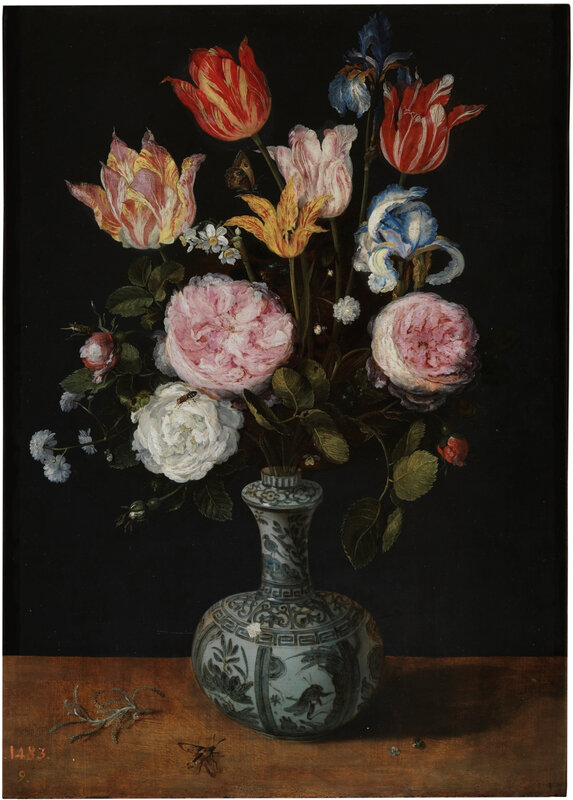
Vase of Flowers by Jan Brueghel the Elder (Jan Velvet Brueghel), 1609

Paintings depicting vases of flowers were very popular at the time.  One of the leading exponents was Jan Breughel the Elder.

Bouquet of Flowers by Clara Peeters (c.1612)

One of Clara Peeters’ floral still life paintings is in the Met Museum of New York. The painting depicts a luxurious bouquet of flowers in a roemer glass, which stands on a low stone shelf. The painting is awash with primary colours which make it stand out against a plain dark background.  The bunch is a mix of late spring and early summer blooms and include roses, tulips, narcissi, carnations, and irises. We see that some of the flowers have shed their petals which now lie on the pitted ledge.  Clara Peeters was an expert when it came to depicting reflective surfaces, an example of this is her depiction of the glass with its ornamented base and serrated foot. We see a butterfly perched on the stem of a fallen flower and in a way, this brings to life this still life work.

One has to presume that Clara Peeters’ choice of still life paintings is a result of the restrictions imposed on female artists. Female artists rarely followed an art education, certainly never being allowed to paint naked models, a must-do requirement if you wanted to become a history painter.  On the other hand, everyday objects were within reach of female painters.  Peeters’ still life artwork was in great demand with the buying public.  Already in the first half of the 17th century there was work by her in collections in the Northern Netherlands as well as her still lifes in the royal collection in Madrid. As was explained at the beginning of this blog the date of her birth is not precisely known.  It is the same for the date of her passing but it is presumed to be sometime after 1657.

Thomas LeClear

Thomas LeClear

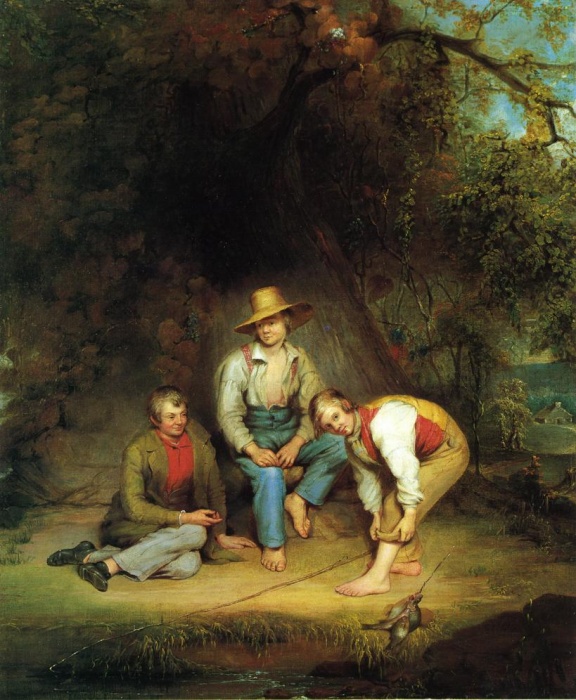
The artist I am featuring today is an American, born in New York State and was considered to be one of the major artists of Buffalo’s first golden age in the mid 1800s. He is Thomas LeClear who is recognized for his beautifully crafted depiction of children.

Boys Fishing by Thomas LeClear (1846)

Thomas LeClear was born in the village of Candor, near Owego, in upstate New York on March 11th 1818.  Even at a young age LeClear showed and interest and aptitude in painting.  In Henry T. Tuckerman’s Book of the Artists, which was first published in 1867, he regaled how LeClear, at the tender age of twelve, completed a painting of Saint Matthew, which was so admired by his neighbours that they were willing to pay him two and a half dollars for copies.  In 1832, at the age of thirteen, his family moved to Ontario, Canada, and a few years later LeClear became an itinerant portrait artist and decorative painter in upstate New York and travelling as far west as Green Bay, Wisconsin.  In 1834 he went to Goodrich, a town on the shores of Lake Huron, where he took up a commission to decorate panels on a steamboat under the guidance of its owner.  The finished paintings pleased the owner but were not what LeClear had wanted to paint as he had hoped to depict scenes from American history.  LeClear left Goodrich and moved to Norfolk in the state of New York situated close to the St Lawrence Seaway.  He remained there for two years carrying out portrait commissions and when the money from the sale of them dried up he would do any manual job that was on offer but slowly but surely his money was fast running out.  He moved on to Green Bay but there was no work for him in that city so he decided to head south to New York

Young America by Thomas LeClear (c.1863)

In 1839 LeClear moved to New York City.  According to Tuckerman’s biography of LeClear. The young artist arrived in the city in a poor financial state but still had enough to open a studio at 1271 Broadway which he would later share with Albert Bierstadt. LeClear had said that the seven years of wandering, looking for work, were the darkest period of his life.  He reportedly studied for several years with Henry Inman, an American portrait, genre, and landscape painter, who was at that time, reckoned to be one of the city’s leading artists. By 1847 , still a year short of his thirtieth birthday,  LeClear had gained a reputation as a talented painter and had gained substantial recognition for his work. He began exhibiting at the National Academy of Design in 1845, and in the next few years several of his genre paintings were acquired by the American Art Union.

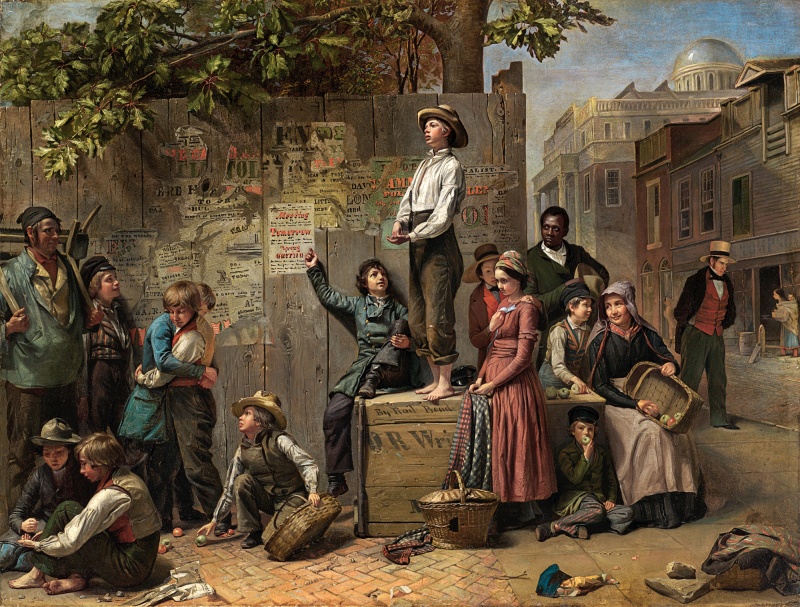
Hi-Jack Game by Thomas LeClear (c.1861)

The year was 1847 and LeClear had arrived in Buffalo, New York.  He reckoned, with Buffalo now a very busy commercial port, there would be many possibilities for a successful career. His calculations proved correct. In short order he became an important member of Buffalo’s art community and acquired many wealthy local patrons. He was a founding member of the Buffalo Fine Arts Academy which later became the Albright-Knox Art Gallery. LeClear served on its board for many years. In addition to portraits, he also produced a substantial number of genre paintings. Many of the latter were street life scenes, in which children were featured in whimsical situations. In the early 1860s LeClear moved back to New York City. where he was elected to full membership in the National Academy of Design in 1863. Within a decade of his return to the city, he was believed to be one of the most prominent portrait painters on the East Coast.

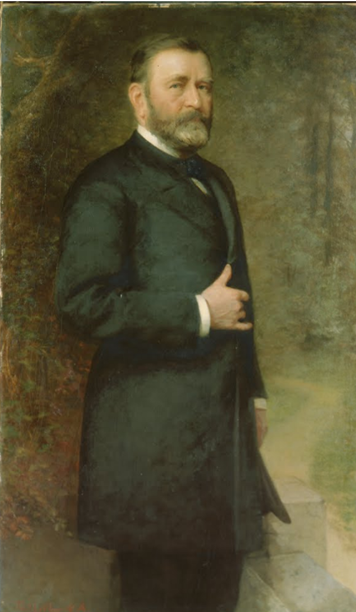
Ulysses S Grant by Thomas LeClear (c.1880)

In the spring of 1861, Ulysses S Grant looked unlikely to be remembered for his greatness. He had resigned his army captain’s commission in 1854, and was struggling to survive financially as a humble clerk. This was all to change with the outbreak of the Civil War. He reenlisted in the army, and soon worked his way up through the ranks becoming a general. By war’s end, he was commander of all Union land forces and, as the chief architect of the South’s defeat, had become one of the country’s heroes. His popularity led him to be elected as US President in 1868. Grant posed for this portrait shortly after he returned from a triumphant world tour following his presidency. Thomas LeClear painted two versions. This one was originally owned by Grant himself, while the second one became part of the White House collection.

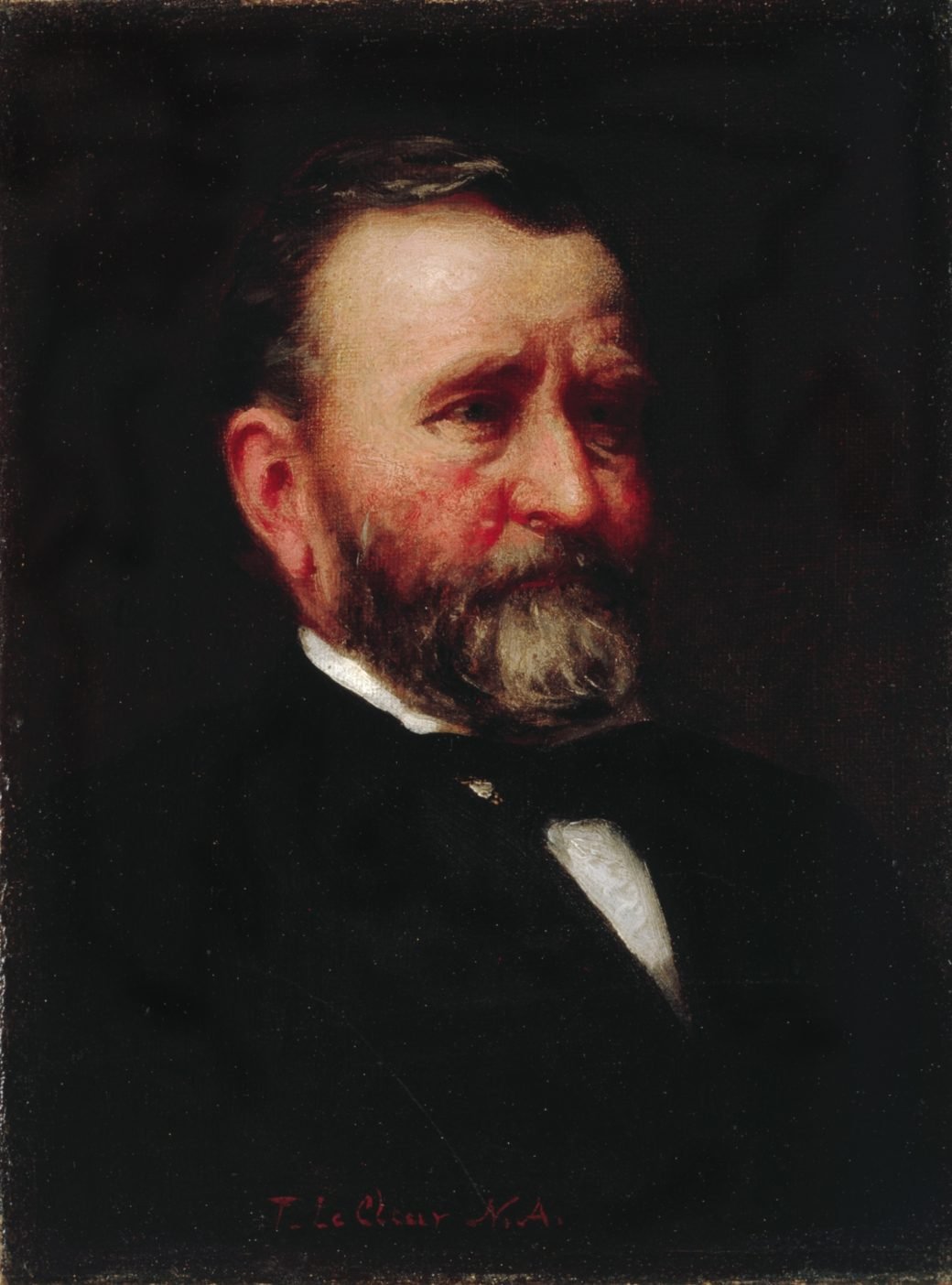
Ulysses S Grant by Thomas LeClear (1880)

President U.S. Grant was painted in a number of portraits by Thomas Le Clear, for whom the former president sat in New York in 1879, two years after the end of his presidency. The sitting led to three portraits, two of which are in the White House whilst the other hangs in the National Portrait Gallery of the Smithsonian Institution.  This small bust portrait was not purchased by the government until the 20th century, and was produced by the painter in 1880.

Buffalo Newsboy by Thomas LeClear (1853)

Buffalo Newsboy was painted by LeClear in 1853 whilst living in Buffalo and twenty years after history’s first paperboy.  The story goes that the publisher of The New York Sun had placed an advert for newspaper hawkers stipulating that only “steady men” should apply. A ten-year-old boy, Barney Flaherty, asked to be considered and he was hired on September 4th, 1833 which is why that date is national newsboy day.  LeClear, who was a founding member and first superintendent of the Buffalo Fine Arts Academy, which would later become the Albright-Knox, and the institution has the work in its collection.

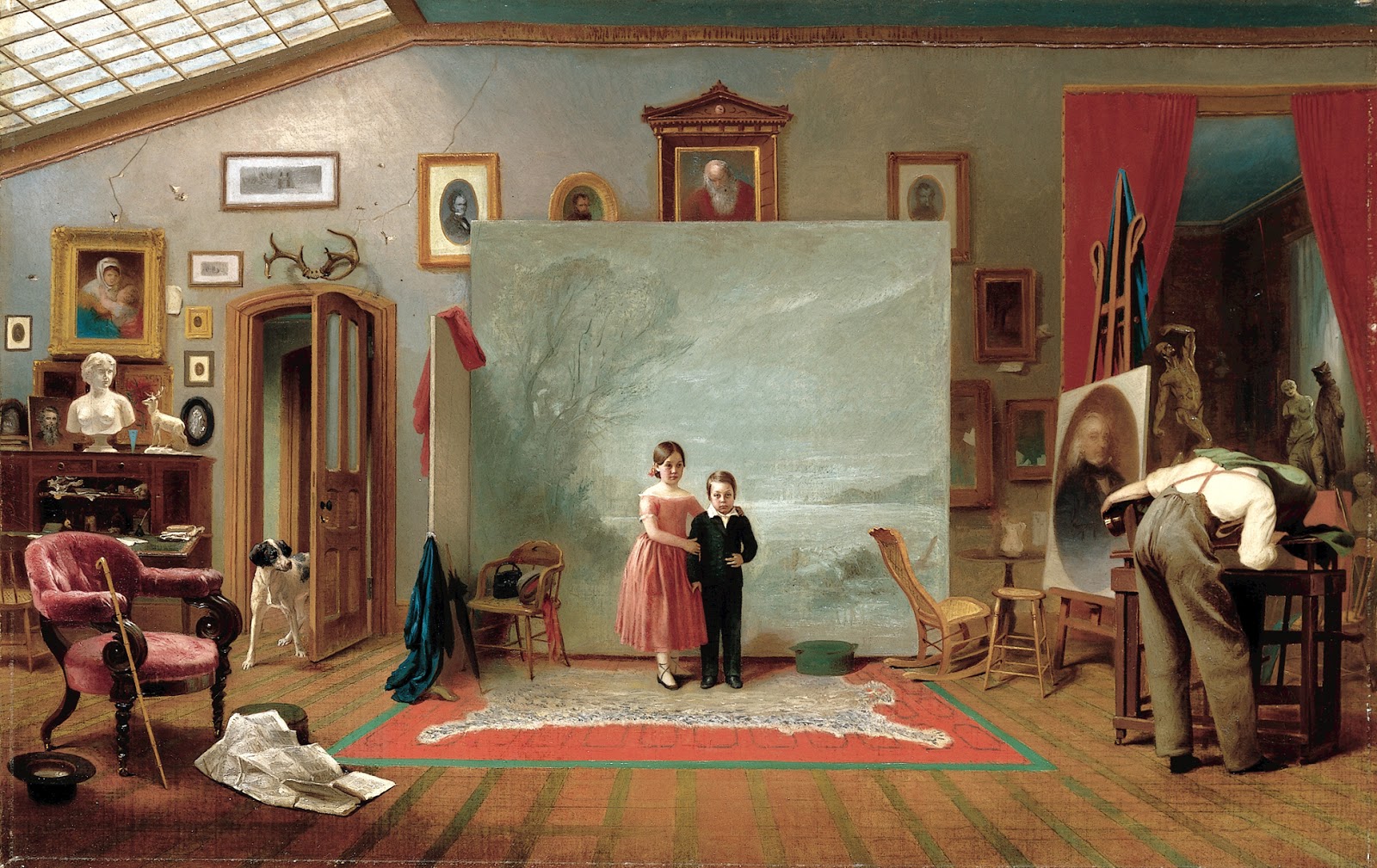
Interior with Portraits by Thomas LeClear (1865)

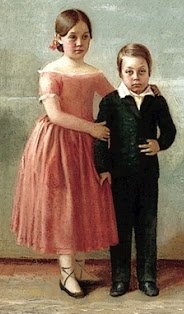
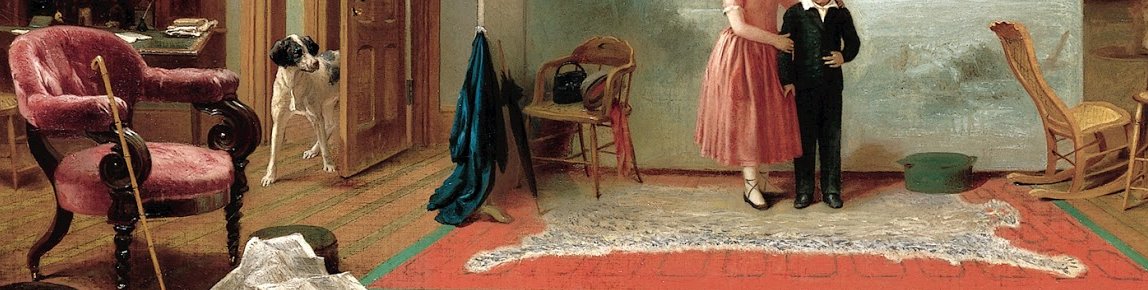
The most fascinating of Thomas LeClear’s works is his 1865 painting entitled Interior with Portraits.  The painting was commissioned by Franklin Sidway, an American businessman and banker from Buffalo, New York and is currently held by the Smithsonian American Art Museum in Washington, D.C.

The setting for the painting is a studio in the famous New York artist building known as the  10th Street Studio Building.  It was constructed in New York City in 1857 and was the first modern facility designed solely to serve the needs of artists. It became the centre of the New York art world for the remainder of the 19th century.  The painting depicts much of the trappings of the professional artist such as a sculpted bust, animal sculptures, prints and copies after the old masters. This was the home of an artist not a photographer.  This was the home of an artist who revered the artists of the past and their works such as the Borghese Gladiator and the Venus de Milo, copies of which we see in the studio.

Parnell and James Sidway

In the painting we see two young children standing side by side.  These are Sidway’s siblings, James and Parnell, who are posing for a photograph in an artist’s studio. But all is not as it seems as both were dead when this painting was made.  The young boy on the right, James Sidway, was a volunteer firefighter, and had died in 1865, aged twenty-five whilst attending a hotel blaze.  The painting was commissioned by his brother shortly after James’ death.  The girl in the painting, Parnell Sidway, was an adolescent when she died of illness in 1850.  LeClear, having no live models for the portrait, has utilised family daguerreotypes to aid him.  Daguerreotypes were photographs taken by an early photographic process employing an iodine-sensitized silvered plate and mercury vapour and were invented by Louis Daguerre, a French artist and photographer.  Painting using photographs was very contentious at the time and many artists were suspicious of the practice and maybe there are references to those hostilities in the painting.  It marked the arrival of a new technological form of virtual reality into the painter’s traditional territory.  Artists everywhere felt threatened by this new photography. Many vowed never to use photographs as painting aids and would rather acclaim the very special qualities that they believed made painting superior to photography

The two children stand before a landscape painting which has become part of the photographic trickery. This fact alone must have incensed the like of the Hudson River painters and the Western landscapes painters whose works were so dominant in the public exhibition rooms at the time.

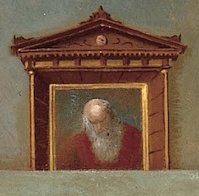
An Old Master

Look above the landscape painting and you will see an old patriarch looking disapprovingly over the scene. Is it a mere coincidence that his portrait is partly obscured by the backdrop?  Is this hinting at the Masters are being relegated to the past by the advent of photography?

There is much to see in the work regarding the tension between painting versus photography.  The children are surrounded by painted portraits, and the demonised photographer has his back to us obscuring his face.  Does this symbolise his reluctance to be part of the photography/painting argument?  Of course, early photography had its own problems especially when it involved long exposure time and it being necessary for the subjects remaining absolutely still during the long exposure. Children were a special challenge for photographers. They sometimes used braces and ties and other torturous to keep people from moving.   Note in this painting how the girl holds onto her brother to stop him moving as a comment on the “keep still” factor.

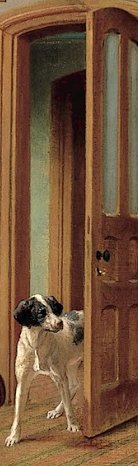
Dog at the door

In the doorway we see a dog is depicted just about to rush into the studio, again highlighting the problem with photography as opposed to painting.  But what happens when the dog chooses just that moment to come in? Well, if you’re an artist, you would capture the moment of him in the doorway. However, if you’re a photographer, you would probably have to start over again.

Three empty chairs

Looking closely at the work of art we have another conundrum to solve.  There are three chairs dotted around but none have a sitter. One, which is positioned in front of the easel, which holds a painting of a bearded man. This had presumably once been occupied by the artist. On another chair we see a lady’s hat, shawl, and purse and the third unoccupied chair with its walking stick and discarded newspaper must have once been occupied by a gentleman.  But where are the three now? The answer is probably quite simple – they are all out here with us, the viewers. We are all standing side by side just outside the picture frame, watching the scene before us. So LeClear is now telling us that instead of there only being three people involved in the painting, there were actually six ! 

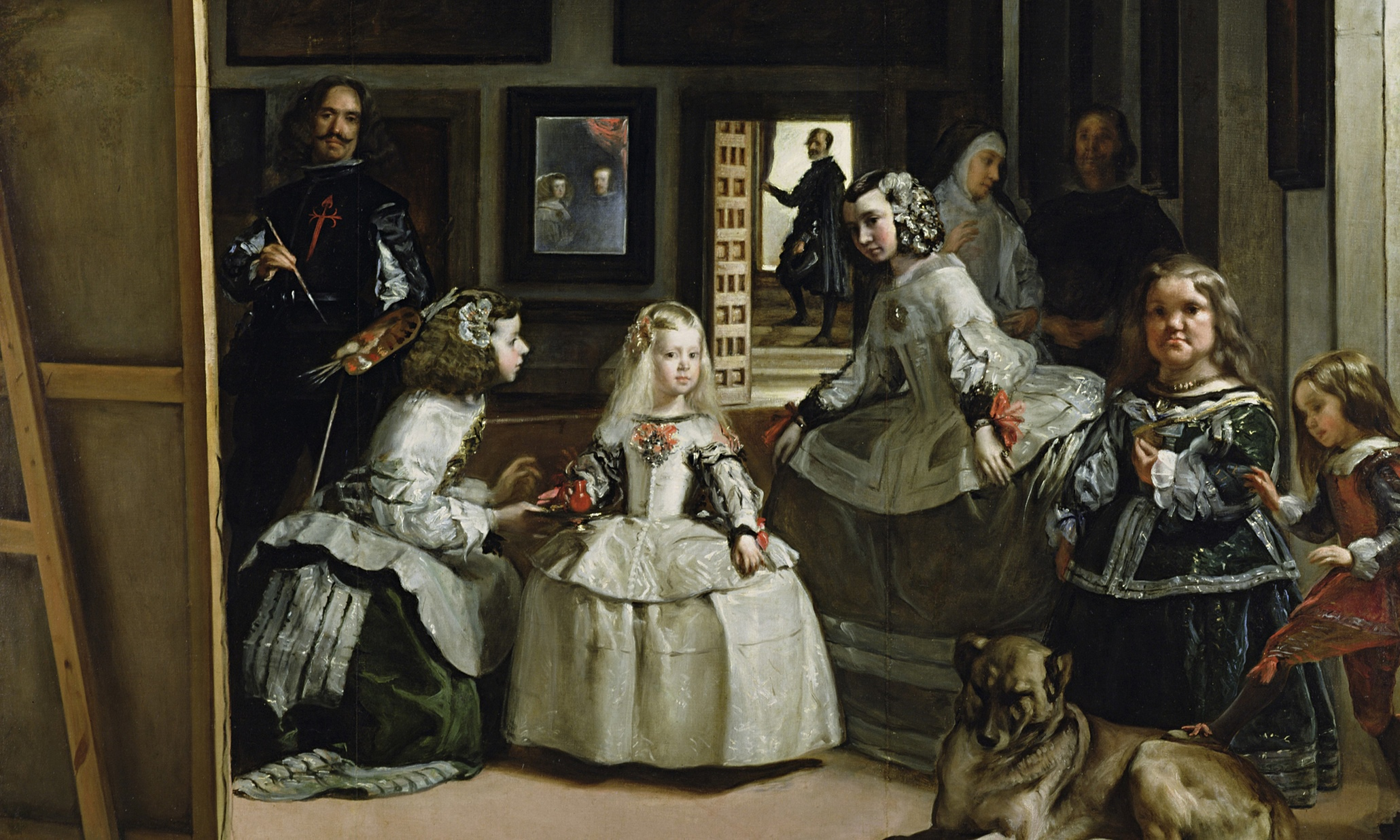
Las Meninas by Velazquez

It is thought that by using this illusion he was paying homage to Velazquez’z painting Las Meninas, which if we look at the figures in the mirror, used the same stratagem.

Two years after completing his portraits of the former president Ulysses S Grant, Thomas LeClear died of pleurisy in Rutherford Park, New Jersey on November 26th 1882 at the age of sixty-four. His wife Caroline had died thirteen years earlier when only forty-six-years of age.

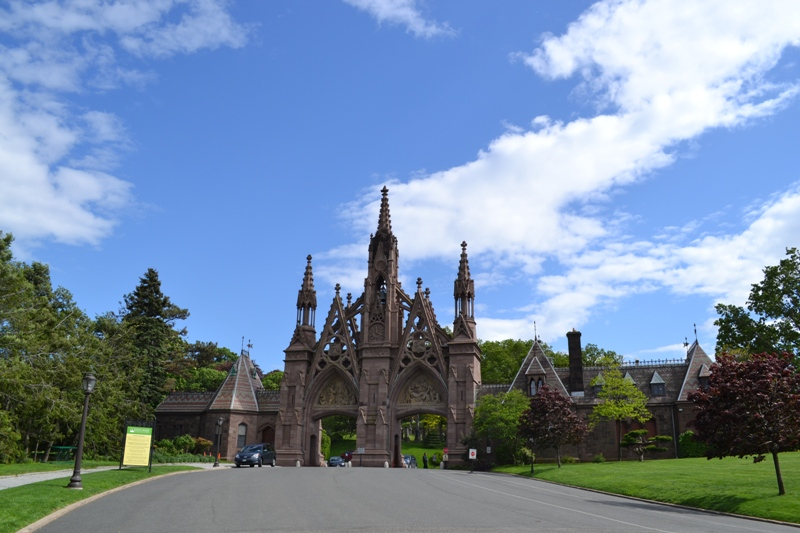
Green-Wood Cemetery, Brooklyn.

The two lie together in Green-Wood Cemetery, Brooklyn, Kings County, New York.

Bernardo Bellotto. Part 1.

In this blog I am returning to an artist I talked about almost nine years ago.  My artist today is Bernardo Bellotto who was born in Venice on May 22nd 1722.  He was the third-born child of Lorenzo Antonio Bellotto and Fiorenza Domenica Canal, who was the eldest of three sisters of Giovanni Antonio Canal, better known to us as Canaletto.  Bellotto’s started his initial artistic training at the age of fourteen when he worked in his uncle’s workshop.  Two years later, at the age of sixteen, Bellotto became a member of the Fraglia dei Pittori (Venetian painters’ guild). Bellotto trained in Canaletto’s studio and would help him to satisfy the growing demand for Venetian scenes. Bellotto would later point out the family connection by signing some of his works ‘Bernardo Canaletto’ or ‘Bellotto de Canaletto’.

Rio dei Mendicanti and the Scuola di San Marco, 1738 - Bernardo Bellotto
Rio dei Mendicanti and the Scuola di San Marco by Bellotto (1738)

In around 1741, he and his uncle, Canaletto, took a trip along the Brenta canal to Dolo and Padua and during this time the two painters amassed a number of sketches which would be later transformed into completed oil paintings. On October 5th, 1741 a marriage contract was drawn up by Bellotto and his future father-in-law Giambattista Pizzorno, for permission for the artist to marry Elisabetta Pizzorno. On November 5th 1741, Bellotto married Elisabetta Pizzorno at Il Redentore church in Venice. A dowry of 850 ducats was agreed to be paid by the bride’s family to the groom at the time of marriage.  Their first child, Lorenzo, was born on October 15th, 1742. A further insight into Bellotto’s life around this time is a document submitted by his mother in which she declares that the family has been abandoned by her husband Lorenzo and that the only goods in her possession are those procured for her by Bernardo who, with his work, maintained her and his brother Pietro, both of them being resident in Bernardo’s home. The brother Pietro Bellotto, who was also an artist, also declared before the same notary to have learned the art of painting from Bernardo. In order to continue living with his brother and improve in his profession Pietro signs a pledge to give him one hundred and twenty ducats a year.

Arno in Florence, c.1742 - Bernardo Bellotto
Arno in Florence by Bellotto (1742)

In 1742 Bellotto set off on a painting trip and travelled extensively around the Northern Italian cities, stopping off at Florence and Lucca and during each stop he would complete a verduta of the place.   A verduta is a highly detailed, usually large-scale painting of a cityscape or some other vista.   These painting were very popular with the foreigners who travelled around Italy on their Grand Tour and wanted to bring home something to remind them of the places they had visited.

The Old Bridge over the River Po, Turin by Bellotto (1746)

Bellotto made a number of painting trips to Lombardy and during a stopover and around 1746 whilst in Turin he painted a view of the city. It was entitled The Old Bridge over the River Po, Turin and it was a commission he received from Charles Emmanuel, King of Sardinia and Duke of Saxony. If you look closely to the extreme left of the painting you will see an artist sitting before his easel which was presumably a reference to himself.   This and his other Turin depictions were large measuring 127 x 171cms and they were, as this was, sweeping panoramic views with such exquisite architectural detail of the brick tower and the bridge in the foreground. Look how well he has used light and colour to portray the reflections on still water and the hint with regards the moving currents. Bellotto eventually arrived in Rome where he studied study architectural and topographical painting and would remain in the Italian capital until 1743 at which time he journeyed back home to Venice.

Kreuzkirche by Bellotto (1747-56)

In May 1746 Bellotto’s uncle Canaletto left Venice for England where his paintings were in great demand.  A year later Bellotto also left Venice.  His destination was Germany and the city of Dresden where he hoped to forge a career and avail himself of some lucrative commissions.  His desire for commissions materialised within a year of his arrival as he became the court painter at the court of Friedrich August II, Elector of Saxony and soon Bellotto was the highest paid artist at the Saxon court.  The following decade was to be Bellotto’s most successful.

Dresden from the Left Bank of the Elbe, below the Fortifications by Bellotto (1748)

The city of Dresden and the outlying districts, such as the villages of Pirna, and Königstein with its magnificent Königstein hilltop fortress, all of which offered Bellotto the chance to paint beautiful cityscapes and rural landscapes. In all, Bellotto completed thirty different paintings for the Elector.  Fourteen depicting views of the city of Dresden and its wonderful buildings, eleven of Pirna and its surrounding rural landscapes and five of the magnificent Königstein fortress.

The Neumarkt from the Judenhof, Dresden by Bellotto (1748-9)

View of Pirma from the Sonnenstein Castle by Bellotto (1755)

The city of Dresden and the outlying districts, such as the villages of Pirna with the nearby Sonnenstein Castle, and Königstein with its magnificent Königstein hilltop fortress, all of which offered Bellotto the chance to paint beautiful cityscapes and rural landscapes. In all, Bellotto completed thirty different large scale paintings for the Elector, each between two and three metres wide.  Fourteen depicting views of the city of Dresden and its wonderful buildings, eleven of Pirna and its surrounding rural landscapes and five of the magnificent Königstein fortress. The finished works were to be hung in the royal painting gallery in the Stallhof, which forms part of the Royal Palace in Dresden. Bellotto’s depictions of the city of Dresden were remarkable for their topographical meticulousness, mathematical perspective and the way in which he portrayed the way the light played on the various architectural structures.  The way he handled the light was truly remarkable.

The Fortress of Königstein by Bellotto (1756-58)

This painting is part of the NGA Washington. This depiction by Bellotto of the Fortress of Königstein is one of five large canvases, commissioned by Augustus III in the spring of 1756 but never delivered, depicting the renovated medieval fortress in the countryside near Dresden. 

The Fortress of Königstein from the North by Bellotto (1756-58)

Bellotto having received the royal commission to complete thirty large scale paintings of Dresden, Pirna and Königstein was proceeding well with the commission.  The Elector’s commission had enabled Bellotto to live a life of luxury.  He had an seven reception rooms in his Dresden apartment which was awash with luxurious furnishings, Venetian mirrors and fine wallpapers and fabrics.  Life could not have been better.  What could possibly go wrong?  The answer to that question was the Seven Year War, which broke out involving all the main European “players”.  The Prussian army invaded Saxony and entered the city of Dresden and Augustus, the Elector of Saxony and Bellotto’s patron fled the city and barricaded himself in at the Königstein fortress for several months before escaping to Warsaw.  Bellotto left Dresden and his luxurious home and went to Pirna. 

The Fortress of Königstein: Courtyard with the Magdalenenburg by Bellotto (1756-58)

This view from the south of Königstein includes several buildings within the fortification: the southern end of the Brunnenhaus facing us to the left, the Georgenburg oblique behind it, and the Magdalenenburg in the foreground

Dominican Church, Vienna by Bellotto

In 1758 Bellotto and his sixteen-year-old son obtained passports to travel to Bayreuth from where he completed an onward journey to Vienna.

Canaletto (I) 037.jpg
Schloss Hof by Bellotto

Shortly after his arrival in Vienna, Bellotto received a couple of private painting commissions.  One was from Prince of Liechenstein and one from Wenzel Anton, the Prince of Kaunitz who was also chancellor to Empress Maria Theresa.  Not only were they lucrative commissions it gave Bellotto a chance to receive a thirteen painting commission from the Empress herself.  The commission tasked the artist to complete six depictions of the city of Vienna and seven much larger panoramic views of Schönbraun and Schloss Hof imperial palaces and their gardens.

The Dominican Church in Vienna by Bellotto (1758)

For the two years Bellotto was in Vienna with his son he worked non-stop producing paintings for the Empress’ commission and other commissions for members of her court. This phenomenal output can also be put down to the help he received from his son Lorenzo. The resulting depictions were amazing and offered to serve as testimony of Vienna’s imperial magnificence

Nymphenburg Palace, Munich, by Bellotto (c. 1761)

In 1761, after almost two years in Vienna, Bellotto left the city and travelled, not to Dresden where his wife and daughters lived, but to Munich.  This could have been because of the on-going troubles with the Prussian invaders.  He had been given authorisation to visit the German city through a letter from Empress Marie Theresa to her cousin Maria Antonia, the Princess of Bavaria, who had fled from Dresden since the Prussian siege.  Once there Bellotto was commissioned to paint panoramic views of Munich and the Baroque Nymphenburg Palace in the western suburbs of the city, which was Maria Antonia’s birthplace and summer residence.

The Ruins of the Old Kreuzkirche in Dresden by Bellotto (1765)

At the end of 1761 Bellotto returned to his home Dresden to find it devastated during the Prussian invasion.  Worse, was the fact that he found himself in great financial difficulty arising from the death of two of his major patrons, Augustus III, Elector of Saxony and King of Poland and Count Heinrich Bruhl, the prime minister of Saxony in 1763.  Their deaths and his financial situation made Bellotto melancholic and it was around this time that he painted the Kreuzkirche which now lay in ruins.  It had been partially destroyed during the Seven Year War, at a time when Bellotto had been forced to flee the city.  The painting is entitled View of the Kreuzkirche in Ruins and was completed by Bellotto in 1765.  The Kreuzkirche is the oldest church in Dresden and, during the conflict, was shelled by Prussian artillery.   The building was set ablaze and finally collapsed. The church tower, though damaged, remained standing.  Work commenced on the reconstruction of the church and it was decided to preserve the original tower. Unfortunately, in June 1765, with the construction of the new church already under way, the greater part of the tower collapsed.  The painting is a good example of how Bellotto unique, capacity to capture the spirit of an event.  His depiction of the ruin  is an unusual one for it is not an ancient ruin as far as the artist was concerned.  It was a relatively new one as the destruction had only occurred five years earlier.   Bellotto had completed a work depicting the great church some years earlier (see painting earlier in the blog).   However, in this work, we see are the jagged remnants of the church rear up skywards.   The cleanliness of the once beautiful church has gone.  There is nothing clean about the church now.   The scene before us is just a mass of noise and dirt.  It is a chaotic scene which we find hard to believe that it could ever be put back to its former glory.   The Church, as the body of Christ, has been violated all over again and the civic wounds of the German city have been violently opened for all to see.  This is the price to be paid when once we set forth to war.  In the painting we see many of Dresden citizens.  Close to the ruins we can just make out craftsmen as they start their preparations to rebuild the once –beautiful edifice.  On the periphery we see men and women dressed in their best clothes staring at the ruin.  For them it was just a day out to visit the site where the destruction had taken place.  For them it was just blatant voyeurism.

Dresden Kreuzkirche 2008.jpg
Kreuzkirche , Dresden (2008)

……………………………….to be continued.

Pinturicchio . The Master of Frescoes – The Baglioni Chapel

In my last blog I looked at the Pinturicchio frescoes in the Bufalini Chapel and although the artist had painted numerous frescoes in many places of worship, in this blog, I just want to focus on his artistry in the Bagnoli Chapel, part of the Collegiate church of Santa Maria Maggiore, in the town of Spello, Perugia and the frescoes executed by him at the start of the sixteenth century during one of last major commissions.

Datei:Pinturicchio - Christ among the Doctors (detail) - WGA17775.jpg
Troilo Baglino (left), fresco detail by Pinturicchio in the Baglioni Chapel 

Troilo Baglioni was the prior, later bishop and protonotary of the Church of Santa Maria Maggiore in Spello, an ancient town and commune of Italy, in the province of Perugia in east central Umbria. He was in charge of the management of the chancellery of that church and the diocese and it was he, who, in 1500, commissioned Pinturicchio to decorate the walls of the Cappella Bella which later became known as the Baglioni Chapel .  Pinturicchio and his workers set about the task in the Autumn of 1500 and completed the commission in the Spring of 1501.  The paintings, typically for Pinturicchio, were completed in such a short period as he had around him, a well-organized workshop, with other masters painting above his drawings. The finished product ensured his artistic reputation and prominence in Umbria.

Baglioni Chapel

The chapel has a quadrangular floor plan with a cross-vault. The entire chapel, all three walls and the ceilings, are covered in frescoes.  The frescoes are themed stories about the childhoods of Mary and of Jesus. a pictorial account of the Annunciation, the Adoration of the Shepherds, and Jesus at the Temple..

The vaulted ceiling of the Baglioni Chapel

On the vaulted ceiling, we see depicted four Sibyls, female prophets, Tiburtina, Eritrea, Europea and Samia, seated on thrones and flanked by cartouches with prophecies of the coming of Jesus Christ.

As you enter the chapel, on the left wall, there is Pinturecchio’s fresco of the Annunciation, which is set in a large Renaissance loggia.  As we look at it our eyes are drawn through, what is termed, the hortus conclusus (enclosed garden) towards the handsomely and meticulously detailed landscape background.  The two main characters in the fresco are Mary and an angel.  Mary had been reading a book which was on a tall ornate wooden lectern but has now been distracted by the angel, who kneels before her with a white lily in one hand, symbolising  virginal purity.  Above them we see God the Father depicted encircled by angels and giving off a ray of light which incorporates the Holy Ghost in the form of a dove (just above the lectern).

Look to the lower right of this fresco.  What is strange about this fresco is that if you look closely under the small bookshelf, you will see a portrait.  In fact, it is a self-portrait of Pinturicchio, featuring the bejewelled inscription, “BERNARDINVS PICTORICIVS PERVSIN[VS]” referring to Pinturicchio’s birth name of Bernardino di Betto.

The Adoration of the Shepherds by Pinturicchio (1501)

The rear wall of the Baglioni Chapel features the fresco depicting the Adoration of the Shepherds. It is a depiction of an idyllic scene within an extensive landscape and includes a number of  secondary motifs. In the background, we can see the arrival of the camels of the Magi procession.  The setting in the foreground is a grassy area in front of the stable, and a line of shepherds who have come to visit and bring gifts to the mother and the new-born child.  

The Shepherds by Pinturicchio

The three shepherds stand out as being over-sized.   They have expressive and detailed features, after the fashion of early Netherlandish painting which influenced Pinturicchio. Their facial characteristics are in a way crude, almost scowling and differ greatly from anything else in Pinturicchio’s repertoire of figures. The one exception is the young man on the left with a goat. This is depicted with a more idealized beauty, inspired by ancient reliefs with sacrifice motifs.

The central panel of the Portinari Altarpiece by Hugo van Goes (1472)

Art historians have put down Pinturicchio’s depiction of his “crude scowling” shepherds as being influenced by the figures of the shepherds in the Portinari Altarpiece which was painted by Hugo van der Goes around 1472.

The figures of the shepherds in the Portinari Altarpiece

In the left background of the fresco on the rear wall we see a meticulously drawn town at the foot of a mountain.  To the right we see a temple-like stable with a window through which we can see a mountainous landscape.  On the roof of the stable sits a peacock, a symbol of immortality. 

In the sky above the nativity scene we observe a cluster of angels on a bank of clouds.  They are celebrating the birth of Jesus in song.

On the right-hand wall as you enter the Baglioni Chapel there is a large fresco pictorially recounting the story of the Dispute with the Doctors. .  It is based on an occurrence in the early life of Jesus depicted in Chapter 2 of the Gospel of Luke.  Twelve-year-old Jesus had accompanied Mary and Joseph, and a large group of their relatives and friends to Jerusalem on a Passover pilgrimage.. On the day of their return, Jesus hung back in the Temple, but Mary and Joseph thought that he was among their group and she and Joseph headed back home.  It was not until a day after they returned that they realised Jesus was missing, so they returned to Jerusalem, finding Jesus three days later among a group of philosophers.   

In the background we see the Temple of Jerusalem with its large dome.  The scene follows an arrangement which Pinturicchio had already used in his fresco on the wall of the Bufalini Chapel, which itself originated from a Perugino fresco in the Sistine Chapel, Delivery of the Keys.  At the centre of the depiction stands the Child Jesus who is debating with and surrounded by two groups of philosophers from the Temple of Jerusalem. His books are scattered on the pavement in front of him. By contrast, the richly dressed scholars either clutch their books close to their chests or read aloud from them. The temple can be seen in the background and is characterized by a large dome. The crowd is formed by standard set of characters which includes young spouses, wise men, toothless women and others, all of whom are witnessing the dispute.

On the left of the crowd, dressed in the dark robes of a protonotary apostolic (a prelate who is a member of a college charged with the registry of important pontifical proceedings). It is a portrait of Troilo Baglioni, who commissioned the frescoes for his chapel

[Photo Credits: tyle_r]
Pinturicchio’s frescoes in the Piccolomini Library

Pinturicchio’s many paintings and frescoes can be seen throughout Italy.  Between 1481 and 1482, he worked in Rome, and collaborated with Perugino on the frescoes of the Sistine Chapel. From this his career flourished and he worked uninterruptedly in the service of five popes: from Sixth IV to Julius II, passing through Innocent VIII, Alexander VI, and Pius III.  He also received commissions from well-to-do and important clients such as the della Rovere family and Pandolfo Petrucci, the lord of the Italian Republic of Siena.. In Siena, among the many works, he created the extraordinary cycle of the Piccolomini Library in the Duomo of Sienna, and completed frescoes in the chapel of San Giovanni Battista.

Bernardino di Betto (Benedetto), the Italian painter known as  II Pinturicchio dies in Sienna in 1513 aged 61.

Ivan Fedorovich Choultsé

779648b48202df7819210fa53eb5c0ce

When my featured artist today had an exhibition of his work in London, the London Times summed up his works by saying “it must be seen to be believed”.  In America the art critics designated him as “the magician of light”.  His paintings are extraordinary.  They are magnificent.  Let me introduce you to the Russian landscape and staunch realist painter, Ivan Fedorovich Choultsé.

Sevanavank Monastery on Lake Sevan by Ivan Fedorovich Choultsé

Ivan Fedorovich Choultsé was born in St. Petersburg on October 21st 1874.  His ancestors hailed from Germany but emigrated to Russia in the eighteenth century.  The original spelling of his family name, which was of German origin, was Schultze.  His story was not one of a child dreaming of becoming a professional artist.  His fascination at an early age was electricity and its production through hydro power especially the electricity generated by the Imatra waterfall in South Karelia.  His interest in science was sated by an engineering education, although he continued to convey his creative side and during those early days as a teenager, he would spend his spare time painting small sketches.  He headed up an engineering project in Finland but something went badly wrong and he lost all his money and was declared bankrupt.

Winter Sunset by Ivan Fedorovich Choultsé

Ivan realised he had to earn money from another source and decided to concentrate on his drawing and painting abilities.  Along with his early paintings which he had fortunately not discarded, he approached the academician, famous landscape painter and drawing teacher, Konstantin Yakovlevich Kryzhitsky, who had been a court painter to Tsar Nicholas II and was a painter of miniatures.  His talent was apparent to Kryzhitsky and he enabled Ivan to be admitted to the Imperial Academy of Arts in St Petersburg. In addition to Kryzhitsky, Choultsé was influenced by other tutors, the Russian landscape artist Arkhip Kuindzhi and the Swiss landscape painter Alexander Kalam.  In 1903 Choultsé held his first Academy exhibition which gained him early fame and recognition as a talented artist. His exhibition was a great success and he went on to exhibit his work at other major galleries in St. Petersburg and Moscow.  He was eventually elected as a court painter to Tsar Nicholas II.

See the source image

Park in Neskuchnoye by Ivan Choultse

In 1910 Choultsé embarked on an Arctic painting trip with Kryzhitsky.  They visited the north of Norway and island of Spitzbergen.  From that trip Choultsé produced a number of glorious paintings of the arctic landscape.  In 1910 and 1911 Choultsé lost two of his most influential mentors, Kuindzhi in July 1910 and fifty-two year old Kryzhitsky who committed suicide in April 1911.  Following the untimely death of Konstantin Kryzhitsky, Choultsé had his works shown at exhibitions which had been arranged by the society created by Grand Duchess Olga Alexandrovna, also a student of Konstantin Kryzhitsly, in his name.  Choultsé frequently participated in its exhibitions that took place in the Grand Duchess’ palace on Sergeevskaya street in St Petersburg.

Silver Frost, Engadine, 1910  by Ivan Fedorovich Choultse

Silver Frost, Engadine, by Ivan Fedorovich Choultsé 

Cholutsé reputation as a painter grew as did the sale of his work which was confirmed by the fact that the brother of Tsar Nicholas II, Mikhail Alexandrovich, regularly commissioned his works.  In 1917 the Russian Revolution took place and for Choultsé he had to make an important decision.  He was an academic painter and a supporter of the Academy system which meant staying in Russia under the new regime which was probably fraught with difficulty and so in 1917 he set off on a two-year trip of Europe.  For those two years Choultsé was able to see and depict on canvas the beautiful landscapes of the mountainous regions of Northern Italy, Switzerland and Southern France where he painted the Mediterranean landscapes.

Ivan Fedorovich Choultse view of Engadine

Vers Le Soir, Engadine’ by Ivan Fedorovich Choultsé

It could well have been the snowy Swiss landscape that brought back memories of his homeland or it could have been because he was mesmerised by the panoramic views of the likes of the long high Alpine valley region of Engadine and St. Moritz, but whatever it was, it profoundly affected Choultsé.

See the source image
November by Ivan Choultsé

Choultsé finally settled back in Russia in 1921 as he still held out hope that he could remain a professional artist in his homeland under the new Soviet regime.  He joined the Society of Individualist Artists in St. Petersburg and took part in the society’s first two exhibitions that year. After a while he lost hope that everything would be the same as it was in the pre-Revolution days and finally took the decision to leave his country of birth and go to Paris.  He settled in the French capital in an apartment on the Boulevard Pereire, close to the Porte Maillot and it was here that the second stage of his career as a Russian immigrant began.

See the source image
A Storm on the Horizon by Ivan Choultse (c.1926)

Choultsé artistic breakthrough in Paris came with his first solo exhibition of his work on November 23rd 1922, at the Galleries Gérard Frères.  All fifty of his works were sold on the opening day of the show. This was extraordinary as the artistic environment of Paris was one of an over-abundance with all sorts of artistic offerings and gallery presentations.  However, his success was indicative of the artist’s amazing talent.  He became inundated with painting commissions and often did not have enough time to fulfil all the assignments.

See the source image
St. Moritz by Ivan Choultsé

There is no doubt that Choultsé was influenced by the the snowy Swiss landscape which probably reminded him of his native Russia.  He said that he had fallen in love with the immense vistas of Engadine and St. Moritz.  He was deeply moved by what he saw there and would concentrate on studying the effects of light on nature and by doing this created his best-known themes of beautiful snow-filled landscapes. In 1923, Ivan Fedorovich’s Choultsé’s paintings were exhibited in the Paris Spring Salon.  His works were an amazing success with the public and the art critics alike and he was touted as the most admired artists of the Salon. With all success, there is an element of luck and Choultsé’s good fortune emanated from having contacts with good art dealers and owners of art galleries.  He was represented by the gallery of Leon Gerard, which not only successfully sold his works of art but also regularly arranged his personal exhibitions. In 1927, Choultsé received his French citizenship.

File:Ivan Fedorovich Choultsé, Sailing boat at sunset on the gulf of Finland.jpg
Sailing boat at sunset on the gulf of Finland by Ivan Choultsé (1916)

Success in Europe was soon followed by success in America.   In 1928, Choultsé met Eduard Jonas, who took most of Choultsé’s works to America. Jonas was a prominent figure in French and international art market, owner of exhibition halls and galleries both in Paris and New York, and also offered an exclusive plan of exposing Choultsé’s works in the States. Choultsé was delighted with the opening up of the American market.  In a letter to his daughter, he wrote:

“…”I met a very interesting dealer. And how good it is that now, sitting in Paris, I can sell my work for dollars!…”

A contemporary of Choultsé, the Russian writer and critic, Nikolai Breshko-Breshkovsky wrote about the artist’s newly found fame and fortune in America:

“…In America, Choultsé’s snow and sun paintings are highly esteemed and worth of great price…”.

La Corniche (Côte d’Azur) by Ivan Fedorovich Choultsé 

Although based in Paris, Choultsé  regularly travelled to the Mediterranean and enjoyed painting many summer landscapes around the Côte d’Azur .

Adriatic Sunset by Ivan Choultsé

He also completed many paintings depicting scenes around the Italian coast.

In 1933 Choultsé moved his permanent residence to Nice. One of the last exhibitions of his work was in March 1936 held at the Breton Castle on rue Saint Antoine in Nice. Ivan Fedorovich Choultsé died in 1939, aged 64 and was buried in the Cimetière Caucade in Nice,

Quiet Mediterranean Evening by Ivan Choultsé

The Toronto dealer, G.Blair Laing, wrote in his 1979 book, Memoirs of an Art Dealer that Choultsé “painted spectacular snow scenes in which light seems to come from behind the canvas and glow

In 1935 the New York Hammer Galleries held a jubilee exhibition entitled ‘150 Years of Russian Painting’ and described Choultsé’s reputation as “beloved among American collectors as a great master of snowy landscapes gilded by slanted sunbeams”.

For all my readers who celebrate this festive period may I wish you all a Merry Christmas.

Jean-Eugène Buland

Jean-Eugene Buland photo.jpg
Jean-Eugène Buland

Jean-Eugène Buland was born in the French capital on October 26th 1852.  He was the son of an engraver, as was his younger brother, Jean-Émile Buland.  Jean-Eugène’s artistic career began when he entered the École des Beaux-Arts in Paris in the studio of Alexandre Cabanel.  Cabanal was a renowned French artist who painted historical, classical and religious subjects in the academic style and was also well known as a portrait painter. He had been a professor at the art establishment since 1864 and was highly regarded by Emperor Napoleon III.  There can be no doubt that Buland was influenced by Cabanel’s choice of subjects for his paintings and his academic painting style.   Success came early on for Buland when he gained the Deuxième Prix de Rome in 1878 and once again in 1879.  The Prix de Rome was a French scholarship for arts students, initially for painters and sculptors, that was established in 1663 during the reign of Louis XIV of France. Winners were awarded a bursary that allowed them to stay at the Villa Medicis in Rome for three to five years funded by the French government. 

See the source image
The Illustrator and His Daughter in the Workshop by Jean Eugène Buland (1891)

On his return to France Buland soon became aware of the popularity of the French painter, Jules Bastien-Lepage, and his success with his Naturalist paintings depicting realistic themes so much so, he decided to forego his depictions of historical works and concentrate on scenes of everyday life.  Bastien-Lepage, like Buland, was also awarded the Deuxième Prix de Rome in 1875 and 1876 but declined the opportunity to study in Rome as the classical training held no interest for him although winning the prize had been a great honour.  Buland joined the Naturalist painting movement with Bastien-Lepage and found that by utilising photography it allowed him to paint his models with the most precision.

Alms of a Beggar by Jean-Eugène Buland (1880)

In 1880 he completed one of his best loved works, Alms of a Beggar, in which we see a young woman beautifully dressed in white sitting outside a church in search of charity. From her left, we see a man, who is a beggar himself, coming towards her with a coin held out in his right hand. His clothes are a mass of patches, and they are pale and dirty.  On his feet he wears scruffy old wooden shoes. From his demeanour he would appear sightless. It is a fascinating depiction that raises all manner of questions.  Why is the well-dressed woman begging?  Is she as poor as the man in the depiction or is Buland telling us that you do not have to be badly dressed to be poor?  Is there such a thing as inward poverty – a poverty that has nothing to do with lack of money?  Look at the painting and make your own mind up.

See the source image
Le Tripot by Jean Eugène Buland (1883)

Three years later, in 1883, Buland completed a painting entitled Le Tripot which is a French word meaning gambling house or gambling den.  This work by Buland is one of his masterpieces.  The setting is a sleazy back-street gambling den and depicts five unsentimental-looking gamblers facing us whilst sitting at a gaming table.  The air is thick with cigarette and cigar smoke, the walls of the establishment are in need of redecoration.

To the left we see an elderly woman, probably a widow, diminutive in stature, dressed all in black.  She pushes some paper money towards the pot.  Looking over her shoulder is a middle-aged man. Is he just a merely a passing observer or is there more to his presence?

Next to the old woman is a man showing an air of confidence as to his ability as a gambler and yet the pile of winnings in front of him is small.  He is slightly laid back and seems to be worry-free.  With cigarette in hand he glances to his right. 

By far the most interesting person in this group portrait is one at the centre.  An elderly man gazes out at us with an almost blank look as if he is not registering what he is seeing.  He is completely lost in his own thoughts.  Why did Buland depict him as almost having no part in what is happening around him ?

Is he just another gambler or is he the croupier as we see his wooden rake which is used to collect money from the gaming table at his side and a large pool of money which could be the “bank”.

The remaining gamblers are to the right of the painting. The man with the long hair and ringlets would appear to be of Jewish origin akin to the likes of Fagan and Shylock and in a way this depiction has a sort of anti-Semitic tone to it. Before him, we see that he has accrued a large amount of winnings, which could have been Buland’s thoughts on the reputation of the Jewish people’s love of money. In contrast, next to him, on his left, is a young man who looks totally bemused and is certainly down on his luck. From his bored facial expression we can see he is completely resigned to losing the last of his money. Behind the pair we see a couple ladies of the night who are looking to see who is winning and thus who is worth approaching for their services.

The question as to why has Buland chosen these five main characters, four of whom are definititely gambling is questionable. Is he trying to put across his belief that all types of people fall into the clutches of gambling? The run-down setting maybe his way of not glorifying the “sport” of gambling.

Jean-Eugène Buland - Bonheur des parents (1903).jpg
Bonheur des Parents by Jean-Eugène Buland (1903)

If you wanted to have an artistic depiction of tenderness and young love Buland’s 1903 offering of Bonheur des parents probably could not be topped.  The painting’s title translates to Parental Happiness and it depicts a young man and his young wife with their newly born baby. The setting is a small room of a stone-built cottage.  It is a new experience for the couple and we can see the woman looking down at her baby as it breast-feeds.   You can see the utter tiredness in the eyes of the young mother and the nervousness in the father’s expression.  It is all new to them and they are having to survive alone with the nurturing of their child. They have been given a precious gift.

Mariage innocent (Innocent marriage) by Jean-Eugène Buland (1884)

Another depiction of young love was his 1884 painting entitled Mariage innocent. It is an idyllic portrayal of young happiness with its young couple walking arm in arm through fields against a backdrop of a village and blossoming flowers in the foreground. 

La Lecture by Jean-Eugène Buland (1901)

In 1886, Buland left Paris to settle in Charly-sur-Marne, a little village just east of the capital, in the French department of Aisne, near Château-Thierry, shunning the art scene of the French capital. From this quiet village life Buland derived inspiration from simple everyday life, which he painted with the greatest fastidiousness. His works gained popularity and he obtained many commissions including ones from a number of  art institutions, such as the Luxembourg Museum in Paris and many other provincial museums.  During these early years he submitted many of his works for the Salon des Sciences in the Paris’ City Hall and some were used to decorate the ceiling of the City Hall of Château-Thierry.  His painstaking realist depictions were well-received at the Salon, where he won a number of medals.  He gained a third-class medal at the Universal Exhibition in Barcelona in 1888.  In the following year he was awarded a silver medal at the Exposition Universelle in Paris and was also awarded during the International Exhibition in London in 1890.  The ultimate honour came in 1894 when he received the Legion of Honour.

Un Patron or The Lesson of the Apprentice by Jean-Eugène Buland (1888)

In France during the start of industrialization realist painters were often given official assignments from the state to depict themes from the new and progressive metal industry. In his 1888 painting, entitled Un Patron, sometimes referred to as The Lesson of the Apprentice, Buland used photographs as a basis for the work catching all the details of what was a combination of a smithy and a mechanical workshop. In the painting we see the head mechanic is using a drill while working on a cogwheel. The painting depiction had a political propaganda aspect to it.  France had suffered after a heavy and costly defeat in the Franco-Prussian War of 1870 and the country was now striving to recover through its advances in its industry and manufacturing and the depiction of the young apprentice learning a trade in engineering highlighted the country’s determination to become an industrial powerhouse.

bulandtinker
The Tinker by Jean-Eugène Buland (1908)

The term ethnography is the scientific description of peoples and cultures with their customs, habits, and mutual differences.  Eugène Buland was a meticulous painter who never overlooked any details with regards to the figures populating his paintings.  He spent a great deal of time depicting their appearance and their costumes and an equal amount of time was spent on the details of the inanimate objects that completed the works.   Through his painstaking way in which he used light and shadow on his figures and on the settings, Buland paintings became true works of art. His paintings are like an everyday chronicle of life combining portraiture with genre scenes.  One good example of this is his 1908 painting entitled The Tinker.  We see the man busy at work, repairing damaged pots, pans, and domestic metal objects. Look at the varying textures of these objects.  Look closely at the wall of the room and see how Buland, with touches of white has a glistening effect which highlights the dampness on the stone wall.

bulandpropaganda
Propaganda Campaign by Jean-Eugène Buland (1889)

I like two of Buland’s works which have a political overtone to them.  In 1889 he painted Propaganda Campaign in which we see a travelling salesman has arrived at the home of a poor family and he is trying to offload books and coloured prints to the head of the household. However, he was not just a salesman as he combined his sales pitch with his political thoughts.  In the salesman’s left hand he holds a poster of General Boulanger, a French general and politician who was an enormously popular public figure during the 1880’s and the buttonhole rosette in the salesman’s jacket lapel identifies him as a canvasser for the General.

bulandmunicipalcouncil
Municipal Council and Commission of Pierrelaye Organizing a Festival by Jean-Eugène Buland (1891)

The other political painting by Buland which I like is his provincial municipal depiction of a group of local councilors.  The 1891 work is entitled Municipal Council and Commission of Pierrelaye Organizing a Festival.   Pierrelaye is a commune in the Val-d’Oise department in Île-de-France in northern France.  It is almost certainly a painting commissioned by the very councilors who are depicted in the work.  They all exude an aura of importance and solemnity.  For those who would look at this group portrait by Buland there would be no doubt that the councilors would be worth every penny of their wages !!!!

Ouvriers Se Chauffant (Workers Warming Themselves) by Jean-Eugène Buland (1906)

My final choice of Buland’s paintings is a dark and somewhat brooding study of two workmen sitting on a large log, who are trying to fight off the cold by warming themselves in front of a brazier.  Maybe they are woodsmen who have just come inside the hut for a rest having been working outside in the cold.  The room is dark and dank and the two figures are just about lit up by a thin beam of daylight penetrating a small window high up in the wall.

Jean-Eugène Buland died on March 18th 1926, aged 73.

Bertha Wegmann – the Danish Queen of Portraiture.

Bertha_Wegmann_by_Georg_E._Hansen_cropped

Bertha Wegmann .  Photographed by Georg Emil Hansen (1891)

Bertha Wegmann was one of the first professional female Danish painters. Her work was very popular during her lifetime and she was much sought after as a portrait artist.   Without doubt, she is one of the most noteworthy painters of the Danish Realism movement.   Some art historians would have us believe that after the famous Danish portrait painter Peder Severin Krøyer, who died in 1909, Wegmann became the acknowledged leader of portrait painters in Denmark, among both genders.  She went on to complete numerous portraits of the celebrities of her day along with many paintings of her family and friends.  Although renowned for her portraiture she also painted landscapes, still life, and genre scenes.

Marie Triepcke

Portrait of Marie Triepcke. by Bertha Wegmann (1885)

In 1885 Bertha completed a portrait of Kroyer’s wife,  Marie Triepcke Krøyer Alfvén, more commonly known as Marie Krøyer, also, like her husband, a talented  Danish painter. The portrait was entitled Portrait of Marie Triepcke. 

Portrait of an Elderly Gentleman by Bertha Wegmann

Another Skagen painter, Vigo Johansen, was thought to be the model for Wegmann’s portrait, Portrait of an Elderly Gentleman.

Portrait of a Girl by Bertha Wegmann (1880)

Bertha Wegmann, who was of German ancestry, was born in the small village of Soglio, in south-east Switzerland on December 16th, 1846 to Eberhard Ludwig and Cathrine Wegmann.   At the age of five the family moved to Denmark but sadly, five years after that move her mother died. As a child, Bertha showed an interest in drawing and her father, who was a merchant, and who was also an accomplished amateur painter, encouraged his daughter to paint.  Because of schoolwork and having to help her father run the family home she had no time to enrol on an additional art course.  In fact, it was not until she was nineteen years of age that she began her formal art studies.

Young Woman with a Child in the Garden by Bertha Wegmann

In 1867, aged twenty-one, funded by her father, she travelled to Munich and enrolled at the Munich Academy of Fine Arts, with the intention of becoming a painter of historical subjects and whilst in Munich her tutors included Wilhelm Lindenschmit the Younger, the German history painter and the Austrian genre painter Eduard Kurzbauer.   Although her artistic technique flourished rapidly, she, like many aspiring young artists, found herself discontented with the old-fashioned academic ambiance of the Munich academic establishments.  It was a time of change in the art world with the arrival of the French Impressionists.  In Italy, a group of Italian painters active in Tuscany in the second half of the nineteenth century had offered an alternative to the antiquated conventions taught by the Italian art academies and urged artists to carry out much of their painting en plein air so as to capture natural light, shade, and colour.

OIP

The Danish Artist Bertha Wegmann Painting a Portrait  by Jeanna Bauck

It was whilst studying in Munich that Bertha Wegmann met fellow aspiring artist Jeanna Bauck.  She was the daughter of a German-born composer and music critic Carl Wilhelm Bauck and a Swedish mother, Dorothea Fredrique.  She was six years older than Wegmann.  She had moved to Germany to study painting, first in Dresden and then in Munich.  They immediately became great friends and for many years would share their home and studios in Munich and Paris.  It was in their Munich studio, around 1879, that Jeanna completed a portrait of Bertha Wegmann entitled Den danska konstnären Bertha Wegmann målande ett porträtt, (The Danish Artist Bertha Wegmann Painting a Portrait).  The setting was their studio and, at the side of which, was a window that allowed natural light to stream through and illuminate the room.

Malarinnan Jeanna Bauck (Jeanna Bauck, The Artist), by Bertha Wegmann 1881

Målarinnan Jeanna Bauck by Bertha Wegmann (1881)

Bertha and Jeanna went together on painting trips including many journeys to Italy.  In late 1880, Bertha and Jeanna moved to Paris and again shared a studio. Bertha Wegmann painted almost twenty portraits of her friend, the best known of which is her well-known portrait entitled, Målarinnan Jeanna Bauck which she completed in their Paris studio. In the painting we see a smiling Jeanna gazing out at us.  She is sitting slightly forward, book in hand, with a smile on her face.  Her friend has portrayed her with great honesty and charisma. In the portrait, Bertha has managed to effectively juxtapose the impression of an uninhibited, independent type of woman with the stylishness of the middle-class woman. Besides Jeanna we see the tools of her career such as brushes, a palette and painting rags. The book held in her hand symbolises her character as an intelligent woman. If we look closely through the window in the background we can just make out the rooftops of Paris..  Jeanna Bauck returned to Munich in 1882, where she founded a painting school for female artists. Later, around the turn of the century she also taught at the Verein der Berliner Künstlerinnen painting school, an influential organisation for female artists, which continuously offered drawing and painting courses in Berlin. 

Bertha Wegmann - Madam Anna Seekamp, the Artist’s Sister
Madam Anna Seekamp, the Artist’s Sister. by Bertha Wegmann (1883)

Bertha Wegmann exhibited at several Salons and received an “honourable mention” in her first Salon in 1880 and a gold medal in 1881.  She left Paris in 1882 and returned to Copenhagen, where she was already renowned for the works she had sent home and had exhibited at the Royal Danish Academy of Fine Arts in Copenhagen.  In 1883 her submission for the annual exhibition at the Charlottenborg Palace was a portrait her sister, Anna, entitled Madam Anna Seekamp, the Artist’s Sister.  For this painting the Royal Danish Academy of Fine Arts awarded her the Thorvaldsen Medal.  The award was one of the highest honours conferred in the Danish art world and Bertha was only the second woman to win this accolade.  The enchanting painting depicts her sister with her knitting in hand.  Her facial expression is one of sweetness, even playfulness.   In this work, Bertha has shown her mastery at conveying both likeness and complex human expressions.

Wikioo.org - The Encyclopedia of Fine Arts - Painting, Artwork by Bertha Wegmann - Maternity
Maternity by Bertha Wegmann

After Bertha received the Thorvaldsen’s Medaille at Charlottenborg in 1883, she became the first woman to sit in the Academy’s Plenary Session. At the same time, she took part in many large official exhibitions throughout Scandinavia and Europe and at the Exposition Universelle of 1889 in Paris and 1900 and she also represented Denmark at several world’s fairs, including the famous World Columbian in Chicago in 1893 also known as the Chicago World’s Fair.   In 1895 her work appeared at the landmark Kvindernes Udstilling fra Fortid og Nutid (the Women’s Exhibition from the Past and Present) held in Copenhagen.  It was an art and culture exhibition for women from the Nordic countries.

Wikioo.org - The Encyclopedia of Fine Arts - Painting, Artwork by Bertha Wegmann - Woman with a Book
Woman with a Book by Bertha Wegmann

In 1897 Bertha Wegmann became the first woman to hold a chair at the Royal Danish Academy of Fine Arts. From that year through to 1907, she was a member of the board for the “Tegne- og Kunstindustriskolen for Kvinder” (Drawing and Art Industrial School for Women). In 1892 she became one of the first women to receive the royal Ingenio et Arti medal.  The award is given to artists (musicians, painters, actors and scientists) who have done extremely noteworthy work. It is a Danish medal awarded to prominent Danish and foreign scientists and artists.

Portrait of a seated Woman by Bertha Wegmann

On February 22nd 1926, after a very long life of constant artistic success, Bertha Wegmann died suddenly, aged 78, while working in her studio.  She will be remembered as someone who achieved an unparalleled career at a time when it was especially difficult for a woman to forge any kind of independent life.  She was both determined and hard-working, but she also had a calm and caring nature. She was a multifaceted person who forged trails, broke stereotypes and cracked so many of the glass ceilings of her time.  She must also be remembered as a popular and loyal friend to many, a loving sister and a zealous champion of other artists, especially women artists.

Frederick Frieseke. Part 3. The latter years.

Portrait of Frederick Carl Frieseke by Lawton Palmer (1912-13)

Frederick Frieseke and Sadie O’Bryan became great friends with an American couple, Richard and Billee Miller who were also staying in Giverny.  Richard Miller had arrived in France a short time after Frederick Frieseke. Miller was a St Louis-born artist who had been honoured by receiving the first scholarship to study in Paris, awarded by the St. Louis School of Fine Arts Student Association.  He too relocated to Giverny for periods and leased a house adjacent to Monet’s property.  Mary Colman Wheeler was the founder and first head of the Wheeler School in Providence, Rhode Island and in 1887, she started a practice of taking groups of students to France during the summer to learn the French language and study painting and art history and also rented a house close to Monet’s residence.  In 1906 Richard Miller was giving summer art instruction in Giverny to the female students of Wheeler’s group.  In the mornings Miller and his students worked indoors with a model, and in the afternoon they sketched outdoors. In 1907 Roger Miller married one of Miss Wheeler’s students, Henriette Adams, known as Billee.

Nude Seated at her Dressing Table by Frederick Frieseke (1909)

Richard Miller was well connected in America and had attained European success very early in his career.  He was offered a chance to fill a whole room with his paintings at the Eighth International Venice Biennial during April and in May 1909, being a close friend and admirer of Frieseke’s work he offered to give up some of that space for Frederick’s paintings.  Frieseke exhibited some of his plein air works as well as a studio work entitled Nude Seated which he had completed that year. A work very similar to this and painted the same year was Nude Seated at her Dressing Table which is now part of the Smithsonian Collection.

[Frieseke_Frederick_C_The_Garden_Parasol.jpg]
The Garden Parasol by Frederick Frieseke

Frederick Frieseke along with other artists, often referred to as Giverny Luminists, put on a joint exhibition of their work at the Henry Fitch Taylor’s Madison Art Gallery in December 1910. Fitch Taylor, an American artist, who had spent time in Giverny with the other artists, on returning to the United States, rented a studio in New York City and began to exhibit his Impressionist landscapes. In 1909, Taylor was appointed to direct Madison Art Gallery by Clara Davidge, an avid supporter of the arts and Taylor’s future wife.

This exhibition of Frieseke’s work was a turning point for him as far as the American market was concerned as William Macbeth, the most successful and influential of the New York dealers in contemporary painting at the time, might well have seen Frieseke’s work at the Madison Art Gallery exhibition. He had already seen some of Frederick’s Giverny paintings whilst in Paris in the early winter of 1908, at the Société International.  By September 1911 Macbeth and Frieseke made plans for Frederick to hold a one-man exhibition at the Macbeth Art Gallery on New York’s Fifth Avenue.  It opened on January 17th, 1912. 

Frederick Carl Frieseke (American, 1874-1939) Two Ladies in a Garden 32 x 32in
Two Ladies in a Garden by Frederick Frieseke

Frederick Frieseke continued to depict females in a state of undress in various settings and this could be one of his reasons for remaining in France and not returning to live in America.  Once when asked if he considered himself an ex-patriot, he said:

“…I am not an expatriate. I often return to the States, and I look forward to finally locating there. I stay on here because I am more free and there are not the Puritanical restrictions which prevail in America…I can paint a nude in my own garden or down by the fish pond and not be run out of town…”

The following month Frederick and Sadie returned to France and apart from a brief visit to America at the end of 1928 Frederick would never again step foot on his homeland.

Cherry Blossoms by Frederick Frieseke (c.1913)

One such painting was his work entitled Cherry Blossoms which he completed around 1913.  The setting for the painting is Frieseke’s lush garden in Giverny.  The colours used in this painting bedazzle the viewer.  Frieseke has blended deep shades with light pastels of greens, blues and yellows, which are set off by traces of white and red.  A female figure, dappled in sunlight, looks relaxed as she enjoys the outdoor space. It is an explosive display of both colour and light, a grand depiction of a day of full sun but with conflicting shadows.  In Dr. William H Gerdt’s 1993 book, Monet’s Giverny: An Impressionist Colony, he wrote of Frieseke’s Giverny works:

“…it was Frieseke who introduced into the repertory of Giverny painting the concern for rich, decorative patterns, related to the art of Édouard Vuillard, Pierre Bonnard, and the other Nabi painters. There are patterns of furniture, patterns of parasols, patterns of fabric and wall coverings, patterns of light and shade, and patterns of flowers, all played off one another in bright sunshine…”

The dappling effect of sunlight in this work can often be found in other paintings by Frieseke around this time.

Reflections (Marcelle) by Frederick Frieseke (c.1909)

One of Frieseke’s favourite models was a red-headed French lady simply known as Marcelle.  She had posed for his well-known work entitled Reflections (Marcelle) which he completed around 1909.  This painting is typical of Frieseke’s many works depicting nudes relaxing in elegant boudoirs, which were often adorned with sumptuous fabrics and rugs. Marcelle stares tranquilly into the mirror at her reflection. She touches the string of her blue necklace.  We are positioned in close proximity to her beautifully rendered figure, which combines what is termed, the “serpentine curve”.  A curve of the body which has been looked upon by centuries of artists as a trademark of beauty.

On the Dunes by Frederick Frieseke (1913)

Having undergone a dreadful summer of bad weather in Paris, Frederick, after completing a number of paintings which he was pleased with, crated them up and sent them to the Macbeth Gallery in New York. He then decided to take his wife, Sadie, away from Paris and travel to the island of Corsica where he planned to stay over the winter months.  Once they arrived, they found a house with a garden which they liked, and Frederick set up his studio.  He then contacted his favourite Parisian model, Marcelle, and had her come to Corsica.  She would feature in six large paintings he completed which were exhibited at the Salon of the Société Nationale des Beaux-Arts.  The weather on Corsica was a great improvement to the previous Giverny summer and even though it was winter, Frederick was able to get Marcelle to pose naked on the beach.  His painting On the Dunes was painted en plein air with Sadie keeping a look-out to warn her husband of approaching tourists !

The Hammock by Frederick Frieseke (c.1915)

In 1915 Frieseke completed another Imressionist-style painting entitled The Hammock.  He was now painting using softer colours and strived to emphasize the natural light.  The predominant colour is periwinkle blue which gives a feeling of coolness afforded by the shade from the nearby trees.  To show how the sunlight as filtered through the leaves of the trees Frieseke has painted vivid white spots.  Frederick had always been fascinated by sunlight, writing that he preferred to paint sunshine, flowers in sunshine; girls in sunshine; the nude in sunshine.

Before Her Appearance by Frederick Frieseke (1913)

The sale of Frederick’s paintings in America had being going well and his arrangement with Wannamaker to purchase a regular number of his works was still in force.  One of his biggest sales was for his painting, Before Her Appearance, which he completed whilst in Corsica during the winter of 1912.  It was later shown at the 1913 Salon before being bought by the wealthy socialite, Mrs Gertrude Whitney Vanderbilt, for $2500.   In the painting we see the young lady, modelled by Marcelle, applying the last bit of ardent rouge to her lips before going on stage.  The female dancer is seated on a stool in her dressing room, looking at herself in the mirror. It is a very intimate scene with a very tender, almost monochromatic palette of pink, pale blue, marble white, and an occasional patch of yellow.

File:Frances, Frieseke.jpg
Frances (The artist’s daughter) by Frederick Frieseke (1924)

By the end of 1913, Frederick Frieseke and his wife Sadie found themselves in a financially sound position and bought themselves an apartment on the rue du Cherche Midi in Montparnasse.  The other good news the couple received at the end of 1913 was that Sadie, after a number of miscarriages, was once again pregnant.   Sadie gave birth to their only child, Frances, in Paris on August 2nd 1914, just about the time the French military forces were mobilizing for war with Germany.  By the end of 1914 most American painters had returned home but the Friesekes decided to remain in Paris.  In a letter to his American art dealer, William Macbeth on September 11th 1914, he wrote:

“…You see we are still staying by the flag. Things were sufficiently exciting with aeroplanes dropping bombs. We are provisioned for a six months’ siege. I couldn’t stand leaving Paris after the years I’ve lived here. Seemed like running away…”

See the source image
Peace by Frederick Frieseke (1917)

The war progressed and the Friesekes continued with their normal routines living and working in Paris and Giverny, and between October 1917 and the Spring of 1918 they spent time in the south of the country.  One of Frederick’s paintings completed during 1917 was entitled Peace which he sent to Macbeth in New York.  It is a depiction of a mother sitting beside her child’s cradle as she sews.  The model for this painting was Louise, who came from Giverny who often posed for Frieseke around this time.  The cradle in the depiction was that of Frieseke’s daughter, Frances, who had long since outgrown it.

See the source image
The Mother (Sadie and their one-year-old baby Frances) By Frederick Frieseke (1915)

One of Frederick Frieseke’s greatest honours was winning the Grand Prize at the Panama–Pacific International Exposition, which was held in San Francisco in 1915.   Among his entries was his painting entitled Summer, which is now part of the Metropolitan Museum of Art collection.   Of the painting, the New York Times of June 1915 declared:

“…Mr. Frieseke, whose accomplished work is well known to New Yorkers, says the last word in the style that was modern before the Modernists came along. Whatever he does has a sense of design, color, and style. A sense of gayety, an entertaining and well considered pattern, a remarkable knowledge of the effect of outdoor light on color are found in nearly all of his most recent paintings…”

Summer by Frederick Frieseke (1914)

After the first World War, Frieseke purchased a country home, the farmhouse, La Beauvairie, in the Normandy village of Le Mesnil-sur-Blangy, where Frederick could sate his desire to fish.  

La Beauvierie

Also, after the Great War had ended, there was a slow but steady waning in Frieseke’s popularity and this was despite him winning many awards and the purchasing of his works by a number of museums.  However lessening sales and discouraging reviews signaled a change in tastes in art buyers.  Art critics saw his work as outmoded and overly conservative and Frieseke as a painter of pretty women.  It was also during this time that his style was becoming less  French-Impressionist and moving more towards realism.

The Library by Frederick Frieseke (1934)

In the latter weeks of 1928, Frederick and his family returned to America for a short time.  It was to be their last visit to their homeland.  When they returned to France, Frederick’s fifteen-year-old daughter Frances became seriously ill and was diagnosed as having a pre-tubercular condition.  It was decided that due to her health conditions the family should move to the cleaner air of Switzerland where they spent the next two years.  By 1932, Frances had recovered and the family returned to Normandy.  However by 1934 the family finances had become dire and Frederick was forced to sell his Paris studio. However he did complete two works which featured Frances. One was entitled The Library whilst the other was Blue Girl Reading.

Blue Girl Reading by Frederick Frieseke (1934)

By 1935 people were sensing that the political turmoil in Germany would lead to another large-scale war.   Also in Europe the effects of the Great Depression were still being felt and the sale of his paintings in America had dipped alarmingly.  On the family front, Frederick and Sadie’s daughter Frances, now twenty-one and fully recovered from her illness, had become engaged to Kenton Kilmer, a young American poet and editor with whom she had begun a correspondence in the winter of 1933—34. Add all this together and Frederick and Sadie began to contemplate returning to America.

Considering their daughter’s impending marriage and other factors, the Friesekes contemplated the possibility of moving to the United States.   The marriage ceremony of Frances Frieseke and Kenton Kilmer was held in Le Mesnil sur Blangy on June 2nd, 1937 and it proved a great village celebration.  A few days later the newly-weds travelled to America to live. At the end of 1937 Frances told her parents that she was pregnant.  With the announcement of Frances’s pregnancy at the end of the year, the issue of the Friesekes’ possible return took on additional impetus. But they had to consider what would happen to Frederick’s career if they went ahead with the re-location, since painting is a reaction to where you live. Frances gave birth to a baby boy, Hugh, in late 1938, in Arlington Virginnia. He was the first of their five children and like his grandparents Hugh became an accomplished painter, and also a sculptor, and poet. He taught English, philosophy, and theology at Salve Regina University in Newport, R.I.  This new addition to the family put further pressure on Frances’ parents to at least go to America for a visit.

Sadie and Frederick at La Beauvairie (1939)

The Friesekes purchased tickets for a visit to the United States to see their daughter, Frances, Kenton, and  their new baby. But it was not to be. On the afternoon of August 24, 1939, shortly after the German invasion of Poland, Frederick Frieseke died suddenly at his home in Normandy. The cause was an aneurysm. Sadie cabled Frances:

…Darling our Papa could not stand the overpowering emotions of the last few days with no suffering he left us last night … be brave and help me to bear my sorrow …”


Most of the information for these three blogs on Frederick Frieseke came from the Telfair Museum of Art, Savannah’s catalogue which accompanied the exhibition, Frederick Carl Frieseke  The Evolution of an American Impressionist

.

Natalie Papamichael. Part 2.

At work in my studio

During her first pregnancy, Natalie and her husband became increasingly unhappy with where they lived in London. They believed it was not a safe place to bring up children and so, decided to move. The problem for them, as it still is for most people, owning an affordable property in a good area in London is almost impossible. As they had had their wedding ceremony in Brighton, they knew something about the area and one of her friends from Paris who had previously lived in the seaside town told her that it would be a good place to bring up children. Knowing that it was a commutable distance to London and her beloved art galleries, the couple moved out of the capital in 2002 and relocated to the south coast town. In 2004 Natalie gave birth to her second child, another son, Tadhg. Now having two young sons, who were not great sleepers, put a lot of pressure on Natalie as she tried to continue with her art.

A collage of her life

In 2007, motivated to focus on combining her research with her studio practice, she went to Florence for a short Intensive Painting Course at the Angel Academy of Art, a private institution, founded by the English artist, Michael John Angel, in 1997, where one is taught drawing and learns the classical painting techniques of the Old Masters.

See the source image
Phoenix Art Space, Brighton.

In 2009, finding it difficult to work from home, Natalie took a studio in the Phoenix Art Space, a five-storey building in the centre of Brighton close to her where she lived. There are four floors dedicated to a diverse community of artists. It was originally started as an artist-run space and a charitable organisation offering affordable studios. Initially Natalie had to share a space but eventually she got her own studio on the second floor.

Casting Call by Eleanor Antin (2007)

One of the artists who influenced Natalie was Eleanor Antin.  She had created a body of work that explores history, contemporary culture, and identity from a feminist perspective.    In 2007 Antin produced photographic tableau entitled Casting Call and from that work evolved Natalie’s 2016 painting, The Masquerade.  Antin’s tableaux was based on the story of the Greek painter, Zeuxis. He was considered the greatest artist of the era and was asked to do a painting of Helen of Troy, considered to be the most beautiful woman. Claiming that there was no such thing as a perfect woman, Zeuxis took the five most perfect women from the town of Croton and took a different characteristic from each. In Antin’s photography, the women appear as if at a casting call for a movie.

The Masquerade by Natalie Papamichael (2016)

In The Masquerade, Natalie replaced Antin’s women with her own performance stills, which she made whilst at college, in different masquerades and at various stages of her pregnancy. She is rewriting the narrative from her own perspective whilst inserting herself into an artistic historical discourse.

The Society of Outsiders (1) (after Eleanor Antin) by Natalie Papamichael (2017)

In 2017, Natalie completed two large works (200 x 170cms) entitled The Society of Outsiders (after Eleanor Antin) I and II.   

The Golden Death from the Last Days of Pompeii by Eleanor Antin (2001)

These were again based on the photographic tableaux by the conceptual artist, Eleanor Antin, entitled The Golden Death from the Last Days of Pompeii by Eleanor Antin (2001).

The Roses of Heligabalus by Lawrence Alma Tadema (1888)

One of the original photographs by Antin was based on the Lawrence Alma Tadema’s 1888 painting, The Roses of Heligabalus. In this painting the decadent Roman Emperor, Heliogabalus, kills his guests by smothering them to death with rose petals.

The Society of Outsiders (II) (after Eleanor Antin) by Natalie Papamichael (2018)

There is an unusual story behind these two large works of art.  In late 2016, Natalie had been invited to create two paintings for an exhibition in Central London for a charitable event.  She was shown where the paintings would be hung so that she could tailor the canvases to fit neatly in place.   She worked on the paintings up until the end of 2018 in preparation for the exhibition which was due to take place in January 2019. She eventually completed the two works but a month prior to the exhibition the Charity organisers baulked at the depictions and said they did not want them in full view and allocated her an alternative space on the back staircase.  They then said they did not want them at all and later excluded more of her paintings, deciding that it was best not to show any of her work.  Who said the life of an artist is easy !!!

In her painting, Self-Portrait at La Salpêtrière, Natalie is once again reimagining an original work of art. 

This image has an empty alt attribute; its file name is image-7.png
A Clinical Lesson at the Salpêtrière by Andre Brouillet (1887)

This time the artist is Andre Brouillet and the painting is A Clinical Lesson at La Salpêtrière which he completed in 1887.   La Pitie-Salpêtrière is a famous hospital for the mentally ill in Paris. The original work depicts the renowned neurologist, Jean-Martin Charcot, giving one of his regular Tuesday lectures in how to treat an hysteric. It depicts the ‘queen of hysterics’ swooning and being caught by the nurses.

Self-Portrait at La Salpêtrière by Natalie Papamichael

In Papamichael’s painting the hysteric is replaced by Natalie’s own Self Portrait. Instead of passively swooning like Brouillet’s hysteric she is actively reading a book entitled ‘The Science of Woman’ and defiantly challenges the gaze of the male doctors.  Of the depiction, Natalie comments:

“…In my paintings I am both performing as the ‘male artist’, but also as the traditional, passive, female subject of the painting, thus challenging the binary opposition inherent in Art History. It is a way of inserting myself into the narratives and combining the past with the present to illustrate the similarities as well as to subvert the meaning…”

Anatomical Venus by Natalie Papamichael (2018)

Another of Natalie’s works featuring the science of medicine is her 2018 oil on aluminium panel, Anatomical Venus, which is based on the wax model which was created in 18th century Florence and displayed as part of the city’s public science museum, La Specola. It was used for instruction in anatomy. The models were also entitled ‘Slashed Beauties’ and ‘Dissecting Graces’. The doctors in the painting are from the 1931 black and white Frankenstein film. The painting juxtaposes the grotesque with the beautiful.

Herstory Rhymes by Natalie Papamichael

One of Natalie’s works which she considers as being of great importance is her painting entitled Herstory Rhymes which she feels encapsulates everything that is relevant to her practice and shows the most development from her early stages. There is reference to the film ‘Fahrenheit 451’ as the setting. She has changed the book titles so that each book is important in terms of censorship as well as her personal story. The poster which is about to burn in the background is ‘Ghost Town’ by the Specials. This references the deep recession of the 1980s and suggests the notion that ‘history doesn’t repeat, but it rhymes.’  Of the painting she said:

“… My self-portrait is again a reflection of the apathy of people ignoring what is happening around them whilst looking at their mobile phones …”

Docile Bodies by Natalie Papamichael

Natalie Papamichael’s painting entitled Docile bodies is a re-imagined painting adapted from a still from a Karl Lagerfield fashion show.  The original image resembled an old Masters setting with the futurist models walking forwards. Natalie explains:

“… I wanted to integrate the absurdity and the futuristic look of the models walking forward in a regimented style and integrate this with a reference to the setting of the Old Masters and integrate this with my performance stills from the LSHTM (London School of Hygiene & Tropical Medicine). In this performance I reference the poses of models from 16th and 17th century medical dictionaries and had misogynistic quotes from throughout history in which woman is subjugated because of her body and her bodily functions. Relating the historical subjugation of women through their bodies to culture today. The last model at the top of the staircase, is overtly referencing an eating disorder by pointing as if she is about to put her fingers down her throat. All the models also have a bar code on their wrists which references the commodification of people and is somewhat more pertinent than I realised it would be...”

Although the writing on the “shields” held by the three women is probably not visible in the picture they were three quotes:

Woman’s sexual needs have less of a mental character because generally speaking her mental life is less developed’ ( Emile Durkheim 1858-1917)
Every woman would prefer to be a man, just as every deformed wretch would prefer to be whole, and every idiot and fool would prefer to be learned and wise”. (Torquatto Tasso)
‘For 15 or 20 days (one could say almost perpetually) women is not only ill but wounded’ Jules Michelet 1798-1874
The Hydra by Natalie Papamichael (work in progress)

Natalie’s “work in progress” is her oil painting depicting the mythology of The Hydra. It is an allegorical piece based on contemporary world events. It is a pendant piece to ‘Herstory Rhymes.’  She explains her thoughts about the depiction:

“…For the beginning of the piece I used a still from a Percy Jackson film with the mythical creature, The Hydra. The Hydra is a monstrous serpent with nine heads and when a head is cut off another one simply grows back to replace it, thus the evil continues.  In my painting I have replaced the heads with politicians and people accused of orchestrating the constraints emerging on civil rights around the world. I am in the forefront of the painting looking at a mobile phone.  I have on my Marie-Antoinette wig and I am oblivious of what is happening around me. I have used one of my performance stills, as Salome, and I am about to strike one of the serpent heads. In the background there are screens depicting the widespread propaganda prevalent in the major media outlets around the world…”

She said that as she worked on it, it has evolved in its references and meanings. It also referenced the poem Jerusalem by Blake:

Bring me my Bow of burning gold:
Bring me my arrows of desire:
Bring me my Spear: O clouds unfold!
Bring me my Chariot of fire!
 
I will not cease from Mental Fight,
Nor shall my sword sleep in my hand:
Till we have built Jerusalem,
In England’s green & pleasant Land.

Dress made from the painting.

Around 1620 Artemesia Gentileschi completed her famous painting, Judith Beheading Holofernes. She portrays the moment that Holofernes is killed by the hand of the determined and formidable Judith. The overall effect is both powerful and frightening: the drunk corpulent general is lying on the bed, his head grasped by his hair and the sword plunged into his neck.

Judith Beheading Holofernes. by Artemesia Gentileschi (c.1620)

Furthermore, Artemisia did not shy away from adding the gory detail of blood spurting so profusely as to stain Judith’s breast.

Below we can see Natalie’s version of the famous painting.

Judith beheading Holofernes (after Artemesia Gentileschi) 2009-2011

Natalie has been continuing to teach herself using the methods she learnt in Florence. She has exhibited widely including exhibitions both within her studio as well as at Gallery Different and at the Society of Women Artists in London. Her practice has evolved in recent times to become more overtly political and she has started turning her paintings into merchandise to try to reach a wider audience.

The artist and I in her studio (Brighton 2021)

It has been my pleasure to collaborate with Natalie with these two blogs featuring her life and works of art. I wish her well in the future.