Der Maler Pforr (The Painter Franz Pforr) by Johann Friedrich Overbeck.

Der Maler Pforr (The Painter Franz Pforr)
by Johann Friedrich Overbeck.

On a number of occasions whilst talking about the life of a nineteenth century  artist I have recounted how they had been in Rome to further their artistic careers and had come across a group of German artists known as the Nazarenes.   Today I am featuring one of the leading members of this group, the German painter, Johann Friedrich Overbeck.

Overbeck was born in Lubeck in 1789.  He was brought up in a very religious and also a very wealthy household.  His ancestors for three generations had been Protestant pastors.  His parents were Elisabeth Lang and Christian Adolph Overbeck, who was a doctor of law, and who was also a Lubeck senator.  In 1814 he actually became the burgomaster (mayor)of his home town.  Johann Oberbeck’s early schooling was at the nearby grammar school where his uncle was the master.  Overbeck studied the classics and received artistic tuition whilst attending this school.  At the age of seventeen, having completed his schooling, Overbeck left his home town and went to Vienna where he enrolled at the Academy of Fine Arts, which at the time was run by German portraitist and historical painter, Heinrich Füger.

Overbeck had mixed emotions about the training he received at the Academy.   Although he received tuition in the technique of neoclassical art, he was disturbed by the themes of the paintings which had been chosen by his tutors.  Overbeck had been brought up in a strict religious household and he felt that at the Academy there was a total lack of religious spirituality in the subjects he was asked to paint.  In a letter to a friend he commented that he had fallen among a vulgar set and that every noble thought was suppressed within the academy and that he, losing all faith in humanity, had turned inward to his faith for inspiration.   In a letter to his father about the tuition, the nineteen year old Overbeck wrote:

“…You get to paint an excellent drape, draw a correct figure, learning perspective, architecture, everything short – and yet comes out not a real painter. Lack one thing … heart, soul and emotion …“

Later he wrote about his disappointment with the lack of spirituality in the artistic training at the Academy and how he envisaged his future plans:

“…Oh! I was full of it; my whole fancy was possessed by Madonnas and Christs, but nowhere could I find response…………..I will abide by the Bible; I elect it as my standing-point…”

Overbeck, with his strong religious beliefs, believed that at this time in Europe, Christian art was in decline, and it was this very belief which was to shape his future artistic career.  Overbeck continued at the Academie until 1809 but he constantly found it ever more difficult to accept the situation and became more vociferous in his condemnation of the artistic tuition offered by the establishment and soon the situation became irreconcilable.  Whilst at the Academie he became close friends with Franz Pforr and together with Ludwig Vogel, Joseph Wintergerst, Joseph Sutter and Konrad Hottinger, all of who were similarly disillusioned with the artistic teaching at the Academie, they decided to take matters into their own hands.   In June 1809 they formed an art association which they called the Brotherhood of St. Luke or Lukasbrüder.  The decision as to whether to remain at the Academy was taken out of Overbeck’s hands as in 1809 Vienna was occupied by French troops and the artistic establishment was closed down.  Later when it re-opened it could not take in “foreigners” and Overbeck and Pforr could not gain re-admission.  Four of the members of the Lukasbrüder, Overbeck, Pforr, Hottinger and Vogelthen decided to head to Rome and in June 1810 they set up home in the empty monastery of Sant’ Isidoro, which had just been dissolved by Napoleon Bonaparte .  It was to become the home of the newly formed artists’ colony.

This newly assembled art group lived and worked with new recruits in their deserted monastery home and because of the way they dressed similar to monks and because of their long flowing hair, they were known as the Nazarenes.   The group led a quasi-monastic lifestyle.  The ethos of the group was based on fraternity and a frugal lifestyle.   The principle of their art was that it should be both simple and sincere, which was at odds with the academic principles of their time. There was a sobriety in the way they chose colours for their paintings.  Overbeck and his group fervently believed that art was a divine mission.

Sadly two years after arriving at Sant’ Isidoro, Franz Pforr died of tuberculosis.  He was just twenty-four years of age.  My Daily Art Display today features a friendship portrait by Johann Overbeck of his fellow artist Franz Pforr, which he completed in 1810,  around the time the pair arrived in Rome.  The painting is entitled Der Maler Pforr (The Painter Franz Pforr).  The painting is housed in the Staatliche Museen of Berlin but is currently on display at the Tate Britain, London, as part of the Pre-Raphaelites Victorian Avant-Garde exhibition.

The Nazarene artists often painted quasi-devotional portraits of each other and in some of the paintings they would include what they considered would be their choice of an ideal wife for their friend and this is exactly what Overbeck has done for his friend Franz Pforr.  There was also a great deal of religious symbolism in these works.   Franz Pforr had been a very close friend of Overbeck since their days at the Vienna Academy and it was he who had encouraged Overbeck into studying the work of the German Masters, such as Hans Holbein, Albrecht Dürer and Lucas Cranach.  There is a typical German feel to this work by Overbeck and maybe in a way it was a testament to the help and guidance Pforr had offered him.

Before us we see a young-looking Franz Pforr, who is not wearing nineteenth century clothing but instead is dressed in a typical German costume of the late 16th century.  He is sitting at a gothic loggia and, through the opening behind him, we can see a typical German townscape with a tall-spired church.  Further back, behind the town there is what appears to be a coastal scene.  To the left of the painting we see a woman busily sewing as she reads text from a book.  She is the ideal wife whom Overbeck as “bequeathed” to his friend.  She is both dutiful as shown by her sewing and religious by the way she reads from what is probably some religious text or the Bible.  These are two characteristics, which no doubt both Overbeck and Pforr would look for in their “perfect” wives.  Add to this the vase of white lilies, which has become the flower of the Virgin and symbolises purity and you have the perfect woman !

The vine we see to the right of the sitter’s head is a Biblical symbol which is often used to express the relationship between God and his people.  The vine is looked upon as an emblem of Christ as the passage from John’s Gospel (John 15:verses 1 and 5)

“I am the true vine, and my Father is the gardener…… I am the vine; you are the branches. If you remain in me and I in you, you will bear much fruit; apart from me you can do nothing…”

The falcon, which is tethered to its perch and is therefore a domestic bird, is in religious symbolism a representation of a holy man or a non-believer who has been converted to the Christian faith.  Pforr has been portrayed with his left hand resting on the stone sill with the watchful cat at his elbow.   There is a look of satisfaction in his face and maybe that is to reflect the inner peace he has achieved through religion.

This is a beautiful painting and the first one I came across when I visited the Pre-Raphaelite exhibition at the Tate Britain in London.  The exhibition lasts until January 13th 2013 and then moves to the National Gallery in Washington (February 17th – May 19th 2013).  If you like Pre-Raphaelite paintings then this exhibition is one you should not miss.

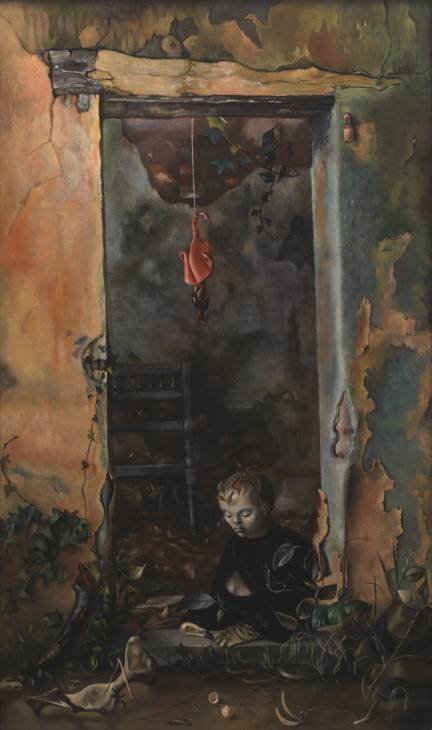
Petit Sphinx Ermite by Leonor Fini

Petit Sphinx Ermite by Leonor Fini (1948)

In a couple of recent blogs I looked at the life and works of two female artists who were possibly best known because of their partners.   I featured Frida Kahlo whose fame partly derived from her marriage to the Mexican muralist Diego Rivera and I showcased the life and works of Gabriele Münter whose one-time partner was Wassily Kandinsky.   Today I want to introduce you to an artist who on her own merits would become the most celebrated female painter of her time.  Her name is Leonor Fini.

I would like to tell you that I have always been a lover of her work but sadly I have to admit that until last Monday I had never even heard of her.  It was purely by chance that I came across a painting of hers, which I am featuring today.  It was one of those paintings, which once viewed, was hard to forget.  I found it fascinating.  I was mesmerised by it and I had to return to stand in front of it a number of times.  It is housed in the Tate Modern in London and I was there primarily to see the Edvard Munch exhibition but thought that I would take the opportunity to look at some of the paintings in the permanent collection of the museum.  I think I have said before that I am not a lover of modern art and find a lot of it very hard to understand but I am constantly being told that I should “embrace all types of art” a suggestion I tend to ignore!    I had just sailed up the Thames on the Tate to Tate boat which transports you from the Tate Britain to the Tate Modern as I had been to the Pre-Raphaelite exhibition at Tate Britain in the morning.  It was interesting to note the difference in the age group of the people attending the two Tate museums.  The Tate Modern certainly had a younger audience and maybe for the young there was an element of rebellion in the art on display there, in comparison with the more staid, more formal art work of the Tate Britain.

Leonor Fini was born in Buenos Aires in August 1907.  Her father, Erminio, was an Argentinean of Italian descent and her mother, Malvina Braun Dubich, was a Trieste-born Italian with German and Slavic origins.  Her parents’ marriage was anything but happy and their turbulent partnership ended in divorce when Leonor was just one year old.  Her mother left her abusive husband and took Leonor back to Trieste to live with her grandparents.  Leonor’s father made a number of attempts to abduct his daughter and have her back with him in Argentina.  His wife, who received no protection from the local authorities and was so afraid that Leonor would be taken from her, decided to take the matter into her own hands and so for the next six years she dressed her daughter up as a boy whenever they ventured out the house.  Eventually Leonor’s father gave up his attempts to snatch her and went back home to Argentina and was never seen again.  Despite this traumatic early part of her life in Trieste, Fini grew up in a very cultivated, well-ordered household.  Having had to suffer the threat of being kidnapped during her early life, Leonor was to suffer another trauma during her early teens when she contracted an eye disease, which forced her to wear bandages on both of her eyes.   She was now locked into a prison of darkness in which she had no alternative but to develop an inner vision and during these long periods of darkness, she would visualise fantastic images, which in some ways would be later mirrored in her art.  It was with these strange images that she had conjured up in her mind during those days of enforced darkness that once her sight was restored she decided that she wanted to become an artist.

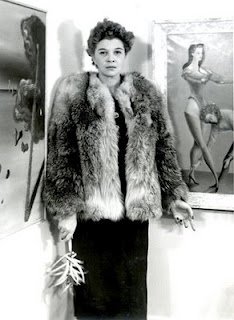
Leonor Fini

Leonor was a very determined and headstrong teenager and was expelled from several schools on account of her rebellious behaviour and her unwillingness to abide to school regulations. Like many teenagers she was very precocious and in a way this manifested in the creation of a persona of incredibly strong will and intense sensitivity.  She became an avid reader and it is said that by the end of her teenage years she had read all the works of Freud.   In a way she educated herself and this thirst for knowledge made her popular within the local artistic and literary circles.  Her interest in art was furthered by her visits to her uncle, a lawyer, where she spent many hours in his library rummaging through and reading his extensive collection of art books about the lives of artists and was especially enthralled by those of the artists of the pre-Raphaelite Brotherhood, Aubrey Beardsley and Gustav Klimt.  She also travelled widely in Italy and Europe visiting all the museums.  Once her decision had been made to become an artist and having no formal training, she taught herself anatomy by studying corpses in the Trieste mortuaries.  When she was seventeen years of age she had some of her artistic works shown at an art exhibition in Trieste and this led to her receiving portrait commissions from some leading dignitaries in Milan.  In 1929, aged just twenty-two years of age, she managed to stage a show of her work at the Galerie Barbaroux in Milan.  Seven years later she left Italy and went to live in Paris, a city Leonor would often referred to as “my real city”.

In 1936, in Paris, she staged her first one-woman exhibition of her work at the Galerie Bonjean, whose director was Christian Dior and the success of this brought her into contact with a number of Surrealist painters such as René Magritte, Paul Eluard, Salvador Dali, Max Ernst, Viktor Brauner and their de facto leader, André Breton.  It was around this time that she started to paint Surrealist images and began to be drawn close to this artistic movement.   However her youthful rebellious nature once again surfaced and she would not kowtow to the dictates of André Breton’s and intensely disliked his authoritarian leadership.   She sided with Dali’s view of Breton and his Surrealist theories.  Dali described Breton as having a typical petit bourgeois mentality.  However, despite this, she did exhibit with the Surrealist group.   The eminent American feminist writer and curator Whitney Chadwick wrote about Leonor’s early days in Paris:

“…In Paris she became a legend almost overnight. When one of the Surrealists saw a painting of hers in a Paris gallery in 1936 and sought out its creator, she arranged a rendezvous in a local cafe and arrived dressed in a cardinal’s scarlet robes, which she had purchased in a clothing store specializing in clerical vestments.   ‘I liked the sacrilegious nature of dressing as a priest, and the experience of being a woman and wearing the clothes of a man who would never know a woman’s body…”

Leonor’s dislike of Breton’s despite his redoubtable charisma was mirrored by his dislike of what he viewed as her often scandalous behaviour and pension for the company of homosexuals.  Breton was known to be fiercely homophobic.   Although she strongly denied she was a Surrealist she did align herself with the group and they welcomed her.  She made her first trip to New York in 1936, showing at the Julian Levy Gallery and in December of that year she participated in the famous “Fantastic Art, Dada and Surrealism” exhibition at New York’s Museum of Modern Art

With the onset of the World War II looming, Leonor fled Paris with her close friend André Pieyre de Mandiargues, a French writer and an associate of the Surrealist set.   The two of them spent part of the summer of 1939 as guests of Max Ernst and Leonora Carrington in Ardèche, before they moved on to Arcachon, where Salvador and Gali Dali had their wartime refuge, the Villa Salesse.  From there the pair went to Monte Carlo.

The bottle for the perfume “Shocking”
designed by Leonor Fini

In the 1940’s, after World War II her career branched out and she began to design theatre sets and costumes for the theater, opera and ballet.  She also worked for Elsa Schiaparelli, the Italian fashion designer, and designed the bottle for the perfume Shocking, which was to become the top selling perfume for the House of Schiaparelli.  The bottle was in the shape of a woman’s torso, which was said to be inspired by Mae West’s tailor’s dummy and Dalí paintings of flower-sellers.   The packaging was also designed by Fini and was in shocking pink, which was one of Schiaparelli’s signature colours.

Leonor Fini had a number of lovers but was married only once.  Her husband was Federico Veneziani but the marriage was short lived and following her liaison with the Italian Count, Stanislao Lepri, she and her husband divorced in 1941.  Lepri, who was the Italian consul in Monaco where Leonor was living, abandoned his career shortly after meeting Fini and the two lived together.  With her encouragement, Lepri became a painter, and the couple moved to Rome shortly before the Allies liberated the city in 1943.  Several years later, they returned together to what had once been her home in the rue Payenne, Paris.  In 1952 she met the Polish writer Konstanty Jelenski, known as Kot Jelenski, in Paris soon after the war.   Kot joined Leonor and Lepri in their Paris apartment in 1952 and the three remained inseparable until their deaths.   In a way she managed to put into practice one of her more famous quotes:

“…Marriage never appealed to me, I have never lived with one person. Since I was 18, I’ve always preferred to live in a sort of community – A big house with my atelier and cats and friends, one with a man who was rather a lover and another who was rather a friend. And it has always worked…”

In the summer of 1954, Leonor, during her travels, discovered a haven of tranquility in Corsica.  It was a ruined monastery near Nonza. It was set in a wild landscape and she immediately felt at peace in this place and from then on she would return to it every summer to paint.  Leonor was, from an early age, a great lover of literature and reading and she illustrated more than 50 works by writers such as Charles Baudelaire, who was one of her favourite authors. In her later life, she continued to design sets and costumes for the theatre, opera, and film.    In early 1960, Leonor Fini moved to an apartment in Paris’ rue de La Vrillière, between the Palais Royal and the Place des Victoires.  She was rarely alone, always in the company of her friends and surrounded by her numerous Persian cats, (at one point she had 23 cats) which along with the sphinx, often featured in her paintings.  Fini adored cats, which were Egyptian symbols of dignity and power, and she identified herself with the sphinx, the mythological hybrid of lion and woman.  She divided her time between the apartment and her home in Saint-Dyé-sur-Loire, in Touraine, up until her death in January 1996.  Leonor Fini died at the age of 88 but one of her obituaries commented that it was impossible to imagine her being old.   It went on to say that she would always be, for those who admired her, the wild, raven-haired, ill-proportioned beauty who haunted her pictures.   The lethal yet irresistible sphinx, the vampire we would most like to visit us.   Her obituary in The Times paid homage to her beauty, the erotic quality of her art and mentioned her legion of lovers whose names “read like a roll call of the literary and artistic talents of that brilliant age.”

She continued to be friends with some of the best known writers, artists, and thinkers of her time while simultaneously being a bona fide cat lady. Throughout her artwork, Leonor always venerated the female form.  She would often show females as the dominant ones of a partnership, who were protecting their male lovers or in some instances, women loving other women. She depicted women exploring their own identity at a time when female identity, both physically and mentally, was being defined by men.

My Daily Art Display featured work today is the painting entitled Petit Sphinx Ermite, (Little Hermit Sphinx), which Leonor Fini completed in 1948. Fini adored cats, and she used the image of the Sphinx, the mythological hybrid of a lion and woman, partly as a self-portrait. She looked upon the Sphinx as a symbolic intermediary between the human and animal realms, and between the conscious and the uncharted areas of the mind and spirit.   The sphinx in this work is child-like domesticated creature, which we see sitting in front of its ramshackle home. At its feet we see a skull of a bird and more bizarrely above the sphinx’s head we see a creatures body hanging from the door lintel, which in a way adds a sense of violence to the scene.

Maybe having seen the painting you will understand why I kept coming back to it, trying to fathom what it was all about !!!   Her works of art are fascinating and I urge you to take a look at more of her paintings.

Self-Portait as a Soldier by Ernst Ludwig Kirchner

Self-Portrait as a Soldier by Ernst Kirchner (1915)

In my last blog I looked at the early life of the German Expressionist painter Ernst Ludwig Kirchner.  I left off the biography at the time he decided to leave Dresden and move to Berlin.  He was still a member of Die Brücke art group, which he had helped to form, and life for Kirchner was good.  Alas, as we all know only too well, life is not constantly good and to our liking and in this second and final instalment of Kirchner’s life I look at what went wrong.

In 1906, Die Brücke held its first exhibition, and two new artists, Emil Nolde and Max Pechstein, joined the group.  The following year, one of their founder members, Fritz Bleyl married and left the group to concentrate on looking after his family.  In 1908 Pechstein moved to Berlin and in October 1911, Kirchner followed, along with some of the other artists from the group.  It was in Berlin that Kirchner along with Pechstein founded a private art school, known as the MIUM-Institut, (Moderner Unterricht in Malerei-Institute)   Kirchner’s aim for this private school was to spread the word about modern ways of teaching art.  Alas, the venture failed with only two candidates, friends of Kirchner, enrolling on the first course.  The school closed the following year.  It was in this same year, 1912, that Kirchner met and started a relationship with Erna Schilling, a relationship which would endure all his life.

With all groups of artists, there comes a time when they begin to drift apart, because of their differing views of the future.   In cases of musicial groups one of them often wants to pursue a solo career and in the case of artist groups sometimes one of them wants to stage a solo exhibition of their work.  With all groups of artists, whether it is painters or musicians, there is often a hierarchical dilemma.  Is there to be a leader of the group?  Is the group to be run on a consensual basis?  This was the problem with Die Brücke as Kirchner believed he was the leader of the group and in 1913 he wrote the Chronik der Brücke, chronicling the history and aims of the group.  In his summation of what had gone before he portrayed himself as the leader and thinker of the group and the others were his followers and this upset the other members.  This publication along with the desire of some of the members, including Kirchner himself, to do their “own thing” led to the break-up of Die Brücke.  Probably because of what Kirchner had written in the chronicle the break-up was not an amicable one and harsh words were exchanged.  For Kirchner the split had been so acrimonious that he completely disassociated himself from Die Brücke artists for the rest of his life and would in later years denigrate the work of the group saying the paintings he did during Die Brücke days were simply “the nonsense of youth”.  Kirchner was determined that history should remember him and his art as a personal triumph, that he was self-sufficient and in fact, never needed Die Brücke.

An Artists’ Group by Kirchner (1927)

The one time, in later years, when he reflected on his Die Brücke days, was in 1926 when he completed a large panel painting entitled An Artists’ Group, which depicted Otto Mueller seated reading the infamous Chronik der Brücke whilst Kirchner, Erich Heckel, and Karl Schmidt-Rottluff stood to the right discussing this very chronicle, which ironically contributed to splitting the group asunder.  Otto Mueller who had only joined Die Brücke in its latter days was included in the work because he was a particular friend of Kirchner but Kirchner pointedly omitted Max Pechstein from the depiction, as he was the least popular member and he had left the group in 1912.

The year 1914 signalled the start of the First World War and this was to have a terrible and deep impact on Kirchner.  He received his call-up papers and joined the German army as an “unwilling volunteer” and was posted to Halle where he served as a driver in the artillery in order to avoid being drafted for less desirable duties.  Life in the army proved too much for Kirchner and he suffered a series of physical ailments, due to general weakness and lung problems.  He eventually suffered a mental breakdown which resulted in him being temporarily discharged from army and confined to a number of sanatoria.  Was he ill or did he just want to be away from army life and the horrors of war?  Maybe we will never know but during his time in hospital and sanatoria he was able to produce some of his best works including my featured painting today, Self-Portrait as a Soldier.

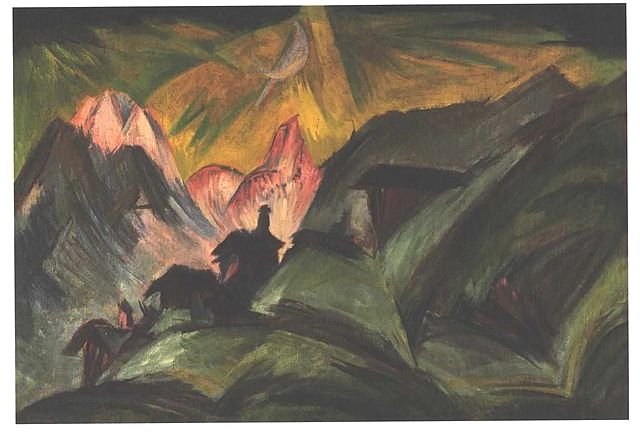
Stafelalp by Moonlight by Kirchner (1919)

Kirchner’s mental state showed no sign of improvement and his friends decided that he should move to a more tranquil environment and so they helped him emigrate to Switzerland and the small mountain town of Frauenkirche which lay just below the Stafelalp,  just south of Davos.  Here he remained for most of his life.   It was during these latter years that although his artistic style remained the same, the subjects of his art changed and he took a keen interest in the life of the farmers, who worked in this mountainous region,  and he recorded it in some of his works.   Although Kirchner was now living in a tranquil setting and his lifestyle was much more relaxed,  he was suffering from his time in the various German hospitals and had developed an addiction to drugs and this was exacerbated further by his alcoholism.  It was not until 1921 that he managed to wean himself off this narcotic addiction and get his life back together.

During the mid 1920’s Kirchner visited Germany in an attempt to regain recognition for his artistic works.  He received a number of commissions and in 1927 he had hoped to be appointed a professor at the Kunstakademie in Dresden.  In 1931 he was admitted to the Preussische Akademie der Künste in Berlin and by now most of the major museums in Germany housed some of his artworks.  Things were once again looking up for Kirchner but all that was to end two years later in 1933 when the National Socialists came to power.  Four years later, in 1937, the National Socialists campaign, known as entartete Kunst (degenerate art), stripped all the museums of his art and he was forced to resign from the Akademie in Berlin.   This proved all too much for Kirchner who had returned to his home in Frauenkirch, where on June 15th 1938, aged 58, he stood before his small house and shot himself.

The work I have featured today is the oil on canvas painting, entitled Self-Portrait as a Soldier, which he completed in 1915 and now hangs in the Allen Memorial Art Museum, Oberlin College in Ohio.  In it Kirchner imagines that due to the savagery of war, his hand has been severed and he is unable to paint.  Could it be that Kirchner was thinking about Van Gogh’s 1889 painting, Self-Portrait with Bandaged Ear when he first set about this work, albeit Kirchner’s severed hand was simply in his mind whereas Van Gogh’s self-mutilation was very real?

The work is all about Kirchner’s fears with regards how the war would affect him as an artist.   His fear was such that it was almost a pathological fear as to what would happen to him and his life as an artist.  It was not just about him but his belief that all young artists would be adversely damaged both mentally and physically by the conflict.  Kirchner painted the Self-Portrait as a Soldier during his time recovering at a sanatorium in Halle.  He has depicted himself in the uniform of the Königlich-Preußische Mansfelder Feldartilierie-Regiment Nr. 75 of Halle/Saale.   It is a haunting portrayal.  His face is drawn with a cigarette hanging loosely from between his lips.  His eyes are unseeing and empty, without pupils and in the irises we can see the reflection of the blue of his uniform. What are the most striking aspects of Kirchner’s self-portrait are the lost right hand and its bloody stump.  This grotesque aspect of the painting is the way Kirchner viewed his losses or possible future losses caused by the war.   He is concerned that he will lose his ability to paint.  He believes that all his creativity, artistic vision, and inspiration will be destroyed.  Behind the self portrait stands a nude woman.  There would seem little to connect the military man and her except that Kirchner may have wanted to think back on his early artistic days and his period where nudity dominated his works.

The style of Kirchner’s self-portrait is similar to his famous Berlin street scenes which he painted between 1913 and 1915.  In those, like this work, the style he used was of a primitive manner.   Kirchner had introduced primitivism to Die Brücke group.  Primitivism is a reference to the use by Western artists of forms of imagery derived from the art of the so-called primitive peoples especially those who had been colonized by Western countries.

Although Expressionism is not my favourite artistic style I have enjoyed researching the work and life of Ernst Kirchner and will soon return to look at some of his contemporaries.

Bathers at Moritzburg by Ernst Ludwig Kirchner

Bathers at Moritzburg by Ernst Kirchner (1909)

My last three blogs looked at Italian Renaissance paintings but today, and in my next blog, I want to move in a completely different artistic direction and look at the life and work of a man who is widely acknowledged as the greatest artist of German Expressionism.  His name is Ernst Ludwig Kirchner.

Before I look at the early life of Kirchner I suppose I should explain a little about the term Expressionism.  Expressionism came about around 1905 and lasted until about 1920.  It is a term given to a style of painting, music, or drama in which the artist or writer seeks to express the inner world of emotion rather than external reality.   This term Expressionism is applied to art which seeks to cause an emotional response, not to actual pictorial content but to the exaggerated style adopted by the artist who is seeking to reflect his inner self.   The term is generally applied to modern European art, where exaggerated forms and vivid colours were employed.  In Germany, at the beginning of the twentieth century, there was disillusionment with the old fashioned academic styles of painting and this prompted a flood of experimentation and innovation.  The artists were desperately searching for a new way to express themselves through the medium of painting and by doing so convey their personal experiences of their new modern world with all its advancing technology.   Expressionism is an artistic style in which the artist attempts to depict not objective reality but rather the subjective emotions and responses that objects and events arouse in him or her.   They accomplish their aim through distortion, exaggeration, primitivism, and fantasy and through the vivid, jarring, violent, or dynamic application of formal elements. The actual term Expressionism was first used in the preface of the catalogue for the 22nd Berlin Secession Exhibition of April 1911 to describe the work of Braque, Derain, Picasso, Vlaminck and Marquet.

Kirchner was born in Aschaffenburg in northwest Bavaria in 1880 and is now looked upon as one of the most important representatives of Expressionism.  Kirchner was brought up in a middle–class family environment.  His father was an industrial chemist.   Kirchner showed an early interest in drawing and as an extra-curricular activity, during his school years his parents arranged for him to have drawing and watercolour lessons at home.  His parents support for his love of art was not wholehearted as they saw no future in their son becoming an artist and so after taking his final school leaving exams they insisted he attended the Königliche Technische Hochschule to study architecture.  Kirchner went along with his parents’ plans as he believed the course would also allow him to have further training in art, such as freehand and perspective drawing.  He took his preliminary diploma in 1903 after which he spent the winter term studying in Munich.

Whilst at the Hochschule he became close friends with another student Fritz Bleyl and later they, along with two other architecture students, Karl-Schmidt-Rottluff and Erich Heckel, after successfully completing their architecture degree course in 1905, formed an artist group which they called Die Brücke (The Bridge).  The name, given to their group by Rottluff, was to symbolise a connection between Germany’s artistic past and future and they intended that their art would be that very link and the way forward.  Theirs was a radical group which was opposed to middle-class conventions, which they considered lacked fervour, and it was their aim to shun the traditional academic style of art and initiate a new style of painting which would be more in keeping with modern life.  They still saw their artistic work as belonging firmly within the tradition of German art, especially the art of Albrecht Dürer, Matthias Grünewald and Lucas Cranach the Elder.  This young group of artists was anti-establishment, liberal in their attitude and full of revolutionary ideas.  Like all new groupings the four founders decided that the group should have its own manifesto setting out its ambitions.  Kirchner was in the forefront of thinking up the wording for the manifesto and he clearly summed up what the group wanted to achieve:

 “….. freedom in our work and in our lives, independence from older, established forces…”

The group met regularly at the Dresden studio of Kirchner.  The lifestyle of this group was Bohemian in character.  In the Royal Academy 2003 exhibition catalogue Kirchner – Expressionism and the city, a quote from Fritz Bleyl described his friend’s first studio, which had formerly been a butcher’s shop:

“…[it was] that of a real bohemian, full of paintings lying all over the place, drawings, books and artist’s materials — much more like an artist’s romantic lodgings than the home of a well-organised architecture student…”

In Kirchner’s studio social standards were largely ignored. Art historians quote reports of the goings-on which took place at the studio and recount tales of “much impulsive love-making and naked cavorting”.  During these meetings at Kirchner’s studio, the artists met to study the nude in group life-drawing sessions.   However, Kirchner wanted to distance himself from the rigid and painstaking academic style of life drawing and he and his fellow artists would instead sketch the naked women, quickly in quarter-hour sessions (Viertelstundenakte) and by so doing, they believed that they were able to capture the fundamental nature of their subject as instinctively as they could. The models who posed nude for Kirchner’s group were not professional models; they were just part of Kirchner’s circle of friends, who were only too willing to become part of this newly-founded art movement.

The lifestyle of the group in some ways was mirrored in the flower-power days of the 1960’s or the punk rock days of the late 70’s.  They hoped and succeeded in shocking the bourgeoisie.  Normal social conventions were abandoned and the group’s studio became a place almost of decadence with group life-drawing sessions, frequent nudity and casual love-making.  Like Matisse and Picasso, Ernst Ludwig Kirchner was fixated with the female nude, as a symbol of his own intense sexuality as well as it being a seductive return to primitive nature. The intention of Die Brücke artists was to wage battle against the constricting forces of bourgeois culture.  To them this culture was linked indelibly with mediocrity, corruption, and weakness. Kirchner believed fervently on self-empowerment and complete freedom from convention and this could be seen in his early art which often concentrated on erotic subject matter. In the paintings done by Kirchner and the other artists of this group they often depicted the female nude crudely as both “primitive” and submissive.  For them this depiction of the female signified both male domination and male virility.

Die Brücke poster for the 1906 exhibition

In the September and October of 1906, a year after the formation of Die Brücke, the first group exhibition was held at the K.F.M. Seifert and Co. in Dresden.   The works exhibited focused on the female nude and Fritz Bleyl designed the lithographic poster for the event.  In 1906, Kirchner met Doris Große, who became his favoured model and remained at his side until 1911 when he decided to leave Dresden and move to Berlin.   Doris would not make that journey.  From 1907 to 1911, Kirchner liked to spend part of his summers at the Moritzburg lakes which lie to the north of Dresden.  He and the other members of Die Brücke art group, along with their friends relaxed amidst the countryside tranquillity and led a relaxed communal lifestyle and embraced the popular German culture of going back to nature and dispensing with such frivolous things as clothes !

My featured painting today is by Ernst Ludwig Kirchner and is entitled Bathers at Moritzburg which he completed around 1910.  It is a painting depicting people who have for a short time shunned the claustrophobic and overpowering life in the city and have gone back to the freedom of nature.   This is their reunion with nature.   It is a painting full of energy.  There is vigorous activity all around.   The first thing that strikes one about this work of art is the overstated colours he has used in this painting.  We have the contrast of the yellow-orange flesh of the bathers with the blue of the water.  This contrasts serves to emphasise the nudity of the figures. Although I have dated the painting as being completed around 1909, the original effect may have been too extreme for Kirchner as in 1926 he repainted parts of the picture making the colours lighter and the surface of the painting more even. It is presently housed in the Tate Modern in London.

As a leading proponent of Expressionism how did Kirchner view his style?  In a letter written in 1937 to art dealer Curt Valentin, he explained the development behind his own Expressionist style:


“…First of all I needed to invent a technique of grasping everything while it was in motion…I practised seizing things quickly in bold strokes, wherever I was and in this way I learned how to depict movement itself, and I found new forms in the ecstasy and haste of this work, which, without being naturalistic, yet represented everything I saw and wanted to represent in a larger and clearer way. And to this form was added pure colour, as pure as the sun generates it…”

In my next blog, I continue looking at the life of Ernst Kirchner as he moves to Berlin, suffers mentally from the rigours of World War I, splits from Die Brücke and spends the last years

The Resurrection by Piero della Francesca

The Resurrection by Piero della Francesca (c.1468)

For today’s blog I am staying with Italian Renaissance art and looking at a work by, some say, the greatest Early Renaissance painter, Piero della Francesca.  This is the second time I have featured this artist in one of my blogs.  The first being The Flagellation of Christ (My Daily Art Display, September 29th 2011).   Today I want to look at his beautiful fresco entitled The Resurrection which he completed around 1468.

Piero della Francesca or as he was known in his day, Piero di Benedetto de’ Franceschi, was born around 1415 in the Tuscan market town of Borgo San Sepolcro, which is now known as Sansepolcro,  a small town located on the plains of the Upper Tiber Valley in the southeast of Tuscany, bordering Umbria and The Marches.  His family were merchants dealing in leather and wool and his father, Benedetto di Franceschi, hoped that his son would follow in his footsteps.  With that in mind, Piero was sent to school to learn arithmetic and the ability to calculate weights and measures, assess the volumes of barrels and bales, and most importantly, learn how to keep accounts.  Piero was academically gifted and became well known as a mathematician and in fact after his death he was revered not so much as a painter but for his mathematical knowledge.

Piero’s initial artistic training came as an apprentice to Antonio di Giovanni, a local painter, who was based in Anghiari, a town across the Tiber Valley from Borgo San Sepolcro.  From being Antonio di Giovanni’s apprentice, he soon became his assistant and during the 1430’s the two of them worked jointly on commissions around Borgo San Sepolcro.  Piero went to Florence for the chance to gain more work and he worked on commissions as an assistant alongside another young artist, Domenico Veneziano.  It was during this time spent in Florence that Piero would have probably come into contact with the great Florentine artists of the time such as Fra Angelico, Mantegna and the architect, Brunelleschi.

In 1442, Piero returned to Sansepolcro and three years later, in 1445, Piero received a large commission from the Compagnia della Misericordia, a confraternity of Borgo San Sepolcro, for a polyptych, Polyptych of the Misericordia: Madonna of Mercy, as an altarpiece for the local church, Church of the Misericordia.  The confraternity had asked Piero to complete the work in three years, setting the anticipated completion date as 1445.   Piero however did not feel constrained by this suggested timeline and any way he had many other projects on the go at the time and in the end did not complete the altarpiece until 1462, some seventeen years late!

Piero moved around the country a good deal during his life, living in Ferrara and Rimini before arriving in Rome in 1455.  Here he painted frescoes in the Vatican for Nicholas V and continued to work in the Vatican Palace for Pius II. Sadly his works were destroyed to make room for paintings by Raphael.

Piero’s birthplace, the town of Borgo San Sepolcro which literally means “Town of the Holy Sepulchre” derives its name from the story of its founding back in the tenth century.   The story of its coming into being would have us believe that two saints, Saint Arcano and Saint Egidio were returning from a pilgrimage to the Holy Land bearing some wood shavings from the sepulchre in which Christ had been buried, when they were miraculously instructed to create a new settlement – Borgo San Sepolcro.   These sacred relics have been preserved in the local Benedictine abbey and so when the town hall of Borgo San Sepolcro was renovated and extended in the late 1450s, Piero was commissioned to paint the fresco on the appropriate subject of The Resurrection for the building’s state chamber. This room was set aside for the use of the Conservatori, the chief magistrates and governors.  Before holding their councils, these four appointed guardians of the town would solemnly kneel before Piero’s image, to pray for the grace of God to descend upon them during their deliberations. The room is now the civic museum.

My featured painting today is a fresco which exudes an air of peace and tranquillity.   In the painting, the risen Christ can be seen in the centre of the composition.  He is portrayed at the moment of his resurrection, as we see him with his left foot on the parapet as he climbs purposefully out of his marble tomb clutching the banner in his right hand, as if he is declaring his victory over death.   He looks formidable as he stands tall.   We don’t see the lid of the tomb but look to the bottom right of the painting and we can see Piero has depicted a large rock which probably harks back to the biblical tale which told of a rock being rolled away from the entrance of Christ’s tomb.   In most resurrection paintings we are used to seeing Christ dressed in white burial clothes and yet Piero has depicted him in red robes, which was probably done to infer royalty and signify that this resurrected person is Christ the King.  Piero has portrayed the pale body of the risen Christ as almost blemish-free with the exception of the wound to his side and the wound in the back of both his hands made by the crucifixion nails.   In his depiction of Christ he has not let us forget that this central figure is both man and God, for if you look closely at the stomach of Christ we notice that the artist has given it an almost human appearance.  It has a slightly wrinkled appearance caused by the folds of the skin happening as he raises his leg to exit the tomb.

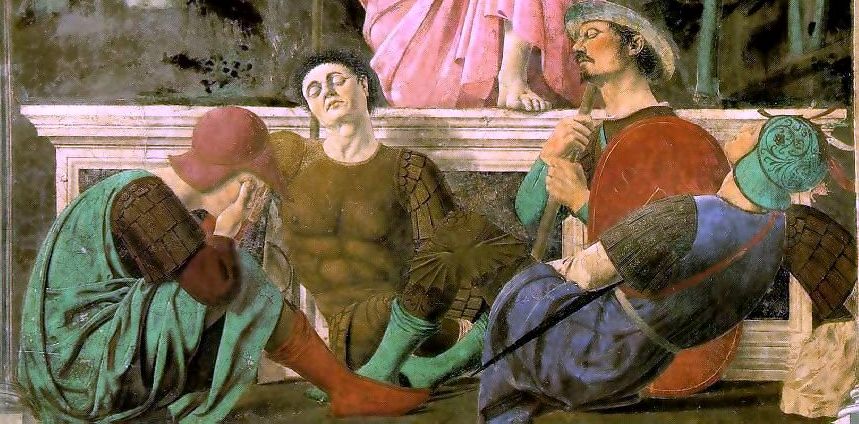
The sleeping guards

The alertness of the risen Christ in the painting contrasts starkly with the four soldiers who instead of keeping guard on the tomb, lie asleep.  The Renaissance painter and biographer of artists, Vasari, would have us believe that Piero included his own self-portrait in this fresco.

Piero della Francesca

It is the face of the second soldier from the left, and Vasari postulates that Piero did this as a sign of his own hopes of awaking one day to redemption. It is also interesting to note the contrast in the way Piero has depicted the risen Christ and the four soldiers.  Christ is shown in a solid vertical stance looking straight out at us, whereas the sleeping soldiers are depicted in diagonal poses and viewed at various oblique angles.  The way the artist has portrayed Christ almost gives one the feeling that he is about to step out of the painting to join us, the viewer.  In some ways the expression on the face of Christ is disturbing.  It is a penetrating glance and one art critic commented that it was if he was looking into the soul of the viewer.

The landscape is bathed in the new cold and clear light of a Tuscan dawn.  Look carefully at the trees on the right of the painting and those on the left side.  Do you spot the difference?   The ones on the right are depicted as flourishing specimens adorned with leaves and healthy green shoots whereas the trees on the left of the painting are grey in colour and bare as if on the point of dying.   This contrast almost certainly alludes to the renewal of mankind through the Resurrection of Christ

It is likely that Piero painted his striking image of the risen Christ stepping resolutely, banner in hand, from the tomb, to represent not only the resurrection of Jesus but also the resurgence of the town of Sansepolcro.  After a few years under the rule of Florence from 1441, Sansepolcro regained its identity and dignity in 1456 when the Florentines returned the use of the Palazzo to the Conservatori. The church Council which the young Piero had witnessed in Florence had thus had unforeseen consequences for Sansepolcro. The Pope, his treasury depleted by his lavish Council, defrayed some of the costs by ceding Sansepolcro to Florence which was later returned by Florentine authorities to the citizens of Sansepolcro on February 1st 1459, as a sign of the restoration of some measure of autonomy to the Borgo.

One interesting end note to the tale of this painting comes from a BBC article which tells the story of how a British artillery officer, Tony Clarke, during World War II, defied orders and held back from using his troop’s guns to shell the town of Sansepolcro and his decision is believed to have saved this beautiful fresco.   To read the full story click on:

http://www.bbc.co.uk/news/magazine-16306893

The Transfiguration by Raphael

The Transfiguration by Raphael (1520)

In my last blog I looked at The Raising of Lazarus by Sebastiano del Piombo and talked about how this and a painting by Raphael, entitled Transfiguration, had been commissioned in 1517 by Cardinal Giulio de’ Medici as a high end altarpiece for the French Cathedral of S. Giusto Narbonne.  Raphael was, at the time, busy on other commissions.  He had been summoned to Rome by Pope Julius II to paint frescoes on the rooms of his private Vatican apartment, the Stanza della Segnatura and the Stanza di Eliodor and at the same time he was busy working on portraits and altarpieces as well as working alongside Sebastiano del Piombo on frescoes for Agostino Chigi’s Villa Farnesina.   It is thought that Giulio de Medici was so concerned with the time it was taking Raphael to complete The Transfiguration altarpiece that he commissioned Sebastiano di Piombo to paint the Raising of Lazarus for the cathedral in an effort to stimulate Raphael to work faster on his commission.

Today I am featuring Raphael’s work, The Transfiguration, which was considered the last painting by the Italian High Renaissance master.  Giorgio Vasari, the sixteenth century Italian painter, writer, historian, and who is famous today for his biographies of Renaissance artists, called Raphael a mortal God and of today’s painting, he described it as:

“…the most famous, the most beautiful and most divine…”

Although Raphael Sanzio was only thirty-four years of age when he was given the commission, bad health prevented him from finishing it. It was left unfinished by Raphael, and is believed to have been completed by his pupils, Giulio Romano and Giovanni Francesco Penni, shortly after his death on Good Friday 1520.

If we look closely at this work of art we can see two things going on simultaneously both of which are described in successive episodes of the Gospel of Matthew.   In the upper part of the painting we have the Transfiguration, which is described in Matthew’s Gospel (Matthew 17: 1-7):

“…After six days Jesus took with him Peter, James and John the brother of James, and led them up a high mountain by themselves.  There he was transfigured before them. His face shone like the sun, and his clothes became as white as the light.  Just then there appeared before them Moses and Elijah, talking with Jesus.   Peter said to Jesus, “Lord, it is good for us to be here. If you wish, I will put up three shelters—one for you, one for Moses and one for Elijah.”    While he was still speaking, a bright cloud covered them, and a voice from the cloud said, “This is my Son, whom I love; with him I am well pleased. Listen to him!”   When the disciples heard this, they fell facedown to the ground, terrified.  But Jesus came and touched them. “Get up,” he said. “Don’t be afraid…”

We see the transfigured Christ floating aloft, bathed in a blue/white aura of light and clouds.  To his left and right are the figures of the prophets, Moses and Elijah.  Below Christ we see the three disciples on the mountain top shielding their eyes from the radiance and maybe because of their own fear of what is happening above them.   The two figures kneeling to the left of the mountain top are said to be the martyrs Saint Felicissimus and Saint Agapitus of Palestrina.

 In the lower part of the painting we have a depiction by Raphael of the Apostles trying, with little success, to liberate the possessed boy from his demonic possession. The Apostles fail in their attempts to save the ailing child until the recently-transfigured Christ arrives and performs a miracle.  Matthew’s Gospel (Mathew 17:14-21) recounts the happening:

“…When they came to the crowd, a man approached Jesus and knelt before him.  “Lord, have mercy on my son,” he said. “He has seizures and is suffering greatly. He often falls into the fire or into the water.  I brought him to your disciples, but they could not heal him.”    “You unbelieving and perverse generation,” Jesus replied, “how long shall I stay with you? How long shall I put up with you?  Bring the boy here to me.”   Jesus rebuked the demon, and it came out of the boy, and he was healed at that moment.   Then the disciples came to Jesus in private and asked, “Why couldn’t we drive it out?”   He replied, “Because you have so little faith. Truly I tell you, if you have faith as small as a mustard seed, you can say to this mountain, ‘Move from here to there,’ and it will move. Nothing will be impossible for you…”

Observe this lower scene.  The young boy, with arms outstretched and distorted in a combination of fear and pain, is possessed by some sort of demonic spirit.   He is being led forward by his elders towards Christ who is about to descend from the mountain.   The boy is crying and rolling his eyes heavenwards.   His body is contorted as he is unable to control his movement.   The old man behind the boy struggles to control him.  The old man, with his wrinkled brow has his eyes wide open in fear as to what is happening to his young charge.  He looks directly at the Apostles, visually pleading with them to help the young boy.    See how Raphael has depicted the boy’s naked upper body.  We can see the pain the boy is enduring in the way the artist has portrayed the pale colour of his flesh, and his veins, as he makes those violent and fearsome gestures.   The raised arms of the people below pointing to Christ, who is descending, links the two stories within the painting.  A woman in the central foreground of the painting kneels before the Apostles.  She points to the boy in desperation, pleading with them to help alleviate his suffering.

Contrapposto

The contorted poses of some of the figures at the bottom of the painting along with the torsion of the woman in what Vasari calls a contrapposto pose were in some way precursors to the Mannerist style that would follow after Raphael’s death.   Vasari believed that this woman was the focal point of the painting.     She has her back to us.  She kneels in a twisted contrapposto pose. Her right knee is thrust forward whilst she thrusts her right shoulder back.   Her left knee is positioned slightly behind the right and her left shoulder forward.  Thus her arms are directed to the right whilst her face and gaze are turned to the left.  Raphael gives her skin and drapery much cooler tones than those he uses for the figures in heavy chiaroscuro in the lower scene and by doing so illuminates her pink garment.  The way he paints her garment puts emphasis on her pose.  She and her clothes are brilliantly illuminated so that they almost shine as bright as the robes of the transfigured Christ and the two Old Testament Prophets who accompany him.   There is an element about her depiction which seems to isolate from the others in the crowd at the lower part of the painting and this makes her stand out more.

The unfinished painting was hung over the couch in Raphael’s studio in the Borgo district of Rome for a couple of days while he was lying in state, and when his body was taken for its burial, the picture was carried by its side.   Cardinal Giulio de’ Medici kept the painting for himself, rather than send it to Narbonne and it was placed above Raphael’s tomb in the Pantheon.   In 1523, three years after the death of Raphael, the cardinal donated the painting to the church of San Pietro in Montorio, Rome. In 1797, following the end of the war in which Napoleon’s Revolutionary French defeated the Papal States; a Treaty of Tolentino was signed.    By the terms of this treaty, a number of artistic treasures, including Raphael’s Transfiguration, were confiscated from the Vatican by the victorious French.   Over a hundred paintings and other works of art were moved to the Louvre in Paris.   The French commissioners reserved the right to enter any building, public, religious or private, to make their choice and assessment of what was to be taken back to France. This part of the treaty was extended to apply to all of Italy in 1798 by treaties with other Italian states.   It was not until 1815, after the fall of Napoleon, that the painting was returned to Rome. It then became part of the Pinacoteca Vaticana of Pius VII where it remains today.

The Raising of Lazarus by Sebastiano del Piombo

The Raising of Lazarus by Sebastiano del Piombo (1520)

My next two blogs feature paintings by two different artists, commissioned almost at the same time by the same person, one of which is often looked upon as the greatest painting ever.

My featured artist today is Sebastiano Luciani, who would be better known later as Sebastiano del Piombo for reasons I will explain later.   Sebastiano was born around 1485 and his birthplace is thought to have been Venice as he often signed his works Sebastianus Venetus.   His first thoughts, regarding what he should do with his life, were to join a religious order and he may well have started along the path towards the priesthood. His first love was not drawing and painting but music.  He had a great interest in music and was an accomplished singer and also played many musical instruments, including the lute, which was his favourite.  This musical talent of his made him very popular in Venetian society.   He did however eventually turn his attention to art when he was about eighteen years of age and his first artistic tuition came from Giovanni Bellini, who was a member of the great Bellini family of Venetian artists and brother-in-law of Andrea Mantegna.   Having learnt the basics of art from Bellini he left the studio and became a pupil of Giorgione da Castelfranco, whom he had first met through their joint love of music.  Sebastiano and Giorgione had a long association and the early works of the young aspiring painter were greatly influenced by the style and technique of his master, so much so, that some of his early paintings were confused with those of Giorgione.

Giorgione died in 1510 and the other great Venetian artist, Tiziano Vecelli (Titian) was away, working in Padua.   Sebastiano was now looked upon as the leading painter in Venice.   In early 1511, the Siennese banker, Agostino Chigi, who had become one of the richest men in Rome and a financial backer of the Popes,  visited Venice and persuaded Sebastiano to return with him to Rome.  Chigi believed that Sebastiano was the greatest living painter in Venice and he wanted him to carry out some work in his newly acquired villa.   Chigi was a great lover of the Arts and a wealthy patron of art and literature.  Chigi, at that time, owned a suburban villa on the shore of the River Tiber, known as Viridario, but later owners changed its name and it became known asVilla Farnesina.  Chigi wanted his residence to be one of the most opulent in the city befitting a man of his standing in society and wanted the best artists of the time to come and decorate the interior.  Besides summoning Sebastiano he invited other great painters to put their mark on the villa, such as Giovanni da Udine, Giulio Romano, Sodoma and Raphael Sanzio.  Sebastiano worked alongside Raphael on the frescoes for the villa which depicted scenes from Ovid’s Metamorphoses.

It was whilst working in Rome that Sebastiano became acquainted with, and became one of the rare and trusted friends of, Michelangelo Buonarroti.   According to Vasari, Michelangelo befriended Sebastiano and offered him pictorial designs for him to develop in paint.  This friendship however drew Sebastiano into the long running rivalry Michelangelo had with Raphael Sanzio but in a way it had a lot to do with today’s featured work.  It is believed that through the good auspices of Michelangelo, Sebastiano was, at the end of 1516, commissioned by Cardinal Giulio de’ Medici to paint a large altarpiece, depicting the Raising of Lazarus.  Cardinal Giulio de’ Medici was appointed to the see of Narbonne, in south-west France, by his cousin Pope Leo X.  The painting, along with its proposed companion piece the Transfiguration, which the cardinal had commissioned, shortly before, from Raphael, were to be sent to the cathedral in the Cardinal’s own bishopric in Narbonne, which owned a relic relating to the story of Lazarus.  There seems nothing strange about the cardinal commissioning two paintings for the same cathedral but Vasari would have us believe that there was a little devilment with the cardinal’s request as, in a way, it was to pit the two artists against one another and of course the cardinal was well aware of the rivalry between Michelangelo and Raphael as we know Raphael’s “artistic enemy” was Michelangelo, who was therefore only too willing to lend Sebastiano a hand with the work by supplying him with sketches that could be incorporated into the Raising of Lazarus.

Michelangelo’s sketch of Lazarus

The featured painting today, the Raising of Lazarus by Sebastiano, is a great example of the highly colourful style of Venetian painting of the time.   Sebastiano completed the painting in January 1519 and it was immediately hailed as an artistic triumph.  Raphael was concerned that his painting of the Transfiguration was not compared with Sebastiano’s Raising of Lazarus but the two were seen together in April of the following year, a couple of days after Raphael’s death.  Raphael’s painting never went to Narbonne, remaining in Rome whereas Sebastiano’s Raising of Lazarus eventually went to the French city.

The biblical tale tells us about the request of the sisters Martha and Mary for Jesus to visit the grave of their brother Lazarus and raise him from the dead.  In his Gospel, St John divided the story of the miracle into three parts. Firstly, Jesus bids the people to take the stone from the tomb.  Next he tells his friend, Lazarus to rise, and finally Jesus tells Lazarus to unbind his shroud and it is this third command to Lazarus that we see in the painting.  The painting we see before us is a depiction of a biblical story from the Gospel of Saint John (John: 11).  Verses 40 to 44 recount the event:

“…Jesus, once more deeply moved, came to the tomb. It was a cave with a stone laid across the entrance.   “Take away the stone,” he said.  “But, Lord,” said Martha, the sister of the dead man, “by this time there is a bad odor, for he has been there four days.”    Then Jesus said, “Did I not tell you that if you believe, you will see the glory of God?”   So they took away the stone. Then Jesus looked up and said, “Father, I thank you that you have heard me.    I knew that you always hear me, but I said this for the benefit of the people standing here, that they may believe that you sent me.”  When he had said this, Jesus called in a loud voice, “Lazarus, come out!” The dead man came out, his hands and feet wrapped with strips of linen, and a cloth around his face.  Jesus said to them, “Take off the grave clothes and let him go.”

In the background of the painting, we see a cloudy sky being penetrated by a shaft of light.  We can make out a distant town by a lake or river. The town is more a depiction of a high-walled fortified Roman town with its large and solidly built bridge, rather than a depiction of somewhere from Sebastiano’s birthplace, Venice.   It feels Roman more than Venetian. We see the figure of Christ standing in the foreground, slightly left of centre,   He is portrayed theatrically pointing towards the seated figure of Lazarus, who is still partly covered by his burial shroud.  It is almost as if Jesus is giving a speech.   Jesus needs all his powers of persuasion to bring back Lazarus. It is not so much a command Jesus is giving to Lazarus, more that he is appealing to the old man, his friend, to rise from the dead.

All around, and squeezed tightly into the composition, are men and women all of who pose in a most theatrical manner, due to their shock at seeing Lazarus coming back to life.   In the left mid-ground we see a group of Pharisees unimpressed by what they have seen and are still hell-bent on plotting the death of the so-called miracle maker.    The various figures in the painting are all clothed differently.  It is interesting to take time and study each figure.  There is an old man knelt on the lower left, hands clasped in a prayer-like manner as he looks up at Jesus.    Look how some of the men and women hold their hands up in horror and look away rather than cast a glimpse on the back-from-the-dead figure of Lazarus.  Dramatic poses have been given to Martha and Mary, the sisters of Lazarus.   Mary is on her knees to the right of Jesus, her hand placed over her heart.   Martha, dressed in a blue robe with a red sash, stands to the right of Jesus, recoiling from what the Biblical passage termed “the bad odour”.

Martha recoiling at the sight and smell of Lazarus

Others talk together discussing what they see before them.   Take time and look at all the various expressions on the faces of the people.   All these figures are painted in bright colours.  The artificial and theatrical gestures we see before us seem almost as if time has come to a standstill.  It is like a freeze-frame shot from a film.   Lazarus is indeed a strong, mature man and Sebastiano used the red and black chalk drawings given to him by Michelangelo for a preliminary study of the figure of Lazarus and some of his attendants. Three of these drawings still exist and one can be seen at the British Museum in London.   The way the figures are portrayed by Sebastiano are depicted in a Michelangelo’s style. A prime example is the depiction of Lazarus.  Look at the way Sebastiano has shown him half turned which is often the way a sculptor would position his figure.  The arms and legs of Lazarus are so positioned to show off his musculature and sinews.  It is so like the work of Michelangelo.

Cardinal Giulio de’ Medici chose to keep Raphael’s Transfiguration for himself and it is now housed in the Vatican Gallery.  He sent Sebastiano’s painting to Narbonne.   The Raising of Lazarus in now housed in the National Gallery, London.    After Raphael’s death, Sebastiano became the leading painter in Rome and he was the first artist to return there after the 1527 Sack of Rome.  In 1531, the Pope rewarded his service by making him Keeper of the Papal Seal and it was from this position that Sebastaino became known as Sebastiano del Piombo, (piombo being the Italian word for lead which was used for sealing).

Tomorrow I will look at the companion piece or some would say the “competition” piece to Sebastiano’s Raising of Lazarus – Raphael Sanzio’s Transfiguration, a painting many art historians believe to be the greatest painting of all time.

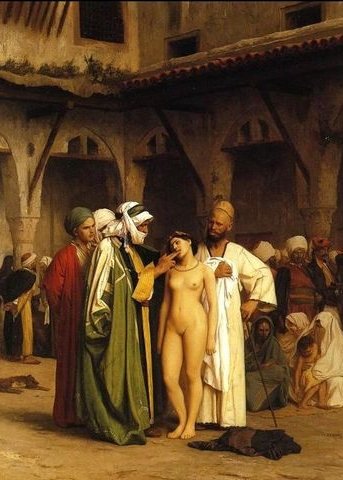
The Slave Market by Jean-Léon Gérôme

The Slave Market by Jean-Léon Gérôme (1866)

Today I am returning to the nineteenth century French academicism painter and sculptor Jean-Léon Gérôme, looking at his early life and featuring one of his works.  I had previously featured this artist in My Daily Art Display of February 10th 2011 when I talked about his painting entitled A Roman Slave Market.

Jean-Léon Gérôme was born in 1824, in Vesoul; a small town close to the city of Besançon and near to the French-Swiss border.  He was the eldest son of Pierre Gérôme, who was a goldsmith by trade, and his wife Claude Françoise Mélanie Vuillemot, a daughter of a merchant. He initially attended school locally in Vesoul where he was looked upon as a star pupil and attained a good deal of academic success culminating in being awarded first prize in chemistry, and an honourable mention in physics.  From the age of nine he took drawing lessons under the tutelage of Claude-Basile Cariage and when he was fourteen years of age he received formal art tuition and was viewed as a great up-and-coming talent and he received a prize from the school for one of his oil paintings.    At the age of sixteen, with his school days behind him, he set out for Paris with a letter of introduction to the French painter Paul Delaroche who at this time was at the height of his fame.   Delaroche’s artistic style was a blend of the academic Neo-classical school and the dramatic subject matter favoured by the Romantics.  This combination was to become known as the historical genre painting style. Gérôme was to be greatly influenced by the paintings and the tuition he received from Delaroche.

In 1845, after three years of studying under Delaroche and having just returned to Paris after a visit to his home in Vesoul, Gérôme discovered that Delaroche had closed his studio.   Delaroche had just suffered the loss of his wife, Louise, whom he deeply loved and whom he had depicted in many of his paintings.   Gérôme discovered him to be in the depths of depression following the death of his wife and was about to close his atelier and journey to Italy. Gérôme asked if he could accompany him.  Delaroche agreed and the two of them along with a couple of other of Delaroche’s students, one of which was the English painter Eyre Crowe, set off on their painting trip.

Gérôme stayed in Italy and visited Naples where he viewed the ruins of Pompeii and Herculaneum which were to become the foundation for his gladiatorial depictions.  His sojourn in Italy was cut short in 1844 when he contracted typhoid fever and he had to return home to Versoul where his mother nursed him back to health.  Later that year, fully recovered, he returned to Paris and entered the atelier of the Swiss painter and teacher Charles Gleyre.   Gleyre was to guide many young aspiring artists who would become famous household names, such as Monet, Renoir, Bazille and Whistler.  From the studio of Gleyre, Gérôme went on to attend the École des Beaux-Arts.

Meanwhile, Delaroche, who had remained in Rome, returned to Paris to work on an important commission.  Delaroche offered Gérôme a position as his assistant on the commission and so Gérôme left Gleyre’s studio to work with his former master.  He remained as Delaroche’s assistant for just on a year. Whilst working alongside Delaroche, he was encouraged to prepare paintings for the Salon exhibitions and within a short time, his talent as an artist was recognised and he was commissioned to paint a reproduction for the Queen. This was to be the start of many official and lucrative commissions. In 1846 Jean-Léon Gérôme began to work on one of his most famous paintings – Young Greeks Attending a Cock Fight.  Gérôme had just suffered the setback at the École des Beaux Arts of not achieving his main aim that of winning Prix de Rome prize, which would have given him a scholarship to travel to and study in Rome.  He was probably questioning his own ability and was somewhat hesitant to submit his painting to the Salon jurists, but on Delaroche’s insistence, he did and it was accepted into the 1847 Salon and hailed a great success.  One of those to take a liking to his work was the art critic and poet, Théophile Gautier, who would later support Gérôme throughout most of his career.  Gautier’s commendation of The Cock Fight made Gérôme famous and his artistic career was well and truly launched.

Gérôme travelled extensively visiting Turkey in 1855 to make studies for a large official commission, and two years later journeyed to Egypt in preparation for the Salon of 1857 in which his first Egyptian genre paintings were shown.   In the 1860’s he returned to Egypt and also visited Judea, Syria and the Holy Places.   Gérôme was fascinated with the Near East and many of his subsequent works highlighted the Near East culture and traditions and it was to mark the start of his career as an Orientalist or a peintre ethnographique.

The painting by Jean-Léon Gérôme which I am featuring today was completed by him in 1866 and is entitled The Slave Market.  It is without doubt one of Gérôme’s most provocative works.  The scene is set in a market place in a Near East country, more than likely, Egypt.  The idea for this painting and others featuring the slave market probably came to Gérôme during his Near East travels, when slavery was still practiced.  However the open air slave market as shown in this painting did not exist in the mid-nineteenth century and so this should be viewed as an idealised depiction.  The artist has put a great deal of effort into details of the costumes worn by the traders as well as the way in which he has carefully depicted, in detail, the architecture of the surrounding buildings.  In the centre of the painting we see a nude woman who is being offered up as a slave and is surrounded by a group of prospective buyers.  One of these men, dressed in a gold and green covered cloak, examines the “goods” on offer.  His left hand holds the back of the woman’s head whilst the fingers of his right hand are forced into her mouth so he could better examine her teeth.  Behind the woman stands the seller and from the smile on his face he seems assured that he is about to be paid handsomely for the woman.  There can be no doubt that prospective buyers of this painting were not totally absorbed by the way the artist depicted the clothes worn by the prospective buyers or with the architecture of the building in the background.  They were sold on the erotic nature of the painting.  Viewers were able to be vociferous in their condemnation of the slave trade whilst enjoying the sight of the female body.

The painting was acquired by Sterling and Francine Clark in 1930 and is part of the Sterling and Francine Clark Art Institute in Williamstown, Massachusetts collection but is currently (until September 23rd) on view at the Royal Academy, London.

The Clothed Maja and The Nude Maja by Goya

La Maja Desnuda (The Naked Maja) by Goya (c.1797-1800)

I ended my last blog with the tantalising statement:

“…I will offer you a work by another famous Spanish artist, Francisco Goya, and tell you about the connection it has with myself, as a naughty schoolboy, and my first sighting of erotica !!!!…”

I suppose I will be accused of cynically employing cheap tactics in order to get people to read my blog but there is a connection between the two Goya paintings I am featuring in this blog with the dubious habits of a young school boy.   My early school days were back in the late 50’s and the first sight of what I loosely termed as “early erotica” came in the form of a pen.  It was not just any pen.  It was a pen which had a picture of a beautiful and fully clothed young woman.  However the titillating aspect about the pen was that if you  turned the pen upside-down the clothed lady slowly shed all her clothes !!!

La Maja Vestida (The Clothed Maja) by Goya (c.1800)

Today I am looking at, not one painting by Francisco Goya, but two, albeit as you will realise, they are almost the same except for one major exception.  His two paintings are entitled La maja vestida (The Clothed Maja) and La maja desnuda (The Nude Maja) were painted around 1800 and 1803 and the only difference between the two is that in one the woman is fully clothed whilst in the other she is naked.  I suppose the first question that comes to one’s mind is who is this lady and how come Goya painted her reclining portrait.  The question has never really been answered but the names of two ladies are often bandied about by historians as being this sultry temptress.  The two candidates are the 13th Duchess of Alba and Pepita Tudó.

The Duchess of Alba or to give her, her full title, Doña María del Pilar Teresa Cayetana de Silva-Álvarez de Toledo y Silva, the 13th Duchess of Alba de Tormes was a Spanish aristocrat who featured in a number of Goya’s paintings.  Francisco de Goya profited from wealthy patronage probably more than any other artist. He was without doubt the darling of the Spanish monarchy.  His first appointment as court painter came from King Charles IV of Spain. The King and his wife, Queen Maria Luisa, sat for the artist themselves many times.   For their portraits they would dress in the most colourful and showy costumes adorned with the royal regalia.  Besides the royal portraits Goya received many lucrative commissions from other high-ranking government officials as well as requests for altarpieces for churches and cathedrals.  However without doubt and notwithstanding his many prominent sitters, one stands out above all the others – the 13th Duchess of Alba.

The Duchess of Alba was not just any royal courtier.  She was a very wealthy and powerful woman in her own right.  She was a  member of Spanish nobility and held the title of 13th Duchess of Alba.  She married José María Alvarez de Toledo y Gonzaga, who was the 15th Duke of Medina-Sidonia, and she became the wealthiest woman in Spain. She was quite a character.  Besides her natural beauty, she was the height of eccentricity, and very strong-willed.  Goya was besotted by her and rumours had it that, at one time, the two were lovers.  He recounted the time she came to his studio and asked him to apply her make-up:

“…the Alba woman, who yesterday came to the studio to make me paint her face, and she got her way; I certainly enjoy it more than painting on canvas, and I still have to do a full-length portrait of her…”

It has been suggested that the two paintings were originally owned by the Duchess of Alba and later acquired by Manuel de Godoy after her death. Goya’s close and intimate relationship with the Duchess of Alba has made her the most popular candidate as a model for the Majas, or at least as a source of inspiration.  Another persuasive argument in favour of this candidate is the many drawings of herself and members of her household Goya made during his visits to the Duchess’s country estate. However the face of the Majas does not show a close resemblance to the facial qualities of the drawings of her but this could be put down to the need to conceal her identity.

The second candidate for the model in Goya’s two paintings was Pepita Tudó, whose full name was Josefa de Tudó, 1st Countess of Castillo Fiel.  Pepita being the diminutive of Josefa.    She was born in Cadiz.  When she was just sixteen years of age, she along with her mother and two sisters, were living in the household of Manuel de Godoy.  Five years later, aged twenty-one, she became the mistress of Godoy who was then Spanish Prime Minister and because of the influence he had with King Charles IV and his wife Queen Maria-Louisa he became one of the most powerful men in Spain.  In 1797, Queen Maria Luisa arranged a marriage for Godoy toMaría Teresa de Borbón y Vallabriga, 15th Countess of Chinchón, the granddaughter of Philip V of Spain, despite him still having Pepita as his mistress.  This was an arranged marriage, set up by the queen as the bride and groom had never met.  The Queen ensured that the partnership was financially advantageous to both bride and groom.  So what was in it for the Queen?  Historians would have us believe that the queen’s ulterior motive was two-fold.  Firstly she had hoped that the marriage was a way of ending Godoy’s dalliance with Pepita and secondly the marriage would act as a cover for her own relationship with Godoy. Godoy was pleased with the arrangement as it boosted his finances and despite what the queen had hoped for, he continued his liaison with his mistress Pepita,  who bizarrely lived in the same house as his wife.  In 1805, Godoy’s wife gave birth to a son, Manuel, and in 1807, she gave birth to another son, Luis.  His wife died in 1828 and Godoy married Pepita although rumour had it that they had married years earlier.  Godoy was a very amorous and amoral man and had many lovers but who was his one true love –the Duchess of Alba or Pepita?  According to the ninety-year old Pepita who died in 1869, Godoy had one, and only one true love, and that was Queen Maria Luisa.

The paintings I am featuring today were possibly first owned by Manuel de Godoy.   The Clothed Maja was hung in a room in his house and placed on top of The Naked Maja.  He had arranged a pulley mechanism to be attached to The Clothed Maja so that it could be raised, revealing the naked version which was behind it !!!

In 1807 Godoy was at the height of his power and as prime minister had negotiated the Treaty of Fontainebleau with Napoleon and the French, which in essence carved up Portugal and Godoy was awarded the “Principality of the Algarves”, under the protectorate of the King of Spain. However as is the case of most powerful men he had made a number of enemies, one of whom was the heir to the Spanish throne, Ferdinand VII.   Unfortunately for Godoy France did not keep to their non-aggression treaty with Spain and Godoy, along with King Charles IV and Queen Maria Louisa went into exile in Bayonne.  Charles IV was forced to abdicate and Ferdinand VII, Godoy’s enemy, became king of Spain.

The following year, in 1808, all Godoy’s fate was sealed.  His property was seized by the Spanish monarch and in 1813 the Spanish Inquisition confiscated both of the La Maja works considering them to be obscene.  In 1815 Goya was denounced to the Inquisition as being the artist who painted the two “obscene” works.  In May of that year he was summoned to appear before the Inquisition and pressure was brought to bear on him to reveal who had commissioned the works, who were the women and what were his intentions for such paintings.  Alas, it is not known what Goya told his inquisitors.

Las Majas at the Prado Museum, Madrid

The two paintings were eventually returned in 1836 and housed in the Academy of Fine Arts of San Fernando.   We will probably never be one hundred per cent sure as to who modelled for the two paintings.  Since 1901, both The Clothed Maja and  The Nude Maja have been exhibited side by side in the same room at the Prado Museum in Madrid.

Thankfully there was no Inquisition around when, as a pre-teenager, I giggled as I watched the woman’s clothes disappear with just a flick of my prized pen !!!!

I send this blog from a very hot Spain and I am reluctant to return to the cold and wet place I call my home.

The Waterseller of Seville by Velazquez

The Watersellerof Seville by Velazquez (1623)
Apsley House, London

At the end of this week we are off on a five-day jaunt to Spain to sample the delights of the Spanish Paradores and so I thought it would be fitting to have my next few blogs focus on Spanish painters.   Today I want to start by looking look at the connection between a famous Spanish painter and an English fighting hero.  I want to explore the connection between the talented Spanish artist Velazquez and the great British general, Arthur Wellesley, the Duke of Wellington.

My Daily Art Display today features not just one work but three very similar works, which were completed by the young aspiring Spanish artist in the early 1620’s and who was to become one of the greatest painters of all time.  His name was Diego Rodriguez da Silva Velazquez.  The works I want to look at today were all painted when he was in his early twenties. The paintings in which Velazquez specialised during his early career were known as “bodegones“.  The word derives from the Spanish word, bodegón which lierally means taven or public eating place.   In Spanish art, a bodegón is a still life painting depicting the preparation or eating of food, pantry items, such as victuals, game, and drink, often arranged on a simple stone slab, and also a painting with one or more figures, but significant still life elements, typically set in a kitchen or tavern. These works often depicted scenes of lowlife in earthy tones, and with a sense of sombre pathos, which were unlike similar works by the contemporary the highly-colourful Dutch and Flemish genre scenes by the likes of Jan Steen and Pieter Aertsen with their depictions of the happy, but poor, peasants.

The title of Velazquez’s  three painting is The Waterseller of Seville.   Hecompleted these works during the period from 1618-1622.    Art historians would have us believe that these works were the greatest of all his Seville paintings.   Velazquez painted three versions of the work.  The one shown above can be seen in the Apsley House in London.  Another version of the painting, which was completed three years earlier, can be found in the Uffizi Gallery of Florence.  The third version of the work hangs in the Walters Art Museum  in Baltimore.

Let us take a look at the paintings in detail.  Before us Velazquez has portrayed a waterseller in the city of Seville. During the scorching heat of a Spanish day, to come across a waterseller would be a godsend.   The role of a waterseller in Spain in those days was a common trade for the lower classes in Seville.  The aguador was often mentioned in popular satirical Spanish literature, plays and popular imagery.  The aquador or waterseller was frequently portrayed as a scoundrel or pathetic peddler, who operated on the fringes of urban society and hawked his often dubious wares to an unsuspecting public.  This street water-seller was nicknamed the Corsican of Seville and who, according to accounts from the end of the 17th century, wore a smock with holes in it to show his scabs and sores to potential customers so as to eke out some sympathy whilst at the same time, boost trade.     In Velazquez’s painting we can see that the vendor of water has two customers.  One is a young boy and it is thought that the artist has used the same model for this work that he used in his earlier works, entitled The Lunch and Old Woman Cooking Eggs, a painting I will look at in my next blog.  In the background and somewhat harder to discern is another young man who has also purchased a small jug of water from the seller.

In the foreground of the painting we have very large jugs of water.  Rivulets and glistening water drops slowly run down the ridges of this massive jug.   Observe how Velazquez has cleverly depicted this main jug.  It appears so close to us.  It almost seems to bulge out of the painting.   The chalice-like goblet, held by the young boy, holds centre stage as the light falls on it.  Look carefully at the glass.  It is not just a simple glass of pure water but in it floats a fig.  This addition of the fruit was to act as a kind of perfumer with the intention of making the water taste fresher.

The Waterseller of Seville by Velazquez, (1618)
The Uffizi Gallery, Florence

The most striking aspect of this painting is how Velazquez has portrayed the water seller.   This is not a rich man.  This is a man who has had to eke out every peseta the hard way.    His facial expression is downcast. He has a look of resignation as he hands the boy the glass of water.  The man behind, who is shown full face, can be seen quaffing water from a lifted jar.  He has almost faded into the darkness of the background.   The features of the water seller, due to his days on end of standing out in the harsh sunlight, have taken its toll.  His face is rather haggard with age and ravaged and wrinkled by its exposure to the sun.  He has been plying his trade for many years, never able to accrue enough to retire.   The Apsley House version of the painting shows the seller bare-headed and in this version we can observe his short shaved hair.   Velazquez’s aged aguador stands in profile in the company of two of his clients.   He is dressed in coarse, monk-like robes.  Look at his eyes.  There is little or no eye contact between him and the boy.  He gazes blankly.  He seems to be lost in thought and has little or no regards to what is happening around him.   The offering of water seems to be just a mechanical movement.   The boy whose downcast, three-quarter glance is highlighted by a stream of light, hesitantly grasps the proffered goblet of water.  He does not make eye contact with the waterseller.  Is he too embarrassed by the plight of the old man?  Velazquez in his depiction of the man and the boy has highlighted the sharp contrast in their lives.  The battered and scarred face of the water seller contrasts greatly with the smooth white facial features of the young boy.

The Waterseller of Seville by Velazquez,(1620)
Walters Art Museum Baltimore

Velázquez’s portrayal of the waterseller is very profound.  One can see that he sympathises with the man and his terrible “lot in life”, by the way he has portrayed the man.  We can see that he shows consideration for  the poverty and age of the street-seller, and has, in some ways, given him an air of quiet dignity .  Velazquez by his depiction has represented a true-to life depiction of the waterseller and his trade.  His carefully crafted work encapsulates the imperfections of the seller’s pots, the saturations of dampness on their sides, the glistening of the light on the small drops of water and the glass, and the realistic expressions of the characters.

So what about the connection I mentioned in my introduction that this painting, the one which presently resides in Apsley House,  had a connection with Arthur Wellesley, 1st Duke of Wellington?   Apsley House, also known as ‘Number One, London’ stands on the north side of Hyde Park Corner. It is the magnificent former home of the Duke of Wellington and was granted to him by a grateful nation.

The “Waterseller” painting originally was a prized part of the Spanish royal collection.   In 1700 it figured in the inventory of the Buen Retiro Palace in Madrid.   By the late 18th century it hung in the Royal Palace in Madrid. There it struck the fancy of Napoleon’s brother Joseph Bonaparte, who was the commander of French forces in Spain during the Peninsular War and, who for a short time was the usurper of the Spanish throne.  When the French realized they were about to be driven from Spain by the Duke of Wellington, Joseph Bonaparte decided to leave Madrid but he was not going to leave the city empty-handed as he plundered numerous royal treasures before quickly retreating northward with his troops.  However Joseph Bonaparte was not able to reach the sanctuary of France as he was caught by Wellington and his troops just as he was about to cross the Pyrenees.  Wellington defeated Bonaparte at Vitoria and recovered from Bonaparte’s baggage train a number of Spanish paintings that had been cut from their frames, including the “Waterseller”.   Wellington wanted to return the artistic treasures to the Spanish nation but the restored Spanish monarch Ferdinand VII gave them all to Wellington as a gift from a grateful Spanish nation. In the dining room of Wellington’s magnificent London mansion, Apsley House, the Waterseller of Seville hangs today as a fitting tribute to its liberator.