Famous Views of the Sixty odd Provinces by Utagawa Hiroshige. Part 2.

Title Page for the series Famous Places in the Sixty-odd Provinces of Japan by Hiroshige

Hiroshige was born in Edo (now Tokyo) in 1797 and grew up in a minor samurai family. His father was part of the firefighting force assigned to Edo Castle. It was here that Hiroshige was given his first exposure to art.   In 1811, young Hiroshige entered an apprenticeship with the celebrated Toyohiro Utagawa. After only a year, he was bestowed with the artist’s name Utagawa. He soon gave up in his role in the fire department to focus entirely on painting and print design. Hiroshige’s artistic genius went largely unnoticed until 1832.  In Hiroshige Utagawa’s groundbreaking series of Japanese woodblock prints.  The 53 Stations of the Tokaido which he produced between 1832 and 1833, he captured the journey along the Tokaido road, the highway connecting Edo to Kyoto, the imperial capital. With the Tokugawa Shogunate relaxing centuries of age-old restrictions on travel, urban populations embraced travel art and Hiroshige Utagawa became one of the most prominent and successful ukiyo-e artists.

Chikugo Province, The Currents Around the Weir by Hiroshige. Print from Hiroshige’s Famous Views of the Sixty-odd Provinces series.

Chikugo River

The Chikugo Province can be found in southern Japan in Fukuoka Prefecture. In this print by Hiroshige, the Chikugo River can be seen flowing through the foreground, as it separates Chikugo Province on the left from Chikuzen Province to the seen in the bottom right. The village of Haki appears within the trees of the far bank, as the mountains rise above the pink clouds of sunset. The river is a much-loved spot for fishing and the choice of fish is the Ayu.  The Ayu often referred to as the is one of Japan’s best summer foods, known for its delicate flavour is found in Japan’s rivers.  It is a small, slender fish that thrives in spotless and clear water. This characteristic has earned it the elegant nickname “the queen of clear rivers” in Japan.

Satsuma Province, Bo Bay, The Two-sword Rocks by Hiroshige Print from Hiroshige’s Famous Views of the Sixty-odd Provinces series

In the print entitled Satsuma Province, Bo Bay, The Two-sword Rocks we are treated to a remarkable view of the “Two-sword Rocks” in Bo Bay, which are two rock pillars extend skywards from the water, as viewed from Mount Use. Two boats are depicted in the print, one a ferry which transports a couple of passengers across the river passing close to the strange rock formations.  Many other smaller rocks forming small islands can be seen in the distance as well as white-sail boats on the rosy coloured horizon.   This was another example of Hiroshige using a vertical print.

Bitchu Province, Gokei by Hiroshige Print from Hiroshige’s Famous Views of the Sixty-odd Provinces series

The small waterfalls in the Makadani River

The Bitchū Province was a province of Japan situated on the Inland Sea side of western Honshū, in what is today western Okayama Prefecture.  This is another of Hiroshige’s beautiful landscape prints which depicts the Gokei Valley with the Makidani River rushing through, crashing over many waterfalls on its relentless journey.  Like the previous print we see the rock formations reaching vertically towards the sky. On the left of the river, we see tiny citizens walking along the riverbank. Hiroshige forgoes the fiery shades of fall but concentrates on emphasizing the monumentality of the landscape through the scale of the travellers and trees. The minute size of the pedestrians, who walk along the riverbank, gives us a sense of how big the valley sides are and how it emphasizes the enormous granite peaks along the valley.

Izumo Province, Taisha, Depiction of Hotohoto by Hiroshige Print from Hiroshige’s Famous Views of the Sixty-odd Provinces series

Izumo Taisha Shrine (Izumo Grand Shrine)

Beneath a canopy of cedar, three women pass through the grounds of the Izumo Grand Shrine. The great Shrine of Izumo Taisha is one of the most important ancient shrine in Japan. It was said to be the oldest, known to have existed at least the 7th Century, according to Japan’s oldest chronicles. The main building was built on 1744 and apparently has undergone 25 reconstructions.  It was dedicated to the kami Okuninushi, the deity of earth and the harmony of nature, agriculture, and medicine. He was also believed to bring happiness and harmony to human relationships, that is why it magnetizes lots of young women who wish to be married.  In the print we see that fog has reduced most of the scene to silhouette, the women carry trays laden with auspicious symbols of the New Year. Hotohoto is a New Year’s celebration local to the region. The festival takes its name from the onomatopoeia of knocking on a door. There are different traditions associated with this festival, including leaving rice cakes (mochi) on the doorstep for a god’s messenger to replace with a straw craft, or children going door-to-door to receive mochi and small gifts. Today, the former Izumo Province belongs to modern Shimane Prefecture.

Tanba Province, Kanegasaka by Hiroshige. Print from Hiroshige’s Famous Views of the Sixty-odd Provinces series

Tanba Province was one of the old provinces of Japan, located in San’indo. It covered the middle part of the present Kyoto prefecture, At the bottom of Hiroshige’s print we can see a narrow path which rises sharply along the mountainside before it disappears beyond the horizon. The area is located on a connecting road to northern Kyoto.  As one can see, it is a difficult and dangerous upward climb which was ultimately thought too steep for travel.

Meiji-period tunnel

To solve the problem the Meiji-period tunnel built in its place still stands today. In the top right of the print one can see that Hiroshige has depicted the arch between two rock formations as a stone beam.  It is thought that he came to know about this structure through travel guides (meishoki) or other paintings of Kanegasaka. Today, the former Tanba Province belongs to central Kyoto Prefecture and east-central Hyogo Prefecture.

Sado Province, The Goldmines by Hiroshige Print from Hiroshige’s Famous Views of the Sixty-odd Provinces series.

In Hiroshige’s print of the Sado goldmines we see a lush green forest which gives way to the rocky entrance to the mine. Miners dot the foreground as the mountainside opens into three mining shafts, each internally reinforced with wood. While the island had been known for its gold since the 12th century, the gold from Sado became an important source of wealth for the Tokugawa shogunate during the Edo period. Though the local economy prospered from the mines in the 17th century, by Hiroshige’s time the veins were running dry and the working conditions had significantly declined. The mines finally closed in 1989. Today, the former Sado Province corresponds to Sado Island in Niigata Prefecture

Doyu no Warito goldmine on Sado Island

Doyu no Warito is a relic of opencast mining from the Edo Period (1603-1867), which is said to be a pit in the early stages of the development of Sado’s gold and silver mines. As the digging went deeper and deeper to extract more gold ore, the mountaintop was split into a V-shape. The crack on the summit reaches approximately thirty metres in width and seventy-four metres in depth. The mountain with the crack holds a mother lode of gold, stretching about ten metres wide, called the Doyu Vein, and after the Meiji Period (1868-1912), large-scale development was carried out under the Warito. Today, the former mining area is a tourist attraction and has been nominated as a World Heritage Site.

I will conclude this blog with a quote from Charles Holmes’:

“…Hiroshige can be of service to us in another way. He is perhaps the artist through whom the great Japanese masters may best be approached by Europeans. The originality and force of his design, the brilliancy of his colour, his fairly successful realism, and more than all, his evident seriousness, his open sympathy with what has seemed admirable to our romantic tastes, render him attractive at once. His great predecessors are more reticent, more abstract, more remote from us. It is hardly surprising, then, that the painter who, in our own times, has assimilated most perfectly the spirit of Japan should have received this inspiration in the main from Hiroshige. To have a share with Velasquez in the making of Mr. Whistler’s style is no slight honour, and among the artists of modern Japan – the Japan of the last fifty years – there is no other who deserves it so well...”


Apart from various Wikipedia sites the information for this blog came from:

ISSUU – Hiroshige: Famous Places in the 60-odd Provinces -Ronin Gallery

Fuji Arts

Viewing Japanese Prints

The Woodblock Prints of Utagawa HiroshigeAppreciation by Charles Holmes

Benjamin Robert Haydon. Part 4.

The sad ending to life.

In the previous blog I told you about Benjamin Haydon’s trip to Paris with his friend David Wilkie.   The journey began at the end of May 1814 when the pair were able to take advantage of the ending of hostilities between England and France.  Whilst in the French capital the two artists spent time at the Louvre  and see the art collections gathered by Napoleon from across Europe.  

Portrait of Emperor Napoleon I by François Gérard (1815)

They also visited François Gérard’s studio.  Gérard was one of the foremost portrait-painters of the day and had eight of his portraits accepted at the 1808 Salon and fourteen in the Salon of 1810.  His portraiture depicted all of the leading figures of the French Empire and of the Bourbon Restoration, as well as all of the most celebrated men and women of Europe and his Paris studio was often a meeting place for upper-class society. 

Napoleon Bonaparte as First Consul by François Gérard (1803)

When Haydon and Wilkie visited the studio Haydon was most impressed by Gérard’s portraits of Napoleon Bonaparte and he became captivated by the French leader.

Napoléon Bonaparte (‘Napoléon on St Helena’) by Benjamin Haydon (1830)

Haydon painted over two dozen of pictures of Napoleon, even bought his death mask and tried on one of the emperor’s hats.  In his portrait of Napoleon entitled Napoleon on St Helena we see the French leader in a thoughtful, meditative mood, pondering on his past triumphs and calamities.  One of the first of Haydon’s Napoleon portraits was for the lawyer, Thomas Kearsey, in 1829 and the following year it was exhibited at the Western Exchange.   A whole-length version above, entitled Napoleon Musing at St Helena was commissioned by Sir Robert Peel. Many others followed including Napoleon Meditating at Marengo and Napoleon Contemplating his Future Grave.

Arthur Wellesley, 1st Duke of Wellington by Benjamin Haydon (1839)

Having completed the depiction of the French leader pondering his triumphs and failures whilst on St Helena, Haydon wanted to produce a companion piece featuring the great British military leader, Arthur Wellesley, the Duke of Wellington.  The painting was to depict  Wellington overlooking the rolling fields at Waterloo at sunrise, a companion piece to Napoleon Bonaparte on St Helena gazing across the sea at St Helena.

In a way the portrait has an element of sadness as we see the ageing hero, who is not adorned in his military uniform but is dressed in civilian clothes.  The painting completed in 1839 by Haydon is almost twenty-five years after the Battle of Waterloo and twenty years after Wellesley finally left the military and entered the world of politics.  In the work we see Wellesley looking out over the scene of his greatest triumph at Waterloo. The Duke who was seventy at the time of the portrait disliked sitting for his portrait, or at least he did at this time of his life

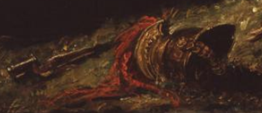
He was even more disinclined to lend Haydon the helmet and sword which we see in the left foreground. Haydon eventually persuaded the Duke to allow them to be used as “stage settings” for the work.  Haydon went on to paint twenty-five variants of the portrait, signifying his almost obsessive interest in the Duke.

The Raising of Lazarus by Benjamin Haydon (1821-23)

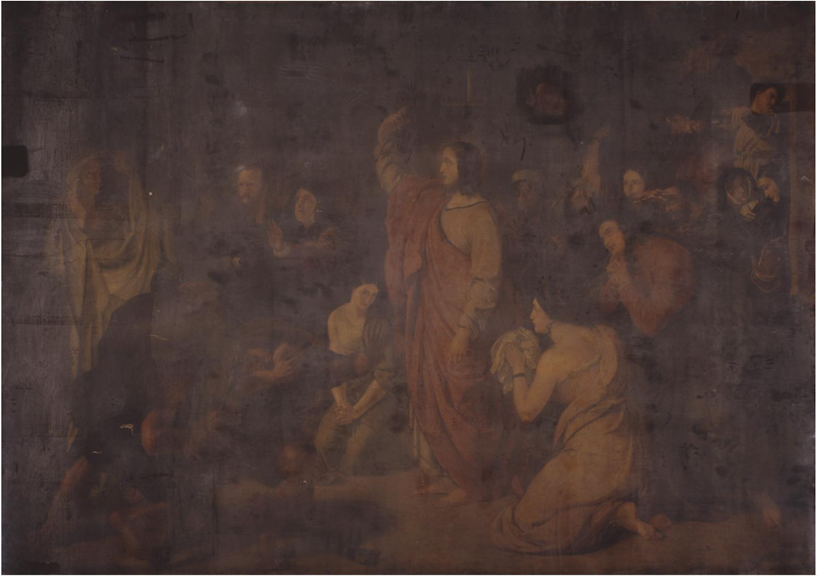
When Haydon began painting The Judgement of Solomon he had debts of more than £600. Two years later when he completed the work the size of his debt had doubled. In 1821 he embarked on his largest ever canvas (426 x 632 cms), The Raising of Lazarus and in that year, Haydon’s financial problems came to a head when he couldn’t fulfil his obligations to some people who had lent him money. He was admonished but only just avoided imprisonment.

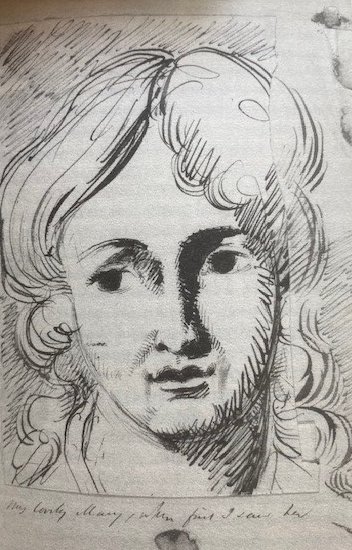
Mary Hyman – a sketch by Benjamin Haydon

It was in late Spring that Haydon first caught sight of Mary Cawrse Hyman whilst he was walking with his friend, Maria Foote, and he recounted that first glimpse of Hyman. In his journal he recorded the moment:

“…Not far from my house she requested me to stop a moment whilst she left a letter with a lady who was going into Devonshire. I waited; a servant came down, and requested I walk up……and in one instant the loveliest face that was ever created since God made Eve smiled gently at my approach…”

Haydon was besotted with her beauty and would spend hours walking by her home hoping to catch a glimpse of her. One “fly in the ointment” with Haydon’s hopes of happiness was that she was married and had two young sons, Orlando and Simon.

Later he made a sketch of her, from memory, in his journal and inscribed it:

“…My lovely Mary when first I saw her…”

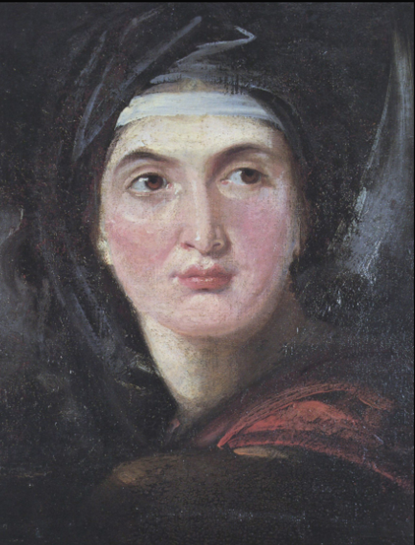
Mary Haydon as the Delphic Sibyl, by Benjamin Robert Haydon (1821)

Mary’s husband, a Devonport jeweller, was much older than his wife and was unwell. He actually died in 1821, three years after Hayman had had that first encounter with Mary. Mary Hyman and Benjamin Haydon married on October 10th 1821 at Church of St Mary le Bone. His friend David Wilkie witnessed the ceremony and he and Haydon drank many toasts to a successful marriage. This ready-made family added more financial pressure on Haydon and a day after the marriage ceremony Haydon was arrested because of he was unable to pay his creditors. Haydon, accompanied by the Sheriff’s Officer, went to the home of David Wilkie to see if his friend would stand guarantor for the debt but Wilkie was reluctant until Haydon managed to negotiate with his landlord a longer time to repay him and so Wilkie agreed to help his friend. Haydon in typical fashion wrote to Wilkie the following day berating him for his unfriendly behaviour. Wilkie, who had reluctantly agreed to stand guarantor, was horrified by Haydon’s words, said to be a mixture of sarcasm and truth, upbraiding him for his unfriendly behaviour.

The Mock Election by Benjamin Haydon (1827)

On December 12th 1822 Mary gave birth to their first child, a son, Frank. He was the first of eight children fathered by Haydon, although sadly, five died in infancy. Haydon’s financial difficulties increased with the enlargement of the family and lack of sales of some of his works and this resulted him spending time in the debtor’s prison on a number of occasions.

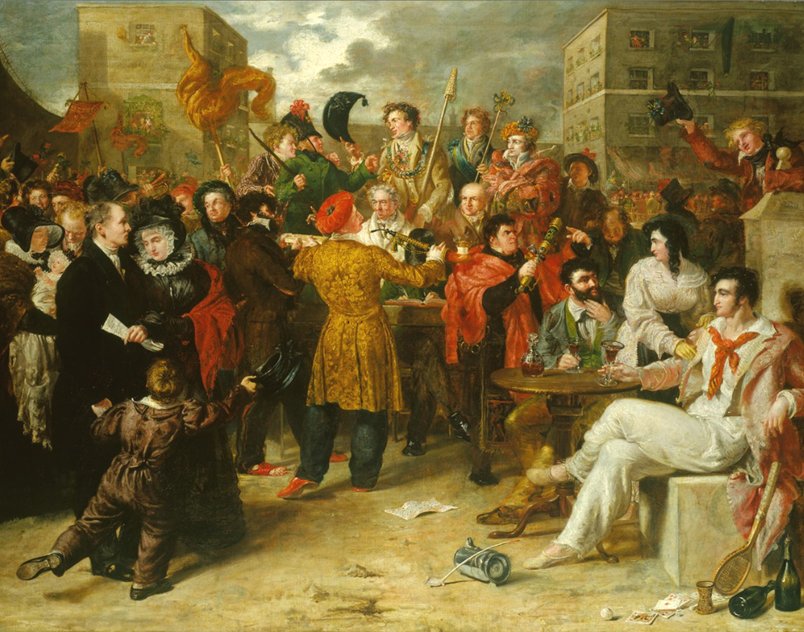
His second such incarceration was in 1827 when Haydon was in King’s Bench Prison for debt. It was whilst staying here that he observed other inmates putting on a sham election in order to open a poll for the election of a member to plead for their parliamentary rights, which had been taken from them once they were imprisoned. It was proposed that they should elect a member of parliament to represent Tenterden, (a slang name for the prison).  Three candidates stood for election, one of whom was Lieutenant Meredith, a veteran of the Peninsula War. It was just like a normal election with addresses made by the candidates’ placards were printed and affixed to the walls of the prison and the electors were invited to attend the poll on Monday morning, the 16th of July.  Haydon recalled the riotous scene:

“…… As I approached the unfortunate, but merry, crowd, to the last day of my life I shall ever remember the impression… baronets and bankers, authors and merchants, painters and poets… dandies of no rank in rap and tat-ters… all mingled in indiscriminate merriment, with a spiked wall, twenty feet high, above their heads…”

King George IV bought the painting and gave Haydon 500 guineas.

Chairing the Member by Benjamin Robert Haydon (1828)

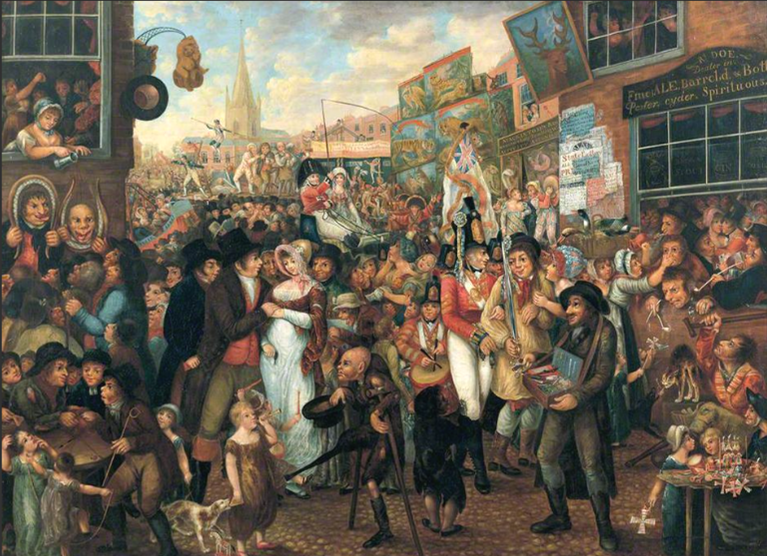
Probably Haydon’s best-known non-biblical works were painted around 1829.  In August 1828 he completed his large oil on canvas work entitled Chairing the Member. Haydon had been so encouraged by the sale of The Mock Election to George IV that he painted a companion piece, Chairing the Member, and returned to the prison to make drawings of some of the inmates. Later a third painting of contemporary life depicted in his painting entitled Punch and May Day in the New Road at Marylebone. He had great hopes that George IV would buy these works as well but he was to be disappointed, a setback he blamed on the actions of the Keeper of the King’s Pictures, William Seguier.

Chairing the Member is a crowd scene, the main characters of which are in a riotous mood brought on by an excess of alcohol.  In the background, we can see two men being hoisted aloft on the shoulders of their friends.  In the centre foreground we observe a man wearing a red waistcoat and coat, white breeches and a Napoleonic hat carrying a long pole attempts to challenge three guards, who stand on guard, seemingly unaffected by the riotous behaviour of the crowd.  A small child also grips the pole.  To the right we see a man slouched drunkenly on a stool still gripping a bottle of ale.  A woman, adorned in a black dress and wearing a white bonnet with pink ribbons, holds the man’s shoulders to prevent him falling off the stool.  A small child with a hoop stands in front of the seated man and places her hand on his thigh in order to steady him.  To the left, on the ground, we see a man slumped under a table, atop of which are glasses and glass decanters of wine.  Also, below the table, on the ground by the fallen man’s feet, is a small barrel in which are a pineapple and two other bottles wine. The whole disorderly scene is closely watched by an elderly man from an upstairs window on the right and, to the left, another man hangs out of an upper window below a red flag and toasts the revellers.  The painting is now part of the Tate Britain collection.

Punch or May Day by Benjamin Haydon (1829)

In 1829, a year after the completion of Chairing the Member, Haydon completed another work that depicted people enjoying themselves.  Initially Haydon had thought to entitle the work, Life, as it would encapsulate everyday life of everyday people but he later gave the work the title, Punch or May Day.  Hayden resolved to highlight the contrasts of everyday life. We see a crowd of mixed classes, ages and races who happily mingle with a costumed procession and a Punch and Judy show in the Marylebone Road.   On the right we see a marriage coach in which are a bride and groom.  In the background we see a hearse.  The newlyweds, tranquil and happy, look out of the window of their coach at the mayhem of the Punch and Judy performance with all its violence.  Even the May Day celebrations and procession in Marylebone Road, which were pagan traditions, is set against a backdrop which includes the Christian church of St Marylebone.  Taking part in this parade is a young dancing chimney sweep with blonde curls and soot-blackened face. The boy’s lively countenance contrasts with the artist’s treatment of the austere black footman standing at the back of the wedding coach.  In the left foreground we see a barefooted female slumped on the ground next to a table of wares which she is trying to sell.  Haydon believed he was a great history painter but also believed, like the woman selling her goods, he and his paintings were similarly under-appreciated.  In contrast, next to the beggar woman, and attentively watching the Punch & Judy show is a man dressed in the finest expensive clothes.  Look closely and you will see he is just about to have his pockets picked by a young pick-pocketer. Standing by the wedding coach and peering around the cavalry officer is a Bow Street runner, who is watching the antics of the thief. Behind the dandy is a rosy-cheeked farmer up from the country. Close to the Punch & Judy stage, a woman holds up her baby aloft so she could see the puppets close up. Haydon had been living in London for twenty-five years and he had enjoyed the capital’s vibrancy and in this painting he had aimed to encapsulate this energy and the diversity of the inhabitants.

Venus and Anchises by Benjamin Haydon (1826)

Haydon became well known as a lecturer on painting, and in 1835 he began to travel around England and Scotland on lecture tours. He was also a fervent believer that the country’s public buildings should be decorated with history paintings showing the glories of the nation’s past.  No doubt he believed he could supply such great works.

Curtius Leaping into the Gulf by Benjamin Haydon (1843)

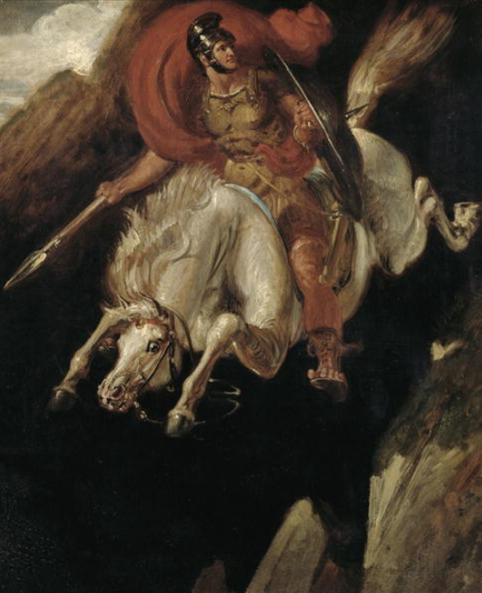
Curtius Leaping into the Gulf was a painting Haydon completed in 1843 and depicts an ancient Roman legend, the young Marcus Curtius, throwing himself into a huge crack in the ground that had opened up in Rome. According to legend, the Roman gods were satisfied with Curtius’s sacrifice and the crack closed again.  In this work, Curtius is a self-portrait of Haydon Whether it was just a coincidence that Haydon should choose the act of suicide for his Curius painting we will never know but what is known that Haydon talked about suicide as an escape from his own life on a number occasions and he had often discussed suicide and the reasons why a person would end their own life.  He was a devote Catholic, so for religious reasons he would never countenance the taking of his own life and yet by the mid-1840s life had become very difficult as a result of his financial difficulties and his constant begging of his friends to alleviate his poverty.  He was becoming desperate.  The day before his death he was out walking with his son, Frank, and expressed how he gained pleasure on the idea of throwing himself off the Monument and dashing his head to pieces.  The viewing gallery at the top of the Monument in London was a favourite place for people wanting to commit suicide and this was only curtailed when the whole of the gallery was encased in an iron cage.  Frank was worried by his father’s mood and pleaded with him to discard any thoughts of taking his own life.  Back home, Frank told his mother about her husband’s dark thoughts but she laughed it off. 

Bartholomew Fair by Benjamin Haydon

The next morning Haydon asked his wife to travel to Brixton to invite over one of his journalist friends, David Coulton, to discuss some business.  That next morning with his wife out of the house, Haydon went to the premises of Isaac Rivière, a gun-maker, and bought himself a pocket-sized pistol.  He arrived back home within the hour and locked himself in his painting studio, with his unfinished work, The Blessings of Justice: Alfred and the First Trial by Jury on an easel.  A portrait of his wife sat on a smaller easel.  He wrote a will, but as it had not been witnessed, was invalid.  He wrote short letters to some of his friends.  One letter was to Sir Robert Peel in which he wrote:

“…Life is unsupportable!  Accept my gratitude for always feeling for me in adversity – I hope I have earned for my dearest Wife security from Want…”

He also wrote a letter to his wife:

“…God bless thee, dearest love.  Pardon this last pang, many thou has suffered from me.  God bless thee in dear widowhood.  I hope Sir Robert Peel will consider I have earned a pension for thee.  A thousand kisses.  Thy husband & love to the last…”

He also wrote a short note to each of his sons and daughter asking them to look after their mother and lead a good and honest life.  He then opened his diary which he had been keeping for the last thirty-eight years and wrote in it:

God forgive me – Amen

Finis

Of B.R.Haydon

‘Stretch me no longer on this tough World’ – Lear

End

He then cocked his pistol and shot himself in the head.  His wife and daughter heard the bang but thought it came from the nearby barracks and ignored it.  The pistol Haydon had bought that morning was of such a low calibre the bullet although fracturing his skull, did not penetrate his brain.   Not to be thwarted he picked up one of his razors and made two cuts to his neck and throat.  His wife and daughter still had no idea of what was happening and both left the house.  Benjamin Robert Haydon lay on the floor and bled to death.

The Maid of Saragossa by Benjamin Haydon

Benjamin Robert Haydon died in his London home on June 22nd 1846, aged 60.  His wife survived him by eight years, dying on July 25th 1858 aged 61.

I recounted this life story of Haydon over four blogs and yet I have only scratched the surface of his life.  Before you judge Haydon, and if you would like to find out more about this talented painter, then I do recommend you reading  Paul O’Keeffe’s biography: A Genius for Failure, The Life of Benjamin Robert Haydon. It was from this book that I got the majority of information for these blogs.

Stacey Gillian Abe

When I was in London last week I made my first visit to the Unit London Gallery.  The gallery is in the heart of London’s Mayfair at No.3 Hanover Square which is off Regent Street, very close to Oxford Street underground station.  It is well known for representing some of the finest local and international talent, and provide an unhindered showcase for artists who operate outside of the mainstream art world  and by so doing, has successfully launched and enhanced the careers of many influential contemporary artists.

Unit London

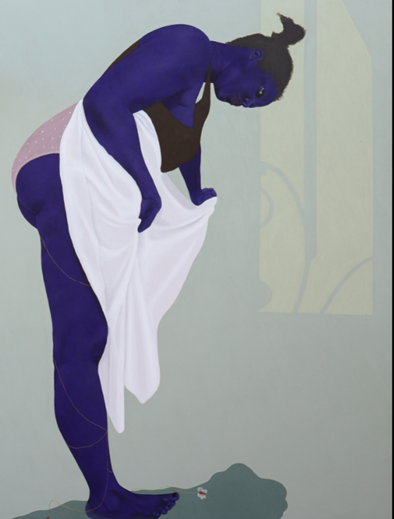
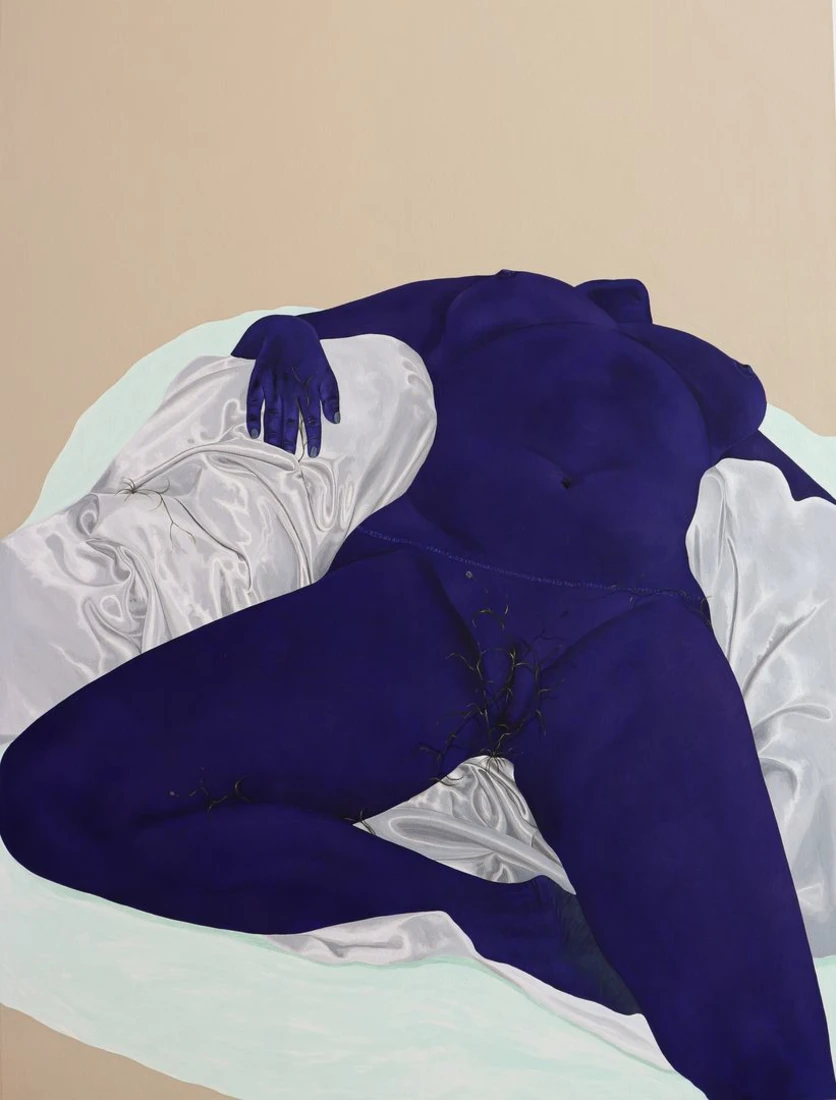
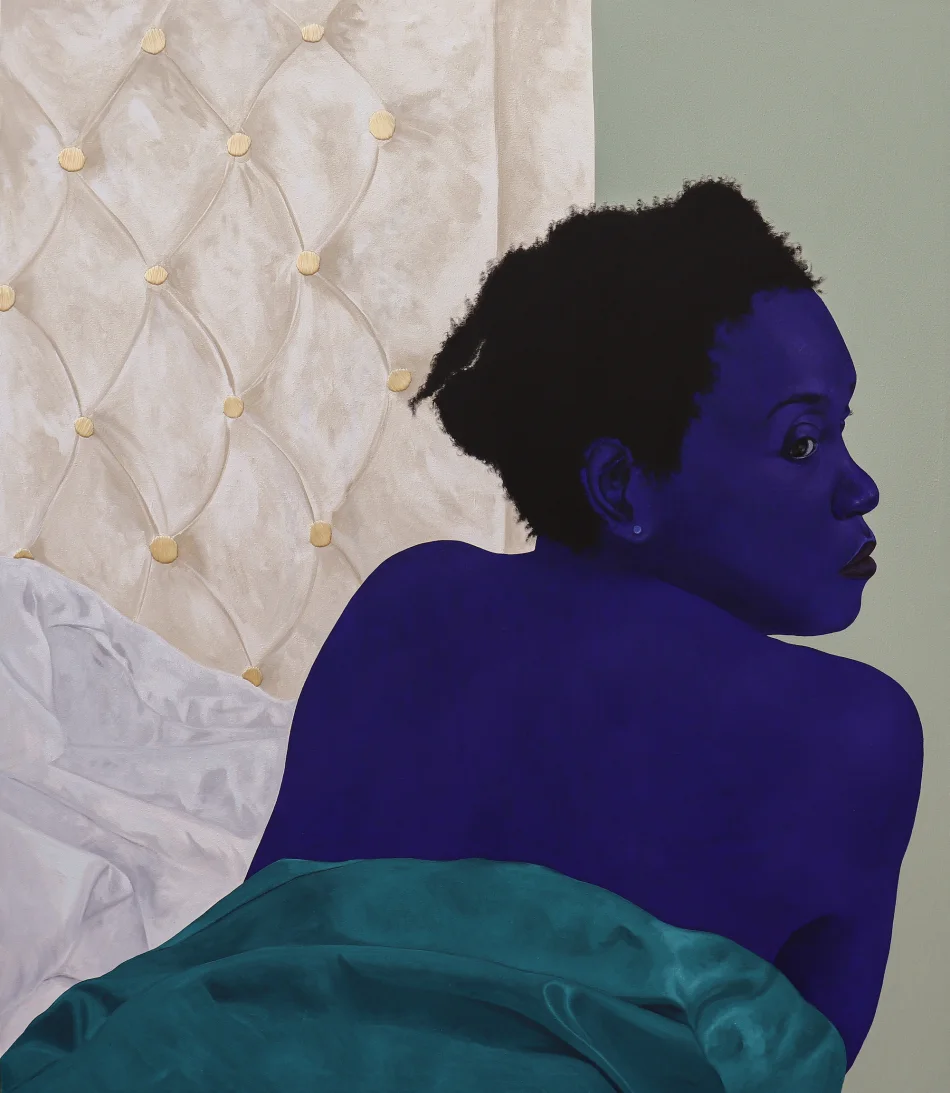
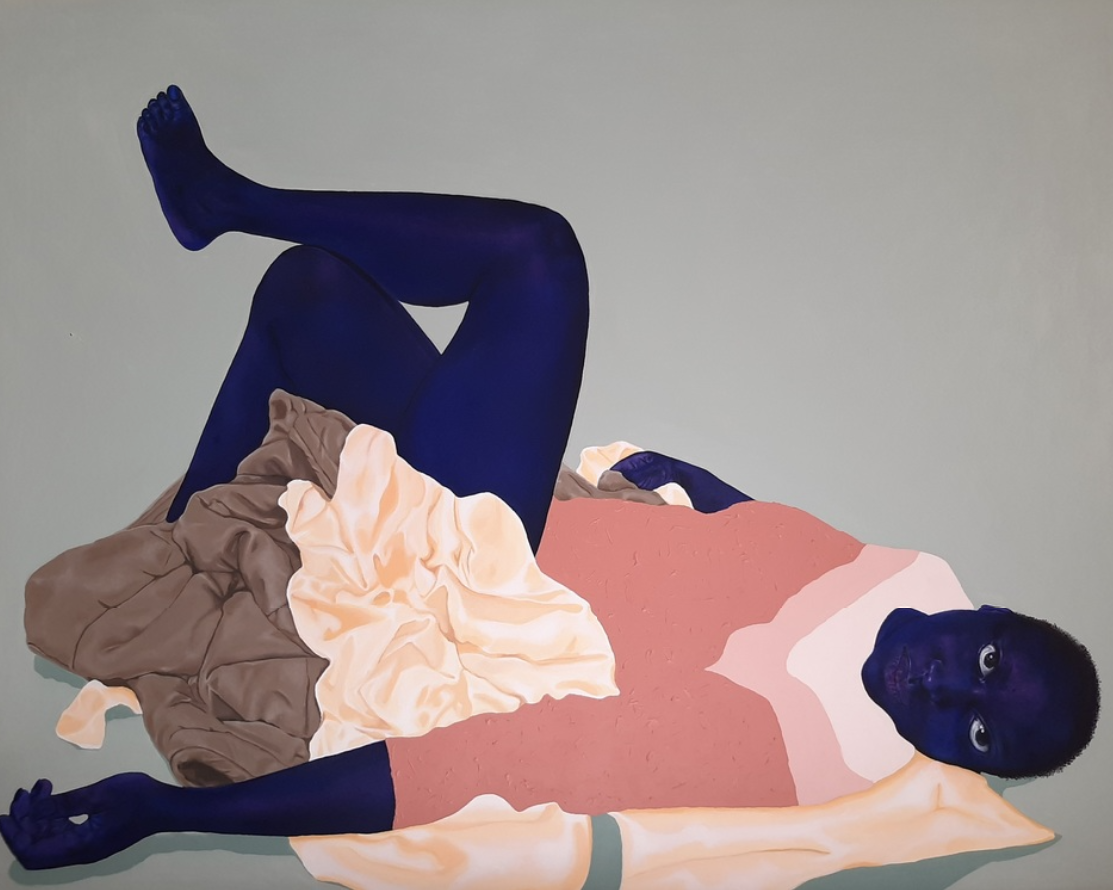
The gallery was hosting two exhibitions and my blog today is all about one of those, which closed at the end of January.  It was a large display of work by the Ugandan multi-disciplinary contemporary artist, Stacey Gillian Abe entitled Shrub-let of Old Ayivu.  Like my previous blog featuring Kyu Hun Kim the artwork is best described as unusual but this does not detract from its beauty.

Bibiana’s Window, by Stacey Gillian Abe (2022)

The name of the exhibition is unusual but Stacey says it can be traced back to the clan  is a descendant of.  She explains:

 “…Ayivu is one of the major clans of the Lugbara-speaking people from Arua in the West Nile region of Uganda.  We are a tribe intersecting three countries that is Democratic Republic of Congo, Sudan and Uganda. Our people are spread out within these countries, and I belong to the Ayivu clan in Uganda.  Shrublet of Old Ayivu is a metaphoric term which alludes to growths that have originated for a long time from a place of great significance that eventually create the perfect conditions for shrub-lets to morph and branch out of the old ways to form new connections independent of their origin.  The shrub-let is representative of this transportation from traditions, mindsets, norms and past lives, places to mention but a few…”

The Farmer’s Daughter by Stacey Gillian Abe (2022)

She goes on to say that the imagery of the plant life also extends to the colour of the models themselves. Jute is seen as a symbol of the Ayivu clan, and it is a motif that unites all of the work on display.  She reveals that jute is a plant of many uses, so this totem recurring in the work is a symbol of possibilities and growth.

Stacey Gillian Abe was born in Kampala, Uganda, in 1991. From an early age she loved art. For her, it all started with painting and drawing in high school in 2008. In 2014, she graduated from Kyambogo University, Kampala, with a BA in Art and Industrial Design.

Forbes Africa Under 30

In 2018 Abe made it onto the 2018 FORBES AFRICA Under 30 list which is the definitive list of Africa’s most promising young change-makers.  There are thirty “game-changers”, all under the age of 30, in each of the three sectors – business, technology and creative, a total of ninety young African people who were said to be challenging conventions and rewriting the rules for the next generation of entrepreneurs, creatives and tech gurus.  Abe was placed in the “creative” group of thirty.  Over six hundred candidates had been put forward and months were spent researching, verifying and investigating them.

Of herself, Abe describes herself as being reticent:

“…My passion started from the need to express myself more, I am not an introvert but a bit reserved…”.

Her way of expressing herself is through her art.  She says that a huge part of her practice now revolves around highlighting complex situations as autobiographical documentations of past and continuous experiences.

Fatou by Gillian Stacey Abe (2022)

Unit London gallery describes the exhibition I went to see:

“…Stacey Gillian Abe’s first solo exhibition at their gallery as an exploration of memory, time and emotion. It focuses on the concept of shared memory, Abe’s latest body of work examines how memories have been passed down through her family’s lineage, alluding to the ways in which traditions are absorbed and transformed from generation to generation.  These ideas are represented in the jute plant and flowers that are detailed in various paintings. A fibrous plant with multiple uses, jute is a totem for the Ayivu clan, one of the major clans in Arua in the West Nile Region of the artist’s native Uganda. The shrublet appears in sections of embroidery that decorate Abe’s paintings, becoming a motif that connects each canvas. Most importantly, Shrub-let of Old Ayivu questions how memory can be shared. With her paintings, Abe explores the transference of abstract memory, of subjects that are not easily explained visually. These notions do not simply materialise through composition or through the artist’s own subjectivity. Instead, they take shape within the space of the canvas itself, seemingly forming from the subject’s own consciousness. Each painting and each figure tell a different story, becoming part of a tapestry of interwoven threads…”

The Sitting I by Gillian Stacey Abe (2022)

The colour Abe uses for her figures is further explained by the gallery:

“…These ideas of generational memory link to Abe’s striking use of the colour indigo. Acutely aware of the colour’s presence in African history, the artist acknowledges its role in centuries-old textile traditions in West Africa. The rich dye was subsequently introduced to East Africa through the exchange of textiles, facilitating the East African slave trade or the Arab Slave Trade and the Indian Ocean Trade. Here, Abe references Catherine McKinley’s study Indigo: In Search of the Colour that Seduced the World (2011), which details that one length of indigo was equivalent to one human body. Through the Indian Ocean trade, Abe’s home country of Uganda also encountered trade routes from the coast to the mainland in the mid-1800s. Her village of Arua, positioned at the intersection of Democratic Republic of Congo, Sudan and Uganda, saw many Congolese people from the surrounding areas abducted into the slave trade to work in silk production…”

What We Wanted by Gillian Stacey Abe

In Abe’s own words:

“…Indigo for a skin tone in my work signifies a tribe, a breed of black, a people that are not limited to social, economic, cultural, political or historical constraints…”

In the exhibition, Shrub-let of Old Ayivu, Abe also shows us her fascination with indigo via its connection to cloth and material. She is fascinated with the colour and this manifests itself as an exploration of the relationship between cloth and the body. Through embroidery and the cloth there is a strong visual element throughout Abe’s body of work, which allows her to revisit the traditional, historical and personal significance attached to fabric.

See you Later, Again. by Gillian Stacey Abe

During the last three years Abe has carried out wide-ranging research on  the colour indigo.  It is a colour that has been viewed as both very rich and very valuable, but in her mind also one that has fashioned narratives around the black body. She says that indigo is a dominant colour in her work and she utilises it as a skin tone for her subjects. In a strange way it allows the observer  to behold  the black body in a different light.

Too Much and Not the Mood by Gillian Stacey Abe

Like my previous blog featuring the work of Hun Kyu Kim, Abe’s work is one you either love or hate. I actually found the exhibition fascinating.

Joseph Farquharson RA

Self Portrait (1882)

We are approaching a time when we have to expect very cold weather and for some of us the oncoming of snow.  So as we are at the beginning of the Christmas month I thought I would treat you to some snowy scenes by one of the greatest exponent of such panoramas.  Permit me to introduce the nineteenth century Scottish painter, Joseph Farquharson, whose snowy winter landscape paintings were featured on many Christmas cards.

Joseph Farquharson was born in Edinburgh on May 4th 1846.  He was the son of Francis Farquharson, a doctor and laird of Finzean in Kincardineshire. Joseph’s brother Robert was a highly respected physician and local Member of Parliament.  Joseph’s mother, Alison Mary Ainslie, was a celebrated beauty, one of the daughters of the lawyer Robert Ainslie, who was a close friend of the poet Robert Burns.

Road to Loch Maree by Joseph Farquharson

Joseph’s early days were spent in his father’s house in Northumberland Street Edinburgh, below the Queen Street Gardens.  Later the family moved to Edinburgh’s Eaton Terrace and finally to the family estate at Finzean, in Aberdeenshire. Joseph was brought up in a strict family environment and was educated in Edinburgh.  Although his father encouraged him to sketch and paint and even let him use his own set of paints, he only allowed his son to paint on Saturdays.  Joseph developed his artistic skills and at the age of twelve, Francis Farquharson bought his son his first set of paints and a year later Joseph exhibited his first painting at the Royal Scottish Academy.

Joseph Farquharson’s first formal art training came in the 1860’s when he enrolled at the Trustees’ Academy in Edinburgh, the forerunner of the Edinburgh School of Art where his tutors included the landscape painter, Peter Graham R.A. who would be a constant influence on Farquharson and Graham’s style can be seen in many of Joseph’s works.  Joseph then spent time at the Life School of the Royal Scottish Academy.

Day’s Dying Glow by Joseph Farquharson (1873)

Joseph Farquharson’s first exhibit at the Royal Academy, was in 1873 when his 1873 painting, Day’s Dying Glow, was on display.

Mrs Farquharson of Finzean (the artist’s stepmother) by Joseph Farquhardson (1871)

Farquharson followed the trend of other leading Scottish artists and concentrated on exhibiting his work in London rather than Edinburgh and Glasgow, as this was where the opportunity to sell their work was the greatest.  Besides his Scottish landscape scenes, Joseph was also a a talented portrait painter and his first portrait to be exhibited was of his stepmother, Mary Ann Girdwood Farquharson, which he completed in 1871.

A Scottish Interior, the Box Bed by Joseph Farquharson (c.1874)

Joseph Farquharson produced a realist genre painting around 1874 entitled A Scottish Interior, the Box Bed which depicts a bed inside a cupboard and table and chair in a kitchen/bedroom/living room. The free-standing box or press bed developed into a very sophisticated piece of furniture, when cabinet-makers designed “secret” press beds disguised as wardrobes or sideboards, or hidden behind rows of bookshelves and drawers, even when there was no pressure on space, and no need to provide a mini-bedroom within a shared living area.

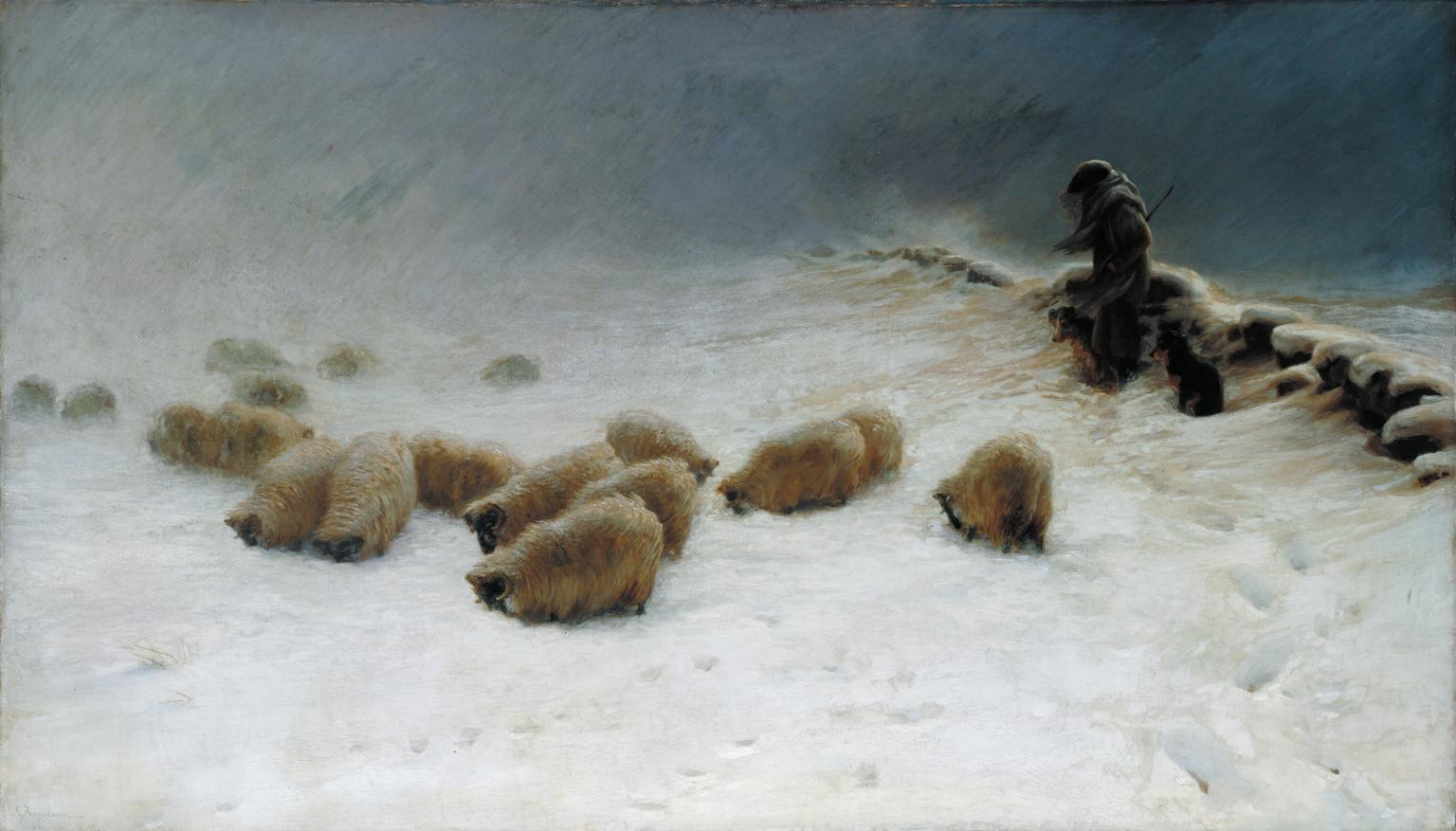
The Joyless Winter’s Day by Joseph Farquharson (1883)

However, Joseph Farquharson will be remembered for his bleak wintry landscapes often depicting sheep and the shepherd. One such painting can be seen in London’s Tate Britain, entitled The Joyless Winter’s Day which he completed in 1883. Despite blizzard conditions, Farquharson painted this en plein air although, he was in the relative comfort of his specially constructed mobile painting hut, which had the added benefit of a stove. This relative comfort enabled Farquharson to capture the remarkably realistic effects of a snow storm. Before you worry about the health of the sheep I have to tell you that those you see were made in plaster by a local sculptor

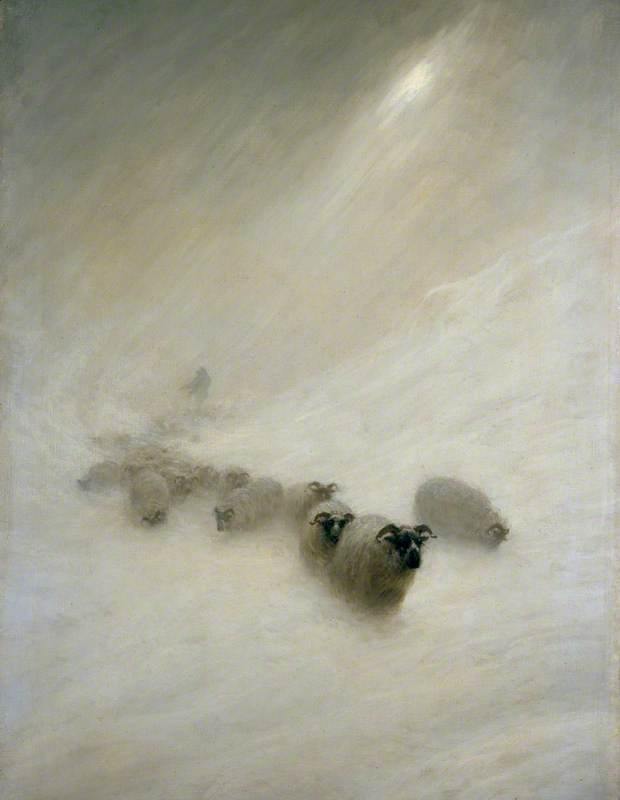
Sheep in a Snowstorm by Joseph Farquharson

Farquharson was famed for his Scottish snow scenes, and with the exception of 1914, he had a new painting exhibited at the Royal Academy every year between 1894 and 1925. . Farquharson combined a career as an artist with his inheritied responsibility as laird of the Finzean estate in Aberdeenshire, where many of his landscapes were painted.

The Stormy Blast by Joseph Farquharson (1898)

But it was not just about snow and blizzards.

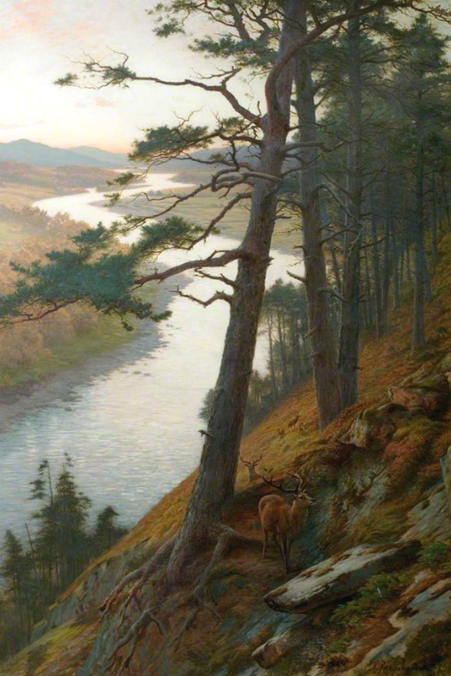
The Winding Dee by Joseph Farquharson (1889)

Some of his landscape paintings depicted the beauty of the Highlands, such as his 1889 painting featuring the River Dee, which rises in the Cairngorms and flows through southern Aberdeenshire to reach the North Sea at Aberdeen.

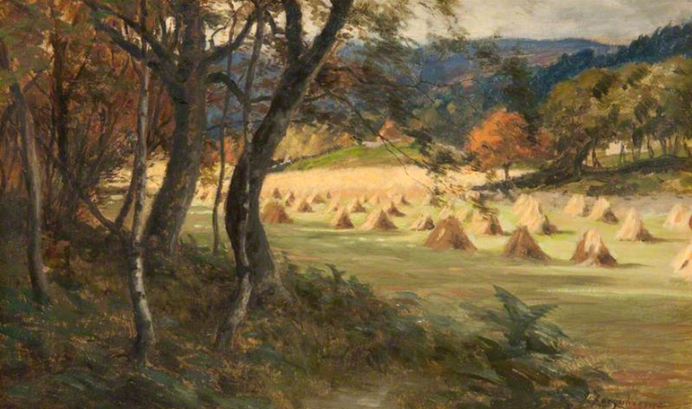
Corn Stooks by Joseph Farquharson (1880)

Harvesting, Forest of Birse, Aberdeenshire (1900)

Some of his paintings depicted the agricultural times in rural communities during the summer months.
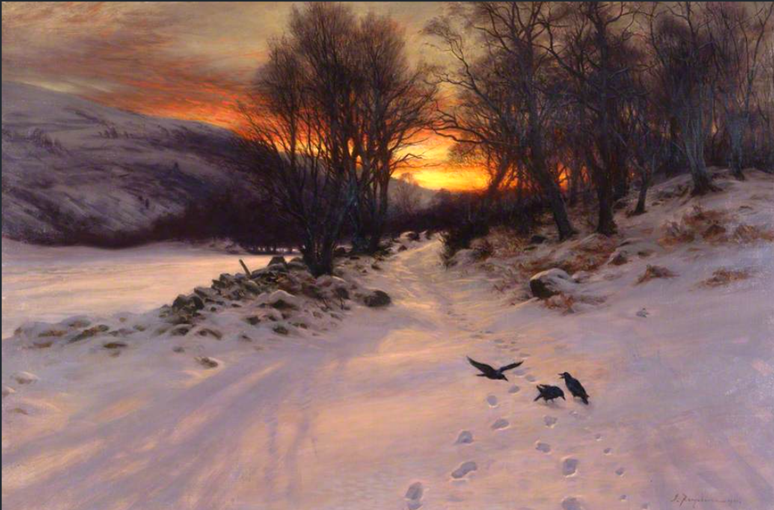
When the West with Evening Glows by Joseph Farquharson (1901)

One of Farquharson’s greatest skills was his ability to depict scenes at sunrise and sunset as this can be seen in his beautiful 1901 painting entitled When the West with Evening Glows. It is a snowy winter landscape, and we look along a snow-covered path, which runs through fields, with groups of trees on either side, as seen in the mid ground of the painting. In foreground we see freshly-made footprints in the deep snow, with three crows having landed close to the footprints. The whole scene is illuminated by the warm glow of the rising sun from behind the hills in the background.

When the West with Evening Glows by Joseph Farquharson (1910)

The above 1910 painting is a slightly smaller version of the work which is owned by the Royal Academy. This version was exhibited at the Royal Academy in 1910 and now hangs in the collection of the Bristol Museum & Art Gallery. This painting was a commission Farquharson received from one of his patrons, who failed in his bid to buy the larger original version. Farquharson often copied his own paintings in order to satisfy his clients’ requests, or to provide an original for engravers tasked with the reproduction of a successful composition. It was such a popular painting with the public that thousands of prints of this work were sold. In his 1913 essay in the Christmas edition of the Art Annual, The Art of Joseph Farquharson, A.R.A, Archdeacon William Macdonald wrote about these popular works:

“…There is not one of Farquharson’s pastoral landscapes which is not treated from the contemplative or poetic point of view: the poetry of snow either in its suggestion of desolation, or of the endurance of peasantry life, or the exquisite beauty of rare tints in the sun or moon on deep snow surfaces and seen through leafless trees… and the varied voices with which Nature elevates us from the prosaic, the commonplace and the ugly in her countless moods…”

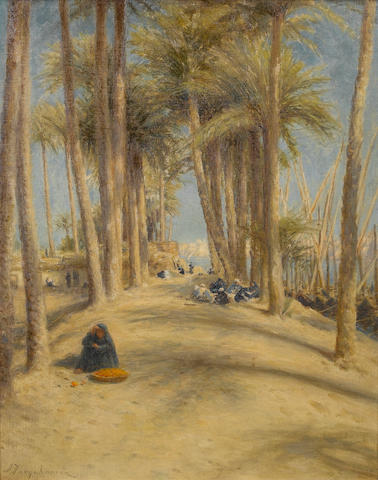
Market on the Nile by Joseph Farquharson (1893) 

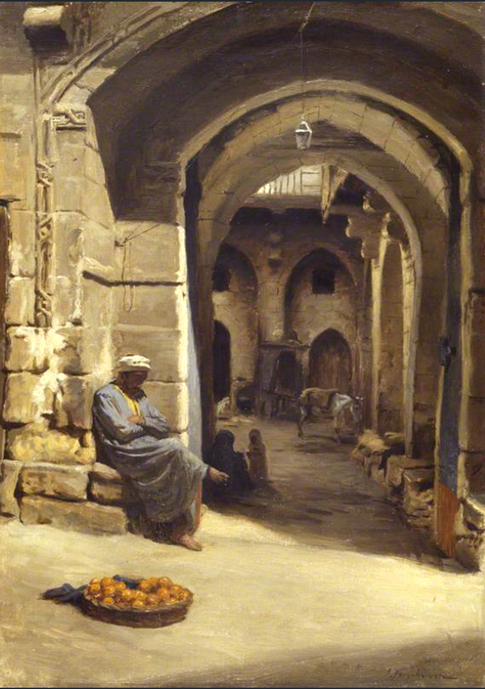
The Orange Seller by Joseph Farquharson (1893)

For the first four years of the 1880’s Farquharson spent the winters in Paris and studied with Carolus-Duran who installed in the minds of his students the importance of using the brush straight away and to think in terms of form and colour. In 1885 Farquharson went to North Africa. Among the works created during the subsequent 8 years were The Egyptian and On the Banks of the Nile opposite Cairo

On the Banks of the Nile opposite Cairo by Joseph Farquharson

Joseph Farquharson was elected Associate of the Royal Academy in July 1900, Royal Academician in February 1915 and finally, Senior Royal Academician in 1922.

Beneath the Snow Encumbered Branches by Joseph Farquharson (1901)

In addition to exhibiting over 200 works at the Royal Academy he showed seventy-three at the Royal Society of Arts and one hundred and eighty-one at the Fine Art Society. He also exhibited at the Royal College of Art and Tate Britain. The renowned artist-critic, Walter Sickert made Farquharson the subject of an essay comparing him favourably with Gustave Courbet. In it he extolled Farquharson’s tension and realism and criticized the pretension of his polar opposites, the Bloomsbury Group, who he wrote “fortunately does not run in the North of Scotland”. The remarkable realism of Farquharson’s work can be attributed to his desire to work en plein air. Farquharson painted so many scenes of cattle and sheep in snow he was nicknamed ‘Frozen Mutton Farquharson’

Farquharson inherited the title of Laird in 1918 after the death of his elder brother Robert. Joseph Farquharson died on April 15th 1935, three weeks before his eighty-ninth birthday..

Anne Goldthwaite

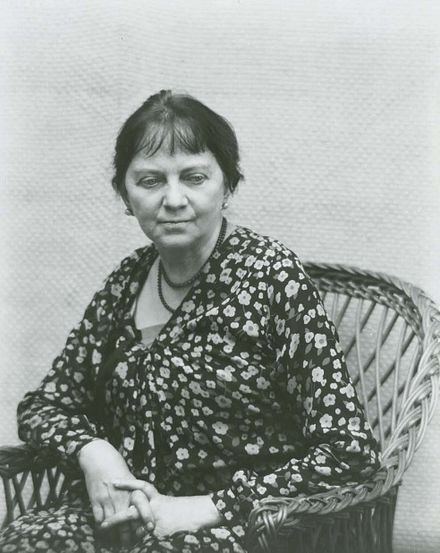
Anna Goldthwaite Self Portrait

The artist I am showcasing today is a lady who hailed from the American Deep South.  Anne Wilson Goldthwaite was born into a genteel Montgomery, Alabama family on June 28th, 1869.  She was a true daughter of the South and the oldest of four siblings. Her father was Richard Wallach Goldthwaite, who served as an artillery captain for the Confederacy during the Civil War and the son of Alabama senator George Goldthwaite.

Portrait of a Young Man by Anna Goldthwaite (1913)

Her family moved to Dallas,Texas when she was young and remained there for the majority of her childhood while her father looked for work.  After her parents both died, in the early 1880s, she and her siblings were taken back to Alabama where they lived with different relations. Anne went to live with her aunt Molly Arrington and her aunt’s nine children.  Her aunt presented her to society as a promising young debutante who was destined to become a southern belle. However this ended when her fiancé was killed in a duel.


As a teenager Anne liked to sketch and paint and soon developed into a talented artist, so much so, that in 1898, one of her uncles, Henry Goldthwaite, who was so impressed by her artistic talent, he offered to pay for her to have private art tuition.  He offered to support her financially for up to ten years if she relocated to New York City to study art. Anne Goldthwaite accepted his offer and arrived in New York around 1898.  She then enrolled at the National Academy of Design, where she studied etching with the German-born immigrant, Charles Mielatz and was tutored in painting by the Scottish-American painter and illustrator, Walter Shirlaw and American artist, Francis Coates Jones.

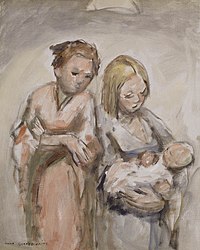
Young Mother by Anne Goldthwaite

She also spent one summer in Princeton, New Jersey, in the 1890’s, where she met then-professor Woodrow Wilson who had been appointed by Princeton to the Chair of Jurisprudence and Political Economy.  Two decades later he would become the twenty-eighth President of the United States.  He commissioned her to paint a portrait of his wife.

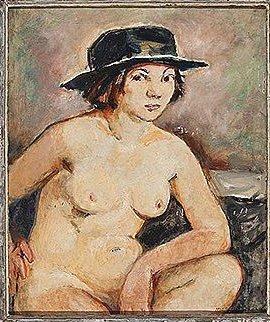
Young Nude Woman in a Hat by Anne Goldthwaite

In 1906, Anne Goldthwaite decided to travel to Paris to further her interest in the early modern painting styles of Fauvism and Cubism.

4 Rue de Chevreuse, Paris by Anne Goldthwaite (1908)

On her arrival in Paris Anne headed for the American Girls Art Club at 4 rue de Chevreuse, on the Left Bank.   The property was built by the Duc de Chevreuse and back in the 18th century it was the Dagoty porcelain factory. Later, in 1834,  it was turned into a Protestant school for boys called the Keller Institute.  It was in the 1890’s that Elisabeth Mills Reid, a wealthy American philanthropist and wife of the American ambassador, had the idea to turn it into a residential club for American women artists in Paris.  Anne Goldthwaite made this her base for the next six years.  According to Mariea Caudill Dennison’s article in the Woman’s Art Journal (2005) entitled The American Girls’ Club in Paris: The Propriety and Imprudence of Art Students, 1890-1914, Anne viewed the Club as a “chateau that was not a club at all, but a glorified pension for American women art students. We paid little board and lived in the midst of luxury and romance”

One day, while she was at the Luxembourg Gardens sketching, she met American writer Gertrude Stein. After a long conversation, Stein invited Anne to visit her apartment, but Anne was somewhat wary due to Stein’s scruffy appearance but eventually she agreed. Goldthwaite recalls Stein describing her as

“…a large, dark woman…who looked something like an immense brown egg. She wore, wrapped tight around her, a brown kimono-like garment and a large flat black hat, and stood on feet covered with wide sandals…”

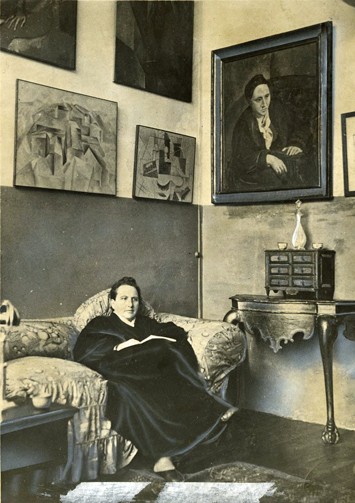
Gertrude Stein’s legendary Montparnasse apartment at 27 rue de Fleurus

Despite Anne having doubts about Gertrude Stein, she was impressed with what she saw in Stein’s apartment.  A large collection of contemporary paintings hung on the walls.  Little did Anne realise that this chance meeting with Gertrude Stein, the most influential pre-war and avant-garde person of the time, would provide her with an opportunity to join the art circle of Henri Matisse and Pablo Picasso. In her memoirs, Goldthwaite wrote about he visit to Stein’s apartment:

“…Crossing a little pebbled court, we went into a beautiful large studio filled with antique Italian furniture. The walls were covered with the most remarkable pictures I had ever seen. I knew they must be pictures because they were framed and hanging on the walls […] There was what I know now was a head by Picasso, looking like a design made of the backbones of fish; “Le Joie de Vivre [sic] ” by Matisse; a small grey canvas by Cezanne, and a yellow nude on a peach-colored background, the feet hanging down as in an ascension […] This was my introduction to what we now call Modern Art, made some six days after my arrival in Paris. It was with surprise, later, that I saw American students who had been in Paris a long time, yet had not heard the names of Matisse, Picasso, et. al., and had never heard of l’Art Moderne, or if they had, thought it completely negligible …”
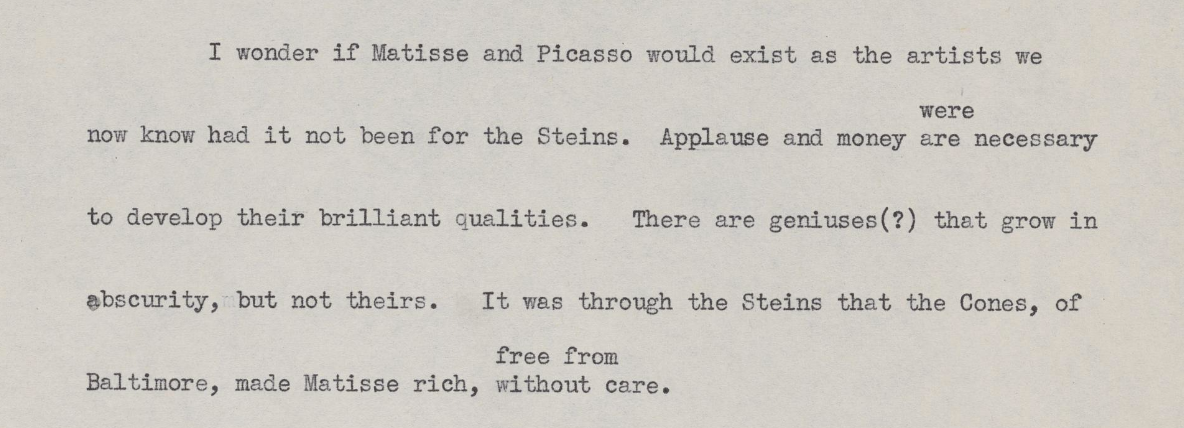
Anne was adamant that but for Gertrude Stein, Modernism would not have arrived in America. A page from her unpublished memoirs testifies to this belief. She wrote:
Page from the memoirs of Anne Goldthwaite

“Cones” refers to the Baltimore Cone sister, Dr Claribel and Etta Cone, who from 1898 to 1949 amassed a collection of primarily post-impressionist and modern French masterpieces.

Anne Goldthwaite later recalled her time in Paris and wrote:

“…Fate gave me several years in Paris at the most exciting time: during the great reconstruction from art to modern art…”

During her stay in Paris Anne moved from one atelier to another searching for a teacher that she could work with.  Eventually, she joined a small group of young artists called Académie Moderne.  This was a free art school in Paris, founded by Fernand Léger and Amédée Ozenfant who also taught at the academy.  The school attracted students from Europe and America.  They also held an exhibition each spring and their work was periodically critiqued by the post-impressionist painter, Charles Guerin.

The House on the Hill by Anne Goldthwaite (1911)

According to an article in the American Art Annual published in 1911, Anne served as president of the American Woman’s Art Association (AWAA) which was based at the The American Girl’s Club, from 1910-1911.

Cottage in Alabama by Anne Goldthwaite (c.1920)

In 1913, the Association of American Painters and Sculptors, also known as the International Exhibition of Modern Art organised a grand art exhibition.  It was the first large exhibition of modern art in America, and a shocking introduction of Modernism to an American audience. It was an exhibition that had been held in the vast spaces of U.S. National Guard armories.  It was a three-city exhibition which started in New York City’s 69th Regiment Armory, on Lexington Avenue between 25th and 26th Streets, on February 17th and ran until March 15th.   The exhibition then moved to the Art Institute of Chicago and finally arrived at The Copley Society of Art in Boston.  The Armory exhibition, as it became known, was an important event in the history of American art for it introduced Americans, who were accustomed to realistic art, to the experimental styles of the European avant-garde, which included Fauvism and Cubism. The show acted as a catalyst for American artists, who wanted to become more independent and by so doing, create their own artistic language.  Upon her return to America in 1913, Anne Goldthwaite exhibited two of her works at the New York Armory exhibition.  One was entitled The Church on the Hill, now known as The House on the Hill which she had completed around 1911.  The other painting was entitled Prince’s Feathers.

Rebecca by Anne Goldthwaite (c.1925)

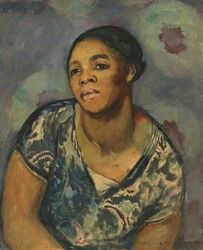
Now back in America, Anne lived most of her adult years in New York but travelled south during the summer months to spend time with her family.  She became a member of the Dixie Art Colony in Wetumpka, Alabama, which was thought to be one of the Deep South’s first art colonies. These summers she spent in and around Montgomery established Anne Goldthwaite as one of the South’s most important regional artists for the period.  During this time she often depicted rural African Americans in their post-slavery contexts in oil paintings, watercolours, and etchings.

Women’s suffrage march on New York’s Fifth Ave. in 1915

Anne Goldthwaite’s politics were said to be progressive and she was a staunch supporter of women’s suffrage, serving on the organizing committee for the 1915 Exhibition of Painting and Sculpture by Women Artists for the Benefit of the Women’s Suffrage Campaign, open from September 27-October 18, 1915 at the Macbeth Gallery in New York which coincided with the Women’s Suffrage March held that year in New York during which it was said that 20,000 supporters attended.

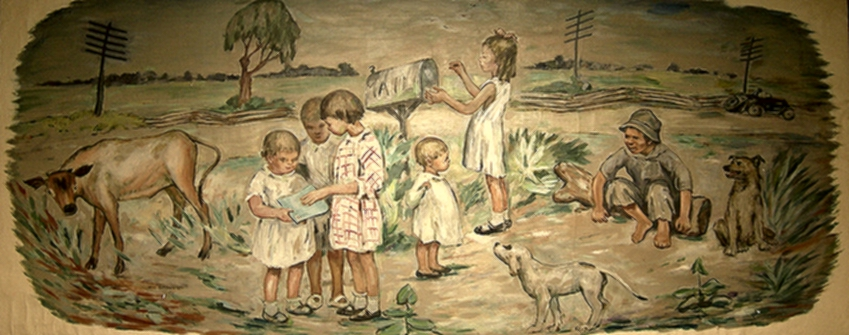
The Atmore Post Office mural: The Letter Box, by Anne Goldthwaite, 1938

The Atmore, Alabama Post Office

The Great Depression hit America at the end of 1929 and lasted almost ten years.  It was both a financial depression and a mental depression which affected many American citizens.  The American government thought that cheering people up during these hard times was something they needed to achieve.  It was part of the New Deal, a series of programs, public works projects, financial reforms, and regulations enacted by President Franklin D. Roosevelt in the United States between 1933 and 1939.  One of the projects in the New Deal was the Public Works of Art Project which was developed to bring artist workers back into the job market and assure the American public that better financial times were on the way. The idea was to employ artists to beautify American government buildings.  The mission of the post office murals was multifaceted – to boost morale in communities, employ artists by the thousands and create world-class art that was accessible to everyone. The murals revolved around local folklore, landscapes, industry and, unsurprisingly, mail delivery. They told the story of life across the United States.

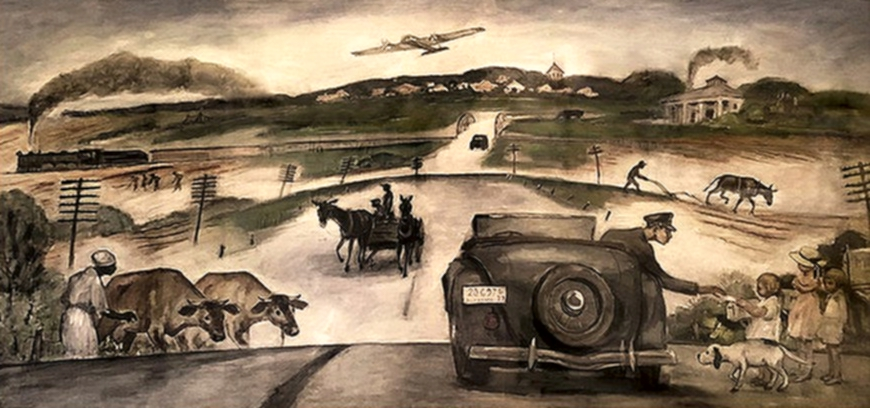
Tuskegee Post Office mural: The Road to Tuskegee, by Anne Goldthwaite, 1937

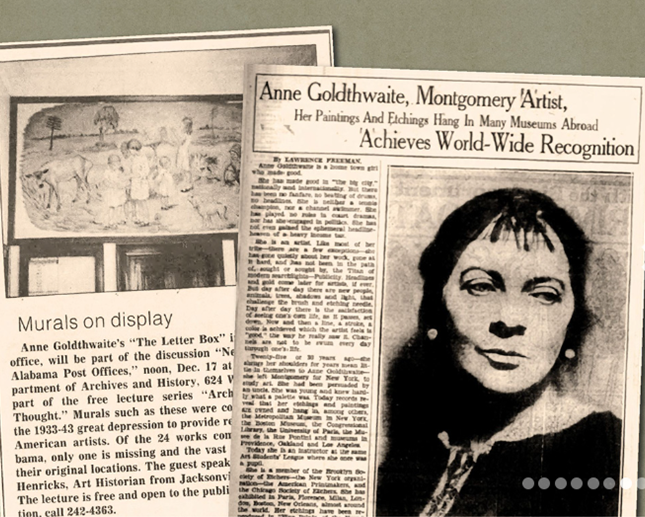
Anne Goldthwaite had two of her murals accepted for Alabama post offices.  One was in the town of Atmore, the other was in the town of Tuskegee. The Road to Tuskegee mural painted in 1937 by Anne Goldthwaite was restored and moved to the new Tuskegee post office in 1996.

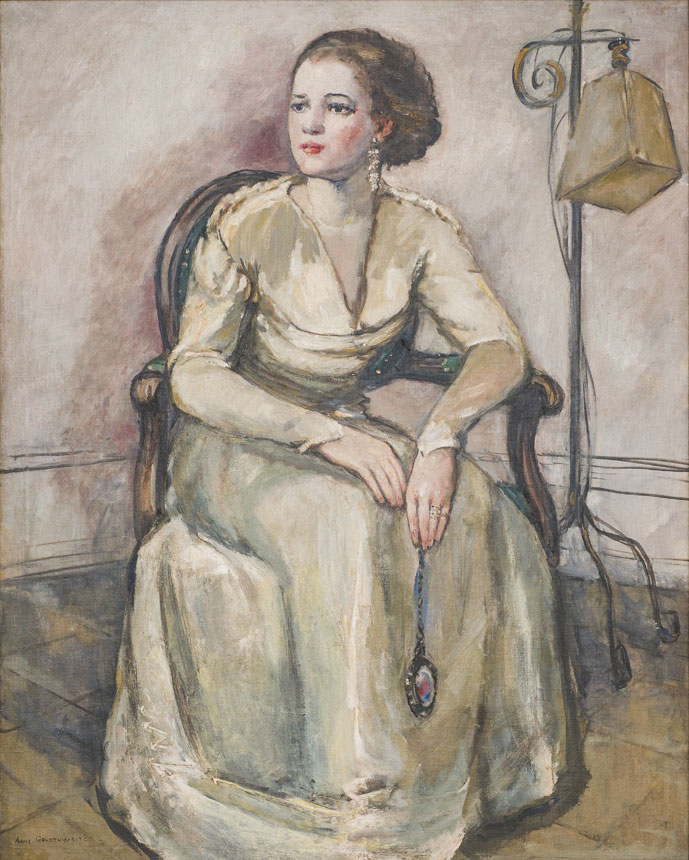
Portrait of Frances Greene Nix by Anne Goldthwaite (c.1940)

Anne Goldthwaite executed a number of portrait commissions, one being that of Frances Nimmo Greene Nix, the Museum Director, Artist, Portrait Painter, and Writer.  Frances was clerk, director, and curator of the Montgomery Museum of Fine Arts and studied with Anne Goldthwaite.

Goldthwaite’s work is included in the permanent collections of The Metropolitan Museum, Whitney Museum, Montgomery Museum, Montgomery Alabama, Greenville County Museum of Art and History, Greenville, South Carolina.  She was a member of the National Association of Women Artist, New York (Co-founder), Watercolor Society, Salons of America and the Society American Etchers/Brooklyn Society of Etchers.  Goldthwaite began teaching at the Art Students League, where she was a very popular teacher until her death in 1944.

Anne Goldthwaite (1869-1944)

Anne Goldthwaite died in New York City on January 29th 1944, aged 74.

Dutch and Flemish Golden Age painters.

Like many others, I am a lover of the artwork of the Dutch Golden Age painters.  The Dutch Golden Age was a period in the history of the Netherlands, which spanned the era from 1588 and the birth of the Dutch Republic to 1672, Rampjaar (Disaster Year) which was the year of the outbreak of the Franco-Dutch War.  During this period, it was considered that Dutch trade, science, and art and the Dutch military were among the most acclaimed in Europe.  We all know about the lives and works of the famous artists of that era, such as Rembrandt, Vermeer, Jan Steen, Frans Hals and Judith Leyster to name but a few.  In my blog today I want to look at the lives and works of the lesser-known painters of that era.

Izaak van Oosten was a Flemish Baroque landscape and cabinet painter who worked out of Antwerp.  Izaak was born in Antwerp in December 1613 and was the son of an art dealer with the same name.  His father had become a master in the Antwerp Guild of St. Luke in 1617. Very little is known about his upbringing or his early artistic training as there is no record of which master or masters he studied under.  Izaak became a master in the Antwerp Guild of St. Luke in 1652.

Landscape with a Wagon and Travellers passing through a Village by Izaak van Oosten

There is something joyful about paintings depicting skaters on frozen rivers and lakes.  It is all before global warming and I am sure that now, many of the rivers and lakes retain their fluidity even in the depths of winter.  The painting I am showcasing is entitled Skaters on a Frozen Lake at the Edge of Town and it was painted by the Dutch Golden Age landscape painter Cornelis Beelt.  Cornelis Beelt was a Dutch Golden Age landscape painter who was  one of the chief figures in the Haarlem school of landscape painting, but was also well-known for his genre paintings of towns, markets and villages.  Beelt was born in Haarlem during the first decade of the seventeenth century.

Skaters on a Frozen Lake at the Edge of Town by Cornelis Beelt (c.1652)

The setting is a clear winter’s day and crowds of locals gather besides a country inn keen to enjoy the sport on the ice. Young and old, rich and poor are attracted to this pastime. In the foreground a group of well-dressed men and women stands on the ice and chat. An old lady with her hands in a fur muff sits in a splendid arreslee (sleigh which is drawn by a horse and which is decorated with a fine plumed harness. Close by young children propel themselves across the ice on small prikslees (sledges).

Beach of Shevingen by Cornelis Beelt

There is a strange thing about this painting which unfortunately is not visible from the attached picture. Beelt signed his painting in an unusual manner, one which he had also done on his painting Beach of Shevingen. He signed his name on the plank of wood in the foreground. However , at a later time, his signature was scrubbed out and replaced by the inscription J.V.Ostade f.1653 and this was judged to be an attempt by a less than honest art dealer to ascribe the work to a more famous name, Isaac van Ostade, so as to have a better chance of selling the painting, even though Ostade had died in 1649 !

The phrase ‘cabinet d’amateur’, in French, is an ancient term which referred to a room or part of a room in an art collector’s house where he or she displayed the paintings they had purchased.  These display areas were before the rise of public galleries.  Some where simple cabinets which contained their owner’s beloved works and some where floor to ceiling displays of their paintings.  The phrase cabinet d’amateur should not be viewed as that of an “amateur collector” but that of an “art lover”.  A German term for such a place is often referred to as a kunstkammer. In Italian it might be called a Gabinetto, Studiolo or Camerino.

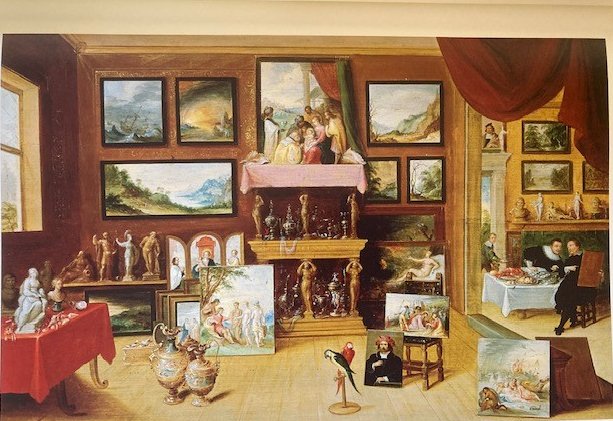
Two collectors dining in a gallery surrounded by paintings and works of art, with two parrots in the foreground. by Frans Fancken the Younger

The painting connected with this term is one by the Flemish painter, Frans Francken the Younger and described as Two collectors dining in a gallery surrounded by paintings and works of art, with two parrots in the foreground. Frans Francken the Younger was the most famous of an Antwerp dynasty of painters; he trained with his father, Frans the Elder, and joined the Antwerp guild in 1605. He was a painter of religious and historical subjects as well as being the inventor of the genre – the cabinet painting.

On the right-hand side of the painting we see two men deep in discussion about a painting one of them is holding up but we do not know who is the owner of this kunstkammer.  The presence of a kunstkammer in one’s house was a sign of wealth, intelligence and social status.  In the main part of the painting, we see an ornate sideboard supported by classical caryatids.  A caryatid is the name given to a sculpted female figure serving as an architectural support taking the place of a column or a pillar supporting an entablature on her head.  A light-pink fringed cloth covers the top shelf of the sideboard on which two large shells are placed either side of the painting, The Adoration of the Magi.   Richly decorated goblets and covered urns are displayed on two of the sideboard shelves. On the floor we see two parrots depicted sitting on a perch.  The import of exotic foreign birds testified to the owner’s wealth.   We see a large red velvet curtain falls from the ceiling which when released would act as a separator of the two rooms.  Everything in the room exudes the wealth of the owner which would have been the raison d’être for the owner of the cabinet d’amateur commissioning the work.

The Cabinet of the Collector by Frans Francken the Younger (c.1617)

A similar painting by Frans Francken the Younger is in the Royal Collection entitled The Cabinet of the Collector which he completed around 1617. Amongst the paintings on view in the kunstkammer is a landscape by Joos de Momper,  a still life of an everyday table set for a meal; and a small, nocturnal Flight into Egypt. Other religious painting depicted are one featuring St Augustine who is trying to comprehend the idea of the Trinity and sees a baby struggling to pour the entire sea into a pool in the sand with a shell – both tasks being equally beyond the scope of man. The drawings, one framed and one in an open book are two studies for Michelangelo’s Sistine ceiling and a preparatory drawing for Raphael’s Madonna della Perla which emphasise the intellectual side of painting.. There are also letters on the table, no doubt signifying an intelligent characteristic of the painting’s owner.  Also displayed are exotic weaponry which is a reminder of the importance of travel and trade and a handful of Roman coins and a bowl of modern ones, which were not anything to do with wealth but more likely a celebration of the achievements of great men.

For me, the most interesting part of the work is seen beneath the arch to the right.  In the background a church is demolished and nearby donkey-headed men with cudgels destroy a pile of objects associated with learning, science, the arts and sport. According to Karel van Mander, the sixteenth century Flemish poet, painter and art historian, a man with a donkey head is a symbol of Ignorance. The episodes depicted here recall two historical events: the Beeldenstorm, an outbreak of iconoclasm carried out by Protestants in 1566; and the ‘Spanish Fury’, the sack of Antwerp in 1576.

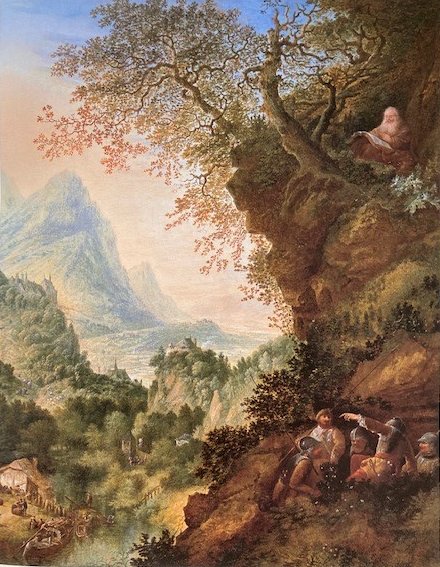
A Rhineland Landscape with a Hermit and Soldiers by Jan Griffier the Elder

Jan Griffier the Elder, who was born in Amsterdam around 1645, was a painter and printmaker, who produced views of Rhineland landscapes as well as spending time, around 1660, in England where he produced many landscape works featuring the English countryside.  One of his most beautiful landscapes is referred to as A Rhineland Landscape with a Hermit and Soldiers. The painting dramatically depicts a steep mountain landscape with a meandering river below which slowly flows through wooded crags which are surmounted by castles.  If we look to the left foreground, we can see a men loading barrels of wine onto a small boat.  The main figures in this painting are on the right-hand side.  We see a group of soldiers lying down, concealed among the ferns and flowers.  One of the group points down to the boat which is being loaded.  Are they planning to raid the operation?  Above them, sitting on a rock by a large oak tree in peaceful isolation, is a hermit, who is meditating.  It is an interesting painting with plenty to focus on, but what is it all about ?

Floral Still life Floral by Gaspar van den Hoecke

There is something that fascinates me about floral still life paintings.  I think it is just the effort and patience the artists must have put in to produce such beautiful works.  My next featured painting is a small (70 x 50cms) floral still life attributed to the Flemish Baroque painter, Gaspar van Hoecke, who was born in Antwerp around 1580.

Gaspar van den Hoecke was best known for his small religious cabinet pieces but during his early period around 1610 his work focused on still life floral paintings.  The vase of flowers sits on a wooden tabletop.  This dense grouping of flowers fills almost two thirds of the painting.  The profusion of flowers doesn’t allow the artist to depict twigs and leaves between individual flowers.  On the table we see a caterpillar of the swallow-tailed butterfly which is next to it.  Also on the table there is a silver medal with the head of Pope Pius V which had been created in 1571.   Just above it is a gold coin which is a rare example of a byzantine solidus made during the era of Anastasius, the Eastern Roman Emperor. 

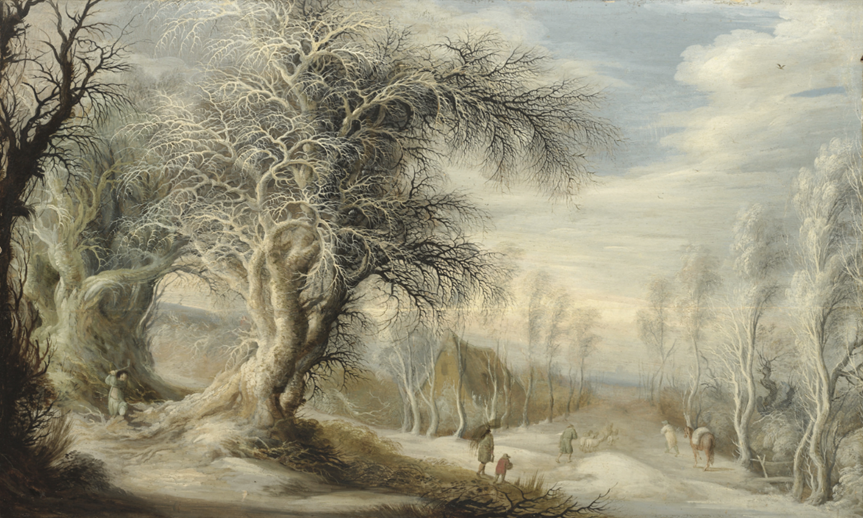
Winter Landscape with a peasant walking through snow by Gysbrecht Leytens

The Flemish painter Gijsbrecht Leytens was born in Antwerp in 1586. As a teenager, he began his apprenticeship with Jacob Vrolijck.  In 1611 he joinied the Antwerp Guild of Saint Luke as a master. In 1615 he became a member of the Olijftak, a chamber of rhetoric that dates back to the early 16th century in Antwerp, when it was a social drama society which drew its membership primarily from merchants and tradesmen and provided public entertainment at prestigious events.  Gijsbrecht was a captain in Antwerp’s Civic Guard between 1624 and 1628.  His work followed the style of 16th and 17th century Flemish and Dutch great landscape paintings, which had brought recognition to such masters as Pieter Brueghel the Elder, Hendrick Avercamp, Gillis Van Coninxloo, Joost de Momper and Denijs Van Alsloot.

Winter landscape with a woodsman and travelers by Gysbrecht Leytens

However, it was Gijsbrecht Leytens’ determined personal style that brought him to the public’s attention.   Many of his paintings were simply attributed to “The Master of the Winter Landscape” and only in the 1940’s attributed to him.  Leytens has an easily recognisable style not just because he focuses on snowy winter scenes but because of the way he depicts intricate and curious intertwining designs created by the bare branches and twigs which form a large part of his depictions.   He was described as a poet of the frost in the way he conveys the cold nakedness of the sun on a countryside caught in the ice. No-one before him, nor after him, either in Flanders or elsewhere, expressed this with such intensity. The fundamental and unique quality of his art also resides in the extreme refinement of the subtle colour harmonies apparent in his paintings at all times.

Old Man Reading a Letter by Willem van Mieris (1729)

The depiction of the reading of a letter has featured in many paintings over the years.  Such attention to what is written in the letter adds to the back-story of the artwork and often our imagination runs riot as we try to fathom out the sentiment expressed in the pages of the letter.  My next painting is one by the Dutch artist Willem van Mieris who was born in Leiden in the Northern Netherlands in June 1662.  His artistic tuition came from his father Frans van Mieris who was a genre painter.  Throughout his career Willem was successful and had the support of a number of patrons who constantly supplied him with commissions.  He was equally at home painting genre scenes and portraiture as well as being a skilled landscape painter, etcher, and draughtsman.  He was the active leader of, and once became dean of, the Leiden Guild of St. Luke in 1693. A year later, in 1694, he established a drawing academy in Leiden along with the painter Jacob Toorenvliet.

In this work we see an elderly gentleman seated  at a table in a darkened interior deep in concentration as he reads a handwritten document.  He wears an opulent-looking gown which is made of richly embroidered material and which is evocative of the fashion for Japanese dress at the time.  Upon his head is a hat made of rich blue velvet and lined with a extravagant swathe of fur.  In the dark background we can just make out shelves filled with books.  Couple that with the paraphernalia on the table, such as an inkwell, sealing wax and quill pen tells us that this a gentleman of great learning, maybe a lawyer.  Lawyers were often depicted in paintings reading documents and letters.

I hope this blog will encourage you to delve into the world of Dutch and Flemish painters where you will find so many talented artists.

Pinturicchio the Master of the Fresco. Part 1.

Over recent months I seem to have concentrated on writing about artists who were practicing their trade during the Victorian period and the first couple of decades of the twentieth century.  Yet, when I look back on my earliest blogs I seemed to have favoured the Dutch and Flemish painters of the sixteenth and seventeenth centuries.  Today I am going to deviate again and look at the life and work of the fifteenth century Italian Renaissance painter Pinturicchio.  I came across the artist and one of his major fresco commissions when I read the excellent blog io sto a casa, written by Jackie, an American teacher who lives with her Italian husband in Le Marche, Italy. She and her husband are lovers of art and often travel around the country visiting places of interest which hold artistic treasures.  It was she who mentioned the artist Pinturicchio in one of her recent blogs.

2008 Italian postage stamp

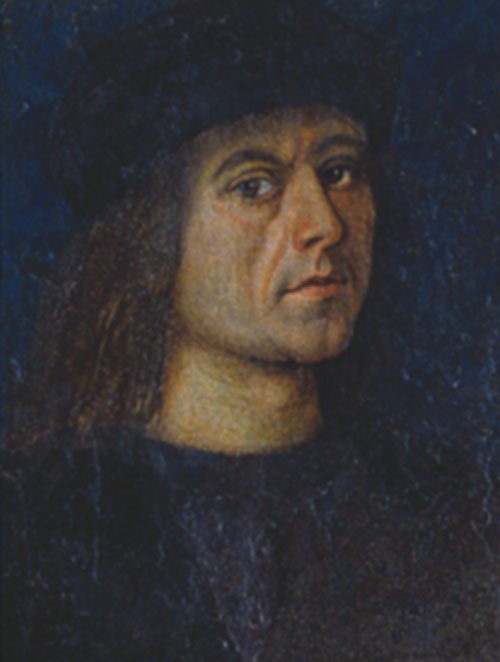
Bernardino di Betto was born around 1454 in the Italian city of Perugia.  He was also known by his nickname, Il Pinturicchio, meaning “little painter” because of his small stature.  His parents were a family of artisans, his father being a cloth tanner.  His early life seems to have been filled with unhappiness, compounded by the death of his father from the plague when Pinturicchio, was just a teenager.  His first foray into the world of  fine art came when the talented miniaturist, Giapeco Caporali opened a bottega (a workshop of a major artist in which other artists may participate in the execution of the projects or commissions of the major artist) close to Pinturicchio’s father’s house at Porta Sant’Angelo. Pinturicchio worked there for a time and would take a share of the profits of the work completed in the studio.  In 1481 Pinturicchio joined the painters’ guild in Perugia.  Perugia was at that time experiencing a great artistic fervour and the central Italian city was becoming a renowned hub for artistic activities of which Pinturicchio contributed. Once Pinturicchio had enrolled in the guild of Artists and Painters in Porta Sant’Angelo, Perugia, his output began to be recorded.  He received many commissions and joint commissions for his fresco work.

Basilica of Santa Maria in Aracoeli in Rome

Meanwhile, in Rome, the first phase of the work on the Sistine Chapel had been on-going.  The fresco work had been carried out by some of the Italian Masters, such as Botticelli, Perugino, Ghirlandaio, Signorelli,  Cosimo Rosselli and Pinturicchio.  The first phase of this massive undertaking came to an end around 1482 and most of these Italian Masters returned to their home cities.  This is with the exception of Pinturicchio who did not go home but instead remained in the city and set up a workshop. as he could take advantage of the opening left by the other great artists. He then chose a group of Italian painters who had collaborated with him at the papal chapel.  His group contained artists from the many regions of the country who were willing to remain in Rome and work for him.    Having set up this group and with many of the renowned artists having left the eternal city he was awarded his first commission in Rome by Nicolò Manno (Riccomanno) Angeli Bufalini, a consistorial lawyer and one-time bishop of Venafro, for his family chapel which was part of the Basilica of Santa Maria in Aracoeli in Rome, which stands on the Capitalone hill. Pinturicchio’s frescos in the Bufalini Chapel depicted scenes from the life of Saint Bernardino of Siena and Saint Francis. The commission was to remember the reconciliation that took place between the Bufalini family and the Baglioni of Perugia, thanks to St. Bernardino.

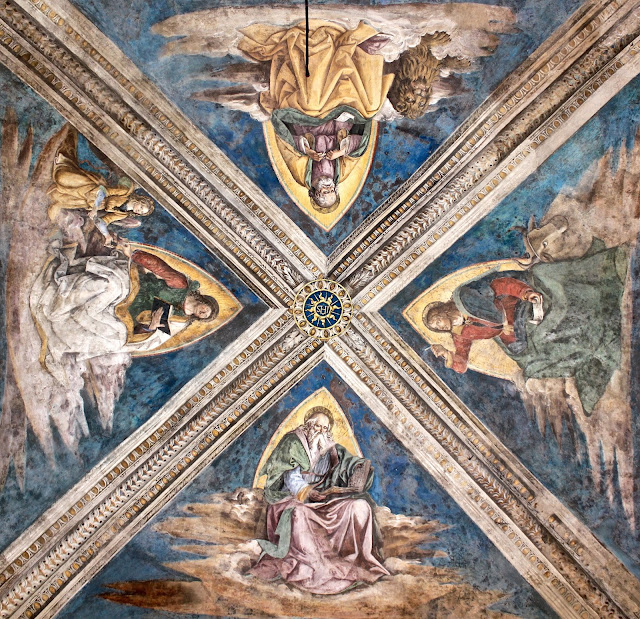
Bufalini Chapel ceiling

Pinturicchio and his team set to work on the chapel around 1484.  On the vaulted ceiling there are depictions of the four Evangelists, Matthew, Mark, Luke and John, each seated on a cloud, in front of a dark blue, star-studded background.  

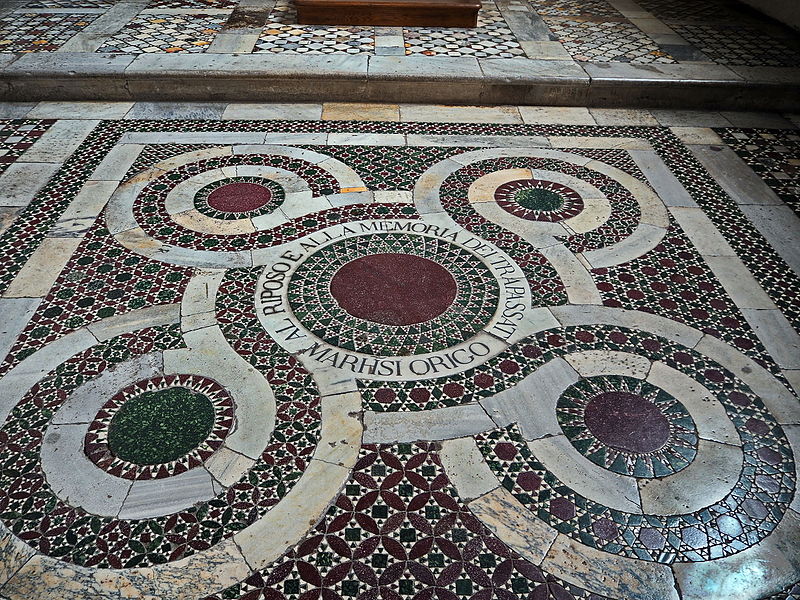
Bufalini Chapel floor

The chapel itself has a quadrangular base, with the vault and floor decorated with cosmatesque mosaics. The Cosmatesque style takes its name from the family of the Cosmati, which flourished in Rome during the twelfth and thirteenth centuries and practiced the art of mosaic.   The inside of the chapel comprises of three sides and the frescoes on the three walls are dedicated to the life and miracles of St. Bernardino of Siena, an Italian priest and Franciscan missionary, who was canonized as a saint in 1450, and who was very popular during the Renaissance.  The frescos also featured two stories of St. Francis.

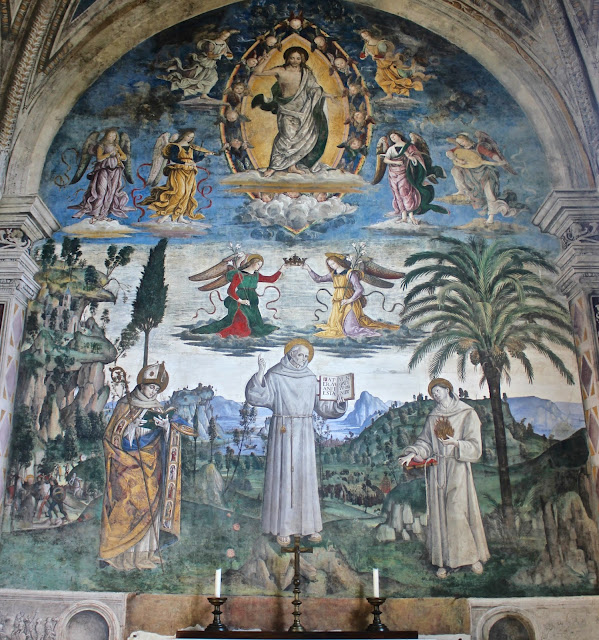
The back wall of the chapel, the altar wall, is decorated by a fresco entitled The Glory of Saint Bernardino.  It is horizontally divided into two sections.  The lower section depicts San Bernardino standing on a rock with outstretched arms.  His right hand points up to Christ. In his left hand he holds an open book in which one can read:

PATER MANIFESTAVI NOMEN TVVM OMNIBVS

“Father, I have shown your name to everyone”,

Above him are two angels who are in the process of crowning him.  Either side of him stand two saints,.  On his right is St. Louis of Toulouse adorned in in his solemn episcopal robes and on his left stands Saint Anthony of Padua in a Franciscan habit..  In one of St Anthony’s hands he holds the flame symbolising his piety whilst in the other he holds a book symbolising his knowledge.  The background of this lower section is a landscape with rocks, lakes and mountains, which extends the depth of the space.  This scene is probably one Pinturicchio would have recalled from his homeland.

In the upper part of the fresco we see Christ in the act of blessing.  His figure is encased in a mandorla. The term mandorla means an almond-shaped frame that surrounds the totality of an iconographic figure.  Surrounding Christ are worshiping and music-making angels.

Left-hand wall of the Bufalini Chapel

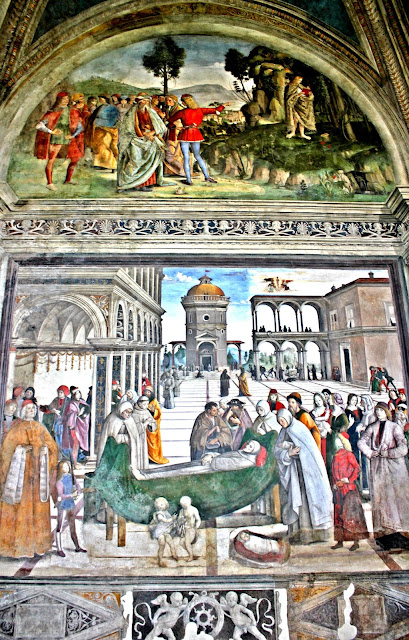
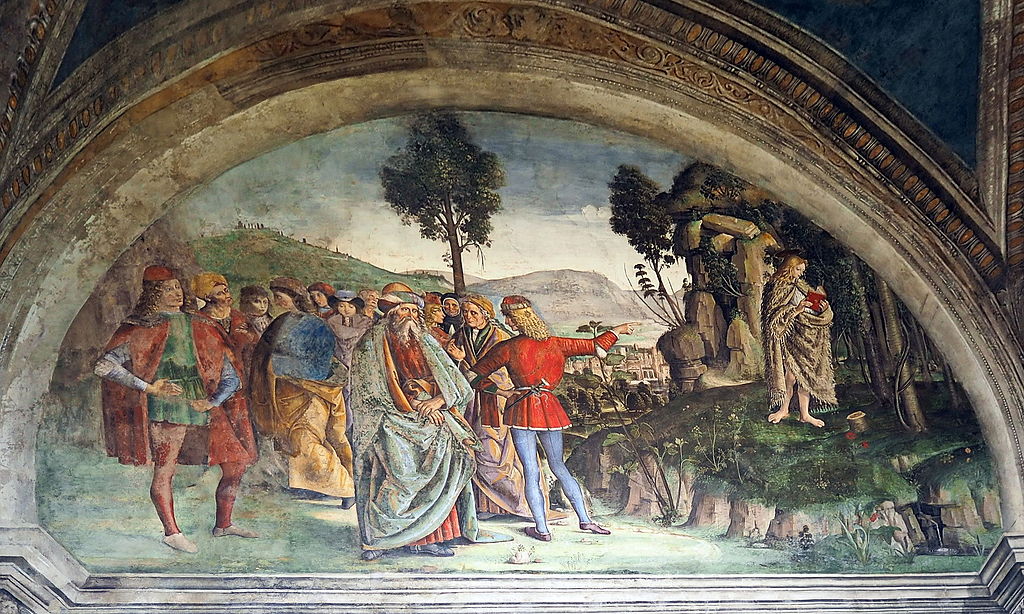
On entering the Bufalini Chapel, the wall to the left comprises of two scenes one atop the other, divided by a painted frieze. The upper part is a lunette, a half-moon shaped, or semi-circular, arch, which depicts St. Bernardino being penitent before the Porta Tufi in Siena and this fresco shows a young Bernardino’s first hermitage.

Upper lunette

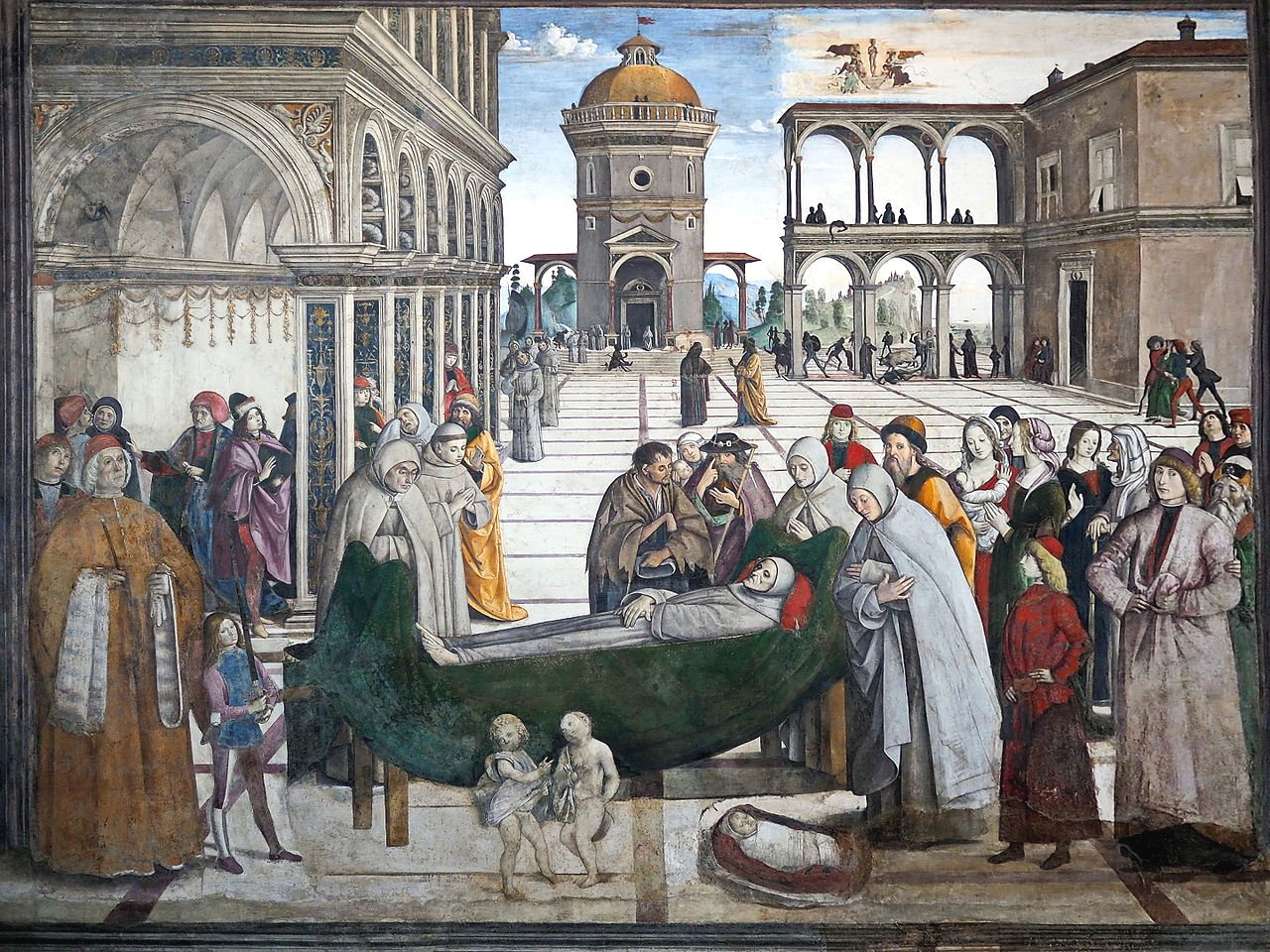
The fresco on the lower part of the left-hand wall is much more interesting.  It depicts the Funeral of Saint Bernardino. 

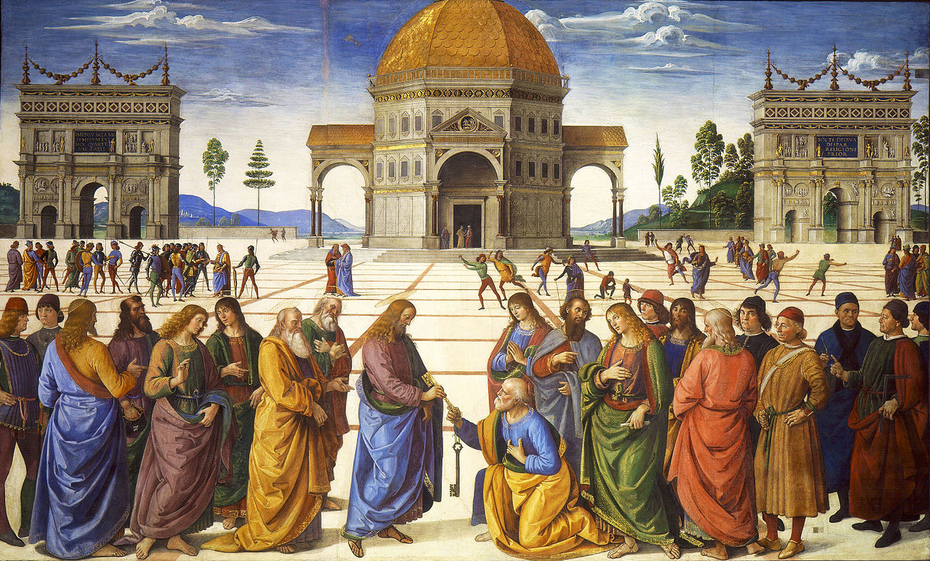
The fresco on the lower part of the left-hand wall is much more interesting.  It depicts the Funeral of Saint Bernardino.  The setting is a city scene with a chessboard-like pavement.  It is painted using geometrical perspective, which enables the depiction of a three-dimensional form as a two-dimensional image which carefully looks like the scene as visualized by the human eye.  The vanishing point is a building similar to one depicted in Perugino’s painting, Delivery of the Keys, although Pinturicchio has two buildings of different heights at the sides. On the left is a loggia,  a covered exterior gallery or corridor, supported by piers decorated with fanciful gilded candelabra. On the right is a cubic building connected through a double loggia to the landscape and the bright sky in the background.

See the source image
Pietro Perugino’s painting, Delivery of the Keys.(1482)

The foreground is dominated by the Saint Bernardino’s funeral. We see his body laid out on what is termed a catafalque, a decorated wooden framework supporting the coffin of a distinguished person during a funeral or while lying in state. Its presence increases the sense of spatial depth

Riccomanno Bufalini

All sorts of folk, friars, pilgrims and the “common” people approach the body to pay their respect. Look at the tall figure in the left foreground wearing the brown robe, with a fur-lined hood and gloves.  He is Riccomanno Bufalini, the person who commissioned the frescoes.

Sight restored.

The remaining characters we see standing around the coffin often portray a series of miracles attributed to Bernardino during his life.  We see the once-blind man who was healed and given back his sight by the body of Bernardino, standing by the head of the coffin pointing to his eyes.  There is the resurrection of someone possessed by the Devil, the healing of the stillborn baby of John and Margaret Basel, the healing of Lorenzo di Niccolo da Prato, wounded by a bull, and the pacification of the warring Umbrian Bufalini and Baglioni families.

The Blessing
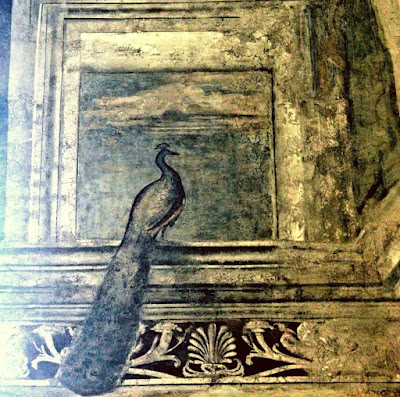
The peacock

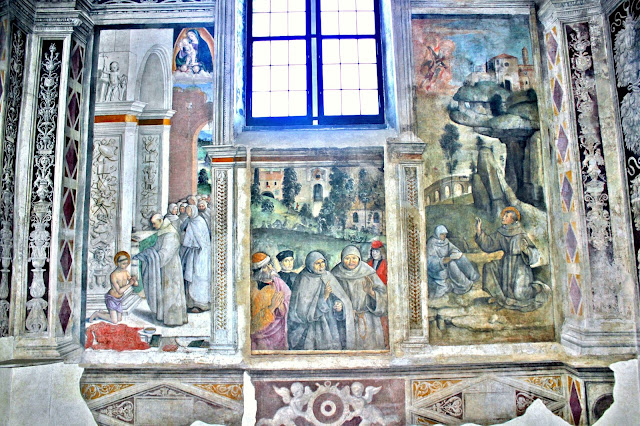
The right wall of the Bufalini Chapel features a double mullioned window.   Pinturicchio has implemented an illusionistic perspective, when he painted two imitation symmetrical windows, one depicting a blessing from God the Father and the other featured a peacock which was an early Christian symbol of immortality.

There is also a fresco featuring, on the left, a scene from the life of St. Bernardino of Siena in which we see him receiving the religious habit. It is set in an oblique perspective that exploits the decorated pillars with a grotesques arch. Finally, there is a small scene on the right featuring, in the background, a view of the Verna Sanctuary over a rocky peak which depicts St. Francis in the act of receiving the stigmata, in honour of the Franciscan foundation of the Aracoeli.

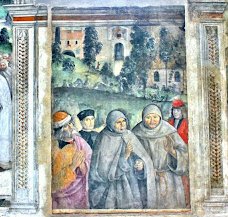
Under the real window is an illusory opening depicting five characters: among them is an aged friar, perhaps the convents prior, and a lay figure that resembles him, perhaps an administrator of the basilica.

In the next blog I will be looking at the frescoes by Pinturicchio on the walls of the Baglioni Chapel in Spello.

………………………………to be continued.

John William Waterhouse. Part 1

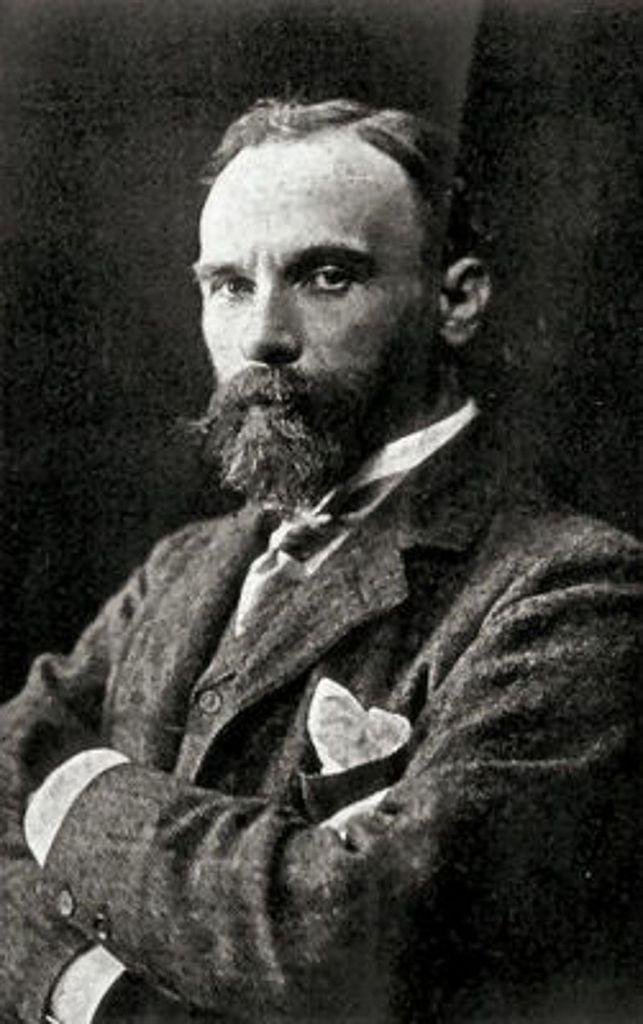
John William Waterhouse (c.1886)

The artist I am looking at in my next series of blogs is the very popular late 19th and early 20th-century British painter, John William Waterhouse, who was best known for painting in the Pre-Raphaelite style, a style which became increasingly popular during the Pre-Raphaelite movement which began in 1848. Waterhouse was a man who, through his paintings, we can see was fascinated by unhappiness, magical worlds and the exciting perils brought about by love and beauty. He was captivated by female beauty and intrigued by the power the women held over men.

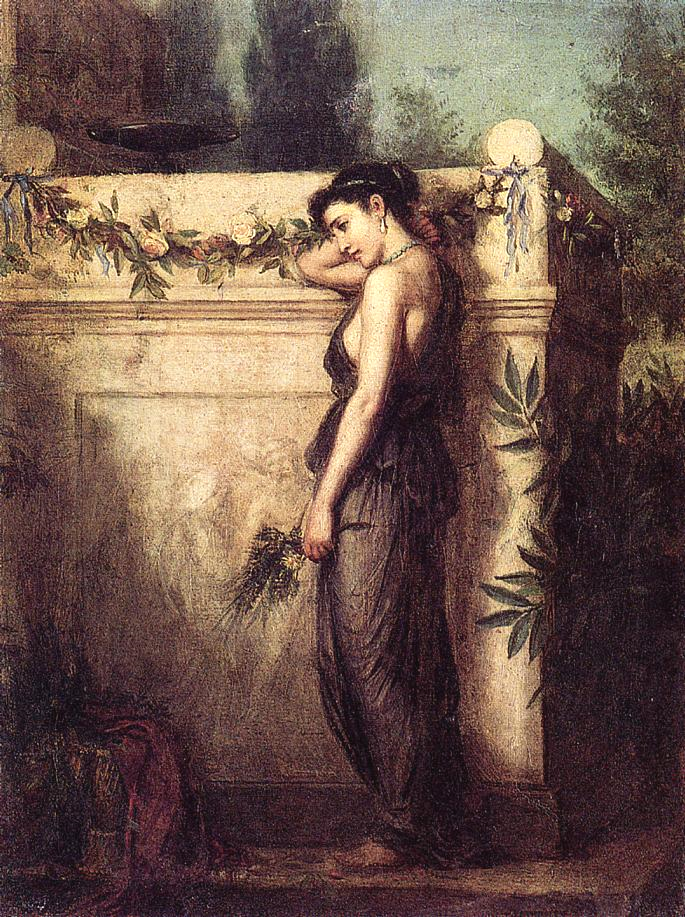
The Slave by John William Waterhouse (1872)

Waterhouse was born in Rome on April 6th 1849. The year 1849 was an important year in English art as it was the year that members of the Pre-Raphaelite Brotherhood, which included Dante Gabriel Rossetti, John Everett Millais and William Holman Hunt, were first causing a pandemonium in the London art scene. John William Waterhouse was the first-born child of William Waterhouse and his second wife Isabella Waterhouse (née McKenzie). Both his parents were artists who had exhibited at the Royal Academy and worked in Rome. Waterhouse was given the nickname of “Nino” by his parents. Nino was short for Giovannino or “little John” and this nickname would remain with him throughout his life. When he was five years old his parents left Italy and moved to the London, where they moved into a newly built house in South Kensington, which was near to the newly founded Victoria and Albert Museum.  Three years after moving back to England, his mother died of tuberculosis at the age of 36, a disease which, seventeen years later, would take the lives of two of his younger brothers.

Gone, But Not Forgotten by John William Waterhouse (1873)

Waterhouse’s father remarried in 1860 and at this time he, his new wife and his son lived in Leeds. Waterhouse attended the local school and despite his favourite subject being Roman history, he had hopes of becoming an engineer. By 1870 the family was once again living in London and his father was earning a living by painting portraits assisted by his son. In 1880, at the age of 21, Waterhouse entered the Royal Academy Schools as a probationer in sculpture. His probationary period just lasted for six months, after which he was admitted as a student but he had now begun to concentrate on painting rather than sculpting. It was around this time that he began to exhibit some of his work at the Dudley Gallery and the Society of British Artists.

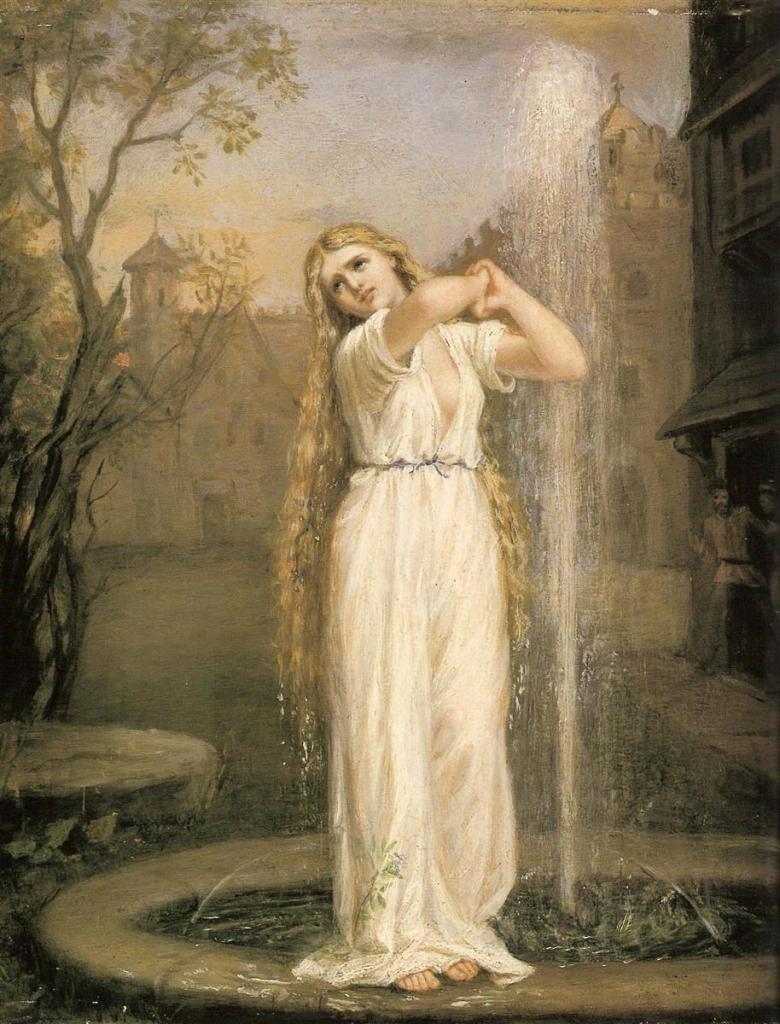
Undine by John William Waterhouse (1882)

One of Waterhouse’s early paintings was his 1882 work entitled Undine. Undine was the main character in the German novelist and playwright Friedrich de la Motte Fouqué’s 1811 classic fairy tale, Undine, in which he tells the story of this elemental water spirit, who marries a human in order to gain a soul.   Undine’s hair and body shape replicate the vertical flume of water from the fountain we see behind her. This connection between women and water will be repeated many times in Waterhouse’s later works. The female, Undine, was also the one of the first of Waterhouse’s many young female figures.

The Unwelcome Companion A Street Scene in Cairo by John William Waterhouse (1873)

During the 1870’s Waterhouse completed a number of Orientalist works. One of these works, which he completed in 1873, was his painting, The Unwelcome Companion: A Street Scene in Cairo. The painting was exhibited at the gallery of the Society of British Artists the following year. In 1951, the work was donated it to Towneley Art Gallery in Burnley. Waterhouse later depicted the same woman in the same dress in his work, Dancing Girl.  At this time there was a great demand for paintings featuring Near Eastern images. The great French painter, Jean-Léon Gérôme had become a worldwide celebrity for his Orientalist works. Coincidentally, whilst Waterhouse was studying at the Royal Academy Schools in London, Gérôme was also in the city having taken refuge there during the 1870 Franco-Prussian War and had been elected as an Honorary Foreign Academician at the Royal Academy and it is thought that the two artists could have met.   The depiction of the woman featured in the painting is quite similar to the females we see in some of Gérôme’s painting featuring the women of Cairo. In this work the woman holds a tambourine and so we must conclude that she is a dancer but she is a mystery as we cannot tell what she is thinking. The architecture, as seen in Waterhouse’s depiction of the arch column we see in the background, derives from the Alhambra Palace in Granada. It is known that Waterhouse had not visited Spain but his family did live close to the South Kensington Museum which housed architectural models of the interior of the Spanish palace and it is here that he probably made sketches.

Sleep and his Half-brother Death by John William Waterhouse (1874)

In 1874, Waterhouse had his first painting accepted for the Royal Academy’s Summer Exhibition. The painting, entitled Sleep and his Half Brother Death refers to Greek mythology and the Greek gods Hypnos (sleep) and Thanatos (death) who were brothers. It is a painting which links sleep and death. Two young men are seen lying on a bed. As our eyes move from the foreground to the background we are moving from life to death. Hypnos in the foreground is bathed in light whereas his brother, Thanatos is enveloped in darkness and from the title of the painting we know that Hypnos represents sleep whereas Thanatos personifies death. Hypnos also can be seen clutching a bunch of poppies from which is derived laudanum and opium for inducing sleep and dreamlike states.

John Arthur Blaikie, a journalist gave a brief critique of this painting in The Magazine of Art in 1886, wrote :

“…The two figures recline side by side on a low couch, beyond which are the columns of a colonnade open to the night and touched with moonlight. The interior is lit by a lamp, whose light streams on the foremost figure, Sleep, whose head hangs in heavy stupor on his breast, and his right hand grasps some poppies. By his side lies Death in dusky shadow, with head thrown back, and the lines of the figure expressive of easeful lassitude. At his feet is an antique lyre, while immediately in the foreground is a low round table… The two figures are both young, and the beauty of youth belongs to one as much as to the other… the strange likeness and unlikeness of the recumbent figures…”

The reason why twenty-five-year-old Waterhouse decided to paint this disturbing scene was probably because it was shortly after his two younger brothers died of tuberculosis.

Miranda by John William Waterhouse (1875)

At the 1875 Royal Academy Exhibition Waterhouse submitted his work Miranda. This marked the first time he depicted a heroine from a Shakespeare play, a thing he would do on a number of occasions later in his life. Miranda was the daughter of Prospero in the play, The Tempest. She was banished to the Island along with her father at the age of three, and in the subsequent twelve years has lived with her father and their slave, Caliban, as her only company In the depiction we see the young women, seated gracefully on a rock, gazing out at a ship on the horizon which she hopes is bringing Ferdinand, her future lover and rescuer, to the land where she has been exiled. But then the storm comes……..

Miranda in Waterhouse’s painting is not dressed in Shakespearean costume but wears classical clothes replicated from ancient Greece sculpture. Cords cross between her breasts and encircle her waist with an overfold of rumpling fabric. The hairstyle Waterhouse has given his female is also of classical style with two bands of circling ribbon, the ends of which flutter in the strengthening winds of the approaching storm.

Miranda by John William Waterhouse (1916)

Forty-one years later, in 1916, a year before his death, Waterhouse once again depicts Miranda in a painting. Whereas the earlier painting has Miranda looking out at Ferdinand’s ship which is a mere dot on the horizon, this painting depicts a later part of the  Shakespearean story. The storm or tempest has come and Ferdinand’s ship is much bigger and closer to the rocky shoreline where Miranda sits upon the rock. The ship is being battered by huge green and purple waves topped with white foam. The gale force winds whip through Miranda’s clothes and hair. In this work Miranda’s clothes are no longer of classical Greek style but now resemble clothes worn at the time of Shakespeare’s 1612 play. There is something much stronger about this latter Miranda with her fiery red hair loosened and flowing and the vivid colouring of her clothes which give her a much bolder aura than her earlier reflective and inhibited counterpart of 1875.

After the Dance by John William Waterhouse (1876)

The third year Waterhouse had a painting accepted for the Royal Academy’s Summer Exhibition was 1876. His painting, entitled After the Dance, was given a favourable hanging position on the wall of the gallery, just above eye-level, often referred to as “on the line” as this was the level at which most observers could best see the works of art. To achieve this positioning was an acknowledgement that the hanging committee looked upon him as an up-and-coming talent. This is a work quite clearly influenced by the great Lawrence Alma-Tadema who also had a painting with the same title in that year’s exhibition, although his work depicted a voluptuous nude bacchante lying asleep after wild revelry.  This large work (76 x 127cms) depicts a Roman interior, in which we see part of the atrium and a glimpse into the court beyond. The main figures are a young boy and a young girl, both dancers who are very tired after dancing and are both resting on cushions, the boy is sitting up, clutching a wilting flower, and the girl is drowsily stretched on the tessellated floor with a tambourine lying alongside her. In the left background we can see a group of adult minstrels seated on a marble bench.

An aulios

One holds an aulos or tibia which was an ancient Greek double-piped wind instrument, while the other rests his arm upon his lyre. One has to question the mood of the painting. The title, After the Dance, suggests merriment and yet before us we see two exhausted children and as a backdrop there is a very dark painting depicting a funeral procession. The expression on the children’s faces is not one of joy and excitement but one of exhaustion and a hint of melancholy. Maybe Waterhouse wanted his painting to be a critical comment with regards child labour.

…………………………….to be continued

Museo de Bellas Artes, Sevilla. Part 2 The Murillo Exhibition

Murillo Exhibition at Seville

……….when I arrived at the Museo de Bellas Artes in Seville I was pleasantly surprised to see that there was a special exhibition on marking the 400th anniversary of Seville’s great painter Bartolomé Estaban Murillo.  It had opened in November 2018 and was still running. The city of Seville had been celebrating the 400th anniversary of his birth for the last twelve months and this exhibition, which ends in April, was the culmination of the celebrations.

Self-portrait by Murillo

Murillo came from a very large family, the youngest of fourteen children.  His father was both a barber and a surgeon.  His parents died when he was young and he went to live with a distant relative and artist, Juan del Castillo who started Murillo’s artistic education.  He stayed with Castillo until 1639 when his mentor had to move to Cadiz.  Now Murillo, aged twenty-two, had to fend for himself and scraped a living by selling some of his paintings.  In 1643 he travelled to Madrid where he met Velazquez who was also from Seville and had now become a master of his craft.  He took pity on Murillo and let him lodge in his house.  Murillo stayed in Madrid for two years before returning to Seville.  In 1648, at the age of thirty-one, Murillo married a wealthy lady of rank, Doña Beatriz de Cabrera y Sotomayor.   Murillo died in 1682 aged 64.  He lived a humble and pious life and was a brave man.  On his death he left a son and daughter, his wife having died before him.

The Seville exhibition was a collection of fifty-five paintings by Murillo from museum collections around the world. The exhibition was divided into nine sections each providing a glimpse of the world through Murillo’s eyes. The sections were designated as Holy Childhood, A family of Nazareth, Glory on Earth, The Immaculate Conception, Compassion, Penitence, Storyteller, Genre painting and Portraiture. It was a journey through his religious works to the social realism of 17th century Seville, which has been described as a city of paupers and saints, of rascals and wealthy noblemen and merchants who, through their wealth, were able to have Murillo paint their portraits.

The Good Shepherd by Murillo (1665)

In the first section, there was the Prado-owned painting entitled The Good Shepherd, which Murillo completed in 1665. The scene has a rural setting along with classical allusions in the form of archaeological ruins which we can see in the left background. Jesus is portrayed as the boy who exudes an air of determination as he holds his shepherd’s crook in one hand whilst his left-hand lies across the back of the animal. There is a certain gentleness about the scene and the sheep, seen with the boy, represents the Agnus Dei (Lamb of God), which is talked about in the scriptures. The depiction of the lamb as being obedient and submissive is all part of the divine plan.

The Holy Family with the Infant St John by Murillo (c.1670)

One of Murillo’s paintings in the Family of Nazareth section was The Holy Family with Infant Saint John, which Murillo completed around 1670 and was loaned to the Seville gallery by Budapest Museum of Fine Arts. This was a pendant painting forming a pair with his work The Flight into Egypt, which was also on show. In the depiction, we see Saint Joseph, in the background, with his carpentry tools. In the foreground, we see the Christ Child and the young Saint John busily tying two sticks together to form a cross. Mary watches over the children as she busies herself sewing. A sense of depth has been added to the composition by the inclusion of a background of mountains and clouds.

The Holy Family (The Heavenly and Earthly Trinities) by Bartolomé Esteban Murillo, (1675-1682)

In the third section, Glory on Earth we have the Murillo painting The Holy Family (The Heavenly and Earthly Trinities) which was loaned to the museum for this exhibition by London’s National Gallery. This work of art encapsulates the religious theory that Jesus is both God and man and thus belongs to both the Heavenly Trilogy of God the Father, God the Son and God the Holy Spirit as well as belonging to the Earthly Trinity – the family from Nazareth as seen in the painting with Jesus’ closeness to his mother, the Virgin Mary and his father, her husband Saint Joseph.

The Annunciation by Murillo (c.1660)

Murillo completed many paintings featuring the Virgin Mary and many were on show at the exhibition. The Annunciation by Murillo, which he completed around 1660 and had been loaned out by the Prado, was a great example of this focus on the Mother of God.

The Virgin and the Rosary by Murillo (c.1680)

The Dulwich Gallery-owned work by Murillo entitled The Virgin and the Rosary was also on view. In this work we see the Virgin seated on a throne of clouds floating in the celestial sphere and unlike other versions of this work by the Seville painter, clouds and angels have now been added to become her throne and footstool.

Mater Dolorosa by Murillo (1670-1675)

One of my favourite pieces of religious art by Murillo, which was at the exhibition, was Mater Dolorosa an artwork, which was part of a private collection belonging to a Dutch family. Mater Dolorosa or Our Lady of Sorrows refers to the sorrows in the life of the Virgin Mary and is a key subject for what is termed Marian art in the Catholic Church. In 1939 when the painting was bought from the Amsterdam art dealership, de Boer, by a private Dutch buyer, there was some doubt as to whether this painting was by Murillo but the German art historian August Lieberman Mayer, who was one of the most prominent art historians of the early 20th century and the era’s leading specialist for 17th century Spanish painting, wrote to the new owner stating his belief that it had been painted by Murillo. In his letter dated July 12th, 1939, he wrote:

“…I deeply regret, that actually I cannot make a new edition of my book in „Klassiker der Kunst“, but I hope to publish another monography of Murillo in Spain“ The picture is, in my opinion, a very fine, well preserved, genuine and most characteristic work by B. Murillo, executed most probably about 1668, the period, I consider the best and most powerful of the master. I reserve me the right of the first publication of this important and impressive work..”

Despite Mayer’s opinion, many art scholars still question his attribution. August Mayer never did publish another work on the Spanish master. As a Jew, he was forced to leave his offices in Munich by the Nazis.   He then fled to Paris in 1936 but was later arrested and was deported to Auschwitz in 1944 where he died.

I am not a great lover of religious art, probably not due to the quality of the work but more to do with the subject matter. I was therefore very pleased that after seven rooms of religious painting the final two rooms were devoted to Murillo’s genre paintings and his portraiture.

A Peasant Boy leaning on a sill by Murillo (c.1675)

I especially liked Murillo’s painting A Peasant Boy Leaning on a Sill, which he completed around 1675.  When London’s National Gallery acquired this work in 1826, it was the first Spanish painting to enter the museum’s collection.   The National Gallery of London loaned this to the Museo de Bellas Artes for the Murillo exhibition. This striking depiction of a cheerful boy is related to Murillo’s depictions of street urchins in his larger canvases. We see the boy at a window, the implication being that there is a lot going on that we are not aware of and so we have to be satisfied with what we have before us. So what else is going on? What has been excluded from the depiction? What is the boy looking at?   Some would have us believe that this work had a companion piece painted by Murillo, which was to be hung to the right of this one which would allow us to see what the boy was looking at.

Young Girl Lifting her Veil by Murillo

That suggested pendant piece was Young Girl Lifting Her Veil, (which is privately owned and was not included at the Seville exhibition). However, many art historians cast doubt on the two paintings being pendant pieces but the fact is that they were painted around the same time, they are both half-length depictions and are of similar size.  I have included the Young Girl Lifting her Veil and let you decide whether the two paintings hung side by side on a wall would add to your belief that they were pendant pieces. Was this beautiful girl the subject of the boy’s gaze?  Some think that the boy’s demeanour has an air of mischief about it and his expression was not instilled with innocent sincerity, like that of the girl. I will leave you with one further clue. At the sale of the two works at the Peter Coxe London saleroom on March 20th, 1806 of paintings owned by the Marquess of Lansdowne, the catalogue described them as:

“…No.50. Murillo. A Laughing Boy – delicately treated in every part – one of those performances so rare to be met with, & in his best style of perfection.

No.51. Murillo. Portrait of a girl treated with the same tone of harmonious colouring, as the preceding Lot, to which it is a companion, in the same happy effect of management…” 

The two paintings were sold at the auction to separate buyers.

Four Figures on a Step by Murillo (1655-1660)

The most bizarre painting at the exhibition, and one I particularly like, is Four Figures on a Step, which is owned by the Kimbell Art Museum of Fort Worth, Texas. At first sight, I thought somebody had defaced the painting by adding a pair of thick black spectacles to the woman on the right.

Before us, we have four very different characters. In the central background, we have a young woman. Her face is somewhat distorted into a smile, even a knowing wink, as she raises her scarf over her head. What is the significance of the gesture?   Art historians have hypothesised that it is a coquettish gesture whilst others say that that is reading too much into her manner stating that the depiction is a simple scene with a family scrutinising the goings-on in the street outside. However, the scene to many historians is to associate it with one of procurement. Procurement?  They would have us believe that the older women with the thick dark glasses, resembles the character of a Celestina, an aged prostitute, madam, and procuress, of Spanish literature. The old procuress,  Celestinacomes from the 1499 book La Celestina, which is considered to be one of the greatest works of all Spanish literature, a timeless story of love, morality, and tragedy by Fernando de Rojas. The Celestina is often represented as a crone wearing enormous glasses and a headscarf hence the belief that Murillo’s painting includes a procuress!   So, if she is procuring, is she offering the man the pleasures of the young woman? More conservative historians point to the fact that on the contrary to the Celestina idea, the mature woman also resembles the bespectacled characters in Dutch and Flemish genre paintings, which Murillo would have seen.

The possible “procuress” is seen cradling the head of a young boy whose bottom is exposed by his torn breeches. In less liberal times Murillo’s depiction of the bare bottom had offended the public and had been over-painted for reasons of regaining a modicum of modesty but the painting now, after restoration, is seen as Murillo intended.

So the question I leave you with is this depiction simply a portrayal of the colourful characters to be found in the streets of Seville, or does the painting carry a reproachful, message, urging the viewers to avoid enticements of worldly decadences?

Portrait of Juan de Saavedra by Murillo (1650)

In the final room of the exhibition, we have Murillo’s portraiture.  Murillo’s earliest dated portrait is a newly discovered canvas, which depicts Juan Arias de Saavedra y Ramírez de Arellano an aristocrat from Seville and one of Murillo’s patrons. The subject of the painting was a knight in the Order of Santiago as indicated by both the red cross on his left shoulder and the pendant with a scallop shell.  The portrait is shown as being in a stone frame, which includes the sitter’s coat of arms. Murillo often used this stone-frame device in his bust-length portraiture. Also in the painting are two putti each holding a tablet. The one held by the putti on the left records the age of the sitter as twenty-nine while the one on the right has the date on which the portrait was painted – 1650. Below the portrait, there is a lengthy Latin inscription which is about Saavedra. Saavedra, it states, was a senior minister of the Holy Inquisition and is described in the inscription as a “profound connoisseur of the liberal arts, and of painting in particular”. The inscription also includes a passage by Murillo, which offers convincing proof of the connection between the artist and the nobleman with Murillo admitting his gratitude and sincere regard for Saavedra.

Portrait of Josua van Belle by Murillo (1670)

My last offering for this blog is another work of portraiture by Murillo, which was loaned to the Seville museum by the National Gallery of Ireland.   The sitter is Josua van Belle. He was born in Rotterdam and became a Dutch shipping merchant who lived for a period in Cadiz and Seville, where this portrait was painted in 1670. Van Belle was a celebrated art collector and amongst his collection of paintings, was Johannes Vermeer’s Woman Writing a Letter, with her Maid, which also resides in the National Gallery of Ireland. This portrait is looked upon as one of Murillo’s finest.

The Museo de Bellas Artes’ exhibition was excellent, full of beautiful masterpieces by Murillo and you have until the last day of March to visit this Sevilla exhibition.