Venus and Mars by Sandro Botticelli

Venus and Mars by Botticelli by Sandro Botticelli (c.1485)

Many have written about today’s painting and the symbolism of what is depicted and the interpretations of the work abound.  In my blog today I have tried to steer a middle course between completely ignoring the interpretation of the work and delving too deeply into the scholarly minutiae of what we see before us.  Today I simply want to look at the characters behind the title of the painting and the actual people who we see before us.

The painting entitled Venus and Marswas completed by the Florentine artist, Sandro Botticelli around 1485 and the nineteenth-century title of the painting alludes to two mythological people who had an adulterous affair.  They are Venus, the Goddess of Love, who had an illicit liaison with Mars, the God of War, whilst she was still married to the lame blacksmith Vulcan, who forged Cupid’s arrows and the intricate armour of the Gods and heroes.   The tempera and oil on poplar work, which now hangs in the National Gallery in London, measures 69cms tall and 174cms in width.  Little is known as to who commissioned the painting or for where it was intended.
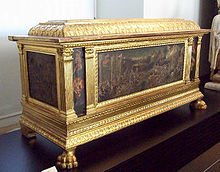
A cassone

However the dimensions of it would probably mean that it was made for either a cassone or a spalliera.   A cassone is the Italian word for chest or box. They were used for storage and often associated with the giving of a dowry.  A spalliera is the Italian word for the back of a bench or settle, or the headboard or footboard of a bed, or any similar vertical attachment of a piece of furniture.  They were commonly painted in Italy, especially in Tuscany.  Often these items of furniture were richly decorated with carving, gilding and painted panels illustrating acts of heroism or as is the case with this work, acts of love.  The fact that it is an act of love we are looking at probably means that this was meant for a bridal chamber and maybe it was to be incorporated into the headboard of a bed (spalliera di letto).  If we look at the painting we can see that the two figures almost rest on the base of the painting and so if it was meant to be part of the headboard of a bed, the lovers would almost be seen as lying on the bed itself.

Before I look at the two main characters in this painting by Botticelli, let us look at some of the other details we see before us.  The setting for the painting is contemporary.  It is a forest and yet strangely the artist has not incorporated any flowers into the scene which may be simply an indication of the time of the year. However the couple is framed by two evergreen plants, the laurel and the myrtle.  The former was associated with the family of Lorenzo de’ Medici and the myrtle was associated with Venus.   In the distance, on the other side of the fields we can just make out the city of Florence, behind which rise the mountains which lie to the north of the River Arno.

If you look closely at the top right corner of the painting, just above the head of Mars you will see a swarm of hovering wasps.  So why include them?  One thought is that as the Italian word for wasps is vespe and they form part of the Vespucci’s coat of arms.  We will see later that the model used for Venus was Simonetta Cattaneo, whose husband Marco was a member of the Vespucci family.  Others interpret the presence of wasps as being the symbolic of the painful stings of illicit love.

In the painting we also have four small satyrs.  Normally in paintings featuring Venus one would have expected to see erotes, which were the tiny group of gods and demi-gods associated with love and sex and part of Venus’ retinue.  The satyrs were more like little devils and maybe their inclusion once again to the fact that we are observing an act of forbidden love.  Two of the satyrs can be seen wielding a lance which no doubt has a phallic connotation.
The narcotic fruit ?

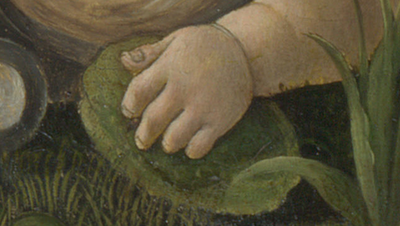
Another satyr can be seen blowing a conch shell in an attempt to wake the sleeping figure of Mars and one, with a lascivious expression on its face, lies beneath the arm of the exhausted Mars, clutching a green fruit.  This fruit has brought about much discussion as to what it is and why it is incorporated in the painting.   Some would have us believe it is the fruit of one of the highly narcotic datura genus of plants, datura stramonium and that Mars is in a drug-induced sleep.  Other art historians disagree with this assertion pointing out that the plant was not found in Italy at the time Botticelli painted his masterpiece.  Others have suggested the fruit depicted was ecballium elaterium which is also known as the ‘exploding cucumber’ or ‘squirting cucumber.’  This too is a poisonous plant.
Simonetta Vespucci née Simonetta Cattaneo de Candia

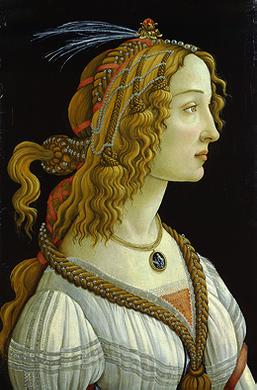
In today’s painting in My Daily Art Display the woman who was believed to have been used as a model for Venus was looked upon as the most beautiful woman of her time.  Botticelli had incorporated this woman in to two of his other masterpieces, namely, Primavera which he completed in 1482 and the Birth of Venus which he completed around 1485.  The interesting thing is that she had died some nine years before Botticelli painted the last of these works.   Some historians would have us believe that Botticelli had, like so many, fallen in love with her beauty.  How true that is we will probably never know but we do know that Botticelli asked to be buried at her feet in the Franciscan Church of Ognissanti, which was the parish church of the Vespucci family in Florence. His wish was in fact carried out when he died some 34 years later, in 1510 and a small round stone in a chapel of the right transept marks his resting-place.

The woman in question is Simonetta Cattaneo de Candia.  She was thought to have been born in either Genoa or Portovenere around 1453.  She was part of a very wealthy and influential family.  Her father, Gaspare Cattaneo della Volta, was a Genoese nobleman from the House of Volta and her mother, Cattocchia Spinola de Candia came from an equally wealthy background, the European dynastic House of Candia.  Simonetta was married at the age of sixteen to the son of a wealthy Florentine banker, Marco Vespucci, who was a distant cousin of the famous Italian explorer, Amerigo Vespucci.  Although this was not an arranged marriage, Simonetta’s parents were pleased with the arrangement as the groom’s family were well connected with the powerful Medici family.

Simonetta moved to Florence and after the marriage in 1469 she and her husband became regulars at the Medici court in Florence and she struck up a close friendship with the co-rulers of Florence, the two de’ Medici brothers Lorenzo and Giuliano.  It was whilst attending court functions that Simonetta first met a number of court painters including the young Florentine artist Sandro Botticelli.  Men were astounded by her natural beauty and she soon became a court favourite.  One of the most prominent men to fall under her spell was none other than Giuliano de’ Medici himself.  In 1475, Lorenzo de’ Medici, Giuliano’s elder brother, organised a jousting tournament to celebrate a treaty with Venice. It was reported that at this tournament Giuliano had entered it carrying a banner, which had been painted by Botticelli, and on which was a picture of Simonetta depicted as wearing the helmet of the Greek goddess of war,  Pallas Athene and beneath the portrait were the French words La Sans Pareille (The unparalleled one).  Giuliano won the tournament and at the same time, Simonetta was nominated the “The Queen of Beauty”.  It was following this that she was looked upon as the most beautiful woman of the Renaissance.

So what was Giuliano’s relationship with the married Simonetta?  Were they lovers or was it a platonic relationship?  The question has divided historians over the years and probably we will never know the truth.  Whatever the answer is the relationship was short lived as Simonetta died of tuberculosis on April 26th 1476, a year after the jousting tournament.  She was only twenty-two years of age.  On the day of her funeral, the city of Florence came to a stand-still as thousands of mourners attended the funeral.  Ironically, Giuliano de Medici was assassinated exactly two years to the day on 26 April 1478 in the Duomo of Florence, Santa Maria del Fiore, by Francesco de’ Pazzi and Bernardo Bandini. He was killed by a sword wound to the head and was stabbed 19 times.

The figure of Mars in the painting is depicted in a traditional classical God-like way, unlike the way in which Botticelli has portrayed Venus as a contemporary woman with a contemporary hair-style dressed in her contemporary clothes.  His body is one of a well-toned athlete and was similar to those classical paintings and sculptures of the young Gods.  The whiteness of his skin reminds us of the white marble sculptures of ancient times.  But who is this Mars?  If we believe that Venus is Simonetta Vespucci, then should we believe that this reclining man is her husband or should we believe that in fact it is her “close friend”,  possibly her lover, Giuliano de’ Medici?  The figure in the painting has a long nose and deep-set eyes and they resemble the ones in his portrait which Botticelli completed of Giuliano around 1477.  As we know from mythological tales Mars was the lover of the already married Venus so are we to deduce that Botticelli had wanted to similarly portray Giuliano de’ Medici and the already married Simonetta as a comparison?

Look at the way Botticelli has portrayed the two characters.  The man lies back exhausted but the woman sits upright and looks quite composed.  Who has initiated the bout of love-making?  Who is the giver and who is the receiver?  I believe in this painting, Botticelli has given the power to the female.  She looks at the man with little emotion.  Maybe she is reflecting on the power she has over him.  The woman seems totally in command of the situation whereas the man appears worn out after what could have been a bout of love-making.  Is this a scene of male-female role-reversal in which the female has seduced the male, drained him of his vitality and in some ways neutralised him and now studies her conquest?

I am a great fan of Botticelli especially in his portrayal of women.  They must be some of the most beautiful ever painted.

I started this blog saying I would keep it concise and not too technical but the more I investigated the painting and its symbolism the more I got carried away with the subject.  More has been written about the painting by more knowledgeable people than me and if this blog has stimulated your mind and your thirst for knowledge about this work I suggest you visit some of the websites which discuss the work of art.  They are:

http://omnparts.com/2010/07/29/david-bellingham-on-sandro-botticellis-venus-and-mars/

The autor of this site is by David Bellingham, of the Sotheby’s Institute of Art

and

http://www.3pipe.net/

The Three Pipe Problem, which is a truly amazing art blog and one i love to visit.  If you go to the “search facility” and insert “Venus and Mars” you will find some interesting articles about today’s painting.

The Risen Christ by Bramantino

The Risen Christ by Bramantino (c.1490)

Today I am returning to an Italian painting for My Daily Art Display and want to look at The Risen Christ by the fifteenth century Italian painter and architect, Bartolomeo Suardi.  He was better known simply as Bramantino, (little Bramante) as he was a devoted follower of his one-time tutor the great Italian architect, who designed St Peters, Donato Bramante.

Bramantino was born in Milan in 1456, the son of Alberto Suardi.  Initially trained as a goldsmith but later turned his attention to painting.  His initial artistic training was with Donato Bramante who profoundly shaped his artistic style.  His style as a painter is somewhat complex and diverse.  In his early career he was also influenced by the drawings of Piero della Francesca.  It was not until he was in his mid-thirties that he exhibited his first works.  It was at this time, around 1490, that he completed today’s featured painting, The Risen Christ as well as another of his great compositions, The Adoration of the Magi

Bramantino worked for Gian Giacomo Tivulzio for whom he designed a series of cartoons for a  tapestry cycle on the twelve months of the year which can now be found in the Castello Sfozesco.  Trivulzio, a nobleman and warlord, had over time, built up a great wealth, which he used in part as a patron of arts and in particular on works by Bramantino.   These commissions included the Trivulzio Chapel in the Basilica of San Nazaro in Brolo where he was eventually buried. In 1508 Bramantino was in Rome on a commission he had received from Pope Julius II to produce some frescos for one of the reception rooms in the Vatican.  The next year following his work for the pontiff he returned to Milan and was inundated with new artistic and architectural commissions.  In 1525 aged sixty-five he was appointed architect and painter to Maria Sforza, the Duke of Milan.  In the following years he produced many religious paintings for his patron including a Crucifixion which I saw when I visited the Pinacoteca Brera in Milan and a Virgin and Child with Saints, which is in the collection at Palazzo Pitti in Florence.

Bramantino died in Milan in 1530 aged 70.

My Daily Art Display featured painting is an oil on panel work entitled The Risen Christ which Bramantino completed around 1490 and is now hanging in the Museo Thyssen-Bornemisza Gallery in Madrid.  It is a haunting portrayal of Christ.  I feel somewhat uneasy when I look at this work of art.   It is a very powerful portrayal but the power of it is not dependent on a depiction of violence or splashes of blood oozing from wounds.  In some ways, and in comparison to other paintings which depict the risen Christ, it is somewhat downbeat.  This is not a portrayal of a triumphant Christ having risen from the dead.

 Before us is a full frontal ,three-quarter length portrayal of Christ with the shroud of his burial wrapped around his shoulders.  This is a man who has passed through death and is now no longer part of this world.   Look at the luminosity Bramantino gave to Christ’s skin.  It is a combination of translucent white and grey.   The cloak, which Christ is wearing, has a metallic lustre and mirrors the paleness of his skin.  The shroud and the body of Christ seem to emit light.  His body, with its raised veins, shows the wound caused by the lance to his right side and the palms of his hands show the scars caused by the crucifixion nails.  In contrast to the colour of his body, his face is not so pale with Bramantino contrasting the ghostly pallor of the body with the reddish/brown of his face and his red hair which hangs down to the shoulders. The long hair and the and the hint of a beard which follows the jaw line helps to elongate the face.  Despite the colouring, his face is gaunt and haggard and bears testament to his mental and physical suffering he has had to endure.  There is a distinct look of sadness in his reddened eyes.  He looks directly at us but it is a penetrating and hauntingly pained look.  He almost appears to look through us with this riveting stare.  There is an air of detachment about Christ which serves to emphasise the fact that he is no longer part of our world. 

To the left, in the background we have a nocturnal landscape.  We can just make out a riverscape with a ship with its tall cross-shaped masts and two campaign tents topped by golden balls.  This part of the painting  is illuminated by moonlight and in some way manages to offset the emotional stress of the foreground.  Bramantino’s architectural interest can be seen coming out of the darkness on the right of the painting in the form of some classical architecture which could represent Christ’s burial tomb in the Garden of Gethsemane. To the left the buildings seemed to have fallen into a state of disrepair with vegetation growing wild from their tops.

What I like about this painting is that Bramantino has managed to stop us in our tracks when we first cast our eyes on the work.  He has managed that without the histrionics of bloody gore.  The pale figure has grabbed our attention and made us focus our mind on what has happened during the lead up to this situation.

Lot and his Daughters by Artemisia Gentileschi


Lot and His Daughters by Artemisia Gentileschi (C.1640)

The other day I was asked a question about a painting and the painting within that painting and it was whilst researching into the answer I came across My Daily Art Display’s featured painting of today.  My Daily Art Display painting today is entitled Lot and his Daughters by Artemisia Gentileschi.  I had previously featured a painting with the same title by Lucas Cranach the Elder back on August 20th and there are numerous similar works by other Renaissance artists who have depicted the biblical scene including Orazio Gentileschi, the father of today’s featured painter.

Artemisia Gentileschi was born in 1593 in her parents’ home on Via Ripetta, near S. Giacomo degli Incurabili, a church dedicated to St James the Great, in the Corso near Piazza del Popolo. She was the first born of five children of the Tuscan painter Orazio Gentileschi, then 30, and Prudentia Montone Gentileschi, who was then just 18 years old.   The Gentileschi family always lived in the artists’ quarter between Piazza del Popolo and Piazza di Spagna, in the Campo Marzio, Latin for the Field of Mars and the nearby church of Sta. Maria del Popolo, which was built in 1520 and contains works by Raphael, Bernini and Caravaggio.  Artemisia’s mother died in childbirth aged 30 when Artemisia was just twelve years of age and she was brought up by her father.  Artemisia studied painting in her father’s workshop and accounts of her early life tell of how she was a far better student than her brothers who were also being trained as artists by their father.  Her father introduced her to the Roman artists of the time including the great Michelangelo Merisi da Caravaggio.

Much of Orazio Gentileschi’s work was influenced by Caravaggio and in turn Artemisia’s style of painting in her early artistic days was also inspired by him.  The one main difference between the painting styles of father and daughter was that Orazio’s works were idealized, her paintings were more naturalistic in nature.  Artemisia was indebted to her father in the way he supported her artistic ambitions as at that time women were not considered to be intelligent enough to be an artist and her artistic talent, which was plain to see even in those early days, was heavily criticised by her male counterparts who were jealous of her artistic gift.  Artemisia was not to be put down and fought for her right to become an artist and her determined and unwavering attitude eventually gained her the respect she deserved and ultimately it gained her justifiable credit for her work.

She produced her first major work at the age of seventeen.  It was Susanna e i Vecchioni (Susan and the Elders) which she completed in 1610.  This biblical subject was another which had been, and was to be painted many times over.  However Artemisia’s painting shows how she incorporated the realism of Caravaggio into the work and is one of the few Susanna paintings showing the actual sexual assault of the two Elders as a traumatic event.

Two years later an incident occurred which was to change the course of Artemisia’s life.  Her father was working on a commission for Pope Paul V inside the Pallavicini Rospigliosi Palace along with fellow painters, one of whom was the Florentine artist,  Agostino Tassi.  Orazio got on well with his fellow worker and contracted him to tutor his daughter privately. It was during this tutelage that Tassi raped Artemisia. At the time she was nineteen years of age.  Instead of reporting the incident to her father she said nothing and continued to have sexual relations with her mentor, as Tassi had managed to placate her by promising her marriage.   Tassi however, had other ideas and broke off the liaison citing her unfaithfulness with another lover as the reason for the end of the relationship.   It was at this point that Artemisia’s father pressed rape charges and Tassi was arrested and put on trial for rape and for the theft of a painting from Orazio’s workshop.

The trial lasted several months and is well documented and the transcripts of the trial still exist.   The case followed a similar pattern that is familiar nowadays with the defendant maintaining that his victim had not been a virgin but was a willing lover and in fact had had many lovers and was an insatiable “whore”.  The assertion that Artemisia was not a virgin was the crucial issue and it has to be remembered that the fact that Artemisia had maintained that she had been a virgin prior to the rape was the only reason the courts would countenance a trial.  However she had to undergo the embarrassment of a number of  thorough gynaecological examinations by midwives to determine whether she had been “deflowered” recently or a long time ago and she even underwent intense questioning sometimes being tortured using a sibille, a type of thumbscrews, for the officials to come to a decision about the charges she had laid against Tassi.  Tassi denied ever having had sexual relations with the virginal Artemisia and brought many witnesses to testify that she was “an insatiable whore.”   During the court case, it came to light that Tassi had previously been imprisoned for having an affair with his sister-in-law and had planned to kill his wife.   Unfortunately for Tassi, a witness was produced who recounted how he had heard Tassi boasting about raping Artemisia.  Tassi was found guilty and sentenced to one year’s imprisonment.

A month after the trial ended, her father arranged for Artemisia to marry a Florentine artist, Pietro Antonio di Vicenzo Stiattesi and soon after the couple moved home to Florence.  Soon after the trial, Artemisia Gentileschi painted Judith Slaying Holofernes .  The painting is remarkable not only for its technical proficiency, but for the original way in which Gentileschi portrays Judith, who had long been a popular subject for art.  A year after moving to Florence, Artemisia gave birth to their daughter Prudentia.  In all they had four sons and the one daughter but it was only Prudentia who survived childhood.  She and her husband worked at the Academy of Design, and Artemisia became an official member there in 1616.  This was an extraordinary tribute to be paid to a woman of her day and this almost certainly came through the good auspices of her Florentine patron, the Grand Duke Cosimo II of the powerful Medici family.   It was during her time in Florence, that he commissioned a number of  paintings from her and soon betters her husband’s reputation.  Artemisia Gentileschi remained in Florence producing works for Cosimo II until his death in 1621 at which time she returned to Rome.

The following year her husband is charged with assaulting one of a group of Spaniards, who were outside their home serenading Artemisia. By 1623, her husband is no longer listed as being a household member and it appears that they have separated permanently. Artemisia continued to live in Rome until about 1627,when she moved to Venice.  A year later she was in Naples, living with her daughters and servants.  Always in search of new patrons she finally found one, King Charles I of England who was an art-collecting monarch and who surrounded himself with many continental artists including Artemisia’s father Orazio.  Her patronage ended suddenly with the outbreak of the English Civil War and the execution of her patron Charles.  Artemisia returned to Naples where she spent the rest of her life.  She died in there in 1654, aged 61.

Although the story about Lot’s wife being turned into a pillar of salt when she disobeyed God by looking back at the burning cities of Sodom and Gomorrah is very well known and told to children who receive bible studies or religious education, the follow-up biblical tale about Lot being plied with wine until he was drunk by his daughters, who then seduce him, and have a sexual relationship with him in order to have children is for obvious reasons often left off the religious curriculum in schools, or at least I can say, with hand on heart, it wasn’t mentioned during my religious lessons.

The Bible passage Genesis (19: 30-38) sets the scene:

30 Lot and his two daughters left Zoar and settled in the mountains, for he was afraid to stay in Zoar. He and his two daughters lived in a cave. 31 One day the older daughter said to the younger, “Our father is old, and there is no man around here to give us children—as is the custom all over the earth. 32 Let’s get our father to drink wine and then sleep with him and preserve our family line through our father.”

33 That night they got their father to drink wine, and the older daughter went in and slept with him. He was not aware of it when she lay down or when she got up.

34 The next day the older daughter said to the younger, “Last night I slept with my father. Let’s get him to drink wine again tonight, and you go in and sleep with him so we can preserve our family line through our father.” 35 So they got their father to drink wine that night also, and the younger daughter went in and slept with him. Again he was not aware of it when she lay down or when she got up.

36 So both of Lot’s daughters became pregnant by their father. 37 The older daughter had a son, and she named him Moab; he is the father of the Moabites of today. 38 The younger daughter also had a son, and she named him Ben-Ammi ; he is the father of the Ammonites of today.

Artemisia Gentileschi painted the subject in the 1640’s at the height of the Baroque era.  In the painting she elected to portray the scene of wining and dining prior to the first seduction.  Lot sits between his two daughters at the entrance to their cave.   In the left background, far behind them, the city burns, and in the middle distance Lot’s wife is frozen into a Baroque statue, her arms outstretched in terror. The three main figures are intricately interlocked by a system of rhyming arms and legs.   Three prominent arms take us across the painting from left to right in a slowly falling rhythm: the daughter’s arm on the wine jug rhymes strongly with Lot’s lower arm which in turn intersects with a third arm that curves gently down to the tabletop. This strong physical  linking, with its relationship to the wine jug, wine glass and bread, has set the scene and in some ways incriminates the father and daughters in the incest which follows.  In this portrayal of the scene unlike others the artist has not depicted Lot as somebody who is so drunk that he is incapable of knowing what is happening and thus unable to thwart the incest.  He is not shown as a passive victim of the affair.  Artemisia has portrayed all three members of the family as having an active role of what is about to happen.  The girls are virgins, a state which will soon change.

The daughter to the right of the painting is well highlighted and one must suppose that she is the elder daughter and the first to seduce her father.   Look at the colours of the girls’ clothing; blue, white and gold.  We have the rich blue which is the colour often used in the portrayal of the Virgin Mary.  We have the white which symbolises virginal innocence and we have gold which is symbolic of purity and preciousness.  The elder daughter twists round, almost contorted, to look at her father.  One end of the rich blue fabric snakes between her thighs whilst the other end lies close to the thighs of her father.  Is that just coincidental or are we to believe that maybe Artemisia has placed the sash between the daughter’s thighs as an indication that this is exactly where her father will position himself during their sexual act?  Again, are we reading too much into the painting if we compare the bread which is on the table as having had its outer skin violently broken and its fresh interior exposed to the light with the act of the virgin being deflowered?  Another strange departure from the biblical tale is the action of the father.  In the Bible we are told that the daughters plied their father with drink so he became drunk and did not know what was about to happen, but look closely at the picture.  The daughter with the wine is on the left and the father is passing his wine glass to the daughter on the right as if he is plying her with wine and not the other way around.  Look at his facial expression.  What do you read into it?  Is it a look of a man who is becoming befuddled and not in control of the situation or is this the look of a man who is beginning to enjoy himself and is encouraging his elder daughter to imbibe and  take pleasure in what is happening?  Is this another way in which Artemisia is implicating him in the sexual acts which were to follow?  Is Artemisia trying to tell us that the man is not without guilt?  So the question you must ask yourself as you look at this painting is whether the artist is portraying Lot as almost a lecherous old man or one that is being hoodwinked by the daughters?  If you believe the former, as a lot of feminists do, why did Artemisia portray him that way?  Had her being raped altered her view of men and thus she would not have us believe Lot was just an old man being hoodwinked by his daughters?  Remember also that her artistic career and her eventual fame did not come easily as she was thwarted throughout her life – by whom?  Men !!!!

Many questions and some controversial answers.   I will let you form your own conclusions.

Just a little addition to the original blog:

The sibille was a long cord which was wound round the base of each finger then the palms of two hands were tied together, palm to palm, at the wrists.   Then the cord was threaded around each pair of fingers.  A large wooden screw is then attached and turned so the cord tightens digging into the flesh, cutting it and eventually it would cut down to the bone.  The pain would have been excruciating.

The Hunt in the Forest by Paolo Uccello

Hunt in the forest by Paolo Uuccello (c.1470)

When I visited the Claude Lorrain exhibition at the Ashmoleon Museum in Oxford last month,  I had time to look around their permanent collection of painting.  To my mind they have one of the best collections on offer with works from artists of different nationalities and from different eras.  I strongly recommend you visit this gallery for I know you will not be disappointed.

The painting I am featuring in today’s My Daily Art Display is one by Paolo Uccello entitled The Hunt in the Forest which he completed around 1470.  Hunting was a very popular pastime for the aristocracy in those days.  The depiction of hunting in art goes back to the Ancient Greeks when it can be seen on their tableware.  During the time of the Romans, many hunting scenes can be found on their sarcophagi and in Medieval times hunting scenes could be found in their manuscripts, wall paintings and tapestries.  There were many forms of hunting in the Medieval times, such as hunting with hawks, which took place mainly in the spring and summer and the boar and bear hunting which took place during winter.

Cassone (chest) with spalliera (backboard)

It is believed that this work of art you see before you was a one-off painting and not part of a series.  It is of an unusual size, measuring 63cms tall x 165cms wide.  With those dimensions it could well have been intended for the front panel of a cassone, a Renaissance marriage chest or a spalliera, the back of a Tuscan bench or settle, or the headboard or footboard of a bed.  The spalliera paintings were very popular at the time this painting was completed.  Therefore we are probably safe to assume that this work was painted for a wealthy family to be seen by guests as they entered the house and went into the camera, the reception room which was also often the bedroom, where the spalliera or cassone would be in pride of place.

 So what do we see before us?  Is it a painting of a real hunt or is it an imaginary scene?  Art historians tend to believe the latter is correct as hunts such as these would have had a number of different species of dogs each trained to carry out a specific task in the hunt.  There would be dogs which were good at following scents.  There would be another species of dog which were fast running and capable of catching and bringing their quarry to ground.   In this painting we only have the one type of dog.   In the painting we also only see one type of deer, the roebuck, and that would be unlikely to be the case in a real hunt.  The setting for the hunt is also very questionable.  The scene is dark and it appears that the hunt is taking place at twilight or during the night and this is not the normal time of day set aside for hunting.  Hunting, especially in forests, would normally take place during the day when the maximum amount of sunlight can filter through the trees.

The view we have before us is also one of organised chaos !  The hunters seem to be converging upon each other from two sides while the dogs and the hunted animals seem to be disappearing into the central distance.  There seems to be no attempt by the hunters to enact a carefully co-ordinated plan to capture their prey.

I love the vibrant colours in this painting.  Look how Uccello has given the leaves on the trees golden highlights.  I love the bright livery of the horses and the colourful clothing of the aristocratic hunters atop their horses, ably being assisted by the beaters.  On the livery of the horses we see many examples of a golden crescent moon emblem which could be a sort of homage to Diana the Roman goddess of hunting (Artemis the Greek goddess of hunting) who was often seen wearing a crown shaped as a crescent moon.

The aristocracy liked to have hunting scenes adorning the walls of their mansions.  Hunting, in some way, like chivalric jousting tournaments, was akin to battle and those taking part in such events were looked upon as being fearless and athletic.  Men who organised such hunts (maybe not in this case!) were looked upon as being tactically astute and great leaders and just the qualities which were needed for those who were to lead armies into battle.  In those days hunting was a very prestigious pastime and strangely, sometimes looked upon as an allegory of love.

The one question, which has yet to be answered and one can only guess at it, is who commissioned Uccello to carry out this work.  We know that this was Uccello’s last major painting before he died in Florence in 1475 and historians think the painting was completed around about 1470.  Art historians have come up with a couple of ideas but none our conclusive.  I have already mentioned the crescent moon emblems on the horses livery and as well as being associated with Diana they were also the emblem of the Strozzi family.  The Strozzi clan were an ancient and noble Florentine family who played an important part in the public life of Florence and this painting may have been commissioned by one of them.  The other possibility was that Uccello painted this picture whilst he was still living in Urbino and before he returned to Florence.  We know that he was in Urbino from 1465 to 1469 and if that was the case he could well have been commissioned by his patron, the Duke of Urbino, Federico da Montefeltro whose palace was full of works of art.

This is undoubtedly a masterpiece and as we look at the painting we can almost hear the noise made by the hunters crashing through the undergrowth and the baying of their animals as they chase after their unfortunate quarry.  It is an exciting painting full of vitality and colour.  The artist encourages us to stare into the depth of the forest and our eyes alight on Uccello’s distant vanishing point in the central background but no sooner do we stare into the distance than our eyes dart back to the foreground, seduced by the colours and the rhythm of the hunt. 

I just love this work and it is even better to stand in front of the original.

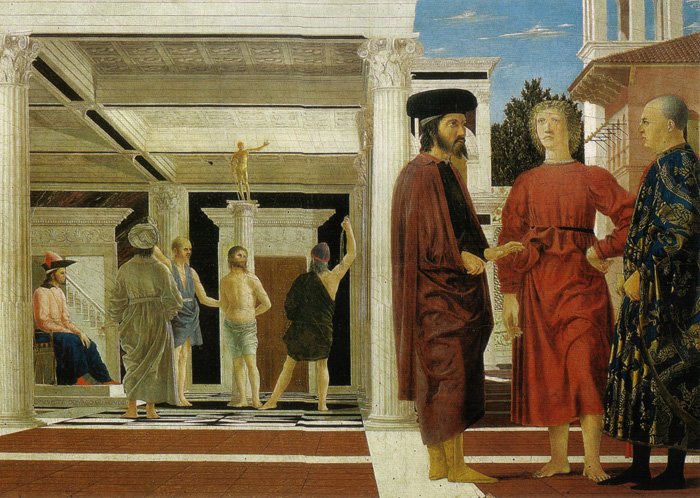
Flagellation of Christ by Piero della Francesca

The Flagellation of Christ by Piero della Francesca (c.1460)

My Daily Art Display today has me in a quandary.  When I choose a painting for the day I have to spend a number of hours researching the artist, the painting and the subject of the painting and then try and collate all I have discovered into a meaningful and yet not too verbose blog.  Sometimes I struggle to find the information I need from the hundreds of art books I have hoarded, the internet and the local library.  On other occasions, like today, I was overwhelmed by the vast amount of information there was with regards the work of art and now I have the difficult task of trying to filter out what I don’t need.  In this case, I also have to contend with the many varied and conflicting interpretations of what we are actually looking at.  The one thing which is common to all that I have read about the work of art is the praise upon praise which has been heaped on it and yet when I look at it, I struggle to appreciate or understand its so-called “greatness”.  However I will let you decide and if you want to comment and tell me that like Kenneth Clarke, the art historian, who declared it to be the “Greatest Small Painting in the World”,  you also believe it to be one of the greatest paintings of all time, then tell me why you think that.

Before I talk about the painting, let me first look at the life of this Early Renaissance painter and mathematician, Piero della Francesca.   Yes, you read that correctly – mathematician, for as well as being a revered painter, he is now looked upon as the greatest mathematician of the 1400’s.   Piero was born in 1415 in the town of Borgo Santo Sepolcro, now Sansepolcro, eighty kilometres east of Florence.  His father Benedetto de’ Franceschi was a tradesman and his mother was Romana di Perino da Monterchi.  At an early age he began his artistic apprenticeship and at the age of fourteen he and another apprentice, Domenico Veneziano worked on frescoes for the Sant’ Egidio Church in Florence.  It was during this time spent in Florence that Piero would have probably come into contact with the great Florentine artists of the time such as Fra Angelico, Mantegna and the architect, Brunelleschi.

Records show that Piero had returned home to San Sepolcro by 1442 and three years later had received a large commission from the Compagnia della Misericordia, a confraternity of Borgo San Sepolcro, for a polyptych as an altarpiece for the local church, Church of the Misericordia,.  The confratentiy had asked Piero to complete the work in three years, setting the anticipated completion date as 1445.  Piero however did not feel constrained by this suggested timeline and any way he had many other projects on the go at the time and in the end did not complete the altarpiece until 1462, some seventeen years late!

Piero della Francesca travelled widely around Italy completing commissions for frescoes including some papal work in Rome.  At the age of fifty-four he moved to Urbino, where for almost the next twenty years he worked for Count Federico III da Montefeltro, the Lord of Urbino (see My Daily Art Display for March 23rd).  It was during his stay at Urbino that he completed today’s featured work, The Flagellation of Christ, somewhere between 1455 and 1460. 

In his later years, around 1482, Piero della Francesca was living in Rimini where he had a studio.  As he grew older he had given up painting, the artist biographer Vasari put this down to his failing eyesight but this has since been contradicted because it is known that he wrote and completed a mathematical treatise in 1485, when he was seventy years of age.  It could be that his love of mathematics had overtaken his love of painting.  He died in 1492, aged seventy seven at his home in San Sepolcro.

 The Flagellation of Christ is an oil on panel painting and one of the most famous paintings completed by Piero della Francesca.  It is one he painted during his first visit to Urbino.  Look closely at the painting.  The setting is the portico of Pontius Pilate’s palace in Jerusalem.  Are we looking at one scene divided into an outdoor and indoor location or are the two scenes we observe, depictions of two different times?    The latter is a popular theory.  It is generally agreed that the inner depiction of the flagellation is set at the time of Christ but the outdoor setting in the right foreground, with the three men, is set in the fifteenth century.  One pictorial argument favouring the time separation of the two scenes is that the background scene is illuminated from the right whilst the outdoor scene with the three men is illuminated from the left.

The whole scene is dominated by architecture with a stunning use of perspective which adds a sense of realism and manages to draw our eyes towards the small figure of Christ despite the fact that the actual flagellation takes place in an open gallery in the middle ground of the work.   Also in the flagellation scene, we have Pontius Pilate seated on the left and possibly King Herod with his back to us.   In the foreground on the right hand side we see three figures, who appear not to be paying any attention to what is happening behind them. So who are all the various people featured in the painting?  It would be great if there was a clear cut answer to that question but different experts have different ideas and so I had better offer you a few alternatives and let you pick which one sounds the most probable to you.

One theory put forward about the reason for the commissioning of this work is that that the painting was an attempt to favour the reconciliation between the two Christian churches, of the East and of the West, because of an impending attack by the Turks on Constantinople. Both the presence of the character in the centre, dressed after Greek fashion, and an inscription on the frame convenerunt in unum would seem to support this interpretation.

We know that the painting was commissioned by the then Duke of Urbino, Federico da Montefeltro.  The conventional interpretation of this painting and the one which is still upheld in Urbino as the true interpretation of the work, is that the three men in the right foreground of the painting are, in the centre, the Duke of Urbino, Oddo Antonio da Montefeltro, the predecessor of Federico, the commissioner of the work, and is flanked, on each side by his advisors, Manfredo dei Pio and Tommaso di Guido dell, Agnello.    All three were dead.  Oddo Antonio was assassinated a few months after coming to power because of the unpopularity of his laws and his advisors suffered a similar fate.  Another interpretation is that Oddo Antonio is in the centre and the characters either side of him were his assassins, Serafini and Riccardelli.  A third suggestion is that this is simply a dynastic painting commissioned by Federico in which he has his three predecessors depicted.

There are more possibilities and books and treatises have been written about the painting with various suggestions as to the identity of each of the characters  but I will leave it there and if you want to look deeper into the interpretation of the painting, do so and I will be interested to see what you find out.  So back to my original question which still puzzles me; why is this painting by Piero della Francesca look on as being “a great work”?    Is it the artistic quality of the painting or is it the mathematical quality of the perspective which has art historians tell us it is a gem?

Self Portrait by Tommaso Minardi

Self Portrait by Tommaso Minardi (1807)

From a French Modernist painter I am moving to an Italian Romantic painter.  Today I am featuring Tommaso Minardi and looking at his painting entitled Self Portrait, which he painted in 1807.

Tommaso Minardi was born in Faenza in 1787, an Italian city some fifty kilometres south-east of Bologna.  As a teenager he studied art and design at a private school, as a pupil of Giuseppi Zauli.  Minardi was granted an annual stipend by Count Virgilio Cavina of Faenza and in addition, he received financial assistance in the form of a stipend, from the Congregazione di S Gregorio of Faenza.  Thanks to this five year stipend from his patron, Minardi, who was not yet sixteen years of age, moved to Rome to continue his artistic studies.  The terms of this five year grant were such that the young man had to send one completed work of art back to Faenza each year.   His paintings Socrates and Alcibiades and Supper at Emmaus were two of his works he sent back to his patron in Faenza.  At the age of twenty-three he entered a painting into an annual competition run by the Bologna Academy of Fine Arts and he won and his reward was financial stability for the next three years.

Whilst in Rome he studied art but was also employed by the painter and engraver Giuseppe Longhi, who was an exponent of Neoclassicism and for his employer he did reproduction drawings of Michelangelo’s Last Judgement in the Sistine Chapel.  

In his thirties Minardi began to teach art and in 1819 he was appointed director of the Academy of Fine Arts in Perugia.  Three years later he became professor of drawing at the Accademia di San Luca in Rome, a position he held for over thirty-five years.  Besides his own painting and teaching, Minardi began to take an interest in local politics and he spent much of his time working tirelessly for the protection and restoration of the capital city’s great heritage.  Tommaso Minari died in Rome in 1871, aged eighty-three.

My Daily Art Display’s featured painting today entitled Self Portrait depicts the artist himself, sitting on a matress which is on the floor.  He is wrapped in a coat in what looks like a very unassuming room.   The room we see him in is termed a mansard room but is known more commonly as an attic room with its sloping ceiling.  It is a typical student-type apartment at the top of a very large house.  On the back wall of the room we can just make out a painting and besides the bed is a bookcase crammed with books and papers.  More books and documents can be seen strewn on a desk to the right of the painting.  The room is lit up from two sources, light streaming in through windows on either side.  On a cabinet to the artist’s left is a human skull and on the floor in the left foreground there is skull of an animal.  What are we to make of this?  What was Minardi’s symbolic reasoning for including these two items?   Was the human skull to have the meaning related to Vanitas paintings, that human life passes quickly and we are but mere mortals, or is it just a  theatrical prop used by the artist to induce a feeling of melancholia into the work.  Are we meant to sympathise with this depiction of him, a poor, sad young art student in his small cramped abode, clutching a heavy coat around his body for warmth.  Is this a depiction of a poor young artist struggling for recognition, and desperate to attain financial security?  Remember Minardi was only twenty years old when he painted this work and had yet to become a successful artist.  So maybe this is how the artist viewed his current “lot in life” – life as a bohemian student in his dingy top floor attic room in the Eternal city.

I wonder whether this paining in any way inspired the French novelist and poet, Henri Murger, when he wrote a work published in 1851 entitled  Scènes de la vie de bohème and which was later used by the librettists Luigi Illica and Giuseppe Giacosa for Puccini’s 1896 opera La Bohème.  Was our struggling artist, Tommaso Minardi, in today’s painting the forerunner of the struggling painter Marcello, in La Bohème ?

I like the painting for its emotive qualities and I am heartened by the fact that Minardi did eventually make good and went on to live a prosperous life.

Portrait of Two Friends by Pontormo

Portrait of Two Friends by Pontormo (c.1524)

Today My Daily Art Display focuses on a double portrait by Jacopo Carrucci, the Italian Mannerist painter, who was better known simply as Pontormo, the name of the town in Italy where he was born.  I featured one of his paintings on January 14th.  The painting entitled Portrait of Two Friends was completed by Pontormo around 1524.  Today, I am not just offering you a painting but I am attempting to unravel the mystery of the painting or to be more precise, the small piece of paper which is held by one of the men depicted in the portrait.

Look closely at the painting.  It is quite a dark painting with the two men sombrely dressed, almost all in black, standing against a plain grey background.  Light coming from the left illuminates the two faces and the hands belonging to the man on the left who holds up and points to a page of writing.    This older man on the left is side-on to us but still manages to look at us.  His gaze is not as forceful as that of the younger man and he seems to be quite pensive and preoccupied with a myriad of thoughts.  The younger of the two men stands on the right and looks out at us.  His is a strangely challenging and intense gaze.

Page of writing

When you look at this painting what are the first questions you want answering?  I am assuming you want to know who the two men are but I wager, you also want to know even more about what is written on the piece of paper and what does it have to do with the two men.    Maybe you are also wondering why the artist would have portrayed one of the men pointing to the writing on the piece of painting.  What is so important about the Latin words we see on the unfolded sheet?

If you look at the writing closely you will just be able to make out that the last written word on the paper is the Latin word Amicitia, which means “friendship”.  Actually the text comes from the Roman statesman and author Marcus Tulius Cicero’s treatise on friendship entitled Laelius de Amicitia or simply Amicitia.   So now you know where it came from but what is written?  A translation of the words on the paper is:

“…In short, all other objects of desire are each, for the most part, adapted to a single end – riches for spending; influence for honour; public office for freedom for reputation; pleasures for sensual enjoyment and health for freedom from pain and full use of the bodily functions; but friendship embraces innumerable ends; turn where you will it is ever at your side; no barrier shuts it out; it is never untimely and never in the way.  Therefore we do not use the proverbial “fire and water” on more occasions than we use friendship…”

Cicero was writing about his own understanding of friendship in a way that would have meaning to people who read the book in later years.  The author considers the meaning of friendship.   He itemises which  qualities make for a good friendship and at the same time clarifies what characteristics illustrate a bad friend, and it provides examples from his personal life. Throughout the book, Cicero stresses the importance of virtue in friendship and how a friendship cannot be a true one without such a quality.   The work is written in dialogue form.   The participants in this dialogue chosen by Cicero are Gaius Laelius who was a close friend  of his and Laelius’s two sons-in-law, Gaius Fannius and Quintus Mucius Scaevola.   So now we have a translation of the Latin words on the paper and we know a little more about the book they came from but we still do not know what it has to do with our two men in the painting.  To answer that question one needs to delve into Vasari’s The Lives of the Artists in which the author writes:

“…Pontormo portrayed two of his close friends in a single picture: one was the son-in-law of Beruccio Bicchieraio and another, whose name is also unknown to me…”

That might not exactly tell us who the two men are but we do know that Pontormo at one time worked at the studios run by his tutor and master, Andrea del Sarto and that del Sarto had a friend Domenico di Jacopo who was a glassmaker by trade and because of that was nicknamed Bicchieraio (Italian for glassmaker).  Maybe it is a leap of imagination too far,  but let us remember that the Latin words on the piece of paper were from a dialogue between a father and his two sons-in-law and we now know that one of the sitters in today’s painting was a son-in-law of Becuccio Bicchierario.  Furthermore, we know he had a second son-in-law and thus we may be able to deduce that the two men looking out at us are the husbands of two of Bicchieraio’s daughters, who probably Pontormo came across through his association with his old master, Andrea del Sarto.  It is also probable that the glassmaker commissioned Pontormo to paint the two men in his daughters’ lives and by adding the piece of written paper he was drawing a parallel to Cicero’s Amicitia and the requirements for true friendship which he hoped would be in place between his daughters and their husbands..

So there you have the solution to the mystery of the painting, or do you?  Well notwithstanding my step by step reasoning for what we see in today’s work and whether you believe my reasoning.   I believe it to be a classical study and that little bit of paper, to me, adds a little spice to the offering.

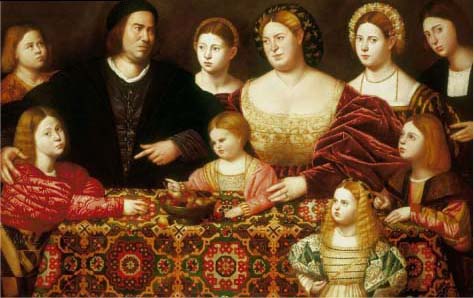
A Family Group by Bernardini Licinio

A Family Group by Bernardino Licinio (1524)

Bernardino Licinio was born in Venice around 1489 during the Italian High Renaissance.  It is thought that he could have trained as an artist in the workshop of Giovanni Bellini, the founder of the Venetian School of Painting.  Although being influenced by his “master”, Licinio soon developed his own down-to-earth style of realism painting.  When he had finished his artistic apprenticeship, Licinio set up his own workshop and produced a number of half length panels of the Virgin and Child, some altarpieces and group portraits one of which is featured in My Daily Art Display for today.  It is simply entitled A Family Group and was painted by Licinio in 1524.

In the painting we see nine members of a family.  It was once thought that it was an actual portrait of Licinio’s own family but there has been no documented evidence that he was ever married.  Licinio was famous for his group portraits and a few years after today’s painting he completed two similar works, namely, Arrigo Licinio and his Family (1535) and Portrait of a Sculptor with Five Apprentices(c. 1530) and all three are looked upon as his greatest works. 

Small-patterned Holbein carpet

 The members of the family are grouped around a table on which we see a Turkish table carpet, known as a small-patterned Holbein named after its characteristic geometric design.  These carpets are of Ottoman origin and so named because Hans Holbein used to often incorporate them into his paintings.  The “small pattern” terminology referred to the small size of the motifs.  These were expensive carpets and in paintings often symbolised wealth and in this case we are being subtly told that this family did not have any financial problems.

What I like about this family portrait is its realistic quality.  How many times have you wanted a family photograph taken with your children only to be thwarted by arguments between the young ones?  This is exactly what Licinio is recording in the painting.  The young boy in the elaborately painted striped hose, seated at the end of the table on the left, has just taken an apple from the bowl and of course this was the very one which his siblings had wanted.  Sounds familiar?   We can see the father, dressed in black, attempting to mediate in the argument.  His wife, in the gold and cream low-cut dress, is listening intently to his proposed solution. 

The determined child

My favourite character in the painting has to be the young girl standing in front of the table in the right foreground.  Look how she stands defiantly, arms akimbo, lips pouted as she demands justice.  Although she maybe the youngest of the siblings she demands to be heard. The one aspect of the painting which art critics have commented on is that there seems to be no face-to-face interaction between family members.  They fail to relate to each other. 

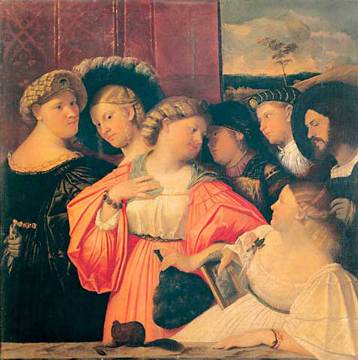
Seven Members of the Albani Family by Cariani

Compare this with, for example, Lotto’s 1547 family painting, Portrait of Giovanni della Volta with his Wife and Children, which has a similar bowl of fruit on a carpeted table but where there is an interaction between the family members or Giovanni Cariani’s Seven Members of the Albani Family (above) where everybody seems so animated.     Licinio’s family group seem to be just a collection of individuals who have no connection with each other.  The difference in style of the two portraits reminds me of two photographs a family photographer has taken.  In one he has instructed everybody to be still and look at the camera.  The result is a wooden photo, which often occurs in a formalised event where everybody has to stand still and look at the camera and not at each other.   In the other the photographer has let things develop naturally before he presses the camera button without warning.

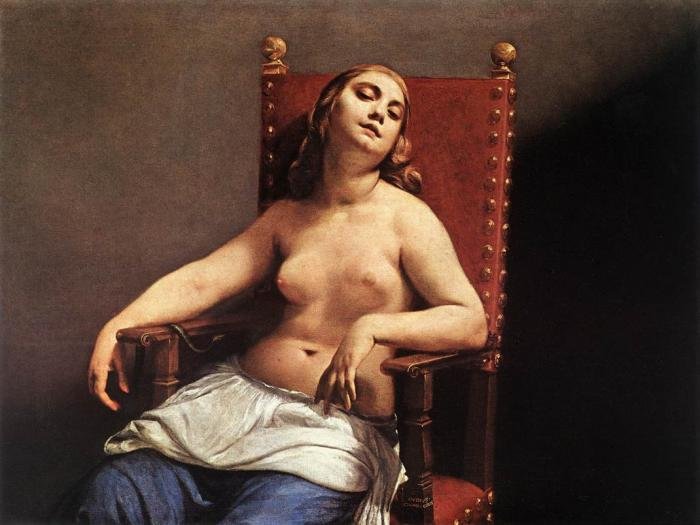
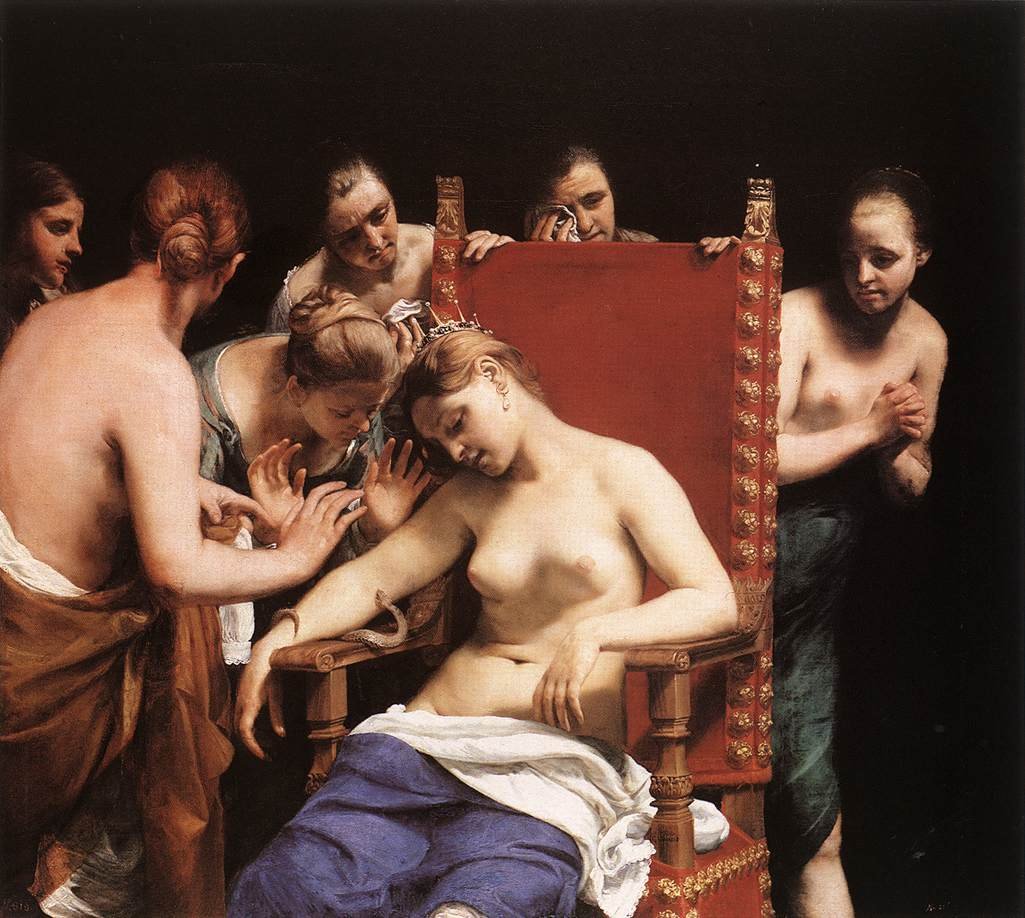
The Death of Cleopatra by Guido Cagnacci

The Death of Cleopatra by Guido Cagnacci (1660)

 My Daily Art Display today features not one but two paintings.  Both are by the same artist Guido Cagnacci and both have the same theme, namely, the death of Cleopatra. 

Guido Cagnacci was an Italian painter of the late Baroque period belonging to the Bolognese School which rivalled Florence and Rome as centres of painting.    He was born in 1601 in  Santarcangelo di Romagna, a town in the province of Rimini  where he spent the early part of his life.  Later, he spent time in Rome where he met fellow artists Simon Vouet, Guernico and was a pupil of Guido Reni.  It is also believed that during this time he may also have studied under an ageing Ludovicio Carracci.  He moved back east to Venice in 1650 and started to paint very sensual scenes with seductive, half-naked girls as his subject.  These erotic paintings were very popular and much sought after by collectors at the time and his popularity spread .  In 1658 he journeyed to Vienna where he gained the patronage of Emperor Leopold I and that was his ticket to fame and riches.  His later paintings featured semi-naked women as Lucretia, Cleopatra and even Mary Magdalene.

The painting above entitled The Death of Cleopatra was completed by him in 1660 and now hangs in the Brera Gallery in Milan.   This painting is charged with sensuality and we see Cleopatra slumped in an upright chair, naked down to the waist.  She has been bitten by the asp which we see trapped between the arm of the chair and her right arm.   Her eyes are almost closed as she drifts towards unconciousness.  Her head has fallen back against the red leather of the chair.  The curls of her golden hair reach down to her shoulder.  Even at the point of death she retains her beauty.  Her facial expression is one of tranquility and not one contorted with pain.  In her final moments she loses none of her radiance.

Death of Cleopatra by Cagnacci (1658)

The second painting by Cagnacci which I am featuring entitled The Death of Cleopatra was painted two years before the first one I featured.  It was completed around 1658 and now hangs in the Kunsthistoriches Museum in Vienna.

In this painting we see Cleopatra, not alone, but with six of her handmaidens.  Look at the contrast between Cleopatra and her handmaidens.  See how Cagnacci has shown the realism of the weeping servants.  The faces of some are contorted with anguish whilst others just dissolve into tears for the plight of their mistress.   The handmaiden in the left  foreground points towards the snake, said to be an asp,  and like the woman next to her holds up her other hand to shield herself from any attack from the creature.  But look at Cleopatra.  Cagnacci has once again painted her half slumped in the chair this time with her head fallen to one side.   Once again we see the small snake trapped between the arm of the chair and her arm.  Maybe the squeezing of the snake’s body has caused it to strike.   Again as was the case in the first painting, Cleopatra seems at peace with the world and once again there are no facial expressions which would lead us to believe that her death had been in any way painful.

It is that very last point about the peaceful look on Cleopatra’s face that brings me to an interesting point of view made by the German historian and author of a best-seller entitled Cleopatra,  Christoph Schäfer, who has researched the death of Cleopatra caused by the snake.   He has looked back at historical texts and one report, written about 200 years after Cleopatra’s death, stated that Cleopatra died a quiet and peaceful death, and this is exactly how Cagnacci has portrayed the victim in both his paintings, which does not correlate with death by asp bite – a  long, painful and disfiguring way to go.

Schäfer’s other findings have also destroyed our long-held beliefs re the 2000 year-old legend of the Queens death,  for he also highlights the fact that the story of Cleopatra, which we are used to, is highly unlikely.  His examination of ancient texts in Alexandria revealed that Egyptians knew a lot about poisons, and one papyrus reported that Cleopatra tested these poisons on herself.  He also states that Cleopatra died in the middle of an Egyptian summer, so temperatures would most likely have been too high for an asp to stay still enough to bite.  Of course in our two paintings Cagnacci has shown the snake trapped under her arm and unable to wriggle free!   Having discussed his thoughts with a toxicologist, Schäfer concluded that the most likely method of death was a drug combination of opium, wolfsbane and hemlock, which was known at that time to induce a painless death.

I will end here and let you decide how Cleopatra died,  but do not let the different theories detract from these two beautiful paintings

St George and the Princess of Trebizond by Pisanello

St George and the Princess of Trebizond by Pisanello (1436-38)

When I was travelling around Italy last week the one thing I noticed, which was different from here in Great Britain, was the fact that most of the churches were open to visitors even if some, especially in tourist areas, had admission fees.   In my country most of the churches are locked up unless a service is in progress for fear of vandalism or theft.  The one exception to this open-policy was Milan cathedral which for some reason would not let individuals inside, just admitting pre-booked guided parties.  I have no idea the reason behind this and my lack of ability to speak Italian put me off questioning the very large armed policemen, who stood guard at the door.

The other difference between the churches I visited in Italy and the ones in my country was that the Italian churches seemed to all have frescoes and paintings adorning their walls whereas the churches I have visited here, although often architecturally attractive and have beautiful stained glass windows, one rarely comes across works of art.  Maybe that again is to do with possible vandalism and theft.  During my short vacation I visited Verona and after the obligatory visit to “Juliet’s balcony” I decided to visit a couple of the churches and I am so glad that I did.

I visited the church of Santa Anastasia and it was here I came across a wonderful fresco above the entrance to the Pellegrini Chapel which is just to the right of the main altar and which according to the guide book was done by an artist called Pisanello.  I decided that when I returned home I would find out a little more about the artist and his fresco and feature it in My Daily Art Display.  So here is what I found out.

Antonio di Puccio Pisano is thought to have been born in Pisa around 1395 and was to become one of the great fresco painters of the early Italian Renaissance and the Quattrocento, which was the collective name given to the cultural and artistic events of 15th century Italy and includes the artistic styles of the late Middle Ages and the early Renaissance.  He was educated in Verona and it has been documented that he worked in Pisa, Venice, Florence and Verona.  Pisanello’s subjects include Arthurian legends and other courtly stories. They reflect the chivalric ideals of his noble patrons. The decorative nature of his work comes from the work of early 15th century artists such as Gentile da Fabriano, a leading exponent of the International Gothic genre.  Pisanello and Gentille collaborated on the frescoes of the Palazzo Ducale in Venice and they both worked at the court of the Gonzaga princes in Mantua.  Pisanello returned to Verona around 1436 and started work on the Pelligrini Chapel in the church of Santa Anastasia, which is the work of art I am featuring in My Daily Art Display today.

The fresco is entitled St George and the Princess of Trebizond and was completed in 1438.  It is based on what was a favourite subject of the period, Saint George, the Princess and the Dragon.  The fresco is in the crown and spandrels of the arch at the entrance to the chapel.  Sadly the fresco in the left-side spandrel has deteriorated badly.  It shows a barely discernible scene of the dragon’s lair where the creature had devoured its prey and all that was left were the bones of the victims which are surrounded by hideous animals which are scavenging the remains.

In the right spandrel we see the heroic St George with his curly golden hair, who has just dismounted from his horse after his gallant rescue of the princess.  The rescued damsel stands side on to us.  There is regality about her stance.  Her head is held high and just take a look at the splendour of her dress with its long train.   Both the Princess and her rescuer are dressed in the finest clothes of the day.  Unfortunately the gold and silver used in the fresco has fallen away over time but one can only imagine how spectacular the fresco would have been when Pisanello had completed it. 

It is interesting to note the way he has painted the two horses one of which we see from behind, the other seen head-on.  There is a perspectival foreshortening of the animals and this painting technique was starting to become popular with artists at this time.   The background is dominated by an enchanting city with its Gothic towers and ornate stonework.    In the left-hand background we see two hanged men swinging on the gallows.  Maybe they were thieves or traitors.  In the foreground we have a ram, what looks like a golden-coloured boar and a dog.

Whilst I was looking around the church I came across a girl on some scaffolding meticulously carrying out restoration work on another of the church’s frescos and it brought to mind the age-old argument as to whether frescoes should be restored or should they be left to slowly decay and thus one sees the original and not a “touched-up” offering.