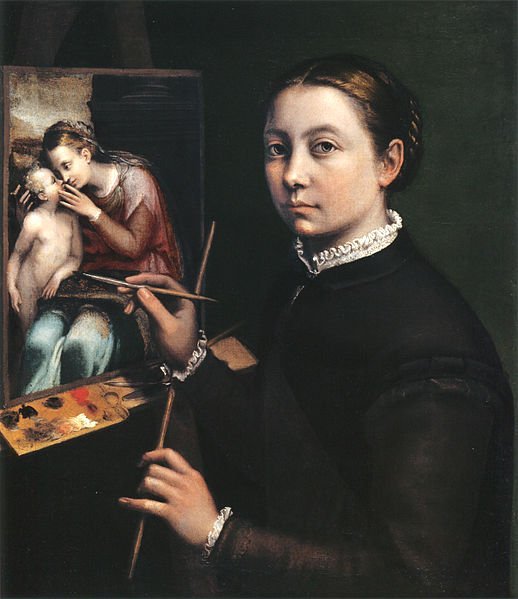
Self-portrait at the Easel Painting a Devotional Panel by Sofonisba Anguissola

Self-portrait at the Easel Painting a Devotional Panel by Sofonisba Anguissola (1556)

Let me introduce you to a female artist, whom I am ashamed to admit, I had never heard of, but whom Giorgio Vasari, the Italian biographer of artists, made the following comment:

“…[She] has shown greater application and better grace than any other woman of our age in her endeavours at drawing; she has thus succeeded not only in drawing, colouring and painting from nature, and copying excellently from others, but by herself has created rare and very beautiful paintings…”

My featured artist today is the Italian Renaissance painter Sofonisba Anguissola. Her christian name came from a strong family connection to ancient Carthaginian history and her parents named their first daughter after the tragic Carthaginian figure who lived and committed suicide during the Second Punic War.  Sofonisba Anguissola was born in Cremona, a city in the Lombardy region of Northern Italy, around 1532.  Her father was Amilcare Anguissola and her mother was Bianca Ponzone.  Both parents came from affluent and noble families and they lived a privileged and affluent lifestyle.  Sofonisba was the oldest of seven children.  She had one brother, Asdrubale and five sisters, Elena, Lucia, Europa, Minerva and Anna Maria.   All of her sisters except Minerva became artists.

Having come from such an advantaged family background was somewhat unusual for women artists of the sixteenth century, as any of note, tended to be daughters of impoverished artists.  The family wealth coupled with the father’s belief that all females should be educated ensured that Sofonisba received an all-round and extensive education, including studying drawing and fine art.   The fact that she came from a wealthy and privileged background did not however avoid the restrictions imposed by the Italian art establishment, such as forbidding female artists from studying anatomy or attending life drawing classes as it was deemed inappropriate for a female to view a naked model, which consequently meant a female could not study the human anatomy to the same extent as a male artist could and because of this she was unable to carry out the complex multi-figure compositions which were at the heart of the popular large-scale religious and historical works.  With those obstacles in mind, Anguissola decided to concentrate on portraiture using female models, which were accessible to her, and instead of historic settings she concentrated on having her sitters shown in homely and unceremonious settings.  Self-portraits and portraits of family members were her most frequent subjects and it was not until much later in life that she turned to paintings incorporating religious themes.
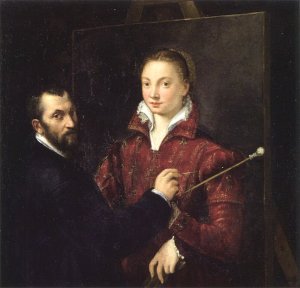
Self-portrait with Bernardino Campi by Sofonisba Anguissola (1550)

At the age of fourteen Sofonisba and her sister Elena attended the studio of Bernardino Campi, the Italian Renaissance religious painter and portraitist who was based in Cremona.  She pictorially recorded the time she was with Campi in her double portrait depicting her mentor painting a portrait of her.  The work, entitled Bernardino Campi Painting Sofonisba Anguissola, was completed by her during her last year as his pupil in 1550, when she was just eighteen years old.   After Campi, Sofonisba studied under the Italian artist Bernardino Gatti, often known as il Sojaro, and continued being tutored by him for three years, eventually leaving him when she was twenty-one years of age.

In 1554, Anguissola journeyed to Rome, where she spent her time sketching various scenes and people. The highlight of her stay in the Italian capital was when she was introduced to the great Master himself, Michelangelo Buonarotti.   We know the two met as in the Buonarrotti Archives held in Florence there is a letter, dated May 1557, from Sofonisba’s father Amilcare to Michelangelo in which he writes thanking him for spending time with his daughter:

“…honourable and thoughtful affection that you have shown to Sofonisba, my daughter,

to whom you introduced to practice the most honourable art of painting…”
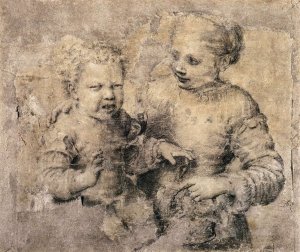
Asdrubale Bitten by a Crayfish by Sofonisba Anguissola (c.1554)

Intrigued by her artistic talent Michelangelo asked her to sketch him a picture of a weeping boy and the result was her sketch entitled Asdrubale Bitten by a Crayfish.  Sofonisba rose to the challenge and sketched her young brother, Asdrubale, being bitten and being comforted by one of his sisters.  Michelangelo was so impressed with the drawing that he gave her some sketches from his notebook and asked her to copy them in her own style.  She complied with his request and the results of her efforts again astounded the Master and because he recognised how artistically talented she was, for the next two years, he agreed to mentor her.  Again we have been made aware of the high regard in which Michelangelo held Sofonisba’s work as in a letter dated May 1558, (held in the Buonarrotti Archives) her father wrote to Michelangelo thanking him for praising his daughter’s artwork:

“…[you were] kind enough to examine, judge, and praise the paintings done by my

daughter Sofonisba…”

In 1558, aged twenty-six, Sofonisba Anguissola left Rome and went to Milan and it was here she received a commission to paint a portrait of Ferdinand Alvarez de Toledo, the Duke of Alba.  The sitter was so pleased with the resulting painting that he recommended her to Philip II, the King of Spain.  Court officials invited Sofonisba to come to Madrid and be part of the Spanish court.  This fact alone is clear evidence of Sofonisba’s artistic talent and her success, as it would have been unheard of that such a powerful leader as Philip II would countenance an insignificant artist being invited to join and live at the Spanish court and paint for his new Queen.

Late in December 1559 she arrived in the Spanish capital and took up her role at the Spanish court as a court painter as well as being one of the attendants to the Isabella Clara Eugenia, the Infanta Isabella, and later as a lady-in-waiting to her mother, Philip’s new queen, his third wife, Elisabeth of Valois (the Queen consort, Isabel of Spain) who was an accomplished amateur portrait painter.  This shared love of art between Sofonisba and Elisabeth flourished and Sofonisba would often offer artistic advice and give the queen some artistic tuition.   Sofonisba soon received many official commissions to paint portraits of the king and queen’s family and courtiers.  These were very different to her earlier portraiture work which were very informal as Philip and his wife wanted the portraits he had commissioned Sofonisba to paint to show the wealth and power of the sitters by paying attention to background and peripheral objects such as fine and sumptuous clothing, jewelled adornments and priceless furnishings.  This type of portraiture took time and skill but the finished products were always well received by the sitters.

Her artistic talents were also recognised by another powerful leader, Pope Pius IV who asked Sofonisba to paint a portrait of the Queen consort, Isabel, and have it sent to him.  Giogio Vasari in his book, Le Vite de’ più eccellenti pittori, scultori, ed architettori (Lives of the Most Eminent Painters, Sculptors and Architects) quotes a letter the pontiff sent Sofonisba thanking her for the painting and praising her work.  In the letter he wrote:

“… Pius Papa IV. Dilecto in Christo filia.

 We have received the portrait of our dear daughter, the Queen of Spain, which you have

sent… We thank you and assure you that we shall treasure it among our choicest possessions,

and commend your marvellous talent which is least among your numerous qualities

 Rome, 15 October 1561…”

In 1571 Sofonisba married Don Francisco de Moncada, who was the son of the Prince of Paterno, Viceroy of Sicily.  King Philip II facilitated the marriage, and paid her dowry of twelve thousand pounds.  She remained at the Spanish court for a further seven years after which time, and with Philip’s permission, she and her husband left Madrid and travelled to Palermo, Sicily. They arrived in Palermo in 1578 but sadly her husband died the following year.  The year following her husband’s death, Sofonisba decided to visit her family back in Cremona and embarked on a sea passage from Palermo to Genoa.   She never made it back home as she fell in love with the young captain of the ship and the couple married shortly after, in January 1580, in Pisa.  Sofonisba was forty-seven years of age and was much older than her seafaring husband.  The couple settled down at the seaport of Genoa and with her husband’s money, along with a pension from Philip of Spain, the pair had a comfortable lifestyle and Sofonisba had her own quarters including an art studio within her husband’s family’s large house.  Her reputation as an accomplished artist spread throughout Europe and she received many visits from young aspiring painters.  The couple moved to Palermo and were visited in 1624 by the Flemish painter, Anthony van Dyck, who at the time was twenty-five years old and travelling around the island of Sicily recording his travels in words and sketches in his diary.  At the time, Sofonisba was ninety-two years old and van Dyck sketched Sofonisba sitting in a chair.   All around the sketch he wrote notes in Italian, a rough translation of which is:

“…portrait of the painter Signora Sofonisba, done from life in Palermo in the year 1624, on 12 July: her age being 96 years, still with her memory and brain most quick, and most kind, and although she has lost her sight because of her old age, she enjoyed to have paintings put in front of her, and with great effort by placing her nose close to the picture, she could make out a little of it…”

It is interesting to note that according to van Dyck, Sofonisba was 96 years old in 1624 and this of course would make her birth date 1528 which is some four years earlier than the date given in a number of reference books.

Page from van Dyck's sketchbook
Page from van Dyck’s sketchbook

Van Dyck recorded in his diaries that her eyesight was weakened (it is thought she suffered from cataracts) but for a lady of 92 (or 96!) she was still mentally alert.  She had completed her last work in 1620 and had become a patron of the arts.  On November 16th 1625, Sofonisba died in Palermo aged 93.

On her birth centenary seven years later, her husband had a plaque placed on her tomb which read:
“…To Sofonisba, my wife…who is recorded among the illustrious women of the world, outstanding in portraying the images of man…

Orazio Lomellino, in sorrow for the loss of his great love, in 1632, dedicated this little tribute to such a great woman…”

Sofonisba was not only appreciated in her own lifetime but continues to be appreciated in modern society albeit I had to admit her name was new to me, which gives you some idea as to my artistic knowledge!

My Daily Art Display’s featured painting today is an early self portrait by Sofonisba Anguissola which she completed in 1556 and is entitled Self-portrait at the Easel Painting a Devotional Panel.  It is housed at the Museum-Zamek in the town of Lancut in south-east Poland.

This is one of many self portraits by the artist, which she sent as gifts to prospective patrons as she could not respectably enter into competition with male artists for paid commissions.   Around this time, there was a highly respected author, Baldassare Castiglione, the count of Casatico, an Italian courtier and diplomat, who held great sway with the public with regards manners at the court and how one should behave if of noble birth.  The book, which had a widely circulated publication in 1528, was entitled The Courtier.  In a way it was also a torch-bearer for women’s equality as it advocated the same education for aristocratic women as that offered to aristocratic men and one can only presume that Sofonisba’s father had read the book and agreed with its conclusions as he made sure that his daughters were not only educated in Latin, classical literature, history, philosophy, math, and sciences, but also that they were schooled in the courtly arts, such as music, writing, drawing, and painting.  Castiglione had written in his book about how aristocratic women of the court should dress.  He wrote:

“…she should always dress herself correctly and wear clothes that do not seem vain and frivolous…”

We can see by the way Sofonisba has depicted herself in this self portrait, wearing a modest black gown, lace collar and cuffs, the absence of jewellery and a simple hairstyle, which precluded any hint of easy virtue, that she had taken on board the advice given by Castiglione in his book.

Sofonisba looks out at us, brush in hand.  She is in the act of painting and is simultaneously the subject and object, the painter and the model of the painting.  Her painting is a re-working of the legend of St Luke the Evangelist, who it was believed, was the first to have painted a portrait of the Virgin but in this painting she has taken on the role of St Luke  and we see her painting of the Virgin and Child resting on the easel.

I love this self portrait.  There is nothing fancy about Sofonisba’s portrayal of herself.  It is an understated depiction.  It is a somewhat discreet portrait of a virtuous noblewoman and its beauty and exquisite artwork challenged the belief in those days that women artists lacked artistic skills.

La Fornarina by Raphael Sanzio

La Fornarina by Raphael (1520)

My Daily Art Display today features an Italian lady, Margarita Luti.  She became known as La Fornarina which in Italian means “the baker’s daughter”.  She was the daughter of Francesco Luti, a local baker from Siena who worked in the Roman district of Santa Dorotea.  The reason she became famous was not because of her father’s occupation but because she modelled for and was the mistress of the great Italian High Renaissance painter, Raphael Sanzio.  It was well documented that Raphael Sanzio was a very passionate man and had many mistresses in his time.  In the book, The Lives of the Artists by Giorgio Vasari, the biographer described the artist and how his love of women affected his work:

“…Raphael was a very amorous man who was fond of women and he was always quick to serve them. This was the reason why, as he continued to pursue his carnal delights, he was treated with too much consideration and acquiescence by his friends. When his dear friend Agostino Chigi commissioned him to paint the first loggia in his palace, Raphael could not really put his mind to his work because of his love for one of his mistresses; Agostino became so desperate over this that, through his own efforts and with the assistance of others, he worked things out in such a way that he finally managed to bring this woman of Raphael’s to come and stay with him on a constant basis in the section of the house where Raphael was working, and that was the reason why the work came to be finished…”

Although Margarita Luti is not actually named by Vasari her name does appear in scribbled notes on the original pages of the manuscript which would become his second edition of his Lives of the Most Excellent Painters, Sculptors and Architects.  The painting entitled La Fornarina, by Raphael hangs in the Palazzo Barberini in Rome and a further copy can be found in the Galleria Borghese, in Rome.  The work was completed around 1520 when Raphael was thirty seven years of age.  This was also the year in which on Good Friday, April 6th he died. Before us is a portrait of a beautiful young woman who is almost nude.  Her skin is flawless as alabaster. Her cheeks are flushed and pink, She stares out to her left and smiles, presumably at the artist as he works on her portrait.

Venus Pudica
Venus Pudica

She is pictured with an oriental style hat on which is attached a large jewel Her breasts are bare. Her right arm crosses her body and her right hand pulls a diaphanous veil over her stomach and abdomen in a gesture which mirrors the posture of women as seen in classical sculptures such as the Venus pudica, apose that became the custom for the nude Aphrodite figures in the Late Classical period.   It is a very suggestive pose and I am not sure whether she is attempting to cover her breast or in fact she is turning it slightly towards us and her lover, Raphael.  Or could it be that her right hand is pressed against her heart as she looks at Raphael as a gesture of her love for him?  Her left hand rests between her thighs, the fingers splayed out and outlined by the deep, bloody-red of her discarded gown.  On her left arm there is a narrow leather band on which is the name of the artist – RAPHAEL URBINAS.  On the third finger of her left hand she appears to be wearing a ruby wedding band.   The presence of a ring was only discovered in the early part of the twenty-first century when the painting underwent some X-Ray analysis during restoration and cleaning work.

The fact that Raphael painted her with a wedding ring would have been very controversial at the time for six years earlier, in 1514; he had become engaged to marry.   He had been pressured by Cardinal Medici Bibbiena’s to marry one of his nieces, a lady named Maria Bibbiena.   Raphael did not want to refuse the Cardinal, but managed to postpone the matter, saying that he would prefer to wait three or four years before entering into marriage.  However after stringing along the cardinal and his niece for four years, Raphael had to agree to the marriage, but managed to keep putting off the date for the big occasion with a string of excuses.   So why had this engagement lasted six years without it ever ending in marriage?  There are a number of theories.  One is that Raphael had already married Margarita Luti in secret years earlier and therefore could not marry Maria Bibbiena.  Another possible reason is that his engagement to Maria had brought him additional status.  He was made a “Groom of the Chamber”, a papal valet, which in itself afforded him status at court and more importantly an additional income.  He would not want to jeopardise that.  He was also made a knight of the Papal Order of the Golden Spur, an honour which was also bestowed on the artists Titian and Vasari.   All such honours would have been lost if he had had to admit to being already married.  So why was the ring on the sitter’s finger not discovered immediately?  It was not just the ring, which was painted out, as the restoration work also uncovered that the myrtle branches we see filling the background of the painting and which are thought to be symbolic of love and marriage were not always there.  The X-Ray analysis of the painting show that originally there had been a landscape background, similar to that seen in da Vinci’s Mona Lisa.
The reason for the over-painting is that it is thought that the work which was found in Raphael’s studio when he died had “finishing touches,” added, including a cover-up of the Margarita Luti’s ring finger by his student, Giulio Romano, who then went on to sell the painting.

Raphael Sanzio died in April 1520 possibly even on April 6th, the day of his 37th birthday.  There are numerous speculative explanations as to the cause of his death.  Probably the most bizarre was put forward by Vasari when he postulated that Raphael died on his 37th birthday after a wild night of celebratory sex with Margarita causing him to lapse into a fever and when a doctor arrived Raphael was too embarrassed to admit to what had brought on this feverish state and then had been given the wrong medicine by the doctor which went on to kill him.  Other historians, who also disagree of the date of his death, have put his demise down to working too closely with arsenic and lead based paints or overwork or heart failure.

And so I leave you with one of the world’s greatest artists and his portrait of the love of his life, but is it?  Is this a portrait of the little baker’s girl who became Raphael’s lover?  Some would disagree.  Some art historians, including Doctor Claudio Strinati, superintendent of the National Museums of Rome, now believe that the way in which Raphael’s has depicted the lady is too refined to have been just done for his own pleasure and in fact, due to the quality of the work, was a commission for a wealthy and influential patron and that patron could have been his friend Agostino Chigi.  According to this theory, the woman in the painting was not Margarita Luti but Chigi’s long-time mistress, and later his wife, Francesca Ardeasca.  We know that Chigi had commissioned Raphael to work at his new “palace”, the Villa Farnesina, and the two had become friends so much so that when the lovelorn Raphael’s mind was so distracted having been parted from his beloved Margarita whilst working on the commission, Chigi had supplied a room in his palace for Margarita so that he could better focus on the work in hand.

So is this enchanting portrait of the dark-eyed woman we see before us today Raphael’s paramour or his patron’s wife?  Is this a painting carried out for love or for money?  We will probably never know for sure as there are no other portraits of Chigi’s wife, Francesca, and therefore no possibility to compare likenesses.  Maybe this doubt adds to the mystification of the portrait and I will let you make up your own minds.

Having extolled the beauty of some other women in featured paintings in early blogs I look at this lady and question her purported beauty but as “beauty is in the eye of the beholder” I will again allow you to decide and leave you with the comments made by French writer, Gustave Flaubert who wrote about La Fornarina in his satirical work entitled Le Dictionnaire des idées reçues (Dictionary of Received Ideas):

“…Fornarina.  C’était une belle femme; inutile d’en savoir plus long…”

(Fornarina. She was a beautiful woman. That is all you need to know)

The Resurrection by Piero della Francesca

The Resurrection by Piero della Francesca (c.1468)

For today’s blog I am staying with Italian Renaissance art and looking at a work by, some say, the greatest Early Renaissance painter, Piero della Francesca.  This is the second time I have featured this artist in one of my blogs.  The first being The Flagellation of Christ (My Daily Art Display, September 29th 2011).   Today I want to look at his beautiful fresco entitled The Resurrection which he completed around 1468.

Piero della Francesca or as he was known in his day, Piero di Benedetto de’ Franceschi, was born around 1415 in the Tuscan market town of Borgo San Sepolcro, which is now known as Sansepolcro,  a small town located on the plains of the Upper Tiber Valley in the southeast of Tuscany, bordering Umbria and The Marches.  His family were merchants dealing in leather and wool and his father, Benedetto di Franceschi, hoped that his son would follow in his footsteps.  With that in mind, Piero was sent to school to learn arithmetic and the ability to calculate weights and measures, assess the volumes of barrels and bales, and most importantly, learn how to keep accounts.  Piero was academically gifted and became well known as a mathematician and in fact after his death he was revered not so much as a painter but for his mathematical knowledge.

Piero’s initial artistic training came as an apprentice to Antonio di Giovanni, a local painter, who was based in Anghiari, a town across the Tiber Valley from Borgo San Sepolcro.  From being Antonio di Giovanni’s apprentice, he soon became his assistant and during the 1430’s the two of them worked jointly on commissions around Borgo San Sepolcro.  Piero went to Florence for the chance to gain more work and he worked on commissions as an assistant alongside another young artist, Domenico Veneziano.  It was during this time spent in Florence that Piero would have probably come into contact with the great Florentine artists of the time such as Fra Angelico, Mantegna and the architect, Brunelleschi.

In 1442, Piero returned to Sansepolcro and three years later, in 1445, Piero received a large commission from the Compagnia della Misericordia, a confraternity of Borgo San Sepolcro, for a polyptych, Polyptych of the Misericordia: Madonna of Mercy, as an altarpiece for the local church, Church of the Misericordia.  The confraternity had asked Piero to complete the work in three years, setting the anticipated completion date as 1445.   Piero however did not feel constrained by this suggested timeline and any way he had many other projects on the go at the time and in the end did not complete the altarpiece until 1462, some seventeen years late!

Piero moved around the country a good deal during his life, living in Ferrara and Rimini before arriving in Rome in 1455.  Here he painted frescoes in the Vatican for Nicholas V and continued to work in the Vatican Palace for Pius II. Sadly his works were destroyed to make room for paintings by Raphael.

Piero’s birthplace, the town of Borgo San Sepolcro which literally means “Town of the Holy Sepulchre” derives its name from the story of its founding back in the tenth century.   The story of its coming into being would have us believe that two saints, Saint Arcano and Saint Egidio were returning from a pilgrimage to the Holy Land bearing some wood shavings from the sepulchre in which Christ had been buried, when they were miraculously instructed to create a new settlement – Borgo San Sepolcro.   These sacred relics have been preserved in the local Benedictine abbey and so when the town hall of Borgo San Sepolcro was renovated and extended in the late 1450s, Piero was commissioned to paint the fresco on the appropriate subject of The Resurrection for the building’s state chamber. This room was set aside for the use of the Conservatori, the chief magistrates and governors.  Before holding their councils, these four appointed guardians of the town would solemnly kneel before Piero’s image, to pray for the grace of God to descend upon them during their deliberations. The room is now the civic museum.

My featured painting today is a fresco which exudes an air of peace and tranquillity.   In the painting, the risen Christ can be seen in the centre of the composition.  He is portrayed at the moment of his resurrection, as we see him with his left foot on the parapet as he climbs purposefully out of his marble tomb clutching the banner in his right hand, as if he is declaring his victory over death.   He looks formidable as he stands tall.   We don’t see the lid of the tomb but look to the bottom right of the painting and we can see Piero has depicted a large rock which probably harks back to the biblical tale which told of a rock being rolled away from the entrance of Christ’s tomb.   In most resurrection paintings we are used to seeing Christ dressed in white burial clothes and yet Piero has depicted him in red robes, which was probably done to infer royalty and signify that this resurrected person is Christ the King.  Piero has portrayed the pale body of the risen Christ as almost blemish-free with the exception of the wound to his side and the wound in the back of both his hands made by the crucifixion nails.   In his depiction of Christ he has not let us forget that this central figure is both man and God, for if you look closely at the stomach of Christ we notice that the artist has given it an almost human appearance.  It has a slightly wrinkled appearance caused by the folds of the skin happening as he raises his leg to exit the tomb.

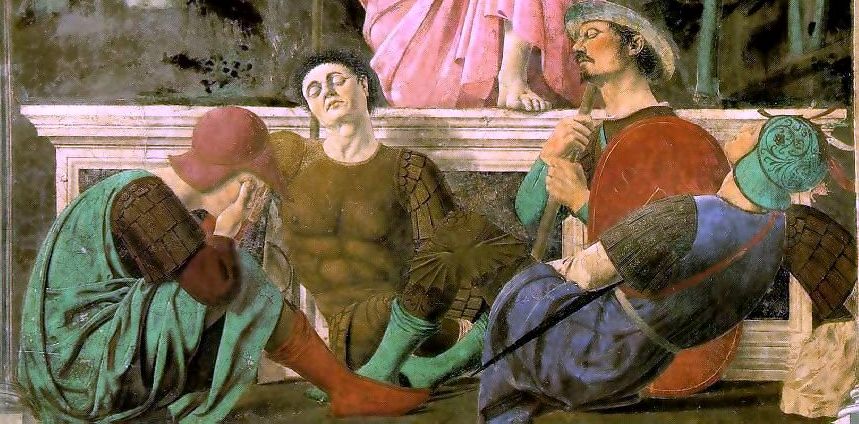
The sleeping guards

The alertness of the risen Christ in the painting contrasts starkly with the four soldiers who instead of keeping guard on the tomb, lie asleep.  The Renaissance painter and biographer of artists, Vasari, would have us believe that Piero included his own self-portrait in this fresco.

Piero della Francesca

It is the face of the second soldier from the left, and Vasari postulates that Piero did this as a sign of his own hopes of awaking one day to redemption. It is also interesting to note the contrast in the way Piero has depicted the risen Christ and the four soldiers.  Christ is shown in a solid vertical stance looking straight out at us, whereas the sleeping soldiers are depicted in diagonal poses and viewed at various oblique angles.  The way the artist has portrayed Christ almost gives one the feeling that he is about to step out of the painting to join us, the viewer.  In some ways the expression on the face of Christ is disturbing.  It is a penetrating glance and one art critic commented that it was if he was looking into the soul of the viewer.

The landscape is bathed in the new cold and clear light of a Tuscan dawn.  Look carefully at the trees on the right of the painting and those on the left side.  Do you spot the difference?   The ones on the right are depicted as flourishing specimens adorned with leaves and healthy green shoots whereas the trees on the left of the painting are grey in colour and bare as if on the point of dying.   This contrast almost certainly alludes to the renewal of mankind through the Resurrection of Christ

It is likely that Piero painted his striking image of the risen Christ stepping resolutely, banner in hand, from the tomb, to represent not only the resurrection of Jesus but also the resurgence of the town of Sansepolcro.  After a few years under the rule of Florence from 1441, Sansepolcro regained its identity and dignity in 1456 when the Florentines returned the use of the Palazzo to the Conservatori. The church Council which the young Piero had witnessed in Florence had thus had unforeseen consequences for Sansepolcro. The Pope, his treasury depleted by his lavish Council, defrayed some of the costs by ceding Sansepolcro to Florence which was later returned by Florentine authorities to the citizens of Sansepolcro on February 1st 1459, as a sign of the restoration of some measure of autonomy to the Borgo.

One interesting end note to the tale of this painting comes from a BBC article which tells the story of how a British artillery officer, Tony Clarke, during World War II, defied orders and held back from using his troop’s guns to shell the town of Sansepolcro and his decision is believed to have saved this beautiful fresco.   To read the full story click on:

http://www.bbc.co.uk/news/magazine-16306893

The Transfiguration by Raphael

The Transfiguration by Raphael (1520)

In my last blog I looked at The Raising of Lazarus by Sebastiano del Piombo and talked about how this and a painting by Raphael, entitled Transfiguration, had been commissioned in 1517 by Cardinal Giulio de’ Medici as a high end altarpiece for the French Cathedral of S. Giusto Narbonne.  Raphael was, at the time, busy on other commissions.  He had been summoned to Rome by Pope Julius II to paint frescoes on the rooms of his private Vatican apartment, the Stanza della Segnatura and the Stanza di Eliodor and at the same time he was busy working on portraits and altarpieces as well as working alongside Sebastiano del Piombo on frescoes for Agostino Chigi’s Villa Farnesina.   It is thought that Giulio de Medici was so concerned with the time it was taking Raphael to complete The Transfiguration altarpiece that he commissioned Sebastiano di Piombo to paint the Raising of Lazarus for the cathedral in an effort to stimulate Raphael to work faster on his commission.

Today I am featuring Raphael’s work, The Transfiguration, which was considered the last painting by the Italian High Renaissance master.  Giorgio Vasari, the sixteenth century Italian painter, writer, historian, and who is famous today for his biographies of Renaissance artists, called Raphael a mortal God and of today’s painting, he described it as:

“…the most famous, the most beautiful and most divine…”

Although Raphael Sanzio was only thirty-four years of age when he was given the commission, bad health prevented him from finishing it. It was left unfinished by Raphael, and is believed to have been completed by his pupils, Giulio Romano and Giovanni Francesco Penni, shortly after his death on Good Friday 1520.

If we look closely at this work of art we can see two things going on simultaneously both of which are described in successive episodes of the Gospel of Matthew.   In the upper part of the painting we have the Transfiguration, which is described in Matthew’s Gospel (Matthew 17: 1-7):

“…After six days Jesus took with him Peter, James and John the brother of James, and led them up a high mountain by themselves.  There he was transfigured before them. His face shone like the sun, and his clothes became as white as the light.  Just then there appeared before them Moses and Elijah, talking with Jesus.   Peter said to Jesus, “Lord, it is good for us to be here. If you wish, I will put up three shelters—one for you, one for Moses and one for Elijah.”    While he was still speaking, a bright cloud covered them, and a voice from the cloud said, “This is my Son, whom I love; with him I am well pleased. Listen to him!”   When the disciples heard this, they fell facedown to the ground, terrified.  But Jesus came and touched them. “Get up,” he said. “Don’t be afraid…”

We see the transfigured Christ floating aloft, bathed in a blue/white aura of light and clouds.  To his left and right are the figures of the prophets, Moses and Elijah.  Below Christ we see the three disciples on the mountain top shielding their eyes from the radiance and maybe because of their own fear of what is happening above them.   The two figures kneeling to the left of the mountain top are said to be the martyrs Saint Felicissimus and Saint Agapitus of Palestrina.

 In the lower part of the painting we have a depiction by Raphael of the Apostles trying, with little success, to liberate the possessed boy from his demonic possession. The Apostles fail in their attempts to save the ailing child until the recently-transfigured Christ arrives and performs a miracle.  Matthew’s Gospel (Mathew 17:14-21) recounts the happening:

“…When they came to the crowd, a man approached Jesus and knelt before him.  “Lord, have mercy on my son,” he said. “He has seizures and is suffering greatly. He often falls into the fire or into the water.  I brought him to your disciples, but they could not heal him.”    “You unbelieving and perverse generation,” Jesus replied, “how long shall I stay with you? How long shall I put up with you?  Bring the boy here to me.”   Jesus rebuked the demon, and it came out of the boy, and he was healed at that moment.   Then the disciples came to Jesus in private and asked, “Why couldn’t we drive it out?”   He replied, “Because you have so little faith. Truly I tell you, if you have faith as small as a mustard seed, you can say to this mountain, ‘Move from here to there,’ and it will move. Nothing will be impossible for you…”

Observe this lower scene.  The young boy, with arms outstretched and distorted in a combination of fear and pain, is possessed by some sort of demonic spirit.   He is being led forward by his elders towards Christ who is about to descend from the mountain.   The boy is crying and rolling his eyes heavenwards.   His body is contorted as he is unable to control his movement.   The old man behind the boy struggles to control him.  The old man, with his wrinkled brow has his eyes wide open in fear as to what is happening to his young charge.  He looks directly at the Apostles, visually pleading with them to help the young boy.    See how Raphael has depicted the boy’s naked upper body.  We can see the pain the boy is enduring in the way the artist has portrayed the pale colour of his flesh, and his veins, as he makes those violent and fearsome gestures.   The raised arms of the people below pointing to Christ, who is descending, links the two stories within the painting.  A woman in the central foreground of the painting kneels before the Apostles.  She points to the boy in desperation, pleading with them to help alleviate his suffering.

Contrapposto

The contorted poses of some of the figures at the bottom of the painting along with the torsion of the woman in what Vasari calls a contrapposto pose were in some way precursors to the Mannerist style that would follow after Raphael’s death.   Vasari believed that this woman was the focal point of the painting.     She has her back to us.  She kneels in a twisted contrapposto pose. Her right knee is thrust forward whilst she thrusts her right shoulder back.   Her left knee is positioned slightly behind the right and her left shoulder forward.  Thus her arms are directed to the right whilst her face and gaze are turned to the left.  Raphael gives her skin and drapery much cooler tones than those he uses for the figures in heavy chiaroscuro in the lower scene and by doing so illuminates her pink garment.  The way he paints her garment puts emphasis on her pose.  She and her clothes are brilliantly illuminated so that they almost shine as bright as the robes of the transfigured Christ and the two Old Testament Prophets who accompany him.   There is an element about her depiction which seems to isolate from the others in the crowd at the lower part of the painting and this makes her stand out more.

The unfinished painting was hung over the couch in Raphael’s studio in the Borgo district of Rome for a couple of days while he was lying in state, and when his body was taken for its burial, the picture was carried by its side.   Cardinal Giulio de’ Medici kept the painting for himself, rather than send it to Narbonne and it was placed above Raphael’s tomb in the Pantheon.   In 1523, three years after the death of Raphael, the cardinal donated the painting to the church of San Pietro in Montorio, Rome. In 1797, following the end of the war in which Napoleon’s Revolutionary French defeated the Papal States; a Treaty of Tolentino was signed.    By the terms of this treaty, a number of artistic treasures, including Raphael’s Transfiguration, were confiscated from the Vatican by the victorious French.   Over a hundred paintings and other works of art were moved to the Louvre in Paris.   The French commissioners reserved the right to enter any building, public, religious or private, to make their choice and assessment of what was to be taken back to France. This part of the treaty was extended to apply to all of Italy in 1798 by treaties with other Italian states.   It was not until 1815, after the fall of Napoleon, that the painting was returned to Rome. It then became part of the Pinacoteca Vaticana of Pius VII where it remains today.

Portrait of Laura Battiferri, wife of the sculptor Bartolomeo Ammannati by Agnolo Bronzino

Portrait of Laura Battiferri by Agnolo Bronzino (c.1560)

My featured painting bears a strange resemblance to the painting I looked at in my last blog although they were painted about thirty years apart by two different Italian artists.  It is not unusual to see paintings featuring the same sitter or views of certain buildings or particular landscapes painted by different artists but it is somewhat unusual to look upon two portraits of two different women featuring a similar gesture towards a certain object which has been included in both of the works of art.  Sounds a little confusing?  Ok let me say that if you have just stumbled on to this page without looking at my previous blog (June 25th  Portrait of a Woman with a Volume of Petrarch by Andrea del Sarto) then go to that one first and read about that particular painting before you read more about today’s offering.

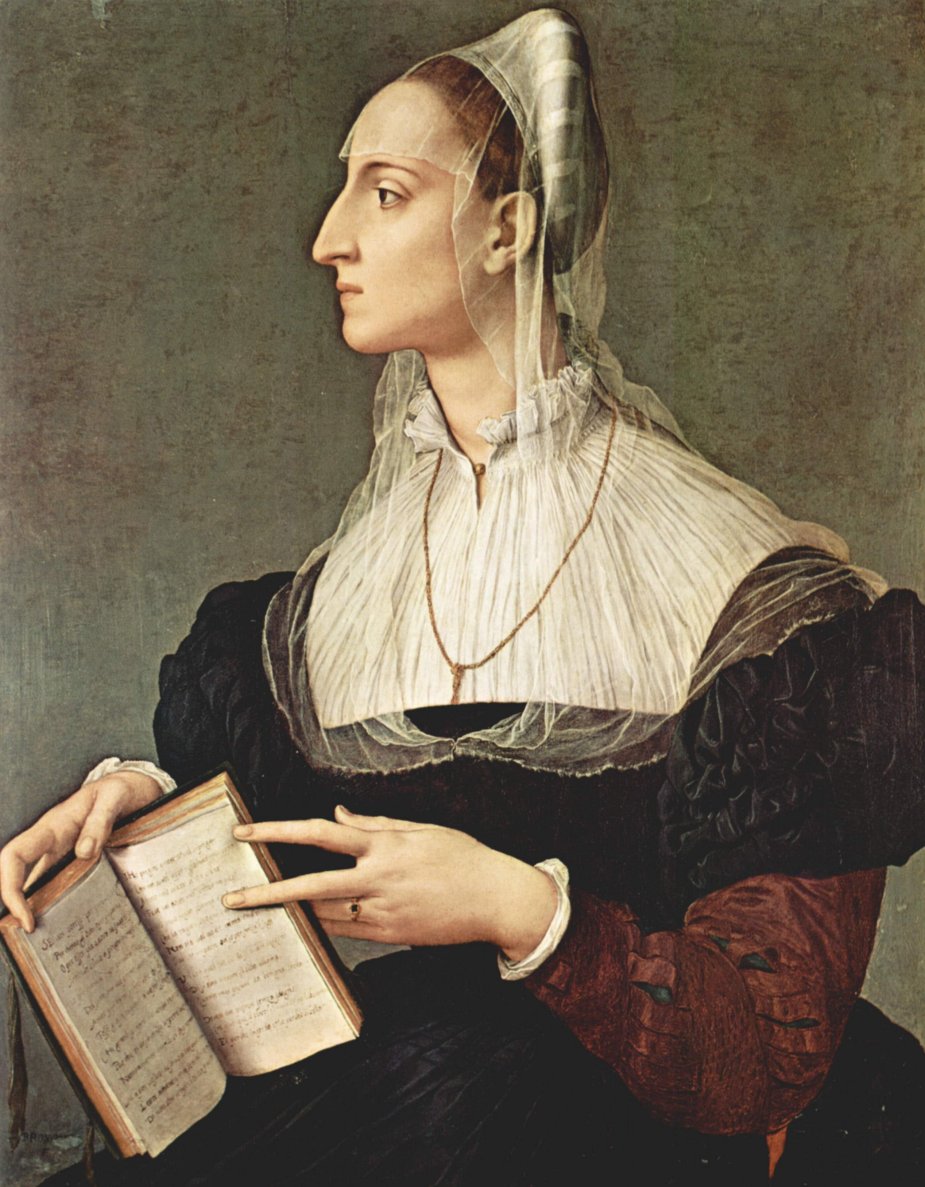
I am sure having now looked at the two paintings you can see the unusual similarity – the book and the pointing fingers.   My featured work of art today is a portrait completed by Agnolo Bronzino around 1560 and is entitled Ritratto di Laura Battiferri, moglie dello scultore Bartolomeo Ammannati  (Portrait of Laura Battiferri, wife of the sculptor Bartolomeo Ammannati) and is housed in the Palazzo Vecchio in Florence.  It is part of the Loeser Bequest of Palazzo Vecchio which comprises of over thirty works of art that the American collector Charles Alexander Loeser bequeathed to the Florence City Council on his death in 1928.  The idea behind his bequest was that he felt it would play a part in the enhancement and reconstruction of the ancient atmosphere of Palazzo Vecchio, which the Florentine Council was carrying out at that time.   One of the conditions Loeser made was that he laid down procedures for the layout of his bequest, which was to be displayed in several rooms in Palazzo Vecchio, and that they were to be kept united in perpetuity, in an arrangement that would give the area not the habitual appearance of a museum but as he put it, it would  make each room appear “simply beautiful for the repose and enjoyment of the visitor”.

Before we look at the painting in detail I suppose the first question one asks when we look at this work of art is, who was Laura Battiferri and why would the great Italain Mannerist painter, Bronzino,  depict her in the portrait pointing at a book?  To find the answer to those questions one needs to look at the life of both the artist and his sitter.

Bronzino, whose real name was Agnolo di Cosimo, but was was probably given the nickname Il Bronzino (the little bronze) because of his relatively dark skin.  He was born in 1503 in Monticelli, a suburb of Florence.  His first artistic training was under the tutorship of the Florentine painter, Raffellino del Garbo and this lasted several years before he became an apprentice at the studio of Jacopo Carrucci, better known as, Pontormo, named as such after the Tuscan town where he was born.  Pontormo is now recognised as one of the founder of Florentine Mannerism.  Despite Pontormo being nine years older than Bronzino they became great friends and artistic collaborators and in some ways Pontormo acted as a father-figure for the young Bronzino.

In 1522 the plague struck Florence and Pontormo and Bronzino left the Tuscan city and headed for the Certosa del Galluzzo which is prominently situated on a hillside just south of Florence.  Here Pontormo, with Bronzino as his apprentice, worked together on a commission to paint a series of frescoes.   This was a very important time for Bronzino as he began to gain a reputation for the beauty of his work.   Bronzino returned to Florence in 1532 and worked on his frescos, as well as a number of portraits.    Seven years later in 1539, Bronzino had a major breakthrough with his artistic career when he received the patronage of the Medicis and was commissioned to carry out the elaborate decorations for the wedding of Cosimo I de’ Medici to Eleonora di Toledo who was the daughter of the Viceroy of Naples.   From that moment in time he became the official court painter to the Medici court and over time would paint a large number of portraits of the Medici clan and members of the royal court.  His portraits of the royal couple, Cosimo and Eleonora, and other figures of the Duke’s court, revealed a delicate coldness, almost an aloofness.  This was to define Bronzino’s portraiture style.  It was a portraiture technique which showed no emotion whilst always remaining stylish. The works were well received by the sitters and Bronzino’s portraiture style went on to influence a century of European court portraiture.

It is now we have our first connection between Bronzino and the sitter in today’s painting, Laura Battiferri, because she was a close friend of Eleanora di Toledo, Cosimo’s di Medici’s wife and there is no doubt that the artist and sitter met at the Medici court.  Another thing the artist and sitter had in common was poetry.   Although we are well aware that Bronzino was an artist he was also, like Laura Battiferri, an accomplished poet. Besides the portraits of members of the Medici family and some of the favoured royal courtiers he would paint portraits of his fellow poets, one of which was Laura Battiferri.   Laura Battiferri  came from Urbino.  She was born illegitimately to a pre-Reformation churchman Giovanni Battiferri, and his concubine. Her wealthy father, a Vatican cleric, provided her with a humanist education. As a well regarded and well respected poet she mixed with the most distinguished poets and artists of her day and lived all her life in court circles. She was the wife of the renowned architect and sculptor Bartolomeo Ammannati, who was a close confidant and adviser to Cosimo di Medici.

And so to the painting.    I would ask you to look at today’s work in conjunction with Andrea del Sarto’s  Portrait of a Woman with a Volume of Petrarch which I featured in my last blog (June 24th).  Both are female portraits but Bronzino has unusually reverted to the type of female portraiture of the Quattrocento (the art of 15th century Italy).   In those days, in female portraiture, the sitter was seen in profile view.  These works were traditionally painted by male artists for male patrons.  Graham Smith commented on why female portraits in those days were painted in profile view in his 1996 book Bronzino’s Portrait of Laura Battiferri.  He wrote:

 “…the profile portrait allowed the suitor to explore his lover’s face ardently, while simultaneously attesting to the woman’s chastity and female virtue…”

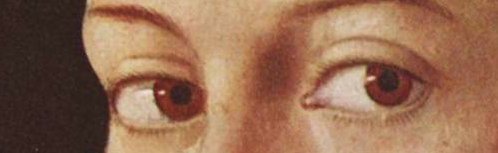
As we look at the portrait of Laura are we immediately struck by her beauty?  I think not.  There is a remoteness about this lady as she looks straight ahead avoiding our eyes.  It is if she has turned away from us showing her disdain for us.   Or could it be that she is exhibiting a sense of modesty, and it is this which makes her avert her eyes?   Whatever the reason, it has in some way, added a majestic aura to her character.   There is a sense that she is untouchable and unattainable which of course would please her husband who is thought to have commissioned the work.  Laura was also recorded by historians as being a devout Catholic and a very pious person.  It is known that she was a great supporter of the Jesuitical Counter-Reformation also known as the Catholic Reformation which was the period of  Catholic revival beginning with the Council of Trent (1545-63)and which historians now look upon as a response to the Protestant Reformation. Therefore Bronzino’s portrayal of her is a very fitting one and it could well be that the artist wanted to indicate this piety in the way he depicted her.

Laura Battiferri

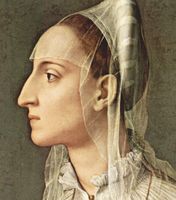
Look at her closely.  Her neck and fingers have been elongated in a Mannerist style.  The upper part of her body is now completely out of proportion in relation to her small head and the way in which Bronzino has depicted her forehead in some ways draws attention to her long and slightly hooked nose.  She is wearing a transparent veil, which hangs down from the shell-shaped, calotte-style bonnet covering her tightly combed-back hair onto her goffered shawl and puffed sleeves.  Her one and only gesture, as she ignores us, is to point to a page in an open book which she is holding.  Her elongated thin fingers frame a certain passage of the prose.  It is a book of sonnets by the Italian poet Petrarch.  Compare this with Andrea del Sarto’s woman who is also pointing to a book of his sonnets.  So similar and yet so different.  The woman in del Sarto’s portrait connects with us.  We have eye contact with her.  We can almost know what she is thinking but with Laura Battiferri she is an enigma.  With no eye contact, her thoughts remain her own.

The passage in the book

In both portraits we see the women pointing to a passage in Petrarch’s book in which the central theme is the poet’s love for a woman he met when he was in his early twenties. Her name was Laura de Noves.   In this painting, Laura Battiferri points to a passage in the book where Petrarch talks about “his Laura” and maybe Battiferri identifies herself with Petrarch’s Laura and empathizes with the poet’s words as he describes the love of his life:

“….she is an unapproachable, unattainable beauty… as chaste as the adored mistress of a troubadour, as modest and devout as a ‘Stilnovismo Beatrice'”. “Laura’s personality is even more elusive than her external appearance. She remains the incarnation of chaste and noble beauty.”

Bronzino had already painted a number of portraits which featured the sitter pointing to pages in a book.  Around 1540 he completed his portrait entitled Portrait of Lucrezia Panciatichi in which the young lady points to a page in a book which rests on her knee.   Eight years earlier he painted a portrait entitled Lorenzo Lenzi, in which the young son of a prominent Florentine family holds an open book inscribed with sonnets by Petrarch and so when he completed his portrait of Laura Battiferri around 1560 showing the sitter pointing at pages in a book it was not a unique depiction and of course as we know Andrea del Sarto’s painting was completed about thirty years earlier.

I end with a question to any females reading this blog.  If you were to commission an artist to paint your portrait would you go for the Bronzino-profile style in which the artist would probably depict you as modest and unattainable or would you choose the del Sarto-style in which you look out at the us, the viewer and from your facial expression maybe we are able to read your thoughts?

Portrait of a Woman with a Volume of Petrarch by Andrea del Sarto

Portrait of a Woman with a Volume of Perarch
by Andrea del Sarto (c.1528)

My blog today centres around three women, an artist and a poet.  The artist in question, and the painter of today’s featured painting, is the Italian artist, Andrea del Sarto.

Andrea del Sarto was born in Florence in 1486 and was one of four children.  His real name was Andrea d’Agnolo di Francesco but the epithet “del Sarto” means “of the tailor” and that was the profession of his father, Agnolo.  At the age of eight, his parents took him out of his normal school where he had been learning to read and write and arranged for him to become an apprentice to a local goldsmith but he didn’t like the work although he did spend time at this early age drawing from his master’s models.  A local Florentine painter and woodcarver, Gian Barile, noticed his drawings and took him under his wing and gave him his first artistic lessons.  Andrea was now doing something he enjoyed and in a very short time had become quite a talented artist for someone his age.  At the age of twelve, Barile realising Andrea would, with the correct training, become a great artist had words with the great Florentine artist of the time Piero di Cosimo and persuaded him to take Andrea on as an apprentice.  Soon Piero di Cosimo realised that despite his age Andrea del Sarto was a greater draughtsman and painter than most of the other aspiring artists in Florence.

Andrea del Sarto remained with Piero di Cosimo for four years.  In 1505 he became great friends with another young Italian painter, Franciabigio, who was four years his senior and apprenticed to the Italian painter, Mariotto Albertinelli.  A year later in 1506, Andrea wanted to move on from his apprenticeship with Piero di Cosimo and because Franciabigio  apprenticeship had ended with Albertinelli, Andrea del Sarto persuaded him to embark on a shared venture with him and open up a joint workshop in Piazza del Grano.  It was here that they worked and lived and where they worked jointly on painting commissions.  One of their collaborations was for frescos for the Basilica della Santissima Annunziata di Firenze, (Basilica of the Most Holy Annunciation). The work they produced was highly regarded by the Church’s patrons, The Brotherhood of the Servites Order, who referred to Andrea del Sarto, as Andrea senza errori, or Andrea the perfect. From 1509 to 1514, he went on to complete many more frescos for the church.  One of the unfortunate aspects of these commissions was that due to the connivance of patrons, Andrea del Sarto and Franciabigio were from being working partners pitted against each other on some of the later commissions.  This eventually led to the breakup of the partnership of the two artists.

These works enhanced Andre del Sarto’s reputation and soon he became one of the leading Florentine painters.  Aged twenty-three, Andre del Sarto was regarded as the best fresco painter of central Italy, barely rivalled by Rafaello Sanzio di Urbino (Raphael), who was four years older.  It should also be remembered that Michelangelo’s Sistine Chapel frescoes were at this time, only in a preliminary stage.

During the time of the friendship between del Sarto and Franciabigio and before they split up, they would often go out socialising and it was on one of these occasions that Andre came across Lucrezia del Fede, who, at the time, was the wife of the hatter, Carlo Recanati.  It was love at first sight.    When her husband died at the end of 1512, Andrea married Lucrezia.  Andrea was besotted by this beautiful woman and would paint her portraits on many occasions and often portraits he did of other women had the hint of Lucrezia in them.  This liaison between man and wife was to have an effect on the course of his life.

In 1516 two of his paintings were sent to the court of the French king, Francois I.  He was very impressed with del Sarto’s work and in 1518 invited the artist to visit him in Paris.  In June that year, Andrea del Sarto, without his beloved wife, went to the French capital, along with his apprentice, Andrea Sguazzella.  He worked at the court and received sizeable remunerations for his time.  At last he was earning a good wage for his work and so everything was perfect.  Actually no, it was not,  as there was one major problem – his wife, whom he had abandoned in Florence.  She became more and more discontented and demanded her husband’s return.  Reluctantly Andrea approached the king and asked if he could return to Florence on a brief visit to see his wife.  King Francois reluctantly agreed on condition that Andreas’ visit home was only for a short period.  Maybe to ensure Andrea del Sarto’s return, he gave the artist some money in order to buy and bring back some Italian works of art.

Andrea took the money but instead of purchasing paintings and probably to placate his wife, used it to buy himself a house in Florence.  His love for his wife and Florence, his birthplace, had too much of a hold on him and he decided not to keep to his part of the bargain he had with the French king.  This act of betrayal meant that he could never return to France and in some ways tarnished his reputation.  For the next ten years he remained in Florence and continued with his art.  In October 1529 the city of Florence came under siege from a large Imperial and Spanish army which had surrounded the city.  The siege lasted for ten months before it was captured and Alessandro de’ Medici was proclaimed the new ruler of the captured city.

Andrea del Sarto had remained in the city during the siege but the following year he died at age 43 during a pandemic of Bubonic Plague which it is thought could have been brought to the city by the invading armies. He was buried in the church of the Servites.  The great biographer of Italian artists, Giorgio Vasari, claimed Andrea received no attention at all from his wife during his terminal illness but one should remember how contagious the Plague was and maybe she was simply scared in case she too contracted the often-fatal disease.   Vasari did not have a kind word for Lucrezia.  According to him, she was faithless, jealous, overbearing and vixenish with her husband’s apprentices. Lucrezia del Fede survived her husband by 40 years.

My featured oil on wood painting today by Andrea del Sarto is entitled Portrait of a Woman with a Volume of Petrarch and was completed by him around 1528 and is now housed in the Uffizi Gallery in Florence.   The woman in the painting is thought to be Maria del Berrettaio, who was born in 1513, and was Andrea del Sarto’s stepdaughter, the daughter from his wife, Lucrezia’s first marriage.  This early sixteenth century portrait is an interesting mix of the High Renaissance and the idealization of Mannerism.   Portraiture was very popular with the middle classes going back a hundred years from the time of this painting.  In those early days,  portraits of women would normally show the sitter in profile.  In those earlier portraits the sitter would look straight ahead with no eye contact with the viewer which in the majority of cases would be a person of the opposite sex.  The averting of the sitter’s eyes from us, the viewer,  enabled the female sitter to retain her modesty.  However by the end of the fifteenth century things began to change and artists would show women in three-quarter or even full face and by doing so would be able to capture the full beauty of the woman and highlight her facial qualities.   To retain a modicum of modesty however, the female sitter would often avert her eyes or look downwards.

Andrea del Sarto’s portrait is different.  What can we make of his sitter from this portrait?    The fact that the artist has chosen a very dark and plain background accentuates the facial expression of the young woman.  She is seated in a semi-circular chair.  Her clothes are somewhat plain and lack the opulence we see in other female portraits who wish to convey their wealth of that of their family.  Her blouse with its high neck has a chaste feeling to it.  Her blue over garment is heavy and full enough to hide the contours of her body.  The only fashionable aspect to her clothing is the popular slashed sleeves of her dress.  Her hair is long, simply fashioned and kept in place with a simple clasp.  The girl looks directly out at us.  She smiles weakly.   It is a demure and shy smile.   This is not an idealized portrait of a woman.  Andrea del Sarto has not shown any inclination to “beautify” his sitter.  She has an olive skin and not the fair skin of an idealized beauty of the time.  Her face is plump and does not have the delicate bone structure of contemporary beauties.  In those days beauty in a woman was fair skin, long neck, and bright oval shaped eyes.  Our sitter has none of these attributes.

At the beginning of this blog I said the painting today was all about an artist, a poet and three women.  I have given you the artist, Andrea del Sarto, talked about his wife Lucrezia and now we have identified his sitter, Maria del Berrettaio but where do the poet and the third woman come into the story?  The answer lies in the portrait itself and the title of the painting.  Our sitter has hold of a book which she has presumably been reading and she is pointing her Mannerist-styled fingers towards a point in the text.  The book she is holding is the Petrarchino and at the time was a popular work of the fourteenth century Italian scholar and poet Francesco Petrarca, who was known in English simply as Petrarch.  Petrarch is often referred to as the “Father of Humanism”.

The Petrarchino was part of a book of sonnets, entitled Il Canzoniere, whose central theme was Petrarch’s love for a woman he met when he was in his early twenties.  Her name was Laura de Noves, the wife of Count Hugues de Sade, an ancestor of the Marquis de Sade.   She was six years younger than Petrarch having been born in Avignon in 1310.  The story goes that Petrarch first saw her on Good Friday 1327 at Easter mass in the church of Sainte-Claire d’Avignon.  In current terminology we may look upon Pertrarch as a stalker as for the next three years whilst living in Avignon he haunted Laura in church and on her walks.   He eventually moved away from Avignon but returns ten years later and it was then that he began to write numerous sonnets in her praise.

The sitter in today’s featured painting points to a page of the book of sonnets which has been recognised as sonnets number 153 and 154.  So what is she coyly pointing to on this page ?  What are the words of the two sonnets?  All will be revealed in this English translation…………

ENGLISH

Sonnet 153

Go, warm sighs, to her frozen   heart,
shatter the ice that chokes her pity,
and if mortal prayers rise to heaven,
let death or mercy end my sorrow.

Go, sweet thoughts, and speak to her
of what her lovely gaze does not include:
so if her harshness or my stars still hurt me,
I shall be free of hope and free of error.

Through you it can be said, perhaps not fully,
how troubled and gloomy is my state,
as hers is both peaceful and serene.

Go safely now that Love goes with you:
and you may lead fortune smiling here,
if I can read the weather by my sun.

Sonnet 154

The stars, the sky, the   elements employed
all their art, and all their deepest care,

 to set in place this living light, where Nature
is mirrored, and a Sun without compare.

The work, so noble, graceful and rare
is such that mortal gaze cannot grasp it:
such is the measure of beauty in her eyes
that Love rains down in grace and sweetness.

The air struck by those sweet rays
is inflamed with virtue, and becomes
such as to conquer all our speech and thought.

There no unworthy desire can be felt,
but honour and virtue: now where
was ill will ever so quenched by noble beauty?

So there you have it – a story about a poet, an artist and three women.

Portrait of a Woman by Bartolomeo Veneto

Portrait of a Woman by Bartolomeo Veneto (c.1525)

I have over the past blogs featured paintings of a women whose facial beauty I find quite stunning and have commented at length on their great beauty.  Two especially come to mind, Jeunesse Dorée by Gerard Brockhurst (My Daily Art Display May 16th 2011) and Virgin Annunciate by Antonello da Messina (My Daily Art Display May 1st 2012).  I mention this because today I am featuring another such painting which is a portrait of an exceptionally beautiful woman.  The title of the painting is simply, Portrait of a Woman and the artist is Bartolomeo Veneto.  I will look at the painting in detail later and explore the mystery of whose portrait it might be but first let me tell you a little about the artist.

Bartolomeo Veneto was born at the end of the fifteenth century but little is known of his early upbringing and family life.  The first time his signature was found on a painting, was on his work entitled Virgin and Child and it was dated 1502.  The signature itself gives an insight into his early days as he signed it:

“… bartolamio mezo mezo cremonexe venizian e…”

which when roughly translated means:

“…Bartolomeo half-Venetian and half Cremonese…”

In his early days he worked in Veneto, in North East Italy, Venice itself and Lombardy, which has its border to the west of Veneto.  Whilst in Venice he trained under Gentile Bellini, who was the most prestigious painter in Venice in the early sixteenth century.  Bartolomeo Veneto concentrated most of his art on portraiture and for that he received many commissions.

It is thought that around 1507 Bartolomeo worked at the Este court in Ferrara, which was ruled by the Duke of Ferrara, Alfonso I d’Este who in 1502 married for the second time.  His new wife was none other than Lucrezia Borgia and Alfonso was her third husband.  During his time at the court Bartolomeo gilded frames and made carnival decorations and completed a painting depicting the Virgin and Saints.  After three years at the court Bartolomeo moved on and he is reported to have been in Padua in 1512 and Milan eight years later and it was here that his portraiture became influenced by the portraits by Leonardo da Vinci who had been in this Italian city some years earlier.

Today’s featured painting by Bartolomeo Veneto, which he completed around 1525, is entitled Portrait of a Woman and is now housed in the Städel Museum in Frankfurt.  I suppose the first question one asks when looking at this beautiful half-naked woman is who is she?   There is no degree of certainty as to the answer but it is thought to be a portrait of Lucrezia Borgia.  What makes her stand out is the fact that the artist has placed her, in three-quarter profile, dressed in a white tunic against a black background and he would use this black background technique in other portraits.

The staring eyes

Although she has turned to the left she keeps eye contact with us.  Although her left breast is bared, it is her gaze that catches our attention.  As we look at her we are almost mesmerized by that stare.  The way she looks at us is in some ways unnerving.  She has captured our attention.

Observe the ringlets of her golden hair as it cascades down her shoulders.  See how Bartolomeo has painted each strand of it in detail.  It is this extraordinary attention to detail that made his portraits so popular and led to many commissions from wealthy patrons.  This tempera and oil on wood panel bears the name of the ancient goddess of spring, Flora and she was often a character portrayed in Renaissance art.   In her right hand, she delicately holds up to us, between her slim index finger and thumb, a small posy of wild flowers consisting of daisies, anemones and buttercups,.  These three flowers are attributes of Zephyr’s wife Flora, the goddess who ushered in spring.  This is her offering to us.

A lavish jewel adorns her forehead.   Above the jewel is a blue silk band and her hair is covered in a veil which is crowned with myrtle, all of which lead us to believe that this woman is married.  Another jewel hangs between her breasts on a pendant, the placing of which adds to the sensuality of the portrait.  Having said that, I believe there is also chasteness in the way the artist has portrayed the woman.  Could this then be a portrait of Lucrezia Borgia?  The same Lucrezia Borgia who was one of the daughters of Cardinal Rodrigo Borgia, later to become Pope Alexander VI, and his mistress Vannozza Cattanei?  Could this be the portrait of a woman who was accused of incest with both her father and her brother Cesare?  Could this beautiful and delicate-looking woman be the infamous female who was accused of poisoning many of her adversaries and who had a string of extra-marital affairs?

So, are we looking at a beauty or a beast and is this a true likeness of Lucrezia Borgia?

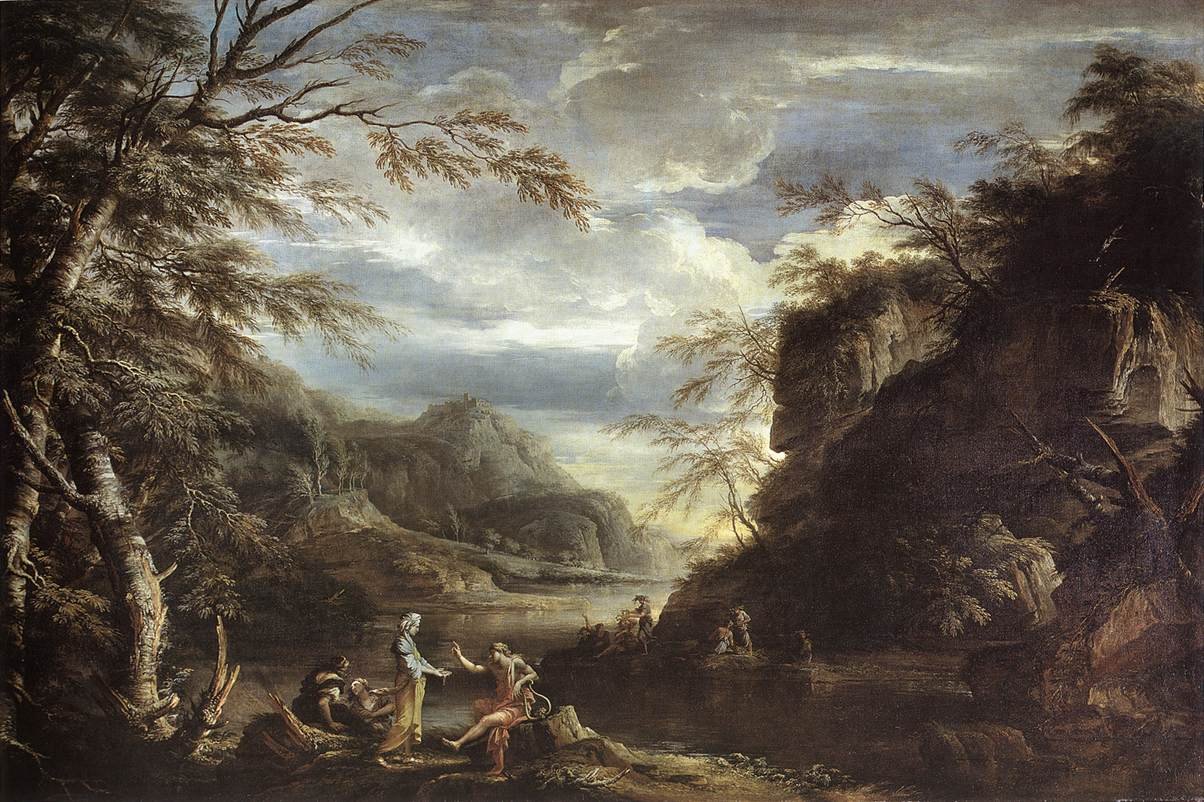
River Landscape with Apollo and the Cumaean Sibyl by Salvator Rosa

River Landscape with Apollo and the Cumaen Sibyl by Salvator Rosa (c.1655)

My featured artist today is the 17th century Italian Baroque painter Salvator Rosa.  He was born in 1615 in the small hill town of Arenella above the outskirts of Naples.  His father Vito Antonio was a land surveyor and had great ambitions for his son wanting him to become either a lawyer or take holy orders in the church and become a priest.  With this in mind he decided that his son should be afforded the best education and had him enter the convent of the Somaschi Fathers, a holy order of priests and brothers.  As we have seen in many biographies of artists, what the parents want for their children often differs from what the children themselves want and so it was the case for Salvator Rosa.  During his studies he had developed a love of art and with the support of his maternal uncle, Paolo Greco, he secretly began to learn to paint.  Rosa began his artistic training in Naples, under the tutelage of his future brother-in-law, Francesco Francanzano, who had trained under the influential Spanish painter, Jusepe de Ribera.  It is also believed that after this initial training, Rosa trained with the Naples painter, Aniello Falcone, who was also at one time apprenticed to Ribera.  Rosa greatly admired the works of Ribera and was influenced by them.

His father died when he was seventeen years old and, as he had been the breadwinner to Rosa’s large family, his mother struggled to feed her children let alone financially support her son Salvator with his artistic ambitions.  After his father’s death, Salvator Rosa continued to work as an apprentice with Falcone until 1634 when he relocated to Rome where he stayed for two years before returning home.

In 1638, aged 23 he went back to Rome where he was given accommodation by the Bishop of Viterbo, Francesco Brancaccio who treated him as his protégé and received commissions from the Catholic Church.  It was whilst in Rome that Rosa further developed his multi-talented skills, not just as an artist but as a musician, a writer and a comic actor.  He founded a company of actors in which he regularly participated.   He wrote and often acted in his own satirical plays, often political in nature and often lampooned the wealthy and powerful, and it was his devilish satire which gained him the reputation of a rebel, pitting himself against these influential people.  However his viperish-tongued satires made him some powerful enemies including Gian Lorenzo Bernini, the famous and powerful architect and who was at that time, the most powerful artist in Rome.  He, like Rosa, was also an amateur playwright and it was during the Carnival in 1639 that Rosa ridiculed Bernini’s plays and his stature as a playwright.  Eventually Rosa had made too many enemies in the Italian capital and decided it was just too dangerous to remain there.

From Rome he travelled to Florence where he was to remain for the next eight years.   One of his most influential Florentine patrons was Cardinal Giancarlo de’ Medici, himself a great lover and supporter of the Arts. Rosa worked for the Cardinal at his palace but was still allowed the freedom to paint his own landscapes and would go off and spend the summers in the Tuscan countryside around Monterufoli and Barbiano.    It was whilst living in Florence that Rosa did some work for Giovanni Carlo who was at the centre of the literary and theatrical life of Florence and Rosa soon became part of Carlo’s circle of friends.  Rosa used his own house as a meeting place for local writers, musicians and artists and it became known as the Accademia dei Percossi, or Academy of the Stricken.

He left Florence in 1646 being unhappy with the ever increasing restrictions put on him and his artistic and literary work by the Medici court  He went first back to Naples where he remained for three years before returning to Rome in 1649  where he believed his writings and paintings would win him even greater fame.  One of the problems Salvator Rosa had was his ever tempestuous relationship with his patrons and their demands.  He often refused to paint on commission or to agree a price beforehand.  He rejected interference from his patrons in his choice of subject.  In Francis Haskell’s book entitled, Patrons and Painters: Study in the Relations Between Italian Art and Society in the Age of the Baroque, he quotes from a letter Rosa wrote to one of his patrons, Antonio Ruffo, explaining his thoughts on his art and commissions:

“…I do not paint to enrich myself but purely for my own satisfaction.  I must allow myself to be carried away by the transports of enthusiasm and use my brushes only when I feel myself rapt…”

The 17th century Florentine art historian Filippo Baldinucci could not believe Rosa’s attitude to his patrons and wrote:

“…I can find few, in fact, I cannot find any, artists either before or after him or among his contemporaries, who can be said to have maintained the status of art as high as he did… No one could ever make him agree a fixed price before a picture was finished and he used to give a very interesting reason for this: he could not instruct his brush to produce paintings worth a particular sum but, when they were completed, he would appraise them on their merits and would then leave it to his friend’s judgement to take them or leave them….”

In his later years he spent much time on satirical portraiture, history paintings and works of art featuring tales from mythology.  In 1672 he contracted dropsy and died six months later.  Whilst on his deathbed he married Lucrezia, his mistress of thirty years, who had borne him two sons.   He died in March 1673 just a few months short of his fifty-eighth birthday.  After his father’s death forty years earlier Rosa had struggled financially but at the time of his death he had accumulated a moderate fortune.

Landscape painting had been regarded as a relatively lesser genre of painting in Italy at the time. But two French artists based in Rome, Claude Lorraine, who Rosa had befriended, and Nicholas Poussin, had done much to raise its status by setting scenes drawn from classical myth or biblical legend in grand Arcadian landscapes inspired by the nearby countryside. Rosa continued their tradition but with one subtle difference.  His landscape scenes depicted scenes of stormy desolation rather than calm pastoral beauty scenes of Claude and Poussin.  For My Daily Art Display today I am going to look at a painting by Salvator Rosa, which is a landscape but based on Roman mythology and Ovid’s book Metamorphoses.  It is the story of Apollo (often known as Phoebus) and the Cumaean Sibyl.   Cumae, which was the location of Italy’s earliest Greek colony, is on the Gulf of Gaeta near Naples and this location was probably known to Rosa.  The basis of the painting harks back to a conversation Aeneas had with the Cumaean Sibyl, who was a guide to the underworld of Hades, the entrance to which was the volcanic crater of Avernus.  Aeneas wanted to enter the underworld in order to visit his dead father Anchises.  Aeneas, with the help of his guide, the Cumaean Sibyl, found the aged ghost of his father.  It was at this time that the Sibyl recounted the story of her barter with the god Apollo, how she reneged on her promise and why she had become old and haggard:

“…“I am no goddess,” she replied, “nor is it well to honour any mortal head with tribute of the holy frankincense. And, that you may not err through ignorance, I tell you life eternal without end was offered to me, if I would but yield virginity to Phoebus for his love. And, while he hoped for this and in desire offered to bribe me for my virtue, first with gifts, he said, ‘Maiden of Cumae choose whatever you may wish, and you shall gain all that you wish.’ I pointed to a heap of dust collected there, and foolishly replied, `As many birthdays must be given to me as there are particles of sand.’  For I forgot to wish them days of changeless youth. He gave long life and offered youth besides, if I would grant his wish. This I refused, I live unwedded still. My happier time has fled away, now comes with tottering step infirm old age, which I shall long endure…”

The making of the bargain

Her mistake had been not only to ask Apollo for eternal life but also to ask for everlasting youth and beauty.  She aged over time.  Her body grew smaller with age and eventually was kept in an ampulla, a small nearly globular flask or bottle, with two handles.   Eventually only her voice was left.

The painting, entitled River Landscape with Apollo and the Cumaean Sibyl, depicting the meeting of the Cumaean Sibyl and Apollo, was painted by Salvator Rosa around 1655.  This is one of his finest works and highlights his ability as a landscape painter.  It is a desolate landscape scene.  Before us we have an isolated inlet of the sea, surrounded by towering cliffs of rough and rugged stone. On the right hand side of the painting we have a dark crag which towers against a stormy summer sunset.  From this jagged rock there are spindly trees sprouting from it at strange angles. In the foreground of the painting we see the god Apollo, seated on a tree stump with his lyre at his side, propositioning the beautiful Cumaean Sibyl, the turbaned woman who stands before him.    His hand is raised almost as if he is blessing the woman but it is his demonstrative act of granting her wish that she might live for as many years as there are grains of dust in the earth she holds out to him in her hand.   In return for the granting of her wish she would become his lover.   The Sibyl having been granted her wish, changes her mind, and refuses to surrender to Apollo’s advances.  Apollo cannot take back what he had given the young woman, but he was still able to punish the fickle girl, for, in devising her wish, she forgot to ask for eternal youth, and by refusing to grant her this he condemned her to grow older and older until at last she wasted away and only her voice was left.

The scene before us, depicted by Rosa, is purely imaginary, Rosa has included the cavern from which the Sibyl uttered her famous prophecies and which still exists in the dark, rocky area at the top right of the picture.  In the background we can see the inaccessible citadel perched high on a cliff.  The other characters we see in the scene are the nine muses, the goddesses of creative inspiration who were the handmaidens of Apollo. The painting is illuminated by the last rays of the setting sun light which light up the stormy sky in the distance. Look at how Rosa has managed to portray an aura of an ominous premonition.   The dramatic use of dark tones and chiaroscuro adds a feeling of foreboding about the scene.  The way he has depicted the wild landscape of bare rocks, splintered trees and a threatening stormy sky goes hand in hand with the story of retribution about to be dealt to the Cumaen Sibyl by Apollo for reneging on her promise to him.

Notwithstanding the darkness of the scene, it is still a beautiful landscape painting.  It is currently housed at the Wallace Collection, London.

La Vucciria by Renato Guttuso

La Vucirria by Renato Guttuso (1974)

I am leaving the final part of My Daily Art Display’s look at the life of Paul Gaugin until my next blog and thought I would feature a painting I came across the other day when I was watching an art/ travelogue/cooking programme, which looked at the artistic treasures of the Sicily whilst the presenters sampled the local dishes.  In the first of three programmes they visited Palermo and in one section we were shown the manic hustle and bustle of La Vucciria, the popular market of the town.  When I was researching this blog I came across a description of this marketplace given by a resident of the town.

“…There are no words in any language to accurately describe this place. It is a mix of heaven and hell in one place! The mix of smells and people and cultures all in one market. You can glimpse into the life of the real people of the city. I go there almost every day because I can’t get enough…”

What fascinated me the most about the market was a painting of it by one of Sicily’s most famous artists, Renato Guttuso, and so I have made him my artist of the day and his painting simply entitled La Vucciria the featured painting for today’s blog.

Renato Guttuso was born on 26 December 1911 at Bagheria, a small town on the north west coast of Sicily, some ten kilometres east of Palermo. His father Gioacchino was a land-surveyor and also an amateur watercolourist.  His mother was Giuseppina d’Amico.  Probably due to his father, Guttuso learnt to paint at a very early age.   At the age of thirteen he began signing and dating his paintings and drawings which at the time were, in the main, copies of nineteenth century landscapes.  He went to high school in Palermo and then on to the university, where he studied European art, from Courbet to Van Goghand to Picasso.
In 1931, when he was twenty years of age he had two of his paintings accepted for the Prima Quadriennale d’Arte Nazionale in Rome and this gave him the chance to attend the exhibition and see the works of the greatest Italian artists. The following year his works appeared in an exhibition in Milan.  To supplement his income as a painter he worked as a picture restorer for the Picture Gallery of Perugia and the Borghese Gallery in Rome.  He was also interested in commenting and writing articles on art and the trends of modern art.  However the first article he contributed to the left-wing Palermo newspaper, L’Ora,  fell foul of Fascist censorship.

In 1935 Guttuso did his military service in Milan and two years later went to live in Rome where he set up his studio and had his first solo exhibition.  Guttuso kept producing outstanding works: nudes, landscapes, still lifes.  In 1941 he produced one of his most famous paintings entitled Crocifissione(Crucifixion), which is now looked upon as one of the most relevant masterpieces of the Twentieth Century.  He explained the meaning of the work:

: “… this is a time of war. I wish to paint the torment of Christ as a contemporary scene … as a symbol of all those who, because of their ideas, endure outrage, imprisonment and torment”.

This controversial painting for which he is probably best remembered, denounced the horrors of the war under a religious guise. His depiction of one of the most famous Christian events provoked widespread controversy.  The Vatican authorities even issued an edict forbidding the religious to look at the canvas.

In 1942 Gutusso turned his hand to stage design for musicals, creating both scenery and costumes for performances at the Teatro della Arte in Rome.  During the war Gutusso moved out of the capital city and joined the Resistance movement which was strongly opposed to fascism.  At the end of the war, he visited Picasso in Paris and this was to be the beginning of a lifelong friendship between the two painters.   He, along with some other like-minded artists, founded the “Fronte Nuovo delle Arti’ (New Arts Front), a group of politically aware artists who aimed at making up for those European artistic experiences whose circulation in Italy had been prevented by Fascism. Social themes and scenes of everyday life prevailed in his painting.   In 1950 Guttuso was awarded the World Council of Peace prize in Warsaw, and in the same year his first one-man exhibition was held in London.  Large-scale paintings of his were regularly shown at the Venice Biennale, always stimulating debates and controversies.  In 1972, Guttuso was awarded the Lenin Prize at the time of his exhibition at the Art Academy in Moscow. The following year Guttuso selected a relevant collection of works, both his own and by other artists, which would form the core of the future municipal art gallery of Bagheria.  In 1976 he was elected a Senator of the Republic for the Italian Communist Party, a political party he had been an active member since joining in 1937,

Guttuso died on 18 January 1987, leaving major works to the Galleria d’Arte Moderna, Rome. He had previously entrusted other works together with a rich collection of documents to the Museum in his native town of Bagheria which had been dedicated to him. This museum, Museo Guttuso, which is housed in the 18th century Villa Cattolica, owns the largest collection of his paintings, drawings and graphics.

And so to the painting I am featuring today, La Vucciria by Renato Guttuso which he completed in 1974 and can be found in Palermo’s Palazzo Steri.  It is a sort of folk art type of painting.  When I watched the TV programme and the part which looked at La Vucirria, nothing seems to have changed in almost forty years since the artist depicted it in his painting.  The naked electrical lights dangling over head still remained.   The Sicilian word vucciria means “confusion” and we can recognise the aptness of that name in the painting.   Look at the scene.  Can you imagine the noise and smells that emanate from this market as the vendors scream out descriptive delights of their precious products?  The many fish stalls have to be kept constantly wet to maintain freshness and the floor around these areas are never dry.  The closeness of the market to the port ensures the freshness of the fish and this is depicted by the artist as we see them curled, still in rigor mortis.    The painting is a rich and colourful, some would say gaudy, portrayal of life in the market.  The colours are so vibrant and pulsating.

There is verticality about the painting as the path between stalls moves almost in an upward direction through the centre of the painting to the top.  This is Sicily and, as we know, Sicily is synonymous with the Mafia and maybe there is a dark side to the painting.  Observe either side of the woman in white who has her back to us.  To her left there is the fish seller.  Note how he looks across at the cheese seller to the right of the woman.  Notice how they scowl at each other.  The fishmonger grasps the swordfish almost as if he is grabbing hold of a blade.  If one looks closely at the cheese seller there is evidence of a pentimento, which is where there is evidence in the form of traces of previous work that shows us that the artist has changed his mind as to the composition whilst he was in the process of painting. The word actually derives from theItalian word pentirsi, which means “to repent”.   It is thought that the partly hidden hand of the cheese seller once was painted with a knife in it.  Are we witnessing a brewing vendetta between the two men?  Does the woman in white have anything to do with the bad feeling?  Are the two vendors vying to be her lover?  The vertical line through the centre of the painting was looked upon as the vertical line of life and the horizontal line of sight between the warring cheese seller and the fishmonger was looked upon as the horizontal line of death and of course the intersection of the two lines form a cross.

Renato Getups was deeply anti-fascist and an ardent communist all his life.  He was also anti-Mafia and so it was ironic that in 2009 when a leading mafia financier, Beniamino Zappy, was arrested and had his art collection confiscated there were many paintings by Gattuso.  A spokesman for the anti-Mafia investigators said, with a touch of humour, of Zappy:

”…He is part of a criminal organization, the Mafia, but

Martha Rebuking Mary for her Vanity by Guido Cagnacci

Martha Rebuking Mary for her Vanity by Guido Cagnacci (c.1660)

Today I am returning to an artist I featured back in My Daily Art Display of April 24th 2011 when I looked at two paintings of his depicting the death of Cleopatra.  He is the Italian painter of the late-Baroque period, Guido Cagnacci.

Guido Cagnacci was an Italian painter belonging to the Bolognese School, which rivalled Florence and Rome as centres of painting.    He was born in 1601 in Santarcangelo di Romagna, a town in the province of Rimini where he spent the early part of his life.  Later, he moved to Rome where he met fellow artists Simon Vouet, and Giovanni Francesco Barbieri, often better known simply as Guernico.   Cagnacci had also been a pupil of Guido Reni and he tended to combine references to classical models and to Raphael’s work with his own lively interest in the type of daring perspectives and brilliant compositions that the Baroque style favoured.   It is also believed that during this time he may have studied under an ageing Ludovicio Carracci.  He moved back east to Venice in 1650 and started to paint very sensual scenes with seductive, half-naked girls as his subject, His later paintings often featured semi-naked women as Lucretia, Cleopatra and even Mary Magdalene, as we will see in today’s offering.  These erotic paintings were very popular and much sought after by collectors at the time and through them, his popularity spread.  In 1658 he journeyed to Vienna where he gained the patronage of Emperor Leopold I and that was his ticket to fame and riches.  It also gave him the opportunity to bring to the German-speaking lands the latest classical style.

It is his contentious painting of a semi-naked Mary Magdalene that I am featuring in My Daily Art Display today.  The painting, which Cagnacci completed around 1660, is entitled Martha Rebuking Mary for Her Vanity.  The title of the painting brings up the first question one needs to consider and that is who is Mary?    Many would say that the Mary in the title is Mary Magdalene but others would disagree.  Mary and Martha are the most familiar set of sisters in the Bible. In the books of Luke and John, the pair, who lived in Bethany were described as friends of Jesus and who had a brother called Lazarus.  Though some earlier interpreters blended the person of Mary of Bethany with Mary Magdalene, current theologians believe she was a different person.  In Latin tradition, Mary of Bethany is often identified as Mary Magdalene while in Eastern Orthodox and Protestant traditions they are considered separate persons. The Orthodox Church has its own traditions regarding Mary of Bethany’s life beyond the gospel accounts.  However I will go along with the idea that in this painting we are looking at Mary Magdalene and her sister Martha.

Cagnacci's Mary Magdalene

The painting is a vivid and somewhat melodramatic allegory of Virtue conquering Vice.  Cagnacci has managed to blend reality, idealism and fantasy in the way he has portrayed the occurrence.   Lying prostrate on the floor is the semi-clad Mary Magdalene being rebuked and lectured to by Martha who sits on the floor in front of her.  Martha leans forward and is fervently lecturing her sister about the sins of Vanity pointing to the allegorical scene we see in the background. She is passionately trying to get her sister to discard the life of pleasure she had been leading up until then and turn to the life of virtue as a true follower of Christ.  Mary would seem to have recognised the life of sin she had been leading and realised, in response to the admonitions of her sister Martha, the error of her ways.  As a dramatic act of changing course, she has discarded her lavish and extravagant outer garments, jewellery and her other worldly possessions which we see scattered on the floor around her.

To the right of the painting we see a couple of servants, one in tears, symbolising contrition whilst the other looks back in disbelief and annoyance at Mary’s act of repentance and she symbolises the unremorseful face of Vanity.   In the background, mirroring what is happening in the foreground, we see an angel, symbolising Virtue driving out the demon which represents Vanity.  Cagnacci has in some ways tailored the story of the discarding of the woman’s clothes so as to give us an unusually sensuous depiction of the semi-naked Mary Magdalene.  He was often criticised for this sort of eroticism in his paintings, with critics maintaining that some artists could make anything salacious and Cagnacci was one of these.  However one must remember that Cagnacci knew that this type of painting sold well, so he would not be put off by his detractors.

The scene, which Cagnacci has painted, does not come from any particular passage in the Bible and we must believe the artist has manipulated the biblical facts of the differing character of the two sisters to suit the story behind this work.  The story of the differing personalities of Mary and her sister Martha was painted many times before by many different artists and in my next blog I will feature one by Johannes Vermeer.

Cagnacci probably completed this work whilst working for Leopold I at the Austrian court in Vienna.   The painting later went to the Gonzaga court in Mantua, which had strong ties with the court at Vienna. The painting was acquired by the Norton Simon Art Foundation and is currently housed at the Norton Simon Museum in Pasadena, California.

Ruth Weisberg and her painting

When I was researching the painting I discovered that the Museum had held a special exhibition in November 2008 entitled Guido Cagnacci and the Resonant Image which featured the Los Angeles artist Ruth Weisberg’s series of works in dialogue with Cagnacci’s Baroque masterpiece Martha Rebuking Mary for her Vanity.  It was based on her intuitive artistic reaction to the work.  Ruth created over twenty paintings and drawings which were pictorial stories on the themes of repentance, anger and ultimately the triumph of virtue over vice. In one she even depicts herself and family members as characters from the Cagnacci work.