The Nativity by Correggio

The Nativity by Correggio (1530)

The name of many painters derives from their place of birth.  Today’s featured artist is no exception.  Antonio Allegri was born around 1490 in the Italian town of  Correggio, a small town a hundred miles south-east of Milan.  Little is known about Correggio’s early life or his artistic training except that his father was a merchant and he may have initially trained under his uncle the painter, Lorenzo Allegri.  When he was seventeen an outbreak of the plague forced him and his family to leave Correggio and move to Mantua. 

During his lifetime his artistic reputation was unexceptional but after his death his works of art were appreciated more and the influence he had on art was acknowledged.  Art historians believe his work was influenced by Andrea Mantegna, who had a studio in Mantua and maybe the two men encountered each other.  Correggio completed numerous altarpieces and small devotional works but his major work was to start when he was just twenty five years of age,

In 1514 he went to Parma and in 1522 he was contracted to paint the fresco of the Assumption of Our Lady on the central cupola of the cathedral.  It took him eight years to complete this major work.  However the fresco of the Virgin Mary ascending to heaven through a sea of limbs was not well received by the officials of the cathedral  with one priest stating that the fresco reminded him of a “stew of frogs’ legs” and it also met with bemusement from the public.  However, later, after Correggio’s death, this domed fresco was to be considered highly influential on the development of Baroque dome painting.  Whether it was due to the criticism at the time of this fresco or the death of his young wife but he became very depressed and returned to his birthplace were, at the young age of thirty six, he died.

As today is Christmas Day I thought my offering should be connected to the feast of Christmas and so have chosen The Nativity by Correggio.  It can be found in the Gemäldegalerie Alte Meister in Dresden.  The work of art was commissioned by Alberto Pratoneri for his family chapel in the church of St. Prosper of Reggio Emilia.  Correggio finished the work in 1530.  In 1640 it was moved to Modena and a century later to Dresden.  This painting was described as one of the first monumental nocturnal scene in European painting.  Correggio used a style and interpretation similar to that of some of Titian’s works.  The scene is fully à la chandelle with the light appearing to both bathe and emanate from the Child Jesus.  The Virgin Mary looks lovingly down at the Child as she cradles Him.  Looking on are the shepherds and St Joseph whilst up above in the clouds are the angels.

Saint Justina with a Donor by Moretto da Brescia

Saint Justina with a Donor by Moretto da Brescia (c.1530)

Alessandro Bonvicino more commonly known as Moretto da Brescia was born around 1498 at Rovato, a town in the province of Brescia in Lombardy. He studied first under Fioravante Ferramola of Brescia and later with Titian in Venice.    He was the leading Brescia painter of the day and concentrated his works on religious subjects mainly producing altarpieces and other religious works.  The human figure in his paintings is somewhat slender and expressions are intently religious.  The backgrounds of his paintings tended to be of a radiant quality.  He was a very religious person and use to prepare himself before embarking on a work of sacred art by prayer and fasting. 

Today’s offering in My Daily Art Display is Moretto’s St Justina with a Donor which he painted around 1530 and was one of the major works of the Northern Italian High Renaissance.  This picture is one which I saw when I visited the Kunsthistoriches Museum in Vienna. 

In this painting the union between a religious subject, in this case Saint Justina, and the figure of a patron has been brought to such a self-contained yet intimate whole.  Although in essence it is a devotional picture there emanates a feeling of a pastoral love scene.  Saint Justina is revered as the patron saint of Padua and is shown holding the martyr’s palm,  standing besides the unicorn.  Moretto merges the legendary figure of a sorcerer, who was converted by Justina, into the donor of the painting.  He gazes up at the saint with an enraptured reverence that seems to have affected even the unicorn.  The influence of Raphael is clearly evident in the statuesque, suspended form of the beautiful saint and Moretto was often alluded to as the Raphael of Brescia.

 Have you a favourite painting which you would like to see on My Daily Art Display?  

If so, let me know and tell me why it is a favourite of yours and I will include it in a future offering.

The School of Athens by Raphael

The School of Athens by Raphael

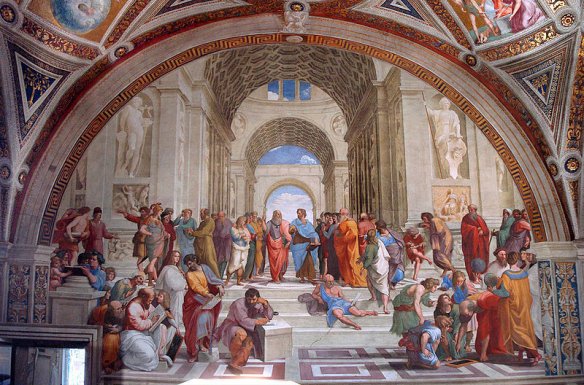
Raphael was commissioned by Pope Julius II in 1510 to decorate with frescos the walls of his private apartment, now known as the Stanze di Raffaello in the Apostolic Palace in the Vatican.  For Raphael, this must have been a daunting task as he had never worked on a project of such magnitude and he had little experiencein fresco. 

The second of his frescos entitled The School of Athens was on the wall of a room, known as the Stanza della Senatura and is one of the most famous paintings by the Italian Renaissance artist.  This room was intended by the Pope to be filled with portraits of great intellectuals of the ancient world.   The fresco is a who’s who of the famous thinkers of the past and there have been many arguments when it comes to identifying the characters of the fresco. 

School of Athens - Who's who

According to Michael Lahanas in his book The School of Athens, “Who is Who?” Puzzle   they are usually identified as follows:

1: Zeno of Citium 2: Epicurus 3: Federico II of Mantua 4: Anicius Manlius Severinus Boethius or Anaximander or Empedocles 5: Averroes 6: Pythagoras 7: Alcibiades or Alexander the Great? 8: Antisthenes or Xenophon 9: Hypatia (Francesco Maria della Rovere) 10: Aeschines or Xenophon 11: Parmenides 12: Socrates 13: Heraclitus (Michelangelo) 14: Plato (Leonardo da Vinci) 15: Aristotle 16: Diogenes 17: Plotinus or Michelangelo 18: Euclid or Archimedes with students (Bramante) 19: Zoroaster 20: Ptolemy R: Apelles (Raphael) 21: Protogenes (Il Sodoma, Perugino, or Timoteo Viti)

 See also:  http://www.mlahanas.de/Greeks/SchoolAthens.htm

The Doge Leonardo Loredan by Giovanni Bellini

The Doge Leonardo Loredan by Giovanni Bellini

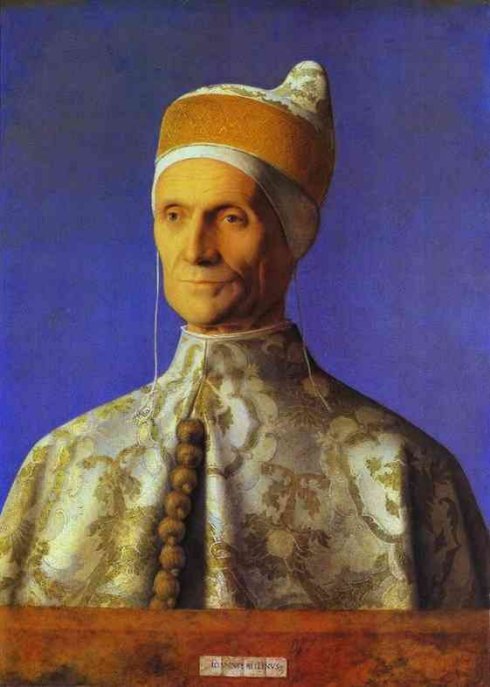
Giovanni Bellini was born in Venice around 1430 and was one of the greatest and most influential artists of the Italian Renaissance.  He came from a family of artists.  His father was Jacopo Bellini, an artist, and Giovanni and his brother Gentile trained under him. His sister married another great Renaissance artist Andrea Mantegna.  Giovanni had a long and prolific career living to the age of 85, during which he transformed Venice into a centre of artistic excellence which rivaled Rome and Florence as established centres of art.  Venetian painting rose to prominence during his time through his use of colour, light and atmosphere.   Bellini was a master of portraiture and today’s art display is one of his most famous works of portraiture,  Doge Leonardo Loredan.

This portrait hangs in the National Gallery in London.  Bellini completed this painting around 1502.  This formal portrait of the Doge at the beginning of his rule shows the hat, called a corno, which was worn over a linen cap.   His robe is made of luxurious, gold-threaded damask and is decorated with ornate buttons which were part of the official wardrobe.  This was a traditional style of portraiture for incumbent rulers of the time.   The style of this portrait is similar to the style of sculpted portrait busts which were often inspired by Roman sculpture.  Bellini’s signature can be seen below on the parapet in the form of a cartellino.  A cartellino being a piece of parchment or paper painted illusionistically, often as though attached to a wall or parapet in a painting, commonly with the artist’s name or that of the sitter.

Susannah and the Elders by Guido Renni (1620-1625)

Susannah and the Elders by Guido Reni (1620-5)

Guido Reni was born in Bologna on November 4th 1575.  He studied art from the age of nine as an apprentice under the Bolognese Studio of Denis Calvaert.  At the age of twenty he worked in the Accadmi degli Incamminati (Academy of the newly embarked, or progressives) under the tutelage of Ludovico Carracci.  This academy was one of the first of its kind in Italy and singularly helped to encourage the so-called Bolognese School of the late 16th century.  His most celebrated work, Aurora, painted in 1614 is an enchantingly beautiful ceiling fresco of the large central hall of the garden palace, Casino dell’Aurora, which was a commission for Scipione Borghese.  Although he was highly successful in Rome, he returned to Bologna.   After Ludovico Carracci’s death in 1619, Reni was unrivalled as Bologna’s most important artist probably the most sought-after painter in Italy.   Reni died in Bologna in 1642 aged 66.

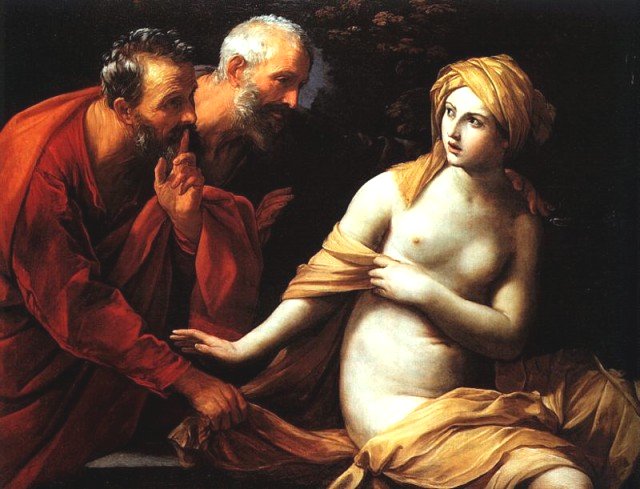
Today’s picture is one I saw at the National Gallery, London and is entitled Susannah and the Elders.  The incident depicted in this painting is taken from the Old Testament.  As the virtuous and beautiful Susannah bathes in her garden, she is approached by two elders who, lusting after her, threaten to accuse her of adultery if she does not sleep with them. She refuses and is falsely accused by them, but her innocence is proved and prevents her from being stoned.  There have been many other versions painted of this scene including one by his former master, Carracci.