William James Muller. Part 2.

The Later years

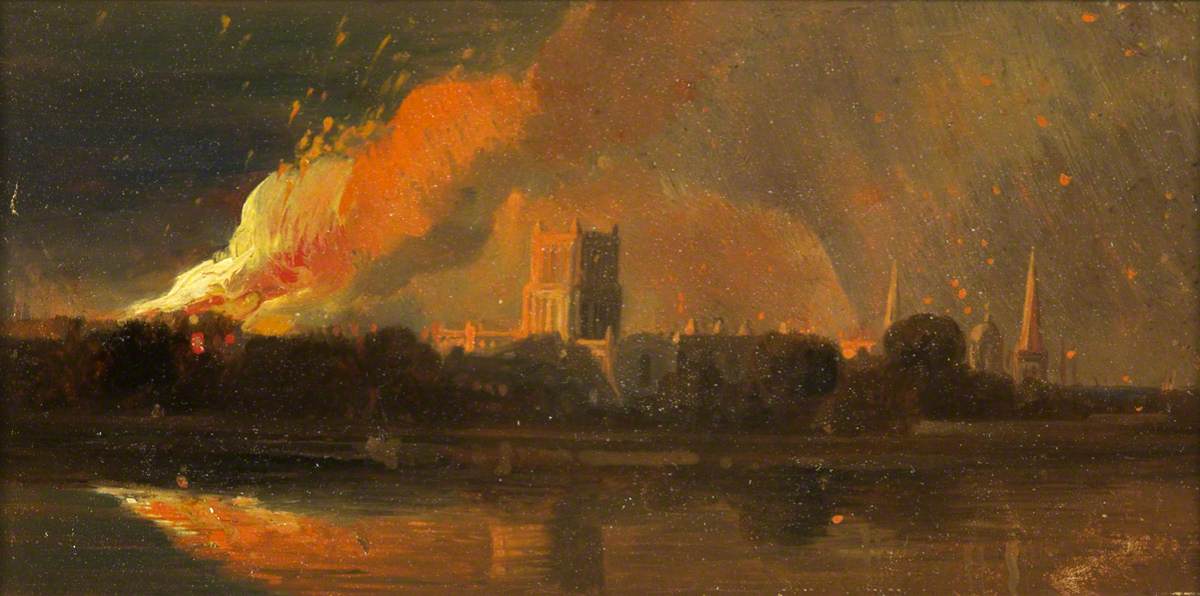
The Gaol Burning and St Paul’s Bedminster by William Muller (c.1831)

William Muller’s home in the city of Bristol was rocked by civil unrest in 1831.  The Reform Riots, as they became known, took place between the 29th and 31st of October and were part of the 1831 riots in England. The riots came about because of the second Reform Bill which was voted down in the House of Lords, and consequently shelved efforts at electoral reform.  The Bristol Riots were a reaction to the statement in Parliament of a senior judge, Sir Charles Wetherell, that the people of Bristol were not in favour of reform, despite 17,000 signatures on a petition supporting the reforms. 

The Burning of the Bishop’s Palace by William Muller (c.1831)

It was at a time when only five per cent of the population, (and they had to be men!) had the right to vote which was based on their wealth.  Wetherell  came to Bristol on his annual visit to Bristol, public meetings were organised in Queen Square on 10th, 11th and 12th October to decide on how to carry the fight forward. Demonstrators met Wetherell on his arrival in Bristol on October 29th, and soon, full scale rioting broke out, with angry crowds of protesters taking control of the city for two days. 

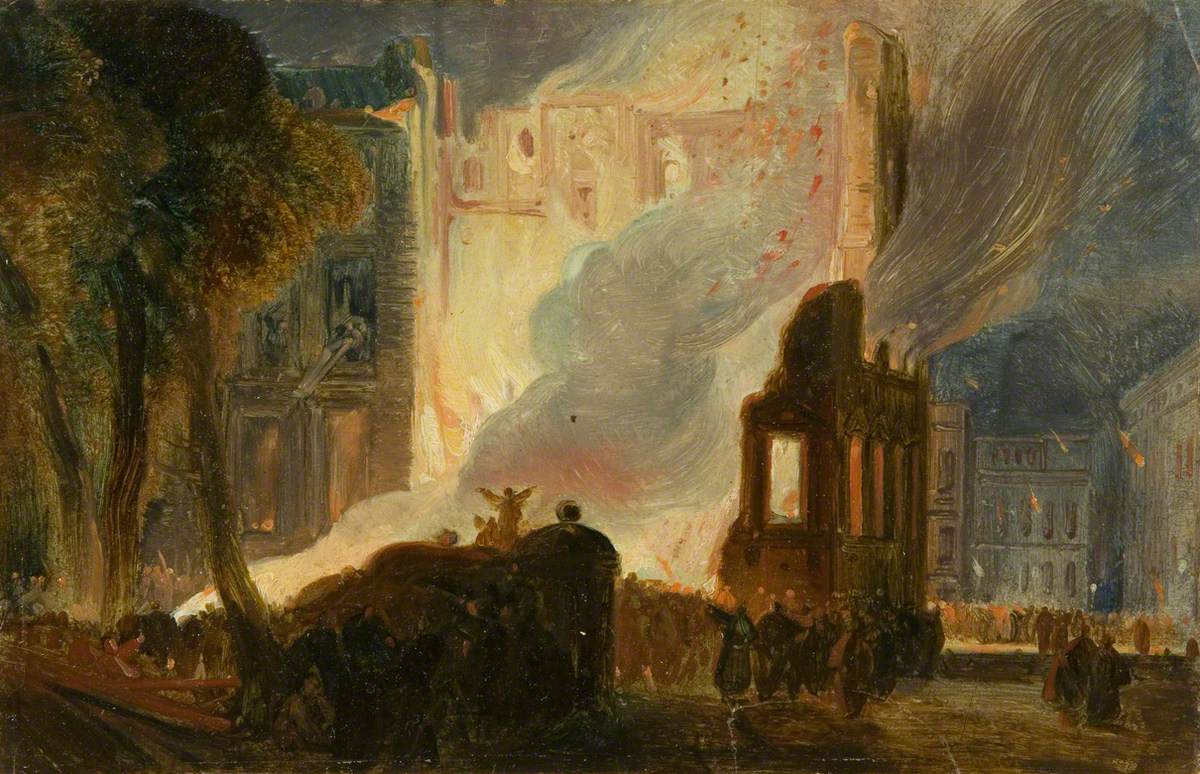
The Burning of the Mansion House, Queens Square by William Muller (1831)

Troops were brought in to end the riots and Wetherell escaped dressed as a woman while the crowds stayed, looting the wine cellar of the Mansion House and becoming drunk and reckless. Over the next two days rioters broke into Bridewell Jail and Lawford’s Gate Prison and set prisoners free. The Tollhouses, the Bishop’s Palace and, in Queen Square, the Mansion House and the Custom House, were all attacked.

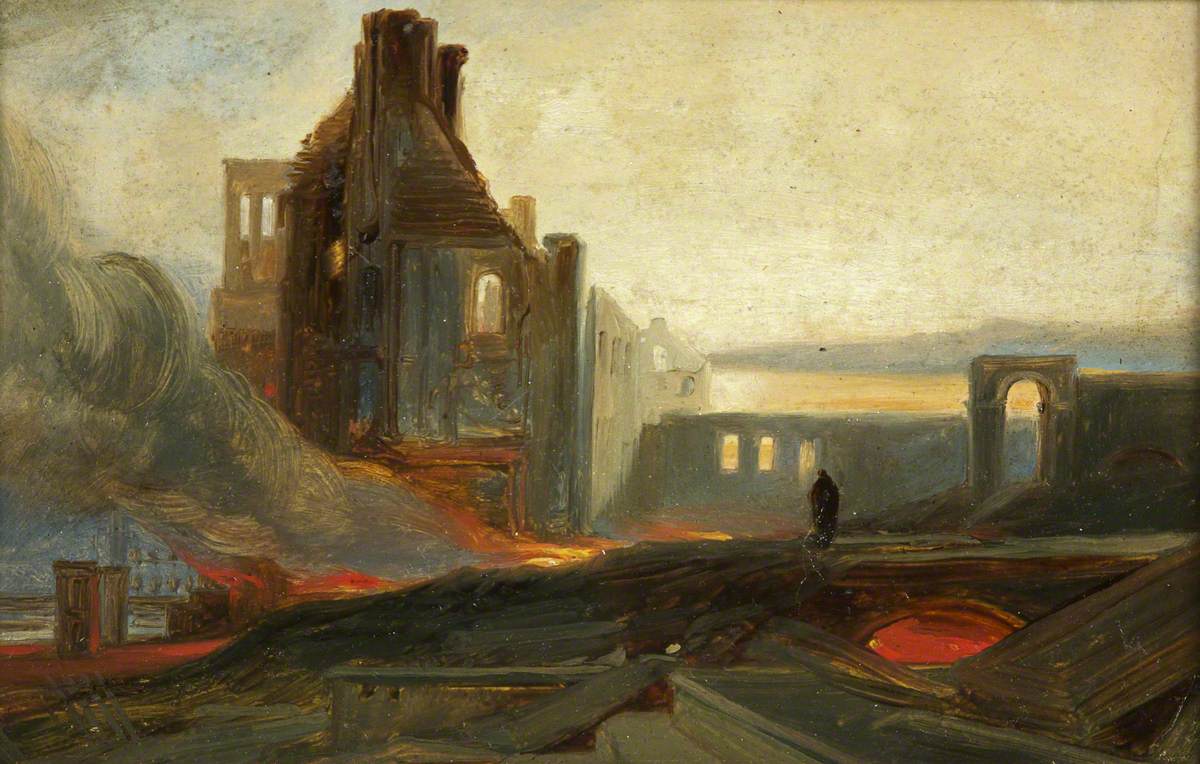
Ruins of Warehouses in Prince Street by William Muller (c.1831)

Nineteen-year-old William Muller and his younger brother, Edmund, witnessed the riots first hand.  William made several sketches of the buildings in flames and the ruins of what remained.   Later he turned the sketches into a number of paintings such as Rioting in Queen’s Square, The Remains of the Mansion House, Ruins of the Custom House, with only the bare and broken columns standing.  He also completed a work entitled Removing the Prisoners at night to the Gaol, with the glare of burning buildings all around.

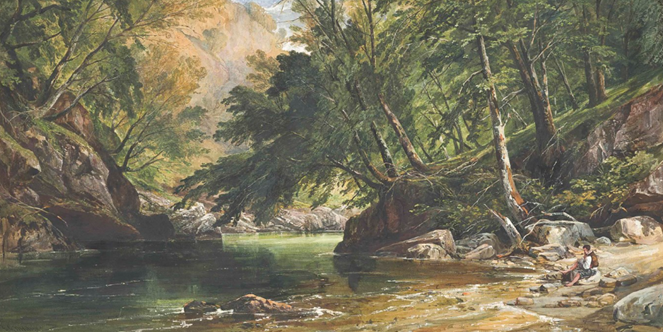
Of all Muller’s painting trips he undertook, North Wales was one of his favourite destinations. In a letter to a friend he called the area, Our English Switzerland. His first foray to the region was in June 1833 when he along with fellow artists, John Skinner Prout and Samuel Jackson left Bristol, crossed the River Severn and traversed the Brecon Beacons, finally arriving at the foothills of Cader Idris.

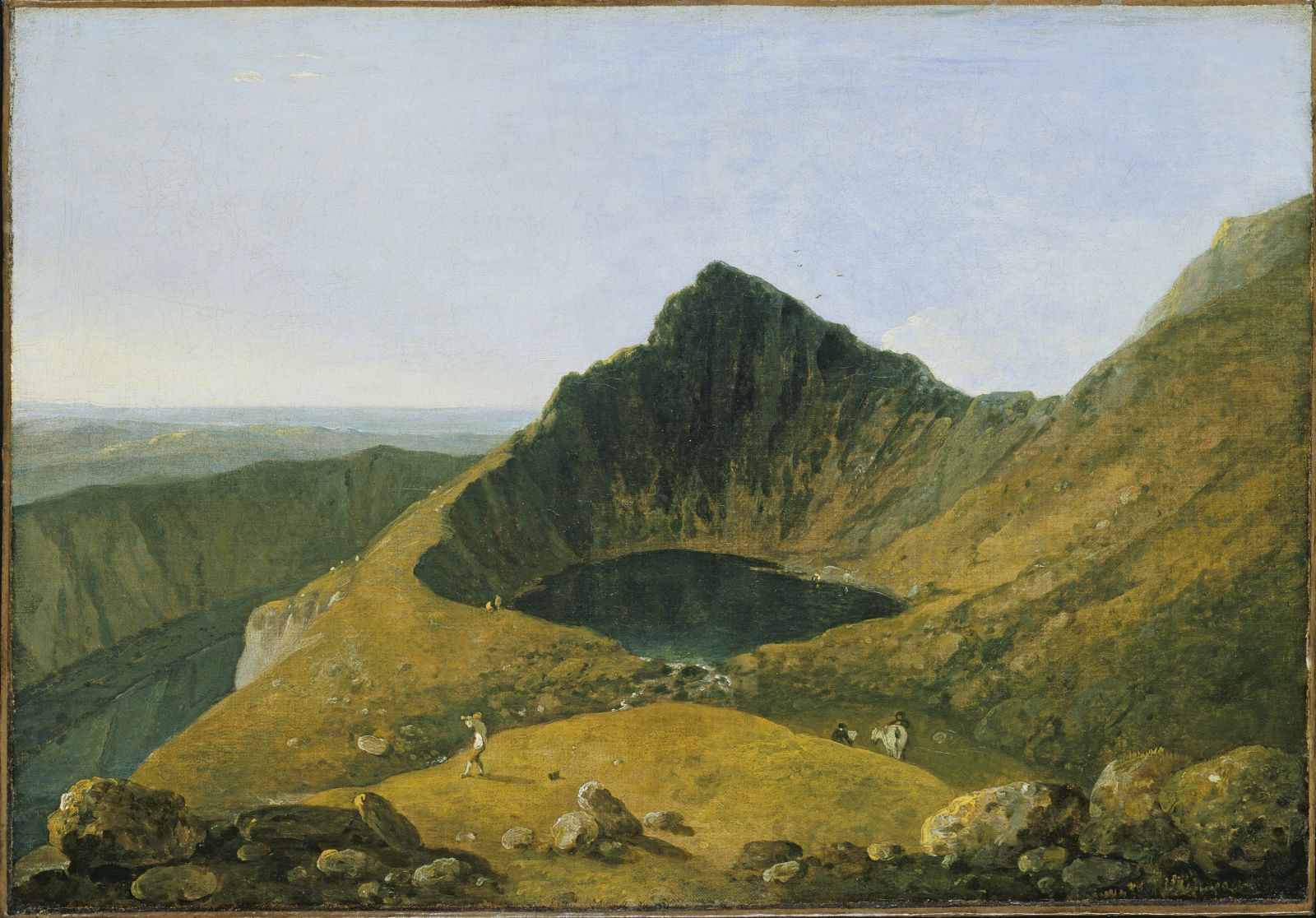
Llyn y Cau by Richard Wilson (1765)

The three men climbed part of the way up the mountain to gain a view of Llyn-y-Cau, a lake Muller referred to as Wilson’s Lake after Richard Wilson’s magnificent depiction of the lake in his 1765 painting.

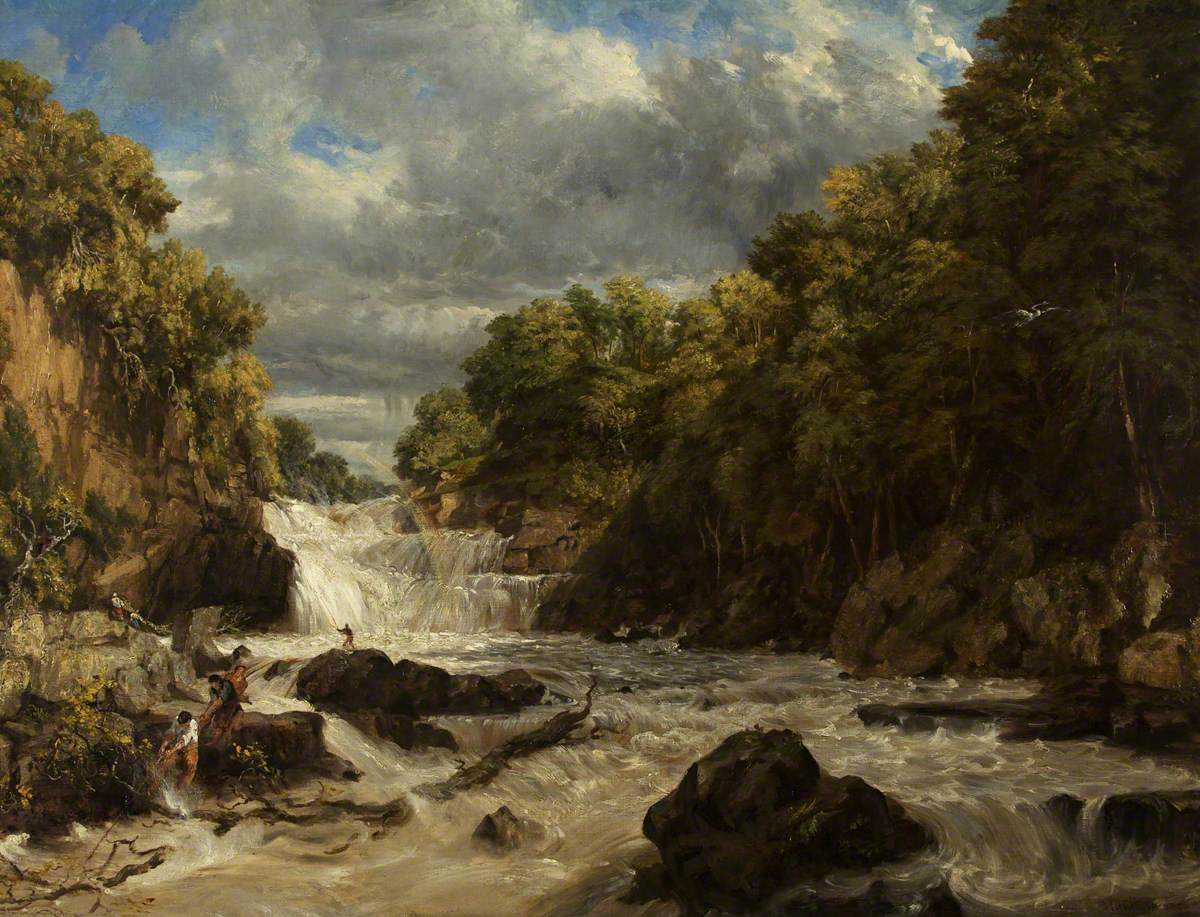
Swallow Falls, Betwys y Coed by William Muller (1837)

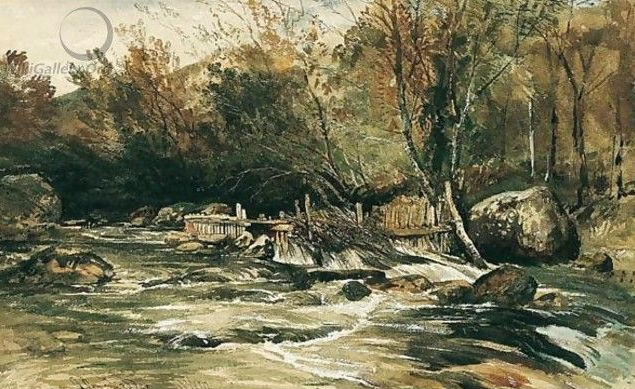
Muller and Prout parted company with Jackson and explored the Conwy Valley from Betwys-y-Coed, all the way down to the sea. Muller was so taken with what he saw that he returned to the area on several occasions. During the winter of 1841 he and his brother travelled to North Wales and stayed at an inn in “Roe” now the small village of Rowen which was up-river from the coastal town of Conwy. He returned the following summer to paint en plein air in oils. In a letter to a fellow artist he wrote:

“…I paint in oil on the spot, and rather large, indeed. I am more than ever convinced in the actual necessity of looking at nature with a much more observant eye than the mass of young artists do, and in particular at skies. These are generally neglected…”

Salmon Trap on the River Lledr by William Muller (1842)

Interior with Goats, Betwys y Coed by William Muller (c.1833)

In July 1834, twenty-two year old Muller set off for Europe on a seven-month journey of discovery along with his good friend and fellow artist, the watercolourist, George Arthur Fripp.  They left Bristol docks on a schooner and sailed to Antwerp.  Having disembarked they went to Brussels and then moved across the German border, arriving in Cologne.  They then followed the river south, eventually arriving at Heidelberg where they rested for several days.

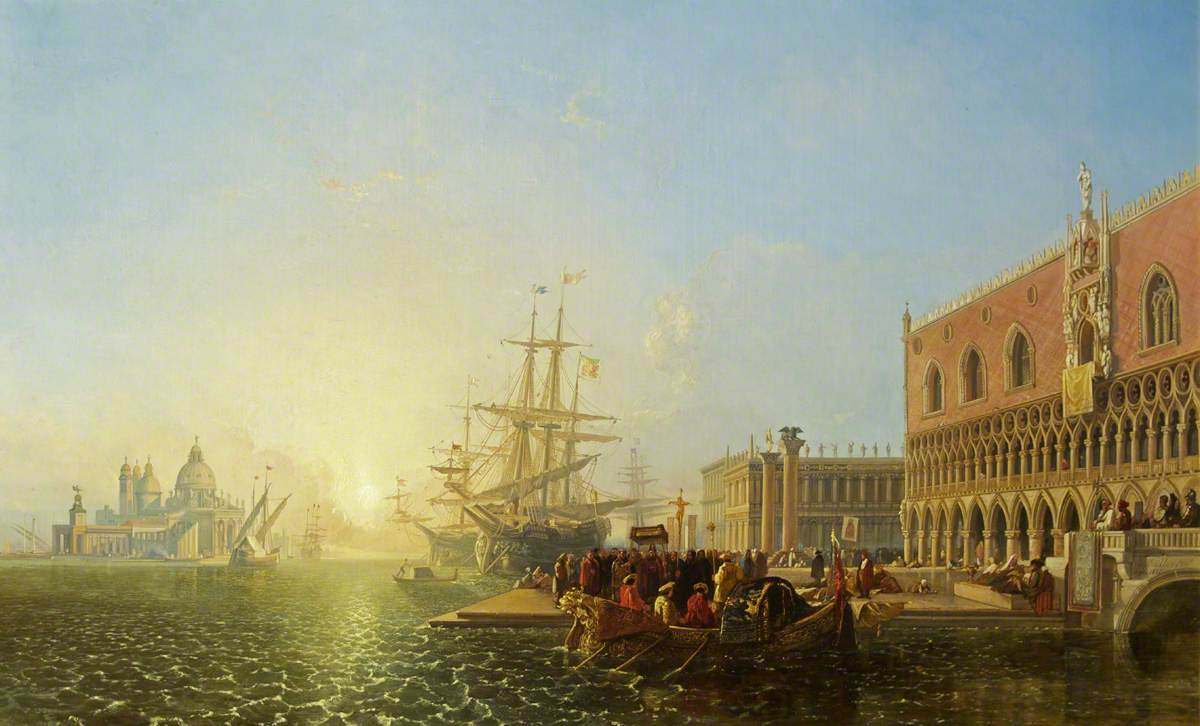
The Doge’s Palace, Venice by William Muller (1834)

The pair crossed the Alps and arrived in Northern Italy, visited the area around Lake Maggiore and staying in the lakeside town of Baverno.  Finally they arrived in Venice where they stayed for almost two months.

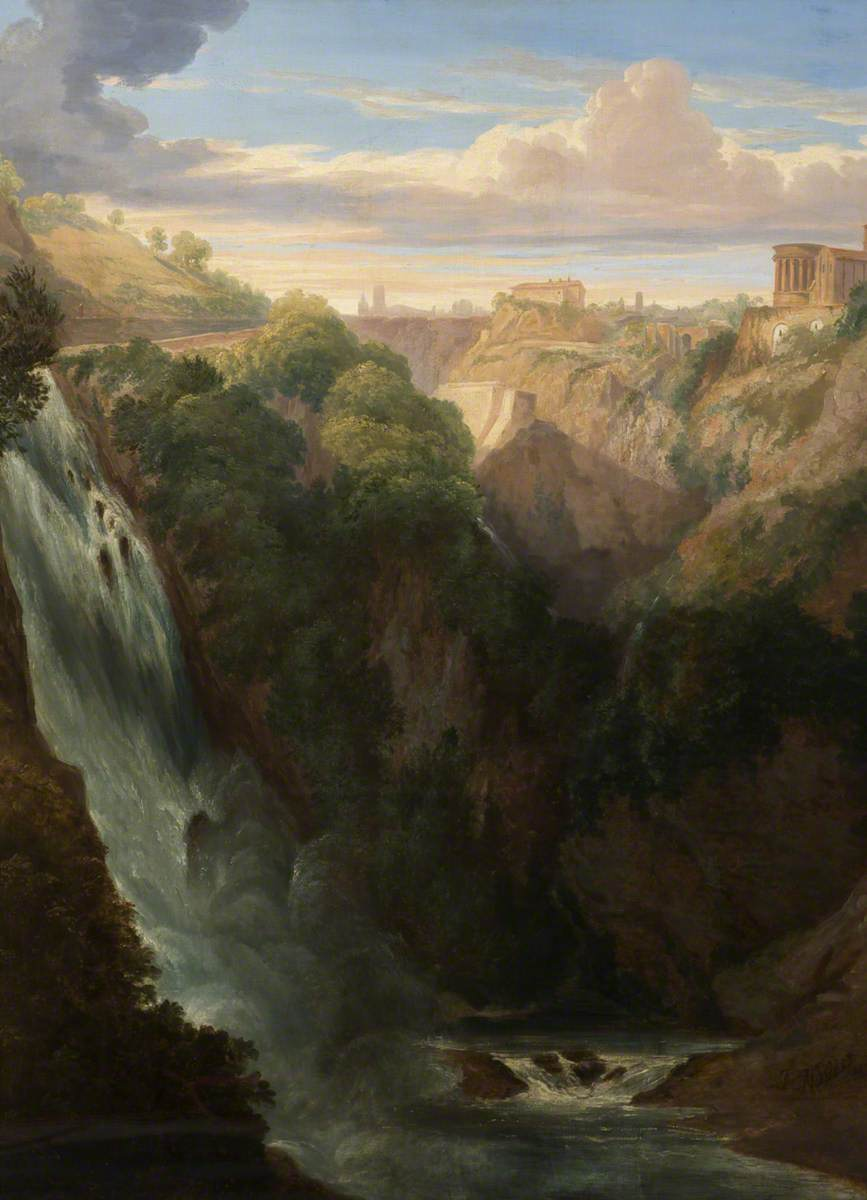
The Falls of Tivoli by William Muller (1837)

At the end of November 1834 they moved to Florence on their way to Rome where they spent that Christmas.  The one place Muller was determined to visit was Tivoli a town 30 kilometres north-east of Rome, where many British watercolourists had visited and stayed to capture the spectacular views.  Muller made many sketches and in 1837 completed his painting The Falls of Tivoli.

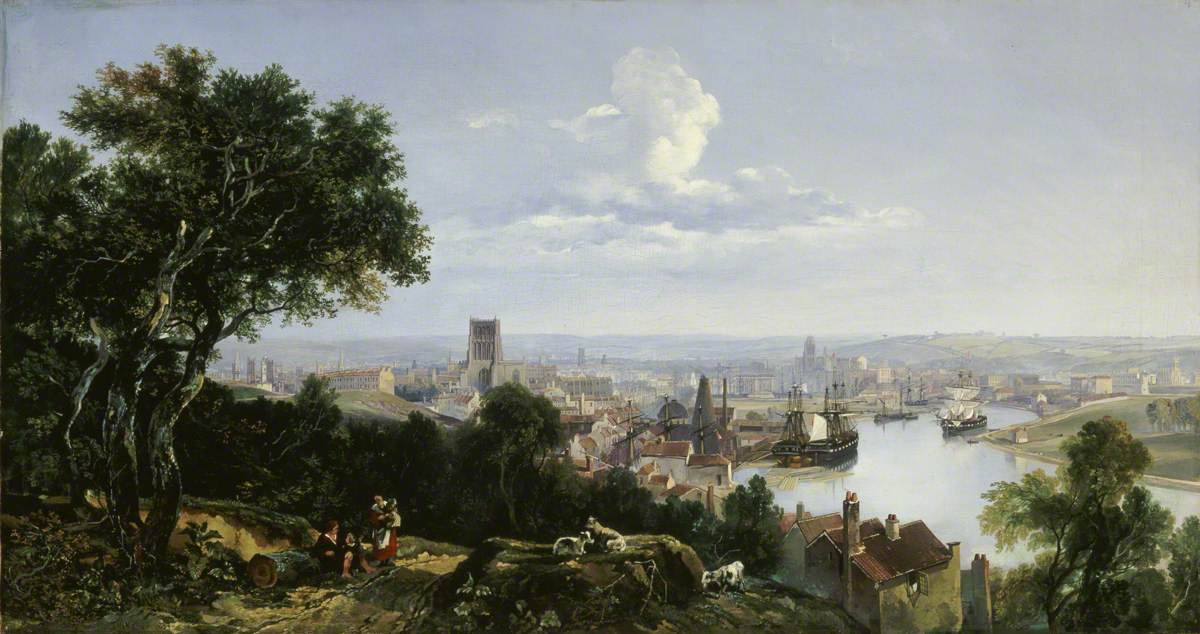
View of Bristol from Clifton Wood by William Muller (1837)

Muller returned to Bristol from his European tour in February 1835 and he set about converting his European and North Wales sketches into finished oil paintings.   In 1838 he once again left the shores of England and this time his ultimate destination was Egypt.  He went via Paris where he managed to visit the Louvre and was impressed by the landscape works of the Dutch painter, Jacob van Ruisdael and the Swiss painter, Francisco Mola.  Muller travelled overland to Marseille and then embarked on a sea passage to Malta and Constantinople.  From there he took a boat to the Greek island of Siros and then journeyed to Piraeus and Athens where he stayed for six weeks.

Temple of Theseus by William Muller (1839)

Whilst in the Greek capital Muller completed more than forty watercolours, many of which were of the Acropolis or views from this elevated monument.   Athens had been a popular destination for artists and this love of the area could be put down to James Stuart and Nicholas Revett’s 1762 book, Antiquities of Athens.  It was the first of four volumes and was the first accurate survey of ancient Greek architecture ever completed. Their detailed drawings done at the sites of the ancient ruins between 1751 and 1754 transformed our understanding of Greek architecture.

In November 1838 Muller left Greece and set sail on a French steamer for Egypt.  He disembarked at Alexandria.  Although earlier artists, such as Turner, and the marine painter Clarkson Stanfield, had produced drawing of Egyptian sites using sketches made by amateur artists, none had actually visited the country and it is thought that William Muller was one of the first established European artists to set foot in Egypt. 

Prayers in the Desert by William Muller (Exhibited at the RA in 1943)

Muller was impressed with Alexandria, likening it to a kaleidoscope of humanity but the Egyptian town was, in his view, bettered by what he saw when he visited Cairo with its long delicate minarets and Asyut but it was the mass of people of these cities that astonished him the most.  His most exciting time was when he mingled with the people at the slave market and he liked to immerse himself amongst the crowds dressed in their highly coloured clothes.

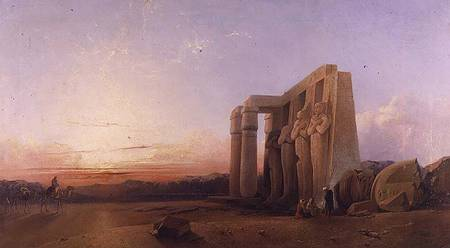
The Ramesseum at Thebes, Sunset by William Muller (1840)

In December 1838, Muller left Cairo and journeyed down the River Nile and on December 10th got his first sight of the pyramids at Giza.  In his book, An Artist’s Tour of Egypt he recounted life on the small river boat:

“…it is tedious, to an extent one can form little conception of, to be shut up in a small boat, with not enough room to stand upright – 9 feet long and in its widest 6 – with little to do but shoot from its windows at crocodiles, pelicans and other birds, in particular vultures;  of these being particularly fond of objects of Natural History, I made a tolerably numerous collection…..Shooting, sketching and smoking, at the expiration of twenty days I found I had arrived at Dundara…”

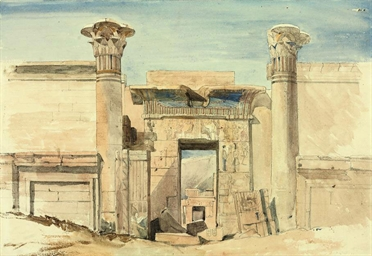
The Entrance to a Small Temple at Medinet Habu, Luxor, by William Muller (1840)

On January 1st 1839, at the end of his four hundred mile journey up the Nile, Muller arrived at Thebes.  Here on the eastern banks were temples at Luxor and Karnak and on the western side the Ramesseum,  the ruined mortuary temple of Ramesses II at Qurnah, the Valley of the Kings, the Valley of the Queens and many more monuments. 

The Pyramids by William Muller (1843)

Despite the sometimes treacherous conditions, his expedition resulted in some of the finest travel records of any artist of the 1840s.  Muller eventually returned home to Bristol via Malta, Naples, Rome and London in March 1839.  Once home he set about completing paintings from sketches he made during is long journey.

In late Autumn 1839 William decided that he needed metropolitan success with his work and left Bristol and moved to London and he and fellow artist, Edward Dighton moved into a residence on Rupert Street, Haymarket and later 22 Charlotte Street, Bloomsbury.  Muller and Dighton joined the Clipstone Street Academy at which figurative painting was taught using models and life classes and this was important to Muller who had been weak when it came to drawing figures.

Tomb in the Water, Telmessos, Lycia by William Muller (1845)

Muller, along with fellow artist, Harry Johnson, visited the eastern Mediterranean for the second time when the pair travelled to Lycia, a remote part of south west Turkey, in September 1843.  There, he had camped for months and encountered ferocious storms, torrential rain, and endured living close to malarial swamps.  Muller eventually made his way home in April 1844 after being away for eight months.  He left his numerous sketches in London to be framed and headed to Bristol to stay with his brother.  He contacted his patron, William Wethered, and and on May 7th 1884, wrote to him about the Lycia expedition:

“…I am home at last – after a most fatiguing travel…….I will look forward to showing you what I have done in sketches – they are satisfactory I believe, & contain some splendid subjects – but I almost question if I had foreseen what I have had to go through to obtain them if I should ever have visited the country…”

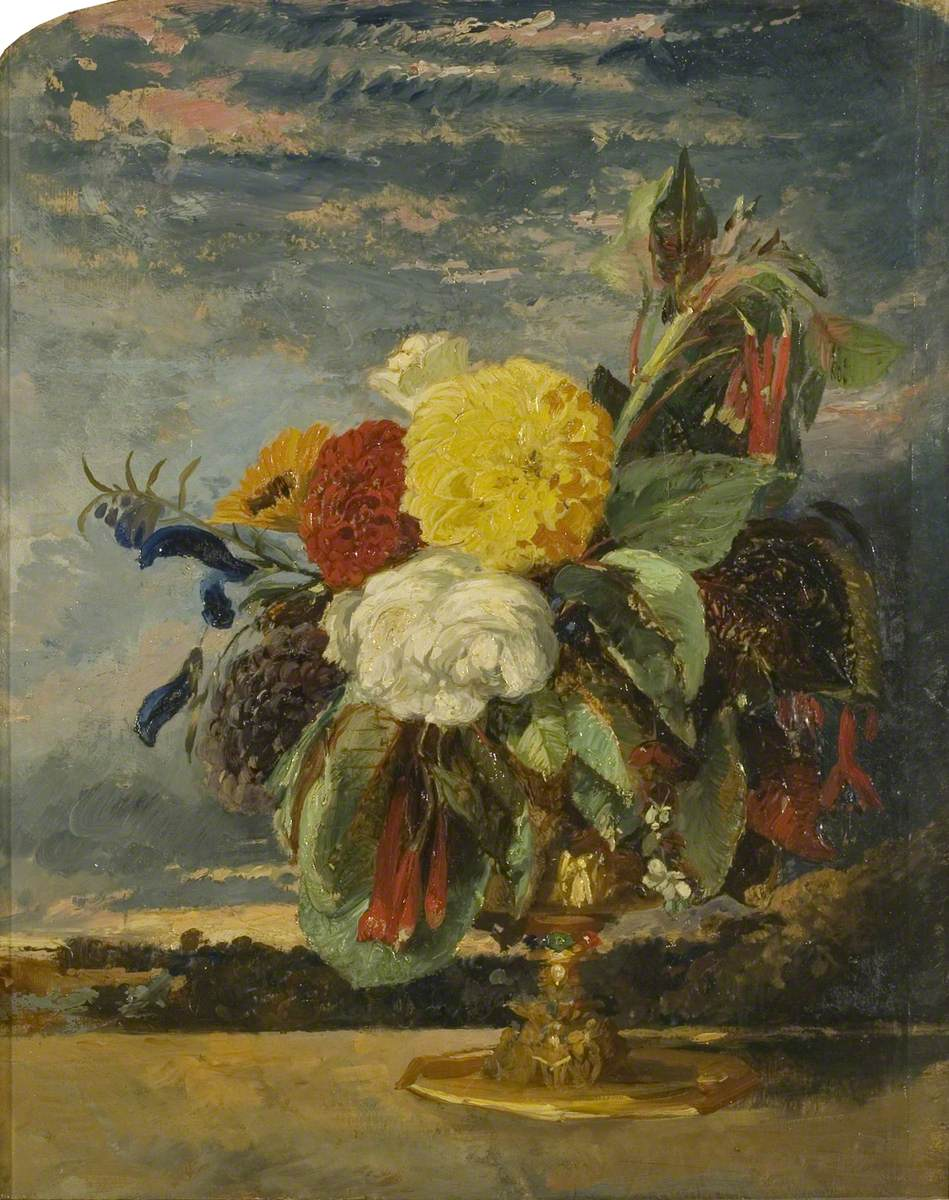
Flower Piece by William Muller (1845)

In early 1845 William Muller became ill, probably exhausted due to overworking.  He had at that time numerous commissions to complete and he believed they would lead to him becoming a very successful painter.  He was disappointed and annoyed with how is paintings were exhibited at that year’s Royal Academy exhibition but nevertheless carried on painting despite his rapidly deteriorating health.  His fingers became swollen and he was finding it difficult to hold a paint brush.  On September 8th 1845 whilst his brother was setting his palette for him to work on a still-life painting, William Muller fell back and died aged just 33.

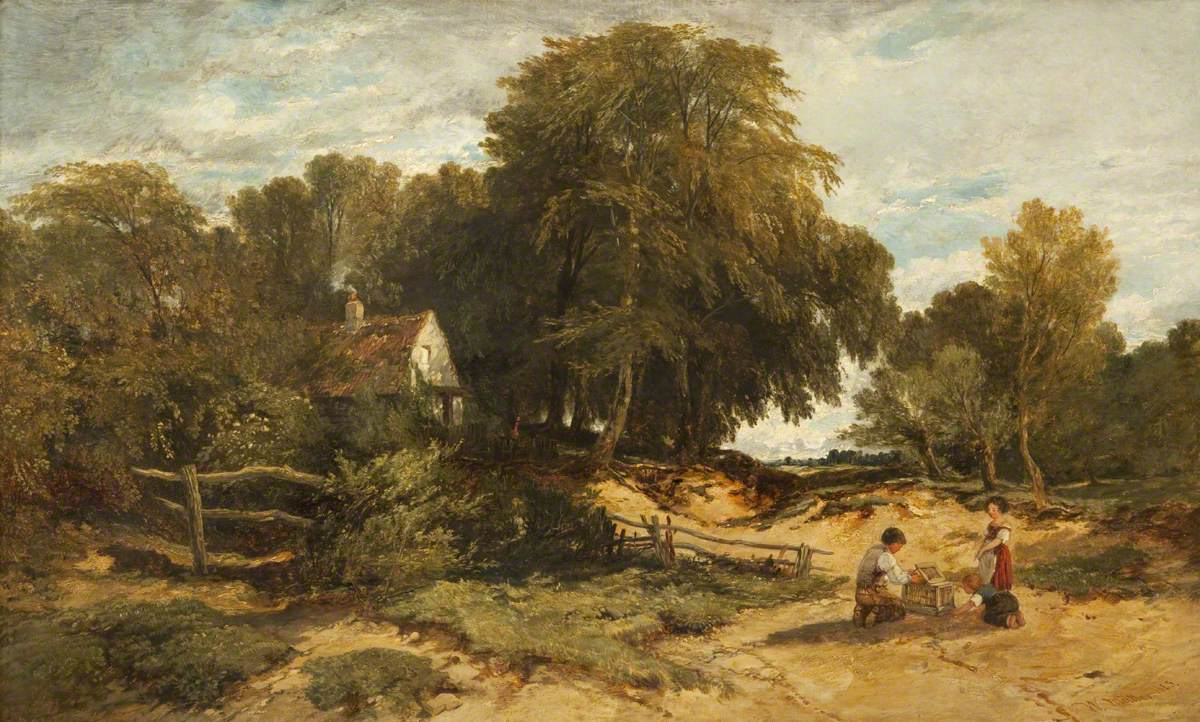
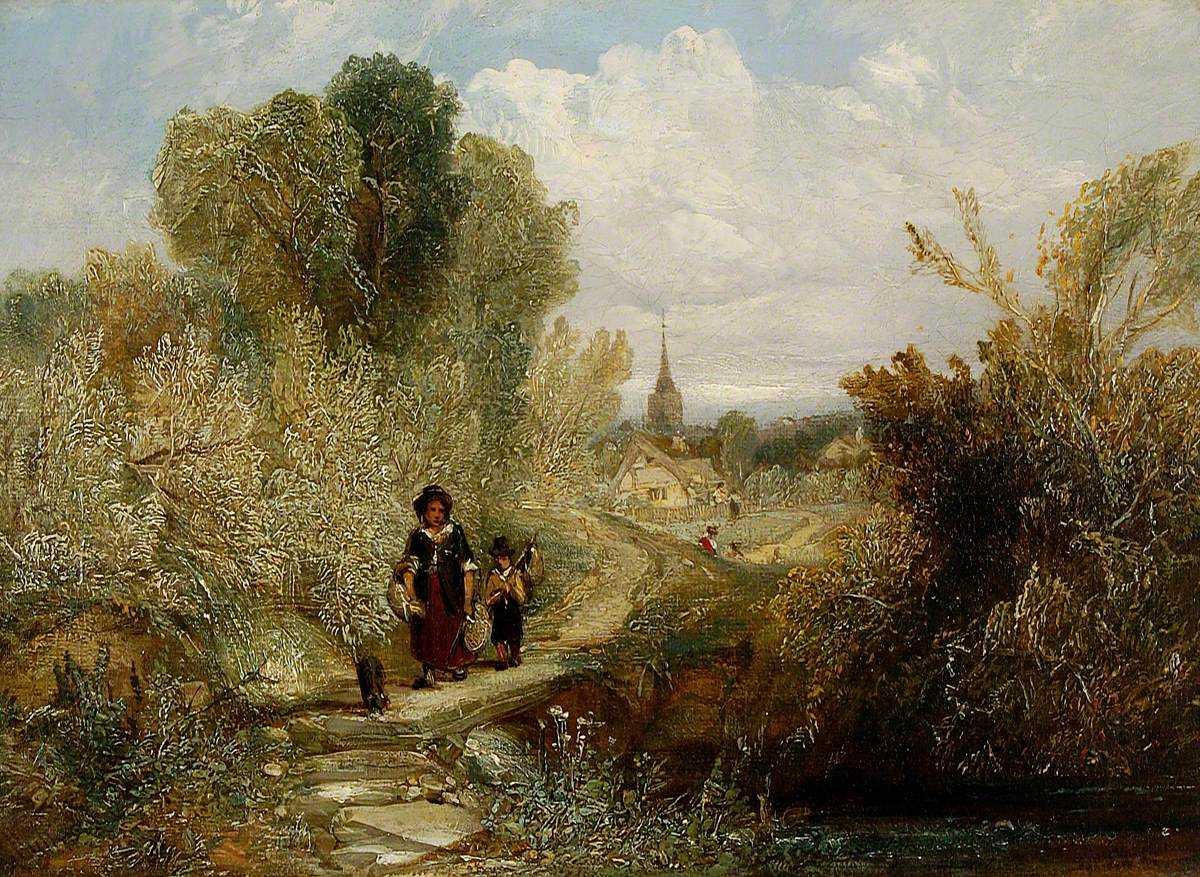
Wooded Landscape with Children by William Muller (1845)

Muller is buried in the Unitarian burial ground, Brunswick Cemetery, off Brunswick Square, Bristol. His grave is marked by a simple polished black stone slab inscribed Sacred to the memory of William James Muller who died Sep 8th 1845.   A bust of the painter is located at the entrance to the cloister in Bristol Cathedral.

William James Muller. Part 1.

The Early Years

After two blogs featuring contemporary artists whose style of work may not find favour with many who love depictions they can relate to, I have returned to a more conventional painter.  William James Muller was a British figurative and landscape painter who was associated with the Bristol School, often referred to as the Bristol School of Artists, the informal association and works of a group of artists working in Bristol, England, in the early 19th century.

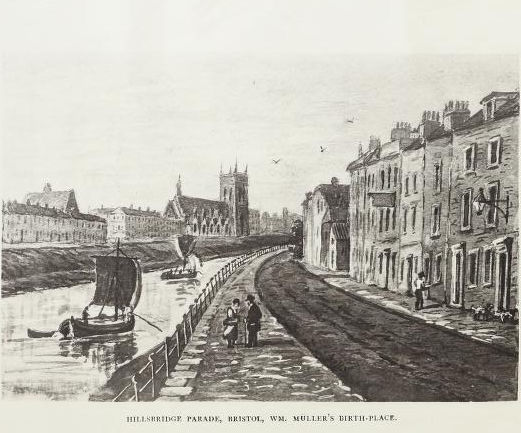
Muller, (or Müller) was born in Bristol on June 28th 1812 at 13 Hillsbridge Place, later becoming Hillsbridge Parade, which overlooked a man-made cut where the occasional small boat or barge would pass by.  His father, John Samuel Müller, a Prussian by birth, had been born in Danzig in 1779 but in 1801 when he was twenty-two, with the continuing conflict between Prussia and France, he and some friends decided to flee the country.  His method of escape was thought to be on a cargo boat carrying timber and which was plying its trade between the Baltic and Bristol.  Although arriving in the British city almost penniless, his love, knowledge and achievements in natural history and geology soon found favour with members of the Philosophical and Literary Society of Bristol who took him under their wings.  In 1821 William’s father published A Natural History of the Crinoidia or Lily-Shaped Animals and three years later he became the first curator of the Bristol Institution which later became the Bristol Museum and Art Gallery.

East Lynn, Lynmouth by Edmund Gustavus Muller

In 1806, five years after arriving in Bristol, John Samuel Muller married Margaret James who came from a well established Bristol family.  In 1808 the couple had their first child, Henry who later became a country doctor.  Their second born was William James who is the subject of this blog and their third and final offspring, born in 1816, was Edmund Gustavus who at first was trained to become a doctor but he, like William, became a well-known painter.

In the Vale of Llangollen by James Baker Pyne (1840)

William James Muller was initially home-educated by his mother.  In 1824, when he was twelve years old he began to be involved in his father’s work at the Bristol Institution sketching some of the establishment’s discoveries and would provide illustrations which then accompanied his father’s lectures.  In that same year, the Bristol Institution began to hold art exhibitions which young William Muller would have witnessed.  In 1827, when he was just sixteen years of age, his father had him apprenticed to the Bristol landscape painter James Baker Pyne whose works often depicted local views as well as imaginary ones.

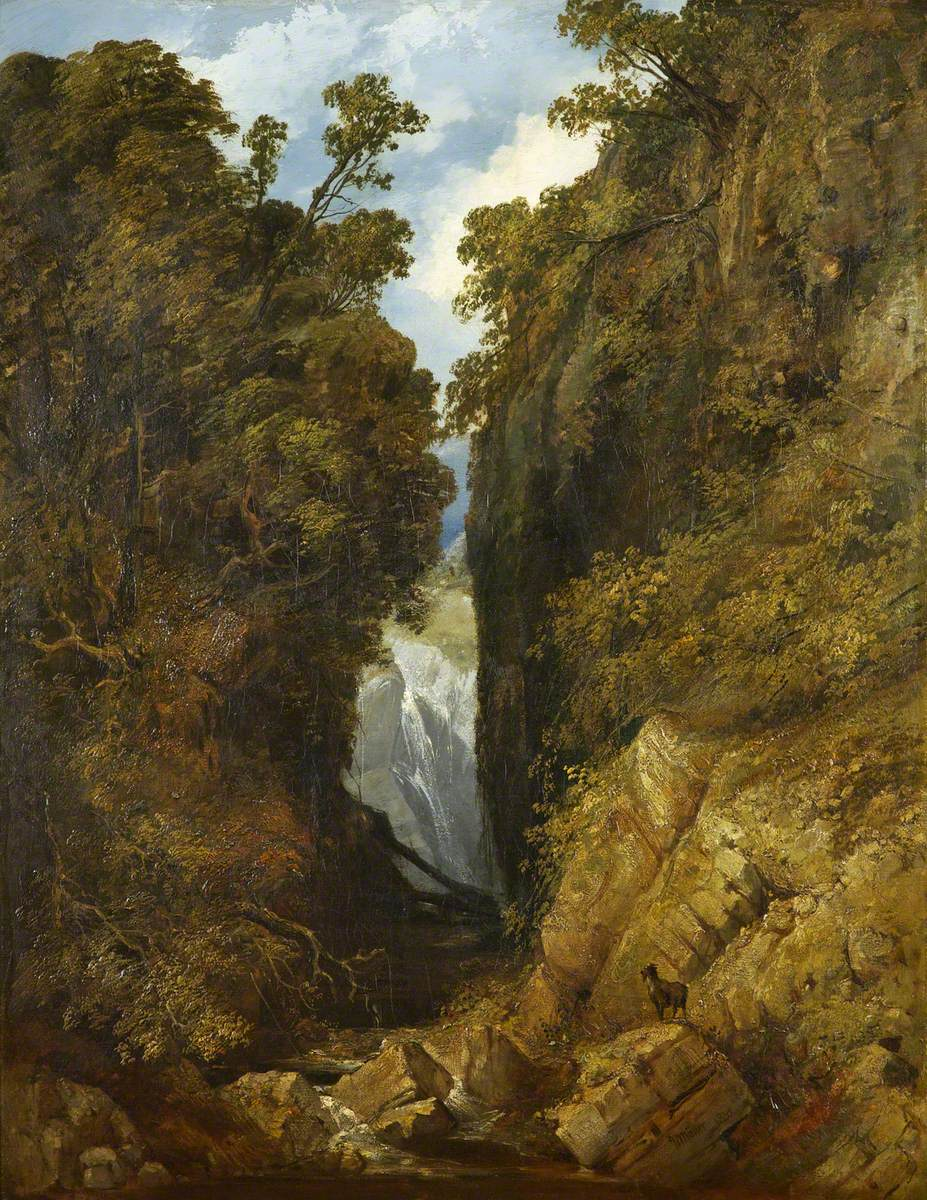
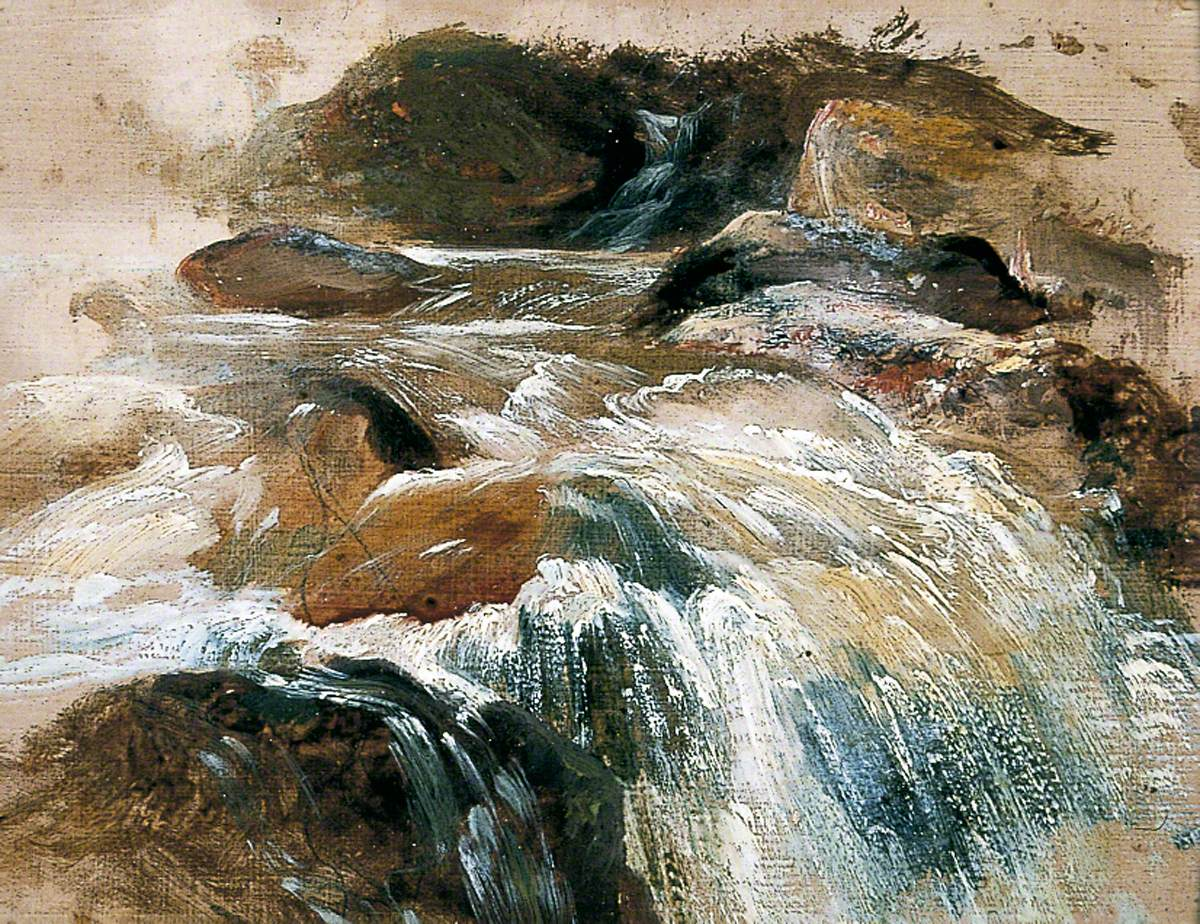
Falls on the River Lledr by William Muller (1830)

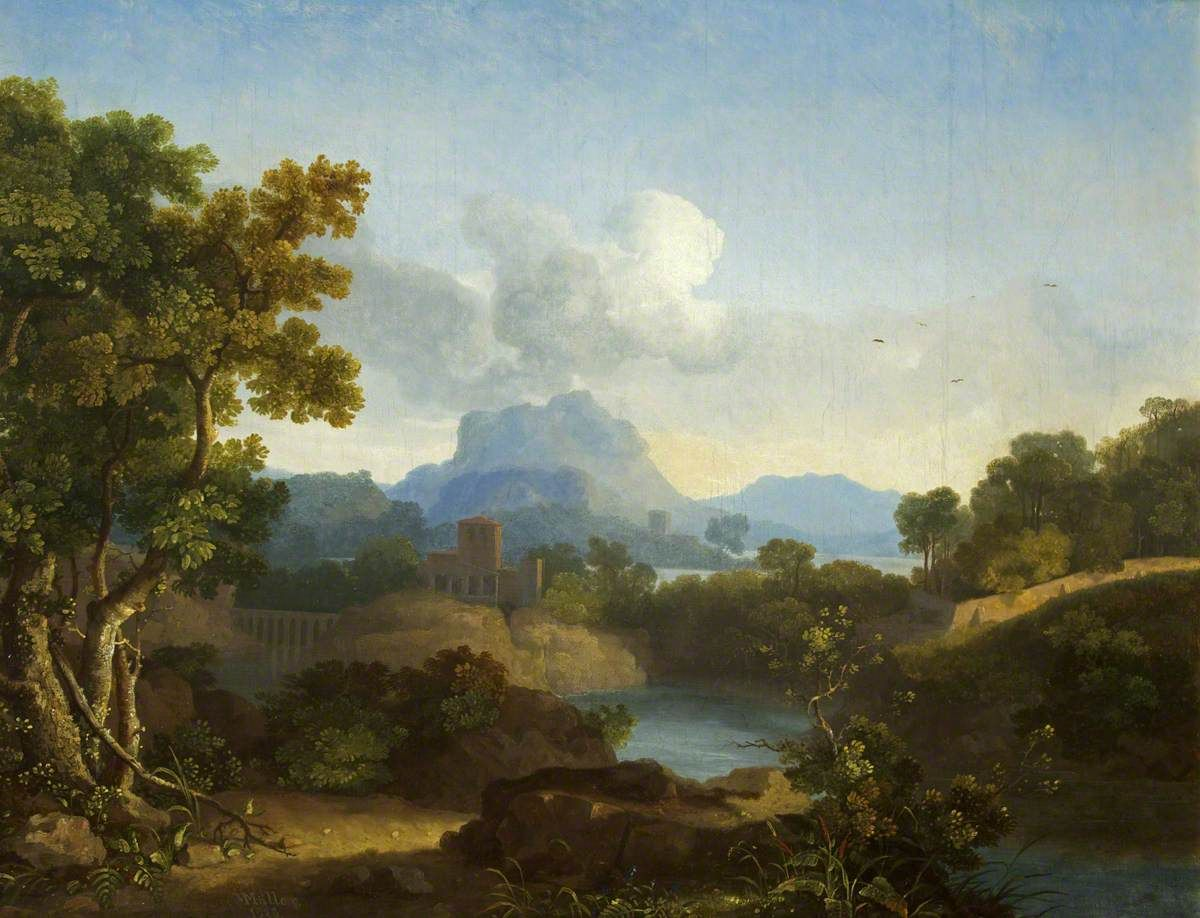
William Muller completed his apprenticeship with James Pyne in 1829.  The abrupt end to the apprenticeship came when William’s father complained to Pyne with regards how he was giving his son menial tasks to complete such as brush cleaning instead of teaching him artistic techniques.  Pyne responded by telling John Muller that he could break his son’s apprenticeship agreement if he wanted to and Muller Senior did just that !  Although it is thought that Pyne’s work did not influence Muller work greatly William did learn to appreciate the Old Masters especially the works of the seventeenth century painters such as Claude Lorrain and Nicholas Poussin. 

Classical Landscape by William Muller (1828)

The early termination of the agreement between Pyne and Muller did not put a barrier between them in later years and they always spoke about each other with a complimentary tone.  In 1843 Muller wrote to a friend about Pyne saying:

“…In early life placed under the direction of my friend J. B. Pyne — nay, serving a regular apprenticeship to the arts with him, to whom I owe so much — I commenced painting in earnest…”

Landscape with Figures by William Muller

On May 25th 1830, William’s father died, aged 51.  As he had been the sole family earner, the family would have struggled financially but this was avoided when the Bristol Institution agreed to buy John Muller’s extensive natural history collection for the sum of seven hundred and thirty pounds. John Muller had brought up his sons to appreciate and love nature and the natural world and William never forgot his father’s words.  In a letter of 1843, William wrote:

“…Travel to me affords two pleasures—my love of botany, and natural history in general (for I cannot forget the impressions given me by my father, to whose acquirements as a man of science his works testify better than aught I can say). I continue to combine them as much as possible with my profession; a new flower often delights me as much as a new sketch…”

Waterfall by William Muller (c.1830)

The executor of William’s father’s will was the Right Reverend Dr. Beeke of Bristol Cathedral and it was he who commissioned William Muller to complete a painting of St Mary Redcliffe church and on completion he paid William £25.   The curate of the church was Reverend James Bulwer, an amateur artist and naturalist who was a good friend of the artist, John Sell Cotman and he and William Muller helped the formation of the first art exhibition of the Bristol Society of Artists at the Bristol Institution in 1832.   He and William each presented eight of their paintings at the exhibition.
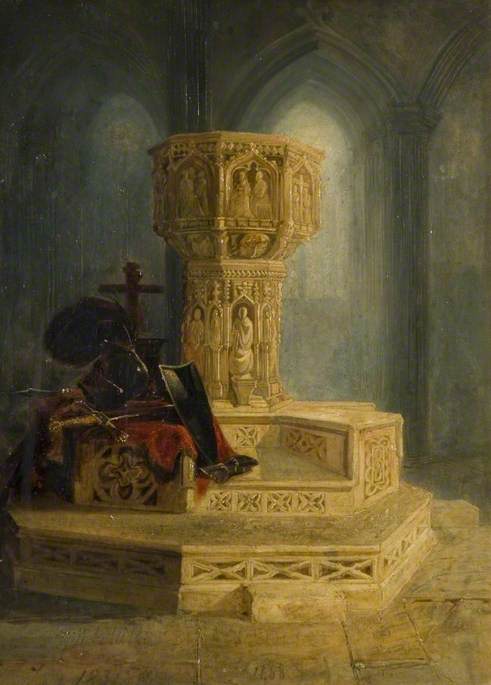
Font at Walsingham Church by William Muller (1831)

In the early part of 1831 Muller travelled to Norfolk and Suffolk and stayed with various clergymen during his two-month travels.  One of the paintings he completed during his trip was entitled The Font in Walsingham Church, although he probably completed the work once home in his studio, using sketches he made at the time.

Muller may have got the idea for his painting on seeing the illustration of the font in Architectural Antiquities of Norfolk by John Sell Cotman, dated 1818.

Trees, Suffolk by William Muller (1831)

During this period William Muller completed a number of largely monochrome watercolours such as Trees, Suffolk which he had sketched whilst visiting the Suffolk town of Lackford.

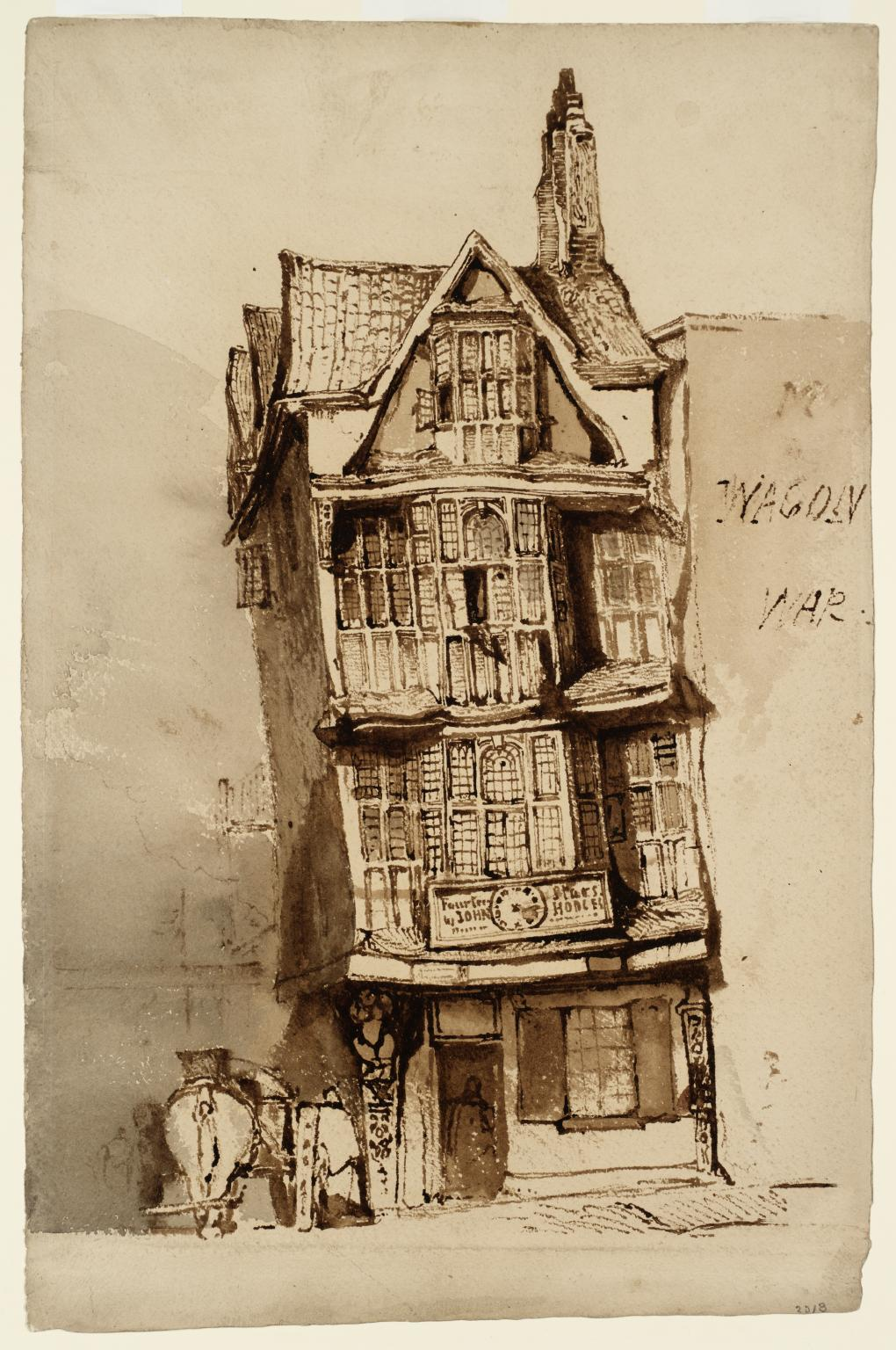
Fourteen Star Inn by William Muller (c.1832)

Another was of the Fourteen Star coaching inn.

In the second part of the blog looking at the life and works of William James Muller we will see how bloody riots and Mediterranean travel featured in his short life.

Stacey Gillian Abe

When I was in London last week I made my first visit to the Unit London Gallery.  The gallery is in the heart of London’s Mayfair at No.3 Hanover Square which is off Regent Street, very close to Oxford Street underground station.  It is well known for representing some of the finest local and international talent, and provide an unhindered showcase for artists who operate outside of the mainstream art world  and by so doing, has successfully launched and enhanced the careers of many influential contemporary artists.

Unit London

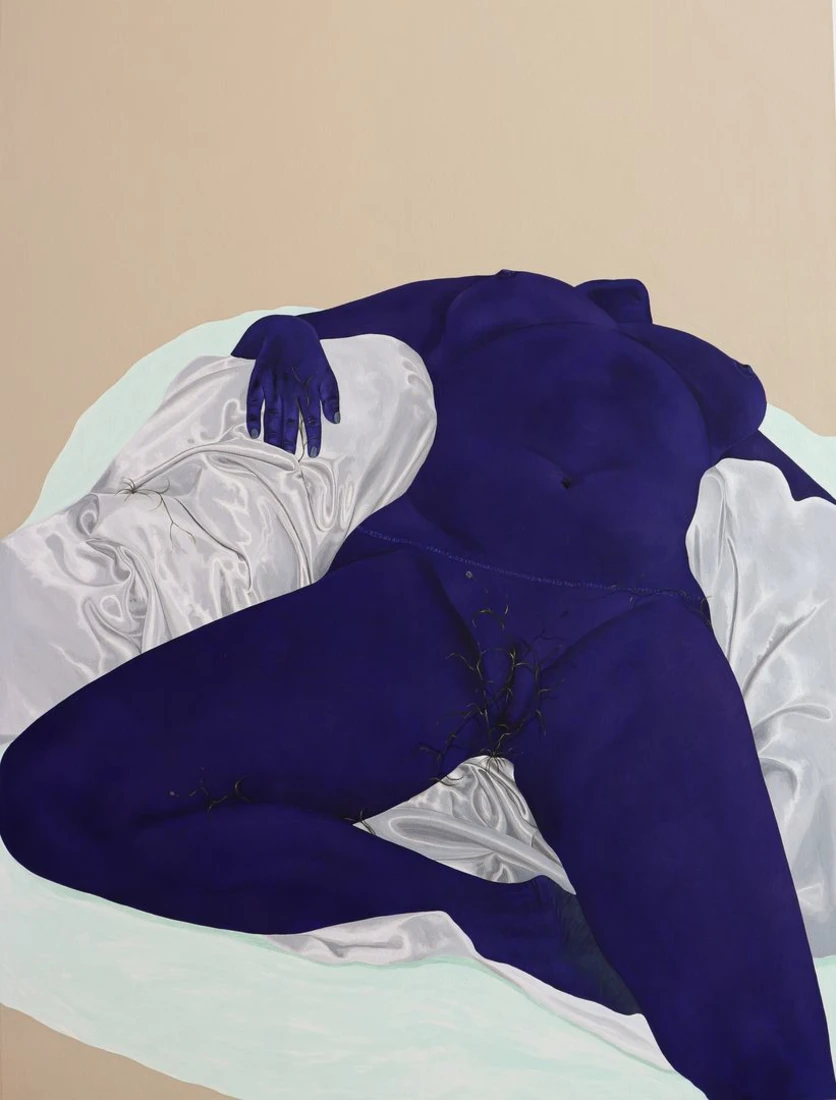
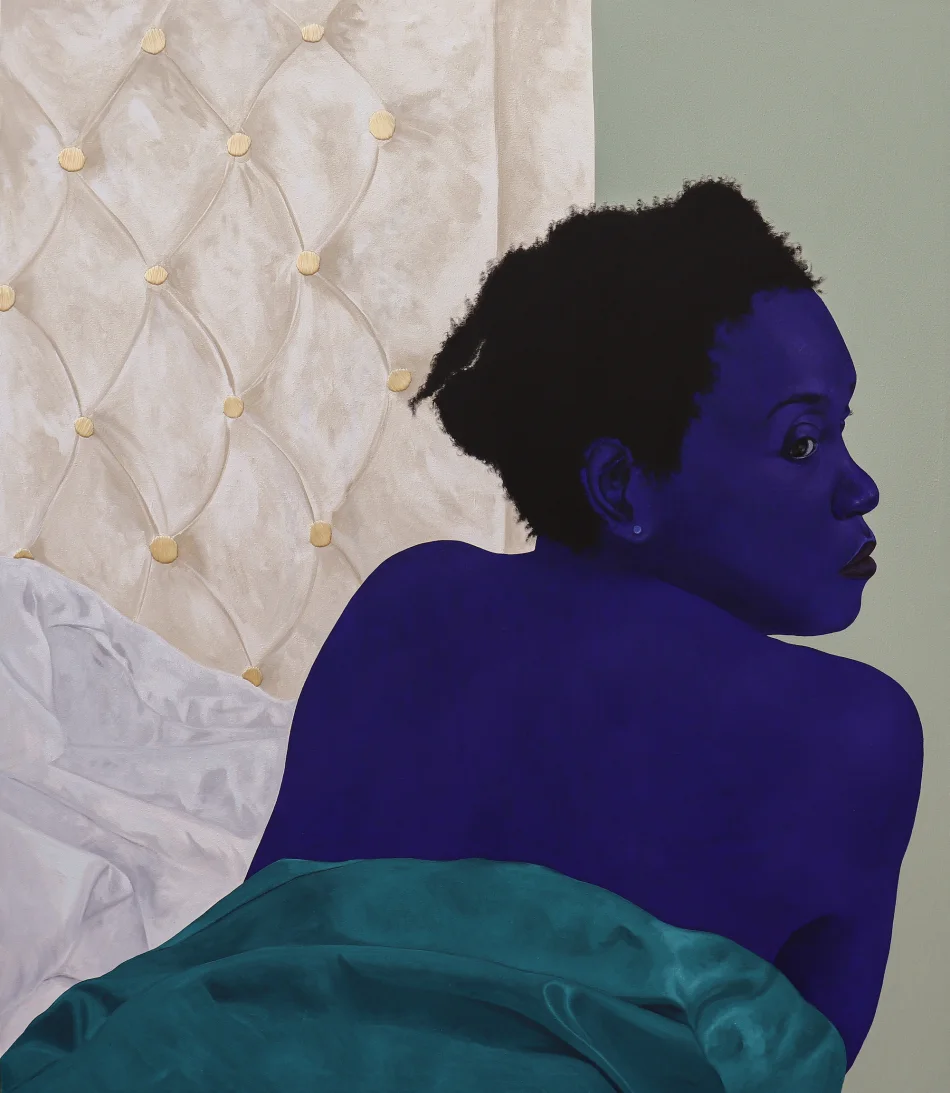
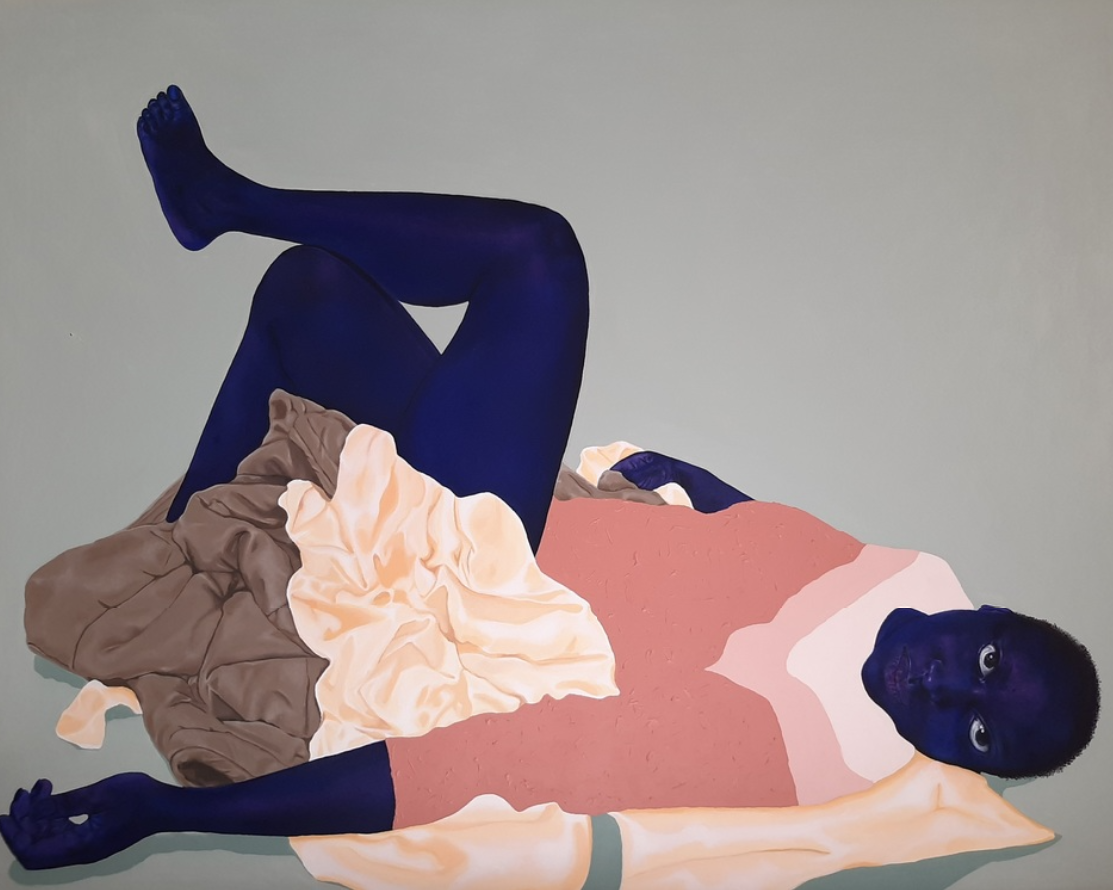
The gallery was hosting two exhibitions and my blog today is all about one of those, which closed at the end of January.  It was a large display of work by the Ugandan multi-disciplinary contemporary artist, Stacey Gillian Abe entitled Shrub-let of Old Ayivu.  Like my previous blog featuring Kyu Hun Kim the artwork is best described as unusual but this does not detract from its beauty.

Bibiana’s Window, by Stacey Gillian Abe (2022)

The name of the exhibition is unusual but Stacey says it can be traced back to the clan  is a descendant of.  She explains:

 “…Ayivu is one of the major clans of the Lugbara-speaking people from Arua in the West Nile region of Uganda.  We are a tribe intersecting three countries that is Democratic Republic of Congo, Sudan and Uganda. Our people are spread out within these countries, and I belong to the Ayivu clan in Uganda.  Shrublet of Old Ayivu is a metaphoric term which alludes to growths that have originated for a long time from a place of great significance that eventually create the perfect conditions for shrub-lets to morph and branch out of the old ways to form new connections independent of their origin.  The shrub-let is representative of this transportation from traditions, mindsets, norms and past lives, places to mention but a few…”

The Farmer’s Daughter by Stacey Gillian Abe (2022)

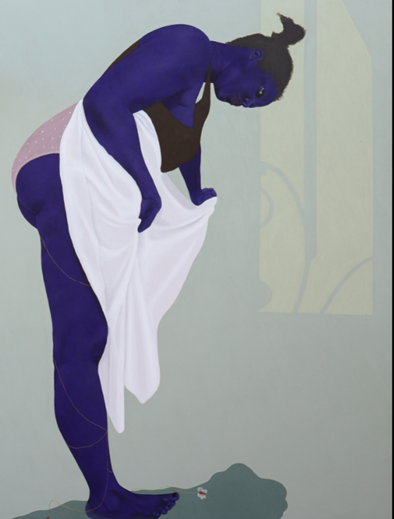
She goes on to say that the imagery of the plant life also extends to the colour of the models themselves. Jute is seen as a symbol of the Ayivu clan, and it is a motif that unites all of the work on display.  She reveals that jute is a plant of many uses, so this totem recurring in the work is a symbol of possibilities and growth.

Stacey Gillian Abe was born in Kampala, Uganda, in 1991. From an early age she loved art. For her, it all started with painting and drawing in high school in 2008. In 2014, she graduated from Kyambogo University, Kampala, with a BA in Art and Industrial Design.

Forbes Africa Under 30

In 2018 Abe made it onto the 2018 FORBES AFRICA Under 30 list which is the definitive list of Africa’s most promising young change-makers.  There are thirty “game-changers”, all under the age of 30, in each of the three sectors – business, technology and creative, a total of ninety young African people who were said to be challenging conventions and rewriting the rules for the next generation of entrepreneurs, creatives and tech gurus.  Abe was placed in the “creative” group of thirty.  Over six hundred candidates had been put forward and months were spent researching, verifying and investigating them.

Of herself, Abe describes herself as being reticent:

“…My passion started from the need to express myself more, I am not an introvert but a bit reserved…”.

Her way of expressing herself is through her art.  She says that a huge part of her practice now revolves around highlighting complex situations as autobiographical documentations of past and continuous experiences.

Fatou by Gillian Stacey Abe (2022)

Unit London gallery describes the exhibition I went to see:

“…Stacey Gillian Abe’s first solo exhibition at their gallery as an exploration of memory, time and emotion. It focuses on the concept of shared memory, Abe’s latest body of work examines how memories have been passed down through her family’s lineage, alluding to the ways in which traditions are absorbed and transformed from generation to generation.  These ideas are represented in the jute plant and flowers that are detailed in various paintings. A fibrous plant with multiple uses, jute is a totem for the Ayivu clan, one of the major clans in Arua in the West Nile Region of the artist’s native Uganda. The shrublet appears in sections of embroidery that decorate Abe’s paintings, becoming a motif that connects each canvas. Most importantly, Shrub-let of Old Ayivu questions how memory can be shared. With her paintings, Abe explores the transference of abstract memory, of subjects that are not easily explained visually. These notions do not simply materialise through composition or through the artist’s own subjectivity. Instead, they take shape within the space of the canvas itself, seemingly forming from the subject’s own consciousness. Each painting and each figure tell a different story, becoming part of a tapestry of interwoven threads…”

The Sitting I by Gillian Stacey Abe (2022)

The colour Abe uses for her figures is further explained by the gallery:

“…These ideas of generational memory link to Abe’s striking use of the colour indigo. Acutely aware of the colour’s presence in African history, the artist acknowledges its role in centuries-old textile traditions in West Africa. The rich dye was subsequently introduced to East Africa through the exchange of textiles, facilitating the East African slave trade or the Arab Slave Trade and the Indian Ocean Trade. Here, Abe references Catherine McKinley’s study Indigo: In Search of the Colour that Seduced the World (2011), which details that one length of indigo was equivalent to one human body. Through the Indian Ocean trade, Abe’s home country of Uganda also encountered trade routes from the coast to the mainland in the mid-1800s. Her village of Arua, positioned at the intersection of Democratic Republic of Congo, Sudan and Uganda, saw many Congolese people from the surrounding areas abducted into the slave trade to work in silk production…”

What We Wanted by Gillian Stacey Abe

In Abe’s own words:

“…Indigo for a skin tone in my work signifies a tribe, a breed of black, a people that are not limited to social, economic, cultural, political or historical constraints…”

In the exhibition, Shrub-let of Old Ayivu, Abe also shows us her fascination with indigo via its connection to cloth and material. She is fascinated with the colour and this manifests itself as an exploration of the relationship between cloth and the body. Through embroidery and the cloth there is a strong visual element throughout Abe’s body of work, which allows her to revisit the traditional, historical and personal significance attached to fabric.

See you Later, Again. by Gillian Stacey Abe

During the last three years Abe has carried out wide-ranging research on  the colour indigo.  It is a colour that has been viewed as both very rich and very valuable, but in her mind also one that has fashioned narratives around the black body. She says that indigo is a dominant colour in her work and she utilises it as a skin tone for her subjects. In a strange way it allows the observer  to behold  the black body in a different light.

Too Much and Not the Mood by Gillian Stacey Abe

Like my previous blog featuring the work of Hun Kyu Kim, Abe’s work is one you either love or hate. I actually found the exhibition fascinating.

Hun Kyu Kim.

and now for something different………………………………

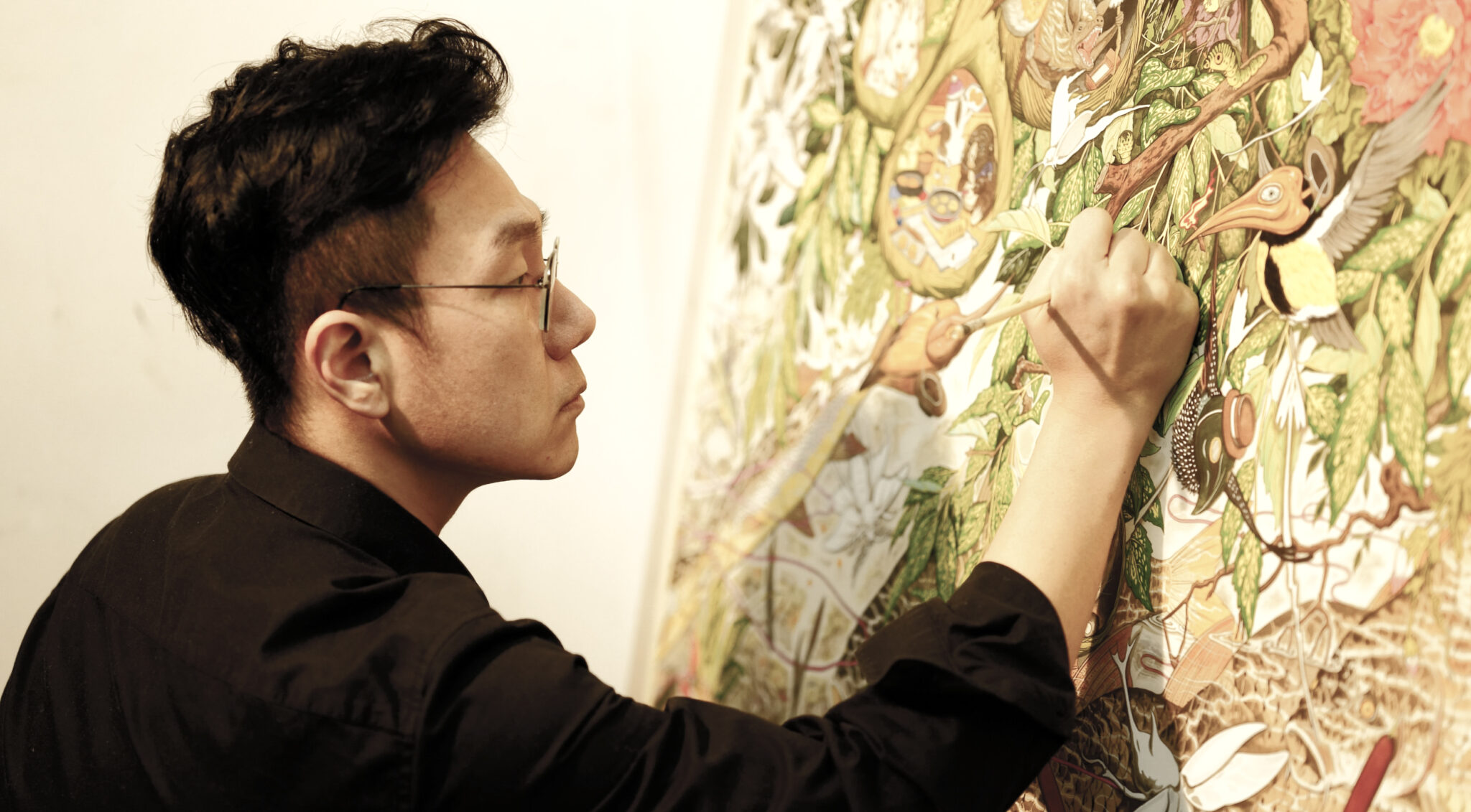
Hun Kyu Kim at work

The artists I am looking at today is the South Korean painter, Hun Kyu Kim.  It is difficult to describe the artwork of today’s featured painter.  It is, to say the least, troubling and the more one concentrates on the figures, the more one becomes alarmed.  The individual figures look like something out of Japanese anime or going back further in the past, the figures one saw and was fascinated with in the paintings of Hieronymus Bosch.

The Garden of Earthly Delights by Hieronymous Bosch

Kim says his favourite artwork is Bosch’s work, The Garden of Earthly Delights. According an interview he gave to CNN Seoul, he also sees his art as a bridge between the past and the contemporary. 

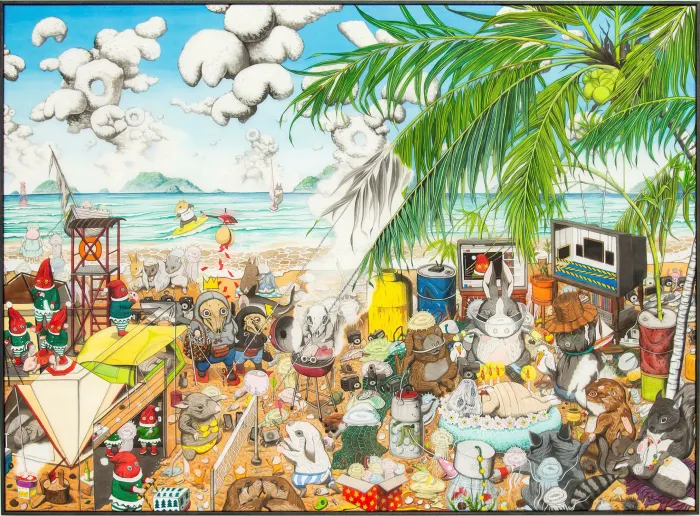
Funeral on the Beach by Hun Kyu Kim (2020). Pigment painted on silk

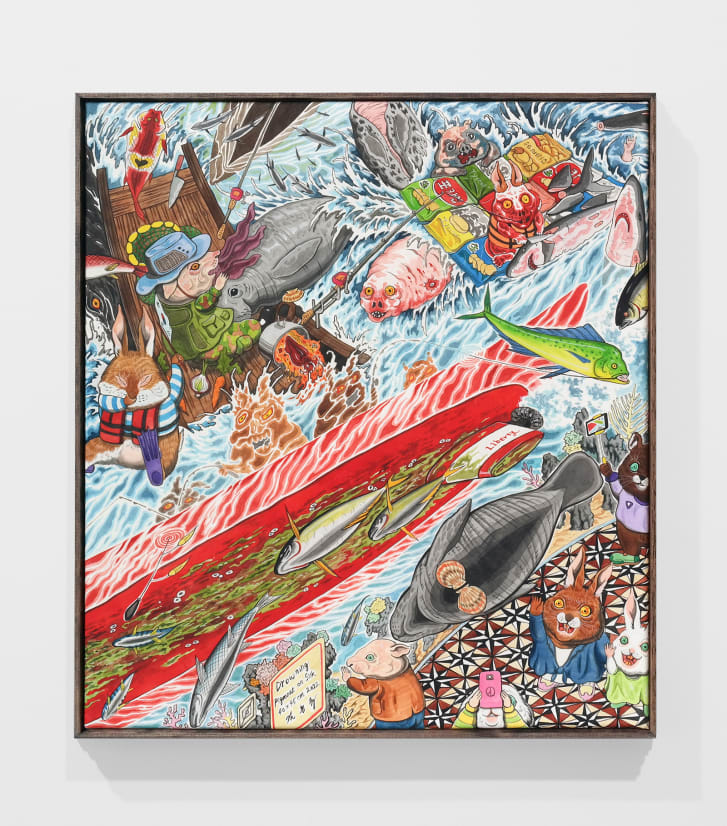
However there is a thread of violence running through many of his works, whether it is threatened catfish, sword-wielding dogs or armoured vermin performing acts of violence, cruelty and damage.  Their expressions distorted by hate, their eyes bloodshot and jaundiced, and their contorted faces often partly decomposed add horror to the depiction. Kim tries to mix amusement with the grotesque, and his paintings put a modern spin on the historical painting styles that Kim spent almost a decade mastering. What I like about his work is the way I can lose myself in the compositions which are so full of details and so visually multifaceted. Kim has said that he hoped his work tangled peoples brains.  I am sure by the end of this blog you will see that he has managed that !

Kim in his studio.

Born in Seoul in 1986, when it came to enrolling at the city’s College of Fine Arts, Kim opted for the course on traditional Oriental painting and Aesthetics as his double major. During his studies he was taught the techniques behind restoring the great Buddhist paintings of the past and was set tasks to faithfully copy them.  Of these tasks Kim spoke about the enjoyment he gained from the various tasks:

“…It was just an instinct. Old paintings come from religious activity so they have an aura inside, and a great beauty. The process is comforting, and I liked the scent of the silk and black ink…”

It took him almost a decade to graduate because the required techniques took that much time to grasp and understand.

Readymade Flea Market by Hun Kyu Kim. Pigment painted on silk.

After graduating Kim became involved in political activism and he found it difficult to gain exhibition space for his work which had anti-authoritarian connotations.  He left South Korea and travelled to London where, in 2015, he enrolled on a postgraduate course at London’s Royal College of Art.  Through his activism days he learnt how to engineer a more subtle activism with his allegorical depictions which left the observer to decide what they were all about and he believed that those who have suffered or are suffering oppression will understand the paintings.

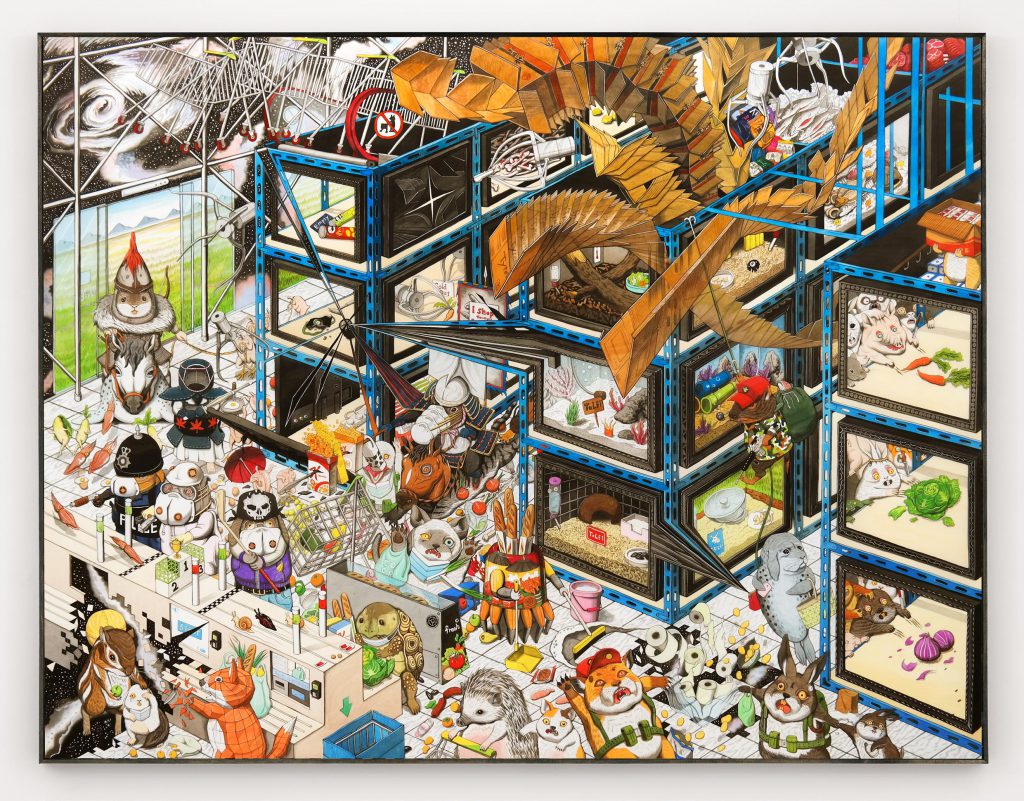
Too Cool for Shopping by Hun Kyu Kim. Pigment painted on silk

Although at one time he considered himself to be a political artist, he now believes that since leaving his homeland he feels more relaxed and less politicised.  In his work entitled Too Cool for Shopping we see anthropomorphic animals perform out endless and various storylines amidst a multicoloured, animated worlds.  Look carefully and we can make out harassed catfish, sword-wielding dogs and rodents dressed in armour which commit acts of violence, malevolence and rascally deeds.  Their contorted expressions are frightening.  Their eyes are bloodshot and yellow, and even their putrefied faces are sometimes partly decomposed.   As we look at the various figures we are partly amused and partly horrified.

Derby Lovers (Spring Day) by Hun Kyu Kim. Pigment painted on silk.

Kim would probably be looked upon as a workaholic.  He is in his studio painting ten hours a day and seven days a week. It is what he loves doing and he says to complete one of his larger works takes him at least a month.  The painting on silk is a complex process.  His modus operandi is to start the work at one corner and let details run out slowly and one must remember that any mistakes made are irreversible resulting in the painting being binned.  So how does Kim cope with that problem?  According to him it is the case of morning meditation before starting work!

Drowning by Hun Kyu Kim. Pigment painted on silk.

We are aware that Kim’s has taken an inordinate amount of time to complete his artworks.  It has consumed hours and hours of his time and in a way it demands we take our time to carefully peruse the depictions and take in every feature of it rather than just giving it the usual cursory five-second glance, the normal time we allow ourselves to gain some pleasure from what we see.

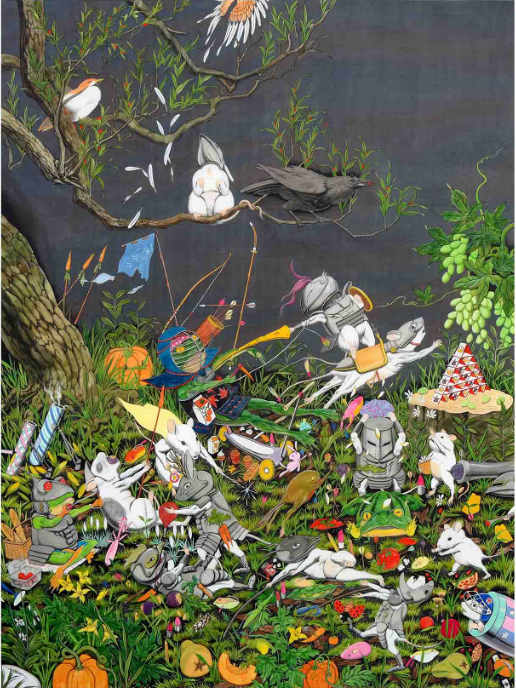
Ark for One by Hun Kyu Kim (2017). Pigment painted on silk.

Kim’s work is what I believe you either love or hate. There is simply no halfway house !

Eight Universes and The Machine by Hun Kyu Kim.

The four paintings above were part of Kim’s first solo exhibition in the UK entitled The Eight Universes and The Machine. The exhibition was held in November and December 2018 at The Approach Gallery, a contemporary art gallery situated above a public house of the same name in Bethnal Green, London.  The exhibition was entitled The Eight Universes and The Machine.  His exhibition weaved intricate stories about an imaginary world. However, Kim’s imagined world becomes an analogy for his understanding and thoughts with regards the very real recent political situation in South Korea and its disquieting change since a stamping out of a corrupt regime.

Pigdog by Hun Kyu Kim

Kim’s Eight Universes and The Machine, has scrupulously created eight parallel universes across his eight paintings, comprising four seasons, night and day. The depictions included numerous hybrid animals symbolising a social status such as scholar, artist and labourer. Kim’s created worlds are envisaged to be under the control of one huge machine, neoliberal capitalism, which is a reference to an ideology encouraging free-market capitalism and minimal government intervention which has been the dominant and increasingly pervasive economic system of the contemporary world since the late 1970s. 

Life will become more interesting by Hun Kyu Kim. Colouring on silk with oriental pigments and taxidermy.

These exhibited works were the first eight paintings from a much larger ongoing project that Kim is embarking upon, which he terms as The Big Picture. A huge endeavour, meticulously illustrating, in obsessive detail, a story combining Korean fairy tales, political history and folklore, as an original science fiction epic. Kim takes on the role of the storyteller.  Each story acts as an independent unit, but shares a common world full of imagination, informing a single overarching narrative.   The political message Kim puts over with these paintings exposes how neoliberalism perniciously operates in our society today, and how, we, its subjects, innocently take part in its operation to their own disadvantage.

Unwashed by Hun Kyu Kim. Colouring on silk with oriental pigment.

Hun Kyu Kim currently lives and works in London and in 2017 was the winner of the Chadwell Award.  This award was set up by Andrew Post and Mary Aylmer in 2010 in memory of Andrew’s mother.  The award is offered to students as a bridge between art school and practice as a professional artist by giving a recent Fine Art MA graduate a free studio in Bow, London for a year, together with a bursary of £1,000. In addition the Chadwell Award has a discretionary purchase grant of up to £4,000 to buy a work from the award holder at their end-of-award show.

So there you have it ! Love it or hate it – your decision.

My next blog will be all about colour but equally different from mainstream art.

Rupert Bunny

Rupert Bunny

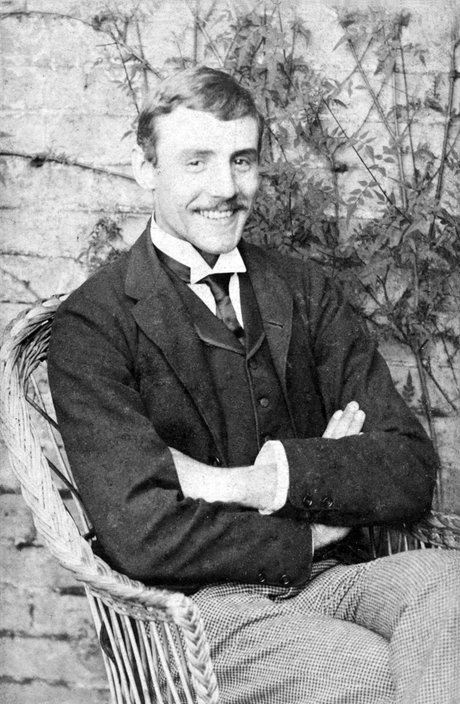
In my last blog, I looked at the life and works of the Australian painter Agnes Goodsir, who had spent a large part of her life in Paris.  Today I am showcasing another Australian artist, Rupert Bunny, who also spent many years in the French capital and was one of the most successful expatriate Australian artists of his generation.

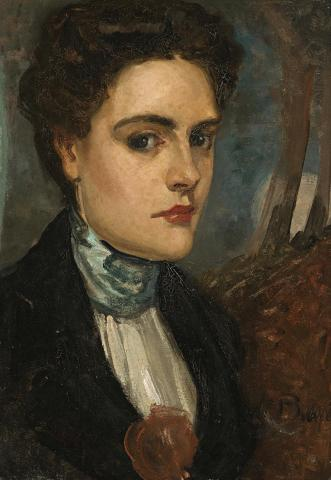
Self portrait by Rupert Bunny (c.1920)

Rupert Charles Wulsten Bunny was born in St Kilda, Melbourne on September 29th 1864.  Rupert was the third son of a English-born, Eton educated, Brice Frederick Bunny.  His father had studied law and was called to the Bar in 1844, becoming a talented equity barrister in London.  The news of the discovery of gold in the 1850s in New South Wales and Victoria whetted Brice’s appetite and in October 1852 he arrived on Australian soil intending to make a quick fortune before returning to London.  However neither of his plans materialised, as after six months of prospecting he had nothing to show. However, the one bit of luck he had was when he emigrated to Australia he brought with him all his law books and so, after his failed prospecting period, he went to Melbourne and resurrected his legal career in October 1853.  In June 1856 Rupert Bunny’s father married German-born Maria Hedwig Dorothea Wulsten, who had followed him to Australia. They set up home in St Kilda, where he was active in the Municipal Council.  In 1873 Brice Bunny was appointed an acting County Court judge but his health started to deteriorate and he had to resign from the legal profession.  He died on 2 June 1885 at St Kilda, Victoria, leaving three sons, one of them a barrister, and three daughters. His wife, Rupert’s mother, died in 1902.

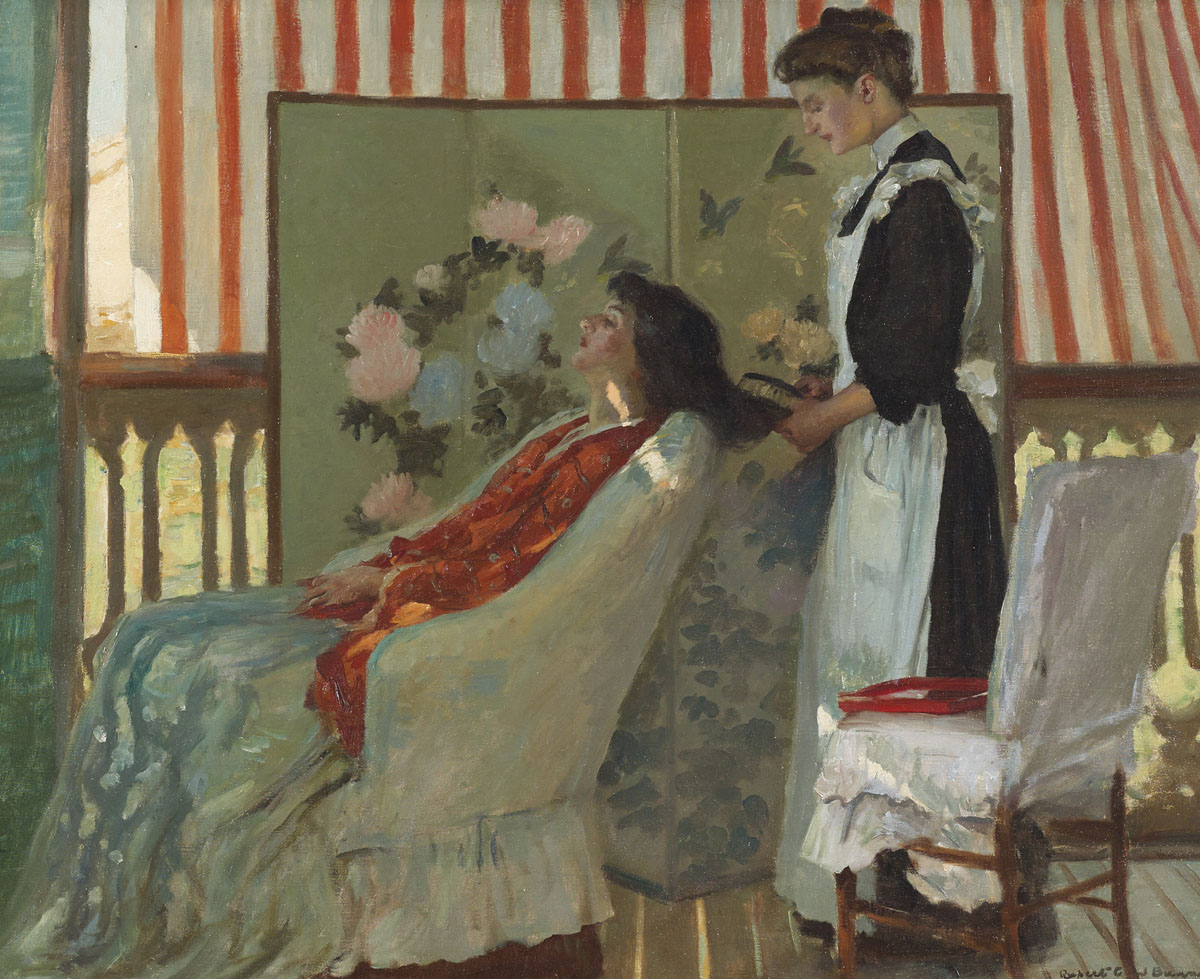
Hair Drying by Rupert Bunny (c.1908)

Rupert Bunny had three sisters, Alice and Annette who were five and two years older than him and Hilda who was three years younger.  He also had two older brothers, Herman and George and a younger brother Brice. Rupert attended the Alma Road Grammar School in St Kilda, and later the Hutchins School in Hobart.  In 1881 he enrolled at the University of Melbourne where he studied civil engineering.  He was not happy with the course and abandoned it.  At one time he decided he wanted to become an actor, but this future path was abruptly blocked by his parents.  Maybe as a compromise between his desires and those of his parents, he settled for joining the National Gallery Schools under British-born Oswald Rose Campbell and Irish-born George Frederick Folingsby, who was the director of the National Gallery and master in the School of Art.  Whilst there he became friends with his fellow students including Frederick McCubbin, E. Phillips Fox and Louis Abrahams.

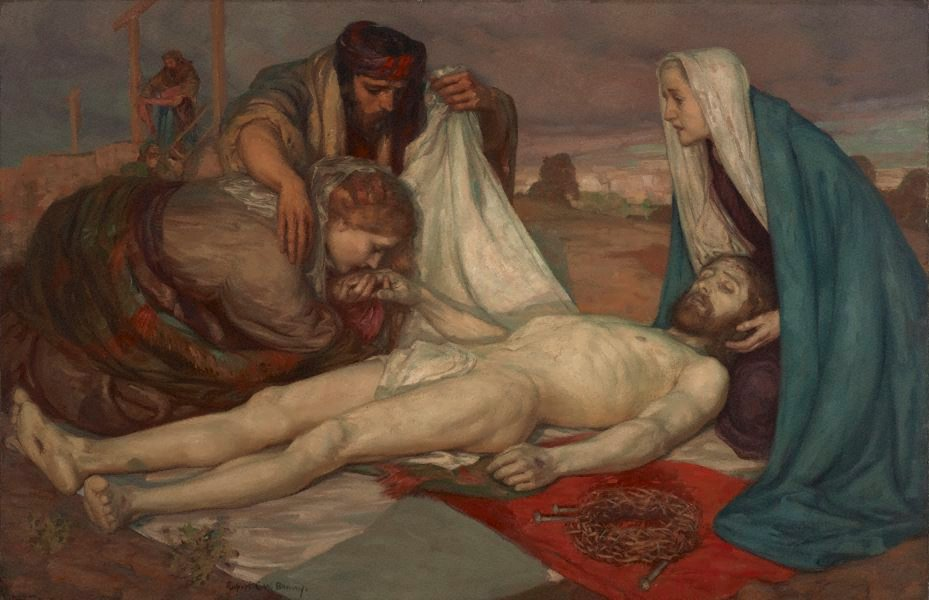
The Descent from the Cross by Rupert Bunny (1898)

The painting was hung at the 1898 Royal Academy in London

In 1884, at the age of twenty, Rupert Bunny left Australia and went to London.  Once in the English capital he enrolled at St Johns Wood Art School where one of his tutors was the English painter, Philip Calderon. Two years later, in 1886, he left England and headed for Paris to study under Jean-Paul Laurens in his studio at the Académie Julian. He left Laurens in 1886 and went to study at the Académie Colarossi where he studied under the French painter, Pierre Paul Léon Glaize.  His studies here made him an accomplished academic history painting – paintings on a large scale, with complex compositions based on mythological, historical and biblical subjects, and the depictions would characteristically contain multiple figures. From 1888, now in Paris, Bunny exhibited at the Parisian Salon de la Société des Artistes Français (Old Salon).

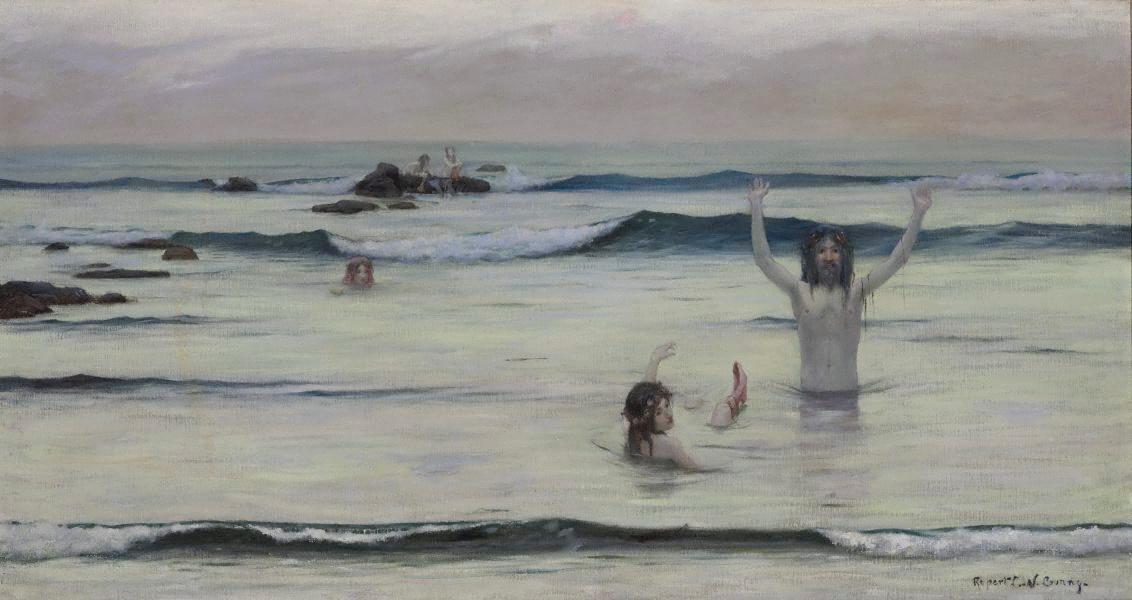
The Tritons by Rupert Bunny (1890)

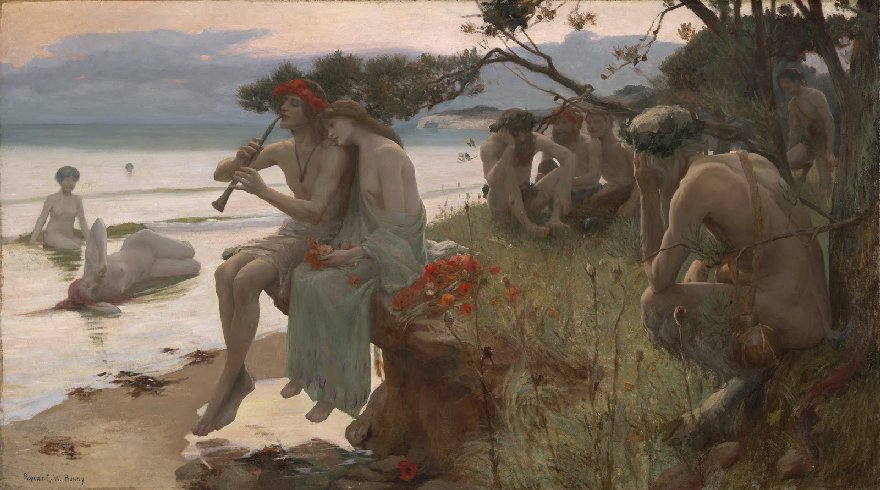
During the late 1880s he produced a series of large-scale, delicately coloured sea idylls peopled with mythological and pagan creatures including mer-folk. Having a German mother, Rupert remembered the German myths and legends. Bunny often drew inspiration from the German myths and legends that she would read to him and characters from these often appeared in his depictions.  These stories were balanced by his father telling his son tales from the bible and Greek and Roman mythology.  One such painting was entitled The Tritons which Bunny completed in 1890. The painting was exhibited in Paris at the Old Salon in 1890, and it was the first painting by an Australian to receive an honourable mention at the event. The painting depicts a group of tritons, who were legendary creatures that lived both on land and at sea.  They are enjoying a lazy moment in their calm surroundings.  Rupert Bunny, in this work, lays before us some of the features which would become characteristics of his work, such as an attraction he had for mythological subjects and the depiction of the mystery and glamour within an intimate setting. Look how he has expertly shaped a twilight atmosphere by the use of subtle colour schemes, as is the case where the pale blue, silvery ocean and pink-toned sky are quietly reflected in the flesh tones of the figures.

Pastoral by Rupert Bunny (1893)

His 1893 painting entitled Pastoral is a good example of the large-scale mythological works Bunny painted during his early years in France.  The painting is an allegory about the life-changing power of music. Before us we see youths and pagan beings who are all mesmerised by the strains of the pipes and soothed into a state of heightened consciousness.  The figures we see in the painting are contemporary youths and Rupert used their inclusion to show that Arcadia was not something we read about in days gone by but a state of mind.  There is a dream-like quality about the depiction and note the inclusion of vermillion poppies, a flower which symbolised sleep.

Madame Melba by Rupert Bunny (1902)

Rupert Bunny, besides being a great artist, was also a talented pianist and composer.   The love of all things musical probably persuaded him to paint a number of portraits of the Australian soprano, Dame Nellie Melba.  She had, during the latter days of the nineteenth century, moved to Europe to cement a career as a professional singer.  Rupert’s portrait of her entitled Madame Melba was completed around 1902.  Rupert had known her since the 1880s.  The painting, once completed, hung in the singer’s London home.  Later, she presented it to Her Majesty’s Theatre in Melbourne.  The National Gallery of Victoria bought the painting in 1980 and later it was loaned to Government House in Melbourne Victoria.

Percy Grainger by Rupert Bunny (1904)

Bunny created portraits of a number of Europe-based Australian musicians and performers.  He was commissioned, by twenty-two-years-old Australian pianist and composer, Percy Grainger, to paint his portrait in the early days of his professional musical career.  Grainger became acquainted with Bunny through Nellie Melba. Whilst living in London Rupert Bunny attended gatherings at Grainger’s rooms at King’s Road where the guests would sing many of Grainger’s compositions.  In this portrait, the young musician is portrayed as a relaxed young gentleman in the tradition of what was termed the ‘swagger’ portrait, which aptly reflected Grainger’s own ambitions. In Grainger’s left hand is a sheet of music, a conscious reference to Grainger’s celebrated career.

Portrait of the Artist’s Wife by Rupert Bunny (c.1895)

Portrait of the Artist’s Wife, Jeanne Morel by Rupert Bunny (1902)

In 1892, Rupert Bunny met his future wife, Jeanne Heloise Morel who was a fellow art student.  It was love at first sight as Bunny was bowled over by her beauty.  John Longstaff, a fellow Australian painter who was living in Paris, remembers the first meeting between Rupert and Jeanne, saying:

“…I remember … the very night they met, and how he fell in love with her at first sight.  She was a regular Dresden china girl with a deliciously tip-titled nose…”

The meeting was to prove a turning point in Rupert’s life, not just with the romance which followed, but by his change in his artistic style.  A colleague of Bunny commented:

“…  Jeanne changed not only Bunny’s life but also his art, which now focused on subjects in which beautiful women played the central role, with Jeanne as his favourite model…”

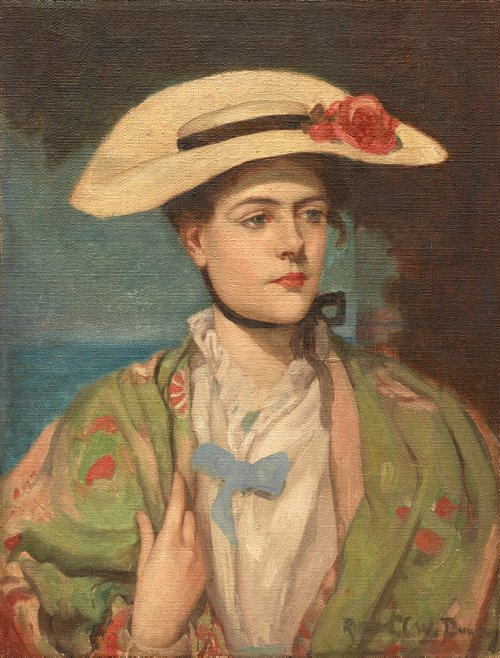
Rupert Bunny was influenced by Morel and she became his favourite model who featured in his depictions of the idyllic and leisured lifestyle of the Belle Epoque. Her graceful form and sensuous features were seen in many of his works, embodying Bunny’s feminine ideal. Bunny was also greatly influenced by the English Pre-Raphaelite painters such as John Everett Millais.

 Portrait of Mlle Morel by Rupert Bunny (1895)

 Portrait of Mlle Morel by Rupert Bunny, which he completed in 1895, is the first, major full-length portrait by Bunny of Morel. It is a tender depiction of his then girlfriend that he painted and was submitted and accepted into the Paris Salon that year.  It was a painting which marked the turning point of Rupert Bunny’s art from the Allegorical to the Belle Époque.

A Summer Morning by Rupert Bunny (1905)

Jeanne Heloise Morel was born on July 29th 1871 in Paris.  Her mother was Marguerite Morel, an unmarried servant. Her father, who was never named on the birth certificate, was said by Jeanne to be Eugénie François Morel, who served as an officer in the French Navy.  Jeanne received training in Fine Arts at the Orphanage of Arts at 96 rue de Vannes in Paris.  In 1884, when she was thirteen-years-old, Jeanne made her public debut at the Société des Artistes and subsequently exhibited at the Société Nationale des Beaux-Arts, working in oils.  Jeanne-Heloise Morel married Rupert Bunny in London in March 1902.

Dolce Far Niente (Sweet Idleness) by Rupert Bunny (c.1897)

The painting’s title means sweet idleness or the sweetness of doing nothing. Rupert Bunny would paint numerous similarly composed works featuring  groups of women relaxing, dreaming, dressing or undressing close by expanses of water.  The French art critic Gustave Geffroy was a great believer in Rupert Bunny and loved his work, Dolce Far Niente and in a review of the Salon of 1897 at which the painting was exhibited, he wrote:

“…To discover the promises and creations of newcomers, it is necessary to research, to go to canvases attracted by a soft radiance, a quiet force, a secret charm….I like the poetry of Dolce Far Nniente by Mr Bunny [of] women with graceful bodies, and beautiful and instinctive faces, who dream by the sea…”

Gustave Geffroy was a great advocate of Bunny’s work for the next three decades and in a 1917 review he wrote:

“He is a brilliant and spirited artist…at one and the same time, a realist and a visionary, an observer of truth and a poet of the world of dreams…”

Endormies by Rupert Bunny (c.1904)

Rupert Bunny’s 1904 painting entitled Endormies (Sleepy) portrays two female figures at the water’s edge relaxing and lost in a world of dreams. Rupert modelled the sleeping figure once again on his wife Jeanne Morel.  Her elegant and sensuous physical qualities enhanced many of his paintings.  In this depiction the artist has included a rose by the side of one of the sleeping women.  The rose was a traditional symbol of love and sensuous power.  The white swans we see in the background symbolise the attributes of grace and beauty. Rupert, like many artists also used the motif of a small dog, which often signifies marital fidelity.  In this painting Rupert has placed the animal sleeping at the feet of his mistress.

Summer Time by Rupert Bunny (1907)

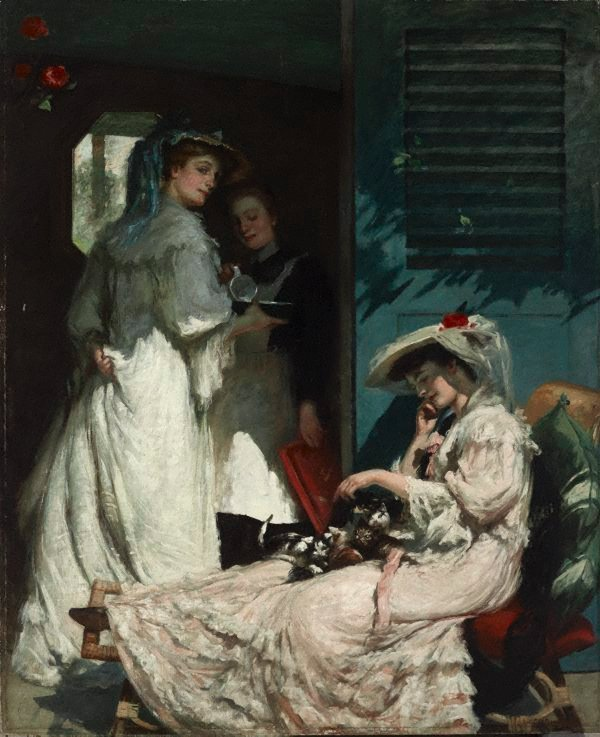
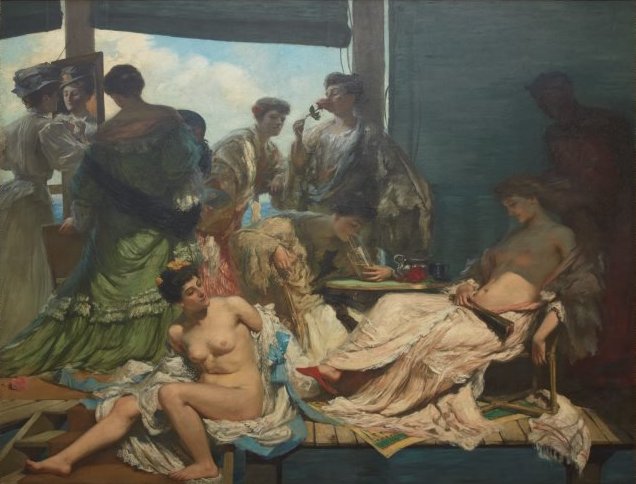
In all Rupert Bunny’s depictions of his wife Jeanne and her friends there was an aura of beauty and elegance.  The clothes which adorned the females were typified in their fashionable trimmings and reflected the stylishness of the apparently endless summers that was La Belle Époque. The public loved these works of art and they became the most commercially and critically successful works of his career. Rupert Bunny’s 1907 work entitled Summer Time splendidly validates his skill as a draughtsman and his consummate treatment of large-scale works such as this one which measures 250 x 300 cms. It was exhibited at that year’s Paris Salon. It was his most ambitious work.

in situ at the Art Gallery of New South Wales

The painting depicts a spirit of leisure and sensuality as we observe seven voluptuous women relaxing inside a bathhouse on the Seine. It is a floating swimming pool sealed off from public view where women could bathe modestly. We see 0ne of the women is undressing preparing to climb down into the water while another female, on the left of the painting, is getting dressed before she emerges into public view.

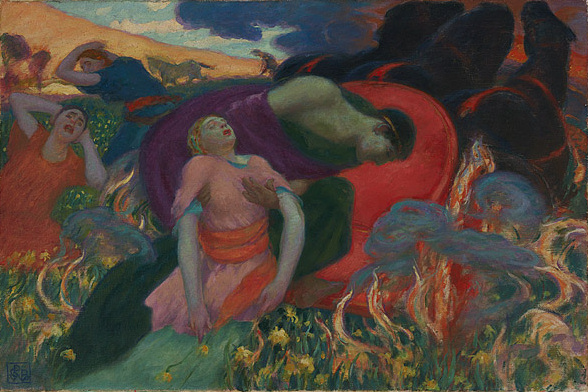
The Rape of Persephone by Rupert Bunny (1913)

Rupert Bunny was never afraid to shy away from changing his artistic style.  He had a refreshing willingness to keep reinventing himself and during his life, he simply kept an eye on what was the most fashionable style, so that his popularity would not wane.  Of the painting, The Rape of Persephone, one art critic, George Bell, described it as:

“…a glorious riot of colour from the finest imaginative Australia has produced…”

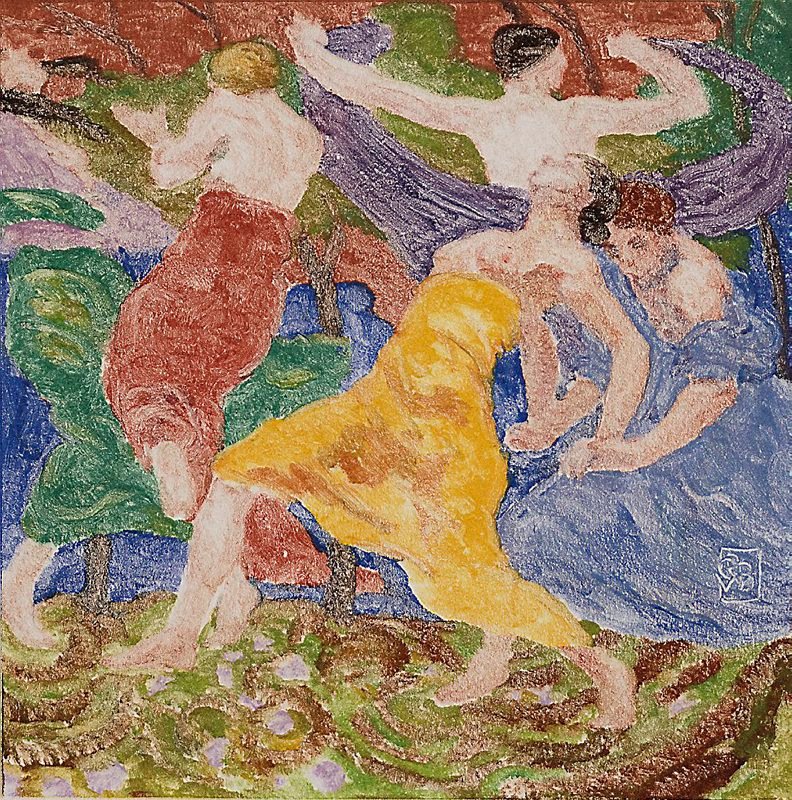
Fresque by Rupert Bunny (1921)

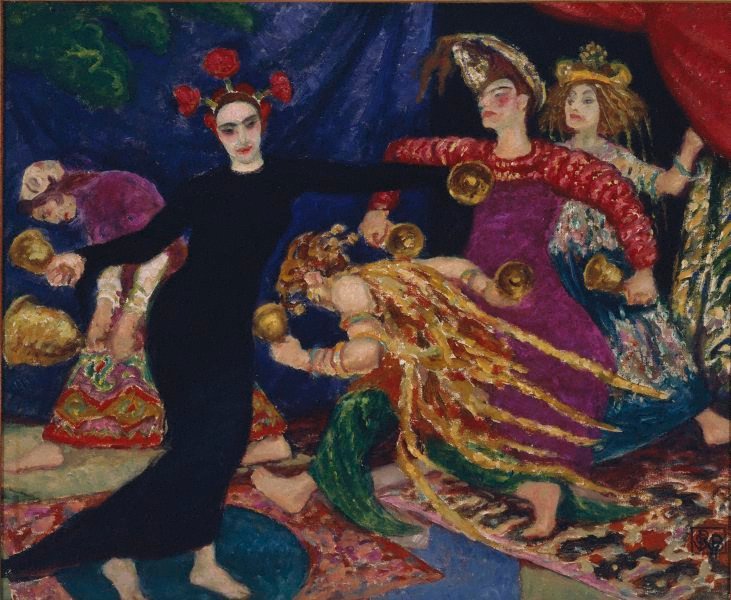
Rupert Bunny moved through successive styles and was strongly influenced by British pre-Raphaelites French primitives, symbolists and Post-Impressionists.  He was particularly influenced by Matisse and his love of Sergei Diaghilev’s Ballet Russes, an itinerant ballet company begun in Paris that performed throughout Europe between 1909 and 1929. 

Salome by Rupert Bunny (c.1919)

The paintings of Rupert Bunny around this time began to be ones of heightened colour and abstracted, rhythmical forms.

In 1933, Bunny returned to live in Melbourne where he continued to paint until his mid-70s. He died on May 25th 1947, aged 82.  Rupert’s forte was his ability to change with the times and he was always open to new artistic influences.  Throughout his life he had always been motivated when it came to his painting. He never tired of experimenting with colour combinations and was never afraid to take risks. He was a master colourist.

Much has been written about Rupert Bunny and this blog has just scratched at the surface of his life but I hope it will tempt you into reading more about this great Australian painter.

.

Agnes Goodsir

The subject of my blog today is the Australian portrait and still life painter Agnes Noyes Goodsir. 

Agnes Goodsir was born in Portland, in South-west Victoria, Australia, on June 18th 1864, and was the second daughter and fifth of the eleven children of David James Cook Goodsir, who held the post of Commissioner of Customs at Melbourne, and Elizabeth Archer, née Tomlins.  Goodsir enjoyed painting and sketching and concentrated on still life works.  She started formal art training at the Bendigo School of Mines around 1898.  Her tutor was the painter and educator, Arthur Thomas Woodward.  Woodward was born in Birmingham, England, and had received his art education at the Birmingham School of Art where Edward Richard Taylor was headmaster and one of his tutors.   Later he attended the South Kensington Art Schools, in London where he was a gold medallist. He emigrated to Victoria, Australia and in 1894 he was appointed Head of the School of Art and Design at the Bendigo School of Mines.  He was an excellent educator who was aware of the trends in European fine arts and introduced methods and syllabi based on it, including en plein air art classes and life drawing, thus offering the opportunity for his students to move to France, immerse themselves in French culture and enroll at French academies, where they would be able to study art internationally.  Agnes Goodsir was open to the idea of travelling to France and in 1899, aged thirty-five, she decided to increase her knowledge of art by moving half way round the world to Paris but to achieve that goal she needed money. This was achieved when a one-woman show of her paintings was held in Bendigo.  Sufficient money was raised by the sale of her work and in 1900 she set sail for France.

Self portrait by Agnes Goodsir (1900)

This self-portrait by Agnes Goodsir is hanging in the National Portrait Gallery in Canberra.   It is dated 1900, around the time Agnes arrived in Paris.  It is a beautiful oil on canvas work.  It combines a formal representation with a dark sobriety that Goodsir presumably believed brought gravitas to the depiction.  At the time of the portrait Agnes would have been studying at Académie Delécluse and the Académie Julian and this could be the reason for this academic-styled depiction with its dark background providing an appropriate backdrop and contrast with the artist’s pearly features and beautifully depicted draped hand.  This signaled the starting point of her illustrious artistic career in France. 

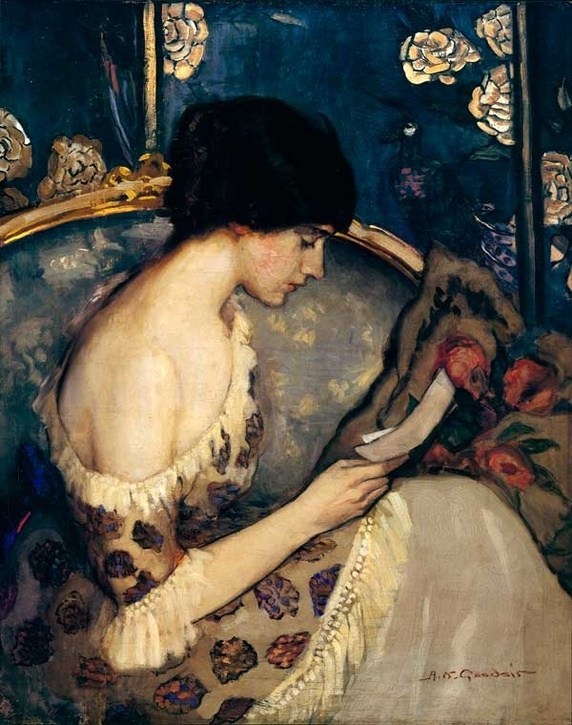
The Letter by Agnes Goodsir (1926)

On arrival in the French capital Agnes enrolled at the Académie Delacluse, an atelier-style art school founded in the late 19th century and named after its founder, the painter Auguste Joseph Delécluse.  Later she would take courses at the Académie Julian, under Jean-Paul Laurens, where she was twice placed first in Composition, the Académie de la Grande Chaumière where she won the 1904 silver medal for portraiture, and finally the Académie Colarossi.  Agnes made a number of visits to London and at the outbreak of the First World War she left Paris and went back to London.   While in London during the war, Agnes became close friends with Bernard Roelvink and his American wife Rachel. Rachel later divorced Roelvink and she reverted to her maiden name, Mrs Rachel Dunn, but to her friends she was known by her nickname ‘Cherry’.

A Letter from the Front by Agnes Goodsir (1914)

Once the Great War had ended Agnes and her beloved companion and muse, Cherry, left the English capital and moved to Paris where they set up home in an apartment at 18 rue de l’Odéon, which is in the sixth arrondissement of Paris on the Left Bank of the Seine, a short walk from the Luxembourg Gardens.  Agnes’ work was well received on both sides of the Channel and exhibited at the New Salon, the Salon des Indépendants and the Société Nationale des Beaux-Arts in Paris.

Girl with a Cigarette by Agnes Goodsir (1925)

Paris in the 1920s was the centre of artistic activity, with writers, artists, performers and musicians from all around the world gathering together. Paris’ 6th arrondissement where Agnes and Rachel lived was in the heart of the “action” and was referred to as the Latin Quarter.  One of Agnes’ famous portraits of Rachel, which she completed in 1925, was entitled Girl with a Cigarette. Rachel is stylishly dressed, with a colourful wrap and chic accessories. It is the archetypal depiction of a 1920s flapper seen enjoying her coffee and cigarette.  She is both self-assured and relaxed within the cafe environment.

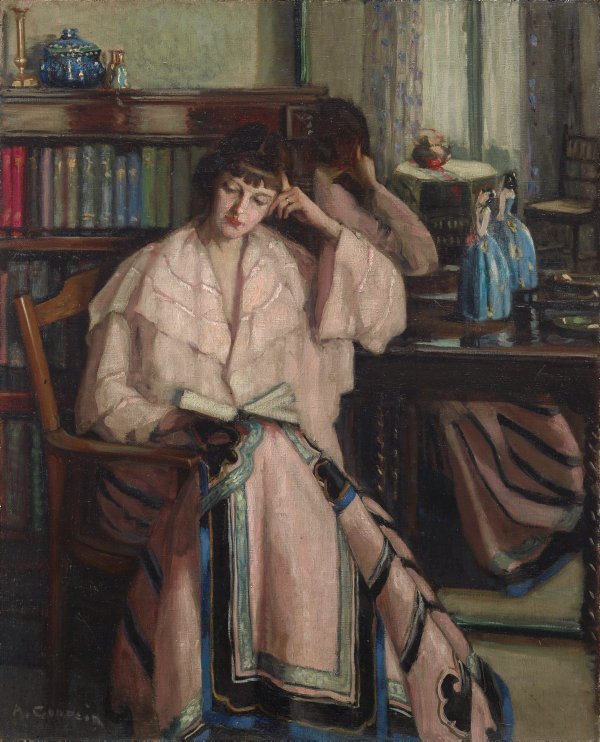
The Chinese Skirt by Agnes Goodsir (1933)

Agnes Goodsir and Rachel Dunn lived together  in Paris,  and Goodsir  often depicted Dunn as  the  unflinching  liberated  and trendy  woman that she undoubtedly was.  Once again in her 1933 painting The Chinese Skirt, like many of Goodsir’s works, the subject of the portrait is her lover, Rachel Dunn.  In this painting we see Rachel adorned in an elegant and fashionable Chinese-inspired skirt. To the right of her, on a table, are two ceramic figures the colour of which is echoed in the blue embroidery of her skirt, a couple of books in the bookcase seen in the background and the pot sitting atop this piece of furniture.

The Australian newspaper, The Australasian  newspaper described Goodsir’s work at the time as being:

“…a galaxy of beautiful, and even more beautiful women, doing feminine things: taking morning tea, posing before a mirror, reading, wearing blue hats or Chineseshawls…”

The Parisienne by Agnes Goodsir (c.1924)

Goodsir lived in Paris with Rachel during the period between the two World Wars.  France, like other participating countries of the Great War, had lost so many men in the fighting and with this lost generation of men the social life in the French capital was more a feminine affair, and the city between wars was a place for innovative women.  Paris was also a place for lesbian couples to live their lives publicly and in peace.  The Parisienne depicts Cherry in a modernist style. She is seen in masculine attire, wearing a cloche hat and high collar which encloses her face. Her hands are relaxed in lap, with a cigarette evoking an air of self-confidence and independence.

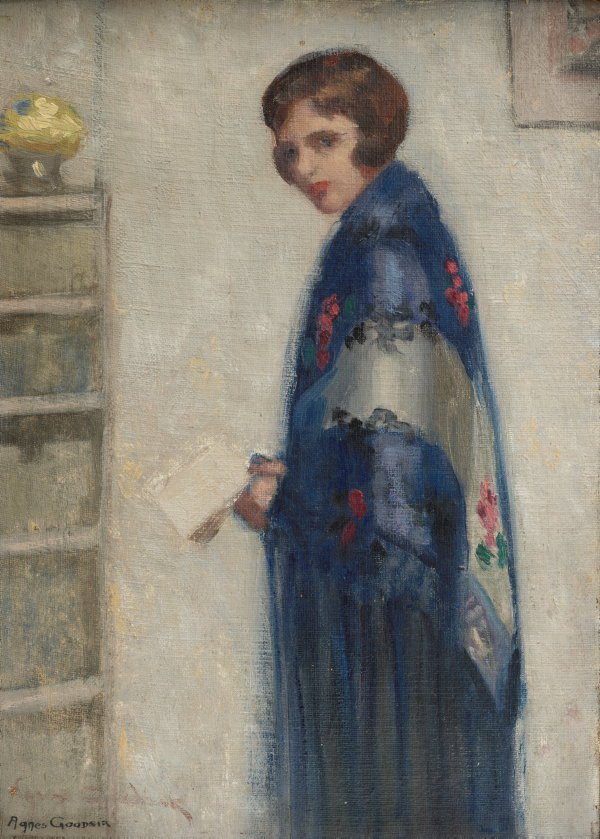
The Hungarian Shawl by Agnes Goodsir (c.1927)

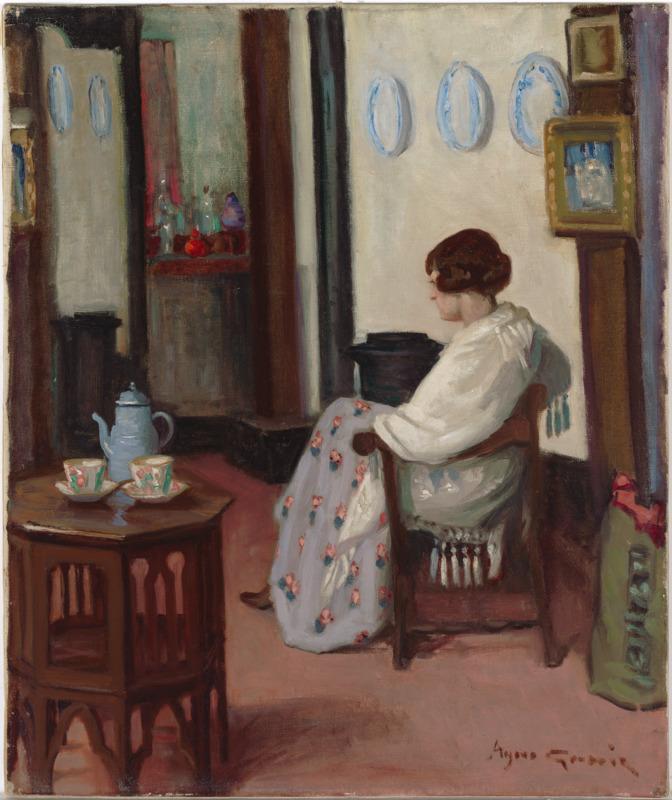
Following a period of spending time in England, Agnes and Rachel settled down in their rue de l’Odéon apartment in Paris. Agnes painted subjects of the domestic interior of their apartment like a series of still life compositions, continually rearranging views of her everyday life, and often using them as a means to explore the expressive potential of colour combinations. Dunn repeatedly featured as Goodsir’s model, imaged in states of repose and gowned in flamboyant dress creating a sense of a domestic theatre that hovers between pretence and realism.  In her 1927 painting entitled The Hungarian Shawl it is all about colour.  The background is almost bare and uncluttered allowing us to concentrate on the figure.  It is all about the patterns on the shawl’s silky fabric design set against an almost monochromatic background. The depiction is instilled with the diffused interior light and almost resembles a small sketch-like work but at the same time conjures up a luminous sense of colour.

 Agnes Goodsir (left) and Rachel Dunn (aka Cherry) (second from left) at Valerie en Caix, c. 1930

In 1926, Goodsir was made a member of France’s Société Nationale des Beaux Arts, one of few Australians to receive the honour.

Portrait of Sunday Baillieu Quinn, Paris by Agnes Goodsir (1929)

Although Agnes Goodsir’s lifestyle was looked upon, during her lifetime, as being somewhat controversial, it was nothing compared to the colourful lifestyle of the sitter of a portrait Agnes completed in 1929.  The painting was entitled Portrait of Sunday Baillieu Quinn, Paris.  Sunday Reed who was born Lelda Sunday Baillieu in Melbourne on October 15th 1905,  who later with her second husband, became patrons of the arts and established in Bulleen, a suburb of Melbourne, the Heide Museum of Modern Art, also simply known as Heide .  She was the third of four children of Arthur Sydney Baillieu and Ethel Mary Baillieu (née Ham) and was a member of the very affluent Melbourne’s Baillieu family and the niece of William Baillieu, one of Australia’s richest men. She was the third of four children and after being home-schooled from a young age by a governess, completed her education at the prestigious boarding school, St Catherine’s School in Toorak.  In 1924 she accompanied her family to England, where she was presented at court during the débutante season. In 1926, when she was twenty-one, she married an American, Leonard Quinn and the couple left Australia and visited England and France.  In 1929, around about the time of the portrait Lelda, she was diagnosed with gonorrhoea and had to endure several operations including a hysterectomy which left her unable to bear children and causing deafness in her right ear.  Shortly afterwards, her husband deserted her in England and her father and brother had to travel to London to bring her home. By the end of the year the couple were divorced.  

John and Sunday Reed on their wedding day in 1932.
Whilst still convalescing in late 1930, Lelda met her second husband, lawyer John Harford Reed at a tennis party.  Despite the difficulty of obtaining a divorce, powerful family influence and connections prevailed and Sunday’s divorce was finalised in June 1931. She and Reid married in January 1932 in a civil ceremony.  In 1934 John Reid and his wife bought a former dairy farm on the Yarra River at Bulleen, Victoria, which became known as “Heide”.  The couple lived on the property until their deaths in 1981, a short time after, the property had become the Heide Museum of Modern Art.

In the Latin Quarter Studio by Agnes Goodsir (c.1922)

Goodsir’s reputation as a great portrait artist, coupled with her social connections, allowed her to complete portrait commissions of many famous people such as the Australian author and journalist Banjo Patterson, English actress, Ellen Terry, Mussolini, Tolstoy and the Australian soprano, Dame Nellie Melba.  Despite those portraits of famous people Agnes Goodsir will be remembered for her portraits featuring Rachel Dunn.

In a Paris Studio by Agnes Goodsir (1926)

Although Goodsir was fond of her Australian birthplace, it was Paris that she loved and where she would spend her final days with Rachel. Agnes Goodsir died in Paris on August 11th 1939, aged 75. All of Agnes’s paintings were left to Rachel. Rachel sent forty of her painting to Agnes’s family in Australia and others to Australian galleries. The Goodsir Scholarship of the Bendigo Art Gallery, one of Australia’s oldest and largest regional art gallery, is named in memory of her. Rachel died in 1950 and was buried in the same grave as her constant companion in a cemetery on the outside Paris.

Christmas and Snow

Somebody once said that the only way to enjoy the sight of snow is when looking at a postcard or a painting.  I have spent a number of Christmas Days in hot climes such as Karachi and Melbourne and know that Christmas is not Christmas without snow.  So for this Christmas blog I want to look at some of the beautiful winter landscapes created by famous and not-so-famous artists to remind me of a snowy Christmas, many of which have featured in earlier blogs.

View of Bazincourt, Snow Effect Sunset by Camille Pissarro (1892)

Camille Pissarro depicted the small town of Bazincourt-sur-Epte at all times of the day, and in all seasons, in a number of his paintings.  In 1892 he completed his work entitled View of Bazincourt, Snow Effect, Sunset.  In this Impressionistic-style painting we can see how Pissarro has managed to infuse a warmth to the scene by his use of violet for the trees and the way the sun has illuminated the clouds.

Snow Scene at Argenteuil by Claude Monet (1875)

The great Claude Monet, known for his lily ponds at Givenchy, also painted a number of winter landscapes.  The first one I am looking at is his work entitled Snow Scene at Argenteuil.  Monet and his family moved to Argenteuil a small Parisian suburb twelve kilometres north-west of the heart of the French capital and was accessible from central Paris with a short train ride.  Monet painted many scenes in and around Argenteuil featuring the riverbanks of the Seine, the railway bridge which straddles the French river, which often featuring a steam train chugging across the structure.  The painting I have chosen was one of eighteen that Monet completed which depicted the snowy winter of 1874/5. It is a depiction of the Boulevard Saint-Denis, near Monet’s home. It looks towards its junction with the rue de la Voie des Bans, with the River Seine beyond.  The figures we see in the painting are plodding along the road and it could be that they are making their way to or from the nearby railway station which lies behind the artist.  The station would have been used by holiday makers and commuters on their way from Paris.  The snowy road surface has dark brown furrows made by passing carts and as we follow them we can see the town in the background.  This painting was one of the largest (71 x 91cms) snowscapes that Monet completed but does not have some of the finer details in Monet’s smaller winter paintings.

La Pie (The Magpie) by Claude Monet (1869)

My favourite winter painting by Monet was completed in 1869,  six years before the Argenteuil work.  He painted it during the winter of 1868–1869 whilst he and his girlfriend, Camille Doncieux were living near the commune of Étretat in Normandy in a house Monet’s patron, Louis Joachim Gaudibert, had arranged for them.  This is Monet’s largest (89 x 130cms) winter painting. The painting depicts a solitary magpie which has alighted on a gate which has been fitted between parts of a wattle fence. Sunlight falls upon freshly fallen snow producing blue shadows.   This “blue shadow” phenomenon later became associated with the Impressionist movement artists. Monet and those Impressionists exploited the use of coloured shadows to symbolise the actual, changing circumstances of light and shadow as witnessed in nature, and by so doing, they defied the academic convention of painting shadows black.   However all were not pleased with this new concept which led to its rejection by the Paris Salon of 1869. However present art historians today believe that The Magpie is one of Monet’s best snowscape paintings.  The painting was acquired by the Musée d’Orsay in 1984 and is considered one of the most popular paintings in their permanent collection.

Snow at Louveciennes by Alfred Sisley (1874)

It is believed that due to a series of severe winters in France in the 1870s it contributed to a sudden increase in the number of winter landscapes produced by Impressionists.  My next painting I am showcasing is one created by Alfred Sisley in 1874, entitled Snow at Louveciennes.  Before us we see a picturesque scene of stillness set in early winter’s morning in Louveciennes, a small village in the Île-de-France region in north-central France, located in the western suburbs of Paris, between Versailles and Saint-Germain-en-Laye.  Sisley depicts the sky in white, crisp blue, and grey hues. His use of perspective guides the viewer along a winding road which vanishes into the background.  The buildings in the paintings are covered with snow and we see a lone woman holding an umbrella strolling along the pathway, which has trees on either side. The artist is willing us to take a walk with the woman as she heads towards the village.  Sisley was entranced by views of the countryside during the winter months.  In fact, unlike most of us who dreaded heavy snowfall Sisley was inspired by what he saw and was especially attracted by how the variations in light came into play in snow scenes.


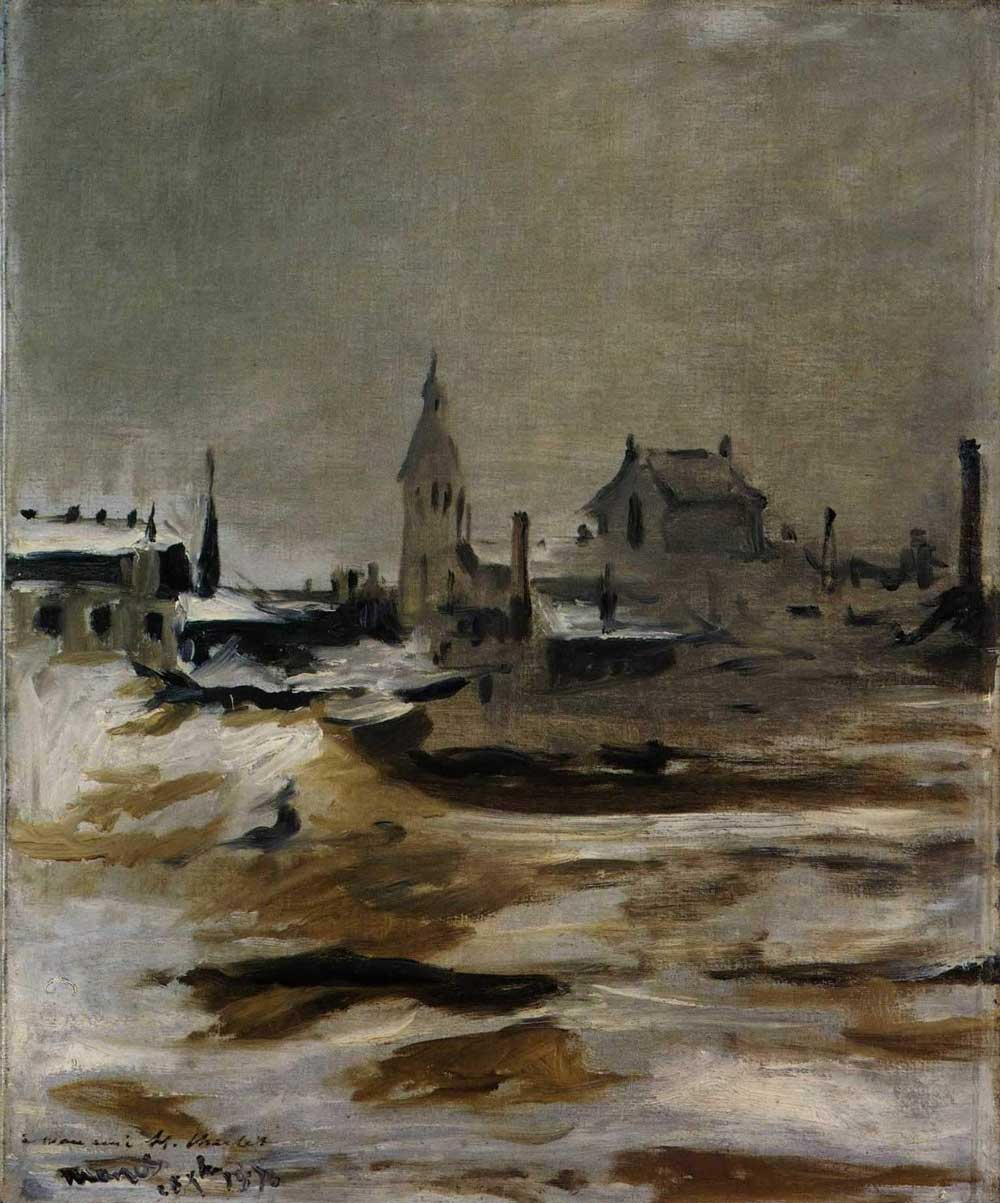
Effect of Snow on Petit-Montrouge by Manet (1870)

The oil on canvas painting entitled Effect of Snow on Petit-Montrouge was painted by Edouard Manet and depicts a winter view of Petit-Montrouge, in the 14th Arondissment of Paris.  Manet completed the work in 1870 whilst he was serving in the National Guard during the 1870–71 Siege of Paris in the Franco-Prussian War. There was no hint of the war, no heroic view of the battle or the bloody fighting, which was raging around the French capital, as often seen in the work of other artists’ paintings of the time.  This painting, although a snowy scene, is awash with shades of brown and black giving it a dark and foreboding ambience which could well be because the way Manet was feeling about the course of the ongoing war.  During this time Manet wrote to his wife:

“…My soldier’s knapsack serves…to hold everything necessary for painting. I shall soon start some sketches from life. They will be souvenirs that will one day have value…”

The painting depicts a view of the church of Saint-Pierre at Petit-Montrouge, and it is inscribed:

“…â mon ami H. Charlet 28 Xbre 1870. Charlet…”

 Charlet is thought to have been a comrade in the National Guard.  The dark image reflects Manet’s loss of hope regarding the impending military defeat and his deep loneliness, the deprivation and his bouts of depression he suffered during this time. It is one of the few landscapes in Manet’s oeuvre and is one of Manet’s first plein air paintings. Today it is in the collection of the National Museum Cardiff.

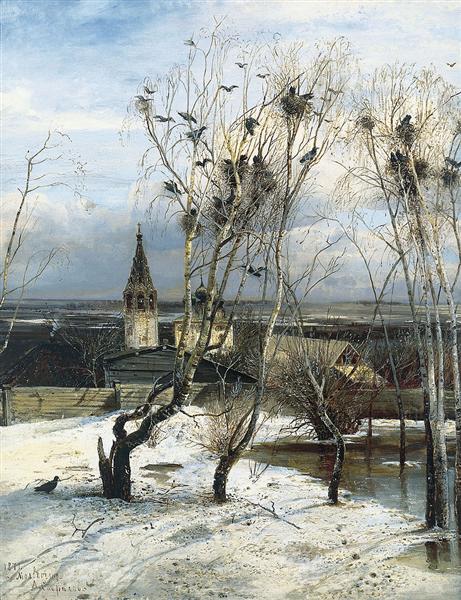
The Rooks have returned by Alexi Savrasov (1871)

Having looked at a painting by Monet featuring a black coloured bird against the white of the snow I had to give you one of my favourite works of art and this too features black birds and snow.  It is not quite a winter scene more “a coming of Spring motif”.  It is Alexi Savrasov’s painting entitled The Rooks have Returned, which I saw at the Tretyakov Gallery when I was in Moscow.  Savrasov was one of the most important, some would say, the most important of all the 19th century Russian landscape painters, and he was  deemed the creator of the “lyrical landscape style”. It is Savrasov’s most famous painting, and the painting is considered by many critics as being the high point in Savrasov’s artistic career.  The depiction witnesses the coming of spring as signalled by the return of the rooks.  The work is testament to Savrasov’s love for the rural Russian landscape, and he was very influenced by John Constable. The depiction we see before us is a simple, and depicts the somewhat inconsequential occurrence of birds returning home in spring to an extremely unpretentious landscape, but it was Savrasov’s way of communicating the change of seasons from Winter to Spring. Simple and yet beautiful.  The great Russian painter, the classical landscape painter, Isaac Levitan commented about its simplicity saying that although the painting was very simple, beneath its simplicity there is the tender artist’s soul, who loves nature and values it.  The painting enhanced Savrasov’s reputation as a landscape painter and it contributed to the success of the first exhibition organized by the Peredvizhniki.

Queue to a Resrvoir by Vasily Perov (1865)

Another depiction of a harsh winter and its effect on the people is Vasily Perov’s work entitled Queue to a Reservoir depicting people in freezing conditions to get themselves some water. It is a reminder of what is happening even nowadays.

Winter Landscape by Caspar David Friedrich (1811) Staatliches Museum, Schwerin.

If your taste in winter landscape paintings is not so much for aesthetic beauty but for depictions that are full of atmosphere then you should look no further than the winter scenes painted by the great German artist, Caspar David Friedrich.  His two Winter Landscape paintings of 1811 relate a poignant story.  One of the works is housed in the Staatliches Museum, Schwerin whilst the other is in the National Gallery, London. In the Schwerin picture, we observe a tiny figure, leaning on a crutch.  He gazes out on a deserted snow-covered landscape.  The sky is coloured grey/black adding to the ominous feel to the work.  The man meanders between dead or dying oak trees, and the stumps of felled trees.  It is a depiction of total barrenness and this bleakness adds to the feeling of hopelessness.  Life for him could not get any worse.

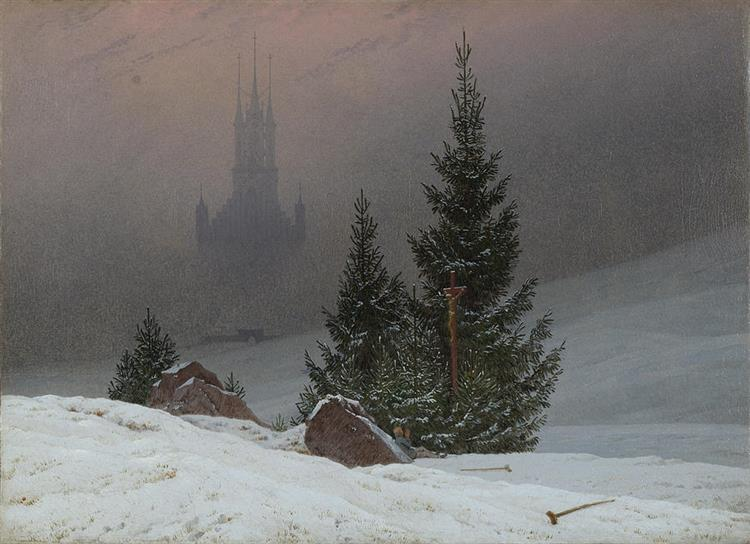
Winter Landscape with Church by Caspar David Friedrich (c.1811). National Gallery London.

However the National Gallery painting, a companion piece to the one in Schwerin, offers us a glimmer of hope for the man. This painting signifies the hope of resurrection through Christian faith. Look carefully at the snow in this work and you will see shoots of grass pushing through the snow and the evergreen trees and faint pink glow of approaching dawn affirm its message of renewal and rebirth. It is a fine example of Friedrich’s use of landscape painting as a vehicle for religious feeling and personal symbolism. As he stated, his aim was not ‘the faithful representation of air, water, rocks and trees … but the reflection of [the artist’s] soul and emotion in these objects.’

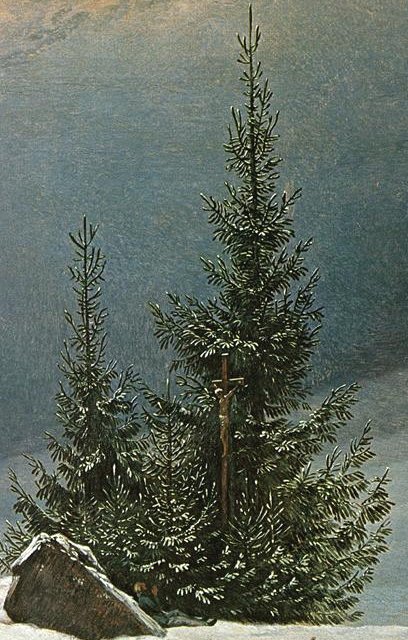
Man praying and abandoned crutches

The painting depicts a man, an invalid, who, in the Schwerin painting, we saw wandering helplessly in the snow, has now thrown away his crutches and lies against a large boulder as he prays in front of a shining crucifix protected by three fir trees, symbolising the Christian Trinity. In the background we see the silhouette of a German Gothic cathedral which is partially covered by a grey mist.  Unlike the hopelessness of the man’s situation in the first painting, Friedrich has instilled a sense of hope of a new life through Christian faith.

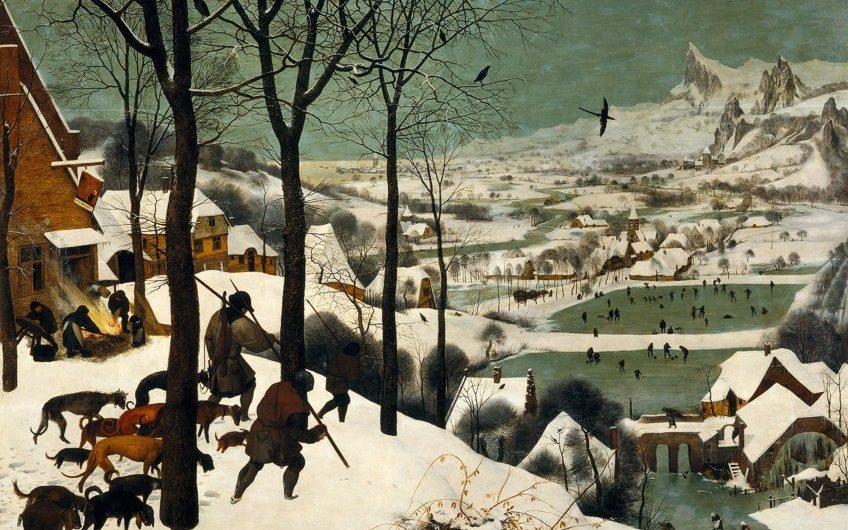
Hunters in the Snow by Pieter Bruehel the Elder (1565)

No compilation of winter landscape paintings would be complete without the inclusion of such works by Pieter Bruegel the Elder.  In 1565 he completed his oil on wood painting entitled The Hunters in the Snow which is also referred to as The Return of the Hunters.  The work is part of the Kunsthistorisches Museum in Vienna, Austria.  It is one of his great genre painting scene with an aeriel viewpoint of a winter’s scene.  The painting was one of a twelve-work series depicting different times of the year and this one is set in the depths of winter during the months of December/January.  Before us we observe a wintry scene and in the left foreground, we see three hunters who are returning from an outing along with their dogs. They are heading down a snow-covered slope towards a small village.  Looking at the men trudging resignedly home with their dogs it appears not to have been a successful hunt with only one of the men carrying over his shoulder one dead fox, the fruit of their labour.  As if to taunt them, there are footprints of rabbits around them, which they failed to ensnare.   It is a cold overcast winters day with little or no wind as we can see by the lack of movement of the wood smoke.  Bruegel has used muted white and grey colours in this composition to give it an air of melancholy.  On the leafless trees we see crows perched on the bare branches. The setting is a flat-bottomed valley through which a river meanders. 

In the background we see an idealised landscape depicting jagged mountain summits which do not exist in Bruegel’s homeland but which would have been seen with him during his time in the Alps.   At the bottom right of the painting we see the large wheel of a watermill which has been frozen stiff.  Below on the frozen lake people are ice skating.  To the returning hunter’s left we can see an inn with villagers preparing a roaring fire in preparation of roasting a pig.  The sign on inn is hanging askew.  The image on the sign depicts a stag named Saint Hubertus, who is the patron saint of hunters. The words are in Dutch, Dit is Guden Hert, which means in English “This is the Golden Deer”.

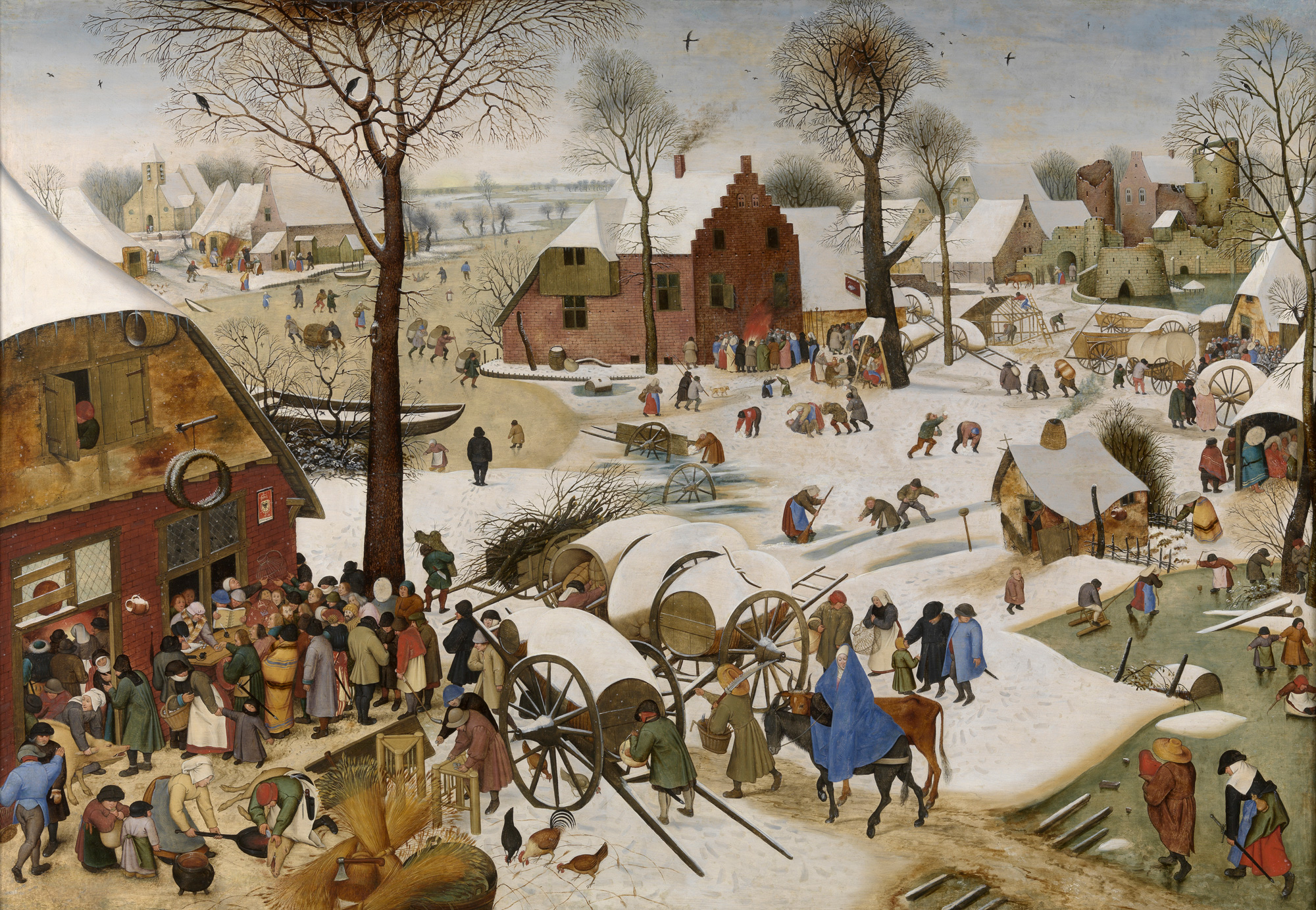
The Census at Bethlehem by Pieter Bruegel the Elder (1566)

Another winter painting by Bruegel the Elder is his 1566 work entitled The Census at Bethlehem, also known as The Numbering at Bethlehem.  It depicts the collecting of names of the villagers so as to enforce a tax collecting regime.  Bruegel would have painted this following the harsh winter of 1565.  In this work Bruegel depicts a scene which pre-dates the Nativity and the birth of Christ. The scene before us takes inspiration from the Gospel of Luke, chapter 2, verses 1 to 5.

“…In those days a decree went out from Emperor Augustus that all the world should be registered in their own towns. Joseph also went from the town of Nazareth to the city of David called Bethlehem … with Mary with whom he was engaged and who was expecting a child…”

Although the story behind the painting is set in the Holy Land, Bruegel Bruegel combines this biblical narrative with life during his own time.  He has set his work in a Flemish village in winter at sunset with the ruined castle in the right-hand side of the background being based on the towers and gates of Amsterdam. People are gathered at a building on the left registering their details.  We can just about make out the Habsburg double-headed eagle on a sign on the building.  Villagers are streaming towards the census point, two of whom are Joseph and the Virgin Mary, who is with child, riding on a donkey. People are mingling in the cold, and we see happy children playing with toys on the ice and having snowball fights. There is the strange sight of a spoked wheel at the centre of the painting and this has occasionally be deemed to symbolise the wheel of fortune. To the right, a man in a small hut is shown holding a clapper, a warning to keep away from leprosy. Leprosy was endemic in that part of Europe when the painting was created. There is a begging bowl in front of the hut. In the background, men drink at a makeshift bar, and in the distance we see a well-kept church and a crumbling castle.

Bruegel once again treats a biblical story, in this case, the Census of Quirinius, as a contemporary event. He wants to liken the harsh events of the Roman occupation with the severity of the Spanish administration, who at Bruegel’s time, were ruling the southern Netherlands.  It is also thought that Bruegel was condemning the bureaucracy he was having to fight on a daily basis.

Census at Bethlehem by Pieter Bruegel the Younger (c.1590)

Pieter Brueghel the Elder’s son Pieter Bruegel the Younger and his studio made dozens of copies of his father’s painting after he died in 1569.  One, thought to be completed before 1600, was sold at auction for $10 million in 2013. One other copy, dated from 1610, is also at Royal Museums of Fine Arts of Belgium in Brussels.

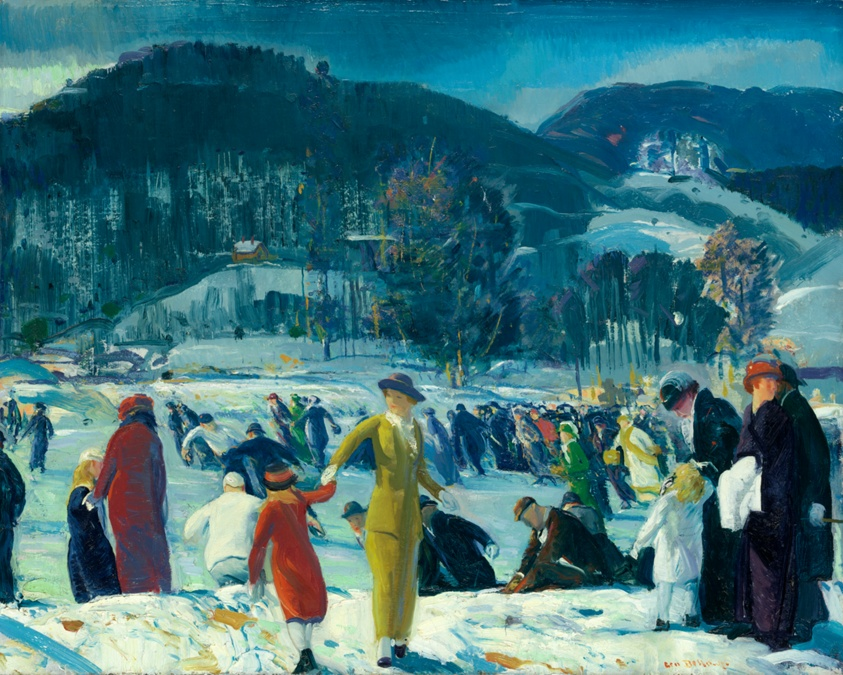
Love of Winter by George Bellows (1914)

I will almost end this compilation of winter scenes by highlighting two works completed by the distinguished American artist, George Bellows.  George Bellows was born in Columbus, Ohio in 1882 and after passing through the various school years arrived at Ohio State University at the age of nineteen.  It was here that his sporting prowess came to the fore and at one time it was thought that he may take up baseball professionally.  During his time at the university, he funded himself by working as a commercial illustrator.  However, Bellows had one aim in life and that was to become an artist, so much so, that he quit the university just before he was due to graduate and moved to New York to study art.

He enrolled in the New York School of Art and became a student of Robert Henri.  It was through Henri that Bellows came into contact with a group of artists known as The Eight and later became part of  The Ashcan School.  The Eight was a group of artists whose fame derives from, and for what they will always be remembered for, their one and only joint exhibition in 1908 at the Macbeth Gallery in New York.  The exhibition was a sensation and it is now looked upon as one of the most important events in the development of twentieth-century American art.

It is said that Bellows wrote to a friend in January 1914:

“…There has been none of my favourite snow. I must always paint the snow at least once a year.”

Unknown to him these were prophetic words as on February 13th 1914 New York City was hit by a major blizzard and it was this occurrence which led to Bellows painting his famous 1914 work entitled Love of Winter.  The whole winter scene was intensified by Bellows with his use of bright reds, yellows, and greens and the feel of movement in the painting is achieved by his broad slashing brushstrokes.  The enthusiastic group of skaters and onlookers of differing ages, differing social classes echoes the diverse populations who appreciated  the public parks and the leisure activities on offer to them in early 20th-century New York City.

Blue Snow, The Battery by George Bellows (1910)

His other snow scene I wanted to show you is entitled Blue Snow, The Battery which he completed in 1910.  The setting for the painting is Battery Park which lies adjacent to the financial district of Manhattan.  There is a breathtaking beauty about this work of art.  His imaginative and powerful use of blue energizes the scene of the southern tip of Manhattan.  Bellows painted a number of scenes with New York City under snowfall and as with this work it is amazing how he has developed a strong sense of light and visual texture contrasting the white and blue of the snow and the dark grimy outline of the old buildings.  It is a beautiful strong composition which is normally housed at the Columbus Museum of Art.

Winter Landscape by Wassily Kandinsky (1909)

The inclusion of a blue tint in the depiction of the snow gave Bellows’ winter scene a colder ambience. Snow is white but a tinge of blue adds to its portrayal but what about other colours for snow? Wassily Kandinsky’s painting Winter Landscape is one of the works in which the individualities of the artist, who was one of the founders of abstract art, are shown in the full extent. The motif of thin black trunks is often used by Kandinsky in his landscapes. Bright colouring with predominant pink, yellow, blue and black is based on immediate visual impressions: the artist seeks to convey various light effects in the snow illuminated by the setting sun. Kandinsky explained his choice of colours:

“…Colour provokes a psychic vibration. Colour hides a power still unknown but real, which acts on every part of the human body…”

Your thoughts ?

I hope you enjoy this over-long blog but it is holiday time and hopefully you have plenty of time to read it. I end by wishing you a Happy Hanukkah, A Happy Christmas and a peaceful and prosperous New Year.

Jonathan

Hans Makart Revisited

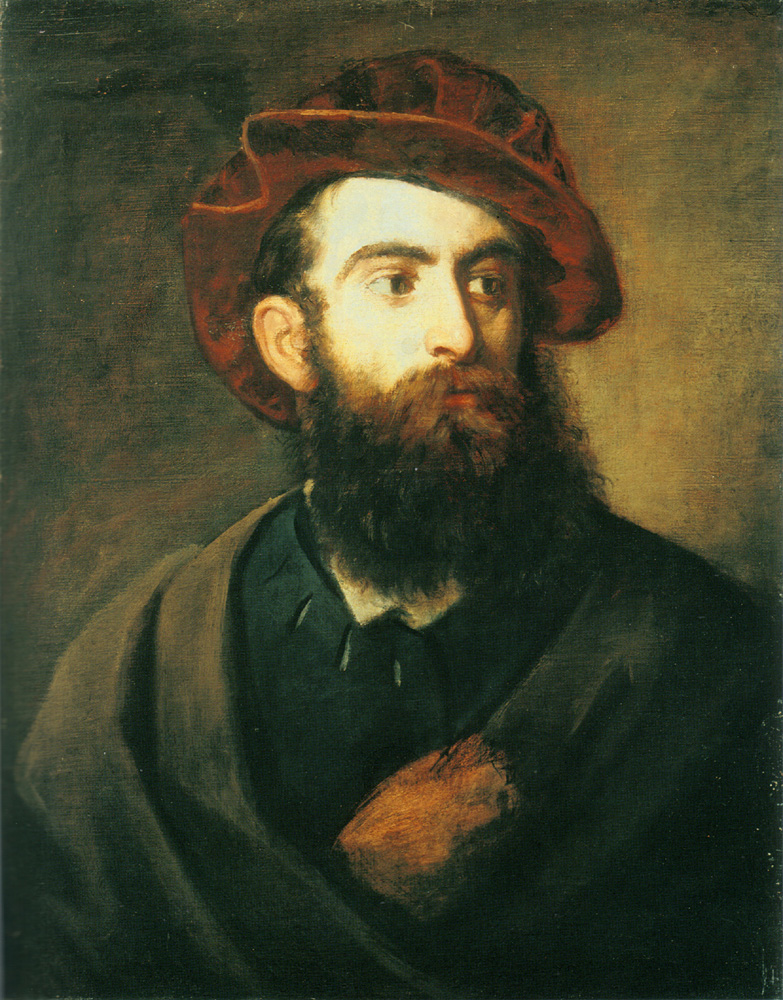
Self Portrait by Hans Makart (1878)

The artist I am looking at today, and had written about in 2013, was one who was revered by many of the art critics of the time and yet hated by others, who baulked at his general lack of interest in factual accuracy in his depictions and for disparaging important episodes in history by including unwarranted female nudity in his paintings.    It would appear that he refused to tone down his flamboyant lifestyle and was known as much for the outrageous society parties he held in his studio as for his works of art.  Let me introduce you to the Austrian painter, Hans Makart.

Mirabell Palace and Gardens, Salzburg

“Hans” Johann Evangelist Ferdinand Apolinaris Makart was born to Johann Makart and Maria Katharina Rüssemayr in Salzburg on May 28th, 1840. His father, an amateur painter, worked as the chamberlain of the Mirabell Palace, which was the home of the powerful Prince-Archbishop. Few facts are known about the early years of Makart, but because of his father’s job, it is thought that he grew up surrounded by the Neoclassical grandeur of this magnificent palace and its extensive Baroque gardens.  It is more than likely that living amongst the splendour of the palace with its luxurious furnishings influenced young Makart who would later in life indulge in the excesses of extravagance and ornamentation as depicted in his artwork as well as his work as a designer and decorator.

The Valkyrie by Hans Makart (1877)

It seems likely that his father, having failed as an artist, urged his young son to take up painting and to endeavour to succeed where he had been unsuccessful.  Sadly, in 1849, Hans Makart’s father died shortly after his son had celebrated his tenth birthday. A year after his father’s death the family moved to Vienna and Makart went to study painting under the Austrian painter, Johan Fischbach, at the Academy of Fine Arts, a public art school in Vienna. Living in Vienna, Makart immersed himself into the worldly life of the great capital, where the women were beautiful and elegant, where dress was held of paramount importance, and where Society balls and entertainments went on through the greater part of the year. In the midst of living such a life, the world Makart witnessed was seen on its brightest most appealing side, and as a young man his ideas were developed into a passion for beauty. From his time and experiences of life in Vienna, Makart could never paint a woman unless she was adorned in the most sumptuous clothes, and he could never help depicting the female with the grace and beauty that distinguished the ladies of the Austrian capital.

Die Japanerin by Hans Makart (1870)

However, Makart’s time at the Academy did not go well and as I have recounted many times in previous blogs, he, like many young aspiring painters, could not accept the precise structure and order of the Academy, as far as the teaching methodology and the type of artwork which those in charge celebrated. He was impatient to escape the endless routine of art school drawing. It was not for him and his stay at the Academy ended in 1851 when he was dismissed after only one year.  Those in authority at the Academy gave the reason for his dismissal as his lack of natural talent.  It could well have been that Makart’s love of intense colour, movement, and sensuality, a style which was similar to that of Titian or Rubens was unacceptable to the Academy hierarchy who wanted students to follow a more sombre, well-ordered classicism that still dictated academic art at the time.  Makart would develop his own recognisable style but that would be ten years in the future.

Die Liebesbrief (The Love Letter) by Hans Makart

Makart believed in himself and was completely impervious to criticism, whether it be his artistic style or his decadent lifestyle.  He was a rebel and proud of it.  He left Vienna and travelled to Munich where the next two years passed without him receiving any formal artistic tuition.  Makart became aware that he needed to learn the technique of his business — the mechanical side of it, so to speak — in short, to learn to paint and for that to happen he needed a good tutor. 

Sarah Bernhardt by Hans Makart (1881)

In 1853, Makart enrolled in the Munich Academy where he was tutored by the German realist painter Karl von Piloty, who was noted for his historical subjects, and recognised as the foremost representative of the realistic school in Germany.

Moderne Amoretten (Modern Cupids) by Hans Makart (1868)

In 1864, after studying under Piloty for some years, twenty-four-year-old Makart left Munich.  His confidence in his ability had been heightened during the years under the guidance of Piloty.  He was now full of self-confidence. During this early period, he perfected his highly decorative style. Makart also journeyed to London, Paris and Rome visiting all the major art galleries. In 1868, while he was staying in the Italian capital, Makart was invited to submit a piece for the opening of the Austria Artists’ Society in Vienna. Makart sent over his colossal three-part work Modern Cupids, along with painstaking instructions on how it should be displayed. All three paintings were bought by the Count Johann Palffy, who became one of Makart’s regular patrons. 

Dame mit Federhut in Rückenansicht (Lady with Feather Hat from Behind) by Hans Makart (1875)

It has to be said that Makart was neither totally impressed by Raphael’s Madonnas which he saw in Rome, nor was he moved by the gilded glories that crown the virgin martyrs, and there can be no doubt that the Italian capital failed to fire his soul.  However, when he moved to Venice all that was to change. It was the art he witnessed in that city that fired his imagination and would influence him for the rest of his life.  Makart had always been a devoted colourist and in Venice he witnessed the colourful works of Veronese, Titian and Tintoretto. These three Italian (Venetian) Masters were to be his mentors.  To him, they were inspirational.

Hans Makart’s Studio in Vienna

Makart’s artistic achievements came to be noticed by the Emperor of Austria, Franz Joseph who, in 1869, summoned him to work in Vienna.  Buoyed up by this prestigious support, Makart requested set of lavish apartments.  That request was denied but instead the Emperor arranged for Makart to be given a studio which had been converted from a disused foundry. Far from being disheartened, Makart transformed this industrial space into the plush, decadent heart of Viennese society. It was not just his art which was colourful.  His lifestyle was equally flamboyant and rich in vibrancy.  His studio, in the Ring-Strasse, at the heart of Vienna, was resplendent.  It was transformed into a ballroom-like space and decorated in lustrous colours.  It was here that he depicted females adorned in beautiful satin gowns in shimmering satin tones.  In his studio he surrounded himself with richly ornamented German chests of the Renaissance, Chinese idols, Greek terracotta, Smyrna carpets and old Italian and Netherlandish pictures mingling beside antique and medieval weapons.  The walls of his studio were covered with splendid vessels, weapons, sculpture and costumes. Makart turned his hand to interior design, costume design, furniture design and soft-decoration, and his studio overflowed with statues, flowers, fine fabrics, and music. It acted thus as the perfect artistic backdrop for his models – largely nude women – who were also welcomed into his high-society circle.

The Espousals of Catterina Cornaro by Hans Makart (c.1873)

A good example of Makart’s large colourful paintings is his work entitled  The  Espousals  of  Catterina  Cornaro, (Venice pays tribute to Caterina Cornaro), which he completed around 1873.  Caterina Cornaro was the last monarch of the Kingdom of Cyprus, also holding the titles of the Queen of Jerusalem and Armenia. She had been engaged by proxy to the King of Cyprus, James II Lusignan, since 1468, when she was just fourteen years old, and at the same time she was declared the daughter of the Republic of Venice. It was not until 1472 that she went to Cyprus for her wedding.  The painting depicts representatives from  Cyprus  and  Venice,  of  dignified  men, of  procurators  of  St.  Mark, of women in foreign garb of  bright colour,  who  crowd  round  their  young  mistress,  the  queen  of the  feast,  rejoicing,  amid  the  splendid  architecture  of  the piazza.  Sadly the marriage did not last long as eight months after the ceremony.  James died and according to his will Catherine, who was carrying his child, became regent.  Caterina’s son James died under suspicious circumstances in 1474 before his first birthday.

Death of Cleopatra by Hans Makart (1876)

Around 1875 Makart completed some paintings depicting the death of Cleopatra.  They both portray Cleopatra, the legendary queen of Egypt, contemplating suicide. The Roman Emperor Octavian’s forces had fought their way into Alexandria, and knowing that her country had fallen, Cleopatra withdrew to her tomb with her closest attendants, Iras and Charmion.  In one of the paintings, we see Cleopatra reclining on a bed of fabrics, semi-nude and wearing jewelry and her crown. To her left, one of her servants weeps, whilst just below the queen another has already died. A brazier burns on the left-hand side.

Death of Cleopatra by Hans Makart (1875)

In both paintings the asp is menacingly depicted.  It is a thin, black form with a tiny wisp of a tongue, and stands out against Cleopatra’s breast.  This adds a sense of eroticism, and danger to the painting which reminds us of the line from Shakespeare’s play, Anthony and Cleopatra:

“…The stroke of death is as a lover’s pinch, which hurts and is desired…”

There is a sensuous decadence about Makart’s depiction of Cleopatra’s naked, bejeweled body and the way his use of chiaroscuro picks out the stark whiteness of Cleopatra’s body, as if she were spot-lit on a stage.

Das Schlafende Schneewittchen (The Sleeping Snow White) by Hans Makart (1872)

Makart’s life in Vienna enabled him to immerse himself into the worldly life of the great Austrian capital, a city where the women were beautiful and elegantly dressed and where Society balls and entertainments are held throughout the greater part of the year. In the midst of living such a life, the world the painter witnessed was seen on its brightest side, and consequently, as a young man his ideas were developed into a passion for beauty.

The Dream after the Ball by Hans Makart

In 1878, Makart took a post as a professor at the Viennese Academy in 1878.  This was the very same institution which had expelled him for lack of artistic talent in the late 1850s. Two years later, he became the institution’s head of a particular school for historical painting, a position he held until he died. It was during this time that Makart, as teacher, met Klimt, one of his students. Klimt had an important role in continuing Makart’s legacy after his death. In addition to his position as a professor, Makart’s work kept him well-off and well-known. Even the negative comments regarding his art appeared to simply inspire him to strive more.

Statue of Hans Makart in Vienna City Park (“Stadtpark”)

Hans Makart died on October 3rd 1884, aged 44. He was buried in the Wiener Zentralfriedhof in Vienna. Makart influenced many painters who followed him, the most notable being Gustav Klimt, who is said to have idolized him. It can be seen in Klimt’s early style which is based in historicism and has clear similarities to Makart’s paintings. Jugendstil, the Austrian Art Nouveau, of which Klimt was a part and it has been suggested that primacy of sexual symbolism in Jugendstil artworks were influenced by the sensuality in many of Makart’s paintings.

Eppo Doeve

Eppo Doeve

After my blog on Anton Pieck the other week, I received a comment from Barbara Matthias, who asked me to look at the life and work of another Dutch painter, Eppo Doeve.  Having never heard of him, I was intrigued.  I managed to scrape together some information about his life and works of art he had completed, so here is a blog on the twentieth century painter and cartoonist.

Aardappeleters (Potato Eaters) by Eppo Doeve

Jozef Ferdinand (Eppo) Doeve was born on July 2nd 1907 in Bandung, the capital city of the Indonesian province of West Java in the Dutch East Indies.  He was the eldest child of a civil servant, Justin Theodorus Doeve and his wife Helena Rosina Kepel and he had four sisters. Both parents were of mixed European and Indian blood.  Eppie, as Doeve was called at home, went to a Catholic School run by the Ursuline Sisters and then later went through the local secondary education system.   Once Doeve had been awarded his diploma, he was allowed to make some trips through the Dutch East Indies. Because of his parents, Eppi developed a love and interest for plants and flowers and this made him choose to study agronomy in the Netherlands.  Agronomy is the science and technology of producing and using plants by agriculture for food, fuel, fibre, chemicals, recreation, or land conservation .  Of his dream for his future Doeve said:

“… I wanted to be a tea planter, somewhere near Garoet, there is nothing more delicious imaginable, isn’t there?…” 

A portrait of the actor Louis van Gasteren Senior by Eppo Doeve (1944)

Besides his love of plants and flowers, Doeve was a multi-talented child and was very artistic from an early age. He played various instruments and could draw well. He was also very humble and did not consider himself very special, despite the fact that he received painting commissions whilst he was still young but he still looked upon drawing and playing music as hobbies and, not being in any way, future professions.

Winston Churchill by Eppo Doeve

When Doeve was twenty he attended the Landbouwhoogeschool (Agricultural science college) in Wageningen in The Netherlands. He enjoyed student life and would contribute drawings to the monthly college magazine, Wagenische Studentencorps.  His love of music was also sated at the college as he was very busy with the jazz band of the association. All his plans and aspirations ended in the early 1930s after the tea market in India collapsed and it was a turning point in his life and his future plans had to be revisited.

Fisherwoman in Regional Costume by Eppo Doeve (1968)

Above all, Doeve wanted to stay in The Netherlands and not return to the Dutch East Indies, to do this he had to find a way to achieve that goal.  He realised that his drawing ability may be the secret to a new life.  He had already earned some money at the Amsterdam advertising agency De LaMar Advertising Company and was able to work regularly at the agency from 1932 onwards. Doeve went from there to other advertising companies and publishers, such as De Groene Amsterdammer, an independent Dutch weekly news magazine published in Amsterdam, and later he moved to the large publishing house, Haagsche Post. In the 1930s Doeve also worked on the Belgian magazine Radiobode, which listed radio programmes.   The magazine was first published in 1931 and had a circulation of approximately 20,000 copies. His graphic work for the Radiobode was loved and became collectables and was praised by such contemporary luminaries such as the young and up-and-coming illustrator, Fiep Westendorp, and one of Doeve’s young colleagues, Marten Toonder, a Dutch comic strip creator, born in Rotterdam and who became the most successful comic artist in the Netherlands

In 1953, Doeve became an even more famous Dutchman when he provided the sketch of Hugo de Groot,  the Dutch diplomat, lawyer, theologian and jurist, for the new 10 Guilden banknote.

1940 issue of Radio Bode with Eppo Doeve’s graphics for the Paul Vlaanderen series

In the 100th issue of Aether, the magazine about the history of broadcasting and phonography, published in July 2011, there is a drawing by Doeve with an article about radio plays. It is a drawing for the well-known AVRO radio play Paul Vlaanderen.  Paul Vlaanderen was the name of the fictional Dutch detective and was based on the novelist, Francis Durbridge’s character Paul Temple, who was a fictional detective in a long-running English radio serial, which first broadcast in 1938.

One of the many advert posters for Heineken Beer designed by Eppo Doeve

Doeve became skilled at every form of graphic art, without having had a formal education. He was commissioned to illustrate commercials, stage sets, book illustrations, and just simple paintings.   Doeve mastered them all.  One of his colleagues, Alexander Pola, commented:

“…He could do everything he wanted, and wanted everything he could…”

For the Dutch weekly magazine, Elseviers Weekblad, he submitted articles, illustrations and political prints.  In addition, he regularly appeared on television. After years of being called J.F. Doeve in the press, he was then referred to by his nickname Eppo.

Portrait of Tinnie van der Elzen by Eppo Doeve (1940)

Eppo Doeve was also a fine portrait artist as can be seen in his 1940 work entitled Portrait of Eugenia Henriette Maria (Tinnie) van der Elzen.  She was Doeve’s first wife, the daughter of a well-to-do family in Arnhem, whom he married in July 1934.  In the background, a landscape is visible in which the castle of Cannenburgh (Vaassen) can be identified.

Poster for Eppo Doeve Retrospective

This painting was exhibited during the retrospective exhibition Eppo Doeve Terug in Wageningen in 2019. Doeve painted the portrait in the typical ‘magisch realisme‘ (magic realism) style of the late 1930’s, an artistic genre in which realistic narrative and naturalistic technique are combined with surreal elements of dream or fantasy.

Portrait of the artist André van der Burght at the age of 63 by Eppo Doeve

Jozef Ferdinand (Eppo) Doeve died on June 11th 1981, aged 73. After his death, piles of beautiful drawings were discovered in his studio.

Eppo Doeve in his studio (August 1954)

The studio was a chaotic mess and many sketches were found behind the heater and at the bottom of the cupboards, almost as if he had hidden them.

Joseph Farquharson RA

Self Portrait (1882)

We are approaching a time when we have to expect very cold weather and for some of us the oncoming of snow.  So as we are at the beginning of the Christmas month I thought I would treat you to some snowy scenes by one of the greatest exponent of such panoramas.  Permit me to introduce the nineteenth century Scottish painter, Joseph Farquharson, whose snowy winter landscape paintings were featured on many Christmas cards.

Joseph Farquharson was born in Edinburgh on May 4th 1846.  He was the son of Francis Farquharson, a doctor and laird of Finzean in Kincardineshire. Joseph’s brother Robert was a highly respected physician and local Member of Parliament.  Joseph’s mother, Alison Mary Ainslie, was a celebrated beauty, one of the daughters of the lawyer Robert Ainslie, who was a close friend of the poet Robert Burns.

Road to Loch Maree by Joseph Farquharson

Joseph’s early days were spent in his father’s house in Northumberland Street Edinburgh, below the Queen Street Gardens.  Later the family moved to Edinburgh’s Eaton Terrace and finally to the family estate at Finzean, in Aberdeenshire. Joseph was brought up in a strict family environment and was educated in Edinburgh.  Although his father encouraged him to sketch and paint and even let him use his own set of paints, he only allowed his son to paint on Saturdays.  Joseph developed his artistic skills and at the age of twelve, Francis Farquharson bought his son his first set of paints and a year later Joseph exhibited his first painting at the Royal Scottish Academy.

Joseph Farquharson’s first formal art training came in the 1860’s when he enrolled at the Trustees’ Academy in Edinburgh, the forerunner of the Edinburgh School of Art where his tutors included the landscape painter, Peter Graham R.A. who would be a constant influence on Farquharson and Graham’s style can be seen in many of Joseph’s works.  Joseph then spent time at the Life School of the Royal Scottish Academy.

Day’s Dying Glow by Joseph Farquharson (1873)

Joseph Farquharson’s first exhibit at the Royal Academy, was in 1873 when his 1873 painting, Day’s Dying Glow, was on display.

Mrs Farquharson of Finzean (the artist’s stepmother) by Joseph Farquhardson (1871)

Farquharson followed the trend of other leading Scottish artists and concentrated on exhibiting his work in London rather than Edinburgh and Glasgow, as this was where the opportunity to sell their work was the greatest.  Besides his Scottish landscape scenes, Joseph was also a a talented portrait painter and his first portrait to be exhibited was of his stepmother, Mary Ann Girdwood Farquharson, which he completed in 1871.

A Scottish Interior, the Box Bed by Joseph Farquharson (c.1874)

Joseph Farquharson produced a realist genre painting around 1874 entitled A Scottish Interior, the Box Bed which depicts a bed inside a cupboard and table and chair in a kitchen/bedroom/living room. The free-standing box or press bed developed into a very sophisticated piece of furniture, when cabinet-makers designed “secret” press beds disguised as wardrobes or sideboards, or hidden behind rows of bookshelves and drawers, even when there was no pressure on space, and no need to provide a mini-bedroom within a shared living area.

The Joyless Winter’s Day by Joseph Farquharson (1883)

However, Joseph Farquharson will be remembered for his bleak wintry landscapes often depicting sheep and the shepherd. One such painting can be seen in London’s Tate Britain, entitled The Joyless Winter’s Day which he completed in 1883. Despite blizzard conditions, Farquharson painted this en plein air although, he was in the relative comfort of his specially constructed mobile painting hut, which had the added benefit of a stove. This relative comfort enabled Farquharson to capture the remarkably realistic effects of a snow storm. Before you worry about the health of the sheep I have to tell you that those you see were made in plaster by a local sculptor

Sheep in a Snowstorm by Joseph Farquharson

Farquharson was famed for his Scottish snow scenes, and with the exception of 1914, he had a new painting exhibited at the Royal Academy every year between 1894 and 1925. . Farquharson combined a career as an artist with his inheritied responsibility as laird of the Finzean estate in Aberdeenshire, where many of his landscapes were painted.

The Stormy Blast by Joseph Farquharson (1898)

But it was not just about snow and blizzards.

The Winding Dee by Joseph Farquharson (1889)

Some of his landscape paintings depicted the beauty of the Highlands, such as his 1889 painting featuring the River Dee, which rises in the Cairngorms and flows through southern Aberdeenshire to reach the North Sea at Aberdeen.

Corn Stooks by Joseph Farquharson (1880)

Harvesting, Forest of Birse, Aberdeenshire (1900)

Some of his paintings depicted the agricultural times in rural communities during the summer months.

When the West with Evening Glows by Joseph Farquharson (1901)

One of Farquharson’s greatest skills was his ability to depict scenes at sunrise and sunset as this can be seen in his beautiful 1901 painting entitled When the West with Evening Glows. It is a snowy winter landscape, and we look along a snow-covered path, which runs through fields, with groups of trees on either side, as seen in the mid ground of the painting. In foreground we see freshly-made footprints in the deep snow, with three crows having landed close to the footprints. The whole scene is illuminated by the warm glow of the rising sun from behind the hills in the background.

When the West with Evening Glows by Joseph Farquharson (1910)

The above 1910 painting is a slightly smaller version of the work which is owned by the Royal Academy. This version was exhibited at the Royal Academy in 1910 and now hangs in the collection of the Bristol Museum & Art Gallery. This painting was a commission Farquharson received from one of his patrons, who failed in his bid to buy the larger original version. Farquharson often copied his own paintings in order to satisfy his clients’ requests, or to provide an original for engravers tasked with the reproduction of a successful composition. It was such a popular painting with the public that thousands of prints of this work were sold. In his 1913 essay in the Christmas edition of the Art Annual, The Art of Joseph Farquharson, A.R.A, Archdeacon William Macdonald wrote about these popular works:

“…There is not one of Farquharson’s pastoral landscapes which is not treated from the contemplative or poetic point of view: the poetry of snow either in its suggestion of desolation, or of the endurance of peasantry life, or the exquisite beauty of rare tints in the sun or moon on deep snow surfaces and seen through leafless trees… and the varied voices with which Nature elevates us from the prosaic, the commonplace and the ugly in her countless moods…”

Market on the Nile by Joseph Farquharson (1893) 

The Orange Seller by Joseph Farquharson (1893)

For the first four years of the 1880’s Farquharson spent the winters in Paris and studied with Carolus-Duran who installed in the minds of his students the importance of using the brush straight away and to think in terms of form and colour. In 1885 Farquharson went to North Africa. Among the works created during the subsequent 8 years were The Egyptian and On the Banks of the Nile opposite Cairo

On the Banks of the Nile opposite Cairo by Joseph Farquharson

Joseph Farquharson was elected Associate of the Royal Academy in July 1900, Royal Academician in February 1915 and finally, Senior Royal Academician in 1922.
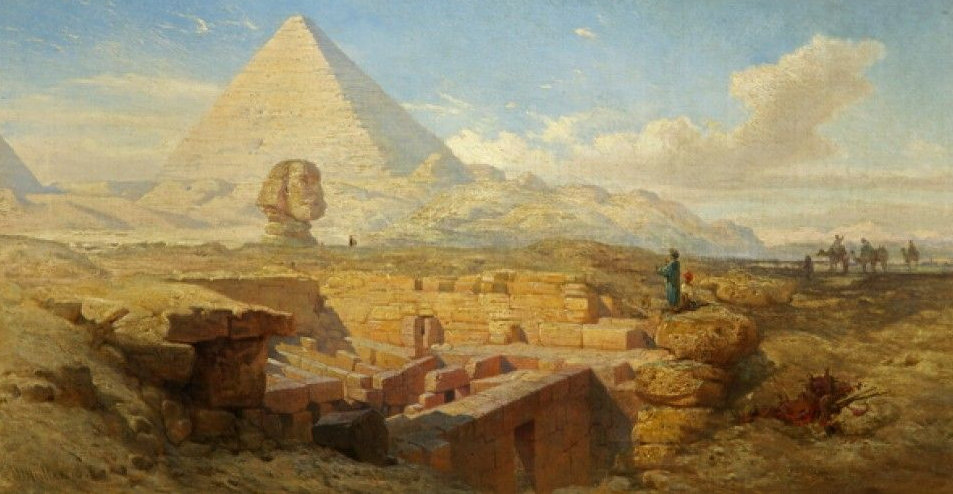
Beneath the Snow Encumbered Branches by Joseph Farquharson (1901)

In addition to exhibiting over 200 works at the Royal Academy he showed seventy-three at the Royal Society of Arts and one hundred and eighty-one at the Fine Art Society. He also exhibited at the Royal College of Art and Tate Britain. The renowned artist-critic, Walter Sickert made Farquharson the subject of an essay comparing him favourably with Gustave Courbet. In it he extolled Farquharson’s tension and realism and criticized the pretension of his polar opposites, the Bloomsbury Group, who he wrote “fortunately does not run in the North of Scotland”. The remarkable realism of Farquharson’s work can be attributed to his desire to work en plein air. Farquharson painted so many scenes of cattle and sheep in snow he was nicknamed ‘Frozen Mutton Farquharson’
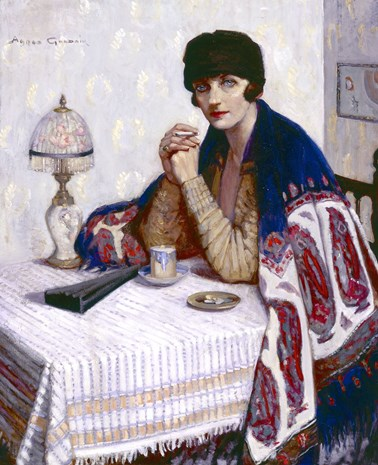
Farquharson inherited the title of Laird in 1918 after the death of his elder brother Robert. Joseph Farquharson died on April 15th 1935, three weeks before his eighty-ninth birthday..