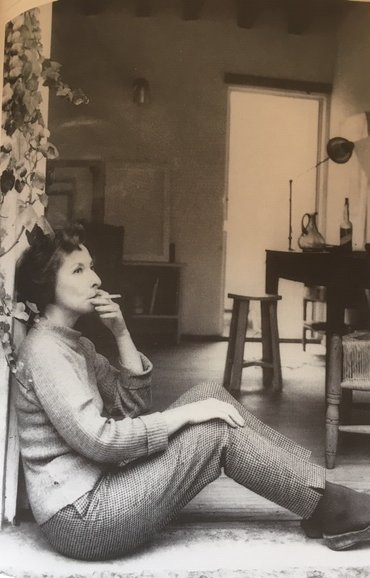
The Red Rose Girls. Part 2. Violet Oakley


                                                          Violet Oakley

The second of the Red Rose Girls I am featuring is Violet Oakley.  Oakley was the youngest of the Red Rose Girls, almost three years younger than Elizabeth Shippen Green and eleven years younger than Jessie Wilcox Smith.    During the American Renaissance mural movement of the late nineteenth-century it produced one of the great female muralists – Violet Oakley. 

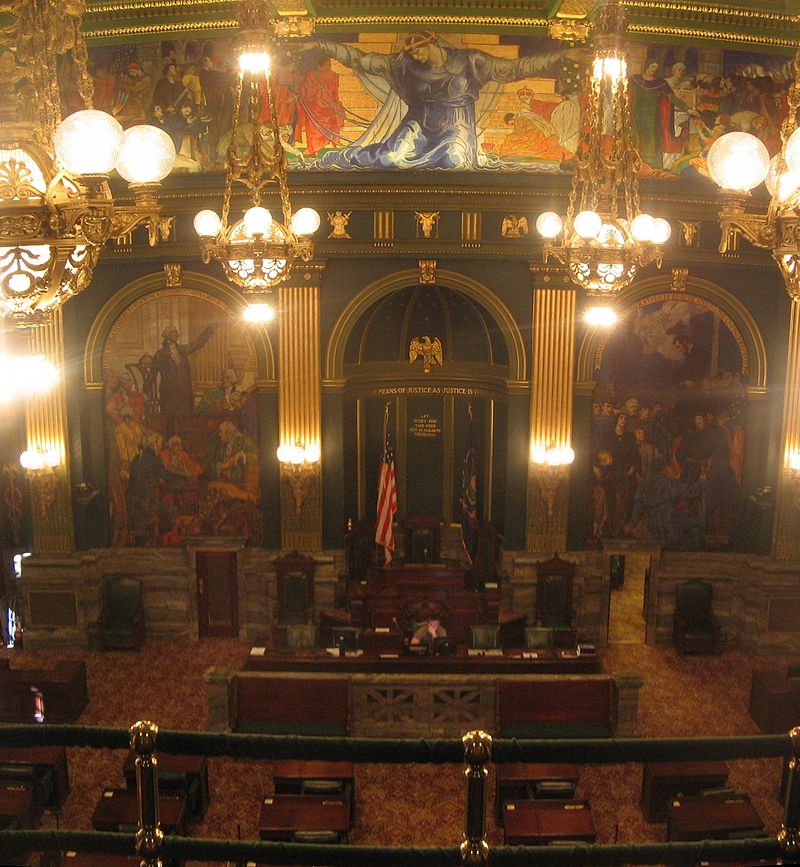
Pennsylvania State Capital murals by Violet Oakley

Violet is probably best known for her murals at the Pennsylvania State Capitol.  The paintings, done by Oakley, show scenes in the state’s history including Washington in Philadelphia in 1787 when the Constitution was written and Lincoln giving his address in Gettysburg in 1863.  Yet, these were only a part of her extraordinary output. Over half a century, Violet Oakley decked out the interiors of churches, schools, civic buildings, and private residences with murals and stained glass. She also illustrated books, magazines, and newspapers, and painted hundreds of portraits. Her Renaissance spirit of civic responsibility helped shape the culture of Philadelphia.
 

Violet (seated) and her sister Hester Oakley

Violet Oakley was born in New York on June 10th 1874, the youngest of three daughters of Arthur and Cornelia Oakley (née Swain) who had married in 1866.   Violet’s eldest sister was Cornelia, who sadly died of diphtheria at the age of six after a very short illness, and a middle-sister, Hester.  She and her family were brought up in Bergen Heights, New Jersey.  As a youngster showing a love for art, she was brought up in the perfect family environment.   In later life she quipped that her own interest in art was “hereditary and chronic” and that she had been born with a paintbrush in her mouth instead of a silver spoon.  At least twelve of her ancestors were artists.  Her paternal grandfather was George Oakley who came to America from London.  He was a talented artist and made many return trips to Europe to study and copy many of the major works of art and became an Associate of the National Academy of Design.  Violet’s father, Arthur, was taught to paint by his father but his business interests precluded him from making art his profession.  Violet’s maternal grandfather, William Swain was a successful portrait artist and his daughter, Violet’s mother, Cornelia set up her own painting studio but gave up her artistic ambitions when she married.  Other of Violet’s aunts, Juliana, and Isabel, became successful painters.
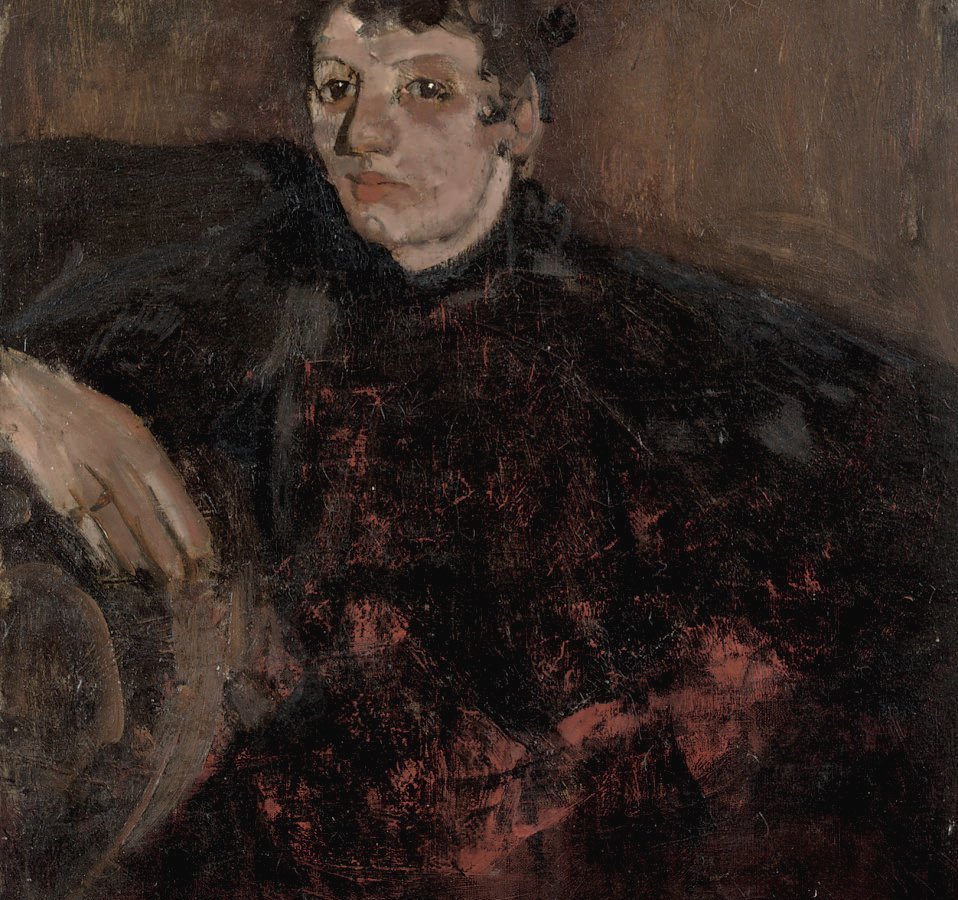
Violet Oakley, Self-Portrait (1919)

Violet was not a healthy child growing up as she suffered from asthma and an over-riding shyness.  Having lost her eldest child Violet’s mother over-cossetted Violet continually worrying about her ill health and fearing that she may lose her second child.  Her surviving sister, Hester, attended Vassar and Violet had hoped to follow her sister but her parents, ever concerned with their daughter’s health, decided to home-school her.  She spent a lot of her time copying paintings by the Old Masters, the prints of which had been brought home by her two grandfathers from their European vacations.  It was not until 1894, when Violet was twenty years of age, that the family allowed her to leave home to study.  She travelled with her father to New York city to attend classes at the Art Student’s league where she studied with Irving Wiles, who would become one of the most successful portrait painters in the United States, and who drew illustrations for magazines such as Harper’s and Scribner’s. Another of her tutors was Carroll Beckwith, an American portrait, genre, and landscape painter.

Penn’s Vision by Violet Oakley (oil paint over printed base) adorns the Governor’s Reception Room at the Pennsylvania State Capitol.

During the winter of 1895, the Oakley family travelled to France to visit relatives and both Hester and Violet decided to improve their artistic skills by enrolling at the Académie de Montparnasse where they studied at the atelier of the Symbolist painter, Edmond Aman-Jean.  It was an all-female studio and the students were a mix of those females who wanted to become professional artists and dilettantes who were merely bored with everyday life.   Violet fell into the former category whilst her older sister Hester, who had yet to decide whether to become an artist or writer, belonged to the latter and used the experience at the atelier to study people,  many of whom she incorporated into her 1898 novel, As Having Nothing.  The family’s European holiday was cut short when Violet’s father took ill.  It is thought that he suffered a nervous breakdown brought on by the failure of many of his business ventures.  Their father’s financial demise focused the minds of Hester and Violet in that they needed to earn money to support themselves and their family.  Hester managed to write and sell her novels and Violet decided that her art had to become financially viable.  Her family moved to Philadelphia to get medical advice for her father and so when Violet arrived in the city, she decided to enrol on two courses at the Pennsylvania Academy.  One was with Cecilia Beaux whose course was entitled Drawing and Painting from Head and focused on portraiture.  She also enrolled in the Day Life Drawing Class; a course run by Joseph de Camp.  However, art tuition cost money, add to that cost of materials and the commute to and from the Academy and Violet had now encountered financial problems.

Violet Oakley in front of the Unity panel that she painted for the Senate Chamber in the Pennsylvania State Capitol Building.

It was her sister, Hester, who saved the day.  Hester was continuing with writing her first novel and decided to enrol at the Drexel Institute where Howard Pyle, a writer and an illustrator was running an illustration class and Hester decided that he was just who she needed to teach her to become a novelist.  Buoyed by this find, Hester rushed home to tell her sister of the opportunity and persuaded her to leave the Academy after just one term and enrol at the Institute.  One could not just walk into to Howard Pyle’s course, one had to prove one’s worth and so Violet carefully organised her portfolio of work.   Howard Pyle examined Violet Oakley’s portfolio and accepted her onto his course, agreeing to help her progress.  Violet and Hester then set themselves up in a rented studio at 1523 Chestnut Street and their mother gave them some of the family’s furniture.  The two young ladies may have been sisters but they were as different as chalk and cheese.  Hester, the Vassar graduate, was outgoing, vivacious, and full of self-confidence whereas Violet was painfully shy and highly emotional and friends stated that she lacked a sense of humour.

Senate mural, Pennsylvania State Capitol by Violet Oakley.

That day in 1897 when Violet Oakley first walked into Howard Pyle’s illustration class she came face to face with the other two Red Rose Girls, Jessie Willcox Smith and Elizabeth Shippen Green ………………….

……………to be continued.


The information I used for my five blogs about the Red Rose Girls was mostly collected from the excellent book entitled The Red Rose Girls.  An Uncommon Story of Art and Love by Alice A. Carter.  I can highly recommend this biography.  You will not be disappointed.

The Red Rose Girls. Part 1. Elizabeth Shippen Green.

In my next series of blogs, I want to look at the lives of three talented women artists – Jessie Willcox Smith, Elizabeth Shippen Green and Violet Oakley.  These three artists enchanted and fascinated early twentieth century Philadelphia with their brilliant careers and somewhat uncommon lifestyle.  At one time the three women lived together in The Red Rose Inn, a picturesque estate in the affluent Philadelphia suburb of Villanova, a respected area known as the Main Line, an historical and social region of suburban Philadelphia, which was situated along the former Pennsylvania Railroad’s once prestigious Main Line.  The three women were joined by their friend, Henrietta Cozens, who took on the responsibility of managing their communal household.  Their mentor and tutor at the time was the famous American illustrator, Howard Pyle, who, because of their residence, nicknamed them The Red Rose Girls.  The four women forged an intense and emotional bond and vowed to live together for the rest of their lives.  They even adopted and acronymic surname, wanting to be known as the Cogs family – C for Cozens, O for Oakley, G for Green and S for Smith.  In the following blogs, I want to delve into the life of these three women and look at their backgrounds, their works and how they fought their way through a male-orientated world of art.  These three women were to become renowned for their illustrative work.

Red Rose Girls, Pictured left are Violet Oakley, Jesse Willcox Smith and Elizabeth Shippen Green (with Henrietta Cozens).

In my next series of five blogs, I want to look at the lives of three talented women artists – Jessie Willcox Smith, Elizabeth Shippen Green and Violet Oakley.  These three artists enchanted and fascinated early twentieth century Philadelphia with their brilliant careers and somewhat uncommon lifestyle.  At one time the three women lived together in The Red Rose Inn, a picturesque estate in the affluent Philadelphia suburb of Villanova, a respected area known as the Main Line, an historical and social region of suburban Philadelphia, which was situated along the former Pennsylvania Railroad’s once prestigious Main Line.  The three women were joined by their friend, Henrietta Cozens, who took on the responsibility of managing their communal household.  Their mentor and tutor at the time was the famous American illustrator, Howard Pyle, who, because of their residence, nicknamed them The Red Rose Girls.  The four women forged an intense and emotional bond and vowed to live together for the rest of their lives.  They even adopted and acronymic surname, wanting to be known as the Cogs family – C for Cozens, O for Oakley, G for Green and S for Smith.  In the following blogs, I want to delve into the life of these three women and look at their backgrounds, their works and how they fought their way through a male-orientated world of art.  The three women were to become renowned for their illustrative work.

Page from illuminated manuscript

Book illustrations can be traced back to the world of manuscript illuminations.  An illuminated manuscript is a manuscript in which the text is accompanied with decoration as initials, borders known as marginalia, and miniature illustrations.  The term illumination originally denoted the embellishment of the text of handwritten books with gold or, more rarely, silver, giving the impression that the page had been literally illuminated. 

Biblia Pauperum or Bible of the Poor, woodcut illustrations with manuscript text

Fast forward to the 18th and 19th centuries and the literature of the Western World and the birth of what we now know as the novel, in the form of adult fiction.  

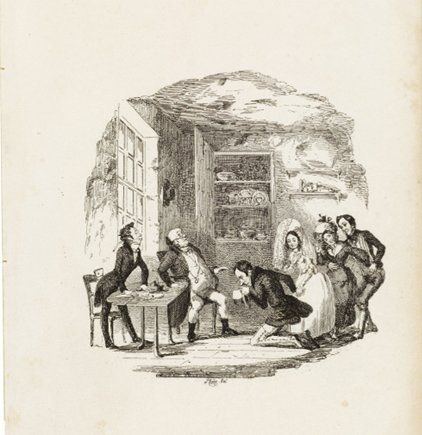
‘Mr Winkle Returns under Extraordinary Circumstances’, etched illustration by Hablot Knight Browne for The Posthumous Papers of the Pickwick Club by Charles Dickens

An example of this are the novels of Charles Dickens and the way in which he would collaborate with book illustrators.  How it worked was Dickens would give the illustrator an outline of the story line before he wrote the text and he carefully scrutinised the drawings to ensure that they complemented his own ideas.  In the case of Dickens, his favoured illustrator was Hablot Knight Browne who worked under the pen name “Phiz”. 

By the end of the twentieth century, Elizabeth Shippen Green, was to become a leading American illustrator.

 Elizabeth Shippen Green

Elisabeth “Bessie” Shippen Green was born into an old well-to-do Philadelphia family, on September 1st 1871.  She was the third child of Jasper Green and Elizabeth Shippen Boude. Her eldest sister died when aged two and, Katherine, her middle sister, was born a year before Elizabeth.  The family lived near the centre of Philadelphia at 1320 Spruce Street.  Although not very wealthy, the Green family had impeccable “old Philadelphia” connections through both the Shippen and Green ancestors and as such Elizabeth was able to access the elite social circles throughout her life.  It was this advantageous aspect of Elizabeth’s life that led her to become easy going and self-confident.  Elizabeth’s parents were determined that their daughters had every possible social advantage in life and to ensure a good start to Elizabeth’s life journey she was sent to private Philadelphia schools.  Initially she was enrolled at Miss Mary Hough’s School and later Miss Gordon’s School.

Jasper Green, Elizabeth’s father at the Red Rose Inn (1904). Elizabeth Shippen Boude, Elizabeth’s mother (1903)

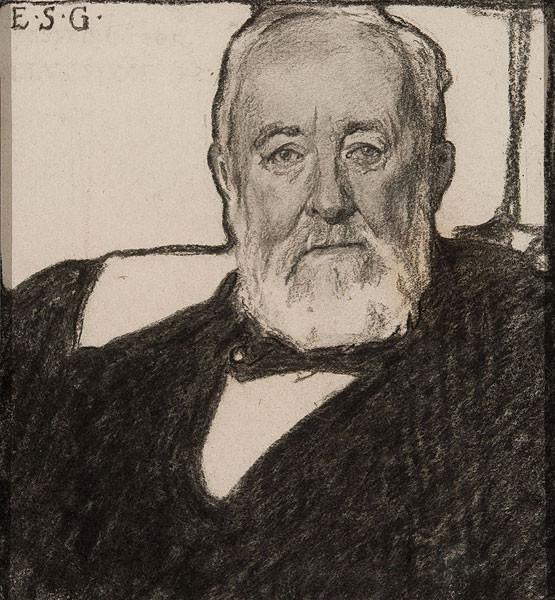
Elizabeth’s father imbued in his daughter a love of art as he was an amateur artist who had studied art at the Pennsylvania Academy of the Fine Arts and during the American Civil War, worked as an illustrator/correspondent for the Harper’s Weekly, an American political magazine based in New York City.   It was said that during her early schooldays Elizabeth took pleasure in illustrating her school notebooks. 

Portrait of the Artist’s Father, Jasper Green by Elizabeth Shippen Green (c.1900)

Elizabeth Shippen Green, self portrait

In October 1889, a month after that first publication of her work she enrolled at the Pennsylvania Academy of the Fine Arts.  She spent one year in the antique class, where she had to draw from plaster casts, and two years in the life class, working with live models.  During that period her teachers included Thomas Anshutz, Thomas Eakins, and Robert Vonnoh.  Elizabeth graduated from the Academy in 1893 and it was in that year that the Green family suffered a devastating loss.  Elizabeth’s sister, Katherine died on September 1st 1893, aged twenty-three.  This tragic death would haunt Elizabeth every year as it coincided with her birthday.  Elizabeth had now suffered the tragic loss of both of her sisters and one can only imagine the devastation felt by her parents.

Paper Doll Book #2 watercolour and charcoal by Elizabeth Shippen Green (1906)

Once her schooling was completed, eighteen-year-old Elizabeth enrolled at the Pennsylvania Academy of Fine Arts in 1888.  For Elizabeth the Fine Arts path was not for her as she was interested in her father’s branch of art, that of illustration and, in her father, she had the best illustrations tutor possible.  By the time she was seventeen years-old she had turned a corner of her bedroom into her studio and produced a series of drawings which she managed to sell to the Philadelphia Times and the first of these were printed by the newspaper on her eighteenth birthday.  The drawings accompanied a short but charming rhyme about a child and her doll, entitled, Naughty Lady Jane.   Although this was the only work of prose which she had published, the Philadelphia Times editors recognised her immense talent as an illustrator and in the September 8th 1889 edition of the Philadelphia Times the editor inserted this extended by-line:

“…You will see in another column today some very pretty verses called Naughty Lady Jane accompanied by six exquisite illustrations.  They are the work of Miss Bessie S. Green of Philadelphia who is only eighteen years old.  The lines are unpretending, of course, yet admirably suited to their purpose; but the illustrations show wonderful talent.  Indeed, they would do credit to an artist much older and more experienced than Miss Green…”

Elizabeth (“Bessie”) must have been delighted to have her work published although the payment of 5o cents for a one-column drawing was hardly going to give her financial independence.

Philadelphia Public Ledger

Elizabeth continued working hard and would regularly submit her illustrations to the Philadelphia Public Ledger, a daily Philadelphia newspaper which was, at the time, owned by George William Childs and Anthony J. Drexel.  Elizabeth received many assignments for fashion illustrations from the newspaper.  In 1897, Elizabeth Shippen Green enrolled at the Drexel Institute which had been founded by Anthony J Drexel, a Philadelphia financier and philanthropist in 1891.   He envisioned an institution of higher learning uniquely suited to the needs of a rapidly growing industrial society and of the young men and women seeking their place in it.

Enter Howard Pyle the leading American illustrator of the time and the two other Red Rose Girls…………………………

………………………………to be continued.


The information I used for my five blogs about the Red Rose Girls was mostly collected from the excellent book entitled The Red Rose Girls.  An Uncommon Story of Art and Love by Alice A. Carter.  I can highly recommend this biography.  You will not be disappointed.

Jules Breton. Part 2. Ruralism and Naturalism.

Jules Breton (1890)

Little did Jules know but this trip with his father to arrange his art tutoring was the last time they would be together as shortly after his father returned to Courrieres, he died.  On hearing of his father’s death, Jules returned home and he was alarmed to see on checking, that the finances of the family business were in a bad state, so much so, some of the family’s furniture had to be sold. Breton finally realised what it was like to be poor and suddenly was able to imagine how the local peasants must feel about their impoverished lifestyle.  He had always loved playing with and mixing with the young peasants but he had never really had to share their lifestyle or their social position in life.  With that in mind the depictions in his paintings began to be all about social realism and the predicament of the poor and the downtrodden.

Calling in the Gleaners by Jules Breton (1859)

Many of Breton’s paintings featured the peasant workers, mainly women, who were known as gleaners, gatherers of grain or other produce left behind in the fields after harvest. This was a charitable activity that allowed the poor and destitute members of a community to collect leftover material after a commercial harvest.   Jules Breton’s desire to depict the plight of the poor and oppressed, was sated with his many depiction of the gleaners.  A good example of this is his 1859 painting housed at the Musée d’Orsay entitled Le rappel des glaneuses [Calling in the Gleaners].  It is an ordinary scene of peasant life in his hometown of Courrières. 

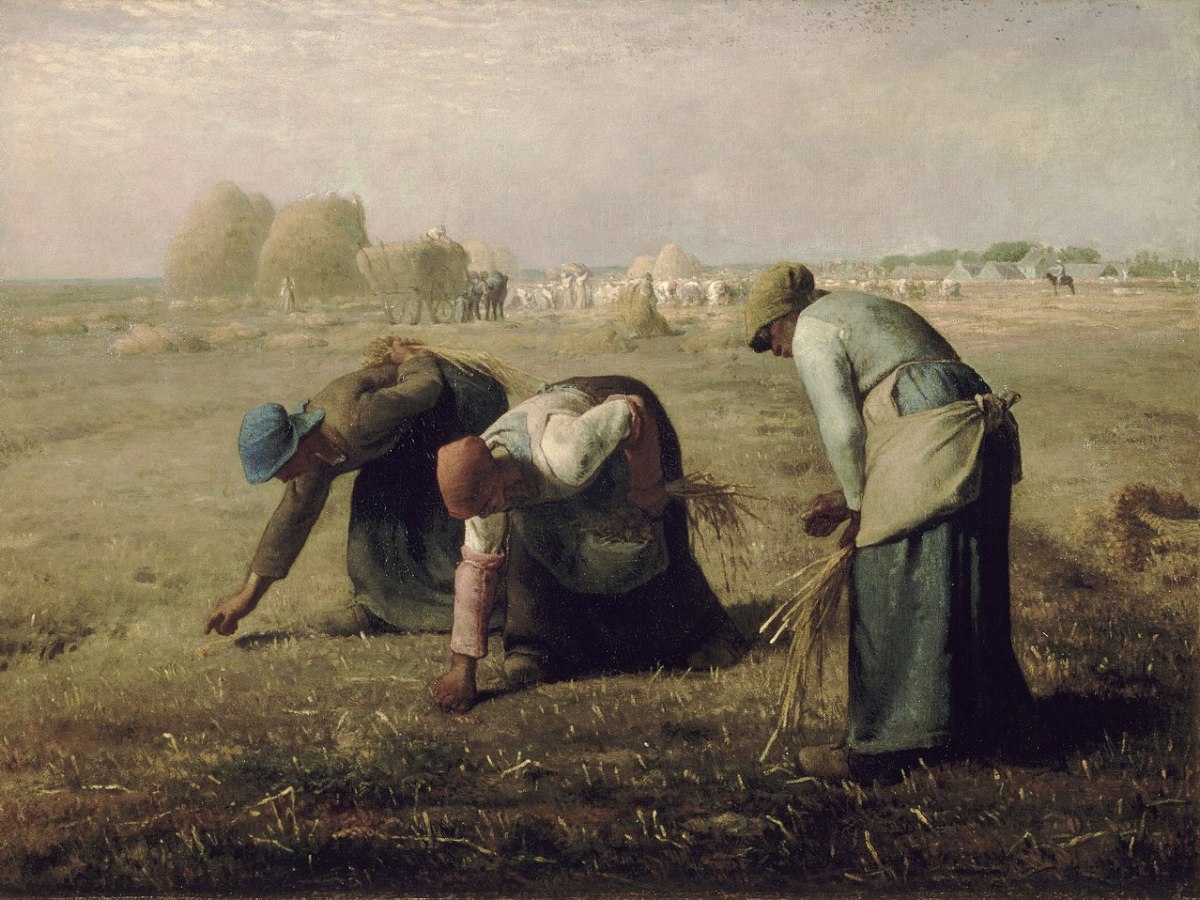
The Gleaners by Jean-François Millet completed in 1857.

Unlike Jean-François Millet’s famous depiction in which we see three women bent over picking up the grain, Jules Breton had portrayed the gleaners leaving the field in which they had been working.  It is the end of the day and the sun has set behind the trees which gives the painting the warm golden glow of late afternoon.  We see the crescent moon in the sky above and to the left and we catch sight of the rural policeman leaning against a milestone cupping his hands around his mouth like a speaking trumpet as he calls in the gleaners.  There are elements of realism in the way Breton has shown the female workers in threadbare, ragged clothes and barefooted but in a way this is also an idealised scene with the peasants walking out of the field with their heads held high in a noble and dignified pose and it was this idealistic and picturesque representation of the peasants and their working life which pleased both the critics and public. The painting was exhibited at the 1859 Salon and was much admired by those who saw it.  It even caught the eye of the Empress Eugenie, who arranged for it to be bought by the French state.  It was then exhibited at the Château de Saint Cloud, and three years later, it was given by the Emperor to the Musée du Luxembourg, which was then known as the Musée des Artistes Vivants.

The Last Gleanings by Jules Breton (1895)

Female gleaners also featured in Breton’s painting entitled The Last Gleanings which is part of the Huntington Art Museum collection in San Marino, California.

The Last Gleanings by Jules Breton (Detail)

In his painting. The Last Gleanings, there are three main characters in the foreground.  A young girl standing alongside a mature woman, both bare-footed, maybe mother and daughter, whilst, slightly behind them is an elderly woman.  This differing of ages, youth, maturity and old age, along with the sunset and the gathering of the remnants of the wheat harvest, can be seen as a metaphor for the passing of time.  The painting has a beautiful background featuring the setting sun, the rays of which wash over the low-lying clouds.  More gleaners follow behind the three in the foreground and to the left we can see a man with a raised stick, signalling the end of the working day.  Although Breton’s painting focuses on the practice of gleaning, we do not see the Millet-type women bent double picking up the remnant grains highlighting the back-breaking nature of the work.  In Breton’s depiction we see the mother and daughter adorned in their peasant attire look well fed and it does not suggest poverty and hardship so his depiction is offering us a mixed message.   On one hand we have a beautiful sunset and the two main characters wearing traditional costumes are carrying, with ease, bundles of wheat.  They look well nourished and yet on the other hand they are walking bare-footed amongst the sharp stubble of the wheat field and we also are aware that continually bending over to gather the wheat is a back-breaking task performed by poor peasants.  

 Catherine Hess, the chief curator of European Art at The Huntington, said we should be aware of the situation in France at the time.  She wrote:

“…In the late 19th century, the defeat of France in the Franco-Prussian War and the subsequent Paris Commune led to bloodshed and deprivation. And throughout the century, France remained a peasant nation, with three out of four men—many poverty-stricken—making their living by farming. Women, children, and the aged sought out gleaning to supplement their meagre provisions…”

The painting was bought by the American industrialist and art patron Henry Clay Frick.  He purchased the painting for $14,000 in 1895, immediately following its presentation at the Paris Salon. Jules Breton wrote to Frick and talked lovingly about the depiction:

“…it expresses a feeling I have frequently felt before the majestic simplicity and beauty of our rustic scenes, when bathed in the last rays of the sun. Those daughters of our fields seem then to be transfigured, the reflections of the heavens giving them the semblance of being surrounded by a natural halo…”

In 1905 Henry Frick returned the work to the art dealer as his taste in art had changed and in 1906 it was purchased by Henry Huntington for his collection.

The End of the Working Day by Jules Breton (1886-87)

Another of Jules Breton’s paintings featuring female peasants at the end of their working day was completed in 1887 and entitled Fin du travail (The End of the Working Day).  In this painting Breton has depicted three women returning from their day’s work in the potato fields.  The way they have been backlit by the sunset adds to the theatrics of the depiction.  Jules Breton had received Academic training and was well aware of the way historic paintings were very much the vogue when it came to teaching at the academy and maybe he remembered how the heroic betrayal of people in those paintings was thought to be currently  de rigueur.  Breton explained:

“… art was to do [the workers] the honour formerly reserved exclusively for the gods…”

The painting is part of the Brooklyn Museum collection.

The Wounded Sea Gull by Jules Breton (1878)

In the late 1870’s Breton completed a number of single-figure paintings of young females, mainly part of peasant families.  One example of this is his 1878 painting entitled The Wounded Seagull.  It depicts a young Breton peasant woman cradling and stroking a wounded gull whilst other gulls fly around in the background.  The strange thing about this depiction is that although tending to the bird she is not looking at it.  Her demeanour is one of pensiveness and it seems that her mind is concentrating on other things in her life.  This work was shown in 1881 at the first special exhibition at the newly founded St. Louis School and Museum of Fine Arts and remains part of the Saint Louis Art Museum.

A Fisherman’s Daughter b y Jules Breton (1878)

Another single-figure work by Breton is housed at the Musée de la Chartreuse de Douai and is entitled A Fisherman’s Daughter which he completed in 1878.  The painting depicts a girl wearing a red headband under a white cornette.  She is dressed in a blue wool petticoat and a tawny bodice. Around her neck, she wears a purple cotton handkerchief crossed on her chest.  On her arms there are false sleeves and in front of her an apron of grey canvas. She is barefoot, and leans against a rock as she repairs a fishing net for her father.  This was a traditional task that women did for their sea-going folk.   The setting is Port-Rhû near Douarnenez, in Brittany.

The Tired Gleaner by Jules Breton.(1880)

When Breton returned home to Courrières to help the family, he embarked on a number of figurative paintings of full-figure views against the flat fields.  One such work was his 1880 painting, The Tired Gleaner.  It portrays a young woman, stretching her arms, after a back-breaking day working in the fields, with a backdrop of the setting sun.  Breton repeated this backdrop in many of his rural works.

The Song of the Lark by Jules Breton (1884)

One of Breton’s best known and most successful single-figure work is Song of the Lark which he completed in 1884.  It was exhibited at the 1885 Salon where it was purchased by George A. Lucas a dealer from Paris, for his client, Samuel Putnam Avery, an American artist, art dealer, and philanthropist best remembered for his patronage of arts and letters.  It eventually came part of the Art Institute of Chicago collection in 1917. It was deemed the most popular painting in America in a poll conducted in 1934 by the Chicago Daily News  to find the “most beloved work of art in America”  The First Lady Eleanor Roosevelt unveiled The Song of the Lark as the winner and declared the painting as being her personal favourite.   It depicts a barefoot young peasant woman farm worker, sickle in hand, happily singing as she sets off to work in the fields near Courrières.  For this painting Breton’s model was a local woman, Marie Bidoul, who stood for him outdoors in the field at dawn and dusk until the artist was happy that he had captured her form.  

First edition cover of The Song of the Lark

Willa Cather’s 1915 novel The Song of the Lark takes its name from this painting.

…………………………..to be continued.

Jules Breton. Part 1. The beginning of an artistic journey.

Before the era of photography and mobile phones, paintings were often bought as  pictorial aide-mémoirs and I am sure it still happens nowadays.  It could be a portrait of a friend, relative or somebody one admires.  It could be a specific landscape or cityscape which one had once visited and wanted to be reminded of.  The completed painting would then adorn a wall in the room of one’s house and be looked at with pleasure every time we passed by it.  Sometimes a painting is placed on display to lift our mood.  Sometimes the painting may be there to remind us of a life we once had or a life we hanker for.  Whatever the reason, artists cater for our wishes to remember.  Of course, one has to decide whether the depiction in the landscape or cityscape painting is topographically accurate or is it an idealised version.  Maybe we want an idealized version, as over time, do we not conjure in our mind just that.

The Rest of the Haymakers by Jules Breton (1872)

When we look at paintings of rural scenes of the past and focus on the peasant workers, what are we wanting to see?  Do we want to have a painting on our wall which focuses on the difficult times the peasant labourers faced?  Do we want to see the folk poorly dressed, shoe-less and struggling to survive?  If that is what we want hanging on the wall of one of our rooms then we need to search for works by the social realism painters.  However, if we want to see depictions of happy smiling workers then we need to look for works by the rural naturalism painters such as today’s featured painter.  Let me introduce you to the nineteenth-century French painter, Jules Adolphe Aimé Louis Breton, one of the greatest artists who managed to convey the beauty and idyllic vision of rural existence, even if it was an idealised vision of peasant life.

Jules Breton

Jules Adolphe Breton was born on May 1st, 1827 to an important family in the small village of Courrieres situated in the Pas-de-Calais department in the Hauts-de-France region of Northern France.  His father, Marie-Louis Breton, oversaw land for a wealthy landowner. His mother died when Jules was four and he was brought up by his father. Other family members who lived in the same house were his maternal grandmother, his younger brother, Émile, and his uncle Boniface Breton.  Jules lived a contented life as a child despite losing his mother at that early age.    His home life was relaxed and was a happy environment, and he got great pleasure playing with the local children belonging to the local peasant farmers despite Jules and them having come from different social classes.

Young Mother nursing her Child, Courrières by Jules Breton (1873)


At the age of ten, Breton was sent to school at a Catholic seminary run by the Jesuits.  It was an unhappy experience for him.  His fellow pupils were unkind to him and he had many a run-in with the authoritarian Jesuits. In the summer of 1842, fifteen-year-old Breton met a man who would shape his future.  He, his father and uncle had been staying with friends at Muno, a Belgium town close to the French border and near the Amerois forest in the Ardennes.  One evening a visitor called on his uncle.  He introduced himself as Félix de Vigne, a painter and professor in the Academy in Ghent. He had come to examine four volumes of French costumes which had beautiful colour plates and belonged to Jules’ uncle.  Although Jules Breton was introduced to de Vigne, the boy’s bashfulness prohibited him from talking about his love of drawing and painting and his desire to become an artist.  When de Vigne left, Jules was devastated at missing the chance of confiding his artistic dreams with the painter.

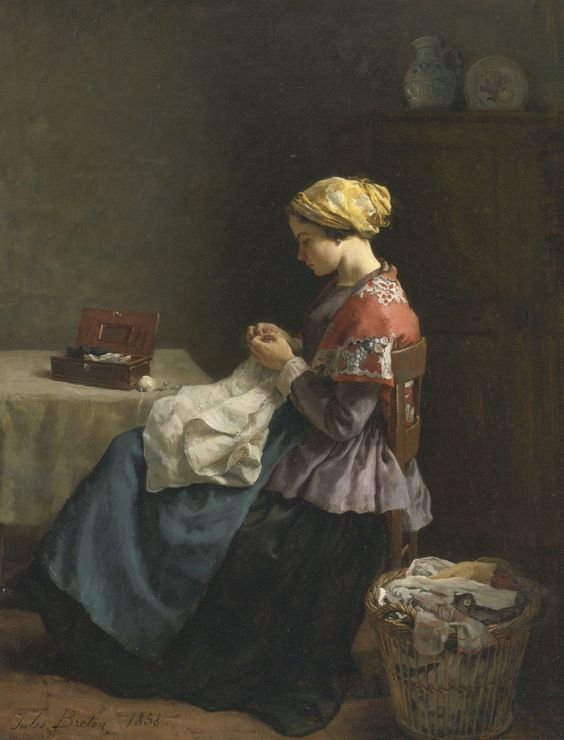
La Petite Coutière by Jules Breton (1858)


In the autumn of 1842 Jules attended the College St. Bertin near Saint-Omer and it was here that he received his first artistic training.   A year later, in 1843, Breton’s uncle happened to be returning home from Lille in a coach and found himself sitting next to Felix De Vigne.  Knowing about his nephew’s disappointment with not conversing with de Vigne, he decided to arrange another meeting under the pretence that he would like the artist to come to their house in order to complete a portrait of my uncle.  The artist agreed.  Not to be wanting to miss another opportunity to talk about art to de Vigne, Jules presented him with sketches he had completed at the college.  Although not liking Jules’ copies of mythological busts he was impressed by his pencil portraits and landscapes.  In the summer of  1843, de Vigne then arranged with Breton’s father and uncle to allow Jules to live with his family and to study with him for three months at his atelier at no.8 Rue de la Line in a quiet quarter of the Belgium city of Ghent.  In his autobiography Jules remembered his first impressions of the city:

“…The city of Ghent seemed to me magnificent.  I felt proud and happy to be able to walk at will through the streets of this Flemish Venice, with its innumerable bridges, its old wharves crowded with merchandise, its ancient houses, some of which look down upon you from the middle ages and whose trembling images are reflected from the waters of the canals, where glide countless boats…”

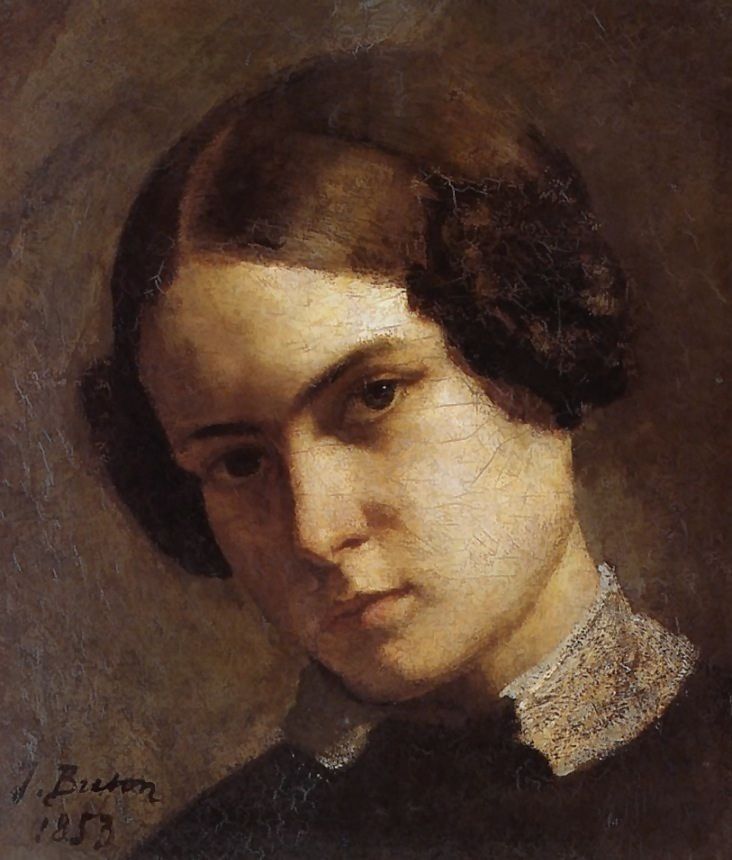
Breton also remembered de Vigne’s eldest child, seven-year-old Elodie.  And in his autobiography, he described her, writing:

“The eldest, Elodie, was a gentle child, in whose blue eyes, shaded by long, silken lashes, there already shone a mysterious charm.   She went about the house silently, gliding rather than walking.  She held her fragile figure thrown slightly backward and her delicately outlined face, resembling that of one of the angels in a Gothic cathedral, inclined forward, as if bending under the weight of a prematurely thoughtful brow……She was about seven years old and I danced her on my knees…”

Portrait of Elodie de Vigne by Jules Breton (1853)


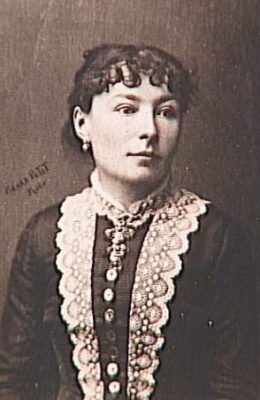
Unbeknown to the then sixteen-year-old Jules, he and Elodie would become man and wife fifteen years after that first meeting.  The couple married on April 29th, 1858.  Jules was thirty-one and his wife was twenty-two.  On July 26th 1859, their daughter Virginie was born.  She studied art under her father and, through her father, she was introduced to other painters, the most influential being Rosa Bonheur who became her role-model and mentor.

Virginie Demont-Breton c.1900, Photograph by Pierre Petit


Virginie was a very talented painter and by the age of twenty, she was exhibiting at the Salon where she received an Honourable Mention and, four years later, she won a Gold Medal at the Amsterdam Exposition.  Virginie travelled extensively and exhibited her work in Holland and France, often receiving medals and citations.  She became President of the Union of Women Painters and Sculptresses, and she was the second woman to receive the cross of the Legion of Honour, the first one going to Rosa Bonheur. Her paintings often featured motherhood or French fisherfolk themes. In 1880, she married artist Adrien Demont, once a student of her uncle, Emile, and the couple moved to Wissant, a small coastal village on the Côte d’Opale, midway between Calais and Boulogne.

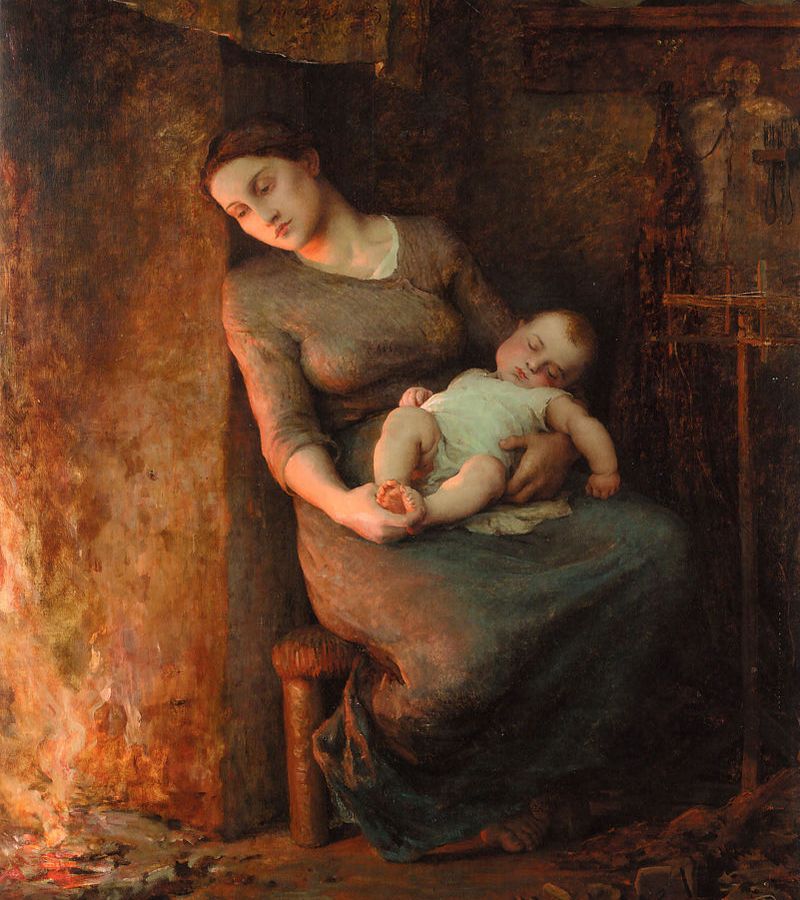
Her Man is at Sea by Virginie Demont-Breton


Whilst living at Wissant, Virginie Élodie Marie Thérèse Demont-Breton began depicting the fishermen and their families in a Realist-style and one 0f her many paintings of that genre, which I particularly like is entitled Her Man is at Sea.  In it we see a mother cradling her baby as she sits by the open fire.  All her thoughts are about her husband who has left the home to go to sea with the local fishing fleet.

Her Man is at Sea (after Demont-Breton), by Vincent Van Gogh, (1889),


Obviously it was not just me that liked the work because in 1889 Van Gogh painted a work based on Virginie’s depiction!

Portrait of Félix de Vinge, by his student Lievin De Winne


Whilst in Ghent Jules Breton enrolled at the city’s Royal Academy of Fine Arts where de Vigne was once again, one of his tutors.  The director of the Academy at the time and another of Breton’s tutors was the Belgian portrait artist and sculptor, Henri van der Haert.  During his stay at the Academy, Jules Breton became great friends with a fellow art student, Liévin de Winne, who would later become one of the foremost Belgian portrait painters of his time.  The friendship between the two would last for many years.  Breton studied at the Academy for three years and during this time he would study the works of the great Flemish Masters.   

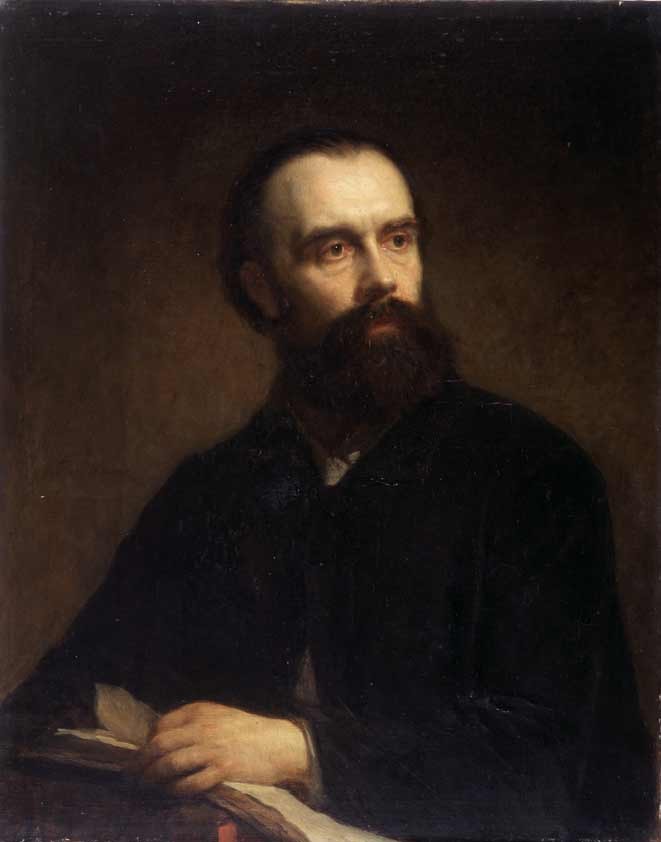
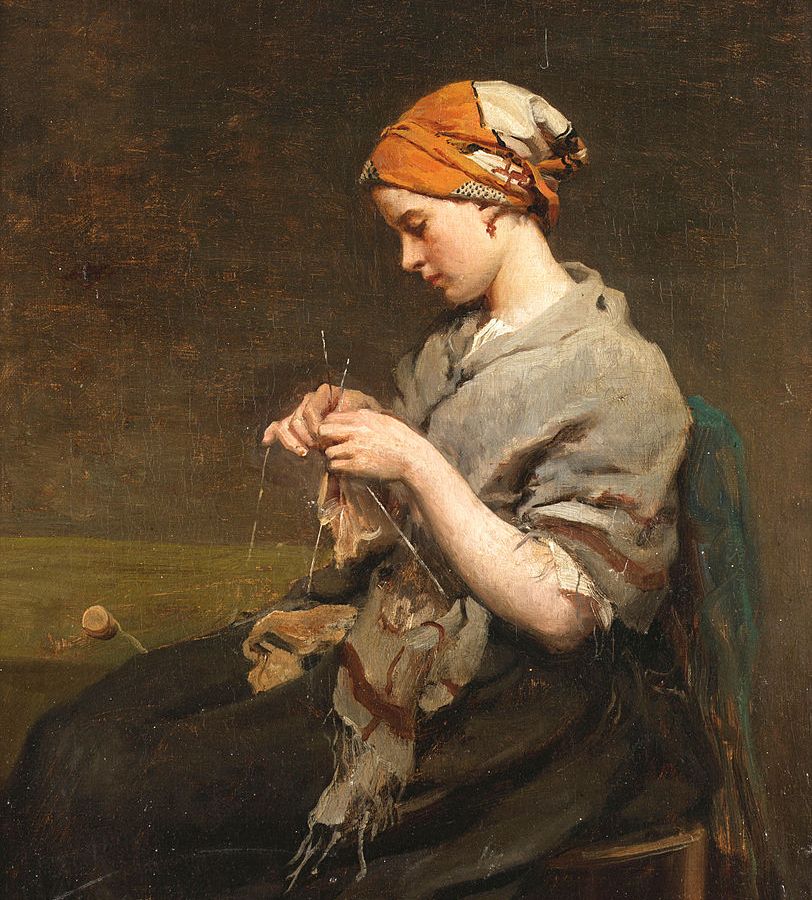
Jules Adolphe Breton – Jeune fille tricotant (Young girl knitting)


Jules Breton left Ghent midway through 1846 and travelled to Antwerp where he stayed for six weeks at the Hôtel Rubens in the Place Verte.  He enrolled at the Royal Academy of Fine Arts at which time the director and one of Breton’s tutors was Gustaf Wappers.  As a professor at the Academy Wappers had taught such well-known painters as Ford Madox Brown, and Lawrence Alma-Tadema.  Breton’s tenure at the Academy lasted a mere three months as he decided it would be more beneficial to spend his time at The Royal Museum of Fine Arts Antwerp where he studied and copied the paintings of Rubens.  Besides his love of the works of Rubens, Breton was influenced by the paintings by Memling, Van Eyck, Van der Weyden and Quentin-Matsys.  Nineteen-year-old Breton contracted chronic bronchitis at the end of 1846 and his father had to bring him home from Antwerp.  Jules was very surprised to see how old and ill his father looked and this, despite his own illness,  was of great concern to him.

A Peasant Girl Knitting under a Tree by Jules Breton (c.1870)


Eventually father and son got back to full health and Jules needed to decide upon his next step of his artistic journey,  He and his father had visited Paris in 1845 and Jules believed he should return to the French capital and hone his artistic skills.  The decision made, Jules returned to Paris in 1847 and took up residence in a small room on the third floor, at No. 5 Rue du Dragon, on Paris’s Left Bank.  Now the only decision left to be made was which atelier should he join.  After a recommendation Jules Breton went to study at the atelier of the neoclassic French painter, a painter of history and a portraitist, Michel Martin Drolling, who was a professor at the Ecole des Beaux Arts.  Breton remembered the moment he and his father knocked on the door of Drolling’s atelier:

“…I knocked timidly at the door of his studio, it was Drolling himself, his palette in his hand, who opened the door.   He wore a knitted woolen jacket and a red Greek cap, as he is represented in the portrait painted of him by his pupil Victor-Francois Biennourry.   His frank and simple manners, somewhat brusque, and his long white moustache, gave him the air rather of a retired officer than of an artist…”

……………………to be continued.

Laurits Ring. Part 2 – True love and happiness.

The Road at Mogenstrup, Zealand. Autumn, by Laurits Ring (1888)

In the later part of the nineteenth century, Ring concentrated on landscape painting.  For Ring, painting landscapes allowed him, through the works, to communicate and find expression in the world around him. One example of this is his 1888 landscape painting entitled The Road at Mogenstrup, Zealand. Autumn.  This depiction is evidence that he was fond of muted autumn colours and there is a definite hint of melancholia about the depiction which may have mirrored his mood at the time.

Thaw by Laurits Ring (1901)

A similar type of “drab” work is his 1901 painting entitled Thaw.  The dilapidated fence in the foreground renders the depiction even more gloomy as does the artist’s use of yellowish-brown colours.  It is yet another example of what one critic called Ring’s “landscapes of the soul”— a type of psychological painting with its own poetic soberness.  Ring landscapes project his personal emotions. His friend and biographer Peter Hertz, a Danish art historian and museum worker, wrote how Ring, especially in those periods from 1887 to 1893 when his depressive moods and melancholy were prevalent, discovered a way of liberating himself, by painting his many overcast and misty landscapes.  Hertz wrote:

“…With such weather he has closed himself up inside his own loneliness and found a resonance in nature, echoing his own mood… In these scenes of dull, overcast weather he reaches his highest pinnacle, giving most of himself…”

Laurits Rings was in a very bad place mentally in 1892.  He had broken off all contact with Alexander Wilde and his wife Johanne.  He had suffered the heartbreak of his mother dying and the sudden death of his brother, Ole.  These losses made him doubt his belief in God and with this doubt came another doubt, a doubt in his own artistic ability and is hope that the lot of the peasant workers would be addressed came to naught.

Herman Kähler in his Workshop by Laurits Ring (1890)

Salvation came to him in the form of a ceramicist, Henrik Kähler, who owned a Danish ceramics factory.  Kähler Keramik was based in Næstved on the island of Zealand.  He had started to experiment with more appealing designs with glazed finishes and in 1886, he succeeded in attracting a number of well-known artists to complement his designs.  Laurits Ring was one as was his friend Hans Andersen Brendekilde.  Through his relationship with Henrik Kähler, Laurits met his daughter, Sigrid who was also a painter as well as a ceramicist.  Sigrid Kähler was the third woman who took on a special importance in Rings’ life. 

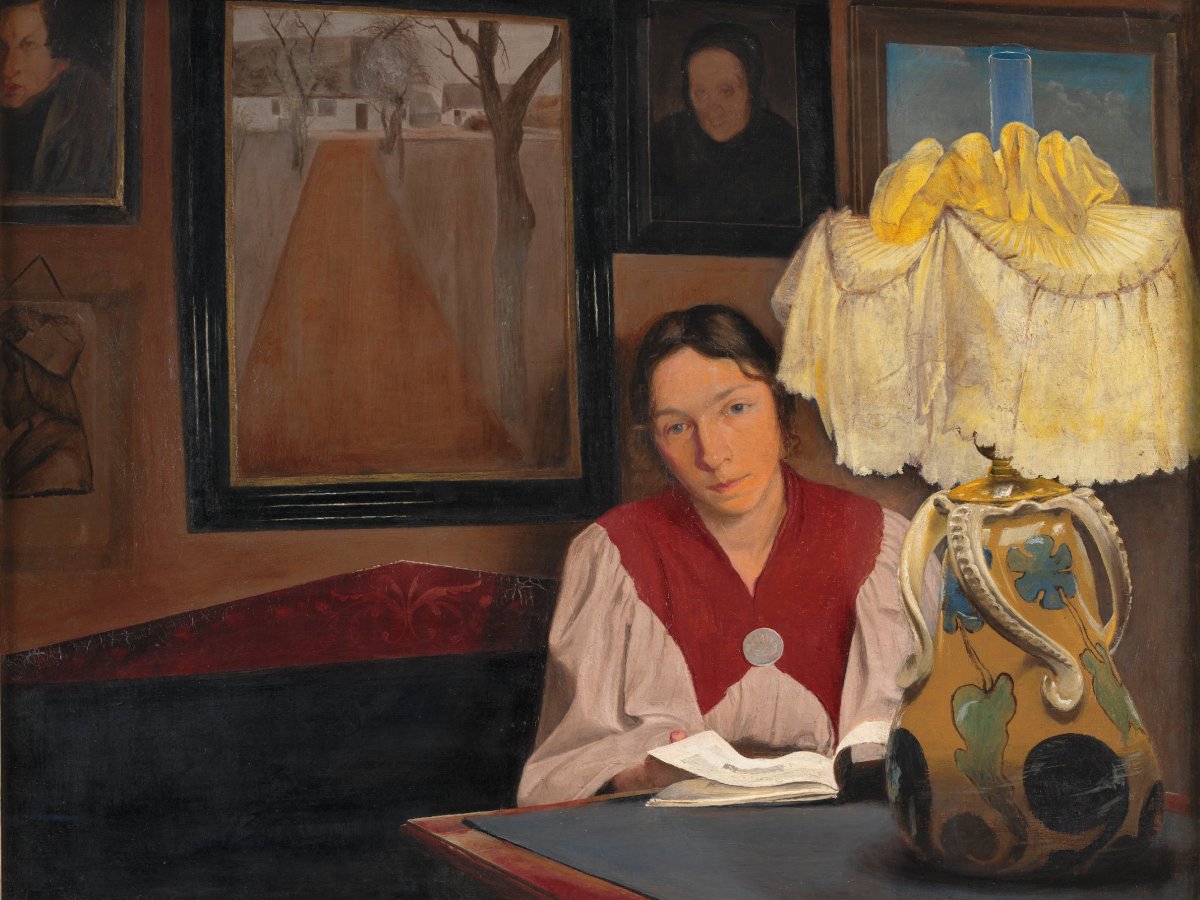
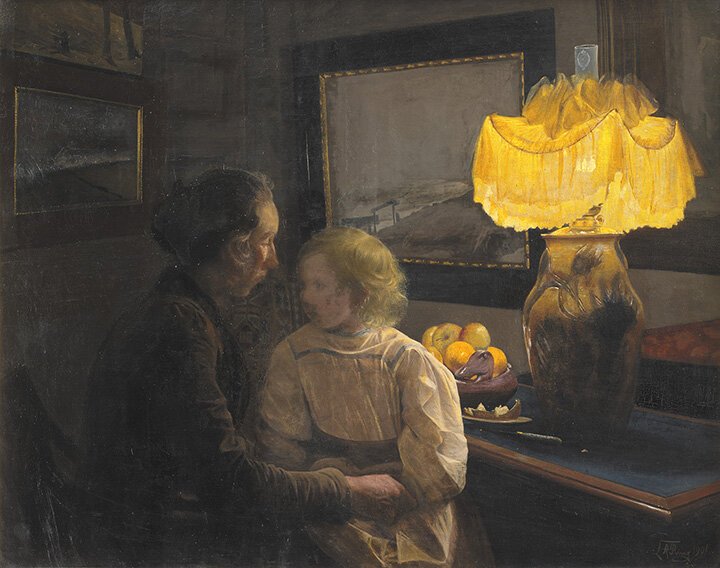
The Artists Wife by Lamplight by Laurits Ring (1898)

She was literally his lifesaver.  Friendship between them soon changed to mutual love and the couple married on July 25th 1896. Laurits was 42 and Sigrid was 21.  The couple moved to a house in the harbour town of Karrebæksminde on the south-east coast of Zealand.

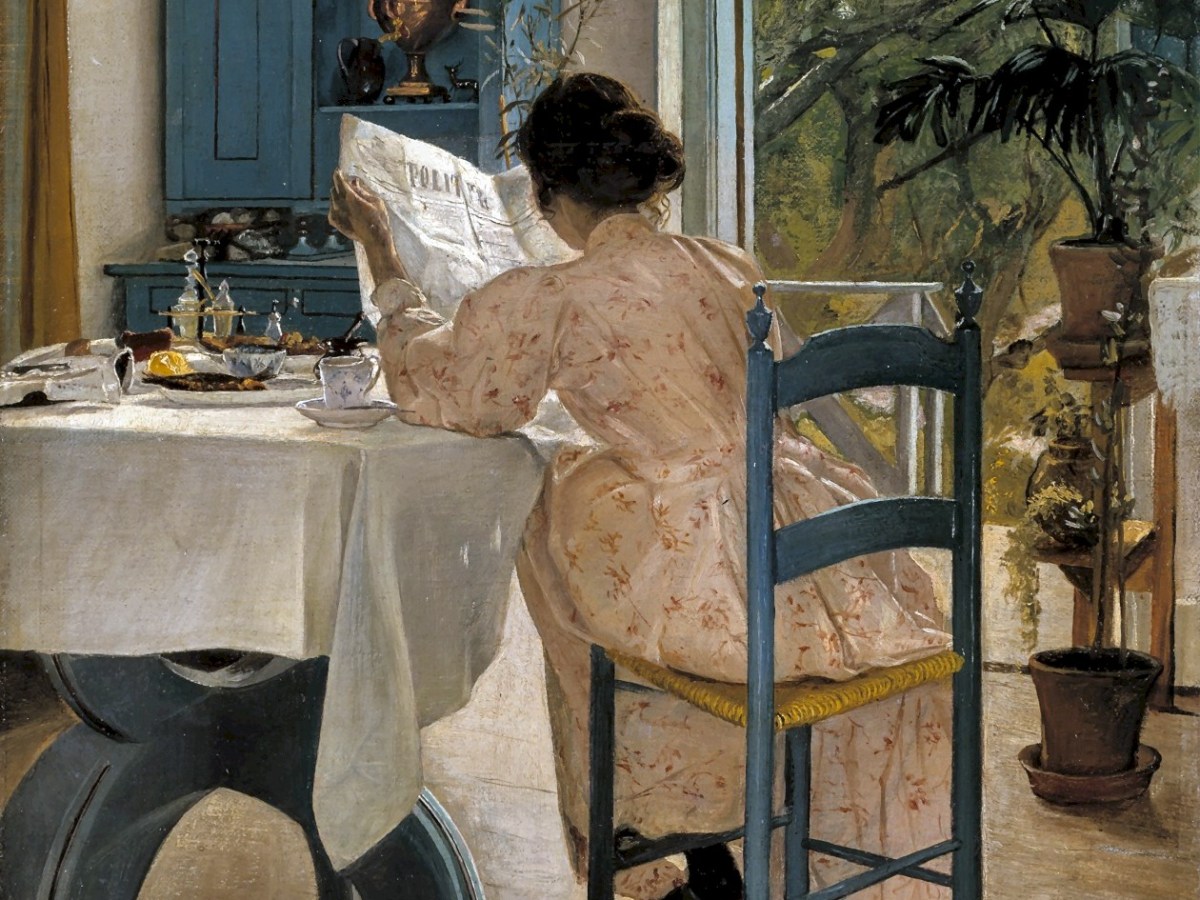
At the Breakfast Table by Laurits Ring

Sigrid featured in many of Laurits’ paintings.  In his paintings of Sigrid we can depict subtle symbols of love and affection and the use of soft hues are different from his more melancholic ones he used in his Realism works.  One depiction of Sigrid was his 1898 work entitled At the Breakfast Table.  We see his wife seated at the breakfast table reading Politiken, the Danish daily broadsheet newspaper, which is Laurits’ way of reminding us about the world outside.  The scene is lit up by the streams of sunlight which come in through the open door, and if we look outside, we can make out the lush green of summer.

In the Garden Door. The Artist’s Wife by Laurits Ring (1897).

Sigrid also featured in her husband’s 1897 work entitled In the Garden Door: The Artist’s Wife.  The painting is housed in the Statens Museum for Kunst (SMK), National Gallery of Denmark and has proved to be one of the most loved works on show.  Peter Nørgaard Larsen Chief Curator, Senior Researcher at SMK says of the work:

“…It’s one of my favourite pictures, and there are several reasons for that. It is fantastically nice painted and has a very crisp and delicate colour scheme. And then it’s a picture you’ll be happy to look at. This is the summer we dream of with a fertile garden and a beautiful woman. After all, this is the woman he just married, so he’s obviously interested in portraying her as part of a world he experiences as happy. A very positive picture…”

So, is this just a depiction of his wife, Sigrid, pregnant with their first child, Ghitta Johanne, who stands before a beautiful Spring garden scene which symbolises a consummated and fertile love between the artist and his wife?  Is this simply a painting honouring fertility and the up and coming new life?   Or is there something else we should be contemplating as we look at the painting.  Remember Laurits Ring was, besides a man dedicated to Social Realism depictions, also a Symbolist painter.  Let us look a little closer at the depiction.  His wife stands before us on the patio with her belly bulging with her unborn child.  This is about new life.   Compare that with the potted bush by her side.  It looks stunted being confined to the pot.  Its branches are gnarly and old.  In all, it looks as if it is coming to the end of its life.  The depiction is a comparison of new life and death.  It is a painting depicting transience and in some way a reminder that all things come to an end.  It is Ring’s appreciation that the opposite to life is death.  Ironically the painting is somewhat premature as Sigrid did not give birth to her daughter until January 5th 1899 !

The Artist’s Wife and Daughter by Laurits Ring (1901)

In 1901 Ring produced a painting featuring his wife, Sigrid and their two-year-old daughter Ghitta.

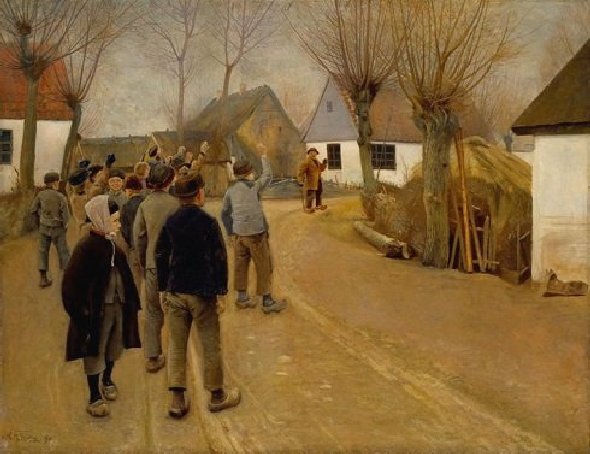
The Drunkard by Laurits Ring

For me, his Social Realism art is his best genre.  In 1890 he completed a work entitled The Drunkard.  It depicts a group of angry villagers, fist-waving and shouting at an elderly man with a walking cane, some distance from them.  He has been forced back to the edge of the village by the baying crowd.  He has been isolated.  It is a sign of rejection.  However, it is not what we perceive it to be.  The scene is actually part of a children’s social play.  It is all about rejection and isolation of a lone figure at the hands of an unsympathetic group.  The artist is testing us to think about times when we have shown little sympathy towards our fellow human beings.  He wants us to examine our own conscience.  The painting sadly verifies Ring’s pessimistic view of the human race.

A Waiting Horsecart on a Village Road by Ole Ring (1946)

On October 9th, 1900, Laurits and Sigrid’s second child was born, a son Anders Herman, who became a painter, silversmith and sculptor.  The family moved to the old school in Baldersbrønde near Hedehuse, where on August 6th, 1902, their third and final child, a son, Ole was born.  He like his father would become an accomplished artist and well-known for his local landscape works.

A Visit ot a Shoemakers Workshop by Laurits Ring (1885)

Laurits Ring’s interest in politics and social issues was an ever theme in his paintings.   An example of this is his 1895 painting entitled A Visit to the Shoemaker’s Shop.  It depicts a politician from the Social Democratic Party who has called on a pair of cobblers hoping that he would secure their support.  It was through Laurits’ political convictions and his social realism depictions of workers and peasants during the early industrialization in Denmark, that he played an important role in what was termed The Modern Breakthrough. Unlike many of his contemporary artists and writers, you have to remember that Laurits Ring was not from a comfortable middle-class or upper-class background but originated from an impoverished peasant farming background and as one reviewer noted in 1886:

“…One implicitly trusts that Ring truly knows the life he portrays…”

Drænrørsgraverne (Laying the drains) by Laurits Ring (1885),

Another of Ring’s painting, from that year, which highlights the hard work of the less well paid is his depiction of drain-layers in his 1885 work, Laying the Drains.   Laurits Ring was always sympathetic with the workers’ struggle for better living conditions and throughout his life he expressed respect for the poor. Ring was always careful to depict the everyday life among workers and rural people with dignity, and avoided sentimentality, choosing to highlight a realistic view of people’s lives, notwithstanding whether his subject was a poor farm couple or a pair of ditch diggers.

When the Train is Expected. Level Crossing at Roskilde Highway by Laurits Ring (1914)

My favourite three paintings by Ring are ones which show his innate ability to portray everyday life.  The first is his 1914 work entitled Waiting for the Train. Level Crossing by Roskilde Highway.

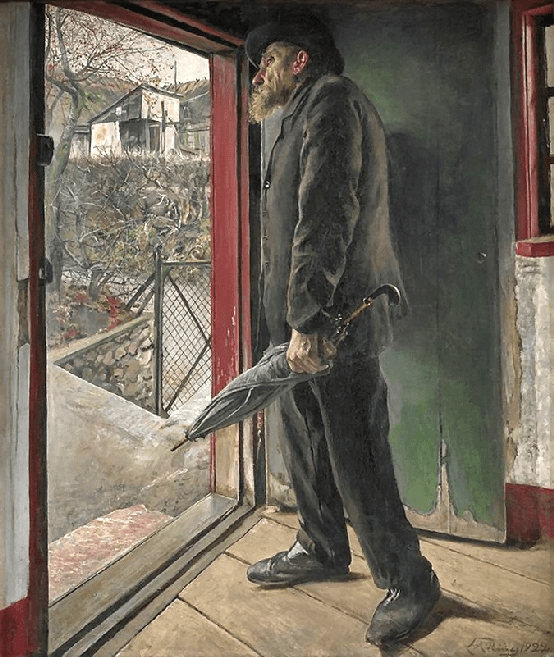
Has it stopped raining by Laurits Ring

The second is his true to life work entitled Has it stopped Raining

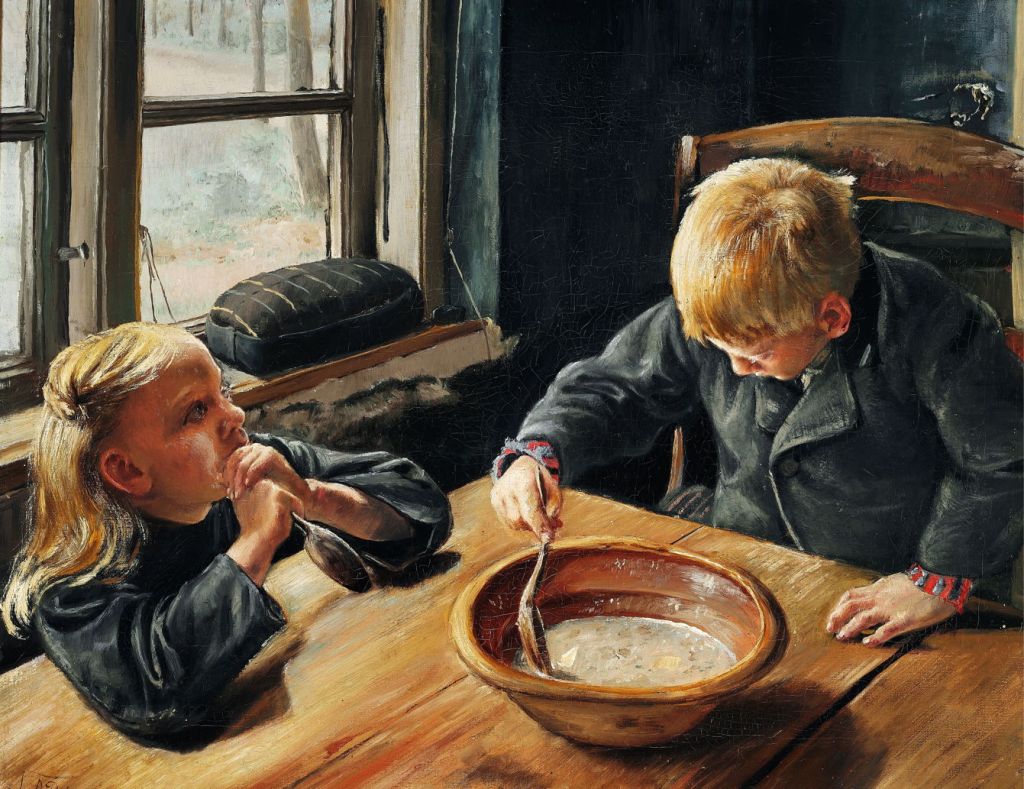
A Boy and a Girl Eating Lunch by Laurits Ring (1884),

And the third is his 1884 Social Realism painting entitled A Boy and Girl Eating Lunch in which we see two children sharing a bowl of broth which focuses on the plight of poor children who often struggled to get sufficient food.

Laurits Ring with his audience

Laurits Ring led a nomadic life during his single and married years.  He frequently moved house preferring to live in small Zealand villages which probably reminded him of Ring, his birthplace.  This life of wandering was interspersed by periods of calm and waiting. 

Looking at Laurits Ring’s work reveals the extent to which the themes of travel and waiting infuse his art. His paintings record the historical changes that took place in the decades around the turn of the century.  This was a period of great change with the coming of modern life and Ring tried to capture how it affected the less well-off.

The aging Laurits Ring, photographed in 1926 as a guest of the couple Johanne and Paul Buhl. Ring sits on the terrace in front of their summer residence on Egevangen on the outskirts of Randers.

In January 1914, Laurits and his family moved to a newly built house on Sankt Jørgensbjerg in Roskilde.  Nine years after that move Laurits’ wife was taken seriously ill and on May 9th, 1923, three days before her 49th birthday, Sigrid Ring died of lung cancer.  After his wife’s death Laurits, then sixty-nine, went to live with his twenty-one-year old son, Ole.  In September 1933, Laurits Ring suffered a brain haemorrhage with slight paralysis of his left arm. He died on Sunday, September 10th, 1933, aged 79.

Laurits Andersen Ring. Part 1. Death, unrequited love and depression.

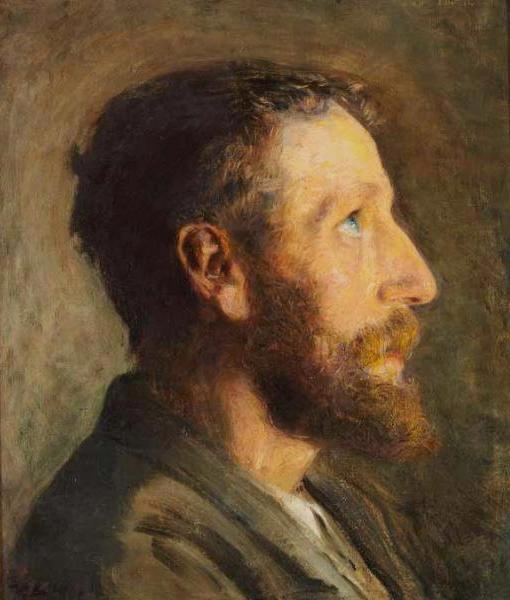
Portrait of Laurits Andersen Ring by Knud Larsen

ecently I gave you five blogs which were devoted to one of the great Surrealist artists of the twentieth century but today I am reverting back to what I would irreverently term “ordinary” paintings.  However, there is nothing ordinary about the works of the Danish painter Laurits Andersen Ring, professionally known as L.R. Ring, one of Denmark’s foremost artists during the late nineteenth and early twentieth centuries. He was a pioneer of both symbolism and social realism.   I had not previously known anything about him or his work but I could not believe how beautiful his paintings were.

Tåget landskab med Mogenstrup Mølle (Foggy landscape with Mogenstrup Mill,) by Laurits Ring (1889)

Laurits Andersen Ring was born Laurits Andersen on August 15th, 1854 in the village of Ring, near Næstved, in the south of the Danish island of Zealand. His father was Anders Olsen and his mother was Johanne Andersdatter.  For several generations, the Anders Olsen family had been peasant farmers and Johanne was a farmer’s daughter and came from a family of smallholders.  When Anders and Johanne married, he took over his father-in-law’s house in the village of Ring.  However, due to his poor health, asthma, he was unable to work the land and so neighbours undertook the upkeep of the land whilst he established himself as a carpenter and wheelwright.  Anders and Johanne had their first child, a son, Ole Peter on January 6th 1850 and four and a half years later Johanne gave birth to Laurits on August 15th, 1854.  Laurits and his brother grew up in a family with cramped and impoverished conditions, and throughout his life Laurits was particularly concerned with the struggle of workers and peasants to get better living and working conditions.  As teenagers the two boys had to help in their father’s workshop as his health was deteriorating and he was unable to work for long periods of time.  Eventually Ole took over the family business.

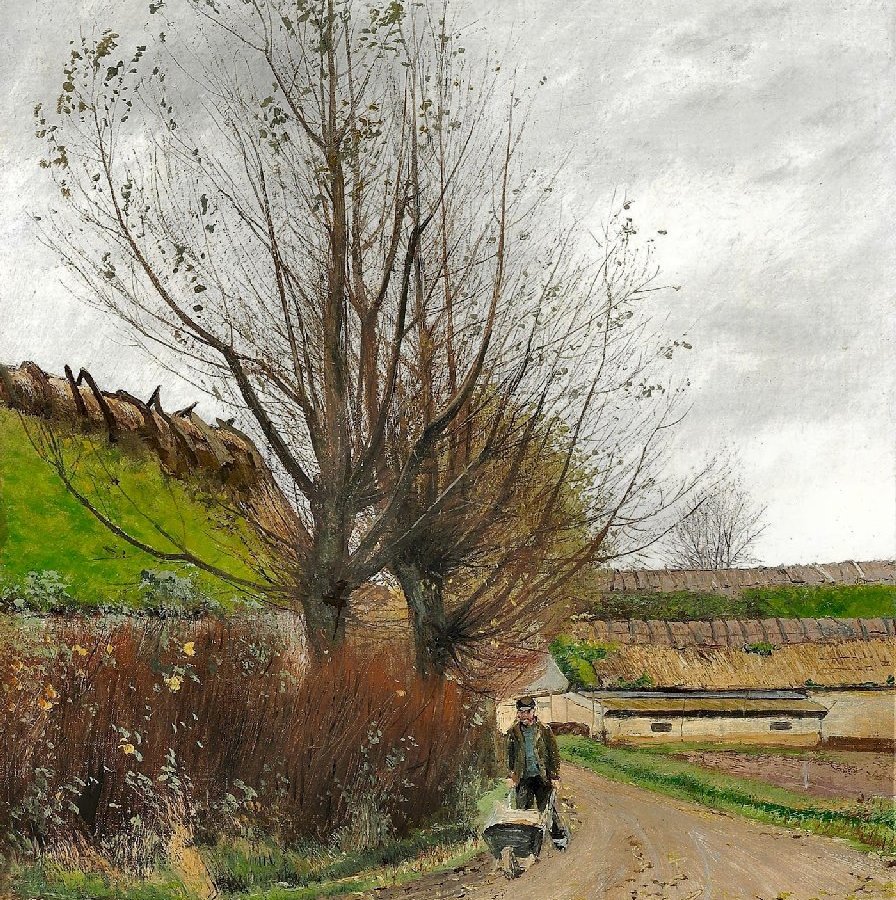
Autumn Weather: A Man with a Wheelbarrow on a Path by Laurits Ring

With Ole was looking after the family business, Laurits was free to further his own ambitions, that of becoming a professional painter. In 1869, aged fifteen, Laurits became a painter’s apprentice.   In 1873, while working in Copenhagen Laurits decided to enrol in painting classes and, in 1875, following two years of private study, he gained entrance to the Royal Danish Academy of Arts.  It was around this time that Laurits decided to change his surname.  He and his friend, fellow painter Hans Andersen, who came from the village of Brændekilde, decided to change their last names, taking the names of their native villages, in order to avoid confusion at exhibitions when they both exhibited paintings.  Laurits Andersen became Laurits Ring and Hans Andersen became Hans Andersen Brendekilde.  As has been the case of many young artists I have profiled, Laurits fell out of love with academic teaching and the Academy set-up.  He was never satisfied with life at the Academy and loathed the strict training in classical disciplines.  In 1882 Laurits had his paintings shown at his exhibition debut.  It was a great triumph and through this and other exhibitions he slowly received critical acclaim for his work and within two years his artistic career had been launched successfully.

The Railroad Guard by Laurits Ring (1884)

In June 1884, Laurits Ring produced a painting which finally bestowed on him the artistic recognition he deserved.  The painting was entitled The Lineman.   Rail transport in Denmark began in 1847 with the opening of a railway line between Copenhagen and Roskilde and for Denmark, it was the great innovation of the middle and late nineteenth century.  Look at the figure in the painting.  He is the Lineman or Railway Guard.  He is dressed in his railway uniform.  He stands looking down the line at the on-coming train.  If we look more closely at the figure, we see a man whose clothes are ill-fitting.  He wears old wooden clogs.  His demeanour is one of tiredness with his slumped shoulders and there is a definite air of poverty about him.  Although the new railways might have benefited the country, they also allowed people the opportunity to escape impoverished rural communities and find work in the cities which further worsened the predicament of the rural communities which suffered the greatest poverty.

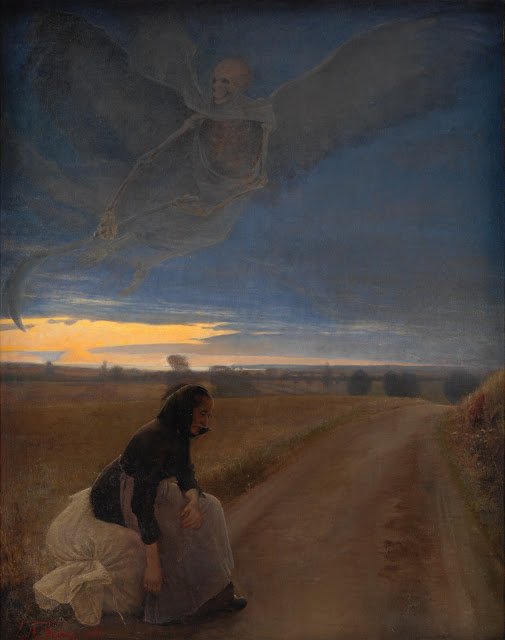
Evening. The Old Wife and Death by L.A. Ring

Sadly, just as Ring’s career was taking off, tragedy struck. On June 18th, 1883, his father, Anders, died, aged 66.  Laurits’ childhood home was dissolved, and his mother had to go and live with his brother. Worse was to happen three years later, on March 28th, 1886, when Laurits’ brother who had been looking after his mother, died after a short illness, aged 36.  Nine years later, in 1895, Laurits’ mother died aged 81.  These inevitable but tragic events occurred in a twelve-year period and greatly affected Laurits Ring.  Many of his works around this time focused on death, such as his 1887 painting entitled Evening: The Old Wife and Death.  Laurits, besides his Social Realism works, was also known as a symbolist painter, and depicted in this painting, we see before us an old woman resting by the roadside, exhausted after carrying her heavy burden.  Her arm hangs slack.  She can do no more. She is close to death.  She will not get to the end of the road.  She will not make it home.   The sun has set and the soft light of dusk characterizes the scene. The road symbolises her road of life on which she has made the final journey.  In the sky above her looms the Angel of Death.  He smiles and laughs knowing he is about to harvest yet another soul.

Three Skulls from Convento dei Cappuccini at Palerrmo by Laurits Ring (1894)

Ten years later Laurits Ring focused on another aspect of death following his visit to Sicily in 1894.  The Symbolist painting was entitled Three Skulls from Convento dei Cappucini at Palermo. It is a strange and haunting work based on the catacombs of the Cappuccin monastery in Palermo which has long placed their dead monks in catacombs, where their corpses slowly mummify.

Capuchin Catacombs of Palermo

Laurits Ring depicts just three of over eight thousand bodies there.  Just a point of interest: The last monk was buried in the Capuchin Catacombs of Palermo in 1871. The last non-clergymen that was added to the collection dates from 1920.

Churchyard at Fløng by Laurits Ring

Throughout Laurits Ring’s life he showed great empathy with the poor and their lot in life.  He was one of the most well-known ambassadors of Social Realism in Danish art. Throughout his life he never forgot his humble and impoverished upbringing and his family’s battle to survive and this could be seen in his art.  He was proud to change his surname to the name of his birthplace in the little south Zealand village and it was those surroundings and the people living in the area which became his constantly recurring subject.

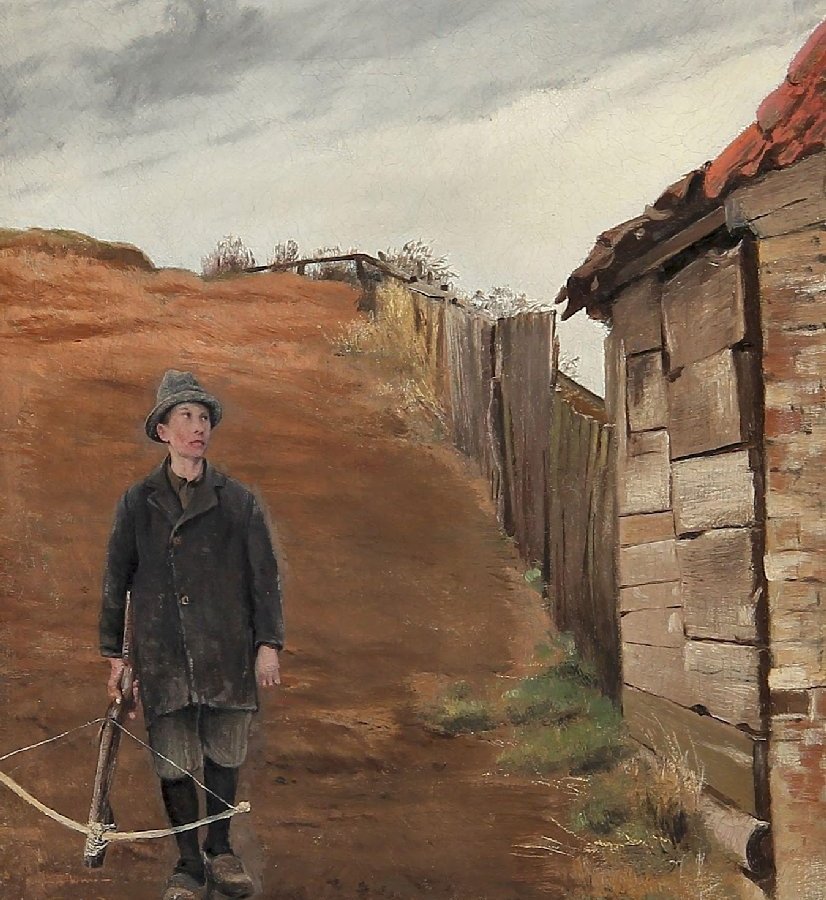
Boy with a Crossbow at the Foot of a Hill by Laurits Ring

In Denmark, the term The Modern Breakthrough was given to the period between 1870 and 1890 which marked a period in Danish literature and arts which focused on naturalism and realism and replaced romanticism at the end of the nineteenth century.  Personal poverty, which Ring had witnessed first-hand in his family household, had inspired him to support the constant battle of peasants and workers for social and economic change. Laurits Ring was a champion of the weak and oppressed and, like many young people demanded change and even contemplated the need for a revolution.  In the 1880s, Ring was active in the Rifle Movement, a group that openly advocated  an armed uprising.

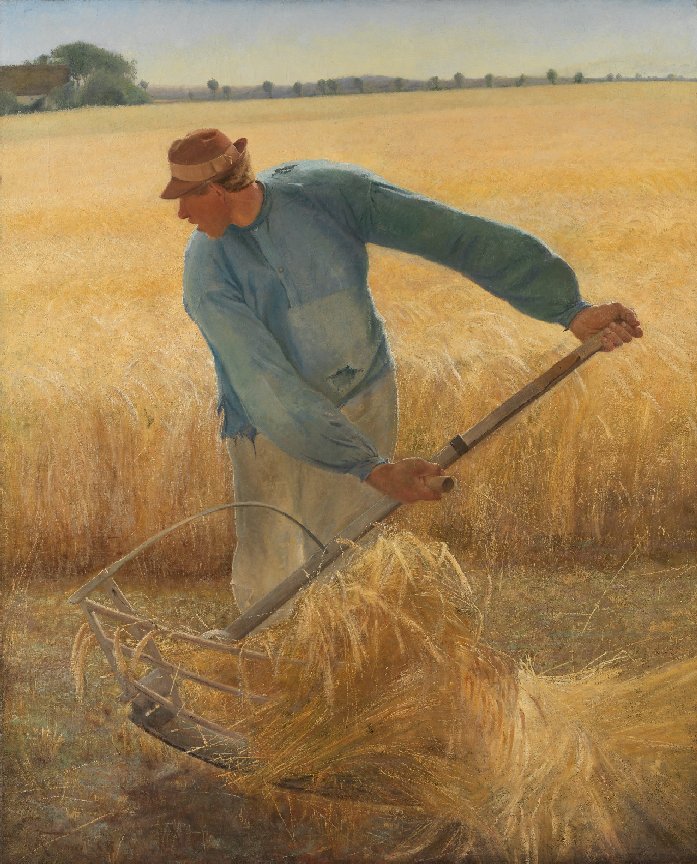
Harvest by Laurits Ring (1885)

Laurits never forgot the poverty his family had suffered and his Social Realism paintings confronted the hardship of life for the less well-off such as the peasant farmers.  There was a family connection in his 1885 painting entitled Harvest.    Laurits managed to persuade his elder brother Ole Peter to model for the painting.  We see his brother working on his Zealand farm near the village of Fakse.  The depiction shows endless swathes of wheat fields and Laurits’ brother vigorously swinging the heavy scythe.

The Gleaners by Laurits Ring (1887)

Another of Laurits’ rural depictions, The Gleaners, completed in 1887, is one used by many artists, and depicts the gathering of grain or other produce left behind in a field after harvest.  The best-known version of this subject is probably Jean-François Millet’s 1857 painting of the same name.

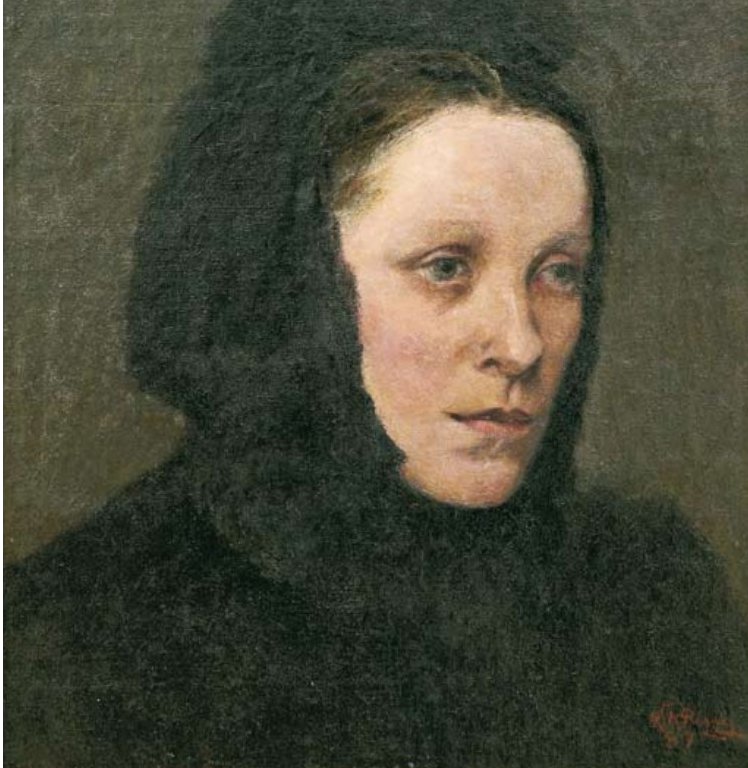
A young woman with a headscarf around her head (Johanne Wilde). by Laurits Ring (1887)

Laurits Ring had three women who took on a special importance in his life.  The first was his mother, Johanne Andersdatter, with whom he had a special and long-lasting bond.  Around 1887, a second woman came into Laurits’ life.  She was Olga Johanne Albertine Wilde, the wife of the lawyer and amateur painter, Alexander Wilde who had his studio next to that of Laurits’ residence in Frederiksberg, a district of Greater Copenhagen.  She was the mother to two sons and a daughter. With a mutual interest in painting Alexander and Laurits became great friends and Laurits almost became one of the family spending Christmas and the summers with them.   Despite his great friendship with Alexander, Laurits fell in love with his wife, Johanne.  It was a disastrous infatuation and an unrequited love as, despite a passing back and forth between Laurits and Johanne of recurrent intimate letters, she remained faithful to her husband.

Johanne Wilde at the loom in the summer residence, Hornbæk by Laurits Ring (1889.)

Finally, around 1892 Laurits realised that there could be no future with Johanne and he broke this circle of friendship with the Wilde family.  The end of this intimate relationship caused Laurits to experience a period of great depression at his lost love. It was a traumatic time in the life of Laurits Ring.  His father and only brother had died within three years of each other.  He was totally disillusioned with the political struggle to better the living conditions of the poor in urban and rural areas and he was now beginning to doubt his artistic ability.  In fact, he was losing faith in God and the deeper meaning of life at all.  It is thought that but for the fact that his mother was still alive, he may have contemplated suicide as a way out of his depression.  If that was not bad enough, his “friend” Henrik Pontoppidan, in his 1895 novel, Nattevagt (Night Watch), based his character Thorkild Drehling, a painter and failed revolutionary, who was in love with his best friend’s wife, on Laurits Ring.  Ring was horrified at his friend’s betrayal, especially the publicly divulging of Ring’s infatuation with Johanne Wilde.  Their friendship immediately ended.

Things had to change for Laurits, and they did, in the form of the third woman in the life of Laurits Ring.

…………………………………….to be continued.

George Hendrik Breitner – The Amsterdam Impressionist.

George Hendrik Breitner

The artist I am looking at today is George Hendrik Breitner, the nineteenth century Dutch painter, who was best known for his realistic depiction of Amsterdam street and harbour scenes.   He was also of great importance in what was later termed Amsterdam Impressionism.

Self portrait by George Breitner (1883)

George Hendrik Breitner was born in Rotterdam on September 12th, 1857.  He and his younger brother, Godfridus, were the children of Johan Wilhelm Heinrich Breitner and Marie Anne Henriette Gortmans.  His father worked in the grain business and George, after finishing primary school, joined the Palthe & Haentjes, grain company, as a clerk.  At the age of seventeen George went to the Delft Polytechnic School for vocational training.  George showed a great talent for drawing and in January 1876, aged eighteen, partly because of the intercession of the artist Charles Rochussen, his father agreed to have him enrolled on a four-year course at the Koninklijke Academie van Beeldende Kunsten (Royal Academy of Art) in The Hague.  He was an exemplary student and won a number of awards including a second prize for composition and two years later took the first prize in a live model competition.  In October 1877 he obtained his teaching certificate and during 1878 and 1879 he taught art at the Leiden Art Society (Ars Aemula Naturae), originally the Leiden Guild of St. Luke.

The Dam, Amsterdam by George Breitner (1895)

In 1880 Breitner was expelled from the Art Academy for misconduct, his misdemeanour said to have been that he had destroyed the regulations-board.  Around that time, he shared lodgings of the Dutch landscape painter of the Hague School, Willem Marisat, at the Oud Rozenburg house in The Hague.  Marisat became Breitner’s friend and tutor. It was through Marisat that Breitner was accepted as a member of the Pulchri Studio, an important artist’s society in that city. 

Les Brisants de la Mere du Nord (The Breakers of the North Sea) by William Mesdag

It was here that he met fellow member Hendrik Mesdag, a one-time banker but later an accomplished artist, whose forte was his maritime paintings, one of which, Les Brisants de la Mere du Nord (The Breakers of the North Sea), gained him the gold medal at the 1870 Paris Salon.  In 1880, Mesdag had been commissioned by a group of Belgian entrepreneurs to paint a panorama depicting a view over the village of Scheveningen which lay on the North Sea coast close to The Hague.  It was such a large project that Mesdag put together a team of artists including his wife Sientje, Theophile de Bock, Barend Blommers and twenty-three-year-old George Hendrik Breitner.  The finished work which measured 14 metres high and 120 metres around, was completed in 1881 and I talked about in my My Daly Art Display blog

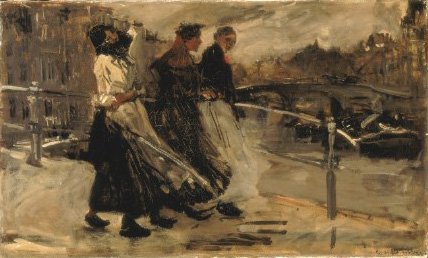
Bridge with Rain and Wind by George Breitner (1887)

In 1882, Breitner made the acquaintance of another distinguished artist, Vincent van Gogh, and the two would often go on sketching trips around the poorer and seamier side of The Hague.  In a letter to his brother Theo in February 1882, Vincent wrote:

“…. At the moment I quite often go to draw with Breitner, a young painter who’s acquainted with Rochussen as I am with Mauve.  He draws very skilfully and very differently from me, and we often draw types together in the soup kitchen or the waiting room &c…”

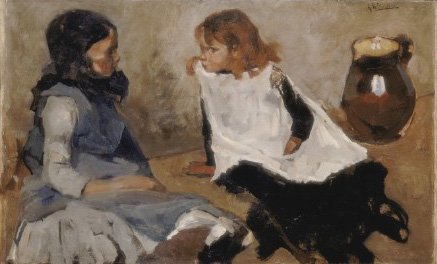
Two Girls with Brown Can by George Breitner (1885)

For Breitner his models were the poorer working-class folk such as labourers and servant girls who plied their trade in the lower working-class areas of the city.  Breitner preferred these working-class models such as labourers, servant girls and people from the lower-class districts. Interest in the fate of the common people, which many artists felt in that period, was cultivated by the social conscience of French writers such as Émile Zola and the realism paintings of Gustave Courbet and Jean-François Millet.  Breitner believed that through his paintings he would create history. His desire to become famous for his realistic paintings of the poor can be seen in his letter he sent to his patron, the grain merchant, Adriaan Pieter van Stolk, dated March 28th 1882.  Breitner wrote:

“…Myself, I will paint the people on the street and in the houses, they built, life above all, I’ll try to be Le peintre du peuple or I’ll be better because I want to be. History I wanted to paint and I will too, but history in its most extensive sense. A market, a quay, a river, a gang of soldiers under a glowing sun or in the snow…”.

Distribution of Soup by George Breitner (1882)

In May 1884 Breitner left The Hague and travelled to Paris.  His stay in the French capital lasted only six months during which time he attended Atelier Cormon where he liked to depict the toiling workhorses or demolition scenes, using dark tones .  He completed a number of paintings featuring the streets of the city with its horse and cart transportation.   His desire to paint scenes of everyday life in the French capital was enhanced by his interest in and inspiration from the writings of Zola, Flaubert and especially Edmund and Jules de Goncourts with their book, Manette Salomon, being a favourite of Breitner. 

Labourers Pulling a Heavily Laden Cart on Jacob van
Lennepkade, Amsterdam by George Breitner (1900)

In the late 1880’s, Breitner’s new hometown, Amsterdam, was beginning to expand, new industries were shooting up and it was pulsating with life.  Breitner was afforded the ideal opportunity to record pictorially the changes.  Now living in the city, he took the opportunity to hone his artistic talents by enrolling for a short period at the Royal Academy of Fine Arts under the tutelage of August Allebé, an exponent of realism and impressionism.  Breitner’s cityscape paintings of that era, although maybe not topographically accurate, were emotional depictions, full of colour and movement.  His depiction of the common people was somewhat different as he used greys and browns to portray the hard and laborious tasks, they had to perform to earn a meagre wage.  His paintings were often both emotional and sensitive.

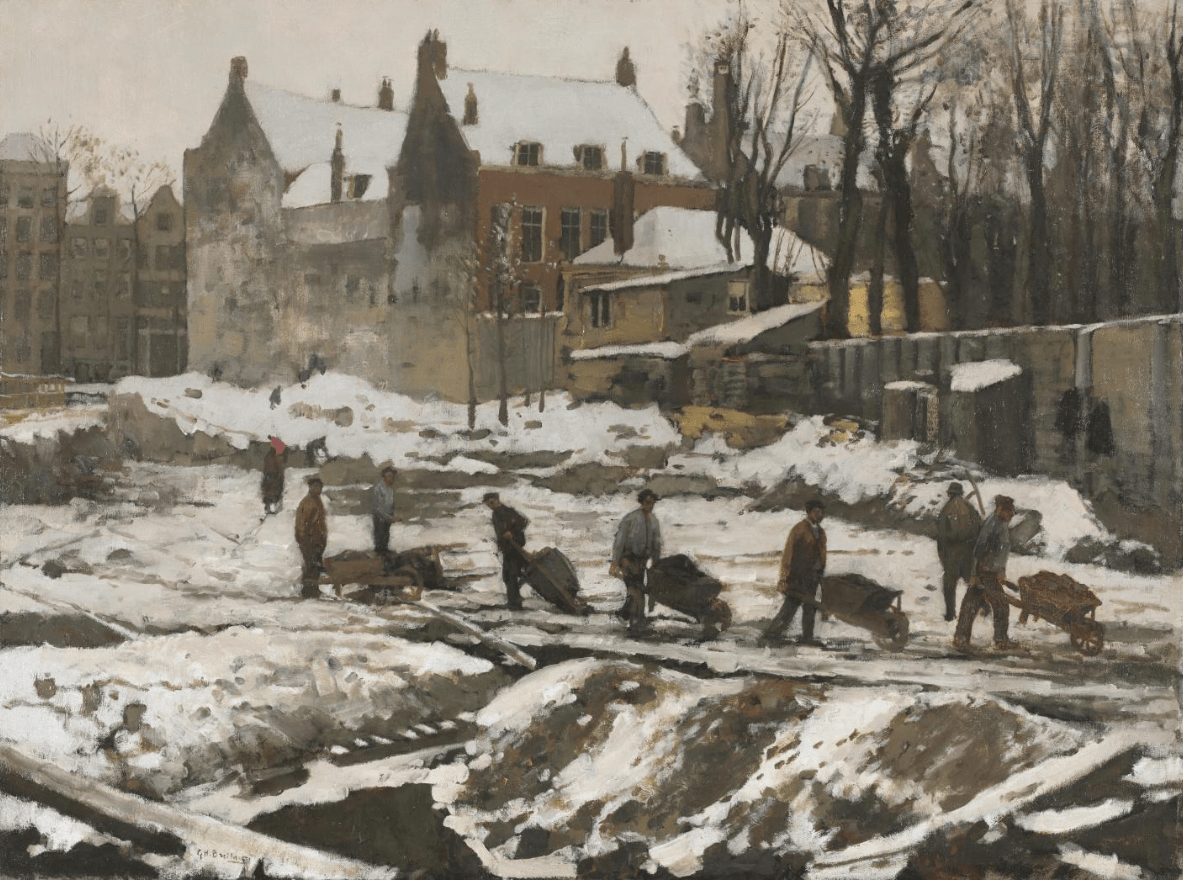
Construction Site in Amsterdam by George Breitner

Breitner’s 1902 painting, Construction Site in Amsterdam, highlights the building boom in Amsterdam.   He based the painting on a series of photographs he took of a construction site in the city. Although it may have been thought to be an en plein air work, the painting was in fact carefully created in his Prinseneiland studio. Through the use of his photographs and sketches, he was able to portray an ever-changing city.

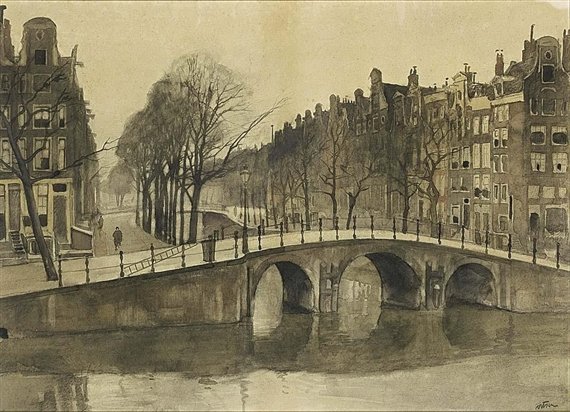
A View of the Leidsegracht Amsterdam by Willem Witsen

One of the painters he liked at this time and whose work influenced him was the Dutch painter and photographer associated with the Amsterdam Impressionism movement, Willem Witsen, whose best works include serene views of Amsterdam, such as his depictions of the canal areas Herengracht and Leidsegracht.

Lying Naked by George Breitner (1889)

In the late 1880’s, beside his cityscape works, Breitner embarked on painting nudes.

The Red Kimono by George Breitner (1893)

In 1893, he completed a series of paintings featuring Japanese girls, a beloved theme of many painters in those days.  Japonism, which referred to the French term, japonisme, which denotes the assimilation of iconography or concepts of Japanese art into European art and design. Most of the Impressionists and Neo-Impressionists painters were influenced by this phenomenon.

Girl in White Kimono by George Breitner (1894)

Breitner was Inspired by Japanese prints he had seen between 1893 and 1896 and completed thirteen paintings featuring a girl in a kimono. In each the young woman assumes different positions and the kimono often are of different colours. In the above 1894 work, Girl in a White Kimono, what stands out the most in the depiction is the exquisitely embroidered, white silk kimono with red-trimmed sleeves and an orange sash. For this painting and many in the series, Breitner utilised the services of seventeen-year-old Geesje Kwak, a seamstress who was also one of his regular models.

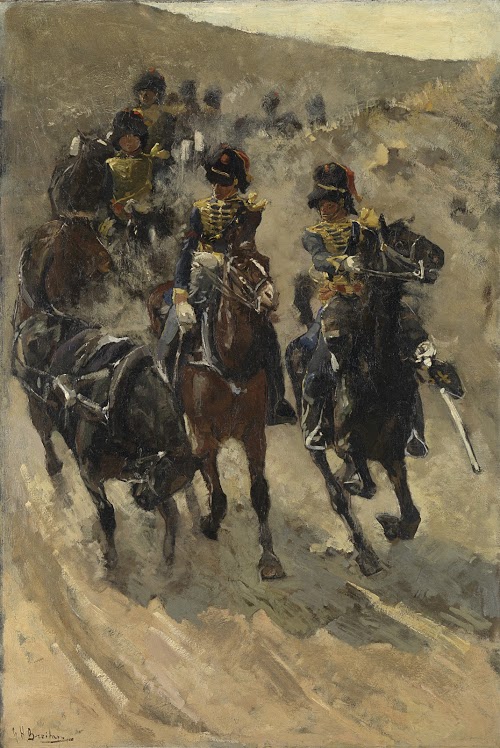
De Gele Ruiters (The Yellow Riders) by George Breitner (1886)

In his earlier days during his time in The Hague, Breitner had been criticised in the media for his drawings and his attempts at Impressionism and even his patron had pressed him just to paint what the public wanted.  Breitner baulked at this advice and his relationship with van Stolk ended.  In the late 1880’s, then living in Amsterdam, there was a change in his fortune and with every passing month, he gained more and more recognition as a talented artist.  In 1886 Breitner completed one of his great masterpieces, De Gele Ruiters (The Yellow Riders).  It was a monumental work measuring 115 x 76 cms and featured the elite mounted artillery corps seen galloping down the sand dunes at breakneck speed. Breitner took full advantage of their black-and-red busbies and the gold braid on their uniforms, which adds to the vitality of the charge.

(Detail) De Gele Ruiters (The Yellow Riders) by George Breitner (1886)

We witness the sand being kicked up by the hooves of the horses at the front which clouds our view of the horsemen who follow and all we can make out of them are the flashes of black, yellow and red of the following troops.  In the October 16th 1886 edition of the Netherlands Spectator, the Dutch poet and art critic, Carel Vosmaer, wrote

“…But what a momentum and storm in the movement, what a feeling for the poetry of such a tingling, dusty, turbulent group!..”

In the same year Breitner was invited by the avant-garde Société des XX (Vingtistes) to show his work in Brussels.  More and more was written in the press about him and his work.  At the turn of the century, George Breitner was forty-two-years-old and at the high point in his artistic career.  So, what was he like as a person ?  In his biography of the artist, Breitner, by Arthur van Schendel, he quoted the description of the artist by people who knew him, writing:

“…often fierce and brusque in his performance, sometimes suddenly rigid and closed, living among bouts of passion and despondency and always possessed wholeheartedly for his art…”

The levelled building-site for Maison de la Bourse by George Breitner (1909)

In 1901 an exhibition of his work was held, a highly successful retrospective at Amsterdam’s Arti et Amicitiae, one of the largest clubs for artists and art lovers in the Netherlands.  At this time Breitner would use his photographs as a preparation for a painting.  He built up a collection of people and cityscapes form a historical document of life in the city of Amsterdam at the end of the 19th century and it was these which helped to document city life at the turn of the century.  These photographs and his cityscapes often appeared in historical publications.

On September 18th, that same year, 1901, George Hendrik Breitner married Maria Catharina Josephina Jordan in Amsterdam.  His wife was nine years younger than him.  The couple had no children. 

Portrait of Marie Breitner, wife of the artist by George Breitner

Breitner painted a portrait of his wife, which, in my eyes, seems less than flattering.

Portrait of Mrs Marie Breitner-Jordan by Willem Witsen

A more flattering portrait was done by Breitner’s friend Willem Witsen.

George Breitner by Willem Witsen

Witsen also completed a portrait of George Breitner.

In 1903 Breitner decided to move away from Amsterdam and relocate to Aerdenhout, a small town located in the dunes between Haarlem and the seaside town of Zandvoort, some twelve miles west of Amsterdam.  His decision to move away from the city was because his friend and fellow artist, Marius Bauer, had moved there and wanted Breitner to join him. However, Breitner missed Amsterdam and in 1906 he returned to the city.

Rokin with the Nieuwezijdskapel, Amsterdam. by George Breitner (1904)

In 1904 Breitner completed his work entitled Rokin with the Nieuwezijdskapel, Amsterdam.  The Rokin is a canal and major street in the centre of Amsterdam and is a recurring theme in Breitner’s works.  Breitner would spend much time in this area, sketching and photographing people and buildings.   The art gallery Van Wisselingh & Co. was found in this area as was his artist’s society Arti et Amicitiae which can be seen in the background.   The painting fetched 415,200 euros at Christie’s Amsterdam auction in April 2005.

Although Breitner was successful as an artist and enjoyed a great reputation during his life, he did encounter financial difficulties during his life and this led to the establishment of a support committee for him and his wife. On June 5, 1923, George Hendrik Breitner died of a heart attack, aged 65.  George Breitner is seen as one of the most important painters in the Netherlands at the end of the 19th century – but internationally he is less well known as an artist.

Remedios Varo. Part 5. The productive years.

In 1958, Remedios Varo participated in the First Salon of Women’s Art at the Galerías Excelsior of Mexico, together with Leonora Carrington, Alice Rahon, Bridget Bate Tichenor and other contemporary women painters of her era.   Remedios submitted two of her works, Harmony and Be Brief, and won the first prize of 3,000 pesos.

Her painting Harmony is a fascinating work of art.   According to Luis-Martín Lozano an art historian and curator of modern and contemporary art:

“…Harmony was conceived as a self-portrait, where the author takes on the role of the organizer of the universe, using a sheet music mill to connect with creatures from other dimensions through magical crystals and formulas…”

Harmony by Remedios Varo (1956)

In the painting, sitting in a medieval study,  we see an androgynous figure of a scientist although some believe it to be a self-portrait of the artist.   The figure takes objects from a treasure chest such as geometric solids, jewels, plants, crystals, even a scrap of paper with the mathematical constant, pi, written out to six digits. 

Detail from “Harmony” painting

They are then placed as notes onto a three-dimensional musical staff, which is being used as an arranging tool, and by doing so, creates from a chaos of possibilities, the order that is music.  On the wall behind the staff we see a female figure who also adds items to the strings of the musical staff.  This is the hand of chance, which is a vital ingredient in attaining scientific achievement.

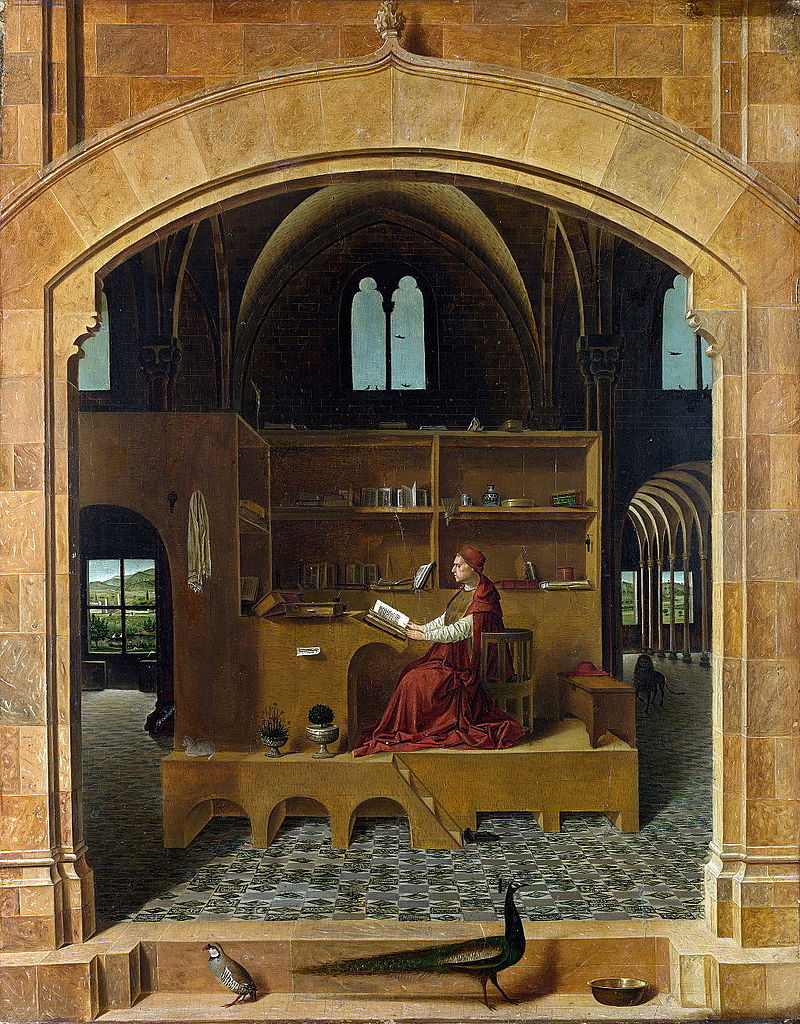
St Jerome in his Study by Antonello da Messina (c.1460-1475)

The depiction has been likened to the Renaissance painting by Antonello da Messina’s work entitled Saint Jerome in his Study, which he completed around 1475.  In both paintings a solitary figure sits in a self-contained space surrounded by thick heavy stone walls,  arched doorways and ceilings and a multi-design floor. 

Trompe l’oeil

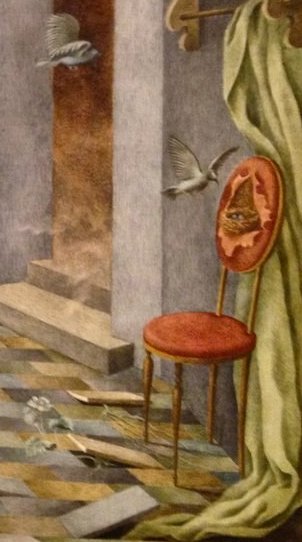
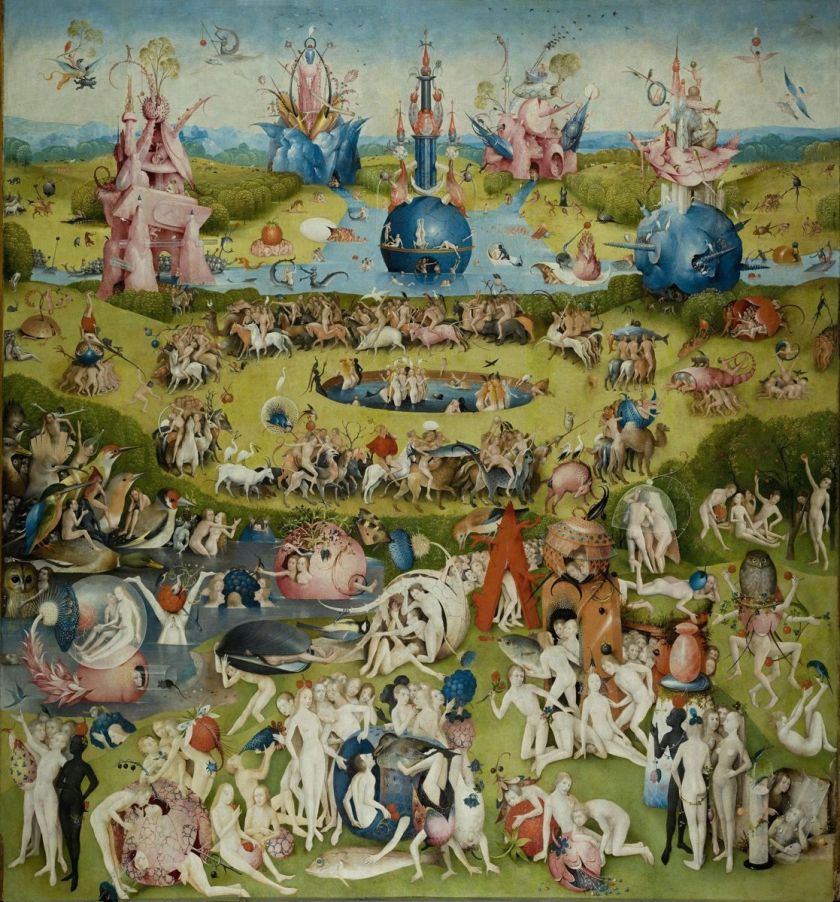
The trompe l’oeil technique was used by both artists. Antonella attempts to trick the viewers eye with what looks like a three-dimensional step in the foreground of his painting whilst Varo has presented us with a bird’s nest emerging from a split in the back of the upholstered chair.  Varo wants not only us to be fooled by this aspect but she shows that a bird is also deceived!  Varo’s painting mirrors the Netherlandish style of paintings of the fifteenth and sixteenth century in the way there are so many items within the depiction, each one making you query why it had been inserted.  Do the various items have a certain meaning that we should grasp?  We should also remember that as a teenager her father would take her to the Prado in Madrid and it was here that she fell in love with the works of Hieronymus Bosch which displayed a myriad of objects, figures and weird details.

Centre panel of Hieronymus Bosch’s painting Garden of Earthly Delights (1490-1510)

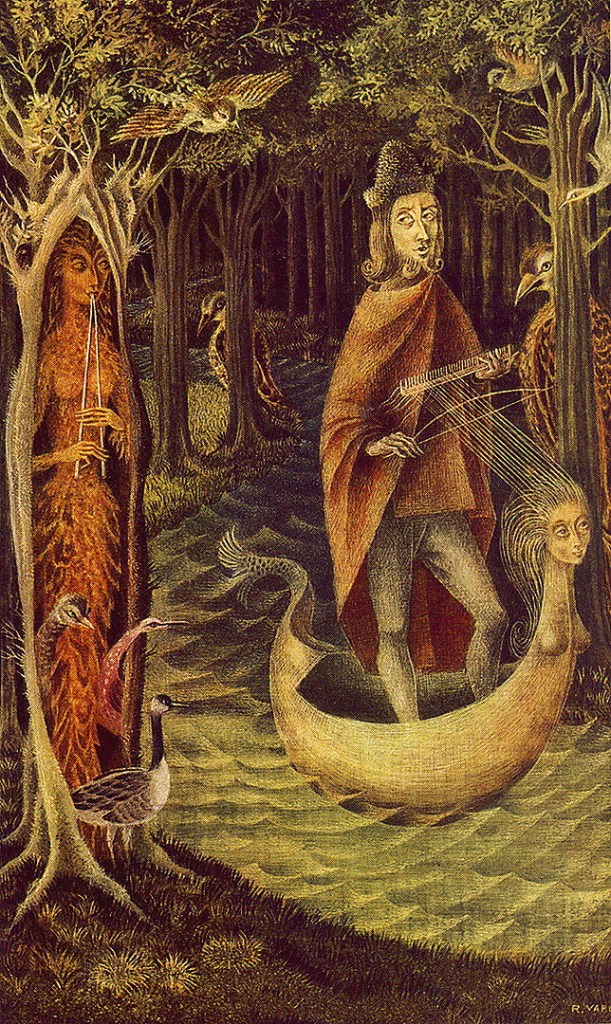
Hieronymus Bosch’s famous triptych painting Garden of Earthly Delights which hangs in the Prado could well have been remembered by Remedios when she painted her 1959 work entitled Troubador as both have oversized yet identifiable birds depicted. 

Troubadour by Remedios Varo (1959)

Again, in this painting we see a bow being pulled across, not a stringed instrument, but the long strands of hair of a female.  In an earlier blog, we saw a painting depicting the bow being drawn across sunbeams.

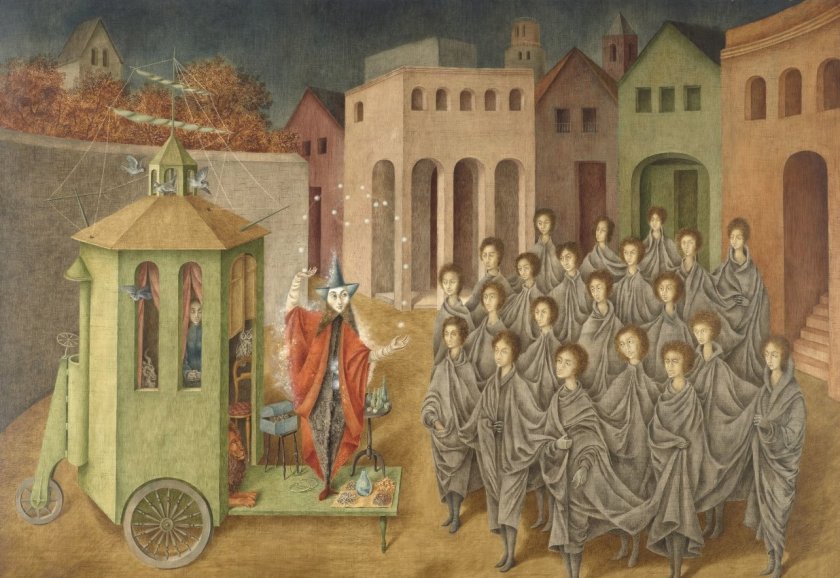
The Juggler by Remedios Varo (1956)

Another interesting painting by Varo is one entitled The Juggler.  At the centre of the depiction we see the magician/juggler standing on a table in front of a crowd of onlookers. The table actually forms part of his bizarre-looking vehicle.  The Juggler is dressed in a red robe which covers his brown-patterned outfit and atop his head he wears a witch-like conical hat.  The face of the juggler is painted on a five-sided piece of inlaid mother of pearl. Mother of pearl was often associated with works by Remedios Varo.  For her, it was the idea of enlightenment and of understanding, a sort of hyper-awareness.   The figure is in the act of juggling but instead of using his juggler’s rings which lay at his feet he is juggling balls of light adding to the impression that this is not just an ordinary juggler but one with mystic powers.  Look carefully at his audience.  All look the same with similar hairstyles and yet on closer inspection they all have individual expressions.  However, what is more bizarre are their clothes.  Again, on closer inspection their clothes are made from just one single cloak which is worn by them all.  It is all about unity.  Varo, in a letter, described the audience as:

“… a kind of unenlightened individuals who were awaiting a transference of enlightenment from the magician so that they can wake up…”

  The painting does not just depict the juggler and his audience.  Look closely at the others in the “cast” that add to the depiction.  Varo includes and owl who we see in the part-open chest, a lion that lies obediently at the juggler’s feet and the ever-present birds.  Inside the vehicle is the juggler’s wife and a goat.  It is this type of painting that I find fascinating.  No matter how many times you look at it there is something new to see and it taxes your brain trying to work out what Remedios was thinking when she put brush to masonite.  The painting is housed in the Museum of Modern Art in New York.

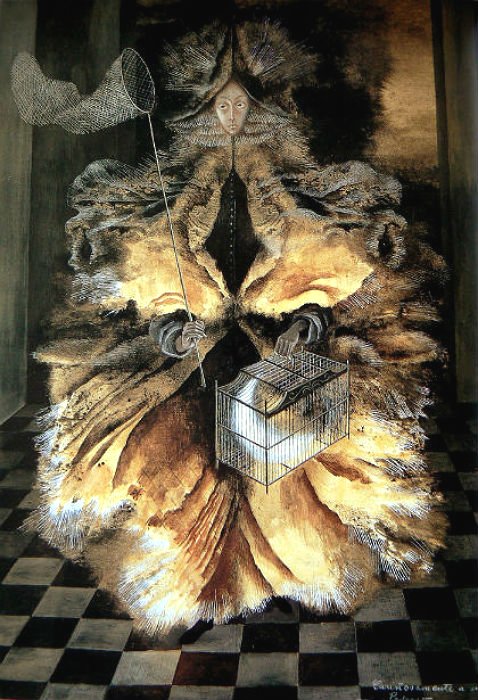
Star Catcher by Remedios Varo (1956)

The theme of the relationship between mother and child was explored in her 1956 painting, Star Catcher.  Remedios never had children although she did terminate a pregnancy when she was married to Péret saying that motherhood was more than she could handle.  In this painting we see a huntress has captured the moon and carries it in a cage.  The fantastic huntress is adorned in a sumptuous costume with delicately marked butterfly-wing sleeves and holds the butterfly net she has used to capture the crescent moon.  The depiction is both beautiful and disturbing and the iconography is hard to read.  However, the idea of imprisonment and constraint runs through many of Remedios’ paintings.  It is the dichotomy between power (the huntress) and powerlessness (the captured moon) which is another recurring theme in her work.

Breaking the Vicious Circle by Remedios Varo (1962)

The theme of breaking free of constraint and demonstrating female power featured in her 1962 mixed-media painting entitled Breaking the Vicious Circle.  The background is a brown shapeless void   A female figure stands before us.  She summons all of her strength to pull apart the rope that encircles her body.  This severing of the rope circle causes an electrification of her hair which stands on end and at the same time we see her torso open up to reveal a path through a forest.  It symbolises the opening up of the possibilities inside her.   Her subconscious thoughts are revealed which are rich and adventurous.  So, what does it all mean?  The breaking of the rope circle is a metaphor for the breaking free and release of the figure’s power of imagination.  This breaking free from the past and tradition allows the figure to embark on a spiritual journey that had lay dormant in her heart.  Look towards the floor at the hem of her cloak.  In the folds of her cloak, at her feet, there is an over-sized bird, which according to Carl Jung, the Swiss psychiatrist and psychoanalyst and great thinker who made a deep impression on Varo, this was a symbol of transcendence and so the woman has made a spiritual breakthrough. 

L’Ecole Buissonnière by Remedios Varo (1962)

In an earlier blog I talked about how Remedios, as a schoolgirl, was fascinated in the occult.  Later in life, she studied mystic disciplines and immersed herself in metaphysical texts and in the pursuit of meaning and control. It became a passion that dominated her work.  She became interested in the ideas postulated by the likes of Jung, Helena Blavatsky as well as stories about the legends of the Holy Grail, alchemy and the I Ching, an ancient Chinese divination text.  It is an influential text read throughout the world, providing inspiration to the worlds of religion, philosophy, literature, and art which Remedios consulted regularly before she made decisions.   She had spurned Catholicism saying:

“…What you grow up with you are given dogmatically, what you find, you conquer yourself…”

It was her search for an alternative to Catholicism featured in the depiction in her 1962 work entitled L’Ecole buissonière (literally, school in the bush but colloquially it means playing hooky).  In the painting we see a youth who has skipped school and gone into the forest in search of answers.  In the conical tower he finds his “friends” – the cunning fox and the wise owl which holds a crystal ball.  These will be his true mentors.

Hermit by Remedios Varo (1956)

An earlier painting completed in 1956 followed a similar theme of knowledge and learning.  In her painting Hermitano (Hermit) we see depicted a magical figure standing alone in the woods.  The body of the figure is formed by a misty six-pointed star, formed by joining together upright and inverted triangles, which symbolises equilibrium and the unification of consciousness with the unconsciousness. 

If you look closely at the chest cavity of the figure you will detect the circle of yin-yang, the Chinese symbol that similarly represents the balance of opposites.  The face of the figure is one of calmness and serenity and suggests inner harmony and balance.


When we look closely at Remedios Varo’s depictions, are we taking in every facet of her work?  The American art historian, Whitney Chadwick summed it up saying:

“…Although we often see everything [on them], we can’t help feeling that we’re missing an important key that would clearly show us the meaning…”

Three Destinies by Remedios Varo

Take for example Varo’s 1956 work entitled Three Destinies.  What is going on?  We see before us three figures in monk-like robes, each sitting in separate towers.  One is writing, one is painting whilst the third is drinking.  Each are oblivious to the presence of the other two. We also see, faintly drawn, a pully and rope systems connecting the towers.  And so, what is happening?

Remedios Varo’s explanation of this depiction is that although the three figures believe they are independent, they are actually and inextricably interconnected.  The fate of the three is permanently interwoven by the complicated pully system which winds around each of the three figures which makes them move, albeit they believe they are moving freely and one day in the future their lives will cross.  Varo was fascinated by what she believed was just an indistinct line separating free will and determinism, the philosophical view that all events are determined completely by previously existing causes.

Still life Reslicitando by Remedios Varo (1963)

Remedios Varo’s last work was completed in 1963 and was entitled Still Life Reviving.  The painting was one of only a few of her works which did not include a human figure.  The painting was all about the cyclical rebirth of nature.  Before us we see a tablecloth, eight dinner plates, various fruits and a candlestick all of which have been swept into a whirlwind by a source of energy which we cannot see.   Soon it looks like a celestial depiction with the fruits acting like planets orbiting the sun, in this case, the candle flame.  Look carefully at the fruit on the outermost ring.  The colliding fruit explode and this then results in the seeds of the fruit being sent back to earth, the floor, where we see them magically germinate, sprouting roots and bearing small delicate green shoots.  Above all this there are the diaphanous blue dragonflies that witness the goings-on and fly off to spread the news.  Look at the background.   Here we see a religious tone to the work with the ogival arches which sit above a chapel-like space. Varo has energised the work by adding a warm glow which also enhances the work, by her inclusion of the reds, golds and oranges of the fruit.

In 1963 Remedios suffered some health problems.  She had complained of a shortage of breath when climbing stairs.  She had a history of chronic gastric problems and was known to drink excessive amounts of coffee as well as being a heavy smoker.  She was checked out for heart problems but was given a clean bill of health.  The state of her mental health was open to doubt.  Some of her friends said she was bubbly and full of life whist others said she had told them that she was depressed and did not know whether she could carry on with life.  Walter Gruen, her husband, remembered the devastating afternoon of October 8th 1963, saying that he and Remedios had lunched with their friend Roger Cossio who had come to buy Varo’s painting, The Lovers.  Gruen said his wife was happily explaining the details of the work to the buyer.  With lunch over Cossio left and Gruen returned to his Sala Margolin shop across from their house to do some work.  Shortly after, their Indian maid rushed into Gruen’s shop to tell him that Remedios was very ill.  Gruen rushed home to find his wife complaining of chest pains.  Gruen was unable to contact a doctor so left Remedios and went into the next room to consult some medical books.  When he returned to his wife, he found that she had died. 

Remedios Varo died two months shy of her fifty-fifth birthday.  She was buried at the Jardin Panteon, a cemetery on the outskirts of the city.  The local newspapers were full of the story of her life and her untimely death.  Margarita Nelken, a close friend and a journalist for the Mexico city newspaper Excelsior wrote:

“…Remedios Varo, one of the greatest artists of modern Mexico, and – without exaggeration – of contemporary painting, on Tuesday evening left us forever.  Unexpectedly.  So discreetly, quietly, just as she had lived among us…”

Alfonso de Neuvillate, the art critic for the Novedades newspaper wrote:

“…Unjust, inexplicable…..on Tuesday, the eighth of October at 7pm, death ended the life of one of the most individual and extraordinary painters of Mexican art, Remedios Varo.   A heart attack.  One asks the questions like, why her?  Why not someone mediocre?…”


Most of the information for this blog, apart from the usual sources, comes from Janet A. Kaplan’s excellent book entitled Remedios Varo, Unexpected Journeys.  This is a must-read book if you want a fuller version of the life and times of Remedios Varo.

Remedios Varo. Part 4 – A new life in Mexico

Remedios Varo at work in her studio

Varo arrived in Mexico at the end of 1941 having had to flee the oppression of Vichy France and the Nazis.  She had been accepted by the Mexican government and granted the status of a political exile for one year but which could be renewed. She was allowed to find work with the exception of bars, cabarets and restaurants providing she did not displace any Mexican workers.    It is estimated that Mexico accepted more than fifteen thousand refugees into its country.  The majority of them could be termed the “intelligentsia”, who brought with them a much-needed stimulus to both the economic and cultural development of the country.  Many of these exiles believed that one day in the near future they would be able to return to France and Spain and so many of these exiles kept together rather than try to assimilate with Mexicans and their culture.

Frida Kahlo and Diego Rivera

These exiled artist from Europe were not loved by everybody and the most popular Mexican artist of the time, Diego Rivera and his partner Freda Kahlo. who held the position of being the reigning leaders of Mexican artistic culture rejected what they deemed as the foreign colonializing influences of the newly arrived European artists.  Kahlo who had been in Paris in 1939 for her own exhibition at the Pierre Colle gallery and who had been a guest of André Breton was surprisingly scathing about the Surrealist painters.  In a letter from Kahlo to Nikolas Murray, a Hungarian-born American photographer and her long-time lover, in the March of that year, she wrote:

“…They make me vomit.  They are so damn ‘intellectual’ and rotten that I can’t stand them anymore……I’d rather sit on the floor in the market at Toluca and sell tortillas, than to have anything to do with those ‘artistic’ bitches of Paris…”

Leonora Carrington

One of Remedios’ closest friends when she arrived in Mexico was the English Surrealist painter Leonora Carrington, who like Remedios had to flee from the Vichy and Nazi controlled France and find refuge in Mexico.  Leonora and Remedios, who had first met in France in the late 1930’s, got together nearly every day and the two women formed an intense connection and would talk about their dreams for the future.  

In her early days in Mexico, Remedios did few paintings and spent most of her time writing.  She and Leonora Carrington would write fairy tales, collaborated on a play, invented Surrealistic potions and recipes, and influenced each other’s work. The two women, together with another of their friends, the photographer Kati Horna became known as “the three witches”
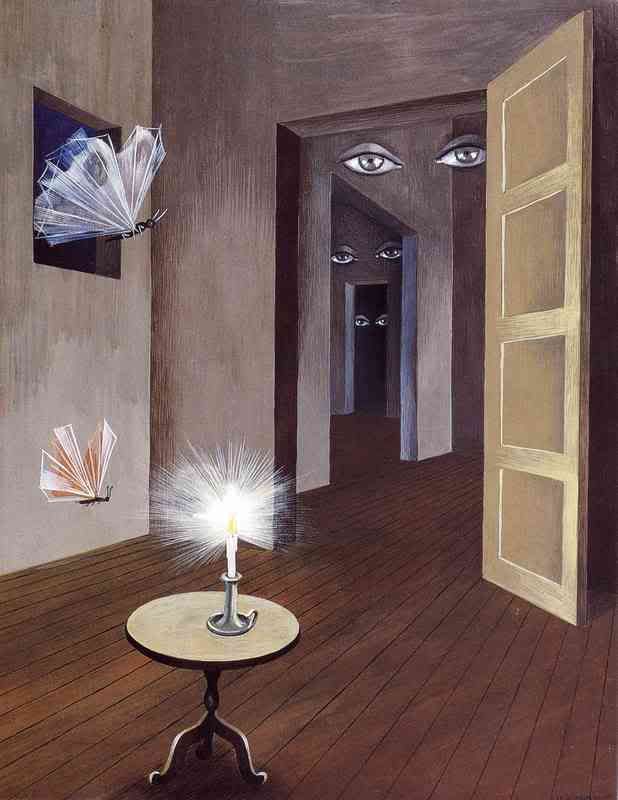
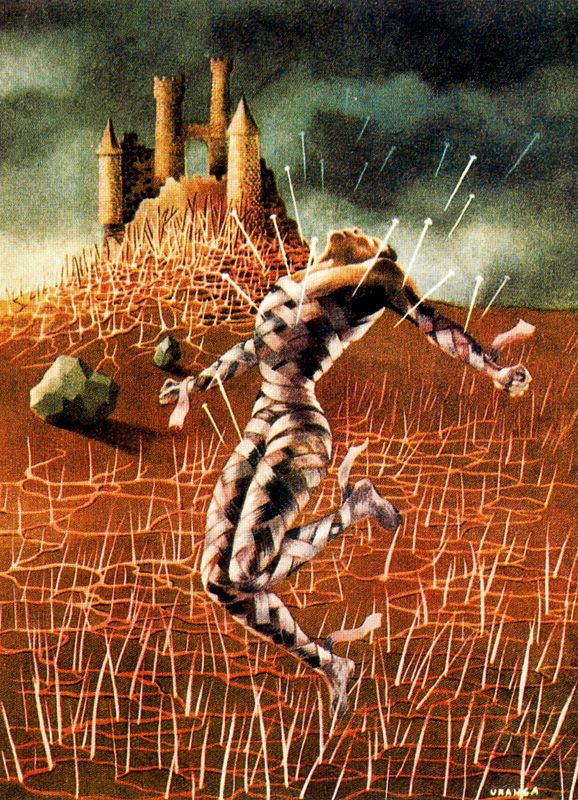
Women’s Tailor by Remedios Varo (1957)

Once in Mexico, Varo took on a variety of jobs, hand painting furniture and restoring pre-Columbian artifacts. In 1942, she worked with Marc Chagall, a fellow refugee from Air-Bel in Marseilles, designing costumes for Leon Massine’s ballet, Aleko.  Remedios completed a painting in 1957 entitled Women’s Tailor which shows the wild imagination she had when it came to costume designs.  The setting is a showroom in an haute-couture fashion house and we see the dress designer proudly parading his models wearing his dresses in front of a potential client.  She had always loved designing and making clothes and would often design clothes for many of the exiled Surrealist costume parties.

Insomnia by Remedios Varo (c.1947)

Remedios Varo’s main source of income in the late 1940’s was the work she did for Casa Bayer (the Bayer pharmaceutical company).  She was tasked with illustrating their promotional literature.  One example of this was her work, Insomnia, which was incorporated into a pamphlet advertising Bayer’s sleeping pills, which included the words warning of the trauma of insomnia:

“…Sensing that someone has been observing them, they open tired eyelids, searching the nocturnal shadows !   Undefined anxiety fills the solitude of the dark, dry rooms, devoid of warmth…” 

Rheumatism Lumbago Sciatica by Remedios Varo (1947)

Another pamphlet Remedios illustrated was one focusing on back pain which Bayer pharmaceuticals could alleviate.  The horrors of the ailment were summed up by Bayer in their leaflet:

“…As if sharp nails are being driven into flesh…..into the joints, into the bones, into the nerves…..!!!  These are the sensations that one can suffer, Rheumatism….lumbago….sciatica….! !…”

Rheumatic Pain by Remedios Varo (1948)

Remedios Varo’s illustration for the 1947 Bayer pamphlet entitled Rheumatism, lumbago, sciatica, added greater force to the words.  In the work we see a man depicted running through a boulder-strewn field with pointed objects piercing his feet and body.   In the background there is a castle with conical towers and crenelated walls which harks back to the Spanish castles of Varo’s childhood. 

The Broken Column by Frida Kahlo (1944)

It is also believed that Varo drew inspiration for this depiction of spikes and nails entering the man’s body from Freda Kahlo’s 1944 work Broken Column which she painted as a reminder of how her body had been broken and put together again after she was involved in traffic accident whilst riding on an old wooden bus, which collided with a streetcar. Several people were killed, and Kahlo suffered nearly fatal injuries—an iron handrail impaled her through her pelvis, fracturing the bone. She also fractured several ribs, her legs, and her collarbone which was to leave her in pain for the rest of her life.

Allegory of Winter by Remedios Varo (1948)

She also illustrated the Bayer calendar with depictions of the coming of Winter and the coming of Spring. 

Signature of “Uranga” on Bayer painting

It is interesting to note that all the commercial illustrations she did for Bayer and other companies were signed “Uranga”, her mother’s maiden name.  Varo was determined to clearly separate her commercial work from her own art which she was happy to sign in her own name.

Although Remedios was beginning to enjoy life in Mexico, her second husband Benjamin Péret was homesick for France and wanted to return there with Varo but his financial situation would not allow him to purchase a passage on a ship to France.  He wrote to his old friend André Breton, who had been exiled in America and the Caribbean until 1946, when he had managed to return to Paris.  Péret’s letters to Breton were sad and pleading.   In March 1947 he wrote:

“…It’s true I have not written for a long time, but what’s the use of writing to give always discouraging news:  abominable material circumstances, no hope of prompt return…”

In October 1947 he wrote again to Breton telling of his poor financial situation:

“…I still can’t make any arrangements for return, for lack of money.  As soon as this is possible, I’ll let you know…”

Breton and other friends of Péret finally rallied around and staged an exhibition for him at the Paris Galerie Rive Gauche.  Artists, such as Picasso, Miro, Tanguy, Dominguez and Breton contributed works, the sale of which was enough to pay for a single one-way passage and by late 1947 Péret was ensconced once again in his beloved Paris.  Remedios Varo refused to accompany her husband for she had made her home in Mexico and did not or could not return to her homeland which held so many bad memories for her.  Her relationship with Péret had been going downhill for some time.  Varo’s close friend, Kati Horna, a Hungarian photographer, explained why Remedios’ relationship with Péret had run its course:

“…Péret was so intellectual, so distracted, that although he was a kind and generous man, he did not participate actively.  He was always lost in thought, his head in the clouds, thinking weighty thoughts…”

Portrait of Jean Nicole by Remedios Varo

Varo had already started a new relationship before her husband had taken his leave of Mexico.  The new love of her life was a French pilot and adventurer, Jean Nicholl, a fellow refugee whom Péret and Varo had sheltered

Remedios Varo with Jean Nicole in the jungle, Venezuela – 1949

To get over the break with her husband, Remedios travelled with her new friend/lover Jean Nicolle to Venezuela at the end of 1947.  Her brother Rodrigo was living in Venezuela, working as an epidemiologist and had brought with him his family and his mother.  It is quite possible Remedios’ mother was horrified when she met her daughter and her new flamboyant lover who was fourteen years younger than her, and who were now living together.  Her mother’s Catholic sensibility must have taken a big hit, knowing her daughter’s first marriage had ended in divorce, her second partner had left her and gone back to Paris and now she was living with a third man!       Her answer was a plea for her daughter to attend mass with her.  Remedios did accompany her mother to church – but just the once.   Remedios’ stay in Venezuela came to an end at the start of 1949.

Walter Gruen (1952)

Around the time of their return from Venezuela, Remedios and Jean Nicolle’s relationship began to peter out and soon they became separated and eventually their romantic interlude came to an end.  A new man came in to Remedios’ life, an Austrian political refugee Walter Gruen whom she had first met in the early 1940’s.  However, they did not become closer until Péret had left for Paris in 1947, her relationship with Jean Nicolle had been downgraded to just a friendship and Gruen’s first wife, Clari had died in a tragic drowning accident.

Sala Margolin

Gruen had once been a medical student in Austria until Hitler came to power which put and end to his studies.  He decided that his life was in danger and managed to escape Europe and settle in Mexico.  He arrived with no possessions and very little money.  Initially he worked in a tyre shop and persuaded the owner that he could make extra money by selling phonograph records as well as tyres and Gruen and the owner set up a record shop at the front of the store.  Soon Gruen’s finances improved, so much so, he bought the tyre shop owner out and by the early 1950’s Gruen had transformed the tyre store into one of Mexico’s most prestigious music stores.  Gruen named his store Sala Margolín after the tyre store owner who had given him his first chance in Mexico.  Remedios moved in with Gruen in 1951 and lived in an apartment block on calle Alvaro Obregón close to Sala Margolín in a middle-class neighbourhood. 

Remedios Varo on her terrace.

They occupied two apartments on either side of a landing, one of which had a high-ceiling third floor studio which had a door leading out to a small terrace, where Remedios would spend hours on end painting.  Walter and Remedios married in 1952.  Remedios was adamant that despite Gruen having a lucrative business she would contribute equally to their living expenses.  Gruen gave Remedios his unwavering support which allowed her to free herself from her commercial work and devote herself entirely to her own artistic vision.

This was the start of Remedios Varo’s great painting years.

………..to be concluded


Most of the information for this blog, apart from the usual sources, comes from Janet A. Kaplan’s excellent book entitled Remedios Varo, Unexpected Journeys.  This is a must-read book if you want a fuller version of the life and times of Remedios Varo.

Remedios Varo. Part 3. Escape and flight from oppression.

Remedios Varo

Remedios Varo’s six year old marriage to Gerado Lizarraga was in decline and she started a romantic relationship with the young Spanish surrealist painter Esteban Francés, and a short time later, she left the marital home and she and Esteban went to live together in a room in a small house in the city.  Whilst there, the two lovers produced a number of surrealist works.  Remedios also became friendly with a group of surrealist artists known as the Logicophobists, who wanted to bring about a close connection of art with metaphysics, the branch of philosophy that examines the fundamental nature of reality, and although she never became an official member of the group in 1936 she exhibited three of her work with theirs at the Catalonia de Barcelona gallery.

The Spanish Civil War broke out on July 17th 1936 between two political groups.  The Republicans who supported the Second Republic of Spain which had been founded in 1932 following a bloodless coup and the Nationalists, led by General Franco, who opposed it.  Remedios’ young brother, Luis, joined Franco’s army but was killed shortly afterwards.  Remedios was devastated by the death of her brother and could never understand why he decided to fight under the banner of the “enemy”.

Benjamin Péret

In October 1936, Remedios Varo met Benjamin Péret, a French poet, a founder and central member of the French Surrealist movement.  Péret had married the Brazilian singer Elsie Houston in April 1928.  Her brother was Mario Pedrosa, a Trotskyist activist, and the next year, Péret and his brother-in-law founded and hosted the Communist League of Brazil, which was based upon the ideas of Trotsky.  Péret was eventually arrested, imprisoned and expelled from Brazil as a “communist agitator” on December 30th, 1931, a few months after the birth of his son Geyser.  He returned alone to France and carried on with the political struggle as a Trotskyist and participated in the Spanish Civil War as one of the many Trotskyists and anarchists, who claimed to fight for a classless society.   When Remedios and Péret first met she was twenty-seven and he was thirty-seven. 

André Breton

Péret was a close friend of the Surrealist painter, André Breton.  In 1937, Péret returned to Paris and Remedios went with him, breaking off her ties with her husband Gerardo and her lover, Esteban Frances, but the latter later decided to follow the couple to Paris. Remedios and Péret were now lovers but the couple’s life was marked by poverty and political uncertainty.  She described the position she found herself in the French capital:

“…It is not easy to live on painting in Paris…Sometimes I did not have more food in an entire day than a small cup of coffee with milk. I call this ‘the heroic epoch’…That bohemian life that is supposed to be necessary for the artist is very bitter…”

Esteban Francés

It is Spring 1937 and Remedios Varo and Benjamin Péret are safe in Paris having escaped the mayhem in Spain caused by the Civil War.   Remedios, through her close relationship with Péret, was accepted into the heart of the Surrealist group.   She commented on her lowly position within the inner sanctum:

“…My position was the timid and humble one of a listener; I was not old enough nor did I have the aplomb to face up to them, to a Paul Eluard, a Benjamin Péret or an André Breton.  Here was I with my mouth gaping open within this group of brilliant and gifted people…”

The Souls of the Mountains by Remedios Varo (1938)

Whilst living in Paris she shared a Montparnasse studio with Péret and Francés and although this ménage-a-trois caused rivalries Remedios managed to enjoy life in Paris.  In 1938 she completed a painting entitled The Souls of the Mountains. In this work, mountains are portrayed as slim volcanic tubes which are seen rising from a light-impregnated mist. Out from the inside of the tallest pair of these mountains emerge a head of a woman each bearing a resemblance to the artist.  Remedios experimented not just with what she depicted but also how she depicted things.  In this work she has used a Surrealist technique known as fumage.  The technique of fumage was invented by the Austrian surrealist artist Wolfgang Paalen in the late 1930s and is achieved by passing a flame quickly across a surface fresh with oil paint.  Paalen found that the smoke would trace unique marks in the wet surface.  In this work by Varo the fumage technique created clouds swirling around the cylindrical mountains, linking the stony peaks and is suggestive of dreams and apparitions. 

Again, we try and get into the head of the artist and work out what the painting is all about.   The encased females in the painting appear to be imprisoned all alone inside the mountain.  Remedios continually harked back to the past and on her feeling of imprisonment within the family home, the constraints made upon her at her convent school and the feeling of isolation and this depiction reminds us of her struggle to break free.  The mountains have a phallic shape and this could be Remedios’ take that she lives in a male-dominated world and that female artists of the time were not looked upon as real painters but were compartmentalised as being the “spouses of artists”.  The overall dark and depressing palette of the depiction was chosen by Remedios so as to give the work a feeling of isolation and disheartening confinement.  The title of the work gives us a clue that the depiction is about a life force under oppression which is deprived of its freedom and entitlement to be acknowledged.  Remedios believes that the souls in the painting should be released from their incarceration so that they may be able to express themselves fully and without any restrictions from their surroundings.  Likewise, Remedios believes female artists should be freed from the restrictions of a patriarchal society.

Left to right: Victor Serge, Benjamin Péret, Remedios Varo and André Breton in front of the Villa Air-Bel (c.1940-41)

So, what was life like for Remedios Varo and her Surrealist group ?  Maybe the late American art historian, Robert Goldwater summed it up in his publication, Reflections on the New York School, Quadrum 8.  He wrote about the group:

“…international in character, bohemian in a self-confident, intensive fashion….. living as if they had no money worries….[Yet they] existed on the margin of society……As thee latest issue of a long line of romantics, they accepted this situation as a condition of creativity and made it a positive virtue.  They carried with them a warmth of feeling, an intensity and concern for matters aesthetic, a conviction of the rightness of their own judgements and an unconcern for any other…”

This encapsulates Remedios Varo’s lifestyle at the time.  She believed fervently in the importance of art and she was reliant on spontanaity and put her trust in her subconscious instincts. At the time, Péret was working as a proof-reader as the sale of his paintings did not bring in enough money to survive and he would often have to beg for food.  When Remedios joined him, she too had to endure this lifestyle but she didn’t care as she loved this bohemian way of life and revelled in the company of the extraordinary and stimulating group of people with whom she was surrounded.  They too were mesmerised by her and during this time she had a number of love affairs.  However, her joie de vie was to be short lived as politics and war were to change her life once again.  Hitler was on his march towards European domination and with his annexation of the Sudetenland and the takeover of Austria, people in France feared the worst.  By July 1939, the worst had arrived and Parisians were told that if they were able, they should get out of their city which was now paralysed with anxiety.  It was an even more dangerous time for foreigners who lived in the French capital.  They were threatened with deportation back to their own countries.  Remedios, being a former Republican sympathiser, could not return to Spain where the right-wing Nationalists under Franco now ruled with an iron fist and where summary executions of Republican sympathizers were common.   Her former husband, Lizarraga, had fled from Franco’s armies and arrived in France but, as a Spanish refugee, he found himself interred in a French concentration camp. 

 In February 1940, Péret, being an outspoken Communist, was recalled to military service but three months later he had been incarcerated in a military prison in Rennes for his political activities. On June 14th 1940 the Nazis entered Paris.  An independent French government was established in Vichy and the Franco-German armistice was signed.  Included in the treaty was an article which required the Vichy French government to surrender on demand any fugitive wanted by the Third Reich.  Remedios was now in great danger for her connections with Péret.  She knew that because of her left-wing Republican views and past actions, she would not survive if she was deported to Spain and yet to remain in Paris would ultimately mean a journey to an internment camp.  Her friends tried everything to save Remedios from arrest but during the Winter of 1940 she was taken in by the police.  She was eventually released but she knew, despite wanting to stay behind until Péret was released, she had to get out of the French capital.

Oscar Dominguez

She did manage to escape the chaos in June 1940 and through help from her friend, Oscar Dominguez.  She managed to get a ride in a car owned by an American couple who were also escaping from Paris.  She arrived on the south coast at the small fishing village of Canet-Plage which lay close to Perpignan.  It was here she stayed with a number of Surrealist painters who had taken refuge on the Mediterranean coast.  Soon she and a Romanian Jew, Victor Brauner, who had also fled south, paired off and went to live together in Marseilles.  This was yet another of her love affairs.  As a reminder of their time together he gave her a watercolour, probably a portrait of her, and he wrote on it:

“…To my very dear friend Remedios with the memory of an indelible period of my life.  Your admiring friend, Victor Brauner, Marseille, Oct 1941…”

Remedios kept Brauner’s watercolour and a letter from him all her life.

Victor Brauner

Varo and Brauner were now part of a large group of intellectuals, artists and Jews who were trying to escape the Nazis.  They were joined by Péret at the end of the year.  He had managed to bribe the Nazi guards and then made a long and dangerous journey south.  The city of Marseilles was bursting with refugees all desperate to get out of the country.  They were living on little food and the fear of being caught in random but regular police roundups. 


Villa Air-Bel

Varo and Péret eventually found refuge at the Villa Air-Bel, a large residence outside the city which was being used by a group calling themselves the Emergency Rescue Committee.  This was a group that officially helped refugees legally obtain visas so they could leave France. The group’s secret agenda was to get those people on the Gestapo’s blacklist – specifically writers, artists and political activists, out of the country, by any means possible,   The organisation was led by an American, Varian Fry.  Fry was one of the founding members and as soon as the Committee was set up, they established a list of people to save in priority, mainly artists and writers, who had fled Germany and Occupied France to hide in the South.

Group of artists posing on the grounds of the Villa Air-Bel near Marseilles (1941)

Remedios Varo, now back with Péret, was in great danger.  Many of their fellow refugees had gained passage to America but Péret had been refused entry to America due to his previous communist activities.  As each month passed in Marseilles the danger of being arrested by the Vichy police became ever greater.  They knew they had to escape.  Their perilous situation was documented in notes in the files of the Emergency Rescue Committee:

“…He [Péret] is in immediate danger as his democratic ideas are opposed to the Vichy government, and he faces persecution.  He and his family [referring to Varo, although Péret did not marry Remedios Varo until 1942, after the death of his first wife] are in danger of starvation, as the problem of the food supply in their region is acute…”

Remedios Varo’s immigration papers (1942)

The Emergency Rescue Committee recognised the couple as “qualified as intellectuals and worthy of attention” and proceeded to try and attain visa for them so as they could leave France.  It was a long and torturous fight to get the documentation and took six months to achieve.  However, it was not just the visas they needed but money, again something they did not have.   Once again it was up to the Emergency Rescue Committee to get them financial help from their American backers.   Their fund-raising pamphlets were quite clear with their message which displayed hard-hitting headlines such as:

“…Wanted by the GESTAPO, Saved by America…”

The pamphlet then asked for contributions of $350, as the price of a life of one escapee.

SS. Serpa Pinto

Remedios and Péret’s thoughts then turned to Mexico as a place of refuge.  They had a number of things going for them with this idea.  Varo spoke Spanish.  The President of Mexico had stated that he would accept all Spanish refugees and to any members of the International Brigade living in France, who had once fought against Franco.  So, the destination for Péret and Varo was decided, now all they needed was to get there and procure a safe sea passage across the Atlantic.  For this to happen they had to travel from Marseilles to Casablanca and then board a ship to Mexico.  They eventually made it to Casablanca and on November 20th 1941, a year after they had arrived in Marseilles, they set sail from Casablanca on the Portuguese freighter Serpa Pinto.  The couple arrived in Mexico at the end of 1941.  They had been battered by the ferocious winter seas of the Atlantic Ocean crossing and also fearful of being attacked by Nazi naval ships.  Remedios remembered the ordeal in a later interview, she said:

“…I came to Mexico searching for the peace that I had not found, neither in Spain – that of the revolution – nor in Europe – that of the terrible war – for me it was impossible to paint amidst such anguish…”

…………..to be continued


Most of the information for this blog, apart from the usual sources, comes from Janet A. Kaplan’s excellent book entitled Remedios Varo, Unexpected Journeys.  This is a must-read book if you want a fuller version of the life and times of Remedios Varo.