Travelling Companions by Augustus Egg

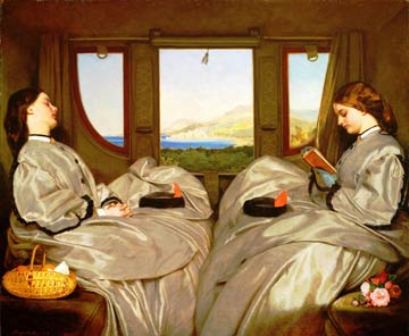
Travelling Companions by Augustus Egg (1862)

Today I am once again featuring a Victorian painter.  His name is August Leopold Egg and he was born in London in 1816.  He was the third son of Joseph and Ann Egg.  His Swiss-born father, like his family before him, was a gunsmith and today one of his guns or rifles commands a high price at auction.

In 1834 Augustus studied art at the Sass Academy in London.  Henry Sass was an English artist and teacher of painting who founded this London art school and it provided training for those seeking to enter the Royal Academy.  Two years later, in 1836, the twenty-year old August Egg enrolled as a Probationer to the Royal Academy Schools.  The following year, he joined up with a number of fellow aspiring artists and formed a sketching club, known as The Clique.  This small grouping, which included the founder, Richard Dadd, also included Alfred Elmore, William Powell Frith, Henry Nelson O’Neil, John Phillip and Edward Matthew Ward.  The Clique was characterised by its denunciation of academic high art in favour of the simpler genre painting, and the group were influenced by the great English narrative painter William Hogarth and the Scottish historical painter David Wilkie.  For them, art was for public consumption and for the public to judge.  They believed that works of art should not be judged solely on how well they conformed to academic principles.

August Egg was at pain to combine popularity with moral and social activism in his paintings which was similar to how his friend, the writer Charles Dickens managed to do with his novels.   Egg and Dickens became great friends and  jointly founded the “Guild of Literature and Art”, which was a philanthropic organisation which provided welfare payments to struggling artists and writers.  Egg’s early works of art were mainly illustrations of literary subjects as well as historical incidents taken from the accounts of the seventeenth century diarist, Samuel Pepys.  He also showed great interest in Hogarth’s narrative works, which often had a moral theme such as Marriage à la Mode and The Rake’s Progress and it was probably these works that inspired Egg to complete his moral narrative painting, The Life and Death of Buckingham.  Many members of The Clique were vociferous critics of the Pre-Raphaelite Brotherhood because, to them, their art was deliberately unconventional, but Egg disagreed and became a great friend and admirer of William Holman Hunt.  In 1848 Egg completed his much lauded work entitled Queen Elizabeth discovers she is no longer young.  This won him critical acclaim and earned him the position of Associate Member of the Royal Academy (ARA).  In 1860 he was elected to the position of Royal Academician (RA).  That same year he married Esther Mary Brown.

August Egg was, besides being a talented artist, a great organiser and spent a much of his time organising exhibitions for his fellow artists.  In 1857 he was one of the organisers of the The Art Treasures of Great Britain exhibition, which was held in Manchester from  May to October of that year.  To this day, it is said to remain the largest art exhibition ever to be held in the Great Britain, possibly in the world with over 16,000 works on display. It was so popular that it attracted over 1.3 million visitors in the 142 days it was open, which at the time, was about four times the population of Manchester.

Egg loved the theatre and it was through this love that he became friends Charles Dickens and Wilkie Collins and at times they would all take part in amateur theatricals.  In 1849, Egg was elected to the Garrick Club, a gentleman’s club, which was named after the well-known thespian of the time David Garrick.  At the end of that year, Egg who often travelled extensively around the Mediterranean countries, set off on a journey to Switzerland and Italy and was accompanied by Dickens, who had just completed his novel Bleak House,  and his other writer friend, Wilkie Collins.  Egg’s health was never good and in his later years he tried to remedy this by living in the warmer climates of the Mediterranean countries.  He died in Algiers in 1863 of asthma aged 46.  He was always well loved and his friend, Charles Dickens, described him as:

“….always sweet-tempered, humorous, conscientious, thoroughly good, and thoroughly beloved…”

My featured painting today by August Egg is entitled Travelling Companions which he completed in 1862 and can now be found at the Birmingham Museum and Art Gallery.  This has a connection with Egg’s travels as the setting of the painting is a railway carriage and through the open window of the carriage one can just make out the shoreline of Menton, a popular health resort in Victorian days, which lies close to Monte Carlo on the French Riviera.   Look how the artist has cleverly depicted the motion of the carriage by painting the tassel attached to the window blind at an angle away from the vertical.  There are no other people in the carriage besides the two females which may have been an indication that in those days, males and females rode in segregated train carriages.  There is almost a perfect symmetry about the women in this painting as they sit across from each other in the carriage.  They wear almost identical billowing voluminous grey dresses.  Their hats rest on their laps.  Their faces are each framed with a mass of beautiful brunette hair and each wears a black choker around their neck.  At first glance, they almost look like mirror images of each other but once we look more closely, there are obvious differences.  One sits with a basket of fruit by her side, whilst the other has a bouquet of flowers next to her.  One reads whilst the other lays back with her eyes closed.  There is no interaction between the two females.  Neither seems to be interested in the other or what sights can be seen from the carriage window.  Did August Egg want us to take the painting on face value, that is, did he want us to just to accept that this is simply a painting of two women travelling in a railway carriage?   I did, but many do not see the painting in such simplistic terms.  Maybe it is because Egg had painted many moral narrative works that people looked for hidden meanings in this work.  I am not convinced, but let us look at some of the suggestions that have been put forward about how we should interpret what  we are looking at and then I will let you be the judge as whether they are too fanciful to believe or there is a modicum of truth in what they want us to accept as the true meaning behind the painting.

So, if you, like me, look on the painting as simply a depiction of two women travelling by train let me “muddy the waters” for the more I investigate this painting the more I am wondering whether I am missing something.  Is this simply a painting of two almost identical women on holiday travelling in a railway carriage?  Are we simply observing a young lady sleeping and a young lady reading?  First of all, are we looking at two separate women?  That would seem a silly question but some people would have us believe they are one and the same person and that the artist is portraying them in different moods.  Some again who believe in the “one woman” theory would have us believe that perhaps the waking woman is the product of the sleeping one: in other words, she is the dreamed projection of the other.  Another theory is that the one who sleeps is a portrait of inactivity and the one who reads is a portrait of activity – a pictorial depiction of “Industry and Idleness”.  I also read that Egg’s painting was a statement of past and future with the one woman with her eyes closed dreaming of the future whilst the other reads of the past?

And so the theories about the interpretation of this painting mount up but I suppose one has to remember that in Victorian times, tales with a moral were all the rage and Augustus Egg painted many pictures which told a moral tale, so is this yet another one?     

For people who like to add their own interpretation to a painting many feel the need to explore the sexual connotations in a scene and I read an article which does just that.  It is by far the most unusual interpretation (I initially intended to say “fanciful interpretation” of the painting but decided the word “fanciful”  sounded derogatory and that is not my intention).  The article I came across was on the website entitled Victorian Visual Culture and was written by Erika Franck as part of a degree course in Modern Literary studies.  She wrote:

“…Although Egg’s Travelling Companions (1862) is considered to be a reflection on railway travel and the way in which the different classes were segregated, one cannot ignore the sexual connotations that are evident in the painting. The painting displays two young ladies who appear to be identical, and yet upon closer inspection are not. It seems as though the girl on the left has been awakened sexually despite the fact that she is asleep. This can only be detected in comparison with the girl on the right. Firstly, the young lady on the right has flowers set beside her as opposed to the other lady who has a basket of fruit. The flowers convey the virginity and sexual virtue of the girl on the right whereas the fruit beside the girl on the left implies her virginity has been lost and her innocence has been replaced by sexual indulgence and consequently sexual maturity. This analogy continues as one studies the way in which the companion on the right has the curtain slightly drawn to shade her from the sunlight, as opposed to the lady on the left whose curtain allows the light to expose her fully. In addition, the companion on the left has removed her gloves and is thus further exposed physically. The hat of the lady on the left is positioned slightly to the left in contrast to her companion whose hat sits centrally upon her lap. Again it appears as though the girl on the left has exposed herself sexually in that she is less guarded than her sister. This notion is furthered when one considers the posture of the two companions. The one on the right seems more composed and is reading a book whereas the one on the left is leaning back exposing her neck, and is asleep. Although one could question that if this girl has been awoken sexually then why is she the one who is sleeping in the painting? However, it is possible to argue that this displays her overall lack of constraint and propriety that is portrayed by the other young lady. Even the hair of the companion on the left seems to have fallen out compared to the girl on the right whose hair is pinned back in a controlled manner. If one examines the shape of the carriage window in conjunction with the symmetry of the girls’ dresses one can observe there is a shape which resembles that of a chalice. This traditionally symbolizes the womb and fertility, thus accentuating the theme of sexual awakening. Therefore, Egg presents a young woman who appears to be sexually passive and another who is not. One can speculate that the two ladies are the same person and this consequently, would indicate that a transition from sexual unconsciousness to sexual enlightenment has occurred. However, if one is to argue that this picture depicts a girl who has fallen sexually in contrast to her companion, then this painting serves as a mere “freeze-frame”. It does not represent the consequences of the girl’s fall….”

I sometimes wonder whether I should write a book entitled My Interpretation of Great Paintings as I would be simply just one of many to offer an interpretation as to what I think we are looking at and as the artist is dead and cannot repudiate my suggestions, who is to say the hidden meanings I put forward are wrong !    Somebody once told me that if you want to write a successful biography of an artist you have to come up with at least one amazing, contentious even bizarre fact about the artist that nobody has ever heard before as that will get you the publicity needed to sell the book.   I wonder if the people who have interpreted Egg’s work were thinking along those lines !

The Sick Child by Edvard Munch

The Sick Child by Edvard Munch (1907) The Tate, London

If I was to mention the name Edvard Munch to most people they would automatically think of his famous painting entitled The Scream and although I will look at that masterpiece in a future blog, today I want to concentrate on his very poignant painting entitled Det syke barn (The Sick Child) which he completed in 1886.  The version you see above is one he completed twenty years after he painted the original and is now to be found in the Tate Gallery, London.  However I look more closely at the painting, I would like to delve into the early life of Munch and by so doing, it may give one an insight into the man and his paintings.

Edvard Munch was born on December 12th, 1863, on a farm, in the village of Ådalsbruk in Løten, Norway.  His father, Christian Munch, the son of a clergyman, was a military doctor, who in 1861 had married Laura Catherine Bjølstad, a woman half his age.  The couple had two sons, Peter Andreas and Edvard and three daughters, Johanne Sophie, Laura Catherine and Inger Marie.     In 1864, when Edvard was just one year old, the family moved to Kristiania (now known as Oslo) as his father had been offered the post of medical officer at the Akershus Fortress.  In 1868, when Edvard was still not five years of age, his mother died of tuberculosis.  Following her death the five children were brought up by their father and their aunt Karen.  Edvard proved to be a sickly child, especially during the cold harsh Norwegian winters.   He suffered from chronic asthmatic bronchitis and had several serious attacks of rheumatic fever and would often have to be kept off school and it was during these times when he was at home confined to his bed that Edvard developed a love of sketching.  Whilst at home his father would tutor him in history and literature.  There can be no doubt as to Christian Munch’s devotion to his children but there was a down-side to this dedication and attentiveness.  Christian Munch was an extremely religious man.  He was a orthodox Christian and a great believer and follower of pietism.  The Pietist movement combined the Lutheranism of the time with the Calvinism emphasis on individual piety and living a vigorous Christian life.  Edvard always remembered his father’s strict religious beliefs and in Sue Prideaux’s 2005 book on Munch entitled Edvard Munch: Behind the Scream, she quotes Munch:

“…My father was temperamentally nervous and obsessively religious—to the point of psychoneurosis. From him I inherited the seeds of madness. The angels of fear, sorrow, and death stood by my side since the day I was born…”

Edvard Munch, like his siblings had to suffer their father’s religious fanaticism and he would often tell them when they were naughty that their mother was looking down upon them and weeping with sadness at their behaviour.  Combine his father’s behaviour with his own illnesses as a child and it is no wonder that young Edvard and some of his siblings experienced nightmares and death-like hallucinations.  Death was never far away from Edvard.  His favourite sister, Johanne Sophie, died of tuberculosis in 1877 when he was fourteen years old.  One of his younger sisters was diagnosed with a mental illness at an early age and Edvard’s brother Andreas who was the only one of the children to marry, died a few months after his wedding.  All this affected Edvard and in Arne Eggum’s 1984 biography of the artist, he quotes Munch as saying:

“…I inherited two of mankind’s most frightful enemies—the heritage of consumption and insanity…”

To supplement his meagre army pay, Christian Munch tried to set up in private practice but this failed and he and his children suffered a poverty-stricken lifestyle which made it necessary to move from home to home in ever worsening conditions.  Many of Edvard Munch’s early drawings and watercolours were of the interiors of their various homes.    In 1879 he followed his father’s wishes by entering the Technical College to become an engineer. However the illnesses Munch had suffered during his childhood continued and, as was the case with his time at school, he had frequent absences from the college due to his ailments.  He fell so far behind in his studies that in the autumn of 1880 he left the college, deciding engineering was not for him. There was an entry in his diary of November 7th 1880:

‘….My decision is now namely to be a painter…”

In the following year he enrolled at the Royal School of Art and Design where he stayed for one year.  He and a few of his fellow art students then set up and rented a studio in a building which housed other painters.  One of these painters was the Norwegian artist, Christian Krohg, who offered to tutor these young aspiring painters.  Krohg was a leading figure in the changeover from romanticism to naturalism, characterized by Norwegian art in this period.   Edvard Munch exhibited his first painting at the end of 1883 at the Industry and Art Exhibition in Oslo.

In 1885 Munch received money to study for three weeks in Paris and the following year he began to work on today’s featured painting, The Sick Child.

My featured painting today by Munch was completed in 1886 when he was just twenty-three years of age and remains one of his most important works.  Munch himself describe this work as “a breakthrough in my art”  Munch created numerous versions of the painting and as I said at the beginning, the painting you see before you today is the fourth version, which he painted in 1907, and which is currently being exhibited at the Tate Gallery, London.   In the painting, the central character is that of a stricken young girl propped up in bed by a thick white pillow and covered by a heavy blanket.  She is dying of tuberculosis.  Her red hair is tousled and uncombed.  This is not just the death of any girl.  This is the death of Edvard Munch’s elder sister, Johanne Sophie, who was dying slowly, in fever, often hallucinating, and begging for someone to rescue her from the jaws of death. Edvard was both distressed and terrified by his own helplessness. His father even with his medical knowledge could not do anything to save his daughter. In the eyes of young Edvard’s both God and his father were both guilty of letting Sophie die.  From this time on, death became a constant companion in the young artist’s life and there can be no doubt that this early traumatic childhood experience influenced all of Munch’s art.   Munch later, he said of this feeling:

“…Sickness, insanity and death were the angels that surrounded my cradle and they have followed me throughout my life…”

This work of art is all about the fragility of life.  As she lies back on the pillow the young girl seems to be focusing on the black drape at the right of the painting.  Maybe Munch wanted to have us interpret this as her staring at death itself.  Next to the bed of the dying girl we see a distraught female, clutching one of her hands in theirs, offering what little comfort she can at this heartrending time.  Look how the supportive friend, who holds the hand of her dying friend, is affected by the situation. Her head is bowed and her eyes are averted from the face of the dying child.   She cannot bear to witness the fear and suffering in the child’s eyes.

I have often said in earlier blogs that I wondered what was going through the artist’s mind when he or she was painting a certain picture.  In this case we can almost feel the pain and the sadness of the artist as he portrayed his dying sister.  Anybody who has suffered the loss of a family member must know what was going through Munch’s mind as he had to recall such a harrowing scene.

There is a history to this version of the painting.  It was bought by the city of Dresden in 1928, where it was displayed in the city art gallery.  Ten years later the Nazis regime declared that the art of Edvard Munch was ‘degenerate’ and, in November 1938, all his works in German public collections were collected in Berlin for sale by auction. Today’s featured painting and many others by Munch were rescued by a Norwegian art dealer, Harald Holst Halvorsen, who returned them safely to Oslo. The painting was then acquired by Thomas Olsen in 1939, who donated it to the Tate.

Were the critics as moved by this poignant painting when it was exhibited at the Autumn Exhibition in Kristiana in 1886?    Alas the painting shocked the critics and the public alike and a storm of indignation and protest broke out.   It is very important to try and understand the people’s hostile reaction;   they were simply not accustomed to see this kind of painting. For them, art was still synonymous with beauty, harmony, good shape, and for them the sight of suffering, ugliness and pain in a painting was just not acceptable.  Edvard Munch however was not put off by the condemnation and criticism.  He came back to the painting time and time again over the following twenty years, re-painting it but never once toning down the sadness and the emotion which, I am sure you agree, makes it a beautiful and moving work of art.  Death, illness and mental anguish were subjects that would from then on continue to figure significantly in Edvard Munch’s future paintings.

On the Brink by Alfred Elmore

On the Brink by Alfred Elmore (1865)

Today I am featuring a work of narrative art.  Narrative art is one that tells a story and has been very popular in Western art.  It often depicts stories from the Bible, mythological tales and legends and were often pictorial recordings of great moments in history.  In the seventeenth century we began to see such narrative works in the paintings of subjects from everyday life, which were known as genre paintings.  They originated in the main in Holland with scenes of peasant life and drinking scenes in taverns.  In England in the sixteenth century the artist William Hogarth invented the Modern Moral Subject paintings which brilliantly brought to our attention and lampooned the manners and morals in his day.  I featured a set of these paintings in My Daily Art Display (May 4th to May 9th 2011).  Before I talk about today’s painting, I will briefly tell you a little about the life of Alfred Elmore.  In the meantime, I want you to look at the painting and see if you can surmise what is going on and why the artist chose the title of On the Brink.

Today featured work is a Victorian narrative painting by English painter of Irish birth, Alfred Elmore.  Elmore was a Victorian history and genre painter, who was born in Cork in Southern Ireland.  His father, John Richard Elmore was a retired surgeon from the British Army.   His family moved to London and Alfred attended the Royal Academy Schools in 1832.  Whilst at the Academy he briefly associated with a group of fellow art students who had just formed a sketching society which they called The Clique.  It was described as the first group of British artists to combine for greater strength and to announce that the great backward-looking tradition of the Academy was not relevant to the requirements of contemporary art.

In the late 1830’s Elmore studied at French atelier and then from 1840 to 1844 travelled extensively through Europe visiting Munich Venice, Bologna, and Florence and spent two years in Rome.  In 1844 he exhibited his work entitled Rienzi in the Forum at the Royal Academy and this led to him becoming an Associate of the Royal Academy (ARA) the following year.  He became a Royal Academician in 1857.  Elmore painted a number of literary subjects, especially depicting scenes from the plays of Shakespeare but many of his later works were historical narrative works, some of which were wholly anti-Catholic in spirit.  Elmore’s reputation was at its height in the 1850’s but he suffered a lapse into comparative obscurity during the latter portion of his life.  He died of cancer in 1881, aged sixty-five.

And so I return to today’s painting entitled On the Brink which Alfred Elmore painted in 1865 and was probably his best known work.  It is termed a moral genre painting which may give you a clue to what is happening in the painted scene.  What do you make of the title of the painting?  Have you any idea why Elmore would give the work such a name?  I suppose to discover the answers to these questions one has to first identify what we are looking at.  We are standing outside a house and looking through an open window into a room which is the venue for some sort of gaming.  A man leans out of the window and is talking to an unhappy-looking woman who is seated outside.  That is the scene and the man and the woman are the main characters.

This painting, which was exhibited at the Royal Academy in London in 1865, clearly embellishes the concerns Victorian people had about gambling, especially when it involved young women. The artist has created a striking sense of depth within the painting. There is a great contrast in the colours used for the interior and the exterior.   In the foreground we have the outside tranquillity and paleness of the moonlight which contrasts with the dazzling red and gold gaudiness of the hustle and bustle going on inside the room.   Look at the garish colours of the gaming room.  The red wallpaper is lit by a chandelier and candles, which are reflected in gilt mirrors around the walls. A throng of people lean over a gaming table, totally absorbed in the action, which contrasts with the sorrowful state of the woman in the foreground. If we look to the left background we can see a curtained-archway which leads to another well-lit gaming room full of people.  We are almost certain we know the setting for this painting for there is a one word inscription, Homburg, on the reverse of the canvas.  In 1842, the German town of Bad Homburg had a casino and spa and had attracted a wealthy and cosmopolitan clientele to its gaming tables, of which many were British.

The woman with a decision to make.

The young woman, we see before us, sits unhappily outside in the darkness of the evening. Her figure is illuminated by the white light coming from the moon. We can only see one side of her face which is deathly white whilst the other side is hidden in the darkness of the night.  Her clothes are of a rich quality and the height of fashion.  Our first clue as to what the painting is all about is the empty purse which dangles from her right hand and a torn gaming card which lies discarded at her feet. From these clues we now know why she is in such a state – she has lost all her money at the gaming tables which we can see through the open window behind her.

The seducer

Still we haven’t reconciled the title of the painting but if we look at the shadowy figure of a man leaning out of the window talking to her all will be resolved.  His figure, apart from his hands, is neither illuminated by the light from the room nor the moonlight.  The way the young man is depicted, almost devil-like, adds a certain air of foreboding and menace and we feel that he is not a good companion for this lady.  It is interesting to see how the artist compares this mismatch with the couple in the middle ground.  They are standing in the room directly behind the shadowy figure and face each other in a loving stance.

The title of the painting can be understood a little better if we look at the flowers which are next to the woman.  There are two types of flower.  One is a white lily which symbolises purity whilst the other is the purple passion flower.  In the Punch magazine in the May of the year the painting was exhibited, an anonymous poet had written, about the scene and what we were looking at:

E’s [for] Mr. Elmore. She’s tempted to sin;
She’s fair. Will the lily or the passion flower win?

According to the poet’s understanding of the painting, it was all about the choice faced by the unfortunate young female who had just gambled away all her money and was now being propositioned by an unseemly man.   The question she is on the brink of answering is, should she retain her virtue and face the consequences of her new found poverty, or does she earn the money she needs to repay her debts by submitting to the proposition of the young man who is offering money for her body.  As we look at her she is “on the brink” of making her decision.  So we now know that the title of the painting derives from the situation in which a young woman s ‘on the brink’ of responding to the blandishments of a seducer, who is depicted as a Satan-like figure, luridly bathed in red light, and whispering corrupting thoughts in her ear.

There were a number of Victorian paintings which depicted “fallen women” and I will look at another in a few days time.  This one by Elmore, which he exhibited at the Royal Academy in 1865, was to greatly enhance his reputation as a Victorian artist.

The painting is presently housed in the Fitzwilliam Museum, Cambridge.

The Rain It Raineth Every Day by Norman Garstin

The Rain It Raineth Every Day by Norman Garstin (1889)

Most of you, who have read my blogs, may know by now that I took early retirement and am now running a small Bed & Breakfast establishment in a Welsh coastal town.  I pride myself in trying to give my guests the best stay they could ask for and each morning cook them the best breakfast possible and I am pleased to say my small establishment has received top ratings on a certain website.  The people that stay with my wife and I are from all over the world, some coming from hot climates.  Sadly, the only thing I cannot guarantee my visitors is the weather.  My breakfast room is in the conservatory and when the heavens open, I try and convince my diners that the sound of rain on the conservatory roof is actually worse than the conditions outside.  I am not sure whether I am believed!  I actually feel guilty about the weather they have to sometimes endure!  So why do I mention this?  It is certainly not an advert for my B&B but merely a lead in to today’s featured painting which highlights the worst of the British weather.  My Daily Art Display’s featured painting today is entitled The Rain it Raineth Every Day and it was completed by the Irish artist and writer Norman Garstin in 1889.

Norman Garstin was born in Cahirconlish, in County Limerick, Southern Ireland in 1847.  His mother was Irish and his father was of Anglo-Irish descent and he was their only child.  He displayed no early interest in art and on leaving school attended the Engineering College of Cork and it was during that time when he was studying to become an engineer and draughtsman that it became apparent that he had a great aptitude for drawing.  Because of this palpable talent for drawing, he moved to London to study architecture.  It was whilst living in the capital that he heard and read about the money that was to be made in the South African diamond fields.  The lure of a possible fortune to be made was too much for him to ignore and so in 1872 he journeyed to South Africa and the diamond field centre, Kimberley, in order to make his fortune.  He remained there for four years and for some time shared a tent with Cecil Rhodes, the English-born South African who was to become the founder of the diamond company De Beers and the founder of the state of Rhodesia, which was named after him.

Garstin did not make his fortune digging for diamonds and after four years he moved to Cape Town where with Frederick York St Leger, an Anglican clergyman and a fellow Limerick man he helped to edit the Cape Times newspaper.    He returned to Ireland but after a bad riding accident, in which he lost the sight of his right eye, Garstin made another career change and turned his attention to art.    He travelled to Antwerp in 1878 where he studied at the Koninklijke Academie, which had been founded two hundred years earlier by David Teniers the Younger.  It was here that Garstin studied under the Belgian painter, Charles Verlat.  From Antwerp he went to live in Paris in 1871, where he remained for three years studying at the studio of Carolus-Duran, the French painter and art teacher.  Whilst in Paris he made many friends in the artistic community, two of whom, Degas and Manet, were artists he looked upon as the greatest painters of their time.  After Paris, and influenced by the French naturalist painter, Garstin Jules Bastien-Lepage, Garstin travelled to Britanny to paint, which was a favoured place for naturalist painters at that time.   Later he travelled around the south of France, Spain, and Tangiers.  In 1885 he was in Italy and in Venice and it was during his European travels that he made friends with many artists who would later form part of the artist colony at Newlyn, which was to be his next port of call.

Garstin moved to Cornwall in 1886 and became one of the early members of the Newlyn School, an art colony situated in and around the small Cornish fishing village of Newlyn, which was situated close to the town of Penzance.  This newly found artist community was similar in nature to the Barbizon School on the outskirts of Paris, near the Fontainebleau Forest, which was established in the 1830’s.  In both cases the lure to these places was the fantastic natural light and the opportunity to paint outside, en plein air.  This opportunity to paint outside instead of in a studio was helped with the innovation of tubes of paint and the invention of the box easel with its built-in paint box, which made it much easier for artists to trek around the undulating countryside.  For Garstin, the fishing port of Newlyn had other things going for it as well.  It was cheap to live there and artists’ models were easy to come by and inexpensive.  The Newlyn School artists found the everyday life in the harbour and the nearby villages were ideal subjects for their paintings and their works often brought home the harsh conditions experienced by the fishing fraternity and the hazards and tragedies which were often associated with that profession.

It was also in 1886 that Garstin married.  The couple had two sons, one of whom was killed in the war and the other went on to be a respected writer.  In 1894, his wife, who was also a painter, gave birth to their daughter Alethea.  Garstin dedicated much time in teaching art to his daughter and she blossomed under his tutelage.  She was the youngest woman to have a painting accepted by the Royal Academy and went on to become a great en plein air artist in her own right and was once called “England’s leading Impressionist”.

Norman Garstin stayed in Newlyn for four years before moving to Wellington Terrace, Penzance in 1890.  He was not a prolific artist and so was not always able to support himself financially from the sale of his paintings.  For that reason he had to supplement his income by writing, teaching and giving lectures.  From 1899 onwards he would organize artist summer schools and led summer trips to the Continent for his students.  Garstin died in Penzance in 1926, shortly before his seventy-ninth birthday.

Today’s featured work by Garstin The Rain it Raineth Every Day derives its title from two of Shakespeare’s plays, Twelfth Night and King Lear.  In Act V, Scene I of Twelfth Night there is a soliloquy by the clown as he sings a song, the last line of each verse ends with the title of today’s painting:

When that I was a little tiny boy,
With hey, ho, the wind and the rain,
A foolish thing was but a toy,
For the rain it raineth every day.

But when I came to man’s estate,
With hey, ho, the wind and the rain,
‘Gainst knaves and thieves men shut their gate,
For the rain it raineth every day.

But when I came, alas! to wive,
With hey, ho, the wind and the rain,
By swaggering could I never thrive,
For the rain it raineth every day.

But when I came unto my beds,
With hey, ho, the wind and the rain,
With toss-pots still had drunken heads,
For the rain it raineth every day.

A great while ago the world begun,
With hey, ho, the wind and the rain,
But that’s all one, our play is done,
And we’ll strive to please you every day.

The painting depicts the promenade between Newlyn and Penzance on a windswept and rainy day, just like it is now, as I look out my window.  It was painted in 1899 and Garstin, with his hopes high, submitted it to the Royal Academy for inclusion in that year’s exhibition but the jury rejected it.  It is such a realistic painting that one can almost feel the sea spay on one’s face as one gazes at the painting.  The way Garstin has painted the scene is thought to have been influenced by works of Whistler, one of Garstin’s favourite painters.  On the left we see the Queens Hotel and further to the right we can just make out the parish church which lies behind a row of terraced houses.

The painting presently hangs in the Penlee House Gallery and Museum in Penzance.  Of all Garstin’s works, this is the one he is remembered for.

So has the setting changed much since the time of Garstin?  I have to admit I have never been to Penzance but my thanks to Jane on whose website entitled Fleur Fisher in her World, I found this picture of the present day promenade

(http://fleurfisher.wordpress.com/2009/12/27/norman-garstin-irishman-and-newlyn-artist-by-richard-pryke/

The promenade at Penzance today

Harvest at La Crau with Montmajour in the Background by Vincent van Gogh

Harvest at La Crau with Montmajour in the Background (1888)

For all of us in the northern hemisphere we are in the midst of winter.  The days are short, the skies are grey and the rain is plentiful.  It is truly a depressing time of the year and one knows only too well that there is nothing more likely to lift one’s spirits than the presence of blue skies, coupled with long hours of sunshine and feeling the warmth of the sun on one’s back.  So what has all this to do with My Daily Art Display’s featured painting and the famous artist who painted it?  Well, just maybe Vincent felt the same as he looked out the window of his Parisian apartment in February 1888.  Today my featured artist is Vincent Willem van Gogh and my featured painting is entitled Harvest at La Crau with Montmajour in the Background which he completed this work in 1888 and can now be found in the Rijksmuseum, Amsterdam.

Van Gogh had come to Paris from Antwerp in March 1886 to live with his brother Théo, who was the manager at the Goupil Gallery in the Boulevard Montmartre.  He studied for a time at the Atelier Cormon under the tutelage of Femand Cormon, the French painter and art teacher.  Whilst in Paris, Van Gogh met up with many of the Impressionists, such as Camille Pissarro, Emile Bernard and Claude Monet and became firm friends with Paul Gaugin who only arrived in the French capital in late 1887.  Van Gogh also witnessed the infancy of Neo-Impressionism and the works of the Neo-Impressionists Signac and Seurat.  Van Gogh quickly abandoned the dark colors he had used to create his earlier paintings and began to he embrace the brighter more vibrant colors and the techniques of the Impressionists.   Life in the French capital for van Gogh with his painting during the day and his socialising with his fellow artists at night soon began to affect his health and after almost two years he began to tire of the cliquish Parisian art scene.   Whether it was for this reason or for health reasons or even the simple desire to leave the drab and cold capital city we will probably never be sure but there was no doubt that he hankered for the warmer sunny climate and the vibrant colours of the southern countryside.,  Van Gogh decided to move south to Arles and take advantage of the special Provencal climate  with its many uninterrupted hours of sunlight and by doing so also absorb the beauty of the French countryside.  It was his fervent hope that he could persuade some of his newly found artist friends to join him there and together they could set up a school of art,  maybe even an artists’ colony and together he believed they could resurrect the purity of the arts.  This was to be van Gogh’s  Studio of the South.  He left Paris in February 1888, a month before his thirty-fifth birthday, and headed south for Provence.

It was during his sojourn in Provence that he painted today’s featured painting Harvest at La Crau with Montmajour in the Background.  Van Gogh loved this region of Provence with the rocky outcrop of Montmajour and the Montmajour abbey.  This was thought to be one of the happiest times of his troubled life.   For a short period he seemed very content with his way of life.  He made many pen and ink sketches of the Benedictine abbey at Montmajour and the spectacular views from it of the surrounding area.   Van Gogh spent much time producing sketches with his reed pen and rather less time painting.  The reasons for this were probably two-fold.  Painting and the acquiring of paints was quite costly and it was almost impossible to paint when the Mistral wind was at full strength.   In a letter which he wrote to his brother Théo in July 1888, he described the pleasure he derived from this area, despite the problem with mosquitos and the strong cold northerly Mistral wind which made his canvases shake on the easel andmade en plein air painting almost impossible.  He wrote:

“….But now I’ve been to Montmajour 50 times to see that view over the plain, if a view can make one forget such small displeasures, then it must have something…”

In this painting, the pride of place does not go to the abbey which can be seen in the background.   The painting is all about the yellow and green patchwork quilt fields of La Crau which lay between Montmajour and Arles.  The fields are interspersed with small farm buildings with their red-topped roofs, the colour of which not only acts as a contrast to but seems to enhance the colour of the surrounding fields.  In the middle ground we can see a blue cart which is often cited as a secondary title to the painting.  He painted the scene in June 1888 and he believed it to be his best work to date.  It was at a time when the summer heat was beginning to intensify and the life-restoring radiance of the Mediterranean sun was his constant companion.  He once described this light  in a letter to his brother:

“….a light that for want of a better word I shall call yellow, pale sulphur yellow, pale golden citron!  How lovely yellow is!  And how much better I shall see the North!….”

Preliminary sketch of Harvest at La Crau (Fogg Art Museum, Harvard University)

Van Gogh made two preliminary drawings of the work and the provenance of one shows that on the death of her brothers Vincent and Théo in 1890, it came into the possession of Willemina van Gogh, their younger sister.  It is now at the Fogg Art Museum, Harvard University, a bequest of Grenville L. Winthrop.  If one compares this preliminary sketch with the finished painting one can see that the space in the finished painting has been expanded and the viewpoint is much higher.  There is a much more gradual retreating of the plain as it runs off towards the towers of the Montmajour Abbey, which can be seen in the left background, and further back to the distant hills.

A later drawing of the scene (NGA Washington)

After he completed the painting he made two further drawings of the scene.  One of which is entitled Harvest – The Plain of La Crau, which he gave to his friend, John Peter Russell, an Australian artist and which can now be seen at the National Gallery of Art in Washington where it is part of the Mr and Mrs Paul Mellon collection.

I love this painting.  It is a truly inspiring painting.  Inspiring?  As I look out of my window at the falling rain and the dark grey rain-laden clouds, it inspires me to return to Provence and bask once again in the warm sunlight, take in the golden colours of the plains, interspersed occasionally with the blue and violet colours of the fields of lavender and of course be in awe of the azure colour of the nearby Mediterranean.

Oh, for the winter to end so that I can travel again!

Venus and Mars by Sandro Botticelli

Venus and Mars by Botticelli by Sandro Botticelli (c.1485)

Many have written about today’s painting and the symbolism of what is depicted and the interpretations of the work abound.  In my blog today I have tried to steer a middle course between completely ignoring the interpretation of the work and delving too deeply into the scholarly minutiae of what we see before us.  Today I simply want to look at the characters behind the title of the painting and the actual people who we see before us.

The painting entitled Venus and Marswas completed by the Florentine artist, Sandro Botticelli around 1485 and the nineteenth-century title of the painting alludes to two mythological people who had an adulterous affair.  They are Venus, the Goddess of Love, who had an illicit liaison with Mars, the God of War, whilst she was still married to the lame blacksmith Vulcan, who forged Cupid’s arrows and the intricate armour of the Gods and heroes.   The tempera and oil on poplar work, which now hangs in the National Gallery in London, measures 69cms tall and 174cms in width.  Little is known as to who commissioned the painting or for where it was intended.

A cassone

However the dimensions of it would probably mean that it was made for either a cassone or a spalliera.   A cassone is the Italian word for chest or box. They were used for storage and often associated with the giving of a dowry.  A spalliera is the Italian word for the back of a bench or settle, or the headboard or footboard of a bed, or any similar vertical attachment of a piece of furniture.  They were commonly painted in Italy, especially in Tuscany.  Often these items of furniture were richly decorated with carving, gilding and painted panels illustrating acts of heroism or as is the case with this work, acts of love.  The fact that it is an act of love we are looking at probably means that this was meant for a bridal chamber and maybe it was to be incorporated into the headboard of a bed (spalliera di letto).  If we look at the painting we can see that the two figures almost rest on the base of the painting and so if it was meant to be part of the headboard of a bed, the lovers would almost be seen as lying on the bed itself.

Before I look at the two main characters in this painting by Botticelli, let us look at some of the other details we see before us.  The setting for the painting is contemporary.  It is a forest and yet strangely the artist has not incorporated any flowers into the scene which may be simply an indication of the time of the year. However the couple is framed by two evergreen plants, the laurel and the myrtle.  The former was associated with the family of Lorenzo de’ Medici and the myrtle was associated with Venus.   In the distance, on the other side of the fields we can just make out the city of Florence, behind which rise the mountains which lie to the north of the River Arno.

If you look closely at the top right corner of the painting, just above the head of Mars you will see a swarm of hovering wasps.  So why include them?  One thought is that as the Italian word for wasps is vespe and they form part of the Vespucci’s coat of arms.  We will see later that the model used for Venus was Simonetta Cattaneo, whose husband Marco was a member of the Vespucci family.  Others interpret the presence of wasps as being the symbolic of the painful stings of illicit love.

In the painting we also have four small satyrs.  Normally in paintings featuring Venus one would have expected to see erotes, which were the tiny group of gods and demi-gods associated with love and sex and part of Venus’ retinue.  The satyrs were more like little devils and maybe their inclusion once again to the fact that we are observing an act of forbidden love.  Two of the satyrs can be seen wielding a lance which no doubt has a phallic connotation.

The narcotic fruit ?

Another satyr can be seen blowing a conch shell in an attempt to wake the sleeping figure of Mars and one, with a lascivious expression on its face, lies beneath the arm of the exhausted Mars, clutching a green fruit.  This fruit has brought about much discussion as to what it is and why it is incorporated in the painting.   Some would have us believe it is the fruit of one of the highly narcotic datura genus of plants, datura stramonium and that Mars is in a drug-induced sleep.  Other art historians disagree with this assertion pointing out that the plant was not found in Italy at the time Botticelli painted his masterpiece.  Others have suggested the fruit depicted was ecballium elaterium which is also known as the ‘exploding cucumber’ or ‘squirting cucumber.’  This too is a poisonous plant.

Simonetta Vespucci née Simonetta Cattaneo de Candia

In today’s painting in My Daily Art Display the woman who was believed to have been used as a model for Venus was looked upon as the most beautiful woman of her time.  Botticelli had incorporated this woman in to two of his other masterpieces, namely, Primavera which he completed in 1482 and the Birth of Venus which he completed around 1485.  The interesting thing is that she had died some nine years before Botticelli painted the last of these works.   Some historians would have us believe that Botticelli had, like so many, fallen in love with her beauty.  How true that is we will probably never know but we do know that Botticelli asked to be buried at her feet in the Franciscan Church of Ognissanti, which was the parish church of the Vespucci family in Florence. His wish was in fact carried out when he died some 34 years later, in 1510 and a small round stone in a chapel of the right transept marks his resting-place.

The woman in question is Simonetta Cattaneo de Candia.  She was thought to have been born in either Genoa or Portovenere around 1453.  She was part of a very wealthy and influential family.  Her father, Gaspare Cattaneo della Volta, was a Genoese nobleman from the House of Volta and her mother, Cattocchia Spinola de Candia came from an equally wealthy background, the European dynastic House of Candia.  Simonetta was married at the age of sixteen to the son of a wealthy Florentine banker, Marco Vespucci, who was a distant cousin of the famous Italian explorer, Amerigo Vespucci.  Although this was not an arranged marriage, Simonetta’s parents were pleased with the arrangement as the groom’s family were well connected with the powerful Medici family.

Simonetta moved to Florence and after the marriage in 1469 she and her husband became regulars at the Medici court in Florence and she struck up a close friendship with the co-rulers of Florence, the two de’ Medici brothers Lorenzo and Giuliano.  It was whilst attending court functions that Simonetta first met a number of court painters including the young Florentine artist Sandro Botticelli.  Men were astounded by her natural beauty and she soon became a court favourite.  One of the most prominent men to fall under her spell was none other than Giuliano de’ Medici himself.  In 1475, Lorenzo de’ Medici, Giuliano’s elder brother, organised a jousting tournament to celebrate a treaty with Venice. It was reported that at this tournament Giuliano had entered it carrying a banner, which had been painted by Botticelli, and on which was a picture of Simonetta depicted as wearing the helmet of the Greek goddess of war,  Pallas Athene and beneath the portrait were the French words La Sans Pareille (The unparalleled one).  Giuliano won the tournament and at the same time, Simonetta was nominated the “The Queen of Beauty”.  It was following this that she was looked upon as the most beautiful woman of the Renaissance.

So what was Giuliano’s relationship with the married Simonetta?  Were they lovers or was it a platonic relationship?  The question has divided historians over the years and probably we will never know the truth.  Whatever the answer is the relationship was short lived as Simonetta died of tuberculosis on April 26th 1476, a year after the jousting tournament.  She was only twenty-two years of age.  On the day of her funeral, the city of Florence came to a stand-still as thousands of mourners attended the funeral.  Ironically, Giuliano de Medici was assassinated exactly two years to the day on 26 April 1478 in the Duomo of Florence, Santa Maria del Fiore, by Francesco de’ Pazzi and Bernardo Bandini. He was killed by a sword wound to the head and was stabbed 19 times.

The figure of Mars in the painting is depicted in a traditional classical God-like way, unlike the way in which Botticelli has portrayed Venus as a contemporary woman with a contemporary hair-style dressed in her contemporary clothes.  His body is one of a well-toned athlete and was similar to those classical paintings and sculptures of the young Gods.  The whiteness of his skin reminds us of the white marble sculptures of ancient times.  But who is this Mars?  If we believe that Venus is Simonetta Vespucci, then should we believe that this reclining man is her husband or should we believe that in fact it is her “close friend”,  possibly her lover, Giuliano de’ Medici?  The figure in the painting has a long nose and deep-set eyes and they resemble the ones in his portrait which Botticelli completed of Giuliano around 1477.  As we know from mythological tales Mars was the lover of the already married Venus so are we to deduce that Botticelli had wanted to similarly portray Giuliano de’ Medici and the already married Simonetta as a comparison?

Look at the way Botticelli has portrayed the two characters.  The man lies back exhausted but the woman sits upright and looks quite composed.  Who has initiated the bout of love-making?  Who is the giver and who is the receiver?  I believe in this painting, Botticelli has given the power to the female.  She looks at the man with little emotion.  Maybe she is reflecting on the power she has over him.  The woman seems totally in command of the situation whereas the man appears worn out after what could have been a bout of love-making.  Is this a scene of male-female role-reversal in which the female has seduced the male, drained him of his vitality and in some ways neutralised him and now studies her conquest?

I am a great fan of Botticelli especially in his portrayal of women.  They must be some of the most beautiful ever painted.

I started this blog saying I would keep it concise and not too technical but the more I investigated the painting and its symbolism the more I got carried away with the subject.  More has been written about the painting by more knowledgeable people than me and if this blog has stimulated your mind and your thirst for knowledge about this work I suggest you visit some of the websites which discuss the work of art.  They are:

http://omnparts.com/2010/07/29/david-bellingham-on-sandro-botticellis-venus-and-mars/

The autor of this site is by David Bellingham, of the Sotheby’s Institute of Art

and

http://www.3pipe.net/

The Three Pipe Problem, which is a truly amazing art blog and one i love to visit.  If you go to the “search facility” and insert “Venus and Mars” you will find some interesting articles about today’s painting.

The Procession to Calvary by Pieter Brueghel the Younger


The Procession to Calvary by Pieter Brueghel the Younger

The elder son of Pieter Bruegel the Elder’s was also named Pieterand was just five years of age when his father died in 1569.   The death of his father left Pieter, his young brother Jan and sister, Marie to be brought up by their mother Mayken Cooke van Aelst.  After their mother died in 1578 the two boys went to live with their maternal grandmother Mayken van Hulst, who was an accomplished miniaturist and watercolour painter in her own right.  It is from her that the boys received their initial artistic tuition.  Very little has been written about Pieter Brueghel but Karel van Mander a Flemish-born Dutch painter and poet, who is mainly remembered as a biographer of Netherlandish artists and was a contemporary of Pieter Brueghel the Younger, records that when Pieter was nine years of age the family moved to Antwerp and it is believed that here, Pieter received his first formal artistic training under the tutelage of the Dutch landscape painter, Gillis van Coninxloo III.  When he was twenty years old he became a member of the local Guild of Saint Luke and was registered as an “independent master”.  In comparison to his younger brother, Jan, Pieter was less successful as an artist.  He ran a studio, which had many apprentices, including Frans Snyders, who was to become one of the foremost Netherlandish painters of animals and still-life.  The problem for Pieter was that his paintings although they sold well, were sold cheaply.  The main reason for this was the fact that a lot of his works were copies or imitations of his father’s works.  Art critics have pointed out that his works had neither the depth of his father’s works nor the refinement of the works of his younger brother Jan.

At the end of 1588 when he was twenty-four he married Elisabeth Goddelet and the couple went on to have seven children.  Pieter Brueghel the Younger painted landscape and religious paintings as well as his fantasy paintings in which he liked to depict hobgoblins, fires, and other grotesque figures and it was his love for this sort of work which made him known as “Hell Brueghel” in stark contrast to the nickname, “Velvet Brueghel” given to his brother Jan for his concentration on still-life flower paintings.  Pieter Brueghel and his apprentices spent a lot of time copying his father’s works of art.  He and his studio produced more than sixty copies of his father’s 1565 painting entitled Winter Landscape with Skaters and a Bird-trap.   Pieter Bruegel the Elder’s painting entitled The Adoration of the Magi in the Snow, which he completed in 1567, was copied by his son in 1600 and was just one of almost thirty copies of the painting which came from the studio.   A painting simply entitled Proverb,s which can be found at the Rockox House museum in Antwerp is a copy of his father’s 1559 painting Netherlandish Proverbs which is housed at the Staatliche Museen in Berlin.  A great number of his paintings featured peasants and their daily lives, just as his father had done years earlier.

My featured painting today is one which Pieter Brueghel the Younger completed in 1607 entitled The Procession to Calvary.  It is a prime example of young Pieter Brueghel attempt to copy one of his father’s great works of art of the same name which was completed in 1564.  The painting which was owned by Lord St Oswald had hung at the family seat of Nostell Priory in Wakefield, West Yorkshire for over two hundred years.  However although the building is now owned by the National Trust the contents belong to the St Oswald family and they wanted to sell the work.  Through the auspices of the Art Fund, The National Heritage Memorial Fund and various monies received from the public, trusts and other foundations the painting was bought for £2.7 million and will now remain at the Priory.

The painting is deemed to be one of Brueghel the Younger’s best works.  His setting for the biblical scene illustrating Christ’s journey to his own crucifixion atop Mount Calvary is a Flemish landscape and is full of fascinating details. The background of the painting is a vast landscape with a river estuary slowly meandering towards the open sea which we can just see on the horizon.  In the left mid-ground we see a city with all its multi-storeyed buildings.  This is not a mystical biblical city from the Middle East but a European cityscape.  I love the details the artist has given the buildings.  People of Flanders who saw the painting could relate to the scene.  Brueghel has not only painstakingly depicted the city but he has spent much time depicting the people and the everyday objects that he has included in the painting.

Look to the right and you can see a troop of soldiers leading the procession up the hill , escorting Christ on his last journey.  Note their armour.  It is modern.  This is not a depiction of Roman cavalry.  This is a depiction of the troops of the Spanish army similar to the ones who had sacked Antwerp in November 1576 when Pieter Brueghel the Younger was just twelve years of age.  Maybe the atrocities of the war between the Catholic Spanish and the Protestant Netherlands affected the young boy and his painting is not just a tale of Christ’s suffering at the hands of the Romans but a tale of his people’s suffering at the hands of the Spanish.

If we look to the top of the hill we do not just see the three traditional crosses which were part of the biblical tale.  What we see is a mish mash of gallows and gibbets.  These would not be unusual sights set outside the city walls at the time of Brueghel.  Public executions were quite common at the time in the Netherlands and as in the days of Christ’s crucifixion, such executions were often attended by the local population.  Ahead of the Spanish troops we can just make out the two thieves being transported in a cart towards the top.  Unlike the biblical tale of the two thieves carrying their crosses like Christ, Brueghel has shown them being moved in carts, which was how those who were to be executed in Brueghel’s day were moved towards their place of execution.

It is also interesting to note how Brueghel has depicted Christ bearing his cross.  He is just a non-descript figure dressed in grey and hardly stands out from the crowd.  He is not the centre of attention in this sprawling painting and yet he has the leading role in the story.  What of the onlookers?  Are these all depicted as wracked with grief mourning the imminent death of Christ?  I would suggest that Brueghel has portrayed the scene differently from what we are used to seeing.  I believe there is a passive air about the crowd which maybe reflects more the contemporary Netherlandish life when executions were commonplace and caused little outpourings of grief except from the immediate next-of-kin.   This is more of an everyday scene than a portrayal of the events of Good Friday.

Take a look at this painting and compare it with the one done by his father which I featured in My Daily Art Display of March 7th.  See which you prefer.

Farm at Montfoucault by Camille Pissarro

Farm at Montfoucault by Camille Pissarro (1876)

At a time of chaos with Christmas Day just hours away and when family descend on us from every direction, it is very difficult to put aside time to develop a new blog for My Daily Art Display.  However today I am a writing a short entry featuring a painting by Camille Pissarro, which was on the majority of my Christmas cards which I sent out.  So, today’s blog is my Christmas card to you.  The painting is entitled Ferme à Montfoucault, effet de neige (Farm at Montfoucault, snow effect), which he completed in 1876 and can now be found in the Ashmoleon Museum.

It was Camille Pissarro’s good friend and fellow painter Ludovic Piette who had an estate at Montfoucault in the department of Mayenne in eastern Brittany.  Pissarro stayed there numerous times in the 1860’s and 1870’s.  It was during these periods that he completed many of his works of art depicting the region and its people.   Pissarro was in awe of the surrounding countryside and once commented to a friend that he always look forward with much anticipation to being in “the true countryside”.   This area was in complete contrast to Pontoise, where he had settled in 1872.  Pontoise was a modem town with a large population criss-crossed by roads and railway lines in complete contrast to the tranquillity of Montfoucault.  Montfoucault and the Mayenne department was criss-crossed, but not by numerous traffic-laden roads but by small country lanes and fields enclosed by hedgerows.  The whole of the Mayenne region at the time was somewhat remote and isolated.  It was Théodore Duret the French journalist and art critic who had recommended that Pissarro should journey to the area to find, as he termed it, “the path of rustic nature”.

The painting before you is of an enclosed barnyard of a farm which was close by to Ludovic Piette’s house.  In all, Pissarro completed no fewer than eighteen paintings which depicted the immediate surroundings of Piette’s house.   There is a coldness about this painting.  It is the kind of scene you appreciate as you sit at home and absorb the warmth of a wood fire.  The snow on the ground is melting slightly and turning to mud.   I like the way Pissarro has depicted the scene with a cold light which falls on the thatched roofs and bundles of straw.  Pissarro has managed to incorporate a number of animals into his painting as well as the figure of the farmer as he struggles through into the yard weighed down with bales of straw.

Despite his love for the area, this painting marked his last visit to the home of Ludovic Piette, who died in 1878.

So that is my Xmas card to you.  For my Christmas present to you I would (if I could) give you one of three books on artists, which I have enjoyed reading this year and which I thoroughly recommend you buy.

They are not strictly biographies but a kind of fictional biography which has allowed the author to mix facts with a touch of fiction and which I believe adds to the enjoyment.  The books are:

Luncheon of the Boating Party by Susan Vreeland and is a novel that brings to life Renoir’s masterpiece and how he came to paint the scene.  It also gives an insight into the Impressionists and the tensions between certain members of the group.

As Above, So Below by Rudy Rucker.  This is a fictional novel, based upon facts about the life and times of Pieter Bruegel the Elder.  It is a lively and interesting tale which will appeal to all of you who love the work of Bruegel.

The Passion of Artemisia by Susan Vreeland.   This is a fictional biography of Artemisia Gentileschi, one of the greatest female artists of all times and follows the struggles of the young woman who had to endure numerous setbacks and overcome much in a male-dominated society in order to reach the pinnacle of her career.

Finally let me wish you all,  a very Merry Christmas.

The Rabbiter and his Family by Russell Drysdale

The Rabbiter and his Family by Russell Drysdale (1938)

I thought as I had spent the last three weeks in Australia I should feature a work by an Australian artist.  I was based in Cairns during my stay and visited a number of small galleries.  Around this area the majority of galleries were displaying indigenous art, which although very colourful, was very similar in many aspects.  The main gallery in the city was, at the time I visited it, devoted to young artists and a display by the local art society.  I think to see major works of art one has to be in either Sydney or Melbourne.  However today I am going to showcase the work of one of the leading twentieth century Australian artists, albeit he was born in England and didn’t move to Australia until he was eleven years of age.  My featured artist is George Russell Drysdale, later to become Sir George Russell Drysdale.

Russell Drysdale was born in Bognor Regis, a Sussex seaside town on the south coast of England in 1912.  His grandfather was an affluent Scottish landowner and livestock farmer as was his father, George, who built on the family wealth by carrying on working the family estate.  Drysdale’s mother, Isobel Gates was English by birth.  Russell Drysdale father had moved to Northern Queensland, Australia where he owned and ran a sugar plantation along the Burdekin River.  The rest of the family moved out to Australia to be with him four years later in 1923.   It was at this time that the family moved and settled in Melbourne and Russell boarded at the nearby Geelong Church of England Grammar School. 

In 1926 his father bought Boxwood Park, an estate in the Riverina district, a pastoral region in the south-western part of New South Wales, which was a main source of beef and wool to markets in Australia and for export.  It was also the homeland of the Aboriginal people who were thought to have settled on this land for more than 40,000 years.   In 1929 Drysdale developed a detached retina in his left eye, a condition which was to trouble him for the rest of his life and left him virtually blind in that eye. He left school and in the following year spent six months working with his uncle, Cluny Drysdale, at the Pioneer estate, later acting as an overseer at the family property, Boxwood Park, in northern Victoria while his family travelled abroad.  Russell had initially intended to follow the family tradition and become a farmer but a quirk of fate changed his destiny.  It was whilst he was an in-patient at a Melbourne hospital, recovering from eye treatment, that he amused himself by drawing in pen and ink. His doctor Julian Smith, who was an amateur photographer, showed the drawings to Daryl Lindsay, a noted artist and who would later become Director of the National Gallery of Victoria.  Lindsay was impressed by the drawings and persuaded Drysdale to consider a possible artistic career.  

In 1935, at the age of twenty-four, he enrolled at the Bourke Street Studio School of Art in Melbourne, which was run by the artist, George Bell.   Bell had a profound and lasting influence on Drysdale and twenty-five years later, at the opening of Drysdale’s retrospective exhibition in 1960, Bell proudly stated: “He is my boy”.  Thus began the road to a very successful artistic career.    In 1935 he married Elizabeth ‘Bon’ Stephen, the daughter of an old Riverina family who were also of Scottish descent and  who lived near the Drysdales in Albury. The wedding took place on Drysdale’s twenty-third birthday. They went on to have two children, a son Tim and a daughter Lynne.   After finishing the three year course in 1938 he embarked on one of his many trips to Europe, where he spent time at the Grosvenor School of Modern Art in London and the Académie de la Grande Chaumière in Paris.  It was during his time in Paris that he came under the influence of the great French painters of the day such as Paul Cezanne, Paul Gauguin and Henri Matisse.  Drysdale was also gratly influenced by the works of the Italian painter Modigliani.

By 1939 he was looked upon as a great aspiring artist but as yet Drysdale had not decided what genre of art he should concentrate on.  In 1940 he left Melbourne and moved first to Albury, the second largest town in the Riverina and later Sydney, where the art world was awakening to European influences, and he immediately found himself at home in this artistic environment.   It was whilst living in the Riverina region that Russell focused on life in this somewhat desolate region. 

In the early 1940’s Drysdale began to illustrate the life of Australia’s rural frontiers in his own enigmatic style.  His paintings often depicted the barren ochre-hued heartland of his country and the harsh conditions experienced by the people that had to work the land.  He held his first solo exhibition in the Riddell Galleries in Melbourne in 1938 and his second four years later in Sydney.  The latter received great acclaim and at that time Russell Drysdale was acknowledged as being in the forefront of the modernist movement in Sydney.  He received many commissions including one from the Sydney Morning Herald who wanted him to do a series of works depicting the devastating drought conditions in western New South Wales and the demise of the deserted mining town of Hill End.  The series of paintings he produced immediately enhanced his artistic reputation.   

At the request of the art historian Sir Kenneth Clarke, Drysdale staged an exhibition of his work at the Leicester Galleries in London.  Up until this time, critics had looked upon Australian art and Australian artists as being simply provincial but this exhibition was to change the minds of the art critics and finally they were willing to look more carefully at the Australian art scene.  Drysdale spent much of the 1950’s and 1960’s painting scenes from the remote Australian outback.  The early 1960’s was to prove a tragic time for Drysdale as his son Tim committed suicide aged just twenty-one and the following year his wife also took her own life.  A year later in 1964 Drysdale married again, this time to Maisie Purves Smith who had been his long time friend.

 In 1969 Drysdale was knighted for his services to art and in 1980, a year before his death he was awarded the Companion of the Order of Australia. In 1980 Drysdale suffered a stroke which ended his painting career.  He died in Sydney in 1981 aged 69.

My Daily Art Display’s featured painting today is by Russell Drysdale and is entitled The Rabbiter and his Family which he completed early on in his career in 1938 and which now hangs in the National Gallery of Australia in Canberra  In this painting we can clearly see that Drysdale was influenced by the work of Modigliani.  Look at the expressions on the faces of the older members of the family.  It is very obvious they are not pleased to see us and there is no question of them asking us to come and join them inside.   There is a defensive attitude about their stance with them spread out wide as if to prevent us from getting past.  It may well be that they, in this remote outback area, are unused to visitors or maybe they believe we are in some way going to force change to their lives.  It has to be said that the two young girls and the baby don’t have the same hostile expressions as seen on the faces of the mother, father and grown-up son.  They are probably too young to be suspicious of our intentions.

The son stands next to his father.  He is probably about twelve years of age.  He, like is sisters, stands before us barefooted and like his mother his head is tilted slightly sideways in a questioning expression.  His arms are folded across his chest in an uncompromising and belligerent fashion.  To the left of him is the large brown family dog who eyes us menacingly.  His young sister is next to him.  Note how she too has tilted her head in an enquiring manner.  She is somewhat concerned by our presence.  See how she wraps her arm around her father’s waist which affords her some comfort. 

In the centre of the group is the father.  His arm and hand lies protectively around the shoulder of his daughter.  His other hand is hooked into the belt around his waist.  He has the darkest skin of all the family members which is probably due to the number of hours he works outside under the ferocity of the unforgiving sun.  Next to him but slightly behind him is the mother.  She is dressed in a shapeless orange dress and on her feet she wears what look like a pair of blue bedroom slippers.  Clutched to her breastm is a very inquisitive baby, who is wrapped in a white shawl the colour of which matches the shirt worn by the son.  On the far right of the group is the younger of the two daughters whose bright reddish orange hair matches the colour of her mother’s dress and the little girl’s pale blue dress tones in with the colour of her mother’s slippers.  Finally to the right of the group is the second family dog, which show no interest in us and is concentrating on relieving an itch on the back of its neck as it scratches away unconcernedly.

In the background we have a dark-blue meadow dotted with flowers and one art historian has likened this with the designs on the Lady with the Unicorn series of tapestries which are at the Musée de Cluny in Paris.  In the background to the right of the family and in front of their yellow-walled house we see a ploughed area with vegetables.  The precious rainwater is collected in a large tin water tank which is connected to the guttering of the house.  The fields depicted in this painting are in triangular curving segments and we get a great sense of the undulation of the land.

Some say that there is a naiveté about Drysdale use of colour in this painting but maybe that is what makes the work so appealing.  Although there is a somewhat menacing look upon the faces of the elders in this picture the cartoon-like way in which Drysdale has portrayed them all has added a little humour to the scene and may in some way elicit an affectionate sentiment from us, the viewer.

The Risen Christ by Bramantino

The Risen Christ by Bramantino (c.1490)

Today I am returning to an Italian painting for My Daily Art Display and want to look at The Risen Christ by the fifteenth century Italian painter and architect, Bartolomeo Suardi.  He was better known simply as Bramantino, (little Bramante) as he was a devoted follower of his one-time tutor the great Italian architect, who designed St Peters, Donato Bramante.

Bramantino was born in Milan in 1456, the son of Alberto Suardi.  Initially trained as a goldsmith but later turned his attention to painting.  His initial artistic training was with Donato Bramante who profoundly shaped his artistic style.  His style as a painter is somewhat complex and diverse.  In his early career he was also influenced by the drawings of Piero della Francesca.  It was not until he was in his mid-thirties that he exhibited his first works.  It was at this time, around 1490, that he completed today’s featured painting, The Risen Christ as well as another of his great compositions, The Adoration of the Magi

Bramantino worked for Gian Giacomo Tivulzio for whom he designed a series of cartoons for a  tapestry cycle on the twelve months of the year which can now be found in the Castello Sfozesco.  Trivulzio, a nobleman and warlord, had over time, built up a great wealth, which he used in part as a patron of arts and in particular on works by Bramantino.   These commissions included the Trivulzio Chapel in the Basilica of San Nazaro in Brolo where he was eventually buried. In 1508 Bramantino was in Rome on a commission he had received from Pope Julius II to produce some frescos for one of the reception rooms in the Vatican.  The next year following his work for the pontiff he returned to Milan and was inundated with new artistic and architectural commissions.  In 1525 aged sixty-five he was appointed architect and painter to Maria Sforza, the Duke of Milan.  In the following years he produced many religious paintings for his patron including a Crucifixion which I saw when I visited the Pinacoteca Brera in Milan and a Virgin and Child with Saints, which is in the collection at Palazzo Pitti in Florence.

Bramantino died in Milan in 1530 aged 70.

My Daily Art Display featured painting is an oil on panel work entitled The Risen Christ which Bramantino completed around 1490 and is now hanging in the Museo Thyssen-Bornemisza Gallery in Madrid.  It is a haunting portrayal of Christ.  I feel somewhat uneasy when I look at this work of art.   It is a very powerful portrayal but the power of it is not dependent on a depiction of violence or splashes of blood oozing from wounds.  In some ways, and in comparison to other paintings which depict the risen Christ, it is somewhat downbeat.  This is not a portrayal of a triumphant Christ having risen from the dead.

 Before us is a full frontal ,three-quarter length portrayal of Christ with the shroud of his burial wrapped around his shoulders.  This is a man who has passed through death and is now no longer part of this world.   Look at the luminosity Bramantino gave to Christ’s skin.  It is a combination of translucent white and grey.   The cloak, which Christ is wearing, has a metallic lustre and mirrors the paleness of his skin.  The shroud and the body of Christ seem to emit light.  His body, with its raised veins, shows the wound caused by the lance to his right side and the palms of his hands show the scars caused by the crucifixion nails.  In contrast to the colour of his body, his face is not so pale with Bramantino contrasting the ghostly pallor of the body with the reddish/brown of his face and his red hair which hangs down to the shoulders. The long hair and the and the hint of a beard which follows the jaw line helps to elongate the face.  Despite the colouring, his face is gaunt and haggard and bears testament to his mental and physical suffering he has had to endure.  There is a distinct look of sadness in his reddened eyes.  He looks directly at us but it is a penetrating and hauntingly pained look.  He almost appears to look through us with this riveting stare.  There is an air of detachment about Christ which serves to emphasise the fact that he is no longer part of our world. 

To the left, in the background we have a nocturnal landscape.  We can just make out a riverscape with a ship with its tall cross-shaped masts and two campaign tents topped by golden balls.  This part of the painting  is illuminated by moonlight and in some way manages to offset the emotional stress of the foreground.  Bramantino’s architectural interest can be seen coming out of the darkness on the right of the painting in the form of some classical architecture which could represent Christ’s burial tomb in the Garden of Gethsemane. To the left the buildings seemed to have fallen into a state of disrepair with vegetation growing wild from their tops.

What I like about this painting is that Bramantino has managed to stop us in our tracks when we first cast our eyes on the work.  He has managed that without the histrionics of bloody gore.  The pale figure has grabbed our attention and made us focus our mind on what has happened during the lead up to this situation.