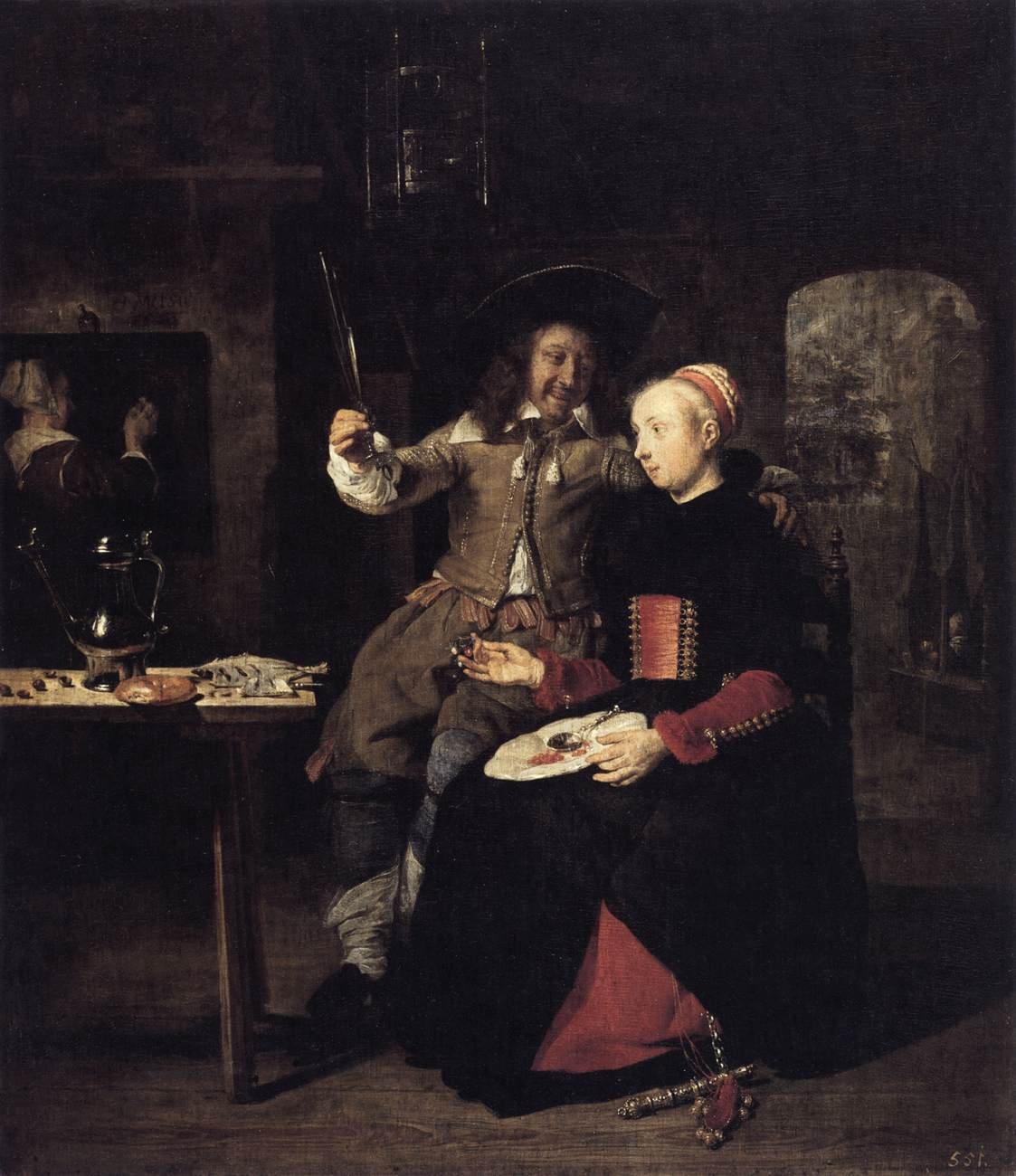
Gabriel Metsu. Part 2 – his later life and paintings

Portrait of the Artist with His Wife Isabella de Wolff in a Tavern by Gabriel Metsu (1661)

In my last blog I looked at the early life of Gabriel Metsu and had reached the year 1651, the year in which his mother died.  Gabriel Metsu was twenty-one years of age and, as such, was still not looked upon as an adult.  In the Netherlands at that time, adult status was only reached when a person became twenty-five years of age, and for that reason Gabriel came under the guardianship of Cornelis Jansz. and Jacob Jansz. de Haes.  Around this time it is thought that he was advised by a fellow aspiring artist, Jan Steen, to seek employment as an apprentice with Nicolaus Knupfer, a painter from Utrecht.  Metsu remained with Knupfer for a few years during which time he completed a number of religious paintings.

In 1654, his guardianship came to an end and his late mother’s estate was finally settled and Gabriel received an inheritance.  With this newly found wealth, Metsu left Leiden and moved to Amsterdam where he had enough money to set up a workshop in a small house off the Prinsengracht.  He remained there for a short time before moving to a canal-side residence.  It is believed the reason he moved was that he had got into so many arguments with his neighbours for keeping chickens at the rear of his house.

His desire to move to Amsterdam was probably due to his search for artistic commissions as the city had far more opportunities for an artist than that of the smaller town of Leiden.  The other thing that Metsu realised when he arrived in Amsterdam was that small-scale genre scenes were far more popular with art buyers than large scale religious works and so he made a conscious decision to change his painting style and for his inspiration into that art genre, he could study the works of the Leiden painter, Gerard Dou and the Deventer artist Ter Borch.  Metsu’s favourite subjects became young women, often maids, drinking with clients and engaged in domestic work often in tavern settings.

Saint Cecilia by Gabriel Metsu (1663)

In May 1658 Gabriel Metsu married Isabella de Wolff who came from Enkhuizen.  Her father was a potter and her mother, Maria de Grebber, was a painter and came from a family of well-known artists.  Metsu had probably met Isabella through his connection with the de Grebber family when he was a teenager.  Anthonie de Grebber, who had given Metsu some early artistic training in those days, was a witness to Metsu and Isabella’s pre-wedding settlement.  They married voor schepenen which means “before magistrates” which presumably meant that the couple did not belong to the Dutch Reformed Church and it is thought more likely that they were both Catholics.  Isabella became one of Metsu’s favourite models and appeared in many of his works.  In 1663 he completed a work featuring his wife, Isabella, as the model for Saint Cecilia.  She is seated playing the viola da gamba.  St Cecilia was a Catholic martyr who was revered for her faithfulness to her husband (note the lap dog) and it could be that Metsu by having his wife model for the martyr was his way of publicly recognising his wife’s fidelity.  This would not have been the first time an artist had used his wife in a depiction of this Catholic saint as in 1633 Rubens completed a painting of St Cecilia in which he used his second wife, Hélène Fourmen,t as the model.  It is entirely possible that Metsu had seen the Rubens’ painting and then decided to use Isabella for his depiction of the martyr.

Gabriel Metsu died in October 1667, just a few months before his thirty-eighth birthday and was buried in the Nieuwe Kerk in Amsterdam.  Following the death of her husband Isabella moved back to Enkhuizen to live with her mother, where she died in her late eighties.

A Woman Artist, (Le Corset Rouge) by Gabriel Metsu (1661-4)

Another painting by Metsu, featuring his wife as an artist, was entitled A Woman Artist, (Le Corset Rouge) and is dated 1661-4.  So is this just simply a painting of an artist for which his wife modeled?   Maybe not, for one must remember that Isabella was actually an artist in her own right, having been trained as an artist by her mother, Maria de Grebber, who had come from a family of artists and so this painting by Metsu may just be a loving portrait of his wife, highlighting her talent as a painter.

Do you ever re-read a book or watch the same film more than once?   Many people who do tell of how they saw things in the film or read things in the book the second or third time which they had not picked up the first time and that for them was the joy for re-visiting the work.  Genre works have the same effect on me.  The more times I study them, the more new things I discover which were not apparent during my initial viewing.  I also like the fact that often one cannot take things depicted at face value as there is often a hint of symbolism with the iconography of some of the objects that are dotted around the work and this I find utterly fascinating.  I read art historians’ views on such things and often wonder whether what the artist has added to the work is as symbolic as the historians would have us believe.

In my previous blog about Metsu I talked about certain iconography in the painting entitled Woman Reading a Letter, and was rather scornful with regards the supposed sexual connotation of the abandoned shoe which was prominently depicted lying on the floor.  In my next two featured paintings there is more iconography that has a supposed sexual nuance.  In the next two featured works we see a dead bird being offered to a woman.  Just a mere offering of food?  Maybe not for the Dutch word for bird is vogel and in the seventeenth century the word was synonymous with “phallus” and the Dutch word vogelen, which literally means “to bird”, was slang for “to have sexual intercourse with”.  So when we look at the two paintings we should look at the offer of a bird not as a gift of food but an enticement to have sexual intercourse!
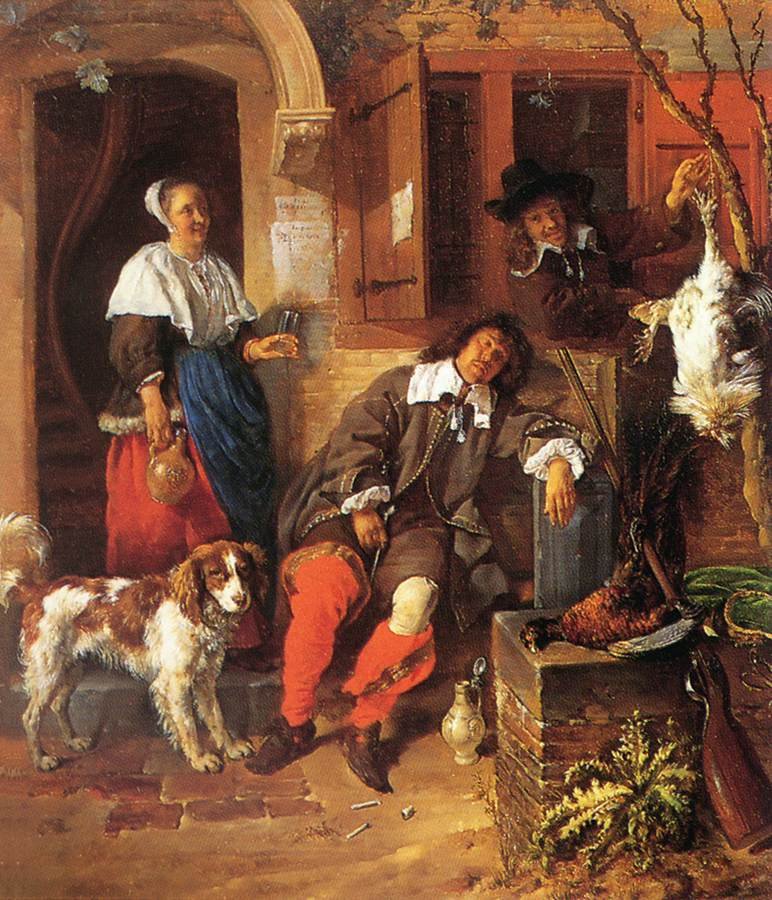
The Sleeping Sportsman by Gabriel Metsu (1660)

In the Wallace Collection in London there is a magnificent painting by Metsu entitled The Sleeping Sportsman which he completed between 1658 and 1661.  It is a kind of “hunter’s scene” and it was in this painting that we need to think laterally in as much as the hunt is the gentleman’s hunt of a woman.  In this painting by Metsu the setting is the outside of a tavern. A hunter has called in for a drink after a long day’s shooting.  His gun is propped against a low wall and the two birds he has shot are on view, a pheasant atop the wall and another bird, probably a fowl, is seen hanging from the tree.   Metsu has depicted a lady coming out of the inn with a glass and a jug of alcohol which has presumably been ordered by the hunter-sportsman.   It would appear that the jug she brings him is not his first, as he has passed out from overindulging, and we observe an empty jug lying at his feet.  After a day of hunting game he has decided to end it with a few drinks and search for the company of a female or as the French would say cherchez la femme, but, sadly for him, alcohol has won the day.  Take a careful look at the stupefied hunter.   It is supposedly a self-portrait of the artist.  He lies slumped against the end of a bench, clay pipe in his lap lying loosely against his genitals which could be interpreted as the drunken state he is in has made him temporarily impotent.  On the floor we see the remnants of another pipe which he must have dropped.  Although finely dressed he looks a mess with one of his red gaiters sagging down his leg.

However, if we look again at the woman who is bringing the hunter’s refreshment, we notice that she is not looking at her “customer”, but her eyes are fixed on the man to the right of the painting who is hanging out of the window of the inn.  He looks knowingly out at us.  He is about to take the hunter’s bird from the tree and if we go back to the slang meaning of bird then he may also be also about to take the woman away from the comatose hunter.  On the floor at the feet of the hunter is his hunting dog.  He even looks meaningfully at us, its tail wagging, as if it too sees the funny side of the incident. It is a painting with a moral, warning us of the consequences of inebriation.  Moralistic paintings were very fashionable and popular at the time in the Netherlands.

The Hunter's Present  by Gabriel Metsu  (c. 1658-61)
The Hunter’s Present by Gabriel Metsu (c. 1658-61)

Gabriel Metsu painted a similar work around the same time entitled The Hunter’s Present.  In this work we see a woman in a white dress with a red frock coat trimmed with ermine, again like the female in Woman Reading a Letter, ermine, being expensive,  signified the wealth of the wearer.  The lady is sitting demurely on a chair with a cushion on her lap as an aid to her sewing. She looks to her left at the dead bird the huntsman is offering her.  In this depiction, the hunter is sober.   Now that we know about the bird/vogelen/sexual intercourse implications then we are now also aware what the man maybe “hunting” for.  If we look at the cupboard, behind the lady, we see the statue of Cupid, the God of Love, which gives us another hint that “love is in the air”.  Standing by his master’s side, with its head faithfully on his lap, is a similar spaniel hunting dog we saw in the previous painting.   There are also another couple of additional items of symbolism incorporated in the work, besides the bird offering, that I should draw to your attention.  Look on the floor in front of the woman.  Here again we have the abandoned shoe or slipper and although I was sceptical in my last blog as to its sexual meaning I am starting to believe that it has a symbolic sexual connotation.  So is the woman, because of the abandoned slipper, to be looked upon as a sexually permissive female.  Maybe to counter that argument we should look at her right arm which rests on the table and there, by it, we see a small lap dog, which is staring at the hunter’s dog.  Lap dogs have always been looked upon as a symbol of faithfulness.  So maybe the woman is not as wanton as we would first have believed.  Maybe the hunter is not some unknown man, chancing his luck, but it is a man known to her, maybe her lover and so perhaps the bird symbolism in this case should be looked upon as just a prelude to lovers making love rather than a more sordid prelude – vogelen! .
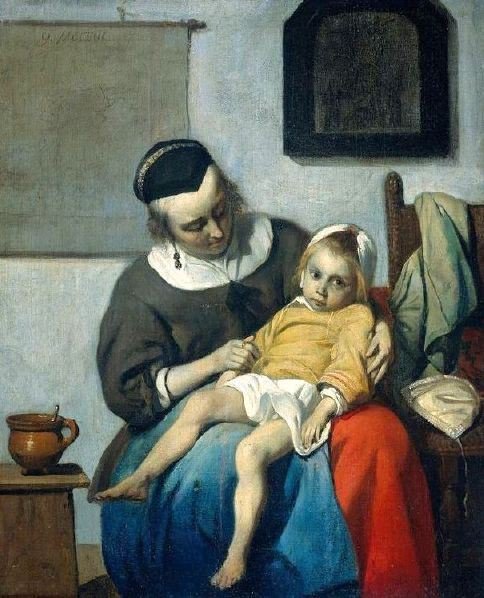
The Sick Child by Gabriel Metsu (c.1663)

The third and final painting by Gabriel Metsu I am featuring is by far one of his most sentimental and poignant.  It is entitled The Sick Child and was completed in the early 1660’s.  Netherlands, like most of Europe had been devastated by the bubonic plague.  Amsterdam was ravaged in 1663–1664, with the death toll believed to be as many as 50,000, killing one in ten citizens and Metsu would have been well aware of the heartbreak and suffering felt by people who had lost their loved ones.

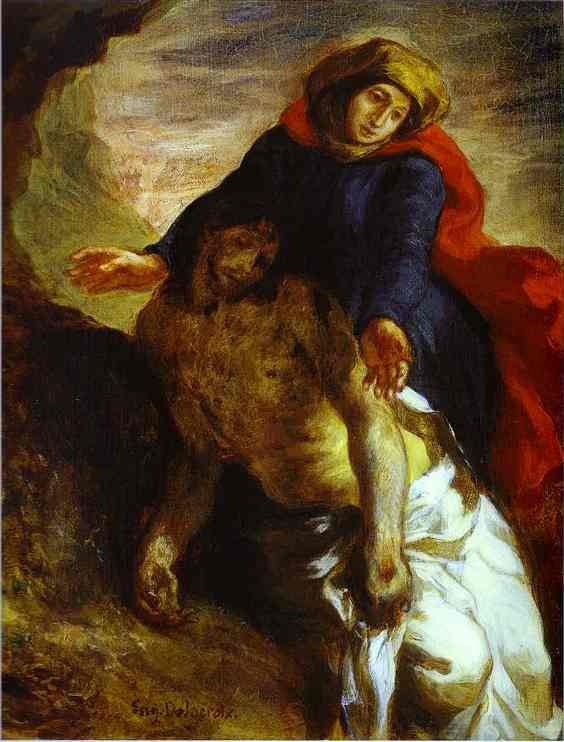
The painting has a dull grey background and the lack of background colour ensures that we are not distracted away from the two main characters.   There is a religious feel about this work.   The reasons for this assertion are threefold.   Firstly the positioning of the mother and child is very evocative of the Pietà, the portrayal of the Virgin Mary holding her son’s lifeless body in her lap, as seen in Italian Renaissance art.  Secondly, the mother is depicted wearing a grey shirt and, as a working woman with a child, one would also expect this but one would have expected her to be also wearing a plain coloured dress but in fact Metsu has depicted her in a royal blue skirt with a red undergarment and these  are the colours of the clothes one associates with Italian Renaissance paintings depicting the Virgin Mary.
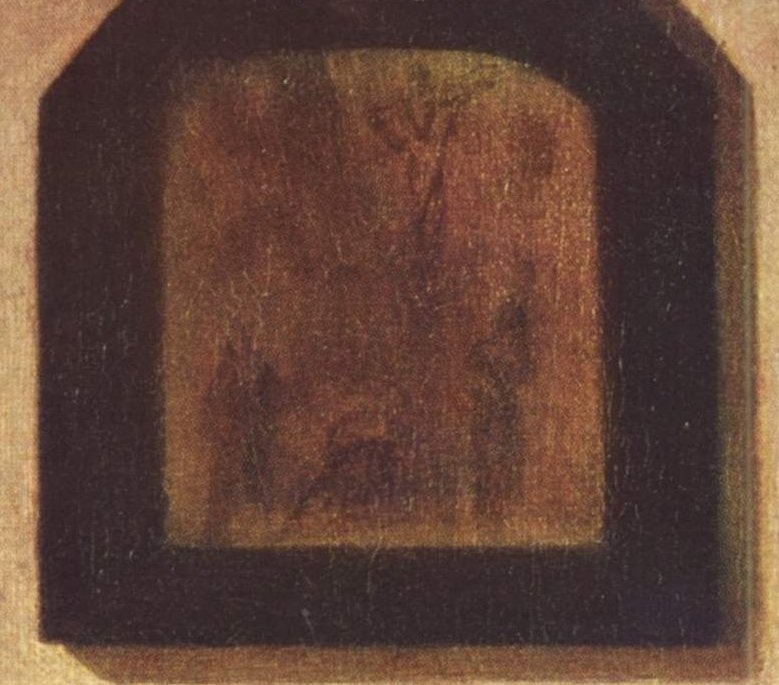
Crucifixion painting on back wall

Finally on the wall we see Metsu has added a painting of the crucifixion.  These three factors go to show that Metsu consciously asks us to compare the circumstances of the Virgin Mary and her dead son with that of this mother and very ill child.  The child, who is drooped in her mother’s lap, looks very ill and this is further underlined by the way the artist has painted her face.  It is pallid and has a deathly blue tinge to it.  The child’s legs fall lifelessly over her mother’s knees.

Tragically, Metsu died very young, at the age of thirty-seven.  He was one of the most popular painters of his era and his paintings fetched high prices.   Many art historians believe Metsu  was one of the greatest of the Dutch Golden Age genre artists and that a number of his paintings were the best of their time.   As I said earlier, although Vermeer is now one of the best loved seventeenth century Dutch painters, in the 18th and 19th centuries, Metsu was far more popular than him, and often Vermeer’s works were attributed to Metsu so that they would sell.  Through Metsu’s works we can get a feel for everyday Dutch seventeenth life.  His earlier genre works focused on the common man and woman but in the 1660’s he concentrated on scenes featuring the better-off Dutch folk, like the letter writer and his beau, and these are the paintings I have focused on in my two blogs featuring Gabriel Metsu.

Gabriel Metsu. Part 1 – Early life and The Letter

A Hunter Getting Dressed after Bathing by Gabriel Metsu (c.1654)

In A Hunter Getting Dressed after Bathing (above), Gabriel Metsu depicted himself as a nobleman and hunter, but of course the unusual twist to the depiction was the fact that he depicted himself in an a full-length, un-idealized, naturalistic nude pose.

If I was asked who was my favourite artist or what was my favourite artistic era, I would probably choose one of the 17th century Dutch Golden Age painters.  To be more precise, I would almost certainly choose an artists who painted genre scenes, all of which I find quite fascinating. Nowadays the most well known and most popular Dutch Golden Age painter is almost certainly, Johannes Vermeer.  However, for the next two blogs, I am going to feature some of my favourite works by a contemporary of Vermeer, and who during their lifetime was by far the more popular.  Let me introduce you to Gabriel Metsu.
Gabriel Metsu was the son of the Flemish painter Jacques Metsu, and Jacomijntje Garniers.  Jacques Metsu besides being a painter was also believed to be a tapestry designer or cartoon painter.  A cartoon being a full size drawing made for the purpose of transferring a design to a painting or tapestry or other large work.  Records show that Jacques came from “Belle in Flanders” which is now Bailleul, a small town in French Flanders close to the France-Belgium border. Jacques Metsu married his first wife, Maeyken, who died in 1619 without giving him any children.  He married his second wife, Machtelt Dircx the following year and the couple went on to have four children, but only the first child, Jacob, survived childhood, the others probably succumbed to the plague which  swept through the region in 1624 and which also claimed the life of Machtelt.
Jacomijntje Garnier’s family came from Ypres but by 1608 when she was eighteen years of age she was living with her family in Amsterdam.  It was in this year that she became betrothed to her first husband, Abraham Lefoutere, a citizen of Antwerp.  His profession was given as a teacher but some records show him as an innkeeper.  The couple had four children, Philips, Sara, Marytgen and Abraham who died in infancy. Her husband, Abraham, died in 1614 and soon after Jacomijntje remarried.  Her second husband was Willem Fermout but he too died at a young age in 1624

Jacomijntje Garnier moved, with her three children, to Leiden and there she met Jacques Metsu and the couple were married in November 1625.  In 1629 she became pregnant with Gabriel but sadly her husband, Jacques died in the March of that year, eight months before Gabriel was born, some time between the end of November and the middle of December 1629.  Jacomijntje’s occupation around this time was given as a midwife.  Gabriel Metsu, along with his step-brother and two step-sisters from his mother’s first marriage, were brought up by her alone, until, in 1636, when Gabriel was six years old, she married her fourth husband, Cornelis Gerritsz. Bontecraey, who then became their stepfather   Bontecraey was a wealthy captain and owner of a barge and two houses in Leiden.  He died in 1649 making Jacomijntje a widow for the fourth time.  She died two years later in 1651.

  There are few hard facts with regards Gabriel Metsu’s early artistic training and teenage years.  However it is believed he could have helped in the workshop of Claes Pietersz de Grebber, a silversmith.   Because Gabriel Metsu’s earliest work, which is still in existence, entitled Ecce Homo, which he completed around the late 1640’s was a religious one,  it is believed that his early artistic tuition must have come from a history painter.  It maybe just a coincidence, but his employer’s son, Anthonie de Grebber, who Metsu must have known, was a history painter and maybe he gave Gabriel some of his first artistic tuition.   In 1644, when just fifteen years of age, Gabriel Metsu joined a  group of local artists, and even at  such an early age, his name was entered in the membership rolls as a “painter.”  Other larger Dutch cities such as Gouda and Haarlem had their own painters’ guild, Guild of Saint Luke, and it was mandatory that artists were members of these guilds in order to sell their wares.  Leiden, up until March 10th 1648, had no such guild but on that date the Leidse Sint Lucasgilde (Leiden Guild of St Luke) was founded by Gerard Dou and Abraham Lambertsz van den Tempel.  Six days after its formation Gabriel Metsu, aged 18,  became a member.

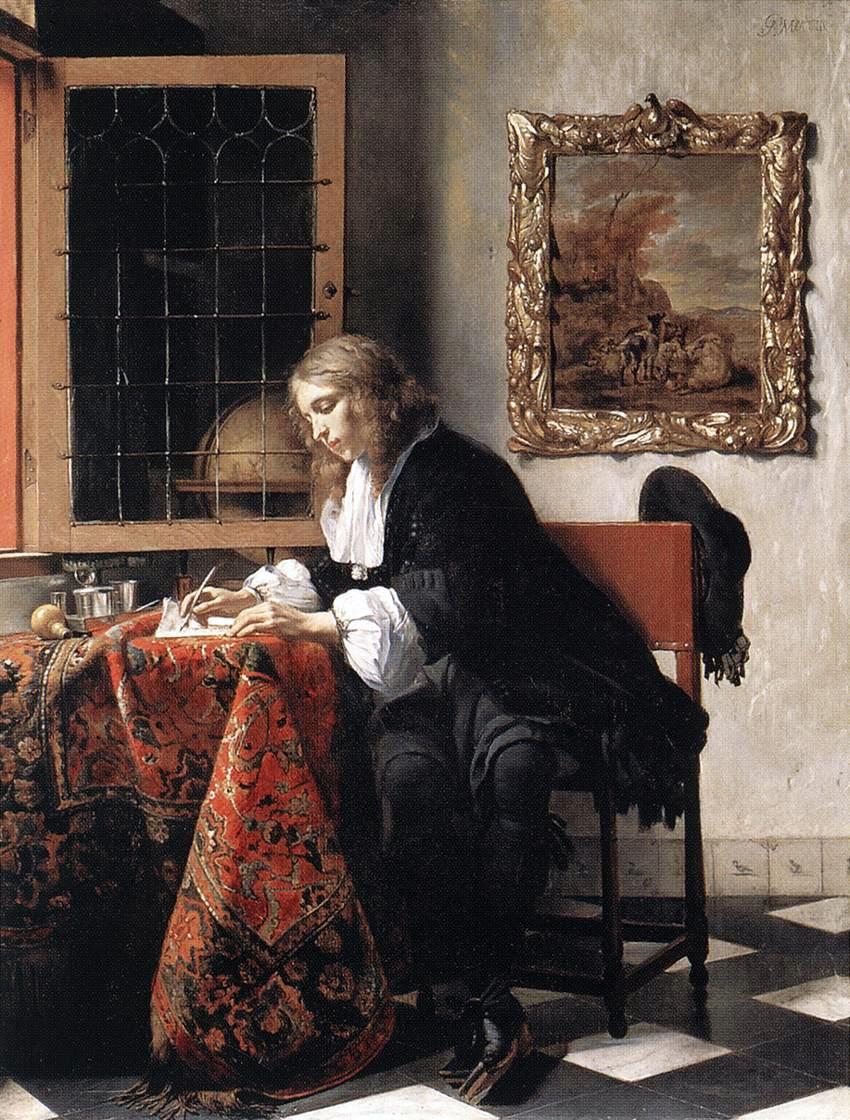
I will continue Gabriel Metsu’s life story in my next blog but for today I want to feature two of his most famous works, two narrative pendants, Man Writing a Letter and its companion piece Woman Reading a Letter, both of which were completed around 1666 and now hang in the National Art Gallery of Ireland in Dublin.  Dutch artists were the first to make the private letter a central focus in genre scenes.

Man writing a Letter by Gabriel Metsu  (c. 1664-1666)
Man writing a Letter by Gabriel Metsu
(c. 1664-1666)

The setting for the painting, Man Reading a Letter, is a study.  The scene is bathed in sunlight.  We see a young, fine-looking man, with long blonde curls, sitting at a table, pen in hand.  He is finely dressed in a black velvet jacket and the white of his shirt and neckerchief are lit up by the sunlight, which streams through the open window in front of him and reflects off the light-coloured back wall.   His hat is precariously balanced on the back of his chair.  He is quietly contemplating the words he wants to write to the woman he loves.  The sunlight highlights him.  He is at centre stage of this work and the sunlight acts as a spotlight.  If this is indeed a love letter he is writing then he must be careful with his words.  He cannot countenance a misunderstanding caused by what he has written.  Look at the resolute expression on his face.  He is totally lost in thought knowing the importance of the words he uses.  They have to say exactly what he wants them to say.  He must avoid ambiguity.  The missive must be perfect.

Observe his opulent surroundings.  The floor is made up of smooth black and white marble slabs, a sure indication that the owner of this house is wealthy.   Everything points to this being a room belonging to a well-to-do person.  We can tell this by some of the furnishings on view.   The table at which he writes the letter is covered with a finely detailed expensive Oriental rug or table tapestry.  Behind him we see a landscape painting in an expensive heavily carved gilt Baroque frame. To his right, partially hidden by the opened window frame we see a globe.  The globe appeared in many Dutch paintings of the time and is almost certainly a reminder of the Dutch Golden Age when the country was one of the leaders in exploration and trade with the far corners of the world.

Woman Reading a Letter by Gabriel Metsu  (c. 1664-1666)
Woman Reading a Letter by Gabriel Metsu
(c. 1664-1666)

The companion work to this painting is Woman Reading a Letter.  The Metsu’s pendants, when seen together, combine to become a set of narrative works in which we see the man writing to the woman and the woman reading his letter.  In this second work by Metsu, we see the lady sitting in the corner on a wooden zoldertje platform in a marble-floored hall.  She is wearing a long pink skirt, and her yellow top is trimmed with ermine, which is a sure sign of wealth.   A pillow rests on her knees, which has been used as a support whilst sewing.  Her sewing has been cast aside when the maidservant brought in a letter for her.  In her excitement at receiving the letter she has dropped her thimble which we see lying on the floor.    The letter obviously means a lot to her.  She is totally absorbed by what he has written.  Look how she tilts the letter at an angle as she thoughtfully reads it.  Maybe it could be that she needs the sunlight which is streaming through the window to illuminate the words, making them easier for her to read or maybe she is shielding the contents from her maidservant.  The painting is full of symbolism which adds intrigue to the painting.  With this being one of a pair of paintings we know that the man has written the letter to her, which she is now reading but what is the relationship between the man and the woman?  Look at the woman’s forehead. The hairline is receding and to achieve that it could be that some of her hair had been plucked or the forehead shaved giving a higher forehead, which was the fashion of the day.  Look more closely and one can see a single curl of hair at the centre of the forehead and this usually signified that the lady was engaged.

The inclusion of the dog is a symbol of fidelity and one presumes its inclusion probably signifies the woman’s faithfulness. According to some art historians and iconographers, a cast-off shoe, one of which we see on the floor, has erotic connotations.  I find that a slight stretch of their imagination but I suppose their line of thought is that lovers hastily cast of shoes in their rush to make love.  It is interesting to look at the maidservant who stands next to her mistress.  Because of her lowly status in the household she has been depicted in a drab brown dress although a little colour has been added with the blue of her apron.  Under her left arms she has a bucket with two arrows scribed on it.  Could this once again symbolise that love is in the air and these are Cupid’s arrows.  To me they look more like the arrows one used to see on the back of prisoners’ jackets in 1930’s movies.  She also holds in her left hand an envelope.  There is a word on the envelope which I cannot quite read although it seems to start with the letter “M”.  I read somewhere that the word is “Metsu” but until I stand before the original work I will not be sure.  Hopefully I will get to Dublin next month and have a closer look.

The maidservant is drawing back the green curtain, which is hanging from a rod, and which is covering a framed painting on the back wall.  Covers over paintings were not unusual as it was a means of preventing sunlight from falling on them causing them to fade.  The subject of the painting is a seascape in which we see two sailing ship battering their way through a storm. Is the subject of the painting symbolic?  There are two theories about this.  One is that the woman’s betrothed is a seafarer and the other is that the ship struggling in a storm symbolises the romantic struggles ahead for the two lovers.  Also on the wall is a mirror which is in a plain black frame, the colour of which I read symbolised a warning against narcissism and lewdness, but like the abandoned shoe I remain unconvinced with that theory.

As I said earlier, both the paintings are housed in the National Gallery of Ireland, part of the Beit Collection which is housed in the .  The paintings were owned by Sir Alfred Beit and his wife, Lady Beit.  Sir Alfred Beit was a British Conservative politician, philanthropist, art lover, and honorary Irish citizen.  He donated the two paintings I have featured today along with fifteen other masterpieces to the National Gallery of Ireland in 1987, whilst the other major art works remained at their home, Russborough House, which was once described as the most beautiful house in Ireland.   Sir Alfred and Lady Beit bought Russborough House in 1952 to house their art collection and in 1976 established the Alfred Beit Foundation to manage the property. Beit died in 1994 but Lady Beit remained in residence until her own death in 2005.  Due to a number of armed robberies and thefts of some of the paintings, which fortunately were recovered, the Foundation agreed to move them to the National Gallery of Ireland for safekeeping.

In my next blog I will complete the life story of Gabriel Metsu and feature some more of his paintings.

Judith Leyster and Tulip madness

The Merry Company by Judith Leyster (1630)

Of my featured artist today, the Dutch Golden Age writer and poet Theodorus Schrevelius wrote in his 1648 book about the history of Haarlem entitled Harlemias:

“…There also have been many experienced women in the field of painting who are still renowned in our time, and who could compete with men. Among them, one excels exceptionally, Judith Leyster, called “the true Leading star in art…” 

Judith Jans Leyster was born in Haarlem in July 1609.  She was the eighth child of Jan Willemsz Leyster who was a cloth maker and owner of a local brewery, which was called Ley-ster (guide or leading star).  It is thought that her initial artistic tuition came from Frans Pieter de Grebber.   De Grebber, a member of the local painters’ guild, Haarlem Guild of St Luke, was a landscape artist and portraitist, who also designed tapestries. The reason for this belief is that the chronicler of life in Haarlem at that time, Samuel Ampzing, mentioned Judith Leyster in his 1628 book about life in Haarlem, Beschrijvinge ende Lof der stad Haelem in Holland.  He commented that Leyster, then 19 years old, was a painter who had “good and keen insight”.   It was interesting to note that he also made the comment: “Who has ever seen paintings by a daughter?” which alluded to the fact that it was very unusual for a female to become a professional painter and furthermore, in 1633, she was one of only two females in the 17th century who had been accepted as a master in the Haarlem Guild of St Luke.  The first woman registered was Sara van Baabbergen, two years earlier.

It was around this time that Judith’s family left Haarlem and moved some forty kilometres to the southwest and went to live in Vreeland, a town close to the provincial capital Utrecht.  Utrecht in the 1620’s was the home of the group of artists known as the Utrecht Caravaggists.  These painters, such as Dirck van Baburen, Hendrick ter Brugghen, and Gerrit van Honthorst had spent time in Rome during the first two decades of the 17th century and, in the Italian capital, it was a time when Caravaggio’s art was exerting a tremendous influence on all who witnessed his works and by the early 1620s, his painterly style of chiaroscuro, was wowing the rest of Europe.   Whether Judith Leyster mixed with these painters or just picked up on their style is in doubt as the family stayed in the Utrecht area less than twelve months, moving to Amsterdam in the autumn of 1629 but two years later Judith returned to her home town of Haarlem.

It is known that she met Frans Hals when she was in Haarlem but although many of Leyster’s work resembled Hals’ work, both in style and genre, art historians are not in agreement as to whether she was ever actually Hals’ pupil or simply an admirer.  Leyster’s paintings were secular in nature and she never painted any religious works.   Although she is known to have painted a couple of portraits she was, in the main, a genre painter, recording on canvas the life of everyday people.  They were, generally speaking, joyous in their depiction and were extremely sought after by wealthy merchants.

Self Portrait by Judith Leyster (1835)

Her famous self-portrait was completed around 1630 when she was twenty-one years of age and could well have been her entrance piece for the Haarlem Guild of St Luke’s.  In the work, she is at her easel, palette and an array of eighteen paint brushes in her left hand.  Her right arm is propped against the back of her chair and a brush, held in her right hand is poised ready to carry on painting the work we see on her easel.  She has turned towards us.  She is relaxed and seems to have broken off from painting to say something to whoever is in her studio.  The first things we notice are that the clothes she is wearing.  These would not be the ones she would wear when she was painting.  They are too good for such a messy job to be worn by somebody who is painting.  Her skilful depiction of her clothes allude to her social status and her depiction of them is a fine example of the up-to-date female fashion. Also consider, would a painter working on a painting really be clutching all eighteen of their brushes at the same time?   Of course not!   This is more a painting in which Judith Leyster is intent on promoting herself.  Through this self- portrait she is eager to reveal herself, her painterly skills and her social standing.  In this one painting she is advertising her ability to paint a merry genre scene as seen by the painting of the violin player on the easel.  This depiction of a musician was similar to the one depicted in her 1630 work entitled The Merry Company, which she completed around the same time as this self-portrait.  Of course this being a self-portrait it has also highlighted her ability as a portraitist.  It is interesting to note that when this painting was subjected to infrared photography it was found that the painting on the easel was Leyster’s own face and so one has to presume she originally intended that this painting would be a quirky “self-portrait within a self-portrait”, but presumably, Leyster on reflection, decided to have the painting on the easel represent another facet of her painterly skills – that of a genre painter.  This was her most successful and profitable painting genre with its scenes of merrymakers.  It was this type of work which was extremely popular with her clientele, who wanted to be reminded of the happy and enjoyable times of life.  Although Leyster was proficiently skilled as a portrait artist the art market was already crowded with popular portraitist and so, probably for economic reasons, she decided to concentrate on her genre paintings.

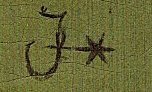
Judith Leyster's signature
Judith Leyster’s signature

Around 1629 she set up a studio on her own and started to add her own signature to her works.  Her signature or moniker was an unusual and clever play on her surname “Leyster”.  Lei-star in Dutch means “lode star” or “polestar” a star often used by sailors to navigate by and she was often referred to as a “leading star” in the art world, and so she used this play-on-words to create a special signature: a monogram of her initials with a shooting star.  She must have been successful at selling her works of art as soon she had employed three apprentices.  It is interesting to note that she had a falling out with Frans Hals who had “illegally” poached one of her apprentices and the whole matter ended up in court at which time Hals was made to apologise and make a payment to her for his action.

The Jolly Toper by Judith Leyster (1629)

Judith Leyster completed many genre pieces in which she portrayed people as being happy with their lot in life.  Settings were often inside taverns but whereas with other Dutch artists who tended to portray the tavern dwellers with a moralistic tone around the evils of drink and the repercussions of becoming a heavy drinker, Leyster wanted to focus more on people enjoying themselves.  A good example of that was her 1630 painting which is in Amsterdam’s Rijksmuseum entitled The Jolly Toper or The Merry Drinker which is considered to be one of her finest works.

The Merry Drinker by Frans Hals (1628-30)
The Merry Drinker by Frans Hals (c.1628)

However with this painting came the assertion by many critics that she was merely a copier of Frans Hals style of painting, such as her choice of subjects and her brushwork.  Hals had completed his own painting The Merry Drinker in 1630 so I will leave you to decide whether there are more similarities between Leyster and Hal’s paintings other than the subject matter.

The Last Drop (The Gay Cavalier) by Judith Leyster (c.1639)

Although Leyster’s genre scenes would often focus on happiness and merriment with no moralistic judgement, she did occasionally focus on the darker side of life and a good example of this can be seen in her 1639 painting which is housed at the Philadelphia Museum of Art, entitled The Last Drop (The Gay Cavalier).  It is a vanitas work, meaning it is a work of art which in some way symbolises the brevity of life.   In the work we see two men dressed in festive clothing having an enjoyable time drinking and smoking.  The fact that they are not just celebrating but are also dressed up for the occasion has led people to believe that this merriment is taking place on the Dutch holiday of  vastelaovend, which we know as Shrove Tuesday, the day before the start of Lent.  This was the day when people took advantage of the last day of merrymaking before the forty days of Lent abstinence and fasting.  However it is not just the two revellers that Leyster has depicted in the drinking scene, for between them we see a skeleton.  The skeleton holds an hour-glass in one bony hand and a skull and a lit candle in the other.  The candle both casts a shadow on the seated drinker but at the same time lights up the cavalier’s face.   The skull, burning candle and hour-glass are classic symbols of a vanitas painting which have the sobering effect of reminding us of the brevity of life and the inevitability of death.  There is no interaction between the drinkers and the skeleton which is probably an indication that as they have imbibed so much alcohol the thought of death never crosses their mind.  Look at the expression on the face of the cavalier dressed in red.  It is one of blankness and stupidity which we have often witnessed when we look into a face of a drunkard.  At that moment in time, he has no concern about his own mortality.   One final comment about this work is that it is a good example of how Leyster utilised a style of painting which was associated with the Italian painter Caravaggio and his Dutch followers, the Utrecht Caravaggists, whom Leyster would have seen earlier in her career.  It is known as tenebrism which is where the artist has depicted most of the figures engulfed in shadow but at the same time, have some of them dramatically illuminated by a shaft of light usually from an identifiable source, such as a candle as is the case in this painting, or from an unidentifiable source, off canvas.

A Boy and a Girl with a Cat and an Eel by Judith Leyster (c.1635)

On a lighter note I offer you another painting with a moral, but somewhat more humorous, which Judith Leyster completed around 1635 and is entitled A Boy and a Girl with a Cat and an Eel.  It is a visual joke with a moralising tale.  It is one of those paintings, typical of Dutch genre scenes, in which you have to look carefully at all who and what are depicted in the painting so as work out what is going on.  See if you can fathom it out.

The two main characters are a boy and a girl.  The boy has a cheeky smile on his face.  He has enticed the cat to join them by waving a wriggling eel which he now holds aloft, having grabbed the cat.   The little girl has now grabbed the tail of the cat, which in a state of shock and fear.  It is desperate to get away from the pair of young tormentors and has extended its claws and about to scratch the boy’s arm in an attempt to escape his clutches.  The young girl who has a face of an older woman, admonishingly wags her finger at us – so why is she so censorious?   It is believed that she is smugly warning us against foolish and mischievous behaviour alluding to the Dutch saying: ‘He who plays with cats gets scratched’.  In other words he who seeks trouble will find it. Although children are depicted in this moralising scene, it is more a warning to adults about their behaviour and many Dutch artists who painted genre scenes with a moral twist frequently used children to put over their moral message.

In the late 1630’s, a strange phenomenon occurred in the Netherlands, which had been brewing for a number of years.   It became known as Tulpenwoede (tulip madness) which saw the price of tulip bulbs rocketing.   It all began when some tulip contracts reached a level which was about 20 times the level of three months earlier.   In one particular case a rare tulip known as Semper Augustus, which had been valued at around 1,000 guilders per bulb  ten years earlier was fetching a price of 5,500 guilders per bulb in  January 1637.  This meant that one of these bulbs was worth the cost of a large Amsterdam house.  Many people, who watched the rising value of the tulip bulb, wanted part of the action.  People used their life savings and other assets were cashed in to get money to invest in these bulbs, all in the belief and expectation that the price of tulip bulbs would continue to rise and they would suddenly become rich.  Alas as we have all seen when a thing is too good to be true, it usually is, and by the end of February 1637 the price of a tulip bulb had crashed and many people lost their savings.

Tulip by Judith Leyster
from her Tulip Book

However the rising value of the tulip bulb came as a boon to floral artists for if people could not afford the actual tulips for their gardens or pots the next best thing was to have a painting of them and even better still would be to have a book full of beautiful depictions of different tulips.   Judith Leyster realised that the public’s love of tulips could be advantageous for her and she produced her own book of tulips.

Flowers in a vase by Judith Leyster (1654)

In 1636 Judith Leyster married Jan Miense Molenaer, another genre painter, and the two of them set up a joint studio and art dealing business.  They moved to Amsterdam as the opportunity to sell their works of art was better and there was also a greater stability in the art market.  Judith went on to have five children and the role of mother and housekeeper meant that her art output declined.  Until recently it was thought that her artistic output had all but ceased, that was until the run-up to a Judith Leyster retrospective at the Frans Hals Museum in Haarlem a number of years ago when a beautiful floral still life which she painted in 1654 surfaced.  It had been hidden from public view in the collection of a private collector.

Judfith Leyster and her husband remained in Amsterdam for eleven years.  They then moved to Heemstede in the province of North Holland, where in 1660, at age 50, Leyster died.

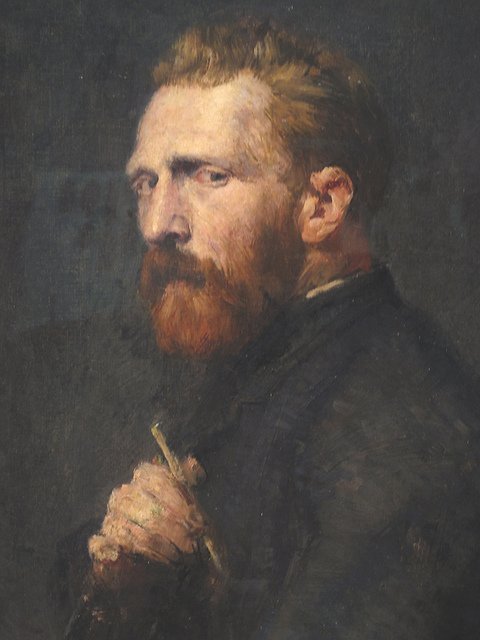
John Peter Russell. Part 1. Van Gogh and portraiture

John Peter Russell
John Peter Russell

Last week I watched a documentary on television about the death of Vincent van Gogh.  You have probably seen something similar or read a book on his somewhat mysterious death.   Did he commit suicide?  Was it an accident?  Was he murdered?  Why was the gun never found?  What, if anything, did Doctor Gachet have to do with his death?  Why did both Doctor Gachet and Vincent’s brother Theo allow Vincent to lie in agony for three days at his lodgings with the bullet still in his body rather than rush him to hospital to have it removed?  However the subject of my blog today is not about Van Gogh’s death.  During the documentary it showed a portrait of the great artist and said that it was Van Gogh’s favourite depiction of himself.   What really stimulated my curiosity was to hear that the portrait was completed by a friend of his, an Australian painter by the name of John Peter Russell.  I had never heard of this artist and I could not comprehend how an Australian artist could feature in the Dutchman’s life and so I decided to find out more about him.  In this first of my two part blog on Russell I want to look at his early life and a couple of his portraits including the one of van Gogh.   So come with me on a voyage of discovery and learn about how a former foundry worker in Australia came to paint a portrait of the great Dutch Master.

The story begins at the beginning of the 19th century in Kirkcaldy, Scotland.  It was here that John Peter Russell’s grandfather, Robert Russell, had his foundry and engineering works. Robert and his wife Janet Russell (née Nicol) had eleven children, one of whom, John, was our featured artist’s father.   In 1830 Robert’s business hit financial problems due to a downturn in demand and he decided to immigrate to Canada.  His intended destination changed on the advice of a friend and instead of heading west to Canada he and his family took the steamer Anne Jamieson and sailed to Van Diemen’s Land (now Tasmania) and arrived in the port of Hobart in June 1832.  Robert Russell along with his sons, Robert, Peter and John started up an engineering works in Tasmania which proved very successful.  In 1838 in order to expand the business the family moved to Sydney and established the firm, Russell Brothers with an engineering works and a foundry on the banks of the Tank Stream, a tributary of Sydney Cove. 

John Russell married and English girl, Charlotte Elizabeth Nichol, and they went on to have four children of which John Peter Russell, the subject of today’s blog, was the eldest.   He was born in June 1858 in the Sydney suburb of Darlinghurst.  John Peter was educated at the Goulburn School in Garrooriagang, a private boarding school for the “sons of gentlemen”.  After completing his education in 1876, the eighteen year old travelled to England and was apprenticed at the engineering company, Robey & Co. of Lincoln and eventually became a qualified engineer.   It was also around this time that he began to take an interest in sketching and painting.   In 1879 John Peter Russell’s father died and left his children a sizeable inheritance. 

In 1881, John Peter Russell who thanks to his inheritance was financially sound and did not need to continue as an engineer.   He decided to pursue his love of art and enrolled at the Slade School of Fine Arts at the University College of London.  Whilst at the Slade he studied under the Dijon-born French painter and sculptor, Alphonse Legros.  Legros would delight his students by showing them his quick preliminary oil sketches (known as ébauches) of the head portraits he had done and it was this type of painting which grabbed Russell’s interest. 

In August 1883, after completing his art course at the Slade, Russell decided to set off on his travels.  His fellow travellers were his brother Percy, an architect, Tom Roberts, a fellow aspiring artist who would later become a leading figure of the Australian Heidelberg School of Impressionism and who, like Russell, had emigrated with his family from the UK to Australia when he was fourteen years of age.  Tom Roberts had returned to his birthplace, London, to study art at the Royal Academy Schools.  Another person in the travel party was the physician and friend William Maloney who would later become a Labour MP.    Their first port of call was Spain where they encountered two Spanish art students Laureano Barrau, who would become a leading Spanish Impressionist painter and the Catalan painter Ramon Casas who would later be known for his paintings depicting crowd scenes. 

In 1885 Russell went to live in Paris and for the next eighteen months studied at the Atelier Cormon, which was run by the French painter, Fernand Cormon.  It was an “academic” studio in which Cormon endeavoured to instil in his students the necessary artistic “rules” which would ensure that their paintings found favour with the Paris Salon jurists.  Many great painters, such as Émile Bernard, Louis Anquetin, and Toulouse Lautrec studied under Cormon during Russell’s tenure.  Russell who had studied portraiture at the Slade School of Art was still interested in portraiture and would often paint portraits of his friends and fellow students.    In March 1886 whilst Russell was attending the Atelier Cormon another student enrolled – Vincent van Gogh.  Vincent had moved to Paris and went to live with his brother Theo in his apartment in rue Laval on Montmartre in order to study at Cormon’s studio.   A great and long-lasting friendship developed between Van Gogh and Russell.  In October 1886, Russell finally persuaded Van Gogh to sit for him.  The resulting work was the beautiful crafted portrait of the Dutchman which I spoke about at the beginning of the blog. 

Vincent van Gogh by John Peter Russell, 1886

Although Russell had painted portraits of his friends it is believed that he wanted to paint Van Gogh’s portrait as the depiction of the Dutchman’s face would be a challenge with its craggy and somewhat haggard appearance.     Russell had seen some of Van Gogh’s own head and shoulder portraits and self portraits and liked the way the Dutchman had used an academic style in his portraiture, incorporating darkened background as a contrast to the lighter skin tones and so decided to use this same technique on his own depiction of van Gogh.  He has given Van Gogh such a penetrating gaze as he stares out at us which in some ways makes us feel slightly uncomfortable.  It is almost a censorious gaze as if he is questioning our presence.    What I think adds to the beauty of this portrait is how Russell has got van Gogh to look over his shoulder for the pose and of course to remind every one of the sitter’s profession he had the Dutchman hold a paintbrush.  Vincent van Gogh was delighted with Russell’s finished portrait.   On September 6th 1889, ten months before his death, Vincent wrote to Theo and in it he mentioned the Russell portrait: 

“……….Afterwards, what are we beginning to glimpse timidly at the moment that is original and lasting – the portrait. That’s something old, one might say – but it’s also brand new. We’ll talk more about this – but let’s still continue to seek out portraits, above all of artists, like the Guillaumin and Guillaumin’s portrait of a young girl, and take good care of my portrait by Russell, which means a lot to me.….”

The painting, which is at the Van Gogh Museum in Amsterdam, has itself darkened over the years as on a recent microscopic examination it was discovered that, above the head of van Gogh, there had been inscribed in red the words:


                                       VINCENT

                                                                      AMITIÉ


                                      J.P.RUSSELL  PINTOR

 Paris 1886


Also according to the Museum curators, a friend of John Peter Russell and van Gogh, the British artist Archibald Standish Hartrick, had seen the original portrait soon after it had been completed and he said that Vincent was depicted in the portrait wearing a striped blue suit !   According to the museum curators there is a hint of blue near the mid base of the work.

Russell and Van Gogh were great friends for the short time they were together and after they went their separate ways they continued to correspond.  One of the last letters Vincent wrote to Russell on February 1st 1890 just five months before his death and when he was in the mental hospital in St Rémy.

My dear friend Russell

Today I’m sending you a little roll of photographs after Millet  which perhaps you may not know.  In any event, it’s to recall us, my brother and myself, to your good memory. Do you know that my brother has since married and that any day now he’s expecting his first-born? May it go well – he has a very nice Dutch wife.  How it pleases me to write to you after a long silence.   Do you remember the time when, almost simultaneously, you I think first and I afterwards, met our friend Gaugin?    He’s still struggling on – and alone, or almost alone, like the good fellow he is. Am sure, though, that you don’t forget him.  He and I are still friends, I can assure you, but perhaps you’re not unaware that I myself am ill, and have more than once had serious nervous crises and delirium. This was why, having had to go into an asylum for the insane, he and I separated. But prior to that, how many times we talked about you together!   Gaugin  is currently still with one of my fellow-countrymen called De Haan, and De Haan praises him a great deal and doesn’t find it at all bad to be with him.  You will find article on canvases of mine at the Vingtistes.   I assure you that I myself owe a lot to things that  Gaugin told me as regards drawing, and hold his way of loving nature in high, very high esteem. For in my opinion he’s worth even more as a man than as an artist. Are things going well with you? And are you still working a lot?  Although being ill isn’t a cause for joy, I nevertheless have no right to complain about it, for it seems to me that nature sees to it that illness is a means of getting us back on our feet, of healing us, rather than an absolute evil.  If you ever come to Paris,  take one of my canvases from my brother’s place if you wish, if you still have the idea of making a collection for your native country one day.  You’ll remember that I’ve already spoken to you about it, that it was my great desire to give you one for this purpose. How is our friend  MacKnight?   If he’s still with you, or if there are others with you whom I’ve had the pleasure of meeting, give them my warm regards. Above all, please remember me to Mrs Russell and believe me, with a handshake in thought,

Yours truly,

Vincent van Gogh

c/o Doctor Peyron

St-Rémy en Provence.

Head of Mrs. John Peter Russell (Marianna Mattiocco della Torre) by Auguste Rodin

Whilst living in Paris, Russell had become very friendly with two Parisian sculptors, Auguste Rodin and Emmanuel Frémiet and it was whilst visiting their studios that he encountered one of Rodin and Frémiet’s’ favourite models, Marianna Mattiocco della Torre. Rodin had, in 1888, encapsulated her beauty in a bronze bust entitled  Head of Mrs. John Peter Russell (Marianna Mattiocco della Torre) and Frémiet had used Marianna as the model for his bronze life-sized Jeanne d’Arc statue which is at the Place des Pyramides in Paris. 

Equestrian statue of Joan of Arc by Emmanuel Frémiet (1899)

Marianne who was born in Cassino, Italy was in her early twenties when she met Russell in 1885 and three years later, on a cold Parisian day in February 1888, John Peter Russell and Marianna Mattiocco became husband and wife.  By the end of the year the happy couple had left Paris and set up home at Belle Isle, the largest of the Breton islands, off the west coast of Brittany.  It was here that Russell had their home built and because he was the first non-Frenchman to settle on the island his house was known as Le Chateau Anglais. 

Dadone by John Peter Russell (1900)

The second portrait by John Peter Russell I want to show you is entitled Dadone and was completed around 1900.  The question is who or what is Dadone?  The word “dadone” I believe, but I am by no means certain, is an old fashioned Italian slang for “ancestor” or literally “old one” and therefore indicates that the subject has some sort of family relationship with Russell. 

Les deux Mattiocco by John Peter Russell (1902)

The answer to the question can be found in a double portrait which was painted by Russell a few years later, entitled Les deux Mattiocco which has, at the top of the work, the inscription ‘Maria Peppa-Y-Pascal Mattiocco’.  The painting, which depicts an elderly couple, is of Russell’s father and mother-in-law, Pasquale and Maria Mattiocco.   

The date of the Dadone painting is thought to be 1900 as there is a preliminary sketch for the work in existence, inscribed, ‘JPR 00’ dating it at 1900 and it is thought that the final painting was completed shortly afterwards.

In the painting, Dadone, we see an inscription in the top right corner of the work:

Dadone

        J R

                Fecit

The inscription indicates the title of the work, the initials of the artist and the word “fecit” meaning he or she made it and the word is used formerly on works of art next to the artist’s name. 

This beautifully crafted portrait by Russell is an affectionate and personal depiction of his wife’s father.  The main colours used by Russell in this work are white, blue and greys profile.  The bony structure of his head is framed by the imperious greying hair and beard, which along with dark bushy eyebrows give his father-in-law such a distinguished appearance.  His eyes are dark and there is a hint of tiredness about them, which has been brought on by age. 

In my next blog, the second part of my look at the life and work of John Peter Russell, I will examine his newly found interest in seascapes and landscapes once he had moved out of Paris and went to live on the Breton island of Belle-Ile where he met with many artists such as Monet and Matisse. 

For further information regarding Russell’s friendship with Vincent van Gogh there is a book you may like to read.  As yet I haven’t read it but I am sure it would be fascinating.  It is:

A Remarkable Friendship:  Vincent van Gogh and John Peter Russell by Anne Galbally

There is also an interesting short video on YouTube about the Van Gogh portrait and the inscriptions that were originally on it:

http://www.youtube.com/watch?v=R6z46c93SXQ

Vanitas Still-life with a Portrait of a Young Painter by David Bailly


Vanitas Still-life with a Portrait of a Young Painter by David Bailly (1651)

Vanitas is an explicit genre of art in which the artist uses gloomy and moody symbolic objects in order that the viewer becomes very aware of the brevity of life and the inevibility of death.   The origins of the term vanitas can be traced back to the Latin biblical adage from the Book of Ecclesiastes (1:2):

“…vanitas vanitatum omnia vanitas…”

which when translated means:

“…vanity of vanities; all is vanity…”

This specific artistic genre was very popular in the 16th and 17th century especially in the Netherlands, Flanders and France.

My Daily Art Display blog today looks at one of the works by the great Dutch still life and vanitas painter David Bailly.   Bailly was born in Leiden in 1584.  His father, Pieter, a Flemish immigrant from Antwerp, was a writing master.  Being a practicing Protestant he had fled from the Catholic Spanish rule of his homeland to the safer, more tolerant Northern Netherlands, eventually settling in the town of Leiden.  It was whilst living here that he married Willempgen Wolphaertsdr. and the couple went on to have four children, Anthony,  Anna, Neeltgen and David.  In 1592 David’s father took up the position as writing master at the University of Leiden.  He remained there until 1597 at which time he changed careers and became fencing master at a school run by the mathematician Ludolph van Cuelen, which was an establishment set up to train aspiring army officers in the various facets of warfare.

David’s initial training in drawing came from his father and in 1597, at the age of thirteen, he trained at the Leiden studio of the Dutch draughtsman and copper engraver, Jacques de Gheyn II.  David Bailly soon came to believe that his future did not lie as a draughtsman but as a painter and he was somewhat fortunate to live in the town of Leiden which was the home of many established and aspiring artists.  The leading artist in Leiden at the time was Isaac van Swanenburgh, who with his three sons, had set up a thriving studio in the town.  However it was not to this family concern that young David sort employment and tuition but instead his father arranged his son to become an apprentice to the painter and surgeon, Adriaen Verburgh.   In 1602 David moved to Amsterdam and became an apprentice in the city studio of the very successful portraitist and art dealer, Cornelius van der Voort. 

At the end of 1608, then aged twenty-four, David Bailly, now a journeyman painter, set off on his own Grand Tour, all the time seeking out commissions.  He travelled around Europe visiting a number of German cities such as Frankfurt, Nuremburg and Augsburg before crossing the Tyrolean Alps into Italy where he visited Venice and Rome.  In all, his journey lasted five years and it was not until 1613 that he returned to the Netherlands.

Once back home his work concentrated on drawing and painting portraits and vanitas still-life works and would often, as is the case in today’s featured work, combine the two genres.  His portraiture at the time consisted of many works featuring some of the students and professors of the University of Leiden.  He built up a very illustrious clientele which was testament to his artistic ability.  Bailly also had a number of pupils, two of whom were his nephews Harmen and Pieter van Steenwyck, who rank amongst the best still-life Dutch Golden Age painters.  In 1642 David Bailly married Agneta van Swanenburgh.  The couple did not have any children.  In 1648, he along with other artists including Gabriel Metsu, Gerard Dou, and Jan Steen founded the Leidse Sint Lucasgilde  – Leiden Guild of St Luke.  David Bailly died in Leiden in October 1657, aged73.

The painting I am featuring today is entitled Vanitas Still Life with a Portrait of a Young Painter which was completed by David Bailly in 1651 when he was sixty-six years of age and six years before he died.  It is now housed in the Stedelijk Museum De Lakenhal in Leiden.    It is a fascinating painting full of symbolism.  To the left of the painting we have, what some believe, is a self-portrait of the artist himself, but of course as we know Bailly’s age when he painted the work we know this was a depiction of himself as a young man in his early twenties.    In his right hand he holds a maulstick, or mahlstick, which is a stick with a soft leather or padded head, used by painters to support the hand that holds the brush.  In his other hand he holds upright on the table a framed oval portrait of himself as he was at the time of painting this work.  So in fact the man sitting on the left of the painting and the man in the frame are one and the same and the inclusion of both images in the painting simply reminds us of the transience of life.    

Behind the framed self-portrait we have another oval painting, that of a young woman and this has always interested art historians.  It is believed to be a portrait of his wife Agneta in her younger days.  However at the time the painting was completed Bailly’s wife was gravely ill, in fact, it could well be that she had already died.  Look closely at the wall in the right background, just behind the half empty fluted glass, can you make out a ghost-like portrait of a woman, en grisaille, painted on it, across which drifts the smoke from the extinguished candle?  This is another classic vanitas symbolisation.  This could well be alluding to the fact that his wife had died from contracting the plague.  On the table we also see a standing figure of Saint Stephen bound to a tree, pierced with arrows.  So what is the connection with St Stephen and the other objects on the table?   One theory is that there was a link between Saint Stephen and the plague, which killed so many people in Europe, including Bailly’s wife.    The infections produced by the bubonic plague caused people to compare the “random attacks” of the plague with attacks by arrows and these folk desperately sort out a saint who was martyred by arrows, to intercede on their behalf and so prayers were offered up to St Stephen for him to intercede.   

This is a vanitas still-life painting and we see the usual vanitas symbolism amongst the objects depicted in the work of art.   Vanitas works allude to the transience of life.  Time passes.  It cannot be halted.  We all must eventually die.  Look at the background of the painting.  Look at the angle of the wall as it vertically divides the painting.  To the left, the painting is brightly lit and we have the young man, the aspiring artist, with his unused artist’s palettes hanging on the wall.  To the right of the vertical divide, the room is in shadow and we have the portrait of the old artist.  On the vertical line we have a bubble, which is a classic metaphor for the impermanence and fragility of life. 

There are many other items to note.   On the wall we see a print of Franz Hals 1626 painting, The Lute Player.  There is a plethora of objects on the table including a picture of a bearded man which could have been a portrait of Bailly’s father or maybe one of his teachers.  On the table, there are also many noteworthy items indicating death such as the skull, the extinguished candle, the tipped-over Roemer glass, the grains of sand of an hour glass running down and the wilting flowers.  There are also reminders of the luxuries of life which are of little use to us once we are dead, such as the coins and the pearls as well as items that have once helped us to relax and add to our enjoyment such as the pipe and the book, as well as the art in the form of paintings and sculpture. Sadly, pleasure and wealth are short-lived and ultimately unimportant.   This is about the temporality of life.    Overhanging the table in the foreground is a scroll with the words:

VANITAS VANIT(AT)VM

ET OMNIA VANITAS

which remind us of the words from the  book of Ecclesiastes I quoted at the start of this blog.

So the next time you decide to have somebody take your photograph, think carefully what you would place by your side or on a nearby table so as to convey a subtle and symbolic message to the people who will view the photograph in years to come.


Rembrandt, Geertje Dircx and Hendrickje Stoffels

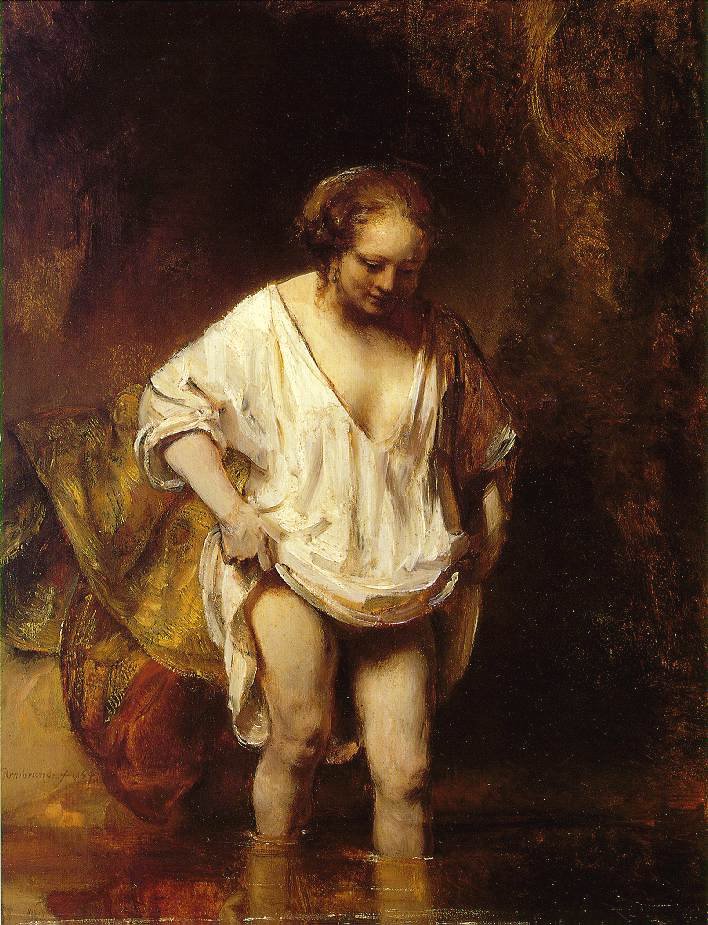
Woman bathing in Stream  by Rembrandt (1654)
Woman bathing in a Stream by Rembrandt (1654)

It is thought that the woman in the painting is Hendrickje Stoffels, who was Rembrandt’s maid and who shared the second part of the artist’s life.  Later she would become his lover and would remain by his side until the day he dies.  At the time of this painting Hendrickje was pregnant with Rembrandt’s child.

We see her before us, immersing herself in the water.  She looks down at her reflection in the water.  She is completely absorbed in what she sees.   Behind her we see a richly-coloured red dress which she has left behind before entering the water.   She has rolled up her skirt up and she hesitatingly and gingerly steps into the cold water of a stream. She seems completely unaware that we are observing her.  For us it is an intimate moment as we study her.  It is not simply a woman bathing in a stream.  Look how Rembrandt has allowed the light to fall on her, illuminating her skin and chemise.  The painting can be seen in the National Gallery, London.

I concluded my last blog about Rembrandt von Rijn and his wife Saskia van Uylenburgh with her death from consumption just before her thirtieth birthday.  In today’s blog I will look how, even from her grave, Saskia managed to have an effect on Rembrandt’s life and I want to move on and look at two other ladies who entered Rembrandt’s life, one of whom featured in a number of his paintings and is thought to have modelled for one of his more famous paintings, Woman Bathing in a Stream.  That lady was Hendrickje Stoffels.

With Saskia’s death in June 1642, the thirty-six year old Rembrandt was left alone with his nine month old son Titus.  He needed help with bringing up his son and so living in the household at the time was Geertje Dircx who had been acting as Titus’ wet nurse.  It is more than likely she was living in the house since Titus was born and before Rembrandt’s wife, Saskia, died.    Geertje was born in Edam around 1610, where she had been brought up by her father, Dirck Pieters and her mother, Jannetje Jans.  She had married a ship’s bugler, Abraham Claesz, in 1634 but he had died following year.   It is thought that she had received little education and could neither read nor write.  There is a great deal of conjecture about Rembrandt’s relationship with Geertje who was just four years his junior.  Was she more than just the wet nurse for Rembrandt’s son?  Did she and the artist have a sexual relationship?  If theirs was a very close relationship then why did they not marry?  By all accounts she was not a woman of great beauty as the Dutch painter and biographer of artists from the Dutch Golden Age, Arnold Houbraken, described her as:

“…a little farm woman……rather small of person but well made in appearance and plump of body….”

For the answer to the question of marriage between the two, we have to consider the power Saskia wielded, even from her grave.

What we do know is that for some reason, a few weeks before her death, Saskia had drawn up a new will and in it she left her share of hers and Rembrandt’s combined estate, not to Rembrandt, but to their baby son Titus, which would be given to him when he came of age.   However, Saskia’s will also stated that any interest accrued from her part of their joint estate could be used by Rembrandt as he was the father and guardian of their son.  As strange as the terms of the will seem, it was legally binding.  So what were the possible reasons for the terms of her will which she signed a fortnight before she died?   Was she concerned by the way Rembrandt spent their money on property and his art collection?  Maybe, as Rembrandt was having a very successful period selling his art work, she didn’t think he needed her money and therefore she would rather it was invested for her son to reap its benefit when he was older.  Unfortunately for Rembrandt he was soon to need this money as his success as an artist, which had provided him with a life of prosperity, was soon to dip and his financial position became ever more serious.  However what was probably more surprising about the will was a codicil which stated that if Rembrandt should marry again all Saskia’s money would be returned to her family, the Uylenburghs.  So you can see that Saskia still controlled Rembrandt from her grave!

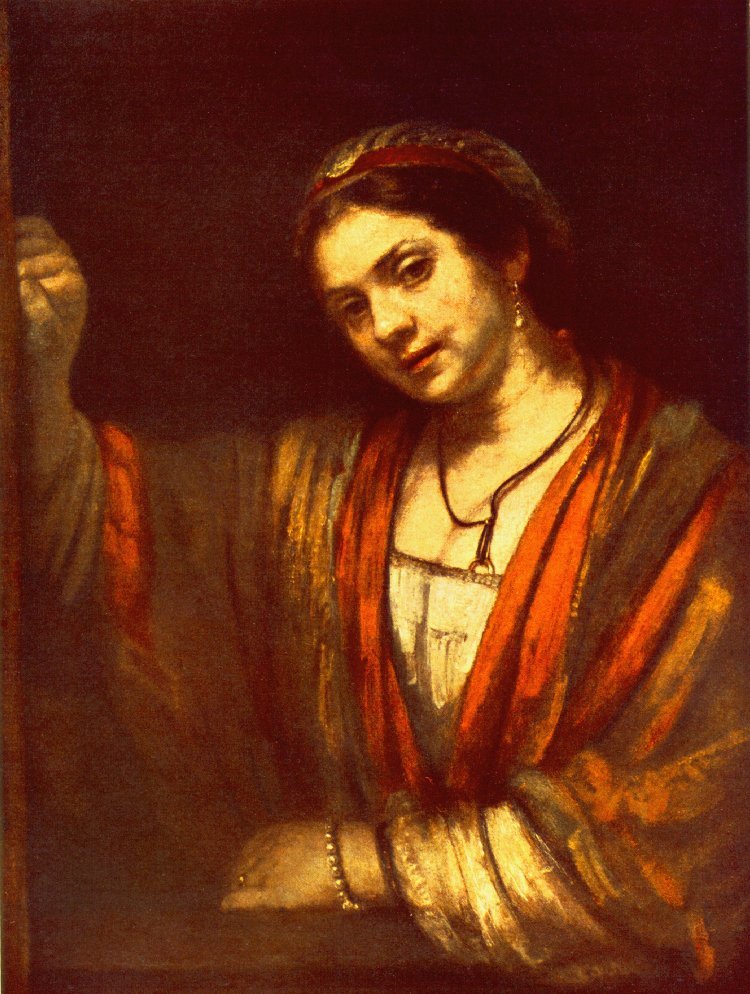
Hendrickje Stoffels(Young Girl at the Window) by Rembrandt (1657)

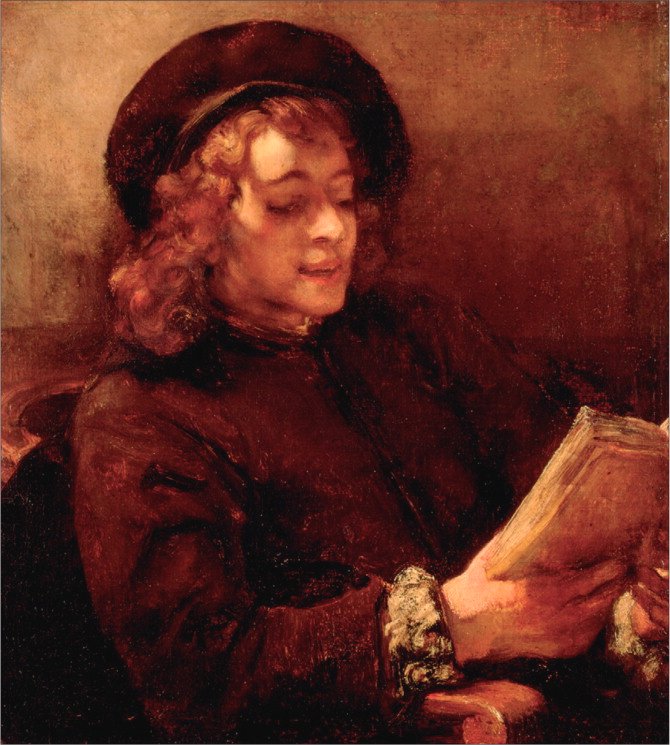
Hendrickje Stoffels (Young Girl at the Window) was painted by Rembrandt in 1657.  It was painted in the same year he completed a portrait of his son Titus (Titus Reading) and it was during this time that the artist concentrated his portraiture work on people or family who lived nearby.  Hendrickje, although uneducated and lacked the ability to read or write, was the perfect companion for Rembrandt.  She supported him during his troubled times when he was mired down in bankruptcy proceedings.  She also stuck with him despite the adverse comments from “respectable” neighbours and the Reform Church about her “state of whoredom” for being his live-in lover.  She was determined to support Rembrandt through thick and thin and in this portrait of her we see that grim determination and her steadfast composure as she stands at the window of their house in Breestraat, Amsterdam.  This portrait hangs in the Gemäldegalerie, Berlin.

Before he felt the full force of pecuniary embarrassment, Rembrandt had another problem to solve, which was probably self-inflicted.  Around about 1647, Rembrandt hired in a young maidservant, Hendrickje Stofefll.  Hendrickje was the daughter of an army sergeant based in the garrison town of Bredevoort.   In 1646, when she was just twenty years of age, her father was killed, the victim of an explosion of the gunpowder tower in Bredevoort.  Hendrickje’s mother remarried the following year and her daughter was left to fend for herself.  She moved to Amsterdam where she became a maidservant and later that year took up employment in Rembrandt’s house.   Hendrickje was sixteen years younger than Geertje, who lived in the household as nurse to Rembrandt’s son, Titus.  The two women did not get on well together.  Hendrickje had characteristics which Geertje lacked.  She was a quiet girl with a very pleasant manner and had the youthful looks which Geertje had lost.  Although Hendrickje was twenty years younger than Rembrandt he was charmed by her as was his son Titus who was six years old when Hendrickje entered the household.  Geertje soon became jealous at the way Rembrandt and Hendrickje became ever closer and she must have been horrified at the turn of events.

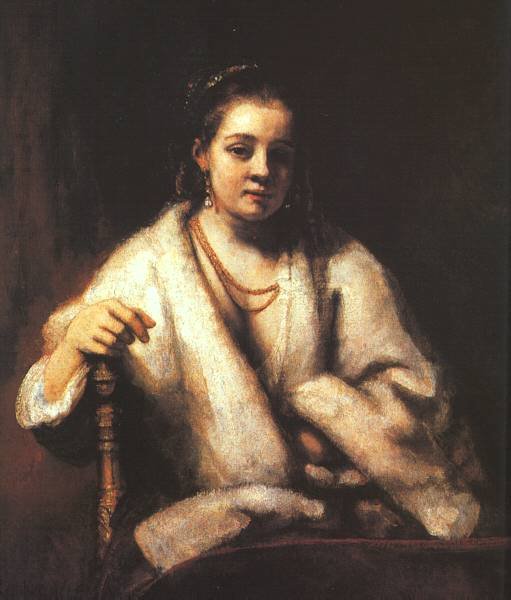
Portrait of Hendrickje Stofells by Rembrandt (c.1656)
Portrait of Hendrickje Stoffels by Rembrandt (c.1656)

This portrait of his mistress, entitled Portrait of Hendrickje Stoffels, was completed by Rembrandt around 1656 and can now be found in the National Gallery, London.  There is a sense of intimacy between artist and subject in this work.  Look closely at the expression on Hendrickje’s face.  It is one of poise and yet there is a degree of sensuality about the way she affectionately looks at Rembrandt, her lover and father of her child, as he concentrates on her portrait.  One of the strange things about this work is that the signature and the date on the portrait were believed to have been added at a later date.

Hell hath no fury as a woman scorned is a maxim that summed up Geertje’s feelings, which led to her subsequent and somewhat foolhardy actions.  Tensions in the Rembrandt household surfaced, culminating in the dismissal of Geertje.  She then decided to take Rembrandt to court for refusing to honour his unwritten agreement to marry her.  Knowing as we do the nature of Saskia’s will, in respect of Rembrandt re-marrying along with the unfavourable financial consequences for him if he was to remarry, there is little likelihood that he would ever have seriously proposed marriage to Geertje.  Whether she had at one time been his lover is of course another matter!   Rembrandt tried to come to a financial settlement with Geertje but she kept holding out for an ever more lucrative settlement.  In the end the case went to court on October 23rd 1649 at the city’s Town Hall and the Commissioners of Marital Affairs, who sat in judgement, were told that Rembrandt had slept with Geertje, but that he had not made a promise to marry her. Their decision was to award Geertje an annuity of 200 guilders in alimony, a sum he continued to pay until 1655.  However there was another  twist to this saga. Geertje was found guilty of stealing Saskia’s jewelry which was part of Rembrandt’s estate.  One of the prosecution witnesses was none other than Hendrickje Stoffels.  Geertje was sent to the Spinhuis in Gouda (A spinhuis was a house of correction, a kind of workhouse) where she remained for five years.

Rembrandt and Hendrickje Stoffels lived together quite happily as lovers but in June 1654 the Council of the Reformed Church of Amsterdam got wind of this relationship and summoned Rembrandt and Hendrickje to stand before them.  Rembrandt was not a practicing churchgoer so the matter against him was dropped.    Hendrickje however was accused of whoredom and of living with a man, unwed.  Being six months pregnant there was little point in denying the charge.  Her fate was to suffer banishment from attending any special church occasions.  She gave birth to Rembrandt’s daughter, Cornelia, on October 30th 1654.  The name could well have been chosen because it was the name of Rembrandt’s mother or more poignantly because it was the name of the two daughters of Saskia and Rembrandt, who survived just a few weeks.

Hendrickje Stoffels died in July 1663, aged 37 and was buried in a rented grave in Amsterdam’s Westerkerk (West Church) on July 24th 1663.  She was probably a victim of the bubonic plague which had swept through the city that year and had lasted for more than two years killing 10% of the city’s population.

Rembrandt van Rijn died on 4 October 1669 aged 63.   He is buried in an anonymous rented grave in Amsterdam’s Westerkerk on the 8th October.  His son Titus died one year earlier, aged 27.

Rembrandt van Rijn and Saskia van Uylenburg

Saskia in Arcadian Costume by Rembrandt (1635)
Saskia van Uylenburgh in Arcadian Costume by Rembrandt (1635)

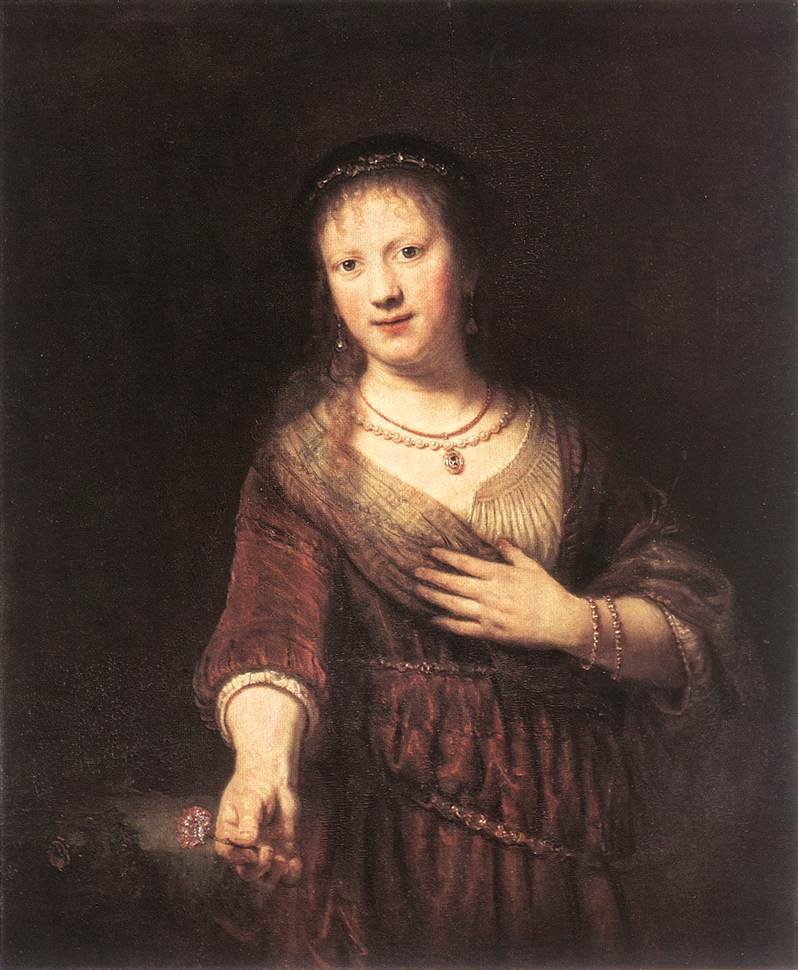
Saskia van Uylenburgh in Arcadian Costume was painted by Rembrandt in 1635,  The painting is housed in the National Gallery, London.  Saskia who was twenty-three years old at the time and who had been married to Rembrandt for just twelve months, poses as Flora, goddess of spring.   Rembrandt has dressed her as a deity of youth, rebirth and beauty, along with her rustic shepherdess’s staff . Sadly as we look on the happy smile on her face it is hard to believe that this young women would die seven years later, shortly before reaching the age of thirty. 

My Daily Art Display today looks at some works of the great Dutch painter Rembrandt van Rijn.  Today’s blog is not so much about him but of a woman who featured in many of his paintings, his first wife Saskia Uylenburgh.

Saskia van Uylenburgh was born on August 2nd 1612 in Leeuwarden, the capital city of the Dutch province of Friesland where her father, Rombertus Uylenburg was the mayor as well as the justice of the Court of Friesland.  He had married Saskia’s mother, Siuckien Ulckedr Aessinga and they had three sons, Rombertus, Edzart and Ulricus and five daughters, Antje, Hiskia, Jelke, Tietcke and Saskia who was the youngest.  Her father was fifty-eight years old when Saskia was born.  Saskia’s uncle, Gerrit, the brother of her father, emigrated with his family to Krakov, Poland.  He was the father of the art dealer Hendrick van Uylenburgh who was to play an important part in Rembrandt’s early artistic career.  Saskia experienced an affluent upbringing, living in a large family home and her parents were able to offer their children a comfortable lifestyle.  Sadly when Saskia was just seven years of age her mother died and five years later her father passed away.  So at the age of twelve, Saskia was orphaned and was brought up by her elder sisters, and brothers.  Within four years of their father’s death all Saskia’s sisters had married and moved away from the family home. By 1628, Saskia, who was only sixteen years of age, was now the only unmarried daughter.  The family home was sold and Saskia went to live with her sister Hiskia and her husband, Gerrit van Loo in Sint Annaparochie, a small town in the municipality of het Bilde and Gerrit became Saskia’s guardian.  The van Loo household was a very welcoming place to Saskia and because of the affluence of her brother-in-law; she led a comfortable and contented lifestyle.  However, in 1632 Saskia and the van Loo family had to hurriedly leave het Bilde due to unrest in the town and they moved to Leeuwarden.

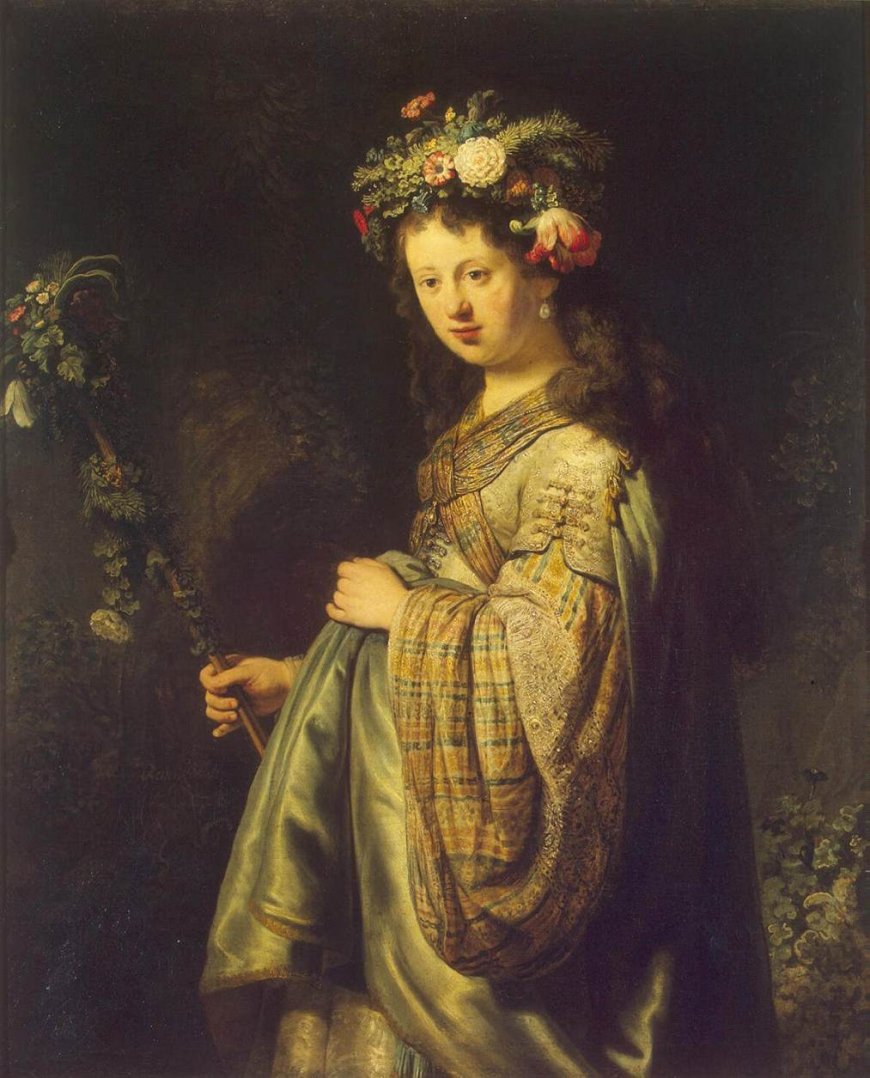
   Saskia as Flora  by Rembrandt (1634)
Saskia as Flora
by Rembrandt (1634)

Saskia as Flora was the first portrait Rembrandt did of his wife dressed as Flora, the Roman goddess of fertility and the season of spring and flowers.     He completed the portrait in 1634 and it can now be found in the State Hermitage Museum in St Petersburg.  Rembrandt has portrayed his wife as a young goddess in a somewhat rustic setting.  His new wife is festooned with flowers.  She is dressed in a splendid and extravagant costume.  This idyllic and pastoral setting was very popular with the upper-class Dutch society in the early seventeenth century.  They had a love of all things to do with the romantic ideal of life in the countryside which they perceived as unadulterated bliss.  The style of dress she wore for this portrait was often seen in local theatres during performances of pastoral plays. 

Meanwhile, Rembrandt (Rembrandt Harmenszoon van Rijn to give him his full name), and who was six years older than Saskia, was born in Leiden in the Dutch Republic, on July 15, 1606.     His father, Harmen Gerritszoon van Rijn, was a miller, and in 1589, aged twenty-one, had married Cornelia Neeltje Willemsdr. van Suijttbroeck , the Catholic daughter of a baker.  The couple went on to have nine children , two of whom died in infancy. Rembrandt was the 8th child and his modest family upbringing was in direct contrast to that of his more affluent upbringing of his future wife, Saskia.  However despite their modest means, Rembrandt’s parents were determined to give Rembrandt the best education they could afford and in 1613, when he was seven years old, he was enrolled at Leiden’s Latin school.  He remained there for seven years and in 1620, aged fourteen years of age he enrolled at the University of Leiden.   Rembrandt was less than impressed by the subjects he was being taught at the university and soon left to study art.  He managed to gain an apprenticeship with the Leiden landscape painter, Jacob  Isaacszoon van Swanenburgh, and he remained with him for three years.   In 1624, Rembrandt went to Amsterdam where he was apprenticed for six months with the Dutch history painter, Pieter Lastman.  In late 1624 Rembrandt left Amsterdam and returned to Leiden where he opened a studio which he shared with his friend and colleague Jan Lievens.  The two young artists collaborated in over two dozen works, including paintings, etchings and drawings.  In 1628, Constantijn Huygens, a scholar poet and diplomat wrote about his cultural visit to Leiden and his visit to Rembrandt and Lieven’s studio.  He wrote of his meeting with “a noble pair of young painters who worked together side by side”.  He watched them collaborate and commented:

“…Lievens was superior in invention and a certain grandeur in his daring themes while Rembrandt surpasses Lievens in his sure touch and in the liveliness of emotion…”

That said, it was Lievens that Huygens turned to for his portrait !

The Lievens/Rembrandt partnership lasted until 1631 at which time Rembrandt moved to Amsterdam and Lievens to England.  In 1631 Rembrandt met Hendrick Uylenburgh, the cousin of Saskia, whose father had moved his family from  Friesland to Krakov.  Hendrick had been trained as a painter but had also been trained as a buyer of works of art.  In 1625 he had moved to Amsterdam  and the following year bought the art studio and business premises of the Dutch portrait painter Cornelis van der Voort who had died in late 1624.  Rembrandt, the artist, and Hendrick Uylenburgh, the art dealer formed a business partnership which was mutually beneficial and Rembrandt moved into Uylenburgh’s house.    Uylenburgh secured the artistic commissions, often portraits of the well-to-do Amsterdam folk and Rembrandt completed them.  It was through this partnership that Rembrandt met Hendrik’s cousin Saskia in 1633.

Saskia van Uylenburgh The Artist's Bride of Three Days  by Rembrandt (1633)
Saskia van Uylenburgh
The Artist’s Bride of Three Days
by Rembrandt (1633)

One of the first works of art by Rembrandt to feature Saskia was a silverpoint portrait on prepared vellum of her entitled Saskia van Uylenburgh, which is housed at Berlin’s Staatlich Museen.  She wears a broad straw hat which is decorated with flowers and she holds a flower in one hand.  Her expression is one of happiness as she leans forward and stares lovingly at her husband-to-be.  The portrait has an inscription by Rembrandt, in Dutch:

“…This was made when my wife was 21 years old, the third day after our betrothal – 8th of June 1633…”

Following a twelve month betrothal, Rembrandt and Saskia were married on July 22nd 1634 at the parish church of St Anna in Friesland.   It is interesting to note that none of Rembrandt’s family went to the wedding so one must presume they were not enamoured by his choice of wife or maybe some time in the past, Rembrandt had, for some reason,  severed links with his family.   As was the case in those days Saskia brought a substantial dowry to the marriage, which caused some consternation with her relatives as early on the marriage they believed that Rembrandt was too free with Saskia’s money, frequently moving home and buying ever more expensive ones.  However Rembrandt was not concerned as his artistic career seemed to have taken off.  He was earning well from the sale of his paintings, especially his portraiture of the city’s bourgeoise, who often had to be added to a long waiting list of Rembrandt’s commissions.  He was also bringing in money by tutoring aspiring artists who were not put off by his high tuition fees.     After the wedding, the happy couple went to live at the home of Saskia’s cousin and Rembrandt’s partner, Hendrik and remained there until Saskia became pregnant with their first child.

Saskia with a Red Flower by Rembrandt (1641)

In Saskia with a Red Flower, which Rembrandt painted in 1641, we see Saskia looking towards us, although at the time she would have been looking directly at her husband as he painted.  Look at the tender and loving expression on her face.   Look how her left hand is place upon her heart as a gesture of adoration, a simple symbol of love and loyalty towards her husband.  In her right hand she holds a red flower which she offers her husband.  The painting is housed in the Gemäldegalerie Alte Meister in Dresden.

Although the financial situation of the couple could not have been better their personal life was about to be shattered.  In December 1635 Saskia gave birth to their first child, a son whom they baptised Rumbartus.  Sadly he died aged two months.  In July 1638 Saskia gave birth to a daughter who they named Cornelia after Rembrandt’s mother but the baby died in the August, aged three weeks.  Saskia gave birth to another daughter, once again christened Cornelia, on July 29th 1640 but she only survived less than a month dying in August.  One can only imagine the torment and suffering, both mentally and physically, Saskia must have endured during this period of her life.

     Titus Reading  by Rembrandt (1657)
Titus Reading
by Rembrandt (1657)

On September 22nd 1641 Saskia gave birth to a son, Titus, who survived childhood, became a painter like his father and lived to the age of twenty-seven.  However the physical suffering from all those pregnancies took a toll on Saskia’s health and she died on June 14th 1642, a few months before her thirtieth birthday.  The cause of death was recorded as consumption.

In my next blog I will look at the repercussions on Rembrandt of Saskia’s death and look at a painting of a woman who was to play an important part in his later life.

The Holy Family paintings by Joos van Cleve

Self portrait by Joos van Cleve (1519) Museo Thyssen-Bornemisza, Madrid
Self portrait by Joos van Cleve (1519)
Museo Thyssen-Bornemisza, Madrid

The artist I am featuring today is the early Netherlandish painter Joos van der Beke, better known as Joos van Cleve because he is thought to have been born in the Lower Rhine region of Kleve, possibly the Rhine-river town of Wesel, which lies on the current Dutch-German border.  The year of his birth is believed to be around 1485.  There are various accounts of his early life, much of which are contradictory, but it is thought that his initial artistic training began when he worked in the Kalkar studio of the Dutch painter, Jan Joest van Kalkar, between 1505 and 1509.

The High Altarpiece in the Kalkar church of St Nicholai  by Jan Joest
The High Altarpiece in the Kalkar church of St Nicholai by Jan Joest

It was during his time with Joest that he worked with his master on the twenty-panelled high altarpiece in the Kalkar church of St Nicholai which is considered to be Joest’s greatest work.   From Kalkar, it is believed Joos van Cleve lived around the Ghent-Bruges area and the next we hear of him is in 1511 where he is mentioned in records as a free-master in the Antwerp’ Guild of St Luke, the city’s painters guild, and on a number of occasions he would hold the position of co-deacon of the guild as well as being appointed Dean of the St Luke’s Guild in 1519, 1520 and 1525.

Centre panel of triptych Death of the Virgin  by Joos van Cleve (c.1515)
Centre panel of triptych
Death of the Virgin
by Joos van Cleve (c.1515)

He set up his own studio in Antwerp and over the next twenty years he took on a number of apprentices.  His studio became the most famous in the city and he was inundated with painting commissions, many of which found their way to the leading European royal, ecclesiastic and merchant houses.  One of these lucrative commissions came in 1515, from the Nicasius and Georg Hackeney, wealthy merchants of Cologne, for a religious triptych which became known as the Death of the Virgin and which is currently housed in Cologne’s Wallraf-Richartz-Museum.  It was from this work that Joos also became known as Master of the Death of the Virgin. It was works like this which brought the Flemish tradition to Cologne, and in so doing brought to bear an extensive influence on the Cologne school of art.

The centre panel of the wide-format triptych is a scene depicting a number of apostles gathered around the bed of the dying Virgin Mary. Of these people, only John and Peter are identifiable.   Peter stands before the bed.  On the floor is a stool on which lies a Gothic rosary.  On the two wings of the triptych there is a depiction of an open river landscape with continuous horizons as well as portraits of the commissioners of the work, Nicasius and Georg Hackeney with their patron saints.

Henry VIII by Joos van Cleve (1535)

Besides his religious works, Joos van Cleve was an accomplished portrait painter.  He was so talented that the king of France at the time, Francis I, summoned him to Paris to work at the French court, during which time he painted a number of portraits of the king, his wife, Eleanor of Austria and members of the court.  It is thought that Joos van Cleve also travelled to England around 1534.  This belief is based on a fact that he painted a portrait of the forty-four year old monarch, Henry VIII, dated 1535, which is now part of the Royal collection.

Little is known about his family life except that in 1519 Joos van Cleve met and married his first wife, Anna Vijts.  The couple had two children, both born in Antwerp.  The birth records of the children show them listed as  “vander Beke, alias van Cleve” and that their father was registered as an Antwerp burgher which possibly indicates that Joos had registered as an Antwerp citizen in order to be able to work in the city.  Joos and Anna had a son, Cornelis, who was born in 1520 and two years later in 1522, Anna gave birth to their daughter, Jozijne.  Their son, Cornelis became a talented portrait painter in his own right.  He helped his father in his workshop and would, after his father’s death, run the business   Cornelis was later known as Sotte Cleve (Mad Cleve) after becoming insane at the age of thirty-four.    Joos van Cleve also allegedly had an illegitimate daughter, Tanneken, from his relationship with Clara van Arp.   In 1531, three years after the death of his first wife, Anna, Joos married Katlijne van Mispelteren.  The couple had no children.   The exact date of Joos van Cleve’s death is uncertain but it is known that on November 10th 1540 he wrote his last will and testament and it is believed he died shortly afterwards.  In April 1541 his wife, Katlijne, was listed as a widow.

     The Holy Family  (St Petersburg version)      by Joos van Cleve
The Holy Family
(St Petersburg version)
by Joos van Cleve

The works of art produced by Joos van Cleve merge the emotions of the Italian Renaissance with the exactitude and lucidity of early Netherlandish art. He was also an astute business man who knew the paintings people liked.   An example of this is in the way he painted many versions of his most popular subject, The Holy Family.  One of these versions is in the Hermitage Museum in Saint Petersburg.  In this work we see a half length composition of the Virgin with the upright Christ Child standing on a stone parapet.  To the left, and somewhat in the background, is Saint Joseph.  The Virgin protects the Child from falling by embracing him with her Mannerist elongated hands.  The pose we see before us is often referred to in Latin, as Maria Lactans, “the virgin’s nursing breast”, or “the lactating virgin”, which was the primary symbol of God’s love for humanity.

    The Holy Family  (Academy of Fine Arts, Vienna)  by Joos van Cleve (c.1515)
The Holy Family
(Academy of Fine Arts, Vienna)
by Joos van Cleve (c.1515)

In the Academy of Fine Arts in Vienna there is another version of The Holy Family, completed around 1515 and in this rendering we see that Joos van Cleve has added a landscape panorama behind the bespectacled foster-father, Joseph, who seems to be positioned outside the room as he reads his book which rests on the window sill.   Again we have the Child standing upright on the parapet held by his mother.  Once more, we notice the depiction of the hands circling the child in an Antwerp Mannerism style.   To emphasize the close mother-child relationship Joos van Cleve has once again gone for the Maria lactans motif but showing it in a somewhat playful fashion.

    The Holy Family  (Metropolitan Museum of Art, New York)  by Joos van Cleve (c.1513)
The Holy Family
(Metropolitan Museum of Art, New York)
by Joos van Cleve (c.1513)

The Metropolitan Museum of Art, in its Friedsam Collection, has a yet another of Jan van Cleve’s versions of The Holy Family which was painted around 1513.  In this version the Christ Child is sitting on the parapet and his lips are tight on the breast of the Virgin as he suckles.  On the parapet we see a glass of wine and a plate of fruit which are symbolic of Christ’s incarnation and the sacrifice of his life which will come in the future.  Again in the background to the left of the mother and child we have Saint Joseph.  In this version he seems less detached and is not concentrating on reading from a book, although he is holding an unfurled scroll.

   The Holy Family (Currier Museum in Manchester, New Hampshire )  by Joos van Cleve (c.1520)
The Holy Family
(Currier Museum in Manchester, New Hampshire )
by Joos van Cleve (c.1520)

The Currier Museum in Manchester, New Hampshire has another version of Joos van Cleve’s The Holy Family, completed around 1520.  It is a small painting measuring 74cms x 56cms.  In front of the mother and child there is, not the stone parapet which we had seen in the other versions, but a table covered by a green felt cloth.   It is a beautiful work which is full of finely detailed still-life objects on the table.   Joos van Cleve has adroitly depicted a variety of objects of differing textures varying from a glass vessel to the ermine lining of Mary’s robe.   In this painting the Christ Child lies across his mother’s lap clutching an amber-coloured string of beads.  As the beads are fixed on the string in five groups of ten we can be almost certain that they represent a rosary.  On the table is a glass jar which symbolises the purity of the Virgin.  This symbolism comes from the fact that light passes through the vessel without breaking it similar to the impregnation of the seed which entered Mary womb without her hymen being breached.    There is a cross reflected in the jar and this is a reminder of how the Christ Child will die and the wine in the jar symbolises the blood of Christ which will be shed during his suffering.   Also on the table there is a folded piece of embroidery, known as a sampler.  In the left of the painting we have Joseph.  He is reading a scroll version of the Magnificat which comes from Luke’s Gospel (1:46-55) and which relates to Mary’s holy stature of Luke:

  “…For behold, henceforth all generations will call me blessed, for He who is mighty has done great things for me and holy is His name…”


   The Holy Family  (National Gallery, London)  by Joos van Cleve (c.1515-20)
The Holy Family
(National Gallery, London)
by Joos van Cleve (c.1515-20)

The final version of Joos van Cleve’s The Holy Family I want to show you is the one in London’s National Gallery.   This version was completed between 1515 and 1520.  In this work the figures are depicted close together giving a sense of intimacy, albeit Joseph is set back and does not engage with Mary or the Child.   This depiction and positioning of Joseph symbolizes his subordinate, albeit contributory, role in the family relationship.  The depiction of Mary is somewhat an idealized and heavenly one but there are definite earthly characteristics about the bespectacled, grey-haired Joseph with his double chin.   Again the Maria Lactans depiction of the Virgin reinforces the human characteristic of the child and adds to the intimate and cherished relationship between mother and baby.  The Christ Child stands on a smooth stone parapet which is shown in the foreground of the painting.  Wrapped around him, almost like a restraint, is the string of beads of an orange rosary.  On this ledge Joos van Cleve has depicted a number of inanimate objects which are symbolic.  We see the Virgin holding a stalk with three red cherries which symbolise paradise.  The glass vase to the left contains a stem of white lilies which symbolizes the purity of the Virgin.  It is believed the piece of lemon which has been cut open by the knife which rests upon it may represent the weaning of the child.

In all the Holy Family paintings Joos van Cleve has depicted the Virgin and the Christ Child in a similar fashion whereas his depiction of Saint Joseph standing in the background varies  from painting to painting.  I wonder why that was.  Did he reconsider the role of Saint Joseph differently and thus altered his image?

Vincent van Gogh, the Copyist. Part 2 – Delacroix’s Pietà

Pieta (after Delacroix)  by van Gogh (1889)
Pieta (after Delacroix) by van Gogh (1889)

In my last blog I looked at how Vincent van Gogh had copied three Japanese woodcut prints and had incorporated his own inimitable style to his versions.  In my blog today I want to look at the versions he painted of a painting by one of his favourite European artists –Eugène Delacroix.

In February 1888, Vincent, tired and disillusioned with life in the French capital, moved to Arles and went to live at No. 2 Place Lamartine in the Yellow House which he had rented.   He invited Paul Gaugin to join him but the latter was rather reluctant.   Vincent’s brother, Theo, was worried about Vincent living alone and so in October pays Paul Gaugin to visit his brother and stay with him.   For the next two months, Gauguin and Van Gogh worked harmoniously together, spending all their time painting and discussing art.

However personal tensions grew between the two men and two days before Christmas Day, Van Gogh experienced what was termed a psychotic episode in which he threatens Gauguin with a razor.  Gaugin fearful for his life left the house but was followed by Vincent.  When Gauguin turned around he saw Van Gogh holding a razor in his hand.  Hours later, Van Gogh went to the local brothel and paid for a prostitute named Rachel. With blood pouring from his hand, he offered her his ear, asking her to “keep this object carefully.” The police found him in his room the next morning, and admitted him to the Hôtel-Dieu hospital.  Gaugin was horrified by the incident and immediately returned to Paris. Vincent’s brother arrived on Christmas Day to see Van Gogh, who was weak from blood loss and having violent seizures. The doctors assured Theo that his brother would live and would be taken good care of, and on January 7, 1889, Van Gogh was released from the hospital.  He was now alone and became very depressed and only his painting relieved the dark moods he was experiencing.   He would paint at the yellow house during the day and return to the hospital at night.  However, the local people of Arles viewed Vincent as somebody mentally disturbed and a risk to the people of the community and petitioned him to leave the town.  Reluctantly he decided to move from Arles and go to Saint-Rémy-de-Provence, to the Saint-Paul-de-Mausole asylum, a former monastery, in the town. Whilst there, he completed numerous oil paintings and drawings.

Pieta by, Eugene Delacroix (1850)National Museum of Oslo
Pieta by, Eugene Delacroix (1850)
National Museum of Oslo

It was whilst Van Gogh was confined to the asylum at Saint-Rémy that he decided to work on a painting based on the Piétà by Eugène Delacroix.   Van Gogh loved the work of Delacroix.  He loved how the French artist used bold and vibrant colours in his works.  In numerous letters to his brother, Theo, he would extol the virtues of Delacroix’s works asking him to buy lithograph prints of Delacroix’s works.   Vincent had in his possession a lithograph by Célestine François Nanteuil-Leboeuf of Delacroix’s  Pietà.  Célestine Nanteuil was a 19th century French painter, engraver and illustrator closely tied to the Romantic Movement in France.  It is believed that the reason Van Gogh decided to paint his own Pietà was because of an accident he had with his copy of the lithograph.  He wrote a letter to Theo in which he says:

“…The Delacroix lithograph La Piétà, as well as several others, fell into my oils and paints and was damaged. This upset me terribly, and I am now busy making a painting of it, as you will see…”

Van Gogh decided that his Pietà was not going to be an exact copy of Delacroix’s work but more of a variation of the French artist’s painting.   Van Gogh described Delacroix’s Piétà in a letter, dated September 19th 1889, to his sister Willemien.  Vincent van Gogh talked about his copying of other artists’ works and describes the Delacroix’s Pietà:

“…I’ve painted a few for myself, too, these past few weeks – I don’t much like seeing my own paintings in my bedroom, so I’ve copied one by Delacroix  and a few by Millet.  The Delacroix is a Pietà, i.e. a dead Christ with the Mater Dolorosa. The exhausted corpse lies bent forward on its left side at the entrance to a cave, its hands outstretched, and the woman stands behind. It’s an evening after the storm, and this desolate, blue-clad figure stands out – its flowing clothes blown about by the wind – against a sky in which violet clouds fringed with gold are floating. In a great gesture of despair she too is stretching out her empty arms, and one can see her hands, a working woman’s good, solid hands.  With its flowing clothes this figure is almost as wide in extent as it’s tall. And as the dead man’s face is in shadow, the woman’s pale head stands out brightly against a cloud – an opposition which makes these two heads appear to be a dark flower with a pale flower, arranged expressly to bring them out better…”

Van Gogh’s positioning and the demeanour of the Virgin Mary, cradling her dead son, as well as the background in his version remain the same as in the lithograph but Van Gogh has added his own colours and “swirling” style.   We see before us the tortured body of Christ after the crucifixion but look at the way Van Gogh has given him red hair and a red beard.  Some art historians believe that the dead Christ in Van Gogh’s Pietà is actually a self-portrait.  It could well be that Van Gogh empathized with the sufferings of Christ and how Christ had been misunderstood.  He could probably see a similarity between the latter days of Christ’s life and his own final years.  It should be remembered that Van Gogh was creating his Piétà from studying the black and white print of Célestine Nanteuil lithograph and so he was free to choose his own colour scheme.  He used bold blues which contrasted strongly with the golden yellows of the background.  Look how he has decide to emphasize lines and curves and we see the outline of the slumping Christ follows the curvature of the rock on which Christ’s body rests.

I wonder if Van Gogh believed that like Christ, he would be reincarnated, in as much as he believed that he would eventually recover from his bouts of mental illness.

This painting is unusual in another way for Van Gogh was not known for his religious works.  However the asylum at Saint-Rémy was once a monastery and was run by an order of nuns and this could have been another reason for Van Gogh to embark on this religious painting.  In a letter to his brother on September 10th 1889 he talks about his mental problems, of Delacroix and why he decided to turn to religion for the subject of his painting:

“…Work is going very well, I’m finding things that I’ve sought in vain for years, and feeling that I always think of those words of Delacroix that you know, that he found painting when he had neither breath nor teeth left.  Ah well, I myself with the mental illness I have, I think of so many other artists suffering mentally, and I tell myself that this doesn’t prevent one from practising the role of painter as if nothing had gone wrong. 

When I see that crises here tend to take an absurd religious turn, I would almost dare believe that this even necessitates a return to the north. Don’t speak too much about this to the doctor when you see him [Doctor Peyron then director of the asylum was due to meet Theo in Paris] but I don’t know if this comes from living for so many months both at the hospital in Arles and here in these old cloisters.  Anyway I ought not to live in surroundings like that, the street would be better then. I am not indifferent, and in the very suffering religious thoughts sometimes console me a great deal. Thus this time during my illness a misfortune happened to me – that lithograph of Delacroix, the Pietà, with other sheets had fallen into some oil and paint and got spoiled…”

Célestine François Nanteuil-Leboeuf lithograph of Delacroix’s  Pietà
Célestine François Nanteuil-Leboeuf lithograph of Delacroix’s Pietà

Vincent van Gogh was never apologetic for “copying” the works of other artists, such as, Jean-François Millet, Honoré Daumier, Jacob Jordaens, Émile Bernard, Gustave Doré , Eugène Delacroix and some of the Japanese printmakers.   He would compare his copying to that of a musical performance with the original artists as the composers and himself as a simple musician interpreting the instructions of the composer.   He made two copies of the Piétà.  The one which belonged to the Van Gogh family hangs in the Van Gogh museum in Amsterdam and the other is part of the Vatican Museum of Modern Art collection.  The latter copy was donated to the Catholic Church by a New York parishioner in the 1930’s.  This Vatican copy is much smaller than the one held at Amsterdam’s Van Gogh Museum and much darker in colour but this could be the result of poor restoration and cleaning.   Van Gogh’s lithograph print which was damaged can also be found in the Van Gogh museum.

Van Gogh liked his finished “copies” of the Delacroix Piétà and took it with him when he finally left the asylum, against doctor’s orders, in May 1890 to go and live in Auvers-sur-Oise.  It was one of the few works he kept with him and remained with him until his death, two months later, in July 1890.  The rest of his large collection he had painted over those last twelve months at the asylum were parcelled up and sent to his brother.

Vincent van Gogh, the copyist – Part 1 – Japonisme

The Courtesan (after Eisen) by van Gogh

“…good artists copy but great artists steal…”

This was a quote attributed to Pablo Picasso and one supposes that his utterance referred to the fact that every artist is influenced by what has been done before or during their lifetime. I suppose in some way we all borrow because it has all been done before and we are not the originators but to make an artistic element your own, you have to interpret it your own way with your own approach and in my next two blogs I am looking at an artist who did just that.

My Daily Art Display today looks at three works by Vincent van Gogh which he completed during the latter years of his life.   When we think of van Gogh we think of his Sunflower series or works depicting life at Arles but my blog today looks at some of his works which were based on paintings by Japanese artists.   They are not exact copies of the actual paintings but they are his versions of them and the likeness between Vincent’s works and the originals is clearly observable and in the title he gives them he always attributes them to the Japanese printmaker.  In a way the copies were his translation of the originals.  Through his use of colour and technique, which often incorporated his trademark “swirls”, he made them his own and for many, including his brother Theo, they were his finest works.  So why did Van Gogh decide to make his own copies of other artists’ works?  I suppose to find the answer to this question one has to understand what was happening at the time and the situation Vincent found himself when he made these “copies”.

Around the time Van Gogh was born there was a fashion known as Japonisme emerging in Western Europe.  The term Japonisme, or Japonism, was a French term that was first used by Jules Claretie in his book L’Art Francais en 1872, and it referred to the influence of Japanese art on Western art.   The Japonisme trend became very popular in France and the Netherlands.  One has to remember that up until the mid nineteenth century there was no trade between Europe and Japan as the political and military power of Japan was in the hands of the shoguns, and the country was virtually isolated from the rest of the world.  It was not until 1854 that the Japanese rulers sanctioned trade with the West and it was then that Japanese art with its woodcuts, ornamental fans, and delicately painted screens became available to the people in the likes of France and the Netherlands.  This love of Japanese artwork became even more fashionable following the great World’s Fair in 1862, which was held in London, where such Japanese art was on display.  At around this time the Japanese woodblock prints, known as ukiyo-e became popular.  They featured many motifs from those of landscapes and the Japanese love of nature to those illustrating the pleasures of city life such as theatres, restaurants, teahouses, geisha and courtesans and were often simply used as posters advertising theatre performances and brothels.  Sometimes they featured portraits of popular actors and beautiful teahouse girls. They became very popular in Europe and a source of artistic inspiration for the artists of the time, whether they were Impressionists, Post Impressionists or Cubists.

Vincent van Gogh loved Japanese art.  His brother, Theo, ran an art gallery in Montmartre and it was here that Vincent first came into contact with ukiyo-e.   He was also fortunate that his apartment was situated next to the Bing Gallery where the German owner Samuel Bing, an art dealer and importer of Japanese artworks, had thousands of Japanese prints for sale. Van Gogh would spend hours there studying and admiring this “new” form of art and he soon became an avid collector of ukiyo-e and built up a collection of hundreds of prints.  He even organized an exhibition of his own collection in the spring of 1887 at the Café du Tambourin, a popular meeting place of artists.

Left: Evening Shower at Atake and the Great Bridge by HiroshigeRight:The Bridge in the Rain (after Hiroshige) by van Gogh
Left: Evening Shower at Atake and the Great Bridge by Hiroshige
Right:The Bridge in the Rain (after Hiroshige) by van Gogh

Van Gogh especially liked the works by Utagawa Hiroshige and in 1887 completed his version of Hiroshige’s Evening Shower at Atake and the Great Bridge, which was part of his collection.   Van Gogh simply entitled his work The Bridge in the Rain (after Hiroshige).  With his version, van Gogh filled the border of his painting with a number of calligraphic figures which he had copied from other prints in his collection.  In van Gogh’s version, he used different colours which were far brighter than those used by Hiroshige and van Gogh spent more attention to colour contrasts which he used to enhance his version.

Hiroshige's-Plum-Tree
Left: Plum Park in Kameido by Hiroshige
Right: Japonaiserie Flowering Plum Tree (after Hiroshige).by van Gogh

Another of Hiroshige’s woodblock prints which van Gogh copied as a painting was 亀戸梅屋舗 Kameido Umeyashiki (Plum Park in Kameido), which was published in November 1857.  It was number 30 in a series of 119 ukiyo-e prints made by Utagawa Hiroshige and Hiroshige II.  Hiroshige II was Utagawa’s student and adopted son.   Utagawa Hiroshige died in 1858 and his adopted son completed the series.  This series of woodcut prints was published in serialized form between May 1856 and April 1859 and was entitled One Hundred Famous Views of Edo.   Edo was the former name of Tokyo, and it was a series of depictions of famous sights around the Japanese city.  In 1887, Van Gogh rendered his own version of this print under the title Japonaiserie Flowering Plum Tree (after Hiroshige).

Title page of Paris Illustré (May 1886)

My final example of Van Gogh’s love of Japanese woodcut prints and his desire to produce his own version is his copying of Keisai Eisen’s print entitled A Courtesan, Nishiki-e,  which was made around 1820.  Van Gogh probably came across this print when it appeared on the front cover of the May 1886 special edition of the Paris Illustré with the front page title of Le Japon.  It was this print which Van Gogh used for his painting entitled The Courtesan (after Eisen).  Vincent’s painting is another fine example of his interest and love of Japanese art.

Van Gogh's tracing for The Courtesan(Van Gogh Museum)
Van Gogh’s tracing for The Courtesan
(Van Gogh Museum)

To produce a copy of Eisen’s work van Gogh actually traced the picture on the magazine’s front cover and then enlarged it.  He then set about giving the courtesan Nishiki a colourful kimono and placed her against a framed bright yellow background.  The framed painting of the woman is then surrounded by a watery landscape along with water lilies, a frog on a lily pad and a pair of cranes wading in the water and in the centre top of the background we can just make out two men in a boat.  It is not unusual to have frogs depicted sitting serenely on lily pads or wading birds such as cranes in watery scenes but van Gogh’s choice of these two types of creatures was not purely accidental as in France, during his time, prostitutes were often referred to as grues which is the French word for cranes, and grenouilles, which is French for frogs, and therefore van Gogh could be reminding us that Nishiki was a courtesan, an escort or mistress of a wealthy client, a euphemistic term for a prostitute.

In my next blog I will look at some of the European painters whose work inspired van Gogh to render his own version of their paintings.

I suppose you may wonder why I should choose van Gogh for the Christmas edition of my blog when a more seasonal painting by Thomas Kincaid would have been more appropriate.  Actually there is a connection between van Gogh and this Christmas and that is because for my Christmas present to myself.   I bought myself the six-volume edition of Van Gogh’s letters.  Very expensive, totally inexcusable but then, maybe I deserved the present!!!!!

 Happy Christmas to you all.