Philosophy, a Self Portrait by Salvator Rosa

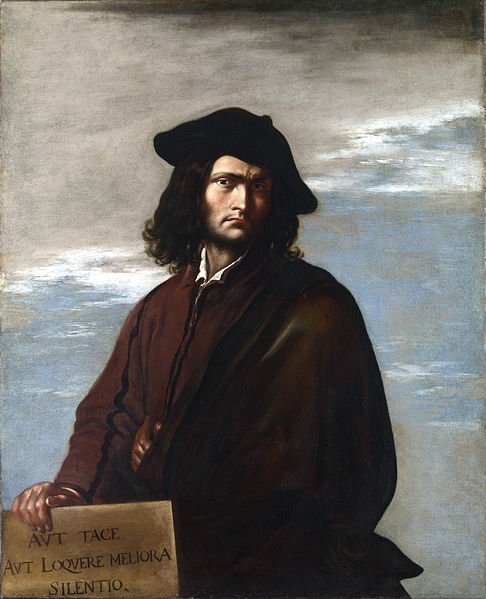
Philosophy, a Self-portrait by Salvator Rosa (c.1645)

Today’s featured work is another self-portrait, this time by the 17th century Italian Baroque painter, poet and printmaker, Salvator Rosa.  Salvator Rosa was a man of many talents and possibly one of the most daring and inventive artists of the Italian 17th century.   Although in Britain, he is often best remembered for his unparalleled wild landscapes and mountain scenery, and it was just those scenes which Horace Walpole, the English art historian, antiquarian and politician so memorably wrote that what he witnessed during his 1739 journey crossing the Alps into Italy, some fifty years after Rosa’s death was so like the landscape works of the late artist:

“…Precipices, mountains, torrents, wolves, rumblings – Salvator Rosa…

But Rosa was not simply a landscape painter.  It was Rosa who invented a series of new types of painting – novel allegorical pictures, which were characterised by poignant and melancholy poetry; whimsical portraits of romantic and mysterious figures; grisly and shocking subjects, which demonstrated the more sinister side of 17th-century triumphalism. Many believe that no other artist has managed to create windswept landscapes of such expressive and emotional power, or figures of such brooding intensity as those depicted in the artwork of Salvator Rosa.

Salvator Rosa was born in 1615 in Arenella, a hill-top suburb of Naples.  His father, a land surveyor, Vito Antonio de Rosa, believed that his son would be well-served if he became a priest or a lawyer and with this in mind enrolled him into the convent run by the Somascan Fathers.  Although his father had mapped out his future life, young Salvator had his own ideas for his future and had shown a liking and a propensity for the arts and a love of sketching and painting.  His first formal artistic tuition was given to him by Francesco Francanzano, the artist who had married Salvator’s sister and then he studied at the Naples studio of the Baroque painter Aniello Falcone.  Falcone although having painted numerous religious works and frescos for Neapolitan churches, will be primarily remembered as the first specialist of battle paintings.  It was this painting genre that won him an international acclaim and he was dubbed L’ Oracolo delle Battaglie.  It was also this genre that inspired Salvator Rosa. Falcone’s battle paintings generally depicted war as a disorderly struggle between unknown soldiers, and by so doing, created a depiction which was described as ‘the battle scene without a hero’.

In 1632 when Salvator was seventeen years of age is father died and his mother and five siblings, without their husband and father’s financial support, became destitute.  Salvator continued to work for and be mentored by Falcone and helped him with his battle paintings.  It is believed that the Rome-based painter Giovanni Lanfranco saw some of Rosa’s work and suggested that he would be best served artistically if he moved to and based himself in the Italian capital.  Rosa took Lanfranco’s advice and moved to Rome in 1634 and stayed there for two years.  In 1636 Rosa returned to Naples and concentrated on landscape painting.  There was a romantic and haunting element to his landscape work, often populated by shepherds, soldiers, brigands, and mythological characters. In general his landscapes avoided the idyllic and pastoral calm countrysides depicted by the likes of Claude Lorrain and Paul Brill and the contrast between his work and theirs was often commented on.     Claude Lorrain and Paul Brill created brooding, melancholic fantasies, awash in ruins and brigands. By the eighteenth century, the contrasts between Rosa and artists such as Claude was much remarked upon.   The 18th century Scottish poet and playwright wrote about such differences in his 1748 poem, The Castle of Indolence.  He wrote:

“…Whate’er Lorraine light touched with softening hue

Or savage Rosa dashed, or learned Poussin drew…”

I featured one of Salvator Rosa’s landscape painting, River Landscape with Apollo and the Cumaean Sibyl in My Daily Art Display of May 10th 2012.

At the age of twenty-three Salvator returned to Rome and worked on commissions including an altarpiece for the bishop of Viterbo, a town to the north of the capital.  The bishop treated him as his protégé and Rosa received many commissions from the Catholic Church.  It was during his stay in Rome that Rosa further developed his multi-talented skills, not just as an artist but as a musician, a writer and a comic actor.  Rosa founded a company of actors in which he regularly participated. He wrote and would often take part in his own satirical plays.  The plays were often political in nature and often lampooned the wealthy and powerful, and it was his devilish satire which gained him the reputation of a rebel, pitting himself against these influential people. However these acidic satires made him some powerful enemies including Gian Lorenzo Bernini, the famous and powerful architect and who was at that time, the most powerful artist in Rome.   He, like Rosa, was also an amateur playwright and it was during the Carnival in 1639 that Rosa ridiculed Bernini’s plays and his stature as a playwright.  Eventually Rosa had made too many enemies in the Italian capital and decided it was just too dangerous to remain in the city.

He left Rome and travelled to Florence, where he remained  for the next eight years.  One of his most influential Florentine patrons was Cardinal Giancarlo de’ Medici, who was a great lover and supporter of the Arts.  Rosa worked for the Cardinal at his palace but was still allowed the freedom to spend time on his own landscape paintings and he would go off and spend the summers in the Tuscan countryside around Monterufoli and Barbiano.   It was whilst living in Florence that Rosa did some work for Giovanni Battista Ricciardi who was at the centre of the literary and theatrical life of Florence and Salvator soon became part of Carlo’s circle of friends. Rosa used his own house as a meeting place for local writers, musicians and artists and it became known as the Accademia dei Percossi, or Academy of the Stricken.

He left Florence in 1646 being unhappy with the ever increasing restrictions put on him and his artistic and literary work by the Medici court.  Initially, he went back to Naples where he remained for three years before returning to Rome once again in 1649 for it was here that he believed his writings and paintings would win him even greater fame.  However, one of Salvator Rosa’s problems was himself for he often had a tempestuous relationship with his patrons, frequently ignoring their demands. Another of his quirks was that he refused to paint on commission or to agree a price beforehand.  He frequently rejected interference from his patrons in his choice of subject.  In a book by Francis Haskell, a twentieth century art historian,  entitled, Patrons and Painters: Study in the Relations Between Italian Art and Society in the Age of the Baroque, Haskell quotes from a letter Rosa wrote to one of his patrons, Antonio Ruffo, explaining his thoughts on his art and commissions:

“…I do not paint to enrich myself but purely for my own satisfaction. I must allow myself to be carried away by the transports of enthusiasm and use my brushes only when I feel myself rapt…”

The 17th century Florentine art historian Filippo Baldinucci could not believe Rosa’s attitude to his patrons and wrote:

“…I can find few, in fact, I cannot find any, artists either before or after him or among his contemporaries, who can be said to have maintained the status of art as high as he did… No one could ever make him agree a fixed price before a picture was finished and he used to give a very interesting reason for this: he could not instruct his brush to produce paintings worth a particular sum but, when they were completed, he would appraise them on their merits and would then leave it to his friend’s judgment to take them or leave them….”

In his later years Rosa spent much time on satirical portraiture, history paintings and works of art featuring tales from mythology.   In 1672 he contracted dropsy and died six months later.  Whilst lying on his deathbed he married Lucrezia, his mistress of thirty years, who had borne him two sons. He died in March 1673 just a few months short of his fifty-eighth birthday.   From the absolute poverty he endured on the death of his father he had managed to accumulate a moderate fortune by the time of his death.

My featured painting today is a self-portrait by Salvator Rosa which he completed around 1645 whilst he was in Florence.  Rosa stands before us wearing a cap and gown symbolising a man of learning.  His giant-like figure is silhouetted against a turbulent sky, dark with the threat of a storm.  Rosa looks at us, tight-lipped.  His distinctive swarthy looks are easily recognisable from his other self-portraits.  His face is gaunt and yet animated.  He is brooding and like the weather depicted in the background, he looks as though a storm is also brewing within him. He looks somewhat angry.  His demeanour is challenging and rather scornful.   His dark hair is matted and his face is depicted with unshaven stubble.  The artist had obviously decided to portray himself as an “angry young man” intensely proud of his unshaven image.  His posture could possibly be likened to one of anti-establishment and could be compared to present day photographs we see of angry and sullen rock stars

His right hand rests on a stone tablet on which has been carved a Latin epigram:

“…Aut tace aut loquere meliora silentio..”

Which when translated reads:

“…Be quiet, unless your speech be better than silence…”

This epigram comes from the Ancient Greek historian and teacher, Dionysius of Halcarnassus.

The painting can be seen at the National Gallery in London.

Self-portrait at the Easel Painting a Devotional Panel by Sofonisba Anguissola

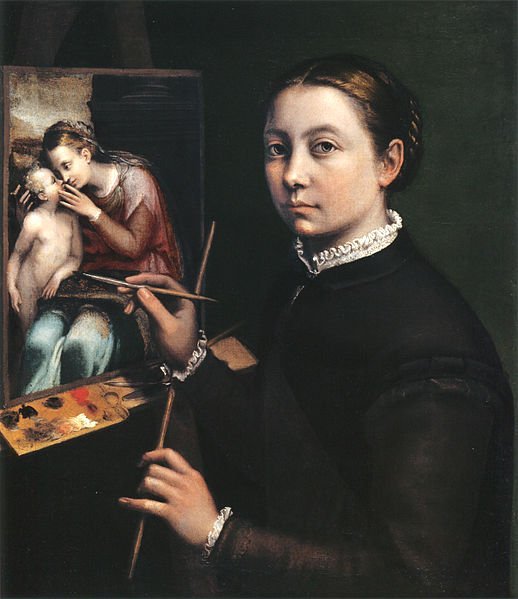
Self-portrait at the Easel Painting a Devotional Panel by Sofonisba Anguissola (1556)

Let me introduce you to a female artist, whom I am ashamed to admit, I had never heard of, but whom Giorgio Vasari, the Italian biographer of artists, made the following comment:

“…[She] has shown greater application and better grace than any other woman of our age in her endeavours at drawing; she has thus succeeded not only in drawing, colouring and painting from nature, and copying excellently from others, but by herself has created rare and very beautiful paintings…”

My featured artist today is the Italian Renaissance painter Sofonisba Anguissola. Her christian name came from a strong family connection to ancient Carthaginian history and her parents named their first daughter after the tragic Carthaginian figure who lived and committed suicide during the Second Punic War.  Sofonisba Anguissola was born in Cremona, a city in the Lombardy region of Northern Italy, around 1532.  Her father was Amilcare Anguissola and her mother was Bianca Ponzone.  Both parents came from affluent and noble families and they lived a privileged and affluent lifestyle.  Sofonisba was the oldest of seven children.  She had one brother, Asdrubale and five sisters, Elena, Lucia, Europa, Minerva and Anna Maria.   All of her sisters except Minerva became artists.

Having come from such an advantaged family background was somewhat unusual for women artists of the sixteenth century, as any of note, tended to be daughters of impoverished artists.  The family wealth coupled with the father’s belief that all females should be educated ensured that Sofonisba received an all-round and extensive education, including studying drawing and fine art.   The fact that she came from a wealthy and privileged background did not however avoid the restrictions imposed by the Italian art establishment, such as forbidding female artists from studying anatomy or attending life drawing classes as it was deemed inappropriate for a female to view a naked model, which consequently meant a female could not study the human anatomy to the same extent as a male artist could and because of this she was unable to carry out the complex multi-figure compositions which were at the heart of the popular large-scale religious and historical works.  With those obstacles in mind, Anguissola decided to concentrate on portraiture using female models, which were accessible to her, and instead of historic settings she concentrated on having her sitters shown in homely and unceremonious settings.  Self-portraits and portraits of family members were her most frequent subjects and it was not until much later in life that she turned to paintings incorporating religious themes.

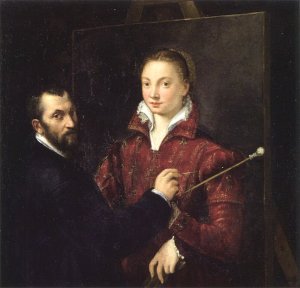
Self-portrait with Bernardino Campi by Sofonisba Anguissola (1550)

At the age of fourteen Sofonisba and her sister Elena attended the studio of Bernardino Campi, the Italian Renaissance religious painter and portraitist who was based in Cremona.  She pictorially recorded the time she was with Campi in her double portrait depicting her mentor painting a portrait of her.  The work, entitled Bernardino Campi Painting Sofonisba Anguissola, was completed by her during her last year as his pupil in 1550, when she was just eighteen years old.   After Campi, Sofonisba studied under the Italian artist Bernardino Gatti, often known as il Sojaro, and continued being tutored by him for three years, eventually leaving him when she was twenty-one years of age.

In 1554, Anguissola journeyed to Rome, where she spent her time sketching various scenes and people. The highlight of her stay in the Italian capital was when she was introduced to the great Master himself, Michelangelo Buonarotti.   We know the two met as in the Buonarrotti Archives held in Florence there is a letter, dated May 1557, from Sofonisba’s father Amilcare to Michelangelo in which he writes thanking him for spending time with his daughter:

“…honourable and thoughtful affection that you have shown to Sofonisba, my daughter,

to whom you introduced to practice the most honourable art of painting…”

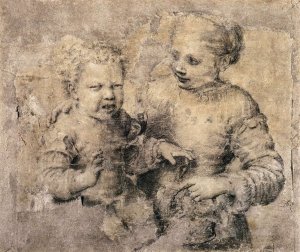
Asdrubale Bitten by a Crayfish by Sofonisba Anguissola (c.1554)

Intrigued by her artistic talent Michelangelo asked her to sketch him a picture of a weeping boy and the result was her sketch entitled Asdrubale Bitten by a Crayfish.  Sofonisba rose to the challenge and sketched her young brother, Asdrubale, being bitten and being comforted by one of his sisters.  Michelangelo was so impressed with the drawing that he gave her some sketches from his notebook and asked her to copy them in her own style.  She complied with his request and the results of her efforts again astounded the Master and because he recognised how artistically talented she was, for the next two years, he agreed to mentor her.  Again we have been made aware of the high regard in which Michelangelo held Sofonisba’s work as in a letter dated May 1558, (held in the Buonarrotti Archives) her father wrote to Michelangelo thanking him for praising his daughter’s artwork:

“…[you were] kind enough to examine, judge, and praise the paintings done by my

daughter Sofonisba…”

In 1558, aged twenty-six, Sofonisba Anguissola left Rome and went to Milan and it was here she received a commission to paint a portrait of Ferdinand Alvarez de Toledo, the Duke of Alba.  The sitter was so pleased with the resulting painting that he recommended her to Philip II, the King of Spain.  Court officials invited Sofonisba to come to Madrid and be part of the Spanish court.  This fact alone is clear evidence of Sofonisba’s artistic talent and her success, as it would have been unheard of that such a powerful leader as Philip II would countenance an insignificant artist being invited to join and live at the Spanish court and paint for his new Queen.

Late in December 1559 she arrived in the Spanish capital and took up her role at the Spanish court as a court painter as well as being one of the attendants to the Isabella Clara Eugenia, the Infanta Isabella, and later as a lady-in-waiting to her mother, Philip’s new queen, his third wife, Elisabeth of Valois (the Queen consort, Isabel of Spain) who was an accomplished amateur portrait painter.  This shared love of art between Sofonisba and Elisabeth flourished and Sofonisba would often offer artistic advice and give the queen some artistic tuition.   Sofonisba soon received many official commissions to paint portraits of the king and queen’s family and courtiers.  These were very different to her earlier portraiture work which were very informal as Philip and his wife wanted the portraits he had commissioned Sofonisba to paint to show the wealth and power of the sitters by paying attention to background and peripheral objects such as fine and sumptuous clothing, jewelled adornments and priceless furnishings.  This type of portraiture took time and skill but the finished products were always well received by the sitters.

Her artistic talents were also recognised by another powerful leader, Pope Pius IV who asked Sofonisba to paint a portrait of the Queen consort, Isabel, and have it sent to him.  Giogio Vasari in his book, Le Vite de’ più eccellenti pittori, scultori, ed architettori (Lives of the Most Eminent Painters, Sculptors and Architects) quotes a letter the pontiff sent Sofonisba thanking her for the painting and praising her work.  In the letter he wrote:

“… Pius Papa IV. Dilecto in Christo filia.

 We have received the portrait of our dear daughter, the Queen of Spain, which you have

sent… We thank you and assure you that we shall treasure it among our choicest possessions,

and commend your marvellous talent which is least among your numerous qualities

 Rome, 15 October 1561…”

In 1571 Sofonisba married Don Francisco de Moncada, who was the son of the Prince of Paterno, Viceroy of Sicily.  King Philip II facilitated the marriage, and paid her dowry of twelve thousand pounds.  She remained at the Spanish court for a further seven years after which time, and with Philip’s permission, she and her husband left Madrid and travelled to Palermo, Sicily. They arrived in Palermo in 1578 but sadly her husband died the following year.  The year following her husband’s death, Sofonisba decided to visit her family back in Cremona and embarked on a sea passage from Palermo to Genoa.   She never made it back home as she fell in love with the young captain of the ship and the couple married shortly after, in January 1580, in Pisa.  Sofonisba was forty-seven years of age and was much older than her seafaring husband.  The couple settled down at the seaport of Genoa and with her husband’s money, along with a pension from Philip of Spain, the pair had a comfortable lifestyle and Sofonisba had her own quarters including an art studio within her husband’s family’s large house.  Her reputation as an accomplished artist spread throughout Europe and she received many visits from young aspiring painters.  The couple moved to Palermo and were visited in 1624 by the Flemish painter, Anthony van Dyck, who at the time was twenty-five years old and travelling around the island of Sicily recording his travels in words and sketches in his diary.  At the time, Sofonisba was ninety-two years old and van Dyck sketched Sofonisba sitting in a chair.   All around the sketch he wrote notes in Italian, a rough translation of which is:

“…portrait of the painter Signora Sofonisba, done from life in Palermo in the year 1624, on 12 July: her age being 96 years, still with her memory and brain most quick, and most kind, and although she has lost her sight because of her old age, she enjoyed to have paintings put in front of her, and with great effort by placing her nose close to the picture, she could make out a little of it…”

It is interesting to note that according to van Dyck, Sofonisba was 96 years old in 1624 and this of course would make her birth date 1528 which is some four years earlier than the date given in a number of reference books.

Page from van Dyck's sketchbook
Page from van Dyck’s sketchbook

Van Dyck recorded in his diaries that her eyesight was weakened (it is thought she suffered from cataracts) but for a lady of 92 (or 96!) she was still mentally alert.  She had completed her last work in 1620 and had become a patron of the arts.  On November 16th 1625, Sofonisba died in Palermo aged 93.

On her birth centenary seven years later, her husband had a plaque placed on her tomb which read:
“…To Sofonisba, my wife…who is recorded among the illustrious women of the world, outstanding in portraying the images of man…

Orazio Lomellino, in sorrow for the loss of his great love, in 1632, dedicated this little tribute to such a great woman…”

Sofonisba was not only appreciated in her own lifetime but continues to be appreciated in modern society albeit I had to admit her name was new to me, which gives you some idea as to my artistic knowledge!

My Daily Art Display’s featured painting today is an early self portrait by Sofonisba Anguissola which she completed in 1556 and is entitled Self-portrait at the Easel Painting a Devotional Panel.  It is housed at the Museum-Zamek in the town of Lancut in south-east Poland.

This is one of many self portraits by the artist, which she sent as gifts to prospective patrons as she could not respectably enter into competition with male artists for paid commissions.   Around this time, there was a highly respected author, Baldassare Castiglione, the count of Casatico, an Italian courtier and diplomat, who held great sway with the public with regards manners at the court and how one should behave if of noble birth.  The book, which had a widely circulated publication in 1528, was entitled The Courtier.  In a way it was also a torch-bearer for women’s equality as it advocated the same education for aristocratic women as that offered to aristocratic men and one can only presume that Sofonisba’s father had read the book and agreed with its conclusions as he made sure that his daughters were not only educated in Latin, classical literature, history, philosophy, math, and sciences, but also that they were schooled in the courtly arts, such as music, writing, drawing, and painting.  Castiglione had written in his book about how aristocratic women of the court should dress.  He wrote:

“…she should always dress herself correctly and wear clothes that do not seem vain and frivolous…”

We can see by the way Sofonisba has depicted herself in this self portrait, wearing a modest black gown, lace collar and cuffs, the absence of jewellery and a simple hairstyle, which precluded any hint of easy virtue, that she had taken on board the advice given by Castiglione in his book.

Sofonisba looks out at us, brush in hand.  She is in the act of painting and is simultaneously the subject and object, the painter and the model of the painting.  Her painting is a re-working of the legend of St Luke the Evangelist, who it was believed, was the first to have painted a portrait of the Virgin but in this painting she has taken on the role of St Luke  and we see her painting of the Virgin and Child resting on the easel.

I love this self portrait.  There is nothing fancy about Sofonisba’s portrayal of herself.  It is an understated depiction.  It is a somewhat discreet portrait of a virtuous noblewoman and its beauty and exquisite artwork challenged the belief in those days that women artists lacked artistic skills.

Desiderius Erasmus and Pieter Gillis by Quinten Massys

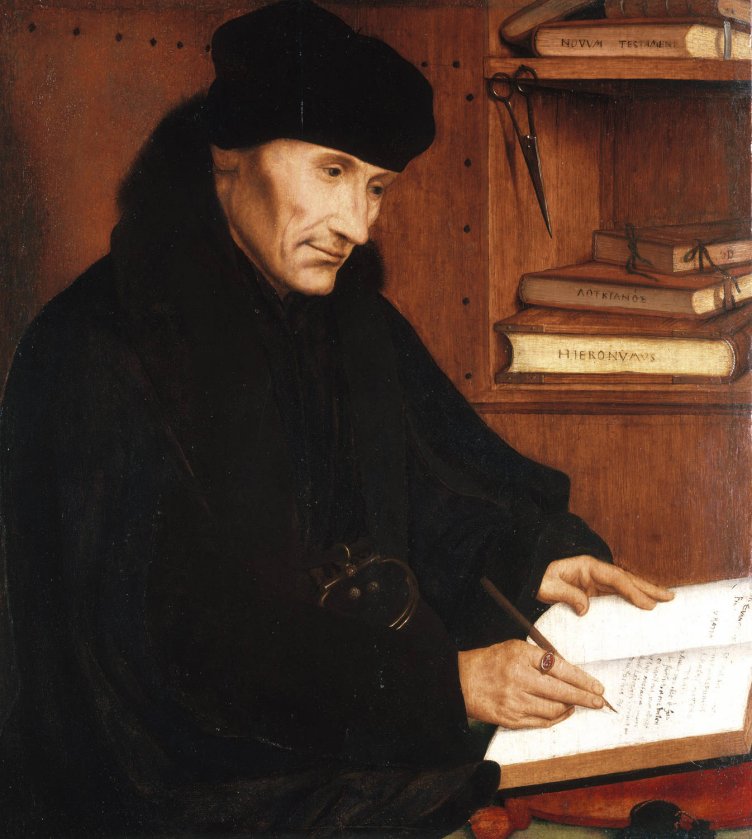
Desiderius Erasmus by Quinten Massys (1517)

We are in the run-up to Christmas and many of us will be struggling to come up with ideas for the perfect gift for a beloved friend.  The problem is even further exacerbated if the friend is wealthy and wants for very little.  What do you give somebody who has everything?  What gift can you give someone which will forever remind him or her of your close and enduring friendship?  My featured painting today is all about this.  It is about three friends, two of whom want to give the third a gift; a memento of their friendship and so they decided to present their friend with two portraits of themselves, known as a friendship diptych.  To make their gift even more special they decided to commission the foremost painter of the time to carry out the work.  The two gift givers were the humanists, Desiderius Erasmus and Pieter Gillis and the recipient of their gift was Thomas More.  The artist they commissioned to paint the friendship diptych was the Flemish painter Quinten Massys.

The beneficiary of the two paintings was Thomas More, an Oxford University graduate.  During his time at university he wrote comedies and studied both Greek and Latin literature.  In 1494, after he had obtained his university degree, he returned to London and was admitted to Lincoln’s Inn and in 1501 became a barrister.    He was a very religious man and at one time had decided to give up his career in law and become a monk and for a time lived at a Carthusian monastery.  His mental torment between following a secular or religious life was finally decided three years later when he chose to serve his country as a parliamentarian and entered Parliament in 1504.

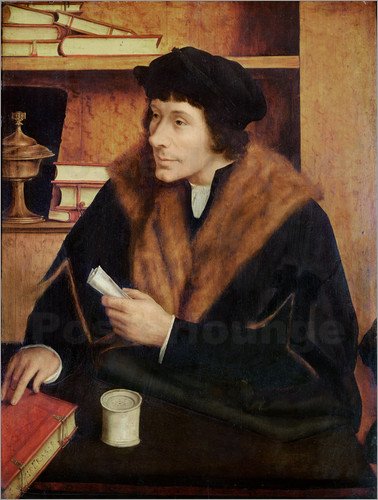
Pieter Gillis by Quinten Massys (1517)

In 1499, whilst Thomas More was living in London he met the Dutch Renaissance humanist and scholar, Desiderius Erasmus.  This initial meeting of the two men turned into a lifelong friendship and they continued to correspond on a regular basis during which time they worked collaboratively to translate into Latin and have printed some of the works of the Assyrian satirist, Lucian of Samosata.  It was through his meeting with Erasmus that Thomas More met Erasmus’ friend, Pieter Gillis, a fellow humanist, a printer by trade and town clerk of Antwerp.  One of Thomas More’s most famous compositions was his two-volume work entitled Utopia.  It is a depiction of a fictional island and its religious, political and social customs and was More’s way of commenting upon the social and political ideas of the day as well as highlighting and satirising the failings he saw all around him.  In the first volume, entitled Dialogue of Counsel, it began with correspondence between More himself and others, including Pieter Gillis.  The whole idea of the book came to Thomas More whilst he was staying at the Antwerp home of Gillis in 1515.  On his return to England in 1516, Thomas More completed the work and the first edition was edited by Erasmus and published in Leuven.  Thomas More dedicated this work to Pieter Gillis.

In 1517, a year after the publication of the first edition of More’s work, Desiderius Erasmus and Pieter Gillis, decided to send portraits of themselves to Sir Thomas More. This friendship diptych would act as a virtual visit to their English friend in London and they approached Quinten Massys to carry out the two paintings as he was the leading Antwerp painter at that time. Erasmus’ portrait was the first to be completed because the portrait of Gillis was constantly being delayed due to him falling ill during the sittings.  The two men had told Thomas More about the paintings which may not have been a wise move as More constantly queried them as to the progress of the paintings and became very impatient to receive the gift.  The two works were finally completed and were sent to More whilst he was in Calais.

The portrait of Erasmus, which is part of the Royal Collection and is currently on show at the Dürer to Holbein; The Northern Renaissance Exhibition at the Queen’s Gallery in London, depicts Erasmus working in his study. The way in which Massys has portrayed Erasmus was a popular way of depicting St Jerome, and so the setting used in the portrait probably alludes to the fact that Erasmus had just published a new edition of the writings of St Jerome.

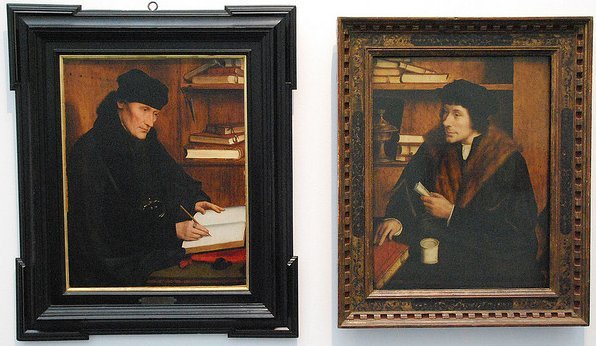
It is interesting to look at the books on the shelves in the background.  On the upper shelf of the Erasmus painting there is a book which has the inscription Novum Testament which alludes to Novum Testamentum Graece, the first published edition of the Greek New Testament produced by Erasmus in 1516.  On the lower shelf there are three books.  The bottom tome has the inscription Hieronymus which refers to Erasmus’s editions of the New Testament and St Jerome; on top of that book there is one with the inscription Λουκιανός which is the Ancient Greek word for Lovkianos or Lucian and refers to Erasmus and Thomas More’s collaboration in translating Lucian’s Dialogues.   The inscription on the uppermost book is the word Hor, which originally read Mor.  The first letter was probably altered during an early restoration, for besides Mor being the first letters of Thomas More’s surname they almost certainly refer to the satirical essays written by Erasmus whilst staying with Thomas More in his London home in 1509 and entitled Enconium Moriae (Praise of Folly).  This collection of essays was considered one of the most notable works of the Renaissance.  We see Erasmus writing in a book.  This depiction has been carefully thought out for the words one sees on the page paper are a paraphrase of St Paul’s Epistle to the Romans, the handwriting is a careful replication of Erasmus’s own hand, and the reed pen he holds was known to be Erasmus’s favourite writing tool.  If you look closely, in the folds of Erasmus’ cloak you can just make out a purse.  It could be that Erasmus wanted the artist to include this in order to illustrate his generosity.  Erasmus and Gillis made a point of informing Thomas More that they had split the cost of the painting because they wanted it to be a present from them both.  If you look at the two paintings side by side then one can see that Massys has cleverly continued the bookcase behind the two sitters and this gives the impression that the two men depicted in the two separate panels occupy the same room and are facing each other.

The Friendship Diptych
Copy of The Friendship Diptych
Galleria Nazionale d’Arte Antica, Rome

If we were to look now at the two paintings of Erasmus and Gillis, side by side, we would question whether they were in fact two halves of a diptych as they have different dimensions.  This has been explained away by the fact that the Royal Collection painting of Erasmus has been cut and the one of Gillis, which is in the private collection of the Earl of Radnor at Longford Castle, has been extended but it is believed that the original dimensions of both had matched perfectly. Furthermore, both panels have the brand of Charles I on the reverse and the fact that they were together in the seventeenth century seems to confirm that they constitute the original friendship diptych.

The artist, Quinten Massys also spelled Matsys or Metsys, was the foremost artist of his day in Antwerp.  He was born around 1466, in the town of Louvain which is situated in the Flemish Province of Brabant in Belgium.   His father Joost Massys was a blacksmith and his mother was Catharina van Kincken and they had four children.  For a time Quentin helped his father in his blacksmith and metalwork business.  Little is known about Massys’ early life and what we do know could be based on fanciful legends!  One such story was that Quentin abandoned working as a blacksmith and became an artist in order to impress a young lady, an artist’s daughter, who found art and artists romantic.  However a more mundane reason for Quinten to give up as a blacksmith was given by the painter, art historian and biographer of Netherlandish artists, Karel van Mander, in his 1604 Schilder-Boeck, who wrote that Quinten was a sickly youth and lacked the physical strength needed by somebody working in the metalwork and blacksmith profession.

Quinten Massys moved to Antwerp where he was admitted to the Antwerp St Lukas Guild.  He married when he was twenty-six years of age.  His wife was Alyt van Tuylt and the couple went on to have three children, two sons, Quinten and Pawel and a daughter Katelijne.  His wife died in 1507 and Quentin remarried a year later.  His new wife was Catherina Heyns and she and Quinten went on to have a further ten children, five sons and five daughters.  Shortly after their father’s death, two of his sons, Jan and Cornelis went on to become artists and members of the Antwerp Guild.

Thomas More was knighted in 1521 and in 1523, he became the speaker of the House of Commons and in 1525 chancellor of the Duchy of Lancaster. Seventeen years after Thomas More received his friendship diptych from Erasmus and Gillis, he was dead.  He had risen to power under Henry VIII but had fallen foul of the English ruler in 1534 by refusing to swear to the king’s Act of Succession and the Oath of Supremacy, statutes which made Henry the supreme head of the Church of England.  Sir Thomas More believed that the supreme head of the church was the Pope and this stated belief lead to him being indicted for treason on charges of praemunire, which was the offense of introducing foreign authority into England and was intended to reduce the civil power of the Pope in England.  The jury found him guilty and he was sentenced to be hanged, drawn and quartered, which was the usual punishment for traitors who were not the nobility.  However Henry VIII commuted this to execution by decapitation. Sir Thomas More was executed on 6 July 1535.   His last words were a declaration that he died “the king’s good servant, but God’s first”

La Fornarina by Raphael Sanzio

La Fornarina by Raphael (1520)

My Daily Art Display today features an Italian lady, Margarita Luti.  She became known as La Fornarina which in Italian means “the baker’s daughter”.  She was the daughter of Francesco Luti, a local baker from Siena who worked in the Roman district of Santa Dorotea.  The reason she became famous was not because of her father’s occupation but because she modelled for and was the mistress of the great Italian High Renaissance painter, Raphael Sanzio.  It was well documented that Raphael Sanzio was a very passionate man and had many mistresses in his time.  In the book, The Lives of the Artists by Giorgio Vasari, the biographer described the artist and how his love of women affected his work:

“…Raphael was a very amorous man who was fond of women and he was always quick to serve them. This was the reason why, as he continued to pursue his carnal delights, he was treated with too much consideration and acquiescence by his friends. When his dear friend Agostino Chigi commissioned him to paint the first loggia in his palace, Raphael could not really put his mind to his work because of his love for one of his mistresses; Agostino became so desperate over this that, through his own efforts and with the assistance of others, he worked things out in such a way that he finally managed to bring this woman of Raphael’s to come and stay with him on a constant basis in the section of the house where Raphael was working, and that was the reason why the work came to be finished…”

Although Margarita Luti is not actually named by Vasari her name does appear in scribbled notes on the original pages of the manuscript which would become his second edition of his Lives of the Most Excellent Painters, Sculptors and Architects.  The painting entitled La Fornarina, by Raphael hangs in the Palazzo Barberini in Rome and a further copy can be found in the Galleria Borghese, in Rome.  The work was completed around 1520 when Raphael was thirty seven years of age.  This was also the year in which on Good Friday, April 6th he died. Before us is a portrait of a beautiful young woman who is almost nude.  Her skin is flawless as alabaster. Her cheeks are flushed and pink, She stares out to her left and smiles, presumably at the artist as he works on her portrait.

Venus Pudica
Venus Pudica

She is pictured with an oriental style hat on which is attached a large jewel Her breasts are bare. Her right arm crosses her body and her right hand pulls a diaphanous veil over her stomach and abdomen in a gesture which mirrors the posture of women as seen in classical sculptures such as the Venus pudica, apose that became the custom for the nude Aphrodite figures in the Late Classical period.   It is a very suggestive pose and I am not sure whether she is attempting to cover her breast or in fact she is turning it slightly towards us and her lover, Raphael.  Or could it be that her right hand is pressed against her heart as she looks at Raphael as a gesture of her love for him?  Her left hand rests between her thighs, the fingers splayed out and outlined by the deep, bloody-red of her discarded gown.  On her left arm there is a narrow leather band on which is the name of the artist – RAPHAEL URBINAS.  On the third finger of her left hand she appears to be wearing a ruby wedding band.   The presence of a ring was only discovered in the early part of the twenty-first century when the painting underwent some X-Ray analysis during restoration and cleaning work.

The fact that Raphael painted her with a wedding ring would have been very controversial at the time for six years earlier, in 1514; he had become engaged to marry.   He had been pressured by Cardinal Medici Bibbiena’s to marry one of his nieces, a lady named Maria Bibbiena.   Raphael did not want to refuse the Cardinal, but managed to postpone the matter, saying that he would prefer to wait three or four years before entering into marriage.  However after stringing along the cardinal and his niece for four years, Raphael had to agree to the marriage, but managed to keep putting off the date for the big occasion with a string of excuses.   So why had this engagement lasted six years without it ever ending in marriage?  There are a number of theories.  One is that Raphael had already married Margarita Luti in secret years earlier and therefore could not marry Maria Bibbiena.  Another possible reason is that his engagement to Maria had brought him additional status.  He was made a “Groom of the Chamber”, a papal valet, which in itself afforded him status at court and more importantly an additional income.  He would not want to jeopardise that.  He was also made a knight of the Papal Order of the Golden Spur, an honour which was also bestowed on the artists Titian and Vasari.   All such honours would have been lost if he had had to admit to being already married.  So why was the ring on the sitter’s finger not discovered immediately?  It was not just the ring, which was painted out, as the restoration work also uncovered that the myrtle branches we see filling the background of the painting and which are thought to be symbolic of love and marriage were not always there.  The X-Ray analysis of the painting show that originally there had been a landscape background, similar to that seen in da Vinci’s Mona Lisa.
The reason for the over-painting is that it is thought that the work which was found in Raphael’s studio when he died had “finishing touches,” added, including a cover-up of the Margarita Luti’s ring finger by his student, Giulio Romano, who then went on to sell the painting.

Raphael Sanzio died in April 1520 possibly even on April 6th, the day of his 37th birthday.  There are numerous speculative explanations as to the cause of his death.  Probably the most bizarre was put forward by Vasari when he postulated that Raphael died on his 37th birthday after a wild night of celebratory sex with Margarita causing him to lapse into a fever and when a doctor arrived Raphael was too embarrassed to admit to what had brought on this feverish state and then had been given the wrong medicine by the doctor which went on to kill him.  Other historians, who also disagree of the date of his death, have put his demise down to working too closely with arsenic and lead based paints or overwork or heart failure.

And so I leave you with one of the world’s greatest artists and his portrait of the love of his life, but is it?  Is this a portrait of the little baker’s girl who became Raphael’s lover?  Some would disagree.  Some art historians, including Doctor Claudio Strinati, superintendent of the National Museums of Rome, now believe that the way in which Raphael’s has depicted the lady is too refined to have been just done for his own pleasure and in fact, due to the quality of the work, was a commission for a wealthy and influential patron and that patron could have been his friend Agostino Chigi.  According to this theory, the woman in the painting was not Margarita Luti but Chigi’s long-time mistress, and later his wife, Francesca Ardeasca.  We know that Chigi had commissioned Raphael to work at his new “palace”, the Villa Farnesina, and the two had become friends so much so that when the lovelorn Raphael’s mind was so distracted having been parted from his beloved Margarita whilst working on the commission, Chigi had supplied a room in his palace for Margarita so that he could better focus on the work in hand.

So is this enchanting portrait of the dark-eyed woman we see before us today Raphael’s paramour or his patron’s wife?  Is this a painting carried out for love or for money?  We will probably never know for sure as there are no other portraits of Chigi’s wife, Francesca, and therefore no possibility to compare likenesses.  Maybe this doubt adds to the mystification of the portrait and I will let you make up your own minds.

Having extolled the beauty of some other women in featured paintings in early blogs I look at this lady and question her purported beauty but as “beauty is in the eye of the beholder” I will again allow you to decide and leave you with the comments made by French writer, Gustave Flaubert who wrote about La Fornarina in his satirical work entitled Le Dictionnaire des idées reçues (Dictionary of Received Ideas):

“…Fornarina.  C’était une belle femme; inutile d’en savoir plus long…”

(Fornarina. She was a beautiful woman. That is all you need to know)

Portrait of a Man and His Wife by Ulrich Apt the Elder

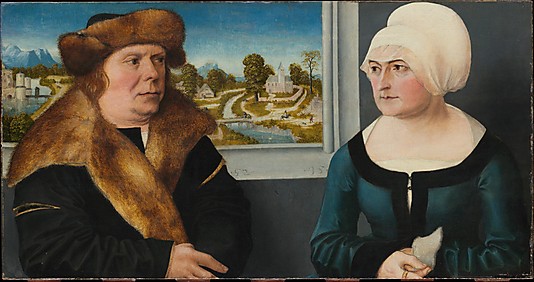
Portrait of a Man and His Wife by Ulrich Apt and Workshop (1521)Queen's Gallery London
Portrait of a Man and His Wife by Ulrich Apt and Workshop (1521)
Queen’s Gallery London

My featured artist today is probably unknown to most of you as he was to me.  He is the late Gothic painter Ulrich Apt the Elder, who was born in Augsburg around 1460.  The work I am featuring today fascinated me when I saw it the other day at the Northern Renaissance Dürer to Holbein exhibition, which is being held at the Queen’s Gallery in London and runs until April 14th 2013.  It is a wonderful exhibition and one I can thoroughly recommend.

Ulrich Apt the Elder was the fourth son of the German painter Peter Apt who trained and worked in the German city of Augsburg.    Little has been written about the artist but we do know from documents that he became an independent master at the age of twenty-one and became an important member of the Guild of Painters, Glaziers, Carvers and Gilders.  He concentrated on religious commissions and it is thought that his first major commission he obtained was in 1491 when he completed a very large fresco of St. Christopher in the Augsburg Cathedral.   He also accepted many portraiture commissions from the leading citizens of Augsburg society, who were enamoured by his conservative style. He was given a very important and lucrative commission from the city of Augsburg in 1516 for frescoes to decorate their town hall.  It is known that Ulrich had built up his business to such an extent that he had all but established a monopoly in mural painting in Augsburg, and from his tax records it can be seen that his business thrived and he had become extremely wealthy.  His three sons worked with him and he trained several Augsburg artists of the next generation.   There has been much discussion amongst art historians as to who actually painted the various works which came from the workshop as a number were done collaboratively and a number of the painters including those of his family had similar styles.    Apt’s eldest son Jacob became an independent master in 1510 and died in 1518.  The second, Ulrich Apt the Younger, was active as a painter in 1512 and continued until 1520.  The youngest, Michael, became a master in 1520 and is documented working as a painter until 1527.    It is thought that during his lifetime he made many journeys to the Low Countries and it is following these visits that his artistic style became noticeably more predisposed towards Netherlandish painting.   Ulrich Apt the Elder’s works, because of this, began to influence other Augsburg artists of the time.  Apt’s studio decided to follow the Netherlandish manner and tradition.  However not all of his contemporary artists from Germany followed this artistic path, for painters such as Hans Holbein the Elder and Hans Burgkmair favoured, and were influenced by, the works of Italian painters, particularly those from Venice

My Daily Art Display’s featured oil on limewood work today is entitled Portrait of a Man and His Wife and was completed in 1512.  In all, the artist painted three versions of this work.  One may wonder why he should do that and the answer could well lie with why the picture was painted in the first place.   It is thought to be a painting to commemorate a wedding and therefore, as we do nowadays, commemorative copies celebrating the marriage were given as gifts to various close relations as well as one being kept by the happy couple.  One copy of the painting is now held in a prívate collection, one is now owned by the Queen of England, having been first acquired for the collection of King Charles I, who received the painting as a gift from Sir Henry Vane, the Comptroller and then Treasurer of the King’s Household.   A third version is on display at the Metropolitan Museum of Art in New York, which acquired their painting in 1912.

In the painting we see the bride and groom, behind which there is a landscape in which there is a centrally positioned church.  Bearing in mind the date of the painting and the fact that it was carried out in Augsburg, art historians believe it to be the wedding of Lorenz Kraffter and Honesta Merz, a couple, who went on to have nine children.  The groom was the son of James Lindsay of Crafford who immigrated to Augsburg from Scotland.   What is interesting to note is the positioning of the man and woman in relationship to the background landscape.  The man is placed in the middle of the finely and beautifully detailed landscape with a castle shown at his back.  From this, we are to deem that this man is of great importance and holds at position of great consequence in Augsburg society – a “man of the world”.  However, look at how the artist has positioned the bride.  She is placed against a blank and dark wall which alludes to her role in life, that of domesticity and enclosure within the marital home.  The landscape in both paintings is criss-crossed by narrow winding paths and two meandering rivers, which curve around the church and castle.  In the New York version the river is given a bluish tone.   Another interesting aspect of the paintings is the three sets of numbers, two of which one can see on the lower sill of the window.  They are “52,  “35”  and “1512” which although not clearly shown in my attached pictures is plainly on view in the painting I stood in front of, and is in between and above the two other numbers.  The “52” indicates the age of the man whilst the “35” denotes the age of the woman and the “1512” alludes to the date the painting was completed by the artist.  The husband is dressed sumptuously in a gown lined with marten and the manner in which he is dressed denotes his high-standing in the local society

The incorporation of a detailed landscape view seen through a window has probably derived from artists such as Hans Memling and its inclusion in this work highlights the power of the Netherlandish influence on the artists of Augsburg in the latter part of the fifteenth century.  Hans Holbein the Elder, another Augsburg painter, would often incorporate architectural settings in his portraits. Although this is essentially a wedding portrait and the focus of the painting is the bride and groom, look at how Ulrich has spent much time in the fine painstaking details of the background landscape with its trees and buildings.

Although I cannot find a picture of the third copy of this painting it is easy to see the differences in the two paintings on offer today, which may lead one to believe that different artists in Ulrich Apt the Elder’s workshop may have had some part in the execution of the works.   A tracing for the figures was obviously shared since they match almost perfectly.  The one in the privately owned Schroder collection is said to be of the highest quality and it is believed that all of that work was carried out by Ulrich Apt himself.  The version held in the Royal Collection, which was previously considered to be a seventeenth-century copy of that in the Schroder collection, has revealed that after recent cleaning and conservation work, it is a very good version by Apt and his workshop.

Originally thought to be by Quinten Massys, and at the end of the seventeenth century it was attributed to Holbein the Younger and furthermore, in the nineteenth century it was thought to be a portrait of his parents. However in 1928, the German art historian Karl Feuchtmayr identified the artist as Ulrich Apt.

Portrait of a Man and His Wife by Ulrich Apt the Elder (1512)Metropolitan Museum of Art, New York
Portrait of a Man and His Wife by Ulrich Apt the Elder (1512)
Metropolitan Museum of Art, New York

The Metropolitan Museum of Art’s copy, shown above, is different in a number of ways to the one held in the Royal Collection.   The first and most obvious difference is the colour of the woman’s dress.   In the Royal collection she is wearing a dress, the color of which is drab brown, whereas in the New York painting it is light turquoise.   According to the MMA, their copy of the painting has been severely overcleaned in the flesh tones. They also comment that splits that run horizontally across the panel at the levels of the sitters’s mouths and foreheads have been filled and in-painted.

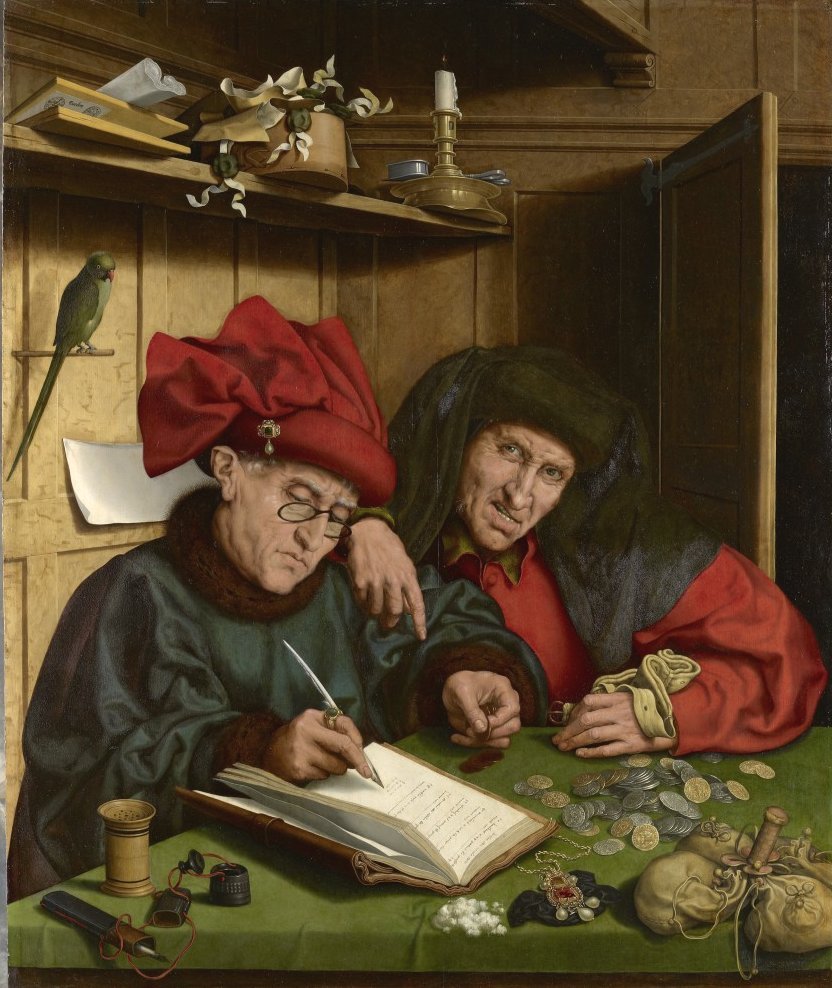
The Misers by Followers of Marinus van Reymerswaele

The Misers by the Followers of Marinus van Raymerswaele (1548-51)

Whenever one picks up a newspaper nowadays, or switches on the television or radio, one is regaled with tales of dastardly deeds done by bankers.  Story upon story is written about their misappropriation of our money.  We sit and read or listen to these tales which coincide with the deterioration of our own financial situation and we seethe with anger.  Over time we are convinced that our own personal financial woes can be directly traced back to and laid at the doorstep of the bankers.  In our minds, the government is also to blame as we are taxed to the hilt and our wrath is also levelled at the role of the tax collectors.  We would rather cling to this belief than question why our credit cards and stores cards are “maxed-out”.   Soon it is not just the bankers and tax collectors whom we despise but we begin to focus our attention on those who are financially sound and before we know it,  they too become targets for our dislike, our jealousy and our envy.   Why should we suffer pecuniary embarrassment when others seem to be untouched by the money problems of the country?  Now we read newspapers, listen to radio reports and watch television stories with glee when we see bankers are being bashed and rich people suddenly lose their fortunes.  We revel in this feeling of schadenfreude.  The media of course knows what we want and they continually feed us with such stories.

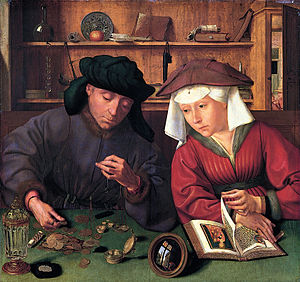
The Banker and his Wife by Quinten Massys (1514)

So is this a new phenomenon?   Actually it isn’t.   The portrayal of greedy bankers, money-lenders and tax collectors often with anti-Semitic connotations has been around for a long time and may have derived from paintings such as Jan van Eyck’s 1440 work entitled Banker and Client, which unfortunately has been lost.  Later, in 1514, the Flemish painter, Quentin Metsys, would carry on the theme in his work entitled The Banker and his Wife.   Just as the present day media are aware that we want to witness the vilification of these people, the artists of the past also knew what would strike a chord with the people of those days when it came to disparage those who had “taken” our money from us, whether it is bankers and money lenders or tax collectors.   In My Daily Art Display today I want to feature another 16th century painting on that very subject.

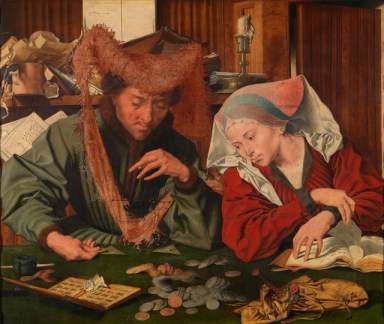
The Moneychanger and his Wife by Marinus van Reymerswaele (1539)

If you care to look back at my blog of January 2nd 2011 you can read about a 1539 work by Marinus Claeszoom van Reymerswaele entitled The Moneychanger and his Wife in which one sees seated at their table a married couple in 16th century Flemish dress totally absorbed, almost spellbound, as they count their money. Both husband and wife are gripped equally by this act and in some ways it maybe this common love of money which brings them happiness and cements their relationship.   However one should observe that they focus their attention on the coins on the table and seem to ignore each other.  It is also interesting to note that in the paintings, The Banker and his Wife by Metsys, The Moneychanger and his Wife by van Reymerswaele and today’s offering there is also something else in common in the depictions besides the two characters and that is behind these people there is a shelf which forms part of a still life depiction of items which add to the story behind the main theme of money.

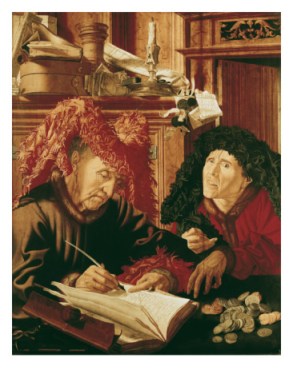
Two Tax Gatherers by Marinus van Reymerswaele (c.1540)

My featured painting today is entitled The Misers and was completed between 1548 and 1551.  It is attributed to the “Followers of Marinus van Reymerswaele” and is part of the Queen’s Royal Collection.  It is a variation on a number of paintings by van Reymerswaele himself, one of which, entitled The Tax Gatherers, he completed around 1540 and is in the National Gallery in London.

In today’s featured painting we see the man on the left writing out a list of taxes and exchange rates on commodities such as wine, beer and fish,  which will then be given to private individuals to collect.  This was a common practice in those days.   The setting for the painting is one of congestion.  In it we see two figures positioned tightly together with their desk positioned ridiculously close to the door but, in a way, this has given the scene a claustrophobic and unsettling atmosphere. On the green baize table in front of the two men are piles of coins which are being counted and registered in a ledger.  There is also a four-bag money pouch with a handle, some jewellery and an ink pot.   The title of the painting, The Misers, is probably a misnomer as in fact these two men are simply tax collectors going about their every-day business. The man on the right points at the ledger being written in French by his colleague.  The exchange rates listed in the ledger gives us a valuable clues to the dating of the picture, as these rates first came into use on 11 July 1548 and were superseded on 16 December 1551.  The fact that the French language was used could mean that either this painting was commissioned by a French patron or the artist lived in the French-speaking region of the Netherlands.  The man on the right stares out at us.  He sneers.  He gloats.  His face is grotesquely distorted.  The artist has, through his depiction of this man, presented us with a “hate figure”.   There is an undoubted air of affluence about the clothes two men are wearing.  The man on the left wears a sumptuous red turban pinned to which is a large jewelled brooch.   He wears spectacles and in a way the artist may have wanted us to interpret the wearing of these as symbolic of moral shortsightedness.  However whoever chose to paint their rich garb decided to clothe them in 15th century costumes which at the time would have looked rather old-fashioned and maybe the artist had decided that by dressing them in such a manner,  he was subtly ridiculing them.

Look at the shelf behind them.  Art historians believe that this still-life depiction was probably painted by a different artist to the one who painted the two figures.  On the shelf there is a lit candle which is slowly burning away and this can probably be interpreted as a warning against greed, and questioning our attitude with regards wealth, because, like the candle, which will soon burn out, life is short and there is a futility about the desire to  accumulate wealth.

This painting which I saw last week when I visited the Queen’s Gallery is a beautiful work of art.

The Grindelwald Glacier by Thomas Fearnley

Grindelwald Glacier by Thomas Fearnley (1838)

Today I am concluding my look at the life of Thomas Fearnley and for those of you have just landed on this page,  my introduction to the Norwegian artist’s life was the subject for My Daily Art Display blog of November 24th.

The date is 1832 and that September, Fearnley, who along with his fellow artists, the Dane, William Bendz and the German painter Joseph Petzl, had just left the Bavarian Alpine village of Ramsau and were beginning their long and strenuous trek on foot over the Alps to Italy.  So why had this Norwegian artist and his friends set off on this gruelling journey?  Why did Fearnley spent most of his life wandering around Europe?   The answer probably lies in the fact that although the Norwegian landscape offered many beautiful vistas to paint, there were few commissions to be had from wealthy patrons in his native Norway.  Whereas in the art capitals of Europe such as Paris, London, Rome and Munich there were a large number of affluent patrons who would pay generous sums for landscape works.

Fearnley and his travelling companions headed for Rome but first stopped off in Venice in the late October of 1832.  The three travellers split up at this point as Fearnley was determined to carry on until he reached the Italian capital whereas Bendz wanted to stay in Venice.  As I told you in my last blog, William Bendz took ill in Venice but left the city and went to Vicenza where his health deteriorated rapidly and he died of typhoid, just ten days after he had parted from his friends.  Fearnley finally arrived in Rome in November 1832, just before his 30th birthday.  He settled down in the Italian capital, living amongst the Danish and German artistic community.  Fearnley made Rome his base for the next three years but was constantly setting off from there on his artistic trips.  In 1883, along with a Danish friend, he left the capital on a long walking tour of Sicily and on his way back to Rome, visited Naples, Sorrento and Capri.  This journey along the Amalfi coast had been carried out by his erstwhile mentor John Christian Dahl, ten years earlier.

Fearnley loved the practice of en plein air oil sketching and he followed earlier practitioners of this kind of art such as Claude-Joseph Vernet, Pierre-Henri Valenciennes and the Welsh artist Richard Wilson, all of whom had pioneered en plein air sketching whilst they were based in Rome.  The other aspect of this art, which Fearnley believed in, was to select views for painting that were “fresh”, even unorthodox rather than painting views which had been done so many times over by other landscape artists.  Another aspect of art which fascinated Fearnley was how various meteorological conditions affected the light and the view of the landscapes.  He strived for a true depiction of the skies and the cloud formations and was only too aware of the fast change in what he was looking at, due to varying changes in the weather conditions.   Having left the colder, duller and wetter climate of Northern Europe and Scandinavia he was now able to appreciate and take advantage of the warmer, sunnier climes of Italy which allowed him a greater opportunity to paint outdoors for lengthy periods of time.

In 1835, after his three year sojourn in Italy, Fearnley decided to move on.  He travelled north via Florence to Switzerland where he spent most of the summer studying the breathtaking Alpine scenery and especially the glaciers at Grindelwald, which would be depicted in his famous 1838 large studio oil painting entitled The Grindelwald Glacier, which is My Daily Art Display’s featured painting today.  From this Alpine area he once again moves north, crossing the Alps, heading for Paris, arriving in September of that year.  Whilst in Paris, he exhibits three of his works, including the “yet to be completed” Grindelwald Glacier painting.  During Fearnley’s stay in Rome he had met and befriended a number of wealthy English art lovers.  Many were rich aristocrats who were taking part in the Grand Tour.   It could have been this that made him decide to travel from Paris to London in the spring of 1836.  Whilst in the English capital, Fearnley took in the Royal Academy May Exhibition and at this exhibition he would have seen major works by the likes of Turner, Constable, David Wilkie and William Etty.  However the artist who most impressed Fearnley was the English landscape painter Augustus Wall Callcott.   This R.A. Exhibition was a special one as there were more than 1200 paintings being exhibited and it was the last one to be held at Somerset House.  Whilst in England Fearnley made a number of painting trips and in August 1837 he, along with his fellow artist friend, Charles West Cope, visited the Lake District.  He visited Derwentwater, Coniston and Patterdale, all the time recording the views in oil sketches.   In 1838 Fearnley became the founder member of the Etching Club, an artists’ society founded in London.  The club published illustrated editions of works by authors such as Oliver Goldsmith, Shakespeare, and Milton.  Other well known artists who became members of this club were the Pre-Raphaelite painters, William Holman Hunt and John Everett Millais.

In 1838, Fearnley exhibited his now completed work The Grindelwald Glacier at the Royal Academy.    His wanderlust continued unabated and he leaves London in the summer for Germany.  He first visits Berlin and then on to Dresden where he once again meets up with his former mentor and teacher J C Dahl. He makes a brief stop-over in Switzerland before returning to his homeland, Norway, where he lives in the capital Christiania for the next two years.   Fearnley became a member of the Christiania Art Society.  On July 15th 1840,  he married Cecilia Catharine Andresen, the daughter of one of his patrons from previous years, the banker and Member of Parliament Nicolai Andresen.   In the autumn the couple went to Amsterdam, where they stayed for one year, and where their only child, a son Thomas, was born.  During their stay Fearnley becomes infected with typhus and on January 16th 1842 he died, aged just 39 years old.   He was buried in a Munich cemetery but 80 years later his son took the initiative to have his father’s remains brought back to Norway, and in 1922 the tomb was moved to Our Saviour’s Cemetery in Oslo.

Fearnley’s painting, which at the time was entitled The Upper Grindelwald Glacier, Canton Berne, Switzerland,  was started in 1836 and although not finished was shown at the Paris Salon that year.  It was two years later in 1838 that the painting appeared at the Royal Academy Exhibition, which was being held in its new home at the National Gallery, the R.A. having just moved from Somerset House that year.  This beautiful painting is dated 1838 which leads us to believe that the original work started in 1836 was re-worked in late 1838 whilst the artist was in London.  This large studio work derives from a number of oil sketches which Fearnley made in late 1835 whilst he was in the Grindelwald valley.  The spectacular view we are looking at is of the upper Grindelwald glacier, which lies on the northern side of the Bernese Alps.  In the middle ground we can just make out a lone shepherd silhouetted against the stunning white ice peaks of the glacier.  In the foreground of the work we see that Fearnley has put a lot of effort into depicting the flora, amongst which are dotted the shepherd’s flock.  Although my attached picture might not clearly show it, the artist’s signature “Fearnley” is on the rock in the right foreground, next to a fern ! Coincidence or a witty visual play on his name?

Ramsau by Thomas Fearnley

Ramsau by Thomas Fearnley (1832)

I have said on a number of occasions that one of the joys of visiting art galleries is when you suddenly come across one you did not know existed.  It is always a pleasure to go to the large and famous galleries such as the Louvre, Prado, and London’s National Gallery to name just a few but I find it exhilarating when I come across, often by accident, the smaller, more hidden-away ones such as London’s Wallace Collection or the Musée Marmottan Monet Gallery  in the 16th arrondissement of Paris.   I had visited Birmingham before and visited the Birmingham Museum and Art Gallery but a fortnight ago I decided to visit the city again and have a look at the Barber Institute of Fine Arts which is on the University of Birmingham campus.   If I had not decided on that visit I would never have come across a divine portraiture work of Élisabeth Vigée Le Brun which I enthused about in my last blog and which was part of their permanent collection.  However the reason for me going to the gallery was to see an exhibition of the Norwegian painter Thomas Fearnley and today I want to talk a little about the life of this artist and look at one of the paintings which was in the exhibition.

Thomas Fearnley, although an English-sounding name, was Norwegian.  He was a romantic painter who was born in 1802 in Frederikshald, Norway, a small town in the south east of the country, a few miles from the Norwegian-Swedish border.  The town has since been renamed Halden.  The Fearnley family maintained its custom of naming its eldest sons Thomas and so both his father and grandfather were named Thomas.  His grandfather was an English timber merchant from Heckmondwike, a small mill town near Leeds, and who with his family moved to Norway in 1753 as a representative for a trading company based in the English seaport of Hull.  Fearnley’s father Thomas was also a merchant and married Maren Sophie Paus, a woman from the important Norwegian Paus dynasty.  Thomas was the eldest of their eight children.

Thomas Fearnley’s father owned a shop in Frederikshald and earned his money as an importer/exporter, importing woollen and cloth goods from England and exporting Norwegian lumber.   At the age of five, young Thomas went to live with his maternal aunt, Karen and her husband, Georg Frederik Hagemann in Christiania, (now known as Oslo).  The couple had no children of their own and were delighted to have Thomas live with them.  When Thomas was twelve years old he was enrolled as a pupil in the cadet corps of the Military Academy.  At the Academy, one of the subjects Thomas was taught was drawing.  It was soon clear that he had a talent for drawing and excelled in these lessons.  However he achieved less in his other subjects especially in the military training and he left the Academy in the spring of 1819.

As his father and his father’s father before him had all been merchants, it was expected that Thomas would follow suit and at the age of sixteen, for a while, he took on the role of a young merchant in his uncle’s business.  However Thomas had not given up his love of drawing and every evening he would attend an elementary art class in Christiania, where he spent time copying still lifes and portraits painted by various artists.

To become an artist in Norway was quite difficult as there were no major art academies where aspiring artists could learn their trade.  It could well be this factor, which forced Fearnley to travel extensively through Europe visiting major art institutions.  In late 1821 he travelled to Copenhagen and enrolled at the Royal Danish Academy of Fine Arts.  It was here that he came across Dutch landscape paintings of Nordic scenes by the likes of Jacob van Ruisdael.  It was these seventeenth century works, which influenced Fearnley and it was these depictions of Nordic landscapes, which would play an important role in Norwegian art and Norwegian artists such as Thomas Fearnley.

In 1823, aged twenty-one, Fearnley left Copenhagen and went to live in Stockholm where he attended the Drawing Class at the Royal Swedish Academy of Fine Arts enrolling on a four-year course.  During this period Thomas received a number of commissions for his landscape work including a three-painting commission from the country’s royal family.  During his time at the Academy, he would take the opportunity, during summer breaks in the art course, to travel back to Norway to sketch the wild and rugged landscape of his homeland.  It was at this juncture in his artistic career that he completed his first en plein air oil sketch.  It was also during one of these visits to western Norway, in 1826, that he first encountered another artist on an art tour.  He was Johan Christian Dahl, who would become the first great romantic painter in Norway, and one of the great European artists of all time.  Dahl is now looked upon as the founder of the “golden age” of Norwegian painting.

Fearnley’s four-year art course at the Copenhagen Academy ended in 1829 and Fearnley continued with his European travels, this time going to Dresden.   It was in this city that Fearnley again meets Dahl and they soon become friends and Thomas received some artistic tuition from him.  One of Dahl’s other artistic friends and near neighbour was the German artist Casper David Friedrich.  Fearnley spent time studying Friedrich’s work and one can see in a number of Fearnley’s landscape works a characteristic employed by Friedrich – figures in the paintings are seen from behind.  Fearnley studied the different ways in which Dahl and Friedrich worked.  J C Dahl used rapid brushstrokes in his paintings whilst Casper Friedrich was much slower and more methodical and his landscapes often had religious connotations.  The study of these two great artists was to influence Fearnley’s art in the future.

From Dresden Fearnley travelled to Prague, Nuremberg and the lake district of Salzburg before finally settling in Munich in 1830.  He was to remain in the Bavarian city for two years often travelling south to the foothills of the Bavarian Alps on painting trips.  Following his two-year sojourn in Munich he and two other fellow artist Wihelm Bendz and Joseph Petzl set off on foot at the end of August 1832 on their 700 kilometre trek to Italy, passing through the Bavarian alpine village of Ramsau, which is the setting for my Daily Art Display’s featured painting today.  The en plein air oil on paper, laid on canvas, sketch was completed by Thomas Fearnley within a week in 1832 and is simply entitled Ramsau.  This was the first painting I came across when I entered the gallery of the Barber Institute of Fine Arts, which was staging Thomas Fearnley’s exhibition In front of Nature.   It was, by far, my favourite of all his works on show and was of great interest to me as I have visited the picturesque Alpine village of Ramsau on a number of occasions when I toured around Berchtesgadener Land in southern Bavaria.

The sketch is dated September 20th 1832 and diaries kept by Wilhelm Bendz record that it was the last day the intrepid trio stayed in the village before heading across the Alps to Italy.  In the picture we can see the road winding and disappearing around a corner of the village before we catch a glimpse of it again as it heads off towards their destination, the snow-covered Alps.  There is a beautiful stillness about this picture.   In the left middle ground we see a solitary farmer collecting hay, which will be needed for the harsh and bitterly cold winter, which is fast approaching.  In the background we see the majestic snow-capped mountain, Hoher Göll, which straddles the border between the German state of Bavaria and the Austrian city of Salzburg.  This en plein air work would have taken Fearnley several sittings during the week-long stay, on each occasion adding another layer of colour.

A Church at Ramsau, Austria by Wilhelm Bendz (c.1830)

It is interesting to note that whilst the intrepid trio were in Ramsau William Bendz also completed an en plein air oil sketch of the village from almost the same vantage point used by Fearnley.  Bendz was principally a figure painter and this landscape work of his is a comparative rarity.  You will see from Bendz’s picture that unlike the deliberate and carefully detailed picture painted by Fearnley over a seven-day period, the foreground and some other areas of Bendz’s work were hastily sketched in and the work would probably have been completed within a day or two.  William Bendz’s work, which was dated September 1830, two years earlier than Fearnley’s sketch, and entitled The Church of Ramsau, Austria, can be found in Oxford’s Ashmolean Museum.

In my next blog I will conclude my look at the life of Thomas Fearnley and follow his journey through Europe visiting the Neapolitan and Amalfi Coasts as well as visiting England and travelling around the Lake District.

To end on a slightly sad note, Fearnley’s companion on his trek to Italy, which started in September 1832, Wilhelm Bendz, made it to Venice but soon after, in the November of that same year, on reaching Vincenza, he took ill and died from a lung infection.  Bendz had noted in his diary that the road to Rome was hard, the weather conditions unfavourable and at times extremely harsh and the walking very strenuous and the exertion obviously took the ultimate toll of him.

Portrait of Countess Golovine by Élisabeth-Louise Vigée Le Brun

Portrait of Countess Golovine
by Élisabeth Vigée Le Brun (c.1797-1800)

Today is the third and final part of my look at the life of one France’s greatest female portraitists, Élisabeth-Louise Vigée Le Brun, but as to why I came to showcase this particular artist I have to make a terrible admission.   I have been unfaithful once again.  My undying and faithful love for a beautiful woman has now fallen by the wayside, not once, but twice.  Last week I looked at a woman and in my mind I told her that she was the most beautiful and the most alluring creature I had set my eyes upon.  What worries me is that this is the third time I have uttered these words in the last couple of years.  How can I be so fickle?

Jeunesse Dorée by Brockhurst

Ok, before you press the escape button, horrified by my infidelity, let me say that my love or is it infatuation is not for an actual woman but for a woman in a painting.  It all started back on May 16th 2011 when I told you about the time I stood before the painting Jeunesse Dorée.  I was rooted to the spot at the gallery, staring at Gerald Brockhurst’s portrait of Kathleen Woodward, the lady who was his beloved muse and who modelled for this painting.  I couldn’t take my eyes off her face.  There was something magnetic about the way she stared out at me.  I have since visited the gallery on a number of occasions just to pay homage to this beautiful woman.

Virgin Annunciate by Antonello da Messina

So that was that.  I was convinced that no other woman would compare with Kathleen’s beauty or so I thought.  However, almost a year later, (My Daily Art Display May 1st 2012), I came across a painting by Antonello da Messina entitled Virgin Annunciate.  As the title states, this was a painting of the Virgin Mary but the model the artist used for Mary was a humble Sicilian girl and for once the Virgin Mary portrayed in a painting, appeared simply as a young girl.  The model the artist had used for this work was a stunningly beautifully girl.  Words failed me as I looked into her eyes.  She had the most gorgeous face.  She had such an innocent air about her, which of course was befitting such a depiction.  There was such an unsullied loveliness about her that for a moment in my mind I discounted the haunting visage of Kathleen Woodward of Jeunesse Dorée, and yet how could I be so capricious?

And so my undying love of beauty had been transferred from a young English woman to a young Sicilian girl but I was determined that it was going to stop there, and so it would until I went to the Barber Institute of Fine Arts at Birmingham University a fortnight ago and “met” Countess Varvara Nikolaevna Golovina as portrayed by my featured painter, Élisabeth-Louise Vigée Le Brun.  Before I tell you more about the sitter and eulogise about her physical beauty, let me complete Élisabeth’s life story.

Maria Carolina by Élisabeth Vigée Le Brun (1791)

The French Revolution had begun and in October 1789, the Palace of Versailles had been stormed by a mob and the Louis XVI and his wife Marie Antoinette had been detained.  Élisabeth, because of her connections with Marie Antoinette, had to hurriedly leave France with her daughter and her daughter’s governess and head for the safety of Italy.  She visited Turin, Bologna, and Rome where her paintings met with great critical acclaim and she was elected to the Roman Accademia di San Luca.  From Rome she moved on to Naples.  Her artistic reputation preceded her and she received many commissions, including royal ones from the Queen of Naples and her husband King Ferdinand IV.  Look closely at the portrait (right) of the Queen, Maria Caroline.  Does she remind you of somebody from my last blog?  There is a very close resemblance with Marie Antoinette and this should not be too surprising as they were sisters.

During her European journeys, Élisabeth gained a travelling companion, who would remain alongside her and her daughter for the next nine years.  His name was, Auguste Jean-Louis Baptiste Rivière, a painter, who had also fled revolutionary Paris and made his way to Turin, where he had met up with Madame Vigée Le Brun and her daughter. Thereafter, he accompanied them and their servants on their trek across Europe and into Russia. During this time the two artists often worked in tandem, Vigée Le Brun painting life-size portraits, some of which were copied in miniature or simply on a small scale by Rivière. She wrote of him in her memoirs:

“…M. de Rivière was an astonishing actor in comic roles. Moreover he possessed every kind of talent, which caused the painter Doyen to remark that M. de Rivière was a little nécessaire de voyage literally a travelling case, but in French a play on words, meaning that he was a necessary adjunct during her voyages. The fact is that he was a fine painter and he copied all of my portraits in the form of large miniatures in oil. He sang very agreeably, played the violin and the bass viol and could accompany himself at the piano. He was endowed with intelligence, perfect tact and such a good heart that despite his distractions, which were frequent and numerous, he was able to oblige his friends with as much enthusiasm as success. M. de Rivière was short, svelte, and he never lost his youthful appearance, so that even at the age of sixty his thin waist and his bearing led one to think he was thirty…”

In 1795, Vigée Le Brun left Vienna and travelled to Russia where she was received by the nobility and painted portraits of numerous aristocrats including the last king of Poland Stanisław August Poniatowski and members of the family of Catherine the Great.  Catherine was not initially happy with Vigée Le Brun’s portrait of her granddaughters, Elena and Alaxandra Pavlovna, because of the amount of bare skin the short sleeved gowns revealed.  However, in order to please the Empress, Vigée Le Brun added sleeves giving the work its characteristic look. This alteration seemed to please the Empress who subsequently agreed to sit herself for Vigée Le Brun.  The proposed portrait never came to fruition as Catherine died in 1796 of a stroke before this work was due to begin.  While in Saint Petersburg, Vigée Le Brun was made a member of the Academy of Fine Arts of Saint Petersburg.   However less pleasing to Élisabeth was her daughter Julie’s decision to marry a Russian nobleman.

And so to My Daily Art Display’s featured work, entitled Portrait of Countess Golovine.  It is of Varvara Nikolaevna Galitzin, the daughter of Lieutenant General Prince Nicholas Feodorovitch Galitzin and his wife, née Prascovia Ivanovna Chouvaloff.  She spent the first fourteen years of her life on her father’s estate of Petrovska, near Moscow. After his death, she and her mother went to live in Saint Petersburg in a house on the Nevsky Prospect next to that of her uncle, Ivan Ivanovitch Chouvaloff.   She was named maid-of-honour at the Imperial court in 1783.   In spite of her mother’s opposition, she married the handsome wealthy but profligate Count Nicholas Nikolaevitch Golovin.   For a time she lived in Paris in the society of the old French aristocracy, but returned to Russia when Napoleon seized power.   Élisabeth and the countess formed a close friendship and in the artist’s memoirs, she wrote of her sitter:

“…Countess Golovin was a charming woman, whose wit and talents were enough to keep us amused, for she received few visitors. She drew very well and composed delightful love songs that she sang while accompanying herself on the piano. Moreover she was on the lookout for all the latest European literature with which she was familiar as soon as it was known in Paris…”

In the painting we see the Countess almost entirely enveloped in the red cloak which is embroidered with a neoclassical design. She wears a deep gold headband.  She stares out at us.  Her eyes are fixed on ours with unwavering, and somewhat unnerving frankness.  What made me lose my heart to this woman was the captivating way her left hand, which grasps her shawl, sweeps up wards clutching the material to her body.  Her loosely flowing auburn hair cascades down on to her shoulder. There is a ray of light falling at an angle from left to right which cuts the background diagonally into dark and light sections and by doing this the artist has emphasised the drama of the pose. There is an aspect of spontaneity about the pose and it is this aspect of the portrait which totally seduced me.

The painting was acquired by the Barber Institute of Fine Arts in Birmingham in 1980 where it hangs today.

After a sustained campaign by  Élisabeth’s ex-husband and other family members to have her name removed from the list of counter-revolutionary émigrés, she was able to return to France in 1802, during the reign of Emperor Napoleon I.   Her husband died in 1813 and six years later she suffers the tragedy of the death of her daughter.  She recalled these times in her memoirs:

“…I must now speak of the sad years of my life during which, in a brief space, I saw the beings dearest to me depart this world. First, I lost M. Lebrun. True that for a long time I had entertained no relations whatever with him, yet I was none the less mournfully affected by his death. You cannot without regret be separated forever from one to whom so close a tie as marriage has bound you. This blow, however, was far less than the cruel grief I experienced at the death of my daughter. I hastened to her as soon as I heard of her illness, but the disease progressed rapidly, and I cannot tell what I felt when all hope of saving her was gone. When, going to see her the last day, my eyes fell upon that dreadfully sunken face, I fainted away. My old friend Mme. de Noisville rescued me from that bed of sorrow; she supported me, for my legs would not carry me, and took me home. The next day I was childless! Mme. de Verdun came with the news, and vainly tried to soften my despair. All the wrong-doing of the poor little one vanished – I saw her again, I still see her, in the days of her childhood. Alas! she was so young! Why did she not survive me?…”

She bought a house in Louveciennes, Île-de-France, and lived there until the house was seized by the Prussian Army during the Franco-Prussian War in 1814.   She then moved to Paris where she remained until her death in her apartment at the Hotel Le Coq, rue Saint Lazare, at the age of 86,  on March 30th 1842 .  Her body was taken back to Louveciennes and buried in the Cimetière de Louveciennes near her old home.  On her tombstone were the words:

“Ici, enfin, je repose…”

(Here, at last, I rest…).

In all, Vigée Le Brun painted over 660 portraits and 200 landscapes which are in galleries and museums all over the world.   In 1835 she published her memoirs.

For a full account of Élisabeth’s life you should try and get hold of her autobiography, Memoirs of Madame Vigée Lebrun translated by Lionel Strachey.  There is an internet version to be found at:

http://digital.library.upenn.edu/women/lebrun/memoirs/memoirs.html#XVIII

Élisabeth-Louise Vigée Le Brun and Marie Antoinette

Marie-Antoinette of Austria, Queen of France
by Élisabeth Vigée Le Brun (1778)

I had intended this blog to be the concluding look at the life and some of the works of Élisabeth-Louise Vigée Le Brun but instead I am just concentrating this blog on a couple of the portraits Élisabeth did of the Queen consort Marie Antoinette and look at Élisabeth’s life up to her forced exile from France.  My next blog will conclude Élisabeth’s life story.

At the end of my last blog we had reached 1775 and Élisabeth’s step father had retired from his jewellery business and the family had moved to an apartment in a large property, Hotel de Lubert, which was situated on the rue de Clery.    The Hotel de Lubert was also where the painter and art dealer Jean-Baptiste Pierre Le Brun had his gallery.  Soon after settling into her new home, Élisabeth took a great interest in the beautiful masterpieces which filled Le Brun’s apartment and gallery.   She recalled this time in her memoirs saying:

“…I was enchanted at an opportunity of first-hand acquaintance with these works by great masters.  Monsieur Lebrun was so obliging as to lend me, for purposes of copying, some of his handsomest and most valuable paintings. Thus I owed him the best lessons I could conceivably have obtained…”

Six months after moving in to her new home Le Brun proposed marriage to Élisabeth.   She was not physically attracted to him but was concerned about her family’s financial future, hated living with her stepfather and after much persuasion from her mother, who believed Le Brun was very rich, agreed to Le Brun’s proposal.  Even on her wedding day on January 11th 1776, Élisabeth had her doubts about the wisdom of her decision for she later wrote:

“…So little, however, did I feel inclined to sacrifice my liberty that, even on my way to church, I kept saying to myself, “Shall I say yes, or shall I say no?” Alas! I said yes, and in so doing exchanged present troubles for others…”

Élisabeth’s fears were soon borne out for although she termed her husband as being “agreeable” he had one great character flaw – he was an inveterate gambler and soon his money and that which Élisabeth earned from her commissions was frittered away.  However before the money had run out, Élisabeth and her husband bought the Hotel de Lubert in 1779, and her Salons, which she held there became one of Paris’ most fashionable pre-revolutionary venues for artists and the literati.  Two years later, on February 12th 1780, her only child Jeanne Julie Louise was born.   In 1781 she and her husband left Paris and journeyed to Flanders and the Netherlands and it was during this trip that she saw some of the works by the great Flemish Masters and these paintings inspired her to try new painting techniques. During their time in Flanders she carried out various portraiture commissions for some of the nobility, including the Prince of Nassau.

It was back in the year 1779 that Élisabeth first painted a portrait of Marie-Antoinette, Louis XVI’s queen consort.  It was at a time when the lady had reached the pinnacle of her beauty.  In her memoirs Élisabeth described Marie-Antoinette:

“…Marie Antoinette was tall and admirably built, being somewhat stout, but not excessively so. Her arms were superb, her hands small and perfectly formed, and her feet charming. She had the best walk of any woman in France, carrying her head erect with a dignity that stamped her queen in the midst of her whole court, her majestic mien, however, not in the least diminishing the sweetness and amiability of her face. To anyone who has not seen the Queen it is difficult to get an idea of all the graces and all the nobility combined in her person. Her features were not regular; she had inherited that long and narrow oval peculiar to the Austrian nation. Her eyes were not large; in colour they were almost blue, and they were at the same time merry and kind. Her nose was slender and pretty, and her mouth not too large, though her lips were rather thick. But the most remarkable thing about her face was the splendour of her complexion. I never have seen one so brilliant and brilliant is the word, for her skin was so transparent that it bore no umber in the painting. Neither could I render the real effect of it as I wished. I had no colours to paint such freshness, such delicate tints, which were hers alone, and which I had never seen in any other woman…”

Both the artist and sitter formed a relaxed friendship and in her first portrait (above) the queen is depicted with a large basket, wearing a satin dress, and holding a rose in her hand. The painting was to be a gift for Marie-Antoinette’s brother, Emperor Joseph II, the Holy Roman Emperor, and a further two copies were made, one of which she gave to the Empress Catherine II of Russia, the other she would keep for her own apartments at Versailles.  In all, Élisabeth painted more than thirty portraits of the queen over a nine year period

Élisabeth’s friendship with Marie-Antoinette and her royal patronage served her well as in 1783,  her name had been put forward by Joseph Vernet for election to France’s Académie Royale de Peinture et de Sculpture.   As her morceau de réception (reception piece) she submitted an allegorical history painting entitled La Paix qui ramène l’Abondance (Peace Bringing Back Prosperity).  She also submitted a number of her portraits. The Académie however did not categorise her work within the academy categories of either portraiture or history.  Her application for admission was opposed on the grounds that her husband was an art dealer, but because of Élisabeth’s powerful royal patronage, the Académie officials were overruled by an order from Louis XVI.  It is thought that Marie Antoinette put considerable pressure on her husband on behalf of her painter friend.

Having royal patronage and being great friends with Marie-Antoinette was a boon when the Royalty was loved by its people but once the people turned against Louis XVI and his queen, as happened during the French Revolution, then any friends the royal couple had were equally detested and at risk from the mob.  Attacks on Élisabeth Vigée Le Brun’s character had started back in late 1783 when the newspapers wrote stories about an alleged affairs she had with the Finance Minister, Charles Alexandre, Vicomte de Calonne, the Comte de Vaudreuil and the painter François Menageot.  The rumours persisted and it all came to a head in 1789 when fictitious correspondence between Élisabeth and Calonne was published in the spring.  Rumours about her lavish lifestyle abounded, even though they were not altogether true.  She was now starting to realise that having close connections to the monarchy, which she had once considered to be advantageous, was becoming a dangerous liability.

Marie Antoinette and her Children
by Élisabeth Vigé Le Brun (1788)

Élisabeth Vigée Le Brun’s last portrait of Marie-Antoinette was completed in 1788 and entitled Marie Antoinette and her Children.  The setting is a bedroom or a private chamber within the Royal palace.  Marie Antoinette is seated with her feet on a cushion.  This depiction of her posture symbolizes her status and high position in society.  She has a young infant on her lap and her son and daughter are either side of her.  In the painting we see her son, Louis-Joseph, Le Dauphin, standing to the right. Louis-Joseph suffered from bad health all his young life with the onset of early symptoms of tuberculosis and he died of consumption in 1789, a few months before his eighth birthday.   On the Queen’s lap sits Louis-Charles, Duc de Normandie, who on the death of his elder brother, became the second Dauphin. Following the guillotining of his father Louis XVI,  he became known as Louis XVII. This young boy was imprisoned in The Temple, a medieval Parisian fortress prison, where he died in 1795, aged ten, probably from malnutrition but rumour also has it that he was murdered.  Standing on the Queen’s right is Marie Therese Charlotte de France, Madame Royale.  She was Marie-Antoinette’s eldest child.  She too was imprisoned in The Temple but was the only member of the Royal family to survive the ordeal.  She remained a prisoner for over a year but Austria arranged for her release in a prisoner-exchange on the eve of her seventeenth birthday, in December 1795.  In the painting we can also see depicted an infant’s cradle which Louis-Joseph points to and lifts the covers showing it as being empty.  This empty cradle is a reference to Princess Sophie, Marie Antoinette’s other daughter, who was born in 1786 and died of convulsions two weeks before her first birthday.  This very poignant painting still hangs at Versailles.

On the night of October 6th 1789, following the invasion of Versailles by Parisian mobs and the arrest of the royal family, Élisabeth Vigée Le Brun left the mayhem of Paris with her daughter and governess in a public coach and headed for Italy.  She had hoped to return to France in the near future when the situation had settled down but in fact she never set foot back in France for twelve years.

My next blog will look at the latter part of Élisabeth’s life and I will regale you with my tale of infidelity which was the reason for featuring Élisabeth-Louise Vigée Le Brun in the first place !!