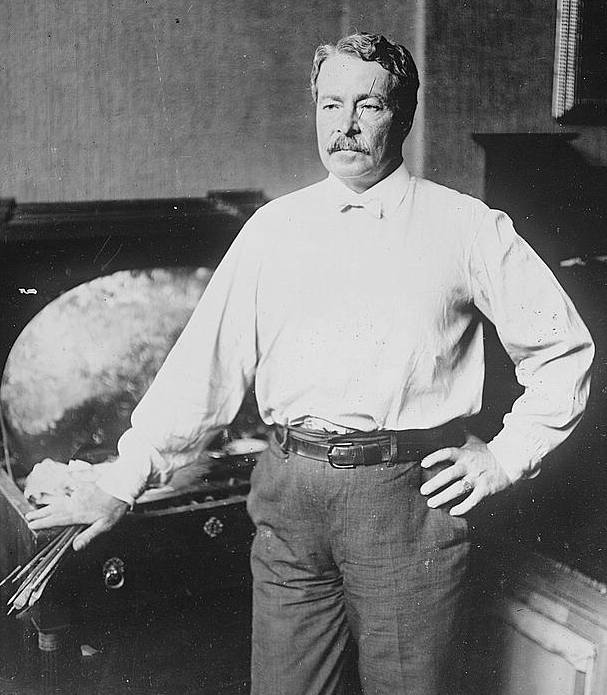
Frederick Childe Hassam – The American Impressionist.

Frederick Childe Hassam

Today I am looking at the life of the nineteenth century American painter, and an important illustrator during the “golden age” of American illustration in the 1880s and 1890s.  He was a leading American Impressionist, although he baulked at that “title”.   Let me introduce you to Frederick Childe Hassam.

Self portrait

Frederick Childe Hassam was born on October 17th 1859 in the family home on Olney Street on Meeting House Hill, Dorchester, the upper middle-class suburb of Boston.  He was the son of Frederick Fitch Hassam and Rosa Delia Hassam (née Hawthorne) who hailed from Maine.  His father, a Boston merchant and hardware store owner, collected Americana well before this hobby became a popular pastime and he passed this interest in history along to his son.  Hassam was educated at Dorchester’s Meeting House Hill School and Dorchester High School, where he studied French, German, Latin and Greek while playing several sports.  Childe had his first lessons in drawing and watercolour whilst a pupil at the Mather public school in Dorchester, although his parents showed little interest in his art.

The Evening Star, by Childe Hassam, pastel on tan paper, (1891)

The family’s fortunes changed dramatically on November 9th 1872 with the sudden outbreak of fire in the basement of a commercial warehouse in the city.  The fire burnt for twelve hours and in that time had destroyed 65 acres of Boston’s downtown, 776 buildings and much of the financial district, including Childe Hassam’s father’s business.  For financial reasons, Childe had to drop out of high school without qualifying, and get a job, so as to help his family in their time of dwindling finances.  His father arranged for his son to work in the accounting department of publisher Little Brown & Company, but his lack of ability to work with figures soon ended that career.  Childe had talked to his parents about his love of painting and sketching and eventually persuaded his father to allow him to take up an artistic career.   Childe Hassam managed to secure a position as an apprentice wood engraver with George Johnson.  In a short time, Childe had proved himself to be an accomplished draughtsman producing designs for commercial engravings such as images for letterheads and newspapers.
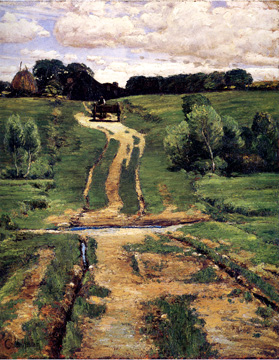
A Back Road, by Childe Hassam, (1884)

It was around 1879 that Hassam began painting in oil but his favourite medium was watercolours.  Childe Hassam’s initial formal art studies began in 1878 when he joined the Boston Art Club.  The institution was founded in 1854 by local artists in order to instigate a democratic organization where there would be a collaboration in the promotion, selling and education of art.  From there he enrolled at the Lowell Institute in Boston which ran classes in freehand practical design.

Old House, Nantucket by Childe Hassam (1882)

In 1882, Childe Hassam took part in his first public group exhibition at the Boston Art Club.  Other artists at the Boston Art Club, at that time were nationally prominent painters such as William Merritt Chase, Robert Henri, Winslow Homer, Maurice Prendergast, and John Singer Sargent.  Following his success at this exhibition Childe Hassam submitted some of his watercolour paintings for his first solo exhibition held at the William & Everett Gallery in Boston.
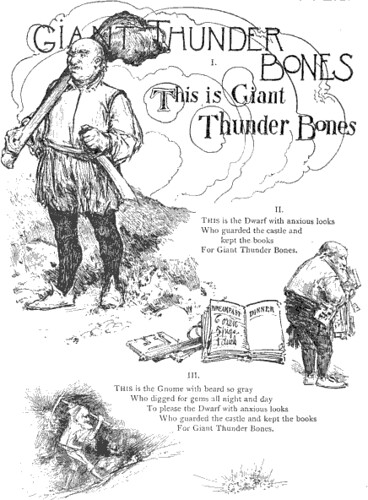
Childe Hassam illustration for St Nicholas Children’s magazine

In 1882, Hassam became a freelance illustrator and founded his first studio. His illustration forte was his illustration of children’s stories for magazines such as Harper’s Weekly, Scribner’s Monthly magazine, and The Century. He continued to develop his technique while he attended the drawing classes at the Lowell Institute, which was a division of MIT, and at the Boston Art Club, where he took life painting classes. 
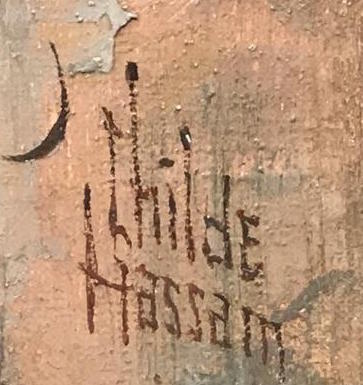
New signature

The following year, his friend Celia Thaxter convinced him to drop his first name, Frederick, and thereafter he was known simply as “Childe Hassam”. He also began to add a crescent symbol in front of his signature.

Gate of the Alhambra by Childe Hassam (1883)

Because of his formal art training was limited he was advised that he should travel to Europe and enhance his artistic knowledge.  The advice came from fellow Boston Art Club member, Edmund Henry Garrett, an American illustrator, bookplate-maker, and author as well as a highly respected painter, who was renowned for his illustrations of the legends of King Arthur.  Garrett persuaded Hassam to accompany him to Europe in the summer of 1883.  The two travelled extensively through Great Britain, The Netherlands, France, Italy, Switzerland, and Spain and during their journey they would study the Old Masters at various museums and create watercolours of the various European landscapes.  While in Paris he was very much influenced by the painterly brushstrokes and pure colours of the Impressionists and it was noticeable that around this time his palette brightened and he discovered a love for depicting city subjects which would stay with him all his life.  In all, Childe Hassam completed sixty-seven watercolours and these were exhibited at his second one-man exhibition in 1884.
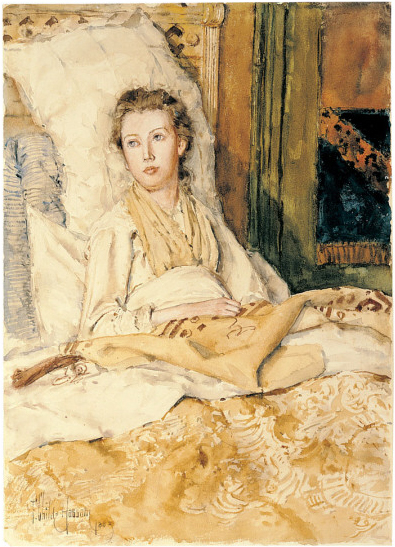
Maude Sewing by Childe Hassam (1883)

After a long courtship, Hassam married Montreal-born Kathleen Maude Doan in February 1884 and during their lifetime together, she organised the Hassam household, arranged all her husband’s travel itineraries and looked after the other domestic tasks. She featured in a number of his paintings including his 1888 work, Geraniums, which he presented at the Salon exhibition that year.

Paris Scene by Childe Hassam (1887)

During the early 1880s, the couple lived in Boston, and Hassam became one of a small number of American artists to paint watercolours of urban street scenes.  Although he believed that his paintings had improved, he decided to return to Paris and seek further artistic tuition.  In 1886 he and Maud arrived at the French capital for the start of their three year stay and Hassam attended classes at the Académie Julian, where he studied under the influential instructors Gustave Boulanger and Jules-Joseph Lefebvre.   To make ends meet Hassam would send his oil and watercolour painting back to Boston to be sold.  The money he received for them was enough for he and Maud to afford to stay in Paris. During his time in Europe, he continued to prefer mundane street and horse scenes, shunning some of the other depictions favoured by the Impressionists, such as opera, cabaret, theatre, and boating. 
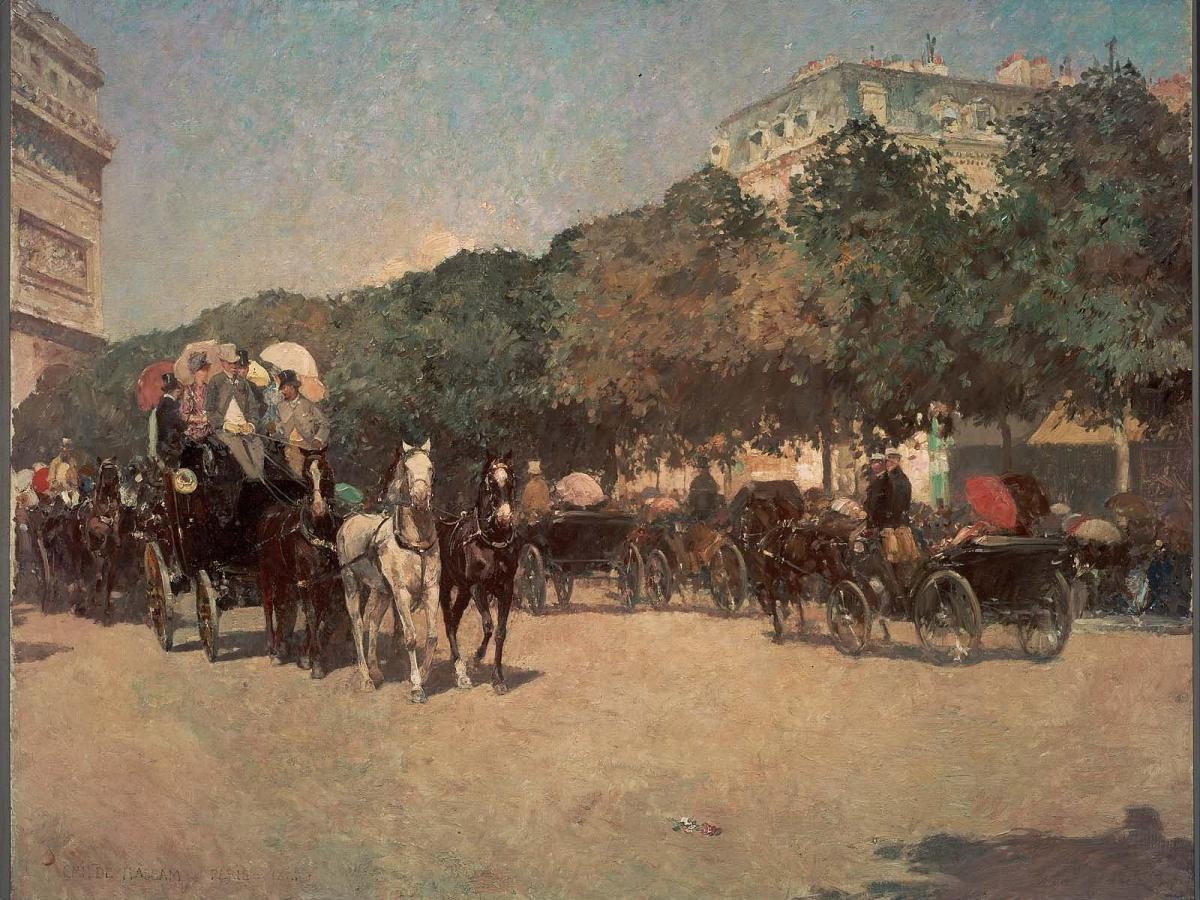
Le Jour de Grand Prix Day by Childe Hassam (1887)

In 1887 he completed his painting Le Jour de Grand Prix Day which now hangs in the Museum of Fine Arts, Boston.  Whereas he normally painted using a darker more tonal palette, in this work he used light colours to encapsulate the impression of a bright sunny day.  The setting was the journey to Longchamp in the Bois de Boulogne and the Grand Prix de Paris horse race which was held annually in June at the Longchamp track.  The affluent racegoers bedecked in their finery can be seen riding atop the horse-driven coaches which travel along the tree-lined avenue Bois de Boulogne, which is now Avenue Foch.  In the top left of the painting we catch a glimpse of Arc de Triomphe.  A slightly larger version of the painting, which is in the New Britain Museum of American Art collection, was exhibited at the Paris Salon of 1888.  Of the painting Childe Hassam said;

“…I am painting sunlight. . . a ‘four in hand’ and the crowds of fiacres filled with the well-dressed women who go to the ‘Grand Prix…”
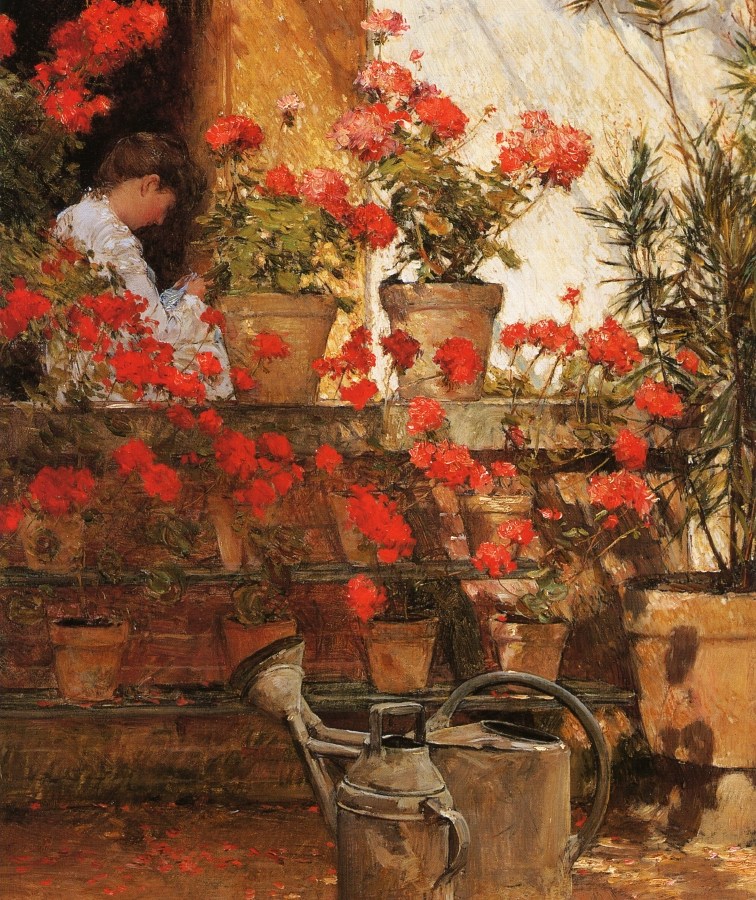
Geraniums by Childe Hassam (1888)

He also liked to paint garden and “flower girl” scenes, some of which included a depiction of his wife, Maude, an example of which is his 1889 painting entitled Geraniums which he presented at the Salon exhibition that year. During his three-year stay in the French capital he managed to exhibit at all three Salon exhibitions.
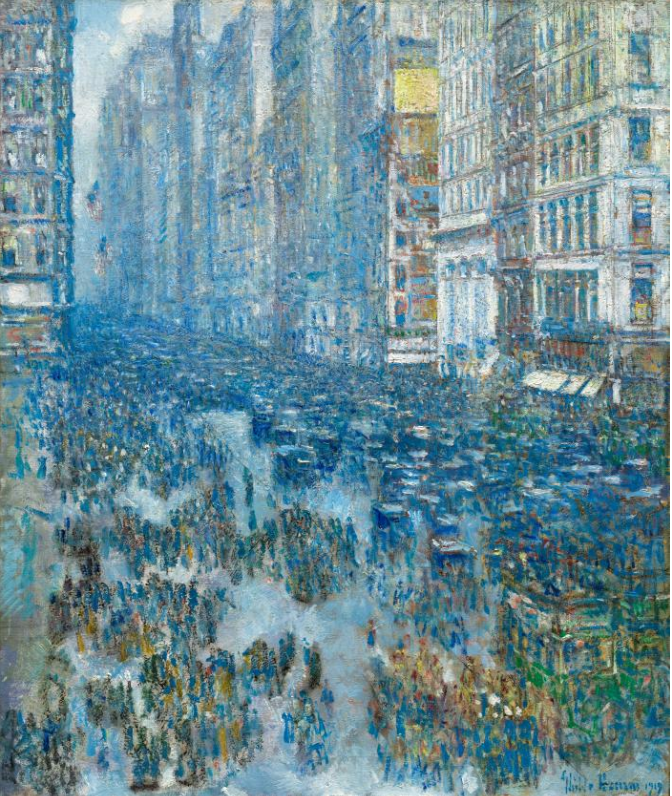
Fifth Avenue Winter by Childe Hassam (1915)

The couple returned to America in 1889 and went to live in a New York City studio apartment a studio apartment at Fifth Avenue and Seventeenth Street.  Hassam began making paintings and etchings of New York city. Hassam saw the city as a place of similar beauty and excitement to Paris especially in the fashionable neighbourhoods along Fifth Avenue and at Washington Square.  It was from this apartment window that Hassam painted the view outside.  His 1915 painting entitled Fifth Avenue Winter depicts the bustling Manhattan thoroughfare which was quickly becoming a popular shopping district around the time he made this work. His composition features flecks of colour and blurred forms to depict reflected light and rapid movement. The accelerated pace of modern city life is evoked by the depiction of the street full of streaming traffic, including two green double-decker buses at lower right.  The fashionable street was the route taken at that time by horse-drawn carriages and trolley buses. It was one of his favourite paintings and he exhibited it several times. The work now hangs in the Cleveland Museum of Art.

Fifth Avenue in Winter by Childe Hassam (c.1892)

Around 1892, Hassam painted a view of the busy thoroughfare in Winter.  The work entitled Fifth Avenue in Winter now hangs at Pittsburgh’s Carnegie Museum of Art

End of the Trolley Line, Oak Park, Illinois by Frederick Childe Hassam (c 1893),

Childe Hassam and his wife lived in New York for the rest of their lives.  He would work on his illustrations in his studio and when, weather permitting, he would go out and paint landscapes en plein air.  Not long after settling in the city, Childe Hassam became involved in the setting up of The New York Watercolour Club in 1890 and became its first president.  The organisation, unlike the American Watercolor Society, accepted both men and women into its ranks and the Club’s first exhibition was held that year.  The organisation’s exhibitions were jury-selected affairs and thus the standard of the works on show was much higher than other artistic societies.  The New York Watercolor Club’s exhibitions were held in the building which was constructed as the result of the founding of the American Fine Arts Society at 215 West 57th Street in 1889. Other art organizations headquartered in the building were the American Federation of Arts, American Watercolor Society, Artists’ Aid Society, Mural Painters, and the Art Students League of New York. Its galleries also held National Academy of Design, Architectural exhibitions.

Washington Arch, Spring by Childe Hassam. (1893)

Hassam’s painting Washington Arch, Spring which he completed in 1893 is an example of why he was termed an Impressionist and also highlights his love of cityscapes and ones which depict the hustle and bustle of life on  the tree-lined avenue settings which were often seen in French Impressionist paintings.  The marble Roman triumphal arch is situated in Washington Square Park, in the Greenwich Village neighbourhood of Lower Manhattan, New York City.  The depiction of the Stanford White designed arch reminded Hassam’s of the Arc de Triomphe in Paris. Hassam lived just north of the Square, and so he was able to watch the various stages of its construction, transitioning from first a temporary wood and plaster structure, to the eventual beautiful marble structure which was completed in 1892. The depiction is unusual in a way as the Arch which is at the end of Fifth Avenue is partially blocked by trees.  In the work, Hassam included several pedestrians along with a street cleaner and a horse-drawn carriage.

Celia Thaxter’s Garden, Isles of Shoals, Maine by Childe Hassam (1890)

At the beginning of the 1890’s Childe Hassam focused a number of his paintings with floral depictions and many were set in the gardens of his friend, the New England poet, Celia Laighton Thaxter who lived with her father at his Appledore Hotel on the Isles of Shoals, a group of small islands and tidal ledges situated approximately 6 miles off the east coast of the United States, straddling the border of the states of Maine and New Hampshire.  He painted images from Appledore Island.  He said that he found the rocks and the sea are the few things that do not change and that they are wonderfully beautiful.

Coast Scene, Isles of Shoals by Childe Hassam (1901)

Among them is the 1901 view Coast Scene, Isles of Shoals, the first painting by Childe Hassam to enter the collection of the Metropolitan Museum.  The oil painting is done in luminous colours, and depicts the remote Isles of Shoals off the rocky shoreline of New England, which was a favourite haunt of Childe Hassam at the end of the 19th century and where he painted a series of similar coastal scenes.  Childe Hassam liked to journey out of the city and he loved to visit places such as Newport, Portsmouth, Old Lyme, Gloucester, and other New England and this urge to free himself from the bustling city made him decide to buy a summer residence.
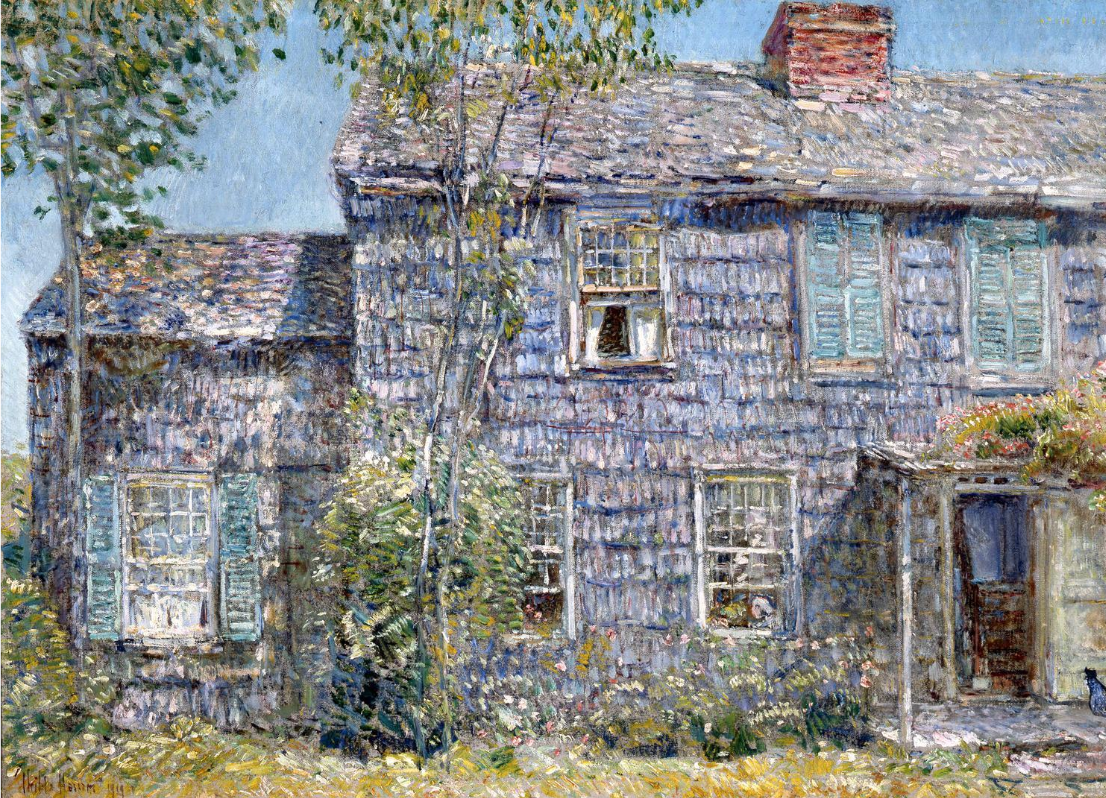
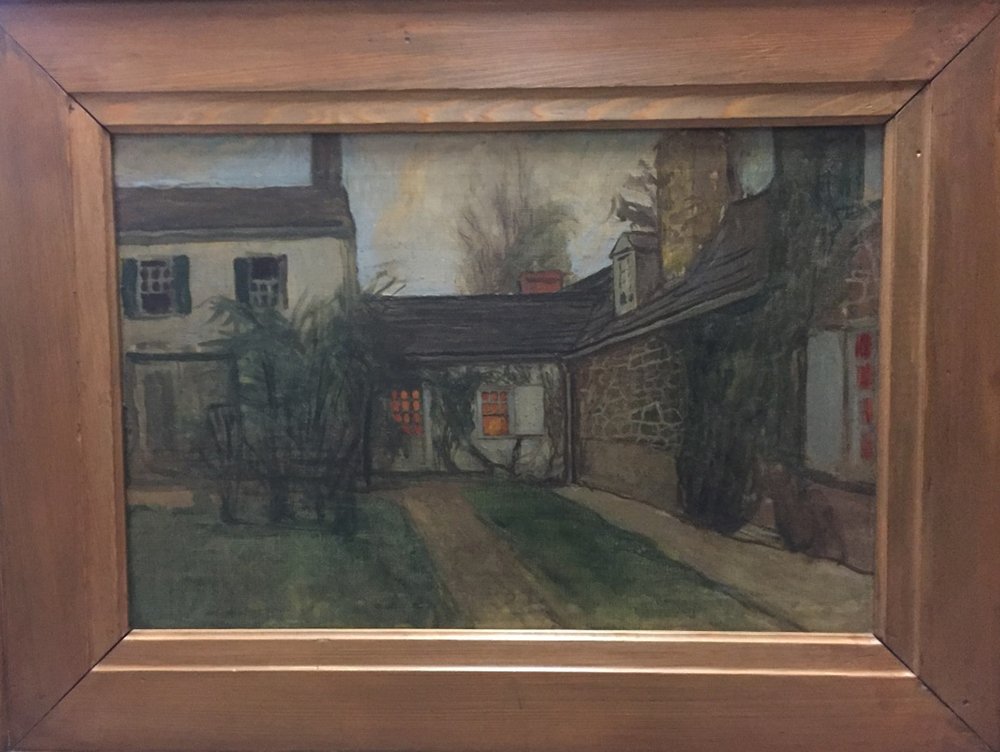
Old House, East Hampton, L.I. by Childe Hassam (1919)

Childe and Maude Hassam first visited East Hampton in 1898 at the invitation of his friend and fellow artist Gaines Ruger Donoho. During the next two decades the couple returned to Long Island during the spring and autumn as the guest of New York businessman Henry Pomroy. In 1919, Hassam and his wife Maude purchased Willow Bend, an eighteenth-century shingled cottage at 48 Egypt Lane. The house was sold to the Hassams by Donoho’s widow who lived next door. Childe Hassam moved into “Willow Bend” in May of 1920 and remained in the house until that October. This became their annual routine which they would maintain for the rest of his life.  While in East Hampton, Hassam sought inspiration from his surroundings and found beauty in the local architecture, the uneven coastline, and the wild landscape of eastern Long Island. During his six month stays in East Hampton, Hassam produced a series of works that focused on his home and its surrounding landscape.  Though Hassam rejected being associated with French Impressionists, there is an obvious influence seen in his painting Old House, East Hampton, a typical East Hampton clapboard home, with its rich colours and quick brushstrokes.
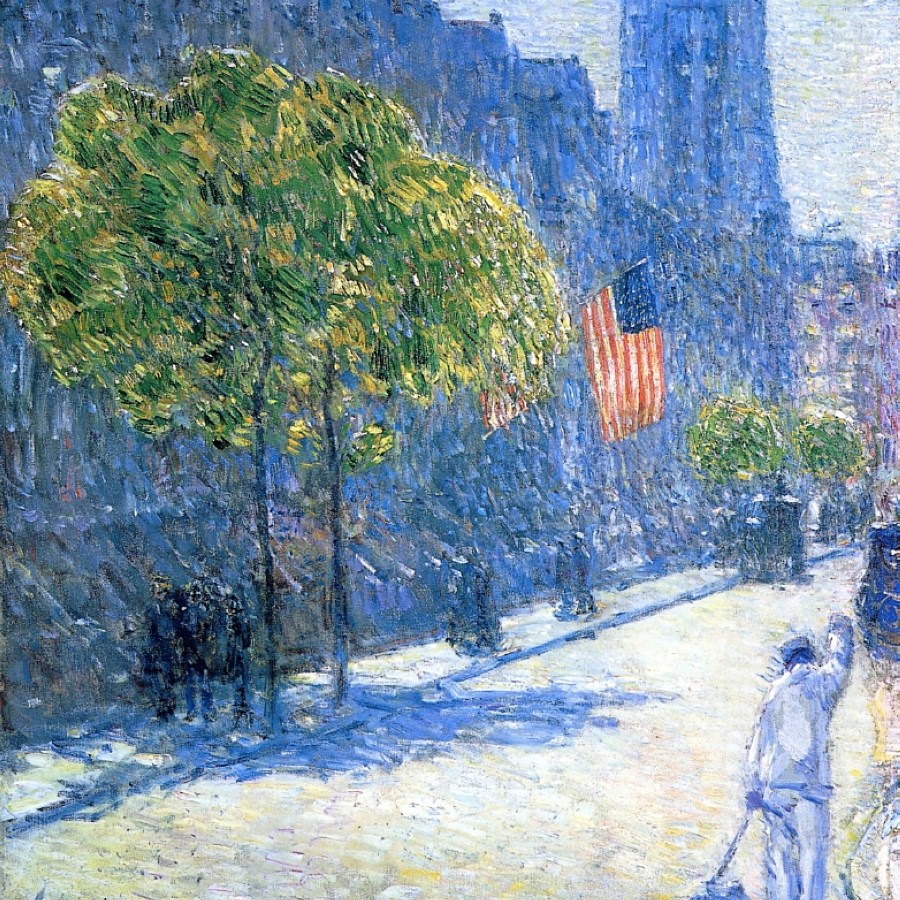
Just Off the Avenue Fifty Third Street, May 1916 by Childe Hassam (1916)

Hassam’s interest in flag subjects dates back to his time spent in Paris from 1886 to 1889. Inspired by the flags and banners displayed on Bastille Day in the area where he lived.   Just Off the Avenue, Fifty-third Street, May 1916 is the first work in the flag series that Hassam painted during the First World War. The sun-dappled street, trees and façades of the grand brownstones are painted in a vibrant palette characteristic of Hassam’s technique at the height of his abilities. In the work. We see a refined residential street in New York, a favoured subject of the artist.  Hassam depicts decorations for the patriotic parade that took place along Fifth Avenue and he has immersed the viewer in an atmosphere of nationalistic pride.

Allies Day, May by Childe Hassam (1917)

During the First World War Childe Hassam created his famous images of flags of the United States and its allies which some scholars have characterized as Hassam’s contribution to the war effort.  One such painting was his 1917 work entitled Allies Day, May.

October Sundown, Newport by Childe Hassam (1901)

In 1920 Hassam received what he deemed to be the greatest honour of his career when he was elected to The American Academy of Arts and Letters.  The Academy is an honour society of the country’s 250 leading architects, artists, composers, and writers. Each year it elects new members as vacancies occur.  When Childe Hassam died, he bequeathed several hundred artworks to the Academy.

Frederick Childe Hassam died in East Hampton, Long Island on August 27th 1935, aged 75.  His wife Maude passed away eleven years later on October 13th 1946.  She was 84.  
The Red Rose Girls. Part 5. The latter years.

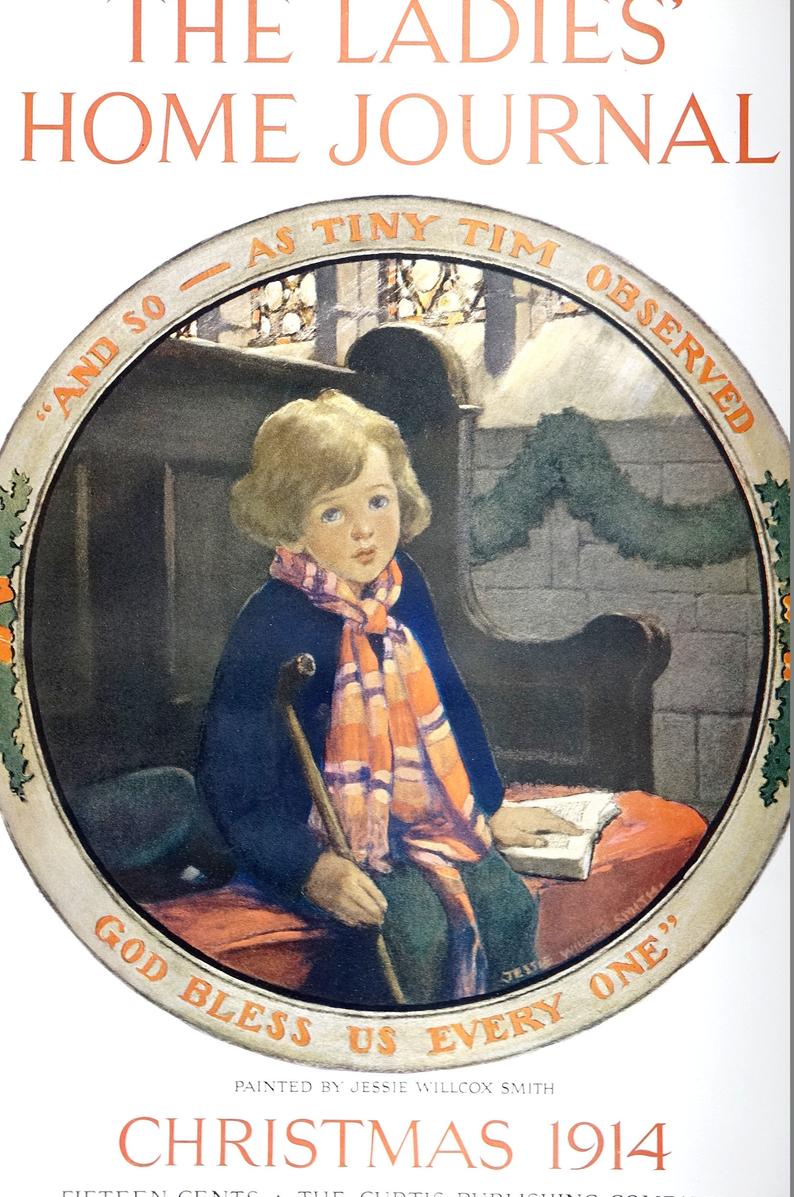
Front cover illustration of The Ladies Home Journal by Jessie Wilcox Smith

Jessie Willcox Smith rented a small studio space at 1334 Chestnut Street, in downtown Philadelphia.  The studio, although cramped and barely room enough for one artist, was in an ideal place for Jessie, as it was close to her job at Ladies Home Journal.

Violet Oakley and her family had returned from their European travels and relocated to Philadelphia to seek medical treatment for her father, Arthur Oakley.  She and her sister Hester rented a studio further down the street at number 1523, in the Love Building.   It was a three-room skylight space on the third floor.   It was a much larger space in comparison that of Jessie’s studio apartment.  The sisters managed to spruce up the space by furnishing it with items lent to them by their mother.  The walls of the studio were covered with prints of paintings by the Old Masters.  Hester Oakley, who was not particularly interested in art was concentrating on her writing and did not need a spacious studio and so vacated the premises, leaving her sister to find new tenants.  Eventually Hester’s place was taken up by Elizabeth Shippen Green, Jessie Willcox Smith, and Jessie Dodd, all fellow students of Violet at the Drexler Institute.

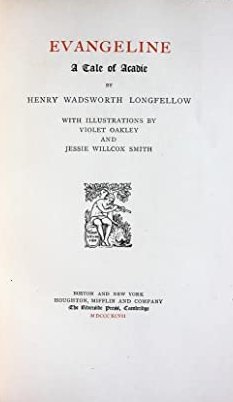
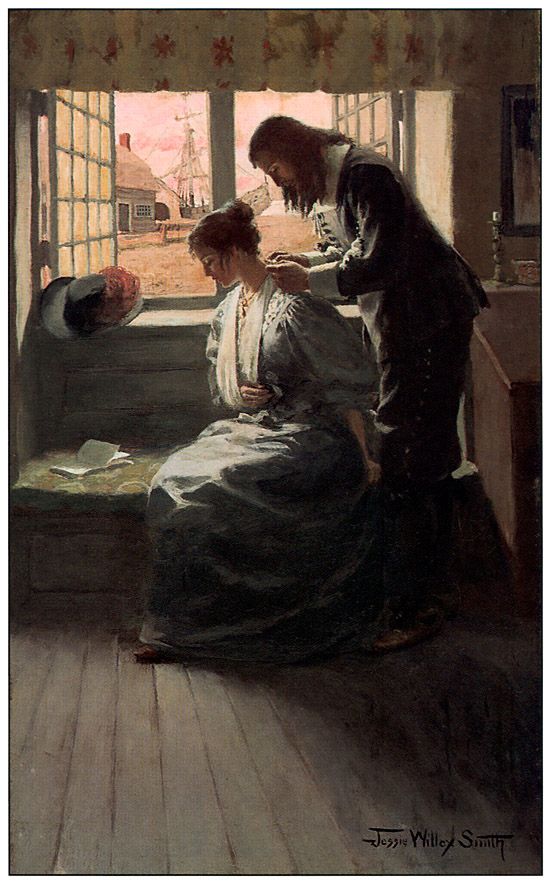
Living together, the ladies soon began working together on commissions.   Jessie Smith and Violet Oakley, with Howard Pyle acting as their mentor, began work on illustrations for a new edition of Evangeline, A Tale of Acadie, an epic poem by the American poet Henry Wadsworth Longfellow, which was first published in 1847.  The epic poem describes the betrothal of a fictional Acadian girl named Evangeline Bellefontaine to her beloved, Gabriel Lajeunesse.  The story tells of how the lovers are separated when the British deported the Acadians from Acadie in the Great Upheaval. The poem then follows Evangeline journey across America as she spends years in a search for him. Finally, Evangeline settles in Philadelphia and, as an old woman, works as a Sister of Mercy among the poor. While tending the dying during an epidemic she finds Gabriel among the sick, and he dies in her arms.  The commission was completed and the book was published in 1897.   Howard Pyle was delighted with the finished illustrations by Jessie and Violet saying:

“…There is a singular delight in beholding the lucid thoughts of a pupil growing into form and colour; the teacher enjoys a singular pleasure in beholding his instruction growing into definite shape.  Nevertheless, I venture to think that the drawings possess both grace and beauty…”

Illustration by Jessie Wilcox Smith for Maud Goodwin’s book The Head of the Hundred.

The illustrations that Smith and Oakley did for the book were a great success and this resulted in a number of new commissions including a commission for Jessie Smith to provide illustrations for a romantic novel, The Head of a Hundred by Maud Wilder Goodwin which was first published in 1897.  Violet Oakley meanwhile provided illustrative covers for The Century magazine and Collier’s Illustrated Weekly

The three women became part of Philadelphia’s vibrant artistic community and became founder members of The Plastic Club.   The art educator Emily Sartain founded the Plastic Club. Its raison d’être was as an arts organization for women to promote collaboration and exhibit members’ works.  It was partly in response to the Philadelphia Sketch Club, which was an exclusively male arts club.

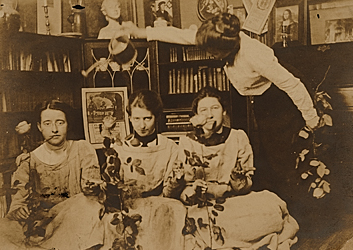
Photograph shows Green, Oakley, and Smith seated, each holding a rose, while Cozens holds a watering can over their heads, pretending to water them. Handwritten identification on verso: The Red Roses; Elizabeth Shippen Green, Violet Oakley, Jessie Willcox Smith, Henrietta Cozens; with Violet Oakley’s poster in the background for first exhibition at the Plastic Club.  Photograph taken at 1523 Chestnut Street, when they planned to move to “The Red Rose”, Villanova.

Jessie Dodd finally left the shared apartment as she was struggling to gain commissions, unlike the other three women.  She became very despondent and in 1899 she gave up artistic career and returned home to Ohio leaving just Violet Oakley, Jessie Wilcox Smith, and Elizabeth Shippen Green living at the Love Building.  The relationship between the three ladies was what was termed a “sympathetic companionship” but in fact was what we would now term a romantic friendship.  There was nothing scandalous about their relationship as in nineteenth century America romantic friendships was deemed a normal part of a woman’s life. The three women were very supportive of each other and shared their triumphs and failures.  There came a time when they had to decide the course their future would take.  Howard Pyle had warned them that combining an artistic career with marriage was not a viable option in an age when a woman was expected to manage a household, function as a hostess and bear children and of course in the minds of Jessie, Violet and Elizabeth, the words of Howard Pyle were sacrosanct.  Jessie Smith was very definite about her views on this subject, saying:

“…A woman’s sphere is as sharply defined as a man’s.  If she elects to be a housewife and mother – that is her sphere and no other.  Circumstances may, but volition should not, lead her from it.  If on the other hand she elects to go into business or the arts, she must sacrifice motherhood in order to fill successfully her chosen sphere…”

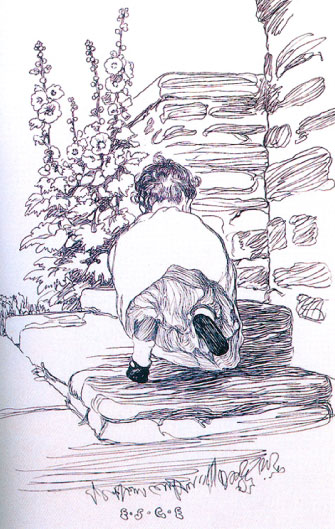
Elizabeth Shippen Green ink on paper illustration, Climbing the Steps.

Jessie Smith and Elizabeth Green were both busy working for The Ladies’ Home Journal and were soon being inundated with commissions resulting in that they could leave their staff jobs and work on a freelance basis.  Elizabeth Shippen Green was submitting a number of pen-and-ink drawings many of which appeared on the covers of the St Nicholas and The Scholar’s Magazine as well as appearing alongside short stories published in Curtis Publishing Company’s Saturday Evening Post.  One of the latter was reproduced in a volume published in London under the title:  The Studio’s 1900-1901 Modern Pen Drawings: European and American.  Her drawings featured in the volume alongside works by the renowned illustrators of the time, Edwin Austin Abbey, Maxwell Parrish, and her teacher Howard Pyle.  The editor, Charles Holme, wrote:

“…Miss Elizabeth Shippen Green though a newcomer, draws with force and has a nice regard for the decorative effect of lines and black masses…”

Madonna and Magi sketch for stained glass panel, by Violet Oakley (1902)

In 1900 Violet Oakley received a commission to paint two murals and create five stained-glass windows and an altarpiece in mosaic for All Angels Church in New York’s Upper West Side. The year 1900 was both a happy and unhappy year for Violet Oakley.  Her sister Heather had married her long-time friend Stanley Ward in 1898 and in 1900 the couple had their first child.  Birth and death are mechanisms of population balance and 1n 1900 Violet’s father Arthur died after a long and debilitating illness.

The three artists remained at their studio on Chestnut Avenue and whilst the winters were tolerable the heat and humidity of New York in the summer months was oppressive so much so that during the summer of 1900 they rented apartments in the Low dormitory on the Bryn Mawr College campus.  Jessie and Elizabeth even won a commission to illustrate the 1901 calendar for the college.

The Red Rose Inn , Villanova, Pennsylvania

In the Autumn of 1900, at the end of their summer stay at Bryn Mawr college, the three friends first visited the Red Rose Inn which was situated in the Philadelphia suburb of Villanova.  The friends had spent many a happy hour leafing through the pages of England Country Life magazines and hankered for a country lifestyle.  Violet Oakley in her handwritten autobiography remembered the time.  She wrote:

“…We became enamoured of the idea of living in the midst of beauty and order of such Gardens as those of England:  of having a country estate; of escaping from work in city studios…”


Red Rose Studio

On one of their last days at the college campus they drove out to Villanova to see the Red Rose Inn.  The inn had been in the local news for many years as the owner, Frederick Phillips, was rumoured to be turning it into an artist’s colony and subdivide the eight hundred plus acres into a number of building lots.  Unfortunately for Phillips he was not the sole owner and his co-owning siblings baulked on his expensive plans to renovate and build on the land as were his near neighbours who christened his plans, Phillip’s Whim.  The die was cast when Frederick Phillips died and his siblings wanted to sell the property.  It was eventually sold to the American banker, Anthony J Drexel for $200,000. 

After a lot of legal wrangling the three artists managed to arrange to rent the Inn and, in the Spring of 1901, they gave in their notice terminating the lease on the 1523 Chestnut Street studio and moved out.  They moved into the Inn in the late Spring of 1901 and with them came another female, their friend, forty-three-year-old Henrietta Cozens.  Henrietta, the daughter of a cotton broker, was not an artist but her role was to be responsible for managing the property, overseeing all the domestic chores, and looking after the upkeep of the gardens.  The monthly outgoings for the three artists had suddenly increased from the mere $125 per month they paid to the landlord for their studio in the Love Building to $500 per month for the rent for the Rose Inn and the wages of the servants and cook.  An although the three artists subsidised Henrietta’s share of the costs it was a financially binding situation and one which needed the three artists to remain together and so once again, they vowed to remain together and never marry.  It was this new home of theirs that led to Howard Pyle calling them The Red Rose Girls.

Bryn Mawr College 1902 calendar – illustration by Elizabeth Shippen Green

In February 1902, the three artists were offered their own three-woman show.  It was an exhibition of a variety of their work. It comprised of their book illustrations and Jessie Wilcox Smith’s designs for the Bryn Mawr calendars.   Elizabeth Green showed her illustrations for Harper’s Magazine and the Saturday Evening Post as well as her calendar illustrations.  Violet Oakley’s offerings for the exhibition comprised of two covers she completed for Collier’s Weekly, some charcoal drawings and her designs for the All Angels’ stained-glass windows and chancel decorations.  The exhibition was a great success and was an important step in the careers of the three artists.

The 1914 advert illustrated by  Jessie Willcox Smith for Procter Gamble Ivory Soap.  

At the exhibition Jessie Wilcox Smith submitted thirty of her illustrations some of which were advertisements for Procter & Gamble.

All good things have to come to an end and their time at The Red Rose Inn ended on January 25th 1906 when the three women were served with an eviction notice:

“…Anthony J. Drexel having leased to you the premises in Lower Merion Township, Montgomery County, Pennsylvania, known as the Red Rose Inn, by lease the terms of which expire on May 1st 1906, subject to three months’ notice, and the said Anthony J Drexel and Margarita, his wife, having granted, assigned and conveyed to me the said premises, with the lease, you and each of you are hereby notified and required to quit and deliver up to me possessions of the said premises, which you now hold as tenant under me, at the expiration of the said lease, namely the first day of May A.D. 1906 as I desire to have such possession…

Signed Henry S Kerbaugh…”

Cogslea, photographed by Elizabeth Shippen Green in 1907

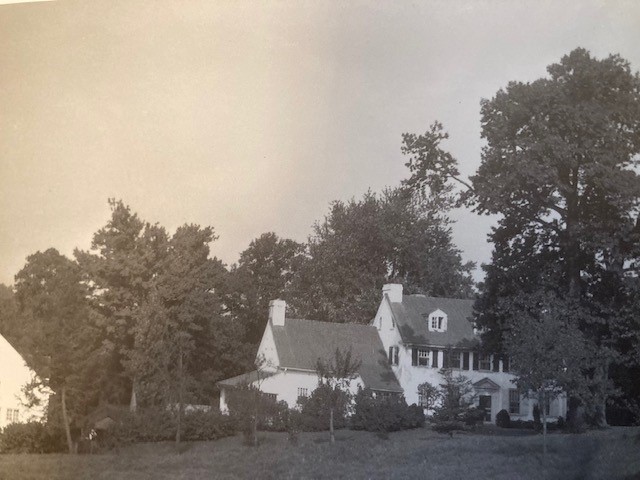
Thanks to the benevolence of Dr. George Woodward, a wealthy relative of Elizabeth Shippen Green, the three artists managed to rent a renovated stone-walled house, adjacent barn, and carriage house at Hill Farm, located on Woodward’s estate at Cresheim Creek in Mt. Airy, some ten miles north of Philadelphia.  The three women named their new home Cogslea (C for Henrietta Cozens, O for Violet Oakley, G for Elizabeth Green and S for Jessie Smith) and “lea” for the sloping land of the new estate.

Photograph of Huger Elliot posing for Elizabeth Shippen Green at Cogslea

In 1909, Elizabeth Green’s mother died and the following March, her father Jasper Green passed away.  More change was to come in 1910.  Elizabeth Shippen Green had built up a friendship for a couple of years with Huger Elliott, a graduate of Columbia University’s school of architecture and the Ecole des Beaux Arts in Paris.  He was looking for more than just a friendship with Elizabeth, albeit the couple had become engaged, but Elizabeth was hesitant about their future considering she had, along with her two friends, “signed a pledge” to keep men out of their lives and just live for their art.  In October 1910, Huger Elliot visited Elizabeth at Cogslea and gave her an ultimatum – marry me now or break off the engagement!  One can only imagine the state of Elizabeth’s mind at this turn of events.   She had to try and think rationally.  She was now thirty-nine years of age and been with her friends for thirteen years and a decision to marry Elliot would violate their “agreement”.  On the other hand, she knew her friends were financially secure and had been given numerous commissions.  She also realised that the dynamics of the household were changing.  Jessie Smith and Henrietta Cozens, who were close in age, were becoming inseparable and both had a quiet temperament and an unbending sense of decorum which was polar opposite to Elizabeth’s exuberance.  Her other friend and housemate, Violet Oakley, was engrossed in her religion and impassioned about her dream of a utopian society and her aspiration to elevate the morals of the country though her art.  Maybe the deciding factor was that Elizabeth more than just liked Huger.  She made the decision to marry Huger Elliot and leave Cogslea and her friends.  Violet, Jessie, and Henrietta were stunned by her decision., Henrietta Cozens declared:

“…How can she love anyone more than she loves us?…”

Elizabeth Shippen Green and Huger Elliot on their honeymoon in Germany  in 1911

The die was cast and On June 3rd 1911 Elizabeth Shippen Green married Huger Elliott at Cogslea.   The couple left Cogslea that evening and went to stay in Philadelphia prior to their honeymoon in Germany.  Unfortunately for Elizabeth being in Philadelphia she saw the front page of the June 4th edition of the Philadelphia Press which announced:

“…Trio of Artist Friends Broken by Cupid…”

which went on to state:

“…a note of sadness was felt when the realization came that the trio of artists who had lived and worked together so long would be depleted by the absence of Mrs Elliott…”

 The Chestnut Hill Herald was even more sensational in its coverage stating that a heartbroken Violet Oakley broke down completely whilst trying to change Elizabeth’s mind.     After their honeymoon, Elizabeth and her husband Huger settled in Cambridge Massachusetts.  From 1912 to 1920 Huger was supervisor of educational work and director of the department of design at the Boston Museum of Fine Arts. For the next five years, he served as president of the Pennsylvania Museum and School of Industrial Art in Philadelphia. He was the Director of educational work in the Metropolitan Museum of Art in New Nork from 1925 to 1941, when he retired.  It was not until two years later, in July 1913, that Elizabeth was reunited with Violet, Jessie and Henrietta when she and her husband returned to Cogslea for a visit. 

Violet Oakley was desperate to have a much larger studio to accomodate her massive murals and so she decided to buy Cogslea for herself and to achieve that she had to sell all her assets.  Jessie Wilcox and Henrietta Cozens moved out of Cogslea, bought a quarter of the estate land, and built a house on it for themselves.  The Red Rose Girls had finally been separated.

Jessie Wilcox Smith died on May 3rd 1935, aged 71.

Elizabeth Shippen Green Elliott died on May 29th 1954, aged 82.  Her husband Huger had died of a heart attack on November 13th 1948, aged 71.

Violet Oakley was the last of the Red Rose Girls to die.  She passed away on February 25th 1961, aged 86.


The Red Rose Girls. Part 4. Howard Pyle.

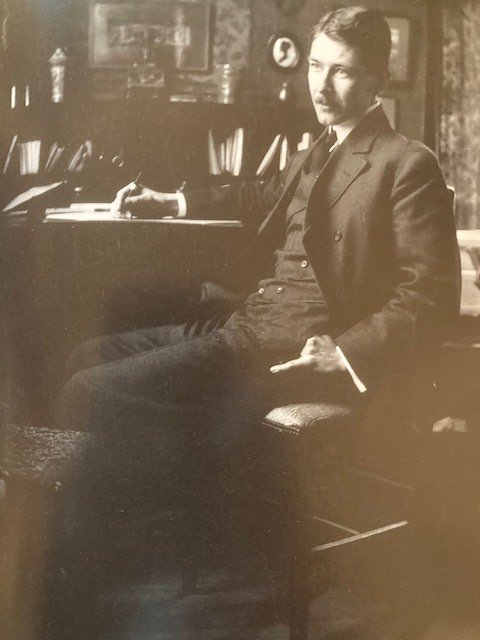
Howard Pyle

The story of The Rose Girls could not be told without talking about the American illustrator and author, primarily of books for young people, Howard Pyle, who gave the The Rose Girls soubriquet to the three young ladies he was mentoring.  He was a man of great talent and a patriotic missionary of Americanism and his illustrations were held in high esteem on both sides of the Atlantic..

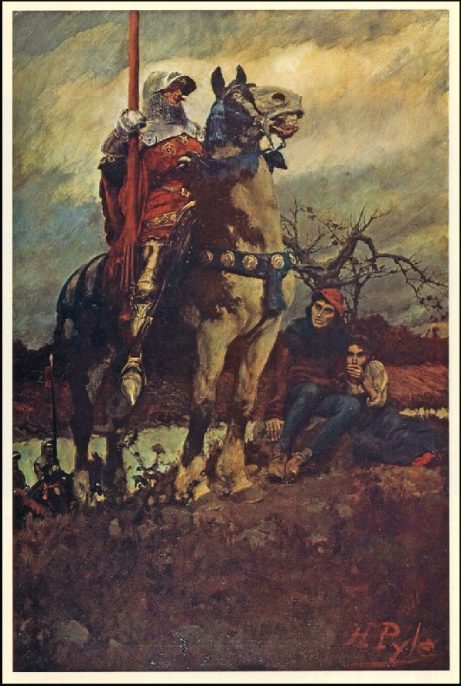
The Coming of Lancaster by Howard Pyle (1908).  Illustration from The Scabbard by James Branch Cabell, and illustrated by Howard Pyle which appeared in Harper’s Monthly Magazine, May 1908 and is a fictional retelling of the story of King Richard II of England, who was deposed by his cousin Henry who belonged to the Lancaster branch of British royalty

Howard Pyle was born in Wilmington, Delaware on March 5th 1853.   He was the son and eldest child of Quakers, William Pyle and Margaret Churchman Painter, an amateur artist.  Pyle remembered his childhood, with fondness, as being an idyllic time that was centred around the family’s wonderful old stone house and its garden, which he remembered as being filled with profuse blooms and hidden wonders. Mainly thanks to his mother, Pyle developed a love of reading and like many children of his age he loved the tales of Daniel Defoe’s,such as Robinson Crusoe, the Grimm’s Fairy Tales, and mystical stories from the Arabian Nights. all of which fired up his young imagination. He attended the Friend’s School in Wilmington followed by schooling at a small private institution. He was not a top student, and it was said that he wasted too much time daydreaming. His one love was art and he spent much of his free time drawing.  He also developed a love of writing his own stories.   Although it was the wish of Pyle’s parents that their son should attend college, Howard Pyle had other ideas about his future, which he saw as being a professional artist or writer.  Knowing that their son was never going to go to university his parents, especially his mother, decided to encourage him to study art.

The Mermaid by Howard Pyle (1910)

He studied for three years at the studio of Francis Van der Wielen in Philadelphia.  Van der Wielen was a Dutch artist who in 1872 had taught sixteen-year-old Cecilia Beaux.  Besides a few art lessons later at the Art Students League of New York, these three years tutoring by van der Wielen were Howard Pyle’s only formal training. Because of problems with his father’s leather business, Howard Pyle had to spend many years helping out in the family business. The artistic breakthrough for Howard Pyle came in 1876 when his mother sent an essay and sketches he had done while on holiday with his father on Chincoteague Island to Scribner’s Magazine.  The editor accepted the article and illustrations and told Pyle they were so good that they were being published in the November issue of the magazine.  Furthermore, the editor invited Howard Pyle to come to New York and work for the magazine as a writer and illustrator.

A Wolf Had Not Been Seen at Salem for Thirty Years by Howard Pyle.  Illustration for “The Salem Wolf”  a short story written and illustrated by Howard Pyle for Harper’s Monthly magazine, December 1909.  

Howard Pyle was now living in New York city in a small rented room at 250 West 38th Street (between Seventh and Eighth Avenues) and it was not long before he sold his first painting to Harpers Weekly, a magazine that would continue to buy his work for many years in the future. The publisher of Harper’s Weekly had assembled an exceptional group of professionals who were knowledgeable about illustration and trained in the newest methods of printing, and the House of Harper became an informal training ground for the likes of Howard Pyle to learn every aspect of the publishing process.  It was soon after settling in New York that Howard Pyle knew that he wanted to write and illustrate books for children. Pyle had both a wonderful imagination and he also was able to recollect stories from his childhood.  He set about putting those memories on paper and at the same time illustrated his prose.  He submitted many of his stories and illustrations to the St Nicholas magazine, a popular monthly American children’s magazine, founded by Scribner’s in 1873.    

An Attack on a Galleon, a 1905 illustration for the story, The Fate of a Treasure Town by Howard Pyle which appeared in the December edition of Harper’s Monthly magazine.

He drew upon his vivid childhood memories to contribute stories to the St. Nicholas magazine, and he read and studied many of the old folktales that he’d loved as a child, extending his reading to include less familiar tales from many nations. These folktales and the romances of his boyhood would become the central core of his work over his lifetime; and although he is primarily remembered today for his contributions to illustration, he was a writer of some skill. Indeed, he has been compared to Hans Christian Andersen in the way his unique voice and imagination shaped his traditional folklore and fantasy material.

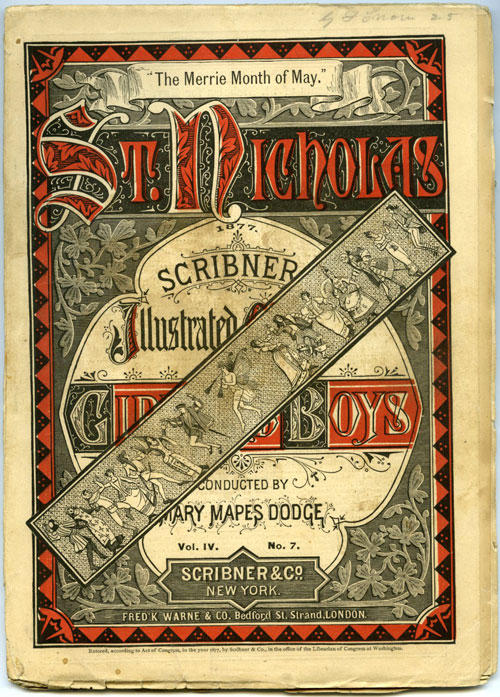
St Nicholas magazine cover. May 1875

According to Ian Schoenherr’s blog on Howard Pyle, one of the first magazine covers to feature an illustration by Howard Pyle is the May 1877 cover of St. Nicholas, Scribner’s Illustrated Magazine for Girls & Boys.  Pyle actually only designed the long rectangular illustration which runs diagonally across the cover.  In the magazine the publisher explained the illustration:

“…The beautiful tablet by Mr. Pyle, which adorns our cover this month, tells a true story in its own lively fashion. Its quaint costumes of successive centuries, showing how May-day rejoicings have been kept up from age to age, will send some of you a-Maying in encyclopedias and year-books, but it gives its real meaning at a glance – which is, that through all time people have welcomed the first coming of the spring. “Merrie May,” meaning pleasant May (for in old times “merry” simply meant pleasant), was as fresh and beautiful ages ago as it is to-day; and in one way or another the thought at the bottom of all the rejoicing is ever that of the old carol:


“A garland gay I’ve brought you here,

And at your door I stand;

It’s but a sprout, but it’s well budded out.

The work of our Lord’s hand.”

Howard Pyle remained in New York until 1879 at which time he returned home to Wilmington, by which time he had established a reputation as a leading writer and illustrator of children’s books. 

The Merry Adventures of Robin Hood of Great Renown in Nottinghamshire, published in 1883, is thought to have been Pyle’s first children’s book.  He wrote, illustrated and designed the book himself.  In all, he went on to do many more books for this audience including Pepper and Salt, The Wonder Clock and four volumes of the Legends of King Arthur

He completed Legend and Stories of King Arthur in 1903.  The book contains a compilation of various stories, adapted by Pyle, regarding the legendary King Arthur of Britain and select Knights of the Round Table. Pyle’s novel begins with King Arthur in his youth and continues through numerous tales of bravery, romance, battle, and knighthood.
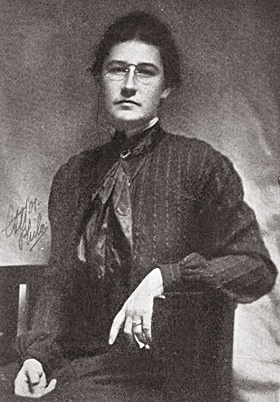
The 1902 illustration by Howard Pyle “There is a time to fight, and that time has now come” for The Story of a Great-Grandfather by George Hibbard which appeared in Scribner’s Magazine January 1903

Howard Pyle believed that book illustration was the fundamental basis from which to produce painters.  His ideas with regards illustration were revolutionary and at odds with many of the beliefs of the day. Pyle was adamant that artists needed, to get beyond the stiff figures of the studio life class and let their figures and scenes come from the imagination rather than from a frozen pose.

For Pyle, the overall design of the book was of paramount importance and he helped his students learn how to incorporate their illustrations into the finished article. Pyle made it clear to his students that the role of the illustrator was to compliment and enhance the text in personal ways rather than merely mimic what the text expressed. Through his many books and his teaching, the influence of Howard Pyle on children’s literature is acknowledged by readers and artists to this day.

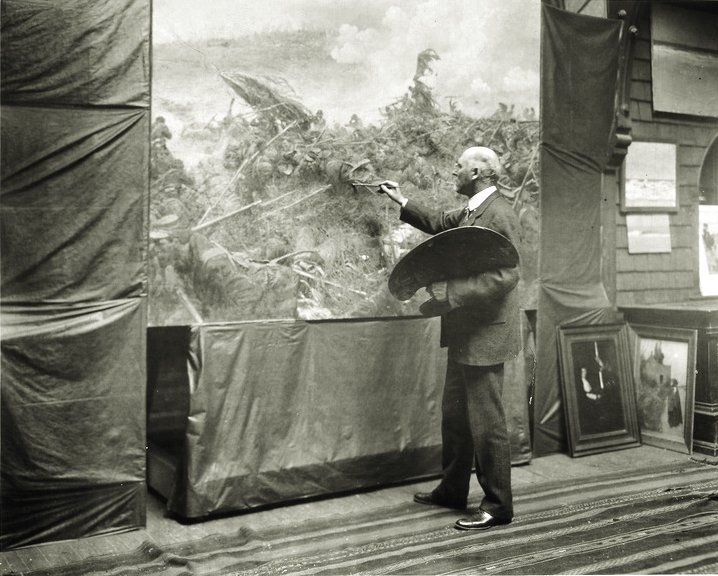
Howard Pyle working on mural depicting Battle of Nashville in his Franklin Street studio (c.1905).

Pyle decided to do something about giving art students a firmer foundation in illustrative art by offering his services to the Pennsylvania Academy of Fine Art as their Instructor of Illustration.  His offer was politely refused and he was told that the Academy school was for painters and sculptors and was a school for the fine arts only.  Pyle, having been rebuffed by the Academy, was not to be deterred and made  the  same  offer  to  the  Drexel  Institute.  His offer was promptly  accepted  and within  a short  time there  began  to appear  in the magazines new names of illustrators who had been students of Pyle.  Sensing that the Drexel Institute was the better option when it came to illustrative art, many of the Pennsylvania Academy students left and enrolled at the Drexel Institute.  The director of the Pennsylvania Academy, Harrison Morris, realised he had been wrong to rebuff Pyle’s offer, and asked him to come and teach at the Academy and name his own salary.  Pyle’s short reply was to the point:

“…He who will not when he may, when he will, he shall have nay…”

Howard Pyle commenced teaching at the Drexler Institute in October 1894. The catalogue of the Department of Fine and Applied Arts (1894-1895) announced:

“…A Course in Practical Illustration in Black and White, under the direction of Mr. Pyle.  The course will begin with a series of lectures illustrated before the class by Mr. Pyle. The lectures will be followed by systematic lessons in Composition and Practical Illustration, including Technique, Drawing from the Costumed Model, the Elaboration of Groups, treatment of Historical and other subjects with reference to their use in Illustrations.  The students’ work will be carefully examined and criticized by Mr. Pyle…”

Within Howard Pyle’s first class that October, there were thirty-nine students, including three young people destined to become outstanding leaders in the field of illustration:  Maxfield Parrish, Jessie Willcox Smith, and Elizabeth Shippen Green.  Three years later, in 1897, Violet Oakley joined the class.

………..to be continued.


Most of the information I used for this blog came from an excellent book by Alice A. Carter entitled The Red Rose Girls, An Uncommon Story of Art and Love.


On a more personal note, it is ten years to the day that I started My Daily Art Display blog and this is 830th “edition”.  It started as a one-a-day blog but they were shorter blogs and I was finding I was putting too much pressure on myself to meet deadlines so I now do just one a week but have increased the number of words.  I do enjoy writing them and hopefully will carry on a little while longer.

The Red Rose Girls. Part 3. Jessie Willcox Smith.

The third of the Red Rose Girls was Jessie Willcox Smith.  She became one of the most prominent female illustrators in the United States, during the celebrated ‘Golden Age of Illustration‘.  Jessie was the eldest of the trio, born in the Mount Airy neighbourhood of Philadelphia, on September 6th 1863, the youngest of four children.  She was the youngest daughter of Charles Henry Smith, an investment broker, and Katherine DeWitt Willcox Smith.  Her father’s profession as an “investment broker” is often questioned as although there was an investment brokerage called Charles H. Smith in Philadelphia there is no record of it being run by anybody from Jessie Smith’s family.  In the 1880 city census, Jessie’s father’s occupation was detailed as a machinery salesman.  Jessie’s family was a middle-class family who always managed to make ends meet.  Her family originally came from New York and only moved to Philadelphia just prior to Jessie’s birth.  Despite not being part of the elite Philadelphia society, her family could trace their routes back to an old New England lineage.  Jessie, like her siblings, were instructed in the conventional social graces which were considered a necessity for progression in Victorian society.   It should be noted that there were no artists within the family and so as a youngster, painting and drawing were not of great importance to her.  Instead her enjoyment was gained from music and reading.  Jessie attended the Quaker Friends Central School in Philadelphia and when she was sixteen, she was sent to Cincinnati, Ohio to live with her cousins and finish her education.
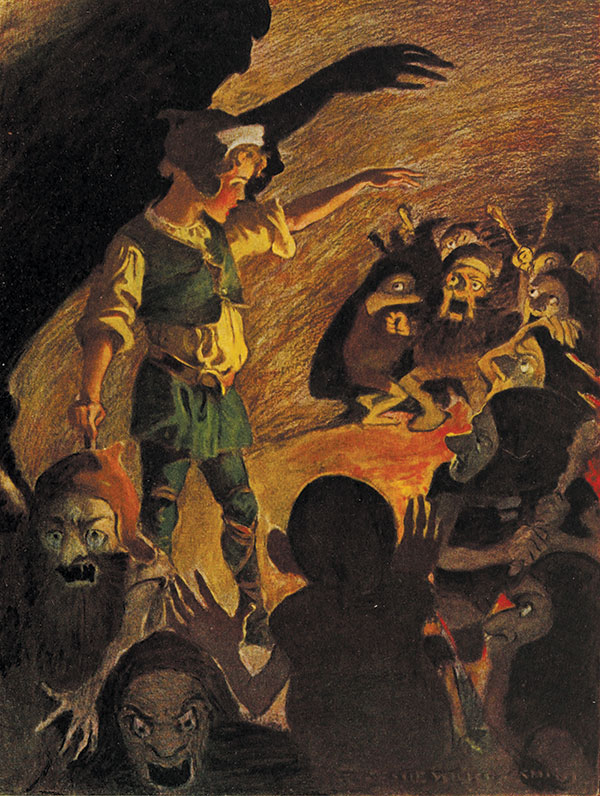
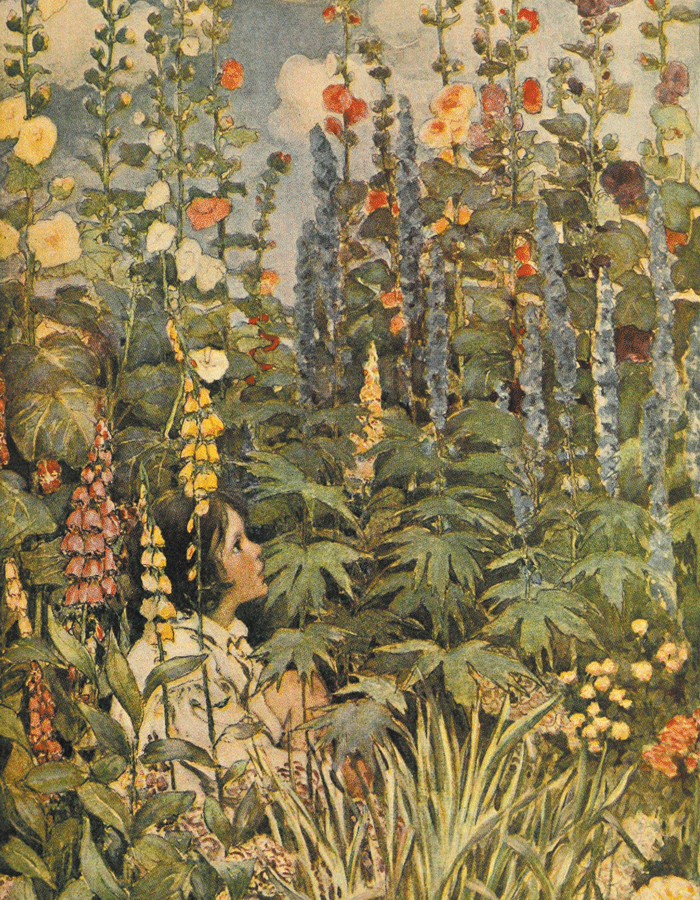
The Princess and the Goblin, by George McDonald, illustrated by Jessie Willcox Smith, (1920)

On completion of her education, instead of returning to the family in Philadelphia, she remained in Cincinnati to look for a job.  Jessie had always been fond of children and managed to secure a position as a kindergarten teacher which would fulfil her need for money whilst doing a job she loved.  However, the belief that all young children are angelic was soon dispelled and she found her charges obstreperous and ill-mannered and soon realised that teaching at a kindergarten was not for her.  One of her friends was interested in art and soon she had managed to inveigle Jessie into the pastime and soon she showed a certain amount of promise as a budding artist.  She remembered this change of direction writing:

“…I knew I wanted to do something with children but never thought of painting them, until an artist friend saw a sketch I had made and insisted I should stop teaching (at which I was an utter failure) and go to art school – which I did…”

John Rogers figurine

Jessie Smith returned to Philadelphia to look for some artistic training and initially wanted to study sculpture.  At the time there was a popular small table-top sculptures called Rogers Group which were relatively inexpensive, mass-produced figurines in the latter 19th which graced the parlours of homes in the United States.  These figurines, often selling for as little as $15 a piece were affordable to the middle class.  They were sculpted in more affordable plaster and painted the colour of putty to hide dust.  She did try her hand at sculpture but soon realised it needed a certain talent, one which she was lacking.  She wrote:

“…my career as a sculptor was brief for my clay had bubbles in it and burst when it was being fired. ‘Heavens’ I decided, ‘ being a sculptor is too expensive!  I will be a painter…’ ”

An illustration by Jessie Wilcox Smith from A Child’s Garden of Verses is a book written by Robert Louis Stevenson

However, Jessie realised that to become a painter she needed formal artistic training and it was difficult for that to happen for a woman in 1884.  It was the age-old story.  Men who wanted to train to become professional artists had academies and teachers to support them but for women, up until the 1850’s, there were few institutions which catered for women and anyway, it was generally thought to be totally ill-advised for a woman to contemplate or prepare for a professional career, art or otherwise.  Life was mapped out for women.  Acquire certain accomplishments which would attract a man, marry that man and give him children, and then be educated at home in the skills needed to look after one’s husband and children.  For women of the middle and upper-class who were interested in art, then a private tutor could be hired but studying in mixed life-drawing classes was deemed unsuitable for women as was sketching nude statuary.

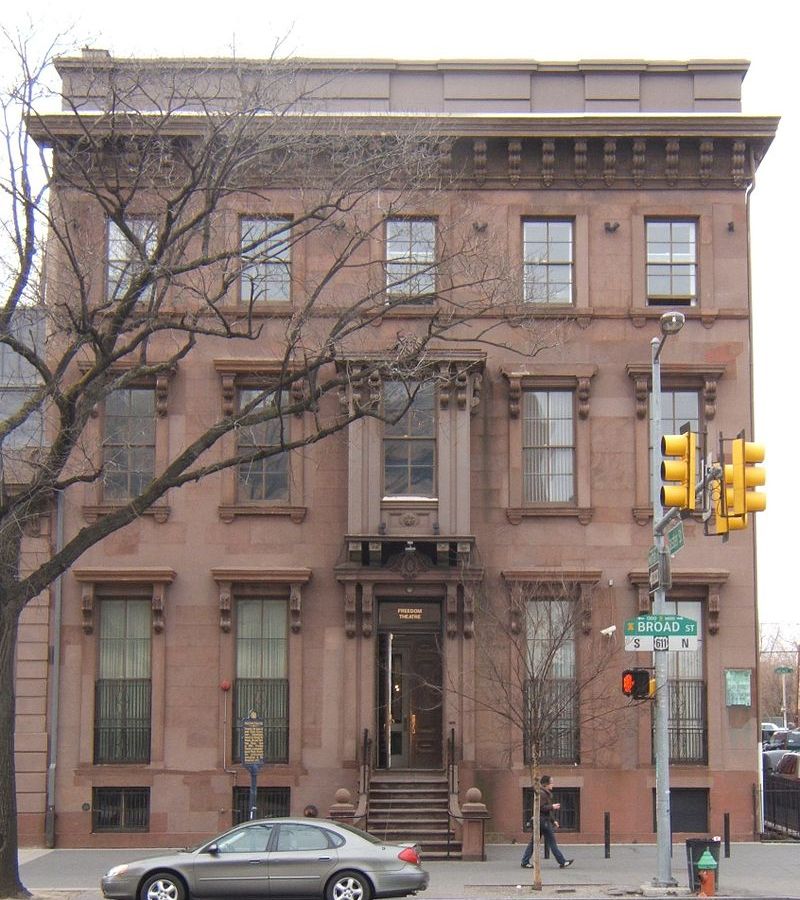
Edwin Forrest House, formerly the home of the Philadelphia School of Design for Women.

Despite this, twenty-one-year-old Jessie Willcox Smith, on October 2nd 1884, enrolled at The Philadelphia School of Design for Women, which was housed in a fashionable Philadelphia neighbourhood in an imposing mansion that had once been the home of actor, Edwin Forrest.  The School had begun when Sarah Worthington King Peter, the wife of the British consul in Philadelphia, established an industrial arts school in her home in 1848 so as to teach a trade to women, who were without a means of supporting themselves.  It was not in direct competition with the Pennsylvania Academy as its emphasis was on decorative pattern and ornament and until 1886 steered clear of controversial life-drawing classes.  After a year at the School of Design, Jessie hankered for more than it could offer her.  She wanted to study the techniques associated with Fine Art and so decided that she had to enrol at the Pennsylvania Academy of the Fine Arts. 

Thomas Eakins, circa 1882

She managed to persuade her parents to fund her tuition and in 1885 she enrolled in the class of the brilliant but controversial painter, Thomas Eakins.  Master and student were so different.  Jessie Willcox Smith was a conservative and shy young woman whilst her tutor was brash, carefree and provocative and cared little for the Academy’s attempt to reign him in.  Eakins represented an outrageous departure from the social norms which had structured Jessie Smith’s life.   Many complaints had been levelled at Eakins and his teaching methods especially those regarding female students.  The following year, 1886, forty-one-year-old Eakins was sacked by the Academy.   It is interesting to note that although there is no doubt her artistic ability flourished under the tutelage of Eakins she viewed him with disdain, once confiding in a friend that she thought he was a “madman”.  Jessie did attend Eakins’ life-drawing classes but of the life models used, once declared:

“…I always wished there were children in the life classes, the men and women were so flabby and fat…”

After Eakins was dismissed from the Academy, he held private classes at his studio and many of his former students attended them, but not Jessie.  She presumably did not agree with Eakins’ way of teaching and decided to remain at the Academy and study under Thomas Anshutz and James B. Kelly, two of Eakins’ former students.

Jessie Willcox Smith graduated from the Academy in June 1888.  She looked back on her time at the Academy with a certain amount of disappointment.  Although her technique had improved, she had hoped to be part of an artistic community in which artistic collaboration would be present but instead she found dissention, scandal and in the wake of the Eakins’ scandal, institutionalized isolation.  Jessie talked very little about her time at the Academy.  It had been a turbulent time and she had hated conflict as it unnerved her and made her extremely distressed.  This desperation to avoid any kind of conflict in her personal and professional life revealed itself in her idealistic and often blissful paintings.  Jessie wanted to believe life was just a period of happiness.

Illustration by Jessie Wilcox Smith for the book of verse, The Seven Ages of Childhood

In 1909 a book of verse entitled The Seven Ages of Childhood by Carolyn Wells with accompanying  illustrations by Jessie Wilcox was published.

After graduation, Jessie became interested in illustration and in 1889 took a job with the advertising department of Ladies’ Home Journal, one of the leading American women’s magazines.   In 1894, nearly six years after graduating, she learned that Howard Pyle, the noted illustrator, was starting a School of Illustration at the Drexel Institute and she was accepted into the inaugural class along with Violet Oakley and Elizabeth Shippen Green.

Jessie Wilcox Smith, cover for Good Housekeeping Magazine. May 1921.

Her illustrations appeared on the covers of Good Housekeeping  resulting in most people becoming familiar with her art. For over 15 years she painted the covers for one of America’s most popular magazines. Month after month, from December of 1917 through March of 1933, a new Jessie Willcox Smith image was on the newsstands and in countless homes.

The Red Rose Girls were finally together.  In my next blog I will look at their time at the Drexel Institute with Howard Pyle and their life together.

……………………to be continued


Most of the information I used for this blog came from an excellent book by Alice A. Carter entitled The Red Rose Girls, An Uncommon Story of Art and Love.

The Red Rose Girls. Part 1. Elizabeth Shippen Green.

In my next series of blogs, I want to look at the lives of three talented women artists – Jessie Willcox Smith, Elizabeth Shippen Green and Violet Oakley.  These three artists enchanted and fascinated early twentieth century Philadelphia with their brilliant careers and somewhat uncommon lifestyle.  At one time the three women lived together in The Red Rose Inn, a picturesque estate in the affluent Philadelphia suburb of Villanova, a respected area known as the Main Line, an historical and social region of suburban Philadelphia, which was situated along the former Pennsylvania Railroad’s once prestigious Main Line.  The three women were joined by their friend, Henrietta Cozens, who took on the responsibility of managing their communal household.  Their mentor and tutor at the time was the famous American illustrator, Howard Pyle, who, because of their residence, nicknamed them The Red Rose Girls.  The four women forged an intense and emotional bond and vowed to live together for the rest of their lives.  They even adopted and acronymic surname, wanting to be known as the Cogs family – C for Cozens, O for Oakley, G for Green and S for Smith.  In the following blogs, I want to delve into the life of these three women and look at their backgrounds, their works and how they fought their way through a male-orientated world of art.  These three women were to become renowned for their illustrative work.

Red Rose Girls, Pictured left are Violet Oakley, Jesse Willcox Smith and Elizabeth Shippen Green (with Henrietta Cozens).

In my next series of five blogs, I want to look at the lives of three talented women artists – Jessie Willcox Smith, Elizabeth Shippen Green and Violet Oakley.  These three artists enchanted and fascinated early twentieth century Philadelphia with their brilliant careers and somewhat uncommon lifestyle.  At one time the three women lived together in The Red Rose Inn, a picturesque estate in the affluent Philadelphia suburb of Villanova, a respected area known as the Main Line, an historical and social region of suburban Philadelphia, which was situated along the former Pennsylvania Railroad’s once prestigious Main Line.  The three women were joined by their friend, Henrietta Cozens, who took on the responsibility of managing their communal household.  Their mentor and tutor at the time was the famous American illustrator, Howard Pyle, who, because of their residence, nicknamed them The Red Rose Girls.  The four women forged an intense and emotional bond and vowed to live together for the rest of their lives.  They even adopted and acronymic surname, wanting to be known as the Cogs family – C for Cozens, O for Oakley, G for Green and S for Smith.  In the following blogs, I want to delve into the life of these three women and look at their backgrounds, their works and how they fought their way through a male-orientated world of art.  The three women were to become renowned for their illustrative work.

Page from illuminated manuscript

Book illustrations can be traced back to the world of manuscript illuminations.  An illuminated manuscript is a manuscript in which the text is accompanied with decoration as initials, borders known as marginalia, and miniature illustrations.  The term illumination originally denoted the embellishment of the text of handwritten books with gold or, more rarely, silver, giving the impression that the page had been literally illuminated. 

Biblia Pauperum or Bible of the Poor, woodcut illustrations with manuscript text

Fast forward to the 18th and 19th centuries and the literature of the Western World and the birth of what we now know as the novel, in the form of adult fiction.  

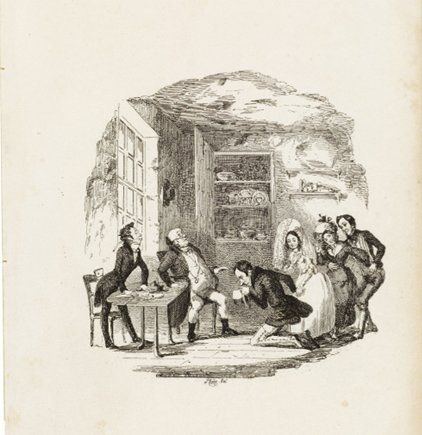
‘Mr Winkle Returns under Extraordinary Circumstances’, etched illustration by Hablot Knight Browne for The Posthumous Papers of the Pickwick Club by Charles Dickens

An example of this are the novels of Charles Dickens and the way in which he would collaborate with book illustrators.  How it worked was Dickens would give the illustrator an outline of the story line before he wrote the text and he carefully scrutinised the drawings to ensure that they complemented his own ideas.  In the case of Dickens, his favoured illustrator was Hablot Knight Browne who worked under the pen name “Phiz”. 

By the end of the twentieth century, Elizabeth Shippen Green, was to become a leading American illustrator.

 Elizabeth Shippen Green

Elisabeth “Bessie” Shippen Green was born into an old well-to-do Philadelphia family, on September 1st 1871.  She was the third child of Jasper Green and Elizabeth Shippen Boude. Her eldest sister died when aged two and, Katherine, her middle sister, was born a year before Elizabeth.  The family lived near the centre of Philadelphia at 1320 Spruce Street.  Although not very wealthy, the Green family had impeccable “old Philadelphia” connections through both the Shippen and Green ancestors and as such Elizabeth was able to access the elite social circles throughout her life.  It was this advantageous aspect of Elizabeth’s life that led her to become easy going and self-confident.  Elizabeth’s parents were determined that their daughters had every possible social advantage in life and to ensure a good start to Elizabeth’s life journey she was sent to private Philadelphia schools.  Initially she was enrolled at Miss Mary Hough’s School and later Miss Gordon’s School.

Jasper Green, Elizabeth’s father at the Red Rose Inn (1904). Elizabeth Shippen Boude, Elizabeth’s mother (1903)

Elizabeth’s father imbued in his daughter a love of art as he was an amateur artist who had studied art at the Pennsylvania Academy of the Fine Arts and during the American Civil War, worked as an illustrator/correspondent for the Harper’s Weekly, an American political magazine based in New York City.   It was said that during her early schooldays Elizabeth took pleasure in illustrating her school notebooks. 

Portrait of the Artist’s Father, Jasper Green by Elizabeth Shippen Green (c.1900)

Elizabeth Shippen Green, self portrait

In October 1889, a month after that first publication of her work she enrolled at the Pennsylvania Academy of the Fine Arts.  She spent one year in the antique class, where she had to draw from plaster casts, and two years in the life class, working with live models.  During that period her teachers included Thomas Anshutz, Thomas Eakins, and Robert Vonnoh.  Elizabeth graduated from the Academy in 1893 and it was in that year that the Green family suffered a devastating loss.  Elizabeth’s sister, Katherine died on September 1st 1893, aged twenty-three.  This tragic death would haunt Elizabeth every year as it coincided with her birthday.  Elizabeth had now suffered the tragic loss of both of her sisters and one can only imagine the devastation felt by her parents.

Paper Doll Book #2 watercolour and charcoal by Elizabeth Shippen Green (1906)

Once her schooling was completed, eighteen-year-old Elizabeth enrolled at the Pennsylvania Academy of Fine Arts in 1888.  For Elizabeth the Fine Arts path was not for her as she was interested in her father’s branch of art, that of illustration and, in her father, she had the best illustrations tutor possible.  By the time she was seventeen years-old she had turned a corner of her bedroom into her studio and produced a series of drawings which she managed to sell to the Philadelphia Times and the first of these were printed by the newspaper on her eighteenth birthday.  The drawings accompanied a short but charming rhyme about a child and her doll, entitled, Naughty Lady Jane.   Although this was the only work of prose which she had published, the Philadelphia Times editors recognised her immense talent as an illustrator and in the September 8th 1889 edition of the Philadelphia Times the editor inserted this extended by-line:

“…You will see in another column today some very pretty verses called Naughty Lady Jane accompanied by six exquisite illustrations.  They are the work of Miss Bessie S. Green of Philadelphia who is only eighteen years old.  The lines are unpretending, of course, yet admirably suited to their purpose; but the illustrations show wonderful talent.  Indeed, they would do credit to an artist much older and more experienced than Miss Green…”

Elizabeth (“Bessie”) must have been delighted to have her work published although the payment of 5o cents for a one-column drawing was hardly going to give her financial independence.

Philadelphia Public Ledger

Elizabeth continued working hard and would regularly submit her illustrations to the Philadelphia Public Ledger, a daily Philadelphia newspaper which was, at the time, owned by George William Childs and Anthony J. Drexel.  Elizabeth received many assignments for fashion illustrations from the newspaper.  In 1897, Elizabeth Shippen Green enrolled at the Drexel Institute which had been founded by Anthony J Drexel, a Philadelphia financier and philanthropist in 1891.   He envisioned an institution of higher learning uniquely suited to the needs of a rapidly growing industrial society and of the young men and women seeking their place in it.

Enter Howard Pyle the leading American illustrator of the time and the two other Red Rose Girls…………………………

………………………………to be continued.


The information I used for my five blogs about the Red Rose Girls was mostly collected from the excellent book entitled The Red Rose Girls.  An Uncommon Story of Art and Love by Alice A. Carter.  I can highly recommend this biography.  You will not be disappointed.

Henry Ossawa Tanner. Part 2.

The Resurrection of Lazarus, by Henry Ossawa Tanner(1897)

The year is 1897, and Henry Tanner’s painting, The Resurrection of Lazarus, was exhibited at the Salon where it received a third-class medal. The work remains one of Tanner’s most treasured and familiar works. The depiction of the biblical story is realistic and lacks sentimentality and is characteristic of Tanner’s religious work and with his fascination with rebirth and deliverance.  The French government purchased the painting for the Musée du Luxembourg. Later it was displayed at the Louvre, and since 1980, it can be found in the Musée d’Orsay.

The Two Disciples at the Tomb by Henry Ossawa Tanner (1906)

After Tanner’s move to Paris his artwork tended to focus mainly on religious art and less about depictions of his African American countrymen. Now that he had become a famous artist, there was a certain amount of pressure brought to bear on him to bring attention to the predicament of black people in America and for him to speak out about how racism had blighted their lives. Tanner was a deeply religious person but shied away from politics maintaining he chose to allow his work to make his point about racial equality.

TLes pélerins d’Emmaüs (The Pilgrims of Emmaus) by Henry Ossawa Tanner (1905)

Henry also depicted the famous biblical scene, much favoured by artists, of the resurrected Christ’s meeting with two of his disciples, Luke and Cleopas, at Emmaus. Tanner’s 1905 work was entitled Les pélerins d’Emmaüs (The Pilgrims of Emmaus). This painting is also part of the Musée d’Orsay collection.

Jessie Olssen Tanner and her son Jesse (c.1908)

In 1899, Henry Tanner did the inconceivable. He married a white woman. His wife was an American opera singer from San Francisco, Jessie Macauley Olssen. They had first met in Barbizon and she had often acted as his model. The couple went on to have their only child, Jesse, who was born in 1903.

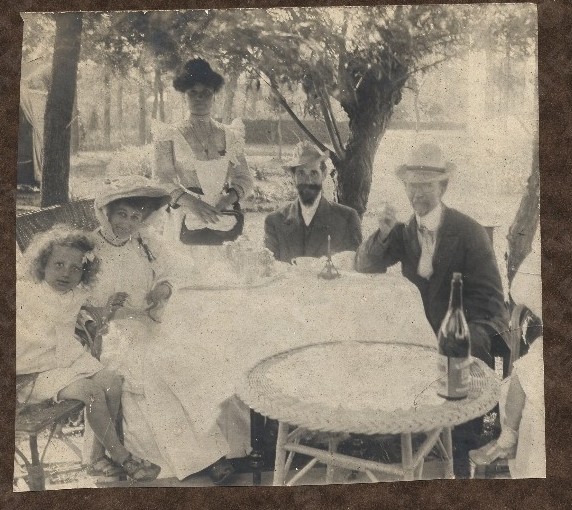
Henry Ossawa Tanner Family Photograph

Above is a photograph of a family get-together in Paris. According to a note on the back of the photo the group was, from left to right, Jesse, their five-year-old son, Henry’s wife, Jessie Tanner, a fellow ex-pat American artist, Myron Barlow, and Henry himself. 


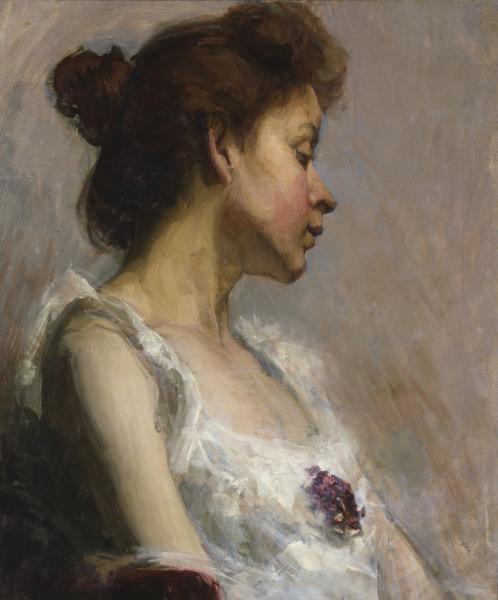
Portrait of the Artist’s Wife by Henry Ossawa Tanner (1897)

Henry completed a portrait of his wife around the time of their betrothal and is now part of the Smithsonian American Art Museum. In this portrait, Jessie Tanner is shown in a highly studied pose which is intended to look informal and nonchalant. Tanner put a lot of time in depicting the details of her face in comparison to the almost “unfinished” look of her dress.

Salome by Henry Ossawa Tanner (1900)

Tanner’s 1900 painting Salome is an Impressionistic-style work in which Tanner used sombre blues, greys, and blacks. It is a realistic depiction of the woman. There is no attempt to idealise her. It is an unusual and yet striking depiction of the biblical character and was typical of work which made Tanner the most famous and well-regarded artist of his time. The painting is housed in the Smithsonian American Art Museum in Washington DC. It is thought that Tanner’s wife modelled for this 1900 painting

Wife and son

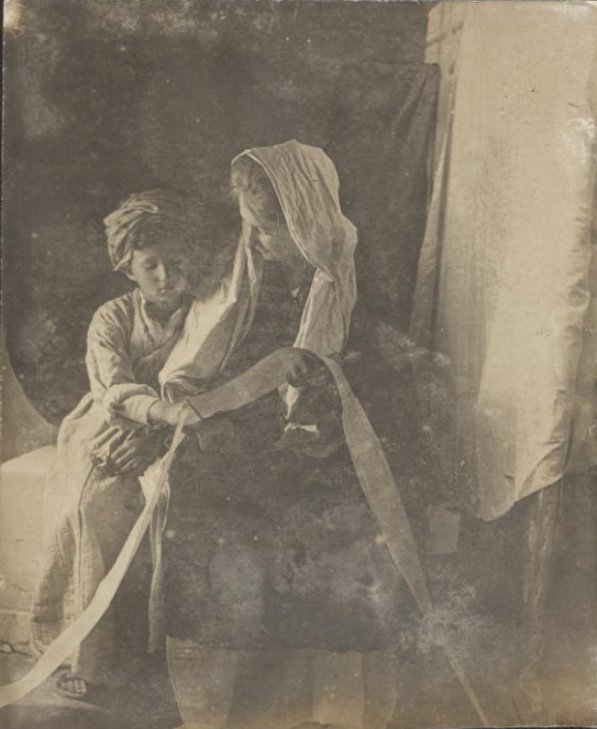
Many of Tanner’s subjects are based on his studies of African Americans from Georgia and North Carolina, the men, and women he encountered while traveling in the Middle East and North Africa in 1897 and 1898. and also, of his Caucasian wife, Jessie. She and their seven-year-old son Jesse posed for a photograph which Tanner would use for his 1909 painting, Christ and His Mother Studying the Scriptures which belongs to the Dallas Museum of Art. In the painting, we see the figures of Christ and her son engaged in a private moment of reading together. She has her hand wrapped around her son’s waist as they each hold the scroll from which they are studying. It is a painting exuding the tenderness of a mother and her son. This physical bond we see before us is also a recognition of their spiritual unity.

Christ and His Mother Studying the Scriptures by Henry Ossawa Tanner (1909)

Henry Ossawa Tanner has used a restricted palette of shades of blue, purple, with gold, bathing the figures in a warm, golden light. This illumination emanating from the scroll is a metaphor for the illumination gleaned from the words of the scroll. The existence of the photograph is proof that Tanner used his wife and son as models for Mary and Jesus. This being so gives the work a double meaning, firstly, a contemplative biblical scene and secondly a loving family portrait.

Christ Learning to Read by Henry Ossawa Tanner (1914)

Several years after, (around 1914), Tanner completed another painting remarkably similar to his 1909 work, Christ, and His Mother Studying the Scriptures. This time the title was Christ Learning to Read which is housed in the Des Moines Art Centre. In the Des Moines painting, brilliant colour, dramatic light, and deep shadows replace the Tonalist restraint of Tanner’s earlier work. The background is lighter and the design of the rug on the floor is more detailed. The depiction is less about spirituality and more about Christ’s early childhood with his mother.

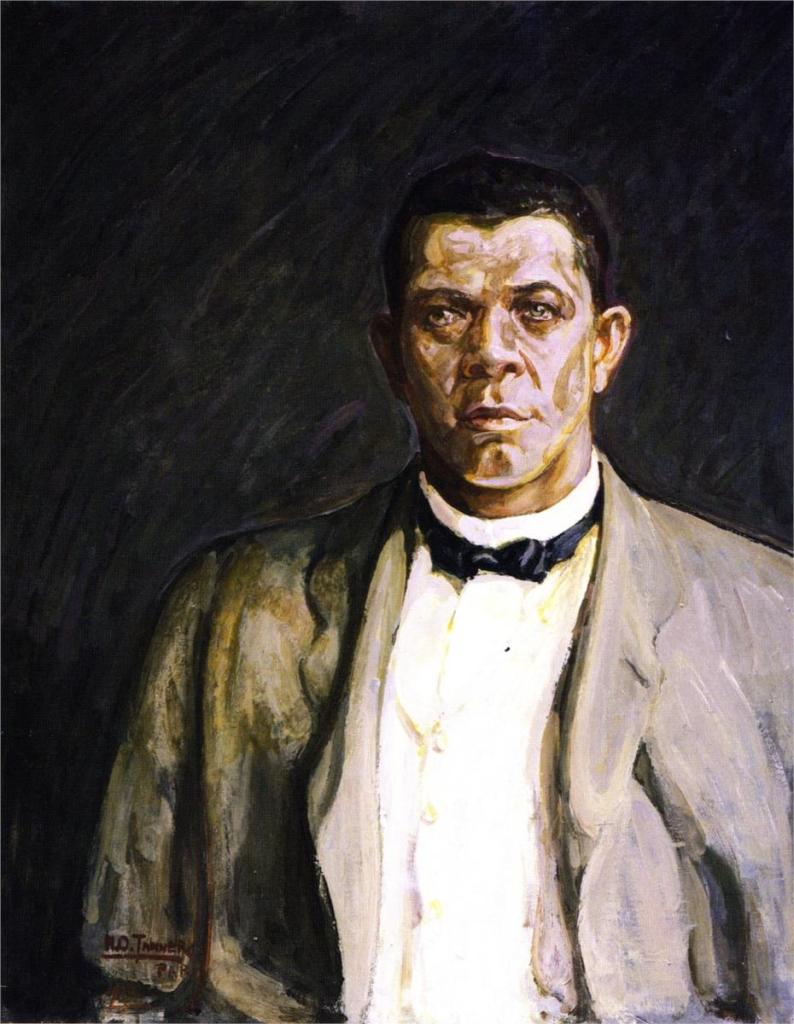
Booker T Washington by Henry Ossawa Tanner (1917)

Booker T. Washington was an American educator, author, orator, and adviser to multiple presidents of the United States and, between 1890 and 1915, Washington was the dominant leader in the African-American community and of the contemporary black elite. Washington was from the last generation of black American leaders born into slavery and became the leading voice of the former slaves and their descendants. In 1899, he published an article on Henry Ossawa Tanner. The publication of this article played a significant role in securing the artist an important position in the art world of America.

La Sainte Marie by Henry Ossawa Tanner (1898) La Salle University Art Museum

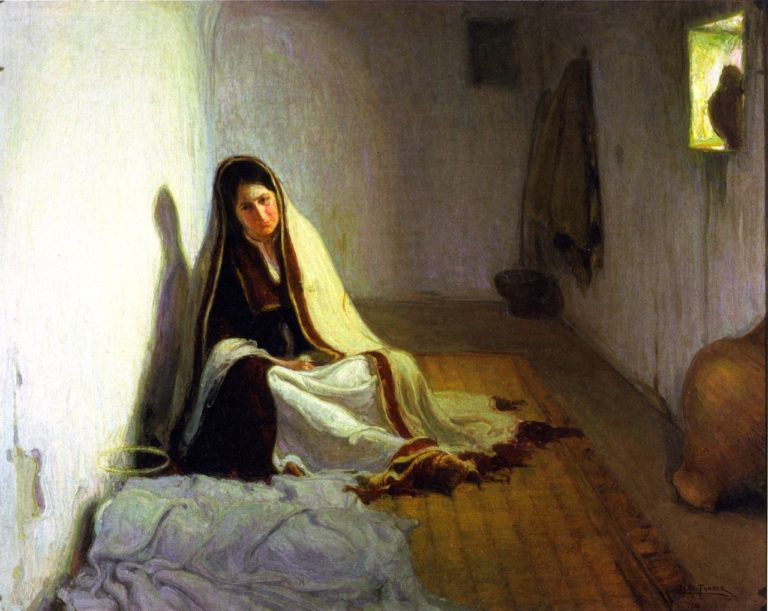
La Sainte Marie is a very strange depiction of the Virgin Mary with the Christ child.   Mary appears melancholy and lost in thought. The infant, who is lying on the floor, is almost completely covered by a shroud-like cloth, possibly suggesting a foreshadowing of his death. Tanner was painstaking when it came to detail and took back home with him sketches which he had made whilst in Jerusalem, where he first travelled in 1898. Tanner’s style is academic and is distinctive for his use of luminous lighting. The model for the depiction of Mary was again Tanner’s newlywed Swedish-American wife. 

Flight Into Egypt by Henry Ossawa Tanner (1923)

Whilst living in Paris, Tanner had met Lewis Rodman Wanamaker, a fellow American expatriate living in Paris, who—like his father, the department store magnate John Wanamaker—was a major patron of contemporary religious art. He was a patron of many important commissions in the field of liturgical arts. He was very impressed with Tanner’s religious paintings so much so that in 1897 he arranged for the artist to travel to Palestine for inspiration. According to Wanamaker any artist who wanted to depict believable biblical scenes should acquaint themselves with the Holy Land and then, from that encounter, he believed Tanner would be able to remind himself of the different shades of blue that can be seen in the twilight sky of Jerusalem and along the hills of Bethlehem.  Tanner left Paris in January 1897 and journeyed south through France by train to the port of Marseilles, where he boarded a ship to Cairo. From Cairo, he travelled to Port Said, Jaffa, Jerusalem, Jericho, and the Dead Sea, returning to Alexandria and sailing back to Europe through Naples. He spent just over two months in the Middle East, but the sketches he made during this trip would be used in his religious paintings for years to come.

Interior of a Mosque, Cairo by Henry Ossawa Tanner (1897)

During the time Tanner spent in Cairo, he visited a number of mosques. One of these featured in his 1897 painting, The setting for the painting, Interior of a Mosque, Cairo was the madrasa of Sultan Qaitbey, a Mamluk-dynasty complex originally containing a mosque, a school, and a mausoleum, built between 1472 and 1475. This mosque has long been held as one of the masterpieces of Islamic architecture in Cairo. The mosque of Qaitbey is famous for its coloured and cut marble, geometric patterning, and decorative tile. Tanner’s painting portrays it as an ageless place of faith and mystery. We are looking at the eastern end of the interior, where the mihrab, a semi-circular niche in the wall of a mosque that indicates the qibla, which is the direction of the Kaaba in Mecca and hence the direction that Muslims, should face when praying. Tanner has made a careful choice of view, one which is angled so as to highlight the curved arches and intricate marble patterning on two sides of the building. Light streams through the stained-glass windows onto the floor. To the left we can make out the minbar, an elaborately carved wooden pulpit in the mosque where the imam stands to deliver sermons. Two robed figures face east, engaged in their devotions. Tanner brought the completed work back with him to France.

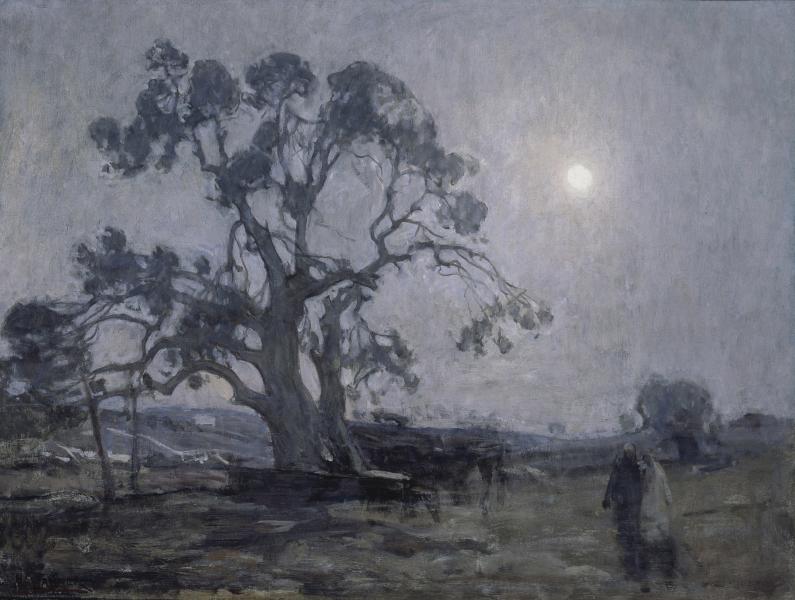
Henry Ossawa Tanner, Abraham’s Oak, (1905), Smithsonian American Art Museum,

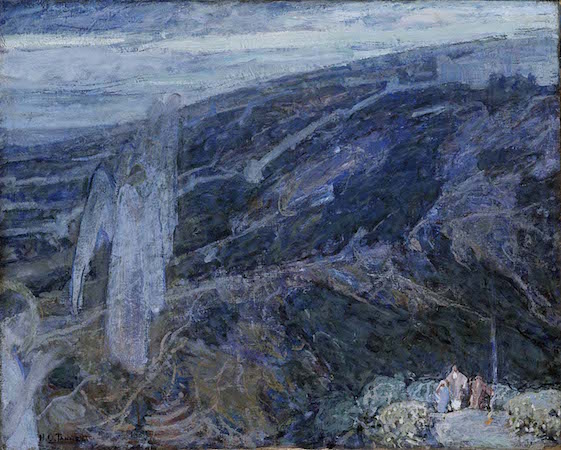
Tanner returned to Palestine, a year later, for a further six months of sketching and painting. During the latter stay he came to Khirbet es-Sibte on the Plain of Mamre and came across the great oak venerated by some as the Oak of Abraham. According to the bible, (Genesis 13), it was beneath this tree that Abram (not yet Abraham) pitched a tent and built an altar to the Lord of Israel after God’s promise of the land of Canaan to him and his offsprings. Whilst Tanner was there, he too pitched his tent on the Mamre Plain and I wonder if he drew the parallel of himself and Abraham. The biblical figure’s lifetime of wanderings and Tanner, who left America and went to live in France where conditions allowed him to work and live relatively free of the widespread and overpowering racism of his own native country and, like Abraham, he too wanted to start a new life. For Tanner it was Paris, for Abraham it was Canaan.  It was almost seven years later that Henry Tanner produced a painting which he looked upon as a souvenir from his Holy Land travels. The painting is entitled Abraham’s Oak. In his depiction, the ancient tree looms large over the scene. It is not just any tree. It is strong, solemn, and gigantic. The aged tree has one of its massive limbs on the left seemingly supported by two struts. The tree is almost withered, almost bare, with the exception of a few leaves sprouting from the end of its mighty limbs. Tanner has used his customary nocturnal blue-grey palette to depict the thick, dim nigh time air broken only by the hazy glow of the moon.

The Holy Family by Henry Ossawa Tanner (c.1910)

Some time in the first decade of the twentieth century, Henry Tanner and his wife and son had moved out of Paris and made their home in Etaples, a fishing commune on the Canche river in the Pas-de-Calais department in northern France, fifty miles from the Franco-Belgium border. However, the fighting during the First World had moved perilously close to Tanner’s home and so he uprooted his family and hastily moved them to England. During his latter years Tanner received many honours for his art. He was elected to the National Academy of Design in America and made an honorary chevalier of the Order of the Legion of Honour in France. Although Tanner remained active until 1936, he refused to change his artistic style and refused to follow the period’s artistic innovations. The taste in art changed in the twentieth century. Modernism became fashionable and so the realism of Tanner’s art became old-fashioned. He remained steadfast in his resistance to becoming a spokesman for racial issues, once again maintaining he wanted to put all his energy into his art. Despite this Henry Ossawa through his international reputation inspired generations of African American artists.

Sand Dunes at Sunset, Atlantic City by Henry Ossawa Tanner (1885)

His wife Jessie died on September 8th 1925 and Tanner died in Paris, alone, on May 25th, 1937, a month before his 78th birthday. On October 29th 1996, in the White House, the American president, Bill Clinton and his wife Hillary unveiled Tanner’s 1885 painting Sand dunes at Sunset in Atlantic City.

The painting became the first work by an African American artist to join the White House permanent collection.
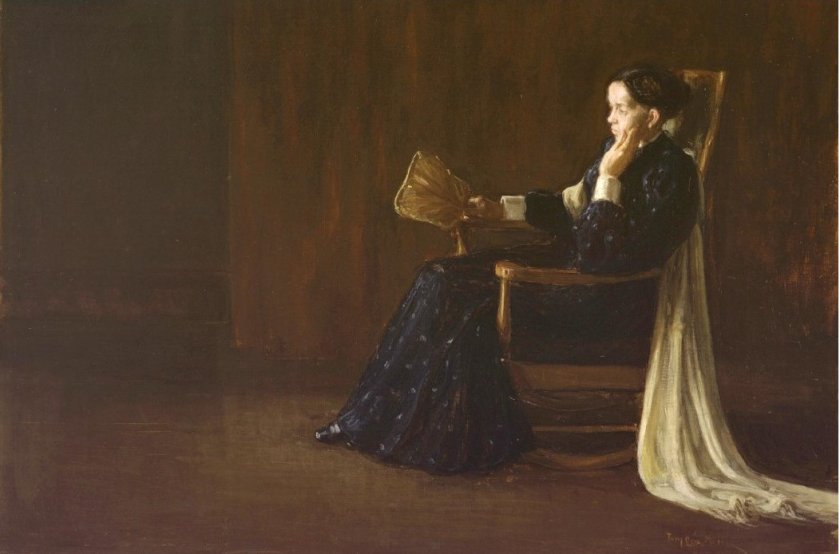
Henry Ossawa Tanner. Part 1

Henry Ossawa Tanner. Paris 1907

In many of my previous blogs I have talked about youngsters, in centuries gone by, who had all the advantages needed to become an artist. They were male and did not have to overcome the barriers females had to hurdle over to become acknowledged painters. They were from wealthy families who could pay for their child’s best artistic tuition. They were part of an artistic family whose parents or siblings could initially tutor them, encourage them and, at the same time, introduce them to their established artist friends.  These were great advantages, not having these benefits was a disadvantage for an aspiring painter.

The nineteenth century American artist I am looking at today had one major disadvantage. He was an African American in nineteenth century America where racism was rife, and as such had to overcome problems his white contemporaries did not have to face. He, however, battled on and became the first African American painter to gain international acclaim. Welcome to the world of Henry Ossawa Tanner.

Portrait of Artists Mother by Henry Ossawa Tanner (1897)

Henry Ossawa Tanner was born in the city of Pittsburgh on June 21st 1859. His middle name was derived from the Battle of Osawatomie, an armed engagement that occurred on August 30, 1856, between pro- and anti-slavery partisans at the town of Osawatomie, Kansas. He was the eldest of nine children born to Benjamin Tucker Tanner and his wife Sarah Miller Tanner, a private school teacher, who was born into slavery in Virginia but whose mother had enabled her to escape to the North via the Underground Railroad. Tanner’s portrait of his mother in 1897, Portrait of the Artist’s Mother, is a dignified depiction of the woman who brought him up. The painting with its deep hues and the large area of dead space adds drama to the painting.

Henry Ossawa Tanner, Angels Appearing before the Shepherds, c. 1910

Henry was brought up in a religious setting. His father was a minister in the African Methodist Episcopal Church in Pittsburgh, the first independent black denomination in the United States. He and his family moved frequently due to him being assigned to various parishes. His father was also a political activist for the abolition of slavery. Religion always played an important role in Henry Ossawa Tanner’s life and art.

The family moved from Pittsburgh to Philadelphia in 1868 when Henry was nine years old. He attended The Promise Academy at Roberts Vaux High School, for coloured students. named after the American jurist, abolitionist, and philanthropist Roberts Vaux  It was a school which encouraged the love of art. He did well at the school and eventually graduated as the valedictorian of his class. The story goes that one day in 1872, thirteen-year-old Henry Ossawa Tanner was walking in the city’s Fairmont Park and came across an artist with his easel painting a landscape. He never forgot this meeting and determined there and then that he too would become an artist. Living in Philadelphia in the summer was a test for everybody. The temperature and the humidity were extremely high and everyday living became onerous. The Tanner family, like many others tried to escape the humid conditions by going to the seaside and experience the cooling Atlantic breeze. Young Henry enjoyed these seaside trips and found plenty of subjects to paint. Some of his sketches were seen by the Philadelphia artists, Henry Price, who offered young Henry a one-year apprenticeship at his Philadelphia studio. It was here that Tanner began to learn about art.

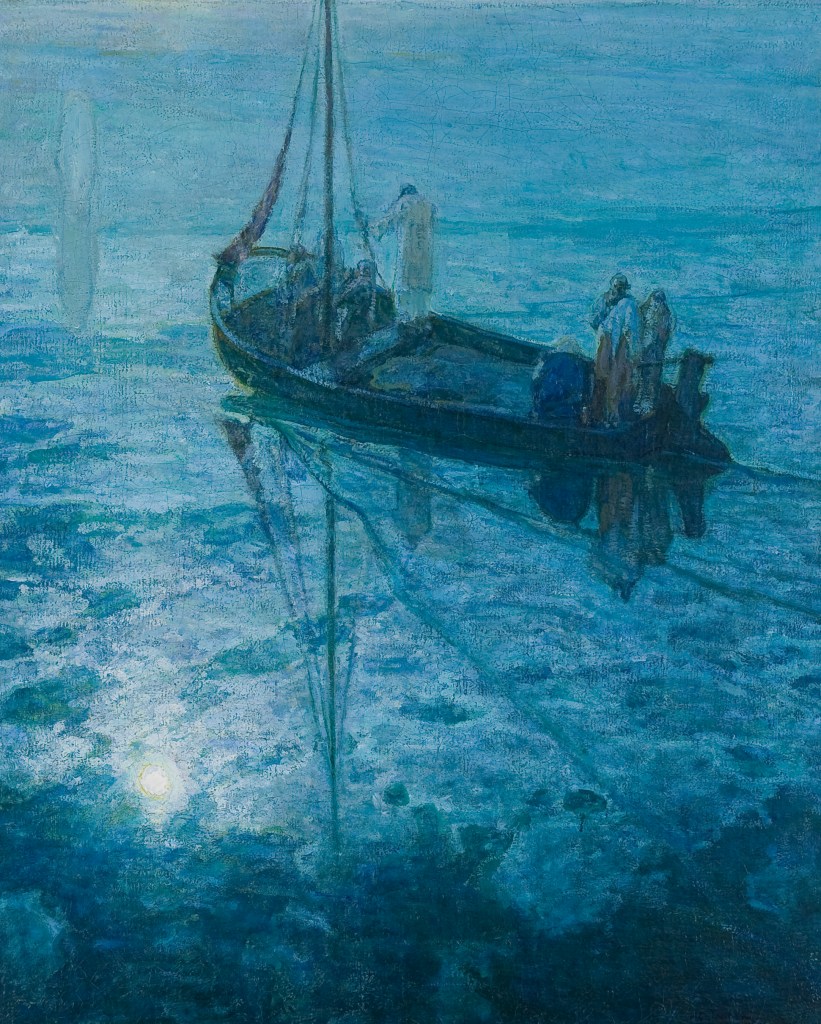
The Disciples See Christ Walking on the Water by Henry Ossawa Tanner (ca. 1907)

However, his father had other ideas as he was doubtful that a career in art was a suitable occupation for his son. With that in mind he arranged for Henry to start an apprenticeship as a miller in a flour mill. Henry Tanner was a delicate young man whose health was never resilient throughout his life and working in the flour mill proved too strenuous and he became seriously ill. Tanner was confined to his home to recuperate. Much of the time during this period of isolation was spent sketching. Once he had recovered, and was freed from home-based isolation, he would often take trips to Rainbow Lake in the Adirondack Mountains where the air was cleaner. He would also go down to the sunnier and warmer climate of Florida. He was pleased when he could get out of the family house and could not wait to be able to start sketching and painting. Tanner began to paint landscape and seascape scenes.

Sand Dunes at Sunset, Atlantic City by Henry Ossawa Tanner (1885)

His artwork must have reached a good standard as at the age of twenty-one, he passed the entrance examination to the Pennsylvania School of Fine Arts in 1880. It was here that he received the finest art tuition from the likes of the great American realist painter, Thomas Eakins. The artwork and teachings of Eakins were to have a great influence on Tanner for the rest of his life. He remained a student there, off-and-on, until 1885. Tanner exhibited some of his early works in New York in 1885 and the following year he opened his own studio in Philadelphia. Once again, Henry and his family would often head towards the New Jersey coast in the summer to avoid the stifling heat of Philadelphia. During those hot summer days Henry completed a painting entitled Sand Dunes at Sunset. Over a century later, in 1995, it became the first painting by an African American artist to be acquired by the White House.

The Young Sabot Maker by Henry Ossawa Tanner

Tanner left the Pennsylvania Academy prior to graduating as he wanted to set himself up in business and in 1888 an opportunity arose in Atlanta, Georgia for him to establish his own art and photography gallery. His idea was to set up a modest gallery where he would attempt to earn a semi-artistic living by selling drawings, making photographs, and teaching art classes at the city’s private Methodist, historically black, university Clark Atlanta University. Through Tanner’s connection with the Methodist Church he came in contact with Joseph Crane Hartzell who was an American Missionary Bishop of the Methodist Episcopal Church.  Joseph Hartzell and his wife became his main white patrons over the next several years. In spite of his efforts, Tanner’s Atlanta studio failed and, in the summer of 1888, Henry sold the business.

Spinning by Firelight – The Boyhood of George Washington Gray by Henry Ossawa Tanner (1894)

Henry Tanner left Atlanta and moved to Highlands, North Carolina, a town in Macon County in North Carolina.  The town is located on a high plateau within the larger Blue Ridge Mountains. He had moved there with the idea that he could make some money from his photographs and paintings. He also believed that the clean mountain air would be good for his well-being. After staying at Highlands during the summer of 1888, he returned to Atlanta and taught drawing for two years at Clark Atlanta University. In a conversation Henry Tanner had with Bishop Hartzell and his wife, he told them about his desire to go to Europe and study art in Rome. They believed it to be a good idea and they arranged to have an exhibition of his work at a gallery in Cincinnati in the Autumn of 1890 and from the sale of his work his trip to Europe would be paid for.

The exhibition was held but unfortunately none of Tanner’s paintings sold. He was devastated. However, the bishop and his wife came to his rescue and bought all the paintings ! Henry Tanner now had the funds to travel to Europe. Tanner eventually set sail for Europe in January 1891. He stayed for a short time in Liverpool and London and then travelled to Paris. He was so impressed by the art scene of the French capital. To him, the French artistic world was much more cutting-edged than that of America’s art world, so much so that he abandoned his plans to travel to Rome and put roots down in the French capital. Once settled in Paris, Tanner enrolled in the Académie Julian and studied under Jean-Paul Laurens, a French painter and sculptor, and one of the last major exponents of the French Academic style and Jean Joseph Benjamin-Constant, a French painter and etcher best known for his Oriental subjects and portraits. He also joined the American Art Students Club of Paris.

In 1893, Tanner went back to the United States to deliver a paper on African Americans and art at the World’s Columbian Exposition in Chicago. In this same year, he created one of his famous works The Banjo Lesson while he was in Philadelphia.  His depiction incorporated a series of sketches he had made while visiting the Blue Ridge Mountains, four years earlier. The sketches he had made during the summer of 1888 had opened his eyes to the poverty of African Americans living in Appalachia.
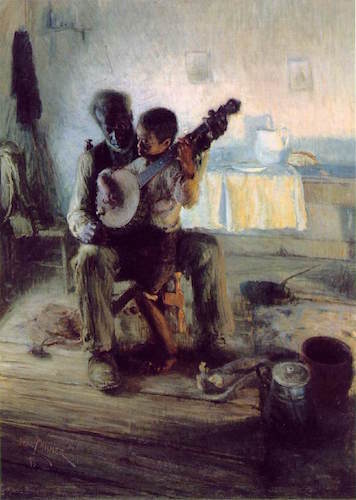
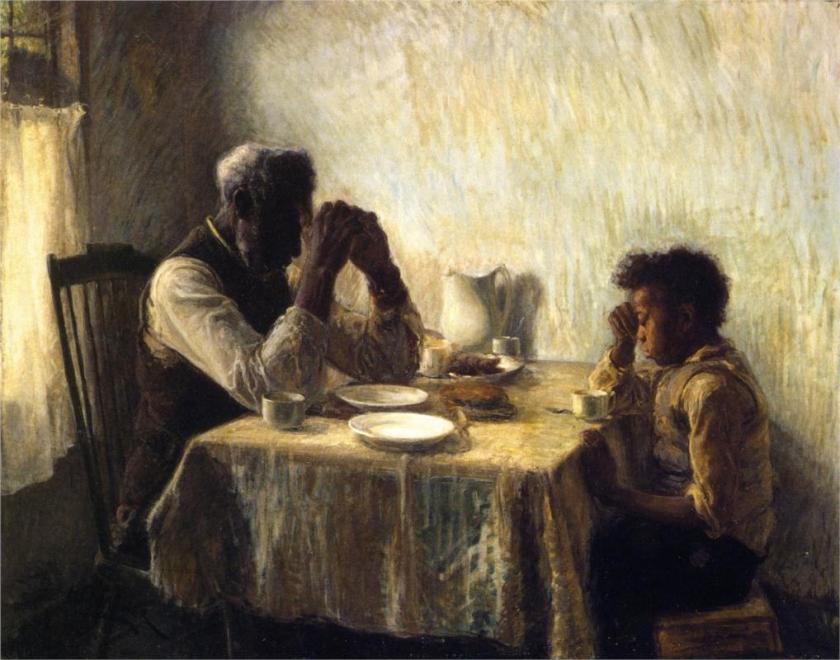
Henry Ossawa Tanner, The Banjo Lesson, 1893

The setting is inside a cramped log cabin with the cool glow of a hearth fire casting the scene’s only light source from right corner, enveloping the man and the boy in a rectangular pool of light across the floor. The young boy holds the banjo in both hands. He looks down, completely focused on the task ahead. His grandfather holds the banjo up gently with his left hand so that the boy is not hampered by its weight, yet it is also clear that the grandfather expects the young boy to appreciate the music he is producing although it may be hard work.

Woman from the French West Indies by Henry Ossawa Tanner (ca. 1891)

When he arrived back in his homeland, he was respected as an artist but despite this recognition and the honours and prizes he received for his art, his paintings were often displayed separately from those of his white colleagues. In 1895 he returned to in Paris, saying that he could not fulfil his artistic aspirations while fighting discrimination in America. Tanner lived over half of the rest of his life in France, saying that he was able to find an expansive and more accepting environment, free from the racial strife which he encountered in America.

The Thankful Poor by Henry Ossawa Tanner (1894)

In 1894 Tanner completed another memorable work. It was entitled The Thankful Poor. It was an oil painting depicting an elderly black man sitting down to supper with a teenage boy. Their heads are bowed in prayer, thanking The Lord for the food they were about to eat. The table is plain and the food upon it is meagre, but Tanner has captured their thankfulness. Whilst Tanner has painted the two figures in great detail, the rest of the scene, such as the wall and the tablecloth seem to just blend in the light. This warm light which streams through the window onto the wall helps to enrich the spiritual quality of the painting. The bright light shines on the young boy’s face and illuminates the boy’s deliberations, devotion, and gratitude for having food to eat. Look how Tanner has portrayed poverty in the way he depicted the man’s coarse hands and the boy’s scruffy clothes.
Around the mid 1890’s, Henry Tanner strong religious beliefs became more apparent in his works. He was determined that the biblical stories he knew and loved should feature in his artwork. He once said:

“…my effort has been not only to put the Biblical incident in the original setting…but at the same time give the human touch…to convey to my public the reverence and elevation these subjects impart to me…”

Daniel in the Lion’s Den by Henry Ossawa Tanner (1896)

Impressionism had been at the height of its popularity in the 1870’s and Tanner was Influenced by colours used by the Impressionists. He was also inspired by the works of the Symbolists. A classic example of his work at the time was his 1896 painting Daniel in the Lion’s Den which won an honourable mention at the Paris Salon of 1896. In this depiction, Daniel is incarcerated in a den of lions. He was being punished for refusing to pray to King Darius of Persia. The late evening light streams through an upper window of his dark prison cell lighting up the lower body of Daniel and highlights his arms crossed on his lap whilst besides him is the exceptionally large head of one of the lions. There is a calmness about the figure of Daniel which underlines his spiritual belief in what he is doing. The shades of blue/green offer us a picture of serenity. The painting, which was the first to be exhibited at the Salon by an African American, was highly praised by the art critics and received international recognition. This was Tanner’s first major religious painting and indicated the direction that his art would take.

Le Grand Inquisiteur chez les rois catholiques by Jean-Paul Laurens

The choice of a religious subject may have been inspired initially by his teacher Jean-Paul Laurens, his former tutor at Académie Julian, who was noted for dramatic biblical paintings and who had depicted a similar scene of incarceration in his painting, Le Grand Inquisiteur chez les rois catholiques, a copy of which Tanner had owned. A later version of this painting can be found at the Los Angeles County Museum of Art on Wilshire Boulevard.

..……to be continued.

Hudson River School – The Hart Family

Part 3.  Julie Hart

“…Mrs. Julie Hart Beers Kempson became the only woman artist of the century to specialize in landscape. It is perhaps not surprising to find so few women landscapists, since the rigors of painting outdoors and the unseemliness of women engaging in this activity during the Victorian era acted as a deterrent…”

William H. Gerdts,
Women Artists of America 1707-1964 (Newark: Newark Museum, 1965)

The above extract is from the article in the 1965 Newark Museum catalogue Women artists of America, 1707-1964 that accompanied the exhibition.  It was written by the American art historian and former professor of Art History at the City University of New York Graduate Center, William Gerdts.

Cabin in Autumn, Upper Hudson Valley by Julie Hart Beers (1910)

In my final blog regarding the artistically talented siblings of the American Hart family I want to look at the life and work of the youngest child of James and Marion Hart, Scottish immigrants who had settled in Albany, N.Y., in 1831. Julie Hart was born in 1835, in Pittsfield, Massachusetts, and was the only one of her siblings to have been born in America. She, as we have seen in the two previous blogs, had two talented artists as brothers, William Hart and James McDougal Hart. The world of Fine Art in America, in the nineteenth century, was a male-dominated institution. There were female painters but they were looked upon purely as hobbyists rather than being serious professional painters. It was believed by many men that women had better things to do than paint professionally – raising children, keeping house and looking after their hard-working husbands. Most art academies didn’t admit women, and neither did the art societies that linked artists with patrons, which was a prerequisite to the financial success of an aspiring artist. So, in the early part of the nineteenth century, women artists signed their work with just a first initial and a surname so as to conceal their gender, thus hoping that their ability as an artist would not be downgraded once the sex of the artist was known. For women to succeed in the world of Fine Art they needed both their family and/or financial backing to launch them professionally. Often, they were the sisters, daughters and wives of better-known male artist. There was no formal training for women at art institutions so once again they relied on family members or friends to help develop their talent. Julia Hart was fortunate enough to have her two elder brothers, who were aligned with the Hudson River School of art, to teach and mentor her and so, as a teenager, she became interested in plein air landscape painting.  She was one of very few professional women landscape painters in nineteenth-century America

The Old Birch Tree by Julia Hart Beers (1876)

In 1865 the American Civil War had ended and the Reconstruction had begun. Americans unfettered by the trials of war were once again relishing the joys of tourism and travel. They would often explore the great landscapes. One such area was the banks of the Hudson River which had started its 319-mile journey from the Adirondacks towards its outflow between Manhattan and Jersey City. It was the upper reaches including the Adirondacks, Catskills and White Mountains which tempted both tourists and artists alike. The artists, who were looked upon as being part of the Hudson River School, wanted to capture the beauty on canvas and the tourists wanted pictorial mementos of their journeys. These areas of beauty were often steep-sided hills and mountains and for female artists who came to the region for some plein air sketching and painting, they had to overcome the challenge of decorous dressing versus suitable attire for their arduous painting trips. These women ventured on their own or alongside male relatives into the wilderness, painting the breath-taking scenery that inspired America’s first art movement. Julie Hart was one of those women.

Hudson River at Croton Point by Julie Hart Beers (1869)

Julie Beers married in 1853, when she was eighteen years old. Her husband, also a painter, was Marion Beers. Marion, like Julie’s brothers, helped teach his wife artistic techniques which were to serve her well in the future. In the mid 1850’s Julie, like her two brothers, relocated to New York city and set up a studio. Since her marriage, Julie signed all her paintings “Julie H Beers
It is thought that Julie’s first exhibition was held at the National Academy of Design (NAD) in 1867, following which she had her paintings exhibited at the NAD annual exhibitions in each of the following twelve years. She also exhibited at the Boston Athenaeum in 1867 and 1868 and at the Pennsylvania Academy of Fine Arts in 1868.

Still Life with Fruit by Julie Hart Beers (1866)

Besides being a renowned landscape painter Julie was also a talented still life artist as can be seen by her 1866 painting Still life with Fruit.

Basket of Roses by Julie Hart Beers (ca. 1860’s).

Another of her still life paintings, completed around the same time was entitled Basket of Roses.

Cabin by the Forest by Julie H Beers

Her husband, Marion Beers died in 1876 and the following year Julie married Peter Kempson and the newly-weds moved to Metuchen in New Jersey.  Julie Hart Beers Kempson proved that women landscape painters were the equal of men, despite the harshness of painting en plein air in the wild and often barely accessible landscapes along the Hudson River.  Sadly her paintings did not receive affair and objective assessment during her lifetime and she was not truly valued in her own time, but notwithstanding that transgression, her talent and dedication as an artist which not only produced outstanding works of art, but also led the way for the female landscapists who would follow her.

A Quiet Pond by Julie Hart Beers (1873)

I will end this blog as I started it, with a quotation.  This one is from Jennifer Krieger, Managing Partner at Hawthorne Fine Art in New York City. Her article entitled Women Artists of the Hudson River School formed part of the catalogue which accompanies the 2010 exhibition, Remember the Ladies: Women of the Hudson River School, which was held at Cedar Grove, The Thomas Cole National Historic Site, Catskill, New York. She wrote about the trials and tribulations of female artists and their struggle to carry out plein air painting in remote areas of the Hudson River valleys. She wrote:

“…These artists managed to make their way through vast, unexplored stretches of the American landscape and to shimmy up trees (for better views) in spite of their long skirts. Rather than complain about all that society had placed in their way…… [They] were all intent on honoring the beauty of the natural world they had experienced so directly. Rather than to complain about all that society had placed in their way, women artists pushed forward to accomplish their goals. As a result of their determination, our own cultural topography has been immeasurably enriched…”

A Hudson River Scene by Julie H Beers

Julie Hart Beers Kempson demonstrated that women landscape painters were the equal of men, even given the hardships of painting outdoors.  While largely undervalued in her own time, her talent and dedication not only produced outstanding works of art, but also broke important ground for the female landscapists who would follow her.

Hudson River School – The Hart family.

Part 2 – James McDougal Hart and family.

James McDougal Hart

The Hudson River School, as it has come to be termed, was founded by the painter Thomas Cole around 1825. Cole believed that nature manifested to man the mind of the Creator and saw the artist as a prophet. The Hudson River School was so named because its proponents showed a fondness for depicting the scenery to be found in the countryside bordering the Hudson River. James McDougal Hart, like his brother William and his sister, Julie, were looked upon as second generation exponents of this type of landscape painting.

James McDougal Hart (1828-1901)

James McDougal Hart was born on May 10th 1828 in the East Ayrshire town of Kilmarnock. His father James was a schoolteacher and he and his wife took passage on the SS Camillus with their seven children and emigrated to America, landing in New York on February 12th 1830. After landing on American shore, the family located to Albany in upstate New York.

After completing his education, James, like his brother William before him, became an apprentice to a local sign and carriage maker and was employed to paint landscape scenes on carriage doors and banners. In 1851 James left America and travelled to Germany, visiting Munich, Leipzig and Dusseldorf, where he enrolled for a short period at the Dusseldorf Art Academy. Being a student at the Academy he was influenced by the Düsseldorf school of painting, which was a name given to a group of painters who taught or studied at the Academy during the 1830s and 1840s, a period when the Academy was directed by the Romantic painter Wilhelm von Schadow. The Dusseldorf School is typified by its keenly detailed yet imaginary landscapes, often with religious or allegorical stories set in the landscapes and he was a great believer in plein air painting and the use of a palette with comparatively subdued colours.

The Old Homestead by James McDougal Hart (1862)

The Düsseldorf School had a significant influence on the Hudson River School in the United States, and many prominent Americans trained at the Düsseldorf Academy such as George Caleb Bingham, Worthington Whittredge, and Richard Caton Woodville. Strangely, one of the great Hudson River painters, Albert Bierstadt, applied but was not accepted.

Cows Watering by James McDougal Hart

James Hart returned to Albany around 1853 and opened a studio where he painted and gave painting lessons. In 1857 he moved to New York City and he and his brother William opened up a studio. James became an associate member of the National Academy of Design in 1857 and a full member in 1859.

The Puzzle by Marie Theresa Gorsuch Hart

James Hart married fellow painter Marie Theresa Gorsuch in 1866 and the couple went on to have five children, three sons Robert Gorsuch Hart, William Gorsuch Hart and William Howard Hart and two daughters, Mary Theresa Hart and Letitia Bonnet Hart. Three of the siblings became artists in their own right.

Portrait of Adeline Pond Adams Seated in an Interior by William Howard Hart (1891)

William Howard Hart became a landscape and portrait painter. He studied in New York with J. Alden Weir at the Art Students League. Later, in the 1890’s, he went to Paris and studied under Gustave Boulanger and Jules Lefebvre at the Academy Julian.

The Basket of Roses by Letitia Bonnet Hart

Letitia Bonnet Hart, who became a painter known for her portrait and figure painting, was born in 1867. She exhibited in twenty-eight annual exhibitions from 1885 to 1914, including at the Woman’s Building at the 1893 World’s Columbian Exposition in Chicago. In 1901 she exhibited in the Pan American Exposition in Buffalo, New York and three years later, in 1904, her work was shown in the Louisiana Purchase Exposition in St. Louis,. She and her sister Mary Theresa Hart, shared a studio in NYC and later she went to live in Lakesville, CT.

The Puzzle by Marie Theresa Gorsuch Hart

Marie Theresa Hart was born in 1872 in Brooklyn, New York and studied with her father as well as with Edgar Melville Ward, the American genre painter, at the National Academy of Design. Between 1889 and 1895, she was enrolled in antique and life classes at the Academy and won several awards. She was best known for her floral painting and illustrations of violets and was also an accomplished portrait artist and art teacher.


The Coming Storm by James McDougal Hart

One of James Hart’s favourite subjects was cattle, and this can be seen by his painting entitled The Coming Storm, where he depicted them huddled under trees, during a period of stormy weather.

Picnic on the Hudson by James McDougal Hart

The mid 1860’s was a time of wealth for some Americans. The Civil War had ended in 1865. The North in 1865 was an extremely prosperous region. Its economy had boomed during the war, bringing economic growth to both the factories and the farms. Since the war had been fought almost entirely on Southern soil, the North did not have to face the task of rebuilding. Men involved in transportation made large profits from the movement of supplies for the Union troops during the Civil War. The world of property development also created many wealthy people. It was known as the Gilded Age and was an era that occurred during the late 19th century, from the 1870s to about 1900. The Gilded Age was an era of rapid economic growth, especially in the Northern United States and the Western United States.

A Mid Summers Idyll by James McDougal Hart (1868)

James Hart later moved to Brooklyn and in the 1870s, he and his brother, William, opened studios in Keene Valley, NY, in the heart of the Adirondacks. For artists like James Hart and his brother William there was plenty of commissions to be had. The wealthy industrialists, now the nouveau riche of the post-Civil War society especially wanted to acquire works which depicted serene and relaxing rural scenes, scenes of picturesque tranquillity and they were eager to spend their money on such paintings as well as other paraphernalia of culture which they believed would allow them to become part of the cultured elite. The American author Sinclair Hamilton summed it up, observing:

“…both Hart brothers painted in a language intelligible for the artistically illiterate…”

James McDougal Hart Oil Painting – Hudson River Landscape

James went on to exhibit at the annual exhibitions of the National Academy, and also at the Pennsylvania Academy of Fine Arts, the Boston Athenaeum, the Centennial Exhibition in Philadelphia, the Boston Art Club, and at the Paris Expositions of 1867 and 1878.

Autumn Landscape by James McDougal Hart (1867)

James McDougal Hart died on October 24, 1901, aged 73. Like his brother William, he is buried at the Green-Wood Cemetery, Brooklyn, New York. Even if one cares little today for the style of painting carried out by James and William Hart, one is able to benefit a better understanding of the era in general, and of its fascination with the Hudson River School painters, through a study of their art work. . The paintings of James MacDougal Hart can be found in several public collections including the Metropolitan Museum of Art and the Brooklyn Museum.

Hudson River School – The Hart family.

Part 1. William Hart

“…Go first to Nature to learn to paint landscape, and when you shall have earnt to imitate her, you may then study the pictures of great artists with benefit . . . I would urge on any young student in landscape painting, the importance of painting direct from Nature as soon as he shall have acquired the first rudiments of Art…”

Asher Durand, a leading Hudson River School painter.
Letters on Landscape Painting (1855)

The Hudson River School painters produced the most richly colourful and remarkable landscape works of the 19th century. However, the term “Hudson River School” was a judgemental term used by European critics who were used to, and preferred, the revered realism of the French Barbizon School. The Hudson River paintings celebrated and honoured the rugged beauty of the American landscape. The works effectively communicated the natural grandeur of what was termed the New World. The paintings did not just depict scenes of the Hudson River Valley, but also depicted scenes from the Catskills, Adirondacks, White Mountains, the Maritimes, the American West and South and the second-generation painters even captured the beauty of their Canadian neighbour. In earlier blogs I have looked at the life and works of many of the Hudson River painters such as Frederick Church, Asher Durand and the man looked upon as the founder of the movement, Thomas Cole. In my next three blogs I am going to look at the members of a family whose art followed the concepts of this art movement. Let me introduce you to three members, siblings, of the Hart family.

James Hart and Marion Robertson lived in Scotland and the couple married on July 16th 1811, and they went on to have ten children. Of these, William Hart was born in Paisley, Scotland on March 31st 1823 and James McDougal Hart was born five years later on May 10th 1828. In 1830 James and Marion Hart and their seven children sailed for America, arriving in New York on February 12th aboard the SS Camillus.  They later settled in Albany in up-state New York. At the time of their sea voyage, James was twenty-one months old and William was just a few months away from his seventh birthday. On December 28th 1834, their youngest child, a daughter, Julia Fenn Hart was born. She was the only child of the family to be born in America. Julia later changed the spelling of her name to Julie and dropped the middle name, Fenn, entirely.

William Hart
William Hart’s signature

If you read about William Hart you will see his name is often given as “William M Hart” or “William McDougal Hart” but some say the middle name “McDougal” was his brother’s middle name and not his.  I have no idea of the correct name so I will just refer to him as William Hart.  Above is a signature from one of his paintings and he has signed it “Wm” with the small letter “m” underlined which I believe is a shortened version of William and not the initial of a middle name.  William’s artistic ability was all self-taught. He was apprenticed to a decorative painter in Albany, New York and worked in the local township of Troy. He was employed to paint coach panels and window shades with depictions of landscapes. Later William decided to set himself up as a portrait painter and travelled in search of commissions and spent several years in and around Michigan but returned to Albany in 1845 because of ill health and a paucity of business opportunities.

First Sketch from Nature by William Hart (1845)

To give some idea of the artistry of William Hart, one only has to look at one of his first landscape works. It is a prime example of his talent at using oil paints plein air which required a special talent. Prior to 1841, when collapsible paint tubes revolutionized plein air painting, pigments had to be mixed and blended by hand, and then carefully sealed in leather bladder bags for transport. It was a time-consuming and problematic task. However, William Hart probably was able to buy the collapsible tubes. The work was entitled First Sketch from Nature and this oil on canvas work was completed in 1845, by the twenty-two year old. On the reverse of the canvas is inscribed the words:

“…My first sketch from Nature in Oil Wm. Hart 1845 Normanskill near Albany N.Y…”

Wordsworth Manor (White Moss House near Grasmere) by William Hart, (1852,) Albany Institute of History and Art

His first art works were exhibited at the National Academy of Design in New York in 1848. Having gained the financial assistance of a patron, Doctor Ormsby, William Hart went abroad in 1849. He spent three years travelling around both England, but mainly his native Scotland before returning to Albany in 1852.

A Quiet Nook by William Hart (1885)

In the following year he took up residence in New York and at this time, all his art was focused on landscape painting and many would include studies of cattle. Cattle were a popular decorative addition in Hudson River School art, and many of the artists from that group included them in at least some of their landscapes. The inclusion of the animals was looked upon as being symbolic of man’s cordial rapport with nature.

Mount Madison from Shelburne by William Hart (1871)

In 1854, he opened up his own studio in the Tenth Street Studio Building, situated at 51 West 10th Street between Fifth and Sixth Avenues in Manhattan. It was the first modern facility in the city designed solely to serve the needs of artists. It became the centre of the New York art world for the remainder of the 19th century. In its initial years, Winslow Homer took a studio there, as did Edward Lamson Henry, and many of the artists of the Hudson River School, including Frederic Church, Lockwood de Forest and Albert Bierstadt.

Harvest Scene – Valley of the Delaware by William Hart (1868)

William soon became one of the most popular landscape artists of the late nineteenth century. He was elected an associate of the National Academy of Design in 1854 and an academician in 1858. On July 15th that same year William and his wife, Jennette had their first child, a daughter, Jessie.

Cows Drinking at a Pool by William Hart (1886)

William Hart was a founder of the Brooklyn Academy of Design and seven years later, in 1865, he became its first president. William Hart exhibited his work on a regular basis throughout the mid 1870’s in particular at the Brooklyn Art Association. He was also one of the eleven founding members of the American Watercolour Society, which was formed at a meeting at the Gilbert Burling’s studio in the New York University Building on December 5th 1866 and Hart was its president from 1870 to 1873. It is interesting to note that although the Society wished to keep the quality of its membership high, many of the top artists of the time were reluctant to join the new Society because women had been allowed membership.

White Pine, Shokan, Ulster County, New York by William Hart (1859)

William Hart also painted in watercolours and his 1860 watercolour and pencil on paper work entitled White Pine, Shokan, Ulster County, New York is a fine example of his work. It is a depiction of a white pine tree.  Few works can surpass the immediacy and spontaneity of William Hart’s watercolour of a stately white pine tree, which he observed whilst visiting Shokan, New York, which lies on the eastern edge of the Catskill Mountains. Hart frequently went on long sketching trips and travelled throughout the Hudson River valley. He even went as far away as Maine and Lake Superior. As a talented draughtsman he experimented with different media and diverse styles. William Hart completed close to four hundred drawings and watercolours which in 2004 were donated to the Albany Institute and from looking at the collection one can see his love of nature and his determination to depict it accurately.

Naponock (Naponoch) Scenery, Ulster County, New York by William Hart (1883)

William Hart was also known for his remarkable etchings. In 1883 the Art Department of the New England Manufacturers’ and Mechanics’ Institute, Boston, held an important exhibition of contemporary American art. The 731 works on view were mainly American drawings and etchings one of which William M. Hart’s etching, Naponock (Naponoch) Scenery, Ulster County, New York.

Scene at Napanoch by William Hart (1883)

That same year Hart completed an oil painting depicting the same area which also included the obligatory cattle. It was simply entitled Scene at Naponock and can be found in the Metropolitan Museum of Art in New York, a direct bequest from Hart’s daughter, Jessie Hart White.

William Hart died at Mount Vernon, New York, in June, 1894, aged 71 and was buried at Green-Wood Cemetery, Brooklyn, New York.