
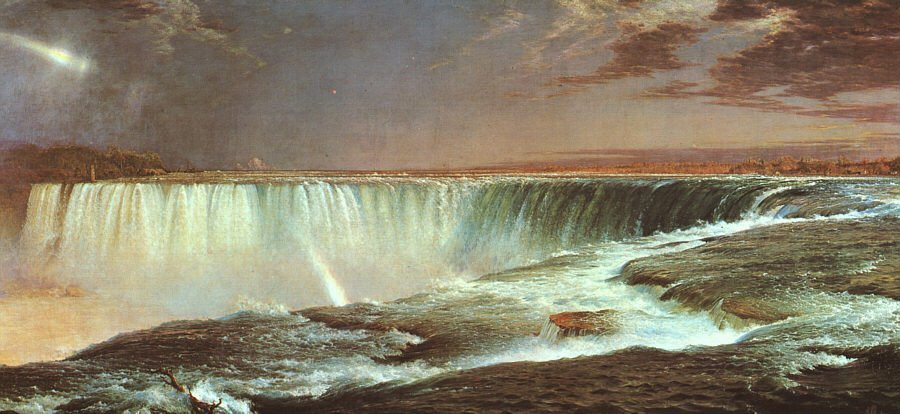
Niagara by Frederic Edwin Church

Niagara by Frederic Church (1857)

My Daily Art Display for today returns to a painting by an American artist and another member of the Hudson River School, which was a mid-19th century American art movement personified by a group of landscape painters whose artistic vision was influenced by the 18th century European Romanticism movement.   The paintings for which the group is named depict the Hudson River Valley and the area around the Catskill, Adirondack and the White Mountain ranges.  The artist is Frederic Edwin Church.

Frederic Church was born in Hartford Connecticut in 1826.  His father, Joseph, was a silversmith and watchmaker and through his success and that of his father who had owned a paper mill, the Church household lived a prosperous lifestyle.  Frederic studied art at school and through a family neighbour, Daniel Wadsworth, was fortunate enough to be introduced to Thomas Cole, the founder of the Hudson River School, who agreed to take Frederic on as his pupil.   Church thrived under Cole’s tutelage and within a year, he had some of his paintings shown in the National Academy of Design annual exhibition.  The following year, 1848, Church was elected as the youngest Associate of the National Academy of Design and was promoted to Academician the following year.  That year he sold his first major oil painting to the Hartford’s Wadsworth Atheneum, which had been founded by Wadsworth.

In 1848 he went to live in New York and began to teach art.  In his spare time in spring and autumn he would travel throughout New York and New England, particularly Vermont, all the time sketching the beautiful scenery whilst during the winter months he would return to New York City and his home and convert his numerous sketches into a number of landscape paintings, all of which sold well.   Church and a friend set forth on an adventurous trip through Central America and Ecuador. From this trip, Church’s first finished South American pictures, shown to great acclaim in 1855, transformed his career.   For the next decade he devoted a great part of his attention to those subjects, producing a celebrated series that became the basis of his ensuing international fame.   During a two year period, 1854 to 1856, he travelled extensively visiting Nova Scotia, and journeying throughout Maine, New Hampshire, and Vermont, and it was around this time that he visited the Niagara Falls.   The late 1850’s were the high point of Church’s career, artistic triumph followed artistic triumph.   In 1857 he made another trip to Ecuador and also took a voyage to Newfoundland and Labrador.  In 1860, Church bought some farmland at Hudson, New York, and married Isabel Carnes, whom he had met during the exhibition of his paintings.   He and his wife lead a settled and happy life and he spent most of his time tending to his farm but his happiness was shattered in 1865 when both his young children contracted diphtheria and died.  However, with the birth of Frederic junior in 1866, Church and his wife began a new family that was eventually to number four children.

At the end of 1867, Frederic Church and his family embarked on a long trip to Europe, North Africa, the Near East, and Greece that was to last eighteen months and was to lead to several important paintings. As Church got older he spent more and more time on his farm and farming.  From the 1870’s onwards Church suffered badly from rheumatoid arthritis and it badly affected his right arm which curtailed much of his art work although he did teach himself to paint with his left hand.  Frederic Church died in 1900, aged 74 and is buried in Spring Grove Cemetery in Hartford, Connecticut.

Today’s painting by Frederic Church entitled Niagara is one of four he painted of this waterfall.  This one was painted in 1857 and guaranteed for him, still a young man of thirty-one, the role of America’s most famous painter.   It is probably the most famous painting of it ever made.  During the 19th century, American artists flocked to the Falls to paint the various views of it.  The Falls were looked upon as the nation’s greatest natural wonder.   This picture was painted from the Canadian shore, a short distance above Table Rock, and includes the sweep of the Horseshoe Fall and the edge of Goat Island in a notable depiction of water and light. The time is towards evening.   We can see an amazing amount of detail in every stage of the water’s journey as it cascades downwards.  Look at how Church has incorporated an optical flourish of the rainbow against the falling waters.

The painting was introduced to the American public shortly after its completion, as a one-painting exhibition at the commercial gallery of Williams, Stevens, and Williams in New York City.   People flocked to see the work and were willing to pay 25 cents each to view the monumental canvas, which measured 109cms x 230cms and sometimes they would use opera glasses or other optical aids to augment the experience.   With their 25 cents admission fee the people would also receive a pamphlet that reprinted contemporary critics’ praise of Church’s picture and offered exhibition-goers the opportunity to purchase a print of the work.   Within a fortnight of the exhibition’s opening more than a hundred thousand people had paid to see it.  Art critics lavished praise on the work describing it as “the finest oil picture ever painted on this side of the Atlantic.”    After this success in New York the painting was taken to a number of American cities before it made two tours of Britain and was exhibited at the 1867 Exposition Universelle in Paris where it won a prize

The painting now hangs in the The Corcoran Gallery of Art in Washington DC

Fur Traders descending the Missouri by George Caleb Bingham

Fur Traders descending the Missouri by George Caleb Bingham (1845)

For My Daily Art Display today I cross the Atlantic and return to the nineteenth century in order to discover the art of George Caleb Bingham.  Bingham was born in 1811 in Augusta County Virginia.  He was the second of seven children to Mary and Henry Bingham and his early life should have been a life of plenty as his grandfather on his mother’s side passed on to his mother and father the family mill and a vast tract of land along with a number of slaves and servants.  However when Caleb was seven years old, an unwise decision to stand surety for a friend’s debt by his father lost the family everything.  It was time to move on and the family went West in search of their fortune.

The family settled in Missouri in the small town of Franklin in Howard County, a few miles north of the great Missouri River, and eventually Caleb’s father became a county judge.  Sadly, when Caleb was only twelve, his thirty-eight year old father contracted malaria and died.   The family moved to a farm just outside the town.  Caleb spent much of his leisure time down by the river and many of his paintings he did as an adult featured this magnificent waterway.   Caleb became an apprentice to a cabinet maker when he was sixteen years old and he was put to work painting signs.  A few years earlier Caleb Bingham had met Chester Harding the portrait painter who had passed through Howard County looking for work.  The artist had sparked an interest in art with Caleb, so much so that the teenager started to paint portraits of the local people which he sold for twenty dollars.

Bingham married Sarah Hutchinson in 1836 and the couple moved to the city St Louis where he was able to expand his artistic career and soon made a name for himself as a portrait painter.  He travelled to Philadelphia where he spent some time at the Pennsylvania Academy of Fine Arts before moving to Washington.   He returned back to his Missouri home in 1844 and started painting river scenes, one of which is my featured painting today.  As far as his paintings are concerned, it is reckoned that the period between 1845 and 1855 he produced his greatest works.    In 1848 his wife died and his mother moved in with him to look after his children.  She too died three years later.  In 1856 Caleb made a trip to Europe with his second wife Eliza Thomas.   He visited Paris and was able to fulfil one of his ambitions which was to study the works of the Great Masters at the Louvre.  They moved on to Germany where the family lived in an artists’ colony and he enrolled at the Dusseldorf School of painting where he studied historical painting.

Eventually he and his family returned to America and he continued his lucrative career as a portraitist.  He also fulfilled another of his ambitions; he entered politics and held positions in the state legislature of Missouri and later became president of the Kansas City Board of Police Commissioners and was appointed their first chief of police.  His second wife died in an asylum in 1876 and soon after he married for a third time.  He became the first Professor of Art at the University of Missouri but he died in 1879, early into this tenure.

The painting I am featuring today in My Daily Art Display is entitled Fur Traders descending the Missouri which he completed in 1845.    This was one of his genre paintings of everyday life on the Missouri River.  He loved to depict the river boatmen and fur traders whose livelihood was tied up with this vast waterway.  In some ways Bingham’s painting was out of date and it really was just his nostalic look back on the past as by 1845 when he completed this work, the world of the lone hunters and trappers bringing their pelts to trading posts by canoe was over, superseded by the big companies which shipped their commodities up and down the river by steamer and barge.  The painting was originally titled French Trader, Half Breed Son.  It was quite common in those days for fur traders to take up with Native American women.  However when first exhibited the American Art Union considered the title to be, what we would now term, “not politically correct” and so the Art Union renamed it, hence its present title.  In front of us we see an old French fur trader, wearing his liberty hat along with his son with their cargo, riding a dugout canoe along the shimmering Missouri River.  In the centre of the canoe is their cargo of furs atop of which is a dead duck which will provide supper for the duo.   In the prow of the craft is a tethered animal.  I say “animal” for to me it looks like a cat but doing some research into the painting I believe it is supposed to be a small bear cub!

The light in the painting adds a haunting quality to the work and this is where I give you another “-ism” to think about – Luminism and the American Luminists.    The term luminism came into being in the mid-twentieth century when art historians used the term to describe a 19th-century American painting style that arose as a derivative of the Hudson River School, examples of which I featured on Feb 4th and Feb 9th.  Luminism was a retrospective name given by art historians and was not a term used by the luminist artist themselves nor did they align themselves with the Hudson River School of painters. The landscapes of Luminists could be characterised by the use of clear and cool colours.  It was hard to detect brushstrokes in paintings done by the luminists.  These artists liked to paint very large works emphasising nature’s grand scale that emphasized tranquillity, reflective water and soft hazy skies.

Today’s featured painting was looked upon as Caleb Bingham’s most famous,  evoking an era in America’s early history.  There is no question that the painting today is a prime example of luminism.  I am amazed by the aura of serenity and stillness I detect in this painting.  The composition is well balanced.   There is no hint of any motion and yet we know the small craft is carrying its passengers downstream.  Caleb Bingham will have seen such sights many times over when he lived near the banks of the Missouri.  It was thanks to the paintings of the likes of Bingham that folk back in the East learnt about the pioneering push to the West as although cameras had been invented before the time of this painting, photographs were expensive to produce and so for the ordinary people works of art were their window to the West.