I don’t know about you, but for me, when I wake up and the sun is shining and the sky is a clear blue, I feel great. Life is good. I want to get out and do things. I have an urge to go into the garden and make things look good. On the other hand, when I get up and it is cold, pouring with rain and the sky is covered in black clouds I start to feel slightly depressed and extremely unmotivated. I know that anything I do will not be done with any degree of enjoyment simply because I am not in the right frame of mind. For that reason, and so as to clear my mind, I will often turn to a DVD and watch a film which helps me escape reality. Although I am not an artist I would imagine that if you are experiencing life at its worse for whatever reason it may be transmitted subconsciously into your work of art. It could be that your painting reflects your state of mind. All this leads me to the second painting I am featuring by the artist L S Lowry.
This painting was the first one I came across when I walked into the Lowry Gallery at Salford Quays, just outside of Manchester. I was so impressed by it that throughout my hour-long walk around the gallery I kept wanting to return to it and search for things that had escaped my attention during my initial viewing. It was painted by Lowry in 1937 at a very distressing period of his life. His father had died five years earlier and this had badly affected his elderly mother who just took to her bed and stayed there until she died in late 1938. Lowry’s never really bonded with his father and their relationship does not appear to have been a loving one. I get the feeling they exchanged pleasantries but there was never a warmth in their relationship. Lowry probably turned to his mother, whom he dearly loved, for comfort but sadly he never received the love and affection that a child should receive from his mother. She had always wanted daughters and was dissatisfied with her lot in life having been saddled with a son. She rarely praised Lowry for his artistic achievements and maybe if she had shown just a modicum of pride for her son’s artistic success then maybe Lowry would have led a much happier life.
Despite all this, she demanded that Lowry and only Lowry attended to her needs when she spent her last seven and half years bedridden. He would comb and brush her hair, bathe her and tend her bed sores. I don’t believe she even appreciated what her son did for her and this period in his life must have affected him both mentally and physically. He was a man under great stress.
So to look at this painting knowing what life was like for Lowry at the time may give you some idea why there is a somewhat depressing feel to the work. It is possible that his mental stress and depression percolated into the painting and in a way was the reason for its bleakness. We are looking at a view of the Irwell Valley. We see the smoke-polluted atmosphere of an industrial area. It is a very moody painting. It is a very depressing work of art. It is an environmental nightmare set against an industrial background. Look at the foreground with its fences and what look like blood-red coloured tombstones dotted around. The telegraph poles remind us of crucifixes. The water in the middle ground looks dirty and stagnant and we see an abandoned half-sunken boat to the left. On the left shore we see men queuing for work at a time when jobs were few and far between. On the far side of the lake we see Agecroft Colliery which had been opened in 1844 but had to close in 1932 with a great loss of jobs. It was re-opened in the late 1940’s due to the country’s lack of coal supplies. As our eyes scan the picture we are drawn to the red mill on the skyline. Look how Lowry has intertwined churches and the town hall with the mill chimneys, which spew out black polluting smoke, and the winding tower of the colliery, which sits by its slag heap. It is an interesting juxtaposition of industrial architecture and residential buildings.
It is a very dark and “dirty” picture and after looking at it for a while I feel I need to go and wash my hands to cleanse myself of the grime which emanates from the painting. The more I look at the painting, the more I am sure that there was transference of the artist’s state of mind into what he offered us in his painting.
The other day I went over to Manchester and visited the Lowry Gallery at Salford Quays. The Gallery was named after Laurence Stephen Lowry, best known simply as L.S.Lowry. He was the Lancashire artist, who had a very distinctive type of art, often depicting people and places around his home town. The small stick-like characters which were seen in the crowd scenes of his paintings were his trademark and were often described as matchstalk people.
The Matchstalk people of a Lowry painting
The term matchstalk men and matchstalk cats and dogs was further immortalised with the No. 1 hit song produced in late 1977 entitled Matchstalk men and Matchstalk cats and dogs. The lyrics of the song, telling the story of the artist Lowry, was performed by a duo, who went by the name of Brian and Michael.
The poignant lyrics summed up Lowry’s art:
He painted Salford’s smokey tops
On cardboard boxes from the shops
And parts of Ancoats where I used to play
I’m sure he once walked down our street
Cause he painted kids who had nowt on their feet
The clothes we wore had all seen better days.
Now they said his works of art were dull
No room, all round the walls are full
But Lowry didn’t care much anyway
They said he just paints cats and dogs
And matchstalk men in boots and clogs
And Lowry said that’s just the way they’ll stay
And he painted matchstalk men and matchstalk cats and dogs
He painted kids on the corner of the street with the sparking clogs
Now he takes his brush and he waits outside them factory gates
To paint his matchstalk men and matchstalk cats and dogs.
The Matchstalk people of a Lowry painting
Although I went to the Gallery expecting to see just a series of similar looking crowd scene paintings filled with strange looking, stick-like people, I was very pleased to see the exhibition showed far more than I was expecting. Besides Lowry’s trade-mark paintings, there were a number of completely different works of art by Lowry, which I found amazing and two of which I will feature today and tomorrow.
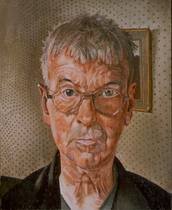
The painting by Lowry which is My Daily Art Display painting of the day is entitled Head of a Man with Red Eyes, which he completed in 1938. The 1930’s had been a period of his life which was very traumatic. Lowry was an only child and was never to marry. He lived with his mother and father, with his mother being, by far, the more dominant parent. His mother had always wanted daughters and her son disappointed her and to make things worse her sister had given birth to three girls. Lowry’s mother was very envious of her sister Mary and once commented that it was unfair that whilst Mary had three splendid daughters all she had was one clumsy boy.
In 1932 his father, aged 74, died of pneumonia. Lowry’s relationship with his father had been somewhat cold and strained and although he called his father “Dad” there was a distinct lack of father-son rapport. The death of his father did not bring out any palpable signs of overwhelming grief. His main concern at the time was how the death of her husband would affect his mother. The affect it had on his 73 year-old mother was terrible as she all but gave up on life and retired to bed where she remained for seven and a half years until her death. Her demands on her son and his time were great and constant and for that lengthy period Lowry had to care for his mother, who would not agree to any outside help.
Not only did Lowry now have to be at his mother’s beck and call he discovered to his horror that his late father had run up a mass of debts. The discovery of the alarming state of his father’s financial situation was only discovered when the creditors came knocking at the door. It took Lowry a year to settle the outstanding debts. Lowry’s health began to fail due to being over-tired with looking after his mother and at one point he had to go away for a few days on doctor’s orders.
Today’s painting probably was in some way a product of his physical and mental state. He had suffered badly because of his all controlling mother who rarely showed him any love or affection and this painting was completed the year before she died. It is the morning- mirror reflection of the face of a man staring out at us. It looks like he has slept little during the night. The healthy vigour is missing, drained completely away, leaving just strain and tension. The physical discomfort we see in this face is the look of utter despair. The gaze is both unsettling and intense. Of this painting Lowry said:
“…I was simply letting off steam. I started a big self-portrait and then I thought ‘What’s the use of it. I don’t want it and nobody will’. I turned it into a grotesque head, I’m glad I did, I like it better than a self-portrait….”
Boy in a Yellow Jacket by L S Lowry (1935)
Lowry in the 1950’s commented again about his work and his equally disturbing 1935 painting Boy in a Yellow Jacket and came to the conclusion that it was painted during a harrowing period in his life. He said of the period:
“…I think I reflected myself in those pictures. That was the most difficult period of my life. It was alright when he [his father] was alive, but after that it was very difficult because she was very exacting. I was tied to my mother. She was bedfast. In 1932 to 1939 I was just letting off steam…”
The painting was bought by a Manchester man who only kept it for three weeks saying that he couldn’t live with such a disturbing picture.
Would you like to have it on your bedroom wall to see when you wake up? Maybe a man should have it next to his bathroom mirror so that he can compare likenesses when he finally gets out of bed and thus be appreciative of his looks and be appreciative of what he has and realise that life could change for the worse !
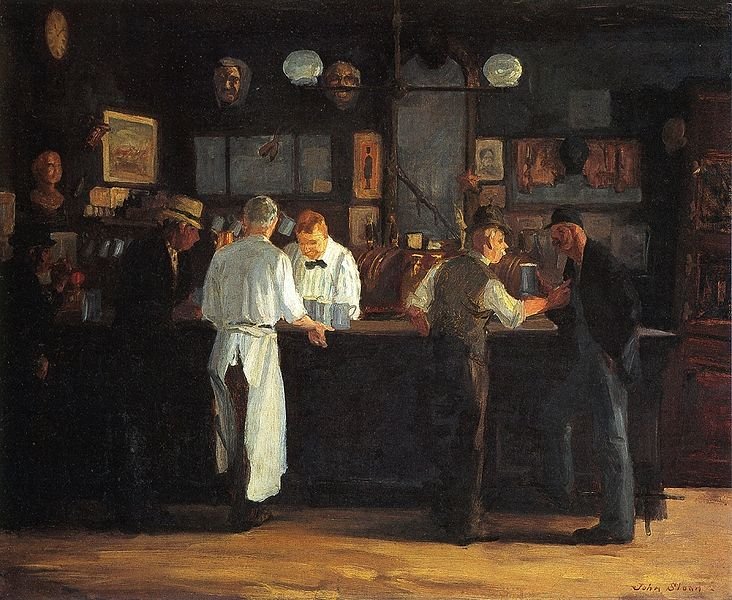
I have looked at many paintings which have featured inns and taverns but they have been mainly been depictions of rural scenes with peasants in the Netherlands and Flanders and were painted by the Dutch and Flemish painters centuries ago. Today, for a change, I am looking at a genre painting of a tavern scene but this is not really a tavern, more what we British would call a pub or Americans would term a bar or a saloon. The title of the painting is McSorley’s Bar and was painted by the American artist John French Sloan. Sloan was originally a member of a group of artists who had the strange collective name of The Eight and later he became a leading figure in the Ashcan School of realist artists. I have featured works by these artists in earlier blogs and if you enter either Ashcan School or Robert Henri or George Bellows into the “Search” function at the right of this blog it will give you a little bit of history about these artist groups.
John French Sloan was born in New York in 1871. His father James had had an interest in art, but as only as a hobby but he did encourage his children to draw and paint during their early years. Sloan’s father struggled to find gainful employment moving from one job to another without ever making a fortune. He married, Henrietta, a girl who had come from a much more financially prosperous family and who was a teacher. James Sloan suffered a mental breakdown when John was seventeen years of age and consequently was unable to work and the burden of supporting the family fell on to the shoulders of the seventeen year old John. For this reason, John Sloan had to leave school and find a job in order to bring in some money for the family.
Sloan was employed in a local bookstore as an assistant cashier. The job was not very taxing and the young man had time to read the books that were on sale at the emporium and also spend time studying the artistic prints that it also held. It was during this time that Sloan started to make pen and ink copies of some of the prints and the store owner liked them so much that he allowed Sloan to put them up for sale in the store. Two years later in 1890 Sloan moved on to work in a stationery store where he used to design calendars and greeting cards. Sloan had now found the joy of art and enrolled in an evening art class. Buoyed by his artistic successes he left the stationers and set himself up as a commercial artist but his well-intentioned venture failed and he took a job as an illustrator at the local newspaper offices of The Philadelphia Enquirer, later he would work for the rival newspaper, The Philadelphia Press. He continued his artistic tuition in the evenings by enrolling at the Pennsylvania Academy of Fine Arts. It was here he met and became friends with fellow artists such as William Glackens and Robert Henri who became Sloan’s mentor, sending him reproductions of works by the French Impressionists and the leading European Renaissance painters, for him to copy.
When Sloan was twenty-seven he was introduced to a young woman with a somewhat chequered history, Anna Maria Wall, known affectionately as Dolly. Sloan, who was very naive, very self-conscious and lacked the social graces which would gain him female companionship, met Anna at a brothel. Although she worked in a department store during the day, she supplemented her meagre income by working in a brothel at night. She needed the extra money to feed her other vice; she was also an alcoholic but despite all this he fell in love with her and they started, what one can imagine, was a “challenging” relationship.
Their relationship did prove difficult as Anna not only suffered the effects of excessive and prolonged alcohol intake, she suffered from alcohol-related mental problems and insecurity often believing Sloan was about to leave her. In 1906 Sloan sought medical advice and was advised that he needed to constantly support Anna and show how much he needed her. Between them they devised a plan by which Sloan would keep a dairy and in it he would write down each day how much he loved Anna and wanted to be with her and then leave the diary somewhere where she was bound to find it and surreptitiously read his journal entries and by doing so put her mind at rest. He wrote daily entries for seven years until 1913. Despite these problems, Sloan’s artistic work continued well and he was producing numerous oil paintings. In 1904 he moved to New York and went to live in Greenwich Village and although relying on money he received from his freelance work for The Philadelphia Press newspaper, he supplemented that with money he earned for his book and magazine illustrations. It was whilst living in New York, in 1912, that he painted today’s featured work McSorley’s Bar. He exhibited it at the 1913 Armory Show, an exhibition of modern art which had been organised by the Association of American Painters and Sculptors. This turned out to be a landmark exhibition which opened the eyes of the New Yorkers to this new modern art and the likes of cubism, who up till then had been accustomed to realistic art. Sloan’s painting never sold and in fact remained unsold until 1932 when the Detroit Institute of Arts purchased it. This was the first painting by Sloan to be part of a museum collection and was probably one of his best.
This painting was very typical of works by John Sloan in which he liked to depict the energy and life during the early years of the twentieth century of New York City and its inhabitants. Sloan was a socialist and a member of the Socialist Party and had great empathy with the less well-off and their demanding and troubled existences. His paintings would show the city’s people in different places and situations on the city streets and occasionally, like today’s painting, he would depict people in interior settings, such as cafés or bars as they discussed among themselves their everyday existence.
The painting today shows the interior of McSorley’s Bar with its clientele standing at the bar. John Mc Sorley opened his Manhatten establishment on East Seventh Street in 1854 and during its existence in the nineteenth century, was an all-male bar. From around 1912 it became a regular haunt of John Sloan and his Ashcan School artists. The bar Sloan depicted was somewhat rough and inhospitable. It was always frequented by a great mix of people of various social classes and even today carpenters and mechanics rub shoulders with Wall Street brokers and local politicians. John Sloan completed five paintings of the interior of the bar between 1912 and 1930 and these certainly increased the popularity of the establishment. Today, McSorley’s bar draws visitors from around the world. Its fame as New York’s oldest bar assures its survival and a 1970 court order guarantees that women are as welcome as men! It’s a museum-like place. One can go there to drink a pint of ale and survey relics of a past era.
In 1943, Sloan’s wife, Dolly, died of coronary heart disease. The next year, Sloan married Helen Farr, who is responsible for most of the preservation of his works. Part of this was the diary he wrote between 1907 and 1913 for his first wife, Dolly, to read and which were lovingly collated and published in 1965. They gave a marvellous insight into Sloan’s life and his thoughts during those turbulent times.
On September 7, 1951 John Sloan died at the age of 80, of cancer in Hanover, New Hampshire. John French Sloan was a leading figure in the Ashcan School of realist painters and was somebody who embraced the principles of socialism and allowed his artistic genius to be used to benefit those fervently upheld values. His paintings sadly rarely sold during his lifetime and teaching at the Art Students’ League, of which he became its director in 1931, was his principal income.
To learn more about McSorley’s Bar why not go to their website:
Today I am returning to the Impressionists. For most people, if they were asked to reel off the names of Impressionist artists, the likes of Monet, Cezanne, Degas, Renior and Pissarro would easily trip off the tongue. With a little more contemplation the names of Sisley and Caillebotte may come to mind. Of course looking at the list they have, besides Impressionists, one thing in common – they are all men. However the Impressionist painters were not all men. They had three talented female artists amongst their ranks and this triumvirate was called le trios grandes dames by the French art critic and historian, Gustave Geffroy, in his book Histoire de l’Impresssionnisme, La Vie artistique.
There was Marie Bracqemond who exhibited at three of the eight great annual Impressionist exhibitions in Paris. There was the American-born Mary Cassatt who spent most of her adult life in Paris and exhibited at four of the Impressionist exhibitions, which were held in Paris between 1874 and 1886. Then finally there was Berthe Morisot, who is my featured artist of the day, and who exhibited her work at all except one of the eight Exhibitions and that was because she was giving birth to her daughter. She was not just a token female of the art group; she was one of the great organisers and a leading light of the Impressionist group. Morisot and Cassatt are also thought of as the most important female painters of the nineteenth century. The art world up to this time was dominated by male artists and even now there is a patronising attitude to 19th century female artists that they were “followers” of their contemporary male painters instead of giving them the credit they deserve. Even today when Impressionist works by Morisot and Cassatt are not looked upon and judged on their own merit but are instead compared to the works of their mail contemporaries, such as Degas and Manet. Female artists in those days were also hamstrung by convention in which they were not supposed to draw or paint nudes. The role of women in those days was simple – look after their men folk and have their babies and if the woman wanted to draw or paint then this was looked on as a mere hobby and not a career option. However along came Berthe Morisot, a very independent person and a free spirit, whose desire to become an artist was supported by her family. She also had another thing going for her – she was an extremely beautiful woman.
Berthe Marie Pauline Morisot was born in 1841 in Bourges in central France. Her family were very successful and wealthy. Her father Edme Tiburce Morisot had studied art at the Ecole de Beaux- Arts, but eventually gave up the idea of becoming a full-time painter and instead became a prominent government official. He married his sixteen year-old bride Marie Cornelie Thomas in 1835 and they had four children. Berthe was the youngest of three sisters, the other two being Marie Edma Caroline and Marie Elizabeth Yves and she had a younger brother Tiburce.
She and her sisters Edma and Yves set their hearts on being painters and their family were very supportive. It was an artistic family with Berthe’s grandfather, Jean-Honoré Fragonard being one of the greatest Rococo painters of his time. Their parents arranged art lessons for them but soon Yves lost interest in art and dropped out of the lessons. In 1857 Berthe and her sister Edma studied drawing under Geoffery-Alphonse Chocrane. A year later they studied under the tutelage of Joseph-Benoît Guichard and he would take them to the Louvre where they copied the paintings of the Masters and that year they were registered with the museum as copyists. It was around about 1861 that the two sisters, whilst working in the Louvre, met another young painter, Edouard Manet and this was to prove to be the start of a very long friendship. From 1862 to 1868 Morisot studied art under the guidance of the French landscape and figure painter Camille Corot who taught her the finer arts of landscape painting and the en plein air method of painting. It was during this time that she became friends with an Impressionist painter Henri Fantin-Latour, whose speciality was still life paintings incorporating flowers.
The two Manet brothers, Edouard and Eugène and the two Morisot sisters, Berthe and Edma became very close friends and it was through Berthe Morisot that Edouard Manet was introduced to the other Impressionist painters. It is also believed that it was through Morisot that Manet embarked on the en plein air method of painting. Edouard Manet used Morisot as a model on a number of occasions and the portrait of Berthe Morisot we see the most is one done by Manet, entitled Berthe Morisot with a Bouquet of Violets. Berthe Morisot was not just a talented artist, she was also extremely beautiful. She and Manet were leading lights of the Impressionist Movement and it was she and Camille Pissarro who were the most consistent exhibitors at the eight Impressionist Exhibitions. In 1874 and Manet became her brother-in-law when Berthe married Eugène Manet. Four years later she gave birth to a daughter, Julie.
Édouard Manet is seen as the most important single influence on the development of her artistic style. Over time the Master/Pupil status of Manet and Morisot changed to the point when they were looked upon as equals and Morisot developed her own style. Morisot was by this time becoming a successful artist and had her first works; two landscape paintings, exhibited at the Paris Salon in 1864 at the age of twenty-three. She continued to exhibit her works there for the next ten years.
Morisot’s paintings focused on everyday life and often reflected the cultural restrictions experienced by females in the nineteenth century. Her works of art, like today’s painting, often concentrated on simple domestic scenes and in her works she would utilise family friends or relatives as models. Her works were set in many different locations such as in the garden, besides the river but there was a constant theme, that of the joys of family life. She battled against the two prejudices which were levelled against her art – her gender and her wealth. Being a female, social convention would not allow her to paint nudes or men and thus she had to concentrate on landscapes and paintings of women and children. Coming from a wealthy family and having financial stability left her open to the charge that she was merely a dilettante whose art was just a hobby.
Eugène Manet, her husband, died in 1892 and three years later Berthe Morisot died of pneumonia in 1854. at the age of 54 and was buried in the Cimetière de Passy, Paris.
The painting today, Le Bercau (The Cradle) was painted by Berthe Morisot in 1872. In the picture we see a mother looking at a baby who lies asleep in a crib. Morisot’s sister Edma was the model for the woman and the baby asleep in the crib was Edma’s daughter Blanche. This painting was the first of her many works which featured motherhood and the everyday life of contemporary women, which was her most favourite subject for her works of art.
There are some interesting things about how mother and child are depicted by Morisot. Look how the left hand of the mother mirrors the left hand of the baby in the way that it touches her face. There is a diagonal line in the painting running from the baby’s arm through to the mother’s arm almost like an attachment between mother and child. The diagonal continues with the way the artist has added a fold in the wispy curtain in the background. There is a great sense of intimacy between mother and child as she looks down lovingly at the infant having carefully drawn back the net curtain to get a better view of her beautiful child. We, on the other hand, are just allowed to see the baby through the mesh of the curtain. The painting reflects the love between mother and child. She is positioned by the crib to be able to comfort the baby if she should wake. This is an extremely moving painting. Its depiction of the look of endearment on the mother’s face and the peaceful look on the baby’s sleeping face is superb. It is very touching but I believe the painting as a whole avoids over-romanticizing the subject or making it mawkish.
The painting was exhibited at the first Impressionist Exhibition at Félix Nadar’s photographic studio at Boulevard des Capucines in 1874 and she was the first woman to exhibit with the group. This has always been looked upon as one of Morisot’s finest paintings. The painting remained in the Morisot family until 1930 when it was sold to the Louvre where it remained until it was transferred to the Musée d’Orsay, where it hangs today.
I will finish with the words of her brother-in-law, the artist Manet, who said of Morisot:
“…This woman’s work is exceptional. Too bad she’s not a man….”
One final bit of trivia – on her death certificate under the heading “Profession” the entry simply stated “No Profession”. Why ? Simply because she was a woman !
I can sum up My Daily Art Display’s featured painting today in one word – disturbing. I have featured many paintings in the past which could be described as erotic, maybe even pornographic. I have described some paintings as being very violent and bloodthirsty but what is disturbing about this painting is the combination of both these elements in one work of art. The painting is entitled The Nightmare and the artist who painted the work was Henry Fuseli.
Henri Fuseli was born Johann Heinrich Fussli in Zurich in 1741. Although Swiss born, he spent almost fifty years living in England. He came from a very large family, the second child of eighteen! His father, Johann Caspar Fussli was a portrait and landscape artist as well as an author. His father encouraged some of Henry’s siblings to become artists but for Henry he wanted him to study theology and enter the church. Henry followed that chosen path and went to Caroline College in Zurich where he received a first-class classical education. Eventually he took orders and at the age of twenty was ordained a Zwinglian clergyman. The following year Henry Fuseli, angered by the corruption of a local politician, Felix Grebel, produced a pamphlet condemning him. This angered the politician and his powerful family vowed retribution and in consequence Henry had to hurriedly leave the city and take refuge in Germany.
Fussli was an accomplished linguist and after spending some time in Berlin, he moved to London where he was employed as a translator, translating French, German and Italian books into English. He spent a lot of his leisure time sketching and writing but had little success in getting any of his writings published. Whilst in London he got to know the artist Sir Joshua Reynolds and on showing the English artists some of his sketches was encouraged to devote more of his time on his art and so in 1768 Henry Fussli decided to become an artist. In 1770, at the age of twenty nine, Fussli went along the well-trodden path taken by artists and would-be artists – an artistic pilgrimage to Italy and he remained in that country for eight years. Fuseli was a self-taught artist and whilst in Italy copied many of the works of the Renaissance Masters and spent much time in the Sistine Chapel copying the frescoes of Michelangelo. During his eight year sojourn In Italy he also changed his surname to the more Italian-sounding Fuseli. In 1779 he returned to Zurich.
If we wind the clock back to the time when he was studying theology in Zurich we know that the young Fuseli came across a man who was to become his lifelong friend – Felix Lavater. It is the meeting of these two, twenty years earlier which has, in a roundabout way, a connection with today’s painting for through his friendship with Lavater, he met Lavater’s niece Anna Landolt. Fuseli was besotted with the young woman and had fallen passionately in love with her. In Maryanne Wards book, A Painting of the Unspeakable: Henri Fuseli’s The Nightmare she quotes a passage of a letter written by Fuseli to his friend Lavater about an erotic dream he had about Anna:
“…Last night I had her in bed with me—tossed my bedclothes hugger-mugger—wound my hot and tight-clasped hands about her—fused her body and soul together with my own—poured into her my spirit, breath and strength. Anyone who touches her now commits adultery and incest! She is mine, and I am hers. And have her I will….”
However, sadly for Fuseli, it was a one-sided love affair and it came to nought but this failed romance played on his mind and art historians believe that today’s featured painting was all about his passionate affair with and the erotic dreams he had about Anna Landolt.
In the painting we see a woman, lying on her back on a bed. See how Fuseli has contrasted the very bright colour of the woman herself and her nightdress with the dark red, yellows and ochres of the background. Her position has been described as “lying in a sexually receptive position”. She looks almost comatose with her right hand placed behind the back of her head which is hanging down exposing her long pale neck. Her left arm also dangles over the side of the bed. Sitting atop of her abdomen with its feet positioned over her heart is an incubus. The creature looks out at us. An incubus is a male demon which lies upon sleepers, especially women, in order to have intercourse with them. It has been suggested that the sleeping woman in this painting is Anna Landolt and Fuseli himself is the incubus. Strangely enough, on the rear of the painting is an unfinished sketch of a girl which is thought to be Anna and that in some way supports the conclusion that Anna is the woman in Fuseli’s picture. In the left background we see a horse’s head with leering phosphorescent eyes push its way through the parting of the dark red velvet curtains. In some quarters this depiction is considered to be the sexual act itself.
Fuseli did not comment on his painting and never gave any indication as to the symbolism, if any, that could be derived from the work. So why did he choose such a subject? Many believe it is all down to his jealous passion and unfulfilled longing for the woman he wanted but could not possess. Fuseli painted other versions of The Nightmare following the success of the first. The painting was first exhibited at the Royal Academy in 1782 and created quite a stir. Critics of the time were shocked by the unconcealed sexuality of the painting
So what happened to Henri Fuseli after this? Fuseli eventually found his “true love”, Sophia Rawlins and married her in 1788. She posed for him in many of his later paintings which were often a mixture of the macabre and the erotic. Two years later he was appointed professor of painting at the Royal Academy and in 1804 was appointed the Keeper of the Academy. This very prestigious appointment gave him the responsibility for the Royal Academy Schools which are located at the Royal Academy. Whilst in this position he oversaw the artistic tuition of such well known artists as Landseer, Turner, William Etty and John Constable. Fuseli was well respected as a teacher despite his eccentric ways. He died in 1825, aged 81 and was buried in St Paul’s Cathedral close to Sir Joshua Reynolds, the man who set Fuseli on his artistic journey.
Fuseli was fascinated with the darker side of human nature and this is probably the reason that many of his works focus on suppressed violence, fears people have which are illogical and often foolish and sexual perversity. There is something very disturbing about this painting and I would love to know what had been going through the artist’s mind when he started to paint this scene we see before us today.
The painting is currently at the Detroit Institute of Arts.
Today, My Daily Art Display looks at a painting by a French Impressionist painter who, to me, is synonymous with paintings and sculptures of young ballet dancers. His name is Edgar Degas who was actually born Hilaire-Germain Edgar De Gas in 1834. He was in the forefront of the Impressionism movement although he preferred to be labelled as a realist painter. He worked on today’s featured painting between 1858 and 1867. It is entitled Family Portrait or The Bellelli Portrait and is a masterpiece of Degas’ youth. It is a deeply insightful family portrait, in which we observe four people, two adults and two children who are the family Bellelli.
Degas had a traditional École des Beaux-arts education in Paris and in 1856 travelled to Italy to continue his studies and the following year visited his grandfather, Hilaire Degas, in Naples. He also spent time in Rome where he set about copying the work of the Renaissance Masters. In 1858 he received an invitation from his aunt, Laura Bellelli, née De Gas, to visit her and her family in Florence and at the same time to take the opportunity to study the paintings in the city’s prestigious gallery, the Uffizi. He jumped at the chance and so went to stay with the family. The head of the household was Laura’s husband, Gennaro, who had been a political journalist as well as a fervent supporter and good friend of Camillo Benso, Count of Cavour, a leading figure in the movement towards Italian Unification. When in 1854 the revolution against the Austrians failed, Gennaro was forced to flee from Italy to escape persecution by the Austrians over his participation in the failed uprising. He first went and lived in exile in Paris but later returned to Florence.
Degas did not get on well with Gennaro and only remained at their rented house until the arrival of his cousins who had remained in Naples following the death of Degas’ grandfather, Hilaire. Degas’ could sense the tension between Gennaro and his aunt Laura who once she confided in Degas about her relationship with her husband and her uncertain future saying:
“…my husband is “immensely disagreeable and dishonest… Living with Gennaro, whose detestable nature you know and who has no serious occupation, shall soon lead me to the grave….”
Part of the problem was that this exile in Florence separated her from her family back in Naples and to make matters worse, Laura was once again pregnant. It is thought that the constant tension between her and her husband led to the death of the child in infancy and this tragic loss only added to the bitterness between husband and wife. It was with this lack of domestic happiness in mind that Degas started this family portrait.
Before us we see the four members of the Bellelli family, Gennaro, his wife Laura, the sister of Degas’ father, and their daughters Giulia and Giovanna. It is known that Degas made many sketches of the family before returning to Paris to work on the painting.
We see Laura dressed in mourning for the recent death of her father, and Degas’ grandfather, Hilaire, and in the background we can see a framed portrait of him. Looking closely at how Degas has depicted his aunt. We see a very dignified woman with a very stern countenance. She stands upright as if posing for an official picture. She coldly averts her gaze away from her husband. Her right hand rests protectively on the shoulder of her elder and favourite daughter, Giovanna. Degas’ two young cousins are depicted with their mother, and are also dressed in mourning, in their black dresses and white pinafores. Giulia half sits on a small chair at the centre of the painting, arms akimbo, as she looks towards her father and in some ways forms a link between the two estranged adults. Degas was very taken with his cousins describing them:
“….The elder one was in fact a little beauty. The younger one, on the other hand, was smart as can be and kind as an angel. I am painting them in mourning dress and small white aprons, which suit them very well…I would like to express a certain natural grace together with a nobility that I don’t know how to define….”
Note how Degas has positioned the husband and wife far apart in the painting, which was probably an acknowledgement of the tension between the couple and how the two had drifted apart. There is no feeling of togetherness about the family. The father sits in an armchair at his desk next to the fireplace, where he had been reading or writing a letter. He has his back to us but his head is turned towards his daughter. He appears unmoved and uncaring, showing little interest in what is going on around him. His body is framed by a mantelpiece on which we see an ornate clock, some plates and a candlestick. Over the mantelpiece there hangs a large mirror and in the mirror we see reflections of the room which in some way open up the space and fills it with more light. We see reflections in the mirror of a curtained window, a chandelier and a framed painting.
It is interesting to look at how Degas has seemed to separate the husband from the rest of the family by a vertical separation formed by the leg of the table, the candlestick and the vertical side of the fireplace and mirror. Just behind his chair, on the floor, we catch a glimpse of the family’s pet dog. The drawing which we can see hanging on the wall behind Laura is a portrait of the recently deceased Hilaire Degas, which his grandson had drawn. It is more than likely that Degas positioned this small picture where he did so as to give a sense of connection between the various generations of the Degas family.
Laura must have been appalled that Degas had to stay in a household, which exuded such unhappiness. It is believed that Laura married Gennaro in desperation because her father had not been satisfied with any of her previous suitors and she was still unmarried at the “ripe old age” of 28. She was extremely unhappy in her marriage and once shared her misgivings with Degas. According to the American biographer and art historian, Theodore Reff, who wrote about a letter from Laura to her nephew, in his book , Degas: The Artist’s Mind . In the letter she wrote:
“…You must be very happy to be with your family again, instead of being in the presence of a sad face like mine and a disagreeable one like my husband’s…”
It is thought that this family portrait was not to be a gift to the family but a work of art which he wanted to exhibit at the Paris Salon. Whether he ever did that is uncertain but many believe he put it forward for exhibition at the Salon in 1867. Degas kept hold of the painting until 1913 when he gave it to his art dealer, Paul Durand-Ruel, for him to sell. In 1918 it was sold to the Musée du Luxembourg, Paris and later the painting was moved to the newly opened Musée d’Orsay where it can now be found.
One should remember that this is not a photograph in which one can detect the mood of the sitters. This is a painting by an artist who has the ability to paint the demeanour of his sitters in whatever way he chooses. So this painting is how Degas views the family life of the Bellelli family. How close it is to realism is known only by Degas and the Bellelli family. So it is up to you to decide whether Laura was a stern and disillusioned matriarch and whether Gennaro was the disinterested and curmudgeonly.
Lady and Gentleman on Horseback by Aelbert Cuyp (c.1655)
Over time I suppose one gets to like different artists and different paintings and one’s favourites constantly change. For me however, I have always loved the work of Aelbert Cuyp and along with Pieter Bruegel the Elder, I would have him constantly in my top five favourite artists. I love his landscapes (see March 12th) and his riverscapes (see Feb 8th) but for My Daily Art Display today I have chosen one of his portraits, entitled Lady and Gentleman on Horseback which he painted around 1655.
Aelbert Jacobsz Cuyp was born in Dordrecht in 1620. His father was Jacob Gerritsz Cuyp, a successful portrait painter in the city and his mother was Aertken Cornelisdr van Cooten. Aelbert was unquestionably raised up in an artistic environment with his grandfather Gerrit Cuyp being an eminent glass painter and his uncle’s step brother Benjamin Gerritsz Cuyp was a well known painter of religious, peasants and tavern scenes. It was his father who gave Aelbert his earliest artistic tuition. Although Dordrecht was not known for being an important artistic centre, it was a wealthy city and proud of being the oldest city and principal city of Holland and of great mercantile importance. Aelbert used to assist his father in his studio by supplying landscape backgrounds for portrait commissions. It is uncertain whether Cuyp had ever been an apprentice of a landscape painter, but he soon abandoned his father’s style and subject matter and turned almost exclusively to landscapes and riverscapes. He would only occasionally paint portraits in his mature period.
Aelbert, despite branching off on his own as a painter, continued to assist his father right up to the time of his father’s death in 1652. It is thought that the landscape works of Jan van Goyen, which were known to Cuyp, may have been instrumental in his artistic style as were the works of the Utrecht painter Jan Both. Cuyp also followed the example of Jan van Goyen in the way he travelled throughout Holland sketching and gaining inspiration for future works.
In 1658, aged thirty eight, he married Cornelia Bosman, a wealthy widow of Johan van de Corput, a naval officer and member of an important Dordrecht family. Cornelia had three children from her previous marriage. Following his marriage, Cuyp appears to have painted less frequently, and stopped painting altogether years before his death due to his civic and religious responsibilities he had assumed after his marriage. He was very wealthy and there were no financial pressures on him to produce paintings for sale. He was listed in the register of the dead on 7 November 1691, and buried in the Augustinian Church at Dordrecht.
Today’s work of art, Lady and Gentleman on Horseback, highlights the popularity of the Dutch patrician pastime of hunting in the second half of the seventeenth century and many similar paintings exist. This is a large oil on canvas work measuring 123cms x 172cms and depicts a man and a woman, probably husband and wife, on horseback setting off for the hunt. There have been many names put forward as to the identity of the sitters, the most popular being that the man is Adriaen Stevensz Snouck and the lady his wife, Erkenraad Berk. The lady’s father, Matthijs, was an important patron of Aelbert Cuyp, which may account for the prominence in the painting of his daughter in her gorgeous blue dress, who we see sitting resplendently on the back of a white horse with its brilliant red and gold saddlecloth. The couple had just married and it could well be that Cuyp was commissioned to paint this to commemorate the happy event.
The landscape in the background is filled with light, typical of the popular Italianate style of the time. We see a building in the background which is more than likely a fanciful evocation of an ancient fortified chateau which Cuyp may have seen on his travels. The two hunters have their dogs with them. There are two types of dog on this hunt, the turfters which were used to track and follow the scent of deer and greyhounds, which we see in the middle-ground of the painting, being controlled by an attendant and which run after the deer and bring them to bay.
X-Ray Image of painting
When this painting was x-rayed there were some interesting differences to the finished article. The man originally wore a hat and his hair was much shorter and was seen lying on his shoulders. His attire was different. He had originally been painted in a military tunic and cape which were adorned with braids and buttons that in all likelihood were golden in colour. It was also thought that the overall colour of the man’s clothing was a brilliant red rather than drab brown we see in today’s painting. If we look at the woman we see that originally she wore a hat which was of a different shape to the one she is wearing now and originally the hat had feathers at the back of it. Her dress was more loosely fitting and cascaded down the right flank of her horse. Such changes to the painting must mean that the patrons were dissatisfied with the original composition and the fact that there was more going on in the original painting probably was viewed as being too distracting from the formal character of the double portrait and thus had to be revised.
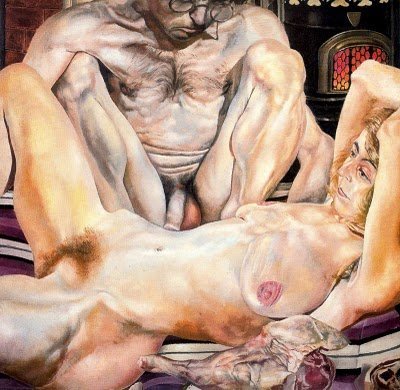
A few days ago I watched a television programme which looked at twentieth century British artists and My Daily Art Display today looks at one of the paintings which the programme highlighted. It was a work of art by Sir Stanley Spencer, completed in 1937 and is entitled the Double Nude Portrait, sometimes known as Leg of Mutton Nude, for reasons we will look at later. I like this painting for its honesty but also because of the story behind it. It is a story of three people: Spencer and his two wives. In a way, it is a story about love, infatuation, lust and how bad decisions can change lives.
Stanley Spencer
Stanley Spencer was born in 1891 in Cookham, Berkshire, a small village on the River Thames, situated west of London. Spencer loved Cookham and was to spend most of his life living in this idyllic spot. He started his art studies at the age of seventeen when he attended the Slade School of Art, which was part of the University College, London, and where he remained for four years. The First World War intervened and Spencer joined the Royal Army Medical Corps in 1915 and from there he transferred to the Berkshire Regiment the following year. He witnessed the savage conflict in Macedonia but he physically survived the war although mentally scarred by the horrors he encountered whilst in active service. Sadly, when he returned to Cookham after the war he learnt that his brother Sydney had been killed in the war three months earlier.
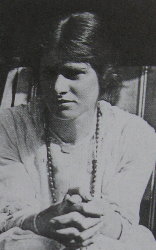
Hilda Carline
Whilst Stanley Spencer attended the Slade School of art he became friendly with a fellow student, Sydney Carline who was one of three children of the British painter and illustrator George Carline. Sydney had two younger artistic siblings, a brother, Richard and a sister Hilda. Although George Carline actively encouraged his two sons to become artists he never encouraged his daughter to follow the same path and she idled her time at home in Oxford. Eventually when she was twenty-four her father arranged for her to go to a London art school in Hampstead, which was run by Percyval Tudor-Hart. Such was her artistic progress that five years later, in 1918, aged twenty-nine, she also was admitted to the Slade School of Art. It was around this time that Sydney met Hilda when he was invited to a Carline family meal in 1919. Spencer was immediately smitten by the lovely Hilda and recalled that first meeting saying:
‘…As she came towards me … with the soup, I thought how extraordinary she looked … I could feel my true self in that extraordinary person….I felt she had the same mental attitude to things as I had. I saw myself in that extraordinary person. I saw life with her…..’
Within a few weeks of that first meeting Spencer wrote to Hilda asking to buy one of her paintings. He wrote:
‘…there is something heavenly in it and the more I look at it, the more I love it..”.
There followed a quite tempestuous courtship, their relationship had its ups and downs and had to withstand many heated arguments. Having said that, the couple spent a lot of time painting together and Spencer was very complimentary about her artistic talent. Hilda Carline went on to exhibit many of her works at the Royal Academy and the New English Art Club, an artists’ society, a society which was founded in 1886 in reaction against the conservatism of the Royal Academy.
In 1925 Hilda Carline and Stanley Spencer married at Wangford in North Suffolk, a place which was well known to Hilda as during the First World War she was stationed there as a Land Girl. By the end of the year Hilda had given birth to a baby girl, Shirin. During the next few years the couple moved around southern England until January 1932, at which time Stanley could afford to buy Lindworth, a comfortable residence in the centre of Cookham, with its tennis court and large garden. This was solely his choice as his wife would have preferred to live in central London to be close to the centre of the art world as well as being close to her widowed mother who still lived in Hampstead. For Stanley, returning to Cookham gave him the chance to recapture the early inspirational ecstasies which he called Cookham-feelings. Of this special feeling, and of his day in this idyllic setting, he once wrote:
“.. We swim and look at the bank over the rushes. I swim right in the pathway of the sunlight. I go home to breakfast thinking as I go of the beautiful wholeness of the day. During the morning I am visited, and walk about being that visitation. Now everything seems more definite and to put on a new meaning and freshness. In the afternoon I set out my work and begin my picture. I leave off at dusk, fully delighted with the spiritual labour I have done…”
So Stanley Spencer is delighted with his life and Hilda, his wife, is reasonably happy, so what could possibly go wrong with this idyllic lifestyle? Sadly Stanley like many of us didn’t appreciate what he had.
Patricia Preece
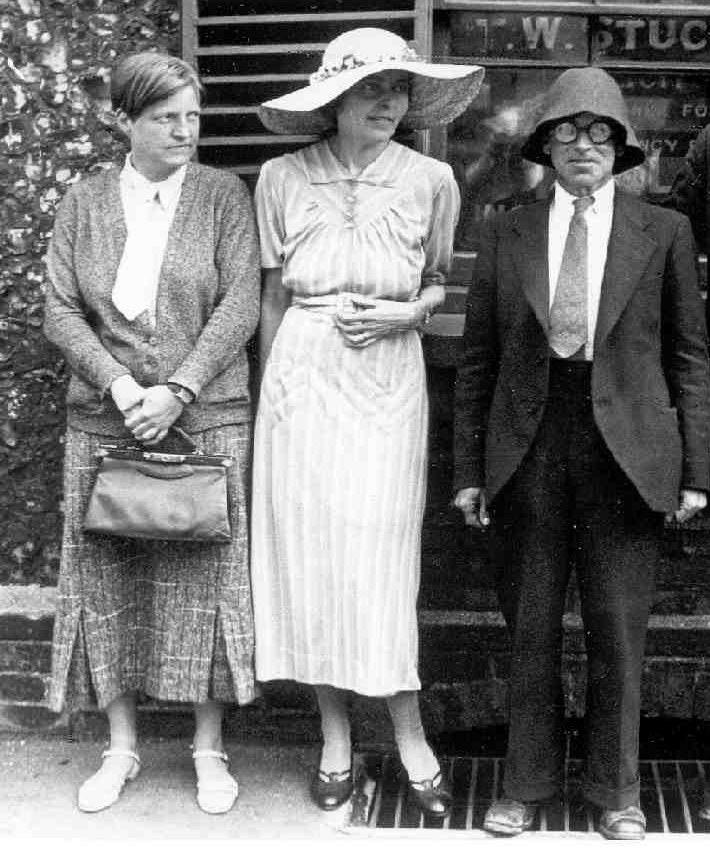
Enter the third person in this story – Patricia Preece. Patricia had, along with her artist friend and lesbian lover, Dorothy Hepworth, moved to the village of Cookham. It was in 1929, when Patricia working in the local High Street café first met Stanley Spencer. Stanley, Hilda and their daughter Shirin, who were visiting the village, came in to the café for lunch. After a conversation about their love for art Spencer invited the two women to visit the Spencer-Carline house parties and picnics and where she was often courted by Hilda’s brother Richard Carline. Spencer and Preece had, besides their art, another thing in common, their love of Cookham. This was in complete contrast to Hilda’s feelings for the village, a situation which saddened her husband.
The relationship between Spencer and Hilda and Patricia Preece started off well, in fact for the first three years they were best of friends and in 1933 Stanley Spencer and Patricia went off together on an artistic assignment in Switzerland with Hilda’s blessing. Richard Carline’s devotion to Patricia ended when he belatedly realised the truth about her relationship with her live-in lover Dorothy. Patricia now turned her attentions to Stanley Spencer, not for amorous reasons but for the reason of his extensive art world contacts which would help her and Dorothy with their artistic careers and also because she, who was comparatively poor, knew that Stanley was a wealthy man. Patricia’s financial situation worsened when the knitwear business of the Hepworth family, from which Dorothy received great financial remuneration, went bankrupt. By 1934, the life of the two women had reached crisis point, their Cookham home was about to be repossessed and they had no money to pay every-day bills.
From l. to r. Hepworth, Preece and Spencer
Stanley Spencer rode to the women’s rescue by suggesting they came to live with Hilda and him. Hilda was having none of her husband’s rescue plan. She also became very concerned by her husband’s closer than ever relationship with Patricia. She took comfort by leaving Cookham for periods of time along with her daughters, going to stay with her mother. Her absence from the family home was all that Patricia needed to get closer to Stanley. They would visit each other’s houses even though Patricia’s lover Dorothy was not best pleased with this blossoming relationship. Stanley and Patricia sadly had different agendas. For Patricia, Stanley Spencer’s money and contacts were of prime importance whereas for Spencer there was a sexual desire.
Hilda initially fought to save their marriage. However, when her brother George became seriously ill towards the end of 1932, she went to London to be with him. By 1934, she knew that she could no longer stay with her husband and moved to London. Spencer became more and more obsessed with the flirtatious Preece, and he showered her with gifts. She persuaded him to divorce his first wife and to sign his house over to her. Patricia Preece married Spencer in 1937 and they were supposed to go on honeymoon in Cornwall. Preece and Dorothy went on ahead and in fact Spencer never joined them, remaining in Cookham to finish a painting. Hilda went to Cookham and, finding a warm welcome from Spencer, spent the night with him. Spencer proposed a ménage à trois with her and Patricia but Hilda would not accept being his mistress, having once been his wife. Preece was shocked by this turn of events and refused thereafter to have sexual relations with him.
Double Nude Portrait by Sir Stanley Spencer (1937)
So that is the story of the three people and now let us look at the painting which Spencer completed in 1937, the year of his second marriage. It is a stark and explicit painting of the artist and his second wife Patricia Preece. It was painted at a time when Spencer realised the mistake he had made leaving his first wife Hilda and marrying this femme fatale. Look at the forlorn depiction he gave himself as he squats before his uncaring wife. His skin tone is a dull grey. We are not looking at a man of great virility. Whereas artists in the past have portrayed themselves or their sitters as virile and glamorous, we see in front of us an unidealized vision of a man. He stares down at the breasts of his wife but he is not aroused. Look at his flaccid penis which presumably alludes to his lack of virility and the non-consummation of his marriage. Look how Spencer has depicted Preece. She lays there, legs apart with a vacant look on her face. She does not look at Spencer. She exudes an air of disinterest. Spencer’s depiction of his wife acknowledges her rejection of him. There is no eye contact. The bodies are not touching. There is a total disconnect between husband and wife. You know the marriage is doomed. There are two other interesting objects in the painting. Firstly in the foreground we have a leg of mutton (hence the alternative title of the painting) and in the background we have a lit gas fire. We can presume that the cold leg of mutton somehow symbolises the coldness of his wife as she lies in front of him and it is in contrast to the heat from the fire which is the only thing in the painting which is going to give warmth to the artist.
Would you say the painting is erotic? Does it have the eroticism of a Schiele painting? To me, the painting is sexual but not erotic. It is an honest painting and tinged with sadness. Should we be sad for the artist or should we simply look upon him as somebody who has rightly got his just deserts? Could things get any worse for Spencer? Well, actually the answer to that is yes.
Preece being a gold-digger and Spencer being besotted and somewhat foolish was persuaded to sign his house and financial affairs over to Preece who never left her lover Hepworth. It is also thought that she had some leverage over Spencer and threatened to expose him and his erotic paintings unless he agreed to the financial terms. There was no acceptance in the 1930’s for such sexual works. Patricia eventually evicted Spencer from the house, and would not grant him a divorce, but continued to receive payments from him. After he was knighted in 1959, she insisted on being styled Lady Spencer and claimed a pension as his widow. Spencer’s fear of being exposed by Preece over his erotic paintings made him keep today’s painting under his bed where it remained until he died. Spencer lived to regret leaving his first wife and constantly wrote to her and occasionally visited her and their two children.
Sir Stanley Spencer died in 1959, aged 68. Hilda Carline died in 1950 aged 61. Patricia Preece died in 1966 aged 72. Wendy Hepworth died in 1978, aged 80.
Although I am sure people love to see the paintings of the so-called “Masters”, I believe it is good to look at the works of lesser known artists and by doing so, one can discover hidden gems. After Renoir’s famous painting Luncheon of the Boating Party,which I featured yesterday, I decided today that I would look for a painter, who until yesterday had been unknown to me. However, I do understand that this may be due to my simple lack of artistic knowledge and in fact the artist is well known to you, if so, I apologise!
It is often the case that when I am researching a painting I come across another artist, whom I have never heard of, and that is the reason for my choice of artist today. Amongst the guests at Renoir’s luncheon was his friend and lesser known Impressionist, Gustave Caillebotte and I decided to make him my artist of the day and I want to look at his unusual painting entitled Les raboteurs de parquet [The Floor Planers].
Caillebotte was born in Paris in 1848 and brought up in a very respectable and very wealthy upper-class family environment. His father, Martial had inherited the family textile business. Martial Caillebotte had been widowed twice before he met and married Gustave’s mother, Céleste. When Gustave was eighteen his father moved the family home from Paris to the town of Yerres, a south-eastern suburb of Paris on the Yerres River, an area which was familiar to the family as they had spent many summers there.
Gustave studied law when he was twenty years old and passed all his exams two years later. That year, he was drafted into army to fight in the Franco-Prussian War. It was after the war and on leaving military service that Gustave wanted to concentrate on art and study painting. He set up an artist’s studio in the family home and in 1873 he entered the École des Beaux-Arts in Paris. The following year his father died and in 1878 his mother passed away, at which time the three brothers shared the family fortune. It was also around this time that Gustave met and became friends with Edgar Degas and came into contact with the Impressionists, a group of artists who had rebelled against Academicism art and academic painters, whose works were exhibited in the Paris Salon. This group of artists had their own Impressionist exhibitions, the first of which was held in 1874.
In 1876 the Impressionists held their second exhibition and Caillebotte exhibited eight of his paintings including today’s featured work, The Floor Scrapers, which he completed in 1875. The style of this work belongs to the Realism genre but unfortunately for Gustave the art establishment only considered peasants and farmers from the countryside as acceptable subjects in works of art which highlighted the realism of working-class life.
The Floor-scrapers, sometimes known as The Floor-strippers was painted in the artist’s family home. It is a painting which depicts working class people hard at work and although that in itself was not an unusual subject for French paintings as it had been done many times before but the difference was that in previous French paintings, the depiction of the hardships of the working class was all about working class farmers or country peasants. This painting depicts the urban working class and as such it was one of the first such representations. Caillebotte presented his painting for the exhibition at the Paris Salon in 1875 but it was rejected. The Jury of the Salon were shocked by its crude realism and some went so far as to describe it as being vulgar and offensive. The artist was both disappointed and angered by their stance and decided that exhibiting his works at the Paris Salon was not going to be the future course for his paintings. Instead, he decided to align himself with another group of French artists, who like him, were disillusioned by the narrow views of the academics and had formed themselves into their own artistic group – the Impressionists.
The work of art today is simply a painting depicting men hard at work. Here we see three men stripping the varnish off the floor of the artist’s new apartment. There is neither a moralising message nor is there a left wing political message. Caillebotte is merely showing the men hard at work carrying out a strenuous task. This is why the artist was looked upon as one of the most gifted French realist painters of his time. Look how Caillebotte has depicted the musculature of the upper body of his three workers as they perform their back-breaking task on their hands and knees. See how the artist has made the light of the late afternoon streams through the long balcony window and illuminate their backs. It harks back to the heroes we saw centuries earlier when we looked at the paintings of the heroes of Antiquity. France, like Britain, had just gone through an Industrial Revolution and with urbanization came a new social class which was termed la classe ouvrière or working class and it was in complete contrast to the bourgeoisie. The hard working men we see in Caillebotte’s painting may have been brought up in the countryside and therefore they were used to exhausting and strenuous work and had moved to the city to seek their fortunes.
At the time of this painting, France was in its Second Empire stage and Paris was undergoing massive change under the Haussmann’s Renovation of Paris which was the great modernisation plan for the city which had been commissioned by Napoleon III. The project encompassed all aspects of urban planning, both in the centre of Paris and in the surrounding districts: streets and boulevards, regulations imposed on facades of buildings, public parks, sewers and water works, city facilities, and public monuments. The planning was influenced by many factors, not the least of which was the city’s history of street revolutions. This was a time of great change and in a way Caillebotte wanted to change art and what had been previously unacceptable, he wanted to be accepted but he was a little ahead of his time as far as this painting was concerned. There is a great contrast in colours used in the painting from the light blue walls to the dark browns of the floor and the men’s clothes. I note that a bottle of wine and a glass has been added – a French prerequisite to help with a day’s work !
Luncheon of the Boating Party by Auguste Renoir (1881)
My Daily Art Display today features one of the best known Impressionist paintings. It is Luncheon of the Boating Party by Renoir which he painted in 1881. Although I would rank Impressionism outside my top three favourite art genres, I was fascinated by this painting and the story behind it.
Maison Fournaise (c.1890)
I suppose firstly I should examine the setting for the painting, which is the balcony at the Maison Fournaise. This building is situated on the ÎlIe de Chatou, an island situated across from the small town of Chatou, which is situated on the right bank of the Seine. Boating on the Seine became a very popular form of recreation in the middle of the eighteenth century and whereas Argenteuil, a little way upstream from Chatou, where the Seine is wider and with its more prevalent winds, attracted sailors, the Îlle de Chatou was the ideal spot for rowers. Alphonse Fournier, who was a river toll collector and a part-time boat carpenter, set up his boat building workshop along with his boat rental business in 1857. Alphonse also used to organise boat regattas and water festivals. At the same time, his wife, an accomplished cook, opened a restaurant next door. This restaurant, combined with the boat rental facility and its many organised boating events, was a very popular family-run business. Their daughter Louise-Alphonsine, who became a popular and well-known artist’s model, greeted the clients whilst their son Jules-Alphonse charmed the ladies and assisted them into the boats. Artists visiting Maison Fournaise were never short of potential models for as Renoir wrote:
“…..I was constantly spending my time chez Fournaise-there I found as many beautiful girls as one could ever wish to paint!…..”
The Island of Chatou had other thing going for it. Rail travel allowed Parisians easy access to this area in the countryside. If you look carefully under the awning you can just make out, at the top left, the blue-gray outline of the Chatou railroad bridge, part of the government’s recently completed transportation projects that had made access to this riverside destination possible to everybody, not just to the members of the upper class.
La Maison Fournaise, today.
The setting also radiated peace and tranquillity along with its ideal light conditions and proved a haven for artists with the likes of Claude Monet, Alfred Sisley, Berte Morisot, Edouart Manet and Camille Pissaro often visiting the location. Auguste Renoir was also a regular caller and he once described his love of the establishment in a letter to friend:
“…You could find me anytime at Fournaise’s. There, I was fortunate enough to find as many splendid creatures as I could possibly desire to paint……….. I can’t leave Chatou, because my painting is not finished yet. It would be nice of you to come down here and have lunch with me. You won’t regret the trip, I assure you. There isn’t a lovelier place in all Paris surroundings….”
The Fournaises’ two businesses flourished until 1906 when Madame Fournaise closed the restaurant and four years later Alphonse Fournaise wound down his boat rental enterprise. Then, unfortunately, over the years, the deserted premises started to fall into disrepair. Madame Fournaise died in 1937. By the 1970’s the buildings were at the point of complete dereliction. However in 1977 the town of Chatou bought the building and five years later it listed it as a building of historic significance, joining the register of Les Monuments Historiques and restoration work began with the support from The Friends of Maison Fournaise and The Friends of French Art. Currently the building is a museum, La Fournaise Museum, and in 1990 a restaurant reopened on the premises
So now we know the setting for the painting let me introduce you to some of the people featured in this wonderful painting. As in a number of Renoir’s paintings, he liked to include portraits of his friends.
The Participants
Aline Charigot, seen holding a dog, was a seamstress and part time model for Renoir. Aged twenty-seven at the time of the painting met Renoir in 1880 and they were married in 1890, despite a thirteen year age difference. The couple had three children, Pierre, Jean (who became the well-known filmmaker) and Claude. Despite being much younger than Renoir she died four years before him in 1915, aged 61 and was buried in the churchyard at Essoyes in the Champagne-Ardennes region of France which was her childhood home. Renoir who died a few months before his seventy-ninth, in Cagnes, was laid to rest alongside his beloved wife.
Jules-Alphonse Fournaise, wearing a straw boater and sportsman’s T shirt leans against the balustrade. He was the son of the owner of Maison Fournaise and was in charge of the boat rentals.
Louise-Alphonsine Fournaise, leaning against the balustrade is the daughter of the owner of the establishment and a war widow.
Baron Raoul Barbier, sporting a brown bowler hat,has his back to us as he engages the proprietor’s daughter in conversation. Formerly a cavalry officer and war hero later became mayor of colonial Saigon. The two loves in his life were women and horse racing.
Jules Laforgue, a Symbolist poet, journalist on the La Vie Moderne newspaper and private secretary to Charles Ephrussi (No.8)
Ellen Andrée, seen drinking from her glass. Aged 24 at the time of the painting, she was a Parisian actress and mime at the Folies Bergère and sometime artist’s model for Renoir, Manet and Degas (See My Daily Art Display June 7th where the actress has modeled for the Degas painting).
Angèle Leault, some time Parisian actress and singer and also a market flower seller.
Charles Ephrussi, wearing a top hat and in conversation with his secretary. Russian-born Ephrussi was a wealthy art collector and historian as well as being editor of the prestigious art magazine, Gazette des Beaux-Arts. He was a great supporter of the Impressionist painters.
Gustave Caillebotte, in the right foreground with a cigarette in his hand. He was a good friend of Renoir and a well-known painter in his own right. He was a collector of Impressionist paintings and also one of Renoir’s wealthy patrons. Renoir’s prominent positioning of Caillebotte was not accidental but was a measure of his importance to Renoir. He lived in a house overlooking the Seine, not far from Chatou. Caillebotte was trained as an engineer, built boats and was a great sportsman. This maybe accounts for Renoir’s youthful portrayal of him (he was 33 at the time of the painting) in his boating attire, consisting of a sleeveless white T shirt and blue flannel pants. On his head is a flat-topped straw hat around which a blue ribbon is tied. This indicates that Caillebotte was a member of the privileged Cercle Nautique de la Voile boating club. He was godfather to Renoir’s eldest son, Pierre.
Adrien Maggiolo , Italian journalist on Le Triboulet newspaper.
Eugène-Pierre Lestringuez, official at the Ministry of the Interior and close friend of Renoir who often modeled for his paintings.
Paul Lhote, wearing a straw hat in conversation with Lestringuez and the actress Jeanne Samary.He was a writer of short fiction and a journalist and close friend of Renoir.
Jeanne Samary, holding her black-gloved hands to her ears. Actress at the Coméie-Francais in Paris.
With this group of people we can see that Renoir was illustrating the nature of Maison Fournaise which welcomed customers from a variety of social backgrounds from the wealthy aristocrats to the humble actors. With the new rail system in place along with the shortened working week, everyone, no matter what their occupation, was able to escape the city and enjoy the pleasures of the Parisian suburbs at the weekends. The forty year old artist in producing this large masterpiece depicted the modern life of Parisians as they relaxed. Renoir’s painting captures the idyllic atmosphere as his friends wine and dine on the riverside terrace. Renoir gathered most of the participants in the painting together early on so that he could organize the composition. Later he worked on the individual figures as and when they were able to model for him. It was a grueling time for the artist and Renoir felt the pressure on him to complete the work. He had a love-hate relationship with the work commenting once:
“… I no longer know where I am with it, except that it is annoying me more and more….”
He made many changes to the work before he was completely satisfied. The final result was a veritable gem of Impressionism.








 my daily art display