Die Teufelsbrücke or the Devil’s Bridge by Karl Blechen

Pont Valentré at Cahors

I will start My Daily Art Display today with a look at a local folklore that of the Devil’s Bridge.  Like most folklore there is not simply one version of the tale but many different versions of it depending on which country the structure is situated.   The first time I came across this phenomenon was when I visited Cahors in France and went to see the spectacular 14th century Pont Valentré Bridge.

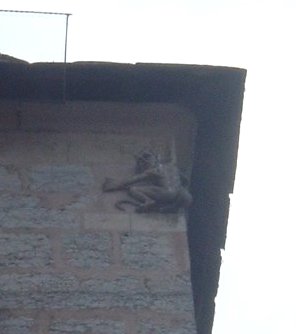
The Devil clinging to one of the towers of the Pont Valentré

Built in 1308 and completed seventy years later it became associated with the legend of the Devil’s Bridge and the architect Paul Gout made reference to this by placing a small sculpture of the devil at the summit of one of the towers.

The folklore of the Devil’s Bridge is all about the Devil, a bridge builder and his bridge.  The main gist of the story is that a bridge builder sets about building a bridge across a river or river gorge, but at some point in the building of the structure the bridge builder realises he hasn’t the strength or time to complete the task and has to turn to the Devil for assistance.  The price levied by the Devil for his assistance is that he should receive the first soul that crosses it.

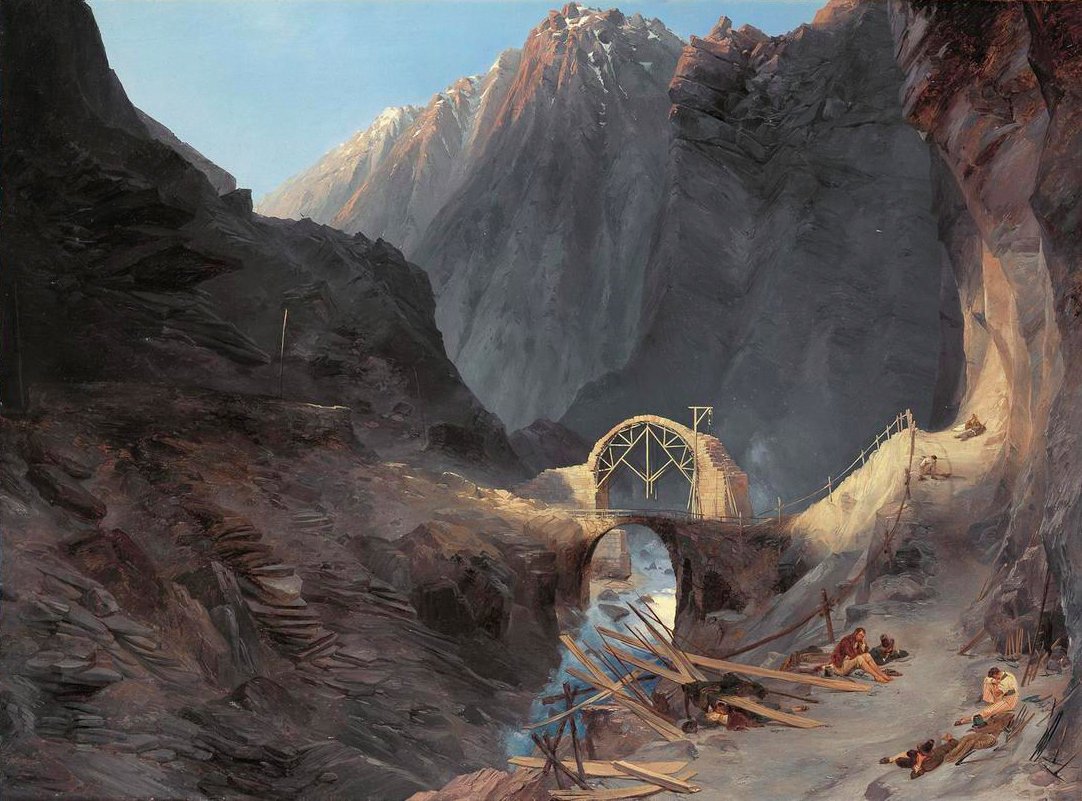
Die Teufelsbrücke by Karl Blechen

In my featured painting, Teufelsbrücke or Devil’s Bridge painted by the German Romantic artist, Karl Blechen, in 1832.  In the painting we see the Devil’s Bridge straddling the Swiss River Reuss as it passes through the Schöllenen Gorge on its way to Lake Lucerne.   The legend of this particular Devil’s Bridge states that the river was so difficult to cross that a Swiss goat herdsman asked the Devil to make a bridge. The Devil duly appeared, but required that if he should construct the bridge, the soul of the first to cross it would be given to him. The herder agreed, but instead of crossing the bridge first and risk losing his soul he drove a goat across ahead of him, thus tricking the devil.   The Devil was so angry that he had been duped he fetched a rock with the intention of smashing the bridge, but an old woman drew a cross on the rock and this prevented the Devil from being able to lift it.    The rock is still there and, in 1977, 300,000 Swiss Francs were spent to move the 220 ton rock by 127 m in order to make room for the new Gotthard road tunnel.

Karl Blechen was born in Cottbus in 1798.   His father was a local tax collector and Karl started his working life as a minor bank official.  It was not until he was aged twenty four that he began to study art.  In 1822 he enrolled at the Akademie der Künste, Berlin (Academy of the Arts).  Later when he was working in Dresden as an apprentice in an art studio he was befriended by two artists also based in the city , the German painter, Caspar David Friedrich and the Norweigen artist, Johan Christian Dahl who were leaders in the fields of art known as Romanticism and Realism.   My Daily Art Display has featured some of their works and they are well worth viewing.   Their styles would influence Blechen in his future works.   In 1828 he travelled to Italy where he remained for a year studying art and in particular, oil painting.  It was here that he was introduced to the en plein air style of painting and was influenced by the works of English landscape painter, Turner who was also in Italy at this time and by the French landscape painter, John-Baptiste Corot, who at this period in time, lived in Italy.  He returned to Germany and in 1831 and was awarded a professorship at the Berlin Academy.   Despite this academic recognition the sales of his work were disappointing and this depressed him.  His depression and mental state deteriorated and four years later, at the age of thirty-seven he was diagnosed as being mentally unstable.  Blechen died in 1840 in Berlin, a broken man, aged forty-two.

When Karl Blechen visited Italy his journey fostered an interest on visual phenomena and how light and colour effects landscapes.  A number of his paintings were categorised as being of a Romantic genre.  The Romantic artists, of which Blechen was one, applauded individualism, subjectivism, irrationalism, imagination, emotions and nature – emotion over reason and senses over intellect.  Whilst Blechen was returning back to Germany he travelled along the St Gothard’s pass and the Teufelsbrücke was still being built.  This Devil’s Bridge depicted by Blechen in his painting is enclosed by snow-capped mountains which soar into the sky and below them we can see the raging torrents of the Reuss River.  I think what I like most about this painting is the beautiful way in which Blechen has depicted the sunlight penetrating a gap in the mountains to light up the bridge and some of its builders.  It is as if somebody has switched on a spotlight to illuminate the scene.  In the central mid ground we see the arch of the old bridge and the partly constructed arch of the new one with its scaffolding.   The illuminated partly-built new arch is dwarfed by the mountains and one wonders whether its frailty and exposed position will be able to withstand the forces of nature when gale force winds relentlessly charge down the valley.    There is also a sensation of remoteness about the scene.  We are aware that we are miles from civilisation but can marvel in the savagery of nature.  In the right foreground we see some of the bridge builders taking a well earned rest from their labours amongst all their building materials.

Karl Blechen has managed to create an image which is both awe-inspiring and beautiful and one which makes us realise how small we are in comparison to our surroundings.   This awesome painting by Karl Blechen, which I have featured today,  hangs in
the Bavarian State Picture Collection housed in the Neue Pinakothek in Munich.


Dordrecht Harbour by Moonlight by Aelbert Cuyp

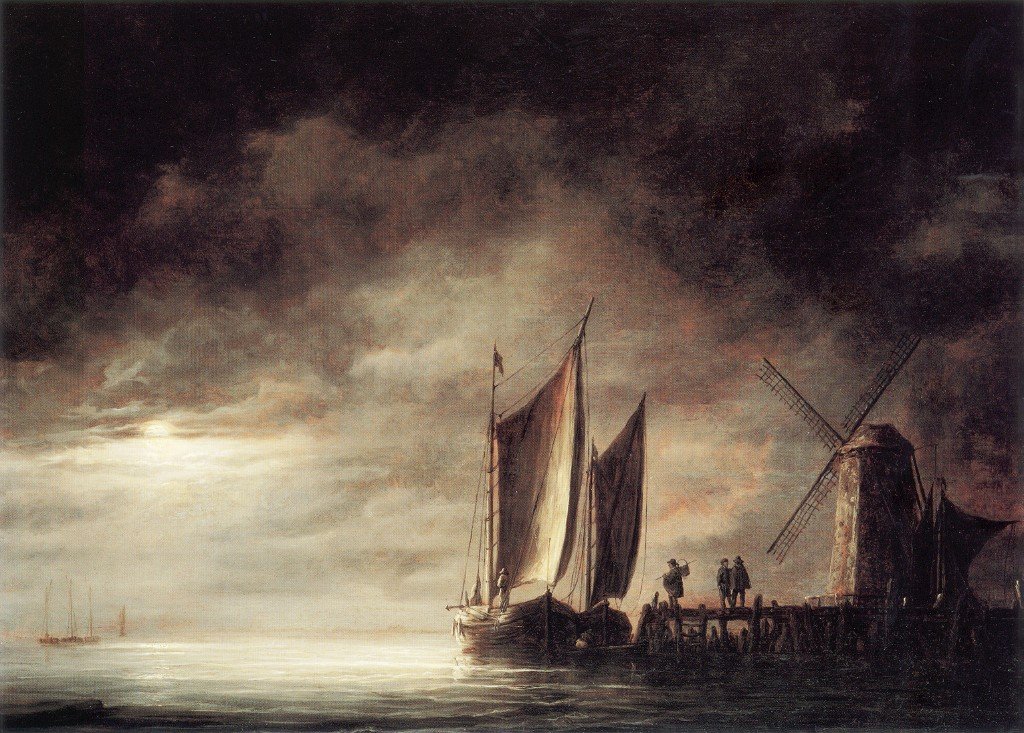
Dordrecht Harbour by Moonlight by Aelbert Cuyp (c.1645)

I am putting religion and religious paintings behind me today and I am going to feature a truly beautiful riverscape painting by one of my favourite artists, Aelbert Cuyp.   I really cannot get enough of this man’s paintings.  Whether it be his landscapes, riverscapes or seascapes, they are all delights to behold.  My Daily Art Display today is the painting Cuyp completed around 1645 entitled Dordrecht Harbor by Night and which now hangs in the Wallraf-Richartz Museum in Cologne.

Aelbert Cuyp was born in 1620 and is the most famous member of the Cuyp family and today is proclaimed as one of the greatest of all landscape painters.  He was the son and, more than likely, the pupil of Jacob Gerritsz Cuyp, a portrait painter.  In his early works one can detect the influence of Jan van Goyen, the prolific seventeenth century Dutch landscape painter.  Aelbert was born and died at Dordrecht, and spent a lot of time travelling along the great rivers of Holland reaching the eastern borders of the country and the western part of what is now Westphalia, Germany.   He was an artist, who naturally signed his works, but very rarely dated them and thus it has been difficult for art historians to build up a chronological list of his works

In 1658 Cuyp married a wealthy widow, and in the 1660’s, with his newly found financial stability, he seems to have practically forsaken painting. He died in 1691 and was buried in the Augustijner Church in Dordrecht.   Although for a hundred years after his death his works seemed to have been ignored, but the eighteenth century proved a turning point for the sale of his paintings.   The greatest collector of his paintings was the eighteenth-century Dordrecht iron dealer and mint-master Johan van der Linden van Slingeland, who owned forty-one works by the artist.   After the sale of his collection in 1785, many of these paintings entered collections in England, where Cuyp’s work was greatly admired for their grandeur.

The popularity of his paintings in France and England grew unabated, so much so,  that by the late eighteenth century there were hardly any of his paintings left in his native Netherlands.   From fame in Europe came fame in America with art dealers clambering to get hold of his works.

It was around 1640 that Dutch painters began to be fascinated with the depiction of extraordinary light and weather conditions but such paintings were deemed to be one of the most complicated challenges faced by artists.

The challenge was to be able to accurately depict the various colours of the moonlight reflections.  It was interesting to read about the debate from the Italian Renaissance period, known as the paragone, in which one form of art, whether it be architecture, sculpture, painting or poetry, is championed to be the superior in comparison to the others.  Bearing in mind today’s featured work, it is interesting to see what Philips Angel, the Dutch Golden Age painter, and a contemporary of Cuyp, wrote in his published a defence of the art of painting:

“..unlike sculpture, painting can depict a rainbow, rain, thunder, lightning, clouds, vapour, light, reflections….. the rising of the sun, early morning, the decline of the sun, evening, the moon illuminating the night, with her attendant companions, the stars, reflections in the water…”

The painting, Dordrecht Harbor by Night is a beautiful study of moonlight over water.  The Dutch painter and esteemed biographer of 17th century Dutch artists, Arnold Houbraken, who lived in Dordrecht at the time of Cuyp was able to have firsthand knowledge of the artist’s work.  Of Cuyp, he wrote:

“.. [Cuyp] paid much attention to the time of day in which he portrayed his subjects, so that one can distinguish in his paintings the misty early mornings from the bright afternoons from the saffron-colored evening time…… I have also seen various moonlight scenes by him which were very realistic and arranged in such a way that the moon was beautifully reflected in the water….”

Aelbert Cuyp’s ability to depict a moonlight scene is exactly what we see in this painting.  Look how the moonlight shimmers on the still waters of the inland waterway.  Look at the colours the artist has used in his depiction of the clouds and sky.  It is an extremely atmospheric and haunting work with its sailboats at a dock across the harbour from Dordrecht’s Rietdijkspoort.  It is believed to be one of the few moonlight scenes painted by Cuyp.  There is an utter stillness to the painting.  Maybe just a whispered conversation of the men standing on the pier awaiting a morning ferry would be heard over the sound of the lapping water which caresses the pier structure and the wooden hulls of the sailing boats.   Above we have dark billowing clouds which try and mask the moonlight which is being cast onto the still water.  The moonlight refuses to be diffused by the threatening clouds and floods across the scene reflecting on the sails of the boats and the old stone windmill.   It would seem that bad weather is on its way or has just passed.

To look at this painting is almost theraputic.  Its calmness has a calming effect on the viewer.  Look at it, relax and enjoy.

The Annunciation by Dante Gabriel Rossetti

The Annunciation by Rossetti (1850)

My Daily Art Display today is, like my last offering, another painting depicting a scene from the Bible.   The scene is The Annunciation and has featured in paintings by many of the Renaissance Masters.  However this painting by the Pre-Raphaelite artist Dante Rossetti has some subtle differences from these earlier works by the likes of Fra Angelico, Raphaello Santi, El Greco, van Eyck and Botticelli.

The story of the Annunciation is probably known by most and it is documented in the bible in the book of Luke (1: 26-38)

26 In the sixth month of Elizabeth’s pregnancy, God sent the angel Gabriel to Nazareth, a town in Galilee, 27 to a virgin pledged to be married to a man named Joseph, a descendant of David. The virgin’s name was Mary. 28 The angel went to her and said, “Greetings, you who are highly favoured! The Lord is with you.”

29 Mary was greatly troubled at his words and wondered what kind of greeting this might be. 30 But the angel said to her, “Do not be afraid, Mary; you have found favour with God. 31 You will conceive and give birth to a son, and you are to call him Jesus. 32 He will be great and will be called the Son of the Most High. The Lord God will give him the throne of his father David, 33 and he will reign over Jacob’s descendants forever; his kingdom will never end.”

34 “How will this be,” Mary asked the angel, “since I am a virgin?”

35 The angel answered, “The Holy Spirit will come on you, and the power of the Most High will overshadow you. So the holy one to be born will be called[a] the Son of God. 36 Even Elizabeth your relative is going to have a child in her old age, and she who was said to be unable to conceive is in her sixth month. 37 For no word from God will ever fail.”

38 “I am the Lord’s servant,” Mary answered. “May your word to me be fulfilled.” Then the angel left her.

The painting I am featuring today is entitled The Annunciation which Rossetti painted in 1850.  That was not its original title given to it by the artist, Gabriel Rossetti.  He had originally decided to call the painting Ecce Ancilla Domini meaning “behold the handmaid of the Lord” but at the last moment changed his mind.  In the painting, Rossetti has just used the three primary colours, red, blue and yellow along with white.  The use of these colours by the artist is symbolic.  We have white for feminine purity, blue for the Virgin Mary, red for the Passion of Christ and yellow or gold which symbolises holiness.   There are other things in the painting which are symbolic.   The Angel Gabriel holds a lily and in the foreground we see a red cloth on to which we can see that Mary has embroidered white lilies.  Maybe this signifies the young girl’s decision to live a very pure life.

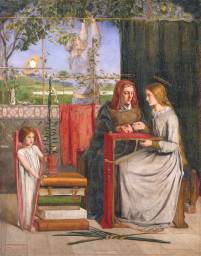
The Girlhood of Mary Virgin by Rossetti (1849)

Mary and her mother, St Anne, can be seen embroidering that very cloth in Rossetti’s painting The Girlhood of Mary Virgin which he painted a year earlier.   Lilies symbolize purity, chastity, and innocence and white lilies represent the purity of the Virgin Mary.  In most paintings of the Annunciation we see the Angel Gabriel presenting Mary with a white lily when he announced to her that she would give birth to the Son of God.

The setting Rossetti has given this scene is very unusual.  In Renaissance paintings of The Annunciation we look at settings which are sumptuous.  Tapestries and heavy velvet curtains often abound.  Light frequently can be seen entering the scene through exquisite stained glass windows lighting up elaborate furnishings and floor coverings.  Rossetti chose not to go down that line.  As we look upon the scene the first thing that strikes us is the claustrophobic compactness of Mary’s room.  It could almost be termed minimalistic in its accoutrements.  Look at the window opening on the back wall.  There was no attempt by Rossetti to give a feeling of depth to this painting by depicting a town somewhere in the far distance.  The window opening is plain and uncovered and through it we just see part of a solitary tree against a blue sky, the colour of which mirrors that of the colour of the screen at the end of Mary’s bed.

In most depictions of this scene we see Mary dressed in blue robes quietly and in some cases joyously receiving the news that she will give birth to the Christ child.  However Rossetti has depicted Mary’s mood differently.  We see Mary dressed in a white shift dress shrinking back from the Angel Gabriel.  Rossetti has added the colour blue which is associated with the Virgin Mary in the form of a blue cloth screen hanging behind her.

Rossetti has also included a dove which embodies the Holy Spirit.  He has depicted the golden-haired Angel Gabriel without wings, which was the norm for Annunciation paintings.  Gabriel’s face is in shade and his facial features are almost hidden from us.    He can be seen in this painting hovering just above the floor with flames all around his feet.  I wonder if I am just imagining it but it looks as if he is pointing the lily stem at Mary’s womb.  It is little wonder that the combination of his words and this action make the young girl almost cower and recoil against her bedroom wall.

Take a while and look at Mary’s expression.  How do you read Rossetti’s depiction of this young woman?  Look at her facial expression.  This is not one of acquiescence or pleasure.  This is a look almost of horror at what she has just been told.    This terrified look adds a great deal of power to Rossetti’s  painting.  Mary herself in Rossetti’s painting looks much younger than we are used to seeing in similar scenes.  She exudes a youthful beauty but only seems to be a mere adolescent with her long un-brushed auburn hair contrasting sharply with her white dress.  She is painfully thin and her hesitance and sad look tinged with fear endears her to us.  We can empathize with her situation.  Rossetti through this painting wants us to put ourselves in the position of Mary at hearing the news of what has been mapped out as her future.  The various Christian religions would have us believe that Mary has been honoured by being chosen as the future Mother of God but Rossetti is asking us to consider carefully whether this young girl, Mary, has been given a wonderful opportunity or whether her life has been saddled with an onerous responsibility.  You need to study her face and decide for yourself.  The model for Mary was Christina Rossetti, the poet, and the artist’s sister

I believe a number of the “standard” Annunciation paintings were meant to inspire us to lead a “good” life and for that reason we see the Virgin Mary delighted to be given the role as Mother of God.  The “standard” depiction of Mary with her happy smiling face leads us to believe that leading a pure and holy life will give us similar pleasure.  However Rossetti’s depiction of the Annunciation questions Mary’s happiness to accept her future role in life.  It is a role that will take away many of the pleasures a young girl would be looking forward to enjoying as she enters adulthood.

I suppose how you look at the painting and how you interpret what you see will depend on your religious belief.

Lot and his Daughters by Lucas Cranach the Elder

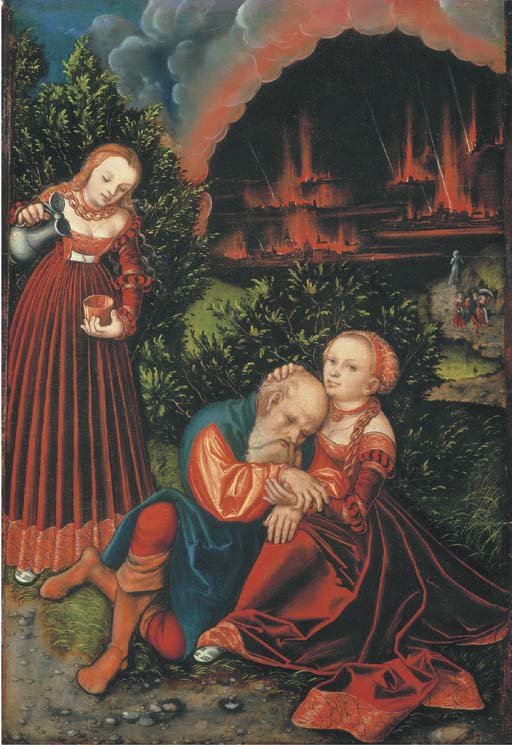
Lot and his Daughters by Lucas Cranach the Elder (C.1530)

My Daily Art Display today starts with a passage from the Bible.  It is from the book of Genesis (19: 30-38) and tells the story of Lot and his two daughters who we see in the painting above, entitled Lot and his Daughters which was painted by the great German Renaissance painter,  Lucas Cranach the Elder around 1530.  The Bible passage sets the scene:

30 Lot and his two daughters left Zoar and settled in the mountains, for he was afraid to stay in Zoar. He and his two daughters lived in a cave. 31 One day the older daughter said to the younger, “Our father is old, and there is no man around here to give us children—as is the custom all over the earth. 32 Let’s get our father to drink wine and then sleep with him and preserve our family line through our father.”

33 That night they got their father to drink wine, and the older daughter went in and slept with him. He was not aware of it when she lay down or when she got up.

34 The next day the older daughter said to the younger, “Last night I slept with my father. Let’s get him to drink wine again tonight, and you go in and sleep with him so we can preserve our family line through our father.” 35 So they got their father to drink wine that night also, and the younger daughter went in and slept with him. Again he was not aware of it when she lay down or when she got up.

36 So both of Lot’s daughters became pregnant by their father. 37 The older daughter had a son, and she named him Moab; he is the father of the Moabites of today. 38 The younger daughter also had a son, and she named him Ben-Ammi ; he is the father of the Ammonites of today.

Not being a reader of the Bible, nor being particularly religious, I was surprised to read the passage from Genesis, as on first seeing the painting, which is housed at Compton Verney in Warwickshire, I believed it to be simply a picture of two girls, one comforting a tired-looking old man whilst the other was bringing him something to drink.

It is known that Lucas Cranach the Elder painted this Old Testament subject on  at least four occasions and many other artists have depicted this same story in their paintings.  The early part of Chapter 19 of Genesis relates the story of how God destroyed the two cities of Sodom and Gomorrah, which are shown in flames in the background of the painting.  To save the righteous people of the two cities, God sent down two angels to lead Lot, his wife Edith, his nephew Abraham and his family away from the doomed cities.  The two angels warned Lot that they should quickly escape but nobody should look back on the burning cities but as we know Lot’s wife did and was turned into a pillar of salt and we see the grey pillar of salt in the right middle-ground of the painting.

In the foreground we have Lot on one knee his arms resting on the knees of one of his daughters, who rests her hand on his head, trying to console him after the loss of his wife.  As the biblical tale tells us the daughters, Pheiné and Thamma, fearing that with the destruction of all the people of the city they will not have the chance to bear children and their father will thus never have a male heir.  With that in mind they decide that their father should make them pregnant and so on two consecutive nights they got Lot drunk and had him make love to them.  The daughters became pregnant and each had a son, Moab and Benammi.

This is really a story of two females taking decisions about their own destiny rather than leaving it to a male to decide what should happen to them and their lives.  Stories of female domination over men were very popular in the late Middle Ages and could not only be seen in paintings, but could be read about in literature, and words of songs and plays of the time.

I am a great fan of both Cranach the Elder and his son Lucas Cranach the Younger and find their paintings

King Edward VI by William Scrots

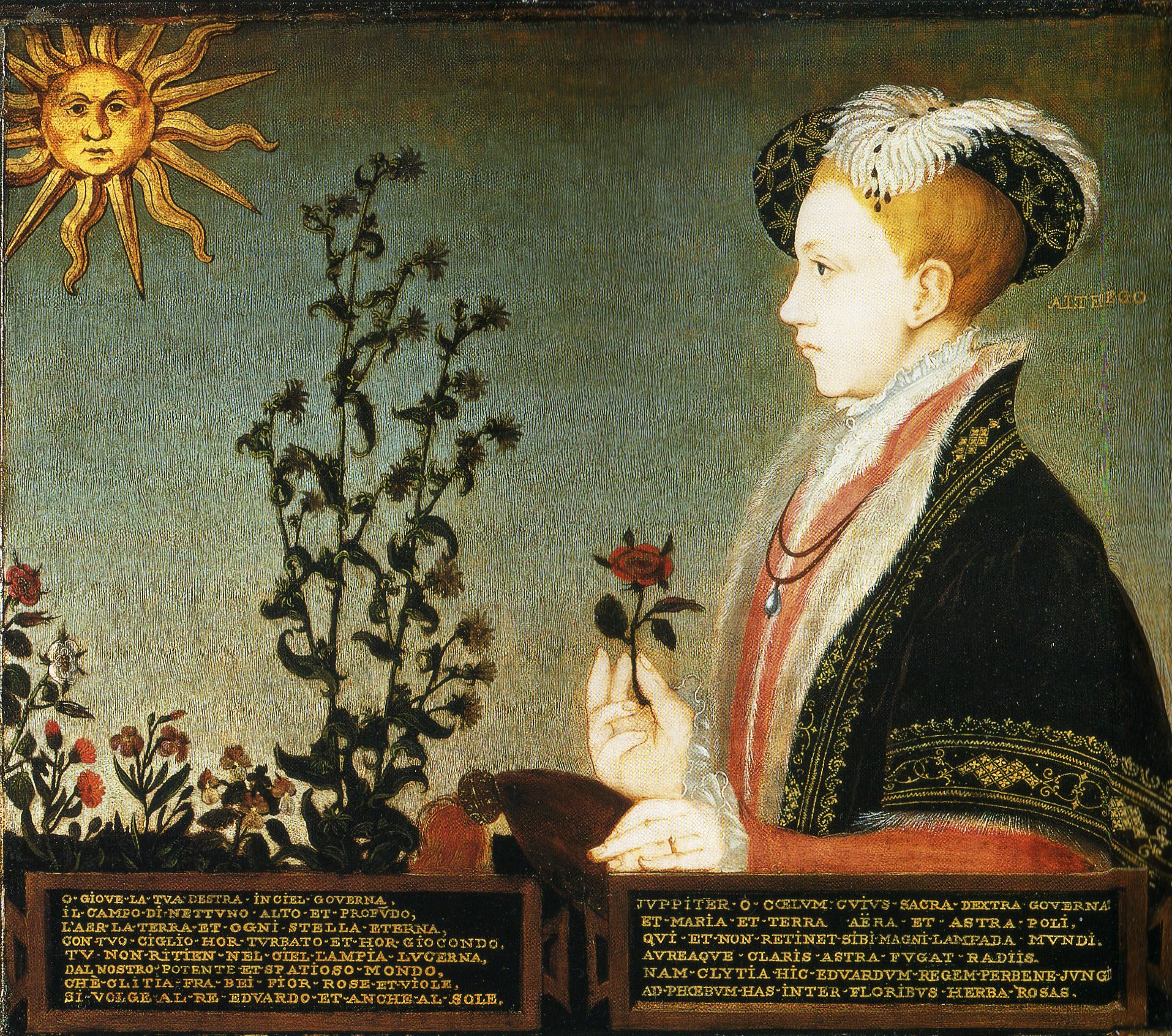
King Edward VI by William Scrots (c.1550)

Let me start  by tantalising you and declaring that today My Daly Art Display is about three people, a young English king who came to the throne aged nine and died six years later, a Netherlandish portrait painter who became the King’s painter and finally a former chairman of an English Premier League football club.   Has that wetted your appetite to read on?

The king in question, who we see in the painting, was King Edward VI, the son of Henry VIII and his third wife, Jane Seymour.  Edward was born in October 1537 just over nine years before his father died and the crown passed to him.  Although he was the first son of Henry he was the third child of the monarch.  Henry VIII’s first child was Mary, born in 1516, whose mother was his first wife, Catherine of Aragon.  His second child was his daughter Elizabeth, born in 1533, his mother being Henry’s second wife Anne Boleyn.  However Henry didn’t want a girl to succeed him so he got Parliament to pass three Succession Acts, the First Succession to the Crown Act of 1534 disbarred Mary becoming Queen of England on the grounds that she was a bastard leaving the yet unborn Elizabeth the true successor.  However in 1536 with the execution of Anne Boleyn, the mother of Elizabeth, Elizabeth was declared also to be a bastard and Henry’s parliament passed the Second Succession to the Crown Act of 1536 which barred her from succeeding him to the throne of England.  At this time Henry had no heir although he had just married his third wife Jane Seymour and Edward had yet to be conceived.  In 1543 it all changed again when Henry had his Parliament pass a Third Act of Succession which made his son Edward the legitimate successor to his throne with Mary and Elizabeth reinstated as second and third in line.  Henry VIII died four years later and the nine year old Edward became King Edward VI.  His reign lasted just six years as at the age of fifteen he contracted tuberculosis and died.

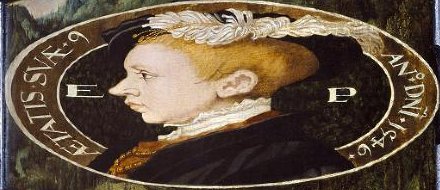
The second person involved in this painting was the painter himself, William Scrots.  Little is known of his early life but he came to light as the court painter to Mary of Habsburg, the Regent of Netherlands in 1537.  We also know that Scrots travelled to England around 1545 where the following year he became the court painter of Henry VIII in succession to Hans Holbein.  It is believed that his annual salary for this position was £62. 10 shillings, double what Holbein had been receiving.  After Henry’s death in 1547 he remained as court painter to the young Edward.  Scrots painted a number of portraits of Edward VI, one of which is today’s featured painting.

Anamorphic portrait of Edward VI by William Scrots

It is interesting to note that Scrots painted an anamorphic profile of Edward VI, which is a painting which looks totally distorted unless viewed from a certain angle when what is depicted becomes clear.   His predecessor Holbein had painted The Ambassadorsin 1533, in which he included a distorted shape of a skull lying diagonally across the bottom of the painting and which can only be recognised as such if viewing it from a very acute angle.

Anamorphic portrait as seen from an acute angle

My Daily Art Display featured oil on panel painting is simply entitled King Edward VI and Scrots is thought to have painted it around 1540.  It is an unusual portrayal of the monarch as it is one in which the sitter is seen in profile.  It is awash with detailed iconography.  We see in the painting both a red and white rose which symbolised the Houses of Lancaster and York respectively, the two great English dynasties, which were united by Edward’s grandfather, Henry VII.   The Latin inscription below the portrait speaks of Phoebus, the sun, and Clytia, the sunflower, both of whom feature in Ovid’s Metamorphoses. Ovid relates how Apollo turned the Princess Clytia into a sunflower as punishment for exposing his romance with her sister Leucothea.  Look at the sunflowers in the painting.  Normally they would turn and face the sun but in this portrait they have their “backs” to the sun and face the boy-king, which was probably meant to symbolise the power and influence of the young man.  It is believed the portrait was commissioned by the Stanhope family who were related to Edward’s uncle and chief minister, Edward Seymour who was for a time also the Lord Protector.  The painting remained in the Stanhope family until 2004.

And so to the third person connected to this painting, the former Premier League football chairman.  As I have just said the painting remained in the Stanhope family for over four hundred and fifty years until 2004 when it was auctioned by Sothebys.  This painting was considered to be one of the most significant sixteenth-century paintings ever to have come up for sale.  It was purchased for £700,000  by the Peter Moores Foundation for Compton Verney.  Sir Peter Moores is a British businessman, art collector and philanthropist, a former chairman of the Liverpool-based Littlewoods football poolsand retailing business in the UK and was briefly the Chairman of Everton Football Club.

So there you have it – a fascinating oil on panel painting, a tale of three men;  a boy-king, an artist and an ex football chairman.   What more could you ask for?

Mrs Baldwin in Eastern Dress by Sir Joshua Reynolds

Mrs Baldwin in Eastern Dress by Sir Joshua Reynolds (1782)

Today I am returning to portraiture and one of the greatest English portrait painters, Sir Joshua Reynolds.  His works were in a style which came from classical art and was often referred to as the Grand Manner which depended on idealization of the imperfect.  Reynolds himself preferred the term Grand Style which referred more to history painting and in his series of lectures, entitled Discourses of Art, he maintained that artists should perceive their subjects through generalisation and idealization rather than simply copying the sitter.  In the course of his lecture he expanded such thoughts, saying:

“…..How much the great style exacts from its professors to conceive and represent their subjects in a poetical manner, not confined to mere matter of fact, may be seen in the cartoons of Raffaelle.   In all the pictures in which the painter has represented the apostles, he has drawn them with great nobleness; he has given them as much dignity as the human figure is capable of receiving yet we are expressly told in Scripture they had no such respectable appearance; and of St. Paul in particular, we are told by himself, that his bodily presence was mean. Alexander is said to have been of a low stature: a painter ought not so to represent him. Agesilaus was low, lame, and of a mean appearance. None of these defects ought to appear in a piece of which he is the hero. In conformity to custom, I call this part of the art history painting; it ought to be called poetical, as in reality it is….”

Reynolds made a number of trips to Europe during which time he studied the foreign artistic techniques and by so doing was able to draw inspiration from them and it influenced how he shaped his own “English” paintings

My Daily Art Display featured painting;  Mrs Baldwin in Eastern Dress is a prime example of Sir Joshua Reynolds’s Grand Style of painting.   Jane Baldwin was born in Smyrna, Turkey in 1763.  She was the third daughter of Margaret Icard and William Maltass, a Yorkshire man from Ripon who, along with his brother Henry, spent the early part of the eighteenth century in Eastern Europe and was one of the earliest Europeans to settle in Turkey.    He became a wealthy merchant who traded with the East through the Levant Company.  From an early age Jane was deemed an extraordinary beauty.  At the age of sixteen, still virtually a child, she married the prosperous George Baldwin, an extremely wealthy English merchant stationed in Alexandria, Egypt.  George Baldwin later became that country’s British Consul-General and the British Minister Plenipotentiary to the Court of Tehran.

In the painting we see the delectable nineteen-year old English beauty attired in a luxuriously brocaded emerald and gold striped caftan, sprigged with cherry-coloured flowers and is aggrandized by an ermine mantle.  We see her dark chestnut hair braided into multiple long strands.  She is wearing a white and pink silk turban, atop of which are a small bouquet of tea roses.   In the late eighteenth century it was very fashionable for ladies to wear Eastern style headdresses and was in a way highlighting Britain’s trading relationship with the Ottoman Empire.

Around her neck she wears a diamond waterfall necklace along with a gold chain and pendant.  Her ears are adorned with gold teardrop earrings.   She is seated on a red velvet divan which is studded with brass tacks around its base.  Her pose is somewhat both alluring and seductive as she sits cross-legged before us.  Her eyes are fixed upon an ancient gold coin of Smyrna, the inclusion of which was probably to remind us of the links between England and its Turkish trading partner.  The sitter seems lost in thought, unaware that she is the focus of attention of the artist and of course us, the viewers.  So did the artist manage this expression on his sitters face by just simply having her stare at the coin for hours on end?  In fact no he didn’t.  Jane Baldwin sat in the pose we see but at the time the artist was painting her portrait she was actually holding and reading a book of poems by Pietro Metastasio, the famed Italian poet and librettist.  So why not have her reading the book in this portrait instead of having her transfixed by the sight of a coin?  The reason is probably that Reynolds had been asked to have something in the painting which reflected the world of commerce, the very thing which had led to her family’s wealth.  It also is reminding us that different cultures are brought together through trade and on economic grounds.  For the sitter to be holding and reading a book of poems written by an Italian might lead the viewers to believe that cultures are brought together through the arts….. perish the thought that we believed that (even if we know it to be true)  !!!!!!!

Jane Baldwin wore the costume we see in the painting many times when she visited England including a ball given by the king.   She earned the sobriquet the “pretty Greek”  not because she was of Hellenic descent (she had no Eastern-European blood) but because she, having been born and raised in the Greek region of Western Turkey, identified with that community as her own.  This is one of Reynolds’ finest portraits and I will leave you with a passage from Jane Baldwin’s obituary notice from the 1839 (July to December) issue of the Gentleman’s Magazine which talks about the painting and the sitter’s views of the artist:

“…..It was during the first winter after her arrival in London (1781), that Sir Joshua Reynolds painted the beautiful portrait of this lady which now enriches the Marquess of Lansdowne’s Gallery at Bowood. She is represented sitting on a sofa in the eastern fashion, contemplating a small object which she holds in her right hand.  She once told the writer that, when this portrait of her was made, she was lodging with her husband in the Temple; and that the trees which Sir Joshua has represented in the background were those in the Temple Gardens. At first she used to give the painter sittings in his study, but Reynolds could not satisfy himself with her resemblance; he made three attempts, which he successively defaced. Mrs. Baldwin could only remember, besides, that he took a prodigious quantity of snuff, and that his painting room smelled horribly. After a few hours she always grew restless and cross, which used to vex Reynolds, who did not know how to amuse her. He made his fourth and last sketch at the residence of the lady, and when she grew impatient suggested that she should take a book. She asked for Metastasio, and while reading it her portrait was made. Instead of a volume, Reynolds represented an ancient coin of Smyrna in Mrs. Baldwin’s band,—a circumstance, as she informed the writer, which was much quizzed and ridiculed at the time. Of this painting there exist several mezzotint engravings….”

“….. She travelled widely and lived in England for a considerable number of years, and was always admired for her intelligence and beauty. She was patronised by Mrs Hester Lynch Thrale, who remarked “I…hope to Obtain some favours from the new Ministry for my pretty Greca: could her Husband but gain the Embassy!  Oh I should not sleep for Pleasure. This pretty Greek as we call her, was born at Smyrna, & ran away with a Man whose Family had been some of Mr Thrale’s best Friends in the Borough; between Gratitude to him, and delight in her, for artlessness & Beauty; I have been led to interest myself no little towards protecting her, may my Fortune & Talents be ever devoted to Charity & Friendship! & may I have the Strength & Courage to despise them who would hinder its Current, by trying to make each other believe that its Source was only Desire!…”.

“…Mrs. Baldwin had many peculiarities, but they were of a less ambitious character: a singular iulirmity of temper, which estranged from her all but her immediate relatives, was perhaps her prevailing characteristic. She had survived her generation, and ended her days in a self-inflicted penurious seclusion,— the inconveniences of which were aggravated, of late years, by sickness and suffering….”

Cottages at Burghclere by Sir Stanley Spencer

Cottages at Burghclere by Sir Stanley Spencer (1930)

On August 5th I featured a painting by Stanley Spencer entitled Double Nude Portrait, which in some ways was a pictorial insight into his life at that time.  For many it was a shocking painting, to others it was a sad realisation as how tormented the artist must have been at that juncture in his life.  Today I am looking at another painting by Spencer,  which could not be more different and which I hope you will like.

For the last two days I have been on my travels visiting my elder daughter who lives in the Derbyshire Peak District and I decided that as I was relatively close to Compton Verney I would call there on my way back home as I knew there was a small exhibition of Stanley Spencer paintings in their galleries.  The title of the exhibition was Stanley Spencer and the English Garden and it is on until October 2nd.  If you get a chance you should try and get there as not only do you have a great selection of paintings, including the Stanley Spencer exhibition, you have the chance to walk around the magnificent grounds of Compton Verney.

Stanley Spencer had served as an orderly with the Royal Army Medical Corps during the First World War, stationed first at the Beaufort War Hospital in Bristol then at the age of 24 he went overseas and served the RAMC in Macedonia in the 68th Field Ambulance unit.  It was whilst there that he transferred into the infantry division of the Berkshire Regiment.  It was during that time that he witnessed horrendous suffering and lost many friends on the field of battle.

After the war Spencer received a commission from Mary and Louis Behrend to paint murals for the Sandham Memorial Chapel in Burghclere, which had been built as a memorial to Mary’s brother, Lieutenant Henry Willoughby Sandham, who had died at the end of World War I.    He started work on them in 1926 and did not complete the commission until 1932.  The featured painting does not come from the chapel but I will feature some of them at a later date but today’s painting is one which he painted in his spare time when he was at Burghclere.  In some ways I think it may have given Spencer a respite from the memorial paintings and the horrors of war which were relevant to those works.

My Daily Art Display painting for today is entitled Cottages at Burghclere which he painted in 1930 and is owned by the Fitzwilliam Museum in Cambridge but is now part of the Compton Verney exhibition.  In this beautiful painting we see two cottages, one with a thatched roof that is slightly bowed and mirrors the bowing of the side hedges separating it from the other, with its tile-cladded roof and its more modern horizontal wooden-slatted facade.  These two side by side dwellings serve as a contrast between old and new.  Both of the dwellings are almost buried by a profusion of shrubbery.  We have before our eyes a voluptuous excess of summer with gardens full of blooming flowers and bordered by lop-sided topiary.  The small compact gardens are fronted by white picket fences, which struggle to fend off the invading weeds and brambles, which press against them in their attempt to spill over into the manicured gardens.  On one side of the fence we see the dwellers have managed to tame the rampant weeds whilst on the other side of the fence line the weeds are mustering forces to lay siege once again.  It is almost man versus nature.

A white picket fence gate in the left foreground stands ajar as if inviting us in to this garden paradise.  The verdancy of the image is almost too much to behold as we look towards the wooded background.   Everything is so lush.  This painting is not of a vast garden with its beautifully manicured lawn which we are used to seeing around French chateaux of the Loire Valley.   This painting is of a small, full-to-the brim with flowers, Berkshire garden in front of its chocolate-box type of dwelling.  There is a snug homeliness about this picture.  There is a feeling of security and wellbeing about the setting.

We are all so used to seeing Spencer’s unusual figures in his religious paintings, which link biblical stories with his native Cookham.  We are also used to his paintings which hark back to the relationship with his two wives, but the garden pictures of Stanley Spencer which he painted throughout his life, have remained little known.   They celebrate all those things that Spencer thought of as quintessentially English and highlight the English love of their gardens.  For this reason I urge you to visit the exhibition before it closes.

The Times described this painting as:

“….the work of a Pre-Raphaelite who has looked at Cezanne..”

The Director of Compton Verney said of Spencer’s paintings:

“…Nothing in Spencer is without symbolism.  He was an inherently mystical person.  For him even the most modest garden was a self-contained vision of heaven…”

I will put it more simply and say that it is so easy to fall in love with the simplicity and beauty of Spencer’s garden paintings and I would love to hang one on my wall at home to remind me of the beauty that is the English countryside.

Portrait of Jacobus Blauw by Jacques-Louis David

Portrait of Jacobus Blauw by Jacques-Louis David (1795)

The artist and the subject of this painting had one thing in common – they were both revolutionaries.  The artist Jacques-Louis David was both an artistic and political revolutionary.

Artistically, David was a revolutionary in as much he condemned the French Royal Academy and its standards and the way it functioned.  In the 1780’s, he continually voiced his disapproval of the rule-bound world of the Academy and Academicism.  His art was different to that which had been so fashionable since the start of the eighteenth century and which was termed Rococo.  Rococo was a light-hearted and often gently erotic artistic style which was well suited to the excesses of the royal regime prior to the Revolution.  David’ style of painting became free of Rococo mannerisms and developed a heroic style which was heavily influenced by his study of antique sculptures during his time in Rome.   His style was to become known as Neoclassicism and harked back to the Classical past which could be looked upon as a means to understanding the contemporary world.  This Neoclassical art tended towards a high moral seriousness and was in complete contrast to the frivolity of Rococo art which was condemned by the French Revolutionists.

Politically, David was an active sympathiser of the French Revolution and he served on various committees and even voted for the execution of Louis XVI.   Artistically he was looked upon as the foremost painter of the Revolution.    As with many of the revolutionaries of that time, life was good for them, as long as the people they supported remained powerful.  In David’s case he was a great friend and supporter of Maximillien Robespiere, one of the most influential figures of the French revolution and a leading light in the period which was commonly known as the Reign of Terror.    However, after the fall of Robespierre and his execution in 1794, David was imprisoned.  He was released on the plea of his wife, who had previously divorced him because of his Revolutionary sympathies; she being a Royalist.  The couple remarried two years later.

The sitter for this painting was Jacobus Blauw.  Blauw, albeit a respectable middle-class man, was also a revolutionary and one of the leaders of the Dutch Patriots.  He went on to be a judge, politician and diplomat..  He was a political envoy from the Netherlands who had rebelled against the feudal relationship with Prince William of Orange and had asked France to assist in the overthrow of the government.

Although David made his name with large heroic narrative pictures on themes from antiquity, some of his finest works are portraits of contemporaries and todays featured painting is a good example.  David has managed to bring authentic realism to this severe composition.  When the French army invaded the Netherlands, Blauw was sent to Paris as Ministre Plénipotentiare (envoy) of the new Batavian Republic to negotiate a peace settlement with the French and get them to recognise the new republic.

David has made interesting use of contrasting colour.  We have a pale grey background, a red chair and a pink cloth lying on the table as well as the turquoise coloured table covering itself.  We see Blauw in a half-length portrait seated at a table writing an official document.  The paper on the table before him is inscribed:

J. BLAUW, minister Plénipotenttiaire aux Etats Généraux des provinces unies.

Blauw sits upright at the table with his short-cropped powdered hair and this contrasts in style to the powdered wigs which were fashionable with the aristocracy of the time.  He has a lively expression on his face as he looks up at us with quill in hand almost as if we have interrupted him as he writes his letter.  This supposed interruption of course gives the artist the chance to paint Blauw in a full-face view.   He is dressed simply, which is befitting a republican.  His blue coat is of a plain design and around his neck he has a soft white cravat.  The brass buttons of his coat glisten with a hint of red as the light falls upon them.   It is probably difficult to see it in the attached picture but if you look closely you will see that the artist has inscribed his name “L.DAVID  4” in the folds of Blauw’s brown coat which seems to have slipped off the back of the chair.  The “4” refers to the date, year four of the French Revolution, i.e. 1795.
Bluaw was delighted with the portrait and in his letter to David he expresses his satisfaction:

“..Mes voeux sont enfin satisfaits, mon cher David.  Vous m’avez fait revivre sur la toile..”

(My wishes were finally satisfied, my dear David. You made me live again on the canvas)

The sitter obviously knew the artist for the letter continues:

“…j’ai voulu posséder un de vos chefs d’oeuvre, et j’ai voulu plus encor avoir dans ce portrait un monument éternel de mon étroite liaison avec le premier peintre de l’Europe..”

(I wanted to own one of your masterpieces, and I wanted to have more in this portrait an eternal monument of my close association with the first painter of Europe)

We must believe that Blauw was aware of David’s revolutionary activities and that will have won the admiration of a fellow revolutionary.  The two had another thing in common; they both suffered for their great causes.

I love this portrait.  I love the way Blauw is portrayed – dignified and assertive.  He is almost too beautiful to be a man.  The way David has portrayed his sitter lends us to believe that the artist respected him and that there was a bond between the two men, a kind of reverence between fellow revolutionaries.

The Lake by L S Lowry

The Lake by L S Lowry (1937)

I don’t know about you, but for me, when I wake up and the sun is shining and the sky is a clear blue, I feel great.  Life is good.  I want to get out and do things.  I have an urge to go into the garden and make things look good.   On the other hand, when I get up and it is cold, pouring with rain and the sky is covered in black clouds I start to feel slightly depressed and extremely unmotivated.  I know that anything I do will not be done with any degree of enjoyment simply because I am not in the right frame of mind.  For that reason, and so as to clear my mind, I will often turn to a DVD and watch a film which helps me escape reality.   Although I am not an artist I would imagine that if you are experiencing life at its worse for whatever reason it may be transmitted subconsciously into your work of art.  It could be that your painting reflects your state of mind.  All this leads me to the second painting I am featuring by the artist L S Lowry.

This painting was the first one I came across when I walked into the Lowry Gallery at Salford Quays, just outside of Manchester.  I was so impressed by it that throughout my hour-long walk around the gallery I kept wanting to return to it and search for things that had escaped my attention during my initial viewing.  It was painted by Lowry in 1937 at a very distressing period of his life.  His father had died five years earlier and this had badly affected his elderly mother who just took to her bed and stayed there until she died in late 1938.  Lowry’s never really bonded with his father and their relationship does not appear to have been a loving one.  I get the feeling they exchanged pleasantries but there was never a warmth in their relationship.  Lowry probably turned to his mother, whom he dearly loved, for comfort but sadly he never received the love and affection that a child should receive from his mother.  She had always wanted daughters and was dissatisfied with her lot in life having been saddled with a son.  She rarely praised Lowry for his artistic achievements and maybe if she had shown just a modicum of pride for her son’s artistic success then maybe Lowry would have led a much happier life.

Despite all this, she demanded that Lowry and only Lowry attended to her needs when she spent her last seven and half years bedridden.  He would comb and brush her hair, bathe her and tend her bed sores.  I don’t believe she even appreciated what her son did for her and this period in his life must have affected him both mentally and physically. He was a man under great stress.

So to look at this painting knowing what life was like for Lowry at the time may give you some idea why there is a somewhat depressing feel to the work.  It is possible that his mental stress and depression percolated into the painting and in a way was the reason for its bleakness.  We are looking at a view of the Irwell Valley.  We see the smoke-polluted atmosphere of an industrial area.   It is a very moody painting.  It is a very depressing work of art.   It is an environmental nightmare set against an industrial background.  Look at the foreground with its fences and what look like blood-red coloured tombstones dotted around.  The telegraph poles remind us of crucifixes.  The water in the middle ground looks dirty and stagnant and we see an abandoned half-sunken boat to the left.  On the left shore we see men queuing for work at a time when jobs were few and far between.  On the far side of the lake we see Agecroft Colliery which had been opened in 1844 but had to close in 1932 with a great loss of jobs.  It was re-opened in the late 1940’s due to the country’s lack of coal supplies.  As our eyes scan the picture we are drawn to the red mill on the skyline.  Look how Lowry has intertwined churches and the town hall with the mill chimneys, which spew out black polluting smoke, and the winding tower of the colliery, which sits by its slag heap.  It is an interesting juxtaposition of industrial architecture and residential buildings.

It is a very dark and “dirty” picture and after looking at it for a while I feel I need to go and wash my hands to cleanse myself of the grime which emanates from the painting.  The more I look at the painting, the more I am sure that there was transference of the artist’s state of mind into what he offered us in his painting.

Head of a Man with Red Eyes by L S Lowry

Head of a Man with Red Eyes by L S Lowry (1938)

The other day I went over to Manchester and visited the Lowry Gallery at Salford Quays.  The Gallery was named after Laurence Stephen Lowry, best known simply as L.S.Lowry.  He was the Lancashire artist, who had a very distinctive type of art, often depicting people and places around his home town.  The small stick-like characters which were seen in the crowd scenes of his paintings were his trademark and were often described as matchstalk people.

The Matchstalk people of a Lowry painting

The term matchstalk men and matchstalk cats and dogs was further immortalised with the No. 1 hit song produced in late 1977 entitled Matchstalk men and Matchstalk cats and dogs.  The lyrics  of the song, telling the story of the artist Lowry, was performed by a duo, who went by the name of Brian and Michael.

The poignant lyrics summed up Lowry’s art:

He painted Salford’s smokey tops

On cardboard boxes from the shops

And parts of Ancoats where I used to play

I’m sure he once walked down our street

Cause he painted kids who had nowt on their feet

The clothes we wore had all seen better days.

Now they said his works of art were dull

No room, all round the walls are full

But Lowry didn’t care much anyway

They said he just paints cats and dogs

And matchstalk men in boots and clogs

And Lowry said that’s just the way they’ll stay

And he painted matchstalk men and matchstalk cats and dogs

He painted kids on the corner of the street with the sparking clogs

Now he takes his brush and he waits outside them factory gates

To paint his matchstalk men and matchstalk cats and dogs.

The Matchstalk people of a Lowry painting

Although I went to the Gallery expecting to see just a series of similar looking crowd scene paintings filled with strange looking, stick-like people, I was very pleased to see the exhibition showed far more than I was expecting.  Besides Lowry’s trade-mark paintings, there were a number of completely different works of art by Lowry, which I found amazing and two of which I will feature today and tomorrow.

The painting by Lowry which is My Daily Art Display painting of the day is entitled Head of a Man with Red Eyes, which he completed in 1938.  The 1930’s had been a period of his life which was very traumatic.  Lowry was an only child and was never to marry.  He lived with his mother and father, with his mother being, by far, the more dominant parent.  His mother had always wanted daughters and her son disappointed her and to make things worse her sister had given birth to three girls.  Lowry’s mother was very envious of her sister Mary and once commented that it was unfair that whilst Mary had three splendid daughters all she had was one clumsy boy.

In 1932 his father, aged 74, died of pneumonia.  Lowry’s relationship with his father had been somewhat cold and strained and although he called his father “Dad” there was a distinct lack of father-son rapport.   The death of his father did not bring out any palpable signs of overwhelming grief.  His main concern at the time was how the death of her husband would affect his mother.  The affect it had on his 73 year-old mother was terrible as she all but gave up on life and retired to bed where she remained for seven and a half years until her death.  Her demands on her son and his time were great and constant and for that lengthy period Lowry had to care for his mother, who would not agree to any outside help.

Not only did Lowry now have to be at his mother’s beck and call he discovered to his horror that his late father had run up a mass of debts.  The discovery of the alarming state of his father’s financial situation was only discovered when the creditors came knocking at the door.  It took Lowry a year to settle the outstanding debts.  Lowry’s health began to fail due to being over-tired with looking after his mother and at one point he had to go away for a few days on doctor’s orders.

Today’s painting probably was in some way a product of his physical and mental state.  He had suffered badly because of his all controlling mother who rarely showed him any love or affection and this painting was completed the year before she died.   It is the morning- mirror reflection of the face of a man staring out at us.   It looks like he has slept little during the night.  The healthy vigour is missing, drained completely away, leaving just strain and tension.  The physical discomfort we see in this face is the look of utter despair.  The gaze is both unsettling and intense.  Of this painting Lowry said:

 “…I was simply letting off steam.  I started a big self-portrait and then I thought ‘What’s the use of it.  I don’t want it and nobody will’.  I turned it into a grotesque head, I’m glad I did, I like it better than a self-portrait….”


Boy in a Yellow Jacket by L S Lowry (1935)

Lowry in the 1950’s commented again about his work and his equally disturbing 1935 painting Boy in a Yellow Jacket and came to the conclusion that it was painted during a harrowing period in his life.  He said of the period:

“…I think I reflected myself in those pictures.  That was the most difficult period of my life.  It was alright when he [his father] was alive, but after that it was very difficult because she was very exacting.  I was tied to my mother.  She was bedfast.  In 1932 to 1939 I was just letting off steam…”

The painting was bought by a Manchester man who only kept it for three weeks saying that he couldn’t live with such a disturbing picture.

Would you like to have it on your bedroom wall to see when you wake up?  Maybe a man should have it next to his bathroom mirror so that he can compare likenesses when he finally gets out of bed and thus be appreciative of his looks and be appreciative of what he has and realise that life could change for the worse !