The thing that brings me the greatest pleasure about writing this blog is that I am constantly unearthing artists whom I had not heard of before. My blog today is another example of such a discovery and I have one of my readers, Mary Ann Barton, to thank for this, as it was she who asked me to write a piece about the artist who had created two of her favourite works. So today, come with me on this voyage of discovery and find out something about a Hungarian artist and at the same time, savour some of his beautiful works of art. Let me introduce you to Mihály Tivadar Kosztka, although, in 1900, he used the pseudonym of Csontváry and that is the name he is always referred to when people talk of his art.
Woman Sitting by the Window by Csontváry (c.1890) Hungarian National Gallery, Budapest
Csontváry (pronounced sont varee) was born in Kisszeben in July 1853. Kisszeben was originally situated in northern Hungary and is the Hungarian name of a small town which is now situated in the north east of Slovakia and is the present day Sabinov.Csontváry’s forefathers were originally from Poland but later moved to Hungary in the seventeenth century. His father was a pharmacist, who later gained a diploma in medicine. Csontváry’s early education took place in his home town of Kisszeben and his secondary education is recorded to have taken place in the town of Ungvár (now the western Ukraine town of Uzhorod). At the age of twenty, having completed his education, he followed in his father’s footsteps and worked in a pharmacy in Presov. He eventually became a pharmacist in his own right in 1874, at the age of twenty-one, after attending the University of Budapest. He completed his military service and later studied at the university’s Faculty of Law whilst working in the local government magistrates office. In 1879 he, along with many of his fellow university students, played a part in the relief operation of the town of Szeged which was almost completely destroyed in a major flood. .
Baalbek by Csontváry (1905) One of his largest works measuring 714 × 385 cm (281.1 × 151.6 in). Csontváry Múzeum, Pécs
This is not a story about a person who, as a young man, always loved to draw and paint and wanted to free himself of the shackles of his father’s profession. He loved working as a pharmacist and had no desire to become an artist. If we are to believe what he later wrote in his autobiography, the beginning of his artistic journey came to him, in the autumn of 1880, through what he termed, a mystical vision in which he was told that he would become a great painter, even as great as Raphael. He believed that it was God’s wish that he should become a great painter. It could well be that this was the first of many schizophrenic happenings which would dog him all his life. He decided there and then that he wanted to be the world’s greatest exponent of plein air painting and his hope was that one day his reputation would surpass that of Raphael Sanzio, his artistic hero. With the money he had accrued, he set off for Rome in the spring of 1881 to study the works of the Masters of the Italian Renaissance, especially Raphael. However, on his return, he did not immediately change his lifestyle and turn to art, in fact, he returned home and continued to work as a pharmacist for another ten years and, whilst a pharmacist, he wrote many articles regarding pharmaceutical work and its regulations. It could be that he realised that to become a full-time artist was a financial gamble and so decided to build up his savings before abandoning his life as a pharmacist and in fact his break from that work did not come until 1894, when he considered himself financially independent. He was now forty-one years of age and ready to devote himself to art.
The Old Fisherman by Csontváry (1902)
Hungary at the time had no Academies of Art and so Csontváry travelled to Munich where he enrolled on a six month course at a private art school run by the Hungarian painter, Simon Hollósy. Hollósy, who was actually four years younger than Csontváry, had studied art at the Munich Academy but had become disillusioned with the its training, which like many of the formal European Academies of Art, concentrated on historical paintings and the copying of such classical works. Hollósy believed in more realistic art and the more realistic depiction of people and was influenced by the likes of Gustave Courbet, who had his work exhibited in the German city. Hollósy was also influenced by the new style of art produced by the French Impressionists.
Ruins of the Greek Theatre in Taormina by Csontváry (1905)
Following stays in the German cities of Dusseldorf and Karlsruhe where he studied under the German painter, Friedrich Kallmorgen, he went to Paris where he studied at the Académie Julien. All the time during his travels he was learning about art but he never remained still and most of his art was self-taught. From Paris, he travelled to Switzerland, along the Dalmatian coast and Italy where he visited Rome and Naples and the nearby ancient site of Pompei, where he stayed during the winter of 1895, constantly sketching the various landscapes. He moved south and visited eastern Sicily and the town of Taormina and the nearby ruins of the ancient Greek colony of Naxos. He was always looking for that special place or special site which he could depict in one of his paintings. He finally returned to his homeland and the Tatras mountain region in the summer of 1902. It was here that he discovered the natural beauty and the way it looked in the natural sunlight. The following year, 1903, he decided to go off on his travels once again and applied for a travel grant from the Cultural Ministry but his request was turned down. Not deterred, and with money he had borrowed, he set off for the Near East visiting the Egyptian city of Cairo and the Palestinian cities of Jerusalem and Bethlehem. From Palestine he journeyed north to Damascus and then crossed over the mountains to Lebanon and the town of Baalbek in the Beqaa Valley which was once the site of the Roman “city of the sun”, Héliopolis. In 1905 he travelled to Greece and stayed in Athens.
Springtime in Mostar by Csontváry (1903)
His constant travelling and his constant search for the perfect location to depict in one of his paintings took a toll on his health. It was not just the deterioration to his physical health brought about by his tiring travelling itinerary but more and more he was suffering from mental problems partly brought about by the solitude on his travels but also his never ending and all-consuming search for the perfect subject and the perfect light. His mental wellbeing was also sorely tested with the mixed reception he received when his work was first exhibited in Budapest in 1905 and again, four years later, in 1908. His paintings received a better reception when shown in Paris in 1907 and following that he went off to the Lebanon where he painted his famous “Cedar paintings”. What disappointed him the most was that he felt that his work was unappreciated by the people of Hungary and that he himself was unloved, so much so that he ended his painting career in 1909, totally disillusioned with it, just fifteen years after it had begun. His last painting was Riding on the Seashore. Instead, he worked on his autobiography and published a number of pamphlets, often controversial, about life in general, religion and pacifism. One in 1912, entitled Energy and Art, laid out his strong beliefs opposing modernity and another, Men of genius, published a year later asserted his genius. Sadly, during his lifetime in his native Hungary, he was thought of as an oddball mainly because of his outspoken views. He was a vegetarian, shunned all forms of alcohol and condemned the habit of smoking. He was also a forthright pacifist. All these traits were condemned by his biographers who would often dismiss him as being a schizophrenic and totally rejected his visionary ideas as being manic. His so-called prophetic writings were probably derived from his ever more serious mental issues which ended his creative ability to paint. He did carry on sketching but the subjects became more bizarre as his schizophrenia became more serious and more debilitating.
The Solitary Cedar by Csontváry (1907)
Csontváry died in Budapest in June 1919, six weeks before his 66th birthday. He died alone and virtually penniless. Like many artists before him, his work was not appreciated fully until after his death. It was not until 1930 that his work was re-assessed at a posthumous exhibition held at the Ernst Museum in Budapest and it was nearly twenty years later, in 1949, when his work was exhibited in Paris that his ability as an artist was fully appreciated. However it was not until two exhibitions held in his homeland, a retrospective held in the Hungarian town of Székesfehérvár in 1963 and at the Hungarian National Gallery in 1964, that his contribution to Hungarian art was fully appreciated by the Hungarian people. An further exhibition of his work was shown at the World Fair in Brussels in 1958 and again a major exhibition in Belgrade in 1963 and both were held to be very successful. Most of Csontvary’s artistic works are to be found in the Hungarian National Gallery in Budapest and the Csontváry Museum in the southern Hungarian town of Pécs while others are in private collections.
Riding on the seashore by Csontváry (1909)
Csontváry is looked upon as being a loner, a genius because of his eccentricity which became more pronounced in his later life due to the severity of his mental issues. He was unappreciated in his own lifetime and it was not until long after his death that he was considered to be one of Hungary’s greatest painters.
Portrait of the Artist with His Wife Isabella de Wolff in a Tavern by Gabriel Metsu (1661)
In my last blog I looked at the early life of Gabriel Metsu and had reached the year 1651, the year in which his mother died. Gabriel Metsu was twenty-one years of age and, as such, was still not looked upon as an adult. In the Netherlands at that time, adult status was only reached when a person became twenty-five years of age, and for that reason Gabriel came under the guardianship of Cornelis Jansz. and Jacob Jansz. de Haes. Around this time it is thought that he was advised by a fellow aspiring artist, Jan Steen, to seek employment as an apprentice with Nicolaus Knupfer, a painter from Utrecht. Metsu remained with Knupfer for a few years during which time he completed a number of religious paintings.
In 1654, his guardianship came to an end and his late mother’s estate was finally settled and Gabriel received an inheritance. With this newly found wealth, Metsu left Leiden and moved to Amsterdam where he had enough money to set up a workshop in a small house off the Prinsengracht. He remained there for a short time before moving to a canal-side residence. It is believed the reason he moved was that he had got into so many arguments with his neighbours for keeping chickens at the rear of his house.
His desire to move to Amsterdam was probably due to his search for artistic commissions as the city had far more opportunities for an artist than that of the smaller town of Leiden. The other thing that Metsu realised when he arrived in Amsterdam was that small-scale genre scenes were far more popular with art buyers than large scale religious works and so he made a conscious decision to change his painting style and for his inspiration into that art genre, he could study the works of the Leiden painter, Gerard Dou and the Deventer artist Ter Borch. Metsu’s favourite subjects became young women, often maids, drinking with clients and engaged in domestic work often in tavern settings.
Saint Cecilia by Gabriel Metsu (1663)
In May 1658 Gabriel Metsu married Isabella de Wolff who came from Enkhuizen. Her father was a potter and her mother, Maria de Grebber, was a painter and came from a family of well-known artists. Metsu had probably met Isabella through his connection with the de Grebber family when he was a teenager. Anthonie de Grebber, who had given Metsu some early artistic training in those days, was a witness to Metsu and Isabella’s pre-wedding settlement. They married voor schepenen which means “before magistrates” which presumably meant that the couple did not belong to the Dutch Reformed Church and it is thought more likely that they were both Catholics. Isabella became one of Metsu’s favourite models and appeared in many of his works. In 1663 he completed a work featuring his wife, Isabella, as the model for Saint Cecilia. She is seated playing the viola da gamba. St Cecilia was a Catholic martyr who was revered for her faithfulness to her husband (note the lap dog) and it could be that Metsu by having his wife model for the martyr was his way of publicly recognising his wife’s fidelity. This would not have been the first time an artist had used his wife in a depiction of this Catholic saint as in 1633 Rubens completed a painting of St Cecilia in which he used his second wife, Hélène Fourmen,t as the model. It is entirely possible that Metsu had seen the Rubens’ painting and then decided to use Isabella for his depiction of the martyr.
Gabriel Metsu died in October 1667, just a few months before his thirty-eighth birthday and was buried in the Nieuwe Kerk in Amsterdam. Following the death of her husband Isabella moved back to Enkhuizen to live with her mother, where she died in her late eighties.
A Woman Artist, (Le Corset Rouge) by Gabriel Metsu (1661-4)
Another painting by Metsu, featuring his wife as an artist, was entitled A Woman Artist, (Le Corset Rouge) and is dated 1661-4. So is this just simply a painting of an artist for which his wife modeled? Maybe not, for one must remember that Isabella was actually an artist in her own right, having been trained as an artist by her mother, Maria de Grebber, who had come from a family of artists and so this painting by Metsu may just be a loving portrait of his wife, highlighting her talent as a painter.
Do you ever re-read a book or watch the same film more than once? Many people who do tell of how they saw things in the film or read things in the book the second or third time which they had not picked up the first time and that for them was the joy for re-visiting the work. Genre works have the same effect on me. The more times I study them, the more new things I discover which were not apparent during my initial viewing. I also like the fact that often one cannot take things depicted at face value as there is often a hint of symbolism with the iconography of some of the objects that are dotted around the work and this I find utterly fascinating. I read art historians’ views on such things and often wonder whether what the artist has added to the work is as symbolic as the historians would have us believe.
In my previous blog about Metsu I talked about certain iconography in the painting entitled Woman Reading a Letter, and was rather scornful with regards the supposed sexual connotation of the abandoned shoe which was prominently depicted lying on the floor. In my next two featured paintings there is more iconography that has a supposed sexual nuance. In the next two featured works we see a dead bird being offered to a woman. Just a mere offering of food? Maybe not for the Dutch word for bird is vogel and in the seventeenth century the word was synonymous with “phallus” and the Dutch word vogelen, which literally means “to bird”, was slang for “to have sexual intercourse with”. So when we look at the two paintings we should look at the offer of a bird not as a gift of food but an enticement to have sexual intercourse!
The Sleeping Sportsman by Gabriel Metsu (1660)
In the Wallace Collection in London there is a magnificent painting by Metsu entitled The Sleeping Sportsman which he completed between 1658 and 1661. It is a kind of “hunter’s scene” and it was in this painting that we need to think laterally in as much as the hunt is the gentleman’s hunt of a woman. In this painting by Metsu the setting is the outside of a tavern. A hunter has called in for a drink after a long day’s shooting. His gun is propped against a low wall and the two birds he has shot are on view, a pheasant atop the wall and another bird, probably a fowl, is seen hanging from the tree. Metsu has depicted a lady coming out of the inn with a glass and a jug of alcohol which has presumably been ordered by the hunter-sportsman. It would appear that the jug she brings him is not his first, as he has passed out from overindulging, and we observe an empty jug lying at his feet. After a day of hunting game he has decided to end it with a few drinks and search for the company of a female or as the French would say cherchez la femme, but, sadly for him, alcohol has won the day. Take a careful look at the stupefied hunter. It is supposedly a self-portrait of the artist. He lies slumped against the end of a bench, clay pipe in his lap lying loosely against his genitals which could be interpreted as the drunken state he is in has made him temporarily impotent. On the floor we see the remnants of another pipe which he must have dropped. Although finely dressed he looks a mess with one of his red gaiters sagging down his leg.
However, if we look again at the woman who is bringing the hunter’s refreshment, we notice that she is not looking at her “customer”, but her eyes are fixed on the man to the right of the painting who is hanging out of the window of the inn. He looks knowingly out at us. He is about to take the hunter’s bird from the tree and if we go back to the slang meaning of bird then he may also be also about to take the woman away from the comatose hunter. On the floor at the feet of the hunter is his hunting dog. He even looks meaningfully at us, its tail wagging, as if it too sees the funny side of the incident. It is a painting with a moral, warning us of the consequences of inebriation. Moralistic paintings were very fashionable and popular at the time in the Netherlands.
The Hunter’s Present by Gabriel Metsu (c. 1658-61)
Gabriel Metsu painted a similar work around the same time entitled The Hunter’s Present. In this work we see a woman in a white dress with a red frock coat trimmed with ermine, again like the female in Woman Reading a Letter, ermine, being expensive, signified the wealth of the wearer. The lady is sitting demurely on a chair with a cushion on her lap as an aid to her sewing. She looks to her left at the dead bird the huntsman is offering her. In this depiction, the hunter is sober. Now that we know about the bird/vogelen/sexual intercourse implications then we are now also aware what the man maybe “hunting” for. If we look at the cupboard, behind the lady, we see the statue of Cupid, the God of Love, which gives us another hint that “love is in the air”. Standing by his master’s side, with its head faithfully on his lap, is a similar spaniel hunting dog we saw in the previous painting. There are also another couple of additional items of symbolism incorporated in the work, besides the bird offering, that I should draw to your attention. Look on the floor in front of the woman. Here again we have the abandoned shoe or slipper and although I was sceptical in my last blog as to its sexual meaning I am starting to believe that it has a symbolic sexual connotation. So is the woman, because of the abandoned slipper, to be looked upon as a sexually permissive female. Maybe to counter that argument we should look at her right arm which rests on the table and there, by it, we see a small lap dog, which is staring at the hunter’s dog. Lap dogs have always been looked upon as a symbol of faithfulness. So maybe the woman is not as wanton as we would first have believed. Maybe the hunter is not some unknown man, chancing his luck, but it is a man known to her, maybe her lover and so perhaps the bird symbolism in this case should be looked upon as just a prelude to lovers making love rather than a more sordid prelude – vogelen! .
The Sick Child by Gabriel Metsu (c.1663)
The third and final painting by Gabriel Metsu I am featuring is by far one of his most sentimental and poignant. It is entitled The Sick Child and was completed in the early 1660’s. Netherlands, like most of Europe had been devastated by the bubonic plague. Amsterdam was ravaged in 1663–1664, with the death toll believed to be as many as 50,000, killing one in ten citizens and Metsu would have been well aware of the heartbreak and suffering felt by people who had lost their loved ones.
The painting has a dull grey background and the lack of background colour ensures that we are not distracted away from the two main characters. There is a religious feel about this work. The reasons for this assertion are threefold. Firstly the positioning of the mother and child is very evocative of the Pietà, the portrayal of the Virgin Mary holding her son’s lifeless body in her lap, as seen in Italian Renaissance art. Secondly, the mother is depicted wearing a grey shirt and, as a working woman with a child, one would also expect this but one would have expected her to be also wearing a plain coloured dress but in fact Metsu has depicted her in a royal blue skirt with a red undergarment and these are the colours of the clothes one associates with Italian Renaissance paintings depicting the Virgin Mary.
Crucifixion painting on back wall
Finally on the wall we see Metsu has added a painting of the crucifixion. These three factors go to show that Metsu consciously asks us to compare the circumstances of the Virgin Mary and her dead son with that of this mother and very ill child. The child, who is drooped in her mother’s lap, looks very ill and this is further underlined by the way the artist has painted her face. It is pallid and has a deathly blue tinge to it. The child’s legs fall lifelessly over her mother’s knees.
Tragically, Metsu died very young, at the age of thirty-seven. He was one of the most popular painters of his era and his paintings fetched high prices. Many art historians believe Metsu was one of the greatest of the Dutch Golden Age genre artists and that a number of his paintings were the best of their time. As I said earlier, although Vermeer is now one of the best loved seventeenth century Dutch painters, in the 18th and 19th centuries, Metsu was far more popular than him, and often Vermeer’s works were attributed to Metsu so that they would sell. Through Metsu’s works we can get a feel for everyday Dutch seventeenth life. His earlier genre works focused on the common man and woman but in the 1660’s he concentrated on scenes featuring the better-off Dutch folk, like the letter writer and his beau, and these are the paintings I have focused on in my two blogs featuring Gabriel Metsu.
A Hunter Getting Dressed after Bathing by Gabriel Metsu (c.1654)
In A Hunter Getting Dressed after Bathing (above), Gabriel Metsu depicted himself as a nobleman and hunter, but of course the unusual twist to the depiction was the fact that he depicted himself in an a full-length, un-idealized, naturalistic nude pose.
If I was asked who was my favourite artist or what was my favourite artistic era, I would probably choose one of the 17th century Dutch Golden Age painters. To be more precise, I would almost certainly choose an artists who painted genre scenes, all of which I find quite fascinating. Nowadays the most well known and most popular Dutch Golden Age painter is almost certainly, Johannes Vermeer. However, for the next two blogs, I am going to feature some of my favourite works by a contemporary of Vermeer, and who during their lifetime was by far the more popular. Let me introduce you to Gabriel Metsu.
Gabriel Metsu was the son of the Flemish painter Jacques Metsu, and Jacomijntje Garniers. Jacques Metsu besides being a painter was also believed to be a tapestry designer or cartoon painter. A cartoon being a full size drawing made for the purpose of transferring a design to a painting or tapestry or other large work. Records show that Jacques came from “Belle in Flanders” which is now Bailleul, a small town in French Flanders close to the France-Belgium border. Jacques Metsu married his first wife, Maeyken, who died in 1619 without giving him any children. He married his second wife, Machtelt Dircx the following year and the couple went on to have four children, but only the first child, Jacob, survived childhood, the others probably succumbed to the plague which swept through the region in 1624 and which also claimed the life of Machtelt.
Jacomijntje Garnier’s family came from Ypres but by 1608 when she was eighteen years of age she was living with her family in Amsterdam. It was in this year that she became betrothed to her first husband, Abraham Lefoutere, a citizen of Antwerp. His profession was given as a teacher but some records show him as an innkeeper. The couple had four children, Philips, Sara, Marytgen and Abraham who died in infancy. Her husband, Abraham, died in 1614 and soon after Jacomijntje remarried. Her second husband was Willem Fermout but he too died at a young age in 1624
Jacomijntje Garnier moved, with her three children, to Leiden and there she met Jacques Metsu and the couple were married in November 1625. In 1629 she became pregnant with Gabriel but sadly her husband, Jacques died in the March of that year, eight months before Gabriel was born, some time between the end of November and the middle of December 1629. Jacomijntje’s occupation around this time was given as a midwife. Gabriel Metsu, along with his step-brother and two step-sisters from his mother’s first marriage, were brought up by her alone, until, in 1636, when Gabriel was six years old, she married her fourth husband, Cornelis Gerritsz. Bontecraey, who then became their stepfather Bontecraey was a wealthy captain and owner of a barge and two houses in Leiden. He died in 1649 making Jacomijntje a widow for the fourth time. She died two years later in 1651.
There are few hard facts with regards Gabriel Metsu’s early artistic training and teenage years. However it is believed he could have helped in the workshop of Claes Pietersz de Grebber, a silversmith. Because Gabriel Metsu’s earliest work, which is still in existence, entitled Ecce Homo, which he completed around the late 1640’s was a religious one, it is believed that his early artistic tuition must have come from a history painter. It maybe just a coincidence, but his employer’s son, Anthonie de Grebber, who Metsu must have known, was a history painter and maybe he gave Gabriel some of his first artistic tuition. In 1644, when just fifteen years of age, Gabriel Metsu joined a group of local artists, and even at such an early age, his name was entered in the membership rolls as a “painter.” Other larger Dutch cities such as Gouda and Haarlem had their own painters’ guild, Guild of Saint Luke, and it was mandatory that artists were members of these guilds in order to sell their wares. Leiden, up until March 10th 1648, had no such guild but on that date the Leidse Sint Lucasgilde (Leiden Guild of St Luke) was founded by Gerard Dou and Abraham Lambertsz van den Tempel. Six days after its formation Gabriel Metsu, aged 18, became a member.
I will continue Gabriel Metsu’s life story in my next blog but for today I want to feature two of his most famous works, two narrative pendants, Man Writing a Letter and its companion piece Woman Reading a Letter, both of which were completed around 1666 and now hang in the National Art Gallery of Ireland in Dublin. Dutch artists were the first to make the private letter a central focus in genre scenes.
Man writing a Letter by Gabriel Metsu (c. 1664-1666)
The setting for the painting, Man Reading a Letter, is a study. The scene is bathed in sunlight. We see a young, fine-looking man, with long blonde curls, sitting at a table, pen in hand. He is finely dressed in a black velvet jacket and the white of his shirt and neckerchief are lit up by the sunlight, which streams through the open window in front of him and reflects off the light-coloured back wall. His hat is precariously balanced on the back of his chair. He is quietly contemplating the words he wants to write to the woman he loves. The sunlight highlights him. He is at centre stage of this work and the sunlight acts as a spotlight. If this is indeed a love letter he is writing then he must be careful with his words. He cannot countenance a misunderstanding caused by what he has written. Look at the resolute expression on his face. He is totally lost in thought knowing the importance of the words he uses. They have to say exactly what he wants them to say. He must avoid ambiguity. The missive must be perfect.
Observe his opulent surroundings. The floor is made up of smooth black and white marble slabs, a sure indication that the owner of this house is wealthy. Everything points to this being a room belonging to a well-to-do person. We can tell this by some of the furnishings on view. The table at which he writes the letter is covered with a finely detailed expensive Oriental rug or table tapestry. Behind him we see a landscape painting in an expensive heavily carved gilt Baroque frame. To his right, partially hidden by the opened window frame we see a globe. The globe appeared in many Dutch paintings of the time and is almost certainly a reminder of the Dutch Golden Age when the country was one of the leaders in exploration and trade with the far corners of the world.
Woman Reading a Letter by Gabriel Metsu (c. 1664-1666)
The companion work to this painting is Woman Reading a Letter. The Metsu’s pendants, when seen together, combine to become a set of narrative works in which we see the man writing to the woman and the woman reading his letter. In this second work by Metsu, we see the lady sitting in the corner on a wooden zoldertje platform in a marble-floored hall. She is wearing a long pink skirt, and her yellow top is trimmed with ermine, which is a sure sign of wealth. A pillow rests on her knees, which has been used as a support whilst sewing. Her sewing has been cast aside when the maidservant brought in a letter for her. In her excitement at receiving the letter she has dropped her thimble which we see lying on the floor. The letter obviously means a lot to her. She is totally absorbed by what he has written. Look how she tilts the letter at an angle as she thoughtfully reads it. Maybe it could be that she needs the sunlight which is streaming through the window to illuminate the words, making them easier for her to read or maybe she is shielding the contents from her maidservant. The painting is full of symbolism which adds intrigue to the painting. With this being one of a pair of paintings we know that the man has written the letter to her, which she is now reading but what is the relationship between the man and the woman? Look at the woman’s forehead. The hairline is receding and to achieve that it could be that some of her hair had been plucked or the forehead shaved giving a higher forehead, which was the fashion of the day. Look more closely and one can see a single curl of hair at the centre of the forehead and this usually signified that the lady was engaged.
The inclusion of the dog is a symbol of fidelity and one presumes its inclusion probably signifies the woman’s faithfulness. According to some art historians and iconographers, a cast-off shoe, one of which we see on the floor, has erotic connotations. I find that a slight stretch of their imagination but I suppose their line of thought is that lovers hastily cast of shoes in their rush to make love. It is interesting to look at the maidservant who stands next to her mistress. Because of her lowly status in the household she has been depicted in a drab brown dress although a little colour has been added with the blue of her apron. Under her left arms she has a bucket with two arrows scribed on it. Could this once again symbolise that love is in the air and these are Cupid’s arrows. To me they look more like the arrows one used to see on the back of prisoners’ jackets in 1930’s movies. She also holds in her left hand an envelope. There is a word on the envelope which I cannot quite read although it seems to start with the letter “M”. I read somewhere that the word is “Metsu” but until I stand before the original work I will not be sure. Hopefully I will get to Dublin next month and have a closer look.
The maidservant is drawing back the green curtain, which is hanging from a rod, and which is covering a framed painting on the back wall. Covers over paintings were not unusual as it was a means of preventing sunlight from falling on them causing them to fade. The subject of the painting is a seascape in which we see two sailing ship battering their way through a storm. Is the subject of the painting symbolic? There are two theories about this. One is that the woman’s betrothed is a seafarer and the other is that the ship struggling in a storm symbolises the romantic struggles ahead for the two lovers. Also on the wall is a mirror which is in a plain black frame, the colour of which I read symbolised a warning against narcissism and lewdness, but like the abandoned shoe I remain unconvinced with that theory.
As I said earlier, both the paintings are housed in the National Gallery of Ireland, part of the Beit Collection which is housed in the . The paintings were owned by Sir Alfred Beit and his wife, Lady Beit. Sir Alfred Beit was a British Conservative politician, philanthropist, art lover, and honorary Irish citizen. He donated the two paintings I have featured today along with fifteen other masterpieces to the National Gallery of Ireland in 1987, whilst the other major art works remained at their home, Russborough House, which was once described as the most beautiful house in Ireland. Sir Alfred and Lady Beit bought Russborough House in 1952 to house their art collection and in 1976 established the Alfred Beit Foundation to manage the property. Beit died in 1994 but Lady Beit remained in residence until her own death in 2005. Due to a number of armed robberies and thefts of some of the paintings, which fortunately were recovered, the Foundation agreed to move them to the National Gallery of Ireland for safekeeping.
In my next blog I will complete the life story of Gabriel Metsu and feature some more of his paintings.
“…Everything that deceives may be said to enchant…”
– Plato
Have you ever heard of the word trampantojo in relationship to art? Maybe if you are Spanish you will have come across this Spanish word, which means “sleight of hand” or “trick”. If I had asked you whether you knew what trompe-l’œil meant then maybe there would have been more hands up as this is a more common artistic term but similar in meaning to trampantojo. Trompe-l’œil is a French phrase which literally means “deceives the eye” and, in painting terms, refers to an artistic technique that deliberately has in mind to hoodwink the viewer into thinking that he or she is seeing the depicted object or person in 3-D when of course it is just a two dimensional representation of it. One looks blearily at the work desperately trying to fathom out the boundaries between the real and the imaginary.
Still Life with Oysters by Pieter-Claesz (c.1633)
The English artistic term often used for this technique is illusionism, something which creates an illusion of reality in a work of art. We often see such an illusion in still-life works, such as the Still Life with Oysters by the 17th century Dutch Golden Age painter, Pieter Claesz, in which we see the rind from a peeled lemon lying over the edge of a silver salver which itself overlaps the table, giving the painting a sense of depth as if it was a 3-D image.
This artistic trickery is not a new phenomenon as it is said to go back to around 5th century BC. Pliny the Elder in his AD 79 book, Naturalis Historia wrote about a myth involving an artistic contest, which happened around that time between the two greatest Greek painters of that era, Parrhasius and Zeuxis. Zeuxis was born in Heraclea sometime around 464 BCE and was said to be the student of Apollodorus, a painter who lived at the end of the 5th century BC and introduced great improvements in perspective and chiaroscuro. Parrhasius of Ephesus was a contemporary of Zeuxis. Both artists produced works on both wooden panels and frescoes on walls. Each of the painters believed that they were the greatest artist of the time and so they decided that once and for all to settle the matter with a painting contest, a kind of painting duel! They assigned themselves two areas of a wall, each invisible from the other, so that they might work in private. Each artist was then set the task of painting a mural. They also arranged for a set of knowledgeable people to become judges for the competition. The contest was all about producing a realistic depiction and the one thing they had in common they were both skilled in the technique we now refer to trompe-l’œil.
The competition between Zeuxis and Parrhasius
The artists completed their works, each of which was covered by a curtain. Zeuxis work was to be viewed first and he drew back the curtain. On the wall he had painted a simple bowl of mixed fruit. It was a beautifully painted still life work. Sunlight shone down on the pale green surface of the pears and made them seem moist and firm. The pomegranates Zeuxis had depicted were so well painted that the judges and onlookers could almost taste them. The audience was stunned by Zeuxis’ artistic mastery and whilst they stood before his work a bird, which had been perched on the wall above, flew down straight into the painted bowl of fruit, from which it had hoped to fly off with one of the succulent-looking grapes. The bird hit his head on the wall and fell to the ground, a victim of illusion. His work was the height of realism and Zeuxis was sure he had won, notwithstanding what his fellow artist, Parrhasius had conjured up.
The judges and the crowd, now led by Zeuxis, moved towards the curtained wall on which Parrahasius had painted his work. The people stared at the curtain, behind which they believed hid Parrahasius’ work. Zeuxis asked his rival to pull the curtain aside and so all could see the work behind it. Parrahasius told him and the crowd that it was not possible. His words baffled the onlookers. He then turned to them to say the curtain was actually the work he had completed. Although the work by Zeuxis fooled the bird by its realism, Parrahasius’ curtain had been so real that it had fooled Zeuxis, the judges and the crowd. Parrahasius won the day.
My blog today looks at a Spanish artist who used the trampantojo technique in a number of his works. He is the nineteenth century painter Pere Borrell del Caso. He was born in 1835 in the Catalonian village of Puigcerdà, which lies close to the Spanish-French border and some twenty kilometres south east of Andorra. His father was a carpenter and he taught his son the art of working with wood. He eventually left home and went to Barcelona where he attended art classes at the Escola de la Llotja, the prestigious School of Fine Arts in Barcelona. To earn some money for food, lodgings and to pay for his education he worked part time as a carpenter making wooden chests.
Escaping Criticism by Pere Borrell del Caso (1874)
Although he was a portraitist as well as an accomplished painter of religious scenes, many of which are housed in the Museu Nacional d’ Art de Catalunya in Barcelona, he is probably best known for his trompe-l’œil works. Borrell was a great believer in realism in art and felt that the Romanticism genre of art, which was the cornerstone of art education at the Llotja in Barcelona, was not the way art should be taught. He set up his own academy of drawing and painting, the Sociedad de Bellas Artes, in which he sort to introduce his students to the world of realism in art and sought to influence his students with the works of the contemporary Catalan painters such as Romà Ribera, Ricard Canals and the muralist, Josep Maria Sert. He encouraged his students to leave the confines of the school and paint en plein air. Pere Borrell fervently believed in his teaching methods so much so that he turned down offers to become a professor of at the Llotja. It is thought that his rejection of the chair at the Llotja with its rigid academic stance to art tuition and its ruthless critique of the work of its students was foremost in his mind when he created one of his most famous paintings, the oil on canvas work, Fugint de la critica (Escaping Criticism) which he completed in 1874 and which is now part of a collection owned by the Bank of Spain.
Cropped image
This painting is a classic example of trampantojo. So how has the artist “converted” this work into a 3-D image? It is simply the way in which he has positioned the boy’s hands, feet, and head outside the painted canvas area and continued the depiction on the surrounding frame and it is that which makes it look like the boy is climbing out of the painting in a desperate attempt to escape. It is that which heightens the illusion. I have cropped the image (above) so that only the depiction on the canvas is shown and one can now see it becomes more of a normal two-dimensional image rather than a 3-D one. The depiction of the poorly dressed, bare-footed boy with his dishevelled hair, and terrified expression desperately trying to escape out of the picture is so realistic and the effect is further heightened by the trampantojo technique. Many believe that Borrell’s depiction mirrored his own desperate attempt to free himself from the confines of official academic training methods of art and the art critics of his day who championed the Romantic art of the time, with all its heroic figures and who were highly critical of art which depicted the not so pleasant “real” world. The title of the work is Escape from Criticism and this probably indicative of the struggle young artists had to go through with the constant bombardment of criticism from so-called knowledgeable art critics.
Two Laughing Girls by Pere Borrell del Caso (1880)
The second work of Pere Borrell I wanted to feature is one he completed in 1880 entitled Two Laughing Girls which can be found at the Museu del Modernisme Català (Museum for Catalan Modernism). In this painting, Borrell has ingeniously depicted the two girls partly entering our space.
Two Laughing Girls by Pere Borrell del Caso (detail)
He has achieved this effect by depicting the girl in the green dress leaning her elbow on the ornamental picture frame. The girl with a blue ribbon in her hair, in the background, extends her hand right hand towards us and her index finger almost seems as if it is coming out of the painting.
Supper at Emmaus by Caravaggio
The elbow of the girl which seems to be extending out of the painting reminds me of Caravaggio’s work Supper at Emmaus in which the elbow of the man in the left foreground, with his back to us, seems to “come out’ of the picture. The effect is enhanced by the small splash of white on his green coat sleeve in way of his elbow. The 3-D effect is also enhanced by the positioning of the basket of fruit overhanging the edge of the table.
People are fascinated by the trompe-l’œil technique and there have been many exhibitions of works of art featuring works that have incorporated this method. Borrell’s Escaping Criticism featured in many exhibitions such as the Deceptions and Illusions, Five Centuries of Trompe l’ Oeil Painting, exhibition in 2002 at the National Gallery of Art in Washington. Again it was shown at the 2008 exhibition Lura Ogat at the National Museum of Stockholm. The following year the painting was exhibited in Japan at the Visual Deception exhibition in the Nagoya City Art Museum and at The Bunkamura Museum of Art in Tokyo. In 2010 the painting was displayed in the exhibition Täuschend Echt. Illusion und Wirklichkeit in der Kunst, held in the Bucherius Kunst Forum, a private art gallery in Hamburg.
Pere Borrell del Caso is probably not a household name outside of Catalonia but there is no doubt his trompe-l’œil paintings have, for many years, fascinated many observers.
The artist I am featuring today is the Englishman, Sydney Lee, who was much-admired for his paintings and prints of landscapes and architectural subjects. He travelled widely in search of suitable subjects and was ever on the look-out for picturesque old buildings. Lee was a pioneering artist and an early advocate of wood engraving as a fine art medium and a proponent of colour woodcuts as had been seen in Japanese art. He was a resourceful and multi-talented artist and printmaker who produced numerous drypoints, aquatints, mezzotints, lithographs, wood engravings and woodcuts.
Sydney Lee was born in August 1866 in Broughton, Manchester. He was the third of four children of William and Hannah Lee. His father was a successful cotton manufacturer and also, for a time, a city alderman. His father had come from a very prosperous and prominent Lancashire family who had a string of mills around Lancashire and the neighbouring counties. Sydney had two elder siblings, an elder sister, Kate and an elder brother, Herbert as well as a younger brother, Frank. When Sydney was still very young his father moved the family into a large house in nearby Prestwich. Although the family was steeped in a history of commerce and industry there was also something of an artistic heritage attached to the family business as they had been, going back to the eighteenth century, designers and creators of decorative textiles.
Both Sydney’s brothers, Herbert and Frank, after finishing their schooling, went into the family business. For them, following their father’s footsteps was a natural progression. However Sydney did not view it similarly but reluctantly acquiesced to join Herbert in the business but it proved ill-fated. Sydney just did not have the business acumen and following a number of ill-judged decisions his father and brother decided that Sydney should take a lesser role in the company. In a way this proved a godsend to Sydney who had also convinced his parents that his future lay in the world of art. His father begrudgingly admitted that his son’s ambitions were serious ones and so, when Sydney was twenty-one, he allowed him to work in the company’s office in the morning and in the afternoon attend the Manchester School of Art.
The House with closed Shutters,Venice by Sydney Lee ca. 1926. Oil on canvas
It was at the Manchester school of Art that Sydney Lee was tutored by the head of the school, the Irish-born sculptor, Richard Henry Albert Willis. It was during these early days at the school that Sydney learnt about sculpture, relief modelling and it was also the time when he became interested in metal working and wood working as a method of printmaking. During his tenure at the art school he received a number of awards and had some of his design work exhibited at the Royal Academy.
In 1891 Sydney’s father died. Sydney, by then, had established himself as an artist but decided that London, not Manchester, was the place to be for his artistic career to develop and so with some financial help from his two brothers, Sydney headed for the capital, where he set up his studio. In 1893, two years after re-locating to the capital, Sydney married. His wife was Edith Mary Elgar, the daughter of Frederick Elgar, who ran a very successful oil cake business. The happy couple left the shores of England and embarked on a year-long honeymoon in Italy. At the end of their Italian stay, the couple moved to Paris where Sydney attended the Atelier Colarossi with the intention of honing is artistic skills, which included time spent at the atelier’s life classes.
Sydney Lee a photograph (1897)
The couple returned to England in 1895 and set up home in Holland Park Road in Kensington, a very fashionable address and one which announced that Sydney Lee was part of the artistic elite of London. Lee was now in good company for his past and present neighbours included the painters Frederic, Lord Leighton, Thomas Sheard and Harold Speed. One way to announce one’s arrival on the artistic scene was to exhibit some of one’s work and Sydney Lee did just that submitting many of his works to exhibitions held by various institutions. There is an interesting photograph dating 1897 taken in St Ives of the thirty-one year old artist. The pose is one of a self-confident and dashing young moustachioed painter, palette and brushes in hand, wearing a neckerchief and cummerbund. Here, before us, we have the dandified artist. It must have just been a passing phase as once settled into London life his outward appearance became that of a respectable gentleman, one befitting a future Royal Academician.
His first work was exhibited at the Royal Academy in 1900 and then from 1909 until his death forty years later, he regularly put forward works for inclusion at their Summer exhibitions. He was a member of a number of artistic societies, such as the Royal Society of British Artists, Society of Painters, Sculptors and Gravers and was a regular exhibitor at the Goupil Gallery on London’s Regent Street. In 1920, he became a founder member of the Society of Wood Engravers. His work was also to be seen in exhibitions across Europe and America. Sydney Lee was elected an Associate of the Royal Academy in 1922 and eight years later, in 1930, a Royal Academician and a Senior Member in 1942. He was an active member of the R.A. and held the post of R.A.Treasurer between 1933 and 1940.
The Bridge, Staithes by Sydney Lee. (1904)
One of the greatest influences on Sydney Lee was Japanese prints and he was to build up a large personal collection of these works. He would often imitate methods use by the Japanese woodcut printers to produce some of his own works. An example of this can be seen in his 1904 woodcut on mulberry paper, entitled The Bridge, Staithes. The prints were of an old rickety wooden trestle bridge, which at the time crossed the Roxby Beck at Staithes, a one-time thriving North Yorkshire coastal fishing village. There were one hundred prints of this work in five different colours, some depicting the moonlit scene at night whilst others were a daytime depiction.
The Sloop Inn by Sydney Lee (1904)
Another interesting colour woodcut was one of a pub in St Ives. It was entitled The Sloop Inn, which Sydney Lee completed in 1904. Sydney and his wife Edith would often visit Cornwall and in particular, St Ives where they stayed in a small terraced house for most of 1896. Sydney found St Ives and the surrounding area was awash with interesting vistas of the harbour which could be seen from the overlooking hills and as he was always fascinated by architecture he was in his element as he studied the small and quaint cottages belonging to the local fishermen, which were dotted around the harbour and bay. Cornwall, because of its views and favourable weather and light, lent itself to en plein air painting, and was a veritable magnet for artists.
Boatbuilding, St Ives by Sydney Lee (c.1905-10)
Sydney Lee enjoyed his time in St Ives. Although we look upon the Cornish coastal town as a place of tourism, Lee always viewed it and other small fishing villages as working environments and not merely as places people visited on holiday. His works featuring St Ives concentrated on this facet of life in a small coastal town or village. Somewhere between 1905 and 1910 he completed a colour woodcut entitled Boatbuilding, St Ives in which we see two men working on the wooden skeletal hull of a boat at the Wharf in St Ives. In the left background behind the black-hulled boat is The Sloop Inn. Sydney Lee also painted an ink and watercolour work of the scene and it became his Diploma Work when he had been elected Fellow of the Royal Watercolour Society in 1945.
The Templars’ Church, Segovia by Sydney Lee (1907)
In 1907 Sydney Lee visited central Spain and based himself in Segovia where he completed a number of etchings often of buildings or structures which held an architectural interest for him. One such work was a wood engraving entitled The Templars’ Church, Segovia, which he completed that year. The Templar Iglesia Vera Cruz (Church of the True Cross) is probably the most fascinating of several impressive Romanesque churches in Segovia. It was consecrated in 1208, and was built by the Knights Templar to house a fragment of the True Cross. Its design was based on Jerusalem’s Church of the Holy Sepulchre. The twelve-sided structure with its tower on the southern side has, at its centre, a two storey chamber where the Knights are thought to have kept vigil over the sliver of wood. Although termed a “church” it has no parishioners and it is simply a shrine and actually, the relic of the True Cross no longer remains within its walls but is safely kept in the nearby village church at Zamarramala.
During the mid-1920’s Sydney Lee spent a lot of time in Italy, especially Rome. He loved the beauty of the city and its architecture and painted many scenes of the Italian capital, with its architecture nearly always featuring in the works. Of the city he said:
“… Here, in Rome, was a field of immense and stupendous variety, the old world and the new in every successive stage and period: ancient, medieval and modern; the home of the Caesars, the splendour of the Popes, the enormous constructions of modern Italy, evidence of the enterprise and scientific skill of that fervid and energetic nation, the whole illuminated by that wonderful Roman sun. Seen for the first time by a native of northern climes a new world reveals itself, a different light, a splendour and liveliness of aspect…”
Venetian Merchant by Sydney Lee (1928)
I really like his wood engraving in black on smooth Japan paper which he completed in 1928. It is entitled A Venetian Merchant. In the work we can see an elderly Venetian merchant, bent over with age, crossing the Ponte della Paglia and in the background is depicted the Bridge of Sighs. Seeing the decrepit figure on the bridge causes me to recall the Shylock character of Shakespeare’s Merchant of Venice. We see, in the right foreground, the eastern corner of the Doge’s Palace with its Gothic bas-relief sculpture depicting the drunkenness of Noah, a scene which Michelangelo had depicted on the ceiling of the Sistine Chapel over four centuries earlier. Four years before the completion of this woodcut, in 1924, Lee had exhibited an oil painting of the same subject titled On the Palace Bridge.
The Red Tower by Sydney Lee (1928
Another beautiful painting was completed by Lee in 1928 was entitled The Red Tower. This oil on canvas work once again highlights his love of ancient structures which had managed to avoid any crass modern makeovers. The Red Tower, in the title of the work, is the Torre dei Conte, which is a medieval fortified tower situated close to the Colosseum in Rome. It was built in 1238 by Richard Conti who was the brother of the papal leader, Pope Innocent III. Although it was originally over fifty meters tall, the upper floors were destroyed in a fourteenth century earthquake and it is now just less than thirty meters high. In the foreground we see horse-drawn carts crossing the cobbled streets. The warm colour of the buildings and the blue skies add to the feeling of it being a hot day brought on by the penetrating rays of the sun, which is out of picture but somewhere high up to the left. This work was presented to the Royal Academy in 1930 as his Diploma Work. Diploma Works are works of art presented by artists upon their election as Members of the Royal Academy.
In October 1937 the Colnaghi Gallery in London, who were the exclusive agent for his prints, staged a retrospective of Sydney Lee’s prints. It was his first solo exhibition. Colnaghi held a second solo exhibition of his work in February 1939 and a third final one in January 1945. This was Sydney Lee’s final exhibition. Sydney Lee died in London in October 1949, aged 83. His wife, Edith, died three years later.
I was fortunate to attend a small exhibition of Sydney Lee’s work at the Royal Academy early last year and it was then that I bought the book by Robert Meyrick entitled Sydney Lee. Prints: A Catalogue Raisonné, from which I have got most of the information for this blog. If you liked the few prints I have included in the blog, you will not be disappointed by this beautiful book.
If you were to decide to hang another picture on one of your walls of your abode, I wonder what you would decide to display. I wonder how you would come to your decision. Would you hang a picture of somewhere you have just visited as an aide-mémoire of the place you enjoyed so much for its beauty, whether it is a seascape, landscape or even a cityscape? Maybe you would consider hanging a print of a painting by one of the great Masters of the Renaissance so that you can be reminded of their artistic mastery but, if you do that, maybe such an inclusion would be construed by your friends as a sign of your pretentiousness. On the other hand, you may choose to hang a painting which, through its complexity and symbolism, becomes a talking point for all those who cast their eyes upon it. Let me offer you an alternative. Today I am featuring a very popular English artist, whose work you either love or hate. She became well-known for her much-adored colourful and ostentatious depictions of large, often scantily-dressed women with a lust for life, often in a setting of a pub or club. She was often referred to as the woman who painted fat ladies. However many were critical of her work. The English art critic, Brian Sewell, was openly disparaging of her artistic style and said of it:
“…very successful formula which fools are prepared to buy but doesn’t have the intellectual honesty of an inn sign for the Pig and Whistle. It has a kind of vulgar streak which has nothing to do with art…”
However, the one thing that her work guarantees is that it will bring a smile to your face and her paintings and prints have sold across the world. The artistic establishment has shunned her work and strangely enough it seems that she understood their condemnation of her efforts as an artist, once saying:
“…I know there are some artists who look down on my work and when you compare mine with some of the others, I can see what they’re getting at…”
At the start even she had been disappointed with what she produced, confessing:
“…I expected to paint like Stanley Spencer. It was a great disappointment to me when I realised that I didn’t…”
The featured painter today was a wonderful proponent of Naive Art, which is a classification of art that is often characterized by a childlike simplicity in its subject matter and technique. So who was this enigmatic and talented person?
Clubbing in the Rain by Beryl Cook
Beryl Frances Lansley was born in September 1926 in Egham, Surrey. She was one of four sisters. Her father was an engineer and her mother was an office worker. Her parents’ marriage broke down and her father left the family home when Beryl was just four years old. In 1930, her mother took her and her three sisters to live in Reading where the family was supported by their paternal grandfather. When Beryl was ten years old the Cook family moved next door and they had a son, John, and soon Beryl and John became good friends. Beryl attended the Kendrick Girls’ School in Reading, but in 1940, aged 14, she left school to train as a typist. It should be noted that during her early life and her school days Beryl showed no interest in art!
Dining Out by Beryl Cook (1985)
In 1944 the family moved to Marylebone, London and Beryl took up a number of jobs; as a secretary in an insurance office but she didn’t enjoy office work, as a show girl in a touring production of TheGypsy Princess, but felt too self-conscious to enjoy the experience and in the fashion industry for Goldberg’s of Bond Street, which aroused her life-long fascination with the way people look and dress. In 1947 the family moved once again and this time went to live in an idyllic house in Hampton, a small town on the north bank of the River Thames and it was from their house that Beryl helped her mother to run a small tea-garden. It was around this time that she became re-acquainted with her erstwhile next-door neighbour, John Cook, who during the war had been an officer in the Merchant Navy. Friendship turned to love and Beryl and John were married in October 1948. In 1950 the couple had a son, also called John and in 1952 they all move into John’s mother’s house in Southend-on-Sea, where they remained until they bought their own house in nearby Leigh-on-Sea, Essex the following year.
Her husband left the merchant Navy in 1955 and he and Beryl tried their hand at running a pub and bought the public-house tenancy of the White Horse Inn, in the small village of Stoke by Nayland, on the Essex-Suffolk border. However they had always enjoyed the bustle of city life and were not use to the tranquillity of the countryside that now surrounded them. It what not what they wanted and so they terminated their pub venture after just twelve months. In 1956, John managed to find himself a job with a motor company as a car salesman but the position meant re-locating his family to Salisbury, the capital of Southern Rhodesia. Beryl worked as a book-keeper in an insurance office but she was far from happy with life in Africa and once talked of her unhappy experience in Southern Rhodesia and the ex-pat lifestyle, saying:
“…I didn’t like being so far from the sea and I couldn’t bear the social life which revolved around parties because there wasn’t anything else to do…”
Hangover by Beryl Cook (1961)
However there was one incident during their stay in Rhodesia that was to change Beryl’s life. It happened in 1960, when her son John was ten years old. She was trying to interest him in drawing and painting and had caught the artistic bug herself, so much so that her husband bought her a set of oil paints. Beryl’s first painting was a half-length copy of a dark-skinned lady which she saw in a photograph, who had large pendulous breasts. Her husband was amused by what he saw and cheekily christened it The Hangover. She never sold this work and remained in the family home.
In 1963 the family moved to the Ndola Copper Belt in Northern Rhodesia. John continued his work as a car salesman and Beryl worked in a finance office. Life for the Cook family was no better, in fact it was worse and they only remained there until 1965. Beryl and her husband had had enough of land-locked Rhodesia and decided to head back home. In 1965 Beryl along with her husband and son returned to the UK settling first in a cottage in East Looe, Cornwall and the change of country and her happiness to be back “home” inspired Beryl to once again take up her art. In 1968 the Cooks moved to Plymouth where they bought a guesthouse on Plymouth Hoe. John Cook continued working in the motor trade whilst Beryl opened up the guesthouse to visitors in the summer. Many of her guests were actors with travelling repertory companies who were appearing at the local theatres. Once the summer was over, the guesthouse was closed and Beryl was able to concentrate on her paintings. She would often use wood instead of canvas and would search for ideal pieces she could find, such as lavatory seats, driftwood and wardrobe doors! She painted continuously during the cold winter months and admitted that she was pleased when summer arrived and she had to put her paint brushes away so as to concentrate on her paying guests. She commented:
“…I had to stop painting for about four months each summer when the visitors were here, and in a way this was quite a relief for by this time there were so many paintings it had become increasingly difficult to stack them!…”
Beryl loved living in Plymouth for it was a flourishing seaside town full of lively and often risqué bars. It was a place frequented by all kinds of people. There were the local fishermen and sailors from the naval warships tied up in the harbour. The place was awash with countless fascinating individuals, and Beryl and her husband would spend time in the local bars where the entertainment was often glitzy and gaudy drag acts. Beryl would often surreptitiously sketch the characters frequenting the bars and they would become the leading figures in many of her paintings.
Anybody for a Whipping by Beryl Cook (1972)
Beryl sold her first paintings in the early 1970’s. The sale of some of her work was arranged by Tony Martin, an antiques dealer friend of the couple, who had bought Beryl and John’s cottage in East Looe. The more her work sold the more she grew in confidence and soon the walls of her guesthouse were filled with her work. In 1972 Beryl asked her husband what he would like for Christmas and his request was simple – he wanted Beryl to paint him a risqué depiction of a scantily-dressed plump young lady. Beryl acquiesced to his Christmas request and gave him a painting which became known as Anybody for a Whipping?
Sabotage by Beryl Cook
Her paintings were about people and she was surrounded with all types, both locals and holiday makers. A classic work of hers around this time was her hexagonal painting entitled Sabotage, completed in 1975. Three women taking part in bowling are depicted in the work. One very large woman is seen bending over about to bowl whilst one of her fellow bowlers, looks out at us with a cheeky smile, as she pokes the bottom of her compatriot. Beryl painted it on a wooden bread board.
Beryl achieved another artistic breakthrough in 1975 when an actress who was a regular guest at Beryl’s guesthouse and who loved her paintings, which adorned the walls, mentioned them to Bernard Samuels who ran the Plymouth Art Centre. Eventually, after much persuasion, he went to see her artwork for himself. At this time she had about sixty paintings spread throughout the rooms of her establishment and Samuels convinced her that she should exhibit them all together in one room at his Art Centre. The exhibition was held in the November and December of that year and it proved a great success. The number of visitors surpassed all expectations, so much so that the duration of the exhibition was extended.
The Lockyer Tavern, (c.1960) courtesy PWDRO, copyright Plymouth Library Services,
The following year The Sunday Times colour magazine featured one of her works, the Lockyer Street Tavern, with the headline The Paintings of a Seaside Landlady. The Lockyer Tavern on Lockyer Street, Plymouth was built in 1862 but now no longer exists, having been demolished in the late 1970’s. It was a favourite haunt of Beryl and her husband and in the painting we see some of her distinctive characters – the regular pub goers lounging at the bar with their pints of beer and glasses of wine.
Lockyer Street Tavern by Beryl Cook
There is an effeminate air about some of the characters depicted which probably alluded to a thriving gay community in the seaport at the time. During the 1950s, 60s and 70s The Lockyer Tavern became famous for being a safe place for gay men to drink and socialise, particularly in its ‘Back Bar’. Homosexuality in those days was a taboo subject and The Lockyer became so famous for the sexuality of some of its clientele that it became a coded term for discovering a person’s sexuality – by asking ‘do you know the Lockyer’s? What Beryl was good at was her power of observation and her attention to detail. In this painting we see how she has portrayed the clothing, accessories and hairstyles of her characters. For many the essence of her work is the “fun factor” and how her sense of humour oozes from most of her work. In this painting our eyes are drawn to the falling man who crutch is thrown upwards as he falls as well as the somewhat effeminate pose of the bespectacled man as he disdainfully looks on.
Hen Night by Beryl Cook (1995)
Another Plymouth drinking establishment that featured in many of her works was The Dolphin Hotel. In her 1995 painting entitled Hen Night we see a line of “larger than life” happy ladies entering the establishment with just one thought in their mind – to have a good time. This, for one of them, is her last night of freedom before she gets married. The dress code of the ladies is probably inappropriate for their figures but today it is still the same. They are probably oblivious of how they look in their short skirts and shorts and are just out to enjoy themselves, which I am sure they do. Beryl described the painting:
“…The friends make the bride a hat (in this case a large cardboard box covered in silver paper and saucy decorations) and there is much singing and hooting as they go through the streets…”
Her paintings are all about having a good time and maybe that is why they are so popular as they are amusing and they lift our spirits. In her work entitled Striptease we see men standing around a bar with pints of beer grasped tightly in their hands ogling a larger than life woman as she disrobes in front of them. One can almost imagine the conversation passing between them as the ladies clothes fall, one by one, to the floor.
In 1976 Beryl Cook had her first London exhibition, it was a sell-out. Following this an article appeared in The Sunday Times, and this led to Beryl being contacted by Lionel Levy of the Portal Gallery in London who wanted to put on an exhibition of her work. She agreed, and in 1977 had her first solo exhibition. Following the success of the exhibition she went on to hold annual exhibitions at the portal Gallery for the next eighteen years. Her last one there was in 2006 with the aptly named title Beryl Cook at 80.
The Red Umbrella by Beryl Cook (1991)
Her paintings were not solely based on what she witnessed during her life in England. She had been an admirer of the works of English painter Edward Burra, who was best known for his often salacious depictions of the urban underworld and black culture. He had painted scenes around the dockside bars of Marseille and the seedier side of the night clubs around Barcelona’s Ramblas district. The works had seduced Beryl and John to visit those places for themselves and for Beryl it was an ideal opportunity to sample the life of these somewhat seedy parts of the towns. From her visit to Barcelona came her painting entitled Red Umbrella which depicted a well-known lady of the night doing her nightly round of the Ramblas bars in search of business.
Roulette by Beryl Cook
Beryl often derided the ostentatious and one of my favourites is her work entitled Roulette which depicts a room in a gambling establishment. How many times have we, after a few too many drinks, decided that we should end the night at a casino. The outcome is a foregone conclusion with the casino quickly relieving us of our money. In this work we see a plump lady lying across the beige of the roulette table lovingly grasping a mound of chips. Has she just won them or is she trying to place them on her favourite number? The pin-stripe suited man with glass a champagne in one hand and a large cigar in the other passes behind her but leans back as he seems unable to take his eyes off her large derriere. A couple of fellow roulette players sit at the table mesmerised by the lady’s actions.
Tango Busking by Beryl Cook (1995)
Beryl Cook was awarded the OBE for services to art in 1966. Many of her works have been bought by British galleries and the Portal Gallery in London has represented Beryl’s work for more than thirty years. In January 2004 her larger than life, over-exuberant characters starred in a two-part animated television series made for the BBC. The animated films, which won several animation awards, was entitled Bosom Pals and Beryl’s voluptuous ladies were transferred from canvas to screen. Besides the recognisable females which were seen in the film the setting used was often The Dolphin pub on Plymouth’s Barbican, which had featured in many of her paintings. People who watched the TV series, and who had never previously seen her artwork, suddenly became aware of talent.
Beryl Cook died in May 2008, aged 81. Her husband of almost sixty years and their son survived her. Beryl Cook never trained professionally, but her paintings have appealed to many for their candour, loudness, and some would say their vulgarity. Her paintings, which often focused on women with large bottoms and bosoms, were as saucy as the well-loved British seaside postcard and they are now looked upon in some quarters as true folk art in the same tradition as Brueghel, Stanley Spencer and the Colombian artist, whom I featured in my last blog, Fernando Botero.
As we are in the middle of holiday celebrations I thought I would lighten my blog with an artist whose works always bring a smile to my face. He is very popular, extremely talented and has a style of his own which is instantly recognisable. Although one would not compare his works with those of Raphael or Titian, they are truly a joy to behold. My featured artist today is the Colombian, Fernando Botero. I will intersperse his life story with some of his paintings and I have concentrated on his version of some of the world’s greatest works by the Masters of the past.
The Dancers by Fernando Botero (1987)
Fernando Botero Angulo was born on April 19th 1932. His birthplace was Medellin, an industrial town situated high up in the Colombian Andes. He was the second of three sons of David Botero and Flora Angulo. His mother was a seamstress and his father was a salesman and due to the mountainous terrain of his home region, had to travel around on horseback. In 1936, when Fernando was just four years of age, his father died of a heart attack and one of his uncles became the main man in his early life. In 1938 he starts his education at a local primary school. He proved to be a very able pupil, so much so that at the end of his primary school education, he gained a scholarship to the Jesuit high school in Medellin.
Whereas young boys in Britain dream of being a soccer star, Fernando’s dream was to become a bull fighter and at the age of twelve, as well as his normal schooling, his uncle had him enrolled at a bull fighting school. During his time at school he began to show a love of drawing and painting with watercolours and his first watercolour work was one of a bull-fighting scene. His artwork improved steadily and in 1948 he, along with other aspiring artists of the regions, held a group exhibition of their work. The following year he begins to draw illustrations for the Sunday supplement of the Medellin newspaper, El Combiano. He finished high school in 1949, aged 17, and enrolled at the Liceo de Marinilla de Antioquia in the neighbouring town of Marinilla. To attend this college he had to part fund his education and he did that by continuing with his illustrative work for local newspapers. He completed his education in 1950 and after a few months working as a stage-set designer he moves to Bogotá. He has been slowly building up a collection of his own works and in 1951 he exhibited a mix of watercolours, drawings and oil paintings at the Leo Matiz Gallery, some of which were sold. Buoyed up by the sale of his work he takes himself off to the coast that summer and spends the time relaxing and painting.
Self-Portrait in the Costume of Velazquez by Fernando Botero (1986)
In 1952 he had a second exhibition of his work which included all of his previous summer’s work. The exhibition was an outstanding success and all his paintings were sold and he was better off by $2000. His coffers were further filled by 7000 pesos which he received for the Second Prize at the Ninth Salon of Colombian Artists held in Bogotá. Now with all the money he had accrued he could realise his dream of going to Europe and studying the paintings of the European Masters. He and some of his artist friends set sail aboard an Italian liner bound for Barcelona where he arrived during late autumn. After a short two-day stay in the Catalonian capital he went on to Madrid and enrolled at Madrid’s academy of art, the Academia de San Fernando. He was somewhat disillusioned with the teaching he received at the academy and remained there for just two semesters. Botero spent most of his time whilst in Madrid making many visits to the Prado where he saw the works of the great artists of the past such as Titian, Rubens, Goya and his all-time favourite, Velazquez. He made a number of copies of the originals which he managed to sell. In 1986 he completed a self portrait dressed as Velazquez.
The Arnolfini Portrait by Fernando Botero (1978)
Over the next few years Botero travelled around Europe. In 1953 he lived in Paris, with his friend the film director, Ricardo Irragarri in the Place des Voges. Although Botero falls into the category of a Modern artist he favoured the Louvre over the establishments exhibiting modern works. It was at the Louvre that he became interested in early Italian art. At the end of the summer of 1953, Botero and Irragarri moved to Florence. For Botero it was love at first sight and he decided to make Florence his home, set up his studio in the Via Panicale and also enrolled at the Academia San Marco where he learnt all about fresco painting and went to art history lectures centring around 15th century Italian art, the time often referred to as the Quattrocentro. In Florence he was then able to study the works of the Renaissance masters. He also extensively travelled around Italy on his motorbike visiting Arezzo, Padua, Siena and Venice and at every stopping-off place he would visit the local museums and seek out the works of the great Italian painters such as Piero della Francesca, Giotto, Uccello, Carpaccio, Giorgione and Titian.
Mademoiselle Rivière (after Ingres) by Fernando Botero (2011)
In all, Botero remained in Europe for four years before returning to Bogotá in March 1955. He did not return empty-handed for during his four year European sojourn he had been continually painting and on his arrival back in Colombia he was excited to exhibit these works at the National Library in Bogotá. His last exhibition of work in 1952 had been a sell-out and so he had high hopes for this new set of paintings. Alas, it was a total anti-climax. The people who came to the exhibition did not like what they saw. They wanted to see more modern works of art and Botero was offering a more classical and academic style of paintings. None of his works sold. Botero was now in desperate need for money and, for a ten week period, he even took on a job as a car tyre salesman to earn enough to feed and house himself. He then reverted to earning money by his illustrative work for magazines.
Gloria Zea by Fernando Botero (1956)
A turning point in his life came in December 1956 when he married Gloria Zea, the daughter of the liberal political leader Germán Zea Hernández. The couple moved to Mexico where Botero believed his modern art would attain the same fame that the Mexican painters Diego Rivera and Frida Kahlo had found. The couple went on to have three children, Fernando born in 1957, Lina born in 1958, and Juan Carlos born in 1960. It was also in this year that Fernando Botero first produced a work which incorporated his own inimitable style.
Still life with Mandolin by Fernando Botero (1956)
It was during his short stay in Mexico that Botero produced a work which was entitled Still Life with Mandolin. This was his first work in which we saw what was termed his “puffed-up” style. In this painting Botero had experimented with scale and volume. In the work we can see how he has puffed-up the size of the instrument and altered the true size of the hole in the instrument, out of which resonates the sound. This unusual enlargement of shapes and people in his works of art became known as Boterismo. When asked why he always painted fat people, he denied it. Botero was a figurative painter but one could not label him as a realistic painter and although his paintings may be focused on his depictions, they could not be further from reality. It is not just the people we see in his works of art who are voluminous, all the inanimate items depicted also took on this over-sized quality. His deformation of the people and items he depicted in his work was a transformation into his own imitable style. One cannot compare his work to those of his favourite painters Velazquez and Raphael as that would be like comparing apples with oranges. However there is something about his work which I find totally beguiling. I am captivated by his over-large people. It is a type of art which makes you smile and surely that cannot be bad.
The Death of Luis Chaleta by Fernando Botero (1984)
Botero and his wife left Mexico and returned to Bogotá. In 1957 he had his first solo exhibition in the United States, in Washington DC. And it was whilst he was at the exhibition he was able to study the works of the leading American contemporary artists such as Jackson Pollock and Willem de Kooning. He returned to Bogotá via Mexico, fully invigorated by what he had seen in America. He returned to his homeland and was an artistic hero. In 1958 he was appointed professor of painting at the Bogotá Academy of Art. He had his work exhibited at the Gres Gallery in Washington, owned by Tania Gres whom he had met the year before. A second solo exhibition of his paintings at her gallery was staged in 1960. More and more of his work found favour among American collectors and he spent more time away from home in the United States. He realised that to progress as an artist he had to move to America. This may have put a strain on his relationship with his wife as in 1960 his marriage to Gloria was dissolved.
Mona Lisa, Age Twelve by Fernando Botero (1959)
Botero moved to America and set up his studio in an apartment in Greenwich Village during the winter of 1960. The sales of his work slowed down and he was living a frugal and somewhat lonely existence. Botero was a fighter and his determination carried him through these inauspicious and difficult times when money was tight, rejection of his work was the norm and his paintings often received unfavourable reviews from the art critics and his New York colleagues who belonged to the Abstract Expressionist school. However in 1961 he was given the Guggenheim International award for his painting entitled The Battle of the Arch-Devil and his big break came in 1963. The Metropolitan Museum in New York had on display Michelangelo’s Mona Lisa and to counter this attraction the Metropolitan Museum of Modern Art decided to buy Botero’s 1959 work entitled Mona Lisa, Aged 12 and had the large square canvas (211cms x 195cms) hung in the foyer of their museum. It caused a sensation and overnight Botero became famous in the city. One thing led to another and soon Botero was the toast of the city and was introduced to the contemporary artists whose work he had always admired such as Pollock, Rothko, Fritz Kline and de Kooning. With fame came fortune and he moved from his small studio to a much larger one in New York’s Lower East Side.
‘Man on Horse’, a bronze sculpture by Fernando Botero (1992)
In 1964, Fernando Botero married for the second time. His wife was Cecilia Zambrano. In 1971 he rented a flat in Paris and commuted between the French capital and New York. The couple had a son, Pedro in 1974 but a year after their son’s birth, the couple separated. Sadly Pedro was killed in a car accident in 1979 in which Botero himself was severely injured. As the years passed, sculpture gained great importance in Botero’s life. In 1983 Botero moved to Pietrasanta, a Tuscan town in Italy which was famous for its foundries and numerous marble quarries. He was so taken up by his sculpture work that he spent several months each year in Italy. However he never abandoned his painting and it was during this period that he turned out many works depicting bull-fighting which gained many favourable reviews and were much in demand for exhibitions.
Fernando Botero at an exhibition of his Abu Ghraib paintings in 1957
His fame continued to grow and in 2005 he completed his most controversial series of over 80 paintings and drawings which depicted stylized renditions of prisoner abuse by American guards at the Abu Ghraib prison in Iraq. Although these works had been exhibited in Europe, it was not until 2007 that they had been shown in the United States, with the exception of a small private show at New York’s Marlborough Gallery. On January 29th 2007, the exhibition Botero: Abu Ghraib opened at the Doe Library of the University of California at Berkeley. Forty-three works from the series were on show, each depicted the torture in Abu Ghraib. The exhibition was sponsored by the Centre for Latin American Studies. These were powerful and disturbing depictions and the prisoners’ large bodies dominated the large canvases. People who looked at the works often spoke of how they too felt the pain and empathized with the people who suffered the dreadful conditions of their captivity.
A recent photograph of Botero and his wife Sophia Vari
Botero has never established a settled lifestyle and seems to be always on the move travelling between New York, his summer house in Colombia, and his apartments in New York, and Paris as well as his house in Pietrasanta. Fernando Botero, who will be 82 in April 2014, is currently married to his third wife, Sophia Vari, a highly respected and talented Greek sculptor.
If you would like to read more about Fernando Botero and his art, I can recommend you buy the small, well illustrated book simply entitled Botero. The author is Mariana Hanstein.
Elizabeth Jane Gardner by William Bouguereau (1879)
The artist I am looking at today is the American, Elizabeth Jane Gardner. If you read my last blog, which was the conclusion of the life of the French Academic painter William Bouguerau, you will know that Gardner was his second wife. This is not a story about the wife of a famous painter dabbling with art. This is a story about the fighting spirit of an acclaimed painter – a great artist in her own right, although it has to be said that she was often criticised because much of her work resembled her husband’s genre pieces.
Elizabeth Jane Gardner was born in October 1837. Her birthplace was the town of Exeter in the American state of New Hampshire. It was here that she attended junior school. After completing her regular school education in 1853, she attended the Lasell Female Seminary at Auburndale Massachusetts. The college, which was founded in 1851, was named after its founder Edward Lasell, who was a great believer in female education. It was at this college that Elizabeth studied languages and art. She graduated in 1856 and for the next few years was a teacher of French at the newly opened Worcester School of Design and Fine Arts in Massachusetts.
Whilst she had been studying art at the Lasell Seminary she would often question the teaching she received but it dawned on her that the foundation of all good painting stemmed from the ability to master the art of drawing. It was probably during the time spent in her art classes there that she nurtured the desire to one day, go to Europe and live and study art in Paris, which was then, the capital of the art world and the Mecca for all European and American artists. This artistic ambition to savour French life and its art was probably delayed by the American Civil War and her dream was not realised until 1864, when she and her former art teacher at the Lasell Seminary, Imogene Robinson, set sail for France. They got themselves a flat in Paris and that summer obtained licenses as copyists at the Louvre and the Musée du Luxembourg. For the duration of that summer they fulfilled artistic commissions from America by copying paintings in the collection of the prestigious galleries which they also sold to the locals. However Elizabeth’s main reason for coming to Paris was to receive further artistic tuition at one of the prestigious art academies and so in the autumn she applied to enter L’École des Beaux-Arts, the foremost art institution. She was horrified that her application was rejected, not on the grounds of her ability but on the grounds of her sex. L’École des Beaux-Arts, like many art establishments at the time, had a male-only admissions policy and refused to admit females into their hallowed corridors. The banning of women from the L’École des Beaux-Arts was not lifted for another thirty-five years, in 1897.
Whether it was her and her American companion Imogene’s need to fulfil their initial aim for coming to France, to receive tuition from an established artist or whether it was the simple fact that the public art galleries were not heated and copying works of art in the cold establishments became less pleasant, the women gave up their commissioning work and in the winter of 1864 they looked for an artist who would provide them with some tuition. Established artists were happy to nurture and teach aspiring artists provided they could pay. The more the student was willing to pay the better the class of artist who would become their tutor. Elizabeth’s companion Imogene was in a much better financial situation than Elizabeth and was able to secure Thomas Couture as her mentor and tutor whereas Elizabeth who was not as well off settled for a lesser-known painter Jean-Baptiste-Ange Tissier, whose students were mostly women.
Portrait of Elizabeth Gardener Bouguereau by her husband William Bouguereau (1895)
Elizabeth Gardner was a resolute and determined character and was not going to be put off by red tape and sexist bureaucracy of the art academies and so devised a plan on how she would gain admission to one of the Parisian art schools. Before she had left the shores of America, she had been ill and had lost a lot of weight and had had to have her hair cropped short. Her figure had taken on a boyish appearance which part facilitated her ingenious plan. She decided to pose as a young lad but for a woman to walk the streets of Paris dressed as a male she had to have permission from the Paris Police Department! The law was passed on November 17th 1800 when Paris city chiefs had placed the order on the statute books that required women to seek permission from the police if they wanted to “dress like a man.” The order was issued at the end of the French Revolution when working-class Parisian women were demanding the right to wear pants in their fight for equal rights. Parisian women activists, during the Revolution, had also requested the right to wear trousers as a political gesture and like their male working-class revolutionaries became known as “sans-culottes” for wearing trousers instead of the silk-knee breeches preferred by the bourgeoisie. It was modified in 1892 and 1909 to allow women to wear trousers if they were “holding a bicycle handlebar or the reins of a horse”. Such an old fashioned law! Actually not, for it was only in January 2013 that the French Minister of Women’s Rights, Najat Vallaud-Belkacem, said that the ban was incompatible with modern French values and laws and although it had been ignored for many years it was only right that the law was officially repealed and so French officials invalidated the 213-year-old order that forbade women in Paris to dress like men and wear trousers. The French government had been opposed to women wearing trousers for it was a simple method of preventing women, who dressed as men, from gaining access to certain offices or occupations which were male-only domains.
The rear of the Gobelin Factory (c.1830)
Elizabeth’s plan worked, for in 1865, she successfully applied to the drawing school of the prestigious Gobelin Tapestry factory which was best known as a royal factory supplying the court of Louis XIV and later monarchs. At the beginning she was accepted as a young lad but after a while her fellow students and instructors realised that she was actually a young woman. Whether it was because of her outstanding drawing ability or her determined personality, one may never know, but despite the discovery of her sex, she was allowed to stay.
In the Académie Julien in Paris by Marie Bashkirtseff (1881)
One person, who was also impressed with her ability and strength of mind, was Rodolphe Julian. He had established the Académie Julian in 1868 as a private studio, a school for art students. The Académie Julian was a kind of feeder school for art students who wanted to later gain admission to the École des Beaux-Arts as well as offering independent training in arts. At that time, women were not allowed to enrol for study at the École des Beaux-Arts, but this new Académie Julian accepted both men and women, albeit they were trained separately, but most importantly, women participated in the same studies as men, which included access to classes which taught the basis of art – drawing and painting of nude models. The Académie Julian was particularly popular with aspiring American artists for it did not have an admission’s precursor of having to be able to speak French.
Whether it was beginners luck or just the fact that she had become a successful and talented artist but in 1868 she had two of her painting accepted by the Salon jury. To have a painting exhibited at the Salon was a great moment in the life of an aspiring painter. It was not just in recognition of their talent but it enhanced the value of their future works. Elizabeth was delighted and wrote home to her parents:
“…when the ex’n opened both of mine were hung in full view among foreign artists and raises the value of what I paint…”
Elizabeth Gardner’s works were often found in the annual Salon exhibitions and in the exhibition catalogues she, like many other artists whose works were on show, would often name the well know artists who had taught them. This was an attempt by artists to boost their status and their “artistic bloodline”. It is by looking at these catalogue entries that we know that Elizabeth received tuition from Hugues Merle, a contemporary and friend of Bouguereau from 1868 to 1874. The name of the artist, Jules-Joseph Lefebvre was added in catalogues in 1875 as was the name of William Bouguereau from 1877 onwards.
Moses in the Bullrushes by Elizabeth Jane Gardner (1878)
In 1878 Elizabeth Gardner put forward a religious painting for inclusion at that year’s Salon. It was entitled Moses in the Bulrushes. She had started the work the previous year and was pleased with its progress. In December 1877, she wrote about her progress with the work to her brother, John, who was back home in Exeter, New Hampshire:
“… I have advanced my picture of little Moses a good bit this month. The canvas is now covered and now comes what is to me the hardest part. I have always ideas enough for nice subjects but it is so hard to make the reality come up to the dream. I get sometimes quite frantic over it…”
The work was accepted by the Salon jurists and exhibited in 1878. The Arts critic of the American Register, a newspaper for expatriate Americans living in Paris wrote in the April 6th edition:
“…‘Miss E. J. Gardner has just completed her picture for the Salon, Moses in the Bulrushes. The subject is taken at the moment when Moses has just been placed amongst them, and his sister has parted the bulrushes to watch the approach of Pharaoh’s daughter, who is seen in the distance. The expression of anguish in the mother’s face is especially well rendered, and the coloring is remarkably fine…”
The fact that she had put forward a religious painting for inclusion at the Salon was a brave move as history and religious paintings were looked upon as the highest form of art genre. It was a genre that was also looked upon as being artistically, a male-only domain and female artists were often discouraged from attempting such works. However as we know, Elizabeth Gardner was a strong-minded person and never shied away from controversy if she believed her course of action was right. Her submission of this religious work entitled Moses in the Bullrushes, put her in direct competition with her male counterparts. It was also interesting to note that her take on the event portrayed was from a female perspective. She had depicted the two women, the mother of the baby and the Pharaoh’s daughter, as courageous women who were saving the life of the baby, Moses.
As the sale of her paintings increased with her popularity, so her financial situation improved. Things got even better in the late 1870’s when the renowned Paris art dealer Goupil began purchasing her work and in the 1880’s her work was so much in demand that the prestigious Knoedler art dealership of New York, was buying her Salon paintings, sight unseen. This art dealership had formerly been a subsidiary of the Parisian art dealers, Goupil & Cie.
Elizabeth had reached one of her most sought-after ambitions in 1868 – to have one of her paintings exhibited at the Paris Salon. However Elizabeth was not one to rest on her laurels and her next ambition was not only to have her work hung at the Salon exhibition but that it was deemed worthy of an award. She had to wait another nine years for that happening.
One of Elizabeth Gardner’s artistic mentors was William Bouguereau. Elizabeth and her companion Imogene were living in a flat in rue Nôtre-Dame des Champs in the Montparnasse district of Paris, the same street in which Bouguereau and his family resided. Elizabeth became known to the family and was on friendly terms with Bouguereau’s wife, Marie-Nelly. William Bouguereau and Elizabeth Gardner must have become quite close during this time as, eight months after the tragic death in childbirth of Bouguereau’s wife in April 1877, the grieving widower proposed marriage to Elizabeth. Elizabeth was happy to accept but Bouguereau’s mother and daughter Henriette were horrified. The daughter threatened to leave home and join a convent if a marriage took place but this threat was never tested as Bouguereau’s of the vociferous, sustained and obdurate opposition from his mother to the formalising of the partnership was enough to halt any proposed wedding plans. However the couple became engaged in 1879 and Elizabeth wrote about Bouguereau, their betrothal and her thoughts about his mother. In a letter she wrote:
“…And now about my engagement…. I am very fond of Mr Bougereau and he has given me every proof of his devotion to me. We neither of us wish to be married at present. I have long been accustomed to my freedom. I am beginning to attain a part of the success for which I have been struggling so long. He is ambitious for me as well as I for myself. As it is I can’t help working very much like him. I wish to paint by myself a while longer. He has a fretful mother who is now not young, 78 I think. She is of a peevish, tyrannical disposition and I know she made his first wife much trouble…”
Elizabeth and Bouguereau continued to work together and seemed happy or maybe just resigned, to accept a long drawn out courtship.
The Farmer’s Daughter by Elizabeth Jane Gardner (1878)
The realisation of Elizabeth’s ambition to be awarded a medal at the Salon came in 1887. By this time, the popularity of her work had surged and she had been inundated with commissions but her mind was focused on her Salon entries and in December 1886, she wrote to her brother John of her desire to achieve that ultimate success:
“…I must work to get a medal in Paris and not for money a while longer. All will come right in time I am confident if I work hard and am patient…”
In a letter to her sister Maria in January 1887, she again sounded both resolute and optimistic about her award prospects:
“…I am bound to get a medal some year…”
Finally in 1887 the Salon awarded her a medal (third class) for her work entitled The Farmer’s Daughter. The idea for the painting came to Elizabeth whilst she was on a painting trip in the countryside. Whilst out, the weather turned nasty and a downpour ensued. She took refuge from the rain by sheltering in a farmer’s barn and it was whilst there that she saw the farmer’s daughter feeding the hens and ducks. So impressed by what she saw, she decided to make a quick sketch of the scene which led to the finished prize-winning work. The painting is a depiction of unspoiled rural living and must have been seen as a breath of fresh air in comparison to paintings by the up-and-coming Impressionists depicting city scenes and the onset of modernity. Gardner’s tranquil scene would probably have made many people want to exit the city and sample the peacefulness and serenity of the countryside and was for the owner of such a painting, it was a reminder of how life was in simpler days.
The award she received for her work was the first and only medal that was ever bestowed on an American woman painter at the Paris Salon. She was ecstatic and on May 30th 1887, she wrote to her brother John back in America:
“…My pictures at this year’s Salon have just received the medal which I have waited for so many years. I hasten to write you by the first mail for I know you will All sympathize with me in my happiness. The jury voted me the honor by a very flattering majority – 30 voices out of 40 ….No American woman has ever received a medal here before. You will perhaps think I attach more importance than is reasonable to so small a thing, but it makes such a difference in my position here, all the difference between that of an officer and a private, and I hope it will be a good thing for the sale of my paintings. I made an extravagant risk in my large one this year. Monsieur Bouguereau is very happy at my success. He is as usual President of the Jury, it is his great impartiality which has so long kept him in office. He has always said that I must succeed through my own merit and not by his influence. I hope to send some photos soon….I have nearly a hundred letters of congratulation and dispatches to acknowledge today. I have begun by the dear ones at home…”
This work by Elizabeth was to receive further awards when it was exhibited in the Gallery of the United States at the Paris Exposition Universelle in 1889 where it was awarded a bronze medal. To understand how great an achievement this was, one has to remember she was up against some of the finest American painters such as Thomas Eakins, William Merritt Chase and John Singer Sargent.
The Imprudent Girl by Elizabeth Jane Gardner (1884)
The work was exhibited along with another of her works, the somewhat controversial, L’imprudente (The Imprudent Girl).
Elizabeth and William Bouguereau had been courting for seventeen years, unable to marry for fear of crossing Bouguereau’s mother who was adamant that the couple should not marry. However in 1896 his mother died aged 91 and the couple wasted no time in getting married. The colour of Elizabeth’s bridal gown was black and white because, as she explained, although it was her wedding day, she was still in mourning for Bouguereau’s mother. The groom was 71, and the bride 59 years of age. Elizabeth wrote home about their change in circumstances:
“… The old lady died on February 18th at the age of 91. Her devoted son who had borne with such affectionate patience all her peculiarities was quite afflicted by the change [in her health]. He had so long had the habit of subordinating every detail of his life to her desires, of which the first was to rule without opposition in his house…”
After marrying Bouguereau, Elizabeth almost stopped painting altogether and spent most of her time looking after her husband and his studio. When asked why she stopped painting she simply replied:
“…He was alone and needed me. I abandoned the brush…”
She did not resume her painting career until after his death nine years later and it was then that she signed all her works in her married name.
One other of Elizabeth Gardner’s painting of note was completed just before she married William. It was another religious painting entitled The Shepherd David and was based on a passage from the Old Testament story (1 Samuel 17:34):
“…And David said unto Saul, “Thy servant kept his father’s sheep, and there came a lion and a bear and took a lamb out of the flock…”
The work depicts David demonstrating his worthiness to fight Goliath when he tells the tale of how he, as a shepherd, battled with wild beasts which were menacing his flock. In the painting Elizabeth has shown the young David kneeling in triumph on a dead lion while at the same time grasping a lamb under his right arm. He looks upward towards the heavens, with his left arm raised in recognition that God had given him the strength to fight off the wild animals. Elizabeth was proud of the painting and wrote to her sister Maria in America that she full expected to see her painting receive full-page coverage as one of the best works of art in 1895 in Goupil’s, the esteemed Parisian art dealers, art directory.
Elizabeth and William worked happily together from their studio in rue Nôtre Dame des Champs and, even at the age of 78, Bouguereau took his new wife to Italy a country he hadn’t visited since 1850 when he had won the Prix de Rome prize and the stay at the Villa Medici. The couple would spend their summers away from the claustrophobic atmosphere of the French capital and return to the calming ambience of his birthplace, La Rochelle. It was here that William Bouguereau died of a heart attack on August 19th 1905, three months short of his eightieth birthday. His body was transported back to Paris and he was buried in the Cimetière de Montparnasse.
Art critics of the time often disapproved of Elizabeth’s painting style, saying that it copied too closely the style of her husband. However Elizabeth was unrepentant and was very proud of her work and in a 1910 interview stated:
“I know I am censured for not more boldly asserting my individuality, but I would rather be known as the best imitator of Bouguereau than be nobody!”
The similarity in style between works painted by her and her husband was probably a financially astute decision as she was well aware that this genre of art, the sentimental secular works, was very popular with the public both in France and even more so in America where clients could not get enough of her and her husband’s art.
Elizabeth Jane Gardner Bouguereau, a native of New Hampshire will be remembered as the feisty young woman who challenged the French art establishment. She was proud to be different and by so doing, signposted the way for many other women to challenge the stranglehold that males had on the world of art. Elizabeth died at her summer residence in St. Cloud, a western suburb of Paris in January 1922 aged 84 and was buried, like her husband William, in the Cimetière de Montparnasse in Paris.
If you are interested in the life and work of Bouguereau and Elizabeth Gardner I do suggest you buy the excellent book, Bouguereau by Fronia E. Wissman, an author who has written or contributed to a number of books about French artists.
This is my third and final look at the life and works of the Classical French artist, Adolphe-William Bouguereau. In Part 1, I looked at his History painting Dante and Virgil and in Part 2 looked at one of his many religious works, The Flagellation of Christ. Today I want to look at a completely different type of work he began to paint at the start of the 1850’s. Why, if his classical History paintings were so successful, did he want a change of artistic genre? The simple answer has to be money. The commissions he once received from the church for his monumental religious works and the private commissions for his large History paintings had dwindled and he had a growing family to support. He needed to increase his income.
In my last blog I looked at Bougereau’s early life. I had reached the stage when through the financial backing of his aunt and money he had accrued by painting small portraits of the parishioners, who attended his curate uncle, Eugène’s church, he could head to the art capital of the world, Paris, and continue his studies. The year was 1846 and Bouguereau was almost twenty-one years of age. Through the recommendation of his former tutor at L’École Municipale de Dessin et de Peinture in Bordeaux, Jean-Paul Alaux, he was accepted into the studio of François-Edouard Picot at Paris’ École des Beaux Arts. Picot’s reputation had been built on his mythological, religious and historical paintings and so was the ideal mentor to Bouguereau who had always admired the academic History works of art. His enrolment at the prestigious art school was a dream come true for Bouguereau as such an acceptance into this celebrated art establishment was the ultimate goal of all aspiring artists and it was the beginning of becoming accepted by the official artistic fraternity.
His artistic training at L’École des Beaux Arts was the standard academic type with its rigid tenets regarding the importance of draughtsmanship, life drawing, technical proficiency and ultimately the training to become a classic History painter and Academic portraitist. Many artists found the strict regimentation of the tuition too authoritarian and suffocating but Bouguereau was a true believer in the academic training and remained so all his life. In 1850, at his third attempt, Bouguereau was awarded one of the two Premier Grand Prix de Rome for the best Historical painting. It was entitled Zénobie Retrouvée par les Bergers sur les Bords de l’Araxe (Zenobia Discovered by Shepherds on the Bank of the River Araxes). His prize was a three year stay at the Villa Medici, the French Academy in Rome, during which time he also had the opportunity to travel around Italy and its countryside and studied and made copies of the works of the great Renaissance masters.
Fraternal Love by Bouguereau (1851)
One of Bouguereau’s first paintings which saw a change in his style was completed in 1851 and was entitled Fraternal Love which can be found in the Museum of Fine Arts in Boston. What immediately comes to mind when you look at the scene before you? Is it a religious or secular work? We know that Bouguereau was a very religious man and had painted many religious works so is this simply another one? Is this the Virgin Mary with the blonde-haired Christ Child and maybe St John? And yet the title is a secular one with no reference to members of the Holy Family. So let us just contemplate what we are looking at. We see a mother and her two boys. The younger child, who sits on his mother’s lap, holds his elder brother’s face between his chubby hands and kisses him. The mother looks down lovingly at this demonstrative display of filial love. She is wearing a blue dress which of course makes us immediately think of the colour blue which we see in most portrayals of the Virgin Mary.
The painting was purchased by the Boston merchant and avid art collector, Thomas Wigglesworth and at the time when he purchased the painting it was known as Madonna and Child with John the Baptist but one must remember that Bouguereau’s gave the painting the secular title of Fraternal Love and by doing so transformed the painting from a religious one into a secular genre scene and by doing so enhanced its selling prospect as there were now far more buyers who would purchase a secularized Virgin Mary than the very religious portrayal of her in Christmas Nativity scenes.
Madonna and Child with St John the Baptist by William Bouguereau (1882)
However Bouguereau did paint religious works featuring the Virgin Mary and the Christ Child and it is interesting to compare the secular painting, Fraternal Love, with the one he painted thirty years later, in 1882, entitled Madonna and Child with St John the Baptist, which is housed in the Herbert F Johnson Museum of Art at Cornell University, Ithaca, New York. The Christ Child in this religious work still has the curly blonde hair and John the Baptist the curly dark hair which we saw in the Fraternal Love painting. Once again we see the close connection between the two children. The setting for this painting, in comparison with his secular work, has a more formal setting. It is an inside setting unlike the outside scene of Fraternal Love. In this work the Virgin Mary is seated on a white marble throne which almost takes up the full width of the work. Behind the throne is beautiful ornate tapestry. The inclusion of such details adds a sense of traditional art of the great Masters which he must have witnessed during his time in Italy. The painting is a depiction of tenderness between mother and child. Look at the pose of the Christ child as he looks down at his friend, John the Baptist. Even at this early age, one recognises a close bond of friendship between the two. It has to be more than just a mere coincidence that Bouguereau has depicted the Christ child with his arms fully extended outwards in a fashion that reminds us of the crucifixion that will come in the future.
In 1854 Bouguereau returned to Paris. Two years later, in 1856, aged 31, he married Marie-Nelly Monchablon. The couple went on to have three sons, Georges, Adolphe-Paul and William-Maurice and two daughters, Henriette and Jeanne-Léontine. Sadly his younger daughter, Jeanne-Léontine, died in 1866 when she was just five years old, Georges died in July 1875, aged sixteen, but the saddest of all was that his forty-year old wife Nelly died giving birth to their fifth child, William-Maurice, in 1877 and he died a seven months later.
Pieta by Bouguereau (1876)
Two of Bouguereau’s greatest works derived from the sorrow he suffered at the death of family members. In both works he has utilised religious themes to present to the world his grief and feeling of loss. His 1876 work entitled Pietà was thought to be based upon the Virgin and Christ of Michelangelo’s marble Pietà. Bouguereau completed the painting shortly after the death of his son Georges.
Vierge Consolatrice – The Virgin of Consolation by William Bouguereau (1875)
In 1877 Bouguereau dedicated a painting to his late wife Nelly who died in childbirth and his youngest William-Maurice who was seven months old when he too passed away. It was entitled Vierge Consolatrice (Virgin of Consolation). In the work we see the black-clad Virgin of Consolation, once again sitting on a white marble throne behind which is a large colourful tapestry. Lying across her lap is a young woman who grieves utterly inconsolable at the death of her child, the body of whom we see lying naked at the Virgin’s feet. The Virgin has raised her hands in prayer. She is the intermediary between the mother and heaven. At first glance one would be forgiven if we looked upon this work as being merely an over-sentimental painting but understanding the circumstances surrounding it, one becomes more understanding and less cynical. It is thought that Bouguereau, who was a staunch Catholic, gained some solace from this work after the death of his wife and baby.
The Elder Sister by William Bouguereau (1869)
In 1869, before the tragic and untimely deaths of his wife and three children, Bouguereau painted a portrait of two children and used his twelve-year old daughter Henriette and her newly born brother Adolphe-Paul as models. The work was entitled La soeur aînée (The Elder Sister) and hangs in the permanent collection of the Museum of Fine Arts in Houston. According to the museum, this is one of the highlights of their collection and was an anonymous gift from a lady in memory of her father. We see Henriette sitting, perched on a rock, cradling a sleeping infant on her lap. The capped head of the baby lolls slightly in sleep. Henriette looks directly out at us and smiles. She, although bare-footed, wears clean clothes. Her skin is without a single blemish. Even at such an early age, one knows that she will grow up to become an exquisite beauty. The painting has a tranquil countryside setting. Everything is “just perfect” in the depiction of the children and the background. This portrayal strays from realism. It is more an idealised depiction. Bouguereau has cleverly used a various mix of colours and merged them in such a way to create an image which has a softness to it. There is an earthiness about the work. The colour of Henriette’s frock/tunic clothes is the brown of the ground. It seems to almost merge in with the colour of the foreground.
For Bouguereau, the 1870’s were a very sad time in his life with the deaths of his wife and three of his children. The only high point for him during that decade was his election to the Académie des Beaux-Arts de l’Institut de France. Throughout his life Bouguereau was a staunch defender of the Academy and all that it stood for and the honour of being elected to become a member of the institute was one he cherished. He wrote:
“…To become a member of the Institut…is the only public distinction I ever really wanted…”
The Bohemian by William Bouguereau (1890)
In 1890, Bouguerau completed a work entitled The Bohemian which is sometimes referred to as Consuelo. The young girl depicted in the painting almost fills the whole canvas. She is a young gypsy girl and we see her seated on a stone bench on the Quai de Tournelle, which lies on the left Bank of the Seine. In the background, across the river, we see Notre Dame cathedral and in the mid-ground we can just make out the Pont de l’Archevêché which straddles the Seine and links up the Left Bank with the Île de la Cité. The girl looks out at us with a somewhat forlorn expression. One cannot help but be moved by her dejected appearance. Her clothes are shabby but the thickness of the fabric serves the purpose of keeping her warm. Her dress is a dull grey but her multi-coloured shawl lightens up her appearance. Her feet are uncovered which leads us to believe she is a beggar. This assertion is further enforced as we see on her lap a violin which is the tool of her trade – begging for money. This is not simply a painting about poverty. In this work Bouguereau not only condemns the humiliation brought about by poverty but lauds those who strive to free themselves from destitution by virtues of their own endeavours.
One interesting aspect of this work is that we know it was changed by the artist. How do we know that? There is a photograph of this painting when it was “initially completed” by Bouguereau in 1889. Bouguereau had decided to employ the photographers, Braun & Clement to photograph his complete collection of unsold works. The photograph of The Bohemian showed a wall of bare stone behind the girl, which completely cut off any view of the River Seine or the bridge spanning it to the Île de la Cité. It is thought that having not sold the painting that year a prospective buyer in 1890 asked for a “better” background to be added to the scene. Bouguereau complied with the request and repainted part of the work. There is also sign that the “8” and the “9” had been altered and over-painted with the numerals “9” and “0”, changing the completion date from 1889 to 1890.
Bouguereau painted many works featuring peasant girls. This was an extremely popular subject in 19th century paintings. For French artists of the time, including William Bouguereau the country peasant was somebody who lived a simple and honest life and got by through their laudable work ethic. For the city dwellers who had not rubbed shoulders with a peasant they formed their visual understanding of who peasants were from the shepherds and shepherdesses with their multi-coloured clothes whom they saw depicted in Italian opera and theatre. Bouguereau’s depiction of peasants was almost all of women and girls. The setting for his portrayals of them and what they wore was often the same – simple white blouses, overdresses of muted colours and thick material, set off by multi-coloured and multi-patterned shawls. The female peasant was depicted bare-footed and standing, seated or lying in some country scene such as a field or wood. Bouguereau tended to steer clear of any other countryside indicators such as farming equipment or farm animals such as grazing sheep or cows.
Bouguereau, like all artists, needed to sell his work. His clients were often middle and upper-middle class Parisians and the one thing the buyers did not want to be reminded of was the inequalities of life. They did not want to be made to feel guilty about the social realities of their life and those of the peasant classes. Unlike some of his contemporaries who were social realist painters and wanted to “accuse” through the depiction of the lower classes in their paintings highlighting how they suffered under an unjust economic system, Bouguereau’s depiction of peasant girls was all about their beauty, and little to do with any resentment or condemnation of the class system. His depiction of the peasant class was often very moving if, on occasions, heart-rending, but the peasants were never depicted as being threatening. An artist and contemporary of Bouguereau, René Ménard, wrote of Bouguereau’s depiction of the female peasants:
“… Rusticity is not with this painter and instinctive sentiment, and he paints a patched petticoat he yet suggests an exquisitely clean figure: the naked feet he gives peasant-women seem to be made rather for elegant boots than for rude sabots; and, in a word, it is as if the princesses transformed into rustics by the magic wand in fairy tales had come to be models for his pictures, rather than the fat-cheeked lasses whose skin is scorched by the sun and whose shoulders are accustomed to heavy burdens…”
After the death of his wife Nelly in 1877, Bouguereau lived in his house in Paris with his mother and two surviving children, Henriette and Adolphe-Paul and had taken up a post as professor at the Académie Julian in Paris. This was a more liberal art establishment which allowed women to attend classes. He was well thought of by his students, especially the women who idolised him. The female artists were very appreciative of his training method and the skill he used when working with them in a lead-up to them establishing professional artistic careers. Many of his female students were Americans and one in particular, Elizabeth Jane Gardner, fell under his spell. She, as well as being a student of Bouguereau, was also friendly with his late wife. Elizabeth was twelve years younger than Bouguereau. Between teacher and student, there developed a mutual admiration which turned to love. He told his mother and daughter Henriette that he intended to marry Gardner. The only rock blocking this path of true love was Bouguereau’s mother. She was a very religious person who had never been happy with the way her son had depicted so many nude figures in his classical works. When it came to Bouguereau falling for another woman after his wife’s death, she was vociferous in her opposition to Bouguereau and Gardner marrying or living under the same roof as her and his children and so the pair’s courtship had to become more discreet and lasted almost twenty years until Bouguereau’s mother died. Shortly after her death, in 1896, the couple married. He was 71 and she was 59.
His daughter Henriette also married around that time, and Bouguereau was happy with her choice of husband. However in 1900, tragedy was to strike again with his son Adolphe-Paul, who was a lawyer, suddenly dying. He was just thirty years old. Bouguereau was devastated and it precipitated a deterioration of his health. Despite this, he continued to paint and exhibit his works at the Salon. He contracted a heart disease which although he fought hard to survive, he died a few months short of his eightieth birthday, in August 1905 at his home in rue Verdière in La Rochelle, the town where he was born.
Near the end of his life he described his love of his art:
“…Each day I go to my studio full of joy; in the evening when obliged to stop because of darkness I can scarcely wait for the next morning to come if I cannot give myself to my dear painting I am miserable…”
Bouguereau was a workaholic. He once sent a letter to his first wife in which he wrote:
“…When I cannot work, I am unhappy…”
And in a diary entry he wrote:
“…I rise every day at seven and breakfast then paint all day, with a light lunch at three which doesn’t interrupt my work…”
He was always a firm believer in Academic art and Academic teaching. He never wavered and he was often ridiculed for this view of how art should be. La peinture bouguereauté was the derisory term given to French Salon artists and to students who painted badly!
During his lifetime he painted eight hundred and twenty-six paintings. To many people, Bouguereau was one of the greatest classical painters of his time, and some even compared him to Raphael. However along with his admirers he had his fair share of detractors who criticized him. One such group of artists were the Impressionists who were hell-bent to rid themselves of the shackles of traditional schools of painting. To them artists like Bouguereau were a regressive influence and hindered their move towards a new style of art. To many people Bouguereau’s art was overburdened with sentimentality and that it was over-romanticizing. To some, however, his art is full of beauty, compassion and piety. I will leave you to decide which view you subscribe to.
As usual I have collated lots of information from the internet and reference books but most of the information was gleaned from an excellent book I treated myself to and which is yet another addition to my collection. If you are interested in Bouguereau and his work I do suggest you buy it. It is not expensive but is a true gem. The title is Bouguereau and is by Fronia E. Wissman, an author who has written or contributed to a number of books about French artists.
My blog today looks at another of Bouguereau’s great history paintings. This is one of his religious works and has all the ferocity of his painting Dante and Virgil, which I featured in my last blog. Whether you are a lover of religious historic paintings or not, I defy you to be unmoved by the beauty of this work. Bouguereau was a devout catholic and looked upon his religious paintings as a form of his worship of both God and mankind. Bouguereau’s religious belief can be plainly seen in his religious works. The painting I am featuring today is entitled TheFlagellation of Christ, which he completed in 1880. Before I discuss the painting let me tell you a little about his life.
Adolphe-William Bouguereau was born in the French Atlantic coastal town of La Rochelle in November 1825. His father was Theodore Bouguereau, a seller of wine and olive oil. His father struggled to make much money from his business and because of the financial hardship and family tensions William was sent to live with his uncle Eugène Bouguereau, who was curate in the town of Montagne, some twenty kilometres from Bordeaux. This enforced move to his uncles was to prove highly fortuitous for the young boy as it was his uncle who introduced him to the world of Roman and Greek mythology and had him read the stories from the Old and New Testaments. At the age of thirteen, William’s uncle arranged for him to attend the high school at Pons where he attended his first drawing classes under the guidance of Louis Sage, a young classical painter who had once studied under Ingres. He remained at the school for three years. In 1841, he eventually moved to Bordeaux where his father had set up his business and once again William was with his family. William joined in his father’s business but at the same time, in 1842, he was allowed to enrol on a two-year part-time course at the city’s École Municipale de Dessin et de Peinture. Here he studiedunder Jean-Paul Alaux, the French landscape painter and lithographer. He could not attend full-time because of his promise to help his father during the day, and so, he only attended art classes in the early morning and in the late evening. Despite being a part-time student he excelled in what he did and in 1844 he won first prize for the best History painting with his depiction of Saint Roch. Following this award William Bouguerau realised that his future was indelibly tied to art. To earn some money for himself he designed lithographic labels for jars of jams and other preserves.
Bouguereau realised that to progress with his art he needed to be in Paris which was, at that time, considered the capital of the art world. However to live in the French capital required money, a commodity he lacked. His father’s business was not successful enough for him to give his son the money but fortunately for William, his uncle Eugène, the curate, once again proved to be his salvation. He arranged for William to paint portraits of his parishioners for a fixed fee and after months of portraiture he had amassed nine hundred francs. A similar sum was given to him by his aunt and he was all set to head to Paris.
The Flagellation of Christ by William Bouguereau (1880)
In my third and final blog about Bouguereau I will finish his life story but for today I want to focus on another of his great History paintings, his religious work entitled The Flagellation of Christ. He exhibited this work at the 1880 Paris Salon. It is a monumental work measuring 390 x 210 cms (almost 13ft high and 7ft wide). One can easily imagine how it stood out from all the other works on show at the exhibition. This is acknowledged as being one of Bouguereau’s greatest religious works. In this painting, Bouguereau has depicted Christ, tied to a column. Christ’s body hangs down almost lifelessly with his feet dragging on the ground. His head droops backwards. His eyes are blank and unfocused. He is utterly powerless. He can do little to stop the ferocious onslaught. Unlike Bouguereau’s painting Dante and Virgil which I featured in the last blog, he has made no attempt to exaggerate the musculature in his portrayal of Christ’s body. The body of Christ is that of a normal human being. It is just like ours and in doing this Bouguereau has allowed us more easily to empathise with Christ’s suffering and pain.
A look of concern
We see Christ’s tormentors, two men, who stand on either side of him, arms raised in mid swing with their knotted rope whips airborne. In the right foreground we see a third man kneeling. He is in the process of tying up birch branches which will be used later to flagellate their prisoner. Look at his facial expression. It is one of concern. It appears that maybe he is not convinced that what he sees before him is justified. It is if he is beginning to question his part in the flogging. In the background an inquisitive crowd gather to witness the flogging. This is not a leering and jeering crowd we have seen in many of the crowd scenes in Northern Renaissance works. This group of people cannot be likened to the snarling mob we have seen in earlier Passion of Christ depictions.
A child looks on
An old man in the crowd, maybe the father, lifts a baby aloft for him or her to get a better view. There is little sign of compassion on the faces of the crowd. Maybe they have accepted the charges that have been laid against Christ and feel that he needed to be punished. However there is one exception.
Look closely at the far left of the background. We see a young boy in a long green tunic who has turned away in horror of what is happening and has burrowed his head in the clothing of the woman who has wrapped her arm around him in a comforting gesture. Maybe it is his mother. Maybe she is horrified by what her young son has witnessed and is trying belatedly to protect him. In the mid-background, there is a man wearing a white vest and grey headband. He grips a sheath of birch branches and is readying himself to take part in the flogging. There are a number of examples where the artist has decided to insert his own image into a work and Bouguereau has done the same in this painting.
The artist looks on
Look at the face in the background to the right of the man wearing the white top and head band. There, gazing between the spectators is a man with red hair and a red beard. His brow is furrowed signifying his unease of what he sees before him. This is believed to be the face of the artist himself. He, like us, looks on at the terrible scene.
The size of the work almost certainly precluded the sale of it to a private individual and in 1881 Bouguereau gave it to the Society of Friends of the Arts in his home town of La Rochelle. This majestic work can now be found at the Baptistery of La Rochelle Cathedral, France.
Bouguereau never lost his love of Greek and Roman mythology which he had been brought up on from early age by his uncle Eugène. As I said earlier, Bouguereau was a very religious man and religious imagery was a persistent theme in his paintings. Often his religious works focused on sad and moving events and it is believed they mirrored the anguish and suffering he endured with the loss of loved ones in his own life, which I will talk about next time.


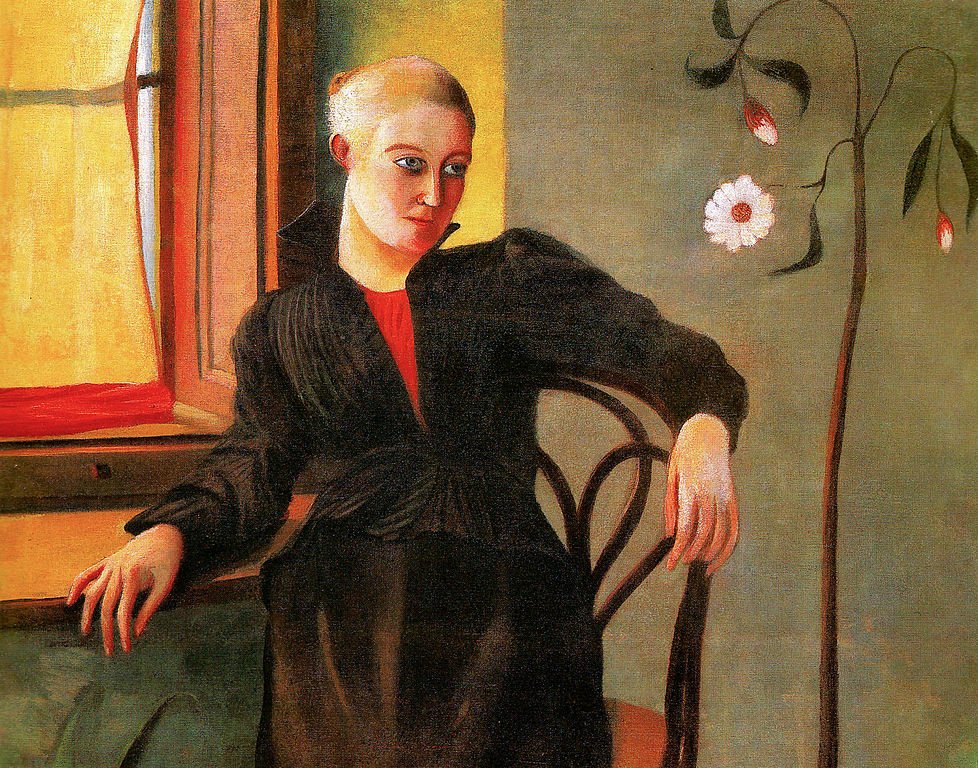
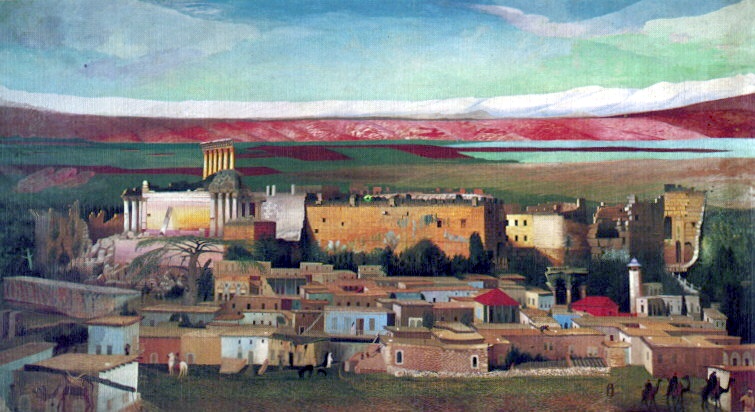

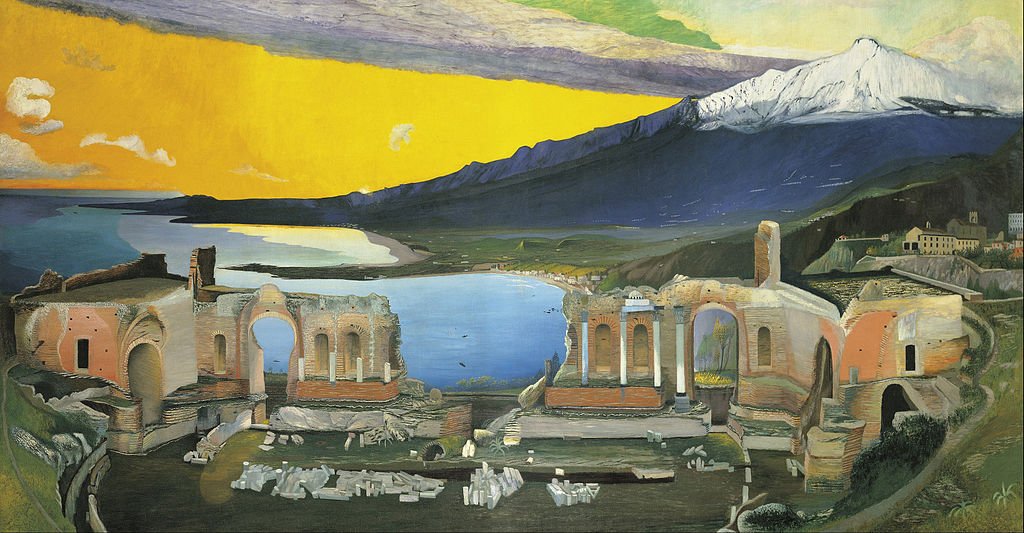
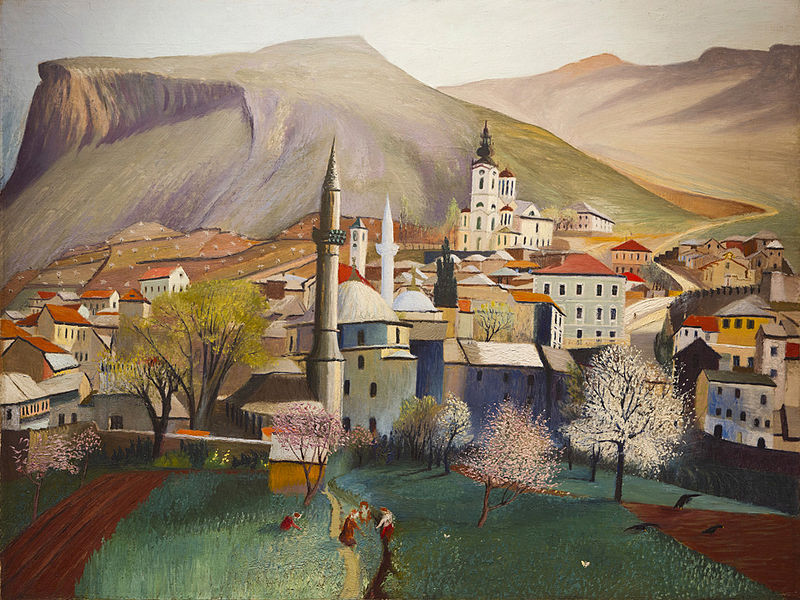

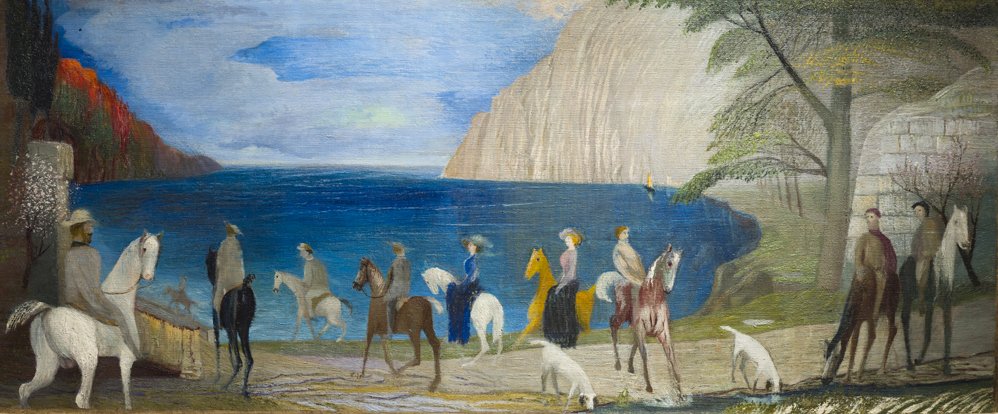
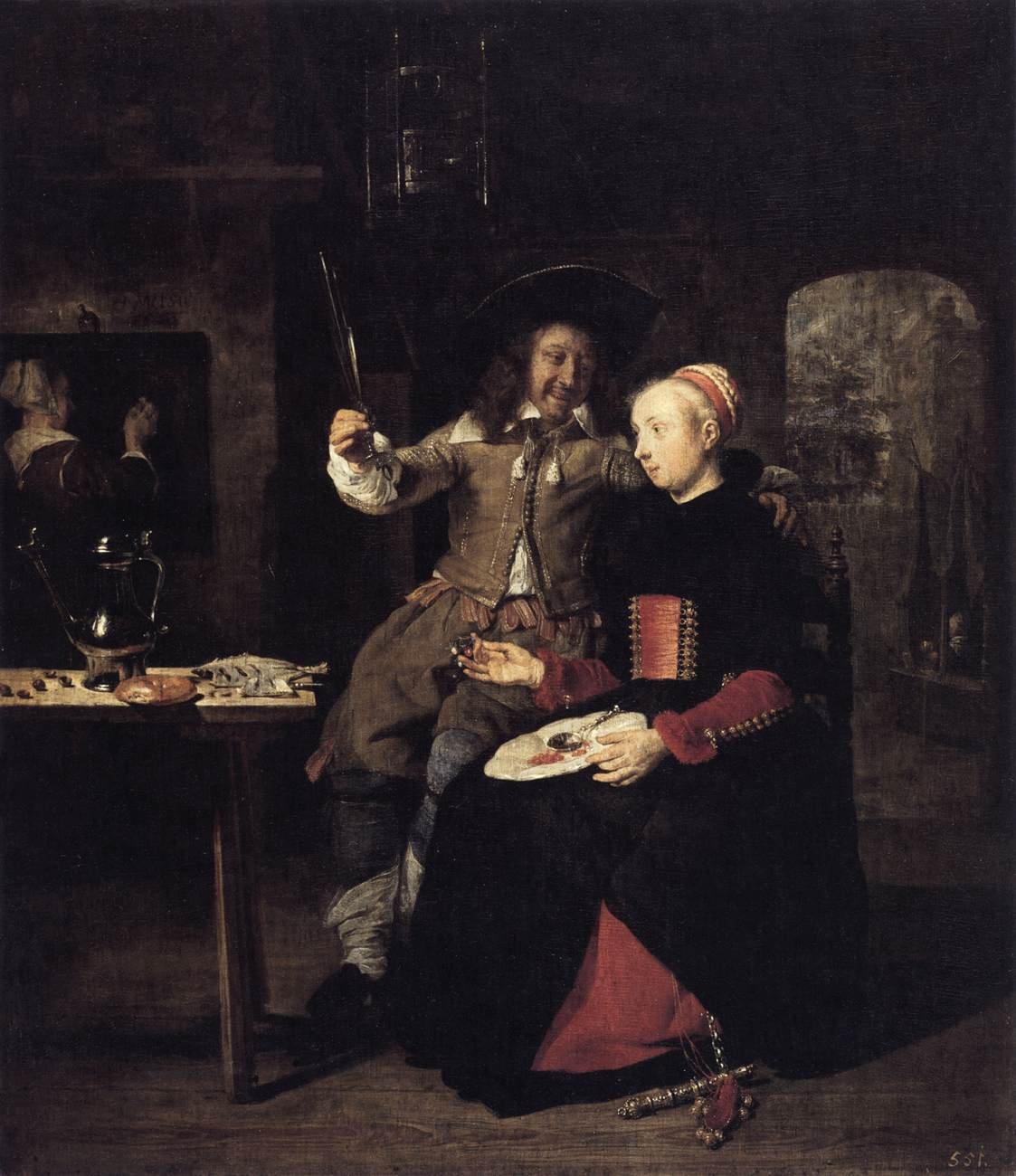


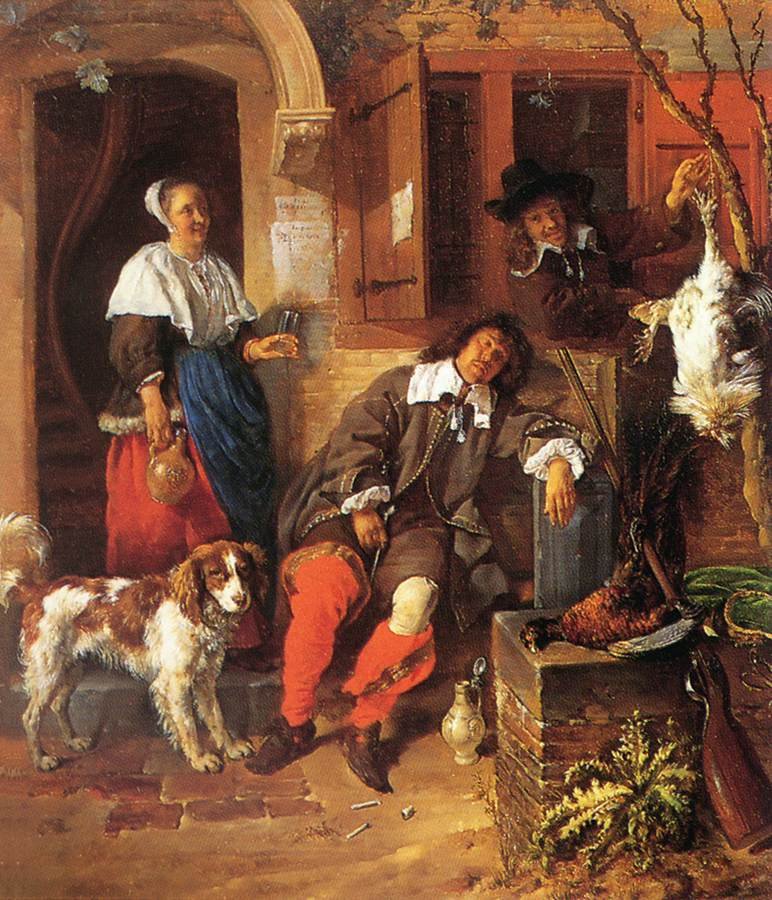

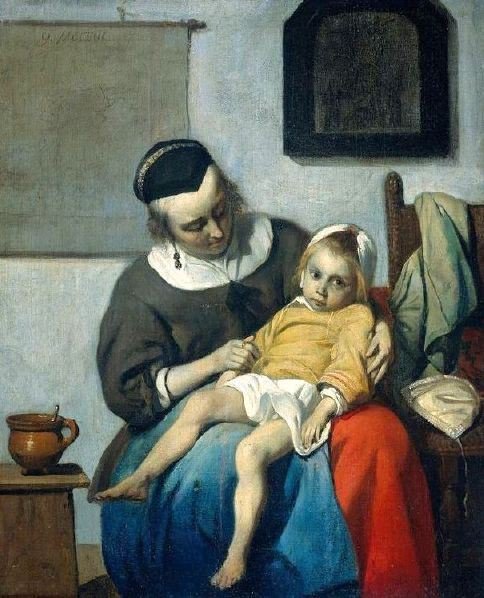
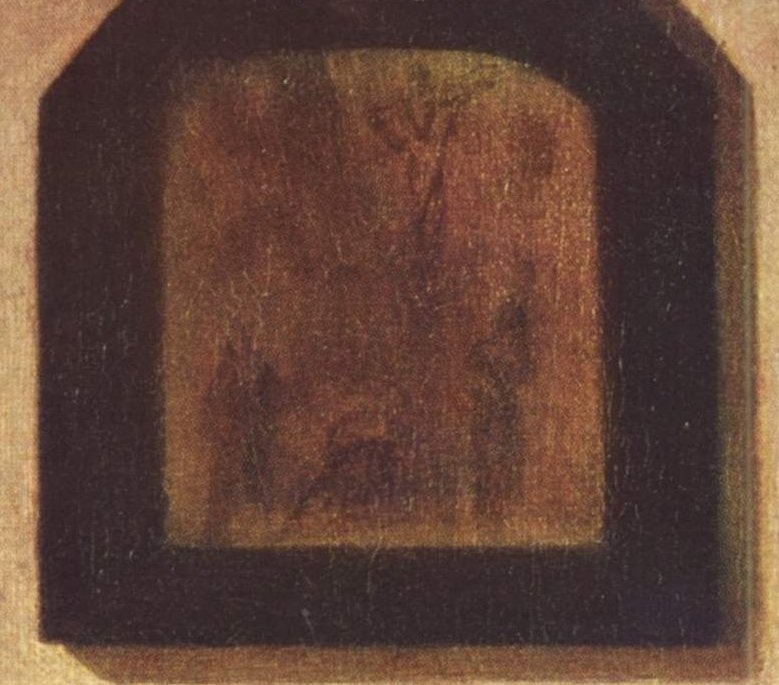

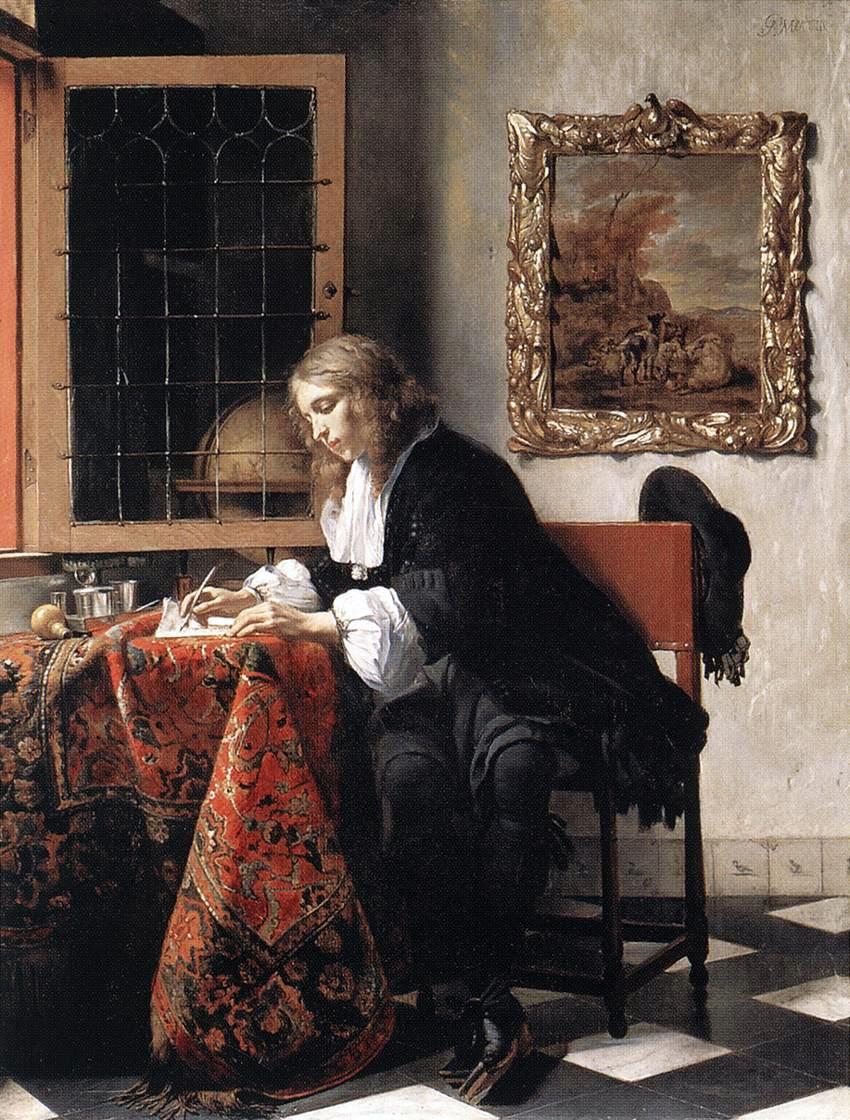

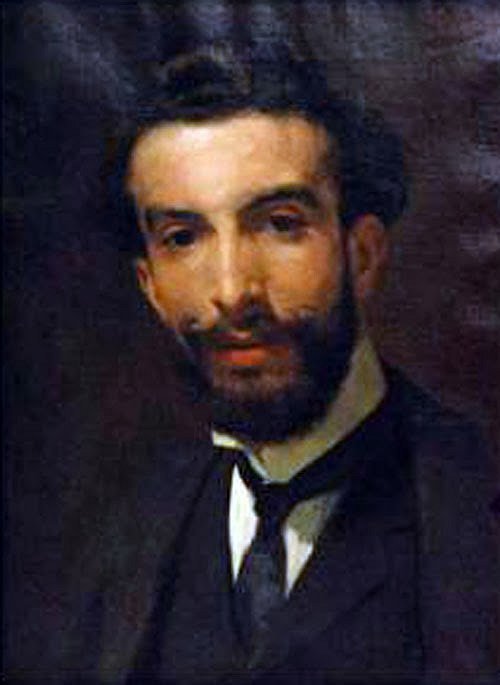
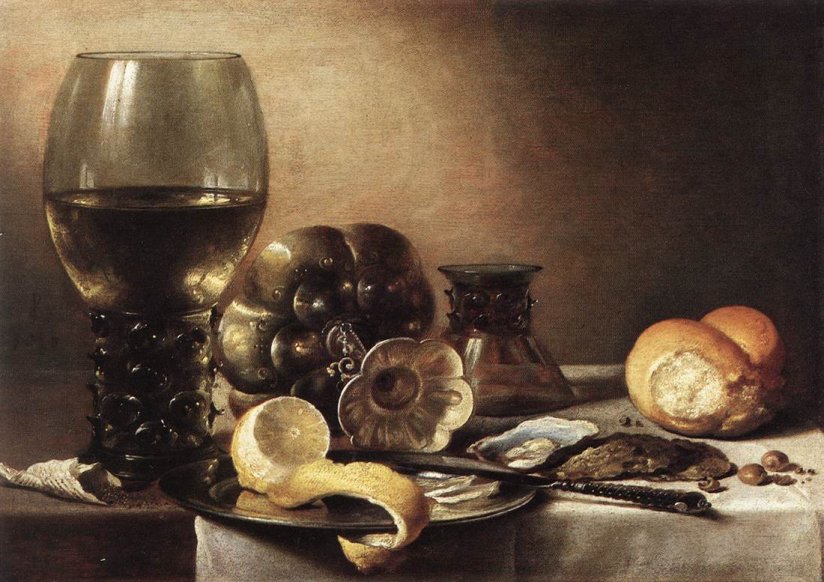


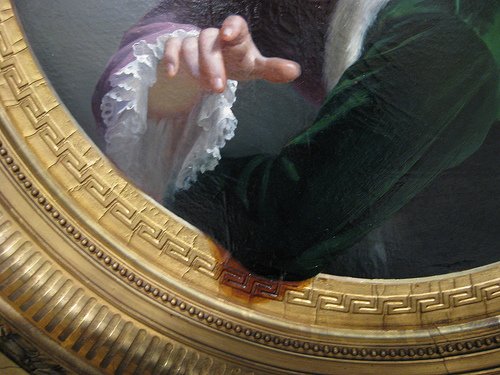
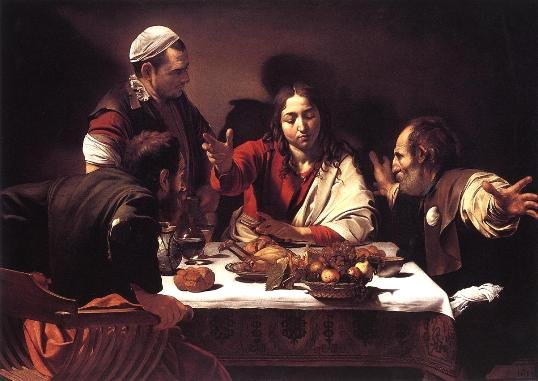
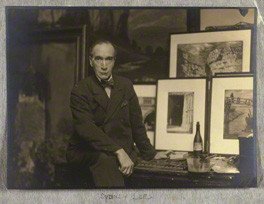


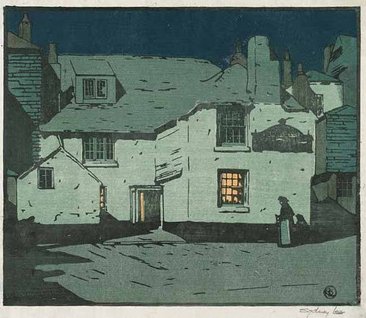

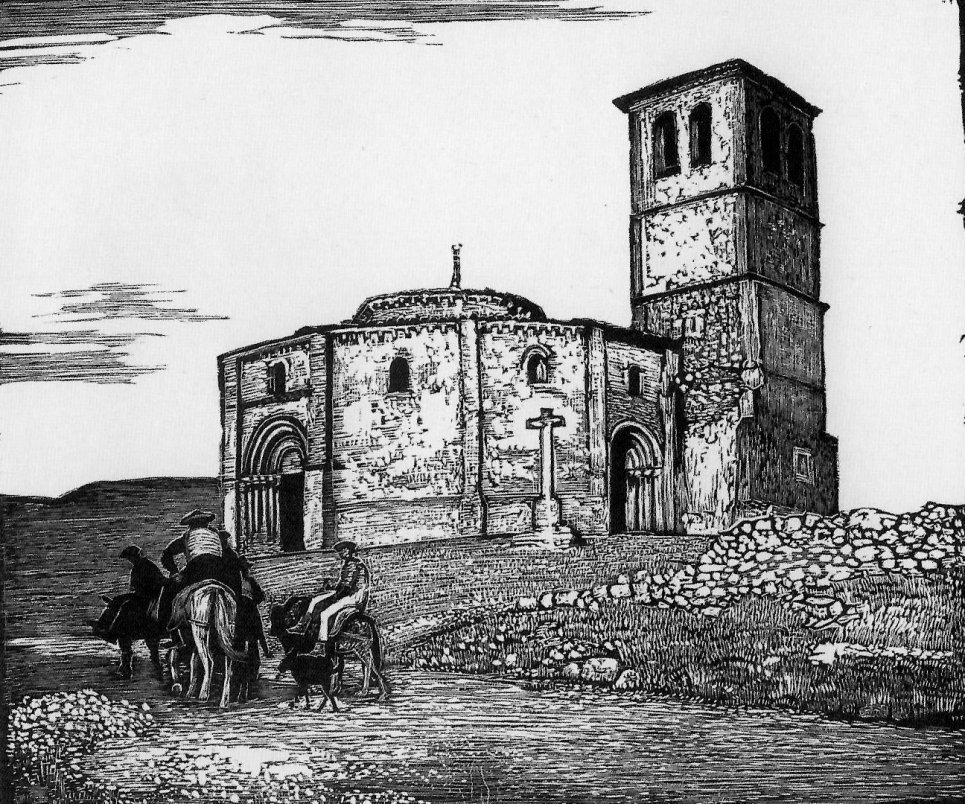

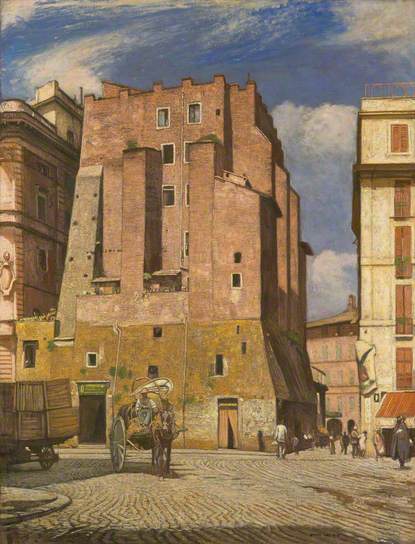

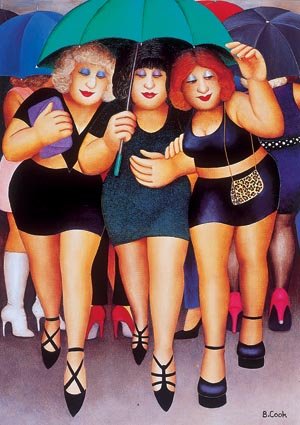
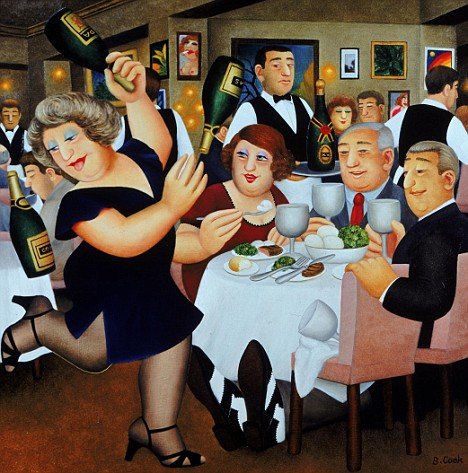
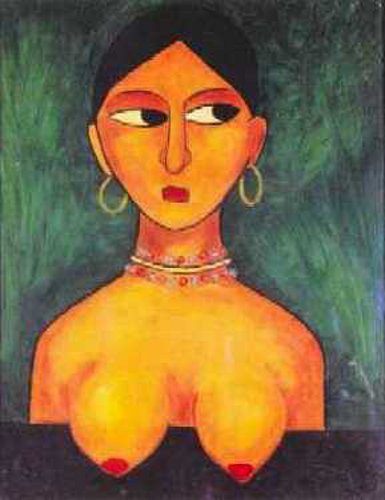
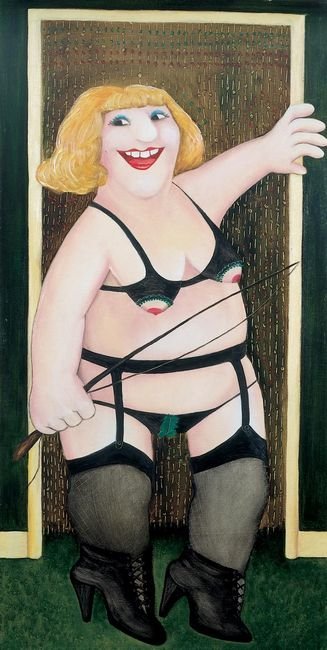

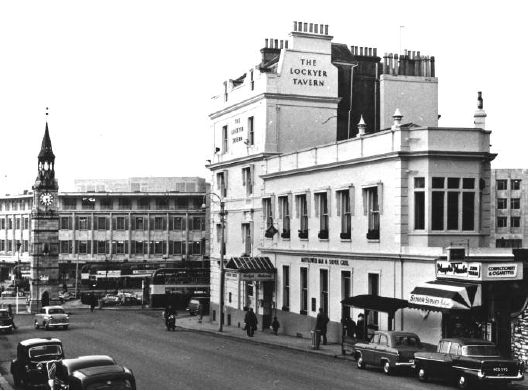


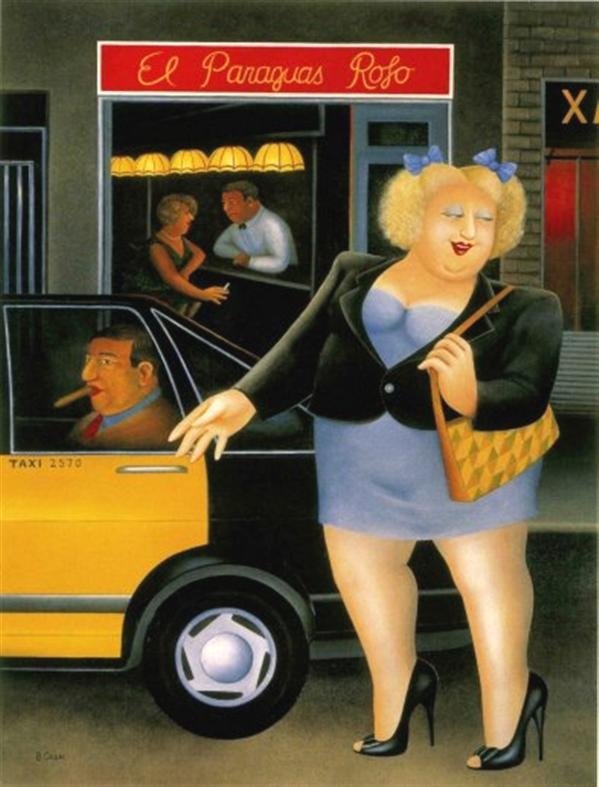
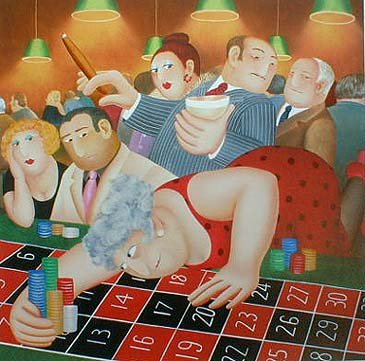
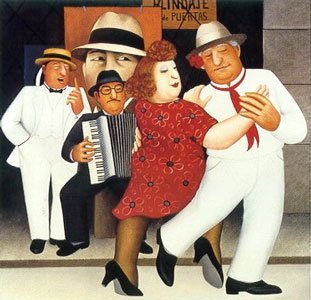


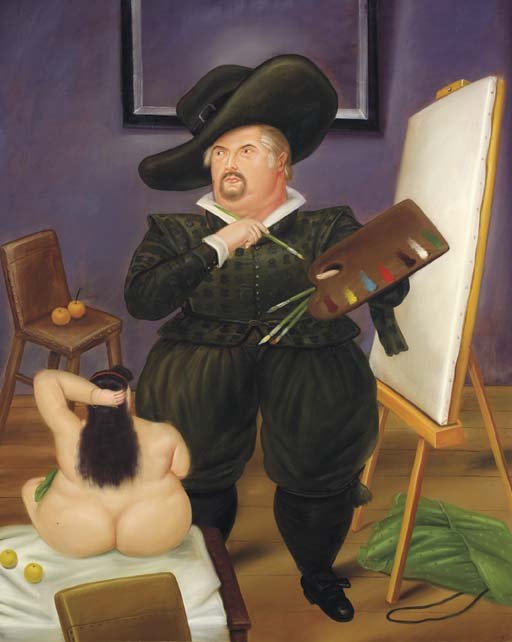

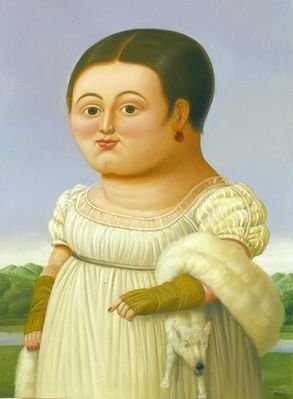

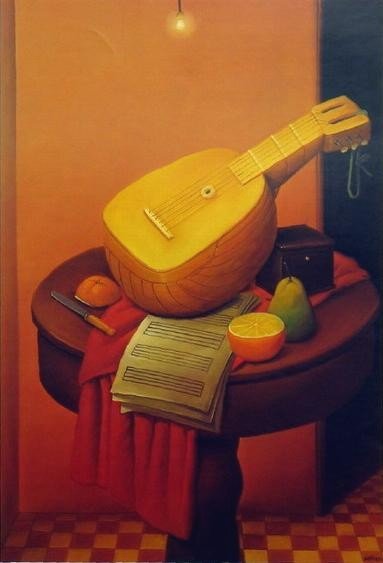


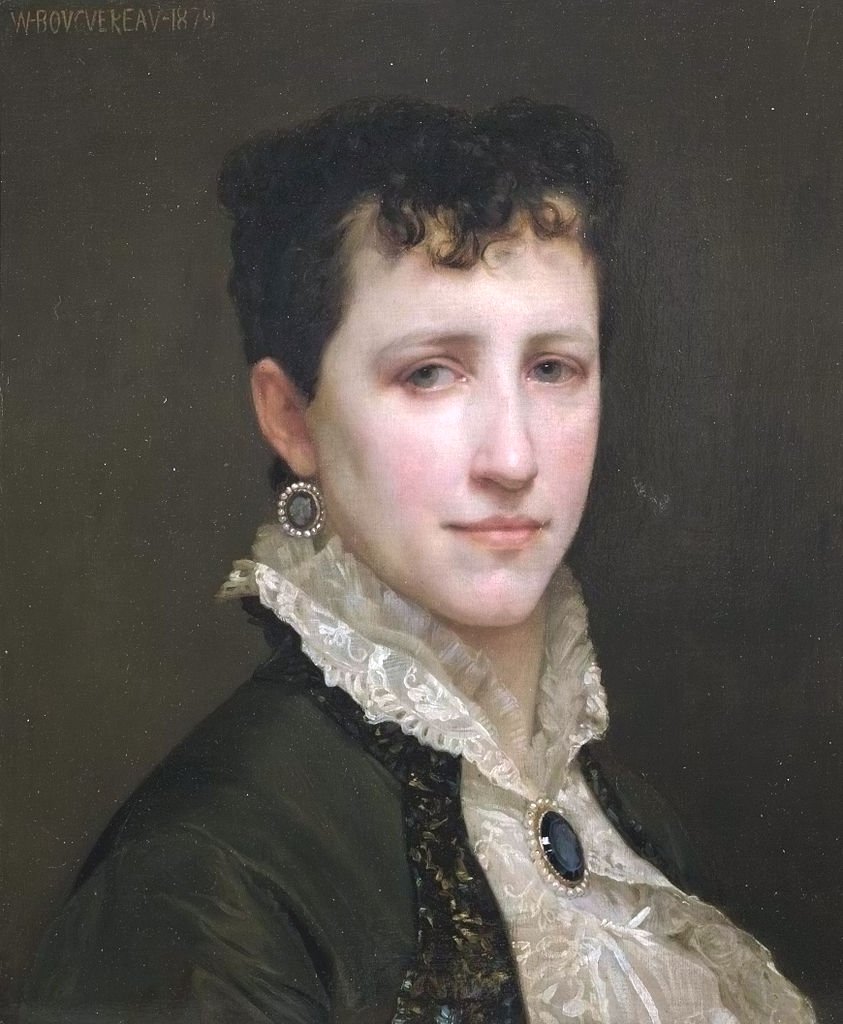

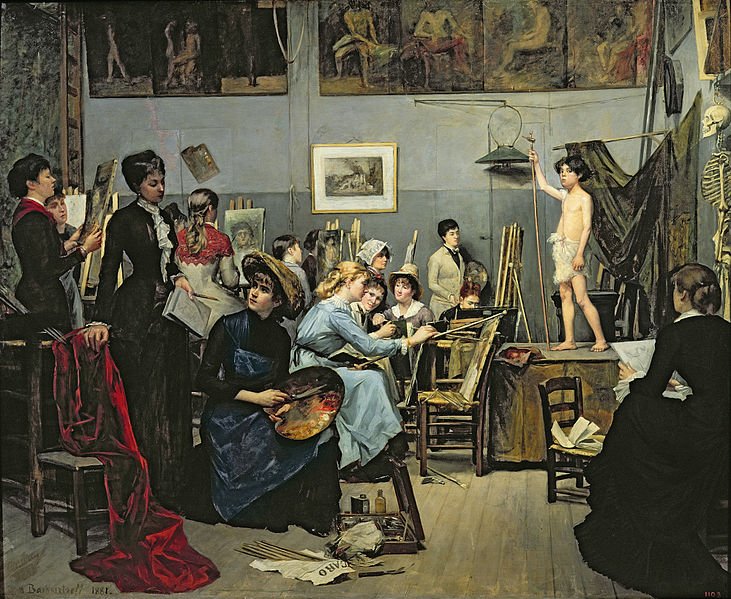


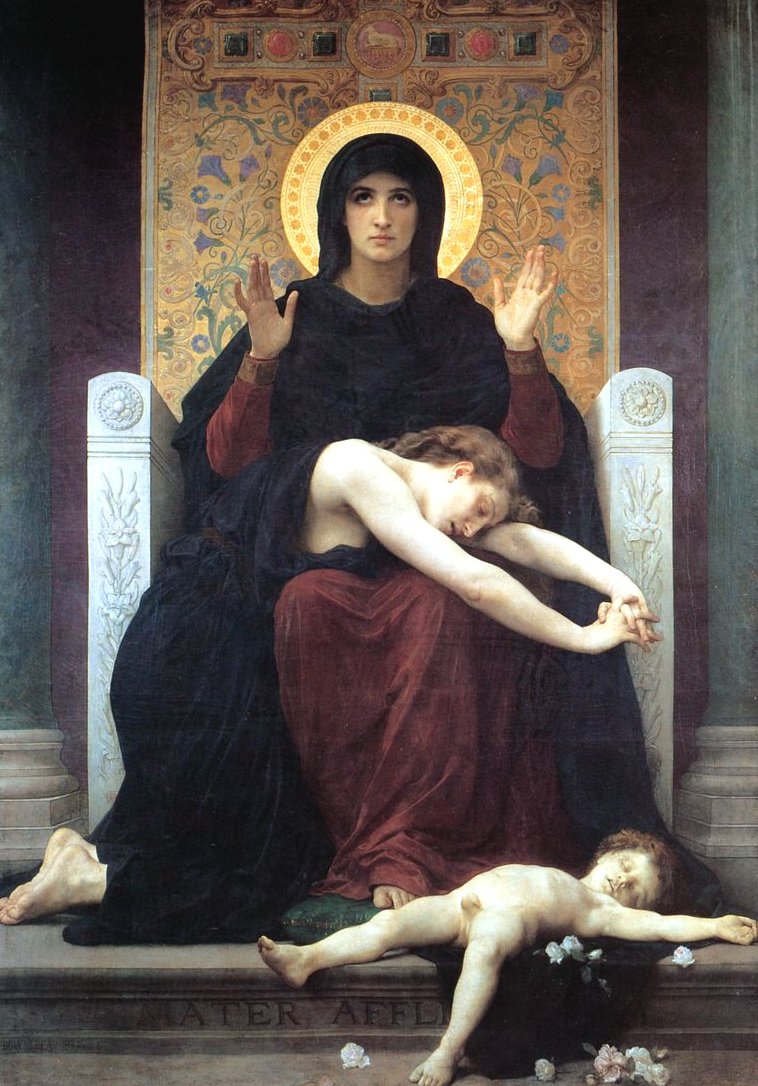
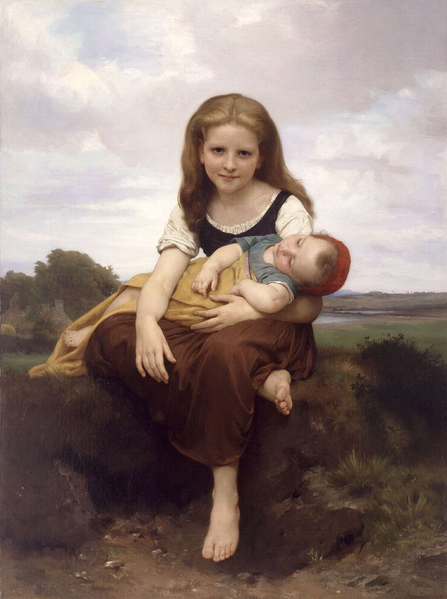


 my daily art display