Ivan Aivazovsky. Part 2. The Master of seascapes.

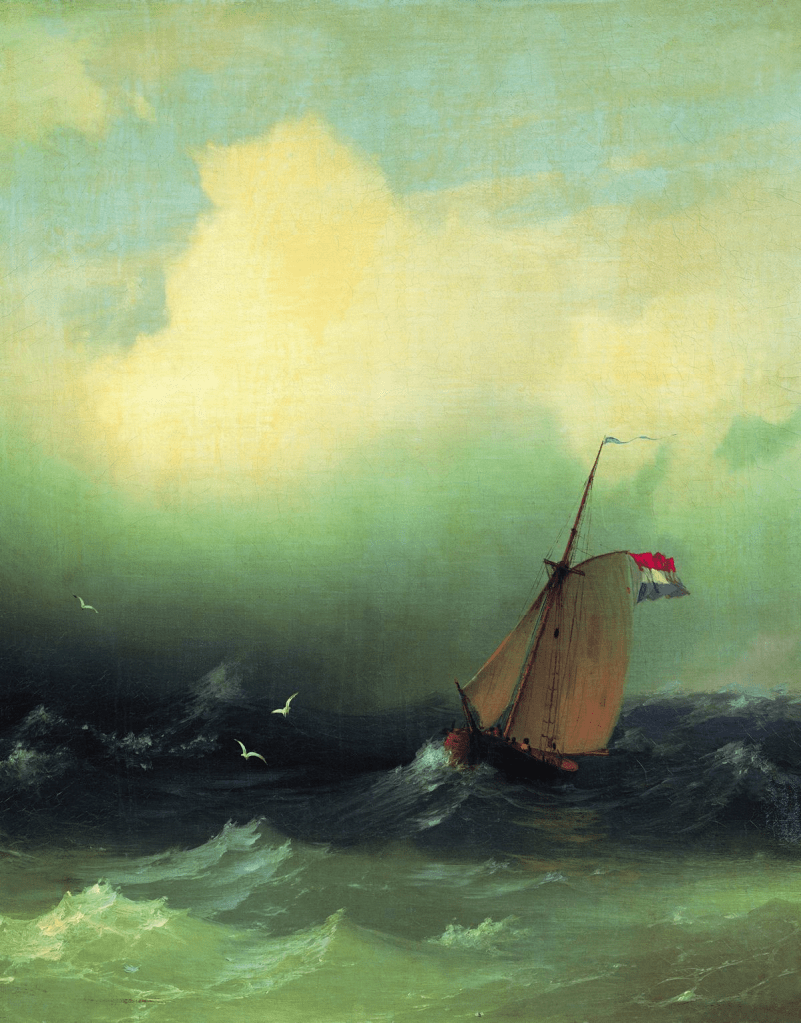
In the first part of my blog featuring the Russian seascape and marine painter, Ivan Aivazovsky I concentrated on his seascapes and marine paintings which, on the whole, depicted calm and idyllic seas.  However, what made me choose Ivan Aviazovsky for my blog was the masterful way he depicted the raging fury of the sea and man’s fight for survival in those terrifying conditions. I experienced that ferocity during my years working on ships but never have I seen it being depicted so graphically. His vivid depiction in his paintings of the terrifying power of the raging seas is masterly.

The Ninth Wave by Ivan Aivakovsky (1850)

One of my favourite seascape paintings by Aviazovsky is his 1850 work entitled The Ninth Wave. It is also probably his best-known work. The title refers to a popular sailing legend that the ninth wave is the most terrible, powerful, destructive wave that comes after a succession of incrementally larger waves. In his painting, set at night, he depicts a raging sea, which has been whipped up by a storm. In the foreground we see people clinging to the mast of a vessel which had sunk during the night. Note how the artist has depicted the debris the people are clinging to in the shape of a cross and this element can be looked upon as a metaphor for salvation from the earthly sin. The people clinging to the debris are lit by the warmth of breaking sunlight and this gives one to believe that they may yet be saved. The painting was originally acquired for the State Russian Museum of St Petersburg and was one of the first paintings in the collection of the Emperor Alexander III Russian Museum in 1897.

The Billowing Sea by Ivan Aivazovsky (1889)

There are many great paintings by Aviazovsky depicting raging seas. I particularly like one entitled The Billowing Sea.

The sheer size of this work, 304 x 505cms (119 x 199 in) is breathtaking.

The Rainbow by Ivan Aviazovsky (1873)

Another one of his works which I saw at the Tretyakov Museum in Moscow the other week was his painting entitled The Rainbow which features a sailing ship foundering on rocks whilst two lifeboats full of sailors try to manoeuvre their boats ashore through the fierce seas. It is a truly remarkable work in which Aviazovsky created a scene of a storm as if seen from inside the raging sea.  In the foreground, we see the sailors who have taken to a lifeboat and abandoned their sinking ship which had foundered on the rocky shoreline. They had spent the whole night in the boat. Suddenly they see a rainbow and feel that all is not lost. The reflection of the rainbow can just be seen to the left of the painting.  Fyodor Dostoevsky, the Russian novelist, was an admirer of Aivazovsky’s art and The Rainbow was his favourite work.  Of the painting, Dostoevsky wrote:

“…This storm by Aivazovsky is fabulous, like all of his storm pictures, and here he is the master who has no competition. In his storms there is the trill, the eternal beauty that startles a spectator in a real-life storm…”

Shipwreck near Gurzuf by Ivan Aivazovsky (1898)

In 1842 Aivazovsky had completed his two-year stint in Italy. He had spent many hours in various museums studying paintings by the Italian masters and became heavily influenced by Italian art and he looked upon his time at the museums as time in his “second academy”. He was awarded a gold medal by Pope Gregory XVI for his artwork. Aivazovsky left Italy in 1842 and travelled around Europe for the next two years. He had his work exhibited in an international exhibition at the Louvre, where he was the only representative from Russia. During his stay in France, he also received a gold medal from the Académie royale de peinture et de sculpture. In 1844 he returned to Russia.

Storm on the Sea by Aivazovsky (1847)

Upon his return to Russia, Aivazovsky was made an Academician of the Imperial Academy of Arts and was appointed the official artist of the Russian Navy to paint seascapes, coastal scenes and naval battles. In 1845, Aivazovsky travelled to the Aegean Sea with Duke Konstantin Nikolayevich and visited the Ottoman capital, Constantinople, and the Greek islands of Patmos and Rhodes. After years of travel Aivazovsky decided to settle down in his hometown of Feodosia In 1845. He built a house and studio and cut himself off from the outside world just maintaining a friendship with close friends.

Chaos (Anno Mundi) by Ivan Aivazovsky (1841)

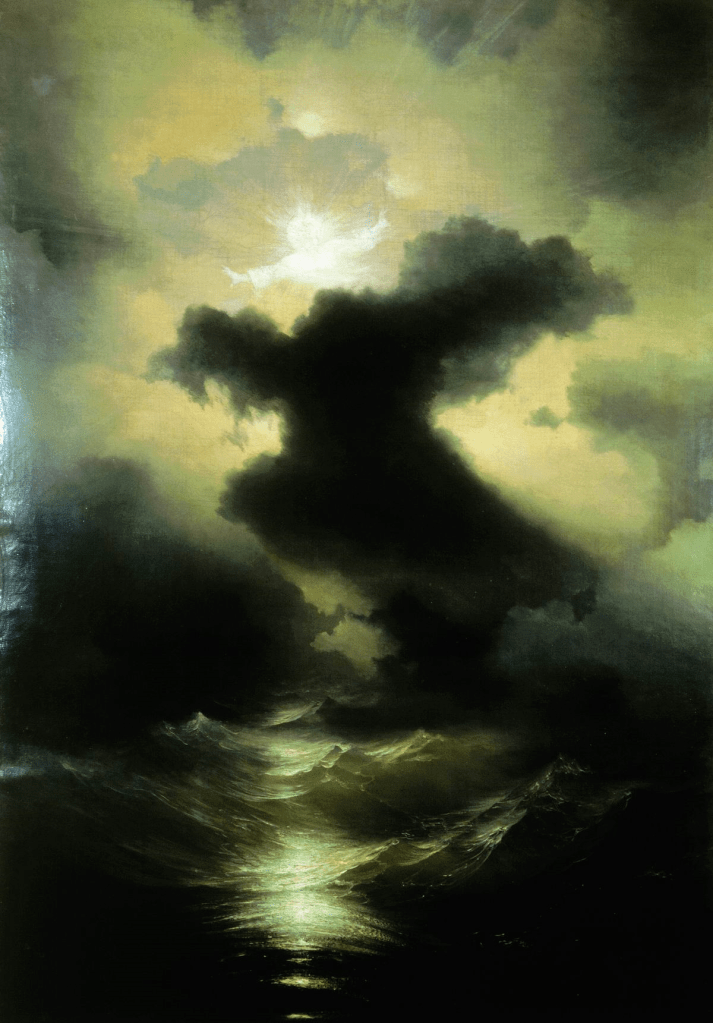
As in life itself, time moves on and change is inevitable. So was the case with Russian art in the mid nineteenth century. Aivazovsky’s love of painting romantic seascapes was becoming unfashionable with the new style of Russian art – Russian Realism, becoming more and more popular. Aivazovsky could not accept the change and persevered with his Romantic style seascapes and his artwork began to be criticised.

Among the Waves by Ivan Aivazosky (1898)

For a beautiful seascape one needs look no further than the one which the eighty-one-year-old Ivan Aivazovsky completed in 1898, just two years before he died, entitled Among the Waves.  For once it is a pure seascape without any ships, afloat or sinking, and no sailors in lifeboats trying to survive their watery ordeal. However, with this painting came an interesting tale with regards the depiction. Before us we see that a storm has already erupted in full force and the black stormy sky threatens worse to come. Look how the water in the foreground is almost translucent, a mixture of greyish-green and silvery blue, dependent on how the sunlight, which bursts through from behind the storm cloud, falls upon the water. The waves are topped with white caps of foam. It is a pure sea and sky painting but it was not always so. Originally Aivazovsky had included in the depiction his “signature” boat which was struggling to survive but when Ivan asked his grandson what he thought of the painting his grandson told the elderly man that it was admirable work but queried why his grandfather had added to the depiction a “toy-like” boat with people in it. According to the memoirs of his grandson, the artist was terribly angry with his comments and, without a word, turned and walked away. The next day when the family members looked at the painting they found that the little boat full of sailors had been removed from the canvas !

In 1847, Aivazovsky became the professor of seascape painting at the Imperial Academy of Arts and was elevated to the rank of nobility. That year, he also was elected to the Royal Netherlands Academy of Arts and Sciences.

Aivazovsky with his first wife, Julia, and their four daughters

In 1848, Aivazovsky married Julia Graves, an English governess. She was the daughter of a St. Petersburg doctor, the Briton Jacob Grevs. It is believed that he may have been more than just an ordinary physician as rumour had it that he was personal physician of Tsar Alexander I.  Grevs mysteriously disappeared after the death of the emperor. Julia was an eighteen-year-old well-educated beauty when she married thirty-one-year-old Aivazovsky. The couple went on to have four daughters: Elena (1849), Maria (1851), Alexandra (1852) and Joanne (1858). Their marriage foundered after twelve years and they separated in 1860 with Julia leaving the marital home and taking the children. The breakdown of their marriage seems to have been the result of Ivan’s all-consuming passion for his art which left him little time for his wife. Anna finally could not accept this kind of marriage. The couple divorced in 1877 with permission from the Armenian Church, since Graves was a Lutheran and Julia remained in her new home in Odessa.

Battle of Chesme at Night by Ivan Aivazovsky (1848)

Aivazovsky completed a number of paintings depicting Russian naval battles and one of his most famous works was his 1848 painting entitled Battle of Chesme at Night which illustrated the Russian-Turkish naval battle which took place on July 7th, 1770. At this significant battle, the Russian Navy defeated the Turkish navy at the Bay of Chesme. This was quite an upset as the Turkish navy at that time was the strongest in the world. It would seem that the Turkish fleet had all the advantages – a significant advantage in the power of their fleet, the backup of their on-shore batteries, a good location and the glory of the strongest navy in the world. But for the Turks nothing quite went to plan. Early into the battle, following a bombardment by the Russian ships, one of the Turkish ships exploded. That night, the remaining part of the Russian fleet came to the bay, including their four fire-ships (specially converted small vessels of the fleet, which were intended to set fire to enemy ships of the line). Just one of them reached the Turkish warships and the Russian sailors set fire to their fire-ship and took flight in their lifeboats. The tactic succeeded and the Turkish battleship which had been rammed by the Russian fire-ship exploded and started a chain reaction. Soon more Turkish ships were ablaze and by the end of the night the Turkish navy had been destroyed. The horror of the battle was perfectly conveyed by Ivan Aivazovsky in his painting.

The Battle of Sinop by Ivan Aivazovsky (1853)

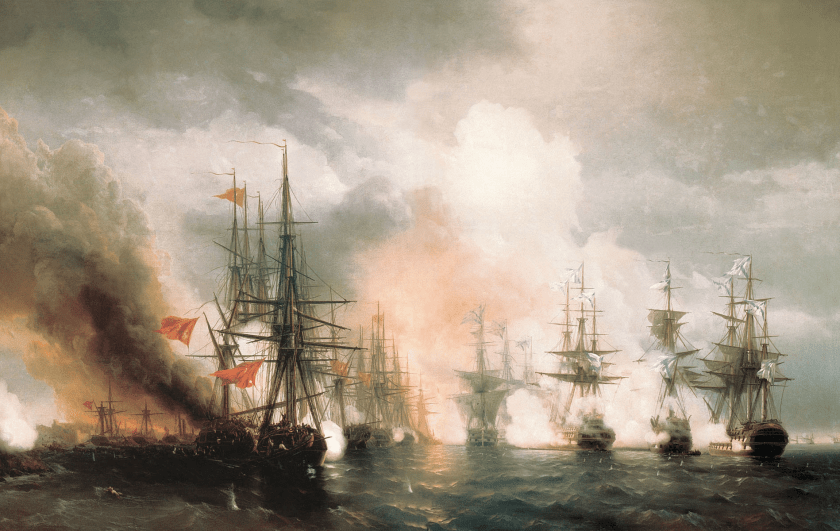
In 1853, the Crimean War erupted between Russia and the Ottoman Empire, and Aivazovsky was evacuated to the northern Ukrainian city of Kharkiv. When the Crimea became safer, he returned to the besieged fortress of Sevastopol to paint battle scenes. He also depicted the famous Battle of Sinop, at which the Russian navy was victorious over the navy of the Ottoman Empire on November 30th 1853 at Sinop, a sea port in northern Anatolia.  It was during this maritime battle that a squadron of Imperial Russian warships struck and defeated a squadron of Ottoman ships anchored in the harbour. It resulted in an ignominious defeat of the once all-powerful Turkish fleet at the hands of the Russian navy.

The Battle of Sinop (Night after the Battle), by Ivan Aivazovsky (1853)

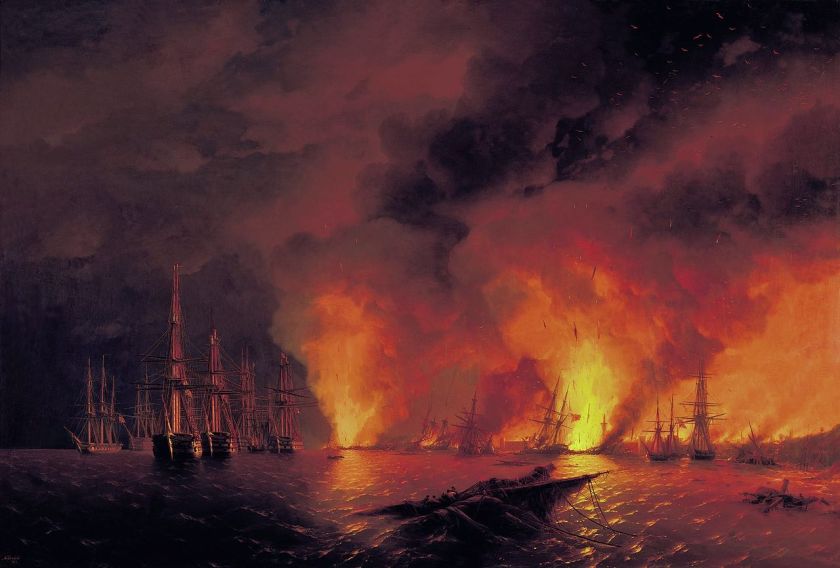
In another painting of the battle often referred to as Night after the Battle, the sky is black, and the light from the stars has been extinguished. The fierce battle resulted in the death of a large number of sailors. In the background of the picture we see the burning ships of the Ottoman navy. The Turkish fleet is burning and a ship is exploding in the darkness. Part of the Turkish fleet went to the bottom, the rest of them burn out. In the foreground we see fragments of a sunken ship, on which people try to escape from imminent death.

Tempest on the Sea at Night by Ivan Aivazosky (1849)

Many honours were bestowed on Aivazovsky in the 1850’s. He had been working in Paris during 1856 and 1857 and became the first Russian, actually the first non-French artist to receive the prestigious Legion of Honour for his services to art. Leaving Paris in 1857, he visited Constantinople and was awarded the Order of the Medjidie. Also that year, he was elected an honorary member of the Moscow Art Society and the following year he was awarded the Greek Order of the Redeemer in 1859.  In 1865 he was further honoured, this time by his homeland, when he was given the Russian Order of St. Vladimir. It was also the year that Aivazovsky opened an art studio in Feodosia and was awarded a salary by the Imperial Academy of Arts the same year.

The Seashore with a Lighthouse at Night by Ivan Aivazovsky (1837)

Aivazovsky had become such a talented and prolific artist that he no longer needed to go outdoors for inspiration. During his almost 60-year career, he created around 6,000 paintings, making him one of the most prolific artists of his time. He had spent so many years observing his treasured surroundings that he was able to produce canvases with remarkable speed. It had got to the point in his artistic career that he often astonished his visitors by creating a large canvas in a matter of hours. Aivazovsky frequently compared his work to that of a poet saying:

“…The artist who only copies nature becomes a slave to nature. The motions of live elements are imperceptible to a brush: painting lightning, a gust of wind or the splash of a wave. The artist must memorize them. The plot of the pictures is composed in my memory, like that of a poet; after doing a sketch on a scrap of paper, I start to work and stay by the canvas until I’ve said everything on it with my brush…”

Moscow in Winter from the Sparrow Hills by Ivan Aivazovsky (1872)

Although most of Aivazovsky’s paintings were seascapes or marine depictions he did complete a number of works featuring landscapes and I particularly like his 1872 winter scene, Moscow in Winter from the Sparrow Hills.

Aivazovsky’s painting of his second wife Anna Burnazian-Sarkisova  (1882)

Aivazovsky had been living alone since his wife left him, taking their children. It was four years after his divorce was finalised that he happened to attend the funeral of a Feodosian merchant, named Sakrisov. At first sight of the grieving widow, Anna, following her husband’s coffin, he fell in love. Realising it would be inappropriate to approach her at such a time he bided his time but never forgot the sight of the young woman. After waiting for the sake of decency, he made an offer of marriage, which Anne accepted. Aivazovsky married his second wife, Anna Burnazian-Sarkisova in 1882. She was twenty-six-years of age and her husband was sixty-five. Aivazovsky believed that as his second wife was Armenian this marriage had brought him closer to his Armenian nation. Anna, unlike his first wife, Julia, was content with her husband devoting most of his time on his paintings and artistic career without becoming jealous, whilst she was able to enjoy her free time.

Tomb of Ivan Ajwazovsky in Feodosia, Crimea.

Ivan Aivazovsky died, aged 82, on April 19th 1900 in Feodosia. In accordance with his wishes, he was buried at the courtyard of St. Sargis Armenian Church. A white marble sarcophagus was made by Italian sculptor L. Biogiolli in 1901.

After Aivazovsky’s death, Anna lived a life of a recluse and for 25 years she did not leave the walls of the house, where she had been happily married. During World War II, she refused to leave her home when the country was under occupation and managed to survive by exchanging the last of her jewellery for bread and cereal. When the Germans left Feodosia, Aivazovsky’s widow, aged 87, forgotten by all, was found by the artist Nikolai Samokish and taken to his home in Simferopol. Anna died a year later, aged 88 and is buried next to her husband, in the square of the Armenian church, where they were once married.

American Shipping off the Rock of Gibraltar by Ivan Aivazovsky (1873)

On June 14, 2007 his painting “American Shipping off the Rock of Gibraltar” sold for £2.71 million pounds, and was the highest price paid at auction for an Ivan Aivazovsky painting. Ironically, he is also said to be the most forged of all Russian painters.

Ivan Konstantinovich Aivazovsky

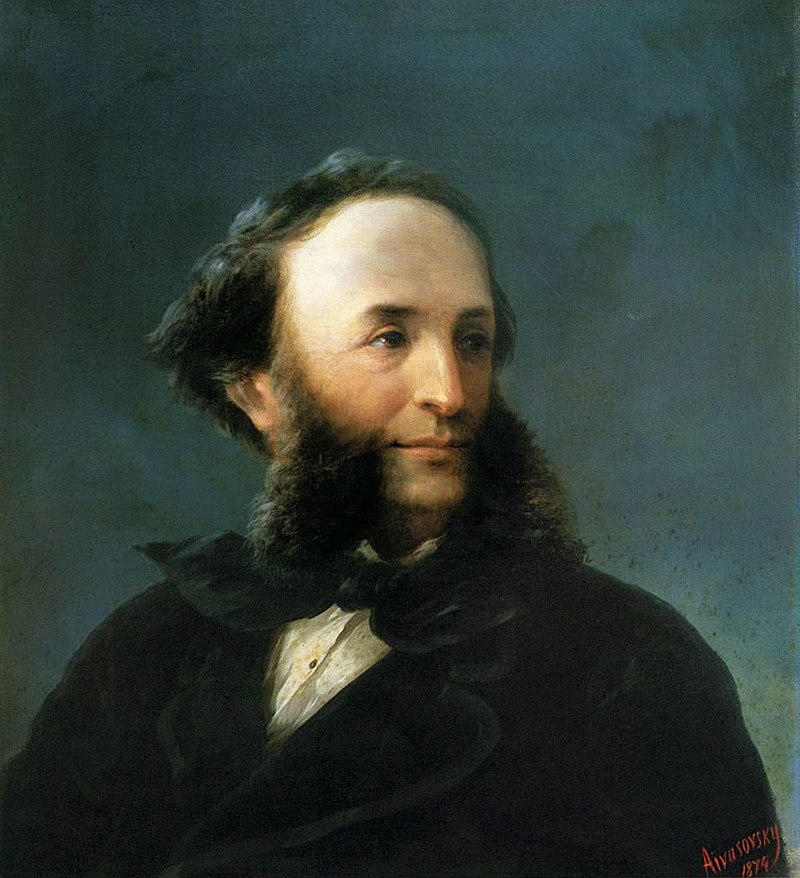
Self-portrait of Ivan Aivazovsky (1874)

Two weeks ago, I went on a four-day city break to Moscow. I had always wanted to visit the Russian capital and especially visit the famous Tretyakov Gallery which houses the largest collection of Russian art in the world. I had read books about the wonders it had to offer and I knew I had to go and see it first-hand. Recently I wrote five blogs on the museum and the works of its leading proponents of portraiture, including Repin, Serov and Kramskoy but in the next few blogs I want to concentrate on lesser known artists (that is lesser known to me!) whose works also graced the walls of this outstanding Gallery.

Sunset in Crimea by Ivan Aivazovsky (1865)

As I have mentioned before, I live on the coast and a large number of paintings by local artists feature seascapes or marine paintings. My featured artist today is looked upon as one of the greatest maritime and seascape painters of all time and regarded as one of the most successful Russian painters of the 19th century. His work was admired by many seascape painters such as Turner. Let me introduce you to the Russian Romantic painter, Ivan Konstantinovich Aivazovsky.

Odessa by Ivan Aivazovsky (1840)

Ivan Konstantinovich Aivazovsky was born on July 29th 1817. At his baptism at the local St. Sargis Armenian Apostolic Church, he was given the name of Hovhannes Aivazian. His father, Konstantin, was an impoverished Armenian merchant whose family originated from the Polish region of Galicia, a historical and geographic region between Central and Eastern Europe.  In the early 1800’s Aivazosky’s father settled in the Black Sea port of Feodosia in the Crimea and it was here that he met a local girl, Ripsime, who later became his wife. They had five children, three daughters and two sons. Ivan’s elder brother, Gabriel, was to become an important historian and an Armenian Apostolic archbishop. Ivan began his education at Feodosia’s St. Sargis Armenian Church school and it was also during this period that he received his first tuition in art. His tutor was Jacob Koch, a local architect. In 1830, at the age of thirteen, he moved with the Taurida governor, Alexander Kaznacheyev’s family to Simferopol, the Crimean capital, where, through the good auspices of Jacob Koch, he was enrolled at the city’s Russian grammar school. Three years later, in 1833, having now established himself as a talented painter, sixteen-year-old Ivan transferred to the St. Petersburg Academy of Arts where he joined the class of the landscape painter, Maxim Vorobiov. He was a model student and progressed well. In 1835, he was awarded the silver medal for his painting Air over the Sea.

The Roads at Kronstadt by Ivan Aivazovsky (1836)

In 1836 the French artist Philippe Tanner arrived in St Petersburg to teach at the Academy and was immediately impressed by the talent of nineteen-year-old Ivan. Tanner’s forte was his marine paintings and during the time Aivazovsky worked as his assistant, he taught the young man marine painting techniques. In the autumn of 1836 Ivan had five of his works shown at art exhibitions, including his painting, The Roads at Kronstadt. Soon Ivan’s work was noticed and praised by both the press and the art critics alike.

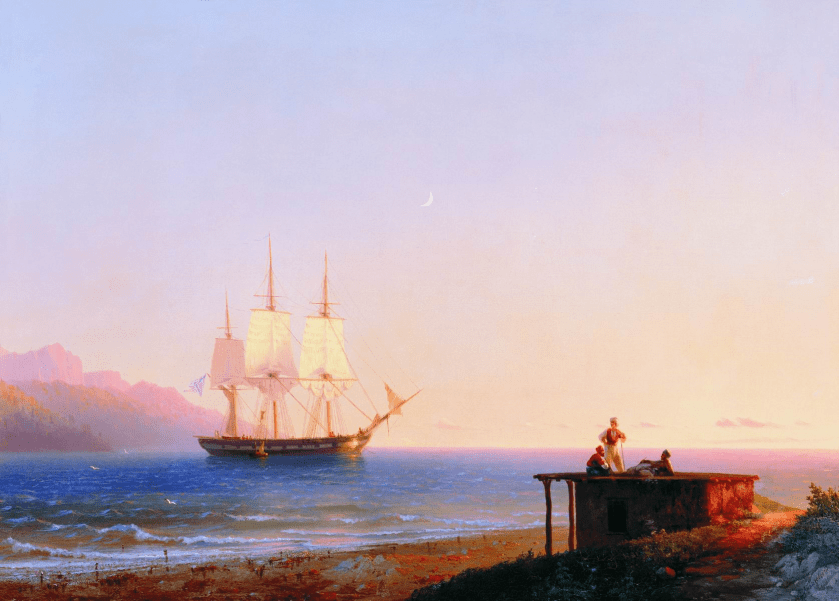
Frigate under sails by Ivan Aivazovsky (1838)

In 1837, Aivazovsky joined the battle-painting class of Alexander Sauerweid and participated in Baltic Fleet exercises in the Gulf of Finland.

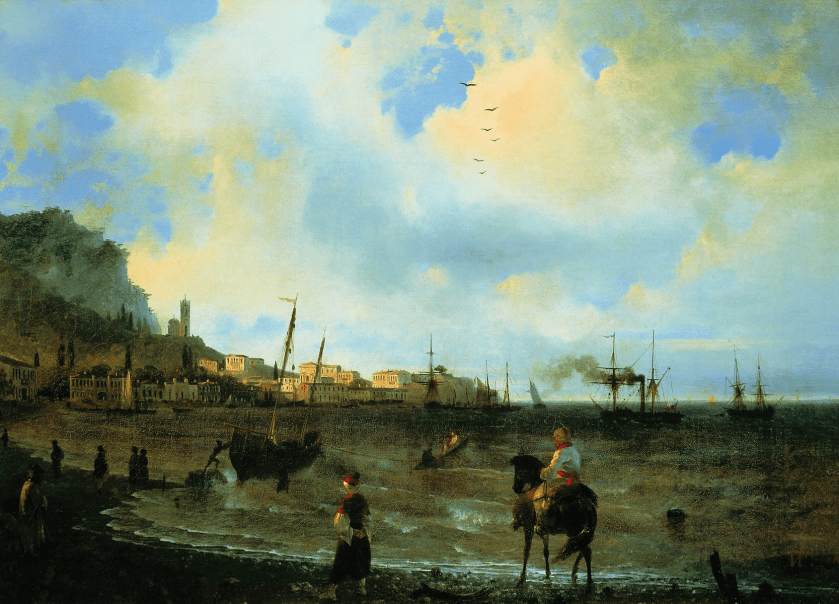
Yalta by Ivan Aviazovsky (1838)

In October 1837, he graduated from the Imperial Academy of Arts with a gold medal and received the official title of artist. He left the St Petersburg Academy in 1838 to carry out a commission to paint views of several Crimean towns and to do this he moved back to his home town of Feodosia in the Crimea where he set up a shop and started painting vistas of the Crimea and his beloved Black Sea. He would paint en plein air carefully recording the elements and then return to his studio to put the finishing touches on his masterpieces. He remained in his homeland for two years.

The Landing at Subashi by Ivan Aivazovsky (1839)

In 1839 Ivan Aivazovsky was invited to participate in a Navy operation which was taking place off the Crimea shores. There he took part in military exercises off the shores of Crimea, and where he met prominent Russian admirals Mikhail Lazarev, Pavel Nakhimov and Vladimir Kornilov and soon a long friendship blossomed between the artist and the military men. His canvases depicting sea battles were remarkably true to fact and so full of accurate details that they are now considered as illustrations of naval attack tactics.  One of his paintings depicting a naval battle was entitled The Landing at Subashi.

Mhitarists on the Island of St. Lazarus, Venice by Ivan Aivazovsky (1843)

In 1840 the Imperial Academy of Arts of St Petersburg sent Aivazovsky to increase his knowledge in art by going and studying in Europe. His first stop-over was Venice which he reached after travelling through Berlin and Vienna. In Venice he went to San Lazzaro degli Armeni, a small island in the Venetian Lagoon which has been home to the monastery of the Mekhitarists, an Armenian Catholic congregation, since 1717. This was the home of Aivazovsky’s elder brother Gabriel.

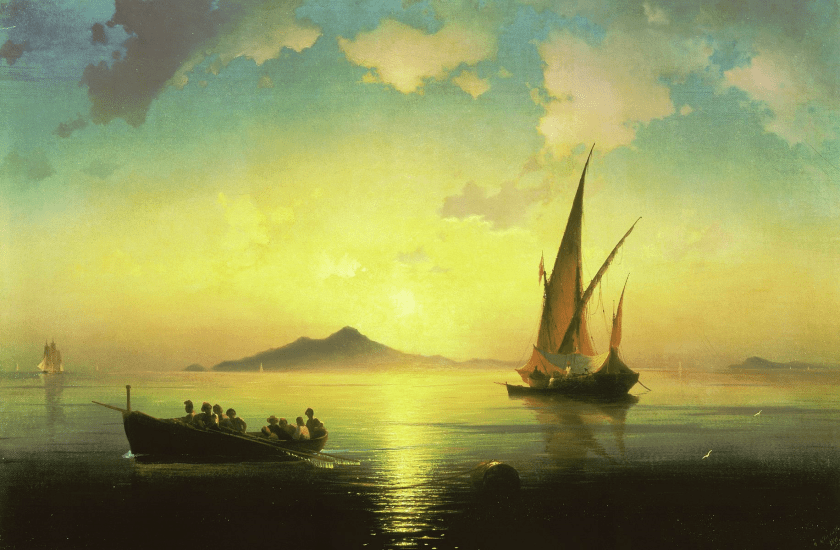
The Bay of Naples by Ivan Aivazovsky (1841)

Whilst here, Aivazovsky studied Armenian manuscripts and familiarised himself with Armenian art. From Venice he travelled across Italy and arrived in the Tuscan city of Florence and later took in the sights of Amalfi and Sorrento. He took up residence in Naples and stayed there until 1842. In that two year period in Italy, Aivazovsky fell in love with Italian art. Among the people he met whilst in Italy was the Ukranian-born Russian writer Gogol and the Russian Neoclassical painter Aleksandr Ivanov.

View of Amalfi by Ivan Aivazovsky (1843)

Aviazovsky returned to Russia in 1842 and he was given an official title within the General Naval Office. As such, he was allowed to join Russian research and science expeditions which travelled to Turkey, Greece, Egypt, America and Asia. From these journeys Aivazovsky was able to bring home hundreds of sketches which he later turned into his famous paintings.

The Bay of Naples at Moonlit Night. Vesuvius by Ivan Aviazovsky (1840)

He then visited Switzerland, Germany, the Netherlands and Britain, where he met English painter J. M. W. Turner who, was so impressed by Aivazovsky’s painting, The Bay of Naples on a Moonlit Night that he dedicated a rhymed eulogy in Italian to Aivazovsky.

“…Like a curtain slowly drawn
It stops suddenly half open,
Or, like grief itself, filled with gentle hope,
It becomes lighter in the shore-less dark,
Thus the moon barely wanes
Winding her way above the storm-tossed sea.
Stand upon this hill and behold endlessly
This scene of a formidable sea,
And it will seem to thee a waking dream.
That secret mind flowing in thee
Which even the day cannot scatter,
The serenity of thinking and the beating of the heart
Will enchain thee in this vision;
This golden-silver moon
Standing lonely over the sea,
All curtain the grief of even the hopeless.
And it appears that through the tempest
Moves a light caressing wind,
While the sea swells up with a roar,
Sometimes, like a battlefield it looks to me
The tempestuous sea,
Where the moon itself is a brilliant golden crown
Of a great king.
But even that moon is always beneath thee
Oh Master most high,
Oh forgive thou me
If even this master was frightened for a moment
Oh, noble moment, by art betrayed…
And how may one not delight in thee,
Oh thou young boy, but forgive thou me,
If I shall bend my white head
Before thy art divine
Thy bliss-wrought genius…”

The Golden Horn, Turkey by Ivan Aivazovsky (1845)

In 1845, Aivazovsky travelled to Istanbul upon the invitation of Sultan Abdülmecid. He would return to this Turkish city many times during his lifetime. He became court painter to the Ottoman Sultans Abdülmecid, Abdulaziz and Abdulhamid, and thirty of his commissioned works are still exhibited in the Ottoman Imperial Palace, the Dolmabahce Museum and many others at various other museums in Turkey.  One of his paintings from this time was The Golden Horn.  The Golden Horn is a horn-shaped estuary which divides the European side of Istanbul and is one of the best natural harbours in the world.  The Byzantine and Ottoman navies and commercial shipping interests were centred here.

In the next part of my bog looking at the life and works of Ivan Aivazovsky I will be looking at his beautiful depictions of the ferocity of the sea and its devastating affect on the seagoing fraternity.

The artists of the Norwich School of Painters. Part 2 – John Crome

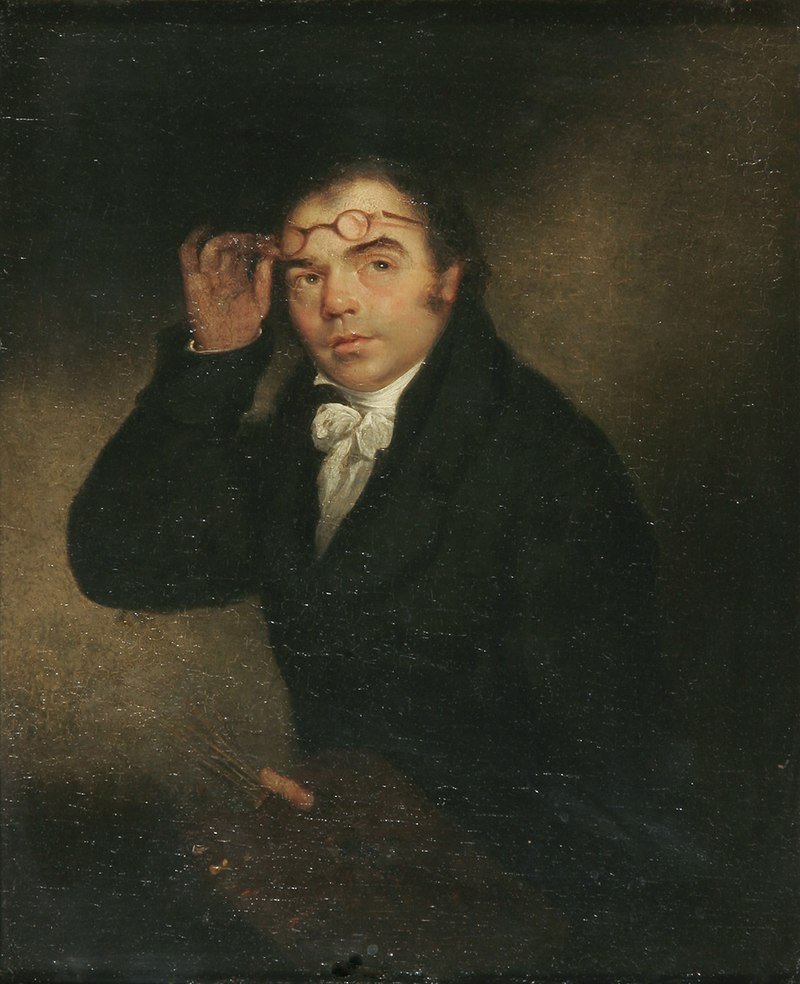
Portrait of John Crome, by Michael William Sharp

One of the founding members of the Norwich School of Painters was John Crome. Crome would become one of the three great landscape painters who came from East Anglia. The other two were Gainsborough and Constable. East Anglia was not known for its spectacular or romantic landscapes. Unlike North Wales or the Lake District, there was little to inspire a landscape painter and yet the quiet pastures of the Stour valley and the Dutch-like vistas of the Norfolk Broads attracted many nature lovers.

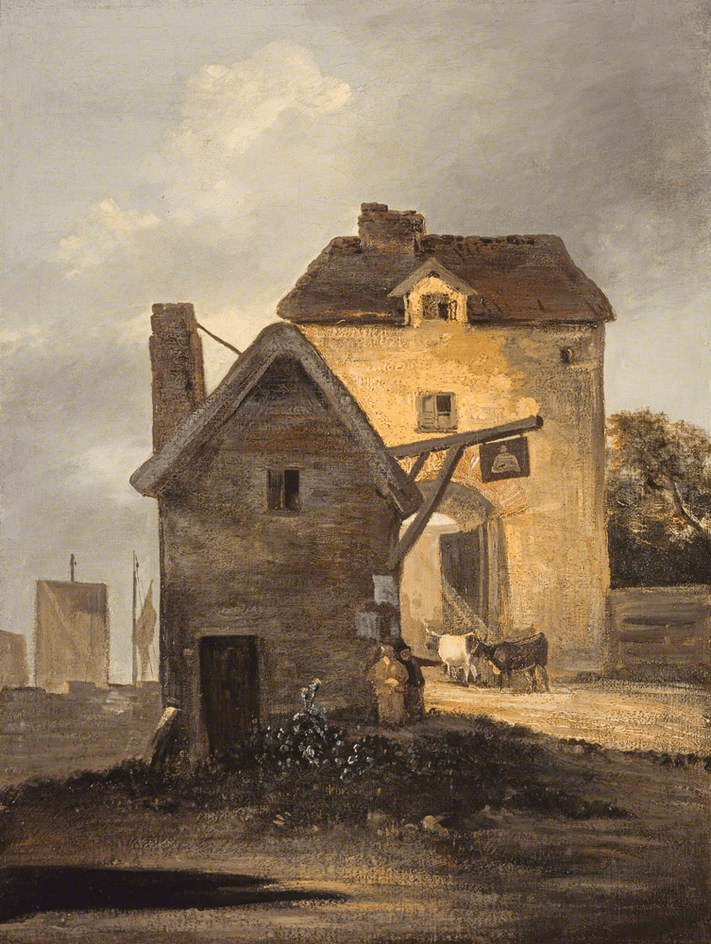
The Bell Inn by John Crome (1805)

Crome was born on December 22nd, 1768 at the small Norwich ale-house called The King and the Miller and was baptised three days later on Christmas Day at St George’s Church Tombland, Norwich. Crome’s father, John, was an impoverished journeyman weaver. He was also either an alehouse keeper or lodged in an alehouse in a very disreputable part of Norwich, known as Castle Ditches. Crome’s mother was Elizabeth Weaver. Crome had very limited schooling and left  at the age of twelve to become an errand boy to the distinguished Doctor Rigby. After a few years living with and serving the doctor, his employer arranged for him to be apprenticed to Mr Francis Whisler, a coach, house and sign painter, of 41 Bethel Street Norwich. Crome commenced his seven-year apprenticeship on August 1st, 1783. At first Crome’s job was to grind the coloured pigments and look after the brushes. He eventually was allowed to paint the signs, which meant that he had to learn the skill of making the depictions on the signs, stand out at a distance and this talent can be seen in many of his later paintings.

The Beaters by John Crome (1810)

During his apprenticeship he struck up a friendship with Robert Ladbrooke, another young apprentice, one who was training to become a printer. The two young men, both of the same age, had one underlying desire – that of becoming painters. The two decided to work together to achieve that aim and rented out a garret and bought some art prints from the local Norwich print-seller, Smith and Jaggers, which they could spend time copying, and thus, honing their artistic skills. Crome and Ladbrooke would go on drawing trips into the fields sketching the scenery and then sell some of their works to the local print-seller.  The print-seller was impressed with what the two young men could achieve and bought some of their drawings and it is very likely it is through Crome’s drawings that he gained the attention of Thomas Harvey, a local amateur artist and art collector. Thomas Harvey owned a number of paintings by old and modern Flemish and Dutch Masters, particularly Meindert Hobbema and Jacob van Ruisdael, which he had acquired through the good auspices of his Dutch father-in-law.  He also had a collection of works by Gainsborough and Richard Wilson, which he allowed Crome to study and copy.

Moonrise on the Yare by John Crome (c.1811-6)

Through Thomas Harvey, Crome met William Beechy, a leading portrait artist who studied at the Royal Academy Schools in 1772, and is thought to have studied under Johan Zoffany. Beechy first exhibited at the Academy in 1776. In 1781, he moved to Norwich. Beechy could see that Crome was a very talented artist and became his mentor.   Beechy, although living in Norwich, had a studio in London which Crome would visit regularly. Beechy wrote about the first time he met Crome:

“…Crome, when I first knew him, must have been about twenty years old, and was an awkward, uninformed country lad but extremely shrewd in all his remarks upon art, though he wanted words and terms to express his meaning. As often as he came to town he never failed to call upon me and to get what information I was able to give him upon the subject of that particular branch of art, which he made his study. His visits were very frequent and all his time was spent in my painting room when I was not particularly engaged. He improved so rapidly that he delighted and astonished me. He always dined and spent his evenings with me…”

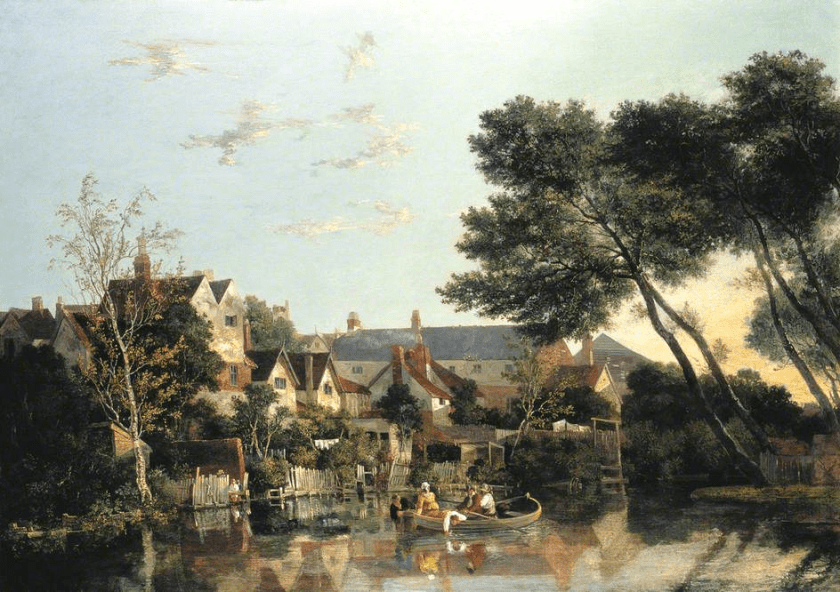
Norwich River, Afternoon by John Crome (c.1819)

On October 2nd 1792, Crome married Phoebe Berney in the medieval St Mary’s Coslany church in the centre of Norwich. The couple went on to have eight children, six sons and two daughters. Two of his sons, John Berney Crome and William Henry Crome became well-known landscape painters.

One of Crome’s rare forays out of the country came in October 1814 when he and two friends crossed the Channel on their way to Paris. Napoleon Bonaparte had just been defeated and hundreds of Englishmen flocked to Paris to view the art treasures held in the Louvre some of which were the spoils Napoleon had collected during his victorious campaigns. On October 10th, 1814, Crome wrote home to his wife informing her that he had arrived safely:

“…My Dear Wife, After one of the most pleasant journeys of one hundred and seventy miles over one of the most fertile countreys I ever saw we arrived in the capital of France. You may imagine how everything struck us with surprise; people of all nations going to and fro – Turks, Jews etc. I shall not enter into ye particulars in this my letter but suffice it to say we are all in good health and in good lodgings…”

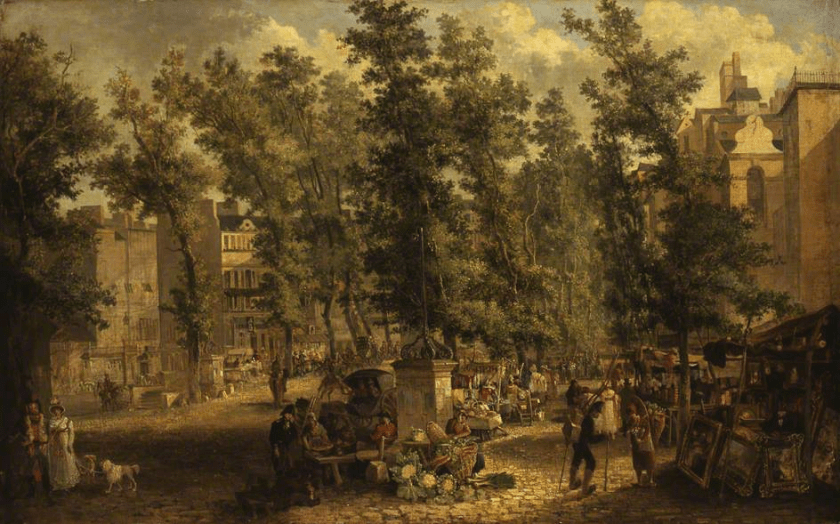
Boulevard des Italiens, Paris by John Crome (1815)

Whilst in the French capital Crome set about pictorialy recording his visit and from the sketches he made, he completed a number of paintings on his return home. In 1815 he completed Boulevard des Italiens, Paris. It is a wonderful work, full of life and energy as we see people milling around the flea market. Crome exhibited the work in the Norwich Exhibition in 1815.

Another painting which came from his many sketches he made whilst in France, was one he sketched whilst on his journey back home. It was entitled Fishmarket on the Beach at Boulogne and Crome completed it in 1820.
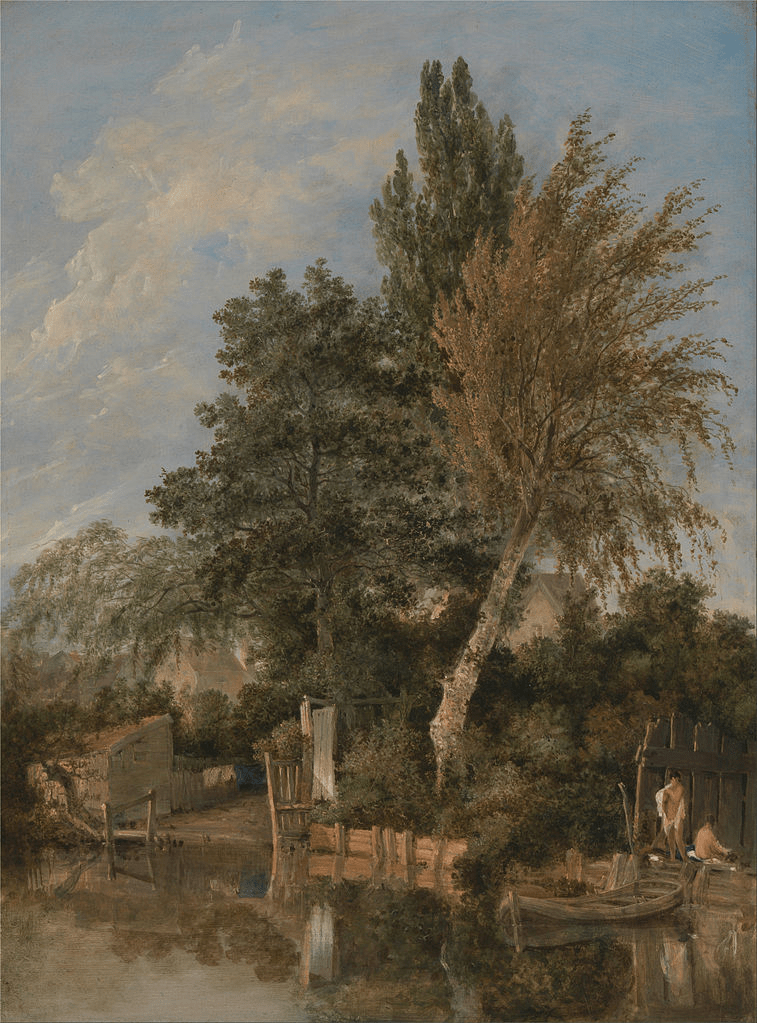
Boys Bathing on the River Wensum, Norwich by John Crome (1817)

Unlike many other English artists, John Crome, besides his one trip to Paris, rarely ventured outside his beloved country and preferred to explore the countryside of East Anglia. He preferred the home life surrounded by his family. His main focus was on the English landscape and especially the natural scenery of the Norfolk area. He maintained that he only painted what he saw and never took poetic licence with his subjects.  As he succinctly put it, I simply represented Nature as I saw her.  Of Crome’s choice of depictions, one art critic wrote:

“…Crome painted ‘the bit of heath, the boat, and the slow water of the flattish land, trees most of all, the single tree in elaborate study, the group of trees, and how the growth of one affects that of another, and the characteristics of each…”

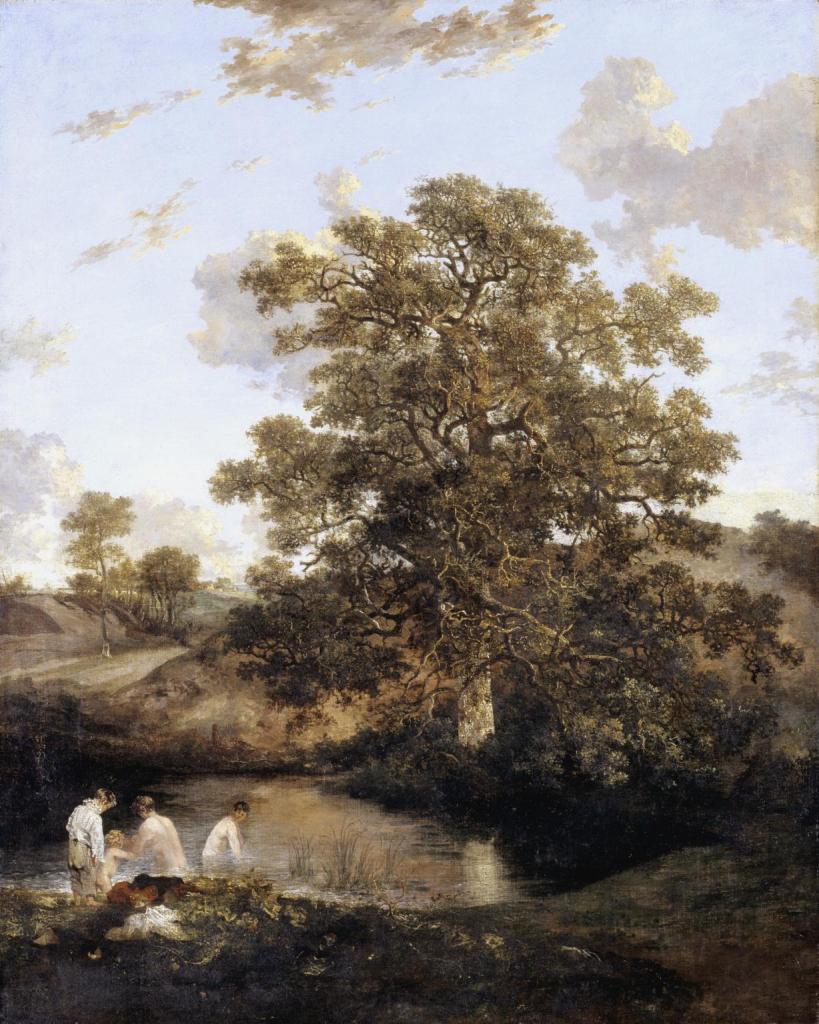
The Poringland Oak by John Crome (c.1818-1820)

Crome was a gifted draughtsman and an authority when it came to depicting trees. He was one of the first artists of his generation to portray individual tree species in his works, rather than just painting simplified structures. His favoured tree was the English Oak tree. A fine example of this is his oil on canvas work entitled The Poringland Oak which he completed in 1820. Poringland is a village in the district of South Norfolk, England. It lies 5 miles south of Norwich city centre and the heathland around the village was one of Crome’s favourite haunts. The depiction centres on a large oak tree that would have been familiar to local residents. Look at the details of the tree Crome has given us. Look how he has masterfully depicted the clouds. This painting came many decades before the Impressionist works and yet it is a study of light, as the sun begins to set. The depiction we see before us is a perfect idyll. The sun is setting bathing the heath in a golden warmth. Bathers, wanting to relax, have taken to the lake after a hard day’s work.
Mousehold Heath, Norwich by John Crome (c.1818-20)

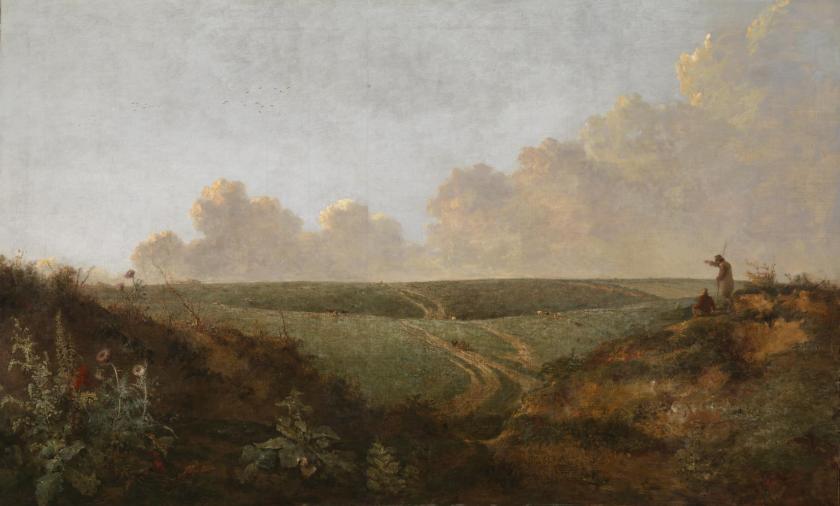
Another of Crome’s paintings featuring the area he loved so much was completed around 1820 and was entitled Mousehold Heath, Norwich. Mousehold Heath was a well–known stretch of common land which lies five miles north of the city of Norwich. It is a unique area made up of heathland, woodland and recreational open space.  Crome’s painting accentuates its vastness and lack of cultivation. In the foreground Crome has depicted clumps of wildflowers and, in the distance, we can just make out cattle grazing freely on the heath. The painting has the feel of a Dutch painting such as those by Aelbert Cuyp which Crome may have seen in the painting collection of Thomas Harvey. Although this painting was completed around 1820 it was probably a view of the Heath some five or ten years earlier as around 1814 a large quantity of land, including this area, was “enclosed”. Once enclosed, use of the land became restricted and available only to the owner, and it ceased to be common land for communal use. In both England and Wales, this process of allowing cultivation of open land was to boost the production of food.

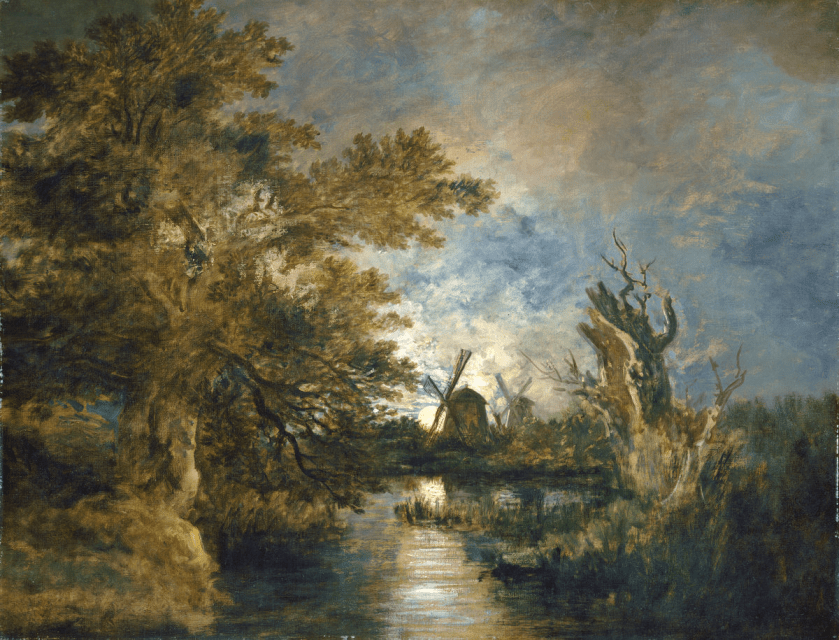
Moonlight on the Yare by John Crome (c.1817)

Besides the money he received for his paintings his income was further increased by teaching art to the “great and good” and he often travelled around to various country homes in his profession as a drawing master. It was during these visits that he would once again have come across many paintings by the Dutch and Flemish Masters. Seeing such collections also gave him an interest in starting his own collection and soon he was fixated on attending sales at auction rooms and he soon built up his own collection of books, prints and drawings. He bought and bought and soon his home was cluttered by his purchases. One can only presume that his wife stepped in and told him that “enough was enough” for an advert appeared in the Norfolk Chronicle:

“…At Mr Noverre’s Rooms, Yarmouth on Wednesday the 23rd of September 1812 and two following days. A capital assemblage of Prints and Books of Prints; Etchings; Finished Drawings and Sketches by the best masters – Woollett, Strange, Fitler, Bartolozzi, Rembrandt, Waterloo etc. They are the genuine sole property of Mr Crome of Norwich – a great part of whose life has been spent collecting them. Descriptive catalogues, price 6d. each of the booksellers of Yarmouth, Norwich, Lynn, Ipswich and Bury…”

There was no mention of the name of the auctioneer and thus it is supposed that Crome himself ran the auction. Although Crome’s had lost his precious collection he was soon visiting sales rooms again, steadily building a new collection !

Landscape by John Crome

John Crome’s life came to an end, after a sudden illness, on April 22nd 1821. He was fifty-two years old. Crome’s thoughts were constantly directed towards the art he so passionately loved. It is believed that on the day of his death he spoke to his eldest son, twenty-seven year old John Berney Crome. He begged him never to forget the dignity of Art, saying:

“…John, my boy, paint but paint for fame, and if your subject is only a pigsty – dignify it…”

It is said that Crome’s last words on his death bed were a cry from the heart and a loving testament to his favourite landscape painter:

“…Oh, Hobbema !  my dear Hobbema, how I loved you…”

John Crome was buried in the medieval church of St George’s-at-Colegate, Norwich and according to The Norwich Mercury, the local newspaper,  an immense concourse of people bore grateful testimony to the estimation in which his character was generally held.

John Berney Crome by George Clint (c.1820)


John Crome was often referred to as “Old Crome” to differentiate him from his talented son the artist John Berney Crome who was referred to as “Young Crome”.


A good deal of information about the Norwich School of Painters came from a book published in 1920, entitled The Norwich school; John (“Old”) Crome, John Sell Cotman, George Vincent, James Stark, J. Berney Crome, John Thirtle, R. Ladbrooke, David Hodgson, M.E. & J.J. Cotman, etc. by Charles Geoffrey Holme.  This book can be read on-line at:

https://archive.org/details/cu31924014891992/page/n3


The artists of the Norwich School of Painters. Part 1 – John Sell Cotman.

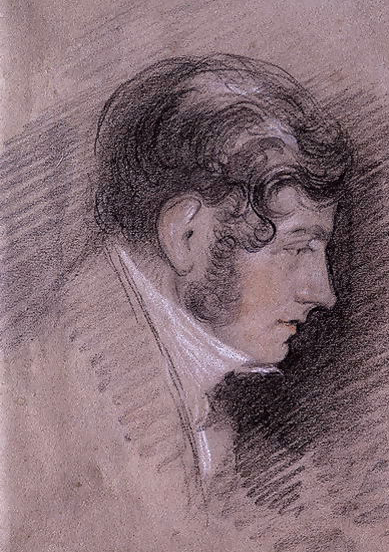
John Sell Cotman by his son, Miles Edmund Cotman

In the art world one often hears about Schools. Not just meaning art establishments but denoting a group of artists who work from a specific location. Prime examples of this are the Barbizon School, which was active from about 1830 through to 1870, and takes its name from the village of Barbizon, France, near the Forest of Fontainebleau. Probably the best known School in Britain was the Newlyn School, an art colony of artists based in or around Newlyn, a fishing village adjacent to Penzance, on the south coast of Cornwall, from the 1880s until the early twentieth century.  A few blogs ago I wrote about Francis Danby who was part of the Bristol School.

Village in Normandy, France, Noon by John Sell Cotman (1817-1820)

In this blog I am looking at a group of artists who worked out of the county of Norfolk, specifically the town of Norwich. These were painters of the Norwich School, or Norwich Society of Artists, which came into being in 1803 in the town of Norwich and was the first provincial art movement in Britain. The area around Norwich was very picturesque and a landscape painter’s idyll. The Scottish miniaturist, Andrew Robertson who was a friend of Constable, visited Norwich in 1812 and was full of praise for the town’s vitality, writing in a letter:

“…I arrived here a week ago and find it a place where the arts are very much cultivated….some branches of knowledge, chemistry, botany etc are carried to a great length.   General literature seems to be pursued with ardour which is astonishing when we consider that it does not contain a university, and is merely a manufacturing town…”

Robertson continued, talking about the quality of music in the city and then turned his thoughts to the city’s art:

“…Painting and Drawing are as much esteemed, and many are nearly as great proficient….The study of landscape about the town are infinitely beautiful and inexhaustible. The buildings, cottages etc are charming and have invited people to the general practice of drawing, or rather painting in watercolours from nature, assisted by man of considerable abilities as a teacher and landscape painter…”

The Norwich Society of Artists was founded in 1803 by John Crome and Robert Ladbrooke and their idea was that artists could meet and exchange ideas. The Society set down its aims as being:

“…an enquiry into the rise, progress and present state of painting, architecture, and sculpture, with a view to point out the best methods of study to attain the greater perfection in these arts…”

Drop Gate, Duncombe Park, Yorkshire by John Sell Cotman (1805)

The Society, once formed had their first meeting in a local tavern, The Hole in the Wall. Two years later they moved to new premises and the extra space allowing the members to use as a studio and also exhibit their work. Their first exhibition was held in 1805 and it was a great success, so much so, that they held an annual exhibition there for the next twenty years. Unfortunately, the building had to be demolished but three years later, in 1828, the Society members regrouped and became the Norfolk and Suffolk Institution for the Promotion of the Fine Arts.

The leading light of the Norwich School of Painters was John Crome who then attracted many friends and pupils until his death in 1821. Leadership of the Society then fell on John Sell Cotman, who had been a member of the society since 1807, and who continued to keep the Society together until he left Norwich for London in 1834. The Society effectively ceased to exist from that date.

Portrait of John Sell Cotman by Alfred Clint

One of the most well-known artists associated with the Norwich School was John Sell Cotman. Cotman was born on May 16th 1782 in the East Anglia town of Norwich, the son of Edmund Cotman and his wife Ann. He was the eldest of ten children. His father, Edmund Cotman, formerly a barber but latterly a draper by trade, had married Ann Sell. John Sell Cotman initially studied at the Norwich School, which is one of the oldest schools in the world having been founded in 1096. John’s father had intended that once his son had completed his education, he would join him in the family business. However, during his time at school John Cotman had developed a love of art and was determined that he would not spend his working life behind a shop counter. At the age of 16, he left home and went to London to study art.

Houses at Epsom by John Sell Cotman (1800)

Whilst living in London he managed to earn some money by colouring aquatints for Anglo-German lithographer and publisher, Rudolph Ackerman, who had, in 1795, established a print-shop and drawing-school in The Strand. Ackermann had set up a lithographic press and begun a trade in prints.

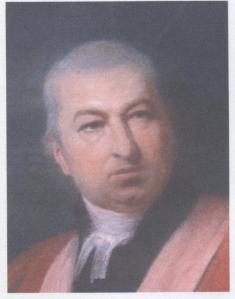
Doctor Thomas Monro

It was whilst Cotman was in London that he also met Doctor Thomas Monro, who was an avid art collector. Monro was Principal Physician of the Bethlem Royal Hospital and one-time the consulting physician to King George III. Besides being an amateur painter and art collector, he was also a patron to a number of young aspiring artists including Thomas Girtin. Monro had a house in Adelphi Terrace, London where he had his studio and a country house in Merry Hill, a suburb of Bushey just fifteen miles from the capital. Monro liked to surround himself with other artists and J.M.W. Turner was a frequent visitor. He ran an art Academy where he would offer evening art classes, some of which were attended by John Sell Cotman.

The Devil’s Bridge North Wales by John Sell Cotman (c.1801)

John Sell Cotman managed to gain the patronage of Monro and through him met many of the leading British artists of the time and it was through his friendship with Turner, Girtin and Peter de Wint that Cotman continued his artistic development. He enjoyed taking trips out to sketch and it is believed that in 1800 he accompanied Thomas Girtin on a sketching trip to North Wales. A painting which came from one of his trips to North Wales was his 1801 work entitled The Devil’s Bridge, North Wales. A pencil drawing of this subject can be found in Leeds City Art Gallery, and it may well have been the inspiration for this very finished example of a Cotman watercolour.

Harlech Castle by John Sell Cotman (c.1800-1802)

Considering Cotman had had no formal art tuition it is amazing the artistic standard he had reached for someone of such a young age for when he was aged just eighteen, he first exhibited at the Royal Academy showing five works, four depicting scenes from the Surrey countryside and one was of Harlech Castle. When touring North Wales in 1800, he made a series of drawings and watercolours of Welsh subjects during the following years. This watercolour of Harlech Castle in North Wales is related to a sketch he drew on July 30th 1800. The castle at Harlech was built in the thirteenth century by Edward I, and was often represented by artists at this time. It features in watercolours by Girtin, Varley and Turner as well as Cotman.
The success Cotman believed would come about in London never materialised and in 1806 he returned to his hometown of Norwich and began earning his living as an art tutor. When he returned to Norwich he also joined the Norwich Society of Artists.  Cotman exhibited 20 works, including six portraits, at the society’s exhibition in 1807, and 67 works including some oils, in 1808. In 1811 he became president of the society.

Greta Bridge by John Sell Cotman (1806)

One of my favourite works by Cotman is a watercolour entitled Greta Bridge measuring just 22cms x 33cms. Cotman completed the small work in 1805 which can be found in the British Museum. A second version of the painting, a much larger one, (30cms x 50cms), was completed by Cotman in 1810 and is housed in the Norwich Castle Museum. Both of these watercolours recreate the rural solitude and tranquillity of the Greta area of North Yorkshire, where Cotman spent the summers of 1803 – 1805. The Greta Bridge in this painting spanned the river Greta in North Yorkshire near the gates of Rokeby Park. John Cotman had arrived at Rokeby on the evening of July 31st 1805, accompanied by his friend and patron, Francis Cholmeley. It had been arranged in advance that the two men were to stay as guests of the owner of Rokeby Park, John Bacon Sawrey Morritt. Cotman stayed at the house for about three weeks and when his hosts left on business, he remained nearby, taking up lodgings in a room at the local inn, which is the large building to the left of the bridge. Cotman then continued the work he had begun along the river Greta that skirts the park. It is a wonderfully balanced composition depicting the Greta Bridge, with its striking, single arch, which runs horizontally across the picture, in some way dividing it in two and yet uniting it into a single scene. The arch of the bridge epitomizes a great feat of engineering, which Cotman, with his love of architecture, admired. The structure we see before us was designed by John Carr of York, and built in 1773 for Morritt’s father, John Sawrey Morritt, who was a well-known collector of classical antiquities. The bridge replaced a Roman single-arched bridge of the same design.

Chateau Navarre, near Evreux, Normandy by John Sell Cotman (1830)

Cotman had a love of bridges and sketched many. For him, a bridge was a meeting point or landmark for travellers and would often be a point of reference on maps where rivers and roads meet. Cotman was fascinated by the interaction of this man-made feature and how it harmoniously interacted with a natural setting.

Dutch Boats off Yarmouth, Prizes during the War by John Sell Cotman (1824)

In 1809, Cotman married Ann Mills, the daughter of a farmer from the nearby village of Felbrigg and the couple went on to have five children. During his time as a drawing master he taught the local banker, botanist and antiquary Dawson Turner and his children. They became close friends and Dawson Turner introduced him to many prospective students. Cotman began to be interested in etchings and issued the first of his in 1811. He moved from Norwich and for the next ten years he lived in the Norfolk coastal town of Yarmouth and this gave him the opportunity to complete a number of seascapes such as his oil painting Dutch Boats off Yarmouth which depicts a coastal scene at Yarmouth and is a reminder of British naval triumphs over the Dutch navy. England and the Dutch Republic, despite having been allied for a century when they again went to war in 1780, a conflict that lasted four years and became known as the Fourth Anglo-Dutch War.  The conflict followed secret Dutch trade and negotiations with the American colonies, who, at the time, were in revolt against England.  In the background of the painting we can just make out Yarmouth’s monument to the Norfolk hero, Lord Nelson.

Cley Church, Norfolk by John Sell Cotman

It was around this time that Cotman concentrated on printmaking. The majority of his etchings were architectural in nature, with numerous ones of old Yorkshire and Norfolk buildings. It is more than likely that this move towards etchings and printmaking was due to, and inspired in part by his friend and patron, Dawson Turner. Unlike academic, London-based painters who romanticized the English countryside, John Sell Cotman and other members of the Norwich School painted landscapes in their immediate surroundings. An example of this is his 1818 drawing Cley Church, Norfolk which is a depiction of Saint Margaret’s in the village of Cley-next-the-Sea. It exhibits Cotman’s heightened attention to perspective and architectural detail as opposed to vegetation and atmospheric effects. It is now part of the Art Institute Chicago collection.

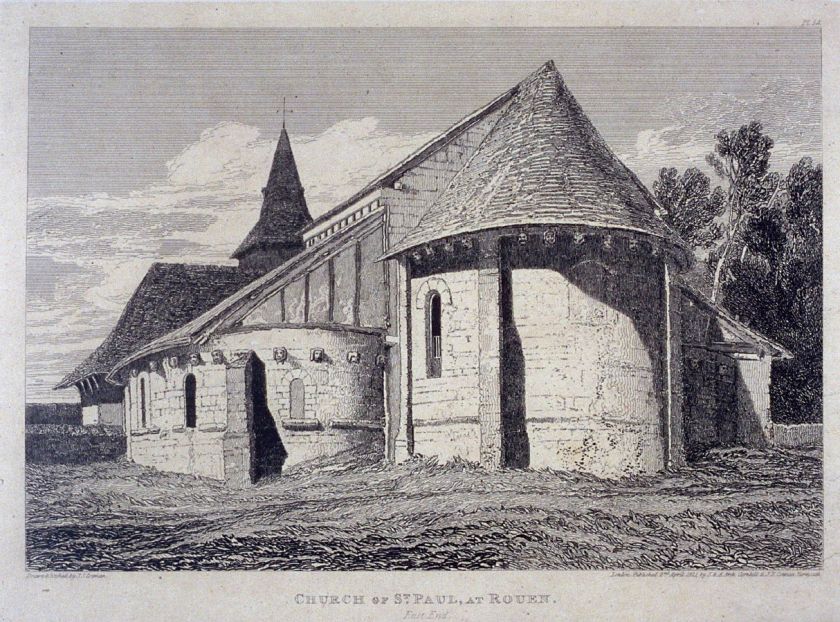
Church of St Paul at Rouen

In 1817, Cotman, with help from his patron, made the first of three tours of Normandy and out of these journeys came a book in 1822 entitled, Architectural Antiquities of Normandy, one of various books he illustrated with his etchings. The Etching on Chine Colle entitled Church of St Paul at Rouen was one of Cotman’s illustrations for his book.

Church of Querqueville, Near Cherbourg, from the series Architectural Antiquities of Normandy, etching by John Sell Cotman (1822)

Another etching from the series ‘Architectural Antiquities of Normandy‘ was his work, Church of Querqueville, Near Cherbourg.

In January 1834, through the good auspices of J.M.W. Turner, Cotman gained the post of Master of Landscape Drawing at King’s College School in London, which he held until his death. He and his family left Norwich and relocated to the London borough of Bloomsbury. Two years later, his eldest son Miles Edmond Cotman was appointed to assist him. The taking up of the position at King’s College could not have come at a more fortuitous time as Cotman was beginning to have financial problems. Sadly, with these financial problems, which had afflicted him during most of his working life, came bouts of depression, ill health and despondency brought on by the poor sales of his work. During John Cotman’s tenure at King’s College he taught many artists including Dante Rossetti.

John Sell Cotman’s grave in St. John’s Wood, London

Cotman’s last visit to his home town of Norfolk was in the autumn of 1841, just nine months before his death in London on July 24th, 1842. He was buried in the cemetery at St. John’s Wood Chapel.  The 20th century art historian and painter, Charles Collins Baker, said of John Sell Cotman:

“…a great colourist, whose earlier palette produced that rare plenitude that only masters of exquisite simplicity and restraint compass: from his palette the brown glebe, the black reflection of massed trees in a still river, the grey and gold of weathered stone and plaster, the glinting gold on foliage and the gilded green of translucent leaves have a special and supernal quality of dream pageants rather than of actuality…”

For most of the twentieth century, Cotman was the most widely admired English watercolourist, surpassing even Turner in popularity.

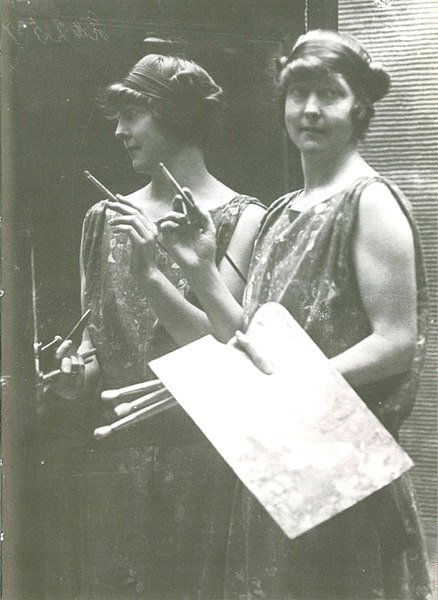
Elisabeth Chaplin

Elisabeth Chaplin

The artist I am looking at today is the French-born painter, Elisabeth Chaplin. She was born in Fontainebleau, France on October 17th 1890. Her father was William Chaplin and her mother was the eminent sculptor and poet, Marguerite Bavier-Chaufour.

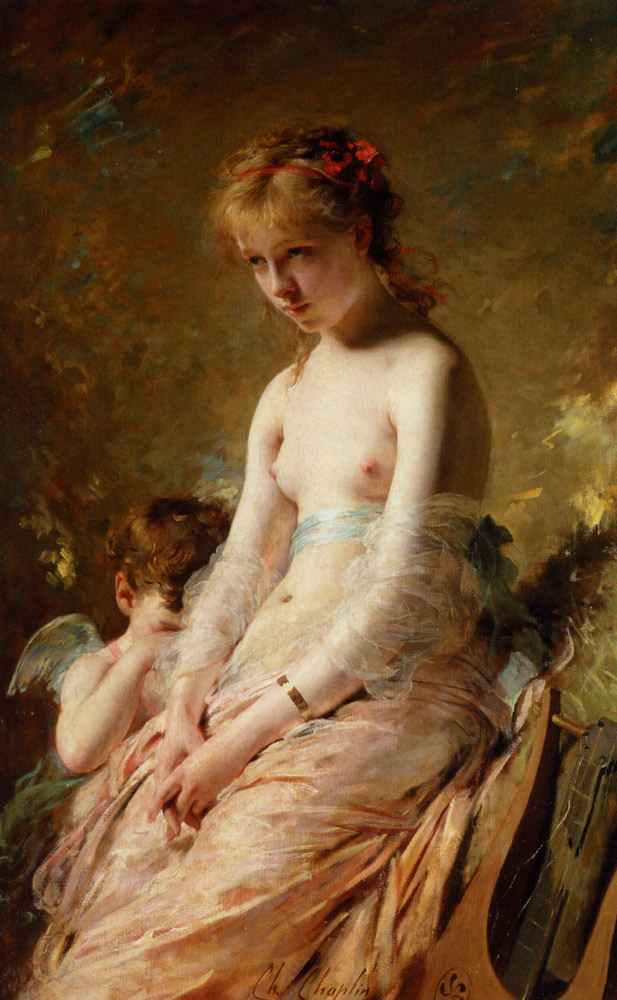
A Song Silenced by Charles Joshua Chaplin

A further artistic connection was that of her uncle, Charles Joshua Chaplin, a French artist and printmaker who was known for his landscapes and portraiture. He worked in many mediums such as watercolours, pastels and oils and was probably best known for his portraits of beautiful young women. He became famous in the Paris of Napoleon III and was admired by  Empress Eugenie for the delicate tones of his paintings. He became a member of the Académie royale de peinture et de sculpture, and exhibited his paintings at the Salon de Paris.

Autoritratto contro la finestra di San Domenico by Elisabeth Chaplin (1910)

The family, due to her father’s occupation, moved from France in 1900 and relocated to the Piemonte region of north-western Italy, a region which borders France. A few years later the family was on the move again. This time they went to live in Lagueglia, a coastal town on the Italian Riviera and it was around this time that Elisabeth, now a teenager, began to take an interest in painting and set about teaching herself to paint.

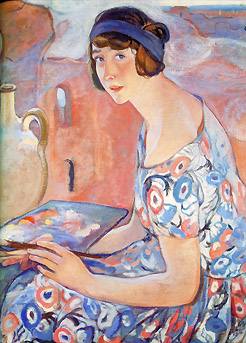
Self portrait in Pink by Elisabeth Chaplin (1921)

The family was soon on the move again and in 1905 finally went to live at Villa Rossi which was in the hills of Fiesole overlooking the Tuscan city of Florence. Living so close to Florence and being interested in painting Elisabeth would spend hours at the Uffizi Gallery copying the paintings of the Grand Masters. Elisabeth received no official training and maintained that the Grand Masters were her tutors and she, their pupil.

Ritratto di Famiglia (Family portrait) by Elisabeth Chaplin (1906)

One of the first paintings she completed was a family portrait in 1906 entitled Ritratto di famiglia in esterno, (Outdoor Family Portrait). She was just sixteen years old and the painting earned her the gold medal from the Florentine Society of Fine Arts. Whilst in Florence, Elisabeth visited the studio of Francesco Giolio’s and met the painter Giovanni Fattori, who was a member of the Macchiaioli, a group of Italian artists who were active in Tuscany in the second half of the nineteenth century. They shied away from the antiquated conventions which were being taught by the Italian art academies. They were lovers of plein air painting so that they were able to capture natural light, shade, and colour. The Macchiaioli are often compared to the French Impressionists, but unlike their French contemporaries they didn’t complete their entire paintings en plein air, but instead would take back to their studios the sketches they had done outdoors and worked them up into a full painting. Elisabeth would have learnt a lot about art from Fattori.

The Garden of Villa Il de Trepiede by Elisabeth Chaplin

In her early twenties, Elisabeth exhibited her work in all the major Italian exhibitions between 1910 and 1914. Her work was shown at the Società delle Belle Arti in 1910, and the Internazionale di Valle Giulia in Rome in 1911. In 1912 her work could be seen at the Promotrice Fiorentina, the Secessione Romana in 1913 and the Venice Biennale in 1914.

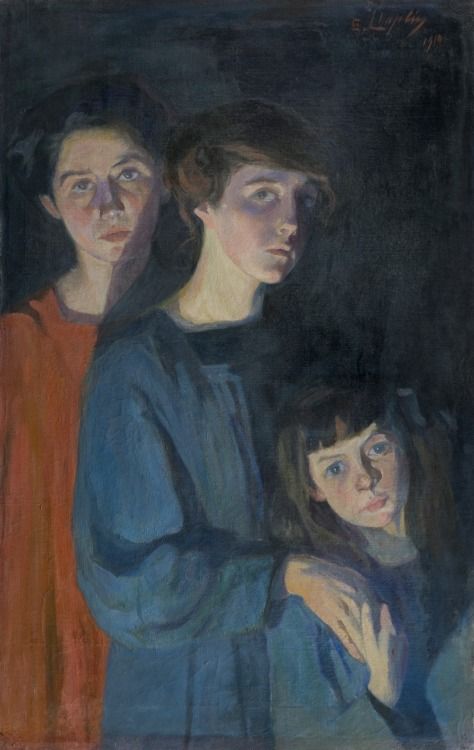
Three Sisters by Elisabeth Chaplin (1912)

In 1916 she and her family moved to Rome, and it was here that she was able to immerse herself into the vibrant, international cultural climate and through her artwork was able to build on her reputation as an international painter. It was in the Italian capital that she met Paul-Albert Besnard, a French painter and printmaker who became one of her mentors. After a two year stay in Rome Elisabeth returned to her beloved Villa Il Treppiede.

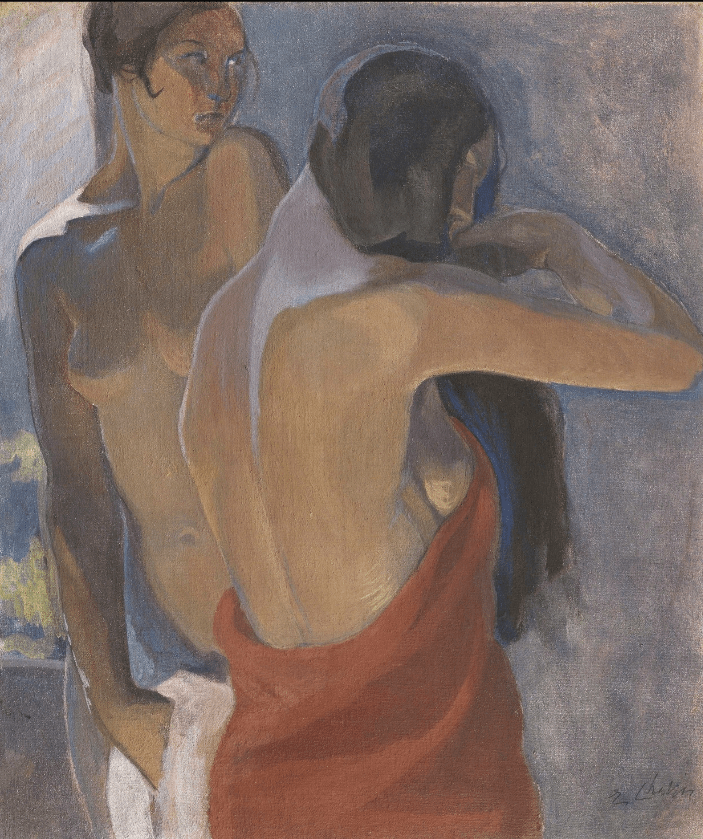
Two Nudes or Double Self-portrait by Elisabeth Chaplin (1918)

It was around 1918 that Elisabeth Chaplin created what is now looked upon as one of her masterpieces. The painting was entitled Two Nudes or Double Self-portrait, and is one of few works which was not bought by the Galleria d’Arte Moderna in Palazzo Pitti a few years before she died. Elisabeth depicts herself in a dual position, front and back, as she holds onto a red sheet that is tantalisingly falling off her naked body. It is a Symbolist-style work and any likeness to her disappears, giving way to Symbolist features that go beyond a solely naturalistic portrayal. It is a beautiful example of chiaroscuro with the light striking the figure from below. The colour palette she uses is vivid with reds and blues meeting and conflicting. There is a whiff of exoticism about her long, black hair and about the red sheet that looks like a Tahitian wraparound skirt, so much so that the Italian art critic and author of the 1994 book: Elisabeth Chaplin, Giuliano Serafini, stated that it was “an unwitting tribute to Gauguin, which remains one of her most fascinating and emblematic pictures, is the nude conveyed with such fullness of style and truth.” .

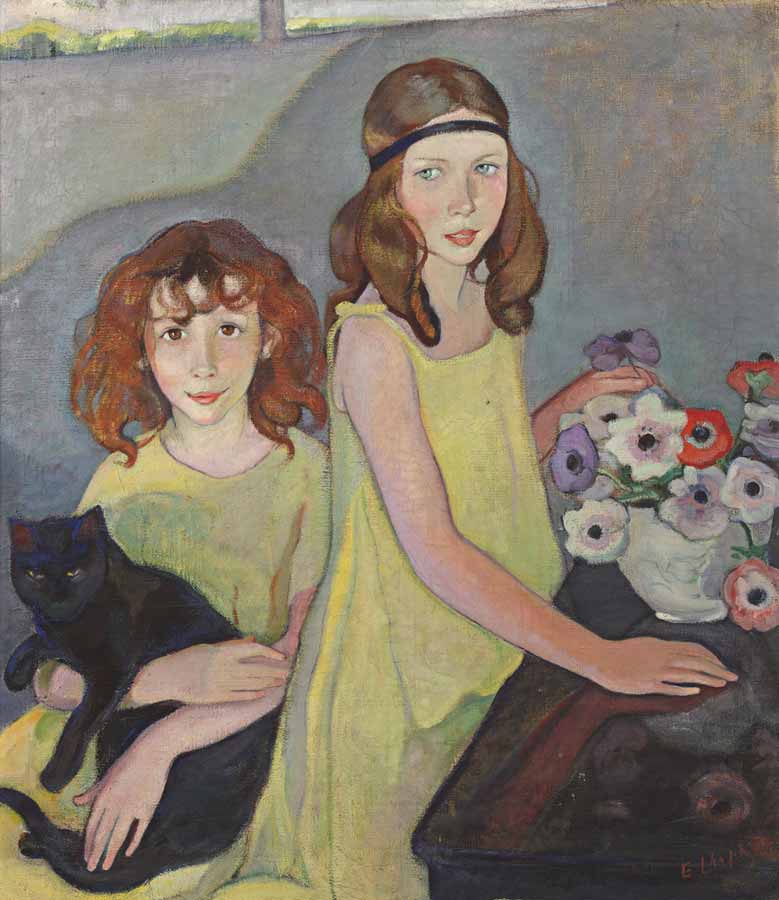
Fanciulle in Giallo (Young girls in yellow) by Elisabeth Chaplin (1921)

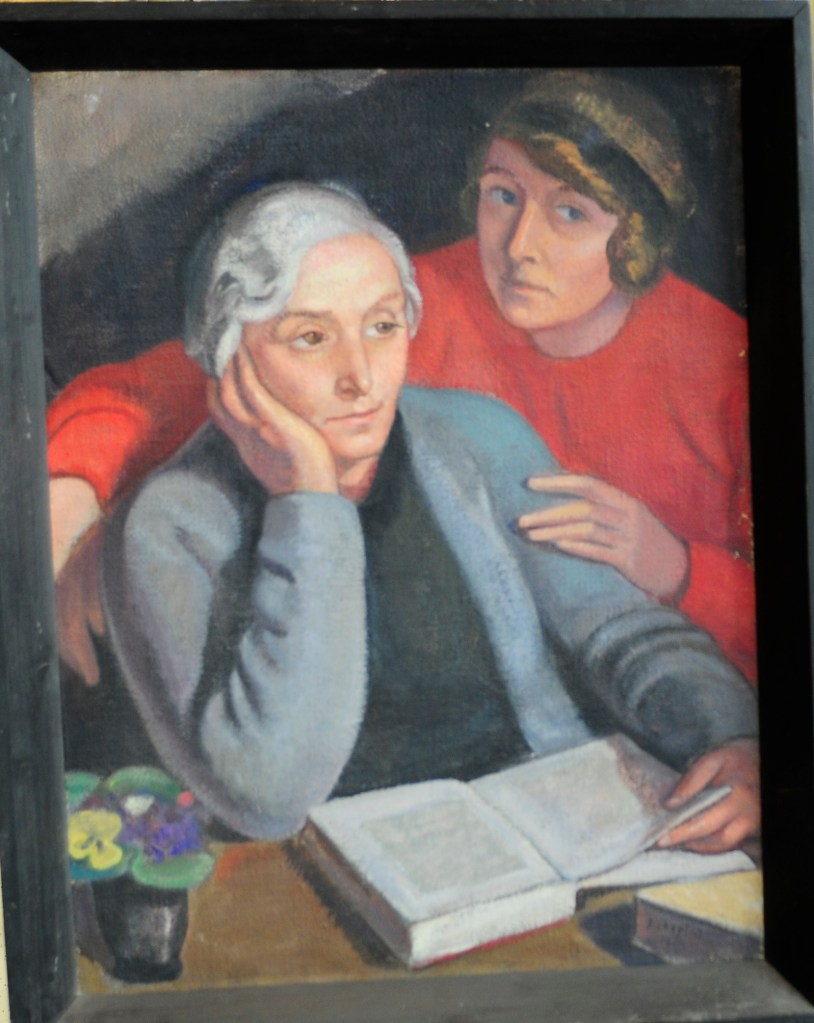
I think my favourite Elisabeth Chaplin work is one she painted in 1921 when she was living in Paris. Its title is Les Jeunes filles en jaune (Young girls in yellow). The painting depicts them dressed in yellow-coloured clothes and this derives from the many self-portraits Elisabeth did during her childhood.  The two young girls are totally different.  The redheaded girl on the left is seated. Her hair is unfettered. She stares out at us with such intensity. Cradled in her arms is a black cat, a creature that is often looked upon as being enigmatic and yet sometimes malign. The cat is a sacred icon that infuses mystery and thus this young girl represents disorder and turmoil. The other girl with her distant blue eyes is so different. There is an air of calm and graceful tranquillity about her. Her hair is neatly coiffed and she is seen touching a bunch of anemones, the embodiment of innocence. This duality is a connotation of Symbolism and we again see the duality with the reflection of the girl’s hand and the vase on the dark brown table.

Self-portrait with a Green Umbrella by Elisabeth Chaplin (1903)

In 1946, the Uffizi Gallery bought three of her paintings and asked to be given an early self-portrait by her. She agreed and donated her 1903 work entitled Self-portrait with a Green Umbrella and it now hangs in the Vasari Corridor.  The most famous and the most respected collection of self-portraits in the world are to be found in the very long Vasari Corridor of the Uffizi Gallery in Florence.  (It has been closed for major renovations). The corridor is a long, raised passageway that connects Palazzo Vecchio in Piazza della Signoria to Palazzo Pitti on the other side of the river Arno. The passageway was designed and built in 1564 by Giorgio Vasari and its function was to allow Cosimo de’ Medici and other Florentine elite to walk safely through the city, from the seat of power in Palazzo Vecchio to their private residence, Palazzo Pitti. It is a veritable tribute to art but more especially to those who have created it. Along the walls there are great self-portraits by the Masters, such as Rembrandt, Velazquez, Delacroix and Chagal. The first paintings were bought by the Medici family, and after the collection started, the family began to receive the paintings as donations from the painters themselves. However, what is noticeable about the collection is the small number of self-portraits by female artists. There are some such as Marietta Robusti, the talented daughter of Tintoretto, who died prematurely, Elisabeth Vigée-Le Brun, who immortalized for posterity the image of Maria Antonietta and today’s artist whom I am writing about, Elisabeth Chaplin. One of her very first paintings.

Self-portrait with her mother by Elisabeth Chaplin (1938)

Buoyed by the success of her work, in 1920 she had her paintings exhibited for the first time at that year’s Paris Salon. During the 1920s, she exhibited with Cezanne, Matisse, and Van Gogh and had her work was exhibited twice at Venice Biennale, in 1924 and 1926. Her work received great acclaim at the Salon, so much so that in 1922 she moved to Paris and remained in the French capital until the end of World War II. During her extended stay in Paris she spent time going to the Panthéon and the Hotel de Ville to study the work of the Symbolist painters, such as Puvis de Chavannes. Her acclaimed work brought her many commissions including producing large murals for the churches of Notre-Dame du Salut and Saint Esprit. In 1937 she was awarded the gold medal at the Exposition Internationale and a year later was given the Légion d’Honneur.

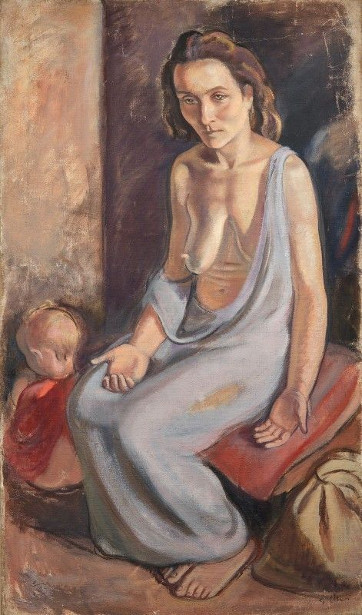
Mendiante avec enfant – Misère (Begging with child – Misery) by Elisabeth Chaplin

Elisabeth Chaplin died in Florence in 1982, aged 91. Most of her work including her family portraits, plus some plaster figures created by her poet and sculptor mother, Marguerite de Bavier-Chaffour, were donated to the Pitti Palace and have been on display there since 1974 in a room devoted entirely to her work.  More than six hundred other works are in storage at the Palace.

Francis Danby. Part 2.

Financial problems, plagiarism and marital difficulties.

Francis Danby

In 1821, Francis Danby fathered a fourth son, Thomas, and the family were still living in the Bristol suburb of Kingsdown.  Aross the River Avon, on the south-west side of the Avon Gorge, was a large area of woodland known as Leigh Woods.

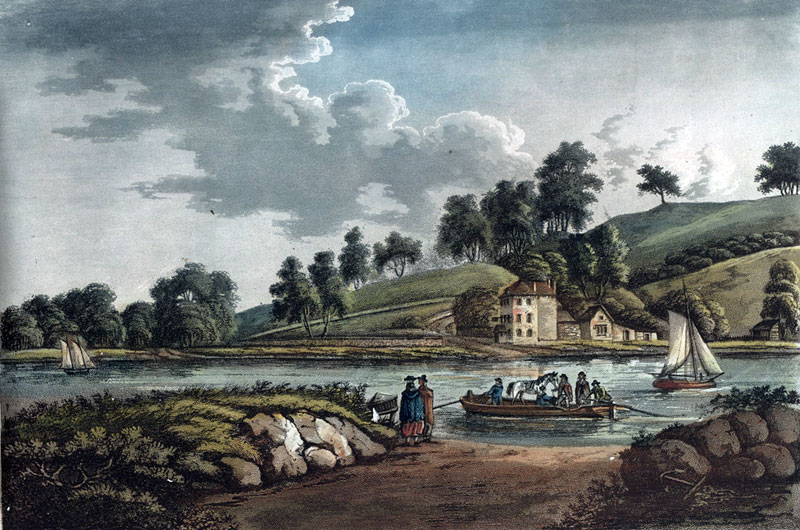
Rownham Ferry from the Somerset side in 1797 by John Hassell

This was a magnet for artists who had a large range of picturesque views to paint and sketch en plein air. However in the 1820’s, there was no Clifton Suspension Bridge which did not get built until 1864 and so, to cross the Avon Danby and fellow painters living in Bristol would have to traverse the river by means of the Rownham Ferry and then walk along the tow path before ascending Nightingale Valley.

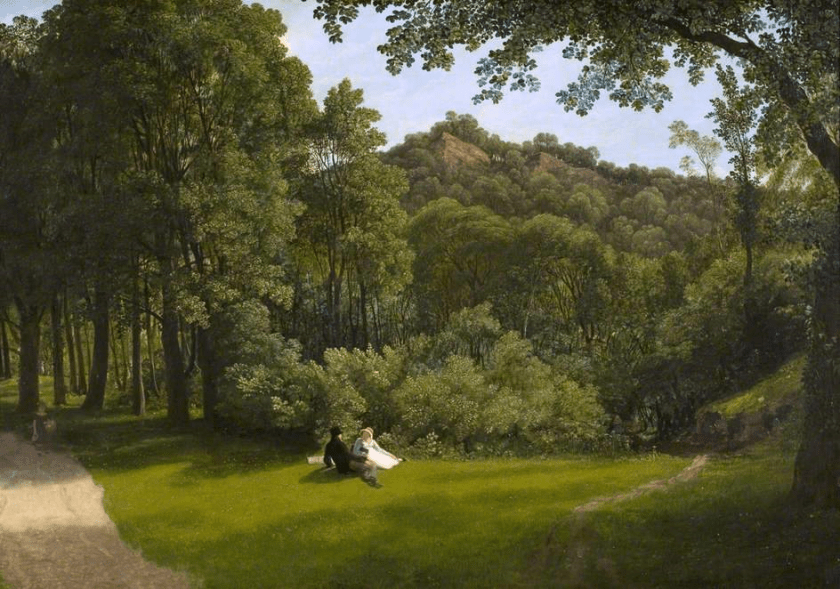
A Scene in Leigh Woods by Francis Danby (1822)

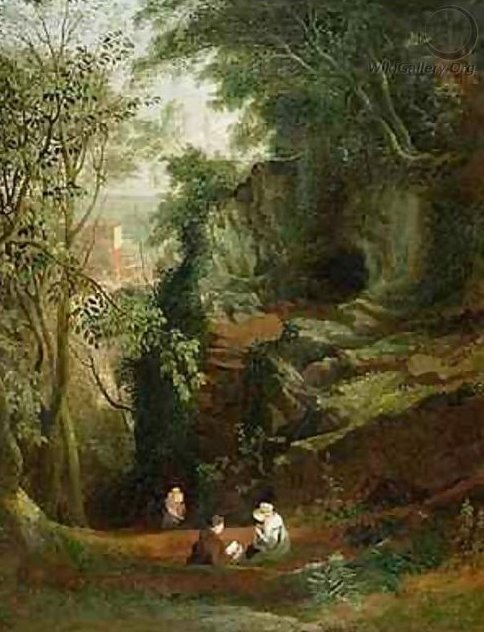
Francis Danby completed his painting A Scene in Leigh Woods in 1822. This oil on panel painting measuring 35 x 50 cms is awash with many tones of green but such variation of tones and tints is well managed. The sunlight coming from the right hand side has struggled to penetrate the dens foliage and this results in the shadows not being so dense. The artist has moved away from his two companions who are busily sketching and by distancing himself from his friends he has been able to give us a very relaxed scene. The Revd. John Eagles, a writer and amateur artist, wrote about the friendship between artists when they descended on Leigh Woods and how Leigh Woods was the best painting-ground. In an article, he wrote about the colours one could find there:

“…they were of all shades, but rich as if every colour had by turns blended with them, yet unmixed, so perfect in predominance was the green throughout. So varied likewise was the texture, whether effected by distance, by variety of shade, by opposition, or by character of ground. There was much of emerald, not in colour only, but in transparent depth…”

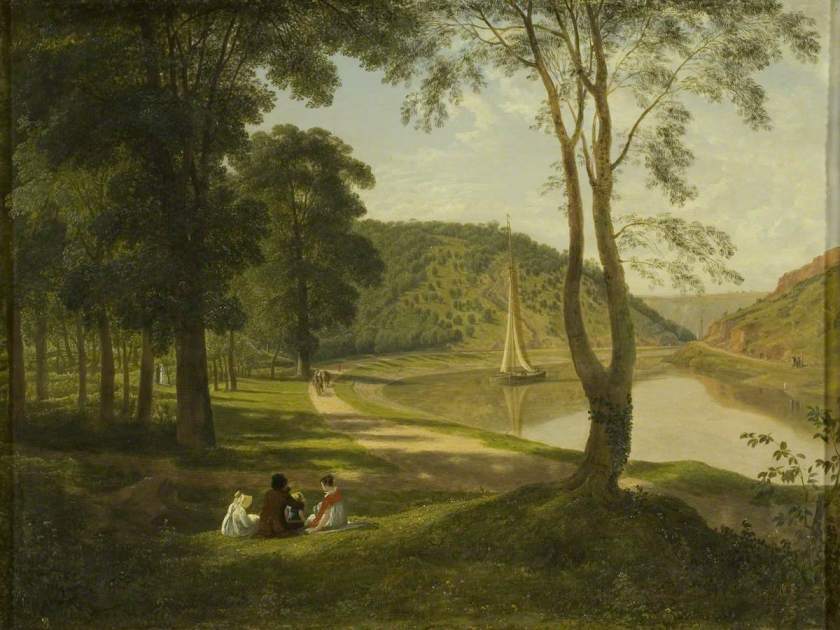
View of the Avon Gorge by Francis Danby (1819)

Danby also completed another painting in 1822, View of the Avon Gorge, which is a companion piece to A Scene in Leigh Woods. This painting depicts a view looking downstream across the entrance to Nightingale Valley which was a favourite spot for the artists of the Bristol School. In the painting we can see a quarry barge moving slowly up the River Avon. In the distance you can just make out the Sea Walls and to the right you can just see the construction of the Bridge Valley Road which eventually ran around the riverbank on the right.

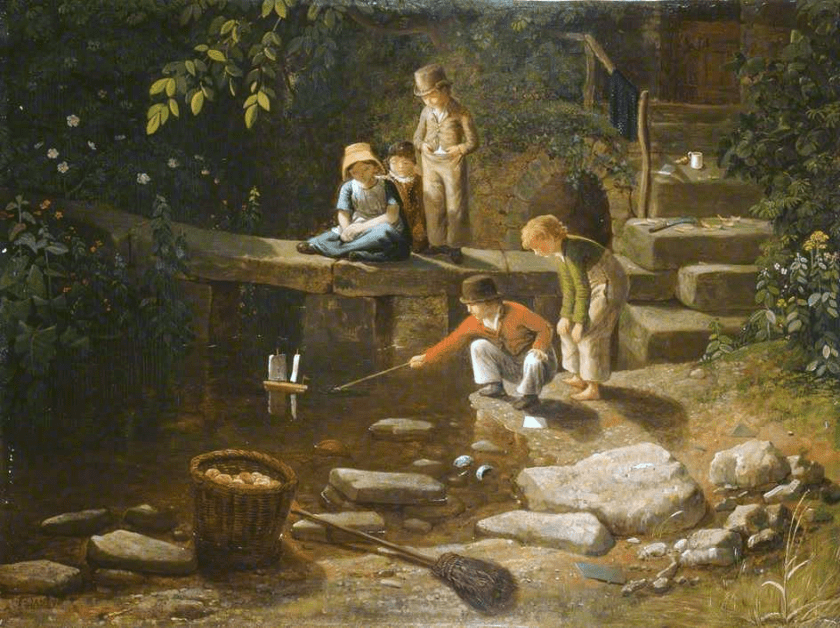
Boys Sailing a Little Boat by Francis Danby (c.1822)

Another of Danby’s captivating paintings was one he also completed in 1822 which was entitled Boys Sailing a Little Boat. It depicts four young boys and a young girl on a riverbank and a small stone bridge. They are fascinated watching their small model boat floating in the water. A basket of potatoes lies on the riverbank and presumably the children had been taxed to peel them but the thrill of watching their boat in the river has been a distraction. It should be remembered that at this time Danby had four sons and it is thought he could also have a daughter so this may have been his idea of portraying them all in this scene.

Sunset at Sea After a Storm by Francis Danby (1824)

In 1824, all was not well with Francis Danby. He was heavily in debt and he decided his only recourse was to take flight. He and his family left Bristol in April and headed to London where he believed he could make more money selling his work. The breakthrough for Danby came in July that year when he exhibited his painting, Sunset at Sea after a Storm at the Royal Academy which was then bought by the President of the Royal Academy, Sir Thomas Lawrence, who became Danby’s mentor. Not only did Lawrence buy Danby’s painting but he put him forward as an Associate of the Royal Academy. Danby was duly elected in November 1825.

Francis Danby – An Enchanted Isle

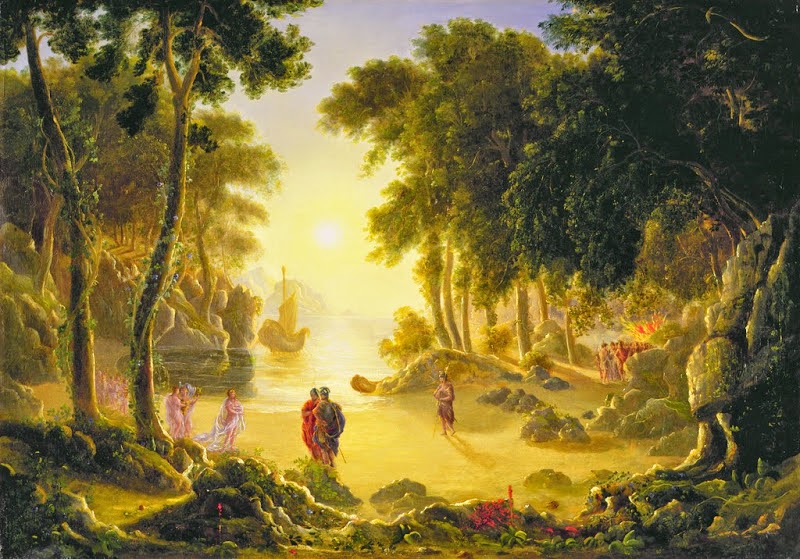
Following the good reviews of his painting, Sunset at Sea after a Storm, he followed it up with An Enchanted Isle which had been commissioned by his patron, John Gibbons, and which was shown at the British Institution, to great acclaim.

Danby, Francis; The Delivery of Israel out of Egypt; by Francis Danby (1825)

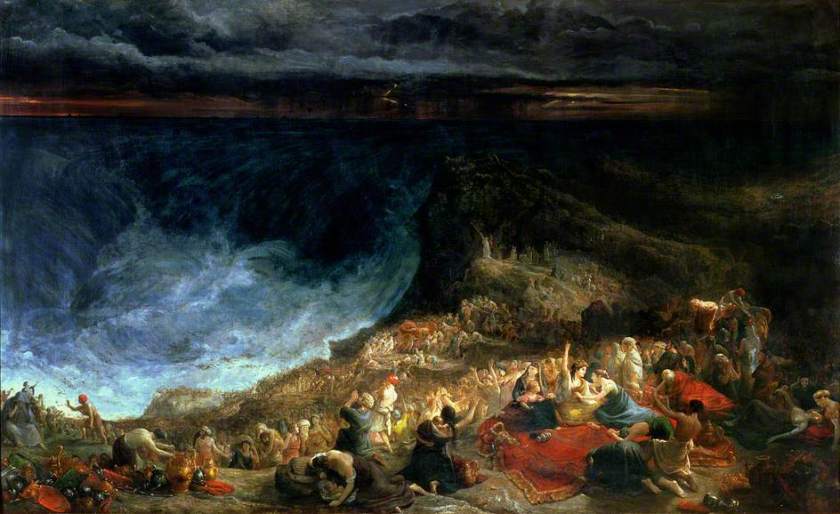
However his next painting, The Delivery of Israel out of Egypt, which he exhibited at the 1825 Royal Academy Exhibition, was a veritable triumph and was immediately bought by the Marquis of Stafford who was the President of the British Institution for £500. The story of the sale of the work is fascinating. The Marquis saw the painting at a private viewing and immediately mounted his horse and rode of to Danby’s house and bought it. An hour later Lord Liverpool rushed into Danby’s house wanting to buy the work, only to be told he was too late.

The Opening of the Sixth Seal by Francis Danby (1828)

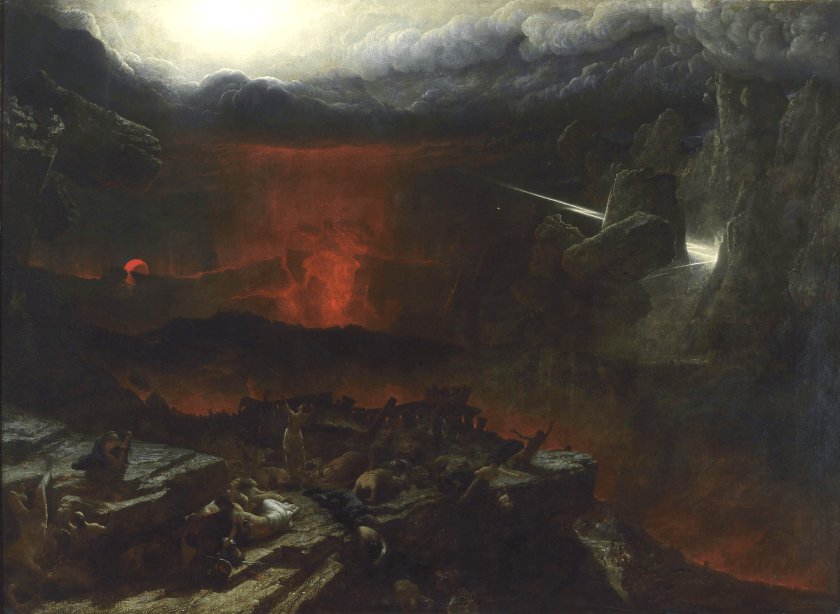
In 1828, Danby completed a somewhat different painting from his light and airy Bristol landscapes. It was entitled The Opening of the Sixth Seal. He actually started the painting in 1825 but gave up on it accusing fellow painter, John Martin, of plagiarising the depiction with his Deluge work. It caused quite a controversy at the time. He returned to the work two years later and completed it in 1828. The depiction was based on the biblical text from the Book of Revelations (6:12-17):

“…I watched as he opened the sixth seal. There was a great earthquake. The sun turned black like sackcloth made of goat hair, the whole moon turned blood red, and the stars in the sky fell to earth, as figs drop from a fig tree when shaken by a strong wind. The heavens receded like a scroll being rolled up, and every mountain and island was removed from its place. Then the kings of the earth, the princes, the generals, the rich, the mighty, and everyone else, both slave and free, hid in caves and among the rocks of the mountains. They called to the mountains and the rocks, “Fall on us and hide us from the face of him who sits on the throne and from the wrath of the Lamb! For the great day of their wrath has come, and who can withstand it?…”

It tells of the opening by God of the sixth seal on a scroll, the earth is rent and mankind descends into disarray. The sun becomes black and the heavens collapse; a king slumps among now worthless symbols of his sovereignty (crown and sceptre), people cower in fear of the wrath of God, and a city falls to rubble in the background.

The slave

It is interesting to note that Danby added to his depiction a topical reference to slavery. If you look to the left of the painting you can make out a crouching figure, similar to that adopted as the symbol of the abolitionist movement, and at the centre of the painting there is the figure of a liberated slave, who has broken the shackles that were wrapped around his wrists. This liberated figure in some way answers the question at the end of the biblical text.  So why did Danby choose to paint this very different depiction? The answer probably lies with the fact that the slave trade had been discontinued in 1807 in Britain but the Bill for the abolition of slavery itself was not passed until 1833. Danby was not known to have had any particularly strong feelings for the religious subject in his works, but was opposed to slavery and was conscious that there was a prevailing appetite for the apocalyptic in art. In this work he has excelled at depicting dramatic phenomena in nature, from spectacular sunsets to lightning storms. The painting proved the most popular work at the Royal Academy in London in 1828.  It was a triumph, loved by public and critics alike. Danby had been elected as an Associate of the Royal Academy in November 1825 and now, following the success at the Academy exhibitions, he had high hopes that he would be elected a full member of the Academy. However there was one problem. The other candidate who stood for election was John Constable and Danby began to fear the worse as he anxiously awaited the result of the ballot, saying:

“…the awful moment is coming…..if Constable is put in, I think I will run out…”

As a full member of the Academy he could apply for funds and he knew that Constable would have no reason to ask for money as his wife had just inherited £30,000 and thus Danby believed that the Academy may look on that factor as a reason for choosing Constable. Danby’s fears were well founded and in February 1829 Constable beat Danby by one vote.   Danby was both furious and bitter. He accused Constable as being underhanded and that the Academy had chosen the rich over the poor adding:

“…for the Academy I have much cause to be ashamed as it lowers their value when it is so evident that the have elected Constable for his money…”

His accusation against the Academy held some credence with the National Press, which must have hurt Constable. Even worse for Constable the President of the Academy, Sir Thomas Lawrence, was openly disappointed with the Academy’s choice.

A Study for The Golden Age (pencil and bodycolour on grey paper) by Francis Danby (1827)

A Danby painting of around this time had an interesting tale to it. Around 1826 when Danby was working on a Cleopatra painting for John Gibbons he mentioned to his patron that he had conceived an idea for a large work. It was to be called The Golden Age but he promised it would not hinder the Cleopatra painting although that work was causing him problems. Lord de Tabley, a patron of Turner, had shown an interest in buying one of Danby’s paintings and so Danby sent him a preliminary study of The Golden Age (above), but unfortunately Lord de Tabley was too ill to look at it and so Danby turned to his patron, Gibbons. In a letter to Gibbons in January 1827 Danby included a small sketch of his ideas for The Golden Age. He had to temper his enthusiasm for this new venture with the promise that Cleopatra had not been forgotten. He also once again told his patron he was in financial difficulty and in danger of debtor’s prison and asked for a loan of £300. Gibbons gave Danby more money and agreed to take the finished Golden Age painting.

Boy Fishing, Stapleton by Francis Danby (1823)

Despite the money, Danby’s life became even more problematic and turbulent. It was anxious times on two fronts for Danby as he had both financial and marital problems to contend with. Despite selling his paintings he was continually asking his patron John Gibbons for money to pay off his debts which were mounting. In December 1829 Danby left London for Paris in order to escape his creditors only returning briefly the following January to attend the funeral of his friend, the President of the Royal Academy, Sir Thomas Lawrence, but he had to make a hasty return to the French capital when his creditors were about to serve him with writs.

Conway Castle by Francis Danby

In June 1830, Danby with four of his seven children, moved to Bruges. He once again contacted John Gibbons expressing his parlous situation and also informing him that his marriage to his wife Hannah was at an end due to her infidelity with a Bristol artist, Paul Falconer Poole and her having also abandoned their children. In later letters to John Gibbons, Danby stated that he only married Hannah out of kindness and implied that she was already pregnant. He ended by saying that the marriage had resulted in a precarious and unhappy life.  Ironically, Danby was now living with his mistress, Ellen Evans, who would give him three more children.

The Deluge by Francis Danby (1840)

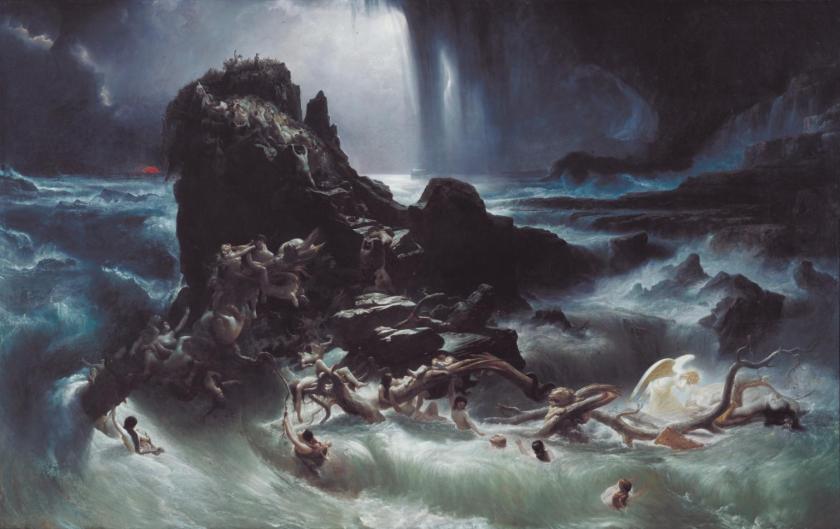
The last painting of Danby’s that I am showcasing is his monumental work, The Deluge, which he completed in 1840. It measures 285 x 452cms and is one of the largest works Danby ever painted. He had been away from England for eleven years, living in Europe but had, in 1839, returned to London. The subject of the painting could well have been chosen as to compete directly with his nemesis John Martin who had also exhibited two of his trilogy of Deluge themed paintings at the Royal Academy in 1840. Martin had decided to depict the story of the deluge in a number of paintings whereas Danby decided that the story should be depicted in a solitary work. The writer and critic William Makepeace Thackery wrote about the painting in in Fraser’s Magazine a literary journal published in London, praising Danby’s treatment of the subject, which he considered to be superior to  those by John Martin, Turner and even Poussin, :

“…He has painted the picture of “The Deluge”; we have before our eyes still the ark in the midst of the ruin floating calm and lonely, the great black cataracts of water pouring down, the mad rush of the miserable people clambering up the rocks…”

The painting which is now housed at Tate Britain, London is described by the Gallery as:

“…As well as such meteorological portents as lightning, a comet, and a blood-red setting sun, Danby has also extended his theme by the use of symbolic references to destruction, in particular the juxtaposition of the serpent and the drowning lion, and the angel weeping over the dead giant. This giant may have been included by Danby on account of the references to venerable giants and heroes that occur in Genesis vi, 4, at the beginning of the account of the Deluge…”

The background is believed to have been derived from the coast of Brittany, a place Danby is known to have visited in 1838. The picture also shows the effects of Danby’s three years stay in Paris, such as the rising pinnacle of figures struggling up the rocky promontory which could have been inspired by a similar compositional form of Gericault’s Raft of the Medusa and Poussin’s Deluge painting which we know he copied during visits to the Louvre in 1837.  The national press liked the work but the public were less impressed in comparison to the notable success he had had with his Opening of the Sixth Seal work.

Landscape near Clifton by Francis Danby (1823)

Danby remained in England for most of the rest of his life. He lived in London until 1842 and then moved to Kent. In 1846 he was living in Exmouth, Devon where he not only painted but enjoyed sailing and boat building. His ever-loyal patron John Gibbons died in August 1851 and in 1856 Francis Danby took a long lease on Shell House on the Maer. where he devoted time to boatbuilding. He constructed his yacht ‘Dragonfly’ on the Maer.  This boat was shipwrecked off the coast at Axmouth in 1860.  It is thought that his studio in Exmouth was just off Exeter Road where he would have had a good view of the river Exe. Francis Danby died at home on February 10th, 1861, aged 67. He was buried at St John -in-the-Wilderness at Withycombe, Exmouth.

Francis Danby. Part 1, the early days.

Francis Danby

My featured artist today is the Irish-born painter Francis Danby who was one of twins born in the small village of Killinick, just south of the county town of Wexford, on November 16th 1793. His father was James Danby, a small-time farmer, whose family had lived in the area since the 1730’s. James Danby had first married Susanna Harvey in 1762. She was the daughter of a Wexford vicar and the couple had two children, John Henry and James. His second marriage took place in 1781 when he married the Dubliner, Margaret Watson, who gave her husband three children, twins Thomas, who died young, and Francis as well as a daughter, Frances Olivia.

A View in County Wexford by Francis Danby (1813)                                                                                               A View in County Wexford (Saint Nicholas’ Clonmines and Bannow Bay)

In 1798, at the age of five, Francis and his family suffered the emotions and terrors associated with the Wexford Rebellion which has gone down in Irish history as one of the most bloody, the most bitterest and yet the most successful insurrections. It began in May 1798 and lasted a month. It was the Society of United Irishmen’s Rising against the British domination of Ireland. The leaders of the rebellion maintained that the rebellion was purely political and not an issue of religion but some of the bloody massacres which occurred did indicate sectarian tensions as motives. There was also the factor that grain prices had collapsed in 1797 and 1798, and also new taxes were being levied by the British government on the malt industry which caused tremendous hardship in many regions, but especially Wexford. The rebels fought for a reform of legislature and the redistribution of political power.

As a protestant and feeling unsafe in the small village of Killinick, James moved his family to the city of Wexford in 1799. He wrote to a friend:

“…My family like many others were destroyed by political and party feeling, many of them lost their lives on both sides of the unhappy question…”

Francis Danby’s father’s fear for his and his family’s lives is borne out with the wording of the preface to his will which he made the following year:

“…Having lately escaped assassination and being convinced of the savage disposition of the majority of people, I am more than ever reminded of the uncertainty of life…”

Panorama of the Coast at Sunset by Francis Danby (1813)

In late 1799, the family were once again on the move. This time they travelled to Dublin, the home town of Francis’ mother. In 1807 James Danby died and through the vagaries of the inheritance laws, whatever money he had was left to the children of his first wife and Francis Danby received nought. Francis finished his schooling in 1811 and decided he wanted to become a professional artist. His mother considered his request and agreed to his ideas, since there seemed little hope in her son moving towards any other meaningful professions.

Conway Castle by Francis Danby

Francis Danby enrolled at the drawing schools of the Dublin Society and it was here he met and became great friends with two aspiring landscape painters, George Petrie and James Arthur O’Connor. In 1813, at the age of nineteen, Francis had his first painting, entitled Landscape – Evening, exhibited at the Society of Artists of Ireland and it was sold for fifteen guineas and with that princely sum Francis travelled to London in June 1813, along with Petrie and O’Connor, to see what the England capital had to offer young artists. Francis, like his two travelling companions, headed for the Royal Academy Summer Exhibition and he wrote about it and how it inspired him:

“…the wonders of which I was so struck that they increased my ambition, and from my twentieth year I have been an English Artist…”

It is thought that Francis Danby never returned to Ireland and he never declared any love for his birthplace. The journey of the three friends ended after two weeks when Petrie was summoned home from London by his father. Francis Danby and O’Connor had not managed to make any money whilst in London and decided that they too must return to Ireland. They knew a captain of a sailing packet who would give them free passage from the port of Bristol back to Ireland, so all three, who had very little money, set off to walk the hundred and twenty miles to the seaport.

The Avon Gorge from the Stop Gate below Sea Walls, pen and ink drawing by Francis Danby (1818)

They arrived and Petrie left them and returned to Ireland. Danby and O’Connor managed to sell two watercolour paintings of the Wicklow Mountains to a Bristol bookseller, John Mintorn and later they completed four drawings of the Avon Gorge which again they sold to Mintorn. They had now accumulated some money but it was not enough to buy two tickets on the boat to Ireland. Danby, knowing that his friend O’Connor, had four young orphaned sisters at home in Ireland, gave him the ticket.

The Eagle’s Nest, Killarney by Francis Danby

Francis Danby was now the only one of the three Irish travellers left in Bristol and was lodging at a baker’s shop on Redcliffe Hill, close to the River Avon. Danby was approached by his landlord, named Fry, who lived in Winscombe, Somerset, asking him to travel down from Bristol, stay with his son and paint some family portraits and this he did and it was during his stay at the home of the landlord’s son that he came across a young woman, Hannah Hardedge, who was one of the servants. Francis Danby was immediately attracted to this young woman and soon they were married. Danby described the lead up to the nuptials in a letter:

“…I was invited down to Somersetshire to paint some portraits amongst the farmers and drank cider. I took a great fancy to one of their servants, a little red-faced bare-footed wench, my Irish brogue I suppose was against me. I could not succeed however in any way but by promising to marry her. She, on the word of a young gentleman who was confoundedly out at the elbows, willingly consented to come with me to Bristol…”

“Out at the elbow” was a seventeenth century phrase meaning poverty stricken. The girl’s condition for going back to Bristol with Danby was on the understanding they would be married. The couple were married on July 4th 1814 at Winscombe parish church. In the parish register it was noted that Hannah was illiterate and she marked her name with a simple cross. Danby was twenty years old. The couple remained in Somerset at the home of her family and Danby rarely returned to Bristol. The first child the couple had was Francis James, who records show was baptised on August 13th 1815, followed eighteen months later by his brother, James, who was baptised on April 27th 1817. According to the Bristol Index, Francis Danby and his family left Somerset in 1817 and moved back to Bristol, staying at 21 Paul Street, Kingsdown. In 1818, Danby and Henriette had a third child, another son, John. A year later, in 1819 the family moved to 9 Kingsdown Parade.

Francis Danby – The Upas, or Poison-Tree, in the Island of Java – painting by Francis Danby, (ca. 1820)

Francis Danby had concentrated on watercolour painting but in January 1820, he had his first oil painting shown in London at the British Institution. It was entitled The Upas or Poison Tree in the Island of Java. It was a large work measuring 169 x 235cms and he had started work on it in 1819. The subject of the painting, the Upas Tree, comes from the poem The Loves of the Plants by Erasmus Darwin. Part of the poem (lines 237-8 of canto III) describe the plant and its deadly properties:

“…There is a poison-tree in the island of Java, which is said by its effluvia to have depopulated the country for 12 or 14 miles round… With the juice of it the most poisonous arrows are prepared; and, to gain this, the condemned criminals are sent to the tree… to get the juice…and are pardoned if they bring back a certain quantity of poison. But…not one in four are said to return. Not only animals of all kinds… but all kinds of vegetables also are destroyed by the effluvia of the noxious tree…the face of the earth is quite barren and rocky intermixed only with the skeletons of men and animals, affording a scene of melancholy beyond what poets have described or painters have delineated…”

The fable about the tree and its deadly properties was based on the poisonous anchar tree. The tale was further embellished in an article which appeared in the London Magazine in December 1873, six years prior to Erasmus Darwin’s poem.

This submission to the British Institution was Danby’s entry to the London art scene. Sir Richard Redgrave, an English landscape artist, genre painter and administrator, was full of praise for Danby’s painting, saying:

“…a wonderful first attempt……..and to succeed in such a subject required a poetical mind, joined to powers of the highest order: no mere landscape painting, no mere imitation of Nature, would suffice to picture to us the gloomy horrors of this land of fear…”

Disappointed Love by Francis Danby (1821)

In 1821 Danby’s fourth son, Thomas, was born and this was also the year that Danby had his first painting accepted by the Royal Academy for their annual exhibition and it became one of his best-known works. It was entitled Disappointed Love. The depiction is of the dark recesses of the River Frome near Stapleton, a north-eastern suburb of Bristol. Stapleton was a favourite destination for Bristol-based artists, such as George Carmichael, Edward Rippingille and Edward Bird and all three had completed works depicting a girl seated alone in a wooded landscape. However it is considered that Danby’s work was far better than theirs.

The painting depicts a heartbroken young woman who has just been jilted. Her hands cover her face as she sits weeping on the bank of a lily pond surrounded by dark and murky woodland. The occasional small white flowers, dotted around, struggle to lift the dark green and browns of the undergrowth. This gloomy undergrowth mirrors the depressed mind of the young girl. Her long dark tresses hang down over her white dress. Beside her, we see her discarded bonnet, her scarlet shawl , a miniature portrait of her lover and other letters which she has not yet destroyed. Her sad figure dressed in white is reflected in the water and it almost seems that the water is drawing her to it so that she can end her life and her misery, in an Ophelia-like fashion. Floating on the surface of the pond are pieces of a letter which she has torn up and discarded. Eric Adams wrote a biography in 1973 on Francis Danby entitled Francis Danby: varieties of poetic landscape and he believes the model for the painting was a model at the Bristol Artists newly founded Life Academy. There was a lot of criticism of the painting, not so much for the poetical nature of the work but for its technical faults, in particular the lack of proportion of the plants in the foreground.

When the painting was put forward to the Royal Academy jurists to see if it should be allowed in to the 1821 Exhibition it was not wholly loved. An account of one of the jurist’s comments on seeing Danby’s painting was reported some twelve years later as:

“…An unknown artist about ten years ago sent a very badly painted picture for the exhibition. The committee laughed but were struck by “something” in it and gave it admission. The subject was this. It was a queer-coloured landscape and a strange doldrum figure of a girl was seated on a bank, leaning over a dingy duck-weed pool. Over the stagnant smeary green, lay scattered the fragments of a letter she had torn to pieces, and she seemed considering whether to plump herself in upon it. Now in this case, the Academicians judged by the same feelings that influence the public. There was more “touching” invention in that than in the nine-tenth of the best pictures exhibited there the last we do not know how many years. The artist is now eminent…”

It is a beautiful painting, full of pathos, and one cannot but feel sympathy for the young girl. It was for this reason that I was surprised to read an anecdote about this painting and the depiction of the girl. Apparently the Prime Minister at the time, Lord Palmerston, was being shown the painting by its owner, the wealthy Yorkshire cloth manufacturer, John Sheepshanks and commented that although he was impressed by the deep gloom of the scene, it was a shame that the girl was so ugly. Sheepshanks replied:

“..Yes, one feels that the sooner she drowns herself the better…”

With that unfeeling comment I will close the first part of my blog on Francis Danby !

Agnès Boulloche and her surrealist world.

Agnès Boulloche

My last blog was about the painter Alfred Robert Quinton and his artwork which was perceived to be “chocolate-boxy” and kitsch and yet, I believe was a charming window on beautifully tranquil bye-gone days of rural life.

The artwork today could not be more different. It is Surrealism. Surrealism, which means “beyond reality”, was a movement, principally in literature and the visual arts. It thrived in Europe between the First and Second World Wars. The Surrealists rejected rationalism and held the belief that the rational mind repressed the power of the imagination. Surrealists instead tried to channel the unconscious mind and by so doing, reveal the power of the imagination.

The founder of the Surrealist movement was the French poet and critic André Breton who launched the movement by publishing the Surrealist Manifesto in 1924 and led the group till his death in 1966. Surrealist artists find magical enchantment and enigmatic beauty in the unexpected and the strange, the overlooked and the eccentric. In a way, it is a belligerent dismissal of conservative, if somewhat conformist, artistic values. The depictions in the Surrealist paintings are startling often colourful. In some ways they are mesmerising and one wonders what was going through the mind of the painter when they put their ideas on canvas or wood. My featured artist today is French and she was considered to be one of the leading twentieth century French Surrealist painters. Let me introduce you to Agnès Boulloche.

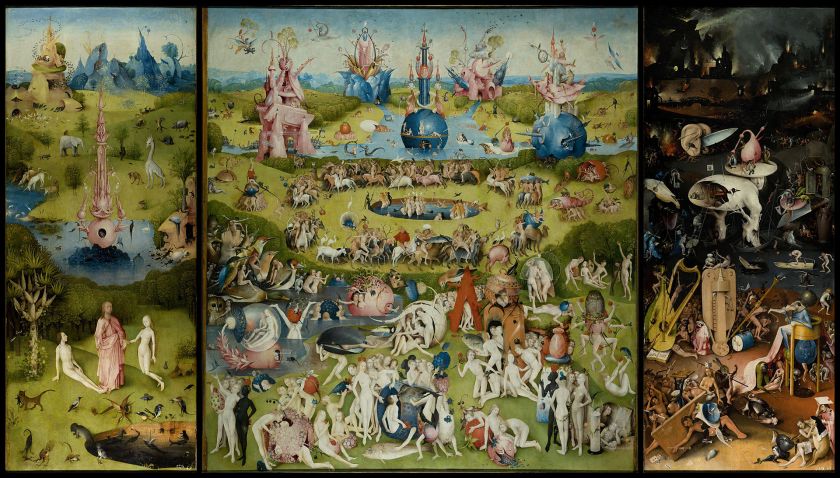
Le Jeu de la Chausse-Trappe (The Trap-Door Game) by Agnès Boulloche

Agnès Boulloche was born in Paris in 1951. She was the daughter of André Boulloche, who in 1940 joined the Resistance movement He was captured and deported by the Nazis. In 1959 he was made Minister of National Education under the mandate of General de Gaulle. He was known as a politician of integrity and conviction. Sadly he died in a plane crash, barely 62 years old. Agnès spent much of early childhood in Rabat, Morocco where André was head of the Road Bureau. As a child she loved to paint and draw. Her mother, Anne, once said that she was born with brushes in her mouth, where others have a pacifier! From a young age Agnès was also fascinated by myths and mythical lands and loved to hear about the adventurous tales of the Arabian Nights. Her other interest, and maybe it came from living in an Arab country, was the world of jinn. Jinn being defined in Islamic mythology as a class of spirits, lower than the angels, capable of appearing in human and animal forms and influencing humankind for either good or evil.

Les Marmitons by Agnès Boulloche

From an early age Agnès had always been immersed in a world populated by fabulous beasts, countless chimeras, gorgons and genies. She experiences life in a fantasy world inhabited by humanimal creatures who she depicts in her artwork dancing, riding on each other and even spinning their horned feet around chessboards in stone-paved gardens. This was her fantasy world which she once described:

“…I’ve always had that taste for escape and freedom. Already a child I escaped, taking the side roads to find my close friends, a whole people of fabulous beasts, chimeras and other geniuses. And my left hand lent itself to my dreams and allowed me to evolve in this magnificent dimension that is painting…”

She always had an affinity towards animals, once saying:

“…I do not see so many differences between humans and animals. On the contrary, I see a lot of interference. However, I hate bestiality on one side or the other. What I disliked was the fact that animals are considered objects, which fortunately is no longer the case since the recent vote of the deputies on April 15, 2014…”

The Garden of Earthly Delights in the Museo del Prado in Madrid, by Hieronymus Bosch (1495 – 1505)

Agnes Boulloche paints in oil on wood panels and uses the ancient technique of “glaze”, a superposition of thin transparent layers of colours. She also uses many chemical recipes to create her pigments and varnishes.
When she was a teenager, she and the family left Morocco and returned to Paris where she enrolled at the École des arts décoratifs, a school which had a major role in the development of the Art Deco design movement in the 1920s and in the creation of new design concepts. Agnès focused on oil-on-wood painting. Except for a short period at art school Agnès was self-taught. One of her main artistic influences is the artist Hieronymus Bosch, whose works are often populated with strange and exotic animals.

Le renard dans le bestiaire médiéval

Agnès also liked to look at the illustrated bestiaries, which must have inspired her works. A bestiary was a compendium of beasts. A bestiary means a manuscript of the Middle Ages gathering fables and morals on the “beasts”, real or imaginary animals, mystical animals. They originate in the ancient world and were made popular in the Middle Ages in illustrated volumes that described various animals. She would study works by Philippe de Thaon, Guillaume le Clerc, Gervaise de Fontenay and Richard de Fournival in a modern version. The themes of her inspiration were creatures, half-men, half-beasts, but according to her, they were “more than human”.

Agnès Boulloche – Self Portrait  entitled We Two (2013)

Her painting technique followed traditional methods. Agnes used her own different alchemical formulas for her colours and mixed her own colours, pigments and varnishes. She would then use these oils and paint on wood panels in “glazing technique” used by the Old Masters, in a way in which many transparent layers of colours are laid on top of each other in several passes. This made it possible to work out very fine details and attain delicate, bright colours. Agnès Boulloche paintings are often set in landscapes, which appear similar to those we see in Renaissance compositions.

Danse avec la Lune by Agnès Boulloche

Besides her paintings, she would spend time in the production of sculptures, which were mainly cast in bronze in wax castings and hand chased and then patinated.

Agnès Boulloche in 2014 creating one of her favourite animals -an owl

In the photograph above, taken by her daughter, Julie Lipinski we see her working on one of her favourite animals, the owl.

Oiseau Au by Agnès Boulloche

Soon after completing her studies, she opened her first exhibition in Paris. She was invited by friends to visit them on the Ile de Ré but for Agnès it was not love at first sight. She recalled that at first she deemed it to be ugly and flat. However, she returned the following year and, had a change of heart:

“…When I came back the following summer, I noticed the lack of bars on the ground floor windows and the houses that were not necessarily closed twice when we were away, etc….. I said to myself, this is a place where the notion of freedom must still have a meaning…”

Le Rat de Bibliothèque by Agnèes Boulloche

She used to live and work alternately in Paris and in the town of Foix on the Île de Ré, which lies on the southern French Atlantic coast. In 1994 she finally made Loix her permanent home. She knew it was her destiny to live in Loix saying:

“…Convinced that it was there that I had to be, I first rented a house in Loix, then quickly bought a first home, still in Loix, my village for 18 years. Even though I have always been painting and if I’ve been living for about forty years, in Loix, when I leave home, I am not permanently stamped “painter”. No, I am a Loidaise [term for people of Loix] full, I participate in a real village life and I feel adopted. So to honour this shared friendship, I contribute artistically, and of course voluntarily, to the daily life of the village by making street signs and various other things such as the cemetery or the children’s kitchen garden of the school…”

Le chien tiroir (The Drawer Dog)  by Agnès Boulloche

She bought her first house, but it had no garden and she missed that aspect of living. Then she met Michel Héraudeau, a local builder and in 1996 they joined forces and bought some land in the heart of Loix. He then built Agnès’ house first, then his own, but by this time they had fallen in love and he moved in with Agnès. Soon their common garden was full of flowers and their life became a great love story, which lasted until her death.

Le Bal des Masques by Agnès Boulloche

In 2011, her daughter, Julie Lipinski, also moved to Loix with her partner, Thibault Chenaille, and their 13-year-old son Swan. Then, in 2013, Agnès Boulloche became a grandmother for a second time with the arrival of Julie’s second child, a son, Marlow. Now, Agnès’ life could not be bettered. She was a very successful artist who was now surrounded by her daughter and her grandchildren. Julie described her mother as being a passionate lover of life, a very sensitive person but for all that, one who has a natural authority.

L’Atelier de la Lune by Agnès Boulloche

Sadly in June 2018 she was diagnosed with having cancer. Her daughter said that she accepted the news and never complained as she was a woman of great strength of character. Agnès Boulloche died on April 7th 2019. On that Sunday afternoon, her daughter announced her passing in Facebook, simply writing:

“…My mom joined her fantasy world this morning…”

A tribute was held together with the dispersion of her ashes at the port of Loix Saturday, on April 20th. The local newspaper, Ré à la Hune, recorded the news of her death writing:

“…Since her death, there has been a shower of tributes that sweeps over the social network, on the island of Ré, and more precisely to Loix. For twenty-five years, Agnès Boulloche had put her baggage in this village she loved so much, because in the middle of the salt marshes, the land, the sea and the sky were her horizons and especially her anchors. In her suitcases, she had first brought back her brushes and paintings, and of course, all this universe of her own, populated by animals like the rhinoceros, the cat, the owl, the unicorns, but also angels and little girls or young women with bare breasts, but with ruffles and pointed hats…”

La Licorne de Troie (The Trojan Unicorn) by Agnès Boulloche

Agnes Boulloche had her paintings exhibited in Paris, as well as several other European countries. Her Surrealist works of art have also been seen in the United States, and in Africa. Her work brings out the energy of the colour she uses and seemed well suited in her imaginary world, a world where dreams prevail over reality. An art critic once wrote:

“…Agnes is a ghost who dreams with her eyes wide open …”.

L’Ecuyère (The Rider) by Agnés Boulloche

At the start of this blog I talked about the meaning of Surrealism paintings and pondered on what went through the artist’s mind when they formulated their depictions. Are there hidden meanings or were the depictions just amusing fantasies? In the case of Agnès Boulloche we may get closer to her reasoning for she decided to put her ideas on paper with her Dictionary of Symbols. I am not sure they help but here are some of the examples from her dictionary:

Cochon; animal très pieux et avenant toujours prêt à se faire atteler ou chevaucher par n’importe qui
Pig; a very pious animal, always ready to be hitched or ridden by anyone.

Chien: ne laissez jamais un chien nu sinon il fugue. Vêtissez le plutôt d’un chapeau de lune et d’une fraise empresée de dentelles
Dog: never leave a dog naked otherwise he runs away. Wear a moon hat and a strawberry with lace

Hibou: à tiroirs, il garde nos secrets
Owl: with drawers, he keeps our secrets

Licorne: sa corne telle celle du narval, son sosie marin, peut empaler les mérous, trépaner les dés ou décrocher la lune                                                                      Unicorn: its horn, like that of the narwhal, its marine look-alike, can impale the groupers, skewer the dice or catch the moon

Nef: folle, elle navigue bondée de créatures insensées qui se jouent de sa ligne de flottaison
Ship or boat: crazy, it sails full of crazy creatures who play with her waterline

I am not sure they help you decode the paintings but they do give you a further insight into the mind of the artist

Le Retable du Poisson Rouge (The Red Fish Altarpiece)  by Agnès Boulloche

Agnès seemed to have lived a happy life surrounded by her family on the Ile de Ré and yet she also loved to escape that land and journey to her imaginary world which brought her equal happiness.  She will be sadly missed.

Alfred Robert Quinton, the chocolate box painter.

People’s taste in art is a very personal thing. What some of us like is anathema to others. The main consideration when we choose our favourite paintings or favourite artist should be that they or their work make us feel good, inspired and happy. Why should we decry art that others like even if we consider it to be trivial or amateurish? What makes people who are critical about a certain painting or certain genres think that they are the great experts on art. Let us just like what we like and allow others to like what they like.

Alfred Robert Quinton

This is all a round about way of justifying the art genre of today’s featured painter. It is a genre which is liked by many but decried by others. My featured artist today is Alfred Robert Quinton, an English nineteenth century watercolour painter who was known for his depictions of villages and landscapes. Detractors label his work as being chocolate-box art. This term derives from scenes of a highly stereotypical nature found on biscuit and chocolate boxes. They were often scenes of the English countryside depicting charming cottages with little girls adorned in pretty dresses dancing happily with their pets. Now the term chocolate-box art is more of a judgemental and derogatory expression. The decriers call these works over-sentimental and kitsch and yet, at the time, they were very popular, albeit in recent years they have fallen slightly out of favour.

Cottages at Lake, Nr Salisbury, Wiltshire, from The Cottages and the Village Life of Rural England by Alfred Robert Quinton published by Dent and Sons Limited, 1912

Alfred Robert Quinton was born in Peckham, London on October 23rd 1853. He was the youngest of seven children, the fifth son of John Allan Quinton and Eliza Quinton (née Cullum). His parents came from the county of Suffolk. John Quinton was from Needham Market and his wife, whom he married in 1840, was from Ipswich. John and Eliza Quinton moved from Suffolk to 5 Ellington Terrace, Islington, London in 1850. John Quinton, a printer, editor of periodicals, and supporter of the Liberals, was staunch Congregationalist and worked for the Religious Tract Society, an organisation which published Christian literature intended originally for evangelism, but also incorporated literature aimed at children, women, and the poor. John eventually became editor of titles such as The Boys’ Own Paper, The Girls’ Own Paper and The Sunday at Home. Alfred was influenced by his father, who lived to be eighty-eight, and was a regular Congregational Church attender and supporter of the Liberal Party.

Marlow by Alfred Robert Quinton

Alfred attended the Hornsey School in North London and excelled in art. He was a hard working pupil and when he was fourteen years old, received a book prize for his hard work, entitled Drawing From Nature. A Series of Progressive Instructions in Sketching To Which are Appended Lectures on Art Delivered at Rugby School. It was to be one of his favourite possessions and an inspiration to him on his artistic journey.

The Bell Inn Waltham St Laurence, Berkshire by Alfred Robert Quinton

Alfred left school and went to study at Heatherley’s Art School, which boasted Burne Jones, Rossetti, Millais, Lord Leighton, and Walter Sickert amongst its former students. From there Alfred became an apprentice engraver but soon decided to concentrate on becoming a professional artist. Initially Quinton worked in oils but his last-known work in that medium is dated 1885. From then on he concentrated on watercolour painting and black and white drawings. He exhibited his work at many London galleries and exhibited a large painting, Above Wharfedale, Yorkshire at the Imperial Jubilee Exhibition in Liverpool on the occasion of the Golden Jubilee of Queen Victoria. In 1879 his watercolour work, At Gomshall, Surrey was his first work to be exhibited at the Royal Academy.

Rottingdean near Brighton by Alfred Robert Quinton

Although Quinton was not a member of the Academy, his paintings were seen there on a regular basis, in fact, he had twenty works of art exhibited on the walls of the Academy between 1879 and 1919. Later however, his work was banned by the Royal Academy because they disapproved of what they termed, his ‘commercialisation’ of art. Quinton also exhibited at the Royal Society of British Artists and the New Watercolour Society, which later became the Royal Institute of Painters in Watercolours. Quinton’s original London studio was in Bolt Court, Fleet Street but in 1880 he moved to a studio in New Court, Lincoln’s Inn which he shared with a contemporary of his, the artist Henry Bailey.

Granny’s Cottage, Henley Common, near Midhurst, Sussex by Alfred Robert Quinton

Alfred Quinton regularly travelled throughout Europe in the early 1880’s. His favourite foreign trips were his sea voyages to Spain and the coastal town of Malaga and it was during one of his return trips home from the Spanish port that he met his future wife, Elizabeth Annie Crompton. The couple married at Bolton, Lancashire on May 20th, 1885. He was thirty-two and she was twenty-seven years of age. The couple went to live with Quinton’s parents who had a house in Finchley, London and they stayed there until his mother died in 1886. That year, on March 5th 1886, their son Leonard was born at Hampstead, London. A second son, Edgar, was born in 1891. Sadly, Edgar, who suffered from heart problems, died aged twenty-one, in 1912.

Dudging-Exhall Shakespeare Village by Alfred Robert Quinton

Quinton had a routine for each year. He would go off on his travels for three months during the summer and during this time would make hundreds of sketches and took and bought photographs of the places he visited, and then settle down at home to convert the sketches into paintings during the autumn and winter months. Quinton’s paintings were very popular and sales of them allowed him to purchase Westfield, a large eleven-roomed house with its own studio in Finchley, which, at the time, sat alone among the fields in the countryside. This home remained in the family until 1974, forty years after Alfred Quinton’s death.

Windsor Castle, from the Brocas by Alfred Robert Quinton

Not only did Quinton sketch during his summer journeys but he also kept a diary of his travels in England and Europe and these would be published in articles with accompanying illustrations by him. One such journey happened between May and October 1895 when he and his cycling companion, thought to be his artist friend, Henry Bailey, travelled from Land’s End to John O’Groats and this mammoth cycling trip was serialised in the journal, Illustrated Sporting and Dramatic News. Of the long journey, Quinton wrote:

“…Our idea was to tour leisurely from end to end, to enjoy varied scenery which our native land presents in such variety to those who care to see it and to study the life and character which we might meet with on the road…”

This was just one of the many he completed during his lifetime and was typical of the Victorians desire to travel.

The Cottages and Village Life of Rural England.by P H Ditchfield with Coloured and Line Illustrations by A.R. Quinton

The well-known English historian and a prolific author, Peter Hempson Ditchfield (P.H. Ditchfield) wrote a book The Cottages and the Village Life of Rural England in 1912 and Quinton provided seventy-one illustrations for it. Quinton recalled the collaboration fondly:

“…We have explored together some of the quaint nooks and corners, the highways and byways, of old England, and with the pen and brush described them as they are at the present time. We have visited the peasant in the wayside cottage…..entered the old village shop, and even taken our ease at an inn…”

The Historic Thames by Hilaire Belloc with illustrations by Alfred Robert Quinton

He provided illustrations for other books and magazines including a set of illustrations featuring the Wye Valley and Wharfedale in 1902 for the Art Journal. One of his most prestigious collaborations was his fifty-nine illustrations for Hilaire Belloc’s 1907 book The Historic Thames, which is considered a minor classic during the early part of the twentieth century.

Victoria Statue, Castle Approach, Windsor by Alfred Robert Quinton

The illustrations included views of Lambeth Place, Tower Bridge, the Houses of Parliament, Hampton Court and Windsor Castle and it took Quinton the summers of 1905 and 1906 to complete the illustrations, many of which were exhibited at the Suffolk Street Gallery which was the home of the Royal Society of British Artists. Two of the paintings on display were purchased by The Duke and Duchess of York for their private collection.

Chiddingstone, Kent by Alfred Robert Quinton

During the 1870’s and 1880’s Quinton struggled to sell his paintings, achieving a top price of fifteen guineas if he was lucky. But his fortunes changed by the early twentieth century and by 1920 his large 4 x 5ft works were fetching around one hundred guineas. In the early days of his career, most of his money came from book and booklet illustrations, but during the late 1890’s and the early 1900’s when he became a recognised landscape painter his paintings began to sell well

Village Cross, Crowcombe, Somerset by Alfred Robert Quinton

The postcard publisher Raphael Tuck began to produce images from Quinton’s watercolours in a series called Village Crosses.

However Quinton’s main outlet for his work came from Joseph Salmon, the Kent printer and art publisher who founded and owned J Salmon Limited.  Joseph Salmon, who had a personal interest in photography, had begun to publish black and white reproductions of photographs of the Sevenoaks neighbourhood in Kent as postcards. By the end of 1903 Salmon decided that picture postcards reproduced from paintings would be the way forward and he commissioned local artists to paint pictures of their local area.

A By-lane at Houghton, Sussex by Alfred Robert Quinton

Around 1911 Joseph Salmon visited the Selfridges Store in London and visited its art department where he noticed an art display featuring watercolour paintings of cottages and countryside scenes mainly of the Worcestershire area. The signature on all the works was A R Quinton. Salmon bought six of the watercolours and arranged with Quinton to have the copyright of the works and then had them reproduced as postcards. They proved a great success and it was to be the start of a collaboration between artist Quinton and printer J. Salmon which would last until Quinton’s death in 1934.

Footbridge, near Porlock, Somerset by Alfred Robert Quinton

Quinton was a prolific painter. In 1924, he completed one hundred and forty-three paintings which were delivered to J. Salmon for reproducing as postcards. Even in the last year of his life he managed to complete forty-seven commissioned works and one, an unfinished work, was on the easel where he had left it, the day before he died. His total artistic output was approximately two thousand watercolour paintings for Salmon postcards. For Quinton it was a lucrative association with Salmon as up until November 1922 he received four pounds for each painting, then his fee increased to five guineas per work. The artistic genius of Alfred Quinton was his ability to capture the flavour and colour of English rural life at the turn of the century. In his paintings, he was able to combine accuracy with an impression of rural peace and harmony which made his work so popular with the public. He was in love with the English countryside.

Alfred died at his beloved Finchley home, Westfield, on 10 December 1934, aged 81. His wife Elizabeth died ten years after her husband on February 16th 1945. She was 86. Their eldest son Leonard died on January 14th 1981.

Why was his work so popular? It is probably the nostalgia of the carefree days spent in the countryside, away from the fast paced towns and cities. P.H. Ditchfield, the author, whom Quinton collaborated in 1904 and 1912 summed it up, writing:

“…Agitators are eager to pull down our old cottages and erect new ones which lack all the grace and charm of our old-fashioned dwellings. It is well to catch a glimpse of rural England before the transformation comes, and to preserve a record of the beauties that for a time remain…”

The Tretyakov Gallery – My favourites.

The Tretyakov Gallery, Moscow.

The Tretyakov Gallery is one of the world’s richest museums, a veritable treasure house of the finest works of Russian and Soviet art. In all, there are in excess of fifty thousand paintings, sculptures, drawings and engravings in the storerooms and galleries of this great establishment. The magnificent collection of art was founded by Pavel Tretyakov who began to collect art in the mid nineteenth century with a clearly formed conception of founding a museum that would be open to all to see and appreciate. It was to be a gallery for the people whereas entry to the Hermitage in St Petersburg was granted exclusively to visitors in full dress or tailcoats and the titles of all the paintings on show were in the French language. The Hermitage was only for the elite. In my final look at paintings housed in the Tretyakov Gallery I am going to showcase my five favourite works. Although my five previous Tretyakov blogs were solely about portraiture, and I do marvel at the technical ability shown by artists of that genre, the favourite paintings I am showing you today are all quite different, but gems in their own right.

The Appearance of Christ Before the People by Alexander Ivanov (1837-1857)

My first offering is a painting by Alexander Andreyevich Ivanov who was born in St. Petersburg on July 16th 1806. It is entitled The Appearance of Christ Before the People (The Apparition of the Messiah) which he started in 1837 and yet did not complete until 1857. This monumental oil on canvas work measures 540cms x 750cms (18ft x 24ft 6ins) and the depiction is set on the banks of the River Jordan. The painting is based on the first chapter of the Gospel According to John (1: 29–31):

“…The next day John saw Jesus coming toward him and said, “Look, the Lamb of God, who takes away the sin of the world! This is the one I meant when I said, ‘A man who comes after me has surpassed me because he was before me.’ I myself did not know him, but the reason I came baptizing with water was that he might be revealed to Israel…”

Ivanov’s fame is inseparable from his great masterpiece. The finished painting is based on hundreds of preparatory studies he made over twenty years, many of which are gems in themselves and are considered by art historians as masterpieces in their own right. This painting and about 300 preparatory sketches are housed in Moscow’s Tretyakov Gallery. Art critics believe that the preparatory sketches reveal greater expressiveness and psychological depth than the finished painting itself.

In the middle ground we see the solitary figure of Christ on a rocky mound approaching the gathering. Behind him in the background is a wide plain and the distant mountains. His figure is small in comparison to the others but nevertheless stands out because of it being a lone figure. In the foreground of the picture there are a number of male figures of varying ages, some of whom are already undressed waiting to be baptised.

John the Baptist

The main figure with his wavy black hair, dressed in his animal skin under a long cloak, is John the Baptist. In his left hand he holds a crosier. He is standing on the banks of the River Jordan and has raised his hands aloft and gestures towards the approaching solitary figure of Christ. To John the Baptist’s left, we see a group of apostles: the young John the Theologian, behind him – Peter, further on – Andrew and behind his back – Nathaniel, the so-called “doubter.” To the right of the approaching Christ and below the two soldiers on horseback, we have the Pharisees and scribes who unbendingly reject the Truth. In the centre of the painting we see a haggard old man struggling to his feet buoyed by the words of John the Baptist.

There are two interesting inclusions in the depiction. Firstly, to the right there is a figure that stands nearest to Jesus and it was he who was depicted as the Repin’s good friend, the writer and dramatist, Nikolai Gogol.

Self portrait

Ivanov also included a self-portrait. Just under the raised right hand of John the Baptist, one can make out a seated man with a red headgear – this is Ivanov himself.

In 1858, Alexander Ivanov went with his beloved painting to St Petersburg where it was exhibited. Its lukewarm reception must have been heart-breaking for Ivanov. Just imagine how you would feel if you had spent almost half of your life on one painting and then after all that effort it was not well received. Ivanov died of cholera in St Petersburg on July 3rd 1858, just a fortnight before his fifty-second birthday, not knowing that some years after his death his work of art would be hailed, by the likes of Ilya Repin, the most celebrated Russian painter of his day, as “the greatest work in the whole world, by a genius born in Russia

Barge Haulers on the Volga by Ilya Repin (1873)

My second choice is a painting by Ilya Repin. In an earlier blog regarding the Tretyakov Gallery I looked at some of Repin’s portraiture but my favourite works by him are his Social Realism works of art. His most iconic and most famous work is one he started in 1870 and completed in 1873. It is his painting entitled Barge Haulers on the Volga, which was bought by the Tsar’s second son. After the Russian Revolution the art collection of the grand duke was nationalized and it is now housed in the State Russian Museum in St Petersburg.

Religious Procession in Kursk Province by Ilya Repin (1880-1883)

However, the Tretyakov Gallery houses another great painting by Repin. It is his 1883 work entitled The Religious Procession in the Province of Kursk. Like the Barge Haulers on the Volga it is a monumental painting measuring 175 × 280 cm. It is the annual religious procession in honour of Our Lady of Kursk at which the famous icon, Our Lady of Kursk, is carried twenty-five kilometres from the Korennaya Monastery, south, to the city of Kursk.  The setting for the painting is a time of drought and we see a large group of people crossing the parched earth. The hillside to the right appears to have been recently cleared of timber, and we can see fresh tree stumps in the ground. Further back along the procession we can see another platform, holding what appears to be a circular icon, besides which are two large banners. Further back along the procession we can just make out a large processional cross which is being held aloft.

The icon bearers

The leaders of the procession carry aloft a bier on top of which is the icon inside an elaborate neo-classical case. The light from the many candles inside the glass case gleam and this reflects off the gold riza icon-cover. A riza is a metal cover protecting an icon. To the left we see a line of peasants holding hands in an attempt to prevent any of the crowd getting too close to the icon. We see a peasant holding a stick out in front of him to try and prevent the crippled boy breaking through the cordon.

The priest


Following behind the icon are the priests and better-dressed people, some of who clutch icons to their chests. Note how Repin has portrayed one of the priests in a dandified manner as he carefully straightens his hair. Repin has also scornfully depicted the large stout woman in a yellow dress and bonnet carrying an icon behind the priest. She clutches an icon case to her chest.


What is interesting about the procession is that there is a great mix of people of various social standing in the community. Look carefully at the painting and observe the various characters Repin has depicted. He, by his portrayal of how the people are dressed, stresses the difference in their social status and highlights life’s inequalities. Some are in rags whilst others are bedecked in rich caftans.

The crippled boy

We focus our eyes on the young hunchback as he struggles along with his makeshift crutch totally focused on the icon, which is being held on the shoulders of the monks. To him, the icon may mean salvation. To him, life cannot get any worse and for him this procession will lead him to a better existence. Compare that with the posture of the cavalry officer atop of his horse who oozes a kind of sanctimonious piety, his attitude appears to be of one who only half believes in the power of the icon and who probably, unlike the hunchback, needs little that the icon can possibly offer anyway.  This is a “them and us” scene, a “have and have not” scenario, which Repin liked to depict in his social realist paintings. This was part of a slow build up to the revolution which would take another twenty years to arrive with its 1905 initial uprisings leading eventually to the ultimate revolution in 1917 which finally destroyed the Tsarist rule and the inequalities of life. For Repin, the procession we see before us in this painting maybe an allegory for the slow but unyielding forward advance of the working classes towards social change. Of his painting Repin wrote:

“…I am applying all of my insignificant forces to try to give true incarnation to my ideas; life around me disturbs me a great deal and gives me no peace – it begs to be captured on canvas…”

David L Jackson wrote in his book, The Wanderers and Critical Realism in nineteenth-century Russian painting, that one art critic at the time wrote with obvious disapproval with regards Repin’s painting and the people viewing it, saying that they were:

“…undesirables who thronged around it at exhibition, noting a preponderance of liberated women with short haircuts, nihilistic young men, and a strong Jewish element; the chief characters of Imperial xenophobia…”

While the American writer and educator, Richard Brettell, wrote about the painting in very unflattering terms, in his book, Modern art, 1851–1929: capitalism and representation, that the painting depicted:

“…fat, gold-robed priests, stupid peasants, wretched cripples, cruel mouthed officials, and inflated rural dignitaries…”

The painting was bought by the leading collector of the time, Pavel Tretyakov for a record 10,000 roubles and there is an interesting tale connected to this purchase. Tretyakov wanted Repin to replace the maids carrying the empty icon-case with “a beautiful young girl, exuding spiritual rapture”. Repin refused !

The Rooks have Returned by Alexei Savrasov (1871)

My third choice is a landscape work. It is Alexsei Savrasov’s 1871 painting entitled The Rooks have Returned, which is considered to be one of his finest works. Savrasov is looked upon as one of the most important of all the 19th century Russian landscape painters and is regarded as being one of the early architects of the “lyrical landscape”, sometimes referred to as “mood landscape”. In 1870 Savrasov became a member of the Peredvizhniki group of Russian realist artists who had protested about academic restrictions, and, with other disenchanted aspiring artists, formed an artists’ cooperative, which eventually evolved into the Society for Traveling Art Exhibitions in 1870, which allowed the artists to break away from government-sponsored academic art. In December 1870, Savrasov and his wife went to Yaroslavl and later, Nizhny Novgorod, which was close to the Volga River. The artist was overwhelmed by the splendour of the beautiful Russian countryside and spent much of his time outdoors painting landscapes en plein air.

The painting, The Rooks have Returned, depicts the start of Spring, evidenced by the return of these birds. Savrasov’s landscape works were influenced by the great English landscape painter, John Constable.  This painting is considered by many critics as being the high point in Savrasov’s artistic career. The depiction we see before us is a simple, and depicts the somewhat inconsequential occurrence of birds returning home in spring to an extremely unpretentious landscape, but it was Savrasov’s way of communicating the change of seasons from Winter to Spring. Simple and yet beautiful. Ivan Kramskoy, the Russian painter and art critic who was the intellectual leader of the Russian democratic art movement wrote that the landscape in “The Rooks Have Come Back” was the best he’d ever seen; and despite the fact that there were similar landscapes painted by other renowned Russian artists, only “The Rooks” mirrored the artist’s soul. Another famous Russian painter, the classical landscape painter, Isaac Levitan commented about its simplicity saying that although the painting was very simple, beneath its simplicity there is the tender artist’s soul, who loves nature and values it.  The painting enhanced Savrasov’s reputation as a landscape painter and it contributed to the success of the first exhibition organized by the Peredvizhniki.

My final two choices are both historical painting by Vasily Surikov which Pavel Tretyakov bought for his Gallery. Surikov was born in Krasnoyarsk, Siberia on January 24th 1848 and at the age of twenty-one, he moved to Moscow. Many believe that he was the greatest Russian historical painter. The paintings like many others by Surikov have one thing in common – the depiction of crowds. He once wrote:

“…I cannot see individual historical figures acting without the people, without the crowd, I want them all out in the street…”

Boyaryna Morozova by Vasily Surikov (1887)

Both these works of art I have chosen hang in the Tretyakov Gallery. The first one is his monumental 1887 work entitled The Boyarynia Morozova which measures 304 x 588cms. A boyarynia is a woman of high nobility.
Tzar Alexey Mikhailovich Romanov who ruled between 1645 to 1676 was the father of Peter I the Great, and he started the reforms in Russia; one of which was intended to subordinate the church to the tsar. The reforms resulted in the Russian Orthodox Church split into Nikonians (those who followed the new course set down by the tsar, the name comes from the revolutionary patriarch Nikon) and the Old-Believers who were against the radical changes. The changes included the revision of icons and holy books, and there were even changes in the divine service. It was also deemed that making the sign of the cross should be done with three fingers, instead of two. In the picture the Boyarynya and her supporters are shown with two fingers up, which means they are Old-Believers.

Boyaryna Morozova

The painting depicts the arrest of Feodosia Morozova, one of the most well-known of the Old Believers in 1653. She is being driven, bound in chains, on a simple peasant sledge through a narrow Moscow street. She has been condemned to a terrible death and is now being exposed to shame and abuse. She remains unbending in her beliefs and we witness her as she sweeps her hand upwards with two outstretched fingers – the sign of the schism. She looks pale and emaciated but still her eyes sparkle defiantly. Few of her followers dare to copy her gesture as they are afraid to openly show their support with the woman because of the brutal oppression by the authorities. However, a beggar to the right holds up his two fingers in a gesture of solidarity whilst others bow their heads in grief.

The Morning of the Streltsy Execution by Vasily Surikov (1881)

The second work by Surikov, and my final choice, is his 1881 painting entitled The Morning of the Streltsy Execution.  Surikov’s very large historical work (218 x 379cms) depicts an event during the reign of the Russian Tsar Peter the Great, the second Streltsy Uprising of 1698. The Streltsy were infantry units which were formed in the 16th century by the Russian Tsar Ivan IV ‘Ivan the Terrible’. These units were considered elite units. Over time the Streltsy became a power behind the throne and in 1682 they attempted to prevent Peter the Great from coming to the throne in favour of his mentally disabled half-brother, Ivan. Whilst Peter the Great was on a scientific tour in western Europe during 1697 and 1698, the four thousand men from the Streltsy-regiments of Moscow rebelled. The rebellion was crushed, Peter the Great cut short his tour and returned to Moscow to punish the rebels with savage reprisals, including public executions and torture. Surikov’s painting depicts the crushing of the rebels. The setting is Red Square, with the large Saint Basil’s Cathedral in the background. The stone platform on the left is the Lobnoye Mesto, a 13-meter-long stone platform situated on Red Square in Moscow in front of Saint Basil’s Cathedral. On the right, on horseback, we can see Tsar Peter the Great, with his advisors standing next to him. To the left we can the Streltsy rebels on carts, their family and loved ones surround them agonising over their impending fate. Fifty-seven Streltsy were executed in Red Square by hanging, with seventy-four more to follow four days later. Many Streltsy were also whipped, drawn and quartered, and buried alive, with the total number of executions eventually reaching 1,182. Six hundred were sent into exile. The Streltsy-regiments were then disbanded.

Of all the world’s Art Galleries the Tretyakov in Moscow is one to visit.