The Grindelwald Glacier by Thomas Fearnley

Grindelwald Glacier by Thomas Fearnley (1838)

Today I am concluding my look at the life of Thomas Fearnley and for those of you have just landed on this page,  my introduction to the Norwegian artist’s life was the subject for My Daily Art Display blog of November 24th.

The date is 1832 and that September, Fearnley, who along with his fellow artists, the Dane, William Bendz and the German painter Joseph Petzl, had just left the Bavarian Alpine village of Ramsau and were beginning their long and strenuous trek on foot over the Alps to Italy.  So why had this Norwegian artist and his friends set off on this gruelling journey?  Why did Fearnley spent most of his life wandering around Europe?   The answer probably lies in the fact that although the Norwegian landscape offered many beautiful vistas to paint, there were few commissions to be had from wealthy patrons in his native Norway.  Whereas in the art capitals of Europe such as Paris, London, Rome and Munich there were a large number of affluent patrons who would pay generous sums for landscape works.

Fearnley and his travelling companions headed for Rome but first stopped off in Venice in the late October of 1832.  The three travellers split up at this point as Fearnley was determined to carry on until he reached the Italian capital whereas Bendz wanted to stay in Venice.  As I told you in my last blog, William Bendz took ill in Venice but left the city and went to Vicenza where his health deteriorated rapidly and he died of typhoid, just ten days after he had parted from his friends.  Fearnley finally arrived in Rome in November 1832, just before his 30th birthday.  He settled down in the Italian capital, living amongst the Danish and German artistic community.  Fearnley made Rome his base for the next three years but was constantly setting off from there on his artistic trips.  In 1883, along with a Danish friend, he left the capital on a long walking tour of Sicily and on his way back to Rome, visited Naples, Sorrento and Capri.  This journey along the Amalfi coast had been carried out by his erstwhile mentor John Christian Dahl, ten years earlier.

Fearnley loved the practice of en plein air oil sketching and he followed earlier practitioners of this kind of art such as Claude-Joseph Vernet, Pierre-Henri Valenciennes and the Welsh artist Richard Wilson, all of whom had pioneered en plein air sketching whilst they were based in Rome.  The other aspect of this art, which Fearnley believed in, was to select views for painting that were “fresh”, even unorthodox rather than painting views which had been done so many times over by other landscape artists.  Another aspect of art which fascinated Fearnley was how various meteorological conditions affected the light and the view of the landscapes.  He strived for a true depiction of the skies and the cloud formations and was only too aware of the fast change in what he was looking at, due to varying changes in the weather conditions.   Having left the colder, duller and wetter climate of Northern Europe and Scandinavia he was now able to appreciate and take advantage of the warmer, sunnier climes of Italy which allowed him a greater opportunity to paint outdoors for lengthy periods of time.

In 1835, after his three year sojourn in Italy, Fearnley decided to move on.  He travelled north via Florence to Switzerland where he spent most of the summer studying the breathtaking Alpine scenery and especially the glaciers at Grindelwald, which would be depicted in his famous 1838 large studio oil painting entitled The Grindelwald Glacier, which is My Daily Art Display’s featured painting today.  From this Alpine area he once again moves north, crossing the Alps, heading for Paris, arriving in September of that year.  Whilst in Paris, he exhibits three of his works, including the “yet to be completed” Grindelwald Glacier painting.  During Fearnley’s stay in Rome he had met and befriended a number of wealthy English art lovers.  Many were rich aristocrats who were taking part in the Grand Tour.   It could have been this that made him decide to travel from Paris to London in the spring of 1836.  Whilst in the English capital, Fearnley took in the Royal Academy May Exhibition and at this exhibition he would have seen major works by the likes of Turner, Constable, David Wilkie and William Etty.  However the artist who most impressed Fearnley was the English landscape painter Augustus Wall Callcott.   This R.A. Exhibition was a special one as there were more than 1200 paintings being exhibited and it was the last one to be held at Somerset House.  Whilst in England Fearnley made a number of painting trips and in August 1837 he, along with his fellow artist friend, Charles West Cope, visited the Lake District.  He visited Derwentwater, Coniston and Patterdale, all the time recording the views in oil sketches.   In 1838 Fearnley became the founder member of the Etching Club, an artists’ society founded in London.  The club published illustrated editions of works by authors such as Oliver Goldsmith, Shakespeare, and Milton.  Other well known artists who became members of this club were the Pre-Raphaelite painters, William Holman Hunt and John Everett Millais.

In 1838, Fearnley exhibited his now completed work The Grindelwald Glacier at the Royal Academy.    His wanderlust continued unabated and he leaves London in the summer for Germany.  He first visits Berlin and then on to Dresden where he once again meets up with his former mentor and teacher J C Dahl. He makes a brief stop-over in Switzerland before returning to his homeland, Norway, where he lives in the capital Christiania for the next two years.   Fearnley became a member of the Christiania Art Society.  On July 15th 1840,  he married Cecilia Catharine Andresen, the daughter of one of his patrons from previous years, the banker and Member of Parliament Nicolai Andresen.   In the autumn the couple went to Amsterdam, where they stayed for one year, and where their only child, a son Thomas, was born.  During their stay Fearnley becomes infected with typhus and on January 16th 1842 he died, aged just 39 years old.   He was buried in a Munich cemetery but 80 years later his son took the initiative to have his father’s remains brought back to Norway, and in 1922 the tomb was moved to Our Saviour’s Cemetery in Oslo.

Fearnley’s painting, which at the time was entitled The Upper Grindelwald Glacier, Canton Berne, Switzerland,  was started in 1836 and although not finished was shown at the Paris Salon that year.  It was two years later in 1838 that the painting appeared at the Royal Academy Exhibition, which was being held in its new home at the National Gallery, the R.A. having just moved from Somerset House that year.  This beautiful painting is dated 1838 which leads us to believe that the original work started in 1836 was re-worked in late 1838 whilst the artist was in London.  This large studio work derives from a number of oil sketches which Fearnley made in late 1835 whilst he was in the Grindelwald valley.  The spectacular view we are looking at is of the upper Grindelwald glacier, which lies on the northern side of the Bernese Alps.  In the middle ground we can just make out a lone shepherd silhouetted against the stunning white ice peaks of the glacier.  In the foreground of the work we see that Fearnley has put a lot of effort into depicting the flora, amongst which are dotted the shepherd’s flock.  Although my attached picture might not clearly show it, the artist’s signature “Fearnley” is on the rock in the right foreground, next to a fern ! Coincidence or a witty visual play on his name?

Ramsau by Thomas Fearnley

Ramsau by Thomas Fearnley (1832)

I have said on a number of occasions that one of the joys of visiting art galleries is when you suddenly come across one you did not know existed.  It is always a pleasure to go to the large and famous galleries such as the Louvre, Prado, and London’s National Gallery to name just a few but I find it exhilarating when I come across, often by accident, the smaller, more hidden-away ones such as London’s Wallace Collection or the Musée Marmottan Monet Gallery  in the 16th arrondissement of Paris.   I had visited Birmingham before and visited the Birmingham Museum and Art Gallery but a fortnight ago I decided to visit the city again and have a look at the Barber Institute of Fine Arts which is on the University of Birmingham campus.   If I had not decided on that visit I would never have come across a divine portraiture work of Élisabeth Vigée Le Brun which I enthused about in my last blog and which was part of their permanent collection.  However the reason for me going to the gallery was to see an exhibition of the Norwegian painter Thomas Fearnley and today I want to talk a little about the life of this artist and look at one of the paintings which was in the exhibition.

Thomas Fearnley, although an English-sounding name, was Norwegian.  He was a romantic painter who was born in 1802 in Frederikshald, Norway, a small town in the south east of the country, a few miles from the Norwegian-Swedish border.  The town has since been renamed Halden.  The Fearnley family maintained its custom of naming its eldest sons Thomas and so both his father and grandfather were named Thomas.  His grandfather was an English timber merchant from Heckmondwike, a small mill town near Leeds, and who with his family moved to Norway in 1753 as a representative for a trading company based in the English seaport of Hull.  Fearnley’s father Thomas was also a merchant and married Maren Sophie Paus, a woman from the important Norwegian Paus dynasty.  Thomas was the eldest of their eight children.

Thomas Fearnley’s father owned a shop in Frederikshald and earned his money as an importer/exporter, importing woollen and cloth goods from England and exporting Norwegian lumber.   At the age of five, young Thomas went to live with his maternal aunt, Karen and her husband, Georg Frederik Hagemann in Christiania, (now known as Oslo).  The couple had no children of their own and were delighted to have Thomas live with them.  When Thomas was twelve years old he was enrolled as a pupil in the cadet corps of the Military Academy.  At the Academy, one of the subjects Thomas was taught was drawing.  It was soon clear that he had a talent for drawing and excelled in these lessons.  However he achieved less in his other subjects especially in the military training and he left the Academy in the spring of 1819.

As his father and his father’s father before him had all been merchants, it was expected that Thomas would follow suit and at the age of sixteen, for a while, he took on the role of a young merchant in his uncle’s business.  However Thomas had not given up his love of drawing and every evening he would attend an elementary art class in Christiania, where he spent time copying still lifes and portraits painted by various artists.

To become an artist in Norway was quite difficult as there were no major art academies where aspiring artists could learn their trade.  It could well be this factor, which forced Fearnley to travel extensively through Europe visiting major art institutions.  In late 1821 he travelled to Copenhagen and enrolled at the Royal Danish Academy of Fine Arts.  It was here that he came across Dutch landscape paintings of Nordic scenes by the likes of Jacob van Ruisdael.  It was these seventeenth century works, which influenced Fearnley and it was these depictions of Nordic landscapes, which would play an important role in Norwegian art and Norwegian artists such as Thomas Fearnley.

In 1823, aged twenty-one, Fearnley left Copenhagen and went to live in Stockholm where he attended the Drawing Class at the Royal Swedish Academy of Fine Arts enrolling on a four-year course.  During this period Thomas received a number of commissions for his landscape work including a three-painting commission from the country’s royal family.  During his time at the Academy, he would take the opportunity, during summer breaks in the art course, to travel back to Norway to sketch the wild and rugged landscape of his homeland.  It was at this juncture in his artistic career that he completed his first en plein air oil sketch.  It was also during one of these visits to western Norway, in 1826, that he first encountered another artist on an art tour.  He was Johan Christian Dahl, who would become the first great romantic painter in Norway, and one of the great European artists of all time.  Dahl is now looked upon as the founder of the “golden age” of Norwegian painting.

Fearnley’s four-year art course at the Copenhagen Academy ended in 1829 and Fearnley continued with his European travels, this time going to Dresden.   It was in this city that Fearnley again meets Dahl and they soon become friends and Thomas received some artistic tuition from him.  One of Dahl’s other artistic friends and near neighbour was the German artist Casper David Friedrich.  Fearnley spent time studying Friedrich’s work and one can see in a number of Fearnley’s landscape works a characteristic employed by Friedrich – figures in the paintings are seen from behind.  Fearnley studied the different ways in which Dahl and Friedrich worked.  J C Dahl used rapid brushstrokes in his paintings whilst Casper Friedrich was much slower and more methodical and his landscapes often had religious connotations.  The study of these two great artists was to influence Fearnley’s art in the future.

From Dresden Fearnley travelled to Prague, Nuremberg and the lake district of Salzburg before finally settling in Munich in 1830.  He was to remain in the Bavarian city for two years often travelling south to the foothills of the Bavarian Alps on painting trips.  Following his two-year sojourn in Munich he and two other fellow artist Wihelm Bendz and Joseph Petzl set off on foot at the end of August 1832 on their 700 kilometre trek to Italy, passing through the Bavarian alpine village of Ramsau, which is the setting for my Daily Art Display’s featured painting today.  The en plein air oil on paper, laid on canvas, sketch was completed by Thomas Fearnley within a week in 1832 and is simply entitled Ramsau.  This was the first painting I came across when I entered the gallery of the Barber Institute of Fine Arts, which was staging Thomas Fearnley’s exhibition In front of Nature.   It was, by far, my favourite of all his works on show and was of great interest to me as I have visited the picturesque Alpine village of Ramsau on a number of occasions when I toured around Berchtesgadener Land in southern Bavaria.

The sketch is dated September 20th 1832 and diaries kept by Wilhelm Bendz record that it was the last day the intrepid trio stayed in the village before heading across the Alps to Italy.  In the picture we can see the road winding and disappearing around a corner of the village before we catch a glimpse of it again as it heads off towards their destination, the snow-covered Alps.  There is a beautiful stillness about this picture.   In the left middle ground we see a solitary farmer collecting hay, which will be needed for the harsh and bitterly cold winter, which is fast approaching.  In the background we see the majestic snow-capped mountain, Hoher Göll, which straddles the border between the German state of Bavaria and the Austrian city of Salzburg.  This en plein air work would have taken Fearnley several sittings during the week-long stay, on each occasion adding another layer of colour.

A Church at Ramsau, Austria by Wilhelm Bendz (c.1830)

It is interesting to note that whilst the intrepid trio were in Ramsau William Bendz also completed an en plein air oil sketch of the village from almost the same vantage point used by Fearnley.  Bendz was principally a figure painter and this landscape work of his is a comparative rarity.  You will see from Bendz’s picture that unlike the deliberate and carefully detailed picture painted by Fearnley over a seven-day period, the foreground and some other areas of Bendz’s work were hastily sketched in and the work would probably have been completed within a day or two.  William Bendz’s work, which was dated September 1830, two years earlier than Fearnley’s sketch, and entitled The Church of Ramsau, Austria, can be found in Oxford’s Ashmolean Museum.

In my next blog I will conclude my look at the life of Thomas Fearnley and follow his journey through Europe visiting the Neapolitan and Amalfi Coasts as well as visiting England and travelling around the Lake District.

To end on a slightly sad note, Fearnley’s companion on his trek to Italy, which started in September 1832, Wilhelm Bendz, made it to Venice but soon after, in the November of that same year, on reaching Vincenza, he took ill and died from a lung infection.  Bendz had noted in his diary that the road to Rome was hard, the weather conditions unfavourable and at times extremely harsh and the walking very strenuous and the exertion obviously took the ultimate toll of him.

View at Narni by Jean-Baptiste-Camille Corot

View at Narni by Corot (1826)

Today I want to focus on the early life of one of the greatest nineteenth century French landscape painters, Jean-Baptiste-Camille Corot.  He was one of the leaders of the Barbizon School and a master of plein air painting.   The Barbizon school, which existed between 1830 and 1870, acquired its name from the French village of Barbizon, which is situated close to the Fontainebleau Forest.  It was here that an informal group of French landscape painters gathered.  Other great luminaries from this group were Théodore Rousseau, Jean-François Millet, Charles-François Daubigny and Constant Troyon, to mention but a few.

Corot was born in Paris in 1796.  He was one of three children.  He had an older sister Annette Octavie and a younger sister Victoire Anne.   His father, Louis Jacques Corot, a Burgundian, was a cloth merchant and his mother, of Swiss origin, Marie Françoise Corot née Oberson, came from a wealthy wine merchant family of Versailles.  Camille’s parents were members of the so called bourgeois class, characterized by their sound financial status and their related culture, which their money allowed them to enjoy.    Following their marriage his father managed to purchase the hat shop, which his mother had worked in and he then gave up his career and helped her manage the business side of the shop whilst she carried on with her design work.   The family lived over the shop, which was situated on the fashionable corner of Rue du Bac and Quai Voltaire, at the end of the Pont Royal Bridge. From the windows of his room above the shop, Corot was able to see the Louvre and the Tuileries.  It could well be that the beautiful views Corot witnessed from his room had an influence on his art.  Their shop was very popular with the Parisians who always wanted to have the latest in fashion accessories.    It was a very successful business venture and on account of his parents’ affluence, Corot, unlike many of his contemporaries, never had to endure the hardships brought about by poverty.

His parent enrolled Camille in the small elementary school in the Rue Vaugirard in Paris and he remained there until he was ten years old.    The following year, 1806, his parents then sent him to the Lycée Pierre-Comeille College in Rouen.   During the time there, Corot lodged with the Sennegon family, who were friends of his father. The Sennegon family were great lovers of country walks and they would often take Camille Corot with them.  Over the five years he lived with the Sennegon family, Camille too built up a love for the countryside and nature and it was this love which would influence his work as a landscape painter and it was this very region that Corot depicted in his early paintings

Corot left Rouen and the Sennegon family home and, at the age of nineteen, he completed his formal education at a boarding school in Poissy, near Paris,.  Corot was not remembered as a clever student.  He never won any academic awards and did not show any interest or ability in art.   After leaving college his father arranged a number of apprenticeships for his son with a number of cloth merchants but Camille never settled and disliked the business practices inherent in that line of work.   Corot had discovered another love which soon consumed him and his time – Art.   In 1817, Corot started to spend all of his evenings painting, attending the art school, Académie Suisse in Paris.

Corot’s country home at Ville-d’Avray

In the same year, his father purchased a country home at Ville-d’Avray, eight miles west of the centre of Paris. Camille loved the house and the surrounding area with its woods and small lakes.  Again, as was the case when he lived in Rouen, Corot was able to appreciate the beauty of nature and the urge to record what he saw in his sketches and paintings.   Ville-d’Avray and the surrounding area were to be the focus of many of Corot’s en plein air paintings throughout his life time.   His bonding with nature, once again, only served to reinforce his desire to paint. The countryside around Ville-d’Avray provided Corot with an immense amount of subjects for his “en plein air” paintings all his life.  Étienne Moreau-Nélaton an artist and art collector and contemporary of Corot commented on Corot’s love of the Ville d’Avray when he said:

“…Providence created Ville-d’Avray for Corot, and Corot for Ville-d’Avray…”

In 1822, by the time Camille was twenty-six years of age, he had spent almost eight years working for various cloth merchants and had enough of this life.  In Vincent Pomarède & Gérard de Wallens, 1996 book Corot: Extraordinary Landscapes they quote Corot’s recollection of his conversation with his father:

“…I told my father that business and I were simply incompatible and that I was getting a divorce…”

The one thing that Camille did gain from working with textiles at the cloth merchants was it taught him about colours, patterns, textures and design and it could be that it was then that he began to explore painting as a possible career.   His father had equally  had enough of his son carping about working for fabric dealers and so asked him that if he wasn’t to follow him in his trade then what did he want to do.  Camille’s answer was unequivocal – he wanted to be an artist.

However, to do this, Camille needed some extra financial help.  Sadly, a year earlier, his younger sister, Victoire-Anne, had died and her annual family’s allowance of 1500 francs could now be made available to finance Camille’s artistic ambitions. This modest funding was to support Camille comfortably for the remainder of his life.   His parents were not happy with their son’s decision to become an artist, believing life as such led to just one thing – poverty.

With the financial assistance from his parents, Corot established an artist’s studio at No. 15 Quai Voltaire, a road which ran along the banks of the River Seine and was located close to his family home.  He, like many aspiring artists of the time, studied the works of the Masters in the Louvre and was initially tutored by the French painter, Achille-Etna Michallon.   After the passing of Michallon, in 1822, Corot moved on to the studio of the French historical landscape painter,  Jean-Victor Bertin.   It was under the auspices of this painter that Corot started combining the French neoclassical with the English and Dutch schools of realistic landscape art in his paintings.  Corot at the same time began sketching nature en plein air in the forest of Fontainebleau near Paris and in Rouen.

In 1825 Corot decided that to enhance his artistic ambitions he had to follow the well trodden route of artists and head for Italy.  Here he wanted to study the landscape of the Italian countryside around Rome, the Campagna.  He remained in the area for almost three years and in 1826 he took a painting trip to the Nar Valley and the hill top town of Narni which brings me to My Daily Art Display’s featured paintings by Corot entitled View at Narni, which is currently housed in the National Gallery of Canada in Ottawa and the preliminary oil sketch, The Bridge at Narni, which can now be seen in the Louvre.  This was initially painted by him as a study for that final work.   Painters in France at the time were encouraged to paint outdoors (en plein air) but the results were not looked upon as the finished works but merely as aides-mémoire for how the light and the atmosphere was at the time.  The artists would then take these sketches to their studios where he or she would complete the finished Classically-balanced composition.  The preliminary sketches were then just filed away and were never exhibited.  Now of course, these plein air sketches are very valuable and of great significance as they highlight the immediate and unmediated perception of the scene as seen through the eyes of the artist.  It is therefore interesting to look at the differences between the preliminary topographically true vision of a landscape and the finished work which may in some way have been somewhat idealized in order to boost the artist’s chance of selling the painting.

Today I am featuring both Corot’s preliminary sketch and the completed painting depicting the Bridge at Narni.  He came upon the town of Narni, on the River Nera in September 1826.  This Roman Bridge of Augustus was built in 27 BC, and was one of the two tallest road bridges ever built by the Romans. The Narni Roman Bridge was 160 m long and its remaining arch is 30 m high.  Corot was not the first artist to incorporate the bridge in one of his paintings as his erstwhile tutors, Achille-Etna Michallon and Edouard Bertin both completed works which depicted the structure.

The Bridge at Narni by Corot (1826)
Preliminary oil sketch

If we look at the preliminary oil sketch above we can tell it is a first attempt as the foreground is formless in detail.  Maybe this is due to the fact that as a plein air artist he was not concentrating on the details close to where he stood or sat at his easel.  His concentration would be solely focused on what he saw in the mid-ground and the background and he would have been absorbed by the aspects of light and shade at the very time he was putting brush to canvas.  This sketch of Corot’s was highly acclaimed by artists and critics alike for its naturalness and for its captivating breadth of vision.

When Corot returned to Paris the following year he set to work on his final oil painting of the bridge at Narnia.  He decided to put forward two paintings for exhibiting at the 1827 Paris Salon.  He wanted them to be two contrasting works.  One would depict a morning landscape whilst the other would depict an evening landscape.  For the morning landscape he submitted his final View at Narnia, the one shown at the start of this blog, whilst putting forward The Roman Campagna (La Carvara) as the evening landscape scene.  This latter painting is presently housed in the Kunsthaus, Zurich.  This final rendition of the painting, View at Narni, is much larger, at 68cm x 93cm than his preliminary oil sketch, Bridge at Narni, which only measures 34cms x 48cms.

When Corot set about “transferring” the details from his preliminary sketch on to the canvas for his final version he had to tread a fine line when it came to topographical integrity and idealised perfection.  This was the normal practice of landscape artists of Corot’s day.   It was expected of the landscape painter not to just depict a photo-like depiction of a scene, but bring to the painting what the likes of Claude had done before – a neoclassical ennoblement.

In Peter Galassi’s 1991 book, Corot in Italy, he talked about Corot’s desire to emulate the great landscape painters of earlier times and he knew he had to find a way to reconcile traditional painting objectives with those of plein air painting:

“…So deeply did Corot admire Claude and Poussin, so fully did he understand their work, that from the outset he viewed nature in their terms….In less than a year (since his arrival in Rome) he had realized his goal of closing the gap between the empirical freshness of outdoor painting and the organizing principles of classical landscape composition..”

The artist had to bring an academic approach to bear on his initial vision.  Look how Corot has changed the foreground from being a steep slope in his preliminary sketch, which was how it was, to terracing and as was often the case in academic landscape works he has added a path, in the left foreground, and on it we see some sheep and goats.   Corot has added shepherds tending their flock and near to the cliff edge, he has added a couple of umbrella pine trees synonymous with and symbolic of the Roman countryside.    This final version has now become a typical example of a Neoclassical landscape.

Corot must have liked the final version, for it remained with him and hung in his bedroom until he died.  The art historian of the time, Germain Bazan, commented on the difference between the two versions saying of the original plein air oil sketch:

“…a marvel of spontaneity in which there is already the germ of Impressionism, [while] the Salon picture, even though it is painted in beautiful thick paint and with great delicacy, is nonetheless a rather artificial Neoclassical composition…”

Kenneth Clark compared the two saying that of the two versions:

“… it [the preliminary sketch] is as free as the most vigorous Constable ; the finished picture in Ottawa is tamer than the tamest imitation of Claude…”

I will leave you to decide whether you prefer the original, topographically accurate sketch or the somewhat idealized final version.   Below is how the bridge appears today.

The Narni Bridge

Winter Landscape with koek en zopie at night by Andreas Schelfhout

Winter Landscape with Cake and Zopie at night by Andreas Schelfhout (1849)

In my last blog I looked at the life of Johan Jongkind.  His initial artistic tuition came when he attended the Drawing Academy of The Hague and it was here that he was taught by Andreas Schelfhout.  Having looked at the life of the pupil I thought it only right to spend some time looking at the life and work of the teacher, so today my featured artist is Andreas Schelfhout.

After the great periods of Dutch art in the Golden Age of the 17th century, there came many economic and political problems which lessened the activity in art in the country. However, the fine arts in the Netherlands enjoyed a revival around 1830, which is a period that is now referred to as the Romantic School in Dutch painting. The style of painting during this period was an imitation of the great 17th century artists. The most widely accepted paintings of this period were landscapes and paintings which reflected national history.   One of the leading painters of this time was Andreas Schelfhout whose works included landscapes, especially winter scenes, and also paintings depicting woodlands and the dunes between The Hague and Scheveningen.

Andreas Schelfhout became one of the most important and influential Dutch landscape artists of the 19th Century.   He was born in The Hague in 1787.  His father owned a gilding and picture framing business and it was here that Andreas worked until 1811.  During this time Andreas painted a number of pictures in his spare time and in 1811 he submitted some of his works at an exhibition in The Hague for amateur artists.  His paintings were well received, so much so, that his father realised that his son may be able to earn a living as an artist and so arranged for him to study art under Joannes Breckenheimer, a painter of stage scenery.   Breckenheimer taught him to paint motifs such as city scenes and landscape but also instructed him in the technical aspects of painting, such as perspective and paint preparation.  Schelfhout, during this time, made detailed studies of the great 17th Century Dutch  Masters of landscape art such as Meindert Hobbema and Jacob van Ruisdael. It was also during this period that he learned to sketch en plein air.   Schelfhout remained with Breckenheimer for four years at which time he decided to go it alone and set up his own workshop in 1815.

In those early days his works were very popular with the art lovers from The Hague but little was known about him in the outlying areas.  Soon however his fame spread to Belgium and with fame, came commissions.  In 1818 he exhibited a set of four paintings depicting the four seasons at an exhibition in Amsterdam and that year he became a member of the Royal Academy for Visual Arts of Amsterdam.  The following year, 1819, he received a Gold Medal at the exhibition in Antwerp and three years later, in 1822, he was named Fourth Class Correspondent of the Royal Dutch Institute and from that moment on his reputation was ensured.  His landscape work was mainly of summer scenes of the countryside, which at that time were far more popular than the winter landscape works.  However this latter type of landscape painting became increasingly more popular with the art buying public and Schelfhout began to exhibit some of his winter landscape paintings in the many exhibitions held in the towns and cities of the Netherlands as well as the Salons in Brussels and Antwerp.  He completed a large variety of paintings over the next few years, winter and summer landscapes, beach scenes, moonlight subjects and a few paintings of animals.  Records show that his annual painting output was about twenty, of which,  over seventy per cent were winter or summer landscapes.

In 1833, Schelfhout decided that it was time to find new landscapes to paint and to travel again so as to increase his knowledge other artistic trends. He first visited France.  Whilst staying in Paris he came into contact with the French Romantic landscape painters and it was after studying their works that his landscape paintings took on brighter colours in comparison to his previous sober palette.  Two years later, he crossed the Channel to visit England where he was able to study the works of the great English landscape artist, John Constable.  Art historians believe, that following these trips, Schelfhout’s palette became warmer and his choice of motifs became more varied.  He taught at The Hague Academy and, as we saw in my last blog, one of his pupils was Johan Jongkind.

He became a member of the Pulchri Studio which was formed in 1847 and which was, and still is, an important art institution and art studio based in The Hague.  The Pulchri Studio was established as there was a growing discontent among the young artists in The Hague about the apparently insufficient opportunities for training and development.  The founders believed that the studio could provide an outlet for art intellectuals to model their work and to exchange thoughts and opinions.  It was in this studio that Schelfhout would complete paintings from the sketches he had made earlier, during his art trips.

The height of his career came in the 1840‘s and 1850’s when his summer landscapes such as Landscape near Haarlem gained him international renown.  However he will probably always best be remembered for his depiction of Dutch winter scenes with their perfect clarity of the ice and the delicate blue wintry tone.  In his later years he became part of the Hague School, which was the name given to a group of artists who lived and worked in The Hague between 1860 and 1890. Their work was heavily influenced by the realist painters of the French Barbizon School. The painters of The Hague school generally made use of relatively somber colors, which is why the Hague School was sometimes referred to as the Gray School.

Schelfhout died on 23rd April, 1870. He was buried in the Eik en Duinen Cemetery in The Hague. His death made a deep impression on the art-loving city and numerous influential figures followed the funeral procession. His death marked the end of the era we now call Romanticism.

Although his portfolio of work included a wide range of themes, he became best known for his winter scenes. He was a Master of the winter landscape genre often embellished with skaters on the frozen waterways.  It was these works of Andreas Schelfhout which continue to be his most sought after works. His skilfully and delicately executed winter landscapes gained him great success and enhanced his reputation both in his home country and abroad.   He became known as the Claude Lorrain of the winter scene.

My featured work today is a winter landscape scene by Andreas Schelfhout entitled Winter Landscape with koek en zopie at night, which he completed in 1849.  It combines the artist’s talents as a painter of winter landscapes and a painter of scenes bathed in moonlight.  Koek en Zopie is the name given to small stands that sold hot food and drinks that kept the skaters warm. ‘Koek’ is the generic term for cakes and ‘zopie‘ is an old recipe for a warm mix of beer, rum and spices.  In today’s painting we see the Koek en zopie stand on the bank, to the left of the frozen river, illuminated by some sort of brazier, which will, along with the alcoholic zopie,  help to keep the skaters and the vendor warm.

The painting is part of the Rademakers Collection, which is a private compilation of romantic paintings from the 19th century owned by Jef Rademakers, a former owner of a television production company.   In the eighties he was commissioned to make a series of documentaries about art in Dutch collections. These programs brought him into close contact with the art world: museums, dealers, auction houses and art historians.  From this, he started to realise that besides being an admirer of art, one could also become the owner of art works from the past.   In the 1990’s, Jef Rademakers decided to renounce the world of television and to hand over his production company. From that moment on he started a new life as a fulltime collector of art. Nowadays the Rademakers Collection consists of more than a hundred highly romantic paintings from mainly Dutch and Belgian masters of the 19th century.   The art works in his collection are now often loaned out to foreign galleries and museums.

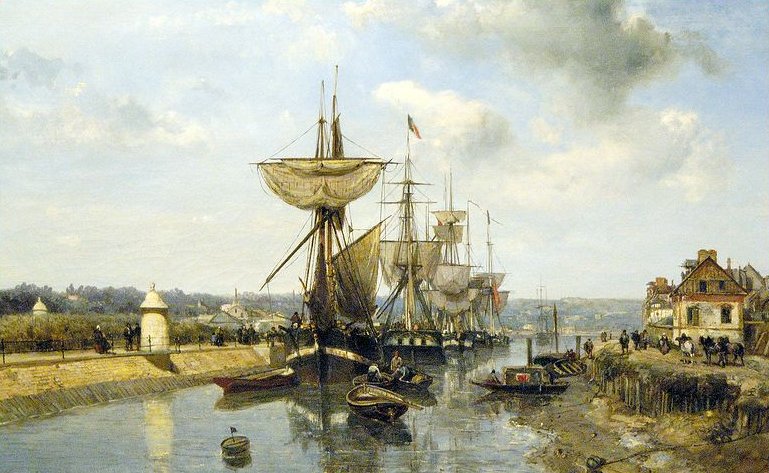
Frigates by Johan Barthold Jongkind

Frigates by Johan Jongkind (1853)

My featured artist today is the nineteenth century Dutch painter and one who is considered to be the forerunner of Impressionism.  His name is Johan Barthold Jongkind.

Jongkind was born in 1819 in the small Dutch town of Lattrop in the Dutch province of Overijssel, close to the German border, although much of his early life was spent in the harbour town of Vlaardingen, which lies on the River Meuse, and where his father, Gerrit Adrianus Jonkind, was a local tax collector.  His father and mother, Wilhelmina, had ten children of which Johan was the eighth.  At the age of sixteen, once he had finished his education, he went to work as a junior clerk in a notary’s office.  A year later in 1836 his father died and Johan moved from Vlaardingen to The Hague where he enrolled at the Academy of Arts to study drawing under the tutelage of the director of Andreas Schelfhout, the Dutch Romantic painter, etcher and lithographer, who was renowned for his landscape works and who, by the end of his life, was looked upon as the leading Dutch landscape painter of the nineteenth century.

He spent almost nine years working at the Schelfhout’s studio training as a landscape painter and studying the great works of the Dutch Golden Age painters who plied their trade between the late sixteenth and mid to latter part of the seventeenth century, such as Jacob von Ruisdael, Meindert Hobbema and Aelbert Cuyp.  It was during this time that Jongkind developed the love of en plein air painting.  The early works of Jongkind depicted themes popular in the Netherlands at the time, harbour scenes with boats as well as canals , windmills and winter scenes featuring skaters on the frozen waterways.  His works grew in popularity and one of the admirers of his paintings was the leader of the French Romantic School, the landscape and seascape painter, Eugène Isabey.  Isabey had accompanied Alfred Emile de Nieuwkerke, who was the directeur des Beaux-Arts in Paris, to The Hague for the unveiling of the equestrian statue of William the Silent in front of the Paleis Noordeinde.  Isabey invites Jongkind to Paris to study in his studio and in 1846, with the financial support from the Prince of Orange, the young Dutch artist headed to the French capital where he remained for ten years.

Jongkind not only studied with Isabey but also with the French painter, François-Edouard Picot.   He also met many of the landscape painters of the Barbizon School with whom he often worked with and exhibited his works alongside theirs.  Despite his initial traditional training as a Dutch landscape artist, his painting technique evolved and soon his works took on a new range of colour and he became fascinated with the pictorial representation of light.  It was this interest in light which would become essential in the development of Impressionism.

When Jongkind had first arrived in Paris he discovered the river Seine and this became a new source of inspiration for his art. He also depicted many aspects of Paris life but preferred to concentrate on the industrial modernity and urban development of the capital rather than the touristy scenes of the crowded city.   His style is often likened to Naturalism, which is the representation of the world with a minimum of abstraction or stylistic distortion.  It is the depiction of realistic objects in a natural setting and is characterised by convincing effects of light and surface texture.

It was whilst in France that he fell in love with the Normandy and Brittany coast which he visited whilst on a painting and sketching trip with Isabey.  He would return to the area many times during his life and some of his best watercolour works incorporate the beautiful and strong lighting found along the Atlantic shoreline.  One of his great artistic successes came in 1850 when he exhibited his work View of Honfleur port at the Paris Salon exhibition.  It received great acclaim from the art critics.

For Jongkind, the streets of Paris were not paved with gold and he spent nine financially difficult years in Paris and had no choice but to live a bohemian existence. He had a number of his paintings rejected by the Salon jurists.  He put forward three of his paintings for inclusion at the 1855 World Exhibition but was disappointed at the lack of interest for his works.  He was now starting to feel dejected and depressed at the way his life was going.   In 1855 his mother died and the thirty-six year old artist returned to The Netherlands and set up home in Rotterdam and with this change of country came his change in painting style as he returned to a more traditional Dutch style of art which he had initially be trained in, during his early life.  Jongkind remained in Holland for five years but the sale of his paintings in his homeland were disappointing.   The only art he managed to sell was to a French art dealer and one of his first patrons, Pierre-Firmin Martin.   Martin’s gallery was on the rue Mogador and he routinely bought works from artists such as Jean-Baptiste-Camille Corot, Jean-FrançoisMillet, Theodore Rousseau, Constant Troyon, and Charles-François Daubigny.   Martin was such a great support figure for these artists that they called him Père or Father in English. Jongkind would send Père Martin a painting and in return he would receive a 100 franc note.  However Jongkind could not survive alone on this and as a result he found himself getting deeper and deeper in debt and so in 1860 he decided to return to Paris where he believed the sale of his works would improve and where his standing as a painter was much greater.  He said at the time:

“…It is Paris where I am recognized as a painter…”

However to return to Paris he needed money and he had none.  However through his Parisian friends led by Comte Doria and Père Martin they put on an auction of their works and managed to raise 6046 francs which was used to bring back their friend to Paris.

Jongkind settles down in Montparnasse in Paris.  His friendship with the art dealer Père Martin continued and it was whilst attending one of his dinners that Jongkind was introduced to Joséphine Fesser-Borrhee, a Dutch lady who taught art at a home for Parisian girls.   This lady who was to shape the rest of Jongkind’s life was an interesting character.  She like him, was born in 1819.   She had been abandoned by her parents and brought up in a children’s home. Although known as Marie Borrhée she would later take the name of Joséphine.    At the age of twenty she arrived in Paris, where she was taught to draw, and later she went on to teach in a home for young girls.   Having had a very difficult childhood she was ideally placed to understand the temperament of her troubled friend, Jongkind,  who in many ways was something of an orphan himself.  Jongkind had immediately taken to Joséphine and shortly after their first meeting at the house of Père Martin; he wrote her a letter in which he commented:

“…When I saw you arrive, it was as if my mother and father were coming to fetch me!…”

She was married to Alexander Fesser with whom she had a son, Jules.   It was the Fesser family and especially Joséphine, who through their kind hospitality and friendship, enabled Jongkind to recover both his physical and mental health  and in doing so had a great impact on the quality of his artistic work.  Jonkind and Fesser would travel around France but on many occasions he would return to Normandy.  It was here in 1862 he met Claude Monet.  Monet once described Jongkind’s and his works of art and chided him for his long-standing inability to master the French language saying:

“….a good-hearted, shy man who butchered French and whose art was too new and too artistic to be, in 1862, appreciated to its true value…”

For the next years, the influence of the Normandy coast showed through Jongkind’s abundant production of etchings and paintings. In Normandy, Jongkind became a close friend of Monet a mixed with the likes of Corot, Diaz, Boudin, Sisley and many of the other great artists who used to gather at the Farm Saint-Simeon run by Mère Toutain.

Joséphine Fesser was to become Jongkind’s guardian angel and companion for life and although she remained married to her husband Alexandre she became Jongkind’s mistress.   She was a very caring person and brought a soothing stability and balance to his life. The sale of his art works grew and Jongkind, reputation as an artist, gained in popularity. The number of his commissions increased and with the rise in his art sales his finances improved and with that came a sort of mental calmness, free from worry, and his personality blossomed.   Through Joséphine,  Jongkind had discovered the Dauphiné region of south-east France.  He soon got himself into an annual routine of spending the summer months there and returning to Paris in the winter months.

The first exhibition of the Impressionists in the studio of the photographer Nadar was held in 1874 and although asked to exhibit some of his works, Jongkind declined as by this time in his life, due to his poor health and intemperance he had given up submitting his paintings to major art exhibitions.  Joséphine’s husband died in 1875 and after his death, Madame Fesser remained with Jongkind in Paris. During the late 1870’s when Jongkind was in his fifties his health started to deteriorate and he spent more time in the warmer climes and fresher air of the Dauphiné.

From 1878 until his death in 1891 Jongkind and Joséphine Fesse live in la Côte-Saint-André near Grenoble.  During the last year of his life Jongkind was beset with mental problems, suffering from bouts of depression and paranoia which led him back to alcohol dependence. His mood swings caused by the excess consumption of alcohol led him to be banned from most of the cultural and social activities of the town.  He died in Saint-Rambert hospital close to Grenoble on February 9th 1891 aged 71.  Joséphine Fesser outlived him by just a few months. They are both buried in the small cemetery of La Côte-Saint-André, on the outskirts of the town.

My featured work today by Johan Jongkind is entitled Frigates.  In the painting we see a seaside port which is an idealised view made up of many sites, which was a technique often used by many Dutch landscape painters.   It was completed in 1853, just a couple of years before he left Paris to return to The Netherlands.  The painting highlights his great ability to depict atmosphere and light effects.  Look how well he has depicted the reflections of the ships in the rippling water of the harbour.  Art historians believed that it was Jongkind’s  mastery of light in his works that was to influence the likes of the young Impressionist painter Claude Monet.

The painting is normally housed in the Sterling and Francine Clark Art Institute in Williamstown, Massachusetts but is now part of the exhibition From Paris: a Taste for Impressionism, which is being held at the Royal Academy in London.   This wonderful exhibition of works by Monet, Manet, Sisley, Renoir and many others is on until September 23rd 2012

A Suffolk Farm by Edward Seago

A Suffolk Farm by Edward Seago

Last Sunday,  I went down to London to visit two of my children and my one and only grandchild and on the following afternoon I had scheduled a visit to the Royal Academy Summer Exhibition.  I had some spare time on Monday morning and had intended to visit a couple of galleries or museums but my best laid plans were thwarted because of an item of shopping I was looking for which proved elusive and the atrocious weather which put a damper on any thoughts I had of a pleasant stroll between artistic collections.  I had seen an advert for an exhibition, Samuel Palmer, His Friends and His Followers at The Fine Art Society which is situated in New Bond Street so I eventually ended up there like a drowned rat as my umbrella proved totally inadequate to counter the torrential rain.   I will look at one of the paintings from that exhibition in a later blog.  I left there and still had an hour to kill before I was due to attend the Royal Academy and as I had no intention of any further long walks in the downpour I ended up at the Richard Green Gallery just a few doors down from The Fine Art Society.  The gallery was in the process of hanging an Edward Seago exhibition but allowed me to take a look at what was already in place.  What a wonderful collection of art.

Edward Brian Seago was born in Norwich in 1910, the second son of Brian, a local coal merchant and Mabel Seago.   As a child he suffered quite a lot with ill health caused by a heart complaint, paroxysmal tachycardia, with which he was first diagnosed when he was eight years of age.   This illness meant that on a number of occasions he was reluctantly confined to his bed. As a result of this enforced confinement, he spent a lot of time painting skies and the surrounding landscape from his bedroom window.  Seago later remembered those times with a surprising fondness and called his enforced leisure, “spells of sheer delight”.  It was during these periods of imposed convalescence that the young Edward Seago realised his great enthusiasm and aptitude for painting.

His continued illness precluded him from any formal artistic training and, for the most, he taught himself.  He did however receive some artistic advice from the local East Anglian painters who were both impressed with his work.  They were Sir Alfred Munnings, who lived in Dedham close to the Essex/Sussex border and the landscape painter, Bertram Priestman, who remained a friend for the rest of Seago’s life.  Another of Edward Seago’s friends was the poet John Masefield with whom Seago collaborated on a number of publications.  Masefield would provide the poems whilst Seago provided the illustrations.  Two of the most successful collaborations were The Country Scene which was published in 1937 and Tribute to Ballet which was published the following year.  It was also Masefield that instilled in Seago the love and appreciation of English country life.

Seago’s landscape works were influenced by the landscape paintings of the Dutch Masters as there was a certain similarity between the landscape of The Netherlands and that of the East Anglian countryside.  Seago also was a great admirer of the landscape works of the English painter, John Constable and by the painters of the Norwich School founded by John Chrome in 1803.  However notwithstanding all these outside influences, his biographer James Reid, wrote:

“…While Seago’s subject matter evolved within a fundamentally traditional genre, his methodology, style and technique contributed to an innovative interpretation of the rural, urban and marine scene…

During the 1930’s Seago led a very varied existence.  He loved the freedom associated with a bohemian lifestyle and would often travel and work with circus folk, gypsies and ballet dancers but at the same time he kept in contact with the more refined aristocratic circles which provided him with generous patronage.  One such patron and friend was the politician and industrialist, Henry Mond, 2nd Lord Melchett, who was also an art connoisseur and collector.  Seago and Henry Mond travelled together to Venice in 1933.   Seago was astounded by the beauty of Venice which he later captured in many of his oil paintings.  He also had the opportunity to view the art works of the great Italian masters which were on show in the city.

Another of Seago’s close friends was Princess Mary, the Countess of Harewood, who was King George VI’s sister, and it was through this acquaintance that he was later to meet the present Royal Family who collected many of his paintings.  George VI also commissioned a portrait, and that royal patronage made Seago and his art,  very fashionable.    The Queen Mother bought so many of his works of art that eventually the artist gave her two a year – on her birthday and at Christmas.   Later, in 1956, he accompanied Prince Philip, the Duke of Edinburgh on the Royal Yacht Britannia, on a world tour and during one part of the voyage the ship sailed around the Antarctic.  Prince Philip and Edward Seago used to paint alongside each other on the deck of the Royal Yacht Britannia and the two developed a very close friendship.  Edward Seago’s paintings depicting the Antarctic were quite beautiful and were loved by art critics and the public alike.

He became a war artist in Italy during the Second World War and spent two years with General Alexander.  After the Second World War Edward Seago concentrated his art work on the East Anglian countryside with its cloud-filled skies, cattle grazing in the expansive flat fields as well as paintings which focused on the waters and the mudflats of The Broads and some of the barges which plied their trade along these inland waterways.  His beautiful landscape paintings would often incorporate man-made structures such as windmills, churches and farmhouses.  Seago loved East Anglia and its countryside and once wrote:

“…Perhaps one has to be born and bred there for it to really get into one’s blood.   But it has a powerful hold on me, and whenever I go, I feel a longing to return there…”

In 1968 Seago bought Ca Conca, a villa apartment in the elegant yachting resort of Porto Cervo on the Costa Smeralda, Sardinia. The terrace of his property offered fine views of the harbour to the right.   His life was suddenly cut short whilst on a painting tour of Sardinia when he was diagnosed as having a brain tumour, from which he died in London in January 1974 just before his sixty-fourth birthday.  In terms of commissions, he was the most successful artist of his day.

The painting I have featured today by Edward Seago is entitled A Suffolk Farm and epitomises the beauty of his landscape paintings and his love for the Suffolk countryside.  I urge you to visit the Richard Green Gallery (147 New Bond Street, London W1 2TS) which in honour of Her Majesty the Queen’s Diamond Jubilee, is presenting an exhibition of 41 paintings by Edward Seago.  The exhibition opened on June 13th and ends on Saturday, July 7th.   The gallery is open Monday to Friday from 10am to 6pm and on Saturday from 10am to 1pm.  I can assure you that you will not be disappointed and if you have a few pounds to spare then you will be pleased to know that all the works are up for sale.

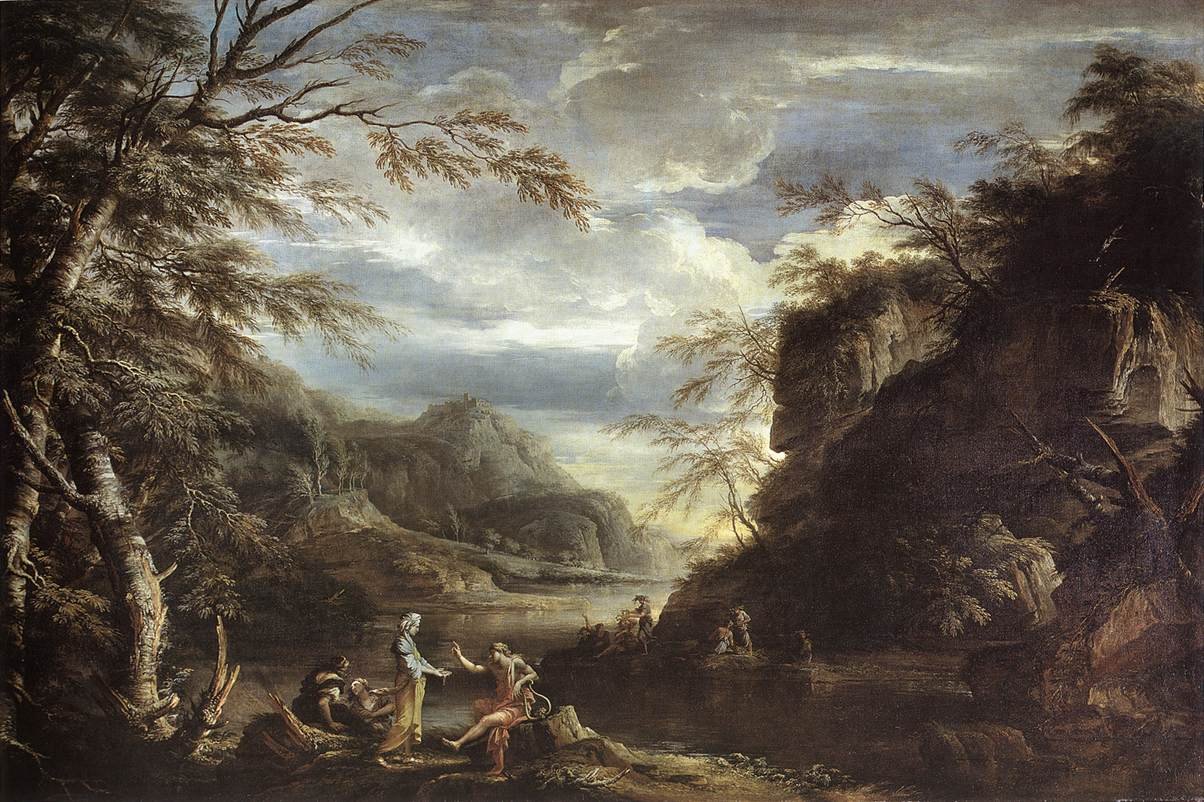
River Landscape with Apollo and the Cumaean Sibyl by Salvator Rosa

River Landscape with Apollo and the Cumaen Sibyl by Salvator Rosa (c.1655)

My featured artist today is the 17th century Italian Baroque painter Salvator Rosa.  He was born in 1615 in the small hill town of Arenella above the outskirts of Naples.  His father Vito Antonio was a land surveyor and had great ambitions for his son wanting him to become either a lawyer or take holy orders in the church and become a priest.  With this in mind he decided that his son should be afforded the best education and had him enter the convent of the Somaschi Fathers, a holy order of priests and brothers.  As we have seen in many biographies of artists, what the parents want for their children often differs from what the children themselves want and so it was the case for Salvator Rosa.  During his studies he had developed a love of art and with the support of his maternal uncle, Paolo Greco, he secretly began to learn to paint.  Rosa began his artistic training in Naples, under the tutelage of his future brother-in-law, Francesco Francanzano, who had trained under the influential Spanish painter, Jusepe de Ribera.  It is also believed that after this initial training, Rosa trained with the Naples painter, Aniello Falcone, who was also at one time apprenticed to Ribera.  Rosa greatly admired the works of Ribera and was influenced by them.

His father died when he was seventeen years old and, as he had been the breadwinner to Rosa’s large family, his mother struggled to feed her children let alone financially support her son Salvator with his artistic ambitions.  After his father’s death, Salvator Rosa continued to work as an apprentice with Falcone until 1634 when he relocated to Rome where he stayed for two years before returning home.

In 1638, aged 23 he went back to Rome where he was given accommodation by the Bishop of Viterbo, Francesco Brancaccio who treated him as his protégé and received commissions from the Catholic Church.  It was whilst in Rome that Rosa further developed his multi-talented skills, not just as an artist but as a musician, a writer and a comic actor.  He founded a company of actors in which he regularly participated.   He wrote and often acted in his own satirical plays, often political in nature and often lampooned the wealthy and powerful, and it was his devilish satire which gained him the reputation of a rebel, pitting himself against these influential people.  However his viperish-tongued satires made him some powerful enemies including Gian Lorenzo Bernini, the famous and powerful architect and who was at that time, the most powerful artist in Rome.  He, like Rosa, was also an amateur playwright and it was during the Carnival in 1639 that Rosa ridiculed Bernini’s plays and his stature as a playwright.  Eventually Rosa had made too many enemies in the Italian capital and decided it was just too dangerous to remain there.

From Rome he travelled to Florence where he was to remain for the next eight years.   One of his most influential Florentine patrons was Cardinal Giancarlo de’ Medici, himself a great lover and supporter of the Arts. Rosa worked for the Cardinal at his palace but was still allowed the freedom to paint his own landscapes and would go off and spend the summers in the Tuscan countryside around Monterufoli and Barbiano.    It was whilst living in Florence that Rosa did some work for Giovanni Carlo who was at the centre of the literary and theatrical life of Florence and Rosa soon became part of Carlo’s circle of friends.  Rosa used his own house as a meeting place for local writers, musicians and artists and it became known as the Accademia dei Percossi, or Academy of the Stricken.

He left Florence in 1646 being unhappy with the ever increasing restrictions put on him and his artistic and literary work by the Medici court  He went first back to Naples where he remained for three years before returning to Rome in 1649  where he believed his writings and paintings would win him even greater fame.  One of the problems Salvator Rosa had was his ever tempestuous relationship with his patrons and their demands.  He often refused to paint on commission or to agree a price beforehand.  He rejected interference from his patrons in his choice of subject.  In Francis Haskell’s book entitled, Patrons and Painters: Study in the Relations Between Italian Art and Society in the Age of the Baroque, he quotes from a letter Rosa wrote to one of his patrons, Antonio Ruffo, explaining his thoughts on his art and commissions:

“…I do not paint to enrich myself but purely for my own satisfaction.  I must allow myself to be carried away by the transports of enthusiasm and use my brushes only when I feel myself rapt…”

The 17th century Florentine art historian Filippo Baldinucci could not believe Rosa’s attitude to his patrons and wrote:

“…I can find few, in fact, I cannot find any, artists either before or after him or among his contemporaries, who can be said to have maintained the status of art as high as he did… No one could ever make him agree a fixed price before a picture was finished and he used to give a very interesting reason for this: he could not instruct his brush to produce paintings worth a particular sum but, when they were completed, he would appraise them on their merits and would then leave it to his friend’s judgement to take them or leave them….”

In his later years he spent much time on satirical portraiture, history paintings and works of art featuring tales from mythology.  In 1672 he contracted dropsy and died six months later.  Whilst on his deathbed he married Lucrezia, his mistress of thirty years, who had borne him two sons.   He died in March 1673 just a few months short of his fifty-eighth birthday.  After his father’s death forty years earlier Rosa had struggled financially but at the time of his death he had accumulated a moderate fortune.

Landscape painting had been regarded as a relatively lesser genre of painting in Italy at the time. But two French artists based in Rome, Claude Lorraine, who Rosa had befriended, and Nicholas Poussin, had done much to raise its status by setting scenes drawn from classical myth or biblical legend in grand Arcadian landscapes inspired by the nearby countryside. Rosa continued their tradition but with one subtle difference.  His landscape scenes depicted scenes of stormy desolation rather than calm pastoral beauty scenes of Claude and Poussin.  For My Daily Art Display today I am going to look at a painting by Salvator Rosa, which is a landscape but based on Roman mythology and Ovid’s book Metamorphoses.  It is the story of Apollo (often known as Phoebus) and the Cumaean Sibyl.   Cumae, which was the location of Italy’s earliest Greek colony, is on the Gulf of Gaeta near Naples and this location was probably known to Rosa.  The basis of the painting harks back to a conversation Aeneas had with the Cumaean Sibyl, who was a guide to the underworld of Hades, the entrance to which was the volcanic crater of Avernus.  Aeneas wanted to enter the underworld in order to visit his dead father Anchises.  Aeneas, with the help of his guide, the Cumaean Sibyl, found the aged ghost of his father.  It was at this time that the Sibyl recounted the story of her barter with the god Apollo, how she reneged on her promise and why she had become old and haggard:

“…“I am no goddess,” she replied, “nor is it well to honour any mortal head with tribute of the holy frankincense. And, that you may not err through ignorance, I tell you life eternal without end was offered to me, if I would but yield virginity to Phoebus for his love. And, while he hoped for this and in desire offered to bribe me for my virtue, first with gifts, he said, ‘Maiden of Cumae choose whatever you may wish, and you shall gain all that you wish.’ I pointed to a heap of dust collected there, and foolishly replied, `As many birthdays must be given to me as there are particles of sand.’  For I forgot to wish them days of changeless youth. He gave long life and offered youth besides, if I would grant his wish. This I refused, I live unwedded still. My happier time has fled away, now comes with tottering step infirm old age, which I shall long endure…”

The making of the bargain

Her mistake had been not only to ask Apollo for eternal life but also to ask for everlasting youth and beauty.  She aged over time.  Her body grew smaller with age and eventually was kept in an ampulla, a small nearly globular flask or bottle, with two handles.   Eventually only her voice was left.

The painting, entitled River Landscape with Apollo and the Cumaean Sibyl, depicting the meeting of the Cumaean Sibyl and Apollo, was painted by Salvator Rosa around 1655.  This is one of his finest works and highlights his ability as a landscape painter.  It is a desolate landscape scene.  Before us we have an isolated inlet of the sea, surrounded by towering cliffs of rough and rugged stone. On the right hand side of the painting we have a dark crag which towers against a stormy summer sunset.  From this jagged rock there are spindly trees sprouting from it at strange angles. In the foreground of the painting we see the god Apollo, seated on a tree stump with his lyre at his side, propositioning the beautiful Cumaean Sibyl, the turbaned woman who stands before him.    His hand is raised almost as if he is blessing the woman but it is his demonstrative act of granting her wish that she might live for as many years as there are grains of dust in the earth she holds out to him in her hand.   In return for the granting of her wish she would become his lover.   The Sibyl having been granted her wish, changes her mind, and refuses to surrender to Apollo’s advances.  Apollo cannot take back what he had given the young woman, but he was still able to punish the fickle girl, for, in devising her wish, she forgot to ask for eternal youth, and by refusing to grant her this he condemned her to grow older and older until at last she wasted away and only her voice was left.

The scene before us, depicted by Rosa, is purely imaginary, Rosa has included the cavern from which the Sibyl uttered her famous prophecies and which still exists in the dark, rocky area at the top right of the picture.  In the background we can see the inaccessible citadel perched high on a cliff.  The other characters we see in the scene are the nine muses, the goddesses of creative inspiration who were the handmaidens of Apollo. The painting is illuminated by the last rays of the setting sun light which light up the stormy sky in the distance. Look at how Rosa has managed to portray an aura of an ominous premonition.   The dramatic use of dark tones and chiaroscuro adds a feeling of foreboding about the scene.  The way he has depicted the wild landscape of bare rocks, splintered trees and a threatening stormy sky goes hand in hand with the story of retribution about to be dealt to the Cumaen Sibyl by Apollo for reneging on her promise to him.

Notwithstanding the darkness of the scene, it is still a beautiful landscape painting.  It is currently housed at the Wallace Collection, London.

The Monk by George Inness

The Monk by George Inness (1873)

For my artist today I had decided to cross the Atlantic and look at the work of an American painter.   I have always liked the beautiful landscape works of the Hudson River School artists and so I dipped into my book, which featured these painters and came up with George Inness.  I particularly liked his superb and beautiful painting entitled Our Old Mill, which I had considered for today’s offering.  It was only when I was researching his life and his works of art that I came across a hauntingly beautiful work of his entitled The Monk.  It had little to do with the landscapes along the Hudson River but it was just too good to ignore.  So today my featured artist is an American who was famous for his American landscapes, but you will just have to forgive me for abandoning those works.  However I am sure that My Daily Art Display featured painting today will impress you.

George Inness was born in Newburgh, New York in 1825.  He came from a very large family being the fifth of thirteen children of John William Inness, a farmer, and Clarissa Baldwin.   In 1829 when George was just five years old the family moved to Newark, New Jersey.  Inness began his artistic education at the age of fourteen when he received tuition from an itinerant artist, John Jesse Barker.  Later he would work as a map engraver in New York and during the summer of 1843,  he studied under the French painter, who had recently arrived from France, Régis-François Gignoux.  From this he developed a great interest in art and enrolled at the National Academy of Design, where Gignoux taught, and the following year he exhibited his first work at the Academy.  This was to be the beginning of a great partnership between the artist and the Academy.

In 1848 he opened his first studio in New York and he received his first commission.  The following year he married Delia Miller but sadly she passed away a few months later.   In 1850, at the age of twenty-five Inness marries Elizabeth Abigail Hart and the couple go on to have six children.  The patronage of Ogden Haggerty allowed him to take a trip to Italy where he was able to paint and study the work of the great Italian masters.  Once there, he fell in love with the beautiful Italian landscape.  In all, he spent fifteen months in Rome and took the opportunity to study the works of the great landscape artists such as Claude Lorrain and Nicolas Poussin.  Whilst in Rome he rented a studio, which was in the same building as the American painter and portrait artist William Page who had arrived in the Italian capital two years earlier.

In 1853 Inness moved to Paris and began studying the work and technique of the French Barbizon landscape painters and soon Inness became the leading American exponent of the Barbizon-style of painting. His main influence was the work of The French painter, Pierre Étienne Théodore Rousseau, which totally captivated him. The Barbizon-style of painting, which uses loose brushwork and places an emphasis on mood, became part of the artist’s tools to create the luminous and atmospheric landscapes that eventually established Inness’ trademark.  A year after the couple settled in Paris, their son George Junior was born.  He would later become a leading landscape painter.

During the 1850’s, Inness received a lucrative commission from the Delaware, Lackawanna and Western Railroads.  The train operator wanted him to record and portray the progress of DLWRR’s growth in early Industrial America. George Inness and his family settled in the small town of Medfield, a suburb of Boston, where they remained for five years.  It was during this time that Inness completed what art critics believed were some of his best paintings.   In 1864, he was on the move once again.  The family moved to the town of Eagleswood in New Jersey where he taught art.   He made many trips to Europe, especially France and Italy where he lived between 1870 and 1874 before he returned to America and settled in Montclair, New Jersey.

In 1894 he and his family made a trip to Europe, visiting Paris, Munich and Baden-Baden before arriving in Scotland where on August 3rd he and his son visited the famous beauty spot of Bridge of Allan.  In Adrienne Baxter Bell’s biography of Inness entitled, George Inness and the Visionary Landscape she recounts the time as described by Inness’ son:

“…My father threw up his hands into the air and exclaimed ‘My God oh, how beautiful!’ fell to the ground and died minutes later….”

George Inness died aged 69.  His funeral was held at the National Academy of Design in New York City and he was buried in West Orange, New Jersey.

George Inness painted today’s featured work, entitled The Monk, in 1873.  Without doubt this can only be described as a haunting work and one of his best paintings.  The setting of the painting is thought to be a secluded corner of the Villa Barberini, which is near the pope’s summer residence of Castel Gandolfo and lies a little distance south of Rome.  Just to the right of centre in the foreground we see the small figure of a cowled monk, holding a staff, as he walks within the walled garden.  He is diminutive in comparison to the tall stone wall behind him and further back, the cluster of tall slender pine trees that we see in the middle distance.   Inness often painted just the odd figure in his landscapes.  In most cases they would be solitary figures with a degree of anonymity.  Look how Inness has portrayed the pine trees with their unusual shaped branches.  They stand out so well against the brilliant yellow-ochre sky.  The bright yellow light also filters between the slim branches which rise vertically to support the tree canopies.

I like this panting.  I like the evocative nature of the depiction of the lone monk.  I suppose it is his white cowl which gives the painting a ghostly feel. The painting can be found in the Addison Gallery of American Art, at the Phillips Academy, Andover, Massachusetts.  The Phillips Academy is unique among secondary schools in the United States in as much as it is home to two museums, each of which is dedicated to educating and enriching its student community while also serving as a resource to the general public.

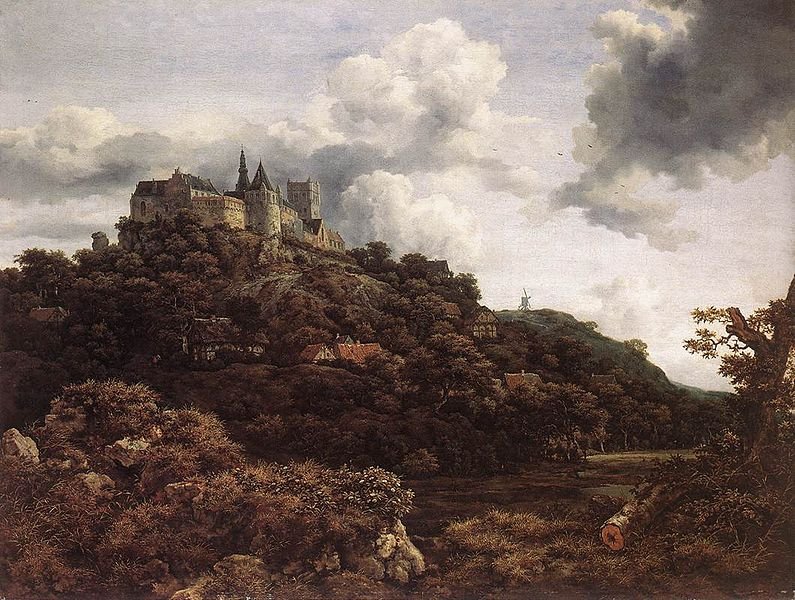
Bentheim Castle by Jacob van Ruisdael

Bentheim Castle by Jacob Van Ruisdael (1653)

Today I am moving away from the horrors depicted in the Max Beckmann’s painting which I featured yesterday and move to a beautiful work by Jacob van Ruisdael, one of the greatest pure landscape painters in the Netherlands in the 17th century.  I have featured his works before in My Daily Art Display.  On January 9th 2011 I looked at his painting Dam Square and on February 18th I featured his hauntingly exquisite work entitled The Jewish Cemetery.  Both are worth looking at if you haven’t seen them before.     I never tire of his amazing paintings.  My Daily Art Display today features another of his works entitled Bentheim Castle which  van Ruisdael completed around 1653.

Jacob van Ruisdael was born in Haarlem in 1628 and was brought up in an artistic household.  His father, Isaak van Ruysdael and his uncle, Salomon van Ruysdael were both landscape painters.  Little is known about Jacob’s early artistic training but it is thought that his father probably taught him with guidance from his uncle.  At the age of twenty he was admitted as a member of the Guild of St Luke in Haarlem.  The Guild of Saint Luke was the most common name for a city guild for painters and other artists especially in the Low Countries.   They were named in honour of the Evangelist Luke, who was the patron saint of artists.

Unfortunately during his lifetime Jacob van Ruisdael’s artistic talent was not appreciated and by all accounts he led a poverty-stricken existence.  At the age of fifty three the Haarlem council was petitioned for his admission into the town’s almshouse.  He died in Amsterdam a year later in 1682 and his body was brought back to be buried in Haarlem

Jacob van Ruisdael travelled considerably during his lifetime but seldom went outside his own country.  However it is known that Ruisdael visited the small town of Bentheim, in Westphalia close to the Dutch-German border in the early 1650’s when he travelled to the region with his friend and fellow artist Nicolaes Berchem,  who, like Ruisdael, came from Haarlem.  Bentheim Castle received a first mention in historical records back in 1020 AD when the owner of the fortress who was named as Count Otto of Northeim, and who would later become the Duke of Bavaria, married.  He had, at this time, just married Richenza, the daughter of the Count of Werl, whose family was one of the most influential and wealth dynasties in Westphalia.  The castle changed hands during many battles over the centuries.  Nowadays the fate of Castle Bentheim is in the hands of the Hereditary Prince Carl Ferdinand of Bentheim and Steinfurt, who was born in 1977. Since 2007 he has been married to Hereditary Princess Elna-Margret of Bentheim and Steinfurt.

Jacob van Ruisdael’s favourite subjects were simple woodland scenes.  He was influenced by two great Netherlandish landscape painters of the time, Allaert van Everdingen and Meindert Hobbema.   Ruisdael forte was the depiction of trees in his works.  His rendering of the foliage was second to none. At the time of this painting which was completed in the 1650’s, Ruisdael portrayal of landscape scenes was bettered by nobody.  He stood out from his contemporaries when it came to the painting of woodlands, rivers, waterfalls, mountains, and even seascapes.

His landscape works became larger which allowed him more space for his portrayal of his giant oak and beech trees as well as the plethora of shrubs.  Look at today’s featured work simply entitled Bentheim Castle for an example of this.  No matter how the castle dominates the landscape, Ruisdael must have spent an enormous amount of time painting the surrounding trees and vegetation which can be seen like a skirt around the castle fortress.  Just take time and carefully study the detail of the vegetation in the foreground. Some of it has been brightened by a sudden shaft of sunlight whilst most of it in the middle ground remains in shade.  The colours the artist used in his paintings around this period became more vivid and space increases in both height and depth.  In this work by Ruisdael, look at the great variety of colours the artist has used to paint the flora.

What we see before us is the castle as seen from the south-west above which Ruisdael has given us a wonderful rendering of cloud formation.  It is an idealized landscape and not topographically accurate as the actual castle is situated on an unimpressive and somewhat low hill. However, Ruisdael, in order to add grandeur to his landscape work, has made the castle almost look like it is perched atop a small mountain.  Why would he do that?  Probably because placing the castle so high and so distant gave it a more commanding appearance but I believe his main reason was it offered him the opportunity to flood the middle and foreground with a small forest with all the colours that brings to the work.  In amongst the wooded slopes we see the red roof tops of the white houses and cottages.  This colour red manages to set off the verdant colour of the flora that surrounds them and which runs down to the foreground of the painting.  One can see that for Ruisdael the painting of trees and flora was his main joy.  Jacob van Ruisdael loved the view of this ancient fortress and over the years painted more than fifteen landscapes featuring Bentheim Castle, viewed from different viewpoints and seen in various surroundings.

I marvel at the detail in this painting and just wonder how long it took the twenty-five year old artist to complete it.  The painting is housed in Dublin at the National Gallery of Ireland.

Harvest at La Crau with Montmajour in the Background by Vincent van Gogh

Harvest at La Crau with Montmajour in the Background (1888)

For all of us in the northern hemisphere we are in the midst of winter.  The days are short, the skies are grey and the rain is plentiful.  It is truly a depressing time of the year and one knows only too well that there is nothing more likely to lift one’s spirits than the presence of blue skies, coupled with long hours of sunshine and feeling the warmth of the sun on one’s back.  So what has all this to do with My Daily Art Display’s featured painting and the famous artist who painted it?  Well, just maybe Vincent felt the same as he looked out the window of his Parisian apartment in February 1888.  Today my featured artist is Vincent Willem van Gogh and my featured painting is entitled Harvest at La Crau with Montmajour in the Background which he completed this work in 1888 and can now be found in the Rijksmuseum, Amsterdam.

Van Gogh had come to Paris from Antwerp in March 1886 to live with his brother Théo, who was the manager at the Goupil Gallery in the Boulevard Montmartre.  He studied for a time at the Atelier Cormon under the tutelage of Femand Cormon, the French painter and art teacher.  Whilst in Paris, Van Gogh met up with many of the Impressionists, such as Camille Pissarro, Emile Bernard and Claude Monet and became firm friends with Paul Gaugin who only arrived in the French capital in late 1887.  Van Gogh also witnessed the infancy of Neo-Impressionism and the works of the Neo-Impressionists Signac and Seurat.  Van Gogh quickly abandoned the dark colors he had used to create his earlier paintings and began to he embrace the brighter more vibrant colors and the techniques of the Impressionists.   Life in the French capital for van Gogh with his painting during the day and his socialising with his fellow artists at night soon began to affect his health and after almost two years he began to tire of the cliquish Parisian art scene.   Whether it was for this reason or for health reasons or even the simple desire to leave the drab and cold capital city we will probably never be sure but there was no doubt that he hankered for the warmer sunny climate and the vibrant colours of the southern countryside.,  Van Gogh decided to move south to Arles and take advantage of the special Provencal climate  with its many uninterrupted hours of sunlight and by doing so also absorb the beauty of the French countryside.  It was his fervent hope that he could persuade some of his newly found artist friends to join him there and together they could set up a school of art,  maybe even an artists’ colony and together he believed they could resurrect the purity of the arts.  This was to be van Gogh’s  Studio of the South.  He left Paris in February 1888, a month before his thirty-fifth birthday, and headed south for Provence.

It was during his sojourn in Provence that he painted today’s featured painting Harvest at La Crau with Montmajour in the Background.  Van Gogh loved this region of Provence with the rocky outcrop of Montmajour and the Montmajour abbey.  This was thought to be one of the happiest times of his troubled life.   For a short period he seemed very content with his way of life.  He made many pen and ink sketches of the Benedictine abbey at Montmajour and the spectacular views from it of the surrounding area.   Van Gogh spent much time producing sketches with his reed pen and rather less time painting.  The reasons for this were probably two-fold.  Painting and the acquiring of paints was quite costly and it was almost impossible to paint when the Mistral wind was at full strength.   In a letter which he wrote to his brother Théo in July 1888, he described the pleasure he derived from this area, despite the problem with mosquitos and the strong cold northerly Mistral wind which made his canvases shake on the easel andmade en plein air painting almost impossible.  He wrote:

“….But now I’ve been to Montmajour 50 times to see that view over the plain, if a view can make one forget such small displeasures, then it must have something…”

In this painting, the pride of place does not go to the abbey which can be seen in the background.   The painting is all about the yellow and green patchwork quilt fields of La Crau which lay between Montmajour and Arles.  The fields are interspersed with small farm buildings with their red-topped roofs, the colour of which not only acts as a contrast to but seems to enhance the colour of the surrounding fields.  In the middle ground we can see a blue cart which is often cited as a secondary title to the painting.  He painted the scene in June 1888 and he believed it to be his best work to date.  It was at a time when the summer heat was beginning to intensify and the life-restoring radiance of the Mediterranean sun was his constant companion.  He once described this light  in a letter to his brother:

“….a light that for want of a better word I shall call yellow, pale sulphur yellow, pale golden citron!  How lovely yellow is!  And how much better I shall see the North!….”

Preliminary sketch of Harvest at La Crau (Fogg Art Museum, Harvard University)

Van Gogh made two preliminary drawings of the work and the provenance of one shows that on the death of her brothers Vincent and Théo in 1890, it came into the possession of Willemina van Gogh, their younger sister.  It is now at the Fogg Art Museum, Harvard University, a bequest of Grenville L. Winthrop.  If one compares this preliminary sketch with the finished painting one can see that the space in the finished painting has been expanded and the viewpoint is much higher.  There is a much more gradual retreating of the plain as it runs off towards the towers of the Montmajour Abbey, which can be seen in the left background, and further back to the distant hills.

A later drawing of the scene (NGA Washington)

After he completed the painting he made two further drawings of the scene.  One of which is entitled Harvest – The Plain of La Crau, which he gave to his friend, John Peter Russell, an Australian artist and which can now be seen at the National Gallery of Art in Washington where it is part of the Mr and Mrs Paul Mellon collection.

I love this painting.  It is a truly inspiring painting.  Inspiring?  As I look out of my window at the falling rain and the dark grey rain-laden clouds, it inspires me to return to Provence and bask once again in the warm sunlight, take in the golden colours of the plains, interspersed occasionally with the blue and violet colours of the fields of lavender and of course be in awe of the azure colour of the nearby Mediterranean.

Oh, for the winter to end so that I can travel again!