Christopher Richard Wynne Nevinson the war artist

     Self Portrait  by C.R.W Nevinson
Self Portrait
by C.R.W Nevinson

The newspapers and television are awash with articles and documentaries with regards the First World War and so, over the next two blogs, I thought I would take this opportunity to look at one of the best known British war artist, many of whose paintings featured the Great War. His name is Christopher Richard Wynne Nevinson, but is often referred to as C.R.W. Nevinson, and was known to his friends as Richard.

Nevinson was the son of Henry Nevinson, who was a British war correspondent during the Second Boer War and the First World War. His father was a fierce and radical campaigning journalist who, through the might of his pen, fought to end slavery in Western Africa. He was also a suffragist, and along with the left-wing writers, Henry Brailsford, Max Eastman and Lawrence Housman founded the Men’s League for Women’s Suffrage society in 1907. In 1884 he had married Margaret Nevinson an activist in the campaign for women’s rights and in Hampstead, London in August 1889 she gave birth to their only child, Christopher Richard Wynne Nevinson. An insight into his early childhood can be gleaned from a book written by Frank Rutter in 1935 entitled Art in my time and in it he talks about Nevinson and his parents. He wrote:

“…Nevinson was the child of parents who had singularly noble ideas, who were markedly progressive and humane in their habit of thought… Nevinson started life with a pre-natal tendency to revolt against injustice, cruelty and oppression…”

He also commented on how tied up Nevinson’s parents were in their campaigning and quotes young Nevinson as being somewhat critical of his mother’s lack of time for him. Later, Nevinson wrote of his mother:

“…If my mother does happen to be in for a meal she is so engrossed in other things that she hardly hears and certainly never takes in a word I say.”

Nevinson’s parents were so wrapped up in their own agendas it was bound to affect the early life of their son and for young Nevinson, who after a period in kindergarten, at the age of seven, worse was to come as his parents decided to send him away from home to a boarding school. For a child who just wanted his parents to spend time with him it was the worst possible outcome and he hated the school and was soon in trouble. In his 1935 autobiography, Paint and Prejudice, he wrote about his time as a boarder:

“…In due time I went to a large school, a ghastly place from which I was rapidly removed as I had some sort of breakdown owing to being publicly flogged, at the age of seven, for giving away some stamps which I believed to be my own. I was not only described as a thief but as a fence. From this moment I developed a shyness which later on became almost a disease. During my sufferings under injustice a conflict was born in me, and my secret life began…”

If school life was bad enough, life at home did not improve. His father’s strong pro-Boer utterances during the Second Boer War became well known and disliked and his son was tarred by this same brush of loathing and would be treated like an outcast by his young contemporaries.

In 1903, Nevinson was sent to Uppingham School. The school was strong in its teaching of engineering and art. However he described the time at Uppingham as a débâcle. At first the school seemed acceptable to the fourteen year old but things deteriorated for the teenager as probably due to his earlier school experiences he did not make friends easily and was singled out by both staff and fellow pupils and he wrote of his horrific experiences at the hands of older students:

“…”I had no wish to go to any such school at all, but nevertheless Uppingham did seem to be the best. Since then I have often wondered what the worst was like. No qualms of mine gave me an inkling of the horrors I was to undergo. Bad feeding, adolescence – always a dangerous period for the male – and the brutality and bestiality in the dormitories, made life a hell on earth. An apathy settled on me. I withered. I learned nothing. I did nothing. I was kicked, hounded, canned, flogged, hairbrushed, morning, noon and night. The more I suffered the less I cared…”

Normality finally came into his life when he left Uppingham School and enrolled at St John’s Wood School of Art where he would train to pass the exams required for entry to the Royal Academy Schools. Nevinson summed up this move in his autobiography in a simple sentence:

“…From Uppingham I went straight to heaven…”

Life at the art school was so different in comparison to his previous schools and Nevinson began to come out of his shell and this could well have been helped by the fact that he was now in the company of female students. He recalled the happy days of socialising with the girls and acknowledged that he himself was changing:

“…My shyness went, and I spent a good deal of my time with Philippa Preston, a lovely creature who was later to marry Maurice Elvey. There were others, blondes and brunettes. There were wild dances, student rags as they were called… and various excursions with exquisite students, young girls and earnest boys; shouting too much, laughing too often…”

However it was not the Royal Academy Schools for Nevinson as he had been influenced by the works of Augustus John who, along with his sister, Gwen, had been students at the Slade School and so, in 1909, aged twenty, Nevinson entered the Slade School. Most of his friends from St John’s Wood School of Art progressed on to the Royal Academy School and so Nevinson arrived at the Slade knowing nobody. After an initial nervousness and an uncertainty about his choice of artistic direction he settled in and made a number of friends. In his class were aspiring artists such as Mark Gertler, Adrian Allinson, Edward Wadsworth, Rudolf Ihlee and Stanley Spencer. This group of young artistic friends were known as the Coster Gang because they dressed in black jerseys with scarlet mufflers and atop their heads they would wear a black cap or hat similar to those worn by costermongers, the street sellers of fruit and vegetables.
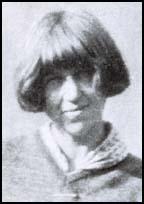
Dora CarringtonIn 1910 a new student joined the Slade. She was Dora Carrington. In Michael Walsh’s 2002 biography on Nevinson which looked at his energetic early career he wrote of Nevinson and Carrington’s relationship:

“…Nevinson’s infatuation with Dora Carrington became progressively more acute. In Carrington he had met his match, not only in intellect and in personality, but also in that she could be as obtuse as he could… The friendship was always confused, faltering between brotherly affection and unfulfilled love affair, rooted in Nevinson’s reluctance to trust strangers and her notorious desire to remain unattached…”
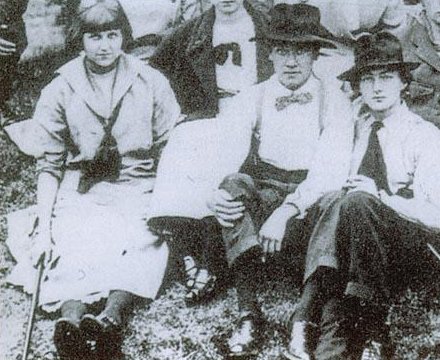
Dora Carrington, CRW Nevinson and Mark Gertler during their time at the Slade School

With this fascination with Dora came a major problem. Dora had another great admirer and he was Nevinson’s best friend, Mark Gertler. Gertler and Nevinson had spent much time together after classes and a bond between them ensued. Michael Walsh in his 2002 biography of Nevinson, C. R. W. Nevinson: The Cult of Violence, wrote about this close friendship:

“…Together they studied at the British Museum, met in the Café Royal, dined at the Nevinson household, went on short holidays and discussed art at length. Independently of each other too, they wrote of the value of their friendship and of the mutual respect they held for each other as artists…”

However they had both fallen in love with Dora Carrington and in a way she destroyed the friendship between the two men. Nevinson after some tentative efforts to move his relationship from a close platonic one to something more was spurned by Carrington and she began to distance herself from him.  Nevinson was devastated at this turn of events and wrote to her:

“…I am now without a friend in the whole world except you…. I cannot give you up, you have put a reason into my life and I am through you slowly winning back my self-respect. I did feel so useless so futile before I devoted my life to you.”

Nevinson also realised that his attempt to become Carrington’s lover ended his friendship with Gertler. Gertler was in love with Carrington and now Nevinson, once his closest friend, had now become a rival for Carrington’s affections. Something had to give and Gertler wrote to Nevinson:

“…I am writing here to tell you that our friendship must end from now, my sole reason being that I am in love with Carrington and I have reason to believe that you are so too. Therefore, much as I have tried to overlook it, I have come to the conclusion that rivals, and rivals in love, cannot be friends. You must know that ever since you brought Carrington to my studio my love for her has been steadily increasing. You might also remember that many times, when you asked me down to dinner. I refused to come. Jealously was the cause of it. Whenever you told me that you had been kissing her, you could have knocked me down with a feather, so faint was I. Whenever you saw me depressed of late, when we were all out together, it wasn’t boredom as I pretended but love…”

The romantic hopes of both Nevinson and Gertler were spurned by Carrington and the two men paid an enormous price because of their infatuation with their fellow student. The price was the ending of their own close and once fulfilling friendship.

Nevinson left the Slade School in the summer of 1912 and travelled to Paris, a place he had visited on a number of occasions with his mother. It was in the French capital that he met and became friends with Gino Severiniand Filippo Marinetti, an Italian poet and editor, the founder of the Futurist movement. Futurism was originally an Italian movement which was characterised by its belligerent celebration of modern technology and city life and energetically showed contempt for Western Art traditions. Nevinson was excited with these futurist ideas and he and Marinetti co-wrote the English Futurist manifesto Vital English Art, in June 1914 edition of English newspaper, The Observer.
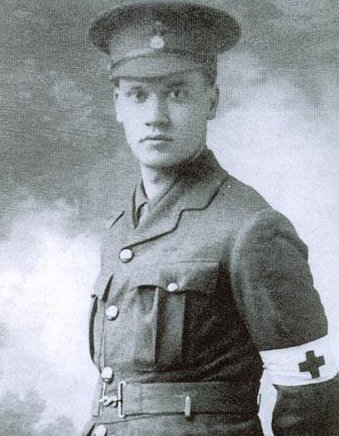
Nevinson in his Red Cross uniform

On the outbreak of the First World War, Nevinson, who was a fervent pacifist, refused to become involved in combat duties, and volunteered instead to work for the Red Cross. Nevinson joined the Friends Ambulance Unit, which was a voluntary ambulance service founded by some young members of the Quakers. It was independent of the Quakers’ organisation and mainly run by registered conscientious objectors. Later, between November 1914 and January 2015, Nevinson served as a volunteer ambulance driver. However his time in the ambulance service as driver, stretcher bearer and hospital orderly ended in January 1915 when he had to return to home due to ill health.

The brutality of the war stimulated him and on his return home in January 1915 he wrote an article for the Daily Express about this artistic stimulation:

“…All artists should go to the front to strengthen their art by a worship of physical and moral courage and a fearless desire of adventure, risk and daring and free themselves from the canker of professors, archaeologists, cicerones, antiquaries and beauty worshippers…”

I will leave Nevinson’s life story at this juncture and return to it in my next blog. I now want to feature three of his war paintings which were to make him famous and which depicted life and the brutality of the First World War. It was during his period convalescing that he started on a series of works based on his own experiences and incidents he witnessed whilst at the Western Front in France.
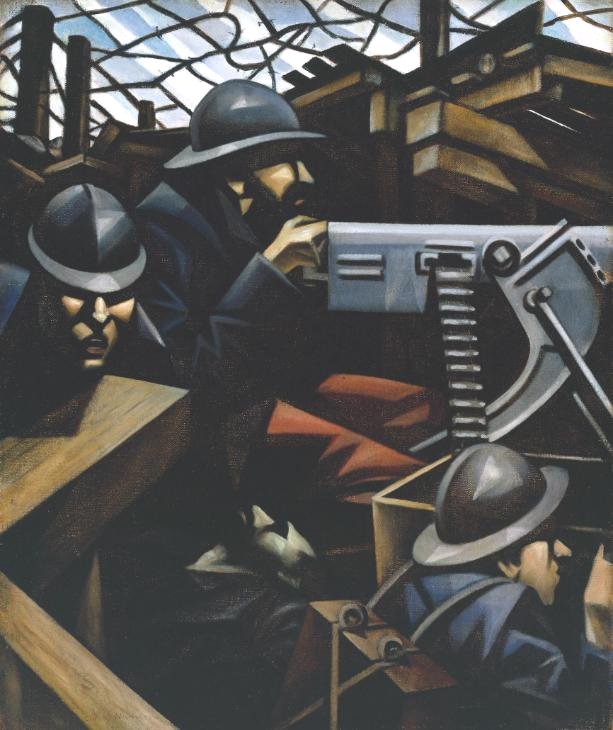
          La Mitrailleuse  by C.R.W. Nevinson (1915)
La Mitrailleuse
by C.R.W. Nevinson (1915)

One such work was entitled La Mitrailleuse (The machine gun), which he completed in 1915. The work is a depiction of a French machine-gunner and two of his comrades in a battle trench. It is amazing how Nevinson has portrayed the soldiers simply as a series of angular planes and has kept the colours to various tones of grey. There is something mechanical about the men. He has de-humanized them. The angularity of their facial expressions and the dark colouring around their eyes transforms them into fierce-looking individuals who seem to lack any trace of humanity. The machine gun, which is the title of the painting, is gripped by the gunner. The belt of bullets hangs from the machine ready to be spat out and mercilessly cut down the enemy. Of the painting Walter Sickert, the Camden Town Group painter described the painting as:

“…the most authoritative and concentrated utterance on the war in the history of painting…”
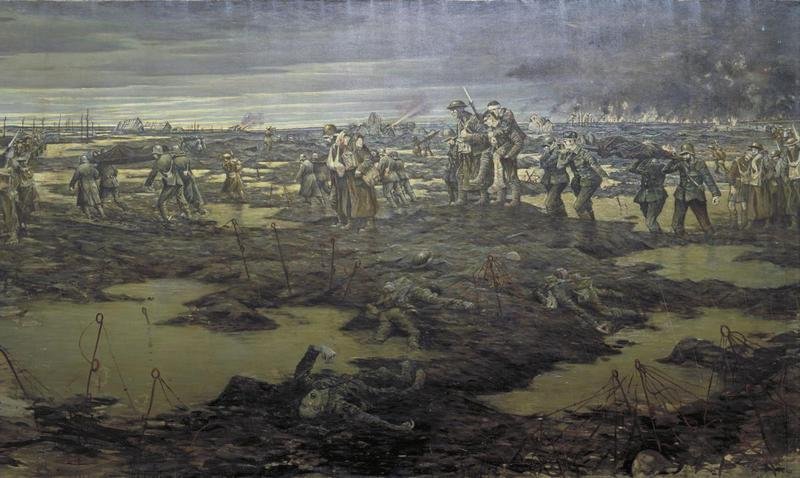
The Harvesting of the Battle by C R W Nevinson (1915)
Harvest of Battle by C R W Nevinson (1915)

The second painting I am featuring is entitled Harvest of Battle, which can be found at the Imperial War Museum, London. In this work we observe the deadly aftermath of battle. The battleground is sodden. Large pools of water formed by craters made by exploding shells abound making life that much worse, if that was possible. We see a long line of soldiers trudging from right to left across the wet ground. Many are wounded with bandaged limbs and some of the able-bodied are carrying or helping their wounded comrades to return to a place of safety at the rear of the battle lines. For many it was to be their last battle and they are now just corpses. In the central foreground we see a skeletal-like corpse lying on his back and even in death, his left arm is still raised in a claw-like fashion, a gesture of pleading for help, whether it be from his comrades or God himself, but it was to no avail.    In the right background we see flashes of artillery fire. The idea for this depiction came to Nevinson when he and another officer visited Passchendaele, close to the town of Ypres, the scene of many battles during the First World War. He wrote about his experience in his autobiography:

“…We arrived at Ypres, and while he went to the Officers’ Club I wandered on up towards the Salient and obtained notes and rough sketches for my painting, ‘Harvest of Battle…”

In a letter Nevinson wrote in 1919 to Alfred Yockney from the Ministry of Information he described what he saw:

“…A typical scene after an offensive at dawn. Walking wounded, prisoners and stretcher cases are making their way to the rear through the water- logged country of Flanders. By now the Infantry have advanced behind the creeping barrage on the right, only leaving the dead, mud, & wire; but their former positions are now occupied by the Artillery. The enemy is sending up SOS signals and once more these shattered men will be subjected to counter-battery fire. British aeroplanes are spotting hostile positions…”
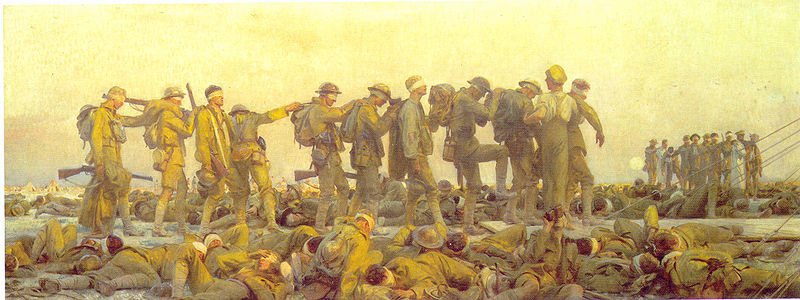
           Gassed  by John Singer Sargent             (c.1919)
Gassed
by John Singer Sargent
(c.1919)

It is a sad and moving painting and reminds me of a work by James Singer Sargent, entitled Gassed, which I featured in My Daily Art Display on July 10th 2011. That work also depicted a line of wounded soldiers, blinded by mustard gas, trudging towards their field hospital.
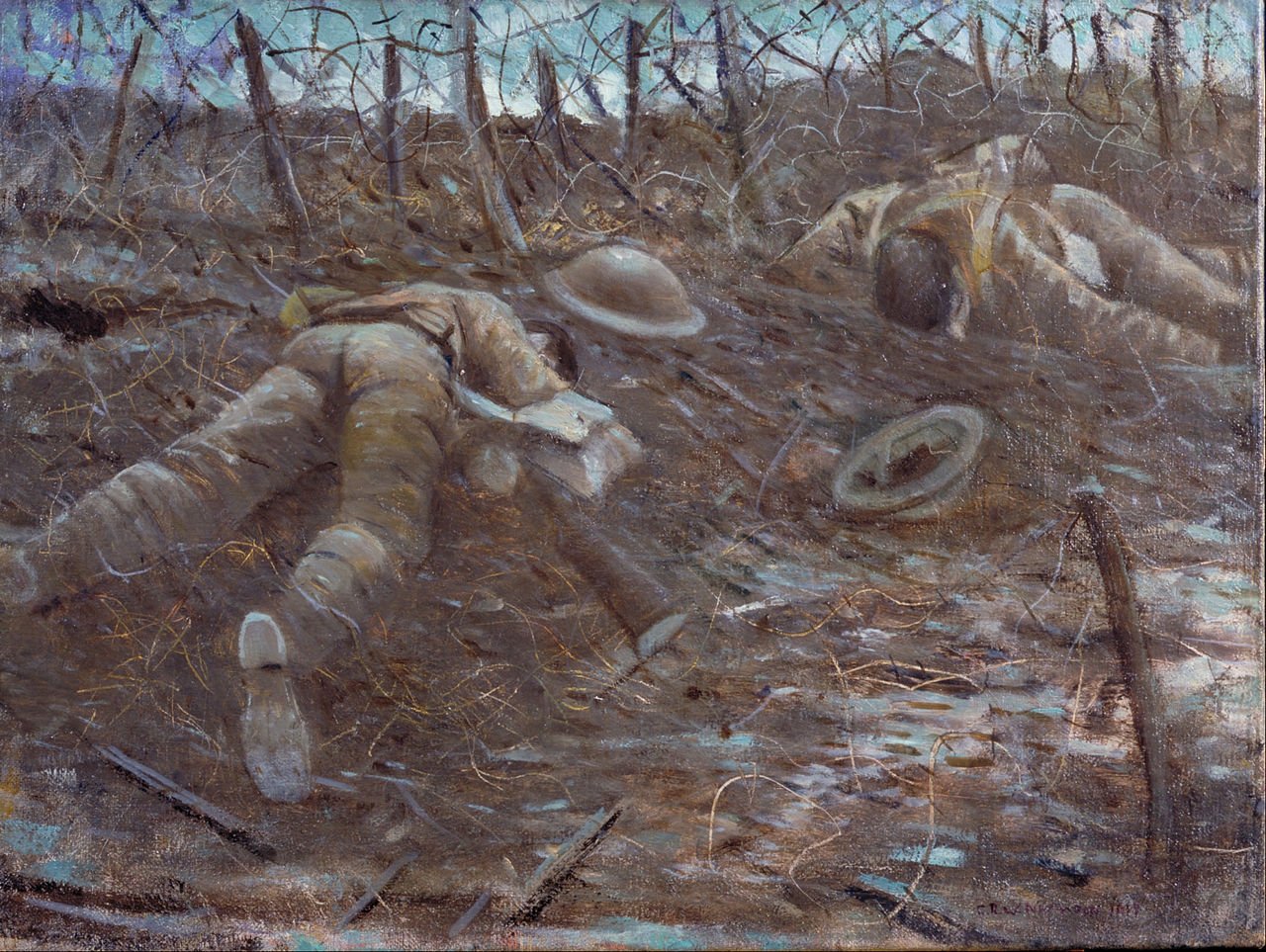
Paths of Glory  by C.R.W. Nevinson (c.1917)
Paths of Glory
by C.R.W. Nevinson (c.1917)

My final offering is another war painting by Nevinson which depicts the horrors of war. It is entitled Paths of Glory and was completed by him around 1917. In the painting we see the corpses of two dead British soldiers lying face down in the mud among barbed wire. They have been left behind and their bodies are awaiting collection, identification and then their nearest and dearest will be informed of their fate. Besides them lie their helmets and rifles now no longer any use to them. Nevinson chose the title for his work, a quote from Thomas Gray’s famous poem Elegy Written in a Country Church-Yard

The boast of heraldry, the pomp of power,
And all that beauty, all that wealth e’er gave,
Awaits alike th’ inevitable hour:-
The paths of glory lead but to the grave.

There is of course a  difference in the circumstances of death between Gray’s corpses who lay buried and at peace in a church graveyard and Nevinson’s corpses which lay abandoned on the battlefield.

Nevinson’s depiction of the two dead soldiers lying abandoned in a foreign field was just too much for the British Board of Censors, for the war was still raging in France and scenes like this would have a terrible affect on the morale of English people and so they did not want the work exhibited at the Leicester Galleries in Leicester Square, London. Nevinson rebelled and included the painting in the exhibition but placed a wide brown strip of paper across the work with word “censored” written upon it. The establishment was very unhappy by Nevinson’s apparent disregard of their dictate and he was publicly reprimanded, firstly for exhibiting a “censored” work and for the audacity of writing the word “censored” across the brown strip. As always, there is no such thing as bad publicity and the notoriety he gained from his audacious behaviour brought him to the attention of the public. The painting was bought by the Leicester Galleries.

In my next blog I will conclude Nevinson’s life story and look at some of his non-war paintings which first attracted me to him.

—————————————————————————–

Most of the information and facts  for this blog came from books which I have mentioned as well as the excellent Spartacus Educational website.
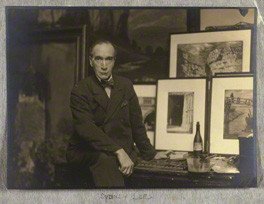
The prints and paintings of Sydney Lee

Sydney Lee by Walter Benington (c 1920)

The artist I am featuring today is the Englishman, Sydney Lee, who was much-admired for his paintings and prints of landscapes and architectural subjects.  He travelled widely in search of suitable subjects and was ever on the look-out for picturesque old buildings.  Lee was a pioneering artist and an early advocate of wood engraving as a fine art medium and a proponent of colour woodcuts as had been seen in Japanese art.   He was a resourceful and multi-talented artist and printmaker who produced numerous drypoints, aquatints, mezzotints, lithographs, wood engravings and woodcuts.

Sydney Lee was born in August 1866 in Broughton, Manchester.  He was the third of four children of William and Hannah Lee.  His father was a successful cotton manufacturer and also, for a time, a city alderman.  His father had come from a very prosperous and prominent Lancashire family who had a string of mills around Lancashire and the neighbouring counties.  Sydney had two elder siblings, an elder sister, Kate and an elder brother, Herbert as well as a younger brother, Frank. When Sydney was still very young his father moved the family into a large house in nearby Prestwich.   Although the family was steeped in a history of commerce and industry there was also something of an artistic heritage attached to the family business as they had been, going back to the eighteenth century, designers and creators of decorative textiles.

Both Sydney’s brothers, Herbert and Frank, after finishing their schooling, went into the family business.  For them, following their father’s footsteps was a natural progression.  However Sydney did not view it similarly but reluctantly acquiesced to join Herbert in the business but it proved ill-fated.   Sydney just did not have the business acumen and following a number of ill-judged decisions his father and brother decided that Sydney should take a lesser role in the company.  In a way this proved a godsend to Sydney who had also convinced his parents that his future lay in the world of art.  His father begrudgingly admitted that his son’s ambitions were serious ones and so, when Sydney was twenty-one, he allowed him to work in the company’s office in the morning and in the afternoon attend the Manchester School of Art.

The House with closed Shutters,Venice by Sydney Lee ca. 1926. Oil on canvas
The House with closed Shutters,Venice by Sydney Lee ca. 1926.
Oil on canvas

It was at the Manchester school of Art that Sydney Lee was tutored by the head of the school, the Irish-born sculptor, Richard Henry Albert Willis.  It was during these early days at the school that Sydney learnt about sculpture, relief modelling and it was also the time when he became interested in metal working and wood working as a method of printmaking.  During his tenure at the art school he received a number of awards and had some of his design work exhibited at the Royal Academy.

In 1891 Sydney’s father died.  Sydney, by then, had established himself as an artist but decided that London, not Manchester, was the place to be for his artistic career to develop and so with some financial help from his two brothers, Sydney headed for the capital, where he set up his studio.   In 1893, two years after re-locating to the capital, Sydney married.  His wife was Edith Mary Elgar, the daughter of Frederick Elgar, who ran a very successful oil cake business.  The happy couple left the shores of England and embarked on a year-long honeymoon in Italy.   At the end of their Italian stay, the couple moved to Paris where Sydney attended the Atelier Colarossi with the intention of honing is artistic skills, which included time spent at the atelier’s life classes.

      Sydney Lee a photograph (1897)
Sydney Lee
a photograph (1897)

The couple returned to England in 1895 and set up home in Holland Park Road in Kensington, a very fashionable address and one which announced that Sydney Lee was part of the artistic elite of London.  Lee was now in good company for his past and present neighbours included the painters Frederic, Lord Leighton, Thomas Sheard and Harold Speed.  One way to announce one’s arrival on the artistic scene was to exhibit some of one’s work and Sydney Lee did just that submitting many of his works to exhibitions held by various institutions.  There is an interesting photograph dating 1897 taken in St Ives of the thirty-one year old artist.  The pose is one of a self-confident and dashing young moustachioed painter, palette and brushes in hand, wearing a neckerchief and cummerbund.  Here, before us, we have the dandified artist.  It must have just been a passing phase as once settled into London life his outward appearance became that of a respectable gentleman, one befitting a future Royal Academician.

His first work was exhibited at the Royal Academy in 1900 and then from 1909 until his death forty years later, he regularly put forward works for inclusion at their Summer exhibitions.  He was a member of a number of artistic societies, such as the Royal Society of British Artists, Society of Painters, Sculptors and Gravers and was a regular exhibitor at the Goupil Gallery on London’s Regent Street.  In 1920, he became a founder member of the Society of Wood Engravers.  His work was also to be seen in exhibitions across Europe and America. Sydney Lee was elected an Associate of the Royal Academy in 1922 and eight years later, in 1930, a Royal Academician and a Senior Member in 1942.   He was an active member of the R.A. and held the post of R.A.Treasurer between 1933 and 1940.

The Bridge, Staithes by Sydney Lee. (1904)

One of the greatest influences on Sydney Lee was Japanese prints and he was to build up a large personal collection of these works.   He would often imitate methods use by the Japanese woodcut printers to produce some of his own works.  An example of this can be seen in his 1904 woodcut on mulberry paper, entitled The Bridge, Staithes.   The prints were of an old rickety wooden trestle bridge, which at the time crossed the Roxby Beck at Staithes, a one-time thriving North Yorkshire coastal fishing village.    There were one hundred prints of this work in five different colours, some depicting the moonlit scene at night whilst others were a daytime depiction.

The Sloop Inn by Sydney Lee (1904)

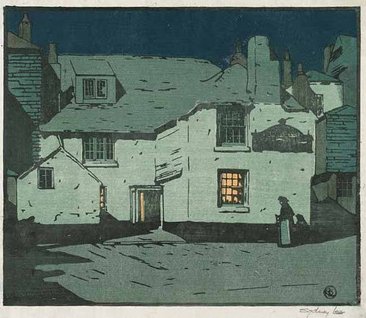
Another interesting colour woodcut was one of a pub in St Ives.  It was entitled The Sloop Inn, which Sydney Lee completed in 1904.  Sydney and his wife Edith would often visit Cornwall and in particular, St Ives where they stayed in a small terraced house for most of 1896.  Sydney found St Ives and the surrounding area was awash with interesting vistas of the harbour which could be seen from the overlooking hills and as he was always fascinated by architecture he was in his element as he studied the small and quaint cottages belonging to the local fishermen, which were dotted around the harbour and bay.   Cornwall, because of its views and favourable weather and light, lent itself to en plein air painting, and was a veritable magnet for artists.

Boatbuilding, St Ives by Sydney Lee (c.1905-10)

Sydney Lee enjoyed his time in St Ives.  Although we look upon the Cornish coastal town as a place of tourism, Lee always viewed it and other small fishing villages as working environments and not merely as places people visited on holiday.  His works featuring St Ives concentrated on this facet of life in a small coastal town or village.  Somewhere between 1905 and 1910 he completed a colour woodcut entitled Boatbuilding, St Ives in which we see two men working on the wooden skeletal hull of a boat at the Wharf in St Ives. In the left background behind the black-hulled boat is The Sloop Inn.   Sydney Lee also painted an ink and watercolour work of the scene and it became his Diploma Work when he had been elected Fellow of the Royal Watercolour Society in 1945.

The Templars’ Church, Segovia by Sydney Lee (1907)

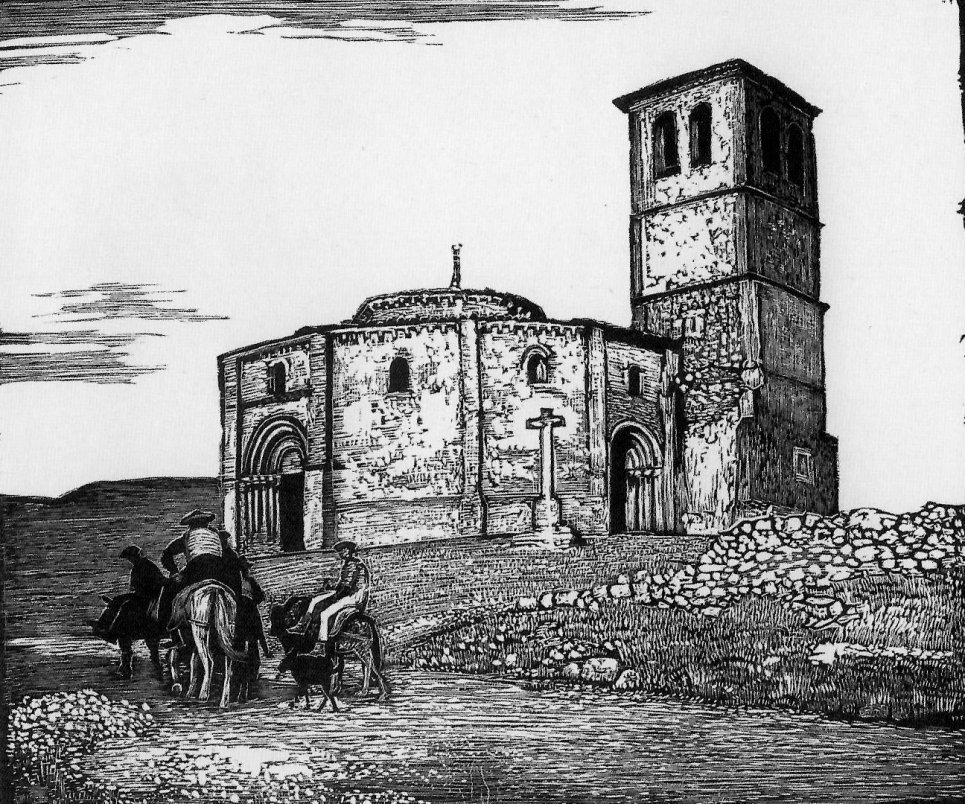
In 1907 Sydney Lee visited central Spain and based himself in Segovia where he completed a number of etchings often of buildings or structures which held an architectural interest for him.  One such work was a wood engraving entitled The Templars’ Church, Segovia, which he completed that year. The Templar Iglesia Vera Cruz (Church of the True Cross) is probably the most fascinating of several impressive Romanesque churches in Segovia.  It was consecrated in 1208, and was built by the Knights Templar to house a fragment of the True Cross. Its design was based on Jerusalem’s Church of the Holy Sepulchre.  The twelve-sided structure with its tower on the southern side has, at its centre, a two storey chamber where the Knights are thought to have kept vigil over the sliver of wood.  Although termed a “church” it has no parishioners and it is simply a shrine and actually, the relic of the True Cross no longer remains within its walls but is safely kept in the nearby village church at Zamarramala.

During the mid-1920’s Sydney Lee spent a lot of time in Italy, especially Rome.  He loved the beauty of the city and its architecture and painted many scenes of the Italian capital, with its architecture nearly always featuring in the works.  Of the city he said:

“… Here, in Rome, was a field of immense and stupendous variety, the old world and the new in every successive stage and period: ancient, medieval and modern; the home of the Caesars, the splendour of the Popes, the enormous constructions of modern Italy, evidence of the enterprise and scientific skill of that fervid and energetic nation, the whole illuminated by that wonderful Roman sun.  Seen for the first time by a native of northern climes a new world reveals itself, a different light, a splendour and liveliness of aspect…” 

Venetian Merchant by Sydney Lee (1928)

I really like his wood engraving in black on smooth Japan paper which he completed in 1928.  It is entitled A Venetian Merchant.   In the work we can see an elderly Venetian merchant, bent over with age, crossing the Ponte della Paglia and in the background is depicted the Bridge of Sighs.  Seeing the decrepit figure on the bridge causes me to recall the Shylock character of Shakespeare’s Merchant of Venice.  We see, in the right foreground, the eastern corner of the Doge’s Palace with its Gothic bas-relief sculpture depicting the drunkenness of Noah, a scene which Michelangelo had depicted on the ceiling of the Sistine Chapel over four centuries earlier.   Four years before the completion of this woodcut, in 1924, Lee had exhibited an oil painting of the same subject titled On the Palace Bridge.

The Red Tower by Sydney Lee (1928

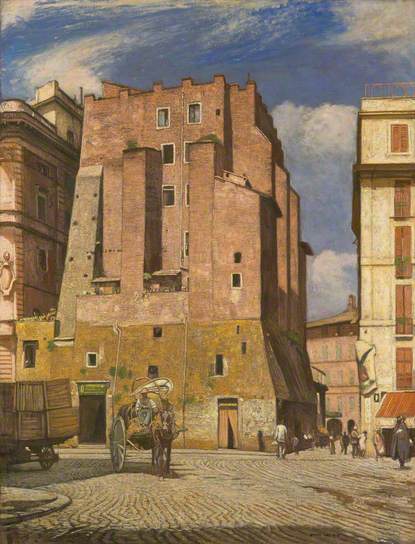
Another beautiful painting was completed by Lee in 1928 was entitled The Red Tower.  This oil on canvas work once again highlights his love of ancient structures which had managed to avoid any crass modern makeovers.  The Red Tower, in the title of the work, is the Torre dei Conte, which is a medieval fortified tower situated close to the Colosseum in Rome.  It was built in 1238 by Richard Conti who was the brother of the papal leader, Pope Innocent III.  Although it was originally over fifty meters tall, the upper floors were destroyed in a fourteenth century earthquake and it is now just less than thirty meters high.   In the foreground we see horse-drawn carts crossing the cobbled streets.  The warm colour of the buildings and the blue skies add to the feeling of it being a hot day brought on by the penetrating rays of the sun, which is out of picture but somewhere high up to the left.    This work was presented to the Royal Academy in 1930 as his Diploma Work.  Diploma Works are works of art presented by artists upon their election as Members of the Royal Academy.

In October 1937 the Colnaghi Gallery in London, who were the exclusive agent for his prints, staged a retrospective of Sydney Lee’s prints.  It was his first solo exhibition.   Colnaghi held a second solo exhibition of his work in February 1939 and a third final one in January 1945.  This was Sydney Lee’s final exhibition. Sydney Lee died in London in October 1949, aged 83.  His wife, Edith, died three years later.

I was fortunate to attend a small exhibition of Sydney Lee’s work at the Royal Academy early last year and it was then that I bought the book by Robert Meyrick entitled Sydney Lee.  Prints: A Catalogue Raisonné, from which I have got most of the information for this blog.  If you liked the few prints I have included in the blog, you will not be disappointed by this beautiful book.

Rocky Seascape with Shipwreck by Clakson Frederick Stanfield

Rocky Seascape with Shipwreck by Clarkson Frederick Stanfield

In my last blog I featured a painting of a lighthouse by Edward Hopper and talked about how these structures over the years had helped seafarers find their way around coasts and enabled them to safely navigate treacherous waters.  However sadly for some they were not enough to prevent maritime disasters and all too often ships would, because of mechanical failure, horrendous weather conditions or human error, suffer the indignity of being grounded on rocks.  I remember all too well an Atlantic port we used to sail into, which had a very tricky entrance to it and was often pounded by the ferocious ocean waves.  As a stark reminder as to the care in which the entrance had to be approached there was an abandoned wreck of a ship on the sandbank at the mouth of the river entrance,  which did not quite make it and which was being gradually eaten away by sea and wind erosion.  I often thought, as I helped to steer the ship along the curving channel with a ferocious following sea lifting the ship’s stern in all directions, what must have been going through the minds of the people on the bridge of that abandoned ship that day, as they realised they were not going to make it safely into the tranquillity and safety of the harbour.  So today I have decided to feature a painting of a shipwreck by one of the great Victorian artists, Clarkson Frederick Stanfield.  Although there is a majestic beauty about this seascape, there is also a sense of sadness as I look at the plight of the sailors.

 The artist who painted today’s featured work is Clarkson Frederick Stanfield, who was born at the end of 1793 in Sunderland, England.   He was the youngest of five children.  His parents were James Field Stanfield and Mary Hoad.   His father was born in Dublin and initially trained for the priesthood in France, but abandoned his “calling” and returned to Liverpool and became a merchant seaman.  He sailed on a ship which was engaged in the slave trade and after his experience on the slave ship, which he described as “a floating dungeon”, he quit the life at sea, came ashore and became both an actor and playwright and an energetic supporter of the campaign to abolish the slave trade.   It is documented that he was the first ordinary seaman involved in the slave trade to write about its horrors.  In 1788 he wrote vividly describing his experiences on the voyage from Liverpool to Benin in West Africa and it was published as a series of letters addressed to Stanfield’s friend and a leading anti-slavery campaigner, the Reverend Thomas Clarkson.  It was from him that young Stanfield received his Christian name.  Clarkson Stanfield’s mother, Mary, who was both an actress and artist, taught painting and must have instilled the love of drawing into her son but sadly she died when he was just seven years old.  His father remarried to Maria Kell, a year later.

 In 1806, Clarkson Stanfield worked as an apprentice to a heraldic and coach painter in Edinburgh but left that employment two years later and, at the tender age of fifteen, decided to go off to sea and joined a small coal-carrying merchant vessel.  Four years later in 1812 he was press-ganged into the Royal Navy.  For some reason, during his stint in the navy he used the alias “Roderick Bland”.  Whilst in the Navy, Stanfield managed to keep his hand in artistically by painting theatre scenery for some naval productions as well as some painting and sketches.   In December 1814 he fell from the rigging of a naval vessel he was working on and had to be discharged from the Navy as being “unfit for duty”.    The following year he returned to sea on a merchant navy ship and sailed to China.  After returning home on leave, he had every intention of carrying on with his sea-going career but for some reason it never materialised.

 It was now 1816 and he found himself without a job and needing to earn some money and so he reverted back to his artistic work and managed to get employment at London’s Royalty theatre as a scene painter.  Soon after working in the theatre he met Mary Hutchinson whom he married in 1818 and the couple went on to have two children, a son, Clarkson William and a daughter, Mary Elizabeth.  Within a month of the birth of her daughter Mary Hutchinson died.   Clarkson Stanfield married again in 1824.  This time his wife was Rebecca Adcock and they went on to have ten children, eight sons and two daughters.  His second son from this marriage, George Clarkson Stanfield, was a pupil of his father, and painted the same type of subjects.

Clarkson Stanfield continued to work in various London and Edinburgh theatres and he gained a reputation as one of the finest scene painters in the land.   The Times reviewed his work in December 1827 stating:

  “…When our memory glances back a few years and we compare in “the mind’s eye”, the dingy, filthy scenery which was exhibited here – trees, like inverted mops, of a brick-dust hue – buildings generally at war with perspective – water as opaque as the surrounding rocks, and clouds not a bit more transparent – when we compare these things with what we now see, the alteration strikes us as nearly miraculous. This is mainly owing to Mr. Stanfield. To the effective execution of the duties belonging to the scenic department, he brought every necessary qualification – a knowledge of light and shade which enabled him to give to his scenes great transparency and a ready and judicious taste for composition, whether landscape, architecture or coast, but more especially for the last…”

 Despite most of his time being taken up working in the theatres he never gave up his painting of pictures.  He first exhibited some of his seascape work in 1820, and was immediately recognised as a marine painter of great promise.   When the Society of British Artists was founded in 1823, he was one of the founder members and later in 1829 became its President.  It was also in that year that he submitted his first painting to the Royal Academy, of which he was elected Associate of the Royal Academy and a Royal Academician in 1832 and 1835 respectively.  He loved to exhibit his work and, in all, he exhibited over a hundred works at the Royal Academy, and forty-nine at the British Institution from 1844 to 1867.

 In late 1834 he resigned as scene painter for Drury Lane and from then on devoted most of his time to his own paintings.   His output included works in both oil and watercolour and he specialised in shipping, coastal and river scenes.  Sadness struck the Clarkson household in 1838 when his eldest son from his second marriage, Harry, died just short of his twelfth birthday.  It was a terrible blow to Stanfield and many believe that his turning to the Roman Catholic religion was partly down to his search for solace and inner peace after his son’s death.    He made a number of European trips taking in Holland, France and Italy and while travelling, he would build up a large and extensive collection of sketches.  During this period, he completed many paintings depicting views of Venice and Dutch river scenes.

 During the last decade of his life he was beset with poor health. His rheumatism and bad leg often prevented him from going out of his house and the pain was so intense that for long periods he was unable to work.   He died in Hampstead, London in May 1867 aged 73.  One of his last visitors to call on him the day he died was his great friend Charles Dickens who he had met thirty years earlier.  After Clarkson Stanfield died, Dickens wrote of him, paying this glowing tribute:

 “…He was the soul of frankness, generosity and simplicity.  The most genial, the most affectionate, the most loving and the most lovable of men. Success had never for an instant spoiled him . . . He had been a sailor once; and all the best characteristics that are popularly attributed to sailors, being his, and being in him refined by the influence of his Art, formed a whole not likely to be often seen…”

The depth of friendship between Dickens and Stanfield can also be seen in a passage from a letter Dickens sent to Stanfield’s son, George shortly after his father’s death.  He wrote:

“…No one of your father’s friends can ever have loved him more dearly than I always did, or can have better known the worth of his noble character…”

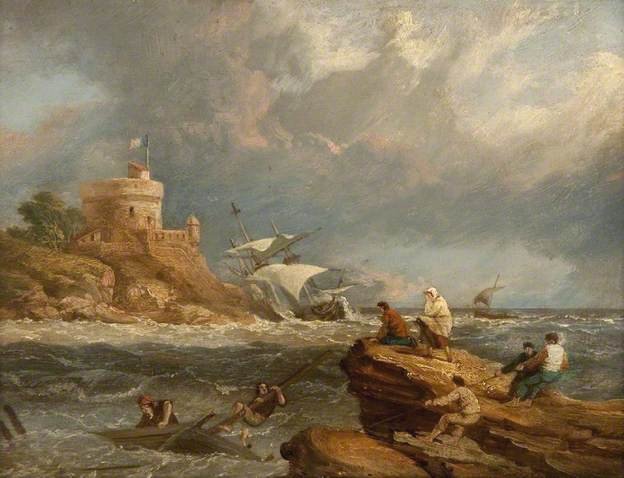
The featured painting today is entitled Rocky Seascape with Shipwreck which is held at the Glasgow Museum.   In it we see dark storm clouds above the ferocious seas which are buffeting the large stricken sailing ship which has grounded on the rocks at the foot of a steep cliff, atop of which is a fort.  This structure could have been at the mouth of the river, which lead inland to the safety of a port.   A smaller sailing boat stands off from the stricken vessel,  probably trying to assist any sailors who are adrift in the choppy seas.  In the foreground we see two sailors desperately clinging on to what looks like the remnants of a sinking boat which may have once belonged to the large grounded vessel.  One of the sailors hangs on to the mast and is struggling to keep out of the water.   Three men perched on the rocks in the foreground are trying to pull this small boat towards them to give the unfortunate sailors a chance to leap onto the rock.  A woman also stands nervously on the rock, her hands covering her eyes, not daring to view the attempted rescue.  Maybe one of the men in peril is her husband or son.  A man kneels on the rock in front of her peering down at the stricken seaman, probably shouting words of encouragement.

The sea, in many ways, is something to fear and I have spent many times on ships which have been battered unmercifully by huge seas during ferocious storms and I end this blog with a quote from Joseph Conrad’s book The Mirror of the Sea in which he wrote:

“…The sea has never been friendly to man.  At most it has been the accomplice of human restlessness…”

“Moonlights” by John Atkinson Grimshaw

Moonlight, Wharfdale by Atkinson Grimshaw (1865)

Today I am featuring some works by the English Victorian painter John Atkinson Grimshaw, who was born in Leeds in 1836.  His father, David, at various times during his life, served as a policeman, worked for Pickfords and then as a Great Northern Railway worker in Leeds.  His mother was Mary Grimshaw née Atkinson.  John Atkinson Grimshaw was the eldest of six children.  He and his siblings were brought up in a very religious household with both his parents being strict Baptists.  He left school at the age of sixteen and became a clerk at the Great Northern Railway headquarters in Leeds.  It was whilst working and living in Leeds that he was able to visit one of the many art galleries and see the works of some of the Pre-Raphaelite painters such as Holman Hunt and Henry Wallis.  He also loved and was influenced by the works of the Leeds-born Pre-Raphaelite landscape artist John William Inchbold.   While he was employed as a clerk much of Atkinson’s free time was taken up by his love of art.  He was a self-taught artist who received no formal training.

In 1857 Atkinson Grimshaw married his cousin Frances Theodosia Hubbard and the couple went on to have twelve children although sadly only six survived to be become teenagers.  Of those who survived, many went on to become artists like their father.  In 1861, much to his parents’ horror Grimshaw, gave up his work at the railway company and decided to become a professional artist.   He first exhibited som of his art work in 1862 and at this time he had concentrated on still life works depicting fruit and blossom and some paintings of birds.  He also managed to gain his first commissions from the Leeds Philosophical and Literary Society.  Over time, Grimshaw developed his own highly individual style, and subject matter.   He became a talented painter of autumnal scenes and also works which depicted twilight and night time scenes, lit by moonlight reflected on the wet cobbled streets, sometimes depicting horse-drawn traffic and handsome cabs.  These were known as his “moonlights”.  His paintings would often depict street scenes swathed in fog and smog from pollution that so often enveloped cities and towns at that time.

Shipping on the Clyde by Atkinson Grimshaw (1881)

 He also painted many nocturnal harbour and dockyard scenes with the spiky outlines of the ships’ masts rearing up against a darkening sky.  Examples of this type of work can be seen in his paintings such as Liverpool from Wapping (1875), Nightfall down the Thames (1880),  Shipping on the Clyde (1881),  The Thames by Moonlight (1884),  Liverpool Quay by Moonlight (1887) and Prince’s Dock, Hull (1887).   Grimshaw’s works were more varied than just this as he painted many portraits, fairy pictures, and the most elaborate pictures of attractively dressed young women in opulent interiors.  During his early period he signed his paintings “J.A. Grimshaw” or “JAG” but in 1867 Grimshaw dropped his first name, John, and from then on signed his works “Atkinson Grimshaw”.

Atkinson Grimshaw always considered himself to be a Northerner, a Yorkshire man and Leeds, for most of his life, remained his base.  Grimshaw rarely travelled to London although he did set up a studio and live there for a short time in the mid 1880’s, and it was during this time he became friends with James McNeil Whistler.  His reputation as an artist was further enhanced when one of his paintings was accepted for exhibition at the Royal Academy.   However the fact that over the years, he only ever submitted five of his paintings to the Royal Academy  probably meant that he set little store by what the RA could do for him and he knew he had numerous northern business men queuing up to buy his work.  Over time, he slowly built up a large clientele for his work, including some London art dealers, especially the William Agnew Gallery, and with this artistic success came wealth, so much so that in 1870 he was able to move his family into Knostrop Hall on the outskirts of the city.

Knostrop Old Hall, Leeds by Atkinson Grimshaw

Knostrop Hall was a magnificent 17th century stone-built manor house, which featured in many of his paintings.  He also had a house in Scarborough for use in the summer.  He called it Castle-by-the-sea.

Atkinson Grimshaw died of cancer in October 1893 at Knostrop Old Hall, and was buried in Woodhouse cemetery in Leeds. He was especially appreciated by middle-class clients, many of whom were northern industrialists.   Grimshaw’s dock scenes of Liverpool, Hull and Glasgow, and the manor houses seen at the end of leafy, stone-walled suburban lanes, along which a single figure walks, were especially popular.

Atkinson Grimshaw had campaigned for a number of years for the building of Leeds City Art Gallery.  After much wrangling and a prolonged struggle with the authorities the Leeds Art Gallery opened in October 1888 and was financed by public subscription, collected in honour of Queen Victoria’s Golden Jubilee in 1887. The artist Hubert Herkomer formally opened the building, and presented an example of his work to the collection.  The Gallery mounted annual spring exhibitions in which Grimshaw always put forward works for inclusion.

 Atkinson Grimshaw had a unique style and is remembered as one of the minor Victorian masters and his place in art history will be assured by his depiction of Victorian life and his haunting moonlight which became his trademark.

Having said that, there was an element of controversy about his work.  As I said at the start of his biography, Atkinson had not received any formal artistic tuition, got married at the age of twenty-one and four years later despite now being a family man, had given up his job as a railway clerk to become a professional artist.  He had now to make money from his art work and to do this had to reach a level of artistic competence which would guarantee that his work would sell.  So how did he achieve such a feat?   John Ruskin, the art critic had recommended that artists should paint directly from nature but to do this one had to have had some training in draughtsmanship and perspective and so Atkinson Grimshaw in a way decided to “cheat”.   He discovered that by projecting a photograph or a lantern slide on to a blank canvas he was able to produce an immediate composition.  Then he would go over the outlines in pencil.  Over which he would add colours and the end result was a glossy finish which had removed all traces of the pencilled outline.  The finished landscapes and cityscapes sold well and for a time made him very wealthy.  However despite his success, other artists who had studied and trained in traditional academic methods for years despised his productions and in one of Grimshaw’s obituary notices it was written:

  “…[his pictures] excited considerable controversy among contemporary artists, not a few [of whom] were doubtful whether they could be accepted as paintings at all…

To be fair to Grimshaw the technique he used would not have caused such controversy nowadays and the question remains, does the end justify the means?  So let me finish with a kinder obituary notice which simply stated:

“…A Leeds artist of very great ability has passed away.  He may be regarded as self-taught in all that gave character and distinction to his art. His methods, treatment and colouring were quite unlike anything in ordinary practice…”

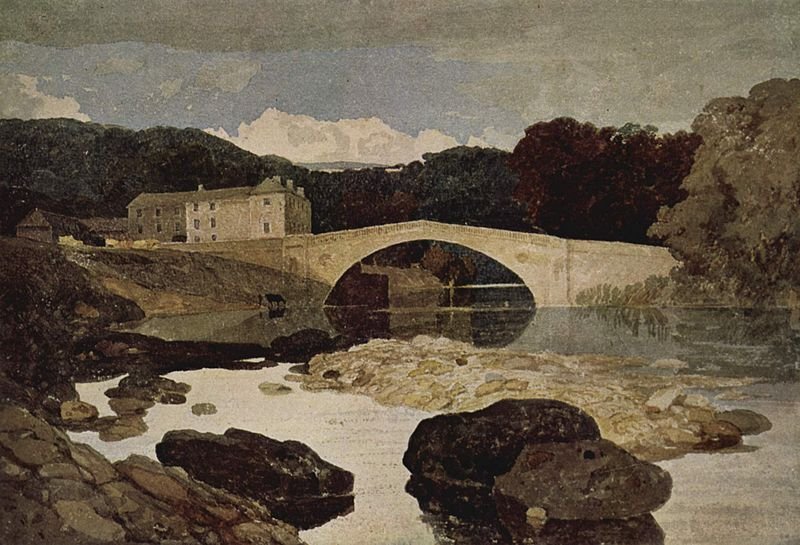
Greta Bridge by John Sell Cotman

Greta Bridge by John Sell Cotman (1805)British Museum
Greta Bridge by John Sell Cotman (1805)
British Museum

I try to visit my children, who live in London, every couple of months and take the opportunity to visit new art exhibition at one of the many city galleries.  As they are all away on extended breaks in far-off lands I will not be heading south until the end of January and this will sadly mean I will miss the Dulwich Picture Gallery exhibition, Cotman in Normandy which is an exhibition of works by the watercolourist, John Sell Cotman, which ends on January 13th.  For most of the twentieth century, Cotman was the most widely admired English watercolourist, surpassing even Turner in popularity.

John Sell Cotman was a marine and landscape painter, mainly in watercolour, who was born in Norwich in 1782.  He was the eldest of ten children.  His father, Edmund Cotman, formerly a barber but latterly a draper by trade, had married Ann Sell.   He initially studied at the Norwich School, which is one of the oldest schools in the world having been founded in 1096.   John’s father had intended that once his son had completed his education he would join him in his family business.  However during his time at school John Cotman had developed a love of art and being determined that he would not spend his working life behind a shop counter, at the age of 16, left home and went to London to study art.

Whilst in London he managed to earn a living by colouring aquatints for Anglo-German lithographer and publisher, Rudolph Ackerman, who in 1795 established a print-shop and drawing-school in The Strand.   Ackermann had set up a lithographic press and begun a trade in prints. It was whilst he was in London that he also met Doctor Thomas Monro, who was an avid art collector.   He was Principal Physician of the Bethlem Royal Hospital and one-time consulting physician to King George III.  Besides being an amateur painter and art collector he was also a patron to a number of young aspiring artists including Thomas Girtin.  He had a house in Adelphi Terrace, London where he had his studio and a country house in Merry Hill, a suburb of Bushey just fifteen miles from the capital.  Monro liked to surround himself with other artists and J.M.W. Turner was a frequent visitor.  He ran an art Academy where he would offer evening art classes, some of which were attended by John Sell Cotman.

John Sell Cotman managed to gain the patronage of Monro and through him met many of the leading British artists of the time and it was through his friendship with Turner, Girtin and Peter de Wint that Cotman continued his artistic development.  He enjoyed taking trips out to sketch and it is believed that in 1800 he accompanied Thomas Girtin on a sketching trip to North Wales. Considering Cotman had had no formal art tuition it is amazing the artistic standard he had reached for someone of such a young age for when he was aged just eighteen, he first exhibited at the Royal Academy  showing five works, four depicting scenes from the Surrey countryside and one was of Harlech Castle.   The following year, 1801, John Cotman joined the Brothers, a sketching society, founded by Thomas Girtin, for both professional artists and talented amateurs. During the next two summers he spent much of his time travelling around Wales, sketching scenes many of which were exhibited at the Royal Academy in 1801 and 1802.

For the next three summers John Cotman spent time at Brandsby Hall in North Yorkshire, which was the home of Francis Cholmeley, an avid art collector and a patron of Cotman.  During his stay at the Hall, Cotman acted as the drawing tutor to the Cholomeley family.  Whilst there he also met the politician and art collector, Walter Ramsden Hawkesworth Fawkes, whose stately home was Farnley Hall and who was a very close friend of the artist, J.M.W. Turner who often stayed at Farnley Hall.

The success he had hoped for in London never materialised and in 1806 Cotman returned to his hometown of Norwich and earned his living as an art tutor.  On returning home he also joined the Norwich Society an art society formed the previous year by the Norfolk landscape painter John Crome.  This society met fortnightly, held artistic discussions and organised exhibitions of their work.  John Cotman became the vice president and he and Crome were the leading lights of the society.  The ethos of the Society was laid down as being:

“…An Enquiry into the Rise, Progress and present state of Painting, Architecture and Sculpture, with a view to point out the Best Methods of study to attain to Greater Perfection in these Arts…”

The artistic styles of Crome and Cotman were different and the Society members were, to some extent, divided into those who followed Crome’s realist manner, and those working in the more free style of Cotman, who was not above painting pictures of places he had not personally visited, working from other artists’ sketches.  The subjects of the Norwich School painters were typically landscapes, coasts and marine scenes from around Norwich and Norfolk.  John Cotman became president of the Norwich Society of Artists in 1811.

In 1809, Cotman married Ann Mills, the daughter of a farmer from the nearby village of Felbrigg and the couple went on to have five children.  During his time as a drawing master he taught the local banker, botanist and antiquary Dawson Turner and his children.  They became close friends and Dawson Turner introduced him to many prospective students. Cotman issued the first of his sets of etchings in 1811. He moved from Norwich and for the next ten years he lived in the Norfolk coastal town of Yarmouth and this gave him the opportunity to complete a number of seascapes.   It was around this time that Cotman concentrated on printmaking.  The majority of his etchings were architectural in nature, with numerous ones of old Yorkshire and Norfolk buildings.  It is more than likely that this move towards etchings and printmaking was due to, and inspired in part by, his friend and patron, Dawson Turner.   In 1817, Cotman , with help from his patron, made the first of three tours of Normandy and out of these journeys came a book in 1822 entitled, Architectural Antiquities of Normandy, one of various books he illustrated with his etchings.

In 1824, for business reasons he moved back to Norwich.  Cotman took up painting again with renewed energy, in watercolour and in oil; he exhibited more frequently in the city and also in London. In January 1834, through the good auspices of J.M.W.Turner, he gained the post of Master of Landscape Drawing at King’s College School in London, which he held until his death.  He and his family moved home to the London borough of Bloomsbury. Two years later, his eldest son Miles Edmond Cotman was appointed to assist him.  The taking up of the position at King’s College could not have come at a more fortuitous time as Cotman was beginning to have financial problems.   Sadly, with these financial problems, which had afflicted him during most of his working life, came bouts of depression, ill health and despondency brought on by the poor sales of his work.  During John Cotman’s tenure at King’s College he taught many artists including Dante Rossetti.  His last visit to his homeland of Norfolk was in the autumn of 1841, just nine months before his death in London in July 1842.

The 20th century art historian and painter, Charles Collins Baker, said of John Sell Cotman:

“…a great colourist, whose earlier palette produced that rare plenitude that only masters of exquisite simplicity and restraint compass: from his palette the brown glebe, the black reflection of massed trees in a still river, the grey and gold of weathered stone and plaster, the glinting gold on foliage and the gilded green of translucent leaves have a special and supernal quality of dream pageants rather than of actuality…”

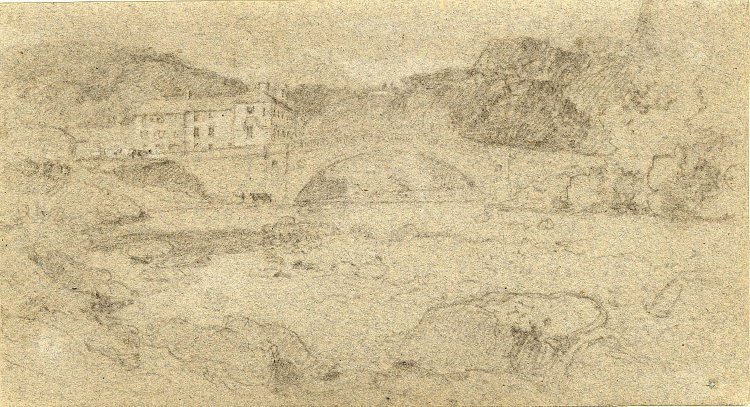
Preliminary sketch of Greta Bridge by John Sell Cotman

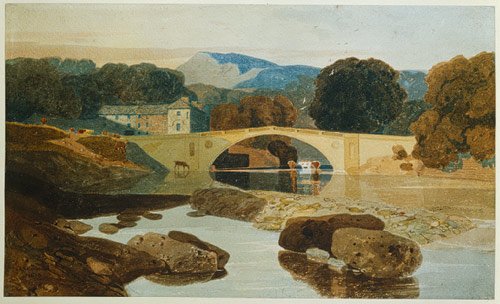
My Daily Art Display featured painting today is a watercolour entitled Greta Bridge (22cms x 33cms), which Cotman completed in 1805 can be found in the British Museum. A second version of the painting, a much larger one, (30cms x 50cms), was completed by Cotman in 1810 and is housed in the Norwich Castle Museum.  Both watercolours recreate the rural solitude and tranquillity of the Greta area of North Yorkshire, where Cotman spent the summers of 1803 – 1805.   The Greta Bridge in this painting  spanned the river Greta in North Yorkshire near the gates of Rokeby Park. John Cotman had arrived at Rokeby on the evening of 31 July 1805, accompanied by his friend and patron, Francis Cholmeley. It had been arranged in advance that the two men were to stay as guests of the owner of Rokeby Park, John Bacon Sawrey Morritt.  Cotman stayed at the house for about three weeks and when his hosts left on business, he remained nearby, taking up lodgings in a room at the local inn, which is the large building to the left of the bridge. Cotman then continued the work he had begun along the river Greta that skirts the park.  It is a wonderfully balanced composition depicting the Greta Bridge, with its striking, single arch, which runs horizontally across the picture, in some way dividing it in two and yet uniting it into a single scene.  The arch of the bridge epitomizes a great feat of engineering, which Cotman, with his love of architecture, admired. The structure we see before us was designed by John Carr of York, and built in 1773 for Morritt’s father, John Sawrey Morritt, who was a well-known collector of classical antiquities. The bridge replaced a Roman single-arched bridgeof the same design.  Cotman had a love of bridges and sketched many.  For him, a bridge was a meeting point or landmark for travellers, and would often be a point of reference on maps where rivers and roads meet. Cotman was fascinated by the interaction of this man-made feature and how it harmoniously interacted with a natural setting

Greta Bridge by John Sell Cotman (1810)Norwich Castle Museum
Greta Bridge by John Sell Cotman (1810)
Norwich Castle Museum

The foreground of the painting is dominated by its rocky intrusions. In the background, above the bridge we see in the 1805 version, a forest of trees and  large white clouds and yet in the 1810 version a mountain ridge, which, in reality, does not actually exist, has substituted the individual clouds. So why did he make this fundamental change and add the idealised rocky structure?  It is believed that Cotman decided to add the mountain ridge in the later watercolour so as to strengthen the sense of perspective and by so doing have the viewers eye drawn through the landscape, starting from the rocks in the foreground, through the arch of the bridge to the trees in the middle ground as far as the mountain ridge and the sky in the background.

Although John Sell Cotman and Turner were strongly influenced by the work of Thomas Girtin, Cotman’s landscape style in comparison to Turner’s was different.  Cotman’s landscapes were not as detailed as either Girtin’s or Turner’s.  In his landscapes, Turner’s was more precise with the details.  Many believed his “every-single-branch-and-bud” precision was somewhat overwhelming, and said that the result was that the viewer stared at the same copse for too long.   In contrast, Cotman’s landscapes could be taken in with just a single glance.  In today’s work one can see the beauty of the watercolour despite the lack of minute detail.  In these watercolours, Cotman strived to capture the feeling and atmosphere of a place through the use of pattern and abstract shapes. Look how he has painted the boulders, which we see in the river.  They are smooth, rounded shapes sprinkled with spots of colour.  Cotman’s technique of using colour washes has accentuated the smooth roundness of the landscape.  His trees are rounded and block-like, in varying shades of green and brown and in the 1810 version the mountain ridge in the background is softly shaped.

This watercolour is a prime example of his balanced and sensitive technique which he used in his landscape work.   In this work he has used very muted colours for his high cloudy sky, which echo the colour of the river surface.  Below the dark clouds we see a suggestion of better weather to come with a hint of blue sky and thick white clouds.  The watercolour is built up in distinct patches of restrained colour, held in a precise pattern of tone and line, which were the hallmarks of Cotman’s inimitable style. The presence of the sun and the large trees around the flowing river causes crisp shadows on the building, bridge and water surface.

I love this watercolour and would love to visit Norwich were a number of his works are housed.  It would also be good to visit the Greta River area and take in the landscape, which inspired this talented artist.

The Outcast by Brian Hatton

The Outcast by Brian Hatton (1913)

Today I am concluding my look at the life of the Hereford artist Brian Hatton and featuring a couple more of his paintings.

In 1905 Brian Hatton was accepted into Trinity College Oxford where he remained for a year.  Hatton enjoyed travelling and in 1906 along with his uncle Charles Marr, he went to Holland where they visited Amsterdam and The Hague.  On returning from his trip abroad, Hatton went to Scotland where he enrolled at the Hospitalfields Art School in Arbroath and studied painting under George Harcourt, the Scottish portrait and figure painter.  This establishment is believed to be Scotland’s first school of fine art and the first art college in Britain.  It was founded by Patrick Allan-Fraser, a patron of the arts.   Allan-Fraser, who was the son of an Arbroath weaving merchant, had studied art in Edinburgh and was once president of the British Academy of Art in Rome.  He acquired the Hospitalfields estate through marriage and set about the remodelling of the buildings, converting the eighteenth-century barn into a gallery.  Allan-Fraser died in 1890 and having no heirs, bequeathed the building to the State for the promotion of Education in the Arts.   It was later renamed the Patrick Allan-Fraser School of Art.

In 1908 Hatton returned to England and went to live in Camden Place, London, where he and his cousin Geoffrey Vevers shared lodgings.  Whilst in London he attended an art school in South Kensington and spent time at the National Gallery copying paintings.  During 1908 Hatton was invited to join an archaeological expedition to Egypt, led by the English Egyptologist, Professor William Flinders Petrie and his wife.

Mother, July 27th 1909 by Brian Hatton

Brian and his party arrived back in England in May 1909.  Whilst he had been away his mother’s health had declined and she had been away from home staying with relations in Scotland.   In the July her doctors prescribed a rest cure and she went into a Shropshire nursing home in Church Stretton and for a time her health seemed to improve.  Sadly Brian’s mother’s health took a sudden turn for the worse and on July 27th 1909 she died.  This was a terrible blow to the Hatton family, especially to Brian.  His mother had, at an early age, recognised his artistic potential and nurtured it with great care.  There are numerous letters in the archives which show how his mother had been his closest confidant and friend.  His final tribute to his mother was a sketch he made of her as she lay at peace in her room, entitled Mother, July 27th 1909.

Following his mother’s death, and for the next twelve months, Brian immersed himself in his artistic work and carried out a number of portraiture commissions.  Eventually he craved a break from this type of work and decided to realise a dream he had been nurturing and planning for some time – a visit to Paris.  In November 1910 he decided to fulfil this dream and set off for the French capital, visiting the Louvre and working at the Parisian art school, Académie Julian.

At Académie Julian, Paris by Brian Hatton (1910-12)

It was whilst at this artistic school that he started the painting (above) entitled At the Académie Julian, Paris, which he completed back in England, two years later, in 1912.

After his brief sojourn in Paris, Brian returned to England and to his family home in Herford in time for Christmas. It was 1911 and the year that the new king, George V, was crowned king of England.  Brian made frequent trips to London and realised that to prosper artistically he needed to establish a studio in the capital and seek out a well-connected patron.  His dilemma was simple – to gain a wealthy London patron he needed to have a studio in the city but to be able to afford a London studio, he needed a wealthy patron !   In a letter to him from the English artist Briton Riviere,  who had been following Hatton’s progress from when he was a youngster, Riviere warned Hatton about the perils of London:

“…I feel that a move to London is almost inevitable for you as time went on and I hope that now you are strong enough in your own convictions and beliefs, to escape being drawn into any artistic extravagances and fashions of the day, which have been so much to the fore in these times…”

Despite the warning, Hatton left Hereford and with his Oxford University friend and fellow artist, Gerald Siordet set themselves up in The Bronze Door studio in South Kensington in January 1912.  Hatton received many commissions and soon he was so busy he found it difficult to spare time to return to Hereford and visit his father and siblings.  In 1913 he received a royal commission from Windsor Castle to make drawings of Princess Alice’s children, Prince Rupert and Princess May.   Princess Alice was the longest surviving grandchild of Queen Victoria.  The success of this commission led to many more from the “landed gentry”.

In 1913 he was approached by a member of the Royal Institute of Oil Painters to see if he would like his name to be put forward in the November annual election to become a member of the Society.  This was a great honour and to further his cause he submitted some of his best paintings to their summer exhibition, one of which was entitled The Outcast, which is My Daily Art Display’s featured painting today.  For this work he had employed a model, Beatrice Stewart, who despite her haunting beauty was lame.  In this work Hatton has depicted her with strong features and a somewhat curious expression.  It is an expression of resignation to her fate combined with a rebellious air and yet there is also a somewhat poignant sadness in her expression.  The work received a “highly commended” award at the exhibition.

In 1914 commissions for his work had virtually dried up and Brian was facing financial problems.  The newspapers at the time were full of stories of an impending war with Germany and on July 28th, just a fortnight before his twenty-seventh birthday, war was declared.  Brian left London and returned home and in September enlisted as a trooper with the 1/1 Worcestershire Yeomanry cavalry regiment.  In October the troop was getting ready to ship out to France.   On November 5th his father received a letter from him with some surprising news:

Nov 5th 1914

My Dear Old Dad,

I have just got married to Biddy today by soldier’s licence.  I only decided to go through with it last night and got Biddy down to talk it over with her.  I suppose on the whole it is a very rash thing to have done…..”

He ended the letter rather sheepishly:

“…I hope when you have got over this little shock that you will give us your blessing.   We shall need all that we can get!   Yes, I know that I’m a silly young fool and all that.  But I am still your

loving son

Brian

Brian’s wife, Lydia Bidmead (Biddy), gave birth to their daughter, Mary Amelia,  on September 21st 1915, the same day as his father’s birthday.  Brian went home to Hereford to see his wife and daughter.  A month later he went to Devenport to embark the troop ship, Scotia, bound for Mudros on the Greek island of Lemnos, which had been a British base used for fighting in Gallipoli.     In his last letter to his grandmother he ended with a wistful remark, fully mindful of the dangers which lay ahead.  He wrote:

“…I shall be thankful to return with a sound right hand and eyesight…”

He and his regiment left Mudros and sailed for Egypt in December 1915.  Brian was now back in the country he had visited seven years earlier when he was part of the Flinders Petrie Archaeological Expedition.  On arrival he was trained as a signaller but found learning semaphore and the Morse code very difficult.  Mail to and from home was spasmodic and often letters went astray which he found very frustrating.  He had witnessed some military action but the imminent danger he and his colleagues were in seemed to have not fully hit home and there was even an element of enjoyment about the conflict.  In a postscript to his last letter home in April 1916 he commented:

“…To me, at the time, it all seems ridiculous – like a comic opera.  The men were all smoking and joking and nobody seemed in the least danger.  One only has to take reasonable precautions and lie down behind a few inches of sand hill to be quite safe from any bullet…”

On April 21st 1916 a party of combat engineers was sent to sink wells at Oghratina in the Sinai Desert and to protect them a detachment of Worcester Yeomanry from their base in Katia, of which Brian Hatton was one, was sent to protect them.  On Easter Sunday, April 23rd they came under heavy attack from a Turkish infantry regiment.  The British commanding officers asked for volunteers to ride back to their main garrison at Katia to fetch help.  Brian Hatton was one of the volunteers.  He rode off but was never seen again.   Months later his body was found.  The corpse was identified as that of Brian Hatton as in his wallet was a tiny photograph of Biddy and a postcard addressed to his wife.

I will bring this blog about Brian Hatton to a close with the words of Walter Shaw Sparrow, a British writer on art who wrote a book in 1926 entitled, Brian Hatton – a young painter of genius killed in the War and in it he talked about Hatton’s artistic ability:

“…Brian had the rarest of all things – true genius…”

He went on to describe Brian’s early years as:

“… a boy endowed with gifts of spirit so extraordinary that the first period of work from the age of ten, 1897, to that of nineteen, 1906, was a period not of rare promise only but also of wonderful achievement, showing not only maturity of Design, but maturity of Poetic Feeling, and a charm brimming with country life and English humour…”

The museum and art gallery in Hereford has a small permanent exhibition of Brian Hatton’s art work and I believe the drawings and paintings are often changed.  It is somewhat sad and disappointing that the display is so small and that there was no literature on hand about him considering he was the town’s famous son.   For a full and excellent account of his life through his letters you may like to get hold of Brian Hatton’s 1978 biography by Celia Davies entitled Brian Hatton – A biography of the artist (1887-1916).  I found the book of great help when I was piecing together Brian Hatton’s life.

Brian Hatton – Family portraits

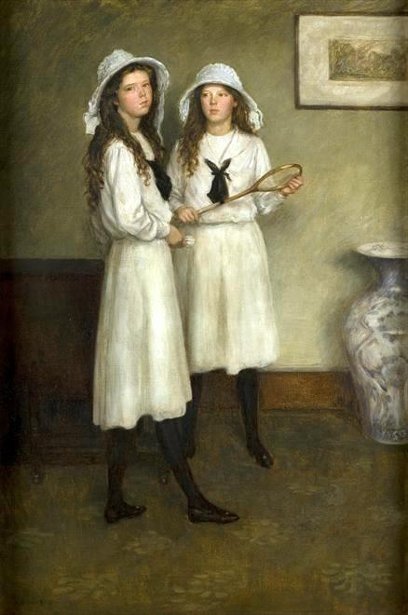
Ailsa & Marjorie Hatton, with a Racquet
by Brian Hatton (1908)

Today I am going to start to look at the life of a young artist, born at the end of the nineteenth century who, like Frédéric Bazille, the featured artist in my last blog, had promised so much but whose life was cut short fighting for his country.

Brian Hatton, the son of Alfred and Amelia Hatton, was born in Whitecross, a suburb of Hereford, in August 1887.   His father, a keen sportsman, was involved in the leather business and was engaged in tanning and in the making of leather gloves.   Brian was the eldest of three children.  He had two sisters, Alisa Marr Hatton who was born in 1893 and Marjorie who was born in 1895, the same year that the family moved from Whitecross to Broomy Hill, another suburb of Hereford.   His siblings would feature in many of his paintings and it is these family portraits which I feature in My Daily Art Display blog today.    As a young child Brian showed a remarkable talent for drawing.   His parents, who were very proud of his artistic ability constantly encouraged and nurtured his talent. When Brian was just eight years old, he was awarded a Bronze medal for his exhibit at the Royal Drawing Society, an association founded in 1888, which promoted the teaching of drawing in schools.

Girl Seated In A Red Beret (Marjorie Hatton, The Artist’s Younger Sister)
by Brian Hatton

At the age of ten, Brian developed asthma and he was sent to Swansea where it was hoped that the sea air would help him recuperate.  During this time he lived with Doctor and Mrs Lancaster.  Whilst there, he used to spend a lot of time pony riding, visiting the beach and pier where he did much sketching.  Swansea, at the time was buzzing with activity, as it was preparing for Queen Victoria’s Diamond Jubilee celebrations.   During 1898 he began lessons at the Swansea School of Art and was awarded the ‘Gold Star’ of the Royal Drawing Society. Following this award from the Society, the artist George Frederic Watts became a great admirer of Brian’s talent and began to take a keen interest in his development.

Alisa Marr Hatton (The Artist’s Older Sister)
by Brian Hatton

Brian Hatton continued to paint and entered his work in many exhibitions and continued winning medals.  In 1903, when he was sixteen years of age, he went down to Cornwall and spent some time in the Carbis Bay area, which was home to many English artists, such as Norman Garstin and Stanhope Forbes.  It offered Hatton a chance to study their work and let them see his portfolio.  Although they congratulated him on his portrayal of the sea and his other favourite subject, horses, they felt that he needed to better his landscape work.

Lydia May Hatton (The artist’s wife)
by Brian Hatton

My final offering today (above)  is an elegant pencil and wash drawing, which Brian Hatton completed in 1911.  It is a portrait of Lydia May Bidmead, who later became Mrs Brian Hatton.   Lydia May, known to her friends as Biddy, was a dancer, talented teacher and performer.   This pencil drawing brings out the sophisticated grace of his wife-to-be with its fine pencil lines and rosy watercolour capturing her elegant beauty. Lydia May Bidmead was married to Brian Hatton by soldier’s licence on 5th November 1914. Their daughter Mary was born the following year.

In my next blog I will conclude the life story of Brian Hatton and look at two of his works which I saw when I visited the Hereford Museum and Art Gallery last weekend.

A Suffolk Farm by Edward Seago

A Suffolk Farm by Edward Seago

Last Sunday,  I went down to London to visit two of my children and my one and only grandchild and on the following afternoon I had scheduled a visit to the Royal Academy Summer Exhibition.  I had some spare time on Monday morning and had intended to visit a couple of galleries or museums but my best laid plans were thwarted because of an item of shopping I was looking for which proved elusive and the atrocious weather which put a damper on any thoughts I had of a pleasant stroll between artistic collections.  I had seen an advert for an exhibition, Samuel Palmer, His Friends and His Followers at The Fine Art Society which is situated in New Bond Street so I eventually ended up there like a drowned rat as my umbrella proved totally inadequate to counter the torrential rain.   I will look at one of the paintings from that exhibition in a later blog.  I left there and still had an hour to kill before I was due to attend the Royal Academy and as I had no intention of any further long walks in the downpour I ended up at the Richard Green Gallery just a few doors down from The Fine Art Society.  The gallery was in the process of hanging an Edward Seago exhibition but allowed me to take a look at what was already in place.  What a wonderful collection of art.

Edward Brian Seago was born in Norwich in 1910, the second son of Brian, a local coal merchant and Mabel Seago.   As a child he suffered quite a lot with ill health caused by a heart complaint, paroxysmal tachycardia, with which he was first diagnosed when he was eight years of age.   This illness meant that on a number of occasions he was reluctantly confined to his bed. As a result of this enforced confinement, he spent a lot of time painting skies and the surrounding landscape from his bedroom window.  Seago later remembered those times with a surprising fondness and called his enforced leisure, “spells of sheer delight”.  It was during these periods of imposed convalescence that the young Edward Seago realised his great enthusiasm and aptitude for painting.

His continued illness precluded him from any formal artistic training and, for the most, he taught himself.  He did however receive some artistic advice from the local East Anglian painters who were both impressed with his work.  They were Sir Alfred Munnings, who lived in Dedham close to the Essex/Sussex border and the landscape painter, Bertram Priestman, who remained a friend for the rest of Seago’s life.  Another of Edward Seago’s friends was the poet John Masefield with whom Seago collaborated on a number of publications.  Masefield would provide the poems whilst Seago provided the illustrations.  Two of the most successful collaborations were The Country Scene which was published in 1937 and Tribute to Ballet which was published the following year.  It was also Masefield that instilled in Seago the love and appreciation of English country life.

Seago’s landscape works were influenced by the landscape paintings of the Dutch Masters as there was a certain similarity between the landscape of The Netherlands and that of the East Anglian countryside.  Seago also was a great admirer of the landscape works of the English painter, John Constable and by the painters of the Norwich School founded by John Chrome in 1803.  However notwithstanding all these outside influences, his biographer James Reid, wrote:

“…While Seago’s subject matter evolved within a fundamentally traditional genre, his methodology, style and technique contributed to an innovative interpretation of the rural, urban and marine scene…

During the 1930’s Seago led a very varied existence.  He loved the freedom associated with a bohemian lifestyle and would often travel and work with circus folk, gypsies and ballet dancers but at the same time he kept in contact with the more refined aristocratic circles which provided him with generous patronage.  One such patron and friend was the politician and industrialist, Henry Mond, 2nd Lord Melchett, who was also an art connoisseur and collector.  Seago and Henry Mond travelled together to Venice in 1933.   Seago was astounded by the beauty of Venice which he later captured in many of his oil paintings.  He also had the opportunity to view the art works of the great Italian masters which were on show in the city.

Another of Seago’s close friends was Princess Mary, the Countess of Harewood, who was King George VI’s sister, and it was through this acquaintance that he was later to meet the present Royal Family who collected many of his paintings.  George VI also commissioned a portrait, and that royal patronage made Seago and his art,  very fashionable.    The Queen Mother bought so many of his works of art that eventually the artist gave her two a year – on her birthday and at Christmas.   Later, in 1956, he accompanied Prince Philip, the Duke of Edinburgh on the Royal Yacht Britannia, on a world tour and during one part of the voyage the ship sailed around the Antarctic.  Prince Philip and Edward Seago used to paint alongside each other on the deck of the Royal Yacht Britannia and the two developed a very close friendship.  Edward Seago’s paintings depicting the Antarctic were quite beautiful and were loved by art critics and the public alike.

He became a war artist in Italy during the Second World War and spent two years with General Alexander.  After the Second World War Edward Seago concentrated his art work on the East Anglian countryside with its cloud-filled skies, cattle grazing in the expansive flat fields as well as paintings which focused on the waters and the mudflats of The Broads and some of the barges which plied their trade along these inland waterways.  His beautiful landscape paintings would often incorporate man-made structures such as windmills, churches and farmhouses.  Seago loved East Anglia and its countryside and once wrote:

“…Perhaps one has to be born and bred there for it to really get into one’s blood.   But it has a powerful hold on me, and whenever I go, I feel a longing to return there…”

In 1968 Seago bought Ca Conca, a villa apartment in the elegant yachting resort of Porto Cervo on the Costa Smeralda, Sardinia. The terrace of his property offered fine views of the harbour to the right.   His life was suddenly cut short whilst on a painting tour of Sardinia when he was diagnosed as having a brain tumour, from which he died in London in January 1974 just before his sixty-fourth birthday.  In terms of commissions, he was the most successful artist of his day.

The painting I have featured today by Edward Seago is entitled A Suffolk Farm and epitomises the beauty of his landscape paintings and his love for the Suffolk countryside.  I urge you to visit the Richard Green Gallery (147 New Bond Street, London W1 2TS) which in honour of Her Majesty the Queen’s Diamond Jubilee, is presenting an exhibition of 41 paintings by Edward Seago.  The exhibition opened on June 13th and ends on Saturday, July 7th.   The gallery is open Monday to Friday from 10am to 6pm and on Saturday from 10am to 1pm.  I can assure you that you will not be disappointed and if you have a few pounds to spare then you will be pleased to know that all the works are up for sale.

John Keats by Joseph Severn

John Keats by Joseph Severn (1821)

My Daily Art Display today centres around one of the greatest English poets, John Keats, and one of his most devoted friend, the English portrait artist Joseph Severn.

Joseph Severn was born in Hoxton near London in 1793.  He was one of seven children and the eldest son of a prosperous middle-class family.  His father was a music teacher and Severn besides being artistically talented was an accomplished pianist.   In 1807 his father arranged for him to be apprenticed to a London engraver, William Bond, a master of the stipple engraving technique.  When Severn was twenty-two years of age he enrolled at the Royal Academy Schools in London and four years later his first works were exhibited at the Royal Academy Exhibition.  That same year he was awarded the gold medal for his painting, Una and the Red Cross Knight in the Cave of Despair, the inspiration for this work being the epic poem by Sir Thomas Spenser entitled the Faerie Queen.  This prestigious award was even more special as the Royal Academy hadn’t awarded the medal for eight years.

It is thought that Severn first met the writer and poet John Keats around 1814 when he became part of the artistic circles of London.  He was not one of Keats’ closest friends but was one of Keats’ circle of literati and artists.  In 1817, John Keats and his brother George had to take time to nurse their brother Tom, who was suffering from tuberculosis.    In June 1818, Keats began a walking tour of Scotland, Ireland and the Lake District with his friend Charles Armitage Brown and his brother George and his sister-in-law Georgina before the latter pair set sail from Liverpool for a new life in America.  When Keats returned from his trip he continued to nurse his brother Tom and in doing so, exposed himself to the disease and it is thought by many that it was at this time that the disease took hold of John Keats.   His brother, Tom died in December 1818.

Tuberculosis took hold of Keats and he was counselled by his physicians to move to a warmer climate for the winter months.   Keats agreed to such a change of venue and a suitable travelling companion for him was sought.   Most of his close friends could not or would not go with him for various reasons and despite not being one of Keats’ “best friend” it was Severn who offered to accompany Keats to Italy for what was hoped to be an aid to the poet’s recovery.  Severn had always wanted to visit Italy and this proposed trip with Keats was his ideal opportunity. Severn was keen to study the great Italian Masters and be enthused by the beautiful landscapes of Italy. As he had just been awarded the gold medal by the Royal Academy he was eligible to apply for a travelling fellowship which gave him three years of artistic freedom funded by the Royal Academy. In order to receive this grant, Severn needed to paint an original in oil and have it shipped back to London. Once the painting was approved by a panel of judges, he would receive the precious fellowship and since Rome was the art capital of Europe, it made sense to Severn to travel there. His decision to leave England with Keats was not universally popular.  When he told his father of his plans, his father was horrified telling his son that he was risking his career and health by travelling with the ailing Keats and ordered him to remain in England. In Grant Scott’s book Letters and Memoirs, he recounts part of Severn’s late memoir in which he talks about this harrowing meeting with his father:

“…in his insane rage he struck me a blow which fell me to the ground…”

Severn was never to see his father again. However, Severn would not be deterred, packed his bags and embarked on what he believed was a voyage of convalescence, for his companion as Keats’s doctors had assured him that a stay in Rome would cure his condition.   It is extremely doubtful whether Keats believed the optimistic views of his doctors but it never crossed Severn’s mind that his companion would not fully recover once living in the favourable climate of the Italian capital.

In September 1820 Keats and Severn set sail for Naples on the vessel, Maria Crowther.  Although at the start of the voyage Keats’ illness seemed to be far from serious in the eyes of Severn, weeks into the voyage Keats became feverish and began to cough up blood and these physical signs of Keats’ illness affected Severn mentally.  In one of his letters he wrote of his time during the voyage with Keats:

“…He was often so distraught, with moreover so sad a look in his eyes, sometimes a starved, haunting expression that it bewildered me…”

The voyage itself had its problems.  The weather was constantly changing.  Stormy weather battered the ship one day and then the weather would completely change and the vessel would be becalmed lengthening the duration of the sea passage.  They finally arrived at the Italian port but then had to endure ten days in quarantine as news had travelled to Italy of a suspected outbreak of cholera in Britain.    Eventually the two men left Naples and travelled by carriage to Rome.  The pair eventually set up home in a villa on the Spanish Steps which is now the Keats-Shelly Memorial House Museum.  Keats’ health detonated and despite the ministrations of the medics he died on 23 February 1821 and was buried in the Protestant Cemetery in Rome and so, to carry out the last wishes of Keats, he was placed under an unnamed tombstone.  Joseph Severn and Keats’ close friend Charles Armitage Brown had the stone erected, which under a relief of a lyre with broken strings, was the epitaph:

“This Grave

contains all that was Mortal

of a

Young English Poet

Who

on his Death Bed, in the Bitterness of his Heart

at the Malicious Power of his Enemies

Desired

these Words to be

engraven on his Tomb Stone:

Here lies One

Whose Name was writ in Water. 24 February 1821″

My Daily Art Display featured painting today is simply entitled John Keats and was completed by Joseph Severn in 1821.  Severn had painted a number of portraits of Keats but this was one which he painted after the death of his friend and whilst he was still in Rome.  Severn wrote about this painting saying that it was painted to evoke a last graceful memory of his friend around the time when Keats first began to feel ill.  It had been on a morning visit to Keats’ house in Hampstead and Severn said that the position of the two chairs was exactly how he remembered the scene.  All the individual items such as the carpet, chairs, open window and even the engraving of Shakespeare hanging on the wall in the background were faithfully recorded in Severn’s work.  Look how Severn has depicted the room with all its atmospheric shadows.  It is a wonderful portrayal of the young poet reading his book and in the background we see a heavily gathered curtain pulled aside allowing us a glimpse of Keats’ Hampstead garden.  Severn said that his visit coincided with the time Keats had just written his famous Ode to the Nightingale and Severn later said that he was struck with the first real symptoms of the sadness Keats had so finely expressed in that poem.

This portrait of Keats is, beyond doubt, a Romantic portrait of one of the unsurpassed Romantic poets.

A Primitive City by Edward Calvert

A Primitive City by Edward Calvert (1822)

When I wander around various galleries, I am often lost in wonderment  when I stand in front of a massive painting.  I can remember when I was in Venice last year and visited the Accademia Galleries and stood before the giant work of Paolo Veronese entitled Feast in the House of Levi.     I was amazed at the magnitude of the work which measured  5.6 metres x 13metres and I could only wonder at how he managed to physically paint such a large scale picture.  How long must it have taken him?  Maybe he had some of his apprentices to help him but still it was an outstanding undertaking.  I find equally impressive miniature paintings and I am always filled with a sense of amazement at how these delicate paintings have been achieved.  My Daily Art Display featured painting today is one such miniature and I want you to feast your eyes on this lovely work of art entitled A Primitive City painted by the English artist Edward Calvert.

Edward Calvert was born in Appledore in the county of Devon in 1799.  His early schooling and art education was at Plymouth but coming from a seafaring area the young Calvert joined the Navy and spent five years serving his country.  A death of a close friend in naval action resulted in him leaving the force and coming ashore.  In 1824 he moved to London and it was here he, at the age of twenty-five, enrolled at the Royal Academy, where one of the professors was the artist, Henri Fuseli.  It was whilst in London that he met the ageing English painter, William Blake.  Blake and his paintings were one of his first great artistic influences and one that would remain with him for the rest of his life.  Blake’s art work inspired a number of aspiring artists and Calvert and some like-minded Romantic artists, who had fallen under the spell of Blake and his work formed an association known as The Brotherhood of the Ancients often simply known as The Ancients.  The leader of the group was Samuel Palmer but one of the most of the most important members of the group was today’s featured artist, Edward Calvert.  Others in the group were George Richmond and John Linnell.  This group of painters, who  all had a love of the spiritual art of the past, would often meet at the home of Blake, which they used to refer reverentially to as the House of the Interpreter.  They would also congregate at Palmer’s house in Shoreham, Kent to discuss Blake’s visionary ideology and to paint pastoral images with a mystical perspective.  They brought a new dimension to Romantic Art.  They brought a wondrous vision of a golden age set in quiet landscapes amidst a pastoral innocence and abundance.

Edward Calvert who was a man of private means left the Academy and concentrated on another love of his, wood-engraving.  He lived with his wife in Dalston in the London borough of Hackney for most of his life.  Calvert’s love of pastoral depictions disappeared gradually but his interest in ancient Greece increased. He visited Greece where he sketched prolifically.  Eventually, he gave up his printmaking and for the rest of his life his art was just for himself and for his own pleasure.  He would work in oil, watercolour and gouache and for his subjects he liked to focus on pagan mythology.  Latterly, Calvert became a recluse and died in 1883, aged 84.

My featured painting today is a tiny watercolour miniature, measuring just 7 cms x 10 cms (not quite 3 inches x 4 inches), entitled A Primitive City, which Edward Calvert painted in 1822.   The quality of this work of art is amazing with its clarity of line and jewel-like colouring and the amount of detail that is shown in such a small space.  It is an evening scene and in the background on the right, we see the waning moon as it hovers behind a distant walled city.  In the right mid-ground we see a peasant leading a donkey which staggers slowly heavily laden with two large baskets of grapes on its back.  Behind the donkey there is another cart, crossing a rickety wooden bridge, being pulled by a bullock, which is loaded with sacks of grain and driven by a woman.  The grapes and grain symbolise the Eucharistic wine and bread.  The pastoral theme is emphasized  by the shepherd and his flock which  we see depicted in the left mid-ground of the work.  If we carefully look at the city itself we see a woman drawing water from a well and above her we see another woman watching her from her viewpoint on the staircase between the two towers.

There is an innocence to the scene and this is accentuated by the beautiful, almost naked, young girl we see to the left of the picture who is about to take a swim in the nearby stream, which runs across  the foreground of the painting.  We can see Calvert’s love and interest in Classical art in the way he  has depicted the woman, as the stance of the scantily-clad young lady is almost certainly derived from the Venus Kallipygos, which is in the Naples National Archaeological Museum.  It could well be that the presence of the river was Calvert’s idea of symbolising the river of life and the nakedness of the young woman symbolic of innocence.  Above the girls head we see that the trees are full of fruit symbolising abundance.

This was Calvert’s vision of the perfect idyll, tranquillity and abundance.  It should be remembered that this work was completed before Calvert went to London and became part of The Ancients , which just goes to show that his ideas for artistic subjects were similar to those of artists he was yet to meet.