Vincent van Gogh, the copyist – Part 1 – Japonisme

The Courtesan (after Eisen) by van Gogh

“…good artists copy but great artists steal…”

This was a quote attributed to Pablo Picasso and one supposes that his utterance referred to the fact that every artist is influenced by what has been done before or during their lifetime. I suppose in some way we all borrow because it has all been done before and we are not the originators but to make an artistic element your own, you have to interpret it your own way with your own approach and in my next two blogs I am looking at an artist who did just that.

My Daily Art Display today looks at three works by Vincent van Gogh which he completed during the latter years of his life.   When we think of van Gogh we think of his Sunflower series or works depicting life at Arles but my blog today looks at some of his works which were based on paintings by Japanese artists.   They are not exact copies of the actual paintings but they are his versions of them and the likeness between Vincent’s works and the originals is clearly observable and in the title he gives them he always attributes them to the Japanese printmaker.  In a way the copies were his translation of the originals.  Through his use of colour and technique, which often incorporated his trademark “swirls”, he made them his own and for many, including his brother Theo, they were his finest works.  So why did Van Gogh decide to make his own copies of other artists’ works?  I suppose to find the answer to this question one has to understand what was happening at the time and the situation Vincent found himself when he made these “copies”.

Around the time Van Gogh was born there was a fashion known as Japonisme emerging in Western Europe.  The term Japonisme, or Japonism, was a French term that was first used by Jules Claretie in his book L’Art Francais en 1872, and it referred to the influence of Japanese art on Western art.   The Japonisme trend became very popular in France and the Netherlands.  One has to remember that up until the mid nineteenth century there was no trade between Europe and Japan as the political and military power of Japan was in the hands of the shoguns, and the country was virtually isolated from the rest of the world.  It was not until 1854 that the Japanese rulers sanctioned trade with the West and it was then that Japanese art with its woodcuts, ornamental fans, and delicately painted screens became available to the people in the likes of France and the Netherlands.  This love of Japanese artwork became even more fashionable following the great World’s Fair in 1862, which was held in London, where such Japanese art was on display.  At around this time the Japanese woodblock prints, known as ukiyo-e became popular.  They featured many motifs from those of landscapes and the Japanese love of nature to those illustrating the pleasures of city life such as theatres, restaurants, teahouses, geisha and courtesans and were often simply used as posters advertising theatre performances and brothels.  Sometimes they featured portraits of popular actors and beautiful teahouse girls. They became very popular in Europe and a source of artistic inspiration for the artists of the time, whether they were Impressionists, Post Impressionists or Cubists.

Vincent van Gogh loved Japanese art.  His brother, Theo, ran an art gallery in Montmartre and it was here that Vincent first came into contact with ukiyo-e.   He was also fortunate that his apartment was situated next to the Bing Gallery where the German owner Samuel Bing, an art dealer and importer of Japanese artworks, had thousands of Japanese prints for sale. Van Gogh would spend hours there studying and admiring this “new” form of art and he soon became an avid collector of ukiyo-e and built up a collection of hundreds of prints.  He even organized an exhibition of his own collection in the spring of 1887 at the Café du Tambourin, a popular meeting place of artists.

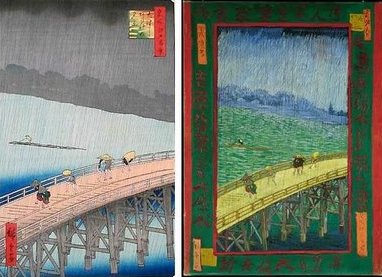
Left: Evening Shower at Atake and the Great Bridge by HiroshigeRight:The Bridge in the Rain (after Hiroshige) by van Gogh
Left: Evening Shower at Atake and the Great Bridge by Hiroshige
Right:The Bridge in the Rain (after Hiroshige) by van Gogh

Van Gogh especially liked the works by Utagawa Hiroshige and in 1887 completed his version of Hiroshige’s Evening Shower at Atake and the Great Bridge, which was part of his collection.   Van Gogh simply entitled his work The Bridge in the Rain (after Hiroshige).  With his version, van Gogh filled the border of his painting with a number of calligraphic figures which he had copied from other prints in his collection.  In van Gogh’s version, he used different colours which were far brighter than those used by Hiroshige and van Gogh spent more attention to colour contrasts which he used to enhance his version.

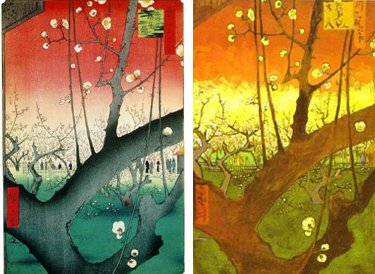
Hiroshige's-Plum-Tree
Left: Plum Park in Kameido by Hiroshige
Right: Japonaiserie Flowering Plum Tree (after Hiroshige).by van Gogh

Another of Hiroshige’s woodblock prints which van Gogh copied as a painting was 亀戸梅屋舗 Kameido Umeyashiki (Plum Park in Kameido), which was published in November 1857.  It was number 30 in a series of 119 ukiyo-e prints made by Utagawa Hiroshige and Hiroshige II.  Hiroshige II was Utagawa’s student and adopted son.   Utagawa Hiroshige died in 1858 and his adopted son completed the series.  This series of woodcut prints was published in serialized form between May 1856 and April 1859 and was entitled One Hundred Famous Views of Edo.   Edo was the former name of Tokyo, and it was a series of depictions of famous sights around the Japanese city.  In 1887, Van Gogh rendered his own version of this print under the title Japonaiserie Flowering Plum Tree (after Hiroshige).

Title page of Paris Illustré (May 1886)

My final example of Van Gogh’s love of Japanese woodcut prints and his desire to produce his own version is his copying of Keisai Eisen’s print entitled A Courtesan, Nishiki-e,  which was made around 1820.  Van Gogh probably came across this print when it appeared on the front cover of the May 1886 special edition of the Paris Illustré with the front page title of Le Japon.  It was this print which Van Gogh used for his painting entitled The Courtesan (after Eisen).  Vincent’s painting is another fine example of his interest and love of Japanese art.

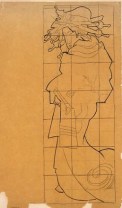
Van Gogh's tracing for The Courtesan(Van Gogh Museum)
Van Gogh’s tracing for The Courtesan
(Van Gogh Museum)

To produce a copy of Eisen’s work van Gogh actually traced the picture on the magazine’s front cover and then enlarged it.  He then set about giving the courtesan Nishiki a colourful kimono and placed her against a framed bright yellow background.  The framed painting of the woman is then surrounded by a watery landscape along with water lilies, a frog on a lily pad and a pair of cranes wading in the water and in the centre top of the background we can just make out two men in a boat.  It is not unusual to have frogs depicted sitting serenely on lily pads or wading birds such as cranes in watery scenes but van Gogh’s choice of these two types of creatures was not purely accidental as in France, during his time, prostitutes were often referred to as grues which is the French word for cranes, and grenouilles, which is French for frogs, and therefore van Gogh could be reminding us that Nishiki was a courtesan, an escort or mistress of a wealthy client, a euphemistic term for a prostitute.

In my next blog I will look at some of the European painters whose work inspired van Gogh to render his own version of their paintings.

I suppose you may wonder why I should choose van Gogh for the Christmas edition of my blog when a more seasonal painting by Thomas Kincaid would have been more appropriate.  Actually there is a connection between van Gogh and this Christmas and that is because for my Christmas present to myself.   I bought myself the six-volume edition of Van Gogh’s letters.  Very expensive, totally inexcusable but then, maybe I deserved the present!!!!!

 Happy Christmas to you all.

Winter Landscape with koek en zopie at night by Andreas Schelfhout

Winter Landscape with Cake and Zopie at night by Andreas Schelfhout (1849)

In my last blog I looked at the life of Johan Jongkind.  His initial artistic tuition came when he attended the Drawing Academy of The Hague and it was here that he was taught by Andreas Schelfhout.  Having looked at the life of the pupil I thought it only right to spend some time looking at the life and work of the teacher, so today my featured artist is Andreas Schelfhout.

After the great periods of Dutch art in the Golden Age of the 17th century, there came many economic and political problems which lessened the activity in art in the country. However, the fine arts in the Netherlands enjoyed a revival around 1830, which is a period that is now referred to as the Romantic School in Dutch painting. The style of painting during this period was an imitation of the great 17th century artists. The most widely accepted paintings of this period were landscapes and paintings which reflected national history.   One of the leading painters of this time was Andreas Schelfhout whose works included landscapes, especially winter scenes, and also paintings depicting woodlands and the dunes between The Hague and Scheveningen.

Andreas Schelfhout became one of the most important and influential Dutch landscape artists of the 19th Century.   He was born in The Hague in 1787.  His father owned a gilding and picture framing business and it was here that Andreas worked until 1811.  During this time Andreas painted a number of pictures in his spare time and in 1811 he submitted some of his works at an exhibition in The Hague for amateur artists.  His paintings were well received, so much so, that his father realised that his son may be able to earn a living as an artist and so arranged for him to study art under Joannes Breckenheimer, a painter of stage scenery.   Breckenheimer taught him to paint motifs such as city scenes and landscape but also instructed him in the technical aspects of painting, such as perspective and paint preparation.  Schelfhout, during this time, made detailed studies of the great 17th Century Dutch  Masters of landscape art such as Meindert Hobbema and Jacob van Ruisdael. It was also during this period that he learned to sketch en plein air.   Schelfhout remained with Breckenheimer for four years at which time he decided to go it alone and set up his own workshop in 1815.

In those early days his works were very popular with the art lovers from The Hague but little was known about him in the outlying areas.  Soon however his fame spread to Belgium and with fame, came commissions.  In 1818 he exhibited a set of four paintings depicting the four seasons at an exhibition in Amsterdam and that year he became a member of the Royal Academy for Visual Arts of Amsterdam.  The following year, 1819, he received a Gold Medal at the exhibition in Antwerp and three years later, in 1822, he was named Fourth Class Correspondent of the Royal Dutch Institute and from that moment on his reputation was ensured.  His landscape work was mainly of summer scenes of the countryside, which at that time were far more popular than the winter landscape works.  However this latter type of landscape painting became increasingly more popular with the art buying public and Schelfhout began to exhibit some of his winter landscape paintings in the many exhibitions held in the towns and cities of the Netherlands as well as the Salons in Brussels and Antwerp.  He completed a large variety of paintings over the next few years, winter and summer landscapes, beach scenes, moonlight subjects and a few paintings of animals.  Records show that his annual painting output was about twenty, of which,  over seventy per cent were winter or summer landscapes.

In 1833, Schelfhout decided that it was time to find new landscapes to paint and to travel again so as to increase his knowledge other artistic trends. He first visited France.  Whilst staying in Paris he came into contact with the French Romantic landscape painters and it was after studying their works that his landscape paintings took on brighter colours in comparison to his previous sober palette.  Two years later, he crossed the Channel to visit England where he was able to study the works of the great English landscape artist, John Constable.  Art historians believe, that following these trips, Schelfhout’s palette became warmer and his choice of motifs became more varied.  He taught at The Hague Academy and, as we saw in my last blog, one of his pupils was Johan Jongkind.

He became a member of the Pulchri Studio which was formed in 1847 and which was, and still is, an important art institution and art studio based in The Hague.  The Pulchri Studio was established as there was a growing discontent among the young artists in The Hague about the apparently insufficient opportunities for training and development.  The founders believed that the studio could provide an outlet for art intellectuals to model their work and to exchange thoughts and opinions.  It was in this studio that Schelfhout would complete paintings from the sketches he had made earlier, during his art trips.

The height of his career came in the 1840‘s and 1850’s when his summer landscapes such as Landscape near Haarlem gained him international renown.  However he will probably always best be remembered for his depiction of Dutch winter scenes with their perfect clarity of the ice and the delicate blue wintry tone.  In his later years he became part of the Hague School, which was the name given to a group of artists who lived and worked in The Hague between 1860 and 1890. Their work was heavily influenced by the realist painters of the French Barbizon School. The painters of The Hague school generally made use of relatively somber colors, which is why the Hague School was sometimes referred to as the Gray School.

Schelfhout died on 23rd April, 1870. He was buried in the Eik en Duinen Cemetery in The Hague. His death made a deep impression on the art-loving city and numerous influential figures followed the funeral procession. His death marked the end of the era we now call Romanticism.

Although his portfolio of work included a wide range of themes, he became best known for his winter scenes. He was a Master of the winter landscape genre often embellished with skaters on the frozen waterways.  It was these works of Andreas Schelfhout which continue to be his most sought after works. His skilfully and delicately executed winter landscapes gained him great success and enhanced his reputation both in his home country and abroad.   He became known as the Claude Lorrain of the winter scene.

My featured work today is a winter landscape scene by Andreas Schelfhout entitled Winter Landscape with koek en zopie at night, which he completed in 1849.  It combines the artist’s talents as a painter of winter landscapes and a painter of scenes bathed in moonlight.  Koek en Zopie is the name given to small stands that sold hot food and drinks that kept the skaters warm. ‘Koek’ is the generic term for cakes and ‘zopie‘ is an old recipe for a warm mix of beer, rum and spices.  In today’s painting we see the Koek en zopie stand on the bank, to the left of the frozen river, illuminated by some sort of brazier, which will, along with the alcoholic zopie,  help to keep the skaters and the vendor warm.

The painting is part of the Rademakers Collection, which is a private compilation of romantic paintings from the 19th century owned by Jef Rademakers, a former owner of a television production company.   In the eighties he was commissioned to make a series of documentaries about art in Dutch collections. These programs brought him into close contact with the art world: museums, dealers, auction houses and art historians.  From this, he started to realise that besides being an admirer of art, one could also become the owner of art works from the past.   In the 1990’s, Jef Rademakers decided to renounce the world of television and to hand over his production company. From that moment on he started a new life as a fulltime collector of art. Nowadays the Rademakers Collection consists of more than a hundred highly romantic paintings from mainly Dutch and Belgian masters of the 19th century.   The art works in his collection are now often loaned out to foreign galleries and museums.

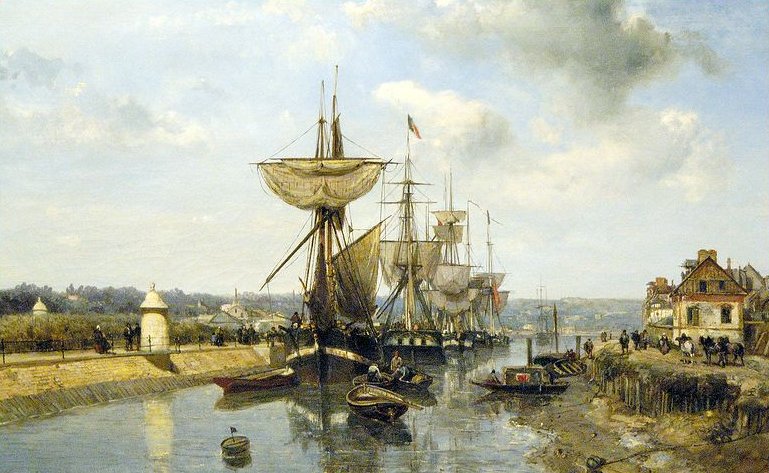
Frigates by Johan Barthold Jongkind

Frigates by Johan Jongkind (1853)

My featured artist today is the nineteenth century Dutch painter and one who is considered to be the forerunner of Impressionism.  His name is Johan Barthold Jongkind.

Jongkind was born in 1819 in the small Dutch town of Lattrop in the Dutch province of Overijssel, close to the German border, although much of his early life was spent in the harbour town of Vlaardingen, which lies on the River Meuse, and where his father, Gerrit Adrianus Jonkind, was a local tax collector.  His father and mother, Wilhelmina, had ten children of which Johan was the eighth.  At the age of sixteen, once he had finished his education, he went to work as a junior clerk in a notary’s office.  A year later in 1836 his father died and Johan moved from Vlaardingen to The Hague where he enrolled at the Academy of Arts to study drawing under the tutelage of the director of Andreas Schelfhout, the Dutch Romantic painter, etcher and lithographer, who was renowned for his landscape works and who, by the end of his life, was looked upon as the leading Dutch landscape painter of the nineteenth century.

He spent almost nine years working at the Schelfhout’s studio training as a landscape painter and studying the great works of the Dutch Golden Age painters who plied their trade between the late sixteenth and mid to latter part of the seventeenth century, such as Jacob von Ruisdael, Meindert Hobbema and Aelbert Cuyp.  It was during this time that Jongkind developed the love of en plein air painting.  The early works of Jongkind depicted themes popular in the Netherlands at the time, harbour scenes with boats as well as canals , windmills and winter scenes featuring skaters on the frozen waterways.  His works grew in popularity and one of the admirers of his paintings was the leader of the French Romantic School, the landscape and seascape painter, Eugène Isabey.  Isabey had accompanied Alfred Emile de Nieuwkerke, who was the directeur des Beaux-Arts in Paris, to The Hague for the unveiling of the equestrian statue of William the Silent in front of the Paleis Noordeinde.  Isabey invites Jongkind to Paris to study in his studio and in 1846, with the financial support from the Prince of Orange, the young Dutch artist headed to the French capital where he remained for ten years.

Jongkind not only studied with Isabey but also with the French painter, François-Edouard Picot.   He also met many of the landscape painters of the Barbizon School with whom he often worked with and exhibited his works alongside theirs.  Despite his initial traditional training as a Dutch landscape artist, his painting technique evolved and soon his works took on a new range of colour and he became fascinated with the pictorial representation of light.  It was this interest in light which would become essential in the development of Impressionism.

When Jongkind had first arrived in Paris he discovered the river Seine and this became a new source of inspiration for his art. He also depicted many aspects of Paris life but preferred to concentrate on the industrial modernity and urban development of the capital rather than the touristy scenes of the crowded city.   His style is often likened to Naturalism, which is the representation of the world with a minimum of abstraction or stylistic distortion.  It is the depiction of realistic objects in a natural setting and is characterised by convincing effects of light and surface texture.

It was whilst in France that he fell in love with the Normandy and Brittany coast which he visited whilst on a painting and sketching trip with Isabey.  He would return to the area many times during his life and some of his best watercolour works incorporate the beautiful and strong lighting found along the Atlantic shoreline.  One of his great artistic successes came in 1850 when he exhibited his work View of Honfleur port at the Paris Salon exhibition.  It received great acclaim from the art critics.

For Jongkind, the streets of Paris were not paved with gold and he spent nine financially difficult years in Paris and had no choice but to live a bohemian existence. He had a number of his paintings rejected by the Salon jurists.  He put forward three of his paintings for inclusion at the 1855 World Exhibition but was disappointed at the lack of interest for his works.  He was now starting to feel dejected and depressed at the way his life was going.   In 1855 his mother died and the thirty-six year old artist returned to The Netherlands and set up home in Rotterdam and with this change of country came his change in painting style as he returned to a more traditional Dutch style of art which he had initially be trained in, during his early life.  Jongkind remained in Holland for five years but the sale of his paintings in his homeland were disappointing.   The only art he managed to sell was to a French art dealer and one of his first patrons, Pierre-Firmin Martin.   Martin’s gallery was on the rue Mogador and he routinely bought works from artists such as Jean-Baptiste-Camille Corot, Jean-FrançoisMillet, Theodore Rousseau, Constant Troyon, and Charles-François Daubigny.   Martin was such a great support figure for these artists that they called him Père or Father in English. Jongkind would send Père Martin a painting and in return he would receive a 100 franc note.  However Jongkind could not survive alone on this and as a result he found himself getting deeper and deeper in debt and so in 1860 he decided to return to Paris where he believed the sale of his works would improve and where his standing as a painter was much greater.  He said at the time:

“…It is Paris where I am recognized as a painter…”

However to return to Paris he needed money and he had none.  However through his Parisian friends led by Comte Doria and Père Martin they put on an auction of their works and managed to raise 6046 francs which was used to bring back their friend to Paris.

Jongkind settles down in Montparnasse in Paris.  His friendship with the art dealer Père Martin continued and it was whilst attending one of his dinners that Jongkind was introduced to Joséphine Fesser-Borrhee, a Dutch lady who taught art at a home for Parisian girls.   This lady who was to shape the rest of Jongkind’s life was an interesting character.  She like him, was born in 1819.   She had been abandoned by her parents and brought up in a children’s home. Although known as Marie Borrhée she would later take the name of Joséphine.    At the age of twenty she arrived in Paris, where she was taught to draw, and later she went on to teach in a home for young girls.   Having had a very difficult childhood she was ideally placed to understand the temperament of her troubled friend, Jongkind,  who in many ways was something of an orphan himself.  Jongkind had immediately taken to Joséphine and shortly after their first meeting at the house of Père Martin; he wrote her a letter in which he commented:

“…When I saw you arrive, it was as if my mother and father were coming to fetch me!…”

She was married to Alexander Fesser with whom she had a son, Jules.   It was the Fesser family and especially Joséphine, who through their kind hospitality and friendship, enabled Jongkind to recover both his physical and mental health  and in doing so had a great impact on the quality of his artistic work.  Jonkind and Fesser would travel around France but on many occasions he would return to Normandy.  It was here in 1862 he met Claude Monet.  Monet once described Jongkind’s and his works of art and chided him for his long-standing inability to master the French language saying:

“….a good-hearted, shy man who butchered French and whose art was too new and too artistic to be, in 1862, appreciated to its true value…”

For the next years, the influence of the Normandy coast showed through Jongkind’s abundant production of etchings and paintings. In Normandy, Jongkind became a close friend of Monet a mixed with the likes of Corot, Diaz, Boudin, Sisley and many of the other great artists who used to gather at the Farm Saint-Simeon run by Mère Toutain.

Joséphine Fesser was to become Jongkind’s guardian angel and companion for life and although she remained married to her husband Alexandre she became Jongkind’s mistress.   She was a very caring person and brought a soothing stability and balance to his life. The sale of his art works grew and Jongkind, reputation as an artist, gained in popularity. The number of his commissions increased and with the rise in his art sales his finances improved and with that came a sort of mental calmness, free from worry, and his personality blossomed.   Through Joséphine,  Jongkind had discovered the Dauphiné region of south-east France.  He soon got himself into an annual routine of spending the summer months there and returning to Paris in the winter months.

The first exhibition of the Impressionists in the studio of the photographer Nadar was held in 1874 and although asked to exhibit some of his works, Jongkind declined as by this time in his life, due to his poor health and intemperance he had given up submitting his paintings to major art exhibitions.  Joséphine’s husband died in 1875 and after his death, Madame Fesser remained with Jongkind in Paris. During the late 1870’s when Jongkind was in his fifties his health started to deteriorate and he spent more time in the warmer climes and fresher air of the Dauphiné.

From 1878 until his death in 1891 Jongkind and Joséphine Fesse live in la Côte-Saint-André near Grenoble.  During the last year of his life Jongkind was beset with mental problems, suffering from bouts of depression and paranoia which led him back to alcohol dependence. His mood swings caused by the excess consumption of alcohol led him to be banned from most of the cultural and social activities of the town.  He died in Saint-Rambert hospital close to Grenoble on February 9th 1891 aged 71.  Joséphine Fesser outlived him by just a few months. They are both buried in the small cemetery of La Côte-Saint-André, on the outskirts of the town.

My featured work today by Johan Jongkind is entitled Frigates.  In the painting we see a seaside port which is an idealised view made up of many sites, which was a technique often used by many Dutch landscape painters.   It was completed in 1853, just a couple of years before he left Paris to return to The Netherlands.  The painting highlights his great ability to depict atmosphere and light effects.  Look how well he has depicted the reflections of the ships in the rippling water of the harbour.  Art historians believed that it was Jongkind’s  mastery of light in his works that was to influence the likes of the young Impressionist painter Claude Monet.

The painting is normally housed in the Sterling and Francine Clark Art Institute in Williamstown, Massachusetts but is now part of the exhibition From Paris: a Taste for Impressionism, which is being held at the Royal Academy in London.   This wonderful exhibition of works by Monet, Manet, Sisley, Renoir and many others is on until September 23rd 2012

Francesca da Rimini by Ary Scheffer

Francesca da Rimini by Ary Scheffer (1835)

What is your perception of Hell?  Do you think of it as a huge furnace full of burning souls, or simply a place of deprivation?  We do not know and I don’t believe we will ever know what it is like or whether it or its sister-place, Heaven, really exists and so with this lack of evidence we can then formulate in our own minds what it is all about without fear of contradiction.  One person who did just that was Durante degli Alighieri, better known simply as Dante Alighieri.  In the first part (Inferno) of his epic poem entitled Divine Comedy he tells of his journey he made through Hell with the Roman poet Virgil acting as his guide.  Many artists have painted pictures based on Dante’s Inferno with its concentric circles full of various types of sinners.  To get to the gates of Hell Dante and Virgil had to cross the river Acheron which could only be achieved by being transported by ferry, piloted by Charon.  My Daily Art Display (September 6th 2011) depicts the two men being ferried across the river made famous in the painting,  The Barque of Dante or Dante and Virgil in Hell by Eugène Delacroix.

According to Dante, Hell is situated within the Earth, it is made up of nine circles of torment.  The circles are concentric, and represent a gradual increase in evilness.  The outer circle, or the first circle is the resting place of those who were never baptised, the second circle was for people whose sin was one of Lust.  As Dante and Virgil moved inwards they came across circles which housed the souls who had committed the sins of Gluttony, Greed, Anger, Heresy, Violence, Fraud and Treachery.  It is interesting to note that for Dante, an Italian male, those who committed the sin of Lust were only in the second circle, as presumably in Dante’s mind, Lust was not that bad a sin!  The inner most part of this Hell ends at the centre of the earth, where Satan is held in bondage.   The sinners who populated each of the circles were punished in a fashion fitting their crimes, a system of contrapasso; derived from the Italian words contra and patior meaning  “suffer the opposite” a sort of poetic justice.

My featured painting today is about two lovers from Dante’s Divine Comedy who Dante and Virgil meet, trapped in the stormy darkness of the Second Circle of Hell (Lust)It is here that those overcome by lust during their time on earth have been sentenced to remain. Dante condemns them, and those like them, calling them “carnal malefactors” for letting their sexual appetites affect their reasoning. These hapless souls are blown to and fro by the terrible winds of a violent storm, without hope of rest and this symbolizes the power of lust to blow one about needlessly and aimlessly.  It is here that Francesca da Rimini tells Dante the story of how she and her lover Paolo ended up in this Second Circle of Hell.

Francesca da Rimini and Paolo Malatesta are depicted in the 1835 painting by Ary Scheffer, which is entitled Dante and Virgil Encountering the Shades of Francesca da Rimini and Paolo in the Underworld or simply Francesca da Rimini. .    The story goes back to the time when Francesca’s father, Guido I da Polenta was lord of Ravenna but had been at war with a rival  family,  the Malatesta family.  Peace between the two families finally came about and to cement their relationship Guido agreed that one of his daughters, Francesca, should marry Giovanni Malatesta, the son and heir of the Malatesta clan.  Although Giovanni was an able man and would on the death of his father become ruler, he was ugly and deformed.   The friends of Francesca’s father told him that if Francesca was to set eyes on Giovanni prior to the marriage, she would never go through with it. So the two fathers hatched plan and sent Giovanni’s younger brother Paolo to Ravenna with authorisation to marry Francesca in Giovanni’s name.   Paolo, unlike his elder brother was handsome and courteous and Francesca immediately fell in love with him. The marriage took place and the marriage contract signed and bride and bridegroom returned to Rimini, with Francesca still unaware of the deception.

In the morning following the wedding she became aware of the deception.  She was furious that she had been deceived and to make matters worse she realised that she had fallen in love with Paolo.  Giovanni left Rimini on business leaving Paolo and Francesca together and they both realised that they loved each other.   Their lovemaking was witnessed by Giovanni’s servant who sent word to his master, who then secretly returned home.  He went to Francesca’s room in which were the two lovers.  He banged on the door and shouted her name.  They recognised Giovanni’s voice.  Paolo pointed to a trapdoor in the floor that led to a room below. He told Francesca to go open the door as he planned his escape.   However as he jumped through the open trapdoor part of his jacket got caught on a piece of iron.  Francesca, unaware of his Paolo’s predicament, opened the door for Giovanni, believing she would be able to make excuses, now that Paolo was gone. When Giovanni entered the bedchamber he noticed Paolo caught by his jacket on the trap door.   He immediately ran towards the trapdoor and with his rapier drawn thrust it at Paolo intending to kill him. Seeing what Giovanni intended to do, Francesca quickly ran between the two brothers to try to prevent it. But Giovanni’s rapier was already thrusting downwards towards the hapless Paolo but before it struck him the blade passed through Francesca’s bosom. Giovanni was totally distraught by what he had done for he still loved Francesca.  He withdrew the blade of the sword from her body and immediately plunged it into his brother, killing him.  The next morning, amidst much weeping, the two lovers were buried in the same tomb.

In the painting we see Dante and Virgil standing to the right hand side watching as the two, almost-naked, lovers cling to each other.  Art critics at the time praised this exceptional work by Scheffer, and it was to become one of his most famous and most admired works.  Scheffer went on to produce several replicas of it.  The original painting can be found at the Wallace Collection, London.

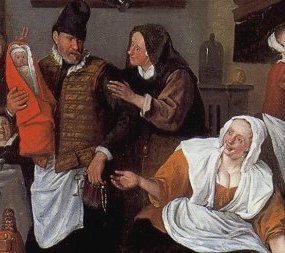
Celebrating the Birth by Jan Steen

Celebrating the Birth by Jan Steen (1664)

I do my best to feature paintings by artists that people may not have come across before and I try not to feature the same artist too many times but sometimes I cannot help but revisit works by my favourite artists and today is no exception.  My Daily Art Display featured painting today is entitled Celebrating the Birth by Jan Steen which he completed in 1664.  I have showcased work by this artist three times before.  On February 16th 2011 we looked at a work entitled In Luxury, Look Out.  On April 27th 2011, I featured his painting The Effects of Intemperance and finally on August 26th 2011, I gave you The Life of Man so if you like today’s work why not go and have a look at some other of Jan Steen’s paintings.

Before us we have a simple scene of a couple celebrating the birth of their child, or do we?  In fact there is more to this painting than a simple celebration of the birth of a baby.  Look closely at the painting and see what is odd about the Steen’s depiction of the event and see if you can work out what is happening in the scene.  I will give you a hint.  Look at the man who stands behind the baby and the baby’s father.  Before I reveal the secret about the painting let me first tell you a little about the artist, Jan Steen.

Jan Havickszoon Steen was born in the Dutch town of Leiden in 1626.  He, like his artistic contemporary, Rembrandt, attended the local Latin School of Leiden. And a year later in 1646 he enrolled at the University of Leiden.  His professional artistic training started the following year and came from the German-born, Dutch Golden Age painter, Nicolaes Knupfer.  It is thought that he also could have studied with Adriaen van Ostade and it was this artist’s low-life genre work which was to influence Jan Steen’s early works.  At the age of twenty-two Steen along with his artist friend Gabriel Metsu and a number of local painters founded the painters’ Guild of St Luke of Leiden.

In 1648, Jan Steen moved to The Hague and worked as an assistant at the workshop of the celebrated landscape painter, Jan van Goyen.  Van Goyen was, like Jan Steen, born in Leiden.  He had moved from Leiden to The Hague in 1631 where he set up his workshop.  Steen was not only employed by van Goyen but was also taken in by van Goyen’s family and lived with him, his wife Annetie and their daughters.     Jan Steen became very friendly with Margriet, one of van Goyen’s daughters and they married in 1649 and the couple went on to have eight children.  Steen’s association with his father-in-law lasted until 1654.

In 1654 he and his family moved to Delft where he ran a brewery which his father had rented for him.  It was called De Roscam (The Curry Comb) but although Steen had a great artistic talent his business acumen was sadly lacking and the brewery failed.  In 1657 he went to live in Warmond,  a town close to Leiden and it was here that he met and became friends with the artist, Frans van Mieris.  Frans van Mieris was a painter of genre scenes which depicted the habits and actions of the wealthier classes.  It was this type of art by van Mieris and the works of Te Borch that weaned Steen off his low-life genre paintings and influenced him to paint more elegant genre scenes.  Jan Steen left Haarlem in 1660 and moved back to Haarlem where he stayed for the next ten years.  In 1669, near the end of this stay his wife died and the following year his father passed away.  After his father’s death in 1670 Jan returned once again to Leiden where he remained for the rest of his life.  He remarried that year and his second wife, Maria van Egmont,  gave Jan two children.

For the Dutch people, the year 1672 became known as the rampjaar(disaster year) as this was the year that saw the start of the Franco-Dutch War and the Third Anglo Dutch War, which culminated in the defeat of the Dutch States Army and large swathes of the Republic was conquered by the invading troops.   Because of these wars the art market collapsed and Steen needed another source of income so in 1673 he opened a tavern. His work in the tavern meant that his artistic output diminished in his later years.

Jan Steen died on New Year’s Day 1679 in Leiden

And so let us go back to the featured painting.  Have you worked out the “sub-plot” depicted in this painting yet?  Steen is best known for his humorous genre scenes, warm hearted and animated works in which he treats life as a vast comedy of manners and this work of his is no different.  We are looking at a lying-in room.  Whenever the lady of the house was about to give birth, one of the rooms was set aside for this purpose. The lying-in room was used for the actual delivery, and later to receive visitors.  The birth of a child was, as it is now, a cause for celebration.  It is greeted with both happiness and pride and in the 17th century in the case of the birth of a son, it became even more of a celebration for economic reasons as a son would often carry on his father’s business and would inherit the family possessions.

In this painting Steen has depicted a group of revellers celebrating the birth of a child.  One can imagine the elated atmosphere within the room with all its merriment and drinking.  The majority of people in the room are women as men, including the father, were considered inappropriate interlopers in this female sanctuary.  The mother is in the left background of the painting lying in her bed being fed some broth.  Another woman sits at the end of the bed drinking to excess.     The others present will probably be female relatives, maidservants and the midwife.  Normally one would expect, as in most works of art depicting such an event, that the mother of the newborn baby would be the main focus of attention.  However Steen has made the proud father the main focus of this painting.  However he is not the only man in the painting.  Look at the figure behind the baby.  We see another man as he is about to creep out of the room.  Actually it is a self-portrait of the artist himself.  It was not simply to break tradition to see the two men in the painting but Steen wanted to convey a little information about what has happened and to the nature of the husband and wife’s relationship.

Sign of the cuckold

Look more carefully and you will see something which was not visible until the painting was cleaned in 1983.  The man leaving the room has made a cheeky two-fingered gesture above the baby’s head.     This gesture can be seen by all those in the room except the proud father.   From the young man’s gesture, Steen has made us aware that the ‘father’ has been made a cuckold. The gesture illustrates the tradition of “cuckold’s horns, and that the horns, visible to all but the man himself, will grow on the head of a man whose wife has been unfaithful. The proud father stands right of centre having been presented with his child.  His pride on the birth of his child is plain to see.  He is totally unaware of the ridicule and stands before us, puffed up, beaming with pride as he shows off his child.  Nobody seems shocked by this audacious gesture which tells us that everyone in the room appears to know what the man does not: that the child is not his..  There are other sexually symbolic inclusions in Steen’s painting to suggest not just sexual impropriety but implying the husband was impotent, such as the bed warming pan, which lays prominently on the floor in the foreground.  The warming pan reminds us of the adage, the only warmth in the marriage bed is the warming pan.   In the right foreground we see broken egg shells scattered on the floor and again this is a reminder that the phrase, cracking eggs into a pan, was a contemporary euphemism for sexual intercourse.

The demand for money

Steen has been very unkind with his depiction of the father in this portrait.  We see him wearing an apron and carrying keys like a housekeeper would do, thus implying a lowering of his status in the household.   We also see the old midwife at his shoulder demanding money for her services and to the right of the man, sat on a stool, is a maid with her hand out, seemingly demanding payment for making the celebratory broth.  Steen’s final degrading of the man is his depiction of the limp and ineffectual sausage hanging by the fireplace which does not need me to explain the connotation of such an inclusion!!

There is a moralistic point to the painting.   It is a warning tale of what happens when an older man marries a much younger woman.   In a way Steen has no qualms about depicting the man as a cuckold.  Maybe the modern saying of there’s no fool like an old fool has its roots way back in time.

A Merry Company at Table by Hendrick Pot

A Merry Company at Table by Hendrick Pot (c.1630)

Two paintings today; one by the artist and one of the artist himself.  One of the pleasures I get from my blog is that besides discovering new artists and their paintings, I acquire an insight with regards the history and traditions of various countries , most of which I had little previous knowledge.  Maybe I should have concentrated more during my history lessons at school.   Recently I have featured Flemish artists and I looked briefly at Dutch and Flemish history during the time of Spanish occupation and rule.  Today, I am looking at a painting by the Dutch painter Hendrick Pot and exploring the world of the schutterij.  Don’t you know what the shutterij is or are?   Neither did I until I researched a painting by Pot but before I reveal the answer let me give you a brief biography of the artist himself.

Hendrick Gerritsz Pot was born in Haarlem around 1585.  His early artistic training was with Karl van Mander.  We probably know Karl van Mander not so much as an artist but for his writings.  He has often been termed the Dutch Vasari for his book entitled Schilderboek, published in 1604, which to this day, remains the main source for information on Northern European painters of the 1400s and 1500s and contains valuable original material about his Italian contemporaries.  He had arrived in Haarlem in 1583 and set up an informal academy with the Dutch engraver and painter, Hendrick Goltzius.  At this Academy, van Mander taught and developed the Haarlem Mannerist style.   Other artists who were trained by van Mander at his studio included Frans Hals.
In 1620 he was commissioned to do two paintings relating to William I of Orange, often referred to as William the Silent, who was one of the key leaders of the Dutch revolt against Spanish rule.  He was assassinated in 1584.  One of the paintings, entitled the Glorification of Willem I, was acquired by the city of Haarlem whilst the other entitled the Deathbed of Willem I was housed in the town hall of Delft.   In1630 Pot became Dean of the Haarlem Guild of St Luke.   He travelled to the court of Charles I in London in 1632 where he was employed as the court portraitist and during his one year sojourn at the court completed portraits of Charles I and his wife Queen Henrietta Maria.

In 1633 he returned he returned to Holland.  Many of Pot’s lucrative commissions were to paint group portraits of the local militias, known as schutterij.  So now you know – schutterij is the Dutch term for militia.  They were a voluntary city guard whose prime objective was to protect their town or city from attack and also to act in case of a fire breaking out within the town.   They were simply a defensive military support system for the local civic authority. The officers of the schutterij came from wealthy backgrounds and were appointed by the city magistrates. The captain of each group was normally a very wealthy inhabitant of the district, and the group’s ensign was a wealthy young bachelor and he could be recognised in the group portraits as the man wearing exceptionally fine clothes.   There was a special kudos to being a member of the schutterij as it often led to one being appointed to an important position within the town council.

At the time when the leaders of an individual schutterij stepped down or passed away and their replacements were sworn in, a local artist was commissioned to paint a new group portrait of the members. These group portraits were known as schuttersstukken and they often had the setting of a banquet which was held to welcome in the new leaders.     The artist commissioned to carry out the painting had a complex job on his hands.  This is not as it would be now when a photographer would get the group to stand as one and after a few minor adjustments shoot the film.  In the case of schuttersstukken the artist would paint each member separately so that each individual portrait within the group was as accurate as possible.  As a member of this militia, if one wanted to be included in the group portrait, one had to pay for the privilege and how much you paid the artist and your rank within the militia, would depend on where he positioned you within the group!  As I said before it was a very lucrative commission and there was a lot of competition for the right to carry out the group portrait.  Probably one of the most famous of the schuttersstukken was Rembrandt’s The Night Watch.   One thing that would help an aspiring artist to gain the painting commission was if he was a member of a schutterij.   Hendrick Pot was a lieutenant in a schutterij and that was the advantage he had over many of the other applicants.

The Banquet of the Officers of the St George Militia Company by Frans Hals

This leads me to my second painting of the day which is entitled The Banquet of the Officers of the St George Militia Company which Frans Hals painted around 1639 and included in the work is none other than Hendrick Pot with his militia sash who is seated at a table on the far right of the gathering, reading a book.

In 1648 Pot moved from Haarlem and went to live in Amsterdam.  In his later years he concentrated on small single figure portraiture.  He died in Amsterdam in 1657, aged 72.

My main featured painting is one Hendrick Pot completed around1630 and is entitled A Merry Company at a Table.   It is now housed in the Wallace Collection in London.   It is a genre piece.  The definition of a genre piece is a work of art  which affords a pictorial representation, painted  in any of the various media and one that represent scenes or events from everyday life, such as markets, domestic settings, interiors, parties, inn scenes, and street scenes. Some of the genre pieces are realistic, some imagined, whilst others are romanticized by the artist. This type of painting was particularly popular in seventeenth century Netherlands, but the term “genre” was not applied at the time;  instead, paintings were divided into more specific categories, such as ‘merry company’ scenes (conversatie), ‘little fire’ scenes (brandje) or ‘bordello scenes’ (bordeeltje).   My featured painting today falls into the latter category, a bordeeltje.  So why do we believe what we are looking at is a bordello?  Although the painting is not littered by scantily dressed females and lusting men the artist has given us some subtle hints as to what we are looking at.  On the floor there is a discarded rapier, lute and in the foreground, a dog.  These symbolise the disarming power of love and carnal desire.  Look to the left of the painting and in the doorway one sees an old woman carefully watching her girls as they enchant and flirt with the soldiers.  The men and women seated around the table make music together which is a common euphemism for making love and they play cards and smoke which were looked upon as the two great vices of the time.

Look to the extreme right of the painting.  Look at the cavalier with his back to the chimney breast, who stares out at us.  He gives us a knowing look as if to say “you know what is going on here, don’t you?”  The background solely consist of a drab muted coloured wall broken up only by the presence of a mirror.  Why do you think Pot added a mirror to this scene?  Could he be asking us to look into it, see our own reflection and examine our own behaviour, before we audaciously condemn the women and the men we see before us in the brothel?

I have always liked these Dutch and Flemish genre pieces.  There is often a moralistic tale being told.  The scene is often up for interpretation and we look carefully for any signs of symbolism.  I enjoy looking closely at the individuals and try to guess what is going on in their minds.  Fortunately there are so many of them in our art galleries and museums and I am never disappointed by what I see.

Enjoy !

A View of the Westerkerk, Amsterdam by Jan van der Heyden

Today I am going to leave 19th century French art and Impressionism, which has featured in my recent blogs, and look at some 16th and 17th Dutch and Flemish art and artists.  Dutch art has always been very popular and admired for the realism it portrayed of everyday life and it has always proved to be highly collectible.  Before I look at some of the art of that time it may be interesting to look at a brief history of the region which has a bearing on the style of art.   I am probably laying myself open for criticism from Dutch historians for my understanding of this period of the history of the Netherlands and Holland but all I am trying to do is give you a brief insight into Flemish and Dutch art of the 16th and 17th centuries.

The Netherlands back in the fifteenth century was a conglomerate of the Seventeen Provinces often referred to as the Burgundian Netherlands, which included part of today’s Germany, Belgium, France and Luxembourg.  It was controlled from 1506 by Charles V who was the Holy Roman Emperor and also the King of Spain.   In 1556, Charles V abdicated and the power passed to his son, Philip II.  With Spanish rule came the imposition of the Catholic religion on the people of the Netherlands.  This policy of strict religious uniformity was imposed by the Inquisition with enormous amounts of brutality.  However the rise of the Protestantism in the forms of the Lutheran and Anabaptist movements and Calvinism were starting to gain ground with the populace.   The beginning of the break-up of Philip’s control of the Seventeen Provinces started with the Dutch people being unhappy at the high level of taxation levelled on them by Philip and his brutal repression of anti-Catholic movements.  To subdue the unrest, Philip sent his Spanish troops to the area under the leadership of the Duke of Alba and their presence and their cruelty further fanned the flames of rebellion.  Control of the vast area was becoming more of a problem for Philip, added to which there was now a threat coming from the French along the southern borders.  Philip II’s troops were moved from the north to the south leaving the north less well controlled and this led to the start of the Eighty Years’ War often termed as the Dutch War of Independence.   After the initial stages, Philip II deployed his armies and regained control over most of the rebelling provinces. However, under the leadership of the exiled William of Orange, the Northern provinces continued their resistance and managed to oust the Spanish armies, and established the Republic of the Seven United Netherlands, Holland, in 1609. The Dutch Revolt had officially ended and the Dutch republic of Holland was officially recognised by France and England. The end of the Eighty years War however did not end for another forty years.

The Netherlands was now split along an almost North/South divide.  The north, Holland, became a haven for Protestantism with Calvinism becoming the main religion.  There were no Catholic churches in this northern territory.   It soon became one of the world’s most economically powerful and wealthy maritime nations in the world and Amsterdam became its capital.   As far as far as art was concerned there was also a north/south divide.   The Spanish Catholic south, Flanders, with its capital Antwerp, still had most of its art commissioned by the Catholic Church or the Spanish Catholic rulers and would more often than not therefore depict religious scenes, whereas now the Dutch north where religion was mainly a Reformed Calvinistic one would not allow church’s money to be spent frivolously on the commissioning of art.   Dutch art had new patrons.  Now works were commissioned by the territory’s wealthy merchants and ship owners.  Often the subjects they commissioned had little to do with religion and more to do with their wealth and their status in society.

Today I want to feature an artist from the southern region, Flanders.  Jan van der Heyden was born in 1637 in Gorinchem, which now lies in south west Holland.  In 1650, when he was thirteen years old, the family moved to Amsterdam and lived in a house on Dam Square.   Sadly however, his father, who was a follower of the ethno-religious Mennonite group, died the year of their move.  Jan’s early artistic training began in Gorinchem with drawing lessons at his elder brother’s studio.  He also learnt, from a local artist, the reverse technique of glass painting.  Although we are looking at van der Heyden as an artist his overwhelming love was not art, although he continued to paint all his life, it was his love of engineering and inventions.   He was an artist but he also was an inventor and an engineer.  He designed many things such as the street lighting system in Amsterdam.  Shortly after he and his family moved to Amsterdam he witnessed a fire at the old town hall and the futile efforts that were made to hold back the flames.   He probably never forgot that incident for later, along with the help of his brother Nicolaes van der Heyden, a hydraulic engineer; he invented a fire engine fitted with pump driven hoses which was to change the effectiveness of fire fighting.

In 1661 Jan van der Heyden married and he and his wife moved to a house along the Herengracht, a fashionable area of Amsterdam.  As a painter, Jan van der Heyden, will always be remembered for his beautiful townscapes and his architectural designs certainly dominate these works.   Although he painted many townscapes he also painted scenes featuring village streets and country houses.  He loved to paint old and new buildings and paid particular attention to their facades.  He also completed more than forty landscapes although his landscape art was never in the same league as his contemporaries, Meindert Hobbema and Jacob van Ruisdael.   He worked in partnership with Adriaen van der Velde,  the Dutch animal and landscape painter, and Johannes Lingelbach, a Dutch Golden Age painter, who would often add figures to van der Heyden’ architectural scenes and add landscape effects as a finishing touch to the paintings.   His main subjects were Amsterdam and the region surrounding the Dutch-German border where he and his family visited on many occasions.

In 1672, Adriaen van de Velde died and Jan van der Heyden artistic output dwindled as he concentrated on his main employment that of superintendent of the lighting in Amsterdam and he also devoted much of his time as the director of the Amsterdam Fireman’s Guild.  He died a wealthy man in 1712, aged 75.

View of the Westerkerk, Amsterdam by Jan van der Heyden (c.1660)
(National Gallery, London)

My featured painting today is entitled View of the Westerkerk, Amsterdam.    The building work on the protestant church commenced in 1620 and was designed by the foremost architect of the time, Hendrick de Keyser, the father of the Dutch painter Thomas de Keyser.  The construction was completed eighteen years later and at the time its tower was the highest in the city.  Jan van der Heyden painting is of the church, seen from the east, across from the Keizersgracht, the new Emperor canal.  Buried within the church are the painters Nicolaes Berchem, Rembrandt and his son Titus.

There are two versions of this paintings housed in galleries in London.  Both were painted between 1660 and 1670.   In both cases these are, like many of his townscapes and landscapes, only loosely based on actual views as topographical accuracy was not in the forefront of his mind when he started to work on his paintings.  It was almost as if he wanted to bring into his painting all that was beautiful about the town, whether it be its landscape or its architecture.  It was simply an idealised townscape which I believe does not lessen the beauty of the finished work.  The difference between these paintings and others he did was that in View of Westerwerk, Amsterdam he has paid great attention to the detail of the buildings whereas in other townscapes the main buildings may look half finished with the emphasis being placed on surrounding structures and open spaces.

Let us look at the version which is at the National Gallery in London.  Look at the clarity of this work.  Marvel at the detail van der Heyden has put into this painting.  In the foreground we can see four wooden casings which protect the young tree saplings.  One can almost read the writing on the torn posters which have been affixed to the casings.   This version is much larger than the one in the Wallace Collection, measuring 91cms x 114cms and almost three times the normal size of van der Heyden’s previous works.  It is believed that it was commissioned by the governors of the Westerkerk, for their meeting room, where it remained until 1864.   I love the details of the red-brick buildings but look at the contrast in colour of them with how the artist has depicted the blue sky with all its luminosity, the yellow cobblestone path in the foreground which runs parallel to the stretch of the canal and the glass-like stillness of the water.  It is probable that another artist painted the people and animals shown in the work.

View of the Westerkerk, Amsterdam by Jan van der Heyden (c.1665-1670)
(Wallace Collection, London)

I went to the Wallace Collection last week and saw this other version of the painting.  It is much smaller in size, measuring just 41cms x 59cms.  The artist’s signature can be seen in the lower right on the coping of the canal wall.  To the left of the church is the Westmarkt and if you look carefully between the trees you can just make out the Westerhal, which housed a meat market on the ground floor and above it was a guard house.   The house which we see to the right of the church is Keizersgracht no, 198 and was at that time the residence of Lucas van Uffelen a wealthy Flemish merchant and art collector.  What is very striking about this small painting is the sharp contrasts of colour, light and texture with shadows slanting across the front of the church.  Look at the contrast between the angular roofs and the luminous blue sky.  See how the artist has contrasted the trees heavy in leaf with the red brick buildings and in the case of the house on the right of the painting, its whitewashed frontage.  In this painting, unlike the one at the National Gallery, the artist(s?) have depicted reflections in the still water of the canal.  It should be remembered that this painting was completed after the one which now hangs in the National Gallery and is probably a re-working of the scene.  It could be that Jan van der Heyden was not completely satisfied with his first effort and wanted to make some artistic improvements.

If you are in London, why not take a chance to visit both galleries and compare the two paintings and decide which you like the best.

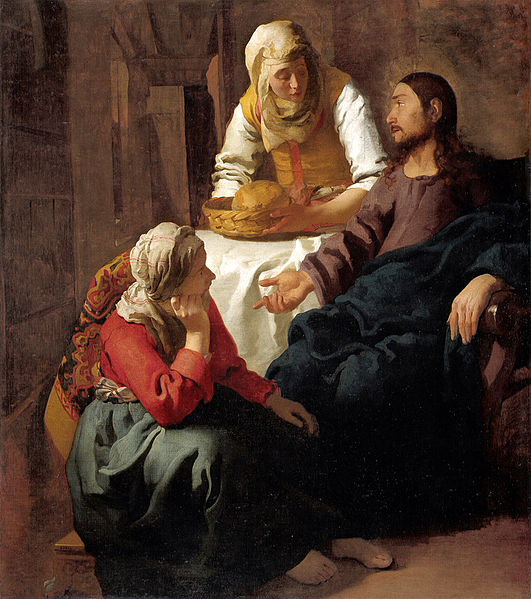
Christ in the House of Martha and Mary by Johannes Vermeer

Christ in the House of Martha and Mary by Johannes Vermeer (c.1655)

Once again, as promised in my last blog, I am returning to a painting depicting the two biblical sisters Mary and Martha.  The setting for this painting is their meeting with Christ at their home, which unlike the setting and the story behind Cagnacci’s painting Martha Rebuking Mary for her Vanity which I featured in yesterday’s blog; this meeting was recorded in the Bible.  In Luke 10:38-39 it states:

“…As Jesus and his disciples were on their way, he came to a village where a woman named Martha opened her home to him.  She had a sister called Mary, who sat at the Lord’s feet listening to what he said.  

The depiction of this meeting has been painted by many artists, such as Tintoretto in 1580, Diego Velázquez in 1618, and Rubens who painted a similar scene in 1628 but moved the setting to an outdoor terrace.  Christ at Home with Martha and Mary was painted by Joachim Beuckelaer, a kitchen scene, but from which we learnt about the rivalry between Mary and Martha.  A similar kitchen scene was depicted in the late 16th century painting entitled Christ in the House of Mary and Martha by Vincenzo Campi.  In these last two paintings Martha is depicted working hard in the kitchen whilst Mary is sitting at the feet of Christ listening to what he had to say.  The tension between the two women as highlighted in these paintings was recorded in the Book of Luke 10:40-42:

“….But Martha was distracted by all the preparations that had to be made. She came to him and asked, “Lord, don’t you care that my sister has left me to do the work by myself?  Tell her to help me!”      “Martha, Martha,” the Lord answered, “you are worried and upset about many things,  but few things are needed—or indeed only one Mary has chosen what is better, and it will not be taken away from her…”

However the painting I am featuring today depicts Mary and Martha in seemingly perfect harmony as they listen to the words of Christ.  The painting is by the great Dutch Master, Johannes Vermeer and is entitled Christ in the House of Martha and Mary and hangs in the National Gallery of Scotland in Edinburgh.  He completed the work around 1655 and it is believed to be one of his earliest surviving paintings, coming some ten years before his more famous works, such as Girl with a Pearl Earringwhich he completed in 1665.    It is also thought to be one of his largest paintings, measuring 160 cm × 142 cm (63 in × 56 in) and this probably means it was painted for a specific commission.  The fact that the work is so large and has a very dark backdrop, unlike most of Vermeer’s later works it may not have been accredited to Vermeer but for his recognisable signature on the stool which Mary sits upon.

Christ in the House of Martha and Mary by Erasmus Quellinus the Younger (1650)

There is a certain similarity with the way Vermeer has painted the folds in Christ’s robe with the 1650  painting  Christ in the House of Martha and Mary by the Flemish artist Erasmus Quellinus the Younger (Musée des Beaux-Arts, Valenciennes) and one that Vermeer may have actually seen as his father, Reynier Jansz,  was an art dealer.

Before us we have the three figures, named in the title of the painting, in a kind of triangular formation almost filling the canvas.  The background is sombre and somewhat dark which ensures that we are not distracted from the three figures depicted in the work.  Our viewpoint is from the bottom left of the painting which leads art historians to believe that this could have been intended for an altarpiece which would have been above eye level.

Christ is seated, looking very relaxed.  There is a soft glow emanating from his head and this ensures that he is seen as the main figure of the three.  He wears a dark blue robe over a brown undergarment.  It is an unusual shade of blue and not the ultramarine that we see in later works by Vermeer.  The right arm of Christ stretches out as he points towards Mary.  At the same time he focuses his attention on Martha.  Our attention is immediately drawn to his outstretched arm as the colour of his skin and the brown sleeve of his undergarment stand out against the pure white of the table cloth.

Mary sits on the floor at the feet of Christ, her head resting on her hand.  She looks lovingly at Christ hanging on his every word.  Of the three she is by far the most exquisite.  Vermeer has painted her lovingly and may have been sympathetic with her contemplative nature.  Mary’s positioning in the painting at the feet of Christ is somewhat controversial as that place was usually taken up by one of Christ’s disciples and in those days for a teacher to accept a female as a disciple was unheard of.

Martha stands at Christ’s right-hand side  and we see her placing a loaf of bread on the table whilst at the same time leaning slightly forward listening to his words.  Her eyes are downcast and yet her eyebrows are raised in a questioning gesture.  She looks somewhat saddened and dissatisfied with something.  Could it be she is not happy with Christ’s support of Mary’s contemplative role?   There is a hint of a pout in her expression, which could hark back to the conflict between the two females.   All looks tranquil and peaceful in Martha and Mary’s house but I wonder if the fact that Martha is bringing in the food whilst Mary just sits and listens to the words of Christ harkens back to the different roles the women play in the household and the discord between the two sisters is caused by such differing roles.  Maybe we are at a point in time that Christ is explaining to Martha that although she is the “worker” of the household who is serving up the bread which she may just have baked, Mary’s role as a contemplative disciple is equally as important. This is more forcibly portrayed in other works of art.  I am sure there are many theologians who have looked in to the relationship between the two sisters but the general consensus is that Martha is the more aggressive and work-like female whereas Mary is the more quiet and contemplative woman.

Much has been written about the two females and it has been interesting to study the various paintings featuring the two sisters and by doing so trying to read the mind of the artist and figure out what he or she is trying to tell us about the women.

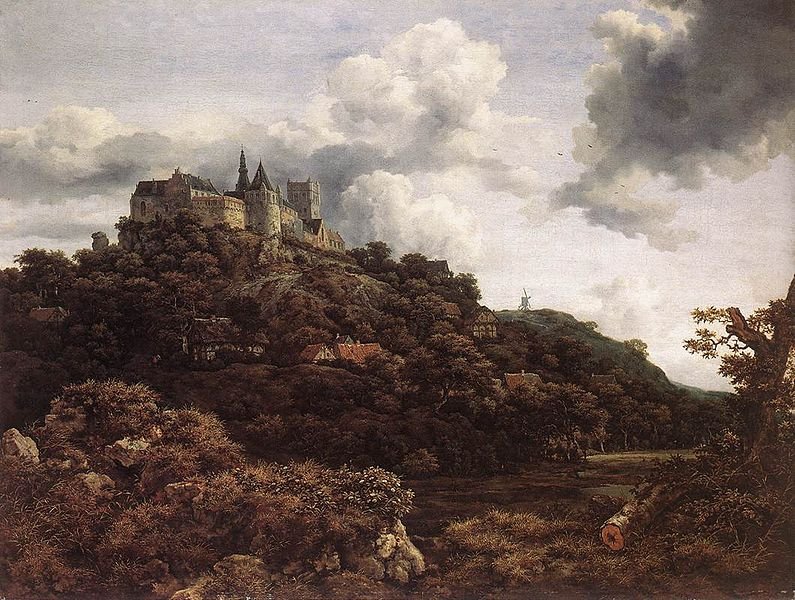
Bentheim Castle by Jacob van Ruisdael

Bentheim Castle by Jacob Van Ruisdael (1653)

Today I am moving away from the horrors depicted in the Max Beckmann’s painting which I featured yesterday and move to a beautiful work by Jacob van Ruisdael, one of the greatest pure landscape painters in the Netherlands in the 17th century.  I have featured his works before in My Daily Art Display.  On January 9th 2011 I looked at his painting Dam Square and on February 18th I featured his hauntingly exquisite work entitled The Jewish Cemetery.  Both are worth looking at if you haven’t seen them before.     I never tire of his amazing paintings.  My Daily Art Display today features another of his works entitled Bentheim Castle which  van Ruisdael completed around 1653.

Jacob van Ruisdael was born in Haarlem in 1628 and was brought up in an artistic household.  His father, Isaak van Ruysdael and his uncle, Salomon van Ruysdael were both landscape painters.  Little is known about Jacob’s early artistic training but it is thought that his father probably taught him with guidance from his uncle.  At the age of twenty he was admitted as a member of the Guild of St Luke in Haarlem.  The Guild of Saint Luke was the most common name for a city guild for painters and other artists especially in the Low Countries.   They were named in honour of the Evangelist Luke, who was the patron saint of artists.

Unfortunately during his lifetime Jacob van Ruisdael’s artistic talent was not appreciated and by all accounts he led a poverty-stricken existence.  At the age of fifty three the Haarlem council was petitioned for his admission into the town’s almshouse.  He died in Amsterdam a year later in 1682 and his body was brought back to be buried in Haarlem

Jacob van Ruisdael travelled considerably during his lifetime but seldom went outside his own country.  However it is known that Ruisdael visited the small town of Bentheim, in Westphalia close to the Dutch-German border in the early 1650’s when he travelled to the region with his friend and fellow artist Nicolaes Berchem,  who, like Ruisdael, came from Haarlem.  Bentheim Castle received a first mention in historical records back in 1020 AD when the owner of the fortress who was named as Count Otto of Northeim, and who would later become the Duke of Bavaria, married.  He had, at this time, just married Richenza, the daughter of the Count of Werl, whose family was one of the most influential and wealth dynasties in Westphalia.  The castle changed hands during many battles over the centuries.  Nowadays the fate of Castle Bentheim is in the hands of the Hereditary Prince Carl Ferdinand of Bentheim and Steinfurt, who was born in 1977. Since 2007 he has been married to Hereditary Princess Elna-Margret of Bentheim and Steinfurt.

Jacob van Ruisdael’s favourite subjects were simple woodland scenes.  He was influenced by two great Netherlandish landscape painters of the time, Allaert van Everdingen and Meindert Hobbema.   Ruisdael forte was the depiction of trees in his works.  His rendering of the foliage was second to none. At the time of this painting which was completed in the 1650’s, Ruisdael portrayal of landscape scenes was bettered by nobody.  He stood out from his contemporaries when it came to the painting of woodlands, rivers, waterfalls, mountains, and even seascapes.

His landscape works became larger which allowed him more space for his portrayal of his giant oak and beech trees as well as the plethora of shrubs.  Look at today’s featured work simply entitled Bentheim Castle for an example of this.  No matter how the castle dominates the landscape, Ruisdael must have spent an enormous amount of time painting the surrounding trees and vegetation which can be seen like a skirt around the castle fortress.  Just take time and carefully study the detail of the vegetation in the foreground. Some of it has been brightened by a sudden shaft of sunlight whilst most of it in the middle ground remains in shade.  The colours the artist used in his paintings around this period became more vivid and space increases in both height and depth.  In this work by Ruisdael, look at the great variety of colours the artist has used to paint the flora.

What we see before us is the castle as seen from the south-west above which Ruisdael has given us a wonderful rendering of cloud formation.  It is an idealized landscape and not topographically accurate as the actual castle is situated on an unimpressive and somewhat low hill. However, Ruisdael, in order to add grandeur to his landscape work, has made the castle almost look like it is perched atop a small mountain.  Why would he do that?  Probably because placing the castle so high and so distant gave it a more commanding appearance but I believe his main reason was it offered him the opportunity to flood the middle and foreground with a small forest with all the colours that brings to the work.  In amongst the wooded slopes we see the red roof tops of the white houses and cottages.  This colour red manages to set off the verdant colour of the flora that surrounds them and which runs down to the foreground of the painting.  One can see that for Ruisdael the painting of trees and flora was his main joy.  Jacob van Ruisdael loved the view of this ancient fortress and over the years painted more than fifteen landscapes featuring Bentheim Castle, viewed from different viewpoints and seen in various surroundings.

I marvel at the detail in this painting and just wonder how long it took the twenty-five year old artist to complete it.  The painting is housed in Dublin at the National Gallery of Ireland.

Harvest at La Crau with Montmajour in the Background by Vincent van Gogh

Harvest at La Crau with Montmajour in the Background (1888)

For all of us in the northern hemisphere we are in the midst of winter.  The days are short, the skies are grey and the rain is plentiful.  It is truly a depressing time of the year and one knows only too well that there is nothing more likely to lift one’s spirits than the presence of blue skies, coupled with long hours of sunshine and feeling the warmth of the sun on one’s back.  So what has all this to do with My Daily Art Display’s featured painting and the famous artist who painted it?  Well, just maybe Vincent felt the same as he looked out the window of his Parisian apartment in February 1888.  Today my featured artist is Vincent Willem van Gogh and my featured painting is entitled Harvest at La Crau with Montmajour in the Background which he completed this work in 1888 and can now be found in the Rijksmuseum, Amsterdam.

Van Gogh had come to Paris from Antwerp in March 1886 to live with his brother Théo, who was the manager at the Goupil Gallery in the Boulevard Montmartre.  He studied for a time at the Atelier Cormon under the tutelage of Femand Cormon, the French painter and art teacher.  Whilst in Paris, Van Gogh met up with many of the Impressionists, such as Camille Pissarro, Emile Bernard and Claude Monet and became firm friends with Paul Gaugin who only arrived in the French capital in late 1887.  Van Gogh also witnessed the infancy of Neo-Impressionism and the works of the Neo-Impressionists Signac and Seurat.  Van Gogh quickly abandoned the dark colors he had used to create his earlier paintings and began to he embrace the brighter more vibrant colors and the techniques of the Impressionists.   Life in the French capital for van Gogh with his painting during the day and his socialising with his fellow artists at night soon began to affect his health and after almost two years he began to tire of the cliquish Parisian art scene.   Whether it was for this reason or for health reasons or even the simple desire to leave the drab and cold capital city we will probably never be sure but there was no doubt that he hankered for the warmer sunny climate and the vibrant colours of the southern countryside.,  Van Gogh decided to move south to Arles and take advantage of the special Provencal climate  with its many uninterrupted hours of sunlight and by doing so also absorb the beauty of the French countryside.  It was his fervent hope that he could persuade some of his newly found artist friends to join him there and together they could set up a school of art,  maybe even an artists’ colony and together he believed they could resurrect the purity of the arts.  This was to be van Gogh’s  Studio of the South.  He left Paris in February 1888, a month before his thirty-fifth birthday, and headed south for Provence.

It was during his sojourn in Provence that he painted today’s featured painting Harvest at La Crau with Montmajour in the Background.  Van Gogh loved this region of Provence with the rocky outcrop of Montmajour and the Montmajour abbey.  This was thought to be one of the happiest times of his troubled life.   For a short period he seemed very content with his way of life.  He made many pen and ink sketches of the Benedictine abbey at Montmajour and the spectacular views from it of the surrounding area.   Van Gogh spent much time producing sketches with his reed pen and rather less time painting.  The reasons for this were probably two-fold.  Painting and the acquiring of paints was quite costly and it was almost impossible to paint when the Mistral wind was at full strength.   In a letter which he wrote to his brother Théo in July 1888, he described the pleasure he derived from this area, despite the problem with mosquitos and the strong cold northerly Mistral wind which made his canvases shake on the easel andmade en plein air painting almost impossible.  He wrote:

“….But now I’ve been to Montmajour 50 times to see that view over the plain, if a view can make one forget such small displeasures, then it must have something…”

In this painting, the pride of place does not go to the abbey which can be seen in the background.   The painting is all about the yellow and green patchwork quilt fields of La Crau which lay between Montmajour and Arles.  The fields are interspersed with small farm buildings with their red-topped roofs, the colour of which not only acts as a contrast to but seems to enhance the colour of the surrounding fields.  In the middle ground we can see a blue cart which is often cited as a secondary title to the painting.  He painted the scene in June 1888 and he believed it to be his best work to date.  It was at a time when the summer heat was beginning to intensify and the life-restoring radiance of the Mediterranean sun was his constant companion.  He once described this light  in a letter to his brother:

“….a light that for want of a better word I shall call yellow, pale sulphur yellow, pale golden citron!  How lovely yellow is!  And how much better I shall see the North!….”

Preliminary sketch of Harvest at La Crau (Fogg Art Museum, Harvard University)

Van Gogh made two preliminary drawings of the work and the provenance of one shows that on the death of her brothers Vincent and Théo in 1890, it came into the possession of Willemina van Gogh, their younger sister.  It is now at the Fogg Art Museum, Harvard University, a bequest of Grenville L. Winthrop.  If one compares this preliminary sketch with the finished painting one can see that the space in the finished painting has been expanded and the viewpoint is much higher.  There is a much more gradual retreating of the plain as it runs off towards the towers of the Montmajour Abbey, which can be seen in the left background, and further back to the distant hills.

A later drawing of the scene (NGA Washington)

After he completed the painting he made two further drawings of the scene.  One of which is entitled Harvest – The Plain of La Crau, which he gave to his friend, John Peter Russell, an Australian artist and which can now be seen at the National Gallery of Art in Washington where it is part of the Mr and Mrs Paul Mellon collection.

I love this painting.  It is a truly inspiring painting.  Inspiring?  As I look out of my window at the falling rain and the dark grey rain-laden clouds, it inspires me to return to Provence and bask once again in the warm sunlight, take in the golden colours of the plains, interspersed occasionally with the blue and violet colours of the fields of lavender and of course be in awe of the azure colour of the nearby Mediterranean.

Oh, for the winter to end so that I can travel again!