Frida Kahlo – Part One

There has been a much longer period since my last blog than I would have liked or I had intended.  I could simply explain that the reason for the delay being down to how busy I am with my Bed and Breakfast business, which is true, but there is another reason.  My blogs, as you know, take the form of an artist’s biography or the biography of the sitter and the painting itself.  The problem arises when I get sucked into the life of the artist or sitter.  The more I read of their life story, the more I delve further into their personal life and time soon passes.  Then of course I have to decide what to leave out to make the blog more manageable.  The problem with reading from so many sources is that they do not always agree on dates so I have had to make educated guesses in some cases as which of the sources is correct.  Sometimes the life story of the artist is so fascinating and so all-consuming, as is the case of today’s artist, I just don’t want to edit out any of the details and so have to run with the artist over a number of blogs.  My featured artist today is the Mexican painter Frida Kahlo.  Her life was controversial, traumatic and often full of sadness and as I recount her fascinating life story in the next few blogs, I will look at a couple of her paintings.  Today I want to focus on her arrival into this world, her family and her ancestors.

Frida was born Magdalena Carmen Frieda Kahlo y Calderón on July 6, 1907 at the family home, La Casa Azul (The Blue House) that was built in 1904 by her father in Coyocoán, a small town on the outskirts of Mexico City.   She was later to change the German spelling of her Christian name from Frieda to Frida.

Her paternal grandparents, Jakob Heinrich Kahlo, who owned a jewellery shop, and Henriette Kahlo (née Kaufmann) were European Jews who originally came from Arad, which was formerly part of the Austro-Hungarian Empire but which is now part of Romania.  Much has been written about this assertion by Frida Kahlo that she has Jewish ancestry.   However, the Jewish family connection and ancestry has been contested a number of times.  In a 2006 newspaper an article by Meir Ronnen in the Jerusalem Post cast doubt on the authenticity of the Jewish claim.   In a book published in 2005 by Gaby Franger and Rainer Huhle, about the photography of Frida’s father entitled Fridas Vater: Der Fotograf Guillermo Kahlo they dispute Frida’s assertion of her Jewish ancestry, agreeing that her father was born in Germany but that he came from a long line of German Lutherans and they reasoned that Frida’s story of Jewish heritage was so that she could disassociate herself from the German Nazis during World War II.

In 1860 the family moved to Germany.   Frida’s father, Wilhelm Kahlo, was born in Baden- Baden in October 1871 and was the eldest of four children.  After early schooling, he attended the University of Nuremburg, however the onset of epileptic seizures cut short his academic studies.   In 1890 Frida’s paternal grandmother Henriette died and her paternal grandfather married Ludowika Karolina Rahm.  Frida’s father Wilhelm did not get on well with his stepmother and with financial help from his father he decided to leave the family home and leave Germany altogether.   The following year, 1891, Frida’s father who was just nineteen year old, set sail from Hamburg on the freighter Borussia bound for Vera Cruz, Mexico.   His complete change of lifestyle included changing his forename name from the Germanic Wilhelm to the Spanish Guillermo although throughout his life he never lost his Germanic ancestry as he always spoke with a heavy German accent and Frida referred to him in mock formality as “Herr Kahlo”.  He soon found work in the up-market Diener Brothers jewellery store in the city, probably through his German/Jewish jeweller connections.

Guillermo married his first wife Maria Cardena in 1895 and the couple had three daughters but sadly the middle girl survived only a few days after her birth.   Maria Luisa, born in 1894, was the eldest and Margarita the youngest.   The marriage ended tragically in 1898 when his wife died during the birth of their third child, Margarita.  The night his wife died he sought help and comfort from his co-worker at the jewellery store, Matilde Calderón and her mother, Isabel, both of whom came to his house to offer their support.  Matilde Calderón y Gonzalez was a woman of Spanish and Mexican-Indian descent.  Her mother was a Spanish Catholic and her father was a native Mexican Indian.  Guillermo now faced having to bring up a four year old girl and a baby alone and he did not keep the best of health as throughout his life as he continued to suffer from bouts of epilepsy.  Whether it was because he knew he would be unable to cope alone bringing up his two young daughters, whether he wanted to avoid loneliness or whether, according to Raquel Tibol in her 1983 biography, Frida Kahlo: an Open Life, we should believe Frida when she says her father and mother simply fell in love.  Whatever his reason was, he soon proposed to Frida’s mother, Matilde Calderón, and they were married later that year.  Matilde was twenty-two years of age and Guillermo twenty-seven years of age when they got married.   The couple went on to have four daughters of which Frida was the third.  She had two older sisters, Matilde born in 1899 and Adriana born in 1902, and one younger sister, Cristina, who was born in 1908.

My Grandparents, My Parents and I (Family Tree) by Frida Kahlo (1936)

The reason I gave you that detailed family tree was as an accompaniment to the very unusual painting I am featuring today, which Frida Kahlo completed in 1936 entitled My Grandparents, My Parents and I (Family Tree).

Frida described the work:

“….Me in the middle of this house, when I was about two years old. The whole house is in perspective as I remember it. On top of the house in the clouds are my father and mother when they were married (portraits taken from photographs). The ribbon about me and my mother’s waist becomes an umbilical cord and I become a foetus.  On the right, the paternal grandparents, on the left the maternal grandparents.  A ribbon circles all the group — symbolic of the family relation. The German grandparents are symbolized by the sea, the Mexican by the earth…”

The Stonebreakers by Gustave Courbet

The Stone Breakers by Gustave Courbet (1849)

For my third look at Realism art and Social Realism art I am going back to the land of its inception, France.   The emergence of this form of art came about in France around 1848, the year King Louis-Philippe lost the French crown and was replaced by Louis-Napoleon Bonaparte, who became President of the French Second Republic.  The monarchy had gone, even if it was just for a few years, as Louis-Napoleon had himself crowned Napoleon III.  With the change of ruler came the promise of greater democracy. The French people were excited with the change and were now baying for this pledged greater democracy under the new regime.  Realism in art also arrived with the Realist artists who democratised their art by depicting in their paintings subjects from everyday lives of the working class.   These painters rejected what had gone before them.  They neither wanted to paint idealized pictures, which had no bearing on reality but was what was being taught and expected from the students at the École des Beaux-Arts, the state-sponsored art academy and exhibited at the official Salons, nor did they want to carry on with the exotic themes of Romanticism.

For these Realist artists, they wanted their paintings to be a direct reflection on modern life.  The great French painter and leading proponent of Realism art, Gustave Courbet, described what art should be, saying:


“…painting is an essentially concrete art and can only consist in the representation of real and existing things..,”

Gustave Courbet is my featured artist today and I wanted to look at his painting The Stonebreakers.  Sadly it no longer exists as it was destroyed by Allied bombing on a transport convoy in February 1945, whilst it was being transported to the Königstein Castle, near Dresden, for safe keeping along with 154 other paintings.   When The Stonebreakers was exhibited in Paris at the Salon of 1850, it was attacked as un-artistic, crude, and socialistic, so let us look at why this view was taken by the critics.

Courbet wanted to depict the lifestyle of working class people in his paintings.  However, he wanted to depart from the idealized depiction of these poor farm workers and peasants who in the past had always been depicted smiling happily as they got on with the most arduous and often dangerous jobs, for little remuneration.   The problem of course with this artistic style was although it appealed to people who sympathised with the lot of the working class, the buyers of art were often the rich and upper classes, who through association were the very people who treated their workers badly.   His Realism art works were looked upon as being anti-authoritarian and politically threatening.  When he put forward two of his large paintings A Burial at Ornans and The Painter’s Studio for inclusion in the 1855 Salon, the Salon jurists rejected them. Courbet was so angered by the jurists’ decision that he withdrew his eleven accepted submissions and displayed the paintings privately in his Pavillon du Réalisme, not far from the official international exhibition.   In his exhibition catalogue, which described his works, he wrote an introduction which, in essence, was a Realist manifesto.  He stated:

“…his goal as an artist was to translate the customs, the ideas, the appearance of my epoch according to my own estimation…”

The realist paintings of Courbet found no favour with the Establishment.  Courbet’s critics firmly believed that he was bringing about an artistic and moral decline by painting what they deemed distasteful and inconsequential subjects on a grand scale. They accused him of nurturing a “cult of ugliness” against much beloved concepts of Beauty and the Ideal.   His critics even went as far as to state that this Realism was nothing less than the enemy of art.  However there were some high placed supporters of Courbet’s work.  The French socialist politician at the time, Pierre-Joseph Proudhon, an advocate of workers’ associations and co-operatives as well as individual worker / peasant possession over private ownership or the nationalization of land and workplaces, saw The Stonebreakers painting and commented:

“… The Stonebreakers was an irony directed against our industrialized civilization … which is incapable of freeing man from the heaviest, most difficult, most unpleasant tasks, the eternal lot of the poor...”
The Stonebreakers was painted by Gustave Courbet in 1849 and shows two peasants breaking rocks into gravel to be used as a base in the construction of roads. One appears to be in his sixties and the other much younger.  The painting could not be described as colourful.  Courbet has used monotonous colours and by doing so has reflected the languishing tone of the painting.  We are not distracted by a colourful landscape.  Our eyes are fixed upon the two men as they carry on with their backbreaking work.    In no way was Courbet’s depiction of the men idealized or romanticized.  What we see is the gritty uncompromising truth.  The job of a stonebreaker was considered the lot of the lowest in French society.   Their differing ages symbolizes the circle of poverty, which will haunt the lower classes throughout their lives.  Those born into poverty would remain so for the rest of their life.   It is a glimpse into the world of the rural unskilled labourer.   The workers are dressed in ragged clothes.  Their ragged clothes and the little meal laid out in the right midground of the work underline their impoverishment. Look how Courbet has depicted the boy as he struggles with the heavy basket of gravel.  It is almost beyond the boy’s strength while the old man exhaustedly bends his knee to work.   One is now too old and almost lacks the strength to wield the hammer whilst the other is almost too young and almost lacks the strength to carry his burden.  This is realist art at its finest.  Courbet has not resorted to ancient heroes for his portrayal of heroism he has taken two simple men whose lot in life was manual labour and who were carrying out their task as best they could.

Despite Realist art not being favoured by the bourgeoisie or the Academies, it found an audience in France who was showing an interest in the plight of the working poor especially following the labourers uprising against the bourgeois leaders of the newly established Second Republic in 1848.  Their demands were simple – a redistribution of property and better working conditions.  The labourers’ uprising lasted just three days and many lives were lost. They did not achieve their demands but suddenly the plight of the working class labourer was centre stage and Courbet’s painting which came a year after the failed uprising could not have arrived at a more fortuitous time.

Barge-Haulers on the Volga by Ilya Repin

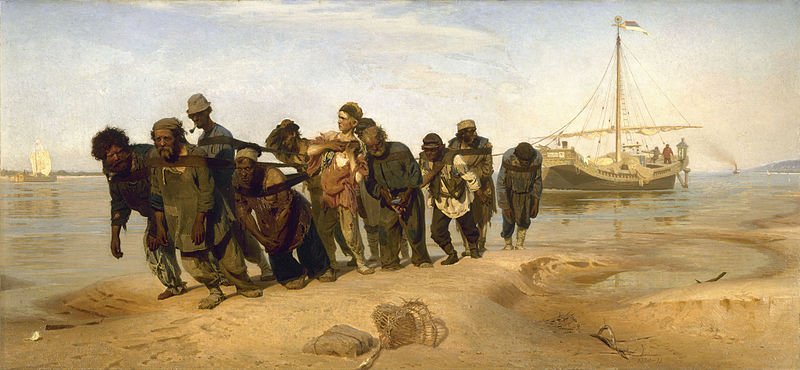
Barge-Haulers on the Volga by Ilia Repin (1873)

My blog today continues, as promised, with the Social Realism Movement in art.  Social Realism is a very broad term for painting or literature that comments on contemporary social political or economic conditions, usually from a left-wing viewpoint, in a realistic manner.  It was a way in which artists were able to draw attention to the everyday conditions of the working classes and the poor, and who were critical of the social structures that maintain these conditions.  As I am looking at a work by a Russian painter today it is important that we understand that Social Realism and Socialist Realism are quite different.  Social Realism evolved from the French Realism of the second half of the nineteenth century whereas Socialist Realism never came into being until the mid 1930’s when in 1934 Joseph Stalin made Socialist Realism the official art form of the USSR and later by the other Communist parties worldwide.  Socialist Realism demanded that all art must depict some aspect of man’s struggle toward socialist progress for a better life.   It was important to the communist regimes that Socialist Realism Art emphasized not just realism but the optimism and heroism of the people and the dictate was that all forms of experimentalism in art was to be looked upon as being degenerate and totally pessimistic.

One group of Soviet Realist artists, of which today’s featured painter was one, was the Peredvizhniki, which was also known as The Wanderers or The Itinerants in English.  This group of painters was formed in 1863 in St Petersburg as a protest at the academic restrictions of the official art center, the St Petersburg Academy of Arts.  Sounds familiar?  It should be, as in the past I have talked about the breakaway of artists from Academic control in both France and England.  The St Petersburg Academy, like other Academies in Western Europe, was associated with neoclassicism.   Neoclassicism was based on the ideal of beauty seen in ancient Greek and Roman art and looked to the Italian Renaissance.  The St Petersburg Academy of Arts was no different.  It wanted its student to depict not Russian subjects but more traditional art-historical themes: classical history, legends and myths.  In 1863, fourteen artists broke away from the Academy in protest of the proposed topic for the annual Gold Medal competition, which was to be the mythological subject of the Entrance of Odin into Valhalla. These fourteen painters believed that this subject was too remote from the real life of Russia and that the academic style of neoclassicism was much too constricting.   Having left the Academy, they organized themselves into a society on cooperative principles and developed their own educational program and in 1870 set up a touring group to exhibit their work known as the Society for Travelling Art Exhibitions. The Society maintained its independence from state support and their travelling exhibitions allowed them to take their art, which illustrated the contemporary life of the people from Moscow and Saint-Petersburg, to the provinces.

The artists adopted the style, which could be termed critical realism. Their aim was to depict their homeland and the life and history of their people from a truthful and democratic standpoint. The artists depicted the working class folk in a favourable and often heroic light but at the same time tore into their corrupt upper classes and aristocracy depicting them as oppressors and enemies of the workers.  Their paintings often highlighted the totally unacceptable and unbearable living conditions that the working class people had to endure.  It should be remembered that even though the first Russian Revolution was still more than 30 years away, and that unlike other Western European countries, Russia was a country where the political freedom to express oneself was strictly prohibited. However things were changing.  Tsar Nicholas I died in 1856 and a year later the Russian armies were defeated in the Crimea.  There was a hint of reform in the air but it was only in the arts, whether it be paintings, literature or the theatre that there was an opportunity to express one’s views.  With this in mind the members of the Peredvizhniki believed it was their duty to effect change to the living conditions of the working class. Our featured artist today, Ilya Repin wrote succinctly that artists come from the people and that the people expect art should reflect a clear understanding of conditions and nature.

Today’s featured work is second painting by Repin which I have looked at in a blog.   The first one was a painting, entitled Easter Procession in the Region of Kursk  (My Daily Art Display of August 29th 2011)   Today’s work is entitled Barge-Haulers on the Volga which he completed in 1873.   An alternative title is Burlacks on the Volga.   A burlak was a Russian nickname for a person who hauled barges and other vessels upstream from the 17th to 20th centuries. The word itself came from the Tatar word bujdak, ‘homeless’.  Before us is a river scene. The barge in the painting’s title is relegated to a minor role in the right background and if you look closely you will see in the distance, behind the barge, a small steam-powered boat, which makes us realise that at the time of the painting we were at the onset of the industrial age and the days of using human beings to haul barges was coming to an end.

The Barge Pullers

It is a magnificent portrayal of a group of eleven men, dressed in rags and bound with leather harnesses, who struggle with their backbreaking task at hand, the towing of a barge along the waters of the River Volga.  This painting is looked upon as being one of the best works of the Peredvizhniki movement.   The men we see before us are simply human pack mules.  This painting focuses on the difficult life endured by the peasantry at that time.  Look how Repin has portrayed the barge haulers.   It is a hot day and the men seem to be at the point of collapse and exhaustion as they lean forward in a desperate effort to keep the laden barge moving.   The painting is not just a testament to the peasant’s heroic efforts but it is a damning condemnation of the people that have set them this inhumane task.

The young optimist

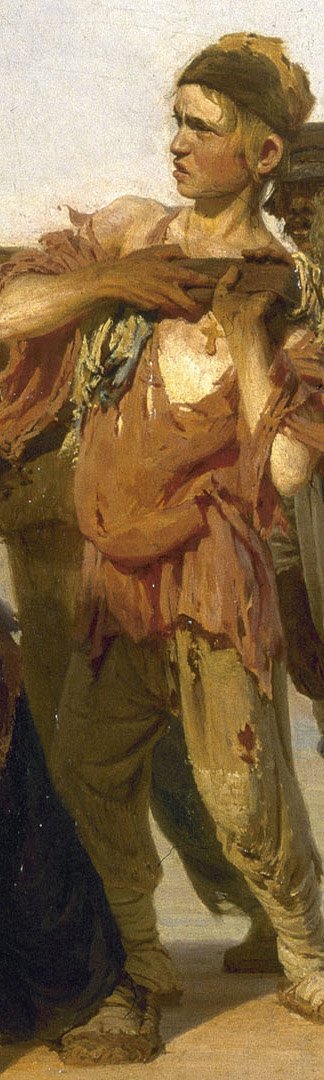
There is an added touch of heroism.  Look at the line of men.  All but one of them is dressed in drably-coloured clothes.  In the middle of the line one man stands out from the others.  He is a fair-haired young man, dressed in slightly brighter colours.  He is not exhausted and bent over like the others.  He stands upright and proud as he looks out over the river.  He is not humiliated by his menial  and backbreaking task.  His spirit, unlike the others, is not broken.  He scans the horizon and in this gesture we realise he is not just scanning the river, he is looking to the future – his future. 

Repin, who was twenty-six at the time he started this work, formulated the idea for this painting during a summer holiday he spent near Stavropol, close to the river Volga in 1870.  He had spent three months there with his brother Vasily and friends. During that time he took a boat trip down the Volga and watched the gangs of barge haulers. Initially he made many oil sketches of the area and the men working on the riverbanks and the people we see in the painting were real people.  One was a former soldier, one and artist and one a defrocked priest.  The former priest’s name was Kanin, who became a good friend of Repin, and he can be seen as the lead hauler of the group wearing a bandana.  From the dialogue Repin had with the barge haulers he was shocked to find that at one time most of them had held relatively important positions in society but had since fallen on hard times.  Although not shown in this painting, there would often be women employed as barge haulers and the number in a barge-hauling gang would normally be more than the eleven Repin has depicted.

Vladimir Vasilievich Stasov, who was looked upon as the most respected Russian critic during his lifetime, said of the way Repin depicted the barge haulers:

“…They are like a group of forest Hercules with their dishevelled heads, their sun-tanned chests, and their motionlessly hanging, strong-veined hands. What glances from untamed eyes, what distended nostrils, what iron muscles!…’

and of the painting itself, Stasov commented:

“….with a daring that is unprecedented amongst us [Repin] has abandoned all former conceptions of the ideal in art, and has plunged head first into the very heart of the people’s life, the people’s interests, and the people’s oppressive reality… no one in Russia has ever dared take on such a subject…”

Despite its critical message of how the upper classes badly treated its workers, the painting was bought by the Tsar’s second son.   After the Russian Revolution the art collection of the grand duke was nationalized and it is now housed in the State Russian Museum in St Petersburg.

Repin commented on the paintings of the Russian Social Realist artists and what they achieved, saying:

 “…The pictures of those days made the viewer blush, to shiver and carefully look into himself…. They upset the public and directed it into the path of humaneness…”

Newgate: Committed for Trial by Frank Holl

Newgate: Committed for Trial by Frank Holl (1878 )

Today I am going to revisit the Social Realism art movement and look at one of the leading English Victorian Social Realist painters, Frank Holl.  I featured two of his very moving paintings Hush and Hushed in My Daily Art Display of February 9th 2012).   The Realist movement which has its roots in France came to the fore in French art in about 1840 in the aftermath of the 1848 Revolution which threw out the monarch, Louis-Philippe and saw the start of the Second Empire under the rule of Napoleon III.   Realist art flourished in France until the late nineteenth century.

The Social Realism Movement originated from this European Realism, and from the works of the great French Realist painters such as Honoré Daumier, Gustave Courbet and Jean-François Millet.   A revolution was also taking place in England in the nineteenth century – the Industrial Revolution, where changes in agriculture, manufacturing, mining, transportation, and technology had a tremendous consequence on the social, economic and cultural conditions of the times. It was a time of poverty and unemployment for many of the lower classes and it aroused a concern in many artists for this urban poor.  During 1870s the work of many of the Social Realist artists, such as Luke Fildes (see My Daily Art Display May 17th and 18th 2011), Hubert Herkomer (See My Daily Art Display July 25th 2011) and today’s featured painter, Frank Holl came to the fore.

Frank Montague Holl was born in Kentish Town, London in 1845. His father, Francis, was a well-known engraver and Academician as was his grandfather, William Holl.   His family environment was politically driven for his family were steadfast Socialists and even when he was just a youngster his family instilled in him the thought that he had a duty in life to change society and make it better for the common people.  Holl went to Heath Mount School in Hampstead and at the age of fifteen he was accepted as a probationer at the Royal Academy Schools. He proved to be an outstanding student but often shocked his tutors by adding a hint of political content to his works of art. At the age of seventeen he won a silver medal for his work and the following year was awarded a gold medal and a travel scholarship for his painting entitled The Lord gave, and the Lord hath taken away.  It was a painting that depicted a family bereavement and when it was exhibited at the Royal Academy in 1869, the then monarch, Queen Victoria,  attempted to buy the painting but the original purchaser refused to sell it. Two years later Holl painted another painting on the same theme entitled No Tidings from the Sea and on this occasion Queen Victoria purchased it for a 100 guineas.

Holl went away to Italy on his travel scholarship but the Italian sojourn lasted only two months, at which time he wrote to the Royal Academy saying that he wanted to return home and concentrate on his social realism paintings based on working-class life in England.   Holl began exhibiting his work in 1864 when he was nineteen years of age and from 1869 onwards he was a regular contributor to the Academy Exhibitions.  Many of these works were depicting the plight of the less fortunate and their pitiful existence, such as No Tidings from the Sea (1871) and Leaving Home (1873).  After he had he completed his studies in 1869 he was employed by William Luson Thomas, a successful artist, wood engraver and social reformer, who had just founded a new weekly illustrated newspaper, called The Graphic.

The newspaper when launched in December 1869 was printed in a rented house.   A successful artist himself, the founder, William Thomas recruited talented authors for the story lines and exceptional artists for the illustration which were to accompany the words.   The gifted artists included Luke Fildes, Hubert von Herkomer and John Millais and great writers who worked on the journal included George Elliot, Thomas Hardy and Anthony Trollope. Thomas believed that it was not just words but the illustrations which had the great power to influence public opinion on political issues.  Thomas said later of his newspaper idea:

“…The originality of the scheme consisted in establishing a weekly illustrated journal open to all artists, whatever their method, instead of confining my staff to draughtsmen on wood as had been hitherto the general custom… it was a bold idea to attempt a new journal at the price of sixpence a copy in the face of the most successful and firmly established paper in the world, costing then only fivepence…”

For William Luson Thomas, his commitment was to force social reform and he hoped that the visual images in The Graphic would have a political impact on the reading public.  In his 2004 biography of Thomas, entitled Thomas, William Luson (1830–1900), Mark Bills, described Thomas’ journal:

“…The format of the paper offered artists an unprecedented opportunity to explore social subjects, and its images of poverty made it a catalyst for the development of social realism in British art. Many of the wood-engravings which it featured were developed into major paintings…”

This commitment to social reform by Thomas was exactly what Frank Holl desired and what he had been brought up to hear at the family table when he was growing up.  He, like Thomas, believed passionately in the cause for political and social change.  Frank Holl produced a series of pictures that were used to illustrate stories in the magazine and sometimes he and the other artists working on the journal would turn their engravings, which they had fashioned for the pages of The Graphic, into oil paintings.  These depictions of the hard and squalid life lead by the “under-class” of the nation lead them to become known as the Social Realist Movement.  Although we may look upon these depictions of poverty as a welcome wake-up call to the nation, they were badly received by the Victorian establishment at the time. The more fortunate viewed the works as being disloyal. The establishment and many of the people who had never suffered poverty wanted to turn a blind-eye to the suffering of the less fortunate. Their motto was “out of sight, out of mind” and they frowned upon these upstart young artists who wanted to drag the social differences which existed into the public forum.

The featured painting in My Daily Art Display today is entitled Newgate: Committed for Trial  which Frank Holl completed in 1878 and is housed in Royal Holloway, University of London, Egham, just outside London.  It came about when Holl was given and assignment to visit Newgate Prison by the management of The Graphic.   Holl visited Newgate on a number of occasions and over time he and the Governor became friends.   What we see before us is what Holl described as a “cage”   It was where prisoners on trial were allowed, at certain times, to see visitors and talk to them through a double row of bars.  The space in between the two sets of bars was patrolled by a warden.    Holl later commented that he became very emotional when he saw the desperation of the prisoners and their visitors as they awaited the results of their trials.  In an attempt to better capture the emotion of imprisonment, Holl painted this picture whilst inside the Newgate Prison. In the painting today we see Holl’s depiction of two women and their children visiting their husbands who had been incarcerated.   Look at the face of the prisoner on the left.  It is a look of wide-eyed innocence but as we catch sight of his wife that stands before him we note how she seems wearied by her husband’s protestations of his innocence.  Could it be that she has heard it all before?  Almost hidden by this female visitor we can just make out a second prisoner.  He is in a much more animated and distressed state and seems to be pleading to his wife who is seated clutching her baby to her chest.  Is it a plea for forgiveness and understanding or is it a plea of innocence?  Whatever it is, the young woman seems unmoved and somewhat resigned by what she hears.

As I said earlier, the rich and aristocratic were unmoved by what they saw in Social Realist works and it is remarkable that the wealthy English philanthropist, Thomas Holloway, who had made his fortune patenting medicines, would buy this work and add it to his collection, which grace the walls of the Royal Holloway College, which he had built in 1880.  Of his collection of seventy seven works of art which can be found there some were simple idyllic landscapes depicting the beautiful English countryside but like today’s work of art by Frank Holl, some were harrowing aspects of Victorian life.

The painting received mixed reviews when it was exhibited at the Royal Academy in 1878 but one critic summed up what we see before us, writing:

“…The characters are so real in this fine work that one feels there is a story to be told of ruined ambitions, of broken home ties, of devotion scorned and trampled underfoot….”

In the next few blogs I will stay with Social Realism art and look at the works of Social Realist artists from other countries

Portrait of Laura Battiferri, wife of the sculptor Bartolomeo Ammannati by Agnolo Bronzino

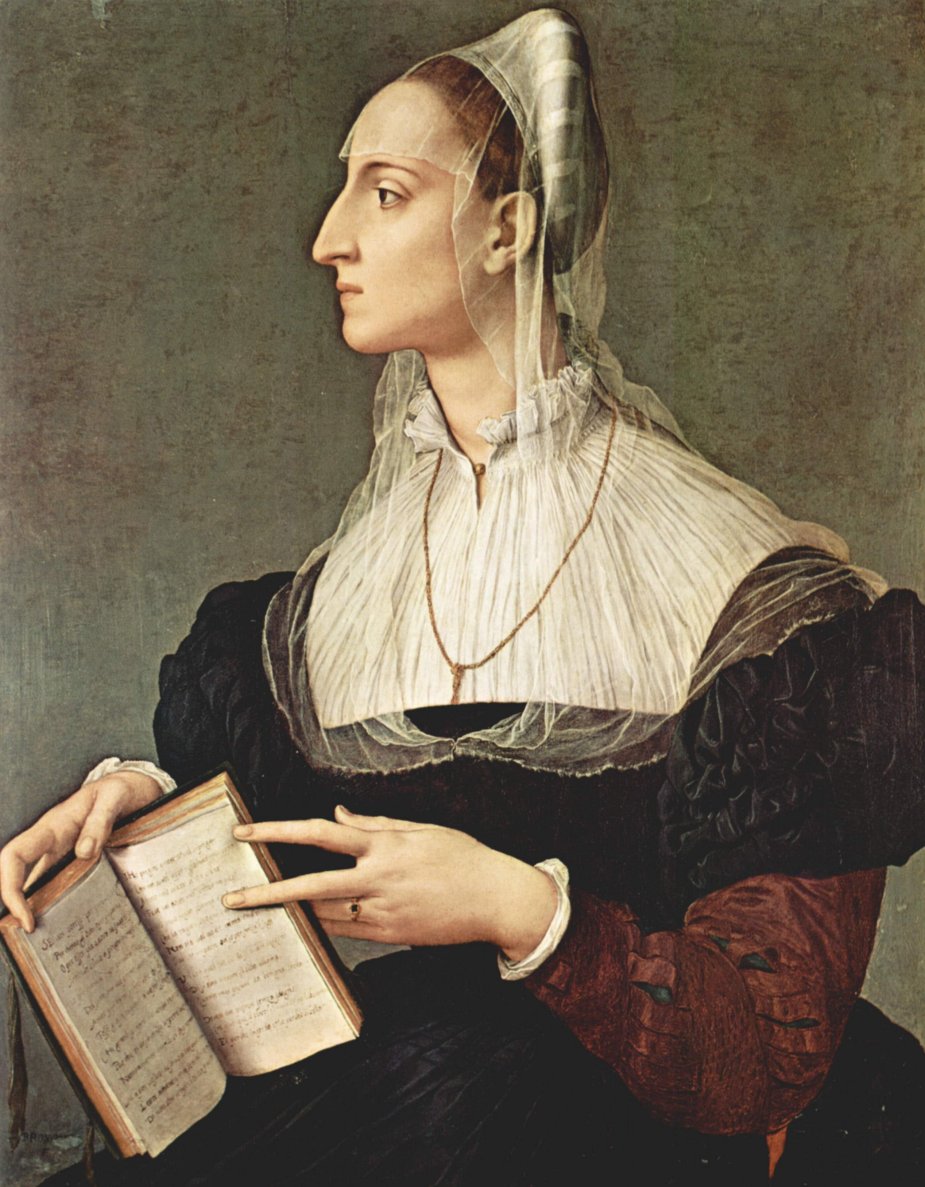
Portrait of Laura Battiferri by Agnolo Bronzino (c.1560)

My featured painting bears a strange resemblance to the painting I looked at in my last blog although they were painted about thirty years apart by two different Italian artists.  It is not unusual to see paintings featuring the same sitter or views of certain buildings or particular landscapes painted by different artists but it is somewhat unusual to look upon two portraits of two different women featuring a similar gesture towards a certain object which has been included in both of the works of art.  Sounds a little confusing?  Ok let me say that if you have just stumbled on to this page without looking at my previous blog (June 25th  Portrait of a Woman with a Volume of Petrarch by Andrea del Sarto) then go to that one first and read about that particular painting before you read more about today’s offering.

I am sure having now looked at the two paintings you can see the unusual similarity – the book and the pointing fingers.   My featured work of art today is a portrait completed by Agnolo Bronzino around 1560 and is entitled Ritratto di Laura Battiferri, moglie dello scultore Bartolomeo Ammannati  (Portrait of Laura Battiferri, wife of the sculptor Bartolomeo Ammannati) and is housed in the Palazzo Vecchio in Florence.  It is part of the Loeser Bequest of Palazzo Vecchio which comprises of over thirty works of art that the American collector Charles Alexander Loeser bequeathed to the Florence City Council on his death in 1928.  The idea behind his bequest was that he felt it would play a part in the enhancement and reconstruction of the ancient atmosphere of Palazzo Vecchio, which the Florentine Council was carrying out at that time.   One of the conditions Loeser made was that he laid down procedures for the layout of his bequest, which was to be displayed in several rooms in Palazzo Vecchio, and that they were to be kept united in perpetuity, in an arrangement that would give the area not the habitual appearance of a museum but as he put it, it would  make each room appear “simply beautiful for the repose and enjoyment of the visitor”.

Before we look at the painting in detail I suppose the first question one asks when we look at this work of art is, who was Laura Battiferri and why would the great Italain Mannerist painter, Bronzino,  depict her in the portrait pointing at a book?  To find the answer to those questions one needs to look at the life of both the artist and his sitter.

Bronzino, whose real name was Agnolo di Cosimo, but was was probably given the nickname Il Bronzino (the little bronze) because of his relatively dark skin.  He was born in 1503 in Monticelli, a suburb of Florence.  His first artistic training was under the tutorship of the Florentine painter, Raffellino del Garbo and this lasted several years before he became an apprentice at the studio of Jacopo Carrucci, better known as, Pontormo, named as such after the Tuscan town where he was born.  Pontormo is now recognised as one of the founder of Florentine Mannerism.  Despite Pontormo being nine years older than Bronzino they became great friends and artistic collaborators and in some ways Pontormo acted as a father-figure for the young Bronzino.

In 1522 the plague struck Florence and Pontormo and Bronzino left the Tuscan city and headed for the Certosa del Galluzzo which is prominently situated on a hillside just south of Florence.  Here Pontormo, with Bronzino as his apprentice, worked together on a commission to paint a series of frescoes.   This was a very important time for Bronzino as he began to gain a reputation for the beauty of his work.   Bronzino returned to Florence in 1532 and worked on his frescos, as well as a number of portraits.    Seven years later in 1539, Bronzino had a major breakthrough with his artistic career when he received the patronage of the Medicis and was commissioned to carry out the elaborate decorations for the wedding of Cosimo I de’ Medici to Eleonora di Toledo who was the daughter of the Viceroy of Naples.   From that moment in time he became the official court painter to the Medici court and over time would paint a large number of portraits of the Medici clan and members of the royal court.  His portraits of the royal couple, Cosimo and Eleonora, and other figures of the Duke’s court, revealed a delicate coldness, almost an aloofness.  This was to define Bronzino’s portraiture style.  It was a portraiture technique which showed no emotion whilst always remaining stylish. The works were well received by the sitters and Bronzino’s portraiture style went on to influence a century of European court portraiture.

It is now we have our first connection between Bronzino and the sitter in today’s painting, Laura Battiferri, because she was a close friend of Eleanora di Toledo, Cosimo’s di Medici’s wife and there is no doubt that the artist and sitter met at the Medici court.  Another thing the artist and sitter had in common was poetry.   Although we are well aware that Bronzino was an artist he was also, like Laura Battiferri, an accomplished poet. Besides the portraits of members of the Medici family and some of the favoured royal courtiers he would paint portraits of his fellow poets, one of which was Laura Battiferri.   Laura Battiferri  came from Urbino.  She was born illegitimately to a pre-Reformation churchman Giovanni Battiferri, and his concubine. Her wealthy father, a Vatican cleric, provided her with a humanist education. As a well regarded and well respected poet she mixed with the most distinguished poets and artists of her day and lived all her life in court circles. She was the wife of the renowned architect and sculptor Bartolomeo Ammannati, who was a close confidant and adviser to Cosimo di Medici.

And so to the painting.    I would ask you to look at today’s work in conjunction with Andrea del Sarto’s  Portrait of a Woman with a Volume of Petrarch which I featured in my last blog (June 24th).  Both are female portraits but Bronzino has unusually reverted to the type of female portraiture of the Quattrocento (the art of 15th century Italy).   In those days, in female portraiture, the sitter was seen in profile view.  These works were traditionally painted by male artists for male patrons.  Graham Smith commented on why female portraits in those days were painted in profile view in his 1996 book Bronzino’s Portrait of Laura Battiferri.  He wrote:

 “…the profile portrait allowed the suitor to explore his lover’s face ardently, while simultaneously attesting to the woman’s chastity and female virtue…”

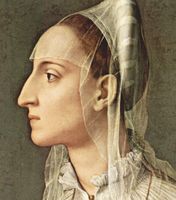
As we look at the portrait of Laura are we immediately struck by her beauty?  I think not.  There is a remoteness about this lady as she looks straight ahead avoiding our eyes.  It is if she has turned away from us showing her disdain for us.   Or could it be that she is exhibiting a sense of modesty, and it is this which makes her avert her eyes?   Whatever the reason, it has in some way, added a majestic aura to her character.   There is a sense that she is untouchable and unattainable which of course would please her husband who is thought to have commissioned the work.  Laura was also recorded by historians as being a devout Catholic and a very pious person.  It is known that she was a great supporter of the Jesuitical Counter-Reformation also known as the Catholic Reformation which was the period of  Catholic revival beginning with the Council of Trent (1545-63)and which historians now look upon as a response to the Protestant Reformation. Therefore Bronzino’s portrayal of her is a very fitting one and it could well be that the artist wanted to indicate this piety in the way he depicted her.

Laura Battiferri

Look at her closely.  Her neck and fingers have been elongated in a Mannerist style.  The upper part of her body is now completely out of proportion in relation to her small head and the way in which Bronzino has depicted her forehead in some ways draws attention to her long and slightly hooked nose.  She is wearing a transparent veil, which hangs down from the shell-shaped, calotte-style bonnet covering her tightly combed-back hair onto her goffered shawl and puffed sleeves.  Her one and only gesture, as she ignores us, is to point to a page in an open book which she is holding.  Her elongated thin fingers frame a certain passage of the prose.  It is a book of sonnets by the Italian poet Petrarch.  Compare this with Andrea del Sarto’s woman who is also pointing to a book of his sonnets.  So similar and yet so different.  The woman in del Sarto’s portrait connects with us.  We have eye contact with her.  We can almost know what she is thinking but with Laura Battiferri she is an enigma.  With no eye contact, her thoughts remain her own.

The passage in the book

In both portraits we see the women pointing to a passage in Petrarch’s book in which the central theme is the poet’s love for a woman he met when he was in his early twenties. Her name was Laura de Noves.   In this painting, Laura Battiferri points to a passage in the book where Petrarch talks about “his Laura” and maybe Battiferri identifies herself with Petrarch’s Laura and empathizes with the poet’s words as he describes the love of his life:

“….she is an unapproachable, unattainable beauty… as chaste as the adored mistress of a troubadour, as modest and devout as a ‘Stilnovismo Beatrice'”. “Laura’s personality is even more elusive than her external appearance. She remains the incarnation of chaste and noble beauty.”

Bronzino had already painted a number of portraits which featured the sitter pointing to pages in a book.  Around 1540 he completed his portrait entitled Portrait of Lucrezia Panciatichi in which the young lady points to a page in a book which rests on her knee.   Eight years earlier he painted a portrait entitled Lorenzo Lenzi, in which the young son of a prominent Florentine family holds an open book inscribed with sonnets by Petrarch and so when he completed his portrait of Laura Battiferri around 1560 showing the sitter pointing at pages in a book it was not a unique depiction and of course as we know Andrea del Sarto’s painting was completed about thirty years earlier.

I end with a question to any females reading this blog.  If you were to commission an artist to paint your portrait would you go for the Bronzino-profile style in which the artist would probably depict you as modest and unattainable or would you choose the del Sarto-style in which you look out at the us, the viewer and from your facial expression maybe we are able to read your thoughts?

Portrait of a Woman with a Volume of Petrarch by Andrea del Sarto

Portrait of a Woman with a Volume of Perarch
by Andrea del Sarto (c.1528)

My blog today centres around three women, an artist and a poet.  The artist in question, and the painter of today’s featured painting, is the Italian artist, Andrea del Sarto.

Andrea del Sarto was born in Florence in 1486 and was one of four children.  His real name was Andrea d’Agnolo di Francesco but the epithet “del Sarto” means “of the tailor” and that was the profession of his father, Agnolo.  At the age of eight, his parents took him out of his normal school where he had been learning to read and write and arranged for him to become an apprentice to a local goldsmith but he didn’t like the work although he did spend time at this early age drawing from his master’s models.  A local Florentine painter and woodcarver, Gian Barile, noticed his drawings and took him under his wing and gave him his first artistic lessons.  Andrea was now doing something he enjoyed and in a very short time had become quite a talented artist for someone his age.  At the age of twelve, Barile realising Andrea would, with the correct training, become a great artist had words with the great Florentine artist of the time Piero di Cosimo and persuaded him to take Andrea on as an apprentice.  Soon Piero di Cosimo realised that despite his age Andrea del Sarto was a greater draughtsman and painter than most of the other aspiring artists in Florence.

Andrea del Sarto remained with Piero di Cosimo for four years.  In 1505 he became great friends with another young Italian painter, Franciabigio, who was four years his senior and apprenticed to the Italian painter, Mariotto Albertinelli.  A year later in 1506, Andrea wanted to move on from his apprenticeship with Piero di Cosimo and because Franciabigio  apprenticeship had ended with Albertinelli, Andrea del Sarto persuaded him to embark on a shared venture with him and open up a joint workshop in Piazza del Grano.  It was here that they worked and lived and where they worked jointly on painting commissions.  One of their collaborations was for frescos for the Basilica della Santissima Annunziata di Firenze, (Basilica of the Most Holy Annunciation). The work they produced was highly regarded by the Church’s patrons, The Brotherhood of the Servites Order, who referred to Andrea del Sarto, as Andrea senza errori, or Andrea the perfect. From 1509 to 1514, he went on to complete many more frescos for the church.  One of the unfortunate aspects of these commissions was that due to the connivance of patrons, Andrea del Sarto and Franciabigio were from being working partners pitted against each other on some of the later commissions.  This eventually led to the breakup of the partnership of the two artists.

These works enhanced Andre del Sarto’s reputation and soon he became one of the leading Florentine painters.  Aged twenty-three, Andre del Sarto was regarded as the best fresco painter of central Italy, barely rivalled by Rafaello Sanzio di Urbino (Raphael), who was four years older.  It should also be remembered that Michelangelo’s Sistine Chapel frescoes were at this time, only in a preliminary stage.

During the time of the friendship between del Sarto and Franciabigio and before they split up, they would often go out socialising and it was on one of these occasions that Andre came across Lucrezia del Fede, who, at the time, was the wife of the hatter, Carlo Recanati.  It was love at first sight.    When her husband died at the end of 1512, Andrea married Lucrezia.  Andrea was besotted by this beautiful woman and would paint her portraits on many occasions and often portraits he did of other women had the hint of Lucrezia in them.  This liaison between man and wife was to have an effect on the course of his life.

In 1516 two of his paintings were sent to the court of the French king, Francois I.  He was very impressed with del Sarto’s work and in 1518 invited the artist to visit him in Paris.  In June that year, Andrea del Sarto, without his beloved wife, went to the French capital, along with his apprentice, Andrea Sguazzella.  He worked at the court and received sizeable remunerations for his time.  At last he was earning a good wage for his work and so everything was perfect.  Actually no, it was not,  as there was one major problem – his wife, whom he had abandoned in Florence.  She became more and more discontented and demanded her husband’s return.  Reluctantly Andrea approached the king and asked if he could return to Florence on a brief visit to see his wife.  King Francois reluctantly agreed on condition that Andreas’ visit home was only for a short period.  Maybe to ensure Andrea del Sarto’s return, he gave the artist some money in order to buy and bring back some Italian works of art.

Andrea took the money but instead of purchasing paintings and probably to placate his wife, used it to buy himself a house in Florence.  His love for his wife and Florence, his birthplace, had too much of a hold on him and he decided not to keep to his part of the bargain he had with the French king.  This act of betrayal meant that he could never return to France and in some ways tarnished his reputation.  For the next ten years he remained in Florence and continued with his art.  In October 1529 the city of Florence came under siege from a large Imperial and Spanish army which had surrounded the city.  The siege lasted for ten months before it was captured and Alessandro de’ Medici was proclaimed the new ruler of the captured city.

Andrea del Sarto had remained in the city during the siege but the following year he died at age 43 during a pandemic of Bubonic Plague which it is thought could have been brought to the city by the invading armies. He was buried in the church of the Servites.  The great biographer of Italian artists, Giorgio Vasari, claimed Andrea received no attention at all from his wife during his terminal illness but one should remember how contagious the Plague was and maybe she was simply scared in case she too contracted the often-fatal disease.   Vasari did not have a kind word for Lucrezia.  According to him, she was faithless, jealous, overbearing and vixenish with her husband’s apprentices. Lucrezia del Fede survived her husband by 40 years.

My featured oil on wood painting today by Andrea del Sarto is entitled Portrait of a Woman with a Volume of Petrarch and was completed by him around 1528 and is now housed in the Uffizi Gallery in Florence.   The woman in the painting is thought to be Maria del Berrettaio, who was born in 1513, and was Andrea del Sarto’s stepdaughter, the daughter from his wife, Lucrezia’s first marriage.  This early sixteenth century portrait is an interesting mix of the High Renaissance and the idealization of Mannerism.   Portraiture was very popular with the middle classes going back a hundred years from the time of this painting.  In those early days,  portraits of women would normally show the sitter in profile.  In those earlier portraits the sitter would look straight ahead with no eye contact with the viewer which in the majority of cases would be a person of the opposite sex.  The averting of the sitter’s eyes from us, the viewer,  enabled the female sitter to retain her modesty.  However by the end of the fifteenth century things began to change and artists would show women in three-quarter or even full face and by doing so would be able to capture the full beauty of the woman and highlight her facial qualities.   To retain a modicum of modesty however, the female sitter would often avert her eyes or look downwards.

Andrea del Sarto’s portrait is different.  What can we make of his sitter from this portrait?    The fact that the artist has chosen a very dark and plain background accentuates the facial expression of the young woman.  She is seated in a semi-circular chair.  Her clothes are somewhat plain and lack the opulence we see in other female portraits who wish to convey their wealth of that of their family.  Her blouse with its high neck has a chaste feeling to it.  Her blue over garment is heavy and full enough to hide the contours of her body.  The only fashionable aspect to her clothing is the popular slashed sleeves of her dress.  Her hair is long, simply fashioned and kept in place with a simple clasp.  The girl looks directly out at us.  She smiles weakly.   It is a demure and shy smile.   This is not an idealized portrait of a woman.  Andrea del Sarto has not shown any inclination to “beautify” his sitter.  She has an olive skin and not the fair skin of an idealized beauty of the time.  Her face is plump and does not have the delicate bone structure of contemporary beauties.  In those days beauty in a woman was fair skin, long neck, and bright oval shaped eyes.  Our sitter has none of these attributes.

At the beginning of this blog I said the painting today was all about an artist, a poet and three women.  I have given you the artist, Andrea del Sarto, talked about his wife Lucrezia and now we have identified his sitter, Maria del Berrettaio but where do the poet and the third woman come into the story?  The answer lies in the portrait itself and the title of the painting.  Our sitter has hold of a book which she has presumably been reading and she is pointing her Mannerist-styled fingers towards a point in the text.  The book she is holding is the Petrarchino and at the time was a popular work of the fourteenth century Italian scholar and poet Francesco Petrarca, who was known in English simply as Petrarch.  Petrarch is often referred to as the “Father of Humanism”.

The Petrarchino was part of a book of sonnets, entitled Il Canzoniere, whose central theme was Petrarch’s love for a woman he met when he was in his early twenties.  Her name was Laura de Noves, the wife of Count Hugues de Sade, an ancestor of the Marquis de Sade.   She was six years younger than Petrarch having been born in Avignon in 1310.  The story goes that Petrarch first saw her on Good Friday 1327 at Easter mass in the church of Sainte-Claire d’Avignon.  In current terminology we may look upon Pertrarch as a stalker as for the next three years whilst living in Avignon he haunted Laura in church and on her walks.   He eventually moved away from Avignon but returns ten years later and it was then that he began to write numerous sonnets in her praise.

The sitter in today’s featured painting points to a page of the book of sonnets which has been recognised as sonnets number 153 and 154.  So what is she coyly pointing to on this page ?  What are the words of the two sonnets?  All will be revealed in this English translation…………

ENGLISH

Sonnet 153

Go, warm sighs, to her frozen   heart,
shatter the ice that chokes her pity,
and if mortal prayers rise to heaven,
let death or mercy end my sorrow.

Go, sweet thoughts, and speak to her
of what her lovely gaze does not include:
so if her harshness or my stars still hurt me,
I shall be free of hope and free of error.

Through you it can be said, perhaps not fully,
how troubled and gloomy is my state,
as hers is both peaceful and serene.

Go safely now that Love goes with you:
and you may lead fortune smiling here,
if I can read the weather by my sun.

Sonnet 154

The stars, the sky, the   elements employed
all their art, and all their deepest care,

 to set in place this living light, where Nature
is mirrored, and a Sun without compare.

The work, so noble, graceful and rare
is such that mortal gaze cannot grasp it:
such is the measure of beauty in her eyes
that Love rains down in grace and sweetness.

The air struck by those sweet rays
is inflamed with virtue, and becomes
such as to conquer all our speech and thought.

There no unworthy desire can be felt,
but honour and virtue: now where
was ill will ever so quenched by noble beauty?

So there you have it – a story about a poet, an artist and three women.

Portrait of Maud Cook by Thomas Eakins

Portrait of Maud Cook by Thomas Eakins (1895)

As promised in my last blog, today I will complete the life story of the great American artist Thomas Eakins and look at another of his paintings, this time a portrait.  If you have just landed on this page maybe you would like to go back to my previous blog in which I started talking about Eakins’ early life and had a look at his famous painting entitled The Champion Single Sculls, a perfectly rendered quiet picture of a rower on the Schuylkill River which he completed in 1871.

After his four year stay in Europe, Eakins had returned to America and the city of Philadelphia where he remained to the end of his life.    He once again attended the Jefferson Medical College and resumed his anatomical studies and in 1878 he took up a teaching post as a volunteer at the Pennsylvania Academy of the Fine Arts.  The following year he was appointed Professor of Painting and Drawing and in 1882 he became director of the artistic establishment.  On January 19, 1884, he married Susan Hannah Macdowell, a student at the academy.   She was, well known in the artistic community.  She was 25 when Eakins met her at the Hazeltine Gallery in Philadelphia, where his painting, The Gross Clinic was being exhibited in 1875.  This was to be his most famous picture and at the time aroused controversy because of its detailed depiction of a surgical operation.     Unlike many, Susan MacDowell was impressed by the controversial painting and she decided to study with him at the Academy, which she attended for 6 years.   Her own artwork became more sober and her painting style became of a more realistic style similar to Eakins. She was an outstanding student and winner of the Mary Smith prize for the best painting by a matriculating woman artist.

Once she married Eakins she all but gave up her art as most of her time was spent in supporting her husband’s career, being the perfect hostess when they entertained and during the difficult times after Eakins left the Academy she never wavered in her support for him, unlike some of his family and so-called friends.  The couple did not have children but it was thought they lived a happy and contented life.  She and Eakins both shared a passion for photography, both as photographers and subjects, and employed it as a tool for their art. She also posed nude for many of his photos and took images of him. Both had separate studios in their home.

In the previous blog I talked about Eakins disenchantment with the École des Beaux-Arts and their treatment of nudity.  He had definite views on the subject and once wrote:

“…She [the female nude] is the most beautiful thing there is in the world except a naked man, but I never yet saw a study of one exhibited… It would be a godsend to see a fine man model painted in the studio with the bare walls, alongside of the smiling smirking goddesses of waxy complexion amidst the delicious arsenic green trees and gentle wax flowers & purling streams running melodious up & down the hills especially up. I hate affectation…”

Eakins was a fervent believer that the male and female nude were things of beauty and nude models should be available to his students for them to complete their life drawing studies.  He was attacked for his radical ideas, particularly his insistence on working from nude models.  Eakins’s work photographing and painting nudes made him something of a liability for the Pennsylvania Academy of the Fine Arts where he taught and it all came to a head in 1886 when he was forced to resign after allowing a class of both male and female students to draw from a completely nude male model.

The Concert Singer by Thomas Eakins

Thomas Eakins, who by the 1880s had only managed to sell nine pictures for a total of $2,000 now decided to concentrate on portraiture.   However, portraiture commissions were equally hard to come by and most of his portraiture works were of his friends and individuals who he admired and offered to paint them without payment.   My Daily Art Display painting today is an example of this.  My featured painting today is entitled Portrait of Maud Cook.  It is such a beautifully haunting portrait which Thomas Eakins completed in 1895 and is looked upon as one of his finest work of portraiture.  In 1892, Eakins had already completed portraits of Maud’s sister Weda Cook, the operatic contralto singer, one of which was entitled The Concert Singer.

Thomas Eakins’ paintings were known for being both scientifically and philosophically accurate.   For Eakins, portraiture held little interest as a means of fashionable idealization.  There was to be no glorification of how people looked.  There was to be no hint of making the person look more beautiful or younger than they actually were.   Unlike most other portrait painters of the time,  Eakins had little concern for flattering his sitters and instead demanded from himself the most precise objective images. The results were comprehensive and revealing portraits that seemed to carry with them the souls of their subjects.  Eakins refused to compromise and painted his subjects as they really were, and not as they wished to be seen.  However, it was precisely for this reason that his portraits were often rejected by the sitters or their families.

Eakins having studied anatomy and later taught it to his students applied this knowledge to the proportions of the human form in his work. He also had a certain gift for capturing the real embodiment of the person, which many artists strove for but often failed to achieve.

In this portrait of the twenty-five year old Maud Cook we see her wearing a pink dress the fabric of which flows from her shoulders and is pinned between her breasts.  Her hair is long and lies, tied with a ribbon, at the back of her neck.  Her face is tilted slightly towards the source of light which comes from the left of the painting.  Such light casts deep shadows across her face and reveals her facial structure.  There is a warmth in the light which illuminates the exposed skin of her neck and upper chest bringing to the painting a demure sensuality.  The expression on the young woman’s face is both captivating and haunting.  Is it a look of sadness or thoughtfulness?  In many of Eakins’ portraits of women he focused on their susceptibility and emotional sensitivity. Is this what he has achieved with this work?   Eakins gave the painting to Maud Cook and inscribed it on the back and carved frame:

“To his friend/Maude Cook/Thomas Eakins/1895”

Years later, Maud Cook described the portrait to the artist’s biographer:

“…As I was just a young girl my hair is done low in the neck and tied with a ribbon. Mr. Eakins never gave the painting a name but said to himself it was like ‘a big rosebud…'”

The painting was later bought by the newspaper publisher and art collector, Stephen Carlton Clark, who on his death bequeathed the painting to Yale University Art Gallery where it remains today.

The American artist Robert Henri, who had studied at the Pennsylvania Academy of the Fine Arts from 1886 to 1888 and knew Eakins, wrote an open letter about him to the Art Students League a year after the artist’s death.    In it he described the great man:

 “…Thomas Eakins was a man of great character. He was a man of iron will and his will to paint and to carry out his life as he thought it should go. This he did. It cost him heavily but in his works we have the precious result of his independence, his generous heart and his big mind. Eakins was a deep student of life, and with a great love he studied humanity frankly. He was not afraid of what his study revealed to him. In the matter of ways and means of expression, the science of technique, he studied most profoundly, as only a great master would have the will to study. His vision was not touched by fashion. He struggled to apprehend the constructive force in nature and to employ in his works the principles found. His quality was honesty. Integrity is the word which seems best to fit him. Personally I consider him the greatest portrait painter America has produced…”

It was only during the final years of his life that Eakins began to receive a little bit of the recognition he deserved. He died in 1916 in the Philadelphia home in which he was born. As is the case with many great artists, Eakins’ fame is almost entirely posthumous.  Eakins had struggled to make a living from his work which is somewhat ironic as his painting The Gross Clinic fetched US$ 68 million in 2006.  Today Thomas Eakins is regarded as one of the most important American artists of any period.

After his death in 1916, his wife returned to painting, adding considerably to her output right up to the 1930s.  Her artistic style changed becoming much warmer, looser, and brighter in tone.   She died in 1938.


The Champion Single Sculls by Thomas Eakins

The Champion Single Skulls by Thomas Eakins (1881)

I had planned that this single blog would be all about the American artist Thomas Eakins and I had decided on which painting I would feature.  However whilst researching the life and works of this great painter I came across another painting of his which I fell in love with and decided that I could not pass up the opportunity of highlighting that particular work of art as well, so I have decided to split Eakins’ life story over two blogs which gives me the opportunity to feature not just one of his paintings, but two.

Thomas Cowperthwaite Eakins was born in Philadelphia in 1844.  He was the eldest child of five children of Caroline Cowperthwait Eakins, whose ancestors were part English and part Dutch, and Benjamin Eakins, who was the son of a Scottish-Irish weaver.  Thomas Eakins was brought up in a loving family environment and had a close and caring relationship with his father.  Father and son both loved sporting activities and they would often go out swimming together in the nearby river and when the harsh winters set in and the river froze over they would go ice skating.  It was also Thomas Eakins’ father who introduced him to the world of rowing, which he would enjoy as a sport and also depict in many of his paintings.  His father was also very interested in art and had many artist friends and would spend much time discussing art with his son.

Benjamin Eakins was a calligrapher and writing master and as such would spend hours pouring over parchment documents which he had to inscribe.   Thomas would watch his father at work and by the age of twelve became competent in line drawing, perspective and the grid work which was the needed in formulating designs and it was a technique that Eakins would sometimes use in his own artwork in the future.   Thomas Eakins attended the Central High School, a public secondary school in Philadelphia. The school still exists to this day and is regarded as one of the top public schools in America due to its high academic standards.  Here Eakins studied many subjects including mechanical drawing at which he proved an excellent student.   In 1861, at the age of seventeen, Thomas Eakins enrolled at the Pennsylvania Academy of Fine Art where he studied drawing and anatomy.  In 1864 he transferred to the Jefferson Medical College where he once again studied anatomy and at one time considered the medical profession as his future.

In 1866, aged twenty-two, he travelled to Europe to study art and remained there for four years.  Whilst in Paris he studied under the French realist painter Jean-Leon Gérome and worked as an apprentice at the atelier of the portrait painter, Léon Bonnat.  It was under his tutorship that Eakins learnt the importance of anatomical accuracy in paintings and a technique he would adhere to in his own future works.   He studied at the École des Beaux-Arts in Paris but like so many who studied there he railed against what he looked upon as that establishment’s classical pretentiousness.  He was also critical with regards the Academy’s treatment of nudity which was always couched in classical or mythological settings.   In William Innes Homer’s 1992 biography of Eakins entitled, Thomas Eakins: His Life and Art, he quotes from a letter Thomas wrote to his father in which he expressed his criticism, he wrote:

“…She [the female nude] is the most beautiful thing there is in the world except a naked man, but I never yet saw a study of one exhibited… It would be a godsend to see a fine man model painted in the studio with the bare walls, alongside of the smiling smirking goddesses of waxy complexion amidst the delicious arsenic green trees and gentle wax flowers & purling streams running melodious up & down the hills especially up. I hate affectation…”

From Paris he travelled to Spain and became influenced by the works of the great Spanish painters such as Velazquez and Ribera which he saw in the Prado.  He returned home to Philadelphia in 1870 and set about working on a series of oil paintings and watercolours, which featured rowing scenes and portraits of champion rowers.  However this depiction of such a modern sport in paintings was reported to have shocked the more staid and conservative local artistic establishment.

The featured painting in My Daily Art Display today is one of this series of paintings featuring rowing scenes.  It is entitled The Champion Single Sculls sometimes known as Max Schmitt in a Single Skull and was completed by Thomas Eakins in 1871.  The setting is the Schuylkill River that meanders quietly through Philadelphia and which is an ideal venue for rowing.  The central figure in this painting is the champion oarsman, Max Schmitt, a childhood friend of Eakins and who, like Eakins, had attended the Central High School.  Max Schmitt, a lawyer, was by far the best oarsman in Philadelphia at the time and had won, against formidable opposition, the first ever single skulls championship on the Schuylkill in 1867 and his friend Eakins sent him a congratulatory telegram from Paris.

The painting is not of the race itself but simply depicts the moustachioed Schmitt taking a break from his training session.  The rower rests and turns to face.  His oars cause a ripple on the surface of the river as they continue to skim across the water.   Schmitt and his racing scull are reflected on the mirror-like surface of the river.  To become a successful oarsmen one needs to have upper body strength and we can see how Eakins has depicted the toned muscular torso of Schmitt.

In the middle ground of the painting we see another oarsman and this is Eakins himself, who is rowing at speed away from us.  His name and the date are inscribed on his boat but it is difficult to make this out in the attached picture.  The name of Schmitt’s scull is much easier to read.  It is Josie which was named after his sister.  Another rowing boat can be seen in the background with its two rowers and a coxswain all of whom are wearing Quaker clothes.   Just beyond them we see the stone arches of the Connecting Railroad Bridge with a steam train just about to cross its span.  Further back is the first Girard Avenue Bridge, behind which we can just make out a steamboat chugging up the river.

Although at first glimpse we presume the setting is somewhere in the countryside, it is not, as the Schuylkill  River runs through Fairmount Park, which at the time was the largest urban park in America and would be the site of the 1876 Universal Exposition.

The Life Line by Winslow Homer

The Life Line by Winslow Homer (1884)

When I was flicking through my ever increasing number of art books and catalogues I came across a painting which immediately immersed me in a wave of nostalgia and reminded me of a time almost forty years ago.  I will tell you why at the end of this blog.  My featured artist today is one of the best loved American landscape and marine painter of the nineteenth century.  His name is Winslow Homer.

Winslow was born in Boston Massachusetts in 1836.  His mother, Henrietta Homer (née Benson) was a talented watercolour artist and acted as Winslow first art teacher. Both she and his father Charles Savage Homer hailed from New England.  Winslow had two brothers, one, two years older, Charles Savage Junior, and one, five years younger, Arthur.   He was brought up in an educated middle-class home by his parents in Cambridge Massachusetts.  By all accounts he led a very happy childhood walking in the countryside, fishing and playing with his brothers and his many cousins.  His father was quite a volatile man who changed jobs many times necessitating the uprooting of his family home on each occasion.  Although never a successful business man Winslow’s father, ever the optimist, always believed that things would soon come good and his fortune would be made.  It is therefore no surprise that when Winslow was just thirteen years of age his father gave up the family hardware business, left the family and joined the California Gold Rush.  Needless to say, all his dreams came to nought and after further spells in England and France in his futile attempt to gain some financial support for his money-making ideas he returned home to his family where he had to financially rely on his wife and family.

Winslow Homer graduated from high school and his father arranged for him to become an apprentice to J.H.Bufford a leading Boston commercial lithographic company.   Lithography was a very lucrative business at the time and was in great demand.   Winslow Homer not only learnt to draw but he developed a good business sense.  Although Winslow learnt all about lithography he found the work monotonous and wanted to concentrate on his real love – painting.  It could well have been his mother’s encouragement that finally turned him from being a journeyman illustrator to becoming “his own man” and so in 1857, on his twenty-first birthday, he left Buffords after being with them for two years. One thing his apprenticeship had taught him was that he wanted to be his own boss.  In Elizabeth Johns 2002 biography on Winslow Homer entitled, Winslow Homer, The Nature of Observation she quotes Homer’s comments regarding his days as an apprentice:

“…it was too fresh in my recollection to let me care to bind myself again.  From the time that I took my nose off that lithographic stone, I have had no master and never shall have any…”

Homer turned down the offer of employment from the magazine Harper’s Weekly but did work for them for a number of years on a freelance basis whilst continuing his career as a freelance illustrator.     He exhibited at the National Academy of Design from 1863 to 1866, and in 1867, and at the age of forty-one,  he embarked on a trip to Paris where he lived for a year and exhibited at the Exposition Universelle.  Whilst in the French capital he continued to supply Harper’s Weekly with scenes depicting Parisian life.  Despite the change in style of French art, Winslow Homer remained faithful to his love of paintings of peasant life and was a great admirer of Millet and his works of art.

Throughout the 1870s, Homer continued painting mostly rural or idyllic scenes of farm life, children playing, and young adults courting.   In 1875, Homer gave up working as a commercial illustrator and declared that he would continue to exist solely on the money he made from his paintings.   Homer started painting regularly with watercolours in 1873 whilst staying in Gloucester, Massachusetts.  From the beginning, his technique was natural, fluid and confident, demonstrating his innate talent for a difficult medium.    In 1877, Homer exhibited for the first time at the Boston Art Club with the oil painting, An Afternoon Sun, and from that first offering until 1909, the year before he died, he exhibited at the Boston Art Club on a regular basis.

Homer became a member of The Tile Club, which was a group of thirty-one notable New York painters, sculptors and architects who met between 1877 and 1887. The group was inspired by William Morris and the English Arts and Crafts movement and they created hand-painted ceramic tiles and promoted the decorative arts.  This group of artists and writers met frequently to exchange ideas and organize outings for painting, as well as foster the creation of decorative tiles. For a short time, Winslow Homer designed tiles for fireplaces.

Winslow Homer travelled to England in 1881 and settled in Cullercoats a Tyneside coastal village on the northeast coast.  Whilst there, he completed many paintings depicting the lives of working men and women.  His works often depicted the ferocity and relentless power of the sea and the men and women who braved those unforgiving elements of nature.  It was whilst staying at Cullercoats that on October 21st 1881 he witnessed the sinking off Tynemouth of the vessel, Iron Crown,  and the daring rescue of its crew by the local life saving society and it is from that memory, which is captured in Winslow’s painting, The Life Line.  The wreck of the Iron Crown at Cullercoats involved the volunteer Life Brigade who managed to rescue four of the crew using a rocket and breeches buoy. The local artist George Edward Horton, a member of the Bewick Club and the Cullercoats Colony of artists later recalled his first encounter with Wilmslow Homer:

“…As I stood watching the rescue operations a little cab turned up with an old Cullercoats fisherman on the dicky: out stepped a dapper medium sized man with a watercolour sketching block and sat down on the ways. He made a powerful drawing with some watercolour and some pastel….”

During the night of the disaster, Winslow Homer made sketches as he stood on the beach.  Immediately following the incident he painted an austere and dramatic canvas in oils depicting sailors huddled against the sea wall as they waited to find out the fate of their companions who were still in the raging seas.  Early during the rescue of the Iron Crown the life savers used a contraption known as a breeches-buoy to reach the stricken sailors.  Two years later in 1883,  when Homer was back in America at Atlantic City on the New Jersey coast, he went to talk to the local life-saving crews and asked them about this breeches-buoy device and watched a demonstration of the use of it for rescue from the sea.  With what he had seen with his own eyes two years earlier and what he had subsequently learnt when he got back home, he painted his large, impressive, and immediately popular painting The Life Line in 1884, which was just one of several paintings he completed at this time on the rescue theme.

The Life Line does not depict a specific rescue but it was intended as a general representation of the distress and heroism that were inexorable aspects of life by and on the high seas.  This work of art by Winslow Homer is all about the age-old themes of peril at sea and the power of nature, but at the same time honours modern heroism and yet at the same time encompasses the thrill of unexpected intimacy between strangers, in this case, the male rescuer and the female who is being saved, and who are being thrown together by the catastrophe.

Look carefully at the painting and what often strikes the viewer on their initial perusal of the scene is the fact that the face of the male rescuer is obliterated by the lady’s red scarf.  How strange is that?  Homer did this as he believed nothing should distract the viewer from the whole image – the actual rescue.  It was Homer’s belief that the intensity of the painting would be increased if we just focused our attention on the physical strength and brute force of the rescuer as he holds on tightly to the woman inching his way back to the shore.  The two dangle in the breeches-buoy in the trough between mountainous waves.  The woman being rescued lies unconsciously in his grasp.  Her head is thrown back.  Her arms lie limply by her side.  Her clothes have been drenched and torn by the ferocity of the sea.  She lies there in the man’s arms having been rescued from the ship, which we just catch a glimpse of with its tattered sails in the top left of the painting.

This is truly a terrifying depiction of a rescue at sea.  When Winslow Homer’s The Life Line was first exhibited at the National Academy of Design in New York in 1884 it became an instant sensation.   Some critics, at the time of the painting being exhibited, commented on its powerful sensuality.  For them the depiction of the man and the woman in the painting, had it not been part of a life and death situation, may well have been lovers locked in an intimate embrace.  The sensuousness and sexuality of the image exhibits itself in the wet clothes clinging to the woman’s flesh with their drenched bodies clutched tightly together.  Some were shocked by Homer’s exposing of the woman’s bare knees!!!  Homer’s composition propels us into the midst of the action with colossal waves rolling past, drenching the semiconscious woman and her anonymous saviour. Homer’s painting, The Life Line was immediately recognized by critics as a major contribution to American art, portraying a heroic, contemporary subject with both painterly virtuosity and detailed observation.

This masterpiece by Winslow Homer can be found at the Philadelphia Museum of Art and will feature in their upcoming exhibition entitled Shipwreck! Winslow Homer and “The Life Line” which runs from September 22nd to December 16th 2012.

Finally I have to tell you why this painting brought on a wave of nostalgia for a time forty years earlier.  It was in the early 70’s that I sat the first of my nautical exams and at the oral part of it I was asked by the examiner to describe how, if I was on a sinking ship, would I rig a breeches-buoy.  Thankfully I never had to put the theory into practice!

A Suffolk Farm by Edward Seago

A Suffolk Farm by Edward Seago

Last Sunday,  I went down to London to visit two of my children and my one and only grandchild and on the following afternoon I had scheduled a visit to the Royal Academy Summer Exhibition.  I had some spare time on Monday morning and had intended to visit a couple of galleries or museums but my best laid plans were thwarted because of an item of shopping I was looking for which proved elusive and the atrocious weather which put a damper on any thoughts I had of a pleasant stroll between artistic collections.  I had seen an advert for an exhibition, Samuel Palmer, His Friends and His Followers at The Fine Art Society which is situated in New Bond Street so I eventually ended up there like a drowned rat as my umbrella proved totally inadequate to counter the torrential rain.   I will look at one of the paintings from that exhibition in a later blog.  I left there and still had an hour to kill before I was due to attend the Royal Academy and as I had no intention of any further long walks in the downpour I ended up at the Richard Green Gallery just a few doors down from The Fine Art Society.  The gallery was in the process of hanging an Edward Seago exhibition but allowed me to take a look at what was already in place.  What a wonderful collection of art.

Edward Brian Seago was born in Norwich in 1910, the second son of Brian, a local coal merchant and Mabel Seago.   As a child he suffered quite a lot with ill health caused by a heart complaint, paroxysmal tachycardia, with which he was first diagnosed when he was eight years of age.   This illness meant that on a number of occasions he was reluctantly confined to his bed. As a result of this enforced confinement, he spent a lot of time painting skies and the surrounding landscape from his bedroom window.  Seago later remembered those times with a surprising fondness and called his enforced leisure, “spells of sheer delight”.  It was during these periods of imposed convalescence that the young Edward Seago realised his great enthusiasm and aptitude for painting.

His continued illness precluded him from any formal artistic training and, for the most, he taught himself.  He did however receive some artistic advice from the local East Anglian painters who were both impressed with his work.  They were Sir Alfred Munnings, who lived in Dedham close to the Essex/Sussex border and the landscape painter, Bertram Priestman, who remained a friend for the rest of Seago’s life.  Another of Edward Seago’s friends was the poet John Masefield with whom Seago collaborated on a number of publications.  Masefield would provide the poems whilst Seago provided the illustrations.  Two of the most successful collaborations were The Country Scene which was published in 1937 and Tribute to Ballet which was published the following year.  It was also Masefield that instilled in Seago the love and appreciation of English country life.

Seago’s landscape works were influenced by the landscape paintings of the Dutch Masters as there was a certain similarity between the landscape of The Netherlands and that of the East Anglian countryside.  Seago also was a great admirer of the landscape works of the English painter, John Constable and by the painters of the Norwich School founded by John Chrome in 1803.  However notwithstanding all these outside influences, his biographer James Reid, wrote:

“…While Seago’s subject matter evolved within a fundamentally traditional genre, his methodology, style and technique contributed to an innovative interpretation of the rural, urban and marine scene…

During the 1930’s Seago led a very varied existence.  He loved the freedom associated with a bohemian lifestyle and would often travel and work with circus folk, gypsies and ballet dancers but at the same time he kept in contact with the more refined aristocratic circles which provided him with generous patronage.  One such patron and friend was the politician and industrialist, Henry Mond, 2nd Lord Melchett, who was also an art connoisseur and collector.  Seago and Henry Mond travelled together to Venice in 1933.   Seago was astounded by the beauty of Venice which he later captured in many of his oil paintings.  He also had the opportunity to view the art works of the great Italian masters which were on show in the city.

Another of Seago’s close friends was Princess Mary, the Countess of Harewood, who was King George VI’s sister, and it was through this acquaintance that he was later to meet the present Royal Family who collected many of his paintings.  George VI also commissioned a portrait, and that royal patronage made Seago and his art,  very fashionable.    The Queen Mother bought so many of his works of art that eventually the artist gave her two a year – on her birthday and at Christmas.   Later, in 1956, he accompanied Prince Philip, the Duke of Edinburgh on the Royal Yacht Britannia, on a world tour and during one part of the voyage the ship sailed around the Antarctic.  Prince Philip and Edward Seago used to paint alongside each other on the deck of the Royal Yacht Britannia and the two developed a very close friendship.  Edward Seago’s paintings depicting the Antarctic were quite beautiful and were loved by art critics and the public alike.

He became a war artist in Italy during the Second World War and spent two years with General Alexander.  After the Second World War Edward Seago concentrated his art work on the East Anglian countryside with its cloud-filled skies, cattle grazing in the expansive flat fields as well as paintings which focused on the waters and the mudflats of The Broads and some of the barges which plied their trade along these inland waterways.  His beautiful landscape paintings would often incorporate man-made structures such as windmills, churches and farmhouses.  Seago loved East Anglia and its countryside and once wrote:

“…Perhaps one has to be born and bred there for it to really get into one’s blood.   But it has a powerful hold on me, and whenever I go, I feel a longing to return there…”

In 1968 Seago bought Ca Conca, a villa apartment in the elegant yachting resort of Porto Cervo on the Costa Smeralda, Sardinia. The terrace of his property offered fine views of the harbour to the right.   His life was suddenly cut short whilst on a painting tour of Sardinia when he was diagnosed as having a brain tumour, from which he died in London in January 1974 just before his sixty-fourth birthday.  In terms of commissions, he was the most successful artist of his day.

The painting I have featured today by Edward Seago is entitled A Suffolk Farm and epitomises the beauty of his landscape paintings and his love for the Suffolk countryside.  I urge you to visit the Richard Green Gallery (147 New Bond Street, London W1 2TS) which in honour of Her Majesty the Queen’s Diamond Jubilee, is presenting an exhibition of 41 paintings by Edward Seago.  The exhibition opened on June 13th and ends on Saturday, July 7th.   The gallery is open Monday to Friday from 10am to 6pm and on Saturday from 10am to 1pm.  I can assure you that you will not be disappointed and if you have a few pounds to spare then you will be pleased to know that all the works are up for sale.