Watson and the Shark by John Singleton Copley

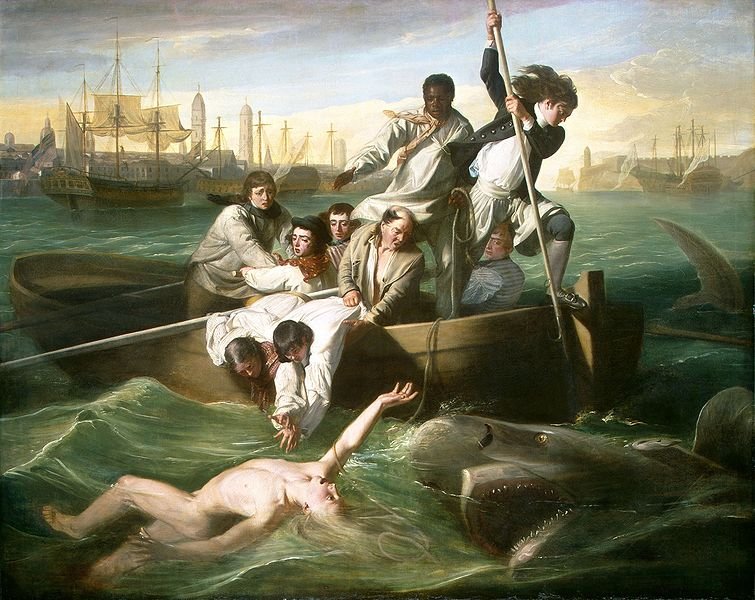
Watson and the Shark by John Singleton Copley (1778)

When I first set eyes on today’s featured painting I thought it was something to do with Herman Melville’s characters, Moby Dick and Captain Ahab but it also reminded me somewhat of Théodore Géricault’s painting Raft of Medusa (see My Daily Art Display June 10th 2011).  Of course it is neither.  Today’s featured work of art is all about two men, John Singleton Copley and the subject of the painting, Brook Watson.  My Daily Art Display painting today is entitled Watson and the Shark and was completed by John Singleton Copley, the American artist, in 1778.  In My Daily Art Display March 6th 2012 The Copley Family, I gave you a short biography of the artist’s life, so you may want to look back to that blog to find more about this talented American painter.  Today however I will concentrate on the subject of Copley’s work, Brook Watson.

Brook Watson, who would later become Sir Brook Watson, 1st Baronet, was born in Plymouth, Devon in 1735.  He was the only son of John and Sarah Watson (née Schofield), who both died when Brook was just six years of age.  After their deaths, he went to live with his aunt and uncle in Boston Massachusetts.  His uncle was a merchant and ship owner whose livelihood came from the import and export of goods to the West Indies.  Probably with living at this American port and seeing the ships plying their trade it is not surprising that young Brook Watson hankered after the seemingly glamorous life of a sailor.  His uncle realising his nephew’s desire to join the Navy organised for him to become a crew member on one of his ships.

In 1749, the fourteen year old Brook Watson was aboard his vessel in Havana harbour and foolhardily decided to take the opportunity to go for a swim on his own.  He was attacked by a shark and his shipmates, who had been waiting on board to escort their captain ashore, launched a valiant rescue effort.  As the sailors rushed to Watson’s aid, the shark repeatedly attacked the struggling boy.  During the first attack, the shark stripped the flesh from Watson’s right leg, just below the calf.   In the second frenzied attack, the shark bit off Watson’s foot at the ankle.  His shipmates managed to rescue the boy who was then taken to a hospital in Havana.  Surgeons were unable to save his leg and it had to be amputated below the knee.  Watson remained in Havana for three months to convalesce.

If that was not bad enough, when young Watson arrived back in Boston he found that his uncle had been declared bankrupt.  Despite the loss of his right leg, Brook Watson managed to secure a position on another ship which traded between Boston and a port in Nova Scotia supplying the British Army at Fort Lawrence.  Despite the loss of his right leg, Watson was taken on by the British military and served them as a commissary until 1759 at which time he left Canada and travelled back to London.  Here he pursued a career as a merchant importing and exporting goods to Canada and Northeast America.  In 1760 he married Helen Campbell, the daughter of an Edinburgh goldsmith.

Watson’s Coat of Arms

In 1784 he entered the English political arena and became a Member of Parliament for the City of London, a position he held until 1793.  In 1796 he was elected Mayor of London.  Watson was made a baronet in 1803 and he had his coat of arms designed in such a way so as to record his encounter with the shark in Havana harbour.  If you look at the crest you will see underneath Neptune, who is brandishing his trident, the shield bearing Watson’s severed right leg, underneath which is the Latin motto Scuto Divino,  which means “Under God’s Protection”. Brook Watson died in 1807, aged 72.

My Daily Art Display’s featured painting today, Watson and the Shark was completed by John Singleton Copley in 1778 and exhibited that year at the Royal Academy.  Copley and Brook Watson had become friends after the American artist arrived in London in 1774.   Watson commissioned Copley to create a painting of the Havana harbour incident which had occurred twenty-five years earlier.   The painting was Copley’s first of a series of large-scale historical paintings he completed after settling in London.   He went on to produce three versions of today’s painting.      The original version of the painting went to Brook Watson.  The second one was a full-size replica which he kept for himself and can now be found in the Museum of Fine Arts in Boston.  His third and smaller version, with a more vertical composition, is housed in the Detroit Institute of Arts.

The painting when exhibited at the Royal Academy was a sensation, probably due to its horrific subject.  The painting is something of an exercise in overstatement and embellishment going beyond a realistic depiction, with the sole intention of evoking strong emotions in the viewer.  In the painting we see nine of Watson’s fellow seamen rushing to his rescue.  Copley who had never visited the Caribbean island of Havana relied on maps, prints and book illustrations of the Cuban harbour for his background.  Observe how Copley has added a dramatic touch to the scene by the way he is portrayed Watson’s rescuers.  Their facial expressions reveal not only their fear for their own safety but the concern they have for the fourteen year old boy who is being attacked by the shark.   One of the sailors has thrown a rope in the water, but it has not reached the young boy and dangles beyond his grasp. Two other crewmen lean over the side of the boat, in an attempt to reach the boy, while the elder boatswain clutches his companion’s shirt trying to ensure he too doesn’t fall into the water. The other terrified seamen in the boat row frantically, and the seaman standing in the front of the small boat has his boathook ready to thrust downwards into the body of the shark. Copley’s depiction of a shark has often been criticised and the most probable reason why the shark looks more like a mythical creature than a shark, is because Copley had probably never seen an actual shark and so was forced to paint a creature based on the description of others.

The young Watson lies on his back in the water transfixed in shock.  It is a romanticised portrayal of the incident as the gory detail of Watson’s severed right foot is hidden beneath the waves and there is only the slightest hint of blood on the surface of the water and in the mouth of the shark.  However there is no sign of the frenzied thrashing about the victim as he is being attacked by the shark.  Maybe Copley thought the inclusion of such a depiction would be a step too far.

After Watson died his will was read and as far as the painting was concerned, it stated:

“I give and bequeath my Picture painted by Mr. Copley which represents the accident by which I lost my Leg in the Harbour of the Havannah in the Year One Thousand Seven Hundred and Forty Nine to the Governors of Christ’s Hospital to be delivered to them immediately after the Decease of my Wife Helen Watson or before if she shall think proper so to do hoping the said worthy Governors will receive the same as a testimony of the high estimation in which I hold that most Excellent Charity and that they will allow it to be hung up in the Hall of their Hospital as holding out a most useful Lesson to Youth.”

The school’s Committee of Almoners accepted the painting in 1819.   In 1963 it was purchased from Christ’s Hospital by the National Gallery of Art, Washington, D.C.

The oil painting’s enormous acclaim ensured John Singleton Copley’s appointment to the prestigious Royal Academy, and he went on to earn a fortune selling engravings of its design.

Jacob and Rachel by William Dyce

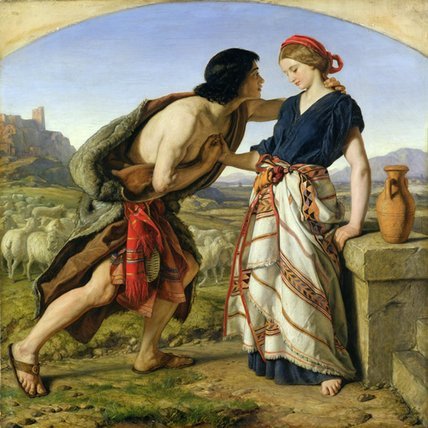
Jacob and Rachel by William Dyce (1853)

The first time I featured a painting by William Dyce was over twelve months ago (My Daily Art Display, May 14th 2011) when I looked at his painting Pegwell Bay, or to give it its full and bizarre title, Pegwell Bay, Kent – a Recollection of October 5th 1858.   To find out why the painting had such a strange title you will have to check back on the earlier blog.

William Dyce was born in Aberdeen in 1806. His father was a fellow of the Royal Society and an eminent physician.  Dyce attended the Marischal College, which is now part of the University of Aberdeen.  He trained as a doctor before reading for the church. However the course of his life changed when aged nineteen he decided to become an artist and enrolled at the Royal Scottish Academy Schools in Edinburgh and later as a probationer at the Royal Academy of London.   At the age of nineteen he made his first trip to Rome and stayed there for nine months studying the works of the great Masters such as Titian, Rembrandt and Poussin.  He returned to Aberdeen but the following year he went back to Rome and this time stayed for eighteen months.   During this second visit to the Italian capital he met the German painter, Friedrich Overbeck, who was one of the leading artists of the Nazarene Movement.   The Nazarene Movement was made up of a group of early 19th century German Romantic painters who aimed to revive honesty and spirituality in Christian art. The name Nazarene came from a term of derision used against them for their affectation of a biblical manner of clothing and hair style.

By 1829 Dyce was back in Scotland and settled in Edinburgh for several years.  To survive financially he would carry out many portraiture commissions but his main love was his religious, history and narrative paintings.   In 1837, he was appointed Master of the School of Design of the Board of Manufactures in Edinburgh and produced a pamphlet on the management of schools like the one he was working at and this was well received, so much so, that he was transferred to London as superintendent and secretary of the recently established Government School of Design at Somerset House, which was later to become the Royal College of Art.   In 1844 he was appointed Professor of Fine Art in King’s College, London, and became an Associate of the Royal Scottish Academy, and in 1848 elected to become a  Royal Academician.

In 1850 Dyce married Jane Brand who was twenty-five years younger than him.  They went on to have four children.   He died at Streatham, Surrey in 1864, aged 58.

Today I am looking at a completely different type of painting by the artist in comparison to his seaside painting, Pegwell Bay.  This is a religious painting entitled The Meeting of Jacob and Rachel.  There were about four versions of this work by Dyce,  each of different size and with minor alterations but this one, which was completed by him in 1853,  is now housed in the Kunsthalle in Hamburg.  This was the original work and the only one which had a vase resting on the edge of the well.  The painting proved so popular with the public that Dyce commissioned Holman Hunt to make copies of it.

The painting is based on a story from the Old Testament book of Genesis (29: 9-14):

9 While he was still talking with them, Rachel came with her father’s sheep, for she was a shepherd. 10 When Jacob saw Rachel daughter of his uncle Laban, and Laban’s sheep, he went over and rolled the stone away from the mouth of the well and watered his uncle’s sheep. 11 Then Jacob kissed Rachel and began to weep aloud. 12 He had told Rachel that he was a relative of her father and a son of Rebekah. So she ran and told her father.  13 As soon as Laban heard the news about Jacob, his sister’s son, he hurried to meet him. He embraced him and kissed him and brought him to his home, and there Jacob told him all these things. 14 Then Laban said to him, “You are my own flesh and blood.”

This painting, Meeting of Jacob and Rachel, depicts the point in time just before Jacob kissed Rachel, and as the biblical text quotes the experience was so memorable, he lifted up his voice, and wept.  Jacob had fallen in love, at first sight, with this beautiful young woman, when he saw her standing at the well about to give water to her father’s flock of sheep.   Look at the way Dyce has portrayed Jacob.  The young man having just cast his eyes on his cousin is besotted with her.  He leans towards her almost balancing on one leg.  Look at his demeanour.  Look at the intensity of his expression as he looks into Rachel’s face. Look at his eagerness.   His emotions seem to be getting the better of him.  He clutches Rachel’s right hand and press it against his heart.  Maybe he wants her to feel how it is beating wildly.  His left hand rests on the nape of her neck.  He caresses her neck gently and at the same time his hand will guide her face towards his so that he may kiss her.  Now look at Rachel.  See how her expression differs from that of Jacob.  Her eyes are cast downwards in a gesture of modesty or is it coyness?  She cannot meet Jacob’s gaze.  The top half of her body leans away from Jacob and she steadies herself by placing her left hand on the well.

So does this meeting of man and woman result in a happy ending?  Well yes and no!   Rachel’s father, Laban was quite cunning and realised that Jacob was a young and strapping lad who could help out on the farm and so he offered him the hand of Rachel in the future, providing he would work for him.  Jacob agreed and worked for Laban for fourteen years without payment in the hope of getting the father’s blessing for his marriage to his daughter.  Then Laban made another condition for this marriage.  He wanted Jacob to first marry Rachel’s elder sister, Leah, after which he would be able to have Rachel as his wife.

So this is not just a story about young love but also a story of patient love and the way Jacob was willing to wait for Rachel.   This may have been uppermost in Dyce’s mind as it mirrored his relationship with his wife-to-be Jane Bickerton Brand who was born in 1831, for he was made to wait for her hand in matrimony as she was so young when they first met and the age difference of twenty-five years obviously further concerned her father.  William Dyce did wait and they did marry,  so all ended happily.

A Primitive City by Edward Calvert

A Primitive City by Edward Calvert (1822)

When I wander around various galleries, I am often lost in wonderment  when I stand in front of a massive painting.  I can remember when I was in Venice last year and visited the Accademia Galleries and stood before the giant work of Paolo Veronese entitled Feast in the House of Levi.     I was amazed at the magnitude of the work which measured  5.6 metres x 13metres and I could only wonder at how he managed to physically paint such a large scale picture.  How long must it have taken him?  Maybe he had some of his apprentices to help him but still it was an outstanding undertaking.  I find equally impressive miniature paintings and I am always filled with a sense of amazement at how these delicate paintings have been achieved.  My Daily Art Display featured painting today is one such miniature and I want you to feast your eyes on this lovely work of art entitled A Primitive City painted by the English artist Edward Calvert.

Edward Calvert was born in Appledore in the county of Devon in 1799.  His early schooling and art education was at Plymouth but coming from a seafaring area the young Calvert joined the Navy and spent five years serving his country.  A death of a close friend in naval action resulted in him leaving the force and coming ashore.  In 1824 he moved to London and it was here he, at the age of twenty-five, enrolled at the Royal Academy, where one of the professors was the artist, Henri Fuseli.  It was whilst in London that he met the ageing English painter, William Blake.  Blake and his paintings were one of his first great artistic influences and one that would remain with him for the rest of his life.  Blake’s art work inspired a number of aspiring artists and Calvert and some like-minded Romantic artists, who had fallen under the spell of Blake and his work formed an association known as The Brotherhood of the Ancients often simply known as The Ancients.  The leader of the group was Samuel Palmer but one of the most of the most important members of the group was today’s featured artist, Edward Calvert.  Others in the group were George Richmond and John Linnell.  This group of painters, who  all had a love of the spiritual art of the past, would often meet at the home of Blake, which they used to refer reverentially to as the House of the Interpreter.  They would also congregate at Palmer’s house in Shoreham, Kent to discuss Blake’s visionary ideology and to paint pastoral images with a mystical perspective.  They brought a new dimension to Romantic Art.  They brought a wondrous vision of a golden age set in quiet landscapes amidst a pastoral innocence and abundance.

Edward Calvert who was a man of private means left the Academy and concentrated on another love of his, wood-engraving.  He lived with his wife in Dalston in the London borough of Hackney for most of his life.  Calvert’s love of pastoral depictions disappeared gradually but his interest in ancient Greece increased. He visited Greece where he sketched prolifically.  Eventually, he gave up his printmaking and for the rest of his life his art was just for himself and for his own pleasure.  He would work in oil, watercolour and gouache and for his subjects he liked to focus on pagan mythology.  Latterly, Calvert became a recluse and died in 1883, aged 84.

My featured painting today is a tiny watercolour miniature, measuring just 7 cms x 10 cms (not quite 3 inches x 4 inches), entitled A Primitive City, which Edward Calvert painted in 1822.   The quality of this work of art is amazing with its clarity of line and jewel-like colouring and the amount of detail that is shown in such a small space.  It is an evening scene and in the background on the right, we see the waning moon as it hovers behind a distant walled city.  In the right mid-ground we see a peasant leading a donkey which staggers slowly heavily laden with two large baskets of grapes on its back.  Behind the donkey there is another cart, crossing a rickety wooden bridge, being pulled by a bullock, which is loaded with sacks of grain and driven by a woman.  The grapes and grain symbolise the Eucharistic wine and bread.  The pastoral theme is emphasized  by the shepherd and his flock which  we see depicted in the left mid-ground of the work.  If we carefully look at the city itself we see a woman drawing water from a well and above her we see another woman watching her from her viewpoint on the staircase between the two towers.

There is an innocence to the scene and this is accentuated by the beautiful, almost naked, young girl we see to the left of the picture who is about to take a swim in the nearby stream, which runs across  the foreground of the painting.  We can see Calvert’s love and interest in Classical art in the way he  has depicted the woman, as the stance of the scantily-clad young lady is almost certainly derived from the Venus Kallipygos, which is in the Naples National Archaeological Museum.  It could well be that the presence of the river was Calvert’s idea of symbolising the river of life and the nakedness of the young woman symbolic of innocence.  Above the girls head we see that the trees are full of fruit symbolising abundance.

This was Calvert’s vision of the perfect idyll, tranquillity and abundance.  It should be remembered that this work was completed before Calvert went to London and became part of The Ancients , which just goes to show that his ideas for artistic subjects were similar to those of artists he was yet to meet.

Portrait of a Woman by Bartolomeo Veneto

Portrait of a Woman by Bartolomeo Veneto (c.1525)

I have over the past blogs featured paintings of a women whose facial beauty I find quite stunning and have commented at length on their great beauty.  Two especially come to mind, Jeunesse Dorée by Gerard Brockhurst (My Daily Art Display May 16th 2011) and Virgin Annunciate by Antonello da Messina (My Daily Art Display May 1st 2012).  I mention this because today I am featuring another such painting which is a portrait of an exceptionally beautiful woman.  The title of the painting is simply, Portrait of a Woman and the artist is Bartolomeo Veneto.  I will look at the painting in detail later and explore the mystery of whose portrait it might be but first let me tell you a little about the artist.

Bartolomeo Veneto was born at the end of the fifteenth century but little is known of his early upbringing and family life.  The first time his signature was found on a painting, was on his work entitled Virgin and Child and it was dated 1502.  The signature itself gives an insight into his early days as he signed it:

“… bartolamio mezo mezo cremonexe venizian e…”

which when roughly translated means:

“…Bartolomeo half-Venetian and half Cremonese…”

In his early days he worked in Veneto, in North East Italy, Venice itself and Lombardy, which has its border to the west of Veneto.  Whilst in Venice he trained under Gentile Bellini, who was the most prestigious painter in Venice in the early sixteenth century.  Bartolomeo Veneto concentrated most of his art on portraiture and for that he received many commissions.

It is thought that around 1507 Bartolomeo worked at the Este court in Ferrara, which was ruled by the Duke of Ferrara, Alfonso I d’Este who in 1502 married for the second time.  His new wife was none other than Lucrezia Borgia and Alfonso was her third husband.  During his time at the court Bartolomeo gilded frames and made carnival decorations and completed a painting depicting the Virgin and Saints.  After three years at the court Bartolomeo moved on and he is reported to have been in Padua in 1512 and Milan eight years later and it was here that his portraiture became influenced by the portraits by Leonardo da Vinci who had been in this Italian city some years earlier.

Today’s featured painting by Bartolomeo Veneto, which he completed around 1525, is entitled Portrait of a Woman and is now housed in the Städel Museum in Frankfurt.  I suppose the first question one asks when looking at this beautiful half-naked woman is who is she?   There is no degree of certainty as to the answer but it is thought to be a portrait of Lucrezia Borgia.  What makes her stand out is the fact that the artist has placed her, in three-quarter profile, dressed in a white tunic against a black background and he would use this black background technique in other portraits.

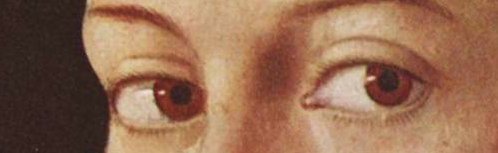
The staring eyes

Although she has turned to the left she keeps eye contact with us.  Although her left breast is bared, it is her gaze that catches our attention.  As we look at her we are almost mesmerized by that stare.  The way she looks at us is in some ways unnerving.  She has captured our attention.

Observe the ringlets of her golden hair as it cascades down her shoulders.  See how Bartolomeo has painted each strand of it in detail.  It is this extraordinary attention to detail that made his portraits so popular and led to many commissions from wealthy patrons.  This tempera and oil on wood panel bears the name of the ancient goddess of spring, Flora and she was often a character portrayed in Renaissance art.   In her right hand, she delicately holds up to us, between her slim index finger and thumb, a small posy of wild flowers consisting of daisies, anemones and buttercups,.  These three flowers are attributes of Zephyr’s wife Flora, the goddess who ushered in spring.  This is her offering to us.

A lavish jewel adorns her forehead.   Above the jewel is a blue silk band and her hair is covered in a veil which is crowned with myrtle, all of which lead us to believe that this woman is married.  Another jewel hangs between her breasts on a pendant, the placing of which adds to the sensuality of the portrait.  Having said that, I believe there is also chasteness in the way the artist has portrayed the woman.  Could this then be a portrait of Lucrezia Borgia?  The same Lucrezia Borgia who was one of the daughters of Cardinal Rodrigo Borgia, later to become Pope Alexander VI, and his mistress Vannozza Cattanei?  Could this be the portrait of a woman who was accused of incest with both her father and her brother Cesare?  Could this beautiful and delicate-looking woman be the infamous female who was accused of poisoning many of her adversaries and who had a string of extra-marital affairs?

So, are we looking at a beauty or a beast and is this a true likeness of Lucrezia Borgia?

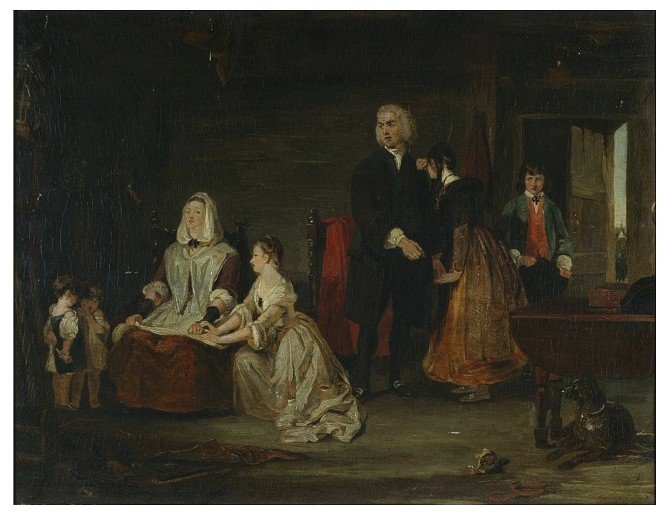
The Vicar of Wakefield Reconciling his Wife to Olivia by Gilbert Stuart Newton

The Vicar of Wakefield Reconciling his Wife to Olivia
by Gilbert Stuart Newton (1828)

Today I am going to look at the life and one of the paintings of the Canadian born artist Gilbert Stuart Newton.  Newton was born in Halifax, Nova Scotia, one of twelve children in 1797.  His father, Henry Newton, who originally came from Boston, worked as a Customs official and his mother Anne Stuart came from a family of Scottish descent, who also lived in Boston, Massachusetts.  Her brother, Gilbert Stuart, was an artist and was generally believed to be one of America’s leading portraitists of the time and was to become one of his nephew’s first art tutors.   Gilbert’s parents moved from Boston to the Canadian port of Halifax in 1776 but on the death of his father in 1803, when he was six years old, his mother took her family back to her home town of Charleston, a district of Boston on the Charles River.

Although initially heading for a career in commerce he developed a love of art and his uncle Gilbert Stuart recognising his artistic promise took him on as one of his pupils.  Like many aspiring artists, Newton travelled to Europe to study painting, first in Florence and later in Paris and London.  He arrived in London in 1817.  During his travels, he made the acquaintance of the American artist, Washington Allston, (see My Daily Art Display, Feb 25th 2011),  the English genre painter Charles Leslie and the Scottish painter David Wilkie.  He enrolled as a student of the Royal Academy Schools in 1817 and exhibited his first work at the Royal Academy the following year.  Initially he focused his artistic talents on portraiture and had many well known sitters, such as the American author, Washington Irving and the American politician and then American Consul in Liverpool, James Maury.  He left England in 1831 and went back to America for a short period where he married but a year later he and his wife returned to England.

Gilbert Stuart Newton is principally remembered, not for his portraiture, but for his genre and literary scenes many of which were engraved.  Probably Newton will be remembered most of all for his depiction of literary subjects such as today’s featured painting entitled The Vicar of Wakefield Reconciling his Wife to Olivia, taken from Oliver Goldsmith’s novel, The Vicar of Wakefield.  He also depicted scenes from Shakespeare such as his 1831 painting entitled Portia and Bassanio.    Another scene from a novel he painted was that of Yorick and Grisette, two characters in Lawrence Sterne’s novel, A Sentimental Journey.  This work was exhibited in the Royal Academy in 1830.  In 1828 Newton was made and Associate of the Royal Academy and four years later was elected as a Royal Academician.  That same year, 1832, when he was made a Royal Academician was the also the year of the onset of his mental illness which progressively worsened to such a point that he had to be institutionalised in a private asylum in Chelsea.  Even whilst hospitalised he continued to draw, completing a number of sketches based on Shakespearian characters.   He died of consumption at the asylum in 1835 just a month before his thirty-eighth birthday.  He died alone as his wife along with their child had returned to America a few months earlier.

My featured painting today is Gilbert Newton’s work entitled The Vicar of Wakefield Reconciling his Wife to Olivia. It was painted as a commission for Lord Lansdowne.   The painting was exhibited at the Royal Academy Exhibition in 1828 and in the Exhibition catalogue against this work was the following quotation from Oliver Goldsmith’s 1766 novel, The Vicar of Wakefield.  They were the words uttered by the vicar to his wife imploring her, like him, to forgive the misdeeds of their daughter:

“…I entreat, woman, -that my words may be now marked once for all: I have here brought you back a poor deluded wanderer; her return to duty demands the revival of our tenderness … The kindness of heaven is promised to the penitent, and let ours be directed by the example…”

This novel, The Vicar of Wakefield, by Goldsmith was his most famous work of literature and in the painting we see Olivia, the vicar’s daughter, who had run away from home to be with the man she loved.  Her father, the vicar, eventually finds her and brings her home and we see him, in the right of the painting, comforting his distraught but repentant daughter, who has buried her face against his shoulder. To the left of the painting we see the vicar’s wife who has her back almost turned away from her husband and daughter and by her facial expression we must believe she hasn’t quite come to terms with what has happened.  She is now trying to balance the desire to punish her daughter for her misdeeds and yet show her some maternal love now that she is back in the fold.  Her hands are clenched tight in her lap and we can see by her facial expression that she is not in a forgiving mood.  Also included in the painting are the vicar’s two youngest sons who stand in front of their mother completely unaware of what is happening.   The younger daughter Sophia, who kneels at the side of her mother and who holds her mother’s hand in a comforting gesture, is pleading with her to forgive her errant sister, Olivia.  The vicar’s second son Moses, stands at the far right of the painting, by the open door of the house and looks somewhat bemused and unable to know what to do for the best.  The family dog lies under the table looking up aware of the commotion.

So how was the painting greeted by the art establishment in 1828?  The literary magazine of the time, The Athenaeum commented on the work:

“…A very interesting picture, cleverly composed, and well painted. The mother’s struggle between pride and tenderness, is admirably expressed, not only in her face and features, but throughout the whole figure; not more in the stiffness and erectness of carriage, than in the clenching of the hand on the knee. The patient and benevolent Dr Primrose, of Goldsmith, is finely characterised in the figure and head of the father: the affectionate sister, kneeling by her mother’s side, and anxiously interceding, is a picture of amiable loveliness; while Olivia, abandoned to shame, sorrow, and penitence, neglected in her attire, and with face averted, and concealed on her father’s shoulder, while her hand is most expressively held by his, forms, with the figure of the indulgent parent, a group replete with delightful expression. The hobbledehoy simplicity of Moses, and the panting and vague consciousness of the younger urchins, must not be overlooked; they are also most happy. The whole picture, in short, is full of truth, sentiment, and feeling…”

Hope by George Frederic Watts

Hope by George Frederic Watts (1886)

George Frederic Watts was a Victorian painter and sculptor who was closely associated in his later years with the Symbolism Movement.  Symbolism came about in the 1880’s but by the end of the century it had almost died away having been overshadowed by the birth and rise of Modernism.  The Symbolist movement was a reaction against the literal representation of objects and subjects, where instead there was an attempt to create more suggestive, metaphorical and evocative works.  Symbolic artists based their ideas on literature, where poets such as Baudelaire believed that ideas and emotions could be portrayed through sound and rhythm and not just through the meaning of words. Symbolist painter styles varied greatly but common themes included the mystical and the visionary. Symbolists also explored themes of death, debauchery, perversion and eroticism. Symbolism moved away from the naturalism of the impressionists and demonstrated a preference for emotions over intellect.

George Frederic Watts was born on February 23rd 1817 in Marylebone, London and his Christian names were those of the great musician George Frederic Handel who was born on that date some 132 years earlier.  His mother and father struggled financially and this was not helped by the poor health of his mother who was to die when George was very young.   His father was a piano maker and took it upon himself to educate his son at home.  Much emphasis was placed on a conservative Christian upbringing and a love for classical literature.  Unfortunately, as is so often the case, his father’s compelling desire to force his Christian views on his son, eventually made George turn completely away from organised religions.

At the age of ten, George had some informal tuition from William Behnes, a local sculptor where he practiced drawing from the sculptures.  This training proved a godsend as by the age of sixteen he was able to support himself from the sale of his portraits.  In 1835, aged eighteen years of age, George Watts enrolled at the Royal Academy Schools.  Although Watts never enjoyed his time at the establishment and would often fail to attend he did exhibit some of his works at the 1837 Royal Academy Exhibition.  It was whilst studying art that he met and became great friends with Alexander Constantine Ionides, an art patron and collector.  Ionides commissioned many paintings from Watts and became one of his earliest patrons.

By 1840 Watts had moved away from portraiture and concentrated on historical paintings.  In 1843, he entered the first competition to design murals for the new Houses of Parliament.  Entries were to be of a narrative genre which endorsed patriotism and thus would be appropriate to the new legislative building.   His entry, Caractacus Led in Triumph through the Streets of Rome, gained him first prize in the competition and the prize money helped fund his artistic study trip to Italy where he remained for four years.  During his stay in Italy he learnt the secrets of fresco painting and completed many large scale paintings depicting scenes from Romantic literature.  However, he never gave up on his other artistic loves, portraiture and landscape painting.

Watts returned to London in 1847 and once again entered the Houses of Parliament competition.  This was the fourth one organised by the monarch and the government.  Watts won the competition with his entry Alfred Inciting the Saxons to Encounter the Danes at Sea.   Watts suffered from bouts of depression and he expressed his personal struggle with the illness in a series of four paintings which evoked a social realism theme.  One of these works entitled Found Drowned was my featured painting in My Daily Art Display of July 4th 2011.  In 1851 he went to live with his friend Henry Thoby Prinsep and his wife Sara at Little Holland House.  He lived with them for the next twenty-four years and it undoubtedly provided Watts with a secure environment for him to work and relax and provide a safe haven away from the rigours of the real world.  Little Holland House was a favourite meeting place of the young Pre-Raphaelite artists and literary people like Tennyson and it gave Watts then ideal opportunity to paint portraits of the aspiring literary and artistic luminaries of the day.

In 1878 Watts took part in the 1878 Exposition Universelle in Paris and submitted nine paintings and one sculpture.  He became an instantaneous celebrity on the European art scene.  During the 1880’s,  he produced many symbolic paintings which displayed close links to the work of his friend, the Pre-Raphaelite artist Dante Gabriel Rossetti, and the other Pre-Raphaelite artists such as Edward Burne-Jones.

In 1886 at the age of 69 Watts re-married, to Mary Fraser-Tytler, a Scottish designer and potter who was some thirty three years his junior.   In 1891 he bought a house in Compton, near Guilford, in Surrey and in 1904 had a gallery built nearby which became known as the Watts Gallery and which was dedicated to his work.  The Watts Gallery is still a very popular venue for art lovers. George Frederic Watts died that year aged 87, shortly after the gallery opening.

Hope is looked upon as certainly the most influential, and outstanding if not most unusual of all George Frederic Watts’ paintings. This portrayal of the poignant musician has struck a chord with audiences and critics ever since it was first displayed at the Grosvenor Gallery in 1886.  In 1887 at the Royal Jubilee exhibition held in Manchester the painting took pride of place in the middle of an entire wall dedicated to Watts’ work.  Numerous reproductions were made of this painting and many who saw it were deeply affected by what they saw and Watts received many letters from people who were greatly moved by the emotional impact it had on them. In the painting Watts has personified Hope as a young woman seated on a globe, hunched over, appearing to be almost asleep.  She wears a blindfold which symbolises her blindness and to the mental state she embodies. What was it about this work that such an effect on people?  It has to be Watts’ portrayal of this hunched, isolated, blindfolded and barefoot woman who appears to be on the edge of despair.  So why the title Hope?   Maybe in this case it is not hope meaning one’s optimistic thoughts but more of a feeling of almost despair; a hoping against hope.   As we take in the picture of the girl bent over listening to the music from her lyre we wonder why Watts has chosen the title.  The bluish grey background induces a melancholy mood. One critic commented that the painting did not evoke a feeling of hope and should have been entitled Despair.  Maybe that was the reason that in another version of his painting he has added a single star to the background to symbolise hope.  The girl, Hope, bends her ear to catch the music from the last remaining string of her almost shattered lyre. It is the faintest of hope as symbolised in her musical instrument which now with just one string left for her to make music and once that has broken, all hope of her producing a musical sound has disappeared.

Did the painting appeal to those who had almost lost hope themselves and in some way empathised with the vulnerability of the woman in the painting?  Watts had always sought, through his paintings, to communicate his message to as many people as possible. Some would criticise this aspect as being somewhat patronizing but Watts was a great master of narrative paintings and this was probably the reason why his conventional patriotic works he put forward for the Houses of Parliament were so successful.  Watts was surprised by the critical acclaim and popularity of his painting and attempted to follow up his success with Hope with two other works entitled, Faith and Charity, the other two “theological virtues” but they neither received the critical acclaim that his Hope painting achieved nor were they as popular with the public.

This version of the painting can be found in the Tate Gallery, London.

Peasant Girl Lighting a Fire. Frost, by Camille Pissarro

Peasant Girl Lighting a Fire. Frost by Camille Pissarro (1888)

My Daily Art Display’s featured painting today is entitled Peasant Girl Lighting a Fire. Frost, which was painted by Camille Pissarro in 1888 and can now be found in the Musée d’Orsay in Paris.  At this time Pissarro was still a leading light of the Impressionist movement, a movement he had helped to form.   However it was two years prior to this work that Pissarro began to become interested in the experimental work of young artists, who had adopted the fragmented brushstroke technique which Georges Seurat and Paul Signac were trying out, known as pointillism , a technique Pissarro used in parts of this painting.  For a more in depth look at pointillism see My Daily Art Display October 21st 2011 for a painting by Georges Seurat and November 29th 2011 for a painting by Paul Signac. Pissarro had been introduced to Seurat and Signac in 1885 and in the following years he began to work in the pointillist style which had then been adopted by the Neo-Impressionists.  By the time Pissarro was in his sixties he found that this pointillism technique too restricting and in the last ten years of his life he returned to a purer Impressionist style.
Camille Pissarro was fifty-eight years of age when he completed today’s featured work of art.  Ten years earlier his style of painting was such that he would portray nature in his landscapes by a myriad of smaller comma-like brushstrokes built up on the surface of the canvas such as his 1877 work, The Red Roofs (see My Daily Art Display of November 30th 2010).  Pissarro was concerned that these works lacked clarity and so he decided to change the way he worked.  He spent time working in collaboration with Degas, who was, of all the Impressionists, a great believer and advocate of figure painting and the primacy of the human figure at the expense of landscape background.  It was maybe the views of Degas that led to Pissarro to complete some works in which the human being(s) took pride of place in the painting, as is the case with today’s featured work.

The painting depicts two peasant girls working in a field in a cold and frosty winter morning and we see one of them tending a fire.  Pissarro often painted peasant women at work.  Two fine examples of this are his 1881 work entitled Girl with a Stick and the 1893 painting entitled Woman with a Green Shawl.  His portrayal of peasants received some criticism for copying the ideas of Jean-François Millet but Pissarro firmly contested such a notion.  However in general art critics looked upon his works as true representations of peasant life.  Look at the beautiful way in which Pissarro has depicted the landscape.  At the time of this painting Pissarro was extremely interested in the pointillism technique of Seurat and Signac and he used this method to present us with a sumptuous backdrop to the two girls.  The painting has a light and airy feel to it and there is a subtle delicate nature to the work.  The work was painted in Eragny just north-west of Paris where Pissarro and his family lived for a time.

In the far distance we can see the low hills topped by irregular spaced bushy trees.  In the middle ground, we observe grazing cows in the meadow, a line of poplar trees at the foot of the hills and possibly a hidden stream running horizontally across the mid ground.   Notwithstanding the backdrop, the focus of the painting is on the two girls in the foreground, who almost appear to stand next to us.  The scene is lit up by the sun, somewhere out of sight, to the left, which throws off long blue shadows across the field.  It is a wintry sun and still low in the sky, hence the long shadow of the girl in the foreground, which disappears off the painting to the right.    Although it emits light, the sun gives off little warmth and so our two young workers are wrapped up well.  The temperature is even colder due to the wind chill factor.  Look how the girls skirt and the smoke from her small fire are blown horizontally by the wind which comes from the left of the painting.  One can imagine how cold it is with the driving wind on a wintry day. We almost shiver as we look at this work of art.

The girls are both well wrapped up against the morning’s wintry chill.  The girl on the right, who seems no more than a child, is warming her hands by the fire.  She wears a blue dress and a thick dark brown coat.  She has a dark woolen hat on her head which is pulled down to protect her ears from the icy wind.   The older girl, who is closest to us and because of her height, is the main focus of our attention.  She has taken a branch from the pile behind her, and is about to break it up and add it to the fire.  She wears a pink skirt with a blue apron.  She too has protected her head, wearing a white scarf tied beneath her chin.  Her final layer of protection is a pink and white shawl from which emerge long black sleeves of her dress.

The colour combinations Pissarro uses to achieve the colour we see is fascinating.  The girls pink dress is made up of a combination of yellow, blue and pink.  The green grass of the meadow is achieved by using a combination green, blue, yellow, pink and white.  The only orange Pissarro used was for the flames of the fire.

Pissarro fled the traumas of the Franco-Prussian War in 1871 and, like Monet, went to live in London.   It was whilst in London that he saw a number of paintings by Turner.  Pissarro later commented on Turner’s works and was amazed by the way Turner succeeded in conveying the snow’s whiteness, not just by the use of white alone but by combining a host of multi-coloured strokes, dabbed in, one against the other, which when looked at from a distance, created the desired effect.  It is in this painting that Pissarro has, without the actual presence of snow, managed to give us a crystalline frost of a cold winter’s morning encapsulated in an aura of diamond blue.

Francesca da Rimini by Ary Scheffer

Francesca da Rimini by Ary Scheffer (1835)

What is your perception of Hell?  Do you think of it as a huge furnace full of burning souls, or simply a place of deprivation?  We do not know and I don’t believe we will ever know what it is like or whether it or its sister-place, Heaven, really exists and so with this lack of evidence we can then formulate in our own minds what it is all about without fear of contradiction.  One person who did just that was Durante degli Alighieri, better known simply as Dante Alighieri.  In the first part (Inferno) of his epic poem entitled Divine Comedy he tells of his journey he made through Hell with the Roman poet Virgil acting as his guide.  Many artists have painted pictures based on Dante’s Inferno with its concentric circles full of various types of sinners.  To get to the gates of Hell Dante and Virgil had to cross the river Acheron which could only be achieved by being transported by ferry, piloted by Charon.  My Daily Art Display (September 6th 2011) depicts the two men being ferried across the river made famous in the painting,  The Barque of Dante or Dante and Virgil in Hell by Eugène Delacroix.

According to Dante, Hell is situated within the Earth, it is made up of nine circles of torment.  The circles are concentric, and represent a gradual increase in evilness.  The outer circle, or the first circle is the resting place of those who were never baptised, the second circle was for people whose sin was one of Lust.  As Dante and Virgil moved inwards they came across circles which housed the souls who had committed the sins of Gluttony, Greed, Anger, Heresy, Violence, Fraud and Treachery.  It is interesting to note that for Dante, an Italian male, those who committed the sin of Lust were only in the second circle, as presumably in Dante’s mind, Lust was not that bad a sin!  The inner most part of this Hell ends at the centre of the earth, where Satan is held in bondage.   The sinners who populated each of the circles were punished in a fashion fitting their crimes, a system of contrapasso; derived from the Italian words contra and patior meaning  “suffer the opposite” a sort of poetic justice.

My featured painting today is about two lovers from Dante’s Divine Comedy who Dante and Virgil meet, trapped in the stormy darkness of the Second Circle of Hell (Lust)It is here that those overcome by lust during their time on earth have been sentenced to remain. Dante condemns them, and those like them, calling them “carnal malefactors” for letting their sexual appetites affect their reasoning. These hapless souls are blown to and fro by the terrible winds of a violent storm, without hope of rest and this symbolizes the power of lust to blow one about needlessly and aimlessly.  It is here that Francesca da Rimini tells Dante the story of how she and her lover Paolo ended up in this Second Circle of Hell.

Francesca da Rimini and Paolo Malatesta are depicted in the 1835 painting by Ary Scheffer, which is entitled Dante and Virgil Encountering the Shades of Francesca da Rimini and Paolo in the Underworld or simply Francesca da Rimini. .    The story goes back to the time when Francesca’s father, Guido I da Polenta was lord of Ravenna but had been at war with a rival  family,  the Malatesta family.  Peace between the two families finally came about and to cement their relationship Guido agreed that one of his daughters, Francesca, should marry Giovanni Malatesta, the son and heir of the Malatesta clan.  Although Giovanni was an able man and would on the death of his father become ruler, he was ugly and deformed.   The friends of Francesca’s father told him that if Francesca was to set eyes on Giovanni prior to the marriage, she would never go through with it. So the two fathers hatched plan and sent Giovanni’s younger brother Paolo to Ravenna with authorisation to marry Francesca in Giovanni’s name.   Paolo, unlike his elder brother was handsome and courteous and Francesca immediately fell in love with him. The marriage took place and the marriage contract signed and bride and bridegroom returned to Rimini, with Francesca still unaware of the deception.

In the morning following the wedding she became aware of the deception.  She was furious that she had been deceived and to make matters worse she realised that she had fallen in love with Paolo.  Giovanni left Rimini on business leaving Paolo and Francesca together and they both realised that they loved each other.   Their lovemaking was witnessed by Giovanni’s servant who sent word to his master, who then secretly returned home.  He went to Francesca’s room in which were the two lovers.  He banged on the door and shouted her name.  They recognised Giovanni’s voice.  Paolo pointed to a trapdoor in the floor that led to a room below. He told Francesca to go open the door as he planned his escape.   However as he jumped through the open trapdoor part of his jacket got caught on a piece of iron.  Francesca, unaware of his Paolo’s predicament, opened the door for Giovanni, believing she would be able to make excuses, now that Paolo was gone. When Giovanni entered the bedchamber he noticed Paolo caught by his jacket on the trap door.   He immediately ran towards the trapdoor and with his rapier drawn thrust it at Paolo intending to kill him. Seeing what Giovanni intended to do, Francesca quickly ran between the two brothers to try to prevent it. But Giovanni’s rapier was already thrusting downwards towards the hapless Paolo but before it struck him the blade passed through Francesca’s bosom. Giovanni was totally distraught by what he had done for he still loved Francesca.  He withdrew the blade of the sword from her body and immediately plunged it into his brother, killing him.  The next morning, amidst much weeping, the two lovers were buried in the same tomb.

In the painting we see Dante and Virgil standing to the right hand side watching as the two, almost-naked, lovers cling to each other.  Art critics at the time praised this exceptional work by Scheffer, and it was to become one of his most famous and most admired works.  Scheffer went on to produce several replicas of it.  The original painting can be found at the Wallace Collection, London.

Celebrating the Birth by Jan Steen

Celebrating the Birth by Jan Steen (1664)

I do my best to feature paintings by artists that people may not have come across before and I try not to feature the same artist too many times but sometimes I cannot help but revisit works by my favourite artists and today is no exception.  My Daily Art Display featured painting today is entitled Celebrating the Birth by Jan Steen which he completed in 1664.  I have showcased work by this artist three times before.  On February 16th 2011 we looked at a work entitled In Luxury, Look Out.  On April 27th 2011, I featured his painting The Effects of Intemperance and finally on August 26th 2011, I gave you The Life of Man so if you like today’s work why not go and have a look at some other of Jan Steen’s paintings.

Before us we have a simple scene of a couple celebrating the birth of their child, or do we?  In fact there is more to this painting than a simple celebration of the birth of a baby.  Look closely at the painting and see what is odd about the Steen’s depiction of the event and see if you can work out what is happening in the scene.  I will give you a hint.  Look at the man who stands behind the baby and the baby’s father.  Before I reveal the secret about the painting let me first tell you a little about the artist, Jan Steen.

Jan Havickszoon Steen was born in the Dutch town of Leiden in 1626.  He, like his artistic contemporary, Rembrandt, attended the local Latin School of Leiden. And a year later in 1646 he enrolled at the University of Leiden.  His professional artistic training started the following year and came from the German-born, Dutch Golden Age painter, Nicolaes Knupfer.  It is thought that he also could have studied with Adriaen van Ostade and it was this artist’s low-life genre work which was to influence Jan Steen’s early works.  At the age of twenty-two Steen along with his artist friend Gabriel Metsu and a number of local painters founded the painters’ Guild of St Luke of Leiden.

In 1648, Jan Steen moved to The Hague and worked as an assistant at the workshop of the celebrated landscape painter, Jan van Goyen.  Van Goyen was, like Jan Steen, born in Leiden.  He had moved from Leiden to The Hague in 1631 where he set up his workshop.  Steen was not only employed by van Goyen but was also taken in by van Goyen’s family and lived with him, his wife Annetie and their daughters.     Jan Steen became very friendly with Margriet, one of van Goyen’s daughters and they married in 1649 and the couple went on to have eight children.  Steen’s association with his father-in-law lasted until 1654.

In 1654 he and his family moved to Delft where he ran a brewery which his father had rented for him.  It was called De Roscam (The Curry Comb) but although Steen had a great artistic talent his business acumen was sadly lacking and the brewery failed.  In 1657 he went to live in Warmond,  a town close to Leiden and it was here that he met and became friends with the artist, Frans van Mieris.  Frans van Mieris was a painter of genre scenes which depicted the habits and actions of the wealthier classes.  It was this type of art by van Mieris and the works of Te Borch that weaned Steen off his low-life genre paintings and influenced him to paint more elegant genre scenes.  Jan Steen left Haarlem in 1660 and moved back to Haarlem where he stayed for the next ten years.  In 1669, near the end of this stay his wife died and the following year his father passed away.  After his father’s death in 1670 Jan returned once again to Leiden where he remained for the rest of his life.  He remarried that year and his second wife, Maria van Egmont,  gave Jan two children.

For the Dutch people, the year 1672 became known as the rampjaar(disaster year) as this was the year that saw the start of the Franco-Dutch War and the Third Anglo Dutch War, which culminated in the defeat of the Dutch States Army and large swathes of the Republic was conquered by the invading troops.   Because of these wars the art market collapsed and Steen needed another source of income so in 1673 he opened a tavern. His work in the tavern meant that his artistic output diminished in his later years.

Jan Steen died on New Year’s Day 1679 in Leiden

And so let us go back to the featured painting.  Have you worked out the “sub-plot” depicted in this painting yet?  Steen is best known for his humorous genre scenes, warm hearted and animated works in which he treats life as a vast comedy of manners and this work of his is no different.  We are looking at a lying-in room.  Whenever the lady of the house was about to give birth, one of the rooms was set aside for this purpose. The lying-in room was used for the actual delivery, and later to receive visitors.  The birth of a child was, as it is now, a cause for celebration.  It is greeted with both happiness and pride and in the 17th century in the case of the birth of a son, it became even more of a celebration for economic reasons as a son would often carry on his father’s business and would inherit the family possessions.

In this painting Steen has depicted a group of revellers celebrating the birth of a child.  One can imagine the elated atmosphere within the room with all its merriment and drinking.  The majority of people in the room are women as men, including the father, were considered inappropriate interlopers in this female sanctuary.  The mother is in the left background of the painting lying in her bed being fed some broth.  Another woman sits at the end of the bed drinking to excess.     The others present will probably be female relatives, maidservants and the midwife.  Normally one would expect, as in most works of art depicting such an event, that the mother of the newborn baby would be the main focus of attention.  However Steen has made the proud father the main focus of this painting.  However he is not the only man in the painting.  Look at the figure behind the baby.  We see another man as he is about to creep out of the room.  Actually it is a self-portrait of the artist himself.  It was not simply to break tradition to see the two men in the painting but Steen wanted to convey a little information about what has happened and to the nature of the husband and wife’s relationship.

Sign of the cuckold

Look more carefully and you will see something which was not visible until the painting was cleaned in 1983.  The man leaving the room has made a cheeky two-fingered gesture above the baby’s head.     This gesture can be seen by all those in the room except the proud father.   From the young man’s gesture, Steen has made us aware that the ‘father’ has been made a cuckold. The gesture illustrates the tradition of “cuckold’s horns, and that the horns, visible to all but the man himself, will grow on the head of a man whose wife has been unfaithful. The proud father stands right of centre having been presented with his child.  His pride on the birth of his child is plain to see.  He is totally unaware of the ridicule and stands before us, puffed up, beaming with pride as he shows off his child.  Nobody seems shocked by this audacious gesture which tells us that everyone in the room appears to know what the man does not: that the child is not his..  There are other sexually symbolic inclusions in Steen’s painting to suggest not just sexual impropriety but implying the husband was impotent, such as the bed warming pan, which lays prominently on the floor in the foreground.  The warming pan reminds us of the adage, the only warmth in the marriage bed is the warming pan.   In the right foreground we see broken egg shells scattered on the floor and again this is a reminder that the phrase, cracking eggs into a pan, was a contemporary euphemism for sexual intercourse.

The demand for money

Steen has been very unkind with his depiction of the father in this portrait.  We see him wearing an apron and carrying keys like a housekeeper would do, thus implying a lowering of his status in the household.   We also see the old midwife at his shoulder demanding money for her services and to the right of the man, sat on a stool, is a maid with her hand out, seemingly demanding payment for making the celebratory broth.  Steen’s final degrading of the man is his depiction of the limp and ineffectual sausage hanging by the fireplace which does not need me to explain the connotation of such an inclusion!!

There is a moralistic point to the painting.   It is a warning tale of what happens when an older man marries a much younger woman.   In a way Steen has no qualms about depicting the man as a cuckold.  Maybe the modern saying of there’s no fool like an old fool has its roots way back in time.

River Landscape with Apollo and the Cumaean Sibyl by Salvator Rosa

River Landscape with Apollo and the Cumaen Sibyl by Salvator Rosa (c.1655)

My featured artist today is the 17th century Italian Baroque painter Salvator Rosa.  He was born in 1615 in the small hill town of Arenella above the outskirts of Naples.  His father Vito Antonio was a land surveyor and had great ambitions for his son wanting him to become either a lawyer or take holy orders in the church and become a priest.  With this in mind he decided that his son should be afforded the best education and had him enter the convent of the Somaschi Fathers, a holy order of priests and brothers.  As we have seen in many biographies of artists, what the parents want for their children often differs from what the children themselves want and so it was the case for Salvator Rosa.  During his studies he had developed a love of art and with the support of his maternal uncle, Paolo Greco, he secretly began to learn to paint.  Rosa began his artistic training in Naples, under the tutelage of his future brother-in-law, Francesco Francanzano, who had trained under the influential Spanish painter, Jusepe de Ribera.  It is also believed that after this initial training, Rosa trained with the Naples painter, Aniello Falcone, who was also at one time apprenticed to Ribera.  Rosa greatly admired the works of Ribera and was influenced by them.

His father died when he was seventeen years old and, as he had been the breadwinner to Rosa’s large family, his mother struggled to feed her children let alone financially support her son Salvator with his artistic ambitions.  After his father’s death, Salvator Rosa continued to work as an apprentice with Falcone until 1634 when he relocated to Rome where he stayed for two years before returning home.

In 1638, aged 23 he went back to Rome where he was given accommodation by the Bishop of Viterbo, Francesco Brancaccio who treated him as his protégé and received commissions from the Catholic Church.  It was whilst in Rome that Rosa further developed his multi-talented skills, not just as an artist but as a musician, a writer and a comic actor.  He founded a company of actors in which he regularly participated.   He wrote and often acted in his own satirical plays, often political in nature and often lampooned the wealthy and powerful, and it was his devilish satire which gained him the reputation of a rebel, pitting himself against these influential people.  However his viperish-tongued satires made him some powerful enemies including Gian Lorenzo Bernini, the famous and powerful architect and who was at that time, the most powerful artist in Rome.  He, like Rosa, was also an amateur playwright and it was during the Carnival in 1639 that Rosa ridiculed Bernini’s plays and his stature as a playwright.  Eventually Rosa had made too many enemies in the Italian capital and decided it was just too dangerous to remain there.

From Rome he travelled to Florence where he was to remain for the next eight years.   One of his most influential Florentine patrons was Cardinal Giancarlo de’ Medici, himself a great lover and supporter of the Arts. Rosa worked for the Cardinal at his palace but was still allowed the freedom to paint his own landscapes and would go off and spend the summers in the Tuscan countryside around Monterufoli and Barbiano.    It was whilst living in Florence that Rosa did some work for Giovanni Carlo who was at the centre of the literary and theatrical life of Florence and Rosa soon became part of Carlo’s circle of friends.  Rosa used his own house as a meeting place for local writers, musicians and artists and it became known as the Accademia dei Percossi, or Academy of the Stricken.

He left Florence in 1646 being unhappy with the ever increasing restrictions put on him and his artistic and literary work by the Medici court  He went first back to Naples where he remained for three years before returning to Rome in 1649  where he believed his writings and paintings would win him even greater fame.  One of the problems Salvator Rosa had was his ever tempestuous relationship with his patrons and their demands.  He often refused to paint on commission or to agree a price beforehand.  He rejected interference from his patrons in his choice of subject.  In Francis Haskell’s book entitled, Patrons and Painters: Study in the Relations Between Italian Art and Society in the Age of the Baroque, he quotes from a letter Rosa wrote to one of his patrons, Antonio Ruffo, explaining his thoughts on his art and commissions:

“…I do not paint to enrich myself but purely for my own satisfaction.  I must allow myself to be carried away by the transports of enthusiasm and use my brushes only when I feel myself rapt…”

The 17th century Florentine art historian Filippo Baldinucci could not believe Rosa’s attitude to his patrons and wrote:

“…I can find few, in fact, I cannot find any, artists either before or after him or among his contemporaries, who can be said to have maintained the status of art as high as he did… No one could ever make him agree a fixed price before a picture was finished and he used to give a very interesting reason for this: he could not instruct his brush to produce paintings worth a particular sum but, when they were completed, he would appraise them on their merits and would then leave it to his friend’s judgement to take them or leave them….”

In his later years he spent much time on satirical portraiture, history paintings and works of art featuring tales from mythology.  In 1672 he contracted dropsy and died six months later.  Whilst on his deathbed he married Lucrezia, his mistress of thirty years, who had borne him two sons.   He died in March 1673 just a few months short of his fifty-eighth birthday.  After his father’s death forty years earlier Rosa had struggled financially but at the time of his death he had accumulated a moderate fortune.

Landscape painting had been regarded as a relatively lesser genre of painting in Italy at the time. But two French artists based in Rome, Claude Lorraine, who Rosa had befriended, and Nicholas Poussin, had done much to raise its status by setting scenes drawn from classical myth or biblical legend in grand Arcadian landscapes inspired by the nearby countryside. Rosa continued their tradition but with one subtle difference.  His landscape scenes depicted scenes of stormy desolation rather than calm pastoral beauty scenes of Claude and Poussin.  For My Daily Art Display today I am going to look at a painting by Salvator Rosa, which is a landscape but based on Roman mythology and Ovid’s book Metamorphoses.  It is the story of Apollo (often known as Phoebus) and the Cumaean Sibyl.   Cumae, which was the location of Italy’s earliest Greek colony, is on the Gulf of Gaeta near Naples and this location was probably known to Rosa.  The basis of the painting harks back to a conversation Aeneas had with the Cumaean Sibyl, who was a guide to the underworld of Hades, the entrance to which was the volcanic crater of Avernus.  Aeneas wanted to enter the underworld in order to visit his dead father Anchises.  Aeneas, with the help of his guide, the Cumaean Sibyl, found the aged ghost of his father.  It was at this time that the Sibyl recounted the story of her barter with the god Apollo, how she reneged on her promise and why she had become old and haggard:

“…“I am no goddess,” she replied, “nor is it well to honour any mortal head with tribute of the holy frankincense. And, that you may not err through ignorance, I tell you life eternal without end was offered to me, if I would but yield virginity to Phoebus for his love. And, while he hoped for this and in desire offered to bribe me for my virtue, first with gifts, he said, ‘Maiden of Cumae choose whatever you may wish, and you shall gain all that you wish.’ I pointed to a heap of dust collected there, and foolishly replied, `As many birthdays must be given to me as there are particles of sand.’  For I forgot to wish them days of changeless youth. He gave long life and offered youth besides, if I would grant his wish. This I refused, I live unwedded still. My happier time has fled away, now comes with tottering step infirm old age, which I shall long endure…”

The making of the bargain

Her mistake had been not only to ask Apollo for eternal life but also to ask for everlasting youth and beauty.  She aged over time.  Her body grew smaller with age and eventually was kept in an ampulla, a small nearly globular flask or bottle, with two handles.   Eventually only her voice was left.

The painting, entitled River Landscape with Apollo and the Cumaean Sibyl, depicting the meeting of the Cumaean Sibyl and Apollo, was painted by Salvator Rosa around 1655.  This is one of his finest works and highlights his ability as a landscape painter.  It is a desolate landscape scene.  Before us we have an isolated inlet of the sea, surrounded by towering cliffs of rough and rugged stone. On the right hand side of the painting we have a dark crag which towers against a stormy summer sunset.  From this jagged rock there are spindly trees sprouting from it at strange angles. In the foreground of the painting we see the god Apollo, seated on a tree stump with his lyre at his side, propositioning the beautiful Cumaean Sibyl, the turbaned woman who stands before him.    His hand is raised almost as if he is blessing the woman but it is his demonstrative act of granting her wish that she might live for as many years as there are grains of dust in the earth she holds out to him in her hand.   In return for the granting of her wish she would become his lover.   The Sibyl having been granted her wish, changes her mind, and refuses to surrender to Apollo’s advances.  Apollo cannot take back what he had given the young woman, but he was still able to punish the fickle girl, for, in devising her wish, she forgot to ask for eternal youth, and by refusing to grant her this he condemned her to grow older and older until at last she wasted away and only her voice was left.

The scene before us, depicted by Rosa, is purely imaginary, Rosa has included the cavern from which the Sibyl uttered her famous prophecies and which still exists in the dark, rocky area at the top right of the picture.  In the background we can see the inaccessible citadel perched high on a cliff.  The other characters we see in the scene are the nine muses, the goddesses of creative inspiration who were the handmaidens of Apollo. The painting is illuminated by the last rays of the setting sun light which light up the stormy sky in the distance. Look at how Rosa has managed to portray an aura of an ominous premonition.   The dramatic use of dark tones and chiaroscuro adds a feeling of foreboding about the scene.  The way he has depicted the wild landscape of bare rocks, splintered trees and a threatening stormy sky goes hand in hand with the story of retribution about to be dealt to the Cumaen Sibyl by Apollo for reneging on her promise to him.

Notwithstanding the darkness of the scene, it is still a beautiful landscape painting.  It is currently housed at the Wallace Collection, London.