Just someone who is interested and loves art. I am neither an artist nor art historian but I am fascinated with the interpretaion and symbolism used in paintings and love to read about the life of the artists and their subjects.
At a time of chaos with Christmas Day just hours away and when family descend on us from every direction, it is very difficult to put aside time to develop a new blog for My Daily Art Display. However today I am a writing a short entry featuring a painting by Camille Pissarro, which was on the majority of my Christmas cards which I sent out. So, today’s blog is my Christmas card to you. The painting is entitled Ferme à Montfoucault, effet de neige (Farm at Montfoucault, snow effect), which he completed in 1876 and can now be found in the Ashmoleon Museum.
It was Camille Pissarro’s good friend and fellow painter Ludovic Piette who had an estate at Montfoucault in the department of Mayenne in eastern Brittany. Pissarro stayed there numerous times in the 1860’s and 1870’s. It was during these periods that he completed many of his works of art depicting the region and its people. Pissarro was in awe of the surrounding countryside and once commented to a friend that he always look forward with much anticipation to being in “the true countryside”. This area was in complete contrast to Pontoise, where he had settled in 1872. Pontoise was a modem town with a large population criss-crossed by roads and railway lines in complete contrast to the tranquillity of Montfoucault. Montfoucault and the Mayenne department was criss-crossed, but not by numerous traffic-laden roads but by small country lanes and fields enclosed by hedgerows. The whole of the Mayenne region at the time was somewhat remote and isolated. It was Théodore Duret the French journalist and art critic who had recommended that Pissarro should journey to the area to find, as he termed it, “the path of rustic nature”.
The painting before you is of an enclosed barnyard of a farm which was close by to Ludovic Piette’s house. In all, Pissarro completed no fewer than eighteen paintings which depicted the immediate surroundings of Piette’s house. There is a coldness about this painting. It is the kind of scene you appreciate as you sit at home and absorb the warmth of a wood fire. The snow on the ground is melting slightly and turning to mud. I like the way Pissarro has depicted the scene with a cold light which falls on the thatched roofs and bundles of straw. Pissarro has managed to incorporate a number of animals into his painting as well as the figure of the farmer as he struggles through into the yard weighed down with bales of straw.
Despite his love for the area, this painting marked his last visit to the home of Ludovic Piette, who died in 1878.
So that is my Xmas card to you. For my Christmas present to you I would (if I could) give you one of three books on artists, which I have enjoyed reading this year and which I thoroughly recommend you buy.
They are not strictly biographies but a kind of fictional biography which has allowed the author to mix facts with a touch of fiction and which I believe adds to the enjoyment. The books are:
Luncheon of the Boating Party by Susan Vreeland and is a novel that brings to life Renoir’s masterpiece and how he came to paint the scene. It also gives an insight into the Impressionists and the tensions between certain members of the group.
As Above, So Below by Rudy Rucker. This is a fictional novel, based upon facts about the life and times of Pieter Bruegel the Elder. It is a lively and interesting tale which will appeal to all of you who love the work of Bruegel.
The Passion of Artemisia by Susan Vreeland. This is a fictional biography of Artemisia Gentileschi, one of the greatest female artists of all times and follows the struggles of the young woman who had to endure numerous setbacks and overcome much in a male-dominated society in order to reach the pinnacle of her career.
Finally let me wish you all, a very Merry Christmas.
The Rabbiter and his Family by Russell Drysdale (1938)
I thought as I had spent the last three weeks in Australia I should feature a work by an Australian artist. I was based in Cairns during my stay and visited a number of small galleries. Around this area the majority of galleries were displaying indigenous art, which although very colourful, was very similar in many aspects. The main gallery in the city was, at the time I visited it, devoted to young artists and a display by the local art society. I think to see major works of art one has to be in either Sydney or Melbourne. However today I am going to showcase the work of one of the leading twentieth century Australian artists, albeit he was born in England and didn’t move to Australia until he was eleven years of age. My featured artist is George Russell Drysdale, later to become Sir George Russell Drysdale.
Russell Drysdale was born in Bognor Regis, a Sussex seaside town on the south coast of England in 1912. His grandfather was an affluent Scottish landowner and livestock farmer as was his father, George, who built on the family wealth by carrying on working the family estate. Drysdale’s mother, Isobel Gates was English by birth. Russell Drysdale father had moved to Northern Queensland, Australia where he owned and ran a sugar plantation along the Burdekin River. The rest of the family moved out to Australia to be with him four years later in 1923. It was at this time that the family moved and settled in Melbourne and Russell boarded at the nearby Geelong Church of England Grammar School.
In 1926 his father bought Boxwood Park, an estate in the Riverina district, a pastoral region in the south-western part of New South Wales, which was a main source of beef and wool to markets in Australia and for export. It was also the homeland of the Aboriginal people who were thought to have settled on this land for more than 40,000 years. In 1929 Drysdale developed a detached retina in his left eye, a condition which was to trouble him for the rest of his life and left him virtually blind in that eye. He left school and in the following year spent six months working with his uncle, Cluny Drysdale, at the Pioneer estate, later acting as an overseer at the family property, Boxwood Park, in northern Victoria while his family travelled abroad. Russell had initially intended to follow the family tradition and become a farmer but a quirk of fate changed his destiny. It was whilst he was an in-patient at a Melbourne hospital, recovering from eye treatment, that he amused himself by drawing in pen and ink. His doctor Julian Smith, who was an amateur photographer, showed the drawings to Daryl Lindsay, a noted artist and who would later become Director of the National Gallery of Victoria. Lindsay was impressed by the drawings and persuaded Drysdale to consider a possible artistic career.
In 1935, at the age of twenty-four, he enrolled at the Bourke Street Studio School of Art in Melbourne, which was run by the artist, George Bell. Bell had a profound and lasting influence on Drysdale and twenty-five years later, at the opening of Drysdale’s retrospective exhibition in 1960, Bell proudly stated: “He is my boy”. Thus began the road to a very successful artistic career. In 1935 he married Elizabeth ‘Bon’ Stephen, the daughter of an old Riverina family who were also of Scottish descent and who lived near the Drysdales in Albury. The wedding took place on Drysdale’s twenty-third birthday. They went on to have two children, a son Tim and a daughter Lynne. After finishing the three year course in 1938 he embarked on one of his many trips to Europe, where he spent time at the Grosvenor School of Modern Art in London and the Académie de la Grande Chaumière in Paris. It was during his time in Paris that he came under the influence of the great French painters of the day such as Paul Cezanne, Paul Gauguin and Henri Matisse. Drysdale was also gratly influenced by the works of the Italian painter Modigliani.
By 1939 he was looked upon as a great aspiring artist but as yet Drysdale had not decided what genre of art he should concentrate on. In 1940 he left Melbourne and moved first to Albury, the second largest town in the Riverina and later Sydney, where the art world was awakening to European influences, and he immediately found himself at home in this artistic environment. It was whilst living in the Riverina region that Russell focused on life in this somewhat desolate region.
In the early 1940’s Drysdale began to illustrate the life of Australia’s rural frontiers in his own enigmatic style. His paintings often depicted the barren ochre-hued heartland of his country and the harsh conditions experienced by the people that had to work the land. He held his first solo exhibition in the Riddell Galleries in Melbourne in 1938 and his second four years later in Sydney. The latter received great acclaim and at that time Russell Drysdale was acknowledged as being in the forefront of the modernist movement in Sydney. He received many commissions including one from the Sydney Morning Herald who wanted him to do a series of works depicting the devastating drought conditions in western New South Wales and the demise of the deserted mining town of Hill End. The series of paintings he produced immediately enhanced his artistic reputation.
At the request of the art historian Sir Kenneth Clarke, Drysdale staged an exhibition of his work at the Leicester Galleries in London. Up until this time, critics had looked upon Australian art and Australian artists as being simply provincial but this exhibition was to change the minds of the art critics and finally they were willing to look more carefully at the Australian art scene. Drysdale spent much of the 1950’s and 1960’s painting scenes from the remote Australian outback. The early 1960’s was to prove a tragic time for Drysdale as his son Tim committed suicide aged just twenty-one and the following year his wife also took her own life. A year later in 1964 Drysdale married again, this time to Maisie Purves Smith who had been his long time friend.
In 1969 Drysdale was knighted for his services to art and in 1980, a year before his death he was awarded the Companion of the Order of Australia. In 1980 Drysdale suffered a stroke which ended his painting career. He died in Sydney in 1981 aged 69.
My Daily Art Display’s featured painting today is by Russell Drysdale and is entitled The Rabbiter and his Family which he completed early on in his career in 1938 and which now hangs in the National Gallery of Australia in Canberra In this painting we can clearly see that Drysdale was influenced by the work of Modigliani. Look at the expressions on the faces of the older members of the family. It is very obvious they are not pleased to see us and there is no question of them asking us to come and join them inside. There is a defensive attitude about their stance with them spread out wide as if to prevent us from getting past. It may well be that they, in this remote outback area, are unused to visitors or maybe they believe we are in some way going to force change to their lives. It has to be said that the two young girls and the baby don’t have the same hostile expressions as seen on the faces of the mother, father and grown-up son. They are probably too young to be suspicious of our intentions.
The son stands next to his father. He is probably about twelve years of age. He, like is sisters, stands before us barefooted and like his mother his head is tilted slightly sideways in a questioning expression. His arms are folded across his chest in an uncompromising and belligerent fashion. To the left of him is the large brown family dog who eyes us menacingly. His young sister is next to him. Note how she too has tilted her head in an enquiring manner. She is somewhat concerned by our presence. See how she wraps her arm around her father’s waist which affords her some comfort.
In the centre of the group is the father. His arm and hand lies protectively around the shoulder of his daughter. His other hand is hooked into the belt around his waist. He has the darkest skin of all the family members which is probably due to the number of hours he works outside under the ferocity of the unforgiving sun. Next to him but slightly behind him is the mother. She is dressed in a shapeless orange dress and on her feet she wears what look like a pair of blue bedroom slippers. Clutched to her breastm is a very inquisitive baby, who is wrapped in a white shawl the colour of which matches the shirt worn by the son. On the far right of the group is the younger of the two daughters whose bright reddish orange hair matches the colour of her mother’s dress and the little girl’s pale blue dress tones in with the colour of her mother’s slippers. Finally to the right of the group is the second family dog, which show no interest in us and is concentrating on relieving an itch on the back of its neck as it scratches away unconcernedly.
In the background we have a dark-blue meadow dotted with flowers and one art historian has likened this with the designs on the Lady with the Unicorn series of tapestries which are at the Musée de Cluny in Paris. In the background to the right of the family and in front of their yellow-walled house we see a ploughed area with vegetables. The precious rainwater is collected in a large tin water tank which is connected to the guttering of the house. The fields depicted in this painting are in triangular curving segments and we get a great sense of the undulation of the land.
Some say that there is a naiveté about Drysdale use of colour in this painting but maybe that is what makes the work so appealing. Although there is a somewhat menacing look upon the faces of the elders in this picture the cartoon-like way in which Drysdale has portrayed them all has added a little humour to the scene and may in some way elicit an affectionate sentiment from us, the viewer.
Today I am returning to an Italian painting for My Daily Art Display and want to look at The Risen Christ by the fifteenth century Italian painter and architect, Bartolomeo Suardi. He was better known simply as Bramantino, (little Bramante) as he was a devoted follower of his one-time tutor the great Italian architect, who designed St Peters, Donato Bramante.
Bramantino was born in Milan in 1456, the son of Alberto Suardi. Initially trained as a goldsmith but later turned his attention to painting. His initial artistic training was with Donato Bramante who profoundly shaped his artistic style. His style as a painter is somewhat complex and diverse. In his early career he was also influenced by the drawings of Piero della Francesca. It was not until he was in his mid-thirties that he exhibited his first works. It was at this time, around 1490, that he completed today’s featured painting, The Risen Christ as well as another of his great compositions, The Adoration of the Magi.
Bramantino worked for Gian Giacomo Tivulzio for whom he designed a series of cartoons for a tapestry cycle on the twelve months of the year which can now be found in the Castello Sfozesco. Trivulzio, a nobleman and warlord, had over time, built up a great wealth, which he used in part as a patron of arts and in particular on works by Bramantino. These commissions included the Trivulzio Chapel in the Basilica of San Nazaro in Brolo where he was eventually buried. In 1508 Bramantino was in Rome on a commission he had received from Pope Julius II to produce some frescos for one of the reception rooms in the Vatican. The next year following his work for the pontiff he returned to Milan and was inundated with new artistic and architectural commissions. In 1525 aged sixty-five he was appointed architect and painter to Maria Sforza, the Duke of Milan. In the following years he produced many religious paintings for his patron including a Crucifixion which I saw when I visited the Pinacoteca Brera in Milan and a Virgin and Child with Saints, which is in the collection at Palazzo Pitti in Florence.
Bramantino died in Milan in 1530 aged 70.
My Daily Art Display featured painting is an oil on panel work entitled The Risen Christ which Bramantino completed around 1490 and is now hanging in the Museo Thyssen-Bornemisza Gallery in Madrid. It is a haunting portrayal of Christ. I feel somewhat uneasy when I look at this work of art. It is a very powerful portrayal but the power of it is not dependent on a depiction of violence or splashes of blood oozing from wounds. In some ways, and in comparison to other paintings which depict the risen Christ, it is somewhat downbeat. This is not a portrayal of a triumphant Christ having risen from the dead.
Before us is a full frontal ,three-quarter length portrayal of Christ with the shroud of his burial wrapped around his shoulders. This is a man who has passed through death and is now no longer part of this world. Look at the luminosity Bramantino gave to Christ’s skin. It is a combination of translucent white and grey. The cloak, which Christ is wearing, has a metallic lustre and mirrors the paleness of his skin. The shroud and the body of Christ seem to emit light. His body, with its raised veins, shows the wound caused by the lance to his right side and the palms of his hands show the scars caused by the crucifixion nails. In contrast to the colour of his body, his face is not so pale with Bramantino contrasting the ghostly pallor of the body with the reddish/brown of his face and his red hair which hangs down to the shoulders. The long hair and the and the hint of a beard which follows the jaw line helps to elongate the face. Despite the colouring, his face is gaunt and haggard and bears testament to his mental and physical suffering he has had to endure. There is a distinct look of sadness in his reddened eyes. He looks directly at us but it is a penetrating and hauntingly pained look. He almost appears to look through us with this riveting stare. There is an air of detachment about Christ which serves to emphasise the fact that he is no longer part of our world.
To the left, in the background we have a nocturnal landscape. We can just make out a riverscape with a ship with its tall cross-shaped masts and two campaign tents topped by golden balls. This part of the painting is illuminated by moonlight and in some way manages to offset the emotional stress of the foreground. Bramantino’s architectural interest can be seen coming out of the darkness on the right of the painting in the form of some classical architecture which could represent Christ’s burial tomb in the Garden of Gethsemane. To the left the buildings seemed to have fallen into a state of disrepair with vegetation growing wild from their tops.
What I like about this painting is that Bramantino has managed to stop us in our tracks when we first cast our eyes on the work. He has managed that without the histrionics of bloody gore. The pale figure has grabbed our attention and made us focus our mind on what has happened during the lead up to this situation.
Yesterday I looked at a painting by the Belgian artist Antoine Wiertz and bemoaned the fact that although I could discover facts about the artist himself, I could find little information about the featured work of art. I have no such problem with today’s featured painting, A Bar of the Folies Bergère by Édouard Manet. Much has been written about this enigmatic painting. This will be the fourth occasion that I have featured one of Manet’s works and so I will not repeat his life story which you can find in my previous blogs (October 11th and 12th and November 9th). Today in My Daily Art Display I want to simply concentrate on the painting itself.
As I have mentioned on a number of occasions previously, I believe that when you have a limited time in a town and you want to visit an art gallery it is sometimes better to go to a smaller one rather than rushing around a large establishment trying to see everything and failing miserably. Today’s painting hangs in the Courtauld Gallery in London which in comparison to the National Gallery or the Tate Galleries is somewhat smaller but what its collection lacks in quantity really comes into its own when it comes to quality. I first visited the Courtauld Gallery when I went to see Cezanne’s Card Players exhibition after which I decided to spend a few hours taking in the gallery’s permanent collection and it was then that I came across this fascinating and famous work by Manet.
The Folies Bergère, as most people know, is a famous Parisian night-club situated in the 9th Arrondissement of Paris, not far from the heart of the post-Haussmann cultural centre of Paris, south of Montmartre, and a little east of the boulevard des Italiens (known simply as The Boulevard). The venue is located at 32 rue Richer, the same place that once housed a department store called ‘In the Pillars of Hercules’ . After almost four years, the departmental store went out of business and so in 1867 it was decided that the store should be replaced a public auditorium. The construction lasted for almost two years and it was the first music-hall to be opened in Paris. It was based upon an imitation of the Alhambra in London, a music hall known and much-loved for broad comedy, opera, ballet and circus. It opened in May 1869, a year before the start of the Franco-Prussian War, and is still in business today. It was originally called the Folies Trévise because it was on the corner of the rue Richer and the rue Trévise but the name was changed in September 1872 because the Duc de Trévise would not allow his name to be brought into such potential notoriety. As the rue Bergère, a road named after a master dyer, was just a couple of blocks away, the decision was made to rename the establishment as the Folies Bergère. A Folies-Bergère show typically included ballet, acrobatics, pantomime, operetta, animal acts, and many included spectacular special effects. However, the Folies-Bergère was perhaps more well-known for its sensual allures.It became chic to be seen at the Folies Bergere, so aristocrats and royal families alike came from all over the European continent to claim their coveted seats at the Folies. Manet’s picture features his friends, both artists and models and was the kind of trendy place in which he spent his evenings. The painting we see before us was the last great work of art painted by Édouard Manet and was completed in 1882. At the time Manet was suffering badly from a debilitating disease, brought on by untreated syphilis, which he was to die from the following year.
So what are we looking at? The woman in the painting is Suzon a waitress at the establishment, who posed for the picture in Manet’s studio. When I first glanced at the painting I thought I was simply looking at a woman standing behind a marble-topped bar and behind her were a large throng of people who were enjoying a meal whilst watching the entertainment but in fact what we are looking at is the woman standing between us and a large mirrored wall, the bottom of its gold frame can be seen running the full width of the painting, and it reflects what is actually going on behind us as we stand at the bar. The young woman, who rests her hands on the counter, wears a greyish blue skirt and a dark velvet jacket with a low-cut lacy collar and has a corsage of pink flowers at her breast. She has blonde hair which is tied back and wears two small drop-earrings and a gold bangle on the wrist of her right hand. The woman before us is not looked upon as a just a simple bar tender but more than likely falls into the category of a demimondaine. A demimondaine was a term used to describe a professional mistress who sold her company, affections and body in exchange for being maintained by a patron in a long term relationship. Later the word became a euphemism for a courtesan or prostitute. Some art historians have interpreted the main aspect of the painting, the woman, as not only the seller of the bottled products we see on the counter before her but possibly the seller of her own body.
Now cast your eyes to the right of the woman and we see the reflection of the woman, or do we?. Should we simply believe that we are looking at a mirrored reflection of her? If Manet has simply drawn her mirrored reflelection, how could it be, as if the mirror is parallel with the plane of the painting then the reflection of the woman should be directly behind her and thus out of our line of sight. In the painting the waitress stands before us, upright and is looking directly out at us and yet the reflection of her as depicted in the painting has her bent over slightly turned sideways as she talks to a gentleman with a moustache and wearing a top hat. Something is not right. Many believe that in actuality Manet had not meant it to be a true mirrored reflection of the back of the woman but the image of the woman at another time in her life. Maybe Manet wanted it to be a depiction of what she is thinking as she looks into our eyes. Maybe she is dreaming of meeting her gentleman lover or remembering the intimate time when they last met. In Jeffrey Meyers book Impressionist Quartet: The Intimate Genius of Manet and Morisot, Degas and Cassatt, he describes the intentional play on perspective and the apparent violation of the operations of mirrors:
“Behind her, and extending for the entire length of the four-and-a-quarter-foot painting, is the gold frame of an enormous mirror. The French philosopher Maurice Merleau-Ponty has called a mirror ‘the instrument of a universal magic that changes things into spectacles, spectacles into things, me into others, and others into me.’ We, the viewers, stand opposite the barmaid on the other side of the counter and, looking at the reflection in the mirror, see exactly what she sees. Her own reflection, however, is not directly behind her, according to the strict rules of perspective, but at a right angle to where she’s standing. It seems to reveal her long hair, cheek, collar and back as she serves and chats to male customer. A critic has noted that Manet’s ‘preliminary study shows her placed off to the right, whereas in the finished canvas she is very much the centre of attention.’ Though Manet shifted her from the right to the center, he kept her reflection on the right. Seen in the mirror, she seems engaged with a customer; in full face, she’s self-protectively withdrawn and remote.”
Preliminary sketch
In an early preparatory sketch for this painting Manet placed the woman to the right of the picture and then her reflection in the mirror seems more realistic.
Suzon
The woman intrigues me. I look at her and try and interpret her expression and by doing so, I may be able to build up a picture of her existence. How would you describe her expression? Is it one of unhappiness, one of disappointment, maybe one of nervousness? Her mind seems somewhere other than with us. Her cheeks are flushed. Is it simply due to the heat of the theatre or maybe it is a sign of extreme weariness. In some ways she has a look of innocence but her reflected image talking to a customer or client belays that thought. So in a way, maybe we are being asked to decide who the real woman is; the one who innocently looks out at us or the one who could well be negotiating the sale of herself?
Look at the bar which separates us from the woman. On it we see a glass bowl containing oranges or mandarins, a small glass with two flowers in which we see a partial reflection of the woman’s corsage and an array of bottles of unopened champagne. Critics have also pointed out that the mirror does not correctly reflect the bottles on the counter in type or quantity. However more interestingly, note the bottles with the red triangle on the label.
Bass Pale Ale
This was not a French product but Bass, a well known brand of English beer which was established in Burton on Trent by William Bass in 1777 and still can be bought today. The inclusion of these bottles in the painting, which in present day terminology would be called product-placement, signifies the varied clientele. Members of the Jockey Club and English bookmakers used to congregate every evening at the Folie-Bergère bars and Bass beer was brought in especially for them. Another interesting detail about the bottles on the counter is that the artist himself has signed his name “Manet 1852”on the label of the bottle containing the red liquid, on the far left.
The reflected background shows the interior of the theatre with its gilded balcony front and its large chandeliers hanging down from the high ceiling. It is a glittering scene depicting a sensuous world of pleasure. Round electric lights can be seen on the pillars which must have been in themselves a novelty as this type of lighting had only just come into being. Look to the upper left corner of the painting and you can just make out a swing and a pair of small green-booted feet which belong to the trapeze artist who is poised aloft on a swing, performing for the theatregoers.
The installation of the painting at the Getty Centre exhibition (2007)
When this painting was lent out to the Getty Center in 2007 a mirror was installed to help dramatize the questions of vision and reflection raised by Manet’s painting. The painting raises so many questions and as Manet is not with us to explain his work, one can only guess at the answers. So I will leave you to ponder these points:
How would you describe the barmaid’s vacant expression, one of remorse, one close to tears ?
What had Manet in mind when he painted the off-set reflection of Suzon and why did he position her at the centre of the painting whereas in an early preparatory sketch she is to the right of the painting and the mirrored reflection of her seems more real?
The reflection shows a man talking to Suzon but why is he not shown on the side of the bar where we are standing?
We are standing on a balcony walkway in front of the bar and yet it is not shown in the mirrored reflection, why?
The marble bar top on which Suzon rests her hands stretches the full width of the painting and yet the reflected image of the of the bar top does not, why?
This is a truly intriguing painting and the next time you are in London you should make time to visit the Courtauld Gallery and stand in front of Suzon and see what you make of the painting.
In recent posts I have looked at the works of William Etty, which featured nudity and the controversy they caused. I have also recently looked at works by William Blake the subjects of which caused many to question his mental stability. Today I am going to look at a work by a Belgian Romantic artist and sculptor whose works also caused some controversy and whose mental state was also questioned. He was looked upon as one of the great eccentrics in the history of art. His name is Antoine Joseph Wiertz and I was requested to look at his very unusual painting entitled La Liseuse de Romans (The Reader of Novels) which he completed in 1853.
Wiertz was born in Dinant, Belgium in 1806. At the age of fourteen, having shown a modicum of artistic talent, he enrolled at the Antwerp Art Academy. Here he studied under Guillaume-Jacques Herreyns, the Flemish painter who was considered the last of the school of Rubens and Mathieu Ignace van Bree, the Belgian painter and sculptor. Having come from a relatively poor family environment Wiertz was fortunate to receive an annual stipend from King William I of Netherlands through the good auspices of Wiertz’s protector, the politician, Pierre-Joseph de Paul de Maibe.
In 1829, aged twenty-three Wiertz moved to Paris where he stayed for three years and spent a great deal of his time studying the old masters at the Louvre. It was whilst in the French capital that he also came into contact with the French Romantic painters, such as Théodore Géricault and it was through him that Wiertz began to appreciate and admire the works of the Flemish master, Pieter Paul Rubens. Wiertz idolised Rubens.
Having come second with his entry in the 1828 Grand Concours for the Belgian Prix de Rome, organised by the Royal Academy of Fine Arts, Antwerp, he tried again in 1832. This time Wiertz’s efforts proved successful and he was awarded the cherished Prix de Rome prize which came with an annual bursary and the chance to stay at the Palazzo Mancini in Rome for three to five years and all the costs of this stay were paid for by Belgian State.
Wiertz travelled to Rome in 1834 and stayed for three years. Here he studied the works of Michelangelo and Raphael. It was also during that time that his artistic leaning changed. He virtually abandoned his landscape works and his paintings which depicted life in the Italian capital and focused on Roman and Greek mythological subjects. In 1836 he completed one of his major works entitled Les Grecs et les Troyens se disputant le corps de Patrocle (The Greeks and the Trojans Contesting the Body of Patroclus) in which he portrays a scene from Homer’s book, Iliad. The way he depicted the musculature of the men vying for the body of Patroculus won great favour with the art critics and this painting was to prove a turning point in Wiertz’s career. It was a somewhat violent scene and it was said that children on looking at the painting ran from it in horror.
Wiertz returned to Belgium in 1837 and set up home with his mother in Liège. Buoyed by the success of this painting when exhibited in Rome he sent it to Paris to be included in the 1838 Salon but it was received too late and was included in the following year’s exhibition. However, much to his annoyance the painting was not placed in a favourable position in the Salon and it went unnoticed by the public, worse still it did not receive the plaudits from the French art critics and was criticised in the French press. Wiertz was devastated by the treatment his painting received and never forgave the French for this snub.
Following on from this debacle, Wiertz’s artistic style changed and the subjects of his works became somewhat more excessive. Tragedy struck in 1844 when his mother died and Wiertz was badly affected by her death. He left Liège the following year and went to live in Brussels where he remained until his death. In 1850, just twenty years after the formation of Belgium, the new Belgian government was in search of national idols and so when Wiertz, who had become famous in the country for his massive works of art, offered them to the State in return for them building him a huge comfortable and well lit studio. His offer was accepted and the government agreed to display his works in the building during and after his lifetime. They also agreed that the works would never be moved, loaned or placed in storage, but should remain “invariably fixed” to the walls of the studio Belgium had built for him.
Wiertz died in his studio in 1865, aged fifty-nine. His remains were embalmed in accordance with Ancient Egyptian burial rites and buried in a vault in the municipal cemetery of Ixelles. Wiertz was an artist with an arrogance which bordered almost on madness and which convinced not only his contemporaries but also himself of his own genius.
The painting featured in today’s My Daily Art Display is entitled LaLiseuse de Romans (The Reader of Novels) which he completed in 1853 and is housed in the Wiertz Museum in Brussels. When I was asked to feature this painting, I investigated the artist and the painting thinking there would have been a lot written about the elements of symbolism in the painting and that many art historians would have written their interpretation of what is before us. However I was wrong as despite hours of research I can find little written about this work of art. I was tempted to discard this blog entry because of the this lack of information but because the painting fascinates me I thought maybe if I published the blog somebody may come up with some background to it.
I suppose the first thing I should do to try and fathom out what is happening in the scene is to state what I see before me. We see before us a naked woman lying on her back with her thighs slightly parted holding a book above her head to allow her to read it. Next to her is a mirror which reflects her nudity. Besides her on the bed are more books and we can see someone or something in the act of either placing a book on the bed or about to remove one.
I get the impression that the woman is enjoying what she is reading. Dare I suggest that the book is in some way titillating her and maybe the contents of the book are of a sexual nature? Look closely at the figure, which is surreptitiously moving his hand towards the books on the bed. Am I imagining that he has “horn like” structures on his head? Am I to conclude that this is actually a satyr and that he is supplying the woman with books of a sexual nature which she is finding so arousing? Are we looking at a scene of temptation and corruption?
I do apologise for not having any firm answers as to what is going on in the painting but then again we must remember that they would only be opinions and interpretations by third parties and who is to say they are correct in their assumptions. So what is your opinion on what we are looking at in today’s featured painting?
One of the unexpected pleasures I get when I visit an art gallery to see a specific exhibition is that having observed the exhibition I always like to walk around and see the paintings in the gallery’s permanent collection and it is then that you unearth some gems. When I visited the York Art Gallery to take in the William Etty exhibition I gave myself time to have a look at some of the gallery’s other paintings and it also gave me a reason to escape the clutches of the semi-naked live art performer (see My Daily Art Display of December 12th). It was during this perusal of the works that I came across a painting by Edward Matthew Ward and it is his painting entitled Hogarth’s Studio in 1739 that I am featuring in today’s edition of My Daily Art Display.
Edward Matthew Ward was born in Pimlico, London in 1816 and has been classified as an English narrative painter. Narrative paintings are an art form that tell a story. This is a long tradition in the world of art and probably dates back to the time of the ancient Egyptians. Popular trends in narrative painting have included history paintings which incorporates the likes of biblical, mythological, and historical themes and which were popular during the period of the Renaissance to the 18th century. We have already seen in earlier blogs of mine the moralizing story series of William Hogarth’s Marriage à la Mode ; and then in the 19th-century the narrative art turned more towards anecdotal and sentimental narratives, usually depicting domestic scenes. In narrative paintings of the 19th century, the title became an important part of the artwork, often explaining the message.
Edward Ward’s parents encouraged his early interest in art and he was sent to a number of art schools, including that of John Cawse, the portraitist and history painter. Ward was a very talented artist even at an early age and even won an award from the Society of Arts at the age of 14. At the age of eighteen he exhibited his first work at the Royal Academy and the following year, 1835, he enrolled as a student at the Royal Academy Schools. At the age of twenty he set off from England and went to Rome where he remained for three years and it was whilst he was there that he achieved another artistic award. This time it was a silver medal presented to him by the Rome Academy of St Luke for his work entitled Cimbaue and Giotto, which he sent back to London and which was exhibited in the 1839 R.A. exhibition.
He returned to England in 1839 but on the way back Ward visited Munich to learn the technique of modern fresco painting. The reason behind that was that he wanted to take part in the competition to decorate the Palace of Westminster. In London, the old Houses of Parliament had been destroyed by fire in 1834 and the new Houses of Parliament at Westminster were built. Competitions were held for appropriate designs (‘cartoons’), with a number of leading artists commissioned to take part. To organise and oversee this project, a Royal Commission had been appointed in 1841, the President of which was Queen Victoria’s new consort Prince Albert. In all there were three annual competitions. The competition rules were that each artist would submit a full sized cartoon (preparatory drawing) with specimens of fresco or other techniques suitable for murals. The design of their submitted work had to be scenes from British History or Literature or personifications of abstract representations of Religion, Justice and the Spirit of Chivalry. Ward submitted his cartoon entitled Boadicea in the 1843 competition, but it was unsuccessful. However nine years later, in 1852, mainly because of his much admired historical works, he was commissioned to produce eight pictures for the corridors of the Palace of Westminster, on subjects drawn from the English Civil War. These were to depict parallel episodes on the two sides in the Civil War. Ward’s paintings depicted the opposed figures, as if confronting one another, across the corridor. By now Ward’s work was becoming very popular and he was never short of commissions.
In 1843, the twenty-seven year old Ward met Henrietta Ward the eleven year old daughter of George Raphael Ward, the artist and printmaker and Mary Webb Ward the miniaturist. Henrietta was besotted with Ward and despite the great age difference they eloped, with the help of Ward’s friend the author Wilkie Collins, and married in 1848 when she was just sixteen years of age. Henrietta’s parents were devastated and angered by this turn of events and her mother never forgave her and in fact, disinherited her. The couple went on to have eight children, one of whom, a son, Leslie, was later to become a portraitist and well-known caricaturist and cartoonist, who had many of his works printed in magazines, such as Vanity Fair. Henrietta although kept busy with her large brood of children was also a noted historical painter and her paintings of children, for which she used her own as models, were also very popular.
Edward Ward was very much influenced by the work of the English narrative artist William Hogarth and during the 1860’s he would mimic Hogarth’s style in his works which depicted incidents from British history. Ward’s life changed dramatically in the late 1870’s when he started to suffer from a painful and debilitating illness which caused him to have prolonged bouts of depression. In January 1879, aged 62, Edward Matthew Ward committed suicide.
The featured painting in My Daily Art Display today is entitled Hogarth’s Studio in 1739. Edward Ward completed this oil on canvas work in 1863. The setting for this painting, as the title implies, is the studio of the great English painter William Hogarth. Hogarth’s completed portrait of Captain Thomas Coram is seen on display. Coram was a philanthropic sea captain who had established the Foundling Hospital in London, in 1741. It was a children’s home established for the “education and maintenance of exposed and deserted young children.” Although the word “hospital” is in the title of the painting, the establishment itself was not a medical facility. It simply indicated that it was a place of “hospitality” to those children who had fallen on hard times. The Foundling’s Hospital had a number of artistic connections. William Hogarth, who was childless, had a long association with the Hospital and was a founding Governor. It was he who designed the children’s uniforms and the establishment’s coat of arms and Hogarth and his wife Jane fostered foundling children. Hogarth also decided to set up a permanent art exhibition in the new buildings, and encouraged other artists to produce work for the hospital. Many of Hogarth’s contemporaries, such as Gainsborough, Reynolds, Richard Wilson and Francis Hayman gave works to the establishment.
We see numerous children in the painting. All in their best clothes having come from the Foundling Hospital to Hogarth’s studio, to see the painting. To the left of the painting we see Hogarth’s wife, Jane standing at the table, slicing up the fruit cake. The little boy standing by Mrs. Hogarth has no time for the painting which is on display; all he is concerned about are the cakes! Hiding behind the painting we see the artist Hogarth and the subject of the work, Thomas Coram. Look at the little girl who stands in front of the portrait peering up hesitantly at it, as if it is the real Captain Coram. Another girl wearing a red-hooded cloak sits to the right of the painting. She, we must presume, is crippled and unable to stand for long periods of time as her crutches lie on the floor next to her. The girl to her right dressed in a sumptuous blue dress animatedly tells her all about the painting. Take time and look at the wonderful facial expressions of the children. I love how the artist has incorporated a multi-paneled window in the background and through it we catch a glimpse of a garden. On the floor we see a globe and a book which Hogarth has used in his painting of the seafarer presumably symbolizing Coram’s travels and knowledge.
It is a beautiful painting and but for my visit to the Etty exhibition in the York Art Gallery, I may never have set eyes on the work.
Youth on the Prow, and Pleasure at the Helm' by William Etty. (1832)
In my last blog I told you about the William Etty art exhibition in York, entitled “William Etty: Art and Controversy and I ended his biography around 1807 at which time he had enrolled at the Royal Academy Schools where he studied under Henry Fuseli and received some private tuition from Sir Thomas Lawrence, a painter who influenced Etty’s early works. So to continue with his life story…….
In 1816 he made his first trip abroad and visited both Paris and Florence. Here he studied the works of the Italian masters and soon he became a great follower and admirer of their art. The subjects of his paintings are mainly classical and mythological, commonly depicting female nudes.
Six years later he made a longer European journey and spent a lot of time in Venice where he studied the Venetian masters and it was during this time he began to master the use of colour which can be seen throughout his paintings. The sensual nature of his paintings scandalized the Victorian public of the day and Etty was often accused of being indecent. Nineteenth century art was expected to elevate the mind of the viewer by offering a pure untainted vision of female beauty. However Etty’s portrayal of flesh was seen as too life-like and sensuous. His Diploma Piece Sleeping Nymph and Satyrs which he submitted to the Royal Academy following his election to Royal Academician in 1828 was criticized by the then Professor of Painting who described it as:
“…Objectionable and offensive with just a veneer of respectability…”
Etty however, was not deterred by the criticism as on the death of his uncle and wealthy benefactor in 1809 he had suddenly become financially independent and was able to choose his own subjects for his paintings and not be worried about the tongue lashings he regularly received from the art critics of the day. He spent most of his later life living in London but would regularly escape the pressures of the city and go back to the tranquillity of his birthplace and the rural areas of Givendale and Pocklington where he was brought up. It was during these times that he was inspired to paint completely different subjects and although he will probably just be remembered for his grand classical and mythological canvasses, and particularly for his paintings of nudes, he painted many small works of the Yorkshire landscapes and portraits of his friends and relatives.
In 1848, when his health started to deteriorate, he left London and returned to York. His crowning glory came just before his death, when there was a major exhibition of his work at the Society of Arts in London, when 133 of his paintings were displayed. Etty died a year later, in 1849 aged 62. His remains are buried in the grounds of the nearby St. Olaves Church, York. Unlike many artists, Etty did not die in poverty and left a considerable fortune of £17,000.
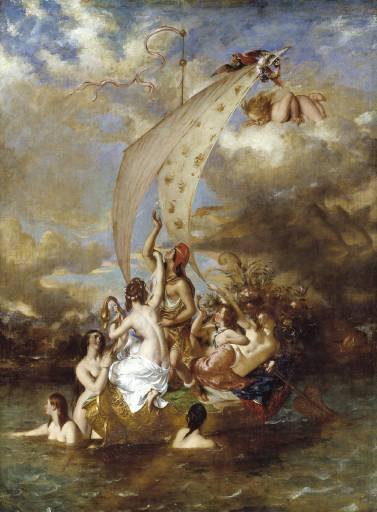
My Daily Art Display feature painting today is entitled Youth on the Prow, and Pleasure at the Helm, which he completed in 1832 and which, when not out on tour, is normally hung in the Tate Britain Gallery in London. The title of the painting comes from a line from the 1757 Pindaric Ode by Thomas Gray entitled The Bard.
Fair laughs the morn and soft the zephyr blows,
While proudly riding o’er the azure realm
In gallant trim the gilded vessel goes;
Youth on the prow, and Pleasure at the helm;
Regardless of the sweeping whirlwind’s sway,
That, hushed in grim repose, expects his evening prey
This poem fascinated many Romantics of the time, like Etty, and he illustrates the line in the poem in this work of his. Paying no attention to the rocking of the golden-prowed boat caused by the Zephyr’s sweeping whirlwind, the almost naked women, in a pyramidic formation, clamber to reach upwards, snatching at the “bubbles of pleasure as they float away.
Etty himself described the subject of the work in a letter to the art dealer C.W.Wass:
“…The view I took of it as a general allegory of Human Life, its empty vain pleasures – if not founded on the laws of Him who is the Rock of Ages…”
Art historians tend to believe the painting which shows the young women playing at catching bubbles despite the onset of a storm is all about Youth in its careless pursuit of pleasure is heedless of impending doom.
According to Leonard Robinson in his book, William Etty, the life and art, the painting was bought by Robert Vernon in 1832. Later that year Vernon bought John Constable’s work, Valley Farm. To house this new acquisition Vernon decided to move Etty’s painting to another position and replace it with Constable’s work. Constable on hearing this wrote to his friend and fellow painter Charles Leslie:
“…My picture is to go into the place – where Etty’s bumboat is at present – his picture with its precious freight is to be brought down nearer to the nose…”
Vernon bequeathed the painting to the National gallery in 1847 and later in 1949 it was transferred to the Tate gallery in London.
As I walked around the main exhibition gallery the majority of the paintings by Etty all included nudes, mainly women but some men and I can see how nineteenth century people were shocked by the works. Of course, for us today who are used to seeing semi-clad or naked women in our daily newspapers and television we are not shocked by the works of Etty and look with some amusement on the puritanical values of the Victorians. Now we tend to concentrate on the beauty of his painted figures. So does nothing shock us these days? I would have said nothing shocks me any more with regards nudity and yet when I stepped from the exhibition gallery to the next door gallery there was a live art performance by an almost naked woman who cavorted and shouted at the few people who had been brave enough to sit on a chair at the edge of her “stage”. Did I take my seat? No, as there seemed to be an element of audience participation I just didn’t have the courage to place myself face to face with the naked female performer. So maybe I can understand how the Victorian people were shocked by what they saw and maybe in another hundred years people will marvel at why I didn’t have the courage to go face to face with my almost naked female live art performer!
Candaules, King of Lydia, Shews his Wife by Stealth to Gyges, One of his Ministers, As She Goes to Bed by William Etty.(1820)
A couple of weeks ago I travelled to York and visited the city’s art gallery which had a long-running exhibition of the works of William Etty. William Etty was born and died in the city and therefore he is the pride and joy of the city’s artistic community. However as we will see in this blog, Etty’s work was often very controversial.
William Etty’s father, Matthew, was a miller and his mother, Esther Calverley, was the sister of the Squire of Hayton, Matthew was aged 28 and Esther just 17 when they fell in love in Hayton and then quickly married at All Saints Church, Pocklington, in July 1771. But Esther’s brother was highly disapproving of his young sister’s marriage, and as lord of the manor, who owned both the mill and the milling rights in Hayton, he promptly ejected Matthew and his new wife from the mill, which was their home, and the newlyweds were ‘run out of town’.
They moved to Pocklington and set up a bakery business, but it did not take off, which may have been due to the wider influence in Pocklington of the squire. The young couple moved briefly to Easington, then made a final switch to York, where their bakery was more successful and Etty’s father again took up flour milling. Alhough they were never particularly well off they produced a large family of ten children, born between 1772 and 1793.
William Etty was born in York in 1787, and grew up in the family bakery. He spent some years at a Pocklington boarding school but in 1798, aged eleven, his father arranged a seven year apprenticeship as a printer at the works of the Hull Packet newspaper. Etty had shown an interest in art in his teenage years and fortunately, through the encouragement and financial support of his wealthy uncle, a successful London gold-lace merchant, he was later able to pursue a career as a painter. His uncle invited Etty to London in 1806 and the following year, aged twenty, he enrolled at the Royal Academy Schools where he studied under Henry Fuseli and received some private tuition from Sir Thomas Lawrence, a painter who influenced Etty’s early works. During this time he would visit the National Gallery in London and study the works of the old masters, especially the Italian masters of the Renaissance. During his time at the Royal Academy he would take part in the Life classes and continued with those studies well after he had became an Academician and well after he had completed all the courses. It was obvious that William Etty was fascinated by the male and female body and its portrayal. I will end Etty’s biography here and conclude it in my next blog.
My Daily Art Display today is entitled Candaules, King of Lydia, Shews his Wife by Stealth to Gyges, One of his Ministers, As She Goes to Bed and was painted by Etty in 1820. The work is based on a story from The Histories of Herodotus, one of the most influential works of history in Western literature. The nine-volume work was written between 450BC to 420BC and records ancient traditions, politics, geography, and clashes of various cultures that were known around the Mediterranean and Western Asia at that time. In the first volume there is the story of King Candaules who according to the tale bragged of his wife’s incredible beauty to his favourite bodyguard Gyges. “It appears you don’t believe me when I tell you how lovely my wife is,” said Candaules. “A man always believes his eyes better than his ears; so do as I tell you – contrive to see her naked.”
Gyges refused; he did not want to dishonour the Queen by seeing her nude body. He also feared what the King might do to him if he did accept. However Candaules was insistent and Gyges had no choice but to obey. Candaules detailed a plan by which Gyges would hide behind a door in the royal bedroom to observe the Queen disrobing before bed. Gyges would then leave the room while the Queen’s back was turned. That night, the plan was executed. However, the Queen saw Gyges as he left the room, and recognized immediately that she had been betrayed and shamed by her own husband. She silently swore to have her revenge, and began to arrange her own plan. The next day, the Queen summoned Gyges to her chamber. Although he thought nothing of the routine request, she confronted him immediately with her knowledge of his misdeed and her husband’s. “One of you must die,” she declared. “Either my husband, the author of this wicked plot; or you, who have outraged propriety by seeing me naked.” Gyges pleaded with the Queen not to force him to make this choice. She was relentless, and eventually he chose to betray the King so that he should live.
The Queen prepared for Gyges to kill Candaules by the same manner in which she was shamed. Gyges hid behind the door of the bedroom chamber with a knife provided by the Queen, and killed him in his sleep. Gyges married the Queen and became King, and father to the Memnad Dynasty.
Before us we have a scene from the start of the tale in which we see Gyges creeping stealthily into the bedroom to catch a glimpse of the naked queen.
Looking through comments made by art critics of the day I came across one who described the subject of the painting as:
“ an undeniably disagreeable, not to say objectionable subject…”
Other reviewers called it
“…offensive, reprobate and a disgraceful story with debase sensuality…”
A Winter Scene with a Man Killing a Pig by David Teniers II (c.1650)
I think there is an adage, or maybe it was just advice I was once given, that says you should be happy with what you have or maybe it was that you should just want what you have. There is certainly an element of truth in that as I can always remember a disastrous policy my former company brought out in making it known to all the employees what each person earned by publishing the grades of each employee and having a separate list of salary against each grade. Up to that point nobody knew what each other earned and most people had, until then, been reasonably happy with their remuneration but once they found out what their colleagues earned there were unmerciful screams around the building.
So what has all this got to do with art? The reason I bring this up is that as I told you the other day I went to see the Group of Seven and Tom Thomson exhibition at the Dulwich Picture Gallery in London and a large number of them focused on winter in Canada. The winter scenes were well executed and very lifelike. However the problem came when I decided to have a look around the rest of the Gallery and its permanent collection and came across a winter landscape by David Teniers the Younger and really, in my mind, it was in a different class to those of the Canadian artists. I was completely amazed by the works of the Canadian artists until my eyes focused on Teniers’ work. Of course, by now you know I love Dutch and Flemish art and therefore I am slightly biased with my comparison but I thought I would let you compare the two styles and see what you think.
David Teniers the Younger was born in Antwerp in 1610. His father was David Teniers the Elder, also an artist, as were his son David Teniers III and grandson, David Teniers IV. His artistic connections don’t end there as his wife, Anna, was the daughter of Jan (Velvet) Brueghel the Elder and granddaughter of the Master himself, Pieter Bruegel the Elder. His initial art training came from his father whose artistic talent would soon be eclipsed by his son, who would become the most famous, most revered and most prolific of the Teniers’ family of artists. Adriaen Brouwer, who at the time was well known and well loved for his everyday scenes, greatly influenced Teniers during his early career as did Rubens who was his wife-to-be’s guardian. At the age of twenty-two he was registered in the Antwerp Guild of St Luke and would later become deacon of that painter’s association.
In 1637 he married Anna Brueghel. The major part of Anna’s dowry was made up of pictures and drawings completed by her grandfather, Pieter Bruegel the Elder, and her father, Jan Brueghel. Teniers spent much time studying these beautifully crafted works of art and they proved to be significant in the development of Teniers’s genre painting. In the year of his marriage to Anna Breughel, Teniers painted his first genre work entitled Peasant Wedding, which hangs in the Hermitage Museum in St Petersburg. It was the period between 1640 and 1650 that art historians believe Teniers produced his finest works. His expertise at depicting village scenes with large crowds of people, often in an open landscape was breathtaking. There was often an element of humour in his paintings and warmth in the way his characters were depicted on his canvases. In many of his works one could recognise the influence of the Bruegel family.
In 1651, David Teniers and his family moved to Brussels and besides carrying on his own art business he took up the post of court painter and the director of the art gallery of the Spanish governor-general, Archduke Leopold-Wilhelm. If you look back to My Daily Art Display of January 18th you will see a painting Teniers completed entitled Archduke Leopold William in his Gallery at Brussels, which precisely documented some of the famous works from the Archduke’s collection. Whilst looking after this vast collection Teniers made many small-scale individual copies of paintings in the Duke’s collection by foreign artists, especially the paintings of the Italian Masters. Of these, two hundred and forty-four were engraved in 1660 under the title Theatrum Pictorium.
On the death of the Archduke Leopold-Wilhelm his successor, Don Jon of Austria continued to employ Teniers as court painter and in 1663 Teniers founded the Royal Academy of Fine Arts Antwerp which still exists and is one of the oldest of its kind in Europe. David Teniers the Younger was a highly productive artist and when he died in 1690, he left more than two thousand works. Most of the major galleries of the world exhibit a number of his works. He was an extremely good businessman and was highly liked by the aristocracy. Teniers knew the type of art the people liked and was very astute when it came to following the latest fashions and whims of his clients. His art work covered numerous subjects from portraits and religious scenes to genre pictures and still-life paintings. Teniers died at the age of seventy-nine in Brussels, five years after the death of his eldest son, David Teniers III.
The featured work for My Daily Art Display today is a painting David Teniers the Younger completed around 1650 and is entitled A Winter Scene with a Man Killing a Pig. The painting is amazing. It just glows in front of your eyes. An art historian and contemporary of Teniers summed up the beauty of this painting when he wrote:
“…For the richness of his golden and silvery light, for the delicacy of his vivid colours there is only one word, and that word is ‘magical…”
Before us we see a winter landscape and in some ways reminiscent of Teniers’ wife’s grandfather, Pieter Brueghel’s work, Hunters in the Snow another winter landscape painting completed almost a hundred years earlier. As well as being a landscape painting it is also a genre picture which does not offer us an idealized landscape, but instead provides us with a window for us to see real people getting on with their daily lives in a real setting. Snow lies deep on the ground and by the looks of the dark clouds there is more snow to come. Look how the artist depicts the rays of weak sunlight forcing their way through the clouds to light up the frosty winter scene.
Work on the farms almost came to a halt at wintertime giving time to the peasants to take the break from working the fields and well-earned time to sleigh and skate. To the left of the painting we see some houses. In front of the nearest house, a pig is about to be slaughtered. Although we may cringe at the depiction of the killing it should be remembered that in Teniers time this would be a common practice. It marked a time of celebration and we see emerging from the end house, a woman carrying a baby and an old man, dressed in black, leading out a young child so they could witness the scene. The butcher kneels on the animal while a woman holds out a pan to collect the blood. Every part of the carcass will be used. The children would be given the pig’s bladder so that they could blow it up and use it as a ball. The skin, once the hair had been singed off it, would be used as a kind of leather, maybe for shoes. The flesh from the large animal would provide meat for their meals all the way to Lent, at which time, the staple food would switch to fish until the end of the “fast” and the arrival of Easter.
So now you have seen an early twentieth century Canadian winter scene and a mid-seventeenth Dutch winter scene and I will let you choose which you prefer
The exhibition I visited back in November at the Dulwich Picture Gallery was entitled The Group of Seven and Tom Thomson. The reason for the Group not including Thomson himself was, although he was closely connected to and had greatly influenced the seven members of the Group, he died before they had formed this artistic association in 1920.
Tom Thomson, who was born into a large western Ontario farm family in Claremont, Ontario, was the son of John and Margaret Thomson. It is interesting to note that unlike many early stories of artist’s lives, Thomson never showed an early interest in art. In his youth, he was far more interested in music and literature. At the age of twenty-two, he worked as an apprentice in an iron foundry owned by a friend of his father. It is possible that Thomson took advantage of his father’s connection with the owner and failed to fulfil his part of the apprenticeship as within a year he had been sacked because of his lack of time management. Thomson then decided that the excitement of military life was for him and applied to fight in the Second Boer war but was rejected on medical grounds. Later he would be turned down again by the Canadian military when he tried to enlist and fight in the First World War.
In 1901, aged twenty-four, he was admitted into a business college at Chatham but stayed there for less than a year, at which time he went to Seattle where his brother George had a business school. It was in this American city that he worked as a photoengraver and designed commercial brochures and spent a lot of his free time sketching and fishing.
Thomson returned to Canada in 1905 and two years later joined Grip Limited, a leading Toronto artistic design company. It was whilst working there that he met some of the future members of the Group of Seven. Apart from Lawren Harris, who came from a wealthy background and enjoyed an independent income, all the artists, who formed the Group of Seven, supported themselves at one time or another as commercial artists or graphic designers producing lettering and layout as well as illustrations for magazine and books. Thomson and his newly found friends, who all loved to sketch and paint, would often go off together at the weekends on sketching trips.
One of Thomson’s favourite destinations on his painting trips was Algonquin Park, a forestry reserve north of Toronto, which stretches between Georgina Bay on the west and the Ottawa River to the east. It is a vast stretch of pristine wilderness and an ideal location for landscape artists. Thompson first journeyed there on a sketching expedition in 1912 returning home clutching numerous sketches of the areas he visited. These sketching trips up north were a bit of a logistical nightmare as the artists had, as well as carrying food, shelter and cooking utensils, had also to carry their painting and sketching materials and this culminated in an almost impossible burden. The weather conditions for en plein air painting or sketching was not conducive for the artists due to the cold and wet and this necessitated them having to try and paint or sketch with speed in changing light.
My Daily Art Display featured painting today is one of Tom Thomson’s early works which he completed in 1916 and which is entitled Spring Ice. The 1915 study for this painting, in the form of a small oil on cardboard sketch, as well as the finished oil on canvas painting are normally housed at the National Gallery of Canada in Ottawa. One should remember that many artists looked upon their preparatory sketches as works in their own right and not just as a preparation for the finished article. Thomson made some subtle changes to his finished painting in comparison to his contemporary sketch. Although the positioning of the land, trees and lake remain the same, the colours on the final canvas are noticeably different. In the finished work Thomson has used much brighter pastel colours and by doing so has cleverly brought to us a hint of spring. Also, whereas the sketch had a square shape, the oil on canvas work was wider and horizontal in shape. This added width allows us to get a better view of the blue waters of the lake. One can imagine the difficulty Thomson endured to capture the scene. Probably squatting down on the thawing earth, balancing his sketch box on his knee so as to obtain a low-level view of the lake. Can you imagine how cold it must have been and how cold his fingers must have been in the chilling air? It was those same frosty conditions which bit unmercifully at his limbs that prevented the ice flows from melting as they moved slowly in the water. We can see that there is a long time to go before the warmth of summer arrives to add warmth to the ground and tease the vegetation from the earth. We are still in spring and the trees have yet to open up their buds to the elements.
Artists like those of the Group of Seven had to endure great hardships in the cause of producing a realistic representation of nature. They had to paint quickly to capture the scene with its many moods as the light from the sun or moon changed. The mood for this painting is one of serenity and tranquillity and one can understand why artists like Thomson put up with the harsh conditions so as to record the beauty of nature.
Thomson’s life ended suddenly and in mysterious circumstances. It was the summer of 1917 and he had been out alone in a canoe on Canoe Lake in Algonquin Park when he disappeared. His empty canoe was spotted later that day. Thomson was an expert fisherman, canoeist and hiker, and when his body was found eight days later in the lake it seemed incongruous that he could have died accidentally. To this day the circumstances of his death have remained shrouded in mystery. The official cause of death was given as “accidental drowning”. The investigation claimed there was a fishing line wrapped around his legs and he had suffered a blow to his head before he died. As with all deaths in unusual and suspicious circumstances, the conspiracy theorists have had a field day, putting forward numerous scenarios, which ultimately led to the artist’s death. Murdered by a neighbour, killed in a drunken brawl over money he owed his assailant, and killed by the father of a girl whom he had got pregnant were just a few of the many suggested circumstances that led to the artist’s demise. Maybe closer to the truth was the belief that it was a simple accident or that he had committed suicide during one of his many bouts of depression. We will probably never know the truth but the one thing we do know with great certainty is that on that lake in July 1917, Canada lost one its great artists, aged just forty.








 my daily art display