The Mancorbo Canal in the Picos de Europe by Carlos de Haes (1876)
My Daily Art Display blog today incorporates the two things I enjoy most in art; landscape paintings and discovering a painter I had, up till now, never heard of. Today I am featuring the nineteenth century Belgian born Spanish landscape painter Carlos de Haes.
Carlos de Haes was born in Brussels in January 1826. He was born into a dynasty of merchants and financiers and was the eldest of seven children. When he was nine years old his family moved to Malaga where he grew up and went to school. His initial artistic training was under the tutelage of Luis de la Cruz y Ríos, the Spanish miniaturist painter, who had once been the court painter of King Ferdinand VII. In 1850, at the age of twenty-four, he returned to Belgium and studied for five years under the Belgian landscape painter Joseph Quineaux. It was the influence of Quineaux which drew de Haes into the world of landscape painting and sketching and painting en plein air. During his five year stay in Brussels he managed to travel to France, Holland and Germany constantly sketching the varied landscapes he came across. It was also around this time that he became interested in the works of the contemporary Realist artists. In 1855 after completing his art course he returned to Spain and went to live in Madrid and became a naturalised Spaniard. In 1856 he put forward a number of his landscape works for exhibition in Madrid’s Exposición Nacional, where they were very well received. The following year, 1857, at the age of thirty-one, Carlos de Haes won the competition for the chair of landscape painting at theReal Academia de Bellas Artes de San Fernando (Royal Academyof Fine Arts ofSan Fernando), with his work entitled Royal Palace from the Casa de Campo. The Academy was an establishment which would half a century later be home to the likes of Dalí and Picasso. In 1861 de Haes was made Académico de mérito.
During his tenure at the Academy, de Haes set about putting together a set of regulations for his students governing landscape painting and rules for future landscape competitions. He was insistent that his students mastered the art of en plein air sketching and painting instead of just producing historical landscapes which they had conjured up in the studio. This, he believed prevented the true study of nature, and he asserted that the en plein air aspect was of paramount importance when contemplating a landscape work. Haes encouraged his students to interpret nature directly and by working out in the open he insisted that they understood how the changing light changed how they viewed the vegetation and the terrain. He did however countenance using the studio to fine tune the painting and make final adjustments. Haes’ insistence that his students should produce a truthful depiction of the landscape, captured by painting en plein air, points towards his interest in the new Realism form of art, which claimed that artists should represent the world as it was, even if it meant breaking artistic and social conventions.
During the next ten years Haes spent most of his time painting landscapes which featured the Spanish Pyrenees and the Guadarama mountains in central Spain. One of his students who accompanied him on his sketching journeys was Aureliano Berruete who would become one of the foremost Spanish painters.
Carlos de Haes became ill in 1890 and died in Madrid in 1898. He bequeathed his mostly small-format paintings to his pupils, who gave them to Spanish museums, the majority of which are now housed in the Casón del Buen Retiro, part of the Prado Museum in Madrid.
My featured painting today by Carlos de Haes was one which I saw when I recently visited the Prado in Madrid. It was completed by him in 1876, although the preparatory sketch for the work was dated in situ in 1874. It was exhibited at that the 1876 National Exhibition in Madrid and was subsequently purchased by the Spanish state. Carlos de Haes had been travelling with Aureliano Berruete around the wild and rugged Cantabrian rural area of Liébana when they came across this spectacular view. The oil on canvas painting, measuring 168cms x 123cms is entitled The Mancorbo Canal in the Picos de Europe. The Picos de Europa is a range of mountains 20 km inland from the northern coast of Spain and this landscape painting by de Haes depicts the awesome and craggy vista of the mountain range which was one of Carlos de Haes’ favourite type of spectacular and breathtaking views. At the bottom of the painting, although it somewhat difficult to pick them out, there are three cows and their herder.
I stood before this beautiful painting and was awestruck by its beauty and its realistic quality. So, if you ever make it to the Prado be sure to find this work.
For those of you who have just landed on this page I suggest you go back to my previous blog which looks at Frederic Church’s early life and talks a little about his exhibition at the National Gallery, London which I visited last week.
Our Banner in the Sky by Frederic Edwin Church (1861)
Another beautiful and moving historical painting by Frederic Church which was on display at the exhibition and which I found very moving was a small oil painting entitled Our Banner in the Sky which Frederic Church completed in 1861. I stood before this work, fascinated by the way in which Church had cleverly depicted the image of the Stars and Stripes American flag in tatters against an amazing daybreak landscape with its red and white bands of clouds. Church had painted this shortly after the attack on Fort Sumter by General Beauregard and his Confederate troops in January 1861 , which signalled the start of the American Civil War, which tragically went on to cost so many American lives. In the work we see a bare and tall tree slightly leaning over, which acts as a flagpole for the flag which blends in with the early morning sky. In it, we see the North Star depicted through a patch of blue sky. Church has cleverly managed to create a highly patriotic scene which in some ways connects the American landscape with the Northern cause. It was a heartfelt cry for unity which sadly was not listened to. It was such a popular work that the Manhattan art dealer, Goupil & Co. commissioned Church to produce a chromolithograph of the work and, within a few months, hundreds of copies were bought up by the public.
Isabel Carnes Church by Frederic Church (1860)
It was during the New York exhibition of his Andes painting that Frederic Church met Isabel Carnes. In 1860 just three months before his marriage to Isabel, Church bought some 126 acres of farmland, close to the towns of Hudson and Catskill and situated on a south sloping hill, overlooking the Hudson River. He was familiar with this site as he had visited the area whilst on a painting trip with Thomas Cole in 1845. As he still lived in New York, this new acquisition would be the family country get-away. Church employed the foremost architect of the time, Richard Morris Hunt, to construct a cottage and design this ferme ornée. The term means an ‘ornamented farm’, and describes a country estate laid out partly according to aesthetic principles and partly for farming. Church and his wife referred to the small cottgae on the estate as their Cosy Cottage and it was surrounded by gardens and orchards and Church even had a section of marshland drained so as to build his own expansive ten acre lake. Over time he bought up more of the adjoining land and eventually his estate encompassed 250 acres.
Fern Walk, Jamaica by Frederic Church (1865)
He and his wife lead a settled and happy life and he spent most of his time tending to his farm but his happiness was shattered in March 1865 when both his young children contracted diphtheria and died a week apart. In an attempt to counteract the intense grief suffered after their children’s death, he and his wife along with some friends travelled to Jamaica where, for five months, Frederic immersed himself in a painting frenzy whilst his wife collected numerous species of ferns which she would later bring back home and which would form part of her fern garden. Isabel’s interest in ferns and Frederic’s love of depicting nature in his painting were combined in his 1865 work entitled Fern Walk, Jamaica in which Church depicts a narrow path winding through luxuriant plants and ferns. The shades of greens and browns which he used in depicting the native flora is breathtaking. Frederic Church loved his stay in Jamaica. He loved sketching plein air in the tropical light and, on his return to America, would often encourage other landscape artists to venture on painting trips to the Caribbean island. In a letter he wrote to the landscape artist, Charles de Wolf Bramwell, he extolled the Fern Walk area of the island, writing:
“…the vegetation, next to that on the Magdalena River, the finest I ever saw –– The ferns, especially in the region known as Fern Walk — excelled every place…”
Ed Deir, Petra Jordan by Frederic Church (1868)
The couple returned home from Jamaica and in 1866 Isabel Church gave birth to a son, Frederic Junior. The following year Frederic and Isabel, along with their son and Isabel’s mother, set off on a two-year long journey of Europe and the Holy Land. They visited Jerusalem and from there headed to Jordan where Church, after an arduous ten day journey by mule, arrived at the ancient city of Petra. During the long trip Church continually sketched and painted. It was a trip which was fraught with danger from not only local bandits, but from the native porters which were helping Church’s party get to their destination. These Arabs were very superstitious about his sketching but were eventually won over by his skill. He finally arrived at Petra and made the long climb up above the city to the monastery of Ed Deir, which in the first century AD was a Nabatean temple. Frederic Church completed his beautiful oil and graphite painting entitled Ed Dier, Petra, Jordan, Unbelievable at it may sound but Church completed the work in just one sitting, in 1868.
Königsee by Frederic Church (1868)
From the Holy Land, Frederic Church returned to Europe visiting Rome and Athens and also the Bavarian Alpine region, Switzerland and Austria which had always been a popular venue for landscape painters. Church was drawn to this area as he was always searching for beautiful vistas to paint. He liked the area as he believed there was a marked similarity between the geography of the area and that of the rugged American landscapes which he knew so well. In July 1868 he visited the Königsee, the beautiful Upper Bavarian lake which nestles amongst steep-sided cliffs. Sheltered from the weather, the surface of the lake is often mirror-like reflecting the surrounding mountains. He completed a beautiful work entitled Königsee that month and it is a poignant reminder to me of the times I have visited the lake and stood in awe before it, mesmerised by its beauty.
South West Facade of Olana A watercolour by Frederic Church (1870)
Frederic Church in 1867 was becoming homesick and wanted to return to America and his country estate. Since he bought it seven years earlier he had been constantly planning the landscape design for the land and the architectural design for a large house on the top of the hill. Richard Morris Hunt, his architect, had submitted plans for a large French chateau-style house and Church had liked the idea and agreed to the design. However having returned from his tour of the Levant and studied the architecture of the area, he changed his mind. He decided to discharge Hunt and take on the British-born American architect and landscape designer Calvert Vaux who was based in Manhattan and had in 1858, along with Frank Law Olmstead had won a design competition to improve and expand New York’s Central Park.
Olana Historic Site
Frederic Church and Vaux worked on the plans for the design of the house which was to be the centrepiece of Church’s estate, which he and his wife Isabel named Olana after a fortress-treasure house in ancient Persia which like Church’s estate also overlooked a river valley. The building project was completed in 1872.
As Church got older he spent more and more time on his farm and concentrated his time running the estate. From the 1870’s onwards Church suffered badly from rheumatoid arthritis which badly affected his right arm curtailing much of his art work although he did teach himself to paint with his left hand. Frederic Church died in 1900, aged 74 and is buried in Spring Grove Cemetery in Hartford, Connecticut.
Forest Pool by Frederic Church (1860)
I will finish this blog with a look at the painting by Frederic Church, which most impressed me at the exhibition. It is entitled Forest Pool and was completed by Frederic Church around 1860. It was almost the first work I came across as I entered the exhibition room and I had to keep coming back to it in order to savour its beauty. I stood before it and could not believe the quality of the painting. Such beautifully drawn details. Such beautiful colour and tones. The work was a close-up view of a dense forest and a small forest pool. Every square inch of the work is covered in rich shades of green and brown and although it was a study for a larger painting, it seems as if it is a finished work. The artist has delightfully depicted the tranquillity of the forest scene with the calm surface of the pond offering up reflections of the trees and their branches and spots of sunlight. If you look closely at the upper middle part of the composition you will just be able to make out a hint of blue sky which is otherwise blocked by the screen of trees.
The Frederic Church exhibition at the National Gallery is worth going to see for this painting alone.
Last weekend I spent a two day break in London attending the christening of my grandson and pottering around a couple of galleries visiting their current exhibitions. I had tickets for the Boccacio exhibition at the National Gallery and whilst there I decided to call in to their small but excellent Frederic Church exhibition, Through American Eyes: Frederic Church and the Landscape Oil Sketch, which is running until April 28th. It was a veritable gem of a show and as the publicity stated,
“…[ it was an invitation to] step into a world of wild natural phenomena with the landscape oil sketches of celebrated American landscape painter, Frederic Church…”
It is a free-to-enter exhibition and one you should try and visit. I want to dedicate the next two blogs to the nineteenth century American painter Frederic Church, and look at some of his paintings, some of which were at the exhibition. Church was a master of the plein-air oil sketch and I ask you to accompany me on a journey looking at his life and sampling some of his exquisite artistic gems.
Frederic Church was born in Hartford, the state capital of Connecticut, in May 1826. He came from a privileged background. His father, Joseph, who came from a very prosperous family, was a jeweller, silversmith and a Hartford insurance adjuster and the Church household lived an affluent lifestyle. Frederic, who was brought up in a devout Protestant Congregationalist household, showed a propensity for art whilst at school and through a family neighbour, Daniel Wadsworth, was fortunate enough to be introduced to Thomas Cole, the English-born American landscape artist, who is regarded as the founder of the Hudson River School. Thomas Cole, who up until then had never taken a pupil under his wing, agreed to take Frederic on as his pupil. Frederic studied under Thomas Cole in his Catskill studio between 1844 and 1846 during which time he and his tutor would go off on painting trips to the Catskill Mountains and the Berkshires, a highland region in western Massachusetts, west of the Connecticut and lower Westfield Rivers .
Hooker and Company journeying through the Wilderness in 1636 from Plymouth to Hartford by Frederic Church (1846)
Frederic flourished under Cole’s guidance and, within a year, he had his painting, a scene from early New England history, Hooker and Company journeying through the Wilderness in 1636 from Plymouth to Hartford shown at New York’s National Academy of Design annual exhibition. The scene recounts the June 1636 journey made by the prominent Puritan religious leader, Reverend Thomas Hooker as he left the Boston area with one hundred men, women, and children and set out for the Connecticut valley. The group traveled over one hundred miles through the wilderness and reached their destination in early July. Many members of the Hooker party settled in Hartford, while some located to nearby Wethersfield and Windsor, and others traveled north and settled Springfield, Massachusetts. It was through this painting that Church combined his love for ancient landscapes with an acknowledgement of his cultural origins. The following year Church was elected as the youngest Associate of the National Academy of Design and was promoted to Academician the following year. That year he sold his first major oil painting to the Wadsworth Atheneum in Hartford, an art museum which had been founded by Daniel Wadsworth.
After completing his apprenticeship with Cole, Frederic Church moved to New York and set up his own studio in a space which he rented in the Art-Union Building, which was at the centre of the city’s art world, and he began to teach art. During the spring and autumn months he would leave the city and set out on painting trips throughout New England, particularly Vermont. Over the months he would build up a large collection of sketches of the beautiful scenery he witnessed, which he would then bring back to his New York studio and during the dark and cold months of winter he would convert them into beautiful landscape paintings. His landscape artistry was much admired and his landscape works featuring New York and New England vistas sold well. Frederic Church’s landscape paintings differed from the moral and religious allegorical ones which had been the hallmark of his tutor, Thomas Cole’s landscape works, for Church wanted to concentrate on the true beauty of nature. His depictions of storms, sunsets and waterfalls in the Catskill Mountains encapsulated the beauty and spirituality of the American wilderness. It could well be the case that Frederic Church had read the words of the great English art critic John Ruskin who laid out his ideas of what a young artist should seek to achieve in their landscape works. Ruskin wrote:
“…For young artists nothing ought to be tolerated but simple bona fide imitation of nature….. Their duty is neither to choose, nor compose, nor imagine, nor experimentalize; but to be humble and earnest in following the steps of nature, and tracing the finger of God…”
Niagara by Frederic Church (1857)
During a two year period, 1854 to 1856, Frederic Church travelled extensively visiting Nova Scotia, and journeying throughout Maine, New Hampshire, and Vermont, and it was around this time that he visited the Niagara Falls. The Falls, by this time, had become a great tourist attraction and a favourite destination for artists. Whilst at the Falls he completed a number of oil sketches which he would utilise when he painted his large-scale works of the Falls in 1857 and 1867. Frederic Church’s great breakthrough came when, in 1857, he exhibited his painting Niagara It was a large work measuring 107cms x 230cms (see My Daily Art Display Sept 9th 2011) and it visually stunned all who saw it. Without doubt, the late 1850’s were the high point of Church’s career. Artistic triumph followed artistic triumph.
Frederic Church had, like many others, become fascinated with the translated writings of the celebrated Prussian naturalist and explorer Alexander von Humboldt, which were based on his five-year expedition in the New World at the start of the nineteenth century. It was in one of his works, Kosmos that Von Humboldt implored artists to travel and paint equatorial South America. In 1853, along with his friend, the young entrepreneur Cyrus West Field, who had financed the trip, Church set off on the first of two expeditions following Humboldt’s footsteps, chiefly in Colombia; the second trip, in 1857, in company with the American Creole landscape painter, Louis Remy Mignot. Together, the artists travelled from Panama to Ecuador, where they spent 10 weeks painting village and mountain scenes.
The Heart of the Andes by Frederic Church (1859)
From his trips to South and Central America, Frederic Church amassed a large collection of sketches from which, on his return home, he completed large and spectacular oil paintings. One of these works was his ten-foot wide work entitled The Heart of the Andes which he completed in 1859. This elaborate and highly structured painting was his most ambitious work. In this painting Church managed to depict the variety of earthly life as seen by the lush green foreground. The painting took pride of place in a New York exhibition, housed in an elaborate window-like frame and illuminated in a darkened room by concealed skylights. Can you just imagine what nineteenth century viewers made of this extraordinary painting exhibited in such an extraordinary setting? People thronged to see the painting and it was estimated that more than twelve thousand people visited the exhibition in three weeks and were happy to part with a quarter each to see it. For that admission fee, the public were provided with opera glasses so that they could examine the painting in detail. The painting was then shipped to England where once again people flocked to see it. Church eventually sold it for $10,000, at that time the highest price ever paid for a work by a living American artist.
Iceberg Flotante by Frederic Church (1859)
In 1859 Church took a voyage north along the coast of Newfoundland and Labrador in search of icebergs. On this trip he was accompanied by the Reverend Louis L. Noble, an author who was to write about their trip together in his 1861 book, After Icebergs with a Painter: A Summer Voyage to Labrador and Around Newfoundland. During their voyage of discovery Frederic Church and Noble would hire a boat to take them up close to these awe-inspiring floating icebergs to allow Church to sketch these remarkable and majestic floating white giants. Frederic Church managed to capture the breath-taking beauty of these white giants in a number of his paintings, one of which was his work entitled Iceberg Flotante which he completed in 1859
The Icebergs by Frederic Church (1861)
I particularly like his 1861 painting entitled TheIcebergs, in the foreground of which we see a broken masthead lying cross-like on the ice. Not only is this a beautiful landscape work but it is a kind of historical painting as the inclusion of the masthead is a reference to the tragic loss of Sir John Franklin’s doomed British expedition party which had been attempting to cross the last un-navigated section of the North-West Passage in 1847. Sadly, the two ships of the expedition became icebound in Victoria Strait, close to King William Island in the Canadian Arctic. Despite the British Admiralty’s sending numerous search parties to find the ships, the entire expedition party, including Franklin himself and his 128 men, was lost.
……………………………………………….to be continued in my next blog.
Classical Greek Landscape with Girls Sacrificing Their Hair to Diana on the Bank of a River by Pierre-Henri de Valenciennes (1790)
As an artist, he has been spoken of as the father of French Neoclassical landscape painting and an artist, who was for landscape painting what Jaques-Louis David was for history painting, so how can I ignore this eminent and much honoured French painter.
My featured artist today is Pierre-Henri de Valenciennes, who was born in Toulouse in 1750. He studied at the Academy of Painting, Sculpture and Architecture of Toulouse, under the tutelage of the local history painter and pastelist, Jean-Baptiste Despax, an artist who had spent much of his life in the decoration of churches and monasteries in and around the French city. It is probably from him that Valenciennes became familiar with the iconography of conventional classical and biblical subjects. Another of Valenciennes’ early teachers was the miniaturist, Guillaume Gabriel Bouton.
When Valenciennes was nineteen years of age his work came to the attention of Mathias Du Bourg, a prominent and wealthy Toulouse lawyer, merchant and councillor at the Toulouse parliament, who became his patron. In 1769 Du Bourg invited Valenciennes to accompany him on a trip to Rome where he stayed for two years before returning home. At the end of that year, 1771, Valenciennes went to live in Paris and, through the recommendation of Du Bourg, managed to get himself a placement in the studio of Gabriel-François Doyen, who at the time was one of the leading French history painters. Another person Du Bourg introduced Valenciennes to was Etienne-François, comte de Stainville, Duc de Choiseul, a French military officer, diplomat and statesman who became another of Valenciennes’ patrons. Valenciennes would often spend time at the country estate of his new patron and soon developed an interest in the native landscape.
In 1777, Valenciennes made another trip to Italy and this time remained there for almost eight years. He travelled extensively around what was then termed the Kingdom of the two Sicilies, which was the largest of the Italian States, prior to Italian unification and extended south of Rome and included the island of Sicily. Valenciennes also found great pleasure in journeying around the campagna, the low-lying area which surrounds Rome. He did return once to Paris in 1781 where he met and received tuition from Claude-Joseph Vernet. Vernet strongly urged him to work en plein air. In 1787, Valenciennes applied to become a member of the Académie Royale and following a short probationary period and the submission of his reception piece, a historical and imaginary landscape work entitled Cicero Uncovering the Tomb of Archimedes, he was accepted into the hallowed institution. His painting was one of two Salon works which he had accepted at the Paris Salon that year. From this first submission to the Paris Salon, Valenciennes would exhibit annually, large landscape works there until 1819, the year of his death. Valenciennes quickly established his reputation at the Salon as a painter of paysage historique (historical landscapes inspired by mythology and Greek antiquity). These large-scale works which represented imaginary visions of the classical past, earned Valenciennes the title, “the David of landscape.”
Once he established himself at the Academy, he opened his own studio in 1796. At this time, the European Academies believed in a strict hierarchy in figurative art, which had originally been postulated for painting in 16th century Italy and which still held good two centuries later. The hierarchy was:
History painting which also included works which had narrative religious mythological and allegorical subjects
Portrait painting
Genre painting which were scenes of everyday life
Landscape painting and cityscapes and cityscape
Animal painting
Still life painting
Many artists would not accept the Academy’s hierarchal approach and would invent new genres and by doing so, raised the lower subjects to the importance of history painting. Joshua Reynolds, the English portraitist, achieved this by inventing the portraiture style that was known as the Grand Manner in which his works flattered his sitters by likening them to mythological characters. The French artist, Jean-Antoine Watteau invented a genre that was known as fetes gallants in which he would depict scenes of courtly amusements which took place in Arcadian setting. These often had a poetic and allegorical quality, which, as such, were considered to elevate them within the hierarchy. Valenciennes, like many landscape artists before him such as Nicolas Poussin and Claude Lorrain, endeavoured to elevate the status of their landscape work by incorporating mythological figures into their works.
Claude had ennobled his paintings of the Roman countryside by adding biblical and classical narrative references and by doing this enforced an idealized vision of balance and harmony on the world before him. This emphasis on timeless landscapes augmented with historical vignettes could be seen in Valenciennes’ large salon landscape paintings. Valenciennes was adamant that the status of landscape painting should be elevated. In his efforts to see this through he put out a famous treatise entitled Élémens de perspectivepratique à l’usage des artistes (Reflections and Advice to a Student on Painting, Particularly on Landscape)in which he gave landscape painting the full practical and theoretical examination it was due but which up until then had been denied. This work remained the most influential treatise on landscape painting for decades to come. Things did change in the nineteenth century France with French landscape painting undergoing a remarkable transformation from a minor genre, rooted in classical traditions, to a primary vehicle for artistic experimentation.
In 1812 Valenciennes was appointed Professor of Perspective at the École Impérial ses Beaux-Arts, a position he held for the next four years. During his time at the art school he managed to nurture an up and coming set of French landscape artists, such as Nicolas Bertin, Achille Michalon and Jean-Baptiste Deperthes. In 1816 the Académie even encouraged Valenciennes’ favoured painting genre, paysage historique (historical landscape painting), by presenting a special Prix de Rome award for the best landscape painting. Much to Valenciennes’ delight the first winner of the award went to Michallon, one of his students.
Pierre-Henri de Valenciennes died in Paris in 1819, aged 68 and is buried in the Parisian Père Lachaise Cemetery.
My featured work today by Valenciennes is one he completed in 1790 and exhibited at the Salon the following year along with six other landscape paintings. It is entitled Classical Greek Landscape with Girls Sacrificing Their Hair to Diana on the Bank of a River.
When young girls wanted to marry, they were asked to lay their personal belongings of their virginity on an altar to Artemis (Diana). They were such things as toys, dolls, and locks of hair. This represented their transition from childhood to adulthood closing the door of the domain of the virgin goddess forever. In ancient times, hair, and the way it was worn, identified class and status. Young girls and unmarried women wore their hair long and loose but once they were married it was coiled upon their heads; prostitutes and women of easy morals coifed their hair in elaborate ringlets and curls. The girls’ short hair now identified them as virgins dedicated to perpetual chastity in the image of Diana, with a consequential curtailment of fertility. When he painted this picture in 1790, Valenciennes was at the height of his artistic career and had already established himself as the master of the paysage historique genre.
In the foreground of this work we can see a small lake. To the right of the lake there is a marble statue of the goddess Diana, under a leafy arbour, holding her bow with a small stag standing by her side. On the far side of the lake we can see a circular altar, which looks very much like the base of a large column. Around this altar we see three young women. On the altar we can see hair that two have laid down as a sacrifice to Diana whilst we see the third woman in the process of cutting off locks of her hair. In the middle ground we can just make out two other women standing in an open sunlit plain pointing towards a stream on the left middle ground where we can just make out more women who are in the process of drying their washed clothes on a large stony outcrop. The building behind the plain is a circular fort along with its high stone walls which divide the composition into two diverse zones.
On the other side of the walls of the fort, to the left, we can see a range of desolate and infertile hills extending into the distance. The Temple of the Sibyl can also be seen atop a mountainous outcropping at left of composition. If we look closely at the hinterland and beyond, on the other side of the wall, we can make out a number of impressive buildings which extend across the plain. In this beautiful landscape painting, the viewer’s eyes quickly pass over the small figures shown in the foreground and are lifted to the expansive and idyllic natural space that stretches into the distance. Even the statue of the goddess directs her attention to the landscape. So even though Valenciennes has added a touch of mythology to his work he seemed more interested in the natural landscape which he hopes will occupy most of our gazes.
The painting is housed at the Mount Holyoke College Art Museum in South Hadley, Massachusetts which was founded in 1876 and was one of the first collegiate museums in the United States.
Today I am concluding my look at the life of Thomas Fearnley and for those of you have just landed on this page, my introduction to the Norwegian artist’s life was the subject for My Daily Art Display blog of November 24th.
The date is 1832 and that September, Fearnley, who along with his fellow artists, the Dane, William Bendz and the German painter Joseph Petzl, had just left the Bavarian Alpine village of Ramsau and were beginning their long and strenuous trek on foot over the Alps to Italy. So why had this Norwegian artist and his friends set off on this gruelling journey? Why did Fearnley spent most of his life wandering around Europe? The answer probably lies in the fact that although the Norwegian landscape offered many beautiful vistas to paint, there were few commissions to be had from wealthy patrons in his native Norway. Whereas in the art capitals of Europe such as Paris, London, Rome and Munich there were a large number of affluent patrons who would pay generous sums for landscape works.
Fearnley and his travelling companions headed for Rome but first stopped off in Venice in the late October of 1832. The three travellers split up at this point as Fearnley was determined to carry on until he reached the Italian capital whereas Bendz wanted to stay in Venice. As I told you in my last blog, William Bendz took ill in Venice but left the city and went to Vicenza where his health deteriorated rapidly and he died of typhoid, just ten days after he had parted from his friends. Fearnley finally arrived in Rome in November 1832, just before his 30th birthday. He settled down in the Italian capital, living amongst the Danish and German artistic community. Fearnley made Rome his base for the next three years but was constantly setting off from there on his artistic trips. In 1883, along with a Danish friend, he left the capital on a long walking tour of Sicily and on his way back to Rome, visited Naples, Sorrento and Capri. This journey along the Amalfi coast had been carried out by his erstwhile mentor John Christian Dahl, ten years earlier.
Fearnley loved the practice of en plein air oil sketching and he followed earlier practitioners of this kind of art such as Claude-Joseph Vernet, Pierre-Henri Valenciennes and the Welsh artist Richard Wilson, all of whom had pioneered en plein air sketching whilst they were based in Rome. The other aspect of this art, which Fearnley believed in, was to select views for painting that were “fresh”, even unorthodox rather than painting views which had been done so many times over by other landscape artists. Another aspect of art which fascinated Fearnley was how various meteorological conditions affected the light and the view of the landscapes. He strived for a true depiction of the skies and the cloud formations and was only too aware of the fast change in what he was looking at, due to varying changes in the weather conditions. Having left the colder, duller and wetter climate of Northern Europe and Scandinavia he was now able to appreciate and take advantage of the warmer, sunnier climes of Italy which allowed him a greater opportunity to paint outdoors for lengthy periods of time.
In 1835, after his three year sojourn in Italy, Fearnley decided to move on. He travelled north via Florence to Switzerland where he spent most of the summer studying the breathtaking Alpine scenery and especially the glaciers at Grindelwald, which would be depicted in his famous 1838 large studio oil painting entitled The Grindelwald Glacier, which is My Daily Art Display’s featured painting today. From this Alpine area he once again moves north, crossing the Alps, heading for Paris, arriving in September of that year. Whilst in Paris, he exhibits three of his works, including the “yet to be completed” Grindelwald Glacier painting. During Fearnley’s stay in Rome he had met and befriended a number of wealthy English art lovers. Many were rich aristocrats who were taking part in the Grand Tour. It could have been this that made him decide to travel from Paris to London in the spring of 1836. Whilst in the English capital, Fearnley took in the Royal Academy May Exhibition and at this exhibition he would have seen major works by the likes of Turner, Constable, David Wilkie and William Etty. However the artist who most impressed Fearnley was the English landscape painter Augustus Wall Callcott. This R.A. Exhibition was a special one as there were more than 1200 paintings being exhibited and it was the last one to be held at Somerset House. Whilst in England Fearnley made a number of painting trips and in August 1837 he, along with his fellow artist friend, Charles West Cope, visited the Lake District. He visited Derwentwater, Coniston and Patterdale, all the time recording the views in oil sketches. In 1838 Fearnley became the founder member of the Etching Club, an artists’ society founded in London. The club published illustrated editions of works by authors such as Oliver Goldsmith, Shakespeare, and Milton. Other well known artists who became members of this club were the Pre-Raphaelite painters, William Holman Hunt and John Everett Millais.
In 1838, Fearnley exhibited his now completed work The Grindelwald Glacier at the Royal Academy. His wanderlust continued unabated and he leaves London in the summer for Germany. He first visits Berlin and then on to Dresden where he once again meets up with his former mentor and teacher J C Dahl. He makes a brief stop-over in Switzerland before returning to his homeland, Norway, where he lives in the capital Christiania for the next two years. Fearnley became a member of the Christiania Art Society. On July 15th 1840, he married Cecilia Catharine Andresen, the daughter of one of his patrons from previous years, the banker and Member of Parliament Nicolai Andresen. In the autumn the couple went to Amsterdam, where they stayed for one year, and where their only child, a son Thomas, was born. During their stay Fearnley becomes infected with typhus and on January 16th 1842 he died, aged just 39 years old. He was buried in a Munich cemetery but 80 years later his son took the initiative to have his father’s remains brought back to Norway, and in 1922 the tomb was moved to Our Saviour’s Cemetery in Oslo.
Fearnley’s painting, which at the time was entitled The Upper Grindelwald Glacier, Canton Berne, Switzerland, was started in 1836 and although not finished was shown at the Paris Salon that year. It was two years later in 1838 that the painting appeared at the Royal Academy Exhibition, which was being held in its new home at the National Gallery, the R.A. having just moved from Somerset House that year. This beautiful painting is dated 1838 which leads us to believe that the original work started in 1836 was re-worked in late 1838 whilst the artist was in London. This large studio work derives from a number of oil sketches which Fearnley made in late 1835 whilst he was in the Grindelwald valley. The spectacular view we are looking at is of the upper Grindelwald glacier, which lies on the northern side of the Bernese Alps. In the middle ground we can just make out a lone shepherd silhouetted against the stunning white ice peaks of the glacier. In the foreground of the work we see that Fearnley has put a lot of effort into depicting the flora, amongst which are dotted the shepherd’s flock. Although my attached picture might not clearly show it, the artist’s signature “Fearnley” is on the rock in the right foreground, next to a fern ! Coincidence or a witty visual play on his name?
Today I want to focus on the early life of one of the greatest nineteenth century French landscape painters, Jean-Baptiste-Camille Corot. He was one of the leaders of the Barbizon School and a master of plein air painting. The Barbizon school, which existed between 1830 and 1870, acquired its name from the French village of Barbizon, which is situated close to the Fontainebleau Forest. It was here that an informal group of French landscape painters gathered. Other great luminaries from this group were Théodore Rousseau, Jean-François Millet, Charles-François Daubigny and Constant Troyon, to mention but a few.
Corot was born in Paris in 1796. He was one of three children. He had an older sister Annette Octavie and a younger sister Victoire Anne. His father, Louis Jacques Corot, a Burgundian, was a cloth merchant and his mother, of Swiss origin, Marie Françoise Corot née Oberson, came from a wealthy wine merchant family of Versailles. Camille’s parents were members of the so called bourgeois class, characterized by their sound financial status and their related culture, which their money allowed them to enjoy. Following their marriage his father managed to purchase the hat shop, which his mother had worked in and he then gave up his career and helped her manage the business side of the shop whilst she carried on with her design work. The family lived over the shop, which was situated on the fashionable corner of Rue du Bac and Quai Voltaire, at the end of the Pont Royal Bridge. From the windows of his room above the shop, Corot was able to see the Louvre and the Tuileries. It could well be that the beautiful views Corot witnessed from his room had an influence on his art. Their shop was very popular with the Parisians who always wanted to have the latest in fashion accessories. It was a very successful business venture and on account of his parents’ affluence, Corot, unlike many of his contemporaries, never had to endure the hardships brought about by poverty.
His parent enrolled Camille in the small elementary school in the Rue Vaugirard in Paris and he remained there until he was ten years old. The following year, 1806, his parents then sent him to the Lycée Pierre-Comeille College in Rouen. During the time there, Corot lodged with the Sennegon family, who were friends of his father. The Sennegon family were great lovers of country walks and they would often take Camille Corot with them. Over the five years he lived with the Sennegon family, Camille too built up a love for the countryside and nature and it was this love which would influence his work as a landscape painter and it was this very region that Corot depicted in his early paintings
Corot left Rouen and the Sennegon family home and, at the age of nineteen, he completed his formal education at a boarding school in Poissy, near Paris,. Corot was not remembered as a clever student. He never won any academic awards and did not show any interest or ability in art. After leaving college his father arranged a number of apprenticeships for his son with a number of cloth merchants but Camille never settled and disliked the business practices inherent in that line of work. Corot had discovered another love which soon consumed him and his time – Art. In 1817, Corot started to spend all of his evenings painting, attending the art school, Académie Suisse in Paris.
Corot’s country home at Ville-d’Avray
In the same year, his father purchased a country home at Ville-d’Avray, eight miles west of the centre of Paris. Camille loved the house and the surrounding area with its woods and small lakes. Again, as was the case when he lived in Rouen, Corot was able to appreciate the beauty of nature and the urge to record what he saw in his sketches and paintings. Ville-d’Avray and the surrounding area were to be the focus of many of Corot’s en plein air paintings throughout his life time. His bonding with nature, once again, only served to reinforce his desire to paint. The countryside around Ville-d’Avray provided Corot with an immense amount of subjects for his “en plein air” paintings all his life. Étienne Moreau-Nélaton an artist and art collector and contemporary of Corot commented on Corot’s love of the Ville d’Avray when he said:
“…Providence created Ville-d’Avray for Corot, and Corot for Ville-d’Avray…”
In 1822, by the time Camille was twenty-six years of age, he had spent almost eight years working for various cloth merchants and had enough of this life. In Vincent Pomarède & Gérard de Wallens, 1996 book Corot: Extraordinary Landscapes they quote Corot’s recollection of his conversation with his father:
“…I told my father that business and I were simply incompatible and that I was getting a divorce…”
The one thing that Camille did gain from working with textiles at the cloth merchants was it taught him about colours, patterns, textures and design and it could be that it was then that he began to explore painting as a possible career. His father had equally had enough of his son carping about working for fabric dealers and so asked him that if he wasn’t to follow him in his trade then what did he want to do. Camille’s answer was unequivocal – he wanted to be an artist.
However, to do this, Camille needed some extra financial help. Sadly, a year earlier, his younger sister, Victoire-Anne, had died and her annual family’s allowance of 1500 francs could now be made available to finance Camille’s artistic ambitions. This modest funding was to support Camille comfortably for the remainder of his life. His parents were not happy with their son’s decision to become an artist, believing life as such led to just one thing – poverty.
With the financial assistance from his parents, Corot established an artist’s studio at No. 15 Quai Voltaire, a road which ran along the banks of the River Seine and was located close to his family home. He, like many aspiring artists of the time, studied the works of the Masters in the Louvre and was initially tutored by the French painter, Achille-Etna Michallon. After the passing of Michallon, in 1822, Corot moved on to the studio of the French historical landscape painter, Jean-Victor Bertin. It was under the auspices of this painter that Corot started combining the French neoclassical with the English and Dutch schools of realistic landscape art in his paintings. Corot at the same time began sketching nature en plein air in the forest of Fontainebleau near Paris and in Rouen.
In 1825 Corot decided that to enhance his artistic ambitions he had to follow the well trodden route of artists and head for Italy. Here he wanted to study the landscape of the Italian countryside around Rome, the Campagna. He remained in the area for almost three years and in 1826 he took a painting trip to the Nar Valley and the hill top town of Narni which brings me to My Daily Art Display’s featured paintings by Corot entitled View at Narni, which is currently housed in the National Gallery of Canada in Ottawa and the preliminary oil sketch, The Bridge at Narni, which can now be seen in the Louvre. This was initially painted by him as a study for that final work. Painters in France at the time were encouraged to paint outdoors (en plein air) but the results were not looked upon as the finished works but merely as aides-mémoire for how the light and the atmosphere was at the time. The artists would then take these sketches to their studios where he or she would complete the finished Classically-balanced composition. The preliminary sketches were then just filed away and were never exhibited. Now of course, these plein air sketches are very valuable and of great significance as they highlight the immediate and unmediated perception of the scene as seen through the eyes of the artist. It is therefore interesting to look at the differences between the preliminary topographically true vision of a landscape and the finished work which may in some way have been somewhat idealized in order to boost the artist’s chance of selling the painting.
Today I am featuring both Corot’s preliminary sketch and the completed painting depicting the Bridge at Narni. He came upon the town of Narni, on the River Nera in September 1826. This Roman Bridge of Augustus was built in 27 BC, and was one of the two tallest road bridges ever built by the Romans. The Narni Roman Bridge was 160 m long and its remaining arch is 30 m high. Corot was not the first artist to incorporate the bridge in one of his paintings as his erstwhile tutors, Achille-Etna Michallon and Edouard Bertin both completed works which depicted the structure.
The Bridge at Narni by Corot (1826) Preliminary oil sketch
If we look at the preliminary oil sketch above we can tell it is a first attempt as the foreground is formless in detail. Maybe this is due to the fact that as a plein air artist he was not concentrating on the details close to where he stood or sat at his easel. His concentration would be solely focused on what he saw in the mid-ground and the background and he would have been absorbed by the aspects of light and shade at the very time he was putting brush to canvas. This sketch of Corot’s was highly acclaimed by artists and critics alike for its naturalness and for its captivating breadth of vision.
When Corot returned to Paris the following year he set to work on his final oil painting of the bridge at Narnia. He decided to put forward two paintings for exhibiting at the 1827 Paris Salon. He wanted them to be two contrasting works. One would depict a morning landscape whilst the other would depict an evening landscape. For the morning landscape he submitted his final View at Narnia, the one shown at the start of this blog, whilst putting forward The Roman Campagna (La Carvara) as the evening landscape scene. This latter painting is presently housed in the Kunsthaus, Zurich. This final rendition of the painting, View at Narni, is much larger, at 68cm x 93cm than his preliminary oil sketch, Bridge at Narni, which only measures 34cms x 48cms.
When Corot set about “transferring” the details from his preliminary sketch on to the canvas for his final version he had to tread a fine line when it came to topographical integrity and idealised perfection. This was the normal practice of landscape artists of Corot’s day. It was expected of the landscape painter not to just depict a photo-like depiction of a scene, but bring to the painting what the likes of Claude had done before – a neoclassical ennoblement.
In Peter Galassi’s 1991 book, Corot in Italy, he talked about Corot’s desire to emulate the great landscape painters of earlier times and he knew he had to find a way to reconcile traditional painting objectives with those of plein air painting:
“…So deeply did Corot admire Claude and Poussin, so fully did he understand their work, that from the outset he viewed nature in their terms….In less than a year (since his arrival in Rome) he had realized his goal of closing the gap between the empirical freshness of outdoor painting and the organizing principles of classical landscape composition..”
The artist had to bring an academic approach to bear on his initial vision. Look how Corot has changed the foreground from being a steep slope in his preliminary sketch, which was how it was, to terracing and as was often the case in academic landscape works he has added a path, in the left foreground, and on it we see some sheep and goats. Corot has added shepherds tending their flock and near to the cliff edge, he has added a couple of umbrella pine trees synonymous with and symbolic of the Roman countryside. This final version has now become a typical example of a Neoclassical landscape.
Corot must have liked the final version, for it remained with him and hung in his bedroom until he died. The art historian of the time, Germain Bazan, commented on the difference between the two versions saying of the original plein air oil sketch:
“…a marvel of spontaneity in which there is already the germ of Impressionism, [while] the Salon picture, even though it is painted in beautiful thick paint and with great delicacy, is nonetheless a rather artificial Neoclassical composition…”
Kenneth Clark compared the two saying that of the two versions:
“… it [the preliminary sketch] is as free as the most vigorous Constable ; the finished picture in Ottawa is tamer than the tamest imitation of Claude…”
I will leave you to decide whether you prefer the original, topographically accurate sketch or the somewhat idealized final version. Below is how the bridge appears today.
Winter Landscape with Cake and Zopie at night by Andreas Schelfhout (1849)
In my last blog I looked at the life of Johan Jongkind. His initial artistic tuition came when he attended the Drawing Academy of The Hague and it was here that he was taught by Andreas Schelfhout. Having looked at the life of the pupil I thought it only right to spend some time looking at the life and work of the teacher, so today my featured artist is Andreas Schelfhout.
After the great periods of Dutch art in the Golden Age of the 17th century, there came many economic and political problems which lessened the activity in art in the country. However, the fine arts in the Netherlands enjoyed a revival around 1830, which is a period that is now referred to as the Romantic School in Dutch painting. The style of painting during this period was an imitation of the great 17th century artists. The most widely accepted paintings of this period were landscapes and paintings which reflected national history. One of the leading painters of this time was Andreas Schelfhout whose works included landscapes, especially winter scenes, and also paintings depicting woodlands and the dunes between The Hague and Scheveningen.
Andreas Schelfhout became one of the most important and influential Dutch landscape artists of the 19th Century. He was born in The Hague in 1787. His father owned a gilding and picture framing business and it was here that Andreas worked until 1811. During this time Andreas painted a number of pictures in his spare time and in 1811 he submitted some of his works at an exhibition in The Hague for amateur artists. His paintings were well received, so much so, that his father realised that his son may be able to earn a living as an artist and so arranged for him to study art under Joannes Breckenheimer, a painter of stage scenery. Breckenheimer taught him to paint motifs such as city scenes and landscape but also instructed him in the technical aspects of painting, such as perspective and paint preparation. Schelfhout, during this time, made detailed studies of the great 17th Century Dutch Masters of landscape art such as Meindert Hobbema and Jacob van Ruisdael. It was also during this period that he learned to sketch en plein air. Schelfhout remained with Breckenheimer for four years at which time he decided to go it alone and set up his own workshop in 1815.
In those early days his works were very popular with the art lovers from The Hague but little was known about him in the outlying areas. Soon however his fame spread to Belgium and with fame, came commissions. In 1818 he exhibited a set of four paintings depicting the four seasons at an exhibition in Amsterdam and that year he became a member of the Royal Academy for Visual Arts of Amsterdam. The following year, 1819, he received a Gold Medal at the exhibition in Antwerp and three years later, in 1822, he was named Fourth Class Correspondent of the Royal Dutch Institute and from that moment on his reputation was ensured. His landscape work was mainly of summer scenes of the countryside, which at that time were far more popular than the winter landscape works. However this latter type of landscape painting became increasingly more popular with the art buying public and Schelfhout began to exhibit some of his winter landscape paintings in the many exhibitions held in the towns and cities of the Netherlands as well as the Salons in Brussels and Antwerp. He completed a large variety of paintings over the next few years, winter and summer landscapes, beach scenes, moonlight subjects and a few paintings of animals. Records show that his annual painting output was about twenty, of which, over seventy per cent were winter or summer landscapes.
In 1833, Schelfhout decided that it was time to find new landscapes to paint and to travel again so as to increase his knowledge other artistic trends. He first visited France. Whilst staying in Paris he came into contact with the French Romantic landscape painters and it was after studying their works that his landscape paintings took on brighter colours in comparison to his previous sober palette. Two years later, he crossed the Channel to visit England where he was able to study the works of the great English landscape artist, John Constable. Art historians believe, that following these trips, Schelfhout’s palette became warmer and his choice of motifs became more varied. He taught at The Hague Academy and, as we saw in my last blog, one of his pupils was Johan Jongkind.
He became a member of the Pulchri Studio which was formed in 1847 and which was, and still is, an important art institution and art studio based in The Hague. The Pulchri Studio was established as there was a growing discontent among the young artists in The Hague about the apparently insufficient opportunities for training and development. The founders believed that the studio could provide an outlet for art intellectuals to model their work and to exchange thoughts and opinions. It was in this studio that Schelfhout would complete paintings from the sketches he had made earlier, during his art trips.
The height of his career came in the 1840‘s and 1850’s when his summer landscapes such as Landscape near Haarlem gained him international renown. However he will probably always best be remembered for his depiction of Dutch winter scenes with their perfect clarity of the ice and the delicate blue wintry tone. In his later years he became part of the Hague School, which was the name given to a group of artists who lived and worked in The Hague between 1860 and 1890. Their work was heavily influenced by the realist painters of the French Barbizon School. The painters of The Hague school generally made use of relatively somber colors, which is why the Hague School was sometimes referred to as the Gray School.
Schelfhout died on 23rd April, 1870. He was buried in the Eik en Duinen Cemetery in The Hague. His death made a deep impression on the art-loving city and numerous influential figures followed the funeral procession. His death marked the end of the era we now call Romanticism.
Although his portfolio of work included a wide range of themes, he became best known for his winter scenes. He was a Master of the winter landscape genre often embellished with skaters on the frozen waterways. It was these works of Andreas Schelfhout which continue to be his most sought after works. His skilfully and delicately executed winter landscapes gained him great success and enhanced his reputation both in his home country and abroad. He became known as the Claude Lorrain of the winter scene.
My featured work today is a winter landscape scene by Andreas Schelfhout entitled Winter Landscape with koek en zopie at night, which he completed in 1849. It combines the artist’s talents as a painter of winter landscapes and a painter of scenes bathed in moonlight. Koek en Zopie is the name given to small stands that sold hot food and drinks that kept the skaters warm. ‘Koek’ is the generic term for cakes and ‘zopie‘ is an old recipe for a warm mix of beer, rum and spices. In today’s painting we see the Koek en zopie stand on the bank, to the left of the frozen river, illuminated by some sort of brazier, which will, along with the alcoholic zopie, help to keep the skaters and the vendor warm.
The painting is part of the Rademakers Collection, which is a private compilation of romantic paintings from the 19th century owned by Jef Rademakers, a former owner of a television production company. In the eighties he was commissioned to make a series of documentaries about art in Dutch collections. These programs brought him into close contact with the art world: museums, dealers, auction houses and art historians. From this, he started to realise that besides being an admirer of art, one could also become the owner of art works from the past. In the 1990’s, Jef Rademakers decided to renounce the world of television and to hand over his production company. From that moment on he started a new life as a fulltime collector of art. Nowadays the Rademakers Collection consists of more than a hundred highly romantic paintings from mainly Dutch and Belgian masters of the 19th century. The art works in his collection are now often loaned out to foreign galleries and museums.
My featured artist today is the nineteenth century Dutch painter and one who is considered to be the forerunner of Impressionism. His name is Johan Barthold Jongkind.
Jongkind was born in 1819 in the small Dutch town of Lattrop in the Dutch province of Overijssel, close to the German border, although much of his early life was spent in the harbour town of Vlaardingen, which lies on the River Meuse, and where his father, Gerrit Adrianus Jonkind, was a local tax collector. His father and mother, Wilhelmina, had ten children of which Johan was the eighth. At the age of sixteen, once he had finished his education, he went to work as a junior clerk in a notary’s office. A year later in 1836 his father died and Johan moved from Vlaardingen to The Hague where he enrolled at the Academy of Arts to study drawing under the tutelage of the director of Andreas Schelfhout, the Dutch Romantic painter, etcher and lithographer, who was renowned for his landscape works and who, by the end of his life, was looked upon as the leading Dutch landscape painter of the nineteenth century.
He spent almost nine years working at the Schelfhout’s studio training as a landscape painter and studying the great works of the Dutch Golden Age painters who plied their trade between the late sixteenth and mid to latter part of the seventeenth century, such as Jacob von Ruisdael, Meindert Hobbema and Aelbert Cuyp. It was during this time that Jongkind developed the love of en plein air painting. The early works of Jongkind depicted themes popular in the Netherlands at the time, harbour scenes with boats as well as canals , windmills and winter scenes featuring skaters on the frozen waterways. His works grew in popularity and one of the admirers of his paintings was the leader of the French Romantic School, the landscape and seascape painter, Eugène Isabey. Isabey had accompanied Alfred Emile de Nieuwkerke, who was the directeur des Beaux-Arts in Paris, to The Hague for the unveiling of the equestrian statue of William the Silent in front of the Paleis Noordeinde. Isabey invites Jongkind to Paris to study in his studio and in 1846, with the financial support from the Prince of Orange, the young Dutch artist headed to the French capital where he remained for ten years.
Jongkind not only studied with Isabey but also with the French painter, François-Edouard Picot. He also met many of the landscape painters of the Barbizon School with whom he often worked with and exhibited his works alongside theirs. Despite his initial traditional training as a Dutch landscape artist, his painting technique evolved and soon his works took on a new range of colour and he became fascinated with the pictorial representation of light. It was this interest in light which would become essential in the development of Impressionism.
When Jongkind had first arrived in Paris he discovered the river Seine and this became a new source of inspiration for his art. He also depicted many aspects of Paris life but preferred to concentrate on the industrial modernity and urban development of the capital rather than the touristy scenes of the crowded city. His style is often likened to Naturalism, which is the representation of the world with a minimum of abstraction or stylistic distortion. It is the depiction of realistic objects in a natural setting and is characterised by convincing effects of light and surface texture.
It was whilst in France that he fell in love with the Normandy and Brittany coast which he visited whilst on a painting and sketching trip with Isabey. He would return to the area many times during his life and some of his best watercolour works incorporate the beautiful and strong lighting found along the Atlantic shoreline. One of his great artistic successes came in 1850 when he exhibited his work View of Honfleur port at the Paris Salon exhibition. It received great acclaim from the art critics.
For Jongkind, the streets of Paris were not paved with gold and he spent nine financially difficult years in Paris and had no choice but to live a bohemian existence. He had a number of his paintings rejected by the Salon jurists. He put forward three of his paintings for inclusion at the 1855 World Exhibition but was disappointed at the lack of interest for his works. He was now starting to feel dejected and depressed at the way his life was going. In 1855 his mother died and the thirty-six year old artist returned to The Netherlands and set up home in Rotterdam and with this change of country came his change in painting style as he returned to a more traditional Dutch style of art which he had initially be trained in, during his early life. Jongkind remained in Holland for five years but the sale of his paintings in his homeland were disappointing. The only art he managed to sell was to a French art dealer and one of his first patrons, Pierre-Firmin Martin. Martin’s gallery was on the rue Mogador and he routinely bought works from artists such as Jean-Baptiste-Camille Corot, Jean-FrançoisMillet, Theodore Rousseau, Constant Troyon, and Charles-François Daubigny. Martin was such a great support figure for these artists that they called him Père or Father in English. Jongkind would send Père Martin a painting and in return he would receive a 100 franc note. However Jongkind could not survive alone on this and as a result he found himself getting deeper and deeper in debt and so in 1860 he decided to return to Paris where he believed the sale of his works would improve and where his standing as a painter was much greater. He said at the time:
“…It is Paris where I am recognized as a painter…”
However to return to Paris he needed money and he had none. However through his Parisian friends led by Comte Doria and Père Martin they put on an auction of their works and managed to raise 6046 francs which was used to bring back their friend to Paris.
Jongkind settles down in Montparnasse in Paris. His friendship with the art dealer Père Martin continued and it was whilst attending one of his dinners that Jongkind was introduced to Joséphine Fesser-Borrhee, a Dutch lady who taught art at a home for Parisian girls. This lady who was to shape the rest of Jongkind’s life was an interesting character. She like him, was born in 1819. She had been abandoned by her parents and brought up in a children’s home. Although known as Marie Borrhée she would later take the name of Joséphine. At the age of twenty she arrived in Paris, where she was taught to draw, and later she went on to teach in a home for young girls. Having had a very difficult childhood she was ideally placed to understand the temperament of her troubled friend, Jongkind, who in many ways was something of an orphan himself. Jongkind had immediately taken to Joséphine and shortly after their first meeting at the house of Père Martin; he wrote her a letter in which he commented:
“…When I saw you arrive, it was as if my mother and father were coming to fetch me!…”
She was married to Alexander Fesser with whom she had a son, Jules. It was the Fesser family and especially Joséphine, who through their kind hospitality and friendship, enabled Jongkind to recover both his physical and mental health and in doing so had a great impact on the quality of his artistic work. Jonkind and Fesser would travel around France but on many occasions he would return to Normandy. It was here in 1862 he met Claude Monet. Monet once described Jongkind’s and his works of art and chided him for his long-standing inability to master the French language saying:
“….a good-hearted, shy man who butchered French and whose art was too new and too artistic to be, in 1862, appreciated to its true value…”
For the next years, the influence of the Normandy coast showed through Jongkind’s abundant production of etchings and paintings. In Normandy, Jongkind became a close friend of Monet a mixed with the likes of Corot, Diaz, Boudin, Sisley and many of the other great artists who used to gather at the Farm Saint-Simeon run by Mère Toutain.
Joséphine Fesser was to become Jongkind’s guardian angel and companion for life and although she remained married to her husband Alexandre she became Jongkind’s mistress. She was a very caring person and brought a soothing stability and balance to his life. The sale of his art works grew and Jongkind, reputation as an artist, gained in popularity. The number of his commissions increased and with the rise in his art sales his finances improved and with that came a sort of mental calmness, free from worry, and his personality blossomed. Through Joséphine, Jongkind had discovered the Dauphiné region of south-east France. He soon got himself into an annual routine of spending the summer months there and returning to Paris in the winter months.
The first exhibition of the Impressionists in the studio of the photographer Nadar was held in 1874 and although asked to exhibit some of his works, Jongkind declined as by this time in his life, due to his poor health and intemperance he had given up submitting his paintings to major art exhibitions. Joséphine’s husband died in 1875 and after his death, Madame Fesser remained with Jongkind in Paris. During the late 1870’s when Jongkind was in his fifties his health started to deteriorate and he spent more time in the warmer climes and fresher air of the Dauphiné.
From 1878 until his death in 1891 Jongkind and Joséphine Fesse live in la Côte-Saint-André near Grenoble. During the last year of his life Jongkind was beset with mental problems, suffering from bouts of depression and paranoia which led him back to alcohol dependence. His mood swings caused by the excess consumption of alcohol led him to be banned from most of the cultural and social activities of the town. He died in Saint-Rambert hospital close to Grenoble on February 9th 1891 aged 71. Joséphine Fesser outlived him by just a few months. They are both buried in the small cemetery of La Côte-Saint-André, on the outskirts of the town.
My featured work today by Johan Jongkind is entitled Frigates. In the painting we see a seaside port which is an idealised view made up of many sites, which was a technique often used by many Dutch landscape painters. It was completed in 1853, just a couple of years before he left Paris to return to The Netherlands. The painting highlights his great ability to depict atmosphere and light effects. Look how well he has depicted the reflections of the ships in the rippling water of the harbour. Art historians believed that it was Jongkind’s mastery of light in his works that was to influence the likes of the young Impressionist painter Claude Monet.
The painting is normally housed in the Sterling and Francine Clark Art Institute in Williamstown, Massachusetts but is now part of the exhibition From Paris: a Taste for Impressionism, which is being held at the Royal Academy in London. This wonderful exhibition of works by Monet, Manet, Sisley, Renoir and many others is on until September 23rd 2012
Last Sunday, I went down to London to visit two of my children and my one and only grandchild and on the following afternoon I had scheduled a visit to the Royal Academy Summer Exhibition. I had some spare time on Monday morning and had intended to visit a couple of galleries or museums but my best laid plans were thwarted because of an item of shopping I was looking for which proved elusive and the atrocious weather which put a damper on any thoughts I had of a pleasant stroll between artistic collections. I had seen an advert for an exhibition, Samuel Palmer, His Friends and His Followers at The Fine Art Society which is situated in New Bond Street so I eventually ended up there like a drowned rat as my umbrella proved totally inadequate to counter the torrential rain. I will look at one of the paintings from that exhibition in a later blog. I left there and still had an hour to kill before I was due to attend the Royal Academy and as I had no intention of any further long walks in the downpour I ended up at the Richard Green Gallery just a few doors down from The Fine Art Society. The gallery was in the process of hanging an Edward Seago exhibition but allowed me to take a look at what was already in place. What a wonderful collection of art.
Edward Brian Seago was born in Norwich in 1910, the second son of Brian, a local coal merchant and Mabel Seago. As a child he suffered quite a lot with ill health caused by a heart complaint, paroxysmal tachycardia, with which he was first diagnosed when he was eight years of age. This illness meant that on a number of occasions he was reluctantly confined to his bed. As a result of this enforced confinement, he spent a lot of time painting skies and the surrounding landscape from his bedroom window. Seago later remembered those times with a surprising fondness and called his enforced leisure, “spells of sheer delight”. It was during these periods of imposed convalescence that the young Edward Seago realised his great enthusiasm and aptitude for painting.
His continued illness precluded him from any formal artistic training and, for the most, he taught himself. He did however receive some artistic advice from the local East Anglian painters who were both impressed with his work. They were Sir Alfred Munnings, who lived in Dedham close to the Essex/Sussex border and the landscape painter, Bertram Priestman, who remained a friend for the rest of Seago’s life. Another of Edward Seago’s friends was the poet John Masefield with whom Seago collaborated on a number of publications. Masefield would provide the poems whilst Seago provided the illustrations. Two of the most successful collaborations were The Country Scene which was published in 1937 and Tribute to Ballet which was published the following year. It was also Masefield that instilled in Seago the love and appreciation of English country life.
Seago’s landscape works were influenced by the landscape paintings of the Dutch Masters as there was a certain similarity between the landscape of The Netherlands and that of the East Anglian countryside. Seago also was a great admirer of the landscape works of the English painter, John Constable and by the painters of the Norwich School founded by John Chrome in 1803. However notwithstanding all these outside influences, his biographer James Reid, wrote:
“…While Seago’s subject matter evolved within a fundamentally traditional genre, his methodology, style and technique contributed to an innovative interpretation of the rural, urban and marine scene…”
During the 1930’s Seago led a very varied existence. He loved the freedom associated with a bohemian lifestyle and would often travel and work with circus folk, gypsies and ballet dancers but at the same time he kept in contact with the more refined aristocratic circles which provided him with generous patronage. One such patron and friend was the politician and industrialist, Henry Mond, 2nd Lord Melchett, who was also an art connoisseur and collector. Seago and Henry Mond travelled together to Venice in 1933. Seago was astounded by the beauty of Venice which he later captured in many of his oil paintings. He also had the opportunity to view the art works of the great Italian masters which were on show in the city.
Another of Seago’s close friends was Princess Mary, the Countess of Harewood, who was King George VI’s sister, and it was through this acquaintance that he was later to meet the present Royal Family who collected many of his paintings. George VI also commissioned a portrait, and that royal patronage made Seago and his art, very fashionable. The Queen Mother bought so many of his works of art that eventually the artist gave her two a year – on her birthday and at Christmas. Later, in 1956, he accompanied Prince Philip, the Duke of Edinburgh on the Royal Yacht Britannia, on a world tour and during one part of the voyage the ship sailed around the Antarctic. Prince Philip and Edward Seago used to paint alongside each other on the deck of the Royal Yacht Britannia and the two developed a very close friendship. Edward Seago’s paintings depicting the Antarctic were quite beautiful and were loved by art critics and the public alike.
He became a war artist in Italy during the Second World War and spent two years with General Alexander. After the Second World War Edward Seago concentrated his art work on the East Anglian countryside with its cloud-filled skies, cattle grazing in the expansive flat fields as well as paintings which focused on the waters and the mudflats of The Broads and some of the barges which plied their trade along these inland waterways. His beautiful landscape paintings would often incorporate man-made structures such as windmills, churches and farmhouses. Seago loved East Anglia and its countryside and once wrote:
“…Perhaps one has to be born and bred there for it to really get into one’s blood. But it has a powerful hold on me, and whenever I go, I feel a longing to return there…”
In 1968 Seago bought Ca Conca, a villa apartment in the elegant yachting resort of Porto Cervo on the Costa Smeralda, Sardinia. The terrace of his property offered fine views of the harbour to the right. His life was suddenly cut short whilst on a painting tour of Sardinia when he was diagnosed as having a brain tumour, from which he died in London in January 1974 just before his sixty-fourth birthday. In terms of commissions, he was the most successful artist of his day.
The painting I have featured today by Edward Seago is entitled A Suffolk Farm and epitomises the beauty of his landscape paintings and his love for the Suffolk countryside. I urge you to visit the Richard Green Gallery (147 New Bond Street, London W1 2TS) which in honour of Her Majesty the Queen’s Diamond Jubilee, is presenting an exhibition of 41 paintings by Edward Seago. The exhibition opened on June 13th and ends on Saturday, July 7th. The gallery is open Monday to Friday from 10am to 6pm and on Saturday from 10am to 1pm. I can assure you that you will not be disappointed and if you have a few pounds to spare then you will be pleased to know that all the works are up for sale.
Francis Danby was an English painter, born in 1793, in a small village near Waterford, Ireland, where his father owned a farm. When he was fourteen years of age his father died and he along with his mother and twin brother moved to Dublin. Whilst living in Dublin, Francis Danby enrolled at the Royal Dublin Society’s Schools of Drawing where he received artistic training. It was at this establishment that he met the renowned Irish landscape painter James Arthur O’Connor and it was through his mentorship that Danby developed a love of landscape painting. Danby also struck up a friendship with another fellow student, George Petrie, and they along with O’Connor left Dublin in 1813 and travelled to London. By all accounts the trip had not been well planned financially and their funds soon ran out and they had to head back to Ireland, on foot, but on the way they stopped off in Bristol. It was in this city that Danby managed to supplement his meagre worth by painting watercolours of the local scenes and selling them to the locals. At the same time as selling some of his work, he kept back what he considered to be his best paintings and sent them to various London exhibitions.
The works of Francis Danby, which were shown at various London sites, received favourable reviews and were soon in great demand. It was whilst still living in Bristol around 1818 that Danby joined an informal association of artists based around Bristol, which had been founded by the English genre painter, Edward Bird, known as the Bristol School or Bristol School of Artists. In 1821, Danby had a painting of his first exhibited at the Royal Academy. It was entitled Disappointed in Love and is My Daily Art Display’s featured work today. In 1824 Danby left Bristol and moved to London. It was around this time that Danby gave up his naturalistic and topographically accurate landscapes and moved towards poetic landscape painting. Poetic landscapes gave one the geography and architecture of landscapes from a subjective point of view, using elements of myth, fantasy or the picturesque. Claude Lorrain is usually looked upon as the originator of this style and this style of painting culminated in the Romantic landscape of the 19th century. A Poetic Landscape presents us with an imaginary place and for that reason the artists did not have to worry about topographical accuracy and it allowed them the opportunity to transform the characteristic features of, for example, Italian geography and architecture, and turn them into mythical or pastoral fantasy. This painting genre allowed artists to exaggerate the shape and height of mountains, delete or redesign buildings and objects, insert dramatically placed trees or human figures, and throw strongly contrasted lighting effects over it all. The public liked this style of landscape painting and did not care about the topographical veracity of what they saw. People, at the time, preferred this style to the topographical landscape with its dryly objective recording of what was actually there.
Another artistic genre Danby began to draw on was the large biblical scenes such as his 1825 painting The Delivery of Israel, which was exhibited at the Royal Academy and which led to him being elected an Associate Member of the Royal Academy. In the next two decades Francis Danby produced many large biblical and apocalyptic paintings which were to rival his contemporary and renowned “high priest” of apocalyptic art, John Martin.
Francis Darby, already an Associate Member of the Royal Academy was put up for election in 1829 to become a Royal Academician. When the votes were counted, he was devastated to find he had lost out by one vote to John Constable, who was elected instead of him. This year, 1829, was an annus horriblis for Danby as this was also the year that his marriage to his wife Hannah failed and he took himself a mistress. Hannah went off with another artist Paul Falconer Poole who had spent some time in the Danby household. London Society was scandalised by the goings-on at Danby’s household and in 1830 he went into self-imposed exile in Paris along with his mistress. From 1831 to 1836 Danby worked out of Geneva reverting back to his topographical watercolour landscape art work.
The Deluge by Francis Danby
In 1837 he returned to Paris and a year later went back to living in London. It was in that year he produced his famous work, The Deluge, which re-established his reputation amongst the art community. This massive canvas, measuring 2.85m x 4.52m, depicted an area of harsh and violent weather and writhing, diminutive bodies trying to save themselves from the stormy waters. The painting put Danby briefly back in the limelight. However for Danby, life as an artist was becoming too much for him and in 1847, aged 54, he left London and went to live in Exmouth, Devon.
Whilst living in Devon Danby still found time to paint concentrating on landscapes and seascapes but he also took up boatbuilding. Francis Danby died in Exmouth, in 1861, aged 67. To the end of his life Danby constantly had money problems and was embittered that he never gained the recognition he deserved from the Royal Academy and was never elected as a Royal Academician. The final straw came two days before he died when he learnt that his ex-wife’s husband, Paul Falconer Poole had been elected a Royal Academician !
My Daily Art Display painting for today is by Francis Danby which he completed in 1821 and is entitled Disappointed Love. The painting was the first painting Francis Danby exhibited at the Royal Academy, and it became one of his best-known works. Before us, we see a heartbroken young woman who has just been jilted. Her hands cover her face as she sits weeping on the bank of a lily pond surrounded by dark and murky woodland. The occasional small white flowers, dotted around, struggle to lift the dark green and browns of the undergrowth. This gloomy undergrowth mirrors the depressed mind of the young girl. Her long dark tresses hang down over her white dress. On the ground beside her we see her discarded bonnet, her scarlet shawl , a miniature portrait of her lover and other letters which she has not yet destroyed. Her sad figure dressed in white is reflected in the water and in some way it seems that the water is drawing her to it so that she can end her life and her misery, in an Ophelia-like fashion. Floating on the surface of the pond are pieces of a letter which she has torn up and discarded. Eric Adams wrote a biography in 1973 on Francis Danby entitled Francis Danby: varieties of poetic landscape and he believes the setting for the painting was on the banks of the River Frome on the outskirts of Bristol and that the model for the painting was a model at the Bristol Artists newly founded Life Academy. There was a lot of criticism of the painting, not so much for the poetical nature of the work but for its technical faults, in particular the lack of proportion of the plants in the foreground.
When the painting was put forward to the Royal Academy jurists to see if it should be allowed in to the 1821 Exhibition it was not wholly loved. An account of the jurist’s comments on seeing Danby’s painting was reported some twelve years later as:
“…An unknown artist about ten years ago sent a very badly painted picture for the exhibition. The committee laughed, but were struck by “something” in it and gave it admission. The subject was this. It was a queer-coloured landscape and a strange doldrum figure of a girl was seated on a bank, leaning over a dingy duck-weed pool. Over the stagnant smeary green, lay scattered the fragments of a letter she had torn to pieces, and she seemed considering whether to plump herself in upon it. Now in this case, the Academicians judged by the same feelings that influence the public. There was more “touching” invention in that than in the nine-tenth of the best pictures exhibited there the last we do not know how many years. The artist is now eminent…”
To my mind it is a beautiful painting, full of pathos, and one cannot but feel sympathy for the young girl. It was for this reason that I was surprised to read an anecdote about this painting and the depiction of the girl. Apparently the Prime Minister at the time, Lord Palmerston, was being shown the painting by its owner, the wealthy Yorkshire cloth manufacturer, John Sheepshanks and commented that although he was impressed by the deep gloom of the scene, it was a shame that the girl was so ugly. Sheepshanks replied:
“..Yes, one feels that the sooner she drowns herself the better…”
How unkind !
This painting along with the rest of his outstanding art collection was presented to the Victoria & Albert Museum



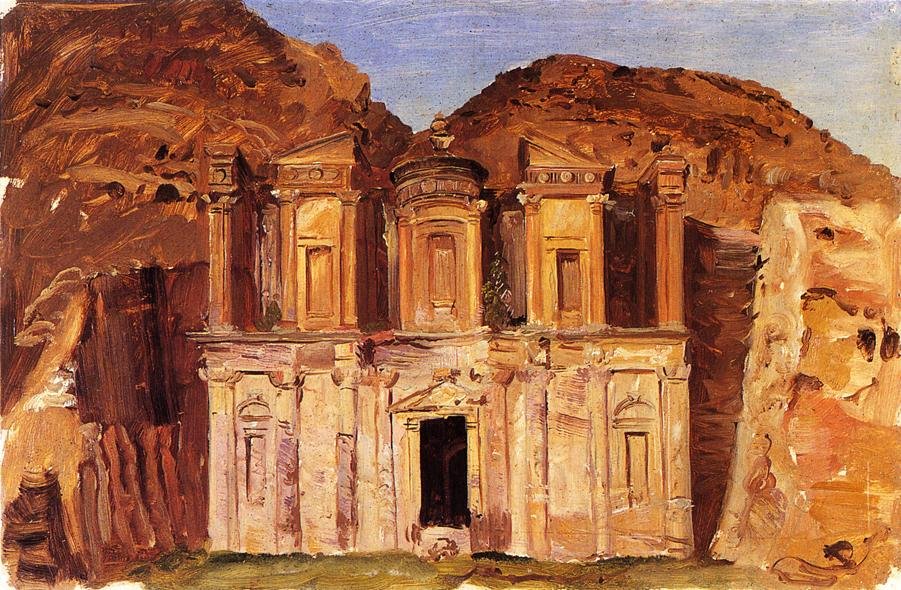

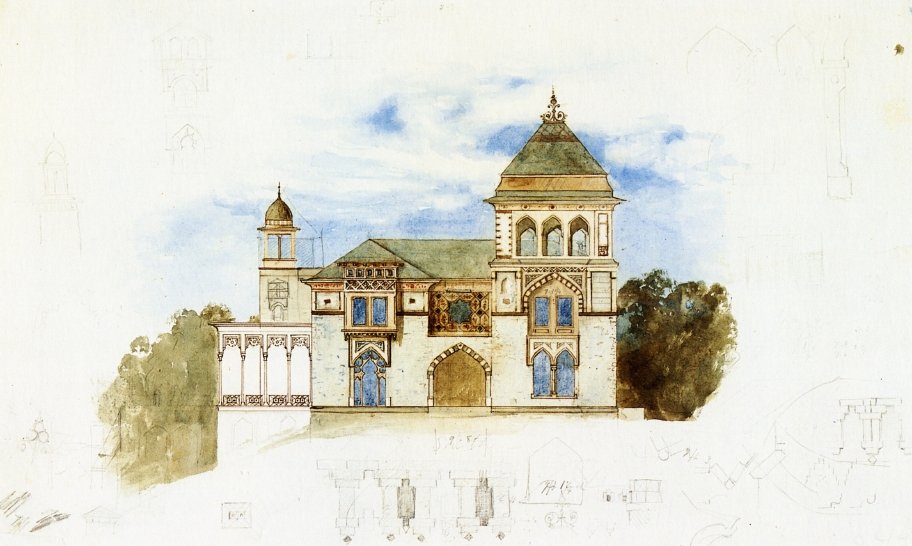

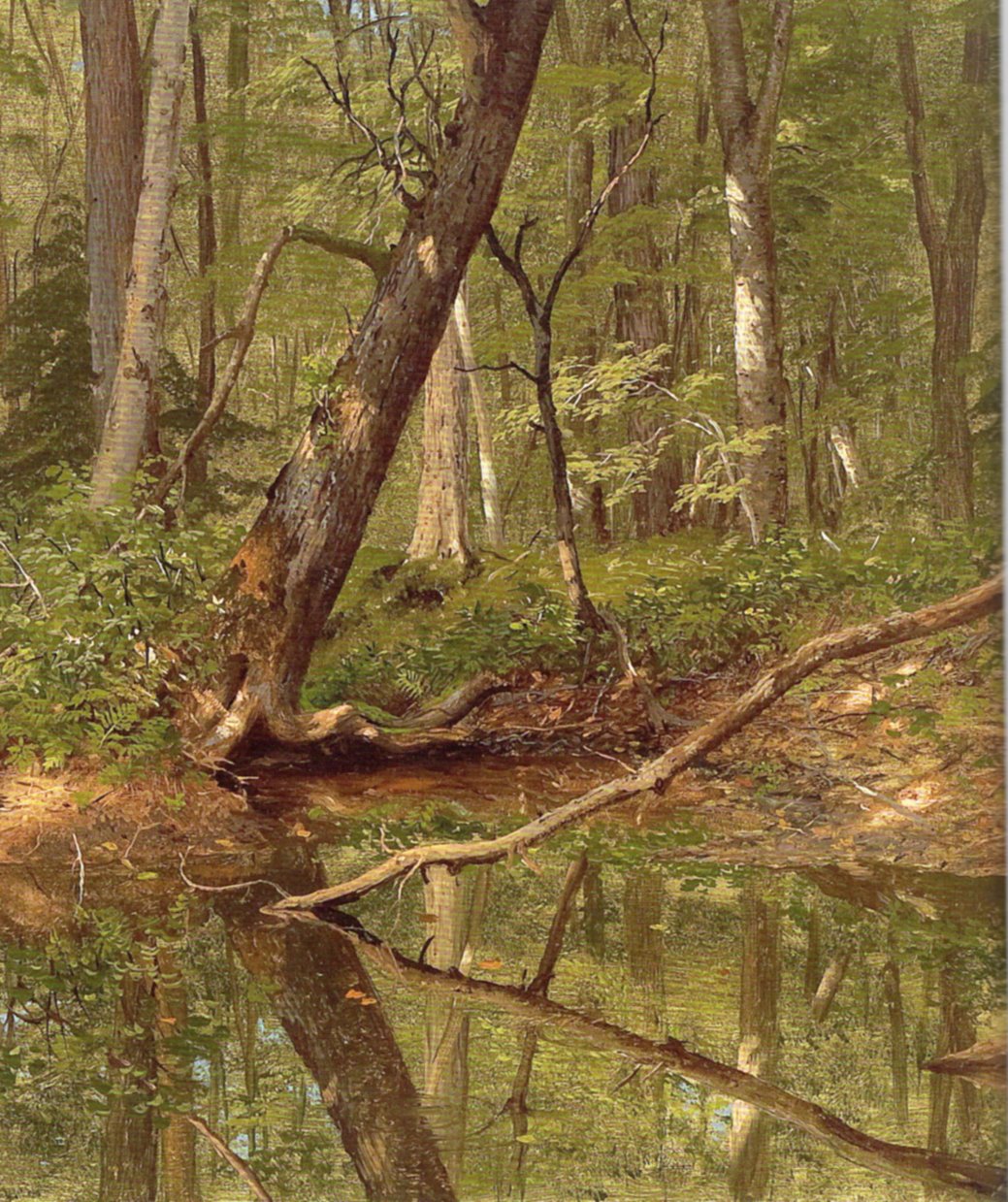

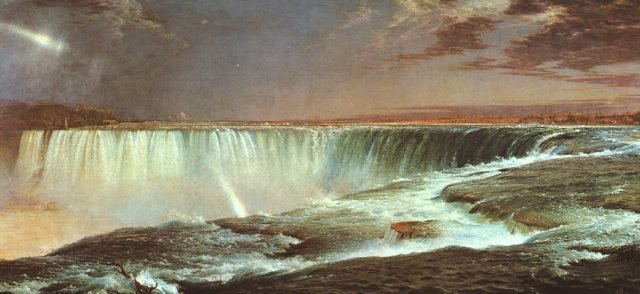
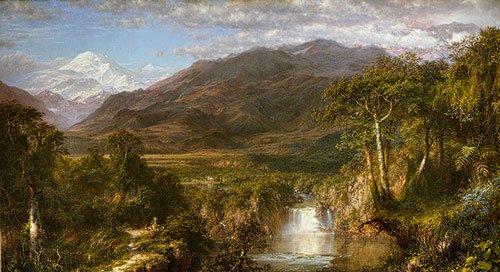


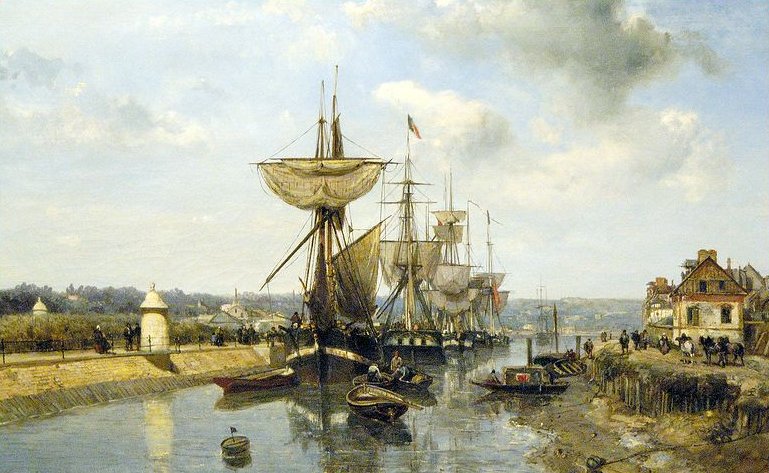

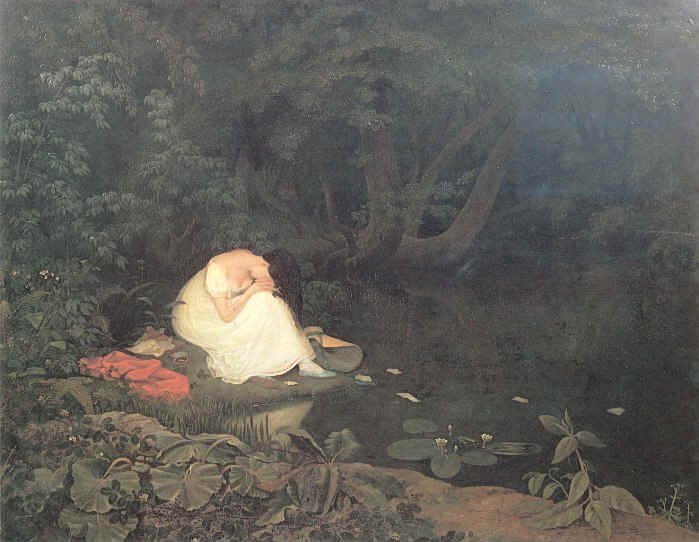
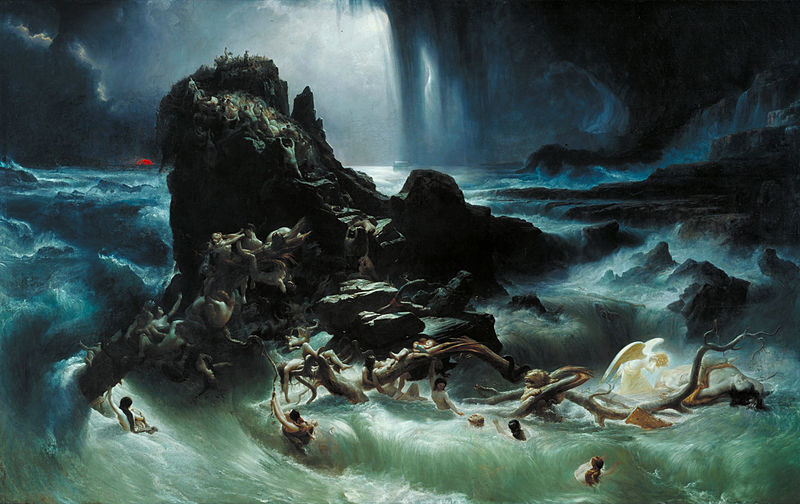
 my daily art display