Mr and Mrs Wachtel and their Californian dreams

Elmer Wachtel
Elmer Wachtel

I often come into contact with American tourists who stay at my Bed & Breakfast and I always ask them where is the best place in America as far as climate is concerned and I nearly always get the same answer – the area around the coastal town of San Diego.  In my blog today I am looking at two landscape artists, husband and wife, who concentrated their work around the beautiful areas of Southern California.  Let me introduce you to Mr and Mrs Wachtel.

Spring Landscape by Elmer Wachtel

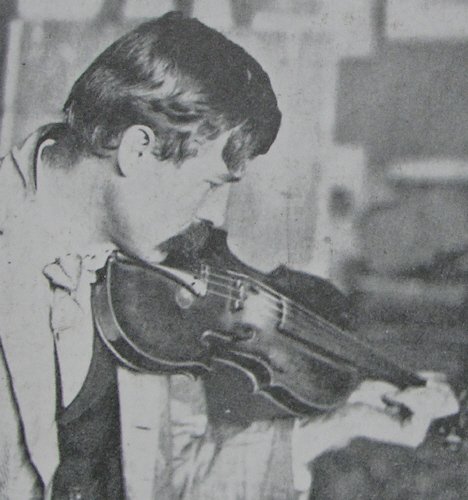
Elmer Wachtel was the older of this married couple, born in Baltimore, Maryland on January 21st 1864 but it was not until 1882, when he was eighteen years of age and had completed schooling, that he crossed country to live in California.  His new home was to be San Gabriel, California where his brother was foreman of the Rose Ranch.  He had married the sister of the artist Guy Rose.  Guy Rose was a student of John Bond Francisco who had settled in Los Angeles. Francisco had become a major cultural figure, performing as a violinist, painting, teaching and entertaining in his home and his studio on Albany Street. He combined his two great loves art and music and helped form the Los Angeles Symphony Orchestra in 1897 and served as their first concertmaster.  Studying with Francisco, Elmer had found the ideal “fit” as he was interested in art and was also an exceptionally talented musician, having taught himself to play the violin.  In fact he was such a talented musician that he at one time was the first violinist of the Los Angeles Philharmonic Orchestra, which was founded by William Andrews Clark, Jr., a millionaire and amateur musician.
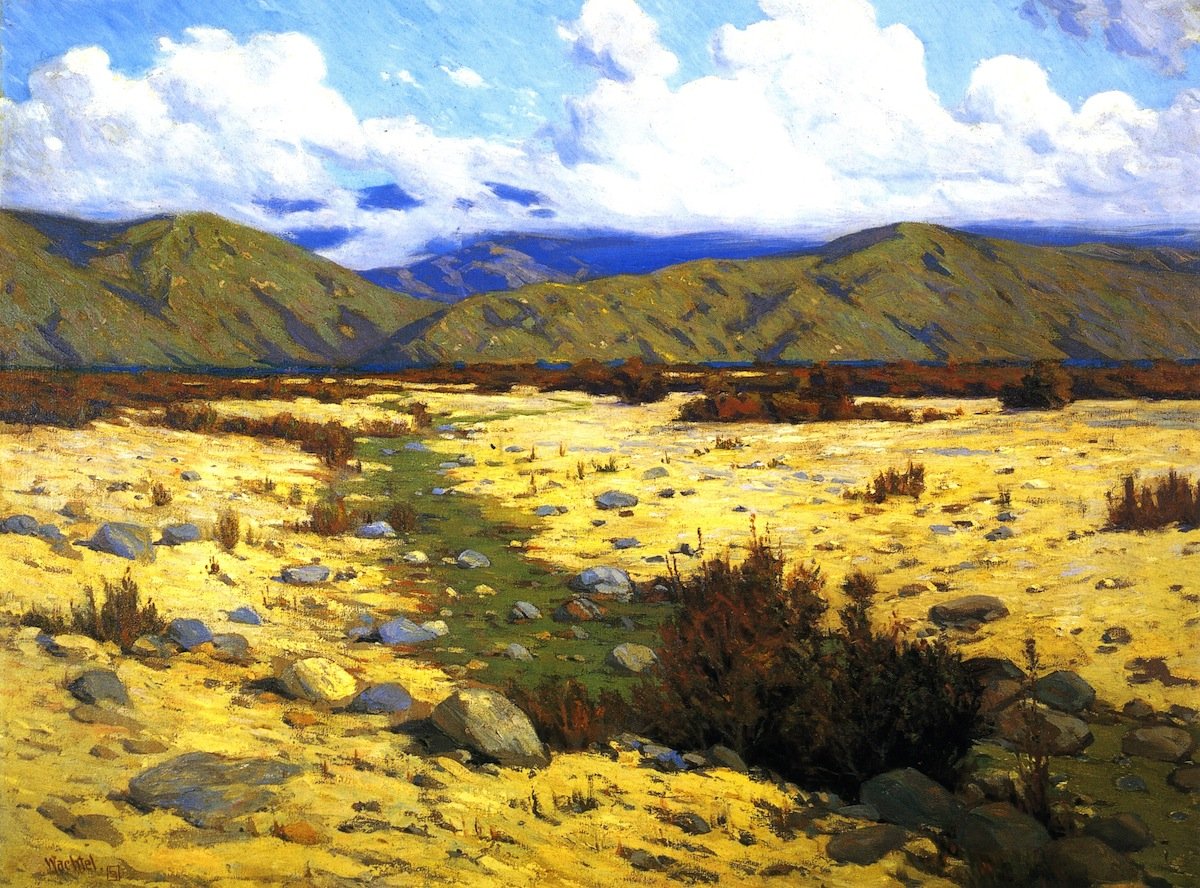
Desert, River, Mountains by Elmer Wachtel

It was not until 1894 that Elmer decided to enrol at an art establishment to learn more about drawing and painting and he moved back east to New York where he joined the Art Students League which had been founded in 1875 by a group of artists, both male and female.  They had all been students at the National Academy of Design in New York City.  Many of these aspiring artists decided to break away from the Academy citing the reason that the Academy’s art tuition was too conservative and unsympathetic to their new and modern ideas about art.  Whilst here, Wachtel studied under William Merritt Chase, the American painter and leading American exponent of Impressionism.

Valley Afternoon by Elmer Wachtel (c.1910)

Elmer returned to California in 1896 and stayed at the San Francisco home of William Keith, the Scottish-American painter who was famous for his Californian landscapes and in fact was often referred to as the “Dean of California painters”.  Elmer Wachtel eventually left San Francisco and returned home to Los Angeles.  During this period, he supplemented his income as an artist and an art teacher and by playing his violin in a number of orchestras.

California had been opened up to folk from the East by the Santa Fe railroad in the late nineteenth century and many of these travellers from the East were artists who wanted to experience the beautiful Californian landscapes and the natural light which bathed these lands.  One such visitor was Marion Kavanaugh.

Marion Kavanagh Wachtel

Marion Kavanaugh was born on June 10th 1876 in Milwaukee.  She came from an artistic background.  Her mother, Jean, was an accomplished and well respected artist and her great grand-father a Royal Academician.   She received the most thorough art education studying in the School of the Art Institute of Chicago under John Vanderpoel, the Dutch-American artist and teacher and was tutored in New York, like Elmer Wachtel, by William Merritt Chase.  Following the completion of her studies she taught art in some Chicago public schools and later attained a post as tutor at the Art Institute of Chicago where she taught for two years but life in the classroom was not for Marion.  Slowly she built up a reputation as a portraitist and an accomplished painter of child portraits.  Marion Kavanaugh had now built up a reputation as one of America’s great watercolourist and her skill as a landscape artist and tonalist was much admired.  Tonalism is a style of painting in which landscapes are depicted in soft light and shadows, often as if through a coloured or misty veil.
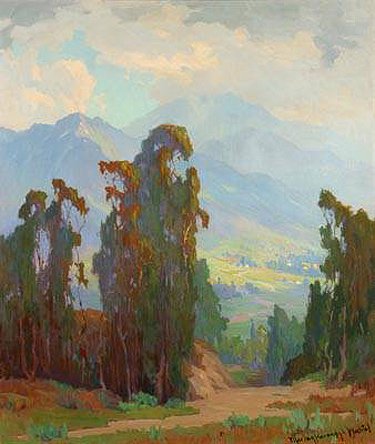
Foothill Eucalyptus Landscape by Marion Wachtel

In 1903, Marion received a commission from one of the vice presidents of the Santa Fe Railroad to paint murals of Western landscapes for the company’s San Francisco ticket offices, in return he offered free passage to California on one of the company’s trains .  To achieve that commission she travelled west and visited many sites all the time making sketches along the way which she found would be conducive for her commission.  She stopped off at New Mexico, Arizona and California. Whilst in California she called in at the Cooper Ranch in Santa Barbara where she stayed for several months as a guest of the owner, the entrepreneur and agriculturist, Ellwood Cooper.  Cooper commissioned her to paint some landscape scenes around his ranch.  It was during this commission that she began to paint the eucalyptus trees which were found close by and it was these beautiful trees that were to appear in many of her works of art.

Brook in Sierra Landscape by Marion Kavanagh Wachtel

Many of the paintings she completed for Ellwood Cooper were exhibited and they won critical acclaim.  One person who viewed her work was none other than William Keith.  Some believe that Marion Kavanaugh worked for a short time with him and that he suggested she visited Elmer Wachtel in Los Angeles and studiywith him.  She agreed to the suggestion and so in 1903 Marion Kavanaugh and Elmer Wachtel met for the first time.  Even though the circumstances of their first meeting may be just conjecture, what is certain is that there was a definite chemistry between the two artists for one year later in 1904, forty-year old Elmer Wachtel and twenty-eight year old Marion Kavanaugh married in Chicago.   After her marriage to Elmer, Marion took his name but also added her maiden name after dropping the “u” from it and became known as Marion Kavanagh Wachtel.  The couple returned to California and settled down in the Mount Washington area, close to Pasadena where they built themselves a home and a studio.  The couple lived in the Mount Washington area of Los Angeles until 1921.  They then moved to the Arroyo Seco area close to Pasadena.

Monterey Coast by Marion Kavanagh Wachtel

They spent almost twenty-five years travelling around together painting, en plein air, the various landscapes in the south west of the United States. Often they would be seen painting and sketching the awe inspiring Southern California landscape and they travelled great distances to capture the views and light conditions which they translated into spectacular paintings.  They traversed and painted the coastline between Gaviota and Conception Lighthouse (just north of Santa Barbara, California), the Cooper Ranch (north of Santa Barbara), Matilija Canyon and Ojai, California. They would head further south to the San Luis Rey River and the Cerisa Loma Ranch which was close to San Diego and in 1908 they hiked their way across the arid deserts of Arizona and New Mexico availing themselves of the opportunity to capture on canvas the historic pueblo villages on the Moki and Navajo reservations.
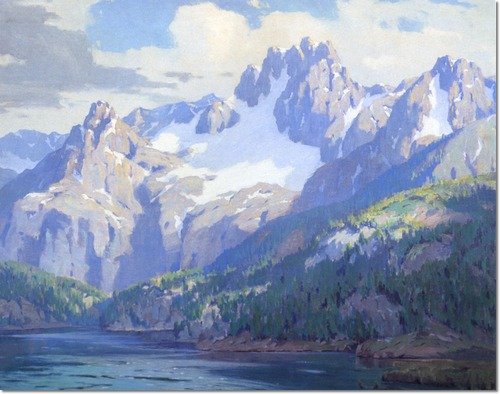
Lake Mary, Sierra Nevada by Marion Kavanagh Wachtel

Marion worked in watercolours unlike her husband who worked in the medium of oils.  She was a member of many art societies such as the American Watercolour Society and the California Watercolour Society and on two occasions in the 1920’s Marion Kavanagh Wachtel was granted one-woman exhibitions at the Los Angeles Museum of History, Science and Art.

Their happy marriage came to an abrupt end in August 1929 when Elmer Wachtel died, aged 65, while on a Mexican painting trip in GuadalajaraFollowing her husband’s death, Marion gave up painting  and exhibiting for a number of years.  When she returned to her beloved art, besides using her favourite painting medium, watercolours, she began to dabble in oils, the favourite medium of her late husband.  She exhibited her works on both coasts of America and became a very popular and revered landscape artist.

Marion Kavanagh Wachtel died at her home in Pasadena on May 22nd 1954.

Henry Herbert La Thangue – the pictorial documenter of rural life

Henry Herbert La Thangue  (photo c.1893)
Henry Herbert La Thangue
(photo c.1893)

A few blogs ago I looked at the life and works of George Clausen and termed his art as rustic realism and today I want to delve into the life and the art work of another such painter, the English realist rural landscape artist Henry Herbert  La Thangue.

Henry Herbert La Thangue was born in Croydon, Surrey on January 19th 1859. He attended the renowned public school, Dulwich College, where two of his contemporary school friends were fellow aspiring artists Stanhope Forbes and Frederick Goodall. He enrolled briefly at the Lambeth School of Art in 1873 before enrolling on a five year course at the Royal Academy schools in 1874. The culmination of his studies at the Academy came in December 1879 when he won a gold medal for his work as well as a three year travelling scholarship to study in Paris at the studio of Jean-Léon Gérôme at the prestigious Ecole des Beaux-Arts.  It was during this time, whilst staying in the French capital, that he became influenced by the works of Whistler and the many paintings he saw at the Salon by artists who favoured rustic naturalism. He was also influenced by the landscape works of the en plein air artists of the Barbizon school. So how did the Barbizon School come into being ?
The Last Furrow by Henry Herbert La Thangue (1895)

As far as the French Academy was concerned aspiring artists should be taught in the Neoclassical tradition and copy the style of the painters of the Renaissance and Classical era.  Landscape art was not looked upon as an important genre unless the landscape , usually an idealized version, was combined with some historical connotation.  In 1816 the Academy even encouraged this genre by introducing a Prix de Rome in paysage historique (landscapes with a historical nuance), the winner of which would travel to Rome to live and paint at the Villa Medici.  By making this award the Academy had hoped to encourage artists to paint not just landscapes but by adding the historical aspect to the work it would ensure history painting would not die.  It actually had the opposite effect as many artists turned to simple landscape work and this desire was further enhanced when in 1824 John Constable’s landscape works were exhibited at that year’s Salon.

The Plough Boy by Henry Herbert La Thangue (c.1900)

In the warm summer months artists would leave the French capital and move to the tranquillity of the Parisian countryside around the Forest of Fontainebleau with its dense forest and meadowlands.  Small hamlets were situated around the periphery of the forest which made ideal stopping-off places for the artists and one such hamlet was Barbizon which proved to be the ideal temporary home for many landscape painters, such as Théodore Rousseau and Constant Troyon, who had rejected the Academic tradition of historical landscape painting and embraced a more realistic representation of the countryside and life in the country.  Later in the 1840’s, artists such as Jean-François Millet and Charles-François Daubigny came to Barbizon.

The Boat Builder's Yard by Henry Herbert La Thangue (1881)
The Boat Builder’s Yard by Henry Herbert La Thangue (1881)

In 1881 after completing his studies at the Ecole des Beaux-Arts, La Thangue travelled to Brittany, another popular region with landscape painters, and worked alongside the English landscape painter, Stanhope Forbes.  Whilst here, he met the renowned master of rustic realism, Jules Bastien-Lepage.  That year, he visited the small coastal commune of Concale, east of St Malo and completed his painting entitled The Boat Builder’s Yard. He remained in Brittany until mid 1882 and the following year he travelled south to the Rhone Valley commune of Donzère with his friend, the sculptor James Havard Thomas.

Resting after the game, Kate La Thangue by Henry Herbert La Thangue

When he returned to England in 1884, La Thangue first lived at South Walsham on the edge of the Norfolk Broads before moving to Rye in East Sussex for a brief time in 1885.   This was an eventful period in La Thangue’s life for in 1885 he married the actress, Kate Rietiker.  It was also at this juncture in his life that he became interested in politics surrounding art and art establishments.  La Thangue was a radical thinker and believed fervently that the Royal Academy had to change.  La Thangue proposed that it should be a more democratic society open to all and based on the principles of ‘universal suffrage’  Much was written about his views in the press but ultimately nothing changed.  La Thangue remained unhappy with the administration of the hallowed society and so he, along with a number of his like-minded contemporaries, having failed in their attempt to revolutionise the establishment, founded the New English Art Club in London in 1885 as an alternate venue to the Royal Academy

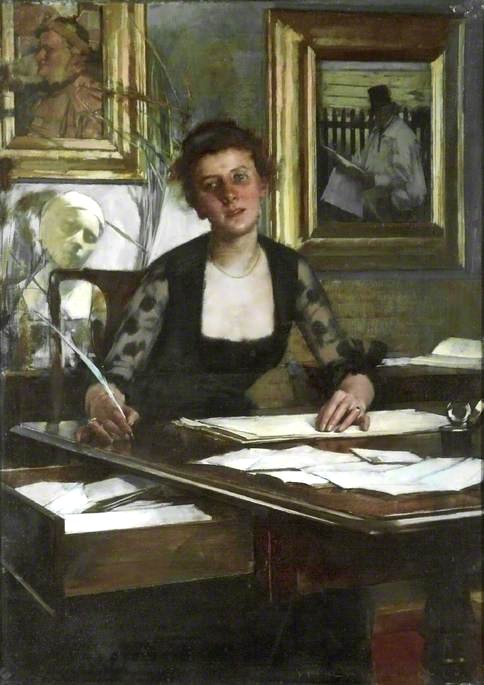
Portrait of the Artist's Wife by Henry Herbert La Thangue
Portrait of the Artist’s Wife by Henry Herbert La Thangue

In 1886, despite his misgivings surrounding the Royal Academy, he continued to exhibit works at the art establishment.  The Royal Academy was not the sole outlet for his works as the paintings were also exhibited Royal Society of British Artists and the Grosvenor Gallery, which had opened in 1877 by Sir Coutts Lindsay, and was a welcoming home for those painters, such as Edward Burne-Jones and Walter Crane, whose works the more conservative Royal Academy shunned.  His paintings could also be seen at the New Gallery which was founded in Regent Street in 1888 by Comyns Carr and Charles Edward Hallé who had once been co-directors of the Grosvenor Gallery but because of all the Grovesnor Gallery problems, had resigned and set up this new gallery.  The New Gallery was also a home for the works of the Pre-Raphaelite and  Aesthetic movement artists and artists such as Lawrence Tadema-Alma, William Holman Hunt, Lord Leighton and George Frederic Watts exhibited works at this establishment.  La Thangue also exhibited at the Royal Institute of Painters which he had joined in 1883.

The Return of the Reapers by Henry Herbert La Thangue (1886)

In the summer of 1886, La Thangue  moved home to the Norfolk countryside and the small fenland village of South Walsham.  During these years La Thangue produced head studies of farm hands and fisherfolk and it was whilst living here that he completed his landscape painting entitled Return of the Reapers.  This was a typical example of La Thangue’s rustic realism style.  La Thangue was probably influenced by the works of the French artists Jules Bastien-Lepage and Gustave Courbet and the en plein air works of the French Impressionists.

Study of a Boy with a Black Hat, before a Cornfield by Henry Herbert La Thangue

Five years later La Thangue left Norfolk and moved home south to the neighbouring county of Suffolk and the coastal village of Bosham just a few miles from the town of Chichester.  He carried on painting rural scenes, often large-scale works, with their realism connotations.

I

The Man with the Scythe by Henry Herbert La Thangue (1896)

n 1896 he completed a work The Man with the Scythe, which is now housed in the Tate Britain gallery in London.  This proved to be a controversial work.  At first glance one ponders as to the reasoning behind the title.  However, look closely and in the background you can make out a man carrying a scythe but this is not just a country scene with a man off to work in the fields whilst the mother tends her daughter.  This is a more solemn and symbolic piece,  as what we are witnessing is a mother horrified to discover that her young daughter has died,.  At the very instant of her tragic discovery a man arrives at the gate carrying a scythe, which is one of the traditional symbols of death, often referred to as the ‘grim reaper’.    This tragic and somewhat melodramatic depiction by La Thangue was a definite change in his subject matter and may have been influenced by the pair of paintings by Frank Holl in 1877 entitled Hush and Hushed (See My Daily Art Display Feb 9th 2012)

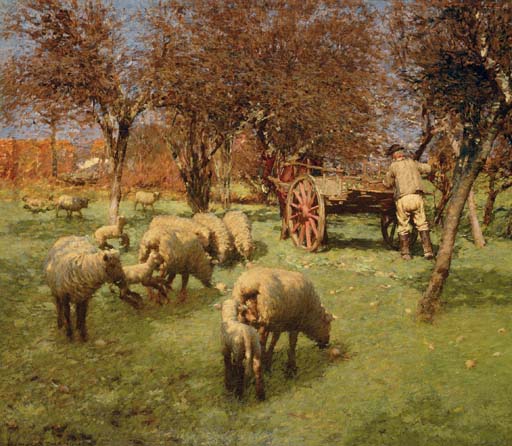
The March Month by Henry Herbert La Thangue

His English base from 1898 and into the early 1900’s was in the West Sussex village of Graffham.  His painting motifs still concentrated on rural life.  His works, depicting both arable and livestock farming, documented life in the fields from the harrow and the harvest, to  animal husbandry and fruit growing.  He was always searching for the perfect portrayal of the countryside and countryside practices during the different seasons.  In his painting entitled The March, completed around 1900,  he depicted the orchard near his house which was also used as nursery areas during lambing time.   We see the farmer scattering turnips from his cart which would feed the sheep and fatten up the lambs.  It could be that this depiction by La Thangue was influenced by the famous novelist and gentleman-farmer Rider Haggard, a contemporary of the artist, for in his 1899 book A Farmer’s Year  he talked about fattening lambs:

“….’The flock is being penned at night on the three-acre [field] with a view to improving the bottom of his young pasture which has grown somewhat thin. In the daytime they run out to one or other of the meadows, where root is thrown to them, and every night they are shut in a new fold on the three-acre and receive a ration of corn, hay and beet…”

Selling Chickens in Liguria by Henry Herbert La Thangue (1906)

At the turn of the century La Thangue became more and more interested with the work of the French Impressionist painters and their fascination with light and in 1901 he travelled to Provence.  From 1903 to 1911 he spent much of his time in the Italian region of Liguria building up a large collection of work. Despite La Thangue’s earlier outspoken criticism of the Royal Academy he became an Associate of the Royal Academy in 1898 and became a full Member in 1912.

Violets for Perfume by Henry Herbert La Thangue (ca. 1913)

His diploma work for the Royal Academy was one entitled Violets for Perfume.  The notable English artist, George Clausen (see My Daly Art Display May 30th & June 8th 2015) wrote about La Thangue’s work:

“…Sunlight was the thing that attracted him: this and some simple motive of rural occupation, enhanced by a picturesque surround…”

This work stemmed from his time in Provence and depicts a woman tipping a basket of freshly picked violets onto a muslin sheet in preparation for perfume making. All through his artistic career La Thangue developed his subject matter from labourers working in fields, vineyards and orchards. The depiction of the lady working in this work highlighted the back-to-basic work practice.  Gone was the mechanised practice of harvesting which La Thangue disliked and which he saw creeping into the rural life of England, destroying the old-fashioned rural practices which he had so loved to paint.

A Mountain Frontier by Henry Herbert La Thangue (1910)

In 1914, just prior to the beginning of the Great War, the Leicester Galleries in London  staged a one-man exhibition of La Thangue’s southern European landscape works,  which concentrated on his paintings completed whilst he was in Provence and Liguria.  One of the works exhibited was entitled A Mountain Frontier which La Thangue completed around 1910.  The exhibition was a great success and praised by the critics.  The artist William Sickert wrote about La Thangue’s skill as a painter in the May 1914 issue of the British literary magazine The New Age stating:

“…What renders La Thangue’s work particularly interesting is that while using the language of the day in painting, that is to say an opaque mosaic for recording objective sensations about visible nature, he is using it in a personal manner…”

Sickert went on to write that La Thangue, through his talent at developing relations of colour with a warm colour at the base,  was able to build on it a series a series of beautiful and interesting sensations of nature which is what he,  and not somebody else, had to say.

A Ligurian Bay by Henry Herbert La Thangue

In the 1920’s after the Great War had ended La Thangue returned to Liguria and the motif of his paintings changed from the arable land of the English countryside to the sunlit orange groves and gardens of Italy.  La Thangue spent those days in southern Europe painting en plein air directly on to large canvases.  This belief is based on the fact that very few smaller versions of his paintings or sketches exist.

Wreck of the S.S. Manuka December 16th 1929

Henry Herbert La Thangue died on December 21st 1929, just a few weeks before his seventy-first birthday.  Less than a week before his death La Thangue had been devastated and depressed when he was given the news that a vessel, the S.S. Manuka, during a voyage from Melbourne/Bluff/Dunedin was wrecked on Nugget Point near Long Point, South Otago.  Part of the cargo on the vessel was two of La Thangue’s paintings.  La Thangue was never to know, that five days after his death, the paintings were recovered and said to have been in “reasonable condition”.

 His wife Kate died in 1941.

Peder Balke. Part 2 – The great Norwegian journey and disillusionment

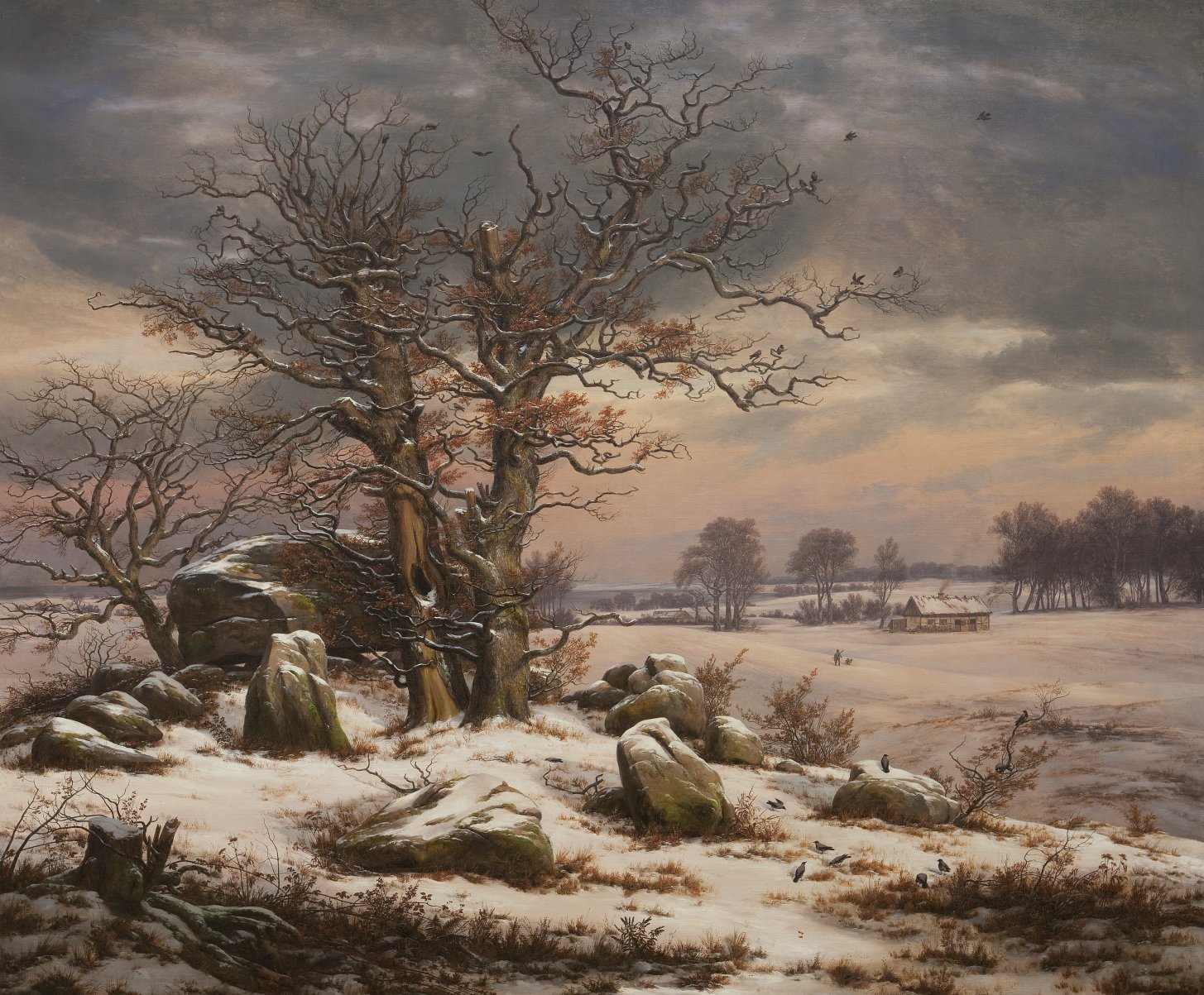
Winter Landscape. Near Vordingborg, by Johan Christian Dahl  (1827)
Winter Landscape. Near Vordingborg, by Johan Christian Dahl (1827)

Balke returned to Christiania in 1830 and stayed with Professor Rathke and in that May travelled to Copenhagen and was fortunate to be able to view royal collections of art.  Of all the works he saw, Balke was most impressed by a winter landscape painted by Johan Christian Dahl, entitled Winter Landscape. Near Vordingborg, which he completed in 1827.  The large (173 x 205cms) work of art depicts a somewhat oppressive atmosphere with its undertones of death, symbolised by the dolmen behind the lifeless branches of the two oak trees. A dolmen is a type of single-chamber megalithic tomb, usually consisting of two or more upright stones supporting a large flat horizontal capstone.  Nature is depicted in the form of its icy winter garb.  He wrote of the painting to Rathke saying that it was the most life-like painting he had ever seen.  The fact that he had managed to see the works of the great Masters at the royal collection, although influencing him, also depressed him somewhat as to his own ability.  He wrote:

“…I sometimes felt a certain heaviness of heart and lack of courage when I compared my own insignificance with these true masterpieces; quietly and I admit somewhat superficially I calculated how much I would have to learn and how many ordeals I would have to go through before I would be able to achieve a mere fraction of the perfection in aptitude and skill in execution exuded by these paintings…”

North Cape by Peder Balke (1945)

Balke was determined to succeed and in the summer of 1830 having returned to Norway from Copenhagen he set off on foot on an artistic journey through the Telemark region and over the mountains to western Norway and then north to Bergen returning to Christiania via the Naeroydalen valley and the town of Gudvangen.  He later recalled his short time spent in the area around Gudvangen, writing:

“.. I first arrived late at night, because I became so engrossed in admiring the sublime beauty of Naeroydalen that I hardly knew whether what surrounded me was real or supernatural.  So fascinating and uplifting did my youthful imagination, with its passion for the beauties of nature….”

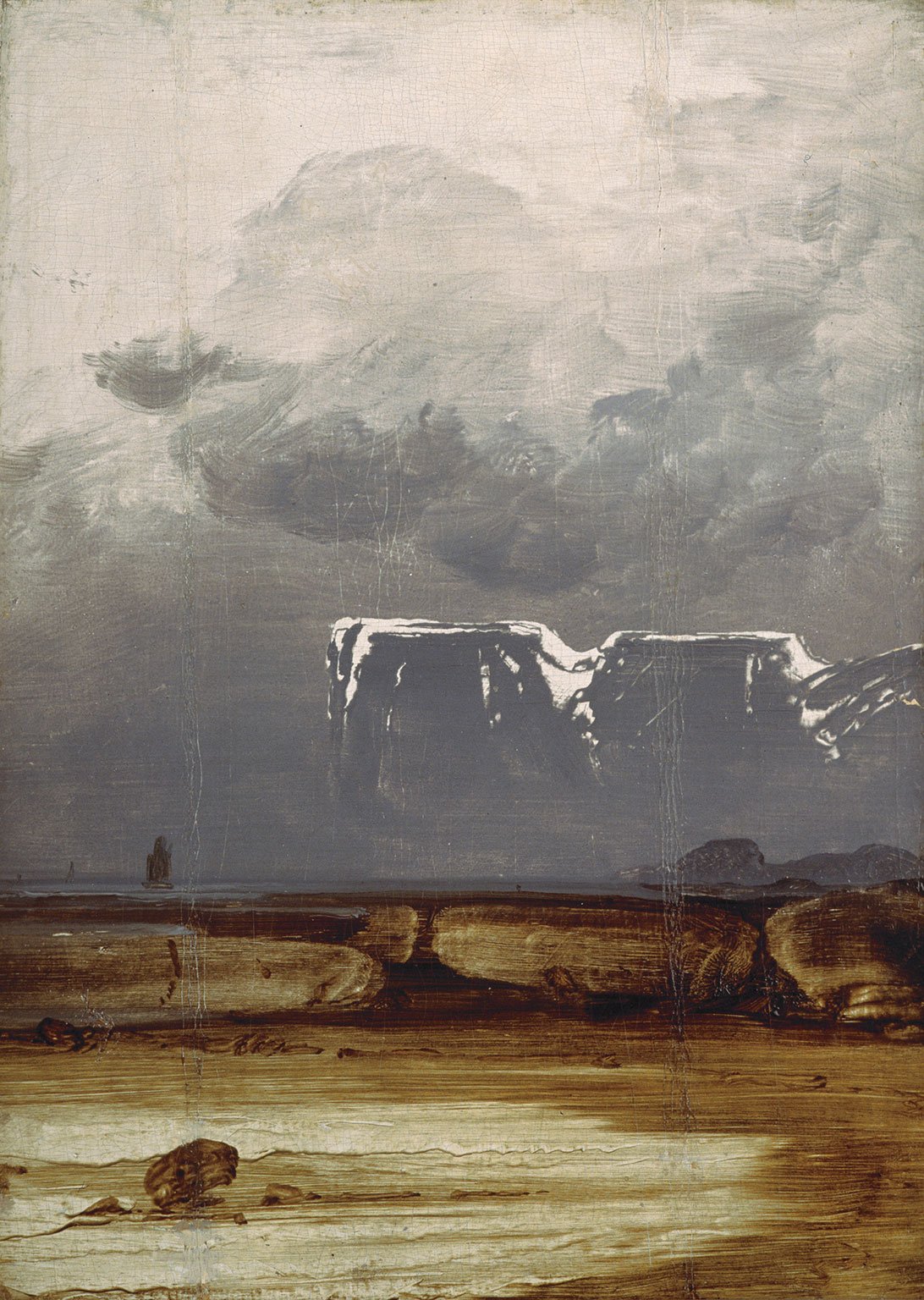
From North Cape by Peder Balke (c.1860's)
From North Cape by Peder Balke (c.1860’s)

Two years later, in April 1832, Balke set off another artistic journey.  This time, setting off in his own carriage he went to Trondheim where he was to catch a boat to the north of the country.  His planned journey hit a snag when he arrived late in Trondheim and missed the boat.  He had to wait a further seven weeks for the next boat but spent the time sketching the town and the surrounding areas.  Peder Balke finally embarked on his northbound boat trip, passing the Lofoten Islands and arrived at Tromso.  From there the boat went further north to Hammerfest and then proceeded around the North Cape to Vardø and Vadsø.  He was the first Norwegian painter to record the harsh beauty of the northern landscape.  Eventually Balke and the boat returned to Trondheim.  During the long journey Balke had completed a large collection of sketches of the places he had seen and many were used in his many seascape and moonscape works of art which he worked on when he returned to Stockholm.  He sold many of his paintings to wealthy Norwegians and Swedes as well as members of the royal family.  In 1834, now, financially secure, Peder married Karen Eriksdatter, the woman he had been secretly engaged to for several years, but had been too poor to marry.

The Severn Sisters by Peder Balke (1847)

The couple settled in Christiania and Balke, now accepted, not simply as a decorator but as a landscape artist, tried to establish himself and sell his artworks.  However competition at the time was too great and the sales he had hoped for never materialised.  However, in 1835, he managed to sell another of his works to the king and with that money he decided on fulfilling his dream of travelling to Dresden and work with the Norwegian artist, J C Dahl.   Many Norwegian artists had trodden this path, including Thomas Fearnley (see My Daily Art Display November 24th & 28th 2012).  With help from a friend, Balke set off for Germany and reached Berlin in the winter of that year.  He remained in Berlin for several weeks and was able to visit the Royal Museum and whilst in the German city he saw paintings by the German romantic landscape painter, Casper David Friedrich.  It was this artist who was going to have a great and lasting influence on Balke.

Ship in Breaking Waves by Peder Balke (c.1849)

Balke left Berlin and travelled to Dresden via Leipzig.  He received a great welcome from Johan Dahl who helped him find accommodation.  J C Dahl introduced Balke to Casper David Friedrich and Balke was able to watch the two great artists at work.  In a letter to Rathke, dated March 29th 1836, he wrote about watching J C Dahl at work:

“..to see Dahl paint, I know with which colours and have seen how he uses them, and though I at present cannot proceed successfully in the same manner I hope that with time I will also reap the benefit.  What I regret most is my lack of studies from nature.  Dahl certainly has several thousands of them, of all kinds.  He has told me there is no other way to become a real painter than by painting from nature, which admittedly has been my intention, and I shall now try to see whether I can make up for what I have hitherto neglected, in Norway, though not in Germany – there is no nature here…”

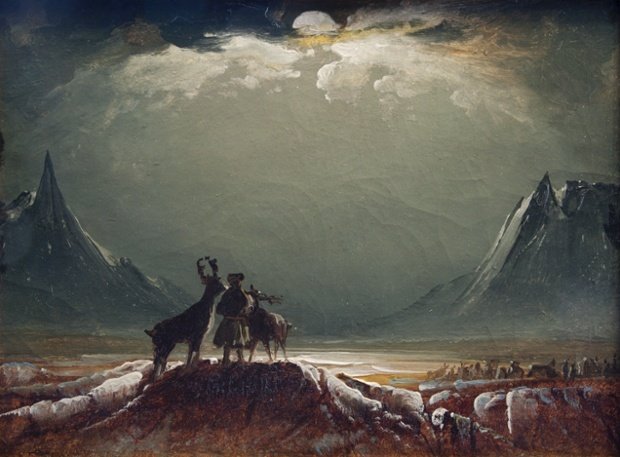
Sami with Reindeer Under the Midnight Sun by Peder Balke, (c.1850)

Balke left Dresden but returned in the 1840’s to work once again with J C Dahl.  Landscape art was popular in Norway and Balke managed to sell many of his works but things were to change when a number of young Norwegian landscape artists having returned from studying at the Dusseldorf Academy, which at the time was looked upon as the most modern art-educational institute.  The teaching of landscape art was more to do with what was termed “cautious Realism” rather than Balke’s Romantic landscapes which suddenly became less fashionable.  He had to endure much criticism with regards his work which had once been loved by his people.  In an article in a 1944 edition of Morgenbladet, the eminent art critic Emil Tidemand scathingly wrote about Balke’s paintings:

“… There is no question here of a grandiose, poetic perception: no not even the simplest technical demands of drawing, perspective, clarity, strength and depth of colour have been met……………….This is not a representation of nature – his whole production is merely the mark of a dirty palette handled without discrimination…”

Old Trees by Peder Balke (c.1849)

Maybe it was the vitriolic criticism which made Balke realise that there would be no hope of becoming financially secure through his art sales in Norway and so in 1844 he, along with his pregnant wife and three young children, left their homeland and travelled to Paris via Copenhagen and Germany  There was also another reason to visit Paris and this was that Balke was well aware that the country’s ruler Louis-Philippe had, as a young prince in exile in 1795, travelled along the Norwegian coast from Trondheim to the North Cape just as he had done.  As Balke did not speak French he asked a friend to write a letter on his behalf to the king in which he reminded the king of his exile and his Norwegian journey and that his nine sketches of the area would remind the king of that journey.  Louis-Philippe was intrigued and summoned Balke to the palace.  Balke and the king immediately became close and the two would meet regularly and reminisce about their travels to the North Cape

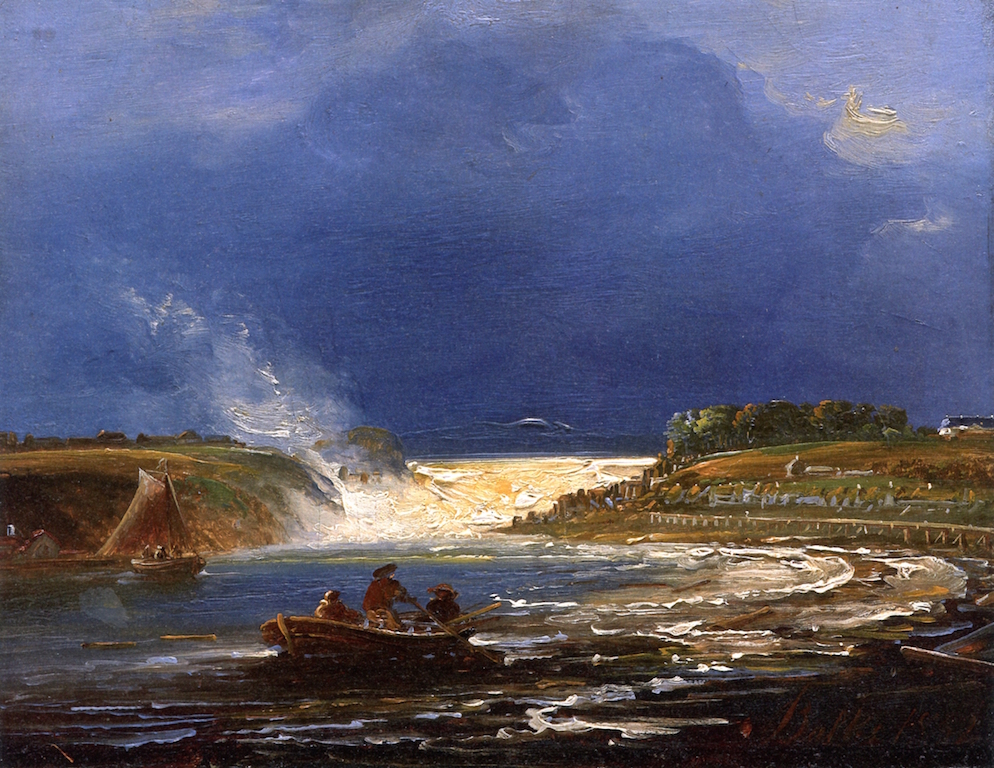
A View of the Sarpsfoss Waterfalls, Norway by Peder Balke (c.1859)

Louis-Philippe commissioned a set of paintings derived from the sketches.  Balke’s financial future seemed to have been rescued and he set to work on the commission.  Alas fate was to take a hand in the form of the February Revolution of 1848 which saw the downfall of Louis-Philippe.  Balke realising the dangers of being close to the unpopular ruler decided in late 1847 that he and his family would have to hurriedly leave Paris which meant he had to abandon, what was to have been a very lucrative commission.  Balke moved back to Dresden.  Shortly after his arrival in the German city in 1848 his young son Johann died.  His death came around the same time that his wife gave birth to their daughter Frederikke.  Sales of his art in Dresden were hard to come by and so he decided to leave his family with a friend and head back to Christiania.  He managed to sell some of his work, one of which was The North Cape by Moonlight but still the Norwegian people favoured the Dusseldorf School of landscape painting and so Balke returned to his family in Dresden.  In the Spring of 1849 he and his family moved to London where Balke believed his art would be more appreciated.  London had fallen under the spell of Joseph Mallord William Turner and his marine paintings and so Balke believed his works of art would do well.  He was proved right and managed to sell more of his works of art.

Balkeby  1860-70
Balkeby
1860-70

In the autumn of 1850 Balke and his family moved back to Christiania.  In 1855 his good friend and benefactor Professor Rathke died and left Balke a sizeable amount of money which Balke used to buy eight acres of land just outside the city limits at a place known as Vestre Aker.  He virtually abandoned his career as an artist of large scale landscape works, concentrating on small scale paintings which he believed would be bought by the middle class.  He now concentrated on his property portfolio and in particular the development of housing for workers in his newly attained property in the suburb of Balkeby, He dabbled in local politics championing the cause of pensions for men and women, and also of grants for artists. His painting was now just a hobby and for his own pleasure.

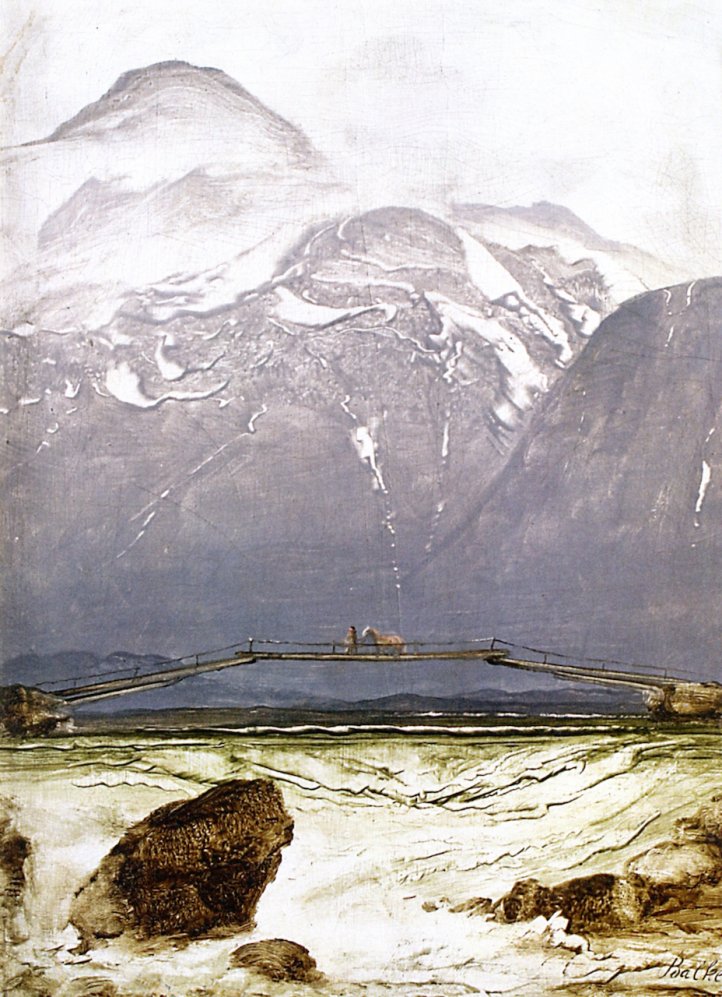
The Old Bridge by Peder Balke (c.1869)

Balke, as you may realise, was an unlucky man and more bad luck came in June 1879 when his beloved Balkeby went up in flames.  Nearly every house, including his own, was burnt to the ground.  Four years later Balke suffered a stroke, and he died in Christiania on February 15th 1887 aged 82.  The obituaries that followed after his death were all about his political work and little was said about Balke the artist.  Maybe his penchant for ignoring criticism and sticking to what he believed in was apparent in the obituary which appeared in the magazine Verdens Gang in March 1887.  It emphasised Balke’s pugnacity:

“…Fearless and straightforward as he was, it would never occur to him to defer to people in an argument.  He considered only the matter in hand and did not bother in the least about who was for or against him.  This does not always result in popularity…”

I can recommend an excellent book about the artist and his work entitled Paintings by Peder Balke, from which I derived most of my information about this Norwegian painter.

Peder Balke. Part 1 – His early life and struggles to become a painter

Peder Balke (1804-1887)
Peder Balke
(1804-1887)

I suppose if you are a landscape or seascape artist it is ideal to be living amongst glorious scenery or rugged coastlines which inspire you to paint and is much better than having to move to an artist colony in some idyllic area to find inspiration.   The artist I am featuring today was fortunate enough to come from a country of amazing natural beauty which he often depicted in his works of art.  Today let me introduce you to the nineteenth century Norwegian painter, Peder Balke, who specialised in landscape and seascape paintings with a romantic and dramatic connotation.

Peder Balke was the younger son of Anders Thoresen and Pernille Pedersdatter and born August 28th 1804.  He was christened Peder Andersen on November 4th.  Information about his early years was given by Balke in a dictated version of his life story, seventy years later.  He reminisced:

“… I was born on the island of Helgøya, in Nes in the country of Hedmark on 4 November 1804 in poverty, my situation in life being therefore less than enviable.  Yet the nearly influence of an affectionate and conscientious mother with constant good advice and exemplary admonitions was of the greatest benefit to my youthful and perhaps exceptionally lively temperament – for it is in these years of one’s development that the seeds are sown of both good and evil, though only later in life does one value their significance correctly…”

Christiania Viewed from Ekeberg by Peder Balke (c.1829)

He did not have an easy start to life his family being part of the lowest ranks of the peasant society.  His parents were simple farm labourers working on a farm called Svennerud on the island of Helgøya, which lies in the middle of Lake Mjøsa, , some 60 kilometres north of Christiania (now Oslo)  and is Norway’s largest and one of the deepest lakes in the country.  The family owned nothing.  They had no lands to grow their own crops.  They were simply impoverished land-less servants of the farmer.   The family predicament was one his father could not tolerate and when Peder was young, he abandoned the family and is never mentioned in his son’s dictated autobiography.  In 1812, when Peder was eight years old, because Norway and Denmark were in an alliance with France, their ports were blockaded by the British, as part of Britain’s war against Napoleon.  This prevented much needed corn from entering the country and this, along with a severe and early frost of 1812 which destroyed the Norwegian corn harvest, meant that for the next two years the country suffered a terrible famine.  This severe time was remembered well by Balke who wrote:

“….wretched times, when war and years of hardship oppressed people and it goes without saying that this suffering and national scourge affected the poor most severely.  My mother, who had to look after herself and two children- for I had a brother who was seven years older than me ……like so many others we had therefore to resort to substitutes which are less easy for humans to digest, and I and my brother went into the forest to remove bark from the trees, which was dried and ground and Mother baked bread with it.  It goes without saying that food of this kind resulted in disease such as dysentery etc…”

The Mountain Range 'Trolltindene' by Peder Balke (c.1845)
The Mountain Range ‘Trolltindene’ by Peder Balke (c.1845)

Being from such a peasant class there was no possibility of schooling for Balke but his mother taught him to read and write.  When he was old enough he would try to earn some money for the family by helping out on the neighbourhood farms, but pay was poor, and he would also go fishing to bring food to the table.

It was thought Peder’s maternal grandfather was an painter/decorator and that was the first influence on him.  Another relative, Anders Skraedderstuen, who had a nearby smallholding was also a painter and took on seventeen year old Peder as an apprentice for two years.  Peder was employed to paint but also learn the skills involved in fine interior decorations.  There was always work for him as the farm owners were becoming richer and building themselves large homes which they needed decorating.  Peder travelled extensively from farm to farm to carry out commissions.  One such farm was the Vestre Balke farm at Toten which was owned by Anders Balke.  The Balke family took to Peder and soon he was not just looked upon as a workman but as a son.  This close tie pleased Peder and it was at this time that he changed his surname to Balke.  Although now living with his “new family” he always remembered to go back and visit his mother and help her out financially.

Landscape with Mill and Rapids by Peder Balke (1840)

In winter there were no commissions to be had so it was then that Balke travelled to Christiania to buy paints, stencils and the latest in ornaments ready for the following summer.  At this time there was no place in the capital where Balke could study art but he did manage to find rooms in a house owned by Ole Nielsen in Gudbrandsdalen.  Nielsen was a talented painter and over a period of seven months he taught Balke the fundamentals of drawing and painting.  Balke recalled the time later in his autobiographical notes:

“…From this kind man I received many tips hitherto unknown to me that had an appreciable effect on my later evolution in the profession of painter…”

Moonlight on the Coast at Steigen by Peder Balke (1842)

Life and business were good for Peder Balke, so much so, he employed several apprentices but as in life itself there were always ups and downs and the “down” at this time was the threat of military service.  Balke did not want anything to do with this and tried all sorts of ploys to get himself out of fighting for his country.  His eventual get-out was by becoming a qualified craftsman and seeking citizenship in Christiania.  So, in 1826, aged twenty-two, Balke left Toten and moved to the capital and was accepted as a journeyman by the Lubeck-born painter and engraver, Heinrich August Grosch and studied to become a master painter of the town, thus acquiring citizenship and best of all, be exempt from military service providing he completed his two year course to the satisfaction of Grosch.   Balke tired of working for Grosch switched to working for Jens Funch.  In 1827, with the money he had saved, he enrolled in an elementary drawing class at the Royal School of Drawing and received tuition at the Kongelige Tegneskole from the former military officer and painter Captain Jacob Munch, who was pleased with Balke’s progress.  With his savings almost gone, Balke returned to Toten and asked his benefactor Anders Balke for some financial help.  Anders and two other farm owners decide to financially back Balke, in the form of a letter of guarantee for a sum of money which Balke needed to continue his studies and in return he promised to decorate their farm buildings.

Winter Landscape. Near Vordingborg, by Johan Christian Dahl  (1827)
Winter Landscape. Near Vordingborg, by Johan Christian Dahl (1827)

Balke returned to Christiania and with the letter of guarantee met with Professor Jens Rathke a renowned natural scientist and professor at the university who was well known for his generosity.  He agreed to take the letter of guarantee and lend Balke the funds he needed.   Balke was to late recall that he was never asked to repay the sum he had borrowed and commented on Rathke’s invaluable support:

“… For that as well as for all the other kindnesses that man bestowed on me I have always been and always will be grateful to him…”

Jens Rathke also persuaded Balke to take a trip around large parts of central Norway in order to study nature.  Balke first toured the Telemark area in the south east of the country an area which he later recalled had awakened his profound interest in Norway’s wonderful natural life, and the astonishing beauty it reveals in all directions.  Later he explored central Norway and the Gudbransdalen Valley.  He continually recorded his travels with a large number of sketches which he would later combine in his paintings.

Seascape by Peder Balke (c.1860)

In 1829, military service still loomed large as Balke had not managed to qualify as a painter-decorator within the prescribed two year period.  His only course of action to avoid military service was to try and enrol at an academy and study landscape painting.  Rathke advised Balke to apply to the Stockholm Academy and agreed to finance Balke’s application.  Balke studied for a short time under the Swedish landscape painter, Carl Johan Fahlcrantz.  Whilst in Stockholm Balke visited the summer residence of the country’s ruler Karl Johnan in Djurgärden where he viewed the king’s art collection and was much enamoured by a painting by the German landscape painter, Johan Christian Ezdorf.  Ezdorf, who was also a student of Fahlcrantz, had a great love for the Nordic scenery and often depicted it in his works of art.

Balke was enjoying life in Stockholm and in his memoirs he wrote:

“…I used the time to pay frequent visits to the city’s art academy and art galleries, as well as a number of private collections of paintings where I was made welcome, and I also executed some small paintings which I had the satisfaction of selling…”

In my next blog I will continue to look at the life and works of Peder Balke and examine the reasons why he gave up being a professional artist in favour of politics.

I can recommend an excellent book about the artist and his work entitled Paintings by Peder Balke, from which I derived most of my information about this Norwegian painter.


Fred Elwell. Part 3 – Landscapes and Mrs Elwell

Fred Elwell by Dame Laura Knight

As far as art was concerned, Fred Elwell was a master of many art genres.  In my last blog I looked at his superb portraiture and in this blog I want to feature some of his landscape paintings as well as introducing you to his wife, another landscape painter.

In telling his life story I had reached the year 1896.  Fred Elwell had returned from Paris and had tried to forge himself a successful career in London but it had not worked out for the twenty-six year old artist and in this year he had been rescued by his father who brought him back to the family home in the East Yorkshire town of Beverley.  Although Elwell had left England and studied in Antwerp and Paris he had always made many trips back home to Beverley.  He had returned for good to the beauty of Yorkshire, not as a student painter but now as an accomplished artist and he was pleased to test himself and his artistic skills by setting out to paint the magnificent local landscape and some of the fine local buildings.

Beverley Minster from the Hall Garth by Fred Elwell (1900)

One such painting, which he completed in 1900, was of Beverley Minster and was entitled Beverley Minster from the Hall Garth.

His year in London and his struggle to survive had taken a toll on him so the first thing the family had wanted him to do was to relax and enjoy the tranquillity of the Yorkshire countryside.  Elwell also enjoyed the freedom offered by sailing and he would often take a small boat and cruise along Beverley Beck which joined the River Hull.  Many like-minded painters would do the same as the clarity of light and the beautiful countryside including the East Riding flatlands surrounding the river was an idyllic setting for landscape artists.  On occasion he would tie up the boat alongside a jetty and would welcome visitors to look at his artwork and, by so doing, would often receive commissions.  Elwell’s love of landscape painting coincided with the English public’s change of attitude of what they wanted to see in a work of art.  Depictions of city life were becoming less popular, displaced by depictions of the tranquillity of the countryside.  This was a period when people wanted to “go back to nature”.  They worked in cities but hankered for the fresh air of the countryside.  They wanted to soak up country life by sailing along inland waterways or get themselves horse-drawn caravans and lose themselves in the peacefulness and serenity of the rural areas.

In 1899, Elwell set himself up in a studio in Wood Lane in the centre of Beverley.  It had once been home to the local theatre and later a meeting house for the local Quakers and it was in that year that Elwell launched his first solo exhibition.  It was a great success for here was the local boy making good.  Locals flocked to see their “own son” and what he had achieved.

One day in 1904 Fred Elwell had a visitor to his studio. The visitor introduced himself as George Alfred Holmes.  Holmes, an oil broker, was a well respected member of the Beverley community.  He asked Elwell whether he could paint a portrait of his wife, Mary.  Mary Dawson Bishop, the daughter of a wealthy shipping merchant, was born in Liverpool in 1874.  Her father died when she was very young and the family moved to Manchester.    Her late father’s wealth ensured that Mary received the best education that money could buy and she was educated at Ellerslie College, which was described as a ‘fairly exclusive school’, and the college would undoubtedly have provided instruction in painting and drawing.  In 1896 she married George Holmes.

A pen and ink sketch of a canoe-yawl by George Holmes

Elwell agreed and made many visits to the home of George and Mary Holmes and soon the three became good friends.  Holmes and Elwell had one thing in common, they both loved boats.  Holmes was a founder member of the local Humber Yawl Club and Fred Elwell owned his own boat.  It was a small twenty-two foot sailing houseboat which had the strange name of Callathumpian.  This too was a canoe-yawl but had been adapted with a large deckhouse.  George and Mary would often visit Fred on his boat and go for days out sailing the boat along the many tributaries and canals.

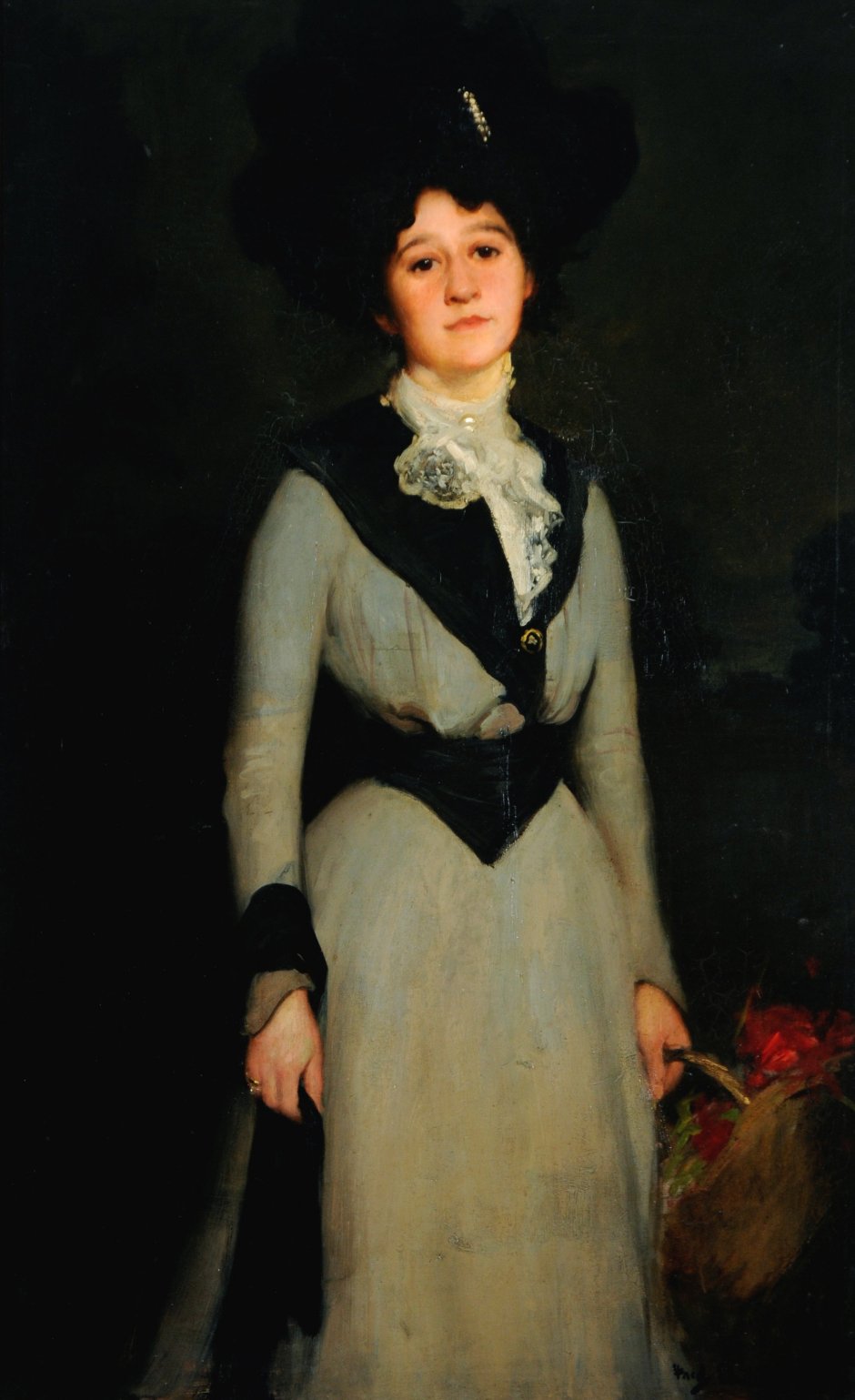
Mary Dawson Holmes by Fred Elwell (1904)

Elwell completed the Portrait of Mary Dawson Holmes in 1904 and had it exhibited at the Royal Academy that year.  It is an exquisite work of portraiture with the sitter depicted as a lady of gracious sophistication.  Her clothes are reminiscent of the French fashion of the time.   She wears a tight-fitting dress finished off with a fine white lace collar.  Her head is tilted slightly to one side.  She holds an upright stance.  She has dark almond-shaped eyes.  Look at her expression.  It gives little away.  What do you make of it?  Is there an unwillingness, a reticence to pose or is this reserve due to her modesty or shyness?

Detail from Les Parapluies by Renoir (1880-6)

The way she stands and the fact that she is holding a basket is the reason why many people have compared the painting with one of Renoir’s ladies depicted in his painting of 1886, Les Parapluies, which Elwell may have seen.

Mary and Fred Elwell also some had a common interest – art, for she was a talented painter and he encouraged her to submit some of her work to the Royal Academy for inclusion at their annual exhibition.  She had two works accepted and Fred also had his portrait of her included at the same exhibition.   It is believed that Fred, George and his wife Mary would often travel to Europe, visiting Venice and Switzerland where Fred Elwell and Mary Holmes would take the opportunity to sketch and paint the local landscapes.

In 1910 George and Mary bought their dream home in Beverley.  It was known as Bar House.  It was a house that afforded the occupants beautiful views of the surrounding areas.  It even had its own tower from where one could watch the local racehorses training on the Gallop around Westwood, close to Beverley racecourse.  Sadly the joy of moving to their beautiful home was tinged with sadness as shortly after taking up residence her husband George became ill, so much so, he had to retire from his Hull shipping business.  As his health deteriorated he had to give up his beloved sailing.  Mary and Fred’s became more distressed with George’s health as he became more and more incapacitated.   His illness eventually was diagnosed as being terminal.  Knowing he was dying George spoke privately to Fred and asked him to look after his wife once he had died.  George Holmes died in August 1913, aged just 58.

Fred Elwell and Mary Dawson Holmes married on October 1st 1914, two months after the start of World War I.

 ……………………… to be continued

  Fred Elwell was a multi-talented painter and in this blog I want to feature some of his landscape works and those of his wife, Mary.

Upper Reaches of the River Hull by Fred Elwell (c.1905)

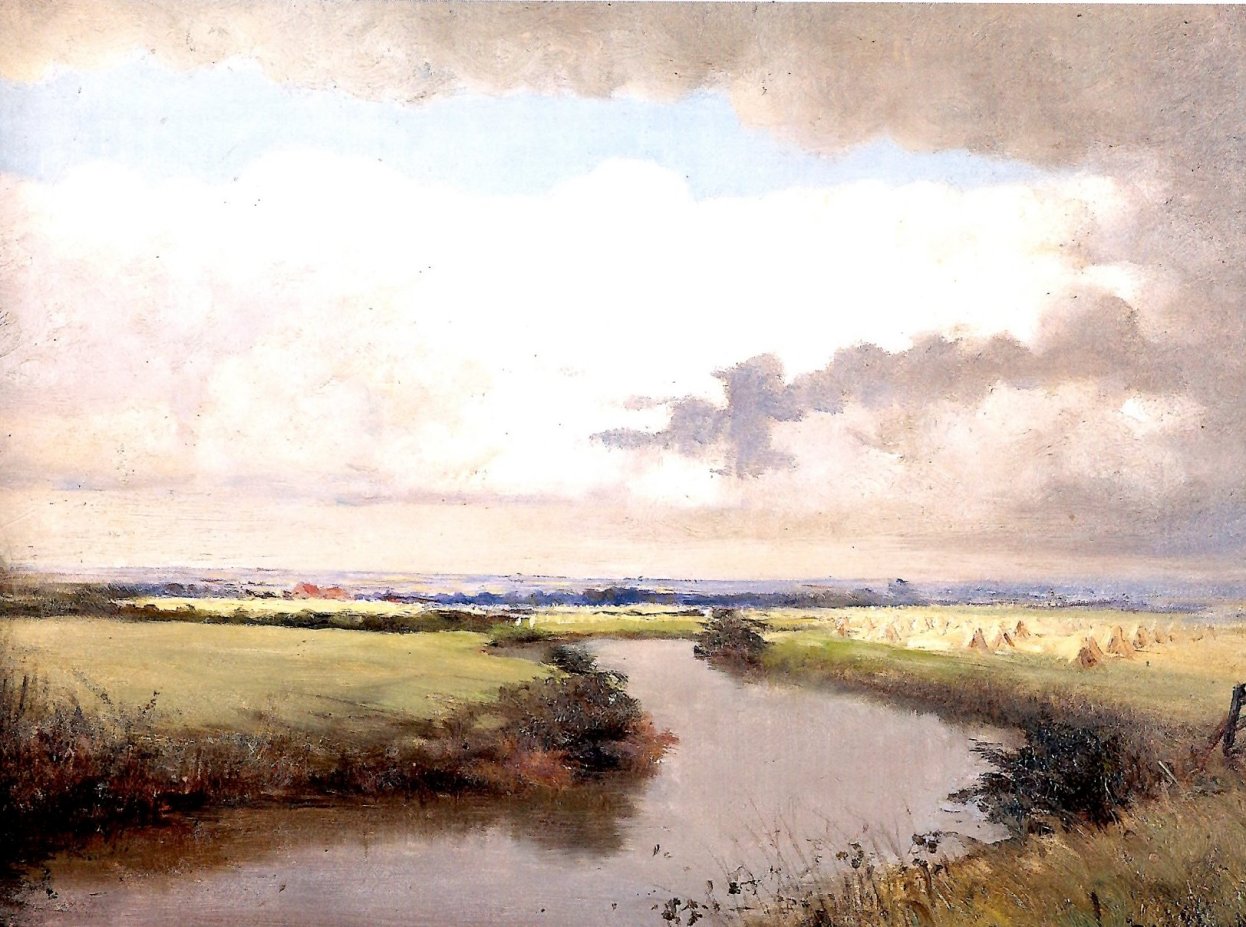
One of his early landscape works was Upper Reaches of the River Hull which he painted in 1905.   The work now hangs in the Beverley Art Gallery.  Its original owner was John Brown of Beverley who was a local tailor and provided suits for Elwell and could well have taken the painting in part payment for tailored clothing.  It is a beautiful work of art and features Elwell’s favourite area, the flatlands on either side of the River Hull, which he would have seen so many times from his boat.  Harvest is over and the stooks of corn sit up proudly in the newly harvested cornfield.

Corsican Landscape by Fred Elwell (1927)

The next painting was completed by Fred in 1927 and entitled, Corsican Landscape.   This landscape work, which has a distinct feel of Impressionism, depicts a farm in the centre ground along with grazing cattle and a few figures, all of which are surrounded by a mountain range which, on the left hand side, have been partially lost in shadow.  I particularly like the colours Elwell has given to his tall trees ranging from green and golds to the black-shaded ones which have lost the light of the sun.

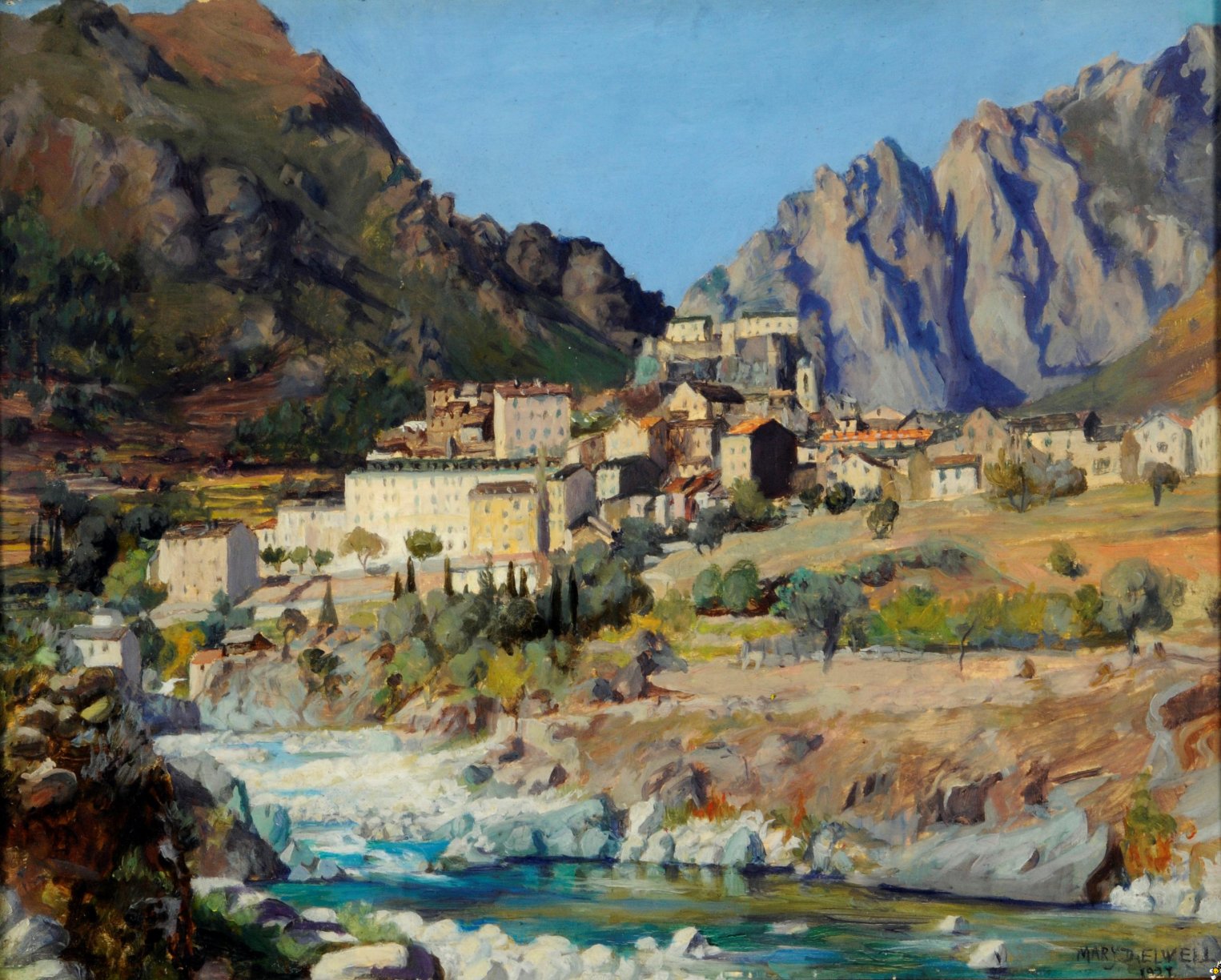
Corte Corsica by Mary Dawson Elwell

Mary Elwell completed a painting, around the same time depicting and probably during the same holiday, of the Corsican landscape, entitled Corte, Corsica.   It is a depiction of the hillside town of Corte, in northern Corsica.  Again, like Elwell’s Corsican landscape, the town is in the centre ground, surrounded by mountains.  The buildings are painted white and yellow with red terracotta roofs.  In the foreground we see a river cascading down a shallow waterfall.  The contrast between the blue of the water and the whiteness of the boulders it flows over adds to the beauty of the work.

Zermatt by Fred Elwell (c.1938)

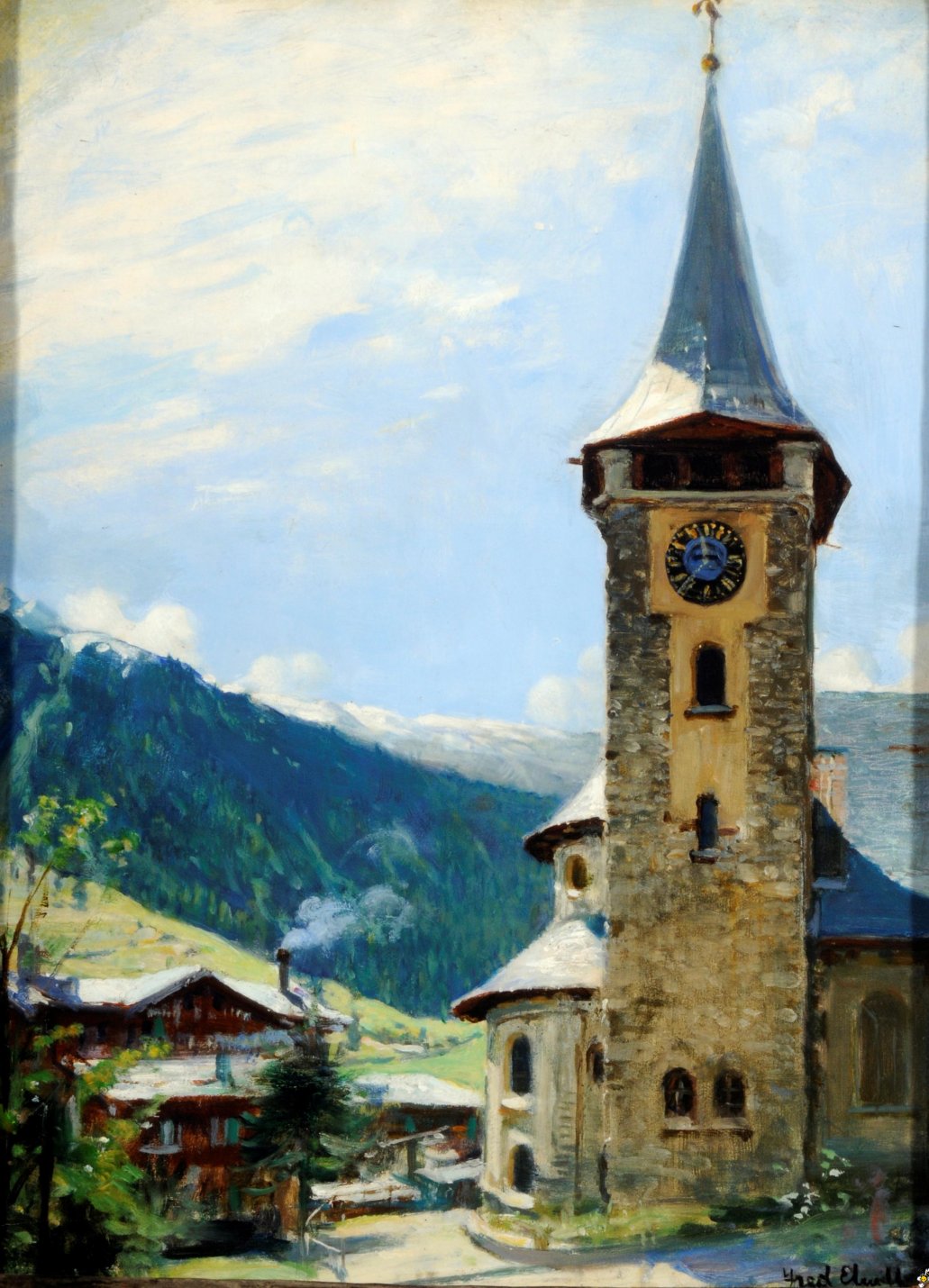
Another foreign landscape work by Fred Elwell was completed in 1937, entitled Zermatt.  The oil on wood panel painting is a typical Swiss-style landscape dominated by the church and its tower on the right, with the clock showing seven o’clock.  On the left we can see some chalets which disappear down the hillside.  In the background we have mountains, some in full sunlight others in full shade.  Fred and Mary Elwell loved this Swiss Alpine region and spent many happy journeys between 1937 and 1939 in the surrounding region completing a number of works in the region of Zermatt and the Matterhorn. On the outbreak of World War II they had to make a hasty retreat back to England.

Pigs in Barn by Fred Elwell (1937)

One amusing anecdote accompanies this work.  Elwell did not sell it to a dealer or art lover for a vast sum of money.  He sold it to a neighbouring pig farmer, a Mr Symmons and all Elwell wanted in return was a number of photographs of the Symmons’ pigs !!  These he used in another work he completed that year, entitled Pigs in Barn.

Brick Bridge, Swinemoor by Fred Elwell (c.1943)

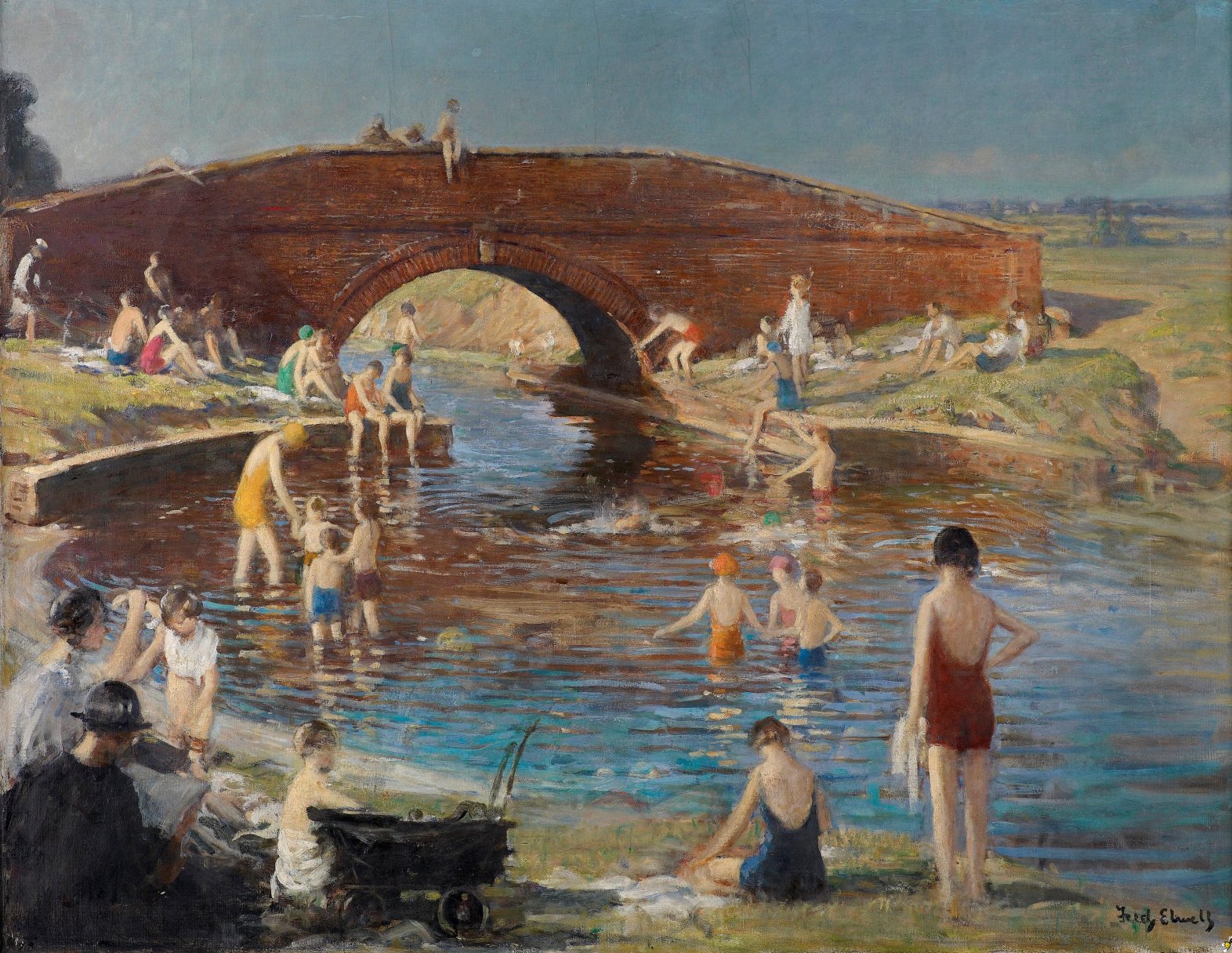
The next work by Fred Elwell probably brought back fond memories of his childhood.  It is entitled Brick Bridge and features a brick-built bridge which straddles the Barmston Drain.  In Fred Elwell’s days this was a favourite place for Beverley folks to come and enjoy a swim on a hot summer’s day.  The picture was painted in 1943 during the Second World War and was the only place the people from Beverley could go for a swim as troops had commandeered the local swimming pool.  Again there is a hint of Elwell’s use of Impressionistic techniques with dabs of various colour representing reflections on rippled water and also the blurring effect of some of the features as if we are looking at the scene through the hazy atmosphere of a summer afternoon.

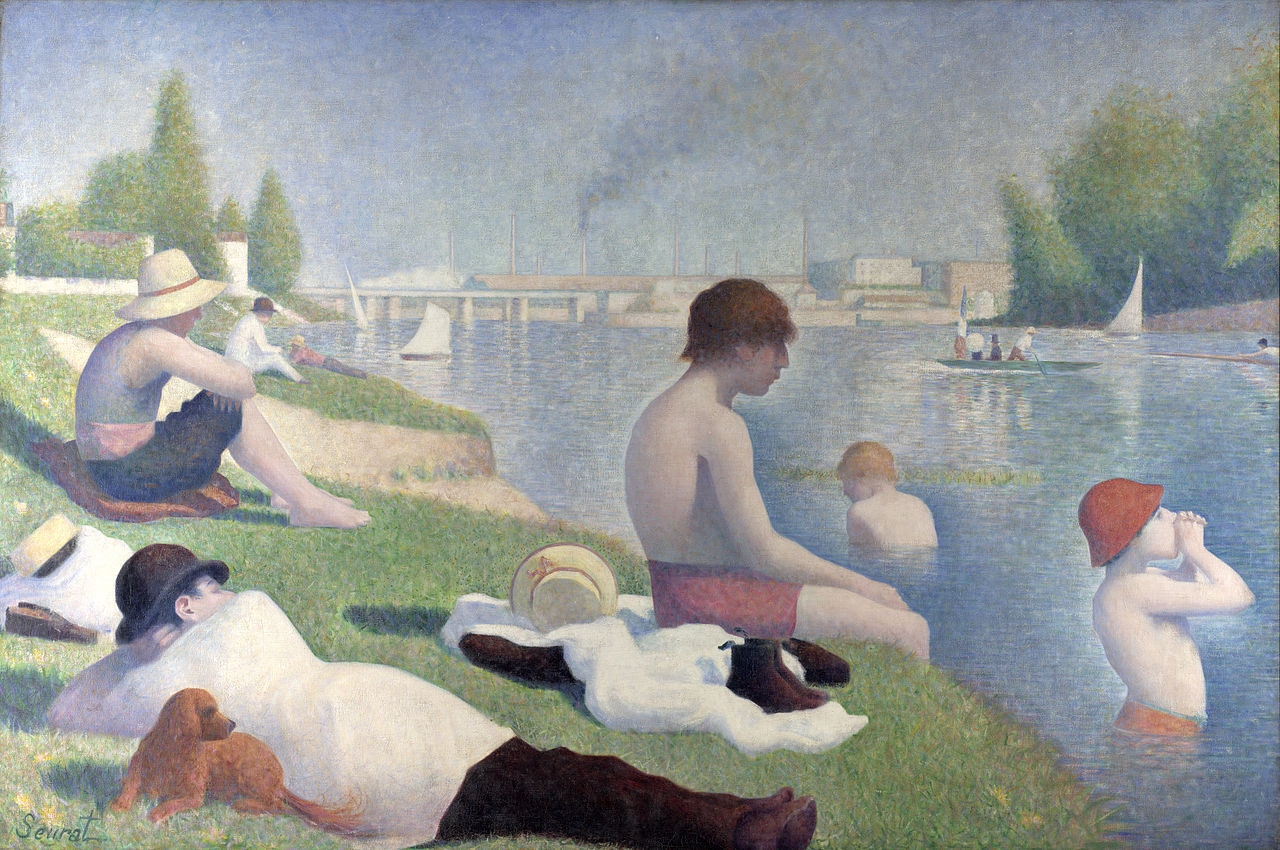
Bathers at Asnières by Georges Seurat (1884)

The painting by Elwell could well have been influenced by the work of the French artist, Georges Seurat, Bathers at Asnières which like Elwell’s work has people relaxing on the riverbank as well as in the water and in the background is the horizontal structure of a bridge crossing the water which in both paintings creates a horizontal axis. In the case of Elwell’s work the bridge almost hides the horizon from our view whereas in Seurat’s work our eyes leave the bathers in the foreground and follow the river towards the bridge and the industry on the far side of it.

In my next blog I will be complete the life story of  Fred Elwell and take a look at some of his genre paintings.

Once again let me recommend an excellent book on the life and works of Fred Elwell.  Most of the information for this blog was gleaned from this book which I bought in Harrogate.  It is entitled Fred Elwell RA – A Life in Art by Wendy Loncaster & Malcolm Shields.

Isaac Levitan. Part 1, His early life and paintings

Self portrait by Isaac Levitan (1880)

From the portraiture and the religious works of the 16th century Italian painter Giovanni Battista Moroni I am moving in a completely different direction.  I am focusing on the Russian Empire and one of, if not the greatest Russian landscape painter of the nineteenth century.  Today let me introduce you to Isaac Levitan.

Portrait of Isaac Levitan by Valentin Serov (1883)

Isaac Ilyich Levitan was born in August 1860 in the small schetl of Kibart.  A schetl is a small settlement with a large Jewish population.    Kibart was close to the border town of Verzhbolovo, and was then part of what was known as Russian Poland.  The town is now part of Lithuania and is known as Virbalis.  Levitan was one of four children who was born into an intellectual working class Jewish family.  His father, Elyashiv Levitan, was a language teacher, teaching French and German at the nearby school in Kowno (now Kaunus, Lithuania) He alaso supplemented his pay as a teacher by acting as a translator for a French building company, which was constructing a nearby bridge over the Lieponio River for the St. Petersburg to Warsaw railway.  Elyashiv spent a lot of his free time educating his children at home.  Both Isaac’s mother and father were interested in art and so, when their son and his brother Axel also showed an interest in it, they were only too pleased to nurture their children’s love of drawing and painting.

Landscape on the Volga by Isaac Levitan (1878)

In the Spring of 1870 the family moved to Moscow and the following year his older brother Axel enrolled at the Moscow College of Art, Sculpture and Architecture, which was one of the largest educational institutions in Russia.  Two years later, in September 1873, Isaac also registered as a pupil at the college to study art.  His initial artistic training concentrated on copying but, after a year, he moved on to a class which focused on nature and art and soon he was embroiled in the genre of landscape painting, which was later to make him famous.  He had first-class teachers at the college, including the landscape painters, Alexi Savrasov, the head of the landscape department, his successor, Vasily Polenov and the Realist painter Vasily Perov, who was the founder of the Peredvizhniki often known as The Wanderers or The Itinerants, who were a group of Russian realist painters who in protest at academic restrictions formed an artists’ cooperative.  The group later evolved into the Society for Travelling Art Exhibitions.

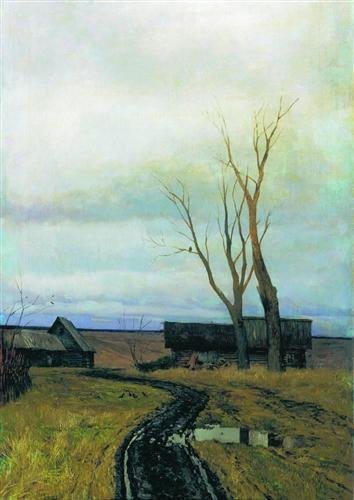
Autumn Road in a Village by Isaac Levitan (1877)

Isaac loved the challenge of landscape painting and was greatly influenced by the landscape work of the Barbizon painters as well as the work of the French realist painter Camile Corot.  Things were proceeding well for Isaac until 1875 when, at the age of fifteen, tragedy struck with the death of his mother and in 1877, after contracting typhus and having endured a long illness during which time he could not earn money, his father died.  Now Isaac was without financial support.  He had neither money to pay the college fees nor the money to live.  He was asked to leave the college due to non-payment of his tuition fees but was rescued by the kindness of friends who gave him the money so that he could continue studying and later, thanks to the College Council who appreciated his talent, the tuition fees were waived and furthermore they awarded him a small bursary.

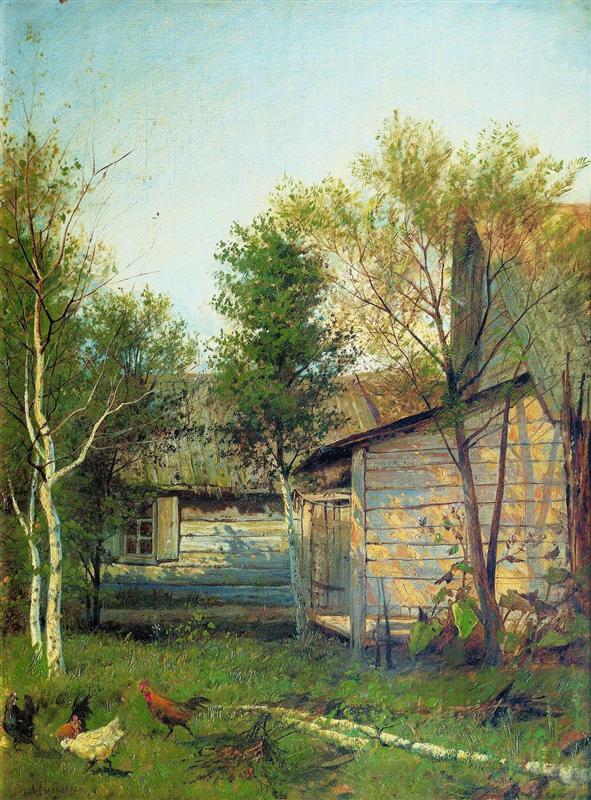
A Sunny Day, Spring by Isaac Levitan (1876)

In 1877, the year that his father died, the fifth Travelling Art Exhibition was held at the Moscow College of Art.  Isaac Levitan submitted two of his works with great hopes of a medal.  He had completed one of the works, Solnechnyi den Vesna (A Sunny Day, Spring) the previous year, whilst his other entry, Vecher (Evening) had been completed in 1877.  Levitan was disappointed in the judges’ decision.  He didn’t receive a medal for either work but was granted a diploma which allowed him to become an art teacher.

The year 1879 proved to be a year of turmoil and triumph for nineteen year old Levitan.  The turmoil occurred on the morning of April 20, 1879; Tsar Alexander II was attacked by a thirty-three year old former student, Alexander Soloviev, as he walked towards the Square of the Guards Staff.  The result of this assassination attempt was a crackdown on groups of people who were believed to be a threat to the Tsar.  The government issued an edict that there would be a mass deportation of Jews from the big cities of the Russian Empire.  This meant that Isaac’s family were forced to move out of the centre of Moscow to the eastern suburb of Saltykovka. Later that year, due to pressure on the local government officials by art lovers, Isaac Levitan was allowed to return to the city.

Autumn Day, Sokolniki, by Isaac Levitan (1879)

The triumph came that December, when Isaac entered his painting, Osenniy den Sokolniki (Autumn Day, Sokolniki) in the second students’ exhibition.  Levitan liked to paint views of different settings in the Moscow area. Considered to be one of the best works of this period is his poignant work entitled Autumn Day, Sokolniki, which he completed in 1879.   The painting reveals to us Levitan’s belief in the connection between nature and human feelings.  The painting is a depiction of a grey-clouded autumn sky and one can imagine the rustling sound of the wind through the trees causing the dying leaves to fall to the ground.  The path which disappears into the distance is the focal point of the painting.  It is empty with the exception of a woman dressed in black, who strolls towards us.

This work of art by Levitan was his reminder of his joy of walking along the forest path of his beloved Sokolniki Park.  The park lies to the northeast of the city and was so named because of its connection with falconry which took place there and was the favourite sport of members of the royal court (sokol is the Russian word for falcon).  This work of art received great revues and the following year it was purchased by the art collector and philanthropist, Pavel Tretyakov, the founder of the famous Tretyakov Gallery in Moscow.  This marked the initial public recognition of Isaac Levitan and his art.  The painting can now be seen at the Tretyakov Gallery in Moscow.

It was around the end of the 1870’s that Isaac Levitan met the writer Anton Chekhov.  The meeting came about as Anton’s brother, Nikolai, was a fellow student of Levitan at the Moscow College of Art.  This was to be a friendship which lasted all Levitan’s life.

In my next blog I will continue looking at the life of Isaac Levitan and feature some of his most important later works.

Joachim Patinir – the early landscape artist.

Joachim Patinir  c.1480 -1524
Joachim Patinir
c.1480 -1524

When I visit local art galleries around my neighbourhood they are packed with landscape works from various local artists.  As it is Wales a few sheep and the odd shepherd are “thrown in” as a prerequisite for Welsh landscape paintings.  My featured artist today was one of the earliest landscape painters and although his paintings often incorporated religious themes which were commonplace in northern Renaissance art, his forte was his splendid detailed, visually fascinating landscapes.   He is considered one of the first modern landscape specialists. Let me introduce you to the great sixteenth century Flemish landscape painter Joachim Patinir (often referred to as Patenier) of whose style the English art historian Kenneth Clarke described as:

“…the first painter to make landscapes more important than his figures…”

So how well thought of as an artist was this sixteenth century painter? Felipe de Guevara was a sixteenth century Spanish humanist, art writer, patron of the arts and a connoisseur of Netherlandish painting and in his manuscript of 1560, which two hundred years later, was published in book form, Comentarios de la pintura, he wrote that he regarded Patinir as on being par with the great Netherlandish painters Jan van Eyck and Rogier van der Weyden.  Praise indeed!  So who was this man who achieved such great standing?

In all biographies the opening paragraph usually contains a date of birth and it is at this point, with this artist, that one hits a brick wall as his actual date of birth is unknown and his birth date, which often varies from book to book, is somewhat of an educated guess.

According to the 1521 diary of Albrecht Dürer, who described Patinir as the good painter of landscapes there was, at that time, a portrait of Patinir as a man in his forties and that would then put Joachim Patinir’s birth date somewhere around 1480.  If Patinir’s birth date is uncertain so is his birthplace albeit the consensus of opinion is that he was born in either the town of Dinant or the nearby village of Bouvignes on the River Meuse.  It is interesting to note that Dinant is situated at a point on the River Meuse where the river cuts deeply into the western Condroz plateau.  The town lies in a steep sided valley sandwiched between the rock face and the river and the spectacular landscape around this town came to influence Patinir in his landscape works.

The first concrete facts we have of him was that he was serving an apprenticeship in the Antwerp Guild of Painters in 1515, a city in which he was to live all his life.  During his time he met and worked with other great Netherlandish artists of the time such as Gérard David, Hieronymus Bosch, Quentin Matsys

The Temptation of St Anthony by Joachim Patinir  (c. 1520-24)
The Temptation of St Anthony by Joachim Patinir (c. 1520-24)

My first offering of Patinir’s work is one entitled Landscape with the Temptation of Saint Anthony Abbot which he completed somewhere between 1520 and 1524 was one of the few paintings which was signed by the artist. The painting now resides at the Museo Nacional del Prado. This work of art was not a solo effort by him, but a collaboration with Quentin Matsys, who painted the figures, which we see in the foreground.  St Anthony, who had given up his worldly possessions and devoted himself to a contemplative life, is depicted sitting on the ground.  He is surrounded by temptation in the form of three courtesans who try to seduce him.  One of the women holds out an apple which symbolises temptation reminding us of the story of Adam and Eve in the Garden of Eden.  A demon-like monkey pulls at his clothes.   Lying on the ground we see a discarded rosary symbolising the possible abandonment of faith.  Although our eyes are initially drawn to the large figures in the foreground and as we try to work out what is going on, they soon move to take in the wondrous landscape in the middle ground and background which is a setting for various events in the life of the saint. Cast your eyes to the central middle ground and one can make out Anthony and his hut which is under attack by an army of demons.  To the right of that scene we see St. Anthony sitting at the water’s edge of a lake on which is the royal barge carrying the queen and her ladies-in-waiting, some of whom are naked; all part of a seduction scene.  The rocky landscape and the river hark back to the geography of his birthplace.  The painting was acquired by the Spanish king, Philip II in 1566 and was hung in the Escorial Palace.

Landscape with St Jerome by Joachim Patinir (c. 1517)

Patinir often incorporated hermit-style life depiction in his landscape works.  This was a very popular subject in Northern European devotional works of art. This next painting focuses on these two elements.  It is his Landscape with St Jerome painting, which he completed around 1517, and which also can be found in the Prado in Madrid.  The work combines an extensive landscape background, with its vibrantly coloured and decidedly naturalistic vista, with the tale of Saint Jerome.  In this work we see the moment in time when Saint Jerome, seen huddled under a rocky outcrop, removes the thorn from the paw of the lion.  Patinir’s depiction of the saint is not as we would expect to observe him.   Jerome, who was a cardinal in the Catholic Church and eminent theological scholar, was often depicted alone, dressed in his red ceremonial robes, studiously at work in his room.  However, in this work Jerome is dressed in the rags of a hermit living outside his battered wooden shelter.  As was the case in the first painting I featured, our eyes soon leave Jerome and the lion and focus on the way Patinir has beautifully depicted, in great detail, the landscape which surrounds the saint. Perched on rocky plateau is a monastery, supposedly a depiction of the one at Bethlehem where Jerome once worked.   The painting seems to have three well defined colour patterns.  The foreground is the darkest made up of various tones of brown and black depicting Jerome’s shelter attached to the high and dark rocky outcrop.  The middle ground is full of green of differing shades from the dark greens of the tree foliage to the lighter greens of the fields further away which surround a small village.  The background is predominantly lighter with blues and greys depicting the sea and the far-off mountains although to the left we see the black clouds of an approaching storm.  This change in colours from the darkness of the foreground to the lightness of the background creates perspective in the work.  Once again the high craggy outcrops hark back to the geography of his birthplace, Dinant which nestled snugly between the high rocky cliffs which protruded out towards the River Meuse.

Charon crossing the River Styx by Joachim Patinir (1524)

My third offering is fundamentally a landscape work and yet this has a mythological connotation.  It is entitled Charon Crossing the River Styx and was completed by Patinir around 1524.  Again, like the two previous works, it can be found in Madrid’s Prado museum.  This is not a devotional work and was probably originally commissioned by a wealthy merchant and scholarly connoisseur who was also an avid art collector.  The painting is divided into three vertical parts, the centre of which is the River Styx and the outer parts represent the banks on either side of this great mythological waterway.   The River Styx was one of the five rivers that separated the world of the living from the world of the dead. In Greek mythology, it was written that the River Styx wound around Hades nine times. The name of the river derives from the Greek word stugein which means hate, and so, Styx, was the river of hate. To the left of the river is the swamp-like and rugged bank of Paradise and to the right of the river is that of Hell

Charon and the Soul
Charon and the Soul

Our eyes immediately home in on the sandy-coloured boat and its occupants which are midway between the two banks.  The boatman is Charon, the old ferry man who ferries the dead onto the underworld, and we see him crossing the river Styx towards the underworld, where the dragon-tailed three-headed dog, Cerebus, stands guard, allowing all souls to enter but none to leave. We can see Cerebus curled up in his lair at the entrance to the gates of Hell, which is depicted in the right background of the painting, burning brightly.

The Angel pointing the way

Along with Charon in the boat is the soul of a recently deceased person. The soul is looking around and has to decide on to which bank it wants to disembark.  If you look carefully at the left bank you will notice an angel perched on a mound pointing towards another waterway and another land.  This water is the Fountain of Life and it is part of Paradise.  We can see peacocks and ravens on this land and these symbolise Resurrection and Redemption.  The angel is canvassing that this should be the soul’s land of choice.  Now, if we look on the right bank that also seems to be calm and peaceful with birds flying around the trees.  Cerebus is out of sight but on the ground near the foot of the trees is a small monkey which is a symbol of the devil and that for the soul in the boat should be warning enough.  Unfortunately, looking at the way Charon is steering the boat, the soul has made the wrong choice!  The background story is interesting but for me the beauty of this work is not the characters in it but the artist’s depiction of the landscape.

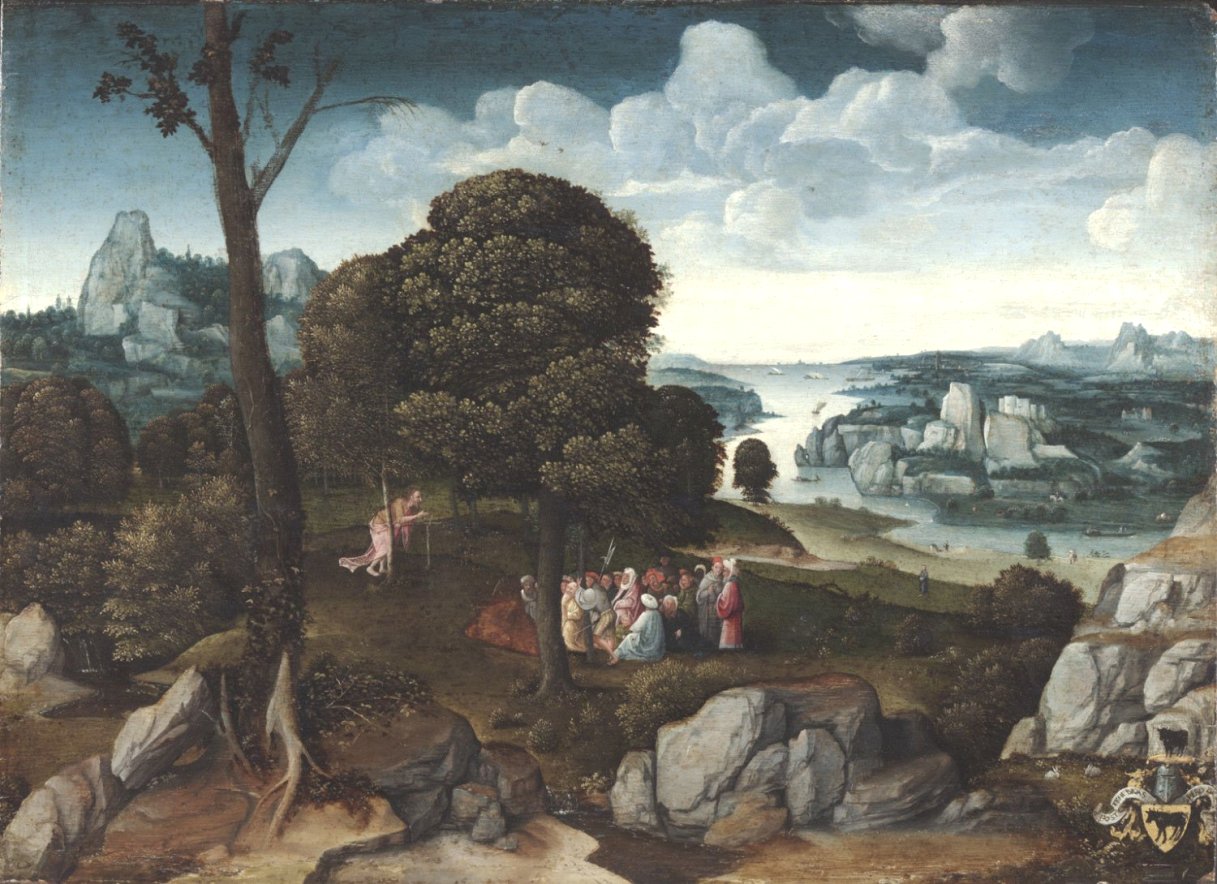
Landscape with Saint John the Baptist Preaching by Joachim Patinir

My fourth and final offering of works by Joachim Patinir is entitled Landscape with Saint John the Baptist Preaching and one version of this work can be found in the Musées Royaux des Beaux-Arts de Belgique – Brussels, but the one below is from the collection of  the Philadelphia Museum of Art and in the lower right hand corner of this version we see a crest.   It is the crest of the wealthy Rem family and it could well be the wealthy merchant, Lucas Rem, the sixteenth century Augsburg merchant and art collector had this version painted for himself and had the family crest added to it.

Landscape with Saint John the Baptist Preaching by Joachim Patinir with the Rem Crest

In the painting, we have a bird’s eye view of St John the Baptist preaching to a group of followers but what I like most about the painting is the beautifully depicted imaginary landscape which acts as a backdrop to the religious scene,   Once again it crosses my mind that the religious story plays a secondary role to Patinir’s depiction of the landscape.  Once again we see a similar landscape to that in his other works – tall rocky outcrops closely bordering on to a river, which because of the religious nuance of the painting could have represented the River Jordan and on the left bank, although not clear in this picture, is a depiction of the baptism of Christ, in the Jordan river, by John the Baptist.

We observe St John, bent over, leaning heavily against a sturdy branch of a tree.  It is almost as if he is leaning against a lectern or pulpit rail as he looks down upon his followers who sit entranced by his words.  In the foreground to the left of the painting we see a tree which is dying around which is a vine.   This is thought to allude to the Tree of Knowledge in the Garden of Eden which withered and died once Adam had taken a bite of the apple offered to him by Eve.  According to legend, the tree eventually came back to life once Jesus Christ had died on the cross and in so doing, had atoned for the sins of the world.

Both John the Baptist and his audience are in the shade as the bright light we see lighting up the meandering river, which wends its way towards the horizon, is incapable of penetrating the thick tree canopy above the group.  As was the case in the earlier painting, Patinir has used different colour combinations to craft perspective.  Dark browns and greens in the foreground around the people gradually change to lighter greens of the banks of the river and then in the distance lighter blues and greys become the dominant colours.

Bayard Rock, Dinant
Bayard Rock, Dinant

There is a fascinating delicacy about Patinir’s landscape work and as I have said before this favoured landscape depiction of the artist probably stemmed from what he remembers of his birthplace around Dinant and the rock structure there known as the Bayard Rock, which looms above the town and the River Meuse.

In German, Patinir would be classified as a painter of Weltlandschaft which translated means world landscape.  The Weltlandschaft painters completed works depicting panoramic landscapes as seen from a high viewpoint.  These works of art typically included mountains and lowlands, water, and buildings. As in Patinir’s works, the subject of each painting is usually a Biblical or historical narrative, but the figures included in the work are secondary to their surroundings and they were often made-to-order by secular patrons.  The landscapes in these works were not geographically accurate.  In her 2005 book, Seventeenth-century Art and Architecture, Anne Sutherland Harris, a professor of Art History, describes this form of art:

“…They were imaginary compilations of the most appealing and spectacular aspects of European geography, assembled for the delight of the wealthy armchair traveller…”

So again I ask – was Patinir a religious painter who liked to add a landscape background to his work or was he a landscape painter who liked to add, or get somebody else to add, figures appertaining to religious and mythological stories?  Perhaps his friend Albrecht Dürer had the answer to this conundrum when he described his friend as:

“…der gute Landschaftmaler…

(the good painter of landscapes)

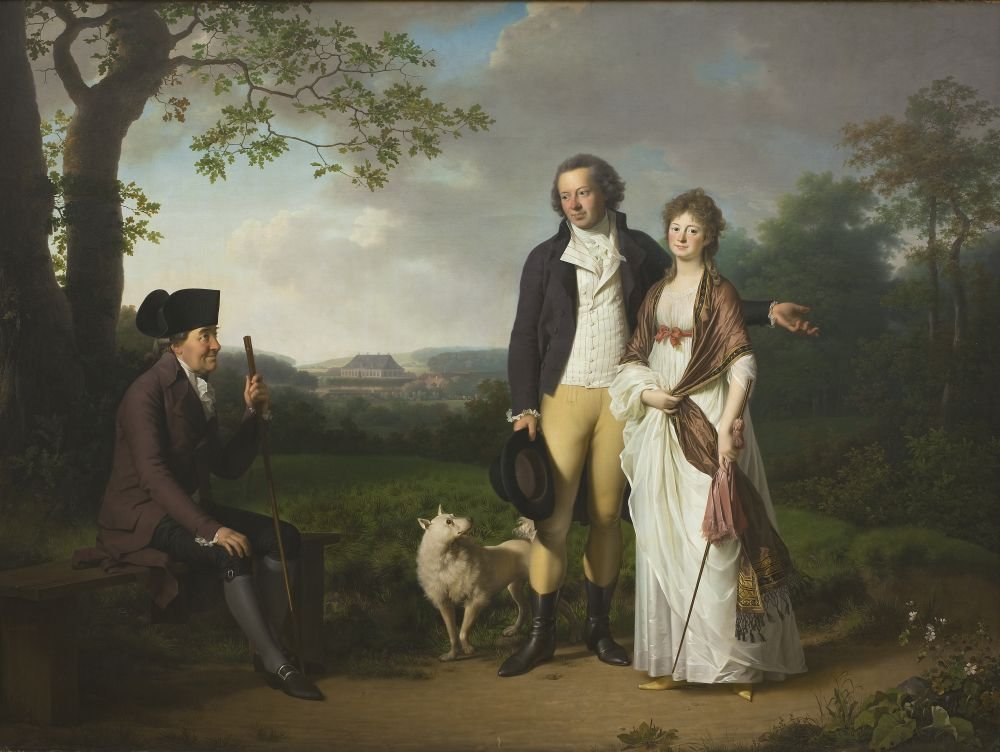
Niels Ryberg with his Son Johan Christian and his Daughter-in-Law Engelke, née Falb by Jens Juel

Niels Ryberg with his Son Johan Christian and his Daughter-in-Law Engelke, née Falb by Jens Juel (1797)

My featured painting today is one I saw when I was in Copenhagen last week.  It was a large scale work measuring 253 x 336cms, and was certainly very impressive.   The first thought which came into my mind when I stood before it was that it reminded me of the painting  Mr and Mrs Andrews by Thomas Gainsborough, which I had seen at the National Gallery in London and which I had featured in My Daily Art Display (May 5th 2011).  Today’s featured painting by the Danish painter Jens Juel, like Gainsborough’s work, is what is termed a conversation piece.  Conversation pieces were very popular in the 18th century.  They were informal portraits, usually depicting two or more full-length characters, often family members, who were seemingly engaged in conversation in domestic interiors or garden settings.   In many ways it was a means for the people depicted to show off their wealth and social status.  In some ways the people who commissioned the paintings were often depicted in the work, and wanted to stimulate a conversation about themselves.   Today’s painting also reminded me of the William Hogarth series of six works entitled Marriage à la Mode, which I featured in my blog (May 4th  –  9th 2011) that told the tale of a merchant desperate to be part of the aristocratic class.  My painting today is by the great Danish artist Jens Juel which he completed in 1797.  It is entitled  Niels Ryberg with his Son Johan Christian and his Daughter-in-Law Engelke, née Falb, often simply referred to as The Ryberg Family.   Jens Juel, who was mainly known for his portraiture, was active during the years preceding what was to become known as the Danish Golden Age, which followed the end of the Napoleonic Wars and lasted until around 1850.   

Jens Jorgensen Juel was born in May 1745 in Balslev on the Danish island of Funen.   It is said that he was born illegitimately, the son of Vilhelmine Elisabeth Juel.  She had been employed at the Wedellsborg estate.  Jens’ father is unknown.  Some believe he was a member of the Wedell family whilst others believe he could have been Lord Jens Juel, the Danish diplomat or that Jens was the son of the local vicar.   For the first year of his life Jens lived with his mother at the house owned by her brother, Johan Jørgensen, a schoolteacher.  When Jens was one year old his mother married Jørgen Jørgensen, also a school teacher who worked and lived in the nearby village of Gamborg and it was here that Jens Jorgensen Juel grew up. 

Like many artists, Jens showed an early fascination with drawing and his parents decided to encourage this interest by arranging for an apprenticeship for their son with the German painter Johann Michael Gehrmann, who had a studio in Hamburg, a city, which at the time was under Danish sovereignty.  He remained at Gehrman’s studio for five years, after which, in 1765, he returned to Denmark and attended the Royal Danish Academy of Art in Copenhagen and during his five-year stay at this establishment he won two gold awards for his paintings and a travel bursary.   One of Juel’s tutors at the Academy was Carl Gustaf Pilo, a Swedish painter, who had for twenty years been Court painter for King Frederik V of Denmark, and who was famous for his portraits of the Danish royal family.   It could well have been through Pilo’s influence that Juel received his first royal commission in 1769 for a portrait of the Queen of Denmark, Queen Caroline Mathilde, the wife of King Christian VII. 

With the prize money he received from the Academy, Juel left Denmark in November 1772 and set off on a European tour.  He wintered in Hamburg before going to Dresden where he remained until 1774.  From Dresden he went to Rome and it was here he met up with a fellow former Danish Academy art student, the Neo-Classical painter, Nikolai Abildgaard.  Juel remained in Rome for two years during which time he was able, for the first time, to draw directly from a nude model, a technique which was not available at the time in Denmark.   He left Rome in 1776 and went to Paris before moving to Geneva in the Spring of 1777.  It was in Geneva where he stayed with his friend, Charles Bonnet, the Swiss naturalist and philosopher and during his stay he helped illustrate some of Bonnet’s books.   Juel left Geneva in late 1779.  Throughout his European sojourn he completed many portraiture commissions and his reputation as a leading portraitist grew steadily.  Finally in March 1780, after eight years away from his homeland, he returned to Copenhagen via Hamburg.  Whilst living in the Danish capital, he received more royal commissions to paint the portraits of members of the royal family as well as portraiture commissions from leading members of the nobility.  He also completed some landscape works and the royal family were so impressed by his artwork that he was made court painter in 1780. 

In 1782 he was elected a member of the Royal Danish Academy of Art and two years later he became one of its professors.  Jens Juels married in 1790, a time which marked the height of his artistic career.  He held the post of Academy director for two periods during the 1790’s. Jens Juel died in December 1802, at the age of 57 and was buried at the Assistens Cemetery in Copenhagen. 

Having looked at the life of the artist it is time to turn our attention to the people in today’s featured painting.   The painting, which he completed in 1797, is considered to be his greatest landscape work.   We see before us three people and of course the title of the work, Niels Ryberg with his Son Johan Christian and his Daughter-in-Law Engelke, née Falbe, reveals their identity.   Seated on a park bench, to the left, is the corpulent gentleman, Niels Ryberg and standing before him is his son, Johann Christian and his son’s wife, Engelke.  In the background we have what was probably the most important aspect of the painting for Ryberg, the depiction of one of his vast estates – Hagenskov on the island of Funen.  As was the case in Gainsborough’s work, Mr and Mrs Andrews, which was commissioned by Robert Andrews at the time of his marriage to Frances Carter and featured their estate lands, Ryberg in a way, when he commissioned the painting from Juel, wanted to show everybody what his wealth had achieved.  It sounds as if he was simply a boastful person but his life story is an amazing rags-to-riches tale and you will begin to realise that he was in fact a very generous man who was simply and rightly proud of what he had achieved. 

Niels Ryberg was not always rich and did not come from an aristocratic background.   In fact he was born Niels Bertelsen (but later adopted the surname “Ryberg” after his birthplace) in 1725 in the village of Ryberg on the Salling peninsular of Jutland in north-west Denmark, the son of Bertel Christensen and Vibeke Nielsdatter.  His father was of peasant-class, a tenant farmer on the local estate and young Niels, who like his father, had the lowly status of a serf on the estate.  He left the estate when he was around eleven years of age and went to live with his mother’s brother Axel Moller.  Historians seem to be divided as to why he left his parents home.  Some say it was to avoid military service whilst others believed it was simply to cast off the shackles of serfdom which living with his uncle, who had bought his freedom from the squire and landowner, had achieved.  Axel Moller, who lived in Alborg, ran a successful grocery business and Niels soon became a willing assistant to his uncle.  He remained with him, learning the trade until 1750, when at the age of twenty-five, he moved to Copenhagen where he plied his trade as a merchant, first as a simple stall-holder and then managed to acquire his own fixed premises.  He also dabbled in insurance underwriting.  Still he had not made his fortune, money was tight and he lacked capital to expand.  However his big break came in 1755 when he entered into partnership with a very profitable trading company, Thygesen,  and so the Ryberg & Thygesen company was formed.  The company prospered and grew.  In 1764, Ryberg married Margaret Dorothea Eight, the daughter of a local businessman in Eckernförde. She gave birth to their son Johan Christian Ryberg in 1767 but sadly she died shortly after the birth, aged just 18.   In 1775 Ryberg went into business on his own until 1789 at which time he invited three family members to join him in his newly formed Ryberg & Co.  His business boomed so much so that he was employing more than a hundred and fifty staff.  From being a market stall trader he had now risen to become a prosperous merchant, shipowner, banker and insurance man. 

Ryberg never forgot his poor upbringing and when he bought the Hagenskov estate, now known as Frederiksgave, he did everything to help the life of his workers.  He provided them with finance and materials such as timber and stone to build their farms and provided the money to improve the growing ability of the soil.  He didn’t stop there as he also built them mills and schools for their children and provided them with medical care.  He did the same on another estate, Øbjerggård, on South Zealand,  which he bought, and on which he built a large linen factory in which his people were employed.  It was one of the first of its kind in Denmark.

My featured painting today was completed in 1797 at the height of Rybergs commercial success and at a time when he was about to hand over the control of his business to his son.   Maybe that he is seated symbolises that he was now going to take a rest from the business world.  His son stands with his left arm outstretched behind his wife’s back maybe indicating with some pride what his father had achieved.   Maybe now, knowing the care and time Niels Ryberg had given to his staff and workers, you will look upon him, not as a boastful person full of his own purpose, smug about his own wealth and desirous of being looked upon as being part of the aristocracy (like the merchant character in Hogarth’s Marriage à la Mode) but as a man who had, through hard work, had managed to provide a better quality of life for himself and for those around him. 

Niels Ryberg died peacefully in his sleep in August 1804, aged 59.   He was buried in his family chapel of the Dreslette church on Funen.  So what happened to his empire?   When Ryberg died his only surviving son, Johan headed up his father’s business empire but the success of his father was not upheld by his son as Ryberg & Co. went bankrupt in 1820.  Although the collapse of Ryberg’s empire was not caused directly by Denmark’s war with England, it had been supported by numerous loans given to it by the Danish government.  The collapse of the Danish economy culminating in Denmark’s declared State bankruptcy due to the cost of the war meant that they could no longer support the likes of Ryberg’s empire.  They called in their loans and the company eventually collapsed and Ryberg’s beloved estates were taken by the State.  

During my research into this painting I came across a very interesting website which gave me a lot of background information and one I recommend you should visit.   It is:

http://historyman.dk/the-story-behind-the-painting/

Jan Siberechts English Country Houses and Landscapes

My Daily Art Display today continues examining the life of the seventeenth century Flemish painter Jan Siberechts and taking a look at some of the paintings he completed after he moved his home to England.  In my previous blog I talked about Siberechts’ early landscape paintings which followed the style of the Dutch Italianate artists of the time.  Then, in the early 1660’s, he worked on a number of paintings depicting Flemish rural life and the life of the peasant community.

View of Longleat by Jan Siberechts (1675)

In 1672, at the age of forty-five, Siberechts’ life changed.   Two years earlier, George Villiers, the second Duke of Buckingham, whilst on business in the southern Netherlands came across some of Siberechts’ work.  He was so enamoured by what he saw that he invited the artist to come to England and help decorate his Italianate mansion, Cliveden, which was situated on the bank River Thames near the town of Windsor and which he had built six years earlier.  Jan Siberechts agreed to move home to England and became just one of the hundreds of Dutch and Flemish artists who came to Britain in the seventeenth century to ply their trade.

View of Longleat by Jan Siberechts (1678)

Siberechts’ work at Cliveden enhanced his reputation in England as a talented artist and his birds-eye views of stately homes became much sought after.  His recognised artistic ability and his connection with Villiers, led him to be awarded numerous painting commissions from the aristocracy and he was often referred to as being the “father of British landscape painting.

Wollaton Hall and Park by Jan Siberechts (1695)

These aristocratic commissions from around England were often for paintings of their stately homes.  One such example was his 1695 work entitled Wollaton Hall and Park which was in Nottinghamshire and the home of Thomas Willoughby, 1st Baron Middleton.  Another commission in 1694 was for a painting of Chatsworth, the Derbyshire country house of William Cavendish, the 1st Duke of Devonshire.

Siberechts received a commission in 1675 from Thomas Thynne.  The painting, entitled View of Longleat, depicted his stately home.   The work still hangs in the house.  Three years later Siberechts completed another painting of the building and this is now part of the Government Art Collection.   These depictions of country houses and country estates were very popular with their aristocratic owners and Siberechts was inundated with similar commissions.   In the foreground of this painting we see the aristocratic owners along with their horses, portrayed as huntsmen readying themselves for the hunt.

Another example of this type of work by Jan Siberechts is his 1696 topographical landscape painting entitled View of a House and its Estate in Belsize, Middlesex which he completed in 1696.   In the painting we see a birds-eye view of the The Grove, the house and estate of Sir Francis Pemberton, a leading figure of the English judiciary.  He, along with his wife and seven children, lived there until his death in 1697 just one year after Siberechts had completed the work.   Pemberton had bought the neighbouring Dorchester House and its estate around 1688.  He then demolished that house to make way for his extensive vegetable gardens and orchards.  The all-embracing gardens can be seen surrounding the manor house in Siberechts’ painting.

Landscape with Rainbow, Henley-on-Thames by Jan Siberechts (c.1690)

Jan Siberechts spent a good deal of time travelling around the English countryside fulfilling commissions to paint palatial residences.  Such paintings were interspersed with works featuring hunting scenes and views of the rural landscape.  My last offerings today are also from the 1690’s when Siberechts completed a series of five landscape paintings featuring the town of Henley and the Thames Valley.    There is no record of who commissioned the works but it could well have been one of the many rich merchants who owned land around the town of Henley.     The works were different to his earlier ones featuring stately homes for in this series Siberechts concentrated on the landscape of the area with its pastureland and woods and also included views of the River Thames and the boats which plied their trade along this busy waterway.  One of the best known of these, entitled Landscape with Rainbow, Henley-on-Thames, can be seen at Tate Britain.  It is a beautifully crafted painting.   In the foreground we have cattle and horses grazing in pastureland which slopes down towards the tree-lined banks of the River Thames.  On the left we can see a laden barge, piled high on deck with its cargo, being manoeuvred along the waterway by four men in the field, who laboriously drag the floating hulk towards the warehouses of Henley.  To the right of the painting we see the busy little town of Henley-on-Thames with its high-towered 13th century church, St Mary the Virgin, rising amidst the dwelling places.  The church still stands today.  The background to the right is filled with rising hills, more pastureland and the occasional woods above which are a double rainbow and a dark and threatening rain cloud which is emptying its contents on the fields below.  In the left background of the painting the view has opened up more and we catch a glimpse of the distant hills.

Henley from the Wargrave Road by Jan Siberechts (1698)

Another painting in the series was Siberechts 1698 work entitled Henley from the Wargrave Road which hangs in its own room in the Henley Gallery of the River & Rowing Museum, Mill Meadows in Oxfordshire.  This work is a veritable masterpiece which is in a way a historical record of the time depicting the life of the town, its surrounding countryside, and the importance of the commercial trade using the river.  Siberechts has depicted the 17th century buildings of Henley with its old wooden bridge with stone flood arches, the Church and the mill on the river.  In the foreground we can see farm workers busy haymaking in the riverside meadows and a cart fully loaded with hay heading down the country lane towards the town of Henley.  It is interesting to look back at the paintings of Jan Siberechts which I have featured in my last two blogs.  They are so different.  There is a certain simplicity and charm to his 1660’s rural life works but his artistic talent cannot be denied when we study some of his later works which he completed during his days in England.

Jan Siberechts died in London in 1703, aged 76.


The Pastoral Scenes of Jan Siberechts

The Ford by Jan Sieberechts (1672) Szépmûvészeti Múzeum, Budapest
The Ford by Jan Sieberechts (1672)
Szépmûvészeti Múzeum, Budapest

My Daily Art Display today features the 17th century Flemish painter, Jan Siberechts.  I will also look at some of Siberechts works and look how his style of painting changed during his lifetime.  In today’s blog I will concentrate on his rural life paintings and in my next blog I will look at how his painting style changed when he went to England. 

Jan Siberechts was born into a family of artists in Antwerp in January 1627, first training with his father, who was a sculptor.  Little is known of his early life and upbringing except to say that in 1648, at the age of twenty-one, he became a master in the Guild of St Luke in Antwerp and four years later, in 1652, he married.   Siberechts’ early works, up until around 1660, were mainly landscapes which were heavily influenced by the Dutch Italianates.  The Dutch Italianates were a group of seventeenth-century Dutch artists who painted landscapes of Italy.  Many of these painters had travelled to and lived in Italy whilst others who had never made the journey to Italy were simply stimulated by the works of those who did.   Many young Dutch painters made the arduous journey, often by foot, over the Alps to Italy, whereas others travelled by sea. The favourite destination for these intrepid travellers was usually Rome, but some journeyed to Venice, and a few to Genoa. 

Many of these artists would make copious sketches during their sojourn in Italy and in the case of those who crossed the Alps on foot, they would pictorially record their arduous journey through the breathtaking mountain passes and then, once they arrived back home to their studios, they would produce this Italianate art.  Such works of art, which were extremely popular with the Dutch and were in great demand in what was then a booming Dutch art market. These Dutch Italianate painters enthused over the golden light of Mediterranean skies which they encountered in Italy.   The countryside around Rome (campagna) was a constant source of inspiration and featured in many of the works of the Dutch Italianates.   Some of the leading Dutch Italianate painters during the lifetime of Siberechts were artists, such as Nicolaes Berchem, Jan Both, Karel du Jardin, and Jan Weenix.  Because Siberechts’ early works reveal the influence of the Dutch Italianates some art historians believe that he may have made the journey to Italy but there is no firm proof of this assertion.   Many believe Siberechts remained in Antwerp until 1672 at which time he accepted an invitation to travel to England and so it could be that he was simply influenced by the finished works of the Dutch Italianate painters which were offered up for sale in Antwerp.  

Shepherdess by Jan Siberechts (1660's) Hermitage, Saint Petersburg, Russia
Shepherdess by Jan Siberechts (1660’s)
Hermitage, Saint Petersburg, Russia

Siberechts style changed around 1661 when he became interested in depicting scenes from the Flemish countryside and the rustic life of the peasants.  His initial landscape work with its occasional small figures changed and, in his work now, the figures in his landscape settings were larger and took on a paramount importance. 

Landscape with a Road, a Cart and Figures by Jan Siberechts Norfolk Museums & Archaeology Service (Norwich Castle Museum & Art Gallery)
Landscape with a Road, a Cart and Figures by Jan Siberechts
Norfolk Museums & Archaeology Service (Norwich Castle Museum & Art Gallery)

Often the countryside scenes depicted in these paintings incorporated country roads which had been partly flooded forming fords and peasant women going about their daily routine, carrying goods, such as hay or vegetables, to or from market, often by horse and cart.  In other paintings we see the women tending to their livestock along a river bank.  

The Wager by Jan Siberechts (1665) Koninklijk Museum voor Schone Kunsten, Antwerp
The Wager by Jan Siberechts (1665)
Koninklijk Museum voor Schone Kunsten, Antwerp

In Siberechts’ countryside depictions his female figures were much larger than corresponding figures in most paintings of this genre. The female figures we see in Siberechts’ paintings are not willowy, weak women but strong robust females who were quite able to hold their own against their men-folk when it came to working on the farm.  The presence of water in Siberechts’ scenes gave him the chance to show off his artistic ability of depicting reflections on the water surface and the glittering of the light on moving water.  The inclusion of water into his peasant scenes also gave Siberechts an excuse for showing us a sensual glimpse of bare female thighs as they washed and cooled down their bare legs in the fords or streams.  The colours Siberechts used in these landscape works were often quite similar.  He would utilise whites, reds and yellows for the clothes of the women and these colours would contrast against the various greens he used to depict surrounding plants and vegetation.  Often there would be no background as such to these paintings as the dense foliage in the middle ground obscured our view of any background. 

I like these works.  There is a certain quaintness about them.  As you will see in my next blog the paintings Siberecht did whilst in England couldnt be more different.