Thomas Benjamin Kennington

In my next two blogs I am going to look at the lives and works of two English painters, the father, Thomas Benjamin Kennington and his son, Eric.   Today I am going to concentrate and examine some of the works of the father and tomorrow, switch to look at the art of his son.

The Pinch of Poverty by Thomas Kennington (1891)

Often when we watch a tear-jerker type film or read a heartbreaking fictional novel, we tend to be critical of the sugary-sweet, heart-tugging subject.  My featured artist today produced many paintings which, although of the realism genre, also wanted us to be emotionally moved by what we saw before us.  His paintings were often studies of the problems which beset the poor in Victorian England.  Today let me introduce you to the Victorian social realism painter and master of portraiture, Thomas Benjamin Kennington.

Kennington was born in the Lincolnshire fishing port of Grimsby in April 1856.  As a young man he studied painting at the Liverpool School of Art, where he won a gold medal, and the Royal College of Art in London.  He also went to Paris where he enrolled at the Académie Julian and studied under William-Adolphe Bougereau and Tony Robert-Fleury.  Thomas Kennington lived at a time when there were a large number of families living on the “bread line”; a term used denoting the poorest condition in which it is acceptable to live, with some even dying of starvation on the city streets.  The population of Great Britain increased three-fold during the nineteenth century due to many factors, such as an influx of people from Ireland who were escaping the potato famine, life expectancy had increased and infant mortality had decreased.  Jobs were hard to find in the countryside so folks had flocked to the urbanized areas seeking work.  With such a pool of workers, owners and businessmen could pay low wages, often so low that workers could not afford to feed or house their families.  In the middle of the nineteenth century it was estimated that there were more than thirty thousand homeless children living on the streets of London.  However, many of the well-off folk were less than sympathetic with regards their plight and believed that any money given to the poor was simply squandered on drink and gambling and did not, in any way, solve the underlying social problems at all.

Homeless by Thomas Kennington (1890)

Thomas Kennington was a social activist who was disturbed by the poverty he saw around him and decided that, through his art, he would highlight the plight of the poor. The first painting I am showcasing is entitled Homeless which he completed in 1890, whilst living in London.   In 1892 it was sent to Melbourne for the large Anglo-German exhibition which was held in Melbourne’s exhibition centre and the painting is now housed in the Bendigo Art Gallery in Australia.

The setting for the work is unknown but presumed to be London.   In the background, partly hidden by the smog, we see a gas works and a tall chimney belching out smoke.  This is a scene of urban pollution; a gloomy streetscape.  In the foreground we see a woman dressed in widow’s garb supporting a young boy’s body, partly lifting him up from the wet pavement.   The young lad’s face is white and his head has lolled to the side.  He looks to be in a bad way, possibly close to death.  His eyes vacantly stare out but he seems unaware of his surroundings.  The artist has further depicted the depressing state of affairs by limiting the depiction of nature to a lifeless-looking tree at the right of the painting.  It is leaf-less with one of its lower branches broken off and the whole of it is encased in the concrete pavings which will inhibit its growth.

Critics praised Kennington’s painting when it was first exhibited.  The art critic of the Melbourne Argus described the work:

“…full of pathos … both a poem and a sermon…”

while another Melbourne newspaper, The Age, told its readers to study the face of the child and described the work as:

“…a chef d’œuvre of artistic power and human sympathy … a face … that expresses all the patient suffering of a whole class, amongst whom the inheritance of sorrow and privation is patiently accepted and endured…”

Widowed and Fatherless by Thomas Kennington (1888)

Another work of art which focused on how poverty can affect families was summed up in Kennington’s work entitled Widowed and Fatherless, 1888.  In this depiction we have a mother whose husband has died and she is left with the monumental task of rearing her children.  One child is lying on the bed.  Maybe she is asleep or maybe she is very ill. Her sister kneels at the bedside praying, maybe praying that her sister will recover from her illness.  The mother sits in a chair stitching clothes but she cannot take her eyes off her sick daughter.

Orphans by Thomas Kennington (1885)

A very moving painting depicting the plight of the poor is one Kennington completed in 1885 entitled Orphans.  There is a similarity in this depiction of poverty with the 1650 work by the great Spanish painter, Bartolomé Esteban Murillo in his work The Beggar Boy. (See My Daily Art Display January 25th 2011).  Before us we see two young boys.  They could be brothers.  Their clothes are no more than rags.  The older boy’s head is slumped to the side due to his tiredness.  He can hardly keep his eyes open but they stare down at the head of the younger boy who through circumstances beyond his control, is whom he has to look after.  The younger boy, with his rosy red cheeks, sits on the floor and leans against the older boy for comfort, his head and arm rest on the older boy’s thigh.  He stares out at us in a beseeching way.  What is he asking us?  Is it merely sustenance or does he want our love and our protection from the deprivation he is forced to suffer.  On the floor before the two boys is a plate with a piece of dried bread highlighting their plight. This is a prime example of Kennington’s depictions of the urban poor.  The painting was purchased by Henry Tate, the sugar merchant and philanthropist, who established the Tate Gallery in London.

Daily Bread by Thomas Benjamin Kennington (1883)

A crust of bread appears in another painting by Kennington, entitled Daily Bread which he completed in 1883.  The title probably derives from the words of the Lord’s Prayer, give us our daily bread.   This is a very emotional depiction of poverty and it was hoped that by depicting such dprivation things would change.  Alas, it was not to happen for many years and even now child poverty and child beggars exist in Great Britain.

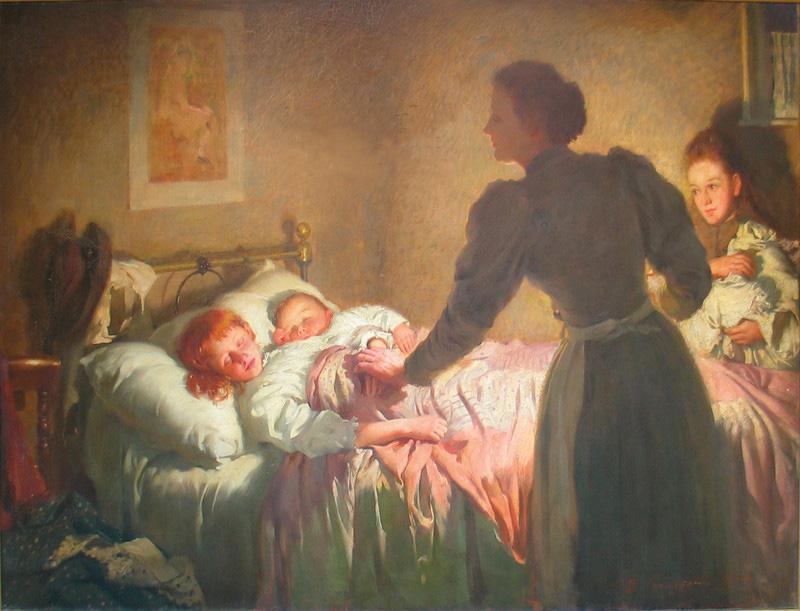
In contrast to the abandoned children we saw depicted in the previous paintings, the next painting, simply entitled The Mother, was Kennington’s idea of what family life should be about and how children should be brought up in a safe and loving environment.  This large work (115 x 168cms), which was completed in 1895, depicts a moment in family life when a mother says goodnight to her children.
The Mother by Thomas Kennington

This is a form of narrative painting as from about the seventeenth century, genre painting showed scenes and narratives of everyday life. Later, during the Victorian age, narrative painting of everyday life subjects became very popular and such art was often considered as a category in itself termed Victorian Narrative painting.   This theme of what family life should be about was a recurrent theme in Victorian art.  Domesticity was the order of the day focusing on how children and adults should behave within a family environment.  It was hoped that families could learn by what they saw through the medium of visual art.    This huge painting of The Mother by Kennington depicts her as the foundation stone of the family, the person who underpins the family group. The painting also alludes to another idea regarding Victorian family group.   If you look carefully at the dead centre of the work you will see the wedding ring on the mother’s finger and this could be the way in which the artist want to share his belief that marriage was also very important part of the family structure and family values.

In this painting we see the mother tending two of her young children.  Although the mother is the focal point of the painting she is depicted with her back to us.  We do not see her face clearly.  She is being helped by an older daughter, who is learning about the role of motherhood. The lighting of the painting is interesting.  The darker silhouette of the mother is in contrast with the brighter area around the two sleeping children, which is lit up by the light emanating from the lamp held by the mother and which is hidden from our view.   Of course this view of the family is a romanticised view of life in Victorian days and maybe it was more to do with what Kennington believed family life should be rather than the actuality.  This painting belongs to the Aigantighe’s Gallery in Hobart, Tasmania

Thomas Kennington exhibited his works in the Royal Academy of Arts every year from  1880 until his death in 1916.  His paintings were also regularly on show at the Royal Society of British Artists (RBA) and the popular Grosvenor gallery in London.   Kennington was a founding member and became the first secretary of the New English Art Club which was founded in 1885 and was one of the founders of the Imperial League of Art in 1909.  This society was set up to protect and promote the interests of Artists and to inform, advise and assist Artists, who have enrolled as members, in matters of business connected with the practice of the Arts  Its role was to aid the artists and the protection of their interests.  Kennington exhibited internationally in Paris and Rome and so good was his work that he was chosen to exhibit at the Universal Expositions held in Paris in 1889, where he was awarded a bronze medal.

Portrait of Elise Kennington née Stevani

Besides his genre pieces which highlighted Victorian poverty, Kennington was an accomplished portraitist.  Many of his portraits featured family members.  In 1883, aged twenty-seven, Thomas Benjamin Kennington married twenty-two year old Swedish beauty, Elise Stevani, who was born in Lund a town in Southern Sweden 1861.

Anne as Alice in Wonderland by Thomas Benjamin Kennington

His daughter Ann also featured in a couple of his works.  One was with her as Alice in Wonderland.

Portrait of the Artist's Daughter Anne in Russian Costume Holding a Balilaika by Thomas Kennington
Portrait of the Artist’s Daughter Anne in Russian Costume Holding a Balilaika by Thomas Kennington

The other, when she was older, was of her, dressed as a Russian lady holding a balalaika.

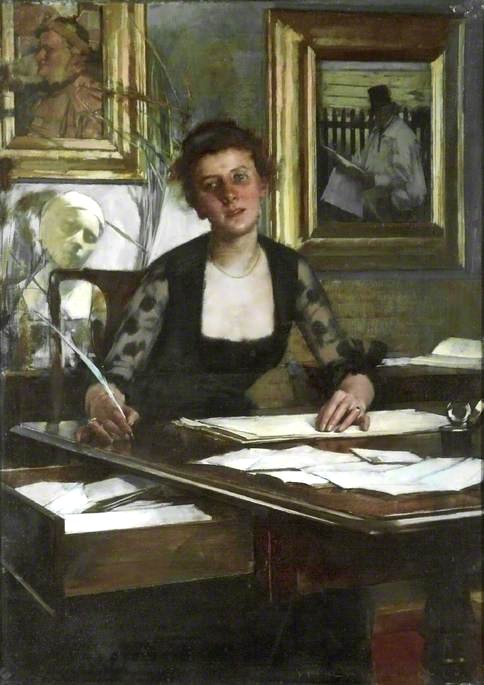
My last offering is another interesting work by Kennington which he completed in 1882 and entitled The Ace of Hearts.  There is an element of trickery about this depiction.  We see the lady seated before us staring directly at us  But are we who she is looking at?   Look carefully at the mirror on the wall, above and behind her.

The Ace of Hearts by Thomas Kennington

The image in the mirror indicated that the lady is looking straight through us, and focusing upon a man who can be seen scratching his neck.  He seems perplexed by what the woman is doing with the cards.  Look at the expression on the lady’s face.  It is one of satisfied triumph as she points to the ace of hearts and we can thus deduce that she was performing a card trick for the gentleman.  He is amazed and she is exultant with her trickery.

Thomas Benjamin Kennington died in London in December 1916 aged 60.  His wife Elise died at the young age of 34 in 1895.  Their son Eric was to go on to be a famous artist and in my next blog I will look at some of his work.

Henry Herbert La Thangue – the pictorial documenter of rural life

Henry Herbert La Thangue  (photo c.1893)
Henry Herbert La Thangue
(photo c.1893)

A few blogs ago I looked at the life and works of George Clausen and termed his art as rustic realism and today I want to delve into the life and the art work of another such painter, the English realist rural landscape artist Henry Herbert  La Thangue.

Henry Herbert La Thangue was born in Croydon, Surrey on January 19th 1859. He attended the renowned public school, Dulwich College, where two of his contemporary school friends were fellow aspiring artists Stanhope Forbes and Frederick Goodall. He enrolled briefly at the Lambeth School of Art in 1873 before enrolling on a five year course at the Royal Academy schools in 1874. The culmination of his studies at the Academy came in December 1879 when he won a gold medal for his work as well as a three year travelling scholarship to study in Paris at the studio of Jean-Léon Gérôme at the prestigious Ecole des Beaux-Arts.  It was during this time, whilst staying in the French capital, that he became influenced by the works of Whistler and the many paintings he saw at the Salon by artists who favoured rustic naturalism. He was also influenced by the landscape works of the en plein air artists of the Barbizon school. So how did the Barbizon School come into being ?

The Last Furrow by Henry Herbert La Thangue (1895)

As far as the French Academy was concerned aspiring artists should be taught in the Neoclassical tradition and copy the style of the painters of the Renaissance and Classical era.  Landscape art was not looked upon as an important genre unless the landscape , usually an idealized version, was combined with some historical connotation.  In 1816 the Academy even encouraged this genre by introducing a Prix de Rome in paysage historique (landscapes with a historical nuance), the winner of which would travel to Rome to live and paint at the Villa Medici.  By making this award the Academy had hoped to encourage artists to paint not just landscapes but by adding the historical aspect to the work it would ensure history painting would not die.  It actually had the opposite effect as many artists turned to simple landscape work and this desire was further enhanced when in 1824 John Constable’s landscape works were exhibited at that year’s Salon.

The Plough Boy by Henry Herbert La Thangue (c.1900)

In the warm summer months artists would leave the French capital and move to the tranquillity of the Parisian countryside around the Forest of Fontainebleau with its dense forest and meadowlands.  Small hamlets were situated around the periphery of the forest which made ideal stopping-off places for the artists and one such hamlet was Barbizon which proved to be the ideal temporary home for many landscape painters, such as Théodore Rousseau and Constant Troyon, who had rejected the Academic tradition of historical landscape painting and embraced a more realistic representation of the countryside and life in the country.  Later in the 1840’s, artists such as Jean-François Millet and Charles-François Daubigny came to Barbizon.

The Boat Builder's Yard by Henry Herbert La Thangue (1881)
The Boat Builder’s Yard by Henry Herbert La Thangue (1881)

In 1881 after completing his studies at the Ecole des Beaux-Arts, La Thangue travelled to Brittany, another popular region with landscape painters, and worked alongside the English landscape painter, Stanhope Forbes.  Whilst here, he met the renowned master of rustic realism, Jules Bastien-Lepage.  That year, he visited the small coastal commune of Concale, east of St Malo and completed his painting entitled The Boat Builder’s Yard. He remained in Brittany until mid 1882 and the following year he travelled south to the Rhone Valley commune of Donzère with his friend, the sculptor James Havard Thomas.

Resting after the game, Kate La Thangue by Henry Herbert La Thangue

When he returned to England in 1884, La Thangue first lived at South Walsham on the edge of the Norfolk Broads before moving to Rye in East Sussex for a brief time in 1885.   This was an eventful period in La Thangue’s life for in 1885 he married the actress, Kate Rietiker.  It was also at this juncture in his life that he became interested in politics surrounding art and art establishments.  La Thangue was a radical thinker and believed fervently that the Royal Academy had to change.  La Thangue proposed that it should be a more democratic society open to all and based on the principles of ‘universal suffrage’  Much was written about his views in the press but ultimately nothing changed.  La Thangue remained unhappy with the administration of the hallowed society and so he, along with a number of his like-minded contemporaries, having failed in their attempt to revolutionise the establishment, founded the New English Art Club in London in 1885 as an alternate venue to the Royal Academy

Portrait of the Artist's Wife by Henry Herbert La Thangue
Portrait of the Artist’s Wife by Henry Herbert La Thangue

In 1886, despite his misgivings surrounding the Royal Academy, he continued to exhibit works at the art establishment.  The Royal Academy was not the sole outlet for his works as the paintings were also exhibited Royal Society of British Artists and the Grosvenor Gallery, which had opened in 1877 by Sir Coutts Lindsay, and was a welcoming home for those painters, such as Edward Burne-Jones and Walter Crane, whose works the more conservative Royal Academy shunned.  His paintings could also be seen at the New Gallery which was founded in Regent Street in 1888 by Comyns Carr and Charles Edward Hallé who had once been co-directors of the Grosvenor Gallery but because of all the Grovesnor Gallery problems, had resigned and set up this new gallery.  The New Gallery was also a home for the works of the Pre-Raphaelite and  Aesthetic movement artists and artists such as Lawrence Tadema-Alma, William Holman Hunt, Lord Leighton and George Frederic Watts exhibited works at this establishment.  La Thangue also exhibited at the Royal Institute of Painters which he had joined in 1883.

The Return of the Reapers by Henry Herbert La Thangue (1886)

In the summer of 1886, La Thangue  moved home to the Norfolk countryside and the small fenland village of South Walsham.  During these years La Thangue produced head studies of farm hands and fisherfolk and it was whilst living here that he completed his landscape painting entitled Return of the Reapers.  This was a typical example of La Thangue’s rustic realism style.  La Thangue was probably influenced by the works of the French artists Jules Bastien-Lepage and Gustave Courbet and the en plein air works of the French Impressionists.

Study of a Boy with a Black Hat, before a Cornfield by Henry Herbert La Thangue

Five years later La Thangue left Norfolk and moved home south to the neighbouring county of Suffolk and the coastal village of Bosham just a few miles from the town of Chichester.  He carried on painting rural scenes, often large-scale works, with their realism connotations.

I

The Man with the Scythe by Henry Herbert La Thangue (1896)

n 1896 he completed a work The Man with the Scythe, which is now housed in the Tate Britain gallery in London.  This proved to be a controversial work.  At first glance one ponders as to the reasoning behind the title.  However, look closely and in the background you can make out a man carrying a scythe but this is not just a country scene with a man off to work in the fields whilst the mother tends her daughter.  This is a more solemn and symbolic piece,  as what we are witnessing is a mother horrified to discover that her young daughter has died,.  At the very instant of her tragic discovery a man arrives at the gate carrying a scythe, which is one of the traditional symbols of death, often referred to as the ‘grim reaper’.    This tragic and somewhat melodramatic depiction by La Thangue was a definite change in his subject matter and may have been influenced by the pair of paintings by Frank Holl in 1877 entitled Hush and Hushed (See My Daily Art Display Feb 9th 2012)

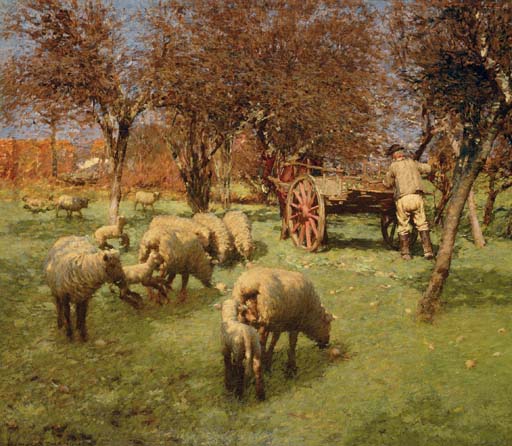
The March Month by Henry Herbert La Thangue

His English base from 1898 and into the early 1900’s was in the West Sussex village of Graffham.  His painting motifs still concentrated on rural life.  His works, depicting both arable and livestock farming, documented life in the fields from the harrow and the harvest, to  animal husbandry and fruit growing.  He was always searching for the perfect portrayal of the countryside and countryside practices during the different seasons.  In his painting entitled The March, completed around 1900,  he depicted the orchard near his house which was also used as nursery areas during lambing time.   We see the farmer scattering turnips from his cart which would feed the sheep and fatten up the lambs.  It could be that this depiction by La Thangue was influenced by the famous novelist and gentleman-farmer Rider Haggard, a contemporary of the artist, for in his 1899 book A Farmer’s Year  he talked about fattening lambs:

“….’The flock is being penned at night on the three-acre [field] with a view to improving the bottom of his young pasture which has grown somewhat thin. In the daytime they run out to one or other of the meadows, where root is thrown to them, and every night they are shut in a new fold on the three-acre and receive a ration of corn, hay and beet…”

Selling Chickens in Liguria by Henry Herbert La Thangue (1906)

At the turn of the century La Thangue became more and more interested with the work of the French Impressionist painters and their fascination with light and in 1901 he travelled to Provence.  From 1903 to 1911 he spent much of his time in the Italian region of Liguria building up a large collection of work. Despite La Thangue’s earlier outspoken criticism of the Royal Academy he became an Associate of the Royal Academy in 1898 and became a full Member in 1912.

Violets for Perfume by Henry Herbert La Thangue (ca. 1913)

His diploma work for the Royal Academy was one entitled Violets for Perfume.  The notable English artist, George Clausen (see My Daly Art Display May 30th & June 8th 2015) wrote about La Thangue’s work:

“…Sunlight was the thing that attracted him: this and some simple motive of rural occupation, enhanced by a picturesque surround…”

This work stemmed from his time in Provence and depicts a woman tipping a basket of freshly picked violets onto a muslin sheet in preparation for perfume making. All through his artistic career La Thangue developed his subject matter from labourers working in fields, vineyards and orchards. The depiction of the lady working in this work highlighted the back-to-basic work practice.  Gone was the mechanised practice of harvesting which La Thangue disliked and which he saw creeping into the rural life of England, destroying the old-fashioned rural practices which he had so loved to paint.

A Mountain Frontier by Henry Herbert La Thangue (1910)

In 1914, just prior to the beginning of the Great War, the Leicester Galleries in London  staged a one-man exhibition of La Thangue’s southern European landscape works,  which concentrated on his paintings completed whilst he was in Provence and Liguria.  One of the works exhibited was entitled A Mountain Frontier which La Thangue completed around 1910.  The exhibition was a great success and praised by the critics.  The artist William Sickert wrote about La Thangue’s skill as a painter in the May 1914 issue of the British literary magazine The New Age stating:

“…What renders La Thangue’s work particularly interesting is that while using the language of the day in painting, that is to say an opaque mosaic for recording objective sensations about visible nature, he is using it in a personal manner…”

Sickert went on to write that La Thangue, through his talent at developing relations of colour with a warm colour at the base,  was able to build on it a series a series of beautiful and interesting sensations of nature which is what he,  and not somebody else, had to say.

A Ligurian Bay by Henry Herbert La Thangue

In the 1920’s after the Great War had ended La Thangue returned to Liguria and the motif of his paintings changed from the arable land of the English countryside to the sunlit orange groves and gardens of Italy.  La Thangue spent those days in southern Europe painting en plein air directly on to large canvases.  This belief is based on the fact that very few smaller versions of his paintings or sketches exist.

Wreck of the S.S. Manuka December 16th 1929

Henry Herbert La Thangue died on December 21st 1929, just a few weeks before his seventy-first birthday.  Less than a week before his death La Thangue had been devastated and depressed when he was given the news that a vessel, the S.S. Manuka, during a voyage from Melbourne/Bluff/Dunedin was wrecked on Nugget Point near Long Point, South Otago.  Part of the cargo on the vessel was two of La Thangue’s paintings.  La Thangue was never to know, that five days after his death, the paintings were recovered and said to have been in “reasonable condition”.

 His wife Kate died in 1941.

Sir George Clausen. Part 2 – More rural works and the War artist

Sir George Clausen       1852 - 1944
Sir George Clausen
1852 – 1944

In this concluding part looking at the life and works of George Clausen, later Sir George Clausen, I will focus on his love of depicting workers labouring in the fields in a genre of art which was often referred to as rustic naturalism and have a look at a couple of works he completed whilst he was employed as a war artist.

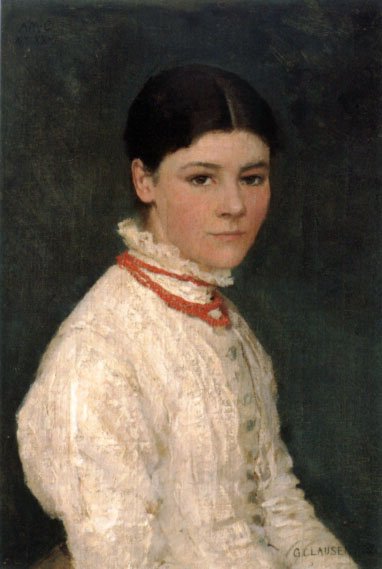
Agnes Mary Webster by George Clausen (1882)

In 1881 George Clausen married Agnes Mary Webster of Kings Lynn and they went on to have three sons and a daughter.  Clausen had met her brother, Alfred, at South Kensington Art School where he was also studying art.  The following year Clausen painted his wife’s portrait.

Henry La Thangue, an English landscape painter, who had visited Brittany to paint and was a friend of Stanhope Forbes, another landscape artist, persuaded Clausen to take a trip there to discover the countryside and light the French area had to offer.  And so, in 1882, Clausen sett off for Brittany with his wife and visited the artist colony at Quimperlé, a small town, fifteen kilometres east of the other popular haven for artist, Pont Aven.   Here they met up with the Dublin-born artist, Stanhope Forbes who, two years later, moved to Newlyn in Cornwall and became a leading figure in that growing colony of artists.  Stanhope Forbes was excited that Clausen was to join him at Quimperlé writing to his mother in September 1882:

“…Thangue tells me he is sending G.Clausen the painter and his wife.  Very glad as he is a really good painter in fact belongs to the sacred band whom even I admire…”

 It was whilst here that Clausen produced a number of wonderful paintings depicting local peasant farm workers and their families.

Peasant Girl Carrying a Jar, Quimperlé by George Clausen (1882)

One such work was entitled Peasant Girl Carrying a Jar, Quimperlé which he completed in 1882.  This is a portrait of a young girl seen standing in a field, hand on hip, holding an earthenware pot.  She is dressed in a peasant costume, the quality of which indicates that she is from a family of limited means.  She is surrounded by tall spherical flowering onion plants. It is interesting to look closely at the way Clausen has depicted the pose of the young girl.   This is not the pose of a professional model.  This is a peasant girl displaying the uncomfortable pose of a young child, which makes the image of her appear so realistic.  There is no harshness about the way Clausen has depicted her facial expression.  It is a face that exudes gentleness.  What must be going through the child’s mind as she poses for this foreigner, the artist?

The Return to the Fields by George Clausen (1882)

The next featured work of Clausen is a small watercolour (35 x 26 cms) which he again completed in 1882.   The painting, entitled The Return from the Fields depicts two young workers carrying bundles of brushwood which had been obtained by thinning out the copses.  This brushwood was used for hedging, or as beating implements used for fire fighting or sometimes used to construct sheep hurdles.  That year, the painting was exhibited at Institute of Painters in Watercolours, in London, under the title of Boy and Man and the art reviewer of the Magazine of Art commented favourably on the work:

“… the most artistic work on the walls……a small drawing, but it is so strong, and at the same time so tender and full of feeling, that it arrests attention more powerfully than the other pictures together.  It is evidently inspired by Millet…….he has struck the right road…”

Head of a Peasant Woman by George Clausen (1882)

Clausen painted two close-up portraits of peasant labourers.  The first was entitled Head of a Peasant Woman which he completed in 1882.   This is a wonderful portrait.  It is a triumph of realism as Clausen has depicted the woman, “warts and all”.  We see her weather beaten face caused by the many days and weeks of working the fields and her wrinkled bow is testament that she has endured a hard and worrisome life.  She doesn’t look directly at us as she rests her hands on a long stick.  The ring on her wedding finger glints in the sunlight.

Labourers after Dinner by George Clausen (c.1882)

The second portrait was an oil and canvas study of a young boy who was to figure in a work entitled Labourers after Dinner.  This painting is held in a private collection in Australia and I have not been able to find a colour copy of it so have just scanned a black and white version which I found in a magazine.   The painting was the first indication that Clausen was moving away from the emotional depiction of peasant pictures which had been popularised in England and France by Jules Bastien-Lepage.  Clausen veered towards more naturalistic, if brutal, genre subjects. This work was one of the most studied of Clausen’s early compositions.   It is a depiction of a boy sitting between his mother and father who were taking a rest from their work in the fields.  The controversial Irish novelist and art critic, George Moore, on seeing the painting, wrote scathingly about the group depicted in the painting in his 1893 book entitled Modern Painting. In it he commented on the depiction of the boy’s mother and father:

“…the middle aged man and woman who live in mute stupidity – they have known nothing but the daily hardship of living and the vacuous face of their son tells how completely the life of his forefathers has descended upon him…”

Head of a Peasant Boy by George Clausen (1884)

A “vacuous face” wrote Moore.  I will let you decide as the oil sketch Clausen made prior to the large scale painting, entitled Head of a Peasant Boy is awash with detail.  George Moore was not a lover of realism in art as in the same book he condemned it saying:

“…Realism, that is to say the desire to compete with nature, to be nature, is the disease from which art has suffered most in the last twenty years.  The disease is now at wane, and when we happen upon a canvas of the period like Labourers after Dinner, we cry out, ‘What madness! Were we ever as mad as that?”…”

Harsh words indeed and yet I like this painting.

The Shepherdess by George Clausen (1885)

Clausen was a founder member of the New English Art Club (NEAC) of London which was set up in 1885 in competition with the Royal Academy.  It was a club which attracted many young inspiring artists who were returning to England after their artistic studies in Paris.  One of Clausen’s first paintings to be exhibited at an NEAC exhibition was The Shepherdess which he completed in the Spring of 1885 and which is now art of the National Museums, Liverpool collection.   Clausen had sold the painting to John Maddocks an artist and art collector, and borrowed it back to show at the exhibition.  The orchard in which the young girl stands was to feature in a number of Clausen’s works.  In 1891, the art critic of The Magazine of Art, Butler Wood, commented on the work:

“…admirable specimen of Mr Clausen’s best manner, and displays feeling and atmosphere.  His colour scheme is simple, yet satisfactory and skilfully elaborated.  The girl’s figure is modelled with almost sculpturesque strength and the face painted with that ruddy glow of health which he is so clever at rendering…”

In 1891 Clausen moved from the Berkshire village of Cookham Dean and went to live in Widdington, a small picturesque village in the county of Essex.  He had been exhibiting most of his works at the New Gallery and the NEAC but as his paintings became larger in size they were not easily accommodated at these venues and so he had to once again look at exhibiting his larger works at the Royal Academy in London.  Clausen had fallen out with the Royal Academy years earlier over their teaching methods and their strict and antiquated rules but now, with an ever expanding family, he needed the support of the Academy if he was to sell his larger works.  In 1895, Clausen was elected an Associate of the Royal Academy.  The art world noted his election to an establishment he had once roundly criticised but many saw Clausen as an excellent addition to the RA.  The scholar and prolific art critic of the time, often referred to as “one of the most powerful figures in the late Victorian art world”, Marion Spielmann, wrote about Clausen’s appointment in the February 1895 edition of weekly illustrated newspaper, The Graphic:

“…Mr Clausen was…… a signatory of the open letter which years ago set fire to the inflammable material which we young hot-bloods had….pile up  against the door of the Academy…. much amelioration has been brought since then;  the girls may now study from the semi-nude; then standard of probationership has been raised….”

Clausen now worked within the Academy system, a system which he had once heavily criticised.   He gave up his time, a couple of months each year, to teach students at the Royal Academy Life School Between 1904 and 1906 and in that year he became Professor of Painting at the Academy and, because of the large number of students who attended his lectures, was regarded as one of the most popular professors since Joshua Reynolds.

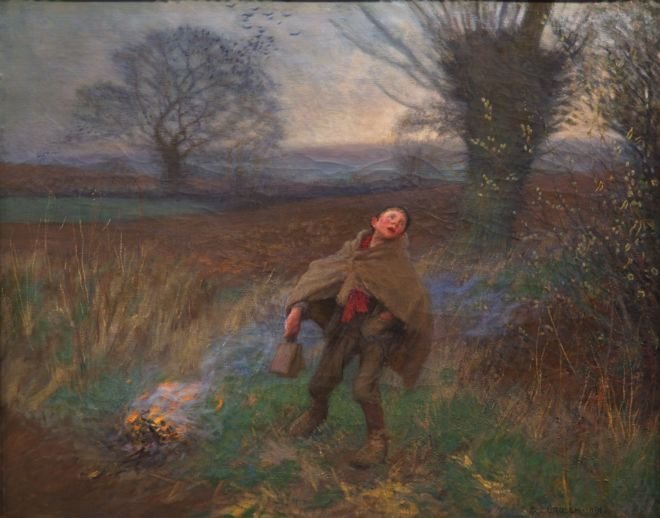
Bird Scaring by George Clausen (1896)

One of the works Clausen completed in 1896 was entitled Bird Scaring: March, and which is housed in the Harris Museum and Art Gallery, Preston.  In Victorian days bird scarers were employed by farmers to act as human scarecrows. Their task was simple; they just had to position themselves in the farmer’s field and scare off the birds which swoop down to eat the farmer’s crops.  This onerous job was for very young children who had to be working in the fields, dawn to dusk, no matter what the weather was like.  In the painting we can see the young boy who, despite the cold weather, wears only sack-cloth.  A small fire has been lit on the ground to keep him warm.  The blue/grey smoke from the fire wafts behind him giving us the sense that it is not only cold but also windy.  He is energetically swinging around, holding a wooden clapper in his right hand which made sufficient noise to deter birds from landing nearby.

Youth Mourning by George Clausen (1916)

For my next two featured works by Clausen you will notice a complete change of style.  The first one was completed in 1916 and entitled Youth Mourning.  The work you see is not the original version but one altered on the request of the purchaser.  Clausen, who was sixty-four when he painted this work was too old for military service in the First World War, however he was not untouched by the many tragedies of the Great War for his son-in-law, the husband of his daughter Kitty, was killed in battle in 1915 and it was that sad event which moved him to paint this work.  It was his personal expression of grief for the thousands who perished during the conflict.  This was an artistic departure of his favoured rustic naturalism style and more towards the French Symbolist genre.

In the original work there were three white crosses in the ground just behind the female and further in the background many more white crosses could be seen.  When the owner of the work, a Mr C.N.Luxmoore, who bought this and many other paintings from Clausen presented it to the Nation in 1929 the crosses had been painted out just leaving a barren shell-holed hillside.  We have no definitive reason why the owner got Clausen to re-paint part of the work.   The resulting work has a powerful symbolic aura of anguish and sorrow captured by the nude female figure hunched over in the foetal position.  The finality of death is depicted by the barrenness of the landscape where nothing lives.

In the Gun Factory at Woolwich Arsenal, 1918 by George Clausen (1918)

George Clausen was later appointed an official war artist and took part in the ambitious British War Memorials Committee art scheme in 1918. He produced a large 183 x 318cms oil on canvas work in 1918 entitled In the Gun Factory at Woolwich Arsenal, 1918.  This urban scene once again is huge shift away from rustic idylls of the countryside we saw in his earlier works.  The painting was a commission Clausen received from The Ministry of Information who said they wanted a “Uccello” sized work of art which would be exhibited in the Hall of Remembrance.  Clausen visited the gun factory on a number of occasions and had originally intended that the painting would be in an upright format but eventually realised that it had to be of a horizontal format.  The work was finally completed in December 1918 and was first exhibited at the Royal Academy Winter Exhibition of 1919-20.  Critics believed it was one of the best works on display.  In 1926, due to his successful war commission he was commissioned to paint murals, notably Wycliffe’s English Bible for the Houses of Parliament and on completion of this task he was knighted.  He continued to regularly exhibit work at the Royal Academy during the 1930’s.

My Back Garden by George Clausen (1940)

One of last paintings by Sir George Clausen was one he completed in 1940 entitled My Back Garden.  It was a depiction of the back garden of his house at 61 Carlton Hill, London.  He was eighty-eight years of age when he painted this picture.  It was almost a farewell painting as a year later; he had left his beloved house and garden because of the almost continuous bombing of London by the Nazis.  He decided that he and his wife should move to Cold Ash, a Berkshire village some two miles from the town of Newbury and seventy miles west of London.  Clausen continued to sketch and complete watercolours which he sent off for inclusion in the Royal Academy Summer Exhibitions of 1942 and 1943.   Clausen’s wife’s health had deteriorated in 1939 and she remained poorly until her death in March 1944.  Sir George Clausen died eight months later in November 1944, aged 92.   In June 1944, just five months before Clausen’s death, he was approached by Kenneth Clark, the Director of the National Gallery, proposing a retrospective exhibition of his work at the National Gallery.  Clausen was delighted with the proposal and wrote back to Clark:

“… I think such an exhibition as you suggest would be more appropriate when I am dead and indifferent to praise or censure !   However I will help you all I can…”

Sadly the exhibition never took place.

Sir George Clausen. Part 1. Rustic Naturalism and the influence of Jules Bastien-Lepage

Sir George Clausen       (Self Portrait)
Sir George Clausen
(Self Portrait)

There is something very intriguing about “–isms” when talking about genres in art.  We are all aware of them common ones such as realism, impressionism, cubism, etc.  In fact I have an art history book about “-isms”.  Today I want to introduce you to another “-ism” which is not mentioned in the knowledgeable tome.  It is ruralism, often referred to as Rural Naturalism, an art genre through which artists pictorially champion life away from the grime of cities and, through their paintings, exalts life in the countryside.   One of the great exponents of ruralism is the subject of my next two blogs, the English painter, Sir George Clausen.

George Clausen was born 8 William Street, Regents Park, London in April 1852, the son of Jorgen Johnsen and Elizabeth Clausen.  His father, an artist and interior decorator, was of Danish extraction and his mother was of Scottish descent.  Up until the age of fourteen and a half, George attended St Mark’s School in Kings Road Chelsea.  In 1867, three months before his fifteenth birthday he started a five year apprenticeship in the Chelsea drawing office of Messrs. Trollope, a firm of interior decorators.  During this period he was trained in drawing by John Cleghorn, whose job title was a copyist and limner, an old term for a painter of ornamental decoration, a book illustrator or somebody who illuminates manuscripts.  Cleghorn had an artistic background having studied at The Royal Academy Schools.  George Clausen had a thirst for artistic knowledge and to supplement Cleghorn’s tuition, also attended evening classes at the National Art Training School, South Kensington, which in 1896, would become the Royal College of Art.  One of the jobs Clausen was involved in was to decorate the home of the English genre, history, biblical and portrait painter, Edwin Long.  Clausen’s boss, an Irish man called Brophy, gave Clausen the task to paint some lilies on the panels of a door in Edwin Long’s house.  Clausen remembered this time and it must have made an impression on him, for sixty years later in his Autobiographical Notes which appeared in the Spring 1931 edition of the Artwork magazine he recalled the time:

“…Long looked at my work and said ‘May I see your sketchbook?’   He gave it back to me and said ‘Did you ever think of becoming an artist?’  I said ‘Yes, but I saw no opportunity of getting the training.’  Long said ‘I think you’d have a chance. And if I were you I’d try for a scholarship at South Kensington.’  Brophy readily agreed.  I had already taken medals in design, and I was worked up in my spare time, and obtained a two years’ scholarship in decorative painting at £50 a year!…”

Clausen was not enamoured by the training he received during the two year course at South Kensington School of Art.  He believed that there was not enough teaching and lacked structure as students were left to get on with things themselves.

The Baylonian Marriage Market by Edwin Long (1875)

He did however keep in contact with Edwin Long and did a lot of research work for him with regards some of Long’s large biblical paintings.  Long would pay Clausen for his help and also tutored him.  Long realised that Clausen’s artistic ability needed to be carefully nurtured and believed, for Clausen to receive the best artistic tuition, he needed to leave England and move to Antwerp and attend the Antwerp Academy of Art.

George Clausen accepted the advice and travelled to Holland and Belgium and for a short period enrolled at the Antwerp Academy where he studied under the tutelage of Professor Joseph van Lerius.  His sketches and paintings around this time were heavily influenced by Dutch subjects such as the coastal fishing villages and he exhibited a number of these at the Dudley Gallery, which was originally located in the Egyptian Hall, Piccadilly, London.   It  was completed in 1812 and financed by Earl of Dudley to house his valuable collection of pictures during the erection of his own gallery at Dudley House in Park Lane. It was known for its promotion of French and Dutch artists.

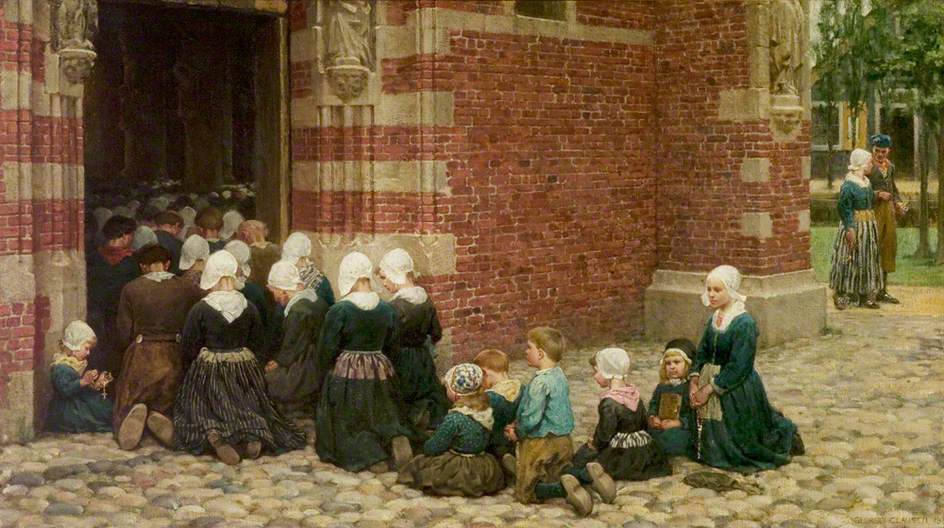
High Mass at a Fishing Village on the Zuyder Zee, Holland by George Clausen (
High Mass at a Fishing Village on the Zuyder Zee, Holland by George Clausen (1876)

One example of Clausen’s “Dutch period” was his small (47 x 84 cms) oil on canvas painting entitled High Mass at a Fishing Village on the Zuider Zee, which he completed in 1876 and is part of the Nottingham Castle Museum collection.  The work was the result of a summer holiday Clausen had taken to the island of Marken, in the Zuider Zee, with his friend and fellow artist Dewey Bates.  They had visited the village of Volendam on a Sunday, where there was a celebration of a High Mass.  The mass was so well attended that the church was full and many parishioners were left outside.  In the painting we see into the fully occupied church as well as a group of fishermen with their wives and children kneeling on the cobbled street outside the main entrance door.

The painting was exhibited at the Royal Academy, the first work he had ever submitted to the prestigious establishment, and the art critic of The Times, seeing the work of art and Clausen’s name immediately believed he was a Dutch artist painting a scene from his homeland and wrote :

“…a very clever Dutch painter, hitherto only known in this country by two drawings exhibited at the Dudley Gallery…”

The art critic of the Spectator was full of praise writing:

“…a quiet thoughtful picture, in every sense of the word. A work of true art and deep feeling…”

Whilst in Europe George Clausen made many visits to Paris.  His paintings around this time showed that he had been influenced by the likes of Whistler and William Quiller Orchardson, a well loved Scottish portraitist and painter of domestic and historical subjects.  He was also very interested in the rustic natural depictions of the Scottish artist John Robertson Reid and Léon Augustine Lhermitte, a French realist painter, whose primary subject matter was of rural scenes depicting the peasant worker.

La Pensée by George Clausen (1880)

In 1880 Clausen exhibited his work La Pensée at the Grosvenor Gallery in London.  It was a difficult depiction for an artist with the model seated in an interior.  The figure is not seated parallel to the plane of the picture and the rear wall.  It is a work of art full of detail.  Look at the right background and you can see the edge of an elaborate chimney piece.  In the left background there is a drop leaf table and on the floor a goat skin rug.  The lady sits upright in the chair looking out at us whilst grasping a knot of violets in her right hand which rests in her lap.  This is the key to the title of the painting (Thought).  Here is a lady lost in thought about her lost love.

Spring Morning, Haverstock Hill by George Clausen (1881)

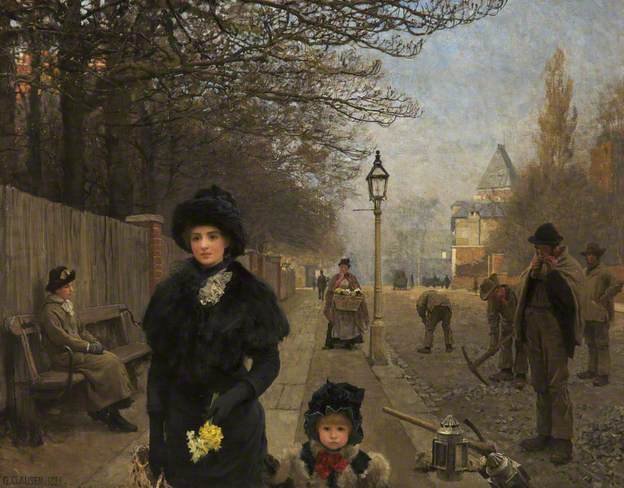
Clausen often used this model for his paintings and one I particularly like featuring her was completed in 1881 and entitled a Spring Morning, Haverstock Hill.  It was exhibited at that year’s Royal Academy exhibition.  This London street scene was an ambitious work featuring not just the main female model, who walks along the street accompanied by a small child, but a number of other characters some at rest, some at work, including labourers digging up the cobbles in the road and, directly behind the main character, a flower seller.

Les Foins by Jules Bastien-Lepage (1877)

When Clausen exhibited La Pensée at the Grosvenor Gallery amongst his fellow exhibitors was Jules Bastien-Lepage who was exhibiting nine paintings, including Les Foins (Haymaking), which depicts resting haymakers.  This painting had been exhibited at the Salon in 1878.  Clausen, like the critics, were enthralled by this work of rural or rustic naturalism.  Clausen shortly after moved to the countryside and went to live in the Hertfordshire village of Childwick Green.  He later wrote in his 1931 Autobiographical Notes about his new surroundings and the new opportunity and challenges it gave him as a painter

“…One saw people doing simple things under good conditions of lighting: and there was always a landscape.  And nothing was made easy for you: you had to dig out what you wanted…”

The Gleaners by George Clausen (1882)

Soon his sketchbooks were full of sketches and paintings depicting workers in the countryside surrounding his house.  One of Clausen’s first works depicting labourers in the fields was completed in 1882 and was entitled The Gleaners.  The work was exhibited at the Grosvenor Gallery in 1882.  It was greeted with great acclaim by the critics and art reviewers.  In Vol. V 1881-2 of The Magazine of Art, the reviewer wrote about how Clausen sympathetically depicted the labourers:

“…He shows us a little company of the poor not in picturesque rags but in garments of fact, gleaning modern English fields…”

Pauvre Fauvette by Jules Bastien-Lepage (1881)

In 1881 Bastien-Lepage completed a work entitled Pauvre Fauvette.  He often painted the peasants from the town he was living in at the time, Damvillers which is situated in north-eastern France. In his painting we see a very small young girl, the ‘little wild girl’ of the painting’s title.  Her job is to patiently and quietly guard a cow, which we see on the other side of the tree.  In a way it is a depiction of isolation in the way the artist has depicted the small child, even dwarfed by the tall thistles.  She stands alone next to a leaf-less tree surrounded by  a very barren landscape.  It is a pitiful depiction and we note her haunted and sad eyes and the way she tries to cover herself up and keep herself warm in a threadbare blanket leads us to believe it could have been a cold winter’s day.

The Stone Pickers by George Clausen (1887)

The next work I am featuring was also probably influenced by Bastien-Lepage’s work above.  It was one which Clausen began in the autumn of 1886 and completed in 1887.  It was entitled The Stone Pickers.  On completion Clausen sent it to Goupil, the art dealer and in 1887 it was exhibited at the Dudley Gallery, London and also appeared at the second New English Art Club exhibition of 1887.  It is now housed at the Laing Gallery in Newcastle upon Tyne.  The model for the painting was Polly Baldwin and the setting was at Cookham Dene.  Look how in this work the girl has sacking wrapped around her lower body to keep her warm, similar to the attire of the child in Bastien-Lepage’s painting.  Stone pickers were sent out into the fields to pick up loose stones prior to ploughing.  In Clausen’s painting we see a young girl depositing stones, which she had picked up, on to a pile.  In the background we see another woman bent down picking up stones from the field. One can only imagine what a backbreaking and tedious job the women had to endure.  Many artists of the time liked to depict hard working labourers/peasants at work in the fields,  This was the essence of rustic realism or rustic naturalism.  Look at the expression on the young girl’s face as she looks down at the pile of stones.  It is a sad and almost haunted expression.  Behind her there is a can containing water and a wicker basket containing food for her lunch.  Our eyes are drawn to this area because of the red colour of what could be a table cloth.

In my next blog I will complete Clausen’s life story and have a look at some more of his works of art.


Frederick Elwell. Part 4 – More of his genre works

Frederick William Elwell       (1870 - 1958)
Frederick William Elwell
(1870 – 1958)

In my final look at the life of the twentieth century Yorkshire artist Frederick William Elwell I want to conclude his life story and look at some of his genre paintings.

In the last blog, when looking at his life, I had reached 1914.  It was in the August of that year that the Great War began in Europe and it was also in that year, two months later, that Fred Elwell married his close friend and fellow artist, Mary Dawson Holmes.  The newlyweds made their home at Bar House, a residence Mary and her late husband George Holmes had bought in 1910.  Mary loved the house and its garden and they were depicted in a number of paintings by both Mary and Fred.

At the Mirror by Mary Dawson Elwell

In the work entitled At the Mirror by Mary Dawson Elwell we see the interior of one of the bedrooms of their house which overlooked York Road.  There are two large double beds each covered with a purple quilt.  One of the bedroom’s windows is in the central background and through it we are able to see the neighbouring house, Wyles House.  The technique of allowing viewers to catch a glimpse of the outside world, seen through the framing device of a window, had always been popular with artists.  To the right of the window a woman stands before a mirror brushing her hair totally oblivious of the outside world that we see through the window.  The large full length mirror reveals a reflection of the room.  The light which shines through the windows of the room lights it up and the polished brass fender casts its reflection on the dark polished wooden floor.

Bar House Garden, Beverley by Fred Elwell (1914)

Fred Elwell painted a number of depictions of the interior of the house but I particularly like the one he completed in 1914 of the garden at Bar House entitled Bar House Garden, Beverley .

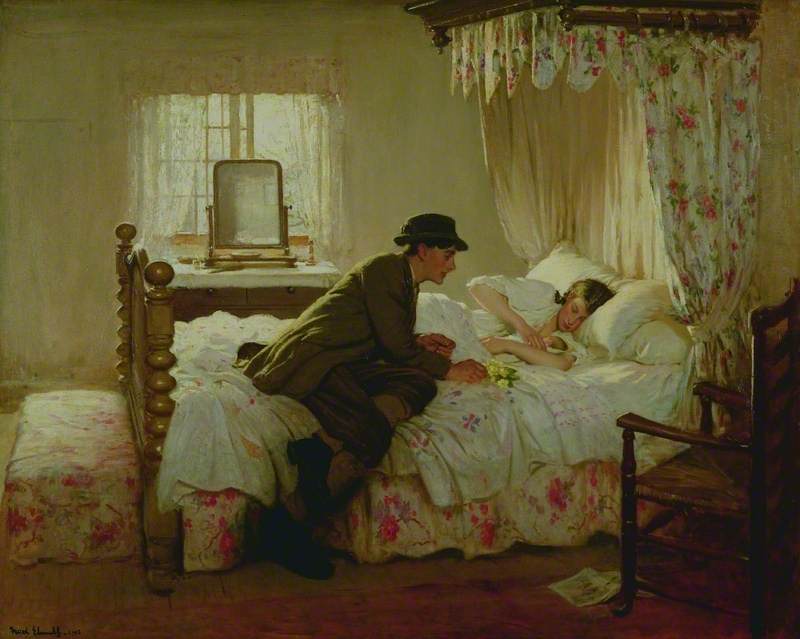
The First Born by Fred Elwell (1913)

It was also around this time that Fred Elwell developed an idea based on the blissful event for a mother,  the birth of her child.  This type of painting was not a new idea for artists but the mother/baby scene had been depicted as far back as the Renaissance period.  In 1913 Elwell completed an oil on canvas work entitled The First Born.  The setting for the work is a farm worker’s cottage in Beverley.  The furnishings are simple.  The large canopied tester bed with its old-fashioned chintz curtains and turned bed-posts takes up centre stage in the painting.  A floral-covered ottoman sits next to the end of the bed.  By the bed is a ladder-backed cane chair.   In the work we see the young father who is still wearing his gamekeeper clothing.  He has rushed home from work to be with his wife and their first baby.  The father sits on his wife’s bed, leaning slightly forward to catch a better glimpse of his child.  He grasps small bouquet of primroses as a small present for his wife.  Primroses are associated with spring which in turn is associated with new beginnings which fits in nicely with the birth of the newborn baby.   It must have been a warm spring day as the sliding window is open and the delicate lace curtains gently flutter in the breeze which penetrates the room.   The thing which strikes you when you look at this work is how light and airy it is.  This was a factor in the work of the French Impressionists and was taken on board by the artists involved with the Newlyn School in Cornwall around the end of the nineteenth century and the first decade of the twentieth century.

The Wedding Dress by Fred Elwell (1911)

Queen Victoria died in 1901 and this solemn period and the Victorian period prior to her death saw many artists concentrate on human loss and the grief felt when a loved one died.  Queen Victoria suffered the loss of her beloved husband, Albert in 1861, and continually wore mourning clothes for ten years after he died.   Many paintings compared the happiness of life before the death of a loved one with the inconsolable grief of those left behind.  Elwell beautifully captured such a moment with his painting, The Wedding Dress, which he completed in 1911.  The setting for Elwell’s painting is the widow’s bedchamber.  The lady lies slumped against the ottoman at the end of the bed, the lid of which is open.  On the floor next to her is her wedding dress and we can see more wedding clothes in the chest.  She is grief-stricken and buries her face in her hands.  We cannot see her face.  This is a private and very sad moment for her.  It could be that although she had her wedding dress, she never had a chance to marry her fiancé or maybe she did marry and is now remembering the day her and her late husband got married and the happy life they once had.  It is a pictorial tale of two worlds.  The white of the dress and the happiness of marriage in contrast to the black mourning clothes she wears in respect of her late husband or fiancé.  It is the contrast between innocence and happiness and the darkness of sadness and loss.  One other thing which makes this depiction even more poignant is the fact that the model for this painting was a local girl, Violet Prest, a costumier of Minster Moorgate West, in Beverley, and three years after the painting was completed, her husband was killed in the Great War.

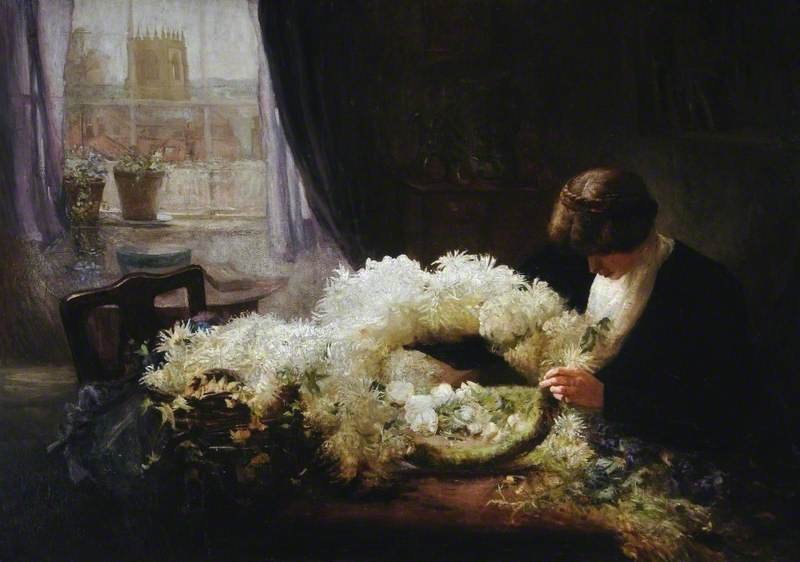
The Wreath by Mary Dawson Elwell (1908)

Violet Prest also modelled for Elwell’s soon-to-be-wife Mary for her painting entitled The Wreath which she completed in 1908, three years before Fred Elwell completed The Wedding Dress.

His Last Purchase by Fred Elwell (1921)

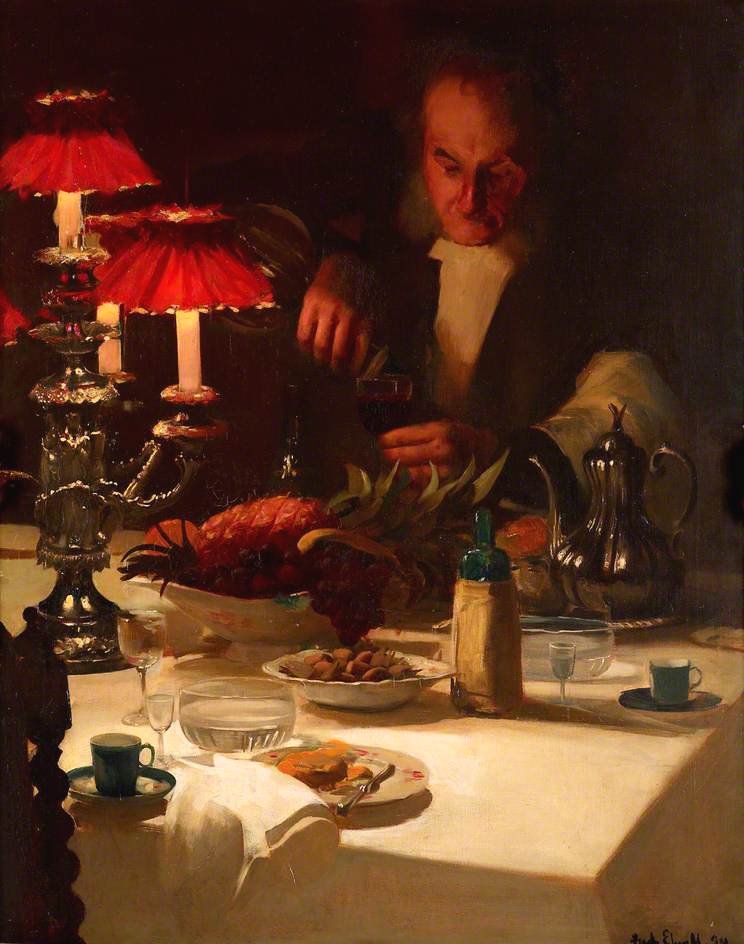
With this being the last part of my blog featuring Frederick Elwell I was in a quandary as which paintings to feature or more to the point which ones could I bear to leave out.  My next painting by Elwell was completed in 1921 and is one of my favourites.  It is entitled The Last Purchase and is housed in the Ferens Art Gallery in Hull.  The painting depicts Fred’s father, James Elwell, sitting at a table in the book-lined study of Fred and Mary Elwell’s house.  We see before us a very satisfied and happy man who has just returned from an antiques auction with his purchases.  James Elwell was a great lover of ceramics and in the painting we can see him carefully eyeing the vase which was one of his purchases.  It is not in perfect condition but this master craftsman considers how best to repair the lip of the vase.  The table he sits at is covered with his beloved purchases some of which still retain their auction lot number.

The painting was originally entitled His New Purchase but on James Elwell’s death in 1926, Fred Elwell changed the title of the work to The Last Purchase in memory of his late father.  What I like about this work is that it highlights the artistic ability of the artist.  It is not just a meticulous and lifelike portrait of his father, it is an example of his ability to paint a still-life work as well as it being a beautifully crafted interior painting

 In 1931, Elwell was elected to the Royal Society of Portrait Painters and, in 1938, he was elected as a member of the Royal Academy.  Elwell felt very honoured to have been elected to full membership of the Royal Academy.  The honour came with one drawback, which he wrote about to one of his friends – the writing of acknowledgements to all his well wishers on them hearing of this artistic honour.  He humorously wrote:

 “…Can you picture me trying to cope……with twenty suitable acknowledgements every evening?   No club, no cinemas, no dinners, no theatres until they are finished for such are the Kingdom of God…”

 Having accepted the honour of becoming a full member of the Academy, he was asked to serve on the Royal Academy Council and become a member of the selection and hanging committee, which was a group of Academicians, who decided which works of art submitted by the public should be accepted into the Royal Academy’s annual exhibition.

The Royal Academy Selection and Hanging Committee by Fred Elwell (1938)

Having featured the portrait of his father in the previous work set me thinking, what could be more difficult than crafting a single recognisable portrait?  I suppose the answer is to craft a work of art which includes fourteen individual recognisable portraits and this is exactly what Fred Elwell achieved in his 1938 painting entitled The Royal Academy Selection & Hanging Committee, 1938,  which was his diploma work on being made a Royal Academician and was retained by the Academy as an example of his extraordinary artistic talent.

 The setting for this work was the assembly room of Burlington House.  This 18th century room was walled with dark wood panelling and the only light emanates from behind the artist himself as he tries to incorporate all the members of the picture selection and hanging committee who sit around the dining table.  Elwell has included himself into the group portrait.  He stands to the left with brushes and palette in hand.  Look how the light source has not only illuminated the faces of the Academicians but also lit up the tableware and napkins.

Armstrong's Garage by Fred Elwell (1921)
Armstrong’s Garage by Fred Elwell (1921)

The next two paintings I am showcasing show how war changes every facet of daily life.   The first work is entitled Armstrong’s Garage which Elwell painted in 1921 and features the interior of the Elizabethan timber-framed building which was a garage and workshop in Beverley, owned by Gordon Armstrong since 1907.  It was close to Fred and Mary’s Bar House.  Fred Elwell was fascinated by motor engineering and the innovative skill of the owner who designed and built his own car, known as The Gordon.  Gordon Armstrong also patented the Armstrong shock absorber which made motoring much more comfortable.   In the foreground of the painting we see two mechanics working at a bench and behind them we see the vast empty expanse of the workshop.  The timber “A” frames and beams play a prominent role in the depiction and are lit up by the light streaming through the skylights.  The work is now part of the permanent collection of the Williamson Art Gallery at Birkenhead.

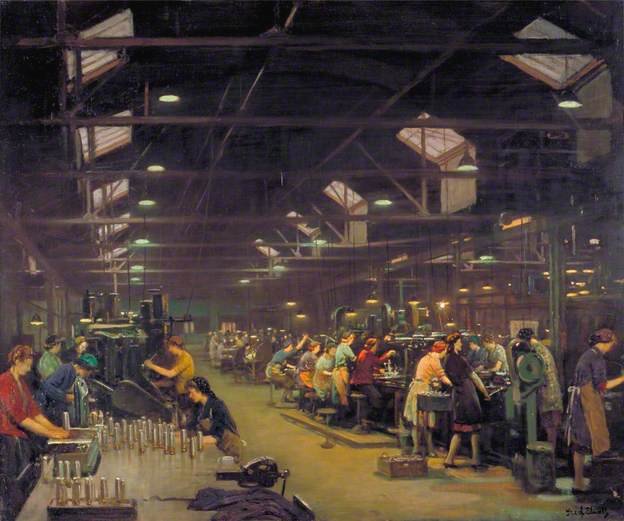
A Munitions Factory by Fred Elwell (1944)

 Fast forward twenty three years and Elwell painted another picture featuring Armstrong’s Garage but it could not be more different.  Armstrong’s business boomed and he eventually moved to a larger premises on the other side of town in the late 1930’s.  However with the onset of the Second World War, his garage was taken over by the government and turned into a munitions factory.  The painting which Elwell completed in 1944 and was entitled A Munitions Factory.  In the left foreground   of the painting we see a table on which lay tracer bullets and other munitions which had been produced in the factory.  This is not just a beautiful work of art but forms a pictorial record of the time.  The factory employees will be almost all women who helped the war effort whilst their male partners had gone off to fight the war.  This will be a daytime scene as we can see windows in the roof which would have been covered with black-out curtains had this been a night shift.  Despite it being the day shift there is a lack of natural light which would have added to the difficulty in working conditions.

Maids with Pigeons by Feed Elwell (1916)

I have reluctantly come to the last painting I am featuring by Elwell.  There are so many and yet far too many for me to feature so I will choose another of my favourites.  When Fred and Mary married in 1914 they went to live in Mary’s Bar House.  Mary, on the death of her husband George Holmes, had been left financially well off.  So much so they were able to employ staff to help run the house.  In his 1916 painting, Maids with Pigeons, two years after their marriage, Fred Elwell depicted their kitchen maids in the houses’ kitchen.  This was just one of many Elwell’s depictions of domestic life at Bar House.  The realism of the paintings was well loved by both public and critics alike.  This work is a fine example of naturalism.  The two maids pay no attention to us but focus on two pigeons who have braved their way through the open window in search of food.  One holds out the palm of her hand on which there is some food for the hungry birds.  On the sink we see a bowl of water, the wetness of which has been skilfully depicted by Elwell using coloured highlights.  On the window sill is a plate and a colander.  To the left of the window we can just make out a wooden casing which highlights the water pump.

Married in 1914, Fred and Mary lived a long and happy life.  In 1945 Mary suffered a series of strokes which meant that she had to have round the clock nursing.  She died in 1952.  Fred Elwell continued to paint finding his art very theraputic.  He was his own tough taskmaster and even in his eightieth year would rise early to work on his canvases.  In 1953, the Ferens Gallery in Kingston upon Hull and the Beverley Art Gallery held a retrospective exhibition featuring ninety of his painting and a small selection of his wife’s work.

Frederick William Elwell died in January 1958, aged eighty-seven.

It has given me great pleasure over the last four blogs to look at the life and work of Fred Elwell.  He was a truly talented painter.  I will certainly make the effort to visit Beverley and Kingston upon Hull and visit the galleries which house so many of his paintings.  In the meantime I will satisfy myself with the excellent book, Fred Elwell RA – A Life in Art by Wendy Loncaster and Malcolm Shields.  It is well written and has 141 colour plates of Elwell’s art.  It inspired me to write these four blogs and I do recommend you buy it.

Fred Elwell. Part 3 – Landscapes and Mrs Elwell

Fred Elwell by Dame Laura Knight

As far as art was concerned, Fred Elwell was a master of many art genres.  In my last blog I looked at his superb portraiture and in this blog I want to feature some of his landscape paintings as well as introducing you to his wife, another landscape painter.

In telling his life story I had reached the year 1896.  Fred Elwell had returned from Paris and had tried to forge himself a successful career in London but it had not worked out for the twenty-six year old artist and in this year he had been rescued by his father who brought him back to the family home in the East Yorkshire town of Beverley.  Although Elwell had left England and studied in Antwerp and Paris he had always made many trips back home to Beverley.  He had returned for good to the beauty of Yorkshire, not as a student painter but now as an accomplished artist and he was pleased to test himself and his artistic skills by setting out to paint the magnificent local landscape and some of the fine local buildings.

Beverley Minster from the Hall Garth by Fred Elwell (1900)

One such painting, which he completed in 1900, was of Beverley Minster and was entitled Beverley Minster from the Hall Garth.

His year in London and his struggle to survive had taken a toll on him so the first thing the family had wanted him to do was to relax and enjoy the tranquillity of the Yorkshire countryside.  Elwell also enjoyed the freedom offered by sailing and he would often take a small boat and cruise along Beverley Beck which joined the River Hull.  Many like-minded painters would do the same as the clarity of light and the beautiful countryside including the East Riding flatlands surrounding the river was an idyllic setting for landscape artists.  On occasion he would tie up the boat alongside a jetty and would welcome visitors to look at his artwork and, by so doing, would often receive commissions.  Elwell’s love of landscape painting coincided with the English public’s change of attitude of what they wanted to see in a work of art.  Depictions of city life were becoming less popular, displaced by depictions of the tranquillity of the countryside.  This was a period when people wanted to “go back to nature”.  They worked in cities but hankered for the fresh air of the countryside.  They wanted to soak up country life by sailing along inland waterways or get themselves horse-drawn caravans and lose themselves in the peacefulness and serenity of the rural areas.

In 1899, Elwell set himself up in a studio in Wood Lane in the centre of Beverley.  It had once been home to the local theatre and later a meeting house for the local Quakers and it was in that year that Elwell launched his first solo exhibition.  It was a great success for here was the local boy making good.  Locals flocked to see their “own son” and what he had achieved.

One day in 1904 Fred Elwell had a visitor to his studio. The visitor introduced himself as George Alfred Holmes.  Holmes, an oil broker, was a well respected member of the Beverley community.  He asked Elwell whether he could paint a portrait of his wife, Mary.  Mary Dawson Bishop, the daughter of a wealthy shipping merchant, was born in Liverpool in 1874.  Her father died when she was very young and the family moved to Manchester.    Her late father’s wealth ensured that Mary received the best education that money could buy and she was educated at Ellerslie College, which was described as a ‘fairly exclusive school’, and the college would undoubtedly have provided instruction in painting and drawing.  In 1896 she married George Holmes.

A pen and ink sketch of a canoe-yawl by George Holmes

Elwell agreed and made many visits to the home of George and Mary Holmes and soon the three became good friends.  Holmes and Elwell had one thing in common, they both loved boats.  Holmes was a founder member of the local Humber Yawl Club and Fred Elwell owned his own boat.  It was a small twenty-two foot sailing houseboat which had the strange name of Callathumpian.  This too was a canoe-yawl but had been adapted with a large deckhouse.  George and Mary would often visit Fred on his boat and go for days out sailing the boat along the many tributaries and canals.

Mary Dawson Holmes by Fred Elwell (1904)

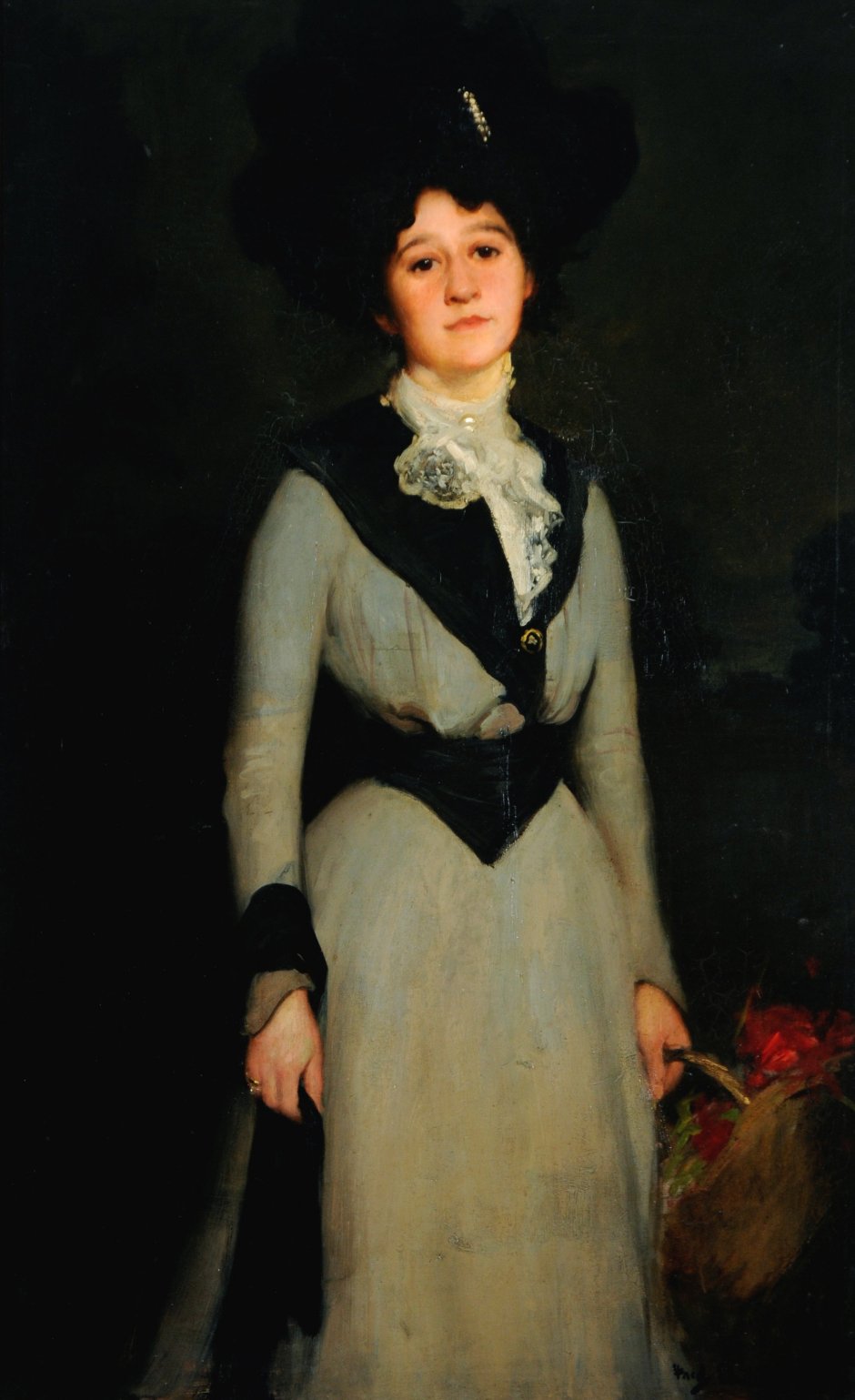
Elwell completed the Portrait of Mary Dawson Holmes in 1904 and had it exhibited at the Royal Academy that year.  It is an exquisite work of portraiture with the sitter depicted as a lady of gracious sophistication.  Her clothes are reminiscent of the French fashion of the time.   She wears a tight-fitting dress finished off with a fine white lace collar.  Her head is tilted slightly to one side.  She holds an upright stance.  She has dark almond-shaped eyes.  Look at her expression.  It gives little away.  What do you make of it?  Is there an unwillingness, a reticence to pose or is this reserve due to her modesty or shyness?

Detail from Les Parapluies by Renoir (1880-6)

The way she stands and the fact that she is holding a basket is the reason why many people have compared the painting with one of Renoir’s ladies depicted in his painting of 1886, Les Parapluies, which Elwell may have seen.

Mary and Fred Elwell also some had a common interest – art, for she was a talented painter and he encouraged her to submit some of her work to the Royal Academy for inclusion at their annual exhibition.  She had two works accepted and Fred also had his portrait of her included at the same exhibition.   It is believed that Fred, George and his wife Mary would often travel to Europe, visiting Venice and Switzerland where Fred Elwell and Mary Holmes would take the opportunity to sketch and paint the local landscapes.

In 1910 George and Mary bought their dream home in Beverley.  It was known as Bar House.  It was a house that afforded the occupants beautiful views of the surrounding areas.  It even had its own tower from where one could watch the local racehorses training on the Gallop around Westwood, close to Beverley racecourse.  Sadly the joy of moving to their beautiful home was tinged with sadness as shortly after taking up residence her husband George became ill, so much so, he had to retire from his Hull shipping business.  As his health deteriorated he had to give up his beloved sailing.  Mary and Fred’s became more distressed with George’s health as he became more and more incapacitated.   His illness eventually was diagnosed as being terminal.  Knowing he was dying George spoke privately to Fred and asked him to look after his wife once he had died.  George Holmes died in August 1913, aged just 58.

Fred Elwell and Mary Dawson Holmes married on October 1st 1914, two months after the start of World War I.

 ……………………… to be continued

  Fred Elwell was a multi-talented painter and in this blog I want to feature some of his landscape works and those of his wife, Mary.

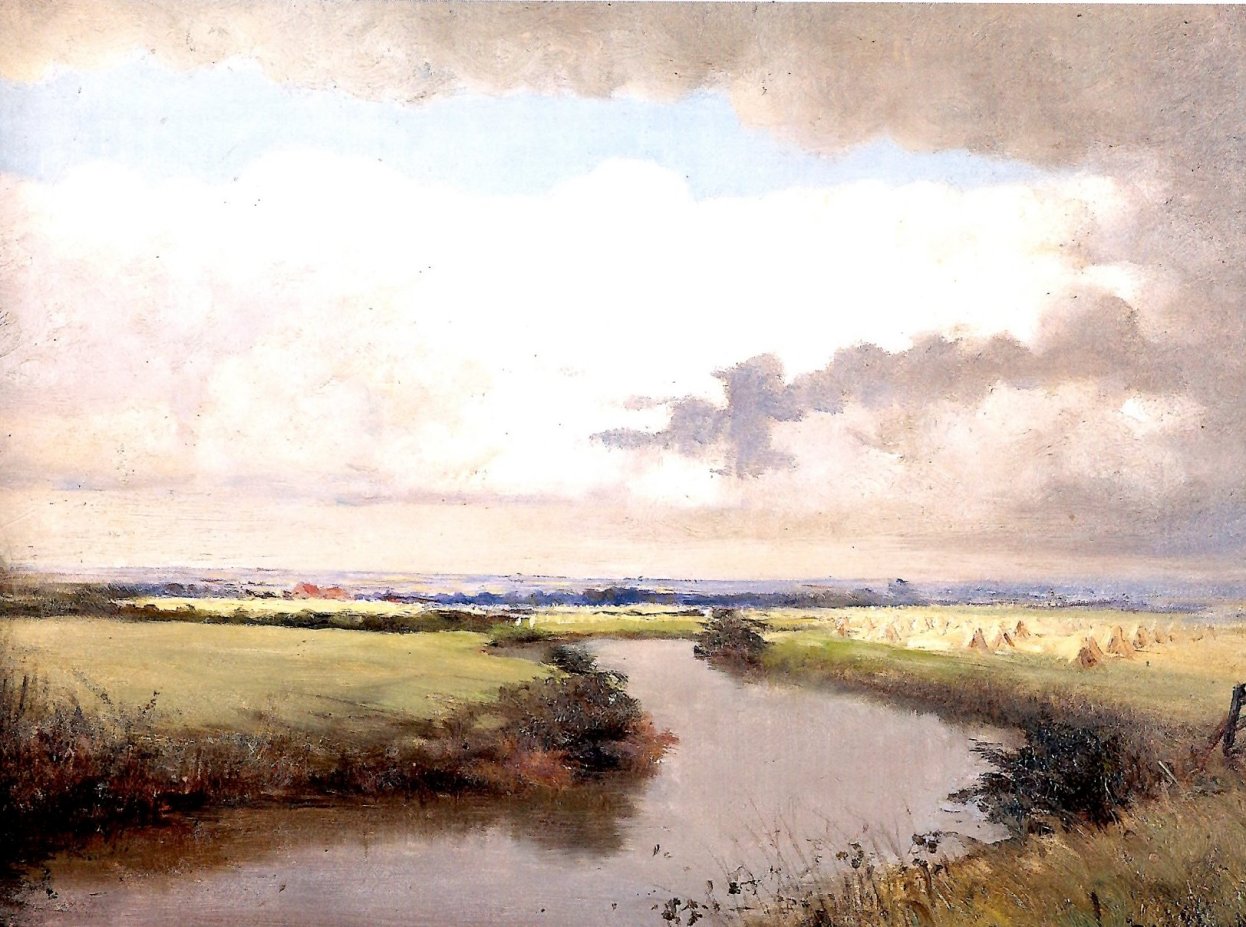
Upper Reaches of the River Hull by Fred Elwell (c.1905)

One of his early landscape works was Upper Reaches of the River Hull which he painted in 1905.   The work now hangs in the Beverley Art Gallery.  Its original owner was John Brown of Beverley who was a local tailor and provided suits for Elwell and could well have taken the painting in part payment for tailored clothing.  It is a beautiful work of art and features Elwell’s favourite area, the flatlands on either side of the River Hull, which he would have seen so many times from his boat.  Harvest is over and the stooks of corn sit up proudly in the newly harvested cornfield.

Corsican Landscape by Fred Elwell (1927)

The next painting was completed by Fred in 1927 and entitled, Corsican Landscape.   This landscape work, which has a distinct feel of Impressionism, depicts a farm in the centre ground along with grazing cattle and a few figures, all of which are surrounded by a mountain range which, on the left hand side, have been partially lost in shadow.  I particularly like the colours Elwell has given to his tall trees ranging from green and golds to the black-shaded ones which have lost the light of the sun.

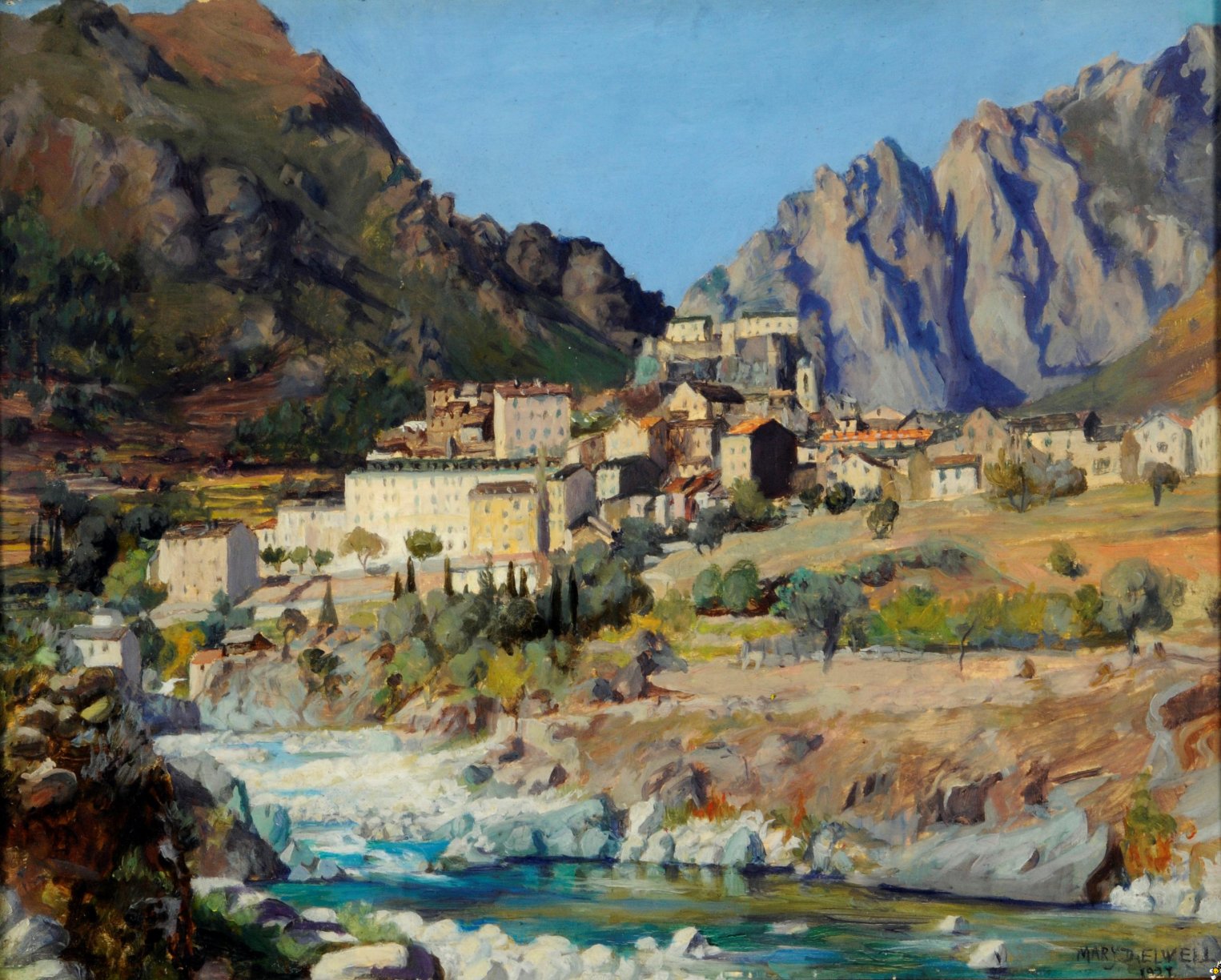
Corte Corsica by Mary Dawson Elwell

Mary Elwell completed a painting, around the same time depicting and probably during the same holiday, of the Corsican landscape, entitled Corte, Corsica.   It is a depiction of the hillside town of Corte, in northern Corsica.  Again, like Elwell’s Corsican landscape, the town is in the centre ground, surrounded by mountains.  The buildings are painted white and yellow with red terracotta roofs.  In the foreground we see a river cascading down a shallow waterfall.  The contrast between the blue of the water and the whiteness of the boulders it flows over adds to the beauty of the work.

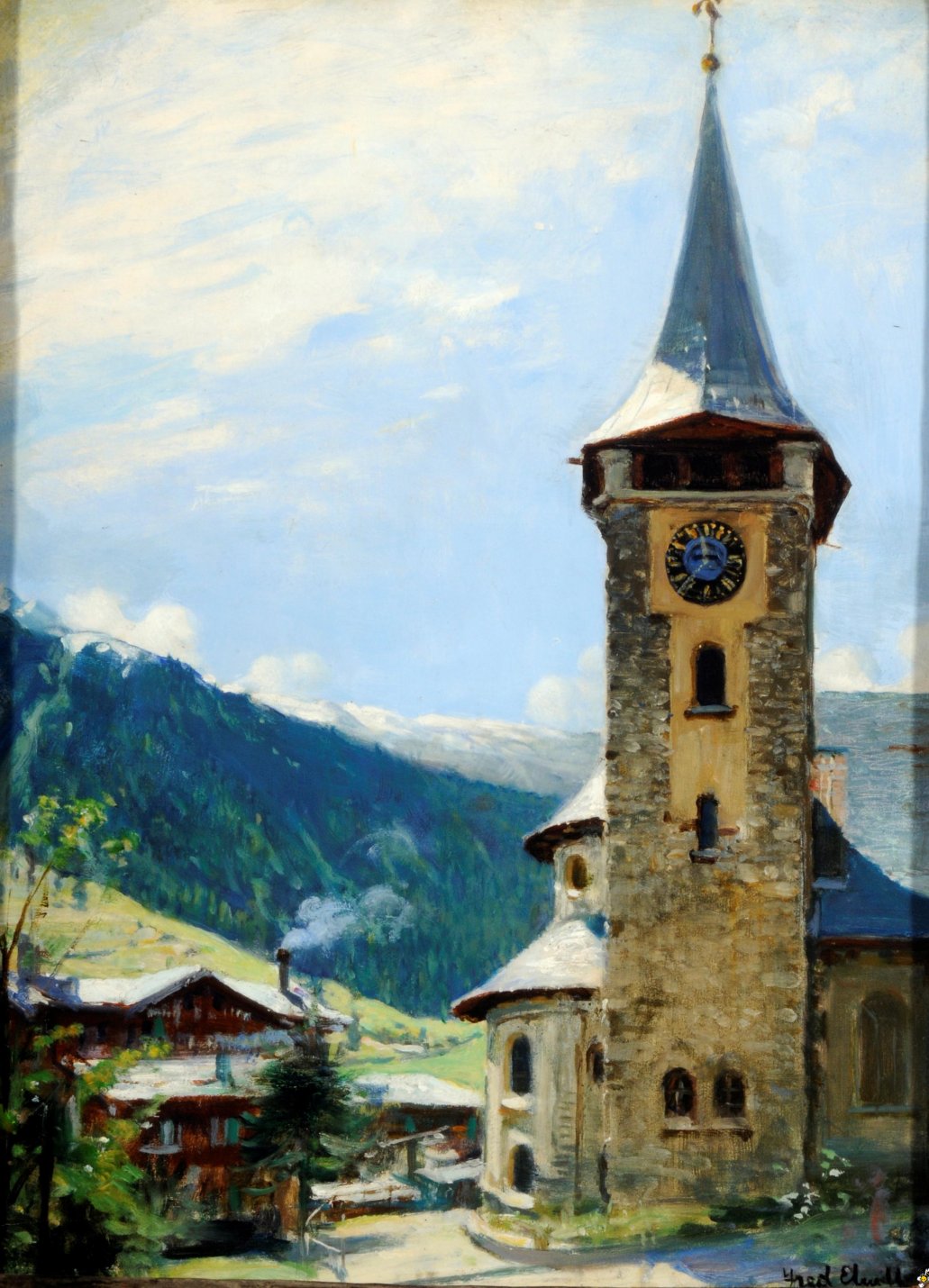
Zermatt by Fred Elwell (c.1938)

Another foreign landscape work by Fred Elwell was completed in 1937, entitled Zermatt.  The oil on wood panel painting is a typical Swiss-style landscape dominated by the church and its tower on the right, with the clock showing seven o’clock.  On the left we can see some chalets which disappear down the hillside.  In the background we have mountains, some in full sunlight others in full shade.  Fred and Mary Elwell loved this Swiss Alpine region and spent many happy journeys between 1937 and 1939 in the surrounding region completing a number of works in the region of Zermatt and the Matterhorn. On the outbreak of World War II they had to make a hasty retreat back to England.

Pigs in Barn by Fred Elwell (1937)

One amusing anecdote accompanies this work.  Elwell did not sell it to a dealer or art lover for a vast sum of money.  He sold it to a neighbouring pig farmer, a Mr Symmons and all Elwell wanted in return was a number of photographs of the Symmons’ pigs !!  These he used in another work he completed that year, entitled Pigs in Barn.
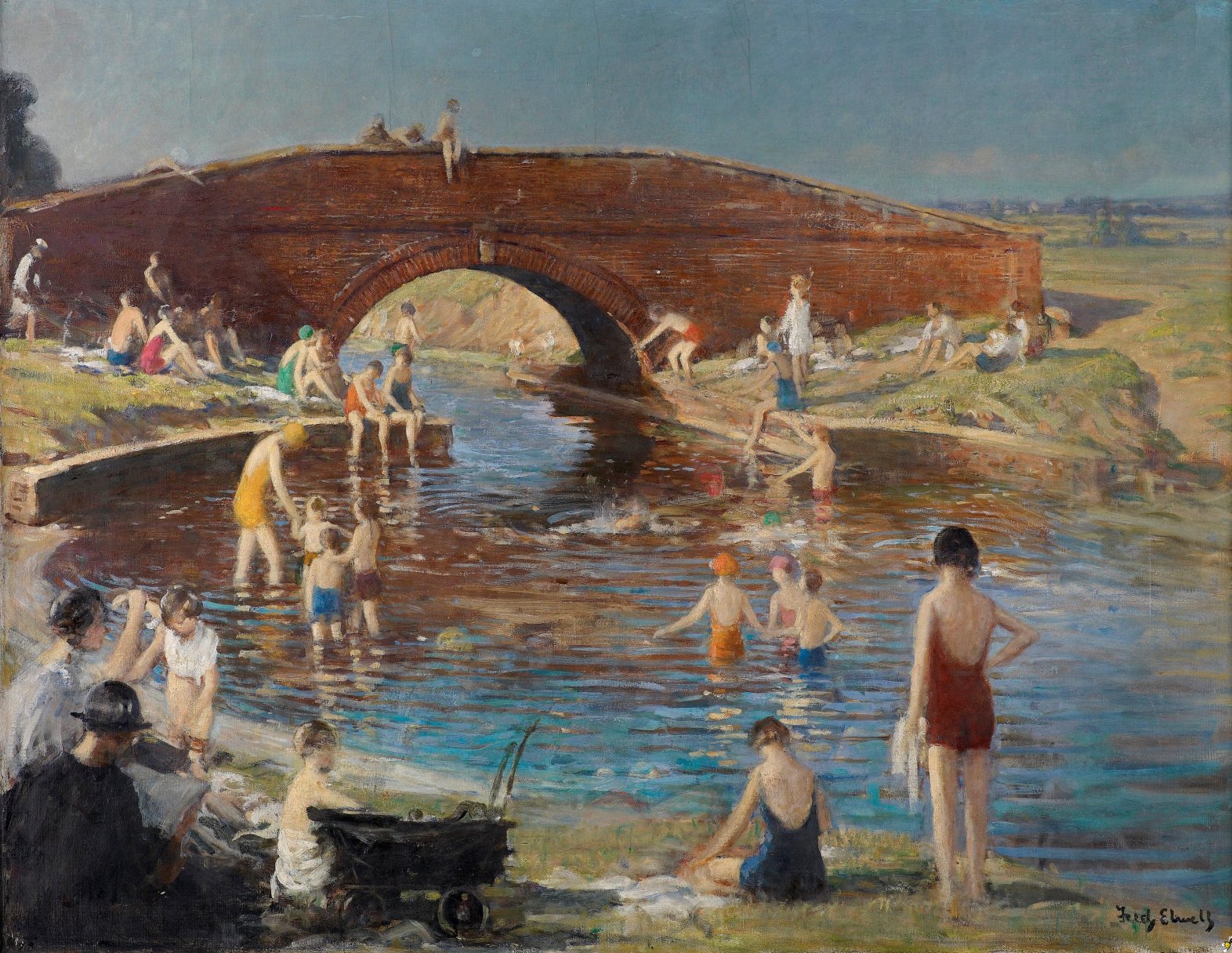
Brick Bridge, Swinemoor by Fred Elwell (c.1943)

The next work by Fred Elwell probably brought back fond memories of his childhood.  It is entitled Brick Bridge and features a brick-built bridge which straddles the Barmston Drain.  In Fred Elwell’s days this was a favourite place for Beverley folks to come and enjoy a swim on a hot summer’s day.  The picture was painted in 1943 during the Second World War and was the only place the people from Beverley could go for a swim as troops had commandeered the local swimming pool.  Again there is a hint of Elwell’s use of Impressionistic techniques with dabs of various colour representing reflections on rippled water and also the blurring effect of some of the features as if we are looking at the scene through the hazy atmosphere of a summer afternoon.

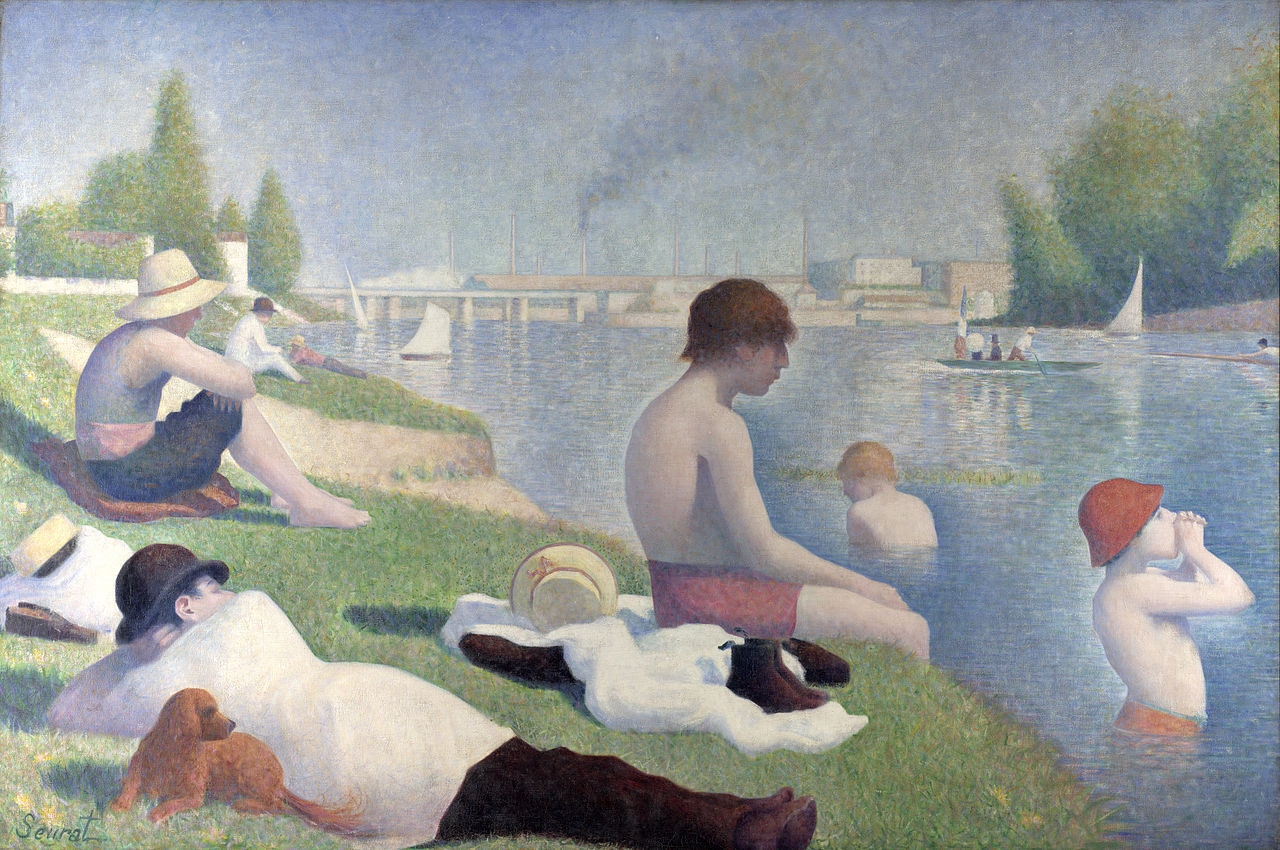
Bathers at Asnières by Georges Seurat (1884)

The painting by Elwell could well have been influenced by the work of the French artist, Georges Seurat, Bathers at Asnières which like Elwell’s work has people relaxing on the riverbank as well as in the water and in the background is the horizontal structure of a bridge crossing the water which in both paintings creates a horizontal axis. In the case of Elwell’s work the bridge almost hides the horizon from our view whereas in Seurat’s work our eyes leave the bathers in the foreground and follow the river towards the bridge and the industry on the far side of it.

In my next blog I will be complete the life story of  Fred Elwell and take a look at some of his genre paintings.

Once again let me recommend an excellent book on the life and works of Fred Elwell.  Most of the information for this blog was gleaned from this book which I bought in Harrogate.  It is entitled Fred Elwell RA – A Life in Art by Wendy Loncaster & Malcolm Shields.

Fred Elwell. Part 2. Portraiture

In my second look at the life and works of Fred Elwell I want to concentrate on his masterful portraiture.

In the last blog I left Fred Elwell studying in Paris with his friend Claude Rivas.  The year was 1892.   They had found themselves some rooms and had enrolled at the Académie Julian under the tutorship of William-Adolphe Bouguereau.  Bouguereau was far more than just a teacher of art at the Academy, he was a fierce defender of the academic method of teaching art.  He was also the chairman of the selection panel of the Paris Salon and thus had, with the other jurists, the power to accept or refuse submitted entries for the annual exhibitions and the jurists’ refusal to accept non-academic art angered many such as Paul Cézanne, Manet and Whistler.

Self Portrait by Fred Elwell (1933)

Life at Académie Julian was an exciting time for aspiring artists and many travelled great distances to be part of the Academy’s chosen few.  The artists were made to work hard and it also developed their competitive nature by offering a number of annual prizes.  Fred Elwell blossomed under this heavy workload and managed to win a number of these prizes during his stay.  Friendships were born at this Paris academy and Fred developed long term and special friendships with two other English artists, Richard Jack and the Lincoln-born, William Tom Warrener.  Warrener was nine years old than Elwell and had already established himself as a painter.   He was also a great social animal and spent much time in the bars of Montmartre and the Moulin Rouge nightclub which had come into being in October 1889, in the Jardin de Paris, at the foot of the Montmartre hill.  Warrener had become friends with Toulouse-Lautrec and, like Lautrec, had been commissioned to design a number of advertising posters for the Moulin Rouge.

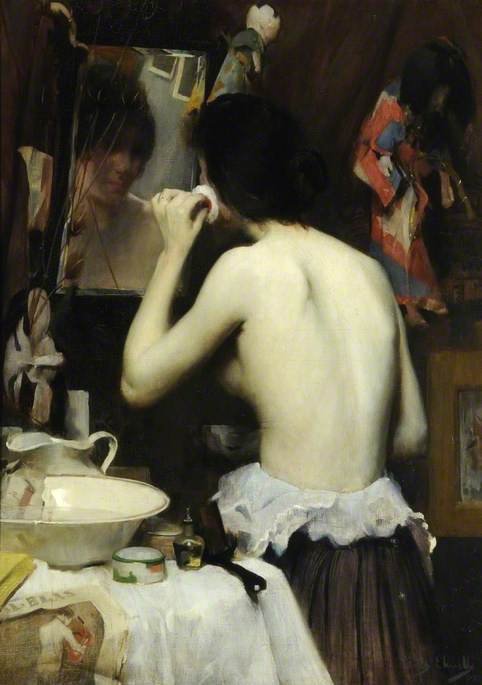
Elwell would often visit Warrener at his apartment on rue Ravignon and would see the walls of his rooms covered with paintings he had done of the nightlife of the Moulin Rouge.  It was during one of those visits that Elwell was introduced to the actress, Léonie, who was one of Warrener’s models and Elwell managed to persuade her to also become his model (see Part 1 of my Fred Elwell blog where I have included Elwell’s painting of her, Léonie’s Toilet).

Elwell’s stay in Paris coincided with La Belle Époque.  This period from the late 1870’s to the start of World War I was one of optimism.  It was the golden age.  For France, this was a period of stability and peace squeezed between the Franco-Prussian War of 1870, quickly followed by the brutality of the Paris Commune and the Great War of 1914. It was a time of peace and prosperity.  It was time of joy and many took the opportunity to visit clubs and theatres and Elwell, who worked and studied hard during the day, managed to sample the night life in the evening and late into the night and it was during his stay in Paris that he developed the love of pipe-smoking, a habit which stayed with him for most of his life.  Another facet of Paris life which Elwell took to was what we now term as café culture which he continued to follow when he returned to England.  However, life in Paris had its downside for Elwell, as with most wannabe artists the burden of financial problems was ever present and Elwell’s financial predicament, despite the odd help from his father, was the same, so much so that he had to give his beloved portrait of Léonie to his landlord in lieu of rent.

Whilst he studied at the Académie Julian, Fred would often go back to Beverley to recharge his batteries and sample the delights of home comforts.  Elwell finally left Paris in 1895 deciding to live and work in London, although he still exhibited his works at the city’s Salon des Artistes Français (Paris Salon).  Elwell was determined to get some of his paintings excepted by the Royal Academy in London and believed he would be able to fund his London life through commissions.  Unfortunately for Elwell many artists had the same thought and the contest for painting commissions was ruthless.  Elwell realised that the streets of London were not paved with gold and soon he became very despondent with his lack of success.  It is thought his despondency led to a nervous breakdown.  His father rushed down to London to support his son and eventually convinced him to return home to Beverley

………..to be continued.

Florence by Fred Elwell (c.1902)

Fred Elwell was a master of many painting genres and the paintings I am featuring today deal with his skilful portraiture. The first portrait, Florence, is one Elwell completed around 1902.  It features his twelve year old niece Florence Elwell.  Florence had been brought up by Fred’s mother and father after she came to live with them at their Park Villa home, close to the racecourse in Beverley, following the death of her parents.  She looks a little moody and frustrated at having to sit for her uncle and pouts with annoyance.  There were more joyous things to do for a twelve-year old including mixing with the racing fraternity who would often congregate at her uncle’s home during Beverley horse-racing events.  It is believed that Fred Elwell completed the portrait in just one hour.

Portrait of a Small Boy by Fred Elwell (1917)

My next featured work is also of a youngster and is entitled Portrait of a Small Boy which Elwell completed in 1917.  Before us we see an immaculately dressed young boy in a white suit holding his hat in his right hand and his beloved yacht in the other.  His short white socks show signs of falling down towards his shiny black leather sandals.  The portrait must have been a challenging task for Elwell as boys of his age are reluctant to stand still and the crumpled look of his white suit is an indication of much movement.   It was so challenging that after he had completed the painting, Elwell swore that he would never paint the portrait of a child again.

Seated Nude in the Studio by Fred Elwell (1935)

As I mentioned in the first part of the Fred Elwell story, the first time he was allowed to paint live nudes was when he moved to Antwerp.  One of his best works of a female nude was completed in 1935 and was simply entitled Seated Nude in Studio and can be found at the East Riding of Yorkshire Council Museum.  The lady depicted in this work is seated on a stool and is depicted in graceful semi-profile.  Her blue dressing gown lies besides her. In the background there is some dark furniture which contrasts with the radiant flesh tints of the lady.  It is a quirky set-up as she sits before a painting on an easel as if she is the artist admiring her own work.

In a Bar by Fred Elwell (1943)

Another female portrait by Elwell which I really like is entitled In a Bar which he completed in 1943 and was exhibited at the Royal Academy that year.  In the work we see the model sitting at the bar, cigarette in hand with a glass of gin and tonic on the bar beside her.  There is an air of casual indifference about the way she poses, a somewhat challenging facial expression which challenges us to query her drinking and smoking habit.    This is twenty-eight year old Muriel Fox a favourite model of Fred Elwell and believed to be the lady who posed nude for him in the previous work.  Muriel was a cook at the Beverley Westwood Hospital and would often call into the Beverley Arms Hotel on her way home from work. This bar was later known as Elwell’s Bar.  She was a well-known regular at this hostelry and this was “her stool”.   There is great poise in her expression as she stares out at us.  As was the fashion in the 1940’s her cheeks were applied with  a liberal amount of rouge and her hairstyle , tightly waved, was the fashion of the day.   It was rumoured that she had recently given birth to her daughter and baby and basket had been placed out of sight behind the bar.
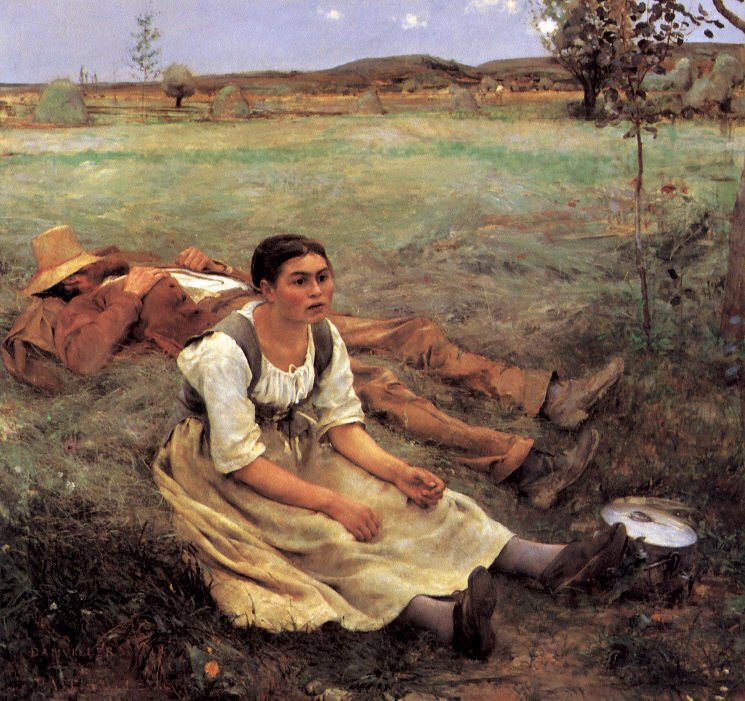
A Man with a Pint by Fred Elwell (1932)

My next offering is a male portrait and it is a real gem.  The work is entitled A Man with a Pint and was completed by Elwell in 1932 and exhibited at the Royal Academy a year later.  The painting depicts and elderly man tightly clasping his pint of beer whilst pointing at something in the newspaper which he had been reading.   He has a red face and a bulbous nose.  There is something very comical about the portrait.  The public loved this portrait and the art journal, The Artist, maintained that Elwell “belonged to the School whose purpose is Life”.  This portrait is a wonderful realist depiction.  Elwell has chosen his sitter, not for his handsome qualities but for his down-to-earth demeanour.  This is a depiction of man, like the many elderly men, who love to spend the time with their pint in a welcoming hostelry.

Portrait of George Monkman, Mace Bearer of Beverley by Fred Elwell (1890)

The next portrait is also of an elderly man but in this instance he is not an unknown character but a member of the local Beverley Council.  He is the official mace bearer that the town rolls out on official occasions.  His name is George Monkman and the title of the pastel painting is Portrait of George Monkman, Mace Bearer of Beverley.  This was painted by the twenty-year old Elwell in July 1890 during the time he was attending the Antwerp Academy and, like many of Elwell’s works, is housed in the East Riding of Yorkshire Council Museum.  Before us sits a grey-haired sad-faced man in top hat and dark gold rimmed livery.  He sits in a high-backed chair. Look how the light shines on both the man’s face and the gilt mace.  It is a great study of character and is a testament to Elwell’s ability in the way he has depicted the demeanour  of the man, who looks old and tired but still proud of his position as the mace bearer.  The frailty of the man, who was eighty-four years old at the time, is brought home by the way Elwell has got him to hold the large ornamental mace with his left hand grasping on to the weighty implement as he holds it against his body.  Elwell remembered the portrait well, stating that to keep the sitter happy he had to ply him with brandy.  Sadly a fortnight after the portrait was completed Monkman died.  Elwell completed an identical portrait in oils thirty years later in 1921.

Canon Fisher and his Wife by Fred Elwell (1905)

 The final work of portraiture by Fred Elwell is entitled Canon Fisher and his Wife which he completed around 1905 and exhibited at the Royal Academy in 1929.  Before us we see an intimate dining room scene featuring the Reverend Robert Fisher and his wife Charlotte.  It is thought that painting had been commissioned to mark the retirement of the Canon paid for by his loyal parishioners and was one of Elwell’s first portraiture commissions.  The portrayal oozes warmth and there is an aura of affection and kind-heartedness surrounding the couple.   Robert Fisher sits at the table writing which probably alludes to the fact that he wrote a number of books on subjects such as plants, flowers and Yorkshire villages.  His wife sits by his side and works on her knitting.  The Canon retired from his position at St Mary’s Church in Beverley in 1905.

In my next blog I will be continue with Fred Elwell’s life story and look at more of his paintings.

Most of the information for this blog was gleaned from the excellent book I bought in Harrogate, Fred Elwell RA – A Life in Art by Wendy Loncaster & Malcolm Shields.  It is a beautiful book and well worth buying.

Frederick William Elwell. Part 1. The early days.

Self Portrait by Fred Elwell (1933)

When I look back on the four and half years of doing this blog I see my early entries were quite short but appeared nearly three or four times a week.  Nowadays due to other commitments and my being sucked into the life of artists the blogs are longer and often in multiple parts.  My last three blogs looked at the life of the American genre painter, William Sidney Mount and today I start a multiple-part blog on a home-grown nineteenth century English painter Frederick William Elwell, who many of you, like me, may have up to now, been unheard of.  In a way you have to thank my wife for this look at Frederick Elwell as she persuaded me to go with her to Yorkshire for a big three-day cooking event in Harrogate and I managed to slide out of the culinary arena and visit some small local galleries in this beautiful town, where I came across a book on Frederick William Elwell.

Frederick William Elwell was born at St Mary’s Cottage in the small Yorkshire market town of Beverley in on June 29th 1870.  His father, James Edward Elwell, was a well-known and well-established wood carver who played a prominent role in Beverley society.  In 1900 he was a member of the town council and mayor of Beverley. And when he held the position of Chairman of the Library Committee, he organised the first exhibition of paintings in 1910. The exhibition featured a selection of art which the town had loaned from local collectors.  It also included a large selection of works by his son Fred.

Fred Elwell’s schooling began with his attendance at Beverley Grammar School but in 1878 the education establishment had to close temporarily and Fred’s parents had to decide where their son should next be schooled.  The family were already aware that their eight year old son was talented at drawing and his father trained him in draughtsmanship and so his father decided to look for some scholarly opening which would allow Fred to further train in art and maybe later architecture as well as attain an all-round education.   The decision was made to send Fred to Lincoln to live with his two aunts, and by doing so, it would allow him to attend Lincoln Grammar School and at the same time afford him the chance to enrol in evening art classes at the nearby Lincoln School of Art on Lindum Hill.  Fred’s two aunts were a formidable pair of Victorian ladies.  One was the principal of the Lincoln Training College for Women whilst the other acted as its secretary

Still Life with Fish by Fred Elwell (1897)

Elwell proved to be a talented scholar and although his father wanted his son’s career path to head towards architecture Fred was in love with painting.  He was so good that he was awarded the Gibney Scholarship, named after Rev. J.S.Gibney the canon of Lincoln Cathedral who with others founded then Lincoln School of Art in 1863, and this allowed him to continue on with a three year course in art.  In 1887, aged seventeen, Fred Elwell won the Queen’s bronze medal in the National Art School’s competition for his painting, Still Life with Fish.  This painting by the seventeen year old Elwell shows the dawning of a great artist in the way he depicts different textures in the painting, such as the shiny reflective glass bottle in contrast to the dull matt finish of the red lobster.  On the wall in the background he has depicted fading Delft tiles. The head of the codfish, with its mouth open, is well illuminated against a dark background.  Its body is curved and the head turns to the right whilst its tale disappears into the darkness.  The curve of the fish is, in some way, countered by the dried herrings which hang in front of the tiles with their tales curving towards the left, balancing out the body position of the cod.  Elwell has used the old artist’s trick of depicting depth by incorporating the edge of the marble shelf in the foreground of the painting.  This picture is housed in the East Riding of Yorkshire Council Museum.

  The head of the college at the time of Fred Ewell was Alfred George Webster and he was a great admirer of the French Impressionism movement which had come to being in the early 1860s in Paris and it was Webster who taught the Impressionist technique to his students.  This introduction of Impressionist techniques to students, including Ewell, was strongly opposed by the Royal Academy.

In 1889, at the age of nineteen, Fred Ewell left the Lincoln Art College and followed the path of many aspiring painters of the time and, financed by his father, Fred travelled to Belgium where he enrolled at the prestigious Royal Academy of Fine Arts in Antwerp which had been founded in 1663 by David Teniers the Younger.  Fred Elwell and a fellow student Claude Rivaz shared a city studio on the Rue des Aveugles.   For many this establishment was considered the most important training academy for those artists who wanted to hone their artistic skills and follow classical Academic training.  Many great artists, such as Van Gogh, Lawrence Alma-Tadema and Ford Madox Brown at one time studied at this establishment.  It was here that the students would learn more about the great Masters of art and in fact the Academy itself housed many works by the old Masters.  Fred Elwell’s tutor at the Academy was the landscape and portrait painter, Piet Van Havermaert.  Havermaert pressed his students hard and would not suffer any slackers, once telling his students:

“… Always remember that for the money your father pays to keep you here, he could keep four pigs…”

Havermaert was a hard task master and pushed his students to the limit demanding more and more from them.

The Butler takes a Glass of Port by Fred Elwell (1890)

Elwell flourished under this strict teaching regime and during his final year at the Academy produced a genre piece which harked back to the typical type of art that was so popular in the Low Countries in the seventeenth century.  It was entitled The Butler takes a Glass of Port.  The title is a play on words, meaning, on one hand, the partaking of a drink but, on the other hand, meaning “stealing” a drink.  The scene is set in a dining room and we see the butler, emerging from the shadows.  He had just finished serving his master and guests at the dining table and has come to arrange the clearance of the plates.  However he has decided to help himself to a small glass of his Master’s port.  Look at the miscreant.  Look how his face is lit on the side by the candlelight.  This use of light was very popular with the Dutch genre painters of the past and Elwell, even at the young age of twenty, managed to master the art of dramatic lighting.  Look at the butler’s expression of anticipation as he pours himself a drink.  His nose has been given a reddish tinge suggesting that he and alcohol were old friends.  It is amusing to note that the painting’s alternative title, another double-entendre, was All Things come to the Man who Waits !  It was at the Royal Academy of Fine Arts in Antwerp that Elwell began to perfect his skill in portraiture and still life through  the influence of the work of 17th century Dutch and Flemish artists.

This Academy was also a stopping off place for art students who headed for the artistic academies of Paris, a route that Fred Elwell and his friend Claude Riaz, followed in 1892.  The two young artist found themselves some rooms in rue de Campagne Première, on the left-bank, in the city’s 14th arrondissement of Montparnasse.  Elwell was fascinated with the French capital and soon built up a large collection of sketches of all that he saw of Paris life.  Elwell enrolled at the Académie Julian and was fortunate to be tutored by a giant among artists, William-Adolphe Bouguereau.  It was whilst study at the Academy that Fred Elwell started his training in life drawing using living models .  He was never given the opportunity to sketch nude men and women whilst studying at Lincoln, probably because of the presence of the cathedral in the city, the Academy thought life classes were somewhat inappropriate.  Out of this training came one of Elwell’s finest early paintings entitled Dolls or Léonie’s Toilet.

Leonie's Toilet by Fred Elwell (1894)
Leonie’s Toilet by Fred Elwell (1894)

Léonie’s Toilet was completed by Elwell in 1894.   Fred Elwell was introduced to the sitter of this painting, Léonie, by Thomas Warrener who was a friend of his from Lincoln, who, like Elwell, had studied at the Lincoln Art College.  Warrener then attended the Slade School of Art before moving to Paris and the Académie Julian where the two friends met up once again.  Léonie was also a model for some of Warrener’s paintings.   To the left of the painting in the foreground is the washbasin, draped over which is the newspaper famed for its gossip, Gil Blas, which leads us to believe Elwell was interested in the comings and goings in French society.  The periodical often serialised French novels as well as being known for its opinionated arts and theatre criticism.  Another hint of Parisian life in the 1890’s is the two Japanese dolls hanging from the mirror. Japonisme was sweeping through Europe in the second half of the nineteenth century.  It was the term used to describe the influence of Japanese art and fashion on Western culture, and was particularly used to refer to Japanese influence on European Art and Impressionism.  This painting’s original title was Dolls, referring to the dolls seen in the work.  Sibylle Cole in her 1980 book, FREDERICK  W. ELWELL, R.A. 1879-1958.  A Monograph with eight selected prints in colour  describes the skill of Elwell in the way he has painted the naked back of Léonie.  She highlighted the way in which he used a wide range of whites and lovely soft edges where she says “the light leaks into the background”.  There is an interesting story behind this work.  Elwell, like all struggling artists, had to part with his beloved depiction of Léonie, giving it to his landlord as payment for his rent.  Fifty years later the artist James Bateman R.A. was walking down Kings Road in Chelsea when he saw the painting of Léonie in an antiques shop.  He bought it and gave it to the seventy year old painter.   Elwell was delighted to have Léonie back with him !
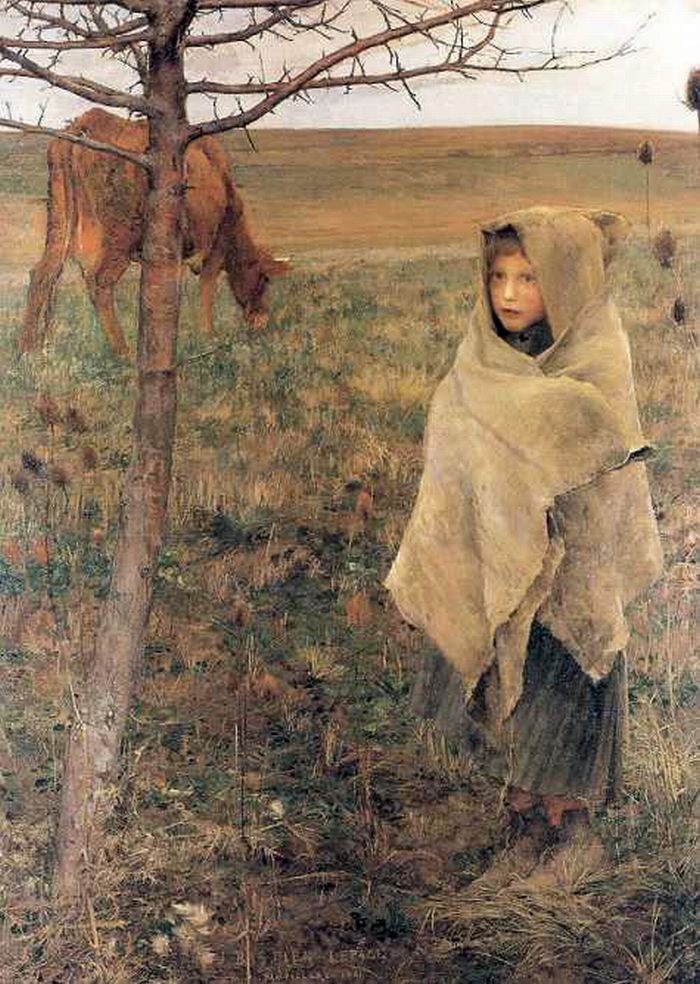
Young Woman Powdering Herself by Georges Seurat (1890)

The subject, a girl powdering her face, may have come to Elwell after seeing Georges Seurat’s 1890 work, Young Woman Powdering Herself, a painting depicting Seurat’s secret lover, a working-class woman, Madeleine Knobloch.  The painting was exhibited at the Société des Artistes Indépendants in 1892, the year Elwell arrived in the French capital.

Man with a Pipe by Paul Cezanne (1892)

My final offering in today’s blog could well have derived from a Cezanne painting Elwell may have seen, one which was painted by Cezanne in 1892 entitled Man with a Pipe, a depiction of a peasant relaxing, staring out at us with his pipe in his mouth.  

Old Man with a Pipe by Fred Elwell (1898)

Fred Elwell completed a work in 1898 which was entitled Old Man with a Pipe and depicts a gardener, with pipe in mouth, which projects towards us.  It is a somewhat cut-off painting with the man’s right fist which grasps the handle of the rake and his left elbow, almost cut out of the lower part of the composition

 In my next blog I will continue with Elwell’s life story and look at some more of his beautiful works of art.

 Most of the information for this blog was gleaned from the excellent book I bought in Harrogate, Fred Elwell RA – A Life in Art by Wendy Loncaster & Malcolm Shields.  It is a beautiful book and well worth buying.

Sarah Siddons

Sarah Siddons by J. Dickinson

The subject of my blog today is not an artist, although many would term her a theatrical artist, and in fact she was looked upon as one of the greatest English tragic actors of the eighteenth century. She was a Shakespearean actor of great renown and particularly famous for her interpretations of Lady Macbeth. She was a lady who was so popular that her portrait was painted a number of times by leading portraitists of the time. Let me introduce you to Sarae Kemble, later known as Sarah Siddons.

Sarae Kemble was born in the Welsh town of Brecon in July 1755. She was the eldest of twelve children of Roger Kemble and his wife Sarah Ward. Her father, who was a theatre manager, managed a troupe of travelling actors, the Warwickshire Company of Comedians. Sarah was fortunate to be the eldest child as her mother made sure that she received a good education and insisted on her attending school at the various towns the troupe of actors performed but this did not preclude her from making many appearances on the stage when she was still just a small child.

During her teenage years she fell in love with William Siddons, who was one of her father’s troupe of actors. However, like most parents, Sarah’s mother and father baulked at her liaison with Siddons as they had already received an offer of marriage from a local squire. Sarah would not agree to such a relationship and held out until she was eighteen and eventually in November of 1773 she married her beloved William Siddons in Trinity Church, Coventry. A year later, in 1774, she appeared as Belvidra in the English Restoration play, a tragedy, written by Thomas Otway, called Venice Preserv’d, which was first performed in 1680. Sarah Siddons’ performance was hailed a great success and the excellent revues of her depiction of her character came to the attention of the veteran actor of the time, David Garrick. She was invited to appear at the prestigious Theatre Royal, Drury Lane but whether it was nerves or whether she had still yet polished her acting ability, her performances were slated and, to her shame and horror, the theatre dispensed of her services.

It may have all been for the best as she spent the next six years travelling around the country with touring companies, honing her skill as an actor, all the time enhancing her reputation and finally she was invited back to the scene of her early disasters, Theatre Royal Drury Lane, where she was hailed as a theatrical genius for her portrayal of Isabella in David Garrick’s adaptation of Thomas Southerne’s play, Isabella or The Fatal Marriage.

Mrs. Siddons as the Tragic Muse by Sir Joshua Reynolds

It was around this time, in 1784 that she sat for Sir Joshua Reynolds who depicted her as the Tragic Muse, Melepoméne, in his famous portrait, Mrs Siddons as The Tragic Muse. The name Melpoméne comes from the Greek word melpo or melpomai, which means “to celebrate with dance and song. She is a Greek and Roman mythological character who was one of nine muses of the arts. She started off as the Muse of Song but later became the Muse of Tragedy. Reynolds was himself a great fan of the actor and was also a lover of all things classical and decided to combine his two loves in one single portrait. Reynolds was so overwhelmed by the actress that it was said that when she first visited him, he led her by the hand into his studio uttering:

“…Ascend upon your undisputed throne, and graciously bestow upon me some great idea of the Tragic Muse…”.

Further evidence of his devotion to the twenty-eight year old actor was that he signed his name on the gold embroidery at the hem of her dress. He explained this pictorial inclusion to the sitter saying:

“…I have resolved to go down to posterity on the hem of your garment…”

In the portrait we see Sarah Siddons seated in her throne chair with the allegories of Pity and Terror standing behind her and who merge into the brown background. Her body is towards us whilst her head and face are in profile. Her facial expression is one of concern. She looks troubled and in two minds as Pain and Terror influence her thought process. Despite this, she exudes an air of sophistication and dignity. Her dress is a mass of subtle colours, ochres and light and dark browns. Look at the beautiful and skilful way Reynolds has depicted the folds of the heavy fabric dress.

Sarah Siddons by Thomas Gainsborough

A year later, in 1785, another portrait of Sarah Siddons was completed. The artist was Thomas Gainsborough and the tile of the work was simply Sarah Siddons. It has been recorded that Gainsborough struggled with the portrait of Siddons especially when it came to her nose and her right hand which rests on the arm of the chair. It took him many attempts to get them right as has been revealed in the pentimenti. The word, pentimento (pentimenti is the plural), comes from the Italian word pentirsi, which means to repent or change your mind and pentimento is a change made by the artist during the process of painting. Such changes are concealed beneath  subsequent paint layers and often, if the final layer of paint has become transparent over a long period of time, an earlier layer of paint can be detected. Other ways of detecting such changes is with infra-red reflectograms and X-rays. Gainsborough himself commented about the difficulty he had with portraying her long nose when he uttered:

“…Confound the nose, there’s no end to it…”

Another well known artist, Sir Thomas Lawrence, painted a portrait of Sarah Siddons in 1804 when she was forty-nine years of age and nearing the end of her theatrical career.

Sir Thomas Lawrence knew Sarah Siddons and her family well. His portraits of her were probably more about Siddons the woman rather than Siddons the actor or one of Siddon’s many female characters she had played on stage. Thomas Lawrence and Siddons had first met in Bath in 1777 when she was twenty-two and on tour with a theatrical production. He was just eight years of age. Lawrence was a kind of child prodigy, an accomplished artist even at that age and had the ability to recite poetry, the two achievements which his father used to extract money from the passing public. At her first meeting with young Thomas Lawrence, Siddons never realised how he would affect her later  life and that of her family.

In 1787, just before his eighteenth birthday, Thomas Lawrence arrived in London. He met up again with Sarah Siddons, who was by now a cultural icon at the high-point of her theatrical career. Lawrence began consecutive relationships with two of her daughters, Maria and Sarah. Sadly they both died in their twenties. Sarah Siddons was by now separated from her husband William. Siddons herself was also in love with Thomas Lawrence, her daughters’ charming and alluring suitor, and he painted many portraits of her.

Mrs Siddons by Sir Thomas Lawrence (1804)

In his 1804 portrait entitled Mrs Siddons, we do not see her portrayed as an actor playing one of her many roles but at one of her many recitals when she would, with an actor’s panache, read from one of the plays which had made her so famous. In this portrait we see Sarah standing next to a table. On the table is a small lectern, on which are scripts of plays by Thomas Otway and Shakespeare.

Mrs Siddons as Mrs Haller in ‘The Stranger’ by Sir Tomas Lawrence

Lawrence had completed an earlier painting of Sarah Siddons in 1797 entitled Sarah Siddons (possibly as Mrs Haller) in ‘The Stranger’ , a play written by August Friedrich Ferdinand von Kotzebue the German dramatist and writer. The role she played was of the adulteress, Mrs Haller. In the portrait we see the sadness in Sarah Siddon’s expression which could well be the feelings expressed by the character in the play or it could be the unhappiness of her own life which would have been well known to Lawrence.  At last we may be seeing the real Sarah Siddons.

Sarah Siddons was a tall woman with strikingly beautiful features. Her most famous role was that of Lady Macbeth in the Shakespeare play, Macbeth. The way in which she played the part of Macbeth’s wife was legendry for the emotions she expressed when murder was on her mind. She was so good in the role, she made it her own. Audiences were spellbound by her performances.

Statue of Sarah Siddons,_Paddington_Green

Sarah Siddons gave up acting in 1812. She died in London in 1831 a month before her 76th birthday and was interred in Saint Mary’s Cemetery at Paddington Green. There is a statue of her on Paddington Green.

C R W Nevinson. Part 2 New York

Portrait of C R W Nevinson by  Ronald Ossory Dunlop
Portrait of C R W Nevinson by Ronald Ossory Dunlop

In my last blog I looked at the early life of Christopher Richard Wynne Nevinson and featured some of his paintings which depicted the horrors of the First World War.  Today I want to conclude his life story and look at some of his other works of art which had nothing to do with war but which I find have their own beauty.

Nevinson had been taken ill in 1912 and was moved to Buxton to convalesce and it was whilst partaking of the healing waters at the Hydro that he met Kathleen Knowlman who had accompanied her father to the health resort.  With the outbreak of war in 1914, Nevinson, being a conscientious objector, had joined the Royal Army Medical Corps in November 1915.  It was in this capacity that he had helped tend the wounded who had been brought home from the Front.  He was stationed at the Third General Hospital in London but was always aware that soon he would be called to leave the relative safety of England and travel to France.  Fully realising his possible death at the Front he decided that he should be married before he met his fate !  On November 1st 1915 he married Kathleen Knowlman.  It turned out that he was never sent to the front as he was invalided out of the army following bouts of pericarditis and rheumatic fever which he contracted in January 1916 which left him crippled and for a time he began to think he would never walk again.  He recalled the time in his 1935 autobiography, Paint and Prejudice:

“…I was now crippled completely. I began to think I should never walk again. Everything was tried on me while I lay helpless on my bed…”

Temples of New York by C R W Nevinson (1919) Drypoint. Trinity Church facade from the back, which faces Wall Street
Temples of New York by C R W Nevinson (1919)
Drypoint. Trinity Church facade from the back, which faces Wall Street

With the ending of the First World War in 1918, the public’s desire for his war paintings and their harrowing depictions of the suffering of the troops waned. Maybe people just wanted to forget about the previous four years and did not want to be reminded of the brutality of war.   For Nevinson, his favoured and once much appreciated subject matter had dried up and he had to make a decision as what to do next.   Paul Nash, a contemporary of Nevinson and also a war artist, summed up the war artists’ dilemma when he talked about the ‘struggles of a war artist without a war’.   At the end of the war, Nevinson went to Paris looking for new inspiration but soon tired of the French capital, a place he had visited as a child with his mother.  In the spring of 1919, he decided to visit America and in particular New York.  He had received an invitation from David Keppel to visit the American city to stage an exhibition of his War prints.  David Keppel who with his father, Frederick Keppel, were print publishers and owned a four-storey gallery on 4 East 39th Street in Manhattan.  They had exhibited many of Nevinson’s war prints which proved very popular with the American public.

Nevinson was made very welcome on his arrival and according to David Boyd Haycock in his 2009 book about the artist, A Crisis of Brilliance, relates how Nevinson was welcomed as a ‘war hero and victimised genius of modern European art, come to discover the USA and reveal it to itself ‘   Nevinson, on his arrival in New York, was taken aback by the city’s architecture, so much so when questioned by a local journalist of how he liked the city he commented that he loved the buildings so much he believed the city had been built for him.  Nevinson would roam around the city constantly sketching and after a month long stay in America, he returned to London and converted his sketches into paintings.   On his return to London he was to receive sad family news.  Whilst he was in America his wife had given birth to a son, Anthony Christopher Wynne on 21st May 1919. His mother, Margaret, recorded that the child only lived for fifteen days, which, as she put it, had been “just enough time to get fond of him.”   Nevinson later wrote in his autobiography:

“…On my arrival in London I was met by my mother, who told me my son was dead…”

 And he later added in a somewhat morbid fashion:

“…I am glad I have not been responsible for bringing any human life into this world…”

The Soul of the Soulless City (New York - an Abstraction) by C R W Nevinson (1920)
The Soul of the Soulless City (New York – an Abstraction) by C R W Nevinson (1920)

One of Nevinson’s depictions of  New York, which he completed back in London in 1920 before he returned to America that October to set up his second exhibition of work at Frederick Keppel & Co, New York gallery, was entitled The Soul of the Soulless City (‘New York – an Abstraction’).  The painting depicts an idealised view of a section of the elevated railway which ran through Manhattan. It was an unusual work with a narrow chromatic range reliant mainly on shades of greys and browns with just merest hint of blue for the skies between the tops of the skyscrapers.  The way he has depicted the skyscrapers with their complex faceting harks back to Picasso and Braque’s cubism of a decade earlier.  There is something very powerful and impressive about the way Nevinson has depicted the railway line receding dramatically into a cluster skyscraper blocks.  There is a sense of speed about the disappearing railway track.  Nevinson, was associated with Filippo Tommaso Marinetti  and his concept of futurism, who wanted  to revolutionize culture including art and make it more modern. The new ideology of Futurism was an art form which stressed modernity, and the virtues of technology, machinery, and speed and we can see in this work that Nevinson was a great believer of the ideals of futurism.

When the work was first exhibited at the Bourgeois Galleries in New York it was entitled New York – an Abstraction.  It was not received well.  According to David Cohen in his 1999 The Rising City Urban Themes in the Art and Writings of C.R.W.Nevinson’, C.R.W.Nevinson The Twentieth Century, one critic went as far as to dub the painting  “inhuman, metallic and hard”.  Later when he exhibited the work in London in 1925 at the Faculty of Arts Exhibition, Grosvenor House, London, it was given the title of The Soul of the Soulless City and this change was almost certainly made by Nevinson himself and although it has been likened to Karl Marx’s comment on religion being the “heart of the heartless world”, it could also be because Nevinson had fallen out of love with the American city.

New York, Night by C R W Nevinson (c.1920)

Another work by Nevinson with New York as its subject is New York, Night which he completed somewhere between 1919 and 1920.  This work which was completed around the same time as the previous work and was painted at the time when Nevinson was still in love with New York.   There can be no doubt about his initial love affair with New York for Nevinson was quoted by David Cohen in his 1999 book, C.R.W. Nevinson, The Twentieth Century:

 “…New York, being the Venice of this epoch, has triumphed, thanks to its engineers and architects, as successfully as the Venetians did in their time..Where the Venetian drove stakes into his sandbanks to overcome nature, the American has pegged his city to the sky. No sight can be more exhilarating and beautiful than this triumph of man…”

 The painting depicts the busy harbour of New York at night.  It is a view I have witnessed many times from the bridge of a ship as the city’s skyscrapers loom large ahead as we enter the port.   In the painting we see the giant buildings through the smoke and steam emanating from the funnels of the small tugs and ferries which ply their way up and down the Hudson River.  It is a mystical and atmospheric scene.  It is a scene depicting industry.  This is a scene of modernity, loved by the futurists.  In the foreground we see jibs of cranes busily working on the loading and unloading of cargo vessels berthed at Brooklyn, across the river from Manhattan.

Looking through Brooklyn Bridge by C R W Nevinson (1920)

Nevinson built up a collection of prints of Manhattan, another of which is the drypoint print entitled Looking through Brooklyn Bridge.  This work and another entitled Under Brooklyn Bridge are housed in the British Museum and were part of a set of ten drypoints of the city of New York which were commissioned by Frederick Keppel.  Whenever I visit New York I always take time to walk across this bridge and never fail to be enthralled by the views on offer when crossing from Brooklyn to Manhattan.  What first strikes you about this work is how the bridge is the central “character” as it dwarfs the people we see walking across it.  In the background, through the mist, we see the colossal skyscrapers of Manhattan looming before us.  In the evening light they lack colour and are just presented as grey giants.  It is a cold depiction.  There is no warmth about it.  It is an inhospitable scene and the mist which gives a haziness to the skyscrapers also gives a feeling that the air may also be polluted.  The people are wrapped up in warm clothes and the wooden walk way looks wet as if the rain has been beating down on the massive structure.  The man in the foreground holds an umbrella but probably due to the strong winds, dare not open it to protect himself. Nevinson has managed to convey the massive structure as a monument to the permanence of the new Industrial time and it contrasts with the temporary nature of the people, who appear on it as mere shadows as they hurry from one side to the other.

Like a lot of artists, Nevinson did not take criticism and rejection well and his love for New York and America disappeared.  Not only were his paintings attracting criticism, he himself was also becoming disliked for his ill-conceived outbursts.  He often suffered periods of depression and would often be volatile.  He had an unfortunate habit of bragging and publicly aired embellished claims of his war experiences, which people found hard to accept and together with his depressive and temperamental personality, he became an unpopular figure on the New York art scene.   Whether it was because of the poor reviews or his growing dislike for the people around him, he decided to leave America.

So who was to blame for Nevinson’s falling out of love with America and the Americans.  Maybe the answer lies in the 1920 catalogue introduction to an exhibition of Nevinson’s work by the art critic Lewis Hind.  Of Nevinson he wrote:

“…It is something, at the age of thirty one, to be among the most discussed, most successful, most promising, most admired and most hated British artists…”

In Julian Freeman’s biography on Nevinson he talked about the artist’s mental state during the last couple of decades of his life:

“…From 1920 until 1940 they carried his strident, maverick diatribes, aimed at society at large, and at the establishment in all its forms… and the variety, salacity, and often uncompromising savagery of his egocentric articles remains enormously entertaining. However, his autobiography is marked and marred by a strong undercurrent of confrontational right-wing xenophobia, and some of his private correspondence in the Imperial War Museum in London is explicitly racist: true signs of the times to which he was such a conspicuous contributor…”

I will leave the last word to the artist himself who, in his 1937 autobiography,  Paint and Prejudice,  wrote:

“…My prices have always been humble, but it has been possible up to the present to lead the life of a millionaire. Far from being a starving artist, a great deal of my time has been taken up in refusing food and drink, affairs with exquisite women, and wonderful offers of travel or hospitality. But I have always been driven mad by the itch to paint. Painting has caused me unspeakable sorrows and humiliations, and I frankly loathe the professional side of my life. I am indifferent to fame, as it only causes envy or downright insult. I know the necessity of publicity in order to sell pictures, because the public would never hear of you or know what you were doing unless you told them of it. But publicity is a dangerous weapon, double-edged, often causing unnecessary hostility and capable of putting you into the most undignified positions. Until of late I have had to fight an entirely lone hand. When I exhibited at the Royal Academy it was a revelation to me how well the publicity was done through the dignity of an institution rather than through the wits of an individual. But I suppose that now I shall always remain the lone wolf. I have been misrepresented so much by those who write on art that the pack will never accept me. Incidentally, because I painted I have earned something like thirty thousand pounds for the critics, curators, or parasites of art. Ninety per cent of their writings has consisted of telling the public not to buy my pictures and of charging me with every form of charlatanism, incompetency, ignorance, madness, degeneracy, and decadence. It is useless to deny that this has had its effect..”

A Winter Landscape by C R W Nevinson (1926)

His post-war career was not so distinguished.  He never achieved the adulation that was bestowed on him due to his war paintings.  Christopher Richard Wynne Nevinson died in October 1946 aged 57.