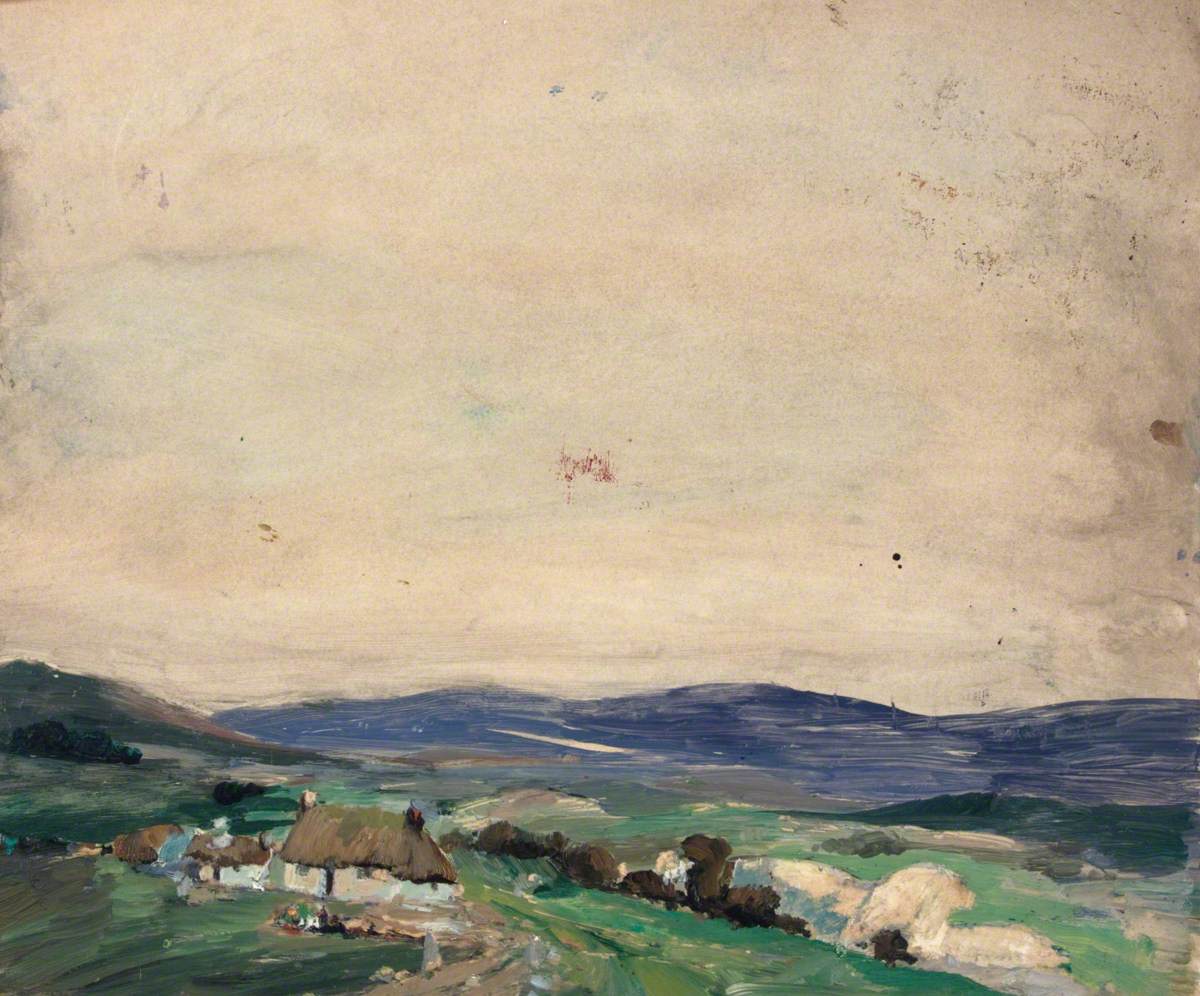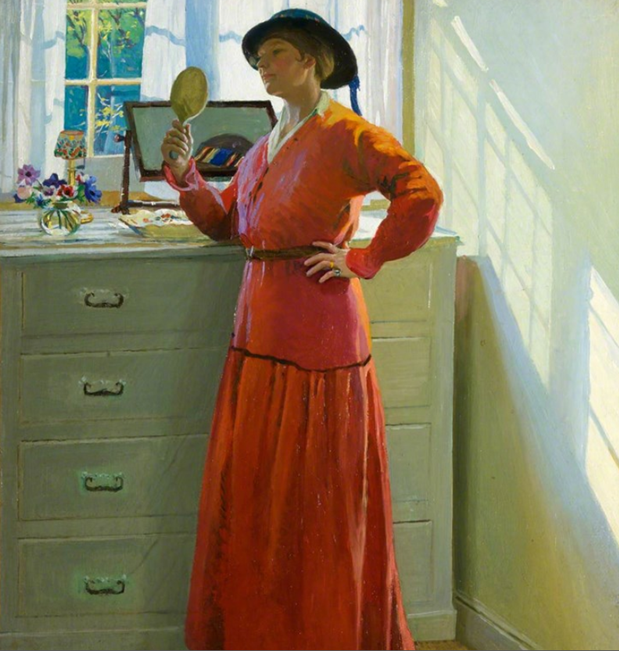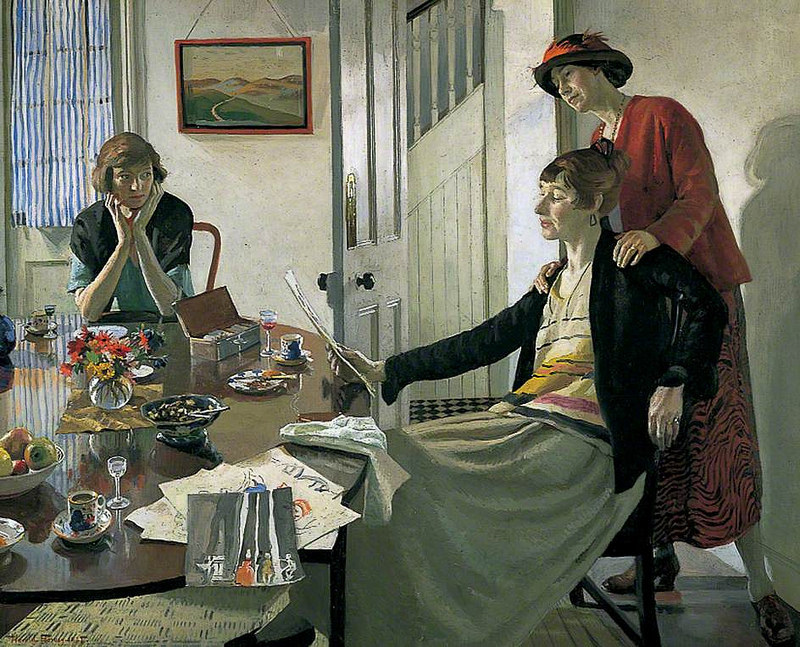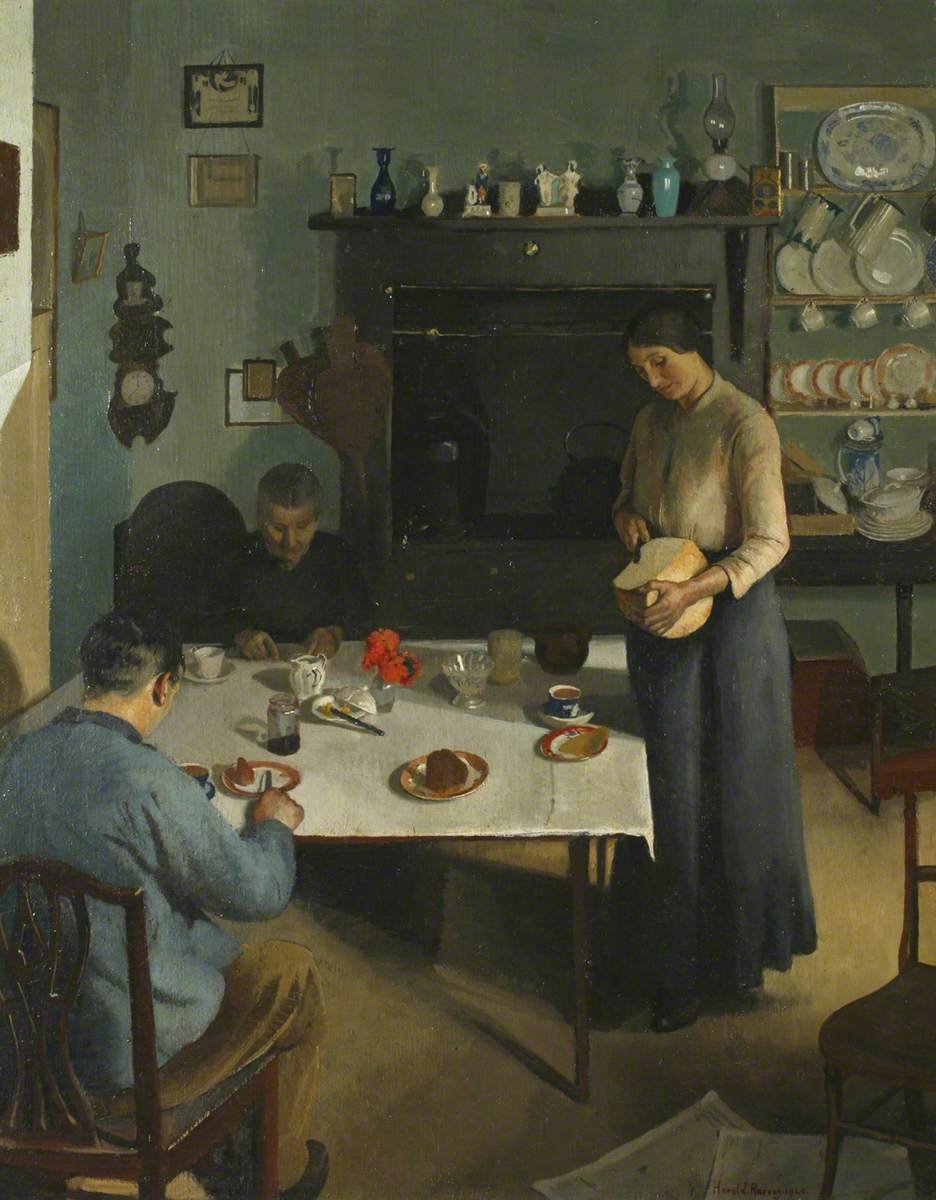
Joseph Edward Southall

See the source image
Joseph Edward Southall

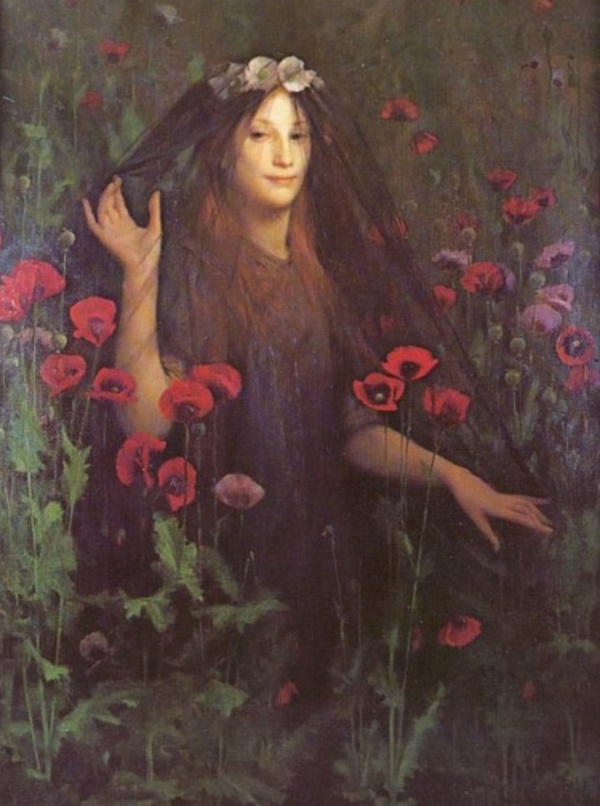
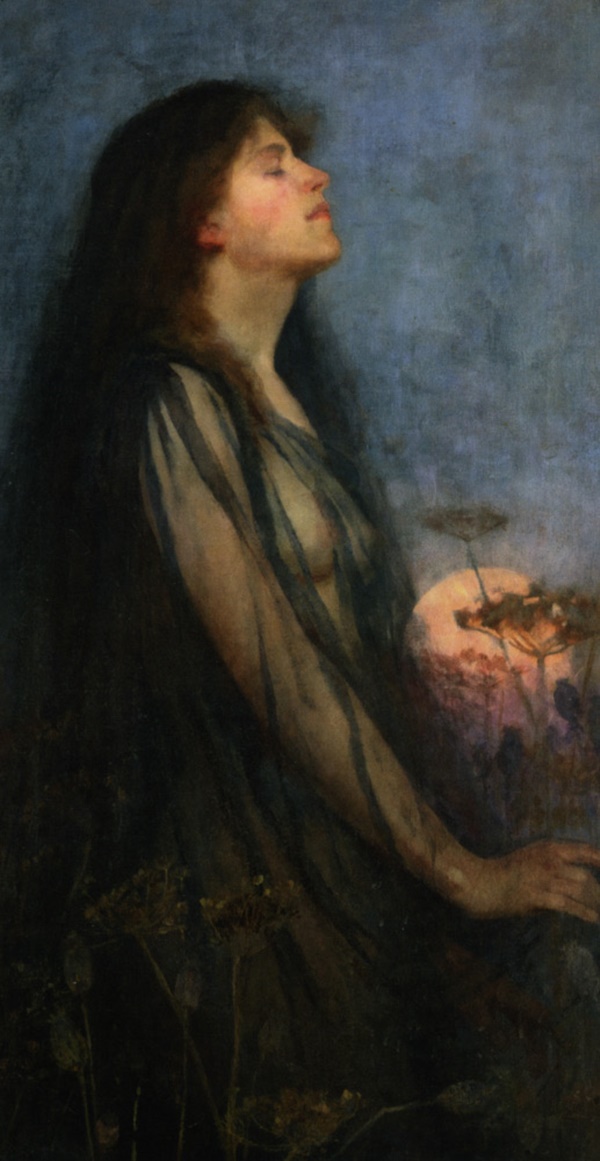
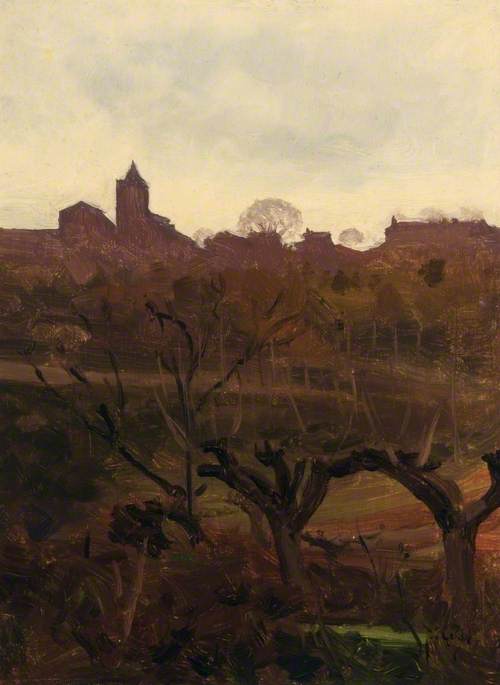
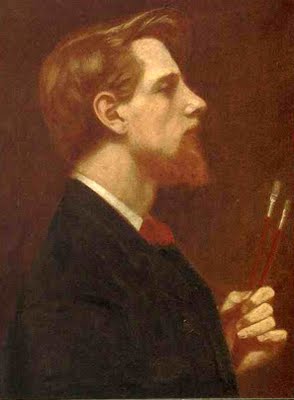
The Arts and Crafts Movement was a design movement which emerged from the Pre-Raphaelite circle with the founding of the design firm Morris and Co. in 1861 by William Morris.  It was a design movement which aspired to enhance the quality of design and make it available to the widest possible audience.  The term was not coined until 1887 and the Arts and Crafts Movement officially started when Morris and fellow artist, Edward Burne-Jones established a group that they called the Birmingham Set or Birmingham Group.   They were an informal collective of painters and craftsmen who worked in Birmingham, England in the late 19th and early 20th centuries. My featured artist today, Joseph Edward Southall, was one of the leaders of this group.  He was probably the most important, if not the most celebrated artist of that group and was looked upon as among the most dedicated.

See the source image
Self portrait by Joseph Southall (1925)

Joseph Edward Southall was born in Nottingham on August 23rd 1861, the son of a grocer, Joseph Sturge Southall, and his wife Elizabeth Maria Baker, both offsprings of distinguished Quaker families. Just a year after the birth of Joseph Southall his father died aged twenty-seven and Joseph and his mother had to go and live with his maternal grandmother in Edgbaston, a suburb of Birmingham

Joseph Southall’s education was to attend Quaker schools.  He attended the Friends’ School at Ackworth and in 1872, at the age of eleven, transferred to the Friends’ School at Bootham, York, where he received his first tuition in art when he was taught watercolour painting by the English artist and educator, Edwin Moore. From the school at Bootham he went to a school in Scarborough while still carrying on with private lessons with Moore.   On September 1st 1878, following on a few days after his seventeenth birthday, Joseph Southall completed his schooling and began an apprenticeship at the offices of the renowned Birmingham architectural partnership of Martin and Chamberlain.  He remained with the firm for four years but continued his art studies at evening classes at the Birmingham School of Art.  Both the architectural company and the School of Art were steeped in the spirit of John Ruskin and the Arts and Crafts movement.  The architect John Henry Chamberlain was a founder and trustee of the Guild of St George, while the Principal of the School of Art, Edward R. Taylor, was a pioneer of Arts and Crafts education and a friend of William Morris and Edward Burne-Jones.  It was also around this time that Joseph took to reading books written by Ruskin and William Morris, and what he gained from this would remain with him for the rest of his life.
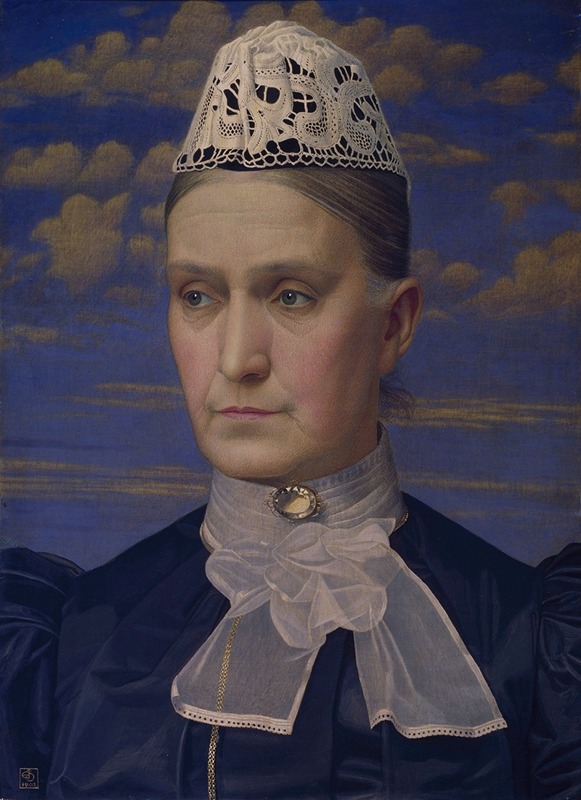
Portrait of the Artist’s Mother by Joseph Southall (1902)

Southall however felt unfulfilled with his architectural training.  Southall left the architectural practice to pursue his studies in painting and carving.   For him, architecture should embrace and craft disciplines such as painting and carving and with that in mind and having been inspired by his reading of Ruskin and Morris he decided to go on trips to Europe to broaden his artistic education.  In 1882 he visited Bayeux, Rouen and Amiens in Northern France where he was enthralled by the ancient cities with their Gothic cathedrals.   In 1883, now a free agent, he, accompanied by his mother,  journeyed to Italy and spent thirteen weeks visiting Pisa, Florence, Siena, Orvieto, Rome, Bologna, Padua, Venice and Milan.  It was during his stay in Italy that he fell in love with the works of the painters of the Italian Renaissance and the frescoes of the fifteenth century painter, Benozzo Gozzoli

Southall returned home with an overwhelming appreciation of the Italian Primitives and set his mind to study and practise the art of painting in tempera, a painting medium he had witnessed whilst in Italy.  In an essay by Peyton Skipwith in the book of paintings, Joseph Southall: 1861-1944. Sixty works by Joseph Southall, 1861-1944, from the Fortunoff Collection, he quotes Southall’s recollection of his time in Italy:

“…the thrill of joy which I experienced when, without any knowledge of what I was about to see, I stepped inside the enchanting cloisters of the great Campo Santo of Pisa. There I found myself at 21 years of age face to face with a vast series of frescoes, so quiet and yet so gay, so reticent in manner and so lively in essence that words must ever fail to convey even the faintest expression of what I felt…”
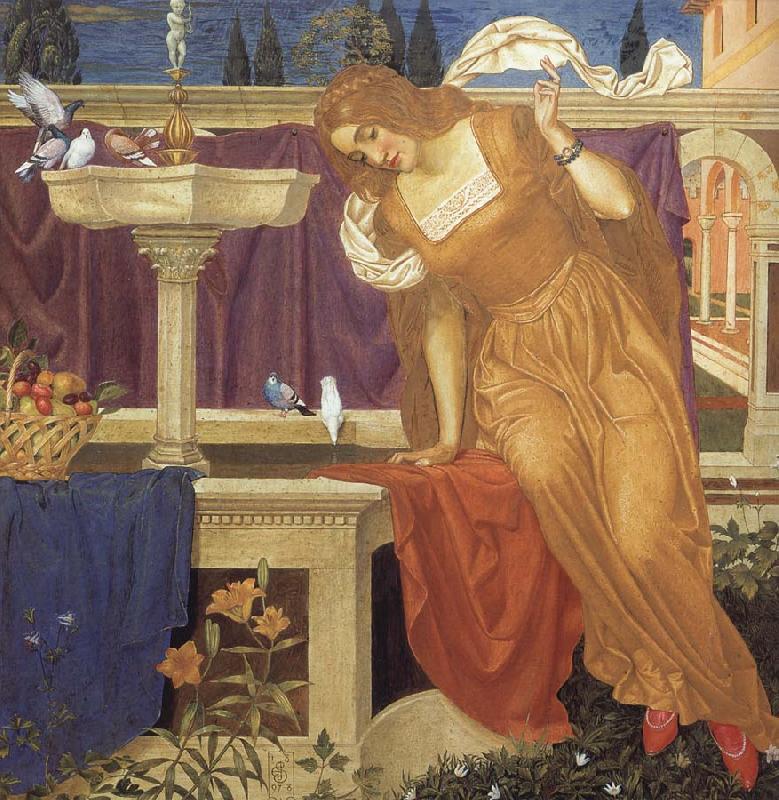
See the source image
Beauty Seeing the Image of her Home in the Fountain.by Joseph Southall (1898)

After returning to England Southall began to experiment with the tempera medium whilst at the Birmingham School of Art.  It was at the Birmingham School of Art that he met Arthur Gaskin, who became his closest friend.  The School of Art was run by the enigmatic head, Edward R. Taylor who had made the Birmingham school one of the leading schools of art in Britain, and the foremost for the study of the crafts. One of Southall’s great work using tempera was his 1898 painting entitled Beauty Seeing the Image of her Home in the Fountain.
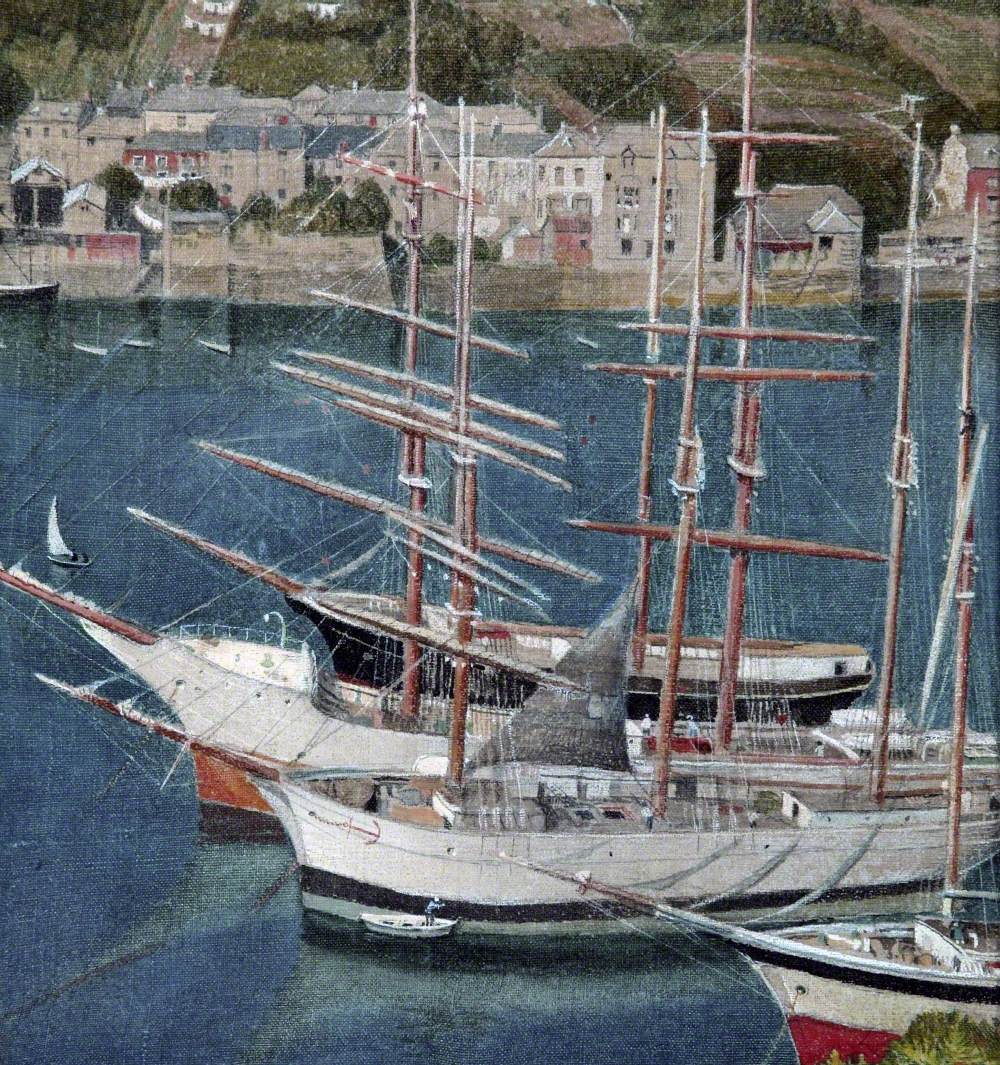
Sailing Ships
Sailing Ships by Joseph Southall (1910)

On his return to Birmingham Joseph Southall settled in the house of his uncle, George Baker, at 13 Charlotte Road, in the city suburb of Edgbaston and it would be here that he would remain for the rest of his life.  George Baker was a charismatic man and a friend of John Ruskin.  He was a staunch Quaker and a life-long admirer of John Ruskin’s Utopian ideals.  Baker became a prominent member of Ruskin’s Guild of St George and succeeded him to become the second master of the Guild on Ruskin’s death in 1900.  He also showed Ruskin some of his nephew’s 1883 Italian drawings.  Ruskin was so taken by Southall’s architectural knowledge that in 1885 he gave Southall his first major commission.  Ruskin wanted Joseph Southall to design a museum for the Guild of St George and have it built on Joseph’s uncle’s land near Bewdley, Worcestershire. To gather ideas for this project, Southall made a second trip to Italy in 1886, again visiting Pisa, Florence, Siena and Assisi, so as to do research into Ruskin’s commission.  Unfortunately for Southall, the project was abandoned by Ruskin who reverted to his original plans to build a museum in Sheffield. Southall was very disappointed at the turn of events saying that his chance of becoming an architect vanished and he was destined to spend years of obscurity, followed by a little bitterness of soul. The years that followed this disappointment and his love of tempera began to wane. He was generally frustrated with the medium and eventually abandoned it leading him to favour painting with oils.
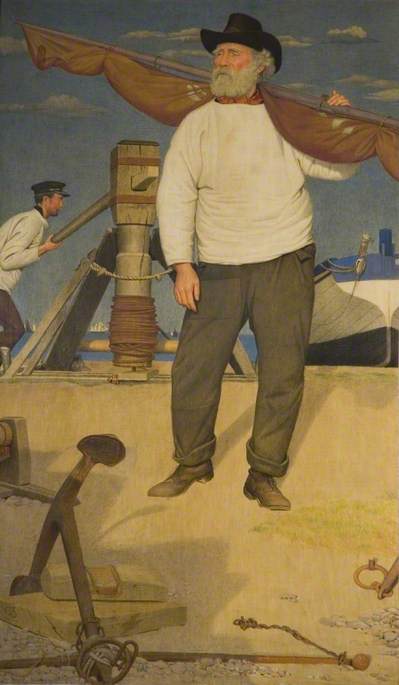
Fisherman Carrying a Sail
Fisherman Carrying a Sail by Joseph Southall (c.1907)

After a third visit to Italy in 1890, he once again became interested with the works by the Italian Primitives and slowly and once again experimented with the painting medium of tempera. His great influence now that he had returned to Birmingham, was his fellow Brummie artist, Sir Edward Burne-Jones. 
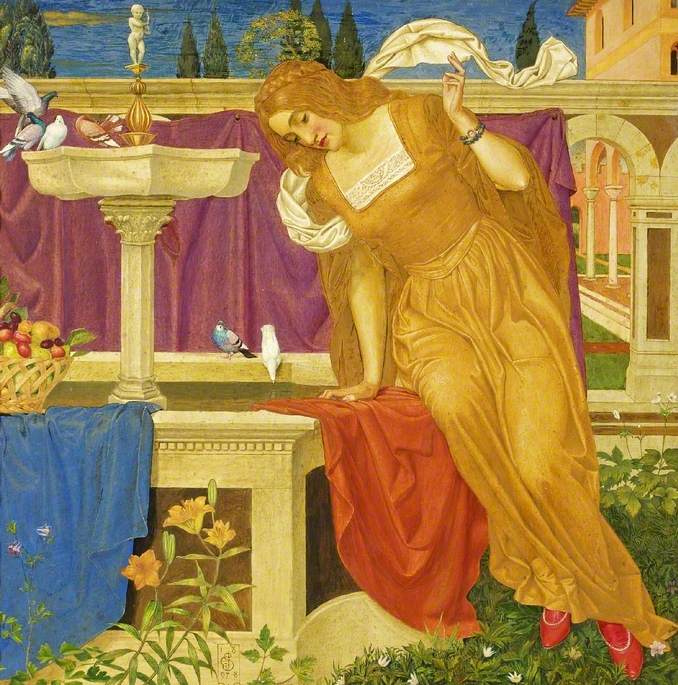
Beauty Seeing the Image of Her Home in the Fountain
Beauty Seeing the Image of Her Home in the Fountain by Joseph Southall (1898)

It was he who congratulated Southall on his 1898 tempera painting Beauty Seeing the Image of her Home in the Fountain.  It was also Burne-Jones who in 1897 sent Southall’s tempera self-portrait, Man with a Sable Brush, to the New Gallery, along with his own work.   These paintings and others like them, confirmed Southall as one of the foremost British tempera painters and as such led to his participation in the exhibitions of the Arts and Crafts Exhibition Society and the exhibition of Modern Paintings in Tempera at Leighton House.  The latter immediately preceded the foundation of the Tempera Society, of which Southall became one of the foremost members.
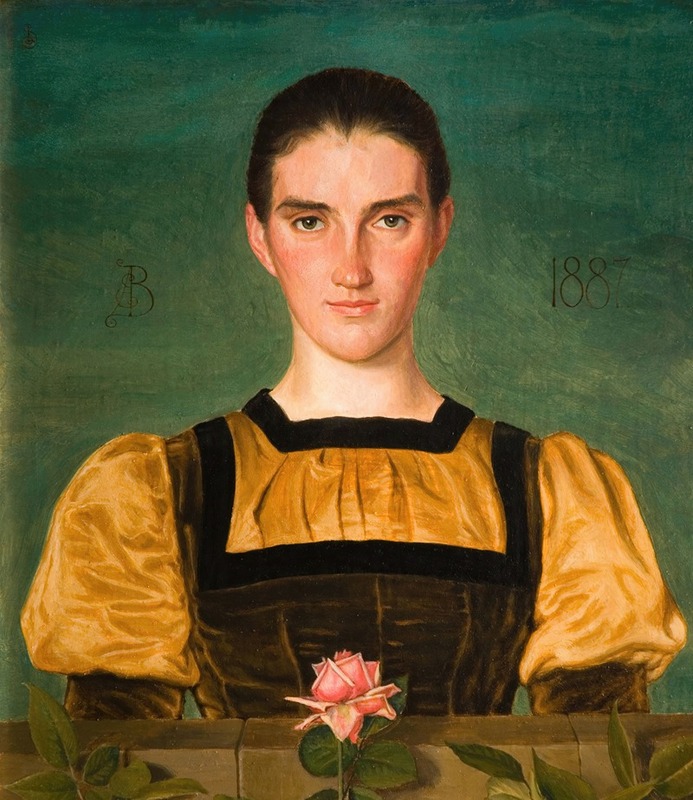
Portrait of Anne Elizabeth Baker by Joseph Southall (1887)

For a number of years Joseph Southall had been very close companions with his cousin Anna Elizabeth Baker, known as Bessie, who was two years older than Joseph.  He completed a number of portraits of her including his 1887 portrait of her when she was twenty years of age.

Coral Necklace by Joseph Southall (1895)

Another early portrait of Anna was John Southall’s 1895 painting entitled Coral Necklace.

Hortus Inclusus by Joseph Southall

She also appeared in his 1898 painting Hortus Inclusus which means private garden.  The setting is just such a garden with tall yew hedges in the background.  It is a portrait of Southall’s wife-to-be although the wedding would not take place for another five years. It is an idyllic scene with Anna sitting on a bench in the garden with her cat by her side.
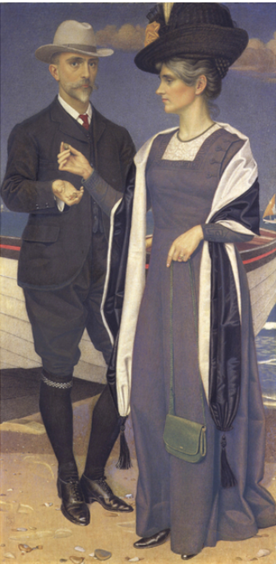
The Agate (Portrait of the Artist and his Wife) by Joseph Southall (1911)

In June 1903 Joseph Southall and his long-time fiancé, Anna Elizabeth Baker were married.  He was forty-two and she was forty-four.  Their relationship started when they were both youths.  Over time their relationship became more intimate and they eventually became engaged to be married.  However, as they were cousins, this close kinship made the couple deliberately put off marriage until Anna was past child-bearing age.  Probably my favourite portrait by Southall is the one which depicts he an Anna, eight years after they married. The setting is a beach, more than likely Southwold on the Suffolk coast, which is where they spent their honeymoon and returned their many times more.  The title of the painting, The Agate, derives from Bessie seen in the depiction handing her husband an agate, a gemstone which can be found on the seashore in this area. This handing of the agate to her husband can be seen as a symbol of the couple’s collaboration, as we know that the agate gemstone is used by craftspeople to burnish the gilding on picture frames and Southall’s wife Anna, who was  a talented craftswoman, would make the picture frames ready for her husband’s paintings.
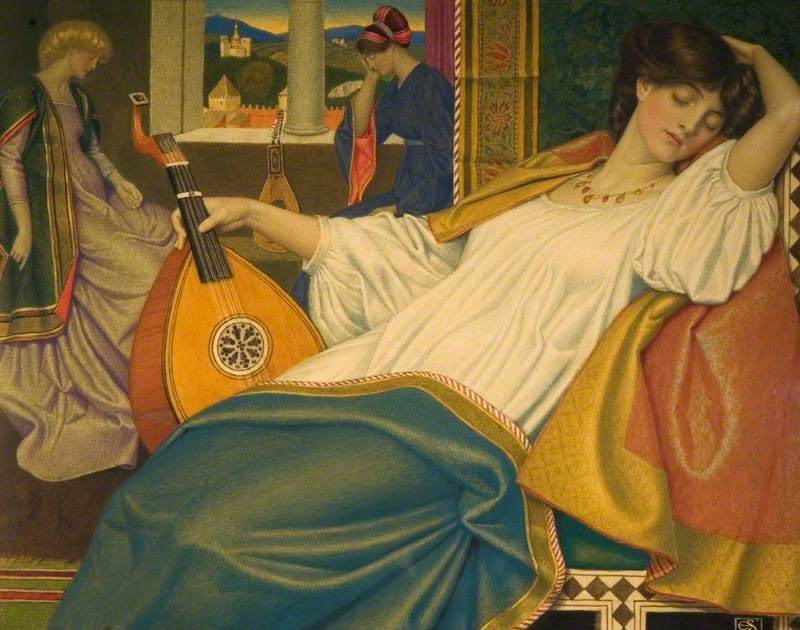
The Sleeping Beauty
The Sleeping Beauty by Joseph Southall (1903)

Joseph Southall’s popularity and recognition as a great painter grew.  He was at the height of his career during the latter years of the 1890’s until the start of World War I.  His work was shown at numerous exhibitions, not just in Britain but in Europe and America and he was elected a member of the Royal Birmingham Society of Artists, the Art Workers Guild and the Union Internationale des Beaux-Arts et des Lettres. His major exhibition in England was held in 1907 at the Fine Art Society in London and three years later a major one-man exhibition was held at the Galeries Georges Petit in Paris.  At the Paris exhibition Southall’s work was snapped up and following the event he received a number of lucrative commissions. 

Contentment by Joseph Southall (1928)

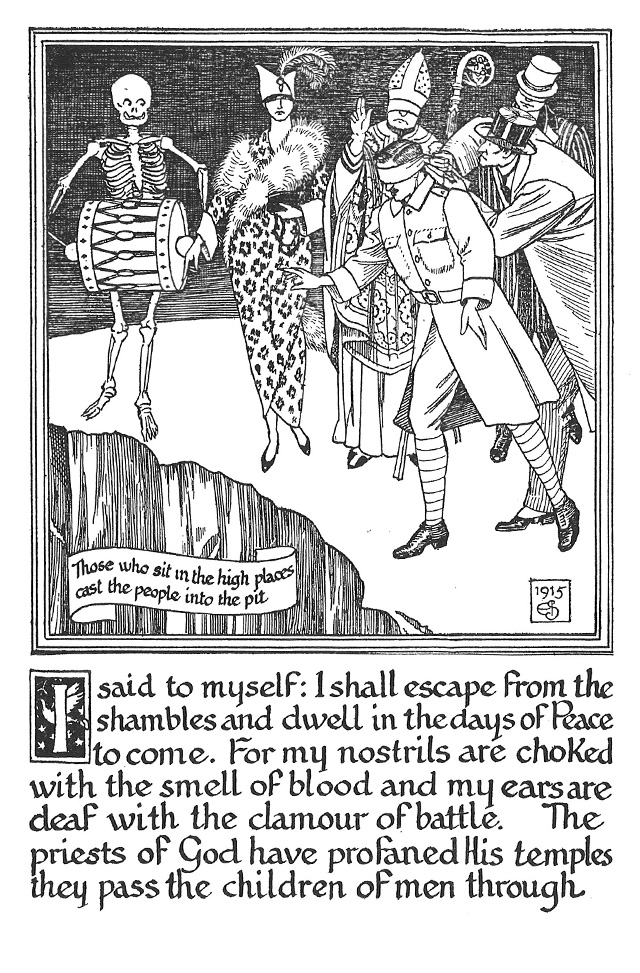
With the onset of war in 1014 Southall’s output as an artist waned.  Southall being brought up a Quaker and followed their beliefs all his life had him take an anti-War stance at the onset of hostilities.    Southall’s output as a painter declined considerably with the outbreak of World War I, as the pacifism inherent in his Quaker faith led him to devote his energies to anti-war campaigning. He abandoned his commitment to the Liberal Party and joined the Independent Labour Party, becoming Chairman of the Birmingham City Branch; the Party was the one left-wing body that always upheld its opposition to the war.  Southall also chaired the Birmingham Auxiliary of the Peace Society and was a joint Vice-president of the Birmingham and District Passive Resistance League.  His main artistic output during this period were anti-war cartoons printed in pamphlets and magazines, and art historians reckon they number among his most powerful works.
See the source image
The anti-war pamphlet Ghosts of the Slain by Joseph Southall

In the above cartoon we see depicted ‘all those who sit in the high places and cast the people into the pit’. A diplomat and a businessman push a blindfolded officer towards a precipice, whilst a fashionable society woman looks on and a cleric of the Established Church appears as the priest who ‘blessed our banners and bade speed to our swords’. Apart from Death, who gleefully accompanies this performance on his drum, only the diplomat sees what is happening; the others all have their eyes covered.

‘The Obliterator’ appeared in his anti-war pamphlet Fables and Illustrations opposite a mock sales promotion advertising the Obliterator’s record of leaving ‘nothing standing and nothing breathing’ while making ‘a clean sweep of civilisation’. Southall’s woodcuts and satirical fables were published when most of his wartime energies were consumed by pacifist activism in Birmingham and print caricature provided him a convenient alternative artistic output. The essence of his moral standpoint is an unshakable absolute conviction of conscience, clearly articulated in his fable ‘Inscription from Babylon’: although citizens ‘ought to be law-abiding’, in the final analysis, pacifism is justified by faith that ‘Divine law stood above human laws’ in the form of the the sixth Commandment: ‘Thou shalt not kill’
The Castle of Angers, France
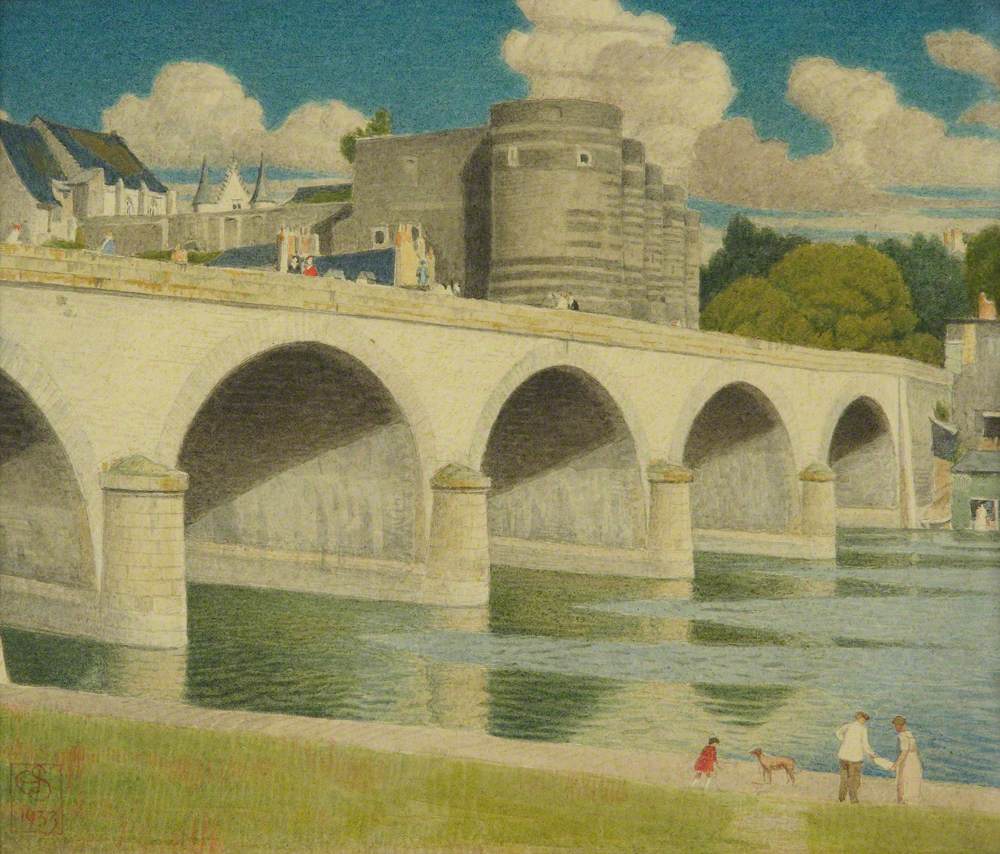
The Castle at Angers by Joseph Southall (1933)

During the two decades of peace between the two world wars, Southall and his wife made regular trips to Europe, visiting France and Italy in the Spring and Autumn.  Their European holidays were combined with their shorter summer holidays to their beloved Southwold on the Suffolk coast and Cornish breaks on the Fowey estuary, all of which gave Southall opportunities to paint the various places.  At this time Southall’s favoured painting medium was watercolours.  Many of these paintings were exhibited at the Alpine or Leicester Galleries in London and the Ruskin Galleries in Birmingham, as well as at the Royal Birmingham Society of Artists, the Royal Academy, and the Paris Salon. 

Portrait of Sir Whitworth Wallace by Joseph Southall (1927)

Between holidays Southall spent time on lucrative commissions, painting portraits for wealthy patrons, who would often be from the Quaker community. One such work was his portrait of Sir Whitworth Wallace  the first director of the Birmingham Museum and Art Gallery which opened in 1885.
The Return
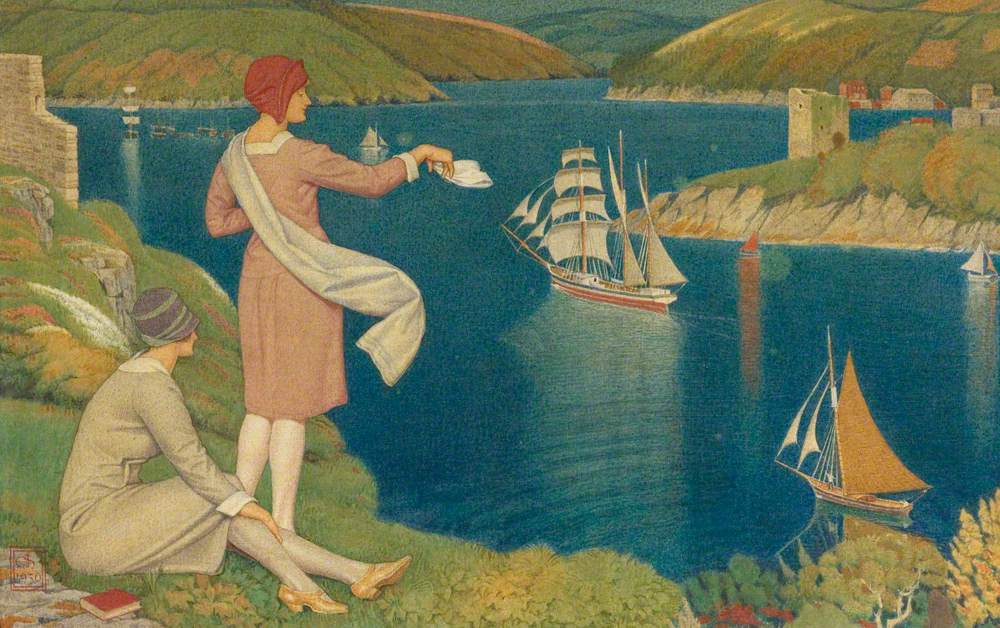
The Return by Joseph Southall (1930)

At the 1930 Winter Exhibition at the Royal Academy, Southall exhibited his painting The Return. The painting depicts two women high up on the banks of a river, possibly the River Fowey, one seated on the grass in grey dress, with mustard coloured shoes and a blue hat with green bands. There is a red book on a rock beside her. The other woman stands. She wears a red hat, a salmon-coloured dress with white collar and cuffs. She waves a handkerchief and her white scarf also waves in the wind. On the still water below are sailing ships, casting long reflections on the water. On a small boat lower right, two figures appear to return the woman’s wave.
The Tower of San Vitale :: Joseph Edward Southall - Italy ôîòî
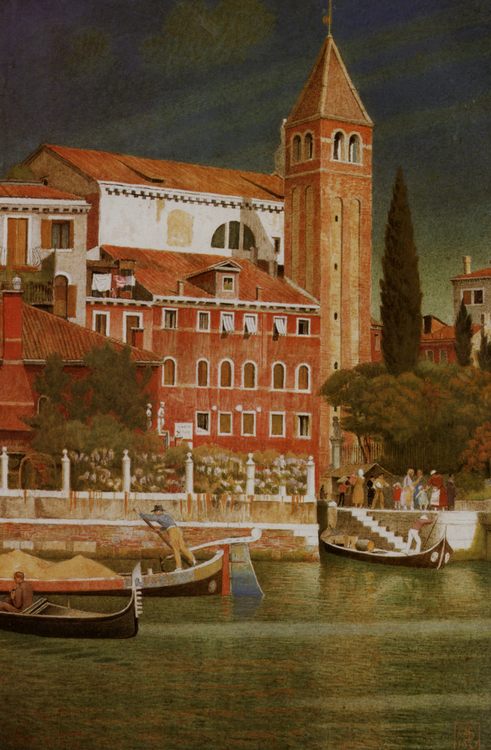
The Tower of San Vitale by Joseph Southall (1933)

Many of the works at this exhibition focused on Southall’s Italian paintings, many done using tempera.  So popular were paintings in that medium that the following Summer Exhibition 1n 1931 allotted one room for works using tempera. This was indeed a change of heart by the Academy Hanging Committee jurists who had scorned that painting medium and could not decide whether such works fell into a watercolour or oil classification.
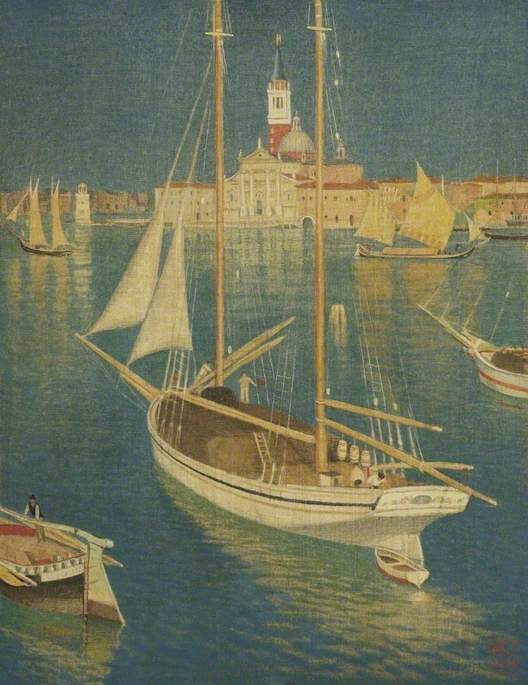
San Giorgio, Venice
San Giorgio, Venice by Joseph Southall (1927)

Joseph and Bessie Southall made many trips to Italy and one of their favourite haunts was Venice which he depicted in a number of his works.
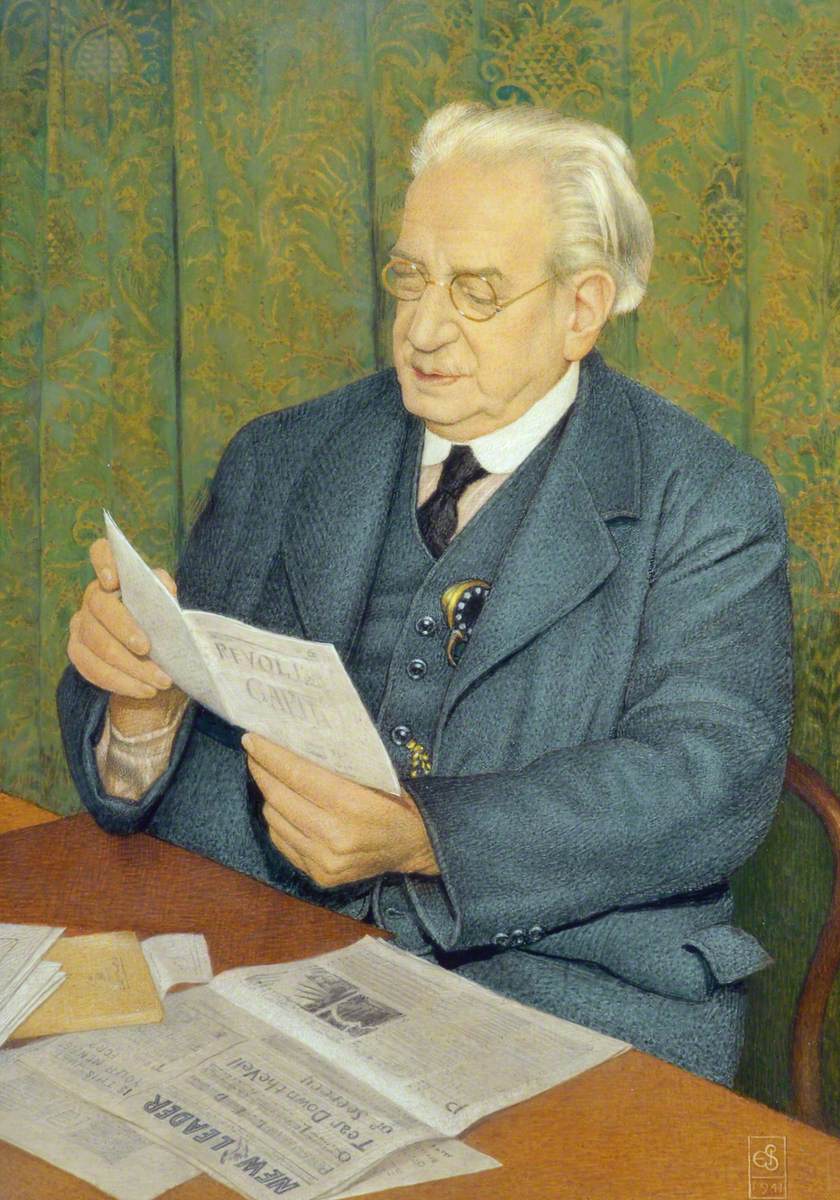
The Right Honourable F. W. Jowett by Joseph Southall (1944)

The couple made their last trip to Venice in the Spring of 1937 but later that year Southall was taken ill and had to undergo major surgery from which he never fully recovered. Doctors struggled to make a proper diagnosis of what was ailing Southall and he had to return to hospital on a number of occasions.  Notwithstanding his poor health he still determinedly carried on painting.  One of his last paintings was his memorial portrait in tempera of the Bradford MP, Frederick William Jowett who was a founder member of the Independent Labour Party. In the depiction we see a copy of the Independent Labour Party newspaper with a headline

“…IS THIS WHAT YOUR MEN FIGHT FOR?…”

Jowett had died in February 1944 and Southall had not quite finished it when he died nine months later.  The work was then completed by Maxwell Armfield, before being presented to the City of Bradford.

Joseph Edward Southall died of heart failure at his home in Edgbaston in 1944, aged 83.
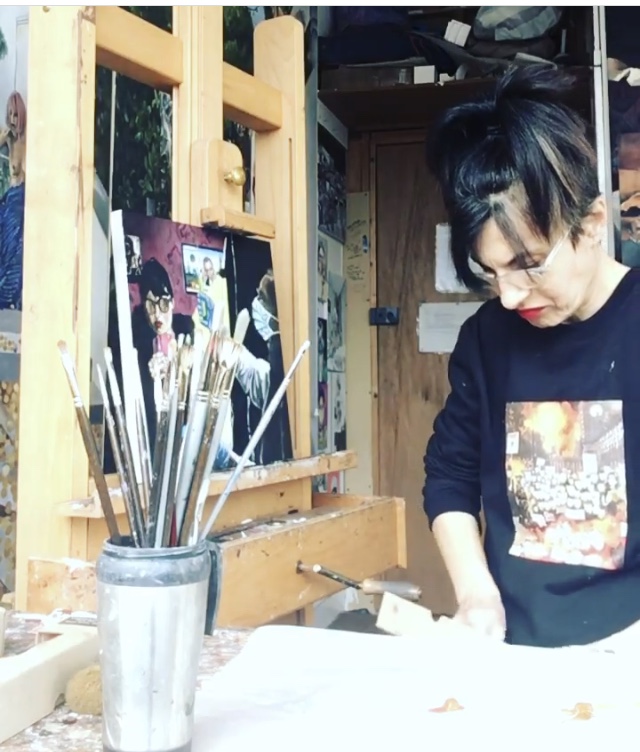
Natalie Papamichael. Part 2.

At work in my studio

During her first pregnancy, Natalie and her husband became increasingly unhappy with where they lived in London. They believed it was not a safe place to bring up children and so, decided to move. The problem for them, as it still is for most people, owning an affordable property in a good area in London is almost impossible. As they had had their wedding ceremony in Brighton, they knew something about the area and one of her friends from Paris who had previously lived in the seaside town told her that it would be a good place to bring up children. Knowing that it was a commutable distance to London and her beloved art galleries, the couple moved out of the capital in 2002 and relocated to the south coast town. In 2004 Natalie gave birth to her second child, another son, Tadhg. Now having two young sons, who were not great sleepers, put a lot of pressure on Natalie as she tried to continue with her art.

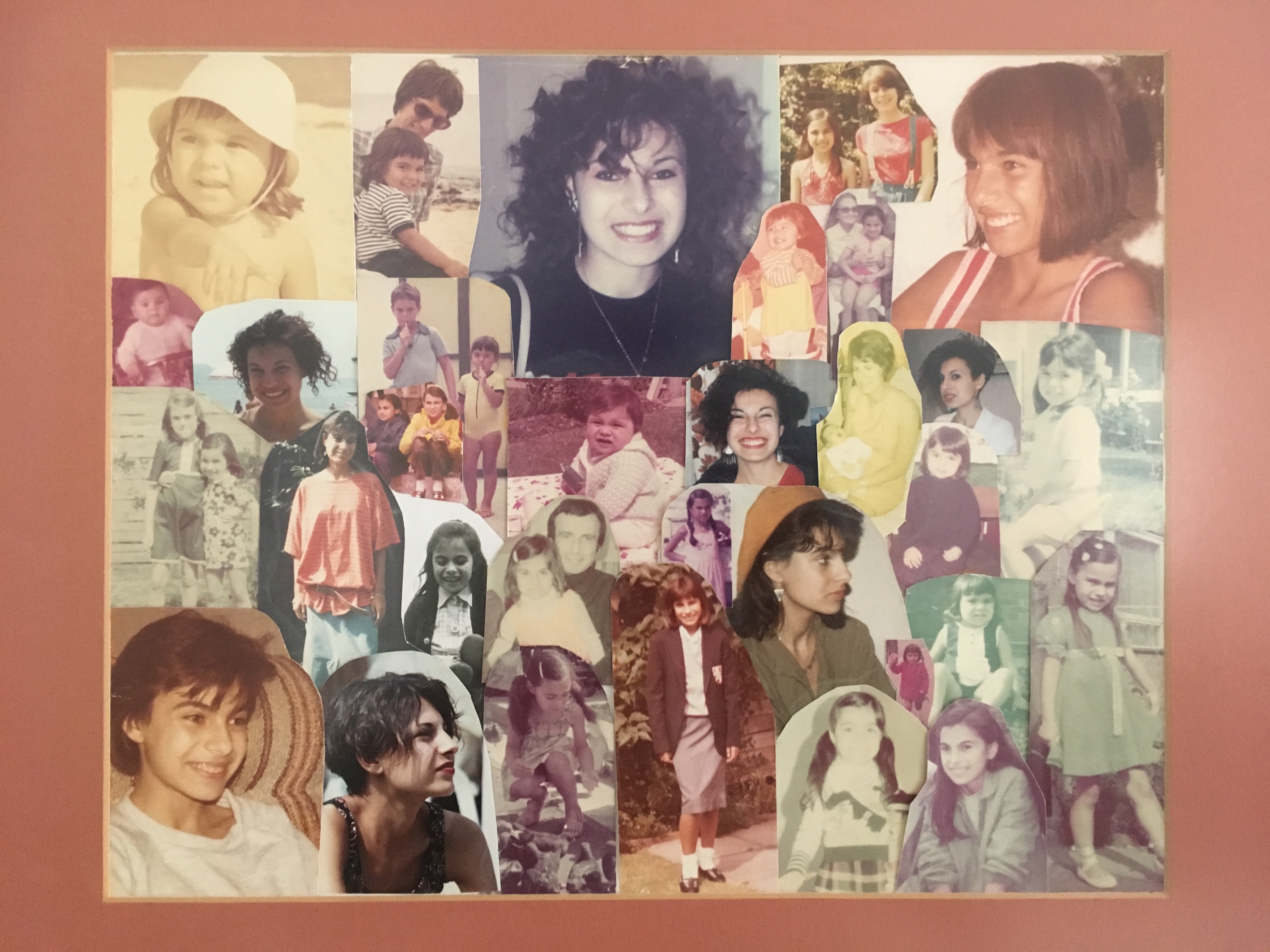
A collage of her life

In 2007, motivated to focus on combining her research with her studio practice, she went to Florence for a short Intensive Painting Course at the Angel Academy of Art, a private institution, founded by the English artist, Michael John Angel, in 1997, where one is taught drawing and learns the classical painting techniques of the Old Masters.

See the source image
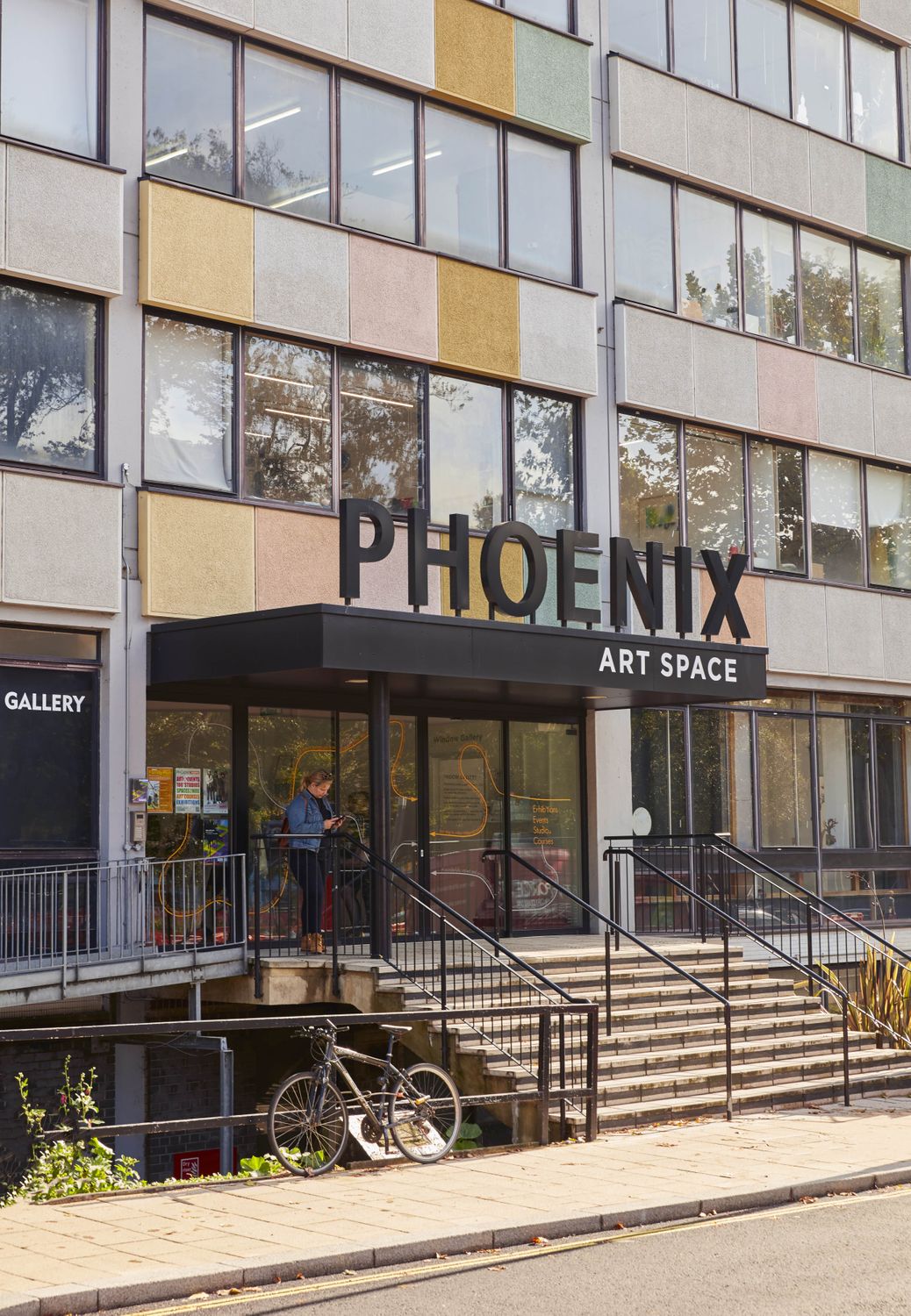
Phoenix Art Space, Brighton.

In 2009, finding it difficult to work from home, Natalie took a studio in the Phoenix Art Space, a five-storey building in the centre of Brighton close to her where she lived. There are four floors dedicated to a diverse community of artists. It was originally started as an artist-run space and a charitable organisation offering affordable studios. Initially Natalie had to share a space but eventually she got her own studio on the second floor.

Casting Call by Eleanor Antin (2007)

One of the artists who influenced Natalie was Eleanor Antin.  She had created a body of work that explores history, contemporary culture, and identity from a feminist perspective.    In 2007 Antin produced photographic tableau entitled Casting Call and from that work evolved Natalie’s 2016 painting, The Masquerade.  Antin’s tableaux was based on the story of the Greek painter, Zeuxis. He was considered the greatest artist of the era and was asked to do a painting of Helen of Troy, considered to be the most beautiful woman. Claiming that there was no such thing as a perfect woman, Zeuxis took the five most perfect women from the town of Croton and took a different characteristic from each. In Antin’s photography, the women appear as if at a casting call for a movie.

The Masquerade by Natalie Papamichael (2016)

In The Masquerade, Natalie replaced Antin’s women with her own performance stills, which she made whilst at college, in different masquerades and at various stages of her pregnancy. She is rewriting the narrative from her own perspective whilst inserting herself into an artistic historical discourse.

The Society of Outsiders (1) (after Eleanor Antin) by Natalie Papamichael (2017)

In 2017, Natalie completed two large works (200 x 170cms) entitled The Society of Outsiders (after Eleanor Antin) I and II.   

The Golden Death from the Last Days of Pompeii by Eleanor Antin (2001)

These were again based on the photographic tableaux by the conceptual artist, Eleanor Antin, entitled The Golden Death from the Last Days of Pompeii by Eleanor Antin (2001).

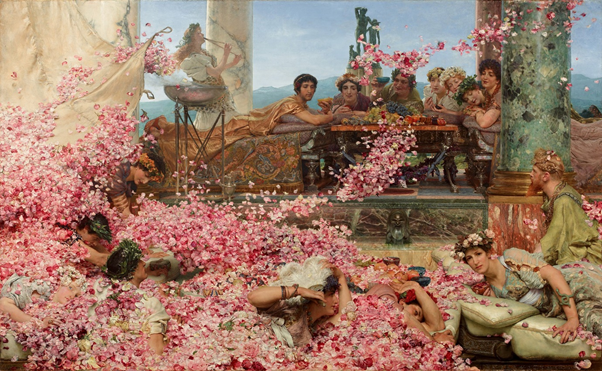
The Roses of Heligabalus by Lawrence Alma Tadema (1888)

One of the original photographs by Antin was based on the Lawrence Alma Tadema’s 1888 painting, The Roses of Heligabalus. In this painting the decadent Roman Emperor, Heliogabalus, kills his guests by smothering them to death with rose petals.

The Society of Outsiders (II) (after Eleanor Antin) by Natalie Papamichael (2018)

There is an unusual story behind these two large works of art.  In late 2016, Natalie had been invited to create two paintings for an exhibition in Central London for a charitable event.  She was shown where the paintings would be hung so that she could tailor the canvases to fit neatly in place.   She worked on the paintings up until the end of 2018 in preparation for the exhibition which was due to take place in January 2019. She eventually completed the two works but a month prior to the exhibition the Charity organisers baulked at the depictions and said they did not want them in full view and allocated her an alternative space on the back staircase.  They then said they did not want them at all and later excluded more of her paintings, deciding that it was best not to show any of her work.  Who said the life of an artist is easy !!!

In her painting, Self-Portrait at La Salpêtrière, Natalie is once again reimagining an original work of art. 

This image has an empty alt attribute; its file name is image-7.png
A Clinical Lesson at the Salpêtrière by Andre Brouillet (1887)

This time the artist is Andre Brouillet and the painting is A Clinical Lesson at La Salpêtrière which he completed in 1887.   La Pitie-Salpêtrière is a famous hospital for the mentally ill in Paris. The original work depicts the renowned neurologist, Jean-Martin Charcot, giving one of his regular Tuesday lectures in how to treat an hysteric. It depicts the ‘queen of hysterics’ swooning and being caught by the nurses.

Self-Portrait at La Salpêtrière by Natalie Papamichael

In Papamichael’s painting the hysteric is replaced by Natalie’s own Self Portrait. Instead of passively swooning like Brouillet’s hysteric she is actively reading a book entitled ‘The Science of Woman’ and defiantly challenges the gaze of the male doctors.  Of the depiction, Natalie comments:

“…In my paintings I am both performing as the ‘male artist’, but also as the traditional, passive, female subject of the painting, thus challenging the binary opposition inherent in Art History. It is a way of inserting myself into the narratives and combining the past with the present to illustrate the similarities as well as to subvert the meaning…”

Anatomical Venus by Natalie Papamichael (2018)

Another of Natalie’s works featuring the science of medicine is her 2018 oil on aluminium panel, Anatomical Venus, which is based on the wax model which was created in 18th century Florence and displayed as part of the city’s public science museum, La Specola. It was used for instruction in anatomy. The models were also entitled ‘Slashed Beauties’ and ‘Dissecting Graces’. The doctors in the painting are from the 1931 black and white Frankenstein film. The painting juxtaposes the grotesque with the beautiful.

Herstory Rhymes by Natalie Papamichael

One of Natalie’s works which she considers as being of great importance is her painting entitled Herstory Rhymes which she feels encapsulates everything that is relevant to her practice and shows the most development from her early stages. There is reference to the film ‘Fahrenheit 451’ as the setting. She has changed the book titles so that each book is important in terms of censorship as well as her personal story. The poster which is about to burn in the background is ‘Ghost Town’ by the Specials. This references the deep recession of the 1980s and suggests the notion that ‘history doesn’t repeat, but it rhymes.’  Of the painting she said:

“… My self-portrait is again a reflection of the apathy of people ignoring what is happening around them whilst looking at their mobile phones …”

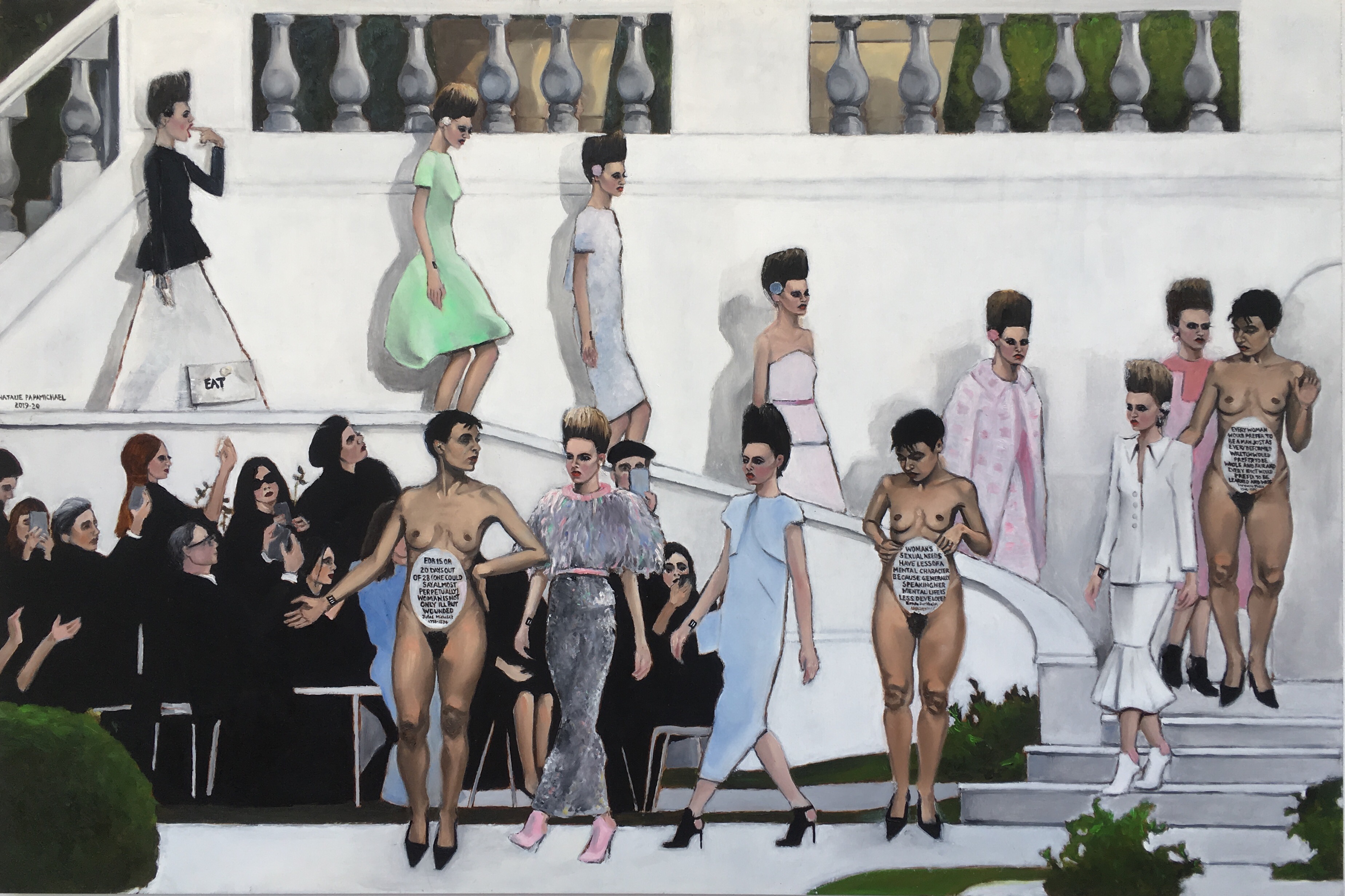
Docile Bodies by Natalie Papamichael

Natalie Papamichael’s painting entitled Docile bodies is a re-imagined painting adapted from a still from a Karl Lagerfield fashion show.  The original image resembled an old Masters setting with the futurist models walking forwards. Natalie explains:

“… I wanted to integrate the absurdity and the futuristic look of the models walking forward in a regimented style and integrate this with a reference to the setting of the Old Masters and integrate this with my performance stills from the LSHTM (London School of Hygiene & Tropical Medicine). In this performance I reference the poses of models from 16th and 17th century medical dictionaries and had misogynistic quotes from throughout history in which woman is subjugated because of her body and her bodily functions. Relating the historical subjugation of women through their bodies to culture today. The last model at the top of the staircase, is overtly referencing an eating disorder by pointing as if she is about to put her fingers down her throat. All the models also have a bar code on their wrists which references the commodification of people and is somewhat more pertinent than I realised it would be...”

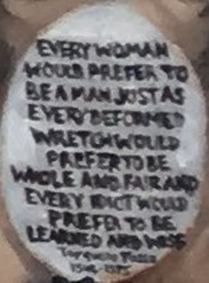
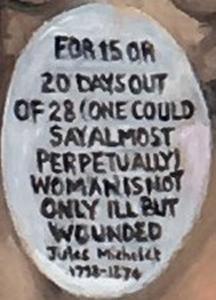
Although the writing on the “shields” held by the three women is probably not visible in the picture they were three quotes:

Woman’s sexual needs have less of a mental character because generally speaking her mental life is less developed’ ( Emile Durkheim 1858-1917)
Every woman would prefer to be a man, just as every deformed wretch would prefer to be whole, and every idiot and fool would prefer to be learned and wise”. (Torquatto Tasso)
‘For 15 or 20 days (one could say almost perpetually) women is not only ill but wounded’ Jules Michelet 1798-1874
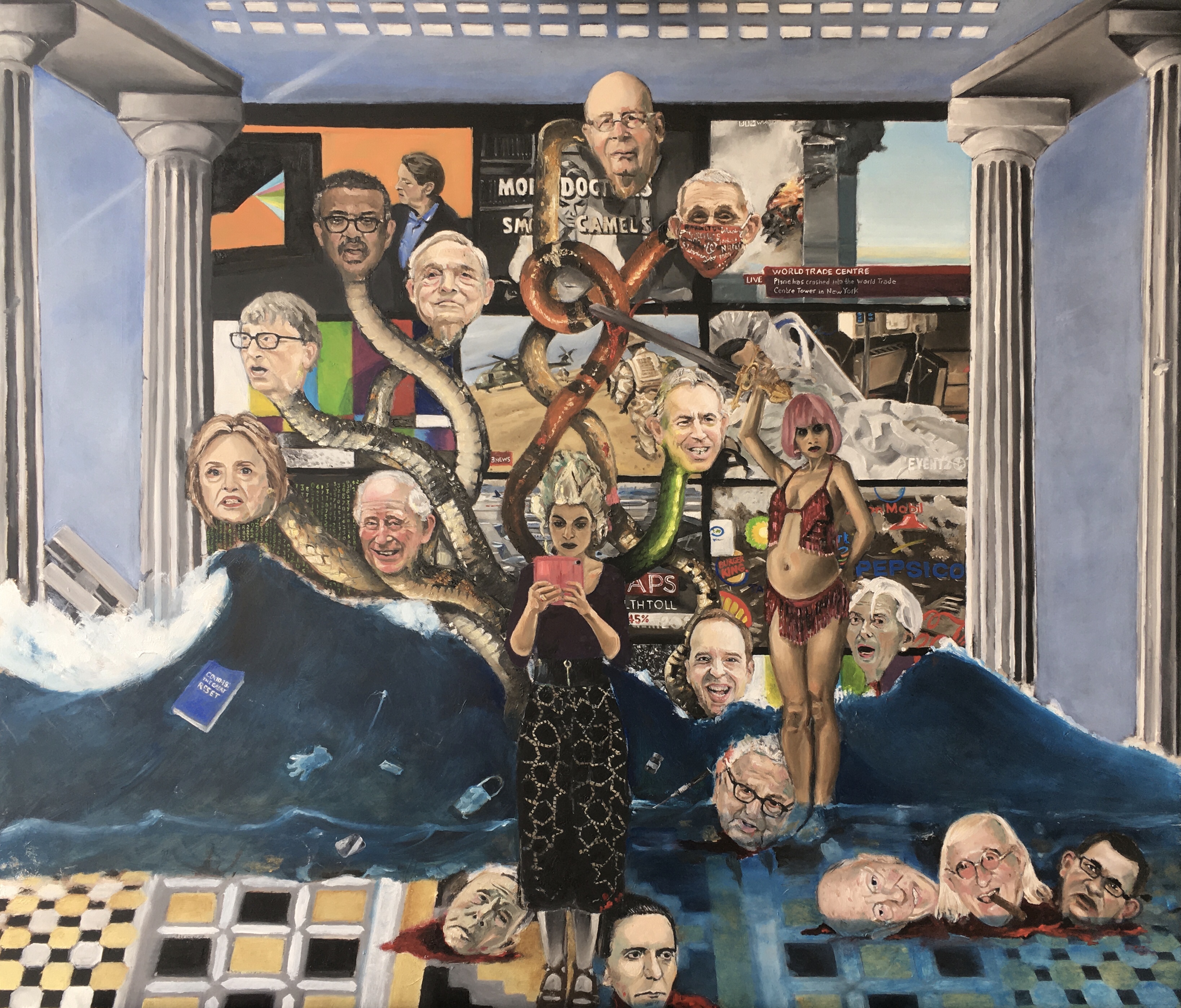
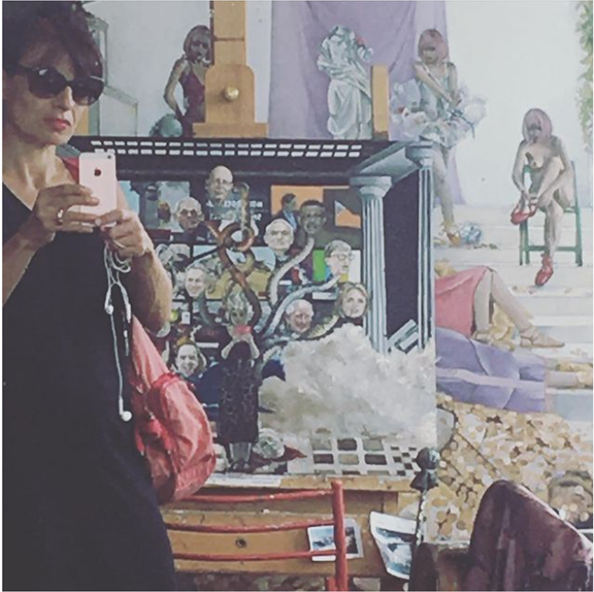
The Hydra by Natalie Papamichael (work in progress)

Natalie’s “work in progress” is her oil painting depicting the mythology of The Hydra. It is an allegorical piece based on contemporary world events. It is a pendant piece to ‘Herstory Rhymes.’  She explains her thoughts about the depiction:

“…For the beginning of the piece I used a still from a Percy Jackson film with the mythical creature, The Hydra. The Hydra is a monstrous serpent with nine heads and when a head is cut off another one simply grows back to replace it, thus the evil continues.  In my painting I have replaced the heads with politicians and people accused of orchestrating the constraints emerging on civil rights around the world. I am in the forefront of the painting looking at a mobile phone.  I have on my Marie-Antoinette wig and I am oblivious of what is happening around me. I have used one of my performance stills, as Salome, and I am about to strike one of the serpent heads. In the background there are screens depicting the widespread propaganda prevalent in the major media outlets around the world…”

She said that as she worked on it, it has evolved in its references and meanings. It also referenced the poem Jerusalem by Blake:

Bring me my Bow of burning gold:
Bring me my arrows of desire:
Bring me my Spear: O clouds unfold!
Bring me my Chariot of fire!
 
I will not cease from Mental Fight,
Nor shall my sword sleep in my hand:
Till we have built Jerusalem,
In England’s green & pleasant Land.

Dress made from the painting.

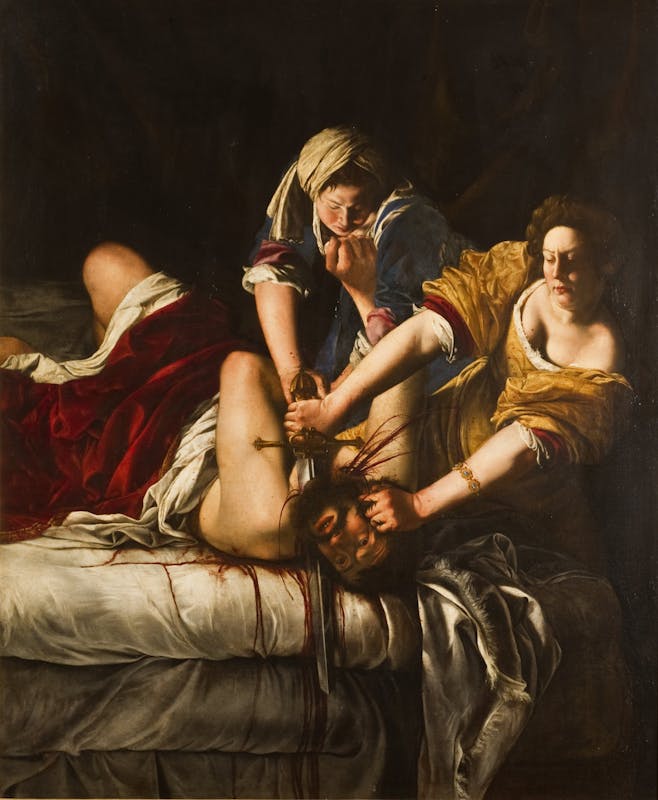
Around 1620 Artemesia Gentileschi completed her famous painting, Judith Beheading Holofernes. She portrays the moment that Holofernes is killed by the hand of the determined and formidable Judith. The overall effect is both powerful and frightening: the drunk corpulent general is lying on the bed, his head grasped by his hair and the sword plunged into his neck.

Judith Beheading Holofernes. by Artemesia Gentileschi (c.1620)

Furthermore, Artemisia did not shy away from adding the gory detail of blood spurting so profusely as to stain Judith’s breast.

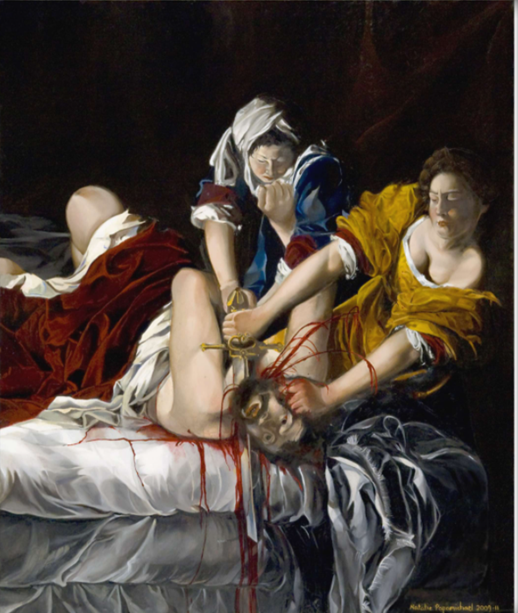
Below we can see Natalie’s version of the famous painting.

Judith beheading Holofernes (after Artemesia Gentileschi) 2009-2011

Natalie has been continuing to teach herself using the methods she learnt in Florence. She has exhibited widely including exhibitions both within her studio as well as at Gallery Different and at the Society of Women Artists in London. Her practice has evolved in recent times to become more overtly political and she has started turning her paintings into merchandise to try to reach a wider audience.

The artist and I in her studio (Brighton 2021)

It has been my pleasure to collaborate with Natalie with these two blogs featuring her life and works of art. I wish her well in the future.

Natalie Papamichael. Part 1.

Natalie Papamichael in her studio

I have told you on a few occasions that I tend to write about artists who have passed away and steer clear of living artists as they may take offence about what I have written!  My featured artist in the next two blogs is a living painter who I was fortunate to meet and talk to her about her art.  She is an utterly fascinating person, as are her works of art.  She is strong-willed and holds very strong opinions with regards feminism and things that face us with twenty-first century living.  Her works, which I will show you, are hard-hitting and thought-provoking and although they may not be liked by all, I am amazed by them and of course you all well know that I like paintings with a background story. My artist today, Natalie Papamichael, who is based in Brighton on the south coast of England where she has her own studio, which I was fortunate to visit.  However, let me start this story before she was born and as we meander along her life’s path, I will introduce you to some of her paintings.

Natalie Papamichael in her studio with some of her paintings

Natalie was born on September 5th 1971 in Slough, Berkshire. She has one sister, Helen, who is three years older than her. Her father Nicholas came from Greek and Cypriot parentage and grew up in Alexandria, Egypt. He and his brother left Egypt to study in UK in 1956. Natalie’s mother, Nicole, is French and came from Paris. She moved to the UK in order to study English and it was in London that the couple met. They married in Athens in 1965 and had intended to live in Greece but a far-right military junta overthrew the caretaker government that ruled the country in April 1967 and the couple decided that it would be safer to stay and live in England. They settled in south-east London. Natalie’s father, a mathematician, worked at Brunel University in the Uxbridge area of west London, and her mother worked at the French Consulate in central London. Natalie was born on September 5th 1971. Her only sibling, a sister, Helen, was born in May 1968.

Self portrait as Medusa by Natalie Papamichael (2016)

Natalie started her schooling, aged five, at the Seer Green Church of England Primary School in 1976, and in 1983 she moved to the Chesham High School, Buckinghamshire where she remained until the age of sixteen. In 1987, having achieved good grades in nine GCSE subjects, she attended the Further Education establishment of Amersham College where she attained her A Levels in French, English Literature and Art. Natalie left the college in 1989 and applied for a place on an Art Foundation Course but was rejected. Subsequently she was offered a place on the “Reserve List” but still feeling aggrieved that they had turned her down initially, she rejected the place and decided to spend her “Gap Year” in Paris, where she had some friends and relatives. There she began working as an au pair, an occupation her sister had undertaken years before.

Self portrait as Marie Antoinette by Natalie Papamichael (2018)

Natalie returned to the UK where she had a place at Leeds University to study French and Brazilian Portuguese. Her reason for choosing this combination of subjects was less to do with future career ideas but more to do with the fact that she would get to spend time in Brazil and France. However, her university plans were abandoned when she became very unwell. Her illness was due to her excessive alcohol consumption combined with a debilitating eating disorder. Her weight at that time was down to below eighty pounds. Around this time, her parents had taken the decision to leave England and settle in Greece.  But in the meantime her father accepted a visiting professorship in Portugal . Natalie’s father was a Socialist and the re-election of Margaret Thatcher was more than he could bear !!! Her father eventually was offered a temporary teaching post at the University of Braga, near Porto and he and his wife travelled to Portugal. Later, due to her illness, Natalie joined them.

Watercolour pencil sketch on paper of Lily Cole by Natalie Papamichael (2005) with pencilled notes of her life at the time

At this time, her sister was living in Paris and so Natalie decided to leave Portugal and join her in the French capital. Initially she lived with her sister but later lived on her own in many different arrondissements around Paris. She loved Paris and continued with her painting. She would often visit the Musée d’Orsay where she would sit for many hours sketching. She loved films and would regularly go to the cinema. Another pleasing pastime was reading and she loved to while away the time sitting and reading in the many city parks. Natalie took on a variety of jobs such as working in some Irish pubs. She also had part time jobs at Chicage Meatpackers, Habitat, Galleries Lafayette and finally she got a job which she stayed at for several years as a receptionist at KPMG. At weekends she would sometimes visit and stay with relatives who lived in the suburbs of Paris.

Totem 01 by Natalie Papamichael (2019)

But all was not well and she began to have health problems due to her continuing high alcohol consumption exacerbated by her constant partying and this coupled with an eating disorder soon took its toll. She had made many friends and went to parties but as her drinking got worse, she became much more isolated and began to self-harm. Finally, she was admitted as an in-patient at L’ Hôpital Sainte Anne. She recalled later:

“…I did not realise at the time that it was a psychiatric hospital. I discovered that it was a famous psychiatric hospital in 2006, when I was sitting in a lecture at the Courtauld Institute. My tutor was talking about Nancy Spero and Antonin Artaud. She mentioned that Artaud had been in Hôpital Sainte Anne in Paris. I nudged my friend (who was also half French, half Greek) and told her I was in that hospital. She said did I realise it was a psychiatric hospital! I then looked into the history of the hospital and realised it had really interesting links to another artist, Unica Zurn. What was also very interesting about this was that Unica Zurn had lived a few doors down from where I lived with my sister in Rue Mouffetard…”

Massacre of the Madwomen by Natalie Papamichael (2019)

The narrative behind Natalie Papamichael’s 2019 painting entitled Massacre of the Madwomen resonated with her own story and her time spent in L’hopital Sainte-Anne in Paris. The characters that she used are pertinent for the stories that they are taken from. The women she enacts are the typical ‘hysterics’.  Her work is based on a black and white print of the event entitled Massacre at la Salpêtrière, 3 September 1792.

La Salpêtrière was a famous asylum in Paris, which, during this period, was operated more like a prison, housing women who were prostitutes, the poor, the mentally ill and the disabled. The Massacre was part of the bloody September massacres in Paris during the French Revolution. On the nights of September 3rd and 4th 1792, La Salpêtrière was stormed with the intention of releasing the detained women. However, out of fear that the inmates would join the foreign and royalist armies, thirty-five of the women were dragged into the streets and murdered. Natalie’s painting is a re-imagaing of the Massacre once again using her own performance still images as well as characters from other sources, such as her favourite films, The Red Shoes and Das Cabinet des Dr Caligari.

Self Portrait with her painting *Society of Outsiders” by Natalie Papamichael (2018)

When Natalie was finally released from the Paris hospital she began to concentrate on her art and plan for the future. She created many paintings whilst in hospital which she exhibited at Finnegan’s Wake. Her excessive drinking became worse and after a progressive mental and physical descent, she managed to stop drinking. She has not had a drink now for twenty-seven years!. Natalie knew the only thing she really wanted to do was art. She had hoped to apply for entrance to the Ecole des Beaux-Arts in Paris but they did not recognise her English qualifications and so in 1996 she returned to London. She gained employment as a receptionist at Talkback TV Production and it was whilst working there that they allowed her to work part time so she was able to enrol on a part-time Foundation Course at the prestigious London art school, Central Saint Martins. In 2000 she married Mark, an English teacher and musician, at a civil ceremony at Brighton Registry Office, followed by a small wedding in Agios Dimitrios, a small church at the foot of the Acropolis in Athens. Having completed the Foundation Course at CSM, she went on to do a full time BA in Fine Art at the school. During her final year at Central St Martins, she became pregnant with their first child. She used her pregnant body for performances at a time when she was looking at the feminist performance artists of 1979’s. She became involved with the Women’s Art Library, researching feminist performance artists of the 1970s and creating her own performances. In 2002 her first born, Ziggy, was born. Four years later, in 2006, she studied for a MA in Art History at the Courtauld Institute of Art in London, a degree she attained the following year. It was at the Courtauld that she explored the exclusion of women from academic training and how art history had recorded the struggle of female artists to gain deserved recognition.

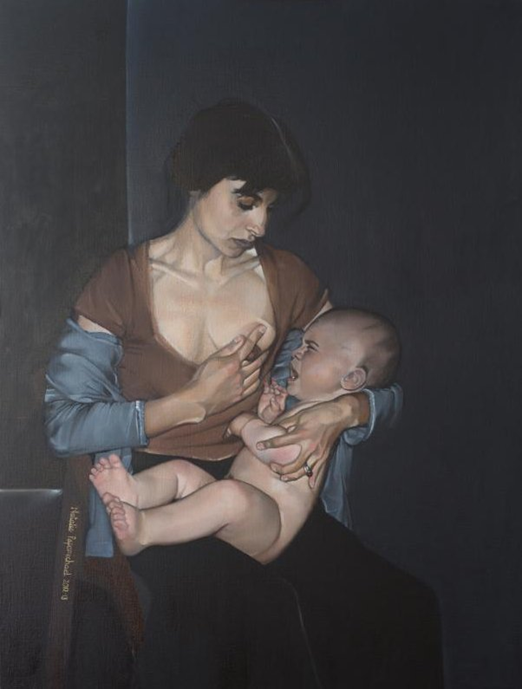
Self portrait with Ziggy (as Madonna and Child) by Natalie Papamichel (2013)

One of her most beautiful works is her 2013 painting, Self portrait with Ziggy (as Madonna and Child) which she completed in 2013.  She used the Madonna and Child painting by Artemisia Gentileschi as the direct reference and re-interpreted this to show the reality of motherhood.  It is such a tender depiction of Natalie and her first-born son.  Did the baby sit still for the portrait?  Actually she used a teddy bear !! (She said that she collaged two photos together, the calm pose was the one with the teddy bear and the other was the one with Ziggy crying).

868px-Madonna-and-child-Gentileschi
Madonna and Child by Artemesia Gentileschi (c.1612)

Maud Allan, born as either Beulah Maude Durrant or Ulah Maud Alma Durrant in August 1873. She was a Canadian dancer, chiefly noted for her Dance of the Seven Veils.  She was a favourite of the music hall and popular theatres, where a population from diverse social backgrounds went to watch a variety of plays, sketches, comedy and songs- much like a modern variety show.

Maud Allan

As a tribute to Allan, Natalie has crafted her oil on aluminium painting Self-portrait as Salome (after Maud Allan).

Self-portrait as Salome (after Maud Allan) by Natalie Papamichael

……………………….to be continued


The idea to write about Natalie Papamichael came from an interview I read in Natasha Moura’s excellent art blog:  Women’n Art

Thomas Cooper Gotch. Part 3.

Although returning to live in Newlyn was tempting Thomas decided on another course of action and took his wife on the long voyage to Australia on the fully rigged sailing passenger clipper, Torrens., leaving England on October 30th 1883.  Their daughter Phyllis remained in Kettering with her grandparents.   Thomas and Caroline arrived in Port Adelaide on January 8th 1884 where they transferred to the SS South Australia and sailed to Melbourne where they were met by John Speechley Gotch, a wealthy distant relative who had met Tom when he visited England in 1874.  John Gotch was an art lover and he arranged for Thomas and Carrie to hold a joint exhibition of their work which they had brought with them, at Melbourne’s Fletcher’s Art Gallery in February 1884. 

Mental arithmetic
Mental Arithmetic by Thomas Gotch

The most important painting exhibited by Thomas Gotch was one entitled Mental Arithmetic.  It depicts an elderly bearded fisherman sitting holding a knife and plate of food being watched by a small girl.  It is thought that Thomas painted this in November 1883 from sketches he made that summer in Newlyn.  Melbourne City Gallery wanted to buy the painting but baulked at the £200 selling price.  However, John Gotch bought it and donated it to the gallery.  Many of John Goth’s paintings and sketches were sold as well as work by his wife Carrie and the couple made more than enough money to pay for their sea passages.

Qua-Qua, south of Johannesburg
Qua-Qua , South of Johannesburg by Thomas Gotch

Tom and Carrie returned to England on the Torrens calling at Cape Town, St Helena and the Ascension Island for the vessel to replenish supplies.  They eventually returned to London on July 3rd 1884.  The couple left the English capital and journeyed to the West Country looking for suitable accommodation.  They tried Brixham and Looe but finally settled on the Cornish town of Polperro where they lodged at the Louriet Hotel and were soon joined by their ten-month-old daughter and her nurse.

Child Enthroned by Thomas Gotch

Children featured in many of Gotch’s paintings.  Probably the best known is his 1894 work entitled Child Enthroned.  Like many other depictions of the young there is a mystical element about the portrayal of the young girl.   His eleven-year-old daughter Phyllis was the model for The Child Enthroned.  Her father’s Madonna like depiction was, he said, down to his time spent in Italy in the summer of 1891.  The painting is testament to Gotch’s ability as a portrait painter, especially his love of child portraiture and his competency in depicting fine detail in ornate fabrics.  The painting when exhibited to the public that year at the Royal Academy was rapturously received and established Gotch’s reputation as an artist.

Alleluia by Thomas Gotch

Another painting featuring Gotch’s daughter was his 1896 work entitled Alleluia. It was a major demonstration of his Pre-Raphaelite style.  Along the top of the painting, we see inscribed in Gothic lettering on a background of gold leaf, a Latin quotation which reads:

“…Sancti tui domine benedicent te gloriam regni tui dicent – Alleluya…”

 The inscription is taken from Psalm xlvii: 6 and 7, which was printed in the catalogue of the 1896 Royal Academy exhibition:

“…Sing praises to God, sing praises: Sing praises unto our King, Sing praises, For God is King of all the earth: Sing praises with understanding…”

It is a painting featuring thirteen richly clad children singing against a gilded background and his thirteen-year-old daughter is at the centre rear of the group with her hands clasped in prayer.  In front of her is a small figure with amber curls.  This is her cousin Hester Gotch.  When it was first shown at a local exhibition in Newlyn it was criticised by the local press because they believed Gotch had broken with the Newlyn tradition of painting.  The art critic of the Cornish Telegraph quipped that he doubted whether the time it took to complete (nine months) was worth the effort.   The art critic of the local weekly newspaper, West Briton, criticised the work saying:

“…It would be easy enough to say outright that we don’t like the thing and have done with it.  It is not possible to take ordinary children of today and pictorially attempt to transform them into choiring cherubim, without coming within consciousness of incongruity…”

Fortunately for Gotch when he submitted the work to that year’s Royal Academy exhibition the receiving jury accepted the painting had it hung at the most advantageous position, (hung on line). The work of art, which is part of the Tate Britain collection, was bought for the Nation under the terms of the Chantrey Bequest, following its exhibition at the Royal Academy.  The Chantrey Bequest, set out in the will of sculptor Sir Francis Chantrey, was of primary importance to the foundation and development of a national collection of British art at the Tate Gallery and it constituted the gallery’s main purchasing fund from its opening in 1897 until 1946.

See the source image
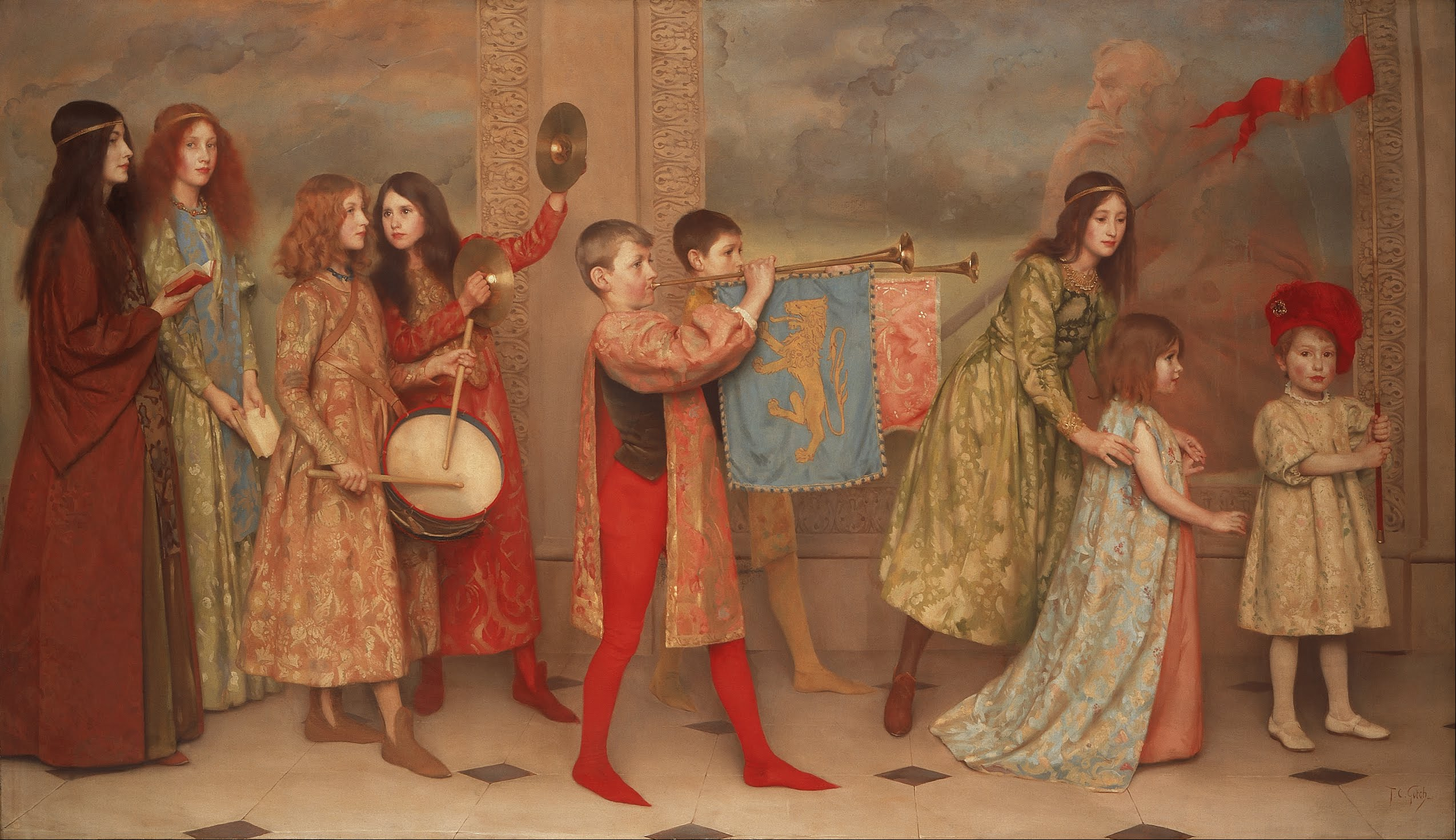
A Pageant of Childhood by Thomas Gotch (1899)

Another of Gotch’s paintings featuring a group of children was completed in 1899. It was entitled A Pageant of Childhood.  It depicts a procession of nine children of varying age, the eldest at the rear and the youngest at the front crossing a tiled hall in front of a fresco of Father Time, who we are aware will, in due course, carry off even the youngest of the children.  It is a colourful depiction of children enacting an historic pageant.  Some like the two boys at the centre play long horns whilst behind them are two girls, one with a drum and one with a set of symbols.  Take a look at the various children.  Some, with thoughtful expressions, are taking the enactment very seriously whilst others appear light-hearted and, in some respect, they personify children of different ages at play, a representation of the stages of life.  It was Gotch’s own evocation of innocence and youth.  The painting was completed just before the family left Newlyn and exhibited at the Newlyn Gallery in March 1899.  It was shown at the 1899 Royal Academy exhibition and appeared at Liverpool’s Walker Art Gallery, after which the Liverpool Corporation purchased the work and is part of the Walker Art Gallery collection.  This painting was completed close to the time that the Gotchs moved to a new house and went to live in Shottermill.

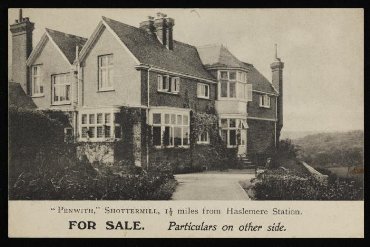
Postcard advertising auction of ‘Penwith’, Shottermill in 1906

Thomas Gotch’s House Penwith on sale in 1907

Thomas Gotch had decided to relocate his family to Shottermill close to the town of Haselmere, West Sussex, forty miles south west of London and twenty-five miles from the south coast of England.  At the end of 1898 Thomas started building his new home, named Penwith and the family were able to move in in October 1899.  Penwith was situated on a hillside at the end of a long twisting drive, which rose above the ponds of Shottermill.  It was a large six-bedroom residence with two drawing rooms, a large kitchen and two purpose-built studios.

See the source image
The Dawn of Womanhood by Thomas Gotch (1900)

In 1900 Thomas Gotch’s main work was entitled The Dawn of Womanhood which appeared at the 1900 Royal Academy Exhibition.  The painting depicts the child enthroned being confronted by the vision of approaching motherhood.  The phantom figure on the left represents Womanhood.  She is dressed in opalescent drapery of pale blue, gold and silvery primrose.  She is wearing a mask, as legend has it that all who are no longer children must conceal themselves which probably harks back to the story of Eve, who after eating the forbidden fruit was ashamed of her nakedness and sought to conceal it.  Sitting on the steps of the throne, to the right, is the familiar winged sprite representing the spirit of childhood, who is aware of the strange presence and makes ready to take flight for ever from the girl on the throne.

The Exile
The Exile: Heavy is the Price I Paid for Love by Thomas Gotch (c.1930)

Painted around that time, in 1930 — a year before Thomas Cooper Gotch’s death — The Exile is shrouded in mystery. As of now, we know nothing about the identity of the sitter or about the suggestive, tantalizing title of her portrait.

Thomas Gotch exhibited at the Royal Academy from 1880-1931, in all showing seventy of his paintings. He was elected to the Royal Society of British Artists in 1885 and the Royal Institute of Painters in Watercolour in 1912. He was a founder member of the New English Art Club in 1886 and served as President of the Royal British Colonial Society of Artists between 1913 and 1928.   Gotch was fêted at the Salon and won medals in Chicago and Berlin.

Thomas Cooper Gotch died aged seventy-six of a heart attack while in London for an exhibition on May 1st, 1931.  He was buried in Sancreed churchyard in Cornwall.   Also in the graveyard of St Sancredus are buried fellow Newlyn School artists, Stanhope Forbes and Elizabeth Forbes.

Thomas Gotch’s wife, Caroline, died on December 14th, 1945 aged 91 and their only child, Phyllis Marian Gotch became Marquise de Verdières when she married André Marie, Marquis de Verdières in 1922. She died in Hong Kong on April 24th, 1963 aged 81.   She is buried with her parents in Cornwall’s Sancreed Churchyard.

Thomas Cooper Gotch. Part 2.

Thomas Cooper Gotch

Sometime in 1878 their reading group, set up by Thomas Gotch, had a new member.  Her name was Caroline Burland Yates.  Caroline was one of three sisters born to Esther Burland and wealthy property owner, Edward Yates. The family was from the Liverpool area, later moving to Sway in Hampshire. Caroline was the youngest of the three daughters and educated by a governess.  Caroline attended finishing school in Switzerland where she became fluent in French.  She, like Thomas Gotch, had studied at the Heatherley School before arriving at the Slade.

A Golden Dream
A Golden Dream by Thomas Gotch

Thomas’ progress at the Slade was outstanding and he was the firm favourite of his principal lecturer, Alphonse Legros, the French-born painter who later took British citizenship.  During his first year at the Slade, Gotch produced many paintings and sketches which were sold at exhibitions in London.  One of Thomas Gotch’s closest friends at the Slade was fellow artistic aspirant, Henry Tuke. Through his friendship with Henry Tuke Thomas met other members of the Tuke family and became friendly with his sister Maria Tuke and medical student brother William Tuke.  Thomas was asked by William, and some of his fellow medics, to help form a group of art and medical students which would become a friendly debating society.  Thomas, who was extremely popular with the female students at Slade, and so, was asked to entice some “beautiful but well educated” young women into joining the society. 

See the source image
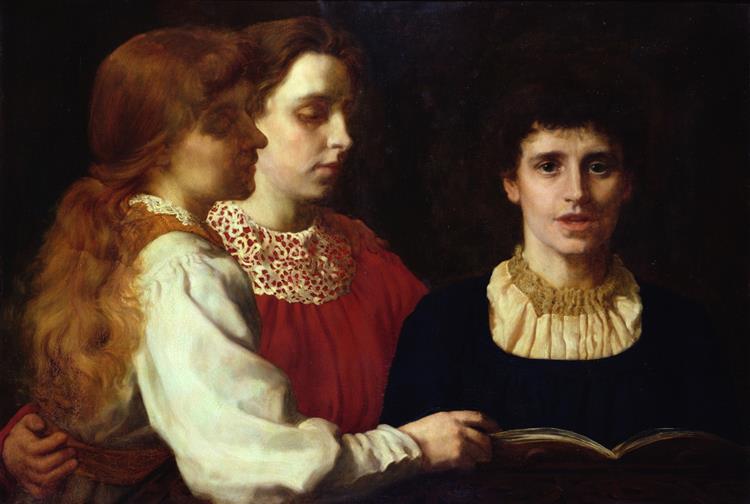
The Misses Santley by Henry Tuke

Many agreed to join, two of whom were the Santley sisters, Edith and Gertrude as well as Carrie Yates.  Thomas Gotch’s close friend, Henry Tuke, depicted these three in his famous work entitled The Misses Santley which was shown at the Royal Academy.  It shows the influence of Henry Tuke’s Slade professor, Alphonse Legros who encouraged his students to study the works of the Old Masters.  Frederic Leighton, then president of the Royal Academy, is reported to have said: “Can it be an old master? It could not be by a young man.”    The work depicts three women who were all fellow students of Thomas Gotch and Henry Tuke at the Slade.  The young woman on the right, holding a music score, is Edith Santley, the daughter of the famous baritone Charles Santley.  Next to her is her sister Gertrude, and in front left of the painting stands Carrie Yates, who would later marry Thomas Gotch.

Cornfields above Lamorna
Cornfields above Lamorna by Thomas Gotch

During the summer of 1879 Thomas Gotch and Harry Tuke went on a painting trip to Cornwall, visiting Penzance and Newlyn, where they were joined by Caroline Yates and her sister Esther.  The following summer Thomas Gotch and his sister Jessie spent part of the summer in the small North Wales coastal town of Beaumaris on the isle of Anglesey meeting up with Willie and Maria Tuke.  In October 1880 Thomas Gotch left England and arrived in Paris where he lodged at the Hotel d’Angleterre for a month whilst he negotiated his entrance to John Paul Laurens’ atelier.  In the meantime, in fact a month earlier, Carrie Yates along with two fellow art students, Jane Ross and Alma Broadridge had travelled to Paris and enrolled at the Académie Julian. 

Hilda and Margaret, daughters of Professor sir Edward Poulton
Hilda and Margaret, daughters of Professor Sir Edward Poulton by Thomas Gotch

Thomas Gotch was influenced by the historical works of Laurens as he was interested in figurative painting.  His other overwhelming interest was also Carrie Yates.  They had become remarkably close and she was teaching him French.  She was lodging at the Hotel de Paris and Thomas had an apartment on the top floor of a building at 17 rue de Tournon. Although it was a Bohemian establishment, the rooms were spacious.   Thomas and Carrie visited the artists’ colony at Barbizon.  The relationship between the two became ever stronger and before he returned to London to submit a painting for the Academy exhibition, he proposed marriage.

Death the Bride by Thomas Gotch (1912)

Thomas and Carrie travelled back to England in July 1881 and visited each other’s families to get the parental permission to marry.  Carrie had spent the summers of 1879 and 1880 in Newlyn and loved the place.  The couple decided that Newlyn in Cornwall should be the setting for their marriage and so they both travelled there and secured separate lodgings.  Twenty-six-year-old Thomas Cooper Gotch and twenty-seven-year-old Caroline Burland Yates married on August 31st 1881 at St. Peter’s church which was built in 1866 and nestles underneath Tol Carn, the ancient pile of rocks associated in Cornish legend with Bucca-boo, a male sea-spirit in Cornish folklore, a merman that inhabited mines and coastal communities as a hobgoblin during storms and who was said to steal the nets of fishermen.

A Cottage Interior, Newlyn
A Cottage Interior, Newlyn by Thomas Gotch

The newlyweds honeymooned at Mullion, a quiet village on the Lizard Peninsula in south Cornwall.  Once the honeymoon was over Carrie returned to London.  Prior to her wedding she had been sharing a house with her sister, Esther (Ess) and now she needed to take back to Newlyn her share of the furniture.  Meanwhile Thomas Gotch had begun painting scenes of Newlyn and became friends with three Birmingham painters, Walter Langley, Edwin Harris and William Wainwright.   Thomas Gotch and his depictions of Cornish life thrived and maybe it was marriage that buoyed his love of the area.

Portrait of Madame G by Thomas Gotch

In October 1881, Caroline and Thomas returned to Paris.  Thomas returned to the Laurens atelier and Carrie went back to Académie Julian where there was a separate atelier for women.  Thomas also engineered the acceptance at the Laurens atelier of his friend Harry Tuke.  That Christmas was spent in Paris but the couple returned to England in time for Easter 1882.   During that three-month period Thomas Gotch worked on a portrait of his wife, entitled Portrait of Madame G, which he presented and was accepted at the April 1st 1872 Salon.  This life-sized portrait of his wife depicts her dressed in a dark navy dress with gold and white cuffs and collar.   Thomas never put the painting up for sale and it adorned the walls of the houses they resided in.

Evening by Thomas Gotch

One of the reasons the couple returned to England that April was for Carrie to consult her doctor and have it confirmed that she was pregnant with her first child and to break the good news to their family members.  Their visit to England was only short but gave them time to employ a nurse for when the new baby arrived.  They all returned to France and rented a small property at Marchand de Bois, Brolles which was owned by a wood merchant.  It was a good-sized house for the young couple and access to half of a large garden.  Brolles was an idyllic spot situated in a very rural area and the nearby landscapes coupled with the fine summer weather allowed them to paint en plein air.  The young couple had domestic help with a young French maid, Marie, and Windsor, the English nurse who looked after Caroline during her pregnancy.

Phillis Marian Gotch was born in Brolles on September 6th 1882.  It is thought the name “Phyllis” came from the fact that Thomas’ first painting to be exhibited at the Royal Academy was entitled Phillis and the name “Marian” derived from a character of that name (a pseudonym for his wife), who was a character in his fictionalised novel A Long Engagement.

In late September Thomas and Carrie had to quickly return to England with nurse Windsor as she had told them that she could no longer put up with life in France and they needed to replace her.  They left Brolles leaving the maid Marie in charge of the house.  Their stay in London had to be quickly curtailed when Thomas and Carrie received a letter from their French landlord telling them that Marie and her friends were leading a riotous lifestyle in their house during their absence !

Winter Sketch, Provence, France
Winter Sketch, Provence, France by Thomas Gotch

Although the quiet picturesque landscape around the village of Brolles offered Thomas Gotch the ideal vistas for his paintings there was a problem in finding suitable models from within the village and eventually he and Carrie decided they must give up their rural idyll and return to the French capital where it would be easier to find models for his paintings.  So, in February 1883 the couple were once again living in Paris, Thomas returned to the Laurens atelier and Caroline to the Académie Julian.

Looe
Looe by Thomas Gotch

Life in France ended for Thomas and Carrie when she became ill with a serious lung infection.  The couple and their daughter returned to England where they received a second opinion from a London specialist.  He confirmed the diagnosis and Carrie was told she had to rest.   Their daughter Phillis was taken to Thomas’ parents who began to look after her along with the re-hiring of their first nanny, Windsor.  Thomas took Carrie to Newlyn that summer to give her a chance to recuperate whilst he continued to paint depictions of the Cornish fishing village.  Carrie’s breathing problems slowly lessened, probably due to the clean and fresh sea air of the Cornish coast and soon she was able to walk freely.  By the end of the summer Carrie had recovered her health and the couple returned to London where the specialist gave her a clean bill of health.

…………………………………to be continued.

Thomas Cooper Gotch. Part 1.

Self Portrait with Two Square Brushes by Thomas Gotch

My featured artist today is the British painter, Thomas Cooper Gotch.  Little has been written about Thomas Gotch and in a way, he appears to be the forgotten man.  Part of the reason for this is that he was an unassuming man who preferred to take a step back rather than be in the limelight.  Another possible reason was that he never associated himself with painting “schools” and it is hard to compartmentalise his painting style.  In the pre-1890’s, his works were mainly depictions of open spaces, subdued in colour and yet full of detail, but then later came his more symbolist-style works.  Gotch was unhappy in the way some of his contemporaries painted only what would sell, or as he put it, they painted down to the level of the market, and further derided them by saying that they grew rich as tradesmen but following that path, they lost as artists.  Having said that, Gotch was aware that he had to survive financially and took on painting commissions, especially portraiture ones.  Once he had earned the money from a portraiture commission, he was happy to return to his Newlyn home, Wheal Betsy, overlooking Mount’s Bay and relax by working on one of his charming landscapes featuring local views of his beloved Cornwall.

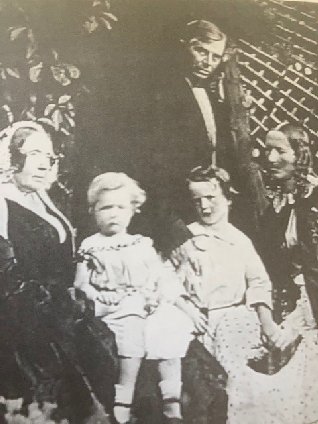
xxFamily

Thomas Cooper Gotch, with the fair hair, sits on his maternal grandmother’s knee whilst his older brother John Alfred Gotch stands by the side of his mother.  The father stands at the back of the family group.

To fully understand the person, we need to look at his family and his early life.  Thomas Cooper Gotch was born on December 10th, 1854 in the Mission House, Kettering, in rural Northamptonshire, a landlocked county located in the southern part of the East Midlands region.  His parents were John Henry Gotch and Mary Anne Gale Gotch. He was the fourth surviving son of the couple.  His father, John Henry, and his father’s two brothers, John Davis Gotch and Frederick William Gotch had inherited the family wealth when their father passed in 1852.  The three men had been bequeathed two businesses, a family shoe and boot establishment which was subsequently managed by John Davis Gotch and the J.C. Gotch and Sons bank, managed by his father, John Henry Gotch.  The artist’s father, John Henry was well suited to run a bank as he was an exceptionally talented mathematician.  His younger brother Frederick William played no part in the family businesses and instead became a renowned Hebrew scholar and later was elected President of the Baptist Union.


A Cottage in a Garden

A Cottage in a Garden by Thomas Gotch

All was going well for the family businesses until 1857 when a combination of events led to a financial disaster for the family.  Firstly, 1857 was the year of a financial panic in the United States which resulted in the declining international economy and over-expansion of the domestic economy.  Due to the advance of telecommunications at the time, it meant that the world economy was also more interconnected, which also made the Panic of 1857 the first worldwide economic crisis.  Secondly, and more connected with the Gotch bank, John Henry Gotch had been authorising a number of unsecured financial loans, a number of which were given to the Rev. Allan Macpherson, the curate of Rothwell, without due diligence and with the downturn of 1857 the bank collapsed as did the shoemaking business under the terms of unlimited liability.  The bankruptcy meant that the brothers had to sell their Mission House and auction off most of the furnishings as well as selling the adjoining shoe factory to pay off creditors.  John Henry Gotch sadly realised that authorising so many loans without investigating the circumstances of the borrowers was his fault.

Ruby

Ruby by Thomas Gotch

Perhaps poking fun at the prevalence of red-headed women in Pre-Raphaelite art, an acquaintance bet Gotch that he could not paint a red-haired subject with red cheeks in red clothes. This painting of Ruby Bone, a local girl who would have been little over two years old when she sat for the portrait, was the artist’s response. The warm oranges and reds of the sitter’s hair and clothes are balanced against the dull green-grey of the background and off-white of her dress and buttons.

After the financial collapse of the two businesses, John Henry Gotch, along with his wife and family were now homeless and had to rely on the kindness of relatives, including his wife’s brother’s family, the Hepburns, for somewhere to stay.  In 1858 they managed to rent a house in Ilford, Essex and this is where his wife gave birth to a daughter, Jessie.  It took John Davis Gotch until 1863 to have the bankruptcy discharged thanks in the main to money that he borrowed from the Hepburns.  He then set about to revive the family shoemaking business and invited John Henry to join him.

The Lady in Gold - A Portrait of Mrs. John Crooke

The Lady in Gold.  A Portrait of Mrs John Crooke by Thomas Gotch

The present picture dates from the turning-point in Gotch’s career since it was painted in Newlyn early in 1891 and exhibited at the Royal Academy that summer, shortly before he made the visit to Florence which had such a dramatic effect on his style. The sitter’s husband had already commissioned Gotch to paint a small watercolour portrait of her, which was exhibited at the New Gallery in 1890.

Thomas Cooper Gotch attended the Church of England boarding school, Foy’s Academy in West Brompton and, along with his brother Alfred, was looked after during long weekends and school holidays by Thomas and Mary Ann Hepburn.  By 1863 the family’s financial problems had eased and Thomas Gotch along with his parents and four siblings returned to live together in Kettering.  Thomas Gotch remained at the Foy’s boarding school until 1869, aged nine.  He returned to live with his family in Kettering and attended the Kettering Grammar School where he was given an “A” for effort but struggled. He left school in 1872 and in March 1873 he began working at his father’s boot and shoe business.

The Orchard

The Orchard by Thomas Gotch (1887)

Working in the shoe and boot industry was not what Tom wanted but on the other hand he did not know what he wanted!  He had a hankering for writing and submitted a few of his stories to a publisher to be edited but there is no record of what was thought of his literary efforts but what we do know is that he continued writing stories throughout his life.  So, what made Thomas Cooper Gotch take up painting?  He never recorded his decision to take up painting in any of his diaries or writings so there is a mystery about what first led him towards an artistic career.  It is known that his mother, Mary Anne, enjoyed sketching and her sister, Sarah Gale had married John Frederick Herring Snr., an animal painter, sign maker and coachman in Victorian England.  It was also at the insistence of his mother that Thomas always took his painting paraphernalia with him when he went off on holiday.  Whatever happened, Thomas Gotch decided to follow the artistic path of life and in May 1876, aged 21, he applied to attend Heatherley’s Art School, one of the oldest independent art schools in London, submitting the required specimens of his work.  Attending Heatherley’s was a steppingstone to entering other art schools.  Whilst at Heatherley’s Thomas Gotch had his work critiqued by well-known practicing artists.

Rosalind

Rosalind by Thomas Gotch

Buoyed by the praise he received from the lecturers at Heatherley’s, Thomas Gotch applied to the Academy Schools and was taken aback when he was refused entry. A second application was also rejected and Thomas began to believe the training he had been receiving at Heatherley’s was at fault and so, in October 1877, accompanied by his friend Edward Laurie, he travelled to Antwerp where they enrolled at the Ecole des Beaux Arts, where the Professor of Art was the Belgian painter and watercolourist, Charles Verlat.  It was not a happy time for Gotch who railed against the school’s endorsement of traditional subject matter and the use of a dark palette whilst he preferred brighter colours and a more decorative approach.  He commented on this to his long-standing friend and previous fellow Heatherley’s student, Jane Ross.  In his letter to her, he wrote:

“…Here we must do what we are told with as good as grace as we can and if we break the rules are reminded that we are only allowed in the school as a favour.  Each week, there is a fresh figure wheeled into the room and all who are drawing figures have obediently to draw that and nothing else…”

Clouds

Clouds by Thomas Gotch

At the end of February 1878, Thomas Gotch, having completed his painting and drawing examinations, decided to leave Antwerp.  He was disheartened by the experience and would have returned home but his brother Alfred joined him in the city and although he could not persuade his brother to stay at the Ecole des Beaux Arts, he did persuade him to carry on with his art and return to London and resume his artistic studies at Heatherleys.  Thomas returned to Heatherleys at the end of March 1878 and also enrolled as a private student with the English portrait painter, Samuel Lawrence.  Following a number of arguments with the family he realised that to be financially independent he would have to become a successful artist.  During the summer of 1878 he set himself the task of completing a number of landscape paintings.  He and his artist student friend, John Smith, rented a small house in the village of Goring-on-Thames and set about painting scenes of the surrounding countryside and various farmyard scenes.  Thomas Gotch was accepted into the Slade School of Fine Art in October 1878 where he remained for two years.  His love of literature encouraged him and some of his fellow art students to form a Shakespeare Reading Society at which they would read the plays. 

……………………………………………..to be continued.

The Moonlight Pethers

Today I am looking at a family of artists who specialised in painting moonlight scenes, so much so they were known as the Moonlight Pethers.  This is a story about Abraham Pether and his two sons Henry and Sebastian who lived and worked in Southampton, England in the late 18th and early 19th Centuries.

Abraham Pether, the patriarch, was a landscape painter who was born at Chichester in 1756. He was the cousin of the notable engraver, William Pether. He could have been a professional musician as at the tender age of nine, he showed a great talent for music, and played the organ in one of the Chichester churches. However, his main love became art and he received artistic training from George Smith, an English landscape painter and poet.  Within a short period of time the talent of the pupil matched that of his master.

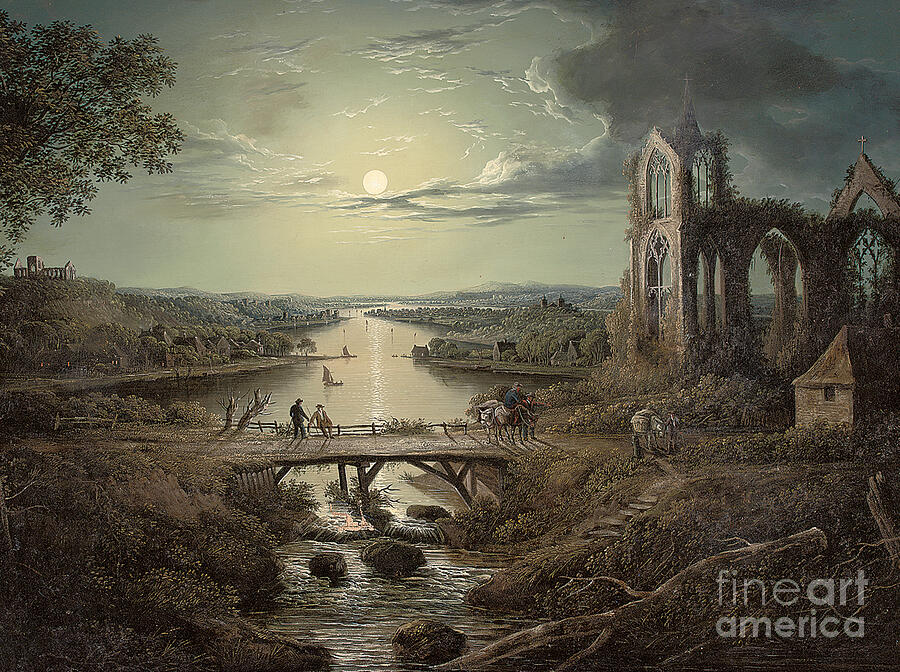
See the source image

A moonlit view of the River Tweed with Melrose Abbey in the foreground and figures on a bridge by Abraham Pether

Abraham painted river and mountain scenery, incorporating classical buildings, in an attractive though artificial style.  Some compared his work with the great Welsh landscape painter Richard Wilson.  However, Abraham Pether will be remembered for his moonlight subjects which warranted him the moniker, ‘Moonlight’ Pether.

media

Moonlight Scene by Abraham Pether (c.1790)

His moonlight pieces are notable for their astronomical accuracy. He exhibited at the Royal Academy in 1784, his subject being “Moonlight.”

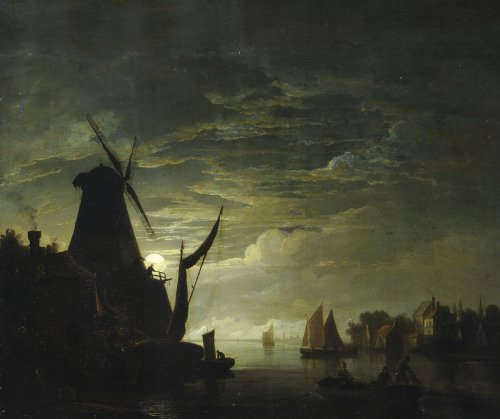
Moonlight Scene with Windmill by Abraham Pether (c.1780)

Moonlight Scene with Windmill by Abraham Pether (c.1780)

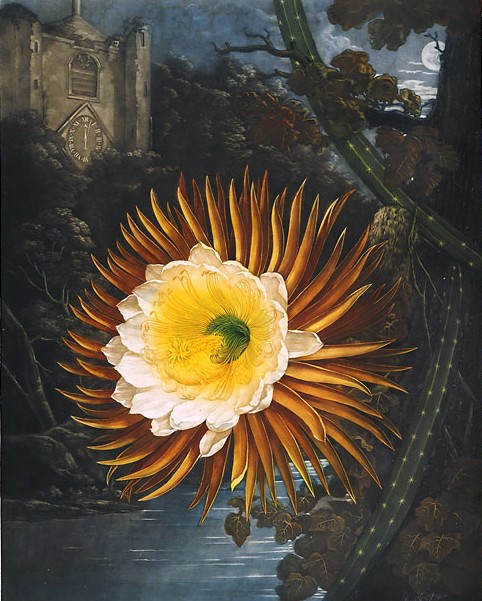
The Night Blowing Cereus (flower painted by Philip Reinagle, (moonlit background by Abraham Pether)

Abraham also collaborated with other painters who needed a moonlight background to their painting.  One example of this is his collaboration with Philip Reinagle RA, an English painter of animals, landscapes, and botanical scenes. Reinagle’s painting was entitled The Night Blowing Cereus and Abraham’s moonlight background added authenticity to the work.

God’s House Tower by Moonlight by Abraham Pether

Close to Abraham’s birthplace, Chichester, is the city of Southampton.  One of Abraham Pether’s paintings featured a night scene featuring the 13th century God’s House Tower, a gatehouse, which leads into the old town.  It stands at the south-east corner of the town walls and permitted access to the town from the Platform and Town Quay. It is now an arts and heritage venue.  In its former days it had served as the town gaol and housed the Museum of Archaeology. The building is Grade I listed and a scheduled ancient monument.  The buildings which form modern-day God’s House Tower are some of the earliest in Southampton. The name God’s House comes from the nearby hospice and it was built around 1189 as a resting place for travellers and pilgrims en-route to Canterbury.  The original gate was built around 1280, to give access to the Platform Quay as well as to the walls on the east at a high level, useful for any patrols or at times of attack. Running along the eastern walls was a double ditched moat, up to 40 feet wide, which was fed by sea water operated by a sluice at the Platform Quay. The ditches were important not only for defence but also because they also provided water-power for one of the town’s main mills which was built adjacent to God’s House Tower.

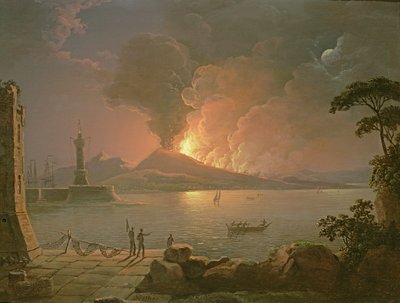
A View of Mount Vesuvius Erupting  by Abraham Pether

A View of Mount Vesuvius Erupting by Abraham Pether (c.1810)

 Abraham Pether also liked to paint depictions in which not only moonlight but fire lighted up the sky as can be seen in his painting entitled A View of Mount Vesuvius Erupting.

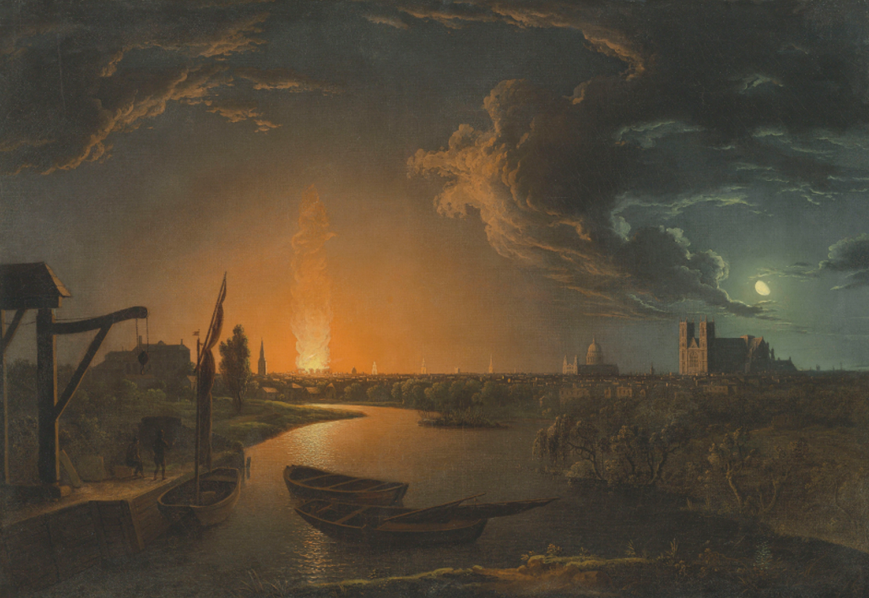
The fire at the Old Drury Lane Theatre, seen from Pimlico by Abraham Pether (1809)

It was not just fire lighting up the sky by natural phenomena, that Abraham captured in some of his works of art but also devastating events of buildings burning such as his painting entitled The Fire at the Old Drury Lane Theatre seen from Pimlico. In this 1809 painting we witness the destruction of Richard Brinsley Sheridan’s Drury Lane Theatre in 1809, which Sheridan had completely rebuilt in 1794 with the architect Henry Holland.  It is said that when Sheridan, who was in the Houses of Parliament at the time when the fire broke out, heard the news, he hurried to his theatre. Upon realising that there was little he could do to help, he sat down in the coffeehouse opposite and ordered a bottle of port, remarking rather dryly ‘a man may surely be allowed to take a glass of wine by his own fireside’.   It is a work of Romanticism which was popular around the beginning of the nineteenth century.  Abraham has cleverly balanced the light sources emanating from the moon and the fire, which adds a sense of excitement to the depiction.  Another interesting fact about this depiction is that it actually shows a lost view of London as the river seen is not the Thames, but part of the River Tyburn, which now flows beneath the city, coming out into the Thames at Whitehall Stairs, near Downing Street.

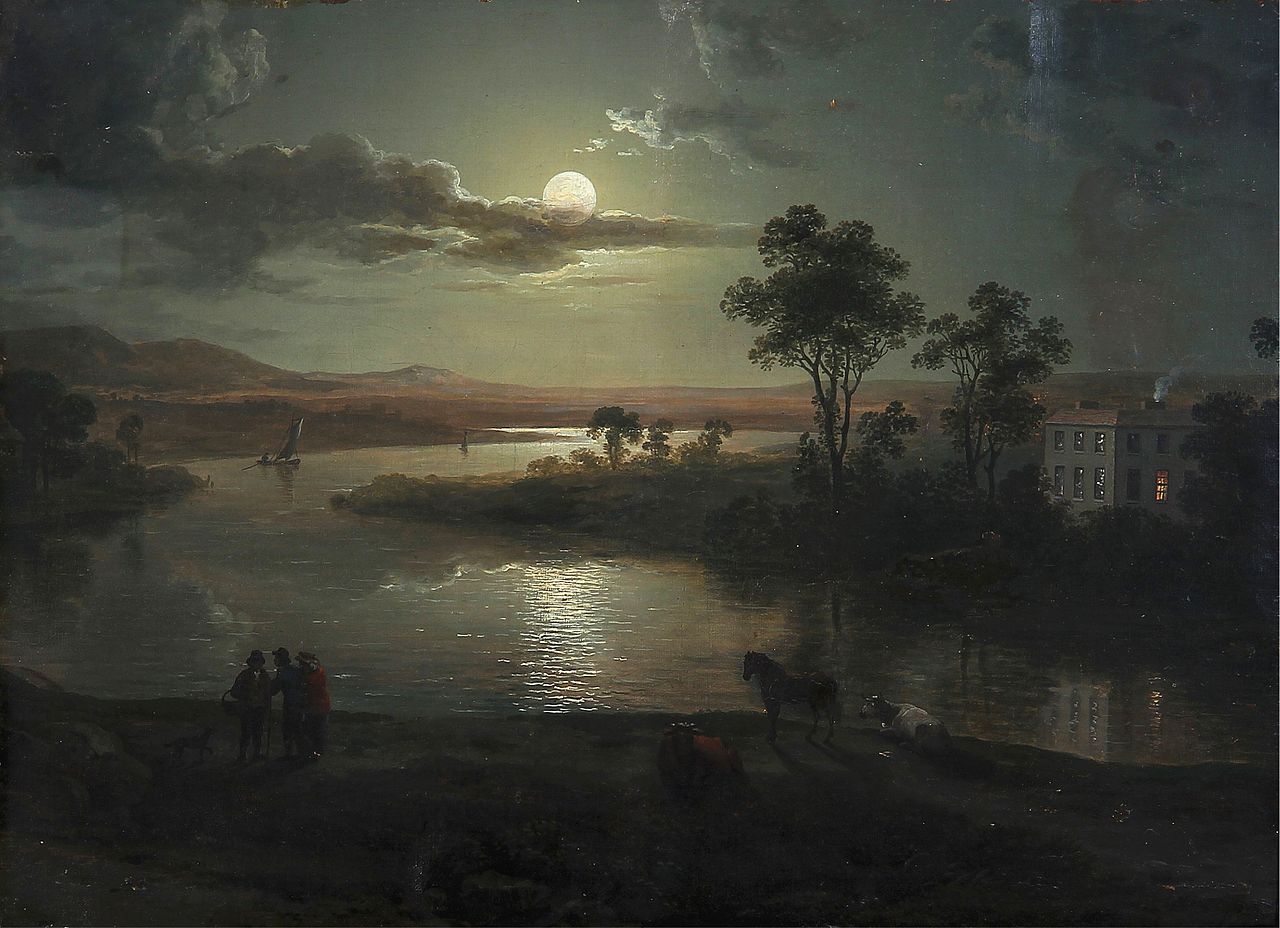
This image has an empty alt attribute; its file name is 1280px-Abraham_Pether_-_Evening_scene_with_full_moon_and_persons_%281801%29.jpg
Evening Scene With Full Moon and Persons by Abraham Pether (1801)

Abraham Pether not only distinguished himself as painter and musician but also by his philosophical and mathematical research which were of great value. He also showed skill as a mechanic, and constructed various optical instruments, such as telescopes, microscopes, air-pumps, and electric instruments. Abraham Pether died in Southampton on April 13th, 1812.

Abraham had two artistically talented sons Sebastian Pether who was born in 1790 and Henry Pether who was born on March 5th, 1800, both of whom became landscape artists who, like their father, became known for their moonlit scenes.

This image has an empty alt attribute; its file name is img_0959.jpg
Houses of Parliament from the Thames by Moonlight by Henry Pether (c.1864)

In Henry Pether‘s painting, Houses of Parliament from the Thames by Moonlight we see Westminster Bridge straddling the River Thames with the Houses of Parliament on the right bank. By the mid-19th century Westminster Bridge was subsiding badly and expensive to maintain and so was replaced by the current bridge, which was designed by Thomas Page and opened on 24 May 1862.  As Henry Pether died in 1865, we know the painting had to be completed sometime between those three years.  It is a fascinating depiction of the endless work on the river even during the night with barges and rowing boats plying their trade.  Note the gaslights illuminating the bridge.  During these years air pollution was very bad, day and night, and this is depicted by the smoky and murky appearance.

View of Windsor Castle looking at the Lowe Ward by Moonlight by Henry Pether

Henry Pether’s work, View of Windsor Castle looking at the Lowe Ward by Moonlight, demonstrates how Henry Pether’s portrayal of the romantic quality of light makes his depiction so striking. Henry preferred actual scenes, often on the Thames or in Venice, and this painting communicates the poetry and realism of his best work. As ever, Henry’s palette was more sensitive and truthful to nature than that used by his father and brother, as this very fine example demonstrates.

Henry Pether, ‘Greenwich Reach, Moonlight’ exhibited 1854
Greenwich Reach, Moonlight by Henry Pether (c.1854)

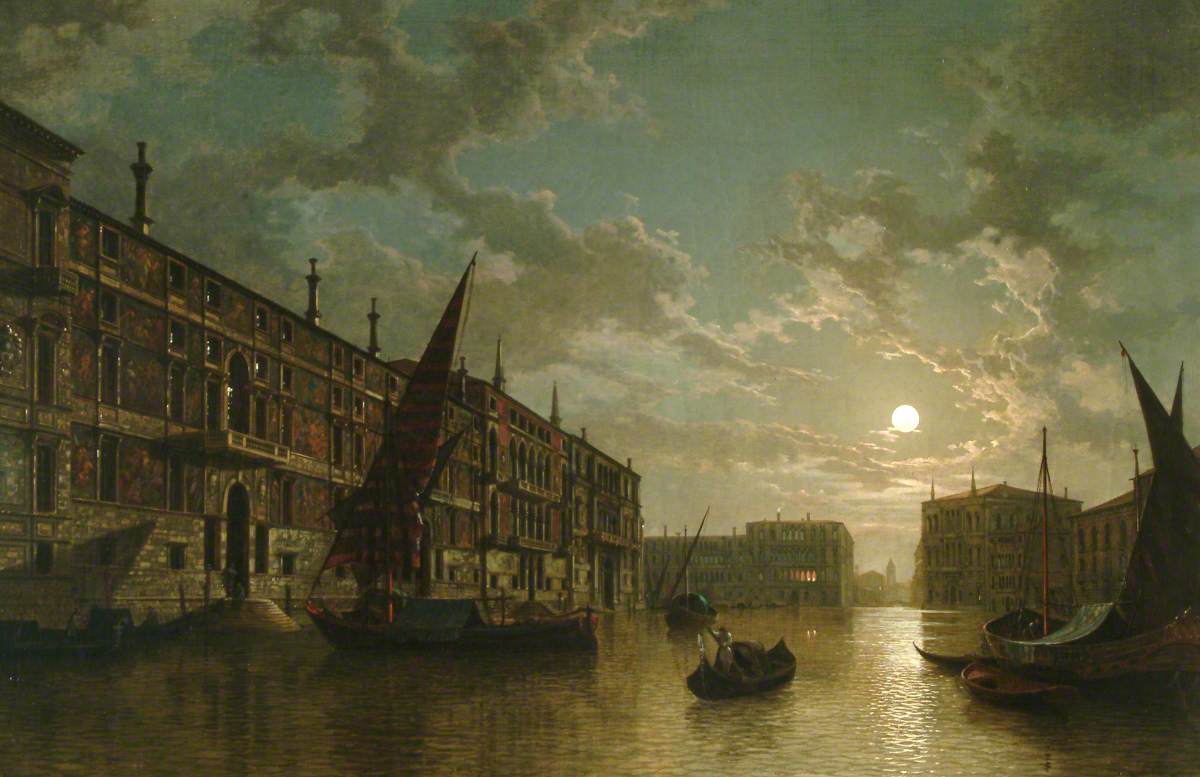
Henry Pether’s works were not all about England as he completed and excellent depiction of the canals of Venice.

Venice by Moonlight
Venice by Moonlight by Henry Pether

Sebastian Pether, born in 1790, was the eldest son of Abraham Pether, was also a landscape painter. He exhibited at the Royal Academy from 1812 to 1826 and at the Royal Society of British Artists at Suffolk Street, London.  He had learnt his artistic ability as a pupil of his father, and, like him, primarily painted moonlight views as well as depictions of fires as seen at night.  His paintings were praised for their accuracy and congruency of colour.   He could have made a fortune from the sales of his work but being desperate for money to feed his family he was having to accept paltry sums from art dealers who knew of his desperate financial circumstances and wanted his work so as they may be copied and sold on. 

Fishing by Moonlight by Sebastian Pether

One of Sebastian’s beautiful painting is his Fishing by Moonlight.  The work is painted on panel, which is a medium best suited to the fine brushwork quality, which he found necessary for this intricate work. In this painting, he has cleverly used the strong use of chiaroscuro effects of light and shade in his painting. The eye, of course, is drawn towards the full moon, which illuminates the sky and caresses the clouds.  Look how the artist has created the mysterious atmosphere of the moonlit evening. He has depicted the moonlight glistening on the river below and has painstakingly depicted the buildings in meticulous detail.  On the bank in the foreground we see the two night fishermen silhouetted against the calm waters.

Artwork by Sebastian Pether, Anglers along a moonlit river, Made of oil on canvas laid down on panel
An extensive river landscape with a fisherman by the shore, before a tower by Sebastian Pether

Sebastian married very young. In the July 1884 edition of the Gentleman’s Magazine there was an obituary notice regarding the death of Sebastian Pether. It said that “he married too young and too poor“. To exacerbate matters his wife had nine children in a short period and Sebastian struggled to earn enough money from his art to feed his family. The art dealers who bought his paintings were aware of his dire financial situation and the obituary notice was very cutting about their role in Sebastian’s life:

“…As a matter of course he soon fell into the hands of those harpies – the dealers. When once they had obtained power over him they took care to retain it; he was their victim all through life…”

See the source image
The Night Fishermen by Sebastian Pether (1920)

Sebastian Pether’s paintings always sold well but because of the low prices offered to him by dealers the money from the sale of his work was never enough to satisfy the wants of his large family.  Sebastian became ill in March 1844.  The illness was brief but severe and he died on March 14th 1844, aged 54.  His life at the end was an unhappy one and this was set out in the Gentleman’s Magazine obituary:

…During the three last years of his life he lost three of his grown-up children by consumption; and since the demise of the father another son died at Westminster Hospital of lockjaw occasioned by an accident to the hand……………………..A subscription has been opened to help his surviving family out of their terrible state of distress…”

A truly sad ending to a great painter.

Harold Harvey

Harold Harvey

Harold Harvey (1874 – 1941)

My featured artist today is one of the famous Newlyn School painters. The term Newlyn school applies to a group of artists who settled in Newlyn and St Ives in the late nineteenth century and whose work is characterised by an impressionistic style and embodies subject matter drawn from scenes of rural life.   It was founded by a group of artists led by Stanhope Forbes. who came to Newlyn in West Cornwall in 1884 and was immediately captivated by the scenery and people in the area. The ‘Newlyn School’ became famous for its superb realism, in ‘Plein-Air‘ painting.  The artist I am looking at today, Harold Harvey, made his name for his beautiful works featuring the Cornish countryside.

See the source image

The Old Slip, Newlyn by Harold Harvey

Harold Charles Francis Harvey was born on May 20th 1874 in North Parade, Penzance, Cornwall.  He was the eldest of eight children of Francis McFarland Harvey, a bank clerk, and Mary Bellringer whom he married in September 1872. Harold had six brothers, Percival George Harvey; Frank Harvey; Arthur William H Harvey; Wilfrid Vignes Harvey; Leonard Harvey, and Cyril Harvey along with one sister, Gladys Maud Harvey.  Harvey trained in painting at the Penzance Art School under the tutelage of Norman Garstin, an Irish artist, teacher, art critic and journalist associated with the Newlyn School of painters. After leaving the Penzance Art School at the age of nineteen, William travelled to France and attended the Académie Julian in Paris between 1894 and 1896.

Harold Harvey - Unloading the boats, Newlyn Harbour.jpg

Unloading the boats, Newlyn Harbour by Harold Harvey (1906)

In the early part of the twentieth century, Harold Harvey’s paintings were impressionistic in style and the depictions focused on people involved in the agricultural and fishing trade. 

In the Whiting Ground’ by Harold Harvey

In the Whiting Ground by Harold Harvey (c.1900)

One such work was In the Whiting Ground which he completed around 1900 and depicts a small dinghy at sea with a young man standing holding a fishing line in his hands while an older man is holding a line in the water.  St Michael’s Mount the tidal island in Mount’s Bay, a large, sweeping bay on the English Channel coast of Cornwall, can be seen in the far distance.

Whiffing in Mount's Bay

Whiffing in St Mount’s Bay by Harold Harvey (c.1900)

A small painting completed around the same time by Harvey featuring three young men in a boat had the strange title of Whiffing in St Mount’s Bay.  Whiffing is a mode of fishing with a hand line.

The Seaweed Gatherers by Harold Harvey

The Seaweed Gatherers by Harold Harvey

Another of his paintings depicting life along the Cornish shoreline was one entitled The Seaweed Gatherers in which we see two men hauling a horse and cart laden with fresh seaweed.

The Close of a Summers Day by Harold Harvey. (1909)

The Close of a Summers Day by Harold Harvey (1909)

A more colourful painting is his beautiful work of idyllic tranquillity entitled The Close of a Summers Day which he completed in 1909.  It is at the end of a hot summers day and man and beast have need of a rest and refreshment.  The young farmworkers have been tasked with taking the horses down to the river for them to cool down and have a drink.  The white horse gently splashes in the water attempting to cool down its fetlocks.

From 1909 to 1913, Harvey was an Associate of the Royal Cambrian Academy of Art, Conwy and, in 1910, he became a member of the South Wales Art Society.

gertrude_harvey2_large

Gertrude Harvey by Harold Harvey

It was around this time that Harold Harvey met Gertrude Bodinnar.  She was born in 1879 and was the eighth of the ten children born to Ann Crews Bodinnar, (née Curnow), and her husband John Matthews Bodinnar, a cooper.  In her twenties, she acted as a model for students at the Forbes School of Painting, which had been founded in 1899 by Stanhope Forbes and his Canadian-born wife Elizabeth as their School of Painting and Drawing at Newlyn. It was indirectly through her work with students at this establishment that she first met Harold Harvey and agreed to act as his model.  Love blossomed and Harold and Gertrude married on April 19th 1911 and the couple set up home at Maen Cottage Elms Close Terrace, in Newlyn

Portrait of the Artist's Wife, Gertrude by Harold Harvey (1917)

Portrait of the Artist’s Wife, Gertrude by Harold Harvey (1917)

Gertrude appeared in a number of her husband’s paintings.  One example was his 1917 portrait of her entitled Portrait of the Artist’s Wife, Gertrude……

Gertrude Harvey with Parrot in the Artist's Home by Harold Harvey

….and Gertrude Harvey with Parrot in the Artist’s Home……

The Red Silk Shawl by Harold Harvey (1932)…..and The Red Silk Shawl in 1932.

Being around artists, including her husband, and watching them work fascinated her. She would often note down how the artists worked, and she soon realised that she had a talent for art and design.  Gertrude used mostly oil on canvas, board, card, or paper, but also tempera, gouache and though largely self-taught she became a talented artist in her own right, and her paintings were mainly of still-lifes, flowers and landscapes. 

Landscape

Landscape by Gertrude Harvey

Her paintings were good enough to be sold and exhibited at the Newlyn Art Gallery and in the twenties and thirties her work could be seen in many London galleries including the Leicester Gallery and the Royal Academy. Often, she showed work together with her husband in mixed and group shows.   Between 1930 and 1949, Gertrude Harvey had twenty works selected for Royal Academy exhibitions and from 1945 to 1949 she was regular exhibitor with the St Ives Society of Artists.  She was also proficient at needlework and clothing design.

Reflections by Harold Harvey (1916)

Reflections by Harold Harvey (1916)

Meanwhile Harold Harvey continued painting and exhibiting his work. The First World War began in 1914 but due to health issues, he was exempted from military service.  In that year, he started to paint a series of interiors often using his own home.  One such painting was his 1916 work entitled Reflections.

The Critics by Harold Harvey

The Critics by Harold Harvey

In another work entitled The Critics, we see three women enjoying coffee and an aperitif as they study some paintings, weighing up the merits of each one.

The Tea Table by Harold Harvey

The Tea Table by Harold Harvey (1920)

A depiction of domestic living can be best seen in Harold Harvey’s 1920 painting entitled The Tea Table.  It is a masterful depiction of a small dining room filled with shelves of crockery and ornaments.  It could almost be termed a still-life of household goods.

Girl on a Cliff by Harold Harvey (1926)

Girl on a Cliff by Harold Harvey (1926)

With such wonderful landscapes on his doorstep, it is no wonder that Harvey continued with his outdoor works featuring young models.  One example of this is his 1926 painting entitled Girl on a Cliff.  In a way, this is not a true plein air painting as the girl in the depiction is fourteen-year-old Cressida Wearne and Harvey painted her posing in the garden of his studio and he added the background at a later date.

Clara

Clara by Harold Harvey (1922)

Again, we see this technique with his 1922 painting, Clara.  It is a full-length portrait of a girl standing by a wall set in a rolling landscape.  She is seen holding a rose and in several of Harvey’s portraits his female sitters are holding a single flower. The work is composed mainly of tones of grey and brown but it is the red of the rosebud which creates the focal point of the work.

Harvey, Harold C., 1874-1941; James Jewill Hill Junior

Portrait of James Jewill Hill by Harold Harvey (1920

Harold Harvey completed a number of portrait commissions, such as his 1920 portrait of the youngest son of James Jewill Hill, a partner in the solicitors firm Jewill Hill & Bennett, Penzance.

Harvey, Harold C., 1874-1941; John Humphreys (1850-1937), Professor of Dentistry
Portrait of John Humphreys, Professor of Dentistry; University of Birmingham; by Harold Harvey (1938)


Another portrait he completed was a 1938 commission to paint a portrait of John Humphreys, Professor of Dentistry.

In 1920, Harold Harvey and fellow Newlyn School artist, Ernest Procter, founded the School of Painting, in Newlyn, called the Harvey-Procter School, which ran throughout most of the 1920s. 

Harold Harvey died in Newlyn on 19 May 1941 and was buried in Penzance at the St Clare Cemetery. His wife, Gertrude, lived in their cottage until 1960 when she moved into the Benoni Nursing Home in St Just. She died six years late, aged 86.


Ralph Hedley. Part 2.

                                       In School by Ralph Hedley (1883)

Another of Hedley’s paintings projecting school life was his 1883 work, In School.  The boy in the painting was John Irwin, the younger brother of Tom Irwin, who worked at Ralph Hedley’s woodcarving shop.

                         The Ballad Seller, the Black Gate by Ralph Hedley (1884)

Hedley used Irwin in a number of his painting. one of which was his 1884 work known as The Ballad Seller.  The setting is the Black Gate in Newcastle with Castle Garth in the background.  The red roofs of Castle Garth can be seen behind the Black Gate in Ralph Hedley’s depiction. The Black Gate formed the entrance to the street, which had been built inside the castle walls. There was only a short stretch of street left standing by the time Hedley painted this picture. It has now all been demolished, though the outline of the street can still be seen.  It is thought that Hedley made many plein air sketches for the background.  In the painting we can see the rough wooden fence that had been put up around the Black Gate in 1883 by the Newcastle Society of Antiquaries during the renovation work.  Hedley’s painting depicts broken and missing stones as well as damaged window glass.  The Black Gate of the Norman castle, which was completed at the end of the thirteenth century, had become run down.  However, the painting is all about the trade of selling ballads.  Ballad sellers were looked upon in the eighteenth century as impoverished, uneducated, and morally-lacking people who were allegedly conspiring with pickpockets.  It was suspected that whilst plying their trade, they hoped to distract their audience with their songs while the pickpockets went to work.  Later, they would share their ill-gotten gains.  Ralph Hedley would have witnessed poor women street sellers having to take their children with them, like the baby in the ballad-seller’s arms in this picture.  John Irwin was once again used as a model for one of the boys.

                             Shoeing a refractory horse (Shoeing the Bay Mare) by Ralph Hedley (1883)

Older brother Tom Irwin was himself the model for one of the men in Hedley’s 1885 painting Shoeing a refractory horse in the stocks – Shoeing the bay mare.  He was the man standing on the right wearing the brown cap, velvet jacket and velvet trousers.  He was seventeen years of age when he modelled for the work.  Tom Irwin, who worked at Ralph Hedley’s woodcarving workshop, and his family arrived in Newcastle around 1880.  He remembered the first meeting with Hedley and how the artist had admired their clothes:

“… When we came from the country where we had been farming, we brought several quaint articles of clothing, caps, clogs, baskets etc, which proved invaluable to your father’ work, and… which we know were much appreciated by him… “

                                    Going Home by Ralph Hedley (1888)

Ralph Hedley believed that art should be a pictorial record of the working lives of local people, and his paintings were particularly valuable for the record they provide of everyday life on Tyneside in the late 19th and early 20th centuries.  His 1888 painting, Going Home, is a depiction of two coal miners returning home from working at the pit at Blaydon, near Gateshead. The younger of the two men wears a cap to protect his head from the low beams, and he wears a pair of shorts because of the heat in the mine. In his hand is a safety lamp and a sack to kneel on. This was an extremely popular painting and a print of it was made the following year which proved extremely popular with the public.

                                                   Go, and God’s will be done! by Ralph Hedley (1891)

One of Ralph Hedley’s 1891 paintings, Go, and God’s Will be Done, fascinates me as there is a story behind the depiction.  At first glance there is obviously something dramatic happening in this painting, but what is it all about?  On the floor in the left foreground a cat sleeps peacefully before the fire, unaware of the chaotic happenings going on in the room.   This is the home of a lifeboatman and in the bed is his wife who is very ill.  The husband, in his shirt sleeves, leans over to talk to her.  Next to him stands a lifeboatman who has come to take him away to their lifeboat.  The door of his cottage is held open by his daughter and we can see that outside there is a gale force wind blowing over rough seas, in which is a boat in trouble.  The call has gone out for all the local lifeboatmen to rush to launch the lifeboat and the wife’s husband is torn between his duty to his sick wife and his duty to the lifeboat rescue.  The painting is based on the English poet and journalist, George Roberts Simms poem, The Lifeboat.  The words of the poem which Hedley has illustrated so beautifully are:

“…I didn’t move, but pointed to the white face on the bed-

“I can’t go, mate,” I murmured; “in an hour she may be dead,

I cannot go and leave her to die in the night alone.”

As I spoke Ben raised the lantern, and the light on my wife was thrown;

And I saw her eyes fix strangely with a pleading look on me,

While a tremblin’ finger pointed through the door to the ragin’ sea,

Then she beckoned me near and whispered “Go, and God’s will be done!

For every lad on that ship, John, is some poor mother‘s son…”.

So how did the story end?   It had a happy conclusion.  The husband went with the lifeboat and helped to save the crew of the sinking ship. One of them was his long-lost son, and when he took him home, his mother was overjoyed and recovered from her illness.  The poem was quoted in the exhibition catalogues when the work was exhibited in 1891 and 1892, in Newcastle, Liverpool, Leeds, and South Shields, and in the Royal Academy.  The painting is now in the collection at Harris Museum and Art Gallery, Preston.

                       Ars Longa. Vita Brevis by Ralph Hedley (1900)

Hedley completed an interesting work in 1900 entitled Ars Longa, Vita Brevis which was exhibited at that year’s Royal Academy Exhibition.  It would almost be classed as a Vanitas painting focusing on the unstoppable transience of life but it does not have the usual Vanitas symbols such as burnt out candles and skulls.  And yet the title of the painting, Ars longa, Vita Brevis meaning Art is long, life is short is the perfect title for a Vanitas work.  The painting is one that elicits our sympathy for the aging artist we see before us.  Look how the depiction evokes this feeling.  The setting is a small drably-coloured attic space in which we see the artist sitting on his bed in front of an easel.  He loosely holds his palette and brushes and yet he has to rest them on his knees.  He has nodded off to sleep in the middle of his work.  Is it that he is tired or is it a sign that he has almost given up on life?  What are his circumstances and what are his thoughts?  Is he lonely and without friends?  Does he mull over his past life and consider past decisions that he has made and which have brought him to this point in his life?  I will leave you to decide.

                                                                          Duty Paid by Ralph Hedley (1886)

In the foreground of his 1886 painting, Duty Paid, we see a man has come to an office on the quayside to collect a parcel brought in by the ship. He puts his money on the table which is due in Custom’s Duty and one of the Customs officers meticulously fills in details of the payment in a ledger. On the other side of the table, another official seals the parcel with red wax, evidencing that duty has been paid. This is a typical Ralph Hedley depiction of local people and local scenes. His oeuvre provided us with an important record of life in the region in that period between the late 19th to early 20th centuries.

     John Graham Lough in His Studio by Ralph Hedley

One of the strangest paintings by Ralph Hedley depicted John Graham Lough an English sculptor who was recognised for his funerary monuments and a variety of portrait sculpture. He also produced ideal classical male and female figures.  Lough had come to London in 1824 to study the Elgin Marbles at the British Museum.  He was living and had his studio on the first floor of a house in his Burleigh Street lodgings, above a greengrocer’s shop, and it was there that he embarked on a mould for his massive statue of Milo of Croton based on his studies of the Elgin Marbles and the work of Michelangelo.  According to Joshua Lax’s 1884 book, Historical and Descriptive Poems, this was the sculptor’s big chance at being a successful sculptor.   The biggest problem Lough faced was that his studio was too small and the ceiling height was too low for him to complete the statue.   Joshua Lax explains:

“…With the recklessness of a bold genius reduced to desperation, he actually broke through the ceiling of the room above him and made for himself sufficient space to work at his statue. The owner began to take steps for instituting legal proceedings, and even consulted Mr. Brougham (afterwards Lord Brougham) for this purpose. Brougham went to look at the Milo, and see for himself what Lough had done… The news of the strange affair soon spread, and, before long, the whole street where Lough’s room was situated was lined with the carriages of ladies and gentlemen, who had come to view the place, and to see Milo…”

In the painting we see the unhappy landlord and his lawyer, Henry Brougham at the base of the sculpture whilst the sculptor is at work on the upper part of the work, unrepentant with his destruction of the ceiling in his lodgings.

                                                         The Tournament by Ralph Hedley (1898)

In 1898 Hedley completed a painting which was to realise the highest price for one of his paintings at auction, (£43,020 at Bonhams in 2004).  It was entitled  The Tournament.  Hedley was influenced stylistically by the Newlyn school and other social realist painters.  He also focused on life in his much-loved Newcastle and the surrounding Tyneside area for his subject matter. The scope of his depictions was enormous.  It ranged from the uncompromising realism of workers on the dockside and miners to the delightful naivety of children at play, as we see depicted in The Tournament.

                                                           One-time home of Ralph Hedley in Newcastle.

Ralph Hedley’s involvement with the Bewick club, as successful exhibitor, committee member and eventually as president, guaranteed him a number of wealthy patrons for both his wood carvings and his paintings. However, his work was also loved by the working class, the subject of many of his works, and they gained access to his work through the many reproductions of his most well-known works could be found in local papers, tea promotions and adverts for cigarettes. He became a member of the Royal Society of British Artists and exhibited a number of paintings at the Royal Academy.

                                                                                          Blue Plaque

Ralph Hedley died on June 11th 1913 aged 64 at his terraced home in 19 Belle Grove Terrace, Newcastle-on-Tyne.  There is a blue plaque commemorating Ralph Hedley who lived in the house from 1888 to his death in 1913.

Ralph Hedley. Part 1

                                                            Self portrait by Ralph Hedley (1895)

In this blog I am once again returning to nineteenth century social realism art.  Today’s artist was a genre painter who was also known for his wood carvings and book illustrations. Let me introduce you to the English painter, Ralph Hedley.

Ralph Hedley was born in the North Yorkshire village of Gilling West near Richmond on New Year’s Eve 1848, the son of carpenter, Ralph Hedley, and his wife Anne Hedley.  The Farrier’s Arms in Gilling West was the first house Ralph lived in.  Around the age of two, Ralph and his family left Yorkshire and moved to Newcastle upon Tyne where the Industrial Revolution had opened up new opportunities for work. 

                                                      Iron and Coal by William Bell Scott (1855–60)

Ralph attended school up to the age of thirteen and then became an apprentice at the wood carving workshop of Thomas Tweedy and during his evenings he attended art and design classes at the Government School of Art in Newcastle upon Tyne, where the principal was the Scottish poet and artist, William Bell Scott, a landscape and history painter who had also painted scenes from the Industrial Revolution in his work.  The Industrial Revolution had changed the life of the population.  Changes which were good for some but for others who had moved to the cities to grab the new opportunities for work there had been adverse consequences due to the rapid growth of dense urban areas with their problems of public health, housing, crime, and poverty.  William Bell Scott greatly influenced Ralph Hedley.  And at the age of 14 Ralph was awarded a bronze medal by government’s Department of Art and Science.

On completion of his apprenticeship with Thomas Tweedy, Hedley set up his own woodcarving and architectural sculpture business, which proved a great success.  As a wood carver, he received many commissions for decorative work in churches.  In 1874. Hedley married his wife Sarah Storey and they had six children, three boys and three girls. One daughter died in an accident, but the other five would all take up woodcarving as well, and two of his sons, on the death of their father, would take over the running of the workshop.

                                          The Newsboy by Ralph Hedley (1879)

Despite working as a wood carver, Hedley loved to spend his free time painting, and he had many of his works accepted into the Royal Academy’s exhibitions.   Hedley had more than fifty of his paintings displayed at the Royal Academy between 1879 and 1904. In 1879, he completed his painting entitled The Newsboy accepted by the Royal Academy’s jurists for inclusion at that summer’s exhibition.  It is a humorous depiction of a very young boy who has succumbed to tiredness and fallen asleep on some stone steps as he waits to offer people his newspapers.

                                      The Newsboy by Ralph Hedley (1892)

Thirteen years later Hedley returned to the subject with his 1892 version of the The Newsboy.  An article about this picture appeared in the Evening Chronicle of 27 January 1930:

“…For years this young newsboy stood against the hoardings which then occupied a site practically opposite the Central Station…..Seen almost invariably with a sack around his shoulders this young seller of ‘Chronicles’ became a familiar figure…”

                 Blinking in the Sun (Cat in a Cottage Window) by Ralph Hedley (1881)

In 1881 Hedley completed one of his best-loved paintings, Blinking in the Sun (Cat in a Cottage Window) sometimes referred to as Ralph’s Cat.  This tabby cat has that lazy, “loving-the-sunshine” expression on its face which every cat lover will recognise as their feline searches out the warmest spot they can find. Its sleek fur looks like it is a well cared for feline.  The cat is sitting on the windowsill of an old stone cottage next to an old earthenware pot of geraniums and narcissi and a Chinese vase of red tulips.

                                                                      Thomas Bewick by James Ramsay

Ralph Hedley and a number of fellow Newcastle artists set up the Bewick Club in 1884, an art group named after Thomas Bewick, the famous Northumbrian wood engraver. The club held a number of exhibitions which attracted large numbers of artists from the region.  The works on show varied from landscapes and seascapes to genre depictions that had a sense of gritty realism.  The raison d’être of the Club was to promote the needs of professional artists and to urge not only the patronage of rich individuals but of the interested less wealthy local population.

                           Chancel and Reredos, The Cathedral Church of St Nicholas, Newcastle.                        Photograph by Peter Loud, as captured from his impressive panoramic virtual tour of the cathedral.

Between 1882 and 1889 Ralph Hedley’s skills as a wood carver were put to use in the renovation of the interior of the Chancel and Reredos of the Cathedral Church of St Nicholas, Newcastle.  His workshop carved the choir and rood screen for the scheme by architect Robert James Johnson.  John McQuillen, author of The Church of St. Nicholas, With a Brief Sketch of the History of Newcastle wrote of Hedley’s role in the internal renovations:

“…The richly-carved woodwork, a creation in which grace and strength are united, is strictly in keeping with the severe style of the chancel, and in accord with ecclesiastical traditions, was executed by Mr Ralph Hedley, and splendidly upholds his craftmanship and artistic feeling…”

Hedley’s great-granddaughter, Clodagh Brown, said that Hedley was responsible for the exceptionally fine wood carving in the choir, including the rood screen, Bishop’s throne, and canons’ stalls with misericords.  For more details of Hedleys work in the cathedral take a look at Victorian Web page: 

 http://victorianweb.org/painting/hedley/woodcarvings/1.html

What I believe was Hedley’s greatest contribution to society was his pictorial history of everyday life in Tyneside during the latter part of the nineteenth century and the early part of the twentieth century. When he died in 1913, the Newcastle Daily Chronicle recognised the importance of his work, writing:

“…What Burns did for the peasantry of Scotland with his pen, Ralph Hedley with his brush and palette had done for the Northumberland miner and labouring man…”

                                                                 Out of Work by Ralph Hedley (1888)

The Industrial Revolution in Britain was a period deemed to be between 1780 and 1830.  It was an episode in British history which saw the transition from being agricultural to being industrial.  There was a movement of the population from the rural areas to the urban areas.  The standard of living for those working-class people who came to the city in search of work was of a poor standard and to make matters worse, work was hard to come by and when you achieved employment, the wages were meagre and barely enough to survive and support your family.  These hard times were ones Hedley depicted in his paintings.  One example of this is his 1888 painting entitled Out of Work with an alternative title, Nothing to do.  The setting is the dockside of the River Tyne.  The four men had queued for a job that morning but were not hired.  Now all they have to do is to sit around and wait to re-apply for work the next morning.  Look at their distraught expressions.  They know they have to return home to their families and break the bad news.

                                                            Seeking Situations by Ralph Hedley (1904)

Another of Hedley’s work which focused on the plight of the unemployed is his 1904 painting, Seeking Situations.  The setting for Hedley’s work is what we would now call a “Job Centre”.  In it we see a number of men, some only young lads who may be looking for their first job, and a single female.  They are all studying the job adverts which are posted on the information boards.  According to the Laing Gallery in Newcastle which owns the painting, the setting is in fact the Victoria City Library, a building which was situated close to the artist’s studio in Newcastle.  It is interesting to look carefully at the various individuals Hedley has depicted.  In the foreground there is a bearded gentleman who is slightly hunched over.  Looking at the way he is dressed, he does not look like a manual worker and probably held, at one time, a supervisory role.  He looks sad and dejected.  He is walking away from the noticeboards having not been able to find any suitable employment.  His age and reduced ability are probably working against him.  Contrast his hunched and crestfallen demeanour with that of the young man to the right of him.  Again, by his clothes we know he is not a manual worker.  He is dressed in typical office-clothes.  His appearance and mood could not be more different to that of the bearded gentleman.  He looks pleased and eager as he spots a job description which would suit him perfectly.  He hastily writes down the information.  The only woman depicted in the painting is dressed well and has a refined air about her.  She is probably looking for shop work rather than factory work.  This compassionate but entirely unemotional work was a great example of social realism and is one of Ralph Hedley’s best-known paintings.

                                                                  Barred Out by Ralph Hedley

Young children of working-class families and their lot in life was depicted in many of Hedley’s paintings, as was there time at school.  A fine example of this genre was his 1896 painting with the unusual title, Barred Out.   The title is all about a widespread custom, up to the 19th century, known as the ‘barring-out’ of the schoolteacher by his pupils. On a certain day agreed by the school authorities, the pupils planned to bar the classroom door with the teacher outside and refused to let him in until he agreed to their terms, which were usually for a half-holiday, or something similar.  In Hedley’s painting we see schoolchildren enjoying the North-East custom of barring the teacher from the classroom on the 29th of May,  until the holidays for the next year had been agreed. One boy is wearing a Northumberland hat with a red pom-pom. Ralph Hedley has depicted the setting as a shabby country classroom in which children of many different ages are being taught together. The children’s clothing albeit shabby and multi-patched does not detract from the depiction of happy and healthy children.  However, although some of the children’s clothes are patched, they seem happy and healthy.

………………….to be continued