Theodoor Rombouts

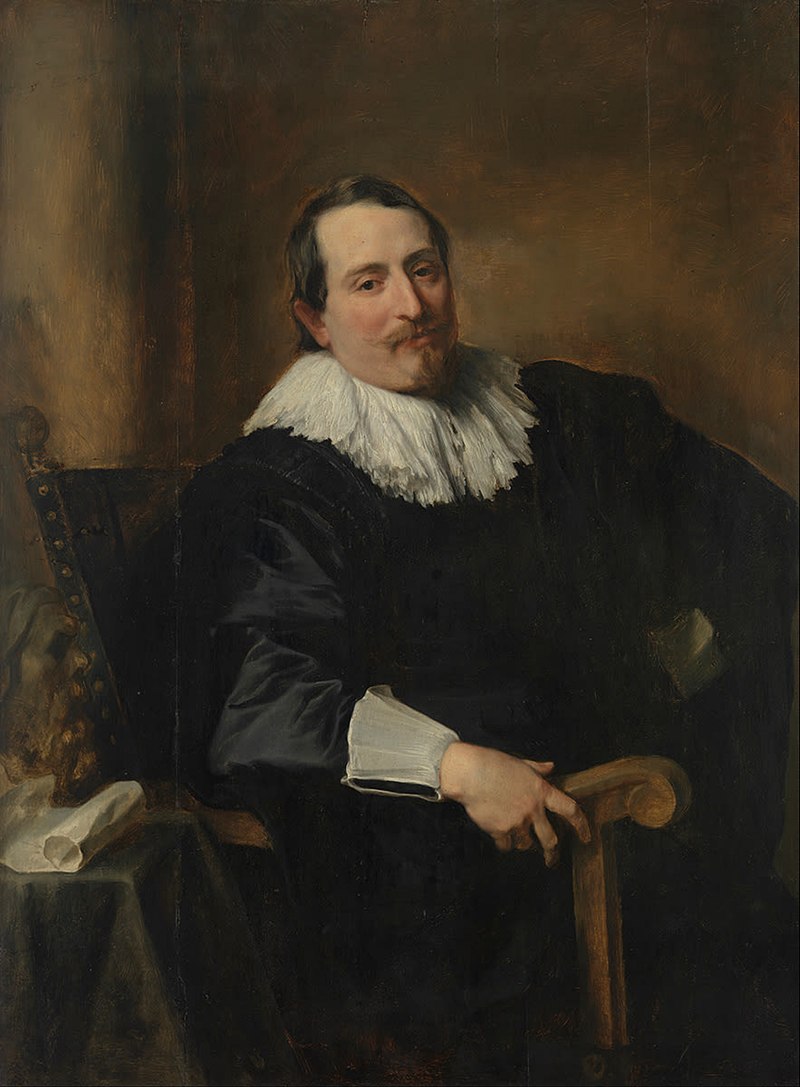
Portrait of Theodoor Rombouts by Anthony van Dyck

In my last two blogs regarding the Groeninge museum in Bruges, I looked at the works of the Flemish Primitive painters.  In this edition of the blog I want to showcase the life and works of an early seventeenth century Flemish painter known for his Caravaggesque genre scenes depicting lively dramatic gatherings.  Maybe because he lived in Antwerp at the same time as the great Rubens he and his artwork was overshadowed but I hope you will see that the man was an artistic genius.  Let me introduce you to Theodoor Rombouts.
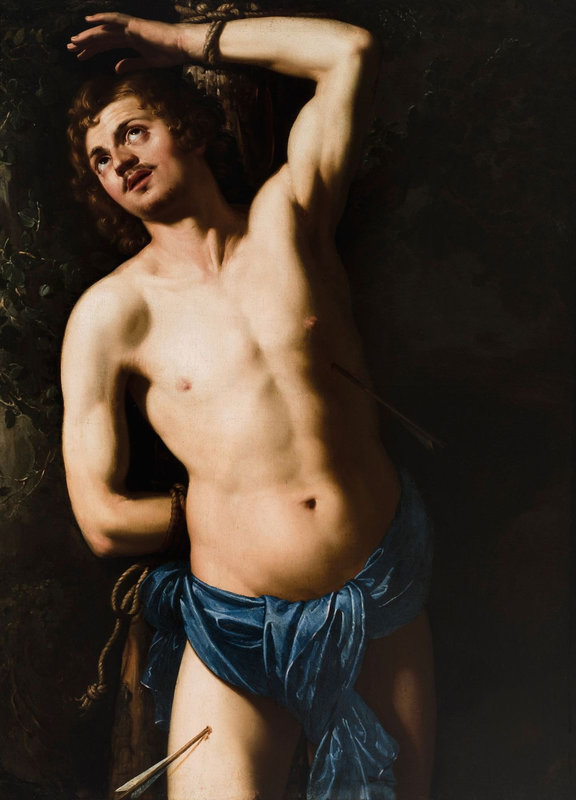
St Sebastian by Theodoor Rombouts (c.1626)

Rombouts was born in Antwerp on July 2nd 1597.  He was the son of Bartholomeus Rombouts, a wealthy tailor, and Barbara de Greve.  In 1608, at the age of eleven, Theodor studied art for a year as a pupil of Frans van Lanckvelt before being tutored by the Flemish artist, Abraham Janssens, the dean of the Antwerp Guild of St Luke and who had studied in Rome at the time of Caravaggio. He was one of the first Flemish followers of Caravaggio.

Young Soldier by Theodoor Rombouts (1624)

In 1616, aged nineteen, Theodore Rombouts also travelled to Rome where he remained until 1625.  He was recorded as living in the Roman parish of Sant’Andrea delle Fratte, along with two other Flemish painters, Francesco Tornelli  and Robert d’Orteil.  It is thought that while on a visit to Florence he met the Caravaggist Bartolomeo Manfredi and worked for Cosimo II de’ Medici. It was during his stay in the Italian capital that Rombouts was inspired by the revolutionary painter Michelangelo Merisi da Caravaggio and his most important follower Bartolomeo Manfredi and the two would influence Rombouts’ painting style.   In 1622 he also travelled to Pisa.
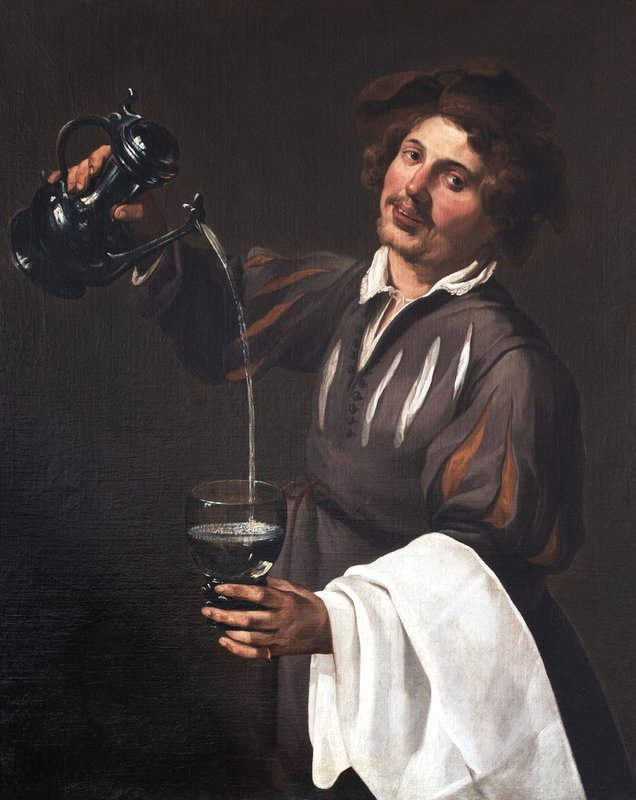
The Cup-bearer (Allegory of Temperance) by Theodoor Rombouts (c.1632)

In 1625, on his return to Flanders, Rombouts entered the Guild of St. Luke in Antwerp as an independent master. Now in Flanders, he concentrated on his genre painting which he could sell at the open market, in a style of strong contrasts of light, with figures of great articulacy, both evoking great energy and yet with natural movement.  The excellence of his work and its popularity resulted in him being looked upon as the leading Flemish Caravaggian of his time.
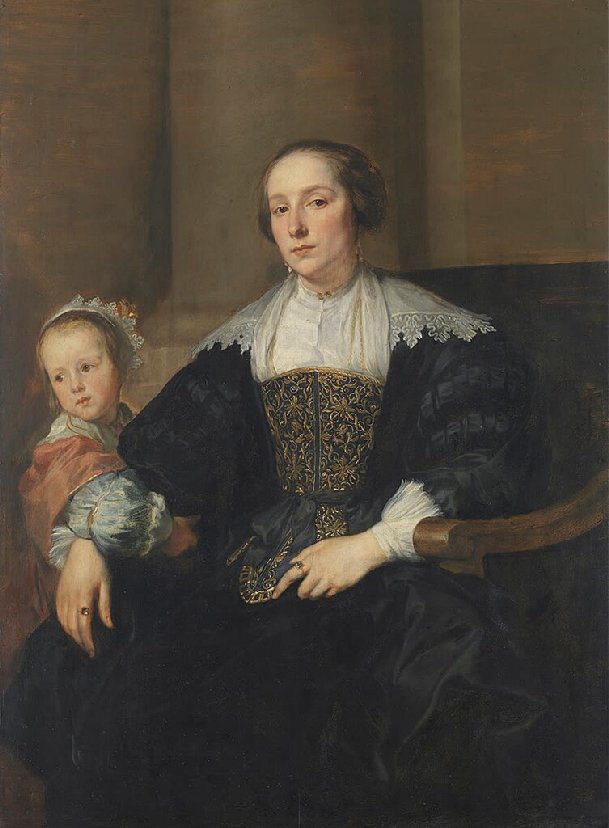
Portrait of Anna van Thielen, wife of the painter Theodor Rombouts with their daughter Anna Maria (c.1630)

In 1627 Rombouts married Anna van Thielen, who was from a noble family and the sister of Jan Philip van Thielen, who was the son of a minor nobleman by the name of Liebrecht van Thielen. Jan Philip became a well-known Flemish painter who specialized in flower and garland paintings.  He would eventually assume his father’s title of Lord of Couwenberch.  Jan Philip van Thielen became Rombout’s pupil in 1631 and became a talented still life painter.  There was a strange twist to Rombout’s marriage as Anna and her family were not from Antwerp but from the Mechelen area, and so he had to obtain, prior to the wedding ceremony, a dispensation from the Antwerp City Council to consummate the marriage outside Antwerp so that he would not forfeit his Antwerp citizenship rights.  In 1628 the couple had a daughter, Anna Maria.
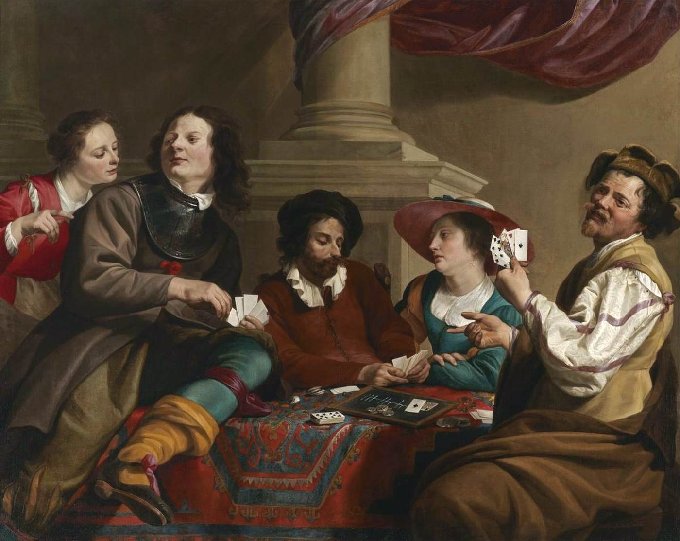
Card Players in an Interior by Theodoor Rombouts

Theodor Rombouts was the primary exponent of Flemish Caravaggism,that became a popular artistic phenomenon that reached its zenith in the 1620s. Besides his religious works, he is probably best known for his large-scale secular works which portrayed groups of cheerful folk partaking in musical merriment and card-playing characters who had often been affected by heavy drinking.  These people depicted wearing theatrical costumes were posed for best effect and set in chiaroscuro lighting typical of the Flemish Caravaggisti, also known as the Antwerp Tenebrosi.  Tenebrism, from Italian word tenebroso meaning dark, gloomy, and mysterious, also occasionally called dramatic illumination, is a style of painting using especially pronounced chiaroscuro, where there are violent contrasts of light and dark, and where darkness becomes a dominating feature of the image.
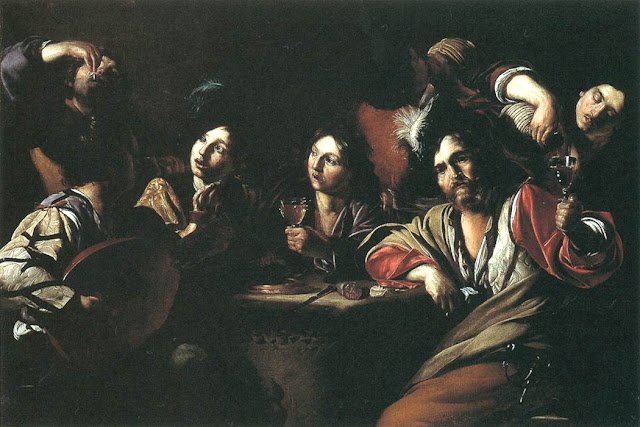
Tavern Scene with Lute Player by Bartolomeo Manfredi (c.1621)

Rombouts’ work entitled Card Players in an Interior, is a prime example of his Caravaggesque genre scenes. Recalling the jovial genre scenes of Bartolomeo Manfredi’s depiction of merriment in a tavern in his 1621 work, Tavern Scene with Lute Player, one can see a similar marked sense of monumentality to Rombouts’ five figures who are positioned around a carpeted table, engaged in a game of cards. The individuals are both realistic and expressive and the whole depiction has natural feel about it.

Rombouts introduces what is known in art terms as repoussoir to the depiction.  The word Repoussoir comes from the French verb répousser, which means “to push back” and it has been used for centuries by artists who want to focus attention and add interest to their art. They achieve this by placing certain types of objects or figures close to the painting’s edges, which guide the viewer’s eyes towards your central theme.  In this painting our eyes are being led towards the central bearded figure who stares down at his hand of cards, and it is thought to be a self-portrait of Rombouts. Rombouts also included a portrait of his wife, Anna, in the hatted figure seated beside him.

The Backgammon Players by Theodoor Rombouts (1634)

Rombout’s inclusion of self-portraits and portraits of family members in some of his paintings was not unusual as these additions were often seen in Dutch and Flemish genre painting.  In his 1634 painting entitled The Backgammon Players, which is part of the collection of the North Carolina Museum of Art, in Raleigh, Rombouts has included himself, the lavishly dressed soldier, his wife and his young daughter.

The Tooth Puller by Theodoor Rombouts (c.1625)

One of my favourite secular painting by Rombouts is his 1625 work entitled The Tooth Puller which can be seen at the Museo del Prado in Madrid. The depiction is of a tooth-puller who is treating a long-suffering patient surrounded by a large group of inquisitive onlookers who could well be the tooth-puller’s next patient.   They look on with a mixture of inquisitiveness and alarm, bordering on panic.  Like Caravaggio, Rombouts was interested in depicting ordinary folk enduring or enjoying everyday life.  The tooth-puller’s certificates lie on the table for his patients to see but his experience is substantiated by a collar of teeth worn around his neck.

The Lute Player by Theodoor Rombouts (c.1625)

One of Rombouts’ popular single figure painting is The Lute Player which is part of the John G. Johnson Collection at the Philadelphia Museum of Art.  It depicts a lute player tuning his instrument.  Lute players were often mocked for the undue amount of time they dedicated to tuning their instruments. Look how Rombouts has depicted the intensity of concentration on the face of the street musician which highlights the complexity of the task.  Some believe that this tuning of the instrument symbolises striving for harmony in love. The depiction of a stringed instruments could also symbolize temperance, especially when shown in the company of a tankard and a pipe, as depicted by Rombouts.

The Lute Player by Caravaggio (c.1596)

The subject of a lute player was very popular in the seventeenth century and was often depicted in a Caravaggio-style as can be seen in Dirck van Baburen’s 1622 painting entitled The Lute Player or Singing Man with Lute which is part of Centraal Museum in Utrecht collection. 
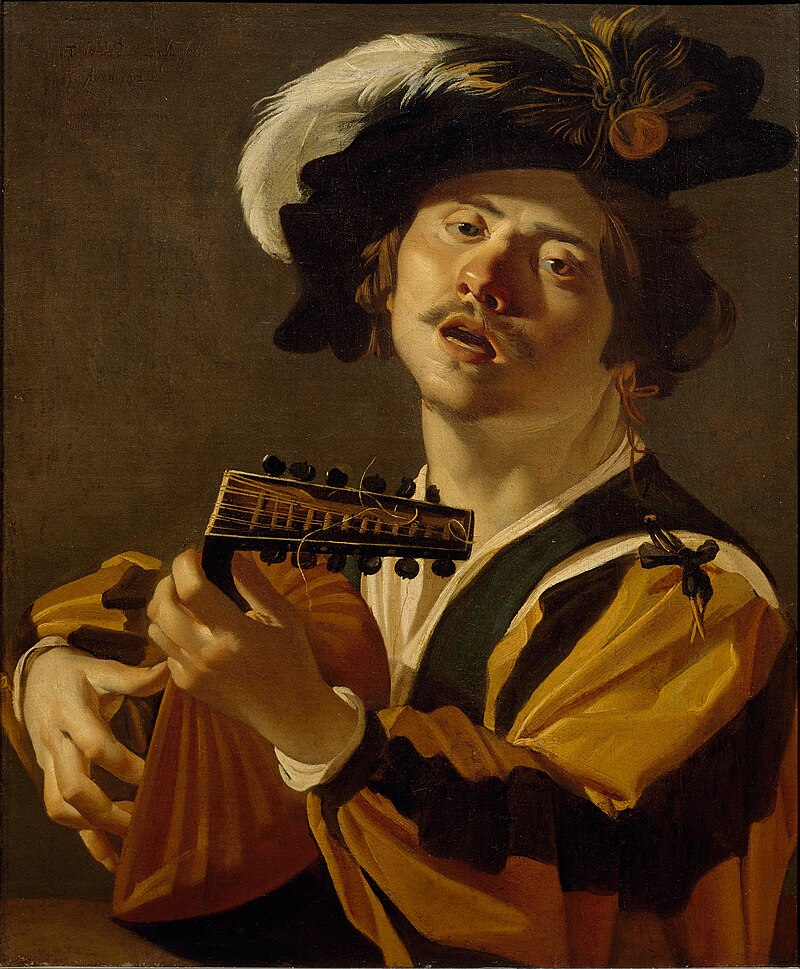
The Lute Player or Singing Man with Lute by Dirck van Baburen (1622)

Von Baburen, like Rombouts, had spent time in Rome and had seen many of Caravaggio’s works of art. 
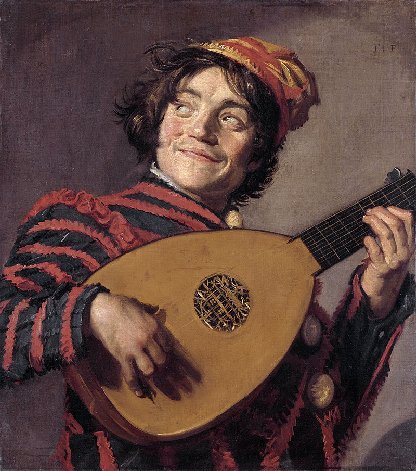
Lute Playing Jester by Frans Hals (1623/1624)

The half-figure image of a single musician became very popular in the Dutch Republic and other artists copied the style such as Frans Hals with his 1623 version of the Lute Playing Jester.
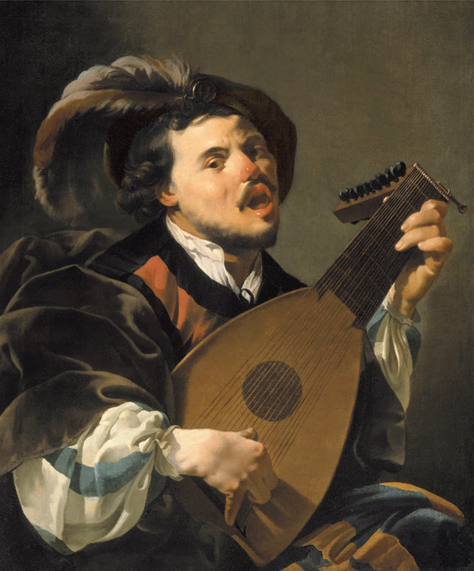
The Singing Lute Player by Hendrick Terbrugghen (1624)

and the Utrecht Caravaggesque painter Hendrick Terbrugghen with his 1624 painting entitled The Singing Lute Player.

Allegory of the Five Senses by Theodoor Rombauts (1632)

In 1632 Rombouts completed his multi-figured work entitled Allegory of the Five Senses which can be seen at the Museum voor Schone Kunsten in Ghent.  The art loving public in the 16th and 17th century were fascinated by symbolic works of art especially those where the artist has also displayed his or her virtuosity as a painter.  In the painting, Allegory of the Five Senses, we see five men depicted.  Each of them symbolizes one of the five senses. The elderly man on the left with glasses propping up a mirror represents Sight. Next to him is a man playing the chitarrone, a type of bass lute, and he symbolises Sound. The blind man in the centre of the painting represents the sense of Touch. Further to the right we see a jovial man with a glass of wine in his hand.  He portrays Taste.  At the far right we have an elegant young man smoking a pipe and holding a bag of garlic.  He represents Smell. The Ghent bishop, Antoon Triest, who also owned several paintings by Dutch masters, purchased this canvas from Rombouts.

The Denial of St. Peter by Theodoor Rombouts (c.1625)

Besides his genre paintings Theodoor Rombouts completed a number of large religious works during his lifetime.  Around 1625, after just returning from Rome, Rombouts completed his religious work entitled The Denial of St. Peter.  The narrative painting had a wide horizontal format (94 x 206cms) and the depiction was based on the biblical story about the testing of St Peter’s resolve in supporting Christ.  In the painting we see the servant girl questioning St Peter.  According to the bible Mark 14: 66-70:

“…While Peter was below in the courtyard, one of the servant-girls of the high priest came by. When she saw Peter warming himself, she stared at him and said, “You also were with Jesus, the man from Nazareth.” But he denied it, saying, “I do not know or understand what you are talking about.” And he went out into the forecourt. Then the cock crowed. And the servant-girl, on seeing him, began again to say to the bystanders, “This man is one of them.” But again, he denied it. Then after a little while the bystanders again said to Peter, “Certainly you are one of them; for you are a Galilean…”
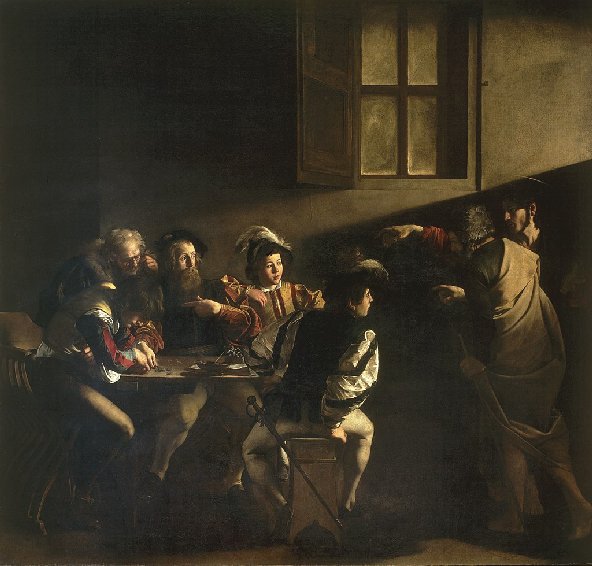
The Calling of St Matthew by Caravaggio (c.1600)

The influence of Caravaggio can be seen in this painting and the setting of the figures reminds one of Caravaggio’s  work The Calling of St Matthew which he completed around 1600 and is hanging in the Contarelli Chapel in San Luigi dei Francesi in Rome, and was probably seen by Rombouts.

Christ driving the Money-changers from the Temple by Theodoor Rombouts (c.1637)

Another of Rombouts’ religious works, Christ driving the Money-changers from the Temple, features the events in the Temple as related in Mark’s Gospel (Mark 11:15-17) in the New Testament:

“… On reaching Jerusalem, Jesus entered the temple courts and began driving out those who were buying and selling there. He overturned the tables of the money changers and the benches of those selling doves and would not allow anyone to carry merchandise through the temple courts. And as he taught them, he said, “Is it not written: ‘My house will be called a house of prayer for all nations’ But you have made it ‘a den of robbers…”

It depicts a furious Christ erupting in anger, his self-made whip in his hand, as he furiously attacks the merchants when he discovered that the holy site of the temple was being used as a market hall and money changer’s office.  Look at the wide range of emotions etched on the faces of the proponents.

Between 1628 and 1630 Rombouts was deacon of the Guild in Antwerp. In 1635, two years before his death, Rombouts collaborated with other artists on the programme of the decorations of the Joyous Entry of Cardinal-infante Ferdinand in Antwerp, which was led by Rubens. Theodoor Rombouts died in Antwerp on September 14th 1637, aged 40, shortly after the completion of this collaborative project.

Antonio Villares Pires.

O Templo do Tempo

Supper at Emmaus by Caravaggio (1601) London National Gallery.

For many of you who have visited the National Gallery in London, you will be aware of the daily lunchtime lectures. These often come in the form of one of the gallery curators/educators talking about one of the paintings, which is part of the gallery’s permanent collection. In some instances, on the day you will be advised of the painting featuring that day’s talk and where to find it. Chairs are then arranged around the painting and at the prescribed time the talk begins. They are well worth half an hour of one’s time.  The reason I mention this is that the painting mentioned in this blog was one that was being talked about when I first attended one of these lunchtime sessions. It was Michelangelo Merisi da Caravaggio’s 1601 work, Supper at Emmaus, which is based on a biblical tale quoted in Luke 24:30-31:

“…When he was at the table with them, he took the bread and blessed and broke it and gave it to them.  And their eyes were opened, and they recognized him. And he vanished from their sight…”

Caravaggio’s large work (141 x 196cms; 56 x 77 ins.) depicts the moment when the resurrected, but incognito Jesus, reveals himself to two of his disciples as they sat down to eat. Standing to the left of Christ is the innkeeper, who has served up the food. On the left, with his back to us, is Luke in his torn clothes and to the right is Cleopas. Attached to the coat worn by Cleopas is the scallop shell denoting that he is a pilgrim.  The setting for the painting is the interior of a village inn, in the small town of Emmaus, which lies close to Jerusalem.  In the painting, we see Christ reaching out his hand, in his renowned gesture, to bless the meal and at it is at this point that Luke and Cleopas suddenly realise that they are with the risen Christ and it is at this juncture of time that Caravaggio has strived to capture in his work.   With the work being so large, the figures within it are life-sized.

My wife with António Villares Pires

However, the blog is more than just this painting but more about a lucky happening.   I had just flown into the Algarve in southern Portugal and picked up a copy of the local newspaper and saw a full-page article about a local painter António Villares Pires who had just completed a full-size copy of the work. I decided to go and see it, which was at his studio in the town of Silves. The name of his workshop/studio is O Templo do Tempo (The Temple of Time). I contacted him and arranged a visit.

António was born in Porto in a neighbourhood which was populated by many artists and it was with him mixing in their company that he fell in love with art. He studied art at university and achieved a degree in Fine Arts.  He later taught art and eventually became a professional artist. He moved to the Algarve in 2009 and founded his studio in Silves, which backs on to the Silves railway station. He says that the name he gave the studio, O Templo do Tempo,  is his perception of art because he always felt that when something is truly art, it belongs to the past, present, and future – art, he says, is timeless.

Ground floor of Antonio’s workshop

His studio is full of his artwork and sculptures he is working on or are completed in the last decade. Despite being busy with many commissions he has dedicated the last six months to his “Caravaggio Project”. António loves and is in awe of Caravaggio’s style of painting and the way in which the Italian painter portrayed human beings in both a physically and emotionally realistic manner, often centered on a melodramatically dark background, which is often lit up by a single source of light.

Antonio studying a book with Caravaggio’s painting. Behind him is his copy.

Antonio says that it was the first time he painted in this style and the experience was a journey he wanted to fulfill in order to get into the mind of Caravaggio. He wanted to get to know the artist. His studio has two levels and it is in the mezzanine that almost all the space is dedicated to his Supper at Emmaus painting.

António Villares Pires at work on his copy of the Caravaggio painting

The painting, which he completed the day before we arrived, has the exact same measurements of the original and is flanked by photographs of the original National Gallery version of the painting as well as a large array of paints. It was on the mezzanine that Antonio spent up to six hours a day for the last six months creating his work. One would think he would tire of this same routine day in, day out, but he says that he loved it more each day. He returned to the National Gallery for the second time last November (his first visit was thirty years ago) and stood in front of the massive painting making notes, becoming aware of subtle changes he may have to make to his version.

Unfinished sculpture

Like Caravaggio’s work, Antonio’s copy is created in oils and he has made every effort to make his painting match every last detail of the original. For me, the painting looks identical to the original I saw in London. So why choose to copy this work? Antonio says that for him the Caravaggio work is an extraordinary painting with a lot of soul and humanity. When I talked to him about it his eyes lit up. He was truly in love with the work.

Standing outside workshop with artist and his wife

He says he will return to London to see if and how he can get his work officially certified. Once certified, he will sell it as his own work. I asked if he would be sad to let it go. He said he would but before it left him, he would make a full-sized colour copy that he could keep.   He says that he will create more pieces of art in the style of Caravaggio. Antonio has been painting for more than fifty years but says that when he is painting in the style of Caravaggio he feels he is twenty-eight again. For him his studio, O Templo do Tempo, is more than just a large storeroom for his work, it is a creative sanctuary, which he has poured his heart into. This is simply, his life.


The full article about O Templo do Tempo was written by Cameron Cobb and appeared in the January 9th, 2020 edition of the Algarve Resident and the December/January edition of the Essential Algarve magazine.

Georges de la Tour. Part 1

In my next two blogs I am looking at the life of the seventeenth century French artist, Georges de la Tour and featuring some of his works of art.   In this first blog I want to feature some of his genre paintings and in the second blog I will look at how he, like Caravaggio before him, was a master of tenebrism.

Georges de la Tour was born in 1593 in Vic-sur-Seille, a small town in the department of Lorraine in north-eastern France but which, at the time, was part of the Holy Roman Empire.  He was one of seven children born to his father Jean, a baker and mother Sybille.  Details of his early life are sparse but we know he married Diane le Nerf when he was twenty-four and they went on to have ten children.  Three years after marrying the couple moved to Lunéville, which was his wife’s home town, and was also just a short distance from Georges’ birthplace.  It was here that he spent the rest of his life.    He had quite a successful career and his paintings were bought by the likes of King Louis XIII, Cardinal Richelieu and the Duke of Lorraine whom he worked for between 1639 and 1642. He died in 1652 just short of his fifty-ninth birthday.

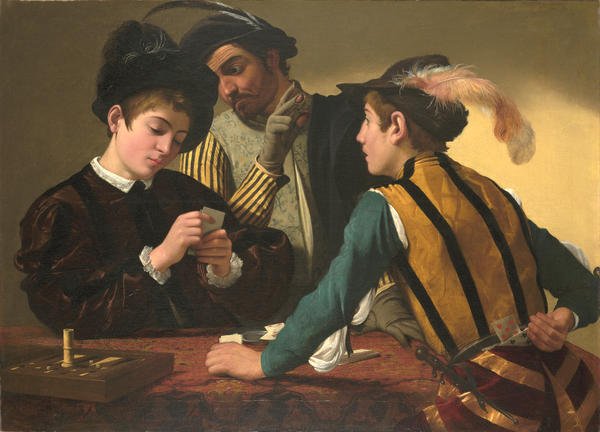
The Cardsharps by Caravaggio (c.1594)

Paintings featuring card players, and the perils of being cheated of your winnings, were not an unusual subject and one of the most famous was completed around 1594 by Caravaggio.  It was entitled The Cardsharps and now hangs in the Kimbell Art Museum in Fort Worth.   The boy on the right is the “cheater” and his older accomplice in the middle is giving him signs as to the cards held by his opponent.

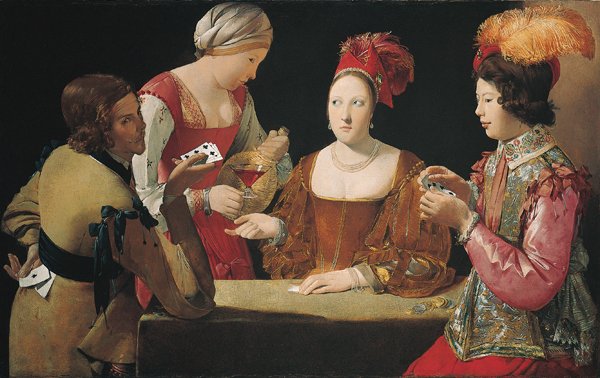
Le Tricheur à l'as de carreau or The Cheat with the Ace of Diamonds by Georges de la Tour (c. 1635)
Le Tricheur à l’as de carreau or The Cheat with the Ace of Diamonds
by Georges de la Tour (c. 1635)

The first of the Georges de la Tour paintings I want to showcase is one entitled Le Tricheur à l’as de carreau or The Cheat with the Ace of Diamonds which he completed around 1635 and is now to be found in the Louvre.   It is easy to see the similarity between this painting and the one painted forty years earlier by the Italian Master.  This seventeenth century work was put on show at the 1934 exhibition at the Musée de l’Orangerie in Paris entitled The Painters of Reality in France in the seventeenth century and it was through this memorable exhibition that French 17th century art was brought back to prominence and works by Georges de la Tour, who had almost been forgotten by French art lovers, once again became popular and his works following the exhibition were in great demand.

 The first thing we must decide on is what is going on.      On the right is a man dressed in the most expensive clothes carefully studying his hand of cards.    There is something about his appearance which makes us believe that he is slightly naive as his conspirators exchange sidelong glances.  He is slightly set apart from the other three characters.  Is he there at his own volition or has he been seduced into coming to the gambling den by the courtesan who sits next to him?  In a way it is a painting with a moral.  It is a depiction of a man who has to withstand three great inducements.   He has to withstand the temptations of lust brought on by the presence of the courtesan and serving maid, the temptation of alcohol which is being handed out to the card players and of course he has to resist the vice of gambling  French moral standards of the time frowned upon the three vices.  However he has put his moral standards to one side and for that, we know, by what we see happening before us, will be his undoing.

The courtesan is centre stage in the painting.  On the table by her is a small pile of money.  It is not as large as that of the guests but that will soon change.  Her clothes are sumptuous.  The plunging neckline of her costume no doubt titillates her male guest and probably distracts him from his game.  Her hair is topped by a fancy and fashionable feathered headdress.  Look at her eyes.  They are shifty.  Her whole expression, her whole demeanour, is one of deceitfulness.  Her right hand points to her co-conspirator probably advising him to play his hand.  We see him retrieving the ace of diamonds from under his belt, which will complete his winning hand.  The serving wench brings wine to the table and she too has a deceitful look about her as she casts a sidelong glance at the “mark”.  She knows what is going on.  She is part of the conspiracy.  The man, who is slightly in shadow and who is retrieving the ace of diamond looks out at us.  We have been drawn into this plot.  It is as if now we are also co-conspirators.

Cheat with Ace of Clubs by Georges de la Tour (c.1634)

A copy of this work which Georges de la Tour completed later can be found at the Kimbell Art Museum in Fort Worth Texas, the same gallery which owns the Caravaggio painting, Cheaters.   This painting is entitled Cheat with Ace of Clubs and once again is a moralistic painting warning people against the vices of lust, excess wine and gambling.  Like the painting in the Louvre the characters are the same, the shifty looks of the deceivers are the same it is just the suit of cards has changed from diamonds to clubs.

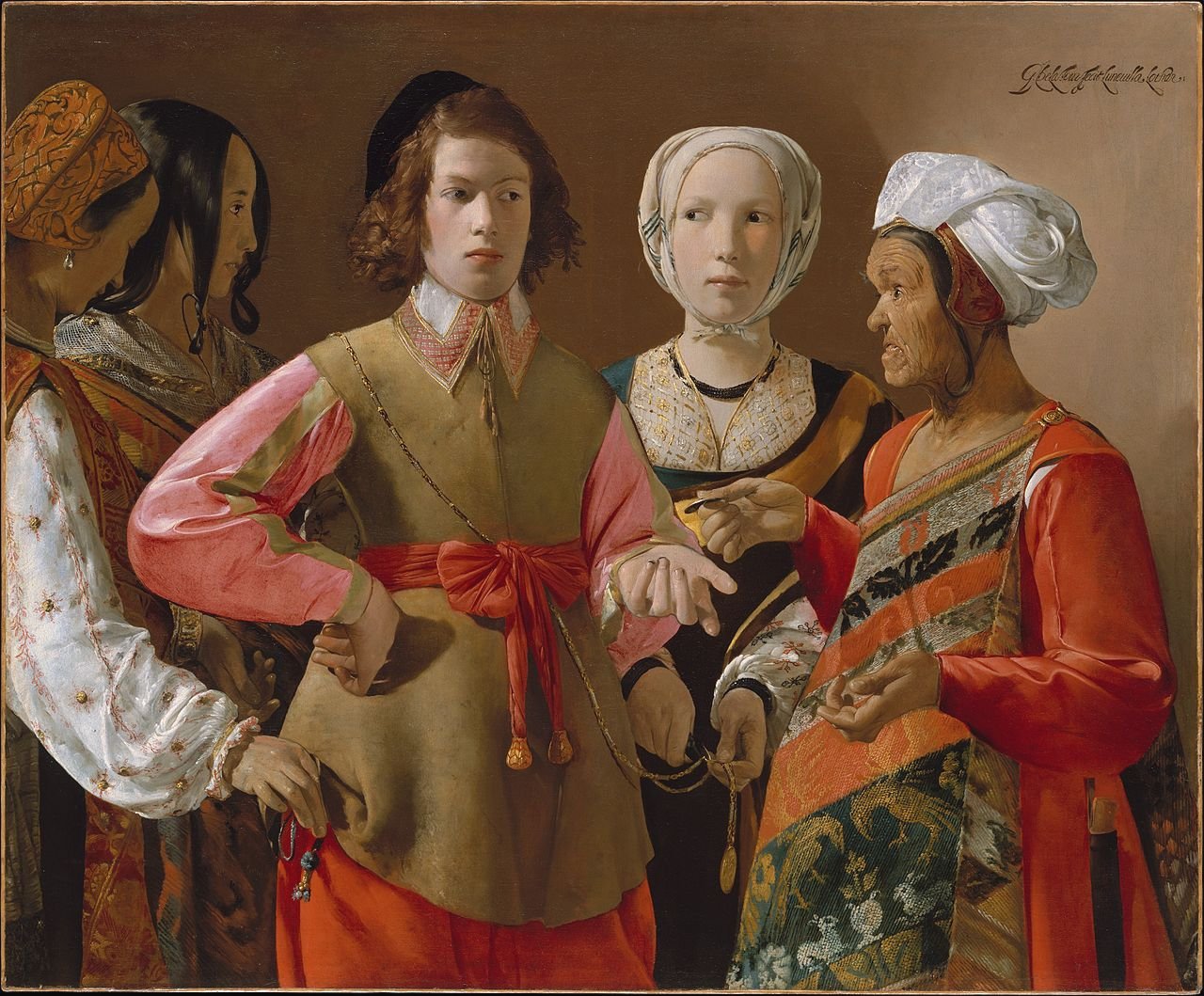
The Fortune Teller by Georges de la Tour (c.1630)

Four years before Georges de la Tour embarked on the theme of cheating at cards he focused on another piece of skulduggery – pick-pockets and con-artists.  The work in question was known as The Fortune Teller which he completed during the 1630’s and can now be found in the Metropolitan Museum of Art in New York.  In this work we see a naive young man standing between two young women.  He is well dressed and one is given the impression that he is also wealthy and ideal rich picking for the pick-pocket.   To the right of the painting is the wrinkle-skinned old crone who purports to be a fortune teller and has extracted a silver coin from the young man as payment for her telling him his fortune.  She is about to take the coin from his hand, and as part of the gypsy fortune-teller ritual, she will then cross his palm with it.   She, like the three younger women, are colourfully dressed and portrayed as gypsies.   As is often the case, even in today’s time, gypsies are pictorially portrayed in this work of art as thieves.  The crime is clearly there for us to witness as whilst the young man is engrossed in what the fortune teller has to say and at the same time as he hands over his fee the young lady on the right of the painting delicately removes the coin purse from the pocket.  However that is not all the young man is about to lose.  Look at the young woman between the fortune teller and the man.  She is more soberly dressed.  Look what she is doing with her hands.  She is just about to cut the gold medallion from its chain which is around the young man’s neck and right shoulder.  I like the way her eyes are fixed on his face in order to see if he is aware of what she was doing.

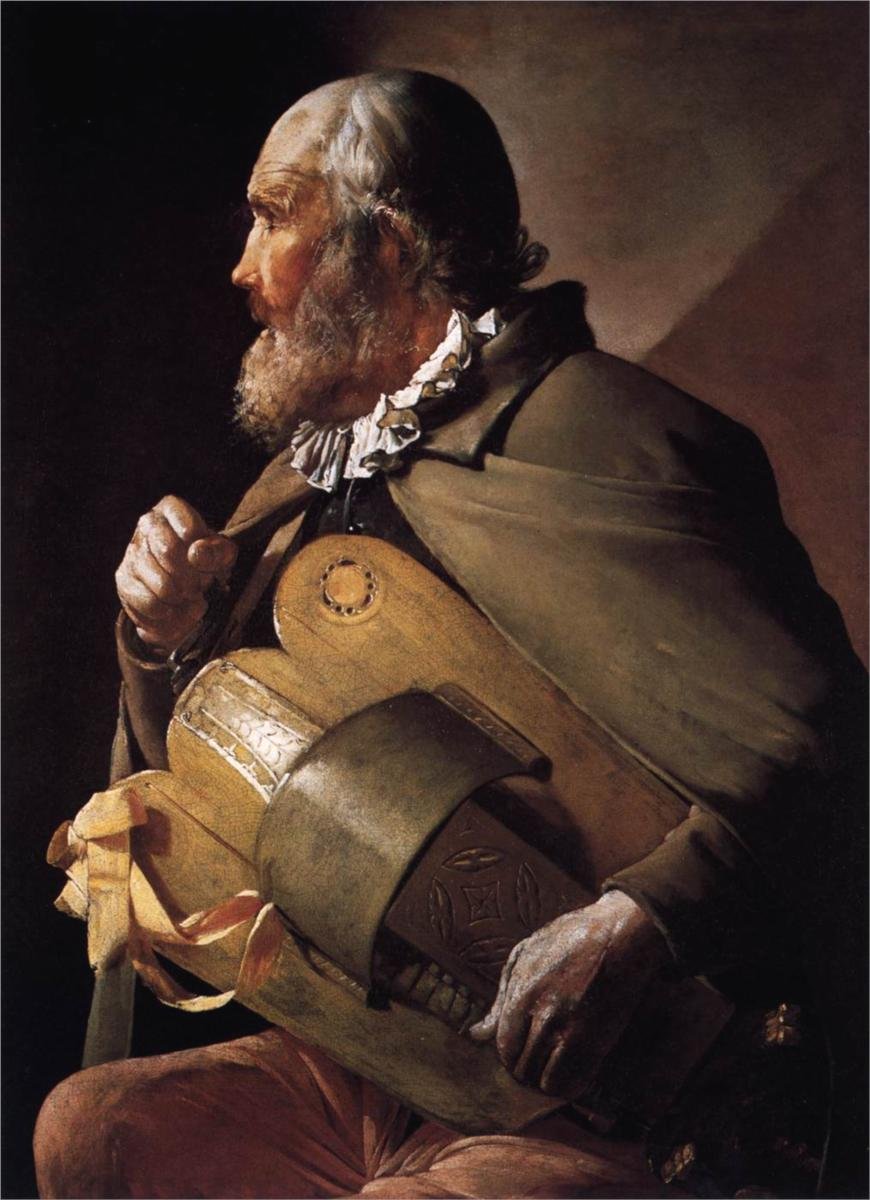
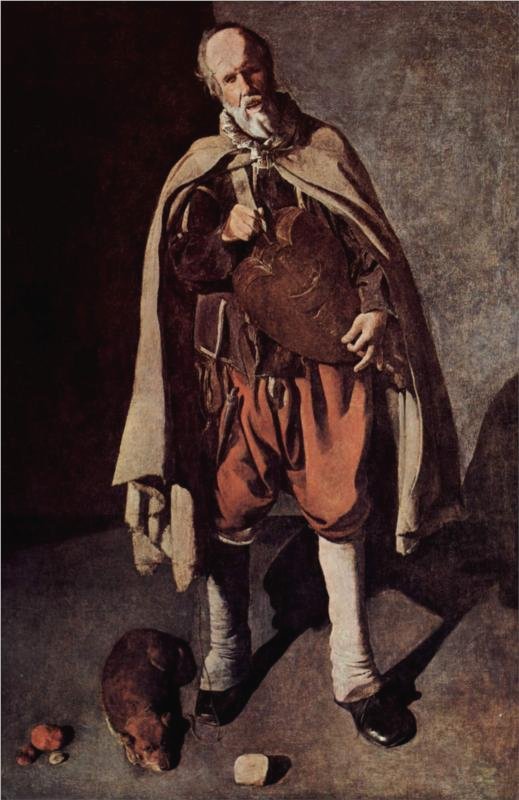
My final featured paintings by Georges de la Tour move away from the group genre scenes with the accompanying moral tale and focus on single portraits.  These are really exquisite works of art.  The subject of the next work of art is an elderly blind beggar and street musician trying to eke out a meagre living by playing a hurdy-gurdy. The hurdy-gurdy was the first stringed instrument to which the keyboard principle was applied. In France it was known as Viella a Roue , which literally translates to wheel fiddle and which describes the method by which sound is produced. The bowing action of the fiddle is replaced by a wheel cranked by a handle. The outer rim of the wooden wheel is coated with resin. When the crank is spun, the wheel turns and the gut strings vibrate.  The player of such an instrument was known as a vielleur.

Blind Hurdy-Gurdy Man by Georges de la Tour (c.1630)

Georges de la Tour often painted several variations on the same subjects, and the depiction of a street musician was an example of this.  He painted the one shown above, entitled The Blind Hurdy-Gurdy Player, around 1630 and it can now be found in the Prado, Madrid.  The man is depicted in profile and, but for the title of the work, one would never have known that he was blind, although his eyes are closed.  He has a trouble-worn face and his forehead is heavily wrinkled.  His skin is swarthy from spending most of his time out on the streets.   He wears a thick grey-brown coat with a white lace ruff.  Look how the artist has spent time on depicting the texture of the musical instrument.

The Hurdy-Gurdy Player by Georges de la Tour (c.1630)

Another version of this work can be seen in the Musée des Beaux-Arts, Nantes in France.   This work entitled The Hurdy-Gurdy Player was also completed by de la Tour around 1630.  This is a more unsettling portrait of the beggar.  He looks unkempt and uncared for.  His facial expression is one of pain and anguish as he sings to the tune he plays on the hurdy-gurdy.  He wears the same heavy grey-brown coat with the white scarf or ruff.  On the floor in front of him, resting on a large stone, is his bright red hat with a plume of feathers and often this painting is referred to as The Hurdy-Gurdy Player with Hat.

The Hurdy Gurdy Player with a Dog by Georges de la Tour (c.1625)

An earlier version, around 1625, on the same theme can be found in Bergues, the northern French town, close to the border with Belgium.   It is the Musée Municipal Bergues which houses The Hurdy-Gurdy Player with his Dog by Georges de la Tour.

In my next blog I will feature some of Georges de la Tour’s tenebrist paintings, a style which had been made popular by Caravaggio.

Granida and Daifilo by Gerard van Honthorst

Granida and Daifilo by Gerard van Honthorst (1625)

As I research paintings and artists for my blog, I delve into various books which I have and of course use the internet.  One of the best art history magazines about is The Burlington Magazine which is published monthly.  However although I have, in a rush of blood to the head, almost signed up for it, the cost of a few pence under £20 per issue I feel  is just too much.  However the other day I bought the Centenary Anthology of the magazine from eBay and although I have just skimmed through some of the 250+ pages I am pleased with my purchase.  It was as I flicked through the pages I came across a beautiful work by Gerard van Honthorst and I thought it was time to feature this Dutch painter and one of his works.

Gerard or Gerrit van Honthorst was born in Utrecht in 1592.  His father was a textile painter and his younger brother Willem also went on to become an artist.  His first taste of art came when he was apprenticed to the great Dutch painter Abraham Bloemaert.  Bloemaert, who resided in Utrecht, was an outstanding teacher and virtually all the aspiring young Utrecht painters of that time, who went on to become famous, had at one time studied under this artistic master.

In his early twenties, Honthorst travelled to Italy and during his stay in Rome where he lived in the palace of a patron of Caravaggio, Vincenzo Giustiniani, he was influenced by the works and style of the famous artist who was at the height of his popularity.  Whilst in Italy, Honthorst developed a similar artistic style to Caravaggio in the way he often portrayed his figures in the darkness of night lit by candlelight and this style acquired him the Italian nickname Gherardo delle Notti (Gerard of the Night).   His paintings were very popular and he managed to acquire a number of wealthy patrons including the powerful Scipione Borghese the Italian Renaissance cardinal who was a great patron of the arts and an avid art collector.  He was also patron to Caravaggio.  Another of his patrons was Marchese Vincenzo Giustiniani an aristocratic Italian banker and art collector

Honthorst returned to Utrecht around 1620 and that same year married Sophia Coopmans.  Along with his fellow artist, Hendrick ter Brugghen, they set up an art school in Utrecht.  Due to the influence of Caravaggio  on the works of the two Dutch painters and the way their paintings showed strong and bold contrasts between light and dark known as chiaroscuro,  they were looked upon as representing Utrecht Caravaggism.

In 1622 van Honthorst joined the Guild of St Luke in Utrecht and three years later was made president of the society.   Van Honthorst fame as a painter spread and he was much sort after as a teacher so much so that in 1627 he moved to a much larger house and turned part of it into his workshop.  The following year, following his rising artistic reputation reaching the English court, he was invited to work at the court of King Charles I.  He remained in England until the end of 1628 at which time he returned to Utrecht.

In 1637 Van Honthorst moved to The Hague when he became the court painter to the Princess of Orange and received a number of commissions for portraits from the Dutch ruler Frederick Hendrick, Prince of Orange and his family and during this period he also worked on the decoration of the royal residences.  His fame spread and he received many royal commissions from the likes of the French Queen Maria de Medici, mother of King Louis XIII, King Christian IV of Denmark and Elizabeth of Bohemia, Charles I of England’s sister.

With success came great wealth and he was fortunate enough to live a luxurious lifestyle.  Gerard van Honthorst died in Utrecht in 1656, aged 64.

The featured painting in today’s My Daily Art Display is entitled Granida and Daifilo which Gerard van Honthorst completed in 1625 and was commissioned by  Stadholder Frederick Hendrick  for his residence at Honselaerdijk and was to form part of a number of paintings of pastoral scenes.

The title of the painting refers to the characters in a pastoral play written by Pieter Hooft, the Dutch historian, poet and playwright entitled Granida.  The story of the play was that Granida and Daifilo were lovers.   Granida, the daughter of an eastern king, was betrothed to Prince Tisiphernes but one day became lost while out hunting.  She came upon a shepherd Daifilo and his mistress Dorilea who had just quarrelled.  Daifilo fetched water for the princess to drink and fell in love with her. He followed her to court and, after several twists and turns in the story, they fled to the woods together to live a pastoral life. However, Daifilo was taken prisoner by one of Granida’s several suitors. The play had a happy ending and the couple were finally reunited after the intervention of Tisiphernes who took pity on the young pair and gave up his claim to her.

The colours of this painting are bright and the details of the two protagonists in this amorous scene set in this idealised woodland setting give it a touch of classicism.  Nevertheless, there is a touch of realism, which was associated with the Caravaggists as we see the dirty soles of Daifilo’s feet.  In the background to the right we see the soldiers approaching the lovers with the intent to arrest them.

The play set a fashion for pastoral idyll in the Netherlands where Granida and Daifilo became iconic symbols of love. The play was noted for the delicacy of its poetry and the simplicity of its moral.  The moral to this tale was that individuals and nations can be at peace only when rulers and subjects alike shun ambition and seek only to serve. Though not well known today, it was a very popular work in early 17th century Netherlands, and Granida and Daifilo were the subject of many important paintings by Dutch masters.

The painting can be found in the Centraal Museum, Utrecht