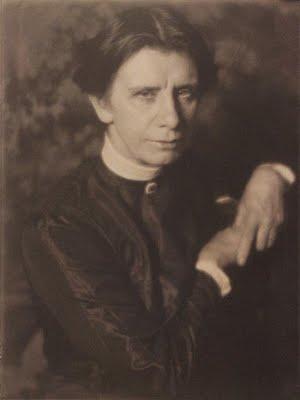
Laura Sylvia Gosse

Laura Sylvia Gosse (1881-1968)

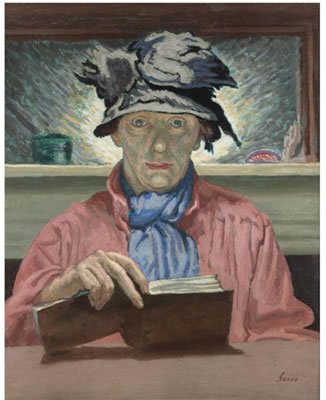
For a number of years now, probably for centuries, many female artists have been discounted as hobby-painters or painting because art for many was like playing the piano, a social grace that every young woman should achieve.  It is even more annoying when a man and a woman work side by side and yet it is the reputation of the male artist that is remembered.  An example of this is looking at two Camden Town Group artists, one a founder, the other on the periphary as it was an all-male domain.  I am sure you have heard of Walter Sickert but what about his friend and contemporary, Laura Sylvia Gosse.  Sylvia who ?  Let me set the record straight.

The Artist’s Mother by Laura Sylvia Gosse

Sylvia Gosse was actually born Laura Sylvia Gosse but was always known by her Christian name, Sylvia.  She was born in London on February 14th 1881, the youngest of three children.  She had an elder sister, Teresa Emily and an elder brother, Philip Henry.  
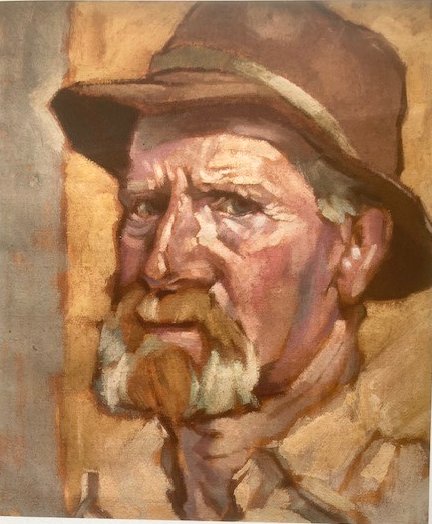
Edmund Gosse by John Singer Sargent

Her father, Edmund Gosse was a poet, literary critic and librarian of the House of Lords.  Her mother was Ellen Gosse (née Epps), an artist in the Pre-Raphaelite circle who had studied under Ford Madox Brown, and whose sister, Laura Theresa, an aspiring artist, had married Lawrence Alma-Tadema.

Fountains at Pernes Les Fountaines, Provence by Laura Sylvia Gosse

Sylvia’s family home in Delamere Terrace was in the London borough of Paddington, and was always inundated with people from both the art and literary world with visitors such as the great writers of the time, such as Henry James, Thomas Hardy, Robert Louis Stevenson and Rudyard Kipling.  In early childhood, Sylvia loved to paint and draw and her favourite subject being her pets. At the age of thirteen, Gosse went to an art school in France, where she stayed for three years and she recounted that it was there that she felt she belonged.  She returned to England and studied at the St John’s Wood School of Art.  In 1906, aged fifteen, she enrolled at the Royal Academy Schools.
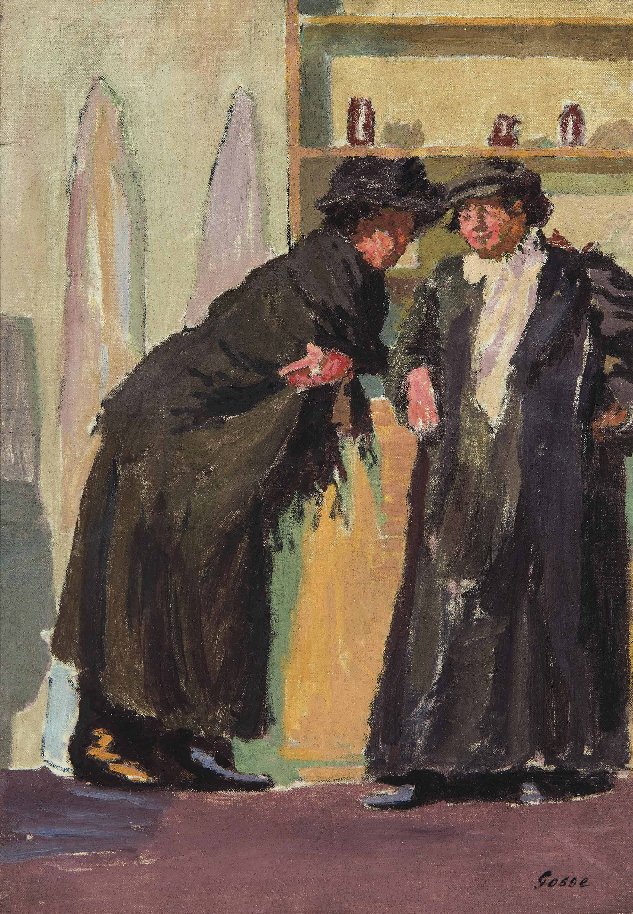
The Gossip by Laura Sylvia Gosse

One of the frequent visitors at the Grosse household was the artist Walter Sickert and it was during one of his visits that he began talking to Sylvia and looked at her artwork.  He was captivated by her work and obvious artistic talent and suggested she learn the art of etching.  Sylvia began to attend Sickert’s evening classes at the Westminster School of Art and in 1909 went as a pupil to his new art school, which he ran with Madeline Knox at 209 Hampstead Road, London.  Sickert’s dual role with Knox at the art school ended when Knox resigned following Sickert’s illness, and having had to run the school singlehandedly.  Sickert approached Sylvia Gosse, his pupil, to see if she would accept the position as associate director. 

Rowlandson House – Sunset by Walter Sickert (1911)

Walter Sickert rented Rowlandson House in Camden Town from 1910–14, during his time with the Camden Town Group. This summertime depiction of the building looks north up Hampstead Road from the back garden, the time of day nearing twilight, which Sickert has indicated by daubs of pink and mauve in the pale sky. The trees in the far background form the edge of Mornington Crescent Gardens. 

Walter Sickert by Sylvia Gosse (1923-25)

Sylvia was made co-director of the Rowlandson House School but did this position alongside Sickert put them on an equal footing?  As a woman in an artistic world which did not always value them, it became clear during her time at Rowlandson House, that her relationship with the Camden Town Group which she was ineligible to join, being a female, despite Sickert being its leader, was not even-handed.  According to Kathleen Fisher, Gosse’s biographer and friend, who wrote Conversations with Sylvia. Sylvia Gosse – Painter, 1881-1968, Sylvia Gosse taught the less-able students at Rowlandson House, as Sickert would grow bored and impatient and dismiss them. The School became known as the Sickert and Gosse School of Painting and Etching.  Silvia served as co-principal from 1910 until it closed in 1914 and during that period, she taught some of the classes and took over responsibility for the practical organisation and finances.  Sylvia Gosse had an independent income, and without her financial backing the school would have closed much sooner.

The school which Gosse and Sickert jointly ran until 1914 when it closed. During those years, Gosse’s own painting career also began to progress. Sylvia Gosse could be described as being slightly introverted (or was she just shy?) and was not known as a very sociable person.  One of her pupils, Marjorie Lilly recalled Sylvia, saying:

“…she might appear at Number 15 [Fitzroy Street] on At Home days, but rarely; being very shy, she always chose the most inconspicuous corner she could find, looking harassed and hunted, and hardly spoke…”

Despite this she was always very supportive of her fellow artists and completely dedicated to Sickert.

Chateau Dieppe by Layra Sylvia Gosse (c.1925)

La Place Saint Jacques by Laura Sylvia Gosse (c.1920)

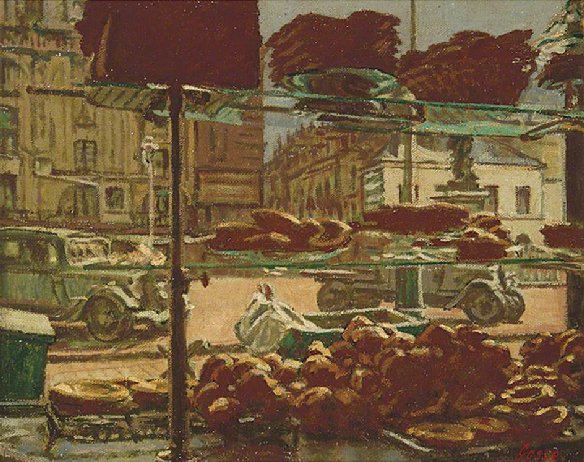
Grande patisserie, Place Nationale, Dieppe, France by Laura Sylvia Gosse (1930)

Walter Sickert had always loved visiting France and would regularly travel to the Normandy coastal town of Dieppe.  Sylvia often accompanied Sickert on his travels, notably when he stayed in Dieppe, and she had a small cottage near his home.  Many of her paintings featured the French town.

Envermeu, France by Laura Sylvia Gosse (c.1920s)

The small town of Envermeu which lies ten kilometres east of Dieppe also featured in many of Sylvia’s paintings.

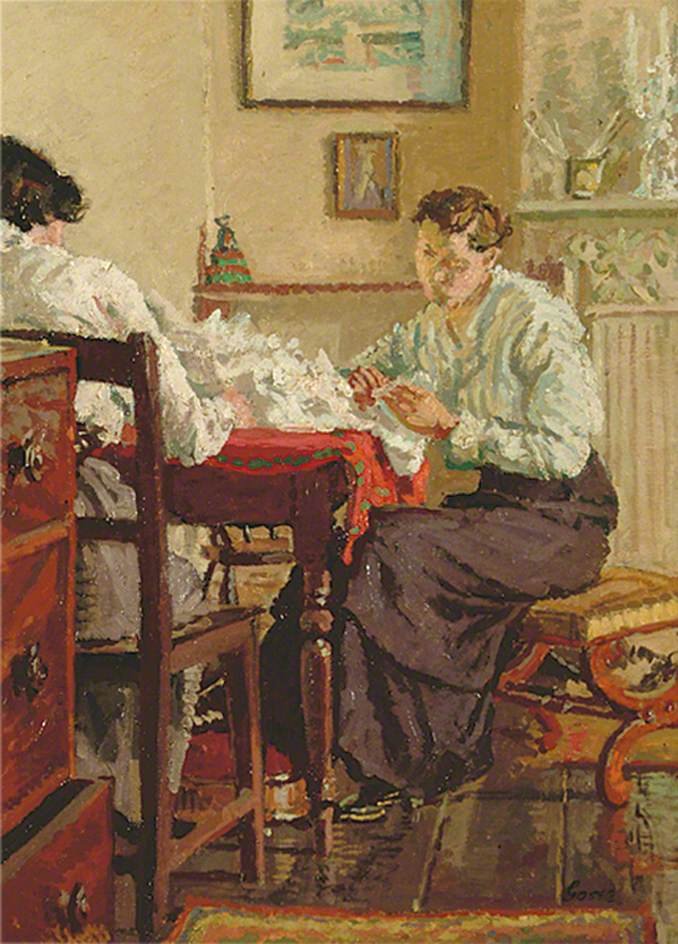
The Seamstress by Laura Sylvia Gosse

Many of the paintings of the Camden Town group focused on the subject of ordinary life, which often concentrated on the life of the poor and dispossessed, and how their life was one of boredom and squalor.  Gosse tended to focus more on the hard-working women, such as the seamstress and the printer.

The Printer by Laura Sylvia Gosse (c.1915)

Sylvia’s painting, The Printer, which she completed around 1915 shows a woman labouring at a press.

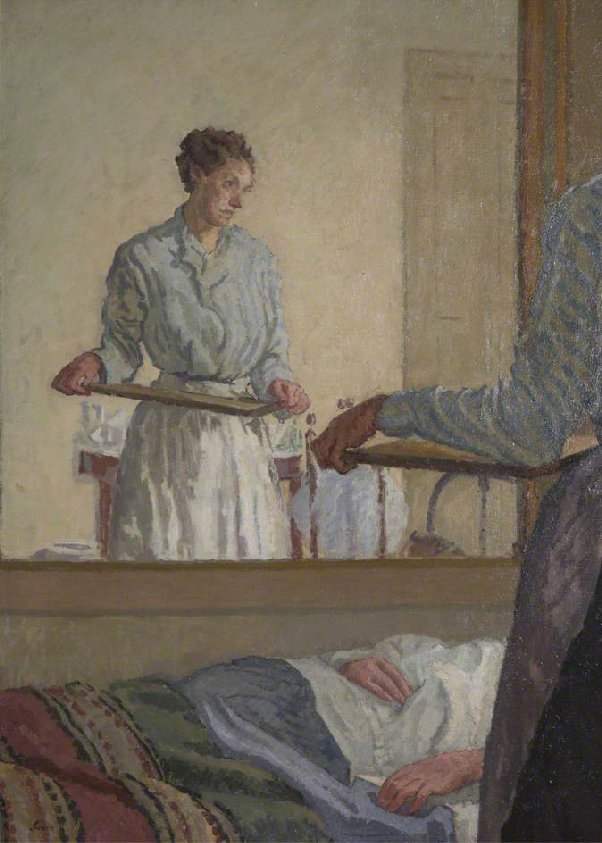
The Nurse by Laura Sylvia Gosse

In her painting, The Nurse, we see her approaching her patient.  In this depiction, we see her as she is reflected in a mirror above the sickbed.  This is not a depiction that beautifies the nursing profession it is simply one that shows us an unglamorous workaday appearance of a nurse tending the sick.

Mrs Alexandra Russell by Laura Sylvia Gosse

During the 1920s and 1930s Sylvia’s paintings were on display at many of best-known commercial galleries. She was elected to the Royal Society of British Artists in 1930 and continued to support Sickert loyally until his death in 1942.

In 1951 Sylvia bought a bungalow in Ore, a large village in the urban area of Hastings, in the county of East Sussex.  It was here that she planned to spend her last days painting, but alas, she suffered from cataracts, which made painting and sketching increasingly problematic.  However, it was her belief that every painter should die with a brush in their hand, so despite her severely reduced vision, she still managed to visit exhibitions and help inspire young artists. She died in the Buchanan Hospital, Hastings on June 6th 1968 at the age of 87.

Jasper Francis Cropsey

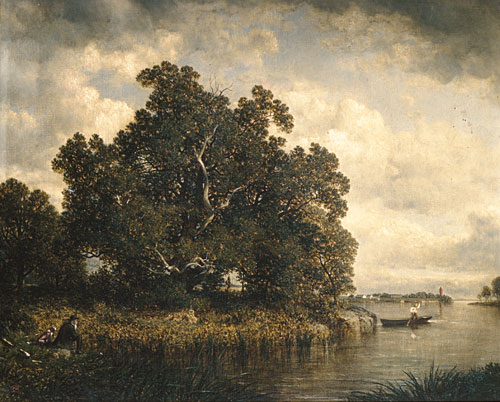
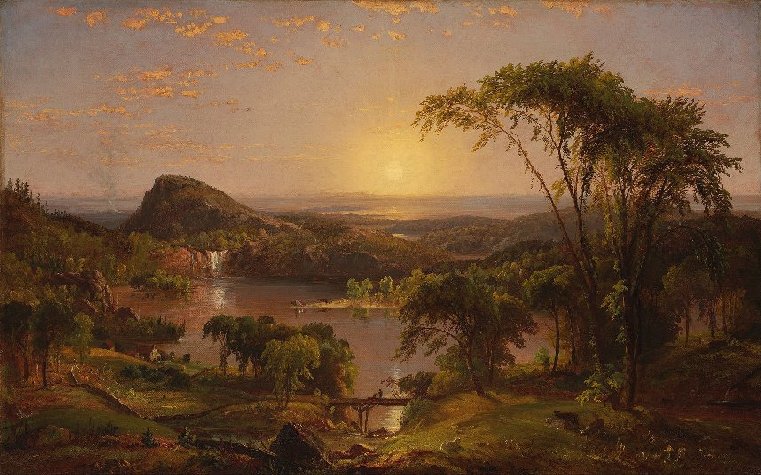
Among the most vibrant and spectacular works of the nineteenth century, were the sweeping landscape depictions of the Hudson River School which managed to capture the rugged beauty of the American countryside and wildernesses.  The name Hudson River School was first used disparagingly by trendy Europhile critics who preferred the dignified depictions of the realism of L’École de Barbizon.  The beautiful paintings of the Hudson River School compellingly convey the natural grandeur, not just of the Hudson River Valley, as the name would imply, but also the Catskills, Adirondacks, White Mountains, the Maritimes, the American West and South America.  My guest artist was one of the great painters of that School.

Jasper Francis Cropsey

Jasper Francis Cropsey was born at Rossville, Staten Island on February 18th 1823.  He was the eldest of eight children and his ancestors were of Dutch and Huguenot ancestry. His father was Jacob Rezeau Cropsey who had a farm in Rossville and his mother was Elizabeth Hilyer Cropsey (née Cortelyeu).  During his early years, Cropsley suffered many bouts of ill health which resulted in him missing school and forced him to rest up at home.  During those frequent periods of inactivity, he taught himself to draw. Many of his sketches featured architectural drawings and landscapes.  Whilst attending the local country school he would help is father on the farm but in his pre-teen and teenage years he developed his main love, sketching and painting.  Much to the chagrin of his teachers he would often be found doodling on his school books.  In his 1846 unpublished biography, Reminiscences of My Own Time he wrote:

“…I was so disposed to adorn my writing book, on the margin, wherever there was a blank space, with fancy letters, boats, houses, trees, etc., and paint, or color the pictures in my books that I would undergo the reprimand of the teacher, rather than desist from it…”

The Valley of Wyoming, by Jasper Francis Cropsey (1865)

Cropsey as a young teenager was fascinated with architecture and this led him to assemble an elaborate model of a country house which he submitted to the 1837 fair of the Mechanics’ Institute of the City of New York and it won him a diploma.  The model was well received and Joseph Trench, a New York architect who saw it, offered fifteen-year-old Cropsey a five-year apprenticeship in his architectural office. After eighteen months, Cropsey’s proficiency in drawing had earned him the responsibility for nearly all the office’s finished renderings.   Cropsey prospered at the firm and during his penultimate year at the company he began painting the backgrounds of the architectural designs. To improve that skill, Joseph Trench persuaded his young apprentice to study watercolour painting with English-born watercolourist, Edward Maury.  The firm even provided him with paints, canvas, and a space in which to study and hone his artistic skills.

The Narrows from Staten Island, by Jasper Francis Cropsey (1868)

Cropsey left the Trench’s office in 1842 and in 1843 he first exhibited a painting, which was quite well-received.  It was a landscape entitled Italian Composition, probably based on a print he had seen at the National Academy of Design. Jasper Cropsey was elected an associate member of the Academy the following year and became a full member in 1851.

Sunset on Greenwood Lake by Jaasper Francis Cropsey (1877)

Having left the Trench architectural company Cropsey managed to support himself for the next two years by accepting commissions to provide architectural designs.  Although that brought him financial support, his main love was sketching and painting landscapes and he would often take painting trips to New Jersey and Greenwood Lake, which straddles the border of New York and New Jersey.  After one such trip, Cropsey had put together a number of sketches of the area, which on his return home he converted them into two paintings of Greenwood Lake that were accepted at an 1843 exhibition at the American Art Union.

Autumn Foliage in the White Mountains (Mount Chocorua) by Jasper Francis Cropsey (1862)

During one of his trips to Greenwood Lake, Cropsey met Maria Cooley, whom he later married in May 1847. They went on to have two children, Mary Cortelyou Cropsey in 1850 and Lilly Frances Cropsey born in 1859. He and his wife crossed the Atlantic for a two-year European honeymoon and visited England during the summer of 1847, travelled throough France and Switzerland and reached Italy wheree the Cropseys spent a year among the colony of American artists who had settled in Rome. During that lengthy stay in Rome, Cropsey worked out of the former studio of Thomas Cole, the founding father of the Hudson River School. Cropsey became familiar with the works of the Nazarenes and other German artists in Rome and it was their influence which may have reinforced his own liking of detail in his paintings. Like many other American artists who visited Italy, Cropsey made frequent sketching trips to the Roman Campagna and other regions of Italy, such as Sorrento, Capri, Amalfi, and Paestum.

Maria Cooley Cropsy by Daniel Huntingdon (c.1850)

Cropsey and his wife returned to America in 1849 and he made his first trip to the White Mountains, a mountain range covering about a quarter of the state of New Hampshire and a small portion of western Maine.  Cropsey rented studio space in New York which he shared with Edwin White, the Massachusetts-born artist, at 114 White Street in New York City. Here he taught and worked up his European sketches into finished oil paintings. Cropsey and his wife made their base in New York and from there in the summers they would make exploratory trips through New York State, Vermont, and New Hampshire, and he would continually sketch what they saw. Cropsey specialized in autumnal landscape paintings of the northeastern United States. He would convert sketches into finished paintings and sell them but also to supplement the family income he would teach.  

 Bayside, New Rochelle, New York by David Johnson (1886)

One of his pupils was the landscape painter David Johnson, who became a member of the second generation of Hudson River School painters.

Lord Byron’s Dream, by Charles Lock Eastlake (1827)

Cropsey and his wife made a second trip to England in 1856 and rented a studio in London at Kensington Gate.  It was an ideal place to host parties and make friends such as the art critic John Ruskin, John Singleton Copley, 1st Baron Lyndhurst, who was a British lawyer and politician and was three times Lord High Chancellor of Great Britain and Sir Charles Lock Eastlake who was a British painter, gallery director, collector and writer of the 19th century. He became the first director of the National Gallery and from 1850 to 1865 he served as President of the Royal Academy.    

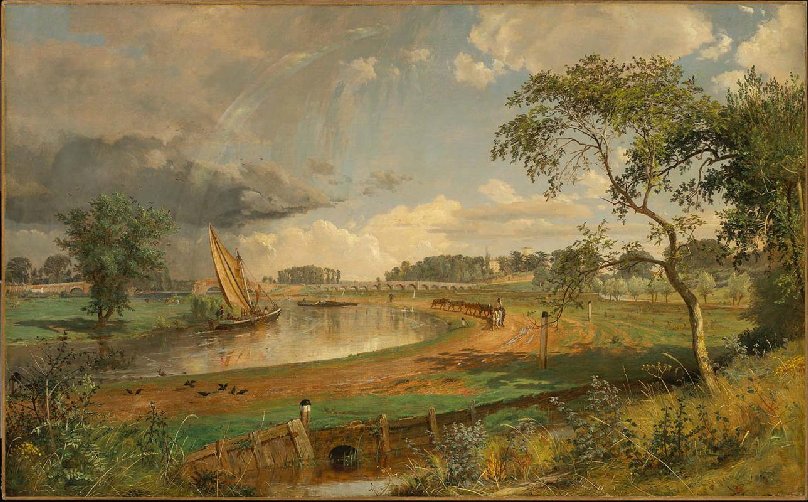
Walton on Thames by Jasper Francis Cropsey (1860)

It was with friends such as these that ensured many English and American landscape painting commissions came Cropsey’s way from both English and American patrons. When Cropsey arrived in England he brought with him many commissions from his American patrons who wanted paintings depicting English castles and abbey ruins. He also found that there was a great interest amongst English clients for his American landscapes. The London printer Gambert and Company commissioned thirty-six views from Cropsey for publication in the American Scenery journal.

Autumn—On the Hudson River , 1860 by Jasper Francis Cropsey

In 1860 Cropsey completed one of his most famous paintings entitled Autumn—On the Hudson River of 1860. This monumental view of the Hudson River Valley was painted from memory and in-situ sketches he had made, in his London studio. Cropsey adopted a high vantage point, looking southeast toward the distant Hudson River and the flank of Storm King Mountain. It is an autumnal scene which would soon become Cropsey’s trademark.  The work was praised by critics and the public alike, including Queen Victoria.  The painting depicts a sweeping panoramic view of the river under a sun-streaked sky in this long, horizontal landscape painting (60 x 108 inches).  The leaves on the trees are fiery autumnal oranges and reds.  In the background we catch a glimpse of the mountains through the haze.  At the bottom of the painting we can see vine-covered, fallen tree trunks and mossy grey boulders.  At the bottom left we can just make out a trickling waterfall and small pool. 

Although not easy to spot, on the bank of the pool, three men and their dogs sit and recline around a blanket and a picnic basket, their rifles leaning against a tree nearby. From our viewpoint, the land stretches down to a grassy meadow which is crossed by a meandering stream at the heart of the painting. 

In the right foreground we see cattle on the riverbank drinking the water close to a wooden bridge. 

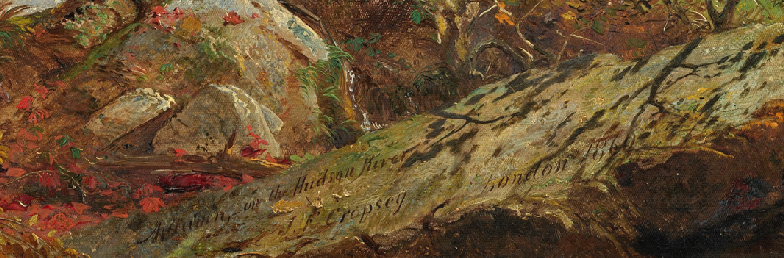
Artist’s signature on flat rock

Cropsey signed the painting as if he had carved it into the flat top of a rock at the centre foreground of the landscape with his name, the title of the painting, and date: “Autumn – on the Hudson River, J.F Cropsey, London 1860.”

Summer, Lake Ontario by Jasper Francis Cropsey (1857)

Besides earning money from the sale of his landscape paintings he also provided illustrations for books of poetry by Edgar Allan Poe and Thomas Moore and did a series of views of American scenery published by Gambert and Company, London.  Cropsy was acclaimed not only for his beautiful autumnal landscapes such as Autumn—On the Hudson River, 1860 which is now part of the National Gallery of Art, Washington, D.C. collection, but for bringing to the untravelled British people the exquisite scenery of the great Western continent.   Queen Victoria was so impressed by Cropsey’s works of art that she appointed him to the American Commission of the 1862 International Exposition in London, and he subsequently received a medal for his services.

Coast of Genoa by Jasper Francis Cropsey (1854)

Cropsey and his wife returned to America in 1863. The 1860s were the most successful time for Cropsey as far as the sales of his work and his ever increasing bank balance. Shortly after their arrival home to America they visited Gettysburg to record the battlefield’s topography in a painting. Cropsey also began to accept architectural commissions once again and produced his best-known designs, such as the ornate cast and wrought iron Queen Anne-style passenger stations of the Gilbert Elevated Railway along New York’s Sixth Avenue.

High Torne Mountain, Rockland County, New York by Jasper Francis Cropsey (1851)

Cropsey’s father-in-law, Isaac P. Cooley was a justice of the peace from 1837 to 1839 and became a judge over the New Jersey Court of Common Pleas in 1840.    Cooley later became a member of New Jersey State House of Assembly from 1860 to 1861.   Cooley offered to build his daughter and son-in-law a studio on his estate but Cropsey declined the  offer and instead, purchased forty-five acres of land near Greenwood Lake in Warwick, New York, where he designed and built a 29-room Gothic Revival mansion with its own studio which he called Aladdin. The family then divided their time between living in New York City, and spending time in Warwick.

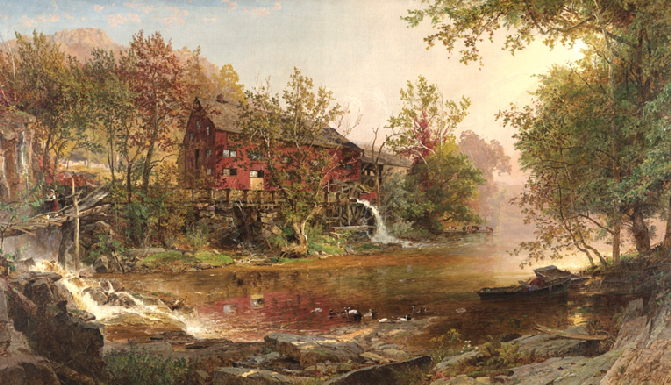
The Old Mill by Jasper Francis Cropsey (1876)

Unfortunately for Cropsey, the art of the Hudson River School began to lose its popularity and by the early 1870’s would be completely out of favour in the art world. In 1876 Cropsey completed his last major work, The Old Mill, which is now part of the Chrysler Museum of Art in Norfolk, VA. Collection.  The painting is a depiction of the Sanford gristmill, which stood on the banks of the Wawayanda Creek near Warwick, New York, and close to where Cropsey had built his palatial estate, Aladdin. The rural water mill was at the heart of the American pre-­industrial economy, but time moved on and in the 1870s, the water mills were quickly being replaced by more efficient steam-powered mills and factories.  This loss of such bygone icons concerned Cropsey.  For him, it was symbolic of the loss of the simple past.  It was a sentimental bereavement.  The depiction was typical of Cropsey’s past output – autumn landscapes that beautifully captured the sunlit atmosphere of autumn in New York and New England.  Cropsey exhibited it at the 1876 Centennial Exposition in Philadelphia, where he was awarded a medal for “excellence” in oils.

Wickham Pond and Sugar Loaf Mountain, Orange County by Jasper Francis Cropsey (1876)

The Hudson River School artwork began to lose its popularity by the mid 1870’s and by the end of the decade would be completely out of favour in the art world. In the early 1880’s the sale of Cropsey’s landscape paintings was dwindling eclipsed in popularity by the smaller scale works which were, softer, mood-evoking landscapes of Barbizon-inspired painters such as George Inness. As a result the Cropsy family’s financial situation became dire and the family was perilously close to having their home, Aladdin, in Warwick, NY, taken from them.   Fortunately, they managed to sell their lavish estate and at the same time, auctioned off many paintings, furniture, and household possessions in preparation to move to a smaller property.

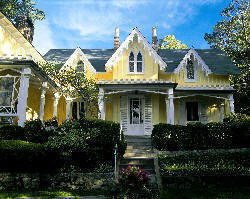
Ever Rest,  49 Washington Avenue, Hastings-on-Hudson

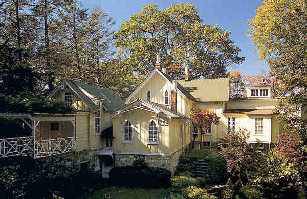
In 1885 the Cropsey family moved from Warwick to Hastings-on-Hudson, a village in Westchester County located in the southwestern part of the town of Greenburgh in the state of New York.  He firstly rented a property then later bought a house at 49 Washington Avenue, which they named Ever Rest. Cropsey and his family lived there for the rest of their lives.  They were content to live a quiet existence there at Ever Rest and did very little travelling.  As far as painting was concerned Cropsey concentrated in depicting local views or views based on the hundreds of sketches he had completed through the years, including studies he did in the two year period spent in Rome. .

Jasper Francis Cropsey by Edward Mooney (1850)

Jasper Francis Cropsey suffered a stroke in 1893 and died at Ever Rest on June 20th 1900 at the age of 77,  and Maria, his wife of 54 years, passed away in 1906.

The Cropsey home, known as Ever Rest,  was built in 1835 and purchased by Jasper F. Cropsey in 1885. Cropsey extended Ever Rest by adding an  artist’s studio to it in 1885. The Homestead is located at 49 Washington Avenue, Hastings-on-Hudson, NY.   On May 17, 1973, both the New York and National Historical Societies declared the Homestead an historical site. The Homestead is listed in the “National Register of Historic Places in New York”.


A great deal of information I needed cam fro some excellent websites:

Newington-Cropsey Foundation

Welcome Autumn with Jasper Cropsey’s Colorful Landscape Paintings

National Gallery of Art

Mark Murray Fine Paintings

Spellman Gallery

Wilhelmina Douglas Hawley

Wilhelmina Douglas Hawley, Self Portrait (1897)

The artist I am featuring today is the American painter and watercolourist Wilhelmina Douglas Hawley.  She was born on July 13th 1860 in the small coastal town of Perth Amboy, New Jersey. Her father, Peter Radcliffe Hawley was an officer in the coast guard and her mother, Isabella Hawley (née Merritt), a Canadian-born dancer. Wilhelmina’s ancestors were English and Scottish migrants, who moved to the east coast of the United States and Canada in the seventeenth and eighteenth century

Birthplace of Wilhelmina Douglas Hawley, Merritt Peck House, 213 High Street, Perth Amboy, New Jersey

Wilhelmina had three siblings: an older sister Jeanne and two younger brothers William and Alan Ramsey.  When Wilhelmina was four-years-old, the family moved to the New York suburb of St Albans, a residential neighbourhood in the southeastern portion of the New York City borough of Queens. Wilhelmina developed two loves during her pre-teen years.  One was a love of sketching and painting thanks to two of her unmarried aunts, Florence and Georgina Agnes Merritt and the other was the love of travel once her grandparents took her to Europe when she was just twelve years of age and it was the excitement of visiting so many new places that encouraged her to start writing a journal.

The Cooper Union

Wilhelmina soon developed a love of art and decided to follow the dream of becoming a professional painter.  In 1879, at the age of nineteen, she enrolled in the Cooper Union Women’s Art School, one of the New York art academies that is open to women.  The Cooper Union for the Advancement of Science and Art was established in 1859 and is among the nation’s oldest and most distinguished institutions of higher education. The college, founded by inventor, industrialist and philanthropist, Peter Cooper, offers a world-class education in art, architecture and engineering as well as an outstanding faculty of humanities and social sciences.  Cooper took the revolutionary step of opening the school to women as well as men. There was no colour bar at Cooper Union. Cooper demanded only a willingness to learn and a commitment to excellence, and in this he manifestly succeeded.

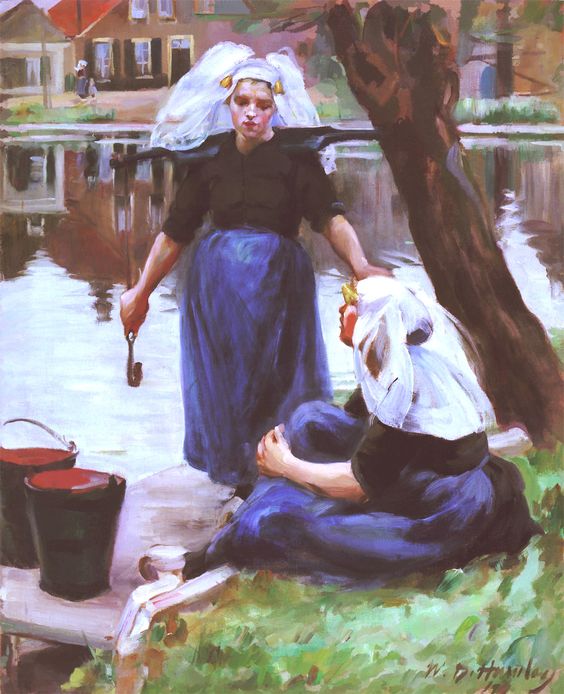
Two Women near the River Waal by Wilhelmina Douglas Hawley (1894)

Wilhelmina remained at the Cooper Union for a year and then enrolled at the Art Students League where she honed her artistic skills eventually becoming the first woman vice-president of this progressive institution. Her tutors included William Merritt Chase, Julian Alden Weir, Charles Yardley Turner and Kenyon Cox. The popularity of the Art Student League was that it was based in New York and the city attracted many European artists, many of whom Wilhelmina met while living and studying at the Arts League.

Young Woman in the Meadow by Wilhelmina Douglas Hawley

To escape the cold climate of New York, Wilhelmina spent the winter of 1891/2 on the island of Bermuda where she fell in and out of love with a mysterious Englishman whom she had agreed to marry.  Fortunately, she realised the error of her judgement and the two split up.  Once again, like so many American artists of the time, who succumbed to the magnetism of Paris, Wilhelmina was drawn towards the French capital to continue with her artistic tuition. On June 18th 1892, just a month before her thirty-second birthday, Wilhelmina once more, set sail for Europe on the Holland-America steamer Veendam.  During her Atlantic voyage, Wilhelmina was accompanied by the Dutch-American artist John Vanderpoel and his wife Jessie Elizabeth Humphreys. Vanderpoel. He was a well-known artist and taught at the Art Institute of Chicago where one of his tudents was Georgia O’Keeffe, and it was he who most likely suggested to Wilhelmina that she should spend the summer months at the charming village of Rijsoord near Dordrecht in the Netherlands, where he had founded an artists’ colony in 1886. 

Interior with Mother, two Children and Cat by Wilhelmina Douglas Hawley

On arriving in Paris Wilhelmina registered at the Académie Julian, one of only two art academies in the city to which women and foreign students were admitted.  Having arrived in the Summer, all the Academies were closed for the summer break and would not re-open until the September.  Wilhelmina used the time to travel throughout Belgium and the Netherlands and on 4 July 1892 she made her first visit to the Dutch flax village and artists’ colony at Rijsoord, where various foreign artists and art students had been living and working since 1888 especially during the summer months.  In 1893, Wilhelmina achieved her first artistic successes at the French Academy where she was awarded a prize for best composition.  Also for the first time, one of Wilhelmina’s paintings was selected for the Paris Salon that year, and success came from across the Atlantic when her painting, Holland Peasant Girl was shown in New York at an exhibition of the National Academy of Design

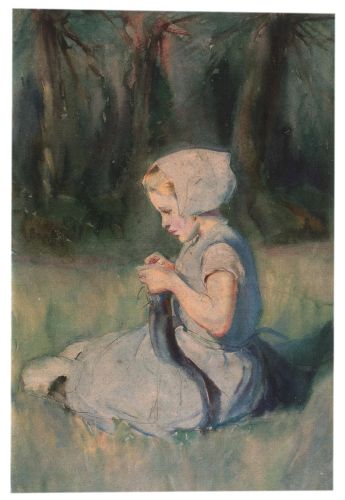
Girl Knitting in a Field by Wilhelmina Douglas Hawley

In 1893, Wilhelmina was appointed as an art teacher at Academy Colarossi and it was around this time that she met English-born Canadian art student, Laura Muntz  A friendship between the two women sprung up and Laura moved in with Wilhelmina at her studio at No. 111 Rue Notre-Dame-des -Champs. Close to the Palais de Luxembourg.  Directly across from their studio was the studio of American artist, James Abbott McNeill Whistler.  Both Laura and Wilhelmina were regular visitor to Whistler’s studio, and he to theirs.

Laura Muntz Lyall

Laura Munz, who was born in 1860 in Radford, Warwickshire, England, was the same age as Wilhelmina and is recognised as one of the most talented painters of her time.  She was an impressionist painter, best known for her depiction of mothers and children. When she was a small child, she emigrated with her family to Canada, where grew up on a farm in the Muskoka District of Ontario. 

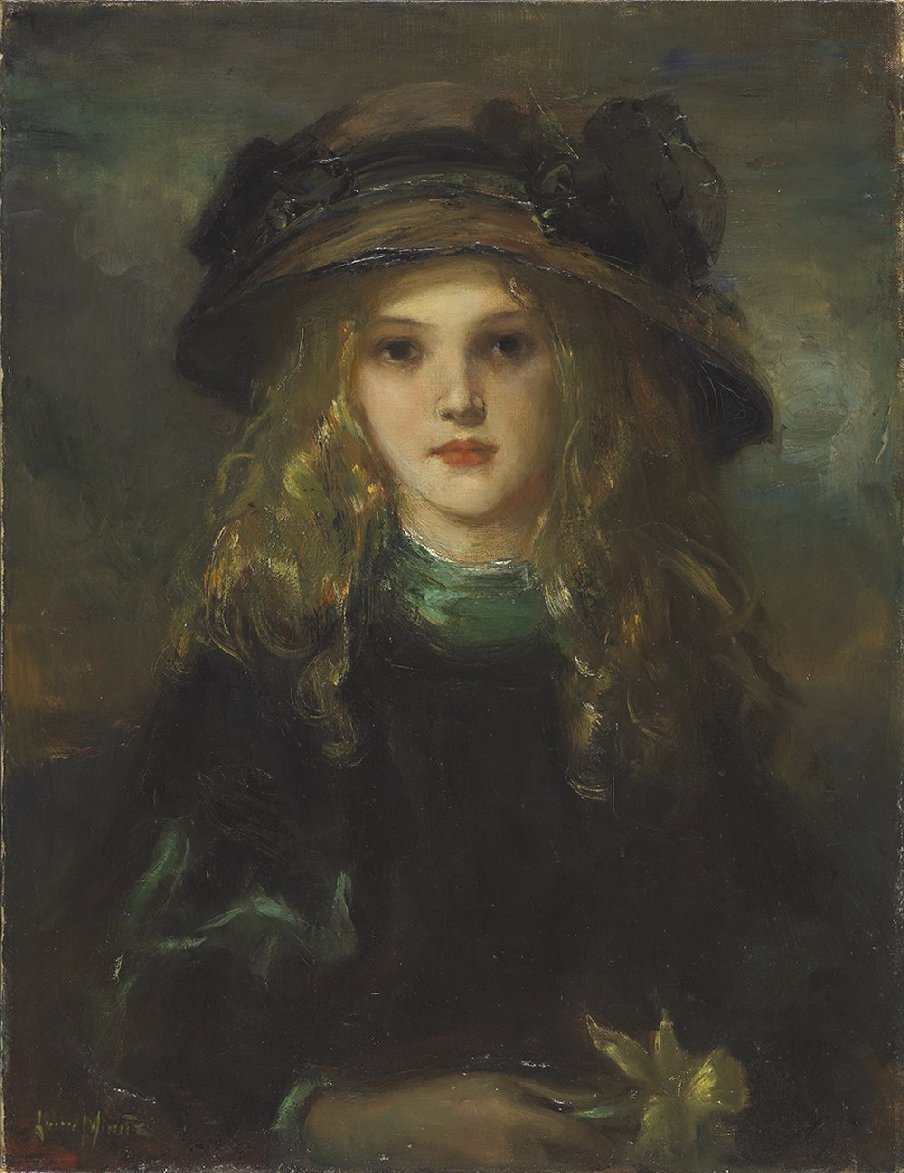
A Daffodil by Laura Munz Lyall (1910)

In 1882, Laura began to take classes at the Ontario School of Art in Toronto.   She also studied briefly at the South Kensington School of Art in 1887, then returned to Canada to continue her studies at the Ontario School. She came to Paris in 1891 and before she met Wilhelmina had been living alone and earning money by teaching and administrative work.  She was the first Canadian to receive the distinguished “Honourable Mention” at the Paris Salon exhibition in 1895.

Portrait of Wilhelmina Douglas Hawley by Laura Munz (1897)

In 1896 Laura returned to Canada for a short spell to help look after an ailing relative.  She returned to Paris and the Academy Colarossi and was promoted to the post of  massiere (Studio head) at the Académie Colarossi.  In 1898 she returned to Canada in 1898 and set up a studio in Toronto to teach and paint.  In 1906, she moved to Montreal to continue her career and built up a large clientele that regarded her as the premier Canadian portraitist of children.  Following the death of her sister in 1915, she returned to Toronto and married her brother-in-law Charles W.B. Lyall and cared for his children of her sister’s marriage, eleven in all, but many had left home by then.  She set up a studio in the attic of their home, and started signing her works with her married name. Laura Munz Lyall died in Toronto in 1930, aged 70.

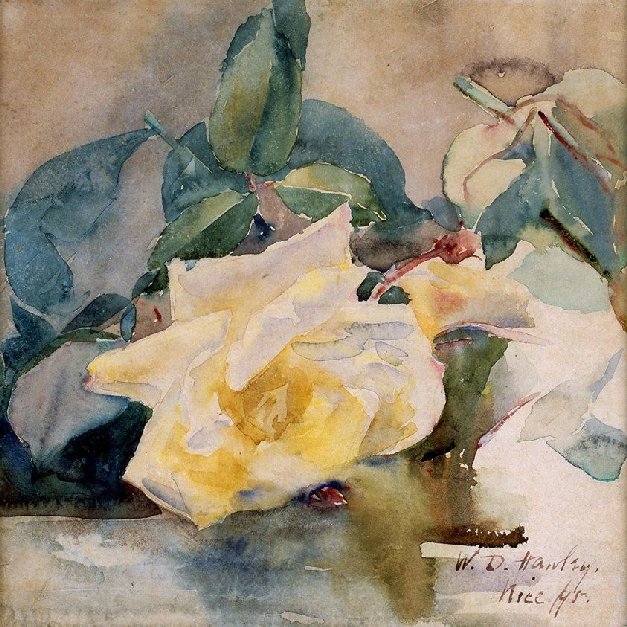
Rose by Wilhelmina Douglas Hawley (1895)

Wilhelmina and Laura spent part of the summers in the French countryside as well as the artists’ colony of Rijsoord in the southern Netherlands. She would often take her international students of the Académie Colarossi with her on these painting trips.   It was here that Wilhelmina captured the villagers in oils and watercolours. The village of Rijsoord was well situated for passing travellers on the Rijksstraatweg (State Highway), an important European road that connected Paris to The Hague.

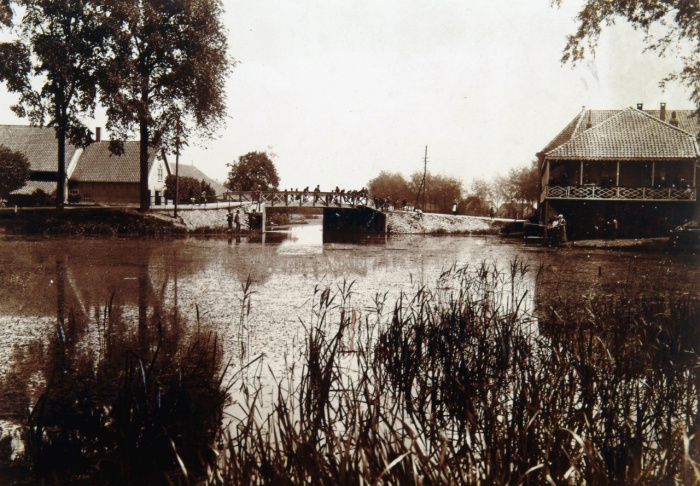
The bridge over the River Waal at Rijsoord, with Hotel Warendorp on the right

An inn was constructed on the spot near the river Waal where the eighteenth-century tollhouse had stood. The building is still standing and for several years had housed the restaurant Hermitage. When Wilhelmina first visited Rijsoord, the inn was called Hotel Warendorp. Hotel Warendorp functioned as the headquarters of the summer academy. The ground floor of the building comprised a livingroom, diningroom and a room for drinking coffee. Most of the guestrooms were also on the ground floor. On the floor above it, the large space under the roof was used as an artists studio, where the artists would hang their most recent paintings and watercolors for discussion. On rainy days, when it was impossible to work en plein air, the artists would actually work in the studio. Wilhelmina’s great granddaughter, Alexandra van Dongen, wrote about how her great grandmother met her husband in her blog: For Two Years, or Perhaps Forever”; Wilhelmina Douglas Hawley and the Artists’ Colony in Rijsoord.  The tale is an instalment in a monthly series of blogs telling stories about the rich history shared by the American and the Dutch peoples.  She wrote:

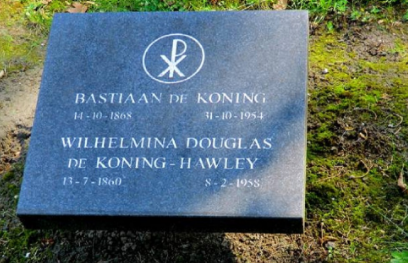
“…In 1899, Wilhelmina apparently first encountered the 31-year-old Rijsoord farmer Bastiaan de Koning (1868-1954). They most likely met during a boat trip on the river Waal, as the story goes, as local villagers including De Koning, regularly rowed the artists to their outdoor painting locations. In the summer of 1900 Wilhelmina returned to Rijsoord again and announced her engagement to Bastiaan. They married a year later on December 5, 1901. Another three years later, when Wilhelmina was 44 years old, she gave birth to a daughter, my grandmother, Georgina Florence de Koning (1904-1973), named after Wilhelmina’s aunts. By that time, Wilhelmina had been active in the art world for twenty-five years. Family life did not prevent her from traveling abroad, visit exhibitions or meet her friends in Paris and New York. In 1915, her family in Rijsoord engaged a young housekeeper, Geertrui van Nielen (1895-1981), who became an important supporter in her life. Trui, or Troy, as she was called by Wilhelmina, took care of household matters and looked after Georgy, as Wilhelmina’s daughter was called, when her mother was traveling abroad …”

Wilhelmina continued to live with her husband and daughter in Rijsoord.  Years later she enjoyed the summer holiday visits from her daughter, Georgy, her husband, Hans van Dongen and their six children.  On February 18th, 1958, Wilhelmina Douglas Hawley passed away at home at the age of 97.


The information I used for this blog came from a number of excellent websites, all of which are worth visiting. They are:

The Society of the Hawley Family

For Two Years, or Perhaps Forever”; Wilhelmina Douglas Hawley and the Artists’ Colony in Rijsoord

Wilhelmina Douglas Hawley

Schildersdorp Rijsoord 1886-1914

New York Almanack


Laura Wheeler Waring. Part 2.

Houses at Semur by Laura Wheeler Waring (1925)

Saint-Jean-Pied-de-Port by Laura Wheeler Waring (1925)

After her short stay in the south of France, Waring returned to Paris in the Spring of 1925 and continued her studies at the Académie de la Grande Chaumiére whilst staying in the Villa de Villiers in Neuilly-sur-Seine.  That year Laura completed her paintings, Houses at Semur, France and Saint-Jean-Pied-de-Port. Critics believed this was a turning point in her artistic style as we see her use of vivid colours in order to express vivid, brilliant atmospheric conditions. Both works enhanced her growing reputation.  The following year, she had works shown at the Corcoran Gallery in Washington, D.C., the Brooklyn Museum, and the Philadelphia Museum of Art. And her standing in the art world was such that she was asked to curate the Negro Art section at the Sesquicentennial Exposition in Philadelphia.  

On June 23rd, 1927, Laura Wheeler was married to the Philadelphian, Walter Waring, a public-school teacher, who was ten years her junior and who was then working as a professor at the all-Black Lincoln University. The couple had no children. That same year, Laura won a gold medal in the annual Harmon Foundation Salon in New York. Laura Waring was actively painting during the Harlem Renaissance.  The Harlem Renaissance was an influential movement in African American literary, artistic, and cultural history from 1918 to the mid-to-late 1930s. The movement was originally referred to as the New Negro Movement, which referred to Alain LeRoy Locke’s 1925 book, The New Negro, which was an anthology that sought to motivate an African-American culture based in pride and self-dependence.

She was also involved with the Harmon Foundation.  It was established in 1921 by wealthy real-estate developer and philanthropist William E. Harmon who was a native of the Midwest, and whose father was an officer in the 10th Cavalry Regiment.  The Foundation originally supported a number of good causes but is best known for having served as a large-scale patron of African-American art and by so doing, helped gain recognition for African-American artists who otherwise would have remained largely unknown.

In 1944 the Harmon Foundation, which was under the direction of Mary Beattie Brady, organized an exhibition Portraits of Outstanding Americans of Negro Origin.  The idea behind the exhibition was to try and counteract racial intolerance, ignorance and bigotry by illustrating the accomplishments of contemporary African Americans. The exhibition featured forty-two oil paintings of leaders in the fields of civil rights, law, education, medicine, the arts, and the military. Betsy Graves Reyneau, Laura Wheeler Waring, and Robert Savon Pious painted the portraits that became known as the Harmon Collection. US Vice President Henry A. Wallace presented the first portrait, which featured scientist George Washington Carver, to the Smithsonian in 1944. The Harmon Foundation donated most of this collection to the Smithsonian’s National Portrait Gallery in 1967.

Anna Washington Derry by Laura Wheeler Waring (1927)

Laura Wheeler Waring will always be remembered for her portraiture and her most acclaimed work was not of the prosperous and famous African Americans which I have highlighted below but of a poor laundress, Anna Washington Derry.  She was one of five children who had moved with her family from Maryland to the eastern Pennsylvanian town of Strodsburgh, a borough in Monroe County.  Monroe was home to a small free Black community who had arrived via the Underground Railroad, a network of secret routes and safe houses used by enslaved African Americans to escape into free states.

The beautiful realistic depiction of the old lady beautifully conveys the lady’s dignity and inner determination through her use of simple, brown-beige tones of her dress, her expressive face, her folded arms and hands.  In the town where she lived Derry was looked upon as that of a community matriarch who was fondly addressed locally as “Annie”. The portrait was unveiled in 1926 at an elite exhibition for Black Philadelphian professionals some of whom may not have identified with Waring’s “ordinary” subject. The art historian Amanda Lampel commented:

“…Although Derry’s portrait did not sell that day, the Philadelphia Tribune, the oldest continuously published African American newspaper in the United States, called it remarkable……… Compared to fellow contemporaries like Aaron Douglas, Waring was much more conservative in her painting style and subject matter. This was in keeping with the types of artists who won the prestigious Harmon Foundation award, which sought to spotlight the up-and-coming Black artists of the Harlem Renaissance. Most of the award winners painted more like Waring and less like Douglas…”

In 1927 Laura exhibited the portrait of Anna Washington Derry at New York’s Harmon Foundation where it received the First Award in Fine Art – Harmon Awards for Distinguished Achievement Among Negroes. From there it was exhibited at Les Galeries du Luxembourg in Paris and across America.  The depiction was often reproduced in magazines and journals. The exhibition had its premiere at the Smithsonian Institution on May 2nd, 1944.  For the next ten years, Portraits of Outstanding Americans of Negro Origin, exhibition, travelled to museums, historical societies, municipal auditoriums, and community centres around the United States.  The public response was overwhelmingly positive in every venue.

James Weldon Johnson by Laura Wheeler Waring

Laura Wheeler Waring will be most remembered for her portraits of successful, upper class Negroes and whites including James Weldon Johnson, the successful Broadway lyricist, poet, novelist, diplomat, and a key figure in the NAACP, National Association for the Advancement of Coloured People.  In 1900, he collaborated with his brother to produce “Lift Every Voice and Sing,” a song that later acquired the subtitle of “The Negro National Anthem.”

William Edward Burghardt Du Bois by Laura Wheeler Waring

Another sitter for Laura was William Edward Burghardt Du Bois (W.E.B. DuBois), who was the first African-American to earn a doctorate from Harvard University  He then became a professor of history, sociology, and economics at Atlanta University, and  co-founder of the National Association for the Advancement of Coloured People (NAACP), and founder and editor of the NAACP’s magazine The Crisis. Laura Waring had worked for Du Bois, creating several illustrations for The Crisis. Laura depicts Du Bois seated at a wooden desk or table, looking to the right. The spectacles he holds in his right hand, and the small paper he holds in his left, confirm his status as an intellectual and academic.

Marian Anderson by Laura Wheeler Waing (1947)

Many women were sitters for Laura’s portraits including Mary White Ovington, an American suffragist, journalist, and co-founder of the National Association for the Advancement of Coloured People (NAACP).  Another of her most famous female portraits was of  the opera singer, Marian Anderson.  This contralto singer, like many African American artists of the time, first achieved success in Europe. She was persuaded to return to America in 1935 and that year had a triumphant concert which secured her standing in the opera world.  In 1939 she became embroiled in a historic event when the Daughters of the American Revolution banned her appearance at its Constitution Hall because she was black. President Roosevelt’s wife, Eleanor, stepped into this controversial banning and arranged for her to take top billing at the Easter Sunday outdoor concert at the Lincoln Memorial, an event which drew in 75,000 opera fans as well as having the event broadcast to a radio audience of millions.

Jessie Redmon Fauset by Laura Wheeler Waring (1945)

Another female to have her portrait painted by Laura Wheeler Waring was Jessie Redmon Fauset, the first African American woman to be accepted into the chapter of Phi Beta Kappa at Cornell University, where she graduated with honours in 1905. Fauset then taught high school at M Street High School (now Dunbar High School) in Washington, D.C., until 1919  She then moved to New York City to serve as the literary editor of the NAACP’s official magazine, The Crisis. In that role, she worked alongside W. E. B. Du Bois to help usher in the Harlem Renaissance of the 1920s.

Alice Dunbar-Nelson by Laura Wheeler Waring (1927)

In the 1890s women formed national women’s club federations, most of which were dominated by upper-middle-class, educated, northern women. Few of these organizations were bi-racial, a legacy of the sometimes uneasy mid-nineteenth-century relationship between socially active African Americans and white women. Rising American prejudice led many white female activists to ban inclusion of their African American sisters. The black women’s club movement rose in answer in the late nineteenth century. The segregation of black women into distinct clubs produced vibrant organizations that promised racial uplift and civil rights for all blacks, as well as equal rights for women. Soon there followed another, more powerful group known as the National Association of Coloured Women in 1896. Women, including Laura Wheeler Waring and Alice Dunbar-Nelson, came together from a variety of backgrounds to combat negative stereotypes and fight for basic rights. Alice Dunbar-Nelson became the subject of Laura Wheeler Waring’s 1927 portrait. By the time the portrait was completed, Dunbar-Nelson was a prominent political activist and journalist and was much in demand as a public speaker. The depiction of her radiates her self-confidence and both artist and sitter were talented, intellectual women whose friendship helped advance the rights of both women and African Americans.

Waring died on February 3rd, 1948, aged 60, in her Philadelphia home after a long illness.  She was buried at Eden Cemetery in Collingdale, Pennsylvania. In 1949, Howard University Gallery of Art in Washington, D.C. held an exhibition of art in her honour.  Her paintings were also included in the 2015 exhibition We Speak: Black Artists in Philadelphia, 1920s-1970s at Philadelphia’s Woodmere Art Museum.

Laura Wheeler Waring (1887-1948)

There is no doubt that although Laura spent most of her life in America she always treasured her three stays in France which played an important role in her artistic progress. During those three periods on French soil she was able to engage in its culture, and associated with famous French, African, and African American intellectuals. Her scholarship, her study at the Academie de la Grande Chaumiere, and her solo exhibition in Paris gave her recognition in the United States in the form of awards, supervisory and teaching positions, and additional exhibitions.  Like many of her colleagues, Waring cherished the freedom she found abroad, declaring in her diary:

“…In my very busy seasons here to come I shall want to relive some of these moments of atmosphere. I record them so that I can never say “I wish I had enjoyed that more” or “I didn’t apprecate all that then but now—[.]” I can never say the above truthfully because am grateful every minute and even the least of things gives me a thrill. . . . The very feeling of freedom is a pleasure and the ride on the bus down will be a joy…”


Much of the information for this blog and many of my other blogs in the past has come from an excellent website entitled The Art Story.

Other sources were:

A CONSTANT STIMULUS AND INSPIRATION”: LAURA WHEELER WARING IN PARIS IN THE 1910s and 1920s by Theresa Lieninger-Miller

BLACKPAST

SPEEDWELL

Nettie Blanche Lazzell

Blanche Lazell during her time at the Art Student League, New York

Cornelius Carhart Lazzell, a direct descendent of pioneers who settled in Monongolia County, West Virginnia, after the American Revolutionary War, married Mary Prudence Pope and the couple went on to have ten children, three sons and seven daughters.  The ninth child was Nettie Blanche Lazzell who was born on October 10th 1878 and it is she who is the subject of today’s blog. 

The Lazzell family, who were devout Methodists, lived on a large farmstead near Maidsville, West Virginia, which lies close to the Pennsylvania border.  The town was thought to have been named Maidsville on account of there being a large proportion of “old maids” among the first settlers !  Her education during her early days was at the one-room schoolhouse on the property where students from the first through to eighth grades were taught from October through February.

Amarylis by Blanche Lazzell (1930)

In 1891, when Blanche was just twelve years old, her mother died, aged 48. In her early teens Blanche experienced hearing problems and became partially deaf and it was not until a year later that a Baltimore doctor was able to remedy her illness.  In 1893, at the age of fifteen, Blanche enrolled at the West Virginia Conference Seminary, which is now the West Virginia Wesleyan College.  From there, in 1899, she transferred to the South Carolina Co-Educational Institute in Edgefield. Once she graduated from the Institute, she became a teacher at the Red Oaks School in Ramsey, South Carolina. In spring of 1900, she returned to her Maidsville home, where she tutored her younger sister, Bessie.   In 1901, she studied art at West Virginia University and did well, receiving a degree in art history and the fine arts in 1905.  She continued to study at WVU on a part time basis until 1909, allowing her to broaden her knowledge of art and twice substituting as a painting teacher.

West Virginnia Coal Works by Blanche Lazzell (1949)

In 1908, at the age of thirty, she moved to New York and enrolled at the Art Students League.  The League had been formed in 1875 to provide more variety and flexibility in education for artists than it was felt the National Academy of Design provided. This breakaway group of art students included many women, many of whom, in the late 1890s and early 1900s, took on key roles. In Marian Wardle’s book: American Women Modernists: The Legacy of Robert Henri, 1910-1945. She recounts the words of the American artist Edith Dimmock regarding the atmosphere at the Art League:

“…In a room innocent of ventilation, the job was to draw Venus (just the head) and her colleagues. We were not allowed to hitch bodies to the heads——yet. The dead white plaster of Paris was a perfect inducer of eye-strain and was called “The Antique.” One was supposed to work from “The Antique” for two years. The advantage of “The Antique” was that all these gods and athletes were such excellent models: there never was the twitch of an iron-bound muscle. Venus never batted her hard-boiled egg eye, and the Discus-thrower never wearied. They were also cheap models and did not have to be paid union rates…”

During her time at the Art League Blanche studied under Kenyon Cox and William Merritt Chase and one of her fellow students was Georgia O’Keeffe. 

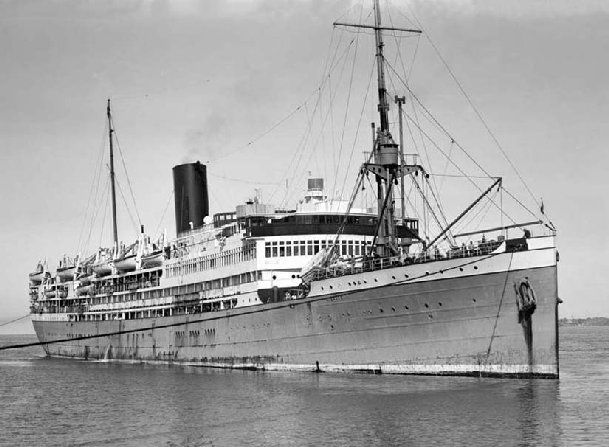
SS. Ivernia

On July 3rd 1912, Lazzell set sail on an American Travel Club cruise on the Cunard liner SS Ivernia, crossing the Atlantic and arriving in England. From there Blanche visited the Netherlands, Belgium and Italy.  She was fascinated by the architecture of the various churches she visited.   

Sailboat by Blanche Lazzell

In August she left the tour party and travelled to Paris.  She then stayed in a pension in Montparnasse on the Left Bank.  She moved into the Students’ Hostel on Boulevard Saint-Michel, one of the two major streets in the Latin Quarter of Paris, running alongside the Luxembourg Gardens.  During her stay in the French capital, she took lessons at the Académie de la Grande Chaumière, Académie Julian, and Académie Delécluse.  She eventually established herself at the Académie Moderne where her tutors were the post-impressionist painters Charles Guérin and David Rosen.  Of all the art tuition she received in Paris she was the most contented with the ideas and techniques behind the Parisian avant-garde art, a genre which pushed the boundaries of ideas and creativity, which she learnt about at the Académie Moderne.

The Monongahela River at Morgantown by Blanche Lazzell (1939)

Blanche returned to America on the White Star passenger liner, SS Arabic, at the end of September 1913.  On her return to America Blanche went to live with her younger sister Bessie in Morgantown.  During her European travels Blanche built up a portfolio of sketches and paintings enough for her to have a solo exhibition in December 1914.  To make ends meet, she rented a studio in town and taught art as well as selling her hand-painted chinaware.

Byrdcliffe Artist Colony

Byrdcliffe Artist Colony

In the summer of 1917, Blanche spent time at the Byrdcliffe Arts Colony, an artists’ colony just outside Woodstock, New York.  The Byrdcliffe Art Colony was founded by Jane Byrd McCall and Ralph Radcliffe Whitehead and colleagues, Bolton Brown, an artist and Hervey White, a writer.  The name of the colony came from an amalgamation of Jane and Ralph’s middle names.  It was founded in 1902 and the complex was formed of a number of Arts and Crafts cottages.  It was there that visual artists, poets, and musicians found their muses and spent time creating works of art, music and poetry. In later times famous people, such as Bob Dylan, writer Thomas Mann, and even famous actors, Helen Hayes, and Chevy Chase, spent time at Byrdcliffe.  Blanche studied under the Belgian-born artist William Schumaker who whilst in Paris had come into contact with European avant-garde artists.  On his return to America he brought with him modernist principles.  The term modernism in art was a rejection of history and conservative values such as realistic depiction of subjects; it was an innovation and experimentation with form, that is to say, the shapes, colours and lines that make up the work have a tendency towards abstraction.  From 1913 to 1931, Schumaker was artist-in-residence at the artists’ colony at Byrdcliffe.

Still Life by Blanche Lazzell

In 1918 Blanche Lazzell left Morganstown and moved permanently to Provincetown, which is situated on the northern tip of Cape Cod, Massachusetts, a place she had previously visited in 1915.   She made the town her summer base while wintering back in Morganstown and Manhatten. 

Blanche Lazzell outside her Fish House studio, Princetown

She purchased an old fish house which overlooked the harbour of Provincetown and converted it into her studio.  She immersed herself into the local art scene and became a member of the Provincetown Art Association and the Sail Loft Club, Provincetown’s women’s art club.  She also became involved with the Provincetown Printers, a group of artists, most of whom were women, who created art using woodblock printing techniques.  It was a refuge for artists and a lively hub of experimentation and innovation. It became known as Princetown Print.  It was a white-line woodcut print, but it differed from woodcut printing as rather than creating separate woodblocks for each colour, one block was made and painted. Small groves between the elements of the design created the white line. In the main the artists often used soft colours, so that the finished product sometimes had the appearance of watercolour paintings.  Recalling her first summer at Provincetown, Blanche Lazzell fondly remembered her time there saying:

“…Hundreds of American artists who had been living in Europe before the first World War flocked to Provincetown. This quaint old seaport town, famous for the first landing place of the Pilgrims, was already an art colony…To be in Provincetown for the first time, in those days, under ordinary conditions was delightful enough, but that summer of 1915, when the whole scene, everything and everybody was new, it was glorious indeed–”

Untitled Abstract work by Blanche Lazzell

Lazzell returned to Paris in 1923 and studied with both Fernand Léger, Andre Lhote and Albert Gleizes, who was said to be one of the founders of cubism. By 1925, Blanche had mastered the static and shuffled planes of Synthetic Cubism, to which she added her own distinctive colour palette and elegant receptivity. Blanche defined Cubism as:

“… the organization of flat planes of colour, with an interplay of space, instead of perspective…”

Princetown Backyards by Blanche Lazzell

This was a style which was excellently suited to her woodcuts and often mirrored the angular patterns of the Provincetown houses, rooftops, and wharves which are depicted in many of her woodcut prints.  It is also interesting to note that Lazzell was a passionate gardener, and images of flowers often featured in her work but even these images, although based on direct observation, were changed into recurrent interactions of abstracted shapes.

The Flaming Bush by Blanche Lazzell (1933) At auction it realized $87,500.

Blanche’s younger sister Bessie gave birth to a son, in August 1924 and Blanche decided to return to Morganstown to help her.  Lazzell also became a mentor and role model for her niece, Frances Reed, the daughter of her sister Myrtle.   Blanche eventually returned to Princeton in 1926 and one of her first tasks was to pull down her previous studio, the Fish House, as it was getting too cold in the winter months due to the numerous drafts.

The Violet Jug by Blanche Lazzell

Trees by Blanche Lazzell (c.1930)

In 1928 she was invited to be on the board of directors of the international art group, Société Anonyme. Lazzell later joined the New York Society of Women Artists and the Society of Independent Artists. In the 1930s, Blanche took part in an exhibition called Fifty Prints of the Year where she exhibited her compositions The Violet Jug and Trees.

Ecuyère (Horsewoman) by Albert Gleizes (c.1923)

Around the same time she produced a number of pure abstract compositions which shows the influence of Albert Gleizes.

In 1934, America was in the midst of the Great Depression and Blanche Lazzell was one of two West Virginian artists who received Federal Art Project grants through the Works Progress Administration.  This was due to the American government which hired hundreds of artists who collectively created more than 100,000 paintings and murals and over 18,000 sculptures to be found in municipal buildings, schools, and hospitals in all of the 48 states. President Franklin Roosevelt sought to put as many unemployed Americans as possible back to work and to buoy the morale of the citizens. Some of the 20th century’s greatest visual artists were employed by the FAP, along with many nascent Abstract Expressionists.

Blanche Lazzell on her porch of her Provincetown studio, 1942

Blanche Lazzell outside Little Church around the Corner, New York

In May 1956, Blanche Lazzell’s health began to fail and she was taken to a hospital with a suspected stroke.  Lazzell died on June 1st 1956 and she is buried next to her father in Bethel Cemetery in Maidsville.  She was aged 77.

Ottalie Tolansky

After my very long last blog, here is a shorter one !

Ben Uri Gallery (Boundary Road, off Abbey Road, St John’s Wood, London)

When I was visiting London the other day, I visited the Ben Uri gallery in St John’s Wood, just off the famous Abbey Road.  I had been sent regular emails from the gallery about events and followed them on Facebook and was interested to visit the premises. 

The Girl in the Green Sari by Clara Klinghoffer

A few weeks ago I wrote about Clara Klinghoffer and I knew one of her paintings was at this gallery so I was interested to look at it up close.  I eventually found the gallery after going round in circles because I struggled to follow the GPS on my phone.  The gallery was much smaller than I had imagined but there on display was the Klinghoffer painting entitled The Girl in the Green Sari.

Girl in a Red Shirt by Ottilie Tolansky (c.1950)

The full-length painting was displayed in the small gallery and was quite impressive.  However, for me, more impressive was the full length painting next to it.  It was entitled Girl in a Red Shirt and the artist was given as Ottilie Tolansky and I knew I had to find out more about this unknown (to me) artist.

Self portrait by Ottilie Tolansky

Ottalie Pinkasovitch was born in Czernowitz, which was, at the time of her birth, in the northern Bukovian sector of the Austro-Hungary.  The town is now known as Chernivsti and is in western Ukraine.  She was born on May 30th 1912 into an Orthodox Jewish household.  Shortly after Ottalie was born, the town witnessed numerous riots directed against the Jewish community and so the family moved to live in Vienna.  For Ottalie, Vienna was home and she always looked upon herself as being Austrian. 

Reimann Art School in Berlin

In 1928, at the age of sixteen, the family were on the move again.  This time they set up home in Berlin where Ottalie’s father, an internationally recognised singer, took up the post of Obercantor at the city’s eighteenth century Alte Synagougue.  Meanwhile, the family having recognised that their daughter had a great talent for art decided to enter her into the Reimann School of Art in Berlin.  It was a private art school which had been founded in 1902 by Albert and Klara Reimann, and later in January 1937 was re-established in Regency Street, Pimlico, London following the persecution of the Jews by the Nazis. After leaving the Reimann School, she continued her studies at the Berlin Academy of Fine Arts.

Meadow Scene by Ottilie Tolansky

Hitler came to power in 1933 when he became the German Chancellor and with growing antisemitic views which swept the country the Pinkasovitch family moved to the safety of England.  Ottilie’s father accepted a job at a synagogue in Cheetham Hill, which was the predominantly Jewish area of Manchester.  Ottilie, who was enrolled at the Manchester Municipal School of Art, once again came into contact with her friend, the physicist Samuel Tolansky who was working at the University of Manchester. 

Mary Louise by Ottalie Tolansky

Samuel Tolansky had been born on November 17th 1907 in Newcastle upon Tyne. His parents had migrated to Great Britain around the turn of the century. His ancestors had come from Odessa but were of Lithuanian Jewish origin. Samuel was the second child in a family of two boys and two girls. His father was a tailor and, like most immigrants from Eastern Europe at the time, he had to start near the bottom of the ladder both financially and socially.  For the first ten years of life in England Samuel’s father lived in conditions of considerable poverty and that his son’s progress up the educational ladder was, at every critical stage, dependent on his ability to win scholarships and other awards.  However, Samuel worked hard and succeeded.

Samuel Tolansky

Ottilie had first met Samuel in Berlin in 1931 when he had been working at the Physikalisch-Technische Reicsansalt, a German government scientific institute.   In 1932, after a year working at the Berlin Institute he went to England and attended Imperial College London as a researcher into interferometry.  He remained in London until 1934.  From Imperial College London he relocated to Manchester and from 1934 to 1947 worked at the University of Manchester, as an Assistant Lecturer, later Senior Lecturer and Reader.  Ottilie and Samuel’s friendship blossomed and the couple found themselves in love.  The couple married in 1935.  Ottilie gave birth to their first child, Ann, who is now married and having graduated in history from Oxford University, became a solicitor. A second child, Jonathan, was born in London. He became a musician, a percussionist who has played in several of the leading orchestras.

Abstract by Ottilie Tolansky

Samuel and Ottilie Tolansky left Manchester and moved to London, where, after the war had ended, she attended the Hammersmith School of Art and regularly submitted her work at various exhibitions.  Ottilie’s portraiture, still lifes and figure drawings, which she completes mainly in oils and gouache are characterised by her main use of blues and violets.

Rabbi Joseph Trostmann by Ottilie Tolansky (c.1962)

One of her most famous portraits, in fact two paintings, is of her grandfather Rabbi Joseph Trostmann.  She based the depiction of the elderly man on her childhood recollections and family photographs.  One can be found at Stoke-on-Trent Art Gallery whilst the other was kept in the family.  After Ottilie died, her son Jonathan Tolansky, donated it to the Ben Uri Gallery.

Portrait of a Gentleman by Ottilie Tolansky

Ottilie Tolansky died in London on February 13th 1977 aged 64.  Her husband who had been nominated for a Nobel Prize, and was a principal investigator to the NASA lunar project known as the Apollo program, died four years earlier.

Albert Godwin

Albert Goodwin

The artist I am looking at today is the nineteenth century English painter, Albert Frederick Goodwin, best known for his watercolour landscapes.

The Artist’s Father, Samuel Goodwin by Albert Goodwin (1868)

Albert Goodwin was born at 1 Acton Place, 62 Boxley Road, Maidstone on January 17th 1845.  His father was Samuel Goodwin, a builder.  His mother was Rosetta (née Smith).  Albert was the seventh of eight children, having three older sisters, Emma, Rosetta and Mary Ann and three elder brothers, Charles, William Sidney and Henry (called Harry).  He also one younger brother, Frank Alfred.  An artistic talent weaved its way through his male siblings.  His eldest brother was known for his artistic talent as a young man before he joined the military as a member of the Royal Engineers.  Charles became a frame maker and Harry and Frank became professional painters.

Albert was brought up in a devout Baptist household and attended the Bethel Chapel in Maidstone, which his father had built along with its Sunday School in 1934.  Albert’s uncle, Thomas Goodwin often preached at the chapel and was its resident organist, which he had also constructed.  Albert attended Mr William Henry Wickstead’s School at Rocky Hill House, London Road, Maidstone.

The Old Bridge at Maidstone, Kent, Looking South by Albert Goodwin

Albert became interested in art and at the age of ten when he first exhibited one of his paintings,  This was a time at the start of the Pre-Raphaelite Brotherhood and one of its founders, William Holman Hunt had a great influence on young Goodwin.  At the age of fourteen Albert Goodwin started an apprenticeship with a local draper but after six months, he realised that the drapery business was not for him as he had set his heart on becoming a professional artist.  He just needed a willing teacher.   That came by chance, as it is said that whilst painting en plein air in the local woods he was spotted by the Pre-Raphaelite painter, Arthur Hughes who lived in Maidstone with his wife and children.  Arthur Hughes was impressed by Albert’s artistic skill and became his first tutor.

Sunrise over the Sea by Albert Goodwin

In 1859 Goodwin completed his painting entitled Bluebell Hill, Maidstone and in 1860 he exhibited his painting, Under the Hedge.  On March 18th 1863, Albert’s mother Rosetta died at the age of fifty-eight.  During Albert’s early twenties he was introduced to the well-known artist and art critic John Ruskin and on seeing Albert’s work, Ruskin purchased them all for £50 and Albert put the money to good use, funding his five week painting trip to the south coast resort of Hastings.  Around the mid 1860s Albert’s tutor, Arthur Hughes, introduced him to Ford Maddox Brown, a Pre-Raphaelite luminary who took Albert on as his pupil in his London studio.  Albert soon became acquainted with the other Pr-Raphaelite Brotherhood, such as Rossetti, William Morris, the Scottish artist William Bell Scott and George Price Boyce, the watercolour painter of landscapes.

The Old Bridge at Maidstone, Kent looking South by Albert Goodwin

Later, according to Albert’s daughter Olive, Albert and his brother Harry, went to work in the studio of William Morris’ company in Red Lion Square in London’s Holborn district.  In 1864 Albert set off on his first overseas trip, going to Holland where he visited the cities of Amsterdam and Rotterdam and that summer spent time in Jersey.  In the Autumn of 1864, he travelled north visiting Newcastle and Durham as well as the coastal town of Whitby

Whitby Abbey a watercolour by Albert Goodwin

Albert Goodwin completed a colourful watercolour of Whitby Abbey as seen from the east.  The abbey which had been founded in 657 by St Hilda was later destroyed by marauding Danes in 867.  This view is of Whitby Abbey from the east. The ruin depicted in this watercolour is as it is now after one of the towers collapsed in 1830.  Goodwin painted another version of the Abbey in 1910 but this was completed using oils and is now housed in the Victoria Gallery, Bath.  Albert Goodwin’s diary entry of July 22nd 1909 declares his love for Whitby.  He wrote:

“…Whitby once again…I am again inclined to repeat myself in the belief that one or two things in it (for colour) are as good as anything can be…”

Whitby Abbey by Albert Goodwin (1910)

Goodwin always loved to depict dramatic, poetic landscapes. In the 1910 version of Whitby Abbey the thoroughly radiant deep blue of the sky in this work is so typical of his work. Albert liked Whitby Abbey as a subject for painting because of its ruinous manifestation, but also because he was a deeply religious man, and had an interest in spiritual subjects.   Goodwin had painted many scenes featuring the abbey over the previous fourteen years.

A Prospect of Edinburgh from the East by Albert Goodwin (1909)

Albert Goodwin carried on painting in the 1860s and exhibited his work at many exhibitions including the Dudley Gallery in London.  On February 16th 1867 Albert married Mary Ann Lucas, who was the eldest daughter of George Lucas, a fruiterer from Brighton and a year later his brother Harry married Henrietta Lucas, the sister of Albert’s new wife.  Sadly, on December 13th 1869 Albert’s wife Mary Ann died, aged twenty-nine of peritonitis.  Albert and Mary Ann had no children.  Around this time Albert went to live with Arthur Hughes and his family in West Brompton, London and he was employed as Hughes’ studio assistant.

Ely Cathedral by Albert Goodwin

In 1871 Albert went on another European trip visiting Bruges.  That year he was elected Associate of the Society of Painters in Watercolours and at the time his address was given as Maltravers Street, Arundel, Sussex where he lived with his brother Harry and his wife Henrietta.  Sadly, Henrietta died that year, less than two years after her sister had passed.

The Medway at Maidstone by Albert Goodwin (1871)

Almost ten years had passed since Albert had first met John Ruskin and in Spring 1971, Ruskin offered Albert a job as his assistant and asked that he came to work with him at his home in Abingdon, Oxfordshire.  At the Royal Academy annual exhibition in 1871 Albert Goodwin exhibited his painting entitled The Medway at Maidstone.

The Drawing Room at Dixton Manor (Drawing Room at Dixton Manor with K.M.G. writing) by Harry Goodwin (1883)

In 1872 Albert’s brother Harry married for the second time following his first wife’s death.  His new wife was fellow painter, Kate Malleson. Harry depicted his wife writing at a desk in Dixton Manor.

From left to right: John Ruskin, Mrs JC Hilliard, Mrs Joan Severn, Arthur Severn, Constance Hilliard, Albert Goodwin.

Albert Goodwin’s friendship with John Ruskin continued and, along with Ruskin’s cousin Joan Severn and her husband Arthur Severn, visited Matlock Bath and the following year Albert Goodwin and Ruskin travelled to Italy and Switzerland.

  Mont Blanc from the Sèleve, near Geneva

In 1873, Albert Goodwin stayed for three months in the Swiss village of Simplon which lies close to the Italian border.

An Arabian Night, Cairo by Albert Goodwin (1876)

In 1873, like his brother the year before, Albert Goodwin a widower for four years, married his second wife, Alice Desborough at Holy Trinity Church in the West Devon village of Gidleigh.  The couple went on to have seven children, two sons and five daughters. In 1876, Albert and Alice travelled to Marseille before boarding a ship for Egypt.  They also called at Gibraltar, Naples and Crete.

Blue Water in Mounts Bay, Cornwall by Albert Goodwin (1881)

Albert Goodwin had first met the naturalist, Charles Darwin when he was introduced to him by John Ruskin. He visited Darwin at his Kent home, Down House.

Down House from the Garden by Albert Goodwin (1880)

Down House by Albert Goodwin (1880)

Whilst there he made sketches of the house and gardens and later completed two watercolour paintings of Darwin’s residence, which had been built in the early 18th century, and remained Darwin’ and his wife, Emma’s home for forty years until his death in 1882.   It was here that Darwin developed his theory of evolution by natural selection and wrote his ground-breaking work On the Origin of Species in 1859.

Ilfracombe by Albert Goodwin (1884)

Albert and his wife and children left London and moved to Montpelier Terrace Ilfracombe in 1877.  He continued on his painting trips around Britain and further afield to France, Switzerland and the Italian Lakes often accompanied by John Ruskin and Arthur Severn, sometimes accompanied by his brother Harry.  During these trips Goodwin made a large number of annotated sketches and watercolour studies direct from nature, a method he used, alongside working from memory, throughout his career. Ruskin was fascinated by the large number of sketches, which he termed “flying sketches”, which Goodwin produced on a daily basis. Goodwin was happy with his system and in his 1917 dairy entry, he wrote:

“…To me this method of work is one of the happy things of the art that I practise, for I get the realisation of a place twice over, and often the memory makes the scene a better one than the first experience…”

Meanwhile his wife Alice was at home in Ilfracombe with their seven children, Ivy, Olive, Edytha, Albert, Christabel, Alice and Harold and their two servants, one a cook and the other a nurse.  A few doors down from them were Alice’s mother and sister Mary.

Florence, Evening by Albert Goodwin (1896)

In 1881 Goodwin was elected a member of the Royal Society of Painters in Watercolours. Albert Goodwin was continually influenced by John Ruskin who was constantly advising him with regards artistic techniques. Goodwin was a master of depicting topographical and landscape views.  For him, it was all about colour, and tonal values.   Ruskin was pleased and proud of his protégé and was constantly talking about the art of Turner and proudly showing off his own collection of Turner’s work.  Albert Goodwin wrote about the influence Turner had upon him in a diary entry in 1911.  He wrote:

“…I sometimes wonder if the spirit of old Turner takes over my personality. I often find (or think I find) myself doing the very same things that he seemed to do…”

Art critics of the time often likened his work to that of Turner.  In The Standard of October 1893, the art critic wrote:

“…In water-colour drawing Mr. Albert Goodwin is the legitimate successor of Turner…”

The Source of the Sacred River by Albert Goodwin (1900)

Albert Goodwin travelled to India in 1895 and one of the works from this trip was The Source of the Sacred River which he completed in 1900 and was exhibited at the Royal Academy that year.  The source in the title refers to the source of the River Ganges, which is regarded by the Hindu population of India as sacred, is at Lapthal, is in the Himalayas on the frontier between India and China. Of the painting, the art critic of The Athenaeum, a British literary magazine, in 1900 wrote:

“…Allegorical landscape, and still more allegorized landscape painting, is a difficult and particularly uncertain sort of art in which Mr Goodwin, its most accomplished practitioner amongst us, is one of the few who contrive even to approach success. The Source of the Sacred River is almost as suggestive, quite as well painted, and much more understandable. In general, it does not differ from a score of similar works by Mr Goodwin, who is not content with painting nature so admirably that few rival him and leaving to her sympathetic lovers the task of recognizing the pathos and poetry which, so to say, harmonizes itself with the spectator’s mood. There is nothing to tell us that the stream Mr Goodwin depicted so rarely is sacred in any exceptional sense, but there is much we can be grateful for in its abundant and sumptuous harmonies of colour, form, and light, and the dignity of its masses…”

Rye – The Winter’s Tale by Albert Goodwin (1920)

Albert Goodwin carried on with his painting trips around Britain and across the world, visiting South Africa, West Indies, Australia and New Zealand. His works were shown at a multitude of exhibitions and were always appreciated by critics and visitors alike. Goodwin died at his home, Ellerslie, in Bexhill-on-Sea on April 10th, 1932 aged 87.


Much of the information regarding the life and times of Albert Goodwin came from the Chris Beetles Gallery catalogue, Albert Goodwin RWS (1845-1932). The John & Mary Goodyear Collection, which I found in a charity shop in London.

and the website

The Maidstone Museum Websitre

Alethea (Thea) Mary Proctor

Alethea Proctor by George Lambert (1903)

The subject of today’s blog is the Australian painter, Alethea (Thea) Mary Proctor.  Thea was born on October 2nd 1879 at Armidale, a town in the Northern Tablelands of New South Wales, two hundred and fifty miles north of Sydney.  She was the elder child of William Consett Proctor, an English-born solicitor who was also a member of the Legislative Assembly and his Queensland-born wife Kathleen Janet Louisa Proctor, (née Roberts), who was a cousin of the artist John Peter Russell .  Thea’s brother Frederick William was born three years later.  She and her brother were brought up in what was considered as a financially comfortable lifestyle. During the 1880s the family lived at Hunters Hill, Sydney, and when she was ten years old, she was sent to boarding school at Armidale. Thea’s mother was determined that her children should succeed in life and arranged for them to take violin lessons from an early age.

Self portrait by Thea Proctor (1921)

In 1892, Thea’s parents separated and were finally divorced five years later. After the parent’s separation, Thea’s mother took her two children to live with her mother at Bowral, in the Southern Highlands of New South Wales, about ninety minutes southwest of Sydney and it was her maternal grandmother who encouraged and inspired Thea’s love of art. In 1894, at the age of fifteen, Thea attended Lynthorpe Ladies’ College, and at the end of the first school year she won a prize at the Bowral District Amateur Art Society’s exhibition. In 1896 she enrolled at the Julian Ashton’s art school, founded by Ashton, an English-born Australian artist. Thea also worked for a short time as an illustrator at the Australian Magazine.

The Bay by Thea Proctor (1927)

Thea’s mother Katherine, who was aware of her daughter’s artistic talent also realised that she would learn much more by visiting England and see what the art institutions had to offer her daughter. Kathleen Proctor and her twenty-two year-old daughter set sail from Australia in April 1903 and arrived in the English capital in early June. Once in London Thea studied at St John’s Wood Art Schools where she and George Washington Lambert once again became fellow students.

Self portrait by George Washington Lambert

Thea would often pose for George Lambert who once proclaimed that Thea was beautiful, tall, dark-haired, languorous and dignified.  She in turn found Lambert to be intellectually stimulating and she was devoted to him and their friendship was to last a lifetime.  Amongst the artist she met whilst in London were other expatriate Australians painters, Charles Conder, Arthur Streeton and Tom Roberts, all of who had been drawn to the opportunities London had to offer aspiring painters. 

Fan by Thea Proctor (1906)

Charles Conder’s fan designs fascinated Thea as did the Japanese prints which were circulating the English capital at the time.  Thea exhibited her decorative fans created in watercolours on silk at the Royal Academy of Arts and New English Art Club in London and they were deemed a great success.  Thea’s favourite painting medium was watercolours and she completed many works drawing and painting in watercolours.  She was also greatly interested in the costumes she saw worn by women at the Chelsea Arts Club Balls and the Ballet Russe which she went to see in 1911.

Yellow Cab, Hyde Park by Thea Proctor (1910)

Thea’s mother, Kathleen, returned to Australia during the summer of 1905 but her daughter decided to stay in England.  Thea favoured the inspiring environment of London with all its cultural riches, and it offered her the chance to learn more about art and it was here that she was able to exhibit her work. The downside for her was it was an expensive place to live but she lasted out till October 1912 when she eventually returned to Australia.  Once back home Thea exhibited her work in Sydney and Melbourne and both the National galleries of Victoria and New South Wales bought some of her works.   The sale of her paintings was not as good as she had expected and the lure of England became too great to ignore and in late 1914, she returned to London. 

Summer by Thea Proctor (1930)

Thea soon produced her first lithographs which, although she continued to paint, established her reputation when exhibited by the Senefelder Club, an organization formed in London in 1909 to promote the craft of art reproduction by the process of lithography.  Later she exhibited with the International Society of Sculptors, Painters and Gravers and at the Goupil Gallery.  In tandem with her love for art was her love of fashion and the theatre.  This combined love of theatre and fashion was reflected in her work.   This was brought home in an interview she gave in the March 1926 issue of The Home Magazine, a high quality Australian quarterly magazine published in Sydney.  In the article Modifying the Mode by Selecting the Suitable Century, Thea talked about women’s fashion in England and was quoted as saying:

“…In London it is different. There quite a number of people dress to express their personalities. I don’t mean fancy dress or anything startling like Isadora Duncan’s brother who used to wear a Greek tunic and sandals on Chelsea Embankment in the chilliest weather, or one London authoress who generally attends dinner parties in hunting pink – the long topcoat looped back over an evening dress. But there are so many ways – almost imperceptible ways – in which a woman can modify the existing fashion so as to make a dress express her own personality rather than the personality of the shop from which it came. And her own period – it is a mistake to think that all women belong to the twentieth century simply because they were born in it…”

The Swing by Thea Proctor (1926)

Proctor eventually returned to Australia and went to live firstly in Melbourne in 1921 where she endeavoured to raise people’s interest in lithography, but unfortunately she found little interest and so she returned to Sydney.

The White Vase by Thea Proctor

Back on Australian soil Thea still promoted her lithographs and in 1925 Thea teamed up with Margaret Rose Preston, an Australian painter and printmaker, to stage a  joint exhibition in Sydney and Melbourne. Both artists exhibited brightly coloured woodcuts in scarlet frames and despite Thea’s works being viewed in London as being comparatively conservative, many Australian critics thought them to be ‘dangerously modern’.   In 1926, Thea Proctor and her long-standing friend, George Lambert, who had also returned from England in 1921 founded the Contemporary Group in Sydney in 1926 to encourage young avant-garde artists.  Their annual exhibitions were held at various galleries including Macquarie Galleries, Farmer’s Blaxland Galleries, Grosvenor Galleries, David Jones’ Galleries.

Alethea Mary Proctor in 1964

Thea taught design at Ashton’s Sydney Art School and also took on the role of a private art tutor and in so doing, introduced many young budding artists to the world of linocut printing.  In the 1940s Thea taught drawing for the Society of Arts and Crafts.  Thea Proctor never married and died on July 29th 1966 at Potts Point, a small suburb in the inner-city of Sydney.  She was 87.  She was cremated with Anglican rites.

Clara Klinghoffer. Part 4.

The Latter Years

Portrait of a Girl by Clara Klinghoffer

Clara’s stay close to Menton with her husband and youngest sister had proved to be a great success and their plans to return home to London had been postponed on a number of occasions.  The decision as to whether to leave their rented villa, Villa Aggradito, was taken out of their hands eventually as the owner needed the villa for a long-term rental over the coming winter, and the price for renting the villa was well beyond their means.  They eventually moved and found Villa Josephine, a small ground floor flat with a small garden in the small Nice suburb of St. Sylvestre which was run by an elderly woman, Madame Rigolier.  No sooner had the trio moved to their new home in September than Clara declared she was pregnant.  Madame Rigolier immediately took on the role of “mother” and saw to all Clara’s needs.  Clara’s husband on seeing that his wife was being well looked after decided to return to London with Clara’s youngest sister, Hilda.   Clara was not being left alone as they invited Joop’s brother, who had not been well, to come and stay and they believed he would benefit from the warmer climate during the winter months.

Portrait of a Young Girl by Clara Klinghoffer (1960)

With winter over Clara and Joop had to decide on their next move.  Clara was not happy with the medical help she received from the local doctor but could not afford the charges levied by the hospitals and doctors in Nice.  Clara and Joop left the Côte d’Azur in early March 1927 and headed to England with a two-day stopover in Paris.  They managed to rent a small ground floor flat in the London suburb of Hendon.  

Portrait of Cera Lewin by Clara Klinghoffer (1935)

On May 28th 1927 Clara gave birth to their first child, a daughter, whom they named Sonia.  The family finances were not good.  It was true that Clara was selling her work to various galleries but by the time you deducted gallery commissions and the cost of painting materials there was barely any profit.  Joop was struggling to find newspapers and magazine willing to buy his journalistic offerings and so the couple struggled financially.  He was also aware of Clara’s family’s disappointment in him for not being able to provide for his wife.  However, on a positive note, Clara’s fame as a talented young artist was spreading into Europe.  The art critic of the leading Amsterdam Handelsblad wrote:

“…Clara Klinghoffer is among the few of her generation who have succeeded in circumventing the many pitfalls adhering to the work of most younger painters in England. Her recent ‘Old Troubadour is praised by leading critics as her best work to date. And rightly so, for in spite of the forcefully realistic conception of this picture, it is free of all coarseness, while the blending of its colours may safely be described as refined…”

Such favourable comments with regards to her work appeared in newspapers in England and throughout Europe and her work was being shown in a number of major exhibitions.  Despite the continuing high praise from art critics the sale of he work was slow and her husband believed this was due to the poor publicity of the galleries were her work was on show. 

My Sister Beth by Clara Kinghoffer (1918)

At the end of 1927 the family’s luck took a turn for the better when Clara’s husband, who could speak French and German, was offered a job as secretary to an American industrialist, Ray Graham, one of the three Graham brothers, who headed up the Graham Paige Motor Car Company of Detroit. He was arriving in Europe and needed a well-travelled multi-linguist as his aide-de-camp.

Girl with Plaits by Clara Klinghoffer

Ray Graham eventually returned to America and offered Joop a position in Detroit but Clara was horrified at this offer and her husband had to turn down the job.  All was not lost however as Graham then offered to set up an agency for his car company in Paris and wanted Joop to head it up.  Clara was not averse to living in Paris so Joop accepted the job offer.  They relocated to the French capital in the Spring of 1928 and rented a small flat in the Avenue de Chatillon on the Left Bank which was an area where many artists lived.  Their home was not at all what they expected and the manageress, who seemed to be an alcoholic, was both unpleasant and unhelpful.  Clara was unhappy and wrote about their home and the surroundings:

“…High up from my window I look down upon the square, grey and desolate. The rain has not left off since last night. The immense puddles are filled with little bubbles that swim about till they burst. The square is new, and the road still unmade. To the right a house is in the making: an incomplete red structure, bricks, mortar and wood are piled up and scattered about. The workmen have not come. Factories and many-storeyed flats arise on all sides. A distant funnel gives out a grey smoke, with irritating slowness. At the end of the square a tram passes by, then a taxi. A group of people und.er umbrellas go past quickly.  Then, for at least four minutes, not another human soul is to be seen…”

Heemstede Canal behind Rudi’s House by Clara Klinghoffer (1932)

Unhappy with their present flat they were pleased to hear about an ideal house for them from a friend of Joop, a fellow journalist.   It lay some ten miles north-west of Paris in the village of Montmorency.  The house was in the rue des Berceaux, close to the railway station, and both Clara and Joop were pleased to make it their home. The little ‘villa’, as they called it had a large corridor leading from the front door, spacious living rooms, a large kitchen and a bedroom.  A wide staircase led to more bedrooms and the bathroom.  At the rear of the property there was a small, enclosed garden.  Both Clara and Joop were pleased with their new home.

Mother and Child by Clara Klinghoffer

Having had her first solo exhibition at Hampstead Gallery in 1920, she held her first solo exhibition abroad in April 1928 when fifteen of her  paintings and thirty-five sketches were displayed at the Nationale Kunsthandel in Amsterdam.  Following the success of this exhibition Clara was bombarded by galleries, such as the Imperial Gallery, The New English Art Club and the Woman’s International Art Club, for more of her work for their future exhibitions.

Untitled (One of Clara’s sisters) Chalk on paper by Clara Klinghoffer   ©the artist’s estate. photo credit: the artist’s family

Joop was still working from his Paris office for the American car company Graham-Paige and Clara was so busy painting that she had to employ an au-pair, Anne-Marie, to look after baby Sonia.  However in October 1929 life in America was rocked by the Wall Street crash and the Great Depression.  The Presidential hopeful Herbert Hoover’s phrase “two chickens in every pot and a car in every garage” in his speech the previous year, now had a hollow ring to it. Joop’s boss’s car firm was all to do with high-end cars and they were hit badly.   People were laid off and money spent on publicity, which was Joop’s area of expertise, was cut back.  Joop began to realise that his job was in jeopardy.  Fortunately, he heard that the Paris branch of the American publicity house of Erwin Wasey had advertised for a linguist to assist their executive in charge of all West-European advertising for Esso products.  He applied for the job and was taken on.  Meanwhile Clara had submitted a number of works to London’s Redfern Gallery and it had proved to be a great success even though financial problems were having an adverse effect on sales of works in both France and England.

Lakshme by Clara Klinghoffer (1918)

Life was to change in 1930 when, in July that year, Clara found herself pregnant with her second child.  Around the same time Joop was “head-hunted” for a position at Lord & Thomas & Logan, a publicity company who were looking for a Dutch-speaker with a Dutch background who, at the same time, had the necessary experience in the international publicity field.  Joop was exactly who they were looking for and he, and after speaking to Clara, agreed terms with his new employer.  Clara was not unhappy about the move to The Netherlands as she had enjoyed her previous stay there and Amsterdam to London was a short distance to travel when she needed to talk to London gallery owners.

Grandmère and Sonia by Clara Klinghoffer (c.1930)

Joop travelled ahead to set up his Amsterdam office and a month later Clara joined him.  The couple found it difficult to rent suitable accommodation in the city and eventually, in the Autumn of 1930, settled for a small house in Heemstede- Aerdenhout, just south of Haarlem.  There they waited for their household furniture to arrive from Paris. Once again Clara, who was now heavily pregnant, needed help with looking after her daughter and husband and so they hired a maid to help with the chores.  It was not a good time for Clara and she became very stressed.

Portrait of Bananas the Pedlar by Clara Klinghoffer (1923)

On the twenty-fifth of January 1931 Clara’s second child, a boy, was born. They called him Michael Jacob.  The name Michael was chosen because they simply liked the sound of it, and Jacob because that was the name of Joop’s late father. With the birth of her son, Clara’s mood and physical health improved.  They even employed a German girl, Hettie, as nurse for the baby, but as Jews, they soon became wary of her and her questions relating to them and their families.  It proved later that the nurse was feeding this information back to the German embassy.  After confronting her, she hastily left the family home.  Help did materialise when her sisters, Leah and Hilda came to live with them during the summer.  In late 1931 Clara’s mother-in-law came to live with her and her son and she remained with them until she died in 1935.

Rosie with Apple by Clara Klinghoffer (c.1929)

The start of 1932 was a very sad time for Clara as she received news that Rosie, one of her younger sister and for many years one of her favourite models, had been ill for some times. At first her illness did not seem to be a very serious one. But her pains increased and then, on being examined by a specialist, Clara had to face the awful truth: that the girl, just about thirty years old, was dying of cancer.  Clara travelled to London at once and stayed there for some time, drawing as she always did and making an exquisite painting of Rosie.   Several doctors were consulted; even a Dutch physician of Utrecht who supposedly had a cure for cancer, was persuaded to send each week a bottle of his magic medicine to London. But it was, of course, all in vain. Rosie died that summer. It was a very hard blow. From now on the magic circle of the seven Klinghoffer girls existed no longer.  For some time the loss of Rosie paralyzed Clara’s desire for work. Then, gradually, she took up her brushes again and painted.

Giuseppina by Clara Klinghoff (1934)

In 1932 Hitler came to power when the Weimar Republic collapsed.  The National Socialist Movement in the Netherlands (Dutch Nazi party) led by Anton Mussert became more prominent following the rise of Hitler and grew more challenging, stressing ever stronger the anti-semitic principles of the Filhrer.   On February 27th 1933, the Reichstag in Berlin was set alight by a twenty-three-year-old Dutchman Marinus van der Lubbe and, as in Germany, anti-semitic tensions in The Netherlands grew fanned by inflammatory articles appearing in Mussert’s weekly newspaper Volk en Vaderland (People and Fatherland).  Notwithstanding the political tensions Clara and Joop managed to get away and have a holiday in Taormina, Sicily where they stayed in a small hotel which had beautiful vistas across the bay.  They became friendly with the owner, Ettore Silvestri and his daughter Giuseppina who agreed to pose for Clara. She said that posing for long periods would be a problem to her and Clara and Joop discovered she had been very ill for five years, an illness that tired her. In August 1935 whilst back home Joop and Clara received a letter from Taormina informing them that sadly, Giuseppina had died.

One-eyed Mexican Farmer by Clara Klinghoffer (1962)

In 1939, the anti-semitic feelings in The Netherlands had begun to escalate and there was talk of a Nazi invasion of the country and so Clara and Joop decided to move to London.  They packed up all their furniture and Clara’s paintings and they were stored in a warehouse in Haarlem but sadly their property was plundered during Nazi occupation.  When the Second World War ended Clara divided her time between her studios in London and New York. In New York Clara held a number of exhibitions of her work but the interest in her figurative art was waning as the art world had latched on to the new abstract expressionism, by the likes of Jackson Pollock and Willem de Kooning and suddenly Clara’s work was considered unfashionable and she struggled to attain exhibition space, even in London.  In 1952 she visited Mexico and she was attracted to the colourful landscapes and had no trouble finding locals who would model for her.  Her last exhibition was in 1969 at the Mexican/North American Cultural Institute in Mexico City.  She then returned to Europe and spent time in Southern France.  Her health began to deteriorate and she returned to London where she died on April 18th, 1970 at the age of 69.  Clara is buried at the Cheshunt Cemetery near London.

Clara Esther Klinghoffer (Stoppelman) 1900-1970

I end with a 1981 quote by Terrence Mullaly of The Daily Telegraph who wrote about Clara and her artistic talent:

“…If ever there was an artist who for some time has been unjustly forgotten, it is Clara Klinghoffer … While the temporary eclipse of her reputation was not, given trends in the visual arts, surprising, it is certainly lamentable. She was a portrait painter of sensitive talent and, above all, a fine draughtsman … In her work her obvious sensitivity towards her sitters is manifested, and enforced by her ability not only to suggest weight and substance of a body, but also to convey mood … When much more celebrated artists are forgotten, she will be remembered…”


Information for this blog was found in many sources but the most important ones were:

Clara Klinghoffer- 20th century English artist

Clara Klinghoffer: the girl who drew like Raphael and Leonardo

Clara Klinghoffer. Part 3.

Marriage and travels.

Lucien Pissarro by Clara Klinghoffer (1928)

Clara continued to paint and produce beautiful works of art.  She worked constantly at her easel from daybreak till sunset.  She was awarded a bursary by the Slade allowing her to attend classes three days a week for a year and receive tuition from the Slade Professors of Art, Frederick Brown, and Henry Tonks.  However, Clara only continued with this tuition for a few weeks, preferring to paint on her own at home.  In 1921, the excessive workload she had given herself and her innate perfectionism finally took a toll on her health and she suffered a breakdown and suddenly the desire to paint had left her.  She was suffering badly both mentally and physically, losing weight and becoming gaunt.  She talked to nobody about her struggle and her parents could not understand why she spent little time painting.  Clara recognised that she was ill and tried self-help but with little success.  It was almost a year later when something strange happened to arrest this decline.  At the rear of their large house, beyond their garden, there was a low border wall, on the other side of which was a set of newly constructed tennis courts.  Clara and her sisters were fascinated and loved to watch the tennis players in action.  The courts were owned by a good-looking young man in his early twenties, Julius Abrahams. A close friendship developed and Julius had strong feelings for Clara.  Clara painted a full sized portrait of him but as Julius was engaged to another woman, Clara decided that a friendship was all she could offer Julius. 

Upon Reflection by Clara Klinghoffer (1919)

Clara continued to build up a portfolio of her work and a number of her drawings were due to be exhibited at the Leicester Galleries in Central London in June 1923.  Her drawings caught the attention of a certain Mr Smith who had contacted her and asked to see more of her work.  Clara was requested to visit his house in Gordon Square in Central London’s Bloomsbury.  Despite disliking trudging across London in wintry weather to visit a possible patron, she needed to sell work to fund her artistic materials and so on January 10th 1924, a Sunday afternoon, she headed towards Gordon Square and to her meeting with Mr Smith – a meeting which would change the course of her life.

Rose with a Mortar and Pestle by Clara Klinghoffer (1919)

Unbeknown to Clara her meeting with Mr Smith was not a one-to-one meeting but she was heading to his house where he was hosting one of his artistic soiree.  One of the regulars to these “parties” was an Italian journalist who lived in Hampstead with his fellow lodger, a Dutch freelance journalist, Joseph (Joop) Stoppleman.  Joop was invited by his flatmate to come along to the party and reluctantly agreed, on the pretext that the experience might even make good copy for an article.  On entering the drawing room of the opulent house the two journalists were greeted by raucous singing led by their host, Mr Smith.  Midway through the party the doors to the Salon opened and Stoopleman in his biography, Clara Klinghoffer, The Life and Career of a Traditional Artist described what happened next:

“…the Study door was opened and a small girl with beautiful auburn hair, entered, carrying a portfolio much too large for her to hold with any comfort…”

The revellers were bemused by the sight of this small girl.  Mr Smith, who was halfway through giving his rousing speech to his guests, stopped and rushed towards Clara, taking her portfolio from her and raising it in the air, whilst acclaiming:

“…”Now my young friends you will have the privilege to see art that is on a par with the work of the great Masters. And who has created it?  This little girl–Clara Klinghoffer. Mark that name well, for one day it will be famous…”

The portfolio of Clara’s work was then placed on the large table at the centre of the Salon and Clara showed each of her paintings and drawings to the guests.  They were all amazed by what she had created.  When the party came to an end Joop Stoopleman offered to carry the heavy portfolio for Clara until she reached the trolleybus which would take her home.  He wanted to see her again and was both surprised and delighted when Clara asked if he wanted to visit her at home and see more of her work.  He avidly agreed and they exchanged telephone numbers and a date was set for the next meeting.  This was the start of a long friendship which resulted in a love affair and which would eventually result in marriage. Joop was well received by the family but as a freelance journalist he knew he could not boast a regular steady income.  As for Clara, she relied on the sale of her work so that their combined income was somewhat irregular.

Harriet Cohen by Clara Klinghoffer (1925)

The new year, 1925, was a very busy time for both Clara and Joop.  Clara worked steadily on her drawings and paintings. One of her sitters was Harriet Cohen, the celebrated British concert pianist. At the same time, she was organising her work for a large-scale exhibition in the Redfern Gallery, in Old Bond Street, which was to begin in March of 1926. Clara had collected together twenty new paintings and some thirty new drawings. By the time she had put together sufficient work for the exhibition she was both exhausted and deflated.  Her spirits were lifted when she was invited to accompany her friend Mabel Greenberg on a month-long holiday in the Pyrenees.  Clara, on her return home at the end of April, was refreshed and was filled with ideas that could be used as depictions for her future paintings.  In parallel to Clara’s busy schedule, Joop had to go on a trip to Holland visiting chief editors, to see if he could find new outlets for his writing.

Portrait of a Girl in a Fur Hat by Clara Klinghoffer

During the New year celebrations of 1926, Joop and Clara decided that they would marry once the Redfern Gallery exhibition had run its course.  The exhibition which opened on March 9th was a great success and her paintings received much praise from the art critics.  The art critic of The Times wrote:

“…It is perhaps being wise after the event to say that “work has feminine characteristics when an artist is known to be a woman. But this is certainly the case with Clara Klinghoffer’ s exhibition of paintings and dnawings at the Redfern Gallery. That is to say she has the power to imitate with great skill the manner of another painter and yet of toning it down and adapting it to her own less emphatic means of expression, as Berthe Morisot did with Manet. Her drawings and small pictures, rather than her larger oils, show that she has real talent. Her drawings are by far her best work and please at once, though, while they are reminiscent of Leonardo da Vinci, they leave out his emphasis and thus their correctness becomes apparent only after close examination. As is the modern custom, they are intended to be works of art in themselves, not studies of works of art, and they do not show the curiosity of an artist who draws to find something out, not to produce a finished effect. They are sensitive, but not profoundly sensitive.  Mims Klinghoffer’s paintings are more under the influence of Renoir than of Leonardo, and in her biggest pictures she has tried to be more forcible than is in keeping with the character shown in her drawings…”

Portrait of the Artist’s Husband, aged 25 by Clara Klinghoffer

Once the Redfern Gallery Exhibition had completed, Clara felt utterly drained and Joop persuaded her to take a rest from painting and visit his homeland, Holland.  She agreed to the change of scene despite Joop not being able to accompany her from the start as he was committed to leading a tour party to Europe.  Joop arranged for her to stay with a family in the village of Voorthuizen and when, after six weeks,  Joop finally arrived,  the pair travelled north to his home town, Groningen and there she met Joop’s family.  Clara and Joop finally returned to London in June 1926 and their marriage took place on July 29th at the Duke Street Great Synagogue of London.  At the time of the wedding Clara’s youngest sister, Hilda had been very unwell.  Joop and Clara decided that as they were going to the warm weather of Southern France for their honeymoon, Hilda should accompany them so as to help restore her health.  All was agreed with the family and the three of them took the ferry to Calais and then the train south to Avignon for a short stay before arriving at their ultimate destination, the Côte d’Azur seaside town of Menton.

The Old Troubador by Clara Klinghoffer (1926)

The Menton pension they stayed in was very comfortable but quite expensive.  In fact, it was too expensive for them as they planned to stay in Menton for six or seven weeks.  Clara approached the pension owner and because they intended to stay a long time in Menton, he agreed to lease them a large house, Villa Aggridito, situated on the Boulevard de Garavan, on the outskirts of the town, and only charged them just four hundred francs a month.  They took him up on his generous offer.  One day whilst out walking they came across a man carrying a guitar.  In Joops biography of his wife he recalls the moment:

“…we saw a little man with grey hair standing in the middle of the right-hand lane. He was neatly dressed in black linen trousers and jacket and carried a large guitar on a leather strap across his shoulders. He had a long egg-shaped face, burnt a red brown by the summer sun. His straight nose had wide, sensitive nostrils; his large eyes were of a melancholy brown.   His forehead, wide and furrowed, blended into his high bald dome; and above both ears were thick tufts of snow-white hair.  On his open shirt collar a neat dress tie had somehow found a foothold. All in all, he made the impression of a musician on the way to an appointment, transporting his instrument in a somewhat unorthodox way.  As we approached, he quickly placed the guitar in position, and began to play. First a gay melody, then the popular ‘Valencia’ tune, of which he sang the words in a small, tremulous voice. We stopped and listened. There was nothing about him of the street singer. Rather, he seemed to be amusing himself and, accidentally, allowing us to share his enjoyment…”

The musician was Torquato Simoncelli and he came to their villa the next day and sat for Clara. It took half a dozen sittings for Clara to complete the portrait. On February 16th 1958, Clara wrote about that visit:

“…My husband and I spent the summer and autumn of 1926 in Menton-Garavan, close to the Italian border. It was there, at the border, that we met old Torquato Simoncelli, singing and playing on his guitar. This gentle and lovable old man came to sit for me on the terrace of our Villa, after his day’s work as a Troubadour was over (generally in the late afternoon). He sang, reminisced and played while I painted…. I did paint a second picture of him in another pose (this picture I still have)…”

………to be continued.


The information I used for this blog came from a variety of sources but the two main ones which would be of interest to you if you want a more in-depth look at Clara’s life are:

Clara Klinghoffer- 20th century English artist

and

Clara Klinghoffer: the girl who drew like Raphael and Leonardo