The Floor-scrapers by Gustave Caillebotte

The Floor Scrapers by Gustave Caillebotte (1875)

Although I am sure people love to see the paintings of the so-called “Masters”, I believe it is good to look at the works of lesser known artists and by doing so, one can discover hidden gems.  After Renoir’s famous painting Luncheon of the Boating Party,which I featured yesterday,  I decided today that I would look for a painter, who until yesterday had been unknown to me.  However, I do understand that this may be due to my simple lack of artistic knowledge and in fact the artist is well known to you, if so, I apologise!

It is often the case that when I am researching a painting I come across another artist, whom I have never heard of, and that is the reason for my choice of artist today.  Amongst the guests at Renoir’s luncheon was his friend and lesser known Impressionist, Gustave Caillebotte and I decided to make him my artist of the day and I want to look at his unusual painting entitled Les raboteurs de parquet [The Floor Planers].

Caillebotte was born in Paris in 1848 and brought up in a very respectable and very wealthy upper-class family environment.  His father, Martial had inherited the family textile business.  Martial Caillebotte had been widowed twice before he met and married Gustave’s mother, Céleste.  When Gustave was eighteen his father moved the family home from Paris to the town of Yerres, a south-eastern suburb of Paris on the Yerres River,  an area which was familiar to the family as they had spent many summers there.

Gustave studied law when he was twenty years old and passed all his exams two years later. That year, he was drafted into army to fight in the Franco-Prussian War.  It was after the war and on leaving military service that Gustave wanted to concentrate on art and study painting.  He set up an artist’s studio in the family home and in 1873 he entered the École des Beaux-Arts in Paris.  The following year his father died and in 1878 his mother passed away, at which time the three brothers shared the family fortune.  It was also around this time that Gustave met and became friends with Edgar Degas and came into contact with the Impressionists, a group of artists who had rebelled against Academicism art and academic painters, whose works were exhibited in the Paris Salon.  This group of artists had their own Impressionist exhibitions, the first of which was held in 1874.

In 1876 the Impressionists held their second exhibition and Caillebotte exhibited eight of his paintings including today’s featured work, The Floor Scrapers, which he completed in 1875.  The style of this work belongs to the Realism genre but unfortunately for Gustave the art establishment only considered peasants and farmers from the countryside as acceptable subjects in works of art which highlighted the realism of working-class life.

The Floor-scrapers, sometimes known as The Floor-strippers  was painted in the artist’s family home.  It is a painting which depicts working class people hard at work and although that in itself was not an unusual subject for French paintings as it had been done many times before but the difference was that in previous French paintings, the depiction of the hardships of the working class was all about working class farmers or country peasants.  This painting depicts the urban working class and as such it was one of the first such representations.  Caillebotte presented his painting for the exhibition at the Paris Salon in 1875 but it was rejected.  The Jury of the Salon were shocked by its crude realism and some went so far as to describe it as being vulgar and offensive.  The artist was both disappointed and angered by their stance and decided that exhibiting his works at the Paris Salon was not going to be the future course for his paintings.  Instead, he decided to align himself with another group of French artists, who like him, were disillusioned by the narrow views of the academics and had formed themselves into their own artistic group – the Impressionists.

The work of art today is simply a painting depicting men hard at work.  Here we see three men stripping the varnish off the floor of the artist’s new apartment.  There is neither a moralising message nor is there a left wing political message.  Caillebotte is merely showing the men hard at work carrying out a strenuous task.  This is why the artist was looked upon as one of the most gifted French realist painters of his time.  Look how Caillebotte has depicted the musculature of the upper body of his three workers as they perform their back-breaking task on their hands and knees.  See how the artist has made the light of the late afternoon streams through the long balcony window and illuminate their backs.   It harks back to the heroes we saw centuries earlier when we looked at the paintings of the heroes of Antiquity. France, like Britain, had just gone through an Industrial Revolution and with urbanization came a new social class which was termed la classe ouvrière or working class and it was in complete contrast to the bourgeoisie.  The hard working men we see in Caillebotte’s painting may have been brought up in the countryside and therefore they were used to exhausting and strenuous work and had moved to the city to seek their fortunes.

At the time of this painting, France was in its Second Empire stage and Paris was undergoing massive change under the Haussmann’s Renovation of Paris which was the great modernisation plan for the city which had been commissioned by Napoleon III.  The project encompassed all aspects of urban planning, both in the centre of Paris and in the surrounding districts: streets and boulevards, regulations imposed on facades of buildings, public parks, sewers and water works, city facilities, and public monuments. The planning was influenced by many factors, not the least of which was the city’s history of street revolutions.  This was a time of great change and in a way Caillebotte wanted to change art and what had been previously unacceptable, he wanted to be accepted but he was a little ahead of his time as far as this painting was concerned.  There is a great contrast in colours used in the painting from the light blue walls to the dark browns of the floor and the men’s clothes.   I note that a bottle of wine and a glass has been added – a French prerequisite to help with a day’s work !

Luncheon of the Boating Party by Pierre-Auguste Renoir

Luncheon of the Boating Party by Auguste Renoir (1881)

My Daily Art Display today features one of the best known Impressionist paintings.  It is Luncheon of the Boating Party by Renoir which he painted in 1881.  Although I would rank Impressionism outside my top three favourite art genres, I was fascinated by this painting and the story behind it.

Maison Fournaise (c.1890)

I suppose firstly I should examine the setting for the painting, which is the balcony at the Maison Fournaise.  This building is situated on the ÎlIe de Chatou, an island situated across from the small town of Chatou, which is situated on the right bank of the Seine.   Boating on the Seine became a very popular form of recreation in the middle of the eighteenth century and whereas Argenteuil, a little way upstream from Chatou, where the Seine is wider and with its more prevalent winds, attracted sailors, the Îlle de Chatou was the ideal spot for rowers.  Alphonse Fournier, who was a river toll collector and a part-time boat carpenter, set up his boat building workshop along with his boat rental business in 1857.  Alphonse also used to organise boat regattas and water festivals.   At the same time, his wife, an accomplished cook, opened a restaurant next door.  This restaurant, combined with the boat rental facility and its many organised boating events, was a very popular family-run business.   Their daughter Louise-Alphonsine, who became a popular and well-known artist’s model, greeted the clients whilst their son Jules-Alphonse charmed the ladies and assisted them into the boats.  Artists visiting Maison Fournaise were never short of potential models for as Renoir wrote:

“…..I was constantly spending my time chez Fournaise-there I found as many beautiful girls as one could ever wish to paint!…..”

The Island of Chatou had other thing going for it.  Rail travel allowed Parisians easy access to this area in the countryside.  If you look carefully under the awning you can just make out, at the top left, the blue-gray outline of the Chatou railroad bridge, part of the government’s recently completed transportation projects that had made access to this riverside destination possible to everybody, not just to the members of the upper class.

La Maison Fournaise, today.

The setting also radiated   peace and tranquillity along with its ideal light conditions and proved a haven for artists with the likes of Claude Monet, Alfred Sisley, Berte Morisot, Edouart Manet and Camille Pissaro often visiting the location.   Auguste Renoir was also a regular caller and he once described his love of the establishment in a letter to friend:

“…You could find me anytime at Fournaise’s. There, I was fortunate enough to find as many splendid creatures as I could possibly desire to paint……….. I can’t leave Chatou, because my painting is not finished yet. It would be nice of you to come down here and have lunch with me. You won’t regret the trip, I assure you. There isn’t a lovelier place in all Paris surroundings….

The Fournaises’ two businesses flourished until 1906 when Madame Fournaise closed the restaurant and four years later Alphonse Fournaise wound down his boat rental enterprise.  Then, unfortunately, over the years,  the deserted premises started to fall into disrepair.  Madame Fournaise died in 1937.  By the 1970’s the buildings were at the point of complete dereliction.  However in 1977 the town of Chatou bought the building and five years later it listed it as a building of historic significance, joining the register of Les Monuments Historiques and restoration work began with the support from The Friends of Maison Fournaise and The Friends of French Art.   Currently the building is a museum, La Fournaise Museum, and in 1990 a restaurant reopened on the premises

So now we know the setting for the painting let me introduce you to some of the people featured in this wonderful painting.  As in a number of Renoir’s paintings, he liked to include portraits of his friends.

The Participants
  1.  Aline Charigot, seen holding a dog, was a seamstress and part time model for Renoir.  Aged twenty-seven at the time of the painting met Renoir in 1880 and they were married in 1890, despite a thirteen year age difference.  The couple had three children, Pierre, Jean (who became the well-known filmmaker) and Claude.  Despite being much younger than Renoir she died four years before him in 1915, aged 61 and was buried in the churchyard at Essoyes in the Champagne-Ardennes region of France which was her childhood home.  Renoir who died a few months before his seventy-ninth, in Cagnes, was laid to rest alongside his beloved wife.
  2. Jules-Alphonse Fournaise, wearing a straw boater and sportsman’s T shirt leans against the balustrade.  He was the son of the owner of Maison Fournaise and was in charge of the boat rentals.
  3. Louise-Alphonsine Fournaise, leaning against the balustrade is the daughter of the owner of the establishment and a war widow.
  4. Baron Raoul Barbier, sporting a brown bowler hat, has his back to us as he engages the proprietor’s daughter in conversation.  Formerly a cavalry officer and war hero later became mayor of colonial Saigon.  The two loves in his life were women and horse racing.
  5. Jules Laforgue, a Symbolist poet, journalist on the La Vie Moderne newspaper and private secretary to Charles Ephrussi (No.8)
  6. Ellen Andrée, seen drinking from her glass. Aged 24 at the time of the painting, she was a Parisian actress and mime at the Folies Bergère and sometime artist’s model for Renoir, Manet and Degas (See My Daily Art Display June 7th where the actress has modeled for the Degas painting).
  7. Angèle Leault, some time Parisian actress and singer and also a market flower seller.
  8. Charles Ephrussi, wearing a top hat and in conversation with his secretary.  Russian-born Ephrussi was a wealthy art collector and historian as well as being editor of the prestigious art magazine, Gazette des Beaux-Arts.  He was a great supporter of the Impressionist painters.
  9. Gustave Caillebotte, in the right foreground with a cigarette in his hand.  He was a good friend of Renoir and a well-known painter in his own right.  He was a collector of Impressionist paintings and also one of Renoir’s wealthy patrons.  Renoir’s prominent positioning of Caillebotte was not accidental but was a measure of his importance to Renoir.  He lived in a house overlooking the Seine, not far from Chatou.  Caillebotte  was trained as an engineer, built boats and was a great sportsman.  This maybe accounts for Renoir’s youthful portrayal of him (he was 33 at the time of the painting) in his boating attire, consisting of a sleeveless white T shirt and blue flannel pants.  On his head is a flat-topped straw hat around which a blue ribbon is tied.  This indicates that Caillebotte was a member of the privileged Cercle Nautique de la Voile boating club.  He was godfather to Renoir’s eldest son, Pierre.
  10. Adrien Maggiolo , Italian journalist on Le Triboulet newspaper.
  11.  Eugène-Pierre Lestringuez, official at the Ministry of the Interior and close friend of Renoir who often modeled for his paintings.
  12.  Paul Lhote, wearing a straw hat in conversation with Lestringuez and the actress Jeanne Samary.  He was a writer of short fiction and a journalist and close friend of Renoir.
  13.  Jeanne Samary, holding her black-gloved hands to her ears.  Actress at the Coméie-Francais in Paris.

With this group of people we can see that Renoir was illustrating the nature of Maison Fournaise which welcomed customers from a variety of social backgrounds from the wealthy aristocrats to the humble actors.   With the new rail system in place along with the shortened working week, everyone, no matter what their occupation, was able to escape the city and enjoy the pleasures of the Parisian suburbs at the weekends.  The forty year old artist in producing this large masterpiece depicted the modern life of Parisians as they relaxed.  Renoir’s painting captures the idyllic atmosphere as his friends wine and dine on the riverside terrace.  Renoir gathered most of the participants in the painting together early on so that he could organize the composition.  Later he worked on the individual figures as and when they were able to model for him.  It was a grueling time for the artist and Renoir felt the pressure on him to complete the work.  He had a love-hate relationship with the work commenting once:

“… I no longer know where I am with it, except that it is annoying me more and more….”

He made many changes to the work before he was completely satisfied. The final result was a veritable gem of Impressionism.

The Execution of Lady Jane Grey by Paul Delaroche

The Execution of Lady Jane Grey by Paul Delaroche (1833)

My Daily Art Display today is all about a 19th century French painter and a 16th century Queen of England, who reigned for just nine days.  The painter in question is the French Academic painter Hippolyte Delaroche, better known as Paul Delaroche, who was to become one of the most popular History painters of his time.  He was brought up in a wealthy household and began his artistic career under Antoine-Jean Gros, the French History and neoclassical painter, famous for his life-size historical paintings.

Delaroche exhibited his first painting at the age of twenty-five and it was at this exhibition he met and became friends of Théodore Géricault and Eugene Delacroix.  These three artists were to form the great triumvirate of Parisian historical painters.  The historical works of Delaroche exuded drama which was so popular with the French people.  His paintings depicted historical events which occurred in his homeland and portrayed great characters in French history such as Joan of Arc (Joan of Arc in Prison), Napoleon,  Napoleon abdicating at Fontainbleau (1845) and Marie Antoinette (Marie Antoinette leaving the Convention after her sentence) as well as historical events which took place across the Channel in England such as Elizabeth I,  Death of Queen Elizabeth (1828),  the execution of Archbishop Laud, Strafford Led to Execution (1836) and The Execution of Lady Jane Grey (1833), today’s featured painting.

Louise Vernet

On June 30th I featured a painting by Claude-Joseph Vernet and looked at the Vernet artistic family tree.  A person on the lower branch of the tree was the artist’s grandson Horace Vernet and it was his young daughter, Louise, whom Delaroche married.  Anne Elizabeth Louise Vernet, some seventeen years his junior was to become the love of his life and Delaroche went on to paint many portraits of her, including Head of an Angel (1835).  Tragically, in 1845, Louise died of a fever at the age of thirty-one and Delaroche never recovered from his loss.  He made a beautiful but haunting graphite sketch of his dead wife entitled Louise Vernet on her deathbed  (1845),  which is now housed at the Walters Art Museum in Baltimore.  It is a wonderfully poignant drawing in which we see Louise laying blissfully in profile.  The pale skin and her lifeless body signifying she has died and although her body had suffered the ravages of fever,  Delaroche’s portrait offers us nothing but an angelic beauty.

The paintings of Delaroche were soon turned into reproductive prints which allowed his great works, which had been exhibited at the Paris Salon, to be circulated internationally.  Delaroche died in Paris in 1856

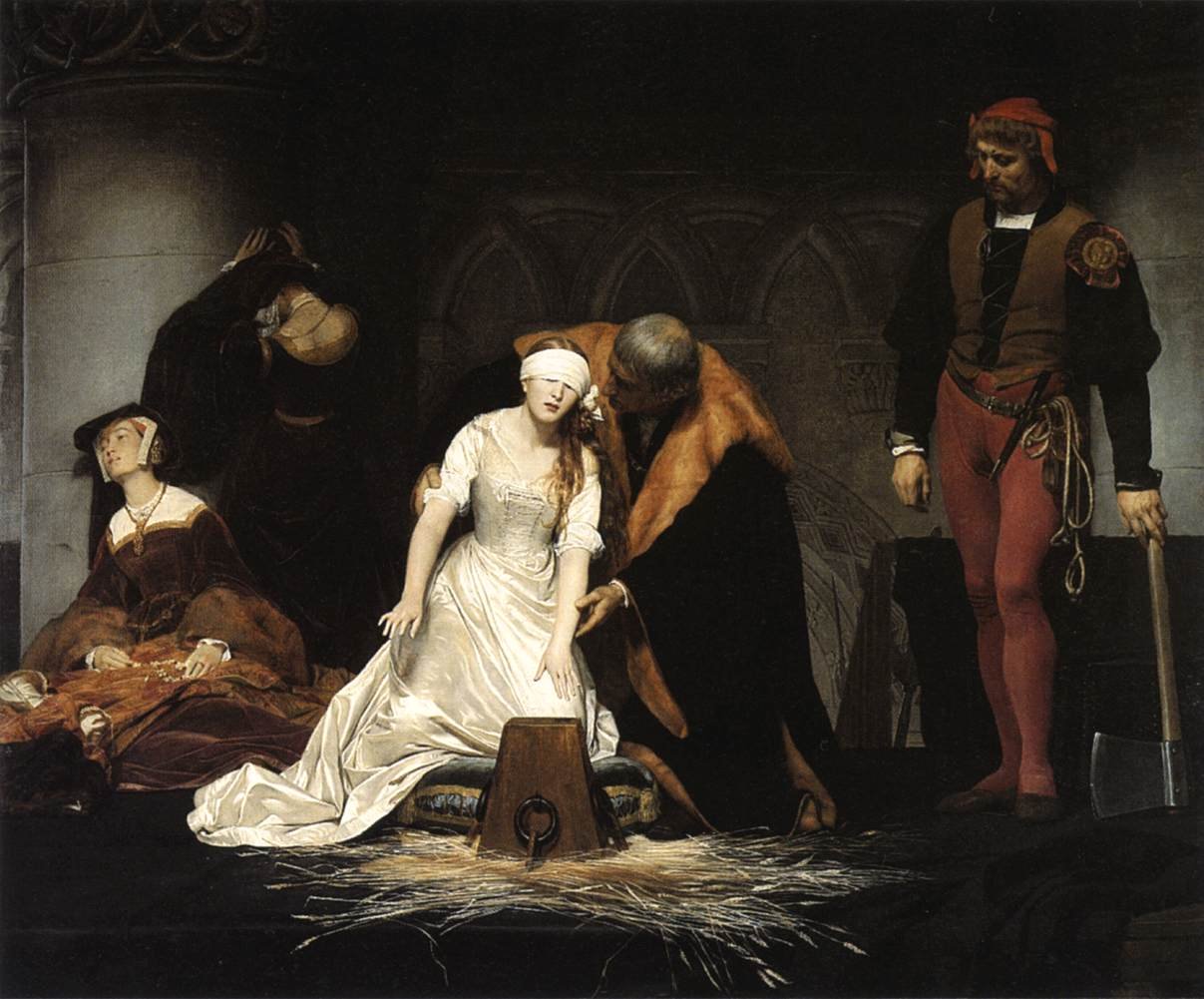
Today’s featured painting is entitled The Execution of Lady Jane Grey which he completed in 1833.  The Execution of Lady Jane Grey, which is depicted in this work of art, occurred almost three hundred years earlier.  It was first exhibited at the Paris Salon in 1834 where it caused a sensation.  It is very large oil on canvas painting almost 250cms x 300cms.  During the 1820’s and 1830’s in France,  a kind of “Anglo-mania” swept the country and this interest in English history had, in part, been fuelled by the novels of Sir Walter Scott and his tales of the battles and conflicts between Roundheads and Cavaliers during the Civil War,  which in some ways mirrored what happened during the violent and turbulent times of the French Revolution.  The setting for the painting is the morning of February 12th 1554.   The painting depicts the last moments in the life of the seventeen-year old Jane Grey, who was the great granddaughter of Henry VII and who was proclaimed Queen of England upon the death of young King Edward VI, a Protestant like herself.  She was young, intelligent and a political pawn whose destiny was out of her control and her reign only lasted for nine days in 1553.  Due to the plotting of the followers of Henry VIII’s Catholic daughter, Mary Tudor, she was convicted of high treason and sentenced to death in the Tower of London.

The painting has a few historical inaccuracies as we know that Lady Jane Grey was actually executed outdoors on Tower Green and not inside a chamber of the Tower of London.  She was also not dressed in a white satin dress along with the depicted whalebone corset and for a beheading her hair would not have been allowed to fall to her waist but instead would have been tucked up high above the head.  However let us not quibble about historical accuracy and rather just let us feast our eyes on this very dramatic painting.

In the painting we have five figures.  The central character of the painting is the tragic figure of the blindfolded Lady Jane Grey, in her under garments, who has just knelt down on a cushion behind the block where soon her neck will rest.  On either side of the block we see iron rings to which her wrists will be bound.   Look how she gropes with her outstretched arms, her hands in front of her, trying to locate the wooden block.  She is being gently guided to the executioner’s block by the elderly Lieutenant of the Tower, who at the time, was Sir John Brydges.  We get the feeling that he feels sadness for the young girl’s plight and his attentiveness and concern as depicted by Delaroche adds more pathos to the painting.  His hulking figure attired in a black coat, lined with orange-brown fur, looms over her and is a perfect contrast to the white attire of his charge ,which would soon be splattered with her blood.  Her sad figure with its golden-red hair is being illuminated from above.  It is a very dark painting with the exception of this lighting, which highlights the young girl and is in some way like a spotlight on a dark stage focusing light on an actor.   To the left we see two of her ladies-in-waiting, beside themselves with grief.  One, who is so distraught, has slumped to the floor, her eyes closed, her head turned away from her mistress.  She is clutching the outer garments of her mistress.  The other, who cannot bear to witness the execution weeps uncontrollably.  Her hands are above her head, grasping the grey column.  Her face is pressed hard against the stony structure.  The executioner stands in his blood-red hose to the right, the fingers of his left hand loosely holding the handle of the axe.   A pile of straw painted in the finest of detail, lies before the executioner’s block, in readiness to catch and soak up the victim’s blood.  Look how the artist has cleverly painted the straw which looks like it is almost falling out of the painting.  We can almost imagine that by leaning forward we could pull out a piece.

As we look at the painting we experience a myriad of feelings – horror of what is about to happen, compassion and pity for the fate of the young girl, despair that such a thing could take place in a civilised society.  The way Delaroche has painted the scene makes us feel that we are there, standing in front of the victim.  We are actual witnesses at the execution.   We are simply voyeurs who cannot change history.  We cannot prevent the neck of the young girl being severed by the executioner’s axe.  It is interesting to note how none of the five figures in the painting look towards us.  They are not aware of our presence.

Whether the painting is factually inaccurate does not lessen its greatness nor does it any way diminish the standing of the artistic genius who has created a work that tugs at our emotions.

A Stormy Landscape by Meindert Hobbema

A Stormy Landscape by Hobbema (1663-5)

Meindert Hobbema was thought to have been born in 1638 in Amsterdam but there are varied opinions on this fact.  The name “Hobbema” was his own invention as his father’s name was Lubbert Meyndert.  He was the great landscape painter of the Dutch Golden Age.   The Dutch Golden age was that period in Dutch history which spanned the 17th century, at the time of, and following the Eighty Years War, which encompassed the struggle for Dutch independence. The newly formed Dutch Republic became the most prosperous nation in Europe, and led European trade, science, and art. The northern Netherlandish provinces that formed part of the new state had customarily been less significant as artistic centres in comparison with the Flemish cities in the south.  The war caused tremendous disruption and resulted in the break with the old monarchist and Catholic cultural traditions.  As a result, Dutch art needed to reinvent itself entirely, a task in which it was very largely successful and this re-birth was known as the Dutch Golden Age.

We know that Hobbema was active as an artist in Amsterdam and that he was a pupil of the great landscape painter Jacob van Ruisdael.  Some of Hobbema’s work showed a distinct similarity to his master’s work and as Ruisdael’s paintings were in great demand, a number of Hobbema’s works were passed off as being works of his master.  Strangely enough, in years to come when Hobbema’s flair as an artist and his artistic gift was established, the reverse would happen.

Hobbema married Eelije Vinck in 1668 who had been his serving maid.  One of the witnesses at the ceremony was Jacob Ruisdael.  The couple went on to have four children.   It was about this time that Hobbema started to work for the Customs & Excise in Amsterdam supervising the weighing and measuring of imported wine.  This was his full time job and from then on his artistic endeavours were reserved for his spare time.  The output of his paintings from then on decreased and was somewhat erratic.   In 1704 Eeltije died, and was buried in the pauper section of the Leiden cemetery at Amsterdam. Hobbema himself survived till December 1709, and he too was buried in a pauper’s grave in Amsterdam. It was a depressing fact of life that both van Ruisdael and Hobbema, looked upon as the two greatest Dutch landscape painters of the era, both died in poverty.  Like the two great Dutch painters Hals and Rembrandt some fifty years earlier, despite the demand for their works and the sale of their paintings, they too died penniless.   This sad fact has to be put down to either they let their paintings go too cheaply or simply their financial mismanagement which was brought on by them living a life they could not afford and as a result it was to prove to be their undoing.   

The Cottages and the passing walkers

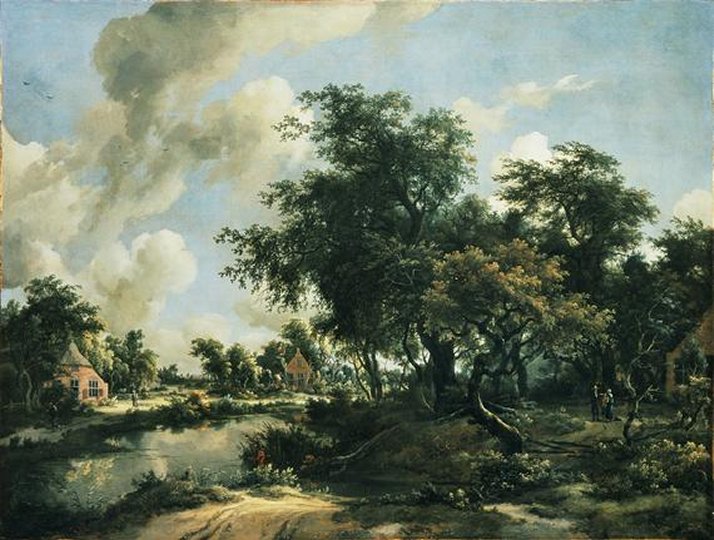
Hobbema was a master painter when it came to painting woods and hedges, or mills and pools. This talent was derived from his life in the countryside, where day after day he might study the branching and foliage of trees, cottages and mills, under every variety of light, in every shade of transparency, during the various seasons.    His paintings had a characteristic rich texture to them.  Today’s featured painting entitled A Stormy Landscape, which he completed in 1665, is a prime example of his extraordinary talent as a landscape painter.  In it we can see his love of creating woodland scenes with various shaped trees which in turn gave him the opportunity to show off his talent in depicting illuminated clearings and patches of light randomly placed amongst the shaded areas caused by the massive trees and dense foliage.

The Fisherman

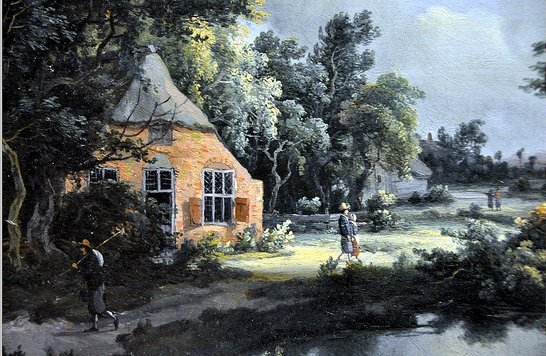
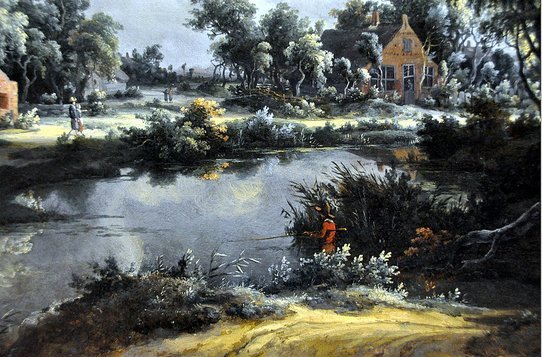
In the foreground we have a fisherman with his line cast in the rippling waters of the river.  In total there are nine figures dotted around the rural scene, all quite small but put there by the artist for a specific reason, that of directing our eyes through the landscape.  There is no urgency in the movement of the water which adds to the tranquillity of the scene. To the man’s right we have a family strolling through the woods.  Across the river stand two cottages nestling under the cover of the large trees.  More people out for a stroll can be seen on that side of the river.   The heavy clouds shown to the left of the painting warn us of a storm approaching but this appears to be of little concern to our fisherman or the walkers.

This is a beautifully crafted work of art and one of Meindert Hobbema’s masterpieces. It has a soothing quality to it.  It is the type of picture you should look at when you feel stressed as its calm depiction of a country scene counteracts the stress of city life.  It has a calming effect and in some ways standing in front of it offers you a chance to relax.   Life alas can be hectic and I believe this painting offers one the perfect foil to our sometime chaotic existence.

A Storm with a Shipwreck by Claude-Joseph Vernet

A Storm with a Shipwreck by Claude-Joseph Vernet (1754)

I spent the last couple of days in London and whilst there visited a couple of art displays.  Unfortunately, with previous commitments tying up my time on one day I had a limited exposure to the beautiful world of art.  I normally would have spent some time at the National Gallery or one of the Tates but because I had only a short period and because I wanted to visit the Royal Academy Summer Exhibition I decided I had to limit myself to one gallery and so I decided to go somewhere new.  It was for these reasons I ended up on the steps of the Wallace Collection and although my time was restricted, I was completely blown-away by the art on display.  This is a beautiful jewel in the art crown of London, just a few minutes’ walk from the great Emporiums of M&S and Selfridges and everybody who visits London should visit this gallery and savour the magnificent art they have on display.

My Daily Art Display today features one of the many works of art I saw at the gallery.  It is entitled A Storm with a Shipwreck and was painted in 1754 by Claude-Joseph Vernet.  The Vernet family tree reads like a “Who’s Who” of distinguished French painters.  The head of the family was Antoine Vernet (1689-1753) was a prosperous artisan painter in Avignon and to whom many decorated coach panels are attributed. He had four sons, all of whom were painters, Claude Joseph,  Jean-Antoine,  Antoine-Francois and Antoine Ignatius.  He was grandfather to the artist Antoine-Charles Joseph, known as Carle Vernet and great grandfather to the painter Horace Vernet.  Of his three sons, Claude-Joseph Vernet (1714-89) earned a reputation throughout Europe as a great landscape and marine artist, receiving the commission from Louis XV for the series of paintings, Ports of France.   Jean-Antoine Vernet (1716-1755) also painted seascapes, and (Antoine-) Francois Vernet (1730-79) was a decorative painter.  Jean-Antoine Vernet had a son, Louis Francois, who along with Antoine-Francois’s son, Joseph Vernet the Younger, were both active sculptors in Paris.  Today’s featured artist Claude-Joseph Vernet had a son Carle who followed in his father’s footsteps and became known for his pictures of horses and battle scenes, though his achievement was overshadowed not only by his father’s but by that of his son Horace Vernet, a prolific and highly successful painter, especially of battle scenes. The Vernet family was connected by marriage to several other notable French artists, Carle becoming father-in-law of Hippolyte Lecomte and Horace that of Paul Delaroche; Carle’s sister Emilie married the architect Jean-Francois-Thérese Chalgrin.

When I saw today’s painting of a shipwreck at sea I was immediately transported back in time to my days at sea and the many horrendous storms I had to endure.  However this seascape also reminded me of the many times we had to bring our small vessel into the Portuguese port of Oporto.  The flow of water along the river Duoro, which is controlled by dams in the river high up in the Spanish mountains, ends its 727kms journey as it forces its way through the town of Oporto before pouring itself out into the Atlantic Ocean.  For many years the flow had not been strong enough to clear the sandbank and silting at the river mouth and the passage from ocean to river was a hazardous dog-leg, which was made even more difficult with the Atlantic rollers buffeting the stern of vessels as they headed for the narrow channel entrance.  I will always remember the tension on the bridge of the vessel as we tried to steer a course through the narrow entrance along the winding channel, hampered by following seas buffeting the stern of vessel making the ship slew from side to side.  Tension was further heightened as one looked at the sandbank which almost completely straddled the entrance and perched on top of it was a wreck of a ship which had failed to successfully navigate its way through the narrow entrance.  This was almost forty years ago and I am sure things have changed.

Vernet had just returned to France in 1753 after spending the previous twenty years in Italy.   Madame de Pompadour’s brother, the Marquis de Marigny, when he had been appointed Surintendant des bâtiments (Cultural Minister) under Louis XV, commissioned Vernet to paint a series of views for the crown of the major French ports.   Vernet had just started his first commission in Marseilles in 1754 when Marginy commissioned today’s work.    Vernet loved the sea and seascapes but his most favourite subject was his dramatic portrayal of shipwrecks and all the emotions that went hand in hand with such disasters.

As we look at the painting we see a dreadful storm and shipwreck scene.  Torrential rain is pouring down on the battered remains of the wrecked ship and its hapless survivors.   The white-crested seas push the broken ship further onto the jagged rocks.  In the background, we can see another ship which is being unmercifully tossed about on the stormy sea but remains out of harm’s way.  In the foreground we see survivors just about clinging to life as they lie on the rocks.   Some are being helped to drag themselves out of the stormy waters and onto the slippery rocks to escape the jaws of certain death.  To the right we see a fort perched on a rocky outcrop.  A tree with its roots embedded in the rocks clings perilously to its elevated position in the face of gale-force winds.  Along the walls leading up to the fort, we see spectators looking down on the unfolding drama.

Some of the survivors

Like a number of his paintings, Vermet has cleverly utilised the effects of light in order to create visual excitement.  He has cleverly contrasted the darkness of the sea and the rocks with the blue sky which is emerging from behind the black storm clouds.   Venet’s figure drawing and his mastery of the portrayal of human emotions through gestures was his forte and you need to stand close up to the painting to take in the minutiae of the details

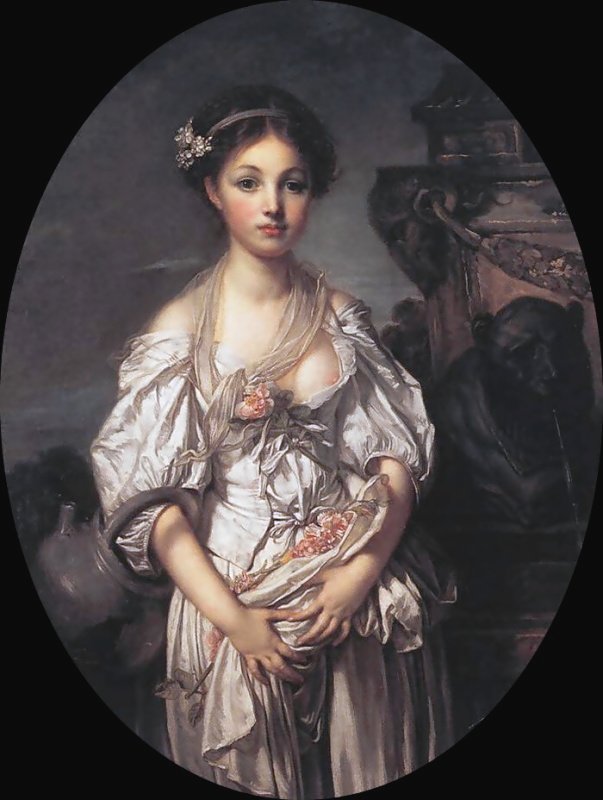
The Broken Pitcher by Jean-Baptiste Greuze

The Broken Jug by Jean-Baptiste Greuze (1771)

This is my second painting featuring the artist Jean-Baptiste Greuze, the first being on June 28th.  However today’s painting is very different in comparison to my first offering.

Greuze was born in Tournus, a Burgundian town on the banks of the River Saône in 1725, the sixth of nine children.  He came from a prosperous middle-class background and studied painting in Lyon in the late 1740’s under the successful portrait painter, Charles Grandon.   At the age of twenty-five, Greuze moved to Paris where he entered the Royal Academy as a student.  During this period he developed a style of painting which was described as Sentimental art or Sentimentality.     I believe we could define sentimentality as an emotional disposition that idealizes its object for the sake of emotional gratification and that it is inherently corrupt because it is grounded in cognitive and moral error. Sentimental art can thus be defined as art that, whether or not by design, evokes a sentimental response.

Greuze was accepted as an Associate member of the Academy after he submitted three of his paintings A Father Reading the Bible to His Family, the Blindman Deceived and The Sleeping Schoolboy.    These three works were about life amongst working class folk and were moralising pictorial stories and, in some ways, are reminiscent of the works by William Hogarth some two decades earlier.  It was Hogarth’s genre of art that depicted scenes from the lives of ordinary citizens and which were calculated to teach a moral lesson.

Greuze was pleased to have achieved admission to the prestigious Academy but he wanted more.  He wanted to be recognised as a historical painter.  From the 17th century, Art Academies of Europe had formalised a hierarchy of figurative art and the French Académie royale de peinture et de sculpturehad a central role in this listing.  According to them this was the hierarchical order, with the most prestigious at the top:

History Painting

(including narrative religious mythological and allegorical subjects)

Portrait Painting

Genre painting

 or scenes of everyday life

Landscape

Animal painting

Still Life


In 1789 he put forward his work, Septimius Severus Reproaching Caracalla, as a history painting but it was rejected by the Academy as they considered him to be a “mere genre painter”.    The Academy did not consider his works fell into the category of historical paintings and this rebuff so annoyed Greuze that he refused to submit any more of his works for the Academy’s exhibitions.  The fact that the Academy downgraded his works did not in any way affect their popularity with the public who couldn’t get enough of these “sentimental” paintings and the sale of his works continued strongly.  In fact, the sales of his works were so popular that the money kept pouring in and so Greuze had no more need to exhibit his works at the Academy.

During the late eighteenth century in France, Rococo art thrived and the likes of Fragonard, Watteau and Boucher had almost taken over the French art scene.  It was all the rage with its mythological and allegorical themes in pastoral settings and its elegant and sometimes sensuous depictions of aristocratic frivolity.  At the time, this brand of light-hearted, and now and again erotic works, were much in demand with wealthy patrons.  So in some ways the French art world received a shock when Greuze’s pompously moralising rural dramas on canvas countered the frivolity of the artificial world of Rococo art.

The majority of Greuze’s later works consisted of titillating paintings of young girls.  His paintings contained thinly disguised sexual suggestions under the surface appearance of over-sentimental innocence.  My Daily Art Display featured painting today entitled The Broken Jug is a classic example of this style of art.  In the picture we see a three-quarter length portrait of a young girl.  She has blue eyes, light hair, pink cheeks, very red lips, and her dress is white. She still exudes the innocence of childhood but we need to look closer at this portrait.   How old do you think she is?  Look closely at her facial expression.  What can you read into it?  Do you think she looks serious?  Do you think there is a slight look of alarm in her eyes?  Is there a look of sadness in her expression?  What has happened?

Look at the way she is dressed.  It looks as if it was a special dress for a special occasion, look at the flowers in her hair, maybe she has just returned from a party, but why are her dress and her appearance so dishevelled?  On her arm she carries a pitcher which is broken but she has not discarded it.  She clings lovingly to it.  It must have been a prized possession of hers and maybe she hopes to be able to remedy the break.  How did it break?  Was she running away from something and tripped, breaking the pitcher, which may explain her dishevelled appearance.  Maybe her worry is based on how she is going to explain away the breaking of the pitcher to her parents and pleading that it was a simple accident and beyond her control.  Is it as simple as this?

Let me suggest another possibility to this story.   I am not convinced this is all about a broken pitcher.  Let us consider an alternative theory.  Look at her dishevelled appearance.  Look at her silk scarf adorned with a rose which has lost some of its petals.  See how the scarf has been dragged down and is now no longer wrapped around her slender neck.  Look how the top of her dress has been pulled down exposing her left breast and nipple.  Look how she struggles to gather up flowers in the folds of her dress.  Has she been involved in a struggle with a lover and the tryst has got out of hand?   Is her beloved broken pitcher just an allegory and this is not about a broken jug at all but it is about her broken hymen and the loss of her virginity and the fear of telling her parents what has happened?

Could The Broken Pitcher by Jean-Baptiste Greuze be alluding to loss of virginity or am I reading something into this painting which does not exist?

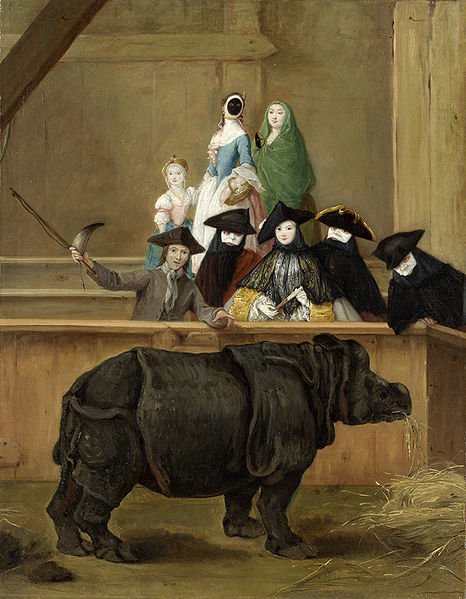
The Rhinoceros by Pietro Longhi

My Daily Art Display painting of the day is one which when once seen will never be forgotten.  Not necessarily for the breathtaking art but for the unusual subject of the painting.  My featured painting to today is The Rhinoceros by Pietro Longhi.

The Rhinoceros by Pietro Longhi (1751)

Longhi was born in Venice in the latter part of 1701. His parents were Antonia and his father Alessandro Falca, who was a silversmith.  Pietro changed his surname to Longhi once he started to paint.  He studied art initially under the guidance of the painter from Verona, Antonio Balestra, and finally was accepted as an apprentice to Giuseppe Crespi the Baroque painter from Bologna.  Longhi returned to Venice when he was thirty-one years of age and married Caterina Maria Rizzi and the couple went on to have eleven children.  Sadly, and it is a common story of that era, only three of their children reached the age of maturity, one of whom, Alessandro, became a successful portraitist.

His early work featured a number of altarpieces and religious paintings and he was commissioned to carry out a number of frescos in the walls and ceilings of the Ca’Sacredo in Venice, which is now an exclusive hotel.  Later his art turned to genre scenes of contemporary life in Venice of the aristocracy and the working class.  He produced numerous works and in many instances painted many different versions of the same scene.  His type of art,  his satirical look at everyday Venetian life with its coffee-drinking, receptions and social soireeswas extremely popular..  Some of his paintings remind one of the type of paintings done by William Hogarth.  The difference between the two was that Hogarth was often brutally satirical with his paintings in which he mocked the life of English folk whereas Longhi just wanted to chronicle the everyday life of his compatriots without standing in judgment and acting as a satirical moralist.  In a number of cases his patrons, who had commissioned his work where featured in the works and maybe for that reason Longhi was careful not to offend them.   Bernard Berenson, the American Art historian, talked about Longhi’s artistic style and the comparison with Hogarth when he wrote:

“…Longhi painted for the Venetians passionate about painting, their daily lives, in all dailiness, domesticity, and quotidian mundane-ness. In the scenes regarding the hairdo and the apparel of the lady, we find the subject of gossip of the inopportune barber, chattering of the maid; in the school of dance, the amiable sound of violins. It is not tragic… but upholds a deep respect of customs, of great refinement, with an omnipresent good humor distinguishes the paintings of the Longhi from those of Hogarth, at times pitiless and loaded with omens of change..”.

Longhi became Director of the Academy of Drawing and Carving in 1763 and it was around this time that he concentrated almost all his artistic efforts in to portraiture, ably assisted by his son, Alessandro.  He died aged 83 in 1785.

The featured painting today is based on historical facts and revolves around the Carnevale di Venezia, the annual festival, held in Venice. The Carnival starts around two weeks before Ash Wednesday and ends on Shrove Tuesday.  This grand event was described by John Evelyn, the 17th century English traveller and diarist:

“…At Shrovetide all the world repair to Venice, to see the folly and madness of the Carnival; the women, men, and persons of all conditions disguising themselves in antique dresses, with extravagant music and a thousand gambols, traversing the streets from house to house, all places being then accessible and free to enter. Abroad, they fling eggs filled with sweet water, but sometimes not over-sweet. They also have a barbarous custom of hunting bulls about the streets and piazzas, which is very dangerous, the passages being generally narrow. The youth… contend in other masteries and pastimes, so that it is impossible to recount the universal madness of this place during this time of license….”

The painting which hangs in the National Gallery in London centres on the unusual spectacle of Clara the young rhinoceros, which was brought to Europe in 1741 by a Dutch sea captain, Douwe Mout van der Meer, who had bought the lumbering creature.  It is believed that she was only the fifth rhinoceros to be imported from India to Europe since the days of the Roman Empire.  Clara, after extensive travels in Europe, arrived in Venice ten years later.   The female rhinoceros in Longhi’s painting, seen munching away at some hay seems somewhat docile, even depressed, as caged animals often are who suffer such a fate.

The Audience

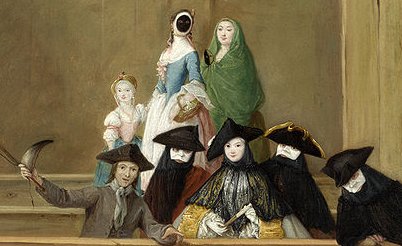
Behind her we see the keeper of the animal and a number of spectators.  The keeper holds aloft a whip and the horn of the rhinoceros which according to historical notes, was not cut off but knocked off by Clara herself due to her continuous rubbing it against the sides of her cage.  The small audience of seven, some of whom wear their Carnival masks stand on wooden benches in an almost triangular formation.  They show no interest in the poor creature as they gaze vacuously in all different directions.  The elegant lady in the front row wearing a dark lace shawl, edged in gold is Catherine Grimani.  She stares directly out at us.  Her white-masked suitor, on her left, is her husband John Grimani and the couple were the commissioners of the painting.  Their servant stands to her right and looks straight ahead.  The man to the right of the group wearing a red cloak and has a long clay pipe in his mouth has his eyes cast downwards and seems lost in his own thoughts.  Above him, Longhi has painted a scroll-like notice which tells us all about the painting, which when translated reads:

“True Portrait of a Rinocerous  conducted in Venice  year 1751:

made for hand by  Pietro Longhi

Commissions  S of Giovanni  Grimani Servi Patrick Veneto “.

The small girl in the back row seems totally disinterested in Clara.  With the exception of the animal’s keeper brandishing the severed horn there seems no relationship with the audience and the animal on display.  It is if Longhi has merely added them to please his patrons and highlight the fact that the exhibition was at Carnival time in Venice.

One thing that I found fascinating is the lady in the upper middle of the audience dressed in the blue and white gown.  Instead of a white carnival mask she is wearing the soft black leather Moretta mask.  Moretta, means darkness, and the masks were only worn by women and were not tied around the wearer’s head but held in place by a leather button on the inside of the mask which is held in the clenched teeth of the wearer.  It has only two nearly circular openings for the eyes, restricting the lady’s breath a little, as the only airway is through the eye openings down to the nose.  Sweat also has to evaporate through the openings as well, quickly making the face hot.  Not only was that uncomfortable but it prevented the wearer from speaking.  This enforced silence especially pleased their male counterparts !

I was going to add a male-chauvinist comment, but thought better of it  !!!!!!

Hard Times by Sir Hubert von Herkomer

Hard Times by Sir Hubert von Herkomer (1885)

My featured artist today is the German painter Hubert von Herkomer.  He was born in 1849 in Waal, a small town in southern Bavaria.  He was an only child.  His father Lorenz was a talented wood carver and his mother was a talented pianist and music teacher.  At the age of two he and his family emigrated to America and settled in Cleveland Ohio.  Their stay in America was comparatively short for in 1857 they returned to Europe, settling down in Southampton, England.  Herkomer first art tuition came from his father and later in life he often said that his father had been one of the most important and positive influences on his career.   He went to school in Southampton and began his art education when he attended the Southampton School of Art.  One of his fellow students was Luke Fildes who was to become one of the greatest English Social Realism painters (see My Daily Art Display, May 17th).  When he was sixteen years old his father took him back to Bavaria where he attended the Munich Academy for a short time.  In 1866 he returned to England and enrolled at the South Kensington Schools which we now know as the Royal College of Art and at the age of twenty he exhibited, for the first time, at the Royal Academy.

Herkomer left Kensington Art School and 1867 and started a career as a book and magazine illustrator. However he found most of the work tedious and so being a young man with radical political opinions he was excited by the news that the social reformer, William Thomas, intended to launch an illustrated weekly magazine called the Graphic.  Herkomer immediately fired with enthusiasm sent Thomas a drawing of a group of gypsies. The magazine owner, Thomas, was delighted with the drawings and the following week it appeared in his magazine.   Over the next few years Herkomer supplied Thomas with more drawings which were published.  He applied to join the staff of the magazine but was both annoyed and disappointed when his application was turned down by Thomas.  Herkomer had no choice but to remain as a freelance contributor.  Although devastated by the refusal he was later to recall that this rebuff was to be the making of him as an artist.  He wrote about his belief that he had an obligation to pictorially depict the hard times of the poor and the importance of such magazines like the Graphic, saying:

 “…It is not too much to say that there was a visible change in the selection of subjects by painters in England after the advent of the Graphic.  Mr. Thomas opened its pages to every phase of the story of our life; he led the rising artist into drawing subjects that might never have otherwise arrested his attention; he only asked that they should be subjects of universal interest and of artistic value.  I owe to Mr. Thomas everything in my early art career.  Whether it was to do a two-penny lodging-house for St. Giles’, a scene in Petticoat Lane, Sunday morning, the flogging of a criminal in Newgate Prison, an entertainment given to Italian organ grinders, it mattered little.  It was a lesson in life, and a lesson in art.  I am only one of many who received these lessons at the hands of Mr. W. L. Thomas….”

(Spartacus Educational Hubert Von Herkomer)

A number of his engravings which were used in the Graphic were later reworked by Herkomer into large scale oil paintings.  In 1879 he was elected an associate of the Royal Academy and became an Academician in 1890.

In 1880 Herkomer started to concentrate on portraiture which, at the time, was the most lucrative art genre.  His fame grew and he spent time in America where he completed thirteen portraits during his ten week stay and for them he received the princely sum of £6000.  His wealth grew rapidly and he could now afford a luxurious lifestyle.  Despite the lucrative portraiture market he never lost his love of Social Realism art which drew attention to the atrocious conditions of the poor.  It was in the late nineteenth century that he produced some of his great Social Realism paintings such as Pressing to the West in 1884; today’s featured painting Hard Times in 1885 and On Strike in 1891.  In 1883 Herkomer started his own art school at Bushey in Hertfordshire, at which he oversaw some five hundred would-be artists.  He served as Slade Professor of Art at Oxford University between 1885 and 1895 and was knighted by the King in 1907.  Herkomer died in 1914 aged 65 and is buried in St James’s Church, Bushey.

The featured painting in My Daily Art Display is entitled Hard Times and was painted by Herkomer in 1885.  It now hangs in the City Art Gallery of Manchester.  The artist was dedicated to bringing the social problems of the poor to the eyes of the public through his oil on canvas paintings.  He never forgot his early impoverished childhood and his health problems.  The author Lee Edwards, who wrote extensively about Herkomer, commented:

“…Herkomer painted a number of pictures that revealed his sympathy with the poor and disadvantaged, a characteristic fostered in part by his own humble origins…”

This painting was one of his most famous works and was one of many of his paintings which featured rural scenes.  His inspiration for this painting was probably the impoverished migrant workers he had seen near his home in Bushey.  Herkomer actually used a real family for his painting, getting an a working labourer, James Quarry and his wife Annie to pose with their two sons Frederick George and his brother James Joseph as unemployed workers and their children.  The setting for this painting was called Coldharbour Lane, a long and winding road in the Hertfordshire countryside.  The outdoor setting was painted en plein air but the characters in the painting were painted later, indoors at his Art School.

The wife who sits with her children by the roadside looks sad and dejected.   On the other hand, the man looks down the road and his face is one of hope and possibly optimism that something will “turn up soon” and the tools of the man’s trade lie before them signifying that strength would eventually overcome hardship.  It is interesting to note the difference in Herkomer’s portrayal of the effect hardship had on men and women.  So should we view this painting as one of hope or one of destitution?

I suppose the answer lies with ourselves and whether when we face problems we believe our glass is half full or half empty !

Crossing at the Schreckenstein by Ludwig Richter

Crossing at the Schreckenstein by Ludwig Richter (1836)

About five or six years ago I was fortunate enough to be having a short break in Europe  and one of my journeys was from Dresden to Prague, partly by boat on the river Elbe and partly by train.  The banks of the River Elbe, like the German Rhine, is littered with palaces and castles perched high above the river.  My featured painting for today entitled Crossing at the Schreckenstein by Ludwig Richter reminded me of that trip and I remember the castle well as it stood imperiously above the river.

Adrian Ludwig Richter, the son of Karl August Richter, a copper engraver, was born in 1803 in Dresden.   He received his initial artistic training from his father.  He attended the Dresden Academy of Art and his favoured artistic genre was that of landscape painting and at the age of twenty, with the financial backing of a Dresden book dealer, he was awarded a scholarship to travel to Rome to continue his studies.  Whilst in Rome he came across Joseph Anton Koch, an Austrian landscape painter of the German Romantic Movement who was famous for idealised landscapes.  It was whilst in Italy that Richter produced the first of many of his idyllic Italian landscape paintings.

Richter returned to Dresden in 1826 and two years later went to work as a designer at the Meissen factory.  Richter made many hiking trips through the mountains of Bohemia and along the Elbe and gradually his landscape art changed from the idealistic landscapes to the topographically accurate ones.  Richter was a lifelong lover of the works of Caspar David Friedrich and his influence can be seen in a number of Richter’s works.  In most cases he would add figures to his landscapes and through them tell a story.    In 1841 he became a professor at the Dresden Academy and would often take parties of students on walking tours through the local mountains where they would sketch and return to the college where they would use them to complete their works of art.

In 1874 at the age seventy-one an eye disease caused his sight to deteriorate to such an extent that he had to give up his art work.  He died in 1884 at Loschwitz ,  a few month short of his 81st birthday.

The harp player

The title of today’s painting Crossing at Schreckenstein is also known as Crossing the Elbe at Schreckenstein near Aussig and I have even seen it referred to as Ferry at the Schreckenstein.   So what do we see before us?  One can almost hear the tune from the harp as the ferryman and his boat transport their passengers across the Elbe.  Note the varied age of the passengers, spread between the child through to the old man and it was thought that Richter’s ferryboat was a “ship of life” in which the passengers of all ages are united.  The ferryman leans back as he heaves on his paddle.  With pipe in his mouth, his eyes are raised towards the hilltop castle.  He still seems in awe of the great edifice notwithstanding how many daily crossing of the river he makes.

At his feet there seems to be a small cargo of plants which are being transported across the waterway and next to them we see a young girl standing with a pole in her hand.  We do not know whether she is the ferryman’s helper or just another passenger.  In the middle of the boat we focus our attention on a young man, standing up with his back to us, who like us,  stares up at the castle whilst the old man plays a folk song about times past.

The Ferryman

A young couple cuddle up together.  His hand rests on hers as she holds on to a posy of flowers. Neither of them are aware of the beauty of their surroundings or their fellow travellers.  They only have eyes for each other.   A man sits in front of the elderly harp player, resting his chin on his hand, his eyes cast downwards.  He too seems unaware of the surrounding landscape.  He is lost in thought.  A small boy at his feet with his hand resting over the gunwale of the craft, drags a small branch through the calm water, slightly rippled by the current.  The curved shape of the upper part of the painting in some way lends it a somewhat solemn and religious feel.

The setting for this picture was probably one Richter saw on his many hikes along the banks of the Elbe.  Maybe the last word on the painting should be given to the artist himself.  He described his work in his autobiography, Lebenserinnerungen eines deutschen Malers, which was edited by his son:

“…As I remained standing on the bank of the Elbe after sunset, watching the activities of the boatmen, I was particularly struck by an old ferryman who was responsible for the crossing.  The boat loaded with people and animals, cut through the quiet current, in which the evening sky was reflected.  So eventually it happened that the ferry came over, filled with a colorful crowd among who sat an old harpist who, instead of paying the penny for his passage, played a tune on his harp….”

The view is as magnificent today as it was in the time of Richter with the once mighty castle perched above the river.  Bridges and locks now straddle the waterway and the ferryman’s efforts are no longer needed.  If ever you visit the area be sure to take the river journey down the mighty Elbe and savour the splendour of the river banks.

Madame Récamier by Jacques-Louis David, Francois Gérard and Magritte

My Daily Art Display today is about one woman and three paintings.  The woman in question was Jeanne-Francois Julie Adélaïde Bernard Récamier and she was a celebrated French beauty and some would say she was the most beautiful and graceful woman of her day.   Add brains, confidence and charms to this exquisite loveliness and you have as they said, the perfect woman.

She was born in Lyons in 1777.  Her father Bernard was a banker and when she was young she and her father moved to Paris.   At the tender age of fifteen she married Jacques Récamier a wealthy banker, some thirty years her senior.  Her residence in Paris was a place of rest for the distinguished men of the day. She was the perfect hostess.  She was witty, a great conversationalist and a natural beauty and the soirées she held at her salon attracted the most important politicians and literary figures.   Invitations to her salon were much in demand, as to be a guest at her house guaranteed one the best of food and drink and the company of the “great and good”.   The fact that you attended one of her gatherings meant that you had achieved social respectability.   She entertained the likes of Lucien Napoleon, the young brother of Napoleon Bonaparte, and painters such as Gustave Moreau and Jacques-Louis David.  Madame Récamier, who had a sweet disposition and was unspoiled by the constant homage she received, was extremely well liked.  Strangely, there was never a hint of scandal regarding all the men that came to visit her.

All was going well until her husband was ruined financially through the policies of  Emperor Napoleon whom he had bankrolled and because of this the visitors to her salon were sympathetic to her and her husband and her house became a home for people who wanted Napoleon’s reign to come to an end.  This led to the Récamiers being forced into exile on the orders of Bonaparte and they fled to Italy for their own safety.   Madame Récamier did not return to France until the fall of Napoleon in 1815.  Husband and wife returned to Paris and she re-opened her salon but further financial setbacks befell them in 1819 and she had to move to a small apartment and despite the downsizing she still was inundated with eminent writers and statesmen.

Even in old age and with little money Madame Récamier retained her popularity.  Her health began to fail and she became almost blind but despite that she never lost her attraction.  Juliette Récamier died of cholera in 1849 aged 72 and is buried in the Cimitière de Montmartre.

Madame Récamier by Jacques-Louis David (1800)

Let us look now at the first of my three paintings and for this we must go back to the year 1800 when the artist Jacques-Louis David, a frequent visitor to her salon, was asked to paint a portrait of Madame Récamier.   The painter who favoured the Neoclassical style was looked upon as the pre-eminent painter of his day.  He had the young twenty-three year old lady bedecked in a white empire-line sleeveless dress like a modern version of a vestal virgin.  We view her from a distance and so her face looks quite small.  It is thought that David wanted his painting to be not just a mere portrait but an ideal of feminine elegance and charm.  Her antique pose, the bare décor and light dress all epitomize his neoclassical ideals.  She is shown in an almost bare space with the exception of the Pompeian furniture.  She reclines on a French empire méridienne sofa, looking slightly backwards over her right shoulder.  We know that David never finished the painting, which may account for the bareness of the canvas.  Besides the sofa there is just a stool and candelabra shown in the painting.  There is an austere minimalism to this painting.

Madame Récamier became impatient with David and the slowness of his work and, unbeknown to him, commissioned one of his pupils, Francois Gérard, to paint her portrait instead.  David, when he heard about this new commission was furious and said to Madame Récamier:

“….Women have their whims, and so do artists; allow me to satisfy mine by keeping this portrait….”

The painting never left David’s atelier until it was finally exhibited at the Louvre in 1826.

Madame Récamier by Francois Gérard (1802)

And so to the second of my three paintings; the one Madame Récamier commissioned Gérard to paint in 1802.  Besides the fact that she thought David was taking too long to complete the painting, she was also unhappy with what she saw on his canvas.  She thought his depiction of her was too low-key and was displeased with his portrayal of her in a Neoclassical style.

Gérard was by no means a novice painter.  In fact he was looked upon as one of the most popular portraitists of the day.  Her instructions to him were quite simple.  She wanted to be painted in a more natural setting.  She wanted a more close-up portrait which would emphasise her natural curvaceous beauty and she wanted her complexion to be somehow echoed in the colour of the background.  She must have been delighted with the finished painting.  The red curtain which acts as a backdrop compliments the sitter giving her flesh a rosy tint.  Look how the slight twist of her body, the low neckline of her Empire dress which only just cover her breasts and her bare feet exude a seductive yet charming air.  There is an erotic charisma about her demeanour.  However, it was not looked upon as erotic at the time.  It was said to be just an intimate and thoughtful pose.  Gérard’s version was not a type of Neoclassical painting.  He has followed more closely the Romanticism movement of the late 18th century.

Perspective: Madame Récamier by David by Magritte

So finally and briefly let us look at the third painting of Madame Récamier.   During the late 1940s and early 1950s, the Surrealist painter René Magritte made a series of “Perspective” paintings based on well-known works by the French artists François Gérard, Jacques Louis David, and Édouard Manet, in which he substituted coffins for the figures represented in the original paintings.  This 1951 irreverent work of art by Magritte, entitled Perspective: Madame Récamier by David is almost identical to the painting by Jacques-Louis David with the one big exception – where Madame Récamier reclined seductively; Magritte substituted her body with a coffin.    The only reminder we have of the lady is her white gown which we see cascading to the floor.

I will let you decide which painting you prefer and will close with one final piece of useful (useless?) information.  The next time you go into a furniture shop looking for a sofa and the haughty salesperson talks to you about possibly purchasing a récamier you will know what he is talking about as the piece of furniture we see Madame Récamier reclining on in Jacques-Louis David’s painting was named after her!!