Niagara by Frederic Edwin Church

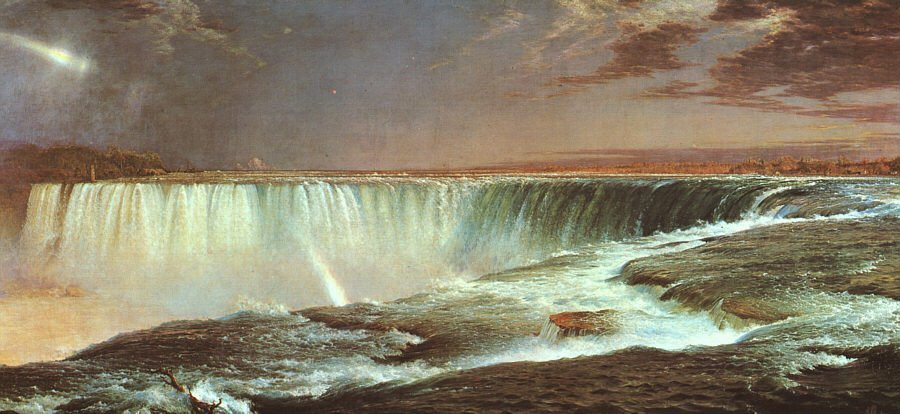
Niagara by Frederic Church (1857)

My Daily Art Display for today returns to a painting by an American artist and another member of the Hudson River School, which was a mid-19th century American art movement personified by a group of landscape painters whose artistic vision was influenced by the 18th century European Romanticism movement.   The paintings for which the group is named depict the Hudson River Valley and the area around the Catskill, Adirondack and the White Mountain ranges.  The artist is Frederic Edwin Church.

Frederic Church was born in Hartford Connecticut in 1826.  His father, Joseph, was a silversmith and watchmaker and through his success and that of his father who had owned a paper mill, the Church household lived a prosperous lifestyle.  Frederic studied art at school and through a family neighbour, Daniel Wadsworth, was fortunate enough to be introduced to Thomas Cole, the founder of the Hudson River School, who agreed to take Frederic on as his pupil.   Church thrived under Cole’s tutelage and within a year, he had some of his paintings shown in the National Academy of Design annual exhibition.  The following year, 1848, Church was elected as the youngest Associate of the National Academy of Design and was promoted to Academician the following year.  That year he sold his first major oil painting to the Hartford’s Wadsworth Atheneum, which had been founded by Wadsworth.

In 1848 he went to live in New York and began to teach art.  In his spare time in spring and autumn he would travel throughout New York and New England, particularly Vermont, all the time sketching the beautiful scenery whilst during the winter months he would return to New York City and his home and convert his numerous sketches into a number of landscape paintings, all of which sold well.   Church and a friend set forth on an adventurous trip through Central America and Ecuador. From this trip, Church’s first finished South American pictures, shown to great acclaim in 1855, transformed his career.   For the next decade he devoted a great part of his attention to those subjects, producing a celebrated series that became the basis of his ensuing international fame.   During a two year period, 1854 to 1856, he travelled extensively visiting Nova Scotia, and journeying throughout Maine, New Hampshire, and Vermont, and it was around this time that he visited the Niagara Falls.   The late 1850’s were the high point of Church’s career, artistic triumph followed artistic triumph.   In 1857 he made another trip to Ecuador and also took a voyage to Newfoundland and Labrador.  In 1860, Church bought some farmland at Hudson, New York, and married Isabel Carnes, whom he had met during the exhibition of his paintings.   He and his wife lead a settled and happy life and he spent most of his time tending to his farm but his happiness was shattered in 1865 when both his young children contracted diphtheria and died.  However, with the birth of Frederic junior in 1866, Church and his wife began a new family that was eventually to number four children.

At the end of 1867, Frederic Church and his family embarked on a long trip to Europe, North Africa, the Near East, and Greece that was to last eighteen months and was to lead to several important paintings. As Church got older he spent more and more time on his farm and farming.  From the 1870’s onwards Church suffered badly from rheumatoid arthritis and it badly affected his right arm which curtailed much of his art work although he did teach himself to paint with his left hand.  Frederic Church died in 1900, aged 74 and is buried in Spring Grove Cemetery in Hartford, Connecticut.

Today’s painting by Frederic Church entitled Niagara is one of four he painted of this waterfall.  This one was painted in 1857 and guaranteed for him, still a young man of thirty-one, the role of America’s most famous painter.   It is probably the most famous painting of it ever made.  During the 19th century, American artists flocked to the Falls to paint the various views of it.  The Falls were looked upon as the nation’s greatest natural wonder.   This picture was painted from the Canadian shore, a short distance above Table Rock, and includes the sweep of the Horseshoe Fall and the edge of Goat Island in a notable depiction of water and light. The time is towards evening.   We can see an amazing amount of detail in every stage of the water’s journey as it cascades downwards.  Look at how Church has incorporated an optical flourish of the rainbow against the falling waters.

The painting was introduced to the American public shortly after its completion, as a one-painting exhibition at the commercial gallery of Williams, Stevens, and Williams in New York City.   People flocked to see the work and were willing to pay 25 cents each to view the monumental canvas, which measured 109cms x 230cms and sometimes they would use opera glasses or other optical aids to augment the experience.   With their 25 cents admission fee the people would also receive a pamphlet that reprinted contemporary critics’ praise of Church’s picture and offered exhibition-goers the opportunity to purchase a print of the work.   Within a fortnight of the exhibition’s opening more than a hundred thousand people had paid to see it.  Art critics lavished praise on the work describing it as “the finest oil picture ever painted on this side of the Atlantic.”    After this success in New York the painting was taken to a number of American cities before it made two tours of Britain and was exhibited at the 1867 Exposition Universelle in Paris where it won a prize

The painting now hangs in the The Corcoran Gallery of Art in Washington DC

Les Charbonniers by Claude Monet

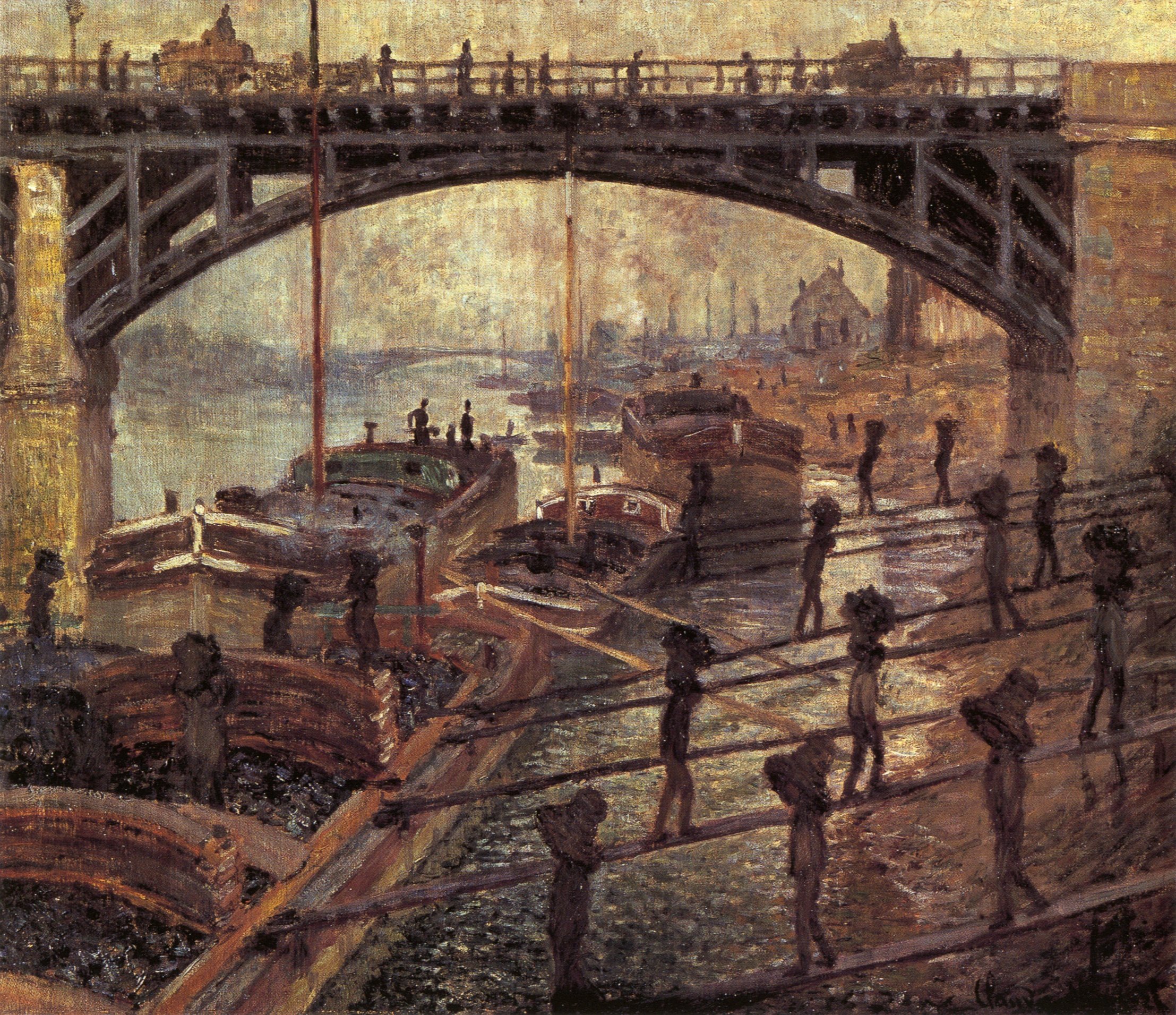
Les Charbonniers by Claude Monet (c.1875)

When I think of Impressionism and Impressionist paintings I think of light airy scenes.  I think of lily ponds and flowering arches at Givenchy.  I think of colourful young things boating on the mirror-like waters of the Seine.  I think of people sitting on the banks of the Seine staring out at blue cloudless skies.  I think of fashionable people promenading along the Grand Jatte in gorgeous sunlight.  I associate Impressionism and the paintings associated with that particular “–ism” as being light, colourful and full of smiling faces on the people as they relax from the rigours of their working lives.

That all changed when I came across the work of the Impressionist, Caillebotte and his Floor Scrapers (see August 3rd).  Today, I am featuring another darker and more sombre painting by one of the greatest Impressionist painters of all time, Claude Monet.  He painted today’s painting in 1875 when he was thirty five years old and living at Argenteuil.  It is entitled Les Charbonniers (The Coalmen) or sometimes referred to as Les déchargeurs de charbon (Men unloading coal).

Before us is a view of the docks at the Quai de Clichy, a little downriver from Paris.  Framed at the top of the painting in the background, we can just make out through the haze, the broad arch of the Pont de Clichy railway bridge, one which Monet would have crossed many times as he took the train from Argenteuil to Paris.   It is also a bridge which he featured in a number of his paintings.  Horses and carts can be seen crossing the nearer bridge, the Pont d’Asnières.  These carts will transport the coal from the quayside to nearby factories, the chimneys of which we can just make out in the distance as they pump out their smoky pollutants.   Also on the bridge we see a few pedestrians gazing down at the unloading operation.

It is a dark and atmospheric picture.  We do not have the brightness of a summer’s day.  It is a dull grey wintery day with a smoke-filled sky.  We see the men struggling with their heavy bags of coal perched on their shoulders as they struggle up the narrow wooden ramps between ship and quay over the murky waters of the Seine, balancing like tightrope walkers on a high wire.  The wooden walkways bend ominously under the strain of man and his load.  We can just imagine the ominous groaning and creaking of the wood as it takes the strain.  Hour upon hour these men will trudge mechanically back and forth until all the coal has been discharged from the boat.  This is a labour intensive operation.  Les charbonniers have an unenviable job with its physical strain on the body coupled with the inhalation of coal dust into their lungs.  In the holds of the vessel itself we see men filling baskets with coal ready for the charbonniers to take them ashore.  These men will probably not live to an old age.  Unfortunately for them, the invention of quayside cranes and cargo escalators had yet to be realised.  This discharge of the coal from the boat would be a long operation, as fully loaded, the coal barge could probably transport about 300 tons of coal, which could take anything up to two weeks to manually unload.

The sailing barge has probably brought its cargo of coal from the mines in Belgium and Northern France along the Canal de Saint-Quentin which connects the rivers Oise, Escaut and Somme.  The canal, a great feat of engineering, was opened by Napoleon Bonaparte in 1810.

The painting by Monet is simply a depiction of urban life and he might not have intended it as a political treatise with regards the conditions suffered by some working class people.  However the artist has given the painting a dark and solemn ambience which emphasizes the plight of some of the lowest paid workers.  This work was one of 29 works Monet presented in the fourth Impressionist exhibition.

Calais Pier by Joseph Mallord William Turner

Calais Pier by Turner (1803)

I am fast approaching my 300th edition of this blog and many of you may think it strange that in all that time I have never featured an artist much loved by many, Joseph Mallord William Turner.  In some ways, of course, it is an omission but I have to be honest and state that Turner is not one of my favourite artists.  Yes, I am aware that statement is artistic anathema and pictorially sacrilegious but everybody’s likes and dislikes are different.  I am a person who loves detail and clarity in a painting and the haziness” of a lot of Turner’s painting is just not for me.  I was at a local gallery the other day and when asked which was my favourite painting on display, I pointed to a mountain scene and the person who asked me to decide commented that it was too much like a photograph for his liking.  There lies my dilemma.  I don’t want a framed photograph on my wall but I do want clarity of detail.  I am happy with an idealised landscape.  I just want to study the intricate details of the artist’s work.

Less about my likes and dislikes and on to today’s offering which is one of Turner’s paintings, which is without the haziness that I dislike.  It is entitled Calais Pier and was completed by Turner in 1803 and is in the safe keeping of the National Gallery in London.  I touched briefly on Turner’s life a few days ago when I featured the artist Thomas Girtin, a friend and contemporary of Turner.  I know many books have been written about Turner’s life but let me briefly go through the life of today’s artist

Turner was born in 1775 in Covent Garden, London.  His father, William Gay Turner was a wig maker and when they became unfashionable he became a barber.  His mother was Mary Mallord Marshall.  His mother and father had married in 1773 and a year after Turner was born his mother gave birth to his sister, Mary Ann.  Sadly and with devastating consequences she died in 1786, at the age of eight.  Her death virtually destroyed her mother who became mentally unstable and eventually in 1799 she was committed to the Bethlem Royal Hospital Mental Hospital (Bedlam) where she died in 1804.

Because of his mother’s mental problems, and the problems arising from her condition, the young Turner left home for about a year and went to live in Brentford with his mother’s brother, Joseph William Mallord Marshal.  Whilst living with his uncle’s family he attended the John White’s School.  It was during the time when he was being brought up by his uncle’s family that Turner started to show an interest in art.    For holidays he would often be taken to Margate and it was around this time, 1786, that eleven year old Turner first signed and dated his drawings of the seaside town and the surrounding areas.    These early drawings of his were often proudly displayed by his father in his shop window.   After early schooling, Turner, aged fourteen, was accepted as a student at the Plaister Academy of the Royal Academy of Art schools in 1789 where he studied for exams which would afford him membership of the Royal Academy itself.  After just one year, when he was fifteen he was accepted into the Royal Academy, which at the time was headed by Sir Joshua Reynolds, the great English painter, and who was on the selection panel of the artistic establishment.  Turner went on to have his first painting, a watercolour entitled The Archbishop’s Palace, Lambeth,  accepted into the Academy’s Summer Exhibition in 1790 and six years later he had his first oil painting entitled Fisherman at Sea  shown at the exhibition.  Turner exhibited some of his work at almost every subsequent Royal Academy Summer Exhibitions for the rest of his life.

After leaving the Royal Academy Schools, Turner embarked on many European journeys, visiting Paris where he studied in the Louvre, visiting Switzerland and Italy where he spent some time in Venice.  He also often travelled around Britain with his friend and fellow artist, Thomas Girtin.  During one of his British journeys when he was twenty-two, he visited Otley, Yorkshire and met and became great friends with Walter Fawkes, a wealthy landowner and Member of Parliament, who was to become one of Turner’s patrons and who commissioned many works from the artist.

Although Turner never married, he did have two children by his mistress Sarah Danby whom he met in 1799.  Sarah, a widow nine years his senior, gave birth to two of his children, Evelina in 1801 and Georgiana in 1811.  Art historians would have us believe that Turner over time became very eccentric and only had a handful of close friends.  However, he was always close to his father and for thirty years his father lived with Turner.  His father died in 1829 and this devastated and depressed the artist.  Not only had his father been supportive of him he would often act as his studio assistant.

In 1833, on one of his journeys back to Margate, Turner met Sophie Caroline Booth who had been recently widowed and lived in the town.  They became lovers and in the 1840’s she bought herself a small cottage in Chelsea and Turner went to live with her.  He was to remain with her until his death at the house of his lover in December 1851.   He was buried in St Paul’s Cathedral and lies next to Sir Joshua Reynolds.

I chose the featured painting today, Calais Pier as I have been associated with the sea and ships almost all my life and I am only too aware of the ferocity of the seas around the British and Channel coasts and so in some way it was a return to my seafaring past when I was in ships and had to watch helplessly when my ship battled against the ferocity of a storm and the mountainous seas which the winds had whipped up.  This painting by Turner is based on his own experience of rough weather during his first ferry crossing to France in 1802 at which time he made many sketches of the crossing from Dover to Calais.  We need to remember that in those days there was no such thing as weather forecasts and so vessels would put to see and were at the mercy of the weather.

We have before us a sombre scene of vessels being wildly buffeted by the gale-force wind and giant waves.  In the centre of the work with the dark sails we see the Dover-Calais ferry crammed full of people.  The English flag flutters wildly at the top of the mast.  Next to it, with the white sail, is a French fishing boat which looks to be perilously close to the English ferry.  The sails and the deck of this vessel are spectacularly lit up by a shaft of sunlight which has managed to penetrate the black storm clouds.  Pulling away from the quay and heading into the rough seas, we see another small boat with its fishermen.  One of its crew can be seen remonstrating wildly towards the other fishing boat, maybe to alert them to the dangers of colliding with the ferry.  It seems a foolhardy act for the men to set sail in the little boat considering the ferocity of the storm or risk being crushed by the waves against the pier itself.  It is almost as if maybe the storm has taken everybody by surprise.  On the pier we see people trying to carry on as normal.  Women wearing local hats and wearing wooden clogs gather the morning catch of what looks like skate and set about gutting the fish.

This is wonderfully dramatic painting and whereas we are use to being able to see and hear the rough seas and the sound of violent storm on television, in the days of Turner it was just the magic of the artist who could bring such things to the attention of people.  Turner has magically given us an insight into the happenings during a storm at sea.  We can almost hear the people shouting to be heard.  We see the wild billowing of the ships’ sails and see and sense the sound of the crashing of the waves against the pier.  We almost feel that we are there on the Calais Pier.

Turner exhibited the painting at the Royal Academy in 1803 but like many of his works it was not well received.  Many thought it was an unfinished work especially the foreground.


The Barque of Dante by Eugène Delacroix

The Barque of Dante by Delacroix (1822)

When I first saw today’s featured painting I was immediately reminded of Géricault’s Raft of Medusa, which was My Daily Art Display on June 10th.  There was something about the look of suffering and desperation on the faces of the men on Géricault’s sinking raft that I could see on the faces of Delacroix’s men in today’s painting.  My Daily Art Display today looks at the painting entitled Dante and Virgil in Hell by Eugène Delacroix.  The painting is also known as The Barque of Dante and was painted by the French artist in 1822.   

The painting is based on Canto VIII of the Inferno, the first part of the 14th century epic poem the Divine Comedy written by the Italian poet Dante Alighieri.  The poem is an allegory recording the journey of Dante through Hell along with his guide, the Roman poet Virgil.  According to the poem Hell is made up of nine concentric circles of suffering located within the Earth.  Each circle representing one sin and is the place where those who have committed that sin and who are unrepentant will end up and receive an appropriate punishment.  The sinners of each circle are punished in a fashion befitting their crimes.  Each sinner is made miserable for all of eternity by the key sin they have committed. The circles represent a gradual increase in wickedness, culminating at the centre of the earth, where Satan is held in bondage.

The painting by Delacroix is based on the fifth circle and is all about the sin of Wrath.  The first circle is nominated as Limbo and the people in there have simply never been baptised into the Church.  The ninth circle is Treachery which is looked upon as the most heinous of sins.  I was amused to note that those unfortunates that had committed the sin of Lust were only allocated  the second circle – maybe for a hot blooded Italian, like Dante Alighieri, lust was hardly a sin at all !!!

The Fifth Circle of Hell is the swamp-like water of the river Styx and in its murky waters, the angry people fight each other on the surface, and the morose and brooding people lie gurgling beneath the water. The character in the poem, Phlegyas, the guardian of the river, reluctantly transports Dante and Virgil across the River Styx in his skiff.  This lower part of Hell where the characters in the painting find themselves is the marshy swamp that lies outside the walls of the city of Dis, the City of the Dead, which houses the lower parts of Hell, and which we see burning in the left background of the painting.

Delacroix and Géricault comparison

At the beginning I said I saw a similarity between Géricault’s Raft of Medusa painting and this painting by Delacroix.  I actually managed to find a picture which also highlights the likeness in the facial expression of a man in each work.  The main picture, on the right, is of the man in the left foreground of today’s painting as he lies in the water and shown in the inset we have the face of the man who is in the centre of the Géricault’s raft looking sky-wards.  Go back to my earlier blog on Géricaults painting and see if you agree.  Some three years after Géricault completed his Raft of Medusa painting in 1819, Delacroix completed what was his first major work and one which he exhibited in the 1822 Salon, the art exhibition of the Académie des Beaux-Arts in Paris.  The oil on canvas painting which measures 189cms x 246cms now hangs in the Louvre.

Dante is given a steadying hand by Virgil as they falteringly stand up in the boat as it ploughs its way through the choppy water of the River Styx, which is heaving with the tormented souls who have been trapped in this fifth circle of hell for their sins of wrath.  The Neo-Classical style which was prevalent at the time can be seen in the way Delacroix has grouped his figures.  The main characters are set in the centre of the painting whilst the subsidiary figures are painted much lower down on a horizontal plane, each holding a classical pose which gives the artist a chance to concentrate on their musculature.  Look how the artist has depicted the gale-force weather condition the boat party have to endure.  See how Delacroix has depicted the blue garment of Phlegyas as he rows his boat.  Although wrapped around his body it flies wildly in the face of the strong wind which roars in from the left of the painting.  The guardian of the river is using every ounce of his strength as we see the muscles of his broad back ripple as he pulls on the oar.  He seems to be sure-footed as he has made this rough crossing many times.  Dante holds his right arm aloft to try and steady himself against the wind’s ferocity, whilst Virgil takes his other hand in an attempt to steady him against the onslaught.   The boat has slewed around and is a little off course as it tries to reach the fiery City of Death.

Look at the characters in the water.  A couple lay back exhausted whilst the others display the anger and hatred which has conspired to send them to this part of Hell.  Look at the piercing demonic eyes of the man that clings to the front of the boat and the staring rage of the man in the water in the right foreground as he seems to be attacking another with his teeth as his adversary grips him by the back of his neck.

The head and demonic face by Delacroix

Look carefully at the man clinging to the gunwale on the far side of the small boat.  See how the muscles and sinews in his arm are almost at breaking point as he tries to heave himself on board.  His reddened eyes are demonic.  It is a frightening depiction of a face and Delacroix admitted that it was his best depiction of a head in the painting.

I am interested to look at the contrast in expressions between our two main characters, Dante and Virgil.  Whereas Dante has a look of horror and fear on his face, Virgil’s facial expression is one of calm and tranquillity as if he is completely detached from what is going on around him. There is also a stark contrast of colours used by Delacroix.  Dante’s red cowl and the fiery inferno of Hell in the background is in sharp contrast to the blue of Phlegyas’ flowing blue robe.

There is such raw emotion in this painting.  We are looking at a world of insanity.  We see before us the rage of angry men who have yet to come to terms with their fate.  We almost wrap our arms around ourselves to protect us from the storm we view and this fifth circle – the circle of Wrath.  Delacroix had worked non-stop for very long hours for nearly three months to have this painting ready for the April opening of The Salon in 1822 and by the time he had completed this work he was totally exhausted.  The work was exhibited with the title:

“…Dante et Virgile conduits par Phlégias, traversent le lac qui entoure les murailles de la ville infernale de Dité…”

Which translated was:

“Dante and Virgil led by Phlegyas, across the lake surrounding the infernal city walls of Dis”

But later came to be known as its present title The Barque of Dante.  The painting received mainly favourable reviews and a few months later it was bought by the French State for 2000 Francs and it was housed in the Musée du Luxembourg but in 1874 transferred to its present location, The Louvre.

The Health of the Bride by Stanhope Alexander Forbes

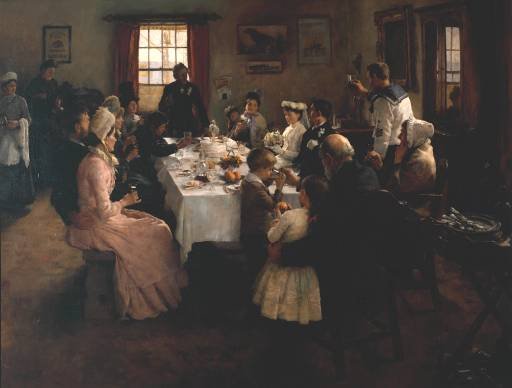
The Health of the Bride by Stanhope Alexander Forbes (1889)

My Daily Art Display today features Stanhope Alexander Forbes, an artist of the Newlyn School.  The term “Newlyn School” refers to the artist colony located in and around the fishing village of Newlyn, in Cornwall, from the 1880s until the early 20th century, which specialized in landscape painting.  Like the Continental artist colonies of the Barbizon School near Paris, and Pont-Aven in Brittany, artists gathered in Newlyn to paint landscape scenes in a purer setting, with strong natural light. Newlyn’s plein air painting followed the Impressionist doctrine of naturalism, which is a true-to-life style which involves the representation or depiction of nature with the least possible distortion or interpretation.  The artists of the Newlyn School would work directly in nature, using subject matter drawn from rural working life, especially that of the fishermen.  Newlyn provided the perfect setting for artists with the long hours of strong natural light, a climate which was much milder than the rest of the country and the seaside town was surrounded by coastal and inland areas of natural beauty.  For the impoverished artist, Newlyn was, in those days, a cheap place to live and following new rail connections between Cornwall and London it proved very accessible.

Forbes was born in Dublin in 1857.  His father worked as a railway manager and his mother, Juliette, was French.  His uncle, James Staats Forbes, was a noted art collector who also worked for the railways.  The family often used to make trips to France and it was whilst on vacation there that young Stanhope developed an interest in art.   The family moved from Ireland to London when his father was transferred and it was at this time that Stanhope attended Dulwich College and later became a student at the Royal Academy Schools where he staged his first exhibition in 1878.  Two years later he and his friend and fellow artist he had met at Dulwich College, Henry La Thangue, went to Paris where they studied art under the French painter, Léon Bonnat.  In 1881, having become familiar with the plein air paintings of the French naturalist painter Jules Bastien-Lepage, he decided to travel to Brittany, staying at Cancale where he painted A Street in Brittany.  This painting met with great acclaim when it was exhibited at the Royal Academy in 1882 and  the Walker Art Gallery, Liverpool, purchased it that same year.  Forbes was greatly encouraged and he described the success of the painting as a turning point in his career.  He once again returned to Brittany in 1883 staying this time at Quimperlé.   He visited Pont-Aven in October and met many fellow artists there.

In 1884 he arrived in Newlyn and soon became a leading figure in the growing colony of artists.   His national reputation was established with the acceptance of his A Fish Sale on a Cornish Beach which he painted in 1885 and exhibited at the Royal Academy in London.  In 1889 he painted The Health of the Bride which is today’s featured work.  It was with the money he received from the sale of this painting to Henry Tate, the wealthy English sugar merchant and philanthropist that enabled him to marry Elizabeth Adela Armstrong, a fellow artist who had moved to Newlyn in 1885.   Canadian-born, she was one of the leading women artists of her day.  In 1886 Forbes became a founding member of the New English Art Club

Ten years later in 1899, as the number of artists in Newlyn dwindled, Stanhope and his wife Elizabeth founded their own Newlyn School of Painting.  Her marriage to Stanhope Forbes was a partnership of equals, and their School of Painting was very much a joint enterprise.  In 1910 he was elected to the Royal Academy.   His wife Elizabeth died of cancer in 1912 and three years later in 1915 Stanhope Forbes remarried, this time to Maudie Palmer, a former pupil of the school and close friend of the family.  Sadly, in August 1916, his son Alec died, killed fighting in the front line in France.

Stanhope Forbes died in Newlyn in 1947, a few months short of his 90th birthday.   In 2000, some fifty years after he died, his painting The Seine Boat which he completed in 1904, sold for £1.2 million and was a world record price for one of his works.

Today’s painting entitled The Health of the Bride was completed by Forbes in 1889, the year of his own marriage.  According to Cook, Hardie & Payne’s book on Forbes, entitled Singing from the Walls, Life & Works of EA Forbes, Forbes wrote about his painting to Sir Henry Tate the purchaser of the work.  In the letter he wrote:

“…I myself will be rather occupied down here – no less a matter than my own wedding.   It was inevitable after painting this picture…”

As to why Forbes should prefer such an indoor subject we need to go to Caroline Fox’s book Stanhope Forbes and the Newlyn School in which she quotes the comments of the artist about the reason behind the painting:

“…Standing in one of these inn parlours I had first thought of a painting of an anglers’ meeting – you will notice one or two cases of fish on the wall – but it occurred to me that a wedding party could be much more picturesquely grouped, even though one had to paint them in the smarter, more conventional Sunday clothes…”

In his painting we have members of different generations of a family seated around a table in an inn for a wedding breakfast.  Standing up, to the right, is a sailor, toasting the bride who avoids his gaze and the gazes of the other celebrants.  She just shyly looks down at her bouquet.  The painting is lit from different angles.  Although this is not an open air scene which was the norm for the Newlyn School of Painters, Forbes has stuck closely to their modus operandi.  The sitters are locals and not professional models and the setting for the scene is a recognisable place – in this case the local inn at Newlyn.   The local fishing industry which played a big part in Newlyn life is not forgotten as in the picture, on the rear wall of the inn, we can see a painting of a ship and if we look through the window of the pub we can just make out the mast and rigging of a ship.

The painting was bought by Sir Henry Tate for £600 and it became part of a collection which the philanthropist gave to the nation when the Tate Gallery was founded in 1897.  The painting was well received and was highly praised when exhibited at the 1899 Royal Academy.  It now hangs in the Tate Britain in London.

Charles Beale by Mary Beale

Charles Beale by Mary Beale (c.1675)

For My Daily Art Display today, I am staying with an English artist but instead of a landscape painter and a man as was the case yesterday I am focusing on a lady artist, one of the most important portrait painters of 17th century England and who has been described as the first professional female English painter.  Her name is Mary Beale and the subject of today’s portrait painting is her husband Charles.

Mary Beale was born in 1633, in Barrow in the county of Suffolk.    Her father was the Reverend John Craddock, who was the local puritan rector.  He was an amateur painter and was acquainted with all the local artists, one of whom was Peter Lely, a portrait painter.  Although Mary Beale was never a pupil of Peter Lely there is no doubt that throughout her life she was influenced by his artistic style.  Her mother was Dorothy Brunton who sadly died when Mary was just ten years of age.

In 1652, at the age of eighteen, she married Charles Beale, a cloth merchant and amateur artist and she went to live with him in Covent Garden, London. The Beales had two sons who survived past childhood, Bartholomew and Charles.  Her husband, Charles became deputy clerk of the patents office in about 1660, by which time Mary had begun to study portraiture.   In 1664, the Beales moved away from London.  Charles had lost his job at the patents office and so they had a loss of income and they decided life would be cheaper in the country, so they moved to a farmhouse in Allbrook in Hampshire.  A second reason for the move was for their own safety as that year saw the onset of the Great Plague in London which was to kill a fifth of the population of London.

In 1670, Mary and her family, returned to London and she set up a studio in Pall Mall.  Here she painted many portraits of the aristocracy and local gentry.  Her husband, not only acted as her assistant, but looked after the business side of her artistic venture and her son Charles trained as an artist in his mother’s studio.  Her work was very popular and she received many commissions.   In her husband’s diary he recorded that in the 1670’s his wife received no fewer than 140 commissions for portraits.   Having returned to London she became reacquainted with Peter Lely who had been made the Court Artist to Charles II and many of Mary’s commissions were to paint copies of Lely’s works.

Mary Beale died in 1699, and was buried at St James’s, Piccadilly. Her husband died in 1705.  The Beales’ first child Bartholomew died when he was young.  Her second son also called Bartholomew studied portraiture but eventually gave up any thoughts of being a full time artist and took up medicine.  Her third son Charles jnr. became a painter specialising in miniatures.

The painting today, simply entitled Charles Beale, is a portrait of her husband.  She has portrayed him as a poet and clothed him accordingly in a style of unkempt abandon.  His disheveled state was that of the preserve of poetic and melancholic genius.  I love the informality of this painting with the sitter’s relaxed pose dressed in a brown gown underneath which we can see an open-necked chemise.  This portrait is in direct contrast to the portraiture norm when the sitter is expected to be shown in a strong courtly pose. This is a portrait that exudes casualness and familiarity which of course one expects of a husband’s portrait carried out by his loving wife.   This portrait has done away with the use of background drapery or Arcadian imagery which was so popular at the time and would no doubt have been included if this had been a commissioned work.  It is an engaging and intimate portrait.  The couple were very much in love and in his notebooks he always referred to his wife as his “Dearest and most Indefatigable Heart”.  There was great equality in their relationship and the fact that after losing his job he “worked” for his wife, which was acting against all contemporary notions of married life. Religious, social and medical teaching stressed the secondary role to be played by women, whose place was determined forever by Eve’s original Sin.   But Charles had no qualms about his position of apparent subservience.  Mary was a firm believer of equality between a husband and his wife and between man and woman outside of marriage.  She even put down her thoughts on the subject in 1660 when she wrote Essay on Friendship.  In Tabitha Barber’s book Mary Beale she quotes Mary’s thoughts on the subject of friendship and equality between husband and wife, writing:

“…This being the perfection of friendship that it supposes its professors equally, laying aside all distance, & so levelling the ground, that neither hath therein the advantage of other…”’

Regarding the relationship in marriage between husband and wife, Mary wrote:

“…In marriage, God had created Eve as ‘a wife and Friend but not a slave…”

Mary Beale painted numerous portraits of her husband Charles which is testament to the deep affection between them.

This painting presently hangs in a private collection.

Morpeth Bridge by Thomas Girtin

Morpeth Bridge by Thomas Girtin (1802)

I am returning today to an English Victorian artist whom I showcased back on June 25th.  The featured artist in My Daily Art Display today is one of the greatest watercolour painters of his time, Thomas Girtin, and the painting I am featuring today is a work he completed in 1802 entitled Morpeth Bridge.

Thomas Girtin was born in Southwark, London in 1775.  His father was a prosperous brush-maker but died when Thomas was still very young.  His mother remarried and her husband, a Mr Vaughn, was a pattern-draughtsman.   Girtin’s artistic training started when he was only eight years of age.  He took drawing lessons from Thomas Malton, a painter of topographical and architectural views.  Another of Malton’s pupils at the time was J M W Turner. It was around this time that he signed up to a seven year apprenticeship with Edward Daves, a watercolourist and mezzotint engraver.   In 1794 and 1795 Girtin and his friend Turner were put to work copying Dr Thomas Munro’s collection of J R Cozen’s drawings and colouring prints with watercolours and slowly but surely both young men learnt their trade.

When Girtin was nineteen years of age he exhibited his first work at the Royal Academy and soon his reputation as a watercolourist grew.  His style of watercolour painting was such that he has been recognised as being the originator of Romantic watercolour painting.  With fame came commissions and patronage and Girtin acquired two very wealthy patrons, Lady Sutherland and Sir George Beaumont, who played a crucial part in the creation of London’s National Gallery by making the first bequest of paintings to that institution.

In 1800, Girtin married Mary Ann Borrett, the sixteen year old daughter of a well-to-do City goldsmith, and set up home in St George’s Row, Hyde Park.  By 1801, his fame as an artist had spread and he was a prized houseguest at his patrons’ country houses.  His work was in such demand that he could charge 20 guineas for a painting.   In late 1801 to early 1802, he went to live in Paris. It was during his sojourn in Paris that he painted watercolours and made a series the pencil sketches which he engraved on his return to London. They were published as Twenty Views in Paris and its Environs after his death. In the spring and summer of 1802, Girtin produced what many believe was his greatest work, a 360 degree panorama of London, entitled the “Eidometropolis”.  It was 18 feet high and 108 feet in circumference.  It was hailed as his greatest masterpiece.

Sadly, his health was deteriorating and that November, Girtin died in his painting room; the cause was variously reported as asthma or “ossification of the heart.”  Girtin’s early death reportedly caused his friend Turner to remark, “Had Tom Girtin lived I should have starved”

Today’s painting, Morpeth Bridge was completed around 1802, the year of Girtin’s death.  He had travelled around Northumberland two years earlier and made a number of sketches of the countryside and towns.  In the painting, we see the bridge silhouetted against a starkly lit building.  Despite the gold and light brown hues of the buildings, there are dramatic contrasts of light and shade and the sky above is dark and threatening and there is an ominous, almost sinister, mood about the setting.  The great clouds which pass overhead dramatically darken some of the buildings and water.  There is just a hint of a break in the clouds where we catch a glimpse of blue sky which is reflected in the mirror-like surface of the still water and the arc of the bridge.   Girtin was able to convey drama and tension in his paintings by his clever depiction of light.

The painting hangs in the Laing Gallery in Newcastle upon Tyne.

Granida and Daifilo by Gerard van Honthorst

Granida and Daifilo by Gerard van Honthorst (1625)

As I research paintings and artists for my blog, I delve into various books which I have and of course use the internet.  One of the best art history magazines about is The Burlington Magazine which is published monthly.  However although I have, in a rush of blood to the head, almost signed up for it, the cost of a few pence under £20 per issue I feel  is just too much.  However the other day I bought the Centenary Anthology of the magazine from eBay and although I have just skimmed through some of the 250+ pages I am pleased with my purchase.  It was as I flicked through the pages I came across a beautiful work by Gerard van Honthorst and I thought it was time to feature this Dutch painter and one of his works.

Gerard or Gerrit van Honthorst was born in Utrecht in 1592.  His father was a textile painter and his younger brother Willem also went on to become an artist.  His first taste of art came when he was apprenticed to the great Dutch painter Abraham Bloemaert.  Bloemaert, who resided in Utrecht, was an outstanding teacher and virtually all the aspiring young Utrecht painters of that time, who went on to become famous, had at one time studied under this artistic master.

In his early twenties, Honthorst travelled to Italy and during his stay in Rome where he lived in the palace of a patron of Caravaggio, Vincenzo Giustiniani, he was influenced by the works and style of the famous artist who was at the height of his popularity.  Whilst in Italy, Honthorst developed a similar artistic style to Caravaggio in the way he often portrayed his figures in the darkness of night lit by candlelight and this style acquired him the Italian nickname Gherardo delle Notti (Gerard of the Night).   His paintings were very popular and he managed to acquire a number of wealthy patrons including the powerful Scipione Borghese the Italian Renaissance cardinal who was a great patron of the arts and an avid art collector.  He was also patron to Caravaggio.  Another of his patrons was Marchese Vincenzo Giustiniani an aristocratic Italian banker and art collector

Honthorst returned to Utrecht around 1620 and that same year married Sophia Coopmans.  Along with his fellow artist, Hendrick ter Brugghen, they set up an art school in Utrecht.  Due to the influence of Caravaggio  on the works of the two Dutch painters and the way their paintings showed strong and bold contrasts between light and dark known as chiaroscuro,  they were looked upon as representing Utrecht Caravaggism.

In 1622 van Honthorst joined the Guild of St Luke in Utrecht and three years later was made president of the society.   Van Honthorst fame as a painter spread and he was much sort after as a teacher so much so that in 1627 he moved to a much larger house and turned part of it into his workshop.  The following year, following his rising artistic reputation reaching the English court, he was invited to work at the court of King Charles I.  He remained in England until the end of 1628 at which time he returned to Utrecht.

In 1637 Van Honthorst moved to The Hague when he became the court painter to the Princess of Orange and received a number of commissions for portraits from the Dutch ruler Frederick Hendrick, Prince of Orange and his family and during this period he also worked on the decoration of the royal residences.  His fame spread and he received many royal commissions from the likes of the French Queen Maria de Medici, mother of King Louis XIII, King Christian IV of Denmark and Elizabeth of Bohemia, Charles I of England’s sister.

With success came great wealth and he was fortunate enough to live a luxurious lifestyle.  Gerard van Honthorst died in Utrecht in 1656, aged 64.

The featured painting in today’s My Daily Art Display is entitled Granida and Daifilo which Gerard van Honthorst completed in 1625 and was commissioned by  Stadholder Frederick Hendrick  for his residence at Honselaerdijk and was to form part of a number of paintings of pastoral scenes.

The title of the painting refers to the characters in a pastoral play written by Pieter Hooft, the Dutch historian, poet and playwright entitled Granida.  The story of the play was that Granida and Daifilo were lovers.   Granida, the daughter of an eastern king, was betrothed to Prince Tisiphernes but one day became lost while out hunting.  She came upon a shepherd Daifilo and his mistress Dorilea who had just quarrelled.  Daifilo fetched water for the princess to drink and fell in love with her. He followed her to court and, after several twists and turns in the story, they fled to the woods together to live a pastoral life. However, Daifilo was taken prisoner by one of Granida’s several suitors. The play had a happy ending and the couple were finally reunited after the intervention of Tisiphernes who took pity on the young pair and gave up his claim to her.

The colours of this painting are bright and the details of the two protagonists in this amorous scene set in this idealised woodland setting give it a touch of classicism.  Nevertheless, there is a touch of realism, which was associated with the Caravaggists as we see the dirty soles of Daifilo’s feet.  In the background to the right we see the soldiers approaching the lovers with the intent to arrest them.

The play set a fashion for pastoral idyll in the Netherlands where Granida and Daifilo became iconic symbols of love. The play was noted for the delicacy of its poetry and the simplicity of its moral.  The moral to this tale was that individuals and nations can be at peace only when rulers and subjects alike shun ambition and seek only to serve. Though not well known today, it was a very popular work in early 17th century Netherlands, and Granida and Daifilo were the subject of many important paintings by Dutch masters.

The painting can be found in the Centraal Museum, Utrecht

Funeral at Bettws Church by David Cox

Funeral at Bettws Church by David Cox (1852)

We are now at the height of the summer holiday season and work at my Bed & Breakfast place is becoming more hectic and I am finding that I have less free time on my hands to devote to the blog.  I sometimes wonder whether my blog should have been entitled My Every Other Day Art Display!   Having said that I spent yesterday afternoon walking around Betwys y Coed, a small town in a very scenic area of North Wales, and it was during this walk that I came across a very old, 14th century church.  What was even more fascinating was its connection with an English mid-nineteenth century artist and a series of his painting.  The artist in question is David Cox and the oil painting, which he completed in 1852,  is entitled Funeral at Bettws Church.

David Cox was born in Birmingham in 1783.  His father was a simple blacksmith and the family lived in a poor area of the city and were, as we would euphemistically put it these days, “financially challenged”.  His first art tuition came from Joseph Barber, the English landscape painter, who as Birmingham’s first drawing master had set up an academy in the city to train aspiring artists.   Cox  eked out a small wage by working as a theatre scenery painter.  At the age of twenty-one, Cox went to live in London and continued his artistic training, this time under the tutelage of the English watercolourist, John Varley.  He made some visits to North Wales and started a job as a commercial artist; producing illustrations to accompany travel writer Thomas Roscoe’s two volumes of Wanderings and Excursions in Wales.

To survive financially, David Cox also took odd jobs in the art world’s Grub Street, as a scene painter, by selling views of London and the River Thames to booksellers at two guineas the dozen.  Grub Street was famous for its concentration of impoverished writers, artists and aspiring poets.   Its bohemian society was set amidst the impoverished neighborhood’s low-rent flophouses, brothels, and coffeehouses.   Cox also enhanced his income by teaching art, spending some time as a teacher at a boarding school for young ladies.  He even published a book on art.

He later moved south of the Thames and settled into life at Dulwich where he taught a number of art students.  Cox exhibited at the Royal Academy for the first time in 1805.  Four years after moving to London he married Mary Ragg who was the daughter of his landlady.  A year later in 1809, the couple had their first child, a son, David Jnr.  In 1814 to escape city life he and his family moved to rural Herefordshire and took up residence in the county town of Hereford where he taught at a girl’s school.  In the late 1820’s he travelled extensively through Western Europe and in 1827 the family moved back to London.  David Cox was now in his forties and had, by now, built up a reputation as a fine landscape painter and the sale of his works was increasing.

In 1841, Cox gave up teaching and moved back to his birthplace, Birmingham, this time to the small town of Harborne, a few miles south of the city.  It was throughout the 1840’ and 1850’s that David Cox would make annual pilgrimages to North Wales where he enjoyed the beautiful rugged scenery and revelled in the many opportunities the area gave him for his landscape subjects.  He fell in love with the Vale of Clwyd and the village of Betws-y-Coed in Conwy and his paintings of this area inspired the 19th Century Birmingham School of artists to follow in his footsteps.  Soon artists from around the country descended on this small Welsh village.   Many believe it was during this period that he completed some of his finest watercolours.  Suprisingly enough it was until the mid 1850’s that Cox started painting in oils.  David Cox died in Harborne in 1858, aged 75.

The sheer range of David Cox’s work is amazing and many considered him to be an equal to some of his more famous contemporaries such as Turner, Constable and Richard Bonnington.  Cox was noted for his skill in encapsulating in his paintings the unpredictable British weather, which was no more apparent than in North Wales.  He is probably best known for his many works associated with the small town of Betws y Coed which nestles at the edge of the Snowdonia National park and sits alongside the River Conwy.

With artists like Cox and their portrayal of the beautiful landscape around Betws y Coed, the village  began to draw in artists from many parts and it became both an artist’s colony and a favourite tourist spot.  Many of the artists flocked to Betws-y-Coed to learn more from David Cox, who made his home at the Royal Oak Hotel each summer.  He actually painted the original pub sign.   The surrounding area offered not only the remarkable scenery but it offered an insight into Welsh history as it was supposedly near the site of the massacre of the bards by King Edward I.

In the painting before us we see a group of mourners attending a funeral, standing outside the gates of St Michaels Church, Betwys y Coed.  The original church would have been built in the latter part of the Celtic Church era around the eighth and ninth century.  Nothing visible remains of that earliest ‘Bettws’ church which derives its name, Bettwys, meaning ‘Bede House’, as in rosary beads and thus meaning a “house of prayer”.   The whole church seems to have been rebuilt during the 14th–15th century This is still the oldest building in Betws y Coed today with parts surviving from the 14th or 15th century.  It was mostly rebuilt and enlarged, with the addition of a vestry and north transept in 1843.     However, even after enlargement, it still could not cope with the rising numbers of worshippers and it became redundant as a village church with the building of St Mary’s Church in 1873.   Although the church is now officially closed for regular public worship, a service is normally held on St Michael’s Day (29th September) and a candle-lit Carol Service at Christmas tide.  The Church houses an excellent quality 14th century stone effigy of Gruffydd ap Dafydd Goch – a close relative of the last Welsh Prince of Wales – Llewellyn ab Gruffydd.   A rustic oak pulpit has the date 1697 upon it, but some say that date is graffiti, and that the pulpit dates to an earlier period. The Church font is dated from the 13th century, although the pillar is from a later date.  In the churchyard there are many 18th century gravestones, some leaning against the church walls, and there are still even 17th century grave stones to be seen.

Many of the visitors to Betws-y-Coed in Victorian times were artists, and they were drawn to St Michael’s Church, which stands besides the river Conwy and was frequently the subject of paintings done by artists from the new artists’ colony,  which thrived in the second half of the nineteenth century.  Today’s featured oil painting by David Cox entitled Funeral at Bettws Church, which he painted in 1852, is a prime example. The painting is housed in the Bury Art Gallery.  In it we see the small church of St Michael in the background framed by two massive yew trees.  It is said to depict the funeral of the daughter of the landlord of the Royal Oak, where Cox used to stay.  The death of this young girl would have affected the whole village. The sunset setting of this painting makes it very atmospheric. Cox was not known for his symbolism but this is very symbolic, with the setting of the sun and little children gathering poppies – symbolic of death.

Welsh Funeral by David Cox

David Cox painted a number of similar paintings, one, a watercolour,  entitled The Welsh Funeral  (1848), which  is at Birmingham Art Gallery and there is the initial preparatory chalk sketch of the funeral painting at the Ashmolean Museum at Oxford.

The massive yew trees

One noticeable change to the vista now is the fact that the yew trees have grown and spread even more and when you stand at the gated entrance to the church and graveyard, it is now almost impossible to see the church between the two enormous trees.

Present day church

So my walking trip yesterday did have artistic connotations but is also the reason for no blog.  My thanks go to Anne Hammond who introduced me to this beautiful little church and its connection with today’s featured artist and who led our small party of intrepid walkers on this voyage of discovery.

Mademoiselle Lange as Danaë and Mademoiselle Lange as Venus by Anne-Louis Girodet

Mademoiselle Lange as Danaë by Anne-Louis Girodet (1798)

My Daily Art Display today has the slight whiff of scandal about it, or to be more precise, about the sitter for the painting.  It is a tale of two paintings, a disgruntled sitter and a furious artist.   The title of today’s featured works are Mademoiselle Lange as Danaë and Mademoiselle Lange as Venus and the artist who painted both these rather erotic works in 1799 was the French painter and illustrator, Anne-Louis Girodet de Roucy-Trisson but more commonly known as Anne-Louis Girodet.  Here was an artist whose works straddled the rationalism of Neoclassicism and the flights of fantasy associated with Romanticism.

Girodet was born in Montargis, a small town some 100 kilometres south of Paris in 1767.   He had an unhappy start to life with both his parents dying when he was young and he then came under the guardianship of Doctor Trioson who took care of his well-being and education.  Later Girodet would add the surname of his guardian to his own in recognition to everything the doctor had done for him when he was young.  There is a train of thought that the good doctor was actually Girodet’s natural father.   Initially Girodet studied to become an architect and had a desire to follow a military career but finally he decided that the life of an artist was for him.

He studied with Jacques-Louis David and in 1789 was awarded the Prix de Rome by the Royale de Peinture et de Sculpture and with that came the scholarship to travel to Italy and stay at the Academy of France in Rome.  Girodet remained in Rome for five years.

He returned to Paris in 1793 and concentrated on portraiture and was well known for his glorifying portraits of Napoleon Bonaparte.  One of his best known and most controversial portraits is one of the painting I am featuring today.  He also spent a lot of time doing illustrations for books.  In 1815 his erstwhile guardian Doctor Trioson died and Girodet inherited a fortune and for the rest of his life he spent little time painting and concentrated on writing poetry.  Girodet died in Paris in 1824, aged 57.

So that was a little bit about the artist and now to delve into the much more colourful life of the sitter of this painting, Anne Françoise Elisabeth Lange.  She was born in Genoa in 1772.  Her mother and father were both musicians who with their company of players, travelled throughout Europe performing in musical shows.  The young Anne Françoise soon became a young child performer.  At the age of sixteen she made her first performance at the famous Comédie-Francais as a pensionnaire, and five years later she was promoted to the position of a sociétaire.  It is an interesting theatrical hierarchy.  A pensionnaire is promoted to a societaire by a decree of the Ministry of Culture, from names put forward by the general administrator of the Comédie-Française.  Once one has achieved the rank of a sociétaire, an actor automatically becomes a member of the Société des Comédiens-Français and receives a share of the profits plus they also receive a number of shares in the Société to which he or she is contractually linked.

Triumph followed triumph in her rolls and soon she became a notable performer in Paris.  The turning point came in 1793 when she appeared in a play which had Royalist connotations and as Paris was in the clutch of the Revolution anything alluding to royalty or the monarchy was taboo and the theatre was shut down and the play’s author and the actors were arrested.  She spent two periods incarceration and narrowly escaped the guillotine thanks to having friends in “high places”.

Elisabeth Lange bore a daughter, Anne-Elisabeth Palmayre  to her wealthy lover, Hoppé, a wealthy banker from Hamburg and two years later bore a son to another lover, Michel-Jean Simons, a Belgian supplier to the French army, whom she later married, after which her acting career virtually came to an end.  Disaster struck Simms’ business and he was ruined almost leaving the family destitute.  Michel-Jean Simons died at the family’s Swiss home in 1810 and his wife Elisabeth Lange died six years later in Florence.

Mademoiselle Lange as Venus by Anne-Louis Girodet (1798)

Miss Lange was both very talented and extremely beautiful.  She had approached the artist, Girodet, to paint her portrait.  He duly obliged and depicted her as Venus, in which she held the pose seen in depictions of the Birth of Venus but in this painting it is Cupid who holds the mirror up to Venus for her to study her reflection.  He exhibited the painting at the 1798 Salon exhibition but the sitter was horrified by her depiction and demanded that Girodet should remove it from the exhibition and from public view.  Furthermore she refused to pay Girodet the agreed amount for the painting.  The artist was furious and in an act of revenge took the painting out of the exhibition, removed it from its frame and ripped it up.  He then sent the pieces to Mademoiselle Lange.  However his revenge was not complete as he decided to paint another portrait of Elisabeth Lange but this time showing her in a very unfavourable light.  He rushed off a satirical painting of Mademoiselle Lange as Danaë  in just a few days.   Eighteenth-century artists sometimes portrayed people as mythological characters to highlight their virtues but this time Girodet wanted to highlight Mademoiselle Lange’s vices.   Danaë was one of the mortals loved by the Greek god Zeus, who transformed himself into a shower of gold and fell upon her. Girodet shows Miss Lange as a prostitute greedily catching and gathering the gold coins in a sheet.   In the painting Girodet has featured a turkey with peacock feathers wearing a wedding ring, symbolizing her final lover and husband Michel-Jean Simons whom she married for his fortune, and to the bottom right we have a bizarre mask with the features of another of her lovers, Lord Lieuthraud, with a gold piece stuck in one of its eye sockets.  Look at the mirror she holds.  It is cracked and this symbolises her inability to see herself as she is, or how Girodet saw her – vain, adulterous and avaricious.

This painting is now at the Minneapolis Institute of Arts.