Maria Bicknell, Mrs John Constable by John Constable

Maria Bicknall by John Constable (1816)

In My Daily Art Display blog yesterday I looked at the early life of John Constable,  up to the point in his life when at twenty-three years of age he was still hell-bent to become an artist.     Today I am going to conclude the story of his life and look at another of his paintings.  

In 1799,  Constable had finally convinced his father to let him pursue art and he enrols in the Royal Academy School as a probationer.  Although he finds inspiration in paintings by Peter Paul Rubens, Thomas Gainsborough, Claude Lorrain and Annibale Carracci, he becomes very homesick and yearns for the beautiful countryside of his Sussex home.  He is also becoming very disheartened with the way the Royal Academy, at that time, disdainfully viewed landscape art.  Landscape art was his passion but unfortunately for him, it was not held in high regard by the Academy, who only valued history painting and portraiture.  Whilst he attended the Academy he met Turner but the two never forged a friendship.

In 1802 Constable exhibited his first painting at the Royal Academy.  His landscape works were unfortunately not the traditional heavenly landscapes which depicted biblical or mythological stories, which were in vogue at the time, and so were not popular with the buying public.  His depictions of the countryside were far more realistic than those of the very popular Gainsborough and Claude.  If anything, his style was more akin to that of the Dutch landscape painters, such as Jacob van Ruysdael.   Constable fervently believed that landscape art was to be a true study and reflection of nature and that idealized landscapes, which had been painted from the artist’s own imagination were, in some ways, dishonest.  He left the Royal Academy in 1802 and was offered the position of drawing master at Great Marlow Military College, but he turned down the offer, which horrified the then master of the Royal Academy, Benjamin West, who told Constable in no uncertain terms that his refusal would probably mean the end of his artistic career.  However Constable was not deterred and chose to stay on his chosen course – that of a landscape artist.  Constable returned to East Bergholt.

In 1800, when he was aged twenty-four and whilst he was at home in East Bergholt, he had become friendly with a young girl who was some twelve years younger than him.  Her name was Maria Bicknell.  Now almost ten years later in 1809, John is aged thirty-three and Maria is twenty-one years of age and their relationship changed.  Slowly but surely, this one-time childhood friendship developed into a much more serious relationship and the two fell deeply in love.  Seven years later, in 1816,  the couple decided to get engaged but this was strongly opposed by Maria’s parents and her grandfather, Dr. Rhudde who was the rector of East Bergholt.  Both Maria’s father, Charles Bicknell, who held the prominent position as solicitor to the Admiralty, and her grandfather did not want her to be married to a penniless artist and they also believed that Constable and his family were socially inferior to them and not fit in-laws.  To force home their disquiet about such a proposed liaison they told Maria that she would be disinherited if she married Constable.  Constable’s parents Golding and Ann Constable, while somewhat sympathetic to the desires of their son, could also see no future in the proposed marriage as they would not in the position to financially support the couple and even Maria herself pointed out to Constable that if he was to succeed as an artist he did not want the distraction of a wife and the financial implications of such a match.  For the next seven years the couple were often parted and sometimes forbidden even to write to one another, but throughout their long, frustrating courtship they remained loyal to each other

The situation changed in 1816 when both Golding and Ann Constable died and Constable inherits a fifth of the family business.   Now with some money behind him and the fact that their daughter Maria is twenty-eight years old, her parents reluctantly agree to let her marry Constable.  John and Maria marry in that October at St Martin-in-the Fields, London and the two of them tour the south coast of England on honeymoon. 

Constable struggled to sell his paintings and it was not until 1819 that Constable made his first big sale, which was for his painting entitled The White Horse.  This sale spurred him on and it led to what are known as his “six footers”, a series of six large scale paintings, which included The Hay Wain and Stratford Lock.  The Hay Wain was exhibited at the Royal Academy in 1821 and was seen by the great French Romantic artist Théodore Géricault who on his return to Paris spread the word about Constable and his painting.   Three years later, the painting is bought by the art dealer John Arrowsmith and it is exhibited at the Paris Salon of 1824 where it wins a gold medal.

Four years on and it is 1828 and that January Maria gives birth to their seventh child.  Sadly that same year she falls ill and after a prolonged illness dies that November of tuberculosis, at the young age of forty-one.  Constable is devastated by his loss and in a letter to his elder brother Golding he wrote:

“….hourly do I feel the loss of my departed Angel—God only knows how my children will be brought up…the face of the World is totally changed to me…”

In his book, Memoirs of the Life of John Constable, Charles Leslie wrote that after the death of his wife, Constable was always dressed in black and was “a prey to melancholy and anxious thoughts”.  Constable had to, from then on, look after his seven children singlehandedly.    

The financial situation of his having to bring up all his children should not have been too burdensome as shortly before her death, Maria’s father had died, leaving her £20,000.  However Constable, instead of safeguarding this new wealth, speculated disastrously with this money.  A large proportion of the money was invested in the engraving of his landscape works which he believed would easily pay for themselves but he was sadly mistaken and the money raised did not cover the expenditure.

At the age of  fifty-two he was elected to the Royal Academy and two years later in 1831 was appointed Visitor at the Royal Academy, a part time teaching post which proved to be very successful and extremely fulfilling.  He regularly lectured on landscape art and once again regaled how works should depict real scenes and not idealized fantasies.  It is interesting to note that although he was not always happy with the art education he received at the Royal Academy thirty years earlier, one of the constant themes of his lectures was the way he praised the establishment calling it the “cradle of British Art” and he stated that no great artist was ever self-taught.

Constable died in 1837 a couple of months short of his sixty-first birthday and was buried besides his beloved Maria in the graveyard of St John-at-Hampstead in London.  Later the couple would be joined in the family tomb by two of their sons, John Charles Constable and Charles Golding Constable

My Daily Art Display featured painting today is not one of his famous “six-footers” but a beautiful painting of his wife which he completed a few months before they married in 1816.  On completing the portrait Constable wrote to his wife:

“…I would not be without your portrait for the world the sight of it soon calms my spirit under all trouble…”

Constable is primarily known for his beautiful landscape paintings but he was also an accomplished portraitist and before us we see his depiction of the woman he deeply loved.  What greater love could an artist bestow on his wife than to paint her portrait?  The marriage only lasted twelve years but one should remember that he had known and loved the young girl for sixteen years before they had been allowed to become man and wife.

The painting hangs at the Tate Britain Gallery in London.

.

Dedham Vale and The Vale of Dedham by John Constable

My Daily Art Display today features two paintings by the same artist, with almost the same titles, but completed twenty six years apart.  The artist is one of the greatest landscape painters of England.  His name is John Constable.  Before we look at the two works of art let me give you a potted history of his life.

John Constable was born in East Bergholt, a small village on the River Stour in Suffolk in 1776, the fourth of six children.  His descendents were farmers and his father Golding Constable was an affluent corn merchant who owned considerable amounts of property in the area.  He owned water mills at Flatford and Dedham, two windmills in East Bergholt and even a small ship The Telegraph, which was moored at Mistley, North Essex, and which he used to transport his grain to London.  It was in East Bergholt that two years before John Constable was born his father built himself a large house and lived there with his wife Ann Constable (née Watts), whom he married in 1748.  The couple had six children, three sons, Golding, John and Abram and three daughters, Ann, Martha and Mary.

John Constable was fortunate with his upbringing, being afforded all the advantages of a wealthy family.  His education consisted of a short spell at a boarding school in Lavenham, which proved far too strict, then followed a period at the local day school in Dedham.  John had always enjoyed sketching and this love of this was helped by the local plumber, John Dunthorne, who would take the young boy out on sketching trips around the nearby area. 

As is the case in many life stories of artists, this desire of his son to become an artist did not go down well with his father who believed artists rarely made much money and instead had wanted John to study for a career in the church.  However this, because of his grades, proved to be a forlorn hope.  After that his father decided that John should come into his corn merchant business.  Although John was the second son, his elder brother Golding was mentally handicapped and could not take an active part in the family business and so John was the obvious choice as the future successor.  John did go into the family business but lasted just a year, at which time his younger brother, Abram, was of the age and had the will to become an active member of his father’s business.

The real turning point for John as far as art was concerned came when he was nineteen years old and he and his mother went to visit neighbours.   At this get-together John was introduced to Sir George Beaumont, an amateur artist and wealthy art collector.  Beaumont used to carry around with him, in a specially made wooden box, the latest paintings he had acquired and the day Constable met him he had with him his newly acquired Claude Lorrain painting Hagar and the Angel.  John Constable could not get over its beauty and was totally in awe of the way Claude had depicted the landscape.  The two art lovers spent much time that day discussing art and the works of Claude and the likes of the English landscape artists, John Cozens, and Thomas Girtin.  Sir George Beaumont was very impressed by young Constable’s enthusiasm and knowledge of art.  Constable knew then that he wanted to be a full time artist.  During a visit to Middlesex he met John Thomas Smith, the painter and engraver, later known as Antiquity Smith, because of the book he wrote, Antiquities of London and its Environs.   It was Smith who taught Constable the basic techniques of painting but warned him of the financial drawbacks of becoming a full-time artist.  In 1798 Constable met Joseph Farrington, who had once been a pupil of Richard Wilson.  Farrington goes on to teach Constable the techniques of this great Welsh landscape painter.

Fortunately in 1799, his father relented on his stance about his son studying art and as he now had his other son, Abram, to assist him,  he gave John some money and arranged for him to go London where he enrolled as a probationer at the Royal Academy School.  John was very homesick missing the beautiful countryside of his home and was disillusioned with the continuous copying of the old Masters.  To make things worse he realised that landscape art, which was what he loved, was not held in high regard by the Academy, who only held in high esteem history painting and portraiture.

I am going to conclude the story of Constable’s life at this juncture in his life, aged twenty-three still hell-bent to become an artist but unhappy with his start at the Royal Academy schools.  My next blog will conclude his life story, the tale of his love for a woman and the problems he had with her family but now I want to look at today’s two featured landscape paintings.

In 1802, at the age of twenty-six John Constable completed his first major work entitled Dedham Vale which is now in the Victoria and Albert Museum in London.  This, like most of Constable’s paintings, was a scene from the area around the Stour Valley.  I started off this blog by saying that Constable was one of the greatest landscape painters of England but maybe his accolade should be that he was the greatest landscape painter of the Stour Valley and Suffolk as he rarely travelled to other parts of Britain, let alone Europe,  unlike other landscape artists, who would travel extensively painting the beauty of the likes of the Lake District or Wales or the Roman Campagna. 

Dedham Vale by John Constable (1802)

Dedham Vale was painted by Constable in 1802 and now hangs in the Victoria and Albert Museum in London.  The scene we see before our eyes is one of complete tranquility.  Sadly for many, including Constable, it was also the start of a period of change in Britain and even in that area with the onset of  creeping industrialization,  such peace and serenity would soon be a thing of the past.  Even Constable’s beloved Stour valley would be home to the hubbub of a textile manufacturing area. 

We see before us, looking down from Gun Hill in the east, a flattish landscape of Dedham Vale pierced with a number of small waterways, some of which are natural, others man-made.  The lower reaches of the River Stour is in the middle ground of the painting and it can be seen wending its way eastwards towards the sea.   In the central background we see the gothic tower of Dedham Church and the village of Dedham and further back in the hazy distance we can just make out the town of Harwich.

The Vale of Dedham by John Constable (1828)

Twenty six years later in 1828 he returned to this scene for his last major painting of the Stour Valley entitled The Vale of Dedham, which is now housed in the National Gallery of Scotland in Edinburgh.  Maybe the fact that he returned to this scene so many years later is testament to his love for the area.  This later painting of the same view has some subtle differences.  The meandering river heading towards Dedham has got wider and now has a bridge across it.  In the foreground the old stump of the tree is sprouting some new saplings and by drawing our eye to it our attention focuses on the distant landscape.  However what was a more contentious addition to the scene was Constable’s inclusion of a gypsy mother nursing her child besides a fire.  Critics said that the addition did not add to the landscape and the inclusion was just the artist’s way of making the scene more picturesque.  However Charles Rhyne, Professor Emeritus, Art History at Reed College, Oregon,  wrote in his book Studies in the History of Art,  when discussing Constable’s landscapes, that according to an ordnance survey map,  a well was located in this area, and that this would have made it a natural camping site for gypsies.

Graham Reynolds, the art historian and author, also talked about the controversial inclusion of the gypsy in the painting.  In his book about Constable, he pointed out that gypsies were frequently to be seen in East Anglia and that the inclusion of this detail did not infringe Constable’s rule that only actual or probable figures should appear in his landscape paintings. By including the gypsy mother and child in this painting, he said that Constable enlivened the image, with the gypsy’s red cloak providing a contrast to the green of the vegetation.  It should be remembered that Suffolk had been affected by the agricultural depression and social unrest during the 1820s, and the inclusion of the gypsy in the painting may reflect the instability of rural life at this time and Constable’s sympathy with the cause of ordinary people.   Note how the gypsy is wearing a bright red shawl or coat.  Constable always believed that even the smallest touch of bright red in a painting highlighted and animated the green of the surroundings and he often used this technique in his other paintings.  Maybe that is another reason for the inclusion of the gypsy.

This second painting of Dedham Vale was well received by the Royal Academy when Constable exhibited it in 1828 under the title of Landscape.  Six years later he exhibited it again, this time at the British Institution under a different title.  This time he called it The Stour Valley.  People loved it and art critic of the The Morning Post (March 10th 1834) wrote:

“…..We must consider this picture as one of the best which we remember to have seen from Mr. Constable’s pencil. It is a work of great power both of colour and light and shade, and is executed with considerable freedom and dexterity of execution…” 

Which version did you prefer?

Spirit of Justice by Ford Madox Brown

Spirit of Justice by Ford Madox Brown (1845)
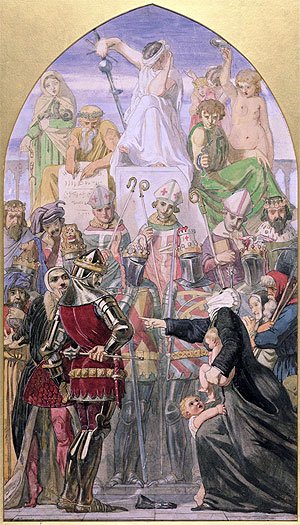
I am returning to the artist Ford Madox Brown and for My Daily Art Display today I am taking a look at one of his earliest works, which he completed in 1845 when he was twenty four years of age, and which is entitled Study for Spirit of Justice.  Before I look in detail at the painting and the reason why the artist painted the picture let me go over with you the early life of the artist and his ancestors.  Much of the information regarding Ford Madox Brown’s family tree comes from a biographical volume written by his grandson, Ford Hueffer, later known as Ford Madox Ford, entitled Ford Madox Brown, a record of his life and works, which was published in 1896.  I also have to acknowledge the work The Ancestry and Families of Ford Madox Brownby W.D.Padden,  a professor of English Literature at the University of Kansas. Ford Madox Brown’s  paternal grandfather, John Brown, was the son of a common labourer and an active member of the Seceders, a strict Scottish sect, linked to the United Secession Church,  which followed the 18th century Secession movement from the Church of Scotland, and which later became the United Presbyterian Church of Scotland.  He, like his father, followed the strict doctrines of the sect but that all changed when he went to the University of St Andrews in Edinburgh and he began to see the failures and flaws of some of the sect’s doctrines.   After his university studies Ford Madox Brown’s grandfather became a doctor and was also the author of many medical books as well as holding down the position as a university lecturer.  He appears to have been a very colourful character as it was reported that during his lectures he would take vigorous mouthfuls of a mixture of whiskey and laudanum in order to achieve a suitable degree of inspiration.  Doctor Brown married Ford Madox Brown’s grandmother, Euphemia, in 1765 and the couple went on to have twelve children of whom eight survived the father. Ford Brown, Ford Madox Brown’s father, was born in 1780.  He became a purser in the Royal Navy in 1800 and remained sea-going in the military for fourteen years before taking a shore-based post.  A year later in April 1815, Ford Brown married Caroline Madox.  Caroline was the daughter of Tristram Maries Madox, who was a member of Her Majesty’s Bodyguard of the Honourable Corps of Gentlemen at Arms.  Their role was to act as guards or attendants to the sovereign on state occasions.   Biographical notes on the couple state that they lived on the continent “for reasons of thrift”.  Their first child, a daughter Eliza Coffin Brown was born in 1819 and two years later on April 16th 1821 their first son Ford Madox Brown was born in Calais.  Ford Madox Brown’s father had to retire from the Royal Navy in 1834 following a stroke.  Ford Madox Brown’s mother died in Calais in 1839 when the artist was nineteen years old and his sister died the following year aged just twenty one.

Ford Madox Brown and his family had moved around the continent quite a lot, probably due to the nature of his father’s work and he received his formal art education at various academies.  In Bruges he studied under the Belgian neo-classicist painter Albert Gregorious, and later was a student of the Flemish painter Pieter van Hanselaer at Ghent both of whom were former pupils of Jacques-Louis David.   From Ghent he went to study in Antwerp for three years where his teacher was Gustav Wappers, the leader of the Belgian Romantic School.  The standard of his art education was high and more importantly to his family, much cheaper than if he had studied in Paris.   In 1840 after the deaths of his mother and sister, he and his father moved to Paris.  His father died there in 1842 and was buried at Montmarte.

So to My Daily Art Display’s featured painting.  In London, the old Houses of Parliament had been destroyed by fire in 1834 and a new Houses of Parliament at Westminster were built. Competitions were held for appropriate designs (‘cartoons’), with a number of leading artists commissioned to take part.   To organise and oversee this project, a Royal Commission had been appointed in 1841, the President of which was Queen Victoria’s new consort Prince Albert.   In all there were three annual competitions and Ford Madox Brown decided to enter a work for the third and final one in 1845.  The competition rules were that each artist would submit a full sized cartoon (preparatory drawing) with specimens of fresco or other techniques suitable for murals.  The design of their submitted work had to be scenes from British History or Literature or personifications of abstract representations of Religion, Justice and the Spirit of Chivalry.

Before us we see the Study for Spirit and Justice, a pencil, watercolour and bodycolour work, the preparatory drawing of which he submitted to the adjudicators of the competition.  It measured 5 meters x 3meters which was to be the actual size of the mural if it was selected.  His reasoning behind his submission was that it reflected patriotism and it highlighted his sympathy with the oppressed.  In it we see Anglo Saxons defeated by foreign invaders and abused by a rich baron.  In the foreground we have a lone grieving widow, clutching her baby with another of her youngsters holding on to her skirt.  To the right of her, we see her parents who are unable to help her.  She is appealing to Justice against the oppression of the wicked but powerful Baron.  We see the baron on the left in his armour with his deceitful advisor whispering advice.  Above them are more armed barons who are there to administer justice and further back we have the bishops and peers who represent the Lords Spiritual and the Lords Temporal and who are an allegorical representation of the House of Lords.    At the top of the painting we see the blindfolded woman – Justice.  To her right we have the figures of Mercy and Erudition and to her left we have Truth and Wisdom.

Ford Madox Brown’s submission did not win a prize but nevertheless it was well received by the artistic community,  both artists and critics alike,  and a picture of his cartoon actually appeared in the competition catalogue.  Benjamin Robert Haydon, the English historical painter and writer was dismissive of the result of the competition stating:

“…The only bit of fresco fit to look at is by Ford Madox Brown.  It is a figure of “Justice” and exquisite as far as that figure goes…”

The young Dante Gabriel Rossetti loved the work and cut out the picture from the catalogue and had hung in his room.

It is an interesting work and one which would have looked good on one of the walls of the Houses of Parliament, but sadly it was not to be.

Winter Scene by Joos de Momper

Winter Scene by Joos de Momper (c.1630)

“…Why, sir, Claude for air and Gaspar for composition and sentiment; you may walk in Claude’s pictures and count the miles. But there are two painters whose merit the world does not yet know, who will not fail hereafter to be highly valued, Cuyp and Mompers…”

Richard Wilson

In an earlier blog about the Welsh landscape painter, Richard Wilson, I told you how he believed that although the landscape works of Claude Lorrain and Gaspar Dughet were lauded, he spoke about the, as yet, unknown talents of Aelbert Cuyp and Joos de Momper and so I thought it was time to take a look at the life of Joos de Momper the Younger and one of his greatest works.

Joos de Momper also known as Josse de Momper was born in 1564 in Antwerp.  He was just one of an outstanding artistic dynasty.  His great grandfather, Jan de Momper I,  was a painter in Bruges; his son, and our featured artist’s grandfather, Josse de Momper I, was also known as an artist and dealer who moved from Bruges to Antwerp, where his son, and Joos’ father,  Bartolomeus de Momper , inherited both occupations, as well as being an engraver. Bartholomeus’s sons Josse de Momper II and Jan de Momper II were both landscape painters, but Josse the younger, today’s featured painter, was the exceptional artist of the family.

He received his initial artistic training under the guidance of his father, Bartholomäus de Momper.   In 1581, when he was seventeen years of age, de Momper’s father, who was at that time Dean of the Antwerp painters’ guild, The Guild of St Luke, enrolled him as a vrijmeester (master) into that association.   It is believed that around this time Joos travelled to Italy.  Records show that an artist in Treviso, Lodewijk Toeput, was his teacher .  Another reason for believing that the young artist had visited Italy is that so many of his paintings featured mountain scenes and as he spent most of his life in Antwerp, to have such a knowledge of mountains, almost certainly meant that he had at one time crossed the Alps into Italy.   So did he go to Italy?   A further clue to whether de Mompers was ever in Italy came in 1985  when the frescoes in the church of San Vitale in Rome, previously attributed to Paul Bril, were attributed to Joos de Momper the Younger.

Records show that in 1590, the twenty-six year old artist was back in Antwerp as it was in this year and in this city that he married Elisabeth Gobyn.  The couple had ten children.  The painting dynasty was to continue with two of the  couples’ sons, Gaspard and Philips both becoming notable artists.  Gaspard de Momper and Philips de Momper I,  both became painters although little is known of their work, except that Philips executed the figures in some of his father’s paintings; he also spent some years in Rome, where he had travelled with Jan Breughel the Younger

 In 1594 De Momper collaborated with two other Flemish painters Adam van Noort and Tobias Vwerhaecht as well as the Flemish architect Cornelis Floris on the decorative programme to celebrate the entry of the Archduke Ernest into Antwerp.   Shortly after this de Momper was invited to become one of the Archduke’s court painters, a position he took up at the court of the Archduke and Archduchess Albert and Isabel Clara Eugenia, the sovereign rulers of the Spanish Netherlands. In 1611, de Momper was made Dean of the Guild of St Luke in Anterp.

Most of de Momper’s paintings, like the one we are going to look at today, featured landscapes and his work was very well received. His landscapes were sometimes topographically accurate whilst others would be idealised fantasy ones, but all sold well.    His work was highly regarded and he is considered to be the most important Flemish landscape artrist of his time.  The timeline of great Flemish painters puts him coming after Pieter Bruegel, whose works greatly influenced him, and before Peter Paul Rubens.  

My Daily Art Display today features a painting simply entitled Winter Landscape and was painted by Joos de Momper the Younger around 1630 and can now be seen in the North Carolina Museum of Art.  This is a winterscape with a number of figures,  which were believed to have been painted, not by de Momper, but by Pieter Bruegel’s son Jan.  I love this work as it is so “busy”.  Besides the beauty of the landscape in winter we have a dozen people depicted carrying on with their daily duties.  Pieter Brueghel the Elder’s influence is clearly evident in this winter landscape.    Joos de Momper was known for his use of Mannerist colors in many of his landscapes, but in the more realistic pictorial representations, such as today’s painting, he used more natural colors.   Momper’s has managed to deliver a scene with such aesthetic appeal. 

Woman by cart

In this village landscape before us, the houses and people, which in his mountain landscapes were mere accessories, are now in some way the main focus of our attention.   Look at the woman in red who stands by the cart.  Look how the artist has depicted her struggling and straining with an arched back to lift the barrel on to the cart.  Look how her face is reddened by the physical effort.  To the right of her we see a mother and two children in a line.  The mother is carrying a bundle of firewood on her head whilst her son tags behind with a token few sticks of kindling.  Following up at the rear is the young daughter, with her arms outstretched shrieking, as she is being left behind.

Man with baskets

It is a scene full of activity and I love to cast my eyes around the painting to discover what is happening.  At the barn we see a man repairing a cart whilst the white horse stands passively to the side.  In the left midground we see a man bent over surveying what looks like two large wicker baskets.  I am not sure what he is doing but whatever is going through his mind, he seems fascinated by them.  Besides the people in the painting, look at the way the artist has elegantly painted the trees which have shed their leaves and which stand tall and unbowed in this cold but still winter’s day.

In the background on the right we have the nearby town.  It is separated from our main scene by a river, the water of which seems partly frozen over.  Fishermen are at the river trying to catch something for their meal in the small parts that have yet to be frozen. 

Town and bridge

The way to the town is accessed by a small wooden bridge and we see a man with his dogs making his way over it and heading into town..

I hope you have enjoyed this painting and thanks to Richard Wilson, I have discovered a new Flemish artist and one day I will return to him and look at another of his works.

Finally my thanks go to Universal Pops’ Photostream on Flickr for the details of the painting.  His photographic site is quite amazing and well worth a visit.

http://www.flickr.com/photos/universalpops/

Nebuchadnezzar by William Blake

My Daily Art Display today looks at the life and works of one of England’s most controversial artists.  He was not just an artist, illustrator and printer, he was also a renowned poet.  The controversial nature of this person derives from what he drew and wrote about and his beliefs.  My featured artist today is William Blake, the writer of prophetic works which are termed works of mythopoeia.  Mythopoeia is the act of making or creating mythologies.   In the case of Blake, they are stories of artificial mythology, which he himself created, such as Vala and The Four Zoahs where he would introduce us to characters with the strangest names, such as Enitharmon, Albion and Urizen.  I suppose to draw a present day parallel to his type of work we should think of Tolkien’s Middle Earth sagas or C S Lewis’s tales of Narnia.   What is probably a little bit more bizarre and daunting about William Blake was that from a very early age he believed in visions and told people about his regular sightings of angels and other heavenly bodies which he was able to communicate with.

  I have put together a short biography of the man and split over this and my next blog.  There have been numerous books written about him and when you read them you will see that he trod a very fine line between sanity and insanity.  He was never vigorously condemned during his lifetime by the Church or by his contemporaries.  The reason being it was probably due to him being looked upon as a harmless eccentric who had few followers and therefore his beliefs would never gain hold and therefore never pose a threat.

Catherine Wright Armitage married her first husband, Thomas Armitage, a hosier, in 1746.  Catherine and her husband had one son, also named Thomas, but he died in 1751, when he was just five years of age.   Ten months after the death of her son, Catherine’s husband died.  The following year, 1752, Catherine married James Blake.  They were to have seven children, the third of whom, William, was born in 1757.  William Blake was to grow up to become one of the great English poets and painters and an influential figure in the history of both the poetry and visual arts of the Romantic Age. 

William Blake did not receive any formal education but he received home tuition from his mother.  In 1867 at the age of ten he attended William Shipley’s Academy in the Strand where he received drawing lessons from Henry Pars.  Historians would have us believe that both his mother and father were Dissenters, members of a religious body who have, for one reason or another, separated from the Established Church.  They were members of the Moravian Church and later fervent followers of the teachings of Emanuel Swedenborg.  Blake had a strong religious upbringing.  Even at the early age of four Blake would tell his parents about the visions of God and angels he had experienced.  His strict religious background would influence Blake for the rest of his life and was to be an inspirational stimulant for his artwork in the future.

Just before his fifteenth birthday William Blake was indentured for seven years as an apprentice to James Basire, engraver to the Royal Society of Antiquaries.  He spent a lot of his time during his apprenticeship copying images from the Gothic churches in London as well as Westminster Abbey and this time in his life was to prove  inspirational to the young artist and would shape his future artistic style. Again, as was the case when he was a young child, he would talk about religious visions he had whilst working amongst the religious icons.

 In 1779 on completion of his apprenticeship he became a professional engraver and he enrolled at the Royal Academy Schools at Somerset House as an engraver.  He exhibited his first work, a watercolour entitled The Earl of Goodwin, at the Academy the following year.  Although he exhibited further works during the 80’s and 90’s, he turned against the establishment denouncing it as a fraud.  In 1780 hegoes to  work for the radical publisher Joseph Johnson carrying out commercial engravings.  He was to have a long association with Johnson and through him would meet the likes of the Swiss artist, Henry Fuseli, the writer and feminist Mary Wollstonecraft and the American revolutionary Thomas Paine.   It was during that time that Blake became involved in the Gordon Riots, an anti-Catholic protest which lead to wide spread rioting and looting in London.  That year he was also arrested as a French spy when he and some fellow artists were on a sketching trip by boat on the River Medway.   It took the pleas from members of the Royal Academy to get them all released.

In 1782, aged 25, William Blake married Catherine Boucher, who was the daughter of a market gardener.  She was five years his junior and illiterate.  We know this as their wedding certificate still exists and she signed her name with an “X”.    They set up home in Leicester Fields in London close to where sir Joshua Reynolds, the President of the Royal Academy lived and William taught her to read and write as well as the art of engraving.   In this same year, Blake’s father dies and leaves his son a small inheritance which enables him to go into partnership with a fellow Basire apprentice, James Parker, and together they set up a print shop.  However the collaboration does not last long and the partnership breaks up after a year. Blake’s younger brother Robert comes to live with William and helps him in the print shop.  Two years later in 1784, Robert falls ill and despite the loving and constant attention given to him by his older brother,  he dies.

William Blake is very affected by the death of his brother and in his biography of Blake, entitled Life and Works of William Blake, Alexander Gilchrist quotes the artist’s words :

“…I converse daily & hourly in the Spirit & See him in my remembrance in the regions of my Imagination.  I hear his advice & even now write from his Dictate…” 

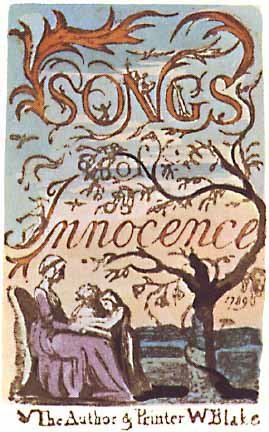
Songs of Innocence

In 1789 Blake set about producing an illuminated book of his poems entitled Songs of Innocence. The poems and artwork were reproduced by copperplate engraving and coloured with washes by hand.  Five years later in 1794 he bound these poems with a set of twenty-six new poems in a volume entitled Songs of Innocence and of Experience Showing the Two Contrary States of the Human Soul.

I will leave off the biography of William Blake at this point in his life just before he moves away from London and will conclude his life story in my next blog.

Nebuchadnezzar (The Tate Britain version) by William Blake (1795)

For My Daly Art Display today I am featuring the colour monotype print by William Blake entitled Nebuchadnezzar.  This comes from Blake’s Large Colour Prints collection. This collection of Blake’s twelve large colour prints, which he first designed and completed in 1795, are now considered to be his greatest works as a pictorial artist. Their inspirational imagery and the printmaking technique Blake used to create them evolved out of his illuminated books of 1790-95.   It is thought that Blake drew an outline of the design on the printing matrix, painted on it areas of gum- or glue-based pigments, and then printed individual impressions on damp paper in his rolling press.  It is thought that then Blake and his wife Catherine added ink and watercolour to the impressions.   There were no more than three impressions of any one of the twelve designs in existence. The one we see before us today was reprinted around 1805 and there was added more hand outlining and tinting to the original impression.  In all there were four copies of this work.  One can be found in the Tate Britain, one in the Museum of Fine Arts, Boston and one in the Minneapolis Institute of Arts.  The fourth copy is missing.

So what is the picture all about?  The bible tells the story of Nebuchadnezzar in book of Daniel (4:33) stating:

“…The same hour was the thing fulfilled upon Nebuchadnezzar: and he was driven from men, and did eat grass as oxen, and his body was wet with the dew of heaven, till his hairs were grown like eagles’ feathers, and his nails like birds’ claws…”

Blake’s biographer, Alexander Gilchrist, wrote in his book of 1880 entitled The Life and Works of William Blake , describing what we are looking at as:

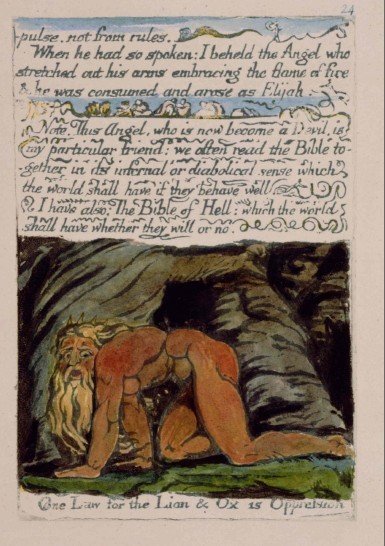
 “…“the mad king crawling like a hunted beast into a den among the rocks; his tangled golden beard sweeping the ground, his nails like vultures’ talons, and his wild eyes full of sullen terror. The powerful frame is losing semblance of humanity, and is bestial in its rough growth of hair, reptile in the toad-like markings and spottings of the skin, which takes on unnatural hues of green, blue, and russet…”]

Nebuchadnezzar from the Marriage of Heaven and Hell (1790-93)

The original depiction of Nebuchadnezzar by Blake dates back to plate number 24 of his book The Marriage of Heaven and Hell which he created between 1790 and 1793 and which was a series of texts and illustrations which expressed Blake’s own intensely personal romantic and revolutionary beliefs. The book was published as printed sheets from etched plates and contained a mixture of prose, poetry, and illustrations.

Welcome to the strange world of William Blake.

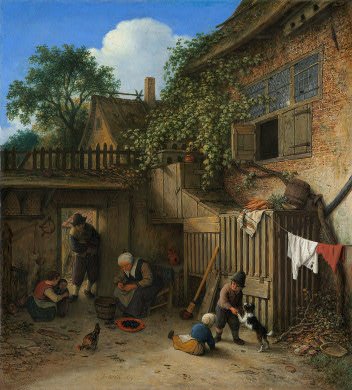
The Cottage Dooryard by Adriaen van Ostade

The Cottage Dooryard by Adriaen van Ostade (1673)

After looking at the younger of the two brothers, Isack, yesterday I am switching my attention to the elder and more famous brother Adriaen van Ostade.  Adriaen was born in Haarlem in 1610, eleven years before the birth of his brother Isack.  He started off his artistic training at the age of seventeen under the watchful eye of Frans Hals, the Dutch Golden Age painter and great portraitist.   Adriaen Brouwer, the Flemish genre painter was a fellow student of van Ostade.   His father Jan Hendricks Ostade, a weaver by trade, came from Ostade near Eindhoven and although his sons were born in Haarlem they took Ostade as their family name.

At the age of twenty-two he registered as an artist in Utrecht.  At this time Adriaen concentrated on genre painting incorporating village scenes which were very popular with people at that time.  His scenes often depicted animated scenes of peasants partying and fighting in crowded inns and disorderly living rooms.  It is interesting to note that his later paintings depict a more civilised community with people displaying much better behaviour and the interiors of the depicted dwellings began to look more orderly and appealing.  He also started to add more outdoor scenes to his works and in general the atmosphere was lighter and more cheerful.  He returned to Haarlem in 1634 and enrolled in the painter’s guild of the town, the Haarlem Guild of St Luke in which he was later to become its president in 1666 and 1667.  In 1637 he joined the Haarlem Schutterij, a voluntary city guard, sometimes termed a citizen militia, the role of which was to protect the town or city from attack and act in case of revolt or fire.   It is interesting to note that these militiamen were generally drawn from the wealthier families and this could mean that van Ostade was doing well with the sale of his art. 

Adriaen was aged sixty-two in 1672 which was known as the rampjaar, the “disaster year” when his country was plunged into war and was invaded.  He decided to leave Haarlem and so he packed up his belongings and headed for Lübeck.  However on reaching Amsterdam he met an art collector, Konstantyn Sennepart who convinced van Ostade to stay and who offered him lodgings in his house.

We know that van Ostade was highly productive and it is believed that he completed over 800 paintings together with a further two hundred drawings and watercolours.  Besides his own art, he taught young several aspiring artists at his workshop in Haarlem, such as his younger brother Isaack van Ostade, Cornelis Bega and it is believed that he also trained Jan Steen.  Unlike many artists whose popularity only came after their death, Adriaen van Ostade attained considerable popularity during his lifetime and his style and work were often copied by other artists.

My Daily Art Display today features one of Adriaen van Ostade’s later paintings entitled Cottage Dooryard which he painted in 1673 and now hangs in the National Gallery of Art in Washington.  Before us we see a peasant’s country cottage and its courtyard.  Unlike the dwellings of the more wealthy, this courtyard has neither a manicured garden nor a paved yard.  This is simply a dirt yard.  At the centre of the painting we see the wife seated busily preparing mussels for the family dinner.  She has already done the washing which we see hanging out on the line which is attached to the shed.  On top of the shed we can see some carrots which are drying in the sun, and an old barrel.  Also atop the shed we can see a pigeon coop and by the door there is a shelf which holds beehives.  A mass of clinging vines cascade down from around the eves of the house and the inclusion of the vines is thought to indirectly refer to family unity    Four of her children amuse themselves in the courtyard, two of them playing with their dog whilst another tends the baby.  A hen pecks away happily at the ground searching for a morsel of food and the husband, leaning on the door jamb, looks on.  Although this is a peasant scene, it is a dignified and poignant scene of family life and there is no sign of the bawdy scenes of van Ostade’s earlier genre paintings.  It is a beautiful work of art and I love how van Ostade has incorporated great detail into the painting such as his depiction of the brickwork, the windows with their small glass panes and the floor of the yard

Winter Scene by Isack van Ostade

Winter Scene by Isack von Ostade (c.1646)

Over the next two blogs I am going to take a look at two Flemish artists who besides being highly talented were brothers.   They were the van Ostade brothers.  Today I am going to feature Isack, who was the lesser known of the two, maybe because he only lived to the age of twenty-eight.

Isack van Ostade was born in Haarlem in 1621.  He was a Dutch landscape and genre painter.  Genre paintings were ones depicting scenes of daily life and were particularly popular in 17th century Holland.  Isack and his brother Adriaen, who was eleven years older, were the sons of Jan Hendricx Ostade, a weaver from the town of Ostade, close to the city of Eindhoven.  Despite being born in Haarlem both he and his brother took the name “van Ostade” as their family name.  Isack studied painting under the guidance of his elder brother until he was almost twenty-one years of age at which time he independently set up his artistic business.  He started off painting subjects similar to his brother and his work was always viewed as not as accomplished as the works of Adriaen van Ostade.  Realising this, Isack decided to stop painting the genre scenes and concentrate more on landscape work in the fashion of Salomon van Ruysdael, the Dutch Golden Age landscape artist.

In his earlier paintings the figures were the key feature but in his later works his landscape becomes increasingly significant.  His change to landscape painting paid off and this coupled with his skill at figure painting ensured the popularity of his winter scenes in which we would see groups of animated people in wintery landscape settings.  These winter scenes like my featured painting today, Winter Scene, were his speciality.  He painted this picture around 1645 and it now hangs in the National Gallery in London.  It is quite similar to the painting, Winter Landscape with Wooden Bridge which another Dutch painter, Philips Wouwerman completed fifteen years later.

The painting we see before us is beautifully picturesque and we view the scene from low down which allows us to see the old rickety wooden bridge outlined against a silvery grey winter sky with its dark snow bearing cloud approaching the area.  The scene is populated by peasants.  Some, like the youngsters, are enjoying themselves sledging and skating on the frozen river whilst others, the adults, are hard at work as we see the man encouraging his old white horse to drag the laden cart up the riverbank and we watch old man as he slowly climbs the steps of the bridge, his back straining under his load of firewood.   

Sadly fewer than three dozen winter landscapes of Isack van Ostade are known today.  He died in 1649 at the early age of twenty-eight.  He had few, if any, pupils yet his influence on the succeeding generation of Haarlem painters was great and the likes of Philips Wouwerman  owed a lot to this young man.

Queen Charlotte with her Two Eldest Sons by Allan Ramsay

Queen Charlotte with her Two Eldest Sons by Allan Ramsey (c.1764)

Britain is very fortunate to have so many art galleries.  Although if one lives in London I suppose one has the cream of the crop but dotted throughout the land there are some excellent art establishments.  One of the richest collection of art works is owned by the monarch and is held in trust for her successors and the nation.   There are more than 7000 paintings within the Royal Collection as well as thousands of watercolours, prints and drawings.  The collection is not held in just one place, Buckingham Palace, but is spread around the royal residences, such as Windsor Castle, Palace of Holyroodhouse in Edinburgh, Balmoral Castle, Hampton Court and Sandringham House.   The total collection is estimated to be worth around ten billion pounds.  My Daily Art Display today features a painting from the Royal Collection which hangs in Buckingham Palace.  It is entitled Queen Charlotte and her Two Eldest Sons by the Scottish portrait painter Allan Ramsay, which he completed around 1764.

Allan Ramsay was born in Edinburgh in 1713.  He was the eldest son of Allan Ramsay who was a poet and writer.  After completing his schooling in Scotland he moved to London when he was twenty years of age and studied art under the tutelage of Hans Hysing, the Swedish portrait painter and later was a student at the St Martin’s Lane Academy, which was the precursor to the present day Royal Academy.  In 1736, aged twenty-three he travelled to Rome and Naples to further his art education and he remained for almost three years.  On returning to Britain he went to Scotland and settled down in Edinburgh.

In 1739 he married his first wife, Anne Bayne, and the couple had three children but none survived childhood and his wife died during the birth of their third child in 1743.    Allan Ramsay supplemented his income from his paintings by teaching art and one of his pupils was Margaret Lindsay the eldest daughter of the nobleman Sir Alexander Lindsay of Evelick.  As a humble artist her parents frowned on their liaison outside of art tuition and knowing that, the couple eloped and were married in secret.  Her parents never forgave her for marrying lower than her station.  Allan Ramsey, in an attempt to ease their minds about how he would care for their daughter and that he had married their daughter for love and not for their money, wrote to them explaining that although he had to support his daughter from his first marriage along with his two sisters, he was well placed financially to look after their daughter.  Her parents were unmoved by his words.  The couple lived a happy life and went on to have two daughters and a son.

The devoted couple spent three years in Italy from 1754 to 1757, where they both spent time painting and copying old Masters and whilst there they would earn an income by painting portraits of the wealthy aristocratic travelers who were doing the Grand Tour of Europe.  They returned to Britain and went to live in London and in 1761, Allan Ramsey was appointed Principal Painter in Ordinary to George III.   The title of Principal Painter in Ordinary to the King or Queen of England was awarded to a number of artists, nearly all of whom were portraitists.  It was in this role that he completed many paintings of the royal couple and their children.  .

 So before us we have Queen Charlotte and two of her children but who was Charlotte and where did she come from?  Sophia Charlotte was born in 1744 and was the youngest daughter of Duke Charles Louis Frederick of Mecklenburg-Strelitz and his wife Princess Elizabeth Albertine of Saxe-Hildburghausen.  When King George III came to the throne it was decided that he should seek to marry someone of royal descent who would be use to life at court but would also have to be somebody who would be popular with the people of Britain.  Many of the ladies that George would have liked to have married were deemed, much to the monarch’s annoyance, unsuitable and inappropriate and he had to reluctantly agree to “look elsewhere” !    Eventually a royal match was made, when David Graeme, a British soldier, diplomat and courtier, who had visited many of the royal courts of Europe, reported back to the British that he had found an ideal marriage partner for George.   She was Princess Sophia Charlotte.

In 1761, when she seventeen years old, she married George III of England and at that young age became the queen consort of  the United Kingdom. With the marriage came stipulations which she had to agree to.  Firstly, she must become an Anglican and secondly, she had to promise not to become involved in the politics of the country.  George III bought Buckingham House in 1761 for his wife Queen Charlotte and it was here that fourteen of the fifteen children of theirs were born.  Charlotte was an extremely intelligent woman.     From her letters we can see that she was well read and loved the fine arts. The Queen was very musical and is known to have been taught music by Johann Christian Bach.   Wolfgang Amadeus Mozart, at aged eight, dedicated his Opus 3 piece to the Queen at her request.  She had a love of plants and trees and helped to establish Kew Gardens.       The Christmas tree was introduced to England by the Queen who had the first one in her house, in 1800.  The royal couple were very much in love with one another but sometimes for the young girl, suddenly having to take on the responsibility of queen consort, was trying but she always took her duties seriously.   In a letter to her younger brother, she wrote:

“…I find that the solitary and retiring life which I lead is not made for me. Having admitted this I assure you I shall not ignore my duty…”

My Daily Art Display today features one of Ramsay’s paintings of Queen Charlotte and her two eldest sons, George, who was Prince of Wales and was later to become George IV and Frederick, Duke of York.  As we have seen in other paintings despite the two children being male they were dressed in, what today, we would term girl’s clothing.  The elder son, George, stands with his bow in his hand and in the left side of the picture, we can see his drum.  These accoutrements have been added by the artist to symbolise George’s future soldierly spirit.  His mother Charlotte has her foot on a foot-stool and leans against a piano.  On the piano we have a sewing box and a copy of John Locke’s book Some Thoughts concerning Education.  At the time, this book, a treatise on education,  was considered the most important philosophical work on education in England and it was translated into almost all of the major written European languages during the eighteenth century.  The setting of this painting and the items depicted in it all add up to a compassionate relationship between a mother and her children and illustrate how she spent time with them whilst they were at play and how important family life was to them.

It is a lovely portrait of a mother and her children.  It is full of compassion and the smiles on their faces have put across the impression of happiness and fulfillment.

The Anaemic Lady by Samuel van Hoogstraten

The Anaemic Lady by Samuel van Hoogstraten (c.1667)

As promised a while back, today I am going feature another painting by the Dutch artist Samuel van Hoogstraten and at the same time have a look at his life story.

Samuel Dirksz van Hoogstraten was born in Dordrecht, Holland in 1627.  He was the eldest of seven children.  His parents were Dirck van Hoogstraten, a silversmith and painter, and Maeiken de Conink.   He came from an artisan background.  His grandfather Hans was registered as a member of the Antwerp St Luke’s Guild, an association for painters and many of his mother’s ancestors were gold and silversmiths by trade.  The line of work the van Hoogstratens were in was a highly paid and one of the most prestigious of occupations.  In the late 16th century, the van Hoogstratens and the de Coninks moved from Antwerp to Dordrecht for a combination of religious, political and economic reasons.   Samuel’s grandparents and those of his wife-to-be were Mennonites, who had lived in Antwerp and because of their religious beliefs had had to escape persecution by the catholic Spanish rulers of the Spanish Netherlands

At the age of three, Samuel and his family moved to The Hague and his father Dirck enrolled in the local painters’ guild.  In 1640, Samuel’s maternal grandfather died and left his mother a sizeable inheritance as well as his house and business.  The family sold their house in The Hague, at a considerable profit, and returned to Dordrecht where they moved into the grandfather’s much larger house.  This was probably not before time as by then the family group had grown and now consisted of Samuel’s parents and seven children.  The family continued with the family’s silversmiths business.  Sadly, within a year of the move, Samuel’s father also died, leaving his mother to bring up the family single-handedly and at the same time persevere with the family business.     

From the age of seven Samuel van Hoogstraten had showed an interest in art and was taught the basics of drawing and the technique of engraving by his father.  In 1678 he wrote what is now considered as one of the most impressive painting treatises to be published in the Netherlands in the seventeenth century entitled Inleyding tot de Hooge Schoole der Schilderkonst (Introduction to the Academy of Painting) and in it he talked about his early love of art and his decision to become a painter despite some opposition from his uncle, his guardian.  He wrote:

“…I remember very well how when my father died my guardian advised me with gentle counsel to give up the art of painting and with pleasant words recommend another profession which seemed to him more secure.  And though I was not yet fourteen years old, I felt as if he wanted to take away my happiness and condemn me to slavery…”

Samuel achieved his wish to study to become a painter, for shortly after his father’s death, he moved to Amsterdam and entered the school of Rembrandt.   When he had completed his apprenticeship at Rembrandt’s studio, Samuel van Hoogstraten became an official Master and Painter.   It is only in some of his earlier works that the influence of his teacher can be seen.  In his later years during the 1660’s and early 1670’s he concentrated on genre paintings of domestic households as is the case with today’s featured work of art.  He was a man of many talents.  As well as being an accomplished artist, he was an expert in etchings and engravings, a gifted poet and writer and in 1656 when he was almost thirty years of age he married, went to live in Dordt, a suburb of Dordrecht, and became director of the local mint.  Samuel van Hoogstraten died in Dordrecht in 1678 aged 51.

My Daily Art Display featured painting today is entitled The Anaemic Lady which Samuel van Hoogstraten completed around 1667 and can now be seen at the Rijksmuseum in Amsterdam.  The setting is a room in a house.  It appears to be a wealthy household judging by the sumptuous furnishings, gilt leather wall hangings and the paintings on the wall.  Before us is a pale faced woman, head slightly tilted to one side, reclining passively,  if somewhat lethargically in her chair, with her hands clasped before her.   It is a mysterious scene and we immediately wonder what is happening in the painting.  Although the woman has a sickly pallor we are not sure what ails her but there are clues.  Behind her we see two men.  One is a doctor holding up a flask of the woman’s urine to the light in order to determine whether she is in fact pregnant.   The other man, perhaps her husband, perhaps her lover, looks on with great apprehension at the bottle and maybe he fears the result of the examination. So what is the story behind this scene?  There are a couple of helpful hints in the painting.  Look at the naked figures, part of the design of the tablecloth and then look at the painting above the door which depicts an image of Venus, the goddess of love.  More importantly, look on the floor by the woman’s feet.  We see a cat.  Why would the artist add a cat to the painting?  Was it just a sign of domesticity and the family pet?   We should however remember that the cat was a medieval symbol of lust and in this painting its presence may represent illicit love.   This is not simply a cat stretched out on the floor but one which has trapped a mouse between its paws and maybe we should interpret that as reflecting the fact that maybe the man and the woman have, like the mouse, been caught and trapped by one moment of passion?

Does that sound a little farfetched?  Well here is a further twist to the story of the painting.  What you are looking at now is the painting after its restoration in 1989.  During the restoration work an overpainting was discovered.  Prior to the restoration work there was neither the mouse between the cat’s paws nor a second man in the painting.  The work just depicted a doctor treating a woman who was ill and the family pet lay lovingly at her feet.  There was now no hint of pregnancy, or entrapment.    It was thought that some time during the 19th century both the mouse and the man were painted out.  The reason for this overpainting is believed to be because it was not considered genteel or proper to refer to an unwelcome pregnancy or hint at its consequences.   

I will let you decide whether this is simply a scene of domesticity and whether the cat and mouse is just a load of nonsense, but if so, why overpaint the mouse and the second man?

Sunday Afternoon on the Island of La Grande Jatte by Georges Seurat

A Sunday Afternoon on the Island of La Grande Jatte by Georges Seurat (1884-86)

Today I am starting My Daily Art Display blog by introducing you to some new “isms” which have a connection with what is to follow.  They are Post-Impressionism, Neo-Impressionism, Pointillism and Divisionism and they all are connected in some way to today’s featured artist George Seurat.

By now you will have read many of my blogs that cover the works of the Impressionists such as Monet, Renoir, Degas and Caillebotte and so by now you are familiar with the term Impressionism.  Post Impressionism was a style of painting that grew out of Impressionism or maybe we could say it was a style of painting which was a reaction against Impressionism. The three main artists who were central to this new group of painters and who were termed Post Impressionists were Gaugin, Van Gogh and Cézanne.   Gaugin retained the intense light and colour of the Impressionists but discarded the idea of painting from nature.  He was totally against naturalism, where artists depict nature just as it is, and in its place he wanted his works to have more inventive subject matter and he also liked to experiment with colour.   On the other hand Van Gogh continued to paint from nature but developed a highly personal use of colour and brushwork which openly expressed his own expressive response to a subject.  Cézanne kept faith with the Impressionist’s principle of painting from nature but his works came across with a greater energy and vitality.

Today I am going to look at Neo-Impressionism and Neo-Impressionist artists who were a distinct group of painters within the Impressionist movement and in some ways formed a transition period between the Impressionists and the Post Impressionists.  The two leading figures of this trend were Georges Seurat and Paul Signac and they wanted to have a more scientific approach on how light was depicted in their paintings.  Their works were characterised by the use of a technique known as Divisionism or Pointillism.  Divisionism, also sometimes known as Chromolumanarism, was a method of painting in which colour effects were achieved by applying small areas of dots of pure unmixed colours on the canvas so that  an observer standing at an appropriate distance from the painting (suggested distance for best effect was three times the diagonal measurement of the work) the dots would appear to react together giving a greater luminosity and brilliance than if the same colours had been mixed together before putting them on the canvas. What these artists wanted to achieve was that the observer of the painting combines the colours, which are in the form of dots, optically instead of the artist pre-mixing them on a palette before putting them on the canvas.

Pointillism comes from the term peinture au point, which was used by the French art critic Félix Fénéon, when he described today featured painting by Seurat.   It can be defined specifically as the use of dots of paint and does not necessarily focus on the separation of colors.  Divisionism refers mainly to the underlying theory, pointillism describes the actual painting technique associated with the likes of Seurat, Signac and to a lesser extent Pissarro. Pointillism is related to Divisionism which is a more technical variant of the method. Divisionism is concerned with color theory, whereas pointillism is more focused on the specific style of brushwork used to apply the paint.

Enough is enough !!!!  I don’t want to get too bogged down with “isms” and their meanings and I am sure that there are many people out there who can give a much more expansive explanation of the differences between Divisionism and Pointillism .   My Daily Art Display today features what many believe is Georges-Pierre  Seurat’s greatest work.  It is entitled A Sunday Afternoon on the Island of La Grand Jatte.  It was the one of the first painting to be executed entirely in the Pointillist technique and the first to include a great many people playing a major role.   It caused a sensation when it was exhibited at the eighth and final Impressionist Exhibition in 1886.  It is thought that it was possibly intended as a pendant to Seurat’s other work, Bathers at Asnière,  which I will look at in a later blog.

He started the work in 1884 and did not complete it until 1886.  He spent two years making over sixty preparatory pencil and ink drawings, conté crayon studies and oil sketches on panel for this work.  He would alter the grouping of people, the number of people within a group and where each group or individual were positioned until he was satisfied that he had achieved the perfect balance.  There was a smaller version of the painting which can be found in the Metropolitan Museum of Art in New York.  There is also a version of the scene without the people which was once in the private collection of Mrs John Hay Whitney.   This painting we see today is massive in size measuring 207cms high by 308cms wide (almost 7ft tall and 10ft wide) and since 1924 has been housed in the Art Institute of Chicago.  Seurat completed the final version of this painting in his small Paris studio.

The Models by Seurat (1886-88)

In 1888, Seurat also completed another painting which was entitled The Models  using his pointillism technique, and which depicts models in his studio.  Included in the painting is a section of La Grande Jatte and art historians believe that by doing this painting, he was showing the world that this technique of Pointillism worked just as well for indoor scenes as outdoor ones.

The Île de la Grande Jatte is a small island in the River Seine, downriver from La Défense.  It is about 2 kilometers long and just 200 metres wide at its widest point.  At one time it was reduced to being an industrial site but now has public gardens and houses.   Living on the island are approximately 4000 inhabitants.  However in the days of Seurat it was a pastoral retreat where Parisians could come at weekends from their claustrophobic city existence and soak up the quiet and peace of this little idyll.

Before us we see Seurat’s idealized version of the Grand Jatte omitting both the cafés and restaurants and the nearby ugly shipyard and factories.  In the painting we see members of different social classes out for a stroll along the Grand Jatte by the side of the Seine.  The figures, shown mainly in profile or frontal position, have a peculiar formal and artificial feel to them.  As we look at the painting head-on, there seems to be a definite elongation of some of the people although I believe if you stand at a certain angle to the painting this is minimised.  Seurat would sketch individual groups or single characters and then return to his studio to decide if and where each group should be placed on the canvas.  He sketched people of different classes in society to give the idea that all types of people enjoyed promenading along La Grande Jatte.   Look at the trio in the right foreground.  Here we have the a man wearing a top hat and holding a cane who is more than likely from the upper classes of Paris society.  The man with the muscular arms, lying back with a cap on his head, smoking the pipe is probably a working-class boatman and finally we have the young genteel lady of an indeterminate class.  An unusual trio and who, although physically close in the painting, would be unlikely to have a closeness in that present-day society.  The faces of the people in the painting show little personality.  There is something very impersonal about them.  We must presume that this was a deliberate ploy by Seurat who seemingly did not want the painting to be sullied by observers of the painting trying to interpret facial expressions.  I don’t believe the artist ever intended this to be in any way a moralistic statement about the French culture and classes at the time. However, some would disagree.   Art historians like to interpret every painting and seek symbolic depictions within a work so let us have a look at a few that have been thrown up for consideration with regards this work of art.

In the left middle ground we see a lady dressed in gold and orange fishing in the river.  I suppose there is nothing strange about that albeit she is hardly dressed as a woman who was to go out on a fishing expedition.  Well consider what the French word is to fish – it is pêcher and some have suggested that Seurat has made a play on the word as the French word to sin is pécher.  So is Seurat secretly identifying her as a prostitute.  Again look at the woman in the right foreground accompanying the gentleman.  Look what she is holding in her left hand – a monkey on a leash.  That is certainly an unusual pet to take for a walk.   So why did Seurat include a monkey.  One possible reason is that a female monkey in French is une singesse.  The symbolists would have us believe that a monkey is a symbol of licentiousness and that is why the French slang for prostitute is singesse.  So again I ask the question is Seurat trying to tell us by symbolism that this woman is a prostitute who is out for a stroll with her client?

It is interesting to note and it is not shown in my attached picture, that later Seurat painted the border using parallel red, orange and blue dashes and dots.  He varied the combination of colours in different parts of this border in order to accentuate the adjacent colours in the painting itself.  Maybe if you go to see the painting in Chicago you can let me know if Seurat’s idea with this border really works.

Finally, I came across a poem about this painting which I was going to add to the blog but it was too long so instead I have added the URL where you can find it.  It is:

http://www.lamaquinadeltiempo.com/algode/delmore2.htm