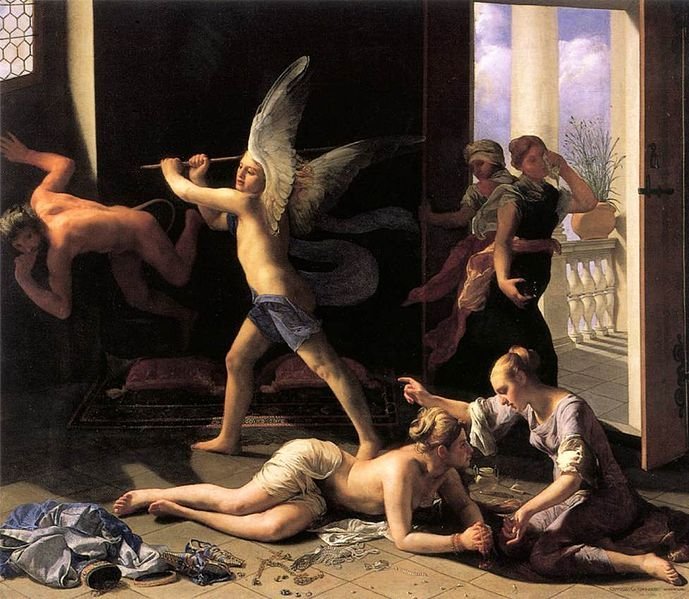
Martha Rebuking Mary for her Vanity by Guido Cagnacci

Martha Rebuking Mary for her Vanity by Guido Cagnacci (c.1660)

Today I am returning to an artist I featured back in My Daily Art Display of April 24th 2011 when I looked at two paintings of his depicting the death of Cleopatra.  He is the Italian painter of the late-Baroque period, Guido Cagnacci.

Guido Cagnacci was an Italian painter belonging to the Bolognese School, which rivalled Florence and Rome as centres of painting.    He was born in 1601 in Santarcangelo di Romagna, a town in the province of Rimini where he spent the early part of his life.  Later, he moved to Rome where he met fellow artists Simon Vouet, and Giovanni Francesco Barbieri, often better known simply as Guernico.   Cagnacci had also been a pupil of Guido Reni and he tended to combine references to classical models and to Raphael’s work with his own lively interest in the type of daring perspectives and brilliant compositions that the Baroque style favoured.   It is also believed that during this time he may have studied under an ageing Ludovicio Carracci.  He moved back east to Venice in 1650 and started to paint very sensual scenes with seductive, half-naked girls as his subject, His later paintings often featured semi-naked women as Lucretia, Cleopatra and even Mary Magdalene, as we will see in today’s offering.  These erotic paintings were very popular and much sought after by collectors at the time and through them, his popularity spread.  In 1658 he journeyed to Vienna where he gained the patronage of Emperor Leopold I and that was his ticket to fame and riches.  It also gave him the opportunity to bring to the German-speaking lands the latest classical style.

It is his contentious painting of a semi-naked Mary Magdalene that I am featuring in My Daily Art Display today.  The painting, which Cagnacci completed around 1660, is entitled Martha Rebuking Mary for Her Vanity.  The title of the painting brings up the first question one needs to consider and that is who is Mary?    Many would say that the Mary in the title is Mary Magdalene but others would disagree.  Mary and Martha are the most familiar set of sisters in the Bible. In the books of Luke and John, the pair, who lived in Bethany were described as friends of Jesus and who had a brother called Lazarus.  Though some earlier interpreters blended the person of Mary of Bethany with Mary Magdalene, current theologians believe she was a different person.  In Latin tradition, Mary of Bethany is often identified as Mary Magdalene while in Eastern Orthodox and Protestant traditions they are considered separate persons. The Orthodox Church has its own traditions regarding Mary of Bethany’s life beyond the gospel accounts.  However I will go along with the idea that in this painting we are looking at Mary Magdalene and her sister Martha.

Cagnacci's Mary Magdalene

The painting is a vivid and somewhat melodramatic allegory of Virtue conquering Vice.  Cagnacci has managed to blend reality, idealism and fantasy in the way he has portrayed the occurrence.   Lying prostrate on the floor is the semi-clad Mary Magdalene being rebuked and lectured to by Martha who sits on the floor in front of her.  Martha leans forward and is fervently lecturing her sister about the sins of Vanity pointing to the allegorical scene we see in the background. She is passionately trying to get her sister to discard the life of pleasure she had been leading up until then and turn to the life of virtue as a true follower of Christ.  Mary would seem to have recognised the life of sin she had been leading and realised, in response to the admonitions of her sister Martha, the error of her ways.  As a dramatic act of changing course, she has discarded her lavish and extravagant outer garments, jewellery and her other worldly possessions which we see scattered on the floor around her.

To the right of the painting we see a couple of servants, one in tears, symbolising contrition whilst the other looks back in disbelief and annoyance at Mary’s act of repentance and she symbolises the unremorseful face of Vanity.   In the background, mirroring what is happening in the foreground, we see an angel, symbolising Virtue driving out the demon which represents Vanity.  Cagnacci has in some ways tailored the story of the discarding of the woman’s clothes so as to give us an unusually sensuous depiction of the semi-naked Mary Magdalene.  He was often criticised for this sort of eroticism in his paintings, with critics maintaining that some artists could make anything salacious and Cagnacci was one of these.  However one must remember that Cagnacci knew that this type of painting sold well, so he would not be put off by his detractors.

The scene, which Cagnacci has painted, does not come from any particular passage in the Bible and we must believe the artist has manipulated the biblical facts of the differing character of the two sisters to suit the story behind this work.  The story of the differing personalities of Mary and her sister Martha was painted many times before by many different artists and in my next blog I will feature one by Johannes Vermeer.

Cagnacci probably completed this work whilst working for Leopold I at the Austrian court in Vienna.   The painting later went to the Gonzaga court in Mantua, which had strong ties with the court at Vienna. The painting was acquired by the Norton Simon Art Foundation and is currently housed at the Norton Simon Museum in Pasadena, California.
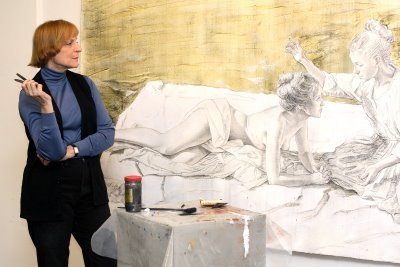
Ruth Weisberg and her painting

When I was researching the painting I discovered that the Museum had held a special exhibition in November 2008 entitled Guido Cagnacci and the Resonant Image which featured the Los Angeles artist Ruth Weisberg’s series of works in dialogue with Cagnacci’s Baroque masterpiece Martha Rebuking Mary for her Vanity.  It was based on her intuitive artistic reaction to the work.  Ruth created over twenty paintings and drawings which were pictorial stories on the themes of repentance, anger and ultimately the triumph of virtue over vice. In one she even depicts herself and family members as characters from the Cagnacci work.
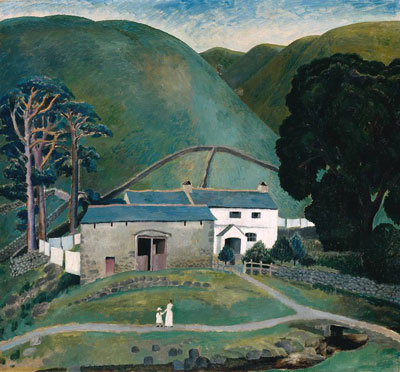
Farm at Watendlath by Dora Carrington

Farm at Watendlath by Dora Carrington (1921)

It often occurs that I stumble across and interesting subject for My Daily Art Display when I am researching another artist.  I came across today’s featured artist when I was delving into the life story of Mark Gertler and his painting Gilbert Cannan and his Mill in my last blog.  I should probably state up front that today’s blog is more about the artist and her fascinating social life than her featured painting.

Dora de Houghton Carrington was born in Hereford in 1893.  She was the second of the two daughters and fourth of the five children of Samuel Carrington and his wife, Charlotte de Houghton.  In 1902, aged 9, the family moved to Bedford and Dora attended the local girl’s high school.  The school’s ethos at the time was that the pupils should concentrate their studies on the Arts such as music and art with a healthy amount of sport thrown in rather than the normal but more commonplace subjects.  Dora showed an aptitude for drawing and her teachers persuaded her parents to pay for her to attend extra drawing classes in the afternoons.  One’s childhood often shapes the way we are in later life and the author Vanessa Curtis wrote about Dora’s differing relationship she had with her mother and father:

“…Although Carrington adored and revered her father, sketching him almost obsessively, she did not admire her fussy, martyr-like mother, who crammed the house with ornaments and devoted herself to charity work and religious causes….”

It is quite obvious that Dora’s mother had a suffocating influence on her children, especially her daughter.  Dora’s brother, Nicholas wrote of his mother extreme views on sex and  religion:

“..The first was extreme prudishness. Any mention of sex or the common bodily functions was unthinkable. We were not even expected to know that a woman was pregnant. Even a word like confined was kept to a whisper. The second was church-going and behaviour on Sunday. We all came to hate the whole atmosphere of a Sunday morning. The special clothes, the carrying of prayer books, the kneeling, standing and murmuring of litanies…”

In 1910, aged 17, she enrolled at the Slade School of Fine Art in London. There can be no doubt that once Dora Carrington was free of her home life and the puritanical views of her domineering mother, she rebelled.  She cut her hair to a bob which gave her a somewhat androgynous appearance. She entered into many intense and sometimes sexual relationships both with women and homosexual and heterosexual men.   She also decided that she wanted to be known simply by her father’s surname, “Carrington”.   Carrington fared well at the Slade and won several awards for her work.  One of her fellow students was Mark Gertler, who was totally besotted with Carrington and it was through him that Carrington met Lady Ottoline Morrell, the “society queen” and he introduced Carrington to the Bloomsbury Group, a group of writers, intellectuals, philosophers and artists.    Lady Ottoline and her husband Philip had a house in Bloomsbury, Central London and a country house in Garsington, Oxford where they would hold weekend parties for their friends, many of whom, like Stanley Spencer, Gertler and Carrington were aspiring artists.

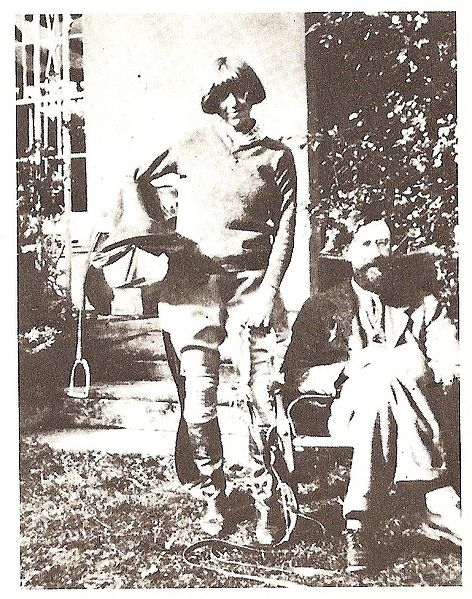
Carrington and Lytton Strachey

The Morrells were prominent pacifists and during World War I they invited conscientious objectors, such as the artist Duncan Grant and the writers Clive Bell and Lytton Strachey to take refuge at Garsington.  Carrington met Strachey, a writer and founder member of the Bloomsbury Group in 1915. Strachey was a homosexual but this did not stop Carrington falling in love with him.  This was a love that was to last almost twenty years.  Gertler felt no threat from Carrington’s love for the openly gay Strachey but in 1917 when Strachey bought a house and Carrington moved in with him, Gertler was devastated and realised that his love for Carrington was irrevocably unrequited and doomed.

Lytton Strachey and Ralph Partridge

Carrington’s father died in 1918 leaving her a small inheritance that allowed her to feel more independent.  That same year, Carrington was introduced to Ralph Partridge, a friend of her brother Noel.  Partridge like many men before him was besotted with Carrington, even though he was aware of Carrington’s love and devotion to Lytton Strachey.  Despite this knowledge, and knowing that Carrington would never give up Strachey, he married her in 1921 and along with Lytton Strachey, they bought and moved into Ham Spray House just outside the town of Hungerford.  It was here that they spent the rest of their lives.  It was a happy period for Carrington who carried on with her artwork and looking after the two men in her life.  Unfortunately, over time, Strachey suffered frequent bouts of illness and had to be cared for by Carrington.

Frances Partridge née Marshall

In 1926 Ralph Partridge started an affair with Frances Marshall, a writer friend and member of the Bloomsbury Group and went to live with her in London. His marriage with Carrington was all but over, but never in the eyes of the law.  Partridge did however still visit her most weekends.   Carringotn in the meantime had a number of extra-marital affairs with both males and females.  The most famous being her affair with Gerald Brenan, an army man and friend of her husband.  She also had a tempestuous love affair with Henrietta Bingham, the daughter of the American ambassador in London

In 1931 Strachey became seriously ill with stomach trouble and the doctors could not decide as to what was causing the illness.  By the end of that year doctors had given up hope of curing him.  In a fit of deep despair at the thought of losing her beloved friend she attempted to kill herself but was saved by her husband Partridge.  For the next month she watched as Strachey moved slowly towards death.  In January 1932 the end came for Strachey and, following an autopsy, it was discovered that he had been suffering from stomach cancer.  Carrington was devastated and her friends tried to rally round to support her but it was to no avail as in March 1932 she shot herself with a gun she had borrowed from a neighbour.  Her husband found her just before she died.  She died just a fortnight before her thirty-ninth birthday.

The painting I am featuring today entitled Farm at Watendlath was completed by Carrington in 1921. Newly-wed Carrington and her husband along with Lytton Strachey and some of their artist friends spent a summer holiday here that year.   One of their holiday companions was her future lover and friend of her husband, Gerald Brenan.  She would often return to spend other painting holidays around this area and she and her friends were frequent visitors to the farm which is near to Keswick in the Lake District.  The house we see in the painting faces Watendlath Beck, which flows from Watendlath Tarn into Derwentwater. A stuffed stag hanging inside was known as ‘Mr Wordsworth’  The two female figures we see in the painting are unknown and it has been suggested by some art historians that this depiction of female figures, dwarfed by a fertile and undulating landscape, relates to the artist’s sense of being overwhelmed by her own womanhood.  However, I find that interpretation hard to believe.

Her life story, in many ways, is tinged with sadness.  Her relationship with Lytton Strachey could not have fulfilled all her dreams and she would have constantly have had to compromise.  Yet, I am sure she had times of great joy and maybe we should look at this painting and remember that at the time she painted this, she had just married and she was at a place she loved with companions whose company she enjoyed and who in return where devoted to her.

The painting which can be found at the Tate Gallery London was presented to that establishment by her brother Noel Carrington in 1987.

Gilbert Cannan and his Mill by Mark Gertler

Gilbert Cannan at his Mill by Mark Gertler (c.1916)

My Daily Art Display today is all about the artist and the person who is the subject of the painting.  The artist who painted today’s featured painting was Mark Gertler and the painting which he completed in 1916 is entitled Gilbert Cannan and his Mill.

Marks Gertler was born in Spitalfields, London in 1891.  He was the youngest of five children born to Jewish immigrants from Poland, Louis Gentler and Kate Berenbaum.  He had two older brothers and two older sisters.   At the age of one, his father took the family to his mother’s native city, Przemyśl in south-east Poland where they worked as innkeepers.  The business failed and one night in 1893, in desperation, Gertler’s father Louis, without telling anyone, left them all and went off to America to search for work.  He eventually sent word to his wife telling her that once he was settled she was to bring the children to live with him there.  It never happened as all his hopes of making a fortune ended in failure.  Louis Gertler returned to Britain, and had his family join him in London in 1896.  It was at this time that his son’s Polish name “Markz” was changed to Mark.

From a very early age Mark Gertler showed a talent for drawing. His first formal artistic tuition came when he enrolled in art classes at Regent Street Polytechnic in London.   Unfortunately because of the family’s dire financial circumstances he had to leave the course after just a year to try and earn some money as an apprentice with a stained glass maker.  However he still maintained his art tuition, attending evening classes at the Polytechnic.  In 1908 he entered a national art competition and was awarded third place.  Buoyed up with that success, but knowing the cost of art training, he applied for a scholarship from the Jewish Education Aid Society.  His application was successful and in 1908, aged seventeen, he enrolled on a three year course at the Slade School of Art.  It was whilst on this course that he met Paul Nash, Stanley Spencer and Charles Nevinson, all of whom would be leading artists in the twentieth century.  Whilst studying at the Slade, Gertler also met the aspiring painter Dora Carrington, the daughter of a Liverpool merchant.  Gertler fell in love with her and pursued her relentlessly for many years.  The story of his brief love affair with Dora was featured in the 1995 biographical film Carrington.  Unfortunately for Gertler his love was unrequited and at one point in this tempestuous relationship he threatened to commit suicide.

Gertler was fortunate enough , in these early days, to be patronized by Lady Ottoline Morrell, the English aristocrat and society hostess and it was through her that Gertler became acquainted with the Bloomsbury Group. He was also introduced to Walter Sickert, who at the time was the leader of the Camden Town Group. With all these new artistic and society connections it was not long before he was enjoying great success as a painter of society portraits.  Unfortunately Gertler had a very abrasive manner and was extremely temperamental.  This did not go down well with his clients and his popularity and that of his paintings waned sharply causing him some financial problems.

In 1914 Gertler visited the writer and the subject of today’s painting, Gilbert Cannan, who lived with his wife in their converted windmill at Cholesbury, Hertfordshire. They became great friends and over the next two years Gertler would be a regular visitor to the mill along with the likes of the writers Katherine Mansfield and D.H.Lawrence  The latter would feature Gertler as the sculptor Loerke in his celebrated novel Women in Love.  It was during one of his early visits that Gertler started his painting which he later entitled Gilbert Cannan and his Mill.

In 1920 when he was just twenty-nine years of age he was diagnosed with tuberculosis and this ailment resulted in many long stays in various sanatoriums.  Around this time, when his artistic career was in decline, he taught part-time at Westminster School of Art.  Gertler’s life began to unravel in the 1930’s.  A war with Germany was brewing.  His mother, whom he was very close to, had died.  The once love of his life Dora Carrington had committed suicide in 1933.    His exhibition at London’s Lefevre Gallery was ridiculed by the critics.  In 1936, no doubt as a result of these personal and professional setbacks, he attempted to commit suicide but failed.   Three years later, in 1939, aged forty-eight, he succeeded in ending his life by gassing himself at his studio in Hampstead.

The subject of today’s painting, as I have said was Gertler’s friend Gilbert Cannan.  Cannan, a novelist, was born in Manchester in 1884 of Scottish ancestry.  He was well educated studying at Manchester Grammar School and King’s College Cambridge.  After receiving his university degree he went into the legal profession.  This profession was not for him and after a brief dabble into the world of theatrics he turned all his efforts to writing.  He worked as a secretary to the Scottish author and dramatist J M Barrie who created the famous character Peter Pan.  Over time, Gilbert Cannan and Barrie’s wife Mary became lovers.  James Barrie and his wife were divorced in 1909 and the following year Mary Barrie and Cannan were married.

In the years before the First World War Gilbert Cannan became friendly with the Bloomsbury Group, a group of writers, intellectuals, philosophers and artists who, throughout the 20th century, held informal discussions in Bloomsbury, London,.   The group would also congregate at Cannan’s home which from 1916 was a converted mill at Cholesbury in Hertfordshire and it was during this time that he met Dora Carrington and Mark Gertler.  The mill we see in the painting was Cannan’s home and was a favourite place for his intellectual circle to meet.

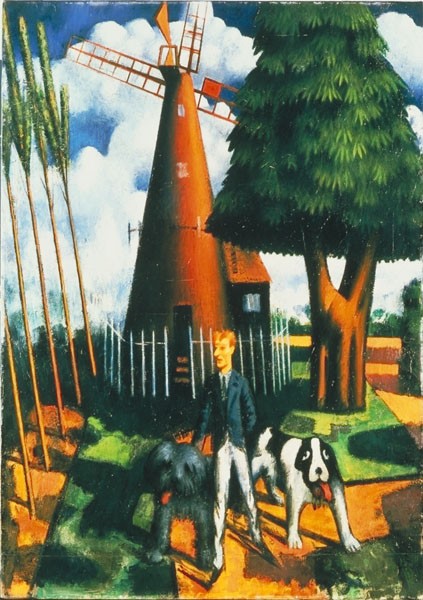
The painting is a full-length portrait of Gilbert Cannan standing in front of the mill with his two dogs.  The large black dog on the right hand side of Cannan is a Newfoundland dog called Luath.  To the left hand side of Cannan is his large black and white St Bernard dog Porthos.  Porthos was originally owned by J.M.Barrie and was used as a model for the dog Nana, dog which served as the Darling children’s nurse in J.M.Barrie’s famous book, Peter Pan, or The Boy Who Wouldn’t Grow Up.

What is interesting and somewhat quirky about this painting is Gertler’s use of geometrical shapes such as cones and triangles.  This can be seen in the shape of the windmill and the foliage of the large tree to the right of it.  Even the way Cannan and his two dogs are portrayed has a triangular shape to it as does the way the tall poplar trees on the left of the work lean to the left against the side of the painting. This was a reflection of Gertler’s interest in the contemporary art which was popular at the time.  The bright colours used by Gertler were not realistic and reflects the anti-naturalistic modern style of the era.

I think I am drawn to this painting purely for its eccentricity and nonconformity and the way Gertler has added vibrancy to the work with his use of unrealistic colouring.  The painting can be seen at the Ashmolean Museum in Oxford and as I have said on a number of occasions you must add a visit to this wonderful establishment on your “to do” list.

Étretat by Various artists

There are many subjects depicted by artists in their paintings which are the same.  One only has to think of religious paintings and the likes of the pietà or the deposition or even the crucifixion itself to see how numerous artists choose the same subject for their works of art.  It is also reasonably common for one artist to paint many versions of the same subject.  Think of how many times Vincent van Gogh painted his Sunflowers.  The last blog I did featured a painting of Bentheim Castle by Jacob van Ruisdael and I told you that he had actually painted the subject no fewer than fifteen times.  Today I am going to focus on geological structure that many artists have used in their paintings and I will let you compare them and see what you think.  First let me show you the location as you would see it today.

Cliffs and The Pinnacle at Étretat

The place is Étretat which is situated in the Haute-Normandie region of Northern France.  The town itself is about twenty miles north-east of Le Havre but it is not the town which claims the fame and which has always fascinated artists but its cliffs.  The single beach of Étretat is separated from the town by a sea-wall promenade and lies between two well-known cliffs.  To the east of the town lies the Amont Cliff and to the west lies the Aval cliff with its huge arch, Porte d’Aval,  cut through the chalk structure.   Slightly offshore of the Porte d’Aval stands the solitary needle rock known as L’Aiguille.    During the late nineteenth century this area of Normandy was very popular with Parisian families and with this popularity it soon became a very fashionable place to visit.

In 1868, Claude Monet lived at Étretat with Camille Doncieux,  whom he was to marry two years later.  He revisited the town on a number of occasions in the 1880’s so as to work on a number of paintings depicting the cliffs and sea.   Étretat had already been painted by both Delacroix and Courbet and in fact Monet owned a Delacroix watercolour of the area.. When Monet visited Étretat in 1883 he had planned to create his own Normandy seascapes, saying:

“I reckon on doing a big canvas on the cliff of Étretat, although it’s terribly audacious of me to do that after Courbet who did it so well, but I’ll try to do it differently.”

Because of the increasing popularity of the area with holidaymakers, Monet sensed that there would be a good market for paintings depicting this area. The area had everything, magnificent cliff structures from the top of which one had spectacular views of the sea, which sometimes had a mirror-like calm sheen about it, whilst on other times it exhibited a terrible unforgiving  ferocity as it crashed on to the foot of the cliffs, biting away at the base of the massive chalk structures

During the 1880s, Monet rediscovered the Normandy coast and visited the area many times so as to draw by the sea. He was fascinated by its dramatic cliffs and rock arches and was constantly looking for somewhere with outstanding natural beauty and a place where he could observe the effects of natural light on the sea and on the chalk and limestone cliffs.  He would move from one position to another continually looking for the best natural lighting of the cliffs and the sea. His search for the perfect light on the sea and the perfect position from where it could be seen was of paramount importance.  He once said:

“…I know that to really paint the sea it has to be seen every day at any hour and from the same spot to know its life at this very spot ; that’s why I’m repeating the same subjects up to four and even six times…”

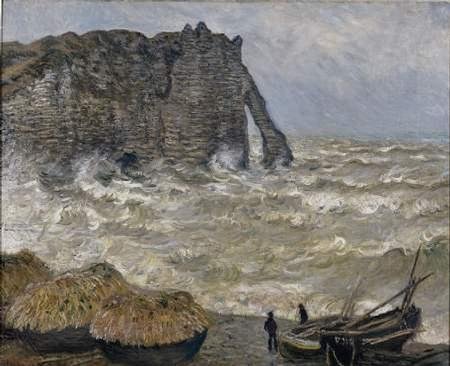
Stormy Sea at Étretat by Claude Monet (1883)

In 1883 Monet completed a work entitled Stormy Sea in Étretat, which is now housed in the Musée des Beaux-Arts in Lyon.  The painting is set on a winter day and we can see is being whipped up by gale force winds.  It is believed that Monet worked on this painting as he sat at the window of his hotel room.  What a wonderful depiction of the ferocity of the sea with the white curls of the surf atop the waves.  In the foreground we have the beach on which we see five boats.  Three of which are filled with what looks like thatch whilst the other two on the right seemed to have been abandoned and show signs that they have had to endure a battering in the waves.  Two men, stand by the boats, looking out on the rough seas.  To the left we have the cliffs and the Porte d’Aval,  above which we have the storm and rain clouds rushing towards the land.

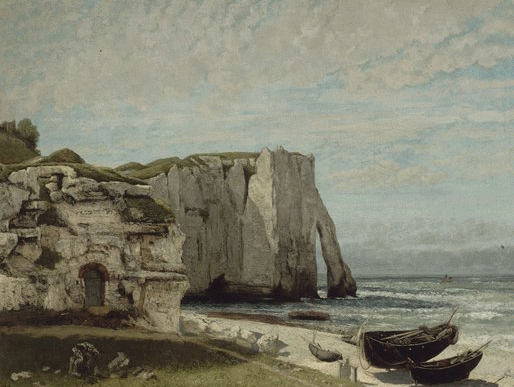
The Étretat Cliffs after the Storm by Gustave Courbet (1870)

The next painting I am featuring is one which depicts a similar view but is a work which depicts the time after a storm.  The title is La falaise d’Étretat après l’orage [The Etretat Cliffs after the Storm] and was completed by Gustave Courbet in 1870.  Courbet visited Étretat that summer and stayed in a house by the sea which was tucked against the Aval cliffs to the left of the bay.  He painted a number of versions of this scene but the one you see above is housed at the Musée d’Orsay in Paris.  Courbet like other artists was attracted to this area not only because of the breathtaking geological structures but because of the quality of natural light and the clarity of the air.  The composition of the sea, the land with its cliffs and rocks and the sky is well balanced.  Courbet had sent the painting for exhibition at the Paris Salon in 1870 where it was well received and Courbet’s reputation as a painter was enhanced.  Of the painting, the art critic and Courbet’s friend, Jules Antoine Castagnary, marvelled at the beauty of his friend’s work and described the elements of the work, speaking of:

 “…the free, joyous air which circulates in the canvas and envelops the details…”

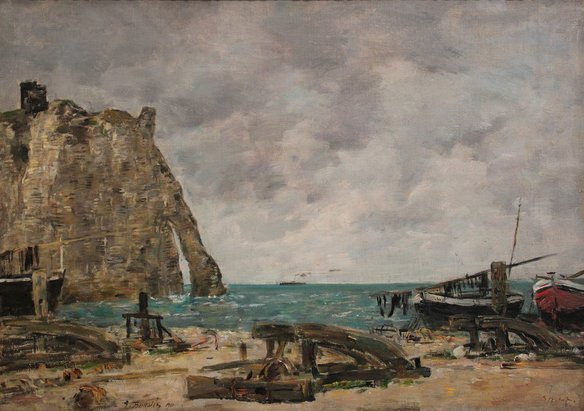
Beach at Etretat by Eugène-Louis Boudin (1890)

Another artist to depict this area in his painting was Eugène-Louis Boudin who in 1890 completed his work entitled Beach at Étretat.  Here we are looking at the scene from a vantage point similar to the previous works.  On the beach we once again see abandoned fishing boats which have been ravaged by the wind and sea.  Sails can be seen hanging from mast boom, shredded by the ferocity of a previous storm and probably act as a warning to the men as they contemplate a return to the fishing grounds.  In the distance we can just make out a steamship passing westward.

Étretat, Laundresses on the Beach, Low Tide by Eugène Bourdin (1892)

Two years later in 1892, Boudin, a noted marine painter, completed a very interesting depicting the beach at Étretat entitled Etretat, Laundresses on the Beach, Low Tide which is held in a private collectionThe setting is the same but the tide has retreated into the distance.  We are left with the brown and green of the rocks which have briefly lost their watery covering.  The breathtaking rock structure of the cliffs is not the focus of our attention in this work.  Before us we have a large group of women who have come down to the beach to do their washing.  It is a veritable hive of activity.

The Manneporte near Étretat by Monet (1886)

For my final painting I am returning to one painted by Monet in 1886 of the Manneporte, a spectacular rock structure just to the west of Étretat and the Aval cliffs.   It is entitled Manneporte (Étretat) and can now be found in the Metroploitan Museum of Art in New York.   This was one of nearly twenty views of the beach at Étretat and the spectacular rock formations such as the Porte d’Aval, Porte d’Amont and the Manneporte which rise upwards on along the coastline that Monet painted. In this painting Monet has captured the way the sunlight strikes the Manneporte, this beautiful natural wonder.  The reason for Monet painting so many pictures of the same scene was that he wanted to capture the changing light at different times of the day and during differing weather conditions

The writer Guy de Maupassant wrote his eyewitness account of Monet at Étretat.

“…The artist walked along the beach, followed by children carrying five or six canvases representing the same subject at different times of the day and with different effects. He took them up and put them aside by turns according to changes in the sky and shadows…”

One can so well imagine that scene.

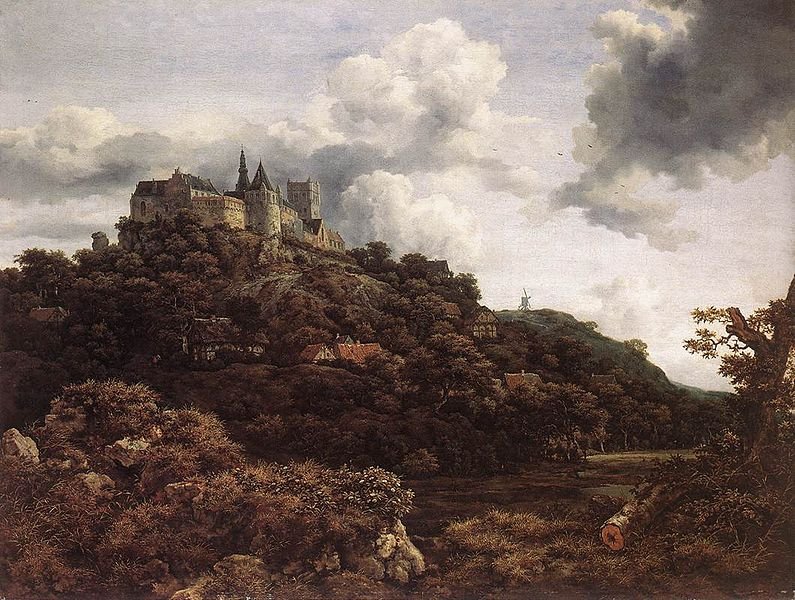
Bentheim Castle by Jacob van Ruisdael

Bentheim Castle by Jacob Van Ruisdael (1653)

Today I am moving away from the horrors depicted in the Max Beckmann’s painting which I featured yesterday and move to a beautiful work by Jacob van Ruisdael, one of the greatest pure landscape painters in the Netherlands in the 17th century.  I have featured his works before in My Daily Art Display.  On January 9th 2011 I looked at his painting Dam Square and on February 18th I featured his hauntingly exquisite work entitled The Jewish Cemetery.  Both are worth looking at if you haven’t seen them before.     I never tire of his amazing paintings.  My Daily Art Display today features another of his works entitled Bentheim Castle which  van Ruisdael completed around 1653.

Jacob van Ruisdael was born in Haarlem in 1628 and was brought up in an artistic household.  His father, Isaak van Ruysdael and his uncle, Salomon van Ruysdael were both landscape painters.  Little is known about Jacob’s early artistic training but it is thought that his father probably taught him with guidance from his uncle.  At the age of twenty he was admitted as a member of the Guild of St Luke in Haarlem.  The Guild of Saint Luke was the most common name for a city guild for painters and other artists especially in the Low Countries.   They were named in honour of the Evangelist Luke, who was the patron saint of artists.

Unfortunately during his lifetime Jacob van Ruisdael’s artistic talent was not appreciated and by all accounts he led a poverty-stricken existence.  At the age of fifty three the Haarlem council was petitioned for his admission into the town’s almshouse.  He died in Amsterdam a year later in 1682 and his body was brought back to be buried in Haarlem

Jacob van Ruisdael travelled considerably during his lifetime but seldom went outside his own country.  However it is known that Ruisdael visited the small town of Bentheim, in Westphalia close to the Dutch-German border in the early 1650’s when he travelled to the region with his friend and fellow artist Nicolaes Berchem,  who, like Ruisdael, came from Haarlem.  Bentheim Castle received a first mention in historical records back in 1020 AD when the owner of the fortress who was named as Count Otto of Northeim, and who would later become the Duke of Bavaria, married.  He had, at this time, just married Richenza, the daughter of the Count of Werl, whose family was one of the most influential and wealth dynasties in Westphalia.  The castle changed hands during many battles over the centuries.  Nowadays the fate of Castle Bentheim is in the hands of the Hereditary Prince Carl Ferdinand of Bentheim and Steinfurt, who was born in 1977. Since 2007 he has been married to Hereditary Princess Elna-Margret of Bentheim and Steinfurt.

Jacob van Ruisdael’s favourite subjects were simple woodland scenes.  He was influenced by two great Netherlandish landscape painters of the time, Allaert van Everdingen and Meindert Hobbema.   Ruisdael forte was the depiction of trees in his works.  His rendering of the foliage was second to none. At the time of this painting which was completed in the 1650’s, Ruisdael portrayal of landscape scenes was bettered by nobody.  He stood out from his contemporaries when it came to the painting of woodlands, rivers, waterfalls, mountains, and even seascapes.

His landscape works became larger which allowed him more space for his portrayal of his giant oak and beech trees as well as the plethora of shrubs.  Look at today’s featured work simply entitled Bentheim Castle for an example of this.  No matter how the castle dominates the landscape, Ruisdael must have spent an enormous amount of time painting the surrounding trees and vegetation which can be seen like a skirt around the castle fortress.  Just take time and carefully study the detail of the vegetation in the foreground. Some of it has been brightened by a sudden shaft of sunlight whilst most of it in the middle ground remains in shade.  The colours the artist used in his paintings around this period became more vivid and space increases in both height and depth.  In this work by Ruisdael, look at the great variety of colours the artist has used to paint the flora.

What we see before us is the castle as seen from the south-west above which Ruisdael has given us a wonderful rendering of cloud formation.  It is an idealized landscape and not topographically accurate as the actual castle is situated on an unimpressive and somewhat low hill. However, Ruisdael, in order to add grandeur to his landscape work, has made the castle almost look like it is perched atop a small mountain.  Why would he do that?  Probably because placing the castle so high and so distant gave it a more commanding appearance but I believe his main reason was it offered him the opportunity to flood the middle and foreground with a small forest with all the colours that brings to the work.  In amongst the wooded slopes we see the red roof tops of the white houses and cottages.  This colour red manages to set off the verdant colour of the flora that surrounds them and which runs down to the foreground of the painting.  One can see that for Ruisdael the painting of trees and flora was his main joy.  Jacob van Ruisdael loved the view of this ancient fortress and over the years painted more than fifteen landscapes featuring Bentheim Castle, viewed from different viewpoints and seen in various surroundings.

I marvel at the detail in this painting and just wonder how long it took the twenty-five year old artist to complete it.  The painting is housed in Dublin at the National Gallery of Ireland.

The Night by Max Beckmann

The Night by Max Beckmann (1918-19)

Today I am exploring the unusual world of Expressionism, to be more precise, German Expressionism, and will be looking at a painting entitled The Night by the German artist Max Beckmann, who was one of the most important German painters of the 20th century.  Beckmann has always been compartmentalised as an Expressionist painter but he himself, railed against that tag.

Expressionism materialized in different artistic circles across Europe but its zenith was the period between 1905 and 1920.  Expressionism as a general term refers to art in which the image of reality is more or less heavily distorted in formand colour in order to make it expressive of the artist’s inner feelings or ideas about it.  In expressionist art the colours used were often strong and highly intense and often non-naturalistic.  The brushwork is typically free and paint application tends to be generous and highly textured.  Expressionist art inclined to be poignant and sometimes had mystical qualities.  It would often look at themes of belonging and alienation.  In some ways Expressionism was the art of unrest and the search for truth.  The German Expressionists were loosely gathered in two groups.  One was called Die Brücke (The Bridge) and the other was Der Blaue Reiter (The Blue Rider).  There are numerous well known artists who could be looked upon as Expressionist artists.  The ones who come to mind are Egon Schiele, Edvard Munch, Wassiliy Kandinsky, Paul Klee and Beckmann just to mention a few.

Max Beckmann was born in Leipzig in 1884, the youngest of three children.  His family were of a middle-class background.  His father was a grain merchant but died when Max was just ten years of age.  He received a thorough education and spent several years at a boarding school.  At the age of fifteen and despite family objections, he decided on an artistic career and applied to the Königliche Akademie in Dresden but failed the entrance exam.  In 1900, aged sixteen years of age, his artistic studies finally began with his enrolment at the Weimar Saxon-Grand Ducal Art School for a three-year course and it was here that he learned to draw from antique statues and eventually progressed to human models.  It was also at the Academy that he met fellow art student, Minna Tube, whom he married three years later.  They went on to have a son, Peter.  After the course ended in 1903 he went to Paris where he studied at the private Académie Colarossi, which was an alternative art institution to the government-sanctioned École des Beaux-Arts that had, in the eyes of many promising young artists at the time, become far too conservative.  In 1906, he was in Florence financed by winning the German art prize, the Villa Romana Prize and it was in this Italian city he was able to study the works of the great Masters.  The following year, he moved to Berlin and three years later in 1907 he participated in the Berlin Secession, which was the predominant voice of modern German painting.  The term Secession, which came from the Latin secessio plebis (the revolt of the plebeians against the patricians) was the term applied to groups of artists who secede from academic bodies or associations in protest at the constraints.  The three main Secessions were those of Berlin, Munich and Vienna.   The Berlin Secession was founded by Berlin artists in 1898 as an alternative to the conservative state-run Association of Berlin Artists.

Beckmann’s paintings from this period are characterized by the legacy of Impressionism, with landscapes and beach scenes painted with stippled brushstrokes which evoked the play of light across shapes. He was held in such high regard by his colleagues that, in 1910, he was elected to the executive board of the Secession and was the youngest member ever to achieve such a distinction. However because he preferred painting to policy making, he resigned the following year in order to devote himself full-time to his art work. Conflict within the Berlin Secession eventually led to a further schism in 1910 and the new group called itself the Neue Secession (New Secession). In 1914 the rejection of works by some members of the Berlin Secession again led to further disagreements and several artists, including Beckmann left the Berlin Secession to found the Berlin Freie Secession (Berlin Free Secession), which existed until 1924.

At the outbreak of World War I in 1914, Beckmann volunteered as a medical orderly and served time on the Belgium front. Before the onset of war, he, like many other Germans, rationalized the necessity of war and believed in their countries aims.  He believed war could cleanse the individual and society. However, after experiencing day after day the widespread destruction and horrors of the war, he became disillusioned with the conflict and rejected the glory of military service.  In 1915 the dreadfulness of what he witnessed took its toll on him and he suffered a nervous breakdown and was moved to Belgium and later Frankfurt.

Following World War I, his work changed radically in reaction to the horrors he had witnessed. Initially he focused on biblical scenes, but during the 1920s he created more contemporary allegories and painted devastatingly realistic portraits and figure paintings associated with the Neue Sachlichkeit (New Objectivity) group, with whom he exhibited in 1925, but never formally joined.  He now rejected traditional perspective and proportion creating taut, airless pictorial structure of space and planes with an absence of bright colour and thick brushstrokes of Expressionism.   He saw the world as a tragedy of man’s inhumanity to man and saw life as a carnival of human folly.   In 1925 his marriage to Minna Tube, which had slowly been unravelling, came to an end and the couple were divorced.  That same year he married his second wife, Mathilde von Kaulbach and he was appointed professor at the Städelsches Kunstinstitut in Frankfurt.

In 1933 the Nazis came to power and Beckmann was declared a “degenerate artist”.  He was dismissed from his post at the Städelsches Kunstinstitut and a ban was placed on all his exhibitions.  All his works in German museums were confiscated.  The Nazi art policy at the time applied to everything that did not conform to Nazi goals.  It was their battle against what they termed überfremdung (foreign infiltration).  He moved from Frankfurt to Berlin where he believed due to its size and large population he could become more anonymous.  In 1937 he moved to Amsterdam where he lived in poverty in self-imposed exile failing in his desperate attempts to obtain a visa for the US.  He remained there until 1948 at which time he was finally granted a US visa.    From there he and his wife moved to the USA and he took up a post at the School of Fine Arts, Washington University in St Louis.  Later he moved to New York where he was given a professorship at the Art School of Brooklyn Museum.

Max Beckmann died of a heart attack whilst out walking in Manhattan, the day after Boxing Day in 1950.  He was aged 66.  His wife, Mathilde, died six years later.

My featured painting today entitled The Night was painted by Max Beckmann during 1918 and 1919.    It is housed at the Kunstammlung Nordrhein-Westfalen, Dusseldorf.   This is an early example of Beckmann’s grotesque and appalling visionary paintings with its misshapen figures. Before us we have an overcrowded room in a modern city.  Beckman himself said he wanted this work to be looked upon as a large modern history painting tinged with a sense of evil. Three men have invaded the room and are terrorising the occupants.  The man to the left has been hung by the neck by one of the intruders while a man with a bandaged head, wearing waistcoat and tie and smoking a pipe, twists his arm.   Two women can also be seen in the scene.  One, in the central foreground with her back to us, possibly the man’s wife, wears red stockings and is bound to a post after having been raped.   The second woman whose feet we can just make out at the top right of the painting, is held upside down by a man whose hat resembles the type worn by Lenin. To the right a blonde-haired child is about to be dragged off.  Under the table we see an old phonograph, the sound from which may have been used to blot out the cries from those being tortured.  Also partly under the table on the left we see a dog whose head is raised as he howls for help.  This is a scene of urban hell, an unfathomable and vile scene.

In his book Max Beckmann, Stephen Lackner commented on this work saying:

“… Beckmann sees no purpose in the suffering he shows; there is no glory for anybody, no compensation, … Beckmann blames human nature as such, and there seems to be no physical escape from this overwhelming self-accusation. Victims and aggressors alike are cornered. There is no exit…”

Maybe, one should remember that 1918 was  the time of the German November Revolution which resulted in the replacement of Germany’s imperial government with a republic and which unleashed tremendous savagery and terror across the country.  In 1919 there followed a general strike which was brutally put down by the authorities.  Maybe in some way Beckmann, in his painting, was alluding to such horrors perpetrated by mankind on mankind.  I find it very hard to fathom the state of the artist’s mind when he was painting this work.  Had he personally suffered so much mentally and lost all hope in humanity to depict such violence?

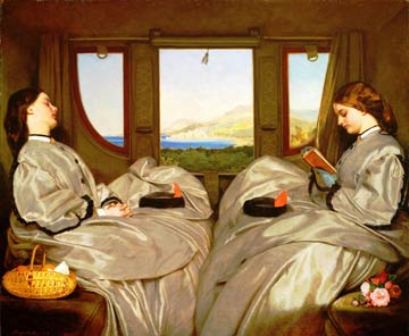
Travelling Companions by Augustus Egg

Travelling Companions by Augustus Egg (1862)

Today I am once again featuring a Victorian painter.  His name is August Leopold Egg and he was born in London in 1816.  He was the third son of Joseph and Ann Egg.  His Swiss-born father, like his family before him, was a gunsmith and today one of his guns or rifles commands a high price at auction.

In 1834 Augustus studied art at the Sass Academy in London.  Henry Sass was an English artist and teacher of painting who founded this London art school and it provided training for those seeking to enter the Royal Academy.  Two years later, in 1836, the twenty-year old August Egg enrolled as a Probationer to the Royal Academy Schools.  The following year, he joined up with a number of fellow aspiring artists and formed a sketching club, known as The Clique.  This small grouping, which included the founder, Richard Dadd, also included Alfred Elmore, William Powell Frith, Henry Nelson O’Neil, John Phillip and Edward Matthew Ward.  The Clique was characterised by its denunciation of academic high art in favour of the simpler genre painting, and the group were influenced by the great English narrative painter William Hogarth and the Scottish historical painter David Wilkie.  For them, art was for public consumption and for the public to judge.  They believed that works of art should not be judged solely on how well they conformed to academic principles.

August Egg was at pain to combine popularity with moral and social activism in his paintings which was similar to how his friend, the writer Charles Dickens managed to do with his novels.   Egg and Dickens became great friends and  jointly founded the “Guild of Literature and Art”, which was a philanthropic organisation which provided welfare payments to struggling artists and writers.  Egg’s early works of art were mainly illustrations of literary subjects as well as historical incidents taken from the accounts of the seventeenth century diarist, Samuel Pepys.  He also showed great interest in Hogarth’s narrative works, which often had a moral theme such as Marriage à la Mode and The Rake’s Progress and it was probably these works that inspired Egg to complete his moral narrative painting, The Life and Death of Buckingham.  Many members of The Clique were vociferous critics of the Pre-Raphaelite Brotherhood because, to them, their art was deliberately unconventional, but Egg disagreed and became a great friend and admirer of William Holman Hunt.  In 1848 Egg completed his much lauded work entitled Queen Elizabeth discovers she is no longer young.  This won him critical acclaim and earned him the position of Associate Member of the Royal Academy (ARA).  In 1860 he was elected to the position of Royal Academician (RA).  That same year he married Esther Mary Brown.

August Egg was, besides being a talented artist, a great organiser and spent a much of his time organising exhibitions for his fellow artists.  In 1857 he was one of the organisers of the The Art Treasures of Great Britain exhibition, which was held in Manchester from  May to October of that year.  To this day, it is said to remain the largest art exhibition ever to be held in the Great Britain, possibly in the world with over 16,000 works on display. It was so popular that it attracted over 1.3 million visitors in the 142 days it was open, which at the time, was about four times the population of Manchester.

Egg loved the theatre and it was through this love that he became friends Charles Dickens and Wilkie Collins and at times they would all take part in amateur theatricals.  In 1849, Egg was elected to the Garrick Club, a gentleman’s club, which was named after the well-known thespian of the time David Garrick.  At the end of that year, Egg who often travelled extensively around the Mediterranean countries, set off on a journey to Switzerland and Italy and was accompanied by Dickens, who had just completed his novel Bleak House,  and his other writer friend, Wilkie Collins.  Egg’s health was never good and in his later years he tried to remedy this by living in the warmer climates of the Mediterranean countries.  He died in Algiers in 1863 of asthma aged 46.  He was always well loved and his friend, Charles Dickens, described him as:

“….always sweet-tempered, humorous, conscientious, thoroughly good, and thoroughly beloved…”

My featured painting today by August Egg is entitled Travelling Companions which he completed in 1862 and can now be found at the Birmingham Museum and Art Gallery.  This has a connection with Egg’s travels as the setting of the painting is a railway carriage and through the open window of the carriage one can just make out the shoreline of Menton, a popular health resort in Victorian days, which lies close to Monte Carlo on the French Riviera.   Look how the artist has cleverly depicted the motion of the carriage by painting the tassel attached to the window blind at an angle away from the vertical.  There are no other people in the carriage besides the two females which may have been an indication that in those days, males and females rode in segregated train carriages.  There is almost a perfect symmetry about the women in this painting as they sit across from each other in the carriage.  They wear almost identical billowing voluminous grey dresses.  Their hats rest on their laps.  Their faces are each framed with a mass of beautiful brunette hair and each wears a black choker around their neck.  At first glance, they almost look like mirror images of each other but once we look more closely, there are obvious differences.  One sits with a basket of fruit by her side, whilst the other has a bouquet of flowers next to her.  One reads whilst the other lays back with her eyes closed.  There is no interaction between the two females.  Neither seems to be interested in the other or what sights can be seen from the carriage window.  Did August Egg want us to take the painting on face value, that is, did he want us to just to accept that this is simply a painting of two women travelling in a railway carriage?   I did, but many do not see the painting in such simplistic terms.  Maybe it is because Egg had painted many moral narrative works that people looked for hidden meanings in this work.  I am not convinced, but let us look at some of the suggestions that have been put forward about how we should interpret what  we are looking at and then I will let you be the judge as whether they are too fanciful to believe or there is a modicum of truth in what they want us to accept as the true meaning behind the painting.

So, if you, like me, look on the painting as simply a depiction of two women travelling by train let me “muddy the waters” for the more I investigate this painting the more I am wondering whether I am missing something.  Is this simply a painting of two almost identical women on holiday travelling in a railway carriage?  Are we simply observing a young lady sleeping and a young lady reading?  First of all, are we looking at two separate women?  That would seem a silly question but some people would have us believe they are one and the same person and that the artist is portraying them in different moods.  Some again who believe in the “one woman” theory would have us believe that perhaps the waking woman is the product of the sleeping one: in other words, she is the dreamed projection of the other.  Another theory is that the one who sleeps is a portrait of inactivity and the one who reads is a portrait of activity – a pictorial depiction of “Industry and Idleness”.  I also read that Egg’s painting was a statement of past and future with the one woman with her eyes closed dreaming of the future whilst the other reads of the past?

And so the theories about the interpretation of this painting mount up but I suppose one has to remember that in Victorian times, tales with a moral were all the rage and Augustus Egg painted many pictures which told a moral tale, so is this yet another one?     

For people who like to add their own interpretation to a painting many feel the need to explore the sexual connotations in a scene and I read an article which does just that.  It is by far the most unusual interpretation (I initially intended to say “fanciful interpretation” of the painting but decided the word “fanciful”  sounded derogatory and that is not my intention).  The article I came across was on the website entitled Victorian Visual Culture and was written by Erika Franck as part of a degree course in Modern Literary studies.  She wrote:

“…Although Egg’s Travelling Companions (1862) is considered to be a reflection on railway travel and the way in which the different classes were segregated, one cannot ignore the sexual connotations that are evident in the painting. The painting displays two young ladies who appear to be identical, and yet upon closer inspection are not. It seems as though the girl on the left has been awakened sexually despite the fact that she is asleep. This can only be detected in comparison with the girl on the right. Firstly, the young lady on the right has flowers set beside her as opposed to the other lady who has a basket of fruit. The flowers convey the virginity and sexual virtue of the girl on the right whereas the fruit beside the girl on the left implies her virginity has been lost and her innocence has been replaced by sexual indulgence and consequently sexual maturity. This analogy continues as one studies the way in which the companion on the right has the curtain slightly drawn to shade her from the sunlight, as opposed to the lady on the left whose curtain allows the light to expose her fully. In addition, the companion on the left has removed her gloves and is thus further exposed physically. The hat of the lady on the left is positioned slightly to the left in contrast to her companion whose hat sits centrally upon her lap. Again it appears as though the girl on the left has exposed herself sexually in that she is less guarded than her sister. This notion is furthered when one considers the posture of the two companions. The one on the right seems more composed and is reading a book whereas the one on the left is leaning back exposing her neck, and is asleep. Although one could question that if this girl has been awoken sexually then why is she the one who is sleeping in the painting? However, it is possible to argue that this displays her overall lack of constraint and propriety that is portrayed by the other young lady. Even the hair of the companion on the left seems to have fallen out compared to the girl on the right whose hair is pinned back in a controlled manner. If one examines the shape of the carriage window in conjunction with the symmetry of the girls’ dresses one can observe there is a shape which resembles that of a chalice. This traditionally symbolizes the womb and fertility, thus accentuating the theme of sexual awakening. Therefore, Egg presents a young woman who appears to be sexually passive and another who is not. One can speculate that the two ladies are the same person and this consequently, would indicate that a transition from sexual unconsciousness to sexual enlightenment has occurred. However, if one is to argue that this picture depicts a girl who has fallen sexually in contrast to her companion, then this painting serves as a mere “freeze-frame”. It does not represent the consequences of the girl’s fall….”

I sometimes wonder whether I should write a book entitled My Interpretation of Great Paintings as I would be simply just one of many to offer an interpretation as to what I think we are looking at and as the artist is dead and cannot repudiate my suggestions, who is to say the hidden meanings I put forward are wrong !    Somebody once told me that if you want to write a successful biography of an artist you have to come up with at least one amazing, contentious even bizarre fact about the artist that nobody has ever heard before as that will get you the publicity needed to sell the book.   I wonder if the people who have interpreted Egg’s work were thinking along those lines !

The Sick Child by Edvard Munch

The Sick Child by Edvard Munch (1907) The Tate, London

If I was to mention the name Edvard Munch to most people they would automatically think of his famous painting entitled The Scream and although I will look at that masterpiece in a future blog, today I want to concentrate on his very poignant painting entitled Det syke barn (The Sick Child) which he completed in 1886.  The version you see above is one he completed twenty years after he painted the original and is now to be found in the Tate Gallery, London.  However I look more closely at the painting, I would like to delve into the early life of Munch and by so doing, it may give one an insight into the man and his paintings.

Edvard Munch was born on December 12th, 1863, on a farm, in the village of Ådalsbruk in Løten, Norway.  His father, Christian Munch, the son of a clergyman, was a military doctor, who in 1861 had married Laura Catherine Bjølstad, a woman half his age.  The couple had two sons, Peter Andreas and Edvard and three daughters, Johanne Sophie, Laura Catherine and Inger Marie.     In 1864, when Edvard was just one year old, the family moved to Kristiania (now known as Oslo) as his father had been offered the post of medical officer at the Akershus Fortress.  In 1868, when Edvard was still not five years of age, his mother died of tuberculosis.  Following her death the five children were brought up by their father and their aunt Karen.  Edvard proved to be a sickly child, especially during the cold harsh Norwegian winters.   He suffered from chronic asthmatic bronchitis and had several serious attacks of rheumatic fever and would often have to be kept off school and it was during these times when he was at home confined to his bed that Edvard developed a love of sketching.  Whilst at home his father would tutor him in history and literature.  There can be no doubt as to Christian Munch’s devotion to his children but there was a down-side to this dedication and attentiveness.  Christian Munch was an extremely religious man.  He was a orthodox Christian and a great believer and follower of pietism.  The Pietist movement combined the Lutheranism of the time with the Calvinism emphasis on individual piety and living a vigorous Christian life.  Edvard always remembered his father’s strict religious beliefs and in Sue Prideaux’s 2005 book on Munch entitled Edvard Munch: Behind the Scream, she quotes Munch:

“…My father was temperamentally nervous and obsessively religious—to the point of psychoneurosis. From him I inherited the seeds of madness. The angels of fear, sorrow, and death stood by my side since the day I was born…”

Edvard Munch, like his siblings had to suffer their father’s religious fanaticism and he would often tell them when they were naughty that their mother was looking down upon them and weeping with sadness at their behaviour.  Combine his father’s behaviour with his own illnesses as a child and it is no wonder that young Edvard and some of his siblings experienced nightmares and death-like hallucinations.  Death was never far away from Edvard.  His favourite sister, Johanne Sophie, died of tuberculosis in 1877 when he was fourteen years old.  One of his younger sisters was diagnosed with a mental illness at an early age and Edvard’s brother Andreas who was the only one of the children to marry, died a few months after his wedding.  All this affected Edvard and in Arne Eggum’s 1984 biography of the artist, he quotes Munch as saying:

“…I inherited two of mankind’s most frightful enemies—the heritage of consumption and insanity…”

To supplement his meagre army pay, Christian Munch tried to set up in private practice but this failed and he and his children suffered a poverty-stricken lifestyle which made it necessary to move from home to home in ever worsening conditions.  Many of Edvard Munch’s early drawings and watercolours were of the interiors of their various homes.    In 1879 he followed his father’s wishes by entering the Technical College to become an engineer. However the illnesses Munch had suffered during his childhood continued and, as was the case with his time at school, he had frequent absences from the college due to his ailments.  He fell so far behind in his studies that in the autumn of 1880 he left the college, deciding engineering was not for him. There was an entry in his diary of November 7th 1880:

‘….My decision is now namely to be a painter…”

In the following year he enrolled at the Royal School of Art and Design where he stayed for one year.  He and a few of his fellow art students then set up and rented a studio in a building which housed other painters.  One of these painters was the Norwegian artist, Christian Krohg, who offered to tutor these young aspiring painters.  Krohg was a leading figure in the changeover from romanticism to naturalism, characterized by Norwegian art in this period.   Edvard Munch exhibited his first painting at the end of 1883 at the Industry and Art Exhibition in Oslo.

In 1885 Munch received money to study for three weeks in Paris and the following year he began to work on today’s featured painting, The Sick Child.

My featured painting today by Munch was completed in 1886 when he was just twenty-three years of age and remains one of his most important works.  Munch himself describe this work as “a breakthrough in my art”  Munch created numerous versions of the painting and as I said at the beginning, the painting you see before you today is the fourth version, which he painted in 1907, and which is currently being exhibited at the Tate Gallery, London.   In the painting, the central character is that of a stricken young girl propped up in bed by a thick white pillow and covered by a heavy blanket.  She is dying of tuberculosis.  Her red hair is tousled and uncombed.  This is not just the death of any girl.  This is the death of Edvard Munch’s elder sister, Johanne Sophie, who was dying slowly, in fever, often hallucinating, and begging for someone to rescue her from the jaws of death. Edvard was both distressed and terrified by his own helplessness. His father even with his medical knowledge could not do anything to save his daughter. In the eyes of young Edvard’s both God and his father were both guilty of letting Sophie die.  From this time on, death became a constant companion in the young artist’s life and there can be no doubt that this early traumatic childhood experience influenced all of Munch’s art.   Munch later, he said of this feeling:

“…Sickness, insanity and death were the angels that surrounded my cradle and they have followed me throughout my life…”

This work of art is all about the fragility of life.  As she lies back on the pillow the young girl seems to be focusing on the black drape at the right of the painting.  Maybe Munch wanted to have us interpret this as her staring at death itself.  Next to the bed of the dying girl we see a distraught female, clutching one of her hands in theirs, offering what little comfort she can at this heartrending time.  Look how the supportive friend, who holds the hand of her dying friend, is affected by the situation. Her head is bowed and her eyes are averted from the face of the dying child.   She cannot bear to witness the fear and suffering in the child’s eyes.

I have often said in earlier blogs that I wondered what was going through the artist’s mind when he or she was painting a certain picture.  In this case we can almost feel the pain and the sadness of the artist as he portrayed his dying sister.  Anybody who has suffered the loss of a family member must know what was going through Munch’s mind as he had to recall such a harrowing scene.

There is a history to this version of the painting.  It was bought by the city of Dresden in 1928, where it was displayed in the city art gallery.  Ten years later the Nazis regime declared that the art of Edvard Munch was ‘degenerate’ and, in November 1938, all his works in German public collections were collected in Berlin for sale by auction. Today’s featured painting and many others by Munch were rescued by a Norwegian art dealer, Harald Holst Halvorsen, who returned them safely to Oslo. The painting was then acquired by Thomas Olsen in 1939, who donated it to the Tate.

Were the critics as moved by this poignant painting when it was exhibited at the Autumn Exhibition in Kristiana in 1886?    Alas the painting shocked the critics and the public alike and a storm of indignation and protest broke out.   It is very important to try and understand the people’s hostile reaction;   they were simply not accustomed to see this kind of painting. For them, art was still synonymous with beauty, harmony, good shape, and for them the sight of suffering, ugliness and pain in a painting was just not acceptable.  Edvard Munch however was not put off by the condemnation and criticism.  He came back to the painting time and time again over the following twenty years, re-painting it but never once toning down the sadness and the emotion which, I am sure you agree, makes it a beautiful and moving work of art.  Death, illness and mental anguish were subjects that would from then on continue to figure significantly in Edvard Munch’s future paintings.

On the Brink by Alfred Elmore

On the Brink by Alfred Elmore (1865)

Today I am featuring a work of narrative art.  Narrative art is one that tells a story and has been very popular in Western art.  It often depicts stories from the Bible, mythological tales and legends and were often pictorial recordings of great moments in history.  In the seventeenth century we began to see such narrative works in the paintings of subjects from everyday life, which were known as genre paintings.  They originated in the main in Holland with scenes of peasant life and drinking scenes in taverns.  In England in the sixteenth century the artist William Hogarth invented the Modern Moral Subject paintings which brilliantly brought to our attention and lampooned the manners and morals in his day.  I featured a set of these paintings in My Daily Art Display (May 4th to May 9th 2011).  Before I talk about today’s painting, I will briefly tell you a little about the life of Alfred Elmore.  In the meantime, I want you to look at the painting and see if you can surmise what is going on and why the artist chose the title of On the Brink.

Today featured work is a Victorian narrative painting by English painter of Irish birth, Alfred Elmore.  Elmore was a Victorian history and genre painter, who was born in Cork in Southern Ireland.  His father, John Richard Elmore was a retired surgeon from the British Army.   His family moved to London and Alfred attended the Royal Academy Schools in 1832.  Whilst at the Academy he briefly associated with a group of fellow art students who had just formed a sketching society which they called The Clique.  It was described as the first group of British artists to combine for greater strength and to announce that the great backward-looking tradition of the Academy was not relevant to the requirements of contemporary art.

In the late 1830’s Elmore studied at French atelier and then from 1840 to 1844 travelled extensively through Europe visiting Munich Venice, Bologna, and Florence and spent two years in Rome.  In 1844 he exhibited his work entitled Rienzi in the Forum at the Royal Academy and this led to him becoming an Associate of the Royal Academy (ARA) the following year.  He became a Royal Academician in 1857.  Elmore painted a number of literary subjects, especially depicting scenes from the plays of Shakespeare but many of his later works were historical narrative works, some of which were wholly anti-Catholic in spirit.  Elmore’s reputation was at its height in the 1850’s but he suffered a lapse into comparative obscurity during the latter portion of his life.  He died of cancer in 1881, aged sixty-five.

And so I return to today’s painting entitled On the Brink which Alfred Elmore painted in 1865 and was probably his best known work.  It is termed a moral genre painting which may give you a clue to what is happening in the painted scene.  What do you make of the title of the painting?  Have you any idea why Elmore would give the work such a name?  I suppose to discover the answers to these questions one has to first identify what we are looking at.  We are standing outside a house and looking through an open window into a room which is the venue for some sort of gaming.  A man leans out of the window and is talking to an unhappy-looking woman who is seated outside.  That is the scene and the man and the woman are the main characters.

This painting, which was exhibited at the Royal Academy in London in 1865, clearly embellishes the concerns Victorian people had about gambling, especially when it involved young women. The artist has created a striking sense of depth within the painting. There is a great contrast in the colours used for the interior and the exterior.   In the foreground we have the outside tranquillity and paleness of the moonlight which contrasts with the dazzling red and gold gaudiness of the hustle and bustle going on inside the room.   Look at the garish colours of the gaming room.  The red wallpaper is lit by a chandelier and candles, which are reflected in gilt mirrors around the walls. A throng of people lean over a gaming table, totally absorbed in the action, which contrasts with the sorrowful state of the woman in the foreground. If we look to the left background we can see a curtained-archway which leads to another well-lit gaming room full of people.  We are almost certain we know the setting for this painting for there is a one word inscription, Homburg, on the reverse of the canvas.  In 1842, the German town of Bad Homburg had a casino and spa and had attracted a wealthy and cosmopolitan clientele to its gaming tables, of which many were British.

The woman with a decision to make.

The young woman, we see before us, sits unhappily outside in the darkness of the evening. Her figure is illuminated by the white light coming from the moon. We can only see one side of her face which is deathly white whilst the other side is hidden in the darkness of the night.  Her clothes are of a rich quality and the height of fashion.  Our first clue as to what the painting is all about is the empty purse which dangles from her right hand and a torn gaming card which lies discarded at her feet. From these clues we now know why she is in such a state – she has lost all her money at the gaming tables which we can see through the open window behind her.

The seducer

Still we haven’t reconciled the title of the painting but if we look at the shadowy figure of a man leaning out of the window talking to her all will be resolved.  His figure, apart from his hands, is neither illuminated by the light from the room nor the moonlight.  The way the young man is depicted, almost devil-like, adds a certain air of foreboding and menace and we feel that he is not a good companion for this lady.  It is interesting to see how the artist compares this mismatch with the couple in the middle ground.  They are standing in the room directly behind the shadowy figure and face each other in a loving stance.

The title of the painting can be understood a little better if we look at the flowers which are next to the woman.  There are two types of flower.  One is a white lily which symbolises purity whilst the other is the purple passion flower.  In the Punch magazine in the May of the year the painting was exhibited, an anonymous poet had written, about the scene and what we were looking at:

E’s [for] Mr. Elmore. She’s tempted to sin;
She’s fair. Will the lily or the passion flower win?

According to the poet’s understanding of the painting, it was all about the choice faced by the unfortunate young female who had just gambled away all her money and was now being propositioned by an unseemly man.   The question she is on the brink of answering is, should she retain her virtue and face the consequences of her new found poverty, or does she earn the money she needs to repay her debts by submitting to the proposition of the young man who is offering money for her body.  As we look at her she is “on the brink” of making her decision.  So we now know that the title of the painting derives from the situation in which a young woman s ‘on the brink’ of responding to the blandishments of a seducer, who is depicted as a Satan-like figure, luridly bathed in red light, and whispering corrupting thoughts in her ear.

There were a number of Victorian paintings which depicted “fallen women” and I will look at another in a few days time.  This one by Elmore, which he exhibited at the Royal Academy in 1865, was to greatly enhance his reputation as a Victorian artist.

The painting is presently housed in the Fitzwilliam Museum, Cambridge.

The Rain It Raineth Every Day by Norman Garstin

The Rain It Raineth Every Day by Norman Garstin (1889)

Most of you, who have read my blogs, may know by now that I took early retirement and am now running a small Bed & Breakfast establishment in a Welsh coastal town.  I pride myself in trying to give my guests the best stay they could ask for and each morning cook them the best breakfast possible and I am pleased to say my small establishment has received top ratings on a certain website.  The people that stay with my wife and I are from all over the world, some coming from hot climates.  Sadly, the only thing I cannot guarantee my visitors is the weather.  My breakfast room is in the conservatory and when the heavens open, I try and convince my diners that the sound of rain on the conservatory roof is actually worse than the conditions outside.  I am not sure whether I am believed!  I actually feel guilty about the weather they have to sometimes endure!  So why do I mention this?  It is certainly not an advert for my B&B but merely a lead in to today’s featured painting which highlights the worst of the British weather.  My Daily Art Display’s featured painting today is entitled The Rain it Raineth Every Day and it was completed by the Irish artist and writer Norman Garstin in 1889.

Norman Garstin was born in Cahirconlish, in County Limerick, Southern Ireland in 1847.  His mother was Irish and his father was of Anglo-Irish descent and he was their only child.  He displayed no early interest in art and on leaving school attended the Engineering College of Cork and it was during that time when he was studying to become an engineer and draughtsman that it became apparent that he had a great aptitude for drawing.  Because of this palpable talent for drawing, he moved to London to study architecture.  It was whilst living in the capital that he heard and read about the money that was to be made in the South African diamond fields.  The lure of a possible fortune to be made was too much for him to ignore and so in 1872 he journeyed to South Africa and the diamond field centre, Kimberley, in order to make his fortune.  He remained there for four years and for some time shared a tent with Cecil Rhodes, the English-born South African who was to become the founder of the diamond company De Beers and the founder of the state of Rhodesia, which was named after him.

Garstin did not make his fortune digging for diamonds and after four years he moved to Cape Town where with Frederick York St Leger, an Anglican clergyman and a fellow Limerick man he helped to edit the Cape Times newspaper.    He returned to Ireland but after a bad riding accident, in which he lost the sight of his right eye, Garstin made another career change and turned his attention to art.    He travelled to Antwerp in 1878 where he studied at the Koninklijke Academie, which had been founded two hundred years earlier by David Teniers the Younger.  It was here that Garstin studied under the Belgian painter, Charles Verlat.  From Antwerp he went to live in Paris in 1871, where he remained for three years studying at the studio of Carolus-Duran, the French painter and art teacher.  Whilst in Paris he made many friends in the artistic community, two of whom, Degas and Manet, were artists he looked upon as the greatest painters of their time.  After Paris, and influenced by the French naturalist painter, Garstin Jules Bastien-Lepage, Garstin travelled to Britanny to paint, which was a favoured place for naturalist painters at that time.   Later he travelled around the south of France, Spain, and Tangiers.  In 1885 he was in Italy and in Venice and it was during his European travels that he made friends with many artists who would later form part of the artist colony at Newlyn, which was to be his next port of call.

Garstin moved to Cornwall in 1886 and became one of the early members of the Newlyn School, an art colony situated in and around the small Cornish fishing village of Newlyn, which was situated close to the town of Penzance.  This newly found artist community was similar in nature to the Barbizon School on the outskirts of Paris, near the Fontainebleau Forest, which was established in the 1830’s.  In both cases the lure to these places was the fantastic natural light and the opportunity to paint outside, en plein air.  This opportunity to paint outside instead of in a studio was helped with the innovation of tubes of paint and the invention of the box easel with its built-in paint box, which made it much easier for artists to trek around the undulating countryside.  For Garstin, the fishing port of Newlyn had other things going for it as well.  It was cheap to live there and artists’ models were easy to come by and inexpensive.  The Newlyn School artists found the everyday life in the harbour and the nearby villages were ideal subjects for their paintings and their works often brought home the harsh conditions experienced by the fishing fraternity and the hazards and tragedies which were often associated with that profession.

It was also in 1886 that Garstin married.  The couple had two sons, one of whom was killed in the war and the other went on to be a respected writer.  In 1894, his wife, who was also a painter, gave birth to their daughter Alethea.  Garstin dedicated much time in teaching art to his daughter and she blossomed under his tutelage.  She was the youngest woman to have a painting accepted by the Royal Academy and went on to become a great en plein air artist in her own right and was once called “England’s leading Impressionist”.

Norman Garstin stayed in Newlyn for four years before moving to Wellington Terrace, Penzance in 1890.  He was not a prolific artist and so was not always able to support himself financially from the sale of his paintings.  For that reason he had to supplement his income by writing, teaching and giving lectures.  From 1899 onwards he would organize artist summer schools and led summer trips to the Continent for his students.  Garstin died in Penzance in 1926, shortly before his seventy-ninth birthday.

Today’s featured work by Garstin The Rain it Raineth Every Day derives its title from two of Shakespeare’s plays, Twelfth Night and King Lear.  In Act V, Scene I of Twelfth Night there is a soliloquy by the clown as he sings a song, the last line of each verse ends with the title of today’s painting:

When that I was a little tiny boy,
With hey, ho, the wind and the rain,
A foolish thing was but a toy,
For the rain it raineth every day.

But when I came to man’s estate,
With hey, ho, the wind and the rain,
‘Gainst knaves and thieves men shut their gate,
For the rain it raineth every day.

But when I came, alas! to wive,
With hey, ho, the wind and the rain,
By swaggering could I never thrive,
For the rain it raineth every day.

But when I came unto my beds,
With hey, ho, the wind and the rain,
With toss-pots still had drunken heads,
For the rain it raineth every day.

A great while ago the world begun,
With hey, ho, the wind and the rain,
But that’s all one, our play is done,
And we’ll strive to please you every day.

The painting depicts the promenade between Newlyn and Penzance on a windswept and rainy day, just like it is now, as I look out my window.  It was painted in 1899 and Garstin, with his hopes high, submitted it to the Royal Academy for inclusion in that year’s exhibition but the jury rejected it.  It is such a realistic painting that one can almost feel the sea spay on one’s face as one gazes at the painting.  The way Garstin has painted the scene is thought to have been influenced by works of Whistler, one of Garstin’s favourite painters.  On the left we see the Queens Hotel and further to the right we can just make out the parish church which lies behind a row of terraced houses.

The painting presently hangs in the Penlee House Gallery and Museum in Penzance.  Of all Garstin’s works, this is the one he is remembered for.

So has the setting changed much since the time of Garstin?  I have to admit I have never been to Penzance but my thanks to Jane on whose website entitled Fleur Fisher in her World, I found this picture of the present day promenade

(http://fleurfisher.wordpress.com/2009/12/27/norman-garstin-irishman-and-newlyn-artist-by-richard-pryke/

The promenade at Penzance today